Antitubercular Drugs
Introduction
• Tuberculosis is a chronic
granulomatous disease and a major
health problem in developing
countries.
• About 1/3rd of the world’s population is
infected with Mycobact. tuberculosis.
• In India, control and treatment of TB is
covered under a National programme
which provides free treatment to all TB
cases.
• India has a large load of HIV infected
subjects, and these patients are
especially vulnerable to severe forms of
tubercular/MAC infection.
• Mycobacteria have caused epic
diseases: Tuberculosis (TB) and leprosy
have terrorized humankind since
antiquity.
• Although the burden of leprosy has
decreased, TB is still the most important
infectious killer of humans.
Introduction
• Mycobacterium, from the Greek "mycos,"
refers to Mycobacteria's waxy
appearance, which is due to the
composition of their cell walls. More
than 60% of the cell wall is lipid,
mainly mycolic acids.
• This extraordinary shield prevents
many pharmacological compounds from
getting to the bacterial cell membrane or
inside the cytosol.
• Another barrier is the propensity of some
of the bacilli to hide inside the patient's
cells, thereby surrounding themselves
with an extra physicochemical barrier that
antimicrobial agents must cross to be
effective.
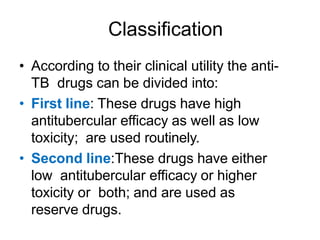
Classification
• According to their clinical utility the anti-
TB drugs can be divided into:
• First line: These drugs have high
antitubercular efficacy as well as low
toxicity; are used routinely.
• Second line:These drugs have either
low antitubercular efficacy or higher
toxicity or both; and are used as
reserve drugs.
First line drugs
• 1. Isoniazid (H)
• 2. Rifampin (R)
• 3. Pyrazinamide
(Z)
• 4. Ethambutol (E)
• 5. Streptomycin
(S)
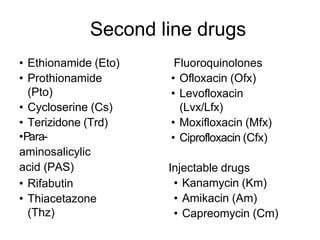
Second line drugs
• Ethionamide (Eto)
• Prothionamide
(Pto)
• Cycloserine (Cs)
• Terizidone (Trd)
•Para-
aminosalicylic
acid (PAS)
• Rifabutin
• Thiacetazone
(Thz)
Fluoroquinolones
• Ofloxacin (Ofx)
• Levofloxacin
(Lvx/Lfx)
• Moxifloxacin (Mfx)
• Ciprofloxacin (Cfx)
Injectable drugs
• Kanamycin (Km)
• Amikacin (Am)
• Capreomycin (Cm)
Drug resistance
Monodrug
resistance
Resistance to either H/R/Z/E/S
Polydrug
resistance
Resistance to HZ or ZE
Multidrug
resistance TB
Resistance to H + R
XDR TB Resistance to HR + Injectable +
FQ
Isoniazid (Isonicotinic acid hydrazide,H)
• It is primarily tuberculocidal.
• Isoniazid inhibits synthesis of mycolic
acids, which are essential components
of mycobacterial cell walls.
• Isoniazid is a prodrug that is activated by
KatG, the mycobacterial catalase-
peroxidase.
Pharmacokinetics
• INH is completely absorbed orally
and penetrates all body tissues,
tubercular cavities, placenta and
meninges.
• It is extensively metabolized in liver;
most important pathway being N-
acetylation.
Isoniazid: Metabolism
• The rate of INH acetylation shows
genetic variation. There are either:
• Fast acetylators: (30–40% of Indians)
t½ of INH 1 hr.
• Slow acetylators:(60–70% of Indians)
t½ of INH 3 hr.
• Isoniazid induced peripheral
neuropathy is more common in slow
acetylators.
Isoniazid: Adverse Effects
• Hepatitis
• a major adverse effect of INH, is rare in
children, but more common in older people
and in alcoholics (chronic alcoholism
induces CYP2E1 which generates the
hepato- toxic metabolite).
• INH hepatotoxicity is due to dose-
related damage to liver cells, but is
reversible on stopping the drug.
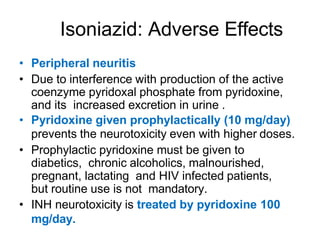
Isoniazid: Adverse Effects
• Peripheral neuritis
• Due to interference with production of the active
coenzyme pyridoxal phosphate from pyridoxine,
and its increased excretion in urine .
• Pyridoxine given prophylactically (10 mg/day)
prevents the neurotoxicity even with higher doses.
• Prophylactic pyridoxine must be given to
diabetics, chronic alcoholics, malnourished,
pregnant, lactating and HIV infected patients,
but routine use is not mandatory.
• INH neurotoxicity is treated by pyridoxine 100
mg/day.
Isoniazid
• 1 in 106 bacteria are resistant to
INH.
• Resistance: inh A gene
Rifampin (Rifampicin, R)
• Bactericidal to M. tuberculosis.
• Acts best on slowly or intermittently
dividing ones (spurters).
• Both extra- and intracellular organisms are
affected.
• It can kill organisms that are poorly accessible to
many other drugs, such as intracellular
organisms and those sequestered in abscesses
and lung cavities.
• Rifampin binds to bacterial DNA-dependent
RNA polymerase and thereby inhibits RNA
synthesis.
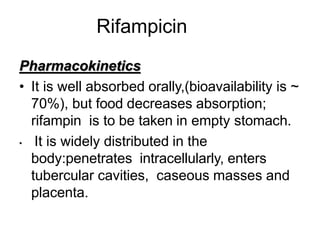
Rifampicin
Pharmacokinetics
• It is well absorbed orally,(bioavailability is ~
70%), but food decreases absorption;
rifampin is to be taken in empty stomach.
• It is widely distributed in the
body:penetrates intracellularly, enters
tubercular cavities, caseous masses and
placenta.
Rifampicin
Interactions
• Rifampicin is a microsomal enzyme
inducer.
• Dose titration is necessary when
Rifampin is taken alongwith OCP,
antiretroviral drugs.
Rifampicin
Adverse effects
• Cholestatic jaundice and occasionally
hepatitis.
• Cutaneous syndrome: flushing, pruritus +
rash (especially on face and scalp),
redness and watering of eyes.
• Flu syndrome: with chills, fever, headache,
malaise and bone pain.
• Abdominal syndrome: nausea, vomiting,
abdominal cramps with or without
diarrhoea.
• Urine and secretions may become orange-
Rifampicin
• 1 in 107bacilli are resistant to
rifampin.
• Mechanism of resistance : rpo B
gene.
Pyrazinamide (Z)
• Chemically similar to INH
• It is weakly tuberculocidal.
• More active in acidic medium.
• It is more lethal to intracellularly locate
bacilli and to those at sites showing an
inflammatory response (pH is acidic at
both these locations).
• MOA: inhibits mycolic acid synthesis
(cell wall synthesis inhibition).
Pyrazinamide (Z)
Pharmacokinetics
• Pyrazinamide is absorbed orally, widely
distributed, has good penetration in CSF,
because of which it is highly useful in
meningeal TB; extensively metabolized in
liver and excreted in urine; plasma t½ is
6–10 hours.
Pyrazinamide (Z)
Adverse effects
• Hepatotoxicity
• Hyperuricaemia
• Other adverse effects are abdominal
distress, arthralgia, flushing, rashes,
fever and loss of diabetes control:
repeated blood glucose monitoring is
warranted in diabetics.
Ethambutol (E)
• Tuberculostatic
• Fast multiplying bacilli are more
susceptible.
• MOA: to inhibit arabinosyl transferases
involved in arabinogalactan synthesis
thereby interfering with mycolic acid
incorporation in mycobacterial cell wall.
• Renal excretion
Ethambutol(E)
Adverse Effects
• Loss of visual acuity/colour
vision, field defects due to optic
neuritis.
• Hyperuricemia
Streptomycin (S)
• Tuberculocidal
• Acts only on extracellular bacilli
(because of poor penetration into cells).
• It penetrates tubercular cavities, but does
not cross to the CSF, and has poor
action in acidic medium.
Disadvantages of Streptomycin(S)
• Need for i.m. injections.
• lower margin of safety
• (ototoxicity and nephrotoxicity)
• S is used only as an alternative to or
in addition to other 1st line anti- TB
drugs.
• Use is restricted to a maximum of 2
months. It is thus also labelled asa
‘supplemental’ 1st line drug.
Second line
drugs
Tuberculosis in pregnant women
• 2 HRE + 7HR (total 9 months).
• S is contraindicated because it is
ototoxic to the foetus.
• Z is not recommended (due to
lack of adequate teratogenicity
data).
Treatment of breastfeeding women
• All anti-TB drugs are compatible
with breastfeeding;
• full course should be given to the mother,
but the baby should be watched.
• The infant should receive BCG
vaccination and 6 month isoniazid
preventive treatment after ruling out
active TB.
Chemoprophylaxis
• This is indicated only in :
• (a) Contacts of open cases who show recent
Mantoux conversion.
• (b) Children with positive Mantoux and a TB
patient in the family.
• (c) Neonate of tubercular mother.
• (d) Patients of leukaemia, diabetes, silicosis, or
those who are HIV positive, or are on
corticosteroid therapy who show a positive
Mantoux.
• (e) Patients with old inactive disease who are
assessed to have received inadequate therapy.
• The standard drug for chemoprophylaxis
of TB is H 300 mg (10 mg/kg in
children) daily for 6 months.
• Because of spread of INH resistance, a
combination of H (5 mg/kg) and R (10
mg/kg, maximum 600 mg) daily given for
3 months is preferred in some areas.
Tuberculosis in AIDS patients
• Initial intensive phase therapy with daily
HRZE for 2 months is started
immediately on the diagnosis of TB,
and is followed by a continuation
phase of HR for 4–7 months (total 6–9
months).
• Pyridoxine 25–50 mg/day is routinely
given along with H to counteract its
neurological side effects, which are
more likely in AIDS patients.
Tuberculosis in AIDS patients
• All HIV positive TB patients should also
receive cotrimoxazole preventive therapy
at least throughout the anti-TB regimen.
• Rifabutin (a less potent enzyme
inducer) given for 9–12 months may be
substituted for rifampin.
Take home message
• All first line drugs are bacteriocidal
except ethambutol.
• Most potent first line drug-Rifampin
• Drug acting well in acidic and
intracellular environment-
pyrazinamide(Z)
• Drug acting inintracellular+
extracellular environment- Rifampin
• Drugs acting on Rapid dividing and
intermittant dividing bacilli- Rifampin +
Pyrazinamide
Take home message
• Drug causing blindness-Ethambutol
• Drug acting extracellularly and in
alkaline medium- streptomycin
Thank You

antituberculardrugs.pptx

  • 1.
  • 2.
    Introduction • Tuberculosis isa chronic granulomatous disease and a major health problem in developing countries. • About 1/3rd of the world’s population is infected with Mycobact. tuberculosis. • In India, control and treatment of TB is covered under a National programme which provides free treatment to all TB cases.
  • 3.
    • India hasa large load of HIV infected subjects, and these patients are especially vulnerable to severe forms of tubercular/MAC infection. • Mycobacteria have caused epic diseases: Tuberculosis (TB) and leprosy have terrorized humankind since antiquity. • Although the burden of leprosy has decreased, TB is still the most important infectious killer of humans.
  • 4.
    Introduction • Mycobacterium, fromthe Greek "mycos," refers to Mycobacteria's waxy appearance, which is due to the composition of their cell walls. More than 60% of the cell wall is lipid, mainly mycolic acids. • This extraordinary shield prevents many pharmacological compounds from getting to the bacterial cell membrane or inside the cytosol.
  • 5.
    • Another barrieris the propensity of some of the bacilli to hide inside the patient's cells, thereby surrounding themselves with an extra physicochemical barrier that antimicrobial agents must cross to be effective.
  • 6.
    Classification • According totheir clinical utility the anti- TB drugs can be divided into: • First line: These drugs have high antitubercular efficacy as well as low toxicity; are used routinely. • Second line:These drugs have either low antitubercular efficacy or higher toxicity or both; and are used as reserve drugs.
  • 7.
    First line drugs •1. Isoniazid (H) • 2. Rifampin (R) • 3. Pyrazinamide (Z) • 4. Ethambutol (E) • 5. Streptomycin (S)
  • 8.
    Second line drugs •Ethionamide (Eto) • Prothionamide (Pto) • Cycloserine (Cs) • Terizidone (Trd) •Para- aminosalicylic acid (PAS) • Rifabutin • Thiacetazone (Thz) Fluoroquinolones • Ofloxacin (Ofx) • Levofloxacin (Lvx/Lfx) • Moxifloxacin (Mfx) • Ciprofloxacin (Cfx) Injectable drugs • Kanamycin (Km) • Amikacin (Am) • Capreomycin (Cm)
  • 9.
    Drug resistance Monodrug resistance Resistance toeither H/R/Z/E/S Polydrug resistance Resistance to HZ or ZE Multidrug resistance TB Resistance to H + R XDR TB Resistance to HR + Injectable + FQ
  • 10.
    Isoniazid (Isonicotinic acidhydrazide,H) • It is primarily tuberculocidal. • Isoniazid inhibits synthesis of mycolic acids, which are essential components of mycobacterial cell walls. • Isoniazid is a prodrug that is activated by KatG, the mycobacterial catalase- peroxidase.
  • 11.
    Pharmacokinetics • INH iscompletely absorbed orally and penetrates all body tissues, tubercular cavities, placenta and meninges. • It is extensively metabolized in liver; most important pathway being N- acetylation.
  • 12.
    Isoniazid: Metabolism • Therate of INH acetylation shows genetic variation. There are either: • Fast acetylators: (30–40% of Indians) t½ of INH 1 hr. • Slow acetylators:(60–70% of Indians) t½ of INH 3 hr. • Isoniazid induced peripheral neuropathy is more common in slow acetylators.
  • 13.
    Isoniazid: Adverse Effects •Hepatitis • a major adverse effect of INH, is rare in children, but more common in older people and in alcoholics (chronic alcoholism induces CYP2E1 which generates the hepato- toxic metabolite). • INH hepatotoxicity is due to dose- related damage to liver cells, but is reversible on stopping the drug.
  • 14.
    Isoniazid: Adverse Effects •Peripheral neuritis • Due to interference with production of the active coenzyme pyridoxal phosphate from pyridoxine, and its increased excretion in urine . • Pyridoxine given prophylactically (10 mg/day) prevents the neurotoxicity even with higher doses. • Prophylactic pyridoxine must be given to diabetics, chronic alcoholics, malnourished, pregnant, lactating and HIV infected patients, but routine use is not mandatory. • INH neurotoxicity is treated by pyridoxine 100 mg/day.
  • 15.
    Isoniazid • 1 in106 bacteria are resistant to INH. • Resistance: inh A gene
  • 16.
    Rifampin (Rifampicin, R) •Bactericidal to M. tuberculosis. • Acts best on slowly or intermittently dividing ones (spurters). • Both extra- and intracellular organisms are affected. • It can kill organisms that are poorly accessible to many other drugs, such as intracellular organisms and those sequestered in abscesses and lung cavities. • Rifampin binds to bacterial DNA-dependent RNA polymerase and thereby inhibits RNA synthesis.
  • 17.
    Rifampicin Pharmacokinetics • It iswell absorbed orally,(bioavailability is ~ 70%), but food decreases absorption; rifampin is to be taken in empty stomach. • It is widely distributed in the body:penetrates intracellularly, enters tubercular cavities, caseous masses and placenta.
  • 18.
    Rifampicin Interactions • Rifampicin isa microsomal enzyme inducer. • Dose titration is necessary when Rifampin is taken alongwith OCP, antiretroviral drugs.
  • 19.
    Rifampicin Adverse effects • Cholestaticjaundice and occasionally hepatitis. • Cutaneous syndrome: flushing, pruritus + rash (especially on face and scalp), redness and watering of eyes. • Flu syndrome: with chills, fever, headache, malaise and bone pain. • Abdominal syndrome: nausea, vomiting, abdominal cramps with or without diarrhoea. • Urine and secretions may become orange-
  • 20.
    Rifampicin • 1 in107bacilli are resistant to rifampin. • Mechanism of resistance : rpo B gene.
  • 21.
    Pyrazinamide (Z) • Chemicallysimilar to INH • It is weakly tuberculocidal. • More active in acidic medium. • It is more lethal to intracellularly locate bacilli and to those at sites showing an inflammatory response (pH is acidic at both these locations). • MOA: inhibits mycolic acid synthesis (cell wall synthesis inhibition).
  • 22.
    Pyrazinamide (Z) Pharmacokinetics • Pyrazinamideis absorbed orally, widely distributed, has good penetration in CSF, because of which it is highly useful in meningeal TB; extensively metabolized in liver and excreted in urine; plasma t½ is 6–10 hours.
  • 23.
    Pyrazinamide (Z) Adverse effects •Hepatotoxicity • Hyperuricaemia • Other adverse effects are abdominal distress, arthralgia, flushing, rashes, fever and loss of diabetes control: repeated blood glucose monitoring is warranted in diabetics.
  • 24.
    Ethambutol (E) • Tuberculostatic •Fast multiplying bacilli are more susceptible. • MOA: to inhibit arabinosyl transferases involved in arabinogalactan synthesis thereby interfering with mycolic acid incorporation in mycobacterial cell wall. • Renal excretion
  • 25.
    Ethambutol(E) Adverse Effects • Lossof visual acuity/colour vision, field defects due to optic neuritis. • Hyperuricemia
  • 26.
    Streptomycin (S) • Tuberculocidal •Acts only on extracellular bacilli (because of poor penetration into cells). • It penetrates tubercular cavities, but does not cross to the CSF, and has poor action in acidic medium.
  • 27.
    Disadvantages of Streptomycin(S) •Need for i.m. injections. • lower margin of safety • (ototoxicity and nephrotoxicity) • S is used only as an alternative to or in addition to other 1st line anti- TB drugs. • Use is restricted to a maximum of 2 months. It is thus also labelled asa ‘supplemental’ 1st line drug.
  • 28.
  • 31.
    Tuberculosis in pregnantwomen • 2 HRE + 7HR (total 9 months). • S is contraindicated because it is ototoxic to the foetus. • Z is not recommended (due to lack of adequate teratogenicity data).
  • 32.
    Treatment of breastfeedingwomen • All anti-TB drugs are compatible with breastfeeding; • full course should be given to the mother, but the baby should be watched. • The infant should receive BCG vaccination and 6 month isoniazid preventive treatment after ruling out active TB.
  • 33.
    Chemoprophylaxis • This isindicated only in : • (a) Contacts of open cases who show recent Mantoux conversion. • (b) Children with positive Mantoux and a TB patient in the family. • (c) Neonate of tubercular mother. • (d) Patients of leukaemia, diabetes, silicosis, or those who are HIV positive, or are on corticosteroid therapy who show a positive Mantoux. • (e) Patients with old inactive disease who are assessed to have received inadequate therapy.
  • 34.
    • The standarddrug for chemoprophylaxis of TB is H 300 mg (10 mg/kg in children) daily for 6 months. • Because of spread of INH resistance, a combination of H (5 mg/kg) and R (10 mg/kg, maximum 600 mg) daily given for 3 months is preferred in some areas.
  • 35.
    Tuberculosis in AIDSpatients • Initial intensive phase therapy with daily HRZE for 2 months is started immediately on the diagnosis of TB, and is followed by a continuation phase of HR for 4–7 months (total 6–9 months). • Pyridoxine 25–50 mg/day is routinely given along with H to counteract its neurological side effects, which are more likely in AIDS patients.
  • 36.
    Tuberculosis in AIDSpatients • All HIV positive TB patients should also receive cotrimoxazole preventive therapy at least throughout the anti-TB regimen. • Rifabutin (a less potent enzyme inducer) given for 9–12 months may be substituted for rifampin.
  • 37.
    Take home message •All first line drugs are bacteriocidal except ethambutol. • Most potent first line drug-Rifampin • Drug acting well in acidic and intracellular environment- pyrazinamide(Z) • Drug acting inintracellular+ extracellular environment- Rifampin • Drugs acting on Rapid dividing and intermittant dividing bacilli- Rifampin + Pyrazinamide
  • 38.
    Take home message •Drug causing blindness-Ethambutol • Drug acting extracellularly and in alkaline medium- streptomycin
  • 39.