Early Cancer Detection
Dr O H Negm
ola.negm@nottingham.ac.uk
01.07.2016 Nottingham Pathology 20161
CEAC: Centre of Excellence for Autoimmunity in Cancer
01.07.2016
Nottingham Pathology 2016
2
• Within a 30 year period (2000 – 2030), cancer is predicted to double in
incidence worldwide, with a concurrent doubling in number of deaths/year.
01.07.2016 Nottingham Pathology 20163
• For many types of cancer the outlook has changed little in the last 30
years.
– Lung cancer – <10% have surgery in UK and 5%-10% alive at 5 years
– Pancreatic cancer – 1% alive at 5 year
• Most people are diagnosed only when there is a late ‘presentation’ of the
cancer; impaired survival, major forms of therapy, major operation,
chemotherapy and radiotherapy.
Early detection and treatment has been shown to
significantly reduce mortality:
Randomised trials (‘Level 1’ evidence)
• Breast Cancer - Mammography (50-74yrs)
– 23% reduction in deaths from breast cancer
– [NB: only ~1/3rd of BCs occur between 50-74]
• Lung Cancer – CT scans (55-74yrs, >30 pys)
– 20% reduction in deaths from lung cancer
– [NB: Only ~1/3rd LCs occur in NLST trial]
• Colon Cancer – faecal occult blood test + colonoscopy (>50yrs)
– 16% reduction in deaths from colon cancer
– [NB: Only ~1/3rd individuals accept colon screening]
01.07.2016 Nottingham Pathology 20164
Our solution is to provide a blood test that will:
• Improve public acceptability.
• Provide improved sensitivity & specificity compared to other screening
methods.
• This will significantly improve clinical outcomes (improved survival
rates) and cost-effectiveness.
01.07.2016 Nottingham Pathology 20165
01.07.2016 Nottingham Pathology 2016 6
01.07.2016 Nottingham Pathology 20167
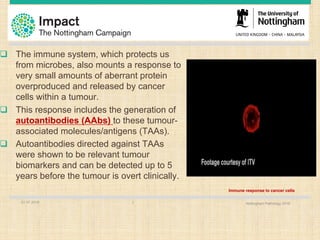
q The immune system, which protects us
from microbes, also mounts a response to
very small amounts of aberrant protein
overproduced and released by cancer
cells within a tumour.
q This response includes the generation of
autoantibodies (AAbs) to these tumour-
associated molecules/antigens (TAAs).
q Autoantibodies directed against TAAs
were shown to be relevant tumour
biomarkers and can be detected up to 5
years before the tumour is overt clinically.
Immune response to cancer cells
01.07.2016 Nottingham Pathology 20168
1- Lung Cancer.
2- Colorectal Carcinoma.
3- Breast Cancer.
01.07.2016 Nottingham Pathology 20169
01.07.2016 Nottingham Pathology 201610
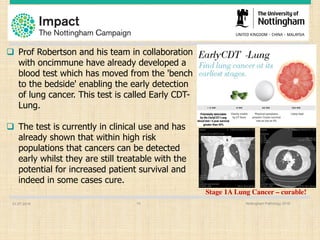
q Prof Robertson and his team in collaboration
with oncimmune have already developed a
blood test which has moved from the 'bench
to the bedside' enabling the early detection
of lung cancer. This test is called Early CDT-
Lung.
q The test is currently in clinical use and has
already shown that within high risk
populations that cancers can be detected
early whilst they are still treatable with the
potential for increased patient survival and
indeed in some cases cure.
Stage 1A Lung Cancer – curable!
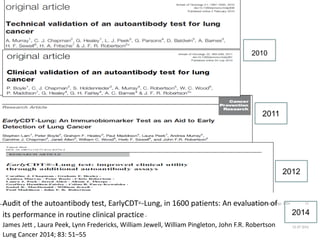
2010
2011
2014
2012
Audit	of	the	autoantibody	test,	EarlyCDT®-Lung,	in	1600	patients:	An	evaluation	of	
its	performance	in	routine	clinical	practice_
James	Jett	,	Laura	Peek,	Lynn	Fredericks,	William	Jewell,	William	Pingleton,	John	F.R.	Robertson
Lung	Cancer	2014;	83:	51–55
01.07.2016
Nottingham Pathology 2016 11
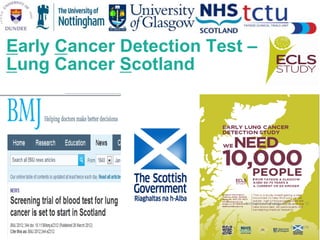
Early Cancer Detection Test –
Lung Cancer Scotland
01.07.2016
Nottingham Pathology 2016 12
01.07.2016 Nottingham Pathology 201613
Background
• Colorectal cancer (CRC) is the 2nd highest cause of cancer mortality in the
Western world.
• Key to better survival is early diagnosis (>90% survival if detected early).
• Current early diagnostic methods (ie Faecal sampling) have low takeup
(57%:Uk, 34% EU). Alternative investigations are invasive (ie
sigmoidoscopy, colonoscopy) and have equally poor patient acceptability.
01.07.2016 Nottingham Pathology 201614
01.07.2016 Nottingham Pathology 2016
Antigen-based protein microarrays:
q TAAs are arrayed (spotted) as a regular
pattern (a microarray) onto an activated surface. A single array can
have multiple TAAs, each at separate location.
q A 5x5mm array can accommodate up to
150+ individual features.
q Immobilized TAAs are exposed to a
patient serum sample.
q Autoantibodies binding to any of the
TAAs can be detected fluorescently and
measured
Antigen-based protein microarrays
Advantages including:
• High throughput, much increased capacity for multiplexing detection
of a range of specific AABs.
• Reduced requirements for TAAs, serum and reagents;
• Increased assay robustness; better sensitivity and specificity than
that achievable by ELISA-based assays.
01.07.2016 Nottingham Pathology 201616
Serum samples: sera from 3 different cohorts; 200 sera from Pittsburgh,
USA (100 CRC and 100 controls), 42 sera (21 CRC and 21 matched controls)
from New York, USA, and 20 sera from Dundee, UK (10 CRC and 10 controls)
were tested.
A panel of multiple tumour-associated antigens (TAAs) using an
optimised multiplex microarray system. Tumour-associated antigen selection:
a panel of 32 TAAs (non-glycosylated recombinant proteins expressed in
E.coli) were included: P53, SOX2, NY-ESO-1, GBU, MAGE A4, HuD, AFP,
Gankyrin, GRP78, HCC1, HDGF, H-Ras1, IMP, p62, RalA, MUC1, CEA, Annexin
A1, rhUteroglobulin (CCSP1), K-Ras, APC1, APC2 blocking peptide, SDCCAG8
(NY-CO-8), TDRD6 (NY-CO-45), vWFA2 (CCSP2), ErbB2, RAF1, SCGB1A1,
CA19-9, UTP14A (NY-CO-16), K-RAS-Q61H and APC-N.
Pilot study
01.07.2016 Nottingham Pathology 201617
01.07.2016 Nottingham Pathology 201618
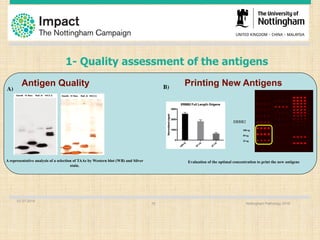
1- Quality assessment of the antigens
Antigen Quality
A representative analysis of a selection of TAAs by Western blot (WB) and Silver
stain.
A)
Printing New Antigens
Evaluation of the optimal concentration to print the new antigens
ERBB2
100 ug
50 ug
25 ug
B)
01.07.2016
Nottingham Pathology 201619
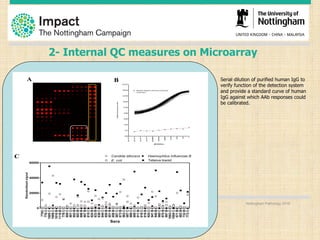
2- Internal QC measures on Microarray
Serial dilution of purified human IgG to
verify function of the detection system
and provide a standard curve of human
IgG against which AAb responses could
be calibrated.
Nottingham Pathology 2016
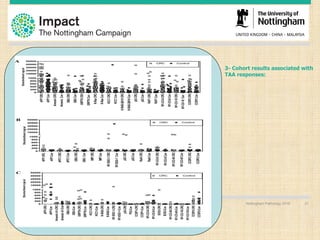
3- Cohort results associated with
TAA responses:
Nottingham Pathology 2016 21
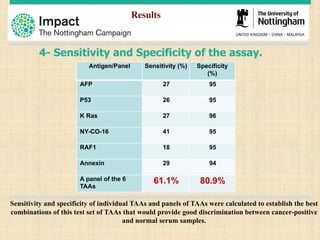
4- Sensitivity and Specificity of the assay.
Antigen/Panel Sensitivity (%) Specificity
(%)
AFP 27 95
P53 26 95
K Ras 27 96
NY-CO-16 41 95
RAF1 18 95
Annexin 29 94
A panel of the 6
TAAs
61.1% 80.9%
Sensitivity and specificity of individual TAAs and panels of TAAs were calculated to establish the best
combinations of this test set of TAAs that would provide good discrimination between cancer-positive
and normal serum samples.
Results
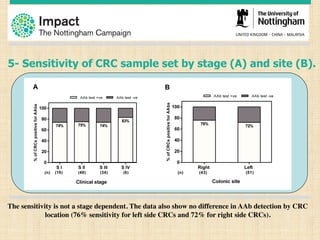
5- Sensitivity of CRC sample set by stage (A) and site (B).
The sensitivity is not a stage dependent. The data also show no difference in AAb detection by CRC
location (76% sensitivity for left side CRCs and 72% for right side CRCs).
01.07.2016
Nottingham Pathology 201624
Human blood autoantibodies in the detection of colorectal cancer
Ola	H	Negm,	Mohamed	R	Hamed,	Robert	E	Schoen,	Richard	L	Whelan,	Robert	J	Steele,	John	Scholefield,	Elizabeth	M	Dilnot,	Shantha
Kumara,	John	FR	Robertson,	Herbert	F	Sewell.
PLOS one- June 2016
01.07.2016 Nottingham Pathology 201625
01.07.2016 Nottingham Pathology 201626
Pilot Study for Early Detection of breast cancer
q The preliminary data confirmed that BC also induces autoantibodies (AAbs) against
the small number of specific tumour associated antigens (TAAs) used in this pilot
study.
q These pilot results showed positive autoantibody signal was detectable across all age
ranges (ie <50yrs, 50-70 years and >70 years) and that the positive tests were as
frequent in early stage cancer (stages 1 & 2) as in late stage disease. The results
showed that 90% of positive samples for the autoantibody test were hormone
receptor positive (HR +ve).
q Initial proof of principle studies have been run to confirm our hypothesis.
q Breast cancer serum samples included 300 invasive BC, (approx. 50% being stage
1/2) and 300 age and gender matched controls.
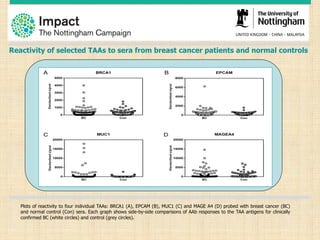
Plots of reactivity to four individual TAAs: BRCA1 (A), EPCAM (B), MUC1 (C) and MAGE A4 (D) probed with breast cancer (BC)
and normal control (Con) sera. Each graph shows side-by-side comparisons of AAb responses to the TAA antigens for clinically
confirmed BC (white circles) and control (grey circles).
Reactivity of selected TAAs to sera from breast cancer patients and normal controls
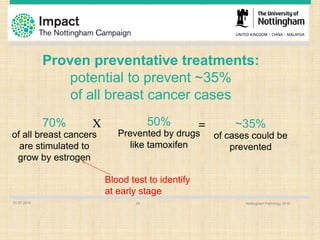
Proven preventative treatments:
potential to prevent ~35%
of all breast cancer cases
01.07.2016 Nottingham Pathology 201628
70%
of all breast cancers
are stimulated to
grow by estrogen
50%
Prevented by drugs
like tamoxifen
~35%
of cases could be
prevented
X =
Blood test to identify
at early stage
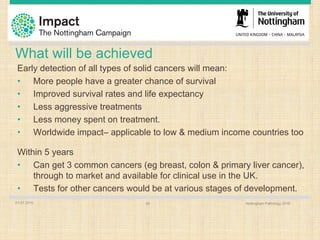
What will be achieved
Early detection of all types of solid cancers will mean:
• More people have a greater chance of survival
• Improved survival rates and life expectancy
• Less aggressive treatments
• Less money spent on treatment.
• Worldwide impact– applicable to low & medium income countries too
Within 5 years
• Can get 3 common cancers (eg breast, colon & primary liver cancer),
through to market and available for clinical use in the UK.
• Tests for other cancers would be at various stages of development.
01.07.2016 Nottingham Pathology 201629
Acknowledgment
Prof John Robertson Prof Herb Sewell
30

Antigen Microarray Technology for Early detection of Solid Cancers.

  • 1.
    Early Cancer Detection DrO H Negm ola.negm@nottingham.ac.uk 01.07.2016 Nottingham Pathology 20161 CEAC: Centre of Excellence for Autoimmunity in Cancer
  • 2.
  • 3.
    • Within a30 year period (2000 – 2030), cancer is predicted to double in incidence worldwide, with a concurrent doubling in number of deaths/year. 01.07.2016 Nottingham Pathology 20163 • For many types of cancer the outlook has changed little in the last 30 years. – Lung cancer – <10% have surgery in UK and 5%-10% alive at 5 years – Pancreatic cancer – 1% alive at 5 year • Most people are diagnosed only when there is a late ‘presentation’ of the cancer; impaired survival, major forms of therapy, major operation, chemotherapy and radiotherapy.
  • 4.
    Early detection andtreatment has been shown to significantly reduce mortality: Randomised trials (‘Level 1’ evidence) • Breast Cancer - Mammography (50-74yrs) – 23% reduction in deaths from breast cancer – [NB: only ~1/3rd of BCs occur between 50-74] • Lung Cancer – CT scans (55-74yrs, >30 pys) – 20% reduction in deaths from lung cancer – [NB: Only ~1/3rd LCs occur in NLST trial] • Colon Cancer – faecal occult blood test + colonoscopy (>50yrs) – 16% reduction in deaths from colon cancer – [NB: Only ~1/3rd individuals accept colon screening] 01.07.2016 Nottingham Pathology 20164
  • 5.
    Our solution isto provide a blood test that will: • Improve public acceptability. • Provide improved sensitivity & specificity compared to other screening methods. • This will significantly improve clinical outcomes (improved survival rates) and cost-effectiveness. 01.07.2016 Nottingham Pathology 20165
  • 6.
  • 7.
    01.07.2016 Nottingham Pathology20167 q The immune system, which protects us from microbes, also mounts a response to very small amounts of aberrant protein overproduced and released by cancer cells within a tumour. q This response includes the generation of autoantibodies (AAbs) to these tumour- associated molecules/antigens (TAAs). q Autoantibodies directed against TAAs were shown to be relevant tumour biomarkers and can be detected up to 5 years before the tumour is overt clinically. Immune response to cancer cells
  • 8.
    01.07.2016 Nottingham Pathology20168 1- Lung Cancer. 2- Colorectal Carcinoma. 3- Breast Cancer.
  • 9.
  • 10.
    01.07.2016 Nottingham Pathology201610 q Prof Robertson and his team in collaboration with oncimmune have already developed a blood test which has moved from the 'bench to the bedside' enabling the early detection of lung cancer. This test is called Early CDT- Lung. q The test is currently in clinical use and has already shown that within high risk populations that cancers can be detected early whilst they are still treatable with the potential for increased patient survival and indeed in some cases cure. Stage 1A Lung Cancer – curable!
  • 11.
  • 12.
    Early Cancer DetectionTest – Lung Cancer Scotland 01.07.2016 Nottingham Pathology 2016 12
  • 13.
  • 14.
    Background • Colorectal cancer(CRC) is the 2nd highest cause of cancer mortality in the Western world. • Key to better survival is early diagnosis (>90% survival if detected early). • Current early diagnostic methods (ie Faecal sampling) have low takeup (57%:Uk, 34% EU). Alternative investigations are invasive (ie sigmoidoscopy, colonoscopy) and have equally poor patient acceptability. 01.07.2016 Nottingham Pathology 201614
  • 15.
    01.07.2016 Nottingham Pathology2016 Antigen-based protein microarrays: q TAAs are arrayed (spotted) as a regular pattern (a microarray) onto an activated surface. A single array can have multiple TAAs, each at separate location. q A 5x5mm array can accommodate up to 150+ individual features. q Immobilized TAAs are exposed to a patient serum sample. q Autoantibodies binding to any of the TAAs can be detected fluorescently and measured
  • 16.
    Antigen-based protein microarrays Advantagesincluding: • High throughput, much increased capacity for multiplexing detection of a range of specific AABs. • Reduced requirements for TAAs, serum and reagents; • Increased assay robustness; better sensitivity and specificity than that achievable by ELISA-based assays. 01.07.2016 Nottingham Pathology 201616
  • 17.
    Serum samples: serafrom 3 different cohorts; 200 sera from Pittsburgh, USA (100 CRC and 100 controls), 42 sera (21 CRC and 21 matched controls) from New York, USA, and 20 sera from Dundee, UK (10 CRC and 10 controls) were tested. A panel of multiple tumour-associated antigens (TAAs) using an optimised multiplex microarray system. Tumour-associated antigen selection: a panel of 32 TAAs (non-glycosylated recombinant proteins expressed in E.coli) were included: P53, SOX2, NY-ESO-1, GBU, MAGE A4, HuD, AFP, Gankyrin, GRP78, HCC1, HDGF, H-Ras1, IMP, p62, RalA, MUC1, CEA, Annexin A1, rhUteroglobulin (CCSP1), K-Ras, APC1, APC2 blocking peptide, SDCCAG8 (NY-CO-8), TDRD6 (NY-CO-45), vWFA2 (CCSP2), ErbB2, RAF1, SCGB1A1, CA19-9, UTP14A (NY-CO-16), K-RAS-Q61H and APC-N. Pilot study 01.07.2016 Nottingham Pathology 201617
  • 18.
  • 19.
    1- Quality assessmentof the antigens Antigen Quality A representative analysis of a selection of TAAs by Western blot (WB) and Silver stain. A) Printing New Antigens Evaluation of the optimal concentration to print the new antigens ERBB2 100 ug 50 ug 25 ug B) 01.07.2016 Nottingham Pathology 201619
  • 20.
    2- Internal QCmeasures on Microarray Serial dilution of purified human IgG to verify function of the detection system and provide a standard curve of human IgG against which AAb responses could be calibrated. Nottingham Pathology 2016
  • 21.
    3- Cohort resultsassociated with TAA responses: Nottingham Pathology 2016 21
  • 22.
    4- Sensitivity andSpecificity of the assay. Antigen/Panel Sensitivity (%) Specificity (%) AFP 27 95 P53 26 95 K Ras 27 96 NY-CO-16 41 95 RAF1 18 95 Annexin 29 94 A panel of the 6 TAAs 61.1% 80.9% Sensitivity and specificity of individual TAAs and panels of TAAs were calculated to establish the best combinations of this test set of TAAs that would provide good discrimination between cancer-positive and normal serum samples. Results
  • 23.
    5- Sensitivity ofCRC sample set by stage (A) and site (B). The sensitivity is not a stage dependent. The data also show no difference in AAb detection by CRC location (76% sensitivity for left side CRCs and 72% for right side CRCs).
  • 24.
    01.07.2016 Nottingham Pathology 201624 Humanblood autoantibodies in the detection of colorectal cancer Ola H Negm, Mohamed R Hamed, Robert E Schoen, Richard L Whelan, Robert J Steele, John Scholefield, Elizabeth M Dilnot, Shantha Kumara, John FR Robertson, Herbert F Sewell. PLOS one- June 2016
  • 25.
  • 26.
    01.07.2016 Nottingham Pathology201626 Pilot Study for Early Detection of breast cancer q The preliminary data confirmed that BC also induces autoantibodies (AAbs) against the small number of specific tumour associated antigens (TAAs) used in this pilot study. q These pilot results showed positive autoantibody signal was detectable across all age ranges (ie <50yrs, 50-70 years and >70 years) and that the positive tests were as frequent in early stage cancer (stages 1 & 2) as in late stage disease. The results showed that 90% of positive samples for the autoantibody test were hormone receptor positive (HR +ve). q Initial proof of principle studies have been run to confirm our hypothesis. q Breast cancer serum samples included 300 invasive BC, (approx. 50% being stage 1/2) and 300 age and gender matched controls.
  • 27.
    Plots of reactivityto four individual TAAs: BRCA1 (A), EPCAM (B), MUC1 (C) and MAGE A4 (D) probed with breast cancer (BC) and normal control (Con) sera. Each graph shows side-by-side comparisons of AAb responses to the TAA antigens for clinically confirmed BC (white circles) and control (grey circles). Reactivity of selected TAAs to sera from breast cancer patients and normal controls
  • 28.
    Proven preventative treatments: potentialto prevent ~35% of all breast cancer cases 01.07.2016 Nottingham Pathology 201628 70% of all breast cancers are stimulated to grow by estrogen 50% Prevented by drugs like tamoxifen ~35% of cases could be prevented X = Blood test to identify at early stage
  • 29.
    What will beachieved Early detection of all types of solid cancers will mean: • More people have a greater chance of survival • Improved survival rates and life expectancy • Less aggressive treatments • Less money spent on treatment. • Worldwide impact– applicable to low & medium income countries too Within 5 years • Can get 3 common cancers (eg breast, colon & primary liver cancer), through to market and available for clinical use in the UK. • Tests for other cancers would be at various stages of development. 01.07.2016 Nottingham Pathology 201629
  • 30.