ANTIGEN &
ANTIBODY
ANTIGEN
An antigen is a substance which,
when introduced into a body
produce immune response.
TYPES OF ANTIGEN
A. Complete Antigen
These are substances which can
induce antibody formation by
themselves and can react specifically
with these antibodies.
B. Haptens
Haptens are substances unable to
induce antibody formation on its own
but can become immunogenic
(capable of inducing antibodies) when
covalently linked to proteins, called
carrier proteins.
Heterophile Antigens
The same or closely related antigens
present in different tissues of more than
one species are known as heterophile
antigens.
BIOLOGICAL CLASSES OF
ANTIGENS
1. T-cell Dependent (TD) Antigens
These are antigens which require T
cells participation to stimulate B-cells to
produce antibodies. These antigens
are called TD antigens.
 2. T-cell Independent (TI) Antigens
• These antigens do not require the help of
T-cells for stimulation of B-cells. These
antigens are called TI antigens.
• TI antigens do not require initial antigen
processing by antigen-presenting cells (e.g.
macrophages) unlike TD antigens.
SUPERANTIGENS
• Superantigens are molecules that can interact with
antigen-presenting cells (APCs) and T-lymphocytes in a
nonspecific manner.
• Interaction of superantigens with MHC class II molecules
of the APC and the Vβ domain of the T-lymphocytes
receptor activates a large number of T-lymphocytes than
conventional antigens. This leads to massive cytokine
expression and immunomodulation
ANTIBODIES
 Antibodies or immunoglobulins are specialised proteins which are
formed by immune system in response to an antigen, and react with
that antigen specifically.
 Chemical nature of antibodies is globulin and they are named as
immunoglobulins.

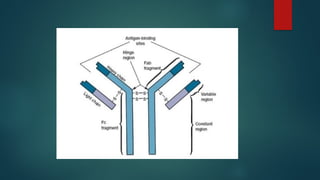
 An antibody molecule consists of two identical heavy and two
identical light chains
IMMUNOGLOBULIN CLASSES
 A. Immunoglobulin G (IgG)
(i) IgG is the major serum immunoglobulin (about
80% of the total amount)
(ii) It is the only immunoglobulin that can cross
placenta.
(iii) IgG appears late but persists for longer period
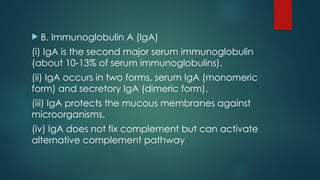
 B. Immunoglobulin A (IgA)
(i) IgA is the second major serum immunoglobulin
(about 10-13% of serum immunoglobulins).
(ii) IgA occurs in two forms, serum IgA (monomeric
form) and secretory IgA (dimeric form).
(iii) IgA protects the mucous membranes against
microorganisms.
(iv) IgA does not fix complement but can activate
alternative complement pathway
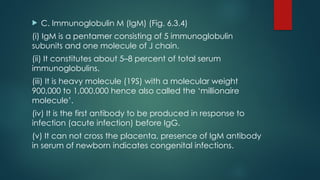
 C. Immunoglobulin M (IgM) (Fig. 6.3.4)
(i) IgM is a pentamer consisting of 5 immunoglobulin
subunits and one molecule of J chain.
(ii) It constitutes about 5–8 percent of total serum
immunoglobulins.
(iii) It is heavy molecule (19S) with a molecular weight
900,000 to 1,000,000 hence also called the ‘millionaire
molecule’.
(iv) It is the first antibody to be produced in response to
infection (acute infection) before IgG.
(v) It can not cross the placenta, presence of IgM antibody
in serum of newborn indicates congenital infections.
 E. Immunoglobulin E (IgE)
(i) IgE is mainly produced in the linings of respiratory and
intestinal tracts.
(ii) It is also referred to as reagins.
(iii) It resembles IgG in structure.
(iv) It is the only heat labile (inactivated at 56°C in one hour)
immunoglobulin.
(v) It has affinity for surface of tissue cells, particularly mast
cells of the same species (homocytotropism).
 D. Immunoglobulin D (IgD)
(i) IgD resembles IgG structurally.
(ii) IgD is also present on the surface of unstimulated B
lymphocytes in blood and acts as recognition receptors for
antigens.
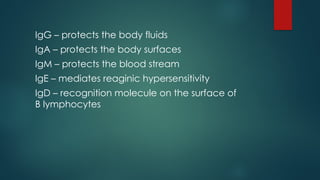
IgG – protects the body fluids
IgA – protects the body surfaces
IgM – protects the blood stream
IgE – mediates reaginic hypersensitivity
IgD – recognition molecule on the surface of
B lymphocytes
Monoclonal Antibodies
 Monoclonal antibodies are antibodies which are
derived from a single clone of plasma cell and
are produced against a single antigenic
determinant (epitope) of an antigen
APPLICATIONS
(i) Diagnostic Use: Many commercial diagnostic systems
use monoclonal antibodies for identification of bacterial,
viral and other antigens.
(ii) Pure antibody: Large amount of pure antibody of
defined class can be prepared.
(iii) Passive immunity: Immunoglobulins against hepatitis B,
rabies and tetanus are used for post-exposure prophylaxis.
(iv) Therapeutic use: Treatment of cancer.
THANK YOU

Antigen & Antibody reaction document pdf

  • 1.
  • 2.
    ANTIGEN An antigen isa substance which, when introduced into a body produce immune response.
  • 3.
    TYPES OF ANTIGEN A.Complete Antigen These are substances which can induce antibody formation by themselves and can react specifically with these antibodies.
  • 4.
    B. Haptens Haptens aresubstances unable to induce antibody formation on its own but can become immunogenic (capable of inducing antibodies) when covalently linked to proteins, called carrier proteins.
  • 5.
    Heterophile Antigens The sameor closely related antigens present in different tissues of more than one species are known as heterophile antigens.
  • 6.
    BIOLOGICAL CLASSES OF ANTIGENS 1.T-cell Dependent (TD) Antigens These are antigens which require T cells participation to stimulate B-cells to produce antibodies. These antigens are called TD antigens.
  • 7.
     2. T-cellIndependent (TI) Antigens • These antigens do not require the help of T-cells for stimulation of B-cells. These antigens are called TI antigens. • TI antigens do not require initial antigen processing by antigen-presenting cells (e.g. macrophages) unlike TD antigens.
  • 8.
    SUPERANTIGENS • Superantigens aremolecules that can interact with antigen-presenting cells (APCs) and T-lymphocytes in a nonspecific manner. • Interaction of superantigens with MHC class II molecules of the APC and the Vβ domain of the T-lymphocytes receptor activates a large number of T-lymphocytes than conventional antigens. This leads to massive cytokine expression and immunomodulation
  • 9.
    ANTIBODIES  Antibodies orimmunoglobulins are specialised proteins which are formed by immune system in response to an antigen, and react with that antigen specifically.  Chemical nature of antibodies is globulin and they are named as immunoglobulins.   An antibody molecule consists of two identical heavy and two identical light chains
  • 11.
    IMMUNOGLOBULIN CLASSES  A.Immunoglobulin G (IgG) (i) IgG is the major serum immunoglobulin (about 80% of the total amount) (ii) It is the only immunoglobulin that can cross placenta. (iii) IgG appears late but persists for longer period
  • 12.
     B. ImmunoglobulinA (IgA) (i) IgA is the second major serum immunoglobulin (about 10-13% of serum immunoglobulins). (ii) IgA occurs in two forms, serum IgA (monomeric form) and secretory IgA (dimeric form). (iii) IgA protects the mucous membranes against microorganisms. (iv) IgA does not fix complement but can activate alternative complement pathway
  • 13.
     C. ImmunoglobulinM (IgM) (Fig. 6.3.4) (i) IgM is a pentamer consisting of 5 immunoglobulin subunits and one molecule of J chain. (ii) It constitutes about 5–8 percent of total serum immunoglobulins. (iii) It is heavy molecule (19S) with a molecular weight 900,000 to 1,000,000 hence also called the ‘millionaire molecule’. (iv) It is the first antibody to be produced in response to infection (acute infection) before IgG. (v) It can not cross the placenta, presence of IgM antibody in serum of newborn indicates congenital infections.
  • 14.
     E. ImmunoglobulinE (IgE) (i) IgE is mainly produced in the linings of respiratory and intestinal tracts. (ii) It is also referred to as reagins. (iii) It resembles IgG in structure. (iv) It is the only heat labile (inactivated at 56°C in one hour) immunoglobulin. (v) It has affinity for surface of tissue cells, particularly mast cells of the same species (homocytotropism).
  • 15.
     D. ImmunoglobulinD (IgD) (i) IgD resembles IgG structurally. (ii) IgD is also present on the surface of unstimulated B lymphocytes in blood and acts as recognition receptors for antigens.
  • 16.
    IgG – protectsthe body fluids IgA – protects the body surfaces IgM – protects the blood stream IgE – mediates reaginic hypersensitivity IgD – recognition molecule on the surface of B lymphocytes
  • 17.
    Monoclonal Antibodies  Monoclonalantibodies are antibodies which are derived from a single clone of plasma cell and are produced against a single antigenic determinant (epitope) of an antigen
  • 19.
    APPLICATIONS (i) Diagnostic Use:Many commercial diagnostic systems use monoclonal antibodies for identification of bacterial, viral and other antigens. (ii) Pure antibody: Large amount of pure antibody of defined class can be prepared. (iii) Passive immunity: Immunoglobulins against hepatitis B, rabies and tetanus are used for post-exposure prophylaxis. (iv) Therapeutic use: Treatment of cancer.
  • 20.