Anticipative Cognition
and its Impact on Personalization
in Business
Executive
SummaryHuman- machine interaction is a key area of interest in the IT world for the
last few years. Now, Computers that could learn, think and function like
human brains are far more a reality than exaggerations in the science
fictions, thanks to the advancements in Cognitive Computing. From the
traditional preprogrammed machines, Cognitive computing shows a huge
leap in the field of computing. It revolutionizes the way in which machines
interact with humans and vice versa. How these Cognitive systems, which
possess anticipation capabilities are poised to transform the way we do
business is an interesting area to ponder.
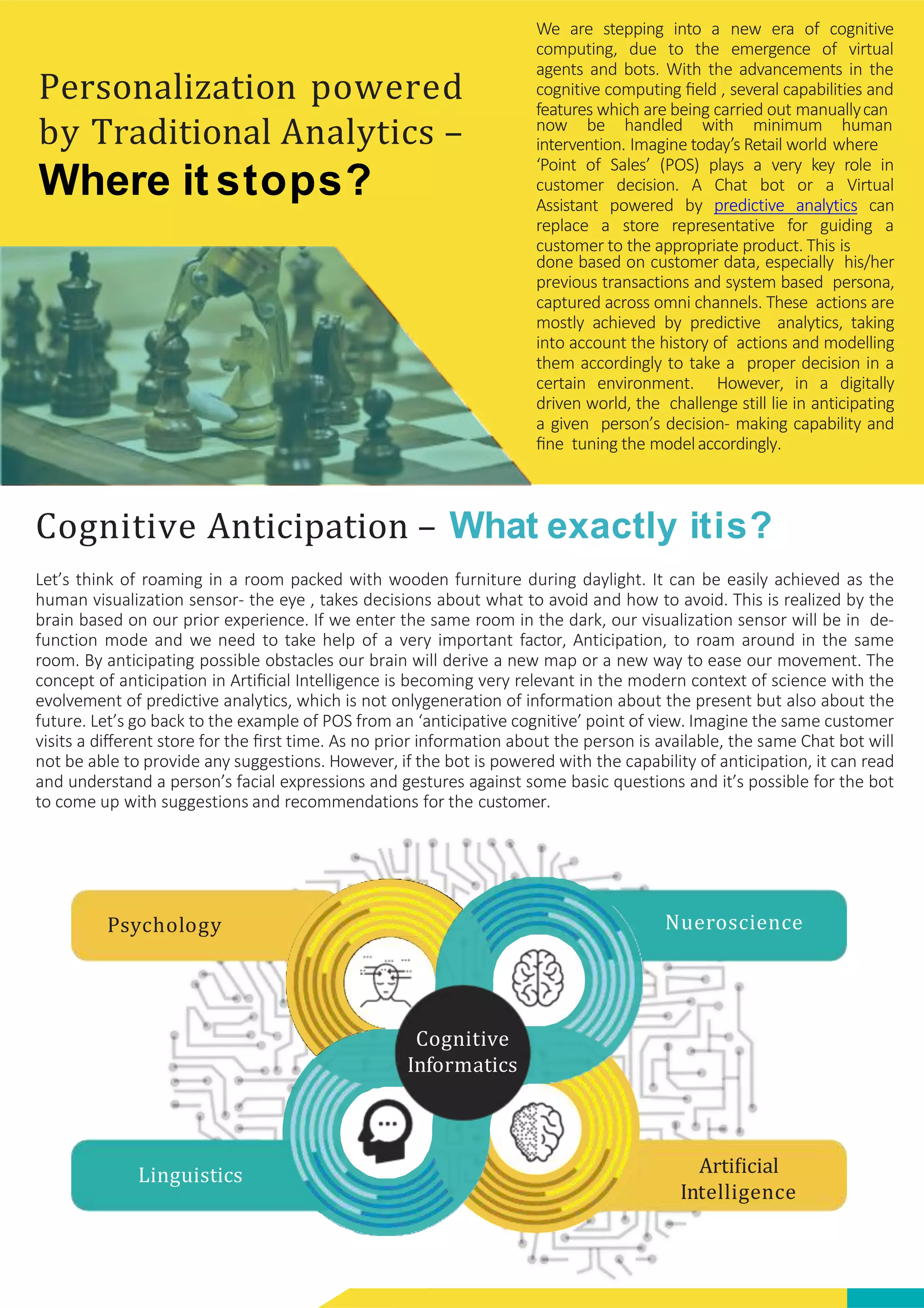
Cognitive
Informatics
Personalization powered
by Traditional Analytics –
Where it stops?
We are stepping into a new era of cognitive
computing, due to the emergence of virtual
agents and bots. With the advancements in the
cognitive computing field , several capabilities and
features which are being carried out manuallycan
now be handled with minimum human
intervention. Imagine today’s Retail world where
‘Point of Sales’ (POS) plays a very key role in
customer decision. A Chat bot or a Virtual
Assistant powered by predictive analytics can
replace a store representative for guiding a
customer to the appropriate product. This is
done based on customer data, especially his/her
previous transactions and system based persona,
captured across omni channels. These actions are
mostly achieved by predictive analytics, taking
into account the history of actions and modelling
them accordingly to take a proper decision in a
certain environment. However, in a digitally
driven world, the challenge still lie in anticipating
a given person’s decision- making capability and
fine tuning the modelaccordingly.
Cognitive Anticipation – What exactly itis?
Let’s think of roaming in a room packed with wooden furniture during daylight. It can be easily achieved as the
human visualization sensor- the eye , takes decisions about what to avoid and how to avoid. This is realized by the
brain based on our prior experience. If we enter the same room in the dark, our visualization sensor will be in de-
function mode and we need to take help of a very important factor, Anticipation, to roam around in the same
room. By anticipating possible obstacles our brain will derive a new map or a new way to ease our movement. The
concept of anticipation in Artificial Intelligence is becoming very relevant in the modern context of science with the
evolvement of predictive analytics, which is not onlygeneration of information about the present but also about the
future. Let’s go back to the example of POS from an ‘anticipative cognitive’ point of view. Imagine the same customer
visits a different store for the first time. As no prior information about the person is available, the same Chat bot will
not be able to provide any suggestions. However, if the bot is powered with the capability of anticipation, it can read
and understand a person’s facial expressions and gestures against some basic questions and it’s possible for the bot
to come up with suggestions and recommendations for the customer.
Artificial
Intelligence
Linguistics
Psychology Nueroscience
Key Components of Cognitive Anticipation
– How does it work?
The ‘anticipation in artificial intelligence’ predicts the future
not only based on historical data but also taking into account
the behavior, gesture, gait and other biometric traits. It can
represent the data and correct it based on the feedback.
Together with predictive analytics, ‘anticipation’ forms the
backbone of a future Cognitive Computing which can be
termed as Anticipative Cognitive Computing. According to
the standard definition of anticipatory systems- anticipation
is based on a predictive model of the system and its
environment. The question is, how an anticipative cognitive
engine will look like?
Let’s explain this with the context of living
beings. Imagine a player in soccer field very
near to a goalpost. The moment he shoots the
ball, the goal keeper dives in to the direction of
the ball to save it. It’s a reactive action. Now
imagine the same situation during the penalty
shoot-out. The goal keeper dive in to a
direction by anticipating the player’s foot
movement, eye movement and prior
information about the player. This is a true
instance of anticipation. Cognitive systems are
not very reactive in nature but are anticipative
and predictive along with behavioral traits.
From an anticipative cognitive computing point
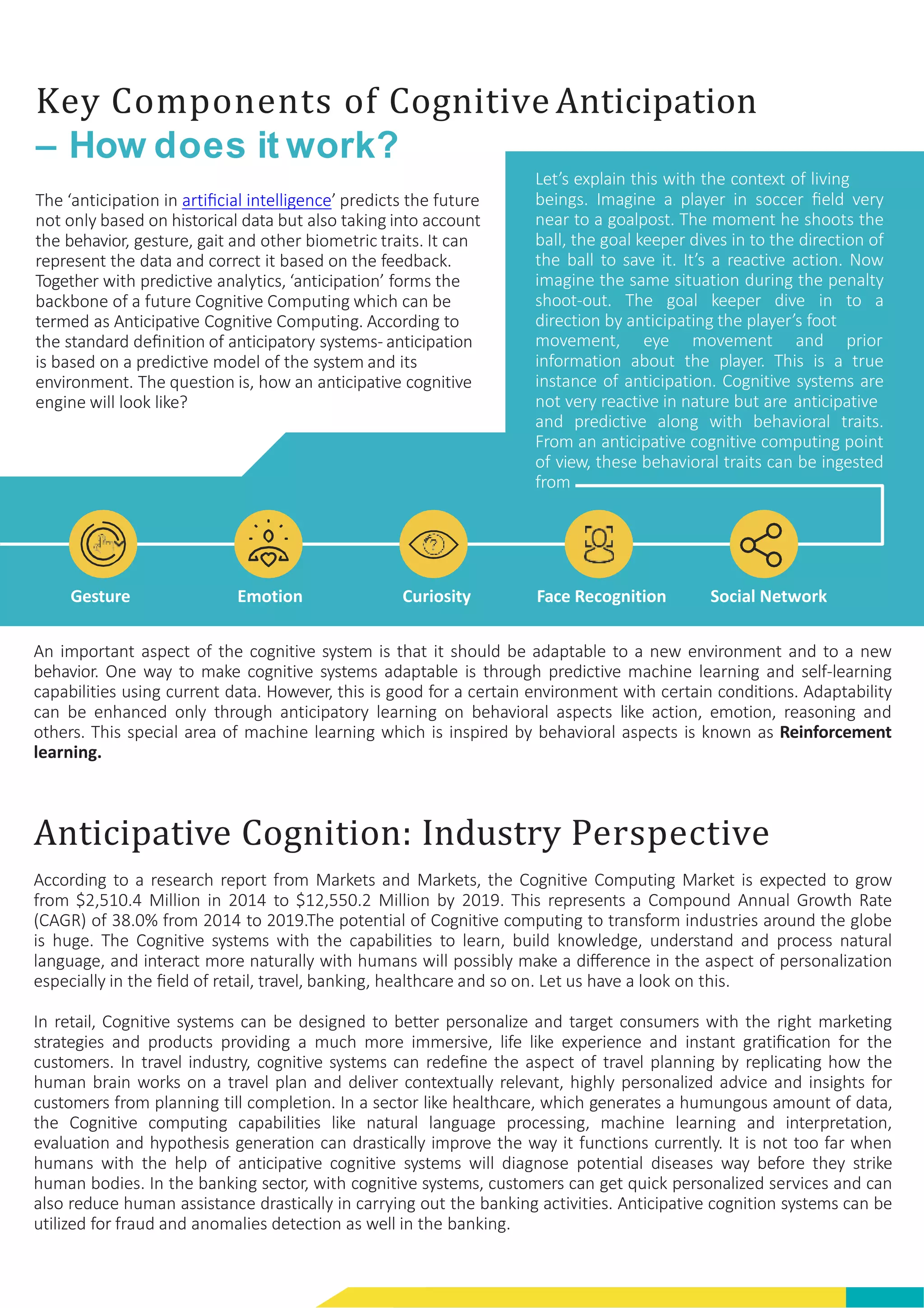
of view, these behavioral traits can be ingested
from
Gesture Emotion Curiosity Face Recognition Social Network
An important aspect of the cognitive system is that it should be adaptable to a new environment and to a new
behavior. One way to make cognitive systems adaptable is through predictive machine learning and self-learning
capabilities using current data. However, this is good for a certain environment with certain conditions. Adaptability
can be enhanced only through anticipatory learning on behavioral aspects like action, emotion, reasoning and
others. This special area of machine learning which is inspired by behavioral aspects is known as Reinforcement
learning.
Anticipative Cognition: Industry Perspective
According to a research report from Markets and Markets, the Cognitive Computing Market is expected to grow
from $2,510.4 Million in 2014 to $12,550.2 Million by 2019. This represents a Compound Annual Growth Rate
(CAGR) of 38.0% from 2014 to 2019.The potential of Cognitive computing to transform industries around the globe
is huge. The Cognitive systems with the capabilities to learn, build knowledge, understand and process natural
language, and interact more naturally with humans will possibly make a difference in the aspect of personalization
especially in the field of retail, travel, banking, healthcare and so on. Let us have a look on this.
In retail, Cognitive systems can be designed to better personalize and target consumers with the right marketing
strategies and products providing a much more immersive, life like experience and instant gratification for the
customers. In travel industry, cognitive systems can redefine the aspect of travel planning by replicating how the
human brain works on a travel plan and deliver contextually relevant, highly personalized advice and insights for
customers from planning till completion. In a sector like healthcare, which generates a humungous amount of data,
the Cognitive computing capabilities like natural language processing, machine learning and interpretation,
evaluation and hypothesis generation can drastically improve the way it functions currently. It is not too far when
humans with the help of anticipative cognitive systems will diagnose potential diseases way before they strike
human bodies. In the banking sector, with cognitive systems, customers can get quick personalized services and can
also reduce human assistance drastically in carrying out the banking activities. Anticipative cognition systems can be
utilized for fraud and anomalies detection as well in the banking.
To read the complete success story visit
https://www.happiestminds.com/wp-
content/uploads/2016/11/Anticipative-
Cognition-and-its-Impact-on-
Personalization-in-Business.pdf
For any Queries, Write to us at:
business@happiestminds.com

Anticipative Cognition and its Impact on Personalization in Business

  • 1.
    Anticipative Cognition and itsImpact on Personalization in Business
  • 2.
    Executive SummaryHuman- machine interactionis a key area of interest in the IT world for the last few years. Now, Computers that could learn, think and function like human brains are far more a reality than exaggerations in the science fictions, thanks to the advancements in Cognitive Computing. From the traditional preprogrammed machines, Cognitive computing shows a huge leap in the field of computing. It revolutionizes the way in which machines interact with humans and vice versa. How these Cognitive systems, which possess anticipation capabilities are poised to transform the way we do business is an interesting area to ponder.
  • 3.
    Cognitive Informatics Personalization powered by TraditionalAnalytics – Where it stops? We are stepping into a new era of cognitive computing, due to the emergence of virtual agents and bots. With the advancements in the cognitive computing field , several capabilities and features which are being carried out manuallycan now be handled with minimum human intervention. Imagine today’s Retail world where ‘Point of Sales’ (POS) plays a very key role in customer decision. A Chat bot or a Virtual Assistant powered by predictive analytics can replace a store representative for guiding a customer to the appropriate product. This is done based on customer data, especially his/her previous transactions and system based persona, captured across omni channels. These actions are mostly achieved by predictive analytics, taking into account the history of actions and modelling them accordingly to take a proper decision in a certain environment. However, in a digitally driven world, the challenge still lie in anticipating a given person’s decision- making capability and fine tuning the modelaccordingly. Cognitive Anticipation – What exactly itis? Let’s think of roaming in a room packed with wooden furniture during daylight. It can be easily achieved as the human visualization sensor- the eye , takes decisions about what to avoid and how to avoid. This is realized by the brain based on our prior experience. If we enter the same room in the dark, our visualization sensor will be in de- function mode and we need to take help of a very important factor, Anticipation, to roam around in the same room. By anticipating possible obstacles our brain will derive a new map or a new way to ease our movement. The concept of anticipation in Artificial Intelligence is becoming very relevant in the modern context of science with the evolvement of predictive analytics, which is not onlygeneration of information about the present but also about the future. Let’s go back to the example of POS from an ‘anticipative cognitive’ point of view. Imagine the same customer visits a different store for the first time. As no prior information about the person is available, the same Chat bot will not be able to provide any suggestions. However, if the bot is powered with the capability of anticipation, it can read and understand a person’s facial expressions and gestures against some basic questions and it’s possible for the bot to come up with suggestions and recommendations for the customer. Artificial Intelligence Linguistics Psychology Nueroscience
  • 4.
    Key Components ofCognitive Anticipation – How does it work? The ‘anticipation in artificial intelligence’ predicts the future not only based on historical data but also taking into account the behavior, gesture, gait and other biometric traits. It can represent the data and correct it based on the feedback. Together with predictive analytics, ‘anticipation’ forms the backbone of a future Cognitive Computing which can be termed as Anticipative Cognitive Computing. According to the standard definition of anticipatory systems- anticipation is based on a predictive model of the system and its environment. The question is, how an anticipative cognitive engine will look like? Let’s explain this with the context of living beings. Imagine a player in soccer field very near to a goalpost. The moment he shoots the ball, the goal keeper dives in to the direction of the ball to save it. It’s a reactive action. Now imagine the same situation during the penalty shoot-out. The goal keeper dive in to a direction by anticipating the player’s foot movement, eye movement and prior information about the player. This is a true instance of anticipation. Cognitive systems are not very reactive in nature but are anticipative and predictive along with behavioral traits. From an anticipative cognitive computing point of view, these behavioral traits can be ingested from Gesture Emotion Curiosity Face Recognition Social Network An important aspect of the cognitive system is that it should be adaptable to a new environment and to a new behavior. One way to make cognitive systems adaptable is through predictive machine learning and self-learning capabilities using current data. However, this is good for a certain environment with certain conditions. Adaptability can be enhanced only through anticipatory learning on behavioral aspects like action, emotion, reasoning and others. This special area of machine learning which is inspired by behavioral aspects is known as Reinforcement learning. Anticipative Cognition: Industry Perspective According to a research report from Markets and Markets, the Cognitive Computing Market is expected to grow from $2,510.4 Million in 2014 to $12,550.2 Million by 2019. This represents a Compound Annual Growth Rate (CAGR) of 38.0% from 2014 to 2019.The potential of Cognitive computing to transform industries around the globe is huge. The Cognitive systems with the capabilities to learn, build knowledge, understand and process natural language, and interact more naturally with humans will possibly make a difference in the aspect of personalization especially in the field of retail, travel, banking, healthcare and so on. Let us have a look on this. In retail, Cognitive systems can be designed to better personalize and target consumers with the right marketing strategies and products providing a much more immersive, life like experience and instant gratification for the customers. In travel industry, cognitive systems can redefine the aspect of travel planning by replicating how the human brain works on a travel plan and deliver contextually relevant, highly personalized advice and insights for customers from planning till completion. In a sector like healthcare, which generates a humungous amount of data, the Cognitive computing capabilities like natural language processing, machine learning and interpretation, evaluation and hypothesis generation can drastically improve the way it functions currently. It is not too far when humans with the help of anticipative cognitive systems will diagnose potential diseases way before they strike human bodies. In the banking sector, with cognitive systems, customers can get quick personalized services and can also reduce human assistance drastically in carrying out the banking activities. Anticipative cognition systems can be utilized for fraud and anomalies detection as well in the banking.
  • 5.
    To read thecomplete success story visit https://www.happiestminds.com/wp- content/uploads/2016/11/Anticipative- Cognition-and-its-Impact-on- Personalization-in-Business.pdf For any Queries, Write to us at: business@happiestminds.com