Annual Report 2011-12
&
Financials
Centre for Education and Communication
New Delhi
Centre for Education and Communication
173-A, Khirki Village
Malviya Nagar
New Delhi – 110017
Tel: 011 29541858 / 29541841
Fax: 011 29545442
Email: cec@cec-india.org
Website: www.cec-india.org
Centre for Education and Communication (CEC), 2011-12
Report Prepared by: Pallavi Mansingh, Divya Devan
Table of Contents
Executive Director’s Note .................................................................................... 5
Sustainable Livelihood for Small Tea Growers ................................................... 9
! STGs in Nilgiris, Idukki & Wayanadu ....................................................... 9
! STGs in West Bengal, Assam, Tripura, Arunachal Pradesh & Mizoram . 11
! Contribution to Plantation Studies ........................................................... 14
Changing Labour Market Dynamics in International Garment Supply Chains .... 15
! Sumangalis or Camp Coolies .................................................................. 15
! Homeworking in Sangam Vihar ............................................................... 16
Child Labour, Child Rights and Right to Education – critical questions .............. 17
! Review of CLPRA .................................................................................... 17
! Bharat Janata School .............................................................................. 18
! Child Labour in Home Based Craft Production ....................................... 19
Labour Rights in the Special Economic Zones ................................................... 21
! CEC Study for ACTRAV/ILO in India ....................................................... 21
Taxation and social security ................................................................................ 23
! Taxation Policies and Implications for the Poor ....................................... 23
! Elusive Universal Social Security ............................................................ 23
Maruti Workers Struggle – ground realities ......................................................... 25
Governing Board of CEC .................................................................................... 26
CECTeam ............................................................................................................ 28
Financials ............................................................................................................ 29
Executive Director’s Note
Core and Periphery
I recall, during the Silver Jubilee celebrations of CEC, how Prof. D. Narasimha Reddy
reacted to an observation made by me that CEC rarely got into the core issues of
labour; rather had been addressing issues of labour in its peripheries. Prof. Reddy
observed that the issues considered peripheral to labour are now the core issues or the
distinction between core and periphery are fast disappearing.
In order to locate CEC’s relevance and understand its contribution, it is important to ask
the question whether there is a core and periphery for labour in India? Are spaces
demarcated defining who can be at the core and who must be at the periphery? if the
answer is in the negative, does it make the problematic superfluous?
Looking at the core and periphery as represented by the ‘organised’ and ‘unorgansed’
workers is insufficient because flexibilisation of production and flexibilisation of labour
are fast obliterating this difference.
At the same time, the core is usually represented by issues of industrial relations
(issues between employer and the employee) evolved from situation where large-scale
production of goods and services takes place, employing men and women workers in
large numbers for longer durations of time and generally for all their productive years.
In the Indian context, the core also gets extended to the machinery of labour
administration. Though labour unions have also been part of the core, this privilege is
fast disappearing.
In this sense, the core has an exclusivity; in Indian context a sort of Brahminism - not
allowing anyone other than those belonging to this group to have access to the
privileged space. State imposes structural restrictions to raise so called core issues by
anyone other than a defined set of people.
When state manages to disempower those who occupy this exclusive space, a huge
vacuum of agency is generated. Incidents that have happened in Grazzianno in
Greater NOIDA and Maruti Suzuki in Manesar can be looked at from this perspective.
Labour cannot be an exclusive space. It must belong to everyone.
CEC and the Peripheries
CEC has largely worked at the peripheries. This is not to pass any value judgment on
this option - whether this was (is) right or wrong.
In the beginning, it was ethnic identity, health and displacement of workers and
implications of mechanisation on workers.
CEC Annual Report 2011-12 5
Later, we addressed emphasised the concept of ‘labour rights’ as human rights at all
work places - paid or unpaid.
CEC argued that labour must have a say in the global neo-liberal trade regime; but
externalities without considering the voice of the local labour can lead to worst forms of
human right violations including unemployment, slavery, displacement, fluctuations in
prices of primary products and also the right to self-determination of nations. It
cautioned against the possible negative impacts of free trade agreements on labour,
employment and livelihood.
CEC worked consistently on the issue of contemporary forms of slavery in India,
particularly in the agrarian and manufacturing sectors through its studies on changing
forms of debt bondage in agriculture and sumangali / camp coolie system in garment
supply chain.
CEC has looked at rights of migrants and helped in evolving a national consensus on
rights based migration policy
Similarly, CEC has helped through various studies and collaborative action, in
deepening the understanding of child labour.
CEC has again helped in building a national consensus on social security - first as the
right of unorganised workers and then as a universal right in the light of changing
nature of employment in India and increasing income disparity.
On Peasant Question
An important question that CEC has to address is how, as a labour organisation, it
should consider small peasants. Traditional perspective says that peasants are allies of
workers in the struggle against capitalistic exploitation. Peasants or small farmers are
allies because though they own land and need to expend their labour to survive.
Alliance gets strengthened when they do farming collectively. This has led to the mass
movement of cooperatives of farmers as an alternative.
Globalisation brings in a new dimension. Huge agri-corporations and global brands
prefer to source products from the small farmers without a direct engagement in
agricultural production but maintaining a streamlined supply chain. In cash crops like
tea and coffee, many corporates are moving out from huge plantations and source
either unprocessed for their factories or processed products for their marketing wing.
Small farmers consequently face multiple jeopardy - not having a say for their products
at the factory gate and in the consumer market; not having any control over inputs and
their costs; individualised ownership of land making them voiceless; spacial distances
to the processing units or market for their perishable products making them vulnerable
to influences of middle people; absence of protection during contingencies making
them dependent on ursurers etc.
CEC Annual Report 2011-12 6
While the theories of global supply chain and global value chain have helped in
understanding this phenomenon of emerging agrarian capitalism, little has been done
to empower small producers to have control over themselves.
CEC has understood this as a major area of struggle - building producer organsations
of farmers based on cooperative principles. Our work among small tea growers is a
case in point.
In Defense of Self Respect
CEC has ardently defended its self respect against an onslaught by a few of the donors
as guided by self styled caste auditors. CEC’s defense was based on the perspective
that southern organisations are autonomous entities and are not built on subservience
resulting from a donor-recipient relationships. The external agencies are not mandated
to make or break organisations in the South, where they have come up on their own
volition and have taken decisions to forge collaborations with internal as well as
external agencies. Therefore, logically the Southern organisations must survive even if
the external sources of funds get dried up.
There are laws that govern southern organisations and as long as there are no
violations of such laws, and as long as there are no instances of financial
embezzlements, the donor organisations cannot dictate on the ‘being’ of the entity as
such.
In principle, no agency can take the role of donor, facilitator, evaluator and judge at the
same time. This may result in serious miscarriage of justice.
The relationship between northern and southern organizations as expressions of
solidarity and partnerships are fast disappearing in formal development funding
scenario. This could largely be the result of dwindling independent financial sources
and greater dependence on state funds, bringing in more of impersonality in
relationships.
CEC found that the attack was on the organisation itself and its independence. So far,
we have put up strong defense.
! ! ! ! ! ! ! ! ! J John
! ! ! ! ! ! ! ! ! August 01, 2012
CEC Annual Report 2011-12 7
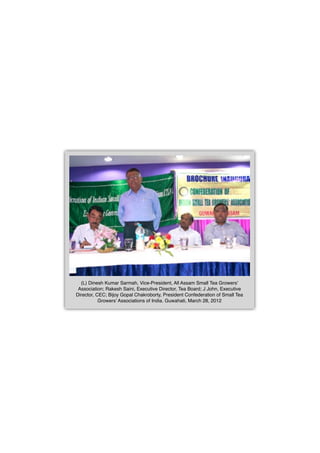
(L) Dinesh Kumar Sarmah, Vice-President, All Assam Small Tea Growers’
Association; Rakesh Saini, Executive Director, Tea Board; J John, Executive
Director, CEC; Bijoy Gopal Chakroborty, President Confederation of Small Tea
Growers’ Associations of India. Guwahati, March 28, 2012
Sustainable Livelihood for Small Tea Growers
STGs in Nilgiris, Idukki & Wayanadu
The tea value chain is structured along a hierarchical relationship with the global buyers
dictating terms to the producers. An inherently asymmetric balance of power relation
increases the vulnerabilities of the producers. At the same time the small producers in this
value chain are not merely passive recipients but dynamic actors who are constantly
engaging with the value chain. CEC’s intervention in the tea industry looks at how these
major shifts in the global tea industry impact upon the men and women who constitute the
periphery of this value chain and empowers them to in turn assert their space in the value
chain.
Wold’s second largest producer and consumer of tea, India, has over 11 million people
dependent on the estate sector of industry for their livelihoods. This excludes over 200,000
small tea growers (STGs), in the tea growing states of Assam, West Bengal, Arunachal
Pradesh, Mizoram, Tripura, Himachal Pradesh, Tamil Nadu and Kerala. The sector
contributes about 28% of total tea production, which is steadily increasing. According to the
Tea Board of India STG is a person who has a tea plantation of up to 25 acres, but most own
less than 3 acres of land. However, the scattered remote locations of habitation, lack of
organisation among growers, lack of bargaining capacity, shortage of working capital,
dependence on exploitative trade channels, low levels of technical knowledge, low quality of
leaves and limited access to resources are serious factors that make them extremely
vulnerable at the lower end of the tea value chain. Failure to get a fair price has a significant
impact on their ability to afford food, education and healthcare due to the absence of other
sources of income.
CEC’s intervention is a means of supporting STGs in India, to improve conditions in the tea
sector as a whole, and to contribute to the alleviation of poverty of thousands of tea growers
and their dependents. Dispersed group of STGs is organised into collectives, trained in
technical, negotiation and governance skills, they will be able to achieve confidence to deal
more effectively with other players in the supply chain.
Funded by NABARD under Rural Innovation Fund, the project Sustainable Livelihoods for
Small Tea Growers in Sept 2010 till Oct 2011 attempted to organize the STGs into business
and social collectives at such a large scale. The project was also attempting to learn from the
experience of collective action in commodity sectors and adapts them to the specific needs
of the tea sector.
The project aimed to reduce poverty among small tea growers (STGs) in India through
innovative means of improved agricultural practices and establishing fairer terms of trade in
tea. It reached out to 5500 STGs and their families in Nilgiris district of Tamilnadu by
mobilizing small tea growers and helping them form collective organizations to manage the
tea based livelihoods; building capacities of STG Primary Producer Societies to be effective
CEC Annual Report 2011-12 9
and efficient platforms for improving production systems, getting better returns, and
increasing access of small tea growers to public schemes; establishing feasibility of tea
processing (tea factory) facilities owned by STG Primary Producer Societies.
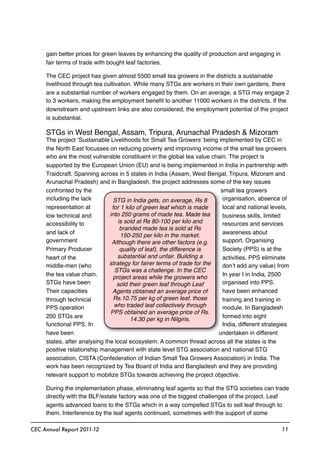
Table	
  I:	
  Value	
  per	
  kg	
  of	
  Green	
  Leaf	
  Before	
  and	
  A7er	
  Forma:on	
  of	
  PPSs	
  in	
  Districts	
  and	
  based	
  
on	
  the	
  Method	
  of	
  Leaf	
  Trade
Table	
  I:	
  Value	
  per	
  kg	
  of	
  Green	
  Leaf	
  Before	
  and	
  A7er	
  Forma:on	
  of	
  PPSs	
  in	
  Districts	
  and	
  based	
  
on	
  the	
  Method	
  of	
  Leaf	
  Trade
Table	
  I:	
  Value	
  per	
  kg	
  of	
  Green	
  Leaf	
  Before	
  and	
  A7er	
  Forma:on	
  of	
  PPSs	
  in	
  Districts	
  and	
  based	
  
on	
  the	
  Method	
  of	
  Leaf	
  Trade
Table	
  I:	
  Value	
  per	
  kg	
  of	
  Green	
  Leaf	
  Before	
  and	
  A7er	
  Forma:on	
  of	
  PPSs	
  in	
  Districts	
  and	
  based	
  
on	
  the	
  Method	
  of	
  Leaf	
  Trade
Table	
  I:	
  Value	
  per	
  kg	
  of	
  Green	
  Leaf	
  Before	
  and	
  A7er	
  Forma:on	
  of	
  PPSs	
  in	
  Districts	
  and	
  based	
  
on	
  the	
  Method	
  of	
  Leaf	
  Trade
Table	
  I:	
  Value	
  per	
  kg	
  of	
  Green	
  Leaf	
  Before	
  and	
  A7er	
  Forma:on	
  of	
  PPSs	
  in	
  Districts	
  and	
  based	
  
on	
  the	
  Method	
  of	
  Leaf	
  Trade
Table	
  I:	
  Value	
  per	
  kg	
  of	
  Green	
  Leaf	
  Before	
  and	
  A7er	
  Forma:on	
  of	
  PPSs	
  in	
  Districts	
  and	
  based	
  
on	
  the	
  Method	
  of	
  Leaf	
  Trade
Value	
  per	
  kg	
  (Rs)	
  per	
  day	
  for	
  Leaf	
  
Agent	
  Growers
Value	
  per	
  kg	
  (Rs)	
  per	
  day	
  for	
  Leaf	
  
Agent	
  Growers
Value	
  per	
  kg	
  (Rs)	
  per	
  day	
  for	
  Leaf	
  
Agent	
  Growers
Value	
  per	
  kg	
  (Rs)	
  per	
  day	
  for	
  Society	
  
Growers	
  
Value	
  per	
  kg	
  (Rs)	
  per	
  day	
  for	
  Society	
  
Growers	
  
Value	
  per	
  kg	
  (Rs)	
  per	
  day	
  for	
  Society	
  
Growers	
  
Before A'er Per	
  cent	
  
Increase
Before A'er Per	
  cent	
  
Increase
Nilgiris 9.07 10.75 19.49 7.93 14.30 84.08
Idukki 6.75 10.00 49.85 6.13 11.19 82.53
Wayanad 8.00 10.31 29.55 8.56 11.81 38.42
Sixty Five (65) primary producer societies were formed in Nilgiris district of Tamillnadu and
Idukki & Wayanadu districts of Kerala during the course of the project, implemented during
the period April 2010 to October 2011. By avoiding leaf agents, improving the quality of
leaves, and negotiating from the strength of a collective, they, on an average, managed to
gained on an average Rs.4.54 per kg of green leaf sold to a bought leaf factory. Activities
have also included technical and organisational capacity building, and networking with the
Tea Board of India (TBI), United Planters of South India, Tea Research Association and
supply chain players.
The activities had a 3-tier structure to organise STGs i.e. STGs societies in villages, regional/
district /state associations and a national association - Primary producers’ societies: STG
societies function as business enterprises at the grassroots levels. They address and
organise issues around the cultivation of tea and sales of green leaves. Their objective is to
0
1.3
2.5
3.8
5.0
Nilgiris Idukki Wayanad Combined
4.09
2.78
4.464.54
Figure	
  1:	
  Daily	
  Gain	
  per	
  kg	
  for	
  STGs	
  after	
  formation	
  of	
  Society	
  in	
  Lean	
  season
CEC Annual Report 2011-12
gain better prices for green leaves by enhancing the quality of production and engaging in
fair terms of trade with bought leaf factories.
The CEC project has given almost 5500 small tea growers in the districts a sustainable
livelihood through tea cultivation. While many STGs are workers in their own gardens, there
are a substantial number of workers engaged by them. On an average, a STG may engage 2
to 3 workers, making the employment benefit to another 11000 workers in the districts. If the
downstream and upstream links are also considered, the employment potential of the project
is substantial.
STGs in West Bengal, Assam, Tripura, Arunachal Pradesh & Mizoram
The project ‘Sustainable Livelihoods for Small Tea Growers’ being implemented by CEC in
the North East focusses on reducing poverty and improving income of the small tea growers
who are the most vulnerable constituent in the global tea value chain. The project is
supported by the European Union (EU) and is being implemented in India in partnership with
Traidcraft. Spanning across in 5 states in India (Assam, West Bengal, Tripura, Mizoram and
Arunachal Pradesh) and in Bangladesh, the project addresses some of the key issues
confronted by the small tea growers
including the lack organisation, absence of
representation at local and national levels,
low technical and business skills, limited
accessibility to resources and services
and lack of awareness about
government support. Organising
Primary Producer Society (PPS) is at the
heart of the activities. PPS eliminate
middle-men (who don’t add any value) from
the tea value chain. In year I in India, 2500
STGs have been organised into PPS.
Their capacities have been enhanced
through technical training and training in
PPS operation module. In Bangladesh
200 STGs are formed into eight
functional PPS. In India, different strategies
have been undertaken in different
states, after analysing the local ecosystem. A common thread across all the states is the
positive relationship management with state level STG association and national STG
association, CISTA (Confederation of Indian Small Tea Growers Association) in India. The
work has been recognized by Tea Board of India and Bangladesh and they are providing
relevant support to mobilize STGs towards achieving the project objective.
During the implementation phase, eliminating leaf agents so that the STG societies can trade
directly with the BLF/estate factory was one of the biggest challenges of the project. Leaf
agents advanced loans to the STGs which in a way compelled STGs to sell leaf through to
them. Interference by the leaf agents continued, sometimes with the support of some
CEC Annual Report 2011-12 11
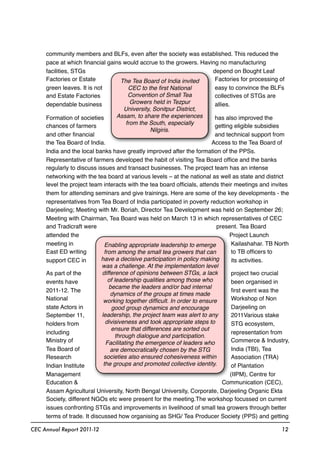
STG in India gets, on average, Rs 8
for 1 kilo of green leaf which is made
into 250 grams of made tea. Made tea
is sold at Rs 80-100 per kilo and
branded made tea is sold at Rs
150-250 per kilo in the market.
Although there are other factors (e.g.
quality of leaf), the difference is
substantial and unfair. Building a
strategy for fairer terms of trade for the
STGs was a challenge. In the CEC
project areas while the growers who
sold their green leaf through Leaf
Agents obtained an average price of
Rs.10.75 per kg of green leaf, those
who traded leaf collectively through
PPS obtained an average price of Rs.
14.30 per kg in Nilgiris.
community members and BLFs, even after the society was established. This reduced the
pace at which financial gains would accrue to the growers. Having no manufacturing
facilities, STGs depend on Bought Leaf
Factories or Estate Factories for processing of
green leaves. It is not easy to convince the BLFs
and Estate Factories collectives of STGs are
dependable business allies.
Formation of societies has also improved the
chances of farmers getting eligible subsidies
and other financial and technical support from
the Tea Board of India. Access to the Tea Board of
India and the local banks have greatly improved after the formation of the PPSs.
Representative of farmers developed the habit of visiting Tea Board office and the banks
regularly to discuss issues and transact businesses. The project team has an intense
networking with the tea board at various levels – at the national as well as state and district
level the project team interacts with the tea board officials, attends their meetings and invites
them for attending seminars and give trainings. Here are some of the key developments - the
representatives from Tea Board of India participated in poverty reduction workshop in
Darjeeling; Meeting with Mr. Boriah, Director Tea Development was held on September 26;
Meeting with Chairman, Tea Board was held on March 13 in which representatives of CEC
and Tradicraft were present. Tea Board
attended the Project Launch
meeting in Kailashahar. TB North
East ED writing to TB officers to
support CEC in its activities.
As part of the project two crucial
events have been organised in
2011-12. The first event was the
National Workshop of Non
state Actors in Darjeeling on
September 11, 2011Various stake
holders from STG ecosystem,
including representation from
Ministry of Commerce & Industry,
Tea Board of India (TBI), Tea
Research Association (TRA)
Indian Institute of Plantation
Management (IIPM), Centre for
Education & Communication (CEC),
Assam Agricultural University, North Bengal University, Corporate, Darjeeling Organic Ekta
Society, different NGOs etc were present for the meeting.The workshop focussed on current
issues confronting STGs and improvements in livelihood of small tea growers through better
terms of trade. It discussed how organising as SHG/ Tea Producer Society (PPS) and getting
CEC Annual Report 2011-12 12
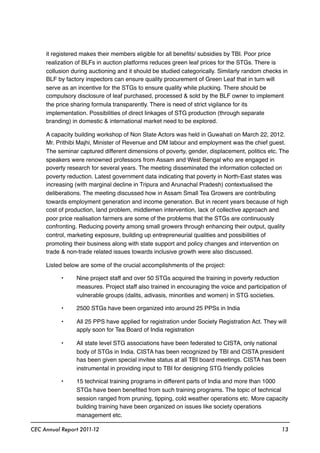
Enabling appropriate leadership to emerge
from among the small tea growers that can
have a decisive participation in policy making
was a challenge. At the implementation level
difference of opinions between STGs, a lack
of leadership qualities among those who
became the leaders and/or bad internal
dynamics of the groups at times made
working together difficult. In order to ensure
good group dynamics and encourage
leadership, the project team was alert to any
divisiveness and took appropriate steps to
ensure that differences are sorted out
through dialogue and participation.
Facilitating the emergence of leaders who
are democratically chosen by the STG
societies also ensured cohesiveness within
the groups and promoted collective identity.
The Tea Board of India invited
CEC to the first National
Convention of Small Tea
Growers held in Tezpur
University, Sonitpur District,
Assam, to share the experiences
from the South, especially
Nilgiris.
it registered makes their members eligible for all benefits/ subsidies by TBI. Poor price
realization of BLFs in auction platforms reduces green leaf prices for the STGs. There is
collusion during auctioning and it should be studied categorically. Similarly random checks in
BLF by factory inspectors can ensure quality procurement of Green Leaf that in turn will
serve as an incentive for the STGs to ensure quality while plucking. There should be
compulsory disclosure of leaf purchased, processed & sold by the BLF owner to implement
the price sharing formula transparently. There is need of strict vigilance for its
implementation. Possibilities of direct linkages of STG production (through separate
branding) in domestic & international market need to be explored.
A capacity building workshop of Non State Actors was held in Guwahati on March 22, 2012.
Mr. Prithibi Majhi, Minister of Revenue and DM labour and employment was the chief guest.
The seminar captured different dimensions of poverty, gender, displacement, politics etc. The
speakers were renowned professors from Assam and West Bengal who are engaged in
poverty research for several years. The meeting disseminated the information collected on
poverty reduction. Latest government data indicating that poverty in North-East states was
increasing (with marginal decline in Tripura and Arunachal Pradesh) contextualised the
deliberations. The meeting discussed how in Assam Small Tea Growers are contributing
towards employment generation and income generation. But in recent years because of high
cost of production, land problem, middlemen intervention, lack of collective approach and
poor price realisation farmers are some of the problems that the STGs are continuously
confronting. Reducing poverty among small growers through enhancing their output, quality
control, marketing exposure, building up entrepreneurial qualities and possibilities of
promoting their business along with state support and policy changes and intervention on
trade & non-trade related issues towards inclusive growth were also discussed.
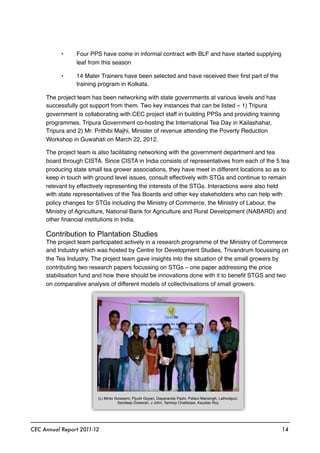
Listed below are some of the crucial accomplishments of the project:
• Nine project staff and over 50 STGs acquired the training in poverty reduction
measures. Project staff also trained in encouraging the voice and participation of
vulnerable groups (dalits, adivasis, minorities and women) in STG societies.
• 2500 STGs have been organized into around 25 PPSs in India
• All 25 PPS have applied for registration under Society Registration Act. They will
apply soon for Tea Board of India registration
• All state level STG associations have been federated to CISTA, only national
body of STGs in India. CISTA has been recognized by TBI and CISTA president
has been given special invitee status at all TBI board meetings. CISTA has been
instrumental in providing input to TBI for designing STG friendly policies
• 15 technical training programs in different parts of India and more than 1000
STGs have been benefited from such training programs. The topic of technical
session ranged from pruning, tipping, cold weather operations etc. More capacity
building training have been organized on issues like society operations
management etc.
CEC Annual Report 2011-12 13
• Four PPS have come in informal contract with BLF and have started supplying
leaf from this season
• 14 Mater Trainers have been selected and have received their first part of the
training program in Kolkata.
The project team has been networking with state governments at various levels and has
successfully got support from them. Two key instances that can be listed – 1) Tripura
government is collaborating with CEC project staff in building PPSs and providing training
programmes. Tripura Government co-hosting the International Tea Day in Kailashahar,
Tripura and 2) Mr. Prithibi Majhi, Minister of revenue attending the Poverty Reduction
Workshop in Guwahati on March 22, 2012.
The project team is also facilitating networking with the government department and tea
board through CISTA. Since CISTA in India consists of representatives from each of the 5 tea
producing state small tea grower associations, they have meet in different locations so as to
keep in touch with ground level issues, consult effectively with STGs and continue to remain
relevant by effectively representing the interests of the STGs. Interactions were also held
with state representatives of the Tea Boards and other key stakeholders who can help with
policy changes for STGs including the Ministry of Commerce, the Ministry of Labour, the
Ministry of Agriculture, National Bank for Agriculture and Rural Development (NABARD) and
other financial institutions in India.
Contribution to Plantation Studies
The project team participated actively in a research programme of the Ministry of Commerce
and Industry which was hosted by Centre for Development Studies, Trivandrum focussing on
the Tea Industry. The project team gave insights into the situation of the small growers by
contributing two research papers focussing on STGs – one paper addressing the price
stabilisation fund and how there should be innovations done with it to benefit STGS and two
on comparative analysis of different models of collectivisations of small growers.
CEC Annual Report 2011-12 14
(L) Minto Goswami, Pijush Goyari, Dayananda Pashi, Pallavi Mansingh, Lalhiratpuii,
Sandeep Dowerah, J John, Tanmoy Chatterjee, Kaustav Roy
Changing Labour Market Dynamics in International
Garment Supply Chains
Sumangalis or Camp Coolies
In the era of free-trade centric globalization, the dynamics of labour and labour relations are
acquiring new meanings. India’s integration into the market economy and influx of
transnational capital has reorganized production in such a way that on the one hand there is
a breakdown and restructuring of traditional structures like the caste system and increased
employment of women. But on the other side, there is disintegration of the organized sectors,
reduced space for collective bargaining, and denial of labour rights to workers in such a way
that brings back the master and slave relationship, making workers extremely vulnerable and
thus creating new forms of slavery.
CEC has been working on highlighting contemporary forms of bondage and forced labour.
Recently in collaboration with ASI a study was conducted on bondage and forced labour in
export garment production in the garment industry in Tamil Nadu in collaboration with ASI.
The study will be released by ASI in UK in around mid-2012. Adding on to the existing study
CEC also collected field information from the source areas on the victims under the
Sumangali scheme. Field visits were conducted and meetings with workers who had worked
or were working at present under sumangali/camp coolie/hostel scheme. CEC’s study was
discussed in these meetings. BBC in UK has also planned a programme focussing on the
conditions of the workers in the garment industry in Tamil Nadu to be aired in June 2012.
Homeworking in Sangam Vihar
A field study was conducted by CEC in Sangam Vihar among home workers in the garment
embellishment industry. Nature of the study was a baseline study and participatory need
assessment survey conducted for the National Homeworkers Group of the Ethical Trading
Initiative (ETI) and Maniben Kara Institute (MKI) in Sangam Vihar, a slum cluster in New
Delhi which is a major hub of global outsourcing for embellishments and stitching garments.
It is an initial project as part of the RAGS project which seeks to improve working conditions
for homeworkers and vulnerable workers
This study looks at the demographic composition of the home based workers in Sangam
Viihar examining their origins, when they migrated, their present status, the identity proof
they possess, their ties with families back home and so on. It looks at the gendered division
of work, nature and extent of involvement of children. It examines the socio economic
condition of home based workers, their remuneration and wage, living and working
conditions, whether and how in this export sector workers are able to meet their basic needs
and how the tenets of the ETI Base Code are being implemented.
Further, the study also looks into how is production is organised in Sangam Vihar’s home
based garment industry. The study observes that parameters of quality and lead time weigh
heavily at this end of the value chain. It highlights the vulnerability of the home workers, how
CEC Annual Report 2011-12 15
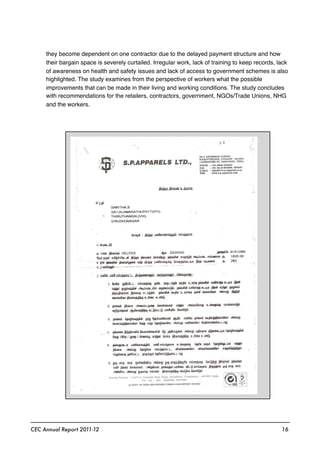
they become dependent on one contractor due to the delayed payment structure and how
their bargain space is severely curtailed. Irregular work, lack of training to keep records, lack
of awareness on health and safety issues and lack of access to government schemes is also
highlighted. The study examines from the perspective of workers what the possible
improvements that can be made in their living and working conditions. The study concludes
with recommendations for the retailers, contractors, government, NGOs/Trade Unions, NHG
and the workers.
CEC Annual Report 2011-12 16
Child Labour, Child Rights and Right to Education –
critical questions
Review of CLPRA
State intervention to eradicate child labour has two major components, both worked out in
1986-87, namely the Child Labour (Prohibition and Regulation) Act CLPRA 1986 and the
National Child Labour Policy following it. At present, Child labour in 18 occupations and 65
processes (Schedule -Part A and B) are prohibited under the CLPRA. However, these cover
only about 10 per cent of the children who are engaged in the formal industrial sector. The
Act neither defines ‘hazardous’ and ‘non hazardous’, nor gives a basis on which child labour
only in certain occupations are considered non exploitative and hence legitimised. The law
also does not include millions of children in the agricultural sector, almost 70 per cent of child
workers in India.
There is no reliable and authentic data on working children. Major reason is that there is no
agreement on the definition of child even among different departments of the government.
While CLPRA defines child as those below 14 years, laws such as Indian Majority Act, 1875
and Factories Act as amended in 1954 for night work categorize persons below 18 years as
children. CRC defines a person of 18 years and less as a child. The NSSO survey
information does not provide clear data on children of the age group 0-18 years. There are
statistics on persons of the age group 0-14 or the age group 0-19 years. These confusions
have serious consequences beyond data and has crippled government of India’s ability to do
away with child labour.
The recent Right to Free and Compulsory Education Act, 2009 promises free and
compulsory education for all children in the 6 to 14 age group. Besides implicit denial of right
to education to children below 6 and above 14 years, critiques have also raised the issue of
the need for a review of CLPRA in the light of the Right to Education Act.
Some of these issues were studied by CEC in 2011-12 CEC as part of a study “Review of the
provisions of Child Labour (Prohibition and Regulation) Act, 1986 and identification of gaps
in implementation” which was conducted by CEC for Save the Children. The study observed
that lack of definition of child labour, definition of child in the Act which is not in tune with the
CRC or Juvenile Justice Act, the half-baked hazardous and non hazardous division,
unpardonable exemptions (especially the agricultural sector) from prohibition, inadequate
penal consequences, unsatisfactory conversion rates from investigations to prosecutions to
convictions, etc., foil the CLPRA from achieving the goal of a society without child labour.
The study further suggested that (1) India shall ratify ILO conventions 138 and 182 and
modify the CLPRA in tune with the CRC; (2) amend Article 24 of the Constitution to prohibit
all forms of child labour as explained in the study to bring it in tune with Article 21 A
(fundamental right to education); (3) amend Article 21 A of the Constitution and the Right to
Education Act to assure fundamental right to education till 18; (4) universalize the Integrated
CEC Annual Report 2011-12 17
Child Development Services and (5) annul the CLPRA and enact a new legislation banning
all forms of child labour.
Bharat Janata School
More than 80, 000 populations dwell in the Janata Colony of Zaffrabad in the north east part
of the capital city Delhi. Out of which about 10, 000 are potential school going children but
unfortunately all are not going. Three government schools can accommodate at best three to
four thousand children. Most of the children are out of school and are either engaged in
selling commodities and eatables in the small shops or in the garment units in the narrow
lanes, rag picking or sitting idle and involved in drug use or other criminal activities. Even if
they want to go to school then also the existing schools cannot accommodate to all, not even
15 per of the school going age groups. The interventions by the non-state actors too were
irregular and for a short span. The concerted effort by few AITUC activists drew the attention
of the Centre for Education and Communication in 2003. Accordingly a non-formal education
centre or more precisely a feeder school was initiated in the Janata Colony of Zaffrabad with
the support of the Terre des Hommes India Programme (TdH- IP).
Over the years, Bharat Janta School has evolved from nominal school to a centre of learning
and community action. It now caters to the
varied needs of the community. While the
bridge school continues with greater
focus, new vocational courses have
been started on the demand of the
community. It has mobilized the community
to understand the importance of schooling
and educate others about the same.
Health and hygiene standards of the
children who join in has improved. In the
neighbourhood of increasing crime and
drug peddling, the Bharat Janta school
facilitates a creative change in the
lives of children through education.
Increasingly, its ownership lies with the
community. Series of meeting with the community and teachers of Bharat Janta School
revealed how the school was at the core but not the only activity of the activists teachers of
Bharat Janta School.
The role of the teachers did not end with conducting a class; they facilitated parents to
ensure that the children are enrolled in schools by helping them in filling forms, obtaining
scholarships and in organizing visits to the school. They organise meetings with the
principals and teachers of the government schools on the quality of education and follow up
with the children and ensure that they are able to keep up to the studies and do not drop out.
Even beyond the schools, they reach out to the community on the right to education through
the school chalo abhiyaan, networking with madarassas and ensuring gainful employment
for adolescent girls by giving them vocational training and facilitating their enrolment in
CEC Annual Report 2011-12 18
“My mother, younger sister and I work
at home 7 days a week. My father is
sick and he cannot work. We stitch zips
and buttons in jeans. We start work from
about 12 pm and work till about 9 pm.
For the past four months I have started
coming to the learning centre in the
morning. I study from 8 am to 11 am.
After some time I want to join a bigger
school even if I have to work up late in
the night to compensate so that when I
grow up I can go to an office and work.”
Ajeem, 11 years, Student at Bharat
Janta Shiksha Kedra, Jafrabad
formal education. The constitutional amendment of making education a right to all children of
the age 6-14 necessarily implies that formal quality education is the responsibility of the
state. Bharat Janta School therefore cannot assume the functions of a regular school.
However, it has a crucial function by acting as a facilitating centre enticing and encouraging
children towards education; a distant model for the community and an activity centre for
children and adolescents.
Given this, the structure of the present school has changed. In 2011-12 the Bharat Janta
School was replaced by ‘Bharat Janta Shiksha Kendra ’ which is run and managed by Bharat
Janta Shiksha Samiti, a general body of representatives from the community which will
decide on the activities of the centre. This process will ensure community ownership and
community leadership. The Samiti will be both an activity of the centre as well as the
advisory body to the management. The centre will work with children as well.
Child Labour in Home Based Craft Production
Researchers and activists have brought to light new elusive forms of bonded child labour in
the export oriented supply chains of giant retailers and brands, and the non-applicability of
the existing legislative provisions to address them. Bonded child labour in home-based
embroidery and craft Industry in Delhi and UP, child labour in sports goods making in Punjab
and child labour in spinning and garment manufacturing in Tamil Nadu where there is
increasing bondage among girl child workers are a few examples.
Trends suggest that home-work is increasing. While home-work was once linked to old craft
traditions and cultural factors that
restricted the mobility of women, it is
increasingly being taken up
because of declining opportunities
for formal employment,
expanding export demand for craft
products, and a growth in the practice
of subcontracting, which
has boosted ‘flexible contractual
work’ as opposed to formal
work. Home- workers often receive
piece rates which are too low to support
their families, and the only way to make
ends meet is to get their children to help with production. The reality that children are
engaged in home-based work cannot be denied. Most children aged 5-14 in home-based
worker households in India, work in the home-based activity.
Some argue that traditional craft skills should be learned/transferred and that every child
should be entitled to be creative and learn a craft. However the ‘transference of skills’
argument does not hold merit because the transference of good skills does not take place
because the age of entry of the children in home-work is low. When children are engaged at
a very young age, they end up doing very basic work and do not graduate to learning fine
skills. This means they are unlikely to become accomplished, independent and skilled
CEC Annual Report 2011-12 19
When children are engaged at a very
young age, they end up doing very basic
work and do not graduate to learning fine
skills. This means they are unlikely to
become accomplished, independent and
skilled artisans in their own right. Moreover,
transference of crafts skills is also not
available to the children as a matter of
choice but is limited to only those specific
skills which their own community/family has
or by what the market demands.
artisans in their own right. Moreover, transference of crafts skills is also not available to the
children as a matter of choice but is limited to only those specific skills which their own
community/family has or by what the market demands.
Recent views are that the problem is not so much that children work at home, but more that
home-working interferes with their time for education and recreation. It is important to ensure
that no child is denied the opportunity for self-development and quality formal education with
adequate time for play and rest. The ban on children engaging in any form of hazardous
work (whether home-based or non-home-based) should also be strictly enforced.
For all the above reasons, home-workers can be much more vulnerable to exploitation and
unfair practices. The combination of ever-shifting supply chains, the ambiguity in employer
responsibilities, and the invisibility of the final producer (the home-worker), makes it harder to
ensure good employment conditions for home-workers as compared to factories. And the
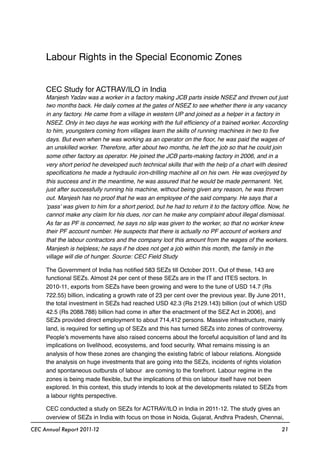
child workers amongst them are even more deprived.
CEC is in the process of understanding an effective model can be developed for addressing
child labour issues in the home-based crafts sector in India, and gain the support of key
stakeholders to ensure the implementation of this model.
CEC Annual Report 2011-12 20
Labour Rights in the Special Economic Zones
CEC Study for ACTRAV/ILO in India
Manjesh Yadav was a worker in a factory making JCB parts inside NSEZ and thrown out just
two months back. He daily comes at the gates of NSEZ to see whether there is any vacancy
in any factory. He came from a village in western UP and joined as a helper in a factory in
NSEZ. Only in two days he was working with the full efficiency of a trained worker. According
to him, youngsters coming from villages learn the skills of running machines in two to five
days. But even when he was working as an operator on the floor, he was paid the wages of
an unskilled worker. Therefore, after about two months, he left the job so that he could join
some other factory as operator. He joined the JCB parts-making factory in 2006, and in a
very short period he developed such technical skills that with the help of a chart with desired
specifications he made a hydraulic iron-drilling machine all on his own. He was overjoyed by
this success and in the meantime, he was assured that he would be made permanent. Yet,
just after successfully running his machine, without being given any reason, he was thrown
out. Manjesh has no proof that he was an employee of the said company. He says that a
‘pass’ was given to him for a short period, but he had to return it to the factory office. Now, he
cannot make any claim for his dues, nor can he make any complaint about illegal dismissal.
As far as PF is concerned, he says no slip was given to the worker, so that no worker knew
their PF account number. He suspects that there is actually no PF account of workers and
that the labour contractors and the company loot this amount from the wages of the workers.
Manjesh is helpless; he says if he does not get a job within this month, the family in the
village will die of hunger. Source: CEC Field Study
The Government of India has notified 583 SEZs till October 2011. Out of these, 143 are
functional SEZs. Almost 24 per cent of these SEZs are in the IT and ITES sectors. In
2010-11, exports from SEZs have been growing and were to the tune of USD 14.7 (Rs
722.55) billion, indicating a growth rate of 23 per cent over the previous year. By June 2011,
the total investment in SEZs had reached USD 42.3 (Rs 2129.143) billion (out of which USD
42.5 (Rs 2088.788) billion had come in after the enactment of the SEZ Act in 2006), and
SEZs provided direct employment to about 714,412 persons. Massive infrastructure, mainly
land, is required for setting up of SEZs and this has turned SEZs into zones of controversy.
People’s movements have also raised concerns about the forceful acquisition of land and its
implications on livelihood, ecosystems, and food security. What remains missing is an
analysis of how these zones are changing the existing fabric of labour relations. Alongside
the analysis on huge investments that are going into the SEZs, incidents of rights violation
and spontaneous outbursts of labour are coming to the forefront. Labour regime in the
zones is being made flexible, but the implications of this on labour itself have not been
explored. In this context, this study intends to look at the developments related to SEZs from
a labour rights perspective.
CEC conducted a study on SEZs for ACTRAV/ILO in India in 2011-12. The study gives an
overview of SEZs in India with focus on those in Noida, Gujarat, Andhra Pradesh, Chennai,
CEC Annual Report 2011-12 21
and Maharashtra. The study looks at the trajectory of development of SEZs inclusive of legal
provisions; it evaluates the investment pattern of some sectors including textiles, electronics,
and main multinationals; focuses on the overall cost-benefit analysis of the selected EPZs
and examines labour response to the employment relations that characterise SEZs.
Study highlights that while both total exports and exports from SEZs have been increasing
over the years, SEZ exports still form a very small percentage of the total exports. There is a
huge difference in private investment in the SEZ vis-à-vis the exports generated. There is
also a high reliance on imports for inputs by the companies operating in SEZs, indicating
week backward linkage. Production through subcontracting is widely practised, but it has
only enabled SEZ firms to meet the rush of orders by utilising out-zone processing facilities
and also hoodwinking standards. Forward linkage is also found to be low as almost all
production is directed to be exported. The Finance Ministry estimates that revenue loss on
account of SEZs could be over $25 billion for 2007-10; this amounts to nearly 4-5 per cent of
total tax revenues of the government. With all the incentives that are given to SEZs, there is
every chance that industries already operating in the country may shift inside the special
economic zones, and they will not create any new jobs in the country.
SEZs provide single window clearance and the district commissioner is the overall authority
for all matters. Powers of the labour commissioner have been delegated to the DC. In effect,
in the SEZs it is the same authority that is in charge of attracting investment and enhancing
exports and also of all labour-related matters. Therefore, though theoretically labour laws are
applicable in the SEZs, in practice a system has been institutionalised by which their
implementation will remain week to the extent of being made redundant. Declaration of SEZ
as a public utility service curtails the ability of workers to strike and reduces their bargaining
strength. Moreover, the autonomy to the states to adopt the Act with suitable changes has
led to a situation where state governments are competing with each other in providing
maximum benefits to the investors and liberalising the concerned laws in the name of
attracting foreign capital and generating employment. States have taken exemptions for
SEZs from Section 22 of the Trade Union Act, restricting the entry of outsiders as office
bearers in trade unions. Physical entry itself is restricted and workers’ movement is strictly
controlled and monitored by the employers. When workers have attempted to organise
workers, registration is strategically denied. Any move towards unionisation leads to
dismissal from service. Workers are mostly contract or casual workers, facilitating easy hire
and fire by the management. Labour administration is absent and the office of the DC does
not respond to workers’ complaints. There is a clear nexus between the state and the
employers, and workers’ protests are being looked at as a law-and-order problem rather than
as an issue of tripartite negotiation.
CEC Annual Report 2011-12 22
Taxation and Social Security
Taxation Policies and Implications for the Poor
Neo-liberal economic policies of Government of India has a corollary in the changing taxation
policies in the country. While resorting to increase the rate of indirect taxes steeply, corporate
tax rates are untouched, thereby, putting the social and economic wellbeing of ordinary
people at risk at the cost of keeping the affluent happy. Toiling masses are left high and dry
by taking away a part of their meagre income even without their proper knowledge.
Moreover, there are also provisions in the budget to bring down government expenditure by
reducing subsidy for poor people while doling out huge subsidy of thousands of crores of
rupees to the corporate houses by foregoing taxes, bank loans as bad debts. All these steps
are hurtling the country towards unforeseen dangers of a corporate led neo-liberal economy
which we need to examine and debate. Given this context CEC initiated a series of meeting
to understand India’s taxation structure and the ground realities. The meetings were held in
Delhi, Lucknow, Hyderabad, Kerala and Kolkata. CEC’s study on Tax Evasion, Tax
Avoidance and Tax Revenue Loss in India was also discussed in these meetings. A critical
point discussed in all the meetings was the absence universal social security and the need to
demand a non-targeted and non-discriminatory universal social security benefit.
Elusive Universal Social Security
In 2011-12 the Labour Ministry continued to expand the coverage of workers under the
RSBY, while the UWSSA remained absolutely forgotten. States had got notifications about a
year back to form the state boards but none of the states adhered to the directive. As a result
the process of registration under the UWSSA did not commence even in this year. The
National Working Group of Social Security Now took stalk of this in its meetings this year.
The National Working Group met in Delhi, Lucknow and Hyderabad.
A development was that the National Advisory Committee (NAC) suggested draft
amendments to the Unorgansied Workers’ Social Security Act 2008. The national working
committee of Social Security Now (SSN), met at Hyderabad on March 30-31, and demanded
the extension of the date for receiving comments to the proposal given by the National
Advisory Committee (NAC) on the amendments to the Unorgansied Workers’ Social Security
Act 2008. While welcoming the NAC proposal as an important step in the making of the
UWSSA 2008 relevant to the unorganized workers in India, the SSN said that it has major
shortcomings. It restricted the applicability of the social security provisions to the workers in
the urganised sector and was against the broadening of the definition as given by the
NCEUS and leaves out a majority of workers who are in the so called organized sector. The
NAC draft concludes by saying that the total expenditure for this kind of a social security
provision for about 430 million workers (roughly the calculation of unorganized sector) will be
about Rs. 86,000 Crores, which is huge and cannot be raised. Therefore it concludes that the
UWSSA should cover only women workers. The argument that India does not have money is
not acceptable; the revenue foregone by way of subsidies given to corporates and the
money slashed away in tax havens would be many times more than what is required for
CEC Annual Report 2011-12 23
‘minimum’ social security as envisaged by the NAC. Moreover, India’s wealth is concentrated
in the hands of a few. Targeting will not always benefit those who are intended to be targeted.
Social Security must be universal. Based on these points, the SSN decided to submit a
comprehensive set of suggestions to the Chairperson, NAC. It was also decided that the
SSN member from various states will also submit the same to their respective state
governments.
Social Security Now (SSN) demands universal social security as a right for all people living
and working in India and comprises of civil society organisations, people’s movements, trade
unions, farmers’ associations, dalit movements and other groups.
CEC Annual Report 2011-12 24
Consultative meeting on Universal Social Security and Taxation, Hyderabad,
March 30-31, 2012
Maruti Workers Struggle – Ground Realities
Since its establishment as Maruti Udyog Limited in India in 1981, every stage of its
spectacular growth has been marred by labour unrest. It could either be because it has
consistently failed in forging healthy relationship with its workforce or has been part of a
carefully crafted strategy to shed off its erstwhile workforce and to absorb a new set of
workers for the ensuing phase of its development. Though engineering by management of an
atmosphere of disquiet is a matter of conjuncture, three factors obviously run through all
incidents of labour struggle in the industry. These are (1) a perceived denial of right to form a
union of choice; (2) intensification of work and harassment at workplace; and (3) a
presumption of denial of remuneration commensurate to the profitability of the establishment.
Workers of Maruti Udyog Limited in India occupied its Manesar factory for 13 days from June
4, 2011 mainly demanding the recognition of an independent union. After managing to break
this occupation, the MSIL management has declared that it will allow entry of only those
workers who agree to sign a ‘good conduct’ letter. Meanwhile, the management terminated
23 workers and suspended 33 workers on grounds of misconduct and destruction of
property.
CEC took note of the incident and presented an analysis of the situation which was
published as a series of Articles by Dainik Bhaskar Newspaper.
CEC Annual Report 2011-12 25
Governing Board of CEC
Duarte Barreto (President)
Duarte Barreto, President, CEC, is a social scientist. He is executive trustee of FEDINA
(Foundation for Educational Innovations in Asia), since 1996. Dr. Barreto is former Deputy
Director of Indian Social Institute, Bangalore.
Bullu Sarin (Secretary)
Bullu Sarin is a social worker. She is engaged in issues pertaining to human rights of dalits,
minorities, tribals, women and children. She is the member of the core committee on infant
and young child feeding and nutrition, Ministry of Human Resource Development,
Government of India.
Dominic D'Souza (Treasurer)
Dominic D'Souza, Treasurer, CEC, is Associate Director, Laya, Visakhapatnam. He is also
involved in the governance of other NGOs: founder member, and currently on the Governing
Board of YUVA (Youth for Unity and Voluntary Action), Mumbai; Chairperson of YUVA-Rural,
Nagpur; Trustee of National Youth Foundation (NYF), and Samvada, Bengalooru. Recently,
he was elected as the Executive Council Member of the Asia South Pacific Association for
Basic and Adult Education (ASPBAE), Philippines.
Ashim Kumar Roy (Member)
Ashim Kumar Roy is a trade unionist. Presently, he is General Secretary of New Trade Union
Initiative (NTUI), a new national federation of independent non-partisan trade unions.
Philip Jadhav (Member)
Philip Jadhav, a social activist, has long association with the YMCA movement and has
worked in senior posts with the Delhi and National YMCAs. He is also the president of Delhi
Forum.
E. Deenadayalan (Member)
E. Deenadayalan, a social activist, has long association with the human rights movement in
the country. Mr. Deenadayalan returned to serve CEC in its Governing Board after a stint as
its Executive Director in 1992. He is the founder member of The Other Media.
J John (Executive Director)
J John is executive director, Centre for Education and Communication (CEC), since 1994. J
John is also the editor for the English bi-monthly, Labour File.
CEC Annual Report 2011-12 26
Philip JadhavDeenadayalan E
Dominic D’SouzaDuarte Barreto
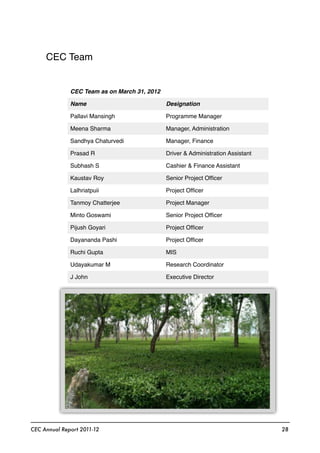
CEC Team
CEC Team as on March 31, 2012CEC Team as on March 31, 2012
Name Designation
Pallavi Mansingh Programme Manager
Meena Sharma Manager, Administration
Sandhya Chaturvedi Manager, Finance
Prasad R Driver & Administration Assistant
Subhash S Cashier & Finance Assistant
Kaustav Roy Senior Project Officer
Lalhriatpuii Project Officer
Tanmoy Chatterjee Project Manager
Minto Goswami Senior Project Officer
Pijush Goyari Project Officer
Dayananda Pashi Project Officer
Ruchi Gupta MIS
Udayakumar M Research Coordinator
J John Executive Director
CEC Annual Report 2011-12 28
Financials 2011-12
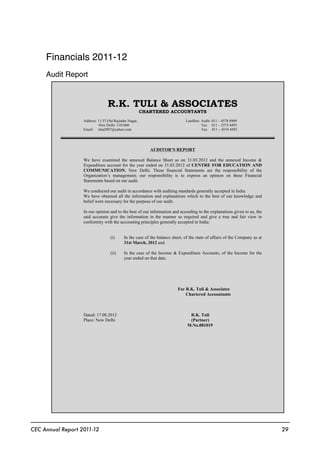
Audit Report
CEC Annual Report 2011-12 29
R.K. TULI & ASSOCIATES
CHARTERED ACCOUNTANTS
Address: 11/37,Old Rajinder Nagar, Landline: Audit: 011 – 4578 8909
New Delhi -110 060 Tax: 011 – 2573 4493
Email: rkta2007@yahoo.com Fax: 011 – 4510 4493
AUDITOR’S REPORT
We have examined the annexed Balance Sheet as on 31.03.2012 and the annexed Income &
Expenditure account for the year ended on 31.03.2012 of CENTRE FOR EDUCATION AND
COMMUNICATION, New Delhi. These financial Statements are the responsibility of the
Organization’s management; our responsibility is to express an opinion on these Financial
Statements based on our audit.
We conducted our audit in accordance with auditing standards generally accepted in India.
We have obtained all the information and explanations which to the best of our knowledge and
belief were necessary for the purpose of our audit.
In our opinion and to the best of our information and according to the explanations given to us, the
said accounts give the information in the manner so required and give a true and fair view in
conformity with the accounting principles generally accepted in India:
(i) In the case of the balance sheet, of the state of affairs of the Company as at
31st March, 2012 and
(ii) In the case of the Income & Expenditure Accounts, of the Income for the
year ended on that date.
For R.K. Tuli & Associates
Chartered Accountants
Dated: 17.08.2012 R.K. Tuli
Place: New Delhi (Partner)
M.No.081019
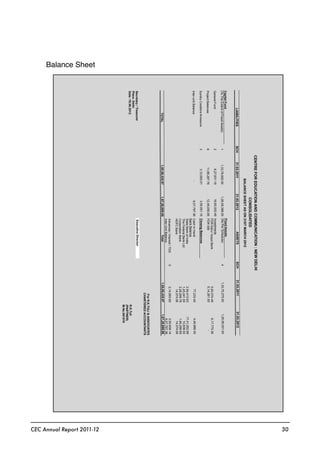
Balance Sheet
CEC Annual Report 2011-12 30
LIABILITIESSCH31.03.201131.03.2012ASSETSSCH31.03.201131.03.2012
CapitalFundFixedAssets
(ToTheExtentofFixedAssets)11,33,76,662.001,26,56,388.00(AsPerSchedule)41,33,75,275.001,26,55,001.00
GeneralFund26,27,831.1816,60,002.49Investments
FDRKarurVysyaBank5,83,074.496,17,775.36
ProjectBalances611,89,287.7812,49,050.85FDRSBI6,14,261.00-
SundryCreditorsAnnexure33,12,655.013,55,651.16ClosingBalances
Inter-unitBalance-8,07,797.36CashInHand77,233.404,46,988.40
BankBalance
StateBankofIndia2,54,413.6317,41,292.89
TheFederalBankLtd1,45,241.0010,836.00
CorporationBank2,28,299.791,84,286.65
HDFCBank14,074.0614,074.06
Advances/Imprest/TDS52,14,563.602,50,838.14
Inter-UnitBalance8,07,797.36
TOTAL1,55,06,435.971,67,28,889.86Total1,55,06,435.971,67,28,889.86
ForR.K.TULI&ASSOCIATES
CHARTEREDACCOUNTANTS
Secretary/TreasurerExecutiveDirector
Place:Delhi
Date:18.08.2012R.K.Tuli
(PARTNER)
M.No.081019
CENTREFOREDUCATIONANDCOMMUNICATION:NEWDELHI
CONSOLIDATED
BALANCESHEETASON31STMARCH2012
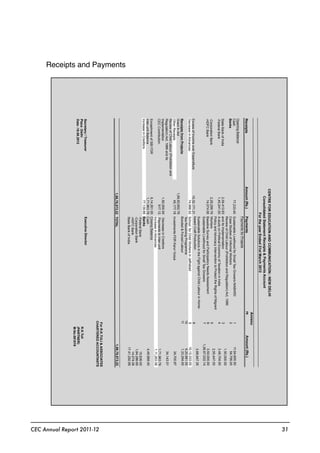
Receipts and Payments
CEC Annual Report 2011-12 31
ReceiptsAmount(Rs.)Payments
Annexu
reAmount(Rs.)
PaymentsforProjects
OpeningBalance
Cash77,233.40SustainableLivelihoodforSmallTeaGrowers-NABARD111,64,600.50
BanksCaseStudiesofInformalWorkers254,795.00
StateBankofIndia2,54,413.63
ReviewofChildLabour(ProhibitionandRegulation)Act,1986
anditsImplementation3
1,50,000.00
-FederalBank1,45,241.00AstudyonPoliticalEconomyofTaxationinIndia43,48,704.00
-CorporationBank2,28,299.79
PolicyandAdvocacyInterventiontoProtecttheRightsofMigrant
Workers5
2,55,447.00
-HDFCBank14,074.06BaselineSurveyandParticipatoryNeedsAssessment63,50,000.00
SustainableLivelihoodforSmallTeaGrowers71,26,67,022.14
ExcessofIncomeoverExpenditure10,32,171.31
SustainableSolutionsintheFightagainstChildLabourinHome-
basedCraftProduction.8
3,68,947.35
DecreaseinAdvances74,988.52SchoolforChildWorkersinJaffrabad910,15,333.00
TeaRevolvingProgramme106,20,881.00
ReceiptsfromProjectsBonded&ForcedLabour111,33,294.00
GrantInAid1,69,92,692.76
OtherReceipts45,177.18Investments-FDRKarurVysya34,700.87
ReviewofChildLabour(Prohibitionand
Regulation)Act,1986andits
Implementation1,50,000.00DecreaseinCreditors
34,143.51
CECContribution917.12PaymentstoInter-unit1,71,963.79
IncreaseinAdvances1,11,263.06
EncashmentofSBIFDR6,14,261.00ClosingBalance
Inter-unitBalance1,71,963.79Cash4,46,988.40
IncreaseinCreditors77,139.66Banks
-FederalBank10,836.00
-CorporationBank1,84,286.65
-HDFCBank14,074.06
StateBankofIndia17,41,292.89
1,98,78,573.22TOTAL1,98,78,573.22
ForR.K.TULI&ASSOCIATES
CHARTEREDACCOUNTANTS
Secretary/TreasurerExecutiveDirector
Place:DelhiR.K.Tuli
Date:18.08.2012(PARTNER)
M.No.081019
CENTREFOREDUCATIONANDCOMMUNICATION::NEWDELHI
ConsolidatedStatementReceipts&PaymentsAccount
FortheyearEnded31stMarch2012
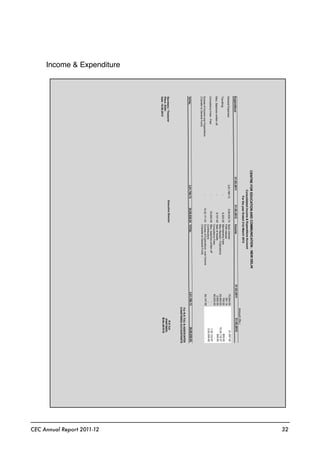
Income & Expenditure
CEC Annual Report 2011-12 32
Amount(Rs.)
Expenditure31.03.201131.03.2012Income31.03.201131.03.2012
GeneralExpenses2,81,786.739,06,635.74BankInterest70,544.0021,297.00
FDRInterest391.14-
Travelling-8,303.00MembershipFees700.00800.00
MiscReceipt/Publications25,404.0015,34,118.37
Misc.Balanceswrittenoff-8,727.49SaleofAssets2,600.00500.00
ConsultancyFees90,000.00-
ConsultancyFees-Paid-53,000.00Misc.balanceswrittenoff-1,30,122.67
Contributions-3,22,000.00
ExcessofIncomeoverExpenditure-10,32,171.81ExcessofExpenditureoverIncome92,147.59-
(TransfertoGeneralFund)(TransfertoGeneralFund)
TOTAL2,81,786.7320,08,838.04TOTAL2,81,786.7320,08,838.04
ForR.K.TULI&ASSOCIATES
CHARTEREDACCOUNTANTS
Secretary/TreasurerExecutiveDirectorR.K.Tuli
Place:Delhi(PARTNER)
Date:18.08.2012M.No.081019
CENTREFOREDUCATIONANDCOMMUNICATION:NEWDELHI
ConsolidatedIncome&ExpenditureAccount
FortheyearEnded31stMarch2012
173-A, Khirki Village
Malviya Nagar
New Delhi – 110017
Tel: 011 29541858 / 29541841
Fax: 011 29545442
Email: cec@cec-india.org
Website: www.cec-india.org
Annual Report 2011-12
Centre for Education and Communication

Annual report-cec-2011-12-web

  • 1.
    Annual Report 2011-12 & Financials Centrefor Education and Communication New Delhi
  • 2.
    Centre for Educationand Communication 173-A, Khirki Village Malviya Nagar New Delhi – 110017 Tel: 011 29541858 / 29541841 Fax: 011 29545442 Email: cec@cec-india.org Website: www.cec-india.org Centre for Education and Communication (CEC), 2011-12 Report Prepared by: Pallavi Mansingh, Divya Devan
  • 3.
    Table of Contents ExecutiveDirector’s Note .................................................................................... 5 Sustainable Livelihood for Small Tea Growers ................................................... 9 ! STGs in Nilgiris, Idukki & Wayanadu ....................................................... 9 ! STGs in West Bengal, Assam, Tripura, Arunachal Pradesh & Mizoram . 11 ! Contribution to Plantation Studies ........................................................... 14 Changing Labour Market Dynamics in International Garment Supply Chains .... 15 ! Sumangalis or Camp Coolies .................................................................. 15 ! Homeworking in Sangam Vihar ............................................................... 16 Child Labour, Child Rights and Right to Education – critical questions .............. 17 ! Review of CLPRA .................................................................................... 17 ! Bharat Janata School .............................................................................. 18 ! Child Labour in Home Based Craft Production ....................................... 19 Labour Rights in the Special Economic Zones ................................................... 21 ! CEC Study for ACTRAV/ILO in India ....................................................... 21 Taxation and social security ................................................................................ 23 ! Taxation Policies and Implications for the Poor ....................................... 23 ! Elusive Universal Social Security ............................................................ 23 Maruti Workers Struggle – ground realities ......................................................... 25 Governing Board of CEC .................................................................................... 26 CECTeam ............................................................................................................ 28 Financials ............................................................................................................ 29
  • 5.
    Executive Director’s Note Coreand Periphery I recall, during the Silver Jubilee celebrations of CEC, how Prof. D. Narasimha Reddy reacted to an observation made by me that CEC rarely got into the core issues of labour; rather had been addressing issues of labour in its peripheries. Prof. Reddy observed that the issues considered peripheral to labour are now the core issues or the distinction between core and periphery are fast disappearing. In order to locate CEC’s relevance and understand its contribution, it is important to ask the question whether there is a core and periphery for labour in India? Are spaces demarcated defining who can be at the core and who must be at the periphery? if the answer is in the negative, does it make the problematic superfluous? Looking at the core and periphery as represented by the ‘organised’ and ‘unorgansed’ workers is insufficient because flexibilisation of production and flexibilisation of labour are fast obliterating this difference. At the same time, the core is usually represented by issues of industrial relations (issues between employer and the employee) evolved from situation where large-scale production of goods and services takes place, employing men and women workers in large numbers for longer durations of time and generally for all their productive years. In the Indian context, the core also gets extended to the machinery of labour administration. Though labour unions have also been part of the core, this privilege is fast disappearing. In this sense, the core has an exclusivity; in Indian context a sort of Brahminism - not allowing anyone other than those belonging to this group to have access to the privileged space. State imposes structural restrictions to raise so called core issues by anyone other than a defined set of people. When state manages to disempower those who occupy this exclusive space, a huge vacuum of agency is generated. Incidents that have happened in Grazzianno in Greater NOIDA and Maruti Suzuki in Manesar can be looked at from this perspective. Labour cannot be an exclusive space. It must belong to everyone. CEC and the Peripheries CEC has largely worked at the peripheries. This is not to pass any value judgment on this option - whether this was (is) right or wrong. In the beginning, it was ethnic identity, health and displacement of workers and implications of mechanisation on workers. CEC Annual Report 2011-12 5
  • 6.
    Later, we addressedemphasised the concept of ‘labour rights’ as human rights at all work places - paid or unpaid. CEC argued that labour must have a say in the global neo-liberal trade regime; but externalities without considering the voice of the local labour can lead to worst forms of human right violations including unemployment, slavery, displacement, fluctuations in prices of primary products and also the right to self-determination of nations. It cautioned against the possible negative impacts of free trade agreements on labour, employment and livelihood. CEC worked consistently on the issue of contemporary forms of slavery in India, particularly in the agrarian and manufacturing sectors through its studies on changing forms of debt bondage in agriculture and sumangali / camp coolie system in garment supply chain. CEC has looked at rights of migrants and helped in evolving a national consensus on rights based migration policy Similarly, CEC has helped through various studies and collaborative action, in deepening the understanding of child labour. CEC has again helped in building a national consensus on social security - first as the right of unorganised workers and then as a universal right in the light of changing nature of employment in India and increasing income disparity. On Peasant Question An important question that CEC has to address is how, as a labour organisation, it should consider small peasants. Traditional perspective says that peasants are allies of workers in the struggle against capitalistic exploitation. Peasants or small farmers are allies because though they own land and need to expend their labour to survive. Alliance gets strengthened when they do farming collectively. This has led to the mass movement of cooperatives of farmers as an alternative. Globalisation brings in a new dimension. Huge agri-corporations and global brands prefer to source products from the small farmers without a direct engagement in agricultural production but maintaining a streamlined supply chain. In cash crops like tea and coffee, many corporates are moving out from huge plantations and source either unprocessed for their factories or processed products for their marketing wing. Small farmers consequently face multiple jeopardy - not having a say for their products at the factory gate and in the consumer market; not having any control over inputs and their costs; individualised ownership of land making them voiceless; spacial distances to the processing units or market for their perishable products making them vulnerable to influences of middle people; absence of protection during contingencies making them dependent on ursurers etc. CEC Annual Report 2011-12 6
  • 7.
    While the theoriesof global supply chain and global value chain have helped in understanding this phenomenon of emerging agrarian capitalism, little has been done to empower small producers to have control over themselves. CEC has understood this as a major area of struggle - building producer organsations of farmers based on cooperative principles. Our work among small tea growers is a case in point. In Defense of Self Respect CEC has ardently defended its self respect against an onslaught by a few of the donors as guided by self styled caste auditors. CEC’s defense was based on the perspective that southern organisations are autonomous entities and are not built on subservience resulting from a donor-recipient relationships. The external agencies are not mandated to make or break organisations in the South, where they have come up on their own volition and have taken decisions to forge collaborations with internal as well as external agencies. Therefore, logically the Southern organisations must survive even if the external sources of funds get dried up. There are laws that govern southern organisations and as long as there are no violations of such laws, and as long as there are no instances of financial embezzlements, the donor organisations cannot dictate on the ‘being’ of the entity as such. In principle, no agency can take the role of donor, facilitator, evaluator and judge at the same time. This may result in serious miscarriage of justice. The relationship between northern and southern organizations as expressions of solidarity and partnerships are fast disappearing in formal development funding scenario. This could largely be the result of dwindling independent financial sources and greater dependence on state funds, bringing in more of impersonality in relationships. CEC found that the attack was on the organisation itself and its independence. So far, we have put up strong defense. ! ! ! ! ! ! ! ! ! J John ! ! ! ! ! ! ! ! ! August 01, 2012 CEC Annual Report 2011-12 7
  • 8.
    (L) Dinesh KumarSarmah, Vice-President, All Assam Small Tea Growers’ Association; Rakesh Saini, Executive Director, Tea Board; J John, Executive Director, CEC; Bijoy Gopal Chakroborty, President Confederation of Small Tea Growers’ Associations of India. Guwahati, March 28, 2012
  • 9.
    Sustainable Livelihood forSmall Tea Growers STGs in Nilgiris, Idukki & Wayanadu The tea value chain is structured along a hierarchical relationship with the global buyers dictating terms to the producers. An inherently asymmetric balance of power relation increases the vulnerabilities of the producers. At the same time the small producers in this value chain are not merely passive recipients but dynamic actors who are constantly engaging with the value chain. CEC’s intervention in the tea industry looks at how these major shifts in the global tea industry impact upon the men and women who constitute the periphery of this value chain and empowers them to in turn assert their space in the value chain. Wold’s second largest producer and consumer of tea, India, has over 11 million people dependent on the estate sector of industry for their livelihoods. This excludes over 200,000 small tea growers (STGs), in the tea growing states of Assam, West Bengal, Arunachal Pradesh, Mizoram, Tripura, Himachal Pradesh, Tamil Nadu and Kerala. The sector contributes about 28% of total tea production, which is steadily increasing. According to the Tea Board of India STG is a person who has a tea plantation of up to 25 acres, but most own less than 3 acres of land. However, the scattered remote locations of habitation, lack of organisation among growers, lack of bargaining capacity, shortage of working capital, dependence on exploitative trade channels, low levels of technical knowledge, low quality of leaves and limited access to resources are serious factors that make them extremely vulnerable at the lower end of the tea value chain. Failure to get a fair price has a significant impact on their ability to afford food, education and healthcare due to the absence of other sources of income. CEC’s intervention is a means of supporting STGs in India, to improve conditions in the tea sector as a whole, and to contribute to the alleviation of poverty of thousands of tea growers and their dependents. Dispersed group of STGs is organised into collectives, trained in technical, negotiation and governance skills, they will be able to achieve confidence to deal more effectively with other players in the supply chain. Funded by NABARD under Rural Innovation Fund, the project Sustainable Livelihoods for Small Tea Growers in Sept 2010 till Oct 2011 attempted to organize the STGs into business and social collectives at such a large scale. The project was also attempting to learn from the experience of collective action in commodity sectors and adapts them to the specific needs of the tea sector. The project aimed to reduce poverty among small tea growers (STGs) in India through innovative means of improved agricultural practices and establishing fairer terms of trade in tea. It reached out to 5500 STGs and their families in Nilgiris district of Tamilnadu by mobilizing small tea growers and helping them form collective organizations to manage the tea based livelihoods; building capacities of STG Primary Producer Societies to be effective CEC Annual Report 2011-12 9
  • 10.
    and efficient platformsfor improving production systems, getting better returns, and increasing access of small tea growers to public schemes; establishing feasibility of tea processing (tea factory) facilities owned by STG Primary Producer Societies. Table  I:  Value  per  kg  of  Green  Leaf  Before  and  A7er  Forma:on  of  PPSs  in  Districts  and  based   on  the  Method  of  Leaf  Trade Table  I:  Value  per  kg  of  Green  Leaf  Before  and  A7er  Forma:on  of  PPSs  in  Districts  and  based   on  the  Method  of  Leaf  Trade Table  I:  Value  per  kg  of  Green  Leaf  Before  and  A7er  Forma:on  of  PPSs  in  Districts  and  based   on  the  Method  of  Leaf  Trade Table  I:  Value  per  kg  of  Green  Leaf  Before  and  A7er  Forma:on  of  PPSs  in  Districts  and  based   on  the  Method  of  Leaf  Trade Table  I:  Value  per  kg  of  Green  Leaf  Before  and  A7er  Forma:on  of  PPSs  in  Districts  and  based   on  the  Method  of  Leaf  Trade Table  I:  Value  per  kg  of  Green  Leaf  Before  and  A7er  Forma:on  of  PPSs  in  Districts  and  based   on  the  Method  of  Leaf  Trade Table  I:  Value  per  kg  of  Green  Leaf  Before  and  A7er  Forma:on  of  PPSs  in  Districts  and  based   on  the  Method  of  Leaf  Trade Value  per  kg  (Rs)  per  day  for  Leaf   Agent  Growers Value  per  kg  (Rs)  per  day  for  Leaf   Agent  Growers Value  per  kg  (Rs)  per  day  for  Leaf   Agent  Growers Value  per  kg  (Rs)  per  day  for  Society   Growers   Value  per  kg  (Rs)  per  day  for  Society   Growers   Value  per  kg  (Rs)  per  day  for  Society   Growers   Before A'er Per  cent   Increase Before A'er Per  cent   Increase Nilgiris 9.07 10.75 19.49 7.93 14.30 84.08 Idukki 6.75 10.00 49.85 6.13 11.19 82.53 Wayanad 8.00 10.31 29.55 8.56 11.81 38.42 Sixty Five (65) primary producer societies were formed in Nilgiris district of Tamillnadu and Idukki & Wayanadu districts of Kerala during the course of the project, implemented during the period April 2010 to October 2011. By avoiding leaf agents, improving the quality of leaves, and negotiating from the strength of a collective, they, on an average, managed to gained on an average Rs.4.54 per kg of green leaf sold to a bought leaf factory. Activities have also included technical and organisational capacity building, and networking with the Tea Board of India (TBI), United Planters of South India, Tea Research Association and supply chain players. The activities had a 3-tier structure to organise STGs i.e. STGs societies in villages, regional/ district /state associations and a national association - Primary producers’ societies: STG societies function as business enterprises at the grassroots levels. They address and organise issues around the cultivation of tea and sales of green leaves. Their objective is to 0 1.3 2.5 3.8 5.0 Nilgiris Idukki Wayanad Combined 4.09 2.78 4.464.54 Figure  1:  Daily  Gain  per  kg  for  STGs  after  formation  of  Society  in  Lean  season CEC Annual Report 2011-12
  • 11.
    gain better pricesfor green leaves by enhancing the quality of production and engaging in fair terms of trade with bought leaf factories. The CEC project has given almost 5500 small tea growers in the districts a sustainable livelihood through tea cultivation. While many STGs are workers in their own gardens, there are a substantial number of workers engaged by them. On an average, a STG may engage 2 to 3 workers, making the employment benefit to another 11000 workers in the districts. If the downstream and upstream links are also considered, the employment potential of the project is substantial. STGs in West Bengal, Assam, Tripura, Arunachal Pradesh & Mizoram The project ‘Sustainable Livelihoods for Small Tea Growers’ being implemented by CEC in the North East focusses on reducing poverty and improving income of the small tea growers who are the most vulnerable constituent in the global tea value chain. The project is supported by the European Union (EU) and is being implemented in India in partnership with Traidcraft. Spanning across in 5 states in India (Assam, West Bengal, Tripura, Mizoram and Arunachal Pradesh) and in Bangladesh, the project addresses some of the key issues confronted by the small tea growers including the lack organisation, absence of representation at local and national levels, low technical and business skills, limited accessibility to resources and services and lack of awareness about government support. Organising Primary Producer Society (PPS) is at the heart of the activities. PPS eliminate middle-men (who don’t add any value) from the tea value chain. In year I in India, 2500 STGs have been organised into PPS. Their capacities have been enhanced through technical training and training in PPS operation module. In Bangladesh 200 STGs are formed into eight functional PPS. In India, different strategies have been undertaken in different states, after analysing the local ecosystem. A common thread across all the states is the positive relationship management with state level STG association and national STG association, CISTA (Confederation of Indian Small Tea Growers Association) in India. The work has been recognized by Tea Board of India and Bangladesh and they are providing relevant support to mobilize STGs towards achieving the project objective. During the implementation phase, eliminating leaf agents so that the STG societies can trade directly with the BLF/estate factory was one of the biggest challenges of the project. Leaf agents advanced loans to the STGs which in a way compelled STGs to sell leaf through to them. Interference by the leaf agents continued, sometimes with the support of some CEC Annual Report 2011-12 11 STG in India gets, on average, Rs 8 for 1 kilo of green leaf which is made into 250 grams of made tea. Made tea is sold at Rs 80-100 per kilo and branded made tea is sold at Rs 150-250 per kilo in the market. Although there are other factors (e.g. quality of leaf), the difference is substantial and unfair. Building a strategy for fairer terms of trade for the STGs was a challenge. In the CEC project areas while the growers who sold their green leaf through Leaf Agents obtained an average price of Rs.10.75 per kg of green leaf, those who traded leaf collectively through PPS obtained an average price of Rs. 14.30 per kg in Nilgiris.
  • 12.
    community members andBLFs, even after the society was established. This reduced the pace at which financial gains would accrue to the growers. Having no manufacturing facilities, STGs depend on Bought Leaf Factories or Estate Factories for processing of green leaves. It is not easy to convince the BLFs and Estate Factories collectives of STGs are dependable business allies. Formation of societies has also improved the chances of farmers getting eligible subsidies and other financial and technical support from the Tea Board of India. Access to the Tea Board of India and the local banks have greatly improved after the formation of the PPSs. Representative of farmers developed the habit of visiting Tea Board office and the banks regularly to discuss issues and transact businesses. The project team has an intense networking with the tea board at various levels – at the national as well as state and district level the project team interacts with the tea board officials, attends their meetings and invites them for attending seminars and give trainings. Here are some of the key developments - the representatives from Tea Board of India participated in poverty reduction workshop in Darjeeling; Meeting with Mr. Boriah, Director Tea Development was held on September 26; Meeting with Chairman, Tea Board was held on March 13 in which representatives of CEC and Tradicraft were present. Tea Board attended the Project Launch meeting in Kailashahar. TB North East ED writing to TB officers to support CEC in its activities. As part of the project two crucial events have been organised in 2011-12. The first event was the National Workshop of Non state Actors in Darjeeling on September 11, 2011Various stake holders from STG ecosystem, including representation from Ministry of Commerce & Industry, Tea Board of India (TBI), Tea Research Association (TRA) Indian Institute of Plantation Management (IIPM), Centre for Education & Communication (CEC), Assam Agricultural University, North Bengal University, Corporate, Darjeeling Organic Ekta Society, different NGOs etc were present for the meeting.The workshop focussed on current issues confronting STGs and improvements in livelihood of small tea growers through better terms of trade. It discussed how organising as SHG/ Tea Producer Society (PPS) and getting CEC Annual Report 2011-12 12 Enabling appropriate leadership to emerge from among the small tea growers that can have a decisive participation in policy making was a challenge. At the implementation level difference of opinions between STGs, a lack of leadership qualities among those who became the leaders and/or bad internal dynamics of the groups at times made working together difficult. In order to ensure good group dynamics and encourage leadership, the project team was alert to any divisiveness and took appropriate steps to ensure that differences are sorted out through dialogue and participation. Facilitating the emergence of leaders who are democratically chosen by the STG societies also ensured cohesiveness within the groups and promoted collective identity. The Tea Board of India invited CEC to the first National Convention of Small Tea Growers held in Tezpur University, Sonitpur District, Assam, to share the experiences from the South, especially Nilgiris.
  • 13.
    it registered makestheir members eligible for all benefits/ subsidies by TBI. Poor price realization of BLFs in auction platforms reduces green leaf prices for the STGs. There is collusion during auctioning and it should be studied categorically. Similarly random checks in BLF by factory inspectors can ensure quality procurement of Green Leaf that in turn will serve as an incentive for the STGs to ensure quality while plucking. There should be compulsory disclosure of leaf purchased, processed & sold by the BLF owner to implement the price sharing formula transparently. There is need of strict vigilance for its implementation. Possibilities of direct linkages of STG production (through separate branding) in domestic & international market need to be explored. A capacity building workshop of Non State Actors was held in Guwahati on March 22, 2012. Mr. Prithibi Majhi, Minister of Revenue and DM labour and employment was the chief guest. The seminar captured different dimensions of poverty, gender, displacement, politics etc. The speakers were renowned professors from Assam and West Bengal who are engaged in poverty research for several years. The meeting disseminated the information collected on poverty reduction. Latest government data indicating that poverty in North-East states was increasing (with marginal decline in Tripura and Arunachal Pradesh) contextualised the deliberations. The meeting discussed how in Assam Small Tea Growers are contributing towards employment generation and income generation. But in recent years because of high cost of production, land problem, middlemen intervention, lack of collective approach and poor price realisation farmers are some of the problems that the STGs are continuously confronting. Reducing poverty among small growers through enhancing their output, quality control, marketing exposure, building up entrepreneurial qualities and possibilities of promoting their business along with state support and policy changes and intervention on trade & non-trade related issues towards inclusive growth were also discussed. Listed below are some of the crucial accomplishments of the project: • Nine project staff and over 50 STGs acquired the training in poverty reduction measures. Project staff also trained in encouraging the voice and participation of vulnerable groups (dalits, adivasis, minorities and women) in STG societies. • 2500 STGs have been organized into around 25 PPSs in India • All 25 PPS have applied for registration under Society Registration Act. They will apply soon for Tea Board of India registration • All state level STG associations have been federated to CISTA, only national body of STGs in India. CISTA has been recognized by TBI and CISTA president has been given special invitee status at all TBI board meetings. CISTA has been instrumental in providing input to TBI for designing STG friendly policies • 15 technical training programs in different parts of India and more than 1000 STGs have been benefited from such training programs. The topic of technical session ranged from pruning, tipping, cold weather operations etc. More capacity building training have been organized on issues like society operations management etc. CEC Annual Report 2011-12 13
  • 14.
    • Four PPShave come in informal contract with BLF and have started supplying leaf from this season • 14 Mater Trainers have been selected and have received their first part of the training program in Kolkata. The project team has been networking with state governments at various levels and has successfully got support from them. Two key instances that can be listed – 1) Tripura government is collaborating with CEC project staff in building PPSs and providing training programmes. Tripura Government co-hosting the International Tea Day in Kailashahar, Tripura and 2) Mr. Prithibi Majhi, Minister of revenue attending the Poverty Reduction Workshop in Guwahati on March 22, 2012. The project team is also facilitating networking with the government department and tea board through CISTA. Since CISTA in India consists of representatives from each of the 5 tea producing state small tea grower associations, they have meet in different locations so as to keep in touch with ground level issues, consult effectively with STGs and continue to remain relevant by effectively representing the interests of the STGs. Interactions were also held with state representatives of the Tea Boards and other key stakeholders who can help with policy changes for STGs including the Ministry of Commerce, the Ministry of Labour, the Ministry of Agriculture, National Bank for Agriculture and Rural Development (NABARD) and other financial institutions in India. Contribution to Plantation Studies The project team participated actively in a research programme of the Ministry of Commerce and Industry which was hosted by Centre for Development Studies, Trivandrum focussing on the Tea Industry. The project team gave insights into the situation of the small growers by contributing two research papers focussing on STGs – one paper addressing the price stabilisation fund and how there should be innovations done with it to benefit STGS and two on comparative analysis of different models of collectivisations of small growers. CEC Annual Report 2011-12 14 (L) Minto Goswami, Pijush Goyari, Dayananda Pashi, Pallavi Mansingh, Lalhiratpuii, Sandeep Dowerah, J John, Tanmoy Chatterjee, Kaustav Roy
  • 15.
    Changing Labour MarketDynamics in International Garment Supply Chains Sumangalis or Camp Coolies In the era of free-trade centric globalization, the dynamics of labour and labour relations are acquiring new meanings. India’s integration into the market economy and influx of transnational capital has reorganized production in such a way that on the one hand there is a breakdown and restructuring of traditional structures like the caste system and increased employment of women. But on the other side, there is disintegration of the organized sectors, reduced space for collective bargaining, and denial of labour rights to workers in such a way that brings back the master and slave relationship, making workers extremely vulnerable and thus creating new forms of slavery. CEC has been working on highlighting contemporary forms of bondage and forced labour. Recently in collaboration with ASI a study was conducted on bondage and forced labour in export garment production in the garment industry in Tamil Nadu in collaboration with ASI. The study will be released by ASI in UK in around mid-2012. Adding on to the existing study CEC also collected field information from the source areas on the victims under the Sumangali scheme. Field visits were conducted and meetings with workers who had worked or were working at present under sumangali/camp coolie/hostel scheme. CEC’s study was discussed in these meetings. BBC in UK has also planned a programme focussing on the conditions of the workers in the garment industry in Tamil Nadu to be aired in June 2012. Homeworking in Sangam Vihar A field study was conducted by CEC in Sangam Vihar among home workers in the garment embellishment industry. Nature of the study was a baseline study and participatory need assessment survey conducted for the National Homeworkers Group of the Ethical Trading Initiative (ETI) and Maniben Kara Institute (MKI) in Sangam Vihar, a slum cluster in New Delhi which is a major hub of global outsourcing for embellishments and stitching garments. It is an initial project as part of the RAGS project which seeks to improve working conditions for homeworkers and vulnerable workers This study looks at the demographic composition of the home based workers in Sangam Viihar examining their origins, when they migrated, their present status, the identity proof they possess, their ties with families back home and so on. It looks at the gendered division of work, nature and extent of involvement of children. It examines the socio economic condition of home based workers, their remuneration and wage, living and working conditions, whether and how in this export sector workers are able to meet their basic needs and how the tenets of the ETI Base Code are being implemented. Further, the study also looks into how is production is organised in Sangam Vihar’s home based garment industry. The study observes that parameters of quality and lead time weigh heavily at this end of the value chain. It highlights the vulnerability of the home workers, how CEC Annual Report 2011-12 15
  • 16.
    they become dependenton one contractor due to the delayed payment structure and how their bargain space is severely curtailed. Irregular work, lack of training to keep records, lack of awareness on health and safety issues and lack of access to government schemes is also highlighted. The study examines from the perspective of workers what the possible improvements that can be made in their living and working conditions. The study concludes with recommendations for the retailers, contractors, government, NGOs/Trade Unions, NHG and the workers. CEC Annual Report 2011-12 16
  • 17.
    Child Labour, ChildRights and Right to Education – critical questions Review of CLPRA State intervention to eradicate child labour has two major components, both worked out in 1986-87, namely the Child Labour (Prohibition and Regulation) Act CLPRA 1986 and the National Child Labour Policy following it. At present, Child labour in 18 occupations and 65 processes (Schedule -Part A and B) are prohibited under the CLPRA. However, these cover only about 10 per cent of the children who are engaged in the formal industrial sector. The Act neither defines ‘hazardous’ and ‘non hazardous’, nor gives a basis on which child labour only in certain occupations are considered non exploitative and hence legitimised. The law also does not include millions of children in the agricultural sector, almost 70 per cent of child workers in India. There is no reliable and authentic data on working children. Major reason is that there is no agreement on the definition of child even among different departments of the government. While CLPRA defines child as those below 14 years, laws such as Indian Majority Act, 1875 and Factories Act as amended in 1954 for night work categorize persons below 18 years as children. CRC defines a person of 18 years and less as a child. The NSSO survey information does not provide clear data on children of the age group 0-18 years. There are statistics on persons of the age group 0-14 or the age group 0-19 years. These confusions have serious consequences beyond data and has crippled government of India’s ability to do away with child labour. The recent Right to Free and Compulsory Education Act, 2009 promises free and compulsory education for all children in the 6 to 14 age group. Besides implicit denial of right to education to children below 6 and above 14 years, critiques have also raised the issue of the need for a review of CLPRA in the light of the Right to Education Act. Some of these issues were studied by CEC in 2011-12 CEC as part of a study “Review of the provisions of Child Labour (Prohibition and Regulation) Act, 1986 and identification of gaps in implementation” which was conducted by CEC for Save the Children. The study observed that lack of definition of child labour, definition of child in the Act which is not in tune with the CRC or Juvenile Justice Act, the half-baked hazardous and non hazardous division, unpardonable exemptions (especially the agricultural sector) from prohibition, inadequate penal consequences, unsatisfactory conversion rates from investigations to prosecutions to convictions, etc., foil the CLPRA from achieving the goal of a society without child labour. The study further suggested that (1) India shall ratify ILO conventions 138 and 182 and modify the CLPRA in tune with the CRC; (2) amend Article 24 of the Constitution to prohibit all forms of child labour as explained in the study to bring it in tune with Article 21 A (fundamental right to education); (3) amend Article 21 A of the Constitution and the Right to Education Act to assure fundamental right to education till 18; (4) universalize the Integrated CEC Annual Report 2011-12 17
  • 18.
    Child Development Servicesand (5) annul the CLPRA and enact a new legislation banning all forms of child labour. Bharat Janata School More than 80, 000 populations dwell in the Janata Colony of Zaffrabad in the north east part of the capital city Delhi. Out of which about 10, 000 are potential school going children but unfortunately all are not going. Three government schools can accommodate at best three to four thousand children. Most of the children are out of school and are either engaged in selling commodities and eatables in the small shops or in the garment units in the narrow lanes, rag picking or sitting idle and involved in drug use or other criminal activities. Even if they want to go to school then also the existing schools cannot accommodate to all, not even 15 per of the school going age groups. The interventions by the non-state actors too were irregular and for a short span. The concerted effort by few AITUC activists drew the attention of the Centre for Education and Communication in 2003. Accordingly a non-formal education centre or more precisely a feeder school was initiated in the Janata Colony of Zaffrabad with the support of the Terre des Hommes India Programme (TdH- IP). Over the years, Bharat Janta School has evolved from nominal school to a centre of learning and community action. It now caters to the varied needs of the community. While the bridge school continues with greater focus, new vocational courses have been started on the demand of the community. It has mobilized the community to understand the importance of schooling and educate others about the same. Health and hygiene standards of the children who join in has improved. In the neighbourhood of increasing crime and drug peddling, the Bharat Janta school facilitates a creative change in the lives of children through education. Increasingly, its ownership lies with the community. Series of meeting with the community and teachers of Bharat Janta School revealed how the school was at the core but not the only activity of the activists teachers of Bharat Janta School. The role of the teachers did not end with conducting a class; they facilitated parents to ensure that the children are enrolled in schools by helping them in filling forms, obtaining scholarships and in organizing visits to the school. They organise meetings with the principals and teachers of the government schools on the quality of education and follow up with the children and ensure that they are able to keep up to the studies and do not drop out. Even beyond the schools, they reach out to the community on the right to education through the school chalo abhiyaan, networking with madarassas and ensuring gainful employment for adolescent girls by giving them vocational training and facilitating their enrolment in CEC Annual Report 2011-12 18 “My mother, younger sister and I work at home 7 days a week. My father is sick and he cannot work. We stitch zips and buttons in jeans. We start work from about 12 pm and work till about 9 pm. For the past four months I have started coming to the learning centre in the morning. I study from 8 am to 11 am. After some time I want to join a bigger school even if I have to work up late in the night to compensate so that when I grow up I can go to an office and work.” Ajeem, 11 years, Student at Bharat Janta Shiksha Kedra, Jafrabad
  • 19.
    formal education. Theconstitutional amendment of making education a right to all children of the age 6-14 necessarily implies that formal quality education is the responsibility of the state. Bharat Janta School therefore cannot assume the functions of a regular school. However, it has a crucial function by acting as a facilitating centre enticing and encouraging children towards education; a distant model for the community and an activity centre for children and adolescents. Given this, the structure of the present school has changed. In 2011-12 the Bharat Janta School was replaced by ‘Bharat Janta Shiksha Kendra ’ which is run and managed by Bharat Janta Shiksha Samiti, a general body of representatives from the community which will decide on the activities of the centre. This process will ensure community ownership and community leadership. The Samiti will be both an activity of the centre as well as the advisory body to the management. The centre will work with children as well. Child Labour in Home Based Craft Production Researchers and activists have brought to light new elusive forms of bonded child labour in the export oriented supply chains of giant retailers and brands, and the non-applicability of the existing legislative provisions to address them. Bonded child labour in home-based embroidery and craft Industry in Delhi and UP, child labour in sports goods making in Punjab and child labour in spinning and garment manufacturing in Tamil Nadu where there is increasing bondage among girl child workers are a few examples. Trends suggest that home-work is increasing. While home-work was once linked to old craft traditions and cultural factors that restricted the mobility of women, it is increasingly being taken up because of declining opportunities for formal employment, expanding export demand for craft products, and a growth in the practice of subcontracting, which has boosted ‘flexible contractual work’ as opposed to formal work. Home- workers often receive piece rates which are too low to support their families, and the only way to make ends meet is to get their children to help with production. The reality that children are engaged in home-based work cannot be denied. Most children aged 5-14 in home-based worker households in India, work in the home-based activity. Some argue that traditional craft skills should be learned/transferred and that every child should be entitled to be creative and learn a craft. However the ‘transference of skills’ argument does not hold merit because the transference of good skills does not take place because the age of entry of the children in home-work is low. When children are engaged at a very young age, they end up doing very basic work and do not graduate to learning fine skills. This means they are unlikely to become accomplished, independent and skilled CEC Annual Report 2011-12 19 When children are engaged at a very young age, they end up doing very basic work and do not graduate to learning fine skills. This means they are unlikely to become accomplished, independent and skilled artisans in their own right. Moreover, transference of crafts skills is also not available to the children as a matter of choice but is limited to only those specific skills which their own community/family has or by what the market demands.
  • 20.
    artisans in theirown right. Moreover, transference of crafts skills is also not available to the children as a matter of choice but is limited to only those specific skills which their own community/family has or by what the market demands. Recent views are that the problem is not so much that children work at home, but more that home-working interferes with their time for education and recreation. It is important to ensure that no child is denied the opportunity for self-development and quality formal education with adequate time for play and rest. The ban on children engaging in any form of hazardous work (whether home-based or non-home-based) should also be strictly enforced. For all the above reasons, home-workers can be much more vulnerable to exploitation and unfair practices. The combination of ever-shifting supply chains, the ambiguity in employer responsibilities, and the invisibility of the final producer (the home-worker), makes it harder to ensure good employment conditions for home-workers as compared to factories. And the child workers amongst them are even more deprived. CEC is in the process of understanding an effective model can be developed for addressing child labour issues in the home-based crafts sector in India, and gain the support of key stakeholders to ensure the implementation of this model. CEC Annual Report 2011-12 20
  • 21.
    Labour Rights inthe Special Economic Zones CEC Study for ACTRAV/ILO in India Manjesh Yadav was a worker in a factory making JCB parts inside NSEZ and thrown out just two months back. He daily comes at the gates of NSEZ to see whether there is any vacancy in any factory. He came from a village in western UP and joined as a helper in a factory in NSEZ. Only in two days he was working with the full efficiency of a trained worker. According to him, youngsters coming from villages learn the skills of running machines in two to five days. But even when he was working as an operator on the floor, he was paid the wages of an unskilled worker. Therefore, after about two months, he left the job so that he could join some other factory as operator. He joined the JCB parts-making factory in 2006, and in a very short period he developed such technical skills that with the help of a chart with desired specifications he made a hydraulic iron-drilling machine all on his own. He was overjoyed by this success and in the meantime, he was assured that he would be made permanent. Yet, just after successfully running his machine, without being given any reason, he was thrown out. Manjesh has no proof that he was an employee of the said company. He says that a ‘pass’ was given to him for a short period, but he had to return it to the factory office. Now, he cannot make any claim for his dues, nor can he make any complaint about illegal dismissal. As far as PF is concerned, he says no slip was given to the worker, so that no worker knew their PF account number. He suspects that there is actually no PF account of workers and that the labour contractors and the company loot this amount from the wages of the workers. Manjesh is helpless; he says if he does not get a job within this month, the family in the village will die of hunger. Source: CEC Field Study The Government of India has notified 583 SEZs till October 2011. Out of these, 143 are functional SEZs. Almost 24 per cent of these SEZs are in the IT and ITES sectors. In 2010-11, exports from SEZs have been growing and were to the tune of USD 14.7 (Rs 722.55) billion, indicating a growth rate of 23 per cent over the previous year. By June 2011, the total investment in SEZs had reached USD 42.3 (Rs 2129.143) billion (out of which USD 42.5 (Rs 2088.788) billion had come in after the enactment of the SEZ Act in 2006), and SEZs provided direct employment to about 714,412 persons. Massive infrastructure, mainly land, is required for setting up of SEZs and this has turned SEZs into zones of controversy. People’s movements have also raised concerns about the forceful acquisition of land and its implications on livelihood, ecosystems, and food security. What remains missing is an analysis of how these zones are changing the existing fabric of labour relations. Alongside the analysis on huge investments that are going into the SEZs, incidents of rights violation and spontaneous outbursts of labour are coming to the forefront. Labour regime in the zones is being made flexible, but the implications of this on labour itself have not been explored. In this context, this study intends to look at the developments related to SEZs from a labour rights perspective. CEC conducted a study on SEZs for ACTRAV/ILO in India in 2011-12. The study gives an overview of SEZs in India with focus on those in Noida, Gujarat, Andhra Pradesh, Chennai, CEC Annual Report 2011-12 21
  • 22.
    and Maharashtra. Thestudy looks at the trajectory of development of SEZs inclusive of legal provisions; it evaluates the investment pattern of some sectors including textiles, electronics, and main multinationals; focuses on the overall cost-benefit analysis of the selected EPZs and examines labour response to the employment relations that characterise SEZs. Study highlights that while both total exports and exports from SEZs have been increasing over the years, SEZ exports still form a very small percentage of the total exports. There is a huge difference in private investment in the SEZ vis-à-vis the exports generated. There is also a high reliance on imports for inputs by the companies operating in SEZs, indicating week backward linkage. Production through subcontracting is widely practised, but it has only enabled SEZ firms to meet the rush of orders by utilising out-zone processing facilities and also hoodwinking standards. Forward linkage is also found to be low as almost all production is directed to be exported. The Finance Ministry estimates that revenue loss on account of SEZs could be over $25 billion for 2007-10; this amounts to nearly 4-5 per cent of total tax revenues of the government. With all the incentives that are given to SEZs, there is every chance that industries already operating in the country may shift inside the special economic zones, and they will not create any new jobs in the country. SEZs provide single window clearance and the district commissioner is the overall authority for all matters. Powers of the labour commissioner have been delegated to the DC. In effect, in the SEZs it is the same authority that is in charge of attracting investment and enhancing exports and also of all labour-related matters. Therefore, though theoretically labour laws are applicable in the SEZs, in practice a system has been institutionalised by which their implementation will remain week to the extent of being made redundant. Declaration of SEZ as a public utility service curtails the ability of workers to strike and reduces their bargaining strength. Moreover, the autonomy to the states to adopt the Act with suitable changes has led to a situation where state governments are competing with each other in providing maximum benefits to the investors and liberalising the concerned laws in the name of attracting foreign capital and generating employment. States have taken exemptions for SEZs from Section 22 of the Trade Union Act, restricting the entry of outsiders as office bearers in trade unions. Physical entry itself is restricted and workers’ movement is strictly controlled and monitored by the employers. When workers have attempted to organise workers, registration is strategically denied. Any move towards unionisation leads to dismissal from service. Workers are mostly contract or casual workers, facilitating easy hire and fire by the management. Labour administration is absent and the office of the DC does not respond to workers’ complaints. There is a clear nexus between the state and the employers, and workers’ protests are being looked at as a law-and-order problem rather than as an issue of tripartite negotiation. CEC Annual Report 2011-12 22
  • 23.
    Taxation and SocialSecurity Taxation Policies and Implications for the Poor Neo-liberal economic policies of Government of India has a corollary in the changing taxation policies in the country. While resorting to increase the rate of indirect taxes steeply, corporate tax rates are untouched, thereby, putting the social and economic wellbeing of ordinary people at risk at the cost of keeping the affluent happy. Toiling masses are left high and dry by taking away a part of their meagre income even without their proper knowledge. Moreover, there are also provisions in the budget to bring down government expenditure by reducing subsidy for poor people while doling out huge subsidy of thousands of crores of rupees to the corporate houses by foregoing taxes, bank loans as bad debts. All these steps are hurtling the country towards unforeseen dangers of a corporate led neo-liberal economy which we need to examine and debate. Given this context CEC initiated a series of meeting to understand India’s taxation structure and the ground realities. The meetings were held in Delhi, Lucknow, Hyderabad, Kerala and Kolkata. CEC’s study on Tax Evasion, Tax Avoidance and Tax Revenue Loss in India was also discussed in these meetings. A critical point discussed in all the meetings was the absence universal social security and the need to demand a non-targeted and non-discriminatory universal social security benefit. Elusive Universal Social Security In 2011-12 the Labour Ministry continued to expand the coverage of workers under the RSBY, while the UWSSA remained absolutely forgotten. States had got notifications about a year back to form the state boards but none of the states adhered to the directive. As a result the process of registration under the UWSSA did not commence even in this year. The National Working Group of Social Security Now took stalk of this in its meetings this year. The National Working Group met in Delhi, Lucknow and Hyderabad. A development was that the National Advisory Committee (NAC) suggested draft amendments to the Unorgansied Workers’ Social Security Act 2008. The national working committee of Social Security Now (SSN), met at Hyderabad on March 30-31, and demanded the extension of the date for receiving comments to the proposal given by the National Advisory Committee (NAC) on the amendments to the Unorgansied Workers’ Social Security Act 2008. While welcoming the NAC proposal as an important step in the making of the UWSSA 2008 relevant to the unorganized workers in India, the SSN said that it has major shortcomings. It restricted the applicability of the social security provisions to the workers in the urganised sector and was against the broadening of the definition as given by the NCEUS and leaves out a majority of workers who are in the so called organized sector. The NAC draft concludes by saying that the total expenditure for this kind of a social security provision for about 430 million workers (roughly the calculation of unorganized sector) will be about Rs. 86,000 Crores, which is huge and cannot be raised. Therefore it concludes that the UWSSA should cover only women workers. The argument that India does not have money is not acceptable; the revenue foregone by way of subsidies given to corporates and the money slashed away in tax havens would be many times more than what is required for CEC Annual Report 2011-12 23
  • 24.
    ‘minimum’ social securityas envisaged by the NAC. Moreover, India’s wealth is concentrated in the hands of a few. Targeting will not always benefit those who are intended to be targeted. Social Security must be universal. Based on these points, the SSN decided to submit a comprehensive set of suggestions to the Chairperson, NAC. It was also decided that the SSN member from various states will also submit the same to their respective state governments. Social Security Now (SSN) demands universal social security as a right for all people living and working in India and comprises of civil society organisations, people’s movements, trade unions, farmers’ associations, dalit movements and other groups. CEC Annual Report 2011-12 24 Consultative meeting on Universal Social Security and Taxation, Hyderabad, March 30-31, 2012
  • 25.
    Maruti Workers Struggle– Ground Realities Since its establishment as Maruti Udyog Limited in India in 1981, every stage of its spectacular growth has been marred by labour unrest. It could either be because it has consistently failed in forging healthy relationship with its workforce or has been part of a carefully crafted strategy to shed off its erstwhile workforce and to absorb a new set of workers for the ensuing phase of its development. Though engineering by management of an atmosphere of disquiet is a matter of conjuncture, three factors obviously run through all incidents of labour struggle in the industry. These are (1) a perceived denial of right to form a union of choice; (2) intensification of work and harassment at workplace; and (3) a presumption of denial of remuneration commensurate to the profitability of the establishment. Workers of Maruti Udyog Limited in India occupied its Manesar factory for 13 days from June 4, 2011 mainly demanding the recognition of an independent union. After managing to break this occupation, the MSIL management has declared that it will allow entry of only those workers who agree to sign a ‘good conduct’ letter. Meanwhile, the management terminated 23 workers and suspended 33 workers on grounds of misconduct and destruction of property. CEC took note of the incident and presented an analysis of the situation which was published as a series of Articles by Dainik Bhaskar Newspaper. CEC Annual Report 2011-12 25
  • 26.
    Governing Board ofCEC Duarte Barreto (President) Duarte Barreto, President, CEC, is a social scientist. He is executive trustee of FEDINA (Foundation for Educational Innovations in Asia), since 1996. Dr. Barreto is former Deputy Director of Indian Social Institute, Bangalore. Bullu Sarin (Secretary) Bullu Sarin is a social worker. She is engaged in issues pertaining to human rights of dalits, minorities, tribals, women and children. She is the member of the core committee on infant and young child feeding and nutrition, Ministry of Human Resource Development, Government of India. Dominic D'Souza (Treasurer) Dominic D'Souza, Treasurer, CEC, is Associate Director, Laya, Visakhapatnam. He is also involved in the governance of other NGOs: founder member, and currently on the Governing Board of YUVA (Youth for Unity and Voluntary Action), Mumbai; Chairperson of YUVA-Rural, Nagpur; Trustee of National Youth Foundation (NYF), and Samvada, Bengalooru. Recently, he was elected as the Executive Council Member of the Asia South Pacific Association for Basic and Adult Education (ASPBAE), Philippines. Ashim Kumar Roy (Member) Ashim Kumar Roy is a trade unionist. Presently, he is General Secretary of New Trade Union Initiative (NTUI), a new national federation of independent non-partisan trade unions. Philip Jadhav (Member) Philip Jadhav, a social activist, has long association with the YMCA movement and has worked in senior posts with the Delhi and National YMCAs. He is also the president of Delhi Forum. E. Deenadayalan (Member) E. Deenadayalan, a social activist, has long association with the human rights movement in the country. Mr. Deenadayalan returned to serve CEC in its Governing Board after a stint as its Executive Director in 1992. He is the founder member of The Other Media. J John (Executive Director) J John is executive director, Centre for Education and Communication (CEC), since 1994. J John is also the editor for the English bi-monthly, Labour File. CEC Annual Report 2011-12 26
  • 27.
    Philip JadhavDeenadayalan E DominicD’SouzaDuarte Barreto
  • 28.
    CEC Team CEC Teamas on March 31, 2012CEC Team as on March 31, 2012 Name Designation Pallavi Mansingh Programme Manager Meena Sharma Manager, Administration Sandhya Chaturvedi Manager, Finance Prasad R Driver & Administration Assistant Subhash S Cashier & Finance Assistant Kaustav Roy Senior Project Officer Lalhriatpuii Project Officer Tanmoy Chatterjee Project Manager Minto Goswami Senior Project Officer Pijush Goyari Project Officer Dayananda Pashi Project Officer Ruchi Gupta MIS Udayakumar M Research Coordinator J John Executive Director CEC Annual Report 2011-12 28
  • 29.
    Financials 2011-12 Audit Report CECAnnual Report 2011-12 29 R.K. TULI & ASSOCIATES CHARTERED ACCOUNTANTS Address: 11/37,Old Rajinder Nagar, Landline: Audit: 011 – 4578 8909 New Delhi -110 060 Tax: 011 – 2573 4493 Email: rkta2007@yahoo.com Fax: 011 – 4510 4493 AUDITOR’S REPORT We have examined the annexed Balance Sheet as on 31.03.2012 and the annexed Income & Expenditure account for the year ended on 31.03.2012 of CENTRE FOR EDUCATION AND COMMUNICATION, New Delhi. These financial Statements are the responsibility of the Organization’s management; our responsibility is to express an opinion on these Financial Statements based on our audit. We conducted our audit in accordance with auditing standards generally accepted in India. We have obtained all the information and explanations which to the best of our knowledge and belief were necessary for the purpose of our audit. In our opinion and to the best of our information and according to the explanations given to us, the said accounts give the information in the manner so required and give a true and fair view in conformity with the accounting principles generally accepted in India: (i) In the case of the balance sheet, of the state of affairs of the Company as at 31st March, 2012 and (ii) In the case of the Income & Expenditure Accounts, of the Income for the year ended on that date. For R.K. Tuli & Associates Chartered Accountants Dated: 17.08.2012 R.K. Tuli Place: New Delhi (Partner) M.No.081019
  • 30.
    Balance Sheet CEC AnnualReport 2011-12 30 LIABILITIESSCH31.03.201131.03.2012ASSETSSCH31.03.201131.03.2012 CapitalFundFixedAssets (ToTheExtentofFixedAssets)11,33,76,662.001,26,56,388.00(AsPerSchedule)41,33,75,275.001,26,55,001.00 GeneralFund26,27,831.1816,60,002.49Investments FDRKarurVysyaBank5,83,074.496,17,775.36 ProjectBalances611,89,287.7812,49,050.85FDRSBI6,14,261.00- SundryCreditorsAnnexure33,12,655.013,55,651.16ClosingBalances Inter-unitBalance-8,07,797.36CashInHand77,233.404,46,988.40 BankBalance StateBankofIndia2,54,413.6317,41,292.89 TheFederalBankLtd1,45,241.0010,836.00 CorporationBank2,28,299.791,84,286.65 HDFCBank14,074.0614,074.06 Advances/Imprest/TDS52,14,563.602,50,838.14 Inter-UnitBalance8,07,797.36 TOTAL1,55,06,435.971,67,28,889.86Total1,55,06,435.971,67,28,889.86 ForR.K.TULI&ASSOCIATES CHARTEREDACCOUNTANTS Secretary/TreasurerExecutiveDirector Place:Delhi Date:18.08.2012R.K.Tuli (PARTNER) M.No.081019 CENTREFOREDUCATIONANDCOMMUNICATION:NEWDELHI CONSOLIDATED BALANCESHEETASON31STMARCH2012
  • 31.
    Receipts and Payments CECAnnual Report 2011-12 31 ReceiptsAmount(Rs.)Payments Annexu reAmount(Rs.) PaymentsforProjects OpeningBalance Cash77,233.40SustainableLivelihoodforSmallTeaGrowers-NABARD111,64,600.50 BanksCaseStudiesofInformalWorkers254,795.00 StateBankofIndia2,54,413.63 ReviewofChildLabour(ProhibitionandRegulation)Act,1986 anditsImplementation3 1,50,000.00 -FederalBank1,45,241.00AstudyonPoliticalEconomyofTaxationinIndia43,48,704.00 -CorporationBank2,28,299.79 PolicyandAdvocacyInterventiontoProtecttheRightsofMigrant Workers5 2,55,447.00 -HDFCBank14,074.06BaselineSurveyandParticipatoryNeedsAssessment63,50,000.00 SustainableLivelihoodforSmallTeaGrowers71,26,67,022.14 ExcessofIncomeoverExpenditure10,32,171.31 SustainableSolutionsintheFightagainstChildLabourinHome- basedCraftProduction.8 3,68,947.35 DecreaseinAdvances74,988.52SchoolforChildWorkersinJaffrabad910,15,333.00 TeaRevolvingProgramme106,20,881.00 ReceiptsfromProjectsBonded&ForcedLabour111,33,294.00 GrantInAid1,69,92,692.76 OtherReceipts45,177.18Investments-FDRKarurVysya34,700.87 ReviewofChildLabour(Prohibitionand Regulation)Act,1986andits Implementation1,50,000.00DecreaseinCreditors 34,143.51 CECContribution917.12PaymentstoInter-unit1,71,963.79 IncreaseinAdvances1,11,263.06 EncashmentofSBIFDR6,14,261.00ClosingBalance Inter-unitBalance1,71,963.79Cash4,46,988.40 IncreaseinCreditors77,139.66Banks -FederalBank10,836.00 -CorporationBank1,84,286.65 -HDFCBank14,074.06 StateBankofIndia17,41,292.89 1,98,78,573.22TOTAL1,98,78,573.22 ForR.K.TULI&ASSOCIATES CHARTEREDACCOUNTANTS Secretary/TreasurerExecutiveDirector Place:DelhiR.K.Tuli Date:18.08.2012(PARTNER) M.No.081019 CENTREFOREDUCATIONANDCOMMUNICATION::NEWDELHI ConsolidatedStatementReceipts&PaymentsAccount FortheyearEnded31stMarch2012
  • 32.
    Income & Expenditure CECAnnual Report 2011-12 32 Amount(Rs.) Expenditure31.03.201131.03.2012Income31.03.201131.03.2012 GeneralExpenses2,81,786.739,06,635.74BankInterest70,544.0021,297.00 FDRInterest391.14- Travelling-8,303.00MembershipFees700.00800.00 MiscReceipt/Publications25,404.0015,34,118.37 Misc.Balanceswrittenoff-8,727.49SaleofAssets2,600.00500.00 ConsultancyFees90,000.00- ConsultancyFees-Paid-53,000.00Misc.balanceswrittenoff-1,30,122.67 Contributions-3,22,000.00 ExcessofIncomeoverExpenditure-10,32,171.81ExcessofExpenditureoverIncome92,147.59- (TransfertoGeneralFund)(TransfertoGeneralFund) TOTAL2,81,786.7320,08,838.04TOTAL2,81,786.7320,08,838.04 ForR.K.TULI&ASSOCIATES CHARTEREDACCOUNTANTS Secretary/TreasurerExecutiveDirectorR.K.Tuli Place:Delhi(PARTNER) Date:18.08.2012M.No.081019 CENTREFOREDUCATIONANDCOMMUNICATION:NEWDELHI ConsolidatedIncome&ExpenditureAccount FortheyearEnded31stMarch2012
  • 34.
    173-A, Khirki Village MalviyaNagar New Delhi – 110017 Tel: 011 29541858 / 29541841 Fax: 011 29545442 Email: cec@cec-india.org Website: www.cec-india.org Annual Report 2011-12 Centre for Education and Communication