Annual Report
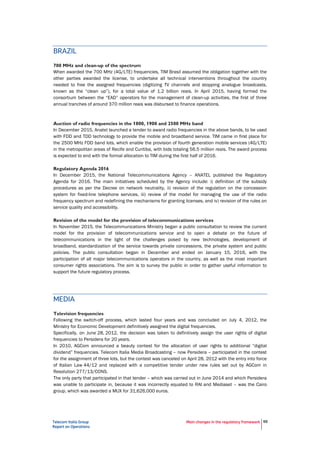
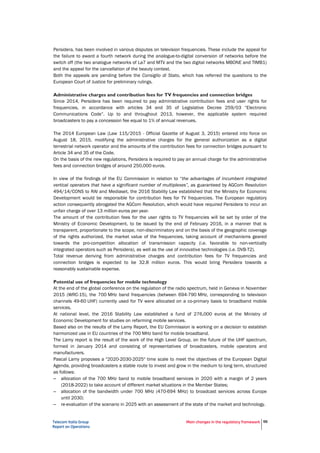
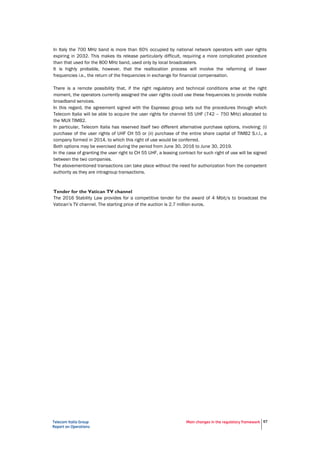
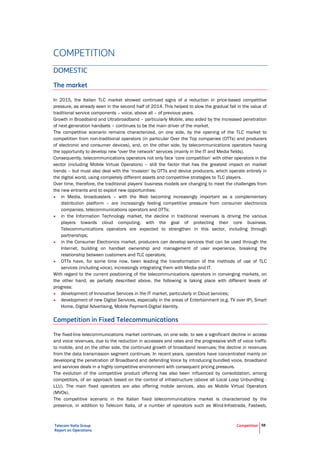
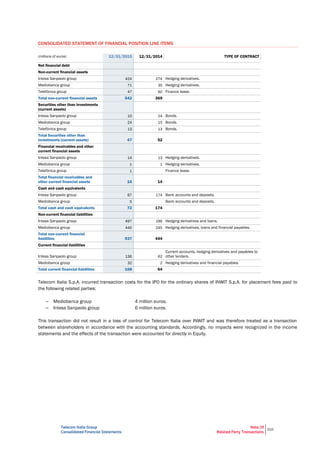
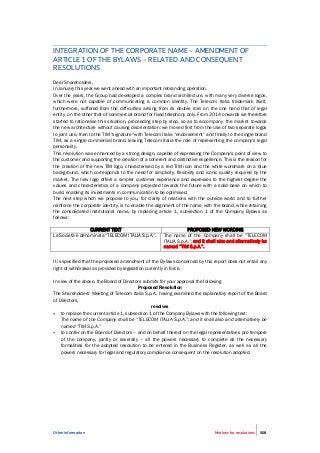
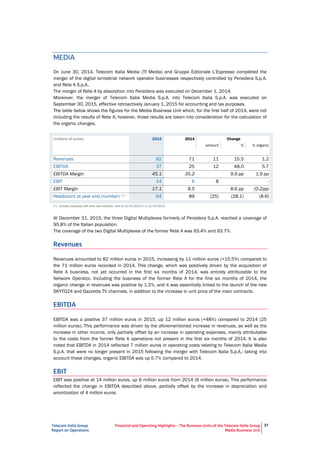
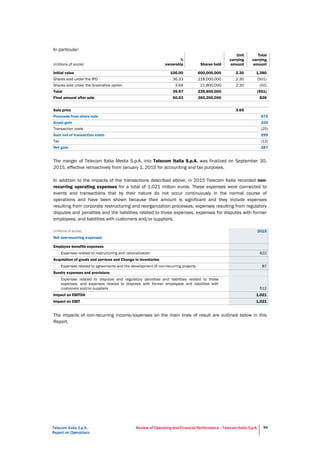
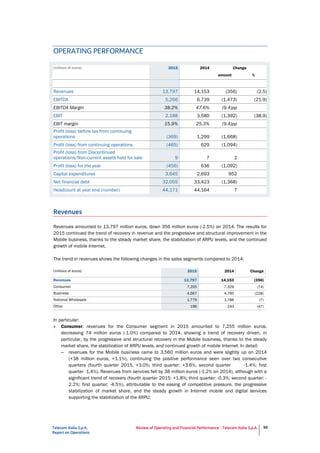
This document has been translated into English solely for the convenience of
the readers. In the event of discrepancy, the Italian language version prevails.
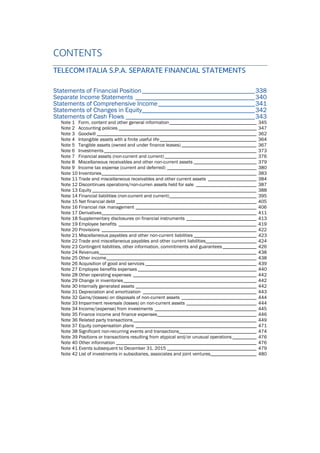
CONTENTS
LETTER TO THE SHAREHOLDERS __________________________________ 2
REPORT ON OPERATIONS
Telecom Italia Group _________________________________________ 10
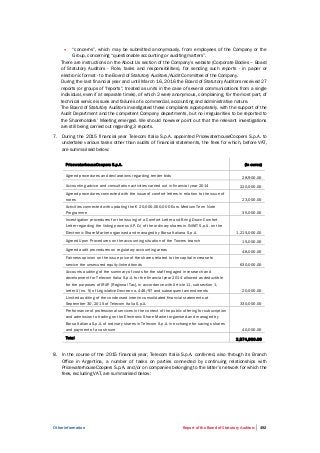
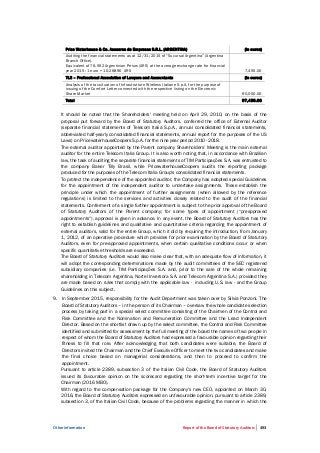
Key Operating and Financial Data - Telecom Italia Group __________________________________ 13 
Financial and Operating Highlights – The Business Units of the Telecom Italia Group ___________ 27 
Discontinued operations/Non-current assets held for sale _________________________________ 38 
Main Commercial Developments of the Business Units of the Group_________________________ 42 
Main changes in the regulatory framework______________________________________________ 50 
Competition _______________________________________________________________________ 58 
Consolidated Financial Position and Cash Flows Performance ______________________________ 61 
Consolidated Financial Statements – Telecom Italia Group ________________________________ 72 
Research and development __________________________________________________________ 81 
Events subsequent to December 31, 2015 _____________________________________________ 81 
Business Outlook for the Year 2016 ___________________________________________________ 81 
Main risks and uncertainties _________________________________________________________ 83 
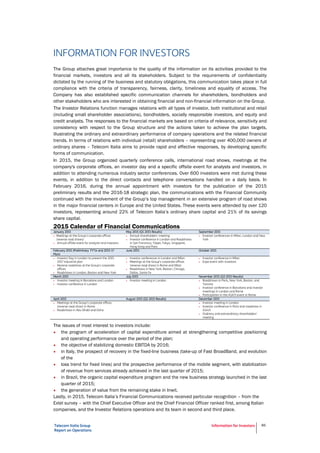
Information for Investors_____________________________________________________________ 86 
Related Party Transactions___________________________________________________________ 89 
Alternative Performance Measures ____________________________________________________ 90 
Telecom Italia S.p.A. __________________________________________ 92
Review of Operating and Financial Performance - Telecom Italia S.p.A._______________________ 93 
Financial Statements - Telecom Italia S.p.A. ____________________________________________ 112 
Reconciliation of Consolidated Equity _________________________________________________ 118 
Social and environmental impacts of operations and their economic aspects ________________ 119 
Corporate Boards at December 31, 2015______________________________________________ 124 
Macro-Organization Chart at December 31, 2015 _______________________________________ 126 
Sustainability _______________________________________________ 127
References and governance_________________________________________________________ 127
Placement in the indexes ___________________________________________________________ 128
Reporting ________________________________________________________________________ 129
Materiality analysis ________________________________________________________________ 130
Economic value generated and distributed_____________________________________________ 132
Digitisation, connectivity and social innovation _________________________________________ 132
Research and development _________________________________________________________ 137
Environmental protection ___________________________________________________________ 142
Digital culture_____________________________________________________________________ 149
Telecom Italia people ______________________________________________________________ 151
Fondazione Telecom Italia commitment ______________________________________________ 162
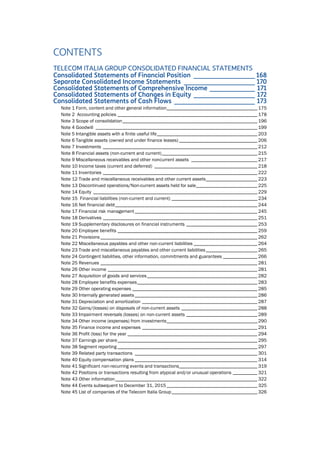
TELECOM ITALIA GROUP CONSOLIDATED FINANCIAL STATEMENT _ 164
Contents_________________________________________________________________________ 167
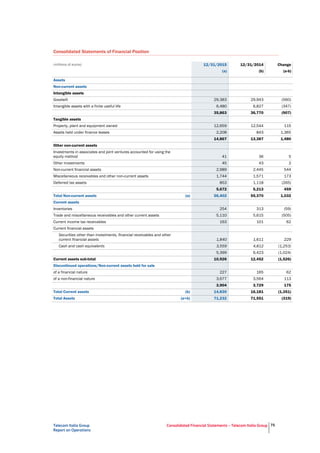
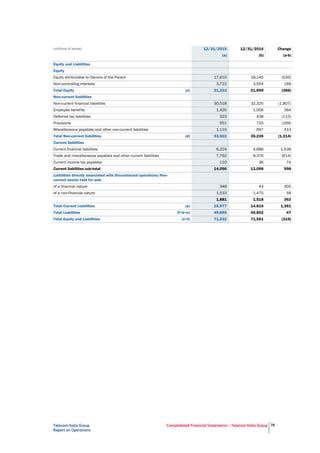
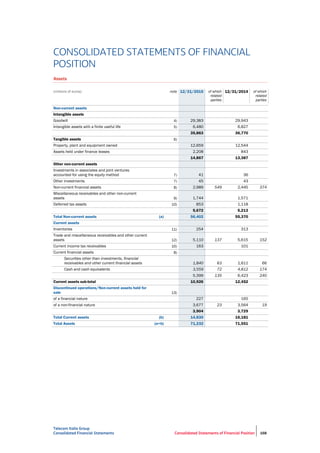
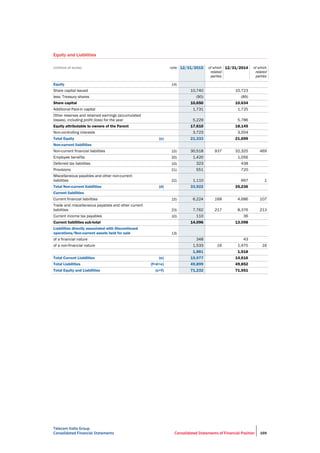
Consolidated Statements of Financial Position__________________________________________ 168
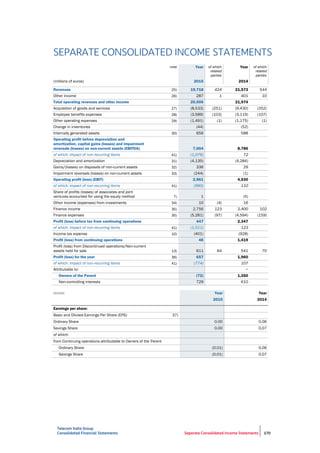
Separate Consolidated Income Statements ____________________________________________ 170
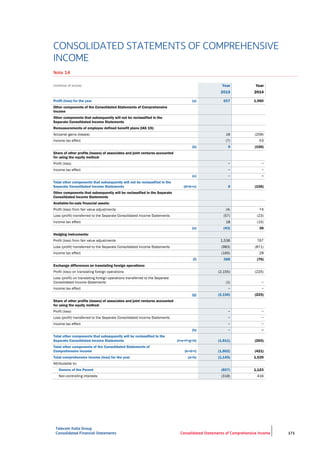
Consolidated Statements of Comprehensive Income_____________________________________ 171
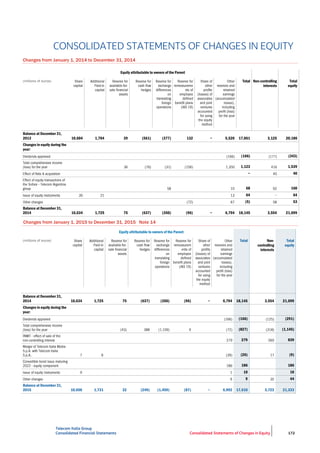
Consolidated Statements of Changes in Equity _________________________________________ 172
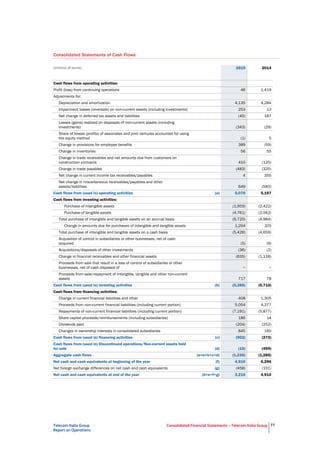
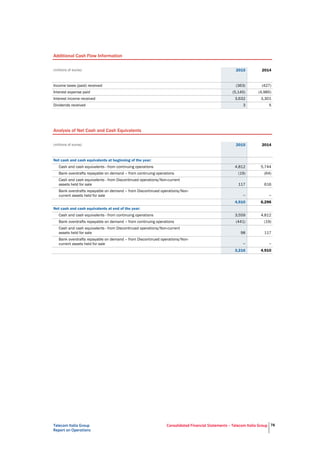
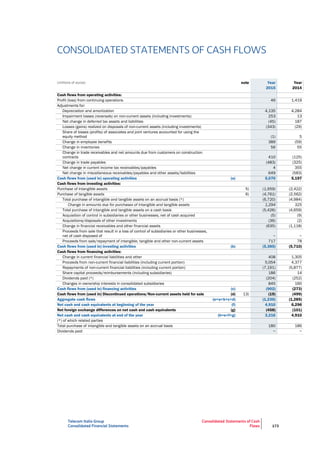
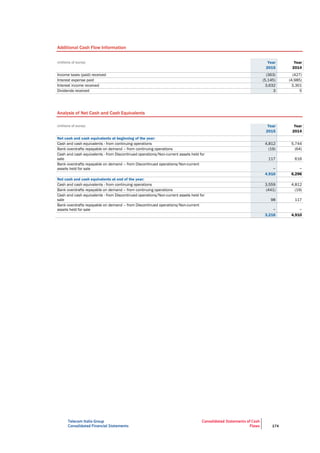
Consolidated Statements of Cash Flows _______________________________________________ 173
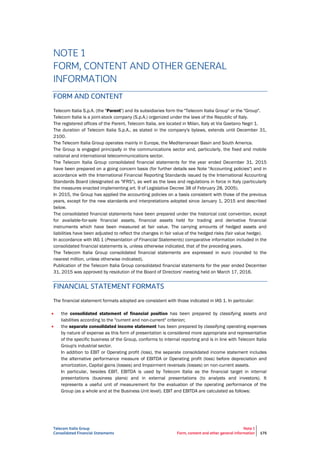
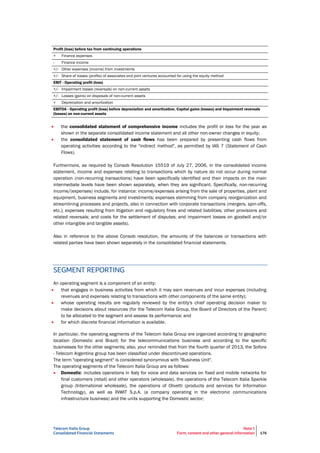
Notes to the Consolidated Financial Statements ________________________________________ 175
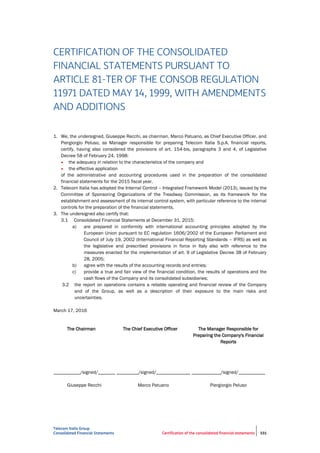
Certification of the Consolidated Financial Statements pursuant to Article 81-ter of the
Consob Regulation 11971 dated May 14, 1999, with Amendments and Additions ____________ 331
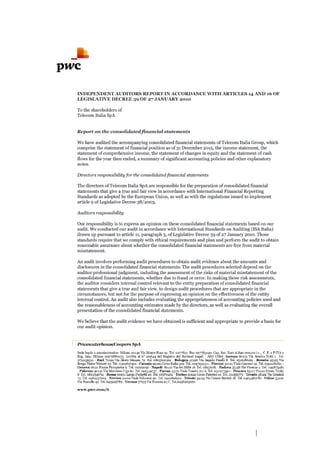
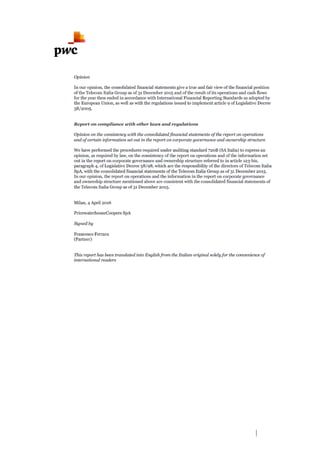
Independent Auditors’ Report________________________________________________________ 332
TELECOM ITALIA S.p.A. SEPARATE FINANCIAL STATEMENTS _______ 334
Contents_________________________________________________________________________ 337
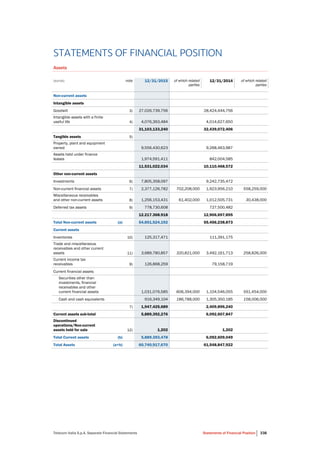
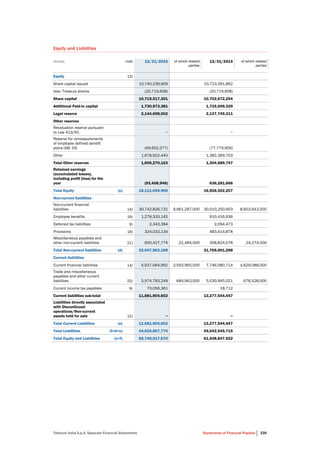
Statements of Financial Position _____________________________________________________ 338
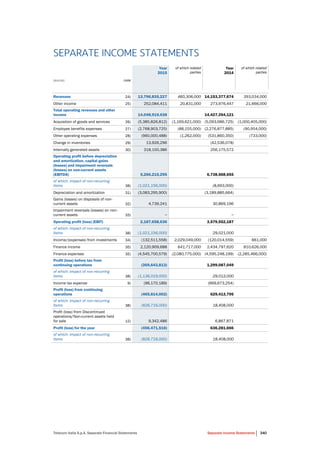
Separate Income Statements________________________________________________________ 340
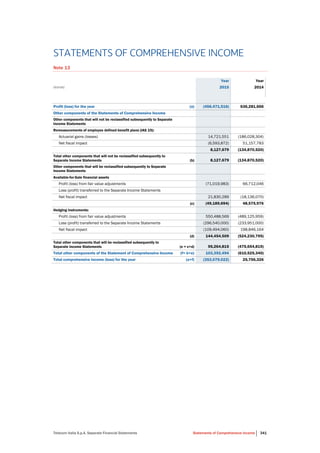
Statements of Comprehensive Income ________________________________________________ 341
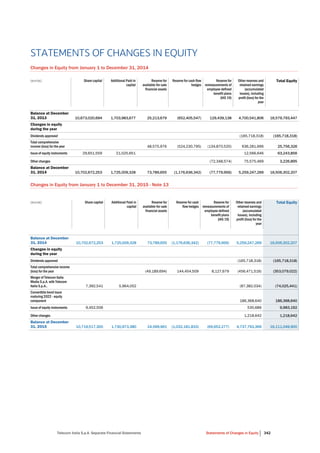
Statements of Changes in Equity _____________________________________________________ 342
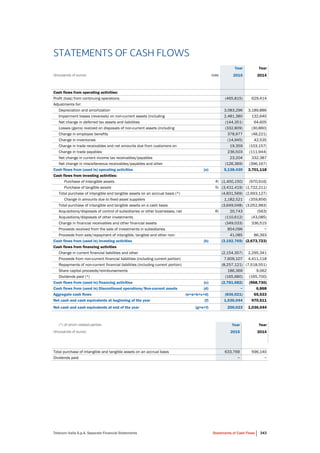
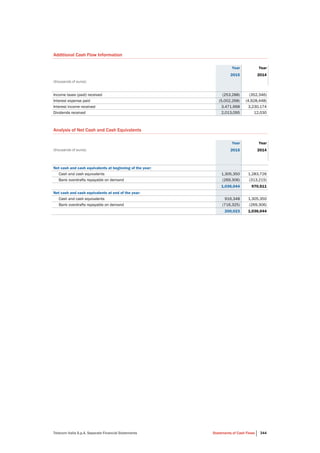
Statements of Cash Flows __________________________________________________________ 343
Notes to the Separate Financial Statements of Telecom Italia S.p.A.________________________ 345
Certification of the Separate Financial Statements Pursuant to Article. 81 ter of
Consob Regulation 11971 dated May 14, 1999, with Amendments and Additions ____________ 482
Independent Auditors’ Report________________________________________________________ 483
OTHER INFORMATION__________________________________________ 486
Report of the Board of Statutory Auditors ______________________________________________ 489
Proposed resolutions ______________________________________________________________ 504
Glossary _________________________________________________________________________ 509
Useful information_________________________________________________________________ 521
Letter
to the
Shareholders
Annual Report
2015
Letter to the Shareholders 3
Dear Shareholders,
Marcus Aurelius, the wisest of all Roman Emperors, once said: “All that happens is
as usual and familiar as the rose in spring and the crop in summer”. What he meant
was that very often reality is less surprising and disorienting than it seems at first
glance. If we take an honest look at our surroundings, we have to say that he was
right. The global economy is going through a difficult period that was anything but
unpredictable. The Chinese economy is slowing down – entirely foreseeable after
years of extraordinary growth. And this slowdown coincides with a fall in demand,
which is weakening growth in other countries. This, too, was predictable. It is true,
sometimes history has its ironies: low or negative interest rates have saved our public
debt and given impetus to the American economy, but now they are blocking lending,
with negative repercussions for everyone. But neither of these circumstances break
any laws that have long been known to economists.
Annual Report
2015
Letter to the Shareholders 4
Continuity on two aspects:
a clear and significant acceleration
in the deployment of ultra-broadband networks
as set out in our industrial plan, and the transformation
of our Group into a “platform company”
Thanks to globalization, reaction times have gotten faster; everything moves more
quickly. Our industry, though, has particular characteristics that means this rule applies
more intensely to it than to many others. The wisdom of Marcus Aurelius holds true
for the global economy as a whole, but not for telecommunications. The Telco market
is truly in a state of “permanent revolution”, as regulatory changes, technological
developments and shifting consumer habits mean we can never rest on our laurels,
not even for a second.
As you know, on March 20, the Board of Directors accepted the resignation of Marco
Patuano. Just ten days later, on March 30, the Board also approved the appointment
of the new Chief Executive Officer, enabling the Company to move swiftly into a new
and important period for its future. Both of us were members of the current Board of
Directors, so we worked together within the Board, designing strategies and setting
industrial and financial targets. We know that there are major challenges ahead.
Despite a broad confirmation of the overall strategic guidelines, we believe that it is
now time to improve executive effectiveness and operational management, making
our actions more dynamic.
Essentially, we intend to maintain continuity on two aspects: a clear and significant
acceleration in the deployment of ultra-broadband networks as set out in our
industrial plan, and the transformation of our Group into a “platform company”,
i.e. a company that exploits its own infrastructure to provide customers with an
increasingly wide-ranging and comprehensive array of digital services. Building more
powerful, more reliable networks is at the heart of our identity – it is a commitment
Annual Report
2015
Letter to the Shareholders 5
we have made to the people, companies and institutions of the countries where we
operate. We believe we can remain true to this commitment, creating value for all of
these stakeholders, and also our shareholders. To make a meaningful contribution
to the creation of the digital society, to ensure the sustainability of the significant
investments required for new networks, and to leverage the best ways to create value,
it is also important to take action to expand and improve the digital services we offer.
In terms of implementing and executing these strategies, we believe that it is necessary
to make a decisive change. The turnaround expected from us by shareholders and the
market will be built on more efficient processes and management, on more effective
commercial initiatives, and on better management of regulatory aspects.
The TIM that we want to take shape in the coming months and weeks is a TIM that is
more flexible, more dynamic and more convergent. We want a more agile TIM in terms
of responsiveness, enthusiasm and ability to challenge processes and paradigms
In terms of implementing
and executing these strategies,
we believe that it is necessary to make
a decisive change. The turnaround
expected from us by shareholders
and the market will be built on more
efficient processes and management,
on more effective commercial
initiatives, and on better management
of regulatory aspects.
Annual Report
2015
Lettera agli Azionisti 6
that have become ingrained over the years, but that have been made redundant or
ineffective due to technological developments and changing consumer habits.
In commercial terms, we must strengthen our competitive position, especially as
regards real and perceived quality. On this front, the real challenge is to put customers
increasingly at the heart of our actions.
A company builds its credibility through the transparency and fairness of its dealings
with all stakeholders, whether institutions, authorities, the industry or, more generally,
the country in which it operates.
For a Group like ours – built on digital services and infrastructures – the significant
growth prospects not yet fully exploited by the Italian ICT sector now represent an
extraordinary opportunity. Moreover, the commitment made by Italy’s government
and institutions to closing the gap that separates us from the other major European
countries only makes this opportunity even greater.
With this in mind, we confirm the planned increase in capital expenditures, although
this too must be aligned and rethought with a view to greater efficiency. For the same
level of investment, we can improve the quality and quantity of our assets by increasing
the coverage and the performance of the networks we are going to build. We also
want to see greater efficiency in sales, marketing, advertising and communications,
and in all back-office functions. Efficiency is a duty: a duty to our shareholders but also
to everyone who works in our Group, each of whom deserves the security of working
in a stronger, more robust company that is ready to face the challenges of the future.
The TIM that we want to take shape in the
coming months and weeks is a TIM that is more
flexible, more dynamic and more convergent.
Annual Report
2015
Letter to the Shareholders 7
Efficiency and value creation are the key words that must pervade every area of the
business.
Our group is rooted in Italy and has the ambition to work worldwide: our network
investments will create important growth opportunities for citizens and companies
in the countries where we operate, but our ability to innovate, the high quality of our
people, and above all our ambitions, know no boundaries.
We confirm the planned increase
in capital expenditures, although this too
must be aligned and rethought
with a view to greater efficiency.
Saying what we will do and doing what we say – this is our commitment and the aim
towards which we shall work.
Giuseppe Recchi Flavio Cattaneo
The high quality of our people, and above all
our ambitions, know no boundaries.
Annual Report
2015
The Telecom Italia Group 8
THE TELECOM ITALIA GROUP
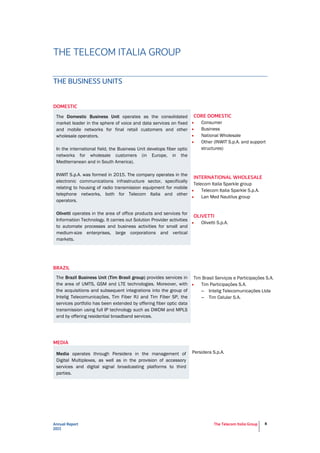
THE BUSINESS UNITS
DOMESTIC
The Domestic Business Unit operates as the consolidated
market leader in the sphere of voice and data services on fixed
and mobile networks for final retail customers and other
wholesale operators.
In the international field, the Business Unit develops fiber optic
networks for wholesale customers (in Europe, in the
Mediterranean and in South America).
INWIT S.p.A. was formed in 2015. The company operates in the
electronic communications infrastructure sector, specifically
relating to housing of radio transmission equipment for mobile
telephone networks, both for Telecom Italia and other
operators.
Olivetti operates in the area of office products and services for
Information Technology. It carries out Solution Provider activities
to automate processes and business activities for small and
medium-size enterprises, large corporations and vertical
markets.
CORE DOMESTIC
• Consumer
• Business
• National Wholesale
• Other (INWIT S.p.A. and support
structures)
INTERNATIONAL WHOLESALE
Telecom Italia Sparkle group
• Telecom Italia Sparkle S.p.A.
• Lan Med Nautilus group
OLIVETTI
• Olivetti S.p.A.
BRAZIL
The Brazil Business Unit (Tim Brasil group) provides services in
the area of UMTS, GSM and LTE technologies. Moreover, with
the acquisitions and subsequent integrations into the group of
Intelig Telecomunicações, Tim Fiber RJ and Tim Fiber SP, the
services portfolio has been extended by offering fiber optic data
transmission using full IP technology such as DWDM and MPLS
and by offering residential broadband services.
Tim Brasil Serviços e Participações S.A.
• Tim Participações S.A.
– Intelig Telecomunicações Ltda
– Tim Celular S.A.
MEDIA
Media operates through Persidera in the management of
Digital Multiplexes, as well as in the provision of accessory
services and digital signal broadcasting platforms to third
parties.
Persidera S.p.A.
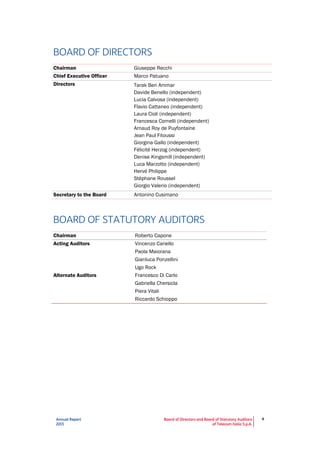
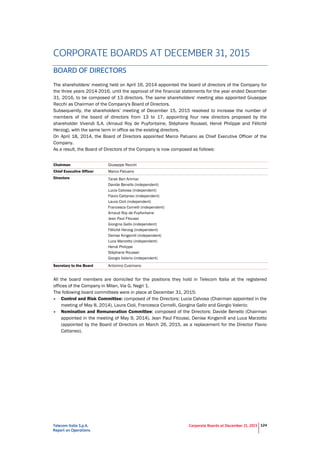
Chairman Giuseppe Recchi
Vice-Chairman Arnaud Roy de Puyfontaine
Chief Executive Officer Flavio Cattaneo
Directors Tarak Ben Ammar, Davide Benello (indipendent), Lucia Calvosa (indipendent),
Laura Cioli (indipendent), Francesca Cornelli (indipendent), Jean Paul Fitoussi, Giorgina Gallo
(indipendent), Félicité Herzog (indipendent), Denise Kingsmill (indipendent), Luca Marzotto
(indipendent), Hervé Philippe, Stéphane Roussel, Giorgio Valerio (indipendent)
Secretary to the Board Antonino Cusimano
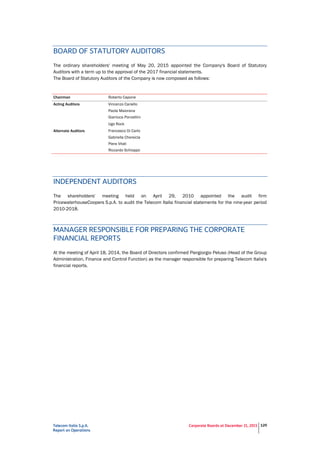
Chairman Roberto Capone
Acting Auditors Vincenzo Cariello, Paola Maiorana, Gianluca Ponzellini, Ugo Rock
Alternate Auditors Gabriella Chersicla, Francesco Di Carlo, Riccardo Schioppo, Piera Vitali
BOARD OF DIRECTORS on April 27, 2016
BOARD OF STATUTORY AUDITORS
Board of Directors and Board of Statutory Auditors
of Telecom Italia S.p.A.
Annual Report
2015
9
Report
on Operations
Telecom Italia Group
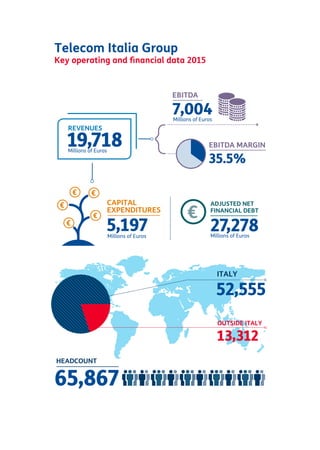
Key operating and financial data 2015
EBITDA
7,004Millions of Euros
19,718Millions of Euros
REVENUES
35.5%
EBITDA MARGIN
HEADCOUNT
ITALY
65,867
OUTSIDE ITALY
13,312
52,555
ADJUSTED NET
FINANCIAL DEBT
Millions of Euros
27,278Millions of Euros
5,197
CAPITAL
EXPENDITURES
Telecom Italia Group
Report on Operations
Key Operating and Financial Data - Telecom Italia Group 13
KEY OPERATING AND FINANCIAL DATA - TELECOM
ITALIA GROUP
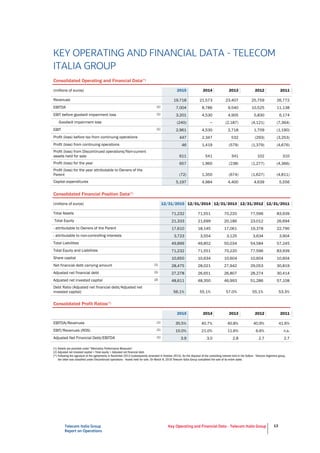
Consolidated Operating and Financial Data(*)
(millions of euros) 2015 2014 2013 2012 2011
Revenues 19,718 21,573 23,407 25,759 26,772
EBITDA (1) 7,004 8,786 9,540 10,525 11,138
EBIT before goodwill impairment loss (1) 3,201 4,530 4,905 5,830 6,174
Goodwill impairment loss (240) − (2,187) (4,121) (7,364)
EBIT (1) 2,961 4,530 2,718 1,709 (1,190)
Profit (loss) before tax from continuing operations 447 2,347 532 (293) (3,253)
Profit (loss) from continuing operations 46 1,419 (579) (1,379) (4,676)
Profit (loss) from Discontinued operations/Non-current
assets held for sale 611 541 341 102 310
Profit (loss) for the year 657 1,960 (238) (1,277) (4,366)
Profit (loss) for the year attributable to Owners of the
Parent (72) 1,350 (674) (1,627) (4,811)
Capital expenditures 5,197 4,984 4,400 4,639 5,556
Consolidated Financial Position Data(*)
(millions of euros) 12/31/2015 12/31/2014 12/31/2013 12/31/2012 12/31/2011
Total Assets 71,232 71,551 70,220 77,596 83,939
Total Equity 21,333 21,699 20,186 23,012 26,694
- attributable to Owners of the Parent 17,610 18,145 17,061 19,378 22,790
- attributable to non-controlling interests 3,723 3,554 3,125 3,634 3,904
Total Liabilities 49,899 49,852 50,034 54,584 57,245
Total Equity and Liabilities 71,232 71,551 70,220 77,596 83,939
Share capital 10,650 10,634 10,604 10,604 10,604
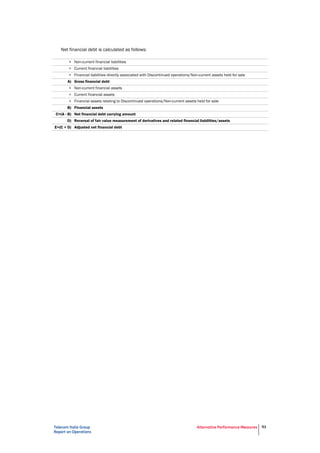
Net financial debt carrying amount (1) 28,475 28,021 27,942 29,053 30,819
Adjusted net financial debt (1) 27,278 26,651 26,807 28,274 30,414
Adjusted net invested capital (2) 48,611 48,350 46,993 51,286 57,108
Debt Ratio (Adjusted net financial debt/Adjusted net
invested capital) 56.1% 55.1% 57.0% 55.1% 53.3%
Consolidated Profit Ratios(*)
2015 2014 2013 2012 2011
EBITDA/Revenues (1) 35.5% 40.7% 40.8% 40.9% 41.6%
EBIT/Revenues (ROS) (1) 15.0% 21.0% 11.6% 6.6% n.s.
Adjusted Net Financial Debt/EBITDA (1) 3.9 3.0 2.8 2.7 2.7
(1) Details are provided under "Alternative Performance Measures".
(2) Adjusted net invested capital = Total equity + Adjusted net financial debt.
(*) Following the signature of the agreements in November 2013 (subsequently amended in October 2014), for the disposal of the controlling interest held in the Sofora - Telecom Argentina group,
the latter was classified under Discontinued operations - Assets held for sale. On March 8, 2016 Telecom Italia Group completed the sale of its entire stake.
Telecom Italia Group
Report on Operations
Key Operating and Financial Data - Telecom Italia Group 14
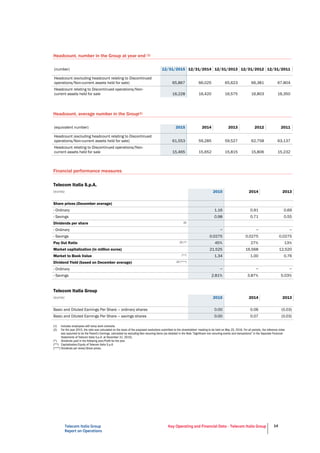
Headcount, number in the Group at year end (1)
(number) 12/31/2015 12/31/2014 12/31/2013 12/31/2012 12/31/2011
Headcount (excluding headcount relating to Discontinued
operations/Non-current assets held for sale) 65,867 66,025 65,623 66,381 67,804
Headcount relating to Discontinued operations/Non-
current assets held for sale 16,228 16,420 16,575 16,803 16,350
Headcount, average number in the Group(1)
(equivalent number) 2015 2014 2013 2012 2011
Headcount (excluding headcount relating to Discontinued
operations/Non-current assets held for sale) 61,553 59,285 59,527 62,758 63,137
Headcount relating to Discontinued operations/Non-
current assets held for sale 15,465 15,652 15,815 15,806 15,232
Financial performance measures
Telecom Italia S.p.A.
(euros) 2015 2014 2013
Share prices (December average)
- Ordinary 1.16 0.91 0.69
- Savings 0.98 0.71 0.55
Dividends per share (2)
- Ordinary − − −
- Savings 0.0275 0.0275 0.0275
Pay Out Ratio (2) (*) 45% 27% 13%
Market capitalization (in million euros) 21.525 16,568 12,520
Market to Book Value (**) 1.34 1.00 0.76
Dividend Yield (based on December average) (2) (***)
- Ordinary − − −
- Savings 2.81% 3.87% 5.03%
Telecom Italia Group
(euros) 2015 2014 2013
Basic and Diluted Earnings Per Share – ordinary shares 0.00 0.06 (0.03)
Basic and Diluted Earnings Per Share – savings shares 0.00 0.07 (0.03)
(1) Includes employees with temp work contracts.
(2) For the year 2015, the ratio was calculated on the basis of the proposed resolutions submitted to the shareholders' meeting to be held on May 25, 2016. For all periods, the reference index
was assumed to be the Parent's Earnings, calculated by excluding Non-recurring items (as detailed in the Note “Significant non-recurring events and transactions" in the Separate Financial
Statements of Telecom Italia S.p.A. at December 31, 2015).
(*) Dividends paid in the following year/Profit for the year.
(**) Capitalization/Equity of Telecom Italia S.p.A.
(***) Dividends per share/Share prices.
Telecom Italia Group
Report on Operations
Key Operating and Financial Data - Telecom Italia Group 15
HIGHLIGHTS 2015
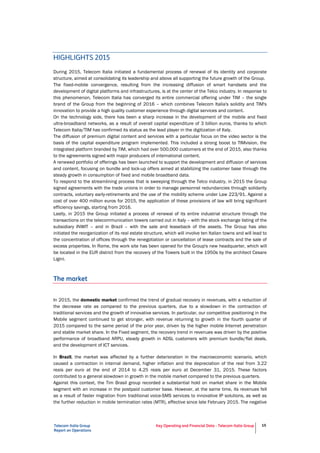
During 2015, Telecom Italia initiated a fundamental process of renewal of its identity and corporate
structure, aimed at consolidating its leadership and above all supporting the future growth of the Group.
The fixed-mobile convergence, resulting from the increasing diffusion of smart handsets and the
development of digital platforms and infrastructures, is at the center of the Telco industry. In response to
this phenomenon, Telecom Italia has converged its entire commercial offering under TIM – the single
brand of the Group from the beginning of 2016 – which combines Telecom Italia's solidity and TIM's
innovation to provide a high quality customer experience through digital services and content.
On the technology side, there has been a sharp increase in the development of the mobile and fixed
ultra-broadband networks, as a result of overall capital expenditure of 3 billion euros, thanks to which
Telecom Italia/TIM has confirmed its status as the lead player in the digitization of Italy.
The diffusion of premium digital content and services with a particular focus on the video sector is the
basis of the capital expenditure program implemented. This included a strong boost to TIMvision, the
integrated platform branded by TIM, which had over 500,000 customers at the end of 2015, also thanks
to the agreements signed with major producers of international content.
A renewed portfolio of offerings has been launched to support the development and diffusion of services
and content, focusing on bundle and lock-up offers aimed at stabilizing the customer base through the
steady growth in consumption of fixed and mobile broadband data.
To respond to the streamlining process that is sweeping through the Telco industry, in 2015 the Group
signed agreements with the trade unions in order to manage personnel redundancies through solidarity
contracts, voluntary early-retirements and the use of the mobility scheme under Law 223/91. Against a
cost of over 400 million euros for 2015, the application of these provisions of law will bring significant
efficiency savings, starting from 2016.
Lastly, in 2015 the Group initiated a process of renewal of its entire industrial structure through the
transactions on the telecommunication towers carried out in Italy – with the stock exchange listing of the
subsidiary INWIT – and in Brazil – with the sale and leaseback of the assets. The Group has also
initiated the reorganization of its real estate structure, which will involve ten Italian towns and will lead to
the concentration of offices through the renegotiation or cancellation of lease contracts and the sale of
excess properties. In Rome, the work site has been opened for the Group's new headquarter, which will
be located in the EUR district from the recovery of the Towers built in the 1950s by the architect Cesare
Ligini.
The market
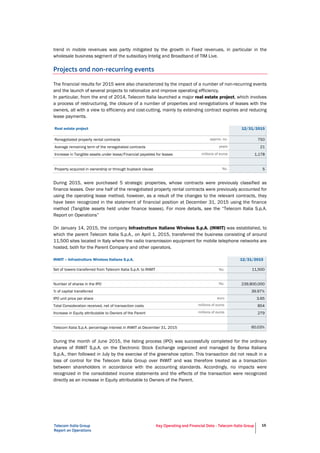
In 2015, the domestic market confirmed the trend of gradual recovery in revenues, with a reduction of
the decrease rate as compared to the previous quarters, due to a slowdown in the contraction of
traditional services and the growth of innovative services. In particular, our competitive positioning in the
Mobile segment continued to get stronger, with revenue returning to growth in the fourth quarter of
2015 compared to the same period of the prior year, driven by the higher mobile Internet penetration
and stable market share. In the Fixed segment, the recovery trend in revenues was driven by the positive
performance of broadband ARPU, steady growth in ADSL customers with premium bundle/flat deals,
and the development of ICT services.
In Brazil, the market was affected by a further deterioration in the macroeconomic scenario, which
caused a contraction in internal demand, higher inflation and the depreciation of the real from 3.22
reais per euro at the end of 2014 to 4.25 reais per euro at December 31, 2015. These factors
contributed to a general slowdown in growth in the mobile market compared to the previous quarters.
Against this context, the Tim Brasil group recorded a substantial hold on market share in the Mobile
segment with an increase in the postpaid customer base. However, at the same time, its revenues fell
as a result of faster migration from traditional voice-SMS services to innovative IP solutions, as well as
the further reduction in mobile termination rates (MTR), effective since late February 2015. The negative
Telecom Italia Group
Report on Operations
Key Operating and Financial Data - Telecom Italia Group 16
trend in mobile revenues was partly mitigated by the growth in Fixed revenues, in particular in the
wholesale business segment of the subsidiary Intelig and Broadband of TIM Live.
Projects and non-recurring events
The financial results for 2015 were also characterized by the impact of a number of non-recurring events
and the launch of several projects to rationalize and improve operating efficiency.
In particular, from the end of 2014, Telecom Italia launched a major real estate project, which involves
a process of restructuring, the closure of a number of properties and renegotiations of leases with the
owners, all with a view to efficiency and cost-cutting, mainly by extending contract expiries and reducing
lease payments.
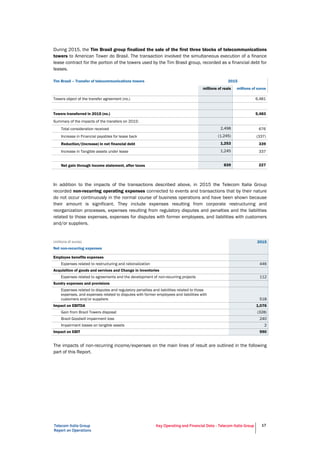
Real estate project 12/31/2015
Renegotiated property rental contracts approx. no. 750
Average remaining term of the renegotiated contracts years 21
Increase in Tangible assets under lease/Financial payables for leases millions of euros 1,178
Property acquired in ownership or through buyback clause No. 5
During 2015, were purchased 5 strategic properties, whose contracts were previously classified as
finance leases. Over one half of the renegotiated property rental contracts were previously accounted for
using the operating lease method, however, as a result of the changes to the relevant contracts, they
have been recognized in the statement of financial position at December 31, 2015 using the finance
method (Tangible assets held under finance leases). For more details, see the “Telecom Italia S.p.A.
Report on Operations”
On January 14, 2015, the company Infrastrutture Italiane Wireless S.p.A. (INWIT) was established, to
which the parent Telecom Italia S.p.A., on April 1, 2015, transferred the business consisting of around
11,500 sites located in Italy where the radio transmission equipment for mobile telephone networks are
hosted, both for the Parent Company and other operators.
INWIT – Infrastrutture Wireless Italiane S.p.A. 12/31/2015
Set of towers transferred from Telecom Italia S.p.A. to INWIT No. 11,500
Number of shares in the IPO No. 239,800,000
% of capital transferred 39.97%
IPO unit price per share euro 3.65
Total Consideration received, net of transaction costs millions of euros 854
Increase in Equity attributable to Owners of the Parent millions of euros 279
Telecom Italia S.p.A. percentage interest in INWIT at December 31, 2015 60.03%
During the month of June 2015, the listing process (IPO) was successfully completed for the ordinary
shares of INWIT S.p.A. on the Electronic Stock Exchange organized and managed by Borsa Italiana
S.p.A., then followed in July by the exercise of the greenshoe option. This transaction did not result in a
loss of control for the Telecom Italia Group over INWIT and was therefore treated as a transaction
between shareholders in accordance with the accounting standards. Accordingly, no impacts were
recognized in the consolidated income statements and the effects of the transaction were recognized
directly as an increase in Equity attributable to Owners of the Parent.
Telecom Italia Group
Report on Operations
Key Operating and Financial Data - Telecom Italia Group 17
During 2015, the Tim Brasil group finalized the sale of the first three blocks of telecommunications
towers to American Tower do Brasil. The transaction involved the simultaneous execution of a finance
lease contract for the portion of the towers used by the Tim Brasil group, recorded as a financial debt for
leases.
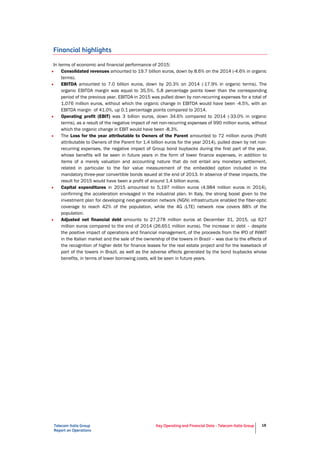
Tim Brasil – Transfer of telecommunications towers 2015
millions of reais millions of euros
Towers object of the transfer agreement (no.) 6,481
Towers transferred in 2015 (no.) 5,483
Summary of the impacts of the transfers on 2015:
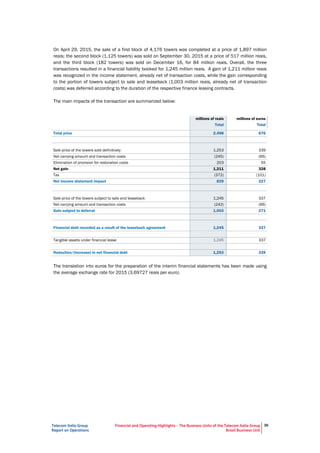
Total consideration received 2,498 676
Increase in Financial payables for lease back (1,245) (337)
Reduction/(increase) in net financial debt 1,253 339
Increase in Tangible assets under lease 1,245 337
Net gain through income statement, after taxes 839 227
In addition to the impacts of the transactions described above, in 2015 the Telecom Italia Group
recorded non-recurring operating expenses connected to events and transactions that by their nature
do not occur continuously in the normal course of business operations and have been shown because
their amount is significant. They include expenses resulting from corporate restructuring and
reorganization processes, expenses resulting from regulatory disputes and penalties and the liabilities
related to those expenses, expenses for disputes with former employees, and liabilities with customers
and/or suppliers.
(millions of euros) 2015
Net non-recurring expenses
Employee benefits expenses
Expenses related to restructuring and rationalization 446
Acquisition of goods and services and Change in inventories
Expenses related to agreements and the development of non-recurring projects 112
Sundry expenses and provisions
Expenses related to disputes and regulatory penalties and liabilities related to those
expenses, and expenses related to disputes with former employees and liabilities with
customers and/or suppliers 518
Impact on EBITDA 1,076
Gain from Brazil Towers disposal (328)
Brazil Goodwill impairment loss 240
Impairment losses on tangible assets 2
Impact on EBIT 990
The impacts of non-recurring income/expenses on the main lines of result are outlined in the following
part of this Report.
Telecom Italia Group
Report on Operations
Key Operating and Financial Data - Telecom Italia Group 18
Financial highlights
In terms of economic and financial performance of 2015:
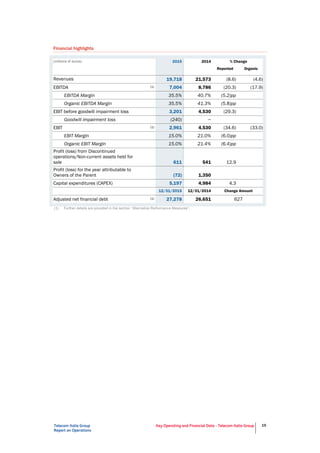
• Consolidated revenues amounted to 19.7 billion euros, down by 8.6% on the 2014 (-4.6% in organic
terms).
• EBITDA amounted to 7.0 billion euros, down by 20.3% on 2014 (-17.9% in organic terms). The
organic EBITDA margin was equal to 35.5%, 5.8 percentage points lower than the corresponding
period of the previous year. EBITDA in 2015 was pulled down by non-recurring expenses for a total of
1,076 million euros, without which the organic change in EBITDA would have been -4.5%, with an
EBITDA margin of 41.0%, up 0.1 percentage points compared to 2014.
• Operating profit (EBIT) was 3 billion euros, down 34.6% compared to 2014 (-33.0% in organic
terms), as a result of the negative impact of net non-recurring expenses of 990 million euros, without
which the organic change in EBIT would have been -8.3%.
• The Loss for the year attributable to Owners of the Parent amounted to 72 million euros (Profit
attributable to Owners of the Parent for 1.4 billion euros for the year 2014), pulled down by net non-
recurring expenses, the negative impact of Group bond buybacks during the first part of the year,
whose benefits will be seen in future years in the form of lower finance expenses, in addition to
items of a merely valuation and accounting nature that do not entail any monetary settlement,
related in particular to the fair value measurement of the embedded option included in the
mandatory three-year convertible bonds issued at the end of 2013. In absence of these impacts, the
result for 2015 would have been a profit of around 1.4 billion euros.
• Capital expenditures in 2015 amounted to 5,197 million euros (4,984 million euros in 2014),
confirming the acceleration envisaged in the industrial plan. In Italy, the strong boost given to the
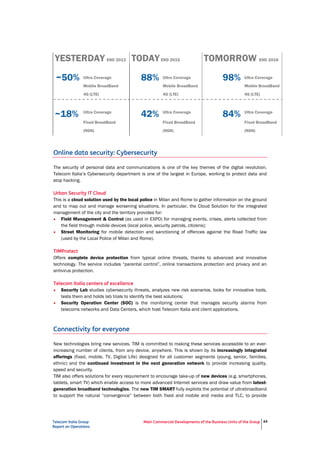
investment plan for developing next-generation network (NGN) infrastructure enabled the fiber-optic
coverage to reach 42% of the population, while the 4G (LTE) network now covers 88% of the
population.
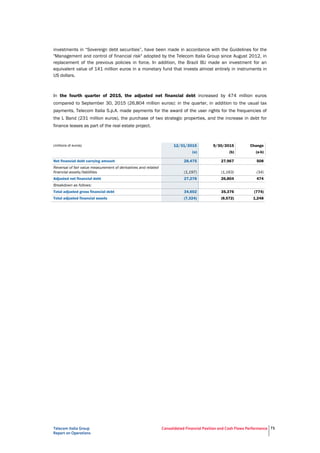
• Adjusted net financial debt amounts to 27,278 million euros at December 31, 2015, up 627
million euros compared to the end of 2014 (26,651 million euros). The increase in debt – despite
the positive impact of operations and financial management, of the proceeds from the IPO of INWIT
in the Italian market and the sale of the ownership of the towers in Brazil – was due to the effects of
the recognition of higher debt for finance leases for the real estate project and for the leaseback of
part of the towers in Brazil, as well as the adverse effects generated by the bond buybacks whose
benefits, in terms of lower borrowing costs, will be seen in future years.
Telecom Italia Group
Report on Operations
Key Operating and Financial Data - Telecom Italia Group 19
Financial highlights
(millions of euros) 2015 2014 % Change
Reported Organic
Revenues 19,718 21,573 (8.6) (4.6)
EBITDA (1) 7,004 8,786 (20.3) (17.9)
EBITDA Margin 35.5% 40.7% (5.2)pp
Organic EBITDA Margin 35.5% 41.3% (5.8)pp
EBIT before goodwill impairment loss 3,201 4,530 (29.3)
Goodwill impairment loss (240) −
EBIT (1) 2,961 4,530 (34.6) (33.0)
EBIT Margin 15.0% 21.0% (6.0)pp
Organic EBIT Margin 15.0% 21.4% (6.4)pp
Profit (loss) from Discontinued
operations/Non-current assets held for
sale 611 541 12.9
Profit (loss) for the year attributable to
Owners of the Parent (72) 1,350
Capital expenditures (CAPEX) 5,197 4,984 4.3
12/31/2015 12/31/2014 Change Amount
Adjusted net financial debt (1) 27,278 26,651 627
(1) Further details are provided in the section “Alternative Performance Measures”.
Telecom Italia Group
Report on Operations
Key Operating and Financial Data - Telecom Italia Group 20
CONSOLIDATED OPERATING PERFORMANCE
Revenues
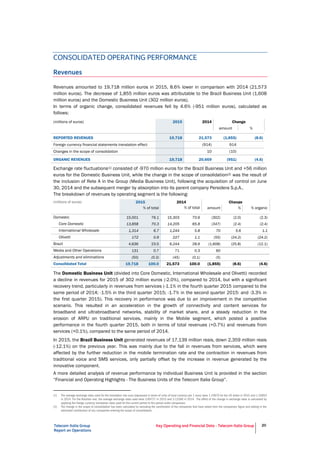
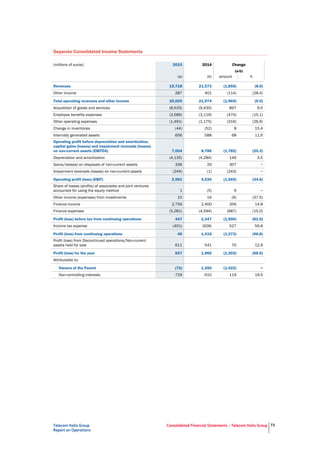
Revenues amounted to 19,718 million euros in 2015, 8.6% lower in comparison with 2014 (21,573
million euros). The decrease of 1,855 million euros was attributable to the Brazil Business Unit (1,608
million euros) and the Domestic Business Unit (302 million euros).
In terms of organic change, consolidated revenues fell by 4.6% (-951 million euros), calculated as
follows:
(millions of euros) 2015 2014 Change
amount %
REPORTED REVENUES 19,718 21,573 (1,855) (8.6)
Foreign currency financial statements translation effect (914) 914
Changes in the scope of consolidation 10 (10)
ORGANIC REVENUES 19,718 20,669 (951) (4.6)
Exchange rate fluctuations(1) consisted of -970 million euros for the Brazil Business Unit and +56 million
euros for the Domestic Business Unit, while the change in the scope of consolidation(2) was the result of
the inclusion of Rete A in the Group (Media Business Unit), following the acquisition of control on June
30, 2014 and the subsequent merger by absorption into its parent company Persidera S.p.A..
The breakdown of revenues by operating segment is the following:
(millions of euros) 2015 2014 Change
% of total % of total amount % % organic
Domestic 15,001 76.1 15,303 70.9 (302) (2.0) (2.3)
Core Domestic 13,858 70.3 14,205 65.8 (347) (2.4) (2.4)
International Wholesale 1,314 6.7 1,244 5.8 70 5.6 1.1
Olivetti 172 0.9 227 1.1 (55) (24.2) (24.2)
Brazil 4,636 23.5 6,244 28.9 (1,608) (25.8) (12.1)
Media and Other Operations 131 0.7 71 0.3 60
Adjustments and eliminations (50) (0.3) (45) (0.1) (5)
Consolidated Total 19,718 100.0 21,573 100.0 (1,855) (8.6) (4.6)
The Domestic Business Unit (divided into Core Domestic, International Wholesale and Olivetti) recorded
a decline in revenues for 2015 of 302 million euros (-2.0%), compared to 2014, but with a significant
recovery trend, particularly in revenues from services (-1.1% in the fourth quarter 2015 compared to the
same period of 2014; -1.5% in the third quarter 2015; -1.7% in the second quarter 2015: and -3.3% in
the first quarter 2015). This recovery in performance was due to an improvement in the competitive
scenario. This resulted in an acceleration in the growth of connectivity and content services for
broadband and ultrabroadband networks, stability of market share, and a steady reduction in the
erosion of ARPU on traditional services, mainly in the Mobile segment, which posted a positive
performance in the fourth quarter 2015, both in terms of total revenues (+0.7%) and revenues from
services (+0.1%), compared to the same period of 2014.
In 2015, the Brazil Business Unit generated revenues of 17,139 million reais, down 2,359 million reais
(-12.1%) on the previous year. This was mainly due to the fall in revenues from services, which were
affected by the further reduction in the mobile termination rate and the contraction in revenues from
traditional voice and SMS services, only partially offset by the increase in revenue generated by the
innovative component.
A more detailed analysis of revenue performance by individual Business Unit is provided in the section
“Financial and Operating Highlights - The Business Units of the Telecom Italia Group”.
(1) The average exchange rates used for the translation into euro (expressed in terms of units of local currency per 1 euro) were 1.10970 for the US dollar in 2015 and 1.32853
in 2014. For the Brazilian real, the average exchange rates used were 3.69727 in 2015 and 3.12280 in 2014. The effect of the change in exchange rates is calculated by
applying the foreign currency translation rates used for the current period to the period under comparison.
(2) The change in the scope of consolidation has been calculated by excluding the contribution of the companies that have exited from the comparison figure and adding in the
estimated contribution of any companies entering the scope of consolidation.
Telecom Italia Group
Report on Operations
Key Operating and Financial Data - Telecom Italia Group 21
EBITDA
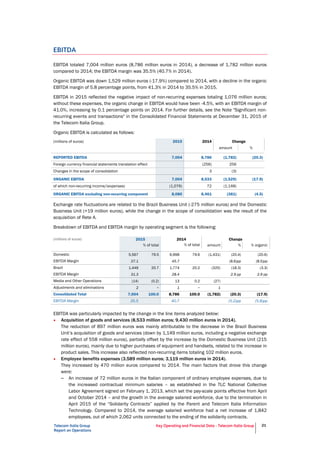
EBITDA totaled 7,004 million euros (8,786 million euros in 2014), a decrease of 1,782 million euros
compared to 2014; the EBITDA margin was 35.5% (40.7% in 2014).
Organic EBITDA was down 1,529 million euros (-17.9%) compared to 2014, with a decline in the organic
EBITDA margin of 5.8 percentage points, from 41.3% in 2014 to 35.5% in 2015.
EBITDA in 2015 reflected the negative impact of non-recurring expenses totaling 1,076 million euros;
without these expenses, the organic change in EBITDA would have been -4.5%, with an EBITDA margin of
41.0%, increasing by 0.1 percentage points on 2014. For further details, see the Note "Significant non-
recurring events and transactions" in the Consolidated Financial Statements at December 31, 2015 of
the Telecom Italia Group.
Organic EBITDA is calculated as follows:
(millions of euros) 2015 2014 Change
amount %
REPORTED EBITDA 7,004 8,786 (1,782) (20.3)
Foreign currency financial statements translation effect (256) 256
Changes in the scope of consolidation 3 (3)
ORGANIC EBITDA 7,004 8,533 (1,529) (17.9)
of which non-recurring income/(expenses) (1,076) 72 (1,148)
ORGANIC EBITDA excluding non-recurring component 8,080 8,461 (381) (4.5)
Exchange rate fluctuations are related to the Brazil Business Unit (-275 million euros) and the Domestic
Business Unit (+19 million euros), while the change in the scope of consolidation was the result of the
acquisition of Rete A.
Breakdown of EBITDA and EBITDA margin by operating segment is the following:
(millions of euros) 2015 2014 Change
% of total % of total amount % % organic
Domestic 5,567 79.5 6,998 79.6 (1,431) (20.4) (20.6)
EBITDA Margin 37.1 45.7 (8.6)pp (8.5)pp
Brazil 1,449 20.7 1,774 20.2 (325) (18.3) (3.3)
EBITDA Margin 31.3 28.4 2.9 pp 2.9 pp
Media and Other Operations (14) (0.2) 13 0.2 (27)
Adjustments and eliminations 2 − 1 − 1
Consolidated Total 7,004 100.0 8,786 100.0 (1,782) (20.3) (17.9)
EBITDA Margin 35.5 40.7 (5.2)pp (5.8)pp
EBITDA was particularly impacted by the change in the line items analyzed below:
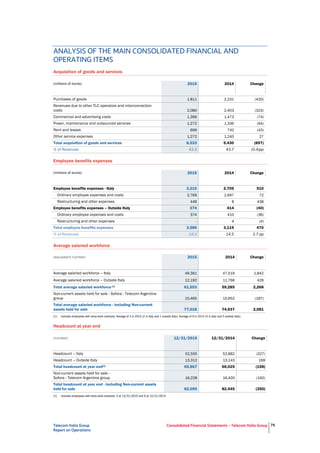
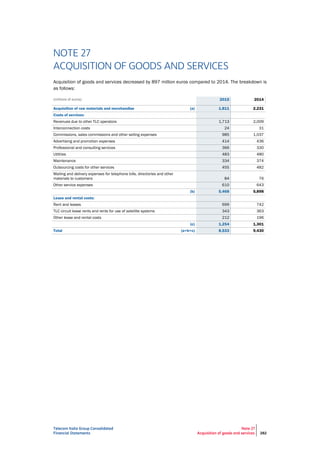
• Acquisition of goods and services (8,533 million euros; 9,430 million euros in 2014).
The reduction of 897 million euros was mainly attributable to the decrease in the Brazil Business
Unit’s acquisition of goods and services (down by 1,149 million euros, including a negative exchange
rate effect of 558 million euros), partially offset by the increase by the Domestic Business Unit (215
million euros), mainly due to higher purchases of equipment and handsets, related to the increase in
product sales. This increase also reflected non-recurring items totaling 102 million euros.
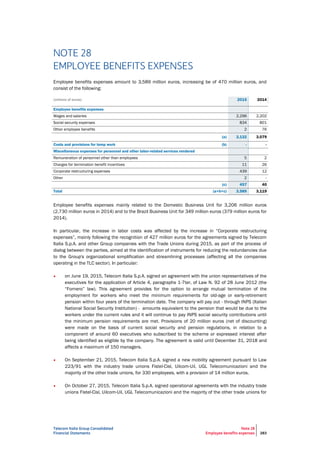
• Employee benefits expenses (3,589 million euros; 3,119 million euros in 2014).
They increased by 470 million euros compared to 2014. The main factors that drove this change
were:
– An increase of 72 million euros in the Italian component of ordinary employee expenses, due to
the increased contractual minimum salaries – as established in the TLC National Collective
Labor Agreement signed on February 1, 2013, which set the pay-scale points effective from April
and October 2014 – and the growth in the average salaried workforce, due to the termination in
April 2015 of the “Solidarity Contracts” applied by the Parent and Telecom Italia Information
Technology. Compared to 2014, the average salaried workforce had a net increase of 1,842
employees, out of which 2,062 units connected to the ending of the solidarity contracts.
Telecom Italia Group
Report on Operations
Key Operating and Financial Data - Telecom Italia Group 22
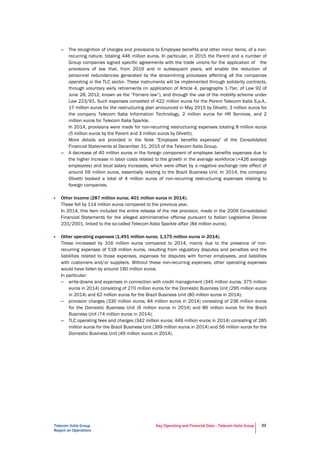
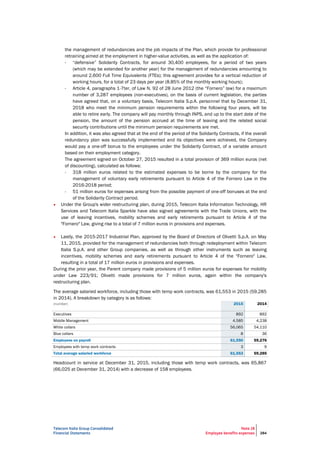
– The recognition of charges and provisions to Employee benefits and other minor items, of a non-
recurring nature, totaling 446 million euros. In particular, in 2015 the Parent and a number of
Group companies signed specific agreements with the trade unions for the application of the
provisions of law that, from 2016 and in subsequent years, will enable the reduction of
personnel redundancies generated by the streamlining processes affecting all the companies
operating in the TLC sector. These instruments will be implemented through solidarity contracts,
through voluntary early retirements (in application of Article 4, paragraphs 1-7ter, of Law 92 of
June 28, 2012, known as the “Fornero law”), and through the use of the mobility scheme under
Law 223/91. Such expenses consisted of 422 million euros for the Parent Telecom Italia S.p.A.,
17 million euros for the restructuring plan announced in May 2015 by Olivetti, 3 million euros for
the company Telecom Italia Information Technology, 2 million euros for HR Services, and 2
million euros for Telecom Italia Sparkle.
In 2014, provisions were made for non-recurring restructuring expenses totaling 8 million euros
(5 million euros by the Parent and 3 million euros by Olivetti).
More details are provided in the Note "Employee benefits expenses" of the Consolidated
Financial Statements at December 31, 2015 of the Telecom Italia Group.
– A decrease of 40 million euros in the foreign component of employee benefits expenses due to
the higher increase in labor costs related to the growth in the average workforce (+426 average
employees) and local salary increases, which were offset by a negative exchange rate effect of
around 59 million euros, essentially relating to the Brazil Business Unit. In 2014, the company
Olivetti booked a total of 4 million euros of non-recurring restructuring expenses relating to
foreign companies.
• Other income (287 million euros; 401 million euros in 2014).
These fell by 114 million euros compared to the previous year.
In 2014, this item included the entire release of the risk provision, made in the 2009 Consolidated
Financial Statements for the alleged administrative offense pursuant to Italian Legislative Decree
231/2001, linked to the so-called Telecom Italia Sparkle affair (84 million euros).
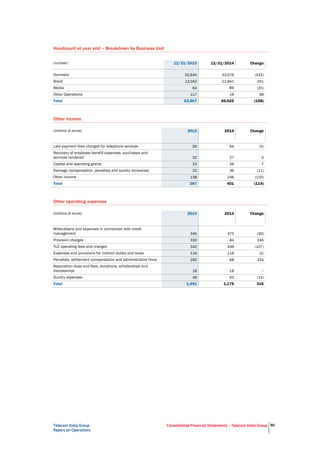
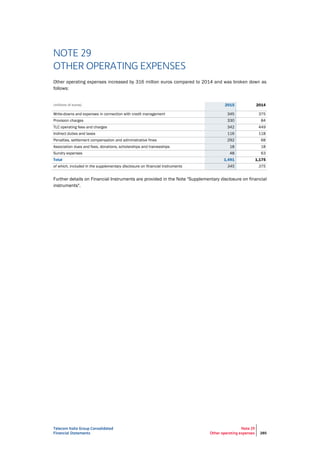
• Other operating expenses (1,491 million euros; 1,175 million euros in 2014).
These increased by 316 million euros compared to 2014, mainly due to the presence of non-
recurring expenses of 518 million euros, resulting from regulatory disputes and penalties and the
liabilities related to those expenses, expenses for disputes with former employees, and liabilities
with customers and/or suppliers. Without these non-recurring expenses, other operating expenses
would have fallen by around 190 million euros.
In particular:
– write-downs and expenses in connection with credit management (345 million euros; 375 million
euros in 2014) consisting of 270 million euros for the Domestic Business Unit (295 million euros
in 2014) and 62 million euros for the Brazil Business Unit (80 million euros in 2014);
– provision charges (330 million euros; 84 million euros in 2014) consisting of 236 million euros
for the Domestic Business Unit (6 million euros in 2014) and 86 million euros for the Brazil
Business Unit (74 million euros in 2014);
– TLC operating fees and charges (342 million euros; 449 million euros in 2014) consisting of 285
million euros for the Brazil Business Unit (399 million euros in 2014) and 56 million euros for the
Domestic Business Unit (49 million euros in 2014).
Telecom Italia Group
Report on Operations
Key Operating and Financial Data - Telecom Italia Group 23
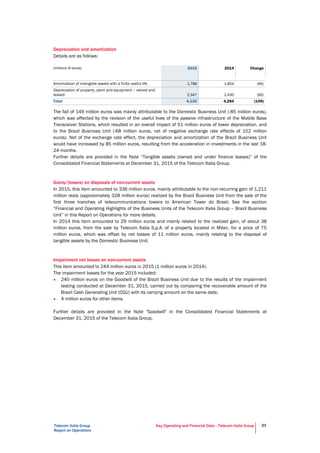
Depreciation and amortization
Details are as follows:
(millions of euros) 2015 2014 Change
Amortization of intangible assets with a finite useful life 1,788 1,854 (66)
Depreciation of property, plant and equipment – owned and
leased 2,347 2,430 (83)
Total 4,135 4,284 (149)
The fall of 149 million euros was mainly attributable to the Domestic Business Unit (-85 million euros),
which was affected by the revision of the useful lives of the passive infrastructure of the Mobile Base
Transceiver Stations, which resulted in an overall impact of 51 million euros of lower depreciation, and
to the Brazil Business Unit (-68 million euros, net of negative exchange rate effects of 152 million
euros). Net of the exchange rate effect, the depreciation and amortization of the Brazil Business Unit
would have increased by 85 million euros, resulting from the acceleration in investments in the last 18-
24 months.
Further details are provided in the Note “Tangible assets (owned and under finance leases)” of the
Consolidated Financial Statements at December 31, 2015 of the Telecom Italia Group.
Gains/(losses) on disposals of non-current assets
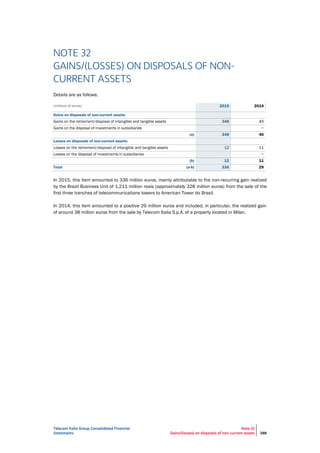
In 2015, this item amounted to 336 million euros, mainly attributable to the non-recurring gain of 1,211
million reais (approximately 328 million euros) realized by the Brazil Business Unit from the sale of the
first three tranches of telecommunications towers to American Tower do Brasil. See the section
“Financial and Operating Highlights of the Business Units of the Telecom Italia Group – Brazil Business
Unit” in this Report on Operations for more details.
In 2014 this item amounted to 29 million euros and mainly related to the realized gain, of about 38
million euros, from the sale by Telecom Italia S.p.A. of a property located in Milan, for a price of 75
million euros, which was offset by net losses of 11 million euros, mainly relating to the disposal of
tangible assets by the Domestic Business Unit.
Impairment net losses on non-current assets
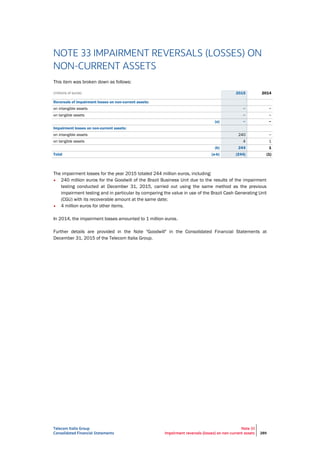
This item amounted to 244 million euros in 2015 (1 million euros in 2014).
The impairment losses for the year 2015 included:
• 240 million euros on the Goodwill of the Brazil Business Unit due to the results of the impairment
testing conducted at December 31, 2015, carried out by comparing the recoverable amount of the
Brazil Cash Generating Unit (CGU) with its carrying amount on the same date;
• 4 million euros for other items.
Further details are provided in the Note "Goodwill" in the Consolidated Financial Statements at
December 31, 2015 of the Telecom Italia Group.
Telecom Italia Group
Report on Operations
Key Operating and Financial Data - Telecom Italia Group 24
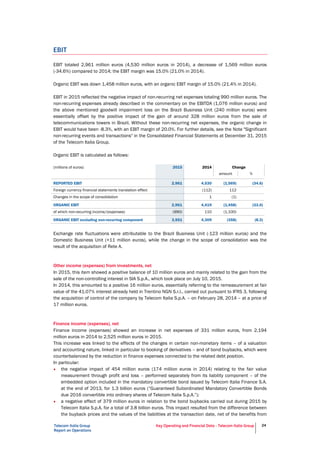
EBIT
EBIT totaled 2,961 million euros (4,530 million euros in 2014), a decrease of 1,569 million euros
(-34.6%) compared to 2014; the EBIT margin was 15.0% (21.0% in 2014).
Organic EBIT was down 1,458 million euros, with an organic EBIT margin of 15.0% (21.4% in 2014).
EBIT in 2015 reflected the negative impact of non-recurring net expenses totaling 990 million euros. The
non-recurring expenses already described in the commentary on the EBITDA (1,076 million euros) and
the above mentioned goodwill impairment loss on the Brazil Business Unit (240 million euros) were
essentially offset by the positive impact of the gain of around 328 million euros from the sale of
telecommunications towers in Brazil. Without these non-recurring net expenses, the organic change in
EBIT would have been -8.3%, with an EBIT margin of 20.0%. For further details, see the Note "Significant
non-recurring events and transactions" in the Consolidated Financial Statements at December 31, 2015
of the Telecom Italia Group.
Organic EBIT is calculated as follows:
(millions of euros) 2015 2014 Change
amount %
REPORTED EBIT 2,961 4,530 (1,569) (34.6)
Foreign currency financial statements translation effect (112) 112
Changes in the scope of consolidation 1 (1)
ORGANIC EBIT 2,961 4,419 (1,458) (33.0)
of which non-recurring income/(expenses) (990) 110 (1,100)
ORGANIC EBIT excluding non-recurring component 3,951 4,309 (358) (8.3)
Exchange rate fluctuations were attributable to the Brazil Business Unit (-123 million euros) and the
Domestic Business Unit (+11 million euros), while the change in the scope of consolidation was the
result of the acquisition of Rete A.
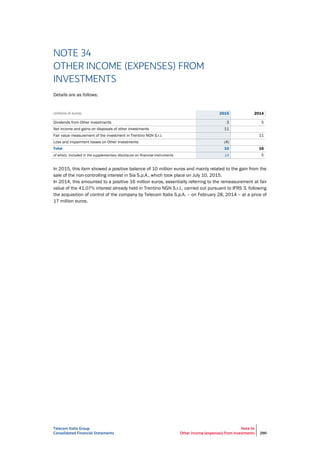
Other income (expenses) from investments, net
In 2015, this item showed a positive balance of 10 million euros and mainly related to the gain from the
sale of the non-controlling interest in SIA S.p.A., which took place on July 10, 2015.
In 2014, this amounted to a positive 16 million euros, essentially referring to the remeasurement at fair
value of the 41.07% interest already held in Trentino NGN S.r.l., carried out pursuant to IFRS 3, following
the acquisition of control of the company by Telecom Italia S.p.A. – on February 28, 2014 – at a price of
17 million euros.
Finance income (expenses), net
Finance income (expenses) showed an increase in net expenses of 331 million euros, from 2,194
million euros in 2014 to 2,525 million euros in 2015.
This increase was linked to the effects of the changes in certain non-monetary items – of a valuation
and accounting nature, linked in particular to booking of derivatives – and of bond buybacks, which were
counterbalanced by the reduction in finance expenses connected to the related debt position.
In particular:
• the negative impact of 454 million euros (174 million euros in 2014) relating to the fair value
measurement through profit and loss – performed separately from its liability component – of the
embedded option included in the mandatory convertible bond issued by Telecom Italia Finance S.A.
at the end of 2013, for 1.3 billion euros (“Guaranteed Subordinated Mandatory Convertible Bonds
due 2016 convertible into ordinary shares of Telecom Italia S.p.A.”);
• a negative effect of 379 million euros in relation to the bond buybacks carried out during 2015 by
Telecom Italia S.p.A. for a total of 3.8 billion euros. This impact resulted from the difference between
the buyback prices and the values of the liabilities at the transaction date, net of the benefits from
Telecom Italia Group
Report on Operations
Key Operating and Financial Data - Telecom Italia Group 25
the termination of several hedging derivatives linked to the bonds repurchased. In 2014, the
negative impact of the buybacks carried out during the period and the exercise of the early
redemption option for a bond amounted to 62 million euros.
Income tax expense
This item amounted to 401 million euros, and was down 527 million euros on 2014 (928 million euros)
mainly due to the lower tax base of the Parent Telecom Italia and the intervening full deductibility of
labor costs from the IRAP tax base introduced by Article 1 paragraph 20, of the 2014 Stability Law (Law
no. 190/14), which resulted in a reduction of around 60 million euros in IRAP tax.
Profit (loss) from Discontinued operations/Non-current assets held for sale
In 2015, this item amounted to 611 million euros (541 million euros in 2014) and it is mainly related to
the positive contribution to the consolidation from the Sofora - Telecom Argentina group.
More details are provided in the section "Discontinued operations/Non-current assets held for sale" of
this Report on Operations and in the Note "Discontinued operations/Non-current assets held for sale" in
the Consolidated Financial Statements at December 31, 2015 of the Telecom Italia Group.
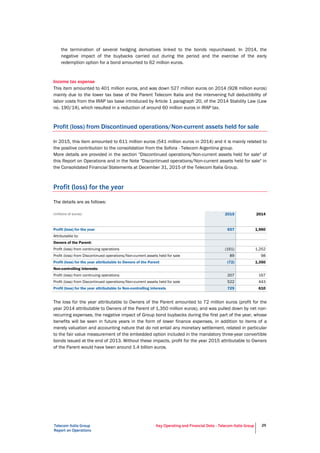
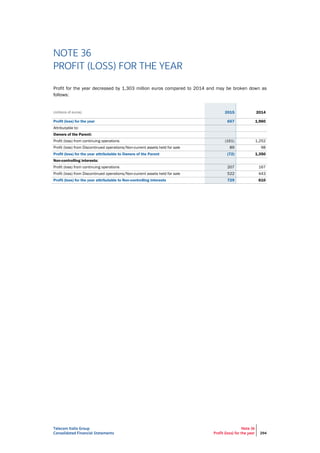
Profit (loss) for the year
The details are as follows:
(millions of euros) 2015 2014
Profit (loss) for the year 657 1,960
Attributable to:
Owners of the Parent:
Profit (loss) from continuing operations (161) 1,252
Profit (loss) from Discontinued operations/Non-current assets held for sale 89 98
Profit (loss) for the year attributable to Owners of the Parent (72) 1,350
Non-controlling interests:
Profit (loss) from continuing operations 207 167
Profit (loss) from Discontinued operations/Non-current assets held for sale 522 443
Profit (loss) for the year attributable to Non-controlling interests 729 610
The loss for the year attributable to Owners of the Parent amounted to 72 million euros (profit for the
year 2014 attributable to Owners of the Parent of 1,350 million euros), and was pulled down by net non-
recurring expenses, the negative impact of Group bond buybacks during the first part of the year, whose
benefits will be seen in future years in the form of lower finance expenses, in addition to items of a
merely valuation and accounting nature that do not entail any monetary settlement, related in particular
to the fair value measurement of the embedded option included in the mandatory three-year convertible
bonds issued at the end of 2013. Without these impacts, profit for the year 2015 attributable to Owners
of the Parent would have been around 1.4 billion euros.
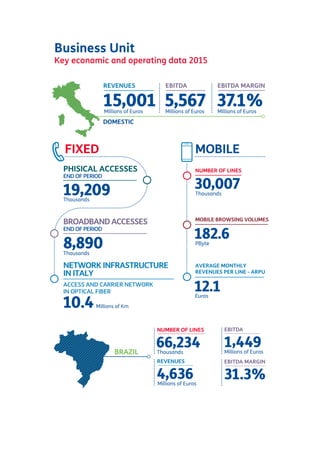
Business Unit
Key economic and operating data 2015
MOBILEFIXED
ACCESS AND CARRIER NETWORK
IN OPTICAL FIBER
NUMBER OF LINES
Millions of Euros
15,001
DOMESTIC
REVENUES
Millions of Euros
5,567
EBITDA
Millions of Euros
37.1%
EBITDA MARGIN
PHISICAL ACCESSES
BROADBAND ACCESSES
END OF PERIOD
19,209Thousands
30,007Thousands
MOBILE BROWSING VOLUMES
182.6PByte
AVERAGE MONTHLY
REVENUES PER LINE - ARPU
12.1Euros
END OF PERIOD
8,890Thousands
NETWORK INFRASTRUCTURE
IN ITALY
10.4Millions of Km
BRAZIL
4,636Millions of Euros
REVENUES
1,449Millions of Euros
EBITDA
31.3%
EBITDA MARGIN
66,234Thousands
NUMBER OF LINES
Telecom Italia Group
Report on Operations
Financial and Operating Highlights – The Business Units of the Telecom Italia Group
Domestic Business Unit
27
FINANCIAL AND OPERATING HIGHLIGHTS – THE
BUSINESS UNITS OF THE TELECOM ITALIA
GROUP
DOMESTIC
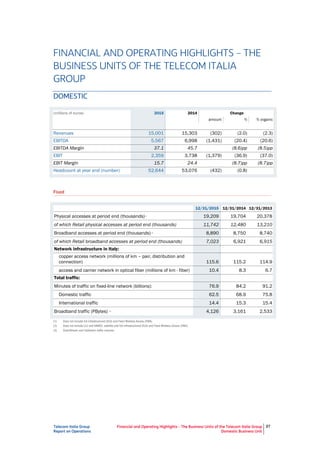
(millions of euros) 2015 2014 Change
amount % % organic
Revenues 15,001 15,303 (302) (2.0) (2.3)
EBITDA 5,567 6,998 (1,431) (20.4) (20.6)
EBITDA Margin 37.1 45.7 (8.6)pp (8.5)pp
EBIT 2,359 3,738 (1,379) (36.9) (37.0)
EBIT Margin 15.7 24.4 (8.7)pp (8.7)pp
Headcount at year end (number) 52,644 53,076 (432) (0.8)
Fixed
12/31/2015 12/31/2014 12/31/2013
Physical accesses at period end (thousands)(1)
19,209 19,704 20,378
of which Retail physical accesses at period end (thousands) 11,742 12,480 13,210
Broadband accesses at period end (thousands)(2)
8,890 8,750 8,740
of which Retail broadband accesses at period end (thousands) 7,023 6,921 6,915
Network infrastructure in Italy:
copper access network (millions of km – pair, distribution and
connection) 115.6 115.2 114.9
access and carrier network in optical fiber (millions of km - fiber) 10.4 8.3 6.7
Total traffic:
Minutes of traffic on fixed-line network (billions): 76.9 84.2 91.2
Domestic traffic 62.5 68.9 75.8
International traffic 14.4 15.3 15.4
Broadband traffic (PBytes) (3)
4,126 3,161 2,533
(1) Does not include full-infrastructured OLOs and Fixed Wireless Access (FWA).
(2) Does not include LLU and NAKED, satellite and full-infrastructured OLOs and Fixed Wireless Access (FWA).
(3) DownStream and UpStream traffic volumes
Telecom Italia Group
Report on Operations
Financial and Operating Highlights – The Business Units of the Telecom Italia Group
Domestic Business Unit
28
Mobile
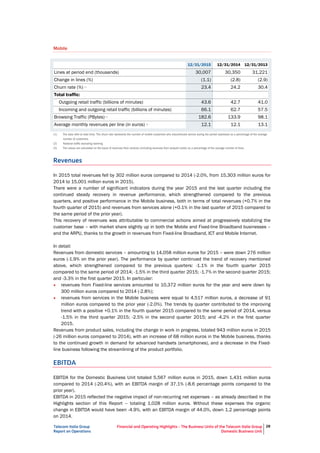
12/31/2015 12/31/2014 12/31/2013
Lines at period end (thousands) 30,007 30,350 31,221
Change in lines (%) (1.1) (2.8) (2.9)
Churn rate (%) (1)
23.4 24.2 30.4
Total traffic:
Outgoing retail traffic (billions of minutes) 43.6 42.7 41.0
Incoming and outgoing retail traffic (billions of minutes) 66.1 62.7 57.5
Browsing Traffic (PBytes) (2)
182.6 133.9 98.1
Average monthly revenues per line (in euros) (3)
12.1 12.1 13.1
(1) The data refer to total lines. The churn rate represents the number of mobile customers who discontinued service during the period expressed as a percentage of the average
number of customers.
(2) National traffic excluding roaming.
(3) The values are calculated on the basis of revenues from services (including revenues from prepaid cards) as a percentage of the average number of lines.
Revenues
In 2015 total revenues fell by 302 million euros compared to 2014 (-2.0%, from 15,303 million euros for
2014 to 15,001 million euros in 2015).
There were a number of significant indicators during the year 2015 and the last quarter including the
continued steady recovery in revenue performance, which strengthened compared to the previous
quarters, and positive performance in the Mobile business, both in terms of total revenues (+0.7% in the
fourth quarter of 2015) and revenues from services alone (+0.1% in the last quarter of 2015 compared to
the same period of the prior year).
This recovery of revenues was attributable to commercial actions aimed at progressively stabilizing the
customer base – with market share slightly up in both the Mobile and Fixed-line Broadband businesses –
and the ARPU, thanks to the growth in revenues from Fixed-line Broadband, ICT and Mobile Internet.
In detail:
Revenues from domestic services – amounting to 14,058 million euros for 2015 – were down 276 million
euros (-1.9% on the prior year). The performance by quarter continued the trend of recovery mentioned
above, which strengthened compared to the previous quarters: -1.1% in the fourth quarter 2015
compared to the same period of 2014; -1.5% in the third quarter 2015; -1.7% in the second quarter 2015;
and -3.3% in the first quarter 2015. In particular:
• revenues from Fixed-line services amounted to 10,372 million euros for the year and were down by
300 million euros compared to 2014 (-2.8%);
• revenues from services in the Mobile business were equal to 4,517 million euros, a decrease of 91
million euros compared to the prior year (-2.0%). The trends by quarter contributed to the improving
trend with a positive +0.1% in the fourth quarter 2015 compared to the same period of 2014, versus
-1.5% in the third quarter 2015; -2.5% in the second quarter 2015; and -4.2% in the first quarter
2015.
Revenues from product sales, including the change in work in progress, totaled 943 million euros in 2015
(-26 million euros compared to 2014), with an increase of 68 million euros in the Mobile business, thanks
to the continued growth in demand for advanced handsets (smartphones), and a decrease in the Fixed-
line business following the streamlining of the product portfolio.
EBITDA
EBITDA for the Domestic Business Unit totaled 5,567 million euros in 2015, down 1,431 million euros
compared to 2014 (-20.4%), with an EBITDA margin of 37.1% (-8.6 percentage points compared to the
prior year).
EBITDA in 2015 reflected the negative impact of non-recurring net expenses – as already described in the
Highlights section of this Report – totaling 1,028 million euros. Without these expenses the organic
change in EBITDA would have been -4.9%, with an EBITDA margin of 44.0%, down 1.2 percentage points
on 2014.
Telecom Italia Group
Report on Operations
Financial and Operating Highlights – The Business Units of the Telecom Italia Group
Domestic Business Unit
29
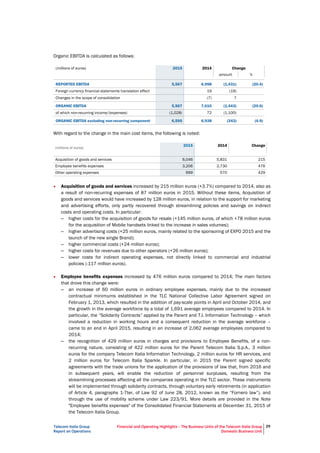
Organic EBITDA is calculated as follows:
(millions of euros) 2015 2014 Change
amount %
REPORTED EBITDA 5,567 6,998 (1,431) (20.4)
Foreign currency financial statements translation effect 19 (19)
Changes in the scope of consolidation (7) 7
ORGANIC EBITDA 5,567 7,010 (1,443) (20.6)
of which non-recurring income/(expenses) (1,028) 72 (1,100)
ORGANIC EBITDA excluding non-recurring component 6,595 6,938 (343) (4.9)
With regard to the change in the main cost items, the following is noted:
(millions of euros)
2015 2014 Change
Acquisition of goods and services 6,046 5,831 215
Employee benefits expenses 3,206 2,730 476
Other operating expenses 999 570 429
• Acquisition of goods and services increased by 215 million euros (+3.7%) compared to 2014, also as
a result of non-recurring expenses of 87 million euros in 2015. Without these items, Acquisition of
goods and services would have increased by 128 million euros, in relation to the support for marketing
and advertising efforts, only partly recovered through streamlining policies and savings on indirect
costs and operating costs. In particular:
– higher costs for the acquisition of goods for resale (+145 million euros, of which +78 million euros
for the acquisition of Mobile handsets linked to the increase in sales volumes);
– higher advertising costs (+25 million euros, mainly related to the sponsoring of EXPO 2015 and the
launch of the new single Brand);
– higher commercial costs (+24 million euros);
– higher costs for revenues due to other operators (+26 million euros);
– lower costs for indirect operating expenses, not directly linked to commercial and industrial
policies (-117 million euros).
• Employee benefits expenses increased by 476 million euros compared to 2014; The main factors
that drove this change were:
– an increase of 60 million euros in ordinary employee expenses, mainly due to the increased
contractual minimums established in the TLC National Collective Labor Agreement signed on
February 1, 2013, which resulted in the addition of pay-scale points in April and October 2014, and
the growth in the average workforce by a total of 1,691 average employees compared to 2014. In
particular, the “Solidarity Contracts” applied by the Parent and T.I. Information Technology – which
involved a reduction in working hours and a consequent reduction in the average workforce –
came to an end in April 2015, resulting in an increase of 2,062 average employees compared to
2014;
– the recognition of 429 million euros in charges and provisions to Employee Benefits, of a non-
recurring nature, consisting of 422 million euros for the Parent Telecom Italia S.p.A., 3 million
euros for the company Telecom Italia Information Technology, 2 million euros for HR services, and
2 million euros for Telecom Italia Sparkle. In particular, in 2015 the Parent signed specific
agreements with the trade unions for the application of the provisions of law that, from 2016 and
in subsequent years, will enable the reduction of personnel surpluses, resulting from the
streamlining processes affecting all the companies operating in the TLC sector. These instruments
will be implemented through solidarity contracts, through voluntary early retirements (in application
of Article 4, paragraphs 1-7ter, of Law 92 of June 28, 2012, known as the “Fornero law”), and
through the use of mobility scheme under Law 223/91. More details are provided in the Note
"Employee benefits expenses" of the Consolidated Financial Statements at December 31, 2015 of
the Telecom Italia Group.
Telecom Italia Group
Report on Operations
Financial and Operating Highlights – The Business Units of the Telecom Italia Group
Domestic Business Unit
30
• Other operating expenses amounted to 999 million euros and increased by 429 million euros
compared to 2014, mainly due to the presence of non-recurring expenses for 512 million euros,
without which other operating expenses would have fallen by 79 million euros. The non-recurring
expenses mainly related to provisions and expenses resulting from regulatory disputes and penalties
and the liabilities related to those expenses, expenses for disputes with former employees, and
liabilities with customers and/or suppliers.
Details of other operating expenses are shown in the table below:
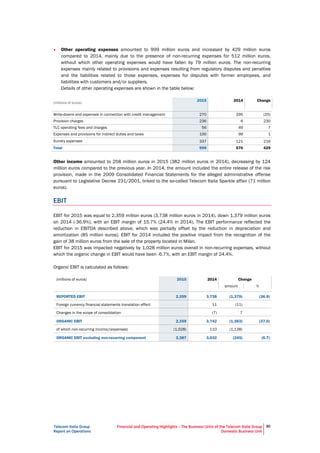
(millions of euros)
2015 2014 Change
Write-downs and expenses in connection with credit management 270 295 (25)
Provision charges 236 6 230
TLC operating fees and charges 56 49 7
Expenses and provisions for indirect duties and taxes 100 99 1
Sundry expenses 337 121 216
Total 999 570 429
Other income amounted to 258 million euros in 2015 (382 million euros in 2014), decreasing by 124
million euros compared to the previous year. In 2014, the amount included the entire release of the risk
provision, made in the 2009 Consolidated Financial Statements for the alleged administrative offense
pursuant to Legislative Decree 231/2001, linked to the so-called Telecom Italia Sparkle affair (71 million
euros).
EBIT
EBIT for 2015 was equal to 2,359 million euros (3,738 million euros in 2014), down 1,379 million euros
on 2014 (-36.9%), with an EBIT margin of 15.7% (24.4% in 2014). The EBIT performance reflected the
reduction in EBITDA described above, which was partially offset by the reduction in depreciation and
amortization (85 million euros). EBIT for 2014 included the positive impact from the recognition of the
gain of 38 million euros from the sale of the property located in Milan.
EBIT for 2015 was impacted negatively by 1,028 million euros overall in non-recurring expenses, without
which the organic change in EBIT would have been -6.7%, with an EBIT margin of 24.4%.
Organic EBIT is calculated as follows:
(millions of euros) 2015 2014 Change
amount %
REPORTED EBIT 2,359 3,738 (1,379) (36.9)
Foreign currency financial statements translation effect 11 (11)
Changes in the scope of consolidation (7) 7
ORGANIC EBIT 2,359 3,742 (1,383) (37.0)
of which non-recurring income/(expenses) (1,028) 110 (1,138)
ORGANIC EBIT excluding non-recurring component 3,387 3,632 (245) (6.7)
Telecom Italia Group
Report on Operations
Financial and Operating Highlights – The Business Units of the Telecom Italia Group
Domestic Business Unit
31
Financial highlights of the Domestic Cash Generating Units
The main financial and operating highlights of the Business Unit are reported according to three Cash
Generating units (CGU):
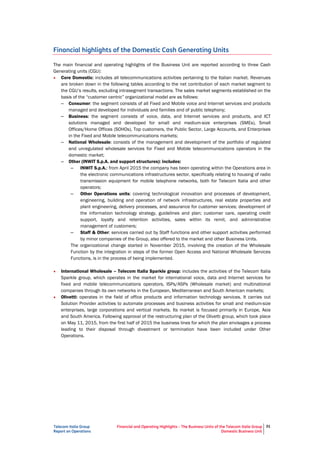
• Core Domestic: includes all telecommunications activities pertaining to the Italian market. Revenues
are broken down in the following tables according to the net contribution of each market segment to
the CGU’s results, excluding intrasegment transactions. The sales market segments established on the
basis of the “customer centric” organizational model are as follows:
– Consumer: the segment consists of all Fixed and Mobile voice and Internet services and products
managed and developed for individuals and families and of public telephony;
– Business: the segment consists of voice, data, and Internet services and products, and ICT
solutions managed and developed for small and medium-size enterprises (SMEs), Small
Offices/Home Offices (SOHOs), Top customers, the Public Sector, Large Accounts, and Enterprises
in the Fixed and Mobile telecommunications markets;
– National Wholesale: consists of the management and development of the portfolio of regulated
and unregulated wholesale services for Fixed and Mobile telecommunications operators in the
domestic market;
– Other (INWIT S.p.A. and support structures): includes:
– INWIT S.p.A.: from April 2015 the company has been operating within the Operations area in
the electronic communications infrastructures sector, specifically relating to housing of radio
transmission equipment for mobile telephone networks, both for Telecom Italia and other
operators;
– Other Operations units: covering technological innovation and processes of development,
engineering, building and operation of network infrastructures, real estate properties and
plant engineering, delivery processes, and assurance for customer services; development of
the information technology strategy, guidelines and plan; customer care, operating credit
support, loyalty and retention activities, sales within its remit, and administrative
management of customers;
– Staff & Other: services carried out by Staff functions and other support activities performed
by minor companies of the Group, also offered to the market and other Business Units.
The organizational change started in November 2015, involving the creation of the Wholesale
Function by the integration in steps of the former Open Access and National Wholesale Services
Functions, is in the process of being implemented.
• International Wholesale – Telecom Italia Sparkle group: includes the activities of the Telecom Italia
Sparkle group, which operates in the market for international voice, data and Internet services for
fixed and mobile telecommunications operators, ISPs/ASPs (Wholesale market) and multinational
companies through its own networks in the European, Mediterranean and South American markets;
• Olivetti: operates in the field of office products and information technology services. It carries out
Solution Provider activities to automate processes and business activities for small and medium-size
enterprises, large corporations and vertical markets. Its market is focused primarily in Europe, Asia
and South America. Following approval of the restructuring plan of the Olivetti group, which took place
on May 11, 2015, from the first half of 2015 the business lines for which the plan envisages a
process leading to their disposal through divestment or termination have been included under Other
Operations.
Telecom Italia Group
Report on Operations
Financial and Operating Highlights – The Business Units of the Telecom Italia Group
Domestic Business Unit
32
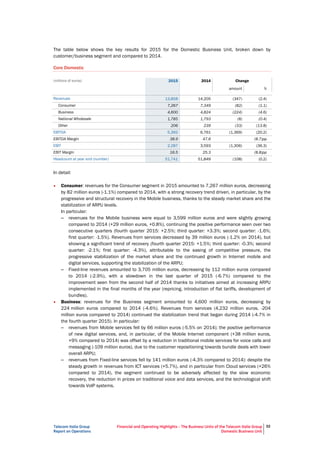
The table below shows the key results for 2015 for the Domestic Business Unit, broken down by
customer/business segment and compared to 2014.
Core Domestic
(millions of euros) 2015 2014 Change
amount %
Revenues 13,858 14,205 (347) (2.4)
Consumer 7,267 7,349 (82) (1.1)
Business 4,600 4,824 (224) (4.6)
National Wholesale 1,785 1,793 (8) (0.4)
Other 206 239 (33) (13.8)
EBITDA 5,392 6,761 (1,369) (20.2)
EBITDA Margin 38.9 47.6 (8.7)pp
EBIT 2,287 3,593 (1,306) (36.3)
EBIT Margin 16.5 25.3 (8.8)pp
Headcount at year end (number) 51,741 51,849 (108) (0.2)
In detail:
• Consumer: revenues for the Consumer segment in 2015 amounted to 7,267 million euros, decreasing
by 82 million euros (-1.1%) compared to 2014, with a strong recovery trend driven, in particular, by the
progressive and structural recovery in the Mobile business, thanks to the steady market share and the
stabilization of ARPU levels.
In particular:
– revenues for the Mobile business were equal to 3,599 million euros and were slightly growing
compared to 2014 (+29 million euros, +0.8%), continuing the positive performance seen over two
consecutive quarters (fourth quarter 2015: +2.5%; third quarter: +3.3%; second quarter: -1.6%;
first quarter: -1.5%). Revenues from services decreased by 39 million euros (-1.2% on 2014), but
showing a significant trend of recovery (fourth quarter 2015: +1.5%; third quarter: -0.3%; second
quarter: -2.1%; first quarter: -4.3%), attributable to the easing of competitive pressure, the
progressive stabilization of the market share and the continued growth in Internet mobile and
digital services, supporting the stabilization of the ARPU;
– Fixed-line revenues amounted to 3,705 million euros, decreasing by 112 million euros compared
to 2014 (-2.9%), with a slowdown in the last quarter of 2015 (-6.7%) compared to the
improvement seen from the second half of 2014 thanks to initiatives aimed at increasing ARPU
implemented in the final months of the year (repricing, introduction of flat tariffs, development of
bundles).
• Business: revenues for the Business segment amounted to 4,600 million euros, decreasing by
224 million euros compared to 2014 (-4.6%). Revenues from services (4,232 million euros, -204
million euros compared to 2014) continued the stabilization trend that began during 2014 (-4.7% in
the fourth quarter 2015). In particular:
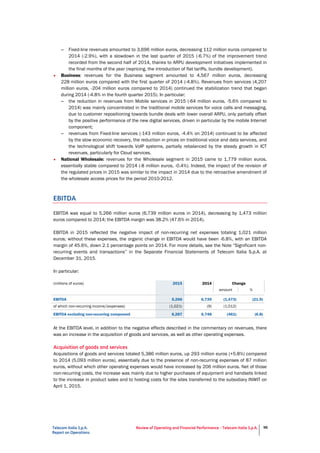
– revenues from Mobile services fell by 66 million euros (-5.5% on 2014); the positive performance
of new digital services, and, in particular, of the Mobile Internet component (+38 million euros,
+9% compared to 2014) was offset by a reduction in traditional mobile services for voice calls and
messaging (-109 million euros), due to the customer repositioning towards bundle deals with lower
overall ARPU;
– revenues from Fixed-line services fell by 141 million euros (-4.3% compared to 2014): despite the
steady growth in revenues from ICT services (+5.7%), and in particular from Cloud services (+26%
compared to 2014), the segment continued to be adversely affected by the slow economic
recovery, the reduction in prices on traditional voice and data services, and the technological shift
towards VoIP systems.
Telecom Italia Group
Report on Operations
Financial and Operating Highlights – The Business Units of the Telecom Italia Group
Domestic Business Unit
33
• National Wholesale: revenues for the Wholesale segment in 2015 amounted to 1,785 million euros,
essentially stable compared to 2014 (-8 million euros, -0.4%). Indeed, the impact of the revision of the
regulated prices in 2015 was similar to the impact in 2014 due to the retroactive amendment of the
wholesale access prices for the period 2010-2012.
International Wholesale – Telecom Italia Sparkle group
(millions of euros) 2015 2014 Change
amount % % organic
Revenues 1,314 1,244 70 5.6 1.1
of which third party 1,062 981 81 8.3 2.4
EBITDA 196 271 (75) (27.7) (32.4)
EBITDA Margin 14.9 21.8 (6.9)pp (7.4)pp
EBIT 85 172 (87) (50.6) (53.6)
EBIT Margin 6.5 13.8 (7.3)pp (7.6)pp
Headcount at year end (number) (*) 645 641 4 0.6
(*) Includes employees with temp work contracts: 2 employees at 12/31/2015 (4 employees at 12/31/2014).
2015 revenues for the Telecom Italia Sparkle group – International Wholesale totaled 1,314 million euros,
significantly higher than 2014 (+70 million euros, +5.6%). This increase related in particular to revenues
for Voice services (+39 million euros, +4.3%) and revenues for IP/Data services (+33 million euros,
+12.8%). The other business segments remained predominantly stable (-2 million euros, -2.2%).
Olivetti
Following the approval of the restructuring plan of the Olivetti group, that took place on May 11, 2015, the
business lines for which the plan envisages a process through divestment or termination have not been
consolidated under Olivetti any longer and have been included under Other Operations instead.
(millions of euros) 2015 2014 Change
amount %
Revenues 172 227 (55) (24.2)
EBITDA (9) (29) 20 69.0
EBITDA Margin (5.2) (12.8) 7.6 pp
EBIT (13) (34) 21 61.8
EBIT Margin (7.6) (15.0) 7.4 pp
Headcount at year end (number) (*) 258 586 (328) (56.0)
(*) Includes employees with temp work contracts: none at 12/31/2015 (4 at 12/31/2014).
The revenues of business lines defined as “Core” (Office, Retail and Systems and Advanced Caring)
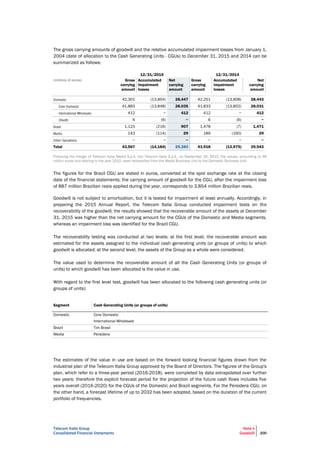
totaled 172 million euros in 2015. In particular, there was an increase in revenues in the Office segment
relating to the sale of multifunctional products under long-term rental agreements (+15 million euros
compared to 2014), and revenues from services in the Advanced Caring segment increased by over 6
million euros compared to the prior year.
Telecom Italia Group
Report on Operations
Financial and Operating Highlights – The Business Units of the Telecom Italia Group
Brazil Business Unit
34
BRAZIL
(millions of euros) (millions of reais)
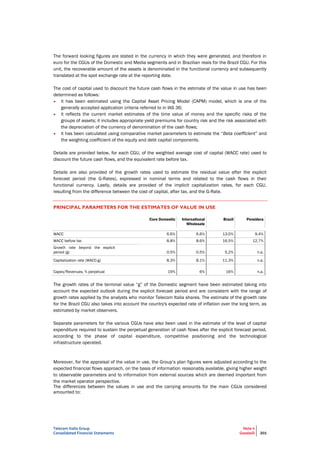
2015 2014 2015 2014 Change
amount %
(a) (b) (c) (d) (c-d) (c-d)/d
Revenues 4,636 6,244 17,139 19,498 (2,359) (12.1)
EBITDA 1,449 1,774 5,358 5,541 (183) (3.3)
EBITDA Margin 31.3 28.4 31.3 28.4 2.9 pp
EBIT 636 795 2,351 2,483 (132) (5.3)
EBIT Margin 13.7 12.7 13.7 12.7 1.0pp
Headcount at year end (number) 13,042 12,841 1.6
2015 2014
Lines at period end (thousands) (*)
66,234 75,721
MOU (minutes/month) (**)
119.5 135.8
ARPU (reais) 16.7 17.7
(*) Includes corporate lines.
(**) Net of visitors.
Revenues
Revenues for 2015, amounting to 17,139 million reais, were down by 2,359 million reais (-12.1%) on
2014. Service revenues totaled 15,384 million reais, a decrease of 941 million reais compared to
16,325 million reais for 2014 (-5.8%). The lower overall revenue was partly attributable to the revenues
from incoming SMS and mobile traffic (-1,005 million reais, -40.2%), due to the reduction in the mobile
termination rate (MTR) and lower volumes, as well as to traditional voice and SMS outgoing traffic (-
1,216 million reais, -13.4%). This was only partially offset by the increase in revenue generated by the
innovative component, mobile data and VAS content (+1,213 million reais, +35.0%). Mobile Average
Revenue Per User (ARPU) amounted to 16.7 reais for 2015 compared with 17.7 reais for 2014 (-5.6%).
Revenues from product sales came to 1,755 million reais (3,173 million reais in 2014; -44.7%),
reflecting the impact of the Brazilian macroeconomic crisis on household spending propensity.
The total number of lines at December 31, 2015 amounted to 66,234 thousand, showing a decrease
compared to December 31, 2014 (-9,487 thousand). This corresponds to a market share of
approximately 25.7% (27% at December 31, 2014).
EBITDA
EBITDA amounted to 5,358 million reais, 183 million reais lower than 2014 (-3.3%). The decline in
EBITDA was attributable to the fall in revenues, which was only partially offset by the deployment of
efficiency measures on cost items and the reduction in costs for revenues due to other operators and
the cost of sales; employee benefits expenses on the other hand also increased due to the salary
inflation adjustment, in addition to other net non-recurring costs of 53 million reais.
The EBITDA margin stood at 31.3%, 2.9 percentage points higher than in the previous year.
Telecom Italia Group
Report on Operations
Financial and Operating Highlights – The Business Units of the Telecom Italia Group
Brazil Business Unit
35
With regard to the change in the main costs, the following is noted:
(millions of euros) (millions of reais)
2015 2014 2015 2014 Change
(a) (b) (c) (d) (c-d)
Acquisition of goods and
services 2,444 3,593 9,037 11,222 (2,185)
Employee benefits expenses 349 379 1,289 1,183 106
Other operating expenses 470 598 1,736 1,865 (129)
Change in inventories 33 11 122 33 89
• Acquisition of goods and services totaled 9,037 million reais (11,222 million reais in 2014). The
19.5% decrease compared to the previous year (-2,185 million reais) can be broken down as follows:
-1,583 million reais for purchases relating primarily to cost of products for resale;
-826 million reais for revenues due to other TLC operators;
+45 million reais for external service costs;
+179 million reais for rent and lease costs.
• Employee benefits expenses, amounting to 1,289 million reais, were 106 million reais higher than
2014 (+9.0%). The average workforce grew from 11,451 employees in 2014 to 11,931 employees
in 2015. The ratio of employee benefits expenses to total revenues rose to 7.5%, up 1.4 percentage
points on 2014;
• Other operating expenses amounted to 1,736 million reais, a decrease of 6.9% on 2014. The
expenses were broken down as follows:
(millions of reais)
2015 2014 Change
Write-downs and expenses in connection with credit management 230 249 (19)
Provision charges 320 232 88
TLC operating fees and charges 1,054 1,247 (193)
Expenses and provisions for indirect duties and taxes 51 51 -
Sundry expenses 81 86 (5)
Total 1,736 1,865 (129)
EBIT
EBIT amounted to 2,351 million reais, down 132 million reais compared to 2014. This result reflected
the lower EBITDA contribution, in addition to the goodwill impairment loss allocated on the Business Unit
of 887 million reais (240 million euros), but benefited from the positive impacts arising from the
conclusion of the first three tranches of sales of telecommunications towers to American Tower do
Brasil. More specifically, at the time of the sales, the gains arising on the assets sold amounted to 1,211
million reais and were already net of transaction costs.
Agreement for the sale of telecommunications towers
On November 21, 2014, the subsidiary Tim Celular signed a contract for the sale to American Tower do
Brasil of part of the mobile infrastructure (6,481 telecommunications towers), for a total value of
approximately 3 billion reais. The sales agreement was signed in conjunction with a “Master Lease
Agreement” having an overall term of 20 years and, accordingly, the transaction has to be considered as
a partial sale and lease back.
Telecom Italia Group
Report on Operations
Financial and Operating Highlights – The Business Units of the Telecom Italia Group
Brazil Business Unit
36
On April 29, 2015, the sale of a first block of 4,176 towers was completed at a price of 1,897 million
reais; the second block (1,125 towers) was sold on September 30, 2015 at a price of 517 million reais,
and the third block (182 towers) was sold on December 16, for 84 million reais. Overall, the three
transactions resulted in a financial liability booked for 1,245 million reais. A gain of 1,211 million reais
was recognized in the income statement, already net of transaction costs, while the gain corresponding
to the portion of towers subject to sale and leaseback (1,003 million reais, already net of transaction
costs) was deferred according to the duration of the respective finance leasing contracts.
The main impacts of the transaction are summarized below:
millions of reais millions of euros
Total Total
Total price 2,498 676
Sale price of the towers sold definitively 1,253 339
Net carrying amount and transaction costs (245) (66)
Elimination of provision for restoration costs 203 55
Net gain 1,211 328
Tax (372) (101)
Net income statement impact 839 227
Sale price of the towers subject to sale and leaseback 1,245 337
Net carrying amount and transaction costs (242) (66)
Gain subject to deferral 1,003 271
Financial debt recorded as a result of the leaseback agreement 1,245 337
Tangible assets under financial lease 1,245 337
Reduction/(increase) in net financial debt 1,253 339
The translation into euros for the preparation of the interim financial statements has been made using
the average exchange rate for 2015 (3.69727 reais per euro).
Telecom Italia Group
Report on Operations
Financial and Operating Highlights – The Business Units of the Telecom Italia Group
Media Business Unit
37
MEDIA
On June 30, 2014, Telecom Italia Media (TI Media) and Gruppo Editoriale L’Espresso completed the
merger of the digital terrestrial network operator businesses respectively controlled by Persidera S.p.A.
and Rete A S.p.A..
The merger of Rete A by absorption into Persidera was executed on December 1, 2014.
Moreover, the merger of Telecom Italia Media S.p.A. into Telecom Italia S.p.A. was executed on
September 30, 2015, effective retroactively January 1, 2015 for accounting and tax purposes.
The table below shows the figures for the Media Business Unit which, for the first half of 2014, were not
including the results of Rete A; however, those results are taken into consideration for the calculation of
the organic changes.
(millions of euros) 2015 2014 Change
amount % % organic
Revenues 82 71 11 15.5 1.2
EBITDA 37 25 12 48.0 5.7
EBITDA Margin 45.1 35.2 9.9 pp 1.9 pp
EBIT 14 6 8 -
EBIT Margin 17.1 8.5 8.6 pp (0.2)pp
Headcount at year end (number) (*) 64 89 (25) (28.1) (8.6)
(*) Includes employees with temp work contracts: none at 12/31/2015 (1 at 12/31/2014).
At December 31, 2015, the three Digital Multiplexes formerly of Persidera S.p.A. reached a coverage of
95.8% of the Italian population.
The coverage of the two Digital Multiplexes of the former Rete A was 93.4% and 93.7%.
Revenues
Revenues amounted to 82 million euros in 2015, increasing by 11 million euros (+15.5%) compared to
the 71 million euros recorded in 2014. This change, which was positively driven by the acquisition of
Rete A business, not yet occurred in the first six months of 2014, was entirely attributable to the
Network Operator. Including the business of the former Rete A for the first six months of 2014, the
organic change in revenues was positive by 1.2%, and it was essentially linked to the launch of the new
SKYTG24 and Gazzetta TV channels, in addition to the increase in unit price of the main contracts.
EBITDA
EBITDA was a positive 37 million euros in 2015, up 12 million euros (+48%) compared to 2014 (25
million euros). This performance was driven by the aforementioned increase in revenues, as well as the
increase in other income, only partially offset by an increase in operating expenses, mainly attributable
to the costs from the former Rete A operations not present in the first six months of 2014. It is also
noted that EBITDA in 2014 reflected 7 million euros in operating costs relating to Telecom Italia Media
S.p.A. that were no longer present in 2015 following the merger with Telecom Italia S.p.A.; taking into
account these changes, organic EBITDA was up 5.7% compared to 2014.
EBIT
EBIT was positive at 14 million euros, up 8 million euros from 2014 (6 million euros). This performance
reflected the change in EBITDA described above, partially offset by the increase in depreciation and
amortization of 4 million euros.
Telecom Italia Group
Report on Operations
Discontinued operations/Non-current assets held for sale 38
DISCONTINUED OPERATIONS/NON-CURRENT
ASSETS HELD FOR SALE
The results are provided below for the Sofora - Telecom Argentina group, which has been classified
under "Discontinued operations/Non-current assets held for sale" following the agreement for the sale to
Fintech entered into on November 13, 2013 and subsequently amended on October 24, 2014, as
described in the 2014 Annual Report.
On March 8, 2016 following the approval by Enacom, the Argentinian Telecommunications Regulator,
the Telecom Italia Group completed the sale of its entire remaining stake in the Sofora -Telecom
Argentina group.
Income statement impacts of the Sofora - Telecom Argentina group
(millions of euros) (millions of Argentine
pesos)
2015 2014 2015 2014 Change
amount %
(a) (b) (c) (d) (c-d) (c-d)/d
Income statement impacts of the Sofora -
Telecom Argentina group:
Revenues 3,943 3,097 40,495 33,341 7,154 21.5
EBITDA 1,055 806 10,831 8,673 2,158 24.9
EBITDA Margin 26.7 26.0 26.7 26.0 0.7 pp
EBIT before impairments 1,057 806 10,856 8,683 2,173 25.0
Impairment reversals (losses) on non-
current assets (22) (2) (224) (26) (198)
EBIT 1,035 804 10,632 8,657 1,975 22.8
EBIT Margin 26.3 26.0 26.3 26.0 0.3 pp
Finance income/(expenses), net (94) 30 (966) 326 (1,292)
Profit (loss) before tax from Discontinued
operations/Non-current assets held for
sale 941 834 9,666 8,983 683 7.6
Income tax expense (320) (290) (3,289) (3,131) (158) 5.0
Profit (loss) after tax from Discontinued
operations/Non-current assets held for
sale 621 544 6,377 5,852 525 9.0
The average exchange rate used for the translation into euro of the Argentine peso (expressed in terms
of units of local currency per 1 euro) was 10.26890 in 2015 and 10.76605 in 2014. In terms of the
spot exchange rate, the Argentinian currency was subject to a significant devaluation in December
2015: the euro exchange rate for the Argentine peso at December 31, 2015 was 14.0972 pesos per
euro compared to 10.2755 pesos per euro at December 31, 2014.
Telecom Italia Group
Report on Operations
Discontinued operations/Non-current assets held for sale 39
12/31/2015 12/31/2014 Change
amount %
Fixed-line
Lines at period end (thousands) 4,043 4,093 (50) (1.2)
ARBU (Average Revenue Billed per User) (Argentine
pesos)
67.7 57.4 10.3 17.9
Mobile
Lines at period end (thousands) 22,202 22,066 136 0.6
Telecom Personal mobile lines (thousands) 19,656 19,585 71 0.4
% postpaid lines (1) 33% 32%
MOU Telecom Personal (minutes/month) 93.7 99.5 (5.8) (5.8)
ARPU Telecom Personal (Argentine pesos) 91.5 74.2 17.3 23.3
Núcleo mobile lines (thousands) (2) 2,546 2,481 65 2.6
% postpaid lines (1) 20% 19%
Broadband
Broadband accesses at period end (thousands) 1,814 1,771 43 2.4
ARPU (Argentine pesos) 207.4 153.0 54.4 35.6
(1) Includes lines with a ceiling invoiced at the end of the month which can be topped-up with prepaid refills.
(2) Includes WiMAX lines.
Revenues
Revenues for 2015 amounted to 40,495 million pesos, increasing by 7,154 million pesos (+21.5%)
compared to 2014 (33,341 million pesos), mainly thanks to the growth in the relative Average Revenue
Per User (ARPU). The main source of revenues was mobile telephony, which accounted for about 73% of
the consolidated revenues of the Sofora - Telecom Argentina group, an increase of about 20% on 2014.
Fixed-line telephony service: the number of fixed lines decreased by 50 thousand compared to the end
of 2014 to a total of 4,043 thousand at December 31, 2015. Even though regulated fixed-line services
in Argentina continued to be influenced by the rate freeze imposed by the Emergency Economic Law of
January 2002, Average Revenue Billed per User (ARBU) rose by 17.9% compared to 2014, thanks to the
sale of additional services and the spread of traffic plans. Revenues from data and ICT services also
rose, because the prices of their contracts are set in US dollars and so they benefited from the
significant exchange rate difference compared to 2014.
Mobile telephony service: Telecom Personal mobile lines in Argentina increased by 71 thousand
compared to the end of 2014, coming to a total of 19,656 thousand lines at December 31, 2015, of
which 33% were postpaid. At the same time, thanks to high-value customer acquisitions, ARPU grew by
23.3% to 91.5 pesos (74.2 pesos in 2014). A large part of this growth was attributable to value added
services (including revenue sharing and Internet), which together accounted for 60% of revenues from
mobile telephony services in 2015.
In Paraguay, the Núcleo customer base grew by 2.6% compared to December 31, 2014, reaching 2,546
thousand lines, 20% of which are postpaid.
BroadBand: Telecom Argentina's portfolio of broadband lines totaled 1,814 thousand accesses at
December 31, 2015, an increase of 43 thousand on December 31, 2014. ARPU rose by 35.6% to 207.4
pesos (153 pesos in 2014), largely thanks to up-selling strategies and price adjustments.
Telecom Italia Group
Report on Operations
Discontinued operations/Non-current assets held for sale 40
EBITDA
EBITDA showed an increase of 2,158 million pesos (+24.9%) compared to 2014, reaching 10,831
million pesos. The EBITDA margin came to 26.7%, up 0.7 percentage points over 2014, mainly due to
the reduction in costs for high-grade handsets and accessories, which was partially offset by the higher
incidence of employee benefits expenses and external service costs.
With regard to the change in the main costs, the following is noted:
(millions of euros) (millions of Argentine pesos)
2015 2014 2015 2014 Change
(a) (b) (c) (d) (c-d)
Acquisition of goods and
services 1,852 1,390 19,017 14,963 4,054
Employee benefits
expenses 713 525 7,317 5,655 1,662
Other operating expenses 470 375 4,835 4,038 797
Change in inventories (142) 6 (1,460) 64 (1,524)
• Acquisition of goods and services amounted to 19,017 million pesos (14,963 million pesos in
2014) showing, in particular, an increase in costs for external services of 1,912 million pesos and an
increase in the purchase of goods of 2,025 million pesos;
• Employee benefits expenses, amounting to 7,317 million pesos, increased by 1,662 million pesos
compared to 2014 (+29.4%). The change was due to salary increases resulting from periodic
revisions in union agreements, primarily linked to inflation. The percentage of employee benefits
expenses to total revenues was 18.1%, up 1.1 percentage points over 2014;
• Changes in inventories totaled 1,460 million pesos and referred mainly to higher purchases of
handsets by Telecom Personal, mentioned above, with an increase of 62% in stock levels compared
to the end of 2014;
• Other operating expenses amounted to 4,835 million pesos, increasing 797 million pesos on 2014.
These expenses consist of the following:
(millions of Argentine pesos) 2015 2014 Change
Write-downs and expenses in connection with credit
management 564 424 140
Provision charges 53 31 22
TLC operating fees and charges 719 592 127
Expenses and provisions indirect duties and taxes 3,232 2,692 540
Sundry expenses 267 299 (32)
Total 4,835 4,038 797
EBIT
EBIT for 2015 came to 10,632 million pesos compared to 8,657 million pesos recorded for 2014. The
increase of 1,975 million pesos was attributable to the improvement in EBITDA, partially offset by higher
net impairment losses on non-current assets for the year (+198 million pesos) related to work in
progress initiated in previous years and now abandoned. The EBIT margin stood at 26.3% of revenues
(+0.3 percentage points compared to 2014).
Telecom Italia Group
Report on Operations
Discontinued operations/Non-current assets held for sale 41
As required by IFRS 5, the calculation of the depreciation and amortization for the Sofora – Telecom
Argentina group, which would have amounted to 4,438 million pesos in 2015 and 3,244 million pesos in
2014 (432 million euros in 2015 and 301 million euros in 2014), was suspended with effect from its
date of classification as a discontinued operation.
Capital expenditures
Capital expenditures in 2015 amounted to 10,100 million pesos and increased by 1,203 million pesos
compared to 2014 (8,897 million pesos).
Capital expenditures in the year were also aimed at customer acquisition, and extension and upgrading
of the access network to increase capacity and improve quality of the 3G mobile network. This objective
was pursued by initiating the upgrade of the existing network with new higher-performance technology
and lower energy consumption. Lastly, to support the growth in data traffic volumes, in 2015 the Sofora
– Telecom Argentina group continued with the activation of sites for the 4G service, the upgrade of
broadband services on the fixed-line network and backhauling.
Other information – Amendment of the Bylaws of Telecom Argentina
S.A.
The Ordinary and Extraordinary Shareholders' Meeting of Telecom Argentina, held on June 22, 2015,
approved changes to the business purpose, adapting it to the new definition of Information and
Communications Technology Services contained in the “Ley de Argentina Digital” including the possibility
of providing Audiovisual communication services.
Tel
Rep
M
B
D
A
Co
In
ch
be
of
wo
co
Th
ha
be
dig
pe
TIM
TI
Th
for
se
A
sys
life
A
ex
se
ch
ecom Italia Grou
port on Operation
MAIN CO
BUSINE
DOMESTIC
A new bran
onnectivity and
2015 the proj
hange that brin
etween fixed, m
Telecom Italia
orking under a
ompany: from p
he Group will m
as been synon
ecause commu
gital lives, bec
eople.
M means bein
IM is the f
he new compan
rward-looking
ecurity and relia
single brand
stem and a sin
e.
single bran
xperience and r
ervices “any tim
hannel”.
p
ns
OMMER
SS UNI
C
nd strategy
d services - for
ect was launch
ngs the comp
mobile or Intern
a. This simplif
a single shared
products and se
move into the f
nymous with i
unication is fre
cause a cultur
ng connected t
uture, by T
ny combines th
approach of
ability of Teleco
responds to
ngle need: to b
d also simp
responds bette
me, anywhere
M
RCIAL D
TS OF T
y
people, househ
hed that will lea
any’s various
net services, an
fication of the
d identity; for T
ervices to the v
uture with resp
innovation, sh
edom. Accordi
re of widespre
to life - always
Telecom It
he dynamism a
TIM, with t
om Italia.
a single val
e connected w
plifies custom
er to the need
and through a
Main Commercial
DEVELO
THE GR
holds and busi
ad, in 2016, to
identities toge
nd rooting TIM
e brand archit
TIM’s custome
various contac
pect for its trad
haring and fre
ngly, TIM is en
ead access me
s, anywhere an
talia
and
the
lue
with
mer
for
any
l Developments o
OPMEN
ROUP
inesses - all un
o TIM being the
ether in a sin
’s modern, dyn
ecture will me
ers it means all
ct points - onlin
dition. Since it
eedom. Its eth
ntrusted with th
eans a future
nd better.
of the Business Un
TS OF T
nder a single na
e Group’s only
gle brand, wit
namic spirit in t
ean that empl
l-round easier
e, in store and
s foundation 2
hos: Freedom
he task of ena
that benefits
nits of the Group
THE
ame: TIM.
trading name
thout distinctio
the dependab
loyees will all
relations with
d billing.
20 years ago, T
to communica
abling of all of
more and m
42
e - a
ons
ility
be
the
TIM
ate,
our
ore
Telecom Italia Group
Report on Operations
Main Commercial Developments of the Business Units of the Group 43
TIM, the enabler of digital Italy
TIM has a responsibility to guide Italy toward the goal of full digitization. As such, the repositioning
affects all its stakeholders, whether internal – TIM’s staff - or external - institutions and the public.
TIM aims to be more than just a name on a product, but to represent a distinctive set of values,
approaches and responsibilities to customers and society. A range of initiatives has been launched in
order to make this a reality: projects to teach young people about responsible Internet use are reaching
thousands of children and families through sport and school.
Security and Support are the pillars of TIM’s strategy. Accordingly, TIM is investing to stop cyberbullying
and phone use while driving, and to promote awareness of coding as a career opportunity.
The third pillar is service quality. TIM publicizes the hard work of its engineers laying thousands of
kilometers of fiber, using adverts in major newspapers and the #KMDIFUTURO campaign to engage
more sophisticated online users. The EXPO, in 2015, also provided an extraordinary opportunity to
showcase the smart city of the future.
Lastly, TIM also provides support for startups through dedicated programs, in partnership with TIM
#Wcap, accelerators and TIM Ventures. The aim is to seize every opportunity to satisfy customers’
requirements - both now and in the future - firm in the belief that TIM is the future of Telecom Italia.
The future is innovation
Telecom Italia has been a consistent leader in technological development, and while 2014 saw
celebrations for 50 years of research at the Group, with the 2015 Expo the conversation has already
shifted to new scenarios. Telecom Italia undertakes research and supports new ideas not only in its own
laboratories, but also at universities where the Company has agreements for Joint Open Labs and
through initiatives to help startups (TIM Ventures and TIM #Wcap). The Group faces a constant
challenge, stemming not only from the digital revolution, but from the entire international industry’s
shift toward new business areas and new technologies.
Network innovation
The commitment to constant technological upgrades is a long-term endeavor. In 2015 innovative
investments continued, in line with 2014. This approach was confirmed, in February 2016, in the 2016-
2018 strategic plan, which calls for a further acceleration of the investments in innovation.
The plan provides for around 12 billion euros of investments in Italy, of which around 6.7 billion
earmarked for the development of innovative components, including next-generation networks to ensure
increasing quality, speed and security.
NGN (NEXT GENERATION NETWORK): FIBER OPTIC EVOLUTION
High-speed network based on fiber optic. The first step is to bring fiber to street cabinets (FTTCab - fiber
to the cabinet) which are then connected to homes. Telecom Italia is also investing to bring fiber to the
home (FTTH), to provide an even faster network.
4G LTE (LONG TERM EVOLUTION): MOBILE EVOLUTION
Represents the evolution of the mobile access network to ultra-broadband or ultra-Internet. This is latest
update to the UMTS network. VoLTE (Voice Over LTE), a next-generation technology, will enable very high
quality calls and a wide range of mobile services.
By the end of 2018, TIM aims to reach 84% of the population with the fiber optic NGN ultra-broadband
network, and 98% of the population with the 4G LTE network, laying the foundations for the
development of "VoLTE" (Voice Over LTE).
Telecom Italia Group
Report on Operations
Main Commercial Developments of the Business Units of the Group 44
YESTERDAY END 2013 TODAYEND 2015 TOMORROW END 2018
~50% Ultra Coverage 88% Ultra Coverage 98% Ultra Coverage
Mobile BroadBand Mobile BroadBand Mobile BroadBand
4G (LTE) 4G (LTE) 4G (LTE)
~18% Ultra Coverage
42% Ultra Coverage
84% Ultra Coverage
Fixed BroadBand Fixed BroadBand Fixed BroadBand
(NGN) (NGN) (NGN)
Online data security: Cybersecurity
The security of personal data and communications is one of the key themes of the digital revolution.
Telecom Italia’s Cybersecurity department is one of the largest in Europe, working to protect data and
stop hacking.
Urban Security IT Cloud
This is a cloud solution used by the local police in Milan and Rome to gather information on the ground
and to map out and manage worsening situations. In particular, the Cloud Solution for the integrated
management of the city and the territory provides for:
• Field Management & Control (as used in EXPO) for managing events, crises, alerts collected from
the field through mobile devices (local police, security patrols, citizens);
• Street Monitoring for mobile detection and sanctioning of offences against the Road Traffic law
(used by the Local Police of Milan and Rome).
TIMProtect
Offers complete device protection from typical online threats, thanks to advanced and innovative
technology. The service includes “parental control”, online transactions protection and privacy and an
antivirus protection.
Telecom Italia centers of excellence
• Security Lab studies cybersecurity threats, analyzes new risk scenarios, looks for innovative tools,
tests them and holds lab trials to identify the best solutions;
• Security Operation Center (SOC) is the monitoring center that manages security alarms from
telecoms networks and Data Centers, which host Telecom Italia and client applications.
Connectivity for everyone
New technologies bring new services. TIM is committed to making these services accessible to an ever-
increasing number of clients, from any device, anywhere. This is shown by its increasingly integrated
offerings (fixed, mobile, TV, Digital Life) designed for all customer segments (young, senior, families,
ethnic) and the continued investment in the next generation network to provide increasing quality,
speed and security.
TIM also offers solutions for every requirement to encourage take-up of new devices (e.g. smartphones,
tablets, smart TV) which enable access to more advanced Internet services and draw value from latest-
generation broadband technologies. The new TIM SMART fully exploits the potential of ultrabroadband
to support the natural “convergence” between both fixed and mobile and media and TLC, to provide
Telecom Italia Group
Report on Operations
Main Commercial Developments of the Business Units of the Group 45
accessibility “anytime and anywhere”. Representing a first in Italy, TIM launched TIM NEXT, the only
offer that allows customers to replace their smartphone every year free of charge.
However, connectivity has nothing to do with impersonal distance; it is about men and women coming
together and talking. Calls and voice are still the main way to feel close to people, so for this reason TIM
is the only operator to offer minutes that never expire: clients own their minutes, which are never lost if
they are not used up and can be enjoyed at any time.
Daily life and leisure time
Useful solutions for everyone’s life that exploit the potential of fixed and mobile ultra-broadband are
increasingly part of our daily routine. For schools, for example, TIMcollege is the first offering on the
Italian market for students providing a complete solution with a tablet, LTE connectivity, and all school
books and courses.
Leisure time is also experiencing a digital revolution, thanks to platforms accessible everywhere, through
various devices. Music can be streamed on a mobile phone and played in the home with a tablet or a
PC. TIMmusic now offers 25 million songs. In 2015, users listened to an average of over 200 songs in
streaming per month, a figure that reflects the market appreciation for the latest service features and
the content provided.
Books are being read in digital format on e-readers, tablets and smartphones that are becoming
veritable pocket libraries: TIMreading, with 60,000 registered users, is TIM’s publishing service with a
catalog of more than 120,000 eBooks, over 50 magazines and the main national and sports daily
newspapers.
Finally, TIMgames is a mobile platform dedicated to digital games, offering a constantly updated catalog
of 1,700 games from leading publishers. With TIMgames, customers can access all content from any
smartphone or tablet (Android and iOS) with a simple “all you can play” subscription.
But Television is probably the medium that is undergoing the biggest revolution, with linear TV being
supplemented by Video on Demand, via new technologies that are accompanying traditional
broadcasting and new pay TV formulas.
TV on the Internet
Films are being watched via broadband on home TVs, PCs and tablets, also simultaneously on several
devices, with consumers deciding where and when to start viewing their favorite content.
TIMvision, TIM’s on demand TV service, with more than 8,000 titles including films, TV series and
content for children, recorded more than 22 million viewings, with over 500,000 subscribers at the end
of 2015 – double the 2014 figure, demonstrating that TV via the Internet is already a reality. This trend
has further strengthened in 2016, with more and more TIM customers (both inside and outside the
home) choosing TIMvision for the whole family’s entertainment, and also subscribing to TIM's 4 play
offers such as TIM Smart.
TIM
vision
OVER
8,000
SHOWS
also in
high
definition
EVERYTHING
ALWAYS ON
DEMAND
wherever
and
whenever
you want
(home TV,
smartphone,
tablet,
TIMvision
website,
etc.)
NO ADVERTs
Telecom Italia Group
Report on Operations
Main Commercial Developments of the Business Units of the Group 46
The partnership between TIM and Sky also continued, which offers the market the most complete TV
offering "without a dish". This is strengthening the "convergence" between media and TLC, with
“quadruple play” offers like TIM Smart&Sky bringing together fixed and mobile telephone services,
broadband and ultra-broadband connectivity, and premium television content, accessible "any time and
anywhere" on all devices connected to the network.
TIM
Sky
OVER 150
CHANNELS
in high
definition
60 HD
CHANNELS
1 3D
channel
2,500
TITLES
available
on Sky On
Demand
The partnership with Sky is one of the key components of TIM’s strategy for TV via the Internet, which
began and will continue with TIMvision, a streamlined offering that makes clear to customers how
important it is to have a quadruple play offering for inside and outside the home. In addition to being a
content offering, TIMvision is also an open platform that can host premium content and services of the
best digital entertainment providers on its decoder.
The first major example of this model, which sees Telecom Italia as an enabler of TV via the Internet in
all its forms, is the agreement reached with Netflix, the biggest online streaming platform in the world
with over 75 million customers. This service is decisively changing television consumption, by offering a
rich catalog of original content, specifically designed for digital consumers and their habits. When Netflix
decided to launch its service in Italy it identified Telecom Italia as the ideal partner to work with in
meeting the challenge of convergence between networks and content.
This approach is also being adopted by Mediaset Premium via the TIM platform, where, in addition to a
vast on-demand offering, it has decided to broadcast 22 live channels on the superfast networks, which
include the best of TIM Serie A and Champions League soccer available exclusively up to 2018. The
offering, called Premium Online, significantly expands the choice of national and international content
for TIM customers, stimulating the use of broadband and ultra-broadband connection infrastructure,
which represents the future, not only for the entertainment market, but also for the growth of Italy’s
economy.
@Giuseppe_Recchi
Innovating the way Italians watch TV, stimulating
demand for broadband: this is the agreement
with #Netflix
@MarcoPatuano
We have signed the agreement with #Netflix, a
major step forward for the @TIM_Official video
strategy
@Giuseppe_Recchi
The agreement with Mediaset is strengthening
our strategy: offering premium content on the
Internet and reducing the digital divide
@MarcoPatuano
TV via fiber of @TIM_Official is expanding. From
September the entire Mediaset Premium Online
offering will be on @TIM_Vision
Telecom Italia Group
Report on Operations
Main Commercial Developments of the Business Units of the Group 47
For businesses
Alongside a functioning administrative system, the driving force behind development and quality of life is
an ecosystem of businesses that generate value for employees and society.
In 2015, Telecom Italia’s business solutions were based on technological innovation, enabling increased
productivity and efficiency.
It is a short step from Nuvola Italiana, a cloud platform providing services ranging from Hosting, Cloud
Storage, Disaster Recovery to IT security and communications, to the NuvolaStore. The NuvolaStore is
a true marketplace for small and medium-sized enterprises to quickly and easily find, buy and manage
the most advanced IT solutions.
And the service for digital invoicing, a reality that both government and business must now embrace, as
well as secure digital signatures, providing a new way to sign documents using a smartphone instead of
the usual devices like smart cards or tokens.
In addition, in 2015 the “Extended Expo” project offered the chance to get to know the advanced digital
solutions that Telecom Italia is developing, either alone or with partners. Thanks to the development of
mobile platforms with technologies such as NFC, Augmented Reality, Visual Search, new solutions are
close at hand: integrated solutions for tourism, info-mobility, geolocation services, e-commerce, digital
signing and much more. The companies and institutions that subscribe to this initiative enjoy high
visibility within the Digital Showcase of Smart City Expo 2015, and they have the possibility to organize
conventions, workshops and meetings, and to project their corporate and institutional videos within the
Expo spaces.
The Commitment to the Public Administration
Telecom Italia takes part in the program of cost reduction and process efficiency in the public
administration, with a number of initiatives involving local authorities, and a diversified offering with
solutions that facilitate the relationship between citizens and institutions.
In particular:
• CONSIP MOBILE 6: Telecom Italia won the CONSIP Mobile 6 contract (24 months, for a maximum of
900 thousand lines), which covers around 19 thousand central and local authorities, providing
traditional voice and data services as well as mobile email services, device management, mobile
apps and workforce management, confirming its place as key operator for the public administration;
• DIGITAL IDENTITY: Trusted Identity and Mobile Identity to convey the identity of users securely
through dedicated apps or latest-generation SIMs;
• DIGITAL PUBLIC ADMINISTRATION: “paperless” services based on Cloud technology, Electronic
invoicing, Advanced Electronic Signature to optimize resources in total security;
• SOLUTIONS FOR THE HEALTH SECTOR: an app for checking ambulance equipment, remote
monitoring systems for vital signs, access to customer details or medical records from mobile and
tablet;
• DIGITAL SCHOOL: solutions for the world of education such as the Kit Scuola Digitale (Digital School
Kit) and the Scuolabook Network platform, launched in collaboration with Alfabook, the leader in the
digital educational publishing sector, acquired in July 2015 by Telecom Italia.
Telecom Italia also works closely with Municipalities and Regions for digital development through the
"TIM-Connected Italy Contest", part of the Connected Italy Project, now in its third edition, as well as the
initiatives for the development of ultra-broadband infrastructure for the development of digital services
across the country.
As regards ultra broadband (UBB), Telecom Italia has won the recent tenders called by various regions in
southern Italy in line with the objectives of the European Digital Agenda and the strategic guidelines
adopted by the Italian Government on the subject.
Tel
Rep
N
ecom Italia Grou
port on Operation
ew develo
p
ns
opments fo
M
or custome
√
Main Commercial
ers
MARCH 9
Superfibe
Optic netw
FEBRUAR
The Digita
profession
MARCH 3
TIM, in co
Tablet sha
APRIL 16,
TIM and S
APRIL 30,
TIM introd
MAY 26, 2
Free hom
clients.
JUNE 18,
TIM atten
of its ener
JUNE 29,
TIM-Conn
of Italian t
JULY 14, 2
TIM celeb
single bra
JULY 29, 2
Netflix arr
SEPTEMB
“Premium
ultrabroad
SEPTEMB
TIM Smar
telephone
OCTOBER
Olivetti la
enterprise
NOVEMBE
TIM's 4G
connectio
NOVEMBE
The TIM S
access fr
download
DECEMBE
TIM and
Cinema p
l Developments o
, 2015
er arrives, enab
work
Y 25, 2015
al Invoice servi
nals and small
1, 2015
ollaboration with
aring initiative f
, 2015
Sky launch fiber
, 2015
duces the first It
2015
me insurance wi
2015
ds the second E
rgy saving and e
2015
nected Italy, the
towns starts up
2015
brates its 20th b
and for the com
2015
rives on the TIM
ER 30, 2015
m Online” availa
dband networks
ER 2, 2015
rt is the Quadru
e, Internet conne
R 16, 2015
aunches its firs
es.
ER 26, 2015
Plus evolution
on speed of up t
ER 30, 2015
SMART FIBRA
rom the home
d and 20 Mbps
ER 29, 2015
RAI renew th
productions on T
of the Business Un
ling speeds of 5
ce launches on
businesses
h Samsung, pres
or EXPO2015.
r-optic TV.
talian Smart Cit
th phone bill int
Energy Day, pre
environmental p
e contest for the
p again.
birthday and bec
mmercial offerin
MVision platform
able on TIM's br
s, thanks to agr
uple Play offerin
ection, and TV s
t 3D printer fo
is launched in
to 300 Mbps.
“SuperFiber” o
at speeds of
in upload.
e agreement t
TIMvision.
nits of the Group
50 Mb/s on the
n the Nuvola Sto
sents TIM2go,
ty at Expo 2015
troduced for TIM
esenting the res
protection polic
e digital develo
comes the Grou
ng.
m.
roadband and
reement with M
ng: fixed and m
services.
or small and m
Milan with max
option offers In
up to 300 M
to offer the be
48
Fiber
ore for
a
5.
M
sults
cies.
pment
up's
Mediaset.
mobile
edium
ximum
nternet
bps in
est RAI
Tel
Rep
B
M
In
se
co
•
•
•
•
Ti
ecom Italia Grou
port on Operation
RAZIL
Marketing P
2015, Tim B
egment and de
overage of its d
defending it
the custome
base), offeri
utilization;
developing th
an approach
on positive g
component o
“pure” postp
on network a
for higher va
mainly smart
expanding t
(Internet, SM
imeline of
p
ns
Policy Evo
Brasil develope
efending its po
ata network. T
ts position in t
er's choice of b
ing low-cost s
he growth driv
h based on the
gross-additions
of the bundle o
paid contracts
availability and
alue customers
tphones, maint
the Consumer
MS and “off net
f the offers
M
lution
ed marketing
osition in the p
The initiatives m
the prepaid se
both the first a
solutions for
er for the “Co
e migration fro
. The profitabil
offer;
s through a geo
d the competiti
s. Continued at
taining alignme
r range of off
t” voice traffic).
s
√
Main Commercial
initiatives aim
prepaid segme
mainly focused
egment by se
and the second
voice consum
ntrole” postpa
m prepaid con
lity of the offer
ographically se
ive dynamics o
ttention to the
ent with the m
fers, which pr
.
February
Price up in
March 20
Blocking o
May 2015
Offer of th
June 201
“Infinity dia
number of
41 (TIM)
July 2015
Increase o
with a pric
Launch of
for local a
to Whatsa
Novembe
Launch of
postpaid, c
distance tr
l Developments o
med at improv
nt, by making
on:
curing and def
d SIM card (ta
mption, offset
aid segment, w
ntracts, to a gr
ring was also im
egmented strat
of the local ma
e availability of
ost innovative
rovide a comp
2015
n the prepaid seg
015
of data traffic onc
5
e benefit of free
15
a” offer for the p
f “on net” calls to
5
of the data limit i
ce increase from
the “TIM Empre
nd national long-
pp
er 2015
a new bundle of
controle and pre
raffic (prefix 41)
of the Business Un
ing the result
better use of
fending Tim B
rget is to defe
by an expec
with maximum
rowth-based ap
mproved by ex
egy of gross-ad
arket, to provid
f a broad portf
offers on the m
plete bundle f
gment. from 0.25
ce the limit has b
access to Whats
prepaid segment
o any TIM numbe
n the “Controle W
29.90 to 32.90
sa Tarifa Flat” in
-distance calls, w
ffer range in the t
paid – including
also off net
nits of the Group
t in the postp
the capacity a
rasil’s position
end the custom
cted higher d
usage limit, fr
pproach, focus
xpanding the d
dditions, focus
de targeted off
folio of handse
market;
for the custom
5 to 0.30 reais p
been used up in
sapp in the post
t, access at a da
er or long distan
Whatsapp” offer
reais
n the corporate s
with 100MB of d
three different m
g Internet, SMS, a
49
paid
and
n in
mer
ata
rom
sed
ata
sing
fers
ets,
mer
per call
Pré-pago and Co
paid offering
ily fixed-price to
ce number using
r (from 300 MB t
segment: fixed pr
data usage and f
market segments
and local and lon
ontrole
an infinite
g the prefix
to 500 MB),
rice
ree access
s –
ng-
Telecom Italia Group
Report on Operations
Main changes in the regulatory framework 50
MAIN CHANGES IN THE REGULATORY
FRAMEWORK
DOMESTIC
Wholesale fixed markets
Telecom Italia Reference Offers
At the end of the public consultations initiated by the Authority in the first few months of 2015, the
Telecom Italia Reference Offers for 2013 were all finally approved and published. For the Reference
Offers for the year 2014, in December 2015 AGCom approved the 2014 prices for the following
services: WLR, access to NGAN infrastructure, End-to-End fiber service, and specific capacity
transmission services. The decision to approve the 2014 prices for wholesale unbundled access to
metallic network and sub-network, and co-location was published in January 2016. The decisions on
Bitstream services (copper and fiber) and Telecom Italia’s fixed-line interconnection are still pending.
Wholesale access services
On December 22, 2015, after more than 3 years since the start of the proceedings and three national
public consultations, and after having received the go-ahead from the European Commission on October
5, AGCom approved the decision on the analysis of access markets for the period 2014-2017.
The Authority's decision proposes the deregulation of the last retail market still subject to ex ante
regulation (retail access to the fixed-line public phone network) and revokes the corresponding
obligations, except for those relating to the authorization of retail offerings before their commercial
launch and replicability checks.
In addition, the Authority has set the rules and prices for access to the copper and fiber network of
Telecom Italia by competing operators, which are the same throughout Italy, with retroactive effect for
the year 2015.
The main changes to the existing regulatory framework concern:
a) the ability for operators to select external companies for line maintenance and activation services
under LLU and sub-loop unbundling (SLU) arrangements;
b) new non-discrimination measures designed to reduce differences in the supply and quality of
access services between the internal divisions of Telecom Italia and competing operators;
c) administrative simplification, through: i) harmonization of the system of SLAs and penalties across
the various access services, and ii) greater efficiency in procedures for approving Telecom Italia
Reference Offers;
d) more stringent penalties for Telecom Italia in the event of delay in the provision of access services
and fault repair;
e) new measures to incentivize Local Loop Unbundling (LLU) of smaller exchanges and to favor the
migration of LLU customers to NGN networks;
f) guidelines on the switch-off of the Telecom Italia exchanges open to LLU, with incentives for co-
located operators to switch to fiber, which will need to be better articulated through a specific
procedure to be undertaken by the Authority.
With regard to the provision of maintenance services and activation of LLU and SLU lines by external
companies, on February 22, 2016 Telecom Italia submitted an implementation proposal for the
Authority’s approval that will be examined through an ad-hoc procedure. On February 22, 2016, Telecom
Italia also submitted a proposal for approval by the Authority on strengthening guarantees of equal
treatment, with particular reference to: (i) commercial management of orders by the National Wholesale
function; (ii) simplification of the causes of refusals; (iii) removal of misalignments between the
databases containing information on retail customers; (iv) reduction of differences in the workflow
applied to orders; (v) rationalization of the procedures for managing wholesale orders and stock.
Approval times for these new measures by the Authority are not set in advance.
Telecom Italia Group
Report on Operations
Main changes in the regulatory framework 51
The controls on wholesale prices set out the following:
a) subscription charges for wholesale access services remain the same in 2014 as in 2013.
b) prices are set for all wholesale access services to the copper and fiber-optic network from 2015 to
2017 (see the table below for the subscription charges, which shows the substantial stability of the
LLU charge and the significant cost “efficiencies” on copper and VULA bitstream services);
The main wholesale access prices for the period 2014-2017 are provided below:
wholesale access services
(euro/month/line)
2013-2014 2015 2016 2017
LLU–Local Loop Unbundling 8.68 8.61 8.61 8.61
SLU-Sub Loop Unbundling 5.79 5.57 5.43 5.30
WLR POTS 11.14 11.06 11.06 11.06
WLR ISDN 13.78 13.67 13.67 13.67
Shared bitstream on copper 6.74 4.96 4.63 4.29
Naked bitstream on copper 15.14 13.59 12.80 12.46
Naked FTTC VULA (30 Mbps)
20.63
13.58 13.42 13.27
Naked FTTC VULA (50 Mbps) 15.38 15.20 15.02
VULA FTTH (100 Mbps/10 Mbps) 24.90 23.15 22.64 22.12
VULA FTTH (40 Mbps/40 Mbps) 34.53 32.08 31.36 30.65
VULA FTTH (100 Mbps/100 Mbps) 86.49 81.37 79.57 77.77
Interconnection services on the fixed network
On April 20, 2015, the Authority initiated the procedure for the 3rd cycle of market analysis of
interconnection services on the fixed telephone network, but the associated public consultation has not
yet begun.
High-quality wholesale access from fixed workstations
In July 2015, the Authority adopted the final ruling essentially confirming the regulations established at
the end of the previous market analysis, despite changes in technology and competition in the
intervening years and expected in the near future.
Specifically, in the user site loop circuits market (terminating), the Authority confirmed Telecom Italia’s
obligations regarding: access, transparency, non-discrimination, accounting separation, accounting for
costs and control of prices.
Regarding prices:
• the 2014 prices for terminating circuits approved by the Authority are the same as for 2013;
• for the years 2015, 2016 and 2017, for terminating SDH/PDH with a capacity below or equal to 155
Mbit/s using Ethernet over SDH technology, Telecom Italia is subject to a planned annual price
reduction mechanism (IPC-6% for subscription charges, IP-8.6% for transport charges). For
terminating SDH/PDH with capacities above 155 Mbit/s using Ethernet technology over fiber optic,
and for ancillary services, the prices should be guided by the costs shown in Telecom Italia’s
Regulatory Accounts.
Telecom Italia Group
Report on Operations
Main changes in the regulatory framework 52
Retail fixed markets
Basic offers
Starting on May 1, 2015, Telecom Italia initiated a process of price simplification for its fixed-line (voice)
telephone service.
Specifically, for Consumer customers interested solely in the voice telephone service without a package
offer, the previous basic offer (rental plus telephone services according to consumption) was replaced by
a flat-type offer (“Tutto VOCE” - “All VOICE”). For a single subscription fee (29 euros per month, including
VAT) the customer has access to the line, together with unlimited calls to all fixed and mobile Italian
numbers. Customers who prefer to maintain an offer with voice traffic charged according to
consumption can choose to move free of charge to the Telecom Italia “Voice” offer (19 euros per month,
including VAT, i.e. rental offer only, with a cost for domestic calls to all fixed and mobile Italian numbers
of 10 cents per minute including VAT, with no connection fee.
Customers who do not intend to take up the offers described above still have the entire range of
Telecom Italia offers available to them.
In addition, effective from July 1, 2015, the billing method has been changed from the previous bi-
monthly to a monthly frequency.
Also for Business customers, starting from May 1, 2015, changes have been made to the basic offer for
telephone (voice) services:
• the monthly rental for telephone lines has increased from 22.50 euro per month excluding VAT to
24.90 euro per month excluding VAT. The rental fee has also been increased for certain types of
ISDN lines, both single and multiple;
• for the main traffic routes (local, inter-district and fixed-to-mobile) the connection charge is now 30
euro cents excluding VAT and a price of 5 euro cents excluding VAT is applied for each minute of
conversation.
Convergent offers
In 2015, Telecom Italia’s convergent deal focused on new audiovisual services based on broadband
connectivity (at least 10 Megabits per second) and ultra-broadband connectivity (at least 30 Megabits
per second). Major partnership agreements were signed with Sky, Mediaset and Netflix, which enabled
the launch of the first offers: the “TIM Sky” offer was launched in April 2015, followed by the “TIM
Premium Online” in September 2015, thanks to the agreement signed with another major player in the
audiovisual sector, Mediaset. The TIMVISION decoder has the Premium Online App, which provides
direct access to the service via home television sets, as well as other compatible devices.
Universal Service
The final proceeding closed by AGCom in relation to the determination of the contribution mechanism to
the net cost of the universal service refers back to resolution no. 100/14/CIR of 2014, in which the
Authority established that “as in 2006, the provision of the mandatory universal service for 2007 will
not carry a cost”. Therefore, the other operators are not required to pay any contribution to cover the net
cost for the universal service provided by Telecom Italia. Following this decision, the Company asked
AGCom to verify the market conditions for keeping the Universal Service obligations that fall to Telecom
Italia alone. At the same time, Telecom Italia urged the Ministry of Economic Development to begin the
review procedure of the Universal Service obligations as soon as possible. In response to this request,
on September 4, 2014, the Authority began to establish the procedures for designating appointed
operators to provide the universal service. Subsequently, in a letter dated November 28, 2014, the
Ministry of Economic Development asked AGCom to inform it of the outcome of the procedure and to
suspend any effects, pending definition of a common process. To date, the procedure is still suspended.
On August 31, 2015, following the annulment (on July 7, 2015) by the Consiglio di Stato of the
Resolutions 106 and 109/11/CIR, with which the Authority had renewed the procedures for sharing the
net cost of the universal service for the years 1999-2000 and 2002-2003, Telecom Italia submitted an
appeal to the Court of Cassation and an application to AGCom for the recommencement of the
preliminary investigations canceled by the Consiglio di Stato. Specifically, the renewal requested by
Telecom Italia relates to the strengthening of the grounds that require the inclusion of mobile operators
Telecom Italia Group
Report on Operations
Main changes in the regulatory framework 53
as parties required to pay for the net cost of the universal service. On October 15, 2015, Vodafone
submitted four notices to pay that demanded Telecom Italia to repay the amounts paid to the universal
service fund plus interest. In letters dated November 13 and 27, 2015, the Ministry for Economic
Development urged the parties to execute the ruling and therefore, for the Company to repay Vodafone
the amounts received by way of reimbursement of universal service charges for 1999–2000 and 2002–
2003.
The ruling of the Lazio Administrative Court of January 22, 2015 canceled Resolution 1/08/CIR with
which AGCom introduced and applied the new methodology for calculating the Universal Service
charges, applicable retroactively from 2004. Telecom Italia’s appeal to the Consiglio di Stato was
rejected in a ruling dated October 2, 2015. AGCom is therefore required to recommence the
investigations for the years 2004 to 2007, applying the method for the net cost calculation in force prior
to the year of publication (2008) of the resolution 1/08/CIR. The recommencement of the investigations
for the years 2004 to 2007 may be strictly tied to the requests for recommencement for the years 1999-
2000 and 2002-2003.
Wholesale mobile markets
On September 30, 2015, the Authority published the definitive decision (Resolution 497/15/CONS)
regarding the 4th cycle of analysis of the mobile termination market, initiated in February 2014. The
Authority has designated all operators offering voice termination services on their own mobile network
as operators with significant market power, for the first time including the full MVNOs (Bt Italia,
Lycamobile, Noverca and Poste Mobile). The Authority also introduced the free negotiation of the
termination price for calls from non-EU countries. With regard to the financial conditions, the AGCom
proposed a termination value “of no more than 0.98 euro cents per minute”. This restriction is effective
retroactively from January 1, 2014 and for the entire period from 2014 to 2017 for the four largest
mobile network operators, whereas, for the full MVNOs, it is effective from the date of publication of the
final decision (from September 30, 2015).
AGCom contribution fee
In 2014 two rulings were published in relation to the lengthy litigation initiated by Telecom Italia
regarding the AGCom contribution fee. The first related to the decision of the Administrative Court (TAR)
of Lazio that fully upheld the pronouncement of the EU Court of Justice, which had been asked to issue a
preliminary ruling on the matter and accepted Telecom Italia's appeals concerning the cancellation of
the resolutions through which AGCom had requested payment of: (i) 26.6 million euros for sums
allegedly unpaid in the five-year period 2006-2010 and (ii) 24.2 million euros for the contribution fee for
the year 2011. The ruling of the Lazio TAR also affirmed the principle whereby the contribution fees of
operators of electronic communications networks and services should only cover costs relating to
activities unequivocally used for ex-ante regulation of this sector and that revenues connected to ex-ante
regulation and obtained as administration fees from the companies must not exceed the overall costs
directly pertaining to this regulatory activity. AGCom lodged an appealed against the Lazio TAR ruling and
requested a suspension, which, however, was rejected.
On February 17, 2015, the Consiglio di Stato published the ruling which upheld the petitions by Telecom
Italia and rejected the appeal by AGCom, confirming the previous ruling of the Lazio Administrative
Court. This resulted in the annulment of the resolution containing the request for the payment of the
AGCom contribution fee of 26.6 million euros as an adjustment for the insufficient payment in the five-
year period 2006-2010. This ruling of the Consiglio di Stato has been appealed by AGCom before the
Court of Cassation.
On March 5, 2015 the AGCom resolution was published containing the guidelines for the payment of the
2015 contribution fee, which confirmed the tax base for the calculation of the contribution fee (revenues
from sales and services in the income statement published in the financial statements for the year
2013) and set a contribution rate of 0.15% (for the first time different from the rate applied to the other
markets governed by the Authority, such as media and publishing, set at 0.2%).
Telecom Italia has made the payment with reservation of the contribution fee requested by AGCom for
2015, at the same time lodging an appeal with the Administrative Court regarding its method of
calculation.
On August 18, 2015, the 2014 European Law came into force amending Article 34 of the CCE,
establishing that AGCom must publish a report of the administrative costs incurred for its TLC activities,
Telecom Italia Group
Report on Operations
Main changes in the regulatory framework 54
in order to enable a comparison between the overall amount of the contribution fee collected compared
to the actual costs incurred and, where necessary, make the appropriate adjustments.
On October 8, 2015, the Authority published its 2014 Annual Report which shows that the expenses
incurred for activities attributable to the electronic communications sectors amounted to around 37
million euros and that in 2014 the Authority received around 1.2 million euros more from the operators,
which will be deducted from the contribution fee requested from the operators for the year 2016.
In April 2014, TI had paid 14 million euros to AGCom, via reverse charge and with reservations, in view
of the pending appeals, for the 2014 fee, instead of the 23.4 million euros requested by the Authority.
On December 22, 2015, AGCom ordered Telecom Italia to pay the remaining amount of the 2014
contribution fee and on February 22, 2016 the payment was made (of around 9.4 million euros), whilst
also submitting an appeal against the order, as a supplement to the appeal already submitted with
regard to the AGCom resolution for the 2014 contribution fee (resolution 547/13/CONS).
Antitrust
For information on the pending disputes relating to Proceedings A428 and I761 see the Note
“Contingent liabilities, other information, commitments and guarantees” of the Separate Financial
Statements of Telecom Italia S.p.A. at December 31, 2015.
Telecom Italia Group
Report on Operations
Main changes in the regulatory framework 55
BRAZIL
700 MHz and clean-up of the spectrum
When awarded the 700 MHz (4G/LTE) frequencies, TIM Brasil assumed the obligation together with the
other parties awarded the license, to undertake all technical interventions throughout the country
needed to free the assigned frequencies (digitizing TV channels and stopping analogue broadcasts,
known as the “clean up”), for a total value of 1.2 billion reais. In April 2015, having formed the
consortium between the “EAD” operators for the management of clean-up activities, the first of three
annual tranches of around 370 million reais was disbursed to finance operations.
Auction of radio frequencies in the 1800, 1900 and 2500 MHz band
In December 2015, Anatel launched a tender to award radio frequencies in the above bands, to be used
with FDD and TDD technology to provide the mobile and broadband service. TIM came in first place for
the 2500 MHz FDD band lots, which enable the provision of fourth generation mobile services (4G/LTE)
in the metropolitan areas of Recife and Curitiba, with bids totaling 56.5 million reais. The award process
is expected to end with the formal allocation to TIM during the first half of 2016.
Regulatory Agenda 2016
In December 2015, the National Telecommunications Agency – ANATEL published the Regulatory
Agenda for 2016. The main initiatives scheduled by the Agency include: i) definition of the subsidy
procedures as per the Decree on network neutrality, ii) revision of the regulation on the concession
system for fixed-line telephone services, iii) review of the model for managing the use of the radio
frequency spectrum and redefining the mechanisms for granting licenses, and iv) revision of the rules on
service quality and accessibility.
Revision of the model for the provision of telecommunications services
In November 2015, the Telecommunications Ministry began a public consultation to review the current
model for the provision of telecommunications service and to open a debate on the future of
telecommunications in the light of the challenges posed by new technologies, development of
broadband, standardization of the service towards private concessions, the private system and public
policies. The public consultation began in December and ended on January 15, 2016, with the
participation of all major telecommunications operators in the country, as well as the most important
consumer rights associations. The aim is to survey the public in order to gather useful information to
support the future regulatory process.
MEDIA
Television frequencies
Following the switch-off process, which lasted four years and was concluded on July 4, 2012, the
Ministry for Economic Development definitively assigned the digital frequencies.
Specifically, on June 28, 2012, the decision was taken to definitively assign the user rights of digital
frequencies to Persidera for 20 years.
In 2010, AGCom announced a beauty contest for the allocation of user rights to additional “digital
dividend” frequencies. Telecom Italia Media Broadcasting – now Persidera – participated in the contest
for the assignment of three lots, but the contest was canceled on April 28, 2012 with the entry into force
of Italian Law 44/12 and replaced with a competitive tender under new rules set out by AGCom in
Resolution 277/13/CONS.
The only party that participated in that tender – which was carried out in June 2014 and which Persidera
was unable to participate in, because it was incorrectly equated to RAI and Mediaset – was the Cairo
group, which was awarded a MUX for 31,626,000 euros.
Telecom Italia Group
Report on Operations
Main changes in the regulatory framework 56
Persidera, has been involved in various disputes on television frequencies. These include the appeal for
the failure to award a fourth network during the analogue-to-digital conversion of networks before the
switch off (the two analogue networks of La7 and MTV and the two digital networks MBONE and TIMB1)
and the appeal for the cancellation of the beauty contest.
Both the appeals are pending before the Consiglio di Stato, which has referred the questions to the
European Court of Justice for preliminary rulings.
Administrative charges and contribution fees for TV frequencies and connection bridges
Since 2014, Persidera has been required to pay administrative contribution fees and user rights for
frequencies, in accordance with articles 34 and 35 of Legislative Decree 259/03 “Electronic
Communications Code”. Up to and throughout 2013, however, the applicable system required
broadcasters to pay a concession fee equal to 1% of annual revenues.
The 2014 European Law (Law 115/2015 - Official Gazette of August 3, 2015) entered into force on
August 18, 2015, modifying the administrative charges for the general authorization as a digital
terrestrial network operator and the amounts of the contribution fees for connection bridges pursuant to
Article 34 and 35 of the Code.
On the basis of the new regulations, Persidera is required to pay an annual charge for the administrative
fees and connection bridges of around 250,000 euros.
In view of the findings of the EU Commission in relation to “the advantages of incumbent integrated
vertical operators that have a significant number of multiplexes”, as guaranteed by AGCom Resolution
494/14/CONS to RAI and Mediaset, the 2016 Stability Law established that the Ministry for Economic
Development would be responsible for contribution fees for TV frequencies. The European regulatory
action consequently abrogated the AGCom Resolution, which would have required Persidera to incur an
unfair charge of over 13 million euros per year.
The amount of the contribution fees for the user rights to TV frequencies will be set by order of the
Ministry of Economic Development, to be issued by the end of February 2016, in a manner that is
transparent, proportionate to the scope, non-discriminatory and on the basis of the geographic coverage
of the rights authorized, the market value of the frequencies, taking account of mechanisms geared
towards the pro-competition allocation of transmission capacity (i.e. favorable to non-vertically
integrated operators such as Persidera), as well as the use of innovative technologies (i.e. DVB-T2).
Total revenue deriving from administrative charges and contribution fees for TV frequencies and
connection bridges is expected to be 32.8 million euros. This would bring Persidera towards a
reasonably sustainable expense.
Potential use of frequencies for mobile technology
At the end of the global conference on the regulation of the radio spectrum, held in Geneva in November
2015 (WRC-15), the 700 MHz band frequencies (between 694-790 MHz, corresponding to television
channels 49-60 UHF) currently used for TV were allocated on a co-primary basis to broadband mobile
services.
At national level, the 2016 Stability Law established a fund of 276,000 euros at the Ministry of
Economic Development for studies on refarming mobile services.
Based also on the results of the Lamy Report, the EU Commission is working on a decision to establish
harmonized use in EU countries of the 700 MHz band for mobile broadband.
The Lamy report is the result of the work of the High Level Group, on the future of the UHF spectrum,
formed in January 2014 and consisting of representatives of broadcasters, mobile operators and
manufacturers.
Pascal Lamy proposes a "2020-2030-2025" time scale to meet the objectives of the European Digital
Agenda, providing broadcasters a stable route to invest and grow in the medium to long term, structured
as follows:
– allocation of the 700 MHz band to mobile broadband services in 2020 with a margin of 2 years
(2018-2022) to take account of different market situations in the Member States;
– allocation of the bandwidth under 700 MHz (470-694 MHz) to broadcast services across Europe
until 2030;
– re-evaluation of the scenario in 2025 with an assessment of the state of the market and technology.
Telecom Italia Group
Report on Operations
Main changes in the regulatory framework 57
In Italy the 700 MHz band is more than 60% occupied by national network operators with user rights
expiring in 2032. This makes its release particularly difficult, requiring a more complicated procedure
than that used for the 800 MHz band, used only by local broadcasters.
It is highly probable, however, that the reallocation process will involve the refarming of lower
frequencies i.e., the return of the frequencies in exchange for financial compensation.
There is a remote possibility that, if the right regulatory and technical conditions arise at the right
moment, the operators currently assigned the user rights could use these frequencies to provide mobile
broadband services.
In this regard, the agreement signed with the Espresso group sets out the procedures through which
Telecom Italia will be able to acquire the user rights for channel 55 UHF (742 – 750 MHz) allocated to
the MUX TIMB2.
In particular, Telecom Italia has reserved itself two different alternative purchase options, involving: (i)
purchase of the user rights of UHF CH 55 or (ii) purchase of the entire share capital of TIMB2 S.r.l., a
company formed in 2014, to which this right of use would be conferred.
Both options may be exercised during the period from June 30, 2016 to June 30, 2019.
In the case of granting the user right to CH 55 UHF, a leasing contract for such right of use will be signed
between the two companies.
The abovementioned transactions can take place without the need for authorization from the competent
authority as they are intragroup transactions.
Tender for the Vatican TV channel
The 2016 Stability Law provides for a competitive tender for the award of 4 Mbit/s to broadcast the
Vatican’s TV channel. The starting price of the auction is 2.7 million euros.
Telecom Italia Group
Report on Operations
Competition 58
COMPETITION
DOMESTIC
The market
In 2015, the Italian TLC market showed continued signs of a reduction in price-based competitive
pressure, as already seen in the second half of 2014. This helped to slow the gradual fall in the value of
traditional service components – voice, above all – of previous years.
Growth in Broadband and Ultrabroadband – particularly Mobile, also aided by the increased penetration
of next-generation handsets – continues to be the main driver of the market.
The competitive scenario remains characterized, on one side, by the opening of the TLC market to
competition from non-traditional operators (in particular Over the Top companies (OTTs) and producers
of electronic and consumer devices), and, on the other side, by telecommunications operators having
the opportunity to develop new "over the network" services (mainly in the IT and Media fields).
Consequently, telecommunications operators not only face ‘core competition’ with other operators in the
sector (including Mobile Virtual Operators) – still the factor that has the greatest impact on market
trends – but must also deal with the ‘invasion’ by OTTs and device producers, which operate entirely in
the digital world, using completely different assets and competitive strategies to TLC players.
Over time, therefore, the traditional players' business models are changing to meet the challenges from
the new entrants and to exploit new opportunities:
• in Media, broadcasters – with the Web becoming increasingly important as a complementary
distribution platform – are increasingly feeling competitive pressure from consumer electronics
companies, telecommunications operators and OTTs;
• in the Information Technology market, the decline in traditional revenues is driving the various
players towards cloud computing, with the goal of protecting their core business.
Telecommunications operators are expected to strengthen in this sector, including through
partnerships;
• in the Consumer Electronics market, producers can develop services that can be used through the
Internet, building on handset ownership and management of user experience, breaking the
relationship between customers and TLC operators;
• OTTs have, for some time now, been leading the transformation of the methods of use of TLC
services (including voice), increasingly integrating them with Media and IT.
With regard to the current positioning of the telecommunications operators in converging markets, on
the other hand, as partially described above, the following is taking place with different levels of
progress:
• development of Innovative Services in the IT market, particularly in Cloud services;
• development of new Digital Services, especially in the areas of Entertainment (e.g. TV over IP), Smart
Home, Digital Advertising, Mobile Payment-Digital Identity.
Competition in Fixed Telecommunications
The fixed-line telecommunications market continues, on one side, to see a significant decline in access
and voice revenues, due to the reduction in accesses and rates and the progressive shift of voice traffic
to mobile, and on the other side, the continued growth of broadband revenues; the decline in revenues
from the data transmission segment continues. In recent years, operators have concentrated mainly on
developing the penetration of Broadband and defending Voice by introducing bundled voice, broadband
and services deals in a highly competitive environment with consequent pricing pressure.
The evolution of the competitive product offering has also been influenced by consolidation, among
competitors, of an approach based on the control of infrastructure (above all Local Loop Unbundling -
LLU). The main fixed operators are also offering mobile services, also as Mobile Virtual Operators
(MVOs).
The competitive scenario in the Italian fixed telecommunications market is characterized by the
presence, in addition to Telecom Italia, of a number of operators such as Wind-Infostrada, Fastweb,
Telecom Italia Group
Report on Operations
Competition 59
Vodafone, BT Italia and Tiscali, that have different business models focused on different segments of
the market.
In 2015, the migration of customers from fixed-line to mobile telephony services continued, as well as
the migration to alternative communications solutions (Voice Over IP, e-mail and social network chat),
driven by the use of the Internet , the penetration of broadband, PCs and other connected devices, as
well as service quality.
At December 31, 2015, fixed accesses in Italy totaled approximately 20.2 million (including
infrastructured OLOs and Fixed Wireless Access), down from 2014. Competition in the access market
led to a gradual reduction in Telecom Italia's market share.
In the broadband market, at December 31, 2015 fixed broadband customers in Italy reached a
penetration rate on fixed accesses of about 74%. The spread of broadband is driven not only by the
penetration of personal computers and other enabled devices (e.g. Smart TVs), but also by the growing
demand for speed and access to new IP based services (Voice over IP, content – particularly Video,
social networking services, etc.).
Competition in Mobile Telecommunications
The mobile market, which is saturated and mature in its traditional component of voice services,
experienced a decline in the number of lines, due to the rationalization of second and third SIM cards (at
December 31, 2015, mobile lines in Italy numbered about 92.7 million, down by about 1.7% over 2014,
which still represents a very high penetration rate of the population, of approximately 152%).
Revenues from traditional service components, such as voice and messaging, continued to decline, both
as a result of competition between operators and of the increasing spread of "communication apps”, but
in 2015 it saw a gradual improvement compared to the drop of 2013 and the first half of 2014. Mobile
Broadband continued to grow and, although being unable to offset the drop in revenues from traditional
services, it represents the main strategic and business opportunity for the mobile TLC industry, also due
to the launch of LTE Ultra Broadband.
In 2015, the growth in mobile broadband customers continued thanks to the development of the small
screen segment, with a high penetration rate on mobile lines, especially as a result of the increasing
spread of smartphones.
Alongside innovative services that have already caught on and are under full-scale development, as in
the case of mobile apps, there are other market environments, associated with the development of
mobile broadband, with major potential for growth in the medium term, such as the Internet of Things
and mobile payment.
The competitive scenario in the Italian mobile telecommunications market is dominated by
Telecom Italia and also by three other infrastructured operators (Vodafone, Wind, H3G) which are
focused on different segments of the market or have different strategies. In August 2015, VimpelCom
and CK Hutchinson also announced that they had reached an agreement to establish an equal joint
venture between Wind and 3 Italia, subject to the necessary regulatory clearance.
In addition to these operators, the field also includes mobile virtual operators (MVO), of which
PosteMobile is the most important player. These operators continue to enjoy significant growth
compared to infrastructured operators.
BRAZIL
The main macroeconomic indicators show a gradual deterioration in Brazil’s economy. Specifically, GDP
is estimated to have fallen by around 3.5% during 2015, with inflation above 10%, also as a result of a
series of increases in tariffs in regulated sectors; the forecasts for 2016 point towards a situation of high
volatility.
The acceleration in inflation is having a significant impact on household purchasing power, with a
consequent decline in economic wellbeing, especially for lower-income sections of society.
It is also worth noting the increasing fiscal pressure, with many Brazilian states set to increase their
taxes on services (above all ICMS and VAT). These measures will have a direct impact on
Telecom Italia Group
Report on Operations
Competition 60
telecommunications operators, for which ICMS accounts for around 85% of indirect taxes paid on
revenues.
The entire telecommunications sector has been badly exposed to the current economic crisis, with a
substantial contraction in total revenues.
The rise in data use and the simultaneous fall in voice traffic reflects the most significant phenomenon:
to reduce their spending, customers are favoring OTT services (especially Whatsapp) as an alternative to
traditional voice services. This has now overshadowed the previous paradigm based on a concept of
Community (customers having several SIMs from various operators to benefit from on-net tariffs that are
much better than off-net tariffs) leading to a progress concentration (and reduction) in the number of
SIMs on the market. The impacts on operators are highly significant, especially for TIM, in light of its
Customer Base being particularly exposed to the Prepaid segment and its “second SIM” positioning.
Against this context, at the end of 2015 the Brazilian mobile market reached 257.8 million lines, a fall of
8.2% compared to the previous year, and a penetration of 125.7% of the population (138.0% in 2014)
with the loss of 22.9 million lines.
Telecom Italia Group
Report on Operations
Consolidated Financial Position and Cash Flows Performance 61
CONSOLIDATED FINANCIAL POSITION AND
CASH FLOWS PERFORMANCE
NON-CURRENT ASSETS
• Goodwill: fell by 560 million euros, from 29,943 million euros at the end of 2014 to 29,383 million
euros at December 31, 2015, as a result of:
– goodwill impairment loss of the Brazil Business Unit (240 million euros);
– changes in foreign exchange rates applicable to the Group's Brazilian operations(1) (324
million euros);
– recognition of the provisional goodwill, of 4 million euros, resulting from the acquisition of
100% of the company Alfabook S.r.l. in July 2015.
Further details are provided in the Note "Goodwill" in the Consolidated Financial Statements at
December 31, 2015 of the Telecom Italia Group.
• Other intangible assets: were down 347 million euros, from 6,827 million euros at the end of 2014
to 6,480 million euros at December 31, 2015, representing the balance of the following items:
– capex (+1,959 million euros);
– amortization charge for the year (-1,788 million euros);
– disposals, exchange differences, reclassifications and other changes (for a net negative balance
of 518 million euros).
• Tangible assets: were up 1,480 million euros, from 13,387 million euros at the end of 2014 to
14,867 million euros at December 31, 2015, representing the balance of the following items:
– capex (+3,238 million euros);
– changes in finance leasing contracts (+1,523 million euros);
– depreciation charge for the year (-2,347 million euros);
– disposals, exchange differences, reclassifications and other changes (for a net negative balance
of 934 million euros).
DISCONTINUED OPERATIONS/NON-CURRENT ASSETS HELD FOR
SALE
These related to the Sofora - Telecom Argentina group and included:
• financial assets of 227 million euros;
• non-financial assets of 3,677 million euros.
For more details, see the Note "Discontinued operations/Non-current assets held for sale" in the
Consolidated Financial Statements of the Telecom Italia Group at December 31, 2015.
CONSOLIDATED EQUITY
Consolidated equity amounted to 21,333 million euros (21,699 million euros at December 31, 2014), of
which 17,610 million euros attributable to Owners of the Parent (18,145 million euros at December 31,
2014) and 3,723 million euros attributable to non-controlling interests (3,554 million euros at
December 31, 2014).
In greater detail, the changes in equity were the following:
(1) The spot exchange rate used for the translation into euro of the Brazilian real (expressed in terms of units of local currency per 1 euro) was 4.25116 at December 31,
2015 and 3.22489 at December 31, 2014.
Telecom Italia Group
Report on Operations
Consolidated Financial Position and Cash Flows Performance 62
(millions of euros) 2015 2014
At the beginning of the year 21,699 20,186
Total comprehensive income (loss) for the year (1,145) 1,539
Dividends approved by: (291) (343)
Telecom Italia S.p.A. (166) (166)
Other Group companies (125) (177)
INWIT - effect of sale of the non-controlling interest 839 −
Merger of TI Media S.p.A. into Telecom Italia S.p.A. (9) −
Convertible bond issue maturing 2022 - equity component 186 −
Issue of equity instruments 10 64
Effect of Rete A acquisition − 40
Effect of equity transactions of the Sofora – Telecom Argentina group − 160
Other changes 44 53
At the end of the year 21,333 21,699
CASH FLOWS
Adjusted net financial debt stood at 27,278 million euros, up 627 million euros compared to December
31, 2014 (26,651 million euros).
Excluding the net financial debt of the Sofora - Telecom Argentina group, amounting to 121 million euros
(net financial assets of 122 million euros at December 31, 2014), the adjusted net financial debt of
continuing operations would have increased by 384 million euros compared to December 31, 2014.
The table below summarizes the main transactions that had an impact on the change in adjusted net
financial debt for 2015:
Change in adjusted net financial debt
(millions of euros) 2015 2014 Change
EBITDA 7,004 8,786 (1,782)
Capital expenditures on an accrual basis (5,197) (4,984) (213)
Change in net operating working capital: (334) (464) 130
Change in inventories 56 55 1
Change in trade receivables and net amounts due from
customers on construction contracts 410 (125) 535
Change in trade payables (*) (623) 72 (695)
Other changes in operating receivables/payables (177) (466) 289
Change in provisions for employee benefits 389 (59) 448
Change in operating provisions and Other changes 112 (105) 217
Net operating free cash flow 1,974 3,174 (1,200)
% of Revenues 10.0 14.7 (4.7)pp
Sale of investments and other disposals flow 1,571 238 1,333
Share capital increases/reimbursements, including incidental
costs 186 14 172
Financial investments flow (51) (32) (19)
Dividends payment (204) (252) 48
Change in finance leasing contracts (1,523) − (1,523)
Finance expenses, income taxes and other net non-operating
requirements flow (2,337) (2,478) 141
Reduction/(Increase) in adjusted net financial debt from
continuing operations (384) 664 (1,048)
Reduction/(Increase) in net financial debt from Discontinued
operations/Non-current assets held for sale (243) (508) 265
Reduction/(Increase) in adjusted net financial debt (627) 156 (783)
(*) Includes the change in trade payables for amounts due to fixed asset suppliers.
Telecom Italia Group
Report on Operations
Consolidated Financial Position and Cash Flows Performance 63
In addition to what has already been described with reference to EBITDA, the change in adjusted net
financial debt for 2015 was particularly impacted by the following:
Capital expenditures on an accrual basis
The breakdown of capital expenditures by operating segment is as follows:
(millions of euros) 2015 2014 Change
% of total % of total
Domestic 3,900 75.0 2,783 55.8 1,117
Brazil 1,289 24.8 2,195 44.0 (906)
Media and Other Operations 8 0.2 6 0.2 2
Adjustments and eliminations − − − − −
Consolidated Total 5,197 100.0 4,984 100.0 213
% of Revenues 26.4 23.1 3.3 pp
Capital expenditures in 2015 totaled 5,197 million euros, up 213 million euros (+4.3%) on 2014. In
particular:
• the Domestic Business Unit posted capital expenditures of 3,900 million euros, an increase of
1,117 million euros compared to 2014. This increase was driven in particular by: the acceleration
and increase in innovative investments dedicated to the development of next-generation networks
and services (+788 million euros), which reached 44% of total investments, compared to 33% for
2014, the award of the user rights for the frequencies of the L band (231 million euros), and the
outlay for the extension of the GSM license for three years (117 million euros);
• the Brazil Business Unit recorded a decrease of 906 million euros (including a negative currency
effect of 341 million euros) compared to 2014; these capital expenditures were mainly aimed at the
development of the industrial infrastructure and at sales support platforms. In 2014, capital
expenditures included the purchase of the 700 MHz license for around 936 million euros.
Change in net operating working capital
The change in net operating working capital for 2015 was a decrease of 334 million euros (decrease of
464 million euros in 2014). In particular:
• the change in inventories and the management of trade receivables generated positive impacts of
56 million euros and 410 million euros, respectively. The change in trade receivables reflected the
significant depreciation in the Brazilian real, which resulted in a reduction of almost 220 million
euros in trade receivables expressed in euros;
• the change in trade payables (-623 million euros) also reflected the performance of the Brazilian
real, which resulted in a reduction of almost 430 million euros in trade payables expressed in euros.
Change in provisions for employee benefits, operating provisions and
other changes
The changes in provisions for employee benefits and operating provisions mainly reflected the above-
mentioned non-recurring provisions made in 2015, which were partially offset by the effects of the
change in the Brazilian real exchange rate.
Telecom Italia Group
Report on Operations
Consolidated Financial Position and Cash Flows Performance 64
Sale of investments and other disposals flow
This was positive at 1,571 million euros in 2015 and consisted of:
• 854 million euros, already net of the related transaction costs, resulting from the placement on the
market of 39.97% of the share capital of Infrastrutture Wireless Italiane S.p.A. (INWIT), which took
place during June 2015, followed, in July, by the exercise of the greenshoe option;
• proceeds generated by the Brazil Business Unit amounting to 2,498 million reais (approximately 676
million euros) as a result of the conclusion of the sale of the first three tranches of
telecommunications towers to American Tower do Brasil; for more detailed information, please see
the chapter "Financial and Operating Highlights of the Business Units of the Telecom Italia Group -
Brazil Business Unit”;
• 19 million euros from the sale of the company Teleleasing S.p.A., which took place in December
2015;
• 9 million euros from the sale of the company SIA S.p.A., classified under Other investments, which
took place in July 2015;
• for the remaining amount, of the disposal of assets in the normal operating cycle.
In 2014, this item was positive at 238 million euros and was mainly due to the proceeds (160 million
euros) from the sale to Fintech of the controlling interest representing 17% of the equity capital of
Sofora, and the proceeds (71 million euros) from the sale by Telecom Italia S.p.A. of a property located in
Milan.
Share capital increases/reimbursements, including incidental costs
In 2015, this item amounted to 186 million euros and it was related to the conversion option of the
1.125% unsecured equity-linked bond amounting to 2 billion euros, issued on March 26, 2015 and
maturing on March 26, 2022.
In particular, the 186 million euros corresponded to the difference between the amount received by
bondholders following the issue of the bond and the debt component of the financial instrument issued.
The debt component is equal to the fair value of an identical liability issued by the Company at market
conditions but without the conversion right, while the remainder, up to the amount received, was
recognized as a component of shareholders' equity (the "residual method").
Financial investments flow
In 2015, this item amounted to 51 million euros and mainly related to the outlay of 23 million euros for
the acquisition of 50% of the share capital of Alfiere S.p.A., a real estate company that owns several
buildings in the EUR district of Rome that will be used by Telecom Italia in the future as an headquarter.
In July 2015, 100% of the equity capital of Alfabook S.r.l. was also acquired; this transaction
represented a financial investment of 6 million euros (of which 5 million euros as the price and 1 million
euros for the net financial debt acquired). Lastly, in October, around 9 million euros were paid out for the
withdrawal rights exercised by the previous shareholders of Telecom Italia Media S.p.A., which was
merged into Telecom Italia on September 30, 2015.
In 2014 the item amounted to 32 million euros and mainly consisted of 9 million euros for the
acquisition by Telecom Italia S.p.A. of the controlling interest in Trentino NGN S.r.l. which took place on
February 28, 2014, and 21 million euros for the acquisition of the controlling interest in Rete A S.p.A.,
with subsequent merger into the parent Persidera S.p.A..
Change in finance leasing contracts
This item represents the higher value of tangible assets under finance lease, which is also a reflection of
the associated higher financial payables, posted mainly as a result of contractual renegotiations that
took place during 2015 as part of the project of transformation of real estate assets by Telecom Italia
S.p.A. (1,178 million euros) and of the finance lease contract concluded by the Tim Brasil group on part
Telecom Italia Group
Report on Operations
Consolidated Financial Position and Cash Flows Performance 65
of the telecommunications towers mentioned above (1,245 million reais corresponding to around 337
million euros). Further details are provided in the Note “Tangible assets (owned and under finance
leases)” of the Consolidated Financial Statements at December 31, 2015 of the Telecom Italia Group.
Finance expenses, income taxes and other net non-operating
requirements flow
This item mainly includes the payment, in 2015, of the net finance expenses (1,513 million euros) and
taxes (363 million euros), as well as the change in non-operating receivables and payables.
In 2014, the income taxes flow (427 million euros) included the effect from the sale without recourse of
IRES tax credits to factoring companies, which generated net proceeds of 231 million euros.
Reduction/(Increase) in net financial debt from Discontinued
operations/Non-current assets held for sale
This was a negative 243 million euros and reflected, among other things, the completion of the
acquisition of 4G licenses by the Sofora - Telecom Argentina group that resulted in an outlay of around
220 million euros.
Telecom Italia Group
Report on Operations
Consolidated Financial Position and Cash Flows Performance 66
Net financial debt
Net financial debt is composed as follows:
(millions of euros) 12/31/2015 12/31/2014 Change
(a) (b) (a-b)
Non-current financial liabilities
Bonds 19,883 23,440 (3,557)
Amounts due to banks, other financial payables and liabilities 8,364 7,901 463
Finance lease liabilities 2,271 984 1,287
30,518 32,325 (1,807)
Current financial liabilities (*)
Bonds 3,681 2,645 1,036
Amounts due to banks, other financial payables and liabilities 2,390 1,872 518
Finance lease liabilities 153 169 (16)
6,224 4,686 1,538
Financial liabilities directly associated with Discontinued
operations/Non-current assets held for sale 348 43 305
Total Gross financial debt 37,090 37,054 36
Non-current financial assets
Securities other than investments (3) (6) 3
Financial receivables and other non-current financial assets (2,986) (2,439) (547)
(2,989) (2,445) (544)
Current financial assets
Securities other than investments (1,488) (1,300) (188)
Financial receivables and other current financial assets (352) (311) (41)
Cash and cash equivalents (3,559) (4,812) 1,253
(5,399) (6,423) 1,024
Financial assets relating to Discontinued operations/Non-
current assets held for sale (227) (165) (62)
Total financial assets (8,615) (9,033) 418
Net financial debt carrying amount 28,475 28,021 454
Reversal of fair value measurement of derivatives and related
financial assets/liabilities (1,197) (1,370) 173
Adjusted net financial debt 27,278 26,651 627
Breakdown as follows:
Total adjusted gross financial debt 34,602 34,421 181
Total adjusted financial assets (7,324) (7,770) 446
(*) of which current portion of medium/long-term debt:
Bonds 3,681 2,645 1,036
Amounts due to banks, other financial payables and liabilities 1,482 1,413 69
Finance lease liabilities 153 169 (16)
The financial risk management policies of the Telecom Italia Group are aimed at minimizing market
risks, fully hedging exchange rate risk, and optimizing interest rate exposure through appropriate
diversification of the portfolio, which is also achieved by using carefully selected derivative financial
instruments. Such instruments, it should be stressed, are not used for speculative purposes and all have
an underlying, which is hedged.
In addition, to determine its exposure to interest rates, the Group sets an optimum composition for the
fixed-rate and variable-rate debt structure and uses derivative financial instruments to achieve that
composition. Taking into account the Group's operating activities, the optimum mix of medium/long-term
non-current financial liabilities has been established, on the basis of the nominal amount, at a range of
65% - 75% for the fixed-rate component and 25% - 35% for the variable-rate component.
In managing market risks, the Group has adopted Guidelines for the "Management and control of
financial risk" and mainly uses IRS and CCIRS derivative financial instruments.
Telecom Italia Group
Report on Operations
Consolidated Financial Position and Cash Flows Performance 67
To provide a better representation of the true performance of Net Financial Debt, from 2009, in addition
to the usual indicator (renamed "Net financial debt carrying amount"), a measure called "Adjusted net
financial debt" has also been shown, which neutralizes the effects caused by the volatility of financial
markets. Given that some components of the fair value measurement of derivatives (contracts for
setting the exchange and interest rate for contractual flows) and derivatives embedded in other financial
instruments do not result in actual monetary settlement, the "Adjusted net financial debt" excludes
these purely accounting and non-monetary effects (including the effects resulting from the introduction
of IFRS 13 – Fair Value Measurement from January 1, 2013) from the measurement of derivatives and
related financial liabilities/assets.
Sales of receivables to factoring companies
The sales of trade receivables to factoring companies finalized in 2015 resulted in a positive effect on
net financial debt at December 31, 2015 of 1,106 million euros (1,316 million euros at December 31,
2014).
Gross financial debt
Bonds
Bonds at December 31, 2015 totaled 23,564 million euros (26,085 million euros at December 31,
2014). Their nominal repayment amount was 22,947 million euros, down 1,967 million euros compared
to December 31, 2014 (24,914 million euros).
Changes in bonds over 2015 are shown below:
(millions of original currency) Currency Amount Issue date
New issues
Telecom Italia S.p.A. 1,000 million euros 3.250% maturing 1/16/2023 Euro 1,000 1/16/2015
Telecom Italia S.p.A. bond convertible(*) into ordinary shares 2,000
million euros 1.125% maturing 3/26/2022 Euro 2,000 3/26/2015
(*) On May 20, 2015, the Shareholders' Meeting of Telecom Italia S.p.A. approved the share capital increase to service the conversion of the unsecured
equity-linked bond issue.
(millions of original currency) Currency Amount Repayment date
Repayments
Telecom Italia Finance S.A. 20,000 million JPY 3.550% (1) JPY 20,000 5/14/2015
Telecom Italia S.p.A. 514 million euros 4.625% (2) Euro 514 6/15/2015
Telecom Italia Capital S.A. 765 million USD 5.250% (3) USD 765 10/1/2015
Telecom Italia S.p.A. 120 million euros, Euribor 3M+0.66% Euro 120 11/23/2015
Telecom Italia S.p.A. 500 million GBP 5.625% GBP 500 12/29/2015
(1) Early repayment of the AFLAC Private Placement maturing 5/14/2032.
(2) Net of buybacks by the Company of 236 million euros during 2014 and the first half of 2015.
(3) Net of buybacks by Telecom Italia S.p.A. of 635 million USD during 2013.
On January 23, 2015, Telecom Italia S.p.A. successfully concluded the buyback public offer on four bond
issues maturing between June 2015 and September 2017, buying back a total nominal amount of
810.3 million euros.
Telecom Italia Group
Report on Operations
Consolidated Financial Position and Cash Flows Performance 68
Details of the bond issues bought back are provided below:
Bond Name Outstanding nominal amount
prior to the purchase offer
(euros)
Repurchased nominal
amount
(euros)
Buyback price
Buybacks
Telecom Italia S.p.A. - 750 million euros,
maturing June 2015, coupon 4.625% (1) 577,701,000 63,830,000 101.650%
Telecom Italia S.p.A. - 1,000 million euros,
maturing January 2016, coupon 5.125% (2) 771,550,000 108,200,000 104.661%
Telecom Italia S.p.A. - 1,000 million euros,
maturing January 2017, coupon 7.000% 1,000,000,000 374,308,000 111.759%
Telecom Italia S.p.A. - 1,000 million euros,
maturing September 2017, coupon 4.500% 1,000,000,000 263,974,000 108.420%
(1) Net of buybacks by the Company of 172 million euros during 2014.
(2) Net of buybacks by the Company of 228 million euros during 2014.
On April 24, 2015, Telecom Italia S.p.A. successfully concluded the buyback public offer on nine bond
issues maturing between January 2017 and February 2022, buying back a total nominal amount of
2,000 million euros (none of the buybacks were accepted for the Notes maturing in September 2017
and January 2017 submitted under the Offers).
Details of the bond issues bought back are provided below:
Bond Name Outstanding nominal
amount prior to the
purchase offer
(euros)
Repurchased nominal
amount
(euros)
Buyback price
Telecom Italia S.p.A. - 750 million euros,
maturing May 2018, coupon 4.750% 750,000,000 35,879,000 111.165%
Telecom Italia S.p.A. - 750 million euros,
maturing December 2018, coupon 6.125% 750,000,000 121,014,000 117.329%
Telecom Italia S.p.A. - 1,250 million euros,
maturing January 2019, coupon 5.375% 1,250,000,000 307,600,000 114.949%
Telecom Italia S.p.A. - 1,000 million euros,
maturing January 2020, coupon 4.000% 1,000,000,000 280,529,000 111.451%
Telecom Italia S.p.A. - 1,000 million euros,
maturing September 2020, coupon 4.875% 1,000,000,000 452,517,000 116.484%
Telecom Italia S.p.A. - 1,000 million euros,
maturing January 2021, coupon 4.500% 1,000,000,000 436,361,000 114.714%
Telecom Italia S.p.A. - 1,250 million euros,
maturing February 2022, coupon 5.250% 1,250,000,000 366,100,000 121.210%
On July 20, 2015 Telecom Italia S.p.A. successfully concluded the buyback public offer on five bond
issues maturing between January 2017 and January 2019, buying back a total nominal amount of
467.3 million euros.
Telecom Italia Group
Report on Operations
Consolidated Financial Position and Cash Flows Performance 69
Details of the bond issues bought back are provided below:
Bond Name Outstanding nominal
amount prior to the
purchase offer
(euros)
Repurchased nominal
amount
(euros)
Buyback price
Telecom Italia S.p.A. - 1,000 million euros,
maturing January 2017, coupon 7.000% (1) 625,692,000 81,141,000 109.420%
Telecom Italia S.p.A. - 1,000 million euros,
maturing September 2017, coupon 4.500% (2) 736,026,000 107,811,000 107.428%
Telecom Italia S.p.A. - 750 million euros,
maturing May 2018, coupon 4.750% (3) 714,121,000 121,223,000 109.477%
Telecom Italia S.p.A. - 750 million euros,
maturing December 2018, coupon 6.125% (4) 628,986,000 47,108,000 115.395%
Telecom Italia S.p.A. - 1,250 million euros,
maturing January 2019, coupon 5.375% (5) 942,400,000 110,000,000 112.960%
(1) Net of buybacks by the Company of 374 million euros in January 2015.
(2) Net of buybacks by the Company of 264 million euros in January 2015.
(3) Net of buybacks by the Company of 36 million euros in April 2015.
(4) Net of buybacks by the Company of 121 million euros in April 2015.
(5) Net of buybacks by the Company of 308 million euros in April 2015.
On the same date, Telecom Italia S.p.A. also successfully concluded the buyback public offer on two
bond issues of Telecom Italia Capital S.A. maturing June 2018 and June 2019, buying back a total
nominal amount of 564 million USD.
Details of the bond issues bought back are provided below:
Bond Name Outstanding nominal
amount prior to the
purchase offer
(USD)
Repurchased nominal
amount
(USD)
Buyback price
Telecom Italia Capital S.A. – 1,000 million
USD, maturing June 2018, coupon 6.999% 1,000,000,000 323,356,000 111.721%
Telecom Italia Capital S.A. – 1,000 million
USD, maturing June 2019, coupon 7.175% 1,000,000,000 240,320,000 114.188%
In reference to the Telecom Italia S.p.A. 2002–2022 bonds, reserved for subscription by employees of
the Group, the nominal amount at December 31, 2015 was 200 million euros, up 4 million euros
compared to December 31, 2014 (196 million euros).
Revolving Credit Facility and Term Loan
The following table shows the composition and the draw down of the committed credit lines available at
December 31, 2015:
(billions of euros) 12/31/2015 12/31/2014
Agreed Drawn down Agreed Drawn down
Revolving Credit Facility – expiring May 2017 4.0 - 4.0 -
Revolving Credit Facility – expiring March 2018 3.0 - 3.0 -
Total 7.0 - 7.0 -
Telecom Italia Group
Report on Operations
Consolidated Financial Position and Cash Flows Performance 70
Telecom Italia has two syndicated Revolving Credit Facilities for amounts of 4 billion euros and 3 billion
euros expiring May 24, 2017 and March 25, 2018 respectively, both not yet drawn down.
On December 14, 2015, a number of beneficial changes to the economic terms of the Revolving Credit
Facilities were signed and they were extended by two years, taking effect on January 4, 2016: to May
24, 2019 for the Revolving Credit Facility of 4 billion euros and to March 25, 2020 for the Revolving
Credit Facility of 3 billion euros.
Telecom Italia also has access to:
• a bilateral Term Loan from Banca Regionale Europea expiring July 2019 for 200 million euros, drawn
down for the full amount;
• two bilateral Term Loans from Cassa Depositi e Prestiti respectively for 100 million euros expiring in
April 2019 and 150 million euros expiring in October 2019, drawn down for the full amount;
• two bilateral Term Loans from Mediobanca respectively for 200 million euros expiring in November
2019 and 150 million euros expiring in July 2020, drawn down for the full amount;
• a bilateral Term Loan from ICBC expiring July 2020 for 120 million euros, drawn down for the full
amount;
• a bilateral Term Loan from Intesa Sanpaolo expiring August 2021 for 200 million euros, drawn down
for the full amount.
Maturities of financial liabilities and average cost of debt
The average maturity of non-current financial liabilities (including the current portion of medium/long-
term financial liabilities due within 12 months) is 7.75 years.
The average cost of the Group's debt, considered as the cost for the year calculated on an annual basis
and resulting from the ratio of debt-related expenses to average exposure, is about 5.3%.
For details of the maturities of financial liabilities in terms of expected nominal repayment amounts, as
contractually agreed, see the Notes "Financial liabilities (non-current and current)" in the Consolidated
Financial Statements at December 31, 2015 of the Telecom Italia Group.
Current financial assets and liquidity margin
The Telecom Italia Group's available liquidity margin amounted to 12,047 million euros at December
31, 2015 (net of 202 million euros related to Discontinued Operations), corresponding to the sum of
"Cash and cash equivalents" and "Current securities other than investments", totaling 5,047 million
euros (6,112 million euros at December 31, 2014), and the committed credit lines, mentioned above, of
which a total of 7,000 million euros has not been drawn down. This margin is sufficient to cover Group
financial liabilities due at least for the next 24 months.
In particular:
Cash and cash equivalents amounted to 3,559 million euros (4,812 million euros at December 31,
2014). The different technical forms of investing available cash at December 31, 2015 can be analyzed
as follows:
– Maturities: investments have a maximum maturity of three months;
– Counterparty risk: investments by the European companies are made with leading banking, financial
and industrial institutions with high credit quality. Investments by the companies in South America
are made with leading local counterparties;
– Country risk: deposits have been made mainly in major European financial markets.
Current securities other than investments amounted to 1,488 million euros (1,300 million euros at
December 31, 2014): these forms of investment represent alternatives to the investment of liquidity
with the aim of improving returns. They include 256 million euros of Italian Treasury Bonds purchased by
Telecom Italia S.p.A., 151 million euros of Italian Treasury Bonds purchased by Telecom Italia Finance
S.A.; 6 million euros of Italian Treasury Certificates (CCTs) (assigned to Telecom Italia S.p.A. as the
holder of trade receivables, as per Italian Ministry of the Economy and Finance Decree of 12/3/2012),
584 million euros of bonds purchased by Telecom Italia Finance S.A. with different maturities, all with an
active market and consequently readily convertible into cash, and 350 million euros of investments in
two Belgian SICAVs by Telecom Italia Finance S.A.. The purchases of the above government bonds and
CCTs, which, pursuant to Consob Communication no. DEM/11070007 of August 5, 2011, represent
Telecom Italia Group
Report on Operations
Consolidated Financial Position and Cash Flows Performance 71
investments in “Sovereign debt securities”, have been made in accordance with the Guidelines for the
"Management and control of financial risk" adopted by the Telecom Italia Group since August 2012, in
replacement of the previous policies in force. In addition, the Brazil BU made an investment for an
equivalent value of 141 million euros in a monetary fund that invests almost entirely in instruments in
US dollars.
In the fourth quarter of 2015, the adjusted net financial debt increased by 474 million euros
compared to September 30, 2015 (26,804 million euros): in the quarter, in addition to the usual tax
payments, Telecom Italia S.p.A. made payments for the award of the user rights for the frequencies of
the L Band (231 million euros), the purchase of two strategic properties, and the increase in debt for
finance leases as part of the real estate project.
(millions of euros) 12/31/2015 9/30/2015 Change
(a) (b) (a-b)
Net financial debt carrying amount 28,475 27,967 508
Reversal of fair value measurement of derivatives and related
financial assets/liabilities (1,197) (1,163) (34)
Adjusted net financial debt 27,278 26,804 474
Breakdown as follows:
Total adjusted gross financial debt 34,602 35,376 (774)
Total adjusted financial assets (7,324) (8,572) 1,248
Telecom Italia Group
Report on Operations
Consolidated Financial Statements – Telecom Italia Group 72
CONSOLIDATED FINANCIAL STATEMENTS –
TELECOM ITALIA GROUP
The Telecom Italia Group Consolidated Financial Statements for the year ended December 31, 2015
and the comparative figures for the prior year have been prepared in accordance with
International Accounting Standards issued by the International Accounting Standards Board and
adopted by the European Union (“IFRS”).
The accounting policies and consolidation principles adopted in the preparation of the Consolidated
Financial Statements at December 31, 2015 are the same as those adopted in the Consolidated
Financial Statements at December 31, 2014, except for the use of the new Standards and
Interpretations adopted by the Group since January 1, 2015, whose effects are described in the notes
to the Consolidated Financial Statements at December 31, 2015, to which the reader is referred.
The Telecom Italia Group, in addition to the conventional financial performance measures established
by IFRS, uses certain alternative performance measures in order to present a better understanding of
the trend of operations and financial condition. Specifically, these alternative performance measures
refer to: EBITDA; EBIT; the organic change in revenues, EBITDA and EBIT; and net financial debt carrying
amount and adjusted net financial debt.
Moreover, the part entitled “Business Outlook for the Year 2016” contains forward-looking statements
in relation to the Group's intentions, beliefs or current expectations regarding financial performance and
other aspects of the Group's operations and strategies. Readers of the Annual Report are reminded not
to place undue reliance on forward-looking statements; actual results may differ significantly from
forecasts owing to numerous factors, the majority of which are beyond the scope of the Group's control.
MAIN CHANGES IN THE SCOPE OF CONSOLIDATION
The following changes in the scope of consolidation occurred during 2015:
• INWIT S.p.A. (Domestic Business Unit): established in January 2015;
• Alfabook S.r.l. (Domestic Business Unit): on July 1st, 2015, Telecom Italia Digital Solution S.p.A.
acquired 100% of the company, which consequently entered the Group’s scope of consolidation;
• TIM Real Estate S.r.l. (Domestic Business Unit): established in November 2015.
The following changes in the scope of consolidation occurred during 2014:
• Telecom Italia Ventures S.r.l. (Domestic Business Unit): established in July 2014;
• Rete A S.p.A. (Media Business Unit): on June 30, 2014 Persidera S.p.A. acquired 100% of the
company. As a result, Rete A entered the Group's scope of consolidation and was consolidated on a
line-by-line basis. The merger of Rete A into Persidera was completed on December 1, 2014;
• TIMB2 S.r.l. (Media Business Unit): established in May 2014;
• Trentino NGN S.r.l. (Domestic Business Unit): on February 28, 2014 the Telecom Italia Group
acquired the controlling interest in the company, which is now part of the Group's scope of
consolidation.
Telecom Italia Group
Report on Operations
Consolidated Financial Statements – Telecom Italia Group 73
Separate Consolidated Income Statements
(millions of euros) 2015 2014 Change
(a-b)
(a) (b) amount %
Revenues 19,718 21,573 (1,855) (8.6)
Other income 287 401 (114) (28.4)
Total operating revenues and other income 20,005 21,974 (1,969) (9.0)
Acquisition of goods and services (8,533) (9,430) 897 9.5
Employee benefits expenses (3,589) (3,119) (470) (15.1)
Other operating expenses (1,491) (1,175) (316) (26.9)
Change in inventories (44) (52) 8 15.4
Internally generated assets 656 588 68 11.6
Operating profit before depreciation and amortization,
capital gains (losses) and impairment reversals (losses)
on non-current assets (EBITDA) 7,004 8,786 (1,782) (20.3)
Depreciation and amortization (4,135) (4,284) 149 3.5
Gains/(losses) on disposals of non-current assets 336 29 307 −
Impairment reversals (losses) on non-current assets (244) (1) (243) −
Operating profit (loss) (EBIT) 2,961 4,530 (1,569) (34.6)
Share of losses (profits) of associates and joint ventures
accounted for using the equity method 1 (5) 6 −
Other income (expenses) from investments 10 16 (6) (37.5)
Finance income 2,756 2,400 356 14.8
Finance expenses (5,281) (4,594) (687) (15.0)
Profit (loss) before tax from continuing operations 447 2,347 (1,900) (81.0)
Income tax expense (401) (928) 527 56.8
Profit (loss) from continuing operations 46 1,419 (1,373) (96.8)
Profit (loss) from Discontinued operations/Non-current
assets held for sale 611 541 70 12.9
Profit (loss) for the year 657 1,960 (1,303) (66.5)
Attributable to:
Owners of the Parent (72) 1,350 (1,422) −
Non-controlling interests 729 610 119 19.5
Telecom Italia Group
Report on Operations
Consolidated Financial Statements – Telecom Italia Group 74
Consolidated Statements of Comprehensive Income
In accordance with IAS 1 (Presentation of Financial Statements), the following consolidated statements
of comprehensive income include the Profit (loss) for the year as shown in the Separate Consolidated
Income Statements and all non-owner changes in equity.
(millions of euros) 2015 2014
Profit (loss) for the year (a) 657 1,960
Other components of the Consolidated Statements of Comprehensive
Income
Other components that subsequently will not be reclassified in the
Separate Consolidated Income Statements
Remeasurements of employee defined benefit plans (IAS 19):
Actuarial gains (losses) 16 (209)
Income tax effect (7) 53
(b) 9 (156)
Share of other profits (losses) of associates and joint ventures accounted
for using the equity method:
Profit (loss) − −
Income tax effect − −
(c) − −
Total other components that subsequently will not be reclassified in the
Separate Consolidated Income Statements (d=b+c) 9 (156)
Other components that subsequently will be reclassified in the Separate
Consolidated Income Statements
Available-for-sale financial assets:
Profit (loss) from fair value adjustments (4) 74
Loss (profit) transferred to the Separate Consolidated Income Statements (57) (23)
Income tax effect 18 (15)
(e) (43) 36
Hedging instruments:
Profit (loss) from fair value adjustments 1,536 767
Loss (profit) transferred to the Separate Consolidated Income Statements (983) (871)
Income tax effect (165) 28
(f) 388 (76)
Exchange differences on translating foreign operations:
Profit (loss) on translating foreign operations (2,155) (225)
Loss (profit) on translating foreign operations transferred to the Separate
Consolidated Income Statements (1) −
Income tax effect − −
(g) (2,156) (225)
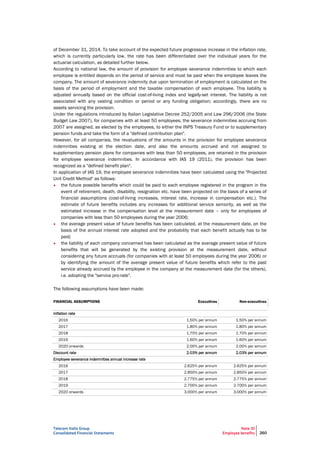
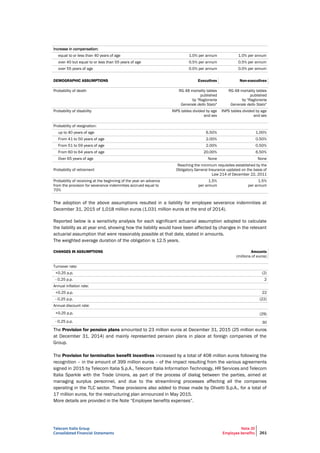
Share of other profits (losses) of associates and joint ventures accounted
for using the equity method:
Profit (loss) − −
Loss (profit) transferred to the Separate Consolidated Income Statements − −
Income tax effect − −
(h) − −
Total other components that subsequently will be reclassified to the
Separate Consolidated Income Statements (i=e+f+g+h) (1,811) (265)
Total other components of the Consolidated Statements of
Comprehensive Income (k=d+i) (1,802) (421)
Total comprehensive income (loss) for the year (a+k) (1,145) 1,539
Attributable to:
Owners of the Parent (827) 1,123
Non-controlling interests (318) 416
Telecom Italia Group
Report on Operations
Consolidated Financial Statements – Telecom Italia Group 75
Consolidated Statements of Financial Position
(millions of euros) 12/31/2015 12/31/2014 Change
(a) (b) (a-b)
Assets
Non-current assets
Intangible assets
Goodwill 29,383 29,943 (560)
Intangible assets with a finite useful life 6,480 6,827 (347)
35,863 36,770 (907)
Tangible assets
Property, plant and equipment owned 12,659 12,544 115
Assets held under finance leases 2,208 843 1,365
14,867 13,387 1,480
Other non-current assets
Investments in associates and joint ventures accounted for using the
equity method 41 36 5
Other investments 45 43 2
Non-current financial assets 2,989 2,445 544
Miscellaneous receivables and other non-current assets 1,744 1,571 173
Deferred tax assets 853 1,118 (265)
5,672 5,213 459
Total Non-current assets (a) 56,402 55,370 1,032
Current assets
Inventories 254 313 (59)
Trade and miscellaneous receivables and other current assets 5,110 5,615 (505)
Current income tax receivables 163 101 62
Current financial assets
Securities other than investments, financial receivables and other
current financial assets 1,840 1,611 229
Cash and cash equivalents 3,559 4,812 (1,253)
5,399 6,423 (1,024)
Current assets sub-total 10,926 12,452 (1,526)
Discontinued operations/Non-current assets held for sale
of a financial nature 227 165 62
of a non-financial nature 3,677 3,564 113
3,904 3,729 175
Total Current assets (b) 14,830 16,181 (1,351)
Total Assets (a+b) 71,232 71,551 (319)
Telecom Italia Group
Report on Operations
Consolidated Financial Statements – Telecom Italia Group 76
(millions of euros) 12/31/2015 12/31/2014 Change
(a) (b) (a-b)
Equity and Liabilities
Equity
Equity attributable to Owners of the Parent 17,610 18,145 (535)
Non-controlling interests 3,723 3,554 169
Total Equity (c) 21,333 21,699 (366)
Non-current liabilities
Non-current financial liabilities 30,518 32,325 (1,807)
Employee benefits 1,420 1,056 364
Deferred tax liabilities 323 438 (115)
Provisions 551 720 (169)
Miscellaneous payables and other non-current liabilities 1,110 697 413
Total Non-current liabilities (d) 33,922 35,236 (1,314)
Current liabilities
Current financial liabilities 6,224 4,686 1,538
Trade and miscellaneous payables and other current liabilities 7,762 8,376 (614)
Current income tax payables 110 36 74
Current liabilities sub-total 14,096 13,098 998
Liabilities directly associated with Discontinued operations/Non-
current assets held for sale
of a financial nature 348 43 305
of a non-financial nature 1,533 1,475 58
1,881 1,518 363
Total Current Liabilities (e) 15,977 14,616 1,361
Total Liabilities (f=d+e) 49,899 49,852 47
Total Equity and Liabilities (c+f) 71,232 71,551 (319)
Telecom Italia Group
Report on Operations
Consolidated Financial Statements – Telecom Italia Group 77
Consolidated Statements of Cash Flows
(millions of euros) 2015 2014
Cash flows from operating activities:
Profit (loss) from continuing operations 46 1,419
Adjustments for:
Depreciation and amortization 4,135 4,284
Impairment losses (reversals) on non-current assets (including investments) 253 13
Net change in deferred tax assets and liabilities (45) 187
Losses (gains) realized on disposals of non-current assets (including
investments) (343) (29)
Share of losses (profits) of associates and joint ventures accounted for using
the equity method (1) 5
Change in provisions for employee benefits 389 (59)
Change in inventories 56 55
Change in trade receivables and net amounts due from customers on
construction contracts 410 (125)
Change in trade payables (483) (325)
Net change in current income tax receivables/payables 4 355
Net change in miscellaneous receivables/payables and other
assets/liabilities 649 (583)
Cash flows from (used in) operating activities (a) 5,070 5,197
Cash flows from investing activities:
Purchase of intangible assets (1,959) (2,422)
Purchase of tangible assets (4,761) (2,562)
Total purchase of intangible and tangible assets on an accrual basis (6,720) (4,984)
Change in amounts due for purchases of intangible and tangible assets 1,294 325
Total purchase of intangible and tangible assets on a cash basis (5,426) (4,659)
Acquisition of control in subsidiaries or other businesses, net of cash
acquired (5) (9)
Acquisitions/disposals of other investments (36) (2)
Change in financial receivables and other financial assets (635) (1,118)
Proceeds from sale that result in a loss of control of subsidiaries or other
businesses, net of cash disposed of − −
Proceeds from sale/repayment of intangible, tangible and other non-current
assets 717 78
Cash flows from (used in) investing activities (b) (5,385) (5,710)
Cash flows from financing activities:
Change in current financial liabilities and other 408 1,305
Proceeds from non-current financial liabilities (including current portion) 5,054 4,377
Repayments of non-current financial liabilities (including current portion) (7,191) (5,877)
Share capital proceeds/reimbursements (including subsidiaries) 186 14
Dividends paid (204) (252)
Changes in ownership interests in consolidated subsidiaries 845 160
Cash flows from (used in) financing activities (c) (902) (273)
Cash flows from (used in) Discontinued operations/Non-current assets held
for sale (d) (19) (499)
Aggregate cash flows (e=a+b+c+d) (1,236) (1,285)
Net cash and cash equivalents at beginning of the year (f) 4,910 6,296
Net foreign exchange differences on net cash and cash equivalents (g) (458) (101)
Net cash and cash equivalents at end of the year (h=e+f+g) 3,216 4,910
Telecom Italia Group
Report on Operations
Consolidated Financial Statements – Telecom Italia Group 78
Additional Cash Flow Information
(millions of euros) 2015 2014
Income taxes (paid) received (363) (427)
Interest expense paid (5,145) (4,985)
Interest income received 3,632 3,301
Dividends received 3 5
Analysis of Net Cash and Cash Equivalents
(millions of euros) 2015 2014
Net cash and cash equivalents at beginning of the year:
Cash and cash equivalents - from continuing operations 4,812 5,744
Bank overdrafts repayable on demand – from continuing operations (19) (64)
Cash and cash equivalents - from Discontinued operations/Non-current
assets held for sale 117 616
Bank overdrafts repayable on demand – from Discontinued operations/Non-
current assets held for sale − −
4,910 6,296
Net cash and cash equivalents at end of the year:
Cash and cash equivalents - from continuing operations 3,559 4,812
Bank overdrafts repayable on demand – from continuing operations (441) (19)
Cash and cash equivalents - from Discontinued operations/Non-current
assets held for sale 98 117
Bank overdrafts repayable on demand – from Discontinued operations/Non-
current assets held for sale − −
3,216 4,910
Telecom Italia Group
Report on Operations
Consolidated Financial Statements – Telecom Italia Group 79
ANALYSIS OF THE MAIN CONSOLIDATED FINANCIAL AND
OPERATING ITEMS
Acquisition of goods and services
(millions of euros) 2015 2014 Change
Purchases of goods 1,811 2,231 (420)
Revenues due to other TLC operators and interconnection
costs 2,080 2,403 (323)
Commercial and advertising costs 1,399 1,473 (74)
Power, maintenance and outsourced services 1,272 1,336 (64)
Rent and leases 699 742 (43)
Other service expenses 1,272 1,245 27
Total acquisition of goods and services 8,533 9,430 (897)
% of Revenues 43.3 43.7 (0.4)pp
Employee benefits expenses
(millions of euros) 2015 2014 Change
Employee benefits expenses - Italy 3,215 2,705 510
Ordinary employee expenses and costs 2,769 2,697 72
Restructuring and other expenses 446 8 438
Employee benefits expenses – Outside Italy 374 414 (40)
Ordinary employee expenses and costs 374 410 (36)
Restructuring and other expenses - 4 (4)
Total employee benefits expenses 3,589 3,119 470
% of Revenues 18.2 14.5 3.7 pp
Average salaried workforce
(equivalent number) 2015 2014 Change
Average salaried workforce – Italy 49,361 47,519 1,842
Average salaried workforce – Outside Italy 12,192 11,766 426
Total average salaried workforce (1) 61,553 59,285 2,268
Non-current assets held for sale - Sofora - Telecom Argentina
group 15,465 15,652 (187)
Total average salaried workforce - including Non-current
assets held for sale 77,018 74,937 2,081
(1) Includes employees with temp work contracts: Average of 3 in 2015 (2 in Italy and 1 outside Italy). Average of 9 in 2014 (4 in Italy and 5 outside Italy).
Headcount at year end
(number) 12/31/2015 12/31/2014 Change
Headcount – Italy 52,555 52,882 (327)
Headcount – Outside Italy 13,312 13,143 169
Total headcount at year end(1) 65,867 66,025 (158)
Non-current assets held for sale -
Sofora - Telecom Argentina group 16,228 16,420 (192)
Total headcount at year end - including Non-current assets
held for sale 82,095 82,445 (350)
(1) Includes employees with temp work contracts: 3 at 12/31/2015 and 9 at 12/31/2014.
Telecom Italia Group
Report on Operations
Consolidated Financial Statements – Telecom Italia Group 80
Headcount at year end – Breakdown by Business Unit
(number) 12/31/2015 12/31/2014 Change
Domestic 52,644 53,076 (432)
Brazil 13,042 12,841 201
Media 64 89 (25)
Other Operations 117 19 98
Total 65,867 66,025 (158)
Other income
(millions of euros) 2015 2014 Change
Late payment fees charged for telephone services 59 64 (5)
Recovery of employee benefit expenses, purchases and
services rendered 32 27 5
Capital and operating grants 33 26 7
Damage compensation, penalties and sundry recoveries 25 36 (11)
Other income 138 248 (110)
Total 287 401 (114)
Other operating expenses
(millions of euros) 2015 2014 Change
Write-downs and expenses in connection with credit
management 345 375 (30)
Provision charges 330 84 246
TLC operating fees and charges 342 449 (107)
Expenses and provisions for indirect duties and taxes 116 118 (2)
Penalties, settlement compensation and administrative fines 292 68 224
Association dues and fees, donations, scholarships and
traineeships 18 18 −
Sundry expenses 48 63 (15)
Total 1,491 1,175 316
Telecom Italia Group
Report on Operations
Business outlook for the year 2016 81
RESEARCH AND DEVELOPMENT
With regard to “Research and Development”, this subject is discussed in a specific paragraph of the
Sustainability Section of this Report on Operations.
EVENTS SUBSEQUENT TO DECEMBER 31, 2015
For details of subsequent events see the specific Note "Events Subsequent to December 31, 2015" in
the Consolidated and Separate Financial Statements at December 31, 2015 of the Telecom Italia Group
and Telecom Italia S.p.A., respectively.
BUSINESS OUTLOOK FOR THE YEAR 2016
As envisaged in the Industrial Plan, and continuing on the realizations of 2015, in 2016 an increase in
capital expenditure is planned for the Domestic area, with the primary aim of ensuring continued
improvement in operating performance and long-term growth for the Group. The improvement of the
market conditions in 2015 allowed this opportunity, which will result in an increase in the speed of
capital expenditure for the three-year period 2016-2018 by almost 2 billion euros compared to the
amount indicated in the presentation of the 2015-2017 Plan. This difference will be funded by the
generation of the underlying operating cash flow. At the same time, at Group level, a roadmap is
developed for the reduction of the financial debt, financed in particular by the conversion of the
Mandatory Convertible Bond – contractually scheduled for November 2016 for 1.3 billion euros – and
the sales of the remaining stake in Telecom Argentina and a significant part of the stake in INWIT. At the
end of 2018 the Adjusted Net Debt/reported EBITDA ratio is expected to be below 3x.
Domestic capital expenditures in the three-year period 2016-2018 will therefore reach almost 12 billion
euros, of which around 6.7 billion euros allocated to the innovative component (NGN; LTE; Cloud,
Sparkle, Platforms and Transformation) with the objective for the end of 2018 of achieving a coverage in
Italy of 84% of the population with new generation networks, through fiber optic networks, and 98% of
the population through the LTE mobile network (4G), confirming the leadership role in Italy's
infrastructure development and digitization.
The main areas of development of innovative technologies are:
• the acceleration of the development of the fiber optic fixed ultra-broadband, to which 3.6 billion
euros will be allocated;
• the LTE mobile ultra-broadband, for which capital expenditure of 1.2 billion euros is planned;
• the further development of the Cloud, the Platforms and the Transformation initiatives (such as the
shift to an “All-IP Network” and the decommissioning of some Network segments) with related
capital expenditure of 1.2 billion euros;
• Telecom Italia Sparkle, with around 400 million euros to be invested for the development of its
international operations.
TIM is continuing its process of transformation and transition from a traditional Telco to a Digital Telco &
Platform Company, facilitating Italy's digital life: a business model based on innovative infrastructure
and high quality customer service, increasingly focused on the diffusion of premium digital services and
content offered within a customizable platform, available everywhere and on any device.
In particular, in the Domestic Mobile segment – where competition based on pricing is steadily easing
and more attention is being given to the level of service, together with continued strong growth in data
usage – TIM will focus increasingly on the adoption of 4G by its customers, encouraged by the growing
penetration of smartphones and bundled offers with distinctive digital content. This will enable the
company to increase its ARPU and strengthen its position as a market leader.
Telecom Italia Group
Report on Operations
Business outlook for the year 2016 82
In the Domestic Fixed-line segment, TIM expects to reduce the decline in the number of customers
already from 2016, thanks to the acceleration of the diffusion of fiber, convergence and the
strengthening of its positioning in Multimedia Entertainment, which includes operations in the areas of
Video, Music, Gaming and Publishing. TIM will also continue to support Italian companies in their
process of digital transformation with its ICT and Cloud services, through an approach differentiated
according to the characteristics of the customers, aimed at achieving distinctive positioning in the most
attractive vertical markets.
The above investment, commercial development and competitive positioning initiatives, accompanied by
rigorous transformation and cost efficiency actions and programs, represent the foundations for a
further improvement in operating performance, with the objective of stabilizing EBITDA already in 2016.
In Brazil, the Plan takes account of and reflects the profound changes in the macroeconomic, political
and market situation seen in recent months.
Indeed, the latest estimates of economic performance show a further steady deterioration in the main
indicators for 2016 as a whole. Specifically, GDP is expected to fall by almost 3%, with inflation still high
– also as a result of a series of increases in tariffs in regulated sectors – and highly volatile. The rise in
inflation could have an increasingly significant impact on household purchasing power, with a
consequent decline in economic well being, especially for lower-income sections of society. In addition,
the exchange rate with the dollar reached and exceeded the level of 4.0 real/USD during 2015, with
forecasts of an increase during the Plan up to 4.20 real/USD.
The entire telecommunications segment (particularly the prepaid Mobile segment) is highly exposed to
this scenario, with a decline in the overall value of the market also due to its substantial maturity and
saturation.
In addition, Brazil is seeing a trend of constant and steady growth in data usage, which is even more
intense than in the other major countries. This is being accompanied by a reduction in voice and
messaging traffic, driven by the objective of optimizing and reducing expenditure on the part of
customers, who are favoring the use of services offered by the OTTs (particularly Whatsapp) as an
alternative to the traditional models of service use.
In this scenario, TIM Brasil is setting itself the objective of growing in terms of market share on revenues
and profitability improvement (EBITDA Margin) thanks to its significant capital expenditure program –
which will reach 14 billion reais in the three-year period 2016-2018 – and a renewal of its commercial
positioning, in order to be competitive in terms of offering and customer experience. Also in Brazil, TIM
will be focusing on 4G where it is already a leader, with the development of an increasingly high quality
service, through a “mobile challenger” approach, which it has once again demonstrated by being ahead
of the game in the symmetric “on/off net” offers. At the same time, the company will be focusing
attentively on efficiency, as a structural and necessary element for the stability and financial
sustainability of the Plan.
Telecom Italia Group
Report on Operations
Main risks and uncertainties 83
MAIN RISKS AND UNCERTAINTIES
The business outlook for 2016 could be affected by risks and uncertainties caused by a multitude of
factors, the majority of which are beyond the Group's control.
In such a scenario, risk management becomes a strategic tool for value creation. The Telecom Italia
Group has adopted an Enterprise Risk Management Model based on the methodology of the Committee
of Sponsoring Organizations of the Treadway Commission (ERM CoSO Report), which enables the
identification and management of risk in a uniform manner within the Group companies, highlighting
potential synergies among the actors involved in the assessment of the Internal Control and Risk
Management System. The ERM process is designed to identify potential events that may affect the
business, to manage risk within acceptable limits and to provide reasonable assurance regarding the
achievement of corporate objectives.
The main risks affecting the business activities of the Telecom Italia Group, which may impact, even
significantly, the ability to achieve the objectives of the Group are presented below.
STRATEGIC RISKS
Risks related to macro economic factors
The Group's economic and financial situation is subject to the influence of numerous macroeconomic
factors such as economic growth, political stability, consumer confidence, and changes in interest rates
and exchange rates in the markets in which it operates. The expected results may be affected, in the
domestic market, by the struggling economic recovery associated with a high rate of unemployment and
the consequent reduction in income available for consumption. In the Brazilian market, the expected
results may be affected by the further deterioration of the macroeconomic environment, with the country
currently in economic recession, and the accompanying deterioration in operating conditions. These
factors mean that the possibility of consequent goodwill impairment losses cannot be ruled out.
In addition, the Telecom Italia Group is currently undertaking numerous projects and transactions,
including corporate and extraordinary transactions, whose feasibility and completion could be affected
by factors outside the control of management, such as political and regulatory factors, currency
exchange restrictions, bureaucratic regulations etc.. As a result, the financial outcomes of these projects
and transactions may differ, even significantly, from expectations.
Risks related to competition
The telecommunications market is characterized by strong competition that may reduce our share in the
markets we operate in as well as lower prices and margins. Competition is focused, on one hand, on
innovative products and services and, on other hand, on the price of traditional services. In addition, in
the area of infrastructure competition, the growth of alternative operators could represent a threat for
Telecom Italia particularly in the years of the plan after 2016 and also beyond the Plan period. In the
Brazilian market the trend in the telecommunications industry is changing rapidly, amplifying the
deterioration in the macroeconomic environment. The competition risk consists of the increased
acceleration in the process of replacement of traditional services with innovative services, and the
downsizing of consumption by customers (e.g. reduction in multi-SIM customers). In this scenario, the
Tim Brasil group may be further impacted in the short term to a greater extent than its main competitors,
due to the higher proportion of customers with prepaid services, which are more affected by the current
macroeconomic situation.
OPERATIONAL RISKS
Operational risks inherent in our business relate to possible inadequacies in internal processes, external
factors, frauds, employee errors, errors in properly documenting transactions, loss of critical or
commercially sensitive data and failures in systems and/or network platforms.
Telecom Italia Group
Report on Operations
Main risks and uncertainties 84
Risks related to business continuity
Our success depends heavily on the ability to deliver the services we provide through the IT
infrastructure and network on a continuous and uninterrupted basis. The infrastructure is susceptible to
interruptions due to failures of information and communication technologies, lack of electricity, floods,
storms and human errors. Unexpected problems in installations, system failures, hardware and software
failures, computer viruses or hacker attacks could affect the quality of services and cause service
interruptions. Each of these events could result in a reduction in traffic and a reduction in revenues
and/or in an increase of restoration costs, with an adverse impact on the level of customer satisfaction
and number of customers, as well as our reputation.
Risks related to the development of fixed and mobile networks
To maintain and expand our customer portfolio in each of the markets in which we operate, it is
necessary to maintain, update and improve existing networks in a timely manner. A reliable and high
quality network is necessary to maintain the customer base and minimize the terminations to protect
the Company's revenues from erosion. The maintenance and improvement of existing installations
depend on our ability to:
• upgrade the capabilities of the networks to provide customers with services that are closer to their
needs; in the regard the Group may be engaged in the participation in tenders for broadcasting
frequencies whose outcomes, in terms of financial requirements, may differ, even significantly, from
expectations;
• increase the geographical coverage of innovative services;
• upgrade the structure of the systems and the networks to adapt it to new technologies.
Risks of internal/external fraud.
The Group has adopted an organizational model to prevent fraud. However, the implementation of this
model cannot ensure the total mitigation of the risk. Dishonest activities and illegal acts committed by
people inside and outside the organization could adversely affect the Company's operating results,
financial position and image.
Risks related to Disputes and Litigation
The Group has to deal with disputes and litigation with tax authorities, regulators, competition
authorities, other telecommunications operators and other entities. The possible impacts of such
proceedings are generally uncertain. In the event of settlement unfavorable to the Group, these issues
may, individually or as whole, have an adverse effect, which may even be significant, on its operating
results, financial position and cash flows.
FINANCIAL RISKS
The Telecom Italia Group may be exposed to financial risks such as risks arising from fluctuations in
interest rates and exchange rates, credit risk, liquidity risk and risks related to the performance of the
equity markets in general, and – more specifically – risks related to the performance of the share price
of the Group companies. These risks may adversely impact the earnings and the financial structure of
the Group. Accordingly, to manage those risks, Telecom Italia Group has established guidelines, at
central level, which must be followed for operational management, identification of the most suitable
financial instruments to meet set goals, and monitoring the results achieved. In particular, in order to
mitigate the liquidity risk, the Group aims to maintain an "adequate level of financial flexibility", in terms
of cash and syndicated committed credit lines, enabling it to cover refinancing requirements at least for
the next 12 -18 months.
Telecom Italia Group
Report on Operations
Main risks and uncertainties 85
REGULATORY AND COMPLIANCE RISKS
Regulatory risks
The telecommunications industry is highly regulated. In this context, new decisions by the regulator and
changes in the regulatory environment may affect the expected results of the Group. More specifically,
the elements which introduce uncertainty are:
• lack of predictability in the timing of the introduction and consequent results of new processes;
• decisions with retroactive effect (i.e. revision of prices relating to prior years as a result of an
administrative judgment) with potential impact on the timing of return on investment;
• decisions that can influence the technological choices made and to be made, with potential impact
on the timing of return on investment.
In 2015, in order to further enhance the guarantees of equality of treatment between retail customers
and wholesale customers, Telecom Italia initiated a project aimed at intervening on both the
equivalence model and the instruments used to assess the supply of wholesale services. The project
and the related implementation roadmap were approved by the Board of Directors of Telecom Italia on
November 5, 2015. The risk is associated with the assessment of the effectiveness of Telecom Italia's
project by the designated organizations (AGCom and AGCM). The positive assessment of the
implementation of the equivalence project is a necessary condition for the termination of the A428
proceedings for failure to provide services, with consequent removal of the associated sanction risk.
Compliance risks
The Telecom Italia Group may be exposed to risks of non-compliance due to non-observance/ breach of
internal (self-regulation such as, for example, bylaws, code of ethics) and external rules (laws and
regulations), with consequent judicial or administrative penalties, financial losses or reputational
damage.
The Group aims to ensure that processes, procedures, systems and corporate conduct comply with legal
requirements. There may be some necessary time lags in making the processes compliant when non-
conformity has been identified.
Telecom Italia Group
Report on Operations
Information for Investors 86
INFORMATION FOR INVESTORS
The Group attaches great importance to the quality of the information on its activities provided to the
financial markets, investors and all its stakeholders. Subject to the requirements of confidentiality
dictated by the running of the business and statutory obligations, this communication takes place in full
compliance with the criteria of transparency, fairness, clarity, timeliness and equality of access. The
Company has also established specific communication channels for shareholders, bondholders and
other stakeholders who are interested in obtaining financial and non-financial information on the Group.
The Investor Relations function manages relations with all types of investor, both institutional and retail
(including small shareholder associations), bondholders, socially responsible investors, and equity and
credit analysts. The responses to the financial markets are based on criteria of relevance, sensitivity and
consistency with respect to the Group structure and the actions taken to achieve the plan targets,
illustrating the ordinary and extraordinary performance of company operations and the related financial
trends. In terms of relations with individual (retail) shareholders – representing over 400,000 owners of
ordinary shares – Telecom Italia aims to provide rapid and effective responses, by developing specific
forms of communication.
In 2015, the Group organized quarterly conference calls, international road shows, meetings at the
company's corporate offices, an investor day and a specific offsite event for analysts and investors, in
addition to attending numerous industry sector conferences. Over 600 investors were met during these
events, in addition to the direct contacts and telephone conversations handled on a daily basis. In
February 2016, during the annual appointment with investors for the publication of the 2015
preliminary results and the 2016-18 strategic plan, the communications with the Financial Community
continued with the involvement of the Group’s top management in an extensive program of road shows
in the major financial centers in Europe and the United States. These events were attended by over 120
investors, representing around 22% of Telecom Italia’s ordinary share capital and 21% of its savings
share capital.
2015 Calendar of Financial Communications
January 2015 May 2015 (Q1 2015 Results) September 2015
 Meetings at the Group's corporate offices
(reverse road shows)
 Annual offsite event for analysts and investors
 Annual shareholders' meeting
 Investor conference in London and Roadshows
in San Francisco, Taipei, Tokyo, Singapore,
Hong Kong and Paris
 Investor conferences in Milan, London and New
York
February 2015 (Preliminary FY’14 and 2015-17
Plan)
June 2015 October 2015
 Investor Day in London to present the 2015-
2017 industrial plan
 Reverse roadshow at the Group's corporate
offices
 Roadshows in London, Boston and New York
 Investor conferences in London and Milan
 Meetings at the Group's corporate offices
(reverse road show) in Rome and Milan
 Roadshows in New York, Boston, Chicago,
Dallas, Santa Fe
 Investor conference in Milan
 Expo event with investors
March 2015 July 2015 November 2015 (Q3 2015 Results)
 Investor meeting in Barcelona and London
 Investor conference in London
 Investor meeting in London  Roadshows in Paris, New York, Boston, and
Toronto
 Investor conference in Barcelona and investor
meetings in London and Rome
 Participation in the ASATI event in Rome
April 2015 August 2015 (Q2 2015 Results) December 2015
 Meetings at the Group's corporate offices
(reverse road show) in Rome
 Roadshows in Abu Dhabi and Doha
 Investor meeting in London
 Investor conference in Paris and roadshow in
Zürich
 Ordinary and extraordinary shareholders'
meeting
The issues of most interest to investors include:
• the program of acceleration of capital expenditure aimed at strengthening competitive positioning
and operating performance over the period of the plan;
• the objective of stabilizing domestic EBITDA by 2016;
• in Italy, the prospect of recovery in the fixed-line business (take-up of Fast BroadBand, and evolution
of the
• loss trend for fixed lines) and the prospective performance of the mobile segment, with stabilization
of revenue from services already achieved in the last quarter of 2015;
• in Brazil, the organic capital expenditure program and the new business strategy launched in the
last quarter of 2015;
• the generation of value from the remaining stake in Inwit.
Lastly, in 2015, Telecom Italia’s Financial Communications received particular recognition – from the
Extel survey – with the Chief Executive Officer and the Chief Financial Officer ranked first, among Italian
companies, and the Investor Relations operations and its team in second and third place.
Telecom Italia Group
Report on Operations
Information for Investors 87
TELECOM ITALIA S.P.A. SHARE CAPITAL AT DECEMBER 31, 2015
Share capital 10,740,236,908.50 euros
Number of ordinary shares (without nominal value) 13,499,911,771
Number of savings shares (without nominal value) 6,027,791,699
Number of Telecom Italia S.p.A. ordinary treasury shares 37,672,014
Number of Telecom Italia S.p.A. ordinary shares held by Telecom Italia Finance S.A. 126,082,374
Percentage of ordinary treasury shares held by the Group to total share capital 0.84%
Market capitalization (based on December 2015 average prices) 21,525 million euros
Regarding the trading of shares issued by Group companies on regulated markets, the ordinary and
savings shares of Telecom Italia S.p.A. are listed in Italy (FTSE index), as well as the ordinary shares of
INWIT S.p.A., whereas the ordinary shares of Tim Participações S.A. are listed in Brazil (BOVESPA index).
The trading of ordinary and savings shares of Telecom Italia Media S.p.A. ceased on September 30,
2015, with effect from 11.59 pm on that day, when the merger by incorporation of Telecom Italia Media
S.p.A. into Telecom Italia S.p.A. came into force, with consequent exchange of the shares of the former
held by third parties with shares of the parent company.
The ordinary and savings shares of Telecom Italia S.p.A., and the ordinary shares of Tim Participações
S.A. are also listed on the NYSE (New York Stock Exchange); trading occurs through ADS (American
Depositary Shares) that respectively represent 10 ordinary shares and 10 savings shares of Telecom
Italia S.p.A. and 5 ordinary shares of Tim Participações S.A..
SHAREHOLDERS
Composition of Telecom Italia S.p.A. shareholders according to the Shareholders Book at
December 31, 2015, supplemented by communications received and other available sources of
information (ordinary shares):
(*) Direct and indirect equity investment
With effect from June 17, 2015, the shareholder agreement in place between the shareholders of Telco
S.p.A. was dissolved, as disclosed by public notices in accordance with the applicable regulations. As a
result, there are no longer any significant shareholder agreements for Telecom Italia pursuant to Article
122 of Italian Legislative Decree 58/1998.
MAJOR HOLDINGS IN SHARE CAPITAL
At December 31, 2015, taking into account the entries in the Shareholders Book, communications sent
to Consob and to the Company pursuant to Italian Legislative Decree 58 of February 24, 1998, art. 120
and other available sources of information, the relevant shareholders of Telecom Italia S.p.A.'s ordinary
share capital are as follows:
FOREIGN
INSTITUTIONAL
INVESTORS
56.61%
ITALIAN
COMPANIES
0.62%
FOREIGN
COMPANIES
4.09%
OTHER ITALIAN
SHAREHOLDERS
11.31%
OTHER FOREIGN
SHAREHOLDERS
0.06%
VIVENDI (*)
21.39%
TELECOM
ITALIA GROUP
1.21%
ITALIAN
INSTITUTIONAL
INVESTORS
4.71%
Telecom Italia Group
Report on Operations
Information for Investors 88
Holder Type of ownership Percentage of ownership
Vivendi S.A. Direct/Indirect (*) 21.39%
JPMorgan Chase & Co. Indirect (**) 2.65%
People's Bank of China Direct 2.07%
(*) Equity interest obtained following receipt of a notification by Vivendi S.A. pursuant to Article 152 octies, paragraph 7, of the Consob Issuer Regulations.
(**) Plus an additional 1.87% without voting rights.
On March 12, 2014, Blackrock Inc. notified Consob that, as an asset management company, it indirectly
held a quantity of ordinary shares equal to 4.78% of the total ordinary shares of Telecom Italia at
December 31, 2015.
Lastly, it is noted that:
• following receipt of several notifications from Vivendi S.A. pursuant to Article 152 octies, paragraph
7, of the Consob Issuer Regulations, the ownership interest held directly and indirectly by that
company, at the latest date of March 9, 2016, amounted to 24.90%;
• following receipt of several notifications from JPMorgan Chase & Co. via form 120B pursuant to the
Consob Issuer Regulations, the ownership interest with voting rights held indirectly by that company,
at the latest date of March 16, 2016, amounted to 2.14%, plus an additional 2.69% without voting
rights.
COMMON REPRESENTATIVES
• The special meeting of the savings shareholders held on May 22, 2013 elected Dario Trevisan as the
common representative for three financial years (up to the approval of the Financial statements for
the year ended December 31, 2015).
• By decree of April 11, 2014, the Milan Court confirmed the appointment of Enrico Cotta Ramusino
(already appointed by decree of March 7, 2011) as the common representative of the bondholders
for the “Telecom Italia S.p.A. 2002-2022 bonds at variable rates, open special series, reserved for
subscription by employees of the Telecom Italia Group, in service or retired”, with a mandate for the
three-year period 2014-2016.
• By decree of June 12, 2015, the Milan Court appointed Monica Iacoviello as the common
representative of the bondholders for the “Telecom Italia S.p.A. 1,250,000,000 euros 5.375
percent. Notes due 2019” up to the approval of the 2017 Financial statements.
RATING AT DECEMBER 31, 2015
At December 31, 2015, the three rating agencies — Standard & Poor's, Moody's and Fitch Ratings —
rated Telecom Italia as follows:
Rating Outlook
STANDARD & POOR'S BB+ Stable
MOODY'S Ba1 Negative
FITCH RATINGS BBB- Stable
WAIVER OF THE OBLIGATION TO PUBLISH DISCLOSURE
DOCUMENTS FOR EXTRAORDINARY OPERATIONS
On January 17, 2013, the board of directors of Telecom Italia S.p.A. resolved to exercise the option, as
per article 70 paragraph 8 and article 71 paragraph 1 bis of the Consob Regulation 11971/99, to waive
the obligations to publish disclosure documents in the event of significant operations such as mergers,
demergers, capital increases by means of the transfer of assets in kind, acquisitions and disposals.
Telecom Italia Group
Report on Operations
Related Party Transactions 89
RELATED PARTY TRANSACTIONS
In accordance with Article 5, paragraph 8 of Consob Regulation 17221 of March 12, 2010 concerning
“related party transactions” and the subsequent Consob Resolution no. 17389 of June 23, 2010, no
significant transactions were entered into in 2015 as defined by Article 4 paragraph 1a of the
aforementioned regulation, or other transactions with related parties that had a major impact on the
financial position or the results of the Telecom Italia Group and Telecom Italia S.p.A. for 2015.
In addition, there were no changes or developments with respect to the related party transactions
described in the 2014 Report on Operations which had a significant effect on the financial position or on
the results of the Telecom Italia Group and Telecom Italia S.p.A. in 2015.
Related party transactions, when not dictated by specific laws, were conducted at arm's length. In
addition, the transactions were subject to an internal procedure (available for consultation on the
Company’s website at the following address: www.telecomitalia.com, section Group – channel governance
system) which establishes procedures and time scales for verification and monitoring.
The information on related parties required by Consob Communication no. DEM/6064293 of
July 28, 2006 is presented in the financial statements themselves and in the Note “Related party
transactions” in the Consolidated Financial Statements of the Telecom Italia Group and the Separate
Financial Statements of Telecom Italia S.p.A. at December 31, 2015.
Telecom Italia Group
Report on Operations
Alternative Performance Measures 90
ALTERNATIVE PERFORMANCE MEASURES
In this Report on Operations, in the Consolidated Financial Statements of the Telecom Italia Group and
in the Separate Financial Statements of the Parent, Telecom Italia S.p.A., for the year ended December
31, 2015, in addition to the conventional financial performance measures established by IFRS, certain
alternative performance measures are presented for purposes of a better understanding of the trend of
operations and the financial condition. Such measures, which are also presented in other periodical
financial reports (half-year financial Report at June 30 and interim Reports at March 31 and
September 30) should, however, not be considered as a substitute for those required by IFRS.
The alternative performance measures used are described below:
• EBITDA: this financial measure is used by Telecom Italia as the financial target in internal
presentations (business plans) and in external presentations (to analysts and investors). It
represents a useful unit of measurement for assessing the operating performance of the Group (as a
whole and at Business Unit level) and the Parent, Telecom Italia S.p.A., in addition to EBIT. These
measures are calculated as follows:
Profit (loss) before tax from continuing operations
+ Finance expenses
- Finance income
+/- Other expenses (income) from investments (1)
+/- Share of losses (profits) of associates and joint ventures accounted for using the equity method (2)
EBIT - Operating profit (loss)
+/- Impairment losses (reversals) on non-current assets
+/- Losses (gains) on disposals of non-current assets
+ Depreciation and amortization
EBITDA - Operating profit (loss) before depreciation and amortization, Capital gains (losses) and Impairment reversals
(losses) on non-current assets
(1) “Expenses (income) from investments” for Telecom Italia S.p.A.
(2) Line item in Group consolidated financial statements only.
• Organic change in Revenues, EBITDA and EBIT: these measures express changes (amount and/or
percentage) in revenues, EBITDA and EBIT, excluding, where applicable, the effects of the change in
the scope of consolidation and exchange differences.
Telecom Italia believes that the presentation of the organic change in revenues, EBITDA and EBIT
allows for a more complete and effective understanding of the operating performance of the Group
(as a whole and at Business Unit level) and the Parent. This method of presenting information is also
used in presentations to analysts and investors. This Report on Operations provides a reconciliation
between the “reported figure” and the “organic” figure.
• Net Financial Debt: Telecom Italia believes that Net Financial Debt represents an accurate indicator
of its ability to meet its financial obligations. It is represented by Gross Financial Debt less Cash and
Cash Equivalents and other Financial Assets. The Report on Operations includes two tables showing
the amounts taken from the statement of financial position and used to calculate the Net Financial
Debt of the Group and Parent respectively.
To better represent the real performance of Net Financial Debt, in addition to the usual indicator
(called “Net financial debt carrying amount”), “Adjusted net financial debt” is also shown, which
excludes effects that are purely accounting and non-monetary in nature deriving from the fair value
measurement of derivatives and related financial assets and liabilities.
Telecom Italia Group
Report on Operations
Alternative Performance Measures 91
Net financial debt is calculated as follows:
+ Non-current financial liabilities
+ Current financial liabilities
+ Financial liabilities directly associated with Discontinued operations/Non-current assets held for sale
A) Gross financial debt
+ Non-current financial assets
+ Current financial assets
+ Financial assets relating to Discontinued operations/Non-current assets held for sale
B) Financial assets
C=(A - B) Net financial debt carrying amount
D) Reversal of fair value measurement of derivatives and related financial liabilities/assets
E=(C + D) Adjusted net financial debt
Telecom Italia S.p.A.
Key operating and financial data 2015
Millions of Euros
32,055
NET FINANCIAL
DEBT CARRYING
AMOUNT
Numbers
44,171
HEADCOUNT
AT YEAR END
Millions of Euros
13,797
REVENUES
Millions of Euros
5,266
EBITDA
38.2%
EBITDA MARGIN
Millions of Euros
3,645
CAPITAL
EXPENDITURES
Telecom Italia S.p.A.
Report on Operations
Review of Operating and Financial Performance - Telecom Italia S.p.A. 93
REVIEW OF OPERATING AND FINANCIAL
PERFORMANCE - TELECOM ITALIA S.P.A.
PROJECTS AND MAIN CHANGES IN THE SCOPE OF COMPANIES
The financial results for 2015 of Telecom Italia were also characterized by the launch of several projects
to rationalize and improve operating efficiency, illustrated below.
At the end of 2014, Telecom Italia launched a major Real Estate Project, which involves a process of
restructuring, the closure of a number of properties and renegotiations of leases with the owners, all
with a view to efficiency and cost-cutting, mainly realized by extending contract expiries and reducing
lease payments.
More specifically, in 2015 the company purchased three strategic properties previously held under
finance leases, while renegotiations were concluded and/or new contracts were signed for around 750
leases.
More than one half of these lease contracts were previously accounted for using the operating lease
method; following the changes to the relevant contracts, they were accounted for in the statement of
financial position at December 31, 2015 using the financial method (Property, plant and equipment held
under finance leases). The renegotiations and new contracts, together with the change in accounting
treatment, resulted in a total impact on the balance sheet at December 31, 2015 of 1,178 million euros
in terms of higher tangible assets and corresponding liabilities related to finance leases.
The activities related to the development of the Project will continue in 2016 and will result - when fully
implemented - in a significant reduction in rental costs and savings in terms of electricity, facility
services, rationalization of space and costs associated with the dispersion of locations.
As part of the overall streamlining of the Group's owned and leased property assets, the company TIM
Real Estate S.r.l., wholly owned by Telecom Italia, was established in November 2015, for the purpose
of developing projects and operations in the real estate sector. In particular, at the end of 2015 the
company purchased two strategic properties from third parties, taking over the lease contracts with
Telecom Italia.
On April 1, 2015, Telecom Italia S.p.A. completed the transfer to the subsidiary Infrastrutture Wireless
Italiane S.p.A. (“INWIT”), established on January 14, 2015, of the business unit consisting of around
11,500 sites in Italy (Towers) that house the radio transmission equipment for the mobile telephone
networks, both for Telecom Italia and other operators. In June 2015, the IPO was successfully completed
for the ordinary shares of INWIT S.p.A. on the Electronic Stock Exchange organized and managed by
Borsa Italiana S.p.A., which was followed in July by the exercise of the greenshoe option.
Telecom Italia S.p.A.
Report on Operations
Review of Operating and Financial Performance - Telecom Italia S.p.A. 94
In particular:
(millions of euros)
%
ownership Shares held
Unit
carrying
amount
Total
carrying
amount
Initial value 100.00 600,000,000 2.30 1,380
Shares sold under the IPO 36.33 218,000,000 2.30 (501)
Shares sold under the Greenshoe option 3.64 21,800,000 2.30 (50)
Total 39.97 239,800,000 (551)
Final amount after sale 60.03 360,200,000 828
Sale price 3.65
Proceeds from share sale 875
Gross gain 324
Transaction costs (25)
Gain net of transaction costs 299
Tax (12)
Net gain 287
The merger of Telecom Italia Media S.p.A. into Telecom Italia S.p.A. was finalized on September 30,
2015, effective retroactively from January 1, 2015 for accounting and tax purposes.
In addition to the impacts of the transactions described above, in 2015 Telecom Italia recorded non-
recurring operating expenses for a total of 1,021 million euros. These expenses were connected to
events and transactions that by their nature do not occur continuously in the normal course of
operations and have been shown because their amount is significant and they include expenses
resulting from corporate restructuring and reorganization processes, expenses resulting from regulatory
disputes and penalties and the liabilities related to those expenses, expenses for disputes with former
employees, and liabilities with customers and/or suppliers.
(millions of euros) 2015
Net non-recurring expenses
Employee benefits expenses
Expenses related to restructuring and rationalization 422
Acquisition of goods and services and Change in inventories
Expenses related to agreements and the development of non-recurring projects 87
Sundry expenses and provisions
Expenses related to disputes and regulatory penalties and liabilities related to those
expenses, and expenses related to disputes with former employees and liabilities with
customers and/or suppliers 512
Impact on EBITDA 1,021
Impact on EBIT 1,021
The impacts of non-recurring income/expenses on the main lines of result are outlined below in this
Report.
Telecom Italia S.p.A.
Report on Operations
Review of Operating and Financial Performance - Telecom Italia S.p.A. 95
OPERATING PERFORMANCE
(millions of euros) 2015 2014 Change
amount %
Revenues 13,797 14,153 (356) (2.5)
EBITDA 5,266 6,739 (1,473) (21.9)
EBITDA Margin 38.2% 47.6% (9.4)pp
EBIT 2,188 3,580 (1,392) (38.9)
EBIT margin 15.9% 25.3% (9.4)pp
Profit (loss) before tax from continuing
operations (369) 1,299 (1,668)
Profit (loss) from continuing operations (465) 629 (1,094)
Profit (loss) from Discontinued
operations/Non-current assets held for sale 9 7 2
Profit (loss) for the year (456) 636 (1,092)
Capital expenditures 3,645 2,693 952
Net financial debt 32,055 33,423 (1,368)
Headcount at year end (number) 44,171 44,164 7
Revenues
Revenues amounted to 13,797 million euros, down 356 million euros (-2.5%) on 2014. The results for
2015 continued the trend of recovery in revenue and the progressive and structural improvement in the
Mobile business, thanks to the steady market share, the stabilization of ARPU levels, and the continued
growth of mobile Internet.
The trend in revenues shows the following changes in the sales segments compared to 2014:
(millions of euros) 2015 2014 Change
Revenues 13,797 14,153 (356)
Consumer 7,255 7,329 (74)
Business 4,567 4,795 (228)
National Wholesale 1,779 1,786 (7)
Other 196 243 (47)
In particular:
• Consumer: revenues for the Consumer segment in 2015 amounted to 7,255 million euros,
decreasing 74 million euros (-1.0%) compared to 2014, showing a trend of recovery driven, in
particular, by the progressive and structural recovery in the Mobile business, thanks to the steady
market share, the stabilization of ARPU levels, and continued growth of mobile Internet. In detail:
– revenues for the Mobile business came to 3,560 million euros and were slightly up on 2014
(+38 million euros, +1.1%), continuing the positive performance seen over two consecutive
quarters (fourth quarter 2015, +3.0%; third quarter: +3.6%, second quarter -1.4%; first
quarter -1.4%). Revenues from services fell by 38 million euros (-1.2% on 2014), although with a
significant trend of recovery (fourth quarter 2015: +1.8%; third quarter: -0.3%; second quarter: -
2.2%; first quarter: -4.5%), attributable to the easing of competitive pressure, the progressive
stabilization of market share, and the steady growth in Internet mobile and digital services
supporting the stabilization of the ARPU;
Telecom Italia S.p.A.
Report on Operations
Review of Operating and Financial Performance - Telecom Italia S.p.A. 96
– Fixed-line revenues amounted to 3,696 million euros, decreasing 112 million euros compared to
2014 (-2.9%), with a slowdown in the last quarter of 2015 (-6.7%) of the improvement trend
recorded from the second half of 2014, thanks to ARPU development initiatives implemented in
the final months of the year (repricing, the introduction of flat tariffs, bundle development).
• Business: revenues for the Business segment amounted to 4,567 million euros, decreasing
228 million euros compared with the first quarter of 2014 (-4.8%). Revenues from services (4,207
million euros, -204 million euros compared to 2014) continued the stabilization trend that began
during 2014 (-4.8% in the fourth quarter 2015). In particular:
– the reduction in revenues from Mobile services in 2015 (-64 million euros, -5.6% compared to
2014) was mainly concentrated in the traditional mobile services for voice calls and messaging,
due to customer repositioning towards bundle deals with lower overall ARPU, only partially offset
by the positive performance of the new digital services, driven in particular by the mobile Internet
component;
– revenues from Fixed-line services (-143 million euros, -4.4% on 2014) continued to be affected
by the slow economic recovery, the reduction in prices on traditional voice and data services, and
the technological shift towards VoIP systems, partially rebalanced by the steady growth in ICT
revenues, particularly for Cloud services.
• National Wholesale: revenues for the Wholesale segment in 2015 came to 1,779 million euros,
essentially stable compared to 2014 (-8 million euros, -0.4%). Indeed, the impact of the revision of
the regulated prices in 2015 was similar to the impact in 2014 due to the retroactive amendment of
the wholesale access prices for the period 2010-2012.
EBITDA
EBITDA was equal to 5,266 million euros (6,739 million euros in 2014), decreasing by 1,473 million
euros compared to 2014; the EBITDA margin was 38.2% (47.6% in 2014).
EBITDA in 2015 reflected the negative impact of non-recurring net expenses totaling 1,021 million
euros; without these expenses, the organic change in EBITDA would have been -6.8%, with an EBITDA
margin of 45.6%, down 2.1 percentage points on 2014. For more details, see the Note “Significant non-
recurring events and transactions” in the Separate Financial Statements of Telecom Italia S.p.A. at
December 31, 2015.
In particular:
(millions of euros) 2015 2014 Change
amount %
EBITDA 5,266 6,739 (1,473) (21.9)
of which non-recurring income/(expenses) (1,021) (9) (1,012)
EBITDA excluding non-recurring component 6,287 6,748 (461) (6.8)
At the EBITDA level, in addition to the negative effects described in the commentary on revenues, there
was an increase in the acquisition of goods and services, as well as other operating expenses.
Acquisition of goods and services
Acquisitions of goods and services totaled 5,386 million euros, up 293 million euros (+5.8%) compared
to 2014 (5,093 million euros), essentially due to the presence of non-recurring expenses of 87 million
euros, without which other operating expenses would have increased by 206 million euros. Net of those
non-recurring costs, the increase was mainly due to higher purchases of equipment and handsets linked
to the increase in product sales and to hosting costs for the sites transferred to the subsidiary INWIT on
April 1, 2015.
Telecom Italia S.p.A.
Report on Operations
Review of Operating and Financial Performance - Telecom Italia S.p.A. 97
(millions of euros) 2015 2014 Change
Purchases of goods 1,208 1,012 196
Revenues due to other TLC operators and interconnection
costs 722 751 (29)
Commercial and advertising costs 743 715 28
Professional and consulting services 182 111 71
Power, maintenance and outsourced services 1,079 1,098 (19)
Lease and rental costs 840 777 63
Other 612 629 (17)
Total acquisition of goods and services 5,386 5,093 293
% of Revenues 39.0 36.0 3.0 pp
Employee benefits expenses
Details are as follows:
(millions of euros) 2015 2014 Change
Ordinary employee expenses and costs 2,347 2,272 75
Restructuring expenses and allocations to employee and other
provisions 422 5 417
Total employee benefits expenses 2,769 2,277 492
Employee benefits expenses increased by 492 million euros compared to 2014; The main factors that
drove this change were:
• an increase of 75 million euros in ordinary employee expenses, mainly due to the increased
contractual minimum salaries – as established in the TLC National Collective Labor Agreement
signed on February 1, 2013, which set the pay-scale points effective from April and October 2014 –
and the growth in the average salaried workforce, following the termination in April 2015 of the
“Solidarity Contracts”, which were bringing a reduction in working hours and a consequent reduction
in the average salaried workforce. Compared to 2014, the average salaried workforce increased by
1,745 employees, with 1,843 average salaried employees connected to the solidarity contracts;
• the recognition of charges, provisions to Employee benefits and other minor items of a non-recurring
nature, totaling 422 million euros, mainly related to specific agreements signed in 2015 with the
trade unions for the application of provisions of law that, from 2016 and subsequent years, will
enable the management of personnel surpluses, resulting from the streamlining processes affecting
all the companies operating in the TLC sector. These instruments will be implemented through
solidarity contracts, through voluntary early retirements (in application of Article 4, paragraphs 1-
7ter, of Law 92 of June 28, 2012, known as the “Fornero law”), and through the use of the mobility
scheme under Law 223/91.
More details are provided in the Note "Employee benefits expenses" of the Separate Financial
Statements at December 31, 2015 of Telecom Italia S.p.A..
The headcount at December 31, 2015 amounted to 44,171, an increase of 7 compared to December
31, 2014 (44,164).
Telecom Italia S.p.A.
Report on Operations
Review of Operating and Financial Performance - Telecom Italia S.p.A. 98
Other operating expenses
Details are as follows:
(millions of euros) 2015 2014 Change
Write-downs and expenses in connection with credit
management 266 292 (26)
Provision charges 234 2 232
TLC operating fees and charges 56 50 6
Indirect duties and taxes 71 70 1
Penalties, settlement compensation and administrative fines 292 68 224
Association dues and fees, donations, scholarships and
traineeships 14 13 1
Sundry expenses 27 37 (10)
Total 960 532 428
Other operating expenses came to 960 million euros and were up 428 million euros compared to 2014,
mainly due to the presence of non-recurring expenses of 512 million euros, resulting from regulatory
disputes and penalties and the liabilities related to those expenses, expenses for disputes with former
employees, and liabilities with customers and/or suppliers. Without these expenses, other operating
expenses would have fallen around 84 million euros.
Depreciation, amortization and capital expenditure
Depreciation and amortization charges amounted to 3,083 million euros (3,190 million euros in 2014),
decreasing 107 million euros, with 64 million euros relating to the depreciation of tangible assets and
43 million euros to the amortization of intangible assets.
The reduction in depreciation was mainly due to the decrease recognized for BTS-Base Transceiver
Stations, resulting from the transfer to the company Infrastrutture Wireless S.p.A. (INWIT), on April 1,
2015, of the business unit consisting of around 11,500 sites that house the radio transmission
equipment for mobile telephone networks, as well as the revision of the useful lives of the BTSs from 13
to 28 years.
In addition, depreciation decreased by 13 million euros for buildings, as a result of the contractual
reformulation with consequent amendment of the residual useful lives of the leases as part of the
above-mentioned real estate project.
These reductions were offset by an increase of 18 million euros for UMTS/LTE equipment, also as a
result of the development work for the UltraBroadBand Networks.
The reduction in amortization was essentially due to the change in amortization amounts for software
(resulting in a decrease of around 19 million euros in amortization charges) as well as the reduced
capitalization of Subscribers Acquisition Costs (SAC), resulting in a decrease of around 56 million euros
in amortization. The reduction in amortization was partially offset by an additional 31 million euros for
licenses due to the acquisition of the extension of the GSM license until June 30, 2018.
Capital expenditures amounted to 3,645 million euros (2,693 million euros in 2014), increasing 952
million euros, with 523 million euros relating to the investments in tangible assets and 429 million euros
to investments in intangible assets. Specifically:
• capital expenditures in tangible assets increased mainly because of the development of the
ultrabroadband networks both in the fixed segment (next-generation networks – NGN) and the
mobile segment (LTE). The low-interest finance Eurosud and Digital Divide projects accounted for a
significant proportion of the capital expenditure on the fixed network;
• the increase in investments in intangible assets was mainly attributable to the cost for the extension
of the expiry of the GSM license for a total of 117 million euros, as well as the 231 million euros
investment connected to the acquisition of the user rights to the 1452-1492 MHz frequencies for
terrestrial electronic communications systems, awarded after participation in the tender called by
the Ministry of Economic Development. The rights were officially awarded on September 14, 2015;
they were definitively assigned in December 2015, while use of the band will begin in January 2016.
Telecom Italia S.p.A.
Report on Operations
Review of Operating and Financial Performance - Telecom Italia S.p.A. 99
Gains (losses) on disposals of non-current assets
Gains/losses on disposal of non-current assets showed a gain of 5 million euros, mainly as a result of
the recognition of gains of 8 million euros – relating to the early termination of the long-term contract
pertaining to part of the Acilia complex in Rome acquired under finance lease – and of approximately 2
million euros deriving from the sale of the real estate property in Buenos Aires (Catalina tower), partially
offset by losses of around 5 million euros due to disposals of assets relating to the Base Transceiver
Station–BTS sites no longer used. In 2014, this item showed a gain of 31 million euros, including the
recognition of gains of 38 million euros, following the sale – which took place in March 2014 – of a
building owned by Telecom Italia, located in Milan.
Impairment losses on non-current assets
There were no impairment reversals (losses) on non-current assets in 2015 (as in 2014).
In accordance with IAS 36, goodwill is not subject to amortization, but is tested for impairment at least
annually.
Accordingly, for the 2015 Annual Report, the Company conducted impairment testing of the
recoverability of goodwill based on the cash flow forecasts in the new 2016 – 2018 Industrial Plan. The
results of that testing, carried out in accordance with the specific procedure adopted by the Telecom
Italia Group, confirmed the amounts of the Goodwill allocated to the Group’s domestic operations.
A more detailed analysis is provided in the Note "Goodwill" in the Separate Financial Statements of
Telecom Italia S.p.A. at December 31, 2015.
EBIT
EBIT was positive and amounted to 2,188 million euros, decreasing 1,392 million euros on 2014 (3,580
million euros). The EBITDA margin rose from 25.3% in 2014 to 15.9% in 2015.
EBIT for 2015 was pulled down by a total of 1,021 million euros in non-recurring expenses, without
which the change in EBIT would have been -9.6%, with an EBIT margin of 23.3%. For more details, see
the Note "Significant non-recurring events and transactions" in the Separate Financial Statements of
Telecom Italia S.p.A. at December 31, 2015.
In particular:
(millions of euros) 2015 2014 Change
amount %
EBIT 2,188 3,580 (1,392) (38.9)
of which non-recurring income/(expenses) (1,021) 29 (1,050)
EBIT excluding non-recurring component 3,209 3,551 (342) (9.6)
Income (expenses) from investments
This item was broken down as follows:
(millions of euros) 2015 2014 Change
Dividends 2,014 6 2,008
Other income and gains on disposals of investments 328 − 328
Impairment losses on financial assets (2,474) (127) (2,347)
Total (132) (121) (11)
In particular, the following is noted:
• dividends mainly related to the subsidiary Telecom Italia International (2,000 million euros) for the
distribution of capital reserves, which took place in June 2015. In accordance with the accounting
standards, following this distribution, the value of the investee company was tested for
recoverability, which resulted in a write-down of 1,467 million euros. Dividends also included
Telecom Italia S.p.A.
Report on Operations
Review of Operating and Financial Performance - Telecom Italia S.p.A. 100
amounts received from Persidera S.p.A. (7 million euros) and Tierra Argentea (3 million euros);
dividends for 2014 mainly came from the company SIA (4 million euros);
• the impairment losses related for 2,369 million euros to the overall write-down of the investment in
the subsidiary Telecom Italia International and reflected:
– 1,467 million euros, for the impairment testing of the value of the investee company resulting
from the distribution of capital reserves, carried out in June 2015, as mentioned above;
– 902 million euros, for the impairment loss on the TIM Brasil group, of which Telecom Italia
International holds a controlling interest, mainly due to the macroeconomic and financial strains
in Brazil, which resulted in the need to adjust the carrying amount recorded in euro;
– the impairment losses also included the write-downs on the subsidiaries Persidera (-55 million
euros), Olivetti (-25 million euros), TI Information Technology (-22 million euros) and Tierra
Argentea (-2 million euros). Impairment losses for 2014 related to write-downs of the
investments in the subsidiaries Telecom Italia Media (-63 million euros), Olivetti (-33 million
euros), TI Information Technology (-21 million euros), and Telecontact (-2 million euros) and in
the associate Tiglio I (-6 million euros);
• net gains consisted of 299 million euros for the gain, net of transaction costs, resulting from the
above-mentioned sale of the non-controlling interest, equal to 39.97% of the ordinary shares of
INWIT S.p.A., 18 million euros for the gain connected to the sale in December of the remaining the
investment in Teleleasing (in liquidation) and 11 million euros for the gain resulting from the sale in
July of the investment in SIA S.p.A..
Finance income (expenses)
Finance income (expenses) shows net expenses of 2,425 million euros (net expenses of 2,160 million
euros in 2014).
The performance resulted from the net effect of:
the reduction in finance expenses due to a decrease in the debt position, as well the effects of the
changes in certain non-monetary items, of a valuation and accounting nature, linked to the fair value
measurement of derivatives, in accordance with IFRS 13;
the negative impact of 454 million euros (174 million euros in 2014) relating to the fair value
measurement through profit and loss – performed separately to its liability component – of the
embedded option included in the mandatory convertible bond issued by Telecom Italia Finance S.A. at
the end of 2013, for 1.3 billion euros (“Guaranteed Subordinated Mandatory Convertible Bonds due
2016 convertible into ordinary shares of Telecom Italia S.p.A.”). This embedded option was initially
recognized in the financial statements of Telecom Italia Finance; having been used as equity settlement,
it was transferred at fair value on the financial statements of Telecom Italia S.p.A., simultaneously with
the approval by the Shareholders’ Meeting on December 20, 2013 of Telecom Italia share capital
increase;
a negative effect of 316 million euros in relation to the bond buybacks and two bond issues by Telecom
Italia Capital S.A. (maturing in June 2018 and June 2019), for a total of 3.8 billion euros. This impact
resulted from the difference between the buyback prices and the values of the liabilities at the
transaction date, net of the benefits from the termination of several hedging derivatives linked to the
bonds repurchased. In 2014, the negative impact of the buybacks carried out during the period and the
exercise of the early redemption option for a bond amounted to 62 million euros.
Income tax expense
This item amounted to 96 million euros, and fell by 574 million euros on 2014 (670 million euros)
mainly due to the lower tax base and the intervening full deductibility of labor costs from the IRAP tax
base introduced by Article 1 (20), of the 2015 Stability Law (Law no. 190/14) which resulted in a
reduction of around 60 million euros in IRAP tax.
Telecom Italia S.p.A.
Report on Operations
Review of Operating and Financial Performance - Telecom Italia S.p.A. 101
Profit (loss) from Discontinued operations/Non-current assets held for
sale
Net profit (loss) from discontinued operations/non-current assets held for sale shows a profit of 9 million
euros (7 million euros in 2014), relating to the dividends for the year 2015 from the company Sofora
Telecomunicaciones.
A more detailed analysis is provided in the Note "Discontinued operations/Non-current assets held for
sale" in the Separate Financial Statements of Telecom Italia S.p.A. at December 31, 2015.
Profit (loss) for the year
The loss for the year amounted to 456 million euros (profit of 636 million euros in 2014), due to the net
non-recurring expenses, the negative impact of bond buybacks during the first part of the year and a
number of items of a merely valuation and accounting nature that do not entail any monetary
settlement, related in particular to the fair value measurement of the embedded option included in the
mandatory three-year convertible bonds issued at the end of 2013. Without these impacts, the result for
the year 2015 for the Company would have been a profit of over 900 million euros.
Telecom Italia S.p.A. Report
on Operations
Review of Operating and Financial Performance - Telecom Italia S.p.A. 102
FINANCIAL POSITION AND CASH FLOWS PERFORMANCE
Financial position structure
(millions of euros) 12/31/2015 12/31/2014 Change
(a) (b) (a-b)
Assets
Non-current assets 54,852 55,456 (604)
Goodwill 27,027 28,424 (1,397)
Other intangible assets 4,076 4,015 61
Tangible assets 11,531 10,110 1,421
Other non-current assets 11,439 12,179 (740)
Deferred tax assets 779 728 51
Current assets 5,889 6,093 (204)
Inventories, Trade and miscellaneous receivables and
other current assets 3,814 3,603 211
Current income tax receivables 127 80 47
Current financial assets 1,948 2,410 (462)
60,741 61,549 (808)
Equity and liabilities
Equity 16,111 16,506 (395)
Non-current liabilities 32,948 31,765 1,183
Current liabilities 11,682 13,278 (1,596)
60,741 61,549 (808)
Statement of financial position transferred to Inwit
(millions of euros) 12/31/2015
Assets
Non-current assets 1,589
Goodwill 1,404
Tangible assets 185
Current assets 22
Inventories, Trade and miscellaneous receivables and other current assets 22
1,611
Equity and liabilities
Equity 1,380
Non-current liabilities 97
Current liabilities 134
1,611
Non-current assets
• Goodwill: fell by 1,397 million euros compared to December 31, 2014 due to the effect of the
following corporate transactions:
– transfer of the goodwill of 1,404 million euros to the company Infrastrutture Italiane Wireless
S.p.A. (INWIT), on April 1, 2015, as part of the transfer of the business unit consisting of around
11,500 sites that house the radio transmission equipment for mobile telephone networks, both
for the Parent Company and other operators;
– recognition of goodwill of 7 million euros from the merger of Telecom Italia Media S.p.A. into
Telecom Italia S.p.A. carried out on September 30, 2015.
Telecom Italia S.p.A. Report
on Operations
Review of Operating and Financial Performance - Telecom Italia S.p.A. 103
• Other intangible assets: increased by 61 million euros, representing the sum of the following:
– capex (+1,400 million euros);
– amortization charge for the period (-1,332 million euros);
– disposals, reclassifications and other changes (-7 million euros).
• Tangible assets: increased by 1,421 million euros, representing the sum of the following;
– transfer of tangible assets to INWIT (-185 million euros);
– capex (+2,245 million euros);
– changes in finance leasing contracts (+1,186 million euros);
– amortization charge for the period (-1,751 million euros);
– disposals, reclassifications and other changes (-74 million euros).
Equity
Equity amounted to 16,111 million euros, down 395 million euros compared to December 31, 2014
(16,506 million euros). The changes in equity during 2015 and 2014 are detailed in the following table:
(millions of euros) 2015 2014
At the beginning of the year 16,506 16,580
Profit (loss) for the year (456) 636
Dividends approved (166) (166)
Merger of Telecom Italia Media S.p.A. into Telecom Italia (74) −
Convertible bond issue maturing 2022 - equity component 186 −
Issue of equity instruments and other changes 12 138
Movements in the reserve for available-for-sale financial assets and derivative hedging
instruments 95 (475)
Movements in the reserve for remeasurements of employee defined benefit plans (IAS
19) 8 (207)
At the end of the year 16,111 16,506
Telecom Italia S.p.A. Report
on Operations
Review of Operating and Financial Performance - Telecom Italia S.p.A. 104
Cash flows
Change in net financial debt
(millions of euros) 2015 2014 Change
EBITDA 5,266 6,739 (1,473)
Capital expenditures on an accrual basis (3,645) (2,693) (952)
Change in net operating working capital: 63 (777) 840
Change in inventories (15) 43 (58)
Change in trade receivables and net amounts due from
customers on construction contracts 19 (103) 122
Change in trade payables (*) 310 (386) 696
Other changes in operating receivables/payables (251) (331) 80
Change in employee benefits 379 (48) 427
Change in operating provisions and Other changes 172 (82) 254
Net operating free cash flow 2,235 3,139 (904)
% of Revenues 16.2 22.2 (6.0)pp
Sale of investments and other disposals flow 895 86 809
Financial investments flow (111) (43) (68)
Dividends flow 1,847 (154) 2,001
Change in finance leasing contracts (1,186) − (1,186)
Share capital increases/reimbursements 186 9 177
Financial expenses, income taxes and other net non-operating
requirements flow (2,498) (3,088) 590
Reduction (Increase) in net financial debt 1,368 (51) 1,419
(*) Includes the change in trade payables for amounts due to fixed asset suppliers.
The reduction in net operating free cash flow in 2015 compared to 2014 (-904 million euros) was mainly
due to the decrease in EBITDA (-1,473 million euros) and the higher capital expenditure requirement
(-952 million euros), partially offset by the change in working capital (+840 million euros) and in
particular of trade payables, as well as the change in employee benefits and operating provisions, which
reflected the above-mentioned non-recurring provisions made in 2015.
In addition to what has already been described with reference to EBITDA, the change in adjusted net
financial debt for 2015 has been particularly impacted by the following:
Flow of capital expenditures on an accrual basis
Capital expenditures amounted to 3,645 million euros (2,693 million euros in 2014), increasing 952
million euros, with 523 million euros relating to the investments in tangible assets and 429 million euros
to investments in intangible assets.
Sale of investments and other disposals flow
This was positive at 895 million euros in 2015 and consisted of:
• 854 million euros, of proceeds, already net of the related transaction costs paid, resulting from the
placement on the market of 39.97% of the share capital of Infrastrutture Wireless Italiane S.p.A.
(INWIT), which took place during the month of June 2015, followed, in July, by the exercise of the
greenshoe option;
• 19 million euros from the sale of the investment in Teleleasing;
• 9 million euros from the sale of the company SIA S.p.A.;
• 2 million euros from the reimbursement of capital from the investment in Tierra Argentea.
Telecom Italia S.p.A. Report
on Operations
Review of Operating and Financial Performance - Telecom Italia S.p.A. 105
In 2014, this item amounted to 86 million euros and was mainly generated by the sale of the property
located in Milan, as well as the proceeds from the reimbursement of capital of the investment in Tierra
Argentea.
Financial investments flow
This item amounted to 111 million euros and mainly included contributions to the investment account,
to cover losses or subscriptions to capital increases in favor of the subsidiaries Olivetti (60 million
euros), Tim Tank former Olivetti Gestione Ivrea (10 million euros), TI Information Technology (5 million
euros), Tierra Argentea (2 million euros), and Telecom Italia Ventures Capital (1 million euros). It also
included an outlay of 23 million euros for the acquisition of 50% of the share capital of the company
Alfiere S.p.A., a real estate company that owns several buildings in the EUR district of Rome that will be
used by Telecom Italia in the future as an administrative center.
In 2014, it amounted to 43 million euros and mainly included contributions of 17 million euros for
acquisition of control in Trentino NGN and 8 million euros for acquisition of direct control in Telecom
Italia San Marino.
Dividends flow
This item amounted to 1,847 million euros, representing the balance between dividends paid (166
million euros) and received (2,013 million euros).
Change in finance leasing contracts
This item represents the increased value of tangible assets under finance lease, reflecting also the
associated higher financial payables, posted mainly as a result of contractual renegotiations that took
place during 2015 as part of the above-mentioned project of transformation of real estate assets by
Telecom Italia S.p.A. (1,178 million euros). Further details are provided in the Note “Tangible assets
(owned and under finance leases)” of the Separate Financial Statements at December 31, 2015 of
Telecom Italia S.p.A..
Share capital increases/reimbursements, including incidental costs
In 2015, the amount of 186 million euros related to the valuation of the conversion option of the
1.125% unsecured equity-linked bond amounting to 2 billion euros, issued on March 26, 2015 and
maturing on March 26, 2022.
In particular, the amount of 186 million euros corresponded to the difference between the credit
received by bondholders following the issue of the bond and the debt component of the financial
instrument issued. The debt component is equal to the fair value of an identical liability issued by the
Company at market conditions but without the conversion right, while the remainder, up to the amount
of the credit received, was recognized as a component of shareholders' equity (the "residual method").
Finance expenses, income taxes and other net non-operating
requirements flow
Finance expenses, income taxes and other net non-operating requirements flow mainly includes the
payment of income taxes, net finance expenses, and the change in non-operating receivables and
payables.
Telecom Italia S.p.A.
Report on Operations
Review of Operating and Financial Performance - Telecom Italia S.p.A. 106
Net financial debt
Net financial debt amounted to 32,055 million euros, decreasing 1,368 million euros compared to
33,423 million euros at the end of 2014.
In addition to the usual indicator (renamed "Net financial debt carrying amount"), another indicator is
also presented called "Adjusted net financial debt" which excludes effects that are purely accounting
and non-monetary in nature deriving from the fair value measurement of derivatives and related
financial assets and liabilities.
The details are as follows:
(millions of euros) 12/31/2015 12/31/2014 Change
Non-current financial liabilities
Bonds 13,772 15,806 (2,034)
Amounts due to banks, other financial payables and liabilities 15,059 13,327 1,732
Finance lease liabilities 1,912 877 1,035
30,743 30,010 733
Current financial liabilities (1)
Bonds 2,189 1,846 343
Amounts due to banks, other financial payables and liabilities 3,306 5,736 (2,430)
Finance lease liabilities 142 165 (23)
5,637 7,747 (2,110)
Total Gross financial debt 36,380 37,757 (1,377)
Non-current financial assets
Financial receivables and other non-current financial assets (2,377) (1,924) (453)
(2,377) (1,924) (453)
Current financial assets
Securities other than investments (830) (802) (28)
Financial receivables and other current financial assets (202) (303) 101
Cash and cash equivalents (916) (1,305) 389
(1,948) (2,410) 462
Total financial assets (4,325) (4,334) 9
Net financial debt carrying amount 32,055 33,423 (1,368)
Reversal of fair value measurement of derivatives and related
financial assets/liabilities (2,072) (1,942) (130)
Adjusted net financial debt 29,983 31,481 (1,498)
Breakdown as follows:
Total adjusted gross financial debt 33,240 34,636 (1,396)
Total adjusted financial assets (3,257) (3,155) (102)
(1) of which current portion of medium/long-term debt:
Bonds 2,189 1,846 343
Amounts due to banks, other financial payables and liabilities 1,954 2,273 (319)
Finance lease liabilities 142 165 (23)
The non-current portion of gross financial debt amounted to 30,743 million euros (30,010 million euros
at the end of 2014) and represented 84.5% of total gross financial debt.
In line with the Group's objectives in terms of debt composition and in accordance Guidelines adopted
for the "Management and control of financial risk", Telecom Italia S.p.A., in securing both third-party and
intercompany loans, uses IRS and CCIRS derivative financial instruments to hedge its liabilities.
Derivative financial instruments are designated as fair value hedges for managing exchange rate risk on
financial instruments denominated in currencies other than euro and for managing interest rate risk on
fixed-rate loans. Derivative financial instruments are designated as cash flow hedges when the objective
is to fix the exchange rate and interest rate of future variable contractual flows.
Telecom Italia S.p.A.
Report on Operations
Review of Operating and Financial Performance - Telecom Italia S.p.A. 107
To provide a better representation of the true performance of Net Financial Debt, from 2009, in addition
to the usual indicator (renamed "Net financial debt carrying amount"), a measure called "Adjusted net
financial debt" has also been shown, which neutralizes the effects caused by the volatility of financial
markets. Given that some components of the fair value measurement of derivatives (contracts for
setting exchange and interest rates for contractual flows) and derivatives embedded in other financial
instruments do not result in actual monetary settlement, the "Adjusted net financial debt" excludes
these purely accounting and non-monetary effects (including the effects resulting from the introduction
of IFRS 13 – Fair Value measurement, from January 1, 2013) from the measurement of derivatives and
related financial assets/liabilities.
Sales of receivables to factoring companies
The sales of trade receivables to factoring companies finalized in 2015 resulted in a positive effect on
net financial debt at December 31, 2015 of 1,068 million euros (1,212 million euros at December 31,
2014).
Gross financial debt
Bonds
Bonds at December 31, 2015 totaled 15,961 million euros (17,652 million euros at December 31,
2014). Their nominal repayment amount was 15,638 million euros, down 1,251 million euros compared
to December 31, 2014 (16,889 million euros).
Changes in bonds over 2015 are shown below:
(millions of original currency) Currency Amount Issue date
New issues
Telecom Italia S.p.A. 1,000 million euros 3.250% maturing 1/16/2023 Euro 1,000 1/16/2015
Telecom Italia S.p.A. bond convertible(*) into ordinary shares 2,000
million euros 1.125% maturing 3/26/2022 Euro 2,000 3/26/2015
(*) On May 20, 2015, the Shareholders' Meeting of Telecom Italia S.p.A. approved the share capital increase to service the conversion of the unsecured
equity-linked bond issue.
(millions of original currency) Currency Amount Repayment date
Repayments
Telecom Italia S.p.A. 514 million euros 4.625% (1) Euro 514 6/15/2015
Telecom Italia S.p.A. 120 million euros, Euribor 3M+0.66% Euro 120 11/23/2015
Telecom Italia S.p.A. 500 million GBP 5.625% GBP 500 12/29/2015
(1) Net of buybacks by the Company of 236 million euros during 2014 and the first half of 2015.
On January 23, 2015, Telecom Italia S.p.A. successfully concluded the buyback offer on four bond
issues maturing between June 2015 and September 2017, buying back a total nominal amount of
810.3 million euros.
Details of the bond issues bought back are provided below:
Telecom Italia S.p.A.
Report on Operations
Review of Operating and Financial Performance - Telecom Italia S.p.A. 108
Bond Name Outstanding nominal amount
prior to the purchase offer
(euros)
Repurchased nominal
amount
(euros)
Buyback price
Buybacks
Telecom Italia S.p.A. - 750 million euros,
maturing June 2015, coupon 4.625% (1) 577,701,000 63,830,000 101.650%
Telecom Italia S.p.A. - 1,000 million euros,
maturing January 2016, coupon 5.125% (2) 771,550,000 108,200,000 104.661%
Telecom Italia S.p.A. - 1,000 million euros,
maturing January 2017, coupon 7.000% 1,000,000,000 374,308,000 111.759%
Telecom Italia S.p.A. - 1,000 million euros,
maturing September 2017, coupon 4.500% 1,000,000,000 263,974,000 108.420%
(1) Net of buybacks by the Company of 172 million euros during 2014.
(2) Net of buybacks by the Company of 228 million euros during 2014.
On April 24, 2015, Telecom Italia S.p.A. successfully concluded the buyback offer on nine bond issues
maturing between January 2017 and February 2022, buying back a total nominal amount of 2,000
million euros (none of the buybacks were accepted for the Notes maturing in September 2017 and
January 2017 submitted under the Offers).
Details of the bond issues bought back are provided below:
Bond Name Outstanding nominal
amount prior to the
purchase offer
(euros)
Repurchased nominal
amount
(euros)
Buyback price
Telecom Italia S.p.A. - 750 million euros,
maturing May 2018, coupon 4.750% 750,000,000 35,879,000 111.165%
Telecom Italia S.p.A. - 750 million euros,
maturing December 2018, coupon 6.125% 750,000,000 121,014,000 117.329%
Telecom Italia S.p.A. - 1,250 million euros,
maturing January 2019, coupon 5.375% 1,250,000,000 307,600,000 114.949%
Telecom Italia S.p.A. - 1,000 million euros,
maturing January 2020, coupon 4.000% 1,000,000,000 280,529,000 111.451%
Telecom Italia S.p.A. - 1,000 million euros,
maturing September 2020, coupon 4.875% 1,000,000,000 452,517,000 116.484%
Telecom Italia S.p.A. - 1,000 million euros,
maturing January 2021, coupon 4.500% 1,000,000,000 436,361,000 114.714%
Telecom Italia S.p.A. - 1,250 million euros,
maturing February 2022, coupon 5.250% 1,250,000,000 366,100,000 121.210%
On July 20, 2015 Telecom Italia S.p.A. successfully concluded the buyback offer on five bond issues
maturing between January 2017 and January 2019, buying back a total nominal amount of 467.3
million euros.
Details of the bond issues bought back are provided below:
Telecom Italia S.p.A.
Report on Operations
Review of Operating and Financial Performance - Telecom Italia S.p.A. 109
Bond Name Outstanding nominal
amount prior to the
purchase offer
(euros)
Repurchased nominal
amount
(euros)
Buyback price
Telecom Italia S.p.A. - 1,000 million euros,
maturing January 2017, coupon 7.000% (1) 625,692,000 81,141,000 109.420%
Telecom Italia S.p.A. - 1,000 million euros,
maturing September 2017, coupon 4.500% (2) 736,026,000 107,811,000 107.428%
Telecom Italia S.p.A. - 750 million euros,
maturing May 2018, coupon 4.750% (3) 714,121,000 121,223,000 109.477%
Telecom Italia S.p.A. - 750 million euros,
maturing December 2018, coupon 6.125% (4) 628,986,000 47,108,000 115.395%
Telecom Italia S.p.A. - 1,250 million euros,
maturing January 2019, coupon 5.375% (5) 942,400,000 110,000,000 112.960%
(1) Net of buybacks by the Company of 374 million euros in January 2015.
(2) Net of buybacks by the Company of 264 million euros in January 2015.
(3) Net of buybacks by the Company of 36 million euros in April 2015.
(4) Net of buybacks by the Company of 121 million euros in April 2015.
(5) Net of buybacks by the Company of 308 million euros in April 2015.
On the same date, Telecom Italia S.p.A. also successfully concluded the buyback offer on two bond
issues of Telecom Italia Capital S.A. maturing June 2018 and June 2019, buying back a total nominal
amount of 563.7 million USD.
Details of the bond issues bought back are provided below:
Bond Name Outstanding nominal
amount prior to the
purchase offer
(USD)
Repurchased nominal
amount
(USD)
Buyback price
Telecom Italia Capital S.A. – 1,000 million
USD, maturity June 2018, coupon 6.999% 1,000,000,000 323,356,000 111.721%
Telecom Italia Capital S.A. – 1,000 million
USD, maturity June 2019, coupon 7.175% 1,000,000,000 240,320,000 114.188%
In reference to the Telecom Italia S.p.A. 2002–2022 bonds, reserved for subscription by employees of
the Group, the nominal amount at December 31, 2015 was 200 million euros, up 4 million euros
compared to December 31, 2014 (196 million euros).
Revolving Credit Facility and Term Loan
The following table shows the composition and the draw down of the committed credit lines available at
December 31, 2015:
(billions of euros) 12/31/2015 12/31/2014
Agreed Drawn down Agreed Drawn down
Revolving Credit Facility – expiring May 2017 4.0 - 4.0 -
Revolving Credit Facility – expiring March 2018 3.0 - 3.0 -
Total 7.0 - 7.0 -
Telecom Italia S.p.A.
Report on Operations
Review of Operating and Financial Performance - Telecom Italia S.p.A. 110
Telecom Italia has two syndicated Revolving Credit Facilities for amounts of 4 billion euros and 3 billion
euros expiring May 24, 2017 and March 25, 2018 respectively, both not yet drawn down.
On December 14, 2015, a number of beneficial changes to the economic terms of the Revolving Credit
Facilities were signed and they were extended by two years, taking effect on January 4, 2016: to May
24, 2019 for the Revolving Credit Facility of 4 billion euros and to March 25, 2020 for the Revolving
Credit Facility of 3 billion euros.
Telecom Italia also has access to:
• a bilateral term loan from Banca Regionale Europea expiring July 2019 for 200 million euros, drawn
down for the full amount;
• two bilateral term loans from Cassa Depositi e Prestiti respectively for 100 million euros expiring in
April 2019 and 150 million euros expiring in October 2019, drawn down for the full amount;
• two bilateral term loans from Mediobanca respectively for 200 million euros expiring in November
2019 and 150 million euros expiring in July 2020, drawn down for the full amount;
• a bilateral term loan from ICBC expiring July 2020 for 120 million euros, drawn down for the full
amount;
• a bilateral term loan from Intesa Sanpaolo expiring August 2021 for 200 million euros, drawn down
for the full amount.
Maturities of financial liabilities
The average maturity of non-current financial liabilities (including the current portion of medium/long-
term financial liabilities due within 12 months) is 7.28 years.
Details of the maturities of financial liabilities in terms of expected nominal repayment amounts, as
contractually agreed, are provided in the Note “Financial Liabilities (current and non-current)” of the
Separate Financial Statements of Telecom Italia S.p.A. at December 31, 2015.
Financial assets
Financial assets totaled 4,325 million euros (4,334 million euros at December 31, 2014), of which 954
million euros relating to financial receivables from Group companies.
It should also be noted that 1,948 million euros (2,410 million euros at December 31, 2014) have been
classified as current financial assets.
Telecom Italia S.p.A.'s available liquidity margin amounted to 8,746 million euros at December
31, 2015, corresponding to the sum of "Cash and cash equivalents" and "Current securities other than
investments", totaling 1,746 million euros (2,107 million euros at December 31, 2014), and the
committed credit lines, mentioned above, of which a total of 7,000 million euros has not been drawn
down. This margin is amply sufficient to cover the financial liabilities due.
In particular:
• Cash and cash equivalents amounted to 916 million euros (1,305 million euros at December 31,
2014). The different technical forms of investing available cash at December 31, 2015 can be
analyzed as follows:
– Maturities: investments have a maximum maturity of three months;
– Counterparty risk: investments are made with leading banking and financial institutions with
high-credit-quality;
– Country risk: deposits have been made mainly in major European financial markets.
• Current securities other than investments amounted to 830 million euros (802 million euros at
December 31, 2014). These forms of investment represent alternatives to the investment of liquidity
with the aim of improving returns. They consist of:
– Italian treasury bonds (256 million euros) and Treasury Credit Certificates (6 million euros
assigned to Telecom Italia S.p.A. as the holder of trade receivables, as per Italian Ministry of
Economy and Finance Decree of December 3, 2012). These securities, which, pursuant to
Consob Communication DEM/11070007 of August 5, 2011, represent investments in
"Sovereign debt securities", have been purchased in accordance with the Guidelines for the
Telecom Italia S.p.A.
Report on Operations
Review of Operating and Financial Performance - Telecom Italia S.p.A. 111
"Management and control of financial risk" adopted by the Telecom Italia Group since August
2012, in replacement of the previous policy;
– securities held in portfolio by Telecom Italia S.p.A. for a total nominal amount of USD 564 million,
resulting from the buyback offer on bonds of Telecom Italia Capital S.A. completed on July 20,
2015.
Telecom Italia S.p.A.
Report on Operations
Financial Statements - Telecom Italia S.p.A. 112
FINANCIAL STATEMENTS - TELECOM ITALIA
S.P.A.
Separate Income Statements
2015 2014 Change
(millions of euros)
amount %
Revenues 13,797 14,153 (356) (2.5)
Other income 252 274 (22) (8.0)
Total operating revenues and other income 14,049 14,427 (378) (2.6)
Acquisition of goods and services (5,386) (5,093) (293) (5.8)
Employee benefits expenses (2,769) (2,277) (492) (21.6)
Other operating expenses (960) (532) (428) (80.5)
Change in inventories 14 (43) 57
Internally generated assets 318 257 61 23.7
Operating profit before depreciation and amortization,
capital gains (losses) and impairment reversals (losses)
on non-current assets (EBITDA) 5,266 6,739 (1,473) (21.9)
Depreciation and amortization (3,083) (3,190) 107 3.4
Gains/(losses) on disposals of non-current assets 5 31 (26) (83.9)
Impairment reversals (losses) on non-current assets − − − −
Operating profit (loss) (EBIT) 2,188 3,580 (1,392) (38.9)
Income/(expenses) from investments (132) (121) (11) (9.1)
Finance income 2,121 2,435 (314) (12.9)
Finance expenses (4,546) (4,595) 49 1.1
Profit (loss) before tax from continuing operations (369) 1,299 (1,668)
Income tax expense (96) (670) 574 85.7
Profit (loss) from continuing operations (465) 629 (1,094)
Profit (loss) from Discontinued operations/Non-current
assets held for sale 9 7 2 28.6
Profit (loss) for the year (456) 636 (1,092)
Telecom Italia S.p.A.
Report on Operations
Financial Statements - Telecom Italia S.p.A. 113
Statements of Comprehensive Income
In accordance with IAS 1 (Presentation of Financial Statements), which came into effect on
January 1, 2009, the following statements of comprehensive income include the profit (loss) for the year
as shown in the separate consolidated income statements and all non-owner changes in equity.
(millions of euros) 2015 2014
Profit (loss) for the year (a) (456) 636
Other components of the Statements of Comprehensive Income:
Other components that will not be reclassified subsequently to Separate
Income Statements
Remeasurements of employee defined benefit plans (IAS 19):
Actuarial gains (losses) 15 (186)
Income tax effect (7) 51
8 (135)
Total other components that will not be reclassified subsequently to
Separate Income Statements (b) 8 (135)
Other components that will be reclassified subsequently to Separate Income
Statements
Available-for-Sale financial assets
Profit (loss) from fair value adjustments (71) 67
Loss (profit) transferred to the Separate Income Statements − −
Income tax effect 22 (18)
(c) (49) 49
Hedging instruments:
Profit (loss) from fair value adjustments 550 (489)
Loss (profit) transferred to the Separate Income Statements (297) (234)
Income tax effect (109) 199
(d) 144 (524)
Total other components that will be reclassified subsequently to Separate
Income Statements (e = c+d) 95 (475)
Total other components of the Statement of Comprehensive Income (f= b+e) 103 (610)
Total comprehensive income (loss) for the year (a+f) (353) 26
Telecom Italia S.p.A.
Report on Operations
Financial Statements - Telecom Italia S.p.A. 114
Statements of Financial Position
(millions of euros) 12/31/2015 12/31/2014 Change
(a) (b) (a-b)
Assets
Non-current assets
Intangible assets
Goodwill 27,027 28,424 (1,397)
Intangible assets with a finite useful life 4,076 4,015 61
31,103 32,439 (1,336)
Tangible assets
Property, plant and equipment owned 9,556 9,268 288
Assets held under finance leases 1,975 842 1,133
11,531 10,110 1,421
Other non-current assets
Investments 7,805 9,243 (1,438)
Non-current financial assets 2,377 1,924 453
Miscellaneous receivables and other non-current assets 1,257 1,012 245
Deferred tax assets 779 728 51
12,218 12,907 (689)
Total Non-current assets (a) 54,852 55,456 (604)
Current assets
Inventories 125 111 14
Trade and miscellaneous receivables and other current assets 3,689 3,492 197
Current income tax receivables 127 80 47
Current financial assets
Securities other than investments, financial receivables and
other current financial assets 1,032 1,105 (73)
Cash and cash equivalents 916 1,305 (389)
1,948 2,410 (462)
Current assets sub-total 5,889 6,093 (204)
Discontinued operations/Non-current assets held for sale − − −
Total Current assets (b) 5,889 6,093 (204)
Total Assets (a+b) 60,741 61,549 (808)
Telecom Italia S.p.A.
Report on Operations
Financial Statements - Telecom Italia S.p.A. 115
(millions of euros) 12/31/2015 12/31/2014 Change
(a) (b) (a-b)
Equity and liabilities
Equity
Share capital issued 10,741 10,724 17
less: Treasury shares (21) (21) −
Share capital 10,720 10,703 17
Paid-in capital 1,731 1,725 6
Other reserves and retained earnings (accumulated losses),
including profit (loss) for the year 3,660 4,078 (418)
Total Equity (c) 16,111 16,506 (395)
Non-current liabilities
Non-current financial liabilities 30,743 30,010 733
Employee benefits 1,278 910 368
Deferred tax liabilities 2 2 −
Provisions 324 484 (160)
Miscellaneous payables and other non-current liabilities 601 359 242
Total Non-current liabilities (d) 32,948 31,765 1,183
Current liabilities
Current financial liabilities 5,637 7,747 (2,110)
Trade and miscellaneous payables and other current liabilities 5,975 5,531 444
Current income tax payables 70 − 70
Current liabilities sub-total 11,682 13,278 (1,596)
Liabilities directly associated with Discontinued operations/Non-
current assets held for sale − − −
Total Current Liabilities (e) 11,682 13,278 (1,596)
Total Liabilities (f=d+e) 44,630 45,043 (413)
Total Equity and Liabilities (c+f) 60,741 61,549 (808)
Telecom Italia S.p.A.
Report on Operations
Financial Statements - Telecom Italia S.p.A. 116
Statements of Cash Flows
(millions of euros) 2015 2014
Cash flows from operating activities:
Profit (loss) from continuing operations (465) 629
Adjustments for:
Depreciation and amortization 3,083 3,190
Impairment losses (reversals) on non-current assets (including
investments) 2,481 132
Net change in deferred tax assets and liabilities (144) 65
Losses (gains) realized on disposals of non-current assets
(including investments) (333) (31)
Change in employee benefits 379 (48)
Change in inventories (15) 43
Change in trade receivables and net amounts due from customers
on construction contracts 19 (103)
Change in trade payables 237 (112)
Net change in current income tax receivables/payables 23 332
Net change in miscellaneous receivables/payables and other
assets/liabilities (127) (396)
Cash flows from (used in) operating activities (a) 5,138 3,701
Cash flows from investing activities:
Purchase of intangible assets (1,400) (971)
Purchase of tangible assets (3,431) (1,722)
Total purchase of intangible and tangible assets on an accrual
basis (4,831) (2,693)
Change in amounts due to fixed asset suppliers 1,183 (360)
Total purchase of intangible and tangible assets on a cash basis (3,648) (3,053)
Acquisitions/disposals of control of subsidiaries or other
businesses, net of cash acquired/disposed of 21 (1)
Acquisitions/disposals of other investments (111) (43)
Change in financial receivables and other financial assets (349) 337
Proceeds received from the sale of investments in subsidiaries 854 −
Proceeds from sale/repayment of intangible, tangible and other
non-current assets 41 86
Cash flows from (used in) investing activities (b) (3,192) (2,674)
Cash flows from financing activities:
Change in current financial liabilities and other (2,154) 2,295
Proceeds from non-current financial liabilities (including current
portion) 7.609 4,411
Repayments of non-current financial liabilities (including current
portion) (8,257) (7,518)
Share capital proceeds/reimbursements 186 9
Dividends paid (166) (166)
Cash flows from (used in) financing activities (c) (2,782) (969)
Cash flows from (used in) Discontinued operations/Non-current
assets held for sale (d) − 7
Aggregate cash flows (e=a+b+c+d) (836) 65
Net cash and cash equivalents at beginning of the year (f) 1,036 971
Net cash and cash equivalents at end of the year (g=e+f) 200 1,036
Telecom Italia S.p.A.
Report on Operations
Financial Statements - Telecom Italia S.p.A.
117
Additional Cash Flow Information
2015 2014
(millions of euros)
Income taxes (paid) received (253) (352)
Interest expense paid (5,002) (4,928)
Interest income received 3,472 3,230
Dividends received 2,013 12
Analysis of Net Cash and Cash Equivalents
(millions of euros) 2015 2014
Net cash and cash equivalents at beginning of the year:
Cash and cash equivalents 1,305 1,284
Bank overdrafts repayable on demand (269) (313)
1,036 971
Net cash and cash equivalents at end of the year:
Cash and cash equivalents 916 1,305
Bank overdrafts repayable on demand (716) (269)
200 1,036
Telecom Italia S.p.A.
Report on Operations
Reconciliation of Consolidated Equity 118
RECONCILIATION OF CONSOLIDATED EQUITY
(millions of euros) Profit (loss) for the year Equity at 12/31
2015 2014 2015 2014
Equity and Profit (Loss) for the year of Telecom
Italia S.p.A. (456) 636 16,111 16,506
Equity and Profit (Loss) for the year of
consolidated companies, net of the share
attributable to Non-controlling interests (175) 1,055 15,408 18,102
Consolidation adjustments on the Equity and
Profit (Loss) for the year attributable to Owners of
the Parent:
elimination of carrying amount of
consolidated investments − − (29,434) (29,459)
impairment losses of consolidated companies
included in the results of parent companies 3,362 96 13,102 10,927
elimination of goodwill recognized in Parent
financial statements − − (27,027) (28,424)
recognition of positive differences arising from
purchase of investments, of which:
- goodwill (240) − 28,668 29,735
- allocation of the purchase price to the net
assets acquired and the liabilities assumed in
the business combinations (3) (4) 84 109
measurement of hedging derivatives at Group
level (52) (8) 739 650
effect of elimination of carrying amount of
Parent's shares held by Telecom Italia Finance − − (149) (110)
intra-group dividends (2,242) (450) − −
change in share of losses (profits) from sale of
investments (309) (33) − −
other adjustments 43 58 108 109
Equity and Profit (Loss) for the year attributable
to Owners of the Parent (72) 1,350 17,610 18,145
Equity and Profit (Loss) for the year attributable
to Non-controlling interests 729 610 3,723 3,554
Equity and Profit (Loss) for the year in the
Consolidated Financial Statements 657 1,960 21,333 21,699
Telecom Italia S.p.A.
Report on Operations
Social and environmental impacts of operations and their economic aspects 119
SOCIAL AND ENVIRONMENTAL IMPACTS OF
OPERATIONS AND THEIR ECONOMIC ASPECTS
Telecom Italia plays a prominent role in the affairs of the countries in which it operates in view of the
increasing importance of communication technologies for people's lives and for the economic and social
development of communities. Changes taking place in the environment and society present economic
risks as well as business opportunities for the Group. Further analysis was carried out in 2015 to
determine the importance for the company of elements that are of interest to stakeholders ("materiality
analysis"). This confirmed the significant energy costs borne by Telecom Italia as well as the
opportunities created by new technologies, including the sale of services with environmental and social
impacts, such as services that allow households and businesses to reduce their energy consumption,
services with which cities can reduce their greenhouse gas emissions or, on the social side,
telemedicine or tele-education services. Among the issues regarded as material by stakeholders and the
company, the materiality analysis also highlighted issues relating to the defence of human rights. This
result, which may seem surprising for a telecommunications operator that works in countries considered
to be at low/medium risk of human rights violations, is based on two sets of reasons:
• the public outcry caused by any human rights violation incidents, which can seriously affect business
reputation;
• the very broad meaning given to the concept of "human right" by Telecom Italia - which includes not
only basic human rights, such as the right to a decent remuneration, non-discrimination, freedom
from forced labour, etc., but also rights associated with the information society, therefore the right to
access information and the right to have one's privacy and safety protected online, which are of
course material issues for a telecommunications company.
During the year, the Corporate Shared Value department wrote the "Respecting Human Rights in the
Telecom Italia Group" policy, with the support of the Global Compact Network Italy. The policy is available
on the telecomitalia.com website and the company intranet. A classroom training and information
course on human rights was also organised with the involvement of the departments most concerned by
the policy, in addition to an online course available to everyone in the company. The drafting of the policy
and the training course stem from the results of the due diligence that Telecom Italia has conducted in
recent years, involving the Domestic BU and Brazil BU.
The following are a few cases in which social and environmental elements have direct economic impacts
on Telecom Italia and, lastly, a brief description is provided of the materiality analysis, the details of
which are provided in the sustainability section of this Report.
IMPROVING THE EFFICIENCY OF ENVIRONMENTAL COSTS -
REDUCING ENERGY CONSUMPTION
Telecom Italia is the second largest consumer of electricity in Italy, with around 2(1) TWh of energy use
per year.
Technological developments launched in 2015, related mainly to the NGAN implementation plan and
LTE technology, are generally leading to an increase in energy consumption. 2015 in particular saw a
significant boost being given to the technological development of the fixed and mobile network and a
significant growth in new installations in the internal and external market in the field of Information
Technology, as well being characterised by exceptional weather conditions, with average temperatures,
during the summer months, well above the levels in 2014. All these factors resulted in a significant
increase in energy demand for both fixed and mobile communication.
(1)
This figure doesn’t include electricity consumed by OLOs.
Telecom Italia S.p.A.
Report on Operations
Social and environmental impacts of operations and their economic aspects 120
The increase in the demand for energy in 2015 was estimated to be approximately 165 GWh, 21% (35
GWh) of which was associated with the increase in temperatures. This increase was offset by the
savings made possible by a series of energy efficiency improvement measures undertaken and
completed in 2013 and 2014, as well as new measures undertaken and completed during 2015,
including, in particular, projects involving the replacement of obsolete equipment with new, more
efficient systems. A significant boost to electricity generation has been achieved by co- and tri-
generation - resulting in an estimated increase of 45 GWh on 2014 - implementing measures to improve
the efficiency of currently operating systems and bringing a further 6 into service, in addition to existing
ones. Overall, these measures have offset the increased demand from technological implementations
and achieved a 2 GWh reduction in consumption. The saving can be estimated to be around 10 million
euros over the course of the year.
Two ISO 50001 certified sites and one ISO 14064 certified site were confirmed in 2015.
The energy efficiency of Telecom Italia was also recognised by the award in 2015 of White Certificates
(TEE) for 34 projects, corresponding to around 40,000 TOE (Tonnes of Oil Equivalent) per year saved
and an estimated economic value at current prices of around 40 million euros over 5 years.
EFFICIENCY IMPROVEMENT PROCESS, SOCIAL COST
OPTIMISATION - ENGAGEMENT WITH WORKERS'
REPRESENTATIVES
Telecom Italia pays great attention to listening and involving workers' representatives in many areas of
work, including reorganisation processes. This allows agreements to be reached for the implementation
of efficiency improvement plans that can mediate between the needs of the workers and those of the
company. In particular, a complex negotiation process involving the leading trade union organisations
was completed in late 2015 with the signing of a new framework agreement, which will apply from the
beginning of 2016, for the management of expected redundancies. The willingness to search for
dialogue between the parties guided this discussion too, and is tangibly demonstrated by the agreement
reached.
Like its predecessors, this Agreement also provides for the use of instruments that are not socially and
economically traumatic, including the use of Defensive Solidarity Contracts, as required by the Jobs Act,
combined with the strategic role of the training lever, as a pivotal element to encourage professional
retraining and requalification in order to counteract redundancies. Defensive Solidarity Contracts are
agreements that provide for working hours to be reduced in order to avoid downsizing. For the workers
to whom the contract will be applied, provision is made for INPS [social security] to make up part of the
remuneration not received due to the reduction in working hours. Furthermore, in order to alleviate the
economic hardship caused by the loss of remuneration, Telecom Italia has provided for company loans
to be granted at very favourable interest rates. Finally, the Agreement provides for Telecom Italia to pay
a variable one-off amount to workers covered by the Solidarity Contract at the end of the period and on
achievement of specific objectives associated with the redundancy plan.
The other instruments agreed between the Parties will allow redundancies to be minimised structurally
with early and voluntary departures under the mobility provisions of law 223/91 and article 4 of the so-
called Fornero Law.
The previous solidarity contracts expired in April 2015. The benefit on the cost of labour for 2015 was
44 million euros for the Group as a whole (145 million euros in 2014) and around 34 million euros for
Telecom Italia S.p.A. (121 million euros in 2014).
Telecom Italia S.p.A.
Report on Operations
Social and environmental impacts of operations and their economic aspects 121
GROWTH OPPORTUNITIES
Currently, ICT services for environmental protection and improving the quality of life of citizens are still
niche services. However, they are seeing positive growth rates and are likely to be widespread in the
future. Telecom Italia's laboratories have long been engaged in researching and developing these kinds
of services, some of which are already being tested on the market. Thus customers already have a wide
range of solutions available to them to cut energy consumption, reduce CO2 emissions, improve health
services and bureaucracy, improve safety for citizens. The many services offered by Telecom Italia
(described at nuvolaitaliana.impresasemplice.it) on the environmental front include Nuvola It Energreen,
the energy management service platform which allows businesses and public organisations to monitor
their consumption and manage it efficiently and effectively through:
 analysing the energy efficiency;
 web portal for advanced reporting and setting alerts;
 Energy Management advice services;
 verifying the accuracy and consistency of supply contract bills.
Monitoring consumption allows savings to be achieved of up to 8% of the total.
For Nuvola It Energreen alone, sales in 2015 were around 350,000 euros.
The market for videoconferencing solutions, which recorded a turnover of 8 million in 2015, remains
lively. Available in different commercial formulations, suitable for the requirements of small, medium
and large companies, with service levels and quality standards ranging from High Definition to
Telepresence, videoconferencing services can dramatically reduce the amount of travel, and therefore
CO2. Web-based solutions in particular are increasing both the availability of videoconferencing services
among SMEs and their penetration among larger companies, contributing to reducing emissions.
The Group remains committed to developing Digital Health services, designed to meet the needs of
doctors and patients in big public or private establishments, through:
 cloud platforms for tele-monitoring of the main vital signs, CE certified as medical devices, remote
consulting, remote emergency assistance, tele-diagnosis, tele-reporting and remote assistance for
patients;
 solutions for gathering and storing health information such as personal details, patient
classification, clinical parameter measurements, drug therapy, laboratory test results, x-rays,
individual patient specifications (which can also be viewed on tablets);
 legal management of diagnostic images (x-rays, ultrasound, CAT, NMR, etc.) and healthcare
documents (reports, certificates, etc.)
Digital Health services make organising and managing care activities easier, more effective and more
economical, and brings them closer to citizens. The value of these solutions in 2015 was 1.12 million
euros, almost half of them being Cloud solutions.
Many other vertical solutions are also available on the market that directly or indirectly contribute to
reducing consumption and emissions by optimising and improving the efficiency of activities. For
example, fleet location services which, by using GPS satellite location and integrated tools for managing
commercial vehicle fleets and planning movements, allow cost and fuel consumption to be optimised.
The series of Nuvola It Localizza, My Fleet Platform, Nuvola It Public Drive, Nuvola It Your WAY solutions
grew by 24% compared to 2014, reaching 6.2 million euros in 2015.
MATERIALITY ANALYSIS
Process for identifying significant issues
Drawing from both national and international sources of information, Telecom Italia has identified
various sustainability-related topics to determine which of them are priorities for its stakeholders. These
topics were initially assessed from an internal point of view by the company's main departments involved
in the analysis process.
T
R
Th
for
co
ex
Th
sta
int
rel









Re
As
ma
Co
en
en
sta
Telecom Italia S.p
Report on Operati
he external poi
r the represen
onsidering the
xpectations and
he forum was a
art-ups, custom
terests and sk
levant topics re
direct and in
business et
responsible
risk manage
market posi
responsible
health and s
compliance
initiatives fo
responsible
esults at a
ssessing the re
ateriality matr
ompany stress
nvironmental c
nergy consump
akeholders.
.A.
ions
nt of view was
ntatives of the
various pers
d priorities.
attended by ov
mers and supp
kills. At the e
epresenting th
ndirect econom
hics and prom
management
ement and Pub
ition and custo
management
safety of worke
with national a
or local Commu
management
a glance
esults of the an
ix for the Gro
sed the impo
connotations, a
ption was ext
Social and en
s assessed by
various stake
pectives, prov
ver 30 represe
pliers of the Gr
nd of this initi
e following ma
mic impacts;
otion of human
of the supply c
blic Policy;
omer protection
of human res
ers;
and internation
unities;
of energy reso
nalyses carried
up to be crea
ortance of inn
and the manag
tremely impor
vironmental imp
organising a m
holders involve
vided an integ
entatives of in
roup, who wer
ial screening,
acro areas:
n rights;
chain;
n;
sources, promo
nal regulations
ources and was
d out allowed th
ted. In particu
novations in
gement of sen
rtant for the
acts of operation
multi-stakehold
ed to participa
grated and m
stitutions, ass
e split up into
Telecom Italia
otion of diversi
s
ste.
he topics to be
ular, both the
services, incl
nsitive data an
company, bu
s and their econo
der forum whic
ate. The contri
mediated vision
ociations, univ
themed group
was able to
ty, equal oppo
e put in order o
external stake
uding those
nd child protec
t less import
omic aspects 1
ch made it eas
butions receiv
n of the vario
versities, schoo
ps based on th
draw up a list
ortunities and
of priority and
eholders and
with social a
ction. In contra
tant for exter
22
sier
ved,
ous
ols,
heir
t of
the
the
the
and
ast,
rnal
Telecom Italia S.p.A.
Report on Operations
Social and environmental impacts of operations and their economic aspects 123
Validation and Review
The issues and the whole materiality analysis process were validated by the Corporate Shared Value
department, which availed itself of the support of SCS Consulting to determine perceptions by
participating in the working groups and sharing the results among the forum participants. Furthermore,
the review phase is due to take place as a preparatory stage prior to the next reporting cycle, with the
aim of submitting the results of the analyses carried out, updated in the following year, to specific
stakeholder engagement activities.
Telecom Italia S.p.A.
Report on Operations
Corporate Boards at December 31, 2015 124
CORPORATE BOARDS AT DECEMBER 31, 2015
BOARD OF DIRECTORS
The shareholders' meeting held on April 16, 2014 appointed the board of directors of the Company for
the three years 2014-2016, until the approval of the financial statements for the year ended December
31, 2016, to be composed of 13 directors. The same shareholders' meeting also appointed Giuseppe
Recchi as Chairman of the Company's Board of Directors.
Subsequently, the shareholders’ meeting of December 15, 2015 resolved to increase the number of
members of the board of directors from 13 to 17, appointing four new directors proposed by the
shareholder Vivendi S.A. (Arnaud Roy de Puyfontaine, Stéphane Roussel, Hervé Philippe and Félicité
Herzog), with the same term in office as the existing directors.
On April 18, 2014, the Board of Directors appointed Marco Patuano as Chief Executive Officer of the
Company.
As a result, the Board of Directors of the Company is now composed as follows:
Chairman Giuseppe Recchi
Chief Executive Officer Marco Patuano
Directors Tarak Ben Ammar
Davide Benello (independent)
Lucia Calvosa (independent)
Flavio Cattaneo (independent)
Laura Cioli (independent)
Francesca Cornelli (independent)
Arnaud Roy de Puyfontaine
Jean Paul Fitoussi
Giorgina Gallo (independent)
Félicité Herzog (independent)
Denise Kingsmill (independent)
Luca Marzotto (independent)
Hervé Philippe
Stéphane Roussel
Giorgio Valerio (independent)
Secretary to the Board Antonino Cusimano
All the board members are domiciled for the positions they hold in Telecom Italia at the registered
offices of the Company in Milan, Via G. Negri 1.
The following board committees were in place at December 31, 2015:
• Control and Risk Committee: composed of the Directors: Lucia Calvosa (Chairman appointed in the
meeting of May 8, 2014), Laura Cioli, Francesca Cornelli, Giorgina Gallo and Giorgio Valerio;
• Nomination and Remuneration Committee: composed of the Directors: Davide Benello (Chairman
appointed in the meeting of May 9, 2014), Jean Paul Fitoussi, Denise Kingsmill and Luca Marzotto
(appointed by the Board of Directors on March 26, 2015, as a replacement for the Director Flavio
Cattaneo).
Telecom Italia S.p.A.
Report on Operations
Corporate Boards at December 31, 2015 125
BOARD OF STATUTORY AUDITORS
The ordinary shareholders' meeting of May 20, 2015 appointed the Company's Board of Statutory
Auditors with a term up to the approval of the 2017 financial statements.
The Board of Statutory Auditors of the Company is now composed as follows:
Chairman Roberto Capone
Acting Auditors Vincenzo Cariello
Paola Maiorana
Gianluca Ponzellini
Ugo Rock
Alternate Auditors Francesco Di Carlo
Gabriella Chersicla
Piera Vitali
Riccardo Schioppo
INDEPENDENT AUDITORS
The shareholders' meeting held on April 29, 2010 appointed the audit firm
PricewaterhouseCoopers S.p.A. to audit the Telecom Italia financial statements for the nine-year period
2010-2018.
MANAGER RESPONSIBLE FOR PREPARING THE CORPORATE
FINANCIAL REPORTS
At the meeting of April 18, 2014, the Board of Directors confirmed Piergiorgio Peluso (Head of the Group
Administration, Finance and Control Function) as the manager responsible for preparing Telecom Italia's
financial reports.
T
R
M
3
Telecom Italia S.p
Report on Operat
MACRO
31, 2015
p.A.
tions
-ORGA
5
ANIZATI
Ma
ION CH
acro-Organizatio
HART AT
n Chart at Decem
T DECE
mber 31, 2015 12
EMBER
26
Management report Sustainability 127
SUSTAINABILITY SECTION
INTRODUCTION
Telecom Italia has dealt with sustainability since 1997, the year it created a specific department and
published the first social report. As a demonstration of the importance given to the Corporate
Responsibility, as of 2002, information and indicators regarding sustainability have been incorporated
into the Report on Operations, which is consistent with the Group's intention to present financial and
non-financial data together.
During 2015, the Group completed the implementation of a new strategy based on creating economic
and social value, driving Corporate Social Responsibility towards the concept of Corporate Shared Value
(CSV), with the aim of linking economic and financial results to the social progress created by responding
to the needs expressed by the communities in which the Group operates.
The new approach adopted by Telecom Italia therefore defines a different way to respond to the social
needs expressed by stakeholders, as well as the economic ones of the Company based on an
awareness that there can be no long-term economic development unless it guarantees an improvement
in social welfare and the protection of natural resources at the same time. The latter consideration is
particularly relevant for Telecom Italia and the ICT sector in general, especially where digital technologies
are concerned, as these are increasingly emerging as a key factor for the country's economic and social
growth.
The culmination of this process is the integration of the sustainability as part of their overall corporate
strategy, turning it into a vehicle for creating economic and social value. Telecom Italia's activities
respond to the objective of providing the country with innovative infrastructure, IT skills, products,
services and ICT solutions that meet the needs of society. Furthermore, the Company is strengthening
this commitment through its active contribution to achieving the country's digitisation objectives as
defined in the Italian Digital Agenda, developed by the Italian government by transposing the directives
set out by the EU in the European Digital Agenda.
A focus on innovation and investments in new infrastructures and technologies also characterizes
Telecom Italia's activities in Brazil, through its subsidiary TIM Brasil which, by investing in next
generation infrastructure for broadband penetration, has played an important role in the digital inclusion
process, responding to a strong social need in the country.
REFERENCES AND GOVERNANCE
The Group operates with the conviction that business activities must be conducted in a way that
considers the expectations of stakeholders, in keeping with the principles established by internationally
recognised standards. In defining and implementing its sustainability strategy and programmes,
Telecom Italia is inspired by the guidelines issued by the main global guidance and standardisation
organisations in the field of Corporate Responsibility.
In 2002, Telecom Italia subscribed to the principles of the main point of reference at the global level,
that is, the Global Compact, which was launched in 2000 by the UN to promote the respect for human
rights and working standards, the protection of the environment and anti-corruption practices. In 2015
the Group published the Human Rights Policy and started raising awareness on the subject in the
Domestic BU.
The system of sustainability management also takes into account the principal reference regulations
and international standards:
 European Commission directives, recommendations and communications;
 the OCSE guidelines directed at multinational enterprises;
Management report Sustainability 128
 the ISO 9000 and ISO 14000 certificates governing Quality and Environmental Management
Systems;
 principles of the International Labour Organization (ILO) Conventions on respecting the fundamental
rights of workers;
 the Social AccountAbility 8000 standard (SA 8000), aimed at promoting respect for human rights
and working conditions by companies and their supply chains;
 Sustainability Reporting Guidelines of the Global Reporting Initiative, version G4, comprehensive
option;
 AA1000 AccountAbility Principles Standard (APS 2008) drawn up by AccountAbility, an international
organisation which promotes collaboration between stakeholders, and lays down standards and
guidelines on matters of sustainability. The APS 2008 establishes the principles that a company
must respect in order to qualify itself “responsible” (accountable);
 ISO 26000 guidelines for private and public organisations of all sizes.
The Group’s Corporate Governance system is founded on the central role of the Board of Directors and
the independent administrators, the transparency of management decisions, the effectiveness of the
Internal Control System and on the strict regulations on potential conflicts of interest. The Internal
Control System includes the Organisational Model pursuant to Legislative Decree No. 231 of June 8,
2001, aimed at preventing offences such as corruption, extortion and corporate offences.
Sustainability is subject to the supervision of the Committee for Control and Risks, which ensures the
consistency of actions carried out by Group companies and Fondazione Telecom Italia with the principles
of the Group's Code of Ethics and Conduct and with the values adopted by the Group. The Committee
also monitors the development of laws, regulations and best practice regarding sustainability.
PLACEMENT IN THE INDEXES
Sustainability indexes are stock indexes in which securities are selected on the basis of economic-
financial, social and environmental parameters. The selection process is carried out by specialised
rating agencies that assess companies on the basis of publicly available information, questionnaires,
and the opinions expressed by the media and stakeholders in general. Inclusion in these indexes is an
important achievement for companies because of the positive effects on their reputation and because,
in addition to the pension funds and ethical funds, an ever increasing number of investors favour these
sustainable companies, considering them to be less risky and to have better performances in the
medium to long term.
Its involvement in the assessment process is also a useful time for the Company to reflect on the results
achieved as the indications given by rating agencies are carefully considered in planning future
improvement actions.
In 2015, Telecom Italia was included for the twelfth year running in both the sustainability index
categories of the Dow Jones (Dow Jones Sustainability Index World and Europe) and for the second time
running in the Climate Disclosure Leadership Index (CDLI) of the Carbon Disclosure Project (CDP).
Telecom Italia has been included in the Financial Times Stock Exchange for Good (FTSE4Good) Global
and Europe series since its inception.
The Group is also included in the following indexes:
 Euronext Vigeo:
– Europe 120
– Eurozone 120
 STOXX® Global ESG Leaders Indexes:
– ESG Leaders
– ESG Environmental Leaders
– ESG Governance Leaders
– ESG Social Leaders
 Ethibel Sustainability Indexes (ESI):
– Excellence Europe
Management report Sustainability 129
– Excellence Global
 ECPI Indexes:
– ECPI Euro Ethical Equity
– ECPI EMU Ethical Equity
– ECPI Global Developed ESG Best in class Equity
Telecom Italia, finally, is classified as "prime" in the OEKOM rating and “industry leader” by the
Sustainalytics report.
Tim Participações, the listed holding company of the TIM Brasil Group, has had its position confirmed in
the ISE (Índice de Sustentabilidade Empresarial) index, managed by BM&F Bovespa (the São Paolo
stock exchange) together with the Brazilian Environment Ministry and other financial sustainability
organisations.
REPORTING
The Sustainability Report has the same consolidation scope as the Consolidated Financial Statements,
except for some information, highlighted in the text or associated with environmental performance1.
In accordance with the triple bottom line2 approach, the company's economic and financial data has to
be shown together with the environmental and social results. The overall analysis of company
performance including all three dimensions provides stakeholders with complete and comprehensive
information and allows interests to be balanced in a way that guarantees the success and survival of the
company in the medium and long term. For this reason, as of 2002, the Group has integrated the
sustainability data in the Consolidated Financial Statements, in fact preceding the application of
European Directive 51/2003, which was transposed in Italy by Legislative Decree No. 32 of February 2,
2007.
The Sustainability Report, which is drawn up for every calendar year, complies with the same deadlines
as the Group's Annual Financial Report and uses a multi-stakeholder approach, involving the joint
analysis of actions taken in respect of the main stakeholders with whom the Company interacts.
This is drawn up according to a system of indicators (KPI - Key Performance Indicators) which measure
the company's performance and the degree of achievement of objectives previously established for
areas in which the Company has major impact.
The KPIs are defined on the basis of:
 the analysis of the Global Reporting Initiative (GRI), an international organisation which develops
universally applicable guidelines for drawing up sustainability reports;
 the demands received from stakeholders;
 the questionnaires sent out by the leading rating agencies for the purpose of confirmation of the
inclusion in the stock market sustainability indexes;
 the experience the Company has gained in the field of sustainability in almost 20 years.
The KPIs are managed on a dedicated application system that uses the same platform used for financial
reporting and controlling.
Reporting standards
The Sustainability Report of Telecom Italia is based on the Sustainability Reporting Guidelines of the
GRI, G4 version, comprehensive option, and the principles (inclusivity, materiality, responsiveness) of
1 Environmental performance includes information relating to companies that fulfil the following two criteria: more than 300,000
euros in turnover and more than 40 employees. Furthermore, if the number of employees is within 5 units of the latter limit,
above or below, in order to mitigate the effects of variations in the number of employees between one year and the next which,
however small, would lead to the inclusion or exclusion of some companies from the consolidation scope, the CSV Function will
make the appropriate decision. On this basis, Telecom Italia San Marino and Telecom Italia Trust Technologies Srl have been
kept in the consolidation scope, despite having slightly fewer than 40 employees.
2 This approach was defined for the first time by John Elkington in 1994 in the article “Towards the sustainable corporation: Win-
win-win business strategies for sustainable development". California Management Review 36, no. 2: 2: 90-100.
Management report Sustainability 130
the AA1000 AccountAbility Principles Standard (APS 2008), adopted as of the 2009 Financial
Statements.
The adherence of Telecom Italia's Sustainability Report to the AA1000 and GRI G4 standards,
comprehensive version, is verified by PricewaterhouseCoopers, independent auditor.
MATERIALITY ANALYSIS
Identification of relevant topics
As stated in the "Guidelines for updating the Telecom Italia materiality analysis" an assessment of the
validity of the issues that emerged the previous year was carried out. This activity involved a specific
comparison with various national and international1 sources of information, both public and private,
inside and outside the Group and a comparison with sector practice benchmarks.
At the end of this initial screening, Telecom Italia was able to draw up a list of relevant topics
representing the following macro areas:
 direct and indirect economic impacts;
 business ethics and promotion of human rights;
 responsible management of the supply chain;
 risk management and Public Policy;
 market position and customer protection;
 responsible management of human resources, promotion of diversity, equal opportunities and the
health and safety of workers;
 compliance with national and international regulations;
 initiatives for local communities;
 responsible management of energy resources and waste.
Assignment of priorities
The assignment of priorities among the topics emerged, led to the identification of the material issues to
be disclosed.
During this phase, Telecom Italia assessed the importance of the topics from an external and internal
viewpoint. The latter was provided by the main departments of the company following a precise
assessment of the topics for analysis.
The updated assessment of relevance from an external point of view was produced by a specific
stakeholder listening activity. At the 2015 multi-stakeholder forum, which involved over 30
representatives of the main external stakeholder categories (customers, suppliers, institutions,
competitors, the environment and the community) and internal ones (shareholders and human
resources), the participants were presented with material issues for the Company's strategy in order to
identify an order of importance2. The stakeholders, subdivided into theme-based working groups based
on their interests and skills, expressed their views regarding the matters discussed by their working
group. The use of parametric qualitative and quantitative scales ensured the uniformity of the
assessment.
The analysis of the results produced the data needed to determined the "stakeholder relevance"
dimension of the materiality matrix.
1 For example: “Digital Economy and Society Index of the European Union, the Polytechnic of Milan's Digital Agenda Observatory
reports, the “Fair and Sustainable Welfare in Italy - 2014” report promoted by the National Council for Economy and Labour and
ISTAT.
2 In preparation for the forum and for a better understanding of the topics discussed, each participant was given an information
folder.
Ma
Th
Hu
the
wit
Th
reg
tel
Rig


In
po
ad
on
Br
Va
Th
de
gro
co
the
Ag


anagement report
he health and
uman Resource
e communities
th the Group's
he materiality a
garded as ma
lecommunicati
ghts violations
the public ou
reputation;
the very broa
only basic H
forced/comp
therefore the
and the righ
telecommun
order to ensu
olicy on Human
ddition to the p
nline course av
razil BU.
alidation a
he issues and
epartment, with
oups and sha
orrespond to th
e sectors in w
genda:
Digitisation, c
Digital cultur
t
safety of wor
es stakeholder
s where the G
people.
analysis has h
aterial by the
ions operator
, is based on tw
utcry caused b
ad meaning giv
uman Rights,
pulsory/restrict
e right to acce
ht to have one
ications compa
ure that Huma
n Rights in the
policy, it has o
vailable on the
and Review
the whole ma
h the support o
aring the resu
hree areas of in
which it operat
connectivity an
re;
kers and staff
r. In actual fact
roup operates
ighlighted issu
Company's sta
that works in
wo sets of reas
by Human Righ
ven to the con
such as the ri
ted labour, etc
ess information
e's privacy and
any.
an Rights are
e Group, availa
organized a cla
e-learning plat
w
ateriality analys
of SCS Consult
lts among the
ntervention wh
tes, in respons
nd social innov
f management
t, these issues
and indirectly
ues relating to
akeholders. Th
countries con
sons:
hts violation in
ncept of "huma
ght to fair rem
c., but also rig
n, the right to
d safety protec
respected in i
able on both t
assroom inform
tform. In 2016
sis process we
ting to determi
e forum parti
hich contribute
se to the socia
vation;
t may appear
s directly involv
y all the stake
o the defence
his result, whi
sidered to be
ncidents, which
an right" by Tel
muneration, no
ghts associate
freedom of ex
cted online, ar
its operations,
he intranet an
mation and tra
6 a Portuguese
ere validated b
ne perceptions
cipants. The t
to the creation
al needs and
to be materia
e government
holders who c
of Human Rig
ch may seem
at low/medium
h can seriously
ecom Italia, w
on-discriminatio
d with the info
xpression (in p
re clearly mate
Telecom Italia
d at www.tele
aining course
version will be
by the Corpora
s by participati
topics identifie
n of value for t
objectives of t
Sustainability
al issues only
local offices a
come into cont
ghts among tho
m surprising fo
m risk of Hum
y affect busine
which includes
on, freedom fr
ormation socie
particular onlin
erial issues fo
a has adopted
ecomitalia.com
and prepared
e prepared for
ate Shared Va
ing in the work
ed in the ma
the Company a
the Italian Dig
131
for
and
tact
ose
or a
man
ess
not
rom
ety,
ne),
or a
d a
. In
an
the
lue
king
atrix
and
gital
Management report Sustainability 132
 Environmental protection.
The review phase is due to take place as a preparatory stage prior to the next reporting cycle, with the
aim of submitting the results of the analyses carried out, updated in the following year, to specific
stakeholder engagement activities.
ECONOMIC VALUE GENERATED AND DISTRIBUTED
The economic value generated and distributed to stakeholders is shown below.
(million euros) 2015 2014
Direct economic value generated
a) Total revenue and operating income 20,005 21,974
b) Interest payable and dividends paid 216 228
c) Net gains (losses) on disposals of non-current assets 336 29
d) Direct economic value generated (a+b+c) 20,557 22,231
Economic value distributed
e) Operating costs 9,296 9,951
f) Employee costs 3,589 3,119
g) Shareholders and providers of capital 2,291 2,259
h) Taxes and duties 532 852
i) Economic value distributed (e+f+g+h) 15,708 16,181
Economic value retained (d-i) 4,849 6,050
Telecom Italia Group – Contribution to the community
(million euros) 2015 2014
Distribution of contribution*
Charity 0.3 0.9
Investments in the community 17.6 7.1
Initiatives in the community 9.4 14.5
Total 27.3 22.5
(*) The Telecom Italia Group's contribution to the community is calculated according to the London Benchmarking Group (LBG)
guidelines. The calculation has been done using management data partly based on estimates.
More than 150 major international companies subscribe to the LBG, which was founded in 1994 and is the global gold
standard for the classification, measuring and representation of voluntary contributions made by companies in favour of the
community.
In line with the LBG model, the contributions paid out have been subdivided into three categories: donations, investments in the
community, initiatives for the community. In the first, the charitable spirit prevails, the third includes initiatives that combine a
benefit to the community with a commercial interest on the part of the Company. For further information regarding the LBG
model and its investment classification criteria on the 3 levels, see the sustainability section of the telecomitalia.com website
and the lbg-online.net website.
DIGITISATION, CONNECTIVITY AND SOCIAL INNOVATION
Digital technologies, increasingly a key factor and enabler for the country's economic and social growth,
give Telecom Italia the main role of driver of progress in Italy. Aware of this strategic role, in 2015 the
CSV department focused on its commitment to mapping and measuring the shared value generated by
the Group as described in the Sustainability Report and on the website www.telecomitalia.com.
In 2015 Telecom Italia invested around 3 billion euros in innovative infrastructures, and innovative
investments amounting to around 7 billion euros are also planned for the three-year period 2016-2018,
making it one of the key players to promote the infrastructural and technological development of the
country.
Management report Sustainability 133
The following table shows the percentages of coverage as of December of the past three years.
Description 2015 2014 2013
ADLS Coverage (*) 99.10 98.75 98.40
UMTS and HSDPA coverage (**) 96.00 96.00 87.50
LTE coverage (**) >88.00 77.00 49.00
Next Generation Plan (fixed telephony) cover (***) >42.00 28.10 16.80
(*) The percentage refers to fixed Telecom Italia telephone lines.
(**) The percentage refers to the residential population. Coverage values are subject to change based on ISTAT and urbanisations
updates.
(***)The percentage is determined by the ratio between the number of properties connected with “cabinets” reached by access
optical fibres (or which can be served directly from an exchange if within acceptable distances) and the total number of
properties that have or have had active telephone lines in the past.
The Company thus acts as an “enabler” in the creation of a digital ecosystem to create positive
synergies for development. The contribution the Group makes towards growth doesn't stop at
infrastructure projects but ranges from digital solutions for government local bodies to cloud services for
businesses, digital platforms for healthcare, applications for people with disabilities to technologies for
reducing energy use by cities and companies.
To make its role even more effective, Telecom Italia has developed important partnerships with schools,
universities and research centres for the targeted and functional dissemination of knowledge and
technological skills, again from the perspective of continuous value creation.
The economic effects of broadband and ultrabroadband networks on
growth and employment
The spread of broadband and ultrabroadband networks is a boost for the economic growth of countries.
The CSV department has estimated the contribution generated by the investments made by Telecom
Italia on both the growth of the national GDP and the employment impact. The impact measured on the
GDP is around 1.9 billion euros (0.12% of the 2014 GDP) while the impact measured on the jobs that
can be potentially activated is over 22 thousand1.
Many studies attest to the positive impact of broadband on GDP. The most reliable estimates, as shown
in an International Telecommunication Union (ITU) report, indicate that a 10% increase in broadband
coverage generates economic growth of between 0.25% and 1.38% of GDP.
Various studies2 demonstrate that ultrabroadband networks have a positive effect on economies. Better
results are definitely achieved when the investment plans of private operators are accompanied by
public initiatives aimed at extending coverage and therefore increasing the benefits for all citizens.
Quality of service and Customer Satisfaction
The progressive global digitisation and the dissemination of social media are radically changing the way
in which the consumer constructs and manages relations with the brands. Understanding and
measuring customer expectations and adopting a culture of continuous optimisation are the drivers that
make it possible to offer customers the best possible experience, confirming their central role, to the
benefit of economic sustainability, loyalty and positive word of mouth.
1 Sources: the aforementioned calculations used the “Impact of broadband on the economy, International Telecommunication
Union, 2012 - National Broadband Plan in Germany”; Katz et al. (2010). In particular, the value of 1.9 billion euros is made up
of 1.3 billion deriving from the multiplier (0.93) which expresses the GDP euros generated for each euro invested for the
creation of the UBB network and includes direct (generated by the companies that build the network), indirect (generated by
supplier companies) and induced impacts (generated by greater consumption deriving from direct and indirect impacts). The
impacts on the GDP deriving from the deployment of the broadband and ultra broadband network (fixed and mobile) amounting
to 662 million euros, are calculated using the multiplier (0.025) which estimates the external effects generated by the
implementation of the network. Similar criteria are used to estimate the impact on jobs and the details are reported in the
Sustainability Report.
2 Analysys Mason and Tech 4i2, BCG for ETNO; both in 2013. Other details in the Sustainability Report.
Management report Sustainability 134
In this context, the Company has developed an extensive system of listening to detect Customer
Satisfaction, which is structured into “hot” and “cold” surveys. The first aim to detect quality perceived
immediately after an event and/or specific contact with the Company (e.g. installation of a service,
purchase of a product and/or service, call to customer service, repair of a failure). These continuous or
regular surveys are mainly carried out through automatic channels. “Cold” surveys carried out
independently by a specific event, enable customer satisfaction to be detected in terms of
competitiveness too. This scope includes the monitoring of the Customer Satisfaction Index (CSI) - which
adopts international standards (ACSI, American Customer Satisfaction Index) - to detect the perception
of quality on the main satisfaction indicators of the various customer segments and competitors.
Under the scope of the continuous evolution of investigations, the Group has begun experimenting with
new methods of listening with a view to Customer Experience Management (CEM) in order to better
understand the customer experience and obtain indications to improve processes.
The introduction of new methods has entailed a change in the questionnaires and channels used for the
interviews, as well as considering new indicators. Of these, the most relevant is the Net Promoter Score
(NPS) based on international standards and which is used in different industrial sectors. The NPS is
based on the potential recommendation of the operator in relation to the experience accrued. On a scale
of 0 to 10, “promoters” are customers expressing votes of 9 or 10 “detractors” are those providing a
score of 0 to 6, whereas the rest of the customers are considered as “passive” and are not countered
towards calculating the NPS. he NPS is calculated as the difference between the percentages of
“promoters” and “detractors”. In 2015, for example, the NPS begun to be monitored of customers
talking with the telephone assistance service, with very positive results indeed (NPS more than 10).
In the same way, the monitoring of CSI has also evolved in terms of Customer Experience and has been
extended to the new services (e.g. LTE and fibre). In order to reconstruct the trend of past years, records
were taken in a parallel fashion to normalise the values.
Monitoring the CSI has earned certification of conformity with standard UNI 11098:2003 and has been
included in the managerial (management by objectives) and collective (result premium) incentive
systems.
The CSI values of Telecom Italia by segment are shown below.
Customer segment
2015 2014 2013
Consumer 76.84 76.45 75.79
Small Enterprise 67.29 66.89 66.35
Large/Medium Enterprise + Vertical 73.22 72.01 71.67
Totals 74.29 73.66 73.15
Average satisfaction is measured on a scale of 0-100, where 0 means “not at all satisfied” and 100 means “completely satisfied”.
TIM Brasil carries out two types of nation-wide customer satisfaction surveys by means of interviews:
 the TIM and competitors' consumer customer survey, conducted twice a year (May and November)
on a "reflective" basis, measures the customer's general perception of the Company e.g. sales
structure, call centre, network coverage and quality of the network (also as regards the Internet
connection), technical support, the price of services, promotions, billing;
 the call centres survey, conducted once a month on a "reactive" basis, with the involvement of TIM
customers (consumer and business) who have contacted the call centre in the previous 15 days.
2015 2014 2013
Consumer Customer survey (*) 7.29 7.54 7.92
Consumer Mobile Telephony Call Centre Survey(**) 7.25 7.30 7.47
Business Mobile Telephony Call Centre Survey(***) 7.24 7.16 7.15
(*) Average index, on a scale of 0 to 10.
(**) average mobile consumer customer satisfaction index on a Scale of 0 to 10.
(***) Average mobile business customer satisfaction index on a scale of 0 to 10.
Management report Sustainability 135
Customer Satisfaction within incentives schemes
Telecom Italia's managerial incentive systems include many targets associated with customer
satisfaction and experience, in keeping with the business plan for the current period. This target is
measured through the Customer Satisfaction indicators monitored through periodical surveys. For 2015,
the managerial incentive system envisages an objective based on the CSI structured over two separate
clusters of customer segments, identified on the basis of the positioning with respect to the competitors.
The purpose of this segmentation is to pursue different improvement objectives according to the
segment.
Specific targets associated with quality parameters and consistent with the criteria established for
corporate and segment Customer Satisfaction indicators have been established in the collective
incentive systems for Telecom Italia staff. Finally, specific objectives associated with Customer
Satisfaction have been set in the collective incentive scheme - known as CANVASS - which involves some
of the staff in the Customer Care and Open Access departments.
Sustainability initiatives in the supply chain
In 2015 the implementation of the new process that defines the activities aimed at improving the
sustainability of the supply chain continued with a more comprehensive system of elements used to
assess the sustainability of suppliers during the qualification stages, incoming quality and vendor rating.
In particular, the suppliers were classified according to the potential risks associated with their
sustainability performance, carried out using a specific method that considers the social-environmental
and business continuity aspects associated with the procurement markets in which they operate. For
this reason, the procurement markets (i.e. procurement categories homogeneous among themselves)
have been classified in accordance with parameters such as:
 the geographical areas of reference and the risks connected with them;
 the potential impact on the environment and on the society of the suppliers' activities and of the
products/services supplied throughout their entire life cycle, including risks relating to violations of
human, employment and environmental rights;
 the impact on the reputation of Telecom Italia as a customer.
A matrix has therefore been created which, by relating the spending associated with the specific
purchase market to the risk index calculated on the basis of the parameters listed, has allowed
purchase markets to be divided into four classes, identifying those most critical from the point of view of
sustainability and economic impact. Suppliers belonging to the classes at greatest risk are the subject of
sustainability audits carried out by Company personnel or by personnel from third party companies
specialising in the sector. These audits will be repeated periodically to monitor the implementation of
corrective actions and, if the results are positive, in order to verify that the standard of performance
found is being maintained.
In 2015, all suppliers of the Domestic BU have been assessed to consider the social/environmental risk;
40 were considered to be at greatest risk (-31% as compared with 2014 and + 33% on 2013). 20
purchase markets and suppliers operating in the following geographical areas are considered to be at
greatest social risk: Asia, Central and South America, North Africa and Eastern Europe.
The self-assessment questionnaire, prepared in 2014, was submitted during the qualification phase to
new suppliers belonging to the highest risk purchase categories in terms of sustainability. Suitable
refresher campaigns were also delivered for suppliers previously qualified. Periodically updated based
on the results and evolution of the qualification process, the questionnaire was developed according to
the main requirements of the relevant responsible corporate management standards relating to respect
for ethical values and to safeguarding the environment (including SA 8000, Global Compact and ISO
14001) and to the best industry practices. The self-assessment sustainability questionnaire is
integrated into the application that handles the supplier qualification process, which automatically
extended it to all new suppliers operating in markets where sustainability is considered to be at risk.
Suitable refresher campaigns were mounted for suppliers previously qualified in Telecom Italia's supplier
register. The results of the questionnaire will make it possible to refine the risk matrix described above.
In 2015, a self-assessment questionnaire was sent out in Brazil on matters of sustainability to suppliers
Management report Sustainability 136
whose orders exceeded one million reais, thereby involving 18% of the total number of suppliers. At end
2015, responses had been obtained from all suppliers involved, a total of 357. The results will help
direct future selection processes.
In October 2015, the ISO 9001:2008 certificate of conformity of the “Quality Management System” was
confirmed for the Purchasing and Service Center Logistics Departments under the responsibility of the
Business Support Office, with specific recognition for the initiatives taken in the field of sustainability.
This initiative has led to the mapping of 23 department processes with the identification of 117
performance indicators that permit the monitoring and improvement of the administration of services
supplied to internal clients and suppliers.
The application of the green procurement policy, which contains guidelines for defining the
environmental requirements of products/services purchased, continues to be an integral part of the
procurement policy. The policy covers all stages of the product life: design, production, use and end of
life. Published on the "Vendors Hub" supplier portal of Telecom Italia and in the sustainability section of
the telecomitalia.com website, the document helps to orient purchasing policies towards low
environmental impact products and services.
Some questions on the annual satisfaction survey relate to the green procurement policy and to
principles relating to human and employment rights, as well as on their implementation by suppliers,
with a view to increasing the involvement in matters of sustainability.
Supplier sustainability performance
Activities intended to verify the sustainability performance level of common suppliers and sub-suppliers
continued in 2015 in the framework of the Joint Audit Cooperation (JAC) initiative, in accordance with
the Memorandum of Understanding signed at the end of 2009 by Telecom Italia, Orange and Deutsche
Telekom. In 2011, Proximus, KPN, Swisscom and Vodafone Group signed up to the memorandum,
followed by Telenor and TeliaSonera in 2012 and Verizon in 2013.
The JAC objectives are:
 to verify the sustainability of the most important suppliers/sub-suppliers that are common to the
members of the JAC, with production plants located in geographical areas with a significant degree
of socio-environmental risk. The checks are carried out by means of audits conducted by third
parties using a specific method developed by the JAC members themselves, who share the results of
the verifications;
 to contribute to the increased sustainability of suppliers/sub-suppliers involved by devising and
implementing corrective actions and ongoing improvement programmes, establishing long-lasting
and mutually beneficial cooperation with them in terms of efficiency, productivity and risk reduction
in the supply chain.
Between 2010 and 2015, thanks to the gradual increase in the number of members of JAC, 209 audits
were carried out – including 61 in 20141 alone - in production plants (suppliers and sub-suppliers)
located in Asia, Central and South America, North Africa and Eastern Europe. The checks were carried
out through international specialised companies selected by competitive tender and related to a total of
more than 600,000 workers. The suppliers included in the audit campaign belonged to the user devices
and appliances, network appliances and IT equipment production sectors.
For all the non-conformities encountered, specific corrective action plans were drawn up that included
resolution procedures and timetables amongst others. The implementation of these plans is monitored
on a constant basis by the JAC members.
Supplier involvement initiatives
Use of the suppliers' portal (Vendors Hub), launched at the end of 2011 to improve communication and
optimise operational processes by applying social networking systems to the business context, is now
well established. The portal now includes around 3,500 enabled vendors on the application platform.
1 52 of Telecom Italia suppliers, of whom 23 in 2015 alone.
Management report Sustainability 137
The portal allows suppliers to access a private area to view important data and events connected to
their relationship with Telecom Italia and manage all their own details, thus improving the smooth
operation and transparency of the relationship. The Vendors Hub also includes a public area containing
information for potential suppliers. Documentation is exchanged electronically thereby reducing the
environmental impact resulting from the use of paper and from transporting and storing documents.
For the ninth consecutive year, the Group’s main suppliers have been involved in the survey on
satisfaction with the Purchasing department and, more generally, with Telecom Italia. The online
questionnaire, consisting of 28 questions, remained active for 3 weeks. The analysis involved 1,078
active suppliers in the Vendors Hub, with a participation rate of 59.1%, higher than the one recorded in
previous editions and around 4.2% higher than the one achieved in 2014. The overall assessment of the
supply relationship with the Group achieved a score of 81/100, having improved by 3% compared to
2014. The positive satisfaction rating achieved in previous surveys was therefore confirmed.
Social innovation initiatives
By way of example, here are some of the projects carried out in 2015 in response to the needs of the
Community using the technologies that underlie the provision of services by Telecom Italia.
 Fund raising: for over ten years, Telecom Italia has been a key player in the solidarity chain
associated with humanitarian, scientific or environmental projects which it supports by allowing
people to make a donation of 1 or 2 euros by sending a text message and of 2, 5 or 10 euros by
calling a dedicated free number from a land line.
 Of the 100 numbers intended for the voluntary sector, 20 are shared with other operators, of which
2 are for emergencies. The amounts collected are returned in full, with no withholdings applied by
either the tax authority or the Company for the costs incurred.
 In 2015, "Dono per...” was established, a limited liability consortium company founded by Telecom
Italia, Vodafone Italia and Wind; the company will deal with all initiatives for the raising and
distribution of funds for charity as well as loans to political parties or movements, as envisaged by
the new legislation. The company is a non-profit organisation and, therefore, any operating profit will
be used for social projects. The Consortium is open to adhesion by other telecommunications
operators. Operations are expected in 2016.
 WithYouWeDo: the recent crowdfunding platform receives requests for donations from public and
private entities intending to implement projects in the fields of social innovation, environmental
protection and digital culture. In order to promote crowdfunding, in addition to making the
technological platform available as necessary for on-line collections
(withyouwedo.telecomitalia.com), the Company also undertakes to contribute 25% (up to a
maximum of 10,000 euros) towards the financing of projects that reach their collection target (8 in
2015 for the sum of around 54,000 euros) and supports, in communication terms, both aspiring
designers (approximately one thousand are involved in the tour that involved 13 Italian cities in
2015) and projects selected to enter the platform, also through a partnership with a national radio
broadcast.
 Digital Champions Association which sees Telecom Italia as the founding member. The Digital
Champion, a position created by the European Union in 2012, is an innovation ambassador,
appointed by each Member State of the European Union and the European Commission to promote
the benefits of an inclusive digital society. The project involves the appointment of a Digital
Champion for each municipality in the country to represent European authorities across the country.
The joint projects between Telecom Italia and the Association are: Italiani.Digital a true online help
desk to answer questions Italians have about digital technology, #DigitalDays on e-billing and Digital
Championship, a digital talent show to bring out the country's digital talents.
RESEARCH AND DEVELOPMENT
Telecom Italia operates the biggest fixed voice and data infrastructure, covering the whole of Italy, and
provides one of the country's most extensive and advanced mobile network platforms.
Management report Sustainability 138
During 2015 there was a significant increase in the speed of investments made by Telecom Italia in Next
Generation Access Networks. This was made possible in particular by technological innovation, which
fundamentally changed the reference scenario. In the meantime, mobile network coverage of the whole
country with the new 4G/LTE standard, a significant evolution in response to the growing demand for
high speed data, has almost been completed.
Telecom Italia has launched its own evolution route by which to gain standing as a supplier of services
and platforms, and not just connectivity. This route envisages two parallel lines of action:
 on the one hand, the acceleration of the development of enabling platforms, namely fixed and
mobile ultrabroadband, data centres, big data and IT;
 on the other, the enrichment of connectivity with innovative digital services towards the development
of a digitised society and an automated industry (industry 4.0).
The technological and business innovation is therefore increasingly confirmed as a central element of
the Company’s strategy in order to respond to the change in the technological, market and competitive
context.
Internally, Telecom Italia has strengthened the Company laboratories, bringing alongside the traditional
Research and Development centred on infrastructures, a focus on digital innovation, also with a view to
supporting the evolution of a demand that has increasingly varied, sophisticated characteristics and
which is met by the activities of the Innovation Centre.
The digital innovation is based on a paradigm of open innovation that is realised by accompanying the
internal generation of ideas and development routes with the generation of ideas and development
paths coming from outside the Company. In these terms, Telecom Italia has reviewed and renewed its
relations with the universities, financing over 100 PhDs, sponsoring Master's degree courses and chairs
in market innovation. Again on the academic front, the Joint Open Labs, research laboratories that
propose a new way for industry and universities to work together, have been created. These laboratories
stem from agreements on specified fields of scientific and technological interest and “live” inside the
university campuses (Trento, Turin, Milan, Pisa and Catania). In the last three years, these public-private
partnerships have enabled Telecom Italia to obtain 5 million euros in European funds for research, in
addition to 2 million euros received from the universities with which it collaborates.
In addition to open innovation, the digital innovation is hinged on another important cornerstone: co-
innovation, a development model that envisages the full optimisation of the ecosystem of stakeholders
and strategic partners of the Company as bearers of innovation on the market. Through the application
of “two-sided” models, Telecom Italia creates a common framework of interaction (e.g. platform) from
which two different user groups can gain mutual benefit, thereby creating further value.
Telecom Italia has expanded upon the Working Capital activities (TIM #Wcap), the business accelerator
that, over the years, has become best in class in Europe. After a début as a programme designed to
support research and business projects, since 2013 TIM #Wcap has opened four accelerators located at
key points in the Italian digital innovation: Rome, Milan, Bologna and Catania. In the last two years,
Telecom Italia has started 25 collaboration activities with start-ups from TIM #Wcap, which have
generated turnover for the young businesses and represent successful open innovation models for the
Group. Moreover, and again in the last two years, 215 jobs have been created thanks to TIM #Wcap.
Starting from TIM #Wcap, Telecom Italia has débuted in seed investment, launching TIM Ventures, the
Group company created with the aim of investing in options or share capital in the most innovative start-
ups in the Digital, Internet, Mobile and Green ICT sectors. In just one year of activity, TIM Ventures has
already invested in 12 start-ups and is mentioned amongst the most active European VC investors in
20151.
In Italy, the Company employs approximately 1,300 resources in engineering, technological innovation
and service activities. Investments in innovation and transformation amount to 1.7 billion euros,
equating to 44% of total investments on the domestic market.
1 Source: Venture Pulse Q2’15 – KPMG and CB Insights.
Management report Sustainability 139
Innovative services for the public sector
In the context of public sector services, in accordance with the Italian Digital Agenda (ADI) and European
Directives, in 2015 Telecom Italia consolidated and streamlined its offer of Smart Services (a range of
services for energy efficiency and digital services in urban areas), Urban Security (new services
dedicated to security, the environment and optimal energy management) and Digital School. The aim is
to promote the "smart city" (Smart City) model to improve quality of life by developing innovative digital
services to ferry communities towards a Smart Community model (as described in the Digital Agenda)
that enables new forms of cooperation between citizens and public authorities.
As regards the innovation of business, Telecom Italia aims to supplement its offer of connectivity with
new innovative services that satisfy the new digital needs of the customer.
In this context, Telecom Italia is overseeing the various areas of digital services, namely Enriched
Communication, Trusted Digital Life, Business Life, Indoor Life, Mobile Open Life, Digital Entertainment
and Big Data; below is a summary of some of the main projects that Telecom Italia has developed or is
developing in these areas:
 Smart Green: this is the assessment of innovation projects connected with the environment and
potential partnerships with the local government offices for the monitoring of air in public offices and
urban areas, using networks of sensors connected to the Telecom Italia Cloud.
 Social Reading: under this theme, the shared reading app for schools has been further developed
and accompanied by a shared reading solution for Italian libraries, which makes it possible to share
comments and viewpoints about the book borrowed.
 Solutions for “good schooling”: as part of the collaboration between Telecom Italia JOL in Turin and
the Regional Education Department of Piedmont, a training course was held for secondary school
teachers to teach them how to use the Open Source ROS (Robot Operating System) framework.
 Digital tourism 2.0: “Virgil, robot a corte” is a project designed to optimise Cultural Heritage,
developed by the Telecom Italia JOL in Turin, the Regional Directorate of Cultural Heritage for
Piedmont, Museum Hub and with the collaboration of the Turin Politecnico University Department of
Architecture and Design. The aim is to provide the museum guides with a digital tool that enables
them to show visitors part of the heritage that is otherwise inaccessible and, above all, place this
environment in the centre of a network of interconnected tourism sites thanks to the Telecom Italia
data network.
 Smart Home: under the scope of the JOL in Milan, in collaboration with Milan Politecnico University,
new technologies and services are being tested for future smart spaces. In the smart spaces,
Internet technologies, proximity wireless connections and smart and wearable objects are being
studied and used to create new ways of interacting and communicating between people, objects and
physical spaces themselves.
 Friend TV (Innovation Centre): the latest versions of FriendTV for smartphones and tablets continued
to be available in the Apple and Android app stores. FriendTV is a guide for the main television
channels, strongly integrated with social media, which allows users to participate in real time in the
most highly commented programmes on the Web.
 Big Data: in this regard, Telecom Italia has launched an evolutionary process based on various
different project "activities" within which several initiatives were already started, and completed with
the development of the first “internal” applications, the launch of the first services for the business
market on anonymous data, and the first projects aiming to increase the ecosystem of partners, also
enriching internal skills.
 One of the Open Innovation initiatives was the second Telecom Italia Big Data Challenge1, which
brought together over 1,000 participants from around the world to discuss the creation of smart city
projects using large amounts of geo-referenced data.
 Smart City App - EXPO 2015: Milan developed the subject of “Feed the Planet, Energy for Life”
starting with the creation of a Digital Smart City through which all participants had the most
innovative technologies available, able to enhance the experience connected with the visit. Telecom
Italia has developed and tested, according to the most modern criteria, the entire ICT chain that
1 www.telecomitalia.com/bigdatachallenge
Management report Sustainability 140
required the use of dedicated resources with a high technological standard. These are some of the
main infrastructural elements prepared for the event:
– development of the fibre optic network running for more than 300 km in length and able to
connect more than 120 pavilions and more than 15,000 holders;
– coverage of the entire area with a latest generation mobile network with more than 50 dedicated
outdoor and indoor antennas able to serve more than 250,000 visitors at the same time;
– management of the “Fully Cloud” event with 450 virtual servers managed in two data centres,
with almost 100 applications managed and more than 100 terabytes in dedicated storage;
– complete digital system for information, ticket purchases and visitor entertainment;
– capillary network of on-site devices for information and visitor entertainment (more than 100
multimedia totem poles and video walls);
– a command control centre with the integrated management of all technological and logistics
operative services, developed according to the new Big Data paradigm;
– a capillary wi-fi network consisting of approximately 1,800 indoor and outdoor hot spots.
Innovative e-health services
Telecom Italia is actively involved, either alone or in partnership with external partners, in devising and
developing healthcare services at national, regional and local level. Designed to improve the Italian
health service and the quality and effectiveness of healthcare, the services allow doctors, nurses and
patients to carry out many activities remotely.
The main electronic healthcare service applications available or being developed include:
 value products and services for general practice, aimed at enabling new primary care models and
proactive medical services (e.g. screening campaigns managed by general practitioners);
 legal archiving of digital diagnostic images on the network, with a guarantee of the authenticity and
integrity of documents;
 management of both healthcare, administrative and logistical processes and a patient's healthcare
information throughout the period of hospitalisation;
 the management and coordination of operational facilities dedicated to emergencies (118) and
continuity of assistance;
 healthcare monitoring (Nuvola IT Home Doctor).
All the solutions comply with the data privacy and transaction security requirements of healthcare
processes.
The main electronic healthcare service applications available or being developed include:
 Nuvola IT Home Doctor: this allows patients suffering from chronic illnesses, or in post-hospital care,
to monitor their physiological parameters directly from their own homes or in properly equipped
facilities. The benefits of the service are that it improves the patient’s quality of life while optimising
costs for the healthcare organisation.
 Fisio@Home: this is a experimental motor telerehabilitation service which allows medical personnel
to remotely monitor the conditions of patients with orthopaedic or neuromotor problems.
 Cassiel 2.0: the service provides remote assistance is provided to elderly people, monitoring them
and receiving alarm signals in cases of emergency.
 Tele-monitoring of Parkinson’s disease: in this area Telecom Italia has filed two patent applications
relating to the upper and lower limbs for patients affected by this disease.
 WebSensor: is a prototype for remote monitoring of progress in Parkinson's disease developed with
the support of neurologists.
 PAPI: is a prototype tested on 30 people aged over 65, suffering from slight cognitive function
deficits, for their remote rehabilitation.
Management report Sustainability 141
Research and innovation in e-security
Telecom Italia is involved in research and innovation regarding cyber security and more generally the
security of information and networks. Activities carried out in 2015 included the following:
 the design of a proprietary platform based on open source technologies for the collection and
management of security big data;
 the study and development of new examination models to be used with visual analysis tools for
security Big Data;
 the study and testing of new approaches for safety analysis and risk management on LTE networks
and telco cloud platforms;
 implementation of various scouting and testing campaigns on innovative security solutions;
 the pursuit of activities for the security analysis of mobile apps and mobile devices;
 the collaboration, within the scope and 3GPP1 SA3 SECAM2, for the definition of the security
requirements and test methods on devices for 3GPP standard networks;
 completion of activities in the international projects IST NEMESYS (Information Society Technologies,
enhanced NEtwork security for seamless service provisioning in the smart Mobile EcoSYStem)
project and CIP (Competitiveness and Innovation framework Programme) Advanced Cyber Defence
Center project;
 the participation, with another 15 partners, in the works of the 5G-ENSURE consortium (5G Enablers
for Network and System SecUrity and REsilience), in order to obtain a loan under the scope of the
European H2020 programme and study, define and test the security measures and resilience of the
future 5G networks, developing a 5G Security Architecture;
 the development, in the context of ETSI3, of the works of TC CYBER focused on Cyber Security;
 the continuation of other monitoring and guidance activities in the area of GSMA Fraud and Security
Group;
 the development of cooperation launched in 2013 with EIT (European institute of Innovation and
Technology), Digital and the Action Line Guide to Privacy, Security & Trust.
Research and Development in Brazil
In the 2014-2015 period, investments in innovative infrastructure amounted to over 2 billion euros, and
the plan for the 2016-2018 period is to invest around 4 billion euros, almost entirely dedicated to
boosting the country's 4G coverage.
In December 2015, the population covered with 4G technology reached 59%, with an increase of 23 pp
on the previous year.
At TIM Brasil, R&S is carried out by the Innovation & Technology department, numbering 32
telecommunications engineers, electrics and electronics engineers, IT experts and other technicians of
varying origin, competence and experience.
In terms of infrastructures, one important result was the constitution of the Innovation Lab, a multi-
purpose test environment based in Rio de Janeiro, which is able to guarantee the assessment/validation
of innovative services, products and technologies, certifying their functional efficiency and performance
and developing new models and configurations, consolidating the innovation flow.
The 2016-2018 technological plan also envisages the construction of a new Innovation Centre in
Guaratiba, in the state of Rio de Janeiro. This new office, which will operate as a national reference point
for R&D activities will host technicians and researchers and will be used as an open space of innovation
for new opportunities and the development of innovation for the Brazilian telecommunications market.
The building will be constructed in compliance with LEED certification4 (US Green Building Council) and
its development will include the use of other sustainable solutions, such as the reuse of water,
alternative energy sources and efficient cooling solutions.
1 The 3rd Generation Partnership Project.
2 SECurity Assurance Methodology.
3 European Telecommunications Standards Institute.
4 Leadership in Energy & Environmental Design.
Management report Sustainability 142
Since 2014, TIM was included in the FINEP (Financiadora de Estudos e Projetos) and BNDES (Banco
Nacional de Desenvolvimento Economico e Social) Inova Telecom programme, which encourages
Research & Development and innovation for the telecommunications market through the financing of
significant projects. BNDES supports TIM in a great many important initiatives, including the construction
of the Innovation Centre in the city of Rio de Janeiro, Customer Experience Management (CEM) and the
Network Analytics project.
TIM develops synergies and partnerships with some important stakeholders with proven experience in
Research & Development, in particular:
 Telecom Italia Lab (TILAB);
 Huawei, through the Joint Innovation Lab agreement: a joint initiative that encourages strategic
collaboration in which both companies undertake to pursue and develop shared opportunities in
terms of the expansion of the telecommunications market, the improvement of the quality of service
and the increase in network coverage. This initiative supports the study and validation of new
technologies, devices and services;
 ZTE, through a partnership focused on fixed access technologies, like the development of GPON1
and G.fast2 services and the exploring of new possibilities of customisation for the Brazilian market;
 Webradar, through a partnership aiming to explore shared possibilities in the field of Network
Analytics, and internet applications;
 MCTI, CEMADEN and PSI (Planetary Skin), on activities regarding the detection of precipitation
through statistical data recorded by radio connections.
ENVIRONMENTAL PROTECTION
The information regarding environmental performance is drawn from management data, some of which
is estimated. The data shown below relate to energy use (heating, transport and electricity), atmospheric
emissions, use of water, paper and waste production.
Energy
Energy consumption by the Group is presented according to the guidelines proposed by the GRI
regarding direct consumption for heating, electricity generation and transport (Scope1, according to the
GreenHouse Gas Protocol3) and indirect consumption for the purchase and use of electricity (Scope2).
Heating systems
Group breakdown by Business Unit (%) and % variation
compared to the previous 2 years
Group Domestic Brazil Media
Energy generated by heating oil MJ 59,486,649 100% 0% 0%
Energy generated by Natural Gas MJ 488,602,104 100% 0% 0%
Total energy for heating MJ 548,088,753 100% 0% 0%
2015 v. 2014 (24)% (24)% 0% 0%
2015 v. 2013 (31)% (31)% 0% 0%
The data in the table shows that in 2015 a significant reduction with respect to 2014 and 2013 can
mainly be attributed to the review of the methods for reporting on fuel consumption, but also the
1 Gigabit-capable Passive Optical Networks.
2 G.fast is a DSL standard adopted on December 05, 2014 by ITU-T (the sector of the international telecommunications union
that deals with the regulation of telephone and telegraphic telecommunications), which enables transmission speeds of
between 200 Mbit/s and 500 Mbit/s. In special circumstances, speed can reach 1 Gbit/s. High speeds can be reached over
very short distances (less than 250 metres).
3 The Greenhouse Gas (GHG) Protocol, developed by the World Resources Institute (WRI) and the World Business Council for
Sustainable Development (WBCSD), defines the standards of reference for measuring, managing and recording greenhouse gas
emissions.
Management report Sustainability 143
climatic conditions that occurred during the year of reference and to real estate rationalisation and
energy efficiency.
In Brazil, given the particular climate conditions throughout the year, indoor heating is not used. The
Media BU operates the broadcasting business and, as has already been said, it is extremely small
compared to the Group as a whole.
Transport1
Group breakdown by Business Unit (%) and % variation
compared to the previous 2 years
Group Domestic Brazil Media
Energy from unleaded petrol MJ 53,395,166 19% 80% 1%
Energy by heating oil MJ 652,677,678 99% 0% 1%
Energy from LPG MJ 5,182,862 100% 0% 0%
Energy by natural gas MJ 328,017 100% 0% 0%
Total energy consumption for vehicles(*) MJ 711,583,723 93% 6% 1%
2015 v. 2014 1% 2% (10)% (5)%
2015 v. 2013 (2)% (1)% (14)% (3)%
Total number of vehicles no. 19,571 95% 5% 0%
2015 v. 2014 (2)% (2)% 0% (2)%
2015 v. 2013 (2)% (2)% (3)% (9)%
Total distance travelled km 308,809,797 95% 4% 1%
2015 v. 2014 2% 3% (6)% (10)%
2015 v. 2013 (1)% 0% (12)% (9)%
(*) Represents conversion into MegaJoules of the consumption of unleaded petrol, diesel and LPG (expressed in litres) and
methane (expressed in kg).
In general the energy uses for transport and the travel times are slightly up compared to the previous
year, and slightly down compared to 2013. In Italy a project is underway to renew the operational fleet,
which involved around 1,500 vehicles between November and December 2015.
Consumption figures for electricity used to operate telecommunications and civil/industrial technological
plants are shown below.
Electricity procured and produced
Group breakdown by Business Unit (%) and % variation
compared to the previous 2 years
Group Domestic Brazil Media
Electricity from mixed sources kWh 772,868,891 19% 77% 4%
2015 v. 2014 20% 47% 16% (1)%
2015 v. 2013 (69)% (93)% 39% 37%
Electricity from renewable sources kWh 1,906,970,185 100% 0% 0%
2015 v. 2014 0% 0% 0% 0%
2015 v. 2013 4,774% 4,774% 0% 0%
Total electricity kWh 2,634,839,076 78% 21% 1%
2015 v. 2014 5% 2% 16% (1)%
2015 v. 2013 10% 3% 39% 37%
Energy use across the Group has risen as a result of the increased volume of traffic and services offered
to customers. In particular, the rate of growth is significant in Brazil as a consequence of the expansion
in the network and the market.
1 The data shown in the tables and graphs relating to transport refer to all the Group's vehicles (industrial, commercial, used by
senior managers/middle managers/sales people), both owned and hired. The vehicles, consumption and mileage of vehicles
owned or in use by the sales force of Tim Brasil have been included only where usage is significant and continuous.
Management report Sustainability 144
In 2014, Telecom Italia entered into an agreement, that also covers 2015, to buy guarantees of origin
that certify the electricity generated by renewable sources. This explains in the table the big percentage
changes in the quantities of electricity used, by type, compared to 2013.
The Group continued with the ongoing research to improve its energy performance by means of
 recovering energy through organic action, such as: temperature alignment and redefinition of Group
policies, improving the efficiency of the existing cogeneration plants and energy stations,
recalibration of set-points in multi-system sites, cogeneration refrigeration systems, free cooling and
disconnection of obsolete equipment;
 technological upgrading and distributed generation work, with investments aimed at achieving "less
use at a lower cost", including new free cooling technologies, prioritising air conditioning, lighting of
offices and industrial sites, trigeneration plants (including micro plants), geothermal and other
renewable sources;
 communication and involvement measures aimed at the company's population to make everyone
aware of the impact of their behaviour and to emphasise the "enabling factors" that help to save
energy and reduce the carbon footprint, defining dedicated roles aimed at guiding the
implementation of initiatives to disseminate the results achieved at all levels and promoting a
culture of energy-saving and environmental respect within the Company.
In detail, in 2015, the following efficiency measures were implemented:
 trigeneration: the 3 large co-generation plants and the 3 Plug&Play plants launched in 2014 were
brought into operation. Efforts to improve the performance of systems were also put in place to
achieve an average rate of operation of 87% for high power plants and 75% for those with power
below 600kW (small co-generation);
 lighting: the plan to replace conventional (neon) light fittings in the main office premises with LED
technology and motion sensors has achieved 50% of the initial target of 41,000 lighting fixtures. In
line with the expectations, the plan to replace 100,000 traditional light fittings in the fixed network
exchanges with LED tubing technology was completed. It is important to point out how the use of a
LED tube, which produces a cold light, also permits energy savings on air conditioning;
 power systems: operations on power stations were completed in accordance with the plans, by both
replacing older equipment with new stations with a higher performance, and by retrofitting which led
to the replacement of just the rectifier modules;
 air conditioning systems: works to replace obsolete cooling and air conditioning systems with new
higher performance equipment were completed and, in the mobile network area, Dedicated Free
Cooling, namely the installation of air ducts directly onto the chassis of a Radio Base Station to
extract heat, allowing an even more efficient use of Free Cooling and the air conditioner;
 DPC: in 2016 optimization works will continue in the Data Centres identified following energy audits;
 Trials:
– the CAGE project: the testing of the CAGE system on a site in the Milan area was finalised with
the creation of a row of exchanges for 7 incremental racks in indoor containers (cages) with the
distribution of “cool side" conditioning, a fire-fighting system and a controlled access system. The
aim of the project is to reduce the energy consumption of the conditioners;
– Vigilent: this solution was tested in a room of the Oriolo Romano Data Centre with the aim of
optimizing the cooling system. The project involves installing a probes system and the respective
actuators on the air conditioning equipment in DPC rooms.
Over the year, during the summer period, further unscheduled work was carried out to combat the
increase in drawings linked to the exceptional temperatures recorded in 2015 with respect to previous
years.
In detail:
 the cleaning of air conditioner filters before the planned date (approximately 1,100 cases);
 ignition tests for the central generators (around 420 cases);
 increase of 1° C of the room temperature in the plants (in August this affected around 3,800
rooms);
 summer closure of around 900 offices.
 It is expected that in 2016 innovative infrastructural solutions will be implemented, the designs of
which were launched in 2015.
Management report Sustainability 145
In detail:
 modernisation of the hydronic circuit1 of the refrigeration units from fixed capacity to variable
capacity with an inverter to modulate the working speed of the pumps;
 Rotary UPS2: the project includes the introduction of dynamic UPSs on a vertical axis with the aim of
eliminating static UPSs in the Exchange, increasing the power plant's reliability by streamlining the
mains-Power Generator exchange system and reducing or eliminating batteries in the Exchange;
 management of the temperature set-points using the "well-being button" to ensure suitable climatic
conditions during targeted and temporary work carried out by technicians.
During 2015, Telecom Italia was awarded energy efficiency certificates (Titoli di Efficienza Energetica -
TEE) for 34 projects, corresponding to around 40,000 TOEs (Tonnes of Oil Equivalent) per year saved
and an estimated financial value, at current prices, over 5 years, of around 40 million euros.3
The certificates, also known as white certificates, certify the achievement of energy savings in the final
use of energy as a result of work and projects carried out to improve energy efficiency. Established by
ministerial decree of July 20, 2004, these certificates are issued by GSE to reward entities carrying out
innovative projects resulting in a significant saving of electricity or fuel. One "White Certificate"
corresponds to 1 Ton of Oil Equivalent (TOE) saved, and its economic value is negotiable. In fact,
electricity and gas distribution companies – known as “required” entities as they are required to achieve
specific annual quantitative targets for primary energy saving – can fulfil their obligation through energy
efficiency projects that entitle them to white certificates or by purchasing TEEs from other entities on the
energy efficiency certificates market organized by GME4.
Atmospheric emissions
Greenhouse gas emissions by the Group consist almost exclusively of carbon dioxide and are due to the
use of fossil fuels for heating, transport, electricity generation, purchase of electricity produced by third
parties and staff travel (for business trips and commuting between home and work). In addition to these,
dispersals of hydrochlorofluorocarbons and hydrofluorocarbons (HCFC and HFC) from air conditioning
plants are also considered and converted into kg of CO2 equivalent.
For atmospheric emissions as well, use is made of the GRI G4 guidelines, which refer to the definitions
of the GHG Protocol, distinguishing between direct emissions (Scope1: use of fossil fuels for transport,
heating, power generation), indirect emissions (Scope2: purchase of electricity for industrial and civil
use) and other indirect emissions (Scope3). Unless otherwise stated, the atmospheric emission figures
given in this Report have been calculated based on the updated coefficients made available by the GHG
Protocol5.
1 A hydronic system uses water to transport thermal energy, both to heat and to cool the atmosphere.
2 UPS is the acronym for Uninterrupted Power Supply, or continuity unit; in this case it involves dynamic units fitted with a
flywheel that is kept at a constant speed when the system is powered from the mains and therefore stores kinetic energy that
is transformed into electricity in the event of a black-out.
3 The reduction with respect to 2014 is mainly due to the fact that in 2015 the Authorities imposed the application of different
regulations to already approved projects. These regulations involve a reduction in the assessments of the reporting planned for
the upcoming years.
4 Gestore del Mercato Elettrico (Electricity Market Administrator), GME S.p.A. – www.mercatoelettrico.org
5 Emissions relating to the consumption of electricity purchased from mixed sources in the Italian market have been calculated
by using the latest coefficient (2009) published by the GHG Protocol - which considers the national energy mix - equal to 386
grams of CO2/kWh. For Brazil, the average coefficients for 2013, 2014 and 2015 have been used, as calculated and published
by the Ministério da Ciência, Tecnologia e Inovação (Ministry of Science, Technology and Innovation), of approximately 96,
135.5 and 124.4 grams respectively of CO2/kWh.
Management report Sustainability 146
The following table shows the total CO2 emissions of the Telecom Italia Group.
Atmospheric emissions
Group breakdown by Business Unit (%) and % variation compared to
the previous 2 years
Group Domestic Brazil Media
CO2 emissions from transport kg 53,048,211 93% 6% 1%
CO2 emissions from heating kg 30,966,636 100% 0% 0%
Emissions of CO2 equivalents for
HCFC/HFC(*) dispersals
kg 6,653,780 100% 0% 0%
CO2 emissions from electricity generation
by cogeneration
kg 60,695,712 100% 0% 0%
CO2 emissions from electricity generation
using diesel
kg 3,012,587 77% 20% 3%
Total direct emissions of CO2 - under
Scope1 GRI
kg 154,376,926 97% 3% 0%
2015 v. 2014 10% 10% (5)% (2)%
2015 v. 2013 (2)% (2)% (9)% 0%
CO2 emissions from purchases of
electricity generated by mixed sources
kg 82,266,006 3% 85% 12%
Total indirect emissions of CO2 - under
Scope2 GRI
kg 82,266,006 3% 85% 12%
2015 v. 2014 4% (33)% 7% (1)%
2015 v. 2013 (89)% (100)% 81% 37%
CO2 emissions from work-home
commuting(†) kg 67,271,551 91% 9% 0%
CO2 emissions from air travel(‡) kg 9,967,790 58% 42% 0%
Total of other indirect emissions of CO2 -
under Scope3 GRI
kg 77,239,341 87% 13% 0%
2015 v. 2014 0% (1)% 9% (27%)
2015 v. 2013 (4)% (7)% 24% (24%)
Total emissions of CO2 kg 313,882,273 70% 27% 3%
2015 v. 2014 6% 6% 7% (2)%
2015 v. 2013 (69)% (77)% 64% 34%
(*) Hydrochlorofluorocarbons (HCFC) and hydrofluorocarbons (HFC), in terms of equivalent CO2 emissions are determined by
reference to specific Global Warming Potential (GWP) parameters for the two gases: the index is based on a relative scale that
compares the gas considered with an equal mass of carbon dioxide with a GWP of 1. The GWP of HCFC used was 1,780 and
that of HFC was 1,300.
(†) In determining the impact of home-work commuting, reference is made to statistical data produced on the company's
personnel. The scope taken into consideration has been extended from 2014 to all the Domestic BU while in previous years
only the main companies were considered. The emissions were recalculated for a similar scope for 2013 too in order to obtain
an accurate comparison.
(‡) Emissions due to air travel were calculated by the study and research centre of American Express (the Travel Agency used by
Telecom Italia) supported by DEFRA (Department of Environment, Food and Rural Affairs of the United Kingdom) based on the
number of journeys actually made, subdivided by the duration of each individual journey (short, medium or long).
The table showing emissions of carbon dioxide, particularly those excluded from the GRI Scope 2, is
strongly and positively influenced, compared to 2013, by the agreement signed for the purchase, in
2014 and 2015, of guarantees of origin which certify the electricity generated by renewable sources. In
2015, the agreement related to almost 100% of the electricity generally purchased by the Domestic BU.
Management report Sustainability 147
Water
Water consumption
Group breakdown by Business Unit (%) and % variation
compared to the previous 2 years
Group Domestic Brazil Media
Consumption of water drawn from artesian wells m3 28,600 100% 0% 0%
Consumption of water provided by water supply
companies
m3 5,656,777 97% 3% 0%
Consumption of water drawn from other sources m3 27,108 0% 100% 0%
Total water consumption(*) m3 5,712,485 97% 3% 0%
2015 v. 2014 19% 22% (22)% 672%
2015 v. 2013 17% 18% (15)% 465%
The significant increase in water consumption by the Domestic BU and the Media BU in previous years is
due to a review of the calculation method which made it possible to obtain more accurate data.
Presumably the consumptions of previous years would also show a significant increase with respect to
what was published. In any case the comparison was made with data published in the previous Reports.
Paper
Paper for office use
Group breakdown by Business Unit (%) and % variation compared to
the previous 2 years
Group Domestic Brazil Media
Non-recycled and non certified paper
purchased
kg 1,821 100% 0% 0%
FSC certified paper purchased kg 283,954 87% 13% 0%
Total paper purchased kg 285,775 87% 13% 0%
2015 v. 2014 (19)% (20)% (14)% 2%
2015 v. 2013 (21)% (20)% (28)% 106%
Purchases of paper for office and commercial use (telephone bills) continue to be directed at product
types that meet the highest environmental standards based on the responsible management of forests
according to the Forest Stewardship Council (FSC, see fsc.org) requirements.
The reduction in paper consumption for office use shown in the following table is in line with a historical
trend resulting from work done to raise awareness about the responsible use of paper in the workplace
and rationalisation of energy use through the “printing on demand” project, which provides for the use of
shared high performance printers and printing methods that save energy and consumables. Moreover,
towards the end of 2015, Telecom Italia was involved in Olivetti's Cloud Printing project to deal with the
need for the technological renewal of printing equipment, with the aim of optimizing printing processes
and as a result reducing the costs. The new equipment has high energy efficiency and reduced
environmental impact.
Activities continued with the aim of achieving overall reductions in the use of paper for business
purposes, including the promotion among customers of electronic invoices and statements.
Management report Sustainability 148
Waste
The data shown in the table refer to the quantity of waste consigned1 and recorded by law2.
Waste consigned
Group breakdown by Business Unit (%) and % variation compared
to the previous 2 years
Group Domestic Brazil Media
Hazardous waste kg 4,461,040 95% 5% 0%
Non-hazardous waste kg 12,618,207 96% 4% 0%
Total waste consigned(*) kg 17,079,247 95% 5% 0%
2015 v. 2014 31% 29% 88% (19)%
2015 v. 2013 4% 3% 10% (21)%
Waste sent for recycling or recovery kg 16,465,964 98% 2% 0%
% Waste sent for recycling or recovery 96% 99% 44% 0%
(*) The data does not include the Domestic BU telephone poles because these are not disposed of as ordinary waste but under the
framework agreement signed in 2003 with the Ministry of the Environment, the Ministry of Production Activities and the
production and recovery companies, subject to the favourable opinion of the conference of State-Regions-Autonomous
Provinces. In 2015, Telecom Italia decommissioned 126,163 poles weighing a total of 10,093,040 kg.
Waste data varies over time according to the quantities and types delivered to the companies contracted
to treat it. The most important item of data for Telecom Italia's purposes is the ratio between waste
produced and consigned for recycling/recovery, which reached a significant level.
Ministerial Decree No. 65 of March 8, 2010 implemented the collection of Waste Electrical and
Electronic Equipment (WEEE) by all Telecom Italia sales channels as of June 18, 2010, resulting in the
company's registration as a "distributor" in the national Register of environmental managers.
Telecom Italia has entered into contracts aimed at recovering used, faulty and end-of-life products and
materials, in order to allow components and raw materials to be reclaimed. In 2015, this allowed the
landfill disposal of 1,300,000 products to be avoided and tangible financial benefits to be gained from
their recovery.
The various management activities allowed logistics and network products (81,748 items) and
commercial logistics products (127,782 items) to be regenerated, components and raw materials
(1,012,476 items) to be sent for recovery and used products (83.880 items, almost exclusively of
mobile telephony) to be resold.
In Brazil TIM collects and manages mobile terminals, batteries and accessories at its shops through the
Recarregue o Planeta (Recharge the Planet) programme. In 2015, a total of 1,192 kg was collected and
sent for recovery/recycling or disposed of in compliance with current legislation.
This activity has a dual purpose: contributing to a reduction in WEEE produced while at the same time
generating a financial benefit resulting from the difference between the cost that would be incurred for
the purchase of new equipment and the cost of regeneration.
Electromagnetic emissions
The actions of the Telecom Italia Group on the subject of electromagnetic emissions are essentially:
 careful management of its equipment during its entire life cycle and in compliance with current
regulations and internal standards of efficiency and safety;
 deployment of, and constant research into, the latest technological instruments for checks and
controls.
1 By “waste consigned” is meant waste delivered to carriers for recycling or reclamation or disposal.
2 Slight variations compared to the situation on December 31 may occur until the following March 30, because the source of the
data is the records of waste loaded and unloaded, which are consolidated once the actual weight at destination has been
verified. The information is supplied to the producer of the waste within 3 months of consignment, which is the reason for the
potential variations in the data.
Management report Sustainability 149
Systematic monitoring of the levels of electromagnetic emissions in installations aims to ensure that
legal limits are respected and high safety standards are maintained for workers and the general
population. According to the checks carried out in Italy, the electromagnetic emissions generated are
well within legal limits.
As part of the certification of mobile phones sold on the market under the TIM brand, TILab performs
tests on all technologically innovative products to check the SAR (Specific Absorption Rate) declared by
suppliers. This parameter estimates the quantity of electromagnetic energy per unit of body mass
absorbed by the human body in the event of exposure to the electromagnetic field generated by
telephones and other mobile devices. Telecom Italia certifies and sells through its sales network only
mobile devices with a SAR value lower than the limit set by European legislation. In determining this
conformity Telecom Italia complies with the instructions given in the ICNIRP (International Commission
on Non-Ionizing Radiation Protection) guidelines and subsequent declarations of conformity1. This
qualification, which is carried out during the pre-marketing stage, when Telecom Italia does not often
have the SAR value declared by the supplier, makes the test more valuable than a simple quality control
check.
Joint activities are also taking place with a number of ARPAs (regional environmental protection
agencies) to assess the electromagnetic fields generated by RBSs, considering the actual power
transmitted based on traffic and power control mechanisms, in accordance with changes to the Prime
Ministerial Decree of 8/7/2003 contained in the Decree Law on Growth 179/2012. Similar attention is
paid to the emissions from mobile devices using the frequency bands operated by Telecom Italia.
DIGITAL CULTURE
Alongside its infrastructure project, Telecom Italia has promoted various initiatives to improve digital
literacy, the technological equipment used by the population and the use of services that make the most
of the potential of the Internet.
For this purpose, Telecom Italia has used a variety of strategies (from conferences to field trials and
financing start-ups) in order to explore and promote the potential applications of digital technology in
many areas of social and economic interest.
Digital skills have a crucial role to play in our society and have been one of the key factors in allowing
economies to achieve a competitive advantage over the past twenty years, as shown by much of the
work carried out by the OECD or promoted by the European Commission.
In this respect as well, the Digital Agenda asks Member States to take action to broaden knowledge of
digital tools and increase the number of people with evolved digital skills, particularly by disseminating
ICT technologies in schools. In this context, schools must make a radical change in the way they plan
and provide education, and in the way pupils, teaches and parents relate to one another. Because of the
importance of this subject, the European Commission constantly monitors the speed with which digital
technologies are being introduced in schools and in teaching processes. A recent report prepared by the
European Commission shows that the presence of Internet-connected computers is a critical factor at all
levels of schooling in Italy.
Digital Culture Projects
The common denominator of all the projects is the establishment of participatory, equitable and stable
relationships and replicable intervention models both inside and outside. These initiatives are part of the
Corporate Shared Value activities based on creating common values with the communities the Company
operates in.
With EducaTI, a national digital education project developed for students, teaching bodies and families,
Telecom Italia actively contributes to the achievement of the objectives set out in the government plan
1 Guidelines for Limiting Exposure to Time-Varying Electric, Magnetic, and Electromagnetic Fields (up to 300 GHz). Health Physics
74 (4): 494-522; 1998; Statement on the "Guidelines for limiting exposure to time-varying electric, magnetic and
electromagnetic fields (up to 300 GHz)". Health Physics 97(3):257-259; 2009.
Management report Sustainability 150
called “La Buona Scuola” [The Good School]. EducaTI is a multi-annual programme which plans the
implementation of a series of complementary initiatives carried out in collaboration with the Ministry of
Education, Universities and Research (MIUR) and with some institutional partners of excellence. In
detail:
 A Social Life: during 2015 the Group renewed its collaboration with the Postal and Communication
Police to run the second edition of the road show across the country (55 cities and 500,000
students involved) aimed at raising awareness among young people on the topic of online security
and the dangers connected with being uninformed about the use of the Internet and Social
Networks. During the tour the “Handbook for Young Surfers: The Rules for Safe Browsing” was
distributed, which lists the 10 virtuous behaviours that a “social” teenager should follow on the
Internet.
 Programme the Future: a MIUR initiative - which sees Telecom Italia as the Founding Sponsor
Partner - to encourage the introduction of computational thought and coding to primary school
students. The project, implemented by CINI (Consorzio Interuniversitario Nazionale per Informatica -
National Inter-University Consortium for Information Technology) and Telecom Italia is contributing in
three ways: economic support, high visibility in the editorial planning of the Group's social and web
properties, and company volunteering, with over 400 voluntary employees offering support and
tutoring to teachers and students.
 YouTeach: a creative contest set up by Telecom Italia in collaboration with MIUR for high schools
throughout the country involving the creation of videos in which students conduct a lesson for their
teachers on the use of social networks. Among the 120 films received, the contest rewarded those
which best conveyed the learning process of the social tool and its value as regards the digital
culture to be disseminated at school.
TIM WebRulez is also a digital education campaign of Telecom Italia starring ten webstars who will act as
ambassadors of the booklet developed by the Company in collaboration with the National Police to
disseminate the responsible use of the Internet among teenagers. Each webstar performs, in an original
way, one of the rules in the booklet through an image disseminated on his/her social channels inviting
fans and followers to share it.
The digital culture is also the scope of projects aimed at bringing high quality cultural content and digital
languages together, making the most of the interaction opportunities offered by the Web. In so doing,
the Company is asserting itself as an innovative partner in the Italian cultural and artistic world,
assuming a role recognised by stakeholders who work alongside it in the various cultural sectors in
which digital dissemination initiatives are run.
The partnership with Accademia Nazionale di Santa Cecilia takes the form of the PappanoinWeb project.
Conceived for the purpose of bringing great classical music to the web. The initiative, in its fifth year in
2015, was enhanced by the experience offered by “360° overview” filming technologies. Over the five
years of the programme, the concerts offered have been watched by over 200,000 users in streaming
on telecomitalia.com/pappanoinweb, thanks to the listening guides, exclusive interviews and the
opportunities to interact with an expert musicologist at the Accademia during direct broadcasts. A big
open air rehearsal also allowed around 2,000 colleagues to experience the excitement backstage, with
the protagonists, and to view the real difficulties of a high level musical performance.
As regards writing we should mention the collaboration with the Eutopia webzine (resulting from a
partnership between the Company and Editori Laterza) and the partnership with Scuola Holden, Turin,
founded by Alessandro Baricco. The first fulfils the aim of drawing the public, particularly the young, into
the debate about the prospects for a new European model of society. The second experiments with new
ways of teaching and sharing ideas, knowledge and creativity through digital technology. The Web
becomes a vehicle to allow the public to participate in master classes and special events happening in
the School. The collaboration has allowed a pioneering multimedia laboratory to be set up, implementing
original dissemination projects, including the #wehaveadream social writing experiment. Scuola Holden
also supports, with a working group formed by the best students, communication of all the stages in the
travelling Digital Championship project, promoted by the Company and the Digital Champions
association.
On the Brazilian front, in 2013, the TIM Institute was founded with the aim of defining strategies and
providing resources for the dissemination of science and innovation to support the community,
particularly by means of mobile technology. Four areas of activity were identified:
 education/teaching
Ma



Fu
T
Te
A s
(un
Ita
Ab
Tot
Age
Tot
No
Tot
Ex
ag
20
Th


(u
Do
Bra
Me
Tur
Th
wo
Te
anagement report
application
work
social inclusi
urther informat
ELECOM
elecom Ita
summary of th
nits)
ly
road
tal personnel on p
ency contract wor
tal personnel
on-current assets
tal
xcluding person
gency contract
014.
hese changes a
entry into the
net turnover
Unit:
nits)
omestic
azil
edia and others
rnover
he people in th
orkers", can be
elecom Italia Gr
t
ion.
tion is available
ITALIA PE
alia people
e numbers rela
payroll
rkers
held for sale - abr
nnel concerne
workers, the G
are due to:
e scope of cons
(net of change
e Telecom Ital
e broken down
roup: distributi
e in the Sustain
EOPLE
e: concise
ating to the Gro
road
ed with non-cu
Group’s workfo
solidation of th
es to scope) d
ia Group, net o
in various way
on by professio
nability Report
figures
oup people can
1
urrent assets h
rce has decrea
he company Alf
own by 169 u
of "Non-curren
ys:
onal category a
of Tim Particip
n be seen in th
12.31.2015
52,554
13,310
65,864
3
65,867
16,228
82,095
held for sale (
ased by 152 un
fabook (17 peo
nits, as detaile
Recruited
823
3,918
4
4,745
t assets held f
and academic
pações.
he table below:
12.31.2014
52,878
13,138
66,016
9
66,025
16,420
82,445
Telecom Argen
nits compared
ople);
ed below by ind
Departed
1,151
3,717
46
4,914
for sale and te
qualification
Sustainability
:
Chan
(3
(1
(1
(1
(3
ntina Group) a
to December
dividual Busine
Net cha
(3
2
(
(1
emporary contr
151
nges
324)
172
152)
(6)
158)
192)
350)
and
31,
ess
ange
328)
201
(42)
169)
ract
Management report Sustainability 152
Distribution of employees and new employees by geographic area
Distribution of intakes of Telecom Italia
Group employees by geographical area
(units) 12.31.2015 12.31.2014 12.31.2013 Change (15/14)
Italy 52,554 52,878 53,152 (324)
Abroad 13,310 13,138 12,467 172
Total 65,864 66,016 65,619 (152)
Distribution of intakes of Telecom Italia
Group employees by geographical area
(units) 12.31.2015 12.31.2014 12.31.2013 Change (15/14)
Italy 325 575 410 (250)
Abroad 3,946 5,224 4,901 (1,278)
Total 4,271 5,799 5,311 (1,528)
Gender balance
In 2015, the distribution of men and women was the following:
In 2015, the percentage of women in the Telecom Group was 36.6%; women holding senior
management positions approximately 17% while, in middle management, the proportion of the total was
26%.
People Caring
Telecom Italia is firmly convinced that social and economic sustainability depends first and foremost on
respect and attention for the people working in the Group. On the basis of this belief, numerous
initiatives are taken to ensure that people can go peaceably about their work and, as far as the
Company is able to assist in this respect, their day-to-day personal lives. A group of people in the
Company is dedicated entirely to listening to the needs expressed by employees and to developing
initiatives which can satisfy them. Thus, thanks to the investigations and information collected, and after
having held meetings and focus groups with employees, four areas have been identified for the
development of specific initiatives:
 improving the balance between working life and free time, supporting employees and their families
in their requirements;
 contributing towards volunteering initiatives taken by employees;
 promoting diversity in the workplace;
 promoting psychological and physical well-being.
New skills and development
2015 was dedicated to the detailed planning, implementation, measuring and refining of various
processes and tools of the new Development Model, defined as part of the People Strategy Workshops.
(units) Distribution of men and women 12.31.2015 12.31.2014 Changes
Men 41,725 41,808 (83)
Women 24,139 24,208 (69)
Total 65,864 66,016 (152)
Ma
Th
Th
kn
de
pro
Th




anagement report
he Telecom It
hrough the inte
nowledge), the
evelopment pla
ofessional imp
he model mainl
Recruiting an
aimed at int
managerial s
process is th
job mobility
rules. Finally
process also
target and s
skills throug
organisation
through an in
new capabili
employer bra
order to stee
training inter
by over 8,00
Recruiting, 5
of over 2,4
employability
Onboarding
Company, en
relationship.
Individual pe
managerial s
performing a
as helping em
The process
Group, with a
Performance
behaviours)
employees.
t
talia developm
egration of all t
model aims
ans fine-tuned
provement and
ly focuses on t
nd selection: i
tegrating the
skills. In this
he creation of a
- both interna
y, the internal
o included rede
skill type. A Pe
gh a methodo
(e.g. Strategic
nternational ne
ties has, more
anding initiativ
er the training i
rnships and 78
0 young peopl
58 professional
400 applicatio
y.
programmes,
ncouraging en
erformance fe
staff and focus
a qualitative as
mployees to en
was completed
a 99.8% covera
e management
was launched
ment model
the assessmen
to ensure acc
d to the chara
growth.
he following ar
n 2015 the ne
processes for
respect, one o
a "control room
al and externa
managerial rec
efining the me
ermanent Skills
ological platfo
c Plan, Techno
etwork of expe
eover, made it
ves and on the
nvestments so
8 employer bra
e from second
l profile search
ons being rec
introduced to
ngagement an
eedback: comp
ed on providin
sessment aime
nhance their pe
d in May 2015
age of domesti
t: in March 20
, aimed at the
nt processes (r
curate knowle
acteristics of e
reas:
ew Internal an
r the internal
of the most im
m" set up to en
al - in accorda
cruiting proces
eans of suppo
s Observatory
orm driven by
ological Plan, P
erts in various s
t possible to w
e partnerships
o they fit with t
anding initiative
dary schools an
hes were carrie
ceived from
o accelerate t
d motivation,
pleted in the
g feedback on
ed at identifyin
erformance th
5 and involved
ic resources.
015 a new per
e entire compa
recruiting, perf
edge of people
each person a
nd External Re
and external
mportant featu
nsure the end-t
nce with clea
ss was system
rt and the eva
will provide u
y a series of
People Strateg
subjects. The d
work in a targe
with the world
the company re
es were set up
nd the academ
ed out through
professionals
he “time to p
which are ba
first half of
2014 perform
ng areas of stre
rough an open
around 47,900
formance eval
any population
formance, pote
e in order to
and aimed at
ecruiting proced
scouting of
ures introduce
to-end supervis
rly defined an
mized. The re-e
aluation steps
pdates on the
inputs from
gy) and from th
definition of the
ted and system
d of education
equirements. In
p in 2015, whic
ic world. With
job posting, w
motivated to
perform” of pe
asic elements
2015, it was
mances. The pro
ength and impr
discussion wit
0 non-manage
luation process
n: managers, p
Sustainability
ential, motivati
create individ
t managerial a
dure was issu
professional a
ed as part of
sion of the en
nd communica
engineering of
differentiated
e development
both within
he external wo
e development
matic way on
and academia
n this respect,
ch were attend
regard to Inter
which led to a p
o increase th
eople joining
for an endur
s aimed at n
rocess focused
rovement, as w
th their manag
erial staff from
ss (objectives a
professionals a
153
on,
ual
and
ed,
and
the
tire
ted
the
by
t of
the
orld
t of
the
a in
60
ded
rnal
pool
heir
the
ring
on-
on
well
ger.
the
and
and
Management report Sustainability 154
 Development plans “open to everyone”: a sort of web-based book has been designed which, based
on people's performance results, motivation level and professional history, helps managers to define
the specific individual development plan for each collaborator, alternatively made up of motivational,
on-field and job rotation training. The book will be operational from the end of the first quarter of
2016.
 Potential Assessment System: the methodology has been simplified on the one hand with the
definition of clearer and more transparent process rules, and on the other differentiated based on
the different types and opportunities for managerial growth in organizational terms. With a view to
transparency and engagement, the entire pre- and post-assessment process has also be redefined
up to the preparation of a development plan and the monitoring timing and procedures.
 Succession Planning: the process for defining the Succession Plan for Executive Directors has been
reviewed, and the process for creating and managing the Succession Planning Charts of Top
Executives has been consolidated. In 2015 the first evaluations cycle was completed at Group level
which, in addition to the first tiers to the Executive Directors, involved a managerial population
selected on the basis of specific criteria (relevance of role, professional seniority, performance
trends, estimated readiness). The assessment process results analysis led to the definition of an
improvement programme divided into different lines of actions and geared towards risk reduction.
 Managerial development policy: a new policy for appointing management was drawn up. From this
year, based on testing carried out last year, a set of standard criteria will be used which allow
comparisons with the outside world to be made, even at international level.
 Career paths: a model has been designed to outline structured career paths that target the critical
managerial and professional roles, in coherence with the strategy of the organization, encouraging
the professional and managerial development of personnel.
 Motivation Review: a new process has been designed, aimed at detecting the motivational level of
people through the multi-assessment and self-assessment tools of the manager. These tools will be
validated on a sample of Telecom Italia representatives, in collaboration with “La Sapienza”
University of Rome. The results will integrate the Performance Management data, representing a key
component of knowledge of the people in order to carefully steer the professional and managerial
development plans and maximise the investment choices in career terms. The process will be
operational from 2016 and will take place every two years.
 Knowledge Review: a new process has been designed, which is intended to make the most of the
knowledge in the Company. The knowledge assessment, which assesses technical knowledge of
one's role for the entire company population, and the knowledge risk analysis, aimed at people who
hold professional roles defined as critical, will be used to identify the Knowledge Holders. Knowledge
Holders are critical for business and essential for the operation of the core processes of the
Company. This process underlies the professional career, which provides specific development paths
for the Knowledge Holders. The process will be implemented in 2016 and will take place every two
years.
Brazil
In 2015 four main programmes were implemented in TIM Brasil which had a great impact on people, in
coherence with the organizational changes and the competitive positioning on the market:
 Skills Model: after having defined the new company values and issued the new strategic plan, TIM
Brasil adopted the same Skills Model as the Group, focused on a process of selecting the people
most geared towards meeting the company requirements. This model is based on professional
training and performance measuring, which is useful for the development and remuneration of
people.
 Performance evaluation: in 2015 the managers’ performance evaluation process was implemented
according to a methodology that also included, in addition to the direct manager's assessment, a
self-assessment, a peer evaluation and a collaborators' assessment.
 Career paths: moments for ad hoc research of career paths were set up to stimulate people to
contemplate the role held and facilitate a pro-active attitude in order to define an individual
development plan.
 Culture: in the belief that the corporate culture is closely linked to company performance, for the first
time, in 2015, an analysis was carried out to assess the type of culture existing at TIM Brasil, with
the aim of identifying the behaviours suited to achieving the company objectives. The results of this
Management report Sustainability 155
analysis led to the drafting of a three-year Cultural Development Plan to spread the most suitable
values and behaviours throughout the Company.
Collaboration with universities
Telecom Italia has further strengthened its relationship with leading universities and national and
international research centres. This relationship is centered on enhancing talent to transfer innovation
to the Company. The goal is to strengthen and accelerate Telecom Italia's ability to innovate while at the
same time contributing to the development of young people by offering them the opportunity to gain new
skills and experiences.
Initiatives include:
 collaboration with secondary schools as part of the “School Business Network” project, which was
launched in 2009 with the aim of creating a structured relationship with high schools, particularly in
order to enhance the skills within the Group, get in touch with young people across the country and
promote the company's image.
 financing of scholarships to help young engineering and economics graduates achieve a
postgraduate qualification: from 2011 to 2014, 131 doctorate scholarships have been assigned for
the development of specific research projects of interest to the company, the subjects of which
range from cloud computing to geomarketing, from big data to e-health, from LTE to robotics,
including issues related to web law and economics. For the 2015-2016 academic year, another 40
doctoral scholarships are envisaged;
 collaboration with postgraduate study courses: through 5 Master's courses closely linked to
business, with which a close partnership with great added value was formed;
 a permanent national and European observatory on issues connected with the transition from school
to work and the development of new skills for young people;
 sponsorship of the Tim Chair in Market Innovation at the Bocconi University of Milan, as part of the
Master's Degree in Economics and Management of Innovation and Technology. The programme
includes the main technological product and service development, creation and marketing models.
Training and knowledge management
For a telecommunications company that wagers its future on offering cutting-edge technological and
commercial solutions, training and managing its people's knowledge is a must.
Telecom Italia training activities are guided by the desire:
 to strengthen leadership styles in order to provide managerial skills that can support the strategic
development of the Company in the coming years;
 to enhance the individual and collective skills needed to compete in the new business scenarios,
paying particular attention to the specialised skills needed in the sector;
 to provide people with the capacity to cope with everyday challenges;
 to accompany and support the transformation of organisational identity and culture;
 increase digital skills and social collaboration also to support the evolution and digitisation of the
national system;
 lower the environmental impact of training activities through the use of e-learning solutions which
reduce the CO2 footprint of the use of classrooms, accommodation and transport. These formats
also represent the Group's commitment to enhancing the quality of life of its employees and
contributing to the correct balancing of their personal and professional lives.
All the Group's training programmes aim to provide tools for professional growth that will then remain as
part of the employee's personal baggage both within and outside the Company.
In Italy, the main training programmes implemented in 2015 fell into the following main groups:
 Management education, involving around 1,400 Group managers. The programme was set up to
support the Business Plan by disseminating and strengthening agreed forms of leadership
behaviour.
Management report Sustainability 156
 The training plan on new development, leadership and performance management models, aimed at
all people in the Group and divided into different initiatives that aim to increase knowledge of the
change introduced in the Company, to promote the culture necessary to guide behaviour and to
reinforce the maturity of the assessment. Induction training, a programme that forms part of the
onboarding project, aimed at people who join Telecom Italia from the external market or from
companies of the Group, aimed at speeding up professional growth and the consolidation of skills
through a gradual inclusion route.
 Space for growth, a programme designed to offer support to much of the company's workforce by
strengthening specific behavioural areas, such as: communication, change, team work, systemic
problem solving, a focus on results, negotiation, planning/organization, innovation/creativity and
coordinating resources;
 Post skill assessment training, which includes training aiming to update competences and develop
new skills;
 Talent In Action, a development and training project intended for one specific segment of the
population of around 1,000 people, which seeks to define individual action plans. A structured
training offer tailored to the needs of individuals, consisting of around 80 different initiatives, has
been defined as part of this project. The activities started in November 2014 and will continue
throughout 2016.
 Professional retraining, a series of training activities aimed at redeveloping people's technical and
specialized skills and at achieving efficiency and savings. One example is the “Single Front End” in
the Network context, where training accompanied the complex transformation of the Front End
ensuring the operating effectiveness of people also by measuring the effectiveness of the training
itself.
As regards the obligations involved in the implementation of company prevention and protection
measures deriving from current regulations, a series of actions were taken in keeping with previous
years aimed at ensuring the protection of all professionals that make use of the workplaces of Telecom
Italia. The Compliance department involved different company departments in specific days referred to
as “Compliance Days”, as well as in different cross-group training actions on SOX, 231 and Databreach
Procedure issues. The “competition compliance” programme was launched in the second half of 2015,
which will also give rise to a specific training course on the topic it will focus on from the end of 2015
and for the whole of 2016.
Finally, an online course on respect for Human Rights, a topic on which the Company has made a
commitment to internal and external Stakeholders, was made available to all employees of BU
Domestic; the same course, in the local language, will be extended to the employees of BU Brazil in
2016. Telecom confirmed its commitment to the cultural transformation process by launching training
courses on Diversity topics: in 2015 around 50 managers discussed the topic of ageing and
generational comparison.
In Brazil all new recruits are required to attend training courses on company-wide issues, such as ethics
and sustainability. In 2015 as well, basic training and refresher courses were also carried out dedicated
to Sales and Call Centre staff.
Around 2.5 million hours of training were carried out in the Group in 2015. 89% of personnel
participated in at least one training session. Summary data of the training provided by the Group is
shown below, by professional category.
Management report Sustainability 157
2015 Hours Participation* Participants Coverage**
Totals Per head
Total 2,498,571 37.94 479,209 58,628 89.0
Senior Managers 22,113 26.17 3,771 811 96.0
Middle Managers 107,240 22.41 16,046 3,946 82.5
Office
Staff/Workers
2,369,218 39.33 459,392 53,871 89.4
(*) Shows the overall number of participation in training sessions, in the various forms provided (classroom, online, training on the
job).
(**) Coverage refers to the percentage of participants compared to the total, i.e. the % of human resources who took part in at least
one training session compared to the total number of human resources in each individual category (senior managers, middle
managers, office workers).
Internal communication
The path taken towards a new internal communication strategy derives from the new reference context
linked to the transformation of business models, technologies and consumer behaviours in TLCs. The
“conversion” of the traditional channels to more innovative ways of favouring two-way communication
inspired by web-centric logic and promoting the exchange of ideas, dialogue and discussion between
members of the corporate community has continued. In this respect the intranet and the company portal
represent fundamental tools as they reach everyone, provide information and implement formal and
informal forms of listening. The specific communication objectives achieved in 2015 are listed below:
 communicate the strategy, in order to share the new Group vision and organic design which supports
transformation also through the mobilization and involvement of middle management, which guides
the process and engages people;
 organisational identity development, to give substance to the new identity system, in keeping with
the renewed positioning and the Group Values, Leadership Model and Employee Value Proposition;
 support the implementation of the People Strategy, to meet the expectations of the Telecom Italia
people and to enhance the skills capital, as well as to motivate the programmes and actions
necessary for transformation towards future skills suited to the Company's business;
 engage people, in order to count on their energy, motivation and creativity, and to encourage
“positive telling” and new styles of storytelling (positive teller, Archimedes project, Values contest);
 support the spreading of initiatives designed to satisfy people's attention/well-being requirements,
for a more inclusive and efficient workplace, in line with digital transformation, to promote a work-life
balance.
Innovative communication initiatives such as the cascade events system, which monitors the
participation, satisfaction, contributions and qualitative results of the meetings planned by the system,
have been added alongside the more traditional forms of relationships that in any case continue to be
important.
Below is a list of the main traditional and other communication activities carried out during the year:
 the Management Meeting of 25 March, targeted at the whole company, has marked the start of an
intense programme of the dissemination and communication of the company strategies in order to
promote greater awareness of the Business Plan: through local meetings around 28,000 people
were involved in the presentation of the 2015-2017 Business Plan;
 following the Management Meeting, a number of "instant events" were organised in the company's
main offices by the team of Positive Tellers, the company's selected "narrators" trained in using the
most innovative visual and social network education techniques to disseminate the main business
content, and the campaign to communicate the Company's values was continued. In 2015 there
were 300 positive tellers who, through 100 instant events held in 31 locations, involved 4,000
colleagues;
 between April and June, the Departments involved all their people in meetings led by departmental
managers to share ways of implementing the main themes of the Business Plan in their professional
context and realising their commitment; 25 meeting were held, in 12 cities, many of which were
reported on the intranet via the news, documents and video highlights;
Management report Sustainability 158
 a new Local Meetings format was launched in June, during which the company's Executive Directors
and top management present strategies, plans and objectives to an audience of around 1,000
colleagues at each meeting. A "celebration" system has also been introduced to promote and
highlight cases of business excellence. Between June and September 4 regional meetings were
organized where the management met 4,000 colleagues in the 4 regional areas: Bologna, Milan,
Rome and Naples;
 the programme of road shows across Italy continues to disseminate the 2015-2017 People Strategy
programme, formalised in a brochure containing illustrative diagrams and summarised data,
published online and distributed to all the Group's employees;
 on a weekly basis (from February 2014) the People Strategy roadshow illustrates the development
process, with a focus on the progress made in the “Workshops” and the first achievements, to share
knowledge about the programmes that concern people. In the same venues and on the same days
as the PS road show, local presentations of the Technological Plan are also organised;
 in May, August and November three Parli@mone events were organised and broadcast online in
video-streaming to the whole company. In these, the company's Executive Directors continue their
dialogue with people and present updates on the main economic data for the quarter, celebrate
results achieved and positive energy, encouraging improvement;
 in 2014 the ninth edition of the climate survey was carried out in Italy and Brazil, involving all
Group’s people. The 2014 form included a specific section dedicated to identity. The first half of
2015 was dedicated to presenting the company departments with the main qualitative and
quantitative KPIs emerging from the analysis. The departments have devised improvement plans,
which are catalogued and put in a specific web intranet area;
 the listening system has been boosted by focus groups: during the first half of 2015, over 300 of the
Group's employees were involved. These were representative of the workforce as a whole in terms of
their gender, geographical presence and organisation.
Brazil
In Brazil, numerous internal communication initiatives were taken in order to promote integration
between people in the workplace, bring them into line with the company's strategic objectives and
improve psychological and physical well-being. For example, the Diversidade Tim campaign aimed to
promote diversity and proper, prejudice-free integration, whilst the Campanha de segurança
disseminated the key notions of health and safety in the workplace within the Company.
Moreover, two new listening initiatives have been launched, Fale com People Value and Focus Groups,
in order to improve dialogue between the Company and people, understand the expectations of the
latter and improve their physical and mental well-being.
Health and Safety
Telecom Italia S.p.A.
During 2015, action regarding health and safety at work was mainly concerned with particular areas of
assessment and preventive actions concerning specific professionals in the company's organisation.
Constant monitoring in this area led to the release in May 2015 of a new version of the Risk Assessment
Document, which reflects the changes made in the previous period.
With regard to risk assessment, particular attention was paid to work-related stress; in February 2015,
the third preliminary assessment was completed, conducted in accordance with the INAIL1 method on
the 16 Uniform Groups of workers into which the company's people were split. The outcome of the risk
assessment was that work-related stress was found to be "insignificant"
The path undertaken was appreciated by sector experts and institutions on a national and international
level. Telecom Italia has been one of the partner companies of the 2014-2015 "Healthy Workplaces
Manage Stress" campaign promoted by the European Agency for Health and Safety at Work. The
partnership meant becoming part of a network of businesses that have made available and pooled their
experiences and projects thereby helping to create greater awareness of the topic. The campaign
officially ended in November 2015.
1 Italian national institute for insurance covering accidents at work.
Management report Sustainability 159
A noteworthy project for 2015, in the context of instrumental measurements relating to the environment
and safety at work, involves the purchase of 4 new mobile units allocated to local offices to ensure more
detailed specialised support for the company's technical departments, creating local and central roving
laboratories to make interventions by the HSE department more effective, and to promote Telecom
Italia's focus on prevention and protecting the safety of its personnel and the community by participating
in exhibitions as well as cultural and information events.
The Company continued its safety training for all company staff with different programmes based on the
risks to which workers are exposed.
Also launched, as they are every year, were the safe driving courses for staff who use company cars.
With a view to promoting the safety culture in all contexts, even the most operative ones, encouraging
debate and collecting suggestions for improvement, 46 meetings were held in 2015, called "Safety
Moments" where technical experts and managers, in the presence of the HSE department, addressed
topics such as accidents, health monitoring, equipment and PPE (Personal Protective Equipment); the
discussion provided some helpful insights which will lead to the definition of improvement actions over
the course of 2016.
The benchmarking activities promoted by Telecom Italia with the involvement of the main companies of
the Italian networks (Enel, Poste Italiane, Ferrovie dello Stato, Terna, Anas, Snam, Autostrade per l'Italia,
Vodafone, etc.) continued, with regular meetings to discuss matters of health and safety and workshops,
organised on a rotation basis by each company, with the participation of sector experts and institutional
entities. The meetings and workshops aim to share the best practices adopted by the companies
adhering to the working party and identify shared solutions to problems common to the networked
companies.
As part of the activities promoted by INAIL and by the ELIS consortium1, aimed at carrying out practical
actions to encourage the dissemination of a security in the workplace culture, Telecom Italia was an
active participant at the working discussions that saw two guidelines issued on managing the risk of
road traffic accidents with the aim of creating a useful tool for assessing the risks and identifying the
necessary prevention and protection measures. The same discussions also identified the guidelines and
procedural requirements for managing the supply chain with particular reference to the selection
methods, inclusion in registers, as well as the monitoring and evaluation of performances.
With regard to activities intended to raise awareness of health and safety issues in the supply chain as
well, periodic audits of the main suppliers continued. In 2015, audits were conducted of all the fixed
Network companies, the results of which contribute to determining the vendor rating. Audits were also
conducted on major companies operating nationwide in the field of infrastructure maintenance, some
mobile Network companies and a sample of additional suppliers of materials and products.
In 2015 two technical meetings were organised (April and June) involving all the fixed Network
companies to discuss specific aspects of safety associated with contracted activities.
Brazil
At TIM Brasil, all newly hired employees receive training on health and safety in the Company. Controls
are also regularly run to identify the risks and related control measures, the results of which are given in
the document entitled "Environmental Risk Prevention Programme". This document, which is prepared
for each TIM site, is updated once a year, as established by the law.
Each year, the Internal Accident Prevention Week is held, during which employees are informed on the
risks relating to the workplace and the related control measures.
TIM Brasil sites with more than 50 employees set up internal committees for the prevention of accidents
at work (Cipas). There are 11 of these committees across the country. These committees are made up of
employees, 50% of whom are elected by employees in roles of responsibility and the remaining 50% by
employees without roles of responsibility. In company sites with fewer than 50 employees, one employee
is specifically trained to follow these activities. In TIM Brasil 27 people are involved in prevention
activities.
1 A non-profit limited liability consortium company that supports the ELIS Manifesto, founded on 9 April 1992 by STET,
Italcementi, Ericsson and Cedel - educational social cooperative ELIS and that has expanded over the years until reaching the
current composition.
Management report Sustainability 160
Industrial relations
Telecom Italia S.p.A.
The Telecom Italia S.p.A. system of industrial relations is based on participation, which is seen as a value
to be pursued in any discussion, not only in negotiations. The year 2015 featured several discussion and
information sessions with union representatives in accordance with the established national and local
industrial relations structure.
The 2016-2018 Business Plan focuses on industrial development and on strengthening the pursuit of
technological leadership in the domestic market by increasing investments and building new technology
infrastructure networks; important investments in the most strategic sectors for the future business of
Telecom Italia, in order to ensure the necessary levels of competitiveness and efficiency. Providing the
country with a modern, next generation network structure is one of the main goals we have set ourselves
in order to deliver fibre optic technology to 75% and a 4G mobile network to 95% of the population by
2017. Implementing the Plan also requires a professional remix to renew the portfolio of skills available
and, wherever possible, ensure that high value activities are carried out internally. In discussions held on
aspects connected with the employment-related effects, the parties explored every possible solution to
identify socially non-traumatic instruments that would be economically sustainable for the people
working in the Company. In this respect, an agreement was reached in September 2015 that
established a course for implementing the Plan aimed at achieving operational efficiency while
safeguarding jobs.
The instruments identified, which were subsequently the subject of implementation agreements, are:
 solidarity contracts for a period of two years with a commitment to extend it for a further twelve
months, in order to allow redundancies to be minimised over the three-year period, particularly
through early and voluntary retirement using the other legal tools identified.
 support for early retirement using the voluntary redundancy tool;
 recourse to article 4 of the Fornero law, which allows older workers to bring forward their retirement
by immediately receiving an amount equal to the pension accrued until that date. The Company will
continue to pay social security contributions as well until the actual retirement age is reached;
 professional retraining, in order to allow workers currently employed in areas where efficiency needs
to be improved to retrain in order to perform more valuable activities providing medium to long term
stability of employment.
In order to lessen the financial hardship caused by the reduction in working hours under the solidarity
contracts, which is only partly offset by the Inps contribution, the Company has decided to provide
company loans at subsidised rates for employees who specifically request them.1 The ultimate purpose
of the operation is to ensure stability of employment at Telecom Italia and therefore protect jobs and
improve competitiveness. The agreement also provides for the Company to pay the workers covered by
solidarity contracts a one-off sum as a bonus at the end of the solidarity suspension if the overall
implementation of the Plan has been positive and its objectives have been achieved.
Particularly intensive discussions continued with executive employee representatives, allowing socially
sustainable instruments to be identified, in addition to the ones normally available in the Company, to
assist with the necessary right-sizing, ensuring it is not traumatic and is able to reconcile staff turnover
administration and management remix requirements.
In this respect, an important agreement was signed with executive representatives that provides for the
voluntary departure of a maximum 150 executives who fulfil legal requirements. As a result, executives
will be able to benefit from the mutually agreed termination of their employment contract if they fulfil the
minimum requirements for retirement or early retirement within four years of the termination, with the
company paying out a benefit equal to the pension to which the workers would be entitled based on
existing rules and continuing to pay INPS the contribution until the minimum requirements for a pension
are fulfilled.
In full compliance with current legal provisions, Telecom Italia S.p.A. carried out the procedures required
with the relevant union representatives regarding two separate corporate transactions, both successfully
completed with an agreement between the Parties. In particular, the Telecom Italia Spa business unit
1 Official ECB refinancing rate currently at 0.05%.
Management report Sustainability 161
was transferred from the Tower department to Società Infrastrutture Wireless Italiane S.p.A. (INWIT).
This initiative fulfilled the objective of establishing an independent radio network infrastructure operator
who can develop and enhance the towers business involving various types of electronic communication
service operators and ICT players. As part of the procedure, specific agreements were signed on
maintaining the salary levels and contractual terms and conditions applicable to the employees affected
by the transfer.
Discussions between the Company and the unions were similarily positive aimed at completing the
procedure for the merger by incorporation of Telecom Italia Media S.p.A. into Telecom Italia S.p.A.. This
operation is intended to rationalise and simplify the Group's structure and to ensure a more efficient
management of the process of enhancing Persidera S.p.A., also by seizing medium to long term
opportunities.
A complex and fruitful series of discussions was held between the Company and the unions on the
scope of Telecom Italia's involvement in EXPO 2015, as its Official Global Partner, and the associated
need to oversee the event as effectively as possible.
In this context, an agreement was signed with the unions that governed Telecom Italia's oversight and
support operating model for EXPO and all the associated aspects, including working hours, shifts and
availability of Company staff who contributed to this event.
Brazil
Meetings were held to discuss the 2015-2016 amendments to collective agreement ACT 2014/2016.
They began in September 2015 and ended in December, when the amendments were approved
unanimously across the country. The Company held five meetings with the two national Federations
(FENATTEL and FITTEL), which together represent the country's 27 trade unions. The negotiations
related to financial aspects, including salaries increases and benefits. With regard to health care for
children, the age limit for insurance was raised from 6 years up to a maximum of 7 years. Finally, the
28th, 29th and 30th of December were recognised as holidays.
Remuneration policy
The Group remuneration policy is established in such a way as to guarantee the necessary levels of
competitiveness of the company on the employment market. Competitiveness translates into supporting
the strategic objectives, pursuing sustainability of results in the long-term and striking a correct balance
between the unitary needs of the Group and the differentiation of the various reference markets. What
follows is a remuneration structure that by way of priority seeks to guarantee a correct balance of the
fixed and variable components and the short and long-term aspects, alongside benefit systems and
other instruments such as the Broad-Based Share Ownership Plan.
More specifically, the fixed component reflects the breadth and strategic nature of the role performed,
measured against the market, and appraises the distinctive subjective characteristics and strategic
skills of the employee. The short term variable remuneration (MBO) on the other hand aims to establish
a transparent link between pay and the degree of fulfilment of annual targets. To this end, the targets
are fixed according to qualitative and quantitative indicators that represent and are consistent with the
strategic priorities and business plan, measured according to pre-established and objective criteria.
Following on from 2014, the "gate" mechanism was confirmed for 2015 as the threshold applied only to
the company's targets: if the "gate" target is not achieved, this mechanism prevents the bonus
associated with the company's other targets from being accrued.
Unlike in 2014, each beneficiary of the MBO will be set a target with a weight of 20% based on the
overall result of the assessment made through the new Performance Management system.
The long-term variable component aimed at achieving consistency between the interests of
management and those of shareholders, by sharing in the business risk, with positive effects expected
in terms of growth in the value of the company's shares. To this end, on 26 June 2014 the 2014-2016
Stock Option Plan was launched, involving the Chief Executive Officer, the Top Management and a
selected number of other managers.
Management report Sustainability 162
In 2015, the implementation of Total Rewarding principles is confirmed and extended for the purpose of
allow the flexible use of multiple instruments, which are no longer only monetary but include welfare,
training, professional and development paths. The 2015 remuneration policy therefore intends to
consolidate the process that began in 2014, making flexible use of five pillars, the first two of a financial
nature, the remaining ones associated with a broader system of rewards: salary increases, bonuses,
cars, job levels and training. Finally, possible instruments of the remuneration policy include the Broad-
Based Share Ownership Plan or PAD (Piano di Azionariato Diffuso), a system for sharing in the risks and
profits of the company, aimed at supporting employee motivation and reinforcing a sense of belonging.
In June 2014, the company launched a new PAD under which all permanent employees of Telecom Italia
S.p.A and its subsidiaries with registered office in Italy could buy shares with a 10% discount on the
market price. In August 2015, one year after allocation, if ownership of the shares had been retained
and the owner remained in employment, one free share (bonus share) was awarded for every three
shares subscribed.
FONDAZIONE TELECOM ITALIA COMMITMENT
The mission of the Fondazione Telecom Italia (FTI) is to promote the culture of digital change and
innovation, promoting integration, communication, economic and social growth.
FTI can operate, in Italy and abroad, by the methods and with the tools that are considered appropriate
in each case for it to achieve its statutory purposes.
In accordance with this mission, four areas of intervention have been identified:
 Education: innovation in teaching and education, promoting initiatives aimed at updating the
technology in Italian schools and introducing radical innovations in educational methods and tools.
 Innovation culture: becoming a reference point for innovation culture through an annual
international conference, two university lectures and research publications on topics related to
business and the history of innovation.
 Social empowerment: promoting the processes of change taking place in society through new
technologies for social enterprises, to help them "do good well".
 Historic and artistic heritage: contributing to protecting a world-famous heritage, allowing it to be
enjoyed, particularly by innovative means, to make our country ever more competitive.
In the area of education three important projects were launched: "Curriculum Mapping", "I linguaggi
della contemporaneità" [Contemporary languages] and "MirRobot".
The "Curriculum Mapping" project involves the creation of a platform to map curricula: it is a useful tool
to facilitate the sharing of programmes between teachers of the same subject and between schools in
the same education network, their supervision by head teachers, the orderly and integrated use of
digital educational content by students. Mapping the curriculum means making the school curriculum
and its component parts intelligible, shareable and transparent.
The "I linguaggi della contemporaneità" [Contemporary languages] project is intended to reinvigorate
and update the teaching of contemporary history in secondary schools, moving beyond the combination
of text book and classroom lesson to integrate narrative strategies drawn from sources including
television, cinema, theatre, photography and literature. The 15 classes involved in the project produced
a multimedia proposal connected with a specific modern conflict, making the most of the opportunities
for interaction and complementarity offered by a digital social platform.
The “MirRobot” project consists of equipping the ITS (Biomedical Secondary School) of Mirandola, a city
that was destroyed by the 2012 earthquake, with an automation and robotics laboratory in the
biomedical sector, to offer students the opportunity to train in a growing technological sector and
develop specific skills that are useful to their inclusion in the world of work. The laboratory organises
robotics lessons and practice for ITS course participants. It will be useful for the ongoing training of
company technicians and will be available to local students to introduce them to the world of
technological innovation.
Management report Sustainability 163
2015 also marked the third year of the TRIS project, which envisages the use of new technologies for
educational inclusion to the benefit of students unable to attend school normally. The innovative
strength of the project is that it not only helps disadvantaged students but is also concerned with the
social networks that surround them. For students, specific attention is paid to welcoming them, to
including them fully in the social life of the class and in the strictly educational aspects by involving them
in lessons and collaborative activities with friends, both in and outside school.
The following were launched in the area of social empowerment:
 "BeeApp" the project against waste and hunger, run by Banco Alimentare with FTI. This is a smart
phone app dedicated to food companies, allowing them to find out to whom they can send food that
is no longer saleable but still edible.
 “DoLine” the first app connected with a Web platform that will allow medicines to be donated directly
from your PC, smart phone or tablet, using a credit card, to people who can't afford to buy them to
treat themselves, thus contributing to the fight against health poverty.
Finally, two Calls for Ideas were held which received over 700 project proposals.
FTI also looks within the founding company, with initiatives that promote the volunteering spirit of
Telecom Italia Group employees actively engaged in social work with non-profit organisations. In 2015,
the Foundation also confirmed a corporate volunteering initiative involving many employees (known as
“angels”) from all over Italy who passionately and enthusiastically support the Foundation in its
activities. Furthermore, the second Fondazione #Italiax10 event was held, with the involvement of
people from the Group: each employee was able to put forward a project involving a voluntary sector
organisation.
Telecom Italia Group
Consolidated Financial
Statements
CONTENTS
TELECOM ITALIA GROUP CONSOLIDATED FINANCIAL STATEMENTS
Consolidated Statements of Financial Position ___________________ 168
Separate Consolidated Income Statements ______________________ 170
Consolidated Statements of Comprehensive Income ______________ 171
Consolidated Statements of Changes in Equity ___________________ 172
Consolidated Statements of Cash Flows _________________________ 173
Note 1 Form, content and other general information_____________________________________ 175
Note 2 Accounting policies _________________________________________________________ 178
Note 3 Scope of consolidation_______________________________________________________ 196
Note 4 Goodwill __________________________________________________________________ 199
Note 5 Intangible assets with a finite useful life_________________________________________ 203
Note 6 Tangible assets (owned and under finance leases) ________________________________ 206
Note 7 Investments _______________________________________________________________ 212
Note 8 Financial assets (non-current and current)_______________________________________ 215
Note 9 Miscellaneous receivables and other noncurrent assets ___________________________ 217
Note 10 Income taxes (current and deferred) __________________________________________ 218
Note 11 Inventories _______________________________________________________________ 222
Note 12 Trade and miscellaneous receivables and other current assets_____________________ 223
Note 13 Discontinued operations/Non-current assets held for sale_________________________ 225
Note 14 Equity ___________________________________________________________________ 229
Note 15 Financial liabilities (non-current and current) ___________________________________ 234
Note 16 Net financial debt__________________________________________________________ 244
Note 17 Financial risk management __________________________________________________ 245
Note 18 Derivatives _______________________________________________________________ 251
Note 19 Supplementary disclosures on financial instruments _____________________________ 253
Note 20 Employee benefits _________________________________________________________ 259
Note 21 Provisions ________________________________________________________________ 262
Note 22 Miscellaneous payables and other non-current liabilities __________________________ 264
Note 23 Trade and miscellaneous payables and other current liabilities_____________________ 265
Note 24 Contingent liabilities, other information, commitments and guarantees ______________ 266
Note 25 Revenues ________________________________________________________________ 281
Note 26 Other income _____________________________________________________________ 281
Note 27 Acquisition of goods and services_____________________________________________ 282
Note 28 Employee benefits expenses_________________________________________________ 283
Note 29 Other operating expenses ___________________________________________________ 285
Note 30 Internally generated assets __________________________________________________ 286
Note 31 Depreciation and amortization _______________________________________________ 287
Note 32 Gains/(losses) on disposals of non-current assets _______________________________ 288
Note 33 Impairment reversals (losses) on non-current assets _____________________________ 289
Note 34 Other income (expenses) from investments_____________________________________ 290
Note 35 Finance income and expenses _______________________________________________ 291
Note 36 Profit (loss) for the year _____________________________________________________ 294
Note 37 Earnings per share_________________________________________________________ 295
Note 38 Segment reporting _________________________________________________________ 297
Note 39 Related party transactions __________________________________________________ 301
Note 40 Equity compensation plans __________________________________________________ 314
Note 41 Significant non-recurring events and transactions________________________________ 319
Note 42 Positions or transactions resulting from atypical and/or unusual operations __________ 321
Note 43 Other information__________________________________________________________ 322
Note 44 Events subsequent to December 31, 2015 _____________________________________ 325
Note 45 List of companies of the Telecom Italia Group___________________________________ 326
Telecom Italia Group
Consolidated Financial Statements Consolidated Statements of Financial Position 168
CONSOLIDATED STATEMENTS OF FINANCIAL
POSITION
Assets
(millions of euros) note 12/31/2015 of which
related
parties
12/31/2014 of which
related
parties
Non-current assets
Intangible assets
Goodwill 4) 29,383 29,943
Intangible assets with a finite useful life 5) 6,480 6,827
35,863 36,770
Tangible assets 6)
Property, plant and equipment owned 12,659 12,544
Assets held under finance leases 2,208 843
14,867 13,387
Other non-current assets
Investments in associates and joint ventures
accounted for using the equity method 7) 41 36
Other investments 7) 45 43
Non-current financial assets 8) 2,989 549 2,445 374
Miscellaneous receivables and other non-current
assets 9) 1,744 1,571
Deferred tax assets 10) 853 1,118
5,672 5,213
Total Non-current assets (a) 56,402 55,370
Current assets
Inventories 11) 254 313
Trade and miscellaneous receivables and other current
assets 12) 5,110 137 5,615 152
Current income tax receivables 10) 163 101
Current financial assets 8)
Securities other than investments, financial
receivables and other current financial assets 1,840 63 1,611 66
Cash and cash equivalents 3,559 72 4,812 174
5,399 135 6,423 240
Current assets sub-total 10,926 12,452
Discontinued operations/Non-current assets held for
sale 13)
of a financial nature 227 165
of a non-financial nature 3,677 23 3,564 19
3,904 3,729
Total Current assets (b) 14,830 16,181
Total Assets (a+b) 71,232 71,551
Telecom Italia Group
Consolidated Financial Statements Consolidated Statements of Financial Position 169
Equity and Liabilities
(millions of euros) note 12/31/2015 of which
related
parties
12/31/2014 of which
related
parties
Equity 14)
Share capital issued 10,740 10,723
less: Treasury shares (90) (89)
Share capital 10,650 10,634
Additional Paid-in capital 1,731 1,725
Other reserves and retained earnings (accumulated
losses), including profit (loss) for the year 5,229 5,786
Equity attributable to owners of the Parent 17,610 18,145
Non-controlling interests 3,723 3,554
Total Equity (c) 21,333 21,699
Non-current liabilities
Non-current financial liabilities 15) 30,518 937 32,325 469
Employee benefits 20) 1,420 1,056
Deferred tax liabilities 10) 323 438
Provisions 21) 551 720
Miscellaneous payables and other non-current
liabilities 22) 1,110 697 1
Total Non-current liabilities (d) 33,922 35,236
Current liabilities
Current financial liabilities 15) 6,224 168 4,686 107
Trade and miscellaneous payables and other current
liabilities 23) 7,762 217 8,376 213
Current income tax payables 10) 110 36
Current liabilities sub-total 14,096 13,098
Liabilities directly associated with Discontinued
operations/Non-current assets held for sale 13)
of a financial nature 348 43
of a non-financial nature 1,533 16 1,475 16
1,881 1,518
Total Current Liabilities (e) 15,977 14,616
Total Liabilities (f=d+e) 49,899 49,852
Total Equity and Liabilities (c+f) 71,232 71,551
Telecom Italia Group
Consolidated Financial Statements Separate Consolidated Income Statements 170
SEPARATE CONSOLIDATED INCOME STATEMENTS
note Year of which
related
parties
Year of which
related
parties
(millions of euros) 2015 2014
Revenues 25) 19,718 424 21,573 544
Other income 26) 287 1 401 10
Total operating revenues and other income 20,005 21,974
Acquisition of goods and services 27) (8,533) (251) (9,430) (352)
Employee benefits expenses 28) (3,589) (103) (3,119) (107)
Other operating expenses 29) (1,491) (1) (1,175) (1)
Change in inventories (44) (52)
Internally generated assets 30) 656 588
Operating profit before depreciation and
amortization, capital gains (losses) and impairment
reversals (losses) on non-current assets (EBITDA) 7,004 8,786
of which: impact of non-recurring items 41) (1,076) 72
Depreciation and amortization 31) (4,135) (4,284)
Gains/(losses) on disposals of non-current assets 32) 336 29
Impairment reversals (losses) on non-current assets 33) (244) (1)
Operating profit (loss) (EBIT) 2,961 4,530
of which: impact of non-recurring items 41) (990) 110
Share of profits (losses) of associates and joint
ventures accounted for using the equity method 7) 1 (5)
Other income (expenses) from investments 34) 10 (4) 16
Finance income 35) 2,756 123 2,400 102
Finance expenses 35) (5,281) (97) (4,594) (159)
Profit (loss) before tax from continuing operations 447 2,347
of which: impact of non-recurring items 41) (1,011) 123
Income tax expense 10) (401) (928)
Profit (loss) from continuing operations 46 1,419
Profit (loss) from Discontinued operations/Non-current
assets held for sale 13) 611 64 541 70
Profit (loss) for the year 36) 657 1,960
of which: impact of non-recurring items 41) (774) 107
Attributable to: −
Owners of the Parent (72) 1,350
Non-controlling interests 729 610
(euros) Year Year
2015 2014
Earnings per share:
Basic and Diluted Earnings Per Share (EPS) 37)
Ordinary Share 0.00 0.06
Savings Share 0.00 0.07
of which:
from Continuing operations attributable to Owners of the Parent
Ordinary Share (0.01) 0.06
Savings Share (0.01) 0.07
Telecom Italia Group
Consolidated Financial Statements Consolidated Statements of Comprehensive Income 171
CONSOLIDATED STATEMENTS OF COMPREHENSIVE
INCOME
Note 14
(millions of euros) Year Year
2015 2014
Profit (loss) for the year (a) 657 1,960
Other components of the Consolidated Statements of Comprehensive
Income
Other components that subsequently will not be reclassified in the
Separate Consolidated Income Statements
Remeasurements of employee defined benefit plans (IAS 19):
Actuarial gains (losses) 16 (209)
Income tax effect (7) 53
(b) 9 (156)
Share of other profits (losses) of associates and joint ventures accounted
for using the equity method:
Profit (loss) − −
Income tax effect − −
(c) − −
Total other components that subsequently will not be reclassified in the
Separate Consolidated Income Statements (d=b+c) 9 (156)
Other components that subsequently will be reclassified in the Separate
Consolidated Income Statements
Available-for-sale financial assets:
Profit (loss) from fair value adjustments (4) 74
Loss (profit) transferred to the Separate Consolidated Income Statements (57) (23)
Income tax effect 18 (15)
(e) (43) 36
Hedging instruments:
Profit (loss) from fair value adjustments 1,536 767
Loss (profit) transferred to the Separate Consolidated Income Statements (983) (871)
Income tax effect (165) 28
(f) 388 (76)
Exchange differences on translating foreign operations:
Profit (loss) on translating foreign operations (2,155) (225)
Loss (profit) on translating foreign operations transferred to the Separate
Consolidated Income Statements (1) −
Income tax effect − −
(g) (2,156) (225)
Share of other profits (losses) of associates and joint ventures accounted
for using the equity method:
Profit (loss) − −
Loss (profit) transferred to the Separate Consolidated Income Statements − −
Income tax effect − −
(h) − −
Total other components that subsequently will be reclassified to the
Separate Consolidated Income Statements (i=e+f+g+h) (1,811) (265)
Total other components of the Consolidated Statements of
Comprehensive Income (k=d+i) (1,802) (421)
Total comprehensive income (loss) for the year (a+k) (1,145) 1,539
Attributable to:
Owners of the Parent (827) 1,123
Non-controlling interests (318) 416
Telecom Italia Group
Consolidated Financial Statements Consolidated Statements of Changes in Equity 172
CONSOLIDATED STATEMENTS OF CHANGES IN EQUITY
Changes from January 1, 2014 to December 31, 2014
Equity attributable to owners of the Parent
(millions of euros) Total Non-controlling
interests
Total
equity
Balance at December 31,
2013 10,604 1,704 39 (561) (377) 132 − 5,520 17,061 3,125 20,186
Changes in equity during the
year:
(166) (343)
1,123 1,539
− 40
68 160
64 64
(5) 53
Balance at December 31,
2014 10,634 1,725 75 (637) (350) (96) − 6,794 18,145 3,554 21,699
Changes from January 1, 2015 to December 31, 2015 Note 14
Equity attributable to owners of the Parent
(millions of euros) Total Non-
controlling
interests
Total
equity
Balance at December 31,
2014 10,634 1,725 75 (637) (350) (96) − 6,794 18,145 3,554 21,699
Changes in equity during the
year:
(166) (291)
(827) (1,145)
279 839
(26) (9)
186 186
10 10
9 44
Balance at December 31,
2015 10,650 1,731 32 (249) (1,459) (87) − 6,992 17,610 3,723 21,333
Telecom Italia Group
Consolidated Financial Statements
Consolidated Statements of Cash
Flows 173
CONSOLIDATED STATEMENTS OF CASH FLOWS
(millions of euros) note Year Year
2015 2014
Cash flows from operating activities:
Profit (loss) from continuing operations 46 1,419
Adjustments for:
Depreciation and amortization 4,135 4,284
Impairment losses (reversals) on non-current assets (including investments) 253 13
Net change in deferred tax assets and liabilities (45) 187
Losses (gains) realized on disposals of non-current assets (including investments) (343) (29)
Share of losses (profits) of associates and joint ventures accounted for using the
equity method (1) 5
Change in employee benefits 389 (59)
Change in inventories 56 55
Change in trade receivables and net amounts due from customers on construction
contracts 410 (125)
Change in trade payables (483) (325)
Net change in current income tax receivables/payables 4 355
Net change in miscellaneous receivables/payables and other assets/liabilities 649 (583)
Cash flows from (used in) operating activities (a) 5,070 5,197
Cash flows from investing activities:
Purchase of intangible assets 5) (1,959) (2,422)
Purchase of tangible assets 6) (4,761) (2,562)
Total purchase of intangible and tangible assets on an accrual basis (*) (6,720) (4,984)
Change in amounts due for purchases of intangible and tangible assets 1,294 325
Total purchase of intangible and tangible assets on a cash basis (5,426) (4,659)
Acquisition of control in subsidiaries or other businesses, net of cash acquired (5) (9)
Acquisitions/disposals of other investments (36) (2)
Change in financial receivables and other financial assets (635) (1,118)
Proceeds from sale that result in a loss of control of subsidiaries or other businesses,
net of cash disposed of − −
Proceeds from sale/repayment of intangible, tangible and other non-current assets 717 78
Cash flows from (used in) investing activities (b) (5,385) (5,710)
Cash flows from financing activities:
Change in current financial liabilities and other 408 1,305
Proceeds from non-current financial liabilities (including current portion) 5,054 4,377
Repayments of non-current financial liabilities (including current portion) (7,191) (5,877)
Share capital proceeds/reimbursements (including subsidiaries) 186 14
Dividends paid (*) (204) (252)
Changes in ownership interests in consolidated subsidiaries 845 160
Cash flows from (used in) financing activities (c) (902) (273)
Cash flows from (used in) Discontinued operations/Non-current assets held for sale (d) 13) (19) (499)
Aggregate cash flows (e=a+b+c+d) (1,236) (1,285)
Net cash and cash equivalents at beginning of the year (f) 4,910 6,296
Net foreign exchange differences on net cash and cash equivalents (g) (458) (101)
Net cash and cash equivalents at end of the year (h=e+f+g) 3,216 4,910
(*) of which related parties
Total purchase of intangible and tangible assets on an accrual basis 180 186
Dividends paid − −
Telecom Italia Group
Consolidated Financial Statements
Consolidated Statements of Cash
Flows 174
Additional Cash Flow Information
(millions of euros) Year Year
2015 2014
Income taxes (paid) received (363) (427)
Interest expense paid (5,145) (4,985)
Interest income received 3,632 3,301
Dividends received 3 5
Analysis of Net Cash and Cash Equivalents
(millions of euros) Year Year
2015 2014
Net cash and cash equivalents at beginning of the year:
Cash and cash equivalents - from continuing operations 4,812 5,744
Bank overdrafts repayable on demand – from continuing operations (19) (64)
Cash and cash equivalents - from Discontinued operations/Non-current assets held for
sale 117 616
Bank overdrafts repayable on demand – from Discontinued operations/Non-current
assets held for sale − −
4,910 6,296
Net cash and cash equivalents at end of the year:
Cash and cash equivalents - from continuing operations 3,559 4,812
Bank overdrafts repayable on demand – from continuing operations (441) (19)
Cash and cash equivalents - from Discontinued operations/Non-current assets held for
sale 98 117
Bank overdrafts repayable on demand – from Discontinued operations/Non-current
assets held for sale − −
3,216 4,910
Telecom Italia Group
Consolidated Financial Statements
Note 1
Form, content and other general information 175
NOTE 1
FORM, CONTENT AND OTHER GENERAL
INFORMATION
FORM AND CONTENT
Telecom Italia S.p.A. (the "Parent") and its subsidiaries form the "Telecom Italia Group" or the "Group".
Telecom Italia is a joint-stock company (S.p.A.) organized under the laws of the Republic of Italy.
The registered offices of the Parent, Telecom Italia, are located in Milan, Italy at Via Gaetano Negri 1.
The duration of Telecom Italia S.p.A., as stated in the company's bylaws, extends until December 31,
2100.
The Telecom Italia Group operates mainly in Europe, the Mediterranean Basin and South America.
The Group is engaged principally in the communications sector and, particularly, the fixed and mobile
national and international telecommunications sector.
The Telecom Italia Group consolidated financial statements for the year ended December 31, 2015
have been prepared on a going concern basis (for further details see Note "Accounting policies") and in
accordance with the International Financial Reporting Standards issued by the International Accounting
Standards Board (designated as "IFRS"), as well as the laws and regulations in force in Italy (particularly
the measures enacted implementing art. 9 of Legislative Decree 38 of February 28, 2005).
In 2015, the Group has applied the accounting policies on a basis consistent with those of the previous
years, except for the new standards and interpretations adopted since January 1, 2015 and described
below.
The consolidated financial statements have been prepared under the historical cost convention, except
for available-for-sale financial assets, financial assets held for trading and derivative financial
instruments which have been measured at fair value. The carrying amounts of hedged assets and
liabilities have been adjusted to reflect the changes in fair value of the hedged risks (fair value hedge).
In accordance with IAS 1 (Presentation of Financial Statements) comparative information included in the
consolidated financial statements is, unless otherwise indicated, that of the preceding years.
The Telecom Italia Group consolidated financial statements are expressed in euro (rounded to the
nearest million, unless otherwise indicated).
Publication of the Telecom Italia Group consolidated financial statements for the year ended December
31, 2015 was approved by resolution of the Board of Directors' meeting held on March 17, 2016.
FINANCIAL STATEMENT FORMATS
The financial statement formats adopted are consistent with those indicated in IAS 1. In particular:
 the consolidated statement of financial position has been prepared by classifying assets and
liabilities according to the "current and non-current" criterion;
 the separate consolidated income statement has been prepared by classifying operating expenses
by nature of expense as this form of presentation is considered more appropriate and representative
of the specific business of the Group, conforms to internal reporting and is in line with Telecom Italia
Group's industrial sector.
In addition to EBIT or Operating profit (loss), the separate consolidated income statement includes
the alternative performance measure of EBITDA or Operating profit (loss) before depreciation and
amortization, Capital gains (losses) and Impairment reversals (losses) on non-current assets.
In particular, besides EBIT, EBITDA is used by Telecom Italia as the financial target in internal
presentations (business plans) and in external presentations (to analysts and investors). It
represents a useful unit of measurement for the evaluation of the operating performance of the
Group (as a whole and at the Business Unit level). EBIT and EBITDA are calculated as follows:
Telecom Italia Group
Consolidated Financial Statements
Note 1
Form, content and other general information 176
Profit (loss) before tax from continuing operations
+ Finance expenses
- Finance income
+/- Other expenses (income) from investments
+/- Share of losses (profits) of associates and joint ventures accounted for using the equity method
EBIT - Operating profit (loss)
+/- Impairment losses (reversals) on non-current assets
+/- Losses (gains) on disposals of non-current assets
+ Depreciation and amortization
EBITDA - Operating profit (loss) before depreciation and amortization, Capital gains (losses) and Impairment reversals
(losses) on non-current assets
 the consolidated statement of comprehensive income includes the profit or loss for the year as
shown in the separate consolidated income statement and all other non-owner changes in equity;
 the consolidated statement of cash flows has been prepared by presenting cash flows from
operating activities according to the "indirect method", as permitted by IAS 7 (Statement of Cash
Flows).
Furthermore, as required by Consob Resolution 15519 of July 27, 2006, in the consolidated income
statement, income and expenses relating to transactions which by nature do not occur during normal
operation (non-recurring transactions) have been specifically identified and their impacts on the main
intermediate levels have been shown separately, when they are significant. Specifically, non-recurring
income/(expenses) include, for instance: income/expenses arising from the sale of properties, plant and
equipment, business segments and investments; expenses stemming from company reorganization and
streamlining processes and projects, also in connection with corporate transactions (mergers, spin-offs,
etc.); expenses resulting from litigation and regulatory fines and related liabilities; other provisions and
related reversals; and costs for the settlement of disputes; and impairment losses on goodwill and/or
other intangible and tangible assets).
Also in reference to the above Consob resolution, the amounts of the balances or transactions with
related parties have been shown separately in the consolidated financial statements.
SEGMENT REPORTING
An operating segment is a component of an entity:
 that engages in business activities from which it may earn revenues and incur expenses (including
revenues and expenses relating to transactions with other components of the same entity);
 whose operating results are regularly reviewed by the entity's chief operating decision maker to
make decisions about resources (for the Telecom Italia Group, the Board of Directors of the Parent)
to be allocated to the segment and assess its performance; and
 for which discrete financial information is available.
In particular, the operating segments of the Telecom Italia Group are organized according to geographic
location (Domestic and Brazil) for the telecommunications business and according to the specific
businesses for the other segments; also, your reminded that from the fourth quarter of 2013, the Sofora
- Telecom Argentina group has been classified under discontinued operations.
The term "operating segment" is considered synonymous with "Business Unit".
The operating segments of the Telecom Italia Group are as follows:
 Domestic: includes operations in Italy for voice and data services on fixed and mobile networks for
final customers (retail) and other operators (wholesale), the operations of the Telecom Italia Sparkle
group (International wholesale), the operations of Olivetti (products and services for Information
Technology), as well as INWIT S.p.A. (a company operating in the electronic communications
infrastructure business) and the units supporting the Domestic sector;
Telecom Italia Group
Consolidated Financial Statements
Note 1
Form, content and other general information 177
 Brazil: includes mobile (TIM Celular) and fixed (TIM Celular and Intelig) telecommunications
operations in Brazil;
 Media: through Persidera S.p.A. it operates in the management of Digital Multiplexes, as well as the
provision of accessory services and digital signal broadcasting platforms to third parties;
 Other Operations: include finance companies and other minor companies not strictly related to the
core business of the Telecom Italia Group.
Telecom Italia Group
Consolidated Financial Statements
Note 2
Accounting policies 178
NOTE 2
ACCOUNTING POLICIES
GOING CONCERN
The consolidated financial statements for the year ended December 31, 2015 have been prepared on a
going concern basis as there is the reasonable expectation that Telecom Italia will continue its
operational activities in the foreseeable future (and in any event for a time horizon of at least twelve
months).
In particular, the following factors have been taken into consideration:
• the main risks and uncertainties (that are for the most part of an external nature) to which the
Group and the various activities of the Telecom Italia Group are exposed:
– changes in the general macroeconomic situation in the Italian, European and South
American markets (particularly the Brazilian market), as well as the volatility of financial
markets in the Eurozone;
– variations in business conditions, also related to competition;
– changes to laws and regulations (price and rate variations);
– outcomes of legal disputes and proceedings with regulatory authorities, competitors and
other parties;
– financial risks (interest rate and/or exchange rate trends, changes in the Group's credit
rating by rating agencies);
• the optimal mix between risk capital and debt capital as well as the policy for the remuneration of
risk capital, described in the paragraph "Share capital information" under the Note "Equity";
• the policy for financial risk management (market risk, credit risk and liquidity risk) described in the
Note "Financial risk management".
Based on these factors, the Management believes that, at the present time, there are no elements of
uncertainty regarding the Group’s ability to continue as a going concern.
PRINCIPLES OF CONSOLIDATION
The consolidated financial statements include the financial statements of all subsidiaries from the date
control over such subsidiaries commences until the date that control ceases.
The statement of financial position date of all the subsidiaries' financial statements coincides with that
of the Parent.
Control exists when the Parent has all the following:
• power over the investee, which includes the ability to direct the relevant activities of the investee, i.e.
the activities that significantly affect the investee's returns;
• exposure, or rights, to variable returns from its involvement with the investee;
• the ability to use its power over the investee to affect the amount of the investor's returns.
Telecom Italia assesses whether it controls an investee if facts and circumstances indicate that there
are changes in one or more of the three control elements.
In the preparation of the consolidated financial statements, assets, liabilities, revenues and expenses of
the consolidated companies are consolidated on a line-by-line basis and non-controlling interests in
equity and in the profit (loss) for the year are disclosed separately under appropriate items, respectively,
in the consolidated statement of financial position, in the separate consolidated income statement and
in the consolidated statement of comprehensive income.
Under IFRS 10 (Consolidated financial statements), the total comprehensive loss (including the profit or
loss for the year) is attributed to the owners of the parent and to the non-controlling interests even if this
results in the non-controlling interests having a deficit balance.
All intragroup balances and transactions and any gains and losses arising from intragroup transactions
are eliminated in consolidation.
Telecom Italia Group
Consolidated Financial Statements
Note 2
Accounting policies 179
The carrying amount of the investment in each subsidiary is eliminated against the corresponding share
of equity in each subsidiary, after adjustment, if any, to fair value at the acquisition date of control. At
that date, goodwill is recorded as an intangible asset, as described below, whereas any gain from a
bargain purchase or negative goodwill is recognized in the separate consolidated income statement.
Assets and liabilities of foreign consolidated subsidiaries expressed in currencies other than euro are
translated using the exchange rates in effect at the statement of financial position date (the current
method); income and expenses are translated at the average exchange rates for the year. Exchange
differences resulting from the application of this method are classified as equity until the entire disposal
of the investment or upon loss of control of the foreign subsidiary. Upon partial disposal, without losing
control, the proportionate share of the cumulative amount of exchange differences related to the
disposed interest is recognized in non-controlling interests. The cash flows of foreign consolidated
subsidiaries expressed in currencies other than Euro included in the consolidated statement of cash
flows are translated into Euro at the average exchange rates for the year.
Goodwill and fair value adjustments arising from the allocation of the purchase price of a foreign entity
are recorded in the relevant foreign currency and are translated using the year-end exchange rate.
Under IFRS 10, changes in a parent's ownership interest in a subsidiary that do not result in a loss or
acquisition of control are accounted for as equity transactions. In such circumstances the carrying
amounts of the controlling and non-controlling interests shall be adjusted to reflect the changes in their
relative interests in the subsidiary. Any difference between the amount by which the non-controlling
interests are adjusted and the fair value of the consideration paid or received shall be recognized
directly in equity and attributed to the owners of the Parent.
Under IFRS 10, the parent company in case of loss of control of a subsidiary:
• derecognizes:
– the assets (including any goodwill) and the liabilities;
– the carrying amount of any non-controlling interests;
• recognizes:
– the fair value of the consideration received, if any, from the transaction;
– any investment retained in the former subsidiary at its fair value at the date when control is
lost;
– any gain or loss, resulting from the transaction, in the separate consolidated income
statement;
– the reclassification to the separate consolidated income statement, of the amounts
previously recognized in other comprehensive income in relation to the subsidiary.
In the consolidated financial statements, investments in associates and joint ventures are accounted for
using the equity method, as provided, respectively, by IAS 28 (Investments in Associates and Joint
Ventures) and IFRS 11 (Joint Arrangements).
Associates are enterprises in which the Group holds at least 20% of the voting rights or exercises
significant influence, but no control or joint control over the financial and operating policies.
A joint venture is a joint arrangement whereby the parties that have joint control of the arrangement
have rights to the net assets of the arrangement.
Joint control is the contractually agreed sharing of control of an arrangement, which exists only when
decisions about the relevant activities require the unanimous consent of the parties sharing control.
Associates and joint ventures are included in the consolidated financial statements from the date that
significant influence or joint control commences until the date such significant influence or joint control
ceases.
Under the equity method, on initial recognition the investment in an associate or a joint venture is
recognized at cost, and the carrying amount is increased or decreased to recognize the investor's share
of the profit or loss of the investee after the date of acquisition. The investor's share of the investee's
profit or loss is recognized in the investor's income statement. Dividends received from an investee
reduce the carrying amount of the investment.
Telecom Italia Group
Consolidated Financial Statements
Note 2
Accounting policies 180
Adjustments to the carrying amount may also be necessary for changes in the investee's other
comprehensive income (i.e. those arising from foreign exchange translation differences). The investor's
share of those changes is recognized in the investor's other comprehensive income.
If an investor's share of losses of an associate or a joint venture equals or exceeds its interest in the
associate or joint venture, the investor discontinues recognizing its share of further losses. After the
investor's interest is reduced to zero, additional losses are provided for, and a liability is recognized, only
to the extent that the investor has incurred legal or constructive obligations or made payments on behalf
of the associate or joint venture. If the associate or joint venture subsequently reports profits, the
investor resumes recognizing its share of those profits only after its share of the profits equals the share
of losses not recognized.
Gains and losses resulting from "upstream" and "downstream" transactions between an investor
(including its consolidated subsidiaries) and its associate or joint venture are recognized in the investor's
financial statements only to the extent of unrelated investors' interests in the associate or joint venture.
Gains and losses arising from transactions with associates or joint ventures are eliminated to the extent
of the Group's interest in those entities.
INTANGIBLE ASSETS
Goodwill
Under IFRS 3 (Business Combinations), goodwill is recognized as of the date of acquisition of control
and measured as the excess of (a) over (b) below:
a) the aggregate of:
– the consideration transferred (measured in accordance with IFRS 3; it is generally
recognized on the basis of the acquisition date fair value);
– the amount of any non-controlling interest in the acquiree measured at the non-controlling
interest's proportionate share of the acquiree's identifiable net assets at the acquisition
date fair value;
– in a business combination achieved in stages, the acquisition date fair value of the
acquirer's previously held equity interest in the acquiree;
b) the acquisition date fair value of the identifiable assets acquired net of the identifiable liabilities
assumed measured at the acquisition date of control.
IFRS 3 requires, inter alia, the following:
• incidental costs incurred in connection with a business combination are charged to the separate
consolidated income statement;
• in a business combination achieved in stages, the acquirer shall remeasure its previously held
equity interest in the acquiree at its fair value at the acquisition date of control and recognize the
resulting gain or loss, if any, in the separate consolidated income statement.
Goodwill is classified in the statement of financial position as an intangible asset with an indefinite
useful life.
Goodwill initially recorded is subsequently reduced only for impairment losses. Further details are
provided in the accounting policy Impairment of tangible and intangible assets - Goodwill, reported
below. In case of loss of control of a subsidiary, the relative amount of goodwill is taken into account in
calculating the gain or loss on disposal.
Development costs
Costs incurred internally for the development of new products and services represent either intangible
assets (mainly costs for software development) or tangible assets. These costs are capitalized only when
all the following conditions are satisfied: i) the cost attributable to the development phase of the asset
can be measured reliably, ii) there is the intention, the availability of financial resources and the
technical ability to complete the asset and make it available for use or sale and iii) it can be
demonstrated that the asset will be able to generate future economic benefits. Capitalized development
Telecom Italia Group
Consolidated Financial Statements
Note 2
Accounting policies 181
costs comprise only expenditures that can be attributed directly to the development process for new
products and services.
Capitalized development costs are amortized systematically over the estimated product or service life so
that the amortization method reflects the way which the asset's future economic benefits are expected
to be consumed by the entity.
Other intangible assets with a finite useful life
Other purchased or internally-generated intangible assets with a finite useful life are recognized as
assets, in accordance with IAS 38 (Intangible Assets), where it is probable that the use of the asset will
generate future economic benefits and where the cost of the asset can be measured reliably.
Such assets are recorded at purchase or production cost and amortized on a straight-line basis over
their estimated useful lives; the amortization rates are reviewed annually and revised if the current
estimated useful life is different from that estimated previously. The effect of such changes is
recognized prospectively in the separate consolidated income statement. For a small portion of mobile
offerings, the Group capitalizes directly attributable subscriber acquisition costs, currently mainly
consisting of commissions for the sales network, when the following conditions are met:
• the capitalized costs can be measured reliably;
• there is a contract binding the customer for a specific period of time;
• it is probable that the amount of the capitalized costs will be recovered through the revenues
generated by the services contractually provided, or, where the customer withdraws from the
contract in advance, through the collection of a penalty.
Capitalized subscriber acquisition costs are amortized on a straight-line basis over the foreseen
minimum period of the underlying contract (between 24 and 30 months).
In all other cases, subscriber acquisition costs are expensed when incurred.
TANGIBLE ASSETS
Property, plant and equipment owned
Property, plant and equipment owned is stated at acquisition or production cost. Subsequent
expenditures are capitalized only if they increase the future economic benefits embodied in the related
item of property, plant and equipment. All other expenditures are expensed as incurred.
Cost also includes the expected costs of dismantling the asset and restoring the site if a legal or
constructive obligation exists. The corresponding liability is recognized at its present value as a provision
in the statement of financial position. These capitalized costs are depreciated and charged to the
separate consolidated income statement over the useful life of the related tangible assets.
The recalculation of estimates for dismantling costs, discount rates and the dates in which such costs
are expected to be incurred is reviewed annually, at each financial year-end. Changes in the above
liability must be recognized as an increase or decrease of the cost of the relative asset; the amount
deducted from the cost of the asset must not exceed its carrying amount. The excess if any, should be
recorded immediately in the separate consolidated income statement, conventionally under the line
item "Depreciation".
Depreciation of property, plant and equipment owned is calculated on a straight-line basis over the
estimated useful life of the assets.
The depreciation rates are reviewed annually and revised if the current estimated useful life is different
from that estimated previously. The effect of such changes is recognized prospectively in the separate
consolidated income statement.
Land, including land pertaining to buildings, is not depreciated.
Telecom Italia Group
Consolidated Financial Statements
Note 2
Accounting policies 182
Assets held under finance leases
Assets held under finance leases, in which substantially all the risks and rewards of ownership are
transferred to the Group, are initially recognized as assets of the Group at fair value or, if lower, at the
present value of the minimum lease payments, including bargain purchase options. The corresponding
liability due to the lessor is included in the statement of financial position under financial liabilities.
Lease payments are apportioned between interest (recognized in the separate consolidated income
statement) and principal (recognized as a deduction from liabilities). This split is determined so as to
produce a constant periodic rate of interest on the remaining balance of the liability.
Furthermore, gains realized on sale and leaseback transactions that are recorded under finance lease
contracts are deferred over the lease term.
The depreciation policy for depreciable assets held under finance leases is consistent with that for
depreciable assets that are owned. If there is no reasonable certainty over the acquisition of the
ownership of the asset at the end of the lease period, assets held under finance leases are depreciated
over the shorter of the lease term and their useful lives.
Leases where the lessor retains substantially all the risks and rewards of ownership of the assets are
accounted for as operating leases. Operating lease rentals are charged to the separate consolidated
income statement on a straight-line basis over the lease term.
When a lease includes both land and buildings elements, an entity assesses the classification of each
element as a finance or an operating lease separately.
CAPITALIZED BORROWING COSTS
Under IAS 23 (Borrowing Costs), the Group capitalizes borrowing costs only if they are directly
attributable to the acquisition, construction or production of an asset that takes a substantial period of
time (conventionally more than 12 months) to get ready for its intended use or sale.
Capitalized borrowing costs are recorded in the separate consolidated income statement and deducted
from the "finance expense" line item to which they relate.
IMPAIRMENT OF INTANGIBLE AND TANGIBLE ASSETS
Goodwill
Goodwill is tested for impairment at least annually or more frequently whenever events or changes in
circumstances indicate that goodwill may be impaired, as set forth in IAS 36 (Impairment of Assets);
however, when the conditions that gave rise to an impairment loss no longer exist, the original amount
of goodwill is not reinstated.
The test is generally conducted at the end of every year so the date of testing is the year-end closing
date of the financial statements. Goodwill acquired and allocated during the year is tested for
impairment at the end of the year in which the acquisition and allocation took place.
To test for impairment, goodwill is allocated at the date of acquisition to each cash-generating unit or
group of cash-generating units which is expected to benefit from the acquisition.
If the carrying amount of the cash-generating unit (or group of cash-generating units) exceeds the
recoverable amount, an impairment loss is recognized in the separate consolidated income statement.
The impairment loss is first recognized as a deduction of the carrying amount of goodwill allocated to the
cash-generating unit (or group of cash-generating units) and then only applied to the other assets of the
cash-generating unit in proportion to their carrying amount, up to the recoverable amount of the assets
with a finite useful life. The recoverable amount of a cash-generating unit (or group of cash-generating
units) to which goodwill is allocated is the higher of fair value less costs to sell and its value in use.
In calculating the value in use, the estimated future cash flows are discounted to present value using a
discount rate that reflects current market assessments of the time value of money and the risks specific
to the asset. The future cash flows are those arising from an explicit time horizon between three and five
years as well as those extrapolated to estimate the terminal value. The long-term growth rate used to
Telecom Italia Group
Consolidated Financial Statements
Note 2
Accounting policies 183
estimate the terminal value of the cash-generating unit (or group of cash-generating units) is assumed
not to be higher than the average long-term growth rate of the segment, country or market in which the
cash-generating unit (or group of cash-generating units) operates.
The value in use of cash-generating units denominated in foreign currency is estimated in the local
currency by discounting cash flows to present value on the basis of an appropriate rate for that currency.
The present value obtained is translated to euro at the spot rate on the date of the impairment test (in
the case of the Telecom Italia Group, the date of the financial statements).
Future cash flows are estimated by referring to the current operating conditions of the cash generating
unit (or group of cash-generating units) and, therefore, do not include either benefits originating from
future restructuring for which the entity is not yet committed, or future investments for the improvement
or optimization of the cash-generating unit.
For the purpose of calculating impairment, the carrying amount of the cash-generating unit is
established based on the same criteria used to determine the recoverable amount of the cash
generating unit, excluding surplus assets (that is, financial assets, deferred tax assets and net non-
current assets held for sale) and includes the goodwill attributable to non-controlling interests.
After conducting the goodwill impairment test for the cash-generating unit (or groups of cash-generating
units), a second level of impairment testing is carried out which includes the corporate assets which do
not generate positive cash flows and which cannot be allocated by a reasonable and consistent criterion
to the single units. At this second level, the total recoverable amount of all cash-generating units (or
groups of cash-generating units) is compared to the carrying amount of all cash-generating units (or
groups of cash-generating units), including also those cash-generating units to which no goodwill was
allocated, and the corporate assets.
Intangible and tangible assets with a finite useful life
At every closing date, the Group assesses whether there are any indications of impairment of intangible
and tangible assets with a finite useful life. Both internal and external sources of information are used
for this purpose. Internal sources include obsolescence or physical damage, and significant changes in
the use of the asset and the economic performance of the asset compared to estimated performance.
External sources include the market value of the asset, changes in technology, markets or laws, trend in
market interest rates and the cost of capital used to evaluate investments, and an excess of the carrying
amount of the net assets of the Group over market capitalization.
When indicators of impairment exist, the carrying amount of the assets is reduced to the recoverable
amount. The recoverable amount of an asset is the higher of fair value less costs to sell and its value in
use. In calculating the value in use, the estimated future cash flows are discounted to present value
using a discount rate that reflects current market assessments of the time value of money and the risks
specific to the asset. Where it is not possible to estimate the recoverable amount of an individual asset,
the Group estimates the recoverable amount of the cash-generating unit to which the asset belongs.
Impairment losses are recognized in the separate consolidated income statement.
When the conditions that gave rise to an impairment loss no longer exist, the carrying amount of the
asset or cash-generating unit is increased to the revised estimate of its recoverable amount, up to the
carrying amount that would have been recorded had no impairment loss been recognized. The reversal
of an impairment loss is recognized as income in the separate consolidated income statement.
FINANCIAL INSTRUMENTS
Other investments
Other investments (other than those in subsidiaries, associates and joint ventures) are classified as non-
current or current assets if they will be kept in the Group's portfolio for a period of more or not more than
12 months, respectively.
Upon acquisition, investments are classified in the following categories:
Telecom Italia Group
Consolidated Financial Statements
Note 2
Accounting policies 184
• "available-for-sale financial assets", as non-current or current assets;
• "financial assets at fair value through profit or loss", as current assets held for trading.
Other investments classified as "available-for-sale financial assets" are measured at fair value; changes
in the fair value of these investments are recognized in a specific equity reserve under the other
components of the statement of comprehensive income (Reserve for available-for-sale financial assets)
until the financial asset is disposed of or impaired, at which time the equity reserve is reversed to the
separate consolidated income statement.
Other unlisted investments classified as "available-for-sale financial assets" whose fair value cannot be
measured reliably are measured at cost adjusted by any impairment losses which are recognized in the
separate consolidated income statement, as required by IAS 39 (Financial instruments: recognition and
measurement).
Impairment losses recognized on other investments classified as "available-for-sale financial assets" are
not reversed.
Changes in the value of other investments classified as "financial assets at fair value through profit or
loss" are recognized directly in the separate consolidated income statement.
Securities other than investments
Securities other than investments classified as non-current assets are those held to maturity. The assets
are recorded on the trade date and, on initial recognition, are stated at acquisition cost, including
transaction costs, and subsequently measured at amortized cost. Amortized cost represents the initial
cost of the financial instrument net of principal repayments received, adjusted (up or down) by the
amortization of any differences between the initial amount and the maturity amount using the effective
interest method, less any write-down for impairment or uncollectibility, if any.
Securities other than investments classified as current assets are those that, by decision of the
directors, are intended to be kept in the Group's portfolio for a period of not more than 12 months, and
are included in the following categories:
• held to maturity (originally more than 3 months but less than 12 months, or, with an original
maturity of more than 12 months but the remaining maturity at the date of purchase is more than 3
months but less than 12 months) and measured at amortized cost;
• held for trading and measured at fair value through profit or loss;
• available-for-sale and measured at fair value with a contra-entry to an equity reserve (Reserve for
available-for-sale financial assets) which is reversed to the separate consolidated income
statement when the financial asset is disposed of or impaired.
When the conditions that gave rise to impairment losses on securities other than investments held to
maturity or classified as "available-for-sale financial assets" no longer exist, the impairment losses are
reversed.
Receivables and loans
Receivables and loans classified as either non-current or current assets are initially recognized at fair
value and subsequently measured at amortized cost.
Cash and cash equivalents
Cash and cash equivalents are recorded, according to their nature, at nominal value or amortized cost.
Telecom Italia Group
Consolidated Financial Statements
Note 2
Accounting policies 185
Cash equivalents are short-term and highly liquid investments that are readily convertible to known
amounts of cash, subject to an insignificant risk of change in value and their original maturity or the
remaining maturity at the date of purchase does not exceed 3 months.
Impairment of financial assets
At every closing date, assessments are made as to whether there is any objective evidence that a
financial asset or a group of financial assets may be impaired. If any such evidence exists, an
impairment loss is recognized in the separate consolidated income statement for financial assets
measured at cost or amortized cost; for "available-for-sale financial assets" reference should be made to
the accounting policy described above.
Financial liabilities
Financial liabilities comprise financial debt, including advances received on the assignment of accounts
receivable, and other financial liabilities such as derivatives and finance lease obligations.
In accordance with IAS 39, they also include trade and other payables.
Financial liabilities other than derivatives are initially recognized at fair value and subsequently
measured at amortized cost.
Financial liabilities hedged by derivative instruments designed to manage exposure to changes in fair
value of the liabilities (fair value hedge derivatives) are measured at fair value in accordance with the
hedge accounting principles of IAS 39. Gains and losses arising from re-measurement at fair value, to
the extent of the hedged component, are recognized in the separate consolidated income statement
and are offset by the effective portion of the gain or loss arising from re-measurement at fair value of the
hedging instrument.
Financial liabilities hedged by derivative instruments designed to manage exposure to variability in cash
flows (cash flow hedge derivatives) are measured at amortized cost in accordance with the hedge
accounting principles of IAS 39.
Derivatives
Derivatives are used by the Telecom Italia Group to manage its exposure to exchange rate and interest
rate risks and to diversify the parameters of debt so that costs and volatility can be reduced to within
pre-established operational limits.
In accordance with IAS 39, derivative financial instruments qualify for hedge accounting only when:
• at the inception of the hedge, the hedging relationship is formally designated and documented;
• the hedge is expected to be highly effective;
• its effectiveness can be reliably measured;
• the hedge is highly effective throughout the financial reporting periods for which it is designated.
All derivative financial instruments are measured at fair value in accordance with IAS 39.
When derivative financial instruments qualify for hedge accounting, the following accounting treatment
applies:
• Fair value hedge – Where a derivative financial instrument is designated as a hedge of the
exposure to changes in fair value of an asset or liability due to a particular risk, the gain or loss from
re-measuring the hedging instrument at fair value is recognized in the separate consolidated
income statement. The gain or loss on the hedged item attributable to the hedged risk adjusts the
carrying amount of the hedged item and is recognized in the separate consolidated income
statement.
• Cash flow hedge – Where a derivative financial instrument is designated as a hedge of the
exposure to variability in cash flows of an asset or liability or a highly probable expected transaction,
the effective portion of any gain or loss on the derivative financial instrument is recognized directly
in a specific equity reserve (Reserve for cash flow hedges). The cumulative gain or loss is removed
Telecom Italia Group
Consolidated Financial Statements
Note 2
Accounting policies 186
from equity and recognized in the separate consolidated income statement at the same time the
hedged transaction affects the separate consolidated income statement. The gain or loss
associated with the ineffective portion of a hedge is recognized in the separate consolidated
income statement immediately. If the hedged transaction is no longer probable, the cumulative
gains or losses included in the equity reserve are immediately recognized in the separate
consolidated income statement.
If hedge accounting is not appropriate, gains or losses arising from the measurement of the fair value of
derivative financial instruments are directly recognized in the separate consolidated income statement.
SALES OF RECEIVABLES
The Telecom Italia Group carries out sales of receivables under factoring arrangements in accordance
with Law 52/1991. These sales, in the majority of cases, are characterized by the transfer of
substantially all the risks and rewards of ownership of the receivables to third parties, therefore meeting
the requirements of IFRS 39 for derecognition. Specific servicing contracts, through which the buyer
confers a mandate to Telecom Italia S.p.A. for the collection and management of the receivables, leave
the current Company/customer relationship unaffected.
AMOUNTS DUE FROM CUSTOMERS ON CONSTRUCTION
CONTRACTS
Amounts due from customers on construction contracts, regardless of the duration of the contracts, are
recognized in accordance with the percentage of completion method and classified under current
assets.
Losses on such contracts, if any, are recorded in full in the separate consolidated income statement
when they become known.
INVENTORIES
Inventories are measured at the lower of purchase and production cost and estimated realizable value;
cost is determined on a weighted average basis. Provision is made for obsolete and slow-moving
inventories based on their expected future use and estimated realizable value.
NON-CURRENT ASSETS HELD FOR SALE/DISCONTINUED
OPERATIONS
Non-current assets (or disposal groups) whose carrying amount will mainly be recovered through sale,
rather than through ongoing use, are classified as held for sale and shown separately from other assets
and liabilities in the consolidated statement of financial position. The corresponding amounts for the
previous year are not reclassified in the consolidated statement of financial position but are instead
shown separately in a specific column in the changes in assets and liabilities in the year in which the
non-current assets held for sale or the disposal groups are classified as such.
An operating asset sold (Discontinued Operations) is a component of an entity that has been disposed of
or classified as held for sale and:
• represents a major line of business or geographical area of operations;
• is part of a single coordinated plan to dispose of a separate major line of business or geographical
area of operations; or
• is a subsidiary acquired exclusively with a view to resale.
Telecom Italia Group
Consolidated Financial Statements
Note 2
Accounting policies 187
The results arising from Discontinued Operations – whether disposed of or classified as held for sale –
are shown separately in the separate consolidated income statement, net of tax effects. The
corresponding values for the previous periods, where present, are reclassified and reported separately
in the separate consolidated income statement, net of tax effects, for comparative purposes.
Non-current assets (or disposal groups) classified as held for sale are first recognized in compliance with
the appropriate IFRS applicable to the specific assets and liabilities and subsequently measured at the
lower of the carrying amount and fair value, less costs to sell.
Any subsequent impairment losses are recognized as a direct adjustment to the non-current assets (or
disposal groups) classified as held for sale and expensed in the separate consolidated income
statement.
An entity shall recognize a gain for any subsequent increase in fair value less costs to sell of an asset,
but not in excess of the cumulative impairment loss that has been recognized.
As required by IFRS 5 (Non-current assets held for sale and discontinued operations), an entity shall not
depreciate (or amortize) a non-current asset while it is classified as held for sale or while it is part of a
disposal group classified as held for sale.
The finance expenses and other expenses attributable to the liabilities of a disposal group classified as
held for sale must continue to be recognized.
EMPLOYEE BENEFITS
Provision for employee severance indemnity
Employee severance indemnity, mandatory for Italian companies pursuant to art. 2120 of the Italian
Civil Code, is deferred compensation and is based on the employees' years of service and the
compensation earned by the employee during the service period.
Under IAS 19 (Employee Benefits), the employee severance indemnity as calculated is considered a
"Defined benefit plan" and the related liability recognized in the statement of financial position (Provision
for employee severance indemnities) is determined by actuarial calculations.
The remeasurements of actuarial gains and losses are recognized in other components of other
comprehensive income. Service cost of Italian companies that employ less than 50 employees, as well
as interest expenses related to the "time value" component of the actuarial calculations (the latter
classified as Finance expenses), are recognized in the separate consolidated income statement.
Starting from January 1, 2007, Italian Law gave employees the choice to direct their accruing indemnity
either to supplementary pension funds or leave the indemnity as an obligation of the Company.
Companies that employ at least 50 employees should transfer the employee severance indemnity to the
"Treasury fund" managed by INPS, the Italian Social Security Institute. Consequently, the Group's
obligation to INPS and the contributions to supplementary pension funds take the form, under IAS 19, of
a "Defined contribution plan".
Equity compensation plans
The companies of the Group provide additional benefits to certain managers of the Group through equity
compensation plans (stock options and long-term incentive plans). The above plans are recognized in
accordance with IFRS 2 (Share-Based Payment).
In accordance with IFRS 2, such plans represent a component of the beneficiaries' compensation.
Therefore, for the plans that provide for compensation in equity instruments, the cost is represented by
the fair value of such instruments at the grant date, and is recognized in the separate consolidated
income statement in "Employee benefits expenses" over the period between the grant date and vesting
date with a contra-entry to an equity reserve denominated "Other equity instruments". Changes in the
fair value subsequent to the grant date do not affect the initial measurement. At the end of each year,
adjustments are made to the estimate of the number of rights that will vest up to expiry. The impact of
the change in estimate is deducted from "Other equity instruments" with a contra-entry to "Employee
benefits expenses".
Telecom Italia Group
Consolidated Financial Statements
Note 2
Accounting policies 188
For the portion of the plans that provide for the payment of compensation in cash, the amount is
recognized in liabilities as a contra-entry to "Employee benefits expenses"; at the end of each year such
liability is measured at fair value.
PROVISIONS
The Group records provisions for risks and charges when it has a present obligation, legal or
constructive, to a third party, as a result of a past event, when it is probable that an outflow of Group
resources will be required to satisfy the obligation and when the amount of the obligation can be
estimated reliably.
If the effect of the time value is material, and the payment date of the obligations can be reasonably
estimated, provisions to be accrued are the present value of the expected cash flows, taking into
account the risks associated with the obligation. The increase in the provision due to the passage of
time is recognized as "Finance expenses".
TREASURY SHARES
Treasury shares are recognized as a deduction from equity. In particular, the treasury shares are
reported as a deduction from the share capital issued in the amount corresponding to the "accounting
par value", that is the ratio of total share capital and the number of issued shares, while the excess cost
of acquisition over the accounting par value is presented as a deduction from "Other reserves and
retained earnings (accumulated losses), including profit (loss) for the year".
FOREIGN CURRENCY TRANSACTIONS
Transactions in foreign currencies are recorded at the foreign exchange rate prevailing at the date of the
transaction. Monetary assets and liabilities denominated in foreign currencies are translated at the
foreign exchange rate prevailing at the statement of financial position date. Exchange differences arising
from the settlement of monetary items or from their conversion at rates different from those at which
they were initially recorded during the year or at the end of the prior year, are recognized in the separate
consolidated income statement.
REVENUES
Revenues are the gross inflows of economic benefits during the period arising in the course of the
ordinary activities of an entity. Amounts collected on behalf of third parties such as sales taxes, goods
and services taxes and value added taxes are not economic benefits which flow to the entity and do not
result in increases in equity. Therefore, they are excluded from revenues.
Revenues are recognized to the extent that it is probable that economic benefits will flow to the Group
and their amount can be measured reliably. Revenues are stated net of discounts, allowances, and
returns.
• Revenues from services rendered
Revenues from services rendered are recognized in the separate consolidated income statement
according to the stage of completion of the service and only when the outcome of the service
rendered can be estimated reliably.
Traffic revenues from interconnection and roaming are reported gross of the amounts due to other
TLC operators.
Revenues for delivering information or other content are recognized on the basis of the amount
invoiced to the customer, when the service is rendered directly by the Group. In the event that the
Telecom Italia Group
Consolidated Financial Statements
Note 2
Accounting policies 189
Group is acting as agent (for example non-geographic numbers) only the commission received from
the content provider is recognized as revenue.
Revenues from the activation of telephone services (as well as the related costs) are deferred over
the expected duration of the relationship with the customer (in Italy generally 8 years for retail
customers and 3 years for wholesale customers). In particular, costs from the activation of
telephone services are deferred taking also into account the reasonable expectations of cash
flows arising from these services.
Revenues from prepaid traffic are recorded on the basis of the minutes used at the contract price
per minute. Deferred revenues for unused minutes are recorded in "Trade and miscellaneous
payables and other current liabilities" in the consolidated statement of financial position.
• Revenues from sales and bundled offerings
Revenues from sales (telephone and other equipment) are recognized when the significant risks
and rewards of ownership are transferred to the buyer.
For offerings which include the sale of mobile handsets and service contracts, the Telecom Italia
Group recognizes revenues related to the sale of the handset when it is delivered to the final
customer whereas traffic revenues are recorded on the basis of the minutes used; the related
subscriber acquisition costs, including sales commissions, are expensed as incurred. The revenues
allocated to the handset sale are limited to the contract amount that is not contingent upon the
rendering of telecommunication services, i.e. the residual of the amount paid by the customer
exceeding the services value.
A small portion of the offerings of packages of products and services in the mobile businesses are
contracts with a minimum contractual period between 24 and 30 months which include an
enforced termination penalty. For these contracts, the subscriber acquisition costs are capitalized
under "Intangible assets with a finite useful life" if the conditions for capitalization as described in
the related accounting policy are met.
• Revenues on construction contracts
Revenues on construction contracts are recognized based on the stage of completion (percentage
of completion method).
RESEARCH COSTS AND ADVERTISING EXPENSES
Research costs and advertising expenses are charged directly to the separate consolidated income
statement in the year in which they are incurred.
FINANCE INCOME AND EXPENSES
Finance income and expenses are recognized on an accrual basis and include: interest accrued on the
related financial assets and liabilities using the effective interest rate method, the changes in fair value
of derivatives and other financial instruments measured at fair value through profit or loss, gains and
losses on foreign exchange and financial instruments (including derivatives).
DIVIDENDS
Dividends received from companies other than subsidiaries, associates and joint ventures are
recognized in the separate consolidated income statement in the year in which they become receivable
following the resolution by the shareholders' meeting for the distribution of dividends of the investee
companies.
Telecom Italia Group
Consolidated Financial Statements
Note 2
Accounting policies 190
Dividends payable to third parties are reported as a change in equity in the year in which they are
approved by the shareholders' meeting.
INCOME TAX EXPENSE (CURRENT AND DEFERRED)
Income tax expense includes all taxes calculated on the basis of the taxable income of the companies of
the Group.
The income tax expense is recognized in the separate consolidated income statement, except to the
extent that they relate to items directly charged or credited to equity, in which case the related tax is
recognized in the relevant equity reserves. In the Statement of comprehensive income, the amount of
income expense relating to each item included as "Other components of the Statement of
comprehensive income" is indicated.
The income tax expense that could arise on the remittance of a subsidiary's retained earnings is only
recognized where there is the actual intention to remit such earnings.
Deferred tax liabilities / assets are recognized using the "Balance sheet liability method". They are
calculated on all temporary differences that arise between the tax base of an asset or liability and the
carrying amounts in the consolidated financial statements, except for non tax-deductible goodwill and
for those differences related to investments in subsidiaries which will not reverse in the foreseeable
future. Deferred tax assets relating to unused tax loss carry-forwards are recognized to the extent that it
is probable that future taxable income will be available against which they can be utilized. Current and
deferred tax assets and liabilities are offset when the income taxes are levied by the same tax authority
and there is a legally enforceable right of offset. Deferred tax assets and liabilities are determined based
on enacted tax rates in the respective jurisdictions in which the Group operates that are expected to
apply to taxable income in the years in which those temporary differences are expected to be recovered
or settled.
Taxes, other than income taxes, are included in "Other operating expenses".
EARNINGS PER SHARE
Basic earnings per ordinary share is calculated by dividing the Group's profit attributable to ordinary
shares by the weighted average number of ordinary shares outstanding during the year, including the
shares relating to the bond issued in November 2013 by Telecom Italia Finance S.A. with mandatory
conversion to Telecom Italia shares and excluding treasury shares. Similarly, basic earnings per savings
share is calculated by dividing the Group's profit attributable to savings shares by the weighted average
number of savings shares outstanding during the year.
For diluted earnings per ordinary share, the weighted average number of shares outstanding during the
year is adjusted by all dilutive potential shares (for example, the exercise of rights on shares with dilutive
effects). The Group profit is also adjusted to reflect the impact of these transactions net of the related
tax effects.
USE OF ESTIMATES
The preparation of consolidated financial statements and related disclosure in conformity with IFRS
requires management to make estimates and assumptions based also on subjective judgments, past
experience and assumptions considered reasonable and realistic in relation to the information known at
the time of the estimate. Such estimates have an effect on the reported amount of assets and liabilities
and disclosure of contingent assets and liabilities at the date of the financial statements, as well as the
amount of revenues and costs during the year. Actual results could differ, even significantly, from those
estimates owing to possible changes in the factors considered in the determination of such estimates.
Estimates are reviewed periodically.
The most important accounting estimates which require a high degree of subjective assumptions and
judgments are detailed below.
Telecom Italia Group
Consolidated Financial Statements
Note 2
Accounting policies 191
Financial statement area Accounting estimates
Goodwill impairment The impairment test on goodwill is carried out by comparing the carrying amount of cash-
generating units and their recoverable amount. The recoverable amount of a cash-
generating unit is the higher of fair value, less costs to sell, and its value in use. This
complex valuation process entails the use of methods such as the discounted cash flow
method which uses assumptions to estimate cash flows. The recoverable amount
depends significantly on the discount rate used in the discounted cash flow model as well
as the expected future cash flows and the growth rate used for the extrapolation. The key
assumptions used to determine the recoverable amount for the different cash generating
units, including a sensitivity analysis, are detailed in the Note "Goodwill".
Impairment of tangible and
intangible assets with a finite
useful life
At every closing date, the Group assesses whether there are any indications of impairment
of intangible and tangible assets with a finite useful life. Both internal and external
sources of information are used for this purpose.
Identifying the impairment indicators, estimating the future cash flows and calculating the
fair value of each asset requires Management to make significant estimates and
assumptions in calculating the discount rate to be used, and the useful life and residual
value of the assets. These estimates can have a significant impact on the fair value of the
assets and on the amount of any impairment write-downs.
Business combinations The recognition of business combinations requires that assets and liabilities of the
acquiree be recorded at their fair value at the acquisition date of control, as well as the
possible recognition of goodwill, through the use of a complex process in determining such
values.
Provision for bad debts The recoverability of receivables is measured by considering the uncollectibility of
receivables, their age and losses on receivables recognized in the past by type of similar
receivables.
Depreciation and amortization Changes in the economic conditions of the markets, technology and competitive forces
could significantly affect the estimated useful lives of tangible and intangible non-current
assets and may lead to a difference in the timing, and thus on the amount of depreciation
and amortization expense.
Accruals, contingent liabilities
and employee benefits
As regards the provisions for restoration costs the estimate of future costs to dismantle
tangible assets and restore the site is a complex process that requires an assessment of
the liability arising from such obligations which seldom are entirely defined by law,
administrative regulations or contract clauses and which normally are to be complied with
after an interval of several years.
The accruals related to legal, arbitration and fiscal disputes are the result of a complex
estimation process based upon the probability of an unfavorable outcome. Employee
benefits, especially the provision for employee severance indemnities, are calculated
using actuarial assumptions; changes in such assumptions could have a material impact
on such liabilities.
Revenues Revenue recognition is influenced by:
• the expected duration of the relationship with the customer for revenues from
telephone service activations (as well as the related costs);
• the estimate of the amount of discounts, allowances and returns to be recorded as a
direct deduction from revenues.
Income tax expense (current and
deferred)
Income taxes (current and deferred) are calculated in each country in which the Group
operates according to a prudent interpretation of the tax laws in effect. This process
sometimes involves complex estimates to determine taxable income and deductible and
taxable temporary differences between the carrying amounts and the taxable amounts. In
particular, deferred tax assets are recognized to the extent that future taxable income will
be available against which they can be utilized. The measurement of the recoverability of
deferred tax assets, recognized based on both unused tax loss carry-forwards to future
years and deductible differences, takes into account the estimate of future taxable
income and is based on conservative tax planning.
Derivative instruments and
equity instruments
The fair value of derivative instruments and equity instruments is determined both using
valuation models which also take into account subjective measurements such as, for
example, cash flow estimates, expected volatility of prices, etc., or on the basis of either
prices in regulated markets or quoted prices provided by financial counterparts. For
further details, please also see the Note "Supplementary disclosures on financial
instruments".
As required by IAS 8 (Accounting Policies, Changes in Accounting Estimates and Errors) par. 10, in the
absence of a Standard or an Interpretation that specifically applies to a particular transaction,
management carefully considers subjective valuation techniques and uses its judgment as to the
accounting methods to adopt with a view to providing financial statements which faithfully represent the
financial position, the results of operations and the cash flows of the Group, which reflect the economic
substance of the transactions, are neutral, prepared on a prudent basis and complete in all material
respects.
Telecom Italia Group
Consolidated Financial Statements
Note 2
Accounting policies 192
NEW STANDARDS AND INTERPRETATIONS ENDORSED BY EU IN
FORCE FROM JANUARY 1, 2015
As required by IAS 8 (Accounting Policies, Changes in Accounting Estimates and Errors), the following is
a brief description of the IFRS in force from January 1, 2015.
Improvements to the IFRS (2010–2012 cycle)
On December 17, 2014, Regulation EC no. 28-2015 was issued, applying several improvements to the
IFRS for the period 2010-2012, at EU level. In particular, the following is noted:
• IFRS 2 - Share-based payments (Definition of vesting condition): the amendment clarifies the
meaning of "vesting conditions" by separately defining "performance conditions" and "service
conditions";
• IFRS 3 - Business combinations (Accounting Recognition of "contingent consideration" in a business
combination): the amendment clarifies how any "contingent consideration" agreed within a business
combination must be classified and measured;
• IFRS 8 - Operating segments (Aggregation of operating segments and reconciliation of the total of
the reportable segments' assets to the entity's assets): the amendment introduces an additional
disclosure to be made in the financial statements. Specifically, a brief description must be provided
on how the segments have been aggregated and the economic indicators assessed in determining
that the aggregated operating segments share similar economic characteristics;
• IAS 24 - Related party disclosures (key management personnel services): the amendment clarifies
that any company (or any member of a group it belongs to) that provides key management personnel
services to the reporting entity or its parent is also a related party. The costs incurred for these
services require separate disclosure.
The adoption of said amendments had no impact on these consolidated financial statements at
December 31, 2015.
Improvements to the IFRS (2011-2013 cycle)
On December 18, 2014, Regulation EC no. 1361-2014 was issued, applying several improvements to
the IFRS for the period 2011-2013, at EU level.
The improvements to the IFRS specifically concern the following aspects:
• "Amendment to IFRS 3 – Business combinations": the amendment clarifies that IFRS 3 does not
apply in the accounting for the establishment of a joint arrangement (IFRS 11) in its financial
statements;
• "Amendment to IFRS 13 – Fair value measurement": the amendment clarifies that the exception
from the principle of measuring assets and liabilities based on net portfolio exposure also applies to
all contracts that come under the scope of IAS 39 even if they do not meet the requirements
established by IAS 32 to be classified as financial assets/liabilities;
• "Amendment to IAS 40 – Investment property".
The adoption of said amendments had no impact on these consolidated financial statements at
December 31, 2015.
Amendments to IAS 19 - Employee Benefits (Defined Benefit Plans - Employee contributions)
On December 17, 2014, Regulation EC no. 29-2015 was issued, applying some amendments to IAS 19
(Employee benefits) at EU level.
These amendments are aimed at clarifying the accounting for employee contributions under a defined
benefit plan.
Telecom Italia Group
Consolidated Financial Statements
Note 2
Accounting policies 193
The adoption of said amendments had no impact on these consolidated financial statements at
December 31, 2015.
NEW STANDARDS AND INTERPRETATIONS ISSUED BY IASB NOT
YET IN FORCE
New Standards and Interpretations issued by IASB not yet in force are listed below.
• Amendments to IFRS 11 (Joint Arrangements): Accounting for acquisitions of interests in joint
operations
On November 24, 2015, Regulation EC 2015/2173 was issued, applying some minor amendments
to IAS 11 at EU level.
IFRS 11 addresses the accounting for interests in Joint Ventures and Joint Operations. These
amendments add new guidance on how to account for the acquisition of an interest in a Joint
Operation that constitutes a business (as defined in IFRS 3 - Business Combinations).
These amendments specify the appropriate accounting treatment for such acquisitions.
The amendments are effective prospectively from January 1, 2016. These amendments are not
expected to have a significant effect on the consolidated financial statements of the Group.
• Amendments to IAS 16 (Property, Plant and Equipment) and IAS 38 (Intangible Assets)
On December 2, 2015, Regulation EC 2015/2231 was issued, applying some minor amendments to
IAS 16 and IAS 38 at EU level.
IAS 16 and IAS 38 both establish the principle of the expected pattern of consumption of the future
economic benefits of an asset as the basis for depreciation and amortization.
The amendment clarifies that the use of revenue-based methods to calculate the depreciation of an
asset is not appropriate. For intangible assets, this indication is considered as a relative assumption,
that may only be overcome in one of the following circumstances: (i) the right to use an intangible
asset is related to the achievement of a set revenue threshold; or (ii) when it can be demonstrated
that the generation of the revenues and the use of the economic benefits of the asset are highly
correlated.
The amendments are effective prospectively from January 1, 2016. These amendments are not
expected to have a significant effect on the consolidated financial statements of the Group.
• Improvements to the IFRS (2012-2014 cycle)
On December 15, 2015, Regulation EC 2015/2343 was issued, applying several improvements to
the IFRS for the period 2012-2014, at EU level. These amendments included:
IFRS 5 Non-current assets held for sale and discontinued operations: these amendments relate to
changes in the methods of disposal (from held for sale to held for distribution to owners and vice
versa); IFRS 7 Financial Instruments: supplementary disclosure: these amendments relate to the
disclosure on servicing contracts, in terms of "continuing involvement", and the applicability of the
disclosure provided for by IFRS 7 concerning the offsetting of financial assets and financial liabilities
in the interim financial statements; IAS 19 Employee Benefits: these amendments relate to the
discount rate (with reference to the market area); IAS 34 Interim Financial Reporting: these
amendments specify how the information included in the interim financial statements may be
supplemented by other available information contained in other sections of the Interim Report (e.g.
the Report on Operations) through the incorporation by cross-reference.
The amendments are effective from January 1, 2016. These amendments are not expected to have
a significant effect on the consolidated financial statements of the Group.
• Amendments to IAS 1 (Presentation of Financial Statements) – Disclosure initiative
On December 18, 2015, Regulation EC 2015/2406 was issued, applying some minor amendments
to IAS 1 at EU level. In particular, the amendments, which are part of a wider initiative to improve the
presentation and disclosure of financial statements, include updates in the following areas:
– materiality: it is clarified that the concept of materiality applies to the financial statements
as a whole and that the inclusion of immaterial information can affect the usefulness of the
financial reporting;
Telecom Italia Group
Consolidated Financial Statements
Note 2
Accounting policies 194
– disaggregation and subtotals: it is clarified that the specific items of the separate income
statement, the statement of comprehensive income and the statement of financial position
can be disaggregated. New requirements for the use of subtotals have also been
introduced;
– structure of the notes: it is clarified that the companies have a certain degree of flexibility
regarding the order of presentation of the notes. In establishing this order, the companies
must take into account the requirements of understandability and comparability of the
financial statements;
– investments accounted for using the equity method: the Other Comprehensive Income
(OCI) relating to investments in associates and joint ventures accounted for using the
equity method must be divided in the income statement between reclassifiable and non-
reclassifiable.
The amendments are effective from January 1, 2016. These amendments are not expected to have a
significant effect on the consolidated financial statements of the Group.
Telecom Italia Group
Consolidated Financial Statements
Note 2
Accounting policies 195
NEW STANDARDS AND INTERPRETATIONS ISSUED BY IASB BUT
NOT YET ENDORSED BY THE EU
At the date of preparation of these consolidated financial statements, the following new standards and
interpretations had been issued by IASB but not yet endorsed by the EU.
Mandatory
application
starting from
IFRS 14 (Regulatory Deferral Accounts) 1/1/2016
IFRS 9 (Financial Instruments) 1/1/2018
IFRS 15 (Revenue from Contracts with Customers, including relevant improvements) 1/1/2018
IFRS 16 (Leases) 1/1/2019
Amendments to IFRS 10 (Consolidated Financial Statements) and to IAS 28 (Investments in
Associates and Joint Ventures): Sale or contribution of assets between an investor and its
associate/joint venture
Deferred
application
date to be set
Amendments to IFRS 12, IFRS 10 and IAS 28 (Investment entities - Exception to consolidation) 1/1/2016
Amendments to IAS 12 (Income tax expense - Recognition of deferred tax assets for unrealized
losses)
1/1/2017
Amendments to IAS 7 (Cash flow statement): Disclosure Initiative 1/1/2017
The potential impacts on the consolidated financial statements from application of these amendments
are currently being assessed.
Telecom Italia Group
Consolidated Financial Statements
Note 3
Scope of consolidation 196
NOTE 3
SCOPE OF CONSOLIDATION
INVESTMENTS IN CONSOLIDATED SUBSIDIARIES
Composition of the Group
Telecom Italia holds a majority of the voting rights in all the subsidiaries included in the scope of
consolidation.
A complete list of consolidated subsidiaries is provided in the Note "List of companies of Telecom Italia
Group".
SCOPE OF CONSOLIDATION
The changes in the scope of consolidation at December 31, 2015 compared to December 31, 2014 are
listed below.
These changes did not have any significant impacts on the Consolidated Financial Statements of the
Telecom Italia Group at December 31, 2015.
Scope of consolidation: subsidiaries entering/exiting/merged into the scope of consolidation:
Company Business Unit Month
Entry:
INWIT S.p.A. New company Domestic January 2015
Alfabook S.r.l. New acquisition Domestic July 2015
TIM Caring S.r.l. New company Domestic July 2015
TIM Real Estate S.r.l. New company Domestic November 2015
Exit:
Olivetti Engineering S.A. Liquidated Domestic March 2015
Olivetti France S.A.S. Liquidated Domestic May 2015
Olivetti I-Jet S.p.A. Liquidated Domestic June 2015
Telecom Italia Sparkle Hungary K.F.T. Liquidated Domestic June 2015
Merger:
Telecom Italia Media S.p.A. Merged into Telecom Italia
S.p.A.
Media September 2015
The breakdown by number of Telecom Italia Group subsidiaries, associates and joint ventures at
December 31, 2015, and December 31, 2014 is as follows:
12/31/2015
Companies: Italy Outside Italy Total
subsidiaries consolidated line-by-line(*) 26 58 84
joint ventures accounted for using the equity method 1 - 1
associates accounted for using the equity method 18 - 18
Total companies 45 58 103
(*) Including subsidiaries posted under Discontinued operations/Non-current assets held for sale.
Telecom Italia Group
Consolidated Financial Statements
Note 3
Scope of consolidation 197
12/31/2014
Companies: Italy Outside Italy Total
subsidiaries consolidated line-by-line(*) 24 61 85
joint ventures accounted for using the equity method - - -
associates accounted for using the equity method 16 - 16
Total companies 40 61 101
(*) Including subsidiaries posted under Discontinued operations/Non-current assets held for sale.
Further details are provided in the Note "List of companies of the Telecom Italia Group".
SUBSIDIARIES WITH SIGNIFICANT NON-CONTROLLING INTERESTS
At December 31, 2015, Telecom Italia Group held equity investments in subsidiaries with significant
non-controlling interests in Sofora – Telecom Argentina group and Tim Brasil group.
For information on Sofora – Telecom Argentina group, see the disclosures provided in the Note
"Discontinued operations/Non-current assets held for sale".
As concerns Tim Brasil group, the figures provided below, stated before the netting and elimination of
intragroup accounts, have been prepared in accordance with IFRS and reflect adjustments made at the
acquisition date to align the assets and liabilities acquired to their fair value.
Tim Brasil group – Brazil Business Unit
Non-controlling interests held at December 31, 2015 amounted to 33.4% of the share capital of Tim
Participações (which in turn holds 100% of the share capital of the operating companies Tim Celular S.A.
and Intelig Telecomunicações Ltda), equivalent to the corresponding share of voting rights.
Financial Position Data Tim Brasil group
(millions of euros) 12/31/2015 12/31/2014
Non-current assets 6,043 7,666
Current assets 2,843 3,484
Total Assets 8,886 11,150
Non-current liabilities 2,164 2,305
Current liabilities 2,110 3,010
Total Liabilities 4,274 5,315
Equity 4,612 5,835
of which Non-controlling interests 1,357 1,622
Telecom Italia Group
Consolidated Financial Statements
Note 3
Scope of consolidation 198
Income statement Data Tim Brasil group
(millions of euros) 2015 2014
Revenues 4,636 6,244
Profit (loss) for the year 320 497
of which Non-controlling interests 187 166
Financial Data Tim Brasil group
In 2015, aggregate cash flows generated a negative amount of 186 million euros, essentially due to a
negative exchange rate effect of 424 million euros, without which cash flow would have generated a
positive amount of 238 million euros. This was driven in part by the effects of the sale of the first three
blocks of telecommunications towers to American Tower do Brasil (around 676 million of euros). In
2014, this item was a negative 12 million euros (in the presence of a positive exchange difference of 4
million euros) and reflected, among other things, the outlay for the acquisition of the 700 MHz license
(around 540 million euros).
Lastly, again with reference to the Tim Brasil group and in line with the information given in the Report
on Operations – Main risks and uncertainties Section, the main risk factors that could, even significantly,
restrict the operations of the Tim Brasil group are listed below:
• strategic risks (risks related to macroeconomic and political factors, as well as risks associated with
foreign exchange restrictions and competition);
• operational risks (risks related to business continuity and development of the fixed and mobile
networks, as well as risks associated with litigation and disputes);
• financial risks;
• Regulatory and Compliance risks.
Telecom Italia Group
Consolidated Financial Statements
Note 4
Goodwill 199
NOTE 4
GOODWILL
Goodwill shows the following breakdown and changes during 2014 and 2015:
(millions of euros) 12/31/2013 12/31/2014
28,443 28,443
1,468 3 1,471
21 8 29
− −
Total 29,932 8 − − 3 29,943
(millions of euros) 12/31/2014 12/31/2015
28,443 4 28,447
1,471 (240) (324) 907
29 29
− −
Total 29,943 4 − (240) (324) 29,383
The decrease of 560 million euros recognized in 2015 includes:
• an overall reduction of 564 million euros in the Goodwill of the Brazil Business Unit linked to the
impairment loss of 240 million euros due to the results of the impairment testing conducted at
December 31, 2015, which compared the value in use of the Brazil Cash Generating Unit (CGU) with
its recoverable amount. This impairment loss essentially reflected the worsening of the macro
economic environment in which the local companies operate. The value of the Goodwill allocated to
the Business Unit also reflects a reduction of 324 million euros due to exchange differences.
• An increase of 4 million euros attributable to the Domestic Business Unit, due to the recognition of
goodwill as a result of the acquisition of control and subsequent consolidation of Alfabook S.r.l.. In
July 2015, Telecom Italia Digital Solution S.p.A. acquired 100% of the company Alfabook S.r.l.,
operating in the digital educational publishing sector, for a price of 5 million euros. An amount of
provisional goodwill was recognized with respect to that transaction, as permitted by IFRS 3. During
the 12 months following the transaction, the provisional amounts of assets and liabilities acquired
may be adjusted retroactively to reflect their fair value at the acquisition date, with consequent
recalculation of the value of goodwill.
Telecom Italia Group
Consolidated Financial Statements
Note 4
Goodwill 200
The gross carrying amounts of goodwill and the relative accumulated impairment losses from January 1,
2004 (date of allocation to the Cash Generating Units - CGUs) to December 31, 2015 and 2014 can be
summarized as follows:
12/31/2015 12/31/2014
(millions of euros) Gross
carrying
amount
Accumulated
impairment
losses
Net
carrying
amount
Gross
carrying
amount
Accumulated
impairment
losses
Net
carrying
amount
42,301 (13,854) 28,447 42,251 (13,808) 28,443
41,883 (13,848) 28,035 41,833 (13,802) 28,031
412 − 412 412 − 412
6 (6) − 6 (6) −
1,123 (216) 907 1,478 (7) 1,471
143 (114) 29 189 (160) 29
− − − − − −
Total 43,567 (14,184) 29,383 43,918 (13,975) 29,943
Following the merger of Telecom Italia Media S.p.A. into Telecom Italia S.p.A., on September 30, 2015, the values, amounting to 46
million euros and relating to the year 2010, were reclassified from the Media Business Unit to the Domestic Business Unit.
The figures for the Brazil CGU are stated in euros, converted at the spot exchange rate at the closing
date of the financial statements; the carrying amount of goodwill for the CGU, after the impairment loss
of 887 million Brazilian reais applied during the year, corresponds to 3,854 million Brazilian reais.
Goodwill is not subject to amortization, but it is tested for impairment at least annually. Accordingly, in
preparing the 2015 Annual Report, the Telecom Italia Group conducted impairment tests on the
recoverability of the goodwill; the results showed that the recoverable amount of the assets at December
31, 2015 was higher than the net carrying amount for the CGUs of the Domestic and Media segments,
whereas an impairment loss was identified for the Brazil CGU.
The recoverability testing was conducted at two levels: at the first level, the recoverable amount was
estimated for the assets assigned to the individual cash generating units (or groups of units) to which
goodwill is allocated; at the second level, the assets of the Group as a whole were considered.
The value used to determine the recoverable amount of all the Cash Generating Units (or groups of
units) to which goodwill has been allocated is the value in use.
With regard to the first level test, goodwill has been allocated to the following cash generating units (or
groups of units):
Segment Cash Generating Units (or groups of units)
Domestic Core Domestic
International Wholesale
Brazil Tim Brasil
Media Persidera
The estimates of the value in use are based on the forward looking financial figures drawn from the
industrial plan of the Telecom Italia Group approved by the Board of Directors. The figures of the Group's
plan, which refer to a three-year period (2016-2018), were completed by data extrapolated over further
two years: therefore the explicit forecast period for the projection of the future cash flows includes five
years overall (2016-2020) for the CGUs of the Domestic and Brazil segments. For the Persidera CGU, on
the other hand, a forecast lifetime of up to 2032 has been adopted, based on the duration of the current
portfolio of frequencies.
Telecom Italia Group
Consolidated Financial Statements
Note 4
Goodwill 201
The forward looking figures are stated in the currency in which they were generated, and therefore in
euro for the CGUs of the Domestic and Media segments and in Brazilian reais for the Brazil CGU. For this
unit, the recoverable amount of the assets is denominated in the functional currency and subsequently
translated at the spot exchange rate at the reporting date.
The cost of capital used to discount the future cash flows in the estimate of the value in use has been
determined as follows:
• it has been estimated using the Capital Asset Pricing Model (CAPM) model, which is one of the
generally accepted application criteria referred to in IAS 36;
• it reflects the current market estimates of the time value of money and the specific risks of the
groups of assets; it includes appropriate yield premiums for country risk and the risk associated with
the depreciation of the currency of denomination of the cash flows;
• it has been calculated using comparative market parameters to estimate the “Beta coefficient” and
the weighting coefficient of the equity and debt capital components.
Details are provided below, for each CGU, of the weighted average cost of capital (WACC rate) used to
discount the future cash flows, and the equivalent rate before tax.
Details are also provided of the growth rates used to estimate the residual value after the explicit
forecast period (the G-Rates), expressed in nominal terms and related to the cash flows in their
functional currency. Lastly, details are provided of the implicit capitalization rates, for each CGU,
resulting from the difference between the cost of capital, after tax, and the G-Rate.
PRINCIPAL PARAMETERS FOR THE ESTIMATES OF VALUE IN USE
Core Domestic International
Wholesale
Brazil Persidera
WACC 6.6% 6.6% 13.0% 9.4%
WACC before tax 8.8% 8.6% 16.5% 12.7%
Growth rate beyond the explicit
period (g) 0.5% 0.5% 5.2% n.a.
Capitalization rate (WACC-g) 8.3% 8.1% 11.3% n.a.
Capex/Revenues, % perpetual 19% 6% 16% n.a.
The growth rates of the terminal value “g” of the Domestic segment have been estimated taking into
account the expected outlook during the explicit forecast period and are consistent with the range of
growth rates applied by the analysts who monitor Telecom Italia shares. The estimate of the growth rate
for the Brazil CGU also takes into account the country's expected rate of inflation over the long term, as
estimated by market observers.
Separate parameters for the various CGUs have also been used in the estimate of the level of capital
expenditure required to sustain the perpetual generation of cash flows after the explicit forecast period,
according to the phase of capital expenditure, competitive positioning and the technological
infrastructure operated.
Moreover, for the appraisal of the value in use, the Group’s plan figures were adjusted according to the
expected financial flows approach, on the basis of information reasonably available, giving higher weight
to observable parameters and to information from external sources which are deemed important from
the market operator perspective.
The differences between the values in use and the carrying amounts for the main CGUs considered
amounted to:
Telecom Italia Group
Consolidated Financial Statements
Note 4
Goodwill 202
(millions of euros) Core Domestic International
Wholesale
Difference between values in use and net
carrying amounts
+4,312 +88
For the Brazil CGU, following the impairment loss, the value in use was in line with the net carrying
amounts.
For the estimate of values in use, simulations were conducted on the results with respect to changes in
the relevant rate parameters. Details are provided below of the variables needed to make the
recoverable amount of the respective CGUs equal to their net carrying amount.
PARAMETERS THAT MAKE THE VALUE IN USE EQUAL TO THE CARRYING AMOUNT
Core Domestic International
Wholesale
WACC before tax 9.6% 8.8%
Capitalization rate (WACC-g)
9.1% 8.3%
Capex/Revenues, % on TV 23% 6%
In addition to the value used to determine the recoverable amount of all the Units (value in use), value
estimates were also made based on various methods, chosen from those generally accepted and based
on the best technical practices. In particular, reference values provided by the stock market prices of the
securities of the Group's listed companies were used, together with multipliers and other summary
indicators determined, on a comparative basis, from the prices of similar assets traded in regulated
markets or traded through discontinuous transactions in unregulated markets.
Concerning the value testing at overall Group level, the sum of the recoverable amounts of all the CGUs
(estimated using methods consistent with the notion of value in use or fair value) was compared against
the carrying amount of the net operating assets of the consolidated financial statements, after
appropriate adjustments to take account of the Central Functions not allocated to any CGU and the Cash
Generating Units of the Group that do not bring any goodwill (Olivetti). No impairment losses were
recorded at this additional level of impairment testing.
Telecom Italia Group
Consolidated Financial Statements
Note 5
Intangible assets with a finite useful life 203
NOTE 5
INTANGIBLE ASSETS WITH A FINITE USEFUL LIFE
Intangible assets with a finite useful life decreased by 347 million euros compared to December 31,
2014. The breakdown and movements are as follows:
(millions of euros) 12/31/2013 12/31/2014
2,332 991 (1,297) (2) 199 2,223
3,394 90 (370) (60) 26 40 3,120
257 63 (187) 1 134
297 1,278 (1) (30) 5 (199) 1,350
Total 6,280 2,422 (1,854) (61) (5) 5 40 6,827
(millions of euros) 12/31/2014 12/31/2015
2,223 1,010 (1,268) (1) (243) 349 2,070
3,120 204 (391) (3) (103) 2 2,829
134 84 (129) (4) (2) 83
1,350 661 (3) (235) 73 (348) 1,498
Total 6,827 1,959 (1,788) (7) (585) 73 1 6,480
Additions in 2015 included 312 million euros of internally generated assets (310 million euros in 2014).
Further details are provided in the Note "Internally generated assets".
Industrial patents and intellectual property rights at December 31, 2015 consisted mainly of
application software purchased outright and user license rights acquired, amortized over a period
between 2 and 5 years. They mainly related to Telecom Italia S.p.A. (1,207 million euros) and to the
Brazil Business Unit (823 million euros).
Concessions, licenses, trademarks and similar rights at December 31, 2015 mainly related to:
• the remaining cost of telephone licenses and similar rights (1,996 million euros for Telecom Italia
S.p.A. and 269 million euros for the Brazil Business Unit). Additions for 2015 included the renewal by
the Parent of the GSM license for a period of 3 years, namely until June 2018, for a price of 117
million euros, already fully paid;
• Indefeasible Rights of Use - IRU (315 million euros) mainly relating to companies of the Telecom
Italia Sparkle group (International Wholesale);
• TV frequencies of the Media Business Unit (126 million euros). The user licenses for the frequencies
used for digital terrestrial transmission held by Persidera S.p.A. will expire in 2032.
Telecom Italia Group
Consolidated Financial Statements
Note 5
Intangible assets with a finite useful life 204
The net carrying amount of telephone licenses and similar rights (2,265 million euros) and their useful
lives are detailed below:
Type Net carrying amount at
12/31/2015
Amortization
period in years
Amortization charge for
2015
(millions of euros) (millions of euros)
Telecom Italia S.p.A.:
806 18 134
44 12 7
1 15 1
7 15 1
120 18 9
840 17 60
92 17 7
86 3.5 31
Tim Brasil group:
194 8-15 80
75 15 9
Other intangible assets with a finite useful life at December 31, 2015 concerning essentially
capitalized subscriber acquisition costs (SAC) equal to 69 million euros (63 million euros for the Parent
and 6 million euros for the Brazil Business Unit), mainly made up of commissions to the sale channels,
on a few commercial offers that require a firm engagement from the customer. Subscriber acquisition
costs are amortized over the underlying minimum contract period (between 24 or 30 months).
Work in progress and advance payments include the acquisition by the Parent of the user rights to the
L Band frequencies (1452-1492 MHz) for terrestrial electronic communications systems (231 million
euros, following its participation in the tender for their assignment called by the Ministry of Economic
Development. The rights were officially awarded on September 14, 2015; they were definitively assigned
in December 2015, while use of the band began in January 2016.
The item also includes the user rights for the 700 MHz frequencies, acquired in 2014 by the Tim Brasil
group for a total of 2.9 billion reais; The assignment of the license also entailed participation in the
consortium that will carry out the cleaning up of the 700 MHz spectrum, currently used by television
broadcasters. Since the assets require a period of more than 12 months to be ready for use, in 2015,
borrowing costs of 73 million euros have been capitalized, as they are directly attributable to the
acquisition. The rate used for the capitalization of borrowing costs in reais is 13.25% per annum.
Capitalized borrowing costs have been recorded as a direct reduction of the income statement item
"Finance expenses - Interest expenses to banks".
Amortization and impairment losses have been recorded in the income statement as components of the
operating result.
Telecom Italia Group
Consolidated Financial Statements
Note 5
Intangible assets with a finite useful life 205
The gross carrying amount, accumulated impairment losses and accumulated amortization at December
31, 2015 and 2014 can be summarized as follows:
12/31/2014
(millions of euros) Gross
carryin
g
amount
Accumulated
impairment
losses
Accumulated
amortization
Net
carrying
amount
12,831 (7) (10,601) 2,223
6,498 (266) (3,112) 3,120
668 − (534) 134
1,352 (2) 1,350
Total intangible assets with a finite useful life 21,349 (275) (14,247) 6,827
12/31/2015
(millions of euros) Gross
carrying
amount
Accumulated
impairment
losses
Accumulated
amortization
Net
carrying
amount
12,579 (7) (10,502) 2,070
6,349 (296) (3,224) 2,829
862 − (779) 83
1,500 (2) 1,498
Total intangible assets with a finite useful life 21,290 (305) (14,505) 6,480
Patents and intellectual property rights included disposals related to the dismissal or rewriting of
software (application software and operative systems of equipment) by the Parent Company for a gross
carrying amount of 690 million euros, which generated an overall loss of a non-significant amount.
Impairment losses on "Concessions, licenses, trademarks and similar rights", relating mainly to reporting
periods prior to 2004, refer to the Indefeasible Rights of Use (IRU) for the transmission capacity and
cables for international connections acquired by the Lamed group. The change in the amount shown for
2015 compared to the previous year, is essentially due to the translation into euros of accounts
denominated in US dollars.
The item "Other intangible assets with a finite useful life", includes gross disposals of 252 million euros
of Telecom Italia S.p.A. connected with Subscriber Acquisition Costs (SAC) that have already been
amortized.
Telecom Italia Group
Consolidated Financial Statements
Note 6
Tangible assets (owned and under finance leases) 206
NOTE 6
TANGIBLE ASSETS (OWNED AND UNDER
FINANCE LEASES)
PROPERTY, PLANT AND EQUIPMENT OWNED
Property, plant and equipment owned increased by 115 million euros compared to December 31, 2014.
The breakdown and movements are as follows:
(millions of euros) 12/31/2013 12/31/2014
135 (1) (3) 131
380 8 (41) (34) 1 6 320
10,594 1,913 (2,075) (10) 9 481 10,912
41 13 (14) 40
454 91 (176) (3) 74 440
695 501 (1) 3 (497) 701
Total 12,299 2,526 (2,306) (1) (51) 13 64 12,544
(millions of euros) 12/31/2014 12/31/2015
131 25 − − (3) 18 171
320 126 (38) − (1) (5) 42 444
10,912 2,342 (2,018) (3) (130) (579) 385 10,909
40 16 (15) (1) 1 41
440 101 (159) (4) (39) 39 378
701 578 − (3) (46) (514) 716
Total 12,544 3,188 (2,230) (4) (138) (672) (29) 12,659
(*) The amounts shown in Depreciation and Other changes take account of the effects resulting from the remeasurement of the
Provision for restoration costs due to the revision of the useful life of the passive infrastructure of the Base Transceiver Stations, as
detailed in the Note “Provisions”.
Land comprises both built-up land and available land and is not subject to depreciation. The balance at
December 31, 2015 mainly related to Telecom Italia S.p.A. (120 million euros).
Buildings (civil and industrial) almost exclusively includes buildings for industrial use hosting telephone
exchanges or for office use, and light constructions. The figure at the end of 2015 was mainly
attributable to Telecom Italia S.p.A. (259 million euros).
In 2015, four buildings and the related land, previously leased under financial leases, were also
purchased for a total outlay of 176 million euros; the purchase resulted in additions of 117 million euros
under the item "Buildings (civil and industrial)" and of 23 million euros under the item "Land". In
addition, the column "Other changes" includes 55 million euros for the reclassification of the remaining
value of these properties, from the assets held under finance leases and the related improvements
made.
Telecom Italia Group
Consolidated Financial Statements
Note 6
Tangible assets (owned and under finance leases) 207
Plant and equipment includes the aggregate of all the structures used for the functioning of voice and
data telephone traffic. The figure at December 31, 2015 was mainly attributable to Telecom Italia S.p.A.
(8,385 million euros) and to companies of the Brazil Business Unit (1,934 million euros).
With regard to the depreciation of the passive infrastructure of the mobile telephone Base Transceiver
Stations, with effect from January 1, 2015, the Parent Telecom Italia has revised their useful life from
thirteen to twenty-eight years and applied this change on a prospective basis.
This revision was made to take account of the update of the average expected duration of the leases of
the areas that infrastructure is located on, also in view of the generation of value from these assets,
particularly through the subsidiary INWIT S.p.A., and in consideration of their technical obsolescence.
In particular, the useful lives were updated on the basis of the average duration of the leases, as well as
of an appraisal by an external expert.
As a result, in 2015, 24 million euros lower depreciation expense was recognized for the period.
The lower estimated depreciation for future periods may be broken down as follows:
• 24 million euros for the year 2016;
• 22 million euros for the year 2017;
• 19 million euros for the year 2018.
Manufacturing and distribution equipment consists of instruments and equipment used for the
operations and maintenance of plant and equipment; the amount was essentially in line with the end of
the prior year and primarily related to Telecom Italia S.p.A..
The item Other mainly consists of hardware for the functioning of the Data Center and for work stations,
furniture and fixtures and, to a minimal extent, transport vehicles and office machines.
Construction in progress and advance payments refer to the internal and external costs incurred for
the acquisition and internal production of tangible assets, which are not yet in use.
Additions in 2015 increased by 662 million euros and included 344 million euros of internally generated
assets (278 million euros in 2014). Further details are provided in the Note "Internally generated
assets".
The increase – in addition to the impact of the above-mentioned purchase of four properties, previously
held under financial leases – was mainly due to the higher investments for the development of
UltraBroadBand networks, both in the Fixed-line segment and the Mobile segment.
Depreciation, impairment losses and reversals have been recorded in the income statement as
components of the operating result.
Depreciation for the years 2015 and 2014 is calculated on a straight-line basis over the estimated
useful lives of the assets according to the following minimum and maximum rates:
Buildings (civil and industrial) 3.33%
Plant and equipment 3% - 50%
Manufacturing and distribution equipment 20%
Other 11% - 33%
Telecom Italia Group
Consolidated Financial Statements
Note 6
Tangible assets (owned and under finance leases) 208
The gross carrying amount, accumulated impairment losses and accumulated depreciation at December
31, 2015 and 2014 can be summarized as follows:
12/31/2014
(millions of euros) Gross
carrying
amount
Accumulated
impairment
losses
Accumulated
depreciation
Net
carrying
amount
132 (1) 131
1,388 (2) (1,066) 320
65,911 (58) (54,941) 10,912
283 (1) (242) 40
3,999 (2) (3,557) 440
702 (1) 701
Total 72,415 (65) (59,806) 12,544
12/31/2015
(millions of euros) Gross
carrying
amount
Accumulated
impairment
losses
Accumulated
depreciation
Net
carrying
amount
173 (2) 171
1,583 (1) (1,138) 444
66,208 (67) (55,232) 10,909
300 (1) (258) 41
3,751 (2) (3,371) 378
717 (1) 716
Total 72,732 (74) (59,999) 12,659
The impairment losses on "Plant and equipment", mainly relating to years prior to 2004, are attributable
to the LanMed group. The change in the amount shown for 2015 compared to the previous year, is
essentially due to the translation into euros of accounts denominated in US dollars.
With regard to the gross carrying amounts of tangible assets, in 2015 Telecom Italia S.p.A. carried out
disposals for a gross carrying amount of 455 million euros mainly in relation to fully depreciated assets.
Disposals mainly involved plant and equipment for around 435 million euros.
Telecom Italia Group
Consolidated Financial Statements
Note 6
Tangible assets (owned and under finance leases) 209
ASSETS HELD UNDER FINANCE LEASES
Assets held under finance leases increased by 1,365 million euros compared to December 31, 2014.
The breakdown and movements are as follows:
(millions of euros) 12/31/2013 12/31/2014
883 19 (120) 31 813
5 1 (4) 2
32 16 (20) 28
Total 920 36 (124) 11 843
(millions of euros) 12/31/2014 12/31/2015
16 16
813 39 1,162 (105) (29) 1,880
− 337 (9) (43) (1) 284
2 1 8 (3) (1) 7
28 10 (17) 21
Total 843 50 1,523 (117) (43) (48) 2,208
The additions consisted of improvements and incremental expenses incurred for movable and
immovable third-party assets used on the basis of finance lease agreements.
The item Buildings (civil and industrial) includes buildings under long rent contracts and related
building adaptations, almost exclusively attributable to Telecom Italia S.p.A..
In late 2014, Telecom Italia launched a major real estate project, aimed on one hand at rationalizing the
utilization of space for industrial use in line with the evolution of next-generation networks, and on the
other at optimizing the number of buildings for office / mixed use by creating functional "hubs" adopting
a modern and more efficient occupation of space.
The project involves a process of renovations, closure of some properties and renegotiations of
agreements with the owners, all with a view to efficiency and cost-cutting, mainly by extending contract
terms and reducing lease payments. In particular, with reference to 2015, it is pointed out that:
• a few properties of strategic importance were selected, in relation to their present or foreseeable
use, in line with the technological evolution of the network and the new ICT services. Four of these
properties were purchased in 2015, while for a fifth, part of the Acilia complex in Rome, it was
decided to renegotiate the contract as described below;
• the renegotiation and/or finalization of new contracts was completed for approx. 750 real estate
leases. Prior to these renegotiations, in accordance with IAS 17 (Leases), more than half of these
contracts were classified as operating leases with consequent recognition of the rent under leasing
costs in the income statement; the remaining contracts were defined as financial leases, and were
therefore accounted for with the recognition of Tangible Asset - Properties and the related financial
debt in the balance sheet. The renegotiation and/or finalization of new contracts resulted, on one
hand, in the change of classification from operating leases to financial leases and, on the other
hand, with regard to the properties whose contracts were already classified as financial lease, in the
“re-assessment” of the value of the property and the related payable. This resulted in an overall
Telecom Italia Group
Consolidated Financial Statements
Note 6
Tangible assets (owned and under finance leases) 210
impact on the balance sheet at December 31, 2015 of 1,178 million euros in terms of higher
tangible assets (Land and Buildings) and related payables for financial leases.
Also under the above-mentioned Project, a long-term rental agreement was early terminated in August
2015 relating to a portion of the Acilia complex in Rome (with the extinction of the remaining financial
debt of 14 million euros and the recognition of a gain of 8 million euros). At the same time, a new
finance lease agreement was signed, containing a "buyback option" at the end of the agreement, with
the recognition of higher tangible assets and the related liability for the finance lease for a total of 73
million euros (of which 16 million euros for land and 57 million euros for buildings) already included in
the overall impact mentioned above.
The item plant and equipment includes the recognition of the value of the telecommunications towers
sold by the Tim Brasil group to American Tower do Brasil and subsequently repurchased in the form of
finance lease for 1,245 million reais (around 337 million euros).
Under the transaction, the gain for the tangible assets not yet definitively sold has been recorded in
deferred income (1,003 million reais corresponding to around 271 million euros).
Other essentially comprises the capitalization of finance leases of Data Center hardware and
photocopiers.
Depreciation and impairment losses are recorded in the income statement as components of the
operating result.
The gross carrying amount, accumulated impairment losses and accumulated depreciation at December
31, 2015 and 2014 can be summarized as follows:
12/31/2014
(millions of euros) Gross
carrying
amount
Accumulated
impairment
losses
Accumulated
depreciation
Net
carrying
amount
2,141 (27) (1,301) 813
91 − (89) 2
28 − − 28
Total 2,260 (27) (1,390) 843
12/31/2015
(millions of euros) Gross
carrying
amount
Accumulated
impairment
losses
Accumulated
depreciation
Net
carrying
amount
16 - - 16
3,275 (27) (1,368) 1,880
293 - (9) 284
29 - (22) 7
21 - - 21
Total 3,634 (27) (1,399) 2,208
Telecom Italia Group
Consolidated Financial Statements
Note 6
Tangible assets (owned and under finance leases) 211
At December 31, 2015 and 2014, finance lease payments due in future years and their present value
are as follows:
12/31/2015 12/31/2014
(millions of euros)
Minimum lease
payments
Present value of
minimum lease
payments
Minimum lease
payments
Present value of
minimum lease
payments
Within 1 year 270 217 216 191
From 2 to 5 years 1,033 680 879 566
Beyond 5 years 3,032 1,422 560 249
Total 4,335 2,319 1,655 1,006
(millions of euros) 12/31/2015 12/31/2014
Future net minimum lease payments 4,335 1,655
Interest portion (2,016) (649)
Present value of lease payments 2,319 1,006
Finance lease liabilities 2,424 1,153
Financial receivables for lease contracts (105) (147)
Total net finance lease liabilities 2,319 1,006
At December 31, 2015, the inflation adjustment to finance lease payments was 28 million euros (38
million euros at December 31, 2014) and related to Telecom Italia S.p.A..
Telecom Italia Group
Consolidated Financial Statements
Note 7
Investments 212
NOTE 7
INVESTMENTS
INVESTMENTS IN ASSOCIATES AND JOINT VENTURES
ACCOUNTED FOR USING THE EQUITY METHOD
Investments in associates and joint ventures accounted for using the equity method include:
(millions of euros) 12/31/2015 12/31/2014
Tiglio I 8 8
NordCom 4 4
W.A.Y. 3
Other 3 24
Total Associates 18 36
Alfiere 23
Total Joint Ventures 23 −
Total investments in associates and joint ventures accounted for using the equity
method 41 36
The changes in this item are broken down as follows:
(millions of euros) 12/31/2013 12/31/2014
25 (25) −
14 (6) 8
4 4
22 1 1 24
Total 65 1 − (5) (25) 36
(millions of euros) 12/31/2014 12/31/2015
8 8
4 4
− 3 3
24 (22) 1 3
Total Associates 36 3 (22) 1 − 18
− 23 23
Total Joint Ventures − 23 − − − 23
Total investments in
associates and joint ventures
accounted for using the
equity method 36 26 (22) 1 − 41
In December 2015, the investment in Teleleasing S.p.A. was sold for a consideration of 19 million euros.
Telecom Italia Group
Consolidated Financial Statements
Note 7
Investments 213
The item "Joint ventures" refers to the investment in the company Alfiere S.p.A., a 50% investee,
acquired on June 19, 2015 by Telecom Italia S.p.A. at a price of 23 million euros. The company owns
several buildings in the EUR area in Rome that will be used by Telecom Italia as headquarters center.
The main aggregated figures for 2015 were prepared in accordance with IFRS with regard to the portion
attributable to the Telecom Italian Group and are summarized below.
Alfiere S.p.A. company information:
2015
(millions of euros) Alfiere S.p.A. Telecom Group
portion (50%)
Non-current assets 194.0 97.0
Current assets 0.9 0.4
Total Assets 194.9 97.4
Non-current liabilities 143.4 71.7
Current liabilities 9.5 4.7
Total Liabilities 152.9 76.4
Profit (loss) for the year 6.6 3.3
The list of investments accounted for using the equity method is presented in the Note "List of
companies of the Telecom Italia Group".
Investments in associates accounted for using the equity method of the Telecom Italia Group are not
material either individually or in aggregate form.
INVESTMENTS IN STRUCTURED ENTITIES
Telecom Italia Group does not hold investments in structured entities.
OTHER INVESTMENTS
Other investments refer to the following:
(millions of euros) 12/31/2013 12/31/2014
3 − 3
14 1 15
11 11
14 14
Total 42 − − 1 − 43
Telecom Italia Group
Consolidated Financial Statements
Note 7
Investments 214
(millions of euros) 12/31/2014 12/31/2015
3 − 3
15 4 19
11 (11) −
9 9
14 14
Total 43 9 (11) 4 − 45
In accordance with IAS 39, Other investments represent "Available-for-sale financial assets".
Further details on Financial Instruments are provided in the Note "Supplementary disclosure on financial
instruments".
Telecom Italia Group
Consolidated Financial Statements
Note 8
Financial assets (non-current and current) 215
NOTE 8
FINANCIAL ASSETS (NON-CURRENT AND
CURRENT)
Financial assets (non-current and current) were broken down as follows:
(millions of euros) 12/31/2015 12/31/2014
Non-current financial assets
Securities, financial receivables and other non-current financial assets
Securities other than investments 3 6
Financial receivables for lease contracts 70 92
Hedging derivatives relating to hedged items classified as non-current
assets/liabilities of a financial nature 2,755 2,163
Receivables from employees 39 30
Non-hedging derivatives 115 149
Other financial receivables 7 5
Total non-current financial assets (a) 2,989 2,445
Current financial assets
Securities other than investments
Held for trading 491 −
Held-to-maturity − −
Available-for-sale 997 1,300
1,488 1,300
Financial receivables and other current financial assets
Liquid assets with banks, financial institutions and post offices (with
maturity over 3 months) − −
Receivables from employees 14 12
Financial receivables for lease contracts 35 55
Hedging derivatives relating to hedged items classified as current
assets/liabilities of a financial nature 152 223
Non-hedging derivatives 150 18
Other short-term financial receivables 1 3
352 311
Cash and cash equivalents 3,559 4,812
Total current financial assets (b) 5,399 6,423
Financial assets relating to Discontinued operations/Non-current
assets held for sale (c) 227 165
Total non-current and current financial assets (a+b+c) 8,615 9,033
Further details on Financial Instruments are provided in the Note "Supplementary disclosure on financial
instruments".
Financial receivables for lease contracts refer to:
• Teleleasing lease contracts entered into directly with customers in previous years and for which
Telecom Italia is the guarantor;
• the portion of rental contracts, with the rendering of accessory services under the "full rent" formula;
• finance leases on rights of use (Brazil Business Unit).
"Hedging derivatives relating to hedged items classified as non-current assets/liabilities of a financial
nature" refer mainly to the mark-to-market component of the hedging derivatives, whereas "Hedging
derivatives relating to hedged items classified as current assets/liabilities of a financial nature" mainly
consist of accrued income on derivative contracts.
Telecom Italia Group
Consolidated Financial Statements
Note 8
Financial assets (non-current and current) 216
The item "Non-hedging derivatives" mainly refers to the mark-to-market component of the non-hedging
derivatives of the Brazil Business Unit.
Further details are provided in the Note "Derivatives".
Securities other than investments included in current assets relate to:
• listed securities (997 million euros), classified as available-for-sale due beyond three months. They
consist of 256 million euros of Italian treasury bonds purchased by Telecom Italia S.p.A. and 151
million euros of Italian treasury bonds purchased by Telecom Italia Finance S.A.; 6 million euros of
Italian Treasury Certificates (CCTs) (assigned to Telecom Italia S.p.A. as the holder of trade
receivables, as per Italian Ministry of the Economy and Finance Decree of 12/3/2012), 584 million
euros of bonds purchased by Telecom Italia Finance S.A. with different maturities, all with an active
market and consequently readily convertible into cash. The purchases of the above government
bonds and CCTs, which, pursuant to Consob Communication DEM/11070007 of August 5, 2011,
represent investments in "Sovereign debt securities", have been made in accordance with the
Guidelines for the "Management and control of financial risk" adopted by the Telecom Italia Group
since August 2012, in replacement of the previous policies in force.
• securities (491 million euros), classified as held-for-trading due beyond three months. They include
350 million euros of investments in two Belgian Sicavs by Telecom Italia Finance S.A. (rated at least
a S&P’s A-) and an investment by the Brazil Business Unit for an equivalent value of 141 million
euros in a monetary fund that invests almost entirely in instruments in US dollars.
Cash and cash equivalents decreased by 1,253 million euros compared to December 31, 2014 and
were broken down as follows:
(millions of euros) 12/31/2015 12/31/2014
Liquid assets with banks, financial institutions and post offices 2,048 3,224
Checks, cash and other receivables and deposits for cash flexibility 1 1
Securities other than investments (due within 3 months) 1,510 1,587
Total 3,559 4,812
Cash and cash equivalents at December 31, 2015 do not include amounts relating to the Sofora -
Telecom Argentina group (classified as Discontinued operations), totaling 97 million euros (130 million
euros at December 31, 2014).
The different technical forms of investing available cash at December 31, 2015 can be analyzed as
follows:
• maturities: all deposits have a maximum maturity date of three months;
• counterparty risk: deposits have been made with leading high-credit-quality banks and financial
institutions with a rating of at least BBB- according to Standard & Poor's with regard to Europe, and
with leading local counterparts with regard to investments in South America;
• Country risk: deposits have been made mainly in major European financial markets.
Securities other than investments (due within 3 months) included 1,414 million euros (1,585 million
euros at December 31, 2014) of Brazilian bank certificates of deposit (Certificado de Depósito Bancário)
taken out by the Brazil Business Unit with premier local banking and financial institutions, and 69 million
euros of Euro Commercial Papers taken out by Telecom Italia Finance S.A. (rated by the issuer a S&P’s
A-).
Telecom Italia Group
Consolidated Financial Statements
Note 9
Miscellaneous receivables and other non-current
assets 217
NOTE 9
MISCELLANEOUS RECEIVABLES AND OTHER
NONCURRENT ASSETS
Miscellaneous receivables and other non-current assets increased by 173 million euros compared to
December 31, 2014. They included:
(millions of euros) 12/31/2015 Of which
IAS 39
Financial
Instrumen
ts
12/31/2014 Of which
IAS 39
Financial
Instrumen
ts
Miscellaneous receivables and other non-current assets:
Miscellaneous receivables 531 276 584 338
Medium/long-term prepaid expenses 1,213 987
Total 1,744 276 1,571 338
Miscellaneous receivables and other non-current assets amounted to 1,744 million euros (1,571 million
euros at December 31, 2014) and included Income tax receivables of 62 million euros (63 million euros
at December 31, 2014).
Miscellaneous receivables mainly relate to the Brazil Business Unit (465 million euros) including
receivables for court deposits of 348 million euros.
Medium/long-term prepaid expenses totaled 1,213 million euros (987 million euros at December 31,
2014) and mainly related to the deferral of costs in connection with the activation of telephone
contracts, essentially attributable to the Domestic Business Unit.
Further details on Financial Instruments are provided in the Note "Supplementary disclosure on financial
instruments".
Telecom Italia Group
Consolidated Financial Statements
Note 10
Income taxes (current and deferred) 218
NOTE 10
INCOME TAXES (CURRENT AND DEFERRED)
INCOME TAX RECEIVABLES
Non-current and current income tax receivables at December 31, 2015 amounted to 225 million euros
(164 million euros at December 31, 2014).
Specifically, they consisted of:
• non-current receivables of 62 million euros (63 million euros at December 31, 2014);
• current income tax receivables of 163 million euros (101 million euros at December 31, 2014)
mainly relating to receivables of the Domestic Business Unit companies (134 million euros) and the
Brazil Business Unit companies (24 million euros).
DEFERRED TAX ASSETS AND DEFERRED TAX LIABILITIES
The net balance of 530 million euros at December 31, 2015 (680 million euros at December 31, 2014)
was broken down as follows.
(millions of euros) 12/31/2015 12/31/2014
Deferred tax assets 853 1,118
Deferred tax liabilities (323) (438)
Total 530 680
Deferred tax assets mainly relate to the Domestic Business Unit (817 million euros). The figure at
December 31, 2014, mainly related to the Domestic Business Unit (778 million euros) and the Brazil
Business Unit (276 million euros).
Deferred tax liabilities mainly consisted of 228 million euros for Telecom Italia Capital (225 million euros
at December 31, 2014) and 28 million euros for the Brazil Business Unit (149 million euros at
December 31, 2014).
Since the presentation of deferred tax assets and liabilities in the financial statements takes into
account the offsets by legal entity when applicable, the composition of the gross amounts before offsets
is presented below:
(millions of euros) 12/31/2015 12/31/2014
Deferred tax assets 1,300 1,402
Deferred tax liabilities (770) (722)
Total 530 680
Telecom Italia Group
Consolidated Financial Statements
Note 10
Income taxes (current and deferred) 219
The temporary differences which made up this line item at December 31, 2015 and 2014, as
well as the movements during 2015 were as follows:
(millions of euros) 12/31/2014 Recognized
in profit or
loss
Recognized
in equity
Change in
scope of
consolidation
and other
changes
12/31/2015
Deferred tax assets:
Tax loss carryforwards 186 (60) (35) 91
Derivatives 681 4 (150) 1 536
Provision for bad debts 195 (18) (13) 164
Provisions 118 221 (11) 328
Taxed depreciation and amortization 117 (26) 91
Other deferred tax assets 105 (9) (6) − 90
Total 1,402 112 (156) (58) 1,300
Deferred tax liabilities:
Derivatives (496) (50) 8 17 (521)
Business combinations - for step-up of net
assets in excess of tax basis (122) (11) 26 (107)
Deferred gains (21) 5 (16)
Accelerated depreciation (30) (3) (1) (34)
Other deferred tax liabilities (53) (38) 1 (2) (92)
Total (722) (97) 9 40 (770)
Total Net deferred tax assets (liabilities) 680 15 (147) (18) 530
The expirations of deferred tax assets and deferred tax liabilities at December 31, 2015 were as follows:
(millions of euros) Within 1 year Beyond 1 year Total at
12/31/2015
Deferred tax assets 480 820 1,300
Deferred tax liabilities (195) (575) (770)
Total Net deferred tax assets (liabilities) 285 245 530
At December 31, 2015, the Telecom Italia Group had unused tax loss carryforwards of 2,611 million
euros, mainly relating to the Brazil Business Unit and the companies Telecom Italia Finance and
Telecom Italia International, with the following expiration dates:
Year of expiration (millions of euros)
2016 1
2017 −
2018 −
2019 −
2020 −
Expiration after 2020 174
Without expiration 2,436
Total unused tax loss carryforwards 2,611
Tax loss carryforwards considered in the calculation of deferred tax assets amounted to 273 million
euros at December 31, 2015 (557 million euros at December 31, 2014) and mainly referred to the
Brazil Business Unit. Deferred tax assets are recognized when it is considered probable that taxable
income will be available in the future against which the tax losses can be utilized.
On the other hand, deferred tax assets of 703 million euros (802 million euros at December 31, 2014)
have not been recognized on 2,338 million euros of tax loss carryforwards since, at this time, their
recoverability is not considered probable.
Telecom Italia Group
Consolidated Financial Statements
Note 10
Income taxes (current and deferred) 220
At December 31, 2015, deferred tax liabilities have not been recognized on approximately 1 billion
euros of tax-suspended reserves and undistributed earnings of subsidiaries, because the Telecom Italia
Group is in a position to control the timing of the distribution of those reserves and it is probable that
those accumulated earnings will not be distributed in the foreseeable future. The contingent liabilities
relating to taxes that should be recognized, if these reserves are distributed, are in any case not
significant.
CURRENT INCOME TAX PAYABLES
Income tax payables amounted to 159 million euros (95 million euros at December 31, 2014). They
were broken down as follows:
(millions of euros) 12/31/2015 12/31/2014
Income tax payables:
non-current 49 59
current 110 36
Total 159 95
Specifically, the non-current portion, amounting to 49 million euros, related entirely to the Brazil
Business Unit, while the current portion, amounting to 110 million euros, related primarily to the
Domestic Business Unit (78 million euros) and the Brazil Business Unit (30 million euros).
INCOME TAX EXPENSE
This item amounted to 721 million euros, also including the Income tax expense from Discontinued
operations, and fell by 497 million euros on 2014 (1,218 million euros) mainly due to the lower tax base
of the Parent Telecom Italia and the intervening full deductibility of labor costs from the IRAP tax base
introduced by Article 1.20 of the 2015 Stability Law (Law no. 190/14) which resulted in a reduction of
around 60 million euros in IRAP tax.
The allocation of deferred tax assets and liabilities reflects a reduction to 24% of the IRES tax rate with
effect from 2017, introduced by the 2016 Stability Law (Law no. 208/15) in Article 1.61. The impact on
the income statement in terms of deferred tax was a higher income tax expense of around 31 million
euros.
Details are as follows:
(millions of euros) 2015 2014
Current taxes for the year 422 802
Net difference in prior year estimates (6) (68)
Total current taxes 416 734
Deferred taxes (15) 194
Total taxes on continuing operations (a) 401 928
Total taxes on Discontinued operations/Non-current assets held for
sale (b) 320 290
Total income tax expense for the year (a+b) 721 1,218
Telecom Italia Group
Consolidated Financial Statements
Note 10
Income taxes (current and deferred) 221
The reconciliation between the theoretical tax expense, using the IRES tax rate in force in Italy (27.5%),
and the effective tax expense for the years ended December 31, 2015 and 2014 is the following:
(millions of euros) 2015 2014
Profit (loss) before tax from continuing operations 447 2,347
Theoretical income tax from continuing operations 123 645
Income tax effect on increases (decreases) in variations:
Tax losses of the year not considered recoverable 10 11
Tax losses from prior years not recoverable (recoverable) in future years (16) (2)
Non-deductible costs 25 69
Non-deductible goodwill impairment charge 66 –
Effect of change in IRES tax rate 31 −
Brazil: different rate compared to theoretical rate in force in Italy 51 46
Brazil: incentive on investments in the north-east of the country (25) (44)
Other net differences 24 (33)
Effective income tax recognized in income statement from continuing
operations, excluding IRAP tax 289 692
IRAP tax 112 236
Total effective income tax recognized in income statement from
continuing operations (a) 401 928
Effective income tax recognized in income statement from Discontinued
operations/Non-current assets held for sale (b) 320 290
Total effective income tax recognized in income statement (a)+(b) 721 1,218
For the analysis of the tax burden related to the Profit (loss) before tax from continuing operations, the
impact of IRAP tax has not been taken into consideration in order to avoid any distorting effect, since
that tax only applies to Italian companies and is calculated on a tax base other than pre-tax profit.
Telecom Italia Group
Consolidated Financial Statements
Note 11
Inventories 222
NOTE 11
INVENTORIES
Inventories decreased by 59 million euros compared to December 31, 2014 and consisted of the
following:
(millions of euros) 12/31/2015 12/31/2014
Raw materials and supplies 2 1
Work in progress and semifinished products 4 4
Finished goods 248 308
Total 254 313
The inventories mainly consist of equipment, handsets and relative fixed and mobile
telecommunications accessories, as well as office products, special printers and gaming terminals.
Inventories mainly consisted of 210 million euros for the Domestic Business Unit (231 million euros at
December 31, 2014) and 33 million euros for the Brazil Business Unit (82 million euros at December
31, 2014).
Within the Domestic Business Unit the following is noted in particular: 125 million euros for Telecom
Italia S.p.A. (111 million euros at December 31, 2014), 53 million euros for Olivetti S.p.A. (88 million
euros at December 31, 2014).
In 2015, inventories were written down by 10 million euros (7 million euros in 2014), mainly to adjust
the carrying amount of the products in the business lines of Olivetti S.p.A., which will be subject to
disposal or sale, to their estimated realizable value.
No inventories are pledged as collateral.
Telecom Italia Group
Consolidated Financial Statements
Note 12
Trade and miscellaneous receivables and other
current assets 223
NOTE 12
TRADE AND MISCELLANEOUS RECEIVABLES
AND OTHER CURRENT ASSETS
Trade and miscellaneous receivables and other current assets decreased by 505 million euros
compared to December 31, 2014 and were broken down as follows:
(millions of euros) 12/31/2015 of which IAS
39 Financial
Instruments
12/31/2014 of which IAS
39 Financial
Instruments
Amounts due on construction contracts 42 58
Trade receivables:
Receivables from customers 2,893 2,893 3,300 3,300
Receivables from other telecommunications
operators 767 767 774 774
3,660 3,660 4,074 4,074
Miscellaneous receivables and other current assets:
Other receivables 814 157 911 183
Trade and miscellaneous prepaid expenses 594 572
1,408 157 1,483 183
Total 5,110 3,817 5,615 4,257
Further details on Financial Instruments are provided in the Note "Supplementary disclosure on financial
instruments".
The aging of financial instruments included in "Trade and miscellaneous receivables and other current
assets" at December 31, 2015 and December 31, 2014 was as follows:
overdue:
(millions of euros) 12/31/2015 Total
current
Total
overdue
0-90
days
91-180
days
181-365
days
More
than 365
days
Trade and miscellaneous
receivables and other current
assets 3,817 2,841 976 334 137 175 330
overdue:
(millions of euros) 12/31/2014 Total
current
Total
overdue
0-90
days
91-180
days
181-365
days
More
than 365
days
Trade and miscellaneous
receivables and other current
assets 4,257 3,330 927 309 151 184 283
The change in current receivables compared to December 31, 2014 (-489 million euros) included the
impact of the negative exchange rate adjustments for the Brazil Business Unit of almost 220 million
euros, in addition to the effects of lower revenue for the year. For the Parent, it also reflected the fall in
revenues in the consumer and business customer segments.
"Overdue" receivables increased by 49 million euros compared to December 31, 2014. This increase is
mainly attributable to the Parent and to the Brazil Business Unit, if the negative exchange rate effect is
excluded. With regard to Telecom Italia S.p.A., the change was mainly linked to credit positions with
Other Licensed Operators, which however are not considered at risk in terms of collectability. On the
other hand, there was a slight improvement in collection capability for retail customers.
Trade receivables amounted to 3,660 million euros (4,074 million euros at December 31, 2014) and
were net of the provision for bad debts of 614 million euros (685 million euros at December 31, 2014).
They included 107 million euros (114 million euros at December 31, 2014) of medium/long-term
Telecom Italia Group
Consolidated Financial Statements
Note 12
Trade and miscellaneous receivables and other
current assets 224
receivables from customers, principally in respect of agreements for the sale of Indefeasible Rights of
Use (IRU).
Trade receivables mainly related to Telecom Italia S.p.A. (2,488 million euros) and the Brazil Business
Unit (680 million euros).
Movements in the provision for bad debts were as follows:
(millions of euros) 12/31/2015 12/31/2014
At January 1 685 776
Provision charges to the income statement 234 272
Utilization and decreases (277) (364)
Exchange differences and other changes (28) 1
At December 31 614 685
The amount of the provision consisted of:
• 274 million euros (308 million euros at December 31, 2014) of specific write-downs, made by
identifying the individual credit positions that have particular elements of risk;
• 340 million euros (377 million euros at December 31, 2014) of write-downs made on the basis of
the estimated average uncollectibility, per customer segment, determined using statistical
indicators.
Other receivables amounted to 814 million euros (911 million euros at December 31, 2014) and were
net of a provision for bad debts of 93 million euros (101 million euros at December 31, 2014). Details
are as follows:
(millions of euros) 2015 2014
Advances to suppliers 24 65
Receivables from employees 24 24
Tax receivables 298 529
Receivables for grants from the government and public entities 233 11
Sundry receivables 235 282
Total 814 911
Tax receivables included 271 million euros relating to the Brazil Business Unit, largely with reference to
local indirect taxes, and 27 million euros relating to the Domestic Business Unit, partly represented by
credits resulting from tax returns, other taxes and also the VAT receivable on the purchase of cars and
related accessories for which refunds were requested under Legislative Decree 258/2006, converted
with amendments by Law 278/2006.
Receivables for grants from the government and public entities (233 million euros) mainly relate to Ultra-
Broadband-UBB and Broadband-BB projects. The grants are recognized to the separate income
statement, when the related plants become ready for use upon satisfaction of specific requirements for
each band.
Sundry receivables mainly included:
• receivables from factoring companies, totaling 95 million euros, of which 36 million euros from
Mediocredito Italiano (an Intesa Sanpaolo group company) and 59 million euros from other factoring
companies;
• receivables from social security and assistance agencies for Telecom Italia S.p.A. of 22 million euros;
• receivable for the Italian Universal Service (1 million euros). This is a regulated contribution in
relation to the costs arising from Telecom Italia S.p.A. obligation to provide basic telephone services
at a sustainable price or to offer special rates solely to subsidized users;
• miscellaneous receivables due to Telecom Italia S.p.A. from other licensed TLC operators (46 million
euros).
Trade and miscellaneous prepaid expenses mainly related to building leases, rent and maintenance
payments, as well as the deferral of costs related to contracts for the activation of telecommunications
services. In particular, trade prepaid expenses mainly referring to the Parent (360 million euros for the
deferral of costs attributable to the activation of new contracts, 31 million euros for building leases, 47
million euros for rent and maintenance payments, and 11 million euros for insurance premiums).
Telecom Italia Group
Consolidated Financial Statements
Note 13
Discontinued operations/Non-current assets
held for sale 225
NOTE 13
DISCONTINUED OPERATIONS/NON-CURRENT
ASSETS HELD FOR SALE
On March 8, 2016, following the approval by the Enacom, the Argentinian communications regulatory
authority, the Telecom Italia Group completed the sale of the entire remaining interest in Sofora -
Telecom Argentina.
The total amount from entire transaction was over 960 million USD, including:
• proceeds of 550.6 million USD received on March 8, 2016 for the investment in Sofora;
• additional proceeds of 50 million USD, also received on March 8, 2016, from other shareholders of
Sofora, with respect to ancillary agreements to the transaction;
• the overall sum of 329.5 million USD received previously in connection with sales of investments
and other associated assets to Fintech completed between December 2013 and October 2014; and
• the future revenues to be generated by the provision of technical support services to Telecom
Argentina group companies, secured by a pledge on debt securities.
Starting from 2013 the Sofora - Telecom Argentina group has been classified under discontinued
operations. Accordingly, the related figures have been classified in the consolidated statement of
financial position under "Discontinued operations/Non-current assets held for sale" and "Liabilities
directly associated with Discontinued operations/Non-current assets held for sale".
Through the signature of the amendment agreements described below, the Telecom Italia Group, had
confirmed its willingness to implement the program for the disposal of the interest in Sofora.
AGREEMENTS FOR THE DISPOSAL OF THE SOFORA - TELECOM
ARGENTINA GROUP
On November 13, 2013, the purchase offer, made by the Fintech group, for the entire controlling
interest held in the Sofora - Telecom Argentina group, was accepted by Telecom Italia S.p.A. and its
subsidiaries Telecom Italia International N.V. and Tierra Argentea S.A., for a total amount of USD 960
million.
In implementation of the above-mentioned agreements, on December 10, 2013, the class B shares of
Telecom Argentina and the class B shares of Nortel owned by Tierra Argentea were sold for a total
amount of USD 108.7 million. As a result, the Telecom Italia Group's economic interest in Telecom
Argentina fell to 19.30%.
The sale of the Sofora shares held by Telecom Italia S.p.A. and its subsidiary Telecom Italia International,
on the other hand, was subject to the condition precedent of obtaining the necessary authorizations.
On October 24, 2014, Telecom Italia signed the amendment agreements of the contract for the sale of
the interest in the Sofora - Telecom Argentina group to Fintech. In particular:
• the first closing took place on October 29, 2014 and, as a result, 17% of the capital of Sofora was
sold. A consideration was received for this closing – also including other related assets – totaling
USD 215.7 million. As a result, the Telecom Italia Group's economic interest in Telecom Argentina
was reduced to 14.47%;
• the sale of the controlling interest of 51% in the capital of Sofora to Fintech was due to take place
within the following two and a half years, subject to approval by the Argentinian regulatory authority.
.
— • —
Telecom Italia Group
Consolidated Financial Statements
Note 13
Discontinued operations/Non-current assets
held for sale 226
The breakdown of the assets and liabilities of the Sofora - Telecom Argentina group is provided below:
(millions of euros) 12/31/2015 12/31/2014
Discontinued operations/Non-current assets held for sale:
of a financial nature 227 165
of a non-financial nature 3,677 3,564
Total (a) 3,904 3,729
Liabilities directly associated with Discontinued operations/Non-current
assets held for sale
of a financial nature 348 43
of a non-financial nature 1,533 1,475
Total (b) 1,881 1,518
Net value of the assets related to the disposal group (a-b) 2,023 2,211
of which amounts accumulated through the Comprehensive Income
Statement (2,003) (1,257)
Net value of the assets related to the disposal group attributable to the
Owners of the Parent 278 307
of which amounts accumulated through the Comprehensive Income
Statement (266) (157)
Net value of the assets related to the disposal group attributable to Non-
controlling interests 1,745 1,904
of which amounts accumulated through the Comprehensive Income
Statement (1,737) (1,100)
The amounts accumulated in Equity through the Consolidated Statements of Comprehensive Income
relate to the "Reserve for exchange differences on translating foreign operations", and total -2,003
million euros (-1,257 million euros at December 31, 2014).
The assets of a financial nature are broken down as follows:
(millions of euros) 12/31/2015 12/31/2014
Non-current financial assets 23 30
Current financial assets 204 135
Total 227 165
The assets of a non-financial nature are broken down as follows:
(millions of euros) 12/31/2015 12/31/2014
Non-current assets 2,939 2,962
Intangible assets 1,121 1,176
Tangible assets 1,798 1,766
Other non-current assets 20 20
Current assets 738 602
Total 3,677 3,564
The liabilities of a financial nature are broken down as follows:
(millions of euros) 12/31/2015 12/31/2014
Non-current financial liabilities 103 25
Current financial liabilities 245 18
Total 348 43
Telecom Italia Group
Consolidated Financial Statements
Note 13
Discontinued operations/Non-current assets
held for sale 227
The liabilities of a non-financial nature are broken down as follows:
(millions of euros) 12/31/2015 12/31/2014
Non-current liabilities 541 579
Current liabilities 992 896
Total 1,533 1,475
— • —
The items relating to "Profit (loss) from Discontinued operations/Non-current assets held for sale" within
the separate consolidated income statements are shown below:
(millions of euros)
2015 2014
Income statement effects from Discontinued operations/Non-current
assets held for sale:
Revenues 3,943 3,097
Other income 4 4
Operating expenses (2,892) (2,296)
Gains/(losses) on disposals of non-current assets 2 1
Net impairment losses on goodwill and other non-current assets (22) (2)
Operating profit (loss) (EBIT) 1,035 804
Finance income (expenses), net (94) 30
Profit (loss) before tax from Discontinued operations/Non-current
assets held for sale 941 834
Income tax expense (320) (290)
Profit (loss) after tax from Discontinued operations/Non-current assets
held for sale (a) 621 544
Other income/(expenses) connected to sales in previous years (1)
Other minor entries (b) (10) (2)
Profit (loss) from Discontinued operations/Non-current assets held for
sale (a+b) 611 541
Attributable to:
Owners of the Parent 89 98
Non-controlling interests 522 443
It should be noted that, as required by IFRS 5, the calculation of the depreciation and amortization for
the Sofora – Telecom Argentina group was suspended with effect from its date of classification as a
discontinued operation. This suspension of the depreciation and amortization had a positive impact on
the Profit (loss) after tax from Discontinued operations/Non-current assets held for sale of 281 million
euros (196 million euros in 2014).
The earnings per share from Discontinued operations/Non-current assets held for sale, for 2015 and
2014 are shown in the table below:
(euros)
2015 2014
Earnings per share from Discontinued operations/Non-current assets
held for sale
(Basic=Diluted)
Ordinary Share 0.03 0.03
Savings Share 0.03 0.03
Telecom Italia Group
Consolidated Financial Statements
Note 13
Discontinued operations/Non-current assets
held for sale 228
Furthermore, the consolidated statements of comprehensive income include the Losses on the
translation of foreign operations of the Sofora - Telecom Argentina group of 746 million euros in 2015
(losses of 238 million euros in 2014). Consequently, the overall result from Discontinued
operations/Non-current assets held for sale was a negative 135 million euros in 2015 (positive 303
million euros in 2014).
— • —
Within the consolidated statements of cash flows the net impacts, expressed in terms of contribution
to the consolidation, of the "Discontinued operations/Non-current assets held for sale" are broken down
as follows:
(millions of euros)
2015 2014
Discontinued operations/Non-current assets held for sale:
Cash flows from (used in) operating activities 810 467
Cash flows from (used in) investing activities (1,058) (872)
Cash flows from (used in) financing activities 229 (94)
Total (19) (499)
Telecom Italia Group
Consolidated Financial Statements
Note 14
Equity 229
NOTE 14
EQUITY
Equity consisted of:
(millions of euros) 12/31/2015 12/31/2014
Equity attributable to owners of the Parent 17,610 18,145
Non-controlling interests 3,723 3,554
Total 21,333 21,699
The composition of Equity attributable to owners of the Parent is the following:
(millions of euros) 12/31/2015 12/31/2014
Share capital 10,650 10,634
Additional Paid-in capital 1,731 1,725
Other reserves and retained earnings (accumulated losses), including
profit (loss) for the year 5,229 5,786
Reserve for available-for-sale financial assets 32 75
Reserve for cash flow hedges (249) (637)
Reserve for exchange differences on translating foreign operations (1,459) (350)
Reserve for remeasurements of employee defined benefit plans (IAS
19) (87) (96)
Share of other profits (losses) of associates and joint ventures
accounted for using the equity method − −
Sundry reserves and retained earnings (accumulated losses),
including profit (loss) for the year 6,992 6,794
Total 17,610 18,145
Movements in Share Capital in 2015, amounting to 10,650 million euros, net of treasury shares of 90
million euro, are shown in the tables below:
Reconciliation between the number of shares outstanding at December 31, 2014 and December 31,
2015
(number of shares) at 12/31/2014 Share issues at 12/31/2015 % of share
capital
Ordinary shares issued (a) 13,470,955,451 28,956,320 13,499,911,771 69.13%
less: treasury shares (b) (162,216,387) (1,538,001) (163,754,388)
Ordinary shares outstanding (c) 13,308,739,064 27,418,319 13,336,157,383
Savings shares issued and outstanding (d) 6,026,120,661 1,671,038 6,027,791,699 30.87%
Total Telecom Italia S.p.A. shares
issued (a+d) 19,497,076,112 30,627,358 19,527,703,470 100.00%
Total Telecom Italia S.p.A. shares
outstanding (c+d) 19,334,859,725 29,089,357 19,363,949,082
Telecom Italia Group
Consolidated Financial Statements
Note 14
Equity 230
Reconciliation between the value of outstanding shares at December 31, 2014 and December 31,
2015
(millions of euros) Share capital at
12/31/2014
Change in
share capital
Share capital at
12/31/2015
Ordinary shares issued (a) 7,409 16 7,425
less: treasury shares (b) (89) (1) (90)
Ordinary shares outstanding (c) 7,320 15 7,335
Savings shares issued and outstanding (d) 3,314 1 3,315
Total Telecom Italia S.p.A. shares capital issued (a+d) 10,723 17 10,740
Total Telecom Italia S.p.A. shares capital outstanding (c+d) 10,634 16 10,650
Share capital increased by 16 million euros mainly as a result of the following:
• 9 million euros, due to the free allocation of ordinary shares in August 2015 - at a ratio of 1 bonus
share for every 3 subscribed shares - as part of the "Broad-Based Share Ownership Plan 2014",
approved by the Shareholders' Meeting of Telecom Italia S.p.A. of April 17, 2013 and commenced in
June 2014. As a result of this transaction, a total of 17,007,927 ordinary shares were issued. For
further details see the description provided in the Note "Equity compensation plans";
• 7 million euros, following the conversion of Telecom Italia Media shares into Telecom Italia S.p.A.
shares, resulting from the capital increase to service the exchange of shares as part of the merger of
Telecom Italia Media into Telecom Italia S.p.A. that took place on September 30, 2015, with
retroactive effect to January 1, 2015. In particular, at the same time as the merger, the right of
withdrawal pursuant to law exercised on 7,553,485 ordinary shares and 1,902,484 savings shares
of Telecom Italia Media took effect, and those shares were acquired in full by Telecom Italia S.p.A.
and the other shareholders of the company that did not exercise the withdrawal right, at a unit price
of 1.055 euros for each ordinary share and 0.6032 euros for each savings share. As a result of the
merger, the Telecom Italia Media shares not held by Telecom Italia S.p.A. were exchanged with
newly-issued shares, with no par value, of the acquiring company, according to the following ratios:
– 0.66 new ordinary shares of Telecom Italia with the same dividend entitlement as the existing
Telecom Italia ordinary shares as of the date of effect of the Merger, for each ordinary share of
Telecom Italia Media;
– 0.47 new savings shares of Telecom Italia with the same dividend entitlement as the existing
Telecom Italia savings shares as of the date of effect of the Merger, for each savings share of
Telecom Italia Media.
The share capital of Telecom Italia S.p.A. was consequently increased, to service the exchange, by a
nominal amount of 7,392,540.65 euros, through the issue of 11,769,945 new ordinary shares and
1,671,038 new savings shares.
In addition, in April 2015 a total of 178,448 ordinary shares were issued in relation to the achievement
of objectives and conditions set by the regulations of the 2010-2015 Long Term Incentive Plan.
The total value of the ordinary treasury shares at December 31, 2015, amounting to 510 million euros,
was recorded as follows: the part relating to accounting par value (90 million euros) was recognized as a
deduction from share capital issued and the remaining part as a deduction from Other reserves and
retained earnings (accumulated losses), including profit (loss) for the year.
SHARE CAPITAL INFORMATION
The Telecom Italia S.p.A. ordinary and savings shares are listed respectively in Italy (FTSE index) and on
the NYSE in the form of American Depositary Shares, each ADS corresponding to 10 shares of ordinary
Telecom Italia Group
Consolidated Financial Statements
Note 14
Equity 231
or savings shares, respectively, represented by American Depositary Receipts (ADRs) issued by
JPMorgan Chase Bank.
In the shareholder resolutions passed to increase share capital against cash payments, the pre-emptive
right can be excluded to the extent of a maximum of ten percent of the pre-existing share capital, on
condition that the issue price corresponds to the market price of the shares and that this is confirmed in
a specific report issued by the firm charged with the audit of the Company.
The Group sources itself with the capital necessary to fund its requirements for business development
and operations; the sources of funds are found in a balanced mix of equity, permanently invested by the
shareholders, and debt capital, to guarantee a balanced financial structure and minimize the total cost
of capital, with a resulting advantage to all the stakeholders.
Debt capital is structured according to different maturities and currencies to ensure an adequate
diversification of the sources of funding and an efficient access to external sources of financing (taking
advantage of the best opportunities offered in the financial markets of the euro, U.S. dollar and Pound
sterling areas to minimize costs), taking care to reduce the refinancing risk.
The remuneration of equity is proposed by the board of directors to the shareholders’ meeting, which
meets to approve the annual financial statements, based upon market trends and business
performance, once all the other obligations are met, including debt servicing. Therefore, in order to
guarantee an adequate remuneration of capital, safeguard company continuity and business
development, the Group constantly monitors the change in debt levels in relation to equity, the level of
net debt and the operating margin of industrial operations.
RIGHTS OF SAVINGS SHARES
The rights of the Telecom Italia S.p.A. savings shares are indicated below:
• the profit shown in the duly approved separate financial statements, less the amount appropriated
to the legal reserve, must be distributed to the holders of savings shares in an amount up to 5% of
the 0.55 euros per share;
• after assigning preferred dividends to the savings shares, the distribution of which is approved by
the shareholders' meeting, the remaining profit shall be assigned to all the shares so that the
savings shares have the right to dividends that are higher, than the dividends to which the ordinary
shares are entitled, by 2% of 0.55 euros per share;
• if in any one year dividends of below 5% of the 0.55 euros per share are paid to the savings shares,
the difference is carried over and added to the preferred dividends for the next two successive years;
• in the case of the distribution of reserves, the savings shares have the same rights as ordinary
shares. Moreover, the shareholders' meeting called to approve the separate financial statements for
the year can, when there is no profit or insufficient profit reported in those separate financial
statements to satisfy the rights of the savings shares, resolve to satisfy the dividend right and/or the
additional right by distributing available reserves;
• the reduction of share capital as a result of losses does not affect the savings shares except for the
amount of the loss which is not covered by the portion of the share capital represented by the other
shares;
• upon the wind-up of Telecom Italia S.p.A., the savings shares have a pre-emptive right in the
reimbursement of capital up to the amount of 0.55 euros per share;
• in the event of the cessation of trading in the Company's ordinary or savings shares, the holder of
savings shares may ask Telecom Italia S.p.A. to convert its shares into ordinary shares, according to
the manner resolved by the special session of the shareholders' meeting called for that purpose
within two months of being excluded from trading.
The Additional Paid-in capital, amounting to 1,731 million euros, increased by 6 million euros
compared to December 31, 2014, as a result of the above-mentioned merger by absorption of the
subsidiary Telecom Italia Media into Telecom Italia S.p.A..
Other reserves moved through the Statements of comprehensive income comprised:
• The Reserve for available-for-sale financial assets, which had a positive balance of 32 million
euros at December 31, 2015, representing a decrease of 43 million euros compared to December
Telecom Italia Group
Consolidated Financial Statements
Note 14
Equity 232
31, 2014. The decrease includes unrealized gains on the investments in Assicurazioni Generali and
Fin.Priv. of the Parent Telecom Italia (4 million euros), as well as the unrealized losses on the
securities portfolio of Telecom Italia Finance (8 million euros), the recognition in the income
statement of the positive reserve relating to the AFLAC Private Placement derivatives maturing 2032
(44 million euros), which were terminated in advance, and the positive fair value adjustment of other
available-for-sale financial assets held by the Parent Telecom Italia (5 million euros). This reserve is
expressed net of deferred tax liabilities of 11 million euros (at December 31, 2014, it was expressed
net of deferred tax liabilities of 29 million euros).
• The Reserve for cash flow hedges, had a negative balance of 249 million euros at December 31,
2015, (negative 637 million euros at December 31, 2014). This reserve is expressed net of deferred
tax assets of 77 million euros (at December 31, 2014, it was expressed net of deferred tax assets of
242 million euros). In particular, this reserve includes the effective portion of gains or losses on the
fair value adjustments of derivatives designated as cash flow hedges of the exposure to volatility in
the cash flows of assets or liabilities recognized in the financial statements ("cash flow hedge").
• The Reserve for exchange differences on translating foreign operations showed a negative
balance of 1,459 million euros at December 31, 2015, (negative 350 million euros at December 31,
2014). This mainly related to exchange differences in euros on the translation of the financial
statements of the companies in the Brazil Business Unit (negative by 1,227 million euros) and in the
Sofora - Telecom Argentina group (negative by 266 million euros).
• The Reserve for remeasurements of employee defined benefit plans, which had a negative
balance of 87 million euros, was up 9 million euros compared to December 31, 2014. This reserve is
expressed net of deferred tax assets of 20 million euros (at December 31, 2014, it was expressed
net of deferred tax assets of 27 million euros). In particular, this reserve includes the recognition of
changes in actuarial gains (losses).
• The Share of other profits (losses) of associates and joint ventures accounted for using the equity
method, was nil at December 31, 2015, and at December 31, 2014.
Other sundry reserves and retained earnings (accumulated losses), including profit (loss) for the year
amounted to 6,992 million euros, and increased by 198 million euros, as detailed below:
(millions of euros) 2015 2014
Profit (loss) for the year attributable to Owners of the Parent (72) 1,350
Dividends approved - Telecom Italia S.p.A. (166) (166)
INWIT - effect of sale of the non-controlling interest 279 −
Merger of Telecom Italia Media S.p.A. with Telecom Italia S.p.A.. (39) −
Convertible bond issue maturing 2022 - equity component 186 −
Effect of equity transactions of the Sofora – Telecom Argentina group − 10
Other changes 10 80
Change for the year in Sundry reserves and retained earnings (accumulated losses),
including profit (loss) for the year 198 1,274
In June 2015, the IPO was successfully completed for the ordinary shares of INWIT S.p.A. on the
Electronic Stock Exchange organized and managed by Borsa Italiana S.p.A., which was followed in July
by the exercise of the greenshoe option. A total of 39.97% of the capital of the investees was sold to
third parties. This transaction did not result in a loss of control for the Telecom Italia Group over INWIT
and was therefore treated as a transaction between shareholders in accordance with the accounting
standards. Accordingly, no impacts were recognized in the consolidated income statements and the
effects of the transaction were recognized directly as an increase in Equity attributable to Owners of the
Parent of 279 million euros and Equity attributable to non-controlling interests of 560 million euros.
Equity attributable to Non-controlling interests amounted to 3,723 million euros, mainly relating to the
companies of the Brazil Business Unit (1,358 million euros) and the Sofora - Telecom Argentina group
(1,745 million euros), and was up 169 million euros compared to December 31, 2014, as detailed
below:
Telecom Italia Group
Consolidated Financial Statements
Note 14
Equity 233
(millions of euros) 2015 2014
Profit (loss) for the year attributable to Non-controlling interests 729 610
Group Company dividends paid to non-controlling shareholders (125) (177)
Changes in the Reserve for exchange differences on translating foreign operations (1,047) (194)
INWIT - effect of sale of the non-controlling interest 560 −
Merger of Telecom Italia Media S.p.A. with Telecom Italia S.p.A.. 17 −
Effect of Rete A acquisition − 40
Effect of equity transactions of the Sofora – Telecom Argentina group − 92
Other changes 35 58
Change for the year in Equity attributable to Non-controlling interests 169 429
The Reserve for exchange differences on translating foreign operations attributable to non-controlling
interests, showed a negative balance of 2,318 million euros at December 31, 2015, (negative 1,271
million euros at December 31, 2014). This mainly related to exchange differences in euros on the
translation of the financial statements of the companies in the Brazil Business Unit (negative by 581
million euros) and in the Sofora - Telecom Argentina group (negative by 1,737 million euros).
POTENTIAL FUTURE CHANGES IN SHARE CAPITAL
Details of "Future potential changes in share capital" are presented in the Note "Earnings per share".
Telecom Italia Group
Consolidated Financial Statements
Note 15
Financial liabilities (non-current and current) 234
NOTE 15
FINANCIAL LIABILITIES (NON-CURRENT AND
CURRENT)
Non-current and current financial liabilities (gross financial debt) were broken down as follows:
(millions of euros) 12/31/2015 12/31/2014
Financial payables (medium/long-term):
Bonds 18,081 22,039
Convertible bonds 1,802 1,401
Amounts due to banks 5,778 4,812
Other financial payables 991 920
26,652 29,172
Finance lease liabilities (medium/long-term) 2,271 984
Other financial liabilities (medium/long-term):
Hedging derivatives relating to hedged items classified as non-current
assets/liabilities of a financial nature 1,595 2,058
Non-hedging derivatives − 111
Other liabilities − −
1,595 2,169
Total non-current financial liabilities (a) 30,518 32,325
Financial payables (short-term):
Bonds 2,318 2,635
Convertible bonds 1,363 10
Amounts due to banks 1,482 1,274
Other financial payables 233 353
5,396 4,272
Finance lease liabilities (short-term) 153 169
Other financial liabilities (short-term):
Hedging derivatives relating to hedged items classified as current
assets/liabilities of a financial nature 84 224
Non-hedging derivatives 591 21
Other liabilities − −
675 245
Total current financial liabilities (b) 6,224 4,686
Financial liabilities directly associated with Discontinued
operations/Non-current assets held for sale (c) 348 43
Total Financial liabilities (Gross financial debt) (a+b+c) 37,090 37,054
The item Convertible Bonds comprises the bond convertible into ordinary shares corresponding to 2,000
million euros, rate of 1.125%, maturing March 26, 2022 (unsecured equity-linked bond) issued by
Telecom Italia S.p.A. on March 26, 2015. On May 20, 2015 Shareholders' Meeting of Telecom Italia
S.p.A. approved the authorization for the convertibility of the unsecured equity-linked bond and the
share capital increase reserved to servicing its conversion. The initial conversion price is 1.8476 euros,
which may be subject to adjustments in line with market practice for this type of financial instrument;
the number of Telecom Italia S.p.A. shares issuable for the possible conversion is 1,082,485,386,
subject to adjustments.
Telecom Italia Group
Consolidated Financial Statements
Note 15
Financial liabilities (non-current and current) 235
Gross financial debt according to the original currency of the transaction is as follows:
12/31/2015 12/31/2014
(millions of foreign
currency) (millions of euros)
(millions of foreign
currency) (millions of euros)
USD 8,463 7,774 9,924 8,174
GBP 2,041 2,781 2,539 3,260
BRL 6,442 1,515 4,799 1,488
JPY 20,036 153 19,919 137
EURO 24,519 23,952
Total excluding Discontinued
Operations 36,742 37,011
Discontinued operations 348 43
Total 37,090 37,054
The breakdown of gross financial debt by effective interest rate bracket, excluding the effect of any
hedging instruments, is provided below:
(millions of euros) 12/31/2015 12/31/2014
Up to 2.5% 7,165 4,904
From 2.5% to 5% 6,536 6,545
From 5% to 7.5% 14,719 16,678
From 7.5% to 10% 4,542 4,491
Over 10% 483 569
Accruals/deferrals, MTM and derivatives 3,297 3,824
Total excluding Discontinued Operations 36,742 37,011
Discontinued operations 348 43
Total 37,090 37,054
Following the use of derivative hedging instruments, on the other hand, the gross financial debt by
nominal interest rate bracket is:
(millions of euros) 12/31/2015 12/31/2014
Up to 2.5% 9,835 6,238
From 2.5% to 5% 6,760 10,273
From 5% to 7.5% 12,617 12,364
From 7.5% to 10% 2,371 2,715
Over 10% 1,862 1,597
Accruals/deferrals, MTM and derivatives 3,297 3,824
Total excluding Discontinued Operations 36,742 37,011
Discontinued operations 348 43
Total 37,090 37,054
Telecom Italia Group
Consolidated Financial Statements
Note 15
Financial liabilities (non-current and current) 236
The maturities of financial liabilities according to the expected nominal repayment amount, as defined
by contract, are the following:
Details of the maturities of financial liabilities – at nominal repayment amount:
maturing by 12/31 of the year:
(millions of euros) 2016 2017 2018 2019 2020 After
2020
Total
Bonds (*) 1,771 2,195 1,796 2,688 1,267 11,930 21,647
Loans and other financial liabilities 796 958 1,104 1,806 1,276 624 6,564
Finance lease liabilities 117 97 103 95 103 1,867 2,382
Total 2,684 3,250 3,003 4,589 2,646 14,421 30,593
Current financial liabilities 905 905
Total excluding Discontinued Operations 3,589 3,250 3,003 4,589 2,646 14,421 31,498
Discontinued operations 340 340
Total 3,929 3,250 3,003 4,589 2,646 14,421 31,838
(*) With regard to the Mandatory Convertible Bond issued at the end of 2013, and maturing in 2016, classified under "Convertible
bonds", the cash repayment has not been considered because its settlement will take place together with the mandatory conversion
into Telecom Italia S.p.A. ordinary shares.
The main components of financial liabilities are commented below.
Bonds are broken down as follows:
(millions of euros) 12/31/2015 12/31/2014
Non-current portion 18,081 22,039
Current portion 2,318 2,635
Total carrying amount 20,399 24,674
Fair value adjustment and measurements at amortized cost (752) (1,060)
Total nominal repayment amount 19,647 23,614
Convertible bonds consisted of:
• the Mandatory Convertible Bond “Guaranteed Subordinated Mandatory Convertible Bonds due 2016
convertible into ordinary shares of Telecom Italia S.p.A.”, for 1,300 million euros, issued by Telecom
Italia Finance S.A.;
• the unsecured equity-linked bond for 2,000 million euros, with a coupon of 1.125%, issued by
Telecom Italia S.p.A., convertible into newly-issued ordinary shares maturing in 2022.
This item was broken down as follows:
(millions of euros) 12/31/2015 12/31/2014
Non-current portion 1,802 1,401
Current portion 1,363 10
Total carrying amount 3,165 1,411
Fair value adjustment and measurements at amortized cost 135 (111)
Total nominal repayment amount (*) 3,300 1,300
(*) For the Mandatory Convertible Bond, the repayment on maturity will take place upon delivery of Telecom Italia S.p.A. ordinary
shares.
The unsecured equity-linked bond, convertible into ordinary shares, was accounted for by recognizing:
• a debt component, for an amount equal to the fair value of an identical liability issued by the
Company at market conditions, but without conversion rights. This component has been recognized
at amortized cost;
• an equity component, calculated on a residual basis, for the remaining portion up to the amount of
the proceeds received from the issue. This equity component (amounting to 186 million euros) will
no longer be remeasured.
Telecom Italia Group
Consolidated Financial Statements
Note 15
Financial liabilities (non-current and current) 237
The costs of the issue have been allocated proportionately to the debt component and the equity
component.
The nominal repayment amount of the bonds and convertible bonds totals 22,947 million euros, down
1,967 million euros compared to December 31, 2014 (24,914 million euros) as a result of the new
issues, repayments and buybacks in 2015.
The following table lists the bonds issued by companies of the Telecom Italia Group, by issuing company,
expressed at the nominal repayment amount, net of bond repurchases, and also at market value:
Currency Amount Nominal
repayment
amount
Coupon Issue date Maturity date Issue price Market price
at
12/31/15
Market value
at
12/31/15
(a) Weighted average issue price for bonds issued with more than one tranche.
(b) Reserved for employees.
(c) Mandatory Convertible Bond.
(d) Bond convertible into newly-issued Telecom Italia S.p.A. ordinary treasury shares. On May 20, 2015 Shareholders' Meeting of
Telecom Italia S.p.A. approved the authorization for the convertibility of the unsecured equity-linked bond and the share capital
increase reserved to servicing its conversion.
(e) Net of the securities bought back by Telecom Italia S.p.A. on July 20, 2015.
The regulations and/or Offering Circulars relating to the bonds of the Telecom Italia Group described
above are available on the corporate website www.telecomitalia.com.
Telecom Italia Group
Consolidated Financial Statements
Note 15
Financial liabilities (non-current and current) 238
The following table lists the changes in bonds during 2015:
New issues
(millions of original currency) Currency Amount Issue date
Telecom Italia S.p.A. 1,000 million euros 3.250% maturing 1/16/2023 Euro 1,000 1/16/2015
Telecom Italia S.p.A. bond convertible(*) into ordinary shares 2,000 million
euros 1.125% maturing 3/26/2022 Euro 2,000 3/26/2015
(*) On May 20, 2015, the Shareholders' Meeting of Telecom Italia S.p.A. approved the share capital increase to service the conversion of the unsecured
equity-linked bond issue.
Repayments
(millions of original currency) Currenc
y
Amount Repayment date
Telecom Italia Finance S.A. 20,000 million JPY 3.550% (1) JPY 20,000 5/14/2015
Telecom Italia S.p.A. 514 million euros 4.625% (2) Euro 514 6/15/2015
Telecom Italia Capital S.A. 765 million USD 5.250% (3) USD 765 10/01/2015
Telecom Italia S.p.A. 120 million euros, Euribor 3M+0.66% Euro 120 11/23/2015
Telecom Italia S.p.A. 500 million GBP 5.625% GBP 500 12/29/2015
(1) Early repayment of the AFLAC Private Placement maturing 5/14/2032.
(2) Net of buybacks by the Company of 236 million euros during 2014 and the first half of 2015.
(3) Net of buybacks by Telecom Italia S.p.A. of 635 million USD during 2013.
Buybacks
On January 23, 2015, Telecom Italia S.p.A. successfully concluded the buyback offer on four bond
issues maturing between June 2015 and September 2017, buying back a total nominal amount of
810.3 million euros.
Details of the bond issues bought back are provided below:
Bond Name Outstanding nominal
amount prior to the
purchase offer
(euros)
Repurchased nominal
amount
(euros)
Buyback price
Telecom Italia S.p.A. - 750 million euros,
maturing June 2015, coupon 4.625% (1) 577,701,000 63,830,000 101.650%
Telecom Italia S.p.A. - 1,000 million euros,
maturing January 2016, coupon 5.125% (2) 771,550,000 108,200,000 104.661%
Telecom Italia S.p.A. - 1,000 million euros,
maturing January 2017, coupon 7.000% 1,000,000,000 374,308,000 111.759%
Telecom Italia S.p.A. - 1,000 million euros,
maturing September 2017, coupon 4.500% 1,000,000,000 263,974,000 108.420%
(1) Net of buybacks by the Company of 172 million euros during 2014.
(2) Net of buybacks by the Company of 228 million euros during 2014.
On April 24, 2015, Telecom Italia S.p.A. successfully concluded the buyback offer on nine bond issues of
Telecom Italia S.p.A. maturing between January 2017 and February 2022, buying back a total nominal
amount of 2,000 million euros (none of the buybacks were accepted for the Notes maturing in
September 2017 and January 2017 submitted under the Offers).
Details of the bond issues bought back are provided below:
Telecom Italia Group
Consolidated Financial Statements
Note 15
Financial liabilities (non-current and current) 239
Bond Name Outstanding nominal
amount prior to the
purchase offer
(euros)
Repurchased nominal
amount
(euros)
Buyback price
Telecom Italia S.p.A. - 750 million euros,
maturing May 2018, coupon 4.750% 750,000,000 35,879,000 111.165%
Telecom Italia S.p.A. - 750 million euros,
maturing December 2018, coupon 6.125% 750,000,000 121,014,000 117.329%
Telecom Italia S.p.A. - 1,250 million euros,
maturing January 2019, coupon 5.375% 1,250,000,000 307,600,000 114.949%
Telecom Italia S.p.A. - 1,000 million euros,
maturing January 2020, coupon 4.000% 1,000,000,000 280,529,000 111.451%
Telecom Italia S.p.A. - 1,000 million euros,
maturing September 2020, coupon 4.875% 1,000,000,000 452,517,000 116.484%
Telecom Italia S.p.A. - 1,000 million euros,
maturing January 2021, coupon 4.500% 1,000,000,000 436,361,000 114.714%
Telecom Italia S.p.A. - 1,250 million euros,
maturing February 2022, coupon 5.250% 1,250,000,000 366,100,000 121.210%
On July 20, 2015 Telecom Italia S.p.A. successfully concluded the buyback offer on five bond issues
maturing between January 2017 and January 2019, buying back a total nominal amount of 467.3
million euros.
Details of the bond issues bought back are provided below:
Bond Name Outstanding nominal
amount prior to the
purchase offer
(euros)
Repurchased nominal
amount
(euros)
Buyback price
Telecom Italia S.p.A. - 1,000 million euros,
maturing January 2017, coupon 7.000% (1) 625,692,000 81,141,000 109.420%
Telecom Italia S.p.A. - 1,000 million euros,
maturing September 2017, coupon 4.500% (2) 736,026,000 107,811,000 107.428%
Telecom Italia S.p.A. - 750 million euros,
maturing May 2018, coupon 4.750% (3) 714,121,000 121,223,000 109.477%
Telecom Italia S.p.A. - 750 million euros,
maturing December 2018, coupon 6.125% (4) 628,986,000 47,108,000 115.395%
Telecom Italia S.p.A. - 1,250 million euros,
maturing January 2019, coupon 5.375% (5) 942,400,000 110,000,000 112.960%
(1) Net of buybacks by the Company of 374 million euros in January 2015.
(2) Net of buybacks by the Company of 264 million euros in January 2015.
(3) Net of buybacks by the Company of 36 million euros in April 2015.
(4) Net of buybacks by the Company of 121 million euros in April 2015.
(5) Net of buybacks by the Company of 308 million euros in April 2015.
On the same date, Telecom Italia S.p.A. also successfully concluded the buyback offer on two bond
issues of Telecom Italia Capital S.A. maturing June 2018 and June 2019, buying back a total nominal
amount of 563.7 million USD.
Details of the bond issues bought back are provided below:
Telecom Italia Group
Consolidated Financial Statements
Note 15
Financial liabilities (non-current and current) 240
Bond Name Outstanding nominal
amount prior to the
purchase offer
(USD)
Repurchased nominal
amount
(USD)
Buyback price
Telecom Italia Capital S.A. – 1,000 million
USD, maturity June 2018, coupon 6.999% 1,000,000,000 323,356,000 111.721%
Telecom Italia Capital S.A. – 1,000 million
USD, maturity June 2019, coupon 7.175% 1,000,000,000 240,320,000 114.188%
Medium/long-term amounts due to banks of 5,778 million euros (4,812 million euros at December 31,
2014) increased by 966 million euros, mainly for bilateral term loans. Short-term amounts due to banks
totaled 1,482 million euros, increasing 208 million euros (1,274 million euros at December 31, 2014).
Short-term amounts due to banks included 696 million euros for the current portion of medium/long-
term amount due to banks.
Medium/long-term other financial payables amounted to 991 million euros (920 million euros at
December 31, 2014) and increased by 71 million euros. They included:
– 250 million euros of loans from Cassa Depositi e Prestiti taken out by Telecom Italia S.p.A. of which
100 million euros expiring April 2019 and 150 million euros expiring October 2019;
– 155 million euros of Telecom Italia Finance S.A.’s loan of 20,000 million Japanese yen expiring in
2029;
– 600.6 million USD (equivalent to 552 million euros) expiring October 2020 following the issuance
by Telecom Italia International N.V. of a Note in favor of the Fintech group for the completion of the
sale of ownership interests held by the Telecom Italia Group in Sofora - Telecom Argentina. The
Note was pledged in favor of Telecom Italia S.p.A. and Telecom Italia International N.V., as
guarantee of performance of the agreement with the Fintech group. The liability was estinguished
on March 8, 2016, following the completion of the sale.
– Short-term other financial payables amounted to 233 million euros (353 million euros at December
31, 2014), down 120 million euros. They included 111 million euros of the current portion of the
medium/long-term other financial payables, of which 92 million euros relating to the remaining
payable from the loan taken out by Telecom Italia S.p.A. with the Ministry of Economic Development
for the purchase of the rights of use for the 800, 1800 and 2600 MHz frequencies due in October
2016.
Medium/long-term finance lease liabilities totaled 2,271 million euros (984 million euros at
December 31, 2014) and mainly related to property leases accounted for using the financial method
established by IAS 17. The increase, with respect to the end of 2014, mainly consisted of:
• 1,178 million euros of the gross impact from the renegotiation and/or signing of new real estate
contracts of Telecom Italia S.p.A. that resulted in the change of classification from operating leases
to financial leases, and the remeasurement of liabilities already considered as financial leases,
following the contractual amendments made, and
• 337 million euros for the partial sale and lease back of the telecommunications towers in Brazil.
Short-term finance lease liabilities amounted to 153 million euros (169 million euros at December 31,
2014).
Hedging derivatives relating to items classified as non-current liabilities of a financial nature amounted
to 1,595 million euros (2,058 million euros at December 31, 2014). Hedging derivatives relating to
items classified as current liabilities of a financial nature totaled 84 million euros (224 million euros at
December 31, 2014).
Non-hedging derivatives relating to items classified as current and non-current financial liabilities
totaled 591 million euros (132 million euros at December 31, 2014) and consisted of 565 million euros
(111 million euros at December 31, 2014) for the value of the embedded option in the mandatory
convertible bond of 1.3 billion euros issued by Telecom Italia Finance S.A. ("Guaranteed Subordinated
Mandatory Convertible Bonds due 2016 convertible into ordinary shares of Telecom Italia S.p.A."). At
December 31, 2015 the measurement of the embedded option resulted in the recognition in the income
Telecom Italia Group
Consolidated Financial Statements
Note 15
Financial liabilities (non-current and current) 241
statement of an expense of 454 million euros (expense of 174 million euros at December 31, 2014). In
addition, these also include the measurement of derivatives which, although put into place for hedging
purposes, do not possess the formal requisites to be considered as such under IFRS.
The non-current portion of non-hedging derivatives classified under financial liabilities amounted to zero
(111 million euros at December 31, 2014); the current portion amounted to 591 million euros (21
million euros at December 31, 2014).
“COVENANTS” AND “NEGATIVE PLEDGES” EXISTING AT
DECEMBER 31, 2015
The bonds issued by the Telecom Italia Group do not contain financial covenants (e.g. ratios such as
Debt/EBITDA, EBITDA/Interest, etc.) or clauses that would force the early redemption of the bonds in
relation to events other than the insolvency of the Telecom Italia Group. Furthermore, the repayment of
the bonds and the payment of interest are not covered by specific guarantees nor are there
commitments provided relative to the assumption of future guarantees, except for the full and
unconditional guarantees provided by Telecom Italia S.p.A. for the bonds issued by
Telecom Italia Finance S.A. and Telecom Italia Capital S.A..
Since these bonds have been placed principally with institutional investors in major world capital
markets (Euromarket and the U.S.A.), the terms which regulate the bonds are in line with market
practice for similar transactions effected on these same markets. Consequently, for example, there are
commitments not to use the company's assets as collateral for loans ("negative pledges").
With regard to the loans taken out by Telecom Italia S.p.A. ("Telecom Italia") with the European
Investment Bank ("EIB"), at December 31, 2015, the nominal amount of outstanding loans amounted to
2,550 million euros, of which 1,100 million euros at direct risk and 1,450 million euros secured.
EIB loans not secured by bank guarantees for a nominal amount equal to 1,100 million euros need to
apply the following covenants:
• in the event the company becomes the target of a merger, demerger or contribution of a business
segment outside the Group, or sells, disposes or transfers assets or business segments (except in
certain cases, expressly provided for), it shall immediately inform the EIB which shall have the right
to ask for guarantees to be provided or changes to be made to the loan contract, or, only for certain
loan contracts, the EIB shall have the option to demand the immediate repayment of the loan
(should the merger, demerger or contribution of a business segment outside the Group compromise
the Project execution or cause a prejudice to EIB in its capacity as creditor);
• with the 500 million euro loan, signed on December 14, 2015, Telecom Italia undertook to ensure
that, for the entire duration of the loan, the total financial debt of the Group companies other than
Telecom Italia S.p.A. – except for the cases when that debt is fully and irrevocably secured by
Telecom Italia S.p.A. – is lower than 35% (thirty-five percent) of the Group's total financial debt.
EIB loans secured by banks or entities approved by the EIB for a total nominal amount of 1,450 million
euros, and direct risk loans, respectively for 300 million euros, signed on July 30, 2014 and 500 million
euros, signed on December 14, 2015, must apply the following covenants:
• "Inclusion clause", covering a total of 1,650 million euros of loans, under which, in the event
Telecom Italia commits to uphold financial covenants in other loan contracts (and even more
restrictive clauses for 2014 and 2015 direct risk loans, including, for instance, cross default clauses
and commitments restricting the sale of goods) that are not present in or are stricter than those
granted to the EIB, the EIB will have the right – if, in its reasonable opinion, it considers that such
changes may have a negative impact on Telecom Italia's financial capacity – to request the provision
of guarantees or the modification of the loan contract in order to establish an equivalent provision in
favor of the EIB;
• "Network Event", covering a total of 1,350 million euros of loans, under which, in the event of the
disposal of the entire fixed network or of a substantial part (in any case more than half in
quantitative terms) to third parties or in the event of disposal of the controlling interest in the
Telecom Italia Group
Consolidated Financial Statements
Note 15
Financial liabilities (non-current and current) 242
company in which the network or a substantial part of it has previously been transferred, Telecom
Italia must immediately inform EIB, which shall have the option of requiring the establishment of
guarantees or amendment of the loan contract or an alternative solution.
The loan agreements of Telecom Italia S.p.A. do not contain financial covenants (e.g. ratios such as
Debt/EBITDA, EBITDA/Interests, etc.) which would oblige the Company to repay the outstanding loan if
the covenants are not observed.
The loan agreements contain the usual other types of covenants, including the commitment not to use
the Company’s assets as collateral for loans (negative pledges), the commitment not to change the
business purpose or sell the assets of the Company unless specific conditions exist (e.g. the sale takes
place at fair market value). Covenants with basically the same content are also found in the export credit
loan agreement.
In the Loan Agreements and the Bonds, Telecom Italia is required to provide notification of change of
control. Identification of the occurrence of a change of control and the applicable consequences –
including the establishment of guarantees or the early repayment of the amount paid and the
cancellation of commitment in the absence of agreements to the contrary – are specifically covered in
the individual agreements.
In addition, the outstanding loans generally contain a commitment by Telecom Italia, whose breach is an
Event of Default, not to implement mergers, demergers or transfer of business, involving entities outside
the Group. Such Event of Default may entail, upon request of the Lender, the early redemption of the
drawn amounts and/or the annulment of the undrawn commitment amounts.
In the documentation of the loans granted to certain companies of the Tim Brasil group, the companies
must generally respect certain financial ratios (e.g. capitalization ratios, ratios for servicing debt and
debt ratios) as well as the usual other covenants, under pain of a request for the early repayment of the
loan.
Finally, as of December 31, 2015, no covenant, negative pledge clause or other clause relating to the
above-described debt position, has in any way been breached or violated.
REVOLVING CREDIT FACILITY
The following table shows the composition and the draw down of the committed credit lines available at
December 31, 2015:
(billions of euros) 12/31/2015 12/31/2014
Agreed Drawn down Agreed Drawn down
Revolving Credit Facility – expiring May 2017 4.0 - 4.0 -
Revolving Credit Facility – expiring March 2018 3.0 - 3.0 -
Total 7.0 - 7.0 -
Telecom Italia has two syndicated Revolving Credit Facilities for amounts of 4 billion euros and 3 billion
euros expiring May 24, 2017 and March 25, 2018 respectively, both not yet drawn down.
On December 14, 2015, a number of beneficial changes to the economic terms of the Revolving Credit
Facilities were signed and they were extended by two years, taking effect on January 4, 2016: to May
24, 2019 for the Revolving Credit Facility of 4 billion euros and to March 25, 2020 for the Revolving
Credit Facility of 3 billion euros.
Telecom Italia also has access to:
• a bilateral term loan from Banca Regionale Europea expiring July 2019 for 200 million euros, drawn
down for the full amount;
• two bilateral term loans from Cassa Depositi e Prestiti respectively for 100 million euros expiring in
April 2019 and 150 million euros expiring in October 2019, drawn down for the full amount;
Telecom Italia Group
Consolidated Financial Statements
Note 15
Financial liabilities (non-current and current) 243
• two bilateral term loans from Mediobanca respectively for 200 million euros expiring in November
2019 and 150 million euros expiring in July 2020, drawn down for the full amount;
• a bilateral term loan from ICBC expiring July 2020 for 120 million euros, drawn down for the full
amount;
• a bilateral term loan from Intesa Sanpaolo expiring August 2021 for 200 million euros, drawn down
for the full amount.
TELECOM ITALIA RATING AT DECEMBER 31, 2015
At December 31, 2015, the three rating agencies — Standard & Poor's, Moody's and Fitch Ratings —
rated Telecom Italia as follows:
Rating Outlook
STANDARD & POOR'S BB+ Stable
MOODY'S Ba1 Negative
FITCH RATINGS BBB- Stable
Telecom Italia Group
Consolidated Financial Statements
Note 16
Net financial debt 244
NOTE 16
NET FINANCIAL DEBT
The following table shows the net financial debt at December 31, 2015 and December 31, 2014,
calculated in accordance with the criteria indicated in the "Recommendations for the Consistent
Implementation of the European Commission Regulation on Prospectuses", issued on February 10,
2005 by the European Securities & Markets Authority (ESMA), and adopted by Consob.
For the purpose of determining such figure, the amount of financial liabilities has been adjusted by the
effect of the relative hedging derivatives recorded in assets and the receivables arising from financial
subleasing.
This table also shows the reconciliation of net financial debt determined according to the criteria
indicated by ESMA and net financial debt calculated according to the criteria of the Telecom Italia Group.
(millions of euros) 12/31/2015 12/31/2014
Non-current financial liabilities 30,518 32,325
Current financial liabilities 6,224 4,686
Financial liabilities directly associated with Discontinued
operations/Non-current assets held for sale 348 43
Total Gross financial debt (a) 37,090 37,054
Non-current financial assets (°)
Non-current financial receivables for lease contract (70) (92)
Non-current hedging derivatives (2,755) (2,163)
(b) (2,825) (2,255)
Current financial assets
Securities other than investments (1,488) (1,300)
Financial receivables and other current financial assets (352) (311)
Cash and cash equivalents (3,559) (4,812)
Financial assets relating to Discontinued operations/Non-current
assets held for sale (227) (165)
(c) (5,626) (6,588)
Net financial debt as per Consob communication
DEM/6064293/2006 (ESMA) (d=a+b+c) 28,639 28,211
Non-current financial assets (°)
Securities other than investments (3) (6)
Other financial receivables and other non-current financial assets (161) (184)
(e) (164) (190)
Net financial debt(*) (f=d+e) 28,475 28,021
Reversal of fair value measurement of derivatives and related
financial assets/liabilities (g) (1,197) (1,370)
Adjusted net financial debt (f+g) 27,278 26,651
(°) At December 31, 2015 and at December 31, 2014, "Non-current financial assets" (b+e) amounted to 2,989 million euros and
2,445 million euros, respectively.
(*) For details of the effects of related party transactions on net financial debt, see the specific table in the Note "Related party
transactions".
Telecom Italia Group
Consolidated Financial Statements
Note 17
Financial risk management 245
NOTE 17
FINANCIAL RISK MANAGEMENT
FINANCIAL RISK MANAGEMENT OBJECTIVES AND POLICIES OF
THE TELECOM ITALIA GROUP
The Telecom Italia Group is exposed to the following financial risks in the ordinary course of its business
operations:
 market risk: stemming from changes in interest rates and exchange rates in connection with
financial assets that have been originated and financial liabilities that have been assumed;
 credit risk: representing the risk of non-fulfillment of obligations undertaken by the counterparty with
regard to the liquidity investments of the Group;
 liquidity risk: connected with the need to meet short-term financial commitments.
These financial risks are managed by:
• the establishment, at central level, of guidelines for directing operations;
• the work of an internal committee that monitors the level of exposure to market risks in accordance
with preestablished general objectives;
• the identification of the most suitable financial instruments, including derivatives, to reach
preestablished objectives;
• the monitoring of the results achieved;
• the exclusion of the use of financial instruments for speculative purposes.
The policies for the management and the sensitivity analyses of the above financial risks by the Telecom
Italia Group are described below.
IDENTIFICATION OF RISKS AND ANALYSIS
The Telecom Italia Group is exposed to market risks as a result of changes in interest rates and
exchange rates in the markets in which it operates, or has bond issues, principally Europe, the United
States, Great Britain and Latin America.
The financial risk management policies of the Telecom Italia Group are directed towards diversifying
market risks, hedging exchange rate risk in full and minimizing interest rate exposure by an appropriate
diversification of the portfolio, which is also achieved by using carefully selected derivative financial
instruments.
The Group sets an optimum composition for the fixed-rate and variable-rate debt structure and uses
derivative financial instruments to achieve that set composition. In consideration of the Group's
operating activities, the optimum combination of medium/long-term non-current financial liabilities has
been set, on the basis of the nominal amount, in the range 65%-75% for the fixed-rate component and
25%-35% for the variable-rate component.
In managing market risk, the Group has adopted Guidelines on "Management and control of financial
risk" and mainly uses the following financial derivatives:
• Interest Rate Swaps (IRS), to modify the profile of the original exposure to interest rate risks on loans
and bonds, both fixed and variable;
• Cross Currency and Interest Rate Swaps (CCIRS) and Currency Forwards, to convert loans and bonds
issued in currencies other than euro – principally in US dollars and British pounds – to the functional
currencies of the operating companies.
Derivative financial instruments are designated as fair value hedges for managing exchange rate and
interest rate risk on instruments denominated in currencies other than euro and for managing interest
rate risk on fixed-rate loans. Derivative financial instruments are designated as cash flow hedges when
the objective is to pre-set the exchange rate of future transactions and the interest rate.
Telecom Italia Group
Consolidated Financial Statements
Note 17
Financial risk management 246
All derivative financial instruments are entered into with banking and financial counterparties with at
least a "BBB-" rating from Standard & Poor's or an equivalent rating. The exposure to the various market
risks can be measured by sensitivity analyses, as set forth in IFRS 7. This analysis illustrates the effects
produced by a given and assumed change in the levels of the relevant variables in the various reference
markets (exchange rates, interest rates and prices) on finance income and expenses and, at times,
directly on equity. The sensitivity analysis was performed based on the suppositions and assumptions
indicated below:
• sensitivity analyses were performed by applying reasonably likely changes in the relevant risk
variables to the amounts in the consolidated financial statements at December 31, 2015;
• the changes in value of fixed-rate financial instruments, other than derivatives, produced by changes
in the reference interest rates, generate an impact on profit only when, in accordance with IAS 39,
they are accounted for at their fair value. All fixed-rate instruments, which are accounted for at
amortized cost, are not subject to interest rate risk as defined by IFRS 7;
• in the case of fair value hedge relationships, fair value changes of the underlying hedged item and of
the derivative instrument, due to changes in the reference interest rates, offset each other almost
entirely in the income statement for the year. As a result, these financial instruments are not
exposed to interest rate risk;
• the changes in value of designated financial instruments in a cash flow hedge relationship, produced
by changes in interest rates, generate an impact on the debt level and on equity; accordingly, they
are included in this analysis;
• the changes in value, produced by changes in the reference interest rates, of variable-rate financial
instruments, other than derivatives, which are not part of a cash flow hedge relationship, generate
an impact on the finance income and expenses for the year; accordingly they are included in this
analysis.
Price risk – Embedded option of the mandatory convertible bond issued
by the subsidiary Telecom Italia Finance S.A..
The measurement for accounting purposes of the embedded option of the mandatory convertible bond
issued in November 2013 by the subsidiary Telecom Italia Finance S.A. for an amount of 1.3 billion
euros ("Guaranteed Subordinated Mandatory Convertible Bonds due 2016 convertible into ordinary
shares of Telecom Italia S.p.A.") is dependent on various factors including the performance of the
ordinary shares of Telecom Italia S.p.A..
With respect to the value at December 31, 2015, if the ordinary shares of Telecom Italia S.p.A., with
other valuation factors remaining equal, increased by 10%, the value of the embedded option would
suffer a negative change of 176 million euros, whereas for a decrease of 10%, the change would be
positive by 68 million euros.
Exchange rate risk – Sensitivity analysis
At December 31, 2015 (and also at December 31, 2014), the exchange risk of the Group's loans
denominated in currencies other than the functional currency of the consolidated financial statements
was hedged in full. Accordingly, a sensitivity analysis was not performed on exchange risk.
Interest rate risk – Sensitivity analysis
The change in interest rates on the variable component of payables and liquidity may lead to higher or
lower finance income and expenses, while the changes in the level of the expected interest rate affect
the fair value measurement of the Group's derivatives. In particular:
• with regard to derivatives that convert the liabilities contracted by the Group to fixed rates (cash flow
hedging), in line with international accounting standards that regulate hedge accounting, the fair
value (mark-to-market) measurement of such instruments is set aside in a specific unavailable
Equity reserve. The combined change of the numerous market variables to which the mark-to-market
calculation is subject between the transaction inception date and the measurement date renders
Telecom Italia Group
Consolidated Financial Statements
Note 17
Financial risk management 247
any assumption about the trend of the variables of little significance. As the contract expiration date
approaches, the accounting effects described will gradually be absorbed until they cease to exist;
• if at December 31, 2015 the interest rates in the various markets in which the Telecom Italia Group
operates had been 100 basis points higher/lower compared to the actual rates, then higher/lower
finance expenses, before the income tax effect, would have been recognized in the income
statement of 60 million euros (57 million euros at December 31, 2014).
Allocation of the financial structure between fixed rate and variable
rate
As for the allocation of the financial structure between the fixed-rate component and the variable-rate
component, for both financial assets and liabilities, reference should be made to the following tables.
They show the nominal repayment/investment amount (insofar as that amount expresses the effective
interest rate exposure of the Group) and, as far as financial assets are concerned, the intrinsic nature
(financial characteristics and duration) of the transactions under consideration rather than just the
stated contractual terms alone. Bearing that in mind, a transaction whose characteristics (short or very
short time frame and frequent renewal) are such that the interest rate is periodically reset on the basis
of market parameters, even though the contract does not call for re-fixing the interest rate (such as in
the case of bank deposits), has been considered in the category of variable rate.
Total Financial liabilities (at the nominal repayment amount)
12/31/2015 12/31/2014
(millions of euros) Fixed Variable
Total
Fixed Variable
Total
rate rate rate rate
Bonds 18,836 4,111 22,947 18,437 6,477 24,914
Loans and other financial liabilities 3,576 5,370 8,946 3,276 4,553 7,829
Total non-current financial liabilities
(including the current portion of
medium/long-term financial liabilities) 22,412 9,481 31,893 21,713 11,030 32,743
Total current financial liabilities (*) 121 784 905 39 415 454
Total excluding Discontinued Operations 22,533 10,265 32,798 21,752 11,445 33,197
Discontinued operations 340 − 340 42 - 42
Total 22,873 10,265 33,138 21,794 11,445 33,239
(*) At December 31, 2015, variable-rate current liabilities included 99 million euros of payables to other lenders for installments paid in
advance, which are classified in this line item even though they are not correlated to a definite rate parameter (179 million euros at
December 31, 2014).
Total Financial assets (at the nominal investment amount)
12/31/2015 12/31/2014
(millions of euros) Fixed Variable
Total
Fixed Variable
Total
rate rate rate rate
Cash and cash equivalents − 2,049 2,049 − 3,225 3,225
Securities 1,006 1,653 2,659 884 1,988 2,872
Other receivables 1,333 538 1,871 831 444 1,275
Total excluding Discontinued Operations 2,339 4,240 6,579 1,715 5,657 7,372
Discontinued operations 164 63 227 51 113 164
Total 2,503 4,303 6,806 1,766 5,770 7,536
With regard to variable-rate financial instruments, the contracts provide for revisions of the relative
parameters to take place within the subsequent 12 months.
Telecom Italia Group
Consolidated Financial Statements
Note 17
Financial risk management 248
Effective interest rate
As to the effective interest rate, for the categories where that parameter can be determined, such
parameter refers to the original transaction net of the effect of any derivative hedging instruments.
The disclosure, since it is provided by class of financial asset and liability, was determined, for purposes
of calculating the weighted average, using the carrying amount adjusted by accruals, prepayments,
deferrals and changes in fair value: this is therefore the amortized cost, net of accruals and any changes
in fair value as a consequence of hedge accounting.
Total Financial liabilities
12/31/2015 12/31/2014
(millions of euros)
Adjusted carrying
amount
Effective interest
rate (%)
Adjusted carrying
amount
Effective interest
rate (%)
Bonds 22,626 5.71 24,742 5.89
Loans and other financial liabilities 10,819 3.34 8,823 3.86
Total (*) 33,445 4.94 33,565 5.36
(*) Does not include Liabilities directly associated with Discontinued operations/Non-current assets held for sale of a financial nature.
Total Financial assets
12/31/2015 12/31/2014
(millions of euros)
Adjusted carrying
amount
Effective interest
rate (%)
Adjusted carrying
amount
Effective interest
rate (%)
Cash and cash equivalents 2,049 0.19 3,225 0.22
Securities 2,659 7.25 2,872 7.08
Other receivables 163 5.16 193 7.19
Total (*) 4,871 4.21 6,290 3.56
(*) Does not include Discontinued operations/Non-current assets held for sale of a financial nature.
As for financial assets, the weighted average effective interest rate is not essentially influenced by the
existence of derivatives.
As for market risk management using derivatives, reference should be made to the Note "Derivatives".
CREDIT RISK
Exposure to credit risk for the Telecom Italia Group consists of possible losses that could arise from the
failure of either commercial or financial counterparties to fulfill their assumed obligations. Such
exposure mainly stems from general economic and financial factors, the potential occurrence of specific
insolvency situations of some borrowers and other more strictly technical-commercial or administrative
factors.
The Telecom Italia Group's maximum theoretical exposure to credit risk is represented by the carrying
amount of the financial assets and trade receivables recorded in the financial statements.
Risk related to trade receivables is managed using customer scoring and analysis systems. For specific
categories of trade receivables, the Group also makes use of factoring, mainly on a "non-recourse" basis.
Provision charges for bad debts are recorded for specific credit positions that have an element of
individual risk. On credit positions that do not have such characteristics, provision charges are recorded
by customer segment according to the average uncollectibility estimated on the basis of statistics.
Further details are provided in the Note "Trade and miscellaneous receivables and other current assets".
For the credit risk relating to the asset components which contribute to the determination of "Net
financial debt", it should be noted that the management of the Group's liquidity is guided by conservative
criteria and is principally based on the following:
Telecom Italia Group
Consolidated Financial Statements
Note 17
Financial risk management 249
 money market management: the investment of temporary excess cash resources;
 bond portfolio management: the investment of a permanent level of liquidity and the investment of
that part of medium term liquidity, as well as the improvement in the average yield.
In order to limit the risk of the non-fulfillment of the obligations undertaken by the counterparty, deposits
of the European companies are made with leading banking and financial institutions rated no lower than
"investment grade". Investments by the companies in South America are made with leading local
counterparties. Moreover, deposits are made generally for periods of less than three months. With
regard to other temporary investments of liquidity, there is a bond portfolio in which the investments
have a low level of risk. All investments have been carried out in compliance with the Group Guidelines
on "Management and control of financial risk".
In order to minimize credit risk, the Group also pursues a diversification policy for its investments of
liquidity and allocation of its credit positions among different banking counterparties. Consequently,
there are no significant positions with any one single counterparty.
LIQUIDITY RISK
The Group pursues the objective of achieving an "adequate level of financial flexibility" which is
expressed by maintaining a current treasury margin to cover the refinancing requirements at least for
the next 12 months with irrevocable bank lines and liquidity.
Over 11% of gross financial debt at December 31, 2015 (nominal repayment amount) will become due
in the next 12 months.
Current financial assets at December 31, 2015, together with unused committed bank lines, ensure
complete coverage of debt repayment obligations also beyond the next 24 months.
The following tables report the contractual cash flows, not discounted to present value, relative to gross
financial debt at nominal repayment amounts and the interest flows, determined using the terms and
the interest and exchange rates in place at December 31, 2015. The portions of principal and interest of
the hedged liabilities includes both the disbursements and the receipts of the relative hedging
derivatives. Does not include Liabilities directly associated with Discontinued operations/Non-current
assets held for sale of a financial nature.
Telecom Italia Group
Consolidated Financial Statements
Note 17
Financial risk management 250
Financial liabilities – Maturities of contractually expected disbursements
maturing by 12/31 of the year:
(millions of euros) 2016 2017 2018 2019 2020 After
2020
Total
Principal 1,771 2,195 1,796 2,688 1,267 11,930 21,647
Interest portion 1,280 1,106 932 803 652 6,687 11,460
Principal 796 958 1,104 1,806 1,276 624 6,564
Interest portion 77 67 94 16 (17) (929) (692)
Principal 117 97 103 95 103 1,867 2,382
Interest portion 121 136 130 124 118 1,207 1,836
Non-current financial liabilities (**) Principal 2,684 3,250 3,003 4,589 2,646 14,421 30,593
Interest portion 1,478 1,309 1,156 943 753 6,965 12,604
Current financial liabilities Principal 905 − − − − − 905
Interest portion 6 − − − − − 6
Total Financial liabilities Principal 3,589 3,250 3,003 4,589 2,646 14,421 31,498
Interest portion 1,484 1,309 1,156 943 753 6,965 12,610
(*) For the Mandatory Convertible Bond, whose mandatory conversion into shares will take place in 2016, only the payment of interest
was considered and not the cash settlement repayment of the principal.
(**) These include hedging and non-hedging derivatives.
Derivatives on financial liabilities – Contractually expected interest flows
maturing by 12/31 of the year:
(millions of euros) 2016 2017 2018 2019 2020 After
2020
Total
Disbursements 490 473 425 351 299 3,196 5,234
Receipts (646) (647) (542) (489) (388) (4,354) (7,066)
Hedging derivatives – net (receipts)
disbursements (156) (174) (117) (138) (89) (1,158) (1,832)
Disbursements 335 105 75 147 52 7 721
Receipts (421) (121) (64) (154) (77) (6) (843)
Non-Hedging derivatives – net (receipts)
disbursements (86) (16) 11 (7) (25) 1 (122)
Total net receipts (disbursements) (242) (190) (106) (145) (114) (1,157) (1,954)
MARKET VALUE OF DERIVATIVES
In order to determine the fair value of derivatives, the Telecom Italia Group uses various valuation
models.
The mark-to-market calculation is determined by the present value discounting of the interest and
notional future contractual flows using market interest rates and exchange rates.
The notional amount of IRS does not represent the amount exchanged between the parties and
therefore does not constitute a measurement of credit risk exposure which, instead, is limited to the
amount of the difference between the interest rates paid/received.
The market value of CCIRSs, on the other hand, also depends on the differential between the reference
exchange rate at the date of signing the contract and the exchange rate at the date of measurement,
since CCIRSs involve the exchange of the reference interest and principal, in the respective currencies of
denomination.
The options are measured according to the Black & Scholes or Binomial models and involve the use of
various measurements factors, such as: time horizon of the life of the option, risk-free rate of return,
current price, volatility and any cash flows (e.g. dividend) of the underlying instrument, and exercise
price.
Telecom Italia Group
Consolidated Financial Statements
Note 18
Derivatives 251
NOTE 18
DERIVATIVES
Derivative financial instruments are used by the Telecom Italia Group to hedge its exposure to foreign
exchange rate risk and the change in commodity prices and the management of interest rate risk and
also to diversify the parameters of debt so that costs and volatility can be reduced to within
predetermined operational limits.
Derivative financial instruments in place at December 31, 2015 are principally used to manage debt
positions. They include interest rate swaps (IRSs) to reduce interest rate exposure on fixed-rate and
variable-rate bank loans and bonds, as well as cross currency and interest rate swaps (CCIRSs), and
currency forwards to convert the loans/receivables secured in currencies different from the functional
currencies of the various Group companies.
IRS transactions, provide for or may entail, at specified maturity dates, the exchange of flows of interest,
calculated on the notional amount, at the agreed fixed or variable rates.
The same also applies to CCIRS transactions which, in addition to the settlement of periodic interest
flows, may provide for the exchange of principal, in the respective currencies of denomination, at
maturity and possibly spot.
The following tables show the derivative financial instruments of the Telecom Italia Group at December
31, 2015 and at December 31, 2014, by type:
Type
(millions of euros)
Hedged risk Notional
amount at
12/31/2015
Notional amount
at 12/31/2014
Spot (*) Mark-to-
Market (Clean
Price) at
12/31/2015
Spot (*) Mark-to-
Market (Clean
Price) at
12/31/2014
Interest rate swaps Interest rate risk 2,889 4,800 35 159
Cross Currency and
Interest Rate Swaps
Interest rate risk and
currency exchange rate
risk 851 1,644 215 169
Total Fair Value Hedge Derivatives ** 3,740 6,444 250 328
Interest rate swaps Interest rate risk 800 520 (8) (31)
Cross Currency and
Interest Rate Swaps
Interest rate risk and
currency exchange rate
risk 8,521 9,654 889 (516)
Forward and FX
Options***
Currency exchange rate
risk 455 - - -
Total Cash Flow Hedge Derivatives ** 9,776 10,174 881 (547)
Total Non-Hedge Accounting Derivatives 2,319 2,122 (316) 45
Total Telecom Italia Group Derivatives 15,835 18,740 815 (174)
* Spot Mark-to-market above represents the market measurement of the derivative net of the accrued portion of the flow in
progress.
** On the 2009 issue in GBP there are two hedges, in FVH and CFH; accordingly, although it is a single issue, the notional amount
of the hedge is included in both the FVH and CFH groupings.
*** The notional amount of the FX options is reflected in both the CFH section and the NH section because only the intrinsic value
portion is documented in the hedge accounting, whereas the time value is treated as a NH derivative.
The category "Non-Hedge Accounting Derivatives" also includes the embedded option of the mandatory
convertible bond issued by the subsidiary Telecom Italia Finance S.A. amounting to 1.3 billion euros.
This component, embedded in the financial instrument, has a notional amount equal to the amount of
the loan.
The hedging of cash flows by cash flow hedges was considered highly effective and at December 31,
2015 led to:
 recognition in equity of unrealized gains of 553 million euros;
 reversal from equity to the income statement of net income from exchange rate adjustments of 854
million euros.
Telecom Italia Group
Consolidated Financial Statements
Note 18
Derivatives 252
Furthermore, at December 31, 2015, the total loss of the hedging instruments still recognized in equity
amounted to approximately zero due to the effect of transactions early terminated over the years. The
positive impact reversed to the income statement during 2015 is approximately zero.
The transactions hedged by cash flow hedges will generate cash flows and produce economic effects in
the income statement in the periods indicated in the following table:
Currency of
denomination
Notional amount in
currency of
denomination
(millions)
Start of
period
End of
period
Rate applied Interest period
GBP 850 Jan-16 Jun-19 6.375% Annually
GBP 400 Jan-16 May-23 5.875% Annually
USD 186 Jan-16 Oct-29 5.45% Semiannually
USD 1,000 Jan-16 Nov-33 6.375% Semiannually
USD 1,000 Jan-16 July-36 7.20% Semiannually
USD 677 Jan-16 Jun-18 6.999% Semiannually
USD 1,000 Jan-15 Jun-38 7.721% Semiannually
Euro 400 Jan-16 Jun-16 3 month Euribor + 0.79% Quarterly
GBP 750 Jan-16 Dec-17 3.72755% Annually
USD 760 Jan-16 Jun-19 7.175% Semiannually
USD 1,000 Jan-16 Sept-34 6% Semiannually
USD 1,500 Jan-16 May-24 5.303% Semiannually
USD 186 Jan-16 Oct-29 0.75% Semiannually
USD 186 Jan-16 Oct-17 1.00% Semiannually
The method selected to test the effectiveness retrospectively and, whenever the principal terms do not
fully coincide, prospectively, for cash flow hedge derivatives, is the Volatility Risk Reduction (VRR) Test.
This test assesses the ratio between the portfolio risk (where the portfolio means the derivative and the
item hedged) and the risk of the hedged item taken separately. In essence, the portfolio risk must be
significantly less than the risk of the hedged item.
The ineffective portion recognized in the income statement from designated cash flow hedge derivatives
during 2015 was positive by 21 million euros (without considering the effects due to the application of
Credit Value Adjustment/Debt Value Adjustment - CVA/DVA).
Telecom Italia Group
Consolidated Financial Statements
Note 19
Supplementary disclosures on financial instruments 253
NOTE 19
SUPPLEMENTARY DISCLOSURES ON FINANCIAL
INSTRUMENTS
MEASUREMENT AT FAIR VALUE
For the purposes of the comparative information between the carrying amounts and fair value of financial
instruments, required by IFRS 7, the majority of the non-current financial liabilities of the Telecom Italia Group
consists of bonds, whose fair value is directly observable in the financial markets, as they are financial instruments
that due to their size and diffusion among investors, are commonly traded on the relevant markets (see the Note
"Financial assets (non-current and current)"). For other types of financing, however, the following assumptions have
been made in determining fair value:
• for variable-rate loans: the nominal repayment amount has been assumed;
• for fixed-rate loans: fair value has been assumed to be the present value of future cash flows using market
interest rates at December 31, 2015;
• for some types of loans granted by government institutions for social development purposes, for which fair value
cannot be reliably calculated, the carrying amount has been used.
Lastly, for the majority of financial assets, their carrying amount constitutes a reasonable approximation of their fair
value since these are short-term investments that are readily convertible into cash.
The fair value measurement of the financial instruments of the Group is classified according to the three levels set
out in IFRS 7. In particular, the fair value hierarchy introduces three levels of input:
• Level 1: quoted prices in active market;
• Level 2: prices calculated using observable market inputs;
• Level 3: prices calculated using inputs that are not based on observable market data.
The following tables set out, for assets and liabilities at December 31, 2015 and December 31, 2014 and in
accordance with the categories established by IAS 39, the supplementary disclosure on financial instruments
required by IFRS 7 and the schedules of gains and losses. It does not include Discontinued operations/Non-current
assets held for sale and Liabilities directly associated with Discontinued operations/Non-current assets held for
sale.
Key for IAS 39 categories
Acronym
Loans and Receivables LaR
Financial assets Held-to-Maturity HtM
Available-for-Sale financial assets AfS
Financial Assets/Liabilities Held for Trading FAHfT/FLHfT
Financial Liabilities at Amortized Cost FLAC
Hedging Derivatives HD
Not applicable n.a.
Telecom Italia Group
Consolidated Financial Statements
Note 19
Supplementary disclosures on financial instruments 254
Carrying amount and fair value hierarchy for each category/class of financial asset/liability and comparison with their fair
value at 12/31/2015
Amounts recognized in financial statements
according to IAS 39
Levels of hierarchy
or
of fair value
(millions of euros) IAS 39
Categories
Carrying
amount
12/31/2015
Amortized
cost
Cost Fair value
taken to
equity
Fair value
recognized
in the
income
statement
Level 1: Level 2: Fair Value at
12/31/2015
ASSETS
Loans and Receivables 7,713 7,710 3 7,713
Non-current assets
Current assets
Available-for-Sale financial assets 1,045 23 1,022 1,045
Non-current assets
Current assets
Financial assets at fair value through
profit or loss held for trading
756 756 756
Non-current assets
Current assets
Hedging Derivatives 2,907 2,642 265 2,907
Non-current assets
Current assets
Financial receivables for lease
contracts
105 105 105
Non-current assets
Current assets
Total 12,526 7,710 26 3,664 1,021 1,494 3,191 105 12,526
Telecom Italia Group
Consolidated Financial Statements
Note 19
Supplementary disclosures on financial instruments 255
Amounts recognized in financial statements
according to IAS 39
Levels of hierarchy
or
of fair value
(millions of euros) IAS 39
Categories
Carrying
amount
12/31/2015
Amortized
cost
Cost Fair value
taken to
equity
Fair value
recognized
in the
income
statement
Level 1: Level 2: Fair Value at
12/31/2015
LIABILITIES
Financial Liabilities at Amortized Cost 37,027 37,027 39,531
Non-current liabilities
Current liabilities
Financial liabilities at fair value
through profit or loss held for trading
591 591 591
Non-current liabilities
Current liabilities
Hedging Derivatives 1,679 1,677 2 1,679
Non-current liabilities
Current liabilities
Finance lease liabilities 2,424 2,424 3,622
Non-current liabilities
Current liabilities
Total 41,721 37,027 − 1,677 593 − 2,270 2,424 45,423
Telecom Italia Group
Consolidated Financial Statements
Note 19
Supplementary disclosures on financial instruments 256
Carrying amount and fair value hierarchy for each category/class of financial asset/liability and comparison with their fair
value at 12/31/2014
Amounts recognized in financial statements
according to IAS 39
Levels of hierarchy
or
of fair value
(millions of euros) IAS 39
Categories
Carrying
amount in
financial
statements
at
12/31/2014
Amortized
cost
Cost Fair value
taken to
equity
Fair value
recognized
in the
income
statement
Level 1: Level 2: Fair Value at
12/31/2014
ASSETS
Loans and Receivables 9,457 9,453 4 9,457
Non-current assets
Current assets
Available-for-Sale financial assets 1,349 25 1,324 1,349
Non-current assets
Current assets
Financial assets at fair value through
profit or loss held for trading 167 167 167
Non-current assets
Current assets
Hedging Derivatives 2,386 1,894 492 2,386
Non-current assets
Current assets
Financial receivables for lease
contracts 147 147 147
Non-current assets
Current assets
Total 13,506 9,453 29 3,218 659 1,309 2,568 147 13,506
Telecom Italia Group
Consolidated Financial Statements
Note 19
Supplementary disclosures on financial instruments 257
Amounts recognized in financial statements
according to IAS 39
Levels of hierarchy
or
of fair value
(millions of euros) IAS 39
Categories
Carrying
amount in
financial
statements
at
12/31/2014
Amortized
cost
Cost Fair value
taken to
equity
Fair value
recognized
in the
income
statement
Level 1: Level 2: Fair Value at
12/31/2014
LIABILITIES
Financial Liabilities at Amortized Cost 38,947 38,947 41,110
Non-current liabilities
Current liabilities
Financial liabilities at fair value
through profit or loss held for trading 132 132 132
Non-current liabilities
Current liabilities
Hedging Derivatives 2,282 2,274 8 2,282
Non-current liabilities
Current liabilities
Finance lease liabilities 1,153 1,153 1,479
Non-current liabilities
Current liabilities
Total 42,514 38,947 − 2,274 140 − 2,414 1,153 45,003
Telecom Italia Group
Consolidated Financial Statements
Note 19
Supplementary disclosures on financial instruments 258
Gains and losses by IAS 39 category - Year 2015
(millions of euros) IAS 39
Categories
Net
gains/(losses)
2015 (1)
of which interest
Loans and Receivables LaR (207) 202
Available-for-Sale financial assets AfS 36
Financial Assets/Liabilities Held for Trading FAHfT/FLHfT (305)
Financial Liabilities at Amortized Cost FLAC (2,013) (1,636)
Total (2,489) (1,434)
(1) Of which 4 million euros for fees and expenses not included in the effective interest rate calculation on financial assets/liabilities other than
those at fair value through profit or loss.
Gains and losses by IAS 39 category - Year 2014
(millions of euros) IAS 39
Categories
Net
gains/(losses)
2014(1)
of which interest
Loans and Receivables LaR (398) 205
Available-for-Sale financial assets AfS 52
Financial Assets/Liabilities Held for Trading FAHfT/FLHfT (222)
Financial Liabilities at Amortized Cost FLAC (1,828) (1,659)
Total (2,396) (1,454)
(1) Of which 1 million euros related to fees and expenses not included in the effective interest rate calculation on financial assets/liabilities other
than those at fair value through profit or loss.
Telecom Italia Group
Consolidated Financial Statements
Note 20
Employee benefits 259
NOTE 20
EMPLOYEE BENEFITS
Provisions for employee benefits increased by 393 million euros compared to December 31, 2014 and
were broken down as follows:
(millions of euros)
12/31/2013 12/31/2014
Provision for employee severance
indemnities
(a) 863 241 (76) 3 1,031
Provision for pension plans 22 5 (2) - 25
Provision for termination benefit
incentives
30 1 (24)
(2)
5
Total other provisions for employee
benefits
(b) 52 6 (26) (2) 30
Total (a+b) 915 247 (102) 1 1,061
of which:
non-current portion 889 1,056
current portion (*) 26 5
(*) The current portion refers only to Other provisions for employee benefits.
(millions of euros)
12/31/2014 12/31/2015
Provision for employee severance
indemnities
(a) 1,031 6 (22) 3 1,018
Provision for pension plans 25 - (2) - 23
Provision for termination benefit
incentives
5 416 (8)
-
413
Total other provisions for employee
benefits
(b) 30 416 (10) - 436
Total (a+b) 1,061 422 (32) 3 1,454
of which:
non-current portion 1,056 1,420
current portion (*) 5 34
(*) The current portion refers only to Other provisions for employee benefits.
The Provision for employee severance indemnities only refers to Italian companies and decreased
overall by 13 million euros. The reduction of 22 million euros under "Decreases" refers to indemnities
paid during the year to employees who terminated employment or for advances. The increase of 6
million euros in the column "Increases/Present value" consists of the following:
(millions of euros) 2015 2014
Current service cost (*) - -
Finance expenses 22 32
Net actuarial (gains) losses for the year (16) 209
Total 6 241
Effective return on plan assets
there are no assets servicing the
plan
(*) Following the social security reform in 2007, the portions intended for the INPS Treasury Fund or for the supplementary pension
funds have been recorded under "Employee benefits expenses", in "Social security expenses", and not as "Employee severance
indemnities expenses". The latter account will still be used only for the accruals of companies with less than 50 employees, amounting
to 0.3 million euros in 2015 (essentially unchanged compared to 2014).
The net actuarial gains recognized at December 31, 2015, totaling 16 million euros (209 million euros
in 2014), are essentially the result of the change in the discount rate of 2.03% applied, from the 1.89%
Telecom Italia Group
Consolidated Financial Statements
Note 20
Employee benefits 260
of December 31, 2014. To take account of the expected future progressive increase in the inflation rate,
which is currently particularly low, the rate has been differentiated over the individual years for the
actuarial calculation, as detailed further below.
According to national law, the amount of provision for employee severance indemnities to which each
employee is entitled depends on the period of service and must be paid when the employee leaves the
company. The amount of severance indemnity due upon termination of employment is calculated on the
basis of the period of employment and the taxable compensation of each employee. This liability is
adjusted annually based on the official cost-of-living index and legally-set interest. The liability is not
associated with any vesting condition or period or any funding obligation; accordingly, there are no
assets servicing the provision.
Under the regulations introduced by Italian Legislative Decree 252/2005 and Law 296/2006 (the State
Budget Law 2007), for companies with at least 50 employees, the severance indemnities accruing from
2007 are assigned, as elected by the employees, to either the INPS Treasury Fund or to supplementary
pension funds and take the form of a "defined contribution plan".
However, for all companies, the revaluations of the amounts in the provision for employee severance
indemnities existing at the election date, and also the amounts accrued and not assigned to
supplementary pension plans for companies with less than 50 employees, are retained in the provision
for employee severance indemnities. In accordance with IAS 19 (2011), the provision has been
recognized as a "defined benefit plan".
In application of IAS 19, the employee severance indemnities have been calculated using the "Projected
Unit Credit Method" as follows:
• the future possible benefits which could be paid to each employee registered in the program in the
event of retirement, death, disability, resignation etc. have been projected on the basis of a series of
financial assumptions (cost-of-living increases, interest rate, increase in compensation etc.). The
estimate of future benefits includes any increases for additional service seniority, as well as the
estimated increase in the compensation level at the measurement date – only for employees of
companies with less than 50 employees during the year 2006;
• the average present value of future benefits has been calculated, at the measurement date, on the
basis of the annual interest rate adopted and the probability that each benefit actually has to be
paid;
• the liability of each company concerned has been calculated as the average present value of future
benefits that will be generated by the existing provision at the measurement date, without
considering any future accruals (for companies with at least 50 employees during the year 2006) or
by identifying the amount of the average present value of future benefits which refer to the past
service already accrued by the employee in the company at the measurement date (for the others),
i.e. adopting the "service pro-rate".
The following assumptions have been made:
FINANCIAL ASSUMPTIONS Executives Non-executives
Inflation rate
2016 1.50% per annum 1.50% per annum
2017 1.80% per annum 1.80% per annum
2018 1.70% per annum 1.70% per annum
2019 1.60% per annum 1.60% per annum
2020 onwards 2.00% per annum 2.00% per annum
Discount rate 2.03% per annum 2.03% per annum
Employee severance indemnities annual increase rate
2016 2.625% per annum 2.625% per annum
2017 2.850% per annum 2.850% per annum
2018 2.775% per annum 2.775% per annum
2019 2.700% per annum 2.700% per annum
2020 onwards 3.000% per annum 3.000% per annum
Telecom Italia Group
Consolidated Financial Statements
Note 20
Employee benefits 261
Increase in compensation:
equal to or less than 40 years of age 1.0% per annum 1.0% per annum
over 40 but equal to or less than 55 years of age 0.5% per annum 0.5% per annum
over 55 years of age 0.0% per annum 0.0% per annum
DEMOGRAPHIC ASSUMPTIONS Executives Non-executives
Probability of death RG 48 mortality tables
published
by "Ragioneria
Generale dello Stato"
RG 48 mortality tables
published
by "Ragioneria
Generale dello Stato"
Probability of disability INPS tables divided by age
and sex
INPS tables divided by age
and sex
Probability of resignation:
up to 40 years of age 6.50% 1.00%
From 41 to 50 years of age 2.00% 0.50%
From 51 to 59 years of age 2.00% 0.50%
From 60 to 64 years of age 20.00% 6.50%
Over 65 years of age None None
Probability of retirement
Reaching the minimum requisites established by the
Obligatory General Insurance updated on the basis of
Law 214 of December 22, 2011
Probability of receiving at the beginning of the year an advance
from the provision for severance indemnities accrued equal to
70%
1.5%
per annum
1.5%
per annum
The adoption of the above assumptions resulted in a liability for employee severance indemnities at
December 31, 2015 of 1,018 million euros (1,031 million euros at the end of 2014).
Reported below is a sensitivity analysis for each significant actuarial assumption adopted to calculate
the liability as at year end, showing how the liability would have been affected by changes in the relevant
actuarial assumption that were reasonably possible at that date, stated in amounts.
The weighted average duration of the obligation is 12.5 years.
CHANGES IN ASSUMPTIONS Amounts
(millions of euros)
Turnover rate:
+0.25 p.p. (2)
- 0.25 p.p. 2
Annual inflation rate:
+0.25 p.p. 22
- 0.25 p.p. (22)
Annual discount rate:
+0.25 p.p. (29)
- 0.25 p.p. 30
The Provision for pension plans amounted to 23 million euros at December 31, 2015 (25 million euros
at December 31, 2014) and mainly represented pension plans in place at foreign companies of the
Group.
The Provision for termination benefit incentives increased by a total of 408 million euros following the
recognition – in the amount of 399 million euros – of the impact resulting from the various agreements
signed in 2015 by Telecom Italia S.p.A., Telecom Italia Information Technology, HR Services and Telecom
Italia Sparkle with the Trade Unions, as part of the process of dialog between the parties, aimed at
managing surplus personnel, and due to the streamlining processes affecting all the companies
operating in the TLC sector. These provisions also added to those made by Olivetti S.p.A., for a total of
17 million euros, for the restructuring plan announced in May 2015.
More details are provided in the Note “Employee benefits expenses”.
Telecom Italia Group
Consolidated Financial Statements
Note 21
Provisions 262
NOTE 21
PROVISIONS
Provisions increased by 30 million euros compared to December 31, 2014 and were broken down as
follows:
(millions of euros) 12/31/2014 Increase Taken to
income
Used directly Exchange
differences
and other
changes
12/31/2015
Provision for taxation and tax
risks 126 13 − (7) (13) 119
Provision for restoration costs 447 28 (55) (8) (80) 332
Provision for legal disputes 155 350 − (127) 94 472
Provision for commercial risks 131 1 (3) (5) (109) 15
Provision for risks and
charges on investments and
corporate-related transactions 70 4 (31) (3) − 40
Other provisions 38 10 (24) (4) (1) 19
Total 967 406 (113) (154) (109) 997
of which:
non-current portion 720 551
current portion 247 446
The non-current portion of provisions for risks and charges mainly relates to the provision for restoration
costs. In accordance with the accounting standards, the total amount of the provision is calculated by re-
measuring the amounts for which a probable outlay is envisaged, based on the on the inflation rates
estimated for the individual due dates, and subsequently discounted to the reporting date based on the
average cost of debt, taking into account cash outflow forecasts.
Provision for taxation and tax risks was essentially unchanged compared to 2014. The figure at
December 31, 2015 mainly related to companies in the Domestic Business Unit (62 million euros) and
companies in the Brazil Business Unit (53 million euros).
Provision for restoration costs related to the provision for the estimated cost of dismantling tangible
assets – in particular: batteries, wooden poles and equipment – and for the restoration of the sites used
for mobile telephony by companies belonging to the Domestic Business Unit (324 million euros) and to
the Brazil Business Unit (8 million euros).
The amount taken to income of 55 million euros relates entirely to the Brazil Business Unit and is the
result of the already described sale of the telecommunications towers, which resulted in the lapse of this
contractual obligation and the release of the related risk provision; this amount is one of the
components of the gain realized from the transaction.
The item "Exchange differences and other changes" mainly reflects the effect of the change in the useful
life of the passive infrastructure of the mobile telephone Base Transceiver Stations (BTSs) located in
Italy and the consequent lengthening of the discounting period, as a result of which the provisions was
reduced by a total of 57 million euros.
This change was recognized as follows:
– 30 million euros as a reduction in the gross carrying amount of the assets it relates to;
– the remaining 27 million euros as a reduction in the depreciation expense for 2015.
Provision for legal disputes included the provision for litigation with employees, social security entities,
and other counterparties.
Telecom Italia Group
Consolidated Financial Statements
Note 21
Provisions 263
The figure at December 31, 2015 includes 425 million euros essentially for the Domestic Business Unit
and 45 million euros for the Brazil Business Unit.
This item increased by 317 million euros compared to December 31, 2014, mainly due to provisions for
litigation with the Public Administration, telecommunication operators and other third parties.
It includes a reclassification from the provision for commercial risks of 109 million euros made by
Telecom Italia S.p.A. in order to provide a better representation of certain types of risk.
The provision for commercial risks decreased by 116 million euros compared to the end of
December 2014 mainly due to the above-mentioned reclassification.
The provision for risks and charges on investment and corporate-related transactions decreased 30
million euros compared to 2014, mainly due to the removal of the related risks and the consequent
release to the income statement during the year.
Telecom Italia Group
Consolidated Financial Statements
Note 22
Miscellaneous payables and other non-current liabilities 264
NOTE 22
MISCELLANEOUS PAYABLES AND OTHER NON-
CURRENT LIABILITIES
Trade and miscellaneous receivables and other current assets increased by 413 million euros compared
to December 31, 2014 and were broken down as follows:
(millions of euros) 12/31/2015 12/31/2014
Payables to social security agencies 23 22
Capital grants 270 19
Deferred income 750 574
Income tax payables (*) 49 59
Other 18 23
Total 1,110 697
(*) Analyzed in the Note "Income tax expense".
Payables to social security agencies related to the remaining amount due to the INPS for estimated
employee benefit obligations owed under Law 58/1992, as well as – from 2015 - the amount due to the
INPS for the application of the 2015 arrangements relating to Article 4 paragraphs 1-7ter, of Law 92 of
June 28, 2012, the “Fornero” law (see the Note “Employee benefits expenses” for more details). Details
are as follows:
(millions of euros) 12/31/2015 12/31/2014
Non-current payables:
Due from 2 to 5 years after the end of the reporting period 13 10
Due beyond 5 years after the end of the reporting period 10 12
23 22
Current payables 8 8
Total 31 30
The item capital grants represents the component still to be released to the income statement based
on the remaining useful life (estimated at around 18 years) of the assets that the grants refer to. The
increase in the figure at December 31, 2015, of 251 million euros mainly relates to the construction of
infrastructure for the Ultra-Broadband-UBB and Broadband-BB projects.
Deferred income includes 286 million euros (293 million euros at December 31, 2014) for the deferral
of revenues from the activation of the telephone service of Telecom Italia S.p.A.. This item also includes
the non-current portion (around 217 million euros) of the deferred gain on the sale and lease back of
the telecommunication towers of the Brazil Business Unit.
Telecom Italia Group
Consolidated Financial Statements
Note 23
Trade and miscellaneous payables and other current liabilities 265
NOTE 23
TRADE AND MISCELLANEOUS PAYABLES AND
OTHER CURRENT LIABILITIES
This item decreased by 614 million euros compared to December 31, 2014 and was broken down as
follows:
(millions of euros) 12/31/2015 Of which IAS
39 Financial
Instruments
12/31/2014 Of which IAS
39 Financial
Instruments
Payables on construction work (a) 29 35
Trade payables
Payables to suppliers 4,012 4,012 4,622 4,622
Payables to other telecommunication operators 409 409 419 419
(b) 4,421 4,421 5,041 5,041
Tax payables (c) 265 458
Miscellaneous payables and other current
liabilities
Payables for employee compensation 317 336
Payables to social security agencies 172 180
Trade and miscellaneous deferred income 790 791
Advances received 41 40
Customer-related items 788 209 847 211
Payables for TLC operating fee 24 20
Dividends approved, but not yet paid to shareholders 53 53 59 59
Other current liabilities 382 296 317 192
Employee benefits (except for employee severance
indemnities) for the current portion expected to be
settled within 1 year 34 5
Provisions for risks and charges for the current
portion expected to be settled within 1 year 446 247
(d) 3,047 558 2,842 462
Total
(a+b+c+
d) 7,762 4,979 8,376 5,503
Further details on Financial Instruments are provided in the Note "Supplementary disclosure on financial
instruments".
Trade payables amounting to 4,421 million euros (5,041 million euros at December 31, 2014), mainly
refer to Telecom Italia S.p.A. (2,672 million euros) and to companies belonging to the Brazil Business
Unit (1,134 million euros).
Tax payables refer in particular to Telecom Italia S.p.A. and relate to the withholding tax payables to the
tax authorities as withholding agent (75 million euros) and the payable for the government concession
tax (29 million euros). They also included other tax payables of the Brazil Business Unit of 136 million
euros.
Telecom Italia Group
Consolidated Financial Statements
Note 24
Contingent liabilities, other information, commitments and
guarantees 266
NOTE 24
CONTINGENT LIABILITIES, OTHER
INFORMATION, COMMITMENTS AND
GUARANTEES
A description is provided below of the most significant judicial, arbitration and tax disputes in which
Telecom Italia Group companies are involved as of 31 December 2015, as well as those that came to an
end during the financial year.
The Telecom Italia Group has posted liabilities totalling 606 million euros for those disputes described
below where the risk of losing the case has been considered probable.
A) SIGNIFICANT DISPUTES AND PENDING LEGAL ACTIONS
Telecom Italia Sparkle – Relations with I-Globe, Planetarium, Acumen,
Accrue Telemedia and Diadem: investigation by the Public Prosecutor’s
Office of Rome
In August 2014, the Rome Court filed its grounds for the judgement, the ruling of which was pronounced
in October 2013. The Court fully acquitted three former managers of Telecom Italia Sparkle from the
charges of transnational conspiracy for the purpose of tax evasion and false declaration by the use of
invoices or other documents for non-existent transactions (the so called “Frode carosello”). A further 18
defendants were found guilty, with sentences of 20 months to 15 years. The grounds for the judgement
acknowledged that the former managers of Telecom Italia Sparkle were completely uninvolved in the
"carousel fraud" and the correctness of their actions.
The non-guilty verdict was, however, appealed by the Rome Public Prosecutor's Office, also in relation to
the standing of the Telecom Italia Sparkle employees, and the date of the hearing before the Court of
Appeal has not yet been set.
Telecom Italia Sparkle is still formally being investigated for the administrative offence pursuant to
Legislative Decree 231/2001, with the predicate offence of conspiracy and translational money
laundering.
Following the outcome of the immediate trial, the Company in any event requested and obtained from
the Judicial Authority, with an order in June 2014, the release and return of the whole sum of the
72,234,003 euro surety issued in the past in favour of the Judicial Authority to guarantee any
obligations deriving from the application of Legislative Decree 231/2001, and the restitution of the sum
of 8,451,00 euros; the sum of 1,549,000 euros, corresponding to the maximum fine payable for the
administrative offence, remains under seizure.
It is pointed out that in view of the provisions made in the 2009 consolidated financial statements
following the Telecom Italia Sparkle affair, risk provisions for a total of 86 million euros (72 million euros
of which referred to the risk pursuant to Legislative Decree 231/2001) were still recorded in the
financial statements and were fully released in the profit and loss account during 2014.
As for risks of a fiscal nature, you are reminded that in February 2014 the Agenzia delle Entrate (Lazio
Regional Office) served three formal notifications of fines for the years 2005, 2006 and 2007, based on
the assumption that the telephone traffic in the “carousel fraud” did not exist. The amount of the fines –
25% of the “crime related costs” unduly deducted – total 280 million euros. In this respect the Company
filed an appeal to the Provincial Tax Commission in April 2014; the company is waiting for its judgement,
after the hearing in February 2016. In light of the investigations carried out, and considering the
favourable outcome of the associated criminal proceedings, the risk is believed to be only potential, so
no provisions were made in the financial statements.
Telecom Italia Group
Consolidated Financial Statements
Note 24
Contingent liabilities, other information, commitments and
guarantees 267
International tax and regulatory disputes
On 22 March 2011 Tim Celular was served notice of a tax assessment issued by the Federal Tax
Authorities of Brazil for a total sum of 1,265 million reais as of the date of the notification, including
fines and interest, as a result of the completion of a tax investigation of financial years 2006, 2007,
2008 and 2009 for the companies Tim Nordeste Telecomunicações S.A. and Tim Nordeste S.A
(previously called Maxitel), companies which have been progressively incorporated into Tim Celular with
the aim of rationalising the corporate structure in Brazil.
The assessment notice includes various adjustments; the main claims may be summarised as follows:
– non-recognition of the fiscal effects of the merger of Tim Nordeste Telecomunicações S.A. and
Maxitel S.A.;
– non-recognition of the fiscal deductibility of the write-down of goodwill relating to the purchase of
Tele Nordeste Celular Participações S.A. (“TNC”).
The adjustments included in the assessment notice were challenged by Tim Celular, before the
administrative court, with the submission of an initial defence on 20 April 2011. On 20 April 2012, Tim
Celular received notification of the decision of the administrative court of first instance which confirmed
the findings set out in the assessment notice; Tim Celular promptly filed an appeal against this decision
on 21 May 2012.
The Management, as confirmed by fitting legal opinions, believes it is unlikely that the company could
suffer any negative consequences in relation to these matters.
Again with regard to Tim Participações' subsidiary Brazilian companies, other cases of tax disputes are
present including for significant amounts but with a risk of losing deemed improbable (for the
aforementioned companies), on the basis of the legal opinions issued to the companies.
The most relevant cases relate to the fiscal deductibility of the write-down of goodwill, indirect taxation
and contributions to the local regulatory authority (ANATEL). Of the main disputes concerning indirect
taxation, several disputes regarding lowering the tax base on the basis of discounts granted to
customers may be noted; the regulatory authority however alleges that the company did not pay
sufficient contributions to the FUST/FUNTTEL funds.
Finally, note that in December 2013 Tim Celular received a tax assessment served by the Brazilian
Federal District Finance Secretariat equal to approximately 582 million Reais at the date of formal
notice, including penalties and interest, on account of alleged non-payments of indirect taxes for the
years 2008 to 2012. The assessment was served following a decision by the Supreme Court declaring
that a state tax incentive was unconstitutional. The Company promptly filed an initial defence statement,
in administrative proceedings, in January 2014. On 23 October 2015, Tim Celular was served notice of
the decision of the lower administrative court which substantially confirmed the claims included in the
assessment notice, although it reduced the amount in dispute, but by a small amount. TIM Celular
promptly filed an appeal, again in administrative proceedings, against this decision on 24 November
2015. Also on the basis of specific legal advice, Tim Celular does not consider an unfavourable outcome
to be likely.
Formal Notice of Assessments against Telecom Italia International N.V.
In June 2014, at the end of a tax investigation which lasted over a year, the Milan Guardia di Finanza
served Telecom Italia International N.V., a subsidiary company with registered offices in the Netherlands,
with a formal notice of assessments relative to the tax periods from 2005 to 2012, with which it
formalized findings on the alleged tax residence in Italy of the aforementioned subsidiary company, due
to considerations essentially linked to the presumed actual administration office in Italy.
The total amount of the assessment for these tax periods, comprising potential tax expense (corporate
income tax - IRES; regional business tax - IRAP), fines and interest totalled approximately 350 million
euros at that time.
Telecom Italia Group
Consolidated Financial Statements
Note 24
Contingent liabilities, other information, commitments and
guarantees 268
Later, and specifically in December 2014, based on the aforementioned formal notice, the Milan office
of the "Agenzia delle Entrate" (Italian Revenue Agency) served separate notices of assessments for IRES
and IRAP on the Dutch company for the tax years 2005, 2006 and 2007, which amounted to a total of
approximately 148 million in tax, plus fines and interest.
The company, while it considers the claim groundless, also based on opinions obtained from
authoritative professional advisors, decided that it would be opportune to have recourse to tools to
"deflate" the dispute, with the advantage of the benefits of the law, with the intention of avoiding a
dispute that is likely to be lengthy and uncertain. Consequently, on 9 July last the whole claim for the
years 2005 to 2012 was settled in this way. The agreement involved the payment of a total of 30 million
euros for taxes, fines and interest, on 17 July 2015.
Irregularities concerning transactions for the leasing/rental of assets
In relation to the irregularities detected with regard to some leasing and rental transactions, which in
some cases led to disputes relating to Direct Taxes and VAT, the Company arranged to make provision
for risks; the actual amount of the risk provision is around 10.3 million euros.
─ ● ─
It should be noted that for some disputes described below, on the basis of the information available
at the closing date of the present document and with particular reference to the complexity of the
proceedings, to their progress, and to elements of uncertainty of a technical-trial nature, it was not
possible to make a reliable estimate of the size and/or times of possible payments, if any. Moreover,
in the case in which the disclosure of information relative to the dispute could seriously jeopardise
the position of Telecom Italia or its subsidiaries, only the general nature of the dispute is described.
Investigation by the Public Prosecutor’s Office of Monza
Criminal proceedings are currently pending before the Judge for Preliminary Hearings of the Monza
Court, following the committal to trial formulated by the Public Prosecutor and with the preliminary
hearing scheduled in May 2016, regarding a number of transactions for the leasing and/or sale of
goods, which allegedly involve various offences committed to the detriment, amongst others, of Telecom
Italia. The alleged offences relate to financial abuses, tax crimes and fraud with more than one
aggravating circumstance. Within the context of said proceeding, Telecom Italia filed a charge against
persons unknown in 2011. Telecom Italia proposes that it join the proceedings as a civil party as the
person injured and damaged by the offence. In the proceedings, one of the defendants is a former
employee of the Company.
Antitrust Case A428
At the conclusion of case A428, in May 2013, Italian Competition Authority AGCM imposed two
administrative sanctions of 88,182,000 euros and 15,612,000 euros on Telecom Italia for abuse of its
dominant position. The Company allegedly (i) hindered or delayed activation of access services
requested by OLOs through unjustified and spurious refusals; (ii) offered its access services to final
customers at economic and technical conditions that allegedly could not be matched by competitors
purchasing wholesale access services from Telecom Italia itself, only in those geographic areas of the
Telecom Italia Group
Consolidated Financial Statements
Note 24
Contingent liabilities, other information, commitments and
guarantees 269
Country where disaggregated access services to the local network are available, and hence where other
operators can compete more effectively with the Company.
Telecom Italia appealed against the decision before the Administrative Court (TAR) for Lazio, applying for
payment of the fine to be suspended. In particular, it alleged: infringement of its rights to defend itself in
the proceedings, the circumstance that the organisational choices challenged by AGCM and allegedly at
the base of the abuse of the OLO provisioning processes had been the subject of specific rulings made
by the industry regulator (AGCom), the circumstance that the comparative examination of the
internal/external provisioning processes had in fact shown better results for the OLOs than for the
Telecom Italia retail department (hence the lack of any form of inequality of treatment and/or
opportunistic behaviour by Telecom Italia), and (regarding the second abuse) the fact that the conduct
was structurally unsuitable to reduce the margins of the OLOs.
In May 2014, the judgement of the Lazio TAR was published, rejecting Telecom Italia's appeal and
confirming the fines imposed in the original order challenged. In September 2014 the Company
appealed against this decision.
On May 2015, with the judgement no. 2479/2015, the Council of State found the decision of the court
of first instance did not present the deficiencies alleged by Telecom Italia and confirmed the AGCM
ruling. The company had already proceeded to pay the fines and the accrued interest.
In a decision notified in July 2015, AGCM started proceedings for non-compliance against Telecom Italia,
to ascertain if the Company had respected the notice to comply requiring it to refrain from undertaking
behaviours analogous to those that were the object of the breach ascertained with the concluding
decision in case A428 dated May 2013.
If non-compliance with the notice requiring the company to refrain from these behaviours, article 15,
subsection 2 of Law no. 287/90 provides for the application of a minimum administrative fine of no less
than double the original fine imposed, and a maximum limit of 10% of the turnover of the firm.
Telecom Italia requested access to the case files, in order to have full knowledge of the alleged
breaches reported, and in the month of July 2015 partial access was granted to the documents
generated by AGCM itself only.
In October 2015, a defence statement was filed, which evidenced the activities undertaken to improve
the ways in which the access services requested by the OLOs are provided, and subsequently the
Company presented the changes that are being made to the processes and systems for their supply at
the AGCM offices.
The term set for the conclusion of the non-compliance proceedings, originally set at 13 January 2016,
has been extended to 31 July 2016 to enable AGCM to assess the aforementioned structural and
process changes.
Antitrust Case I761
With a ruling issued on 10 July 2013, the Italian Competition Authority (AGCM) extended to Telecom
Italia the investigation started in March of the same year into some firms active in the fixed network
maintenance sector. The investigation aims to establish if an agreement exists that is prohibited
pursuant to article 101 of the Treaty on the Functioning of the European Union. The proceedings were
initiated after Wind filed two complaints in which the AGCM was informed that, based on an invitation to
bid for the assignment of network corrective maintenance services, it had encountered substantial
uniformity of prices offered by the aforementioned enterprises and a significant difference from the
offers submitted subsequently by other and different companies.
The AGCM alleged that Telecom Italia carried out a role of coordinating the other parts of the procedure,
both during the formulation of the offers requested by Wind and in relation to the positions represented
to AGCom.
Telecom Italia challenged these proceedings before the Administrative Court (TAR), sustaining that the
AGCM does not have competence in this matter.
On 7 July 2014, the AGCM notified the objective extension of the proceedings to check if the Company,
abusing its dominant position, put in place initiatives that might influence the conditions of the offer of
accessory technical services when the offers of the maintenance businesses to Wind and Fastweb were
Telecom Italia Group
Consolidated Financial Statements
Note 24
Contingent liabilities, other information, commitments and
guarantees 270
being formulated. With the extension provision, the AGCM has also extended the deadline for closing the
proceedings from the original date of 31 July 2014 to 31 July 2015. This extension was also challenged
before the Administrative Court (TAR) of Lazio sustaining that the Italian Competition Authority does not
have competence in this matter.
In November 2014, for reasons of procedural economy and also convinced that it was acting
legitimately, Telecom Italia presented to the Authority a proposal of undertakings in order to resolve the
competition concerns subject of the investigation. In its resolution of 19 December 2014 the AGCM
considered that these undertakings were not manifestly groundless and later ordered their publication
for the purposes of market testing.
On 25 March 2015, AGCM definitively rejected the aforesaid undertakings, considering them not
suitable for removing the anticompetitive aspects investigated.
On 21 July 2015 the Communication of the Results of the Investigation was served on the parties to the
proceedings, in which the Offices of AGCM expressed their position in the sense of (i) archiving the
complaints regarding the abuse of dominant position and (ii) confirming, instead, that there exists
between Telecom and the maintenance firms an agreement to coordinate the economic offers drawn up
for Wind and Fastweb, and to proceed to supply, in unbundled form, the ancillary technical services.
On 16 December 2015, the final order was issued, confirming the conclusions of the Communication of
the Results of the Investigation, sustaining that, between 2012 and 2013, there existed an agreement
that restricted competition, and as a result imposed a fine of 21.5 million euros on the Company. The
relevant market is the corrective maintenance (assurance) market and, more precisely, the market for
troubleshooting the Telecom Italia LLU lines. The purpose of the conduct maintained by the Company
and the network firms would have been to limit competition and prevent the evolution of forms of
disaggregated supply of ancillary technical services.
Telecom Italia appealed the order before the Lazio Regional Administrative Court.
VODAFONE
In August 2013, Vodafone, as incorporating company of operator Teletu, submitted to the Milan Court a
huge claim for damages for presumed abusive and anticompetitive behaviour (founded principally on
AGCM case A428) which Telecom Italia allegedly implemented in the period 2008 - 2013. The pecuniary
claim was quantified by Vodafone as an estimated sum of between 876 million euros and 1,029 million
euros.
In particular, Vodafone alleged technical boycotting activities, with refusal to activate lines requested for
Teletu customers (in the period from 2008 to the month of June 2013), together with the adoption of
allegedly abusive price policies for wholesale network access services (period from 2008 to the month
of June 2013). Furthermore, the other party complained of the presumed application of discounts to
business customers greater than those envisaged ("margin squeezing") and the carrying out of
presumed illegal and anticompetitive winback practices (in the period from the second half of 2012 to
the month of June 2013).
Telecom Italia filed an appearance, challenging the claims made by the other party regarding the matter
and the amount and making a counterclaim. The judgement in question has been suspended, while
awaiting the judgement of the Court of Cassation on the Company's appeal against the order with which
the Court rejected the Company's argument that it did not have territorial competence.
With a writ of summons dated 28 May 2015 before the Milan Court, Vodafone has advanced further
claims for compensation, based on the same AGCM case A428 and referring to alleged damages it
suffered in the period July 2013 - December 2014 (and therefore over a period of time subsequent to
the period of the similar compensatory judgement mentioned above), for approximately 568.5 million
euros.
The case also contains a reservation of further damages to be quantified, during the proceedings, for the
following periods, the claimant alleging that the presumed abusive conduct of Telecom Italia continued.
The first hearing is scheduled for the month of July 2016.
Telecom Italia Group
Consolidated Financial Statements
Note 24
Contingent liabilities, other information, commitments and
guarantees 271
FASTWEB
In April 2014 Fastweb and Telecom Italia reached a technical-procedural agreement to waive the
arbitration started by Fastweb in January 2011 by virtue of which the competitor requested
compensation for presumed damages totalling 146 million euros incurred following alleged non-
compliance with the provisions contained in the contract for the supply of the LLU service. The
agreement reached did not define the respective damages claimed inferred in arbitration, which will
continue in the proceedings already pending before the Milan Civil Court, described below. It should be
pointed out that in arbitration Fastweb complained that, in the period from July 2008 to June 2010,
Telecom Italia had refused, unlawfully, to execute approximately 30,000 requests to migrate customers
to the Fastweb network. Telecom Italia filed an appearance, submitting a counterclaim.
In December 2013, Fastweb served a writ of summons at the Court of Milan with a claim for damages
arising from alleged improper conduct by Telecom Italia in issuing an excessive number of refusals to
supply wholesale access ("KO") services in 2009-2012 and in making economic offers to business
customers, in areas open to LLU services, that could not be replicated by competitors because of the
alleged squeeze on discount margins ("margin squeeze" practices). Based on the content of the Antitrust
Authority's well-known decision A428, Fastweb has quantified this claim to be in the order of 1,744
million euros. The Company filed an appearance challenging the claims made by the other party
regarding the matter and the amount and making a counterclaim. Subsequently, as part of a structured
agreement between the Parties, the case ended with a settlement.
BT ITALIA
With a writ of summons in June 2015, BT Italia has advanced, before the Milan Court, claims for
compensation for approximately 638.6 million euros against Telecom Italia referring to alleged damages
suffered in the period from 2009 to 2014 for technical boycotting and margin squeezing (these claims
refer to the known AGCM A428 case). The other party, assuming that the unlawful conduct of Telecom
Italia is still in course, also proposes to update the claim for damages up to the month of May 2015,
recalculating the total to be 662.90 million euros. Telecom Italia filed an appearance, challenging the
claims of the other party.
COLT TECHNOLOGY SERVICES
With a writ of summons served in August 2015 before the Milan Court, operator Colt Technology
Services claimed damages based on the decisive order in case A428, referring to alleged damages
suffered over the period 2009/2011, due to the presumed inefficient and discriminatory conduct of
Telecom Italia in the process of supplying wholesale services. The damage claimed was quantified as 27
million euros in loss of profits for the alleged non-acquisition of new costumers, or for the alleged
impossibility of supplying new services to the customers it had already acquired; the other party also
formulated an express request for compensation for the damages to its image and commercial
reputation. This case follows the extrajudicial claim for approximately 23 million euros, previously
advanced by Colt in June 2015, which the Company rejected in its entirety. The first hearing has been
set for December 2015; the Company filed an appearance, contesting the claims of the other party in
full.
Telecom Italia Group
Consolidated Financial Statements
Note 24
Contingent liabilities, other information, commitments and
guarantees 272
KPNQ West Italia S.p.A.
With a writ of summons issued by the Rome Court, KPNQ West Italia has sued Telecom Italia, claiming
damages quantified as totalling 38 million euros for alleged abusive and anti-competitive conduct in the
period 2009-2011, through technical boycotting (KOs and refusals to activate wholesale services); these
claims were based on the content of the Italian Competition Authority ruling that settled the A428 case.
The first hearing is scheduled for May 2016. Telecom Italia will file an appearance challenging the
claims of the other party.
TISCALI
With a writ of summons issued before the Milan Court, served in January 2015, Tiscali has claimed
damages of 285 million euros for alleged abusive behaviours of Telecom Italia in the years 2009-2014,
through technical boycott activities and by making economic offers to its business clients, in areas open
to LLU service, which their competitors were not capable of replicating due to the alleged excessive
squeezing of their discount margins. Tiscali's claim is based on the content of the known AGCM case
A428. This dispute was settled in June 2015.
TELEUNIT
With a writ of summons before the Rome Court, Teleunit has claimed 35.4 million euros in damages
from Telecom Italia, based on the known decision of the Italian Competition Authority that settled the
A/428 case. Specifically, the company complained that in the period 2009/2010 it had suffered abuse
conduct in the form of technical boycotting (refusals to active network access services - KOs), and
anticompetitive practices in the form of margin squeezing (whereby the excess squeezing is considered
abusive inasmuch as it cannot be replicated by competitors). The first hearing is scheduled for the
month of June 2016. The Company will file an appearance challenging the other party's arguments.
With a writ issued in October 2009 before the Milan Appeal Court, Teleunit asked for alleged acts of
abuse by Telecom Italia of its dominant position in the premium services market to be investigated. The
complainant quantified its damages at a total of approximately 362 million euros. Telecom Italia filed an
appearance, contesting the claims of the other party.
After the ruling of January 2014 with which the Court of Appeal declared that it was not competent in
this matter and referred the case to the Court, Teleunit reinstated the case before the Milan Court the
following April. Telecom Italia filed an appearance in the reinstated proceedings challenging the claims
of the other parties.
EUTELIA and VOICEPLUS
In June 2009, Eutelia and Voiceplus asked that alleged acts of abuse by Telecom Italia of its dominant
position in the premium services market (based on the public offer of services provided through so-
called Non Geographic Numbers) be investigated. The complainants quantified their damages at a total
of approximately 730 million euros.
The case follows a precautionary procedure in which the Milan Appeal Court prohibited certain
behaviours of the Company relating to the management of some financial relations with Eutelia and
Voiceplus concerning the Non Geographic Numbers, for which Telecom Italia managed the payments
from the end customers, on behalf of such OLOs and in the light of regulatory requirements. After the
ruling with which the Milan Court of Appeal accepted Telecom Italia's objections, declaring that it was
not competent in this matter and referring the case to the Civil Court, Eutelia in extraordinary
administration and Voiceplus in liquidation resubmitted the matter to the Milan Court. The first hearing
took place in the month of March 2014. Telecom Italia filed an appearance challenging the claims of the
Telecom Italia Group
Consolidated Financial Statements
Note 24
Contingent liabilities, other information, commitments and
guarantees 273
other parties.. After the collapse of Voiceplus, the Milan Court declared the case suspended, in an order
in September 2015. The case was consequently resumed by Voiceplus.
Irregular sale of handsets to companies in San Marino - Investigation by
the Public Prosecutor's Office of Forli
Despite the initial dismissal of the case by the Public Prosecutor's Office of Bologna in 2011, in June
2012 the Company was served with a search warrant issued by the Public Prosecutor’ s Office of Forlì in
the context of proceedings in which the defendants included one subsequently suspended employee
and three former employees of the Company.
In September 2013, the notice of completion of the preliminary investigations was filed. The offences
proceeded with are conspiracy for the purpose of committing crimes of “false declaration through the
use of invoices or other documents for non-existent transactions” and the “issuing of invoices or other
documents for non-existent transactions” and the respective target offences. The Company employees
have also been accused of the offence of "preventing public supervisory authorities from performing
their functions", "for having prevented CONSOB from learning promptly of the involvement of Telecom
S.p.A. in the “San Marino System” for achieving the sales targets imposed by senior management, failing
to inform the communication authorities at CONSOB of the economic, equity-related, financial and
reputation risks to which its involvement might have led, with potential harm to investors and
consequential alteration of market transparency".
Regarding the latter charge, the Forlì Prosecutor's Office has transmitted the case papers to the Milan
Public Prosecutor's Office, deemed to be territorially competent.
This matter was the subject of an audit and of the Greenfield Project at the time. In this regard, note
that, as a result of what emerged from these activities, the Company took steps to independently
regularise some invoices for which the fiscal obligations laid down had not been fully discharged.
POSTE
There are some pending actions brought Ing. C. Olivetti & C. S.p.A. (now Telecom Italia) against Poste,
the Italian postal service, concerning non-payment of services rendered under a series of contracts to
supply IT goods and services. The judgements issued in the lower courts established an outcome that
was partially favourable to the ex-Olivetti, and have been appealed against by Poste in individual
rehearings.
In this respect, while a judgement of the Rome Appeal Court confirmed one of the outstanding payables
to Telecom Italia, another judgement by the same Court declared void one of the disputed contracts.
After this judgement, Poste had issued a writ for the return of approximately 58 million euros, opposed
by Telecom Italia given that the judgement of the Supreme Court for amendment of the above
judgement is still pending.
After the judgement of the Supreme Court that quashed and remanded the decision of the Appeal Court
on which the order was based, the Rome Court declared that the matter of issue in the enforcement
proceedings was discontinued, since the claim made by Poste had been rejected. The judgement was
resubmitted to another section of the Rome Appeal Court.
Elinet S.p.A. Bankruptcy
The receivers of collapsed Elinet S.p.A., and subsequently the receivers of Elitel S.r.l. and Elitel Telecom
S.p.A (the controller of the Elitel group at the time), have appealed the judgement with which the Rome
Court rejected the claims for compensation made by the receivers of Elinet-Elitel, reproposing a claim for
damages totalling 282 million euros. The claims made to the Company regard the alleged performance
of management and coordination activities of the plaintiff, and with it the Elitel group (alternative
operator in which Telecom Italia has never had any type of interest), allegedly enacted by playing the
Telecom Italia Group
Consolidated Financial Statements
Note 24
Contingent liabilities, other information, commitments and
guarantees 274
card of trade receivables management. Telecom Italia filed an appearance, challenging the claims of the
other party.
Dispute relative to "Adjustments on license fees" for the years 1994-
1998
With regard to the judgements sought in previous years by Telecom Italia and Tim concerning the
Ministry of Communications' request for payment of the balance of the amounts paid in concession
charges for the years 1994-1998 (for a total of 113 million euros), the Administrative Court (TAR) for
Lazio rejected the Company’s appeal against the request for adjustment of the licence fee for 1994 in
the amount of approximately 11 million euros, 9 million euros of which against turnover not received
due to bad debts. Telecom Italia lodged an appeal.
With two further judgements the Administrative Court (TAR) for Lazio, reiterating the reasons expressed
previously, also rejected the appeals in which the Company challenged the requests for payment of
outstanding balances of licence fees for the years 1995 and 1996-1997-1998, in the amount of
approximately 46 million euros. Telecom Italia has appealed before the Council of State also against
these judgements.
Vodafone Dispute - Universal Service
In a decision published in July 2015, the Council of State rejected the appeal lodged by AGCom and
Telecom Italia against the judgement of the Lazio Administrative Court (TAR) on the financing of the
universal service obligation for the period 1999-2003, in which the administrative judge granted the
appeals by Vodafone against AGCom decisions 106-109/11/CONS on the renewal of the related
proceedings, adding Vodafone to the list of subjects required to contribute, for a sum of approximately
38 million euros. Essentially, the judgement confirms that the Authority has not demonstrated the
particular degree of "replaceability" between fixed and mobile telephony for mobile operators to be
included among the subjects required to repay the cost of the universal service, which means that
AGCom needs to issue a new ruling.
Telecom has filed an application to AGCom to renew the proceedings, and an appeal to the Court of
Cassation against the judgement of the Council of State on the grounds that it exceeded its jurisdiction.
Formal Notice of Assessments against Telecom Italia S.p.A.
On 29 October 2015 the Guardia di Finanza concluded a tax investigation into Telecom Italia S.p.A.,
started in 2013, regarding the years 2007 to 2014. The formal notice of assessment (Processo Verbale
di Costatazione, or PVC) contained two substantial findings. The first relates to the presumed non-
debiting of royalties to the company's indirect subsidiary Tim Brasil, for the use of the "TIM" brand. The
second regards the alleged non-application of withholding tax on interest paid to subsidiary Telecom
Italia Capital S.A.
It should be noted that the PVC does not involve demands for payment since the decision as to whether
or not assessment notices are to be issued is to be made by the Revenues Agency.
On this point, last December, based on the aforementioned formal notice of assessment, the Milan
Revenues Agency served assessment notices on the company for the 2010 tax period.
The Company claims, supported by the opinion of established professionals, that it correctly fulfilled all
its fiscal obligations, and is undertaking analyses of the most appropriate approach to adopt to defend
and/or settle the dispute.
Olivetti – Asbestos exposure
In September 2014 the Ivrea Public Prosecutor’s Office closed the investigation on the presumed
exposure to asbestos of 15 former workers from the companies “Ing. C. Olivetti S.p.A.” (now Telecom
Telecom Italia Group
Consolidated Financial Statements
Note 24
Contingent liabilities, other information, commitments and
guarantees 275
Italia S.p.A.), “Olivetti Controllo Numerico S.p.A”, “Olivetti Peripheral Equipment S.p.A.”, “Sixtel S.p.A.”
and “Olteco S.p.A” and served notice that the investigations had been concluded on the 39 people
investigated (who include former Directors of the aforementioned companies).
On December 2014 the Ivrea Public Prosecutor’s Office formulated a request for 33 of the 39 people
originally investigated to be committed for trial, and at the same time asked that 6 investigations be
archived.
During the preliminary hearing, which started in April 2015, Telecom Italia assumed the role of civilly
liable party, after being formally summonsed by all 26 civil parties (institutions and natural persons)
joined in the proceedings. At the end of the preliminary hearing, 18 of the original 33 persons accused
were committed for trial.
The trial started in November 2015, and the prosecution experts and witnesses are currently giving
evidence. As the party liable for damages, the Company has, at the present time, reached a settlement
agreement with 12 of the 18 individuals (heirs/injured persons/family members) who are civil parties to
the dispute and they have, therefore, withdrawn as civil parties in the case against those accused and
the claim for damages against Telecom Italia.
Brazil - Opportunity Arbitration
In May 2012, Telecom Italia and Telecom Italia International N.V were served with an arbitration brought
by the Opportunity group, claiming restoration of damages allegedly suffered as a consequence of the
presumed breach of a certain settlement agreement signed in 2005. Based on claimant’s allegations,
such damages would be related to matters emerged in the framework of the criminal proceedings
pending before the Court of Milan regarding, among others, unlawful activities of former employees of
Telecom Italia.
The investigatory phase having been completed, the hearing for oral discussion took place in November
2014, after which the parties filed their concluding arguments in preparation for the decision on the
case.
In September 2015, the Board of Arbitration declared the proceedings closed, as the award was going to
be filed.
Subsequently, the Board of Arbitration allowed the parties to exchange short arguments and the ICC
Court extended the term for the filing of the award.
Brazil - Docas/JVCO arbitration
In March 2013, the Brazilian companies Docas Investimentos S.A. (Docas) and JVCO Participações Ltda.
(JVCO) started arbitration proceedings against Tim Brasil Serviços e Participações S.A. (Tim Brasil), Tim
Participações S.A. (Tim Participações) and Intelig Telecomunicações Ltda. (Intelig) requesting the
restitution of the Tim Participações shares held by the Tim group as guarantee (“Alienaçao Fiduciaria”)
for the indemnity obligations undertaken by the Docas group upon acquisition of Intelig (a Docas group
subsidiary) by the merger by incorporation of its controlling company into Tim Participações, as well as
compensation for damages for alleged breach of the merger agreement and alleged offences by Tim
Participações in determining the exchange ratio between Tim Participações shares and Intelig shares,
for an amount not yet specified and to be paid during the proceedings. After the Arbitration Board had
been constituted in May 2013, Tim Brasil, Tim Participações and Intelig filed their response, including a
counterclaim against the Docas Group for compensation for damages.
In October 2013, in order to preserve the status quo until the arbitration decision is made, the Court of
Arbitration ordered that the guarantee represented by the aforementioned Tim Participações shares
could not be enforced and that they would remain in "Alienaçao Fiduciaria" in the custody of Banco
Bradesco. The voting rights connected to the Shares are "frozen" and future dividends must be paid into
an escrow account.
In December 2013, Docas and JVCO filed their Statement of Claim. In March 2014, the counterclaim by
Tim Brasil, Tim Participações and Intelig was filed, and the discovery phase started. In February 2015
the Statements of Defence of all the parties were filed, in view of the examination hearing.
Telecom Italia Group
Consolidated Financial Statements
Note 24
Contingent liabilities, other information, commitments and
guarantees 276
In September 2015 there was an examination hearing in Rio de Janeiro, in which the witnesses were
cross-examined and legal and financial experts gave evidence.
In the month of December, the parties filed their final arguments. The TIM group also asked that the
JVCO's application for the appointment of an expert by the Court be rejected.
The statements of costs were filed in January 2016. Tim's counsel believes that the Board of Arbitration
will file its award soon.
Brazil - JVCO Dispute
In the month of September 2013, the Company was served notice of judicial proceedings started by
JVCO Participações Ltda. (JVCO) before the Rio de Janeiro Court against Telecom Italia, Telecom Italia
International and Tim Brasil Serviços e Participações S.A., which asked for their control of Tim
Participações S.A. (Tim Participações) to be declared abusive, and for compensation to be awarded for
the damages caused by the exercise of this power of control, the amount of which should be determined
during the proceedings.
In February 2014 the statements of rejoinder were filed, objecting to the lack of jurisdiction of the court
addressed, and in August the Court of Rio de Janeiro ruled in favour of Telecom Italia, Telecom Italia
International and Tim Brasil, rejecting JVCO's claim. The latter appealed the judgement before a judge of
the first instance, motion which was refused by the judge in September 2014.
In November 2014, JVCO appealed against the judgement of the court of first instance. On 10
December 2014 Telecom Italia, Telecom Italia International and Tim Participações filed both their
respective responses to this appeal and their own appeal against the costs awarded to them in the
judgement of the court of the first instance, deemed to be too low. Subsequently, JVCO filed a response
to the appeal filed by Telecom Italia, Telecom Italia International and Tim Participações.
In June 2015, JVCO withdrew its appeal and as a result the judge closed the case.
Brazil – CAM JVCO Arbitration
In September 2015, JVCO Participações Ltda filed an application for arbitration before the Camara de
Arbitragem do Mercado (CAM), based in Rio de Janeiro, against Telecom Italia, Telecom Italia
International, Tim Brasil Serviços e Participações S.A. and Tim Participações S.A., claiming
compensation for damages due to an alleged abuse of controlling power over Tim Participações. In
October, all the companies entered appearances and filed statements of defence.
Constitution of the Board of Arbitration is underway.
Telecom Italia Group
Consolidated Financial Statements
Note 24
Contingent liabilities, other information, commitments and
guarantees 277
B) OTHER INFORMATION
Mobile telephony - criminal proceedings
In March 2012 Telecom Italia was served notice of the conclusion of the preliminary enquiries, which
showed that the Company was being investigated by the Public Prosecutor of Milan pursuant to the
Legislative Decree n. 231/2001, for the offences of handling stolen goods and counterfeiting
committed, according to the alleged allegations, by fourteen employees of the so-called “ethnic
channel”, with the participation of a number of dealers, for the purpose of obtaining undeserved
commissions from Telecom Italia.
The Company, as the injured party damaged by such conduct, had brought two legal actions in 2008
and 2009 and had proceeded to suspend the employees involved in the criminal proceedings
(suspension later followed by dismissal). It has also filed an initial statement of defence, together with a
technical report by its own expert, requesting that the proceedings against it be suspended, and that
charges of aggravated fraud against the Company be brought against the other defendants. In
December 2012, the Public Prosecutor's Office filed a request for 89 defendants and the Company itself
to be committed for trial.
During the preliminary hearing, the Company was admitted as civil party to the trial and, in November
2013, the conclusions in the interest of the civil party were filed, reaffirming Telecom Italia's total lack of
involvement in the offences claimed.
At the end of the preliminary hearing, which took place in March 2014, the Judge for the Preliminary
Hearings committed for trial all the defendants (including Telecom Italia) who did not ask for the
definition of their position with alternative procedures, on the grounds that “the examination hearing is
necessary”. Currently the proceedings are in the phase of evidence hearings before the Court sitting as a
judicial panel. The Public Prosecutor added to the original charges further charges of counterfeiting and
handling of stolen goods, referring to other identity documents. The Public Prosecutor's investigation
having been completed, the defence experts and witnesses are currently giving evidence
Dispute concerning the license fees for 1998
Telecom Italia has issued civil proceedings against the Presidenza del Consiglio dei Ministri (the office of
the Prime Minister) for compensation of the damage caused by the Italian State through appeal
judgement no.7506/09 by the Consiglio di Stato that, in the view of the Company, violates the principles
of current European community law.
The main claim which the proceedings are founded on is based on community jurisprudence that
recognises the right to assert the responsibility of the State in relation to violation of rights recognised in
community law and injured by a judgement that has become definitive, in respect of which no other
remedy may be applied. The judgement of the Council of State definitively denied the right of Telecom
Italia to restitution of the concession charge for 1998 (totalling 386 million euros for Telecom Italia and
143 million euros for Tim, plus interest), already denied by the Lazio regional administrative court
despite the favourable and binding opinion of the European Court of Justice in February 2008
concerning the conflict between EC Directive 97/13 on general authorisations and individual licences in
the telecommunications services industry, and the national regulations that had deferred, for 1998, the
obligation to pay the fee payable by telecommunications concession holders, despite the intervening
deregulation process. The Company then proposed an alternative compensation claim, within the sphere
of the same proceedings, for tort pursuant to art. 2043 of the Italian Civil Code. The compensation
claimed has been quantified as approximately 529 million euros, plus legal interest and revaluation. The
Avvocatura di Stato filed an appearance and submitted a counterclaim for the same sum. The case is
subject to eligibility analysis by the Court, which declared the inadmissibility of Telecom Italia's main
claim (case for damages for manifest breach of community law pursuant to law 117/88). However, this
decision was amended in favour of the Company on appeal. In March 2015 the Rome Court issued its
judgement in the first instance, declaring the Company's application inadmissible. Telecom Italia has
appealed this decision and the judgement is pending in the closing argument phase.
Telecom Italia Group
Consolidated Financial Statements
Note 24
Contingent liabilities, other information, commitments and
guarantees 278
TELETU
There is a pending litigation for compensation started by Telecom Italia with a summons dated February
2012 against the operator Teletu (now incorporated into Vodafone) for unlawful refusals regarding
reactivation with Telecom Italia of the competitor's customers. The claim was quantified as
approximately 93 million euros.
CONSOB audit
In November 2013, officials from the National Commission for Companies and the Stock Exchange
(CONSOB) conducted an audit at the registered offices of Telecom Italia in order to obtain documents
and information concerning the bond issue of Telecom Italia Finance (“Guaranteed Subordinated
Mandatory Convertible Bonds due 2016 convertible into ordinary shares of Telecom Italia S.p.A.”), the
procedures for the sale of holdings held by the Telecom Italia Group in the Sofora - Telecom Argentina
Group and the company's procedures regarding the confidentiality of sensitive information and keeping
of the register of people who have access thereto. According to public sources, CONSOB informed the
Public Prosecutor's Office of Rome of the audit and in December 2013 the latter issued a press release
stating that: "With regard to corporate and financial events involving the companies Telecom and Telco,
the Public Prosecutor's Office points out that there are no subjects under investigation for the offence of
obstructing Supervision nor for any other kind of offence". The Public Prosecutor's Office also stated
that since "last October the office of the public prosecutor has been following the developments in the
Telecom affair, requesting and engaging in exchanges of information with CONSOB between the judicial
and supervisory authorities, particularly in cases where potential offences might have been committed".
In September 2014 CONSOB closed the preliminary investigation phase of its audit, opening the
sanctioning proceeding with a charge against the Company concerning some administrative
infringements of the Consolidated Law on Finance (TUF).
The Company has made provision for its arguments confuting the accusations made by the Sanctions
Office to be made, and in September 2015 the Commission acceded to most of the Company's
arguments, and fined the Company a total of 60,000 euros.
Telecom Argentina
On 3 June 2013, four trade union organisations issued proceedings against Telecom Argentina to obtain
the issue of profit sharing bonds reserved for the employees, as provided in a specific Argentine Law,
challenging the constitutionality of the subsequent Decree no. 395/92 which exempted Telecom
Argentina from issuing such bonds.
The company filed its defence statements, challenging the jurisdiction of the employment court and
disputing the entitlement of the other party in this matter. On 30 October 2013 the court rejected
Telecom Argentina's requests and the company appealed the decision. The appeal is still pending. The
proceedings have, moreover, been suspended for verification of the plaintiffs' entitlement to act on this
matter, after a claim on this point was made by Telecom Argentina.
Based on the assessments made by its external counsel, the management of Telecom Argentina
believes the opposing party's claim to be unfounded.
Telecom Italia Group
Consolidated Financial Statements
Note 24
Contingent liabilities, other information, commitments and
guarantees 279
Other liabilities connected with sales of assets and investments
Under the contracts for the sale of assets and companies, the Telecom Italia Group has provided
indemnities to the buyers generally commensurate to a percentage of the purchase price for liabilities,
deriving mainly from legal, tax, social security and labor-related issues.
In connection with these contingent liabilities, totaling about 1,000 million euros, a risk provision has
been allocated in an amount of 36 million euros solely for the cases where an outlay is considered likely.
Moreover, the Telecom Italia Group is committed to providing further indemnities for certain specific
contractual provisions under agreements for the sale of assets and companies, for which the contingent
liabilities cannot at present be determined.
C) COMMITMENTS AND GUARANTEES
Guarantees, net of back-to-back guarantees received, amounted to 8 million euros.
The guarantees provided by third parties to Group companies, amounting to 5,338 million euros,
consisted of guarantees for loans received (2,361 million euros) and of performance under outstanding
contracts (2,977 million euros).
The guarantees provided by third parties for Telecom Italia S.p.A. obligations include two guarantees in
favor of the Ministry of Economic Development for the auction to assign the rights of use for the 800,
1800 and 2600 MHz frequencies. The guarantees amount, respectively, to 182 million euros (for the
request to pay back the total amount owed over a period of 5 years) and 38 million euros (for the
commitment undertaken by the Company to build equipment networks according to eco-sustainability
characteristics). In particular, the Company has made a commitment to achieve energy savings in the
new LTE technologies of approximately 10% on infrastructure and 20% on transmission devices over a
period of 5 years (compared to energy consumed by current technology).
In March 2014, the Interior Ministry issued a bank guarantee of 26 million euros to Fastweb, as a jointly
obliged party with Telecom Italia, following the judgment from the Consiglio di Stato – which suspended
the effects, on appeal by Fastweb, of the ruling of the Lazio Administrative Court that had declared the
invalidity of the "Master Agreement" for the supply of all the electronic communication services –
ordering the issue of a bank guarantee (or other equivalent guarantee) equal to 5% of the financial value
of the Agreement. This guarantee covers the potential payment of the amounts that the Consiglio di
Stato could award to Fastweb in the appeal proceedings.
The Interior Ministry and Telecom Italia are obliged, jointly, to provide the security (or establish another
form of guarantee), on the understanding that the fulfillment of this obligation by one of the parties will
exempt the other from having to establish a second identical guarantee and that if the guarantee is
enforced against the main obliged party, that party shall retain the possibility of acting by way of
recourse against the other party.
Telecom Italia Group
Consolidated Financial Statements
Note 24
Contingent liabilities, other information, commitments and
guarantees 280
Main guarantees for loans at December 31, 2015
Issuer
Amount
(millions of euros)(1)
BBVA - Banco Bilbao Vizcaya Argentaria 373
SACE 368
Intesa Sanpaolo 306
Bank of Tokyo - Mitsubishi UFJ 272
Cassa Depositi e Prestiti 158
Barclays Bank 105
Ing 105
Natixis 92
Commerzbank 57
Sumitomo 52
Banco Santander 52
There are also surety bonds on the telecommunication services in Brazil for 1,023 million euros.
D) ASSETS PLEDGED TO GUARANTEE FINANCIAL LIABILITIES
The contracts for low-rate loans granted by the Brazilian development bank BNDES (Banco Nacional de
Desenvolvimento Econômico e Social) to Tim Celular for a total equivalent amount of 1,130 million
euros are covered by specific covenants. In the event of non-compliance with the covenant obligations,
BNDES will have a right to the receipts which transit on the bank accounts of the company.
Telecom Italia Group Consolidated
Financial Statements
Note 25
Revenues 281
NOTE 25
REVENUES
Revenues decreased by 1,855 million euros compared to 2014. The breakdown is as follows:
(millions of euros) 2015 2014
Equipment sales 1,474 1,970
Services 18,257 19,588
Revenues on construction contracts (13) 15
Total 19,718 21,573
Revenues from telecommunications services are presented gross of amounts due to other TLC
operators, equal to 1,713 million euros (2,009 million euros in 2014, -14.7%), included in the costs of
services.
For a breakdown of revenues by operating segment/geographical area, reference should be made to the
Note "Segment Reporting".
NOTE 26
OTHER INCOME
Other operating expenses decreased by 114 million euros compared to 2014. The breakdown is as
follows:
(millions of euros) 2015 2014
Late payment fees charged for telephone services 59 64
Recovery of employee benefit expenses, purchases and services rendered 32 27
Capital and operating grants 33 26
Damage compensation, penalties and sundry recoveries 25 36
Other income 138 248
Total 287 401
In 2014, this item included the entire release of the risk provision, made in the 2009 Consolidated
Financial Statements for the alleged administrative offense pursuant to Italian Legislative Decree
231/2001, linked to the so-called Telecom Italia Sparkle affair (84 million euros).
Telecom Italia Group Consolidated
Financial Statements
Note 27
Acquisition of goods and services 282
NOTE 27
ACQUISITION OF GOODS AND SERVICES
Acquisition of goods and services decreased by 897 million euros compared to 2014. The breakdown is
as follows:
(millions of euros) 2015 2014
Acquisition of raw materials and merchandise (a) 1,811 2,231
Costs of services:
Revenues due to other TLC operators 1,713 2,009
Interconnection costs 24 31
Commissions, sales commissions and other selling expenses 985 1,037
Advertising and promotion expenses 414 436
Professional and consulting services 366 330
Utilities 483 480
Maintenance 334 374
Outsourcing costs for other services 455 482
Mailing and delivery expenses for telephone bills, directories and other
materials to customers 84 76
Other service expenses 610 643
(b) 5,468 5,898
Lease and rental costs:
Rent and leases 699 742
TLC circuit lease rents and rents for use of satellite systems 343 363
Other lease and rental costs 212 196
(c) 1,254 1,301
Total (a+b+c) 8,533 9,430
Telecom Italia Group Consolidated
Financial Statements
Note 28
Employee benefits expenses 283
NOTE 28
EMPLOYEE BENEFITS EXPENSES
Employee benefits expenses amount to 3,589 million euros, increasing be of 470 million euros, and
consist of the following:
(millions of euros) 2015 2014
Employee benefits expenses
Wages and salaries 2,296 2,202
Social security expenses 834 801
Other employee benefits 2 76
(a) 3,132 3,079
Costs and provisions for temp work (b) - -
Miscellaneous expenses for personnel and other labor-related services rendered
Remuneration of personnel other than employees 5 2
Charges for termination benefit incentives 11 26
Corporate restructuring expenses 439 12
Other 2 -
(c) 457 40
Total (a+b+c) 3,589 3,119
Employee benefits expenses mainly related to the Domestic Business Unit for 3,206 million euros
(2,730 million euros in 2014) and to the Brazil Business Unit for 349 million euros (379 million euros for
2014).
In particular, the increase in labor costs was affected by the increase in “Corporate restructuring
expenses”, mainly following the recognition of 427 million euros for the agreements signed by Telecom
Italia S.p.A. and other Group companies with the Trade Unions during 2015, as part of the process of
dialog between the parties, aimed at the identification of instruments for reducing the redundancies due
to the Group's organizational simplification and streamlining processes (affecting all the companies
operating in the TLC sector). In particular:
• on June 19, 2015, Telecom Italia S.p.A. signed an agreement with the union representatives of the
executives for the application of Article 4, paragraphs 1-7ter, of Law N. 92 of 28 June 2012 (the
“Fornero” law). This agreement provides for the option to arrange mutual termination of the
employment for workers who meet the minimum requirements for old-age or early-retirement
pension within four years of the termination date. The company will pay out - through INPS (Italian
National Social Security Institution) - amounts equivalent to the pension that would be due to the
workers under the current rules and it will continue to pay INPS social security contributions until
the minimum pension requirements are met. Provisions of 20 million euros (net of discounting)
were made on the basis of current social security and pension regulations, in relation to a
component of around 60 executives who subscribed to the scheme or expressed interest after
being identified as eligible by the company. The agreement is valid until December 31, 2018 and
affects a maximum of 150 managers.
• On September 21, 2015, Telecom Italia S.p.A. signed a new mobility agreement pursuant to Law
223/91 with the industry trade unions Fistel-Cisl, Uilcom-Uil, UGL Telecomunicazioni and the
majority of the other trade unions, for 330 employees, with a provision of 14 million euros.
• On October 27, 2015, Telecom Italia S.p.A. signed operational agreements with the industry trade
unions Fistel-Cisl, Uilcom-Uil, UGL Telecomunicazioni and the majority of the other trade unions for
Telecom Italia Group Consolidated
Financial Statements
Note 28
Employee benefits expenses 284
the management of redundancies and the job impacts of the Plan, which provide for professional
retraining aimed at the employment in higher-value activities, as well as the application of:
- “defensive” Solidarity Contracts, for around 30,400 employees, for a period of two years
(which may be extended for another year) for the management of redundancies amounting to
around 2,600 Full Time Equivalents (FTEs); this agreement provides for a vertical reduction of
working hours, for a total of 23 days per year (8.85% of the monthly working hours);
- Article 4, paragraphs 1-7ter, of Law N. 92 of 28 June 2012 (the “Fornero” law) for a maximum
number of 3,287 employees (non-executives), on the basis of current legislation, the parties
have agreed that, on a voluntary basis, Telecom Italia S.p.A. personnel that by December 31,
2018 who meet the minimum pension requirements within the following four years, will be
able to retire early. The company will pay monthly through INPS, and up to the start date of the
pension, the amount of the pension accrued at the time of leaving and the related social
security contributions until the minimum pension requirements are met.
In addition, it was also agreed that at the end of the period of the Solidarity Contracts, if the overall
redundancy plan was successfully implemented and its objectives were achieved, the Company
would pay a one-off bonus to the employees under the Solidarity Contract, of a variable amount
based on their employment category.
The agreement signed on October 27, 2015 resulted in a total provision of 369 million euros (net
of discounting), calculated as follows:
- 318 million euros related to the estimated expenses to be borne by the company for the
management of voluntary early retirements pursuant to Article 4 of the Fornero Law in the
2016-2018 period;
- 51 million euros for expenses arising from the possible payment of one-off bonuses at the end
of the Solidarity Contract period.
• Under the Group's wider restructuring plan, during 2015, Telecom Italia Information Technology, HR
Services and Telecom Italia Sparkle have also signed agreements with the Trade Unions, with the
use of leaving incentives, mobility schemes and early retirements pursuant to Article 4 of the
"Fornero" Law, giving rise to a total of 7 million euros in provisions and expenses.
• Lastly, the 2015-2017 Industrial Plan, approved by the Board of Directors of Olivetti S.p.A. on May
11, 2015, provided for the management of redundancies both through redeployment within Telecom
Italia S.p.A. and other Group companies, as well as through other instruments such as leaving
incentives, mobility schemes and early retirements pursuant to Article 4 of the "Fornero" Law,
resulting in a total of 17 million euros in provisions and expenses.
During the prior year, the Parent company made provisions of 5 million euros for expenses for mobility
under Law 223/91; Olivetti made provisions for 7 million euros, again within the company's
restructuring plan.
The average salaried workforce, including those with temp work contracts, was 61,553 in 2015 (59,285
in 2014). A breakdown by category is as follows:
(number) 2015 2014
Executives 892 892
Middle Management 4,585 4,238
White collars 56,065 54,110
Blue collars 8 36
Employees on payroll 61,550 59,276
Employees with temp work contracts 3 9
Total average salaried workforce 61,553 59,285
Headcount in service at December 31, 2015, including those with temp work contracts, was 65,867
(66,025 at December 31, 2014) with a decrease of 158 employees.
Telecom Italia Group Consolidated
Financial Statements
Note 29
Other operating expenses 285
NOTE 29
OTHER OPERATING EXPENSES
Other operating expenses increased by 316 million euros compared to 2014 and was broken down as
follows:
(millions of euros) 2015 2014
Write-downs and expenses in connection with credit management 345 375
Provision charges 330 84
TLC operating fees and charges 342 449
Indirect duties and taxes 116 118
Penalties, settlement compensation and administrative fines 292 68
Association dues and fees, donations, scholarships and traineeships 18 18
Sundry expenses 48 63
Total 1,491 1,175
of which, included in the supplementary disclosure on financial instruments 345 375
Further details on Financial Instruments are provided in the Note "Supplementary disclosure on financial
instruments".
Telecom Italia Group Consolidated
Financial Statements
Note 30
Internally generated assets 286
NOTE 30
INTERNALLY GENERATED ASSETS
Internally generated assets increased by 68 million euros compared to 2014 and was broken down as
follows:
(millions of euros) 2015 2014
Intangible assets with a finite useful life 312 310
Tangible assets owned 344 278
Total 656 588
Internally generated assets mainly include labor costs of dedicated technical staff for software
development and work in connection with the executive design, construction and testing of network
installations.
Telecom Italia Group Consolidated
Financial Statements
Note 31
Depreciation and amortization 287
NOTE 31
DEPRECIATION AND AMORTIZATION
Depreciation and amortization decreased by 149 million euros compared to 2014. The breakdown is as
follows:
(millions of euros) 2015 2014
attenzione ad altri beniAmortization of intangible assets with a finite useful life:
Industrial patents and intellectual property rights 1,268 1,297
Concessions, licenses, trademarks and similar rights 391 370
Other intangible assets 129 187
(a) 1,788 1,854
Depreciation of tangible assets owned:
Buildings (civil and industrial) 38 41
Plant and equipment 2,018 2,075
Manufacturing and distribution equipment 15 14
Other 159 176
(b) 2,230 2,306
Depreciation of tangible assets held under finance leases:
Buildings (civil and industrial) 105 120
Plant and equipment 9 −
Other 3 4
(c) 117 124
Total (a+b+c) 4,135 4,284
Further details are provided in the Notes "Other intangible assets" and "Tangible assets (owned and
under finance leases)".
For a breakdown of depreciation and amortization by operating segment/geographical area, reference
should be made to the Note "Segment Reporting".
Telecom Italia Group Consolidated Financial
Statements
Note 32
Gains/(losses) on disposals of non-current assets 288
NOTE 32
GAINS/(LOSSES) ON DISPOSALS OF NON-
CURRENT ASSETS
Details are as follows:
(millions of euros) 2015 2014
Gains on disposals of non-current assets:
Gains on the retirement/disposal of intangible and tangible assets 348 40
Gains on the disposal of investments in subsidiaries −
(a) 348 40
Losses on disposals of non-current assets:
Losses on the retirement/disposal of intangible and tangible assets 12 11
Losses on the disposal of investments in subsidiaries −
(b) 12 11
Total (a-b) 336 29
In 2015, this item amounted to 336 million euros, mainly attributable to the non-recurring gain realized
by the Brazil Business Unit of 1,211 million reais (approximately 328 million euros) from the sale of the
first three tranches of telecommunications towers to American Tower do Brasil.
In 2014, this item amounted to a positive 29 million euros and included, in particular, the realized gain
of around 38 million euros from the sale by Telecom Italia S.p.A. of a property located in Milan.
Telecom Italia Group
Consolidated Financial Statements
Note 33
Impairment reversals (losses) on non-current assets 289
NOTE 33 IMPAIRMENT REVERSALS (LOSSES) ON
NON-CURRENT ASSETS
This item was broken down as follows:
(millions of euros) 2015 2014
Reversals of impairment losses on non-current assets:
on intangible assets − −
on tangible assets − −
(a) − −
Impairment losses on non-current assets:
on intangible assets 240 −
on tangible assets 4 1
(b) 244 1
Total (a-b) (244) (1)
The impairment losses for the year 2015 totaled 244 million euros, including:
• 240 million euros for the Goodwill of the Brazil Business Unit due to the results of the impairment
testing conducted at December 31, 2015, carried out using the same method as the previous
impairment testing and in particular by comparing the value in use of the Brazil Cash Generating Unit
(CGU) with its recoverable amount at the same date;
• 4 million euros for other items.
In 2014, the impairment losses amounted to 1 million euros.
Further details are provided in the Note "Goodwill" in the Consolidated Financial Statements at
December 31, 2015 of the Telecom Italia Group.
Telecom Italia Group
Consolidated Financial Statements
Note 34
Other income (expenses) from investments 290
NOTE 34
OTHER INCOME (EXPENSES) FROM
INVESTMENTS
Details are as follows:
(millions of euros) 2015 2014
Dividends from Other investments 3 5
Net income and gains on disposals of other investments 11
Fair value measurement of the investment in Trentino NGN S.r.l. 11
Loss and impairment losses on Other investments (4)
Total 10 16
of which, included in the supplementary disclosure on financial instruments 14 5
In 2015, this item showed a positive balance of 10 million euros and mainly related to the gain from the
sale of the non-controlling interest in Sia S.p.A., which took place on July 10, 2015.
In 2014, this amounted to a positive 16 million euros, essentially referring to the remeasurement at fair
value of the 41.07% interest already held in Trentino NGN S.r.l., carried out pursuant to IFRS 3, following
the acquisition of control of the company by Telecom Italia S.p.A. – on February 28, 2014 – at a price of
17 million euros.
Telecom Italia Group
Consolidated Financial Statements
Note 35
Finance income and expenses 291
NOTE 35
FINANCE INCOME AND EXPENSES
FINANCE INCOME
Finance income increased by 356 million euros compared to 2014 and was broken down as follows:
(millions of euros)
2015 2014
Interest income and other finance income:
Income from financial receivables, recorded in Non-current assets − −
Income from securities other than investments, recorded in Non-current
assets 1 −
Income from securities other than investments, recorded in Current
assets 26 31
Income other than the above:
Interest income 214 223
Exchange gains 976 785
Income from fair value hedge derivatives 99 133
Reversal of the Reserve for cash flow hedge derivatives to the income
statement (interest rate component) 954 613
Income from non-hedging derivatives 15 24
Miscellaneous finance income 106 58
(a) 2,391 1,867
Positive fair value adjustments to:
Fair value hedge derivatives 129 387
Underlying financial assets and liabilities of fair value hedge derivatives 10 27
Non-hedging derivatives 226 119
(b) 365 533
Reversal of impairment loss on financial assets other than
investments (c) − −
Total (a+b+c) 2,756 2,400
of which, included in the supplementary disclosure on financial
instruments 630 409
Telecom Italia Group
Consolidated Financial Statements
Note 35
Finance income and expenses 292
FINANCE EXPENSES
Finance expenses increased by 687 million euros compared to 2014 and were broken down as follows:
(millions of euros) 2015 2014
Interest expenses and other finance expenses:
Interest expenses and other costs relating to bonds 1,621 1,438
Interest expenses to banks 128 220
Interest expenses to others 264 187
2,013 1,845
Commissions 140 147
Exchange losses 1,158 857
Charges from fair value hedge derivatives 12 35
Reversal of the Reserve for cash flow hedge derivatives to the income
statement (interest rate component) 820 610
Charges from non-hedging derivatives 75 72
Miscellaneous finance expenses 360 311
(a) 4,578 3,877
Negative fair value adjustments to:
Fair value hedge derivatives 33 72
Underlying financial assets and liabilities of fair value hedge derivatives 117 366
Non-hedging derivatives 553 279
(b) 703 717
Impairment losses on financial assets other than investments (c) − −
Total (a+b+c) 5,281 4,594
of which, included in the supplementary disclosure on financial
instruments 2,788 2,435
Telecom Italia Group
Consolidated Financial Statements
Note 35
Finance income and expenses 293
For greater clarity of presentation, the net effects relating to derivative financial instruments are
summarized in the following table:
(millions of euros) 2015 2014
Exchange gains 976 785
Exchange losses (1,158) (857)
Net exchange gains and losses (182) (72)
Income from fair value hedge derivatives 99 133
Charges from fair value hedge derivatives (12) (35)
Net result from fair value hedge derivatives (a) 87 98
Positive effect of the reversal of the Reserve of cash flow hedge
derivatives to the income statement (interest rate component) 954 613
Negative effect of the reversal of the Reserve of cash flow hedge
derivatives to the income statement (interest rate component) (820) (610)
Net effect of the Reversal of the Reserve of cash flow hedge derivatives to
the income statement (interest rate component) (b) 134 3
Income from non-hedging derivatives 15 24
Charges from non-hedging derivatives (75) (72)
Net result from non-hedging derivatives (c) (60) (48)
Net result from derivatives (a+b+c) 161 53
Positive fair value adjustments to fair value hedge derivatives 129 387
Negative fair value adjustments to Underlying financial assets and
liabilities of fair value hedge derivatives (117) (366)
Net fair value adjustments (d) 12 21
Positive fair value adjustments to Underlying financial assets and
liabilities of fair value hedge derivatives 10 27
Negative fair value adjustments to fair value hedge derivatives (33) (72)
Net fair value adjustments (e) (23) (45)
Net fair value adjustments to fair value hedge derivatives and
underlyings (d+e) (11) (24)
Positive fair value to non-hedging derivatives (f) 226 119
Negative fair value adjustments to non-hedging derivatives (g) (553) (279)
Net fair value adjustments to non-hedging derivatives (f+g) (327) (160)
Telecom Italia Group
Consolidated Financial Statements
Note 36
Profit (loss) for the year 294
NOTE 36
PROFIT (LOSS) FOR THE YEAR
Profit for the year decreased by 1,303 million euros compared to 2014 and may be broken down as
follows:
(millions of euros) 2015 2014
Profit (loss) for the year 657 1,960
Attributable to:
Owners of the Parent:
Profit (loss) from continuing operations (161) 1,252
Profit (loss) from Discontinued operations/Non-current assets held for sale 89 98
Profit (loss) for the year attributable to Owners of the Parent (72) 1,350
Non-controlling interests:
Profit (loss) from continuing operations 207 167
Profit (loss) from Discontinued operations/Non-current assets held for sale 522 443
Profit (loss) for the year attributable to Non-controlling interests 729 610
Telecom Italia Group
Consolidated Financial Statements
Note 37
Earnings per share 295
NOTE 37
EARNINGS PER SHARE
2015 2014
Basic and diluted earnings per share
Profit (loss) for the year attributable to Owners of the Parent (72) 1,350
Less: additional dividends for the savings shares (0.011 euros per
share and up to capacity) – (66)
(millions of
euros) (72) 1,284
Average number of ordinary and savings shares (millions) 20,916 20,878
Basic and diluted earnings per share – Ordinary shares (euros) 0.00 0.06
Plus: additional dividends per savings share – 0.01
Basic and diluted earnings per share – Savings shares (euros) 0.00 0.07
Basic and diluted earnings per share from continuing
operations
Profit (loss) from continuing operations attributable to Owners of
the Parent (161) 1,252
Less: additional dividends for the savings shares – (66)
(millions of
euros) (161) 1,186
Average number of ordinary and savings shares (millions) 20,916 20,878
Basic and diluted earnings per share from continuing operations
— Ordinary shares (euros) (0.01) 0.06
Plus: additional dividends per savings share – 0.01
Basic and diluted earnings per share from continuing operations
— Savings shares (euros) (0.01) 0.07
Basic and diluted earnings per share from Discontinued
operations/Non-current assets held for sale
Profit (loss) from Discontinued operations/Non-current assets
held for sale
(millions of
euros) 611 541
Average number of ordinary and savings shares (millions) 20,916 20,878
Basic and diluted earnings per share from Discontinued
operations/Non-current assets held for sale - Ordinary shares (euros) 0.03 0.03
Basic and diluted earnings per share from Discontinued
operations/Non-current assets held for sale - Savings shares (euros) 0.03 0.03
2015 2014
Average number of ordinary shares (*) 14,889,773,009 14,851,386,060
Average number of savings shares 6,026,677,674 6,026,120,661
Total 20,916,450,683 20,877,506,721
(*) The average number of ordinary shares includes shares issuable following the conversion of the mandatory convertible bond and,
for the purposes of the calculation of the diluted earnings per share, the potential ordinary shares relating only to the equity
compensation plans of employees for whom the market and non-market performance conditions have been.
Telecom Italia Group
Consolidated Financial Statements
Note 37
Earnings per share 296
POTENTIAL FUTURE CHANGES IN SHARE CAPITAL
The table below shows future potential changes in share capital, based on: the issuance of the
"Guaranteed Subordinated Mandatory Convertible Bonds due 2016, convertible into ordinary shares of
Telecom Italia S.p.A." by Telecom Italia Finance S.A. in November 2013; the issuance of the convertible
bond by Telecom Italia S.p.A. in March 2015; the authorizations to increase the share capital in place at
December 31, 2015; and the options and rights granted under equity compensation plans, still
outstanding at December 31, 2015.
Number of
maximum shares
issuable
Share
capital
(thousands
of euros)(*)
Additional
Paid-in
capital
(thousands
of euros)
Subscription
price per
share
(euros)
Additional capital increases not yet approved
(ordinary shares)
2014-2016 Stock Option Plan 196,000,000 107,800 n.a. 0.94
Total additional capital increases not yet
approved (ordinary shares)
107,800
Capital increases already approved (ordinary
shares)
2013 Guaranteed Subordinated Mandatory
Convertible Bonds (ordinary shares)
– principal
– interest portion
n.a.
n.a.
1,300,000
79,625
n.a.
n.a.
n.a.
n.a.
2015 Convertible Bond (ordinary shares)(**) 1,082,485,386 2,000,000 n.a. n.a.
Convertible bonds 3,379,625
Total 3,487,425
(*) Amounts stated for capital increases connected with equity compensation plans and the "Guaranteed Subordinated Mandatory
Convertible Bonds due 2016, convertible into ordinary shares of Telecom Italia S.p.A." are the "total estimated value" inclusive,
where applicable, of any premiums.
(**) The number of shares potentially issuable shown may be subject to adjustments.
Further information is provided in the Notes “Financial liabilities (non-current and current)” and “Equity
compensation plans”.
Telecom Italia Group
Consolidated Financial Statements
Note 38
Segment reporting
297
NOTE 38
SEGMENT REPORTING
A) SEGMENT REPORTING
Segment reporting is based on the following operating segments:
• Domestic
• Brazil
• Media
• Other Operations
Following approval of the restructuring plan of the Olivetti group, which took place on May 11, 2015, in 2015 business lines for which
the plan envisages a process leading to their abandonment through divestment or termination have been included under Other
Operations.
Telecom Italia Group
Consolidated Financial Statements
Note 38
Segment reporting 298
Separate Consolidated Income Statements by Operating Segment
(millions of euros) Domestic Brazil Media Other Operations Adjustments and
eliminations
Consolidated
Total
2015 2014 2015 2014 2015 2014 2015 2014 2015 2014 2015 2014
Revenues by operating segment 15,001 15,303 4,636 6,244 82 71 49 − (50) (45) 19,718 21,573
Total operating revenues and other income 15,259 15,685 4,657 6,262 86 72 53 − (50) (45) 20,005 21,974
EBITDA 5,567 6,998 1,449 1,774 37 25 (51) (12) 2 1 7,004 8,786
EBIT 2,359 3,738 636 795 14 6 (52) (12) 4 3 2,961 4,530
Profit (loss) before tax from continuing operations 447 2,347
Profit (loss) from continuing operations 46 1,419
Profit (loss) for the year 657 1,960
Owners of the Parent (72) 1,350
Telecom Italia Group
Consolidated Financial Statements
Note 38
Segment reporting 299
Revenues by operating segment
(millions of euros) Domestic Brazil Media Other Operations Adjustments and
eliminations
Consolidated
Total
2015 2014 2015 2014 2015 2014 2015 2014 2015 2014 2015 2014
Total revenues from equipment sales 956 954 475 1,016 − − 48 − (5) − 1,474 1,970
Total revenues from services 14,058 14,334 4,161 5,228 82 71 1 − (45) (45) 18,257 19,588
Total revenues on construction contracts (13) 15 − − − − − − − − (13) 15
Total revenues by operating segment 15,001 15,303 4,636 6,244 82 71 49 − (50) (45) 19,718 21,573
Purchase of intangible and tangible assets by operating segment
(millions of euros) Domestic Brazil Media Other Operations Adjustments and
eliminations
Consolidated
Total
2015 2014 2015 2014 2015 2014 2015 2014 2015 2014 2015 2014
Total purchase of intangible and tangible
assets 5,086 2,783 1,626 2,195 8 6 − − − − 6,720 4,984
of which: capital expenditures 3,900 2,783 1,289 2,195 8 6 − − − − 5,197 4,984
of which: change in financial
leasing contracts 1,186 − 337 − − − − − − − 1,523 −
Telecom Italia Group
Consolidated Financial Statements
Note 38
Segment reporting 300
Headcount by Operating Segment
(number) Domestic Brazil Media Other Operations Consolidated Total
12/31/2015 12/31/2014 12/31/2015 12/31/2014 12/31/2015 12/31/2014 12/31/2015 12/31/2014 12/31/2015 12/31/2014
Headcount (*) 52,644 53,076 13,042 12,841 64 89 117 19 65,867 66,025
(*) The number of personnel at year end does not include the headcount relating to Discontinued operations/Non-current assets held for sale.
Assets and liabilities by Operating Segment
(millions of euros) Domestic Brazil Media Other Operations Adjustments and
eliminations
Consolidated Total
12/31/201512/31/201412/31/201512/31/201412/31/201512/31/201412/31/201512/31/201412/31/201512/31/201412/31/201512/31/2014
Total Assets 71,232 71,551
Total Equity and Liabilities 71,232 71,551
B) REPORTING BY GEOGRAPHICAL AREA
Revenues Non-current operating assets
(millions of euros) Breakdown by location of operations Breakdown by location of customers Breakdown by location of operations
2015 2014 2015 2014 12/31/ 2015 12/31/ 2014
Total (a+b) 19,718 21,573 19,718 21,573 52,474 51,728
C) INFORMATION ABOUT MAJOR CUSTOMERS
None of the Telecom Italia Group's customers exceeds 10% of consolidated revenues.
Telecom Italia Group
Consolidated Financial Statements
Note 39
Related Party Transactions
301
NOTE 39
RELATED PARTY TRANSACTIONS
The following tables show the figures relating to related party transactions and the impact of those amounts on the separate
consolidated income statement, consolidated statement of financial position and consolidated statement of cash flows.
The procedure adopted by the Company for the management of related party transactions expressly applies "also to the participants in
significant shareholder agreements pursuant to Article 122 of the Consolidated Law on Finance that govern the candidature to the
office of Board Director of the Company, when the majority of the Directors appointed are drawn from the resulting list submitted".
Accordingly, since the majority of the members of the Board of Directors of Telecom Italia in office (appointed by the Ordinary
Shareholders' Meeting of April 16, 2014 and subsequently supplemented by the Ordinary Shareholders' Meeting of December 15,
2015) were drawn from the list submitted then by the shareholder Telco, whose shareholders (Generali group, Mediobanca S.P.A.,
Intesa Sanpaolo S.p.A. and Telefonica S.A.) were bound at the time by a significant shareholder agreement pursuant to Article 122 of
Italian Legislative Decree 58/1998, the participants in that shareholder agreement and the companies controlled by them continue to
be considered as related parties of Telecom Italia (even though that shareholder agreement has been terminated in the meantime).
Related party transactions, when not dictated by specific laws, were conducted at arm's length. The transactions were subject to the
above-mentioned internal procedure (available for consultation on the Company’s website at the following address:
www.telecomitalia.com, section Group – channel governance system) which establishes procedures and time scales for verification
and monitoring.
On November 13, 2013, the Telecom Italia Group accepted the offer for the purchase of the entire controlling interest held in the
Sofora – Telecom Argentina group; as a result, from the 2013 consolidated financial statements, the investment has been classified
as Discontinued Operations (Discontinued operations/Non-current assets held for sale). On March 8, 2016, the sale was completed of
the remaining 51% of the Sofora – Telecom Argentina group.
Telecom Italia Group
Consolidated Financial Statements
Note 39
Related Party Transactions
302
The effects on the individual line items of the Group's separate consolidated income statements for the years 2015 and 2014 are as follows:
SEPARATE CONSOLIDATED INCOME STATEMENT LINE ITEMS 2015
(millions of euros) Total Related Parties
Total
related
parties
Total related
parties net of
Discontinued
operations
(a) (b) (b/a)
19,718 6 605 611 (187) 424 2.2
287 1 1 1 0.3
8,533 39 323 362 (111) 251 2.9
3,589 15 86 14 115 (12) 103 2.9
1,491 1 1 1 0.1
10 (4) (4) (4) (40.0)
2,756 123 123 123 4.5
5,281 5 92 97 97 1.8
611 (13) 77 64
SEPARATE CONSOLIDATED INCOME STATEMENT LINE ITEMS 2014
(millions of euros) Total Related Parties
Total
related
parties
Total related
parties net of
Discontinued
operations
(a) (b) (b/a)
21,573 8 703 711 (167) 544 2.5
401 10 10 10 2.5
9,430 26 415 441 (89) 352 3.7
3,119 11 89 15 115 (8) 107 3.4
1,175 1 1 1 0.1
2,400 102 102 102 4.3
4,594 8 151 159 159 3.5
541 (6) 76 70
Telecom Italia Group
Consolidated Financial Statements
Note 39
Related Party Transactions
303
The effects on the individual line items of the consolidated statements of financial position at December 31, 2015 and at December
31, 2014 are as follows:
CONSOLIDATED STATEMENT OF FINANCIAL POSITION LINE ITEMS AT 12/31/2015
(millions of euros) Total Related Parties
Total
related
parties
Total related
parties net
of
Discontinue
d operations
(a) (b) (b/a)
Net financial debt
Non-current financial
assets (2,989) (7) (542) (549) (549) 18.4
(1,488) (47) (47) (47) 3.2
(352) (16) (16) (16) 4.5
(3,559) (72) (72) (72) 2.0
Current financial assets (5,399) (135) (135) (135) 2.5
(227)
Non-current financial
liabilities 30,518 937 937 937 3.1
Current financial
liabilities 6,224 168 168 168 2.7
348
Total net financial debt 28,475 (7) 428 421 421 1.5
Other statement of
financial position line
items
5,110 2 158 160 (23) 137 2.7
3,677 23 23
7,762 32 176 25 233 (16) 217 2.8
1,533 11 5 16
Telecom Italia Group
Consolidated Financial Statements
Note 39
Related Party Transactions
304
CONSOLIDATED STATEMENT OF FINANCIAL POSITION LINE ITEMS AT 12/31/2014
(millions of euros) Total Related Parties
Total
related
parties
Total related
parties net
of
Discontinue
d operations
(a) (b) (b/a)
Net financial debt
Non-current financial
assets (2,445) (5) (369) (374) (374) 15.3
(1,300) (52) (52) (52) 4.0
(311) (14) (14) (14) 4.5
(4,812) (174) (174) (174) 3.6
Current financial assets (6,423) (240) (240) (240) 3.7
(165)
Non-current financial
liabilities 32,325 25 444 469 469 1.5
Current financial
liabilities 4,686 43 64 107 107 2.3
43
Total net financial debt 28,021 63 (101) (38) (38) (0.1)
Other statement of
financial position line
items
5,615 3 168 171 (19) 152 2.7
3,564 19 19
697 1 1 1 0.1
8,376 35 163 31 229 (16) 213 2.5
1,475 6 10 16
Telecom Italia Group
Consolidated Financial Statements
Note 39
Related Party Transactions
305
The effects on the individual line items of the consolidated statements of cash flows for the years 2015 and 2014 are as follows:
CONSOLIDATED STATEMENT OF CASH FLOWS LINE ITEMS 2015
(millions of euros) Total Related Parties
Total
related
parties
Total
related
parties
net of
Discontin
ued
operation
s
(a) (b) (b/a)
6,720 160 22 182 (2) 180 2.7
(19) (2) (2)
CONSOLIDATED STATEMENT OF CASH FLOWS LINE ITEMS 2014
(millions of euros) Total Related Parties
Total
related
parties
Total
related
parties
net of
Discontin
ued
operation
s
(a) (b) (b/a)
4,984 170 16 186 186 3.7
Telecom Italia Group
Consolidated Financial Statements
Note 39
Related Party Transactions
306
ASSOCIATES, COMPANIES CONTROLLED BY ASSOCIATES AND JOINT VENTURES
On June 19, 2015, Telecom Italia S.p.A. purchased a 50% stake in the company Alfiere S.p.A. classified as a joint venture. In
addition, on December 22, 2015, it sold its investment in Teleleasing S.p.A. to the Mediobanca group; accordingly, the
statement of financial position balances at December 31, 2015 with respect to Teleleasing S.p.A. are included under the
amount shown for the Mediobanca group.
The most significant amounts are summarized as follows:
SEPARATE CONSOLIDATED INCOME STATEMENT LINE ITEMS
(millions of euros)
2015 2014 TYPE OF CONTRACT
Revenues
Italtel group 1 1
Provision of equipment rental, fixed and mobile
telephone and outsourced communication services.
NordCom S.p.A. 1 2
Fixed and mobile voice services, data network
connections and outsourced ICT products and
services.
Teleleasing S.p.A. (in liquidation) 3 4 Equipment sale and maintenance services.
Other minor companies 1 1
Total revenues 6 8
Acquisition of goods and services
Italtel group 37 21
Supply and maintenance of switching equipment,
software development and platforms upgrading, and
customized products and services, as part of Telecom
Italia offerings to the Italtel group customers.
Movenda S.p.A. 2
Supply and specialist support for the development of
SIM cards, functional development of IT platforms, and
software development.
NordCom S.p.A. 1 1
Supply and development of IT solutions, provision of
customized services as part of Telecom Italia offerings
to end customers, and rental expense for base
transceiver station housing.
Teleleasing S.p.A. (in liquidation) 1 1
Purchase of goods assigned under leasing
arrangements with Telecom Italia customers.
TM Holding News S.p.A. 1
Supply of information content for the TimSpot service,
services and photos for intranet, supply of journalistic
information.
Total acquisition of goods and
services 39 26
Finance expenses 5 8
Interest expenses for equipment lease and finance
leases with Teleleasing S.p.A..
Telecom Italia Group
Consolidated Financial Statements
Note 39
Related Party Transactions
307
CONSOLIDATED STATEMENT OF FINANCIAL POSITION LINE ITEMS
(millions of euros) 12/31/2015 12/31/2014 TYPE OF CONTRACT
Net financial debt
Non-current financial assets
Italtel group 5 Interest bearing loan.
Alfiere S.p.A. 7 Loan to shareholders.
Total non-current financial assets 7 5
Non-current financial liabilities 25
Finance leases of equipment and finance leases with
Teleleasing S.p.A. (in liquidation).
Current financial liabilities 43
Finance leases of equipment and finance leases with
Teleleasing S.p.A. (in liquidation).
Other statement of financial
position line items
Trade and miscellaneous
receivables and other current
assets
NordCom S.p.A. 1
Fixed and mobile voice services, data network
connections and outsourced ICT products and
services.
Teleleasing S.p.A. (in liquidation) 1 Equipment sale and maintenance services.
Other minor companies 2 1
Total trade and miscellaneous
receivables and other current
assets 2 3
Trade and miscellaneous payables
and other current liabilities
Italtel group 28 31
Supply transactions connected with investment and
operations activities.
Movenda S.p.A. 1 2
Supply and specialist support for the development of
SIM cards, functional development of IT platforms, and
software development.
NordCom S.p.A. 1
Supply and development of IT solutions, provision of
customized services as part of Telecom Italia offerings
to end customers, and rental expense for base
transceiver station housing.
Teleleasing S.p.A. (in liquidation) 1
Purchase of goods assigned under leasing
arrangements with Telecom Italia customers.
W.A.Y. S.r.l. 2
Supply of geolocation equipment and related technical
support services within the Telecom Italia customer
offering.
Other minor companies 1
Total trade and miscellaneous
payables and other current
liabilities 32 35
CONSOLIDATED STATEMENT OF CASH FLOWS LINE ITEMS
(millions of euros) 2015 2014 TYPE OF CONTRACT
Purchase of intangible and tangible
assets on an accrual basis
Italtel group 158 169 Purchases of telecommunications equipment.
Movenda S.p.A. 1 1
Information technology services, licenses for GSMA
Mobile Connect Application.
Other minor companies 1
Total purchase of intangible and
tangible assets on an accrual basis 160 170
Telecom Italia Group
Consolidated Financial Statements
Note 39
Related Party Transactions
308
TRANSACTIONS WITH OTHER RELATED PARTIES (BOTH THROUGH DIRECTORS,
STATUTORY AUDITORS AND KEY MANAGERS, AND AS PARTICIPANTS IN
SHAREHOLDER AGREEMENTS PURSUANT TO ARTICLE 122 OF THE
CONSOLIDATED LAW ON FINANCE)
The "Procedure for carrying out transactions with related parties" – pursuant to the Regulation containing the provisions on
related party transactions adopted by Consob under Resolution 17221 of March 12, 2010, as amended – provides that the
procedure should be applied also to parties who, regardless of whether they qualify as related parties according to the
accounting principles, participate in significant shareholder agreements according to art. 122 of the Consolidated Law on
Finance, which govern the candidacy to the position of director of Telecom Italia, where the slate presented is the slate where
the majority of the Directors nominated have been drawn from.
The main changes that occurred during 2015 in the scope of related parties, were as follows:
• from October 23, 2015, the Vivendi S.A. Group, due to a direct and indirect stake in the Company equal to 21.39%, has
been included within the scope of “Other related parties”;
• from November 1, 2015, the RCS Group has been included in the scope of “Other related parties through directors”;
• from November 1, 2015, CartaSì group has no longer been included in the scope of “Other related parties through
directors”;
• from December 15, 2015, following the change both in the number of directors and the members of the Board of Directors,
approved by the Shareholders' Meeting, the Company verified possible new entries in the scope of “Other related parties
through directors”, without, however, making further significant changes.
The most significant amounts are summarized as follows:
Telecom Italia Group
Consolidated Financial Statements
Note 39
Related Party Transactions
309
SEPARATE CONSOLIDATED INCOME STATEMENT LINE ITEMS
(millions of euros)
2015 2014 TYPE OF CONTRACT
Revenues
Generali group 109 91
Supply of telephone and data transmission services,
peripheral data networks, connections, storage, and
telecommunications products and services.
Intesa Sanpaolo group 68 56
Telephone services, MPLS data and international
network, ICT services and Microsoft licenses, Internet
connectivity and high-speed connections.
Mediobanca group 6 6
Telephone and MPLS data network services and
marketing of data devices and sale of equipment for
fixed and mobile networks.
RCS group 1 Fixed-line telephony service.
Telefónica group 421 549
Interconnection services, roaming, broadband access
fees, supply of "IRU" transmission capacity and
software.
Other minor companies 1
Total revenues 605 703
Other income
Generali group 9 Damage compensation.
Other minor companies 1 1
Total other income 1 10
Acquisition of goods and services
CartaSì group 5 5
Commissions on collections and top-up services for
prepaid mobile users.
Generali group 25 32 Insurance premiums and property leases.
Intesa Sanpaolo group 11 13
Factoring fees, fees for smart card top-ups/activation
and commissions for payment of telephone bills by
direct debit and collections via credit cards.
Mediobanca group 1 1 Credit recovery activities.
Telefónica group 279 364
Interconnection and roaming services, site sharing, co-
billing agreements, broadband linesharing and
unbundling.
Vivendi group 1 Purchase of musical digital content (TIM MUSIC).
Other minor companies 1
Total acquisition of goods and
services 323 415
Employee benefits expenses 15 11
Generali group insurance related to the work of
personnel.
Other operating expenses 1 1
Expenses for penalties and contractual breaches
towards the Intesa Sanpaolo group.
Other income (expenses) from
investments (4)
Loss related to the sale of Teleleasing S.p.A. to the
Mediobanca group.
Finance income
Intesa Sanpaolo group 96 80 Bank accounts, deposits and hedging derivatives.
Mediobanca group 18 11 Bank accounts, deposits and hedging derivatives.
Telefónica group 9 11 Finance lease.
Total finance income 123 102
Finance expenses
Intesa Sanpaolo group 68 131
Term Loan Facility, Revolving Credit Facility, hedging
derivatives, loans and bank accounts.
Mediobanca group 24 20
Term Loan Facility and Revolving Credit Facility and
hedging derivatives.
Total finance expenses 92 151
Telecom Italia Group
Consolidated Financial Statements
Note 39
Related Party Transactions
310
CONSOLIDATED STATEMENT OF FINANCIAL POSITION LINE ITEMS
(millions of euros) 12/31/2015 12/31/2014 TYPE OF CONTRACT
Net financial debt
Non-current financial assets
Intesa Sanpaolo group 424 274 Hedging derivatives.
Mediobanca group 71 35 Hedging derivatives.
Telefónica group 47 60 Finance lease.
Total non-current financial assets 542 369
Securities other than investments
(current assets)
Intesa Sanpaolo group 10 24 Bonds.
Mediobanca group 24 15 Bonds.
Telefónica group 13 13 Bonds.
Total Securities other than
investments (current assets) 47 52
Financial receivables and other
current financial assets
Intesa Sanpaolo group 14 13 Hedging derivatives.
Mediobanca group 1 1 Hedging derivatives.
Telefónica group 1 Finance lease.
Total financial receivables and
other current financial assets 16 14
Cash and cash equivalents
Intesa Sanpaolo group 67 174 Bank accounts and deposits.
Mediobanca group 5 Bank accounts and deposits.
Total cash and cash equivalents 72 174
Non-current financial liabilities
Intesa Sanpaolo group 497 199 Hedging derivatives and loans.
Mediobanca group 440 245 Hedging derivatives, loans and financial payables.
Total non-current financial
liabilities 937 444
Current financial liabilities
Intesa Sanpaolo group 136 62
Current accounts, hedging derivatives and payables to
other lenders.
Mediobanca group 32 2 Hedging derivatives and financial payables.
Total current financial liabilities 168 64
Telecom Italia S.p.A. incurred transaction costs for the IPO for the ordinary shares of INWIT S.p.A. for placement fees paid to
the following related parties:
– Mediobanca group 4 million euros;
– Intesa Sanpaolo group 6 million euros.
This transaction did not result in a loss of control for Telecom Italia over INWIT and was therefore treated as a transaction
between shareholders in accordance with the accounting standards. Accordingly, no impacts were recognized in the income
statements and the effects of the transaction were accounted for directly in Equity.
Telecom Italia Group
Consolidated Financial Statements
Note 39
Related Party Transactions
311
(millions of euros) 12/31/2015 12/31/2014 TYPE OF CONTRACT
Other statement of financial
position line items
Trade and miscellaneous
receivables and other current
assets
Generali group 28 30
Supply of telephone and data transmission services,
peripheral data networks, connections, storage, and
telecommunications products and services.
Intesa Sanpaolo group 64 83
Factoring services, supply of telephone, MPLS and
international data network services, ICT services,
Microsoft licenses, Internet connectivity and high-
speed connections.
Mediobanca group 1 2
Voice and MPLS data network services and marketing
of data devices, sale of equipment for fixed and mobile
networks, receivables from Teleleasing sold to the
Mediobanca group.
RCS Group 2 Fixed-line telephony service.
Telefónica group 63 53
Interconnection services, roaming, broadband access
fees, supply of "IRU" transmission capacity and
software.
Total trade and miscellaneous
receivables and other current
assets 158 168
Miscellaneous payables and other
non-current liabilities 1
Deferred income relating to the supply of "IRU"
transmission capacity to the Telefónica group.
Trade and miscellaneous payables
and other current liabilities
CartaSì group 2
Commissions on top-up services for prepaid mobile
users.
Generali group 8 7
Deferred income relating to outsourcing of data
networks and centralized and peripheral telephony
systems.
Intesa Sanpaolo group 121 123
Factoring fees, payable resulting from the collection of
receivables sold, fees for smart card top-
ups/activation and commissions for payment of
telephone bills by direct debit and collections via credit
cards.
Mediobanca group 7 1 Credit recovery activities.
Telefónica group 37 29
Interconnection and roaming services, site sharing, co-
billing agreements, broadband line sharing and
unbundling.
Vivendi group 3 Purchase of musical digital content (TIM MUSIC).
Other minor companies 1
Total trade and miscellaneous
payables and other current
liabilities 176 163
CONSOLIDATED STATEMENT OF CASH FLOWS LINE ITEMS
(millions of euros)
2015 2014 TYPE OF CONTRACT
Purchase of intangible and tangible
assets on an accrual basis 22 16
Acquisition of transmission capacity with the
Telefónica group.
Telecom Italia Group
Consolidated Financial Statements
Note 39
Related Party Transactions
312
TRANSACTIONS WITH PENSION FUNDS
The most significant amounts are summarized as follows:
SEPARATE CONSOLIDATED INCOME STATEMENT LINE ITEMS
(millions of euros)
2015 2014 TYPE OF CONTRACT
Employee benefits expenses Contributions to pension funds.
Fontedir 11 11
Telemaco 70 73
Other pension funds 5 5
Total employee benefits expenses 86 89
CONSOLIDATED STATEMENT OF FINANCIAL POSITION LINE ITEMS
(millions of euros) 12/31/2015 12/31/2014 TYPE OF CONTRACT
Trade and miscellaneous payables
and other current liabilities Payables for contributions to pension funds.
Fontedir 4 4
Telemaco 21 27
Trade and miscellaneous payables
and other current liabilities 25 31
Telecom Italia Group
Consolidated Financial Statements
Note 39
Related Party Transactions
313
REMUNERATION TO KEY MANAGERS
In 2015, the total remuneration recorded on the accrual basis by Telecom Italia S.p.A. or by companies controlled by the Group
in respect of key managers amounted to 13.9 million euros (14.8 million euros in 2014), broken down as follows:
(millions of euros)
2015 2014
Short-term remuneration 11.4 (1) 9.5 (3)
Employment termination benefit incentives 1.5
Share-based payments (*) 2.5 (2) 3.8 (4)
13.9 14.8
(*) These refer to the fair value of the rights, accrued to December 31, under the share-based incentive plans of Telecom Italia S.p.A. and its subsidiaries
(SOP Plans 2014)
(1) of which 0.6 million euros recorded by the Latin American subsidiaries.
(2) of which 0.4 million euros recorded by the Latin American subsidiaries.
(3) of which 1.4 million euros recorded by the Latin American subsidiaries.
(4) of which 0.3 million euros recorded by the Latin American subsidiaries.
Short-term remuneration is paid during the period it pertains to, and, at the latest, within the six months following the end of
that period.
The amounts for 2015 shown in the table do not include the effects of the reversal of the accruals pertaining to the previous
years, due to the failure to achieve the performance targets, and for the update of the performance targets for the 2014/2016
Stock Option Plan. The related amounts are broken down below:
(millions of euros)
2015 2014
2014/2016 Stock Option Plan, 2014 verifications – share-based payments (1.6)
LTI 2011 and 2012 – 2011, 2012 and 2013 verifications – long-term
remuneration (1.9)
LTI 2011 and 2012 – 2011, 2012 and 2013 verifications – share-based
payments (1.6)
Total (1.6) (3.5)
In 2015, there were no reversal of accruals relating to the LTI Plans.
In 2015, the contributions paid in to defined contribution plans (Assida and Fontedir) by Telecom Italia S.p.A. or by subsidiaries
of the Group, on behalf of key managers, amounted to 126,000 euros (208,000 euros in 2014).
In 2015, "Key managers", i.e. those who have the power and responsibility, directly or indirectly, for the planning, direction and
control of the operations of the Telecom Italia Group, including directors, were the following:
Directors:
Giuseppe Recchi Chairman of Telecom Italia S.p.A.
Marco Patuano Managing Director and Chief Executive Officer of Telecom Italia S.p.A.
Managers:
Rodrigo Modesto de Abreu Diretor Presidente Tim Participações S.A.
Simone Battiferri Head of Business
Franco Brescia (1)
Head of Public & Regulatory Affairs
Stefano Ciurli (2)
Head of National Wholesale Services
Antonino Cusimano Head of Corporate Legal Affairs
Stefano De Angelis Head of Consumer
Mario Di Loreto Head of People Value
Giuseppe Roberto Opilio Head of Operations
Piergiorgio Peluso Head of Administration, Finance and Control
Paolo Vantellini Head of Business Support Office
(1) to September 15, 2015;
(2) from November 5, 2015 Head of Wholesale.
Telecom Italia Group
Consolidated Financial Statements
Note 40
Equity compensation plans 314
NOTE 40
EQUITY COMPENSATION PLANS
The equity compensation plans in force at December 31, 2015 are used by Telecom Italia for retention
purposes and as a long-term incentive for the managers and employees of the Group.
A summary is provided below of the plans in place at December 31, 2015; for further details on the
plans already in place at December 31, 2014, please refer to the consolidated financial statements of
the Telecom Italia Group at that date.
DESCRIPTION OF STOCK OPTION PLANS
Telecom Italia S.p.A. Top 2014-2016 Stock Option Plan
The Stock Option Plan 2014-2016 was approved by the Shareholders' Meeting of Telecom Italia S.p.A. of
April 16, 2014 and was initiated following the resolution of the Board of Directors of June 26, 2014.
The Plan is aimed at encouraging Management, who hold organizational positions that are crucial to the
company business, to focus on the medium/long-term growth in value of the company shares.
The beneficiaries of the Plan include the Chief Executive Officer, Top Management (including Key
Officers) and a selected part of the Management for a total of 159 employees of the Telecom Italia
Group.
The Plan covers the three-year period 2014-2016, with a maximum limit of 196,000,000 shares
available for issue. Beneficiaries identified off to the plan is launched will receive an allocation of
options based on the actual number of years of incentivization.
The option rights become exercisable after achievement of the performance conditions for the 2014-
2016 three-year period has been verified by the Board of Directors of the company called to approve
financial statements at December 31, 2016. Once they have vested, the rights can be exercised for a
period of three years (exercise period).
The performance conditions are described below:
• Total Shareholder Return of Telecom Italia which determines 50% of the options. This parameter
measures the positioning of Telecom Italia's TSR in the TSR ranking of the Benchmark Panel
consisting of: AT&T, Verizon, Telefónica, Deutsche Telekom, Orange (France Télécom), Telekom
Austria, KPN, Swisscom, British Telecom, Vodafone and Telecom Italia itself. The objective includes
different levels of achievement based on the Telecom Italia TSR's positioning in the ranking, which
corresponds to a different exercisable percentage of the Options associated to it:
– 150% of the target level for positioning in first place (maximum level);
– 100% of the target level for positioning in fifth place (target level);
– 40% of the target level for positioning in eighth place (minimum level);
– no options for positioning below the minimum level.
• Cumulated Free Cash Flow consolidated in the 2014-2016 three-year period determines the
exercisability of the remaining 50% of the allocated options. The parameter measures the Free Cash
Flow available for the payment of dividends and repaying the debt, and will be calculated as a
cumulative value for the 2014-2016 period. The Options associated with the Cumulated Free Cash
Flow objective will become exercisable according to the level of performance achieved over the three
years:
Telecom Italia Group
Consolidated Financial Statements
Note 40
Equity compensation plans 315
• 150% of the target options for over performance of 110% (or more) than the value established in
the Plan;
• 100% of the options for achievement of the plan objective 2014-2016 (target level);
• 80% of the target options for achievement of the minimum value, set at 93% of the Cumulated
Free Cash Flow value established in the plan (minimum level);
• no options for positioning below the minimum level.
The number of exercisable options depends on the level of achievement objectives.
The exercise price was set, by the Board of Directors meeting that initiated the plan, at 0.94 euros per
option (strike price). If allocations are made at a later stage, the strike price will be the higher of the
price established upon initial allocation in the price resulting from the application of the above criteria at
the time of allocation of the options.
Tim Participações S.A. Stock Option Plan
• 2011-2013 Plan
On August 5, 2011, the General Meeting of Shareholders of Tim Participações S.A. approved the
long-term incentive plan for managers in key positions in the company and its subsidiaries. Exercise
of the options is subject to achieving two objectives simultaneously:
– absolute performance: increase in value of the Tim Participações S.A.’s shares;
– relative performance: performance of the prices of Tim Participações S.A.’s shares against a
benchmark index mainly composed of in the Telecommunications, Information Technology and
Media industry.
Performance targets refer to the three-year period 2011-2014 and performance is recorded in July
of each year.
The vesting period is 3 years (a third per year), the options are valid for 6 years, and the company
does not have the legal obligation to repurchase or liquidate the options in cash, or in any other
form.
Year 2011
The grantees of the options were granted the right to purchase a total of 2,833,596 shares.
At December 31, 2015, no options were pending or exercisable. All the plan options have been
exercised or have expired due to failure to achieve the minimum conditions set by the plan.
Year 2012
On September 5, 2012 the grantees of the options were granted the right to purchase a total of
2,661,752 shares.
At December 31, 2015, all pending options were still vested, but were not exercisable since the
minimum performance condition had not been reached. A total of 513,904 options are still pending.
Year 2013
On July 30, 2013, the grantees of the options were granted the right to purchase a total of
3,072,418 shares.
At December 31, 2015 no option was exercisable. A total of 971,221 options have been exercised,
whereas 1,531,984 options did not reach the minimum performance condition or have not yet
vested.
• 2014-2016 Plan
On April 10, 2014, the General Meeting of Shareholders of Tim Participações S.A. approved the long-
term incentive plan for managers in key positions in the company and its subsidiaries.
Telecom Italia Group
Consolidated Financial Statements
Note 40
Equity compensation plans 316
Exercise of the options is not subject to the achievement of specific performance targets, but the
exercise price is adjusted upwards or downwards according to the performance of the Tim
Participações S.A. shares in a ranking of Total Shareholder Return, in which companies in the
Telecommunications, Information Technology and Media industry are compared during each year of
validity of the plan. If the performance of the Tim Participações S.A. shares, in the 30 days prior to
September 29 of each year, is in last place in that ranking, the participant loses the right to 25% of
the options vesting at that time.
The vesting period is 3 years (a third per year), the options are valid for 6 years, and the company
does not have the legal obligation to repurchase or liquidate the options in cash, or in any other
form.
Year 2014
On September 29, 2014, the grantees of the options were granted the right to purchase a total of
1,456,353 shares.
At December 31, 2015, out of the total of those options, 150,791 could be considered as lapsed
due to failure to achieve the minimum exercise conditions set in the Plan, whereas 435,188 could
be considered as vested. No option has been exercised.
Year 2015
On October 16, 2015, the grantees of the options were granted the right to purchase a total of
3,355,229 shares.
At December 31, 2015, no option could be considered as vested. No options have lapsed.
DESCRIPTION OF OTHER EQUITY COMPENSATION PLANS
Other equity compensation plans of Telecom Italia S.p.A.
• Long Term Incentive Plan 2010-2015 (LTI Plan 2010-2015)
The Plan provided the option, after a 2010-2012 three-year performance period, to invest 50% of
the bonus awarded in the subscription for Telecom Italia ordinary shares at a market price set at
0.60 euro. In addition, for the take up of the offer for the subscription to Telecom Italia ordinary
shares, a bonus share would be assigned for each share acquired if the beneficiary maintained
ownership of those shares and the employment relationship with the Group company during the two-
year period. Upon closure of the plan, on April 20, 2015, a total of 178,448 ordinary shares were
issued as bonus shares to the beneficiaries.
• MBO 2015 Deferred
In implementation of the resolutions passed by the Shareholders' Meeting of Telecom Italia S.p.A. of
May 20, 2015, a deferment mechanism was introduced for the bonus related to the MBO 2015 for
the Chief Executive Officer, Top Management and a selected part of management.
In view of the recent cost cutting measures also involving management staff of the company, the
Board of Directors of Telecom Italia S.p.A. in the meeting of August 6, 2015, resolved not to
implement the deferred 2015 MBO. If the performance targets set are achieved, only a cash bonus
will be paid.
• 2014 Broad-Based Share Ownership Plan
In June 2014 Telecom Italia launched a Broad-Based Share Ownership Plan, under which all
employees, with a permanent contract in Telecom Italia S.p.A. and its subsidiaries with registered
Telecom Italia Group
Consolidated Financial Statements
Note 40
Equity compensation plans 317
office in Italy, could subscribe for shares with a discount of 10% with respect to the average of the
official prices of the Telecom Italia shares in the month prior to the subscription period (the
subscription price was 0.84 euro cents).
The Plan also provided for the free allocation of ordinary shares, subject to the shares subscribed
being retained for one year and continuation of employment with companies in the Telecom Italia
Group. On August 4, 2015, the employees who satisfied these requirements were allocated shares
of Telecom Italia as bonus shares, in the ratio of 1 bonus share for every 3 shares subscribed.
CALCULATION OF FAIR VALUE MEASUREMENT OF THE GRANTED
OPTIONS AND RIGHTS
The fair value of the options relating to the 2014 - 2016 Stock Option Plan was calculated using the
"Monte Carlo method" according to the calculation parameters reported in the following table.
For the 2010-2015 LTI plan, the following was measured:
• the debt component, determined as follows:
– 65%, linked to reaching Total Shareholder Return targets, was calculated as the average of the
levels of expected bonus weighted by the probability of occurrence of the related scenarios; such
probability is measured using the Monte Carlo method;
– 35%, linked to reaching Free Cash Flow targets, was calculated as the bonus level according to
the best estimate of expected Free Cash Flow with reference to the data of the Telecom Italia
three-year plan;
• the equity component, determined as the theoretical value of the right to the bonus share calculated
as the fair value of a 24-month call option (36 months for the 2014-2016 Stock Option Plan) on
Telecom Italia ordinary shares, starting in three years.
Telecom Italia Group
Consolidated Financial Statements
Note 40
Equity compensation plans 318
Parameters used to determine fair value – Telecom Italia S.p.A.
Plans/Parameters Exercise
price
(euro)
Current
price/
Spot
(euros)
(1)
Volatility
(2)
Period Expected dividends
(euros)
(3)
Rate
(4)
LTI Plan 2010-2015 –
equity component
- 0.9219 33.4281% 5 years 0.055 first year
0.06 second year
1.89% at 5
years
2014 Broad-Based Share
Ownership Plan
0.94 40.36% 1 year 0.02 0.239%
2014-2016 Stock Option Plan (5) 0.94 0.931 36.95% 3 years 0.02 1.135%
(1) In relation to the performance targets set in the Plan, consideration was given to the market prices of Telecom Italia shares
and, if necessary, of other shares of the leading companies in the telecommunications sector at the grant date.
(2) In relation to the performance targets set in the Plan, consideration was given to the volatility values of the Telecom Italia share
and, if necessary, of the shares of the leading companies in the telecommunications sector.
(3) The dividends are estimated based on data from Bloomberg.
(4) For the 2010-2015 LTI Plan, the interest rate is based on the rate of government securities of the Federal Republic of Germany
(the market benchmark for transactions in euro) with expirations commensurate with the reference period. For the 2014
Broad-Based Share Ownership Plan, the rate is equal to the 1-year yield on Italian securities. For the 2014–2016 Stock Option
Plan, it consists of a 3-year forward zero coupon rate.
(5) The mentioned parameters refer to the assessment made at the beginning of the Plan. During the year, new beneficiaries were
added to the Plan; the fair value of solely the new rights granted was thus calculated by updating the parameters to their
market value, calculated at the time they were added.
Parameters used to determine fair value – Tim Participações S.A.
Plans/Parameters
Exercise
price
(reais)
Volatility Period
Expected
dividends
(reais)
Risk-free interest rate
Stock option plan 2011 8.84 51.73% 6 years _ 11.94% per annum
Stock option plan 2012 8.96 50.46% 6 years _ 8.89% per annum
Stock option plan 2013 8.13 48.45% 6 years _ 10.66% per annum
Stock option plan 2014 13.42 44.60% 6 years _ 10.66% per annum
Stock option plan 2015 8.45 35.50% 6 years _ 16.10% per annum
Effects on the income statement and statement of financial position
Equity compensation plans which call for payment in equity instruments are recorded at fair value which
represents the cost of such instruments at the grant date and is recorded in the separate income
statements under "Employee benefits expenses" over the period between the grant date and the vesting
period with a contra-entry to the equity reserve "Other equity instruments". For the portion of the plans
that provide for the payment of compensation in cash, the amount is recognized in liabilities as a contra-
entry to "Employee benefits expenses"; at the end of each year such liability is measured at fair value.
Equity compensation plans which call for payment in equity instruments did not have significant impacts
either on the income statements or the statements of financial position or of cash flows of the Telecom
Italia Group at December 31, 2015.
Telecom Italia Group
Consolidated Financial Statements
Note 41
Significant non-recurring events and transactions 319
NOTE 41
SIGNIFICANT NON-RECURRING EVENTS AND
TRANSACTIONS
The effect of 2015 non-recurring events and transactions on equity, profit, net financial debt and cash
flows of the Telecom Italia Group is set out below in accordance with Consob Communication
DEM/6064293 of July 28, 2006. The non-recurring effects on Equity and Profit (loss) for the year are
shown net of tax effects.
(millions of euros) Equity Profit (loss)
for the year
Net financial
debt
Cash flows
Carrying
amount
(*)
Amount – financial statements (a) 21,333 657 28,475 (1,236)
Acquisition of goods and services - Expenses related to
agreements and the development of non-recurring projects (69) (69) 15 (15)
Employee benefits expenses - Expenses related to
restructuring and rationalization (307) (307) 21 (21)
Other operating expenses - Expenses related to disputes
and regulatory penalties and liabilities related to those
expenses, and expenses related to disputes with former
employees and liabilities (363) (363) 48 (48)
Change in inventories (7) (7) − −
Gains on disposals of non-current assets 227 227 (339) 676
Net income and gains on disposals of other investments 7 7 (28) 28
Changes in ownership interests in consolidated subsidiaries
- IPO INWIT 839 − (854) 854
Goodwill impairment loss Brazil (240) (240) - -
Impairment loss on non-current tangible fixed assets for
restructuring (2) (2) − −
Finance expenses – Other finance expenses related to
litigations (20) (20) 10 (10)
Total non-recurring effects (b) 65 (774) (1,127) 1,464
Figurative amount – financial statements (a-b) 21,268 1,431 29,602 (2,700)
(*) Cash flows refer to the increase (decrease) in Cash and Cash equivalents during the year.
Telecom Italia Group
Consolidated Financial Statements
Note 41
Significant non-recurring events and transactions 320
The impact of non-recurring items on the separate consolidated income statement line items is as
follows:
(millions of euros)
2015 2014
Operating revenues and other income:
Other income − 88
Acquisition of goods and services:
Expenses related to agreements and the development of non-recurring projects (102) −
Employee benefits expenses - Charges and provisions for employee benefits:
Expenses related to restructuring and rationalization (446) (12)
Other operating expenses – Charges and provisions for risks:
Expenses related to disputes and regulatory penalties and liabilities related to those
expenses, and expenses related to disputes with former employees and liabilities with
customers and/or suppliers (518) (4)
Change in inventories (10) −
Impact on Operating profit (loss) before depreciation and amortization, capital gains
(losses) and impairment reversals (losses) on non-current assets (EBITDA) (1,076) 72
Gains (losses) on non-current assets:
Gains on disposals of non-current assets 328 38
Impairment reversals (losses) on non-current assets:
Goodwill impairment loss Brazil (240) -
Impairment loss on tangible assets (2) −
Impact on EBIT – Operating profit (loss) (990) 110
Other income (expenses) from investments:
Net income and gains on disposals of other investments 7 −
Fair value measurement of the investment in Trentino NGN S.r.l. − 11
Other finance income (expenses) (28) 2
Impact on profit (loss) before tax from continuing operations (1,011) 123
Effect on income taxes on non-recurring items 237 (15)
Income/(Expenses) relating to Discontinued operations − (1)
Impact on profit (loss) for the year (774) 107
Telecom Italia Group
Consolidated Financial Statements
Note 42
Positions or transactions resulting from
atypical and/or unusual operations 321
NOTE 42
POSITIONS OR TRANSACTIONS RESULTING
FROM ATYPICAL AND/OR UNUSUAL
OPERATIONS
In accordance with Consob Communication DEM/6064293 of July 28, 2006, a statement is made to the
effect that in 2015 the Telecom Italia Group has not put into place any atypical and/or unusual
transactions, as defined by that Communication.
Telecom Italia Group
Consolidated Financial Statements
Note 43
Other information 322
NOTE 43
OTHER INFORMATION
A) EXCHANGE RATES USED TO TRANSLATE THE FINANCIAL
STATEMENTS OF FOREIGN OPERATIONS(*)
Year-end exchange rates Average exchange rates for the year
(statements of financial position) (income statements and statements of
cash flows)
(local currency against 1 euro) 12/31/2015 12/31/2014 2015 2014
Europe
BGN Bulgarian Lev 1.95580 1.95580 1.95580 1.95580
CZK Czech koruna 27.02300 27.73500 27.28277 27.53672
HUF Hungarian forint 315.98000 315.54000 309.93218 308.70632
CHF Swiss franc 1.08350 1.20240 1.06813 1.21462
TRY Turkish lira 3.17650 2.83200 3.02349 2.90668
GBP Pound sterling 0.73395 0.77890 0.72612 0.80628
RON Romanian leu 4.52400 4.48280 4.44555 4.44414
North America
USD U.S. dollar 1.08870 1.21410 1.10970 1.32853
Latin America
VEF Venezuelan bolivar 14.69745 14.56920 13.71398 14.83317
BOB Bolivian boliviano 7.52292 8.38943 7.66808 9.18015
PEN Peruvian nuevo sol 3.70833 3.63265 3.53192 3.76818
ARS Argentine peso 14.09720 10.27550 10.26890 10.76605
CLP Chilean peso 772.71300 737.29700 726.01073 756.92568
COP Colombian peso 3,456.01000 2,892.26000 3,046.29559 2,654.42017
MXN Mexican peso 18.91450 17.86790 17.61029 17.66469
BRL Brazilian real 4.25116 3.22489 3.69727 3.12280
PYG Paraguayan guarani 6,321.98000 5,620.07000 5,770.44570 5,920.22584
UYU Uruguayan peso 32.60440 29.58640 30.29701 30.83479
Other countries
ILS Israeli shekel 4.24810 4.72000 4.31323 4.74603
(*) Source: data processed by the European Central Bank, Reuters and major Central Banks.
B) RESEARCH AND DEVELOPMENT
Expenditures for research and development activities are represented by external costs, labor costs of
dedicated staff and depreciation and amortization. Details are as follows:
(millions of euros)
2015 2014
Research and development costs expensed during the year 52 55
Development costs capitalized 1,668 1,063
Total research and development costs (expensed and capitalized) 1,720 1,118
Telecom Italia Group
Consolidated Financial Statements
Note 43
Other information 323
The increase for 2015 was primarily linked to the diffusion and development work conducted on the
next generation networks, such as LTE and NGAN.
Moreover, in the separate consolidated income statement for the year 2015, amortization charges are
recorded for development costs, capitalized during the period and in prior years, for an amount of 653
million euros.
Research and development activities conducted by the Telecom Italia Group are detailed in the Report
on Operations (Sustainability Section).
C) OPERATING LEASES
In accordance with the accounting standards and the provisions of IAS 17 in particular, the Group
considers operating leases to be non-cancellable when they are only cancellable upon the occurrence of
some remote contingency, with the permission of the lessor, or upon payment by the lessee of such an
additional amount (penalty) that, at inception of the lease, continuation of the lease is reasonably
certain.
In particular:
Revenue related
The Group has entered into agreements for line lease and hosting which cannot be canceled. At
December 31, 2015 the amount of lease installments receivable is as follows:
(millions of euros) 12/31/2015 12/31/2014
Within 1 year 106 105
From 2 to 5 years 210 172
Beyond 5 years 24 9
Total 340 286
Expense related
The Group has entered into agreements for lease of properties, vehicle rental and hosting which cannot
be canceled. At December 31, 2015 the amount of lease installments receivable is as follows:
(millions of euros) 12/31/2015 12/31/2014
Within 1 year 200 180
From 2 to 5 years 403 439
Beyond 5 years 77 108
Total 680 727
Telecom Italia Group
Consolidated Financial Statements
Note 43
Other information 324
D) DIRECTORS' AND STATUTORY AUDITORS' REMUNERATION
The total compensation due for the year 2015 to the directors and statutory auditors of
Telecom Italia S.p.A. for carrying out such functions in the Parent and in other consolidated companies
amounts to 4 million euros for the directors and to 0.6 million euros for the statutory auditors. In
reference to the compensation to which the directors are entitled, it should be noted that the amount is
calculated by considering only compensation for corporate offices (in primis those under ex art. 2389,
paragraphs 1 and 3 of the Italian Civil Code) thus excluding the amounts relating to any employment
relationship with the companies of the Group and any non-monetary fringe benefits; for a complete and
detailed description of the compensation paid to the directors, reference should be made to the
Compensation Report, available at the Company's headquarters and on the corporate website at the
following address: www.telecomitalia.com/shareholders.
E) SUMMARY SCHEDULE OF FEES DUE TO THE AUDIT FIRM AND
OTHER FIRMS IN ITS NETWORK
The following table reports the fees due to PricewaterhouseCoopers S.p.A. ("PwC") and to the other firms
in the PwC network for the audit of the 2015 financial statements and the fees referring to the year
2015 for other audit and review services, for tax consulting services and for other services besides audit
rendered to the companies of the Telecom Italia Group (including the companies of the Sofora - Telecom
Argentina group) by PwC and other firms in the PwC network. The out-of-pocket expenses incurred for
these services in 2015 are also shown.
PricewaterhouseCoopers S.p.A. Other firms in the
PricewaterhouseCoopers network
(euros)
Telecom
Italia
S.p.A.
Subsidiaries Telecom
Italia
Group
Telecom
Italia
S.p.A.
Subsidiaries Telecom Italia
Group
Total
PwC
network
Audit services 3,378,605 2,134,830 5,513,435 98,678 3,486,197 3,584,875 9,098,310
Verification services with issue of
certification 1,949,900 10,500 1,960,400 - 100,844 100,844 2,061,244
Tax consulting services - - - - 131,553 131,553 131,553
Other services:
agreed procedures on
regulatory accounting areas 48,000 - 48,000 - - - 48,000
due diligence on sale of
investments - - - 90,000 - 90,000 90,000
Total 2015 fees due for audit
and other services to the PwC
network (*) 5,376,505 2,145,330 7,521,835 188,678 3,718,594 3,907,272 11,429,107
Out-of-pocket 583,921
Total (**) 12,013,028
(*) Total fees for 2015 do not include 1.1 million euros charged to the Tim Brasil group by the PwC network for audits on the quality
of services imposed by the Brazilian authority ANATEL.
(**) The total includes the fees and out-of-pocket expenses, for the INWIT IPO, recognized directly in Equity attributable to Owners of
the Parent, for an amount of 1.8 million euros.
Telecom Italia Group
Consolidated Financial Statements
Note 44
Events subsequent to December 31, 2015 325
NOTE 44
EVENTS SUBSEQUENT TO DECEMBER 31, 2015
TELECOM ITALIA 8-YEAR BOND ISSUE FOR 750 MILLION EUROS
On January 13, 2016, Telecom Italia S.p.A. successfully completed the launch of a fixed-rate bond issue
for 750 billion euros, offered to institutional investors, opening the 2016 Italian corporate bond issuers’
market.
The high quality and the amount of the order book once again confirmed the positive attitude of the
international financial community towards Telecom Italia's debt instruments, and allowed the company
to price the issue with a coupon of 3.625%, the second lowest of the outstanding bonds under the
Group's EMTN Program, with a yield lower than initial guidance.
The yield of the bond, of 3.679%, is much lower than the Group's average cost of debt, which was 5.3%
at the end of September 2015.
The proceeds of the new issue will be used to refinance maturing debt.
COMPLETION OF THE SALE OF THE INVESTMENT IN SOFORA-
TELECOM ARGENTINA
On March 8, 2016, the Telecom Italia Group completed the sale of the entire remaining investment in
Sofora - Telecom Argentina with the sale to the Fintech Group of 51% of the share capital of Sofora
Telecomunicaciones (controlling company Nortel, control holding company of Telecom Argentina). As
provided for in the agreement signed by the parties on October 24, 2014, the sale took place upon
approval by Enacom, the Argentinian communications regulatory authority.
The total amount from the sale is over 960 million USD, including:
• proceeds of 550.6 million USD received on March 8, 2016 for the investment in Sofora;
• additional proceeds of 50 million USD, also received on March 8, 2016, from other shareholders of
Sofora, with respect to ancillary agreements to the transaction;
• the sum of 329.5 million USD received previously in connection with sales of investments and other
associated assets to Fintech completed between December 2013 and October 2014; and
• the future revenues to be generated by providing technical support services to Telecom Argentina
group companies.
Telecom Italia Group
Consolidated Financial Statements
Note 45
List of companies of the Telecom Italia Group 326
NOTE 45
LIST OF COMPANIES OF THE TELECOM ITALIA GROUP
In accordance with Consob Communication DEM/6064293 dated July 28, 2006, the list of companies is provided herein.
The list is divided by type of investment, consolidation method and operating segment.
The following is indicated for each company: name, head office, country and share capital in the original currency. In addition to the
percentage ownership of share capital, the percentage of voting rights in the ordinary shareholders' meeting, if different than the
percentage holding of share capital, and which companies hold the investment.
Company name Head office Currency Share capital % Ownership
% of
voting
rights
Held by
PARENT COMPANY
TELECOM ITALIA S.p.A. MILAN (ITALY) EUR 10,740,236,909
SUBSIDIARIES CONSOLIDATED LINE-BY-LINE
DOMESTIC BU
4G RETAIL S.r.l. MILAN (ITALY) EUR 2,402,241 100.0000 TELECOM ITALIA S.p.A.
(sale of fixed and mobile telecommunications products and
services and all analog and digital broadcasting equipment)
ADVANCED CARING CENTER S.r.l. ROME (ITALY) EUR 600,000 100.0000 TELECONTACT CENTER S.p.A.
(telemarketing, market research and surveys activities and
development)
ALFABOOK S.r.l. TURIN (ITALY) EUR 100,000 100.0000 TELECOM ITALIA DIGITAL SOLUTIONS S.p.A.
(on-line sale of digital texts)
H.R. SERVICES S.r.l. L'AQUILA (ITALY) EUR 500,000 100.0000 TELECOM ITALIA S.p.A.
(personnel training and services)
INFRASTRUTTURE WIRELESS ITALIANE S.p.A. MILAN (ITALY) EUR 600,000,000 60.0333 TELECOM ITALIA S.p.A.
(installation and operation of installations and infrastructure for
the management and the sale of telecommunications services)
LAN MED NAUTILUS Ltd DUBLIN USD 1,000,000 100.0000 TELECOM ITALIA SPARKLE S.p.A.
(telecommunications services, installation and maintenance of
submarine cable systems for managed bandwidth services)
(IRELAND)
LATIN AMERICAN NAUTILUS ARGENTINA S.A. BUENOS AIRES ARS 9,998,000 95.0000 LAN MED NAUTILUS Ltd
(managed bandwidth services) (ARGENTINA) 5.0000 TELECOM ITALIA SPARKLE S.p.A.
LATIN AMERICAN NAUTILUS BOLIVIA S.R.L. LA PAZ BOB 1,747,600 99.9999 TELECOM ITALIA SPARKLE S.p.A.
(managed bandwidth services) (BOLIVIA) 0.0001 LATIN AMERICAN NAUTILUS USA Inc.
LATIN AMERICAN NAUTILUS BRASIL Ltda RIO DE JANEIRO BRL 6,850,598 99.9999 LATIN AMERICAN NAUTILUS BRASIL
(managed bandwidth services) (BRAZIL) PARTICIPAÇÕES Ltda
0.0001 LATIN AMERICAN NAUTILUS USA Inc.
LATIN AMERICAN NAUTILUS BRASIL PARTICIPAÇÕES Ltda RIO DE JANEIRO BRL 8,844,866 99.9999 LAN MED NAUTILUS Ltd
(investment holding company) (BRAZIL) 0.0001 TELECOM ITALIA SPARKLE S.p.A.
LATIN AMERICAN NAUTILUS CHILE S.A. SANTIAGO CLP 5,852,430,960 100.0000 LAN MED NAUTILUS Ltd
(managed bandwidth services) (CHILE)
LATIN AMERICAN NAUTILUS COLOMBIA Ltda BOGOTA' COP 240,225,000 99.9999 LAN MED NAUTILUS Ltd
(managed bandwidth services) (COLOMBIA) 0.0001 LATIN AMERICAN NAUTILUS USA Inc.
LATIN AMERICAN NAUTILUS PANAMA S.A. PANAMA USD 10,000 100.0000 LAN MED NAUTILUS Ltd
(managed bandwidth services)
LATIN AMERICAN NAUTILUS PERU' S.A. LIMA PEN 16,109,788 99.9999 LAN MED NAUTILUS Ltd
(managed bandwidth services) (PERU) 0.0001 LATIN AMERICAN NAUTILUS USA Inc.
LATIN AMERICAN NAUTILUS PUERTO RICO LLC SAN JUAN USD 50,000 100.0000 LAN MED NAUTILUS Ltd
(managed bandwidth services) (PUERTO RICO)
LATIN AMERICAN NAUTILUS St. CROIX LLC VIRGIN ISLANDS USD 10,000 100.0000 LAN MED NAUTILUS Ltd
(managed bandwidth services)
(UNITED STATES)
LATIN AMERICAN NAUTILUS USA Inc. MIAMI USD 10,000 100.0000 LAN MED NAUTILUS Ltd
(managed bandwidth services)
(UNITED STATES)
LATIN AMERICAN NAUTILUS VENEZUELA C.A. CARACAS VEF 981,457 100.0000 LAN MED NAUTILUS Ltd
(managed bandwidth services) (VENEZUELA)
MED 1 SUBMARINE CABLES Ltd RAMAT GAN ILS 55,886,866 100.0000 TELECOM ITALIA SPARKLE S.p.A.
(construction and management of the submarine cable lev1) (ISRAEL)
MEDITERRANEAN NAUTILUS BULGARIA EOOD SOFIA BGN 100,000 100.0000 LAN MED NAUTILUS Ltd
(telecommunications) (BULGARIA)
MEDITERRANEAN NAUTILUS GREECE S.A. ATHENS EUR 368,760 100.0000 LAN MED NAUTILUS Ltd
(telecommunications) (GREECE)
MEDITERRANEAN NAUTILUS ISRAEL Ltd RAMAT GAN ILS 1,000 100.0000 LAN MED NAUTILUS Ltd
(international wholesale telecommunication services) (ISRAEL)
MEDITERRANEAN NAUTILUS ITALY S.p.A. ROME (ITALY) EUR 3,100,000 100.0000 LAN MED NAUTILUS Ltd
(installation and management of submarine cable systems)
MEDITERRANEAN NAUTILUS TELEKOMÜNIKASYON YENIBOSNA, ISTANBUL TRY 40,600,000 100.0000 LAN MED NAUTILUS Ltd
HIZMETLERI TICARET ANONIM SIRKETI (TURKEY)
(telecommunications services)
Telecom Italia Group
Consolidated Financial Statements
Note 45
List of companies of the Telecom Italia Group 327
Company name Head office Currency Share capital % Ownership
% of
voting
rights
Held by
OLIVETTI MULTISERVICES S.p.A. MILAN (ITALY) EUR 20,337,161 100.0000 TELECOM ITALIA S.p.A.
(real estate management)
OLIVETTI S.p.A. IVREA EUR 10,000,000 100.0000 TELECOM ITALIA S.p.A.
(production and sale of office equipment and information
technology services)
(TURIN) (ITALY)
TELECOM ITALIA DIGITAL SOLUTIONS S.p.A. ROME (ITALY) EUR 7,224,000 100.0000 TELECOM ITALIA S.p.A.
(telecommunications and interconnection services)
TELECOM ITALIA INFORMATION TECHNOLOGY S.r.l. ROME (ITALY) EUR 3,400,000 100.0000 TELECOM ITALIA S.p.A.
(planning, design, development and launch of IT services)
TELECOM ITALIA NETHERLANDS B.V. AMSTERDAM EUR 18,200 100.0000 TELECOM ITALIA SPARKLE S.p.A.
(telecommunications services) (NETHERLANDS)
TELECOM ITALIA SAN MARINO S.p.A. BORGO MAGGIORE EUR 1,808,000 100.0000 TELECOM ITALIA S.p.A.
(San Marino telecommunications management) (SAN MARINO)
TELECOM ITALIA SPAIN SL UNIPERSONAL MADRID EUR 2,003,096 100.0000 TELECOM ITALIA SPARKLE S.p.A.
(telecommunications services) (SPAIN)
TELECOM ITALIA SPARKLE CZECH S.R.O. PRAGUE CZK 6,720,000 100.0000 TELECOM ITALIA SPARKLE S.p.A.
(telecommunications services) (CZECH REPUBLIC)
TELECOM ITALIA SPARKLE EST S.R.L. BUCHAREST RON 3,021,560 100.0000 TELECOM ITALIA SPARKLE S.p.A.
(telecommunications services) (ROMANIA)
TELECOM ITALIA SPARKLE OF NORTH AMERICA, INC. NEW YORK USD 15,550,000 100.0000 TELECOM ITALIA SPARKLE S.p.A.
(telecommunications and promotional services)
(UNITED STATES)
TELECOM ITALIA SPARKLE S.p.A. ROME (ITALY) EUR 200,000,000 100.0000 TELECOM ITALIA S.p.A.
(completion and management of telecommunications services for
public and private use)
TELECOM ITALIA SPARKLE SINGAPORE PTE. Ltd SINGAPORE USD 5,121,120 99.9999 TELECOM ITALIA SPARKLE S.p.A.
(telecommunications services)
0.0001
TELECOM ITALIA SPARKLE OF NORTH
AMERICA, INC.
TELECOM ITALIA SPARKLE SLOVAKIA S.R.O. BRATISLAVA EUR 300,000 100.0000 TELECOM ITALIA SPARKLE S.p.A.
(telecommunications services) (SLOVAKIA)
TELECOM ITALIA TRUST TECHNOLOGIES S.r.l. POMEZIA EUR 7,000,000 100.0000 TELECOM ITALIA S.p.A.
(other operations related to non-classified IT services) ROME (ITALY)
TELECOM ITALIA VENTURES S.r.l. MILAN (ITALY) EUR 10,000 100.0000 TELECOM ITALIA S.p.A.
(investment holding company)
TELECONTACT CENTER S.p.A. NAPLES (ITALY) EUR 3,000,000 100.0000 TELECOM ITALIA S.p.A.
(telemarketing services)
TELEFONIA MOBILE SAMMARINESE S.p.A. BORGO MAGGIORE EUR 78,000 51.0000 TELECOM ITALIA SAN MARINO S.p.A.
(development and management of mobile telecommunications
plants and services)
(SAN MARINO)
TELENERGIA S.r.l. ROME (ITALY) EUR 50,000 100.0000 TELECOM ITALIA S.p.A.
(import, export, purchase, sale and trade of electricity)
TELSY ELETTRONICA E TELECOMUNICAZIONI S.p.A. TURIN (ITALY) EUR 390,000 100.0000 TELECOM ITALIA S.p.A.
(production and sale of equipment and systems for crypto
telecommunications)
TI BELGIUM S.P.R.L. - B.V.B.A BRUSSELS EUR 2,200,000 100.0000 TELECOM ITALIA SPARKLE S.p.A.
(telecommunications services) (BELGIUM)
TI GERMANY GmbH FRANKFURT EUR 25,000 100.0000 TELECOM ITALIA SPARKLE S.p.A.
(telecommunications services) (GERMANY)
TI SWITZERLAND GmbH ZURICH CHF 2,000,000 100.0000 TELECOM ITALIA SPARKLE S.p.A.
(telecommunications services) (SWITZERLAND)
TI TELECOM ITALIA (AUSTRIA) TELEKOMMUNIKATIONDIENSTE
GmbH
VIENNA EUR 2,735,000 100.0000 TELECOM ITALIA SPARKLE S.p.A.
(telecommunications services) (AUSTRIA)
TIM Caring S.r.l. ROME (ITALY) EUR 50,000 100.0000 TELECOM ITALIA S.p.A.
(telemarketing)
TIM REAL ESTATE S.r.l. MILAN (ITALY) EUR 50,000 100.0000 TELECOM ITALIA S.p.A.
(real estate management)
TIS FRANCE S.A.S. PARIS EUR 18,295,000 100.0000 TELECOM ITALIA SPARKLE S.p.A.
(installation and management of telecommunications services for
fixed network and related activities)
(FRANCE)
TMI - TELEMEDIA INTERNATIONAL Ltd LONDON EUR 3,983,254 100.0000 TELECOM ITALIA SPARKLE S.p.A.
(value-added and networking services) (UNITED KINGDOM)
TMI TELEMEDIA INTERNATIONAL DO BRASIL Ltda SÃO PAULO BRL 8,909,639 100.0000
LATIN AMERICAN NAUTILUS BRASIL
PARTICIPAÇÕES Ltda
(telecommunications services and promotional services) (BRAZIL)
TRENTINO NGN S.r.l. TRENTO (ITALY) EUR 55,918,000 100.0000 TELECOM ITALIA S.p.A.
(design, construction, maintenance and supply of optical network
access to users in the province of Trento)
BRAZIL BU
INTELIG TELECOMUNICAÇÕES Ltda RIO DE JANEIRO BRL 4,041,956,045 99.9999 TIM PARTICIPAÇÕES S.A.
(telecommunications services) (BRAZIL) 0.0001 TIM CELULAR S.A.
TIM BRASIL SERVIÇOS E PARTICIPAÇÕES S.A. RIO DE JANEIRO BRL 7,169,029,859 99.9999 TELECOM ITALIA INTERNATIONAL N.V.
(investment holding company) (BRAZIL) 0.0001 TELECOM ITALIA S.p.A.
TIM CELULAR S.A. SÃO PAULO BRL 9,434,215,720 100.0000 TIM PARTICIPAÇÕES S.A.
(telecommunications services) (BRAZIL)
TIM PARTICIPAÇÕES S.A. RIO DE JANEIRO BRL 9,913,414,422 66.5819 TIM BRASIL SERVIÇOS E
(investment holding company) (BRAZIL) PARTICIPAÇÕES S.A.
0.0329 TIM PARTICIPAÇÕES S.A.
Telecom Italia Group
Consolidated Financial Statements
Note 45
List of companies of the Telecom Italia Group 328
Company name Head office Currency Share capital % Ownership
% of
voting
rights
Held by
MEDIA BU
BEIGUA S.r.l. ROME (ITALY) EUR 51,480 100.0000 PERSIDERA S.p.A.
(purchase, sale and maintenance of systems for repair work and
radio and television broadcasting)
PERSIDERA S.p.A. ROME (ITALY) EUR 21,428,572 70.0000 TELECOM ITALIA S.p.A.
(purchase, sale and maintenance of systems for repair work and
radio and television broadcasting)
TIMB2 S.r.l. ROME (ITALY) EUR 10,000 99.0000 PERSIDERA S.p.A.
(management of television frequency user rights) 1.0000 TELECOM ITALIA S.p.A.
OTHER OPERATIONS
EMSA SERVIZI S.p.A. (in liquidation) ROME (ITALY) EUR 5,000,000 100.0000 TELECOM ITALIA S.p.A.
(building management integrated services)
OFI CONSULTING S.r.l. IVREA EUR 95,000 100.0000 TELECOM ITALIA S.p.A.
(administrative consultancy) (TURIN) (ITALY)
OLIVETTI DEUTSCHLAND GmbH NURENBERG EUR 25,600,000 100.0000 OLIVETTI S.p.A.
(sale of office equipment and supplies) (GERMANY)
OLIVETTI ESPAÑA S.A. BARCELONA EUR 1,229,309 100.0000 OLIVETTI S.p.A.
(sale and maintenance of office supplies, consultancy and network
management)
(SPAIN)
OLIVETTI UK Ltd. NORTHAMPTON GBP 6,295,712 100.0000 OLIVETTI S.p.A.
(sale of office equipment and supplies) (UNITED KINGDOM)
PURPLE TULIP B.V. AMSTERDAM EUR 18,000 100.0000 TELECOM ITALIA INTERNATIONAL N.V.
(investment holding company) (NETHERLANDS)
TELECOM ITALIA CAPITAL S.A. LUXEMBOURG EUR 2,336,000 100.0000 TELECOM ITALIA S.p.A.
(financial company)
TELECOM ITALIA DEUTSCHLAND HOLDING GmbH FRANKFURT EUR 25,000 100.0000 TELECOM ITALIA S.p.A.
(investment holding company) (GERMANY)
TELECOM ITALIA FINANCE IRELAND Ltd DUBLIN EUR 1,360,000,000 100.0000 TELECOM ITALIA FINANCE S.A.
(financial company) (IRELAND)
TELECOM ITALIA FINANCE S.A. LUXEMBOURG EUR 542,090,241 100.0000 TELECOM ITALIA S.p.A.
(financial company)
TELECOM ITALIA INTERNATIONAL N.V. AMSTERDAM EUR 2,399,483,000 100.0000 TELECOM ITALIA S.p.A.
(investment holding company) (NETHERLANDS)
TELECOM ITALIA LATAM PARTICIPAÇÕES E GESTÃO
ADMINISTRATIVA LTDA
SÃO PAULO BRL 118,925,804 100.0000 TELECOM ITALIA S.p.A.
(telecommunications and promotional services) (BRAZIL)
TIAUDIT COMPLIANCE LATAM S.A. (in liquidation) RIO DE JANEIRO BRL 1,500,000 69.9996 TELECOM ITALIA S.p.A.
(internal audit services)
(BRAZIL) 30.0004
TIM BRASIL SERVIÇOS E PARTICIPAÇÕES
S.A.
TIERRA ARGENTEA S.A. BUENOS AIRES ARS 11,856,773 69.3702 TELECOM ITALIA INTERNATIONAL N.V.
(investment holding company) (ARGENTINA) 30.6298 TELECOM ITALIA S.p.A.
TIESSE S.c.p.A. IVREA EUR 103,292 61.0000 OLIVETTI S.p.A.
(installation and assistance for electronic, IT, telematics and
telecommunications equipment)
(TURIN) (ITALY)
TIM TANK S.r.l. (former Olivetti Gestioni Ivrea) MILAN (ITALY) EUR 9,600,000 100.0000 TELECOM ITALIA S.p.A.
(fund and securities investments)
SUBSIDIARIES HELD FOR SALE (*)
MICRO SISTEMAS S.A. BUENOS AIRES ARS 760,000 99.9900 TELECOM ARGENTINA S.A.
(telecommunications services) (ARGENTINA) 0.0100 NORTEL INVERSORA S.A.
NORTEL INVERSORA S.A. BUENOS AIRES ARS 68,008,550 78.3784 100.000
0
SOFORA TELECOMUNICACIONES S.A.
(investment holding company) (ARGENTINA)
NUCLEO S.A. ASUNCIÓN PYG 146,400,000,000 67.5000 TELECOM PERSONAL S.A.
(mobile telephony services) (PARAGUAY)
PERSONAL ENVIOS S.A. ASUNCIÓN PYG 3,000,000,000 97.0000 NUCLEO S.A.
(mobile financial services) (PARAGUAY) 2.0000 TELECOM PERSONAL S.A.
SOFORA TELECOMUNICACIONES S.A. BUENOS AIRES ARS 439,702,000 32.5000 TELECOM ITALIA S.p.A.
(investment holding company) (ARGENTINA) 18.5000 TELECOM ITALIA INTERNATIONAL N.V.
TELECOM ARGENTINA S.A. BUENOS AIRES ARS 984,380,978 54.7417 NORTEL INVERSORA S.A.
(telecommunications services) (ARGENTINA) 1.5463 TELECOM ARGENTINA S.A.
TELECOM ARGENTINA USA Inc. DELAWARE USD 219,973 100.0000 TELECOM ARGENTINA S.A.
(telecommunications services)
(UNITED STATES)
TELECOM PERSONAL S.A. BUENOS AIRES ARS 1,552,572,405 99.9923 TELECOM ARGENTINA S.A.
(mobile telephony services) (ARGENTINA) 0.0077 NORTEL INVERSORA S.A.
(*) On March 8, 2016, the sale was completed of the companies belonging to the Sofora – Telecom Argentina group.
Telecom Italia Group
Consolidated Financial Statements
Note 45
List of companies of the Telecom Italia Group 329
Head office Currency Share capital % Ownership
% of
voting
rights
Held by
ASSOCIATES AND JOINT VENTURES ACCOUNTED FOR USING THE EQUITY METHOD
ALFIERE S.p.A. (*) ROME (ITALY) EUR 9,250,000 50.0000 TELECOM ITALIA S.p.A.
(real estate management)
AREE URBANE S.r.l. (in liquidation) MILAN (ITALY) EUR 100,000 32.6200 TELECOM ITALIA S.p.A.
(real estate management)
ASSCOM INSURANCE BROKERS S.r.l. MILAN (ITALY) EUR 100,000 20.0000 TELECOM ITALIA S.p.A.
(insurance brokerage)
BALTEA S.r.l. (in bankruptcy) IVREA EUR 100,000 49.0000 OLIVETTI S.p.A.
(production and sale of office products and telecommunications IT
services)
(TURIN) (ITALY)
CLOUDESIRE.COM S.r.l. PISA (ITALY) EUR 10,857 (**) TELECOM ITALIA VENTURES S.r.l.
(design of a marketplace platform for the sale of software-as-a-
service applications)
CONSORZIO ANTENNA COLBUCCARO ASCOLI PICENO (ITALY) EUR 180,000 22.3300 PERSIDERA S.p.A.
(installation, management and maintenance of metal pylons
complete with workstations for device recovery)
CONSORZIO E O (in liquidation) ROME (ITALY) EUR 30,987 50.0000 TELECOM ITALIA S.p.A.
(training services)
DONO PER...S.C.A.R.L. ROME (ITALY) EUR 30,000 33.3333 TELECOM ITALIA S.p.A.
(collection and distribution of funds for charitable purposes or for
financing of political parties or political or social movements)
ECO4CLOUD S.r.l. RENDE EUR 19,532 (**) TELECOM ITALIA VENTURES S.r.l.
(development, production and sale of innovative products and
services with high technological value)
(COSENZA) (ITALY)
ITALTEL GROUP S.p.A. SETTIMO MILANESE EUR 825,695 34.6845 19.3733 TELECOM ITALIA FINANCE S.A.
(investment holding company) (MILAN) (ITALY)
ITALTEL S.p.A. SETTIMO MILANESE EUR 2,000,000 (**) TELECOM ITALIA S.p.A.
(telecommunications systems) (MILAN) (ITALY)
MOVENDA S.p.A. ROME (ITALY) EUR 133,333 24.9998 TELECOM ITALIA FINANCE S.A.
(creation of technological platforms for the development of mobile
Internet services)
NORDCOM S.p.A. MILAN (ITALY) EUR 5,000,000 42.0000 TELECOM ITALIA S.p.A.
(application service provider)
OILPROJECT S.r.l. MILAN (ITALY) EUR 13,556 (**) TELECOM ITALIA VENTURES S.r.l.
(training)
PEDIUS S.r.l. ROME (ITALY) EUR 137 (**) TELECOM ITALIA VENTURES S.r.l.
(implementation of specialized telecommunications applications,
telecommunications services over telephone connections, VOIP
services)
TIGLIO I S.r.l. MILAN (ITALY) EUR 5,255,704 47.8019 TELECOM ITALIA S.p.A.
(real estate management)
TIGLIO II S.r.l. (in liquidation) MILAN (ITALY) EUR 10,000 49.4700 TELECOM ITALIA S.p.A.
(real estate management)
W.A.Y S.r.l. TURIN (ITALY) EUR 136,383 39.9999 TELECOM ITALIA DIGITAL SOLUTIONS S.p.A.
(development and sale of geolocation products and systems for
security and logistics)
WIMAN S.r.l. MATTINATA EUR 19,275 (**) TELECOM ITALIA VENTURES S.r.l.
(development, management and implementation of platforms for
social-based Wi-Fi authentication)
(FOGGIA) (ITALY)
OTHER RELEVANT SHAREHOLDERS PURSUANT TO CONSOB RESOLUTION NO. 11971 OF MAY 14, 1999 AS AMENDED
ARMNet S.r.l. SASSARI (ITALY) EUR 889 14.5107 TELECOM ITALIA VENTURES S.r.l.
(IT systems)
CEFRIEL S.c.a.r.l. MILAN (ITALY) EUR 1,115,595 10.3618 TELECOM ITALIA S.p.A.
(training)
DAHLIA TV S.p.A. (in liquidation) ROME (ITALY) EUR 11,318,833 10.0800 TELECOM ITALIA S.p.A.
(pay-per-view services)
EDO.IO S.r.l. ROME (ITALY) EUR 720 11.1111 TELECOM ITALIA VENTURES S.r.l.
(analysis, design, development and sale of IT systems)
CONSORZIO ANTENNA MONTECONERO SIROLO EUR 16,895 12.5000 PERSIDERA S.p.A.
(installation, management and maintenance of metal pylons
complete with workstations for device recovery)
(ANCONA) (ITALY)
CONSORZIO ANTENNA TOLENTINO RECANATI EUR 66,000 18.6600 PERSIDERA S.p.A.
(installation, management and maintenance of metal pylons
complete with workstations for device recovery)
(MACERATA) (ITALY)
CONSORZIO EMITTENTI RADIOTELEVISIVE BOLOGNA (ITALY) EUR 119,309 18.6600 PERSIDERA S.p.A.
(broadcasting activities)
FIN.PRIV. S.r.l. MILAN (ITALY) EUR 20,000 14.2900 TELECOM ITALIA S.p.A.
(financial company)
INNAAS S.r.l. ROME (ITALY) EUR 108,700 13.0046 TELECOM ITALIA VENTURES S.r.l.
(design, development and sale of high-tech software and
hardware)
ITALBIZ.COM Inc. DELAWARE USD 4,720 19.5000 TELECOM ITALIA S.p.A.
(Internet services) (UNITED STATES)
(*) Joint Venture.
(**) Associate over which Telecom Italia S.p.A., directly or indirectly, exercises significant influence pursuant to IAS 28 (Investments in Associates and Joint Ventures).
Telecom Italia Group
Consolidated Financial Statements
Note 45
List of companies of the Telecom Italia Group 330
Head office Currency Share capital % Ownership
% of
voting
rights
Held by
KOPJRA S.r.l. SCHIO EUR 13,352 13.4062 TELECOM ITALIA VENTURES S.r.l.
(design, development and sale of high-tech software and
hardware)
(VICENZA) (ITALY)
MIX S.r.l. MILAN (ITALY) EUR 99,000 10.8500 TELECOM ITALIA S.p.A.
(Internet service provider)
PARCO SCIENTIFICO E TECNOLOGICO DELL'AREA METROPOLITANA
DI NAPOLI
NAPLES (ITALY) EUR 1,678,501 16.4756 TELECOM ITALIA S.p.A.
(design of science parks)
TXN Società Responsabilità Limitata Semplificata ARIANO IRPINO EUR 333 14.4991 TELECOM ITALIA VENTURES S.r.l.
(software development) (AVELLINO) (ITALY)
Telecom Italia Group
Consolidated Financial Statements Certification of the consolidated financial statements 331
CERTIFICATION OF THE CONSOLIDATED
FINANCIAL STATEMENTS PURSUANT TO
ARTICLE 81-TER OF THE CONSOB REGULATION
11971 DATED MAY 14, 1999, WITH AMENDMENTS
AND ADDITIONS
1. We, the undersigned, Giuseppe Recchi, as chairman, Marco Patuano, as Chief Executive Officer, and
Piergiorgio Peluso, as Manager responsible for preparing Telecom Italia S.p.A. financial reports,
certify, having also considered the provisions of art. 154-bis, paragraphs 3 and 4, of Legislative
Decree 58 of February 24, 1998:
• the adequacy in relation to the characteristics of the company and
• the effective application
of the administrative and accounting procedures used in the preparation of the consolidated
financial statements for the 2015 fiscal year.
2. Telecom Italia has adopted the Internal Control – Integrated Framework Model (2013), issued by the
Committee of Sponsoring Organizations of the Treadway Commission, as its framework for the
establishment and assessment of its internal control system, with particular reference to the internal
controls for the preparation of the financial statements.
3. The undersigned also certify that:
3.1 Consolidated Financial Statements at December 31, 2015:
a) are prepared in conformity with international accounting principles adopted by the
European Union pursuant to EC regulation 1606/2002 of the European Parliament and
Council of July 19, 2002 (International Financial Reporting Standards – IFRS) as well as
the legislative and prescribed provisions in force in Italy also with reference to the
measures enacted for the implementation of art. 9 of Legislative Decree 38 of February
28, 2005;
b) agree with the results of the accounting records and entries;
c) provide a true and fair view of the financial condition, the results of operations and the
cash flows of the Company and its consolidated subsidiaries;
3.2 the report on operations contains a reliable operating and financial review of the Company
and of the Group, as well as a description of their exposure to the main risks and
uncertainties.
March 17, 2016
The Chairman The Chief Executive Officer The Manager Responsible for
Preparing the Company's Financial
Reports
___________/signed/_______
Giuseppe Recchi
_________/signed/______________
Marco Patuano
____________/signed/___________
Piergiorgio Peluso
Telecom Italia S.p.A.
Separate
Financial Statements
CONTENTS
TELECOM ITALIA S.P.A. SEPARATE FINANCIAL STATEMENTS
Statements of Financial Position___________________________________338
Separate Income Statements _____________________________________340
Statements of Comprehensive Income______________________________341
Statements of Changes in Equity___________________________________342
Statements of Cash Flows ________________________________________343 
Note 1 Form, content and other general information____________________________________ 345 
Note 2 Accounting policies _________________________________________________________ 347 
Note 3 Goodwill __________________________________________________________________ 362 
Note 4 Intangible assets with a finite useful life________________________________________ 364 
Note 5 Tangible assets (owned and under finance leases) _______________________________ 367 
Note 6 Investments_______________________________________________________________ 373 
Note 7 Financial assets (non-current and current)______________________________________ 376 
Note 8 Miscellaneous receivables and other non-current assets __________________________ 379 
Note 9 Income tax expense (current and deferred) _____________________________________ 380 
Note 10 Inventories________________________________________________________________ 383 
Note 11 Trade and miscellaneous receivables and other current assets ____________________ 384 
Note 12 Discontinues operations/non-curren assets held for sale _________________________ 387 
Note 13 Equity____________________________________________________________________ 388 
Note 14 Financial liabilities (non-current and current)____________________________________ 395 
Note 15 Net financial debt __________________________________________________________ 405 
Note 16 Financial risk management __________________________________________________ 406 
Note 17 Derivatives________________________________________________________________ 411 
Note 18 Supplementary disclosures on financial instruments _____________________________ 413 
Note 19 Employee benefits _________________________________________________________ 419 
Note 20 Provisions ________________________________________________________________ 422 
Note 21 Miscellaneous payables and other non-current liabilities __________________________ 423 
Note 22 Trade and miscellaneous payables and other current liabilities_____________________ 424 
Note 23 Contingent liabilities, other information, commitments and guarantees______________ 426 
Note 24 Revenues_________________________________________________________________ 438 
Note 25 Other income______________________________________________________________ 438 
Note 26 Acquisition of good and services ______________________________________________ 439 
Note 27 Employee benefits expenses _________________________________________________ 440 
Note 28 Other operating expenses ___________________________________________________ 442 
Note 29 Change in inventories_______________________________________________________ 442 
Note 30 Internally generated assets __________________________________________________ 442 
Note 31 Depreciation and amortization _______________________________________________ 443 
Note 32 Gains/(losses) on disposals of non-current assets _______________________________ 444 
Note 33 Impairment reversals (losses) on non-current assets _____________________________ 444 
Note 34 Income/(expense) from investments __________________________________________ 445 
Note 35 Finance income and finance expenses_________________________________________ 446 
Note 36 Related party transactions___________________________________________________ 449 
Note 37 Equity compensation plans __________________________________________________ 471 
Note 38 Significant non-recurring events and transactions________________________________ 474 
Note 39 Positions or transactions resulting from atypical and/or unusual operations__________ 476 
Note 40 Other information __________________________________________________________ 476 
Note 41 Events subsequent to December 31, 2015 _____________________________________ 479 
Note 42 List of investments in subsidiaries, associates and joint ventures___________________ 480 
Telecom Italia S.p.A. Separate Financial Statements Statements of Financial Position 338
STATEMENTS OF FINANCIAL POSITION
Assets
(euros) note 12/31/2015 of which related
parties
12/31/2014 of which related
parties
Non-current assets
Intangible assets
Goodwill 3) 27,026,739,756 28,424,444,756
Intangible assets with a finite
useful life 4) 4,076,393,484 4,014,627,650
31,103,133,240 32,439,072,406
Tangible assets 5)
Property, plant and equipment
owned 9,556,430,623 9,268,463,987
Assets held under finance
leases 1,974,591,411 842,004,585
11,531,022,034 10,110,468,572
Other non-current assets
Investments 6) 7,805,358,097 9,242,735,472
Non-current financial assets 7) 2,377,126,782 702,208,000 1,923,956,210 558,259,000
Miscellaneous receivables
and other non-current assets 8) 1,256,153,431 61,402,000 1,012,505,731 30,438,000
Deferred tax assets 9) 778,730,608 727,500,482
12.217.368.918 12,906,697,895
Total Non-current assets (a) 54,851,524,192 55,456,238,873
Current assets
Inventories 10) 125,317,471 111,391,175
Trade and miscellaneous
receivables and other current
assets 11) 3,689,780,857 320,821,000 3,492,161,713 258,826,000
Current income tax
receivables 9) 126,868,259 79,158,719
Current financial assets
Securities other than
investments, financial
receivables and other
current financial assets 1,031,076,585 606,394,000 1,104,546,055 591,454,000
Cash and cash equivalents 916,349,104 186,788,000 1,305,350,185 158,006,000
7) 1,947,425,689 2,409,896,240
Current assets sub-total 5,889,392,276 6,092,607,847
Discontinued
operations/Non-current
assets held for sale 12) 1,202 1,202
Total Current assets (b) 5,889,393,478 6,092,609,049
Total Assets (a+b) 60,740,917,670 61,548,847,922
Telecom Italia S.p.A. Separate Financial Statements Statements of Financial Position 339
Equity and Liabilities
(euros) note 12/31/2015 of which related
parties
12/31/2014 of which related
parties
Equity 13)
Share capital issued 10,740,236,909 10,723,391,862
less: Treasury shares (20,719,608) (20,719,608)
Share capital 10,719,517,301 10,702,672,254
Additional Paid-in capital 1,730,973,381 1,725,009,329
Legal reserve 2,144,698,002 2,137,749,211
Other reserves
Revaluation reserve pursuant
to Law 413/91 − −
Reserve for remeasurements
of employee defined benefit
plans (IAS 19) (69,652,277) (77,779,956)
Other 1,678,922,440 1,382,369,703
Total Other reserves 1,609,270,163 1,304,589,747
Retained earnings
(accumulated losses),
including profit (loss) for the
year (93,408,946) 636,281,666
Total Equity (c) 16,111,049,900 16,506,302,207
Non-current liabilities
Non-current financial
liabilities 14) 30,742,826,731 9,961,297,000 30,010,250,903 8,603,643,000
Employee benefits 19) 1,278,333,145 910,416,936
Deferred tax liabilities 9) 2,343,384 2,094,473
Provisions 19) 324,032,134 483,414,878
Miscellaneous payables and
other non-current liabilities 21) 600,427,774 21,484,000 358,824,078 24,274,000
Total Non-current liabilities (d) 32,947,963,168 31,765,001,268
Current liabilities
Current financial liabilities 14) 5,637,064,992 2,593,965,000 7,746,580,714 4,629,088,000
Trade and miscellaneous
payables and other current
liabilities 22) 5,974,783,249 684,963,000 5,530,945,021 676,528,000
Current income tax payables 9) 70,056,361 18,712
Current liabilities sub-total 11,681,904,602 13,277,544,447
Liabilities directly associated
with Discontinued
operations/Non-current
assets held for sale 12) − −
Total Current Liabilities (e) 11,681,904,602 13,277,544,447
Total Liabilities (f=d+e) 44,629,867,770 45,042,545,715
Total Equity and Liabilities (c+f) 60,740,917,670 61,548,847,922
Telecom Italia S.p.A. Separate Financial Statements Separate Income Statements 340
SEPARATE INCOME STATEMENTS
Year
2015
of which related
parties
Year
2014
of which related
parties
(euros) note
Revenues 24) 13,796,835,227 460,306,000 14,153,377,674 393,034,000
Other income 25) 252,084,411 20,831,000 273,976,447 21,666,000
Total operating revenues and other
income 14,048,919,638 14,427,354,121
Acquisition of goods and services 26) (5,385,826,812) (1,169,621,000) (5,093,686,725) (1,000,405,000)
Employee benefits expenses 27) (2,768,903,725) (88,155,000) (2,276,877,885) (90,954,000)
Other operating expenses 28) (960,000,488) (1,262,000) (531,860,350) (733,000)
Change in inventories 29) 13,926,296 (42,536,078)
Internally generated assets 30) 318,100,386 256,175,572
Operating profit before depreciation
and amortization, capital gains
(losses) and impairment reversals
(losses) on non-current assets
(EBITDA) 5,266,215,295 6,738,568,655
of which: impact of non-recurring
items 38) (1,021,156,000) (8,693,000)
Depreciation and amortization 31) (3,083,295,900) (3,189,885,664)
Gains (losses) on disposals of non-
current assets 32) 4,739,241 30,869,196
Impairment reversals (losses) on non-
current assets 33) − −
Operating profit (loss) (EBIT) 2,187,658,636 3,579,552,187
of which: impact of non-recurring
items 38) (1,021,156,000) 29,021,000
Income/(expenses) from investments 34) (132,511,558) 2,029,049,000 (120,014,559) 661,000
Finance income 35) 2,120,909,688 641,717,000 2,434,797,620 810,626,000
Finance expenses 35) (4,545,700,579) (2,080,775,000) (4,595,248,199) (2,285,466,000)
Profit (loss) before tax from
continuing operations (369,643,813) 1,299,087,049
of which: impact of non-recurring
items 38) (1,136,019,000) 29,012,000
Income tax expense 9) (96,170,189) (669,673,254)
Profit (loss) from continuing
operations (465,814,002) 629,413,795
of which: impact of non-recurring
items 38) (826,716,000) 18,408,000
Profit (loss) from Discontinued
operations/Non-current assets held
for sale 12) 9,342,486 6,867,871
Profit (loss) for the year (456,471,516) 636,281,666
of which: impact of non-recurring
items 38) (826,716,000) 18,408,000
Telecom Italia S.p.A. Separate Financial Statements Statements of Comprehensive Income 341
STATEMENTS OF COMPREHENSIVE INCOME
Note 13
Year Year
(euros) 2015 2014
Profit (loss) for the year (a) (456,471,516) 636,281,666
Other components of the Statements of Comprehensive Income
Other components that will not be reclassified subsequently to Separate
Income Statements
Remeasurements of employee defined benefit plans (IAS 19):
Actuarial gains (losses) 14,721,551 (186,028,304)
Net fiscal impact (6,593,872) 51,157,783
8,127,679 (134,870,520)
Total other components that will not be reclassified subsequently to
Separate Income Statements (b) 8,127,679 (134,870,520)
Other components that will be reclassified subsequently to Separate
Income Statements
Available-for-Sale financial assets
Profit (loss) from fair value adjustments (71,019,983) 66,712,046
Loss (profit) transferred to the Separate Income Statements
Net fiscal impact 21,830,289 (18,136,070)
(c) (49,189,694) 48,575,976
Hedging instruments:
Profit (loss) from fair value adjustments 550,488,569 (489,125,959)
Loss (profit) transferred to the Separate Income Statements (296,540,000) (233,951,000)
Net fiscal impact (109,494,060) 198,846,164
(d) 144,454,509 (524,230,795)
Total other components that will be reclassified subsequently to
Separate Income Statements (e = c+d) 95,264,815 (475,654,819)
Total other components of the Statement of Comprehensive Income (f= b+e) 103,392,494 (610,525,340)
Total comprehensive income (loss) for the year (a+f) (353,079,022) 25,756,326
Telecom Italia S.p.A. Separate Financial Statements Statements of Changes in Equity 342
STATEMENTS OF CHANGES IN EQUITY
Changes in Equity from January 1 to December 31, 2014
(euros) Share capital Additional Paid-in
capital
Reserve for
available-for-sale
financial assets
Reserve for cash flow
hedges
Reserve for
remeasurements of
employee defined
benefit plans
(IAS 19)
Other reserves and
retained earnings
(accumulated
losses), including
profit (loss) for the
year
Total Equity
Balance at December
31, 2013 10,673,020,694 1,703,983,677 25,213,679 (652,405,547) 129,439,138 4,700,541,806 16,579,793,447
Changes in equity
during the year
Dividends approved (165,718,318) (165,718,318)
Total comprehensive
income (loss) for the year 48,575,976 (524,230,795) (134,870,520) 636,281,666 25,756,326
Issue of equity instruments 29,651,559 21,025,651 12,566,646 63,243,856
Other changes (72,348,574) 75,575,469 3,226,895
Balance at December
31, 2014 10,702,672,253 1,725,009,328 73,789,655 (1,176,636,342) (77,779,956) 5,259,247,269 16,506,302,207
Changes in Equity from January 1 to December 31, 2015 - Note 13
(euros) Share capital Additional Paid-in
capital
Reserve for
available-for-sale
financial assets
Reserve for cash
flow hedges
Reserve for
remeasurements of
employee defined
benefit plans
(IAS 19)
Other reserves and
retained earnings
(accumulated
losses), including
profit (loss) for the
year
Total Equity
Balance at December
31, 2014 10,702,672,253 1,725,009,328 73,789,655 (1,176,636,342) (77,779,956) 5,259,247,269 16,506,302,207
Changes in equity
during the year
Dividends approved (165,718,318) (165,718,318)
Total comprehensive income
(loss) for the year (49,189,694) 144,454,509 8,127,679 (456,471,516) (353,079,022)
Merger of Telecom Italia
Media S.p.A. with Telecom
Italia S.p.A.. 7,392,541 5,964,052 (87,382,034) (74,025,441)
Convertible bond issue
maturing 2022 - equity
component 186,368,640 186,368,640
Issue of equity instruments 9,452,506 530,686 9,983,192
Other changes 1,218,642 1,218,642
Balance at December
31, 2015 10,719,517,300 1,730,973,380 24,599,961 (1,032,181,833) (69,652,277) 4,737,793,369 16,111,049,900
Telecom Italia S.p.A. Separate Financial Statements Statements of Cash Flows 343
STATEMENTS OF CASH FLOWS
Year Year
(thousands of euros) note 2015 2014
Cash flows from operating activities:
Profit (loss) from continuing operations (465,815) 629,414
Adjustments for:
Depreciation and amortization 3,083,296 3,189,886
Impairment losses (reversals) on non-current assets (including 2,481,380 132,640
Net change in deferred tax assets and liabilities (144,351) 64,605
Losses (gains) realized on disposals of non-current assets (including (332,809) (30,860)
Change in employee benefits 378,977 (48,221)
Change in inventories (14,945) 42,535
Change in trade receivables and net amounts due from customers on 19,359 (103,157)
Change in trade payables 236,503 (111,944)
Net change in current income tax receivables/payables 23,204 332,387
Net change in miscellaneous receivables/payables and other (126,369) (396,167)
Cash flows from (used in) operating activities (a) 5,138,430 3,701,118
Cash flows from investing activities:
Purchase of intangible assets 4) (1,400,150) (970,916)
Purchase of tangible assets 5) (3,431,419) (1,722,211)
Total purchase of intangible and tangible assets on an accrual basis (*) (4,831,569) (2,693,127)
Change in amounts due to fixed asset suppliers 1,182,521 (359,856)
Total purchase of intangible and tangible assets on a cash basis (3,649,048) (3,052,983)
Acquisitions/disposals of control of subsidiaries or other businesses, net 6) 20,743 (563)
Acquisitions/disposals of other investments (110,612) (43,085)
Change in financial receivables and other financial assets (349,033) 336,515
Proceeds received from the sale of investments in subsidiaries 854,096 −
Proceeds from sale/repayment of intangible, tangible and other non- 41,085 86,393
Cash flows from (used in) investing activities (b) (3,192,769) (2,673,723)
Cash flows from financing activities
Change in current financial liabilities and other (2,154,357) 2,295,341
Proceeds from non-current financial liabilities (including current portion) 7,609,107 4,411,118
Repayments of non-current financial liabilities (including current portion) (8,257,121) (7,518,551)
Share capital proceeds/reimbursements 186,369 9,062
Dividends paid (*) (165,680) (165,700)
Cash flows from (used in) financing activities (c) (2,781,682) (968,730)
Cash flows from (used in) Discontinued operations/Non-current assets (d) − 6,868
Aggregate cash flows (e=a+b+c+d) (836,021) 65,533
Net cash and cash equivalents at beginning of the year (f) 1,036,044 970,511
Net cash and cash equivalents at end of the year (g=e+f) 200,023 1,036,044
(*) of which related parties Year Year
(thousands of euros) 2015 2014
Total purchase of intangible and tangible assets on an accrual basis 633,769 596,140
Dividends paid − −
Telecom Italia S.p.A. Separate Financial Statements Statements of Cash Flows 344
Additional Cash Flow Information
Year Year
2015 2014
(thousands of euros)
Income taxes (paid) received (253,288) (352,346)
Interest expense paid (5,002,268) (4,928,448)
Interest income received 3,471,668 3,230,174
Dividends received 2,013,095 12,030
Analysis of Net Cash and Cash Equivalents
Year Year
(thousands of euros) 2015 2014
Net cash and cash equivalents at beginning of the year:
Cash and cash equivalents 1,305,350 1,283,726
Bank overdrafts repayable on demand (269,306) (313,215)
1,036,044 970,511
Net cash and cash equivalents at end of the year:
Cash and cash equivalents 916,348 1,305,350
Bank overdrafts repayable on demand (716,325) (269,306)
200,023 1,036,044
Telecom Italia S.p.A. Separate Financial Statements
Note 1
Form, content and other general information 345
NOTE 1
FORM, CONTENT AND OTHER GENERAL
INFORMATION
FORM AND CONTENT
Telecom Italia is a joint-stock company (S.p.A.) organized under the laws of the Republic of Italy.
The registered offices of Telecom Italia S.p.A. are located in Milan in 1 Via Gaetano Negri, Italy.
The duration of Telecom Italia S.p.A., as stated in the company's bylaws, extends until December 31,
2100.
Telecom Italia S.p.A. operates in Italy in the fixed and mobile telecommunications sector.
The Telecom Italia S.p.A. separate financial statements for the year ended December 31, 2015 have
been prepared on a going concern basis (for further details see Note "Accounting policies") and in
accordance with the International Financial Reporting Standards issued by the International Accounting
Standards Board (designated as "IFRS"), as well as the laws and regulations in force in Italy (particularly
the measures enacted implementing art. 9 of Legislative Decree 38 of February 28, 2005).
In particular, in 2015, Telecom Italia S.p.A. applied the accounting policies on a basis consistent with
those of the previous years, except for the new standards and interpretations adopted since January 1,
2015 and described below.
The separate financial statements have been prepared under the historical cost convention, except for
available-for-sale financial assets, financial assets held for trading and derivative financial instruments
which have been measured at fair value. The carrying amounts of hedged assets and liabilities have
been adjusted to reflect the changes in fair value of the hedged risks (fair value hedge).
In accordance with IAS 1 (Presentation of Financial Statements) comparative information included in the
consolidated financial statements is, unless otherwise indicated, that of the preceding years.
The statements of financial position, the separate income statements, the statements of comprehensive
income and the statements of changes in equity are presented in euros (without cents), the statements
of cash flows in thousands of euros and the notes to these separate financial statements in millions of
euros, unless otherwise indicated.
Publication of the Telecom Italia S.p.A. separate financial statements for the year ended December 31,
2015 was approved by resolution of the Board of Directors’ meeting held on March 17, 2016.
However, final approval of the Telecom Italia S.p.A. separate financial statements rests with the
shareholders’ meeting.
FINANCIAL STATEMENT FORMATS
The financial statement formats adopted are consistent with those indicated in IAS 1. In particular:
• the separate statement of financial position has been prepared by classifying assets and liabilities
according to "current and non-current" criterion;
• the separate income statement has been prepared by classifying operating expenses by nature of
expense as this form of presentation is considered more appropriate and representative of the
specific business of the Company, conforms to internal reporting and is in line with Telecom Italia
Group’s industrial sector.
In addition to EBIT or Operating profit (loss), the separate income statement includes the alternative
performance measure of EBITDA or Operating profit (loss) before depreciation and amortization,
Capital gains (losses) and Impairment reversals (losses) on non-current assets.
In particular, besides EBIT, EBITDA is used by Telecom Italia as the financial target in internal
presentations (business plans) and in external presentations (to analysts and investors). It
represents a useful unit of measurement for the evaluation of the operating performance of Telecom
Italia S.p.A.. EBIT and EBITDA are calculated as follows:
Telecom Italia S.p.A. Separate Financial Statements
Note 1
Form, content and other general information 346
Profit (loss) before tax from continuing operations
+ Finance expenses
- Finance income
+/- Income (Expenses) from investments
EBIT - Operating profit (loss)
+/- Impairment losses (reversals) on non-current assets
+/- Losses (gains) on disposals of non-current assets
+ Depreciation and amortization
EBITDA - Operating profit (loss) before depreciation and amortization, Capital gains (losses) and Impairment
reversals (losses) on non-current assets
• the statement of comprehensive income includes the profit or loss for the year as shown in the
separate consolidated income statement and all other non-owner changes in equity;
• the statement of cash flows has been prepared by presenting cash flows from operating activities
according to the "indirect method", as permitted by IAS 7 (Statement of Cash Flows).
Furthermore, as required by Consob Resolution 15519 of July 27, 2006, in the separate income
statement, income and expenses relating to transactions, which by nature do not occur during normal
operation (non-recurring transactions) have been specifically identified and their impact has been shown
separately, when they are significant. Specifically, non-recurring income/(expenses) include, for
instance: income/expenses arising from the sale of properties, plant and equipment, business segments
and investments; expenses stemming from company reorganization and streamlining processes and
projects, also in connection with corporate transactions (mergers, spin-offs, etc.); expenses resulting
from litigation and regulatory fines and related liabilities; other provisions and related reversals; costs for
the settlement of disputes; and impairment losses on goodwill and/or other intangible and tangible
assets).
Also in reference to the above Consob resolution, the amounts of the balances or transactions with
related parties have been shown separately in the statements of financial position, the separate income
statements and the statements of cash flows.
Telecom Italia S.p.A. Separate Financial Statements
Note 2
Accounting policies 347
NOTE 2
ACCOUNTING POLICIES
GOING CONCERN
The separate financial statements for the year ended December 31, 2015 have been prepared on a
going concern basis as there is the reasonable expectation that Telecom Italia S.p.A. will continue its
operational activities in the foreseeable future (and in any event for a time horizon of at least twelve
months).
In particular, consideration has been given to the following factors:
• the main risks and uncertainties (that are for the most part of an external nature) to which
Telecom Italia is exposed:
– changes in the general macroeconomic condition in the Italian market;
– variations in business conditions, also related to competition;
– changes to laws and regulations (price and rate variations);
– outcomes of legal disputes and proceedings with regulatory authorities, competitors and other
parties;
– financial risks (interest rate and/or exchange rate trends, changes in the Group's credit rating by
rating agencies);
• the optimal mix between risk capital and debt capital as well as the policy for the remuneration of
risk capital, described in the paragraph "Share capital information" under the Note "Equity";
• the policy for financial risk management (market risk, credit risk and liquidity risk) described in the
Note "Financial risk management".
Based on these factors, the Management believes that, at the present time, there are no elements of
uncertainty regarding the Group’s ability to continue as a going concern.
INTANGIBLE ASSETS
Goodwill
Under IFRS 3 (Business Combinations), goodwill is recognized as of the acquisition date (through merger
or contribution) of companies or business segments and is measured as the difference between the
consideration transferred (measured in accordance with IFRS 3, which is generally recognized on the
basis of the acquisition date fair value), and the acquisition date fair value of the identifiable assets
acquired net of the identifiable liabilities assumed.
Goodwill is classified in the statement of financial position as an intangible asset with an indefinite
useful life whereas any gain from a bargain purchase or negative goodwill is recognized in the separate
income statement.
Development costs
Costs incurred internally for the development of new products and services represent either intangible
assets (mainly costs for software development) or tangible assets. Such costs are capitalized only when
all the following conditions are satisfied: i) the cost attributable to the development phase of the asset
can be measured reliably, ii) there is the intention, the availability of financial resources and the
technical ability to complete the asset and make it available for use or sale and iii) it can be
demonstrated that the asset will be able to generate future economic benefits.
Capitalized development costs comprise only expenditures that can be attributed directly to the
development process for new products and services.
Telecom Italia S.p.A. Separate Financial Statements
Note 2
Accounting policies 348
Capitalized development costs are amortized systematically over the estimated product or service life so
that the amortization method reflects the way which the asset's future economic benefits are expected
to be consumed by the entity.
Other intangible assets with a finite useful life
Other purchased or internally-generated intangible assets with a finite useful life are recognized as
assets, in accordance with IAS 38 (Intangible Assets), where it is probable that the use of the asset will
generate future economic benefits and where the cost of the asset can be measured reliably.
Such assets are recorded at purchase or production cost and amortized on a straight-line basis over
their estimated useful lives; the amortization rates are reviewed annually and revised if the current
estimated useful life is different from that estimated previously. The effect of such changes is
recognized in the separate consolidated income statement prospectively. For a small portion of mobile
offerings, the Company capitalizes directly attributable subscriber acquisition costs, currently mainly
consisting of commissions for the sales network, when the following conditions are met:
• the capitalized costs can be measured reliably;
• there is a contract binding the customer for a specific period of time;
• it is probable that the amount of the capitalized costs will be recovered through the revenues
generated by the services contractually provided, or, where the customer withdraws from the
contract in advance, through the collection of a penalty.
Capitalized subscriber acquisition costs are amortized on a straight-line basis over the foreseen
minimum period of the underlying contract (24-30 months).
In all other cases, subscriber acquisition costs are expensed when incurred.
TANGIBLE ASSETS
Property, plant and equipment owned
Property, plant and equipment owned is stated at acquisition or production cost. Subsequent
expenditures are capitalized only if they increase the future economic benefits embodied in the related
item of property, plant and equipment. All other expenditures are expensed as incurred.
Cost also includes the expected costs of dismantling the asset and restoring the site if a legal or
constructive obligation exists. The corresponding liability is recognized at its present value as a provision
in the statement of financial position. These capitalized costs are depreciated and charged to the
separate consolidated income statement over the useful life of the related tangible assets.
The recalculation of estimates for dismantling costs, discount rates and the dates in which such costs
are expected to be incurred is reviewed annually, at each financial year-end. Changes in the above
liability must be recognized as an increase or decrease of the cost of the relative asset; the amount
deducted from the cost of the asset must not exceed its carrying amount. The excess if any, should be
recorded immediately in the separate consolidated income statement, conventionally under the line
item "Depreciation".
Depreciation of property, plant and equipment owned is calculated on a straight-line basis over the
estimated useful life of the assets. The depreciation rates are reviewed annually and revised if the
current estimated useful life is different from that estimated previously. The effect of such changes is
recognized in the separate consolidated income statement prospectively.
Land, including land pertaining to buildings, is not depreciated.
Assets held under finance leases
Assets held under finance leases, in which substantially all the risks and rewards of ownership are
transferred to the Company, are initially recognized as assets of the Group at fair value or, if lower, at the
present value of the minimum lease payments, including bargain purchase options. The corresponding
liability due to the lessor is included in the statement of financial position under financial liabilities.
Telecom Italia S.p.A. Separate Financial Statements
Note 2
Accounting policies 349
Lease payments are apportioned between interest (recognized in the separate income statement) and
principal (recognized as a deduction from liabilities). This split is determined so as to produce a constant
periodic rate of interest on the remaining balance of the liability.
Furthermore, gains realized on sale and leaseback transactions that are recorded under finance lease
contracts are deferred over the lease term.
The depreciation policy for depreciable assets held under finance leases is consistent with that for
depreciable assets that are owned. If there is no reasonable certainty over the acquisition of the
ownership of the asset at the end of the lease period, assets held under finance leases are depreciated
over the shorter of the lease term and their useful lives.
Leases where the lessor retains substantially all the risks and rewards of ownership of the assets are
accounted for as operating leases. Operating lease rentals are charged to the separate consolidated
income statement on a straight-line basis over the lease term.
When a lease includes both land and buildings elements, an entity assesses the classification of each
element as a finance or an operating lease separately.
CAPITALIZED BORROWING COSTS
Under IAS 23 (Borrowing Costs), Telecom Italia S.p.A. capitalizes borrowing costs only if they are directly
attributable to the acquisition, construction or production of a qualifying asset, that is an asset that
takes a substantial period of time (conventionally more than 12 months) to get ready for its intended
use or sale.
Capitalized borrowing costs are recorded in the separate consolidated income statement and deducted
from the "finance expense" line item to which they relate.
IMPAIRMENT OF INTANGIBLE AND TANGIBLE ASSETS
Goodwill
Goodwill is tested for impairment at least annually or more frequently whenever events or changes in
circumstances indicate that goodwill may be impaired, as set forth in IAS 36 (Impairment of Assets);
however, when the conditions that gave rise to an impairment loss no longer exist, the original amount
of goodwill is not reinstated.
The test is generally conducted at the end of every year so the date of testing is the year-end closing
date of the financial statements. Goodwill acquired and allocated during the year is tested for
impairment at the end of the year in which the acquisition and allocation took place.
To test for impairment, goodwill is allocated at the date of acquisition to each cash-generating unit or
group of cash-generating units which is expected to benefit from the acquisition.
If the carrying amount of the cash-generating unit (or group of cash-generating units) exceeds the
recoverable amount, an impairment loss is recognized in the separate income statement. The
impairment loss is first recognized as a deduction of the carrying amount of goodwill allocated to the
cash-generating unit (or group of cash-generating units) and then only applied to the other assets of the
cash-generating unit in proportion to their carrying amount, up to the recoverable amount of the assets
with a finite useful life. The recoverable amount of a cash-generating unit (or group of cash-generating
units) to which goodwill is allocated is the higher of fair value less costs to sell and its value in use.
In calculating the value in use, the estimated future cash flows are discounted to present value using a
discount rate that reflects current market assessments of the time value of money and the risks specific
to the asset. The future cash flows are those arising from an explicit time horizon between three and five
years as well as those extrapolated to estimate the terminal value. The long-term growth rate used to
estimate the terminal value of the cash-generating unit (or group of cash-generating units) is assumed
not to be higher than the average long-term growth rate of the segment or market in which the cash-
generating unit (or group of cash-generating units) operates.
Telecom Italia S.p.A. Separate Financial Statements
Note 2
Accounting policies 350
Future cash flows are estimated by referring to the current operating conditions of the cash generating
unit (or of a group of cash-generating units) and, therefore, do not include either benefits originating
from future restructuring for which the entity is not yet committed, or future investments for the
improvement or optimization of the cash-generating unit.
For the purpose of calculating impairment, the carrying amount of the cash-generating unit is
established based on the same criteria used to determine the recoverable amount of the cash
generating unit, excluding surplus assets (that is, financial assets, deferred tax assets and net non-
current assets held for sale).
After conducting the goodwill impairment test for the cash-generating unit (or groups of cash-generating
units), a second level of impairment testing is carried out which includes the corporate assets which do
not generate positive cash flows and which cannot be allocated by a reasonable and consistent criterion
to the single units. At this second level, the total recoverable amount of all cash-generating units (or
groups of cash-generating units) is compared to the carrying amount of all cash-generating units (or
groups of cash-generating units), including also those cash-generating units to which no goodwill was
allocated, and the corporate assets.
Intangible and tangible assets with a finite useful life
At every closing date, the Company assesses whether there are any indications of impairment of
intangible and tangible assets with a finite useful life. Both internal and external sources of information
are used for this purpose. Internal sources include obsolescence or physical damage, and significant
changes in the use of the asset and the economic performance of the asset compared to estimated
performance. External sources include the market value of the asset, changes in technology, markets or
laws, trend in market interest rates and the cost of capital used to evaluate investments, and an excess
of the carrying amount of the net assets of the Company over market capitalization.
When indicators of impairment exist, the carrying amount of the assets is reduced to the recoverable
amount. The recoverable amount of an asset is the higher of fair value less costs to sell and its value in
use. In calculating the value in use, the estimated future cash flows are discounted to present value
using a discount rate that reflects current market assessments of the time value of money and the risks
specific to the asset. Where it is not possible to estimate the recoverable amount of an individual asset,
the Company estimates the recoverable amount of the cash-generating unit to which the asset belongs.
Impairment losses are recognized in the separate income statement.
When the conditions that gave rise to an impairment loss no longer exist, the carrying amount of the
asset or cash-generating unit is increased to the revised estimate of its recoverable amount, up to the
carrying amount that would have been recorded had no impairment loss been recognized. The reversal
of an impairment loss is recognized as income in the separate consolidated income statement.
FINANCIAL INSTRUMENTS
Investments in subsidiaries, associates and joint ventures
Investments in subsidiaries, associates and joint ventures are measured at cost adjusted by impairment
losses. When there is objective evidence of an impairment, recoverability is verified by comparing the
carrying amount of the investment against its recoverable amount consisting of the greater of fair value,
net of disposal costs, and value in use.
Telecom Italia S.p.A. Separate Financial Statements
Note 2
Accounting policies 351
Other investments
Other investments (other than those in subsidiaries, associates and joint ventures) are classified as non-
current or current assets if they will be kept in the Company’s portfolio for a period of more or not more
than 12 months, respectively.
Upon acquisition, investments are classified in the following categories:
• "available-for-sale financial assets", as non-current or current assets;
• "financial assets at fair value through profit or loss", as current assets held for trading.
Other investments classified as "available-for-sale financial assets" are measured at fair value; changes
in the fair value of these investments are recognized in a specific equity reserve under the other
components of the statement of comprehensive income (Reserve for available-for-sale financial assets)
until the financial asset is disposed of or impaired, at which time the equity reserve is reversed to the
separate consolidated income statement.
Other unlisted investments classified as "available-for-sale financial assets" whose fair value cannot be
measured reliably are measured at cost adjusted by any impairment losses which are recognized in the
separate consolidated income statement, as required by IAS 39 (Financial instruments: recognition and
measurement).
Impairment losses recognized on other investments classified as "available-for-sale financial assets" are
not reversed.
Changes in the value of other investments classified as "financial assets at fair value through profit or
loss" are recognized directly in the separate consolidated income statement.
Securities other than investments
Securities other than investments classified as non-current assets are those held to maturity. The assets
are recorded on the trade date and, on initial recognition, are stated at acquisition cost, including
transaction costs, and subsequently measured at amortized cost. Amortized cost represents the initial
cost of the financial instrument net of principal repayments received, adjusted (up or down) by the
amortization of any differences between the initial amount and the maturity amount using the effective
interest method, less any write-down for impairment or uncollectibility, if any.
Securities other than investments classified as current assets are those that, by decision of the
directors, are intended to be kept in the Company’s portfolio for a period of not more than 12 months,
and are included in the following categories:
• held to maturity (originally more than 3 months but less than 12 months, or, with an original maturity
of more than 12 months but the remaining maturity at the date of purchase is more than 3 months
but less than 12 months) and measured at amortized cost;
• held for trading and measured at fair value through profit or loss;
• available-for-sale and measured at fair value with a contra-entry to an equity reserve (Reserve for
available-for-sale financial assets) which is reversed to the separate income statement when the
financial asset is disposed of or impaired.
• When the conditions that gave rise to impairment losses on securities other than investments held
to maturity or classified as "available-for-sale financial assets" no longer exist, the impairment losses
are reversed.
Telecom Italia S.p.A. Separate Financial Statements
Note 2
Accounting policies 352
Receivables and loans
Receivables and loans classified as either non-current or current assets are initially recognized at fair
value and subsequently measured at amortized cost.
Cash and cash equivalents
Cash and cash equivalents are recorded, according to their nature, at nominal value or amortized cost.
Cash equivalents are short-term and highly liquid investments that are readily convertible to known
amounts of cash, subject to an insignificant risk of change in value and their original maturity or the
remaining maturity at the date of purchase does not exceed 3 months.
Impairment of financial assets
At every closing date, assessments are made as to whether there is any objective evidence that a
financial asset or a group of financial assets may be impaired. If any such evidence exists, an
impairment loss is recognized in the separate income statement for financial assets measured at cost or
amortized cost; for "available-for-sale financial assets" reference should be made to the accounting
policy described above.
Financial liabilities
Financial liabilities comprise financial debt, including advances received on the assignment of accounts
receivable, and other financial liabilities such as derivatives and finance lease obligations.
In accordance with IAS 39, they also include trade and other payables.
Financial liabilities other than derivatives are initially recognized at fair value and subsequently
measured at amortized cost.
Financial liabilities hedged by derivative instruments designed to manage exposure to changes in fair
value of the liabilities (fair value hedge derivatives) are measured at fair value in accordance with the
hedge accounting principles of IAS 39. Gains and losses arising from re-measurement at fair value, to
the extent of the hedged component, are recognized in the separate income statement and are offset by
the effective portion of the gain or loss arising from re-measurement at fair value of the hedging
instrument.
Financial liabilities hedged by derivative instruments designed to manage exposure to variability in cash
flows (cash flow hedge derivatives) are measured at amortized cost in accordance with the hedge
accounting principles of IAS 39.
Derivatives
Derivatives are used by the Company to manage its exposure to exchange rate and interest rate risks
and to diversify the parameters of debt so that costs and volatility can be reduced to within pre-
established operational limits.
In accordance with IAS 39, derivative financial instruments qualify for hedge accounting only when:
• at the inception of the hedge, the hedging relationship is formally designated and documented;
• the hedge is expected to be highly effective;
• its effectiveness can be reliably measured;
• the hedge is highly effective throughout the financial reporting periods for which it is designated.
All derivative financial instruments are measured at fair value in accordance with IAS 39.
Telecom Italia S.p.A. Separate Financial Statements
Note 2
Accounting policies 353
When derivative financial instruments qualify for hedge accounting, the following accounting treatment
applies:
• Fair value hedge – Where a derivative financial instrument is designated as a hedge of the exposure
to changes in fair value of an asset or liability due to a particular risk, the gain or loss from re-
measuring the hedging instrument at fair value is recognized in the separate income statement. The
gain or loss on the hedged item attributable to the hedged risk adjusts the carrying amount of the
hedged item and is recognized in the separate income statement.
• Cash flow hedge – Where a derivative financial instrument is designated as a hedge of the exposure
to variability in cash flows of an asset or liability or a highly probable forecasted transaction, the
effective portion of any gain or loss on the derivative financial instrument is recognized directly in a
specific equity reserve (Reserve for cash flow hedges). The cumulative gain or loss is removed from
equity and recognized in the separate income statement at the same time the hedged transaction
affects the separate income statement. The gain or loss associated with the ineffective portion of a
hedge is recognized in the separate income statement immediately. If the hedged transaction is no
longer probable, the cumulative gains or losses included in the equity reserve are immediately
recognized in the separate income statement.
If hedge accounting is not appropriate, gains or losses arising from the measurement of the fair value of
derivative financial instruments are directly recognized in the separate income statement.
SALES OF RECEIVABLES
Telecom Italia S.p.A. carries out sales of receivables under factoring arrangements in accordance with
Law 52/1991. These sales, in the majority of cases, are characterized by the transfer of substantially all
the risks and rewards of ownership of the receivables to third parties, therefore meeting the
requirements of IFRS 39 for derecognition. Specific servicing contracts, through which the buyer confers
a mandate to Telecom Italia S.p.A. for the collection and management of the receivables, leave the
current Company/customer relationship unaffected.
AMOUNTS DUE FROM CUSTOMERS ON CONSTRUCTION
CONTRACTS
Amounts due from customers on construction contracts, regardless of the duration of the contracts, are
recognized in accordance with the percentage of completion method and classified under current
assets. Losses on such contracts, if any, are recorded in full in the separate consolidated income
statement when they become known.
INVENTORIES
Inventories are measured at the lower of purchase and production cost and estimated realizable value;
cost is determined on a weighted average basis. Provision is made for obsolete and slow-moving
inventories based on their expected future use and estimated realizable value.
NON-CURRENT ASSETS HELD FOR SALE/DISCONTINUED
OPERATIONS
Non-current assets (or disposal groups) whose carrying amount will mainly be recovered through sale,
rather than through ongoing use, are classified as held for sale and shown separately in the statement
of financial position from other assets and liabilities. The corresponding amounts for the previous period
are not reclassified in the statement of financial position.
Telecom Italia S.p.A. Separate Financial Statements
Note 2
Accounting policies 354
An operating asset sold (Discontinued Operations) is a component of an entity that has been disposed of
or classified as held for sale and:
• represents a major line of business or geographical area of operations;
• is part of a single coordinated plan to dispose of a separate major line of business or geographical
area of operations; or
• is a subsidiary acquired exclusively with a view to resale.
The results arising from Discontinued Operations – whether disposed of or classified as held for sale –
are shown separately in the separate income statement, net of tax effects. The corresponding values for
the previous periods, where present, are reclassified and reported separately in the separate income
statement, net of tax effects, for comparative purposes.
Non-current assets (or disposal groups) classified as held for sale are first recognized in compliance with
the appropriate IFRS applicable to the specific assets and liabilities and subsequently measured at the
lower of the carrying amount and the fair value, less costs to sell.
Any subsequent impairment losses are recognized as a direct adjustment to the non-current assets (or
disposal groups) classified as held for sale and expensed in the separate income statement.
An entity shall recognize a gain for any subsequent increase in fair value less costs to sell of an asset,
but not in excess of the cumulative impairment loss that has been recognized.
EMPLOYEE BENEFITS
Provision for employee severance indemnity
Employee severance indemnity, mandatory pursuant to art. 2120 of the Italian Civil Code, is deferred
compensation and is based on the employees’ years of service and the compensation earned by the
employee during the service period.
Under IAS 19 (Employee Benefits), the employee severance indemnity as calculated is considered a
"Defined benefit plan" and the related liability recognized in the statement of financial position (Provision
for employee severance indemnities) is determined by actuarial calculations.
The remeasurements of actuarial gains and losses are recognized in other components of other
comprehensive income. The interest expenses related to the "time value" component of the actuarial
calculations (the latter classified as Finance expenses), are recognized in the separate income
statement under financial expenses.
Starting from January 1, 2007, Italian Law introduced for employees the choice to direct their accruing
indemnity either to supplementary pension funds or leave the indemnity as an obligation of the
company. Companies that employ at least 50 employees should transfer the employee severance
indemnity to the "Treasury fund" managed by INPS, the Italian Social Security Institute. Consequently,
the Group's obligation to INPS and the contributions to supplementary pension funds take the form,
under IAS 19, of a "Defined contribution plan".
Equity compensation plans
Telecom Italia S.p.A. provide additional benefits to certain managers of the Company through equity
compensation plans (stock option and long-term incentive plans). The above plans are recognized in
accordance with IFRS 2 (Share-Based Payment).
In accordance with IFRS 2, such plans represent a component of the beneficiaries' compensation.
Therefore, for the plans that provide for compensation in equity instruments, the cost is represented by
the fair value of such instruments at the grant date, and is recognized in "Employee benefits expenses",
for employees of the Company, and in "Investments", for employees of subsidiaries, over the period
between the grant date and vesting date with a contra-entry to an equity reserve denominated "Other
equity instruments". Changes in the fair value subsequent to the grant date do not affect the initial
measurement. At the end of each year, adjustments are made to the estimate of the number of rights
that will vest up to expiry. The impact of the change in estimate is deducted from "Other equity
instruments" with a contra-entry to "Employee benefits expenses" or "Investments".
Telecom Italia S.p.A. Separate Financial Statements
Note 2
Accounting policies 355
For the portion of the plans that provide for the payment of compensation in cash, the amount is
recognized in liabilities as a contra-entry to "Employee benefits expenses" for employees of the
Company, and in "Investments", for employees of subsidiaries; at the end of each year such liability is
measured at fair value.
PROVISIONS
The Company records provisions for risks and charges when it has a present obligation, legal or
constructive, to a third party, as a result of a past event, when it is probable that an outflow of resources
will be required to satisfy the obligation and when the amount of the obligation can be estimated
reliably.
If the effect of the time value is material, and the payment date of the obligations can be reasonably
estimated, provisions to be accrued are the present value of the expected cash flows, taking into
account the risks associated with the obligation. The increase in the provision due to the passage of
time is recognized as "Finance expenses".
TREASURY SHARES
Treasury shares are recognized as a deduction from equity. In particular, the treasury shares are
reported as a deduction from the share capital issued in the amount corresponding to the "accounting
par value", that is the ratio of total share capital and the number of issued shares, while the excess cost
of acquisition over the accounting par value is presented as a deduction from "Other reserves and
retained earnings (accumulated losses), including profit (loss) for the year".
FOREIGN CURRENCY TRANSACTIONS
Transactions in foreign currencies are recorded at the foreign exchange rate prevailing at the date of the
transaction. Monetary assets and liabilities denominated in foreign currencies are translated at the
foreign exchange rate prevailing at the statement of financial position date. Exchange differences arising
from the settlement of monetary items or from their conversion at rates different from those at which
they were initially recorded during the year or at the end of the prior year, are recognized in the separate
consolidated income statement.
REVENUES
Revenues are the gross inflows of economic benefits during the period arising in the course of the
ordinary activities of an entity. Amounts collected on behalf of third parties such as sales taxes, goods
and services taxes and value added taxes are not economic benefits which flow to the entity and do not
result in increases in equity. Therefore, they are excluded from revenues.
Revenues are recognized only when it is probable that economic benefits will flow to the Company and
their amount can be measured reliably. Revenues are stated net of discounts, allowances, and returns.
• Revenues from services rendered
Revenues from services rendered are recognized in the separate consolidated income statement
according to the stage of completion of the service and only when the outcome of the service
rendered can be estimated reliably.
Traffic revenues from interconnection and roaming are reported gross of the amounts due to other
TLC operators.
Revenues for delivering information or other content are recognized on the basis of the amount
invoiced to the customer, when the service is rendered directly by the Group. In the event that the
Group is acting as agent (for example non-geographic numbers) only the commission received from
the content provider is recognized as revenue.
Revenues from the activation of telephone services (as well as the related costs) are deferred over
the expected duration of the relationship with the customer (generally 8 years for retail customers
Telecom Italia S.p.A. Separate Financial Statements
Note 2
Accounting policies 356
and 3 years for wholesale customers). In particular, costs from the activation of telephone services
are deferred taking also into account the reasonable expectations of cash flows arising from
these services.
Revenues from prepaid traffic are recorded on the basis of the minutes used at the contract price
per minute. Deferred revenues for unused minutes are recorded in "Trade and miscellaneous
payables and other current liabilities" in the statement of financial position.
• Revenues from sales and bundled offerings
Revenues from sales (telephone and other equipment) are recognized when the significant risks and
rewards of ownership are transferred to the buyer.
For offerings which include the sale of mobile handsets and service contracts, Telecom Italia S.p.A.
recognizes revenues related to the sale of the handset when it is delivered to the final customer
whereas traffic revenues are recorded on the basis of the minutes used; the related subscriber
acquisition costs, including sales commissions, are expensed as incurred. The revenues allocated to
the handset sale are limited to the contract amount that is not contingent upon the rendering of
telecommunication services, i.e. the residual of the amount paid by the customer exceeding the
services value.
A small portion of the offerings of packages of products and services in the mobile businesses are
contracts with a minimum contractual period between 24 and 30 months which include an enforced
termination penalty. For these contracts, the subscriber acquisition costs are capitalized under
"Intangible assets with a finite useful life" if the conditions for capitalization as described in the
related accounting policy are met.
• Revenues on construction contracts
Revenues on construction contracts are recognized based on the stage of completion (percentage of
completion method).
RESEARCH COSTS AND ADVERTISING EXPENSES
Research costs and advertising expenses are charged directly to the separate consolidated income
statement in the year in which they are incurred.
FINANCE INCOME AND EXPENSES
Finance income and expenses are recognized on an accrual basis and include: interest accrued on the
related financial assets and liabilities using the effective interest rate method, the changes in fair value
of derivatives and other financial instruments measured at fair value through profit or loss, gains and
losses on foreign exchange and financial instruments (including derivatives).
DIVIDENDS
Dividends received are recognized in the separate income statement in the year in which they become
receivable following the resolution by the shareholders’ meeting for the distribution of dividends of the
investee companies.
Dividends payable are reported as a change in equity in the year in which they are approved by the
shareholders’ meeting.
Telecom Italia S.p.A. Separate Financial Statements
Note 2
Accounting policies 357
INCOME TAX EXPENSE (CURRENT AND DEFERRED)
Income tax expense includes all taxes calculated on the basis of the taxable income of the Company.
The income tax expense is recognized in the separate income statement, except to the extent that it
relates to items directly charged or credited to equity, in which case the related tax is recognized in the
relevant equity reserves. In the Statement of comprehensive income the amount of income tax expense
relating to each item included as "Other components of the Statement of comprehensive income" is
indicated.
Deferred tax liabilities / assets are recognized using the "Balance sheet liability method". They are
calculated on all temporary differences that arise between the tax base of an asset or liability and the
relevant carrying amounts in the separate financial statements, except for non tax-deductible goodwill.
Deferred tax assets relating to unused tax loss carry-forwards are recognized to the extent that it is
probable that future taxable income will be available against which they can be utilized. Current and
deferred tax assets and liabilities are offset when there is a legally enforceable right of offset. Deferred
tax assets and liabilities are determined based on enacted tax rates that are expected to apply to
taxable income in the years in which those temporary differences are expected to be recovered or
settled.
Taxes, other than income taxes, are included in "Other operating expenses".
USE OF ESTIMATES
The preparation of separate financial statements and related disclosure in conformity with IFRS requires
management to make estimates and assumptions based also on subjective judgments, past experience
and hypotheses considered reasonable and realistic in relation to the information known at the time of
the estimate. Such estimates have an effect on the reported amount of assets and liabilities and
disclosure of contingent assets and liabilities at the date of the financial statements, as well as the
amount of revenues and costs during the year. Actual results could differ, even significantly, from those
estimates owing to possible changes in the factors considered in the determination of such estimates.
Estimates are reviewed periodically.
The most important accounting estimates which require a high degree of subjective assumptions and
judgments are detailed below:
Telecom Italia S.p.A. Separate Financial Statements
Note 2
Accounting policies 358
Financial statement area Accounting estimates
Goodwill impairment The impairment test on goodwill is carried out by comparing the carrying amount of cash-
generating units and their recoverable amount. The recoverable amount of a cash-generating unit
is the higher of fair value, less costs to sell, and its value in use. This complex valuation process
entails the use of methods such as the discounted cash flow method which uses assumptions to
estimate cash flows. The recoverable amount depends significantly on the discount rate used in
the discounted cash flow model as well as the expected future cash flows and the growth rate
used for the extrapolation. The key assumptions used to determine the recoverable amount for
the different cash generating units, including a sensitivity analysis, are detailed in the Note
"Goodwill".
Impairment of tangible
and intangible assets with
a finite useful life
At every closing date, the Company assesses whether there are any indications of impairment of
intangible and tangible assets with a finite useful life. Both internal and external sources of
information are used for this purpose.
Identifying the impairment indicators, estimating the future cash flows and calculating the fair
value of each asset requires Management to make significant estimates and assumptions in
calculating the discount rate to be used, and the useful life and residual value of the assets.
These estimates can have a significant impact on the fair value of the assets and on the amount
of any impairment write-downs.
Provision for bad debts The recoverability of receivables is measured by considering the uncollectibility of receivables,
their age and losses on receivables recognized in the past by type of similar receivables.
Depreciation and
amortization
Changes in the economic conditions of the markets, technology and competitive forces could
significantly affect the estimated useful lives of tangible and intangible non-current assets and
may lead to a difference in the timing, and thus on the amount of depreciation and amortization
expense.
Accruals, contingent
liabilities and employee
benefits
As regards the provisions for restoration costs the estimate of future costs to dismantle tangible
assets and restore the site is a complex process that requires an assessment of the liability
arising from such obligations which seldom are entirely defined by law, administrative regulations
or contract clauses and which normally are to be complied with after an interval of several years.
The accruals related to legal, arbitration and fiscal disputes are the result of a complex
estimation process based upon the probability of an unfavorable outcome. Employee benefits,
especially the provision for employee severance indemnities, are calculated using actuarial
assumptions; changes in such assumptions could have a material impact on such liabilities.
Revenues Revenue recognition is influenced by:
 the expected duration of the relationship with the customer for revenues from telephone
service activations (as well as the related costs);
 the estimate of the amount of discounts, allowances and returns to be recorded as a direct
deduction from revenues.
Income tax expense
(current and deferred)
Income taxes (current and deferred) are calculated according to a prudent interpretation of the
tax laws in effect. This process sometimes involves complex estimates to determine taxable
income and deductible and taxable temporary differences between the carrying amounts and the
taxable amounts. In particular, deferred tax assets are recognized to the extent that future
taxable income will be available against which they can be utilized. The measurement of the
recoverability of deferred tax assets, recognized based on both unused tax loss carry-forwards to
future years and deductible differences, takes into account the estimate of future taxable income
and is based on conservative tax planning.
Derivative instruments
and equity instruments
The fair value of derivative instruments and equity instruments is determined both using
valuation models which also take into account subjective measurements such as, for example,
cash flow estimates, expected volatility of prices, etc., or on the basis of either prices in regulated
markets or quoted prices provided by financial counterparts. For more details, see the Note
"Supplementary disclosures on financial instruments".
As required by IAS 8.10 (Accounting Policies, Changes in Accounting Estimates and Errors) in the
absence of a Standard or an Interpretation that specifically applies to a particular transaction,
Management, through careful subjective evaluation techniques, chooses the accounting methods to
adopt with a view to providing financial statements which faithfully represent the financial position, the
results of operations and the cash flows of the Company, which reflect the economic substance of the
transactions, which are neutral, prepared on a prudent basis and complete in all material respects.
Telecom Italia S.p.A. Separate Financial Statements
Note 2
Accounting policies 359
NEW STANDARDS AND INTERPRETATIONS ENDORSED BY THE EU
AND IN FORCE FROM JANUARY 1, 2015
As required by IAS 8 (Accounting Policies, Changes in Accounting Estimates and Errors), the following is
a brief description of the IFRS in force from January 1, 2015.
Improvements to the IFRS (2010–2012 cycle)
On December 17, 2014, EC Regulation no. 28-2015 was issued, applying several improvements to the
IFRS for the period 2010-2012, at EU level. In particular, the following is noted:
• IFRS 2 - Share-based payments (Definition of vesting condition): the amendment clarifies the
meaning of "vesting conditions" by separately defining "performance conditions" and "service
conditions";
• IFRS 3 - Business combinations (Accounting Recognition of "contingent consideration" in a business
combination): the amendment clarifies how any "contingent consideration" agreed within a business
combination must be classified and measured;
• IFRS 8 - Operating segments (Aggregation of operating segments and reconciliation of the total of
the reportable segments' assets to the entity's assets): the amendment introduces an additional
disclosure to be made in the financial statements. Specifically, a brief description must be provided
on how the segments have been aggregated and the economic indicators assessed in determining
that the aggregated operating segments share similar economic characteristics;
• IAS 24 - Related party disclosures (key management personnel services): the amendment clarifies
that any company (or any member of a group it belongs to) that provides key management personnel
services to the reporting entity or its parent is also a related party. The costs incurred for these
services require separate disclosure.
The adoption of these amendments had no impact on these separate financial statements at December
31, 2015.
Improvements to the IFRS (2011-2013 cycle)
On December 18, 2014, EC Regulation no. 1361-2014 was issued, applying several improvements to
the IFRS for the period 2011-2013, at EU level.
The improvements to the IFRS specifically concern the following aspects:
• "Amendment to IFRS 3 – Business combinations": the amendment clarifies that IFRS 3 does not
apply in the accounting for the establishment of a joint arrangement (IFRS 11) in its financial
statements;
• "Amendment to IFRS 13 – Fair value measurement": the amendment clarifies that the exception
from the principle of measuring assets and liabilities based on net portfolio exposure also applies to
all contracts that come under the scope of IAS 39 even if they do not meet the requirements
established by IAS 32 to be classified as financial assets/liabilities;
• "Amendment to IAS 40 – Investment property".
The adoption of these amendments had no impact on these separate financial statements at December
31, 2015.
Amendments to IAS 19 - Employee Benefits (Defined Benefit Plans -
Employee contributions)
On December 17, 2014, EC Regulation no. 29-2015 was issued, applying some amendments to IAS 19
(Employee benefits) at EU level.
These amendments are aimed at clarifying the accounting for employee contributions under a defined
benefit plan.
The adoption of these amendments had no impact on these separate financial statements at December
31, 2015.
Telecom Italia S.p.A. Separate Financial Statements
Note 2
Accounting policies 360
NEW STANDARDS AND INTERPRETATIONS ISSUED BY IASB NOT
YET IN FORCE
New Standards and Interpretations issued by IASB not yet in force are listed below.
• Amendments to IFRS 11 (Joint Arrangements): Accounting for acquisitions of interests in joint
operations
On November 24, 2015, Commission Regulation EU 2015/2173 was issued, applying some minor
amendments to IAS 11 at EU level.
IFRS 11 addresses the accounting for interests in Joint Ventures and Joint Operations. These
amendments add new guidance on how to account for the acquisition of an interest in a Joint
Operation that constitutes a business (as defined in IFRS 3 - Business Combinations).
These amendments specify the appropriate accounting treatment for such acquisitions.
The amendments are effective prospectively from January 1, 2016. These amendments are not
expected to have a significant effect on the separate financial statements.
• Amendments to IAS 16 (Property, Plant and Equipment) and IAS 38 (Intangible Assets)
On December 2, 2015, Commission Regulation EU 2015/2231 was issued, applying some minor
amendments to IAS 16 and IAS 38 at EU level.
IAS 16 and IAS 38 both establish the principle of the expected pattern of consumption of the future
economic benefits of an asset as the basis for depreciation and amortization.
The amendment clarifies that the use of revenue-based methods to calculate the depreciation of an
asset is not appropriate. For intangible assets, this indication is considered as a relative assumption,
that may only be overcome in one of the following circumstances: (i) the right to use an intangible
asset is related to the achievement of a set revenue threshold; or (ii) when it can be demonstrated
that the generation of the revenues and the use of the economic benefits of the asset are highly
correlated.
The amendments are effective prospectively from January 1, 2016. These amendments are not
expected to have a significant effect on the separate financial statements.
• Improvements to the IFRS (2012-2014 cycle)
On December 15, 2015, Commission Regulation EU 2015/2343 was issued, applying several
improvements to the IFRS for the period 2012-2014, at EU level. These amendments included:
IFRS 5 Non-current assets held for sale and discontinued operations: these amendments relate to
changes in the methods of disposal (from held for sale to held for distribution to owners and vice
versa); IFRS 7 Financial Instruments: supplementary disclosure: these amendments relate to the
disclosure on servicing contracts, in terms of "continuing involvement", and the applicability of the
disclosure provided for by IFRS 7 concerning the offsetting of financial assets and financial liabilities
in the interim financial statements; IAS 19 Employee Benefits: these amendments relate to the
discount rate (with reference to the market area); IAS 34 Interim Financial Reporting: these
amendments specify how the information included in the interim financial statements may be
supplemented by other available information contained in other sections of the Interim Report (e.g.
the Report on Operations) through the incorporation by cross-reference.
The amendments are effective from January 1, 2016. These amendments are not expected to have
a significant effect on the separate financial statements.
• Amendments to IAS 27 (Separate Financial Statements) - Equity method in the Separate Financial
Statements
On December 18, 2015, Commission Regulation EU 2015/2441 was issued, applying some minor
amendments to IAS 27 (Separate Financial Statements) at EU level.
The amendments to IAS 27 allow entities to also adopt the equity method to account for investments
in subsidiaries, joint ventures and associates in their separate financial statements. These
amendments must be applied retrospectively starting from January 1, 2016 in accordance with IAS 8
- Accounting policies, changes in accounting estimates and errors. Early adoption is permitted.
Telecom Italia does not intend to use the option of adopting the equity method for the accounting of
investments in subsidiaries, joint ventures and associates.
Telecom Italia S.p.A. Separate Financial Statements
Note 2
Accounting policies 361
• Amendments to IAS 1 (Presentation of Financial Statements) – Disclosure initiative
On December 18, 2015, Commission Regulation EU 2015/2406 was issued, applying some minor
amendments to IAS 1 at EU level. In particular, the amendments, which are part of a wider initiative
to improve the presentation and disclosure of financial statements, include updates in the following
areas:
– materiality: it is clarified that the concept of materiality applies to the financial statements as a
whole and that the inclusion of immaterial information can affect the usefulness of the financial
reporting;
– disaggregation and subtotals: it is clarified that the specific items of the separate income
statement, the statement of comprehensive income and the statement of financial position can
be disaggregated. New requirements for the use of subtotals have also been introduced;
– structure of the notes: it is clarified that the companies have a certain degree of flexibility
regarding the order of presentation of the notes. In establishing this order, the companies must
take into account the requirements of understandability and comparability of the financial
statements.
The amendments are effective from January 1, 2016. These amendments are not expected to have a
significant effect on the separate financial statements.
NEW STANDARDS AND INTERPRETATIONS ISSUED BY IASB BUT
NOT YET ENDORSED BY THE EU
At the date of preparation of these separate financial statements, the following new standards and
interpretations had been issued by IASB but not yet endorsed by the EU.
Mandatory
application
starting from
IFRS 14 (Regulatory Deferral Accounts) 1/1/2016
IFRS 9 (Financial Instruments) 1/1/2018
IFRS 15 (Revenue from Contracts with Customers, including relevant improvements) 1/1/2018
IFRS 16 (Leases) 1/1/2019
Amendments to IAS 12 (Income tax expense - Recognition of deferred tax assets for unrealized
losses)
1/1/2017
Amendments to IAS 7 (Cash flow statement): Disclosure Initiative 1/1/2017
The potential impacts on the separate financial statements from application of these amendments are
currently being assessed.
Telecom Italia S.p.A. Separate Financial Statements
Note 3
Goodwill 362
NOTE 3
GOODWILL
Goodwill at December 31, 2015 amounted to 27,027 million euros and related to the goodwill included
in the domestic segment of Telecom Italia S.p.A.. The amount also included the goodwill allocated to the
International Wholesale CGU, in line with the amount recognized in the consolidated financial
statements.
This item fell by 1,397 million euros compared to December 31, 2014 due to the effect of the following
corporate transactions:
• allocation of goodwill of 1,404 million euros following the transfer to the company Infrastrutture
Italiane Wireless S.p.A. (INWIT), on April 1, 2015, of the business unit consisting of around 11,500
sites that house the radio transmission equipment for mobile telephone networks, both for Telecom
Italia and other operators;
• acquisition of goodwill of 7 million euros from the merger of Telecom Italia Media S.p.A. into Telecom
Italia S.p.A. carried out on September 30, 2015.
In accordance with IAS 36, goodwill is not subject to amortization, but is tested for impairment at least
annually. Accordingly, in preparing the 2015 Annual Report, Telecom Italia S.p.A. conducted impairment
tests on the recoverability of the goodwill. The value used to determine the recoverable amount is the
value in use.
The recoverable amount of the assets at December 31, 2015 was higher than the net carrying amount
both for the domestic segment of Telecom Italia S.p.A. and for the goodwill allocated to the International
Wholesale CGU, and no impairment losses were identified.
The recoverable amount of the assets was calculated in accordance with the impairment testing of the
Core Domestic CGU and the International Wholesale CGU conducted for the Group consolidated financial
statements.
The goodwill impairment testing for the separate financial statements of Telecom Italia S.p.A. involved
the domestic segment of Telecom Italia S.p.A. and the International Wholesale CGU.
The domestic segment of Telecom Italia S.p.A. corresponds to the Core Domestic Cash Generating Unit
(CGU) considered for the impairment testing of goodwill in the consolidated financial statements after
having excluded the minor subsidiaries within its scope.
The International Wholesale CGU is composed of the investment in Telecom Italia Sparkle S.p.A. and of
the goodwill of 412 million euros, allocated in accordance with the treatment adopted in the
consolidated financial statements. This CGU is the same as the International Wholesale CGU for the
purposes of the Group consolidated financial statements.
The value in use estimates are based on the financial forecast figures taken from the industrial plan of
the Telecom Italia Group approved by the Board of Directors. The figures from the Group's plan, which
refer to a three-year time period (2016-2018), were added to with figures extrapolated for another two
years; as a result, the explicit forecast period for the future cash flows is a total of five years (2016-
2020).
With regard to the cost of capital used to discount the expected cash flows in the value in use estimates,
the following is noted:
• it has been estimated using the Capital Asset Pricing Model (CAPM), which is one of the generally
accepted application criteria referred to in IAS 36;
• it reflects the current market estimates of the time value of money and the specific risks of the
groups of assets and includes appropriate yield premiums for country risk and the risk associated
with the depreciation of the currency of denomination of the cash flows;
• it has been calculated using comparative market parameters to estimate the “Beta coefficient” and
the weighting coefficient of the equity and debt capital components.
Details are provided below, for each CGU, of the weighted average cost of capital (WACC rate) used to
discount the expected cash flows, and the equivalent rate before tax.
Details are also provided of the growth rates used to estimate the residual value after the explicit
forecast period (the G-Rates), which are expressed in nominal terms and are related to the cash flows in
Telecom Italia S.p.A. Separate Financial Statements
Note 3
Goodwill 363
their functional currency. Lastly, details are provided of the implicit capitalization rates, for each CGU,
resulting from the difference between the cost of capital, after tax, and the G-Rate.
PRINCIPAL PARAMETERS FOR THE ESTIMATES OF VALUE IN USE
Telecom Italia S.p.A.
Domestic Segment %
International Wholesale
%
WACC 6.6% 6.6%
WACC before tax 8.8% 8.6%
Growth rate beyond the explicit period (g) 0.5% 0.5%
Capitalization rate (WACC-g) 8.3% 8.1%
Capex/Revenues, % perpetual 19% 6%
The G-rates for the CGUs have been estimated taking into account the expected outlook during the
explicit forecast period and are the range of growth rates applied by the analysts who monitor Telecom
Italia shares.
Different parameters for the various CGUs have been used in the estimate of the level of capital
expenditure required to sustain the perpetual generation of cash flows in the period after the explicit
forecast period, according to the capital expenditure phase, competitive positioning and the
technological infrastructure managed.
Moreover, for the appraisal of the value in use, the Group’s plan figures were adjusted according to the
expected financial flows approach, on the basis of information reasonably available, giving higher weight
to observable parameters and to information from external sources which are deemed important from
the market operator perspective.
The differences between the values in use and the carrying amounts amounted to:
(millions of euros) Telecom Italia S.p.A.
Domestic Segment
International Wholesale
Difference between values in use and net carrying amounts +4,495 +219
For Telecom Italia S.p.A. Domestic Segment, simulations were conducted on the results with respect to
changes in the relevant rate parameters. Details are provided below of the variables needed to make
the recoverable amount of the respective CGUs equal to their net carrying amount.
CHANGES IN THE PARAMETERS THAT MAKE THE VALUE IN USE
EQUAL TO THE CARRYING AMOUNT
Telecom Italia S.p.A.
Domestic Segment %
International Wholesale
%
WACC before tax 9.6% 10.3%
Capitalization rate (WACC-g) 9.1% 9.8%
Capital expenditure/Revenues, % of Terminal Value (TV) 22.8% 7.6%
In addition to the value used to determine the recoverable amount of all the Units (value in use), value
estimates were also made based on various methods, chosen from those generally accepted and based
on the best technical practices. In particular, reference values provided by the stock market prices of the
securities of Telecom Italia S.p.A. were used, together with multipliers and other summary indicators
determined, on a comparative basis, from the prices of similar assets traded in regulated markets or
traded through discontinuous transactions in unregulated markets.
Telecom Italia S.p.A. Separate Financial Statements
Note 4
Intangible assets with a finite useful life 364
NOTE 4
INTANGIBLE ASSETS WITH A FINITE USEFUL LIFE
Intangible assets with a finite useful life increased by 61 million euros compared to
December 31, 2014. Details of the breakdown and movements are as follows:
(millions of euros) 12/31/2013 Additions Amortization Impairment
(losses) /
reversals
Disposals Other
changes
12/31/2014
Industrial patents and
intellectual property rights 1,476 561 (970) − 193 1,260
Concessions, licenses,
trademarks and similar rights 2,436 7 (227) − 2,216
Other intangible assets 232 62 (178) 116
Work in progress and advance
payments 276 341 − (1) (193) 423
Total 4,420 971 (1,375) − (1) − 4,015
(millions of euros) 12/31/2014 Additions Amortization Impairment
(losses) /
reversals
Disposals Other
changes
12/31/2015
Industrial patents and intellectual
property rights 1,260 562 (951) 350 1,221
Concessions, licenses,
trademarks and similar rights 2,216 135 (259) 1 2,093
Other intangible assets 116 75 (122) (3) 66
Work in progress and advance
payments 423 628 (4) (351) 696
Total 4,015 1,400 (1,332) − (4) (3) 4,076
The merger of the subsidiary Telecom Italia Media S.p.A. into Telecom Italia S.p.A. was completed on
September 30, 2015, effective retroactively January 1, 2015 for accounting and tax purposes; the
values of the intangible assets were acquired accordingly, with no significant impact on the financial
statements of Telecom Italia S.p.A.
Industrial patents and intellectual property rights mostly consisted of software (divided mainly
between application software and plant operation software), purchased outright and under user license.
They are amortized over an expected useful life of two/three years, whereas patents are amortized over
five years.
They decreased by 39 million euros compared to December 31, 2014 as a result of the higher
amortization charge compared to intangible assets under construction coming into operation and
additions in the year. Other changes included 350 million euros of assets resulting from investments in
prior years, for which amortization was commenced.
Concessions, licenses, trademarks and similar rights mainly related to the unamortized cost of
licenses for mobile and fixed telecommunications services. These decreased by 123 million euros
compared to December 31, 2014. Additions include 117 million euros for the renewal of the GSM
license for a period of three years, namely until June 2018.
The value of telephone licenses and similar rights, and their useful lives, are detailed below:
Telecom Italia S.p.A. Separate Financial Statements
Note 4
Intangible assets with a finite useful life 365
Type Net carrying amount at
12/31/2015
(thousands of euros)
Amortization period in
years
Amortization charge at
12/31/2015
(thousands of euros)
UMTS 805,673 18 134,279
UMTS 2100 MHz 44,170 12 7,362
Wireless Local Loop 1,119 15 1,119
WiMax 6,828 15 921
LTE 1800 MHz 119,994 18 8,571
LTE 800 MHz 840,442 17 60,032
LTE 2600 MHz 92,430 17 6,602
GSM license (extension) 85,488 3 31,346
Other intangible assets mainly included capitalized Subscriber Acquisition Costs (SACs) of the Business
and Consumer segments in the mobile telephony area. The unamortized cost at December 31, 2015
was 63 million euros (114 million euros at December 31, 2014). The amortization of these subscriber
acquisition costs – amounting to 121 million euros – is completed in a period of 24 to 30 months,
corresponding to the minimum duration of contracts signed with customers.
Work in progress and advance payments amounted to 696 million euros (423 million euros at
December 31, 2014), representing an increase of 273 million euros. This item mainly consisted of 231
million euros for the acquisition of the user rights to the L Band (1452-1492 MHz) for terrestrial
electronic communications systems, assigned following participation in the tender called by the Ministry
of Economic Development. The rights were officially awarded on September 14, 2015. The rights were
definitively assigned in December 2015, while use of the band began in January 2016. This item also
included 465 million euros primarily relating to software development currently underway.
Additions amounted to 1,400 million euros in 2015 and included 58 million euros of internally
generated assets (54 million euros in 2014), mainly relating to engineering, design and deployment of
network solutions, applications and innovative services handled by the Engineering & Tilab function.
Amortization of intangible assets amounted to 1,332 million euros, a decrease of 43 million euros
compared to the amount recognized in 2014 (1,375 million euros).
The reduction in amortization was essentially due to the change in amortization amounts for software
(resulting in a decrease of around 19 million euros in amortization charges) as well as the reduced
capitalization of Subscribers Acquisition Costs (SAC), resulting in a decrease of around 56 million euros
in amortization. The reduction in amortization was offset by an additional 31 million euros for licenses
due to the acquisition of the extension of the GSM license until June 30, 2018.
Amortization is recorded in the income statement under the components of the operating result.
Gross carrying amount, accumulated impairment losses and accumulated amortization at
December 31, 2015 and December 31, 2014 can be summarized as follows:
12/31/2014
(millions of euros) Gross carrying
amount
Accumulated
impairment losses
Accumulated
amortization
Net carrying
amount
Industrial patents and intellectual property rights 9,076 (7) (7,809) 1,260
Concessions, licenses, trademarks and similar rights 3,948 (1,732) 2,216
Other intangible assets 452 − (336) 116
Work in progress and advance payments 423 423
Total 13,899 (7) (9,877) 4,015
Telecom Italia S.p.A. Separate Financial Statements
Note 4
Intangible assets with a finite useful life 366
12/31/2015
(millions of euros) Gross carrying
amount
Accumulated
impairment losses
Accumulated
amortization
Net carrying
amount
Industrial patents and intellectual property rights 9,299 (7) (8,071) 1,221
Concessions, licenses, trademarks and similar rights 4,084 (1,991) 2,093
Other intangible assets 274 (208) 66
Work in progress and advance payments 696 696
Total 14,353 (7) (10,270) 4,076
Patents and intellectual property rights included disposals related to the elimination or rewriting of
software (for applications and plant operation) for a gross carrying amount of 690 million euros, which
generated a loss of a non-significant amount.
Other intangible assets included gross disposals of 252 million euros relating to Subscribers Acquisition
Costs (SACs).
Lastly, there were disposals of work being abandoned totaling 3 million euros.
Telecom Italia S.p.A. Separate Financial Statements
Note 5
Tangible assets (owned and under finance leases) 367
NOTE 5
TANGIBLE ASSETS (OWNED AND UNDER
FINANCE LEASES)
PROPERTY, PLANT AND EQUIPMENT OWNED
Property, plant and equipment owned increased by 288 million euros compared to
December 31, 2014. Details of the breakdown and movements are as follows:
(millions of euros) 12/31/2013 Additions Depreciation Impairment (losses) /
reversals
Disposals Other
changes
12/31/2014
Land 115 − (3) 112
Buildings (civil and industrial) 318 6 (36) (34) 5 259
Plant and equipment 8,110 1,381 (1,548) (9) 222 8,156
Manufacturing and distribution
equipment 40 12 (13) − 39
Other 277 45 (94) 34 262
Construction in progress and
advance payments 447 241 (1) (247) 440
Total 9,307 1,685 (1,691) − (47) 14 9,268
(millions of euros) 12/31/2014 Transfer of
Business
Unit to
Inwit
Additions Depreciation Impairment
(losses) /
reversals
Disposals Other
changes
12/31/2015
Land 112 8 120
Buildings (civil and
industrial) 259 19 (33) 8 253
Plant and equipment (*) 8,156 (185) 1,746 (1,509) (6) 183 8,385
Manufacturing and
distribution equipment 39 14 (14) 1 40
Other 262 39 (86) 17 232
Construction in progress and
advance payments 440 369 (3) (280) 526
Total 9,268 (185) 2,195 (1,642) − (9) (71) 9,556
(*)The amounts shown in Depreciation and Other changes take account of the effects resulting from the remeasurement of the
Provision for restoration costs due to the revision of the useful life of the passive infrastructure of the Base Transceiver Stations,
as detailed in the Note “Provisions”.
On January 14, 2015, the company Infrastrutture Italiane Wireless S.p.A. (INWIT) was established, to
which Telecom Italia, on April 1, 2015, transferred the business unit consisting of around 11,500 sites
where the radio transmission equipment for mobile telephone networks are hosted, both for the
Company and other operators, with an impact of 185 million euros of plant and equipment transferred.
The merger of the subsidiary Telecom Italia Media S.p.A. into Telecom Italia S.p.A. was completed on
September 30, 2015, effective retroactively January 1, 2015 for accounting and tax purposes; the
values of tangible assets were acquired accordingly, with no significant impact on the financial
statements of Telecom Italia S.p.A.
Land includes both built-up land (with buildings or light constructions) and other available land (on which
various building works stand that are not recorded in the land registry, such as pylons, building podia,
etc.). Land, including land pertaining to buildings, is not depreciated. In June 2015 two properties and
the related land were also purchased, previously leased under financial leases, for a total outlay of 27
million euros; the purchase resulted in additions of 12 million euros under the item "Buildings (civil and
Telecom Italia S.p.A. Separate Financial Statements
Note 5
Tangible assets (owned and under finance leases) 368
industrial)" and of 8 million euros under the item "Land", as well as a reduction in the remaining financial
debt of 7 million euros.
Buildings (civil and industrial) almost exclusively consists of buildings for industrial use hosting
telephone exchanges or for office use and light constructions (referring to constructions built with light
structures and walls and registered containers). This item also includes some residential property (i.e.
classified as residential property in the land registry) for a marginal amount of 623 thousand euros.
As mentioned above, the "Additions" column includes 12 million euros resulting from the acquisition of
ownership of two properties and the related land, previously leased under financial leases. In addition,
the column "Other changes" includes 4 million euros for the reclassification of the remaining value of
these properties, from the assets held under finance leases and the related improvements made.
Plant and equipment includes the aggregate of all the structures used for the operations of voice and
data telephone traffic. They refer to the entire company infrastructure and are divided into macro
categories comprising switching, power supply systems, access and carrier networks in copper and fiber,
fixed-line and mobile transmission equipment, BTSs-Base Transceiver Stations and also telephone
systems for termination used by the different clientele segments.
This item increased 229 million euros compared to December 31, 2014, mainly due to higher capital
expenditures on the fiber optic networks.
With effect from January 1, 2015, the Company has revised the useful life of BTS - Base Transceiver
Stations from thirteen to twenty-eight years and applied this change on a prospective basis. This revision
was made to take account of the update of the average expected duration of the contracts of leases of
the areas whew the infrastructure is located, also in view of the generation of value from these assets,
particularly through the subsidiary INWIT, and in consideration of their technical obsolescence. In
particular, the useful lives were updated on the basis of the average duration of the leases, as well as of
an appraisal by an external expert. consequently, the item “Other changes” includes 57 million euros
from the effects of the above-mentioned change to the useful life. See the Note "Provisions" for more
details.
Manufacturing and distribution equipment consists of instruments and equipment used for the
operations and maintenance of plant and equipment, and was essentially unchanged from December
31, 2014.
Other is mostly made up of hardware for the functioning of the Data Centers and for work stations,
furniture and fixtures and, to a minimal extent, transport vehicles and office machines; this item
decreased 30 million euros compared to December 31, 2014.
Construction in progress and advance payments refers to the internal and external costs incurred for
the acquisition and internal production of tangible assets, which are not yet in use. This item increased
by 86 million euros compared to December 31, 2014.
Additions amounted to 2,195 million euros in 2015 and included 260 million euros of internally
generated assets (202 million euros in 2014), which increased by 59 million euros mainly due to the
construction of infrastructure and network installations. The increase of 510 million euros in capital
expenditures in tangible assets compared to 2014 (1,685 million euros) was mainly due – in addition to
the impact of the above-mentioned purchase of two properties, previously leased under financial leases
– to the higher investments for the development of UltraBroadBand networks, both in the Fixed-line
segment and the Mobile segment.
Telecom Italia S.p.A. Separate Financial Statements
Note 5
Tangible assets (owned and under finance leases) 369
Depreciation of tangible assets owned amounted to 1,642 million euros in 2015, representing a
decrease of 49 million euros on 2014 (1,691 million euros). The reduction in depreciation was mainly
due to the decrease recognized for BTS-Base Transceiver Stations, resulting from the above-mentioned
transfer of assets to the company Infrastrutture Wireless S.p.A. (INWIT), as well as the revision of the
useful lives of the BTSs from 13 to 28 years.
In addition, depreciation decreased by 13 million euros for buildings, as a result of the renegotiation of
contracts with consequent revision of the residual useful lives of the leases as part of the above-
mentioned real estate project.
These reductions were offset by an increase of 18 million euros for UMTS/LTE equipment, also as a
result of the development work for the UltraBroadBand Networks.
Depreciation is calculated using the straight-line method over the remaining useful lives of the assets in
accordance with the depreciation plan reviewed annually to take account of useful lives by single class
of fixed asset. The effects of any changes in the useful life are recognized in the separate income
statement prospectively.
Depreciation for the years 2015 and 2014 is calculated on a straight-line basis over the estimated
useful lives of the assets according to the following minimum and maximum rates:
Buildings (civil and industrial) 3.33%
Plant and equipment 3% - 50%
Manufacturing and distribution equipment 20%
Other 11% - 33%
Gross carrying amount, accumulated impairment losses and accumulated depreciation at
December 31, 2015 and December 31, 2014 can be summarized as follows:
12/31/2014
(millions of euros) Gross carrying
amount
Accumulated
impairment losses
Accumulated
depreciation
Net carrying
amount
Land 112 112
Buildings (civil and industrial) 1,248 (1) (988) 259
Plant and equipment 58,702 (5) (50,541) 8,156
Manufacturing and distribution equipment 237 (198) 39
Other 2,667 (2) (2,403) 262
Construction in progress and advance payments 440 440
Total 63,406 (8) (54,130) 9,268
12/31/2015
(millions of euros) Gross carrying
amount
Accumulated
impairment losses
Accumulated
depreciation
Net carrying
amount
Land 121 (1) 120
Buildings (civil and industrial) 1,279 (1,026) 253
Plant and equipment 59,183 (5) (50,793) 8,385
Manufacturing and distribution equipment 252 (212) 40
Other 2,644 (2) (2,410) 232
Construction in progress and advance payments 527 (1) 526
Total 64,006 (9) (54,441) 9,556
Telecom Italia S.p.A. Separate Financial Statements
Note 5
Tangible assets (owned and under finance leases) 370
With regard to the gross carrying amounts of non-current tangible assets, in 2015 disposals were made
for a gross carrying amount of 455 million euros, mainly in relation to fully depreciated assets. Disposals
mainly involved plant and equipment (435 million euros), including, in particular, disposals for the
replacement of mobile network transmission systems (32 million euros); disposals of rented assets both
for fixed and mobile business (130 million euros); disposals of subscriber connection units (58 million
euros), fixed-line/mobile power supply systems (61 million euros), and Poles (26 million euros).
The transfer to Inwit generated write-offs for a book value of 1,046 million euros relating to plant and
equipment (BTS infrastructure, power supply, ARO)
Disposals of tangible assets generated gains of 3 million euros (of which 2 million euros for the sale of
the Buenos Aires property and various properties for another million) and losses of 4 million euros
(primarily relating to disposal of work in progress no longer implemented).
ASSETS HELD UNDER FINANCE LEASES
Assets held under finance leases increased by 1,133 million euros compared to December 31, 2014.
The breakdown and movements are as follows:
(millions of euros) 12/31/2013 Additions Depreciation Impairment
(losses) /
reversals
Disposals Other
changes
12/31/2014
Buildings (civil and industrial) 882 20 (120) (1) 31 812
Plant and equipment − −
Other 5 1 (4) 2
Construction in progress and
advance payments 31 16 (19) 28
Total 918 37 (124) − (1) 12 842
(millions of euros) 12/31/2014 Additions Change in
financial
leasing
contracts
Depreciation Impairment
(losses) /
reversals
Disposals Other
changes
12/31/2015
Land under lease − 16 16
Buildings (civil and
industrial) 812 40 1,162 (106) (6) 29 1,931
Plant and equipment − −
Other 2 8 (3) 7
Construction in progress and
advance payments 28 10 (17) 21
Total 842 50 1,186 (109) − (6) 12 1,975
The additions consisted of improvements and incremental expenses incurred for movable and
immovable third-party assets used on the basis of finance lease agreements.
The item Buildings (civil and industrial) includes buildings under long rent contracts and related
building adaptations.
In late 2014, Telecom Italia launched a major real estate project, aimed on the one hand at rationalizing
the utilization of space for industrial use in line with the evolution of next-generation networks, and on
the other at optimizing the number of buildings for office/mixed use by creating functional "hubs"
adopting a modern and more efficient occupation of space.
The Project involves a process of renovations, closure of some properties and renegotiations of
agreements with the owners, all with a view to efficiency and cost-cutting, mainly by extending contract
terms and reducing lease payments. In particular, with reference to 2015, it is pointed out that:
• a few properties of strategic importance were selected, in relation to their present or foreseeable
use, in line with the technological evolution of the network and the new ICT services. Two of these
properties were purchased in June 2015, while for a third, part of the Acilia complex, it was decided
to renegotiate the contract as described below;
Telecom Italia S.p.A. Separate Financial Statements
Note 5
Tangible assets (owned and under finance leases) 371
• for approx. 750 real estate leases, the renegotiation and/or finalization of new contracts has been
completed. Prior to these renegotiations, in accordance with IAS 17 (Leases), more than half of
these contracts were classified as operating leases with consequent recognition of the rent under
leasing costs in the income statement; the remaining contracts were defined as financial leases, and
were therefore accounted for, in accordance with IAS 17, with recognition of Tangible Asset -
Properties and the related financial debt in the balance sheet. The renegotiation and/or finalization
of new contracts resulted, on one hand, in the change of classification from operating leases to
financial leases and, on the other hand, with regard to the properties whose contracts were already
classified as financial lease, in the “re-assessment” of the value of the property and the related
payable. This resulted in an overall impact on the balance sheet at December 31, 2015 of 1,178
million euros in terms of higher tangible assets (Land and Buildings) and related payables for
financial leases.
Also under the above-mentioned Project, a long-term rental agreement was early terminated in August
2015 relating to a portion of the Acilia complex in Rome (with the extinction of the remaining financial
debt of 14 million euros and the recognition of a gain of 8 million euros). At the same time, a new
finance lease agreement was signed, which includes a buyback option at the end of contract, with the
recognition of higher tangible assets and the related liability for the finance lease for a total of 73 million
euros (of which 16 million euros for land and 57 million euros for buildings), already included in the
overall impact mentioned above.
The item Other essentially comprises the capitalization of finance leases of Data Center hardware and
copiers.
Depreciation and impairment losses are recorded in the income statement as components of the
operating result.
Gross carrying amount, accumulated impairment losses and accumulated depreciation at
December 31, 2015 and December 31, 2014 can be summarized as follows:
12/31/2014
(millions of euros) Gross carrying
amount
Accumulated
impairment losses
Accumulated
depreciation
Net carrying
amount
Buildings (civil and industrial) 2,140 (27) (1,301) 812
Plant and equipment −
Other 91 (89) 2
Construction in progress and advance payments 28 28
Total 2,259 (27) (1,390) 842
12/31/2015
(millions of euros) Gross carrying
amount
Accumulated
impairment
losses
Accumulated
depreciation
Net carrying
amount
Land under lease 16 16
Buildings (civil and industrial) 3,409 (27) (1,451) 1,931
Plant and equipment −
Other 29 (22) 7
Construction in progress and advance payments 21 21
Total 3,475 (27) (1,473) 1,975
Telecom Italia S.p.A. Separate Financial Statements
Note 5
Tangible assets (owned and under finance leases) 372
During 2015 there were disposals for 69 million euros of gross carrying amounts totaling in the item
Other, due to the expiry of lease agreements and disposals of Long Rent agreements totaling 21 million
euros.
At December 31, 2015, lease payments due in future years and their present value were as follows:
12/31/2015 12/31/2014
(millions of euros)
Minimum lease
payments
Present value of
minimum lease
payments
Minimum lease
payments
Present value
of minimum
lease
payments
Within 1 year 233 215 216 190
From 2 to 5 years 921 700 879 566
Beyond 5 years 2,519 1,100 463 209
Total 3,673 2,015 1,558 965
(millions of euros) 12/31/2015 12/31/2014
Future net minimum lease payments 3,673 1,558
Interest portion (1,658) (593)
Present value of lease payments 2,015 965
Finance lease liabilities (1) 2,054 1,042
Financial receivables for lease contracts (2) (39) (77)
Total net finance lease liabilities 2,015 965
(1) These include financial payables to Teleleasing of 33 million euros (67 million euros at December 31, 2014) for direct and indirect
lease transactions.
(2) These refer to the present value of installments receivable from customers on direct and indirect lease transactions with
Teleleasing, net of the relative provision for write-downs.
At December 31, 2015, the adjustments to lease payments based on ISTAT price index was 28 million
euros (38 million euros at December 31, 2014).
Telecom Italia S.p.A. Separate Financial Statements
Note 6
Investments 373
NOTE 6
INVESTMENTS
Investments decreased 1,438 million euros compared to December 31, 2014 and included:
(millions of euros) 12/31/2015 Of which IAS 39
Financial
Instruments
12/31/2014 Of which IAS 39
Financial
Instruments
Subsidiaries 7,739 9,191
Associates and joint ventures 33 − 11 −
Other investments 33 33 41 41
Total 7,805 33 9,243 41
Further details on Financial Instruments are provided in the Note "Supplementary disclosure on financial
instruments".
In 2015 the most significant transactions with subsidiaries and associates and joint ventures of Telecom
Italia S.p.A. were the following:
• Transfer of the Tower BU to INWIT S.p.A.: on April 1, 2015, Telecom Italia S.p.A. completed the
transfer to the subsidiary Infrastrutture Wireless Italiane S.p.A. (“INWIT”) of the business unit
consisting of around 11,500 sites (Towers) where the radio transmission equipment for the mobile
telephone networks are hosted, both for Telecom Italia and other operators. Thereafter, in June
2015, the IPO was successfully completed for the ordinary shares of INWIT S.p.A., on the Electronic
Stock Exchange organized and managed by Borsa Italiana S.p.A., which was followed in July by the
exercise of the greenshoe option;
• Alfiere S.p.A: the acquisition of 50% of the share capital of the company Alfiere S.p.A. was
completed on June 19, 2015; this is a real estate company that owns several buildings in the EUR
district of Rome that will be used by Telecom Italia in the future as an headquarters center;
• TM News Holding S.p.A.: the sale of the 40.00% investment in TM News Holding S.p.A. to the
company Editoriale Progetto e Servizi S.p.A. was completed on September 9, 2015;
• Merger by absorption of Telecom Italia Media S.p.A.: the merger of this company into Telecom
Italia S.p.A. was completed on September 30, 2015, effective retroactively January 1, 2015 for
accounting and tax purposes. As a result of the merger, Telecom Italia acquired the stake in
Persidera S.p.A. owned by Telecom Italia Media, equal to 70% for a book value of 193 million euros;
• TIM Real Estate S.r.l.: on November 19, 2015 the company TIM Real Estate S.r.l. was incorporated
(TIM RE); its corporate purpose is to develop real estate projects, activities and transactions, such as
the promotion and management of real estate investments, and the purchase, sale and renovation
of owned or leased real estate assets. The company is wholly owned by Telecom Italia;
• Teleleasing S.p.A. (in liquidation): the sale of the 20% investment in Teleleasing to the company
Selma Bipiemme Leasing of the Mediobanca group was completed on December 22, 2015.
In addition:
• Olivetti Gestioni Ivrea S.r.l.: effective March 13, 2015, the company name of Olivetti Ivrea Gestioni
S.r.l. was changed to Tim Tank S.r.l..
Movements during 2015 for each investment and the corresponding amounts at the beginning and end
of the year are reported below. The list of investments in subsidiaries, associates and joint ventures at
December 31, 2015 is presented in compliance with art. 2427 of the Italian Civil Code and reported in
the Note "List of investments in subsidiaries, associates and joint ventures".
Telecom Italia S.p.A. Separate Financial Statements
Note 6
Investments 374
Investments
(thousands of euros) Carrying
amount at
12/31/2014
Changes during the year Carrying
amount at
12/31/2015
Mergers/
Demer-
gers
Acquisitions
/Subscrip-
tions/
Payments
to cover
losses
Disposals/
Reimbur-
sements
Impairment
losses/
Reversals/
Fair value
adjustments
Other
changes and
reclassifica-
tions (*)
Total
changes
Investments in subsidiaries
4G RETAIL 15,104 4 4 15,108
ADVANCED CARING
CENTER (#) 2 2 2 4
EMSA SERVIZI (in
liquidation) 5,000 - 5,000
HR SERVICES 543 40 40 583
INWIT - 50 (551,540) 1,379,969 828,479 828,479
MEDITERRANEAN NAUTILUS
ITALY (#) 3 - 3
OFI CONSULTING 35,109 - 35,109
OLIVETTI - 60,000 (24,794) (3,005) 32,201 32,201
OLIVETTI I-JET
(in liquidation) (#) 68 (68) (68) -
OLIVETTI MULTISERVICES 40,407 1 1 40,408
PERSIDERA 4 192,636 (55,000) 1 137,637 137,641
TELECOM ITALIA CAPITAL 2,388 - 2,388
TELECOM ITALIA
DEUTSCHLAND HOLDING 10,820 - 10,820
TELECOM ITALIA FINANCE 1,448,390 - 1,448,390
TELECOM ITALIA
INFORMATION TECHNOLOGY 25,619 5,000 (22,394) 737 (16,657) 8,962
TELECOM ITALIA
INTERNATIONAL 6,835,705 (2,369,124) (2,369,124) 4,446,581
TELECOM ITALIA LATAM
PARTICIPACOES E GESTAO
ADMINISTRATIVA - - -
TELECOM ITALIA MEDIA 74,568 (83,646) 9,077 1 (74,568) -
TELECOM ITALIA SAN
MARINO 7,565 - 7,565
TELECOM ITALIA SPARKLE 586,630 134 134 586,764
TELECOM ITALIA TRUST
TECHNOLOGY 8,487 11 11 8,498
TELECOM ITALIA VENTURES 1,360 1,400 1,400 2,760
TELECONTACT CENTER 12,509 43 43 12,552
TELENERGIA 50 - 50
TELSY 14,517 - 14,517
TI AUDIT COMPLIANCE
LATAM (in liquidation) 313 - 313
TI DIGITAL SOLUTIONS 8,046 66 66 8,112
TIERRA ARGENTEA 2,131 1,926 (1,916) (1,573) (1,563) 568
TIM BRASIL SERVICOS E
PARTICIPACOES - - - -
TIM CARING - 50 50 50
TIM REAL ESTATE - 50 50 50
TIM TANK (former Olivetti
Gestioni Ivrea) 375 9,500 9,500 9,875
TIMB 2 - - -
TRENTINO NGN 55,227 427 427 55,654
9,190,940 108,990 87,480 (553,456) (2,472,953) 1,378,004 (4,451,935) 7,739,005
(#) Company indirectly controlled by Telecom Italia S.p.A. whose employees subscribed to the 2010 and/or 2014 Broad-Based Share
Ownership Plan (BBSOP).
(*) The column "Other changes and reclassification" includes:
a) 0.5 thousand euros as the fair value of expenses relating to the granting of the equity compensation plans to the employees of
Telecom Italia Group companies under the "Long Term Incentive Plan" 2010-2015 (LTI);
Telecom Italia S.p.A. Separate Financial Statements
Note 6
Investments 375
b) 868 thousand euros representing the discount and the fair value of the bonus shares, on Telecom Italia ordinary shares
subscribed by the employees of Telecom Italia Group Companies under the 2014 Broad-based Share Ownership Plan (BBSOP);
c) 239 thousand euros representing the option rights for the purchase of Telecom Italia ordinary shares at a set price allocated to
people holding strategic roles, employed by Telecom Italia Group Companies, under the 2014 -2016 Stock Option Plan (SOP).
(thousands of euros) Carrying
amount at
12/31/2014
Changes during the year Carrying
amount at
12/31/2015Mergers/
Demer-
gers
Acquisitions/
Subscriptions/
Payments to
cover losses
Disposals/
Reimbur-
sements
Impairment
losses/
Reversals/
Fair value
adjustments
Other
changes
and
reclassi-
fications
Total
changes
Investments in associates and joint ventures
ALFIERE - 23,122 23,122 23,122
AREE URBANE (in
liquidation) - - -
ASSCOM INSURANCE
BROKERS 20 - 20
DONO PER …. 10 10 10
NORDCOM 2,143 - 2,143
TELELEASING (in
liquidation) 829 (829) (829) -
TIGLIO I 7,817 361 (233) 128 7,945
TIGLIO II (in liquidation) 444 (98) (98) 346
Consorzio EO (in
liquidation) - - -
11,253 361 23,132 (829) (331) - 22,333 33,586
(thousands of euros) Carrying
amount at
12/31/2014
Changes during the year Carrying
amount at
12/31/2015
Mergers/
Demer-
gers
Acquisitions/
Subscriptions/
Payments To
Cover Losses
Disposals/
Reimburse-
ments
Impairment
losses/
Reversals/
Fair value
adjustments
Other
changes
and
reclassi-
fications
Total
changes
Investments in other companies
ASSICURAZIONI
GENERALI (**) 3,200 (7) (7) 3,193
BANCA UBAE 1,898 - 1,898
FIN. PRIV.(**) 14,420 4,382 4,382 18,802
IST. ENCICLOPEDIA
ITALIANA G. TRECCANI 3,832 - 3,832
ISTITUTO EUROPEO DI
ONCOLOGIA 2,116 - 2,116
SIA 11,278 (11,278) (11,278) -
Other minor
investments 3,798 36 - - (908) - (872) 2,926
40,542 36 - (11,278) 3,467 - (7,775) 32,767
Total Investments 9,242,735 109,387 110,612 (565,563) (2,469,817) 1,378,004 (1,437,377) 7,805,358
(**) Investments measured at fair value.
 
Telecom Italia S.p.A. Separate Financial Statements
Note 7
Financial assets (non-current and current) 376
NOTE 7
FINANCIAL ASSETS (NON-CURRENT AND
CURRENT)
Financial assets (non-current and current) were broken down as follows:
(millions of euros) 12/31/2015 12/31/2014
Non-current financial assets
Financial receivables and other non-current financial assets:
Financial receivables from subsidiaries 1 1
Financial receivables from associates and joint ventures 7 −
Financial receivables from other related parties − −
Financial receivables for lease contracts 11 25
Receivables from employees 34 26
Hedging derivatives relating to hedged items classified as non-current
assets/liabilities of a financial nature 752 663
Non-hedging derivatives 1,572 1,209
Other financial receivables − −
Prepaid expenses − −
Total non-current financial assets (a) 2,377 1,924
Current financial assets
Securities other than investments
Held for trading − −
Held-to-maturity − −
Available-for-sale 830 802
830 802
Financial receivables and other current financial assets
Financial receivables for lease contracts 28 52
Receivables from employees 12 10
Hedging derivatives relating to hedged items classified as current
assets/liabilities of a financial nature 85 124
Non-hedging derivatives 69 108
Financial receivables from subsidiaries 6 7
Financial receivables from associates and joint ventures −
Other financial receivables 1 1
Prepaid expenses 1 1
202 303
Cash and cash equivalents 916 1,305
Total current financial assets (b) 1,948 2,410
Total financial assets (c)=(a+b) 4,325 4,334
Financial receivables for lease contracts refer to:
• indirect contracts, that is, lease contracts negotiated directly by Teleleasing with Telecom Italia
customers and of which Telecom Italia is the guarantor. In particular:
– the non-current portion amounted to 10 million euros (22 million euros at December 31, 2014),
entirely for receivables due in the next two to five years (at December 31, 2014, 20 million euros
for receivables due in the next two to five years and 2 million euros due after five years);
– the current portion amounted to 27 million euros (50 million euros at December 31, 2014);
 
Telecom Italia S.p.A. Separate Financial Statements
Note 7
Financial assets (non-current and current) 377
• direct contracts, that is, lease contracts with the rendering of accessory services under the "full rent"
formula. In particular:
– the non-current portion amounted to 1 million euros (3 million euros at December 31, 2014) all
for receivables due in the next two to five years;
– the current portion of these contracts amounted to 1 million euros (2 million euros at December
31, 2014).
Receivables from employees (current and non-current) refer to the remaining amount due on loans
granted.
Hedging derivatives amounted to 837 million euros (787 million euros at December 31, 2014) and
related to:
• hedged items classified as non-current financial assets/liabilities that mainly pertain to the mark to
market component (752 million euros) and include cash flow hedges and fair value hedges entered
into with Banca Intesa (66 million euros) and Telecom Italia Finance S.A. (211 million euros);
• hedged items classified as current assets/liabilities of a financial nature (85 million euros),
essentially consisting of accrued income on cash flow hedge and fair value hedge derivative
contracts.
Non-hedging derivatives amounted to 1,641 million euros (1,317 million euros at December 31, 2014)
and included the asset value of transactions that Telecom Italia S.p.A. carries out on behalf of
companies of the Group as a centralized treasury function. This item is offset by the corresponding item
classified in financial liabilities.
At December 31, 2015, non-hedging derivatives consisted of:
• item classified under Non-current financial assets (1,572 million euros) consisting of derivatives
entered into with Banca Intesa (347 million euros) and the Mediobanca group (71 million euros);
• items classified as Current financial assets (69 million euros), essentially consisting of accrued
income from Banca Intesa (13 million euros), the Mediobanca group (1 million euros), Telecom Italia
Capital S.A. (11 million euros), and Telecom Italia Finance S.A. (1 million euros).
Further details are provided in the Note "Derivatives".
Securities other than investments available-for-sale due beyond three months and recognized at
market value, amounting to 830 million euros (802 million euros at December 31, 2014), consisted of:
• Italian treasury bonds (256 million euros) and Treasury Credit Certificates (6 million euros assigned
to Telecom Italia S.p.A. as the holder of trade receivables, as per Italian Ministry of Economy and
Finance Decree of December 3, 2012). These securities, which, pursuant to Consob Communication
DEM/11070007 of August 5, 2011, represent investments in "Sovereign debt securities", have been
purchased in accordance with the Guidelines for the "Management and control of financial risk"
adopted by the Telecom Italia Group since August 2012, in replacement of the previous policy;
• securities held in portfolio by Telecom Italia S.p.A. for a total nominal amount of USD 564 million,
resulting from the buyback offer on bonds of Telecom Italia Capital S.A. completed on July 20, 2015.
 
 
Telecom Italia S.p.A. Separate Financial Statements
Note 7
Financial assets (non-current and current) 378
Cash and cash equivalents decreased 389 million euros compared to December 31, 2014 and were
broken down as follows:
(millions of euros) 12/31/2015 12/31/2014
Liquid assets with banks, financial institutions and post offices 764 1,178
Checks, cash and other receivables and deposits for cash flexibility 1 1
Receivables from subsidiaries 151 126
Total 916 1,305
The different technical forms of investing available cash at December 31, 2015 can be analyzed as
follows:
• maturities: investments have a maximum maturity of three months;
• counterparty risk: investments are made with leading banking and financial institutions with high
credit quality and with a rating of at least BBB- according to Standard & Poor’s or similar rating
agencies;
• Country risk: deposits have been made mainly in major European financial markets.
Telecom Italia S.p.A. Separate Financial Statements
Note 8
Miscellaneous receivables and other non-current assets 379
NOTE 8
MISCELLANEOUS RECEIVABLES AND OTHER
NON-CURRENT ASSETS
Miscellaneous receivables and other non-current assets decreased by 245 million euros compared to
December 31, 2015. They included:
(millions of euros) 12/31/2015 Of which IAS 39
Financial
Instruments
12/31/2014 Of which IAS 39
Financial
Instruments
Miscellaneous receivables and other
non-current assets:
Miscellaneous receivables from
subsidiaries 10 5 −
Miscellaneous receivables from
associates − − −
Other receivables 50 4 52 7
Medium/long-term prepaid expenses 1,197 960
Total 1,257 9 1,012 7
Receivables from subsidiaries, amounting to 10 million euros, consisted of:
• 5 million euros of non-current receivables for tax consolidation (mainly due from INWIT);
• 5 million euros of receivables from Persidera, acquired as a result of the merger of Telecom Italia
Media S.p.A. into Telecom Italia; these refer to the purchase for consideration under the joint
investment agreement with the Editoriale L’Espresso group, which resulted in the acquisition of
ReteA, relating to the possibility for Telecom Italia (as the absorbing entity) to acquire the TIMB2
Multiplex, subject to the relevant ministerial approvals.
Other receivables included income tax receivables of 45 million euros (45 million euros at
December 31, 2014).
Medium/long-term prepaid expenses mainly relate to the deferral of costs in connection with contracts
for the activation of telephone services.
Telecom Italia S.p.A. Separate Financial Statements
Note 9
Income tax expense 380
NOTE 9
INCOME TAX EXPENSE (CURRENT AND
DEFERRED)
CURRENT INCOME TAX RECEIVABLES
Non-current income tax receivables (classified under Miscellaneous receivables and other non-current
assets) amounted to 45 million euros at December 31, 2015 (45 million euros at December 31, 2014)
and related to unsold receivables for taxes and interest resulting from the recognized deductibility from
IRES tax of the IRAP tax calculated on labor costs, relating to years prior to 2012, following the entry into
force of Decree Law 16/2012.
Current income tax receivables amounted to 127 million euros (79 million euros at December 31,
2014), of which 122 million euros for the IRES tax receivable arising from the national consolidated tax
return for 2015 (carried by Telecom Italia S.p.A. as the consolidating entity), and 5 million euros in
surplus advance payments for IRAP tax and other minor taxes.
DEFERRED TAX ASSETS AND DEFERRED TAX LIABILITIES
The net balance is composed as follows:
(millions of euros) 12/31/2015 12/31/2014
Deferred tax assets 779 727
Deferred tax liabilities (2) (2)
Total 777 725
The presentation of deferred tax assets and liabilities in the financial statements takes account of
offsets to the extent that such offsets are legally permitted. The composition of the gross amounts prior
to offsetting is presented below:
(millions of euros) 12/31/2015 12/31/2014
Deferred tax assets 873 827
Deferred tax liabilities (96) (102)
Total 777 725
Telecom Italia S.p.A. Separate Financial Statements
Note 9
Income tax expense 381
The temporary differences which made up this line item at December 31, 2015 and 2014, as well as
the movements during 2015 were as follows:
(millions of euros) 12/31/2014 Recognized in
profit or loss
Recognized in
equity
Other
changes
12/31/2015
Deferred tax assets:
Provisions for pension fund integration
Law 58/92 8 (3) 5
Provisions 74 203 277
Provision for bad debts 146 (22) 1 125
Financial instruments 447 (105) 342
Capital grants 3 (1) 2
Taxed depreciation and amortization 116 (26) 90
Discounting of provision for employee
severance indemnities 27 1 (5) 23
Other deferred tax assets 6 3 9
Total 827 155 (110) 1 873
Deferred tax liabilities:
Accelerated depreciation (19) 3 (16)
Deferred gains (14) 6 (8)
Discounting of provisions (1) (15) (16)
Financial instruments (29) 18 (11)
Other deferred tax liabilities (39) (6) (45)
Total (102) (12) 18 - (96)
Total Net deferred tax assets (liabilities) 725 143 (92) 1 777
The expirations of deferred tax assets and deferred tax liabilities at December 31, 2015 were as follows:
(millions of euros) Within 1 year Beyond 1 year Total
at 12/31/2015
Deferred tax assets 298 481 779
Deferred tax liabilities - (2) (2)
Total Net deferred tax assets (liabilities) 298 479 777
CURRENT INCOME TAX PAYABLES
Current income tax payables amounted to 70 million euros at December 31, 2015 (19 thousand euros
at December 31, 2014).
Telecom Italia S.p.A. Separate Financial Statements
Note 9
Income tax expense 382
INCOME TAX EXPENSE
The income tax expense for the years ended December 31, 2015 and 2014 is detailed below.
(millions of euros) 2015 2014
IRAP taxes for current year 146 236
IRES taxes for current year 108 407
Expenses/(income) from tax consolidation 13 18
Current taxes of prior years (28) (56)
Total current taxes 239 605
Deferred income taxes (160) 57
Deferred taxes of prior years 17 8
Total deferred taxes (143) 65
Total income tax expense for the year 96 670
The current IRES tax rate is 27.5%, while the IRAP tax rate has been set at 3.9%.
The allocation of deferred tax assets and liabilities was made taking into account the planned reduction
to 24% of the IRES tax rate with effect from the tax year 2017, introduced by the 2016 Stability Law
(Law no. 208/15) in Article 1.61. The impact on the income statement in terms of deferred tax was a
higher income tax expense of around 28 million euros.
The income for prior year tax (28 million euros) reflects the positive impact from the result of the income
tax return with respect to the estimate made in the 2014 financial statements based a prudent
interpretation of the applicable tax regulations at the time.
The reconciliation between the theoretical tax charge, calculated on the basis of the IRES tax rate in
effect at December 31, 2015 (27.5%), and the effective tax charge in the separate financial statements
is as follows:
(millions of euros) 2015 2014
Profit (loss) before tax
From continuing operations (369) 1,299
From Discontinued operations/Non-current assets held for sale 9 7
Total profit (loss) before tax (360) 1,306
Theoretical income tax (99) 359
Income tax effect on increases (decreases) in variations:
dividends recognized in income (556) (3)
non-deductible goodwill impairment charge - -
non-deductible impairments and losses on investments 694 34
non-taxable gains on investments and other income (92) -
non-deductible costs 5 62
other taxed items 31 29
Effect of IRES tax rate change 28 -
IRES taxes for previous years (20) (34)
Effective income tax recognized in income statement, excluding IRAP tax (9) 447
IRAP tax 105 223
Total effective income tax recognized in income statement 96 670
For a better understanding of the above reconciliation, the Regional Income Tax (IRAP tax) has been
shown separately so as to avoid any distorting effect arising from the fact that this tax is calculated on a
tax basis other than pre-tax profit.
Telecom Italia S.p.A. Separate Financial Statements
Note 10
Inventories 383
NOTE 10
INVENTORIES
Inventories amounted to 125 million euros at December 31, 2015, increasing 14 million euros
compared to December 31, 2014 (111 million euros). They mainly consist of equipment, handsets and
the related accessories for fixed-line and mobile telecommunications.
In 2015, inventories were written down by 4 million euros, mainly to adjust the carrying amount to their
estimated realizable value of fixed and mobile devices to be sold.
No inventories are pledged as collateral.
Telecom Italia S.p.A. Separate Financial Statements
Note 11
Trade and miscellaneous receivables and other current
assets 384
NOTE 11
TRADE AND MISCELLANEOUS RECEIVABLES
AND OTHER CURRENT ASSETS
Trade and miscellaneous receivables and other current assets increased 197 million euros compared
to December 31, 2014 and were broken down as follows:
(millions of euros) 12/31/2015 Of which IAS 39
Financial
Instruments
12/31/2014 Of which IAS 39
Financial
Instruments
Amounts due on construction
contracts (a) 40 56
Trade receivables
Receivables from customers 1,799 1,799 1,877 1,877
Receivables from other
telecommunications operators 596 596 569 569
Receivables from subsidiaries 146 146 139 139
Receivables from associates and joint
ventures 1 1 3 3
Receivables from other related parties 55 55 40 40
Customer collections pending credit 33 33 22 22
(b) 2,630 2,630 2,650 2,650
Miscellaneous receivables and other
current assets
Receivables from subsidiaries 68 5 9 −
Receivables from associates and joint
ventures − − − −
Receivables from other related parties 36 36 61 61
Other receivables 410 110 239 116
Trade and miscellaneous prepaid
expenses 505 477 −
(c) 1,019 151 786 177
Total (a+b+c) 3,689 2,781 3,492 2,827
Further details on Financial Instruments are provided in the Note "Supplementary disclosure on financial
instruments".
The aging of financial instruments included in Trade and miscellaneous receivables and other current
assets at December 31, 2015 and December 31, 2014 is as follows:
Overdue:
(millions of euros) 12/31/2015 Total
current
Total
overdue
0-90 days 91-180
days
181-365
days
More than
365 days
Trade and
miscellaneous
receivables and other
current assets 2,781 2,091 690 199 85 118 288
Overdue:
(millions of euros) 12/31/2014 Total
current
Total
overdue
0-90 days 91-180
days
181-365
days
More than
365 days
Trade and
miscellaneous
receivables and other
current assets 2,827 2,196 631 134 90 143 264
Telecom Italia S.p.A. Separate Financial Statements
Note 11
Trade and miscellaneous receivables and other current
assets 385
The change in current receivables compared to December 31, 2014 (-105 million euros) mainly reflects
the fall in revenues in the consumer and business customer segments.
Overdue receivables increased by 59 million euros against December 31, 2014, mainly due to the
increase of 65 million euros in receivables due within 90 days.
These changes were mainly linked to credit positions with Other Licensed Operators, which however are
not considered at risk in terms of collectability. On the other hand, there was a slight improvement in
collection capability for retail customers.
Trade receivables amounted to 2,630 million euros (2,650 million euros at December 31, 2014) and
were net of the provision for bad debts of 468 million euros (514 million euros at December 31, 2014).
Movements in the provision for bad debts were as follows:
(millions of euros) 12/31/2015 12/31/2014
At January 1 514 584
Provision charges to the income statement 155 189
Utilization and decreases (201) (259)
At December 31 468 514
The amount of the provision consisted of:
• 211 million euros (255 million euros at December 31, 2014) of specific write-downs, made on the
individual credit positions that have particular elements of risk;
• 257 million euros (259 million euros at December 31, 2014) of specific write-downs, made on the
basis of the estimated average of uncollected amounts, per customer segment, determined using
statistical indicators.
The decrease in trade receivables of Telecom Italia (of 20 million euros) compared to December 31,
2014 was mainly due to the changes in the receivables due from customers.
Receivables from customers amounted to 1,799 million euros, decreasing 78 million euros compared to
December 31, 2014.
Receivables from subsidiaries amounted to 146 million euros (up 7 million euros compared to
December 31, 2014) and mainly related to TLC services and products provided to 4GRetail (38 million
euros), Telecom Italia Digital Solutions (37 million euros), Telecom Italia Sparkle (23 million euros),
Telecom Italia Information Technology (12 million euros), and INWIT (11 million euros).
Receivables from associates and joint ventures, amounting to 1 million euros, related to Tiglio I.
Receivables from other related parties, amounting to 55 million euros, related in particular to receivable
positions with the Intesa Sanpaolo group and the Generali group.
Miscellaneous receivables and other current assets stood at 1,019 million euros (786 million euros at
December 31, 2014) and were net of a provision for bad debts of 74 million euros. In particular,
receivables from subsidiaries consisted of 33 million euros of receivables from Group companies for the
tax consolidation (mainly due from INWIT, Persidera and Telenergia), in addition to 35 million euros of
other receivables (mainly due from Telecom Italia Sparkle, TI Information Technology and Olivetti).
Receivables from other related parties refer to the Intesa SanPaolo group, mainly for the sale of dealer
receivables and for mobile equipment sales.
Trade and miscellaneous prepaid expenses mainly relate to the deferrals of costs referring to the
activation of new contracts (360 million euros), building leases (31 million euros), rent and maintenance
(47 million euros) and insurance premiums (11 million euros).
Telecom Italia S.p.A. Separate Financial Statements
Note 11
Trade and miscellaneous receivables and other current
assets 386
Other receivables amounted to 410 million euros (239 million euros at December 31, 2014) and were
broken down as follows:
(millions of euros) 12/31/2015 12/31/2014
Advances to suppliers 2 2
Receivables from employees 22 22
Tax receivables 11 12
Receivables for grants from the government and public entities 233 11
Sundry receivables 142 192
Total 410 239
Tax receivables totaling 11 million euros mostly consisted of credits resulting from tax returns and from
other taxes, as well as the VAT receivable on the purchase of cars and related accessories for which
refunds were requested under Decree Law 258/2006, converted with amendments by Law 278/2006.
The receivables from the Italian Government and the European Union for grants (233 million euros)
mainly related to the Ultra-Broadband-UBB and Broadband-BB projects. The grants are recognized to the
separate income statement, when the related plants become ready for use upon satisfaction of specific
requirements for each band.
Sundry receivables mainly included:
• receivables from other factoring companies (59 million euros);
• receivables from social security and assistance agencies (22 million euros);
• miscellaneous receivables from OLOs (46 million euros);
• receivables for the Universal Service (1 million euros). This is a regulated contribution in relation to
the costs arising from Telecom Italia’s obligation to provide basic telephone services at a sustainable
price or to offer special rates solely to subsidized users.
Telecom Italia S.p.A. Separate Financial Statements
Note 12
Discontinued operations/Non-current assets held for sale 387
NOTE 12
DISCONTINUED OPERATIONS/NON-CURRENT
ASSETS HELD FOR SALE
Discontinued operations/Non-current assets held for sale amounted to 1,202 euros. They related to the
carrying amount of the company Sofora Telecomunicaciones (32.50% owned by Telecom Italia) that was
classified under this line item following the acceptance - on November 13, 2013 - of the purchase offer
made by the Fintech Group for the shares held in that company; the transaction is part of a broader
project involving the sale of the entire controlling interest in Telecom Argentina, both directly and
through the subsidiaries Telecom Italia International, Sofora Telecomunicaciones, Nortel Inversora and
Tierra Argentea, for a total amount of USD 960 million.
On March 8, 2016, following the approval by Enacom, the Argentinian communications regulatory
authority, the Telecom Italia Group completed the sale of the entire remaining interest in Sofora -
Telecom Argentina. For more details, see the Note “Events subsequent to December 31, 2015”.
Since 2013, the investment in Sofora has been classified under discontinued operations/Non-current
assets held for sale, because Telecom Italia, in signing the amendment agreements described below,
confirmed its intention to implement the program for the disposal of the interest in Sofora.
On October 24, 2014, Telecom Italia signed the amendment agreements of the contract for the sale of
the interest in the Sofora - Telecom Argentina group to Fintech. In particular:
• the first closing took place on October 29, 2014 and, as a result, 17% of the capital of Sofora was
sold. A consideration was received for this closing – also including other related assets – totaling
USD 215.7 million. As a result, the Telecom Italia Group's economic interest in Telecom Argentina
amounted to 14.47%;
• the guarantees of performance by Fintech are secured by a pledge made on October 29, 2014 in
favor of Telecom Italia and Telecom Italia International, on a debt security for the amount of USD
600.6 million issued by Telecom Italia International and purchased by Fintech.
Telecom Italia S.p.A. Separate Financial Statements
Note 13
Equity 388
NOTE 13
EQUITY
Equity consisted of:
(millions of euros) 12/31/2015 12/31/2014
Share capital issued 10,741 10,724
less: Treasury shares (21) (21)
Share capital 10,720 10,703
Additional Paid-in capital 1,731 1,725
Legal reserve 2,145 2,138
Other reserves:
Merger surplus reserve 1,833 1,845
Other (224) (541)
Total other reserves 1,609 1,304
Retained earnings, including profit (loss) for the year (94) 636
Total 16,111 16,506
Movements in share capital during 2015 are presented in the following tables:
Reconciliation between the number of shares outstanding at December 31, 2014, and December 31,
2015
(number of shares) at 12/31/2014 Share issues at 12/31/2015 % of share
capital
Ordinary shares issued (a) 13,470,955,451 28,956,320 13,499,911,771 69.13
less: treasury shares (b) (37,672,014) (37,672,014)
Ordinary shares outstanding (c) 13,433,283,437 28,956,320 13,462,239,757
Savings shares issued and
outstanding (d) 6,026,120,661 1,671,038 6,027,791,699 30.87
Total shares issued (a+d) 19,497,076,112 30,627,358 19,527,703,470 100
Total shares outstanding (c+d) 19,459,404,098 30,627,358 19,490,031,456
Reconciliation between the value of shares outstanding at December 31, 2014 and December 31,
2015
(thousands of euros) Share capital at
12/31/2014
Change in
share capital
Share capital at
12/31/2015
Ordinary shares issued (a) 7,409,026 15,926 7,424,952
less: treasury shares (b) (20,720) - (20,720)
Ordinary shares outstanding (c) 7,388,306 15,926 7,404,232
Savings shares issued and
outstanding (d) 3,314,366 919 3,315,285
Total share capital issued (a+d) 10,723,392 16,845 10,740,237
Total share capital
outstanding (c+d) 10,702,672 16,845 10,719,517
Telecom Italia S.p.A. Separate Financial Statements
Note 13
Equity 389
The share capital increased by 17 million euros, mainly consisting of:
• 10 million euros, due to the free allocation of ordinary shares in August 2015 - at a ratio of 1 bonus
share for every 3 subscribed shares - as part of the "Broad-Based Share Ownership Plan 2014",
approved by the Shareholders' Meeting of the Company of April 17, 2013 and commenced in June
2014. As a result of this transaction, a total of 17,007,927 ordinary shares were issued. For further
details see the description provided in the sections below and in the Note "Equity compensation
plans".
• 7 million euros, following the conversion of Telecom Italia Media shares into Telecom Italia S.p.A.
shares, resulting from the capital increase to service the exchange of shares as part of the merger of
Telecom Italia Media into Telecom Italia S.p.A. that took place on September 30, 2015, with
retroactive effect to January 1, 2015. In particular, the right of withdrawal pursuant to law exercised
on 7,553,485 ordinary shares and 1,902,484 savings shares of Telecom Italia Media S.p.A. took
effect at the same time as the merger, and those shares were acquired in full by Telecom Italia S.p.A.
and the other shareholders of the company that did not exercise the withdrawal right, at a unit price
of 1.055 euros for each ordinary share and 0.6032 euros for each savings share. As a result of the
merger, the Telecom Italia Media shares not held by Telecom Italia S.p.A. were exchanged with
newly-issued shares, with no par value, of the acquiring company, according to the following ratios:
– 0.66 new ordinary shares of Telecom Italia with the same dividend entitlement as the
existing Telecom Italia ordinary shares as of the date of effect of the Merger, for each
ordinary share of Telecom Italia Media;
– 0.47 new savings shares of Telecom Italia with the same dividend entitlement as the existing
Telecom Italia savings shares as of the date of effect of the Merger, for each savings share of
Telecom Italia Media.
The share capital of Telecom Italia S.p.A. was consequently increased, to service the exchange, by a
nominal amount of 7,392,540.65 euros, through the issue of 11,769,945 new ordinary shares and
1,671,038 new savings shares.
Lastly, in April 2015 a total of 178,448 ordinary shares were issued in relation to the achievement of
objectives and conditions set by the regulations of the 2010-2015 Long Term Incentive Plan.
Share capital information
The ordinary and savings shares of the Company are also listed on the NYSE in the form of American
Depositary Shares, with each ADS corresponding to 10 shares of ordinary or savings shares,
respectively, represented by American Depositary Receipts (ADRs) issued by JPMorgan Chase Bank.
In the shareholder resolutions passed to increase share capital against cash payments, the pre-emptive
right can be excluded to the extent of a maximum of ten percent of the pre-existing share capital, on
condition that the issue price corresponds to the market price of the shares and that this is confirmed in
a specific report issued by the firm charged with the audit of the Company.
The Company sources itself with the capital necessary to fund its requirements for business
development and operations; the sources of funds are found in a balanced mix of equity, permanently
invested by the shareholders, and debt capital, to guarantee a balanced financial structure and
minimize the total cost of capital, with a resulting advantage to all the stakeholders.
Debt capital is structured according to different maturities and currencies to ensure an adequate
diversification of the sources of funding and an efficient access to external sources of financing (taking
advantage of the best opportunities offered in the financial markets of the euro, U.S. dollar and Pound
sterling areas to minimize costs), taking care to reduce the refinancing risk.
The remuneration of equity is proposed by the board of directors to the shareholders’ meeting, which
meets to approve the annual financial statements, based upon market trends and business
performance, once all the other obligations are met, including debt servicing. Therefore, in order to
guarantee an adequate remuneration of capital, safeguard company continuity and business
development, the Company constantly monitors the change in debt levels in relation to equity, the level
of net debt and the operating margin of industrial operations.
Telecom Italia S.p.A. Separate Financial Statements
Note 13
Equity 390
Rights of savings shares
The rights of the Telecom Italia S.p.A. savings shares are indicated below:
• the profit shown in the duly approved separate financial statements, less the amount appropriated
to the legal reserve, must be distributed to the holders of savings shares in an amount up to 5% of
the 0.55 euros per share;
• after assigning preferred dividends to the savings shares, the distribution of which is approved by
the shareholders' meeting, the remaining profit shall be assigned to all the shares so that the
savings shares have the right to dividends that are higher, than the dividends to which the ordinary
shares are entitled, by 2% of 0.55 euros per share;
• if in any one year dividends of below 5% of the 0.55 euros per share are paid to the savings shares,
the difference is carried over and added to the preferred dividends for the next two successive years;
• in the case of the distribution of reserves, the savings shares have the same rights as ordinary
shares. Moreover, the shareholders' meeting called to approve the separate financial statements for
the year can, when there is no profit or insufficient profit reported in those separate financial
statements to satisfy the rights of the savings shares, resolve to satisfy the dividend right and/or the
additional right by distributing available reserves;
• the reduction of share capital as a result of losses does not affect the savings shares except for the
amount of the loss which is not covered by the portion of the share capital represented by the other
shares;
• upon the wind-up of Telecom Italia S.p.A., the savings shares have a pre-emptive right in the
reimbursement of capital up to the amount of 0.55 euros per share;
• in the event of the cessation of trading in the Company's ordinary or savings shares, the holder of
savings shares may ask Telecom Italia S.p.A. to convert its shares into ordinary shares, according to
the manner resolved by the special session of the shareholders' meeting called for that purpose
within two months of being excluded from trading.
Share capital carries a restriction on tax suspension for an amount of 1,191 million euros.
─ ● ─
Additional Paid-in capital at December 31, 2015, amounted to 1,731 million euros, increased by 6
million euros following the above-mentioned merger by absorption of the subsidiary Telecom Italia Media
S.p.A. into Telecom Italia S.p.A..
The Legal reserve at December 31, 2015, amounted to 2,145 million euros; It increased by 7 million
euros compared to December 31, 2014 due to the allocation of profit for the year 2014, as approved by
the shareholders’ meeting on May 20, 2015. The legal reserve carries a tax suspension restriction up to
the amount of 1,898 million euros.
Other reserves totaled 1,609 million euros at December 31, 2015, increasing 305 million euros
compared to December 31, 2014.
The Other reserves moved through the Statements of Comprehensive Income were broken down as
follows:
• Reserve for remeasurements of employee defined benefit plans (negative 70 million euros): this
reserve increased by 8 million euros on December 31, 2014, as a result of the recognition of
employee severance indemnity actuarial gains for the year 2015, net of related tax effects;
• Reserve for cash flow hedges (a negative 1,032 million euros; a negative 1,176 million euros at
December 31, 2014): this reserve is related to the accounting of cash flow hedge transactions. In
particular, it refers to unrealized gains and losses, net of the related tax effect, on the fair value
adjustment of a financial instrument designated as a cash flow hedge;
• Reserve for available-for-sale financial assets (25 million euros): this item decreased 49 million
euros compared to December 31, 2014, mainly resulting from the recognition in the income
statement of the positive reserve relating to the AFLAC Private Placement derivatives maturing 2032
(44 million euros), which were terminated in advance. It included the unrealized loss on the
investment in Assicurazioni Generali (1 million euros) and the unrealized gain on the investment in
Telecom Italia S.p.A. Separate Financial Statements
Note 13
Equity 391
Fin.Priv (3 million euros), as well as 23 million euros for the positive fair value adjustment of other
available-for-sale financial assets, net of related tax effects.
The Other reserves also include:
• Merger surplus reserve (1,833 million euros): this reserve decreased by 12 million euros compared
to December 31, 2014 following the elimination of the exchange deficit from the merger of Telecom
Italia Media into Telecom Italia S.p.A.;
• Reserve for Plans pursuant to art. 2349 of the Italian Civil Code: this reserve was reduced to nil
compared to the previous (10 million euros at December 31, 2014) mainly as a result of the free
allocation of ordinary shares – in August 2015 – at a ratio of 1 bonus share for every 3 shares to
employees that had subscribed to the 2014 Broad-Based Share Ownership Plan and had kept the
shares received for a year, as provided for by the Plan. The Shareholders' Meeting of May 20, 2015
resolved to allocate the profit for the year 2014 to this reserve in the amount of 25.5 million euros to
service the mandate for the partial deferral of the 2015 MBO Bonus through settlement in equity.
However, the Board of Directors meeting held on August 6, 2015 resolved not to exercise the option
assigned by the Shareholders' Meeting of May 20, 2015 and, accordingly, the amount allocated was
reclassified to Other reserves;
• Reserve for other equity instruments: this reserve amounted to 199 million euros (an increase of
180 million euros compared to December 31, 2014) and consisted of:
– the value of the stock options granted under the "Stock Option Plan 2014-2016" (13 million
euros);
– the amount of the convertible bond maturing 2015-2022 (186 million euros)
• Unavailable reserve originating from the application of art. 7, paragraph 7 of Legislative Decree
38/2005 (521 million euros): unchanged from December 31, 2014;
• Miscellaneous reserves (133 million euros).
Retained earnings (accumulated losses), including profit (loss) for the year, was negative by 94
million euros at December 31, 2015, with a decrease of 730 million euros compared to
December 31, 2014. The change was due to:
• the loss for the year 2015 (456 million euros);
• the decrease of 74 million euros relating to the merger deficit for cancellation of shares resulting
from the merger by absorption of the subsidiary Telecom Italia Media S.p.A. into Telecom Italia
S.p.A.;
• the partial allocation of profit for the year 2014, as approved by the shareholders’ meeting on May
20, 2015:
– 166 million euros for the distribution of a preferred dividend to Savings Shareholders of 0.0275
euros for each savings share, gross of withholdings required by law;
– 7 million euros to the legal reserve;
– 25 million euros to the Reserve for "Plans pursuant to art. 2349 of the Italian Civil Code" to
service the mandate to increase the share capital to service the partial deferral of the 2015 MBO
Bonus through settlement in equity, approved in the same Shareholders' Meeting.
Telecom Italia S.p.A. Separate Financial Statements
Note 13
Equity 392
The following statement provides additional disclosure on equity and is prepared pursuant to art. 2427,
number 7-bis, showing the items in equity separately according to their source, possibility of utilization
and distribution, in addition to their utilization in the three-year period 2013-2015.
Statement according to art. 2427, 7-bis
Nature/Description Amount at
12/31/2015
Possibility of
utilization
Amount
available
Summary of the amounts utilized in the
three-year period 2013-2015
(millions of euros)
for absorption of
losses
for other
reasons
Share capital 10,720
Capital reserves:
Additional Paid-in capital 1,732 A,B,C 1,732
Legal reserve 1,953 B -
Reserve for other equity instruments 199 B -
Other 84 A,B,C 84
Reserve for remeasurements of
employee defined benefit plans 57 A,B,C 57
Reserve pursuant to art. 7,
paragraph 7, Law Decree 38/2005 521 B -
Merger surplus reserve 1,833 A,B,C 1,833 178
Profit reserves
Additional Paid-in capital (1) A,B,C (1)
Legal reserve 192 B -
Revaluation reserve pursuant to Law
413/91 - A,B,C - 1
Other 68 A,B,C 68 348 1
Reserve for cash flow hedges and
related underlyings (1,032) B (1,032)
Reserve for available-for-sale
financial assets 25 B -
Reserve for remeasurements of
employee defined benefit plans (127) A,B,C (127) 72
Merger surplus reserve - A,B,C - 78
Retained earnings 363 A,B,C 363 2,350 529
Total 16,587 2,977 2,849 708
Treasury shares (40)
Amount not distributable (1) 3
Remaining amount distributable 2,934
Key:
A = for share capital increase;
B = for absorption of losses;
C = for distribution to shareholders
(1) Represents the amount not distributable as the part of the additional paid-in capital needed to supplement the legal reserve to
reach 1/5 of the share capital.
Specifically, the amounts shown in the column "Summary of the amounts utilized in the three-year
period 2013-2015 – for other reasons" relate to the distribution of dividends, as well as costs connected
to the distribution of the dividends.
It is noted that the Shareholders' Meeting of April 16, 2014, upon approval of the 2013 annual financial
statements, resolved to take the dividend, paid to savings shareholders, from the Merger surplus
reserve (166 million euros).
For tax purposes, however, the sum paid out was charged on a priority basis, for an amount of 31 million
euros, to the remaining Other retained earnings, in application of the presumption established in Article
47.1 of the TUIR.
As a result, in the event of future distributions of reserves to Shareholders, the Other retained earnings
in the financial statements must be considered Capital reserves for tax purposes up to the
corresponding amount of 31 million euros.
Telecom Italia S.p.A. Separate Financial Statements
Note 13
Equity 393
The table below shows the restrictions, pursuant to art. 109, paragraph 4, letter b) of TUIR, relating to
off-book deductions effected for income tax purposes in past years:
(millions of euros)
Off-book deductions at December 31, 2014 31
Reversal for taxation during the year (3)
Off-book deductions at December 31, 2015 28
Deferred taxes (IRES and IRAP) (8)
Restriction on equity at December 31, 2015 20
This regime imposes a restriction on all equity reserves, without distinction, for an amount equal to the
off-book deductions net of the relative deferred taxes provided. This restriction remains until such time
as the excess tax deductions and consequent taxation are recovered in the books.
More specifically, compared to December 31, 2014, the deductions decreased by 3 million euros as a
result of taxation during the year.
Therefore, taking into account the residual deductions effected in prior years and not covered by the
fiscal realignment carried out in accordance with Law 244 dated December 24, 2007, the total
restriction on equity in the separate financial statements amounts to 20 million euros.
At December 31, 2015, the Company had tax-suspended equity reserves of 1,835 million euros, subject
to taxation in the event of distribution, on which deferred taxes had not been allocated as their
distribution is not foreseen.
Telecom Italia S.p.A. Separate Financial Statements
Note 13
Equity 394
POTENTIAL FUTURE CHANGES IN SHARE CAPITAL
The table below shows future potential changes in share capital, based on: the issuance of the
"Guaranteed Subordinated Mandatory Convertible Bonds due 2016, convertible into ordinary shares of
Telecom Italia S.p.A." by Telecom Italia Finance S.A. in November 2013; the issuance of the convertible
bond by Telecom Italia S.p.A. in March 2015; the authorizations to increase the share capital in place at
December 31, 2015; and the options and rights granted under equity compensation plans, still
outstanding at December 31, 2015.
Number of
maximum shares
issuable
Share capital
(thousands of
euros)(*)
Additional Paid-
in capital
(thousands of
euros)
Subscription
price per
share
(euros)
Additional capital increases not yet approved
(ordinary shares)
2014-2016 Stock Option Plan 196,000,000 107,800 n.a. 0.94
Total additional capital increases not yet
approved (ordinary shares)
107,800
2013 Guaranteed Subordinated Mandatory
Convertible Bonds (ordinary shares)
– principal
– interest portion
n.a.
n.a.
1,300,000
79,625
n.a.
n.a.
n.a.
n.a.
2015 Convertible Bond (ordinary shares)(**) 1,082,485,386 2,000,000 n.a. n.a.
Convertible bonds 3,379,625
Total 3,487,425
(*) Amounts stated for capital increases connected with equity compensation plans and the "Guaranteed Subordinated Mandatory
Convertible Bonds due 2016, convertible into ordinary shares of Telecom Italia S.p.A." are the "total estimated value" inclusive,
where applicable, of any premiums.
(**) The number of shares potentially issuable shown may be subject to adjustments.
Further information is provided in the Notes "Financial liabilities (non-current and current)" and "Equity
compensation plans".
Telecom Italia S.p.A. Separate Financial Statements
Note 14
Financial liabilities (non-current and current) 395
NOTE 14
FINANCIAL LIABILITIES (NON-CURRENT AND
CURRENT)
Non-current and current financial liabilities (gross financial debt) were broken down as follows:
(millions of euros) 12/31/2015 12/31/2014
Non-current financial liabilities
Financial payables (medium/long-term)
Bonds 11,969 15,806
Convertible bonds 1,803 −
Amounts due to banks 4,266 3,091
Payables to other lenders 266 266
Payables to subsidiaries 7,360 6,672
25,664 25,835
Finance lease liabilities (medium/long-term)
Payables to subsidiaries 28 −
Payables to associates 73 25
Payables to others 1,811 852
1,912 877
Other financial liabilities (medium/long-term)
Hedging derivatives relating to hedged items classified as non-current
assets/liabilities of a financial nature 1,595 2,038
Non-hedging derivatives 1,572 1,260
Deferred income − −
3,167 3,298
Total non-current financial liabilities (a) 30,743 30,010
Current financial liabilities
Financial payables (short term)
Bonds 2,183 1,846
Convertible bonds 6 −
Amounts due to banks 573 678
Payables to other lenders 222 321
Payables to subsidiaries 1,675 4,411
Payables to associates − −
Other financial payables 2 −
4,661 7,256
Finance lease liabilities (short-term)
Payables to subsidiaries 5 −
Payables to associates 24 43
Payables to others 113 122
142 165
Other financial liabilities (short-term)
Hedging derivatives relating to hedged items classified as current
assets/liabilities of a financial nature 205 220
Non-hedging derivatives 629 106
Deferred income − −
834 326
Total Current financial liabilities (b) 5,637 7,747
Total financial liabilities (Gross Financial Debt) (a+b) 36,380 37,757
Telecom Italia S.p.A. Separate Financial Statements
Note 14
Financial liabilities (non-current and current) 396
The item Convertible Bonds comprises the bond convertible into ordinary shares corresponding to 2,000
million euros, rate of 1.125%, maturing March 26, 2022 (unsecured equity-linked bond) issued by
Telecom Italia S.p.A. on March 26, 2015. On May 20, 2015 Shareholders' Meeting of Telecom Italia
S.p.A. approved the authorization for the convertibility of the unsecured equity-linked bond and the
share capital increase reserved to servicing its conversion. The initial conversion price is 1.8476 euros,
which may be subject to adjustments in line with market practice for this type of financial instrument;
the number of Telecom Italia S.p.A. shares issuable for the possible conversion is 1,082,485,386,
subject to adjustments.
Gross financial debt according to the original currency of the transaction is as follows:
12/31/2015 12/31/2015 12/31/2014 12/31/2014
(millions of foreign
currency)
(millions of euros) (millions of foreign
currency)
(millions of euros)
USD 2,532 2,326 2,551 2,101
GBP 2,041 2,781 2,539 3,260
JPY 20,037 153 40,087 276
EURO - 31,120 - 32,120
36,380 37,757
The breakdown of gross financial debt by effective interest rate bracket, excluding the effect of any
hedging instruments, is provided below:
(millions of euros) 12/31/2015 12/31/2014
Up to 2.5% 10,873 9,679
From 2.5% to 5% 6,418 7,718
From 5% to 7.5% 10,545 11,828
From 7.5% to 10% 3,708 3,588
Over 10% 130 304
Accruals/deferrals, MTM and derivatives 4,706 4,640
36,380 37,757
Following the use of derivative hedging instruments, on the other hand, the gross financial debt by
nominal interest rate bracket is:
(millions of euros) 12/31/2015 12/31/2014
Up to 2.5% 9,874 6,743
From 2.5% to 5% 7,733 12,709
From 5% to 7.5% 11,249 10,733
From 7.5% to 10% 2,688 2,628
Over 10% 130 304
Accruals/deferrals, MTM and derivatives 4,706 4,640
36,380 37,757
The maturities of financial liabilities according to the expected nominal repayment amount, as defined
by contract, are the following:
Telecom Italia S.p.A. Separate Financial Statements
Note 14
Financial liabilities (non-current and current) 397
Details of the maturities of financial liabilities – at nominal repayment amount:
maturing by 31/12 of the year:
(millions of euros) 2016 2017 2018 2019 2020 After 2020 Total
Bonds and convertible bonds 1,771 2,195 1,175 1,990 1,267 7,240 15,638
Loans and other financial
liabilities
1,200 2,358 1,112 3,485 390 4,186 12,731
Finance lease liabilities 114 95 102 99 110 1,506 2,026
Total 3,085 4,648 2,389 5,574 1,767 12,932 30,395
Current financial liabilities 1,346 - - - - - 1,346
Total 4,431 4,648 2,389 5,574 1,767 12,932 31,741
The main components of financial liabilities are commented below.
Bonds are broken down as follows:
(thousands of euros) 12/31/2015 12/31/2014
Non-current portion 11,969 15,806
Current portion 2,183 1,846
Total carrying amount 14,152 17,652
Fair value adjustment and measurement at amortized cost (514) (763)
Total nominal repayment amount 13,638 16,889
The convertible bonds include the unsecured equity-linked bond for 2,000 million euros, with a coupon
of 1.125%, issued by Telecom Italia S.p.A., convertible into newly-issued ordinary shares maturing in
2022.
This item was broken down as follows:
(millions of euros) 12/31/2015 12/31/2014
Non-current portion 1,803 -
Current portion 6 -
Total carrying amount 1,809 -
Fair value adjustment and measurements at amortized cost (191) -
Total nominal repayment amount (*) 2,000 -
(*) Concerning the Mandatory Convertible Bond, the actual repayment at maturity will take place through delivery of Telecom Italia
S.p.A. ordinary shares.
The bond convertible into ordinary shares was accounted for by recognizing:
• a debt component, for an amount equal to the fair value of an identical liability issued by the
Company at market conditions, but without conversion rights. This component has been recognized
at amortized cost;
• an equity component, calculated on a residual basis, for the remaining portion up to the amount of
the proceeds received from the issue. This equity component (amounting to 186 million euros) will
no longer be remeasured.
The costs of the issue have been allocated proportionately to the debt component and the equity
component.
The nominal repayment amount of the bonds and convertible bonds totals 15,638 million euros, down
1,251 million euros compared to December 31, 2014 (16,889 million euros) as a result of the new
issues, repayments and buybacks in 2015.
Telecom Italia S.p.A. Separate Financial Statements
Note 14
Financial liabilities (non-current and current) 398
The following table lists the bonds issued by Telecom Italia S.p.A., expressed at the nominal repayment
amount, net of bond repurchases, and also at market value:
Currency Amount
(millions)
Nominal
repayment
amount
(millions of
euros)
Coupon Issue date Maturity
date
Issue price
(%)
Market
price at
12/31/15
(%)
Market
value at
12/31/15
(millions of
euros)
Bonds issued
Euro 663.3 663.3 5.125% 01/25/11 01/25/16 99.686 100.255 665
Euro 708 708 8.250% 03/19/09 03/21/16 99.740 101.578 719
Euro 400 400 3 month Euribor + 0.79% 06/07/07 06/07/16 100 100.133 401
Euro 544.6 544.6 7.000% 10/20/11 01/20/17 (a) 100.185 106.727 581
Euro 628.2 628.2 4.500% 09/20/12 09/20/17 99.693 106.291 668
GBP 750 1,021.9 7.375% 05/26/09 12/15/17 99.608 108.875 1,113
Euro 592.9 592.9 4.750% 05/25/11 05/25/18 99.889 108.820 645
Euro 581.9 581.9 6.125% 06/15/12 12/14/18 99.737 114.029 664
Euro 832.4 832.4 5.375% 01/29/04 01/29/19 99.070 112.248 934
GBP 850 1,158.1 6.375% 06/24/04 06/24/19 98.850 108.752 1,259
Euro 719.5 719.5 4.000% 12/21/12 01/21/20 99.184 108.749 782
Euro 547.5 547.5 4.875% 09/25/13 09/25/20 98.966 113.132 619
Euro 563.6 563.6 4.500% 01/23/14 01/25/21 99.447 111.250 627
Euro (b) 199.8 199.8 6 month Euribor (base 365) 01/01/02 01/01/22 100 100 200
Euro 883.9 883.9 5.250% 02/10/10 02/10/22 99.295 114.655 1,013
Euro (c)2,000 2,000 1.125% 03/26/15 03/26/22 100 112.955 2,259
Euro 1,000 1,000 3.250% 01/16/15 01/16/23 99.446 101.650 1,017
GBP 400 545 5.875% 05/19/06 05/19/23 99.622 107.679 587
USD 1,500 1,377.8 5.303% 05/30/14 05/30/24 100 99.313 1,368
Euro 670 670 5.250% 03/17/05 03/17/55 99.667 100.179 671
Total 15,638.4 16,792
(a) Weighted average issue price for bonds issued with more than one tranche.
(b) Reserved for employees.
(c) Bond convertible into newly-issued Telecom Italia S.p.A. ordinary treasury shares. On May 20, 2015 Shareholders' Meeting of
Telecom Italia S.p.A. approved the authorization for the convertibility of the unsecured equity-linked bond and the share capital
increase reserved to servicing its conversion.
The regulations and/or Offering Circulars relating to the bonds described above are available on the
corporate website at the address: www.telecomitalia.com.
The change in bonds during 2015 was as follows:
New issues
(millions of original currency) Currency Amount Issue date
Telecom Italia S.p.A. 1,000 million euros 3.250% maturing 01/16/2023 Euro 1,000 01/16/2015
Telecom Italia S.p.A. bond convertible(*) into ordinary shares 2,000 million
euros 1.125% maturing 03/26/2022 Euro 2,000 03/26/2015
(*) On May 20, 2015, the Shareholders' Meeting of Telecom Italia S.p.A. approved the share capital increase to service the conversion
of the unsecured equity-linked bond issue.
Repayments
(millions of original currency) Currency Amount Repayment date
Telecom Italia S.p.A. 514 million euros 4.625% (1) Euro 514 06/15/2015
Telecom Italia S.p.A. 120 million euros, Euribor 3M+0.66% Euro 120 23/11/2015
Telecom Italia S.p.A. 500 million GBP 5.625% GBP 500 29/12/2015
(1) Net of buybacks by the Company of 236 million euros during 2014 and the first half of 2015.
Telecom Italia S.p.A. Separate Financial Statements
Note 14
Financial liabilities (non-current and current) 399
Buybacks
On January 23, 2015, Telecom Italia S.p.A. successfully concluded the buyback offer on four bond
issues maturing between June 2015 and September 2017, buying back a total nominal amount of
810.3 million euros.
Details of the bond issues bought back are provided below:
Bond Name Outstanding nominal
amount prior to the
purchase offer
(euros)
Repurchased nominal
amount
(euros)
Buyback price
Telecom Italia S.p.A. - 750 million euros,
maturing June 2015, coupon 4.625% (1) 577,701,000 63,830,000 101.650%
Telecom Italia S.p.A. - 1,000 million euros,
maturing January 2016, coupon 5.125% (2) 771,550,000 108,200,000 104.661%
Telecom Italia S.p.A. - 1,000 million euros,
maturing January 2017, coupon 7.000% 1,000,000,000 374,308,000 111.759%
Telecom Italia S.p.A. - 1,000 million euros,
maturing September 2017, coupon 4.500% 1,000,000,000 263,974,000 108.420%
(1) Net of buybacks by the Company of 172 million euros during 2014.
(2) Net of buybacks by the Company of 228 million euros during 2014.
On April 24, 2015, Telecom Italia S.p.A. successfully concluded the buyback offer on nine bond issues of
Telecom Italia S.p.A. maturing between January 2017 and February 2022, buying back a total nominal
amount of 2,000 million euros (none of the buybacks were accepted for the Notes maturing in
September 2017 and January 2017 submitted under the Offers).
Details of the bond issues bought back are provided below:
Bond Name Outstanding nominal
amount prior to the
purchase offer
(euros)
Repurchased nominal
amount
(euros)
Buyback price
Telecom Italia S.p.A. - 750 million euros,
maturing May 2018, coupon 4.750% 750,000,000 35,879,000 111.165%
Telecom Italia S.p.A. - 750 million euros,
maturing December 2018, coupon 6.125% 750,000,000 121,014,000 117.329%
Telecom Italia S.p.A. - 1,250 million euros,
maturing January 2019, coupon 5.375% 1,250,000,000 307,600,000 114.949%
Telecom Italia S.p.A. - 1,000 million euros,
maturing January 2020, coupon 4.000% 1,000,000,000 280,529,000 111.451%
Telecom Italia S.p.A. - 1,000 million euros,
maturing September 2020, coupon 4.875% 1,000,000,000 452,517,000 116.484%
Telecom Italia S.p.A. - 1,000 million euros,
maturing January 2021, coupon 4.500% 1,000,000,000 436,361,000 114.714%
Telecom Italia S.p.A. - 1,250 million euros,
maturing February 2022, coupon 5.250% 1,250,000,000 366,100,000 121.210%
On July 20, 2015 Telecom Italia S.p.A. successfully concluded the buyback offer on five bond issues
maturing between January 2017 and January 2019, buying back a total nominal amount of 467.3
million euros.
Details of the bond issues bought back are provided below:
Telecom Italia S.p.A. Separate Financial Statements
Note 14
Financial liabilities (non-current and current) 400
Bond Name Outstanding nominal
amount prior to the
purchase offer
(euros)
Repurchased nominal
amount
(euros)
Buyback price
Telecom Italia S.p.A. - 1,000 million euros,
maturing January 2017, coupon 7.000% (1) 625,692,000 81,141,000 109.420%
Telecom Italia S.p.A. - 1,000 million euros,
maturing September 2017, coupon 4.500% (2) 736,026,000 107,811,000 107.428%
Telecom Italia S.p.A. - 750 million euros,
maturing May 2018, coupon 4.750% (3) 714,121,000 121,223,000 109.477%
Telecom Italia S.p.A. - 750 million euros,
maturing December 2018, coupon 6.125% (4) 628,986,000 47,108,000 115.395%
Telecom Italia S.p.A. - 1,250 million euros,
maturing January 2019, coupon 5.375% (5) 942,400,000 110,000,000 112.960%
(1) Net of buybacks by the Company of 374 million euros in January 2015.
(2) Net of buybacks by the Company of 264 million euros in January 2015.
(3) Net of buybacks by the Company of 36 million euros in April 2015.
(4) Net of buybacks by the Company of 121 million euros in April 2015.
(5) Net of buybacks by the Company of 308 million euros in April 2015.
On the same date, Telecom Italia S.p.A. also successfully concluded the buyback offer on two bond
issues of Telecom Italia Capital S.A. maturing June 2018 and June 2019, buying back a total nominal
amount of 563.7 million USD.
Details of the bond issues bought back are provided below:
Bond Name Outstanding nominal
amount prior to the
purchase offer
(USD)
Repurchased nominal
amount
(USD)
Buyback price
Telecom Italia Capital S.A. – 1,000 million
USD, maturity June 2018, coupon 6.999% 1,000,000,000 323,356,000 111.721%
Telecom Italia Capital S.A. – 1,000 million
USD, maturity June 2019, coupon 7.175% 1,000,000,000 240,320,000 114.188%
Medium/long-term amounts due to banks of 4,266 million euros (3,091 million euros at December 31,
2014) increased by 1,175 million euros, mainly for bilateral Term Loans. Short-term amounts due to
banks totaled 573 million euros, decreasing 105 million euros (678 million euros at December 31,
2014). Short-term amounts due to banks included 133 million euros for the current portion of
medium/long-term amount due to banks.
Medium/long-term payables to other lenders, amounting to 266 million euros (266 million euros at
December 31, 2014), mainly consist of 250 million euros of loans from Cassa Depositi e Prestiti taken
out by Telecom Italia S.p.A. (of which 100 million euros expiring in April 2019 and 150 million euros
expiring in October 2019). Short-term payables to other lenders amounted to 222 million euros (321
million euros at December 31, 2014) and included 105 million euros for the current portion of
medium/long-term payables to other lenders (of which 92 million euros relating to the remaining
payable for the loan taken out with the Ministry of Economic Development for the purchase of the user
rights for the 800, 1800 and 2600 MHz frequencies expiring in October 2016).
Medium/long-term payables to subsidiaries amounted to 7,360 million euros, decreasing 688 million
euros compared to December 31, 2014 (6,672 million euros). They consisted of loans obtained from
Telecom Italia Capital S.A. (4,506 million euros) and from Telecom Italia Finance S.A. (2,853 million
euros), following the issues of bonds placed by the financial companies of the Group on the United
States and Luxembourg markets. Short-term payables to subsidiaries amounted to 1,675 million euros
Telecom Italia S.p.A. Separate Financial Statements
Note 14
Financial liabilities (non-current and current) 401
and decreased by 2,736 million euros compared to December 31, 2014 (4,411 million euros). These
payables refer to the current portion of medium/long-term loans due to Telecom Italia Capital S.A. (19
million euros) and Telecom Italia Finance S.A. (1,004 million euros), short-term loans payable to
Telecom Italia Finance S.A. (141 million euros), Telecom Italia Sparkle (180 million euros), and Olivetti
Multiservices (23 million euros), in addition to current accounts held at market rates for centralized
treasury services, mainly with Telecom Italia Sparkle (95 million euros), Telecom Italia Information
Technology (77 million euros), Telenergia (31 million euros), Telecontact (20 million euros), Telsy (8
million euros), Inwit (8 million euros), H.R. Services (7 million euros) and into NGN (7 million euros).
Medium/long-term finance lease liabilities totaled 1,912 million euros (877 million euros at
December 31, 2014) and mainly related to building sale and leaseback transactions recorded in
accordance with the financial method established by IAS 17. The increase compared to December 31,
2014 was mainly attributable to the renegotiation and/or finalization of new contracts carried out at the
end of 2014, which resulted, on one hand, in the reclassification from operating leases to finance leases
for a number of contracts previously classified as operating leases, and, on the other hand, for the
contracts that were already classified as finance lease, in the "remeasurement" of the value of the
properties and the related liability. This resulted in an overall impact on the balance sheet at December
31, 2015 of 1,178 million euros in terms of higher tangible assets (Land and Buildings) and related
payables for financial leases. Short-term finance lease liabilities amounted to 142 million euros (165
million euros at December 31, 2014).
Hedging derivatives relating to hedged items classified as non-current liabilities of a financial nature
amounted to 1,595 million euros (2,038 million euros at December 31, 2014). Hedging derivatives
relating to hedged items classified as current liabilities of a financial nature amounted to 205 million
euros (220 million euros at December 31, 2014).
Medium/long-term non-hedging derivatives amounted to 1,572 million euros (1,260 million euros at
December 31, 2014). Short-term Non-hedging derivatives amounted to 629 million euros (106 million
euros at December 31, 2014) and consisted of 565 million euros (111 million euros at December 31,
2014) for the value of the embedded option in the mandatory convertible bond of 1.3 billion euros
issued by Telecom Italia Finance S.A. ("Guaranteed Subordinated Mandatory Convertible Bonds due
2016 convertible into ordinary shares of Telecom Italia S.p.A."). At December 31, 2015 the
measurement of the embedded option resulted in the recognition in the income statement of an
expense of 454 million euros (expense of 174 million euros at December 31, 2014). The embedded
option was transferred to Telecom Italia S.p.A. in December 2013 following the shareholders' meeting
resolutions of December 20, 2013.
These line items include the measurement of transactions which Telecom Italia S.p.A. carries out with
banking counterparts to service the companies of the Group in its exclusive role as the centralized
treasury function and are offset in full by the corresponding items classified in financial assets.
Further details are provided in the Note "Derivatives".
"COVENANTS", "NEGATIVE PLEDGES" AND OTHER CONTRACT
CLAUSES IN EFFECT AT DECEMBER 31, 2015
The bonds issued by the Telecom Italia Group do not contain financial covenants (e.g. ratios such as
Debt/EBITDA, EBITDA/Interest, etc.) or clauses that would force the early redemption of the bonds in
relation to events other than the insolvency of the Telecom Italia Group. Furthermore, the repayment of
the bonds and the payment of interest are not covered by specific guarantees nor are there
commitments provided relative to the assumption of future guarantees, except for the full and
unconditional guarantees provided by Telecom Italia S.p.A. for the bonds issued by
Telecom Italia Finance S.A. and Telecom Italia Capital S.A..
Since these bonds have been placed principally with institutional investors in major world capital
markets (Euromarket and the U.S.A.), the terms which regulate the bonds are in line with market
practice for similar transactions effected on these same markets. Consequently, for example, there are
commitments not to use the company's assets as collateral for loans ("negative pledges").
Telecom Italia S.p.A. Separate Financial Statements
Note 14
Financial liabilities (non-current and current) 402
With regard to the loans taken out by Telecom Italia S.p.A. ("Telecom Italia") with the European
Investment Bank ("EIB"), at December 31, 2015, the nominal amount of outstanding loans amounted to
2,550 million euros, of which 1,100 million euros at direct risk and 1,450 million euros secured.
EIB loans not secured by bank guarantees for a nominal amount equal to 1,100 million euros need to
apply the following covenants:
• in the event the company becomes the target of a merger, demerger or contribution of a business
segment outside the Group, or sells, disposes or transfers assets or business segments (except in
certain cases, expressly provided for), it shall immediately inform the EIB which shall have the right
to ask for guarantees to be provided or changes to be made to the loan contract, or, only for certain
loan contracts, the EIB shall have the option to demand the immediate repayment of the loan
(should the merger, demerger or contribution of a business segment outside the Group compromise
the Project execution or cause a prejudice to EIB in its capacity as creditor);
• with the 500 million euro loan, signed on December 14, 2015, Telecom Italia undertook to ensure
that, for the entire duration of the loan, the total financial debt of the Group companies other than
Telecom Italia – except for the cases when that debt is fully and irrevocably secured by Telecom
Italia – is lower than 35% of the Group's total financial debt.
EIB loans secured by banks or entities approved by the EIB for a total nominal amount of 1,450 million
euros, and direct risk loans, respectively of 300 million euros, signed on July 30, 2014 and 500 million
euros, signed on December 14, 2015, must apply the following covenants:
• "Inclusion clause", covering a total of 1,650 million euros of loans, under which, in the event
Telecom Italia commits to uphold financial covenants in other loan contracts (and even more
restrictive clauses for 2014 and 2015 direct risk loans, including, for instance, cross default clauses
and commitments restricting the sale of goods) that are not present in or are stricter than those
granted to the EIB, the EIB will have the right – if, in its reasonable opinion, it considers that such
changes may have a negative impact on Telecom Italia's financial capacity – to request the provision
of guarantees or the modification of the loan contract in order to establish an equivalent provision in
favor of the EIB;
• "Network Event", covering a total of 1,350 million euros of loans, under which, in the event of the
disposal of the entire fixed network or of a substantial part (in any case more than half in
quantitative terms) to third parties or in the event of disposal of the controlling interest in the
company in which the network or a substantial part of it has previously been transferred, Telecom
Italia must immediately inform EIB, which shall have the option of requiring the establishment of
guarantees or amendment of the loan contract or an alternative solution.
The loan agreements of Telecom Italia S.p.A. do not contain financial covenants (e.g. ratios such as
Debt/EBITDA, EBITDA/Interests, etc.) which would oblige the Company to repay the outstanding loan if
the covenants are not observed.
The loan agreements contain the usual other types of covenants, including the commitment not to use
the Company’s assets as collateral for loans (“negative pledges”), the commitment not to change the
business purpose or sell the assets of the Company unless specific conditions exist (e.g. the sale takes
place at fair market value). Covenants with basically the same content are also found in the export credit
loan agreement.
In the Loan Agreements and the Bonds, Telecom Italia is required to provide notification of change of
control. Identification of the occurrence of a change of control and the applicable consequences –
including the establishment of guarantees or the early repayment of the amount paid and the
cancellation of commitment in the absence of agreements to the contrary – are specifically covered in
the individual agreements.
In addition, the outstanding loans generally contain a commitment by Telecom Italia, whose breach is an
Event of Default, not to implement mergers, demergers or transfer of business to entities outside the
Group. Such Event of Default may entail, upon request of the Lender, the early redemption of the drawn
amounts and/or the annulment of the undrawn commitment amounts.
Telecom Italia S.p.A. Separate Financial Statements
Note 14
Financial liabilities (non-current and current) 403
Finally, as of December 31, 2015, no covenant, negative pledge clause or other clause relating to the
above-described debt position, has in any way been breached or violated.
REVOLVING CREDIT FACILITY
The following table shows the composition and the draw down of the committed credit lines available at
December 31, 2015:
(billions of euros) 12/31/2015 12/31/2014
Agreed Drawn down Agreed Drawn down
Revolving Credit Facility – expiring May 2017 4.0 - 4.0 -
Revolving Credit Facility – expiring March 2018 3.0 - 3.0 -
Total 7.0 - 7.0 -
Telecom Italia has two syndicated Revolving Credit Facilities for amounts of 4 billion euros and 3 billion
euros expiring May 24, 2017 and March 25, 2018 respectively, both not yet drawn down.
On December 14, 2015, a number of beneficial changes to the economic terms of the Revolving Credit
Facilities were signed and they were extended by two years, taking effect on January 4, 2016: to May
24, 2019 for the Revolving Credit Facility of 4 billion euros and to March 25, 2020 for the Revolving
Credit Facility of 3 billion euros.
Telecom Italia also has access to:
• a bilateral Term Loan from Banca Regionale Europea expiring July 2019 for 200 million euros, drawn
down for the full amount;
• two bilateral Term Loans from Cassa Depositi e Prestiti respectively for 100 million euros expiring in
April 2019 and 150 million euros expiring in October 2019, drawn down for the full amount;
• two bilateral Term Loans from Mediobanca respectively for 200 million euros expiring in November
2019 and 150 million euros expiring in July 2020, drawn down for the full amount;
• a bilateral Term Loan from ICBC expiring July 2020 for 120 million euros, drawn down for the full
amount;
• a bilateral Term Loan from Intesa Sanpaolo expiring August 2021 for 200 million euros, drawn down
for the full amount.
Telecom Italia S.p.A. Separate Financial Statements
Note 14
Financial liabilities (non-current and current) 404
TELECOM ITALIA’S RATING
At December 31, 2015, the three rating agencies — Standard & Poor's, Moody's and Fitch Ratings —
rated Telecom Italia as follows:
Rating Outlook
STANDARD & POOR'S BB+ Stable
MOODY'S Ba1 Negative
FITCH RATINGS BBB- Stable
Telecom Italia S.p.A. Separate Financial Statements
Note 15
Net financial debt 405
NOTE 15
NET FINANCIAL DEBT
As required by Consob Communication DEM/6064293 of July 28, 2006, the following table presents the
net financial debt at December 31, 2015 and December 31, 2014, calculated in accordance with the
criteria indicated in the "Recommendations for the Consistent Implementation of European Commission
Regulation implementing the Prospectus Directive," issued by the former CESR (Committee of European
Securities Regulators) on February 10, 2005 (now the European Securities & Markets Authority —
ESMA), and adopted by Consob.
For the purpose of determining such figure, the amount of financial liabilities has been adjusted by the
effect of the relative hedging derivatives recorded in assets and the receivables arising from financial
sublea
Annual report 2015
Annual report 2015
Annual report 2015
Annual report 2015
Annual report 2015
Annual report 2015
Annual report 2015
Annual report 2015
Annual report 2015
Annual report 2015
Annual report 2015
Annual report 2015
Annual report 2015
Annual report 2015
Annual report 2015
Annual report 2015
Annual report 2015
Annual report 2015
Annual report 2015
Annual report 2015
Annual report 2015
Annual report 2015
Annual report 2015
Annual report 2015
Annual report 2015
Annual report 2015
Annual report 2015
Annual report 2015
Annual report 2015
Annual report 2015
Annual report 2015
Annual report 2015
Annual report 2015
Annual report 2015
Annual report 2015
Annual report 2015
Annual report 2015
Annual report 2015
Annual report 2015
Annual report 2015
Annual report 2015
Annual report 2015
Annual report 2015
Annual report 2015
Annual report 2015
Annual report 2015
Annual report 2015
Annual report 2015
Annual report 2015
Annual report 2015
Annual report 2015
Annual report 2015
Annual report 2015
Annual report 2015
Annual report 2015
Annual report 2015
Annual report 2015
Annual report 2015
Annual report 2015
Annual report 2015
Annual report 2015
Annual report 2015
Annual report 2015
Annual report 2015
Annual report 2015
Annual report 2015
Annual report 2015
Annual report 2015
Annual report 2015
Annual report 2015
Annual report 2015
Annual report 2015
Annual report 2015
Annual report 2015
Annual report 2015
Annual report 2015
Annual report 2015
Annual report 2015
Annual report 2015
Annual report 2015
Annual report 2015
Annual report 2015
Annual report 2015
Annual report 2015
Annual report 2015
Annual report 2015
Annual report 2015
Annual report 2015
Annual report 2015
Annual report 2015
Annual report 2015
Annual report 2015
Annual report 2015
Annual report 2015
Annual report 2015
Annual report 2015
Annual report 2015
Annual report 2015
Annual report 2015
Annual report 2015
Annual report 2015
Annual report 2015
Annual report 2015
Annual report 2015
Annual report 2015
Annual report 2015
Annual report 2015
Annual report 2015
Annual report 2015
Annual report 2015
Annual report 2015
Annual report 2015
Annual report 2015
Annual report 2015
Annual report 2015
Annual report 2015
Annual report 2015

Annual report 2015

  • 1.
  • 2.
    This document hasbeen translated into English solely for the convenience of the readers. In the event of discrepancy, the Italian language version prevails.
  • 3.
    CONTENTS LETTER TO THESHAREHOLDERS __________________________________ 2 REPORT ON OPERATIONS Telecom Italia Group _________________________________________ 10 Key Operating and Financial Data - Telecom Italia Group __________________________________ 13  Financial and Operating Highlights – The Business Units of the Telecom Italia Group ___________ 27  Discontinued operations/Non-current assets held for sale _________________________________ 38  Main Commercial Developments of the Business Units of the Group_________________________ 42  Main changes in the regulatory framework______________________________________________ 50  Competition _______________________________________________________________________ 58  Consolidated Financial Position and Cash Flows Performance ______________________________ 61  Consolidated Financial Statements – Telecom Italia Group ________________________________ 72  Research and development __________________________________________________________ 81  Events subsequent to December 31, 2015 _____________________________________________ 81  Business Outlook for the Year 2016 ___________________________________________________ 81  Main risks and uncertainties _________________________________________________________ 83  Information for Investors_____________________________________________________________ 86  Related Party Transactions___________________________________________________________ 89  Alternative Performance Measures ____________________________________________________ 90  Telecom Italia S.p.A. __________________________________________ 92 Review of Operating and Financial Performance - Telecom Italia S.p.A._______________________ 93  Financial Statements - Telecom Italia S.p.A. ____________________________________________ 112  Reconciliation of Consolidated Equity _________________________________________________ 118  Social and environmental impacts of operations and their economic aspects ________________ 119  Corporate Boards at December 31, 2015______________________________________________ 124  Macro-Organization Chart at December 31, 2015 _______________________________________ 126  Sustainability _______________________________________________ 127 References and governance_________________________________________________________ 127 Placement in the indexes ___________________________________________________________ 128 Reporting ________________________________________________________________________ 129 Materiality analysis ________________________________________________________________ 130 Economic value generated and distributed_____________________________________________ 132 Digitisation, connectivity and social innovation _________________________________________ 132 Research and development _________________________________________________________ 137 Environmental protection ___________________________________________________________ 142 Digital culture_____________________________________________________________________ 149 Telecom Italia people ______________________________________________________________ 151 Fondazione Telecom Italia commitment ______________________________________________ 162 TELECOM ITALIA GROUP CONSOLIDATED FINANCIAL STATEMENT _ 164 Contents_________________________________________________________________________ 167 Consolidated Statements of Financial Position__________________________________________ 168 Separate Consolidated Income Statements ____________________________________________ 170 Consolidated Statements of Comprehensive Income_____________________________________ 171 Consolidated Statements of Changes in Equity _________________________________________ 172 Consolidated Statements of Cash Flows _______________________________________________ 173 Notes to the Consolidated Financial Statements ________________________________________ 175 Certification of the Consolidated Financial Statements pursuant to Article 81-ter of the Consob Regulation 11971 dated May 14, 1999, with Amendments and Additions ____________ 331 Independent Auditors’ Report________________________________________________________ 332 TELECOM ITALIA S.p.A. SEPARATE FINANCIAL STATEMENTS _______ 334 Contents_________________________________________________________________________ 337 Statements of Financial Position _____________________________________________________ 338 Separate Income Statements________________________________________________________ 340 Statements of Comprehensive Income ________________________________________________ 341 Statements of Changes in Equity _____________________________________________________ 342 Statements of Cash Flows __________________________________________________________ 343 Notes to the Separate Financial Statements of Telecom Italia S.p.A.________________________ 345 Certification of the Separate Financial Statements Pursuant to Article. 81 ter of Consob Regulation 11971 dated May 14, 1999, with Amendments and Additions ____________ 482 Independent Auditors’ Report________________________________________________________ 483 OTHER INFORMATION__________________________________________ 486 Report of the Board of Statutory Auditors ______________________________________________ 489 Proposed resolutions ______________________________________________________________ 504 Glossary _________________________________________________________________________ 509 Useful information_________________________________________________________________ 521
  • 4.
  • 5.
    Annual Report 2015 Letter tothe Shareholders 3 Dear Shareholders, Marcus Aurelius, the wisest of all Roman Emperors, once said: “All that happens is as usual and familiar as the rose in spring and the crop in summer”. What he meant was that very often reality is less surprising and disorienting than it seems at first glance. If we take an honest look at our surroundings, we have to say that he was right. The global economy is going through a difficult period that was anything but unpredictable. The Chinese economy is slowing down – entirely foreseeable after years of extraordinary growth. And this slowdown coincides with a fall in demand, which is weakening growth in other countries. This, too, was predictable. It is true, sometimes history has its ironies: low or negative interest rates have saved our public debt and given impetus to the American economy, but now they are blocking lending, with negative repercussions for everyone. But neither of these circumstances break any laws that have long been known to economists.
  • 6.
    Annual Report 2015 Letter tothe Shareholders 4 Continuity on two aspects: a clear and significant acceleration in the deployment of ultra-broadband networks as set out in our industrial plan, and the transformation of our Group into a “platform company” Thanks to globalization, reaction times have gotten faster; everything moves more quickly. Our industry, though, has particular characteristics that means this rule applies more intensely to it than to many others. The wisdom of Marcus Aurelius holds true for the global economy as a whole, but not for telecommunications. The Telco market is truly in a state of “permanent revolution”, as regulatory changes, technological developments and shifting consumer habits mean we can never rest on our laurels, not even for a second. As you know, on March 20, the Board of Directors accepted the resignation of Marco Patuano. Just ten days later, on March 30, the Board also approved the appointment of the new Chief Executive Officer, enabling the Company to move swiftly into a new and important period for its future. Both of us were members of the current Board of Directors, so we worked together within the Board, designing strategies and setting industrial and financial targets. We know that there are major challenges ahead. Despite a broad confirmation of the overall strategic guidelines, we believe that it is now time to improve executive effectiveness and operational management, making our actions more dynamic. Essentially, we intend to maintain continuity on two aspects: a clear and significant acceleration in the deployment of ultra-broadband networks as set out in our industrial plan, and the transformation of our Group into a “platform company”, i.e. a company that exploits its own infrastructure to provide customers with an increasingly wide-ranging and comprehensive array of digital services. Building more powerful, more reliable networks is at the heart of our identity – it is a commitment
  • 7.
    Annual Report 2015 Letter tothe Shareholders 5 we have made to the people, companies and institutions of the countries where we operate. We believe we can remain true to this commitment, creating value for all of these stakeholders, and also our shareholders. To make a meaningful contribution to the creation of the digital society, to ensure the sustainability of the significant investments required for new networks, and to leverage the best ways to create value, it is also important to take action to expand and improve the digital services we offer. In terms of implementing and executing these strategies, we believe that it is necessary to make a decisive change. The turnaround expected from us by shareholders and the market will be built on more efficient processes and management, on more effective commercial initiatives, and on better management of regulatory aspects. The TIM that we want to take shape in the coming months and weeks is a TIM that is more flexible, more dynamic and more convergent. We want a more agile TIM in terms of responsiveness, enthusiasm and ability to challenge processes and paradigms In terms of implementing and executing these strategies, we believe that it is necessary to make a decisive change. The turnaround expected from us by shareholders and the market will be built on more efficient processes and management, on more effective commercial initiatives, and on better management of regulatory aspects.
  • 8.
    Annual Report 2015 Lettera agliAzionisti 6 that have become ingrained over the years, but that have been made redundant or ineffective due to technological developments and changing consumer habits. In commercial terms, we must strengthen our competitive position, especially as regards real and perceived quality. On this front, the real challenge is to put customers increasingly at the heart of our actions. A company builds its credibility through the transparency and fairness of its dealings with all stakeholders, whether institutions, authorities, the industry or, more generally, the country in which it operates. For a Group like ours – built on digital services and infrastructures – the significant growth prospects not yet fully exploited by the Italian ICT sector now represent an extraordinary opportunity. Moreover, the commitment made by Italy’s government and institutions to closing the gap that separates us from the other major European countries only makes this opportunity even greater. With this in mind, we confirm the planned increase in capital expenditures, although this too must be aligned and rethought with a view to greater efficiency. For the same level of investment, we can improve the quality and quantity of our assets by increasing the coverage and the performance of the networks we are going to build. We also want to see greater efficiency in sales, marketing, advertising and communications, and in all back-office functions. Efficiency is a duty: a duty to our shareholders but also to everyone who works in our Group, each of whom deserves the security of working in a stronger, more robust company that is ready to face the challenges of the future. The TIM that we want to take shape in the coming months and weeks is a TIM that is more flexible, more dynamic and more convergent.
  • 9.
    Annual Report 2015 Letter tothe Shareholders 7 Efficiency and value creation are the key words that must pervade every area of the business. Our group is rooted in Italy and has the ambition to work worldwide: our network investments will create important growth opportunities for citizens and companies in the countries where we operate, but our ability to innovate, the high quality of our people, and above all our ambitions, know no boundaries. We confirm the planned increase in capital expenditures, although this too must be aligned and rethought with a view to greater efficiency. Saying what we will do and doing what we say – this is our commitment and the aim towards which we shall work. Giuseppe Recchi Flavio Cattaneo The high quality of our people, and above all our ambitions, know no boundaries.
  • 10.
    Annual Report 2015 The TelecomItalia Group 8 THE TELECOM ITALIA GROUP THE BUSINESS UNITS DOMESTIC The Domestic Business Unit operates as the consolidated market leader in the sphere of voice and data services on fixed and mobile networks for final retail customers and other wholesale operators. In the international field, the Business Unit develops fiber optic networks for wholesale customers (in Europe, in the Mediterranean and in South America). INWIT S.p.A. was formed in 2015. The company operates in the electronic communications infrastructure sector, specifically relating to housing of radio transmission equipment for mobile telephone networks, both for Telecom Italia and other operators. Olivetti operates in the area of office products and services for Information Technology. It carries out Solution Provider activities to automate processes and business activities for small and medium-size enterprises, large corporations and vertical markets. CORE DOMESTIC • Consumer • Business • National Wholesale • Other (INWIT S.p.A. and support structures) INTERNATIONAL WHOLESALE Telecom Italia Sparkle group • Telecom Italia Sparkle S.p.A. • Lan Med Nautilus group OLIVETTI • Olivetti S.p.A. BRAZIL The Brazil Business Unit (Tim Brasil group) provides services in the area of UMTS, GSM and LTE technologies. Moreover, with the acquisitions and subsequent integrations into the group of Intelig Telecomunicações, Tim Fiber RJ and Tim Fiber SP, the services portfolio has been extended by offering fiber optic data transmission using full IP technology such as DWDM and MPLS and by offering residential broadband services. Tim Brasil Serviços e Participações S.A. • Tim Participações S.A. – Intelig Telecomunicações Ltda – Tim Celular S.A. MEDIA Media operates through Persidera in the management of Digital Multiplexes, as well as in the provision of accessory services and digital signal broadcasting platforms to third parties. Persidera S.p.A.
  • 11.
    Chairman Giuseppe Recchi Vice-ChairmanArnaud Roy de Puyfontaine Chief Executive Officer Flavio Cattaneo Directors Tarak Ben Ammar, Davide Benello (indipendent), Lucia Calvosa (indipendent), Laura Cioli (indipendent), Francesca Cornelli (indipendent), Jean Paul Fitoussi, Giorgina Gallo (indipendent), Félicité Herzog (indipendent), Denise Kingsmill (indipendent), Luca Marzotto (indipendent), Hervé Philippe, Stéphane Roussel, Giorgio Valerio (indipendent) Secretary to the Board Antonino Cusimano Chairman Roberto Capone Acting Auditors Vincenzo Cariello, Paola Maiorana, Gianluca Ponzellini, Ugo Rock Alternate Auditors Gabriella Chersicla, Francesco Di Carlo, Riccardo Schioppo, Piera Vitali BOARD OF DIRECTORS on April 27, 2016 BOARD OF STATUTORY AUDITORS Board of Directors and Board of Statutory Auditors of Telecom Italia S.p.A. Annual Report 2015 9
  • 12.
  • 14.
    Telecom Italia Group Keyoperating and financial data 2015 EBITDA 7,004Millions of Euros 19,718Millions of Euros REVENUES 35.5% EBITDA MARGIN HEADCOUNT ITALY 65,867 OUTSIDE ITALY 13,312 52,555 ADJUSTED NET FINANCIAL DEBT Millions of Euros 27,278Millions of Euros 5,197 CAPITAL EXPENDITURES
  • 15.
    Telecom Italia Group Reporton Operations Key Operating and Financial Data - Telecom Italia Group 13 KEY OPERATING AND FINANCIAL DATA - TELECOM ITALIA GROUP Consolidated Operating and Financial Data(*) (millions of euros) 2015 2014 2013 2012 2011 Revenues 19,718 21,573 23,407 25,759 26,772 EBITDA (1) 7,004 8,786 9,540 10,525 11,138 EBIT before goodwill impairment loss (1) 3,201 4,530 4,905 5,830 6,174 Goodwill impairment loss (240) − (2,187) (4,121) (7,364) EBIT (1) 2,961 4,530 2,718 1,709 (1,190) Profit (loss) before tax from continuing operations 447 2,347 532 (293) (3,253) Profit (loss) from continuing operations 46 1,419 (579) (1,379) (4,676) Profit (loss) from Discontinued operations/Non-current assets held for sale 611 541 341 102 310 Profit (loss) for the year 657 1,960 (238) (1,277) (4,366) Profit (loss) for the year attributable to Owners of the Parent (72) 1,350 (674) (1,627) (4,811) Capital expenditures 5,197 4,984 4,400 4,639 5,556 Consolidated Financial Position Data(*) (millions of euros) 12/31/2015 12/31/2014 12/31/2013 12/31/2012 12/31/2011 Total Assets 71,232 71,551 70,220 77,596 83,939 Total Equity 21,333 21,699 20,186 23,012 26,694 - attributable to Owners of the Parent 17,610 18,145 17,061 19,378 22,790 - attributable to non-controlling interests 3,723 3,554 3,125 3,634 3,904 Total Liabilities 49,899 49,852 50,034 54,584 57,245 Total Equity and Liabilities 71,232 71,551 70,220 77,596 83,939 Share capital 10,650 10,634 10,604 10,604 10,604 Net financial debt carrying amount (1) 28,475 28,021 27,942 29,053 30,819 Adjusted net financial debt (1) 27,278 26,651 26,807 28,274 30,414 Adjusted net invested capital (2) 48,611 48,350 46,993 51,286 57,108 Debt Ratio (Adjusted net financial debt/Adjusted net invested capital) 56.1% 55.1% 57.0% 55.1% 53.3% Consolidated Profit Ratios(*) 2015 2014 2013 2012 2011 EBITDA/Revenues (1) 35.5% 40.7% 40.8% 40.9% 41.6% EBIT/Revenues (ROS) (1) 15.0% 21.0% 11.6% 6.6% n.s. Adjusted Net Financial Debt/EBITDA (1) 3.9 3.0 2.8 2.7 2.7 (1) Details are provided under "Alternative Performance Measures". (2) Adjusted net invested capital = Total equity + Adjusted net financial debt. (*) Following the signature of the agreements in November 2013 (subsequently amended in October 2014), for the disposal of the controlling interest held in the Sofora - Telecom Argentina group, the latter was classified under Discontinued operations - Assets held for sale. On March 8, 2016 Telecom Italia Group completed the sale of its entire stake.
  • 16.
    Telecom Italia Group Reporton Operations Key Operating and Financial Data - Telecom Italia Group 14 Headcount, number in the Group at year end (1) (number) 12/31/2015 12/31/2014 12/31/2013 12/31/2012 12/31/2011 Headcount (excluding headcount relating to Discontinued operations/Non-current assets held for sale) 65,867 66,025 65,623 66,381 67,804 Headcount relating to Discontinued operations/Non- current assets held for sale 16,228 16,420 16,575 16,803 16,350 Headcount, average number in the Group(1) (equivalent number) 2015 2014 2013 2012 2011 Headcount (excluding headcount relating to Discontinued operations/Non-current assets held for sale) 61,553 59,285 59,527 62,758 63,137 Headcount relating to Discontinued operations/Non- current assets held for sale 15,465 15,652 15,815 15,806 15,232 Financial performance measures Telecom Italia S.p.A. (euros) 2015 2014 2013 Share prices (December average) - Ordinary 1.16 0.91 0.69 - Savings 0.98 0.71 0.55 Dividends per share (2) - Ordinary − − − - Savings 0.0275 0.0275 0.0275 Pay Out Ratio (2) (*) 45% 27% 13% Market capitalization (in million euros) 21.525 16,568 12,520 Market to Book Value (**) 1.34 1.00 0.76 Dividend Yield (based on December average) (2) (***) - Ordinary − − − - Savings 2.81% 3.87% 5.03% Telecom Italia Group (euros) 2015 2014 2013 Basic and Diluted Earnings Per Share – ordinary shares 0.00 0.06 (0.03) Basic and Diluted Earnings Per Share – savings shares 0.00 0.07 (0.03) (1) Includes employees with temp work contracts. (2) For the year 2015, the ratio was calculated on the basis of the proposed resolutions submitted to the shareholders' meeting to be held on May 25, 2016. For all periods, the reference index was assumed to be the Parent's Earnings, calculated by excluding Non-recurring items (as detailed in the Note “Significant non-recurring events and transactions" in the Separate Financial Statements of Telecom Italia S.p.A. at December 31, 2015). (*) Dividends paid in the following year/Profit for the year. (**) Capitalization/Equity of Telecom Italia S.p.A. (***) Dividends per share/Share prices.
  • 17.
    Telecom Italia Group Reporton Operations Key Operating and Financial Data - Telecom Italia Group 15 HIGHLIGHTS 2015 During 2015, Telecom Italia initiated a fundamental process of renewal of its identity and corporate structure, aimed at consolidating its leadership and above all supporting the future growth of the Group. The fixed-mobile convergence, resulting from the increasing diffusion of smart handsets and the development of digital platforms and infrastructures, is at the center of the Telco industry. In response to this phenomenon, Telecom Italia has converged its entire commercial offering under TIM – the single brand of the Group from the beginning of 2016 – which combines Telecom Italia's solidity and TIM's innovation to provide a high quality customer experience through digital services and content. On the technology side, there has been a sharp increase in the development of the mobile and fixed ultra-broadband networks, as a result of overall capital expenditure of 3 billion euros, thanks to which Telecom Italia/TIM has confirmed its status as the lead player in the digitization of Italy. The diffusion of premium digital content and services with a particular focus on the video sector is the basis of the capital expenditure program implemented. This included a strong boost to TIMvision, the integrated platform branded by TIM, which had over 500,000 customers at the end of 2015, also thanks to the agreements signed with major producers of international content. A renewed portfolio of offerings has been launched to support the development and diffusion of services and content, focusing on bundle and lock-up offers aimed at stabilizing the customer base through the steady growth in consumption of fixed and mobile broadband data. To respond to the streamlining process that is sweeping through the Telco industry, in 2015 the Group signed agreements with the trade unions in order to manage personnel redundancies through solidarity contracts, voluntary early-retirements and the use of the mobility scheme under Law 223/91. Against a cost of over 400 million euros for 2015, the application of these provisions of law will bring significant efficiency savings, starting from 2016. Lastly, in 2015 the Group initiated a process of renewal of its entire industrial structure through the transactions on the telecommunication towers carried out in Italy – with the stock exchange listing of the subsidiary INWIT – and in Brazil – with the sale and leaseback of the assets. The Group has also initiated the reorganization of its real estate structure, which will involve ten Italian towns and will lead to the concentration of offices through the renegotiation or cancellation of lease contracts and the sale of excess properties. In Rome, the work site has been opened for the Group's new headquarter, which will be located in the EUR district from the recovery of the Towers built in the 1950s by the architect Cesare Ligini. The market In 2015, the domestic market confirmed the trend of gradual recovery in revenues, with a reduction of the decrease rate as compared to the previous quarters, due to a slowdown in the contraction of traditional services and the growth of innovative services. In particular, our competitive positioning in the Mobile segment continued to get stronger, with revenue returning to growth in the fourth quarter of 2015 compared to the same period of the prior year, driven by the higher mobile Internet penetration and stable market share. In the Fixed segment, the recovery trend in revenues was driven by the positive performance of broadband ARPU, steady growth in ADSL customers with premium bundle/flat deals, and the development of ICT services. In Brazil, the market was affected by a further deterioration in the macroeconomic scenario, which caused a contraction in internal demand, higher inflation and the depreciation of the real from 3.22 reais per euro at the end of 2014 to 4.25 reais per euro at December 31, 2015. These factors contributed to a general slowdown in growth in the mobile market compared to the previous quarters. Against this context, the Tim Brasil group recorded a substantial hold on market share in the Mobile segment with an increase in the postpaid customer base. However, at the same time, its revenues fell as a result of faster migration from traditional voice-SMS services to innovative IP solutions, as well as the further reduction in mobile termination rates (MTR), effective since late February 2015. The negative
  • 18.
    Telecom Italia Group Reporton Operations Key Operating and Financial Data - Telecom Italia Group 16 trend in mobile revenues was partly mitigated by the growth in Fixed revenues, in particular in the wholesale business segment of the subsidiary Intelig and Broadband of TIM Live. Projects and non-recurring events The financial results for 2015 were also characterized by the impact of a number of non-recurring events and the launch of several projects to rationalize and improve operating efficiency. In particular, from the end of 2014, Telecom Italia launched a major real estate project, which involves a process of restructuring, the closure of a number of properties and renegotiations of leases with the owners, all with a view to efficiency and cost-cutting, mainly by extending contract expiries and reducing lease payments. Real estate project 12/31/2015 Renegotiated property rental contracts approx. no. 750 Average remaining term of the renegotiated contracts years 21 Increase in Tangible assets under lease/Financial payables for leases millions of euros 1,178 Property acquired in ownership or through buyback clause No. 5 During 2015, were purchased 5 strategic properties, whose contracts were previously classified as finance leases. Over one half of the renegotiated property rental contracts were previously accounted for using the operating lease method, however, as a result of the changes to the relevant contracts, they have been recognized in the statement of financial position at December 31, 2015 using the finance method (Tangible assets held under finance leases). For more details, see the “Telecom Italia S.p.A. Report on Operations” On January 14, 2015, the company Infrastrutture Italiane Wireless S.p.A. (INWIT) was established, to which the parent Telecom Italia S.p.A., on April 1, 2015, transferred the business consisting of around 11,500 sites located in Italy where the radio transmission equipment for mobile telephone networks are hosted, both for the Parent Company and other operators. INWIT – Infrastrutture Wireless Italiane S.p.A. 12/31/2015 Set of towers transferred from Telecom Italia S.p.A. to INWIT No. 11,500 Number of shares in the IPO No. 239,800,000 % of capital transferred 39.97% IPO unit price per share euro 3.65 Total Consideration received, net of transaction costs millions of euros 854 Increase in Equity attributable to Owners of the Parent millions of euros 279 Telecom Italia S.p.A. percentage interest in INWIT at December 31, 2015 60.03% During the month of June 2015, the listing process (IPO) was successfully completed for the ordinary shares of INWIT S.p.A. on the Electronic Stock Exchange organized and managed by Borsa Italiana S.p.A., then followed in July by the exercise of the greenshoe option. This transaction did not result in a loss of control for the Telecom Italia Group over INWIT and was therefore treated as a transaction between shareholders in accordance with the accounting standards. Accordingly, no impacts were recognized in the consolidated income statements and the effects of the transaction were recognized directly as an increase in Equity attributable to Owners of the Parent.
  • 19.
    Telecom Italia Group Reporton Operations Key Operating and Financial Data - Telecom Italia Group 17 During 2015, the Tim Brasil group finalized the sale of the first three blocks of telecommunications towers to American Tower do Brasil. The transaction involved the simultaneous execution of a finance lease contract for the portion of the towers used by the Tim Brasil group, recorded as a financial debt for leases. Tim Brasil – Transfer of telecommunications towers 2015 millions of reais millions of euros Towers object of the transfer agreement (no.) 6,481 Towers transferred in 2015 (no.) 5,483 Summary of the impacts of the transfers on 2015: Total consideration received 2,498 676 Increase in Financial payables for lease back (1,245) (337) Reduction/(increase) in net financial debt 1,253 339 Increase in Tangible assets under lease 1,245 337 Net gain through income statement, after taxes 839 227 In addition to the impacts of the transactions described above, in 2015 the Telecom Italia Group recorded non-recurring operating expenses connected to events and transactions that by their nature do not occur continuously in the normal course of business operations and have been shown because their amount is significant. They include expenses resulting from corporate restructuring and reorganization processes, expenses resulting from regulatory disputes and penalties and the liabilities related to those expenses, expenses for disputes with former employees, and liabilities with customers and/or suppliers. (millions of euros) 2015 Net non-recurring expenses Employee benefits expenses Expenses related to restructuring and rationalization 446 Acquisition of goods and services and Change in inventories Expenses related to agreements and the development of non-recurring projects 112 Sundry expenses and provisions Expenses related to disputes and regulatory penalties and liabilities related to those expenses, and expenses related to disputes with former employees and liabilities with customers and/or suppliers 518 Impact on EBITDA 1,076 Gain from Brazil Towers disposal (328) Brazil Goodwill impairment loss 240 Impairment losses on tangible assets 2 Impact on EBIT 990 The impacts of non-recurring income/expenses on the main lines of result are outlined in the following part of this Report.
  • 20.
    Telecom Italia Group Reporton Operations Key Operating and Financial Data - Telecom Italia Group 18 Financial highlights In terms of economic and financial performance of 2015: • Consolidated revenues amounted to 19.7 billion euros, down by 8.6% on the 2014 (-4.6% in organic terms). • EBITDA amounted to 7.0 billion euros, down by 20.3% on 2014 (-17.9% in organic terms). The organic EBITDA margin was equal to 35.5%, 5.8 percentage points lower than the corresponding period of the previous year. EBITDA in 2015 was pulled down by non-recurring expenses for a total of 1,076 million euros, without which the organic change in EBITDA would have been -4.5%, with an EBITDA margin of 41.0%, up 0.1 percentage points compared to 2014. • Operating profit (EBIT) was 3 billion euros, down 34.6% compared to 2014 (-33.0% in organic terms), as a result of the negative impact of net non-recurring expenses of 990 million euros, without which the organic change in EBIT would have been -8.3%. • The Loss for the year attributable to Owners of the Parent amounted to 72 million euros (Profit attributable to Owners of the Parent for 1.4 billion euros for the year 2014), pulled down by net non- recurring expenses, the negative impact of Group bond buybacks during the first part of the year, whose benefits will be seen in future years in the form of lower finance expenses, in addition to items of a merely valuation and accounting nature that do not entail any monetary settlement, related in particular to the fair value measurement of the embedded option included in the mandatory three-year convertible bonds issued at the end of 2013. In absence of these impacts, the result for 2015 would have been a profit of around 1.4 billion euros. • Capital expenditures in 2015 amounted to 5,197 million euros (4,984 million euros in 2014), confirming the acceleration envisaged in the industrial plan. In Italy, the strong boost given to the investment plan for developing next-generation network (NGN) infrastructure enabled the fiber-optic coverage to reach 42% of the population, while the 4G (LTE) network now covers 88% of the population. • Adjusted net financial debt amounts to 27,278 million euros at December 31, 2015, up 627 million euros compared to the end of 2014 (26,651 million euros). The increase in debt – despite the positive impact of operations and financial management, of the proceeds from the IPO of INWIT in the Italian market and the sale of the ownership of the towers in Brazil – was due to the effects of the recognition of higher debt for finance leases for the real estate project and for the leaseback of part of the towers in Brazil, as well as the adverse effects generated by the bond buybacks whose benefits, in terms of lower borrowing costs, will be seen in future years.
  • 21.
    Telecom Italia Group Reporton Operations Key Operating and Financial Data - Telecom Italia Group 19 Financial highlights (millions of euros) 2015 2014 % Change Reported Organic Revenues 19,718 21,573 (8.6) (4.6) EBITDA (1) 7,004 8,786 (20.3) (17.9) EBITDA Margin 35.5% 40.7% (5.2)pp Organic EBITDA Margin 35.5% 41.3% (5.8)pp EBIT before goodwill impairment loss 3,201 4,530 (29.3) Goodwill impairment loss (240) − EBIT (1) 2,961 4,530 (34.6) (33.0) EBIT Margin 15.0% 21.0% (6.0)pp Organic EBIT Margin 15.0% 21.4% (6.4)pp Profit (loss) from Discontinued operations/Non-current assets held for sale 611 541 12.9 Profit (loss) for the year attributable to Owners of the Parent (72) 1,350 Capital expenditures (CAPEX) 5,197 4,984 4.3 12/31/2015 12/31/2014 Change Amount Adjusted net financial debt (1) 27,278 26,651 627 (1) Further details are provided in the section “Alternative Performance Measures”.
  • 22.
    Telecom Italia Group Reporton Operations Key Operating and Financial Data - Telecom Italia Group 20 CONSOLIDATED OPERATING PERFORMANCE Revenues Revenues amounted to 19,718 million euros in 2015, 8.6% lower in comparison with 2014 (21,573 million euros). The decrease of 1,855 million euros was attributable to the Brazil Business Unit (1,608 million euros) and the Domestic Business Unit (302 million euros). In terms of organic change, consolidated revenues fell by 4.6% (-951 million euros), calculated as follows: (millions of euros) 2015 2014 Change amount % REPORTED REVENUES 19,718 21,573 (1,855) (8.6) Foreign currency financial statements translation effect (914) 914 Changes in the scope of consolidation 10 (10) ORGANIC REVENUES 19,718 20,669 (951) (4.6) Exchange rate fluctuations(1) consisted of -970 million euros for the Brazil Business Unit and +56 million euros for the Domestic Business Unit, while the change in the scope of consolidation(2) was the result of the inclusion of Rete A in the Group (Media Business Unit), following the acquisition of control on June 30, 2014 and the subsequent merger by absorption into its parent company Persidera S.p.A.. The breakdown of revenues by operating segment is the following: (millions of euros) 2015 2014 Change % of total % of total amount % % organic Domestic 15,001 76.1 15,303 70.9 (302) (2.0) (2.3) Core Domestic 13,858 70.3 14,205 65.8 (347) (2.4) (2.4) International Wholesale 1,314 6.7 1,244 5.8 70 5.6 1.1 Olivetti 172 0.9 227 1.1 (55) (24.2) (24.2) Brazil 4,636 23.5 6,244 28.9 (1,608) (25.8) (12.1) Media and Other Operations 131 0.7 71 0.3 60 Adjustments and eliminations (50) (0.3) (45) (0.1) (5) Consolidated Total 19,718 100.0 21,573 100.0 (1,855) (8.6) (4.6) The Domestic Business Unit (divided into Core Domestic, International Wholesale and Olivetti) recorded a decline in revenues for 2015 of 302 million euros (-2.0%), compared to 2014, but with a significant recovery trend, particularly in revenues from services (-1.1% in the fourth quarter 2015 compared to the same period of 2014; -1.5% in the third quarter 2015; -1.7% in the second quarter 2015: and -3.3% in the first quarter 2015). This recovery in performance was due to an improvement in the competitive scenario. This resulted in an acceleration in the growth of connectivity and content services for broadband and ultrabroadband networks, stability of market share, and a steady reduction in the erosion of ARPU on traditional services, mainly in the Mobile segment, which posted a positive performance in the fourth quarter 2015, both in terms of total revenues (+0.7%) and revenues from services (+0.1%), compared to the same period of 2014. In 2015, the Brazil Business Unit generated revenues of 17,139 million reais, down 2,359 million reais (-12.1%) on the previous year. This was mainly due to the fall in revenues from services, which were affected by the further reduction in the mobile termination rate and the contraction in revenues from traditional voice and SMS services, only partially offset by the increase in revenue generated by the innovative component. A more detailed analysis of revenue performance by individual Business Unit is provided in the section “Financial and Operating Highlights - The Business Units of the Telecom Italia Group”. (1) The average exchange rates used for the translation into euro (expressed in terms of units of local currency per 1 euro) were 1.10970 for the US dollar in 2015 and 1.32853 in 2014. For the Brazilian real, the average exchange rates used were 3.69727 in 2015 and 3.12280 in 2014. The effect of the change in exchange rates is calculated by applying the foreign currency translation rates used for the current period to the period under comparison. (2) The change in the scope of consolidation has been calculated by excluding the contribution of the companies that have exited from the comparison figure and adding in the estimated contribution of any companies entering the scope of consolidation.
  • 23.
    Telecom Italia Group Reporton Operations Key Operating and Financial Data - Telecom Italia Group 21 EBITDA EBITDA totaled 7,004 million euros (8,786 million euros in 2014), a decrease of 1,782 million euros compared to 2014; the EBITDA margin was 35.5% (40.7% in 2014). Organic EBITDA was down 1,529 million euros (-17.9%) compared to 2014, with a decline in the organic EBITDA margin of 5.8 percentage points, from 41.3% in 2014 to 35.5% in 2015. EBITDA in 2015 reflected the negative impact of non-recurring expenses totaling 1,076 million euros; without these expenses, the organic change in EBITDA would have been -4.5%, with an EBITDA margin of 41.0%, increasing by 0.1 percentage points on 2014. For further details, see the Note "Significant non- recurring events and transactions" in the Consolidated Financial Statements at December 31, 2015 of the Telecom Italia Group. Organic EBITDA is calculated as follows: (millions of euros) 2015 2014 Change amount % REPORTED EBITDA 7,004 8,786 (1,782) (20.3) Foreign currency financial statements translation effect (256) 256 Changes in the scope of consolidation 3 (3) ORGANIC EBITDA 7,004 8,533 (1,529) (17.9) of which non-recurring income/(expenses) (1,076) 72 (1,148) ORGANIC EBITDA excluding non-recurring component 8,080 8,461 (381) (4.5) Exchange rate fluctuations are related to the Brazil Business Unit (-275 million euros) and the Domestic Business Unit (+19 million euros), while the change in the scope of consolidation was the result of the acquisition of Rete A. Breakdown of EBITDA and EBITDA margin by operating segment is the following: (millions of euros) 2015 2014 Change % of total % of total amount % % organic Domestic 5,567 79.5 6,998 79.6 (1,431) (20.4) (20.6) EBITDA Margin 37.1 45.7 (8.6)pp (8.5)pp Brazil 1,449 20.7 1,774 20.2 (325) (18.3) (3.3) EBITDA Margin 31.3 28.4 2.9 pp 2.9 pp Media and Other Operations (14) (0.2) 13 0.2 (27) Adjustments and eliminations 2 − 1 − 1 Consolidated Total 7,004 100.0 8,786 100.0 (1,782) (20.3) (17.9) EBITDA Margin 35.5 40.7 (5.2)pp (5.8)pp EBITDA was particularly impacted by the change in the line items analyzed below: • Acquisition of goods and services (8,533 million euros; 9,430 million euros in 2014). The reduction of 897 million euros was mainly attributable to the decrease in the Brazil Business Unit’s acquisition of goods and services (down by 1,149 million euros, including a negative exchange rate effect of 558 million euros), partially offset by the increase by the Domestic Business Unit (215 million euros), mainly due to higher purchases of equipment and handsets, related to the increase in product sales. This increase also reflected non-recurring items totaling 102 million euros. • Employee benefits expenses (3,589 million euros; 3,119 million euros in 2014). They increased by 470 million euros compared to 2014. The main factors that drove this change were: – An increase of 72 million euros in the Italian component of ordinary employee expenses, due to the increased contractual minimum salaries – as established in the TLC National Collective Labor Agreement signed on February 1, 2013, which set the pay-scale points effective from April and October 2014 – and the growth in the average salaried workforce, due to the termination in April 2015 of the “Solidarity Contracts” applied by the Parent and Telecom Italia Information Technology. Compared to 2014, the average salaried workforce had a net increase of 1,842 employees, out of which 2,062 units connected to the ending of the solidarity contracts.
  • 24.
    Telecom Italia Group Reporton Operations Key Operating and Financial Data - Telecom Italia Group 22 – The recognition of charges and provisions to Employee benefits and other minor items, of a non- recurring nature, totaling 446 million euros. In particular, in 2015 the Parent and a number of Group companies signed specific agreements with the trade unions for the application of the provisions of law that, from 2016 and in subsequent years, will enable the reduction of personnel redundancies generated by the streamlining processes affecting all the companies operating in the TLC sector. These instruments will be implemented through solidarity contracts, through voluntary early retirements (in application of Article 4, paragraphs 1-7ter, of Law 92 of June 28, 2012, known as the “Fornero law”), and through the use of the mobility scheme under Law 223/91. Such expenses consisted of 422 million euros for the Parent Telecom Italia S.p.A., 17 million euros for the restructuring plan announced in May 2015 by Olivetti, 3 million euros for the company Telecom Italia Information Technology, 2 million euros for HR Services, and 2 million euros for Telecom Italia Sparkle. In 2014, provisions were made for non-recurring restructuring expenses totaling 8 million euros (5 million euros by the Parent and 3 million euros by Olivetti). More details are provided in the Note "Employee benefits expenses" of the Consolidated Financial Statements at December 31, 2015 of the Telecom Italia Group. – A decrease of 40 million euros in the foreign component of employee benefits expenses due to the higher increase in labor costs related to the growth in the average workforce (+426 average employees) and local salary increases, which were offset by a negative exchange rate effect of around 59 million euros, essentially relating to the Brazil Business Unit. In 2014, the company Olivetti booked a total of 4 million euros of non-recurring restructuring expenses relating to foreign companies. • Other income (287 million euros; 401 million euros in 2014). These fell by 114 million euros compared to the previous year. In 2014, this item included the entire release of the risk provision, made in the 2009 Consolidated Financial Statements for the alleged administrative offense pursuant to Italian Legislative Decree 231/2001, linked to the so-called Telecom Italia Sparkle affair (84 million euros). • Other operating expenses (1,491 million euros; 1,175 million euros in 2014). These increased by 316 million euros compared to 2014, mainly due to the presence of non- recurring expenses of 518 million euros, resulting from regulatory disputes and penalties and the liabilities related to those expenses, expenses for disputes with former employees, and liabilities with customers and/or suppliers. Without these non-recurring expenses, other operating expenses would have fallen by around 190 million euros. In particular: – write-downs and expenses in connection with credit management (345 million euros; 375 million euros in 2014) consisting of 270 million euros for the Domestic Business Unit (295 million euros in 2014) and 62 million euros for the Brazil Business Unit (80 million euros in 2014); – provision charges (330 million euros; 84 million euros in 2014) consisting of 236 million euros for the Domestic Business Unit (6 million euros in 2014) and 86 million euros for the Brazil Business Unit (74 million euros in 2014); – TLC operating fees and charges (342 million euros; 449 million euros in 2014) consisting of 285 million euros for the Brazil Business Unit (399 million euros in 2014) and 56 million euros for the Domestic Business Unit (49 million euros in 2014).
  • 25.
    Telecom Italia Group Reporton Operations Key Operating and Financial Data - Telecom Italia Group 23 Depreciation and amortization Details are as follows: (millions of euros) 2015 2014 Change Amortization of intangible assets with a finite useful life 1,788 1,854 (66) Depreciation of property, plant and equipment – owned and leased 2,347 2,430 (83) Total 4,135 4,284 (149) The fall of 149 million euros was mainly attributable to the Domestic Business Unit (-85 million euros), which was affected by the revision of the useful lives of the passive infrastructure of the Mobile Base Transceiver Stations, which resulted in an overall impact of 51 million euros of lower depreciation, and to the Brazil Business Unit (-68 million euros, net of negative exchange rate effects of 152 million euros). Net of the exchange rate effect, the depreciation and amortization of the Brazil Business Unit would have increased by 85 million euros, resulting from the acceleration in investments in the last 18- 24 months. Further details are provided in the Note “Tangible assets (owned and under finance leases)” of the Consolidated Financial Statements at December 31, 2015 of the Telecom Italia Group. Gains/(losses) on disposals of non-current assets In 2015, this item amounted to 336 million euros, mainly attributable to the non-recurring gain of 1,211 million reais (approximately 328 million euros) realized by the Brazil Business Unit from the sale of the first three tranches of telecommunications towers to American Tower do Brasil. See the section “Financial and Operating Highlights of the Business Units of the Telecom Italia Group – Brazil Business Unit” in this Report on Operations for more details. In 2014 this item amounted to 29 million euros and mainly related to the realized gain, of about 38 million euros, from the sale by Telecom Italia S.p.A. of a property located in Milan, for a price of 75 million euros, which was offset by net losses of 11 million euros, mainly relating to the disposal of tangible assets by the Domestic Business Unit. Impairment net losses on non-current assets This item amounted to 244 million euros in 2015 (1 million euros in 2014). The impairment losses for the year 2015 included: • 240 million euros on the Goodwill of the Brazil Business Unit due to the results of the impairment testing conducted at December 31, 2015, carried out by comparing the recoverable amount of the Brazil Cash Generating Unit (CGU) with its carrying amount on the same date; • 4 million euros for other items. Further details are provided in the Note "Goodwill" in the Consolidated Financial Statements at December 31, 2015 of the Telecom Italia Group.
  • 26.
    Telecom Italia Group Reporton Operations Key Operating and Financial Data - Telecom Italia Group 24 EBIT EBIT totaled 2,961 million euros (4,530 million euros in 2014), a decrease of 1,569 million euros (-34.6%) compared to 2014; the EBIT margin was 15.0% (21.0% in 2014). Organic EBIT was down 1,458 million euros, with an organic EBIT margin of 15.0% (21.4% in 2014). EBIT in 2015 reflected the negative impact of non-recurring net expenses totaling 990 million euros. The non-recurring expenses already described in the commentary on the EBITDA (1,076 million euros) and the above mentioned goodwill impairment loss on the Brazil Business Unit (240 million euros) were essentially offset by the positive impact of the gain of around 328 million euros from the sale of telecommunications towers in Brazil. Without these non-recurring net expenses, the organic change in EBIT would have been -8.3%, with an EBIT margin of 20.0%. For further details, see the Note "Significant non-recurring events and transactions" in the Consolidated Financial Statements at December 31, 2015 of the Telecom Italia Group. Organic EBIT is calculated as follows: (millions of euros) 2015 2014 Change amount % REPORTED EBIT 2,961 4,530 (1,569) (34.6) Foreign currency financial statements translation effect (112) 112 Changes in the scope of consolidation 1 (1) ORGANIC EBIT 2,961 4,419 (1,458) (33.0) of which non-recurring income/(expenses) (990) 110 (1,100) ORGANIC EBIT excluding non-recurring component 3,951 4,309 (358) (8.3) Exchange rate fluctuations were attributable to the Brazil Business Unit (-123 million euros) and the Domestic Business Unit (+11 million euros), while the change in the scope of consolidation was the result of the acquisition of Rete A. Other income (expenses) from investments, net In 2015, this item showed a positive balance of 10 million euros and mainly related to the gain from the sale of the non-controlling interest in SIA S.p.A., which took place on July 10, 2015. In 2014, this amounted to a positive 16 million euros, essentially referring to the remeasurement at fair value of the 41.07% interest already held in Trentino NGN S.r.l., carried out pursuant to IFRS 3, following the acquisition of control of the company by Telecom Italia S.p.A. – on February 28, 2014 – at a price of 17 million euros. Finance income (expenses), net Finance income (expenses) showed an increase in net expenses of 331 million euros, from 2,194 million euros in 2014 to 2,525 million euros in 2015. This increase was linked to the effects of the changes in certain non-monetary items – of a valuation and accounting nature, linked in particular to booking of derivatives – and of bond buybacks, which were counterbalanced by the reduction in finance expenses connected to the related debt position. In particular: • the negative impact of 454 million euros (174 million euros in 2014) relating to the fair value measurement through profit and loss – performed separately from its liability component – of the embedded option included in the mandatory convertible bond issued by Telecom Italia Finance S.A. at the end of 2013, for 1.3 billion euros (“Guaranteed Subordinated Mandatory Convertible Bonds due 2016 convertible into ordinary shares of Telecom Italia S.p.A.”); • a negative effect of 379 million euros in relation to the bond buybacks carried out during 2015 by Telecom Italia S.p.A. for a total of 3.8 billion euros. This impact resulted from the difference between the buyback prices and the values of the liabilities at the transaction date, net of the benefits from
  • 27.
    Telecom Italia Group Reporton Operations Key Operating and Financial Data - Telecom Italia Group 25 the termination of several hedging derivatives linked to the bonds repurchased. In 2014, the negative impact of the buybacks carried out during the period and the exercise of the early redemption option for a bond amounted to 62 million euros. Income tax expense This item amounted to 401 million euros, and was down 527 million euros on 2014 (928 million euros) mainly due to the lower tax base of the Parent Telecom Italia and the intervening full deductibility of labor costs from the IRAP tax base introduced by Article 1 paragraph 20, of the 2014 Stability Law (Law no. 190/14), which resulted in a reduction of around 60 million euros in IRAP tax. Profit (loss) from Discontinued operations/Non-current assets held for sale In 2015, this item amounted to 611 million euros (541 million euros in 2014) and it is mainly related to the positive contribution to the consolidation from the Sofora - Telecom Argentina group. More details are provided in the section "Discontinued operations/Non-current assets held for sale" of this Report on Operations and in the Note "Discontinued operations/Non-current assets held for sale" in the Consolidated Financial Statements at December 31, 2015 of the Telecom Italia Group. Profit (loss) for the year The details are as follows: (millions of euros) 2015 2014 Profit (loss) for the year 657 1,960 Attributable to: Owners of the Parent: Profit (loss) from continuing operations (161) 1,252 Profit (loss) from Discontinued operations/Non-current assets held for sale 89 98 Profit (loss) for the year attributable to Owners of the Parent (72) 1,350 Non-controlling interests: Profit (loss) from continuing operations 207 167 Profit (loss) from Discontinued operations/Non-current assets held for sale 522 443 Profit (loss) for the year attributable to Non-controlling interests 729 610 The loss for the year attributable to Owners of the Parent amounted to 72 million euros (profit for the year 2014 attributable to Owners of the Parent of 1,350 million euros), and was pulled down by net non- recurring expenses, the negative impact of Group bond buybacks during the first part of the year, whose benefits will be seen in future years in the form of lower finance expenses, in addition to items of a merely valuation and accounting nature that do not entail any monetary settlement, related in particular to the fair value measurement of the embedded option included in the mandatory three-year convertible bonds issued at the end of 2013. Without these impacts, profit for the year 2015 attributable to Owners of the Parent would have been around 1.4 billion euros.
  • 28.
    Business Unit Key economicand operating data 2015 MOBILEFIXED ACCESS AND CARRIER NETWORK IN OPTICAL FIBER NUMBER OF LINES Millions of Euros 15,001 DOMESTIC REVENUES Millions of Euros 5,567 EBITDA Millions of Euros 37.1% EBITDA MARGIN PHISICAL ACCESSES BROADBAND ACCESSES END OF PERIOD 19,209Thousands 30,007Thousands MOBILE BROWSING VOLUMES 182.6PByte AVERAGE MONTHLY REVENUES PER LINE - ARPU 12.1Euros END OF PERIOD 8,890Thousands NETWORK INFRASTRUCTURE IN ITALY 10.4Millions of Km BRAZIL 4,636Millions of Euros REVENUES 1,449Millions of Euros EBITDA 31.3% EBITDA MARGIN 66,234Thousands NUMBER OF LINES
  • 29.
    Telecom Italia Group Reporton Operations Financial and Operating Highlights – The Business Units of the Telecom Italia Group Domestic Business Unit 27 FINANCIAL AND OPERATING HIGHLIGHTS – THE BUSINESS UNITS OF THE TELECOM ITALIA GROUP DOMESTIC (millions of euros) 2015 2014 Change amount % % organic Revenues 15,001 15,303 (302) (2.0) (2.3) EBITDA 5,567 6,998 (1,431) (20.4) (20.6) EBITDA Margin 37.1 45.7 (8.6)pp (8.5)pp EBIT 2,359 3,738 (1,379) (36.9) (37.0) EBIT Margin 15.7 24.4 (8.7)pp (8.7)pp Headcount at year end (number) 52,644 53,076 (432) (0.8) Fixed 12/31/2015 12/31/2014 12/31/2013 Physical accesses at period end (thousands)(1) 19,209 19,704 20,378 of which Retail physical accesses at period end (thousands) 11,742 12,480 13,210 Broadband accesses at period end (thousands)(2) 8,890 8,750 8,740 of which Retail broadband accesses at period end (thousands) 7,023 6,921 6,915 Network infrastructure in Italy: copper access network (millions of km – pair, distribution and connection) 115.6 115.2 114.9 access and carrier network in optical fiber (millions of km - fiber) 10.4 8.3 6.7 Total traffic: Minutes of traffic on fixed-line network (billions): 76.9 84.2 91.2 Domestic traffic 62.5 68.9 75.8 International traffic 14.4 15.3 15.4 Broadband traffic (PBytes) (3) 4,126 3,161 2,533 (1) Does not include full-infrastructured OLOs and Fixed Wireless Access (FWA). (2) Does not include LLU and NAKED, satellite and full-infrastructured OLOs and Fixed Wireless Access (FWA). (3) DownStream and UpStream traffic volumes
  • 30.
    Telecom Italia Group Reporton Operations Financial and Operating Highlights – The Business Units of the Telecom Italia Group Domestic Business Unit 28 Mobile 12/31/2015 12/31/2014 12/31/2013 Lines at period end (thousands) 30,007 30,350 31,221 Change in lines (%) (1.1) (2.8) (2.9) Churn rate (%) (1) 23.4 24.2 30.4 Total traffic: Outgoing retail traffic (billions of minutes) 43.6 42.7 41.0 Incoming and outgoing retail traffic (billions of minutes) 66.1 62.7 57.5 Browsing Traffic (PBytes) (2) 182.6 133.9 98.1 Average monthly revenues per line (in euros) (3) 12.1 12.1 13.1 (1) The data refer to total lines. The churn rate represents the number of mobile customers who discontinued service during the period expressed as a percentage of the average number of customers. (2) National traffic excluding roaming. (3) The values are calculated on the basis of revenues from services (including revenues from prepaid cards) as a percentage of the average number of lines. Revenues In 2015 total revenues fell by 302 million euros compared to 2014 (-2.0%, from 15,303 million euros for 2014 to 15,001 million euros in 2015). There were a number of significant indicators during the year 2015 and the last quarter including the continued steady recovery in revenue performance, which strengthened compared to the previous quarters, and positive performance in the Mobile business, both in terms of total revenues (+0.7% in the fourth quarter of 2015) and revenues from services alone (+0.1% in the last quarter of 2015 compared to the same period of the prior year). This recovery of revenues was attributable to commercial actions aimed at progressively stabilizing the customer base – with market share slightly up in both the Mobile and Fixed-line Broadband businesses – and the ARPU, thanks to the growth in revenues from Fixed-line Broadband, ICT and Mobile Internet. In detail: Revenues from domestic services – amounting to 14,058 million euros for 2015 – were down 276 million euros (-1.9% on the prior year). The performance by quarter continued the trend of recovery mentioned above, which strengthened compared to the previous quarters: -1.1% in the fourth quarter 2015 compared to the same period of 2014; -1.5% in the third quarter 2015; -1.7% in the second quarter 2015; and -3.3% in the first quarter 2015. In particular: • revenues from Fixed-line services amounted to 10,372 million euros for the year and were down by 300 million euros compared to 2014 (-2.8%); • revenues from services in the Mobile business were equal to 4,517 million euros, a decrease of 91 million euros compared to the prior year (-2.0%). The trends by quarter contributed to the improving trend with a positive +0.1% in the fourth quarter 2015 compared to the same period of 2014, versus -1.5% in the third quarter 2015; -2.5% in the second quarter 2015; and -4.2% in the first quarter 2015. Revenues from product sales, including the change in work in progress, totaled 943 million euros in 2015 (-26 million euros compared to 2014), with an increase of 68 million euros in the Mobile business, thanks to the continued growth in demand for advanced handsets (smartphones), and a decrease in the Fixed- line business following the streamlining of the product portfolio. EBITDA EBITDA for the Domestic Business Unit totaled 5,567 million euros in 2015, down 1,431 million euros compared to 2014 (-20.4%), with an EBITDA margin of 37.1% (-8.6 percentage points compared to the prior year). EBITDA in 2015 reflected the negative impact of non-recurring net expenses – as already described in the Highlights section of this Report – totaling 1,028 million euros. Without these expenses the organic change in EBITDA would have been -4.9%, with an EBITDA margin of 44.0%, down 1.2 percentage points on 2014.
  • 31.
    Telecom Italia Group Reporton Operations Financial and Operating Highlights – The Business Units of the Telecom Italia Group Domestic Business Unit 29 Organic EBITDA is calculated as follows: (millions of euros) 2015 2014 Change amount % REPORTED EBITDA 5,567 6,998 (1,431) (20.4) Foreign currency financial statements translation effect 19 (19) Changes in the scope of consolidation (7) 7 ORGANIC EBITDA 5,567 7,010 (1,443) (20.6) of which non-recurring income/(expenses) (1,028) 72 (1,100) ORGANIC EBITDA excluding non-recurring component 6,595 6,938 (343) (4.9) With regard to the change in the main cost items, the following is noted: (millions of euros) 2015 2014 Change Acquisition of goods and services 6,046 5,831 215 Employee benefits expenses 3,206 2,730 476 Other operating expenses 999 570 429 • Acquisition of goods and services increased by 215 million euros (+3.7%) compared to 2014, also as a result of non-recurring expenses of 87 million euros in 2015. Without these items, Acquisition of goods and services would have increased by 128 million euros, in relation to the support for marketing and advertising efforts, only partly recovered through streamlining policies and savings on indirect costs and operating costs. In particular: – higher costs for the acquisition of goods for resale (+145 million euros, of which +78 million euros for the acquisition of Mobile handsets linked to the increase in sales volumes); – higher advertising costs (+25 million euros, mainly related to the sponsoring of EXPO 2015 and the launch of the new single Brand); – higher commercial costs (+24 million euros); – higher costs for revenues due to other operators (+26 million euros); – lower costs for indirect operating expenses, not directly linked to commercial and industrial policies (-117 million euros). • Employee benefits expenses increased by 476 million euros compared to 2014; The main factors that drove this change were: – an increase of 60 million euros in ordinary employee expenses, mainly due to the increased contractual minimums established in the TLC National Collective Labor Agreement signed on February 1, 2013, which resulted in the addition of pay-scale points in April and October 2014, and the growth in the average workforce by a total of 1,691 average employees compared to 2014. In particular, the “Solidarity Contracts” applied by the Parent and T.I. Information Technology – which involved a reduction in working hours and a consequent reduction in the average workforce – came to an end in April 2015, resulting in an increase of 2,062 average employees compared to 2014; – the recognition of 429 million euros in charges and provisions to Employee Benefits, of a non- recurring nature, consisting of 422 million euros for the Parent Telecom Italia S.p.A., 3 million euros for the company Telecom Italia Information Technology, 2 million euros for HR services, and 2 million euros for Telecom Italia Sparkle. In particular, in 2015 the Parent signed specific agreements with the trade unions for the application of the provisions of law that, from 2016 and in subsequent years, will enable the reduction of personnel surpluses, resulting from the streamlining processes affecting all the companies operating in the TLC sector. These instruments will be implemented through solidarity contracts, through voluntary early retirements (in application of Article 4, paragraphs 1-7ter, of Law 92 of June 28, 2012, known as the “Fornero law”), and through the use of mobility scheme under Law 223/91. More details are provided in the Note "Employee benefits expenses" of the Consolidated Financial Statements at December 31, 2015 of the Telecom Italia Group.
  • 32.
    Telecom Italia Group Reporton Operations Financial and Operating Highlights – The Business Units of the Telecom Italia Group Domestic Business Unit 30 • Other operating expenses amounted to 999 million euros and increased by 429 million euros compared to 2014, mainly due to the presence of non-recurring expenses for 512 million euros, without which other operating expenses would have fallen by 79 million euros. The non-recurring expenses mainly related to provisions and expenses resulting from regulatory disputes and penalties and the liabilities related to those expenses, expenses for disputes with former employees, and liabilities with customers and/or suppliers. Details of other operating expenses are shown in the table below: (millions of euros) 2015 2014 Change Write-downs and expenses in connection with credit management 270 295 (25) Provision charges 236 6 230 TLC operating fees and charges 56 49 7 Expenses and provisions for indirect duties and taxes 100 99 1 Sundry expenses 337 121 216 Total 999 570 429 Other income amounted to 258 million euros in 2015 (382 million euros in 2014), decreasing by 124 million euros compared to the previous year. In 2014, the amount included the entire release of the risk provision, made in the 2009 Consolidated Financial Statements for the alleged administrative offense pursuant to Legislative Decree 231/2001, linked to the so-called Telecom Italia Sparkle affair (71 million euros). EBIT EBIT for 2015 was equal to 2,359 million euros (3,738 million euros in 2014), down 1,379 million euros on 2014 (-36.9%), with an EBIT margin of 15.7% (24.4% in 2014). The EBIT performance reflected the reduction in EBITDA described above, which was partially offset by the reduction in depreciation and amortization (85 million euros). EBIT for 2014 included the positive impact from the recognition of the gain of 38 million euros from the sale of the property located in Milan. EBIT for 2015 was impacted negatively by 1,028 million euros overall in non-recurring expenses, without which the organic change in EBIT would have been -6.7%, with an EBIT margin of 24.4%. Organic EBIT is calculated as follows: (millions of euros) 2015 2014 Change amount % REPORTED EBIT 2,359 3,738 (1,379) (36.9) Foreign currency financial statements translation effect 11 (11) Changes in the scope of consolidation (7) 7 ORGANIC EBIT 2,359 3,742 (1,383) (37.0) of which non-recurring income/(expenses) (1,028) 110 (1,138) ORGANIC EBIT excluding non-recurring component 3,387 3,632 (245) (6.7)
  • 33.
    Telecom Italia Group Reporton Operations Financial and Operating Highlights – The Business Units of the Telecom Italia Group Domestic Business Unit 31 Financial highlights of the Domestic Cash Generating Units The main financial and operating highlights of the Business Unit are reported according to three Cash Generating units (CGU): • Core Domestic: includes all telecommunications activities pertaining to the Italian market. Revenues are broken down in the following tables according to the net contribution of each market segment to the CGU’s results, excluding intrasegment transactions. The sales market segments established on the basis of the “customer centric” organizational model are as follows: – Consumer: the segment consists of all Fixed and Mobile voice and Internet services and products managed and developed for individuals and families and of public telephony; – Business: the segment consists of voice, data, and Internet services and products, and ICT solutions managed and developed for small and medium-size enterprises (SMEs), Small Offices/Home Offices (SOHOs), Top customers, the Public Sector, Large Accounts, and Enterprises in the Fixed and Mobile telecommunications markets; – National Wholesale: consists of the management and development of the portfolio of regulated and unregulated wholesale services for Fixed and Mobile telecommunications operators in the domestic market; – Other (INWIT S.p.A. and support structures): includes: – INWIT S.p.A.: from April 2015 the company has been operating within the Operations area in the electronic communications infrastructures sector, specifically relating to housing of radio transmission equipment for mobile telephone networks, both for Telecom Italia and other operators; – Other Operations units: covering technological innovation and processes of development, engineering, building and operation of network infrastructures, real estate properties and plant engineering, delivery processes, and assurance for customer services; development of the information technology strategy, guidelines and plan; customer care, operating credit support, loyalty and retention activities, sales within its remit, and administrative management of customers; – Staff & Other: services carried out by Staff functions and other support activities performed by minor companies of the Group, also offered to the market and other Business Units. The organizational change started in November 2015, involving the creation of the Wholesale Function by the integration in steps of the former Open Access and National Wholesale Services Functions, is in the process of being implemented. • International Wholesale – Telecom Italia Sparkle group: includes the activities of the Telecom Italia Sparkle group, which operates in the market for international voice, data and Internet services for fixed and mobile telecommunications operators, ISPs/ASPs (Wholesale market) and multinational companies through its own networks in the European, Mediterranean and South American markets; • Olivetti: operates in the field of office products and information technology services. It carries out Solution Provider activities to automate processes and business activities for small and medium-size enterprises, large corporations and vertical markets. Its market is focused primarily in Europe, Asia and South America. Following approval of the restructuring plan of the Olivetti group, which took place on May 11, 2015, from the first half of 2015 the business lines for which the plan envisages a process leading to their disposal through divestment or termination have been included under Other Operations.
  • 34.
    Telecom Italia Group Reporton Operations Financial and Operating Highlights – The Business Units of the Telecom Italia Group Domestic Business Unit 32 The table below shows the key results for 2015 for the Domestic Business Unit, broken down by customer/business segment and compared to 2014. Core Domestic (millions of euros) 2015 2014 Change amount % Revenues 13,858 14,205 (347) (2.4) Consumer 7,267 7,349 (82) (1.1) Business 4,600 4,824 (224) (4.6) National Wholesale 1,785 1,793 (8) (0.4) Other 206 239 (33) (13.8) EBITDA 5,392 6,761 (1,369) (20.2) EBITDA Margin 38.9 47.6 (8.7)pp EBIT 2,287 3,593 (1,306) (36.3) EBIT Margin 16.5 25.3 (8.8)pp Headcount at year end (number) 51,741 51,849 (108) (0.2) In detail: • Consumer: revenues for the Consumer segment in 2015 amounted to 7,267 million euros, decreasing by 82 million euros (-1.1%) compared to 2014, with a strong recovery trend driven, in particular, by the progressive and structural recovery in the Mobile business, thanks to the steady market share and the stabilization of ARPU levels. In particular: – revenues for the Mobile business were equal to 3,599 million euros and were slightly growing compared to 2014 (+29 million euros, +0.8%), continuing the positive performance seen over two consecutive quarters (fourth quarter 2015: +2.5%; third quarter: +3.3%; second quarter: -1.6%; first quarter: -1.5%). Revenues from services decreased by 39 million euros (-1.2% on 2014), but showing a significant trend of recovery (fourth quarter 2015: +1.5%; third quarter: -0.3%; second quarter: -2.1%; first quarter: -4.3%), attributable to the easing of competitive pressure, the progressive stabilization of the market share and the continued growth in Internet mobile and digital services, supporting the stabilization of the ARPU; – Fixed-line revenues amounted to 3,705 million euros, decreasing by 112 million euros compared to 2014 (-2.9%), with a slowdown in the last quarter of 2015 (-6.7%) compared to the improvement seen from the second half of 2014 thanks to initiatives aimed at increasing ARPU implemented in the final months of the year (repricing, introduction of flat tariffs, development of bundles). • Business: revenues for the Business segment amounted to 4,600 million euros, decreasing by 224 million euros compared to 2014 (-4.6%). Revenues from services (4,232 million euros, -204 million euros compared to 2014) continued the stabilization trend that began during 2014 (-4.7% in the fourth quarter 2015). In particular: – revenues from Mobile services fell by 66 million euros (-5.5% on 2014); the positive performance of new digital services, and, in particular, of the Mobile Internet component (+38 million euros, +9% compared to 2014) was offset by a reduction in traditional mobile services for voice calls and messaging (-109 million euros), due to the customer repositioning towards bundle deals with lower overall ARPU; – revenues from Fixed-line services fell by 141 million euros (-4.3% compared to 2014): despite the steady growth in revenues from ICT services (+5.7%), and in particular from Cloud services (+26% compared to 2014), the segment continued to be adversely affected by the slow economic recovery, the reduction in prices on traditional voice and data services, and the technological shift towards VoIP systems.
  • 35.
    Telecom Italia Group Reporton Operations Financial and Operating Highlights – The Business Units of the Telecom Italia Group Domestic Business Unit 33 • National Wholesale: revenues for the Wholesale segment in 2015 amounted to 1,785 million euros, essentially stable compared to 2014 (-8 million euros, -0.4%). Indeed, the impact of the revision of the regulated prices in 2015 was similar to the impact in 2014 due to the retroactive amendment of the wholesale access prices for the period 2010-2012. International Wholesale – Telecom Italia Sparkle group (millions of euros) 2015 2014 Change amount % % organic Revenues 1,314 1,244 70 5.6 1.1 of which third party 1,062 981 81 8.3 2.4 EBITDA 196 271 (75) (27.7) (32.4) EBITDA Margin 14.9 21.8 (6.9)pp (7.4)pp EBIT 85 172 (87) (50.6) (53.6) EBIT Margin 6.5 13.8 (7.3)pp (7.6)pp Headcount at year end (number) (*) 645 641 4 0.6 (*) Includes employees with temp work contracts: 2 employees at 12/31/2015 (4 employees at 12/31/2014). 2015 revenues for the Telecom Italia Sparkle group – International Wholesale totaled 1,314 million euros, significantly higher than 2014 (+70 million euros, +5.6%). This increase related in particular to revenues for Voice services (+39 million euros, +4.3%) and revenues for IP/Data services (+33 million euros, +12.8%). The other business segments remained predominantly stable (-2 million euros, -2.2%). Olivetti Following the approval of the restructuring plan of the Olivetti group, that took place on May 11, 2015, the business lines for which the plan envisages a process through divestment or termination have not been consolidated under Olivetti any longer and have been included under Other Operations instead. (millions of euros) 2015 2014 Change amount % Revenues 172 227 (55) (24.2) EBITDA (9) (29) 20 69.0 EBITDA Margin (5.2) (12.8) 7.6 pp EBIT (13) (34) 21 61.8 EBIT Margin (7.6) (15.0) 7.4 pp Headcount at year end (number) (*) 258 586 (328) (56.0) (*) Includes employees with temp work contracts: none at 12/31/2015 (4 at 12/31/2014). The revenues of business lines defined as “Core” (Office, Retail and Systems and Advanced Caring) totaled 172 million euros in 2015. In particular, there was an increase in revenues in the Office segment relating to the sale of multifunctional products under long-term rental agreements (+15 million euros compared to 2014), and revenues from services in the Advanced Caring segment increased by over 6 million euros compared to the prior year.
  • 36.
    Telecom Italia Group Reporton Operations Financial and Operating Highlights – The Business Units of the Telecom Italia Group Brazil Business Unit 34 BRAZIL (millions of euros) (millions of reais) 2015 2014 2015 2014 Change amount % (a) (b) (c) (d) (c-d) (c-d)/d Revenues 4,636 6,244 17,139 19,498 (2,359) (12.1) EBITDA 1,449 1,774 5,358 5,541 (183) (3.3) EBITDA Margin 31.3 28.4 31.3 28.4 2.9 pp EBIT 636 795 2,351 2,483 (132) (5.3) EBIT Margin 13.7 12.7 13.7 12.7 1.0pp Headcount at year end (number) 13,042 12,841 1.6 2015 2014 Lines at period end (thousands) (*) 66,234 75,721 MOU (minutes/month) (**) 119.5 135.8 ARPU (reais) 16.7 17.7 (*) Includes corporate lines. (**) Net of visitors. Revenues Revenues for 2015, amounting to 17,139 million reais, were down by 2,359 million reais (-12.1%) on 2014. Service revenues totaled 15,384 million reais, a decrease of 941 million reais compared to 16,325 million reais for 2014 (-5.8%). The lower overall revenue was partly attributable to the revenues from incoming SMS and mobile traffic (-1,005 million reais, -40.2%), due to the reduction in the mobile termination rate (MTR) and lower volumes, as well as to traditional voice and SMS outgoing traffic (- 1,216 million reais, -13.4%). This was only partially offset by the increase in revenue generated by the innovative component, mobile data and VAS content (+1,213 million reais, +35.0%). Mobile Average Revenue Per User (ARPU) amounted to 16.7 reais for 2015 compared with 17.7 reais for 2014 (-5.6%). Revenues from product sales came to 1,755 million reais (3,173 million reais in 2014; -44.7%), reflecting the impact of the Brazilian macroeconomic crisis on household spending propensity. The total number of lines at December 31, 2015 amounted to 66,234 thousand, showing a decrease compared to December 31, 2014 (-9,487 thousand). This corresponds to a market share of approximately 25.7% (27% at December 31, 2014). EBITDA EBITDA amounted to 5,358 million reais, 183 million reais lower than 2014 (-3.3%). The decline in EBITDA was attributable to the fall in revenues, which was only partially offset by the deployment of efficiency measures on cost items and the reduction in costs for revenues due to other operators and the cost of sales; employee benefits expenses on the other hand also increased due to the salary inflation adjustment, in addition to other net non-recurring costs of 53 million reais. The EBITDA margin stood at 31.3%, 2.9 percentage points higher than in the previous year.
  • 37.
    Telecom Italia Group Reporton Operations Financial and Operating Highlights – The Business Units of the Telecom Italia Group Brazil Business Unit 35 With regard to the change in the main costs, the following is noted: (millions of euros) (millions of reais) 2015 2014 2015 2014 Change (a) (b) (c) (d) (c-d) Acquisition of goods and services 2,444 3,593 9,037 11,222 (2,185) Employee benefits expenses 349 379 1,289 1,183 106 Other operating expenses 470 598 1,736 1,865 (129) Change in inventories 33 11 122 33 89 • Acquisition of goods and services totaled 9,037 million reais (11,222 million reais in 2014). The 19.5% decrease compared to the previous year (-2,185 million reais) can be broken down as follows: -1,583 million reais for purchases relating primarily to cost of products for resale; -826 million reais for revenues due to other TLC operators; +45 million reais for external service costs; +179 million reais for rent and lease costs. • Employee benefits expenses, amounting to 1,289 million reais, were 106 million reais higher than 2014 (+9.0%). The average workforce grew from 11,451 employees in 2014 to 11,931 employees in 2015. The ratio of employee benefits expenses to total revenues rose to 7.5%, up 1.4 percentage points on 2014; • Other operating expenses amounted to 1,736 million reais, a decrease of 6.9% on 2014. The expenses were broken down as follows: (millions of reais) 2015 2014 Change Write-downs and expenses in connection with credit management 230 249 (19) Provision charges 320 232 88 TLC operating fees and charges 1,054 1,247 (193) Expenses and provisions for indirect duties and taxes 51 51 - Sundry expenses 81 86 (5) Total 1,736 1,865 (129) EBIT EBIT amounted to 2,351 million reais, down 132 million reais compared to 2014. This result reflected the lower EBITDA contribution, in addition to the goodwill impairment loss allocated on the Business Unit of 887 million reais (240 million euros), but benefited from the positive impacts arising from the conclusion of the first three tranches of sales of telecommunications towers to American Tower do Brasil. More specifically, at the time of the sales, the gains arising on the assets sold amounted to 1,211 million reais and were already net of transaction costs. Agreement for the sale of telecommunications towers On November 21, 2014, the subsidiary Tim Celular signed a contract for the sale to American Tower do Brasil of part of the mobile infrastructure (6,481 telecommunications towers), for a total value of approximately 3 billion reais. The sales agreement was signed in conjunction with a “Master Lease Agreement” having an overall term of 20 years and, accordingly, the transaction has to be considered as a partial sale and lease back.
  • 38.
    Telecom Italia Group Reporton Operations Financial and Operating Highlights – The Business Units of the Telecom Italia Group Brazil Business Unit 36 On April 29, 2015, the sale of a first block of 4,176 towers was completed at a price of 1,897 million reais; the second block (1,125 towers) was sold on September 30, 2015 at a price of 517 million reais, and the third block (182 towers) was sold on December 16, for 84 million reais. Overall, the three transactions resulted in a financial liability booked for 1,245 million reais. A gain of 1,211 million reais was recognized in the income statement, already net of transaction costs, while the gain corresponding to the portion of towers subject to sale and leaseback (1,003 million reais, already net of transaction costs) was deferred according to the duration of the respective finance leasing contracts. The main impacts of the transaction are summarized below: millions of reais millions of euros Total Total Total price 2,498 676 Sale price of the towers sold definitively 1,253 339 Net carrying amount and transaction costs (245) (66) Elimination of provision for restoration costs 203 55 Net gain 1,211 328 Tax (372) (101) Net income statement impact 839 227 Sale price of the towers subject to sale and leaseback 1,245 337 Net carrying amount and transaction costs (242) (66) Gain subject to deferral 1,003 271 Financial debt recorded as a result of the leaseback agreement 1,245 337 Tangible assets under financial lease 1,245 337 Reduction/(increase) in net financial debt 1,253 339 The translation into euros for the preparation of the interim financial statements has been made using the average exchange rate for 2015 (3.69727 reais per euro).
  • 39.
    Telecom Italia Group Reporton Operations Financial and Operating Highlights – The Business Units of the Telecom Italia Group Media Business Unit 37 MEDIA On June 30, 2014, Telecom Italia Media (TI Media) and Gruppo Editoriale L’Espresso completed the merger of the digital terrestrial network operator businesses respectively controlled by Persidera S.p.A. and Rete A S.p.A.. The merger of Rete A by absorption into Persidera was executed on December 1, 2014. Moreover, the merger of Telecom Italia Media S.p.A. into Telecom Italia S.p.A. was executed on September 30, 2015, effective retroactively January 1, 2015 for accounting and tax purposes. The table below shows the figures for the Media Business Unit which, for the first half of 2014, were not including the results of Rete A; however, those results are taken into consideration for the calculation of the organic changes. (millions of euros) 2015 2014 Change amount % % organic Revenues 82 71 11 15.5 1.2 EBITDA 37 25 12 48.0 5.7 EBITDA Margin 45.1 35.2 9.9 pp 1.9 pp EBIT 14 6 8 - EBIT Margin 17.1 8.5 8.6 pp (0.2)pp Headcount at year end (number) (*) 64 89 (25) (28.1) (8.6) (*) Includes employees with temp work contracts: none at 12/31/2015 (1 at 12/31/2014). At December 31, 2015, the three Digital Multiplexes formerly of Persidera S.p.A. reached a coverage of 95.8% of the Italian population. The coverage of the two Digital Multiplexes of the former Rete A was 93.4% and 93.7%. Revenues Revenues amounted to 82 million euros in 2015, increasing by 11 million euros (+15.5%) compared to the 71 million euros recorded in 2014. This change, which was positively driven by the acquisition of Rete A business, not yet occurred in the first six months of 2014, was entirely attributable to the Network Operator. Including the business of the former Rete A for the first six months of 2014, the organic change in revenues was positive by 1.2%, and it was essentially linked to the launch of the new SKYTG24 and Gazzetta TV channels, in addition to the increase in unit price of the main contracts. EBITDA EBITDA was a positive 37 million euros in 2015, up 12 million euros (+48%) compared to 2014 (25 million euros). This performance was driven by the aforementioned increase in revenues, as well as the increase in other income, only partially offset by an increase in operating expenses, mainly attributable to the costs from the former Rete A operations not present in the first six months of 2014. It is also noted that EBITDA in 2014 reflected 7 million euros in operating costs relating to Telecom Italia Media S.p.A. that were no longer present in 2015 following the merger with Telecom Italia S.p.A.; taking into account these changes, organic EBITDA was up 5.7% compared to 2014. EBIT EBIT was positive at 14 million euros, up 8 million euros from 2014 (6 million euros). This performance reflected the change in EBITDA described above, partially offset by the increase in depreciation and amortization of 4 million euros.
  • 40.
    Telecom Italia Group Reporton Operations Discontinued operations/Non-current assets held for sale 38 DISCONTINUED OPERATIONS/NON-CURRENT ASSETS HELD FOR SALE The results are provided below for the Sofora - Telecom Argentina group, which has been classified under "Discontinued operations/Non-current assets held for sale" following the agreement for the sale to Fintech entered into on November 13, 2013 and subsequently amended on October 24, 2014, as described in the 2014 Annual Report. On March 8, 2016 following the approval by Enacom, the Argentinian Telecommunications Regulator, the Telecom Italia Group completed the sale of its entire remaining stake in the Sofora -Telecom Argentina group. Income statement impacts of the Sofora - Telecom Argentina group (millions of euros) (millions of Argentine pesos) 2015 2014 2015 2014 Change amount % (a) (b) (c) (d) (c-d) (c-d)/d Income statement impacts of the Sofora - Telecom Argentina group: Revenues 3,943 3,097 40,495 33,341 7,154 21.5 EBITDA 1,055 806 10,831 8,673 2,158 24.9 EBITDA Margin 26.7 26.0 26.7 26.0 0.7 pp EBIT before impairments 1,057 806 10,856 8,683 2,173 25.0 Impairment reversals (losses) on non- current assets (22) (2) (224) (26) (198) EBIT 1,035 804 10,632 8,657 1,975 22.8 EBIT Margin 26.3 26.0 26.3 26.0 0.3 pp Finance income/(expenses), net (94) 30 (966) 326 (1,292) Profit (loss) before tax from Discontinued operations/Non-current assets held for sale 941 834 9,666 8,983 683 7.6 Income tax expense (320) (290) (3,289) (3,131) (158) 5.0 Profit (loss) after tax from Discontinued operations/Non-current assets held for sale 621 544 6,377 5,852 525 9.0 The average exchange rate used for the translation into euro of the Argentine peso (expressed in terms of units of local currency per 1 euro) was 10.26890 in 2015 and 10.76605 in 2014. In terms of the spot exchange rate, the Argentinian currency was subject to a significant devaluation in December 2015: the euro exchange rate for the Argentine peso at December 31, 2015 was 14.0972 pesos per euro compared to 10.2755 pesos per euro at December 31, 2014.
  • 41.
    Telecom Italia Group Reporton Operations Discontinued operations/Non-current assets held for sale 39 12/31/2015 12/31/2014 Change amount % Fixed-line Lines at period end (thousands) 4,043 4,093 (50) (1.2) ARBU (Average Revenue Billed per User) (Argentine pesos) 67.7 57.4 10.3 17.9 Mobile Lines at period end (thousands) 22,202 22,066 136 0.6 Telecom Personal mobile lines (thousands) 19,656 19,585 71 0.4 % postpaid lines (1) 33% 32% MOU Telecom Personal (minutes/month) 93.7 99.5 (5.8) (5.8) ARPU Telecom Personal (Argentine pesos) 91.5 74.2 17.3 23.3 Núcleo mobile lines (thousands) (2) 2,546 2,481 65 2.6 % postpaid lines (1) 20% 19% Broadband Broadband accesses at period end (thousands) 1,814 1,771 43 2.4 ARPU (Argentine pesos) 207.4 153.0 54.4 35.6 (1) Includes lines with a ceiling invoiced at the end of the month which can be topped-up with prepaid refills. (2) Includes WiMAX lines. Revenues Revenues for 2015 amounted to 40,495 million pesos, increasing by 7,154 million pesos (+21.5%) compared to 2014 (33,341 million pesos), mainly thanks to the growth in the relative Average Revenue Per User (ARPU). The main source of revenues was mobile telephony, which accounted for about 73% of the consolidated revenues of the Sofora - Telecom Argentina group, an increase of about 20% on 2014. Fixed-line telephony service: the number of fixed lines decreased by 50 thousand compared to the end of 2014 to a total of 4,043 thousand at December 31, 2015. Even though regulated fixed-line services in Argentina continued to be influenced by the rate freeze imposed by the Emergency Economic Law of January 2002, Average Revenue Billed per User (ARBU) rose by 17.9% compared to 2014, thanks to the sale of additional services and the spread of traffic plans. Revenues from data and ICT services also rose, because the prices of their contracts are set in US dollars and so they benefited from the significant exchange rate difference compared to 2014. Mobile telephony service: Telecom Personal mobile lines in Argentina increased by 71 thousand compared to the end of 2014, coming to a total of 19,656 thousand lines at December 31, 2015, of which 33% were postpaid. At the same time, thanks to high-value customer acquisitions, ARPU grew by 23.3% to 91.5 pesos (74.2 pesos in 2014). A large part of this growth was attributable to value added services (including revenue sharing and Internet), which together accounted for 60% of revenues from mobile telephony services in 2015. In Paraguay, the Núcleo customer base grew by 2.6% compared to December 31, 2014, reaching 2,546 thousand lines, 20% of which are postpaid. BroadBand: Telecom Argentina's portfolio of broadband lines totaled 1,814 thousand accesses at December 31, 2015, an increase of 43 thousand on December 31, 2014. ARPU rose by 35.6% to 207.4 pesos (153 pesos in 2014), largely thanks to up-selling strategies and price adjustments.
  • 42.
    Telecom Italia Group Reporton Operations Discontinued operations/Non-current assets held for sale 40 EBITDA EBITDA showed an increase of 2,158 million pesos (+24.9%) compared to 2014, reaching 10,831 million pesos. The EBITDA margin came to 26.7%, up 0.7 percentage points over 2014, mainly due to the reduction in costs for high-grade handsets and accessories, which was partially offset by the higher incidence of employee benefits expenses and external service costs. With regard to the change in the main costs, the following is noted: (millions of euros) (millions of Argentine pesos) 2015 2014 2015 2014 Change (a) (b) (c) (d) (c-d) Acquisition of goods and services 1,852 1,390 19,017 14,963 4,054 Employee benefits expenses 713 525 7,317 5,655 1,662 Other operating expenses 470 375 4,835 4,038 797 Change in inventories (142) 6 (1,460) 64 (1,524) • Acquisition of goods and services amounted to 19,017 million pesos (14,963 million pesos in 2014) showing, in particular, an increase in costs for external services of 1,912 million pesos and an increase in the purchase of goods of 2,025 million pesos; • Employee benefits expenses, amounting to 7,317 million pesos, increased by 1,662 million pesos compared to 2014 (+29.4%). The change was due to salary increases resulting from periodic revisions in union agreements, primarily linked to inflation. The percentage of employee benefits expenses to total revenues was 18.1%, up 1.1 percentage points over 2014; • Changes in inventories totaled 1,460 million pesos and referred mainly to higher purchases of handsets by Telecom Personal, mentioned above, with an increase of 62% in stock levels compared to the end of 2014; • Other operating expenses amounted to 4,835 million pesos, increasing 797 million pesos on 2014. These expenses consist of the following: (millions of Argentine pesos) 2015 2014 Change Write-downs and expenses in connection with credit management 564 424 140 Provision charges 53 31 22 TLC operating fees and charges 719 592 127 Expenses and provisions indirect duties and taxes 3,232 2,692 540 Sundry expenses 267 299 (32) Total 4,835 4,038 797 EBIT EBIT for 2015 came to 10,632 million pesos compared to 8,657 million pesos recorded for 2014. The increase of 1,975 million pesos was attributable to the improvement in EBITDA, partially offset by higher net impairment losses on non-current assets for the year (+198 million pesos) related to work in progress initiated in previous years and now abandoned. The EBIT margin stood at 26.3% of revenues (+0.3 percentage points compared to 2014).
  • 43.
    Telecom Italia Group Reporton Operations Discontinued operations/Non-current assets held for sale 41 As required by IFRS 5, the calculation of the depreciation and amortization for the Sofora – Telecom Argentina group, which would have amounted to 4,438 million pesos in 2015 and 3,244 million pesos in 2014 (432 million euros in 2015 and 301 million euros in 2014), was suspended with effect from its date of classification as a discontinued operation. Capital expenditures Capital expenditures in 2015 amounted to 10,100 million pesos and increased by 1,203 million pesos compared to 2014 (8,897 million pesos). Capital expenditures in the year were also aimed at customer acquisition, and extension and upgrading of the access network to increase capacity and improve quality of the 3G mobile network. This objective was pursued by initiating the upgrade of the existing network with new higher-performance technology and lower energy consumption. Lastly, to support the growth in data traffic volumes, in 2015 the Sofora – Telecom Argentina group continued with the activation of sites for the 4G service, the upgrade of broadband services on the fixed-line network and backhauling. Other information – Amendment of the Bylaws of Telecom Argentina S.A. The Ordinary and Extraordinary Shareholders' Meeting of Telecom Argentina, held on June 22, 2015, approved changes to the business purpose, adapting it to the new definition of Information and Communications Technology Services contained in the “Ley de Argentina Digital” including the possibility of providing Audiovisual communication services.
  • 44.
    Tel Rep M B D A Co In ch be of wo co Th ha be dig pe TIM TI Th for se A sys life A ex se ch ecom Italia Grou porton Operation MAIN CO BUSINE DOMESTIC A new bran onnectivity and 2015 the proj hange that brin etween fixed, m Telecom Italia orking under a ompany: from p he Group will m as been synon ecause commu gital lives, bec eople. M means bein IM is the f he new compan rward-looking ecurity and relia single brand stem and a sin e. single bran xperience and r ervices “any tim hannel”. p ns OMMER SS UNI C nd strategy d services - for ect was launch ngs the comp mobile or Intern a. This simplif a single shared products and se move into the f nymous with i unication is fre cause a cultur ng connected t uture, by T ny combines th approach of ability of Teleco responds to ngle need: to b d also simp responds bette me, anywhere M RCIAL D TS OF T y people, househ hed that will lea any’s various net services, an fication of the d identity; for T ervices to the v uture with resp innovation, sh edom. Accordi re of widespre to life - always Telecom It he dynamism a TIM, with t om Italia. a single val e connected w plifies custom er to the need and through a Main Commercial DEVELO THE GR holds and busi ad, in 2016, to identities toge nd rooting TIM e brand archit TIM’s custome various contac pect for its trad haring and fre ngly, TIM is en ead access me s, anywhere an talia and the lue with mer for any l Developments o OPMEN ROUP inesses - all un o TIM being the ether in a sin ’s modern, dyn ecture will me ers it means all ct points - onlin dition. Since it eedom. Its eth ntrusted with th eans a future nd better. of the Business Un TS OF T nder a single na e Group’s only gle brand, wit namic spirit in t ean that empl l-round easier e, in store and s foundation 2 hos: Freedom he task of ena that benefits nits of the Group THE ame: TIM. trading name thout distinctio the dependab loyees will all relations with d billing. 20 years ago, T to communica abling of all of more and m 42 e - a ons ility be the TIM ate, our ore
  • 45.
    Telecom Italia Group Reporton Operations Main Commercial Developments of the Business Units of the Group 43 TIM, the enabler of digital Italy TIM has a responsibility to guide Italy toward the goal of full digitization. As such, the repositioning affects all its stakeholders, whether internal – TIM’s staff - or external - institutions and the public. TIM aims to be more than just a name on a product, but to represent a distinctive set of values, approaches and responsibilities to customers and society. A range of initiatives has been launched in order to make this a reality: projects to teach young people about responsible Internet use are reaching thousands of children and families through sport and school. Security and Support are the pillars of TIM’s strategy. Accordingly, TIM is investing to stop cyberbullying and phone use while driving, and to promote awareness of coding as a career opportunity. The third pillar is service quality. TIM publicizes the hard work of its engineers laying thousands of kilometers of fiber, using adverts in major newspapers and the #KMDIFUTURO campaign to engage more sophisticated online users. The EXPO, in 2015, also provided an extraordinary opportunity to showcase the smart city of the future. Lastly, TIM also provides support for startups through dedicated programs, in partnership with TIM #Wcap, accelerators and TIM Ventures. The aim is to seize every opportunity to satisfy customers’ requirements - both now and in the future - firm in the belief that TIM is the future of Telecom Italia. The future is innovation Telecom Italia has been a consistent leader in technological development, and while 2014 saw celebrations for 50 years of research at the Group, with the 2015 Expo the conversation has already shifted to new scenarios. Telecom Italia undertakes research and supports new ideas not only in its own laboratories, but also at universities where the Company has agreements for Joint Open Labs and through initiatives to help startups (TIM Ventures and TIM #Wcap). The Group faces a constant challenge, stemming not only from the digital revolution, but from the entire international industry’s shift toward new business areas and new technologies. Network innovation The commitment to constant technological upgrades is a long-term endeavor. In 2015 innovative investments continued, in line with 2014. This approach was confirmed, in February 2016, in the 2016- 2018 strategic plan, which calls for a further acceleration of the investments in innovation. The plan provides for around 12 billion euros of investments in Italy, of which around 6.7 billion earmarked for the development of innovative components, including next-generation networks to ensure increasing quality, speed and security. NGN (NEXT GENERATION NETWORK): FIBER OPTIC EVOLUTION High-speed network based on fiber optic. The first step is to bring fiber to street cabinets (FTTCab - fiber to the cabinet) which are then connected to homes. Telecom Italia is also investing to bring fiber to the home (FTTH), to provide an even faster network. 4G LTE (LONG TERM EVOLUTION): MOBILE EVOLUTION Represents the evolution of the mobile access network to ultra-broadband or ultra-Internet. This is latest update to the UMTS network. VoLTE (Voice Over LTE), a next-generation technology, will enable very high quality calls and a wide range of mobile services. By the end of 2018, TIM aims to reach 84% of the population with the fiber optic NGN ultra-broadband network, and 98% of the population with the 4G LTE network, laying the foundations for the development of "VoLTE" (Voice Over LTE).
  • 46.
    Telecom Italia Group Reporton Operations Main Commercial Developments of the Business Units of the Group 44 YESTERDAY END 2013 TODAYEND 2015 TOMORROW END 2018 ~50% Ultra Coverage 88% Ultra Coverage 98% Ultra Coverage Mobile BroadBand Mobile BroadBand Mobile BroadBand 4G (LTE) 4G (LTE) 4G (LTE) ~18% Ultra Coverage 42% Ultra Coverage 84% Ultra Coverage Fixed BroadBand Fixed BroadBand Fixed BroadBand (NGN) (NGN) (NGN) Online data security: Cybersecurity The security of personal data and communications is one of the key themes of the digital revolution. Telecom Italia’s Cybersecurity department is one of the largest in Europe, working to protect data and stop hacking. Urban Security IT Cloud This is a cloud solution used by the local police in Milan and Rome to gather information on the ground and to map out and manage worsening situations. In particular, the Cloud Solution for the integrated management of the city and the territory provides for: • Field Management & Control (as used in EXPO) for managing events, crises, alerts collected from the field through mobile devices (local police, security patrols, citizens); • Street Monitoring for mobile detection and sanctioning of offences against the Road Traffic law (used by the Local Police of Milan and Rome). TIMProtect Offers complete device protection from typical online threats, thanks to advanced and innovative technology. The service includes “parental control”, online transactions protection and privacy and an antivirus protection. Telecom Italia centers of excellence • Security Lab studies cybersecurity threats, analyzes new risk scenarios, looks for innovative tools, tests them and holds lab trials to identify the best solutions; • Security Operation Center (SOC) is the monitoring center that manages security alarms from telecoms networks and Data Centers, which host Telecom Italia and client applications. Connectivity for everyone New technologies bring new services. TIM is committed to making these services accessible to an ever- increasing number of clients, from any device, anywhere. This is shown by its increasingly integrated offerings (fixed, mobile, TV, Digital Life) designed for all customer segments (young, senior, families, ethnic) and the continued investment in the next generation network to provide increasing quality, speed and security. TIM also offers solutions for every requirement to encourage take-up of new devices (e.g. smartphones, tablets, smart TV) which enable access to more advanced Internet services and draw value from latest- generation broadband technologies. The new TIM SMART fully exploits the potential of ultrabroadband to support the natural “convergence” between both fixed and mobile and media and TLC, to provide
  • 47.
    Telecom Italia Group Reporton Operations Main Commercial Developments of the Business Units of the Group 45 accessibility “anytime and anywhere”. Representing a first in Italy, TIM launched TIM NEXT, the only offer that allows customers to replace their smartphone every year free of charge. However, connectivity has nothing to do with impersonal distance; it is about men and women coming together and talking. Calls and voice are still the main way to feel close to people, so for this reason TIM is the only operator to offer minutes that never expire: clients own their minutes, which are never lost if they are not used up and can be enjoyed at any time. Daily life and leisure time Useful solutions for everyone’s life that exploit the potential of fixed and mobile ultra-broadband are increasingly part of our daily routine. For schools, for example, TIMcollege is the first offering on the Italian market for students providing a complete solution with a tablet, LTE connectivity, and all school books and courses. Leisure time is also experiencing a digital revolution, thanks to platforms accessible everywhere, through various devices. Music can be streamed on a mobile phone and played in the home with a tablet or a PC. TIMmusic now offers 25 million songs. In 2015, users listened to an average of over 200 songs in streaming per month, a figure that reflects the market appreciation for the latest service features and the content provided. Books are being read in digital format on e-readers, tablets and smartphones that are becoming veritable pocket libraries: TIMreading, with 60,000 registered users, is TIM’s publishing service with a catalog of more than 120,000 eBooks, over 50 magazines and the main national and sports daily newspapers. Finally, TIMgames is a mobile platform dedicated to digital games, offering a constantly updated catalog of 1,700 games from leading publishers. With TIMgames, customers can access all content from any smartphone or tablet (Android and iOS) with a simple “all you can play” subscription. But Television is probably the medium that is undergoing the biggest revolution, with linear TV being supplemented by Video on Demand, via new technologies that are accompanying traditional broadcasting and new pay TV formulas. TV on the Internet Films are being watched via broadband on home TVs, PCs and tablets, also simultaneously on several devices, with consumers deciding where and when to start viewing their favorite content. TIMvision, TIM’s on demand TV service, with more than 8,000 titles including films, TV series and content for children, recorded more than 22 million viewings, with over 500,000 subscribers at the end of 2015 – double the 2014 figure, demonstrating that TV via the Internet is already a reality. This trend has further strengthened in 2016, with more and more TIM customers (both inside and outside the home) choosing TIMvision for the whole family’s entertainment, and also subscribing to TIM's 4 play offers such as TIM Smart. TIM vision OVER 8,000 SHOWS also in high definition EVERYTHING ALWAYS ON DEMAND wherever and whenever you want (home TV, smartphone, tablet, TIMvision website, etc.) NO ADVERTs
  • 48.
    Telecom Italia Group Reporton Operations Main Commercial Developments of the Business Units of the Group 46 The partnership between TIM and Sky also continued, which offers the market the most complete TV offering "without a dish". This is strengthening the "convergence" between media and TLC, with “quadruple play” offers like TIM Smart&Sky bringing together fixed and mobile telephone services, broadband and ultra-broadband connectivity, and premium television content, accessible "any time and anywhere" on all devices connected to the network. TIM Sky OVER 150 CHANNELS in high definition 60 HD CHANNELS 1 3D channel 2,500 TITLES available on Sky On Demand The partnership with Sky is one of the key components of TIM’s strategy for TV via the Internet, which began and will continue with TIMvision, a streamlined offering that makes clear to customers how important it is to have a quadruple play offering for inside and outside the home. In addition to being a content offering, TIMvision is also an open platform that can host premium content and services of the best digital entertainment providers on its decoder. The first major example of this model, which sees Telecom Italia as an enabler of TV via the Internet in all its forms, is the agreement reached with Netflix, the biggest online streaming platform in the world with over 75 million customers. This service is decisively changing television consumption, by offering a rich catalog of original content, specifically designed for digital consumers and their habits. When Netflix decided to launch its service in Italy it identified Telecom Italia as the ideal partner to work with in meeting the challenge of convergence between networks and content. This approach is also being adopted by Mediaset Premium via the TIM platform, where, in addition to a vast on-demand offering, it has decided to broadcast 22 live channels on the superfast networks, which include the best of TIM Serie A and Champions League soccer available exclusively up to 2018. The offering, called Premium Online, significantly expands the choice of national and international content for TIM customers, stimulating the use of broadband and ultra-broadband connection infrastructure, which represents the future, not only for the entertainment market, but also for the growth of Italy’s economy. @Giuseppe_Recchi Innovating the way Italians watch TV, stimulating demand for broadband: this is the agreement with #Netflix @MarcoPatuano We have signed the agreement with #Netflix, a major step forward for the @TIM_Official video strategy @Giuseppe_Recchi The agreement with Mediaset is strengthening our strategy: offering premium content on the Internet and reducing the digital divide @MarcoPatuano TV via fiber of @TIM_Official is expanding. From September the entire Mediaset Premium Online offering will be on @TIM_Vision
  • 49.
    Telecom Italia Group Reporton Operations Main Commercial Developments of the Business Units of the Group 47 For businesses Alongside a functioning administrative system, the driving force behind development and quality of life is an ecosystem of businesses that generate value for employees and society. In 2015, Telecom Italia’s business solutions were based on technological innovation, enabling increased productivity and efficiency. It is a short step from Nuvola Italiana, a cloud platform providing services ranging from Hosting, Cloud Storage, Disaster Recovery to IT security and communications, to the NuvolaStore. The NuvolaStore is a true marketplace for small and medium-sized enterprises to quickly and easily find, buy and manage the most advanced IT solutions. And the service for digital invoicing, a reality that both government and business must now embrace, as well as secure digital signatures, providing a new way to sign documents using a smartphone instead of the usual devices like smart cards or tokens. In addition, in 2015 the “Extended Expo” project offered the chance to get to know the advanced digital solutions that Telecom Italia is developing, either alone or with partners. Thanks to the development of mobile platforms with technologies such as NFC, Augmented Reality, Visual Search, new solutions are close at hand: integrated solutions for tourism, info-mobility, geolocation services, e-commerce, digital signing and much more. The companies and institutions that subscribe to this initiative enjoy high visibility within the Digital Showcase of Smart City Expo 2015, and they have the possibility to organize conventions, workshops and meetings, and to project their corporate and institutional videos within the Expo spaces. The Commitment to the Public Administration Telecom Italia takes part in the program of cost reduction and process efficiency in the public administration, with a number of initiatives involving local authorities, and a diversified offering with solutions that facilitate the relationship between citizens and institutions. In particular: • CONSIP MOBILE 6: Telecom Italia won the CONSIP Mobile 6 contract (24 months, for a maximum of 900 thousand lines), which covers around 19 thousand central and local authorities, providing traditional voice and data services as well as mobile email services, device management, mobile apps and workforce management, confirming its place as key operator for the public administration; • DIGITAL IDENTITY: Trusted Identity and Mobile Identity to convey the identity of users securely through dedicated apps or latest-generation SIMs; • DIGITAL PUBLIC ADMINISTRATION: “paperless” services based on Cloud technology, Electronic invoicing, Advanced Electronic Signature to optimize resources in total security; • SOLUTIONS FOR THE HEALTH SECTOR: an app for checking ambulance equipment, remote monitoring systems for vital signs, access to customer details or medical records from mobile and tablet; • DIGITAL SCHOOL: solutions for the world of education such as the Kit Scuola Digitale (Digital School Kit) and the Scuolabook Network platform, launched in collaboration with Alfabook, the leader in the digital educational publishing sector, acquired in July 2015 by Telecom Italia. Telecom Italia also works closely with Municipalities and Regions for digital development through the "TIM-Connected Italy Contest", part of the Connected Italy Project, now in its third edition, as well as the initiatives for the development of ultra-broadband infrastructure for the development of digital services across the country. As regards ultra broadband (UBB), Telecom Italia has won the recent tenders called by various regions in southern Italy in line with the objectives of the European Digital Agenda and the strategic guidelines adopted by the Italian Government on the subject.
  • 50.
    Tel Rep N ecom Italia Grou porton Operation ew develo p ns opments fo M or custome √ Main Commercial ers MARCH 9 Superfibe Optic netw FEBRUAR The Digita profession MARCH 3 TIM, in co Tablet sha APRIL 16, TIM and S APRIL 30, TIM introd MAY 26, 2 Free hom clients. JUNE 18, TIM atten of its ener JUNE 29, TIM-Conn of Italian t JULY 14, 2 TIM celeb single bra JULY 29, 2 Netflix arr SEPTEMB “Premium ultrabroad SEPTEMB TIM Smar telephone OCTOBER Olivetti la enterprise NOVEMBE TIM's 4G connectio NOVEMBE The TIM S access fr download DECEMBE TIM and Cinema p l Developments o , 2015 er arrives, enab work Y 25, 2015 al Invoice servi nals and small 1, 2015 ollaboration with aring initiative f , 2015 Sky launch fiber , 2015 duces the first It 2015 me insurance wi 2015 ds the second E rgy saving and e 2015 nected Italy, the towns starts up 2015 brates its 20th b and for the com 2015 rives on the TIM ER 30, 2015 m Online” availa dband networks ER 2, 2015 rt is the Quadru e, Internet conne R 16, 2015 aunches its firs es. ER 26, 2015 Plus evolution on speed of up t ER 30, 2015 SMART FIBRA rom the home d and 20 Mbps ER 29, 2015 RAI renew th productions on T of the Business Un ling speeds of 5 ce launches on businesses h Samsung, pres or EXPO2015. r-optic TV. talian Smart Cit th phone bill int Energy Day, pre environmental p e contest for the p again. birthday and bec mmercial offerin MVision platform able on TIM's br s, thanks to agr uple Play offerin ection, and TV s t 3D printer fo is launched in to 300 Mbps. “SuperFiber” o at speeds of in upload. e agreement t TIMvision. nits of the Group 50 Mb/s on the n the Nuvola Sto sents TIM2go, ty at Expo 2015 troduced for TIM esenting the res protection polic e digital develo comes the Grou ng. m. roadband and reement with M ng: fixed and m services. or small and m Milan with max option offers In up to 300 M to offer the be 48 Fiber ore for a 5. M sults cies. pment up's Mediaset. mobile edium ximum nternet bps in est RAI
  • 51.
    Tel Rep B M In se co • • • • Ti ecom Italia Grou porton Operation RAZIL Marketing P 2015, Tim B egment and de overage of its d defending it the custome base), offeri utilization; developing th an approach on positive g component o “pure” postp on network a for higher va mainly smart expanding t (Internet, SM imeline of p ns Policy Evo Brasil develope efending its po ata network. T ts position in t er's choice of b ing low-cost s he growth driv h based on the gross-additions of the bundle o paid contracts availability and alue customers tphones, maint the Consumer MS and “off net f the offers M lution ed marketing osition in the p The initiatives m the prepaid se both the first a solutions for er for the “Co e migration fro . The profitabil offer; s through a geo d the competiti s. Continued at taining alignme r range of off t” voice traffic). s √ Main Commercial initiatives aim prepaid segme mainly focused egment by se and the second voice consum ntrole” postpa m prepaid con lity of the offer ographically se ive dynamics o ttention to the ent with the m fers, which pr . February Price up in March 20 Blocking o May 2015 Offer of th June 201 “Infinity dia number of 41 (TIM) July 2015 Increase o with a pric Launch of for local a to Whatsa Novembe Launch of postpaid, c distance tr l Developments o med at improv nt, by making on: curing and def d SIM card (ta mption, offset aid segment, w ntracts, to a gr ring was also im egmented strat of the local ma e availability of ost innovative rovide a comp 2015 n the prepaid seg 015 of data traffic onc 5 e benefit of free 15 a” offer for the p f “on net” calls to 5 of the data limit i ce increase from the “TIM Empre nd national long- pp er 2015 a new bundle of controle and pre raffic (prefix 41) of the Business Un ing the result better use of fending Tim B rget is to defe by an expec with maximum rowth-based ap mproved by ex egy of gross-ad arket, to provid f a broad portf offers on the m plete bundle f gment. from 0.25 ce the limit has b access to Whats prepaid segment o any TIM numbe n the “Controle W 29.90 to 32.90 sa Tarifa Flat” in -distance calls, w ffer range in the t paid – including also off net nits of the Group t in the postp the capacity a rasil’s position end the custom cted higher d usage limit, fr pproach, focus xpanding the d dditions, focus de targeted off folio of handse market; for the custom 5 to 0.30 reais p been used up in sapp in the post t, access at a da er or long distan Whatsapp” offer reais n the corporate s with 100MB of d three different m g Internet, SMS, a 49 paid and n in mer ata rom sed ata sing fers ets, mer per call Pré-pago and Co paid offering ily fixed-price to ce number using r (from 300 MB t segment: fixed pr data usage and f market segments and local and lon ontrole an infinite g the prefix to 500 MB), rice ree access s – ng-
  • 52.
    Telecom Italia Group Reporton Operations Main changes in the regulatory framework 50 MAIN CHANGES IN THE REGULATORY FRAMEWORK DOMESTIC Wholesale fixed markets Telecom Italia Reference Offers At the end of the public consultations initiated by the Authority in the first few months of 2015, the Telecom Italia Reference Offers for 2013 were all finally approved and published. For the Reference Offers for the year 2014, in December 2015 AGCom approved the 2014 prices for the following services: WLR, access to NGAN infrastructure, End-to-End fiber service, and specific capacity transmission services. The decision to approve the 2014 prices for wholesale unbundled access to metallic network and sub-network, and co-location was published in January 2016. The decisions on Bitstream services (copper and fiber) and Telecom Italia’s fixed-line interconnection are still pending. Wholesale access services On December 22, 2015, after more than 3 years since the start of the proceedings and three national public consultations, and after having received the go-ahead from the European Commission on October 5, AGCom approved the decision on the analysis of access markets for the period 2014-2017. The Authority's decision proposes the deregulation of the last retail market still subject to ex ante regulation (retail access to the fixed-line public phone network) and revokes the corresponding obligations, except for those relating to the authorization of retail offerings before their commercial launch and replicability checks. In addition, the Authority has set the rules and prices for access to the copper and fiber network of Telecom Italia by competing operators, which are the same throughout Italy, with retroactive effect for the year 2015. The main changes to the existing regulatory framework concern: a) the ability for operators to select external companies for line maintenance and activation services under LLU and sub-loop unbundling (SLU) arrangements; b) new non-discrimination measures designed to reduce differences in the supply and quality of access services between the internal divisions of Telecom Italia and competing operators; c) administrative simplification, through: i) harmonization of the system of SLAs and penalties across the various access services, and ii) greater efficiency in procedures for approving Telecom Italia Reference Offers; d) more stringent penalties for Telecom Italia in the event of delay in the provision of access services and fault repair; e) new measures to incentivize Local Loop Unbundling (LLU) of smaller exchanges and to favor the migration of LLU customers to NGN networks; f) guidelines on the switch-off of the Telecom Italia exchanges open to LLU, with incentives for co- located operators to switch to fiber, which will need to be better articulated through a specific procedure to be undertaken by the Authority. With regard to the provision of maintenance services and activation of LLU and SLU lines by external companies, on February 22, 2016 Telecom Italia submitted an implementation proposal for the Authority’s approval that will be examined through an ad-hoc procedure. On February 22, 2016, Telecom Italia also submitted a proposal for approval by the Authority on strengthening guarantees of equal treatment, with particular reference to: (i) commercial management of orders by the National Wholesale function; (ii) simplification of the causes of refusals; (iii) removal of misalignments between the databases containing information on retail customers; (iv) reduction of differences in the workflow applied to orders; (v) rationalization of the procedures for managing wholesale orders and stock. Approval times for these new measures by the Authority are not set in advance.
  • 53.
    Telecom Italia Group Reporton Operations Main changes in the regulatory framework 51 The controls on wholesale prices set out the following: a) subscription charges for wholesale access services remain the same in 2014 as in 2013. b) prices are set for all wholesale access services to the copper and fiber-optic network from 2015 to 2017 (see the table below for the subscription charges, which shows the substantial stability of the LLU charge and the significant cost “efficiencies” on copper and VULA bitstream services); The main wholesale access prices for the period 2014-2017 are provided below: wholesale access services (euro/month/line) 2013-2014 2015 2016 2017 LLU–Local Loop Unbundling 8.68 8.61 8.61 8.61 SLU-Sub Loop Unbundling 5.79 5.57 5.43 5.30 WLR POTS 11.14 11.06 11.06 11.06 WLR ISDN 13.78 13.67 13.67 13.67 Shared bitstream on copper 6.74 4.96 4.63 4.29 Naked bitstream on copper 15.14 13.59 12.80 12.46 Naked FTTC VULA (30 Mbps) 20.63 13.58 13.42 13.27 Naked FTTC VULA (50 Mbps) 15.38 15.20 15.02 VULA FTTH (100 Mbps/10 Mbps) 24.90 23.15 22.64 22.12 VULA FTTH (40 Mbps/40 Mbps) 34.53 32.08 31.36 30.65 VULA FTTH (100 Mbps/100 Mbps) 86.49 81.37 79.57 77.77 Interconnection services on the fixed network On April 20, 2015, the Authority initiated the procedure for the 3rd cycle of market analysis of interconnection services on the fixed telephone network, but the associated public consultation has not yet begun. High-quality wholesale access from fixed workstations In July 2015, the Authority adopted the final ruling essentially confirming the regulations established at the end of the previous market analysis, despite changes in technology and competition in the intervening years and expected in the near future. Specifically, in the user site loop circuits market (terminating), the Authority confirmed Telecom Italia’s obligations regarding: access, transparency, non-discrimination, accounting separation, accounting for costs and control of prices. Regarding prices: • the 2014 prices for terminating circuits approved by the Authority are the same as for 2013; • for the years 2015, 2016 and 2017, for terminating SDH/PDH with a capacity below or equal to 155 Mbit/s using Ethernet over SDH technology, Telecom Italia is subject to a planned annual price reduction mechanism (IPC-6% for subscription charges, IP-8.6% for transport charges). For terminating SDH/PDH with capacities above 155 Mbit/s using Ethernet technology over fiber optic, and for ancillary services, the prices should be guided by the costs shown in Telecom Italia’s Regulatory Accounts.
  • 54.
    Telecom Italia Group Reporton Operations Main changes in the regulatory framework 52 Retail fixed markets Basic offers Starting on May 1, 2015, Telecom Italia initiated a process of price simplification for its fixed-line (voice) telephone service. Specifically, for Consumer customers interested solely in the voice telephone service without a package offer, the previous basic offer (rental plus telephone services according to consumption) was replaced by a flat-type offer (“Tutto VOCE” - “All VOICE”). For a single subscription fee (29 euros per month, including VAT) the customer has access to the line, together with unlimited calls to all fixed and mobile Italian numbers. Customers who prefer to maintain an offer with voice traffic charged according to consumption can choose to move free of charge to the Telecom Italia “Voice” offer (19 euros per month, including VAT, i.e. rental offer only, with a cost for domestic calls to all fixed and mobile Italian numbers of 10 cents per minute including VAT, with no connection fee. Customers who do not intend to take up the offers described above still have the entire range of Telecom Italia offers available to them. In addition, effective from July 1, 2015, the billing method has been changed from the previous bi- monthly to a monthly frequency. Also for Business customers, starting from May 1, 2015, changes have been made to the basic offer for telephone (voice) services: • the monthly rental for telephone lines has increased from 22.50 euro per month excluding VAT to 24.90 euro per month excluding VAT. The rental fee has also been increased for certain types of ISDN lines, both single and multiple; • for the main traffic routes (local, inter-district and fixed-to-mobile) the connection charge is now 30 euro cents excluding VAT and a price of 5 euro cents excluding VAT is applied for each minute of conversation. Convergent offers In 2015, Telecom Italia’s convergent deal focused on new audiovisual services based on broadband connectivity (at least 10 Megabits per second) and ultra-broadband connectivity (at least 30 Megabits per second). Major partnership agreements were signed with Sky, Mediaset and Netflix, which enabled the launch of the first offers: the “TIM Sky” offer was launched in April 2015, followed by the “TIM Premium Online” in September 2015, thanks to the agreement signed with another major player in the audiovisual sector, Mediaset. The TIMVISION decoder has the Premium Online App, which provides direct access to the service via home television sets, as well as other compatible devices. Universal Service The final proceeding closed by AGCom in relation to the determination of the contribution mechanism to the net cost of the universal service refers back to resolution no. 100/14/CIR of 2014, in which the Authority established that “as in 2006, the provision of the mandatory universal service for 2007 will not carry a cost”. Therefore, the other operators are not required to pay any contribution to cover the net cost for the universal service provided by Telecom Italia. Following this decision, the Company asked AGCom to verify the market conditions for keeping the Universal Service obligations that fall to Telecom Italia alone. At the same time, Telecom Italia urged the Ministry of Economic Development to begin the review procedure of the Universal Service obligations as soon as possible. In response to this request, on September 4, 2014, the Authority began to establish the procedures for designating appointed operators to provide the universal service. Subsequently, in a letter dated November 28, 2014, the Ministry of Economic Development asked AGCom to inform it of the outcome of the procedure and to suspend any effects, pending definition of a common process. To date, the procedure is still suspended. On August 31, 2015, following the annulment (on July 7, 2015) by the Consiglio di Stato of the Resolutions 106 and 109/11/CIR, with which the Authority had renewed the procedures for sharing the net cost of the universal service for the years 1999-2000 and 2002-2003, Telecom Italia submitted an appeal to the Court of Cassation and an application to AGCom for the recommencement of the preliminary investigations canceled by the Consiglio di Stato. Specifically, the renewal requested by Telecom Italia relates to the strengthening of the grounds that require the inclusion of mobile operators
  • 55.
    Telecom Italia Group Reporton Operations Main changes in the regulatory framework 53 as parties required to pay for the net cost of the universal service. On October 15, 2015, Vodafone submitted four notices to pay that demanded Telecom Italia to repay the amounts paid to the universal service fund plus interest. In letters dated November 13 and 27, 2015, the Ministry for Economic Development urged the parties to execute the ruling and therefore, for the Company to repay Vodafone the amounts received by way of reimbursement of universal service charges for 1999–2000 and 2002– 2003. The ruling of the Lazio Administrative Court of January 22, 2015 canceled Resolution 1/08/CIR with which AGCom introduced and applied the new methodology for calculating the Universal Service charges, applicable retroactively from 2004. Telecom Italia’s appeal to the Consiglio di Stato was rejected in a ruling dated October 2, 2015. AGCom is therefore required to recommence the investigations for the years 2004 to 2007, applying the method for the net cost calculation in force prior to the year of publication (2008) of the resolution 1/08/CIR. The recommencement of the investigations for the years 2004 to 2007 may be strictly tied to the requests for recommencement for the years 1999- 2000 and 2002-2003. Wholesale mobile markets On September 30, 2015, the Authority published the definitive decision (Resolution 497/15/CONS) regarding the 4th cycle of analysis of the mobile termination market, initiated in February 2014. The Authority has designated all operators offering voice termination services on their own mobile network as operators with significant market power, for the first time including the full MVNOs (Bt Italia, Lycamobile, Noverca and Poste Mobile). The Authority also introduced the free negotiation of the termination price for calls from non-EU countries. With regard to the financial conditions, the AGCom proposed a termination value “of no more than 0.98 euro cents per minute”. This restriction is effective retroactively from January 1, 2014 and for the entire period from 2014 to 2017 for the four largest mobile network operators, whereas, for the full MVNOs, it is effective from the date of publication of the final decision (from September 30, 2015). AGCom contribution fee In 2014 two rulings were published in relation to the lengthy litigation initiated by Telecom Italia regarding the AGCom contribution fee. The first related to the decision of the Administrative Court (TAR) of Lazio that fully upheld the pronouncement of the EU Court of Justice, which had been asked to issue a preliminary ruling on the matter and accepted Telecom Italia's appeals concerning the cancellation of the resolutions through which AGCom had requested payment of: (i) 26.6 million euros for sums allegedly unpaid in the five-year period 2006-2010 and (ii) 24.2 million euros for the contribution fee for the year 2011. The ruling of the Lazio TAR also affirmed the principle whereby the contribution fees of operators of electronic communications networks and services should only cover costs relating to activities unequivocally used for ex-ante regulation of this sector and that revenues connected to ex-ante regulation and obtained as administration fees from the companies must not exceed the overall costs directly pertaining to this regulatory activity. AGCom lodged an appealed against the Lazio TAR ruling and requested a suspension, which, however, was rejected. On February 17, 2015, the Consiglio di Stato published the ruling which upheld the petitions by Telecom Italia and rejected the appeal by AGCom, confirming the previous ruling of the Lazio Administrative Court. This resulted in the annulment of the resolution containing the request for the payment of the AGCom contribution fee of 26.6 million euros as an adjustment for the insufficient payment in the five- year period 2006-2010. This ruling of the Consiglio di Stato has been appealed by AGCom before the Court of Cassation. On March 5, 2015 the AGCom resolution was published containing the guidelines for the payment of the 2015 contribution fee, which confirmed the tax base for the calculation of the contribution fee (revenues from sales and services in the income statement published in the financial statements for the year 2013) and set a contribution rate of 0.15% (for the first time different from the rate applied to the other markets governed by the Authority, such as media and publishing, set at 0.2%). Telecom Italia has made the payment with reservation of the contribution fee requested by AGCom for 2015, at the same time lodging an appeal with the Administrative Court regarding its method of calculation. On August 18, 2015, the 2014 European Law came into force amending Article 34 of the CCE, establishing that AGCom must publish a report of the administrative costs incurred for its TLC activities,
  • 56.
    Telecom Italia Group Reporton Operations Main changes in the regulatory framework 54 in order to enable a comparison between the overall amount of the contribution fee collected compared to the actual costs incurred and, where necessary, make the appropriate adjustments. On October 8, 2015, the Authority published its 2014 Annual Report which shows that the expenses incurred for activities attributable to the electronic communications sectors amounted to around 37 million euros and that in 2014 the Authority received around 1.2 million euros more from the operators, which will be deducted from the contribution fee requested from the operators for the year 2016. In April 2014, TI had paid 14 million euros to AGCom, via reverse charge and with reservations, in view of the pending appeals, for the 2014 fee, instead of the 23.4 million euros requested by the Authority. On December 22, 2015, AGCom ordered Telecom Italia to pay the remaining amount of the 2014 contribution fee and on February 22, 2016 the payment was made (of around 9.4 million euros), whilst also submitting an appeal against the order, as a supplement to the appeal already submitted with regard to the AGCom resolution for the 2014 contribution fee (resolution 547/13/CONS). Antitrust For information on the pending disputes relating to Proceedings A428 and I761 see the Note “Contingent liabilities, other information, commitments and guarantees” of the Separate Financial Statements of Telecom Italia S.p.A. at December 31, 2015.
  • 57.
    Telecom Italia Group Reporton Operations Main changes in the regulatory framework 55 BRAZIL 700 MHz and clean-up of the spectrum When awarded the 700 MHz (4G/LTE) frequencies, TIM Brasil assumed the obligation together with the other parties awarded the license, to undertake all technical interventions throughout the country needed to free the assigned frequencies (digitizing TV channels and stopping analogue broadcasts, known as the “clean up”), for a total value of 1.2 billion reais. In April 2015, having formed the consortium between the “EAD” operators for the management of clean-up activities, the first of three annual tranches of around 370 million reais was disbursed to finance operations. Auction of radio frequencies in the 1800, 1900 and 2500 MHz band In December 2015, Anatel launched a tender to award radio frequencies in the above bands, to be used with FDD and TDD technology to provide the mobile and broadband service. TIM came in first place for the 2500 MHz FDD band lots, which enable the provision of fourth generation mobile services (4G/LTE) in the metropolitan areas of Recife and Curitiba, with bids totaling 56.5 million reais. The award process is expected to end with the formal allocation to TIM during the first half of 2016. Regulatory Agenda 2016 In December 2015, the National Telecommunications Agency – ANATEL published the Regulatory Agenda for 2016. The main initiatives scheduled by the Agency include: i) definition of the subsidy procedures as per the Decree on network neutrality, ii) revision of the regulation on the concession system for fixed-line telephone services, iii) review of the model for managing the use of the radio frequency spectrum and redefining the mechanisms for granting licenses, and iv) revision of the rules on service quality and accessibility. Revision of the model for the provision of telecommunications services In November 2015, the Telecommunications Ministry began a public consultation to review the current model for the provision of telecommunications service and to open a debate on the future of telecommunications in the light of the challenges posed by new technologies, development of broadband, standardization of the service towards private concessions, the private system and public policies. The public consultation began in December and ended on January 15, 2016, with the participation of all major telecommunications operators in the country, as well as the most important consumer rights associations. The aim is to survey the public in order to gather useful information to support the future regulatory process. MEDIA Television frequencies Following the switch-off process, which lasted four years and was concluded on July 4, 2012, the Ministry for Economic Development definitively assigned the digital frequencies. Specifically, on June 28, 2012, the decision was taken to definitively assign the user rights of digital frequencies to Persidera for 20 years. In 2010, AGCom announced a beauty contest for the allocation of user rights to additional “digital dividend” frequencies. Telecom Italia Media Broadcasting – now Persidera – participated in the contest for the assignment of three lots, but the contest was canceled on April 28, 2012 with the entry into force of Italian Law 44/12 and replaced with a competitive tender under new rules set out by AGCom in Resolution 277/13/CONS. The only party that participated in that tender – which was carried out in June 2014 and which Persidera was unable to participate in, because it was incorrectly equated to RAI and Mediaset – was the Cairo group, which was awarded a MUX for 31,626,000 euros.
  • 58.
    Telecom Italia Group Reporton Operations Main changes in the regulatory framework 56 Persidera, has been involved in various disputes on television frequencies. These include the appeal for the failure to award a fourth network during the analogue-to-digital conversion of networks before the switch off (the two analogue networks of La7 and MTV and the two digital networks MBONE and TIMB1) and the appeal for the cancellation of the beauty contest. Both the appeals are pending before the Consiglio di Stato, which has referred the questions to the European Court of Justice for preliminary rulings. Administrative charges and contribution fees for TV frequencies and connection bridges Since 2014, Persidera has been required to pay administrative contribution fees and user rights for frequencies, in accordance with articles 34 and 35 of Legislative Decree 259/03 “Electronic Communications Code”. Up to and throughout 2013, however, the applicable system required broadcasters to pay a concession fee equal to 1% of annual revenues. The 2014 European Law (Law 115/2015 - Official Gazette of August 3, 2015) entered into force on August 18, 2015, modifying the administrative charges for the general authorization as a digital terrestrial network operator and the amounts of the contribution fees for connection bridges pursuant to Article 34 and 35 of the Code. On the basis of the new regulations, Persidera is required to pay an annual charge for the administrative fees and connection bridges of around 250,000 euros. In view of the findings of the EU Commission in relation to “the advantages of incumbent integrated vertical operators that have a significant number of multiplexes”, as guaranteed by AGCom Resolution 494/14/CONS to RAI and Mediaset, the 2016 Stability Law established that the Ministry for Economic Development would be responsible for contribution fees for TV frequencies. The European regulatory action consequently abrogated the AGCom Resolution, which would have required Persidera to incur an unfair charge of over 13 million euros per year. The amount of the contribution fees for the user rights to TV frequencies will be set by order of the Ministry of Economic Development, to be issued by the end of February 2016, in a manner that is transparent, proportionate to the scope, non-discriminatory and on the basis of the geographic coverage of the rights authorized, the market value of the frequencies, taking account of mechanisms geared towards the pro-competition allocation of transmission capacity (i.e. favorable to non-vertically integrated operators such as Persidera), as well as the use of innovative technologies (i.e. DVB-T2). Total revenue deriving from administrative charges and contribution fees for TV frequencies and connection bridges is expected to be 32.8 million euros. This would bring Persidera towards a reasonably sustainable expense. Potential use of frequencies for mobile technology At the end of the global conference on the regulation of the radio spectrum, held in Geneva in November 2015 (WRC-15), the 700 MHz band frequencies (between 694-790 MHz, corresponding to television channels 49-60 UHF) currently used for TV were allocated on a co-primary basis to broadband mobile services. At national level, the 2016 Stability Law established a fund of 276,000 euros at the Ministry of Economic Development for studies on refarming mobile services. Based also on the results of the Lamy Report, the EU Commission is working on a decision to establish harmonized use in EU countries of the 700 MHz band for mobile broadband. The Lamy report is the result of the work of the High Level Group, on the future of the UHF spectrum, formed in January 2014 and consisting of representatives of broadcasters, mobile operators and manufacturers. Pascal Lamy proposes a "2020-2030-2025" time scale to meet the objectives of the European Digital Agenda, providing broadcasters a stable route to invest and grow in the medium to long term, structured as follows: – allocation of the 700 MHz band to mobile broadband services in 2020 with a margin of 2 years (2018-2022) to take account of different market situations in the Member States; – allocation of the bandwidth under 700 MHz (470-694 MHz) to broadcast services across Europe until 2030; – re-evaluation of the scenario in 2025 with an assessment of the state of the market and technology.
  • 59.
    Telecom Italia Group Reporton Operations Main changes in the regulatory framework 57 In Italy the 700 MHz band is more than 60% occupied by national network operators with user rights expiring in 2032. This makes its release particularly difficult, requiring a more complicated procedure than that used for the 800 MHz band, used only by local broadcasters. It is highly probable, however, that the reallocation process will involve the refarming of lower frequencies i.e., the return of the frequencies in exchange for financial compensation. There is a remote possibility that, if the right regulatory and technical conditions arise at the right moment, the operators currently assigned the user rights could use these frequencies to provide mobile broadband services. In this regard, the agreement signed with the Espresso group sets out the procedures through which Telecom Italia will be able to acquire the user rights for channel 55 UHF (742 – 750 MHz) allocated to the MUX TIMB2. In particular, Telecom Italia has reserved itself two different alternative purchase options, involving: (i) purchase of the user rights of UHF CH 55 or (ii) purchase of the entire share capital of TIMB2 S.r.l., a company formed in 2014, to which this right of use would be conferred. Both options may be exercised during the period from June 30, 2016 to June 30, 2019. In the case of granting the user right to CH 55 UHF, a leasing contract for such right of use will be signed between the two companies. The abovementioned transactions can take place without the need for authorization from the competent authority as they are intragroup transactions. Tender for the Vatican TV channel The 2016 Stability Law provides for a competitive tender for the award of 4 Mbit/s to broadcast the Vatican’s TV channel. The starting price of the auction is 2.7 million euros.
  • 60.
    Telecom Italia Group Reporton Operations Competition 58 COMPETITION DOMESTIC The market In 2015, the Italian TLC market showed continued signs of a reduction in price-based competitive pressure, as already seen in the second half of 2014. This helped to slow the gradual fall in the value of traditional service components – voice, above all – of previous years. Growth in Broadband and Ultrabroadband – particularly Mobile, also aided by the increased penetration of next-generation handsets – continues to be the main driver of the market. The competitive scenario remains characterized, on one side, by the opening of the TLC market to competition from non-traditional operators (in particular Over the Top companies (OTTs) and producers of electronic and consumer devices), and, on the other side, by telecommunications operators having the opportunity to develop new "over the network" services (mainly in the IT and Media fields). Consequently, telecommunications operators not only face ‘core competition’ with other operators in the sector (including Mobile Virtual Operators) – still the factor that has the greatest impact on market trends – but must also deal with the ‘invasion’ by OTTs and device producers, which operate entirely in the digital world, using completely different assets and competitive strategies to TLC players. Over time, therefore, the traditional players' business models are changing to meet the challenges from the new entrants and to exploit new opportunities: • in Media, broadcasters – with the Web becoming increasingly important as a complementary distribution platform – are increasingly feeling competitive pressure from consumer electronics companies, telecommunications operators and OTTs; • in the Information Technology market, the decline in traditional revenues is driving the various players towards cloud computing, with the goal of protecting their core business. Telecommunications operators are expected to strengthen in this sector, including through partnerships; • in the Consumer Electronics market, producers can develop services that can be used through the Internet, building on handset ownership and management of user experience, breaking the relationship between customers and TLC operators; • OTTs have, for some time now, been leading the transformation of the methods of use of TLC services (including voice), increasingly integrating them with Media and IT. With regard to the current positioning of the telecommunications operators in converging markets, on the other hand, as partially described above, the following is taking place with different levels of progress: • development of Innovative Services in the IT market, particularly in Cloud services; • development of new Digital Services, especially in the areas of Entertainment (e.g. TV over IP), Smart Home, Digital Advertising, Mobile Payment-Digital Identity. Competition in Fixed Telecommunications The fixed-line telecommunications market continues, on one side, to see a significant decline in access and voice revenues, due to the reduction in accesses and rates and the progressive shift of voice traffic to mobile, and on the other side, the continued growth of broadband revenues; the decline in revenues from the data transmission segment continues. In recent years, operators have concentrated mainly on developing the penetration of Broadband and defending Voice by introducing bundled voice, broadband and services deals in a highly competitive environment with consequent pricing pressure. The evolution of the competitive product offering has also been influenced by consolidation, among competitors, of an approach based on the control of infrastructure (above all Local Loop Unbundling - LLU). The main fixed operators are also offering mobile services, also as Mobile Virtual Operators (MVOs). The competitive scenario in the Italian fixed telecommunications market is characterized by the presence, in addition to Telecom Italia, of a number of operators such as Wind-Infostrada, Fastweb,
  • 61.
    Telecom Italia Group Reporton Operations Competition 59 Vodafone, BT Italia and Tiscali, that have different business models focused on different segments of the market. In 2015, the migration of customers from fixed-line to mobile telephony services continued, as well as the migration to alternative communications solutions (Voice Over IP, e-mail and social network chat), driven by the use of the Internet , the penetration of broadband, PCs and other connected devices, as well as service quality. At December 31, 2015, fixed accesses in Italy totaled approximately 20.2 million (including infrastructured OLOs and Fixed Wireless Access), down from 2014. Competition in the access market led to a gradual reduction in Telecom Italia's market share. In the broadband market, at December 31, 2015 fixed broadband customers in Italy reached a penetration rate on fixed accesses of about 74%. The spread of broadband is driven not only by the penetration of personal computers and other enabled devices (e.g. Smart TVs), but also by the growing demand for speed and access to new IP based services (Voice over IP, content – particularly Video, social networking services, etc.). Competition in Mobile Telecommunications The mobile market, which is saturated and mature in its traditional component of voice services, experienced a decline in the number of lines, due to the rationalization of second and third SIM cards (at December 31, 2015, mobile lines in Italy numbered about 92.7 million, down by about 1.7% over 2014, which still represents a very high penetration rate of the population, of approximately 152%). Revenues from traditional service components, such as voice and messaging, continued to decline, both as a result of competition between operators and of the increasing spread of "communication apps”, but in 2015 it saw a gradual improvement compared to the drop of 2013 and the first half of 2014. Mobile Broadband continued to grow and, although being unable to offset the drop in revenues from traditional services, it represents the main strategic and business opportunity for the mobile TLC industry, also due to the launch of LTE Ultra Broadband. In 2015, the growth in mobile broadband customers continued thanks to the development of the small screen segment, with a high penetration rate on mobile lines, especially as a result of the increasing spread of smartphones. Alongside innovative services that have already caught on and are under full-scale development, as in the case of mobile apps, there are other market environments, associated with the development of mobile broadband, with major potential for growth in the medium term, such as the Internet of Things and mobile payment. The competitive scenario in the Italian mobile telecommunications market is dominated by Telecom Italia and also by three other infrastructured operators (Vodafone, Wind, H3G) which are focused on different segments of the market or have different strategies. In August 2015, VimpelCom and CK Hutchinson also announced that they had reached an agreement to establish an equal joint venture between Wind and 3 Italia, subject to the necessary regulatory clearance. In addition to these operators, the field also includes mobile virtual operators (MVO), of which PosteMobile is the most important player. These operators continue to enjoy significant growth compared to infrastructured operators. BRAZIL The main macroeconomic indicators show a gradual deterioration in Brazil’s economy. Specifically, GDP is estimated to have fallen by around 3.5% during 2015, with inflation above 10%, also as a result of a series of increases in tariffs in regulated sectors; the forecasts for 2016 point towards a situation of high volatility. The acceleration in inflation is having a significant impact on household purchasing power, with a consequent decline in economic wellbeing, especially for lower-income sections of society. It is also worth noting the increasing fiscal pressure, with many Brazilian states set to increase their taxes on services (above all ICMS and VAT). These measures will have a direct impact on
  • 62.
    Telecom Italia Group Reporton Operations Competition 60 telecommunications operators, for which ICMS accounts for around 85% of indirect taxes paid on revenues. The entire telecommunications sector has been badly exposed to the current economic crisis, with a substantial contraction in total revenues. The rise in data use and the simultaneous fall in voice traffic reflects the most significant phenomenon: to reduce their spending, customers are favoring OTT services (especially Whatsapp) as an alternative to traditional voice services. This has now overshadowed the previous paradigm based on a concept of Community (customers having several SIMs from various operators to benefit from on-net tariffs that are much better than off-net tariffs) leading to a progress concentration (and reduction) in the number of SIMs on the market. The impacts on operators are highly significant, especially for TIM, in light of its Customer Base being particularly exposed to the Prepaid segment and its “second SIM” positioning. Against this context, at the end of 2015 the Brazilian mobile market reached 257.8 million lines, a fall of 8.2% compared to the previous year, and a penetration of 125.7% of the population (138.0% in 2014) with the loss of 22.9 million lines.
  • 63.
    Telecom Italia Group Reporton Operations Consolidated Financial Position and Cash Flows Performance 61 CONSOLIDATED FINANCIAL POSITION AND CASH FLOWS PERFORMANCE NON-CURRENT ASSETS • Goodwill: fell by 560 million euros, from 29,943 million euros at the end of 2014 to 29,383 million euros at December 31, 2015, as a result of: – goodwill impairment loss of the Brazil Business Unit (240 million euros); – changes in foreign exchange rates applicable to the Group's Brazilian operations(1) (324 million euros); – recognition of the provisional goodwill, of 4 million euros, resulting from the acquisition of 100% of the company Alfabook S.r.l. in July 2015. Further details are provided in the Note "Goodwill" in the Consolidated Financial Statements at December 31, 2015 of the Telecom Italia Group. • Other intangible assets: were down 347 million euros, from 6,827 million euros at the end of 2014 to 6,480 million euros at December 31, 2015, representing the balance of the following items: – capex (+1,959 million euros); – amortization charge for the year (-1,788 million euros); – disposals, exchange differences, reclassifications and other changes (for a net negative balance of 518 million euros). • Tangible assets: were up 1,480 million euros, from 13,387 million euros at the end of 2014 to 14,867 million euros at December 31, 2015, representing the balance of the following items: – capex (+3,238 million euros); – changes in finance leasing contracts (+1,523 million euros); – depreciation charge for the year (-2,347 million euros); – disposals, exchange differences, reclassifications and other changes (for a net negative balance of 934 million euros). DISCONTINUED OPERATIONS/NON-CURRENT ASSETS HELD FOR SALE These related to the Sofora - Telecom Argentina group and included: • financial assets of 227 million euros; • non-financial assets of 3,677 million euros. For more details, see the Note "Discontinued operations/Non-current assets held for sale" in the Consolidated Financial Statements of the Telecom Italia Group at December 31, 2015. CONSOLIDATED EQUITY Consolidated equity amounted to 21,333 million euros (21,699 million euros at December 31, 2014), of which 17,610 million euros attributable to Owners of the Parent (18,145 million euros at December 31, 2014) and 3,723 million euros attributable to non-controlling interests (3,554 million euros at December 31, 2014). In greater detail, the changes in equity were the following: (1) The spot exchange rate used for the translation into euro of the Brazilian real (expressed in terms of units of local currency per 1 euro) was 4.25116 at December 31, 2015 and 3.22489 at December 31, 2014.
  • 64.
    Telecom Italia Group Reporton Operations Consolidated Financial Position and Cash Flows Performance 62 (millions of euros) 2015 2014 At the beginning of the year 21,699 20,186 Total comprehensive income (loss) for the year (1,145) 1,539 Dividends approved by: (291) (343) Telecom Italia S.p.A. (166) (166) Other Group companies (125) (177) INWIT - effect of sale of the non-controlling interest 839 − Merger of TI Media S.p.A. into Telecom Italia S.p.A. (9) − Convertible bond issue maturing 2022 - equity component 186 − Issue of equity instruments 10 64 Effect of Rete A acquisition − 40 Effect of equity transactions of the Sofora – Telecom Argentina group − 160 Other changes 44 53 At the end of the year 21,333 21,699 CASH FLOWS Adjusted net financial debt stood at 27,278 million euros, up 627 million euros compared to December 31, 2014 (26,651 million euros). Excluding the net financial debt of the Sofora - Telecom Argentina group, amounting to 121 million euros (net financial assets of 122 million euros at December 31, 2014), the adjusted net financial debt of continuing operations would have increased by 384 million euros compared to December 31, 2014. The table below summarizes the main transactions that had an impact on the change in adjusted net financial debt for 2015: Change in adjusted net financial debt (millions of euros) 2015 2014 Change EBITDA 7,004 8,786 (1,782) Capital expenditures on an accrual basis (5,197) (4,984) (213) Change in net operating working capital: (334) (464) 130 Change in inventories 56 55 1 Change in trade receivables and net amounts due from customers on construction contracts 410 (125) 535 Change in trade payables (*) (623) 72 (695) Other changes in operating receivables/payables (177) (466) 289 Change in provisions for employee benefits 389 (59) 448 Change in operating provisions and Other changes 112 (105) 217 Net operating free cash flow 1,974 3,174 (1,200) % of Revenues 10.0 14.7 (4.7)pp Sale of investments and other disposals flow 1,571 238 1,333 Share capital increases/reimbursements, including incidental costs 186 14 172 Financial investments flow (51) (32) (19) Dividends payment (204) (252) 48 Change in finance leasing contracts (1,523) − (1,523) Finance expenses, income taxes and other net non-operating requirements flow (2,337) (2,478) 141 Reduction/(Increase) in adjusted net financial debt from continuing operations (384) 664 (1,048) Reduction/(Increase) in net financial debt from Discontinued operations/Non-current assets held for sale (243) (508) 265 Reduction/(Increase) in adjusted net financial debt (627) 156 (783) (*) Includes the change in trade payables for amounts due to fixed asset suppliers.
  • 65.
    Telecom Italia Group Reporton Operations Consolidated Financial Position and Cash Flows Performance 63 In addition to what has already been described with reference to EBITDA, the change in adjusted net financial debt for 2015 was particularly impacted by the following: Capital expenditures on an accrual basis The breakdown of capital expenditures by operating segment is as follows: (millions of euros) 2015 2014 Change % of total % of total Domestic 3,900 75.0 2,783 55.8 1,117 Brazil 1,289 24.8 2,195 44.0 (906) Media and Other Operations 8 0.2 6 0.2 2 Adjustments and eliminations − − − − − Consolidated Total 5,197 100.0 4,984 100.0 213 % of Revenues 26.4 23.1 3.3 pp Capital expenditures in 2015 totaled 5,197 million euros, up 213 million euros (+4.3%) on 2014. In particular: • the Domestic Business Unit posted capital expenditures of 3,900 million euros, an increase of 1,117 million euros compared to 2014. This increase was driven in particular by: the acceleration and increase in innovative investments dedicated to the development of next-generation networks and services (+788 million euros), which reached 44% of total investments, compared to 33% for 2014, the award of the user rights for the frequencies of the L band (231 million euros), and the outlay for the extension of the GSM license for three years (117 million euros); • the Brazil Business Unit recorded a decrease of 906 million euros (including a negative currency effect of 341 million euros) compared to 2014; these capital expenditures were mainly aimed at the development of the industrial infrastructure and at sales support platforms. In 2014, capital expenditures included the purchase of the 700 MHz license for around 936 million euros. Change in net operating working capital The change in net operating working capital for 2015 was a decrease of 334 million euros (decrease of 464 million euros in 2014). In particular: • the change in inventories and the management of trade receivables generated positive impacts of 56 million euros and 410 million euros, respectively. The change in trade receivables reflected the significant depreciation in the Brazilian real, which resulted in a reduction of almost 220 million euros in trade receivables expressed in euros; • the change in trade payables (-623 million euros) also reflected the performance of the Brazilian real, which resulted in a reduction of almost 430 million euros in trade payables expressed in euros. Change in provisions for employee benefits, operating provisions and other changes The changes in provisions for employee benefits and operating provisions mainly reflected the above- mentioned non-recurring provisions made in 2015, which were partially offset by the effects of the change in the Brazilian real exchange rate.
  • 66.
    Telecom Italia Group Reporton Operations Consolidated Financial Position and Cash Flows Performance 64 Sale of investments and other disposals flow This was positive at 1,571 million euros in 2015 and consisted of: • 854 million euros, already net of the related transaction costs, resulting from the placement on the market of 39.97% of the share capital of Infrastrutture Wireless Italiane S.p.A. (INWIT), which took place during June 2015, followed, in July, by the exercise of the greenshoe option; • proceeds generated by the Brazil Business Unit amounting to 2,498 million reais (approximately 676 million euros) as a result of the conclusion of the sale of the first three tranches of telecommunications towers to American Tower do Brasil; for more detailed information, please see the chapter "Financial and Operating Highlights of the Business Units of the Telecom Italia Group - Brazil Business Unit”; • 19 million euros from the sale of the company Teleleasing S.p.A., which took place in December 2015; • 9 million euros from the sale of the company SIA S.p.A., classified under Other investments, which took place in July 2015; • for the remaining amount, of the disposal of assets in the normal operating cycle. In 2014, this item was positive at 238 million euros and was mainly due to the proceeds (160 million euros) from the sale to Fintech of the controlling interest representing 17% of the equity capital of Sofora, and the proceeds (71 million euros) from the sale by Telecom Italia S.p.A. of a property located in Milan. Share capital increases/reimbursements, including incidental costs In 2015, this item amounted to 186 million euros and it was related to the conversion option of the 1.125% unsecured equity-linked bond amounting to 2 billion euros, issued on March 26, 2015 and maturing on March 26, 2022. In particular, the 186 million euros corresponded to the difference between the amount received by bondholders following the issue of the bond and the debt component of the financial instrument issued. The debt component is equal to the fair value of an identical liability issued by the Company at market conditions but without the conversion right, while the remainder, up to the amount received, was recognized as a component of shareholders' equity (the "residual method"). Financial investments flow In 2015, this item amounted to 51 million euros and mainly related to the outlay of 23 million euros for the acquisition of 50% of the share capital of Alfiere S.p.A., a real estate company that owns several buildings in the EUR district of Rome that will be used by Telecom Italia in the future as an headquarter. In July 2015, 100% of the equity capital of Alfabook S.r.l. was also acquired; this transaction represented a financial investment of 6 million euros (of which 5 million euros as the price and 1 million euros for the net financial debt acquired). Lastly, in October, around 9 million euros were paid out for the withdrawal rights exercised by the previous shareholders of Telecom Italia Media S.p.A., which was merged into Telecom Italia on September 30, 2015. In 2014 the item amounted to 32 million euros and mainly consisted of 9 million euros for the acquisition by Telecom Italia S.p.A. of the controlling interest in Trentino NGN S.r.l. which took place on February 28, 2014, and 21 million euros for the acquisition of the controlling interest in Rete A S.p.A., with subsequent merger into the parent Persidera S.p.A.. Change in finance leasing contracts This item represents the higher value of tangible assets under finance lease, which is also a reflection of the associated higher financial payables, posted mainly as a result of contractual renegotiations that took place during 2015 as part of the project of transformation of real estate assets by Telecom Italia S.p.A. (1,178 million euros) and of the finance lease contract concluded by the Tim Brasil group on part
  • 67.
    Telecom Italia Group Reporton Operations Consolidated Financial Position and Cash Flows Performance 65 of the telecommunications towers mentioned above (1,245 million reais corresponding to around 337 million euros). Further details are provided in the Note “Tangible assets (owned and under finance leases)” of the Consolidated Financial Statements at December 31, 2015 of the Telecom Italia Group. Finance expenses, income taxes and other net non-operating requirements flow This item mainly includes the payment, in 2015, of the net finance expenses (1,513 million euros) and taxes (363 million euros), as well as the change in non-operating receivables and payables. In 2014, the income taxes flow (427 million euros) included the effect from the sale without recourse of IRES tax credits to factoring companies, which generated net proceeds of 231 million euros. Reduction/(Increase) in net financial debt from Discontinued operations/Non-current assets held for sale This was a negative 243 million euros and reflected, among other things, the completion of the acquisition of 4G licenses by the Sofora - Telecom Argentina group that resulted in an outlay of around 220 million euros.
  • 68.
    Telecom Italia Group Reporton Operations Consolidated Financial Position and Cash Flows Performance 66 Net financial debt Net financial debt is composed as follows: (millions of euros) 12/31/2015 12/31/2014 Change (a) (b) (a-b) Non-current financial liabilities Bonds 19,883 23,440 (3,557) Amounts due to banks, other financial payables and liabilities 8,364 7,901 463 Finance lease liabilities 2,271 984 1,287 30,518 32,325 (1,807) Current financial liabilities (*) Bonds 3,681 2,645 1,036 Amounts due to banks, other financial payables and liabilities 2,390 1,872 518 Finance lease liabilities 153 169 (16) 6,224 4,686 1,538 Financial liabilities directly associated with Discontinued operations/Non-current assets held for sale 348 43 305 Total Gross financial debt 37,090 37,054 36 Non-current financial assets Securities other than investments (3) (6) 3 Financial receivables and other non-current financial assets (2,986) (2,439) (547) (2,989) (2,445) (544) Current financial assets Securities other than investments (1,488) (1,300) (188) Financial receivables and other current financial assets (352) (311) (41) Cash and cash equivalents (3,559) (4,812) 1,253 (5,399) (6,423) 1,024 Financial assets relating to Discontinued operations/Non- current assets held for sale (227) (165) (62) Total financial assets (8,615) (9,033) 418 Net financial debt carrying amount 28,475 28,021 454 Reversal of fair value measurement of derivatives and related financial assets/liabilities (1,197) (1,370) 173 Adjusted net financial debt 27,278 26,651 627 Breakdown as follows: Total adjusted gross financial debt 34,602 34,421 181 Total adjusted financial assets (7,324) (7,770) 446 (*) of which current portion of medium/long-term debt: Bonds 3,681 2,645 1,036 Amounts due to banks, other financial payables and liabilities 1,482 1,413 69 Finance lease liabilities 153 169 (16) The financial risk management policies of the Telecom Italia Group are aimed at minimizing market risks, fully hedging exchange rate risk, and optimizing interest rate exposure through appropriate diversification of the portfolio, which is also achieved by using carefully selected derivative financial instruments. Such instruments, it should be stressed, are not used for speculative purposes and all have an underlying, which is hedged. In addition, to determine its exposure to interest rates, the Group sets an optimum composition for the fixed-rate and variable-rate debt structure and uses derivative financial instruments to achieve that composition. Taking into account the Group's operating activities, the optimum mix of medium/long-term non-current financial liabilities has been established, on the basis of the nominal amount, at a range of 65% - 75% for the fixed-rate component and 25% - 35% for the variable-rate component. In managing market risks, the Group has adopted Guidelines for the "Management and control of financial risk" and mainly uses IRS and CCIRS derivative financial instruments.
  • 69.
    Telecom Italia Group Reporton Operations Consolidated Financial Position and Cash Flows Performance 67 To provide a better representation of the true performance of Net Financial Debt, from 2009, in addition to the usual indicator (renamed "Net financial debt carrying amount"), a measure called "Adjusted net financial debt" has also been shown, which neutralizes the effects caused by the volatility of financial markets. Given that some components of the fair value measurement of derivatives (contracts for setting the exchange and interest rate for contractual flows) and derivatives embedded in other financial instruments do not result in actual monetary settlement, the "Adjusted net financial debt" excludes these purely accounting and non-monetary effects (including the effects resulting from the introduction of IFRS 13 – Fair Value Measurement from January 1, 2013) from the measurement of derivatives and related financial liabilities/assets. Sales of receivables to factoring companies The sales of trade receivables to factoring companies finalized in 2015 resulted in a positive effect on net financial debt at December 31, 2015 of 1,106 million euros (1,316 million euros at December 31, 2014). Gross financial debt Bonds Bonds at December 31, 2015 totaled 23,564 million euros (26,085 million euros at December 31, 2014). Their nominal repayment amount was 22,947 million euros, down 1,967 million euros compared to December 31, 2014 (24,914 million euros). Changes in bonds over 2015 are shown below: (millions of original currency) Currency Amount Issue date New issues Telecom Italia S.p.A. 1,000 million euros 3.250% maturing 1/16/2023 Euro 1,000 1/16/2015 Telecom Italia S.p.A. bond convertible(*) into ordinary shares 2,000 million euros 1.125% maturing 3/26/2022 Euro 2,000 3/26/2015 (*) On May 20, 2015, the Shareholders' Meeting of Telecom Italia S.p.A. approved the share capital increase to service the conversion of the unsecured equity-linked bond issue. (millions of original currency) Currency Amount Repayment date Repayments Telecom Italia Finance S.A. 20,000 million JPY 3.550% (1) JPY 20,000 5/14/2015 Telecom Italia S.p.A. 514 million euros 4.625% (2) Euro 514 6/15/2015 Telecom Italia Capital S.A. 765 million USD 5.250% (3) USD 765 10/1/2015 Telecom Italia S.p.A. 120 million euros, Euribor 3M+0.66% Euro 120 11/23/2015 Telecom Italia S.p.A. 500 million GBP 5.625% GBP 500 12/29/2015 (1) Early repayment of the AFLAC Private Placement maturing 5/14/2032. (2) Net of buybacks by the Company of 236 million euros during 2014 and the first half of 2015. (3) Net of buybacks by Telecom Italia S.p.A. of 635 million USD during 2013. On January 23, 2015, Telecom Italia S.p.A. successfully concluded the buyback public offer on four bond issues maturing between June 2015 and September 2017, buying back a total nominal amount of 810.3 million euros.
  • 70.
    Telecom Italia Group Reporton Operations Consolidated Financial Position and Cash Flows Performance 68 Details of the bond issues bought back are provided below: Bond Name Outstanding nominal amount prior to the purchase offer (euros) Repurchased nominal amount (euros) Buyback price Buybacks Telecom Italia S.p.A. - 750 million euros, maturing June 2015, coupon 4.625% (1) 577,701,000 63,830,000 101.650% Telecom Italia S.p.A. - 1,000 million euros, maturing January 2016, coupon 5.125% (2) 771,550,000 108,200,000 104.661% Telecom Italia S.p.A. - 1,000 million euros, maturing January 2017, coupon 7.000% 1,000,000,000 374,308,000 111.759% Telecom Italia S.p.A. - 1,000 million euros, maturing September 2017, coupon 4.500% 1,000,000,000 263,974,000 108.420% (1) Net of buybacks by the Company of 172 million euros during 2014. (2) Net of buybacks by the Company of 228 million euros during 2014. On April 24, 2015, Telecom Italia S.p.A. successfully concluded the buyback public offer on nine bond issues maturing between January 2017 and February 2022, buying back a total nominal amount of 2,000 million euros (none of the buybacks were accepted for the Notes maturing in September 2017 and January 2017 submitted under the Offers). Details of the bond issues bought back are provided below: Bond Name Outstanding nominal amount prior to the purchase offer (euros) Repurchased nominal amount (euros) Buyback price Telecom Italia S.p.A. - 750 million euros, maturing May 2018, coupon 4.750% 750,000,000 35,879,000 111.165% Telecom Italia S.p.A. - 750 million euros, maturing December 2018, coupon 6.125% 750,000,000 121,014,000 117.329% Telecom Italia S.p.A. - 1,250 million euros, maturing January 2019, coupon 5.375% 1,250,000,000 307,600,000 114.949% Telecom Italia S.p.A. - 1,000 million euros, maturing January 2020, coupon 4.000% 1,000,000,000 280,529,000 111.451% Telecom Italia S.p.A. - 1,000 million euros, maturing September 2020, coupon 4.875% 1,000,000,000 452,517,000 116.484% Telecom Italia S.p.A. - 1,000 million euros, maturing January 2021, coupon 4.500% 1,000,000,000 436,361,000 114.714% Telecom Italia S.p.A. - 1,250 million euros, maturing February 2022, coupon 5.250% 1,250,000,000 366,100,000 121.210% On July 20, 2015 Telecom Italia S.p.A. successfully concluded the buyback public offer on five bond issues maturing between January 2017 and January 2019, buying back a total nominal amount of 467.3 million euros.
  • 71.
    Telecom Italia Group Reporton Operations Consolidated Financial Position and Cash Flows Performance 69 Details of the bond issues bought back are provided below: Bond Name Outstanding nominal amount prior to the purchase offer (euros) Repurchased nominal amount (euros) Buyback price Telecom Italia S.p.A. - 1,000 million euros, maturing January 2017, coupon 7.000% (1) 625,692,000 81,141,000 109.420% Telecom Italia S.p.A. - 1,000 million euros, maturing September 2017, coupon 4.500% (2) 736,026,000 107,811,000 107.428% Telecom Italia S.p.A. - 750 million euros, maturing May 2018, coupon 4.750% (3) 714,121,000 121,223,000 109.477% Telecom Italia S.p.A. - 750 million euros, maturing December 2018, coupon 6.125% (4) 628,986,000 47,108,000 115.395% Telecom Italia S.p.A. - 1,250 million euros, maturing January 2019, coupon 5.375% (5) 942,400,000 110,000,000 112.960% (1) Net of buybacks by the Company of 374 million euros in January 2015. (2) Net of buybacks by the Company of 264 million euros in January 2015. (3) Net of buybacks by the Company of 36 million euros in April 2015. (4) Net of buybacks by the Company of 121 million euros in April 2015. (5) Net of buybacks by the Company of 308 million euros in April 2015. On the same date, Telecom Italia S.p.A. also successfully concluded the buyback public offer on two bond issues of Telecom Italia Capital S.A. maturing June 2018 and June 2019, buying back a total nominal amount of 564 million USD. Details of the bond issues bought back are provided below: Bond Name Outstanding nominal amount prior to the purchase offer (USD) Repurchased nominal amount (USD) Buyback price Telecom Italia Capital S.A. – 1,000 million USD, maturing June 2018, coupon 6.999% 1,000,000,000 323,356,000 111.721% Telecom Italia Capital S.A. – 1,000 million USD, maturing June 2019, coupon 7.175% 1,000,000,000 240,320,000 114.188% In reference to the Telecom Italia S.p.A. 2002–2022 bonds, reserved for subscription by employees of the Group, the nominal amount at December 31, 2015 was 200 million euros, up 4 million euros compared to December 31, 2014 (196 million euros). Revolving Credit Facility and Term Loan The following table shows the composition and the draw down of the committed credit lines available at December 31, 2015: (billions of euros) 12/31/2015 12/31/2014 Agreed Drawn down Agreed Drawn down Revolving Credit Facility – expiring May 2017 4.0 - 4.0 - Revolving Credit Facility – expiring March 2018 3.0 - 3.0 - Total 7.0 - 7.0 -
  • 72.
    Telecom Italia Group Reporton Operations Consolidated Financial Position and Cash Flows Performance 70 Telecom Italia has two syndicated Revolving Credit Facilities for amounts of 4 billion euros and 3 billion euros expiring May 24, 2017 and March 25, 2018 respectively, both not yet drawn down. On December 14, 2015, a number of beneficial changes to the economic terms of the Revolving Credit Facilities were signed and they were extended by two years, taking effect on January 4, 2016: to May 24, 2019 for the Revolving Credit Facility of 4 billion euros and to March 25, 2020 for the Revolving Credit Facility of 3 billion euros. Telecom Italia also has access to: • a bilateral Term Loan from Banca Regionale Europea expiring July 2019 for 200 million euros, drawn down for the full amount; • two bilateral Term Loans from Cassa Depositi e Prestiti respectively for 100 million euros expiring in April 2019 and 150 million euros expiring in October 2019, drawn down for the full amount; • two bilateral Term Loans from Mediobanca respectively for 200 million euros expiring in November 2019 and 150 million euros expiring in July 2020, drawn down for the full amount; • a bilateral Term Loan from ICBC expiring July 2020 for 120 million euros, drawn down for the full amount; • a bilateral Term Loan from Intesa Sanpaolo expiring August 2021 for 200 million euros, drawn down for the full amount. Maturities of financial liabilities and average cost of debt The average maturity of non-current financial liabilities (including the current portion of medium/long- term financial liabilities due within 12 months) is 7.75 years. The average cost of the Group's debt, considered as the cost for the year calculated on an annual basis and resulting from the ratio of debt-related expenses to average exposure, is about 5.3%. For details of the maturities of financial liabilities in terms of expected nominal repayment amounts, as contractually agreed, see the Notes "Financial liabilities (non-current and current)" in the Consolidated Financial Statements at December 31, 2015 of the Telecom Italia Group. Current financial assets and liquidity margin The Telecom Italia Group's available liquidity margin amounted to 12,047 million euros at December 31, 2015 (net of 202 million euros related to Discontinued Operations), corresponding to the sum of "Cash and cash equivalents" and "Current securities other than investments", totaling 5,047 million euros (6,112 million euros at December 31, 2014), and the committed credit lines, mentioned above, of which a total of 7,000 million euros has not been drawn down. This margin is sufficient to cover Group financial liabilities due at least for the next 24 months. In particular: Cash and cash equivalents amounted to 3,559 million euros (4,812 million euros at December 31, 2014). The different technical forms of investing available cash at December 31, 2015 can be analyzed as follows: – Maturities: investments have a maximum maturity of three months; – Counterparty risk: investments by the European companies are made with leading banking, financial and industrial institutions with high credit quality. Investments by the companies in South America are made with leading local counterparties; – Country risk: deposits have been made mainly in major European financial markets. Current securities other than investments amounted to 1,488 million euros (1,300 million euros at December 31, 2014): these forms of investment represent alternatives to the investment of liquidity with the aim of improving returns. They include 256 million euros of Italian Treasury Bonds purchased by Telecom Italia S.p.A., 151 million euros of Italian Treasury Bonds purchased by Telecom Italia Finance S.A.; 6 million euros of Italian Treasury Certificates (CCTs) (assigned to Telecom Italia S.p.A. as the holder of trade receivables, as per Italian Ministry of the Economy and Finance Decree of 12/3/2012), 584 million euros of bonds purchased by Telecom Italia Finance S.A. with different maturities, all with an active market and consequently readily convertible into cash, and 350 million euros of investments in two Belgian SICAVs by Telecom Italia Finance S.A.. The purchases of the above government bonds and CCTs, which, pursuant to Consob Communication no. DEM/11070007 of August 5, 2011, represent
  • 73.
    Telecom Italia Group Reporton Operations Consolidated Financial Position and Cash Flows Performance 71 investments in “Sovereign debt securities”, have been made in accordance with the Guidelines for the "Management and control of financial risk" adopted by the Telecom Italia Group since August 2012, in replacement of the previous policies in force. In addition, the Brazil BU made an investment for an equivalent value of 141 million euros in a monetary fund that invests almost entirely in instruments in US dollars. In the fourth quarter of 2015, the adjusted net financial debt increased by 474 million euros compared to September 30, 2015 (26,804 million euros): in the quarter, in addition to the usual tax payments, Telecom Italia S.p.A. made payments for the award of the user rights for the frequencies of the L Band (231 million euros), the purchase of two strategic properties, and the increase in debt for finance leases as part of the real estate project. (millions of euros) 12/31/2015 9/30/2015 Change (a) (b) (a-b) Net financial debt carrying amount 28,475 27,967 508 Reversal of fair value measurement of derivatives and related financial assets/liabilities (1,197) (1,163) (34) Adjusted net financial debt 27,278 26,804 474 Breakdown as follows: Total adjusted gross financial debt 34,602 35,376 (774) Total adjusted financial assets (7,324) (8,572) 1,248
  • 74.
    Telecom Italia Group Reporton Operations Consolidated Financial Statements – Telecom Italia Group 72 CONSOLIDATED FINANCIAL STATEMENTS – TELECOM ITALIA GROUP The Telecom Italia Group Consolidated Financial Statements for the year ended December 31, 2015 and the comparative figures for the prior year have been prepared in accordance with International Accounting Standards issued by the International Accounting Standards Board and adopted by the European Union (“IFRS”). The accounting policies and consolidation principles adopted in the preparation of the Consolidated Financial Statements at December 31, 2015 are the same as those adopted in the Consolidated Financial Statements at December 31, 2014, except for the use of the new Standards and Interpretations adopted by the Group since January 1, 2015, whose effects are described in the notes to the Consolidated Financial Statements at December 31, 2015, to which the reader is referred. The Telecom Italia Group, in addition to the conventional financial performance measures established by IFRS, uses certain alternative performance measures in order to present a better understanding of the trend of operations and financial condition. Specifically, these alternative performance measures refer to: EBITDA; EBIT; the organic change in revenues, EBITDA and EBIT; and net financial debt carrying amount and adjusted net financial debt. Moreover, the part entitled “Business Outlook for the Year 2016” contains forward-looking statements in relation to the Group's intentions, beliefs or current expectations regarding financial performance and other aspects of the Group's operations and strategies. Readers of the Annual Report are reminded not to place undue reliance on forward-looking statements; actual results may differ significantly from forecasts owing to numerous factors, the majority of which are beyond the scope of the Group's control. MAIN CHANGES IN THE SCOPE OF CONSOLIDATION The following changes in the scope of consolidation occurred during 2015: • INWIT S.p.A. (Domestic Business Unit): established in January 2015; • Alfabook S.r.l. (Domestic Business Unit): on July 1st, 2015, Telecom Italia Digital Solution S.p.A. acquired 100% of the company, which consequently entered the Group’s scope of consolidation; • TIM Real Estate S.r.l. (Domestic Business Unit): established in November 2015. The following changes in the scope of consolidation occurred during 2014: • Telecom Italia Ventures S.r.l. (Domestic Business Unit): established in July 2014; • Rete A S.p.A. (Media Business Unit): on June 30, 2014 Persidera S.p.A. acquired 100% of the company. As a result, Rete A entered the Group's scope of consolidation and was consolidated on a line-by-line basis. The merger of Rete A into Persidera was completed on December 1, 2014; • TIMB2 S.r.l. (Media Business Unit): established in May 2014; • Trentino NGN S.r.l. (Domestic Business Unit): on February 28, 2014 the Telecom Italia Group acquired the controlling interest in the company, which is now part of the Group's scope of consolidation.
  • 75.
    Telecom Italia Group Reporton Operations Consolidated Financial Statements – Telecom Italia Group 73 Separate Consolidated Income Statements (millions of euros) 2015 2014 Change (a-b) (a) (b) amount % Revenues 19,718 21,573 (1,855) (8.6) Other income 287 401 (114) (28.4) Total operating revenues and other income 20,005 21,974 (1,969) (9.0) Acquisition of goods and services (8,533) (9,430) 897 9.5 Employee benefits expenses (3,589) (3,119) (470) (15.1) Other operating expenses (1,491) (1,175) (316) (26.9) Change in inventories (44) (52) 8 15.4 Internally generated assets 656 588 68 11.6 Operating profit before depreciation and amortization, capital gains (losses) and impairment reversals (losses) on non-current assets (EBITDA) 7,004 8,786 (1,782) (20.3) Depreciation and amortization (4,135) (4,284) 149 3.5 Gains/(losses) on disposals of non-current assets 336 29 307 − Impairment reversals (losses) on non-current assets (244) (1) (243) − Operating profit (loss) (EBIT) 2,961 4,530 (1,569) (34.6) Share of losses (profits) of associates and joint ventures accounted for using the equity method 1 (5) 6 − Other income (expenses) from investments 10 16 (6) (37.5) Finance income 2,756 2,400 356 14.8 Finance expenses (5,281) (4,594) (687) (15.0) Profit (loss) before tax from continuing operations 447 2,347 (1,900) (81.0) Income tax expense (401) (928) 527 56.8 Profit (loss) from continuing operations 46 1,419 (1,373) (96.8) Profit (loss) from Discontinued operations/Non-current assets held for sale 611 541 70 12.9 Profit (loss) for the year 657 1,960 (1,303) (66.5) Attributable to: Owners of the Parent (72) 1,350 (1,422) − Non-controlling interests 729 610 119 19.5
  • 76.
    Telecom Italia Group Reporton Operations Consolidated Financial Statements – Telecom Italia Group 74 Consolidated Statements of Comprehensive Income In accordance with IAS 1 (Presentation of Financial Statements), the following consolidated statements of comprehensive income include the Profit (loss) for the year as shown in the Separate Consolidated Income Statements and all non-owner changes in equity. (millions of euros) 2015 2014 Profit (loss) for the year (a) 657 1,960 Other components of the Consolidated Statements of Comprehensive Income Other components that subsequently will not be reclassified in the Separate Consolidated Income Statements Remeasurements of employee defined benefit plans (IAS 19): Actuarial gains (losses) 16 (209) Income tax effect (7) 53 (b) 9 (156) Share of other profits (losses) of associates and joint ventures accounted for using the equity method: Profit (loss) − − Income tax effect − − (c) − − Total other components that subsequently will not be reclassified in the Separate Consolidated Income Statements (d=b+c) 9 (156) Other components that subsequently will be reclassified in the Separate Consolidated Income Statements Available-for-sale financial assets: Profit (loss) from fair value adjustments (4) 74 Loss (profit) transferred to the Separate Consolidated Income Statements (57) (23) Income tax effect 18 (15) (e) (43) 36 Hedging instruments: Profit (loss) from fair value adjustments 1,536 767 Loss (profit) transferred to the Separate Consolidated Income Statements (983) (871) Income tax effect (165) 28 (f) 388 (76) Exchange differences on translating foreign operations: Profit (loss) on translating foreign operations (2,155) (225) Loss (profit) on translating foreign operations transferred to the Separate Consolidated Income Statements (1) − Income tax effect − − (g) (2,156) (225) Share of other profits (losses) of associates and joint ventures accounted for using the equity method: Profit (loss) − − Loss (profit) transferred to the Separate Consolidated Income Statements − − Income tax effect − − (h) − − Total other components that subsequently will be reclassified to the Separate Consolidated Income Statements (i=e+f+g+h) (1,811) (265) Total other components of the Consolidated Statements of Comprehensive Income (k=d+i) (1,802) (421) Total comprehensive income (loss) for the year (a+k) (1,145) 1,539 Attributable to: Owners of the Parent (827) 1,123 Non-controlling interests (318) 416
  • 77.
    Telecom Italia Group Reporton Operations Consolidated Financial Statements – Telecom Italia Group 75 Consolidated Statements of Financial Position (millions of euros) 12/31/2015 12/31/2014 Change (a) (b) (a-b) Assets Non-current assets Intangible assets Goodwill 29,383 29,943 (560) Intangible assets with a finite useful life 6,480 6,827 (347) 35,863 36,770 (907) Tangible assets Property, plant and equipment owned 12,659 12,544 115 Assets held under finance leases 2,208 843 1,365 14,867 13,387 1,480 Other non-current assets Investments in associates and joint ventures accounted for using the equity method 41 36 5 Other investments 45 43 2 Non-current financial assets 2,989 2,445 544 Miscellaneous receivables and other non-current assets 1,744 1,571 173 Deferred tax assets 853 1,118 (265) 5,672 5,213 459 Total Non-current assets (a) 56,402 55,370 1,032 Current assets Inventories 254 313 (59) Trade and miscellaneous receivables and other current assets 5,110 5,615 (505) Current income tax receivables 163 101 62 Current financial assets Securities other than investments, financial receivables and other current financial assets 1,840 1,611 229 Cash and cash equivalents 3,559 4,812 (1,253) 5,399 6,423 (1,024) Current assets sub-total 10,926 12,452 (1,526) Discontinued operations/Non-current assets held for sale of a financial nature 227 165 62 of a non-financial nature 3,677 3,564 113 3,904 3,729 175 Total Current assets (b) 14,830 16,181 (1,351) Total Assets (a+b) 71,232 71,551 (319)
  • 78.
    Telecom Italia Group Reporton Operations Consolidated Financial Statements – Telecom Italia Group 76 (millions of euros) 12/31/2015 12/31/2014 Change (a) (b) (a-b) Equity and Liabilities Equity Equity attributable to Owners of the Parent 17,610 18,145 (535) Non-controlling interests 3,723 3,554 169 Total Equity (c) 21,333 21,699 (366) Non-current liabilities Non-current financial liabilities 30,518 32,325 (1,807) Employee benefits 1,420 1,056 364 Deferred tax liabilities 323 438 (115) Provisions 551 720 (169) Miscellaneous payables and other non-current liabilities 1,110 697 413 Total Non-current liabilities (d) 33,922 35,236 (1,314) Current liabilities Current financial liabilities 6,224 4,686 1,538 Trade and miscellaneous payables and other current liabilities 7,762 8,376 (614) Current income tax payables 110 36 74 Current liabilities sub-total 14,096 13,098 998 Liabilities directly associated with Discontinued operations/Non- current assets held for sale of a financial nature 348 43 305 of a non-financial nature 1,533 1,475 58 1,881 1,518 363 Total Current Liabilities (e) 15,977 14,616 1,361 Total Liabilities (f=d+e) 49,899 49,852 47 Total Equity and Liabilities (c+f) 71,232 71,551 (319)
  • 79.
    Telecom Italia Group Reporton Operations Consolidated Financial Statements – Telecom Italia Group 77 Consolidated Statements of Cash Flows (millions of euros) 2015 2014 Cash flows from operating activities: Profit (loss) from continuing operations 46 1,419 Adjustments for: Depreciation and amortization 4,135 4,284 Impairment losses (reversals) on non-current assets (including investments) 253 13 Net change in deferred tax assets and liabilities (45) 187 Losses (gains) realized on disposals of non-current assets (including investments) (343) (29) Share of losses (profits) of associates and joint ventures accounted for using the equity method (1) 5 Change in provisions for employee benefits 389 (59) Change in inventories 56 55 Change in trade receivables and net amounts due from customers on construction contracts 410 (125) Change in trade payables (483) (325) Net change in current income tax receivables/payables 4 355 Net change in miscellaneous receivables/payables and other assets/liabilities 649 (583) Cash flows from (used in) operating activities (a) 5,070 5,197 Cash flows from investing activities: Purchase of intangible assets (1,959) (2,422) Purchase of tangible assets (4,761) (2,562) Total purchase of intangible and tangible assets on an accrual basis (6,720) (4,984) Change in amounts due for purchases of intangible and tangible assets 1,294 325 Total purchase of intangible and tangible assets on a cash basis (5,426) (4,659) Acquisition of control in subsidiaries or other businesses, net of cash acquired (5) (9) Acquisitions/disposals of other investments (36) (2) Change in financial receivables and other financial assets (635) (1,118) Proceeds from sale that result in a loss of control of subsidiaries or other businesses, net of cash disposed of − − Proceeds from sale/repayment of intangible, tangible and other non-current assets 717 78 Cash flows from (used in) investing activities (b) (5,385) (5,710) Cash flows from financing activities: Change in current financial liabilities and other 408 1,305 Proceeds from non-current financial liabilities (including current portion) 5,054 4,377 Repayments of non-current financial liabilities (including current portion) (7,191) (5,877) Share capital proceeds/reimbursements (including subsidiaries) 186 14 Dividends paid (204) (252) Changes in ownership interests in consolidated subsidiaries 845 160 Cash flows from (used in) financing activities (c) (902) (273) Cash flows from (used in) Discontinued operations/Non-current assets held for sale (d) (19) (499) Aggregate cash flows (e=a+b+c+d) (1,236) (1,285) Net cash and cash equivalents at beginning of the year (f) 4,910 6,296 Net foreign exchange differences on net cash and cash equivalents (g) (458) (101) Net cash and cash equivalents at end of the year (h=e+f+g) 3,216 4,910
  • 80.
    Telecom Italia Group Reporton Operations Consolidated Financial Statements – Telecom Italia Group 78 Additional Cash Flow Information (millions of euros) 2015 2014 Income taxes (paid) received (363) (427) Interest expense paid (5,145) (4,985) Interest income received 3,632 3,301 Dividends received 3 5 Analysis of Net Cash and Cash Equivalents (millions of euros) 2015 2014 Net cash and cash equivalents at beginning of the year: Cash and cash equivalents - from continuing operations 4,812 5,744 Bank overdrafts repayable on demand – from continuing operations (19) (64) Cash and cash equivalents - from Discontinued operations/Non-current assets held for sale 117 616 Bank overdrafts repayable on demand – from Discontinued operations/Non- current assets held for sale − − 4,910 6,296 Net cash and cash equivalents at end of the year: Cash and cash equivalents - from continuing operations 3,559 4,812 Bank overdrafts repayable on demand – from continuing operations (441) (19) Cash and cash equivalents - from Discontinued operations/Non-current assets held for sale 98 117 Bank overdrafts repayable on demand – from Discontinued operations/Non- current assets held for sale − − 3,216 4,910
  • 81.
    Telecom Italia Group Reporton Operations Consolidated Financial Statements – Telecom Italia Group 79 ANALYSIS OF THE MAIN CONSOLIDATED FINANCIAL AND OPERATING ITEMS Acquisition of goods and services (millions of euros) 2015 2014 Change Purchases of goods 1,811 2,231 (420) Revenues due to other TLC operators and interconnection costs 2,080 2,403 (323) Commercial and advertising costs 1,399 1,473 (74) Power, maintenance and outsourced services 1,272 1,336 (64) Rent and leases 699 742 (43) Other service expenses 1,272 1,245 27 Total acquisition of goods and services 8,533 9,430 (897) % of Revenues 43.3 43.7 (0.4)pp Employee benefits expenses (millions of euros) 2015 2014 Change Employee benefits expenses - Italy 3,215 2,705 510 Ordinary employee expenses and costs 2,769 2,697 72 Restructuring and other expenses 446 8 438 Employee benefits expenses – Outside Italy 374 414 (40) Ordinary employee expenses and costs 374 410 (36) Restructuring and other expenses - 4 (4) Total employee benefits expenses 3,589 3,119 470 % of Revenues 18.2 14.5 3.7 pp Average salaried workforce (equivalent number) 2015 2014 Change Average salaried workforce – Italy 49,361 47,519 1,842 Average salaried workforce – Outside Italy 12,192 11,766 426 Total average salaried workforce (1) 61,553 59,285 2,268 Non-current assets held for sale - Sofora - Telecom Argentina group 15,465 15,652 (187) Total average salaried workforce - including Non-current assets held for sale 77,018 74,937 2,081 (1) Includes employees with temp work contracts: Average of 3 in 2015 (2 in Italy and 1 outside Italy). Average of 9 in 2014 (4 in Italy and 5 outside Italy). Headcount at year end (number) 12/31/2015 12/31/2014 Change Headcount – Italy 52,555 52,882 (327) Headcount – Outside Italy 13,312 13,143 169 Total headcount at year end(1) 65,867 66,025 (158) Non-current assets held for sale - Sofora - Telecom Argentina group 16,228 16,420 (192) Total headcount at year end - including Non-current assets held for sale 82,095 82,445 (350) (1) Includes employees with temp work contracts: 3 at 12/31/2015 and 9 at 12/31/2014.
  • 82.
    Telecom Italia Group Reporton Operations Consolidated Financial Statements – Telecom Italia Group 80 Headcount at year end – Breakdown by Business Unit (number) 12/31/2015 12/31/2014 Change Domestic 52,644 53,076 (432) Brazil 13,042 12,841 201 Media 64 89 (25) Other Operations 117 19 98 Total 65,867 66,025 (158) Other income (millions of euros) 2015 2014 Change Late payment fees charged for telephone services 59 64 (5) Recovery of employee benefit expenses, purchases and services rendered 32 27 5 Capital and operating grants 33 26 7 Damage compensation, penalties and sundry recoveries 25 36 (11) Other income 138 248 (110) Total 287 401 (114) Other operating expenses (millions of euros) 2015 2014 Change Write-downs and expenses in connection with credit management 345 375 (30) Provision charges 330 84 246 TLC operating fees and charges 342 449 (107) Expenses and provisions for indirect duties and taxes 116 118 (2) Penalties, settlement compensation and administrative fines 292 68 224 Association dues and fees, donations, scholarships and traineeships 18 18 − Sundry expenses 48 63 (15) Total 1,491 1,175 316
  • 83.
    Telecom Italia Group Reporton Operations Business outlook for the year 2016 81 RESEARCH AND DEVELOPMENT With regard to “Research and Development”, this subject is discussed in a specific paragraph of the Sustainability Section of this Report on Operations. EVENTS SUBSEQUENT TO DECEMBER 31, 2015 For details of subsequent events see the specific Note "Events Subsequent to December 31, 2015" in the Consolidated and Separate Financial Statements at December 31, 2015 of the Telecom Italia Group and Telecom Italia S.p.A., respectively. BUSINESS OUTLOOK FOR THE YEAR 2016 As envisaged in the Industrial Plan, and continuing on the realizations of 2015, in 2016 an increase in capital expenditure is planned for the Domestic area, with the primary aim of ensuring continued improvement in operating performance and long-term growth for the Group. The improvement of the market conditions in 2015 allowed this opportunity, which will result in an increase in the speed of capital expenditure for the three-year period 2016-2018 by almost 2 billion euros compared to the amount indicated in the presentation of the 2015-2017 Plan. This difference will be funded by the generation of the underlying operating cash flow. At the same time, at Group level, a roadmap is developed for the reduction of the financial debt, financed in particular by the conversion of the Mandatory Convertible Bond – contractually scheduled for November 2016 for 1.3 billion euros – and the sales of the remaining stake in Telecom Argentina and a significant part of the stake in INWIT. At the end of 2018 the Adjusted Net Debt/reported EBITDA ratio is expected to be below 3x. Domestic capital expenditures in the three-year period 2016-2018 will therefore reach almost 12 billion euros, of which around 6.7 billion euros allocated to the innovative component (NGN; LTE; Cloud, Sparkle, Platforms and Transformation) with the objective for the end of 2018 of achieving a coverage in Italy of 84% of the population with new generation networks, through fiber optic networks, and 98% of the population through the LTE mobile network (4G), confirming the leadership role in Italy's infrastructure development and digitization. The main areas of development of innovative technologies are: • the acceleration of the development of the fiber optic fixed ultra-broadband, to which 3.6 billion euros will be allocated; • the LTE mobile ultra-broadband, for which capital expenditure of 1.2 billion euros is planned; • the further development of the Cloud, the Platforms and the Transformation initiatives (such as the shift to an “All-IP Network” and the decommissioning of some Network segments) with related capital expenditure of 1.2 billion euros; • Telecom Italia Sparkle, with around 400 million euros to be invested for the development of its international operations. TIM is continuing its process of transformation and transition from a traditional Telco to a Digital Telco & Platform Company, facilitating Italy's digital life: a business model based on innovative infrastructure and high quality customer service, increasingly focused on the diffusion of premium digital services and content offered within a customizable platform, available everywhere and on any device. In particular, in the Domestic Mobile segment – where competition based on pricing is steadily easing and more attention is being given to the level of service, together with continued strong growth in data usage – TIM will focus increasingly on the adoption of 4G by its customers, encouraged by the growing penetration of smartphones and bundled offers with distinctive digital content. This will enable the company to increase its ARPU and strengthen its position as a market leader.
  • 84.
    Telecom Italia Group Reporton Operations Business outlook for the year 2016 82 In the Domestic Fixed-line segment, TIM expects to reduce the decline in the number of customers already from 2016, thanks to the acceleration of the diffusion of fiber, convergence and the strengthening of its positioning in Multimedia Entertainment, which includes operations in the areas of Video, Music, Gaming and Publishing. TIM will also continue to support Italian companies in their process of digital transformation with its ICT and Cloud services, through an approach differentiated according to the characteristics of the customers, aimed at achieving distinctive positioning in the most attractive vertical markets. The above investment, commercial development and competitive positioning initiatives, accompanied by rigorous transformation and cost efficiency actions and programs, represent the foundations for a further improvement in operating performance, with the objective of stabilizing EBITDA already in 2016. In Brazil, the Plan takes account of and reflects the profound changes in the macroeconomic, political and market situation seen in recent months. Indeed, the latest estimates of economic performance show a further steady deterioration in the main indicators for 2016 as a whole. Specifically, GDP is expected to fall by almost 3%, with inflation still high – also as a result of a series of increases in tariffs in regulated sectors – and highly volatile. The rise in inflation could have an increasingly significant impact on household purchasing power, with a consequent decline in economic well being, especially for lower-income sections of society. In addition, the exchange rate with the dollar reached and exceeded the level of 4.0 real/USD during 2015, with forecasts of an increase during the Plan up to 4.20 real/USD. The entire telecommunications segment (particularly the prepaid Mobile segment) is highly exposed to this scenario, with a decline in the overall value of the market also due to its substantial maturity and saturation. In addition, Brazil is seeing a trend of constant and steady growth in data usage, which is even more intense than in the other major countries. This is being accompanied by a reduction in voice and messaging traffic, driven by the objective of optimizing and reducing expenditure on the part of customers, who are favoring the use of services offered by the OTTs (particularly Whatsapp) as an alternative to the traditional models of service use. In this scenario, TIM Brasil is setting itself the objective of growing in terms of market share on revenues and profitability improvement (EBITDA Margin) thanks to its significant capital expenditure program – which will reach 14 billion reais in the three-year period 2016-2018 – and a renewal of its commercial positioning, in order to be competitive in terms of offering and customer experience. Also in Brazil, TIM will be focusing on 4G where it is already a leader, with the development of an increasingly high quality service, through a “mobile challenger” approach, which it has once again demonstrated by being ahead of the game in the symmetric “on/off net” offers. At the same time, the company will be focusing attentively on efficiency, as a structural and necessary element for the stability and financial sustainability of the Plan.
  • 85.
    Telecom Italia Group Reporton Operations Main risks and uncertainties 83 MAIN RISKS AND UNCERTAINTIES The business outlook for 2016 could be affected by risks and uncertainties caused by a multitude of factors, the majority of which are beyond the Group's control. In such a scenario, risk management becomes a strategic tool for value creation. The Telecom Italia Group has adopted an Enterprise Risk Management Model based on the methodology of the Committee of Sponsoring Organizations of the Treadway Commission (ERM CoSO Report), which enables the identification and management of risk in a uniform manner within the Group companies, highlighting potential synergies among the actors involved in the assessment of the Internal Control and Risk Management System. The ERM process is designed to identify potential events that may affect the business, to manage risk within acceptable limits and to provide reasonable assurance regarding the achievement of corporate objectives. The main risks affecting the business activities of the Telecom Italia Group, which may impact, even significantly, the ability to achieve the objectives of the Group are presented below. STRATEGIC RISKS Risks related to macro economic factors The Group's economic and financial situation is subject to the influence of numerous macroeconomic factors such as economic growth, political stability, consumer confidence, and changes in interest rates and exchange rates in the markets in which it operates. The expected results may be affected, in the domestic market, by the struggling economic recovery associated with a high rate of unemployment and the consequent reduction in income available for consumption. In the Brazilian market, the expected results may be affected by the further deterioration of the macroeconomic environment, with the country currently in economic recession, and the accompanying deterioration in operating conditions. These factors mean that the possibility of consequent goodwill impairment losses cannot be ruled out. In addition, the Telecom Italia Group is currently undertaking numerous projects and transactions, including corporate and extraordinary transactions, whose feasibility and completion could be affected by factors outside the control of management, such as political and regulatory factors, currency exchange restrictions, bureaucratic regulations etc.. As a result, the financial outcomes of these projects and transactions may differ, even significantly, from expectations. Risks related to competition The telecommunications market is characterized by strong competition that may reduce our share in the markets we operate in as well as lower prices and margins. Competition is focused, on one hand, on innovative products and services and, on other hand, on the price of traditional services. In addition, in the area of infrastructure competition, the growth of alternative operators could represent a threat for Telecom Italia particularly in the years of the plan after 2016 and also beyond the Plan period. In the Brazilian market the trend in the telecommunications industry is changing rapidly, amplifying the deterioration in the macroeconomic environment. The competition risk consists of the increased acceleration in the process of replacement of traditional services with innovative services, and the downsizing of consumption by customers (e.g. reduction in multi-SIM customers). In this scenario, the Tim Brasil group may be further impacted in the short term to a greater extent than its main competitors, due to the higher proportion of customers with prepaid services, which are more affected by the current macroeconomic situation. OPERATIONAL RISKS Operational risks inherent in our business relate to possible inadequacies in internal processes, external factors, frauds, employee errors, errors in properly documenting transactions, loss of critical or commercially sensitive data and failures in systems and/or network platforms.
  • 86.
    Telecom Italia Group Reporton Operations Main risks and uncertainties 84 Risks related to business continuity Our success depends heavily on the ability to deliver the services we provide through the IT infrastructure and network on a continuous and uninterrupted basis. The infrastructure is susceptible to interruptions due to failures of information and communication technologies, lack of electricity, floods, storms and human errors. Unexpected problems in installations, system failures, hardware and software failures, computer viruses or hacker attacks could affect the quality of services and cause service interruptions. Each of these events could result in a reduction in traffic and a reduction in revenues and/or in an increase of restoration costs, with an adverse impact on the level of customer satisfaction and number of customers, as well as our reputation. Risks related to the development of fixed and mobile networks To maintain and expand our customer portfolio in each of the markets in which we operate, it is necessary to maintain, update and improve existing networks in a timely manner. A reliable and high quality network is necessary to maintain the customer base and minimize the terminations to protect the Company's revenues from erosion. The maintenance and improvement of existing installations depend on our ability to: • upgrade the capabilities of the networks to provide customers with services that are closer to their needs; in the regard the Group may be engaged in the participation in tenders for broadcasting frequencies whose outcomes, in terms of financial requirements, may differ, even significantly, from expectations; • increase the geographical coverage of innovative services; • upgrade the structure of the systems and the networks to adapt it to new technologies. Risks of internal/external fraud. The Group has adopted an organizational model to prevent fraud. However, the implementation of this model cannot ensure the total mitigation of the risk. Dishonest activities and illegal acts committed by people inside and outside the organization could adversely affect the Company's operating results, financial position and image. Risks related to Disputes and Litigation The Group has to deal with disputes and litigation with tax authorities, regulators, competition authorities, other telecommunications operators and other entities. The possible impacts of such proceedings are generally uncertain. In the event of settlement unfavorable to the Group, these issues may, individually or as whole, have an adverse effect, which may even be significant, on its operating results, financial position and cash flows. FINANCIAL RISKS The Telecom Italia Group may be exposed to financial risks such as risks arising from fluctuations in interest rates and exchange rates, credit risk, liquidity risk and risks related to the performance of the equity markets in general, and – more specifically – risks related to the performance of the share price of the Group companies. These risks may adversely impact the earnings and the financial structure of the Group. Accordingly, to manage those risks, Telecom Italia Group has established guidelines, at central level, which must be followed for operational management, identification of the most suitable financial instruments to meet set goals, and monitoring the results achieved. In particular, in order to mitigate the liquidity risk, the Group aims to maintain an "adequate level of financial flexibility", in terms of cash and syndicated committed credit lines, enabling it to cover refinancing requirements at least for the next 12 -18 months.
  • 87.
    Telecom Italia Group Reporton Operations Main risks and uncertainties 85 REGULATORY AND COMPLIANCE RISKS Regulatory risks The telecommunications industry is highly regulated. In this context, new decisions by the regulator and changes in the regulatory environment may affect the expected results of the Group. More specifically, the elements which introduce uncertainty are: • lack of predictability in the timing of the introduction and consequent results of new processes; • decisions with retroactive effect (i.e. revision of prices relating to prior years as a result of an administrative judgment) with potential impact on the timing of return on investment; • decisions that can influence the technological choices made and to be made, with potential impact on the timing of return on investment. In 2015, in order to further enhance the guarantees of equality of treatment between retail customers and wholesale customers, Telecom Italia initiated a project aimed at intervening on both the equivalence model and the instruments used to assess the supply of wholesale services. The project and the related implementation roadmap were approved by the Board of Directors of Telecom Italia on November 5, 2015. The risk is associated with the assessment of the effectiveness of Telecom Italia's project by the designated organizations (AGCom and AGCM). The positive assessment of the implementation of the equivalence project is a necessary condition for the termination of the A428 proceedings for failure to provide services, with consequent removal of the associated sanction risk. Compliance risks The Telecom Italia Group may be exposed to risks of non-compliance due to non-observance/ breach of internal (self-regulation such as, for example, bylaws, code of ethics) and external rules (laws and regulations), with consequent judicial or administrative penalties, financial losses or reputational damage. The Group aims to ensure that processes, procedures, systems and corporate conduct comply with legal requirements. There may be some necessary time lags in making the processes compliant when non- conformity has been identified.
  • 88.
    Telecom Italia Group Reporton Operations Information for Investors 86 INFORMATION FOR INVESTORS The Group attaches great importance to the quality of the information on its activities provided to the financial markets, investors and all its stakeholders. Subject to the requirements of confidentiality dictated by the running of the business and statutory obligations, this communication takes place in full compliance with the criteria of transparency, fairness, clarity, timeliness and equality of access. The Company has also established specific communication channels for shareholders, bondholders and other stakeholders who are interested in obtaining financial and non-financial information on the Group. The Investor Relations function manages relations with all types of investor, both institutional and retail (including small shareholder associations), bondholders, socially responsible investors, and equity and credit analysts. The responses to the financial markets are based on criteria of relevance, sensitivity and consistency with respect to the Group structure and the actions taken to achieve the plan targets, illustrating the ordinary and extraordinary performance of company operations and the related financial trends. In terms of relations with individual (retail) shareholders – representing over 400,000 owners of ordinary shares – Telecom Italia aims to provide rapid and effective responses, by developing specific forms of communication. In 2015, the Group organized quarterly conference calls, international road shows, meetings at the company's corporate offices, an investor day and a specific offsite event for analysts and investors, in addition to attending numerous industry sector conferences. Over 600 investors were met during these events, in addition to the direct contacts and telephone conversations handled on a daily basis. In February 2016, during the annual appointment with investors for the publication of the 2015 preliminary results and the 2016-18 strategic plan, the communications with the Financial Community continued with the involvement of the Group’s top management in an extensive program of road shows in the major financial centers in Europe and the United States. These events were attended by over 120 investors, representing around 22% of Telecom Italia’s ordinary share capital and 21% of its savings share capital. 2015 Calendar of Financial Communications January 2015 May 2015 (Q1 2015 Results) September 2015  Meetings at the Group's corporate offices (reverse road shows)  Annual offsite event for analysts and investors  Annual shareholders' meeting  Investor conference in London and Roadshows in San Francisco, Taipei, Tokyo, Singapore, Hong Kong and Paris  Investor conferences in Milan, London and New York February 2015 (Preliminary FY’14 and 2015-17 Plan) June 2015 October 2015  Investor Day in London to present the 2015- 2017 industrial plan  Reverse roadshow at the Group's corporate offices  Roadshows in London, Boston and New York  Investor conferences in London and Milan  Meetings at the Group's corporate offices (reverse road show) in Rome and Milan  Roadshows in New York, Boston, Chicago, Dallas, Santa Fe  Investor conference in Milan  Expo event with investors March 2015 July 2015 November 2015 (Q3 2015 Results)  Investor meeting in Barcelona and London  Investor conference in London  Investor meeting in London  Roadshows in Paris, New York, Boston, and Toronto  Investor conference in Barcelona and investor meetings in London and Rome  Participation in the ASATI event in Rome April 2015 August 2015 (Q2 2015 Results) December 2015  Meetings at the Group's corporate offices (reverse road show) in Rome  Roadshows in Abu Dhabi and Doha  Investor meeting in London  Investor conference in Paris and roadshow in Zürich  Ordinary and extraordinary shareholders' meeting The issues of most interest to investors include: • the program of acceleration of capital expenditure aimed at strengthening competitive positioning and operating performance over the period of the plan; • the objective of stabilizing domestic EBITDA by 2016; • in Italy, the prospect of recovery in the fixed-line business (take-up of Fast BroadBand, and evolution of the • loss trend for fixed lines) and the prospective performance of the mobile segment, with stabilization of revenue from services already achieved in the last quarter of 2015; • in Brazil, the organic capital expenditure program and the new business strategy launched in the last quarter of 2015; • the generation of value from the remaining stake in Inwit. Lastly, in 2015, Telecom Italia’s Financial Communications received particular recognition – from the Extel survey – with the Chief Executive Officer and the Chief Financial Officer ranked first, among Italian companies, and the Investor Relations operations and its team in second and third place.
  • 89.
    Telecom Italia Group Reporton Operations Information for Investors 87 TELECOM ITALIA S.P.A. SHARE CAPITAL AT DECEMBER 31, 2015 Share capital 10,740,236,908.50 euros Number of ordinary shares (without nominal value) 13,499,911,771 Number of savings shares (without nominal value) 6,027,791,699 Number of Telecom Italia S.p.A. ordinary treasury shares 37,672,014 Number of Telecom Italia S.p.A. ordinary shares held by Telecom Italia Finance S.A. 126,082,374 Percentage of ordinary treasury shares held by the Group to total share capital 0.84% Market capitalization (based on December 2015 average prices) 21,525 million euros Regarding the trading of shares issued by Group companies on regulated markets, the ordinary and savings shares of Telecom Italia S.p.A. are listed in Italy (FTSE index), as well as the ordinary shares of INWIT S.p.A., whereas the ordinary shares of Tim Participações S.A. are listed in Brazil (BOVESPA index). The trading of ordinary and savings shares of Telecom Italia Media S.p.A. ceased on September 30, 2015, with effect from 11.59 pm on that day, when the merger by incorporation of Telecom Italia Media S.p.A. into Telecom Italia S.p.A. came into force, with consequent exchange of the shares of the former held by third parties with shares of the parent company. The ordinary and savings shares of Telecom Italia S.p.A., and the ordinary shares of Tim Participações S.A. are also listed on the NYSE (New York Stock Exchange); trading occurs through ADS (American Depositary Shares) that respectively represent 10 ordinary shares and 10 savings shares of Telecom Italia S.p.A. and 5 ordinary shares of Tim Participações S.A.. SHAREHOLDERS Composition of Telecom Italia S.p.A. shareholders according to the Shareholders Book at December 31, 2015, supplemented by communications received and other available sources of information (ordinary shares): (*) Direct and indirect equity investment With effect from June 17, 2015, the shareholder agreement in place between the shareholders of Telco S.p.A. was dissolved, as disclosed by public notices in accordance with the applicable regulations. As a result, there are no longer any significant shareholder agreements for Telecom Italia pursuant to Article 122 of Italian Legislative Decree 58/1998. MAJOR HOLDINGS IN SHARE CAPITAL At December 31, 2015, taking into account the entries in the Shareholders Book, communications sent to Consob and to the Company pursuant to Italian Legislative Decree 58 of February 24, 1998, art. 120 and other available sources of information, the relevant shareholders of Telecom Italia S.p.A.'s ordinary share capital are as follows: FOREIGN INSTITUTIONAL INVESTORS 56.61% ITALIAN COMPANIES 0.62% FOREIGN COMPANIES 4.09% OTHER ITALIAN SHAREHOLDERS 11.31% OTHER FOREIGN SHAREHOLDERS 0.06% VIVENDI (*) 21.39% TELECOM ITALIA GROUP 1.21% ITALIAN INSTITUTIONAL INVESTORS 4.71%
  • 90.
    Telecom Italia Group Reporton Operations Information for Investors 88 Holder Type of ownership Percentage of ownership Vivendi S.A. Direct/Indirect (*) 21.39% JPMorgan Chase & Co. Indirect (**) 2.65% People's Bank of China Direct 2.07% (*) Equity interest obtained following receipt of a notification by Vivendi S.A. pursuant to Article 152 octies, paragraph 7, of the Consob Issuer Regulations. (**) Plus an additional 1.87% without voting rights. On March 12, 2014, Blackrock Inc. notified Consob that, as an asset management company, it indirectly held a quantity of ordinary shares equal to 4.78% of the total ordinary shares of Telecom Italia at December 31, 2015. Lastly, it is noted that: • following receipt of several notifications from Vivendi S.A. pursuant to Article 152 octies, paragraph 7, of the Consob Issuer Regulations, the ownership interest held directly and indirectly by that company, at the latest date of March 9, 2016, amounted to 24.90%; • following receipt of several notifications from JPMorgan Chase & Co. via form 120B pursuant to the Consob Issuer Regulations, the ownership interest with voting rights held indirectly by that company, at the latest date of March 16, 2016, amounted to 2.14%, plus an additional 2.69% without voting rights. COMMON REPRESENTATIVES • The special meeting of the savings shareholders held on May 22, 2013 elected Dario Trevisan as the common representative for three financial years (up to the approval of the Financial statements for the year ended December 31, 2015). • By decree of April 11, 2014, the Milan Court confirmed the appointment of Enrico Cotta Ramusino (already appointed by decree of March 7, 2011) as the common representative of the bondholders for the “Telecom Italia S.p.A. 2002-2022 bonds at variable rates, open special series, reserved for subscription by employees of the Telecom Italia Group, in service or retired”, with a mandate for the three-year period 2014-2016. • By decree of June 12, 2015, the Milan Court appointed Monica Iacoviello as the common representative of the bondholders for the “Telecom Italia S.p.A. 1,250,000,000 euros 5.375 percent. Notes due 2019” up to the approval of the 2017 Financial statements. RATING AT DECEMBER 31, 2015 At December 31, 2015, the three rating agencies — Standard & Poor's, Moody's and Fitch Ratings — rated Telecom Italia as follows: Rating Outlook STANDARD & POOR'S BB+ Stable MOODY'S Ba1 Negative FITCH RATINGS BBB- Stable WAIVER OF THE OBLIGATION TO PUBLISH DISCLOSURE DOCUMENTS FOR EXTRAORDINARY OPERATIONS On January 17, 2013, the board of directors of Telecom Italia S.p.A. resolved to exercise the option, as per article 70 paragraph 8 and article 71 paragraph 1 bis of the Consob Regulation 11971/99, to waive the obligations to publish disclosure documents in the event of significant operations such as mergers, demergers, capital increases by means of the transfer of assets in kind, acquisitions and disposals.
  • 91.
    Telecom Italia Group Reporton Operations Related Party Transactions 89 RELATED PARTY TRANSACTIONS In accordance with Article 5, paragraph 8 of Consob Regulation 17221 of March 12, 2010 concerning “related party transactions” and the subsequent Consob Resolution no. 17389 of June 23, 2010, no significant transactions were entered into in 2015 as defined by Article 4 paragraph 1a of the aforementioned regulation, or other transactions with related parties that had a major impact on the financial position or the results of the Telecom Italia Group and Telecom Italia S.p.A. for 2015. In addition, there were no changes or developments with respect to the related party transactions described in the 2014 Report on Operations which had a significant effect on the financial position or on the results of the Telecom Italia Group and Telecom Italia S.p.A. in 2015. Related party transactions, when not dictated by specific laws, were conducted at arm's length. In addition, the transactions were subject to an internal procedure (available for consultation on the Company’s website at the following address: www.telecomitalia.com, section Group – channel governance system) which establishes procedures and time scales for verification and monitoring. The information on related parties required by Consob Communication no. DEM/6064293 of July 28, 2006 is presented in the financial statements themselves and in the Note “Related party transactions” in the Consolidated Financial Statements of the Telecom Italia Group and the Separate Financial Statements of Telecom Italia S.p.A. at December 31, 2015.
  • 92.
    Telecom Italia Group Reporton Operations Alternative Performance Measures 90 ALTERNATIVE PERFORMANCE MEASURES In this Report on Operations, in the Consolidated Financial Statements of the Telecom Italia Group and in the Separate Financial Statements of the Parent, Telecom Italia S.p.A., for the year ended December 31, 2015, in addition to the conventional financial performance measures established by IFRS, certain alternative performance measures are presented for purposes of a better understanding of the trend of operations and the financial condition. Such measures, which are also presented in other periodical financial reports (half-year financial Report at June 30 and interim Reports at March 31 and September 30) should, however, not be considered as a substitute for those required by IFRS. The alternative performance measures used are described below: • EBITDA: this financial measure is used by Telecom Italia as the financial target in internal presentations (business plans) and in external presentations (to analysts and investors). It represents a useful unit of measurement for assessing the operating performance of the Group (as a whole and at Business Unit level) and the Parent, Telecom Italia S.p.A., in addition to EBIT. These measures are calculated as follows: Profit (loss) before tax from continuing operations + Finance expenses - Finance income +/- Other expenses (income) from investments (1) +/- Share of losses (profits) of associates and joint ventures accounted for using the equity method (2) EBIT - Operating profit (loss) +/- Impairment losses (reversals) on non-current assets +/- Losses (gains) on disposals of non-current assets + Depreciation and amortization EBITDA - Operating profit (loss) before depreciation and amortization, Capital gains (losses) and Impairment reversals (losses) on non-current assets (1) “Expenses (income) from investments” for Telecom Italia S.p.A. (2) Line item in Group consolidated financial statements only. • Organic change in Revenues, EBITDA and EBIT: these measures express changes (amount and/or percentage) in revenues, EBITDA and EBIT, excluding, where applicable, the effects of the change in the scope of consolidation and exchange differences. Telecom Italia believes that the presentation of the organic change in revenues, EBITDA and EBIT allows for a more complete and effective understanding of the operating performance of the Group (as a whole and at Business Unit level) and the Parent. This method of presenting information is also used in presentations to analysts and investors. This Report on Operations provides a reconciliation between the “reported figure” and the “organic” figure. • Net Financial Debt: Telecom Italia believes that Net Financial Debt represents an accurate indicator of its ability to meet its financial obligations. It is represented by Gross Financial Debt less Cash and Cash Equivalents and other Financial Assets. The Report on Operations includes two tables showing the amounts taken from the statement of financial position and used to calculate the Net Financial Debt of the Group and Parent respectively. To better represent the real performance of Net Financial Debt, in addition to the usual indicator (called “Net financial debt carrying amount”), “Adjusted net financial debt” is also shown, which excludes effects that are purely accounting and non-monetary in nature deriving from the fair value measurement of derivatives and related financial assets and liabilities.
  • 93.
    Telecom Italia Group Reporton Operations Alternative Performance Measures 91 Net financial debt is calculated as follows: + Non-current financial liabilities + Current financial liabilities + Financial liabilities directly associated with Discontinued operations/Non-current assets held for sale A) Gross financial debt + Non-current financial assets + Current financial assets + Financial assets relating to Discontinued operations/Non-current assets held for sale B) Financial assets C=(A - B) Net financial debt carrying amount D) Reversal of fair value measurement of derivatives and related financial liabilities/assets E=(C + D) Adjusted net financial debt
  • 94.
    Telecom Italia S.p.A. Keyoperating and financial data 2015 Millions of Euros 32,055 NET FINANCIAL DEBT CARRYING AMOUNT Numbers 44,171 HEADCOUNT AT YEAR END Millions of Euros 13,797 REVENUES Millions of Euros 5,266 EBITDA 38.2% EBITDA MARGIN Millions of Euros 3,645 CAPITAL EXPENDITURES
  • 95.
    Telecom Italia S.p.A. Reporton Operations Review of Operating and Financial Performance - Telecom Italia S.p.A. 93 REVIEW OF OPERATING AND FINANCIAL PERFORMANCE - TELECOM ITALIA S.P.A. PROJECTS AND MAIN CHANGES IN THE SCOPE OF COMPANIES The financial results for 2015 of Telecom Italia were also characterized by the launch of several projects to rationalize and improve operating efficiency, illustrated below. At the end of 2014, Telecom Italia launched a major Real Estate Project, which involves a process of restructuring, the closure of a number of properties and renegotiations of leases with the owners, all with a view to efficiency and cost-cutting, mainly realized by extending contract expiries and reducing lease payments. More specifically, in 2015 the company purchased three strategic properties previously held under finance leases, while renegotiations were concluded and/or new contracts were signed for around 750 leases. More than one half of these lease contracts were previously accounted for using the operating lease method; following the changes to the relevant contracts, they were accounted for in the statement of financial position at December 31, 2015 using the financial method (Property, plant and equipment held under finance leases). The renegotiations and new contracts, together with the change in accounting treatment, resulted in a total impact on the balance sheet at December 31, 2015 of 1,178 million euros in terms of higher tangible assets and corresponding liabilities related to finance leases. The activities related to the development of the Project will continue in 2016 and will result - when fully implemented - in a significant reduction in rental costs and savings in terms of electricity, facility services, rationalization of space and costs associated with the dispersion of locations. As part of the overall streamlining of the Group's owned and leased property assets, the company TIM Real Estate S.r.l., wholly owned by Telecom Italia, was established in November 2015, for the purpose of developing projects and operations in the real estate sector. In particular, at the end of 2015 the company purchased two strategic properties from third parties, taking over the lease contracts with Telecom Italia. On April 1, 2015, Telecom Italia S.p.A. completed the transfer to the subsidiary Infrastrutture Wireless Italiane S.p.A. (“INWIT”), established on January 14, 2015, of the business unit consisting of around 11,500 sites in Italy (Towers) that house the radio transmission equipment for the mobile telephone networks, both for Telecom Italia and other operators. In June 2015, the IPO was successfully completed for the ordinary shares of INWIT S.p.A. on the Electronic Stock Exchange organized and managed by Borsa Italiana S.p.A., which was followed in July by the exercise of the greenshoe option.
  • 96.
    Telecom Italia S.p.A. Reporton Operations Review of Operating and Financial Performance - Telecom Italia S.p.A. 94 In particular: (millions of euros) % ownership Shares held Unit carrying amount Total carrying amount Initial value 100.00 600,000,000 2.30 1,380 Shares sold under the IPO 36.33 218,000,000 2.30 (501) Shares sold under the Greenshoe option 3.64 21,800,000 2.30 (50) Total 39.97 239,800,000 (551) Final amount after sale 60.03 360,200,000 828 Sale price 3.65 Proceeds from share sale 875 Gross gain 324 Transaction costs (25) Gain net of transaction costs 299 Tax (12) Net gain 287 The merger of Telecom Italia Media S.p.A. into Telecom Italia S.p.A. was finalized on September 30, 2015, effective retroactively from January 1, 2015 for accounting and tax purposes. In addition to the impacts of the transactions described above, in 2015 Telecom Italia recorded non- recurring operating expenses for a total of 1,021 million euros. These expenses were connected to events and transactions that by their nature do not occur continuously in the normal course of operations and have been shown because their amount is significant and they include expenses resulting from corporate restructuring and reorganization processes, expenses resulting from regulatory disputes and penalties and the liabilities related to those expenses, expenses for disputes with former employees, and liabilities with customers and/or suppliers. (millions of euros) 2015 Net non-recurring expenses Employee benefits expenses Expenses related to restructuring and rationalization 422 Acquisition of goods and services and Change in inventories Expenses related to agreements and the development of non-recurring projects 87 Sundry expenses and provisions Expenses related to disputes and regulatory penalties and liabilities related to those expenses, and expenses related to disputes with former employees and liabilities with customers and/or suppliers 512 Impact on EBITDA 1,021 Impact on EBIT 1,021 The impacts of non-recurring income/expenses on the main lines of result are outlined below in this Report.
  • 97.
    Telecom Italia S.p.A. Reporton Operations Review of Operating and Financial Performance - Telecom Italia S.p.A. 95 OPERATING PERFORMANCE (millions of euros) 2015 2014 Change amount % Revenues 13,797 14,153 (356) (2.5) EBITDA 5,266 6,739 (1,473) (21.9) EBITDA Margin 38.2% 47.6% (9.4)pp EBIT 2,188 3,580 (1,392) (38.9) EBIT margin 15.9% 25.3% (9.4)pp Profit (loss) before tax from continuing operations (369) 1,299 (1,668) Profit (loss) from continuing operations (465) 629 (1,094) Profit (loss) from Discontinued operations/Non-current assets held for sale 9 7 2 Profit (loss) for the year (456) 636 (1,092) Capital expenditures 3,645 2,693 952 Net financial debt 32,055 33,423 (1,368) Headcount at year end (number) 44,171 44,164 7 Revenues Revenues amounted to 13,797 million euros, down 356 million euros (-2.5%) on 2014. The results for 2015 continued the trend of recovery in revenue and the progressive and structural improvement in the Mobile business, thanks to the steady market share, the stabilization of ARPU levels, and the continued growth of mobile Internet. The trend in revenues shows the following changes in the sales segments compared to 2014: (millions of euros) 2015 2014 Change Revenues 13,797 14,153 (356) Consumer 7,255 7,329 (74) Business 4,567 4,795 (228) National Wholesale 1,779 1,786 (7) Other 196 243 (47) In particular: • Consumer: revenues for the Consumer segment in 2015 amounted to 7,255 million euros, decreasing 74 million euros (-1.0%) compared to 2014, showing a trend of recovery driven, in particular, by the progressive and structural recovery in the Mobile business, thanks to the steady market share, the stabilization of ARPU levels, and continued growth of mobile Internet. In detail: – revenues for the Mobile business came to 3,560 million euros and were slightly up on 2014 (+38 million euros, +1.1%), continuing the positive performance seen over two consecutive quarters (fourth quarter 2015, +3.0%; third quarter: +3.6%, second quarter -1.4%; first quarter -1.4%). Revenues from services fell by 38 million euros (-1.2% on 2014), although with a significant trend of recovery (fourth quarter 2015: +1.8%; third quarter: -0.3%; second quarter: - 2.2%; first quarter: -4.5%), attributable to the easing of competitive pressure, the progressive stabilization of market share, and the steady growth in Internet mobile and digital services supporting the stabilization of the ARPU;
  • 98.
    Telecom Italia S.p.A. Reporton Operations Review of Operating and Financial Performance - Telecom Italia S.p.A. 96 – Fixed-line revenues amounted to 3,696 million euros, decreasing 112 million euros compared to 2014 (-2.9%), with a slowdown in the last quarter of 2015 (-6.7%) of the improvement trend recorded from the second half of 2014, thanks to ARPU development initiatives implemented in the final months of the year (repricing, the introduction of flat tariffs, bundle development). • Business: revenues for the Business segment amounted to 4,567 million euros, decreasing 228 million euros compared with the first quarter of 2014 (-4.8%). Revenues from services (4,207 million euros, -204 million euros compared to 2014) continued the stabilization trend that began during 2014 (-4.8% in the fourth quarter 2015). In particular: – the reduction in revenues from Mobile services in 2015 (-64 million euros, -5.6% compared to 2014) was mainly concentrated in the traditional mobile services for voice calls and messaging, due to customer repositioning towards bundle deals with lower overall ARPU, only partially offset by the positive performance of the new digital services, driven in particular by the mobile Internet component; – revenues from Fixed-line services (-143 million euros, -4.4% on 2014) continued to be affected by the slow economic recovery, the reduction in prices on traditional voice and data services, and the technological shift towards VoIP systems, partially rebalanced by the steady growth in ICT revenues, particularly for Cloud services. • National Wholesale: revenues for the Wholesale segment in 2015 came to 1,779 million euros, essentially stable compared to 2014 (-8 million euros, -0.4%). Indeed, the impact of the revision of the regulated prices in 2015 was similar to the impact in 2014 due to the retroactive amendment of the wholesale access prices for the period 2010-2012. EBITDA EBITDA was equal to 5,266 million euros (6,739 million euros in 2014), decreasing by 1,473 million euros compared to 2014; the EBITDA margin was 38.2% (47.6% in 2014). EBITDA in 2015 reflected the negative impact of non-recurring net expenses totaling 1,021 million euros; without these expenses, the organic change in EBITDA would have been -6.8%, with an EBITDA margin of 45.6%, down 2.1 percentage points on 2014. For more details, see the Note “Significant non- recurring events and transactions” in the Separate Financial Statements of Telecom Italia S.p.A. at December 31, 2015. In particular: (millions of euros) 2015 2014 Change amount % EBITDA 5,266 6,739 (1,473) (21.9) of which non-recurring income/(expenses) (1,021) (9) (1,012) EBITDA excluding non-recurring component 6,287 6,748 (461) (6.8) At the EBITDA level, in addition to the negative effects described in the commentary on revenues, there was an increase in the acquisition of goods and services, as well as other operating expenses. Acquisition of goods and services Acquisitions of goods and services totaled 5,386 million euros, up 293 million euros (+5.8%) compared to 2014 (5,093 million euros), essentially due to the presence of non-recurring expenses of 87 million euros, without which other operating expenses would have increased by 206 million euros. Net of those non-recurring costs, the increase was mainly due to higher purchases of equipment and handsets linked to the increase in product sales and to hosting costs for the sites transferred to the subsidiary INWIT on April 1, 2015.
  • 99.
    Telecom Italia S.p.A. Reporton Operations Review of Operating and Financial Performance - Telecom Italia S.p.A. 97 (millions of euros) 2015 2014 Change Purchases of goods 1,208 1,012 196 Revenues due to other TLC operators and interconnection costs 722 751 (29) Commercial and advertising costs 743 715 28 Professional and consulting services 182 111 71 Power, maintenance and outsourced services 1,079 1,098 (19) Lease and rental costs 840 777 63 Other 612 629 (17) Total acquisition of goods and services 5,386 5,093 293 % of Revenues 39.0 36.0 3.0 pp Employee benefits expenses Details are as follows: (millions of euros) 2015 2014 Change Ordinary employee expenses and costs 2,347 2,272 75 Restructuring expenses and allocations to employee and other provisions 422 5 417 Total employee benefits expenses 2,769 2,277 492 Employee benefits expenses increased by 492 million euros compared to 2014; The main factors that drove this change were: • an increase of 75 million euros in ordinary employee expenses, mainly due to the increased contractual minimum salaries – as established in the TLC National Collective Labor Agreement signed on February 1, 2013, which set the pay-scale points effective from April and October 2014 – and the growth in the average salaried workforce, following the termination in April 2015 of the “Solidarity Contracts”, which were bringing a reduction in working hours and a consequent reduction in the average salaried workforce. Compared to 2014, the average salaried workforce increased by 1,745 employees, with 1,843 average salaried employees connected to the solidarity contracts; • the recognition of charges, provisions to Employee benefits and other minor items of a non-recurring nature, totaling 422 million euros, mainly related to specific agreements signed in 2015 with the trade unions for the application of provisions of law that, from 2016 and subsequent years, will enable the management of personnel surpluses, resulting from the streamlining processes affecting all the companies operating in the TLC sector. These instruments will be implemented through solidarity contracts, through voluntary early retirements (in application of Article 4, paragraphs 1- 7ter, of Law 92 of June 28, 2012, known as the “Fornero law”), and through the use of the mobility scheme under Law 223/91. More details are provided in the Note "Employee benefits expenses" of the Separate Financial Statements at December 31, 2015 of Telecom Italia S.p.A.. The headcount at December 31, 2015 amounted to 44,171, an increase of 7 compared to December 31, 2014 (44,164).
  • 100.
    Telecom Italia S.p.A. Reporton Operations Review of Operating and Financial Performance - Telecom Italia S.p.A. 98 Other operating expenses Details are as follows: (millions of euros) 2015 2014 Change Write-downs and expenses in connection with credit management 266 292 (26) Provision charges 234 2 232 TLC operating fees and charges 56 50 6 Indirect duties and taxes 71 70 1 Penalties, settlement compensation and administrative fines 292 68 224 Association dues and fees, donations, scholarships and traineeships 14 13 1 Sundry expenses 27 37 (10) Total 960 532 428 Other operating expenses came to 960 million euros and were up 428 million euros compared to 2014, mainly due to the presence of non-recurring expenses of 512 million euros, resulting from regulatory disputes and penalties and the liabilities related to those expenses, expenses for disputes with former employees, and liabilities with customers and/or suppliers. Without these expenses, other operating expenses would have fallen around 84 million euros. Depreciation, amortization and capital expenditure Depreciation and amortization charges amounted to 3,083 million euros (3,190 million euros in 2014), decreasing 107 million euros, with 64 million euros relating to the depreciation of tangible assets and 43 million euros to the amortization of intangible assets. The reduction in depreciation was mainly due to the decrease recognized for BTS-Base Transceiver Stations, resulting from the transfer to the company Infrastrutture Wireless S.p.A. (INWIT), on April 1, 2015, of the business unit consisting of around 11,500 sites that house the radio transmission equipment for mobile telephone networks, as well as the revision of the useful lives of the BTSs from 13 to 28 years. In addition, depreciation decreased by 13 million euros for buildings, as a result of the contractual reformulation with consequent amendment of the residual useful lives of the leases as part of the above-mentioned real estate project. These reductions were offset by an increase of 18 million euros for UMTS/LTE equipment, also as a result of the development work for the UltraBroadBand Networks. The reduction in amortization was essentially due to the change in amortization amounts for software (resulting in a decrease of around 19 million euros in amortization charges) as well as the reduced capitalization of Subscribers Acquisition Costs (SAC), resulting in a decrease of around 56 million euros in amortization. The reduction in amortization was partially offset by an additional 31 million euros for licenses due to the acquisition of the extension of the GSM license until June 30, 2018. Capital expenditures amounted to 3,645 million euros (2,693 million euros in 2014), increasing 952 million euros, with 523 million euros relating to the investments in tangible assets and 429 million euros to investments in intangible assets. Specifically: • capital expenditures in tangible assets increased mainly because of the development of the ultrabroadband networks both in the fixed segment (next-generation networks – NGN) and the mobile segment (LTE). The low-interest finance Eurosud and Digital Divide projects accounted for a significant proportion of the capital expenditure on the fixed network; • the increase in investments in intangible assets was mainly attributable to the cost for the extension of the expiry of the GSM license for a total of 117 million euros, as well as the 231 million euros investment connected to the acquisition of the user rights to the 1452-1492 MHz frequencies for terrestrial electronic communications systems, awarded after participation in the tender called by the Ministry of Economic Development. The rights were officially awarded on September 14, 2015; they were definitively assigned in December 2015, while use of the band will begin in January 2016.
  • 101.
    Telecom Italia S.p.A. Reporton Operations Review of Operating and Financial Performance - Telecom Italia S.p.A. 99 Gains (losses) on disposals of non-current assets Gains/losses on disposal of non-current assets showed a gain of 5 million euros, mainly as a result of the recognition of gains of 8 million euros – relating to the early termination of the long-term contract pertaining to part of the Acilia complex in Rome acquired under finance lease – and of approximately 2 million euros deriving from the sale of the real estate property in Buenos Aires (Catalina tower), partially offset by losses of around 5 million euros due to disposals of assets relating to the Base Transceiver Station–BTS sites no longer used. In 2014, this item showed a gain of 31 million euros, including the recognition of gains of 38 million euros, following the sale – which took place in March 2014 – of a building owned by Telecom Italia, located in Milan. Impairment losses on non-current assets There were no impairment reversals (losses) on non-current assets in 2015 (as in 2014). In accordance with IAS 36, goodwill is not subject to amortization, but is tested for impairment at least annually. Accordingly, for the 2015 Annual Report, the Company conducted impairment testing of the recoverability of goodwill based on the cash flow forecasts in the new 2016 – 2018 Industrial Plan. The results of that testing, carried out in accordance with the specific procedure adopted by the Telecom Italia Group, confirmed the amounts of the Goodwill allocated to the Group’s domestic operations. A more detailed analysis is provided in the Note "Goodwill" in the Separate Financial Statements of Telecom Italia S.p.A. at December 31, 2015. EBIT EBIT was positive and amounted to 2,188 million euros, decreasing 1,392 million euros on 2014 (3,580 million euros). The EBITDA margin rose from 25.3% in 2014 to 15.9% in 2015. EBIT for 2015 was pulled down by a total of 1,021 million euros in non-recurring expenses, without which the change in EBIT would have been -9.6%, with an EBIT margin of 23.3%. For more details, see the Note "Significant non-recurring events and transactions" in the Separate Financial Statements of Telecom Italia S.p.A. at December 31, 2015. In particular: (millions of euros) 2015 2014 Change amount % EBIT 2,188 3,580 (1,392) (38.9) of which non-recurring income/(expenses) (1,021) 29 (1,050) EBIT excluding non-recurring component 3,209 3,551 (342) (9.6) Income (expenses) from investments This item was broken down as follows: (millions of euros) 2015 2014 Change Dividends 2,014 6 2,008 Other income and gains on disposals of investments 328 − 328 Impairment losses on financial assets (2,474) (127) (2,347) Total (132) (121) (11) In particular, the following is noted: • dividends mainly related to the subsidiary Telecom Italia International (2,000 million euros) for the distribution of capital reserves, which took place in June 2015. In accordance with the accounting standards, following this distribution, the value of the investee company was tested for recoverability, which resulted in a write-down of 1,467 million euros. Dividends also included
  • 102.
    Telecom Italia S.p.A. Reporton Operations Review of Operating and Financial Performance - Telecom Italia S.p.A. 100 amounts received from Persidera S.p.A. (7 million euros) and Tierra Argentea (3 million euros); dividends for 2014 mainly came from the company SIA (4 million euros); • the impairment losses related for 2,369 million euros to the overall write-down of the investment in the subsidiary Telecom Italia International and reflected: – 1,467 million euros, for the impairment testing of the value of the investee company resulting from the distribution of capital reserves, carried out in June 2015, as mentioned above; – 902 million euros, for the impairment loss on the TIM Brasil group, of which Telecom Italia International holds a controlling interest, mainly due to the macroeconomic and financial strains in Brazil, which resulted in the need to adjust the carrying amount recorded in euro; – the impairment losses also included the write-downs on the subsidiaries Persidera (-55 million euros), Olivetti (-25 million euros), TI Information Technology (-22 million euros) and Tierra Argentea (-2 million euros). Impairment losses for 2014 related to write-downs of the investments in the subsidiaries Telecom Italia Media (-63 million euros), Olivetti (-33 million euros), TI Information Technology (-21 million euros), and Telecontact (-2 million euros) and in the associate Tiglio I (-6 million euros); • net gains consisted of 299 million euros for the gain, net of transaction costs, resulting from the above-mentioned sale of the non-controlling interest, equal to 39.97% of the ordinary shares of INWIT S.p.A., 18 million euros for the gain connected to the sale in December of the remaining the investment in Teleleasing (in liquidation) and 11 million euros for the gain resulting from the sale in July of the investment in SIA S.p.A.. Finance income (expenses) Finance income (expenses) shows net expenses of 2,425 million euros (net expenses of 2,160 million euros in 2014). The performance resulted from the net effect of: the reduction in finance expenses due to a decrease in the debt position, as well the effects of the changes in certain non-monetary items, of a valuation and accounting nature, linked to the fair value measurement of derivatives, in accordance with IFRS 13; the negative impact of 454 million euros (174 million euros in 2014) relating to the fair value measurement through profit and loss – performed separately to its liability component – of the embedded option included in the mandatory convertible bond issued by Telecom Italia Finance S.A. at the end of 2013, for 1.3 billion euros (“Guaranteed Subordinated Mandatory Convertible Bonds due 2016 convertible into ordinary shares of Telecom Italia S.p.A.”). This embedded option was initially recognized in the financial statements of Telecom Italia Finance; having been used as equity settlement, it was transferred at fair value on the financial statements of Telecom Italia S.p.A., simultaneously with the approval by the Shareholders’ Meeting on December 20, 2013 of Telecom Italia share capital increase; a negative effect of 316 million euros in relation to the bond buybacks and two bond issues by Telecom Italia Capital S.A. (maturing in June 2018 and June 2019), for a total of 3.8 billion euros. This impact resulted from the difference between the buyback prices and the values of the liabilities at the transaction date, net of the benefits from the termination of several hedging derivatives linked to the bonds repurchased. In 2014, the negative impact of the buybacks carried out during the period and the exercise of the early redemption option for a bond amounted to 62 million euros. Income tax expense This item amounted to 96 million euros, and fell by 574 million euros on 2014 (670 million euros) mainly due to the lower tax base and the intervening full deductibility of labor costs from the IRAP tax base introduced by Article 1 (20), of the 2015 Stability Law (Law no. 190/14) which resulted in a reduction of around 60 million euros in IRAP tax.
  • 103.
    Telecom Italia S.p.A. Reporton Operations Review of Operating and Financial Performance - Telecom Italia S.p.A. 101 Profit (loss) from Discontinued operations/Non-current assets held for sale Net profit (loss) from discontinued operations/non-current assets held for sale shows a profit of 9 million euros (7 million euros in 2014), relating to the dividends for the year 2015 from the company Sofora Telecomunicaciones. A more detailed analysis is provided in the Note "Discontinued operations/Non-current assets held for sale" in the Separate Financial Statements of Telecom Italia S.p.A. at December 31, 2015. Profit (loss) for the year The loss for the year amounted to 456 million euros (profit of 636 million euros in 2014), due to the net non-recurring expenses, the negative impact of bond buybacks during the first part of the year and a number of items of a merely valuation and accounting nature that do not entail any monetary settlement, related in particular to the fair value measurement of the embedded option included in the mandatory three-year convertible bonds issued at the end of 2013. Without these impacts, the result for the year 2015 for the Company would have been a profit of over 900 million euros.
  • 104.
    Telecom Italia S.p.A.Report on Operations Review of Operating and Financial Performance - Telecom Italia S.p.A. 102 FINANCIAL POSITION AND CASH FLOWS PERFORMANCE Financial position structure (millions of euros) 12/31/2015 12/31/2014 Change (a) (b) (a-b) Assets Non-current assets 54,852 55,456 (604) Goodwill 27,027 28,424 (1,397) Other intangible assets 4,076 4,015 61 Tangible assets 11,531 10,110 1,421 Other non-current assets 11,439 12,179 (740) Deferred tax assets 779 728 51 Current assets 5,889 6,093 (204) Inventories, Trade and miscellaneous receivables and other current assets 3,814 3,603 211 Current income tax receivables 127 80 47 Current financial assets 1,948 2,410 (462) 60,741 61,549 (808) Equity and liabilities Equity 16,111 16,506 (395) Non-current liabilities 32,948 31,765 1,183 Current liabilities 11,682 13,278 (1,596) 60,741 61,549 (808) Statement of financial position transferred to Inwit (millions of euros) 12/31/2015 Assets Non-current assets 1,589 Goodwill 1,404 Tangible assets 185 Current assets 22 Inventories, Trade and miscellaneous receivables and other current assets 22 1,611 Equity and liabilities Equity 1,380 Non-current liabilities 97 Current liabilities 134 1,611 Non-current assets • Goodwill: fell by 1,397 million euros compared to December 31, 2014 due to the effect of the following corporate transactions: – transfer of the goodwill of 1,404 million euros to the company Infrastrutture Italiane Wireless S.p.A. (INWIT), on April 1, 2015, as part of the transfer of the business unit consisting of around 11,500 sites that house the radio transmission equipment for mobile telephone networks, both for the Parent Company and other operators; – recognition of goodwill of 7 million euros from the merger of Telecom Italia Media S.p.A. into Telecom Italia S.p.A. carried out on September 30, 2015.
  • 105.
    Telecom Italia S.p.A.Report on Operations Review of Operating and Financial Performance - Telecom Italia S.p.A. 103 • Other intangible assets: increased by 61 million euros, representing the sum of the following: – capex (+1,400 million euros); – amortization charge for the period (-1,332 million euros); – disposals, reclassifications and other changes (-7 million euros). • Tangible assets: increased by 1,421 million euros, representing the sum of the following; – transfer of tangible assets to INWIT (-185 million euros); – capex (+2,245 million euros); – changes in finance leasing contracts (+1,186 million euros); – amortization charge for the period (-1,751 million euros); – disposals, reclassifications and other changes (-74 million euros). Equity Equity amounted to 16,111 million euros, down 395 million euros compared to December 31, 2014 (16,506 million euros). The changes in equity during 2015 and 2014 are detailed in the following table: (millions of euros) 2015 2014 At the beginning of the year 16,506 16,580 Profit (loss) for the year (456) 636 Dividends approved (166) (166) Merger of Telecom Italia Media S.p.A. into Telecom Italia (74) − Convertible bond issue maturing 2022 - equity component 186 − Issue of equity instruments and other changes 12 138 Movements in the reserve for available-for-sale financial assets and derivative hedging instruments 95 (475) Movements in the reserve for remeasurements of employee defined benefit plans (IAS 19) 8 (207) At the end of the year 16,111 16,506
  • 106.
    Telecom Italia S.p.A.Report on Operations Review of Operating and Financial Performance - Telecom Italia S.p.A. 104 Cash flows Change in net financial debt (millions of euros) 2015 2014 Change EBITDA 5,266 6,739 (1,473) Capital expenditures on an accrual basis (3,645) (2,693) (952) Change in net operating working capital: 63 (777) 840 Change in inventories (15) 43 (58) Change in trade receivables and net amounts due from customers on construction contracts 19 (103) 122 Change in trade payables (*) 310 (386) 696 Other changes in operating receivables/payables (251) (331) 80 Change in employee benefits 379 (48) 427 Change in operating provisions and Other changes 172 (82) 254 Net operating free cash flow 2,235 3,139 (904) % of Revenues 16.2 22.2 (6.0)pp Sale of investments and other disposals flow 895 86 809 Financial investments flow (111) (43) (68) Dividends flow 1,847 (154) 2,001 Change in finance leasing contracts (1,186) − (1,186) Share capital increases/reimbursements 186 9 177 Financial expenses, income taxes and other net non-operating requirements flow (2,498) (3,088) 590 Reduction (Increase) in net financial debt 1,368 (51) 1,419 (*) Includes the change in trade payables for amounts due to fixed asset suppliers. The reduction in net operating free cash flow in 2015 compared to 2014 (-904 million euros) was mainly due to the decrease in EBITDA (-1,473 million euros) and the higher capital expenditure requirement (-952 million euros), partially offset by the change in working capital (+840 million euros) and in particular of trade payables, as well as the change in employee benefits and operating provisions, which reflected the above-mentioned non-recurring provisions made in 2015. In addition to what has already been described with reference to EBITDA, the change in adjusted net financial debt for 2015 has been particularly impacted by the following: Flow of capital expenditures on an accrual basis Capital expenditures amounted to 3,645 million euros (2,693 million euros in 2014), increasing 952 million euros, with 523 million euros relating to the investments in tangible assets and 429 million euros to investments in intangible assets. Sale of investments and other disposals flow This was positive at 895 million euros in 2015 and consisted of: • 854 million euros, of proceeds, already net of the related transaction costs paid, resulting from the placement on the market of 39.97% of the share capital of Infrastrutture Wireless Italiane S.p.A. (INWIT), which took place during the month of June 2015, followed, in July, by the exercise of the greenshoe option; • 19 million euros from the sale of the investment in Teleleasing; • 9 million euros from the sale of the company SIA S.p.A.; • 2 million euros from the reimbursement of capital from the investment in Tierra Argentea.
  • 107.
    Telecom Italia S.p.A.Report on Operations Review of Operating and Financial Performance - Telecom Italia S.p.A. 105 In 2014, this item amounted to 86 million euros and was mainly generated by the sale of the property located in Milan, as well as the proceeds from the reimbursement of capital of the investment in Tierra Argentea. Financial investments flow This item amounted to 111 million euros and mainly included contributions to the investment account, to cover losses or subscriptions to capital increases in favor of the subsidiaries Olivetti (60 million euros), Tim Tank former Olivetti Gestione Ivrea (10 million euros), TI Information Technology (5 million euros), Tierra Argentea (2 million euros), and Telecom Italia Ventures Capital (1 million euros). It also included an outlay of 23 million euros for the acquisition of 50% of the share capital of the company Alfiere S.p.A., a real estate company that owns several buildings in the EUR district of Rome that will be used by Telecom Italia in the future as an administrative center. In 2014, it amounted to 43 million euros and mainly included contributions of 17 million euros for acquisition of control in Trentino NGN and 8 million euros for acquisition of direct control in Telecom Italia San Marino. Dividends flow This item amounted to 1,847 million euros, representing the balance between dividends paid (166 million euros) and received (2,013 million euros). Change in finance leasing contracts This item represents the increased value of tangible assets under finance lease, reflecting also the associated higher financial payables, posted mainly as a result of contractual renegotiations that took place during 2015 as part of the above-mentioned project of transformation of real estate assets by Telecom Italia S.p.A. (1,178 million euros). Further details are provided in the Note “Tangible assets (owned and under finance leases)” of the Separate Financial Statements at December 31, 2015 of Telecom Italia S.p.A.. Share capital increases/reimbursements, including incidental costs In 2015, the amount of 186 million euros related to the valuation of the conversion option of the 1.125% unsecured equity-linked bond amounting to 2 billion euros, issued on March 26, 2015 and maturing on March 26, 2022. In particular, the amount of 186 million euros corresponded to the difference between the credit received by bondholders following the issue of the bond and the debt component of the financial instrument issued. The debt component is equal to the fair value of an identical liability issued by the Company at market conditions but without the conversion right, while the remainder, up to the amount of the credit received, was recognized as a component of shareholders' equity (the "residual method"). Finance expenses, income taxes and other net non-operating requirements flow Finance expenses, income taxes and other net non-operating requirements flow mainly includes the payment of income taxes, net finance expenses, and the change in non-operating receivables and payables.
  • 108.
    Telecom Italia S.p.A. Reporton Operations Review of Operating and Financial Performance - Telecom Italia S.p.A. 106 Net financial debt Net financial debt amounted to 32,055 million euros, decreasing 1,368 million euros compared to 33,423 million euros at the end of 2014. In addition to the usual indicator (renamed "Net financial debt carrying amount"), another indicator is also presented called "Adjusted net financial debt" which excludes effects that are purely accounting and non-monetary in nature deriving from the fair value measurement of derivatives and related financial assets and liabilities. The details are as follows: (millions of euros) 12/31/2015 12/31/2014 Change Non-current financial liabilities Bonds 13,772 15,806 (2,034) Amounts due to banks, other financial payables and liabilities 15,059 13,327 1,732 Finance lease liabilities 1,912 877 1,035 30,743 30,010 733 Current financial liabilities (1) Bonds 2,189 1,846 343 Amounts due to banks, other financial payables and liabilities 3,306 5,736 (2,430) Finance lease liabilities 142 165 (23) 5,637 7,747 (2,110) Total Gross financial debt 36,380 37,757 (1,377) Non-current financial assets Financial receivables and other non-current financial assets (2,377) (1,924) (453) (2,377) (1,924) (453) Current financial assets Securities other than investments (830) (802) (28) Financial receivables and other current financial assets (202) (303) 101 Cash and cash equivalents (916) (1,305) 389 (1,948) (2,410) 462 Total financial assets (4,325) (4,334) 9 Net financial debt carrying amount 32,055 33,423 (1,368) Reversal of fair value measurement of derivatives and related financial assets/liabilities (2,072) (1,942) (130) Adjusted net financial debt 29,983 31,481 (1,498) Breakdown as follows: Total adjusted gross financial debt 33,240 34,636 (1,396) Total adjusted financial assets (3,257) (3,155) (102) (1) of which current portion of medium/long-term debt: Bonds 2,189 1,846 343 Amounts due to banks, other financial payables and liabilities 1,954 2,273 (319) Finance lease liabilities 142 165 (23) The non-current portion of gross financial debt amounted to 30,743 million euros (30,010 million euros at the end of 2014) and represented 84.5% of total gross financial debt. In line with the Group's objectives in terms of debt composition and in accordance Guidelines adopted for the "Management and control of financial risk", Telecom Italia S.p.A., in securing both third-party and intercompany loans, uses IRS and CCIRS derivative financial instruments to hedge its liabilities. Derivative financial instruments are designated as fair value hedges for managing exchange rate risk on financial instruments denominated in currencies other than euro and for managing interest rate risk on fixed-rate loans. Derivative financial instruments are designated as cash flow hedges when the objective is to fix the exchange rate and interest rate of future variable contractual flows.
  • 109.
    Telecom Italia S.p.A. Reporton Operations Review of Operating and Financial Performance - Telecom Italia S.p.A. 107 To provide a better representation of the true performance of Net Financial Debt, from 2009, in addition to the usual indicator (renamed "Net financial debt carrying amount"), a measure called "Adjusted net financial debt" has also been shown, which neutralizes the effects caused by the volatility of financial markets. Given that some components of the fair value measurement of derivatives (contracts for setting exchange and interest rates for contractual flows) and derivatives embedded in other financial instruments do not result in actual monetary settlement, the "Adjusted net financial debt" excludes these purely accounting and non-monetary effects (including the effects resulting from the introduction of IFRS 13 – Fair Value measurement, from January 1, 2013) from the measurement of derivatives and related financial assets/liabilities. Sales of receivables to factoring companies The sales of trade receivables to factoring companies finalized in 2015 resulted in a positive effect on net financial debt at December 31, 2015 of 1,068 million euros (1,212 million euros at December 31, 2014). Gross financial debt Bonds Bonds at December 31, 2015 totaled 15,961 million euros (17,652 million euros at December 31, 2014). Their nominal repayment amount was 15,638 million euros, down 1,251 million euros compared to December 31, 2014 (16,889 million euros). Changes in bonds over 2015 are shown below: (millions of original currency) Currency Amount Issue date New issues Telecom Italia S.p.A. 1,000 million euros 3.250% maturing 1/16/2023 Euro 1,000 1/16/2015 Telecom Italia S.p.A. bond convertible(*) into ordinary shares 2,000 million euros 1.125% maturing 3/26/2022 Euro 2,000 3/26/2015 (*) On May 20, 2015, the Shareholders' Meeting of Telecom Italia S.p.A. approved the share capital increase to service the conversion of the unsecured equity-linked bond issue. (millions of original currency) Currency Amount Repayment date Repayments Telecom Italia S.p.A. 514 million euros 4.625% (1) Euro 514 6/15/2015 Telecom Italia S.p.A. 120 million euros, Euribor 3M+0.66% Euro 120 11/23/2015 Telecom Italia S.p.A. 500 million GBP 5.625% GBP 500 12/29/2015 (1) Net of buybacks by the Company of 236 million euros during 2014 and the first half of 2015. On January 23, 2015, Telecom Italia S.p.A. successfully concluded the buyback offer on four bond issues maturing between June 2015 and September 2017, buying back a total nominal amount of 810.3 million euros. Details of the bond issues bought back are provided below:
  • 110.
    Telecom Italia S.p.A. Reporton Operations Review of Operating and Financial Performance - Telecom Italia S.p.A. 108 Bond Name Outstanding nominal amount prior to the purchase offer (euros) Repurchased nominal amount (euros) Buyback price Buybacks Telecom Italia S.p.A. - 750 million euros, maturing June 2015, coupon 4.625% (1) 577,701,000 63,830,000 101.650% Telecom Italia S.p.A. - 1,000 million euros, maturing January 2016, coupon 5.125% (2) 771,550,000 108,200,000 104.661% Telecom Italia S.p.A. - 1,000 million euros, maturing January 2017, coupon 7.000% 1,000,000,000 374,308,000 111.759% Telecom Italia S.p.A. - 1,000 million euros, maturing September 2017, coupon 4.500% 1,000,000,000 263,974,000 108.420% (1) Net of buybacks by the Company of 172 million euros during 2014. (2) Net of buybacks by the Company of 228 million euros during 2014. On April 24, 2015, Telecom Italia S.p.A. successfully concluded the buyback offer on nine bond issues maturing between January 2017 and February 2022, buying back a total nominal amount of 2,000 million euros (none of the buybacks were accepted for the Notes maturing in September 2017 and January 2017 submitted under the Offers). Details of the bond issues bought back are provided below: Bond Name Outstanding nominal amount prior to the purchase offer (euros) Repurchased nominal amount (euros) Buyback price Telecom Italia S.p.A. - 750 million euros, maturing May 2018, coupon 4.750% 750,000,000 35,879,000 111.165% Telecom Italia S.p.A. - 750 million euros, maturing December 2018, coupon 6.125% 750,000,000 121,014,000 117.329% Telecom Italia S.p.A. - 1,250 million euros, maturing January 2019, coupon 5.375% 1,250,000,000 307,600,000 114.949% Telecom Italia S.p.A. - 1,000 million euros, maturing January 2020, coupon 4.000% 1,000,000,000 280,529,000 111.451% Telecom Italia S.p.A. - 1,000 million euros, maturing September 2020, coupon 4.875% 1,000,000,000 452,517,000 116.484% Telecom Italia S.p.A. - 1,000 million euros, maturing January 2021, coupon 4.500% 1,000,000,000 436,361,000 114.714% Telecom Italia S.p.A. - 1,250 million euros, maturing February 2022, coupon 5.250% 1,250,000,000 366,100,000 121.210% On July 20, 2015 Telecom Italia S.p.A. successfully concluded the buyback offer on five bond issues maturing between January 2017 and January 2019, buying back a total nominal amount of 467.3 million euros. Details of the bond issues bought back are provided below:
  • 111.
    Telecom Italia S.p.A. Reporton Operations Review of Operating and Financial Performance - Telecom Italia S.p.A. 109 Bond Name Outstanding nominal amount prior to the purchase offer (euros) Repurchased nominal amount (euros) Buyback price Telecom Italia S.p.A. - 1,000 million euros, maturing January 2017, coupon 7.000% (1) 625,692,000 81,141,000 109.420% Telecom Italia S.p.A. - 1,000 million euros, maturing September 2017, coupon 4.500% (2) 736,026,000 107,811,000 107.428% Telecom Italia S.p.A. - 750 million euros, maturing May 2018, coupon 4.750% (3) 714,121,000 121,223,000 109.477% Telecom Italia S.p.A. - 750 million euros, maturing December 2018, coupon 6.125% (4) 628,986,000 47,108,000 115.395% Telecom Italia S.p.A. - 1,250 million euros, maturing January 2019, coupon 5.375% (5) 942,400,000 110,000,000 112.960% (1) Net of buybacks by the Company of 374 million euros in January 2015. (2) Net of buybacks by the Company of 264 million euros in January 2015. (3) Net of buybacks by the Company of 36 million euros in April 2015. (4) Net of buybacks by the Company of 121 million euros in April 2015. (5) Net of buybacks by the Company of 308 million euros in April 2015. On the same date, Telecom Italia S.p.A. also successfully concluded the buyback offer on two bond issues of Telecom Italia Capital S.A. maturing June 2018 and June 2019, buying back a total nominal amount of 563.7 million USD. Details of the bond issues bought back are provided below: Bond Name Outstanding nominal amount prior to the purchase offer (USD) Repurchased nominal amount (USD) Buyback price Telecom Italia Capital S.A. – 1,000 million USD, maturity June 2018, coupon 6.999% 1,000,000,000 323,356,000 111.721% Telecom Italia Capital S.A. – 1,000 million USD, maturity June 2019, coupon 7.175% 1,000,000,000 240,320,000 114.188% In reference to the Telecom Italia S.p.A. 2002–2022 bonds, reserved for subscription by employees of the Group, the nominal amount at December 31, 2015 was 200 million euros, up 4 million euros compared to December 31, 2014 (196 million euros). Revolving Credit Facility and Term Loan The following table shows the composition and the draw down of the committed credit lines available at December 31, 2015: (billions of euros) 12/31/2015 12/31/2014 Agreed Drawn down Agreed Drawn down Revolving Credit Facility – expiring May 2017 4.0 - 4.0 - Revolving Credit Facility – expiring March 2018 3.0 - 3.0 - Total 7.0 - 7.0 -
  • 112.
    Telecom Italia S.p.A. Reporton Operations Review of Operating and Financial Performance - Telecom Italia S.p.A. 110 Telecom Italia has two syndicated Revolving Credit Facilities for amounts of 4 billion euros and 3 billion euros expiring May 24, 2017 and March 25, 2018 respectively, both not yet drawn down. On December 14, 2015, a number of beneficial changes to the economic terms of the Revolving Credit Facilities were signed and they were extended by two years, taking effect on January 4, 2016: to May 24, 2019 for the Revolving Credit Facility of 4 billion euros and to March 25, 2020 for the Revolving Credit Facility of 3 billion euros. Telecom Italia also has access to: • a bilateral term loan from Banca Regionale Europea expiring July 2019 for 200 million euros, drawn down for the full amount; • two bilateral term loans from Cassa Depositi e Prestiti respectively for 100 million euros expiring in April 2019 and 150 million euros expiring in October 2019, drawn down for the full amount; • two bilateral term loans from Mediobanca respectively for 200 million euros expiring in November 2019 and 150 million euros expiring in July 2020, drawn down for the full amount; • a bilateral term loan from ICBC expiring July 2020 for 120 million euros, drawn down for the full amount; • a bilateral term loan from Intesa Sanpaolo expiring August 2021 for 200 million euros, drawn down for the full amount. Maturities of financial liabilities The average maturity of non-current financial liabilities (including the current portion of medium/long- term financial liabilities due within 12 months) is 7.28 years. Details of the maturities of financial liabilities in terms of expected nominal repayment amounts, as contractually agreed, are provided in the Note “Financial Liabilities (current and non-current)” of the Separate Financial Statements of Telecom Italia S.p.A. at December 31, 2015. Financial assets Financial assets totaled 4,325 million euros (4,334 million euros at December 31, 2014), of which 954 million euros relating to financial receivables from Group companies. It should also be noted that 1,948 million euros (2,410 million euros at December 31, 2014) have been classified as current financial assets. Telecom Italia S.p.A.'s available liquidity margin amounted to 8,746 million euros at December 31, 2015, corresponding to the sum of "Cash and cash equivalents" and "Current securities other than investments", totaling 1,746 million euros (2,107 million euros at December 31, 2014), and the committed credit lines, mentioned above, of which a total of 7,000 million euros has not been drawn down. This margin is amply sufficient to cover the financial liabilities due. In particular: • Cash and cash equivalents amounted to 916 million euros (1,305 million euros at December 31, 2014). The different technical forms of investing available cash at December 31, 2015 can be analyzed as follows: – Maturities: investments have a maximum maturity of three months; – Counterparty risk: investments are made with leading banking and financial institutions with high-credit-quality; – Country risk: deposits have been made mainly in major European financial markets. • Current securities other than investments amounted to 830 million euros (802 million euros at December 31, 2014). These forms of investment represent alternatives to the investment of liquidity with the aim of improving returns. They consist of: – Italian treasury bonds (256 million euros) and Treasury Credit Certificates (6 million euros assigned to Telecom Italia S.p.A. as the holder of trade receivables, as per Italian Ministry of Economy and Finance Decree of December 3, 2012). These securities, which, pursuant to Consob Communication DEM/11070007 of August 5, 2011, represent investments in "Sovereign debt securities", have been purchased in accordance with the Guidelines for the
  • 113.
    Telecom Italia S.p.A. Reporton Operations Review of Operating and Financial Performance - Telecom Italia S.p.A. 111 "Management and control of financial risk" adopted by the Telecom Italia Group since August 2012, in replacement of the previous policy; – securities held in portfolio by Telecom Italia S.p.A. for a total nominal amount of USD 564 million, resulting from the buyback offer on bonds of Telecom Italia Capital S.A. completed on July 20, 2015.
  • 114.
    Telecom Italia S.p.A. Reporton Operations Financial Statements - Telecom Italia S.p.A. 112 FINANCIAL STATEMENTS - TELECOM ITALIA S.P.A. Separate Income Statements 2015 2014 Change (millions of euros) amount % Revenues 13,797 14,153 (356) (2.5) Other income 252 274 (22) (8.0) Total operating revenues and other income 14,049 14,427 (378) (2.6) Acquisition of goods and services (5,386) (5,093) (293) (5.8) Employee benefits expenses (2,769) (2,277) (492) (21.6) Other operating expenses (960) (532) (428) (80.5) Change in inventories 14 (43) 57 Internally generated assets 318 257 61 23.7 Operating profit before depreciation and amortization, capital gains (losses) and impairment reversals (losses) on non-current assets (EBITDA) 5,266 6,739 (1,473) (21.9) Depreciation and amortization (3,083) (3,190) 107 3.4 Gains/(losses) on disposals of non-current assets 5 31 (26) (83.9) Impairment reversals (losses) on non-current assets − − − − Operating profit (loss) (EBIT) 2,188 3,580 (1,392) (38.9) Income/(expenses) from investments (132) (121) (11) (9.1) Finance income 2,121 2,435 (314) (12.9) Finance expenses (4,546) (4,595) 49 1.1 Profit (loss) before tax from continuing operations (369) 1,299 (1,668) Income tax expense (96) (670) 574 85.7 Profit (loss) from continuing operations (465) 629 (1,094) Profit (loss) from Discontinued operations/Non-current assets held for sale 9 7 2 28.6 Profit (loss) for the year (456) 636 (1,092)
  • 115.
    Telecom Italia S.p.A. Reporton Operations Financial Statements - Telecom Italia S.p.A. 113 Statements of Comprehensive Income In accordance with IAS 1 (Presentation of Financial Statements), which came into effect on January 1, 2009, the following statements of comprehensive income include the profit (loss) for the year as shown in the separate consolidated income statements and all non-owner changes in equity. (millions of euros) 2015 2014 Profit (loss) for the year (a) (456) 636 Other components of the Statements of Comprehensive Income: Other components that will not be reclassified subsequently to Separate Income Statements Remeasurements of employee defined benefit plans (IAS 19): Actuarial gains (losses) 15 (186) Income tax effect (7) 51 8 (135) Total other components that will not be reclassified subsequently to Separate Income Statements (b) 8 (135) Other components that will be reclassified subsequently to Separate Income Statements Available-for-Sale financial assets Profit (loss) from fair value adjustments (71) 67 Loss (profit) transferred to the Separate Income Statements − − Income tax effect 22 (18) (c) (49) 49 Hedging instruments: Profit (loss) from fair value adjustments 550 (489) Loss (profit) transferred to the Separate Income Statements (297) (234) Income tax effect (109) 199 (d) 144 (524) Total other components that will be reclassified subsequently to Separate Income Statements (e = c+d) 95 (475) Total other components of the Statement of Comprehensive Income (f= b+e) 103 (610) Total comprehensive income (loss) for the year (a+f) (353) 26
  • 116.
    Telecom Italia S.p.A. Reporton Operations Financial Statements - Telecom Italia S.p.A. 114 Statements of Financial Position (millions of euros) 12/31/2015 12/31/2014 Change (a) (b) (a-b) Assets Non-current assets Intangible assets Goodwill 27,027 28,424 (1,397) Intangible assets with a finite useful life 4,076 4,015 61 31,103 32,439 (1,336) Tangible assets Property, plant and equipment owned 9,556 9,268 288 Assets held under finance leases 1,975 842 1,133 11,531 10,110 1,421 Other non-current assets Investments 7,805 9,243 (1,438) Non-current financial assets 2,377 1,924 453 Miscellaneous receivables and other non-current assets 1,257 1,012 245 Deferred tax assets 779 728 51 12,218 12,907 (689) Total Non-current assets (a) 54,852 55,456 (604) Current assets Inventories 125 111 14 Trade and miscellaneous receivables and other current assets 3,689 3,492 197 Current income tax receivables 127 80 47 Current financial assets Securities other than investments, financial receivables and other current financial assets 1,032 1,105 (73) Cash and cash equivalents 916 1,305 (389) 1,948 2,410 (462) Current assets sub-total 5,889 6,093 (204) Discontinued operations/Non-current assets held for sale − − − Total Current assets (b) 5,889 6,093 (204) Total Assets (a+b) 60,741 61,549 (808)
  • 117.
    Telecom Italia S.p.A. Reporton Operations Financial Statements - Telecom Italia S.p.A. 115 (millions of euros) 12/31/2015 12/31/2014 Change (a) (b) (a-b) Equity and liabilities Equity Share capital issued 10,741 10,724 17 less: Treasury shares (21) (21) − Share capital 10,720 10,703 17 Paid-in capital 1,731 1,725 6 Other reserves and retained earnings (accumulated losses), including profit (loss) for the year 3,660 4,078 (418) Total Equity (c) 16,111 16,506 (395) Non-current liabilities Non-current financial liabilities 30,743 30,010 733 Employee benefits 1,278 910 368 Deferred tax liabilities 2 2 − Provisions 324 484 (160) Miscellaneous payables and other non-current liabilities 601 359 242 Total Non-current liabilities (d) 32,948 31,765 1,183 Current liabilities Current financial liabilities 5,637 7,747 (2,110) Trade and miscellaneous payables and other current liabilities 5,975 5,531 444 Current income tax payables 70 − 70 Current liabilities sub-total 11,682 13,278 (1,596) Liabilities directly associated with Discontinued operations/Non- current assets held for sale − − − Total Current Liabilities (e) 11,682 13,278 (1,596) Total Liabilities (f=d+e) 44,630 45,043 (413) Total Equity and Liabilities (c+f) 60,741 61,549 (808)
  • 118.
    Telecom Italia S.p.A. Reporton Operations Financial Statements - Telecom Italia S.p.A. 116 Statements of Cash Flows (millions of euros) 2015 2014 Cash flows from operating activities: Profit (loss) from continuing operations (465) 629 Adjustments for: Depreciation and amortization 3,083 3,190 Impairment losses (reversals) on non-current assets (including investments) 2,481 132 Net change in deferred tax assets and liabilities (144) 65 Losses (gains) realized on disposals of non-current assets (including investments) (333) (31) Change in employee benefits 379 (48) Change in inventories (15) 43 Change in trade receivables and net amounts due from customers on construction contracts 19 (103) Change in trade payables 237 (112) Net change in current income tax receivables/payables 23 332 Net change in miscellaneous receivables/payables and other assets/liabilities (127) (396) Cash flows from (used in) operating activities (a) 5,138 3,701 Cash flows from investing activities: Purchase of intangible assets (1,400) (971) Purchase of tangible assets (3,431) (1,722) Total purchase of intangible and tangible assets on an accrual basis (4,831) (2,693) Change in amounts due to fixed asset suppliers 1,183 (360) Total purchase of intangible and tangible assets on a cash basis (3,648) (3,053) Acquisitions/disposals of control of subsidiaries or other businesses, net of cash acquired/disposed of 21 (1) Acquisitions/disposals of other investments (111) (43) Change in financial receivables and other financial assets (349) 337 Proceeds received from the sale of investments in subsidiaries 854 − Proceeds from sale/repayment of intangible, tangible and other non-current assets 41 86 Cash flows from (used in) investing activities (b) (3,192) (2,674) Cash flows from financing activities: Change in current financial liabilities and other (2,154) 2,295 Proceeds from non-current financial liabilities (including current portion) 7.609 4,411 Repayments of non-current financial liabilities (including current portion) (8,257) (7,518) Share capital proceeds/reimbursements 186 9 Dividends paid (166) (166) Cash flows from (used in) financing activities (c) (2,782) (969) Cash flows from (used in) Discontinued operations/Non-current assets held for sale (d) − 7 Aggregate cash flows (e=a+b+c+d) (836) 65 Net cash and cash equivalents at beginning of the year (f) 1,036 971 Net cash and cash equivalents at end of the year (g=e+f) 200 1,036
  • 119.
    Telecom Italia S.p.A. Reporton Operations Financial Statements - Telecom Italia S.p.A. 117 Additional Cash Flow Information 2015 2014 (millions of euros) Income taxes (paid) received (253) (352) Interest expense paid (5,002) (4,928) Interest income received 3,472 3,230 Dividends received 2,013 12 Analysis of Net Cash and Cash Equivalents (millions of euros) 2015 2014 Net cash and cash equivalents at beginning of the year: Cash and cash equivalents 1,305 1,284 Bank overdrafts repayable on demand (269) (313) 1,036 971 Net cash and cash equivalents at end of the year: Cash and cash equivalents 916 1,305 Bank overdrafts repayable on demand (716) (269) 200 1,036
  • 120.
    Telecom Italia S.p.A. Reporton Operations Reconciliation of Consolidated Equity 118 RECONCILIATION OF CONSOLIDATED EQUITY (millions of euros) Profit (loss) for the year Equity at 12/31 2015 2014 2015 2014 Equity and Profit (Loss) for the year of Telecom Italia S.p.A. (456) 636 16,111 16,506 Equity and Profit (Loss) for the year of consolidated companies, net of the share attributable to Non-controlling interests (175) 1,055 15,408 18,102 Consolidation adjustments on the Equity and Profit (Loss) for the year attributable to Owners of the Parent: elimination of carrying amount of consolidated investments − − (29,434) (29,459) impairment losses of consolidated companies included in the results of parent companies 3,362 96 13,102 10,927 elimination of goodwill recognized in Parent financial statements − − (27,027) (28,424) recognition of positive differences arising from purchase of investments, of which: - goodwill (240) − 28,668 29,735 - allocation of the purchase price to the net assets acquired and the liabilities assumed in the business combinations (3) (4) 84 109 measurement of hedging derivatives at Group level (52) (8) 739 650 effect of elimination of carrying amount of Parent's shares held by Telecom Italia Finance − − (149) (110) intra-group dividends (2,242) (450) − − change in share of losses (profits) from sale of investments (309) (33) − − other adjustments 43 58 108 109 Equity and Profit (Loss) for the year attributable to Owners of the Parent (72) 1,350 17,610 18,145 Equity and Profit (Loss) for the year attributable to Non-controlling interests 729 610 3,723 3,554 Equity and Profit (Loss) for the year in the Consolidated Financial Statements 657 1,960 21,333 21,699
  • 121.
    Telecom Italia S.p.A. Reporton Operations Social and environmental impacts of operations and their economic aspects 119 SOCIAL AND ENVIRONMENTAL IMPACTS OF OPERATIONS AND THEIR ECONOMIC ASPECTS Telecom Italia plays a prominent role in the affairs of the countries in which it operates in view of the increasing importance of communication technologies for people's lives and for the economic and social development of communities. Changes taking place in the environment and society present economic risks as well as business opportunities for the Group. Further analysis was carried out in 2015 to determine the importance for the company of elements that are of interest to stakeholders ("materiality analysis"). This confirmed the significant energy costs borne by Telecom Italia as well as the opportunities created by new technologies, including the sale of services with environmental and social impacts, such as services that allow households and businesses to reduce their energy consumption, services with which cities can reduce their greenhouse gas emissions or, on the social side, telemedicine or tele-education services. Among the issues regarded as material by stakeholders and the company, the materiality analysis also highlighted issues relating to the defence of human rights. This result, which may seem surprising for a telecommunications operator that works in countries considered to be at low/medium risk of human rights violations, is based on two sets of reasons: • the public outcry caused by any human rights violation incidents, which can seriously affect business reputation; • the very broad meaning given to the concept of "human right" by Telecom Italia - which includes not only basic human rights, such as the right to a decent remuneration, non-discrimination, freedom from forced labour, etc., but also rights associated with the information society, therefore the right to access information and the right to have one's privacy and safety protected online, which are of course material issues for a telecommunications company. During the year, the Corporate Shared Value department wrote the "Respecting Human Rights in the Telecom Italia Group" policy, with the support of the Global Compact Network Italy. The policy is available on the telecomitalia.com website and the company intranet. A classroom training and information course on human rights was also organised with the involvement of the departments most concerned by the policy, in addition to an online course available to everyone in the company. The drafting of the policy and the training course stem from the results of the due diligence that Telecom Italia has conducted in recent years, involving the Domestic BU and Brazil BU. The following are a few cases in which social and environmental elements have direct economic impacts on Telecom Italia and, lastly, a brief description is provided of the materiality analysis, the details of which are provided in the sustainability section of this Report. IMPROVING THE EFFICIENCY OF ENVIRONMENTAL COSTS - REDUCING ENERGY CONSUMPTION Telecom Italia is the second largest consumer of electricity in Italy, with around 2(1) TWh of energy use per year. Technological developments launched in 2015, related mainly to the NGAN implementation plan and LTE technology, are generally leading to an increase in energy consumption. 2015 in particular saw a significant boost being given to the technological development of the fixed and mobile network and a significant growth in new installations in the internal and external market in the field of Information Technology, as well being characterised by exceptional weather conditions, with average temperatures, during the summer months, well above the levels in 2014. All these factors resulted in a significant increase in energy demand for both fixed and mobile communication. (1) This figure doesn’t include electricity consumed by OLOs.
  • 122.
    Telecom Italia S.p.A. Reporton Operations Social and environmental impacts of operations and their economic aspects 120 The increase in the demand for energy in 2015 was estimated to be approximately 165 GWh, 21% (35 GWh) of which was associated with the increase in temperatures. This increase was offset by the savings made possible by a series of energy efficiency improvement measures undertaken and completed in 2013 and 2014, as well as new measures undertaken and completed during 2015, including, in particular, projects involving the replacement of obsolete equipment with new, more efficient systems. A significant boost to electricity generation has been achieved by co- and tri- generation - resulting in an estimated increase of 45 GWh on 2014 - implementing measures to improve the efficiency of currently operating systems and bringing a further 6 into service, in addition to existing ones. Overall, these measures have offset the increased demand from technological implementations and achieved a 2 GWh reduction in consumption. The saving can be estimated to be around 10 million euros over the course of the year. Two ISO 50001 certified sites and one ISO 14064 certified site were confirmed in 2015. The energy efficiency of Telecom Italia was also recognised by the award in 2015 of White Certificates (TEE) for 34 projects, corresponding to around 40,000 TOE (Tonnes of Oil Equivalent) per year saved and an estimated economic value at current prices of around 40 million euros over 5 years. EFFICIENCY IMPROVEMENT PROCESS, SOCIAL COST OPTIMISATION - ENGAGEMENT WITH WORKERS' REPRESENTATIVES Telecom Italia pays great attention to listening and involving workers' representatives in many areas of work, including reorganisation processes. This allows agreements to be reached for the implementation of efficiency improvement plans that can mediate between the needs of the workers and those of the company. In particular, a complex negotiation process involving the leading trade union organisations was completed in late 2015 with the signing of a new framework agreement, which will apply from the beginning of 2016, for the management of expected redundancies. The willingness to search for dialogue between the parties guided this discussion too, and is tangibly demonstrated by the agreement reached. Like its predecessors, this Agreement also provides for the use of instruments that are not socially and economically traumatic, including the use of Defensive Solidarity Contracts, as required by the Jobs Act, combined with the strategic role of the training lever, as a pivotal element to encourage professional retraining and requalification in order to counteract redundancies. Defensive Solidarity Contracts are agreements that provide for working hours to be reduced in order to avoid downsizing. For the workers to whom the contract will be applied, provision is made for INPS [social security] to make up part of the remuneration not received due to the reduction in working hours. Furthermore, in order to alleviate the economic hardship caused by the loss of remuneration, Telecom Italia has provided for company loans to be granted at very favourable interest rates. Finally, the Agreement provides for Telecom Italia to pay a variable one-off amount to workers covered by the Solidarity Contract at the end of the period and on achievement of specific objectives associated with the redundancy plan. The other instruments agreed between the Parties will allow redundancies to be minimised structurally with early and voluntary departures under the mobility provisions of law 223/91 and article 4 of the so- called Fornero Law. The previous solidarity contracts expired in April 2015. The benefit on the cost of labour for 2015 was 44 million euros for the Group as a whole (145 million euros in 2014) and around 34 million euros for Telecom Italia S.p.A. (121 million euros in 2014).
  • 123.
    Telecom Italia S.p.A. Reporton Operations Social and environmental impacts of operations and their economic aspects 121 GROWTH OPPORTUNITIES Currently, ICT services for environmental protection and improving the quality of life of citizens are still niche services. However, they are seeing positive growth rates and are likely to be widespread in the future. Telecom Italia's laboratories have long been engaged in researching and developing these kinds of services, some of which are already being tested on the market. Thus customers already have a wide range of solutions available to them to cut energy consumption, reduce CO2 emissions, improve health services and bureaucracy, improve safety for citizens. The many services offered by Telecom Italia (described at nuvolaitaliana.impresasemplice.it) on the environmental front include Nuvola It Energreen, the energy management service platform which allows businesses and public organisations to monitor their consumption and manage it efficiently and effectively through:  analysing the energy efficiency;  web portal for advanced reporting and setting alerts;  Energy Management advice services;  verifying the accuracy and consistency of supply contract bills. Monitoring consumption allows savings to be achieved of up to 8% of the total. For Nuvola It Energreen alone, sales in 2015 were around 350,000 euros. The market for videoconferencing solutions, which recorded a turnover of 8 million in 2015, remains lively. Available in different commercial formulations, suitable for the requirements of small, medium and large companies, with service levels and quality standards ranging from High Definition to Telepresence, videoconferencing services can dramatically reduce the amount of travel, and therefore CO2. Web-based solutions in particular are increasing both the availability of videoconferencing services among SMEs and their penetration among larger companies, contributing to reducing emissions. The Group remains committed to developing Digital Health services, designed to meet the needs of doctors and patients in big public or private establishments, through:  cloud platforms for tele-monitoring of the main vital signs, CE certified as medical devices, remote consulting, remote emergency assistance, tele-diagnosis, tele-reporting and remote assistance for patients;  solutions for gathering and storing health information such as personal details, patient classification, clinical parameter measurements, drug therapy, laboratory test results, x-rays, individual patient specifications (which can also be viewed on tablets);  legal management of diagnostic images (x-rays, ultrasound, CAT, NMR, etc.) and healthcare documents (reports, certificates, etc.) Digital Health services make organising and managing care activities easier, more effective and more economical, and brings them closer to citizens. The value of these solutions in 2015 was 1.12 million euros, almost half of them being Cloud solutions. Many other vertical solutions are also available on the market that directly or indirectly contribute to reducing consumption and emissions by optimising and improving the efficiency of activities. For example, fleet location services which, by using GPS satellite location and integrated tools for managing commercial vehicle fleets and planning movements, allow cost and fuel consumption to be optimised. The series of Nuvola It Localizza, My Fleet Platform, Nuvola It Public Drive, Nuvola It Your WAY solutions grew by 24% compared to 2014, reaching 6.2 million euros in 2015. MATERIALITY ANALYSIS Process for identifying significant issues Drawing from both national and international sources of information, Telecom Italia has identified various sustainability-related topics to determine which of them are priorities for its stakeholders. These topics were initially assessed from an internal point of view by the company's main departments involved in the analysis process.
  • 124.
    T R Th for co ex Th sta int rel          Re As ma Co en en sta Telecom Italia S.p Reporton Operati he external poi r the represen onsidering the xpectations and he forum was a art-ups, custom terests and sk levant topics re direct and in business et responsible risk manage market posi responsible health and s compliance initiatives fo responsible esults at a ssessing the re ateriality matr ompany stress nvironmental c nergy consump akeholders. .A. ions nt of view was ntatives of the various pers d priorities. attended by ov mers and supp kills. At the e epresenting th ndirect econom hics and prom management ement and Pub ition and custo management safety of worke with national a or local Commu management a glance esults of the an ix for the Gro sed the impo connotations, a ption was ext Social and en s assessed by various stake pectives, prov ver 30 represe pliers of the Gr nd of this initi e following ma mic impacts; otion of human of the supply c blic Policy; omer protection of human res ers; and internation unities; of energy reso nalyses carried up to be crea ortance of inn and the manag tremely impor vironmental imp organising a m holders involve vided an integ entatives of in roup, who wer ial screening, acro areas: n rights; chain; n; sources, promo nal regulations ources and was d out allowed th ted. In particu novations in gement of sen rtant for the acts of operation multi-stakehold ed to participa grated and m stitutions, ass e split up into Telecom Italia otion of diversi s ste. he topics to be ular, both the services, incl nsitive data an company, bu s and their econo der forum whic ate. The contri mediated vision ociations, univ themed group was able to ty, equal oppo e put in order o external stake uding those nd child protec t less import omic aspects 1 ch made it eas butions receiv n of the vario versities, schoo ps based on th draw up a list ortunities and of priority and eholders and with social a ction. In contra tant for exter 22 sier ved, ous ols, heir t of the the the and ast, rnal
  • 125.
    Telecom Italia S.p.A. Reporton Operations Social and environmental impacts of operations and their economic aspects 123 Validation and Review The issues and the whole materiality analysis process were validated by the Corporate Shared Value department, which availed itself of the support of SCS Consulting to determine perceptions by participating in the working groups and sharing the results among the forum participants. Furthermore, the review phase is due to take place as a preparatory stage prior to the next reporting cycle, with the aim of submitting the results of the analyses carried out, updated in the following year, to specific stakeholder engagement activities.
  • 126.
    Telecom Italia S.p.A. Reporton Operations Corporate Boards at December 31, 2015 124 CORPORATE BOARDS AT DECEMBER 31, 2015 BOARD OF DIRECTORS The shareholders' meeting held on April 16, 2014 appointed the board of directors of the Company for the three years 2014-2016, until the approval of the financial statements for the year ended December 31, 2016, to be composed of 13 directors. The same shareholders' meeting also appointed Giuseppe Recchi as Chairman of the Company's Board of Directors. Subsequently, the shareholders’ meeting of December 15, 2015 resolved to increase the number of members of the board of directors from 13 to 17, appointing four new directors proposed by the shareholder Vivendi S.A. (Arnaud Roy de Puyfontaine, Stéphane Roussel, Hervé Philippe and Félicité Herzog), with the same term in office as the existing directors. On April 18, 2014, the Board of Directors appointed Marco Patuano as Chief Executive Officer of the Company. As a result, the Board of Directors of the Company is now composed as follows: Chairman Giuseppe Recchi Chief Executive Officer Marco Patuano Directors Tarak Ben Ammar Davide Benello (independent) Lucia Calvosa (independent) Flavio Cattaneo (independent) Laura Cioli (independent) Francesca Cornelli (independent) Arnaud Roy de Puyfontaine Jean Paul Fitoussi Giorgina Gallo (independent) Félicité Herzog (independent) Denise Kingsmill (independent) Luca Marzotto (independent) Hervé Philippe Stéphane Roussel Giorgio Valerio (independent) Secretary to the Board Antonino Cusimano All the board members are domiciled for the positions they hold in Telecom Italia at the registered offices of the Company in Milan, Via G. Negri 1. The following board committees were in place at December 31, 2015: • Control and Risk Committee: composed of the Directors: Lucia Calvosa (Chairman appointed in the meeting of May 8, 2014), Laura Cioli, Francesca Cornelli, Giorgina Gallo and Giorgio Valerio; • Nomination and Remuneration Committee: composed of the Directors: Davide Benello (Chairman appointed in the meeting of May 9, 2014), Jean Paul Fitoussi, Denise Kingsmill and Luca Marzotto (appointed by the Board of Directors on March 26, 2015, as a replacement for the Director Flavio Cattaneo).
  • 127.
    Telecom Italia S.p.A. Reporton Operations Corporate Boards at December 31, 2015 125 BOARD OF STATUTORY AUDITORS The ordinary shareholders' meeting of May 20, 2015 appointed the Company's Board of Statutory Auditors with a term up to the approval of the 2017 financial statements. The Board of Statutory Auditors of the Company is now composed as follows: Chairman Roberto Capone Acting Auditors Vincenzo Cariello Paola Maiorana Gianluca Ponzellini Ugo Rock Alternate Auditors Francesco Di Carlo Gabriella Chersicla Piera Vitali Riccardo Schioppo INDEPENDENT AUDITORS The shareholders' meeting held on April 29, 2010 appointed the audit firm PricewaterhouseCoopers S.p.A. to audit the Telecom Italia financial statements for the nine-year period 2010-2018. MANAGER RESPONSIBLE FOR PREPARING THE CORPORATE FINANCIAL REPORTS At the meeting of April 18, 2014, the Board of Directors confirmed Piergiorgio Peluso (Head of the Group Administration, Finance and Control Function) as the manager responsible for preparing Telecom Italia's financial reports.
  • 128.
    T R M 3 Telecom Italia S.p Reporton Operat MACRO 31, 2015 p.A. tions -ORGA 5 ANIZATI Ma ION CH acro-Organizatio HART AT n Chart at Decem T DECE mber 31, 2015 12 EMBER 26
  • 129.
    Management report Sustainability127 SUSTAINABILITY SECTION INTRODUCTION Telecom Italia has dealt with sustainability since 1997, the year it created a specific department and published the first social report. As a demonstration of the importance given to the Corporate Responsibility, as of 2002, information and indicators regarding sustainability have been incorporated into the Report on Operations, which is consistent with the Group's intention to present financial and non-financial data together. During 2015, the Group completed the implementation of a new strategy based on creating economic and social value, driving Corporate Social Responsibility towards the concept of Corporate Shared Value (CSV), with the aim of linking economic and financial results to the social progress created by responding to the needs expressed by the communities in which the Group operates. The new approach adopted by Telecom Italia therefore defines a different way to respond to the social needs expressed by stakeholders, as well as the economic ones of the Company based on an awareness that there can be no long-term economic development unless it guarantees an improvement in social welfare and the protection of natural resources at the same time. The latter consideration is particularly relevant for Telecom Italia and the ICT sector in general, especially where digital technologies are concerned, as these are increasingly emerging as a key factor for the country's economic and social growth. The culmination of this process is the integration of the sustainability as part of their overall corporate strategy, turning it into a vehicle for creating economic and social value. Telecom Italia's activities respond to the objective of providing the country with innovative infrastructure, IT skills, products, services and ICT solutions that meet the needs of society. Furthermore, the Company is strengthening this commitment through its active contribution to achieving the country's digitisation objectives as defined in the Italian Digital Agenda, developed by the Italian government by transposing the directives set out by the EU in the European Digital Agenda. A focus on innovation and investments in new infrastructures and technologies also characterizes Telecom Italia's activities in Brazil, through its subsidiary TIM Brasil which, by investing in next generation infrastructure for broadband penetration, has played an important role in the digital inclusion process, responding to a strong social need in the country. REFERENCES AND GOVERNANCE The Group operates with the conviction that business activities must be conducted in a way that considers the expectations of stakeholders, in keeping with the principles established by internationally recognised standards. In defining and implementing its sustainability strategy and programmes, Telecom Italia is inspired by the guidelines issued by the main global guidance and standardisation organisations in the field of Corporate Responsibility. In 2002, Telecom Italia subscribed to the principles of the main point of reference at the global level, that is, the Global Compact, which was launched in 2000 by the UN to promote the respect for human rights and working standards, the protection of the environment and anti-corruption practices. In 2015 the Group published the Human Rights Policy and started raising awareness on the subject in the Domestic BU. The system of sustainability management also takes into account the principal reference regulations and international standards:  European Commission directives, recommendations and communications;  the OCSE guidelines directed at multinational enterprises;
  • 130.
    Management report Sustainability128  the ISO 9000 and ISO 14000 certificates governing Quality and Environmental Management Systems;  principles of the International Labour Organization (ILO) Conventions on respecting the fundamental rights of workers;  the Social AccountAbility 8000 standard (SA 8000), aimed at promoting respect for human rights and working conditions by companies and their supply chains;  Sustainability Reporting Guidelines of the Global Reporting Initiative, version G4, comprehensive option;  AA1000 AccountAbility Principles Standard (APS 2008) drawn up by AccountAbility, an international organisation which promotes collaboration between stakeholders, and lays down standards and guidelines on matters of sustainability. The APS 2008 establishes the principles that a company must respect in order to qualify itself “responsible” (accountable);  ISO 26000 guidelines for private and public organisations of all sizes. The Group’s Corporate Governance system is founded on the central role of the Board of Directors and the independent administrators, the transparency of management decisions, the effectiveness of the Internal Control System and on the strict regulations on potential conflicts of interest. The Internal Control System includes the Organisational Model pursuant to Legislative Decree No. 231 of June 8, 2001, aimed at preventing offences such as corruption, extortion and corporate offences. Sustainability is subject to the supervision of the Committee for Control and Risks, which ensures the consistency of actions carried out by Group companies and Fondazione Telecom Italia with the principles of the Group's Code of Ethics and Conduct and with the values adopted by the Group. The Committee also monitors the development of laws, regulations and best practice regarding sustainability. PLACEMENT IN THE INDEXES Sustainability indexes are stock indexes in which securities are selected on the basis of economic- financial, social and environmental parameters. The selection process is carried out by specialised rating agencies that assess companies on the basis of publicly available information, questionnaires, and the opinions expressed by the media and stakeholders in general. Inclusion in these indexes is an important achievement for companies because of the positive effects on their reputation and because, in addition to the pension funds and ethical funds, an ever increasing number of investors favour these sustainable companies, considering them to be less risky and to have better performances in the medium to long term. Its involvement in the assessment process is also a useful time for the Company to reflect on the results achieved as the indications given by rating agencies are carefully considered in planning future improvement actions. In 2015, Telecom Italia was included for the twelfth year running in both the sustainability index categories of the Dow Jones (Dow Jones Sustainability Index World and Europe) and for the second time running in the Climate Disclosure Leadership Index (CDLI) of the Carbon Disclosure Project (CDP). Telecom Italia has been included in the Financial Times Stock Exchange for Good (FTSE4Good) Global and Europe series since its inception. The Group is also included in the following indexes:  Euronext Vigeo: – Europe 120 – Eurozone 120  STOXX® Global ESG Leaders Indexes: – ESG Leaders – ESG Environmental Leaders – ESG Governance Leaders – ESG Social Leaders  Ethibel Sustainability Indexes (ESI): – Excellence Europe
  • 131.
    Management report Sustainability129 – Excellence Global  ECPI Indexes: – ECPI Euro Ethical Equity – ECPI EMU Ethical Equity – ECPI Global Developed ESG Best in class Equity Telecom Italia, finally, is classified as "prime" in the OEKOM rating and “industry leader” by the Sustainalytics report. Tim Participações, the listed holding company of the TIM Brasil Group, has had its position confirmed in the ISE (Índice de Sustentabilidade Empresarial) index, managed by BM&F Bovespa (the São Paolo stock exchange) together with the Brazilian Environment Ministry and other financial sustainability organisations. REPORTING The Sustainability Report has the same consolidation scope as the Consolidated Financial Statements, except for some information, highlighted in the text or associated with environmental performance1. In accordance with the triple bottom line2 approach, the company's economic and financial data has to be shown together with the environmental and social results. The overall analysis of company performance including all three dimensions provides stakeholders with complete and comprehensive information and allows interests to be balanced in a way that guarantees the success and survival of the company in the medium and long term. For this reason, as of 2002, the Group has integrated the sustainability data in the Consolidated Financial Statements, in fact preceding the application of European Directive 51/2003, which was transposed in Italy by Legislative Decree No. 32 of February 2, 2007. The Sustainability Report, which is drawn up for every calendar year, complies with the same deadlines as the Group's Annual Financial Report and uses a multi-stakeholder approach, involving the joint analysis of actions taken in respect of the main stakeholders with whom the Company interacts. This is drawn up according to a system of indicators (KPI - Key Performance Indicators) which measure the company's performance and the degree of achievement of objectives previously established for areas in which the Company has major impact. The KPIs are defined on the basis of:  the analysis of the Global Reporting Initiative (GRI), an international organisation which develops universally applicable guidelines for drawing up sustainability reports;  the demands received from stakeholders;  the questionnaires sent out by the leading rating agencies for the purpose of confirmation of the inclusion in the stock market sustainability indexes;  the experience the Company has gained in the field of sustainability in almost 20 years. The KPIs are managed on a dedicated application system that uses the same platform used for financial reporting and controlling. Reporting standards The Sustainability Report of Telecom Italia is based on the Sustainability Reporting Guidelines of the GRI, G4 version, comprehensive option, and the principles (inclusivity, materiality, responsiveness) of 1 Environmental performance includes information relating to companies that fulfil the following two criteria: more than 300,000 euros in turnover and more than 40 employees. Furthermore, if the number of employees is within 5 units of the latter limit, above or below, in order to mitigate the effects of variations in the number of employees between one year and the next which, however small, would lead to the inclusion or exclusion of some companies from the consolidation scope, the CSV Function will make the appropriate decision. On this basis, Telecom Italia San Marino and Telecom Italia Trust Technologies Srl have been kept in the consolidation scope, despite having slightly fewer than 40 employees. 2 This approach was defined for the first time by John Elkington in 1994 in the article “Towards the sustainable corporation: Win- win-win business strategies for sustainable development". California Management Review 36, no. 2: 2: 90-100.
  • 132.
    Management report Sustainability130 the AA1000 AccountAbility Principles Standard (APS 2008), adopted as of the 2009 Financial Statements. The adherence of Telecom Italia's Sustainability Report to the AA1000 and GRI G4 standards, comprehensive version, is verified by PricewaterhouseCoopers, independent auditor. MATERIALITY ANALYSIS Identification of relevant topics As stated in the "Guidelines for updating the Telecom Italia materiality analysis" an assessment of the validity of the issues that emerged the previous year was carried out. This activity involved a specific comparison with various national and international1 sources of information, both public and private, inside and outside the Group and a comparison with sector practice benchmarks. At the end of this initial screening, Telecom Italia was able to draw up a list of relevant topics representing the following macro areas:  direct and indirect economic impacts;  business ethics and promotion of human rights;  responsible management of the supply chain;  risk management and Public Policy;  market position and customer protection;  responsible management of human resources, promotion of diversity, equal opportunities and the health and safety of workers;  compliance with national and international regulations;  initiatives for local communities;  responsible management of energy resources and waste. Assignment of priorities The assignment of priorities among the topics emerged, led to the identification of the material issues to be disclosed. During this phase, Telecom Italia assessed the importance of the topics from an external and internal viewpoint. The latter was provided by the main departments of the company following a precise assessment of the topics for analysis. The updated assessment of relevance from an external point of view was produced by a specific stakeholder listening activity. At the 2015 multi-stakeholder forum, which involved over 30 representatives of the main external stakeholder categories (customers, suppliers, institutions, competitors, the environment and the community) and internal ones (shareholders and human resources), the participants were presented with material issues for the Company's strategy in order to identify an order of importance2. The stakeholders, subdivided into theme-based working groups based on their interests and skills, expressed their views regarding the matters discussed by their working group. The use of parametric qualitative and quantitative scales ensured the uniformity of the assessment. The analysis of the results produced the data needed to determined the "stakeholder relevance" dimension of the materiality matrix. 1 For example: “Digital Economy and Society Index of the European Union, the Polytechnic of Milan's Digital Agenda Observatory reports, the “Fair and Sustainable Welfare in Italy - 2014” report promoted by the National Council for Economy and Labour and ISTAT. 2 In preparation for the forum and for a better understanding of the topics discussed, each participant was given an information folder.
  • 133.
    Ma Th Hu the wit Th reg tel Rig   In po ad on Br Va Th de gro co the Ag   anagement report he healthand uman Resource e communities th the Group's he materiality a garded as ma lecommunicati ghts violations the public ou reputation; the very broa only basic H forced/comp therefore the and the righ telecommun order to ensu olicy on Human ddition to the p nline course av razil BU. alidation a he issues and epartment, with oups and sha orrespond to th e sectors in w genda: Digitisation, c Digital cultur t safety of wor es stakeholder s where the G people. analysis has h aterial by the ions operator , is based on tw utcry caused b ad meaning giv uman Rights, pulsory/restrict e right to acce ht to have one ications compa ure that Huma n Rights in the policy, it has o vailable on the and Review the whole ma h the support o aring the resu hree areas of in which it operat connectivity an re; kers and staff r. In actual fact roup operates ighlighted issu Company's sta that works in wo sets of reas by Human Righ ven to the con such as the ri ted labour, etc ess information e's privacy and any. an Rights are e Group, availa organized a cla e-learning plat w ateriality analys of SCS Consult lts among the ntervention wh tes, in respons nd social innov f management t, these issues and indirectly ues relating to akeholders. Th countries con sons: hts violation in ncept of "huma ght to fair rem c., but also rig n, the right to d safety protec respected in i able on both t assroom inform tform. In 2016 sis process we ting to determi e forum parti hich contribute se to the socia vation; t may appear s directly involv y all the stake o the defence his result, whi sidered to be ncidents, which an right" by Tel muneration, no ghts associate freedom of ex cted online, ar its operations, he intranet an mation and tra 6 a Portuguese ere validated b ne perceptions cipants. The t to the creation al needs and to be materia e government holders who c of Human Rig ch may seem at low/medium h can seriously ecom Italia, w on-discriminatio d with the info xpression (in p re clearly mate Telecom Italia d at www.tele aining course version will be by the Corpora s by participati topics identifie n of value for t objectives of t Sustainability al issues only local offices a come into cont ghts among tho m surprising fo m risk of Hum y affect busine which includes on, freedom fr ormation socie particular onlin erial issues fo a has adopted ecomitalia.com and prepared e prepared for ate Shared Va ing in the work ed in the ma the Company a the Italian Dig 131 for and tact ose or a man ess not rom ety, ne), or a d a . In an the lue king atrix and gital
  • 134.
    Management report Sustainability132  Environmental protection. The review phase is due to take place as a preparatory stage prior to the next reporting cycle, with the aim of submitting the results of the analyses carried out, updated in the following year, to specific stakeholder engagement activities. ECONOMIC VALUE GENERATED AND DISTRIBUTED The economic value generated and distributed to stakeholders is shown below. (million euros) 2015 2014 Direct economic value generated a) Total revenue and operating income 20,005 21,974 b) Interest payable and dividends paid 216 228 c) Net gains (losses) on disposals of non-current assets 336 29 d) Direct economic value generated (a+b+c) 20,557 22,231 Economic value distributed e) Operating costs 9,296 9,951 f) Employee costs 3,589 3,119 g) Shareholders and providers of capital 2,291 2,259 h) Taxes and duties 532 852 i) Economic value distributed (e+f+g+h) 15,708 16,181 Economic value retained (d-i) 4,849 6,050 Telecom Italia Group – Contribution to the community (million euros) 2015 2014 Distribution of contribution* Charity 0.3 0.9 Investments in the community 17.6 7.1 Initiatives in the community 9.4 14.5 Total 27.3 22.5 (*) The Telecom Italia Group's contribution to the community is calculated according to the London Benchmarking Group (LBG) guidelines. The calculation has been done using management data partly based on estimates. More than 150 major international companies subscribe to the LBG, which was founded in 1994 and is the global gold standard for the classification, measuring and representation of voluntary contributions made by companies in favour of the community. In line with the LBG model, the contributions paid out have been subdivided into three categories: donations, investments in the community, initiatives for the community. In the first, the charitable spirit prevails, the third includes initiatives that combine a benefit to the community with a commercial interest on the part of the Company. For further information regarding the LBG model and its investment classification criteria on the 3 levels, see the sustainability section of the telecomitalia.com website and the lbg-online.net website. DIGITISATION, CONNECTIVITY AND SOCIAL INNOVATION Digital technologies, increasingly a key factor and enabler for the country's economic and social growth, give Telecom Italia the main role of driver of progress in Italy. Aware of this strategic role, in 2015 the CSV department focused on its commitment to mapping and measuring the shared value generated by the Group as described in the Sustainability Report and on the website www.telecomitalia.com. In 2015 Telecom Italia invested around 3 billion euros in innovative infrastructures, and innovative investments amounting to around 7 billion euros are also planned for the three-year period 2016-2018, making it one of the key players to promote the infrastructural and technological development of the country.
  • 135.
    Management report Sustainability133 The following table shows the percentages of coverage as of December of the past three years. Description 2015 2014 2013 ADLS Coverage (*) 99.10 98.75 98.40 UMTS and HSDPA coverage (**) 96.00 96.00 87.50 LTE coverage (**) >88.00 77.00 49.00 Next Generation Plan (fixed telephony) cover (***) >42.00 28.10 16.80 (*) The percentage refers to fixed Telecom Italia telephone lines. (**) The percentage refers to the residential population. Coverage values are subject to change based on ISTAT and urbanisations updates. (***)The percentage is determined by the ratio between the number of properties connected with “cabinets” reached by access optical fibres (or which can be served directly from an exchange if within acceptable distances) and the total number of properties that have or have had active telephone lines in the past. The Company thus acts as an “enabler” in the creation of a digital ecosystem to create positive synergies for development. The contribution the Group makes towards growth doesn't stop at infrastructure projects but ranges from digital solutions for government local bodies to cloud services for businesses, digital platforms for healthcare, applications for people with disabilities to technologies for reducing energy use by cities and companies. To make its role even more effective, Telecom Italia has developed important partnerships with schools, universities and research centres for the targeted and functional dissemination of knowledge and technological skills, again from the perspective of continuous value creation. The economic effects of broadband and ultrabroadband networks on growth and employment The spread of broadband and ultrabroadband networks is a boost for the economic growth of countries. The CSV department has estimated the contribution generated by the investments made by Telecom Italia on both the growth of the national GDP and the employment impact. The impact measured on the GDP is around 1.9 billion euros (0.12% of the 2014 GDP) while the impact measured on the jobs that can be potentially activated is over 22 thousand1. Many studies attest to the positive impact of broadband on GDP. The most reliable estimates, as shown in an International Telecommunication Union (ITU) report, indicate that a 10% increase in broadband coverage generates economic growth of between 0.25% and 1.38% of GDP. Various studies2 demonstrate that ultrabroadband networks have a positive effect on economies. Better results are definitely achieved when the investment plans of private operators are accompanied by public initiatives aimed at extending coverage and therefore increasing the benefits for all citizens. Quality of service and Customer Satisfaction The progressive global digitisation and the dissemination of social media are radically changing the way in which the consumer constructs and manages relations with the brands. Understanding and measuring customer expectations and adopting a culture of continuous optimisation are the drivers that make it possible to offer customers the best possible experience, confirming their central role, to the benefit of economic sustainability, loyalty and positive word of mouth. 1 Sources: the aforementioned calculations used the “Impact of broadband on the economy, International Telecommunication Union, 2012 - National Broadband Plan in Germany”; Katz et al. (2010). In particular, the value of 1.9 billion euros is made up of 1.3 billion deriving from the multiplier (0.93) which expresses the GDP euros generated for each euro invested for the creation of the UBB network and includes direct (generated by the companies that build the network), indirect (generated by supplier companies) and induced impacts (generated by greater consumption deriving from direct and indirect impacts). The impacts on the GDP deriving from the deployment of the broadband and ultra broadband network (fixed and mobile) amounting to 662 million euros, are calculated using the multiplier (0.025) which estimates the external effects generated by the implementation of the network. Similar criteria are used to estimate the impact on jobs and the details are reported in the Sustainability Report. 2 Analysys Mason and Tech 4i2, BCG for ETNO; both in 2013. Other details in the Sustainability Report.
  • 136.
    Management report Sustainability134 In this context, the Company has developed an extensive system of listening to detect Customer Satisfaction, which is structured into “hot” and “cold” surveys. The first aim to detect quality perceived immediately after an event and/or specific contact with the Company (e.g. installation of a service, purchase of a product and/or service, call to customer service, repair of a failure). These continuous or regular surveys are mainly carried out through automatic channels. “Cold” surveys carried out independently by a specific event, enable customer satisfaction to be detected in terms of competitiveness too. This scope includes the monitoring of the Customer Satisfaction Index (CSI) - which adopts international standards (ACSI, American Customer Satisfaction Index) - to detect the perception of quality on the main satisfaction indicators of the various customer segments and competitors. Under the scope of the continuous evolution of investigations, the Group has begun experimenting with new methods of listening with a view to Customer Experience Management (CEM) in order to better understand the customer experience and obtain indications to improve processes. The introduction of new methods has entailed a change in the questionnaires and channels used for the interviews, as well as considering new indicators. Of these, the most relevant is the Net Promoter Score (NPS) based on international standards and which is used in different industrial sectors. The NPS is based on the potential recommendation of the operator in relation to the experience accrued. On a scale of 0 to 10, “promoters” are customers expressing votes of 9 or 10 “detractors” are those providing a score of 0 to 6, whereas the rest of the customers are considered as “passive” and are not countered towards calculating the NPS. he NPS is calculated as the difference between the percentages of “promoters” and “detractors”. In 2015, for example, the NPS begun to be monitored of customers talking with the telephone assistance service, with very positive results indeed (NPS more than 10). In the same way, the monitoring of CSI has also evolved in terms of Customer Experience and has been extended to the new services (e.g. LTE and fibre). In order to reconstruct the trend of past years, records were taken in a parallel fashion to normalise the values. Monitoring the CSI has earned certification of conformity with standard UNI 11098:2003 and has been included in the managerial (management by objectives) and collective (result premium) incentive systems. The CSI values of Telecom Italia by segment are shown below. Customer segment 2015 2014 2013 Consumer 76.84 76.45 75.79 Small Enterprise 67.29 66.89 66.35 Large/Medium Enterprise + Vertical 73.22 72.01 71.67 Totals 74.29 73.66 73.15 Average satisfaction is measured on a scale of 0-100, where 0 means “not at all satisfied” and 100 means “completely satisfied”. TIM Brasil carries out two types of nation-wide customer satisfaction surveys by means of interviews:  the TIM and competitors' consumer customer survey, conducted twice a year (May and November) on a "reflective" basis, measures the customer's general perception of the Company e.g. sales structure, call centre, network coverage and quality of the network (also as regards the Internet connection), technical support, the price of services, promotions, billing;  the call centres survey, conducted once a month on a "reactive" basis, with the involvement of TIM customers (consumer and business) who have contacted the call centre in the previous 15 days. 2015 2014 2013 Consumer Customer survey (*) 7.29 7.54 7.92 Consumer Mobile Telephony Call Centre Survey(**) 7.25 7.30 7.47 Business Mobile Telephony Call Centre Survey(***) 7.24 7.16 7.15 (*) Average index, on a scale of 0 to 10. (**) average mobile consumer customer satisfaction index on a Scale of 0 to 10. (***) Average mobile business customer satisfaction index on a scale of 0 to 10.
  • 137.
    Management report Sustainability135 Customer Satisfaction within incentives schemes Telecom Italia's managerial incentive systems include many targets associated with customer satisfaction and experience, in keeping with the business plan for the current period. This target is measured through the Customer Satisfaction indicators monitored through periodical surveys. For 2015, the managerial incentive system envisages an objective based on the CSI structured over two separate clusters of customer segments, identified on the basis of the positioning with respect to the competitors. The purpose of this segmentation is to pursue different improvement objectives according to the segment. Specific targets associated with quality parameters and consistent with the criteria established for corporate and segment Customer Satisfaction indicators have been established in the collective incentive systems for Telecom Italia staff. Finally, specific objectives associated with Customer Satisfaction have been set in the collective incentive scheme - known as CANVASS - which involves some of the staff in the Customer Care and Open Access departments. Sustainability initiatives in the supply chain In 2015 the implementation of the new process that defines the activities aimed at improving the sustainability of the supply chain continued with a more comprehensive system of elements used to assess the sustainability of suppliers during the qualification stages, incoming quality and vendor rating. In particular, the suppliers were classified according to the potential risks associated with their sustainability performance, carried out using a specific method that considers the social-environmental and business continuity aspects associated with the procurement markets in which they operate. For this reason, the procurement markets (i.e. procurement categories homogeneous among themselves) have been classified in accordance with parameters such as:  the geographical areas of reference and the risks connected with them;  the potential impact on the environment and on the society of the suppliers' activities and of the products/services supplied throughout their entire life cycle, including risks relating to violations of human, employment and environmental rights;  the impact on the reputation of Telecom Italia as a customer. A matrix has therefore been created which, by relating the spending associated with the specific purchase market to the risk index calculated on the basis of the parameters listed, has allowed purchase markets to be divided into four classes, identifying those most critical from the point of view of sustainability and economic impact. Suppliers belonging to the classes at greatest risk are the subject of sustainability audits carried out by Company personnel or by personnel from third party companies specialising in the sector. These audits will be repeated periodically to monitor the implementation of corrective actions and, if the results are positive, in order to verify that the standard of performance found is being maintained. In 2015, all suppliers of the Domestic BU have been assessed to consider the social/environmental risk; 40 were considered to be at greatest risk (-31% as compared with 2014 and + 33% on 2013). 20 purchase markets and suppliers operating in the following geographical areas are considered to be at greatest social risk: Asia, Central and South America, North Africa and Eastern Europe. The self-assessment questionnaire, prepared in 2014, was submitted during the qualification phase to new suppliers belonging to the highest risk purchase categories in terms of sustainability. Suitable refresher campaigns were also delivered for suppliers previously qualified. Periodically updated based on the results and evolution of the qualification process, the questionnaire was developed according to the main requirements of the relevant responsible corporate management standards relating to respect for ethical values and to safeguarding the environment (including SA 8000, Global Compact and ISO 14001) and to the best industry practices. The self-assessment sustainability questionnaire is integrated into the application that handles the supplier qualification process, which automatically extended it to all new suppliers operating in markets where sustainability is considered to be at risk. Suitable refresher campaigns were mounted for suppliers previously qualified in Telecom Italia's supplier register. The results of the questionnaire will make it possible to refine the risk matrix described above. In 2015, a self-assessment questionnaire was sent out in Brazil on matters of sustainability to suppliers
  • 138.
    Management report Sustainability136 whose orders exceeded one million reais, thereby involving 18% of the total number of suppliers. At end 2015, responses had been obtained from all suppliers involved, a total of 357. The results will help direct future selection processes. In October 2015, the ISO 9001:2008 certificate of conformity of the “Quality Management System” was confirmed for the Purchasing and Service Center Logistics Departments under the responsibility of the Business Support Office, with specific recognition for the initiatives taken in the field of sustainability. This initiative has led to the mapping of 23 department processes with the identification of 117 performance indicators that permit the monitoring and improvement of the administration of services supplied to internal clients and suppliers. The application of the green procurement policy, which contains guidelines for defining the environmental requirements of products/services purchased, continues to be an integral part of the procurement policy. The policy covers all stages of the product life: design, production, use and end of life. Published on the "Vendors Hub" supplier portal of Telecom Italia and in the sustainability section of the telecomitalia.com website, the document helps to orient purchasing policies towards low environmental impact products and services. Some questions on the annual satisfaction survey relate to the green procurement policy and to principles relating to human and employment rights, as well as on their implementation by suppliers, with a view to increasing the involvement in matters of sustainability. Supplier sustainability performance Activities intended to verify the sustainability performance level of common suppliers and sub-suppliers continued in 2015 in the framework of the Joint Audit Cooperation (JAC) initiative, in accordance with the Memorandum of Understanding signed at the end of 2009 by Telecom Italia, Orange and Deutsche Telekom. In 2011, Proximus, KPN, Swisscom and Vodafone Group signed up to the memorandum, followed by Telenor and TeliaSonera in 2012 and Verizon in 2013. The JAC objectives are:  to verify the sustainability of the most important suppliers/sub-suppliers that are common to the members of the JAC, with production plants located in geographical areas with a significant degree of socio-environmental risk. The checks are carried out by means of audits conducted by third parties using a specific method developed by the JAC members themselves, who share the results of the verifications;  to contribute to the increased sustainability of suppliers/sub-suppliers involved by devising and implementing corrective actions and ongoing improvement programmes, establishing long-lasting and mutually beneficial cooperation with them in terms of efficiency, productivity and risk reduction in the supply chain. Between 2010 and 2015, thanks to the gradual increase in the number of members of JAC, 209 audits were carried out – including 61 in 20141 alone - in production plants (suppliers and sub-suppliers) located in Asia, Central and South America, North Africa and Eastern Europe. The checks were carried out through international specialised companies selected by competitive tender and related to a total of more than 600,000 workers. The suppliers included in the audit campaign belonged to the user devices and appliances, network appliances and IT equipment production sectors. For all the non-conformities encountered, specific corrective action plans were drawn up that included resolution procedures and timetables amongst others. The implementation of these plans is monitored on a constant basis by the JAC members. Supplier involvement initiatives Use of the suppliers' portal (Vendors Hub), launched at the end of 2011 to improve communication and optimise operational processes by applying social networking systems to the business context, is now well established. The portal now includes around 3,500 enabled vendors on the application platform. 1 52 of Telecom Italia suppliers, of whom 23 in 2015 alone.
  • 139.
    Management report Sustainability137 The portal allows suppliers to access a private area to view important data and events connected to their relationship with Telecom Italia and manage all their own details, thus improving the smooth operation and transparency of the relationship. The Vendors Hub also includes a public area containing information for potential suppliers. Documentation is exchanged electronically thereby reducing the environmental impact resulting from the use of paper and from transporting and storing documents. For the ninth consecutive year, the Group’s main suppliers have been involved in the survey on satisfaction with the Purchasing department and, more generally, with Telecom Italia. The online questionnaire, consisting of 28 questions, remained active for 3 weeks. The analysis involved 1,078 active suppliers in the Vendors Hub, with a participation rate of 59.1%, higher than the one recorded in previous editions and around 4.2% higher than the one achieved in 2014. The overall assessment of the supply relationship with the Group achieved a score of 81/100, having improved by 3% compared to 2014. The positive satisfaction rating achieved in previous surveys was therefore confirmed. Social innovation initiatives By way of example, here are some of the projects carried out in 2015 in response to the needs of the Community using the technologies that underlie the provision of services by Telecom Italia.  Fund raising: for over ten years, Telecom Italia has been a key player in the solidarity chain associated with humanitarian, scientific or environmental projects which it supports by allowing people to make a donation of 1 or 2 euros by sending a text message and of 2, 5 or 10 euros by calling a dedicated free number from a land line.  Of the 100 numbers intended for the voluntary sector, 20 are shared with other operators, of which 2 are for emergencies. The amounts collected are returned in full, with no withholdings applied by either the tax authority or the Company for the costs incurred.  In 2015, "Dono per...” was established, a limited liability consortium company founded by Telecom Italia, Vodafone Italia and Wind; the company will deal with all initiatives for the raising and distribution of funds for charity as well as loans to political parties or movements, as envisaged by the new legislation. The company is a non-profit organisation and, therefore, any operating profit will be used for social projects. The Consortium is open to adhesion by other telecommunications operators. Operations are expected in 2016.  WithYouWeDo: the recent crowdfunding platform receives requests for donations from public and private entities intending to implement projects in the fields of social innovation, environmental protection and digital culture. In order to promote crowdfunding, in addition to making the technological platform available as necessary for on-line collections (withyouwedo.telecomitalia.com), the Company also undertakes to contribute 25% (up to a maximum of 10,000 euros) towards the financing of projects that reach their collection target (8 in 2015 for the sum of around 54,000 euros) and supports, in communication terms, both aspiring designers (approximately one thousand are involved in the tour that involved 13 Italian cities in 2015) and projects selected to enter the platform, also through a partnership with a national radio broadcast.  Digital Champions Association which sees Telecom Italia as the founding member. The Digital Champion, a position created by the European Union in 2012, is an innovation ambassador, appointed by each Member State of the European Union and the European Commission to promote the benefits of an inclusive digital society. The project involves the appointment of a Digital Champion for each municipality in the country to represent European authorities across the country. The joint projects between Telecom Italia and the Association are: Italiani.Digital a true online help desk to answer questions Italians have about digital technology, #DigitalDays on e-billing and Digital Championship, a digital talent show to bring out the country's digital talents. RESEARCH AND DEVELOPMENT Telecom Italia operates the biggest fixed voice and data infrastructure, covering the whole of Italy, and provides one of the country's most extensive and advanced mobile network platforms.
  • 140.
    Management report Sustainability138 During 2015 there was a significant increase in the speed of investments made by Telecom Italia in Next Generation Access Networks. This was made possible in particular by technological innovation, which fundamentally changed the reference scenario. In the meantime, mobile network coverage of the whole country with the new 4G/LTE standard, a significant evolution in response to the growing demand for high speed data, has almost been completed. Telecom Italia has launched its own evolution route by which to gain standing as a supplier of services and platforms, and not just connectivity. This route envisages two parallel lines of action:  on the one hand, the acceleration of the development of enabling platforms, namely fixed and mobile ultrabroadband, data centres, big data and IT;  on the other, the enrichment of connectivity with innovative digital services towards the development of a digitised society and an automated industry (industry 4.0). The technological and business innovation is therefore increasingly confirmed as a central element of the Company’s strategy in order to respond to the change in the technological, market and competitive context. Internally, Telecom Italia has strengthened the Company laboratories, bringing alongside the traditional Research and Development centred on infrastructures, a focus on digital innovation, also with a view to supporting the evolution of a demand that has increasingly varied, sophisticated characteristics and which is met by the activities of the Innovation Centre. The digital innovation is based on a paradigm of open innovation that is realised by accompanying the internal generation of ideas and development routes with the generation of ideas and development paths coming from outside the Company. In these terms, Telecom Italia has reviewed and renewed its relations with the universities, financing over 100 PhDs, sponsoring Master's degree courses and chairs in market innovation. Again on the academic front, the Joint Open Labs, research laboratories that propose a new way for industry and universities to work together, have been created. These laboratories stem from agreements on specified fields of scientific and technological interest and “live” inside the university campuses (Trento, Turin, Milan, Pisa and Catania). In the last three years, these public-private partnerships have enabled Telecom Italia to obtain 5 million euros in European funds for research, in addition to 2 million euros received from the universities with which it collaborates. In addition to open innovation, the digital innovation is hinged on another important cornerstone: co- innovation, a development model that envisages the full optimisation of the ecosystem of stakeholders and strategic partners of the Company as bearers of innovation on the market. Through the application of “two-sided” models, Telecom Italia creates a common framework of interaction (e.g. platform) from which two different user groups can gain mutual benefit, thereby creating further value. Telecom Italia has expanded upon the Working Capital activities (TIM #Wcap), the business accelerator that, over the years, has become best in class in Europe. After a début as a programme designed to support research and business projects, since 2013 TIM #Wcap has opened four accelerators located at key points in the Italian digital innovation: Rome, Milan, Bologna and Catania. In the last two years, Telecom Italia has started 25 collaboration activities with start-ups from TIM #Wcap, which have generated turnover for the young businesses and represent successful open innovation models for the Group. Moreover, and again in the last two years, 215 jobs have been created thanks to TIM #Wcap. Starting from TIM #Wcap, Telecom Italia has débuted in seed investment, launching TIM Ventures, the Group company created with the aim of investing in options or share capital in the most innovative start- ups in the Digital, Internet, Mobile and Green ICT sectors. In just one year of activity, TIM Ventures has already invested in 12 start-ups and is mentioned amongst the most active European VC investors in 20151. In Italy, the Company employs approximately 1,300 resources in engineering, technological innovation and service activities. Investments in innovation and transformation amount to 1.7 billion euros, equating to 44% of total investments on the domestic market. 1 Source: Venture Pulse Q2’15 – KPMG and CB Insights.
  • 141.
    Management report Sustainability139 Innovative services for the public sector In the context of public sector services, in accordance with the Italian Digital Agenda (ADI) and European Directives, in 2015 Telecom Italia consolidated and streamlined its offer of Smart Services (a range of services for energy efficiency and digital services in urban areas), Urban Security (new services dedicated to security, the environment and optimal energy management) and Digital School. The aim is to promote the "smart city" (Smart City) model to improve quality of life by developing innovative digital services to ferry communities towards a Smart Community model (as described in the Digital Agenda) that enables new forms of cooperation between citizens and public authorities. As regards the innovation of business, Telecom Italia aims to supplement its offer of connectivity with new innovative services that satisfy the new digital needs of the customer. In this context, Telecom Italia is overseeing the various areas of digital services, namely Enriched Communication, Trusted Digital Life, Business Life, Indoor Life, Mobile Open Life, Digital Entertainment and Big Data; below is a summary of some of the main projects that Telecom Italia has developed or is developing in these areas:  Smart Green: this is the assessment of innovation projects connected with the environment and potential partnerships with the local government offices for the monitoring of air in public offices and urban areas, using networks of sensors connected to the Telecom Italia Cloud.  Social Reading: under this theme, the shared reading app for schools has been further developed and accompanied by a shared reading solution for Italian libraries, which makes it possible to share comments and viewpoints about the book borrowed.  Solutions for “good schooling”: as part of the collaboration between Telecom Italia JOL in Turin and the Regional Education Department of Piedmont, a training course was held for secondary school teachers to teach them how to use the Open Source ROS (Robot Operating System) framework.  Digital tourism 2.0: “Virgil, robot a corte” is a project designed to optimise Cultural Heritage, developed by the Telecom Italia JOL in Turin, the Regional Directorate of Cultural Heritage for Piedmont, Museum Hub and with the collaboration of the Turin Politecnico University Department of Architecture and Design. The aim is to provide the museum guides with a digital tool that enables them to show visitors part of the heritage that is otherwise inaccessible and, above all, place this environment in the centre of a network of interconnected tourism sites thanks to the Telecom Italia data network.  Smart Home: under the scope of the JOL in Milan, in collaboration with Milan Politecnico University, new technologies and services are being tested for future smart spaces. In the smart spaces, Internet technologies, proximity wireless connections and smart and wearable objects are being studied and used to create new ways of interacting and communicating between people, objects and physical spaces themselves.  Friend TV (Innovation Centre): the latest versions of FriendTV for smartphones and tablets continued to be available in the Apple and Android app stores. FriendTV is a guide for the main television channels, strongly integrated with social media, which allows users to participate in real time in the most highly commented programmes on the Web.  Big Data: in this regard, Telecom Italia has launched an evolutionary process based on various different project "activities" within which several initiatives were already started, and completed with the development of the first “internal” applications, the launch of the first services for the business market on anonymous data, and the first projects aiming to increase the ecosystem of partners, also enriching internal skills.  One of the Open Innovation initiatives was the second Telecom Italia Big Data Challenge1, which brought together over 1,000 participants from around the world to discuss the creation of smart city projects using large amounts of geo-referenced data.  Smart City App - EXPO 2015: Milan developed the subject of “Feed the Planet, Energy for Life” starting with the creation of a Digital Smart City through which all participants had the most innovative technologies available, able to enhance the experience connected with the visit. Telecom Italia has developed and tested, according to the most modern criteria, the entire ICT chain that 1 www.telecomitalia.com/bigdatachallenge
  • 142.
    Management report Sustainability140 required the use of dedicated resources with a high technological standard. These are some of the main infrastructural elements prepared for the event: – development of the fibre optic network running for more than 300 km in length and able to connect more than 120 pavilions and more than 15,000 holders; – coverage of the entire area with a latest generation mobile network with more than 50 dedicated outdoor and indoor antennas able to serve more than 250,000 visitors at the same time; – management of the “Fully Cloud” event with 450 virtual servers managed in two data centres, with almost 100 applications managed and more than 100 terabytes in dedicated storage; – complete digital system for information, ticket purchases and visitor entertainment; – capillary network of on-site devices for information and visitor entertainment (more than 100 multimedia totem poles and video walls); – a command control centre with the integrated management of all technological and logistics operative services, developed according to the new Big Data paradigm; – a capillary wi-fi network consisting of approximately 1,800 indoor and outdoor hot spots. Innovative e-health services Telecom Italia is actively involved, either alone or in partnership with external partners, in devising and developing healthcare services at national, regional and local level. Designed to improve the Italian health service and the quality and effectiveness of healthcare, the services allow doctors, nurses and patients to carry out many activities remotely. The main electronic healthcare service applications available or being developed include:  value products and services for general practice, aimed at enabling new primary care models and proactive medical services (e.g. screening campaigns managed by general practitioners);  legal archiving of digital diagnostic images on the network, with a guarantee of the authenticity and integrity of documents;  management of both healthcare, administrative and logistical processes and a patient's healthcare information throughout the period of hospitalisation;  the management and coordination of operational facilities dedicated to emergencies (118) and continuity of assistance;  healthcare monitoring (Nuvola IT Home Doctor). All the solutions comply with the data privacy and transaction security requirements of healthcare processes. The main electronic healthcare service applications available or being developed include:  Nuvola IT Home Doctor: this allows patients suffering from chronic illnesses, or in post-hospital care, to monitor their physiological parameters directly from their own homes or in properly equipped facilities. The benefits of the service are that it improves the patient’s quality of life while optimising costs for the healthcare organisation.  Fisio@Home: this is a experimental motor telerehabilitation service which allows medical personnel to remotely monitor the conditions of patients with orthopaedic or neuromotor problems.  Cassiel 2.0: the service provides remote assistance is provided to elderly people, monitoring them and receiving alarm signals in cases of emergency.  Tele-monitoring of Parkinson’s disease: in this area Telecom Italia has filed two patent applications relating to the upper and lower limbs for patients affected by this disease.  WebSensor: is a prototype for remote monitoring of progress in Parkinson's disease developed with the support of neurologists.  PAPI: is a prototype tested on 30 people aged over 65, suffering from slight cognitive function deficits, for their remote rehabilitation.
  • 143.
    Management report Sustainability141 Research and innovation in e-security Telecom Italia is involved in research and innovation regarding cyber security and more generally the security of information and networks. Activities carried out in 2015 included the following:  the design of a proprietary platform based on open source technologies for the collection and management of security big data;  the study and development of new examination models to be used with visual analysis tools for security Big Data;  the study and testing of new approaches for safety analysis and risk management on LTE networks and telco cloud platforms;  implementation of various scouting and testing campaigns on innovative security solutions;  the pursuit of activities for the security analysis of mobile apps and mobile devices;  the collaboration, within the scope and 3GPP1 SA3 SECAM2, for the definition of the security requirements and test methods on devices for 3GPP standard networks;  completion of activities in the international projects IST NEMESYS (Information Society Technologies, enhanced NEtwork security for seamless service provisioning in the smart Mobile EcoSYStem) project and CIP (Competitiveness and Innovation framework Programme) Advanced Cyber Defence Center project;  the participation, with another 15 partners, in the works of the 5G-ENSURE consortium (5G Enablers for Network and System SecUrity and REsilience), in order to obtain a loan under the scope of the European H2020 programme and study, define and test the security measures and resilience of the future 5G networks, developing a 5G Security Architecture;  the development, in the context of ETSI3, of the works of TC CYBER focused on Cyber Security;  the continuation of other monitoring and guidance activities in the area of GSMA Fraud and Security Group;  the development of cooperation launched in 2013 with EIT (European institute of Innovation and Technology), Digital and the Action Line Guide to Privacy, Security & Trust. Research and Development in Brazil In the 2014-2015 period, investments in innovative infrastructure amounted to over 2 billion euros, and the plan for the 2016-2018 period is to invest around 4 billion euros, almost entirely dedicated to boosting the country's 4G coverage. In December 2015, the population covered with 4G technology reached 59%, with an increase of 23 pp on the previous year. At TIM Brasil, R&S is carried out by the Innovation & Technology department, numbering 32 telecommunications engineers, electrics and electronics engineers, IT experts and other technicians of varying origin, competence and experience. In terms of infrastructures, one important result was the constitution of the Innovation Lab, a multi- purpose test environment based in Rio de Janeiro, which is able to guarantee the assessment/validation of innovative services, products and technologies, certifying their functional efficiency and performance and developing new models and configurations, consolidating the innovation flow. The 2016-2018 technological plan also envisages the construction of a new Innovation Centre in Guaratiba, in the state of Rio de Janeiro. This new office, which will operate as a national reference point for R&D activities will host technicians and researchers and will be used as an open space of innovation for new opportunities and the development of innovation for the Brazilian telecommunications market. The building will be constructed in compliance with LEED certification4 (US Green Building Council) and its development will include the use of other sustainable solutions, such as the reuse of water, alternative energy sources and efficient cooling solutions. 1 The 3rd Generation Partnership Project. 2 SECurity Assurance Methodology. 3 European Telecommunications Standards Institute. 4 Leadership in Energy & Environmental Design.
  • 144.
    Management report Sustainability142 Since 2014, TIM was included in the FINEP (Financiadora de Estudos e Projetos) and BNDES (Banco Nacional de Desenvolvimento Economico e Social) Inova Telecom programme, which encourages Research & Development and innovation for the telecommunications market through the financing of significant projects. BNDES supports TIM in a great many important initiatives, including the construction of the Innovation Centre in the city of Rio de Janeiro, Customer Experience Management (CEM) and the Network Analytics project. TIM develops synergies and partnerships with some important stakeholders with proven experience in Research & Development, in particular:  Telecom Italia Lab (TILAB);  Huawei, through the Joint Innovation Lab agreement: a joint initiative that encourages strategic collaboration in which both companies undertake to pursue and develop shared opportunities in terms of the expansion of the telecommunications market, the improvement of the quality of service and the increase in network coverage. This initiative supports the study and validation of new technologies, devices and services;  ZTE, through a partnership focused on fixed access technologies, like the development of GPON1 and G.fast2 services and the exploring of new possibilities of customisation for the Brazilian market;  Webradar, through a partnership aiming to explore shared possibilities in the field of Network Analytics, and internet applications;  MCTI, CEMADEN and PSI (Planetary Skin), on activities regarding the detection of precipitation through statistical data recorded by radio connections. ENVIRONMENTAL PROTECTION The information regarding environmental performance is drawn from management data, some of which is estimated. The data shown below relate to energy use (heating, transport and electricity), atmospheric emissions, use of water, paper and waste production. Energy Energy consumption by the Group is presented according to the guidelines proposed by the GRI regarding direct consumption for heating, electricity generation and transport (Scope1, according to the GreenHouse Gas Protocol3) and indirect consumption for the purchase and use of electricity (Scope2). Heating systems Group breakdown by Business Unit (%) and % variation compared to the previous 2 years Group Domestic Brazil Media Energy generated by heating oil MJ 59,486,649 100% 0% 0% Energy generated by Natural Gas MJ 488,602,104 100% 0% 0% Total energy for heating MJ 548,088,753 100% 0% 0% 2015 v. 2014 (24)% (24)% 0% 0% 2015 v. 2013 (31)% (31)% 0% 0% The data in the table shows that in 2015 a significant reduction with respect to 2014 and 2013 can mainly be attributed to the review of the methods for reporting on fuel consumption, but also the 1 Gigabit-capable Passive Optical Networks. 2 G.fast is a DSL standard adopted on December 05, 2014 by ITU-T (the sector of the international telecommunications union that deals with the regulation of telephone and telegraphic telecommunications), which enables transmission speeds of between 200 Mbit/s and 500 Mbit/s. In special circumstances, speed can reach 1 Gbit/s. High speeds can be reached over very short distances (less than 250 metres). 3 The Greenhouse Gas (GHG) Protocol, developed by the World Resources Institute (WRI) and the World Business Council for Sustainable Development (WBCSD), defines the standards of reference for measuring, managing and recording greenhouse gas emissions.
  • 145.
    Management report Sustainability143 climatic conditions that occurred during the year of reference and to real estate rationalisation and energy efficiency. In Brazil, given the particular climate conditions throughout the year, indoor heating is not used. The Media BU operates the broadcasting business and, as has already been said, it is extremely small compared to the Group as a whole. Transport1 Group breakdown by Business Unit (%) and % variation compared to the previous 2 years Group Domestic Brazil Media Energy from unleaded petrol MJ 53,395,166 19% 80% 1% Energy by heating oil MJ 652,677,678 99% 0% 1% Energy from LPG MJ 5,182,862 100% 0% 0% Energy by natural gas MJ 328,017 100% 0% 0% Total energy consumption for vehicles(*) MJ 711,583,723 93% 6% 1% 2015 v. 2014 1% 2% (10)% (5)% 2015 v. 2013 (2)% (1)% (14)% (3)% Total number of vehicles no. 19,571 95% 5% 0% 2015 v. 2014 (2)% (2)% 0% (2)% 2015 v. 2013 (2)% (2)% (3)% (9)% Total distance travelled km 308,809,797 95% 4% 1% 2015 v. 2014 2% 3% (6)% (10)% 2015 v. 2013 (1)% 0% (12)% (9)% (*) Represents conversion into MegaJoules of the consumption of unleaded petrol, diesel and LPG (expressed in litres) and methane (expressed in kg). In general the energy uses for transport and the travel times are slightly up compared to the previous year, and slightly down compared to 2013. In Italy a project is underway to renew the operational fleet, which involved around 1,500 vehicles between November and December 2015. Consumption figures for electricity used to operate telecommunications and civil/industrial technological plants are shown below. Electricity procured and produced Group breakdown by Business Unit (%) and % variation compared to the previous 2 years Group Domestic Brazil Media Electricity from mixed sources kWh 772,868,891 19% 77% 4% 2015 v. 2014 20% 47% 16% (1)% 2015 v. 2013 (69)% (93)% 39% 37% Electricity from renewable sources kWh 1,906,970,185 100% 0% 0% 2015 v. 2014 0% 0% 0% 0% 2015 v. 2013 4,774% 4,774% 0% 0% Total electricity kWh 2,634,839,076 78% 21% 1% 2015 v. 2014 5% 2% 16% (1)% 2015 v. 2013 10% 3% 39% 37% Energy use across the Group has risen as a result of the increased volume of traffic and services offered to customers. In particular, the rate of growth is significant in Brazil as a consequence of the expansion in the network and the market. 1 The data shown in the tables and graphs relating to transport refer to all the Group's vehicles (industrial, commercial, used by senior managers/middle managers/sales people), both owned and hired. The vehicles, consumption and mileage of vehicles owned or in use by the sales force of Tim Brasil have been included only where usage is significant and continuous.
  • 146.
    Management report Sustainability144 In 2014, Telecom Italia entered into an agreement, that also covers 2015, to buy guarantees of origin that certify the electricity generated by renewable sources. This explains in the table the big percentage changes in the quantities of electricity used, by type, compared to 2013. The Group continued with the ongoing research to improve its energy performance by means of  recovering energy through organic action, such as: temperature alignment and redefinition of Group policies, improving the efficiency of the existing cogeneration plants and energy stations, recalibration of set-points in multi-system sites, cogeneration refrigeration systems, free cooling and disconnection of obsolete equipment;  technological upgrading and distributed generation work, with investments aimed at achieving "less use at a lower cost", including new free cooling technologies, prioritising air conditioning, lighting of offices and industrial sites, trigeneration plants (including micro plants), geothermal and other renewable sources;  communication and involvement measures aimed at the company's population to make everyone aware of the impact of their behaviour and to emphasise the "enabling factors" that help to save energy and reduce the carbon footprint, defining dedicated roles aimed at guiding the implementation of initiatives to disseminate the results achieved at all levels and promoting a culture of energy-saving and environmental respect within the Company. In detail, in 2015, the following efficiency measures were implemented:  trigeneration: the 3 large co-generation plants and the 3 Plug&Play plants launched in 2014 were brought into operation. Efforts to improve the performance of systems were also put in place to achieve an average rate of operation of 87% for high power plants and 75% for those with power below 600kW (small co-generation);  lighting: the plan to replace conventional (neon) light fittings in the main office premises with LED technology and motion sensors has achieved 50% of the initial target of 41,000 lighting fixtures. In line with the expectations, the plan to replace 100,000 traditional light fittings in the fixed network exchanges with LED tubing technology was completed. It is important to point out how the use of a LED tube, which produces a cold light, also permits energy savings on air conditioning;  power systems: operations on power stations were completed in accordance with the plans, by both replacing older equipment with new stations with a higher performance, and by retrofitting which led to the replacement of just the rectifier modules;  air conditioning systems: works to replace obsolete cooling and air conditioning systems with new higher performance equipment were completed and, in the mobile network area, Dedicated Free Cooling, namely the installation of air ducts directly onto the chassis of a Radio Base Station to extract heat, allowing an even more efficient use of Free Cooling and the air conditioner;  DPC: in 2016 optimization works will continue in the Data Centres identified following energy audits;  Trials: – the CAGE project: the testing of the CAGE system on a site in the Milan area was finalised with the creation of a row of exchanges for 7 incremental racks in indoor containers (cages) with the distribution of “cool side" conditioning, a fire-fighting system and a controlled access system. The aim of the project is to reduce the energy consumption of the conditioners; – Vigilent: this solution was tested in a room of the Oriolo Romano Data Centre with the aim of optimizing the cooling system. The project involves installing a probes system and the respective actuators on the air conditioning equipment in DPC rooms. Over the year, during the summer period, further unscheduled work was carried out to combat the increase in drawings linked to the exceptional temperatures recorded in 2015 with respect to previous years. In detail:  the cleaning of air conditioner filters before the planned date (approximately 1,100 cases);  ignition tests for the central generators (around 420 cases);  increase of 1° C of the room temperature in the plants (in August this affected around 3,800 rooms);  summer closure of around 900 offices.  It is expected that in 2016 innovative infrastructural solutions will be implemented, the designs of which were launched in 2015.
  • 147.
    Management report Sustainability145 In detail:  modernisation of the hydronic circuit1 of the refrigeration units from fixed capacity to variable capacity with an inverter to modulate the working speed of the pumps;  Rotary UPS2: the project includes the introduction of dynamic UPSs on a vertical axis with the aim of eliminating static UPSs in the Exchange, increasing the power plant's reliability by streamlining the mains-Power Generator exchange system and reducing or eliminating batteries in the Exchange;  management of the temperature set-points using the "well-being button" to ensure suitable climatic conditions during targeted and temporary work carried out by technicians. During 2015, Telecom Italia was awarded energy efficiency certificates (Titoli di Efficienza Energetica - TEE) for 34 projects, corresponding to around 40,000 TOEs (Tonnes of Oil Equivalent) per year saved and an estimated financial value, at current prices, over 5 years, of around 40 million euros.3 The certificates, also known as white certificates, certify the achievement of energy savings in the final use of energy as a result of work and projects carried out to improve energy efficiency. Established by ministerial decree of July 20, 2004, these certificates are issued by GSE to reward entities carrying out innovative projects resulting in a significant saving of electricity or fuel. One "White Certificate" corresponds to 1 Ton of Oil Equivalent (TOE) saved, and its economic value is negotiable. In fact, electricity and gas distribution companies – known as “required” entities as they are required to achieve specific annual quantitative targets for primary energy saving – can fulfil their obligation through energy efficiency projects that entitle them to white certificates or by purchasing TEEs from other entities on the energy efficiency certificates market organized by GME4. Atmospheric emissions Greenhouse gas emissions by the Group consist almost exclusively of carbon dioxide and are due to the use of fossil fuels for heating, transport, electricity generation, purchase of electricity produced by third parties and staff travel (for business trips and commuting between home and work). In addition to these, dispersals of hydrochlorofluorocarbons and hydrofluorocarbons (HCFC and HFC) from air conditioning plants are also considered and converted into kg of CO2 equivalent. For atmospheric emissions as well, use is made of the GRI G4 guidelines, which refer to the definitions of the GHG Protocol, distinguishing between direct emissions (Scope1: use of fossil fuels for transport, heating, power generation), indirect emissions (Scope2: purchase of electricity for industrial and civil use) and other indirect emissions (Scope3). Unless otherwise stated, the atmospheric emission figures given in this Report have been calculated based on the updated coefficients made available by the GHG Protocol5. 1 A hydronic system uses water to transport thermal energy, both to heat and to cool the atmosphere. 2 UPS is the acronym for Uninterrupted Power Supply, or continuity unit; in this case it involves dynamic units fitted with a flywheel that is kept at a constant speed when the system is powered from the mains and therefore stores kinetic energy that is transformed into electricity in the event of a black-out. 3 The reduction with respect to 2014 is mainly due to the fact that in 2015 the Authorities imposed the application of different regulations to already approved projects. These regulations involve a reduction in the assessments of the reporting planned for the upcoming years. 4 Gestore del Mercato Elettrico (Electricity Market Administrator), GME S.p.A. – www.mercatoelettrico.org 5 Emissions relating to the consumption of electricity purchased from mixed sources in the Italian market have been calculated by using the latest coefficient (2009) published by the GHG Protocol - which considers the national energy mix - equal to 386 grams of CO2/kWh. For Brazil, the average coefficients for 2013, 2014 and 2015 have been used, as calculated and published by the Ministério da Ciência, Tecnologia e Inovação (Ministry of Science, Technology and Innovation), of approximately 96, 135.5 and 124.4 grams respectively of CO2/kWh.
  • 148.
    Management report Sustainability146 The following table shows the total CO2 emissions of the Telecom Italia Group. Atmospheric emissions Group breakdown by Business Unit (%) and % variation compared to the previous 2 years Group Domestic Brazil Media CO2 emissions from transport kg 53,048,211 93% 6% 1% CO2 emissions from heating kg 30,966,636 100% 0% 0% Emissions of CO2 equivalents for HCFC/HFC(*) dispersals kg 6,653,780 100% 0% 0% CO2 emissions from electricity generation by cogeneration kg 60,695,712 100% 0% 0% CO2 emissions from electricity generation using diesel kg 3,012,587 77% 20% 3% Total direct emissions of CO2 - under Scope1 GRI kg 154,376,926 97% 3% 0% 2015 v. 2014 10% 10% (5)% (2)% 2015 v. 2013 (2)% (2)% (9)% 0% CO2 emissions from purchases of electricity generated by mixed sources kg 82,266,006 3% 85% 12% Total indirect emissions of CO2 - under Scope2 GRI kg 82,266,006 3% 85% 12% 2015 v. 2014 4% (33)% 7% (1)% 2015 v. 2013 (89)% (100)% 81% 37% CO2 emissions from work-home commuting(†) kg 67,271,551 91% 9% 0% CO2 emissions from air travel(‡) kg 9,967,790 58% 42% 0% Total of other indirect emissions of CO2 - under Scope3 GRI kg 77,239,341 87% 13% 0% 2015 v. 2014 0% (1)% 9% (27%) 2015 v. 2013 (4)% (7)% 24% (24%) Total emissions of CO2 kg 313,882,273 70% 27% 3% 2015 v. 2014 6% 6% 7% (2)% 2015 v. 2013 (69)% (77)% 64% 34% (*) Hydrochlorofluorocarbons (HCFC) and hydrofluorocarbons (HFC), in terms of equivalent CO2 emissions are determined by reference to specific Global Warming Potential (GWP) parameters for the two gases: the index is based on a relative scale that compares the gas considered with an equal mass of carbon dioxide with a GWP of 1. The GWP of HCFC used was 1,780 and that of HFC was 1,300. (†) In determining the impact of home-work commuting, reference is made to statistical data produced on the company's personnel. The scope taken into consideration has been extended from 2014 to all the Domestic BU while in previous years only the main companies were considered. The emissions were recalculated for a similar scope for 2013 too in order to obtain an accurate comparison. (‡) Emissions due to air travel were calculated by the study and research centre of American Express (the Travel Agency used by Telecom Italia) supported by DEFRA (Department of Environment, Food and Rural Affairs of the United Kingdom) based on the number of journeys actually made, subdivided by the duration of each individual journey (short, medium or long). The table showing emissions of carbon dioxide, particularly those excluded from the GRI Scope 2, is strongly and positively influenced, compared to 2013, by the agreement signed for the purchase, in 2014 and 2015, of guarantees of origin which certify the electricity generated by renewable sources. In 2015, the agreement related to almost 100% of the electricity generally purchased by the Domestic BU.
  • 149.
    Management report Sustainability147 Water Water consumption Group breakdown by Business Unit (%) and % variation compared to the previous 2 years Group Domestic Brazil Media Consumption of water drawn from artesian wells m3 28,600 100% 0% 0% Consumption of water provided by water supply companies m3 5,656,777 97% 3% 0% Consumption of water drawn from other sources m3 27,108 0% 100% 0% Total water consumption(*) m3 5,712,485 97% 3% 0% 2015 v. 2014 19% 22% (22)% 672% 2015 v. 2013 17% 18% (15)% 465% The significant increase in water consumption by the Domestic BU and the Media BU in previous years is due to a review of the calculation method which made it possible to obtain more accurate data. Presumably the consumptions of previous years would also show a significant increase with respect to what was published. In any case the comparison was made with data published in the previous Reports. Paper Paper for office use Group breakdown by Business Unit (%) and % variation compared to the previous 2 years Group Domestic Brazil Media Non-recycled and non certified paper purchased kg 1,821 100% 0% 0% FSC certified paper purchased kg 283,954 87% 13% 0% Total paper purchased kg 285,775 87% 13% 0% 2015 v. 2014 (19)% (20)% (14)% 2% 2015 v. 2013 (21)% (20)% (28)% 106% Purchases of paper for office and commercial use (telephone bills) continue to be directed at product types that meet the highest environmental standards based on the responsible management of forests according to the Forest Stewardship Council (FSC, see fsc.org) requirements. The reduction in paper consumption for office use shown in the following table is in line with a historical trend resulting from work done to raise awareness about the responsible use of paper in the workplace and rationalisation of energy use through the “printing on demand” project, which provides for the use of shared high performance printers and printing methods that save energy and consumables. Moreover, towards the end of 2015, Telecom Italia was involved in Olivetti's Cloud Printing project to deal with the need for the technological renewal of printing equipment, with the aim of optimizing printing processes and as a result reducing the costs. The new equipment has high energy efficiency and reduced environmental impact. Activities continued with the aim of achieving overall reductions in the use of paper for business purposes, including the promotion among customers of electronic invoices and statements.
  • 150.
    Management report Sustainability148 Waste The data shown in the table refer to the quantity of waste consigned1 and recorded by law2. Waste consigned Group breakdown by Business Unit (%) and % variation compared to the previous 2 years Group Domestic Brazil Media Hazardous waste kg 4,461,040 95% 5% 0% Non-hazardous waste kg 12,618,207 96% 4% 0% Total waste consigned(*) kg 17,079,247 95% 5% 0% 2015 v. 2014 31% 29% 88% (19)% 2015 v. 2013 4% 3% 10% (21)% Waste sent for recycling or recovery kg 16,465,964 98% 2% 0% % Waste sent for recycling or recovery 96% 99% 44% 0% (*) The data does not include the Domestic BU telephone poles because these are not disposed of as ordinary waste but under the framework agreement signed in 2003 with the Ministry of the Environment, the Ministry of Production Activities and the production and recovery companies, subject to the favourable opinion of the conference of State-Regions-Autonomous Provinces. In 2015, Telecom Italia decommissioned 126,163 poles weighing a total of 10,093,040 kg. Waste data varies over time according to the quantities and types delivered to the companies contracted to treat it. The most important item of data for Telecom Italia's purposes is the ratio between waste produced and consigned for recycling/recovery, which reached a significant level. Ministerial Decree No. 65 of March 8, 2010 implemented the collection of Waste Electrical and Electronic Equipment (WEEE) by all Telecom Italia sales channels as of June 18, 2010, resulting in the company's registration as a "distributor" in the national Register of environmental managers. Telecom Italia has entered into contracts aimed at recovering used, faulty and end-of-life products and materials, in order to allow components and raw materials to be reclaimed. In 2015, this allowed the landfill disposal of 1,300,000 products to be avoided and tangible financial benefits to be gained from their recovery. The various management activities allowed logistics and network products (81,748 items) and commercial logistics products (127,782 items) to be regenerated, components and raw materials (1,012,476 items) to be sent for recovery and used products (83.880 items, almost exclusively of mobile telephony) to be resold. In Brazil TIM collects and manages mobile terminals, batteries and accessories at its shops through the Recarregue o Planeta (Recharge the Planet) programme. In 2015, a total of 1,192 kg was collected and sent for recovery/recycling or disposed of in compliance with current legislation. This activity has a dual purpose: contributing to a reduction in WEEE produced while at the same time generating a financial benefit resulting from the difference between the cost that would be incurred for the purchase of new equipment and the cost of regeneration. Electromagnetic emissions The actions of the Telecom Italia Group on the subject of electromagnetic emissions are essentially:  careful management of its equipment during its entire life cycle and in compliance with current regulations and internal standards of efficiency and safety;  deployment of, and constant research into, the latest technological instruments for checks and controls. 1 By “waste consigned” is meant waste delivered to carriers for recycling or reclamation or disposal. 2 Slight variations compared to the situation on December 31 may occur until the following March 30, because the source of the data is the records of waste loaded and unloaded, which are consolidated once the actual weight at destination has been verified. The information is supplied to the producer of the waste within 3 months of consignment, which is the reason for the potential variations in the data.
  • 151.
    Management report Sustainability149 Systematic monitoring of the levels of electromagnetic emissions in installations aims to ensure that legal limits are respected and high safety standards are maintained for workers and the general population. According to the checks carried out in Italy, the electromagnetic emissions generated are well within legal limits. As part of the certification of mobile phones sold on the market under the TIM brand, TILab performs tests on all technologically innovative products to check the SAR (Specific Absorption Rate) declared by suppliers. This parameter estimates the quantity of electromagnetic energy per unit of body mass absorbed by the human body in the event of exposure to the electromagnetic field generated by telephones and other mobile devices. Telecom Italia certifies and sells through its sales network only mobile devices with a SAR value lower than the limit set by European legislation. In determining this conformity Telecom Italia complies with the instructions given in the ICNIRP (International Commission on Non-Ionizing Radiation Protection) guidelines and subsequent declarations of conformity1. This qualification, which is carried out during the pre-marketing stage, when Telecom Italia does not often have the SAR value declared by the supplier, makes the test more valuable than a simple quality control check. Joint activities are also taking place with a number of ARPAs (regional environmental protection agencies) to assess the electromagnetic fields generated by RBSs, considering the actual power transmitted based on traffic and power control mechanisms, in accordance with changes to the Prime Ministerial Decree of 8/7/2003 contained in the Decree Law on Growth 179/2012. Similar attention is paid to the emissions from mobile devices using the frequency bands operated by Telecom Italia. DIGITAL CULTURE Alongside its infrastructure project, Telecom Italia has promoted various initiatives to improve digital literacy, the technological equipment used by the population and the use of services that make the most of the potential of the Internet. For this purpose, Telecom Italia has used a variety of strategies (from conferences to field trials and financing start-ups) in order to explore and promote the potential applications of digital technology in many areas of social and economic interest. Digital skills have a crucial role to play in our society and have been one of the key factors in allowing economies to achieve a competitive advantage over the past twenty years, as shown by much of the work carried out by the OECD or promoted by the European Commission. In this respect as well, the Digital Agenda asks Member States to take action to broaden knowledge of digital tools and increase the number of people with evolved digital skills, particularly by disseminating ICT technologies in schools. In this context, schools must make a radical change in the way they plan and provide education, and in the way pupils, teaches and parents relate to one another. Because of the importance of this subject, the European Commission constantly monitors the speed with which digital technologies are being introduced in schools and in teaching processes. A recent report prepared by the European Commission shows that the presence of Internet-connected computers is a critical factor at all levels of schooling in Italy. Digital Culture Projects The common denominator of all the projects is the establishment of participatory, equitable and stable relationships and replicable intervention models both inside and outside. These initiatives are part of the Corporate Shared Value activities based on creating common values with the communities the Company operates in. With EducaTI, a national digital education project developed for students, teaching bodies and families, Telecom Italia actively contributes to the achievement of the objectives set out in the government plan 1 Guidelines for Limiting Exposure to Time-Varying Electric, Magnetic, and Electromagnetic Fields (up to 300 GHz). Health Physics 74 (4): 494-522; 1998; Statement on the "Guidelines for limiting exposure to time-varying electric, magnetic and electromagnetic fields (up to 300 GHz)". Health Physics 97(3):257-259; 2009.
  • 152.
    Management report Sustainability150 called “La Buona Scuola” [The Good School]. EducaTI is a multi-annual programme which plans the implementation of a series of complementary initiatives carried out in collaboration with the Ministry of Education, Universities and Research (MIUR) and with some institutional partners of excellence. In detail:  A Social Life: during 2015 the Group renewed its collaboration with the Postal and Communication Police to run the second edition of the road show across the country (55 cities and 500,000 students involved) aimed at raising awareness among young people on the topic of online security and the dangers connected with being uninformed about the use of the Internet and Social Networks. During the tour the “Handbook for Young Surfers: The Rules for Safe Browsing” was distributed, which lists the 10 virtuous behaviours that a “social” teenager should follow on the Internet.  Programme the Future: a MIUR initiative - which sees Telecom Italia as the Founding Sponsor Partner - to encourage the introduction of computational thought and coding to primary school students. The project, implemented by CINI (Consorzio Interuniversitario Nazionale per Informatica - National Inter-University Consortium for Information Technology) and Telecom Italia is contributing in three ways: economic support, high visibility in the editorial planning of the Group's social and web properties, and company volunteering, with over 400 voluntary employees offering support and tutoring to teachers and students.  YouTeach: a creative contest set up by Telecom Italia in collaboration with MIUR for high schools throughout the country involving the creation of videos in which students conduct a lesson for their teachers on the use of social networks. Among the 120 films received, the contest rewarded those which best conveyed the learning process of the social tool and its value as regards the digital culture to be disseminated at school. TIM WebRulez is also a digital education campaign of Telecom Italia starring ten webstars who will act as ambassadors of the booklet developed by the Company in collaboration with the National Police to disseminate the responsible use of the Internet among teenagers. Each webstar performs, in an original way, one of the rules in the booklet through an image disseminated on his/her social channels inviting fans and followers to share it. The digital culture is also the scope of projects aimed at bringing high quality cultural content and digital languages together, making the most of the interaction opportunities offered by the Web. In so doing, the Company is asserting itself as an innovative partner in the Italian cultural and artistic world, assuming a role recognised by stakeholders who work alongside it in the various cultural sectors in which digital dissemination initiatives are run. The partnership with Accademia Nazionale di Santa Cecilia takes the form of the PappanoinWeb project. Conceived for the purpose of bringing great classical music to the web. The initiative, in its fifth year in 2015, was enhanced by the experience offered by “360° overview” filming technologies. Over the five years of the programme, the concerts offered have been watched by over 200,000 users in streaming on telecomitalia.com/pappanoinweb, thanks to the listening guides, exclusive interviews and the opportunities to interact with an expert musicologist at the Accademia during direct broadcasts. A big open air rehearsal also allowed around 2,000 colleagues to experience the excitement backstage, with the protagonists, and to view the real difficulties of a high level musical performance. As regards writing we should mention the collaboration with the Eutopia webzine (resulting from a partnership between the Company and Editori Laterza) and the partnership with Scuola Holden, Turin, founded by Alessandro Baricco. The first fulfils the aim of drawing the public, particularly the young, into the debate about the prospects for a new European model of society. The second experiments with new ways of teaching and sharing ideas, knowledge and creativity through digital technology. The Web becomes a vehicle to allow the public to participate in master classes and special events happening in the School. The collaboration has allowed a pioneering multimedia laboratory to be set up, implementing original dissemination projects, including the #wehaveadream social writing experiment. Scuola Holden also supports, with a working group formed by the best students, communication of all the stages in the travelling Digital Championship project, promoted by the Company and the Digital Champions association. On the Brazilian front, in 2013, the TIM Institute was founded with the aim of defining strategies and providing resources for the dissemination of science and innovation to support the community, particularly by means of mobile technology. Four areas of activity were identified:  education/teaching
  • 153.
    Ma    Fu T Te A s (un Ita Ab Tot Age Tot No Tot Ex ag 20 Th   (u Do Bra Me Tur Th wo Te anagement report application work socialinclusi urther informat ELECOM elecom Ita summary of th nits) ly road tal personnel on p ency contract wor tal personnel on-current assets tal xcluding person gency contract 014. hese changes a entry into the net turnover Unit: nits) omestic azil edia and others rnover he people in th orkers", can be elecom Italia Gr t ion. tion is available ITALIA PE alia people e numbers rela payroll rkers held for sale - abr nnel concerne workers, the G are due to: e scope of cons (net of change e Telecom Ital e broken down roup: distributi e in the Sustain EOPLE e: concise ating to the Gro road ed with non-cu Group’s workfo solidation of th es to scope) d ia Group, net o in various way on by professio nability Report figures oup people can 1 urrent assets h rce has decrea he company Alf own by 169 u of "Non-curren ys: onal category a of Tim Particip n be seen in th 12.31.2015 52,554 13,310 65,864 3 65,867 16,228 82,095 held for sale ( ased by 152 un fabook (17 peo nits, as detaile Recruited 823 3,918 4 4,745 t assets held f and academic pações. he table below: 12.31.2014 52,878 13,138 66,016 9 66,025 16,420 82,445 Telecom Argen nits compared ople); ed below by ind Departed 1,151 3,717 46 4,914 for sale and te qualification Sustainability : Chan (3 (1 (1 (1 (3 ntina Group) a to December dividual Busine Net cha (3 2 ( (1 emporary contr 151 nges 324) 172 152) (6) 158) 192) 350) and 31, ess ange 328) 201 (42) 169) ract
  • 154.
    Management report Sustainability152 Distribution of employees and new employees by geographic area Distribution of intakes of Telecom Italia Group employees by geographical area (units) 12.31.2015 12.31.2014 12.31.2013 Change (15/14) Italy 52,554 52,878 53,152 (324) Abroad 13,310 13,138 12,467 172 Total 65,864 66,016 65,619 (152) Distribution of intakes of Telecom Italia Group employees by geographical area (units) 12.31.2015 12.31.2014 12.31.2013 Change (15/14) Italy 325 575 410 (250) Abroad 3,946 5,224 4,901 (1,278) Total 4,271 5,799 5,311 (1,528) Gender balance In 2015, the distribution of men and women was the following: In 2015, the percentage of women in the Telecom Group was 36.6%; women holding senior management positions approximately 17% while, in middle management, the proportion of the total was 26%. People Caring Telecom Italia is firmly convinced that social and economic sustainability depends first and foremost on respect and attention for the people working in the Group. On the basis of this belief, numerous initiatives are taken to ensure that people can go peaceably about their work and, as far as the Company is able to assist in this respect, their day-to-day personal lives. A group of people in the Company is dedicated entirely to listening to the needs expressed by employees and to developing initiatives which can satisfy them. Thus, thanks to the investigations and information collected, and after having held meetings and focus groups with employees, four areas have been identified for the development of specific initiatives:  improving the balance between working life and free time, supporting employees and their families in their requirements;  contributing towards volunteering initiatives taken by employees;  promoting diversity in the workplace;  promoting psychological and physical well-being. New skills and development 2015 was dedicated to the detailed planning, implementation, measuring and refining of various processes and tools of the new Development Model, defined as part of the People Strategy Workshops. (units) Distribution of men and women 12.31.2015 12.31.2014 Changes Men 41,725 41,808 (83) Women 24,139 24,208 (69) Total 65,864 66,016 (152)
  • 155.
    Ma Th Th kn de pro Th     anagement report he TelecomIt hrough the inte nowledge), the evelopment pla ofessional imp he model mainl Recruiting an aimed at int managerial s process is th job mobility rules. Finally process also target and s skills throug organisation through an in new capabili employer bra order to stee training inter by over 8,00 Recruiting, 5 of over 2,4 employability Onboarding Company, en relationship. Individual pe managerial s performing a as helping em The process Group, with a Performance behaviours) employees. t talia developm egration of all t model aims ans fine-tuned provement and ly focuses on t nd selection: i tegrating the skills. In this he creation of a - both interna y, the internal o included rede skill type. A Pe gh a methodo (e.g. Strategic nternational ne ties has, more anding initiativ er the training i rnships and 78 0 young peopl 58 professional 400 applicatio y. programmes, ncouraging en erformance fe staff and focus a qualitative as mployees to en was completed a 99.8% covera e management was launched ment model the assessmen to ensure acc d to the chara growth. he following ar n 2015 the ne processes for respect, one o a "control room al and externa managerial rec efining the me ermanent Skills ological platfo c Plan, Techno etwork of expe eover, made it ves and on the nvestments so 8 employer bra e from second l profile search ons being rec introduced to ngagement an eedback: comp ed on providin sessment aime nhance their pe d in May 2015 age of domesti t: in March 20 , aimed at the nt processes (r curate knowle acteristics of e reas: ew Internal an r the internal of the most im m" set up to en al - in accorda cruiting proces eans of suppo s Observatory orm driven by ological Plan, P erts in various s t possible to w e partnerships o they fit with t anding initiative dary schools an hes were carrie ceived from o accelerate t d motivation, pleted in the g feedback on ed at identifyin erformance th 5 and involved ic resources. 015 a new per e entire compa recruiting, perf edge of people each person a nd External Re and external mportant featu nsure the end-t nce with clea ss was system rt and the eva will provide u y a series of People Strateg subjects. The d work in a targe with the world the company re es were set up nd the academ ed out through professionals he “time to p which are ba first half of 2014 perform ng areas of stre rough an open around 47,900 formance eval any population formance, pote e in order to and aimed at ecruiting proced scouting of ures introduce to-end supervis rly defined an mized. The re-e aluation steps pdates on the inputs from gy) and from th definition of the ted and system d of education equirements. In p in 2015, whic ic world. With job posting, w motivated to perform” of pe asic elements 2015, it was mances. The pro ength and impr discussion wit 0 non-manage luation process n: managers, p Sustainability ential, motivati create individ t managerial a dure was issu professional a ed as part of sion of the en nd communica engineering of differentiated e development both within he external wo e development matic way on and academia n this respect, ch were attend regard to Inter which led to a p o increase th eople joining for an endur s aimed at n rocess focused rovement, as w th their manag erial staff from ss (objectives a professionals a 153 on, ual and ed, and the tire ted the by t of the orld t of the a in 60 ded rnal pool heir the ring on- on well ger. the and and
  • 156.
    Management report Sustainability154  Development plans “open to everyone”: a sort of web-based book has been designed which, based on people's performance results, motivation level and professional history, helps managers to define the specific individual development plan for each collaborator, alternatively made up of motivational, on-field and job rotation training. The book will be operational from the end of the first quarter of 2016.  Potential Assessment System: the methodology has been simplified on the one hand with the definition of clearer and more transparent process rules, and on the other differentiated based on the different types and opportunities for managerial growth in organizational terms. With a view to transparency and engagement, the entire pre- and post-assessment process has also be redefined up to the preparation of a development plan and the monitoring timing and procedures.  Succession Planning: the process for defining the Succession Plan for Executive Directors has been reviewed, and the process for creating and managing the Succession Planning Charts of Top Executives has been consolidated. In 2015 the first evaluations cycle was completed at Group level which, in addition to the first tiers to the Executive Directors, involved a managerial population selected on the basis of specific criteria (relevance of role, professional seniority, performance trends, estimated readiness). The assessment process results analysis led to the definition of an improvement programme divided into different lines of actions and geared towards risk reduction.  Managerial development policy: a new policy for appointing management was drawn up. From this year, based on testing carried out last year, a set of standard criteria will be used which allow comparisons with the outside world to be made, even at international level.  Career paths: a model has been designed to outline structured career paths that target the critical managerial and professional roles, in coherence with the strategy of the organization, encouraging the professional and managerial development of personnel.  Motivation Review: a new process has been designed, aimed at detecting the motivational level of people through the multi-assessment and self-assessment tools of the manager. These tools will be validated on a sample of Telecom Italia representatives, in collaboration with “La Sapienza” University of Rome. The results will integrate the Performance Management data, representing a key component of knowledge of the people in order to carefully steer the professional and managerial development plans and maximise the investment choices in career terms. The process will be operational from 2016 and will take place every two years.  Knowledge Review: a new process has been designed, which is intended to make the most of the knowledge in the Company. The knowledge assessment, which assesses technical knowledge of one's role for the entire company population, and the knowledge risk analysis, aimed at people who hold professional roles defined as critical, will be used to identify the Knowledge Holders. Knowledge Holders are critical for business and essential for the operation of the core processes of the Company. This process underlies the professional career, which provides specific development paths for the Knowledge Holders. The process will be implemented in 2016 and will take place every two years. Brazil In 2015 four main programmes were implemented in TIM Brasil which had a great impact on people, in coherence with the organizational changes and the competitive positioning on the market:  Skills Model: after having defined the new company values and issued the new strategic plan, TIM Brasil adopted the same Skills Model as the Group, focused on a process of selecting the people most geared towards meeting the company requirements. This model is based on professional training and performance measuring, which is useful for the development and remuneration of people.  Performance evaluation: in 2015 the managers’ performance evaluation process was implemented according to a methodology that also included, in addition to the direct manager's assessment, a self-assessment, a peer evaluation and a collaborators' assessment.  Career paths: moments for ad hoc research of career paths were set up to stimulate people to contemplate the role held and facilitate a pro-active attitude in order to define an individual development plan.  Culture: in the belief that the corporate culture is closely linked to company performance, for the first time, in 2015, an analysis was carried out to assess the type of culture existing at TIM Brasil, with the aim of identifying the behaviours suited to achieving the company objectives. The results of this
  • 157.
    Management report Sustainability155 analysis led to the drafting of a three-year Cultural Development Plan to spread the most suitable values and behaviours throughout the Company. Collaboration with universities Telecom Italia has further strengthened its relationship with leading universities and national and international research centres. This relationship is centered on enhancing talent to transfer innovation to the Company. The goal is to strengthen and accelerate Telecom Italia's ability to innovate while at the same time contributing to the development of young people by offering them the opportunity to gain new skills and experiences. Initiatives include:  collaboration with secondary schools as part of the “School Business Network” project, which was launched in 2009 with the aim of creating a structured relationship with high schools, particularly in order to enhance the skills within the Group, get in touch with young people across the country and promote the company's image.  financing of scholarships to help young engineering and economics graduates achieve a postgraduate qualification: from 2011 to 2014, 131 doctorate scholarships have been assigned for the development of specific research projects of interest to the company, the subjects of which range from cloud computing to geomarketing, from big data to e-health, from LTE to robotics, including issues related to web law and economics. For the 2015-2016 academic year, another 40 doctoral scholarships are envisaged;  collaboration with postgraduate study courses: through 5 Master's courses closely linked to business, with which a close partnership with great added value was formed;  a permanent national and European observatory on issues connected with the transition from school to work and the development of new skills for young people;  sponsorship of the Tim Chair in Market Innovation at the Bocconi University of Milan, as part of the Master's Degree in Economics and Management of Innovation and Technology. The programme includes the main technological product and service development, creation and marketing models. Training and knowledge management For a telecommunications company that wagers its future on offering cutting-edge technological and commercial solutions, training and managing its people's knowledge is a must. Telecom Italia training activities are guided by the desire:  to strengthen leadership styles in order to provide managerial skills that can support the strategic development of the Company in the coming years;  to enhance the individual and collective skills needed to compete in the new business scenarios, paying particular attention to the specialised skills needed in the sector;  to provide people with the capacity to cope with everyday challenges;  to accompany and support the transformation of organisational identity and culture;  increase digital skills and social collaboration also to support the evolution and digitisation of the national system;  lower the environmental impact of training activities through the use of e-learning solutions which reduce the CO2 footprint of the use of classrooms, accommodation and transport. These formats also represent the Group's commitment to enhancing the quality of life of its employees and contributing to the correct balancing of their personal and professional lives. All the Group's training programmes aim to provide tools for professional growth that will then remain as part of the employee's personal baggage both within and outside the Company. In Italy, the main training programmes implemented in 2015 fell into the following main groups:  Management education, involving around 1,400 Group managers. The programme was set up to support the Business Plan by disseminating and strengthening agreed forms of leadership behaviour.
  • 158.
    Management report Sustainability156  The training plan on new development, leadership and performance management models, aimed at all people in the Group and divided into different initiatives that aim to increase knowledge of the change introduced in the Company, to promote the culture necessary to guide behaviour and to reinforce the maturity of the assessment. Induction training, a programme that forms part of the onboarding project, aimed at people who join Telecom Italia from the external market or from companies of the Group, aimed at speeding up professional growth and the consolidation of skills through a gradual inclusion route.  Space for growth, a programme designed to offer support to much of the company's workforce by strengthening specific behavioural areas, such as: communication, change, team work, systemic problem solving, a focus on results, negotiation, planning/organization, innovation/creativity and coordinating resources;  Post skill assessment training, which includes training aiming to update competences and develop new skills;  Talent In Action, a development and training project intended for one specific segment of the population of around 1,000 people, which seeks to define individual action plans. A structured training offer tailored to the needs of individuals, consisting of around 80 different initiatives, has been defined as part of this project. The activities started in November 2014 and will continue throughout 2016.  Professional retraining, a series of training activities aimed at redeveloping people's technical and specialized skills and at achieving efficiency and savings. One example is the “Single Front End” in the Network context, where training accompanied the complex transformation of the Front End ensuring the operating effectiveness of people also by measuring the effectiveness of the training itself. As regards the obligations involved in the implementation of company prevention and protection measures deriving from current regulations, a series of actions were taken in keeping with previous years aimed at ensuring the protection of all professionals that make use of the workplaces of Telecom Italia. The Compliance department involved different company departments in specific days referred to as “Compliance Days”, as well as in different cross-group training actions on SOX, 231 and Databreach Procedure issues. The “competition compliance” programme was launched in the second half of 2015, which will also give rise to a specific training course on the topic it will focus on from the end of 2015 and for the whole of 2016. Finally, an online course on respect for Human Rights, a topic on which the Company has made a commitment to internal and external Stakeholders, was made available to all employees of BU Domestic; the same course, in the local language, will be extended to the employees of BU Brazil in 2016. Telecom confirmed its commitment to the cultural transformation process by launching training courses on Diversity topics: in 2015 around 50 managers discussed the topic of ageing and generational comparison. In Brazil all new recruits are required to attend training courses on company-wide issues, such as ethics and sustainability. In 2015 as well, basic training and refresher courses were also carried out dedicated to Sales and Call Centre staff. Around 2.5 million hours of training were carried out in the Group in 2015. 89% of personnel participated in at least one training session. Summary data of the training provided by the Group is shown below, by professional category.
  • 159.
    Management report Sustainability157 2015 Hours Participation* Participants Coverage** Totals Per head Total 2,498,571 37.94 479,209 58,628 89.0 Senior Managers 22,113 26.17 3,771 811 96.0 Middle Managers 107,240 22.41 16,046 3,946 82.5 Office Staff/Workers 2,369,218 39.33 459,392 53,871 89.4 (*) Shows the overall number of participation in training sessions, in the various forms provided (classroom, online, training on the job). (**) Coverage refers to the percentage of participants compared to the total, i.e. the % of human resources who took part in at least one training session compared to the total number of human resources in each individual category (senior managers, middle managers, office workers). Internal communication The path taken towards a new internal communication strategy derives from the new reference context linked to the transformation of business models, technologies and consumer behaviours in TLCs. The “conversion” of the traditional channels to more innovative ways of favouring two-way communication inspired by web-centric logic and promoting the exchange of ideas, dialogue and discussion between members of the corporate community has continued. In this respect the intranet and the company portal represent fundamental tools as they reach everyone, provide information and implement formal and informal forms of listening. The specific communication objectives achieved in 2015 are listed below:  communicate the strategy, in order to share the new Group vision and organic design which supports transformation also through the mobilization and involvement of middle management, which guides the process and engages people;  organisational identity development, to give substance to the new identity system, in keeping with the renewed positioning and the Group Values, Leadership Model and Employee Value Proposition;  support the implementation of the People Strategy, to meet the expectations of the Telecom Italia people and to enhance the skills capital, as well as to motivate the programmes and actions necessary for transformation towards future skills suited to the Company's business;  engage people, in order to count on their energy, motivation and creativity, and to encourage “positive telling” and new styles of storytelling (positive teller, Archimedes project, Values contest);  support the spreading of initiatives designed to satisfy people's attention/well-being requirements, for a more inclusive and efficient workplace, in line with digital transformation, to promote a work-life balance. Innovative communication initiatives such as the cascade events system, which monitors the participation, satisfaction, contributions and qualitative results of the meetings planned by the system, have been added alongside the more traditional forms of relationships that in any case continue to be important. Below is a list of the main traditional and other communication activities carried out during the year:  the Management Meeting of 25 March, targeted at the whole company, has marked the start of an intense programme of the dissemination and communication of the company strategies in order to promote greater awareness of the Business Plan: through local meetings around 28,000 people were involved in the presentation of the 2015-2017 Business Plan;  following the Management Meeting, a number of "instant events" were organised in the company's main offices by the team of Positive Tellers, the company's selected "narrators" trained in using the most innovative visual and social network education techniques to disseminate the main business content, and the campaign to communicate the Company's values was continued. In 2015 there were 300 positive tellers who, through 100 instant events held in 31 locations, involved 4,000 colleagues;  between April and June, the Departments involved all their people in meetings led by departmental managers to share ways of implementing the main themes of the Business Plan in their professional context and realising their commitment; 25 meeting were held, in 12 cities, many of which were reported on the intranet via the news, documents and video highlights;
  • 160.
    Management report Sustainability158  a new Local Meetings format was launched in June, during which the company's Executive Directors and top management present strategies, plans and objectives to an audience of around 1,000 colleagues at each meeting. A "celebration" system has also been introduced to promote and highlight cases of business excellence. Between June and September 4 regional meetings were organized where the management met 4,000 colleagues in the 4 regional areas: Bologna, Milan, Rome and Naples;  the programme of road shows across Italy continues to disseminate the 2015-2017 People Strategy programme, formalised in a brochure containing illustrative diagrams and summarised data, published online and distributed to all the Group's employees;  on a weekly basis (from February 2014) the People Strategy roadshow illustrates the development process, with a focus on the progress made in the “Workshops” and the first achievements, to share knowledge about the programmes that concern people. In the same venues and on the same days as the PS road show, local presentations of the Technological Plan are also organised;  in May, August and November three Parli@mone events were organised and broadcast online in video-streaming to the whole company. In these, the company's Executive Directors continue their dialogue with people and present updates on the main economic data for the quarter, celebrate results achieved and positive energy, encouraging improvement;  in 2014 the ninth edition of the climate survey was carried out in Italy and Brazil, involving all Group’s people. The 2014 form included a specific section dedicated to identity. The first half of 2015 was dedicated to presenting the company departments with the main qualitative and quantitative KPIs emerging from the analysis. The departments have devised improvement plans, which are catalogued and put in a specific web intranet area;  the listening system has been boosted by focus groups: during the first half of 2015, over 300 of the Group's employees were involved. These were representative of the workforce as a whole in terms of their gender, geographical presence and organisation. Brazil In Brazil, numerous internal communication initiatives were taken in order to promote integration between people in the workplace, bring them into line with the company's strategic objectives and improve psychological and physical well-being. For example, the Diversidade Tim campaign aimed to promote diversity and proper, prejudice-free integration, whilst the Campanha de segurança disseminated the key notions of health and safety in the workplace within the Company. Moreover, two new listening initiatives have been launched, Fale com People Value and Focus Groups, in order to improve dialogue between the Company and people, understand the expectations of the latter and improve their physical and mental well-being. Health and Safety Telecom Italia S.p.A. During 2015, action regarding health and safety at work was mainly concerned with particular areas of assessment and preventive actions concerning specific professionals in the company's organisation. Constant monitoring in this area led to the release in May 2015 of a new version of the Risk Assessment Document, which reflects the changes made in the previous period. With regard to risk assessment, particular attention was paid to work-related stress; in February 2015, the third preliminary assessment was completed, conducted in accordance with the INAIL1 method on the 16 Uniform Groups of workers into which the company's people were split. The outcome of the risk assessment was that work-related stress was found to be "insignificant" The path undertaken was appreciated by sector experts and institutions on a national and international level. Telecom Italia has been one of the partner companies of the 2014-2015 "Healthy Workplaces Manage Stress" campaign promoted by the European Agency for Health and Safety at Work. The partnership meant becoming part of a network of businesses that have made available and pooled their experiences and projects thereby helping to create greater awareness of the topic. The campaign officially ended in November 2015. 1 Italian national institute for insurance covering accidents at work.
  • 161.
    Management report Sustainability159 A noteworthy project for 2015, in the context of instrumental measurements relating to the environment and safety at work, involves the purchase of 4 new mobile units allocated to local offices to ensure more detailed specialised support for the company's technical departments, creating local and central roving laboratories to make interventions by the HSE department more effective, and to promote Telecom Italia's focus on prevention and protecting the safety of its personnel and the community by participating in exhibitions as well as cultural and information events. The Company continued its safety training for all company staff with different programmes based on the risks to which workers are exposed. Also launched, as they are every year, were the safe driving courses for staff who use company cars. With a view to promoting the safety culture in all contexts, even the most operative ones, encouraging debate and collecting suggestions for improvement, 46 meetings were held in 2015, called "Safety Moments" where technical experts and managers, in the presence of the HSE department, addressed topics such as accidents, health monitoring, equipment and PPE (Personal Protective Equipment); the discussion provided some helpful insights which will lead to the definition of improvement actions over the course of 2016. The benchmarking activities promoted by Telecom Italia with the involvement of the main companies of the Italian networks (Enel, Poste Italiane, Ferrovie dello Stato, Terna, Anas, Snam, Autostrade per l'Italia, Vodafone, etc.) continued, with regular meetings to discuss matters of health and safety and workshops, organised on a rotation basis by each company, with the participation of sector experts and institutional entities. The meetings and workshops aim to share the best practices adopted by the companies adhering to the working party and identify shared solutions to problems common to the networked companies. As part of the activities promoted by INAIL and by the ELIS consortium1, aimed at carrying out practical actions to encourage the dissemination of a security in the workplace culture, Telecom Italia was an active participant at the working discussions that saw two guidelines issued on managing the risk of road traffic accidents with the aim of creating a useful tool for assessing the risks and identifying the necessary prevention and protection measures. The same discussions also identified the guidelines and procedural requirements for managing the supply chain with particular reference to the selection methods, inclusion in registers, as well as the monitoring and evaluation of performances. With regard to activities intended to raise awareness of health and safety issues in the supply chain as well, periodic audits of the main suppliers continued. In 2015, audits were conducted of all the fixed Network companies, the results of which contribute to determining the vendor rating. Audits were also conducted on major companies operating nationwide in the field of infrastructure maintenance, some mobile Network companies and a sample of additional suppliers of materials and products. In 2015 two technical meetings were organised (April and June) involving all the fixed Network companies to discuss specific aspects of safety associated with contracted activities. Brazil At TIM Brasil, all newly hired employees receive training on health and safety in the Company. Controls are also regularly run to identify the risks and related control measures, the results of which are given in the document entitled "Environmental Risk Prevention Programme". This document, which is prepared for each TIM site, is updated once a year, as established by the law. Each year, the Internal Accident Prevention Week is held, during which employees are informed on the risks relating to the workplace and the related control measures. TIM Brasil sites with more than 50 employees set up internal committees for the prevention of accidents at work (Cipas). There are 11 of these committees across the country. These committees are made up of employees, 50% of whom are elected by employees in roles of responsibility and the remaining 50% by employees without roles of responsibility. In company sites with fewer than 50 employees, one employee is specifically trained to follow these activities. In TIM Brasil 27 people are involved in prevention activities. 1 A non-profit limited liability consortium company that supports the ELIS Manifesto, founded on 9 April 1992 by STET, Italcementi, Ericsson and Cedel - educational social cooperative ELIS and that has expanded over the years until reaching the current composition.
  • 162.
    Management report Sustainability160 Industrial relations Telecom Italia S.p.A. The Telecom Italia S.p.A. system of industrial relations is based on participation, which is seen as a value to be pursued in any discussion, not only in negotiations. The year 2015 featured several discussion and information sessions with union representatives in accordance with the established national and local industrial relations structure. The 2016-2018 Business Plan focuses on industrial development and on strengthening the pursuit of technological leadership in the domestic market by increasing investments and building new technology infrastructure networks; important investments in the most strategic sectors for the future business of Telecom Italia, in order to ensure the necessary levels of competitiveness and efficiency. Providing the country with a modern, next generation network structure is one of the main goals we have set ourselves in order to deliver fibre optic technology to 75% and a 4G mobile network to 95% of the population by 2017. Implementing the Plan also requires a professional remix to renew the portfolio of skills available and, wherever possible, ensure that high value activities are carried out internally. In discussions held on aspects connected with the employment-related effects, the parties explored every possible solution to identify socially non-traumatic instruments that would be economically sustainable for the people working in the Company. In this respect, an agreement was reached in September 2015 that established a course for implementing the Plan aimed at achieving operational efficiency while safeguarding jobs. The instruments identified, which were subsequently the subject of implementation agreements, are:  solidarity contracts for a period of two years with a commitment to extend it for a further twelve months, in order to allow redundancies to be minimised over the three-year period, particularly through early and voluntary retirement using the other legal tools identified.  support for early retirement using the voluntary redundancy tool;  recourse to article 4 of the Fornero law, which allows older workers to bring forward their retirement by immediately receiving an amount equal to the pension accrued until that date. The Company will continue to pay social security contributions as well until the actual retirement age is reached;  professional retraining, in order to allow workers currently employed in areas where efficiency needs to be improved to retrain in order to perform more valuable activities providing medium to long term stability of employment. In order to lessen the financial hardship caused by the reduction in working hours under the solidarity contracts, which is only partly offset by the Inps contribution, the Company has decided to provide company loans at subsidised rates for employees who specifically request them.1 The ultimate purpose of the operation is to ensure stability of employment at Telecom Italia and therefore protect jobs and improve competitiveness. The agreement also provides for the Company to pay the workers covered by solidarity contracts a one-off sum as a bonus at the end of the solidarity suspension if the overall implementation of the Plan has been positive and its objectives have been achieved. Particularly intensive discussions continued with executive employee representatives, allowing socially sustainable instruments to be identified, in addition to the ones normally available in the Company, to assist with the necessary right-sizing, ensuring it is not traumatic and is able to reconcile staff turnover administration and management remix requirements. In this respect, an important agreement was signed with executive representatives that provides for the voluntary departure of a maximum 150 executives who fulfil legal requirements. As a result, executives will be able to benefit from the mutually agreed termination of their employment contract if they fulfil the minimum requirements for retirement or early retirement within four years of the termination, with the company paying out a benefit equal to the pension to which the workers would be entitled based on existing rules and continuing to pay INPS the contribution until the minimum requirements for a pension are fulfilled. In full compliance with current legal provisions, Telecom Italia S.p.A. carried out the procedures required with the relevant union representatives regarding two separate corporate transactions, both successfully completed with an agreement between the Parties. In particular, the Telecom Italia Spa business unit 1 Official ECB refinancing rate currently at 0.05%.
  • 163.
    Management report Sustainability161 was transferred from the Tower department to Società Infrastrutture Wireless Italiane S.p.A. (INWIT). This initiative fulfilled the objective of establishing an independent radio network infrastructure operator who can develop and enhance the towers business involving various types of electronic communication service operators and ICT players. As part of the procedure, specific agreements were signed on maintaining the salary levels and contractual terms and conditions applicable to the employees affected by the transfer. Discussions between the Company and the unions were similarily positive aimed at completing the procedure for the merger by incorporation of Telecom Italia Media S.p.A. into Telecom Italia S.p.A.. This operation is intended to rationalise and simplify the Group's structure and to ensure a more efficient management of the process of enhancing Persidera S.p.A., also by seizing medium to long term opportunities. A complex and fruitful series of discussions was held between the Company and the unions on the scope of Telecom Italia's involvement in EXPO 2015, as its Official Global Partner, and the associated need to oversee the event as effectively as possible. In this context, an agreement was signed with the unions that governed Telecom Italia's oversight and support operating model for EXPO and all the associated aspects, including working hours, shifts and availability of Company staff who contributed to this event. Brazil Meetings were held to discuss the 2015-2016 amendments to collective agreement ACT 2014/2016. They began in September 2015 and ended in December, when the amendments were approved unanimously across the country. The Company held five meetings with the two national Federations (FENATTEL and FITTEL), which together represent the country's 27 trade unions. The negotiations related to financial aspects, including salaries increases and benefits. With regard to health care for children, the age limit for insurance was raised from 6 years up to a maximum of 7 years. Finally, the 28th, 29th and 30th of December were recognised as holidays. Remuneration policy The Group remuneration policy is established in such a way as to guarantee the necessary levels of competitiveness of the company on the employment market. Competitiveness translates into supporting the strategic objectives, pursuing sustainability of results in the long-term and striking a correct balance between the unitary needs of the Group and the differentiation of the various reference markets. What follows is a remuneration structure that by way of priority seeks to guarantee a correct balance of the fixed and variable components and the short and long-term aspects, alongside benefit systems and other instruments such as the Broad-Based Share Ownership Plan. More specifically, the fixed component reflects the breadth and strategic nature of the role performed, measured against the market, and appraises the distinctive subjective characteristics and strategic skills of the employee. The short term variable remuneration (MBO) on the other hand aims to establish a transparent link between pay and the degree of fulfilment of annual targets. To this end, the targets are fixed according to qualitative and quantitative indicators that represent and are consistent with the strategic priorities and business plan, measured according to pre-established and objective criteria. Following on from 2014, the "gate" mechanism was confirmed for 2015 as the threshold applied only to the company's targets: if the "gate" target is not achieved, this mechanism prevents the bonus associated with the company's other targets from being accrued. Unlike in 2014, each beneficiary of the MBO will be set a target with a weight of 20% based on the overall result of the assessment made through the new Performance Management system. The long-term variable component aimed at achieving consistency between the interests of management and those of shareholders, by sharing in the business risk, with positive effects expected in terms of growth in the value of the company's shares. To this end, on 26 June 2014 the 2014-2016 Stock Option Plan was launched, involving the Chief Executive Officer, the Top Management and a selected number of other managers.
  • 164.
    Management report Sustainability162 In 2015, the implementation of Total Rewarding principles is confirmed and extended for the purpose of allow the flexible use of multiple instruments, which are no longer only monetary but include welfare, training, professional and development paths. The 2015 remuneration policy therefore intends to consolidate the process that began in 2014, making flexible use of five pillars, the first two of a financial nature, the remaining ones associated with a broader system of rewards: salary increases, bonuses, cars, job levels and training. Finally, possible instruments of the remuneration policy include the Broad- Based Share Ownership Plan or PAD (Piano di Azionariato Diffuso), a system for sharing in the risks and profits of the company, aimed at supporting employee motivation and reinforcing a sense of belonging. In June 2014, the company launched a new PAD under which all permanent employees of Telecom Italia S.p.A and its subsidiaries with registered office in Italy could buy shares with a 10% discount on the market price. In August 2015, one year after allocation, if ownership of the shares had been retained and the owner remained in employment, one free share (bonus share) was awarded for every three shares subscribed. FONDAZIONE TELECOM ITALIA COMMITMENT The mission of the Fondazione Telecom Italia (FTI) is to promote the culture of digital change and innovation, promoting integration, communication, economic and social growth. FTI can operate, in Italy and abroad, by the methods and with the tools that are considered appropriate in each case for it to achieve its statutory purposes. In accordance with this mission, four areas of intervention have been identified:  Education: innovation in teaching and education, promoting initiatives aimed at updating the technology in Italian schools and introducing radical innovations in educational methods and tools.  Innovation culture: becoming a reference point for innovation culture through an annual international conference, two university lectures and research publications on topics related to business and the history of innovation.  Social empowerment: promoting the processes of change taking place in society through new technologies for social enterprises, to help them "do good well".  Historic and artistic heritage: contributing to protecting a world-famous heritage, allowing it to be enjoyed, particularly by innovative means, to make our country ever more competitive. In the area of education three important projects were launched: "Curriculum Mapping", "I linguaggi della contemporaneità" [Contemporary languages] and "MirRobot". The "Curriculum Mapping" project involves the creation of a platform to map curricula: it is a useful tool to facilitate the sharing of programmes between teachers of the same subject and between schools in the same education network, their supervision by head teachers, the orderly and integrated use of digital educational content by students. Mapping the curriculum means making the school curriculum and its component parts intelligible, shareable and transparent. The "I linguaggi della contemporaneità" [Contemporary languages] project is intended to reinvigorate and update the teaching of contemporary history in secondary schools, moving beyond the combination of text book and classroom lesson to integrate narrative strategies drawn from sources including television, cinema, theatre, photography and literature. The 15 classes involved in the project produced a multimedia proposal connected with a specific modern conflict, making the most of the opportunities for interaction and complementarity offered by a digital social platform. The “MirRobot” project consists of equipping the ITS (Biomedical Secondary School) of Mirandola, a city that was destroyed by the 2012 earthquake, with an automation and robotics laboratory in the biomedical sector, to offer students the opportunity to train in a growing technological sector and develop specific skills that are useful to their inclusion in the world of work. The laboratory organises robotics lessons and practice for ITS course participants. It will be useful for the ongoing training of company technicians and will be available to local students to introduce them to the world of technological innovation.
  • 165.
    Management report Sustainability163 2015 also marked the third year of the TRIS project, which envisages the use of new technologies for educational inclusion to the benefit of students unable to attend school normally. The innovative strength of the project is that it not only helps disadvantaged students but is also concerned with the social networks that surround them. For students, specific attention is paid to welcoming them, to including them fully in the social life of the class and in the strictly educational aspects by involving them in lessons and collaborative activities with friends, both in and outside school. The following were launched in the area of social empowerment:  "BeeApp" the project against waste and hunger, run by Banco Alimentare with FTI. This is a smart phone app dedicated to food companies, allowing them to find out to whom they can send food that is no longer saleable but still edible.  “DoLine” the first app connected with a Web platform that will allow medicines to be donated directly from your PC, smart phone or tablet, using a credit card, to people who can't afford to buy them to treat themselves, thus contributing to the fight against health poverty. Finally, two Calls for Ideas were held which received over 700 project proposals. FTI also looks within the founding company, with initiatives that promote the volunteering spirit of Telecom Italia Group employees actively engaged in social work with non-profit organisations. In 2015, the Foundation also confirmed a corporate volunteering initiative involving many employees (known as “angels”) from all over Italy who passionately and enthusiastically support the Foundation in its activities. Furthermore, the second Fondazione #Italiax10 event was held, with the involvement of people from the Group: each employee was able to put forward a project involving a voluntary sector organisation.
  • 166.
  • 169.
    CONTENTS TELECOM ITALIA GROUPCONSOLIDATED FINANCIAL STATEMENTS Consolidated Statements of Financial Position ___________________ 168 Separate Consolidated Income Statements ______________________ 170 Consolidated Statements of Comprehensive Income ______________ 171 Consolidated Statements of Changes in Equity ___________________ 172 Consolidated Statements of Cash Flows _________________________ 173 Note 1 Form, content and other general information_____________________________________ 175 Note 2 Accounting policies _________________________________________________________ 178 Note 3 Scope of consolidation_______________________________________________________ 196 Note 4 Goodwill __________________________________________________________________ 199 Note 5 Intangible assets with a finite useful life_________________________________________ 203 Note 6 Tangible assets (owned and under finance leases) ________________________________ 206 Note 7 Investments _______________________________________________________________ 212 Note 8 Financial assets (non-current and current)_______________________________________ 215 Note 9 Miscellaneous receivables and other noncurrent assets ___________________________ 217 Note 10 Income taxes (current and deferred) __________________________________________ 218 Note 11 Inventories _______________________________________________________________ 222 Note 12 Trade and miscellaneous receivables and other current assets_____________________ 223 Note 13 Discontinued operations/Non-current assets held for sale_________________________ 225 Note 14 Equity ___________________________________________________________________ 229 Note 15 Financial liabilities (non-current and current) ___________________________________ 234 Note 16 Net financial debt__________________________________________________________ 244 Note 17 Financial risk management __________________________________________________ 245 Note 18 Derivatives _______________________________________________________________ 251 Note 19 Supplementary disclosures on financial instruments _____________________________ 253 Note 20 Employee benefits _________________________________________________________ 259 Note 21 Provisions ________________________________________________________________ 262 Note 22 Miscellaneous payables and other non-current liabilities __________________________ 264 Note 23 Trade and miscellaneous payables and other current liabilities_____________________ 265 Note 24 Contingent liabilities, other information, commitments and guarantees ______________ 266 Note 25 Revenues ________________________________________________________________ 281 Note 26 Other income _____________________________________________________________ 281 Note 27 Acquisition of goods and services_____________________________________________ 282 Note 28 Employee benefits expenses_________________________________________________ 283 Note 29 Other operating expenses ___________________________________________________ 285 Note 30 Internally generated assets __________________________________________________ 286 Note 31 Depreciation and amortization _______________________________________________ 287 Note 32 Gains/(losses) on disposals of non-current assets _______________________________ 288 Note 33 Impairment reversals (losses) on non-current assets _____________________________ 289 Note 34 Other income (expenses) from investments_____________________________________ 290 Note 35 Finance income and expenses _______________________________________________ 291 Note 36 Profit (loss) for the year _____________________________________________________ 294 Note 37 Earnings per share_________________________________________________________ 295 Note 38 Segment reporting _________________________________________________________ 297 Note 39 Related party transactions __________________________________________________ 301 Note 40 Equity compensation plans __________________________________________________ 314 Note 41 Significant non-recurring events and transactions________________________________ 319 Note 42 Positions or transactions resulting from atypical and/or unusual operations __________ 321 Note 43 Other information__________________________________________________________ 322 Note 44 Events subsequent to December 31, 2015 _____________________________________ 325 Note 45 List of companies of the Telecom Italia Group___________________________________ 326
  • 170.
    Telecom Italia Group ConsolidatedFinancial Statements Consolidated Statements of Financial Position 168 CONSOLIDATED STATEMENTS OF FINANCIAL POSITION Assets (millions of euros) note 12/31/2015 of which related parties 12/31/2014 of which related parties Non-current assets Intangible assets Goodwill 4) 29,383 29,943 Intangible assets with a finite useful life 5) 6,480 6,827 35,863 36,770 Tangible assets 6) Property, plant and equipment owned 12,659 12,544 Assets held under finance leases 2,208 843 14,867 13,387 Other non-current assets Investments in associates and joint ventures accounted for using the equity method 7) 41 36 Other investments 7) 45 43 Non-current financial assets 8) 2,989 549 2,445 374 Miscellaneous receivables and other non-current assets 9) 1,744 1,571 Deferred tax assets 10) 853 1,118 5,672 5,213 Total Non-current assets (a) 56,402 55,370 Current assets Inventories 11) 254 313 Trade and miscellaneous receivables and other current assets 12) 5,110 137 5,615 152 Current income tax receivables 10) 163 101 Current financial assets 8) Securities other than investments, financial receivables and other current financial assets 1,840 63 1,611 66 Cash and cash equivalents 3,559 72 4,812 174 5,399 135 6,423 240 Current assets sub-total 10,926 12,452 Discontinued operations/Non-current assets held for sale 13) of a financial nature 227 165 of a non-financial nature 3,677 23 3,564 19 3,904 3,729 Total Current assets (b) 14,830 16,181 Total Assets (a+b) 71,232 71,551
  • 171.
    Telecom Italia Group ConsolidatedFinancial Statements Consolidated Statements of Financial Position 169 Equity and Liabilities (millions of euros) note 12/31/2015 of which related parties 12/31/2014 of which related parties Equity 14) Share capital issued 10,740 10,723 less: Treasury shares (90) (89) Share capital 10,650 10,634 Additional Paid-in capital 1,731 1,725 Other reserves and retained earnings (accumulated losses), including profit (loss) for the year 5,229 5,786 Equity attributable to owners of the Parent 17,610 18,145 Non-controlling interests 3,723 3,554 Total Equity (c) 21,333 21,699 Non-current liabilities Non-current financial liabilities 15) 30,518 937 32,325 469 Employee benefits 20) 1,420 1,056 Deferred tax liabilities 10) 323 438 Provisions 21) 551 720 Miscellaneous payables and other non-current liabilities 22) 1,110 697 1 Total Non-current liabilities (d) 33,922 35,236 Current liabilities Current financial liabilities 15) 6,224 168 4,686 107 Trade and miscellaneous payables and other current liabilities 23) 7,762 217 8,376 213 Current income tax payables 10) 110 36 Current liabilities sub-total 14,096 13,098 Liabilities directly associated with Discontinued operations/Non-current assets held for sale 13) of a financial nature 348 43 of a non-financial nature 1,533 16 1,475 16 1,881 1,518 Total Current Liabilities (e) 15,977 14,616 Total Liabilities (f=d+e) 49,899 49,852 Total Equity and Liabilities (c+f) 71,232 71,551
  • 172.
    Telecom Italia Group ConsolidatedFinancial Statements Separate Consolidated Income Statements 170 SEPARATE CONSOLIDATED INCOME STATEMENTS note Year of which related parties Year of which related parties (millions of euros) 2015 2014 Revenues 25) 19,718 424 21,573 544 Other income 26) 287 1 401 10 Total operating revenues and other income 20,005 21,974 Acquisition of goods and services 27) (8,533) (251) (9,430) (352) Employee benefits expenses 28) (3,589) (103) (3,119) (107) Other operating expenses 29) (1,491) (1) (1,175) (1) Change in inventories (44) (52) Internally generated assets 30) 656 588 Operating profit before depreciation and amortization, capital gains (losses) and impairment reversals (losses) on non-current assets (EBITDA) 7,004 8,786 of which: impact of non-recurring items 41) (1,076) 72 Depreciation and amortization 31) (4,135) (4,284) Gains/(losses) on disposals of non-current assets 32) 336 29 Impairment reversals (losses) on non-current assets 33) (244) (1) Operating profit (loss) (EBIT) 2,961 4,530 of which: impact of non-recurring items 41) (990) 110 Share of profits (losses) of associates and joint ventures accounted for using the equity method 7) 1 (5) Other income (expenses) from investments 34) 10 (4) 16 Finance income 35) 2,756 123 2,400 102 Finance expenses 35) (5,281) (97) (4,594) (159) Profit (loss) before tax from continuing operations 447 2,347 of which: impact of non-recurring items 41) (1,011) 123 Income tax expense 10) (401) (928) Profit (loss) from continuing operations 46 1,419 Profit (loss) from Discontinued operations/Non-current assets held for sale 13) 611 64 541 70 Profit (loss) for the year 36) 657 1,960 of which: impact of non-recurring items 41) (774) 107 Attributable to: − Owners of the Parent (72) 1,350 Non-controlling interests 729 610 (euros) Year Year 2015 2014 Earnings per share: Basic and Diluted Earnings Per Share (EPS) 37) Ordinary Share 0.00 0.06 Savings Share 0.00 0.07 of which: from Continuing operations attributable to Owners of the Parent Ordinary Share (0.01) 0.06 Savings Share (0.01) 0.07
  • 173.
    Telecom Italia Group ConsolidatedFinancial Statements Consolidated Statements of Comprehensive Income 171 CONSOLIDATED STATEMENTS OF COMPREHENSIVE INCOME Note 14 (millions of euros) Year Year 2015 2014 Profit (loss) for the year (a) 657 1,960 Other components of the Consolidated Statements of Comprehensive Income Other components that subsequently will not be reclassified in the Separate Consolidated Income Statements Remeasurements of employee defined benefit plans (IAS 19): Actuarial gains (losses) 16 (209) Income tax effect (7) 53 (b) 9 (156) Share of other profits (losses) of associates and joint ventures accounted for using the equity method: Profit (loss) − − Income tax effect − − (c) − − Total other components that subsequently will not be reclassified in the Separate Consolidated Income Statements (d=b+c) 9 (156) Other components that subsequently will be reclassified in the Separate Consolidated Income Statements Available-for-sale financial assets: Profit (loss) from fair value adjustments (4) 74 Loss (profit) transferred to the Separate Consolidated Income Statements (57) (23) Income tax effect 18 (15) (e) (43) 36 Hedging instruments: Profit (loss) from fair value adjustments 1,536 767 Loss (profit) transferred to the Separate Consolidated Income Statements (983) (871) Income tax effect (165) 28 (f) 388 (76) Exchange differences on translating foreign operations: Profit (loss) on translating foreign operations (2,155) (225) Loss (profit) on translating foreign operations transferred to the Separate Consolidated Income Statements (1) − Income tax effect − − (g) (2,156) (225) Share of other profits (losses) of associates and joint ventures accounted for using the equity method: Profit (loss) − − Loss (profit) transferred to the Separate Consolidated Income Statements − − Income tax effect − − (h) − − Total other components that subsequently will be reclassified to the Separate Consolidated Income Statements (i=e+f+g+h) (1,811) (265) Total other components of the Consolidated Statements of Comprehensive Income (k=d+i) (1,802) (421) Total comprehensive income (loss) for the year (a+k) (1,145) 1,539 Attributable to: Owners of the Parent (827) 1,123 Non-controlling interests (318) 416
  • 174.
    Telecom Italia Group ConsolidatedFinancial Statements Consolidated Statements of Changes in Equity 172 CONSOLIDATED STATEMENTS OF CHANGES IN EQUITY Changes from January 1, 2014 to December 31, 2014 Equity attributable to owners of the Parent (millions of euros) Total Non-controlling interests Total equity Balance at December 31, 2013 10,604 1,704 39 (561) (377) 132 − 5,520 17,061 3,125 20,186 Changes in equity during the year: (166) (343) 1,123 1,539 − 40 68 160 64 64 (5) 53 Balance at December 31, 2014 10,634 1,725 75 (637) (350) (96) − 6,794 18,145 3,554 21,699 Changes from January 1, 2015 to December 31, 2015 Note 14 Equity attributable to owners of the Parent (millions of euros) Total Non- controlling interests Total equity Balance at December 31, 2014 10,634 1,725 75 (637) (350) (96) − 6,794 18,145 3,554 21,699 Changes in equity during the year: (166) (291) (827) (1,145) 279 839 (26) (9) 186 186 10 10 9 44 Balance at December 31, 2015 10,650 1,731 32 (249) (1,459) (87) − 6,992 17,610 3,723 21,333
  • 175.
    Telecom Italia Group ConsolidatedFinancial Statements Consolidated Statements of Cash Flows 173 CONSOLIDATED STATEMENTS OF CASH FLOWS (millions of euros) note Year Year 2015 2014 Cash flows from operating activities: Profit (loss) from continuing operations 46 1,419 Adjustments for: Depreciation and amortization 4,135 4,284 Impairment losses (reversals) on non-current assets (including investments) 253 13 Net change in deferred tax assets and liabilities (45) 187 Losses (gains) realized on disposals of non-current assets (including investments) (343) (29) Share of losses (profits) of associates and joint ventures accounted for using the equity method (1) 5 Change in employee benefits 389 (59) Change in inventories 56 55 Change in trade receivables and net amounts due from customers on construction contracts 410 (125) Change in trade payables (483) (325) Net change in current income tax receivables/payables 4 355 Net change in miscellaneous receivables/payables and other assets/liabilities 649 (583) Cash flows from (used in) operating activities (a) 5,070 5,197 Cash flows from investing activities: Purchase of intangible assets 5) (1,959) (2,422) Purchase of tangible assets 6) (4,761) (2,562) Total purchase of intangible and tangible assets on an accrual basis (*) (6,720) (4,984) Change in amounts due for purchases of intangible and tangible assets 1,294 325 Total purchase of intangible and tangible assets on a cash basis (5,426) (4,659) Acquisition of control in subsidiaries or other businesses, net of cash acquired (5) (9) Acquisitions/disposals of other investments (36) (2) Change in financial receivables and other financial assets (635) (1,118) Proceeds from sale that result in a loss of control of subsidiaries or other businesses, net of cash disposed of − − Proceeds from sale/repayment of intangible, tangible and other non-current assets 717 78 Cash flows from (used in) investing activities (b) (5,385) (5,710) Cash flows from financing activities: Change in current financial liabilities and other 408 1,305 Proceeds from non-current financial liabilities (including current portion) 5,054 4,377 Repayments of non-current financial liabilities (including current portion) (7,191) (5,877) Share capital proceeds/reimbursements (including subsidiaries) 186 14 Dividends paid (*) (204) (252) Changes in ownership interests in consolidated subsidiaries 845 160 Cash flows from (used in) financing activities (c) (902) (273) Cash flows from (used in) Discontinued operations/Non-current assets held for sale (d) 13) (19) (499) Aggregate cash flows (e=a+b+c+d) (1,236) (1,285) Net cash and cash equivalents at beginning of the year (f) 4,910 6,296 Net foreign exchange differences on net cash and cash equivalents (g) (458) (101) Net cash and cash equivalents at end of the year (h=e+f+g) 3,216 4,910 (*) of which related parties Total purchase of intangible and tangible assets on an accrual basis 180 186 Dividends paid − −
  • 176.
    Telecom Italia Group ConsolidatedFinancial Statements Consolidated Statements of Cash Flows 174 Additional Cash Flow Information (millions of euros) Year Year 2015 2014 Income taxes (paid) received (363) (427) Interest expense paid (5,145) (4,985) Interest income received 3,632 3,301 Dividends received 3 5 Analysis of Net Cash and Cash Equivalents (millions of euros) Year Year 2015 2014 Net cash and cash equivalents at beginning of the year: Cash and cash equivalents - from continuing operations 4,812 5,744 Bank overdrafts repayable on demand – from continuing operations (19) (64) Cash and cash equivalents - from Discontinued operations/Non-current assets held for sale 117 616 Bank overdrafts repayable on demand – from Discontinued operations/Non-current assets held for sale − − 4,910 6,296 Net cash and cash equivalents at end of the year: Cash and cash equivalents - from continuing operations 3,559 4,812 Bank overdrafts repayable on demand – from continuing operations (441) (19) Cash and cash equivalents - from Discontinued operations/Non-current assets held for sale 98 117 Bank overdrafts repayable on demand – from Discontinued operations/Non-current assets held for sale − − 3,216 4,910
  • 177.
    Telecom Italia Group ConsolidatedFinancial Statements Note 1 Form, content and other general information 175 NOTE 1 FORM, CONTENT AND OTHER GENERAL INFORMATION FORM AND CONTENT Telecom Italia S.p.A. (the "Parent") and its subsidiaries form the "Telecom Italia Group" or the "Group". Telecom Italia is a joint-stock company (S.p.A.) organized under the laws of the Republic of Italy. The registered offices of the Parent, Telecom Italia, are located in Milan, Italy at Via Gaetano Negri 1. The duration of Telecom Italia S.p.A., as stated in the company's bylaws, extends until December 31, 2100. The Telecom Italia Group operates mainly in Europe, the Mediterranean Basin and South America. The Group is engaged principally in the communications sector and, particularly, the fixed and mobile national and international telecommunications sector. The Telecom Italia Group consolidated financial statements for the year ended December 31, 2015 have been prepared on a going concern basis (for further details see Note "Accounting policies") and in accordance with the International Financial Reporting Standards issued by the International Accounting Standards Board (designated as "IFRS"), as well as the laws and regulations in force in Italy (particularly the measures enacted implementing art. 9 of Legislative Decree 38 of February 28, 2005). In 2015, the Group has applied the accounting policies on a basis consistent with those of the previous years, except for the new standards and interpretations adopted since January 1, 2015 and described below. The consolidated financial statements have been prepared under the historical cost convention, except for available-for-sale financial assets, financial assets held for trading and derivative financial instruments which have been measured at fair value. The carrying amounts of hedged assets and liabilities have been adjusted to reflect the changes in fair value of the hedged risks (fair value hedge). In accordance with IAS 1 (Presentation of Financial Statements) comparative information included in the consolidated financial statements is, unless otherwise indicated, that of the preceding years. The Telecom Italia Group consolidated financial statements are expressed in euro (rounded to the nearest million, unless otherwise indicated). Publication of the Telecom Italia Group consolidated financial statements for the year ended December 31, 2015 was approved by resolution of the Board of Directors' meeting held on March 17, 2016. FINANCIAL STATEMENT FORMATS The financial statement formats adopted are consistent with those indicated in IAS 1. In particular:  the consolidated statement of financial position has been prepared by classifying assets and liabilities according to the "current and non-current" criterion;  the separate consolidated income statement has been prepared by classifying operating expenses by nature of expense as this form of presentation is considered more appropriate and representative of the specific business of the Group, conforms to internal reporting and is in line with Telecom Italia Group's industrial sector. In addition to EBIT or Operating profit (loss), the separate consolidated income statement includes the alternative performance measure of EBITDA or Operating profit (loss) before depreciation and amortization, Capital gains (losses) and Impairment reversals (losses) on non-current assets. In particular, besides EBIT, EBITDA is used by Telecom Italia as the financial target in internal presentations (business plans) and in external presentations (to analysts and investors). It represents a useful unit of measurement for the evaluation of the operating performance of the Group (as a whole and at the Business Unit level). EBIT and EBITDA are calculated as follows:
  • 178.
    Telecom Italia Group ConsolidatedFinancial Statements Note 1 Form, content and other general information 176 Profit (loss) before tax from continuing operations + Finance expenses - Finance income +/- Other expenses (income) from investments +/- Share of losses (profits) of associates and joint ventures accounted for using the equity method EBIT - Operating profit (loss) +/- Impairment losses (reversals) on non-current assets +/- Losses (gains) on disposals of non-current assets + Depreciation and amortization EBITDA - Operating profit (loss) before depreciation and amortization, Capital gains (losses) and Impairment reversals (losses) on non-current assets  the consolidated statement of comprehensive income includes the profit or loss for the year as shown in the separate consolidated income statement and all other non-owner changes in equity;  the consolidated statement of cash flows has been prepared by presenting cash flows from operating activities according to the "indirect method", as permitted by IAS 7 (Statement of Cash Flows). Furthermore, as required by Consob Resolution 15519 of July 27, 2006, in the consolidated income statement, income and expenses relating to transactions which by nature do not occur during normal operation (non-recurring transactions) have been specifically identified and their impacts on the main intermediate levels have been shown separately, when they are significant. Specifically, non-recurring income/(expenses) include, for instance: income/expenses arising from the sale of properties, plant and equipment, business segments and investments; expenses stemming from company reorganization and streamlining processes and projects, also in connection with corporate transactions (mergers, spin-offs, etc.); expenses resulting from litigation and regulatory fines and related liabilities; other provisions and related reversals; and costs for the settlement of disputes; and impairment losses on goodwill and/or other intangible and tangible assets). Also in reference to the above Consob resolution, the amounts of the balances or transactions with related parties have been shown separately in the consolidated financial statements. SEGMENT REPORTING An operating segment is a component of an entity:  that engages in business activities from which it may earn revenues and incur expenses (including revenues and expenses relating to transactions with other components of the same entity);  whose operating results are regularly reviewed by the entity's chief operating decision maker to make decisions about resources (for the Telecom Italia Group, the Board of Directors of the Parent) to be allocated to the segment and assess its performance; and  for which discrete financial information is available. In particular, the operating segments of the Telecom Italia Group are organized according to geographic location (Domestic and Brazil) for the telecommunications business and according to the specific businesses for the other segments; also, your reminded that from the fourth quarter of 2013, the Sofora - Telecom Argentina group has been classified under discontinued operations. The term "operating segment" is considered synonymous with "Business Unit". The operating segments of the Telecom Italia Group are as follows:  Domestic: includes operations in Italy for voice and data services on fixed and mobile networks for final customers (retail) and other operators (wholesale), the operations of the Telecom Italia Sparkle group (International wholesale), the operations of Olivetti (products and services for Information Technology), as well as INWIT S.p.A. (a company operating in the electronic communications infrastructure business) and the units supporting the Domestic sector;
  • 179.
    Telecom Italia Group ConsolidatedFinancial Statements Note 1 Form, content and other general information 177  Brazil: includes mobile (TIM Celular) and fixed (TIM Celular and Intelig) telecommunications operations in Brazil;  Media: through Persidera S.p.A. it operates in the management of Digital Multiplexes, as well as the provision of accessory services and digital signal broadcasting platforms to third parties;  Other Operations: include finance companies and other minor companies not strictly related to the core business of the Telecom Italia Group.
  • 180.
    Telecom Italia Group ConsolidatedFinancial Statements Note 2 Accounting policies 178 NOTE 2 ACCOUNTING POLICIES GOING CONCERN The consolidated financial statements for the year ended December 31, 2015 have been prepared on a going concern basis as there is the reasonable expectation that Telecom Italia will continue its operational activities in the foreseeable future (and in any event for a time horizon of at least twelve months). In particular, the following factors have been taken into consideration: • the main risks and uncertainties (that are for the most part of an external nature) to which the Group and the various activities of the Telecom Italia Group are exposed: – changes in the general macroeconomic situation in the Italian, European and South American markets (particularly the Brazilian market), as well as the volatility of financial markets in the Eurozone; – variations in business conditions, also related to competition; – changes to laws and regulations (price and rate variations); – outcomes of legal disputes and proceedings with regulatory authorities, competitors and other parties; – financial risks (interest rate and/or exchange rate trends, changes in the Group's credit rating by rating agencies); • the optimal mix between risk capital and debt capital as well as the policy for the remuneration of risk capital, described in the paragraph "Share capital information" under the Note "Equity"; • the policy for financial risk management (market risk, credit risk and liquidity risk) described in the Note "Financial risk management". Based on these factors, the Management believes that, at the present time, there are no elements of uncertainty regarding the Group’s ability to continue as a going concern. PRINCIPLES OF CONSOLIDATION The consolidated financial statements include the financial statements of all subsidiaries from the date control over such subsidiaries commences until the date that control ceases. The statement of financial position date of all the subsidiaries' financial statements coincides with that of the Parent. Control exists when the Parent has all the following: • power over the investee, which includes the ability to direct the relevant activities of the investee, i.e. the activities that significantly affect the investee's returns; • exposure, or rights, to variable returns from its involvement with the investee; • the ability to use its power over the investee to affect the amount of the investor's returns. Telecom Italia assesses whether it controls an investee if facts and circumstances indicate that there are changes in one or more of the three control elements. In the preparation of the consolidated financial statements, assets, liabilities, revenues and expenses of the consolidated companies are consolidated on a line-by-line basis and non-controlling interests in equity and in the profit (loss) for the year are disclosed separately under appropriate items, respectively, in the consolidated statement of financial position, in the separate consolidated income statement and in the consolidated statement of comprehensive income. Under IFRS 10 (Consolidated financial statements), the total comprehensive loss (including the profit or loss for the year) is attributed to the owners of the parent and to the non-controlling interests even if this results in the non-controlling interests having a deficit balance. All intragroup balances and transactions and any gains and losses arising from intragroup transactions are eliminated in consolidation.
  • 181.
    Telecom Italia Group ConsolidatedFinancial Statements Note 2 Accounting policies 179 The carrying amount of the investment in each subsidiary is eliminated against the corresponding share of equity in each subsidiary, after adjustment, if any, to fair value at the acquisition date of control. At that date, goodwill is recorded as an intangible asset, as described below, whereas any gain from a bargain purchase or negative goodwill is recognized in the separate consolidated income statement. Assets and liabilities of foreign consolidated subsidiaries expressed in currencies other than euro are translated using the exchange rates in effect at the statement of financial position date (the current method); income and expenses are translated at the average exchange rates for the year. Exchange differences resulting from the application of this method are classified as equity until the entire disposal of the investment or upon loss of control of the foreign subsidiary. Upon partial disposal, without losing control, the proportionate share of the cumulative amount of exchange differences related to the disposed interest is recognized in non-controlling interests. The cash flows of foreign consolidated subsidiaries expressed in currencies other than Euro included in the consolidated statement of cash flows are translated into Euro at the average exchange rates for the year. Goodwill and fair value adjustments arising from the allocation of the purchase price of a foreign entity are recorded in the relevant foreign currency and are translated using the year-end exchange rate. Under IFRS 10, changes in a parent's ownership interest in a subsidiary that do not result in a loss or acquisition of control are accounted for as equity transactions. In such circumstances the carrying amounts of the controlling and non-controlling interests shall be adjusted to reflect the changes in their relative interests in the subsidiary. Any difference between the amount by which the non-controlling interests are adjusted and the fair value of the consideration paid or received shall be recognized directly in equity and attributed to the owners of the Parent. Under IFRS 10, the parent company in case of loss of control of a subsidiary: • derecognizes: – the assets (including any goodwill) and the liabilities; – the carrying amount of any non-controlling interests; • recognizes: – the fair value of the consideration received, if any, from the transaction; – any investment retained in the former subsidiary at its fair value at the date when control is lost; – any gain or loss, resulting from the transaction, in the separate consolidated income statement; – the reclassification to the separate consolidated income statement, of the amounts previously recognized in other comprehensive income in relation to the subsidiary. In the consolidated financial statements, investments in associates and joint ventures are accounted for using the equity method, as provided, respectively, by IAS 28 (Investments in Associates and Joint Ventures) and IFRS 11 (Joint Arrangements). Associates are enterprises in which the Group holds at least 20% of the voting rights or exercises significant influence, but no control or joint control over the financial and operating policies. A joint venture is a joint arrangement whereby the parties that have joint control of the arrangement have rights to the net assets of the arrangement. Joint control is the contractually agreed sharing of control of an arrangement, which exists only when decisions about the relevant activities require the unanimous consent of the parties sharing control. Associates and joint ventures are included in the consolidated financial statements from the date that significant influence or joint control commences until the date such significant influence or joint control ceases. Under the equity method, on initial recognition the investment in an associate or a joint venture is recognized at cost, and the carrying amount is increased or decreased to recognize the investor's share of the profit or loss of the investee after the date of acquisition. The investor's share of the investee's profit or loss is recognized in the investor's income statement. Dividends received from an investee reduce the carrying amount of the investment.
  • 182.
    Telecom Italia Group ConsolidatedFinancial Statements Note 2 Accounting policies 180 Adjustments to the carrying amount may also be necessary for changes in the investee's other comprehensive income (i.e. those arising from foreign exchange translation differences). The investor's share of those changes is recognized in the investor's other comprehensive income. If an investor's share of losses of an associate or a joint venture equals or exceeds its interest in the associate or joint venture, the investor discontinues recognizing its share of further losses. After the investor's interest is reduced to zero, additional losses are provided for, and a liability is recognized, only to the extent that the investor has incurred legal or constructive obligations or made payments on behalf of the associate or joint venture. If the associate or joint venture subsequently reports profits, the investor resumes recognizing its share of those profits only after its share of the profits equals the share of losses not recognized. Gains and losses resulting from "upstream" and "downstream" transactions between an investor (including its consolidated subsidiaries) and its associate or joint venture are recognized in the investor's financial statements only to the extent of unrelated investors' interests in the associate or joint venture. Gains and losses arising from transactions with associates or joint ventures are eliminated to the extent of the Group's interest in those entities. INTANGIBLE ASSETS Goodwill Under IFRS 3 (Business Combinations), goodwill is recognized as of the date of acquisition of control and measured as the excess of (a) over (b) below: a) the aggregate of: – the consideration transferred (measured in accordance with IFRS 3; it is generally recognized on the basis of the acquisition date fair value); – the amount of any non-controlling interest in the acquiree measured at the non-controlling interest's proportionate share of the acquiree's identifiable net assets at the acquisition date fair value; – in a business combination achieved in stages, the acquisition date fair value of the acquirer's previously held equity interest in the acquiree; b) the acquisition date fair value of the identifiable assets acquired net of the identifiable liabilities assumed measured at the acquisition date of control. IFRS 3 requires, inter alia, the following: • incidental costs incurred in connection with a business combination are charged to the separate consolidated income statement; • in a business combination achieved in stages, the acquirer shall remeasure its previously held equity interest in the acquiree at its fair value at the acquisition date of control and recognize the resulting gain or loss, if any, in the separate consolidated income statement. Goodwill is classified in the statement of financial position as an intangible asset with an indefinite useful life. Goodwill initially recorded is subsequently reduced only for impairment losses. Further details are provided in the accounting policy Impairment of tangible and intangible assets - Goodwill, reported below. In case of loss of control of a subsidiary, the relative amount of goodwill is taken into account in calculating the gain or loss on disposal. Development costs Costs incurred internally for the development of new products and services represent either intangible assets (mainly costs for software development) or tangible assets. These costs are capitalized only when all the following conditions are satisfied: i) the cost attributable to the development phase of the asset can be measured reliably, ii) there is the intention, the availability of financial resources and the technical ability to complete the asset and make it available for use or sale and iii) it can be demonstrated that the asset will be able to generate future economic benefits. Capitalized development
  • 183.
    Telecom Italia Group ConsolidatedFinancial Statements Note 2 Accounting policies 181 costs comprise only expenditures that can be attributed directly to the development process for new products and services. Capitalized development costs are amortized systematically over the estimated product or service life so that the amortization method reflects the way which the asset's future economic benefits are expected to be consumed by the entity. Other intangible assets with a finite useful life Other purchased or internally-generated intangible assets with a finite useful life are recognized as assets, in accordance with IAS 38 (Intangible Assets), where it is probable that the use of the asset will generate future economic benefits and where the cost of the asset can be measured reliably. Such assets are recorded at purchase or production cost and amortized on a straight-line basis over their estimated useful lives; the amortization rates are reviewed annually and revised if the current estimated useful life is different from that estimated previously. The effect of such changes is recognized prospectively in the separate consolidated income statement. For a small portion of mobile offerings, the Group capitalizes directly attributable subscriber acquisition costs, currently mainly consisting of commissions for the sales network, when the following conditions are met: • the capitalized costs can be measured reliably; • there is a contract binding the customer for a specific period of time; • it is probable that the amount of the capitalized costs will be recovered through the revenues generated by the services contractually provided, or, where the customer withdraws from the contract in advance, through the collection of a penalty. Capitalized subscriber acquisition costs are amortized on a straight-line basis over the foreseen minimum period of the underlying contract (between 24 and 30 months). In all other cases, subscriber acquisition costs are expensed when incurred. TANGIBLE ASSETS Property, plant and equipment owned Property, plant and equipment owned is stated at acquisition or production cost. Subsequent expenditures are capitalized only if they increase the future economic benefits embodied in the related item of property, plant and equipment. All other expenditures are expensed as incurred. Cost also includes the expected costs of dismantling the asset and restoring the site if a legal or constructive obligation exists. The corresponding liability is recognized at its present value as a provision in the statement of financial position. These capitalized costs are depreciated and charged to the separate consolidated income statement over the useful life of the related tangible assets. The recalculation of estimates for dismantling costs, discount rates and the dates in which such costs are expected to be incurred is reviewed annually, at each financial year-end. Changes in the above liability must be recognized as an increase or decrease of the cost of the relative asset; the amount deducted from the cost of the asset must not exceed its carrying amount. The excess if any, should be recorded immediately in the separate consolidated income statement, conventionally under the line item "Depreciation". Depreciation of property, plant and equipment owned is calculated on a straight-line basis over the estimated useful life of the assets. The depreciation rates are reviewed annually and revised if the current estimated useful life is different from that estimated previously. The effect of such changes is recognized prospectively in the separate consolidated income statement. Land, including land pertaining to buildings, is not depreciated.
  • 184.
    Telecom Italia Group ConsolidatedFinancial Statements Note 2 Accounting policies 182 Assets held under finance leases Assets held under finance leases, in which substantially all the risks and rewards of ownership are transferred to the Group, are initially recognized as assets of the Group at fair value or, if lower, at the present value of the minimum lease payments, including bargain purchase options. The corresponding liability due to the lessor is included in the statement of financial position under financial liabilities. Lease payments are apportioned between interest (recognized in the separate consolidated income statement) and principal (recognized as a deduction from liabilities). This split is determined so as to produce a constant periodic rate of interest on the remaining balance of the liability. Furthermore, gains realized on sale and leaseback transactions that are recorded under finance lease contracts are deferred over the lease term. The depreciation policy for depreciable assets held under finance leases is consistent with that for depreciable assets that are owned. If there is no reasonable certainty over the acquisition of the ownership of the asset at the end of the lease period, assets held under finance leases are depreciated over the shorter of the lease term and their useful lives. Leases where the lessor retains substantially all the risks and rewards of ownership of the assets are accounted for as operating leases. Operating lease rentals are charged to the separate consolidated income statement on a straight-line basis over the lease term. When a lease includes both land and buildings elements, an entity assesses the classification of each element as a finance or an operating lease separately. CAPITALIZED BORROWING COSTS Under IAS 23 (Borrowing Costs), the Group capitalizes borrowing costs only if they are directly attributable to the acquisition, construction or production of an asset that takes a substantial period of time (conventionally more than 12 months) to get ready for its intended use or sale. Capitalized borrowing costs are recorded in the separate consolidated income statement and deducted from the "finance expense" line item to which they relate. IMPAIRMENT OF INTANGIBLE AND TANGIBLE ASSETS Goodwill Goodwill is tested for impairment at least annually or more frequently whenever events or changes in circumstances indicate that goodwill may be impaired, as set forth in IAS 36 (Impairment of Assets); however, when the conditions that gave rise to an impairment loss no longer exist, the original amount of goodwill is not reinstated. The test is generally conducted at the end of every year so the date of testing is the year-end closing date of the financial statements. Goodwill acquired and allocated during the year is tested for impairment at the end of the year in which the acquisition and allocation took place. To test for impairment, goodwill is allocated at the date of acquisition to each cash-generating unit or group of cash-generating units which is expected to benefit from the acquisition. If the carrying amount of the cash-generating unit (or group of cash-generating units) exceeds the recoverable amount, an impairment loss is recognized in the separate consolidated income statement. The impairment loss is first recognized as a deduction of the carrying amount of goodwill allocated to the cash-generating unit (or group of cash-generating units) and then only applied to the other assets of the cash-generating unit in proportion to their carrying amount, up to the recoverable amount of the assets with a finite useful life. The recoverable amount of a cash-generating unit (or group of cash-generating units) to which goodwill is allocated is the higher of fair value less costs to sell and its value in use. In calculating the value in use, the estimated future cash flows are discounted to present value using a discount rate that reflects current market assessments of the time value of money and the risks specific to the asset. The future cash flows are those arising from an explicit time horizon between three and five years as well as those extrapolated to estimate the terminal value. The long-term growth rate used to
  • 185.
    Telecom Italia Group ConsolidatedFinancial Statements Note 2 Accounting policies 183 estimate the terminal value of the cash-generating unit (or group of cash-generating units) is assumed not to be higher than the average long-term growth rate of the segment, country or market in which the cash-generating unit (or group of cash-generating units) operates. The value in use of cash-generating units denominated in foreign currency is estimated in the local currency by discounting cash flows to present value on the basis of an appropriate rate for that currency. The present value obtained is translated to euro at the spot rate on the date of the impairment test (in the case of the Telecom Italia Group, the date of the financial statements). Future cash flows are estimated by referring to the current operating conditions of the cash generating unit (or group of cash-generating units) and, therefore, do not include either benefits originating from future restructuring for which the entity is not yet committed, or future investments for the improvement or optimization of the cash-generating unit. For the purpose of calculating impairment, the carrying amount of the cash-generating unit is established based on the same criteria used to determine the recoverable amount of the cash generating unit, excluding surplus assets (that is, financial assets, deferred tax assets and net non- current assets held for sale) and includes the goodwill attributable to non-controlling interests. After conducting the goodwill impairment test for the cash-generating unit (or groups of cash-generating units), a second level of impairment testing is carried out which includes the corporate assets which do not generate positive cash flows and which cannot be allocated by a reasonable and consistent criterion to the single units. At this second level, the total recoverable amount of all cash-generating units (or groups of cash-generating units) is compared to the carrying amount of all cash-generating units (or groups of cash-generating units), including also those cash-generating units to which no goodwill was allocated, and the corporate assets. Intangible and tangible assets with a finite useful life At every closing date, the Group assesses whether there are any indications of impairment of intangible and tangible assets with a finite useful life. Both internal and external sources of information are used for this purpose. Internal sources include obsolescence or physical damage, and significant changes in the use of the asset and the economic performance of the asset compared to estimated performance. External sources include the market value of the asset, changes in technology, markets or laws, trend in market interest rates and the cost of capital used to evaluate investments, and an excess of the carrying amount of the net assets of the Group over market capitalization. When indicators of impairment exist, the carrying amount of the assets is reduced to the recoverable amount. The recoverable amount of an asset is the higher of fair value less costs to sell and its value in use. In calculating the value in use, the estimated future cash flows are discounted to present value using a discount rate that reflects current market assessments of the time value of money and the risks specific to the asset. Where it is not possible to estimate the recoverable amount of an individual asset, the Group estimates the recoverable amount of the cash-generating unit to which the asset belongs. Impairment losses are recognized in the separate consolidated income statement. When the conditions that gave rise to an impairment loss no longer exist, the carrying amount of the asset or cash-generating unit is increased to the revised estimate of its recoverable amount, up to the carrying amount that would have been recorded had no impairment loss been recognized. The reversal of an impairment loss is recognized as income in the separate consolidated income statement. FINANCIAL INSTRUMENTS Other investments Other investments (other than those in subsidiaries, associates and joint ventures) are classified as non- current or current assets if they will be kept in the Group's portfolio for a period of more or not more than 12 months, respectively. Upon acquisition, investments are classified in the following categories:
  • 186.
    Telecom Italia Group ConsolidatedFinancial Statements Note 2 Accounting policies 184 • "available-for-sale financial assets", as non-current or current assets; • "financial assets at fair value through profit or loss", as current assets held for trading. Other investments classified as "available-for-sale financial assets" are measured at fair value; changes in the fair value of these investments are recognized in a specific equity reserve under the other components of the statement of comprehensive income (Reserve for available-for-sale financial assets) until the financial asset is disposed of or impaired, at which time the equity reserve is reversed to the separate consolidated income statement. Other unlisted investments classified as "available-for-sale financial assets" whose fair value cannot be measured reliably are measured at cost adjusted by any impairment losses which are recognized in the separate consolidated income statement, as required by IAS 39 (Financial instruments: recognition and measurement). Impairment losses recognized on other investments classified as "available-for-sale financial assets" are not reversed. Changes in the value of other investments classified as "financial assets at fair value through profit or loss" are recognized directly in the separate consolidated income statement. Securities other than investments Securities other than investments classified as non-current assets are those held to maturity. The assets are recorded on the trade date and, on initial recognition, are stated at acquisition cost, including transaction costs, and subsequently measured at amortized cost. Amortized cost represents the initial cost of the financial instrument net of principal repayments received, adjusted (up or down) by the amortization of any differences between the initial amount and the maturity amount using the effective interest method, less any write-down for impairment or uncollectibility, if any. Securities other than investments classified as current assets are those that, by decision of the directors, are intended to be kept in the Group's portfolio for a period of not more than 12 months, and are included in the following categories: • held to maturity (originally more than 3 months but less than 12 months, or, with an original maturity of more than 12 months but the remaining maturity at the date of purchase is more than 3 months but less than 12 months) and measured at amortized cost; • held for trading and measured at fair value through profit or loss; • available-for-sale and measured at fair value with a contra-entry to an equity reserve (Reserve for available-for-sale financial assets) which is reversed to the separate consolidated income statement when the financial asset is disposed of or impaired. When the conditions that gave rise to impairment losses on securities other than investments held to maturity or classified as "available-for-sale financial assets" no longer exist, the impairment losses are reversed. Receivables and loans Receivables and loans classified as either non-current or current assets are initially recognized at fair value and subsequently measured at amortized cost. Cash and cash equivalents Cash and cash equivalents are recorded, according to their nature, at nominal value or amortized cost.
  • 187.
    Telecom Italia Group ConsolidatedFinancial Statements Note 2 Accounting policies 185 Cash equivalents are short-term and highly liquid investments that are readily convertible to known amounts of cash, subject to an insignificant risk of change in value and their original maturity or the remaining maturity at the date of purchase does not exceed 3 months. Impairment of financial assets At every closing date, assessments are made as to whether there is any objective evidence that a financial asset or a group of financial assets may be impaired. If any such evidence exists, an impairment loss is recognized in the separate consolidated income statement for financial assets measured at cost or amortized cost; for "available-for-sale financial assets" reference should be made to the accounting policy described above. Financial liabilities Financial liabilities comprise financial debt, including advances received on the assignment of accounts receivable, and other financial liabilities such as derivatives and finance lease obligations. In accordance with IAS 39, they also include trade and other payables. Financial liabilities other than derivatives are initially recognized at fair value and subsequently measured at amortized cost. Financial liabilities hedged by derivative instruments designed to manage exposure to changes in fair value of the liabilities (fair value hedge derivatives) are measured at fair value in accordance with the hedge accounting principles of IAS 39. Gains and losses arising from re-measurement at fair value, to the extent of the hedged component, are recognized in the separate consolidated income statement and are offset by the effective portion of the gain or loss arising from re-measurement at fair value of the hedging instrument. Financial liabilities hedged by derivative instruments designed to manage exposure to variability in cash flows (cash flow hedge derivatives) are measured at amortized cost in accordance with the hedge accounting principles of IAS 39. Derivatives Derivatives are used by the Telecom Italia Group to manage its exposure to exchange rate and interest rate risks and to diversify the parameters of debt so that costs and volatility can be reduced to within pre-established operational limits. In accordance with IAS 39, derivative financial instruments qualify for hedge accounting only when: • at the inception of the hedge, the hedging relationship is formally designated and documented; • the hedge is expected to be highly effective; • its effectiveness can be reliably measured; • the hedge is highly effective throughout the financial reporting periods for which it is designated. All derivative financial instruments are measured at fair value in accordance with IAS 39. When derivative financial instruments qualify for hedge accounting, the following accounting treatment applies: • Fair value hedge – Where a derivative financial instrument is designated as a hedge of the exposure to changes in fair value of an asset or liability due to a particular risk, the gain or loss from re-measuring the hedging instrument at fair value is recognized in the separate consolidated income statement. The gain or loss on the hedged item attributable to the hedged risk adjusts the carrying amount of the hedged item and is recognized in the separate consolidated income statement. • Cash flow hedge – Where a derivative financial instrument is designated as a hedge of the exposure to variability in cash flows of an asset or liability or a highly probable expected transaction, the effective portion of any gain or loss on the derivative financial instrument is recognized directly in a specific equity reserve (Reserve for cash flow hedges). The cumulative gain or loss is removed
  • 188.
    Telecom Italia Group ConsolidatedFinancial Statements Note 2 Accounting policies 186 from equity and recognized in the separate consolidated income statement at the same time the hedged transaction affects the separate consolidated income statement. The gain or loss associated with the ineffective portion of a hedge is recognized in the separate consolidated income statement immediately. If the hedged transaction is no longer probable, the cumulative gains or losses included in the equity reserve are immediately recognized in the separate consolidated income statement. If hedge accounting is not appropriate, gains or losses arising from the measurement of the fair value of derivative financial instruments are directly recognized in the separate consolidated income statement. SALES OF RECEIVABLES The Telecom Italia Group carries out sales of receivables under factoring arrangements in accordance with Law 52/1991. These sales, in the majority of cases, are characterized by the transfer of substantially all the risks and rewards of ownership of the receivables to third parties, therefore meeting the requirements of IFRS 39 for derecognition. Specific servicing contracts, through which the buyer confers a mandate to Telecom Italia S.p.A. for the collection and management of the receivables, leave the current Company/customer relationship unaffected. AMOUNTS DUE FROM CUSTOMERS ON CONSTRUCTION CONTRACTS Amounts due from customers on construction contracts, regardless of the duration of the contracts, are recognized in accordance with the percentage of completion method and classified under current assets. Losses on such contracts, if any, are recorded in full in the separate consolidated income statement when they become known. INVENTORIES Inventories are measured at the lower of purchase and production cost and estimated realizable value; cost is determined on a weighted average basis. Provision is made for obsolete and slow-moving inventories based on their expected future use and estimated realizable value. NON-CURRENT ASSETS HELD FOR SALE/DISCONTINUED OPERATIONS Non-current assets (or disposal groups) whose carrying amount will mainly be recovered through sale, rather than through ongoing use, are classified as held for sale and shown separately from other assets and liabilities in the consolidated statement of financial position. The corresponding amounts for the previous year are not reclassified in the consolidated statement of financial position but are instead shown separately in a specific column in the changes in assets and liabilities in the year in which the non-current assets held for sale or the disposal groups are classified as such. An operating asset sold (Discontinued Operations) is a component of an entity that has been disposed of or classified as held for sale and: • represents a major line of business or geographical area of operations; • is part of a single coordinated plan to dispose of a separate major line of business or geographical area of operations; or • is a subsidiary acquired exclusively with a view to resale.
  • 189.
    Telecom Italia Group ConsolidatedFinancial Statements Note 2 Accounting policies 187 The results arising from Discontinued Operations – whether disposed of or classified as held for sale – are shown separately in the separate consolidated income statement, net of tax effects. The corresponding values for the previous periods, where present, are reclassified and reported separately in the separate consolidated income statement, net of tax effects, for comparative purposes. Non-current assets (or disposal groups) classified as held for sale are first recognized in compliance with the appropriate IFRS applicable to the specific assets and liabilities and subsequently measured at the lower of the carrying amount and fair value, less costs to sell. Any subsequent impairment losses are recognized as a direct adjustment to the non-current assets (or disposal groups) classified as held for sale and expensed in the separate consolidated income statement. An entity shall recognize a gain for any subsequent increase in fair value less costs to sell of an asset, but not in excess of the cumulative impairment loss that has been recognized. As required by IFRS 5 (Non-current assets held for sale and discontinued operations), an entity shall not depreciate (or amortize) a non-current asset while it is classified as held for sale or while it is part of a disposal group classified as held for sale. The finance expenses and other expenses attributable to the liabilities of a disposal group classified as held for sale must continue to be recognized. EMPLOYEE BENEFITS Provision for employee severance indemnity Employee severance indemnity, mandatory for Italian companies pursuant to art. 2120 of the Italian Civil Code, is deferred compensation and is based on the employees' years of service and the compensation earned by the employee during the service period. Under IAS 19 (Employee Benefits), the employee severance indemnity as calculated is considered a "Defined benefit plan" and the related liability recognized in the statement of financial position (Provision for employee severance indemnities) is determined by actuarial calculations. The remeasurements of actuarial gains and losses are recognized in other components of other comprehensive income. Service cost of Italian companies that employ less than 50 employees, as well as interest expenses related to the "time value" component of the actuarial calculations (the latter classified as Finance expenses), are recognized in the separate consolidated income statement. Starting from January 1, 2007, Italian Law gave employees the choice to direct their accruing indemnity either to supplementary pension funds or leave the indemnity as an obligation of the Company. Companies that employ at least 50 employees should transfer the employee severance indemnity to the "Treasury fund" managed by INPS, the Italian Social Security Institute. Consequently, the Group's obligation to INPS and the contributions to supplementary pension funds take the form, under IAS 19, of a "Defined contribution plan". Equity compensation plans The companies of the Group provide additional benefits to certain managers of the Group through equity compensation plans (stock options and long-term incentive plans). The above plans are recognized in accordance with IFRS 2 (Share-Based Payment). In accordance with IFRS 2, such plans represent a component of the beneficiaries' compensation. Therefore, for the plans that provide for compensation in equity instruments, the cost is represented by the fair value of such instruments at the grant date, and is recognized in the separate consolidated income statement in "Employee benefits expenses" over the period between the grant date and vesting date with a contra-entry to an equity reserve denominated "Other equity instruments". Changes in the fair value subsequent to the grant date do not affect the initial measurement. At the end of each year, adjustments are made to the estimate of the number of rights that will vest up to expiry. The impact of the change in estimate is deducted from "Other equity instruments" with a contra-entry to "Employee benefits expenses".
  • 190.
    Telecom Italia Group ConsolidatedFinancial Statements Note 2 Accounting policies 188 For the portion of the plans that provide for the payment of compensation in cash, the amount is recognized in liabilities as a contra-entry to "Employee benefits expenses"; at the end of each year such liability is measured at fair value. PROVISIONS The Group records provisions for risks and charges when it has a present obligation, legal or constructive, to a third party, as a result of a past event, when it is probable that an outflow of Group resources will be required to satisfy the obligation and when the amount of the obligation can be estimated reliably. If the effect of the time value is material, and the payment date of the obligations can be reasonably estimated, provisions to be accrued are the present value of the expected cash flows, taking into account the risks associated with the obligation. The increase in the provision due to the passage of time is recognized as "Finance expenses". TREASURY SHARES Treasury shares are recognized as a deduction from equity. In particular, the treasury shares are reported as a deduction from the share capital issued in the amount corresponding to the "accounting par value", that is the ratio of total share capital and the number of issued shares, while the excess cost of acquisition over the accounting par value is presented as a deduction from "Other reserves and retained earnings (accumulated losses), including profit (loss) for the year". FOREIGN CURRENCY TRANSACTIONS Transactions in foreign currencies are recorded at the foreign exchange rate prevailing at the date of the transaction. Monetary assets and liabilities denominated in foreign currencies are translated at the foreign exchange rate prevailing at the statement of financial position date. Exchange differences arising from the settlement of monetary items or from their conversion at rates different from those at which they were initially recorded during the year or at the end of the prior year, are recognized in the separate consolidated income statement. REVENUES Revenues are the gross inflows of economic benefits during the period arising in the course of the ordinary activities of an entity. Amounts collected on behalf of third parties such as sales taxes, goods and services taxes and value added taxes are not economic benefits which flow to the entity and do not result in increases in equity. Therefore, they are excluded from revenues. Revenues are recognized to the extent that it is probable that economic benefits will flow to the Group and their amount can be measured reliably. Revenues are stated net of discounts, allowances, and returns. • Revenues from services rendered Revenues from services rendered are recognized in the separate consolidated income statement according to the stage of completion of the service and only when the outcome of the service rendered can be estimated reliably. Traffic revenues from interconnection and roaming are reported gross of the amounts due to other TLC operators. Revenues for delivering information or other content are recognized on the basis of the amount invoiced to the customer, when the service is rendered directly by the Group. In the event that the
  • 191.
    Telecom Italia Group ConsolidatedFinancial Statements Note 2 Accounting policies 189 Group is acting as agent (for example non-geographic numbers) only the commission received from the content provider is recognized as revenue. Revenues from the activation of telephone services (as well as the related costs) are deferred over the expected duration of the relationship with the customer (in Italy generally 8 years for retail customers and 3 years for wholesale customers). In particular, costs from the activation of telephone services are deferred taking also into account the reasonable expectations of cash flows arising from these services. Revenues from prepaid traffic are recorded on the basis of the minutes used at the contract price per minute. Deferred revenues for unused minutes are recorded in "Trade and miscellaneous payables and other current liabilities" in the consolidated statement of financial position. • Revenues from sales and bundled offerings Revenues from sales (telephone and other equipment) are recognized when the significant risks and rewards of ownership are transferred to the buyer. For offerings which include the sale of mobile handsets and service contracts, the Telecom Italia Group recognizes revenues related to the sale of the handset when it is delivered to the final customer whereas traffic revenues are recorded on the basis of the minutes used; the related subscriber acquisition costs, including sales commissions, are expensed as incurred. The revenues allocated to the handset sale are limited to the contract amount that is not contingent upon the rendering of telecommunication services, i.e. the residual of the amount paid by the customer exceeding the services value. A small portion of the offerings of packages of products and services in the mobile businesses are contracts with a minimum contractual period between 24 and 30 months which include an enforced termination penalty. For these contracts, the subscriber acquisition costs are capitalized under "Intangible assets with a finite useful life" if the conditions for capitalization as described in the related accounting policy are met. • Revenues on construction contracts Revenues on construction contracts are recognized based on the stage of completion (percentage of completion method). RESEARCH COSTS AND ADVERTISING EXPENSES Research costs and advertising expenses are charged directly to the separate consolidated income statement in the year in which they are incurred. FINANCE INCOME AND EXPENSES Finance income and expenses are recognized on an accrual basis and include: interest accrued on the related financial assets and liabilities using the effective interest rate method, the changes in fair value of derivatives and other financial instruments measured at fair value through profit or loss, gains and losses on foreign exchange and financial instruments (including derivatives). DIVIDENDS Dividends received from companies other than subsidiaries, associates and joint ventures are recognized in the separate consolidated income statement in the year in which they become receivable following the resolution by the shareholders' meeting for the distribution of dividends of the investee companies.
  • 192.
    Telecom Italia Group ConsolidatedFinancial Statements Note 2 Accounting policies 190 Dividends payable to third parties are reported as a change in equity in the year in which they are approved by the shareholders' meeting. INCOME TAX EXPENSE (CURRENT AND DEFERRED) Income tax expense includes all taxes calculated on the basis of the taxable income of the companies of the Group. The income tax expense is recognized in the separate consolidated income statement, except to the extent that they relate to items directly charged or credited to equity, in which case the related tax is recognized in the relevant equity reserves. In the Statement of comprehensive income, the amount of income expense relating to each item included as "Other components of the Statement of comprehensive income" is indicated. The income tax expense that could arise on the remittance of a subsidiary's retained earnings is only recognized where there is the actual intention to remit such earnings. Deferred tax liabilities / assets are recognized using the "Balance sheet liability method". They are calculated on all temporary differences that arise between the tax base of an asset or liability and the carrying amounts in the consolidated financial statements, except for non tax-deductible goodwill and for those differences related to investments in subsidiaries which will not reverse in the foreseeable future. Deferred tax assets relating to unused tax loss carry-forwards are recognized to the extent that it is probable that future taxable income will be available against which they can be utilized. Current and deferred tax assets and liabilities are offset when the income taxes are levied by the same tax authority and there is a legally enforceable right of offset. Deferred tax assets and liabilities are determined based on enacted tax rates in the respective jurisdictions in which the Group operates that are expected to apply to taxable income in the years in which those temporary differences are expected to be recovered or settled. Taxes, other than income taxes, are included in "Other operating expenses". EARNINGS PER SHARE Basic earnings per ordinary share is calculated by dividing the Group's profit attributable to ordinary shares by the weighted average number of ordinary shares outstanding during the year, including the shares relating to the bond issued in November 2013 by Telecom Italia Finance S.A. with mandatory conversion to Telecom Italia shares and excluding treasury shares. Similarly, basic earnings per savings share is calculated by dividing the Group's profit attributable to savings shares by the weighted average number of savings shares outstanding during the year. For diluted earnings per ordinary share, the weighted average number of shares outstanding during the year is adjusted by all dilutive potential shares (for example, the exercise of rights on shares with dilutive effects). The Group profit is also adjusted to reflect the impact of these transactions net of the related tax effects. USE OF ESTIMATES The preparation of consolidated financial statements and related disclosure in conformity with IFRS requires management to make estimates and assumptions based also on subjective judgments, past experience and assumptions considered reasonable and realistic in relation to the information known at the time of the estimate. Such estimates have an effect on the reported amount of assets and liabilities and disclosure of contingent assets and liabilities at the date of the financial statements, as well as the amount of revenues and costs during the year. Actual results could differ, even significantly, from those estimates owing to possible changes in the factors considered in the determination of such estimates. Estimates are reviewed periodically. The most important accounting estimates which require a high degree of subjective assumptions and judgments are detailed below.
  • 193.
    Telecom Italia Group ConsolidatedFinancial Statements Note 2 Accounting policies 191 Financial statement area Accounting estimates Goodwill impairment The impairment test on goodwill is carried out by comparing the carrying amount of cash- generating units and their recoverable amount. The recoverable amount of a cash- generating unit is the higher of fair value, less costs to sell, and its value in use. This complex valuation process entails the use of methods such as the discounted cash flow method which uses assumptions to estimate cash flows. The recoverable amount depends significantly on the discount rate used in the discounted cash flow model as well as the expected future cash flows and the growth rate used for the extrapolation. The key assumptions used to determine the recoverable amount for the different cash generating units, including a sensitivity analysis, are detailed in the Note "Goodwill". Impairment of tangible and intangible assets with a finite useful life At every closing date, the Group assesses whether there are any indications of impairment of intangible and tangible assets with a finite useful life. Both internal and external sources of information are used for this purpose. Identifying the impairment indicators, estimating the future cash flows and calculating the fair value of each asset requires Management to make significant estimates and assumptions in calculating the discount rate to be used, and the useful life and residual value of the assets. These estimates can have a significant impact on the fair value of the assets and on the amount of any impairment write-downs. Business combinations The recognition of business combinations requires that assets and liabilities of the acquiree be recorded at their fair value at the acquisition date of control, as well as the possible recognition of goodwill, through the use of a complex process in determining such values. Provision for bad debts The recoverability of receivables is measured by considering the uncollectibility of receivables, their age and losses on receivables recognized in the past by type of similar receivables. Depreciation and amortization Changes in the economic conditions of the markets, technology and competitive forces could significantly affect the estimated useful lives of tangible and intangible non-current assets and may lead to a difference in the timing, and thus on the amount of depreciation and amortization expense. Accruals, contingent liabilities and employee benefits As regards the provisions for restoration costs the estimate of future costs to dismantle tangible assets and restore the site is a complex process that requires an assessment of the liability arising from such obligations which seldom are entirely defined by law, administrative regulations or contract clauses and which normally are to be complied with after an interval of several years. The accruals related to legal, arbitration and fiscal disputes are the result of a complex estimation process based upon the probability of an unfavorable outcome. Employee benefits, especially the provision for employee severance indemnities, are calculated using actuarial assumptions; changes in such assumptions could have a material impact on such liabilities. Revenues Revenue recognition is influenced by: • the expected duration of the relationship with the customer for revenues from telephone service activations (as well as the related costs); • the estimate of the amount of discounts, allowances and returns to be recorded as a direct deduction from revenues. Income tax expense (current and deferred) Income taxes (current and deferred) are calculated in each country in which the Group operates according to a prudent interpretation of the tax laws in effect. This process sometimes involves complex estimates to determine taxable income and deductible and taxable temporary differences between the carrying amounts and the taxable amounts. In particular, deferred tax assets are recognized to the extent that future taxable income will be available against which they can be utilized. The measurement of the recoverability of deferred tax assets, recognized based on both unused tax loss carry-forwards to future years and deductible differences, takes into account the estimate of future taxable income and is based on conservative tax planning. Derivative instruments and equity instruments The fair value of derivative instruments and equity instruments is determined both using valuation models which also take into account subjective measurements such as, for example, cash flow estimates, expected volatility of prices, etc., or on the basis of either prices in regulated markets or quoted prices provided by financial counterparts. For further details, please also see the Note "Supplementary disclosures on financial instruments". As required by IAS 8 (Accounting Policies, Changes in Accounting Estimates and Errors) par. 10, in the absence of a Standard or an Interpretation that specifically applies to a particular transaction, management carefully considers subjective valuation techniques and uses its judgment as to the accounting methods to adopt with a view to providing financial statements which faithfully represent the financial position, the results of operations and the cash flows of the Group, which reflect the economic substance of the transactions, are neutral, prepared on a prudent basis and complete in all material respects.
  • 194.
    Telecom Italia Group ConsolidatedFinancial Statements Note 2 Accounting policies 192 NEW STANDARDS AND INTERPRETATIONS ENDORSED BY EU IN FORCE FROM JANUARY 1, 2015 As required by IAS 8 (Accounting Policies, Changes in Accounting Estimates and Errors), the following is a brief description of the IFRS in force from January 1, 2015. Improvements to the IFRS (2010–2012 cycle) On December 17, 2014, Regulation EC no. 28-2015 was issued, applying several improvements to the IFRS for the period 2010-2012, at EU level. In particular, the following is noted: • IFRS 2 - Share-based payments (Definition of vesting condition): the amendment clarifies the meaning of "vesting conditions" by separately defining "performance conditions" and "service conditions"; • IFRS 3 - Business combinations (Accounting Recognition of "contingent consideration" in a business combination): the amendment clarifies how any "contingent consideration" agreed within a business combination must be classified and measured; • IFRS 8 - Operating segments (Aggregation of operating segments and reconciliation of the total of the reportable segments' assets to the entity's assets): the amendment introduces an additional disclosure to be made in the financial statements. Specifically, a brief description must be provided on how the segments have been aggregated and the economic indicators assessed in determining that the aggregated operating segments share similar economic characteristics; • IAS 24 - Related party disclosures (key management personnel services): the amendment clarifies that any company (or any member of a group it belongs to) that provides key management personnel services to the reporting entity or its parent is also a related party. The costs incurred for these services require separate disclosure. The adoption of said amendments had no impact on these consolidated financial statements at December 31, 2015. Improvements to the IFRS (2011-2013 cycle) On December 18, 2014, Regulation EC no. 1361-2014 was issued, applying several improvements to the IFRS for the period 2011-2013, at EU level. The improvements to the IFRS specifically concern the following aspects: • "Amendment to IFRS 3 – Business combinations": the amendment clarifies that IFRS 3 does not apply in the accounting for the establishment of a joint arrangement (IFRS 11) in its financial statements; • "Amendment to IFRS 13 – Fair value measurement": the amendment clarifies that the exception from the principle of measuring assets and liabilities based on net portfolio exposure also applies to all contracts that come under the scope of IAS 39 even if they do not meet the requirements established by IAS 32 to be classified as financial assets/liabilities; • "Amendment to IAS 40 – Investment property". The adoption of said amendments had no impact on these consolidated financial statements at December 31, 2015. Amendments to IAS 19 - Employee Benefits (Defined Benefit Plans - Employee contributions) On December 17, 2014, Regulation EC no. 29-2015 was issued, applying some amendments to IAS 19 (Employee benefits) at EU level. These amendments are aimed at clarifying the accounting for employee contributions under a defined benefit plan.
  • 195.
    Telecom Italia Group ConsolidatedFinancial Statements Note 2 Accounting policies 193 The adoption of said amendments had no impact on these consolidated financial statements at December 31, 2015. NEW STANDARDS AND INTERPRETATIONS ISSUED BY IASB NOT YET IN FORCE New Standards and Interpretations issued by IASB not yet in force are listed below. • Amendments to IFRS 11 (Joint Arrangements): Accounting for acquisitions of interests in joint operations On November 24, 2015, Regulation EC 2015/2173 was issued, applying some minor amendments to IAS 11 at EU level. IFRS 11 addresses the accounting for interests in Joint Ventures and Joint Operations. These amendments add new guidance on how to account for the acquisition of an interest in a Joint Operation that constitutes a business (as defined in IFRS 3 - Business Combinations). These amendments specify the appropriate accounting treatment for such acquisitions. The amendments are effective prospectively from January 1, 2016. These amendments are not expected to have a significant effect on the consolidated financial statements of the Group. • Amendments to IAS 16 (Property, Plant and Equipment) and IAS 38 (Intangible Assets) On December 2, 2015, Regulation EC 2015/2231 was issued, applying some minor amendments to IAS 16 and IAS 38 at EU level. IAS 16 and IAS 38 both establish the principle of the expected pattern of consumption of the future economic benefits of an asset as the basis for depreciation and amortization. The amendment clarifies that the use of revenue-based methods to calculate the depreciation of an asset is not appropriate. For intangible assets, this indication is considered as a relative assumption, that may only be overcome in one of the following circumstances: (i) the right to use an intangible asset is related to the achievement of a set revenue threshold; or (ii) when it can be demonstrated that the generation of the revenues and the use of the economic benefits of the asset are highly correlated. The amendments are effective prospectively from January 1, 2016. These amendments are not expected to have a significant effect on the consolidated financial statements of the Group. • Improvements to the IFRS (2012-2014 cycle) On December 15, 2015, Regulation EC 2015/2343 was issued, applying several improvements to the IFRS for the period 2012-2014, at EU level. These amendments included: IFRS 5 Non-current assets held for sale and discontinued operations: these amendments relate to changes in the methods of disposal (from held for sale to held for distribution to owners and vice versa); IFRS 7 Financial Instruments: supplementary disclosure: these amendments relate to the disclosure on servicing contracts, in terms of "continuing involvement", and the applicability of the disclosure provided for by IFRS 7 concerning the offsetting of financial assets and financial liabilities in the interim financial statements; IAS 19 Employee Benefits: these amendments relate to the discount rate (with reference to the market area); IAS 34 Interim Financial Reporting: these amendments specify how the information included in the interim financial statements may be supplemented by other available information contained in other sections of the Interim Report (e.g. the Report on Operations) through the incorporation by cross-reference. The amendments are effective from January 1, 2016. These amendments are not expected to have a significant effect on the consolidated financial statements of the Group. • Amendments to IAS 1 (Presentation of Financial Statements) – Disclosure initiative On December 18, 2015, Regulation EC 2015/2406 was issued, applying some minor amendments to IAS 1 at EU level. In particular, the amendments, which are part of a wider initiative to improve the presentation and disclosure of financial statements, include updates in the following areas: – materiality: it is clarified that the concept of materiality applies to the financial statements as a whole and that the inclusion of immaterial information can affect the usefulness of the financial reporting;
  • 196.
    Telecom Italia Group ConsolidatedFinancial Statements Note 2 Accounting policies 194 – disaggregation and subtotals: it is clarified that the specific items of the separate income statement, the statement of comprehensive income and the statement of financial position can be disaggregated. New requirements for the use of subtotals have also been introduced; – structure of the notes: it is clarified that the companies have a certain degree of flexibility regarding the order of presentation of the notes. In establishing this order, the companies must take into account the requirements of understandability and comparability of the financial statements; – investments accounted for using the equity method: the Other Comprehensive Income (OCI) relating to investments in associates and joint ventures accounted for using the equity method must be divided in the income statement between reclassifiable and non- reclassifiable. The amendments are effective from January 1, 2016. These amendments are not expected to have a significant effect on the consolidated financial statements of the Group.
  • 197.
    Telecom Italia Group ConsolidatedFinancial Statements Note 2 Accounting policies 195 NEW STANDARDS AND INTERPRETATIONS ISSUED BY IASB BUT NOT YET ENDORSED BY THE EU At the date of preparation of these consolidated financial statements, the following new standards and interpretations had been issued by IASB but not yet endorsed by the EU. Mandatory application starting from IFRS 14 (Regulatory Deferral Accounts) 1/1/2016 IFRS 9 (Financial Instruments) 1/1/2018 IFRS 15 (Revenue from Contracts with Customers, including relevant improvements) 1/1/2018 IFRS 16 (Leases) 1/1/2019 Amendments to IFRS 10 (Consolidated Financial Statements) and to IAS 28 (Investments in Associates and Joint Ventures): Sale or contribution of assets between an investor and its associate/joint venture Deferred application date to be set Amendments to IFRS 12, IFRS 10 and IAS 28 (Investment entities - Exception to consolidation) 1/1/2016 Amendments to IAS 12 (Income tax expense - Recognition of deferred tax assets for unrealized losses) 1/1/2017 Amendments to IAS 7 (Cash flow statement): Disclosure Initiative 1/1/2017 The potential impacts on the consolidated financial statements from application of these amendments are currently being assessed.
  • 198.
    Telecom Italia Group ConsolidatedFinancial Statements Note 3 Scope of consolidation 196 NOTE 3 SCOPE OF CONSOLIDATION INVESTMENTS IN CONSOLIDATED SUBSIDIARIES Composition of the Group Telecom Italia holds a majority of the voting rights in all the subsidiaries included in the scope of consolidation. A complete list of consolidated subsidiaries is provided in the Note "List of companies of Telecom Italia Group". SCOPE OF CONSOLIDATION The changes in the scope of consolidation at December 31, 2015 compared to December 31, 2014 are listed below. These changes did not have any significant impacts on the Consolidated Financial Statements of the Telecom Italia Group at December 31, 2015. Scope of consolidation: subsidiaries entering/exiting/merged into the scope of consolidation: Company Business Unit Month Entry: INWIT S.p.A. New company Domestic January 2015 Alfabook S.r.l. New acquisition Domestic July 2015 TIM Caring S.r.l. New company Domestic July 2015 TIM Real Estate S.r.l. New company Domestic November 2015 Exit: Olivetti Engineering S.A. Liquidated Domestic March 2015 Olivetti France S.A.S. Liquidated Domestic May 2015 Olivetti I-Jet S.p.A. Liquidated Domestic June 2015 Telecom Italia Sparkle Hungary K.F.T. Liquidated Domestic June 2015 Merger: Telecom Italia Media S.p.A. Merged into Telecom Italia S.p.A. Media September 2015 The breakdown by number of Telecom Italia Group subsidiaries, associates and joint ventures at December 31, 2015, and December 31, 2014 is as follows: 12/31/2015 Companies: Italy Outside Italy Total subsidiaries consolidated line-by-line(*) 26 58 84 joint ventures accounted for using the equity method 1 - 1 associates accounted for using the equity method 18 - 18 Total companies 45 58 103 (*) Including subsidiaries posted under Discontinued operations/Non-current assets held for sale.
  • 199.
    Telecom Italia Group ConsolidatedFinancial Statements Note 3 Scope of consolidation 197 12/31/2014 Companies: Italy Outside Italy Total subsidiaries consolidated line-by-line(*) 24 61 85 joint ventures accounted for using the equity method - - - associates accounted for using the equity method 16 - 16 Total companies 40 61 101 (*) Including subsidiaries posted under Discontinued operations/Non-current assets held for sale. Further details are provided in the Note "List of companies of the Telecom Italia Group". SUBSIDIARIES WITH SIGNIFICANT NON-CONTROLLING INTERESTS At December 31, 2015, Telecom Italia Group held equity investments in subsidiaries with significant non-controlling interests in Sofora – Telecom Argentina group and Tim Brasil group. For information on Sofora – Telecom Argentina group, see the disclosures provided in the Note "Discontinued operations/Non-current assets held for sale". As concerns Tim Brasil group, the figures provided below, stated before the netting and elimination of intragroup accounts, have been prepared in accordance with IFRS and reflect adjustments made at the acquisition date to align the assets and liabilities acquired to their fair value. Tim Brasil group – Brazil Business Unit Non-controlling interests held at December 31, 2015 amounted to 33.4% of the share capital of Tim Participações (which in turn holds 100% of the share capital of the operating companies Tim Celular S.A. and Intelig Telecomunicações Ltda), equivalent to the corresponding share of voting rights. Financial Position Data Tim Brasil group (millions of euros) 12/31/2015 12/31/2014 Non-current assets 6,043 7,666 Current assets 2,843 3,484 Total Assets 8,886 11,150 Non-current liabilities 2,164 2,305 Current liabilities 2,110 3,010 Total Liabilities 4,274 5,315 Equity 4,612 5,835 of which Non-controlling interests 1,357 1,622
  • 200.
    Telecom Italia Group ConsolidatedFinancial Statements Note 3 Scope of consolidation 198 Income statement Data Tim Brasil group (millions of euros) 2015 2014 Revenues 4,636 6,244 Profit (loss) for the year 320 497 of which Non-controlling interests 187 166 Financial Data Tim Brasil group In 2015, aggregate cash flows generated a negative amount of 186 million euros, essentially due to a negative exchange rate effect of 424 million euros, without which cash flow would have generated a positive amount of 238 million euros. This was driven in part by the effects of the sale of the first three blocks of telecommunications towers to American Tower do Brasil (around 676 million of euros). In 2014, this item was a negative 12 million euros (in the presence of a positive exchange difference of 4 million euros) and reflected, among other things, the outlay for the acquisition of the 700 MHz license (around 540 million euros). Lastly, again with reference to the Tim Brasil group and in line with the information given in the Report on Operations – Main risks and uncertainties Section, the main risk factors that could, even significantly, restrict the operations of the Tim Brasil group are listed below: • strategic risks (risks related to macroeconomic and political factors, as well as risks associated with foreign exchange restrictions and competition); • operational risks (risks related to business continuity and development of the fixed and mobile networks, as well as risks associated with litigation and disputes); • financial risks; • Regulatory and Compliance risks.
  • 201.
    Telecom Italia Group ConsolidatedFinancial Statements Note 4 Goodwill 199 NOTE 4 GOODWILL Goodwill shows the following breakdown and changes during 2014 and 2015: (millions of euros) 12/31/2013 12/31/2014 28,443 28,443 1,468 3 1,471 21 8 29 − − Total 29,932 8 − − 3 29,943 (millions of euros) 12/31/2014 12/31/2015 28,443 4 28,447 1,471 (240) (324) 907 29 29 − − Total 29,943 4 − (240) (324) 29,383 The decrease of 560 million euros recognized in 2015 includes: • an overall reduction of 564 million euros in the Goodwill of the Brazil Business Unit linked to the impairment loss of 240 million euros due to the results of the impairment testing conducted at December 31, 2015, which compared the value in use of the Brazil Cash Generating Unit (CGU) with its recoverable amount. This impairment loss essentially reflected the worsening of the macro economic environment in which the local companies operate. The value of the Goodwill allocated to the Business Unit also reflects a reduction of 324 million euros due to exchange differences. • An increase of 4 million euros attributable to the Domestic Business Unit, due to the recognition of goodwill as a result of the acquisition of control and subsequent consolidation of Alfabook S.r.l.. In July 2015, Telecom Italia Digital Solution S.p.A. acquired 100% of the company Alfabook S.r.l., operating in the digital educational publishing sector, for a price of 5 million euros. An amount of provisional goodwill was recognized with respect to that transaction, as permitted by IFRS 3. During the 12 months following the transaction, the provisional amounts of assets and liabilities acquired may be adjusted retroactively to reflect their fair value at the acquisition date, with consequent recalculation of the value of goodwill.
  • 202.
    Telecom Italia Group ConsolidatedFinancial Statements Note 4 Goodwill 200 The gross carrying amounts of goodwill and the relative accumulated impairment losses from January 1, 2004 (date of allocation to the Cash Generating Units - CGUs) to December 31, 2015 and 2014 can be summarized as follows: 12/31/2015 12/31/2014 (millions of euros) Gross carrying amount Accumulated impairment losses Net carrying amount Gross carrying amount Accumulated impairment losses Net carrying amount 42,301 (13,854) 28,447 42,251 (13,808) 28,443 41,883 (13,848) 28,035 41,833 (13,802) 28,031 412 − 412 412 − 412 6 (6) − 6 (6) − 1,123 (216) 907 1,478 (7) 1,471 143 (114) 29 189 (160) 29 − − − − − − Total 43,567 (14,184) 29,383 43,918 (13,975) 29,943 Following the merger of Telecom Italia Media S.p.A. into Telecom Italia S.p.A., on September 30, 2015, the values, amounting to 46 million euros and relating to the year 2010, were reclassified from the Media Business Unit to the Domestic Business Unit. The figures for the Brazil CGU are stated in euros, converted at the spot exchange rate at the closing date of the financial statements; the carrying amount of goodwill for the CGU, after the impairment loss of 887 million Brazilian reais applied during the year, corresponds to 3,854 million Brazilian reais. Goodwill is not subject to amortization, but it is tested for impairment at least annually. Accordingly, in preparing the 2015 Annual Report, the Telecom Italia Group conducted impairment tests on the recoverability of the goodwill; the results showed that the recoverable amount of the assets at December 31, 2015 was higher than the net carrying amount for the CGUs of the Domestic and Media segments, whereas an impairment loss was identified for the Brazil CGU. The recoverability testing was conducted at two levels: at the first level, the recoverable amount was estimated for the assets assigned to the individual cash generating units (or groups of units) to which goodwill is allocated; at the second level, the assets of the Group as a whole were considered. The value used to determine the recoverable amount of all the Cash Generating Units (or groups of units) to which goodwill has been allocated is the value in use. With regard to the first level test, goodwill has been allocated to the following cash generating units (or groups of units): Segment Cash Generating Units (or groups of units) Domestic Core Domestic International Wholesale Brazil Tim Brasil Media Persidera The estimates of the value in use are based on the forward looking financial figures drawn from the industrial plan of the Telecom Italia Group approved by the Board of Directors. The figures of the Group's plan, which refer to a three-year period (2016-2018), were completed by data extrapolated over further two years: therefore the explicit forecast period for the projection of the future cash flows includes five years overall (2016-2020) for the CGUs of the Domestic and Brazil segments. For the Persidera CGU, on the other hand, a forecast lifetime of up to 2032 has been adopted, based on the duration of the current portfolio of frequencies.
  • 203.
    Telecom Italia Group ConsolidatedFinancial Statements Note 4 Goodwill 201 The forward looking figures are stated in the currency in which they were generated, and therefore in euro for the CGUs of the Domestic and Media segments and in Brazilian reais for the Brazil CGU. For this unit, the recoverable amount of the assets is denominated in the functional currency and subsequently translated at the spot exchange rate at the reporting date. The cost of capital used to discount the future cash flows in the estimate of the value in use has been determined as follows: • it has been estimated using the Capital Asset Pricing Model (CAPM) model, which is one of the generally accepted application criteria referred to in IAS 36; • it reflects the current market estimates of the time value of money and the specific risks of the groups of assets; it includes appropriate yield premiums for country risk and the risk associated with the depreciation of the currency of denomination of the cash flows; • it has been calculated using comparative market parameters to estimate the “Beta coefficient” and the weighting coefficient of the equity and debt capital components. Details are provided below, for each CGU, of the weighted average cost of capital (WACC rate) used to discount the future cash flows, and the equivalent rate before tax. Details are also provided of the growth rates used to estimate the residual value after the explicit forecast period (the G-Rates), expressed in nominal terms and related to the cash flows in their functional currency. Lastly, details are provided of the implicit capitalization rates, for each CGU, resulting from the difference between the cost of capital, after tax, and the G-Rate. PRINCIPAL PARAMETERS FOR THE ESTIMATES OF VALUE IN USE Core Domestic International Wholesale Brazil Persidera WACC 6.6% 6.6% 13.0% 9.4% WACC before tax 8.8% 8.6% 16.5% 12.7% Growth rate beyond the explicit period (g) 0.5% 0.5% 5.2% n.a. Capitalization rate (WACC-g) 8.3% 8.1% 11.3% n.a. Capex/Revenues, % perpetual 19% 6% 16% n.a. The growth rates of the terminal value “g” of the Domestic segment have been estimated taking into account the expected outlook during the explicit forecast period and are consistent with the range of growth rates applied by the analysts who monitor Telecom Italia shares. The estimate of the growth rate for the Brazil CGU also takes into account the country's expected rate of inflation over the long term, as estimated by market observers. Separate parameters for the various CGUs have also been used in the estimate of the level of capital expenditure required to sustain the perpetual generation of cash flows after the explicit forecast period, according to the phase of capital expenditure, competitive positioning and the technological infrastructure operated. Moreover, for the appraisal of the value in use, the Group’s plan figures were adjusted according to the expected financial flows approach, on the basis of information reasonably available, giving higher weight to observable parameters and to information from external sources which are deemed important from the market operator perspective. The differences between the values in use and the carrying amounts for the main CGUs considered amounted to:
  • 204.
    Telecom Italia Group ConsolidatedFinancial Statements Note 4 Goodwill 202 (millions of euros) Core Domestic International Wholesale Difference between values in use and net carrying amounts +4,312 +88 For the Brazil CGU, following the impairment loss, the value in use was in line with the net carrying amounts. For the estimate of values in use, simulations were conducted on the results with respect to changes in the relevant rate parameters. Details are provided below of the variables needed to make the recoverable amount of the respective CGUs equal to their net carrying amount. PARAMETERS THAT MAKE THE VALUE IN USE EQUAL TO THE CARRYING AMOUNT Core Domestic International Wholesale WACC before tax 9.6% 8.8% Capitalization rate (WACC-g) 9.1% 8.3% Capex/Revenues, % on TV 23% 6% In addition to the value used to determine the recoverable amount of all the Units (value in use), value estimates were also made based on various methods, chosen from those generally accepted and based on the best technical practices. In particular, reference values provided by the stock market prices of the securities of the Group's listed companies were used, together with multipliers and other summary indicators determined, on a comparative basis, from the prices of similar assets traded in regulated markets or traded through discontinuous transactions in unregulated markets. Concerning the value testing at overall Group level, the sum of the recoverable amounts of all the CGUs (estimated using methods consistent with the notion of value in use or fair value) was compared against the carrying amount of the net operating assets of the consolidated financial statements, after appropriate adjustments to take account of the Central Functions not allocated to any CGU and the Cash Generating Units of the Group that do not bring any goodwill (Olivetti). No impairment losses were recorded at this additional level of impairment testing.
  • 205.
    Telecom Italia Group ConsolidatedFinancial Statements Note 5 Intangible assets with a finite useful life 203 NOTE 5 INTANGIBLE ASSETS WITH A FINITE USEFUL LIFE Intangible assets with a finite useful life decreased by 347 million euros compared to December 31, 2014. The breakdown and movements are as follows: (millions of euros) 12/31/2013 12/31/2014 2,332 991 (1,297) (2) 199 2,223 3,394 90 (370) (60) 26 40 3,120 257 63 (187) 1 134 297 1,278 (1) (30) 5 (199) 1,350 Total 6,280 2,422 (1,854) (61) (5) 5 40 6,827 (millions of euros) 12/31/2014 12/31/2015 2,223 1,010 (1,268) (1) (243) 349 2,070 3,120 204 (391) (3) (103) 2 2,829 134 84 (129) (4) (2) 83 1,350 661 (3) (235) 73 (348) 1,498 Total 6,827 1,959 (1,788) (7) (585) 73 1 6,480 Additions in 2015 included 312 million euros of internally generated assets (310 million euros in 2014). Further details are provided in the Note "Internally generated assets". Industrial patents and intellectual property rights at December 31, 2015 consisted mainly of application software purchased outright and user license rights acquired, amortized over a period between 2 and 5 years. They mainly related to Telecom Italia S.p.A. (1,207 million euros) and to the Brazil Business Unit (823 million euros). Concessions, licenses, trademarks and similar rights at December 31, 2015 mainly related to: • the remaining cost of telephone licenses and similar rights (1,996 million euros for Telecom Italia S.p.A. and 269 million euros for the Brazil Business Unit). Additions for 2015 included the renewal by the Parent of the GSM license for a period of 3 years, namely until June 2018, for a price of 117 million euros, already fully paid; • Indefeasible Rights of Use - IRU (315 million euros) mainly relating to companies of the Telecom Italia Sparkle group (International Wholesale); • TV frequencies of the Media Business Unit (126 million euros). The user licenses for the frequencies used for digital terrestrial transmission held by Persidera S.p.A. will expire in 2032.
  • 206.
    Telecom Italia Group ConsolidatedFinancial Statements Note 5 Intangible assets with a finite useful life 204 The net carrying amount of telephone licenses and similar rights (2,265 million euros) and their useful lives are detailed below: Type Net carrying amount at 12/31/2015 Amortization period in years Amortization charge for 2015 (millions of euros) (millions of euros) Telecom Italia S.p.A.: 806 18 134 44 12 7 1 15 1 7 15 1 120 18 9 840 17 60 92 17 7 86 3.5 31 Tim Brasil group: 194 8-15 80 75 15 9 Other intangible assets with a finite useful life at December 31, 2015 concerning essentially capitalized subscriber acquisition costs (SAC) equal to 69 million euros (63 million euros for the Parent and 6 million euros for the Brazil Business Unit), mainly made up of commissions to the sale channels, on a few commercial offers that require a firm engagement from the customer. Subscriber acquisition costs are amortized over the underlying minimum contract period (between 24 or 30 months). Work in progress and advance payments include the acquisition by the Parent of the user rights to the L Band frequencies (1452-1492 MHz) for terrestrial electronic communications systems (231 million euros, following its participation in the tender for their assignment called by the Ministry of Economic Development. The rights were officially awarded on September 14, 2015; they were definitively assigned in December 2015, while use of the band began in January 2016. The item also includes the user rights for the 700 MHz frequencies, acquired in 2014 by the Tim Brasil group for a total of 2.9 billion reais; The assignment of the license also entailed participation in the consortium that will carry out the cleaning up of the 700 MHz spectrum, currently used by television broadcasters. Since the assets require a period of more than 12 months to be ready for use, in 2015, borrowing costs of 73 million euros have been capitalized, as they are directly attributable to the acquisition. The rate used for the capitalization of borrowing costs in reais is 13.25% per annum. Capitalized borrowing costs have been recorded as a direct reduction of the income statement item "Finance expenses - Interest expenses to banks". Amortization and impairment losses have been recorded in the income statement as components of the operating result.
  • 207.
    Telecom Italia Group ConsolidatedFinancial Statements Note 5 Intangible assets with a finite useful life 205 The gross carrying amount, accumulated impairment losses and accumulated amortization at December 31, 2015 and 2014 can be summarized as follows: 12/31/2014 (millions of euros) Gross carryin g amount Accumulated impairment losses Accumulated amortization Net carrying amount 12,831 (7) (10,601) 2,223 6,498 (266) (3,112) 3,120 668 − (534) 134 1,352 (2) 1,350 Total intangible assets with a finite useful life 21,349 (275) (14,247) 6,827 12/31/2015 (millions of euros) Gross carrying amount Accumulated impairment losses Accumulated amortization Net carrying amount 12,579 (7) (10,502) 2,070 6,349 (296) (3,224) 2,829 862 − (779) 83 1,500 (2) 1,498 Total intangible assets with a finite useful life 21,290 (305) (14,505) 6,480 Patents and intellectual property rights included disposals related to the dismissal or rewriting of software (application software and operative systems of equipment) by the Parent Company for a gross carrying amount of 690 million euros, which generated an overall loss of a non-significant amount. Impairment losses on "Concessions, licenses, trademarks and similar rights", relating mainly to reporting periods prior to 2004, refer to the Indefeasible Rights of Use (IRU) for the transmission capacity and cables for international connections acquired by the Lamed group. The change in the amount shown for 2015 compared to the previous year, is essentially due to the translation into euros of accounts denominated in US dollars. The item "Other intangible assets with a finite useful life", includes gross disposals of 252 million euros of Telecom Italia S.p.A. connected with Subscriber Acquisition Costs (SAC) that have already been amortized.
  • 208.
    Telecom Italia Group ConsolidatedFinancial Statements Note 6 Tangible assets (owned and under finance leases) 206 NOTE 6 TANGIBLE ASSETS (OWNED AND UNDER FINANCE LEASES) PROPERTY, PLANT AND EQUIPMENT OWNED Property, plant and equipment owned increased by 115 million euros compared to December 31, 2014. The breakdown and movements are as follows: (millions of euros) 12/31/2013 12/31/2014 135 (1) (3) 131 380 8 (41) (34) 1 6 320 10,594 1,913 (2,075) (10) 9 481 10,912 41 13 (14) 40 454 91 (176) (3) 74 440 695 501 (1) 3 (497) 701 Total 12,299 2,526 (2,306) (1) (51) 13 64 12,544 (millions of euros) 12/31/2014 12/31/2015 131 25 − − (3) 18 171 320 126 (38) − (1) (5) 42 444 10,912 2,342 (2,018) (3) (130) (579) 385 10,909 40 16 (15) (1) 1 41 440 101 (159) (4) (39) 39 378 701 578 − (3) (46) (514) 716 Total 12,544 3,188 (2,230) (4) (138) (672) (29) 12,659 (*) The amounts shown in Depreciation and Other changes take account of the effects resulting from the remeasurement of the Provision for restoration costs due to the revision of the useful life of the passive infrastructure of the Base Transceiver Stations, as detailed in the Note “Provisions”. Land comprises both built-up land and available land and is not subject to depreciation. The balance at December 31, 2015 mainly related to Telecom Italia S.p.A. (120 million euros). Buildings (civil and industrial) almost exclusively includes buildings for industrial use hosting telephone exchanges or for office use, and light constructions. The figure at the end of 2015 was mainly attributable to Telecom Italia S.p.A. (259 million euros). In 2015, four buildings and the related land, previously leased under financial leases, were also purchased for a total outlay of 176 million euros; the purchase resulted in additions of 117 million euros under the item "Buildings (civil and industrial)" and of 23 million euros under the item "Land". In addition, the column "Other changes" includes 55 million euros for the reclassification of the remaining value of these properties, from the assets held under finance leases and the related improvements made.
  • 209.
    Telecom Italia Group ConsolidatedFinancial Statements Note 6 Tangible assets (owned and under finance leases) 207 Plant and equipment includes the aggregate of all the structures used for the functioning of voice and data telephone traffic. The figure at December 31, 2015 was mainly attributable to Telecom Italia S.p.A. (8,385 million euros) and to companies of the Brazil Business Unit (1,934 million euros). With regard to the depreciation of the passive infrastructure of the mobile telephone Base Transceiver Stations, with effect from January 1, 2015, the Parent Telecom Italia has revised their useful life from thirteen to twenty-eight years and applied this change on a prospective basis. This revision was made to take account of the update of the average expected duration of the leases of the areas that infrastructure is located on, also in view of the generation of value from these assets, particularly through the subsidiary INWIT S.p.A., and in consideration of their technical obsolescence. In particular, the useful lives were updated on the basis of the average duration of the leases, as well as of an appraisal by an external expert. As a result, in 2015, 24 million euros lower depreciation expense was recognized for the period. The lower estimated depreciation for future periods may be broken down as follows: • 24 million euros for the year 2016; • 22 million euros for the year 2017; • 19 million euros for the year 2018. Manufacturing and distribution equipment consists of instruments and equipment used for the operations and maintenance of plant and equipment; the amount was essentially in line with the end of the prior year and primarily related to Telecom Italia S.p.A.. The item Other mainly consists of hardware for the functioning of the Data Center and for work stations, furniture and fixtures and, to a minimal extent, transport vehicles and office machines. Construction in progress and advance payments refer to the internal and external costs incurred for the acquisition and internal production of tangible assets, which are not yet in use. Additions in 2015 increased by 662 million euros and included 344 million euros of internally generated assets (278 million euros in 2014). Further details are provided in the Note "Internally generated assets". The increase – in addition to the impact of the above-mentioned purchase of four properties, previously held under financial leases – was mainly due to the higher investments for the development of UltraBroadBand networks, both in the Fixed-line segment and the Mobile segment. Depreciation, impairment losses and reversals have been recorded in the income statement as components of the operating result. Depreciation for the years 2015 and 2014 is calculated on a straight-line basis over the estimated useful lives of the assets according to the following minimum and maximum rates: Buildings (civil and industrial) 3.33% Plant and equipment 3% - 50% Manufacturing and distribution equipment 20% Other 11% - 33%
  • 210.
    Telecom Italia Group ConsolidatedFinancial Statements Note 6 Tangible assets (owned and under finance leases) 208 The gross carrying amount, accumulated impairment losses and accumulated depreciation at December 31, 2015 and 2014 can be summarized as follows: 12/31/2014 (millions of euros) Gross carrying amount Accumulated impairment losses Accumulated depreciation Net carrying amount 132 (1) 131 1,388 (2) (1,066) 320 65,911 (58) (54,941) 10,912 283 (1) (242) 40 3,999 (2) (3,557) 440 702 (1) 701 Total 72,415 (65) (59,806) 12,544 12/31/2015 (millions of euros) Gross carrying amount Accumulated impairment losses Accumulated depreciation Net carrying amount 173 (2) 171 1,583 (1) (1,138) 444 66,208 (67) (55,232) 10,909 300 (1) (258) 41 3,751 (2) (3,371) 378 717 (1) 716 Total 72,732 (74) (59,999) 12,659 The impairment losses on "Plant and equipment", mainly relating to years prior to 2004, are attributable to the LanMed group. The change in the amount shown for 2015 compared to the previous year, is essentially due to the translation into euros of accounts denominated in US dollars. With regard to the gross carrying amounts of tangible assets, in 2015 Telecom Italia S.p.A. carried out disposals for a gross carrying amount of 455 million euros mainly in relation to fully depreciated assets. Disposals mainly involved plant and equipment for around 435 million euros.
  • 211.
    Telecom Italia Group ConsolidatedFinancial Statements Note 6 Tangible assets (owned and under finance leases) 209 ASSETS HELD UNDER FINANCE LEASES Assets held under finance leases increased by 1,365 million euros compared to December 31, 2014. The breakdown and movements are as follows: (millions of euros) 12/31/2013 12/31/2014 883 19 (120) 31 813 5 1 (4) 2 32 16 (20) 28 Total 920 36 (124) 11 843 (millions of euros) 12/31/2014 12/31/2015 16 16 813 39 1,162 (105) (29) 1,880 − 337 (9) (43) (1) 284 2 1 8 (3) (1) 7 28 10 (17) 21 Total 843 50 1,523 (117) (43) (48) 2,208 The additions consisted of improvements and incremental expenses incurred for movable and immovable third-party assets used on the basis of finance lease agreements. The item Buildings (civil and industrial) includes buildings under long rent contracts and related building adaptations, almost exclusively attributable to Telecom Italia S.p.A.. In late 2014, Telecom Italia launched a major real estate project, aimed on one hand at rationalizing the utilization of space for industrial use in line with the evolution of next-generation networks, and on the other at optimizing the number of buildings for office / mixed use by creating functional "hubs" adopting a modern and more efficient occupation of space. The project involves a process of renovations, closure of some properties and renegotiations of agreements with the owners, all with a view to efficiency and cost-cutting, mainly by extending contract terms and reducing lease payments. In particular, with reference to 2015, it is pointed out that: • a few properties of strategic importance were selected, in relation to their present or foreseeable use, in line with the technological evolution of the network and the new ICT services. Four of these properties were purchased in 2015, while for a fifth, part of the Acilia complex in Rome, it was decided to renegotiate the contract as described below; • the renegotiation and/or finalization of new contracts was completed for approx. 750 real estate leases. Prior to these renegotiations, in accordance with IAS 17 (Leases), more than half of these contracts were classified as operating leases with consequent recognition of the rent under leasing costs in the income statement; the remaining contracts were defined as financial leases, and were therefore accounted for with the recognition of Tangible Asset - Properties and the related financial debt in the balance sheet. The renegotiation and/or finalization of new contracts resulted, on one hand, in the change of classification from operating leases to financial leases and, on the other hand, with regard to the properties whose contracts were already classified as financial lease, in the “re-assessment” of the value of the property and the related payable. This resulted in an overall
  • 212.
    Telecom Italia Group ConsolidatedFinancial Statements Note 6 Tangible assets (owned and under finance leases) 210 impact on the balance sheet at December 31, 2015 of 1,178 million euros in terms of higher tangible assets (Land and Buildings) and related payables for financial leases. Also under the above-mentioned Project, a long-term rental agreement was early terminated in August 2015 relating to a portion of the Acilia complex in Rome (with the extinction of the remaining financial debt of 14 million euros and the recognition of a gain of 8 million euros). At the same time, a new finance lease agreement was signed, containing a "buyback option" at the end of the agreement, with the recognition of higher tangible assets and the related liability for the finance lease for a total of 73 million euros (of which 16 million euros for land and 57 million euros for buildings) already included in the overall impact mentioned above. The item plant and equipment includes the recognition of the value of the telecommunications towers sold by the Tim Brasil group to American Tower do Brasil and subsequently repurchased in the form of finance lease for 1,245 million reais (around 337 million euros). Under the transaction, the gain for the tangible assets not yet definitively sold has been recorded in deferred income (1,003 million reais corresponding to around 271 million euros). Other essentially comprises the capitalization of finance leases of Data Center hardware and photocopiers. Depreciation and impairment losses are recorded in the income statement as components of the operating result. The gross carrying amount, accumulated impairment losses and accumulated depreciation at December 31, 2015 and 2014 can be summarized as follows: 12/31/2014 (millions of euros) Gross carrying amount Accumulated impairment losses Accumulated depreciation Net carrying amount 2,141 (27) (1,301) 813 91 − (89) 2 28 − − 28 Total 2,260 (27) (1,390) 843 12/31/2015 (millions of euros) Gross carrying amount Accumulated impairment losses Accumulated depreciation Net carrying amount 16 - - 16 3,275 (27) (1,368) 1,880 293 - (9) 284 29 - (22) 7 21 - - 21 Total 3,634 (27) (1,399) 2,208
  • 213.
    Telecom Italia Group ConsolidatedFinancial Statements Note 6 Tangible assets (owned and under finance leases) 211 At December 31, 2015 and 2014, finance lease payments due in future years and their present value are as follows: 12/31/2015 12/31/2014 (millions of euros) Minimum lease payments Present value of minimum lease payments Minimum lease payments Present value of minimum lease payments Within 1 year 270 217 216 191 From 2 to 5 years 1,033 680 879 566 Beyond 5 years 3,032 1,422 560 249 Total 4,335 2,319 1,655 1,006 (millions of euros) 12/31/2015 12/31/2014 Future net minimum lease payments 4,335 1,655 Interest portion (2,016) (649) Present value of lease payments 2,319 1,006 Finance lease liabilities 2,424 1,153 Financial receivables for lease contracts (105) (147) Total net finance lease liabilities 2,319 1,006 At December 31, 2015, the inflation adjustment to finance lease payments was 28 million euros (38 million euros at December 31, 2014) and related to Telecom Italia S.p.A..
  • 214.
    Telecom Italia Group ConsolidatedFinancial Statements Note 7 Investments 212 NOTE 7 INVESTMENTS INVESTMENTS IN ASSOCIATES AND JOINT VENTURES ACCOUNTED FOR USING THE EQUITY METHOD Investments in associates and joint ventures accounted for using the equity method include: (millions of euros) 12/31/2015 12/31/2014 Tiglio I 8 8 NordCom 4 4 W.A.Y. 3 Other 3 24 Total Associates 18 36 Alfiere 23 Total Joint Ventures 23 − Total investments in associates and joint ventures accounted for using the equity method 41 36 The changes in this item are broken down as follows: (millions of euros) 12/31/2013 12/31/2014 25 (25) − 14 (6) 8 4 4 22 1 1 24 Total 65 1 − (5) (25) 36 (millions of euros) 12/31/2014 12/31/2015 8 8 4 4 − 3 3 24 (22) 1 3 Total Associates 36 3 (22) 1 − 18 − 23 23 Total Joint Ventures − 23 − − − 23 Total investments in associates and joint ventures accounted for using the equity method 36 26 (22) 1 − 41 In December 2015, the investment in Teleleasing S.p.A. was sold for a consideration of 19 million euros.
  • 215.
    Telecom Italia Group ConsolidatedFinancial Statements Note 7 Investments 213 The item "Joint ventures" refers to the investment in the company Alfiere S.p.A., a 50% investee, acquired on June 19, 2015 by Telecom Italia S.p.A. at a price of 23 million euros. The company owns several buildings in the EUR area in Rome that will be used by Telecom Italia as headquarters center. The main aggregated figures for 2015 were prepared in accordance with IFRS with regard to the portion attributable to the Telecom Italian Group and are summarized below. Alfiere S.p.A. company information: 2015 (millions of euros) Alfiere S.p.A. Telecom Group portion (50%) Non-current assets 194.0 97.0 Current assets 0.9 0.4 Total Assets 194.9 97.4 Non-current liabilities 143.4 71.7 Current liabilities 9.5 4.7 Total Liabilities 152.9 76.4 Profit (loss) for the year 6.6 3.3 The list of investments accounted for using the equity method is presented in the Note "List of companies of the Telecom Italia Group". Investments in associates accounted for using the equity method of the Telecom Italia Group are not material either individually or in aggregate form. INVESTMENTS IN STRUCTURED ENTITIES Telecom Italia Group does not hold investments in structured entities. OTHER INVESTMENTS Other investments refer to the following: (millions of euros) 12/31/2013 12/31/2014 3 − 3 14 1 15 11 11 14 14 Total 42 − − 1 − 43
  • 216.
    Telecom Italia Group ConsolidatedFinancial Statements Note 7 Investments 214 (millions of euros) 12/31/2014 12/31/2015 3 − 3 15 4 19 11 (11) − 9 9 14 14 Total 43 9 (11) 4 − 45 In accordance with IAS 39, Other investments represent "Available-for-sale financial assets". Further details on Financial Instruments are provided in the Note "Supplementary disclosure on financial instruments".
  • 217.
    Telecom Italia Group ConsolidatedFinancial Statements Note 8 Financial assets (non-current and current) 215 NOTE 8 FINANCIAL ASSETS (NON-CURRENT AND CURRENT) Financial assets (non-current and current) were broken down as follows: (millions of euros) 12/31/2015 12/31/2014 Non-current financial assets Securities, financial receivables and other non-current financial assets Securities other than investments 3 6 Financial receivables for lease contracts 70 92 Hedging derivatives relating to hedged items classified as non-current assets/liabilities of a financial nature 2,755 2,163 Receivables from employees 39 30 Non-hedging derivatives 115 149 Other financial receivables 7 5 Total non-current financial assets (a) 2,989 2,445 Current financial assets Securities other than investments Held for trading 491 − Held-to-maturity − − Available-for-sale 997 1,300 1,488 1,300 Financial receivables and other current financial assets Liquid assets with banks, financial institutions and post offices (with maturity over 3 months) − − Receivables from employees 14 12 Financial receivables for lease contracts 35 55 Hedging derivatives relating to hedged items classified as current assets/liabilities of a financial nature 152 223 Non-hedging derivatives 150 18 Other short-term financial receivables 1 3 352 311 Cash and cash equivalents 3,559 4,812 Total current financial assets (b) 5,399 6,423 Financial assets relating to Discontinued operations/Non-current assets held for sale (c) 227 165 Total non-current and current financial assets (a+b+c) 8,615 9,033 Further details on Financial Instruments are provided in the Note "Supplementary disclosure on financial instruments". Financial receivables for lease contracts refer to: • Teleleasing lease contracts entered into directly with customers in previous years and for which Telecom Italia is the guarantor; • the portion of rental contracts, with the rendering of accessory services under the "full rent" formula; • finance leases on rights of use (Brazil Business Unit). "Hedging derivatives relating to hedged items classified as non-current assets/liabilities of a financial nature" refer mainly to the mark-to-market component of the hedging derivatives, whereas "Hedging derivatives relating to hedged items classified as current assets/liabilities of a financial nature" mainly consist of accrued income on derivative contracts.
  • 218.
    Telecom Italia Group ConsolidatedFinancial Statements Note 8 Financial assets (non-current and current) 216 The item "Non-hedging derivatives" mainly refers to the mark-to-market component of the non-hedging derivatives of the Brazil Business Unit. Further details are provided in the Note "Derivatives". Securities other than investments included in current assets relate to: • listed securities (997 million euros), classified as available-for-sale due beyond three months. They consist of 256 million euros of Italian treasury bonds purchased by Telecom Italia S.p.A. and 151 million euros of Italian treasury bonds purchased by Telecom Italia Finance S.A.; 6 million euros of Italian Treasury Certificates (CCTs) (assigned to Telecom Italia S.p.A. as the holder of trade receivables, as per Italian Ministry of the Economy and Finance Decree of 12/3/2012), 584 million euros of bonds purchased by Telecom Italia Finance S.A. with different maturities, all with an active market and consequently readily convertible into cash. The purchases of the above government bonds and CCTs, which, pursuant to Consob Communication DEM/11070007 of August 5, 2011, represent investments in "Sovereign debt securities", have been made in accordance with the Guidelines for the "Management and control of financial risk" adopted by the Telecom Italia Group since August 2012, in replacement of the previous policies in force. • securities (491 million euros), classified as held-for-trading due beyond three months. They include 350 million euros of investments in two Belgian Sicavs by Telecom Italia Finance S.A. (rated at least a S&P’s A-) and an investment by the Brazil Business Unit for an equivalent value of 141 million euros in a monetary fund that invests almost entirely in instruments in US dollars. Cash and cash equivalents decreased by 1,253 million euros compared to December 31, 2014 and were broken down as follows: (millions of euros) 12/31/2015 12/31/2014 Liquid assets with banks, financial institutions and post offices 2,048 3,224 Checks, cash and other receivables and deposits for cash flexibility 1 1 Securities other than investments (due within 3 months) 1,510 1,587 Total 3,559 4,812 Cash and cash equivalents at December 31, 2015 do not include amounts relating to the Sofora - Telecom Argentina group (classified as Discontinued operations), totaling 97 million euros (130 million euros at December 31, 2014). The different technical forms of investing available cash at December 31, 2015 can be analyzed as follows: • maturities: all deposits have a maximum maturity date of three months; • counterparty risk: deposits have been made with leading high-credit-quality banks and financial institutions with a rating of at least BBB- according to Standard & Poor's with regard to Europe, and with leading local counterparts with regard to investments in South America; • Country risk: deposits have been made mainly in major European financial markets. Securities other than investments (due within 3 months) included 1,414 million euros (1,585 million euros at December 31, 2014) of Brazilian bank certificates of deposit (Certificado de Depósito Bancário) taken out by the Brazil Business Unit with premier local banking and financial institutions, and 69 million euros of Euro Commercial Papers taken out by Telecom Italia Finance S.A. (rated by the issuer a S&P’s A-).
  • 219.
    Telecom Italia Group ConsolidatedFinancial Statements Note 9 Miscellaneous receivables and other non-current assets 217 NOTE 9 MISCELLANEOUS RECEIVABLES AND OTHER NONCURRENT ASSETS Miscellaneous receivables and other non-current assets increased by 173 million euros compared to December 31, 2014. They included: (millions of euros) 12/31/2015 Of which IAS 39 Financial Instrumen ts 12/31/2014 Of which IAS 39 Financial Instrumen ts Miscellaneous receivables and other non-current assets: Miscellaneous receivables 531 276 584 338 Medium/long-term prepaid expenses 1,213 987 Total 1,744 276 1,571 338 Miscellaneous receivables and other non-current assets amounted to 1,744 million euros (1,571 million euros at December 31, 2014) and included Income tax receivables of 62 million euros (63 million euros at December 31, 2014). Miscellaneous receivables mainly relate to the Brazil Business Unit (465 million euros) including receivables for court deposits of 348 million euros. Medium/long-term prepaid expenses totaled 1,213 million euros (987 million euros at December 31, 2014) and mainly related to the deferral of costs in connection with the activation of telephone contracts, essentially attributable to the Domestic Business Unit. Further details on Financial Instruments are provided in the Note "Supplementary disclosure on financial instruments".
  • 220.
    Telecom Italia Group ConsolidatedFinancial Statements Note 10 Income taxes (current and deferred) 218 NOTE 10 INCOME TAXES (CURRENT AND DEFERRED) INCOME TAX RECEIVABLES Non-current and current income tax receivables at December 31, 2015 amounted to 225 million euros (164 million euros at December 31, 2014). Specifically, they consisted of: • non-current receivables of 62 million euros (63 million euros at December 31, 2014); • current income tax receivables of 163 million euros (101 million euros at December 31, 2014) mainly relating to receivables of the Domestic Business Unit companies (134 million euros) and the Brazil Business Unit companies (24 million euros). DEFERRED TAX ASSETS AND DEFERRED TAX LIABILITIES The net balance of 530 million euros at December 31, 2015 (680 million euros at December 31, 2014) was broken down as follows. (millions of euros) 12/31/2015 12/31/2014 Deferred tax assets 853 1,118 Deferred tax liabilities (323) (438) Total 530 680 Deferred tax assets mainly relate to the Domestic Business Unit (817 million euros). The figure at December 31, 2014, mainly related to the Domestic Business Unit (778 million euros) and the Brazil Business Unit (276 million euros). Deferred tax liabilities mainly consisted of 228 million euros for Telecom Italia Capital (225 million euros at December 31, 2014) and 28 million euros for the Brazil Business Unit (149 million euros at December 31, 2014). Since the presentation of deferred tax assets and liabilities in the financial statements takes into account the offsets by legal entity when applicable, the composition of the gross amounts before offsets is presented below: (millions of euros) 12/31/2015 12/31/2014 Deferred tax assets 1,300 1,402 Deferred tax liabilities (770) (722) Total 530 680
  • 221.
    Telecom Italia Group ConsolidatedFinancial Statements Note 10 Income taxes (current and deferred) 219 The temporary differences which made up this line item at December 31, 2015 and 2014, as well as the movements during 2015 were as follows: (millions of euros) 12/31/2014 Recognized in profit or loss Recognized in equity Change in scope of consolidation and other changes 12/31/2015 Deferred tax assets: Tax loss carryforwards 186 (60) (35) 91 Derivatives 681 4 (150) 1 536 Provision for bad debts 195 (18) (13) 164 Provisions 118 221 (11) 328 Taxed depreciation and amortization 117 (26) 91 Other deferred tax assets 105 (9) (6) − 90 Total 1,402 112 (156) (58) 1,300 Deferred tax liabilities: Derivatives (496) (50) 8 17 (521) Business combinations - for step-up of net assets in excess of tax basis (122) (11) 26 (107) Deferred gains (21) 5 (16) Accelerated depreciation (30) (3) (1) (34) Other deferred tax liabilities (53) (38) 1 (2) (92) Total (722) (97) 9 40 (770) Total Net deferred tax assets (liabilities) 680 15 (147) (18) 530 The expirations of deferred tax assets and deferred tax liabilities at December 31, 2015 were as follows: (millions of euros) Within 1 year Beyond 1 year Total at 12/31/2015 Deferred tax assets 480 820 1,300 Deferred tax liabilities (195) (575) (770) Total Net deferred tax assets (liabilities) 285 245 530 At December 31, 2015, the Telecom Italia Group had unused tax loss carryforwards of 2,611 million euros, mainly relating to the Brazil Business Unit and the companies Telecom Italia Finance and Telecom Italia International, with the following expiration dates: Year of expiration (millions of euros) 2016 1 2017 − 2018 − 2019 − 2020 − Expiration after 2020 174 Without expiration 2,436 Total unused tax loss carryforwards 2,611 Tax loss carryforwards considered in the calculation of deferred tax assets amounted to 273 million euros at December 31, 2015 (557 million euros at December 31, 2014) and mainly referred to the Brazil Business Unit. Deferred tax assets are recognized when it is considered probable that taxable income will be available in the future against which the tax losses can be utilized. On the other hand, deferred tax assets of 703 million euros (802 million euros at December 31, 2014) have not been recognized on 2,338 million euros of tax loss carryforwards since, at this time, their recoverability is not considered probable.
  • 222.
    Telecom Italia Group ConsolidatedFinancial Statements Note 10 Income taxes (current and deferred) 220 At December 31, 2015, deferred tax liabilities have not been recognized on approximately 1 billion euros of tax-suspended reserves and undistributed earnings of subsidiaries, because the Telecom Italia Group is in a position to control the timing of the distribution of those reserves and it is probable that those accumulated earnings will not be distributed in the foreseeable future. The contingent liabilities relating to taxes that should be recognized, if these reserves are distributed, are in any case not significant. CURRENT INCOME TAX PAYABLES Income tax payables amounted to 159 million euros (95 million euros at December 31, 2014). They were broken down as follows: (millions of euros) 12/31/2015 12/31/2014 Income tax payables: non-current 49 59 current 110 36 Total 159 95 Specifically, the non-current portion, amounting to 49 million euros, related entirely to the Brazil Business Unit, while the current portion, amounting to 110 million euros, related primarily to the Domestic Business Unit (78 million euros) and the Brazil Business Unit (30 million euros). INCOME TAX EXPENSE This item amounted to 721 million euros, also including the Income tax expense from Discontinued operations, and fell by 497 million euros on 2014 (1,218 million euros) mainly due to the lower tax base of the Parent Telecom Italia and the intervening full deductibility of labor costs from the IRAP tax base introduced by Article 1.20 of the 2015 Stability Law (Law no. 190/14) which resulted in a reduction of around 60 million euros in IRAP tax. The allocation of deferred tax assets and liabilities reflects a reduction to 24% of the IRES tax rate with effect from 2017, introduced by the 2016 Stability Law (Law no. 208/15) in Article 1.61. The impact on the income statement in terms of deferred tax was a higher income tax expense of around 31 million euros. Details are as follows: (millions of euros) 2015 2014 Current taxes for the year 422 802 Net difference in prior year estimates (6) (68) Total current taxes 416 734 Deferred taxes (15) 194 Total taxes on continuing operations (a) 401 928 Total taxes on Discontinued operations/Non-current assets held for sale (b) 320 290 Total income tax expense for the year (a+b) 721 1,218
  • 223.
    Telecom Italia Group ConsolidatedFinancial Statements Note 10 Income taxes (current and deferred) 221 The reconciliation between the theoretical tax expense, using the IRES tax rate in force in Italy (27.5%), and the effective tax expense for the years ended December 31, 2015 and 2014 is the following: (millions of euros) 2015 2014 Profit (loss) before tax from continuing operations 447 2,347 Theoretical income tax from continuing operations 123 645 Income tax effect on increases (decreases) in variations: Tax losses of the year not considered recoverable 10 11 Tax losses from prior years not recoverable (recoverable) in future years (16) (2) Non-deductible costs 25 69 Non-deductible goodwill impairment charge 66 – Effect of change in IRES tax rate 31 − Brazil: different rate compared to theoretical rate in force in Italy 51 46 Brazil: incentive on investments in the north-east of the country (25) (44) Other net differences 24 (33) Effective income tax recognized in income statement from continuing operations, excluding IRAP tax 289 692 IRAP tax 112 236 Total effective income tax recognized in income statement from continuing operations (a) 401 928 Effective income tax recognized in income statement from Discontinued operations/Non-current assets held for sale (b) 320 290 Total effective income tax recognized in income statement (a)+(b) 721 1,218 For the analysis of the tax burden related to the Profit (loss) before tax from continuing operations, the impact of IRAP tax has not been taken into consideration in order to avoid any distorting effect, since that tax only applies to Italian companies and is calculated on a tax base other than pre-tax profit.
  • 224.
    Telecom Italia Group ConsolidatedFinancial Statements Note 11 Inventories 222 NOTE 11 INVENTORIES Inventories decreased by 59 million euros compared to December 31, 2014 and consisted of the following: (millions of euros) 12/31/2015 12/31/2014 Raw materials and supplies 2 1 Work in progress and semifinished products 4 4 Finished goods 248 308 Total 254 313 The inventories mainly consist of equipment, handsets and relative fixed and mobile telecommunications accessories, as well as office products, special printers and gaming terminals. Inventories mainly consisted of 210 million euros for the Domestic Business Unit (231 million euros at December 31, 2014) and 33 million euros for the Brazil Business Unit (82 million euros at December 31, 2014). Within the Domestic Business Unit the following is noted in particular: 125 million euros for Telecom Italia S.p.A. (111 million euros at December 31, 2014), 53 million euros for Olivetti S.p.A. (88 million euros at December 31, 2014). In 2015, inventories were written down by 10 million euros (7 million euros in 2014), mainly to adjust the carrying amount of the products in the business lines of Olivetti S.p.A., which will be subject to disposal or sale, to their estimated realizable value. No inventories are pledged as collateral.
  • 225.
    Telecom Italia Group ConsolidatedFinancial Statements Note 12 Trade and miscellaneous receivables and other current assets 223 NOTE 12 TRADE AND MISCELLANEOUS RECEIVABLES AND OTHER CURRENT ASSETS Trade and miscellaneous receivables and other current assets decreased by 505 million euros compared to December 31, 2014 and were broken down as follows: (millions of euros) 12/31/2015 of which IAS 39 Financial Instruments 12/31/2014 of which IAS 39 Financial Instruments Amounts due on construction contracts 42 58 Trade receivables: Receivables from customers 2,893 2,893 3,300 3,300 Receivables from other telecommunications operators 767 767 774 774 3,660 3,660 4,074 4,074 Miscellaneous receivables and other current assets: Other receivables 814 157 911 183 Trade and miscellaneous prepaid expenses 594 572 1,408 157 1,483 183 Total 5,110 3,817 5,615 4,257 Further details on Financial Instruments are provided in the Note "Supplementary disclosure on financial instruments". The aging of financial instruments included in "Trade and miscellaneous receivables and other current assets" at December 31, 2015 and December 31, 2014 was as follows: overdue: (millions of euros) 12/31/2015 Total current Total overdue 0-90 days 91-180 days 181-365 days More than 365 days Trade and miscellaneous receivables and other current assets 3,817 2,841 976 334 137 175 330 overdue: (millions of euros) 12/31/2014 Total current Total overdue 0-90 days 91-180 days 181-365 days More than 365 days Trade and miscellaneous receivables and other current assets 4,257 3,330 927 309 151 184 283 The change in current receivables compared to December 31, 2014 (-489 million euros) included the impact of the negative exchange rate adjustments for the Brazil Business Unit of almost 220 million euros, in addition to the effects of lower revenue for the year. For the Parent, it also reflected the fall in revenues in the consumer and business customer segments. "Overdue" receivables increased by 49 million euros compared to December 31, 2014. This increase is mainly attributable to the Parent and to the Brazil Business Unit, if the negative exchange rate effect is excluded. With regard to Telecom Italia S.p.A., the change was mainly linked to credit positions with Other Licensed Operators, which however are not considered at risk in terms of collectability. On the other hand, there was a slight improvement in collection capability for retail customers. Trade receivables amounted to 3,660 million euros (4,074 million euros at December 31, 2014) and were net of the provision for bad debts of 614 million euros (685 million euros at December 31, 2014). They included 107 million euros (114 million euros at December 31, 2014) of medium/long-term
  • 226.
    Telecom Italia Group ConsolidatedFinancial Statements Note 12 Trade and miscellaneous receivables and other current assets 224 receivables from customers, principally in respect of agreements for the sale of Indefeasible Rights of Use (IRU). Trade receivables mainly related to Telecom Italia S.p.A. (2,488 million euros) and the Brazil Business Unit (680 million euros). Movements in the provision for bad debts were as follows: (millions of euros) 12/31/2015 12/31/2014 At January 1 685 776 Provision charges to the income statement 234 272 Utilization and decreases (277) (364) Exchange differences and other changes (28) 1 At December 31 614 685 The amount of the provision consisted of: • 274 million euros (308 million euros at December 31, 2014) of specific write-downs, made by identifying the individual credit positions that have particular elements of risk; • 340 million euros (377 million euros at December 31, 2014) of write-downs made on the basis of the estimated average uncollectibility, per customer segment, determined using statistical indicators. Other receivables amounted to 814 million euros (911 million euros at December 31, 2014) and were net of a provision for bad debts of 93 million euros (101 million euros at December 31, 2014). Details are as follows: (millions of euros) 2015 2014 Advances to suppliers 24 65 Receivables from employees 24 24 Tax receivables 298 529 Receivables for grants from the government and public entities 233 11 Sundry receivables 235 282 Total 814 911 Tax receivables included 271 million euros relating to the Brazil Business Unit, largely with reference to local indirect taxes, and 27 million euros relating to the Domestic Business Unit, partly represented by credits resulting from tax returns, other taxes and also the VAT receivable on the purchase of cars and related accessories for which refunds were requested under Legislative Decree 258/2006, converted with amendments by Law 278/2006. Receivables for grants from the government and public entities (233 million euros) mainly relate to Ultra- Broadband-UBB and Broadband-BB projects. The grants are recognized to the separate income statement, when the related plants become ready for use upon satisfaction of specific requirements for each band. Sundry receivables mainly included: • receivables from factoring companies, totaling 95 million euros, of which 36 million euros from Mediocredito Italiano (an Intesa Sanpaolo group company) and 59 million euros from other factoring companies; • receivables from social security and assistance agencies for Telecom Italia S.p.A. of 22 million euros; • receivable for the Italian Universal Service (1 million euros). This is a regulated contribution in relation to the costs arising from Telecom Italia S.p.A. obligation to provide basic telephone services at a sustainable price or to offer special rates solely to subsidized users; • miscellaneous receivables due to Telecom Italia S.p.A. from other licensed TLC operators (46 million euros). Trade and miscellaneous prepaid expenses mainly related to building leases, rent and maintenance payments, as well as the deferral of costs related to contracts for the activation of telecommunications services. In particular, trade prepaid expenses mainly referring to the Parent (360 million euros for the deferral of costs attributable to the activation of new contracts, 31 million euros for building leases, 47 million euros for rent and maintenance payments, and 11 million euros for insurance premiums).
  • 227.
    Telecom Italia Group ConsolidatedFinancial Statements Note 13 Discontinued operations/Non-current assets held for sale 225 NOTE 13 DISCONTINUED OPERATIONS/NON-CURRENT ASSETS HELD FOR SALE On March 8, 2016, following the approval by the Enacom, the Argentinian communications regulatory authority, the Telecom Italia Group completed the sale of the entire remaining interest in Sofora - Telecom Argentina. The total amount from entire transaction was over 960 million USD, including: • proceeds of 550.6 million USD received on March 8, 2016 for the investment in Sofora; • additional proceeds of 50 million USD, also received on March 8, 2016, from other shareholders of Sofora, with respect to ancillary agreements to the transaction; • the overall sum of 329.5 million USD received previously in connection with sales of investments and other associated assets to Fintech completed between December 2013 and October 2014; and • the future revenues to be generated by the provision of technical support services to Telecom Argentina group companies, secured by a pledge on debt securities. Starting from 2013 the Sofora - Telecom Argentina group has been classified under discontinued operations. Accordingly, the related figures have been classified in the consolidated statement of financial position under "Discontinued operations/Non-current assets held for sale" and "Liabilities directly associated with Discontinued operations/Non-current assets held for sale". Through the signature of the amendment agreements described below, the Telecom Italia Group, had confirmed its willingness to implement the program for the disposal of the interest in Sofora. AGREEMENTS FOR THE DISPOSAL OF THE SOFORA - TELECOM ARGENTINA GROUP On November 13, 2013, the purchase offer, made by the Fintech group, for the entire controlling interest held in the Sofora - Telecom Argentina group, was accepted by Telecom Italia S.p.A. and its subsidiaries Telecom Italia International N.V. and Tierra Argentea S.A., for a total amount of USD 960 million. In implementation of the above-mentioned agreements, on December 10, 2013, the class B shares of Telecom Argentina and the class B shares of Nortel owned by Tierra Argentea were sold for a total amount of USD 108.7 million. As a result, the Telecom Italia Group's economic interest in Telecom Argentina fell to 19.30%. The sale of the Sofora shares held by Telecom Italia S.p.A. and its subsidiary Telecom Italia International, on the other hand, was subject to the condition precedent of obtaining the necessary authorizations. On October 24, 2014, Telecom Italia signed the amendment agreements of the contract for the sale of the interest in the Sofora - Telecom Argentina group to Fintech. In particular: • the first closing took place on October 29, 2014 and, as a result, 17% of the capital of Sofora was sold. A consideration was received for this closing – also including other related assets – totaling USD 215.7 million. As a result, the Telecom Italia Group's economic interest in Telecom Argentina was reduced to 14.47%; • the sale of the controlling interest of 51% in the capital of Sofora to Fintech was due to take place within the following two and a half years, subject to approval by the Argentinian regulatory authority. . — • —
  • 228.
    Telecom Italia Group ConsolidatedFinancial Statements Note 13 Discontinued operations/Non-current assets held for sale 226 The breakdown of the assets and liabilities of the Sofora - Telecom Argentina group is provided below: (millions of euros) 12/31/2015 12/31/2014 Discontinued operations/Non-current assets held for sale: of a financial nature 227 165 of a non-financial nature 3,677 3,564 Total (a) 3,904 3,729 Liabilities directly associated with Discontinued operations/Non-current assets held for sale of a financial nature 348 43 of a non-financial nature 1,533 1,475 Total (b) 1,881 1,518 Net value of the assets related to the disposal group (a-b) 2,023 2,211 of which amounts accumulated through the Comprehensive Income Statement (2,003) (1,257) Net value of the assets related to the disposal group attributable to the Owners of the Parent 278 307 of which amounts accumulated through the Comprehensive Income Statement (266) (157) Net value of the assets related to the disposal group attributable to Non- controlling interests 1,745 1,904 of which amounts accumulated through the Comprehensive Income Statement (1,737) (1,100) The amounts accumulated in Equity through the Consolidated Statements of Comprehensive Income relate to the "Reserve for exchange differences on translating foreign operations", and total -2,003 million euros (-1,257 million euros at December 31, 2014). The assets of a financial nature are broken down as follows: (millions of euros) 12/31/2015 12/31/2014 Non-current financial assets 23 30 Current financial assets 204 135 Total 227 165 The assets of a non-financial nature are broken down as follows: (millions of euros) 12/31/2015 12/31/2014 Non-current assets 2,939 2,962 Intangible assets 1,121 1,176 Tangible assets 1,798 1,766 Other non-current assets 20 20 Current assets 738 602 Total 3,677 3,564 The liabilities of a financial nature are broken down as follows: (millions of euros) 12/31/2015 12/31/2014 Non-current financial liabilities 103 25 Current financial liabilities 245 18 Total 348 43
  • 229.
    Telecom Italia Group ConsolidatedFinancial Statements Note 13 Discontinued operations/Non-current assets held for sale 227 The liabilities of a non-financial nature are broken down as follows: (millions of euros) 12/31/2015 12/31/2014 Non-current liabilities 541 579 Current liabilities 992 896 Total 1,533 1,475 — • — The items relating to "Profit (loss) from Discontinued operations/Non-current assets held for sale" within the separate consolidated income statements are shown below: (millions of euros) 2015 2014 Income statement effects from Discontinued operations/Non-current assets held for sale: Revenues 3,943 3,097 Other income 4 4 Operating expenses (2,892) (2,296) Gains/(losses) on disposals of non-current assets 2 1 Net impairment losses on goodwill and other non-current assets (22) (2) Operating profit (loss) (EBIT) 1,035 804 Finance income (expenses), net (94) 30 Profit (loss) before tax from Discontinued operations/Non-current assets held for sale 941 834 Income tax expense (320) (290) Profit (loss) after tax from Discontinued operations/Non-current assets held for sale (a) 621 544 Other income/(expenses) connected to sales in previous years (1) Other minor entries (b) (10) (2) Profit (loss) from Discontinued operations/Non-current assets held for sale (a+b) 611 541 Attributable to: Owners of the Parent 89 98 Non-controlling interests 522 443 It should be noted that, as required by IFRS 5, the calculation of the depreciation and amortization for the Sofora – Telecom Argentina group was suspended with effect from its date of classification as a discontinued operation. This suspension of the depreciation and amortization had a positive impact on the Profit (loss) after tax from Discontinued operations/Non-current assets held for sale of 281 million euros (196 million euros in 2014). The earnings per share from Discontinued operations/Non-current assets held for sale, for 2015 and 2014 are shown in the table below: (euros) 2015 2014 Earnings per share from Discontinued operations/Non-current assets held for sale (Basic=Diluted) Ordinary Share 0.03 0.03 Savings Share 0.03 0.03
  • 230.
    Telecom Italia Group ConsolidatedFinancial Statements Note 13 Discontinued operations/Non-current assets held for sale 228 Furthermore, the consolidated statements of comprehensive income include the Losses on the translation of foreign operations of the Sofora - Telecom Argentina group of 746 million euros in 2015 (losses of 238 million euros in 2014). Consequently, the overall result from Discontinued operations/Non-current assets held for sale was a negative 135 million euros in 2015 (positive 303 million euros in 2014). — • — Within the consolidated statements of cash flows the net impacts, expressed in terms of contribution to the consolidation, of the "Discontinued operations/Non-current assets held for sale" are broken down as follows: (millions of euros) 2015 2014 Discontinued operations/Non-current assets held for sale: Cash flows from (used in) operating activities 810 467 Cash flows from (used in) investing activities (1,058) (872) Cash flows from (used in) financing activities 229 (94) Total (19) (499)
  • 231.
    Telecom Italia Group ConsolidatedFinancial Statements Note 14 Equity 229 NOTE 14 EQUITY Equity consisted of: (millions of euros) 12/31/2015 12/31/2014 Equity attributable to owners of the Parent 17,610 18,145 Non-controlling interests 3,723 3,554 Total 21,333 21,699 The composition of Equity attributable to owners of the Parent is the following: (millions of euros) 12/31/2015 12/31/2014 Share capital 10,650 10,634 Additional Paid-in capital 1,731 1,725 Other reserves and retained earnings (accumulated losses), including profit (loss) for the year 5,229 5,786 Reserve for available-for-sale financial assets 32 75 Reserve for cash flow hedges (249) (637) Reserve for exchange differences on translating foreign operations (1,459) (350) Reserve for remeasurements of employee defined benefit plans (IAS 19) (87) (96) Share of other profits (losses) of associates and joint ventures accounted for using the equity method − − Sundry reserves and retained earnings (accumulated losses), including profit (loss) for the year 6,992 6,794 Total 17,610 18,145 Movements in Share Capital in 2015, amounting to 10,650 million euros, net of treasury shares of 90 million euro, are shown in the tables below: Reconciliation between the number of shares outstanding at December 31, 2014 and December 31, 2015 (number of shares) at 12/31/2014 Share issues at 12/31/2015 % of share capital Ordinary shares issued (a) 13,470,955,451 28,956,320 13,499,911,771 69.13% less: treasury shares (b) (162,216,387) (1,538,001) (163,754,388) Ordinary shares outstanding (c) 13,308,739,064 27,418,319 13,336,157,383 Savings shares issued and outstanding (d) 6,026,120,661 1,671,038 6,027,791,699 30.87% Total Telecom Italia S.p.A. shares issued (a+d) 19,497,076,112 30,627,358 19,527,703,470 100.00% Total Telecom Italia S.p.A. shares outstanding (c+d) 19,334,859,725 29,089,357 19,363,949,082
  • 232.
    Telecom Italia Group ConsolidatedFinancial Statements Note 14 Equity 230 Reconciliation between the value of outstanding shares at December 31, 2014 and December 31, 2015 (millions of euros) Share capital at 12/31/2014 Change in share capital Share capital at 12/31/2015 Ordinary shares issued (a) 7,409 16 7,425 less: treasury shares (b) (89) (1) (90) Ordinary shares outstanding (c) 7,320 15 7,335 Savings shares issued and outstanding (d) 3,314 1 3,315 Total Telecom Italia S.p.A. shares capital issued (a+d) 10,723 17 10,740 Total Telecom Italia S.p.A. shares capital outstanding (c+d) 10,634 16 10,650 Share capital increased by 16 million euros mainly as a result of the following: • 9 million euros, due to the free allocation of ordinary shares in August 2015 - at a ratio of 1 bonus share for every 3 subscribed shares - as part of the "Broad-Based Share Ownership Plan 2014", approved by the Shareholders' Meeting of Telecom Italia S.p.A. of April 17, 2013 and commenced in June 2014. As a result of this transaction, a total of 17,007,927 ordinary shares were issued. For further details see the description provided in the Note "Equity compensation plans"; • 7 million euros, following the conversion of Telecom Italia Media shares into Telecom Italia S.p.A. shares, resulting from the capital increase to service the exchange of shares as part of the merger of Telecom Italia Media into Telecom Italia S.p.A. that took place on September 30, 2015, with retroactive effect to January 1, 2015. In particular, at the same time as the merger, the right of withdrawal pursuant to law exercised on 7,553,485 ordinary shares and 1,902,484 savings shares of Telecom Italia Media took effect, and those shares were acquired in full by Telecom Italia S.p.A. and the other shareholders of the company that did not exercise the withdrawal right, at a unit price of 1.055 euros for each ordinary share and 0.6032 euros for each savings share. As a result of the merger, the Telecom Italia Media shares not held by Telecom Italia S.p.A. were exchanged with newly-issued shares, with no par value, of the acquiring company, according to the following ratios: – 0.66 new ordinary shares of Telecom Italia with the same dividend entitlement as the existing Telecom Italia ordinary shares as of the date of effect of the Merger, for each ordinary share of Telecom Italia Media; – 0.47 new savings shares of Telecom Italia with the same dividend entitlement as the existing Telecom Italia savings shares as of the date of effect of the Merger, for each savings share of Telecom Italia Media. The share capital of Telecom Italia S.p.A. was consequently increased, to service the exchange, by a nominal amount of 7,392,540.65 euros, through the issue of 11,769,945 new ordinary shares and 1,671,038 new savings shares. In addition, in April 2015 a total of 178,448 ordinary shares were issued in relation to the achievement of objectives and conditions set by the regulations of the 2010-2015 Long Term Incentive Plan. The total value of the ordinary treasury shares at December 31, 2015, amounting to 510 million euros, was recorded as follows: the part relating to accounting par value (90 million euros) was recognized as a deduction from share capital issued and the remaining part as a deduction from Other reserves and retained earnings (accumulated losses), including profit (loss) for the year. SHARE CAPITAL INFORMATION The Telecom Italia S.p.A. ordinary and savings shares are listed respectively in Italy (FTSE index) and on the NYSE in the form of American Depositary Shares, each ADS corresponding to 10 shares of ordinary
  • 233.
    Telecom Italia Group ConsolidatedFinancial Statements Note 14 Equity 231 or savings shares, respectively, represented by American Depositary Receipts (ADRs) issued by JPMorgan Chase Bank. In the shareholder resolutions passed to increase share capital against cash payments, the pre-emptive right can be excluded to the extent of a maximum of ten percent of the pre-existing share capital, on condition that the issue price corresponds to the market price of the shares and that this is confirmed in a specific report issued by the firm charged with the audit of the Company. The Group sources itself with the capital necessary to fund its requirements for business development and operations; the sources of funds are found in a balanced mix of equity, permanently invested by the shareholders, and debt capital, to guarantee a balanced financial structure and minimize the total cost of capital, with a resulting advantage to all the stakeholders. Debt capital is structured according to different maturities and currencies to ensure an adequate diversification of the sources of funding and an efficient access to external sources of financing (taking advantage of the best opportunities offered in the financial markets of the euro, U.S. dollar and Pound sterling areas to minimize costs), taking care to reduce the refinancing risk. The remuneration of equity is proposed by the board of directors to the shareholders’ meeting, which meets to approve the annual financial statements, based upon market trends and business performance, once all the other obligations are met, including debt servicing. Therefore, in order to guarantee an adequate remuneration of capital, safeguard company continuity and business development, the Group constantly monitors the change in debt levels in relation to equity, the level of net debt and the operating margin of industrial operations. RIGHTS OF SAVINGS SHARES The rights of the Telecom Italia S.p.A. savings shares are indicated below: • the profit shown in the duly approved separate financial statements, less the amount appropriated to the legal reserve, must be distributed to the holders of savings shares in an amount up to 5% of the 0.55 euros per share; • after assigning preferred dividends to the savings shares, the distribution of which is approved by the shareholders' meeting, the remaining profit shall be assigned to all the shares so that the savings shares have the right to dividends that are higher, than the dividends to which the ordinary shares are entitled, by 2% of 0.55 euros per share; • if in any one year dividends of below 5% of the 0.55 euros per share are paid to the savings shares, the difference is carried over and added to the preferred dividends for the next two successive years; • in the case of the distribution of reserves, the savings shares have the same rights as ordinary shares. Moreover, the shareholders' meeting called to approve the separate financial statements for the year can, when there is no profit or insufficient profit reported in those separate financial statements to satisfy the rights of the savings shares, resolve to satisfy the dividend right and/or the additional right by distributing available reserves; • the reduction of share capital as a result of losses does not affect the savings shares except for the amount of the loss which is not covered by the portion of the share capital represented by the other shares; • upon the wind-up of Telecom Italia S.p.A., the savings shares have a pre-emptive right in the reimbursement of capital up to the amount of 0.55 euros per share; • in the event of the cessation of trading in the Company's ordinary or savings shares, the holder of savings shares may ask Telecom Italia S.p.A. to convert its shares into ordinary shares, according to the manner resolved by the special session of the shareholders' meeting called for that purpose within two months of being excluded from trading. The Additional Paid-in capital, amounting to 1,731 million euros, increased by 6 million euros compared to December 31, 2014, as a result of the above-mentioned merger by absorption of the subsidiary Telecom Italia Media into Telecom Italia S.p.A.. Other reserves moved through the Statements of comprehensive income comprised: • The Reserve for available-for-sale financial assets, which had a positive balance of 32 million euros at December 31, 2015, representing a decrease of 43 million euros compared to December
  • 234.
    Telecom Italia Group ConsolidatedFinancial Statements Note 14 Equity 232 31, 2014. The decrease includes unrealized gains on the investments in Assicurazioni Generali and Fin.Priv. of the Parent Telecom Italia (4 million euros), as well as the unrealized losses on the securities portfolio of Telecom Italia Finance (8 million euros), the recognition in the income statement of the positive reserve relating to the AFLAC Private Placement derivatives maturing 2032 (44 million euros), which were terminated in advance, and the positive fair value adjustment of other available-for-sale financial assets held by the Parent Telecom Italia (5 million euros). This reserve is expressed net of deferred tax liabilities of 11 million euros (at December 31, 2014, it was expressed net of deferred tax liabilities of 29 million euros). • The Reserve for cash flow hedges, had a negative balance of 249 million euros at December 31, 2015, (negative 637 million euros at December 31, 2014). This reserve is expressed net of deferred tax assets of 77 million euros (at December 31, 2014, it was expressed net of deferred tax assets of 242 million euros). In particular, this reserve includes the effective portion of gains or losses on the fair value adjustments of derivatives designated as cash flow hedges of the exposure to volatility in the cash flows of assets or liabilities recognized in the financial statements ("cash flow hedge"). • The Reserve for exchange differences on translating foreign operations showed a negative balance of 1,459 million euros at December 31, 2015, (negative 350 million euros at December 31, 2014). This mainly related to exchange differences in euros on the translation of the financial statements of the companies in the Brazil Business Unit (negative by 1,227 million euros) and in the Sofora - Telecom Argentina group (negative by 266 million euros). • The Reserve for remeasurements of employee defined benefit plans, which had a negative balance of 87 million euros, was up 9 million euros compared to December 31, 2014. This reserve is expressed net of deferred tax assets of 20 million euros (at December 31, 2014, it was expressed net of deferred tax assets of 27 million euros). In particular, this reserve includes the recognition of changes in actuarial gains (losses). • The Share of other profits (losses) of associates and joint ventures accounted for using the equity method, was nil at December 31, 2015, and at December 31, 2014. Other sundry reserves and retained earnings (accumulated losses), including profit (loss) for the year amounted to 6,992 million euros, and increased by 198 million euros, as detailed below: (millions of euros) 2015 2014 Profit (loss) for the year attributable to Owners of the Parent (72) 1,350 Dividends approved - Telecom Italia S.p.A. (166) (166) INWIT - effect of sale of the non-controlling interest 279 − Merger of Telecom Italia Media S.p.A. with Telecom Italia S.p.A.. (39) − Convertible bond issue maturing 2022 - equity component 186 − Effect of equity transactions of the Sofora – Telecom Argentina group − 10 Other changes 10 80 Change for the year in Sundry reserves and retained earnings (accumulated losses), including profit (loss) for the year 198 1,274 In June 2015, the IPO was successfully completed for the ordinary shares of INWIT S.p.A. on the Electronic Stock Exchange organized and managed by Borsa Italiana S.p.A., which was followed in July by the exercise of the greenshoe option. A total of 39.97% of the capital of the investees was sold to third parties. This transaction did not result in a loss of control for the Telecom Italia Group over INWIT and was therefore treated as a transaction between shareholders in accordance with the accounting standards. Accordingly, no impacts were recognized in the consolidated income statements and the effects of the transaction were recognized directly as an increase in Equity attributable to Owners of the Parent of 279 million euros and Equity attributable to non-controlling interests of 560 million euros. Equity attributable to Non-controlling interests amounted to 3,723 million euros, mainly relating to the companies of the Brazil Business Unit (1,358 million euros) and the Sofora - Telecom Argentina group (1,745 million euros), and was up 169 million euros compared to December 31, 2014, as detailed below:
  • 235.
    Telecom Italia Group ConsolidatedFinancial Statements Note 14 Equity 233 (millions of euros) 2015 2014 Profit (loss) for the year attributable to Non-controlling interests 729 610 Group Company dividends paid to non-controlling shareholders (125) (177) Changes in the Reserve for exchange differences on translating foreign operations (1,047) (194) INWIT - effect of sale of the non-controlling interest 560 − Merger of Telecom Italia Media S.p.A. with Telecom Italia S.p.A.. 17 − Effect of Rete A acquisition − 40 Effect of equity transactions of the Sofora – Telecom Argentina group − 92 Other changes 35 58 Change for the year in Equity attributable to Non-controlling interests 169 429 The Reserve for exchange differences on translating foreign operations attributable to non-controlling interests, showed a negative balance of 2,318 million euros at December 31, 2015, (negative 1,271 million euros at December 31, 2014). This mainly related to exchange differences in euros on the translation of the financial statements of the companies in the Brazil Business Unit (negative by 581 million euros) and in the Sofora - Telecom Argentina group (negative by 1,737 million euros). POTENTIAL FUTURE CHANGES IN SHARE CAPITAL Details of "Future potential changes in share capital" are presented in the Note "Earnings per share".
  • 236.
    Telecom Italia Group ConsolidatedFinancial Statements Note 15 Financial liabilities (non-current and current) 234 NOTE 15 FINANCIAL LIABILITIES (NON-CURRENT AND CURRENT) Non-current and current financial liabilities (gross financial debt) were broken down as follows: (millions of euros) 12/31/2015 12/31/2014 Financial payables (medium/long-term): Bonds 18,081 22,039 Convertible bonds 1,802 1,401 Amounts due to banks 5,778 4,812 Other financial payables 991 920 26,652 29,172 Finance lease liabilities (medium/long-term) 2,271 984 Other financial liabilities (medium/long-term): Hedging derivatives relating to hedged items classified as non-current assets/liabilities of a financial nature 1,595 2,058 Non-hedging derivatives − 111 Other liabilities − − 1,595 2,169 Total non-current financial liabilities (a) 30,518 32,325 Financial payables (short-term): Bonds 2,318 2,635 Convertible bonds 1,363 10 Amounts due to banks 1,482 1,274 Other financial payables 233 353 5,396 4,272 Finance lease liabilities (short-term) 153 169 Other financial liabilities (short-term): Hedging derivatives relating to hedged items classified as current assets/liabilities of a financial nature 84 224 Non-hedging derivatives 591 21 Other liabilities − − 675 245 Total current financial liabilities (b) 6,224 4,686 Financial liabilities directly associated with Discontinued operations/Non-current assets held for sale (c) 348 43 Total Financial liabilities (Gross financial debt) (a+b+c) 37,090 37,054 The item Convertible Bonds comprises the bond convertible into ordinary shares corresponding to 2,000 million euros, rate of 1.125%, maturing March 26, 2022 (unsecured equity-linked bond) issued by Telecom Italia S.p.A. on March 26, 2015. On May 20, 2015 Shareholders' Meeting of Telecom Italia S.p.A. approved the authorization for the convertibility of the unsecured equity-linked bond and the share capital increase reserved to servicing its conversion. The initial conversion price is 1.8476 euros, which may be subject to adjustments in line with market practice for this type of financial instrument; the number of Telecom Italia S.p.A. shares issuable for the possible conversion is 1,082,485,386, subject to adjustments.
  • 237.
    Telecom Italia Group ConsolidatedFinancial Statements Note 15 Financial liabilities (non-current and current) 235 Gross financial debt according to the original currency of the transaction is as follows: 12/31/2015 12/31/2014 (millions of foreign currency) (millions of euros) (millions of foreign currency) (millions of euros) USD 8,463 7,774 9,924 8,174 GBP 2,041 2,781 2,539 3,260 BRL 6,442 1,515 4,799 1,488 JPY 20,036 153 19,919 137 EURO 24,519 23,952 Total excluding Discontinued Operations 36,742 37,011 Discontinued operations 348 43 Total 37,090 37,054 The breakdown of gross financial debt by effective interest rate bracket, excluding the effect of any hedging instruments, is provided below: (millions of euros) 12/31/2015 12/31/2014 Up to 2.5% 7,165 4,904 From 2.5% to 5% 6,536 6,545 From 5% to 7.5% 14,719 16,678 From 7.5% to 10% 4,542 4,491 Over 10% 483 569 Accruals/deferrals, MTM and derivatives 3,297 3,824 Total excluding Discontinued Operations 36,742 37,011 Discontinued operations 348 43 Total 37,090 37,054 Following the use of derivative hedging instruments, on the other hand, the gross financial debt by nominal interest rate bracket is: (millions of euros) 12/31/2015 12/31/2014 Up to 2.5% 9,835 6,238 From 2.5% to 5% 6,760 10,273 From 5% to 7.5% 12,617 12,364 From 7.5% to 10% 2,371 2,715 Over 10% 1,862 1,597 Accruals/deferrals, MTM and derivatives 3,297 3,824 Total excluding Discontinued Operations 36,742 37,011 Discontinued operations 348 43 Total 37,090 37,054
  • 238.
    Telecom Italia Group ConsolidatedFinancial Statements Note 15 Financial liabilities (non-current and current) 236 The maturities of financial liabilities according to the expected nominal repayment amount, as defined by contract, are the following: Details of the maturities of financial liabilities – at nominal repayment amount: maturing by 12/31 of the year: (millions of euros) 2016 2017 2018 2019 2020 After 2020 Total Bonds (*) 1,771 2,195 1,796 2,688 1,267 11,930 21,647 Loans and other financial liabilities 796 958 1,104 1,806 1,276 624 6,564 Finance lease liabilities 117 97 103 95 103 1,867 2,382 Total 2,684 3,250 3,003 4,589 2,646 14,421 30,593 Current financial liabilities 905 905 Total excluding Discontinued Operations 3,589 3,250 3,003 4,589 2,646 14,421 31,498 Discontinued operations 340 340 Total 3,929 3,250 3,003 4,589 2,646 14,421 31,838 (*) With regard to the Mandatory Convertible Bond issued at the end of 2013, and maturing in 2016, classified under "Convertible bonds", the cash repayment has not been considered because its settlement will take place together with the mandatory conversion into Telecom Italia S.p.A. ordinary shares. The main components of financial liabilities are commented below. Bonds are broken down as follows: (millions of euros) 12/31/2015 12/31/2014 Non-current portion 18,081 22,039 Current portion 2,318 2,635 Total carrying amount 20,399 24,674 Fair value adjustment and measurements at amortized cost (752) (1,060) Total nominal repayment amount 19,647 23,614 Convertible bonds consisted of: • the Mandatory Convertible Bond “Guaranteed Subordinated Mandatory Convertible Bonds due 2016 convertible into ordinary shares of Telecom Italia S.p.A.”, for 1,300 million euros, issued by Telecom Italia Finance S.A.; • the unsecured equity-linked bond for 2,000 million euros, with a coupon of 1.125%, issued by Telecom Italia S.p.A., convertible into newly-issued ordinary shares maturing in 2022. This item was broken down as follows: (millions of euros) 12/31/2015 12/31/2014 Non-current portion 1,802 1,401 Current portion 1,363 10 Total carrying amount 3,165 1,411 Fair value adjustment and measurements at amortized cost 135 (111) Total nominal repayment amount (*) 3,300 1,300 (*) For the Mandatory Convertible Bond, the repayment on maturity will take place upon delivery of Telecom Italia S.p.A. ordinary shares. The unsecured equity-linked bond, convertible into ordinary shares, was accounted for by recognizing: • a debt component, for an amount equal to the fair value of an identical liability issued by the Company at market conditions, but without conversion rights. This component has been recognized at amortized cost; • an equity component, calculated on a residual basis, for the remaining portion up to the amount of the proceeds received from the issue. This equity component (amounting to 186 million euros) will no longer be remeasured.
  • 239.
    Telecom Italia Group ConsolidatedFinancial Statements Note 15 Financial liabilities (non-current and current) 237 The costs of the issue have been allocated proportionately to the debt component and the equity component. The nominal repayment amount of the bonds and convertible bonds totals 22,947 million euros, down 1,967 million euros compared to December 31, 2014 (24,914 million euros) as a result of the new issues, repayments and buybacks in 2015. The following table lists the bonds issued by companies of the Telecom Italia Group, by issuing company, expressed at the nominal repayment amount, net of bond repurchases, and also at market value: Currency Amount Nominal repayment amount Coupon Issue date Maturity date Issue price Market price at 12/31/15 Market value at 12/31/15 (a) Weighted average issue price for bonds issued with more than one tranche. (b) Reserved for employees. (c) Mandatory Convertible Bond. (d) Bond convertible into newly-issued Telecom Italia S.p.A. ordinary treasury shares. On May 20, 2015 Shareholders' Meeting of Telecom Italia S.p.A. approved the authorization for the convertibility of the unsecured equity-linked bond and the share capital increase reserved to servicing its conversion. (e) Net of the securities bought back by Telecom Italia S.p.A. on July 20, 2015. The regulations and/or Offering Circulars relating to the bonds of the Telecom Italia Group described above are available on the corporate website www.telecomitalia.com.
  • 240.
    Telecom Italia Group ConsolidatedFinancial Statements Note 15 Financial liabilities (non-current and current) 238 The following table lists the changes in bonds during 2015: New issues (millions of original currency) Currency Amount Issue date Telecom Italia S.p.A. 1,000 million euros 3.250% maturing 1/16/2023 Euro 1,000 1/16/2015 Telecom Italia S.p.A. bond convertible(*) into ordinary shares 2,000 million euros 1.125% maturing 3/26/2022 Euro 2,000 3/26/2015 (*) On May 20, 2015, the Shareholders' Meeting of Telecom Italia S.p.A. approved the share capital increase to service the conversion of the unsecured equity-linked bond issue. Repayments (millions of original currency) Currenc y Amount Repayment date Telecom Italia Finance S.A. 20,000 million JPY 3.550% (1) JPY 20,000 5/14/2015 Telecom Italia S.p.A. 514 million euros 4.625% (2) Euro 514 6/15/2015 Telecom Italia Capital S.A. 765 million USD 5.250% (3) USD 765 10/01/2015 Telecom Italia S.p.A. 120 million euros, Euribor 3M+0.66% Euro 120 11/23/2015 Telecom Italia S.p.A. 500 million GBP 5.625% GBP 500 12/29/2015 (1) Early repayment of the AFLAC Private Placement maturing 5/14/2032. (2) Net of buybacks by the Company of 236 million euros during 2014 and the first half of 2015. (3) Net of buybacks by Telecom Italia S.p.A. of 635 million USD during 2013. Buybacks On January 23, 2015, Telecom Italia S.p.A. successfully concluded the buyback offer on four bond issues maturing between June 2015 and September 2017, buying back a total nominal amount of 810.3 million euros. Details of the bond issues bought back are provided below: Bond Name Outstanding nominal amount prior to the purchase offer (euros) Repurchased nominal amount (euros) Buyback price Telecom Italia S.p.A. - 750 million euros, maturing June 2015, coupon 4.625% (1) 577,701,000 63,830,000 101.650% Telecom Italia S.p.A. - 1,000 million euros, maturing January 2016, coupon 5.125% (2) 771,550,000 108,200,000 104.661% Telecom Italia S.p.A. - 1,000 million euros, maturing January 2017, coupon 7.000% 1,000,000,000 374,308,000 111.759% Telecom Italia S.p.A. - 1,000 million euros, maturing September 2017, coupon 4.500% 1,000,000,000 263,974,000 108.420% (1) Net of buybacks by the Company of 172 million euros during 2014. (2) Net of buybacks by the Company of 228 million euros during 2014. On April 24, 2015, Telecom Italia S.p.A. successfully concluded the buyback offer on nine bond issues of Telecom Italia S.p.A. maturing between January 2017 and February 2022, buying back a total nominal amount of 2,000 million euros (none of the buybacks were accepted for the Notes maturing in September 2017 and January 2017 submitted under the Offers). Details of the bond issues bought back are provided below:
  • 241.
    Telecom Italia Group ConsolidatedFinancial Statements Note 15 Financial liabilities (non-current and current) 239 Bond Name Outstanding nominal amount prior to the purchase offer (euros) Repurchased nominal amount (euros) Buyback price Telecom Italia S.p.A. - 750 million euros, maturing May 2018, coupon 4.750% 750,000,000 35,879,000 111.165% Telecom Italia S.p.A. - 750 million euros, maturing December 2018, coupon 6.125% 750,000,000 121,014,000 117.329% Telecom Italia S.p.A. - 1,250 million euros, maturing January 2019, coupon 5.375% 1,250,000,000 307,600,000 114.949% Telecom Italia S.p.A. - 1,000 million euros, maturing January 2020, coupon 4.000% 1,000,000,000 280,529,000 111.451% Telecom Italia S.p.A. - 1,000 million euros, maturing September 2020, coupon 4.875% 1,000,000,000 452,517,000 116.484% Telecom Italia S.p.A. - 1,000 million euros, maturing January 2021, coupon 4.500% 1,000,000,000 436,361,000 114.714% Telecom Italia S.p.A. - 1,250 million euros, maturing February 2022, coupon 5.250% 1,250,000,000 366,100,000 121.210% On July 20, 2015 Telecom Italia S.p.A. successfully concluded the buyback offer on five bond issues maturing between January 2017 and January 2019, buying back a total nominal amount of 467.3 million euros. Details of the bond issues bought back are provided below: Bond Name Outstanding nominal amount prior to the purchase offer (euros) Repurchased nominal amount (euros) Buyback price Telecom Italia S.p.A. - 1,000 million euros, maturing January 2017, coupon 7.000% (1) 625,692,000 81,141,000 109.420% Telecom Italia S.p.A. - 1,000 million euros, maturing September 2017, coupon 4.500% (2) 736,026,000 107,811,000 107.428% Telecom Italia S.p.A. - 750 million euros, maturing May 2018, coupon 4.750% (3) 714,121,000 121,223,000 109.477% Telecom Italia S.p.A. - 750 million euros, maturing December 2018, coupon 6.125% (4) 628,986,000 47,108,000 115.395% Telecom Italia S.p.A. - 1,250 million euros, maturing January 2019, coupon 5.375% (5) 942,400,000 110,000,000 112.960% (1) Net of buybacks by the Company of 374 million euros in January 2015. (2) Net of buybacks by the Company of 264 million euros in January 2015. (3) Net of buybacks by the Company of 36 million euros in April 2015. (4) Net of buybacks by the Company of 121 million euros in April 2015. (5) Net of buybacks by the Company of 308 million euros in April 2015. On the same date, Telecom Italia S.p.A. also successfully concluded the buyback offer on two bond issues of Telecom Italia Capital S.A. maturing June 2018 and June 2019, buying back a total nominal amount of 563.7 million USD. Details of the bond issues bought back are provided below:
  • 242.
    Telecom Italia Group ConsolidatedFinancial Statements Note 15 Financial liabilities (non-current and current) 240 Bond Name Outstanding nominal amount prior to the purchase offer (USD) Repurchased nominal amount (USD) Buyback price Telecom Italia Capital S.A. – 1,000 million USD, maturity June 2018, coupon 6.999% 1,000,000,000 323,356,000 111.721% Telecom Italia Capital S.A. – 1,000 million USD, maturity June 2019, coupon 7.175% 1,000,000,000 240,320,000 114.188% Medium/long-term amounts due to banks of 5,778 million euros (4,812 million euros at December 31, 2014) increased by 966 million euros, mainly for bilateral term loans. Short-term amounts due to banks totaled 1,482 million euros, increasing 208 million euros (1,274 million euros at December 31, 2014). Short-term amounts due to banks included 696 million euros for the current portion of medium/long- term amount due to banks. Medium/long-term other financial payables amounted to 991 million euros (920 million euros at December 31, 2014) and increased by 71 million euros. They included: – 250 million euros of loans from Cassa Depositi e Prestiti taken out by Telecom Italia S.p.A. of which 100 million euros expiring April 2019 and 150 million euros expiring October 2019; – 155 million euros of Telecom Italia Finance S.A.’s loan of 20,000 million Japanese yen expiring in 2029; – 600.6 million USD (equivalent to 552 million euros) expiring October 2020 following the issuance by Telecom Italia International N.V. of a Note in favor of the Fintech group for the completion of the sale of ownership interests held by the Telecom Italia Group in Sofora - Telecom Argentina. The Note was pledged in favor of Telecom Italia S.p.A. and Telecom Italia International N.V., as guarantee of performance of the agreement with the Fintech group. The liability was estinguished on March 8, 2016, following the completion of the sale. – Short-term other financial payables amounted to 233 million euros (353 million euros at December 31, 2014), down 120 million euros. They included 111 million euros of the current portion of the medium/long-term other financial payables, of which 92 million euros relating to the remaining payable from the loan taken out by Telecom Italia S.p.A. with the Ministry of Economic Development for the purchase of the rights of use for the 800, 1800 and 2600 MHz frequencies due in October 2016. Medium/long-term finance lease liabilities totaled 2,271 million euros (984 million euros at December 31, 2014) and mainly related to property leases accounted for using the financial method established by IAS 17. The increase, with respect to the end of 2014, mainly consisted of: • 1,178 million euros of the gross impact from the renegotiation and/or signing of new real estate contracts of Telecom Italia S.p.A. that resulted in the change of classification from operating leases to financial leases, and the remeasurement of liabilities already considered as financial leases, following the contractual amendments made, and • 337 million euros for the partial sale and lease back of the telecommunications towers in Brazil. Short-term finance lease liabilities amounted to 153 million euros (169 million euros at December 31, 2014). Hedging derivatives relating to items classified as non-current liabilities of a financial nature amounted to 1,595 million euros (2,058 million euros at December 31, 2014). Hedging derivatives relating to items classified as current liabilities of a financial nature totaled 84 million euros (224 million euros at December 31, 2014). Non-hedging derivatives relating to items classified as current and non-current financial liabilities totaled 591 million euros (132 million euros at December 31, 2014) and consisted of 565 million euros (111 million euros at December 31, 2014) for the value of the embedded option in the mandatory convertible bond of 1.3 billion euros issued by Telecom Italia Finance S.A. ("Guaranteed Subordinated Mandatory Convertible Bonds due 2016 convertible into ordinary shares of Telecom Italia S.p.A."). At December 31, 2015 the measurement of the embedded option resulted in the recognition in the income
  • 243.
    Telecom Italia Group ConsolidatedFinancial Statements Note 15 Financial liabilities (non-current and current) 241 statement of an expense of 454 million euros (expense of 174 million euros at December 31, 2014). In addition, these also include the measurement of derivatives which, although put into place for hedging purposes, do not possess the formal requisites to be considered as such under IFRS. The non-current portion of non-hedging derivatives classified under financial liabilities amounted to zero (111 million euros at December 31, 2014); the current portion amounted to 591 million euros (21 million euros at December 31, 2014). “COVENANTS” AND “NEGATIVE PLEDGES” EXISTING AT DECEMBER 31, 2015 The bonds issued by the Telecom Italia Group do not contain financial covenants (e.g. ratios such as Debt/EBITDA, EBITDA/Interest, etc.) or clauses that would force the early redemption of the bonds in relation to events other than the insolvency of the Telecom Italia Group. Furthermore, the repayment of the bonds and the payment of interest are not covered by specific guarantees nor are there commitments provided relative to the assumption of future guarantees, except for the full and unconditional guarantees provided by Telecom Italia S.p.A. for the bonds issued by Telecom Italia Finance S.A. and Telecom Italia Capital S.A.. Since these bonds have been placed principally with institutional investors in major world capital markets (Euromarket and the U.S.A.), the terms which regulate the bonds are in line with market practice for similar transactions effected on these same markets. Consequently, for example, there are commitments not to use the company's assets as collateral for loans ("negative pledges"). With regard to the loans taken out by Telecom Italia S.p.A. ("Telecom Italia") with the European Investment Bank ("EIB"), at December 31, 2015, the nominal amount of outstanding loans amounted to 2,550 million euros, of which 1,100 million euros at direct risk and 1,450 million euros secured. EIB loans not secured by bank guarantees for a nominal amount equal to 1,100 million euros need to apply the following covenants: • in the event the company becomes the target of a merger, demerger or contribution of a business segment outside the Group, or sells, disposes or transfers assets or business segments (except in certain cases, expressly provided for), it shall immediately inform the EIB which shall have the right to ask for guarantees to be provided or changes to be made to the loan contract, or, only for certain loan contracts, the EIB shall have the option to demand the immediate repayment of the loan (should the merger, demerger or contribution of a business segment outside the Group compromise the Project execution or cause a prejudice to EIB in its capacity as creditor); • with the 500 million euro loan, signed on December 14, 2015, Telecom Italia undertook to ensure that, for the entire duration of the loan, the total financial debt of the Group companies other than Telecom Italia S.p.A. – except for the cases when that debt is fully and irrevocably secured by Telecom Italia S.p.A. – is lower than 35% (thirty-five percent) of the Group's total financial debt. EIB loans secured by banks or entities approved by the EIB for a total nominal amount of 1,450 million euros, and direct risk loans, respectively for 300 million euros, signed on July 30, 2014 and 500 million euros, signed on December 14, 2015, must apply the following covenants: • "Inclusion clause", covering a total of 1,650 million euros of loans, under which, in the event Telecom Italia commits to uphold financial covenants in other loan contracts (and even more restrictive clauses for 2014 and 2015 direct risk loans, including, for instance, cross default clauses and commitments restricting the sale of goods) that are not present in or are stricter than those granted to the EIB, the EIB will have the right – if, in its reasonable opinion, it considers that such changes may have a negative impact on Telecom Italia's financial capacity – to request the provision of guarantees or the modification of the loan contract in order to establish an equivalent provision in favor of the EIB; • "Network Event", covering a total of 1,350 million euros of loans, under which, in the event of the disposal of the entire fixed network or of a substantial part (in any case more than half in quantitative terms) to third parties or in the event of disposal of the controlling interest in the
  • 244.
    Telecom Italia Group ConsolidatedFinancial Statements Note 15 Financial liabilities (non-current and current) 242 company in which the network or a substantial part of it has previously been transferred, Telecom Italia must immediately inform EIB, which shall have the option of requiring the establishment of guarantees or amendment of the loan contract or an alternative solution. The loan agreements of Telecom Italia S.p.A. do not contain financial covenants (e.g. ratios such as Debt/EBITDA, EBITDA/Interests, etc.) which would oblige the Company to repay the outstanding loan if the covenants are not observed. The loan agreements contain the usual other types of covenants, including the commitment not to use the Company’s assets as collateral for loans (negative pledges), the commitment not to change the business purpose or sell the assets of the Company unless specific conditions exist (e.g. the sale takes place at fair market value). Covenants with basically the same content are also found in the export credit loan agreement. In the Loan Agreements and the Bonds, Telecom Italia is required to provide notification of change of control. Identification of the occurrence of a change of control and the applicable consequences – including the establishment of guarantees or the early repayment of the amount paid and the cancellation of commitment in the absence of agreements to the contrary – are specifically covered in the individual agreements. In addition, the outstanding loans generally contain a commitment by Telecom Italia, whose breach is an Event of Default, not to implement mergers, demergers or transfer of business, involving entities outside the Group. Such Event of Default may entail, upon request of the Lender, the early redemption of the drawn amounts and/or the annulment of the undrawn commitment amounts. In the documentation of the loans granted to certain companies of the Tim Brasil group, the companies must generally respect certain financial ratios (e.g. capitalization ratios, ratios for servicing debt and debt ratios) as well as the usual other covenants, under pain of a request for the early repayment of the loan. Finally, as of December 31, 2015, no covenant, negative pledge clause or other clause relating to the above-described debt position, has in any way been breached or violated. REVOLVING CREDIT FACILITY The following table shows the composition and the draw down of the committed credit lines available at December 31, 2015: (billions of euros) 12/31/2015 12/31/2014 Agreed Drawn down Agreed Drawn down Revolving Credit Facility – expiring May 2017 4.0 - 4.0 - Revolving Credit Facility – expiring March 2018 3.0 - 3.0 - Total 7.0 - 7.0 - Telecom Italia has two syndicated Revolving Credit Facilities for amounts of 4 billion euros and 3 billion euros expiring May 24, 2017 and March 25, 2018 respectively, both not yet drawn down. On December 14, 2015, a number of beneficial changes to the economic terms of the Revolving Credit Facilities were signed and they were extended by two years, taking effect on January 4, 2016: to May 24, 2019 for the Revolving Credit Facility of 4 billion euros and to March 25, 2020 for the Revolving Credit Facility of 3 billion euros. Telecom Italia also has access to: • a bilateral term loan from Banca Regionale Europea expiring July 2019 for 200 million euros, drawn down for the full amount; • two bilateral term loans from Cassa Depositi e Prestiti respectively for 100 million euros expiring in April 2019 and 150 million euros expiring in October 2019, drawn down for the full amount;
  • 245.
    Telecom Italia Group ConsolidatedFinancial Statements Note 15 Financial liabilities (non-current and current) 243 • two bilateral term loans from Mediobanca respectively for 200 million euros expiring in November 2019 and 150 million euros expiring in July 2020, drawn down for the full amount; • a bilateral term loan from ICBC expiring July 2020 for 120 million euros, drawn down for the full amount; • a bilateral term loan from Intesa Sanpaolo expiring August 2021 for 200 million euros, drawn down for the full amount. TELECOM ITALIA RATING AT DECEMBER 31, 2015 At December 31, 2015, the three rating agencies — Standard & Poor's, Moody's and Fitch Ratings — rated Telecom Italia as follows: Rating Outlook STANDARD & POOR'S BB+ Stable MOODY'S Ba1 Negative FITCH RATINGS BBB- Stable
  • 246.
    Telecom Italia Group ConsolidatedFinancial Statements Note 16 Net financial debt 244 NOTE 16 NET FINANCIAL DEBT The following table shows the net financial debt at December 31, 2015 and December 31, 2014, calculated in accordance with the criteria indicated in the "Recommendations for the Consistent Implementation of the European Commission Regulation on Prospectuses", issued on February 10, 2005 by the European Securities & Markets Authority (ESMA), and adopted by Consob. For the purpose of determining such figure, the amount of financial liabilities has been adjusted by the effect of the relative hedging derivatives recorded in assets and the receivables arising from financial subleasing. This table also shows the reconciliation of net financial debt determined according to the criteria indicated by ESMA and net financial debt calculated according to the criteria of the Telecom Italia Group. (millions of euros) 12/31/2015 12/31/2014 Non-current financial liabilities 30,518 32,325 Current financial liabilities 6,224 4,686 Financial liabilities directly associated with Discontinued operations/Non-current assets held for sale 348 43 Total Gross financial debt (a) 37,090 37,054 Non-current financial assets (°) Non-current financial receivables for lease contract (70) (92) Non-current hedging derivatives (2,755) (2,163) (b) (2,825) (2,255) Current financial assets Securities other than investments (1,488) (1,300) Financial receivables and other current financial assets (352) (311) Cash and cash equivalents (3,559) (4,812) Financial assets relating to Discontinued operations/Non-current assets held for sale (227) (165) (c) (5,626) (6,588) Net financial debt as per Consob communication DEM/6064293/2006 (ESMA) (d=a+b+c) 28,639 28,211 Non-current financial assets (°) Securities other than investments (3) (6) Other financial receivables and other non-current financial assets (161) (184) (e) (164) (190) Net financial debt(*) (f=d+e) 28,475 28,021 Reversal of fair value measurement of derivatives and related financial assets/liabilities (g) (1,197) (1,370) Adjusted net financial debt (f+g) 27,278 26,651 (°) At December 31, 2015 and at December 31, 2014, "Non-current financial assets" (b+e) amounted to 2,989 million euros and 2,445 million euros, respectively. (*) For details of the effects of related party transactions on net financial debt, see the specific table in the Note "Related party transactions".
  • 247.
    Telecom Italia Group ConsolidatedFinancial Statements Note 17 Financial risk management 245 NOTE 17 FINANCIAL RISK MANAGEMENT FINANCIAL RISK MANAGEMENT OBJECTIVES AND POLICIES OF THE TELECOM ITALIA GROUP The Telecom Italia Group is exposed to the following financial risks in the ordinary course of its business operations:  market risk: stemming from changes in interest rates and exchange rates in connection with financial assets that have been originated and financial liabilities that have been assumed;  credit risk: representing the risk of non-fulfillment of obligations undertaken by the counterparty with regard to the liquidity investments of the Group;  liquidity risk: connected with the need to meet short-term financial commitments. These financial risks are managed by: • the establishment, at central level, of guidelines for directing operations; • the work of an internal committee that monitors the level of exposure to market risks in accordance with preestablished general objectives; • the identification of the most suitable financial instruments, including derivatives, to reach preestablished objectives; • the monitoring of the results achieved; • the exclusion of the use of financial instruments for speculative purposes. The policies for the management and the sensitivity analyses of the above financial risks by the Telecom Italia Group are described below. IDENTIFICATION OF RISKS AND ANALYSIS The Telecom Italia Group is exposed to market risks as a result of changes in interest rates and exchange rates in the markets in which it operates, or has bond issues, principally Europe, the United States, Great Britain and Latin America. The financial risk management policies of the Telecom Italia Group are directed towards diversifying market risks, hedging exchange rate risk in full and minimizing interest rate exposure by an appropriate diversification of the portfolio, which is also achieved by using carefully selected derivative financial instruments. The Group sets an optimum composition for the fixed-rate and variable-rate debt structure and uses derivative financial instruments to achieve that set composition. In consideration of the Group's operating activities, the optimum combination of medium/long-term non-current financial liabilities has been set, on the basis of the nominal amount, in the range 65%-75% for the fixed-rate component and 25%-35% for the variable-rate component. In managing market risk, the Group has adopted Guidelines on "Management and control of financial risk" and mainly uses the following financial derivatives: • Interest Rate Swaps (IRS), to modify the profile of the original exposure to interest rate risks on loans and bonds, both fixed and variable; • Cross Currency and Interest Rate Swaps (CCIRS) and Currency Forwards, to convert loans and bonds issued in currencies other than euro – principally in US dollars and British pounds – to the functional currencies of the operating companies. Derivative financial instruments are designated as fair value hedges for managing exchange rate and interest rate risk on instruments denominated in currencies other than euro and for managing interest rate risk on fixed-rate loans. Derivative financial instruments are designated as cash flow hedges when the objective is to pre-set the exchange rate of future transactions and the interest rate.
  • 248.
    Telecom Italia Group ConsolidatedFinancial Statements Note 17 Financial risk management 246 All derivative financial instruments are entered into with banking and financial counterparties with at least a "BBB-" rating from Standard & Poor's or an equivalent rating. The exposure to the various market risks can be measured by sensitivity analyses, as set forth in IFRS 7. This analysis illustrates the effects produced by a given and assumed change in the levels of the relevant variables in the various reference markets (exchange rates, interest rates and prices) on finance income and expenses and, at times, directly on equity. The sensitivity analysis was performed based on the suppositions and assumptions indicated below: • sensitivity analyses were performed by applying reasonably likely changes in the relevant risk variables to the amounts in the consolidated financial statements at December 31, 2015; • the changes in value of fixed-rate financial instruments, other than derivatives, produced by changes in the reference interest rates, generate an impact on profit only when, in accordance with IAS 39, they are accounted for at their fair value. All fixed-rate instruments, which are accounted for at amortized cost, are not subject to interest rate risk as defined by IFRS 7; • in the case of fair value hedge relationships, fair value changes of the underlying hedged item and of the derivative instrument, due to changes in the reference interest rates, offset each other almost entirely in the income statement for the year. As a result, these financial instruments are not exposed to interest rate risk; • the changes in value of designated financial instruments in a cash flow hedge relationship, produced by changes in interest rates, generate an impact on the debt level and on equity; accordingly, they are included in this analysis; • the changes in value, produced by changes in the reference interest rates, of variable-rate financial instruments, other than derivatives, which are not part of a cash flow hedge relationship, generate an impact on the finance income and expenses for the year; accordingly they are included in this analysis. Price risk – Embedded option of the mandatory convertible bond issued by the subsidiary Telecom Italia Finance S.A.. The measurement for accounting purposes of the embedded option of the mandatory convertible bond issued in November 2013 by the subsidiary Telecom Italia Finance S.A. for an amount of 1.3 billion euros ("Guaranteed Subordinated Mandatory Convertible Bonds due 2016 convertible into ordinary shares of Telecom Italia S.p.A.") is dependent on various factors including the performance of the ordinary shares of Telecom Italia S.p.A.. With respect to the value at December 31, 2015, if the ordinary shares of Telecom Italia S.p.A., with other valuation factors remaining equal, increased by 10%, the value of the embedded option would suffer a negative change of 176 million euros, whereas for a decrease of 10%, the change would be positive by 68 million euros. Exchange rate risk – Sensitivity analysis At December 31, 2015 (and also at December 31, 2014), the exchange risk of the Group's loans denominated in currencies other than the functional currency of the consolidated financial statements was hedged in full. Accordingly, a sensitivity analysis was not performed on exchange risk. Interest rate risk – Sensitivity analysis The change in interest rates on the variable component of payables and liquidity may lead to higher or lower finance income and expenses, while the changes in the level of the expected interest rate affect the fair value measurement of the Group's derivatives. In particular: • with regard to derivatives that convert the liabilities contracted by the Group to fixed rates (cash flow hedging), in line with international accounting standards that regulate hedge accounting, the fair value (mark-to-market) measurement of such instruments is set aside in a specific unavailable Equity reserve. The combined change of the numerous market variables to which the mark-to-market calculation is subject between the transaction inception date and the measurement date renders
  • 249.
    Telecom Italia Group ConsolidatedFinancial Statements Note 17 Financial risk management 247 any assumption about the trend of the variables of little significance. As the contract expiration date approaches, the accounting effects described will gradually be absorbed until they cease to exist; • if at December 31, 2015 the interest rates in the various markets in which the Telecom Italia Group operates had been 100 basis points higher/lower compared to the actual rates, then higher/lower finance expenses, before the income tax effect, would have been recognized in the income statement of 60 million euros (57 million euros at December 31, 2014). Allocation of the financial structure between fixed rate and variable rate As for the allocation of the financial structure between the fixed-rate component and the variable-rate component, for both financial assets and liabilities, reference should be made to the following tables. They show the nominal repayment/investment amount (insofar as that amount expresses the effective interest rate exposure of the Group) and, as far as financial assets are concerned, the intrinsic nature (financial characteristics and duration) of the transactions under consideration rather than just the stated contractual terms alone. Bearing that in mind, a transaction whose characteristics (short or very short time frame and frequent renewal) are such that the interest rate is periodically reset on the basis of market parameters, even though the contract does not call for re-fixing the interest rate (such as in the case of bank deposits), has been considered in the category of variable rate. Total Financial liabilities (at the nominal repayment amount) 12/31/2015 12/31/2014 (millions of euros) Fixed Variable Total Fixed Variable Total rate rate rate rate Bonds 18,836 4,111 22,947 18,437 6,477 24,914 Loans and other financial liabilities 3,576 5,370 8,946 3,276 4,553 7,829 Total non-current financial liabilities (including the current portion of medium/long-term financial liabilities) 22,412 9,481 31,893 21,713 11,030 32,743 Total current financial liabilities (*) 121 784 905 39 415 454 Total excluding Discontinued Operations 22,533 10,265 32,798 21,752 11,445 33,197 Discontinued operations 340 − 340 42 - 42 Total 22,873 10,265 33,138 21,794 11,445 33,239 (*) At December 31, 2015, variable-rate current liabilities included 99 million euros of payables to other lenders for installments paid in advance, which are classified in this line item even though they are not correlated to a definite rate parameter (179 million euros at December 31, 2014). Total Financial assets (at the nominal investment amount) 12/31/2015 12/31/2014 (millions of euros) Fixed Variable Total Fixed Variable Total rate rate rate rate Cash and cash equivalents − 2,049 2,049 − 3,225 3,225 Securities 1,006 1,653 2,659 884 1,988 2,872 Other receivables 1,333 538 1,871 831 444 1,275 Total excluding Discontinued Operations 2,339 4,240 6,579 1,715 5,657 7,372 Discontinued operations 164 63 227 51 113 164 Total 2,503 4,303 6,806 1,766 5,770 7,536 With regard to variable-rate financial instruments, the contracts provide for revisions of the relative parameters to take place within the subsequent 12 months.
  • 250.
    Telecom Italia Group ConsolidatedFinancial Statements Note 17 Financial risk management 248 Effective interest rate As to the effective interest rate, for the categories where that parameter can be determined, such parameter refers to the original transaction net of the effect of any derivative hedging instruments. The disclosure, since it is provided by class of financial asset and liability, was determined, for purposes of calculating the weighted average, using the carrying amount adjusted by accruals, prepayments, deferrals and changes in fair value: this is therefore the amortized cost, net of accruals and any changes in fair value as a consequence of hedge accounting. Total Financial liabilities 12/31/2015 12/31/2014 (millions of euros) Adjusted carrying amount Effective interest rate (%) Adjusted carrying amount Effective interest rate (%) Bonds 22,626 5.71 24,742 5.89 Loans and other financial liabilities 10,819 3.34 8,823 3.86 Total (*) 33,445 4.94 33,565 5.36 (*) Does not include Liabilities directly associated with Discontinued operations/Non-current assets held for sale of a financial nature. Total Financial assets 12/31/2015 12/31/2014 (millions of euros) Adjusted carrying amount Effective interest rate (%) Adjusted carrying amount Effective interest rate (%) Cash and cash equivalents 2,049 0.19 3,225 0.22 Securities 2,659 7.25 2,872 7.08 Other receivables 163 5.16 193 7.19 Total (*) 4,871 4.21 6,290 3.56 (*) Does not include Discontinued operations/Non-current assets held for sale of a financial nature. As for financial assets, the weighted average effective interest rate is not essentially influenced by the existence of derivatives. As for market risk management using derivatives, reference should be made to the Note "Derivatives". CREDIT RISK Exposure to credit risk for the Telecom Italia Group consists of possible losses that could arise from the failure of either commercial or financial counterparties to fulfill their assumed obligations. Such exposure mainly stems from general economic and financial factors, the potential occurrence of specific insolvency situations of some borrowers and other more strictly technical-commercial or administrative factors. The Telecom Italia Group's maximum theoretical exposure to credit risk is represented by the carrying amount of the financial assets and trade receivables recorded in the financial statements. Risk related to trade receivables is managed using customer scoring and analysis systems. For specific categories of trade receivables, the Group also makes use of factoring, mainly on a "non-recourse" basis. Provision charges for bad debts are recorded for specific credit positions that have an element of individual risk. On credit positions that do not have such characteristics, provision charges are recorded by customer segment according to the average uncollectibility estimated on the basis of statistics. Further details are provided in the Note "Trade and miscellaneous receivables and other current assets". For the credit risk relating to the asset components which contribute to the determination of "Net financial debt", it should be noted that the management of the Group's liquidity is guided by conservative criteria and is principally based on the following:
  • 251.
    Telecom Italia Group ConsolidatedFinancial Statements Note 17 Financial risk management 249  money market management: the investment of temporary excess cash resources;  bond portfolio management: the investment of a permanent level of liquidity and the investment of that part of medium term liquidity, as well as the improvement in the average yield. In order to limit the risk of the non-fulfillment of the obligations undertaken by the counterparty, deposits of the European companies are made with leading banking and financial institutions rated no lower than "investment grade". Investments by the companies in South America are made with leading local counterparties. Moreover, deposits are made generally for periods of less than three months. With regard to other temporary investments of liquidity, there is a bond portfolio in which the investments have a low level of risk. All investments have been carried out in compliance with the Group Guidelines on "Management and control of financial risk". In order to minimize credit risk, the Group also pursues a diversification policy for its investments of liquidity and allocation of its credit positions among different banking counterparties. Consequently, there are no significant positions with any one single counterparty. LIQUIDITY RISK The Group pursues the objective of achieving an "adequate level of financial flexibility" which is expressed by maintaining a current treasury margin to cover the refinancing requirements at least for the next 12 months with irrevocable bank lines and liquidity. Over 11% of gross financial debt at December 31, 2015 (nominal repayment amount) will become due in the next 12 months. Current financial assets at December 31, 2015, together with unused committed bank lines, ensure complete coverage of debt repayment obligations also beyond the next 24 months. The following tables report the contractual cash flows, not discounted to present value, relative to gross financial debt at nominal repayment amounts and the interest flows, determined using the terms and the interest and exchange rates in place at December 31, 2015. The portions of principal and interest of the hedged liabilities includes both the disbursements and the receipts of the relative hedging derivatives. Does not include Liabilities directly associated with Discontinued operations/Non-current assets held for sale of a financial nature.
  • 252.
    Telecom Italia Group ConsolidatedFinancial Statements Note 17 Financial risk management 250 Financial liabilities – Maturities of contractually expected disbursements maturing by 12/31 of the year: (millions of euros) 2016 2017 2018 2019 2020 After 2020 Total Principal 1,771 2,195 1,796 2,688 1,267 11,930 21,647 Interest portion 1,280 1,106 932 803 652 6,687 11,460 Principal 796 958 1,104 1,806 1,276 624 6,564 Interest portion 77 67 94 16 (17) (929) (692) Principal 117 97 103 95 103 1,867 2,382 Interest portion 121 136 130 124 118 1,207 1,836 Non-current financial liabilities (**) Principal 2,684 3,250 3,003 4,589 2,646 14,421 30,593 Interest portion 1,478 1,309 1,156 943 753 6,965 12,604 Current financial liabilities Principal 905 − − − − − 905 Interest portion 6 − − − − − 6 Total Financial liabilities Principal 3,589 3,250 3,003 4,589 2,646 14,421 31,498 Interest portion 1,484 1,309 1,156 943 753 6,965 12,610 (*) For the Mandatory Convertible Bond, whose mandatory conversion into shares will take place in 2016, only the payment of interest was considered and not the cash settlement repayment of the principal. (**) These include hedging and non-hedging derivatives. Derivatives on financial liabilities – Contractually expected interest flows maturing by 12/31 of the year: (millions of euros) 2016 2017 2018 2019 2020 After 2020 Total Disbursements 490 473 425 351 299 3,196 5,234 Receipts (646) (647) (542) (489) (388) (4,354) (7,066) Hedging derivatives – net (receipts) disbursements (156) (174) (117) (138) (89) (1,158) (1,832) Disbursements 335 105 75 147 52 7 721 Receipts (421) (121) (64) (154) (77) (6) (843) Non-Hedging derivatives – net (receipts) disbursements (86) (16) 11 (7) (25) 1 (122) Total net receipts (disbursements) (242) (190) (106) (145) (114) (1,157) (1,954) MARKET VALUE OF DERIVATIVES In order to determine the fair value of derivatives, the Telecom Italia Group uses various valuation models. The mark-to-market calculation is determined by the present value discounting of the interest and notional future contractual flows using market interest rates and exchange rates. The notional amount of IRS does not represent the amount exchanged between the parties and therefore does not constitute a measurement of credit risk exposure which, instead, is limited to the amount of the difference between the interest rates paid/received. The market value of CCIRSs, on the other hand, also depends on the differential between the reference exchange rate at the date of signing the contract and the exchange rate at the date of measurement, since CCIRSs involve the exchange of the reference interest and principal, in the respective currencies of denomination. The options are measured according to the Black & Scholes or Binomial models and involve the use of various measurements factors, such as: time horizon of the life of the option, risk-free rate of return, current price, volatility and any cash flows (e.g. dividend) of the underlying instrument, and exercise price.
  • 253.
    Telecom Italia Group ConsolidatedFinancial Statements Note 18 Derivatives 251 NOTE 18 DERIVATIVES Derivative financial instruments are used by the Telecom Italia Group to hedge its exposure to foreign exchange rate risk and the change in commodity prices and the management of interest rate risk and also to diversify the parameters of debt so that costs and volatility can be reduced to within predetermined operational limits. Derivative financial instruments in place at December 31, 2015 are principally used to manage debt positions. They include interest rate swaps (IRSs) to reduce interest rate exposure on fixed-rate and variable-rate bank loans and bonds, as well as cross currency and interest rate swaps (CCIRSs), and currency forwards to convert the loans/receivables secured in currencies different from the functional currencies of the various Group companies. IRS transactions, provide for or may entail, at specified maturity dates, the exchange of flows of interest, calculated on the notional amount, at the agreed fixed or variable rates. The same also applies to CCIRS transactions which, in addition to the settlement of periodic interest flows, may provide for the exchange of principal, in the respective currencies of denomination, at maturity and possibly spot. The following tables show the derivative financial instruments of the Telecom Italia Group at December 31, 2015 and at December 31, 2014, by type: Type (millions of euros) Hedged risk Notional amount at 12/31/2015 Notional amount at 12/31/2014 Spot (*) Mark-to- Market (Clean Price) at 12/31/2015 Spot (*) Mark-to- Market (Clean Price) at 12/31/2014 Interest rate swaps Interest rate risk 2,889 4,800 35 159 Cross Currency and Interest Rate Swaps Interest rate risk and currency exchange rate risk 851 1,644 215 169 Total Fair Value Hedge Derivatives ** 3,740 6,444 250 328 Interest rate swaps Interest rate risk 800 520 (8) (31) Cross Currency and Interest Rate Swaps Interest rate risk and currency exchange rate risk 8,521 9,654 889 (516) Forward and FX Options*** Currency exchange rate risk 455 - - - Total Cash Flow Hedge Derivatives ** 9,776 10,174 881 (547) Total Non-Hedge Accounting Derivatives 2,319 2,122 (316) 45 Total Telecom Italia Group Derivatives 15,835 18,740 815 (174) * Spot Mark-to-market above represents the market measurement of the derivative net of the accrued portion of the flow in progress. ** On the 2009 issue in GBP there are two hedges, in FVH and CFH; accordingly, although it is a single issue, the notional amount of the hedge is included in both the FVH and CFH groupings. *** The notional amount of the FX options is reflected in both the CFH section and the NH section because only the intrinsic value portion is documented in the hedge accounting, whereas the time value is treated as a NH derivative. The category "Non-Hedge Accounting Derivatives" also includes the embedded option of the mandatory convertible bond issued by the subsidiary Telecom Italia Finance S.A. amounting to 1.3 billion euros. This component, embedded in the financial instrument, has a notional amount equal to the amount of the loan. The hedging of cash flows by cash flow hedges was considered highly effective and at December 31, 2015 led to:  recognition in equity of unrealized gains of 553 million euros;  reversal from equity to the income statement of net income from exchange rate adjustments of 854 million euros.
  • 254.
    Telecom Italia Group ConsolidatedFinancial Statements Note 18 Derivatives 252 Furthermore, at December 31, 2015, the total loss of the hedging instruments still recognized in equity amounted to approximately zero due to the effect of transactions early terminated over the years. The positive impact reversed to the income statement during 2015 is approximately zero. The transactions hedged by cash flow hedges will generate cash flows and produce economic effects in the income statement in the periods indicated in the following table: Currency of denomination Notional amount in currency of denomination (millions) Start of period End of period Rate applied Interest period GBP 850 Jan-16 Jun-19 6.375% Annually GBP 400 Jan-16 May-23 5.875% Annually USD 186 Jan-16 Oct-29 5.45% Semiannually USD 1,000 Jan-16 Nov-33 6.375% Semiannually USD 1,000 Jan-16 July-36 7.20% Semiannually USD 677 Jan-16 Jun-18 6.999% Semiannually USD 1,000 Jan-15 Jun-38 7.721% Semiannually Euro 400 Jan-16 Jun-16 3 month Euribor + 0.79% Quarterly GBP 750 Jan-16 Dec-17 3.72755% Annually USD 760 Jan-16 Jun-19 7.175% Semiannually USD 1,000 Jan-16 Sept-34 6% Semiannually USD 1,500 Jan-16 May-24 5.303% Semiannually USD 186 Jan-16 Oct-29 0.75% Semiannually USD 186 Jan-16 Oct-17 1.00% Semiannually The method selected to test the effectiveness retrospectively and, whenever the principal terms do not fully coincide, prospectively, for cash flow hedge derivatives, is the Volatility Risk Reduction (VRR) Test. This test assesses the ratio between the portfolio risk (where the portfolio means the derivative and the item hedged) and the risk of the hedged item taken separately. In essence, the portfolio risk must be significantly less than the risk of the hedged item. The ineffective portion recognized in the income statement from designated cash flow hedge derivatives during 2015 was positive by 21 million euros (without considering the effects due to the application of Credit Value Adjustment/Debt Value Adjustment - CVA/DVA).
  • 255.
    Telecom Italia Group ConsolidatedFinancial Statements Note 19 Supplementary disclosures on financial instruments 253 NOTE 19 SUPPLEMENTARY DISCLOSURES ON FINANCIAL INSTRUMENTS MEASUREMENT AT FAIR VALUE For the purposes of the comparative information between the carrying amounts and fair value of financial instruments, required by IFRS 7, the majority of the non-current financial liabilities of the Telecom Italia Group consists of bonds, whose fair value is directly observable in the financial markets, as they are financial instruments that due to their size and diffusion among investors, are commonly traded on the relevant markets (see the Note "Financial assets (non-current and current)"). For other types of financing, however, the following assumptions have been made in determining fair value: • for variable-rate loans: the nominal repayment amount has been assumed; • for fixed-rate loans: fair value has been assumed to be the present value of future cash flows using market interest rates at December 31, 2015; • for some types of loans granted by government institutions for social development purposes, for which fair value cannot be reliably calculated, the carrying amount has been used. Lastly, for the majority of financial assets, their carrying amount constitutes a reasonable approximation of their fair value since these are short-term investments that are readily convertible into cash. The fair value measurement of the financial instruments of the Group is classified according to the three levels set out in IFRS 7. In particular, the fair value hierarchy introduces three levels of input: • Level 1: quoted prices in active market; • Level 2: prices calculated using observable market inputs; • Level 3: prices calculated using inputs that are not based on observable market data. The following tables set out, for assets and liabilities at December 31, 2015 and December 31, 2014 and in accordance with the categories established by IAS 39, the supplementary disclosure on financial instruments required by IFRS 7 and the schedules of gains and losses. It does not include Discontinued operations/Non-current assets held for sale and Liabilities directly associated with Discontinued operations/Non-current assets held for sale. Key for IAS 39 categories Acronym Loans and Receivables LaR Financial assets Held-to-Maturity HtM Available-for-Sale financial assets AfS Financial Assets/Liabilities Held for Trading FAHfT/FLHfT Financial Liabilities at Amortized Cost FLAC Hedging Derivatives HD Not applicable n.a.
  • 256.
    Telecom Italia Group ConsolidatedFinancial Statements Note 19 Supplementary disclosures on financial instruments 254 Carrying amount and fair value hierarchy for each category/class of financial asset/liability and comparison with their fair value at 12/31/2015 Amounts recognized in financial statements according to IAS 39 Levels of hierarchy or of fair value (millions of euros) IAS 39 Categories Carrying amount 12/31/2015 Amortized cost Cost Fair value taken to equity Fair value recognized in the income statement Level 1: Level 2: Fair Value at 12/31/2015 ASSETS Loans and Receivables 7,713 7,710 3 7,713 Non-current assets Current assets Available-for-Sale financial assets 1,045 23 1,022 1,045 Non-current assets Current assets Financial assets at fair value through profit or loss held for trading 756 756 756 Non-current assets Current assets Hedging Derivatives 2,907 2,642 265 2,907 Non-current assets Current assets Financial receivables for lease contracts 105 105 105 Non-current assets Current assets Total 12,526 7,710 26 3,664 1,021 1,494 3,191 105 12,526
  • 257.
    Telecom Italia Group ConsolidatedFinancial Statements Note 19 Supplementary disclosures on financial instruments 255 Amounts recognized in financial statements according to IAS 39 Levels of hierarchy or of fair value (millions of euros) IAS 39 Categories Carrying amount 12/31/2015 Amortized cost Cost Fair value taken to equity Fair value recognized in the income statement Level 1: Level 2: Fair Value at 12/31/2015 LIABILITIES Financial Liabilities at Amortized Cost 37,027 37,027 39,531 Non-current liabilities Current liabilities Financial liabilities at fair value through profit or loss held for trading 591 591 591 Non-current liabilities Current liabilities Hedging Derivatives 1,679 1,677 2 1,679 Non-current liabilities Current liabilities Finance lease liabilities 2,424 2,424 3,622 Non-current liabilities Current liabilities Total 41,721 37,027 − 1,677 593 − 2,270 2,424 45,423
  • 258.
    Telecom Italia Group ConsolidatedFinancial Statements Note 19 Supplementary disclosures on financial instruments 256 Carrying amount and fair value hierarchy for each category/class of financial asset/liability and comparison with their fair value at 12/31/2014 Amounts recognized in financial statements according to IAS 39 Levels of hierarchy or of fair value (millions of euros) IAS 39 Categories Carrying amount in financial statements at 12/31/2014 Amortized cost Cost Fair value taken to equity Fair value recognized in the income statement Level 1: Level 2: Fair Value at 12/31/2014 ASSETS Loans and Receivables 9,457 9,453 4 9,457 Non-current assets Current assets Available-for-Sale financial assets 1,349 25 1,324 1,349 Non-current assets Current assets Financial assets at fair value through profit or loss held for trading 167 167 167 Non-current assets Current assets Hedging Derivatives 2,386 1,894 492 2,386 Non-current assets Current assets Financial receivables for lease contracts 147 147 147 Non-current assets Current assets Total 13,506 9,453 29 3,218 659 1,309 2,568 147 13,506
  • 259.
    Telecom Italia Group ConsolidatedFinancial Statements Note 19 Supplementary disclosures on financial instruments 257 Amounts recognized in financial statements according to IAS 39 Levels of hierarchy or of fair value (millions of euros) IAS 39 Categories Carrying amount in financial statements at 12/31/2014 Amortized cost Cost Fair value taken to equity Fair value recognized in the income statement Level 1: Level 2: Fair Value at 12/31/2014 LIABILITIES Financial Liabilities at Amortized Cost 38,947 38,947 41,110 Non-current liabilities Current liabilities Financial liabilities at fair value through profit or loss held for trading 132 132 132 Non-current liabilities Current liabilities Hedging Derivatives 2,282 2,274 8 2,282 Non-current liabilities Current liabilities Finance lease liabilities 1,153 1,153 1,479 Non-current liabilities Current liabilities Total 42,514 38,947 − 2,274 140 − 2,414 1,153 45,003
  • 260.
    Telecom Italia Group ConsolidatedFinancial Statements Note 19 Supplementary disclosures on financial instruments 258 Gains and losses by IAS 39 category - Year 2015 (millions of euros) IAS 39 Categories Net gains/(losses) 2015 (1) of which interest Loans and Receivables LaR (207) 202 Available-for-Sale financial assets AfS 36 Financial Assets/Liabilities Held for Trading FAHfT/FLHfT (305) Financial Liabilities at Amortized Cost FLAC (2,013) (1,636) Total (2,489) (1,434) (1) Of which 4 million euros for fees and expenses not included in the effective interest rate calculation on financial assets/liabilities other than those at fair value through profit or loss. Gains and losses by IAS 39 category - Year 2014 (millions of euros) IAS 39 Categories Net gains/(losses) 2014(1) of which interest Loans and Receivables LaR (398) 205 Available-for-Sale financial assets AfS 52 Financial Assets/Liabilities Held for Trading FAHfT/FLHfT (222) Financial Liabilities at Amortized Cost FLAC (1,828) (1,659) Total (2,396) (1,454) (1) Of which 1 million euros related to fees and expenses not included in the effective interest rate calculation on financial assets/liabilities other than those at fair value through profit or loss.
  • 261.
    Telecom Italia Group ConsolidatedFinancial Statements Note 20 Employee benefits 259 NOTE 20 EMPLOYEE BENEFITS Provisions for employee benefits increased by 393 million euros compared to December 31, 2014 and were broken down as follows: (millions of euros) 12/31/2013 12/31/2014 Provision for employee severance indemnities (a) 863 241 (76) 3 1,031 Provision for pension plans 22 5 (2) - 25 Provision for termination benefit incentives 30 1 (24) (2) 5 Total other provisions for employee benefits (b) 52 6 (26) (2) 30 Total (a+b) 915 247 (102) 1 1,061 of which: non-current portion 889 1,056 current portion (*) 26 5 (*) The current portion refers only to Other provisions for employee benefits. (millions of euros) 12/31/2014 12/31/2015 Provision for employee severance indemnities (a) 1,031 6 (22) 3 1,018 Provision for pension plans 25 - (2) - 23 Provision for termination benefit incentives 5 416 (8) - 413 Total other provisions for employee benefits (b) 30 416 (10) - 436 Total (a+b) 1,061 422 (32) 3 1,454 of which: non-current portion 1,056 1,420 current portion (*) 5 34 (*) The current portion refers only to Other provisions for employee benefits. The Provision for employee severance indemnities only refers to Italian companies and decreased overall by 13 million euros. The reduction of 22 million euros under "Decreases" refers to indemnities paid during the year to employees who terminated employment or for advances. The increase of 6 million euros in the column "Increases/Present value" consists of the following: (millions of euros) 2015 2014 Current service cost (*) - - Finance expenses 22 32 Net actuarial (gains) losses for the year (16) 209 Total 6 241 Effective return on plan assets there are no assets servicing the plan (*) Following the social security reform in 2007, the portions intended for the INPS Treasury Fund or for the supplementary pension funds have been recorded under "Employee benefits expenses", in "Social security expenses", and not as "Employee severance indemnities expenses". The latter account will still be used only for the accruals of companies with less than 50 employees, amounting to 0.3 million euros in 2015 (essentially unchanged compared to 2014). The net actuarial gains recognized at December 31, 2015, totaling 16 million euros (209 million euros in 2014), are essentially the result of the change in the discount rate of 2.03% applied, from the 1.89%
  • 262.
    Telecom Italia Group ConsolidatedFinancial Statements Note 20 Employee benefits 260 of December 31, 2014. To take account of the expected future progressive increase in the inflation rate, which is currently particularly low, the rate has been differentiated over the individual years for the actuarial calculation, as detailed further below. According to national law, the amount of provision for employee severance indemnities to which each employee is entitled depends on the period of service and must be paid when the employee leaves the company. The amount of severance indemnity due upon termination of employment is calculated on the basis of the period of employment and the taxable compensation of each employee. This liability is adjusted annually based on the official cost-of-living index and legally-set interest. The liability is not associated with any vesting condition or period or any funding obligation; accordingly, there are no assets servicing the provision. Under the regulations introduced by Italian Legislative Decree 252/2005 and Law 296/2006 (the State Budget Law 2007), for companies with at least 50 employees, the severance indemnities accruing from 2007 are assigned, as elected by the employees, to either the INPS Treasury Fund or to supplementary pension funds and take the form of a "defined contribution plan". However, for all companies, the revaluations of the amounts in the provision for employee severance indemnities existing at the election date, and also the amounts accrued and not assigned to supplementary pension plans for companies with less than 50 employees, are retained in the provision for employee severance indemnities. In accordance with IAS 19 (2011), the provision has been recognized as a "defined benefit plan". In application of IAS 19, the employee severance indemnities have been calculated using the "Projected Unit Credit Method" as follows: • the future possible benefits which could be paid to each employee registered in the program in the event of retirement, death, disability, resignation etc. have been projected on the basis of a series of financial assumptions (cost-of-living increases, interest rate, increase in compensation etc.). The estimate of future benefits includes any increases for additional service seniority, as well as the estimated increase in the compensation level at the measurement date – only for employees of companies with less than 50 employees during the year 2006; • the average present value of future benefits has been calculated, at the measurement date, on the basis of the annual interest rate adopted and the probability that each benefit actually has to be paid; • the liability of each company concerned has been calculated as the average present value of future benefits that will be generated by the existing provision at the measurement date, without considering any future accruals (for companies with at least 50 employees during the year 2006) or by identifying the amount of the average present value of future benefits which refer to the past service already accrued by the employee in the company at the measurement date (for the others), i.e. adopting the "service pro-rate". The following assumptions have been made: FINANCIAL ASSUMPTIONS Executives Non-executives Inflation rate 2016 1.50% per annum 1.50% per annum 2017 1.80% per annum 1.80% per annum 2018 1.70% per annum 1.70% per annum 2019 1.60% per annum 1.60% per annum 2020 onwards 2.00% per annum 2.00% per annum Discount rate 2.03% per annum 2.03% per annum Employee severance indemnities annual increase rate 2016 2.625% per annum 2.625% per annum 2017 2.850% per annum 2.850% per annum 2018 2.775% per annum 2.775% per annum 2019 2.700% per annum 2.700% per annum 2020 onwards 3.000% per annum 3.000% per annum
  • 263.
    Telecom Italia Group ConsolidatedFinancial Statements Note 20 Employee benefits 261 Increase in compensation: equal to or less than 40 years of age 1.0% per annum 1.0% per annum over 40 but equal to or less than 55 years of age 0.5% per annum 0.5% per annum over 55 years of age 0.0% per annum 0.0% per annum DEMOGRAPHIC ASSUMPTIONS Executives Non-executives Probability of death RG 48 mortality tables published by "Ragioneria Generale dello Stato" RG 48 mortality tables published by "Ragioneria Generale dello Stato" Probability of disability INPS tables divided by age and sex INPS tables divided by age and sex Probability of resignation: up to 40 years of age 6.50% 1.00% From 41 to 50 years of age 2.00% 0.50% From 51 to 59 years of age 2.00% 0.50% From 60 to 64 years of age 20.00% 6.50% Over 65 years of age None None Probability of retirement Reaching the minimum requisites established by the Obligatory General Insurance updated on the basis of Law 214 of December 22, 2011 Probability of receiving at the beginning of the year an advance from the provision for severance indemnities accrued equal to 70% 1.5% per annum 1.5% per annum The adoption of the above assumptions resulted in a liability for employee severance indemnities at December 31, 2015 of 1,018 million euros (1,031 million euros at the end of 2014). Reported below is a sensitivity analysis for each significant actuarial assumption adopted to calculate the liability as at year end, showing how the liability would have been affected by changes in the relevant actuarial assumption that were reasonably possible at that date, stated in amounts. The weighted average duration of the obligation is 12.5 years. CHANGES IN ASSUMPTIONS Amounts (millions of euros) Turnover rate: +0.25 p.p. (2) - 0.25 p.p. 2 Annual inflation rate: +0.25 p.p. 22 - 0.25 p.p. (22) Annual discount rate: +0.25 p.p. (29) - 0.25 p.p. 30 The Provision for pension plans amounted to 23 million euros at December 31, 2015 (25 million euros at December 31, 2014) and mainly represented pension plans in place at foreign companies of the Group. The Provision for termination benefit incentives increased by a total of 408 million euros following the recognition – in the amount of 399 million euros – of the impact resulting from the various agreements signed in 2015 by Telecom Italia S.p.A., Telecom Italia Information Technology, HR Services and Telecom Italia Sparkle with the Trade Unions, as part of the process of dialog between the parties, aimed at managing surplus personnel, and due to the streamlining processes affecting all the companies operating in the TLC sector. These provisions also added to those made by Olivetti S.p.A., for a total of 17 million euros, for the restructuring plan announced in May 2015. More details are provided in the Note “Employee benefits expenses”.
  • 264.
    Telecom Italia Group ConsolidatedFinancial Statements Note 21 Provisions 262 NOTE 21 PROVISIONS Provisions increased by 30 million euros compared to December 31, 2014 and were broken down as follows: (millions of euros) 12/31/2014 Increase Taken to income Used directly Exchange differences and other changes 12/31/2015 Provision for taxation and tax risks 126 13 − (7) (13) 119 Provision for restoration costs 447 28 (55) (8) (80) 332 Provision for legal disputes 155 350 − (127) 94 472 Provision for commercial risks 131 1 (3) (5) (109) 15 Provision for risks and charges on investments and corporate-related transactions 70 4 (31) (3) − 40 Other provisions 38 10 (24) (4) (1) 19 Total 967 406 (113) (154) (109) 997 of which: non-current portion 720 551 current portion 247 446 The non-current portion of provisions for risks and charges mainly relates to the provision for restoration costs. In accordance with the accounting standards, the total amount of the provision is calculated by re- measuring the amounts for which a probable outlay is envisaged, based on the on the inflation rates estimated for the individual due dates, and subsequently discounted to the reporting date based on the average cost of debt, taking into account cash outflow forecasts. Provision for taxation and tax risks was essentially unchanged compared to 2014. The figure at December 31, 2015 mainly related to companies in the Domestic Business Unit (62 million euros) and companies in the Brazil Business Unit (53 million euros). Provision for restoration costs related to the provision for the estimated cost of dismantling tangible assets – in particular: batteries, wooden poles and equipment – and for the restoration of the sites used for mobile telephony by companies belonging to the Domestic Business Unit (324 million euros) and to the Brazil Business Unit (8 million euros). The amount taken to income of 55 million euros relates entirely to the Brazil Business Unit and is the result of the already described sale of the telecommunications towers, which resulted in the lapse of this contractual obligation and the release of the related risk provision; this amount is one of the components of the gain realized from the transaction. The item "Exchange differences and other changes" mainly reflects the effect of the change in the useful life of the passive infrastructure of the mobile telephone Base Transceiver Stations (BTSs) located in Italy and the consequent lengthening of the discounting period, as a result of which the provisions was reduced by a total of 57 million euros. This change was recognized as follows: – 30 million euros as a reduction in the gross carrying amount of the assets it relates to; – the remaining 27 million euros as a reduction in the depreciation expense for 2015. Provision for legal disputes included the provision for litigation with employees, social security entities, and other counterparties.
  • 265.
    Telecom Italia Group ConsolidatedFinancial Statements Note 21 Provisions 263 The figure at December 31, 2015 includes 425 million euros essentially for the Domestic Business Unit and 45 million euros for the Brazil Business Unit. This item increased by 317 million euros compared to December 31, 2014, mainly due to provisions for litigation with the Public Administration, telecommunication operators and other third parties. It includes a reclassification from the provision for commercial risks of 109 million euros made by Telecom Italia S.p.A. in order to provide a better representation of certain types of risk. The provision for commercial risks decreased by 116 million euros compared to the end of December 2014 mainly due to the above-mentioned reclassification. The provision for risks and charges on investment and corporate-related transactions decreased 30 million euros compared to 2014, mainly due to the removal of the related risks and the consequent release to the income statement during the year.
  • 266.
    Telecom Italia Group ConsolidatedFinancial Statements Note 22 Miscellaneous payables and other non-current liabilities 264 NOTE 22 MISCELLANEOUS PAYABLES AND OTHER NON- CURRENT LIABILITIES Trade and miscellaneous receivables and other current assets increased by 413 million euros compared to December 31, 2014 and were broken down as follows: (millions of euros) 12/31/2015 12/31/2014 Payables to social security agencies 23 22 Capital grants 270 19 Deferred income 750 574 Income tax payables (*) 49 59 Other 18 23 Total 1,110 697 (*) Analyzed in the Note "Income tax expense". Payables to social security agencies related to the remaining amount due to the INPS for estimated employee benefit obligations owed under Law 58/1992, as well as – from 2015 - the amount due to the INPS for the application of the 2015 arrangements relating to Article 4 paragraphs 1-7ter, of Law 92 of June 28, 2012, the “Fornero” law (see the Note “Employee benefits expenses” for more details). Details are as follows: (millions of euros) 12/31/2015 12/31/2014 Non-current payables: Due from 2 to 5 years after the end of the reporting period 13 10 Due beyond 5 years after the end of the reporting period 10 12 23 22 Current payables 8 8 Total 31 30 The item capital grants represents the component still to be released to the income statement based on the remaining useful life (estimated at around 18 years) of the assets that the grants refer to. The increase in the figure at December 31, 2015, of 251 million euros mainly relates to the construction of infrastructure for the Ultra-Broadband-UBB and Broadband-BB projects. Deferred income includes 286 million euros (293 million euros at December 31, 2014) for the deferral of revenues from the activation of the telephone service of Telecom Italia S.p.A.. This item also includes the non-current portion (around 217 million euros) of the deferred gain on the sale and lease back of the telecommunication towers of the Brazil Business Unit.
  • 267.
    Telecom Italia Group ConsolidatedFinancial Statements Note 23 Trade and miscellaneous payables and other current liabilities 265 NOTE 23 TRADE AND MISCELLANEOUS PAYABLES AND OTHER CURRENT LIABILITIES This item decreased by 614 million euros compared to December 31, 2014 and was broken down as follows: (millions of euros) 12/31/2015 Of which IAS 39 Financial Instruments 12/31/2014 Of which IAS 39 Financial Instruments Payables on construction work (a) 29 35 Trade payables Payables to suppliers 4,012 4,012 4,622 4,622 Payables to other telecommunication operators 409 409 419 419 (b) 4,421 4,421 5,041 5,041 Tax payables (c) 265 458 Miscellaneous payables and other current liabilities Payables for employee compensation 317 336 Payables to social security agencies 172 180 Trade and miscellaneous deferred income 790 791 Advances received 41 40 Customer-related items 788 209 847 211 Payables for TLC operating fee 24 20 Dividends approved, but not yet paid to shareholders 53 53 59 59 Other current liabilities 382 296 317 192 Employee benefits (except for employee severance indemnities) for the current portion expected to be settled within 1 year 34 5 Provisions for risks and charges for the current portion expected to be settled within 1 year 446 247 (d) 3,047 558 2,842 462 Total (a+b+c+ d) 7,762 4,979 8,376 5,503 Further details on Financial Instruments are provided in the Note "Supplementary disclosure on financial instruments". Trade payables amounting to 4,421 million euros (5,041 million euros at December 31, 2014), mainly refer to Telecom Italia S.p.A. (2,672 million euros) and to companies belonging to the Brazil Business Unit (1,134 million euros). Tax payables refer in particular to Telecom Italia S.p.A. and relate to the withholding tax payables to the tax authorities as withholding agent (75 million euros) and the payable for the government concession tax (29 million euros). They also included other tax payables of the Brazil Business Unit of 136 million euros.
  • 268.
    Telecom Italia Group ConsolidatedFinancial Statements Note 24 Contingent liabilities, other information, commitments and guarantees 266 NOTE 24 CONTINGENT LIABILITIES, OTHER INFORMATION, COMMITMENTS AND GUARANTEES A description is provided below of the most significant judicial, arbitration and tax disputes in which Telecom Italia Group companies are involved as of 31 December 2015, as well as those that came to an end during the financial year. The Telecom Italia Group has posted liabilities totalling 606 million euros for those disputes described below where the risk of losing the case has been considered probable. A) SIGNIFICANT DISPUTES AND PENDING LEGAL ACTIONS Telecom Italia Sparkle – Relations with I-Globe, Planetarium, Acumen, Accrue Telemedia and Diadem: investigation by the Public Prosecutor’s Office of Rome In August 2014, the Rome Court filed its grounds for the judgement, the ruling of which was pronounced in October 2013. The Court fully acquitted three former managers of Telecom Italia Sparkle from the charges of transnational conspiracy for the purpose of tax evasion and false declaration by the use of invoices or other documents for non-existent transactions (the so called “Frode carosello”). A further 18 defendants were found guilty, with sentences of 20 months to 15 years. The grounds for the judgement acknowledged that the former managers of Telecom Italia Sparkle were completely uninvolved in the "carousel fraud" and the correctness of their actions. The non-guilty verdict was, however, appealed by the Rome Public Prosecutor's Office, also in relation to the standing of the Telecom Italia Sparkle employees, and the date of the hearing before the Court of Appeal has not yet been set. Telecom Italia Sparkle is still formally being investigated for the administrative offence pursuant to Legislative Decree 231/2001, with the predicate offence of conspiracy and translational money laundering. Following the outcome of the immediate trial, the Company in any event requested and obtained from the Judicial Authority, with an order in June 2014, the release and return of the whole sum of the 72,234,003 euro surety issued in the past in favour of the Judicial Authority to guarantee any obligations deriving from the application of Legislative Decree 231/2001, and the restitution of the sum of 8,451,00 euros; the sum of 1,549,000 euros, corresponding to the maximum fine payable for the administrative offence, remains under seizure. It is pointed out that in view of the provisions made in the 2009 consolidated financial statements following the Telecom Italia Sparkle affair, risk provisions for a total of 86 million euros (72 million euros of which referred to the risk pursuant to Legislative Decree 231/2001) were still recorded in the financial statements and were fully released in the profit and loss account during 2014. As for risks of a fiscal nature, you are reminded that in February 2014 the Agenzia delle Entrate (Lazio Regional Office) served three formal notifications of fines for the years 2005, 2006 and 2007, based on the assumption that the telephone traffic in the “carousel fraud” did not exist. The amount of the fines – 25% of the “crime related costs” unduly deducted – total 280 million euros. In this respect the Company filed an appeal to the Provincial Tax Commission in April 2014; the company is waiting for its judgement, after the hearing in February 2016. In light of the investigations carried out, and considering the favourable outcome of the associated criminal proceedings, the risk is believed to be only potential, so no provisions were made in the financial statements.
  • 269.
    Telecom Italia Group ConsolidatedFinancial Statements Note 24 Contingent liabilities, other information, commitments and guarantees 267 International tax and regulatory disputes On 22 March 2011 Tim Celular was served notice of a tax assessment issued by the Federal Tax Authorities of Brazil for a total sum of 1,265 million reais as of the date of the notification, including fines and interest, as a result of the completion of a tax investigation of financial years 2006, 2007, 2008 and 2009 for the companies Tim Nordeste Telecomunicações S.A. and Tim Nordeste S.A (previously called Maxitel), companies which have been progressively incorporated into Tim Celular with the aim of rationalising the corporate structure in Brazil. The assessment notice includes various adjustments; the main claims may be summarised as follows: – non-recognition of the fiscal effects of the merger of Tim Nordeste Telecomunicações S.A. and Maxitel S.A.; – non-recognition of the fiscal deductibility of the write-down of goodwill relating to the purchase of Tele Nordeste Celular Participações S.A. (“TNC”). The adjustments included in the assessment notice were challenged by Tim Celular, before the administrative court, with the submission of an initial defence on 20 April 2011. On 20 April 2012, Tim Celular received notification of the decision of the administrative court of first instance which confirmed the findings set out in the assessment notice; Tim Celular promptly filed an appeal against this decision on 21 May 2012. The Management, as confirmed by fitting legal opinions, believes it is unlikely that the company could suffer any negative consequences in relation to these matters. Again with regard to Tim Participações' subsidiary Brazilian companies, other cases of tax disputes are present including for significant amounts but with a risk of losing deemed improbable (for the aforementioned companies), on the basis of the legal opinions issued to the companies. The most relevant cases relate to the fiscal deductibility of the write-down of goodwill, indirect taxation and contributions to the local regulatory authority (ANATEL). Of the main disputes concerning indirect taxation, several disputes regarding lowering the tax base on the basis of discounts granted to customers may be noted; the regulatory authority however alleges that the company did not pay sufficient contributions to the FUST/FUNTTEL funds. Finally, note that in December 2013 Tim Celular received a tax assessment served by the Brazilian Federal District Finance Secretariat equal to approximately 582 million Reais at the date of formal notice, including penalties and interest, on account of alleged non-payments of indirect taxes for the years 2008 to 2012. The assessment was served following a decision by the Supreme Court declaring that a state tax incentive was unconstitutional. The Company promptly filed an initial defence statement, in administrative proceedings, in January 2014. On 23 October 2015, Tim Celular was served notice of the decision of the lower administrative court which substantially confirmed the claims included in the assessment notice, although it reduced the amount in dispute, but by a small amount. TIM Celular promptly filed an appeal, again in administrative proceedings, against this decision on 24 November 2015. Also on the basis of specific legal advice, Tim Celular does not consider an unfavourable outcome to be likely. Formal Notice of Assessments against Telecom Italia International N.V. In June 2014, at the end of a tax investigation which lasted over a year, the Milan Guardia di Finanza served Telecom Italia International N.V., a subsidiary company with registered offices in the Netherlands, with a formal notice of assessments relative to the tax periods from 2005 to 2012, with which it formalized findings on the alleged tax residence in Italy of the aforementioned subsidiary company, due to considerations essentially linked to the presumed actual administration office in Italy. The total amount of the assessment for these tax periods, comprising potential tax expense (corporate income tax - IRES; regional business tax - IRAP), fines and interest totalled approximately 350 million euros at that time.
  • 270.
    Telecom Italia Group ConsolidatedFinancial Statements Note 24 Contingent liabilities, other information, commitments and guarantees 268 Later, and specifically in December 2014, based on the aforementioned formal notice, the Milan office of the "Agenzia delle Entrate" (Italian Revenue Agency) served separate notices of assessments for IRES and IRAP on the Dutch company for the tax years 2005, 2006 and 2007, which amounted to a total of approximately 148 million in tax, plus fines and interest. The company, while it considers the claim groundless, also based on opinions obtained from authoritative professional advisors, decided that it would be opportune to have recourse to tools to "deflate" the dispute, with the advantage of the benefits of the law, with the intention of avoiding a dispute that is likely to be lengthy and uncertain. Consequently, on 9 July last the whole claim for the years 2005 to 2012 was settled in this way. The agreement involved the payment of a total of 30 million euros for taxes, fines and interest, on 17 July 2015. Irregularities concerning transactions for the leasing/rental of assets In relation to the irregularities detected with regard to some leasing and rental transactions, which in some cases led to disputes relating to Direct Taxes and VAT, the Company arranged to make provision for risks; the actual amount of the risk provision is around 10.3 million euros. ─ ● ─ It should be noted that for some disputes described below, on the basis of the information available at the closing date of the present document and with particular reference to the complexity of the proceedings, to their progress, and to elements of uncertainty of a technical-trial nature, it was not possible to make a reliable estimate of the size and/or times of possible payments, if any. Moreover, in the case in which the disclosure of information relative to the dispute could seriously jeopardise the position of Telecom Italia or its subsidiaries, only the general nature of the dispute is described. Investigation by the Public Prosecutor’s Office of Monza Criminal proceedings are currently pending before the Judge for Preliminary Hearings of the Monza Court, following the committal to trial formulated by the Public Prosecutor and with the preliminary hearing scheduled in May 2016, regarding a number of transactions for the leasing and/or sale of goods, which allegedly involve various offences committed to the detriment, amongst others, of Telecom Italia. The alleged offences relate to financial abuses, tax crimes and fraud with more than one aggravating circumstance. Within the context of said proceeding, Telecom Italia filed a charge against persons unknown in 2011. Telecom Italia proposes that it join the proceedings as a civil party as the person injured and damaged by the offence. In the proceedings, one of the defendants is a former employee of the Company. Antitrust Case A428 At the conclusion of case A428, in May 2013, Italian Competition Authority AGCM imposed two administrative sanctions of 88,182,000 euros and 15,612,000 euros on Telecom Italia for abuse of its dominant position. The Company allegedly (i) hindered or delayed activation of access services requested by OLOs through unjustified and spurious refusals; (ii) offered its access services to final customers at economic and technical conditions that allegedly could not be matched by competitors purchasing wholesale access services from Telecom Italia itself, only in those geographic areas of the
  • 271.
    Telecom Italia Group ConsolidatedFinancial Statements Note 24 Contingent liabilities, other information, commitments and guarantees 269 Country where disaggregated access services to the local network are available, and hence where other operators can compete more effectively with the Company. Telecom Italia appealed against the decision before the Administrative Court (TAR) for Lazio, applying for payment of the fine to be suspended. In particular, it alleged: infringement of its rights to defend itself in the proceedings, the circumstance that the organisational choices challenged by AGCM and allegedly at the base of the abuse of the OLO provisioning processes had been the subject of specific rulings made by the industry regulator (AGCom), the circumstance that the comparative examination of the internal/external provisioning processes had in fact shown better results for the OLOs than for the Telecom Italia retail department (hence the lack of any form of inequality of treatment and/or opportunistic behaviour by Telecom Italia), and (regarding the second abuse) the fact that the conduct was structurally unsuitable to reduce the margins of the OLOs. In May 2014, the judgement of the Lazio TAR was published, rejecting Telecom Italia's appeal and confirming the fines imposed in the original order challenged. In September 2014 the Company appealed against this decision. On May 2015, with the judgement no. 2479/2015, the Council of State found the decision of the court of first instance did not present the deficiencies alleged by Telecom Italia and confirmed the AGCM ruling. The company had already proceeded to pay the fines and the accrued interest. In a decision notified in July 2015, AGCM started proceedings for non-compliance against Telecom Italia, to ascertain if the Company had respected the notice to comply requiring it to refrain from undertaking behaviours analogous to those that were the object of the breach ascertained with the concluding decision in case A428 dated May 2013. If non-compliance with the notice requiring the company to refrain from these behaviours, article 15, subsection 2 of Law no. 287/90 provides for the application of a minimum administrative fine of no less than double the original fine imposed, and a maximum limit of 10% of the turnover of the firm. Telecom Italia requested access to the case files, in order to have full knowledge of the alleged breaches reported, and in the month of July 2015 partial access was granted to the documents generated by AGCM itself only. In October 2015, a defence statement was filed, which evidenced the activities undertaken to improve the ways in which the access services requested by the OLOs are provided, and subsequently the Company presented the changes that are being made to the processes and systems for their supply at the AGCM offices. The term set for the conclusion of the non-compliance proceedings, originally set at 13 January 2016, has been extended to 31 July 2016 to enable AGCM to assess the aforementioned structural and process changes. Antitrust Case I761 With a ruling issued on 10 July 2013, the Italian Competition Authority (AGCM) extended to Telecom Italia the investigation started in March of the same year into some firms active in the fixed network maintenance sector. The investigation aims to establish if an agreement exists that is prohibited pursuant to article 101 of the Treaty on the Functioning of the European Union. The proceedings were initiated after Wind filed two complaints in which the AGCM was informed that, based on an invitation to bid for the assignment of network corrective maintenance services, it had encountered substantial uniformity of prices offered by the aforementioned enterprises and a significant difference from the offers submitted subsequently by other and different companies. The AGCM alleged that Telecom Italia carried out a role of coordinating the other parts of the procedure, both during the formulation of the offers requested by Wind and in relation to the positions represented to AGCom. Telecom Italia challenged these proceedings before the Administrative Court (TAR), sustaining that the AGCM does not have competence in this matter. On 7 July 2014, the AGCM notified the objective extension of the proceedings to check if the Company, abusing its dominant position, put in place initiatives that might influence the conditions of the offer of accessory technical services when the offers of the maintenance businesses to Wind and Fastweb were
  • 272.
    Telecom Italia Group ConsolidatedFinancial Statements Note 24 Contingent liabilities, other information, commitments and guarantees 270 being formulated. With the extension provision, the AGCM has also extended the deadline for closing the proceedings from the original date of 31 July 2014 to 31 July 2015. This extension was also challenged before the Administrative Court (TAR) of Lazio sustaining that the Italian Competition Authority does not have competence in this matter. In November 2014, for reasons of procedural economy and also convinced that it was acting legitimately, Telecom Italia presented to the Authority a proposal of undertakings in order to resolve the competition concerns subject of the investigation. In its resolution of 19 December 2014 the AGCM considered that these undertakings were not manifestly groundless and later ordered their publication for the purposes of market testing. On 25 March 2015, AGCM definitively rejected the aforesaid undertakings, considering them not suitable for removing the anticompetitive aspects investigated. On 21 July 2015 the Communication of the Results of the Investigation was served on the parties to the proceedings, in which the Offices of AGCM expressed their position in the sense of (i) archiving the complaints regarding the abuse of dominant position and (ii) confirming, instead, that there exists between Telecom and the maintenance firms an agreement to coordinate the economic offers drawn up for Wind and Fastweb, and to proceed to supply, in unbundled form, the ancillary technical services. On 16 December 2015, the final order was issued, confirming the conclusions of the Communication of the Results of the Investigation, sustaining that, between 2012 and 2013, there existed an agreement that restricted competition, and as a result imposed a fine of 21.5 million euros on the Company. The relevant market is the corrective maintenance (assurance) market and, more precisely, the market for troubleshooting the Telecom Italia LLU lines. The purpose of the conduct maintained by the Company and the network firms would have been to limit competition and prevent the evolution of forms of disaggregated supply of ancillary technical services. Telecom Italia appealed the order before the Lazio Regional Administrative Court. VODAFONE In August 2013, Vodafone, as incorporating company of operator Teletu, submitted to the Milan Court a huge claim for damages for presumed abusive and anticompetitive behaviour (founded principally on AGCM case A428) which Telecom Italia allegedly implemented in the period 2008 - 2013. The pecuniary claim was quantified by Vodafone as an estimated sum of between 876 million euros and 1,029 million euros. In particular, Vodafone alleged technical boycotting activities, with refusal to activate lines requested for Teletu customers (in the period from 2008 to the month of June 2013), together with the adoption of allegedly abusive price policies for wholesale network access services (period from 2008 to the month of June 2013). Furthermore, the other party complained of the presumed application of discounts to business customers greater than those envisaged ("margin squeezing") and the carrying out of presumed illegal and anticompetitive winback practices (in the period from the second half of 2012 to the month of June 2013). Telecom Italia filed an appearance, challenging the claims made by the other party regarding the matter and the amount and making a counterclaim. The judgement in question has been suspended, while awaiting the judgement of the Court of Cassation on the Company's appeal against the order with which the Court rejected the Company's argument that it did not have territorial competence. With a writ of summons dated 28 May 2015 before the Milan Court, Vodafone has advanced further claims for compensation, based on the same AGCM case A428 and referring to alleged damages it suffered in the period July 2013 - December 2014 (and therefore over a period of time subsequent to the period of the similar compensatory judgement mentioned above), for approximately 568.5 million euros. The case also contains a reservation of further damages to be quantified, during the proceedings, for the following periods, the claimant alleging that the presumed abusive conduct of Telecom Italia continued. The first hearing is scheduled for the month of July 2016.
  • 273.
    Telecom Italia Group ConsolidatedFinancial Statements Note 24 Contingent liabilities, other information, commitments and guarantees 271 FASTWEB In April 2014 Fastweb and Telecom Italia reached a technical-procedural agreement to waive the arbitration started by Fastweb in January 2011 by virtue of which the competitor requested compensation for presumed damages totalling 146 million euros incurred following alleged non- compliance with the provisions contained in the contract for the supply of the LLU service. The agreement reached did not define the respective damages claimed inferred in arbitration, which will continue in the proceedings already pending before the Milan Civil Court, described below. It should be pointed out that in arbitration Fastweb complained that, in the period from July 2008 to June 2010, Telecom Italia had refused, unlawfully, to execute approximately 30,000 requests to migrate customers to the Fastweb network. Telecom Italia filed an appearance, submitting a counterclaim. In December 2013, Fastweb served a writ of summons at the Court of Milan with a claim for damages arising from alleged improper conduct by Telecom Italia in issuing an excessive number of refusals to supply wholesale access ("KO") services in 2009-2012 and in making economic offers to business customers, in areas open to LLU services, that could not be replicated by competitors because of the alleged squeeze on discount margins ("margin squeeze" practices). Based on the content of the Antitrust Authority's well-known decision A428, Fastweb has quantified this claim to be in the order of 1,744 million euros. The Company filed an appearance challenging the claims made by the other party regarding the matter and the amount and making a counterclaim. Subsequently, as part of a structured agreement between the Parties, the case ended with a settlement. BT ITALIA With a writ of summons in June 2015, BT Italia has advanced, before the Milan Court, claims for compensation for approximately 638.6 million euros against Telecom Italia referring to alleged damages suffered in the period from 2009 to 2014 for technical boycotting and margin squeezing (these claims refer to the known AGCM A428 case). The other party, assuming that the unlawful conduct of Telecom Italia is still in course, also proposes to update the claim for damages up to the month of May 2015, recalculating the total to be 662.90 million euros. Telecom Italia filed an appearance, challenging the claims of the other party. COLT TECHNOLOGY SERVICES With a writ of summons served in August 2015 before the Milan Court, operator Colt Technology Services claimed damages based on the decisive order in case A428, referring to alleged damages suffered over the period 2009/2011, due to the presumed inefficient and discriminatory conduct of Telecom Italia in the process of supplying wholesale services. The damage claimed was quantified as 27 million euros in loss of profits for the alleged non-acquisition of new costumers, or for the alleged impossibility of supplying new services to the customers it had already acquired; the other party also formulated an express request for compensation for the damages to its image and commercial reputation. This case follows the extrajudicial claim for approximately 23 million euros, previously advanced by Colt in June 2015, which the Company rejected in its entirety. The first hearing has been set for December 2015; the Company filed an appearance, contesting the claims of the other party in full.
  • 274.
    Telecom Italia Group ConsolidatedFinancial Statements Note 24 Contingent liabilities, other information, commitments and guarantees 272 KPNQ West Italia S.p.A. With a writ of summons issued by the Rome Court, KPNQ West Italia has sued Telecom Italia, claiming damages quantified as totalling 38 million euros for alleged abusive and anti-competitive conduct in the period 2009-2011, through technical boycotting (KOs and refusals to activate wholesale services); these claims were based on the content of the Italian Competition Authority ruling that settled the A428 case. The first hearing is scheduled for May 2016. Telecom Italia will file an appearance challenging the claims of the other party. TISCALI With a writ of summons issued before the Milan Court, served in January 2015, Tiscali has claimed damages of 285 million euros for alleged abusive behaviours of Telecom Italia in the years 2009-2014, through technical boycott activities and by making economic offers to its business clients, in areas open to LLU service, which their competitors were not capable of replicating due to the alleged excessive squeezing of their discount margins. Tiscali's claim is based on the content of the known AGCM case A428. This dispute was settled in June 2015. TELEUNIT With a writ of summons before the Rome Court, Teleunit has claimed 35.4 million euros in damages from Telecom Italia, based on the known decision of the Italian Competition Authority that settled the A/428 case. Specifically, the company complained that in the period 2009/2010 it had suffered abuse conduct in the form of technical boycotting (refusals to active network access services - KOs), and anticompetitive practices in the form of margin squeezing (whereby the excess squeezing is considered abusive inasmuch as it cannot be replicated by competitors). The first hearing is scheduled for the month of June 2016. The Company will file an appearance challenging the other party's arguments. With a writ issued in October 2009 before the Milan Appeal Court, Teleunit asked for alleged acts of abuse by Telecom Italia of its dominant position in the premium services market to be investigated. The complainant quantified its damages at a total of approximately 362 million euros. Telecom Italia filed an appearance, contesting the claims of the other party. After the ruling of January 2014 with which the Court of Appeal declared that it was not competent in this matter and referred the case to the Court, Teleunit reinstated the case before the Milan Court the following April. Telecom Italia filed an appearance in the reinstated proceedings challenging the claims of the other parties. EUTELIA and VOICEPLUS In June 2009, Eutelia and Voiceplus asked that alleged acts of abuse by Telecom Italia of its dominant position in the premium services market (based on the public offer of services provided through so- called Non Geographic Numbers) be investigated. The complainants quantified their damages at a total of approximately 730 million euros. The case follows a precautionary procedure in which the Milan Appeal Court prohibited certain behaviours of the Company relating to the management of some financial relations with Eutelia and Voiceplus concerning the Non Geographic Numbers, for which Telecom Italia managed the payments from the end customers, on behalf of such OLOs and in the light of regulatory requirements. After the ruling with which the Milan Court of Appeal accepted Telecom Italia's objections, declaring that it was not competent in this matter and referring the case to the Civil Court, Eutelia in extraordinary administration and Voiceplus in liquidation resubmitted the matter to the Milan Court. The first hearing took place in the month of March 2014. Telecom Italia filed an appearance challenging the claims of the
  • 275.
    Telecom Italia Group ConsolidatedFinancial Statements Note 24 Contingent liabilities, other information, commitments and guarantees 273 other parties.. After the collapse of Voiceplus, the Milan Court declared the case suspended, in an order in September 2015. The case was consequently resumed by Voiceplus. Irregular sale of handsets to companies in San Marino - Investigation by the Public Prosecutor's Office of Forli Despite the initial dismissal of the case by the Public Prosecutor's Office of Bologna in 2011, in June 2012 the Company was served with a search warrant issued by the Public Prosecutor’ s Office of Forlì in the context of proceedings in which the defendants included one subsequently suspended employee and three former employees of the Company. In September 2013, the notice of completion of the preliminary investigations was filed. The offences proceeded with are conspiracy for the purpose of committing crimes of “false declaration through the use of invoices or other documents for non-existent transactions” and the “issuing of invoices or other documents for non-existent transactions” and the respective target offences. The Company employees have also been accused of the offence of "preventing public supervisory authorities from performing their functions", "for having prevented CONSOB from learning promptly of the involvement of Telecom S.p.A. in the “San Marino System” for achieving the sales targets imposed by senior management, failing to inform the communication authorities at CONSOB of the economic, equity-related, financial and reputation risks to which its involvement might have led, with potential harm to investors and consequential alteration of market transparency". Regarding the latter charge, the Forlì Prosecutor's Office has transmitted the case papers to the Milan Public Prosecutor's Office, deemed to be territorially competent. This matter was the subject of an audit and of the Greenfield Project at the time. In this regard, note that, as a result of what emerged from these activities, the Company took steps to independently regularise some invoices for which the fiscal obligations laid down had not been fully discharged. POSTE There are some pending actions brought Ing. C. Olivetti & C. S.p.A. (now Telecom Italia) against Poste, the Italian postal service, concerning non-payment of services rendered under a series of contracts to supply IT goods and services. The judgements issued in the lower courts established an outcome that was partially favourable to the ex-Olivetti, and have been appealed against by Poste in individual rehearings. In this respect, while a judgement of the Rome Appeal Court confirmed one of the outstanding payables to Telecom Italia, another judgement by the same Court declared void one of the disputed contracts. After this judgement, Poste had issued a writ for the return of approximately 58 million euros, opposed by Telecom Italia given that the judgement of the Supreme Court for amendment of the above judgement is still pending. After the judgement of the Supreme Court that quashed and remanded the decision of the Appeal Court on which the order was based, the Rome Court declared that the matter of issue in the enforcement proceedings was discontinued, since the claim made by Poste had been rejected. The judgement was resubmitted to another section of the Rome Appeal Court. Elinet S.p.A. Bankruptcy The receivers of collapsed Elinet S.p.A., and subsequently the receivers of Elitel S.r.l. and Elitel Telecom S.p.A (the controller of the Elitel group at the time), have appealed the judgement with which the Rome Court rejected the claims for compensation made by the receivers of Elinet-Elitel, reproposing a claim for damages totalling 282 million euros. The claims made to the Company regard the alleged performance of management and coordination activities of the plaintiff, and with it the Elitel group (alternative operator in which Telecom Italia has never had any type of interest), allegedly enacted by playing the
  • 276.
    Telecom Italia Group ConsolidatedFinancial Statements Note 24 Contingent liabilities, other information, commitments and guarantees 274 card of trade receivables management. Telecom Italia filed an appearance, challenging the claims of the other party. Dispute relative to "Adjustments on license fees" for the years 1994- 1998 With regard to the judgements sought in previous years by Telecom Italia and Tim concerning the Ministry of Communications' request for payment of the balance of the amounts paid in concession charges for the years 1994-1998 (for a total of 113 million euros), the Administrative Court (TAR) for Lazio rejected the Company’s appeal against the request for adjustment of the licence fee for 1994 in the amount of approximately 11 million euros, 9 million euros of which against turnover not received due to bad debts. Telecom Italia lodged an appeal. With two further judgements the Administrative Court (TAR) for Lazio, reiterating the reasons expressed previously, also rejected the appeals in which the Company challenged the requests for payment of outstanding balances of licence fees for the years 1995 and 1996-1997-1998, in the amount of approximately 46 million euros. Telecom Italia has appealed before the Council of State also against these judgements. Vodafone Dispute - Universal Service In a decision published in July 2015, the Council of State rejected the appeal lodged by AGCom and Telecom Italia against the judgement of the Lazio Administrative Court (TAR) on the financing of the universal service obligation for the period 1999-2003, in which the administrative judge granted the appeals by Vodafone against AGCom decisions 106-109/11/CONS on the renewal of the related proceedings, adding Vodafone to the list of subjects required to contribute, for a sum of approximately 38 million euros. Essentially, the judgement confirms that the Authority has not demonstrated the particular degree of "replaceability" between fixed and mobile telephony for mobile operators to be included among the subjects required to repay the cost of the universal service, which means that AGCom needs to issue a new ruling. Telecom has filed an application to AGCom to renew the proceedings, and an appeal to the Court of Cassation against the judgement of the Council of State on the grounds that it exceeded its jurisdiction. Formal Notice of Assessments against Telecom Italia S.p.A. On 29 October 2015 the Guardia di Finanza concluded a tax investigation into Telecom Italia S.p.A., started in 2013, regarding the years 2007 to 2014. The formal notice of assessment (Processo Verbale di Costatazione, or PVC) contained two substantial findings. The first relates to the presumed non- debiting of royalties to the company's indirect subsidiary Tim Brasil, for the use of the "TIM" brand. The second regards the alleged non-application of withholding tax on interest paid to subsidiary Telecom Italia Capital S.A. It should be noted that the PVC does not involve demands for payment since the decision as to whether or not assessment notices are to be issued is to be made by the Revenues Agency. On this point, last December, based on the aforementioned formal notice of assessment, the Milan Revenues Agency served assessment notices on the company for the 2010 tax period. The Company claims, supported by the opinion of established professionals, that it correctly fulfilled all its fiscal obligations, and is undertaking analyses of the most appropriate approach to adopt to defend and/or settle the dispute. Olivetti – Asbestos exposure In September 2014 the Ivrea Public Prosecutor’s Office closed the investigation on the presumed exposure to asbestos of 15 former workers from the companies “Ing. C. Olivetti S.p.A.” (now Telecom
  • 277.
    Telecom Italia Group ConsolidatedFinancial Statements Note 24 Contingent liabilities, other information, commitments and guarantees 275 Italia S.p.A.), “Olivetti Controllo Numerico S.p.A”, “Olivetti Peripheral Equipment S.p.A.”, “Sixtel S.p.A.” and “Olteco S.p.A” and served notice that the investigations had been concluded on the 39 people investigated (who include former Directors of the aforementioned companies). On December 2014 the Ivrea Public Prosecutor’s Office formulated a request for 33 of the 39 people originally investigated to be committed for trial, and at the same time asked that 6 investigations be archived. During the preliminary hearing, which started in April 2015, Telecom Italia assumed the role of civilly liable party, after being formally summonsed by all 26 civil parties (institutions and natural persons) joined in the proceedings. At the end of the preliminary hearing, 18 of the original 33 persons accused were committed for trial. The trial started in November 2015, and the prosecution experts and witnesses are currently giving evidence. As the party liable for damages, the Company has, at the present time, reached a settlement agreement with 12 of the 18 individuals (heirs/injured persons/family members) who are civil parties to the dispute and they have, therefore, withdrawn as civil parties in the case against those accused and the claim for damages against Telecom Italia. Brazil - Opportunity Arbitration In May 2012, Telecom Italia and Telecom Italia International N.V were served with an arbitration brought by the Opportunity group, claiming restoration of damages allegedly suffered as a consequence of the presumed breach of a certain settlement agreement signed in 2005. Based on claimant’s allegations, such damages would be related to matters emerged in the framework of the criminal proceedings pending before the Court of Milan regarding, among others, unlawful activities of former employees of Telecom Italia. The investigatory phase having been completed, the hearing for oral discussion took place in November 2014, after which the parties filed their concluding arguments in preparation for the decision on the case. In September 2015, the Board of Arbitration declared the proceedings closed, as the award was going to be filed. Subsequently, the Board of Arbitration allowed the parties to exchange short arguments and the ICC Court extended the term for the filing of the award. Brazil - Docas/JVCO arbitration In March 2013, the Brazilian companies Docas Investimentos S.A. (Docas) and JVCO Participações Ltda. (JVCO) started arbitration proceedings against Tim Brasil Serviços e Participações S.A. (Tim Brasil), Tim Participações S.A. (Tim Participações) and Intelig Telecomunicações Ltda. (Intelig) requesting the restitution of the Tim Participações shares held by the Tim group as guarantee (“Alienaçao Fiduciaria”) for the indemnity obligations undertaken by the Docas group upon acquisition of Intelig (a Docas group subsidiary) by the merger by incorporation of its controlling company into Tim Participações, as well as compensation for damages for alleged breach of the merger agreement and alleged offences by Tim Participações in determining the exchange ratio between Tim Participações shares and Intelig shares, for an amount not yet specified and to be paid during the proceedings. After the Arbitration Board had been constituted in May 2013, Tim Brasil, Tim Participações and Intelig filed their response, including a counterclaim against the Docas Group for compensation for damages. In October 2013, in order to preserve the status quo until the arbitration decision is made, the Court of Arbitration ordered that the guarantee represented by the aforementioned Tim Participações shares could not be enforced and that they would remain in "Alienaçao Fiduciaria" in the custody of Banco Bradesco. The voting rights connected to the Shares are "frozen" and future dividends must be paid into an escrow account. In December 2013, Docas and JVCO filed their Statement of Claim. In March 2014, the counterclaim by Tim Brasil, Tim Participações and Intelig was filed, and the discovery phase started. In February 2015 the Statements of Defence of all the parties were filed, in view of the examination hearing.
  • 278.
    Telecom Italia Group ConsolidatedFinancial Statements Note 24 Contingent liabilities, other information, commitments and guarantees 276 In September 2015 there was an examination hearing in Rio de Janeiro, in which the witnesses were cross-examined and legal and financial experts gave evidence. In the month of December, the parties filed their final arguments. The TIM group also asked that the JVCO's application for the appointment of an expert by the Court be rejected. The statements of costs were filed in January 2016. Tim's counsel believes that the Board of Arbitration will file its award soon. Brazil - JVCO Dispute In the month of September 2013, the Company was served notice of judicial proceedings started by JVCO Participações Ltda. (JVCO) before the Rio de Janeiro Court against Telecom Italia, Telecom Italia International and Tim Brasil Serviços e Participações S.A., which asked for their control of Tim Participações S.A. (Tim Participações) to be declared abusive, and for compensation to be awarded for the damages caused by the exercise of this power of control, the amount of which should be determined during the proceedings. In February 2014 the statements of rejoinder were filed, objecting to the lack of jurisdiction of the court addressed, and in August the Court of Rio de Janeiro ruled in favour of Telecom Italia, Telecom Italia International and Tim Brasil, rejecting JVCO's claim. The latter appealed the judgement before a judge of the first instance, motion which was refused by the judge in September 2014. In November 2014, JVCO appealed against the judgement of the court of first instance. On 10 December 2014 Telecom Italia, Telecom Italia International and Tim Participações filed both their respective responses to this appeal and their own appeal against the costs awarded to them in the judgement of the court of the first instance, deemed to be too low. Subsequently, JVCO filed a response to the appeal filed by Telecom Italia, Telecom Italia International and Tim Participações. In June 2015, JVCO withdrew its appeal and as a result the judge closed the case. Brazil – CAM JVCO Arbitration In September 2015, JVCO Participações Ltda filed an application for arbitration before the Camara de Arbitragem do Mercado (CAM), based in Rio de Janeiro, against Telecom Italia, Telecom Italia International, Tim Brasil Serviços e Participações S.A. and Tim Participações S.A., claiming compensation for damages due to an alleged abuse of controlling power over Tim Participações. In October, all the companies entered appearances and filed statements of defence. Constitution of the Board of Arbitration is underway.
  • 279.
    Telecom Italia Group ConsolidatedFinancial Statements Note 24 Contingent liabilities, other information, commitments and guarantees 277 B) OTHER INFORMATION Mobile telephony - criminal proceedings In March 2012 Telecom Italia was served notice of the conclusion of the preliminary enquiries, which showed that the Company was being investigated by the Public Prosecutor of Milan pursuant to the Legislative Decree n. 231/2001, for the offences of handling stolen goods and counterfeiting committed, according to the alleged allegations, by fourteen employees of the so-called “ethnic channel”, with the participation of a number of dealers, for the purpose of obtaining undeserved commissions from Telecom Italia. The Company, as the injured party damaged by such conduct, had brought two legal actions in 2008 and 2009 and had proceeded to suspend the employees involved in the criminal proceedings (suspension later followed by dismissal). It has also filed an initial statement of defence, together with a technical report by its own expert, requesting that the proceedings against it be suspended, and that charges of aggravated fraud against the Company be brought against the other defendants. In December 2012, the Public Prosecutor's Office filed a request for 89 defendants and the Company itself to be committed for trial. During the preliminary hearing, the Company was admitted as civil party to the trial and, in November 2013, the conclusions in the interest of the civil party were filed, reaffirming Telecom Italia's total lack of involvement in the offences claimed. At the end of the preliminary hearing, which took place in March 2014, the Judge for the Preliminary Hearings committed for trial all the defendants (including Telecom Italia) who did not ask for the definition of their position with alternative procedures, on the grounds that “the examination hearing is necessary”. Currently the proceedings are in the phase of evidence hearings before the Court sitting as a judicial panel. The Public Prosecutor added to the original charges further charges of counterfeiting and handling of stolen goods, referring to other identity documents. The Public Prosecutor's investigation having been completed, the defence experts and witnesses are currently giving evidence Dispute concerning the license fees for 1998 Telecom Italia has issued civil proceedings against the Presidenza del Consiglio dei Ministri (the office of the Prime Minister) for compensation of the damage caused by the Italian State through appeal judgement no.7506/09 by the Consiglio di Stato that, in the view of the Company, violates the principles of current European community law. The main claim which the proceedings are founded on is based on community jurisprudence that recognises the right to assert the responsibility of the State in relation to violation of rights recognised in community law and injured by a judgement that has become definitive, in respect of which no other remedy may be applied. The judgement of the Council of State definitively denied the right of Telecom Italia to restitution of the concession charge for 1998 (totalling 386 million euros for Telecom Italia and 143 million euros for Tim, plus interest), already denied by the Lazio regional administrative court despite the favourable and binding opinion of the European Court of Justice in February 2008 concerning the conflict between EC Directive 97/13 on general authorisations and individual licences in the telecommunications services industry, and the national regulations that had deferred, for 1998, the obligation to pay the fee payable by telecommunications concession holders, despite the intervening deregulation process. The Company then proposed an alternative compensation claim, within the sphere of the same proceedings, for tort pursuant to art. 2043 of the Italian Civil Code. The compensation claimed has been quantified as approximately 529 million euros, plus legal interest and revaluation. The Avvocatura di Stato filed an appearance and submitted a counterclaim for the same sum. The case is subject to eligibility analysis by the Court, which declared the inadmissibility of Telecom Italia's main claim (case for damages for manifest breach of community law pursuant to law 117/88). However, this decision was amended in favour of the Company on appeal. In March 2015 the Rome Court issued its judgement in the first instance, declaring the Company's application inadmissible. Telecom Italia has appealed this decision and the judgement is pending in the closing argument phase.
  • 280.
    Telecom Italia Group ConsolidatedFinancial Statements Note 24 Contingent liabilities, other information, commitments and guarantees 278 TELETU There is a pending litigation for compensation started by Telecom Italia with a summons dated February 2012 against the operator Teletu (now incorporated into Vodafone) for unlawful refusals regarding reactivation with Telecom Italia of the competitor's customers. The claim was quantified as approximately 93 million euros. CONSOB audit In November 2013, officials from the National Commission for Companies and the Stock Exchange (CONSOB) conducted an audit at the registered offices of Telecom Italia in order to obtain documents and information concerning the bond issue of Telecom Italia Finance (“Guaranteed Subordinated Mandatory Convertible Bonds due 2016 convertible into ordinary shares of Telecom Italia S.p.A.”), the procedures for the sale of holdings held by the Telecom Italia Group in the Sofora - Telecom Argentina Group and the company's procedures regarding the confidentiality of sensitive information and keeping of the register of people who have access thereto. According to public sources, CONSOB informed the Public Prosecutor's Office of Rome of the audit and in December 2013 the latter issued a press release stating that: "With regard to corporate and financial events involving the companies Telecom and Telco, the Public Prosecutor's Office points out that there are no subjects under investigation for the offence of obstructing Supervision nor for any other kind of offence". The Public Prosecutor's Office also stated that since "last October the office of the public prosecutor has been following the developments in the Telecom affair, requesting and engaging in exchanges of information with CONSOB between the judicial and supervisory authorities, particularly in cases where potential offences might have been committed". In September 2014 CONSOB closed the preliminary investigation phase of its audit, opening the sanctioning proceeding with a charge against the Company concerning some administrative infringements of the Consolidated Law on Finance (TUF). The Company has made provision for its arguments confuting the accusations made by the Sanctions Office to be made, and in September 2015 the Commission acceded to most of the Company's arguments, and fined the Company a total of 60,000 euros. Telecom Argentina On 3 June 2013, four trade union organisations issued proceedings against Telecom Argentina to obtain the issue of profit sharing bonds reserved for the employees, as provided in a specific Argentine Law, challenging the constitutionality of the subsequent Decree no. 395/92 which exempted Telecom Argentina from issuing such bonds. The company filed its defence statements, challenging the jurisdiction of the employment court and disputing the entitlement of the other party in this matter. On 30 October 2013 the court rejected Telecom Argentina's requests and the company appealed the decision. The appeal is still pending. The proceedings have, moreover, been suspended for verification of the plaintiffs' entitlement to act on this matter, after a claim on this point was made by Telecom Argentina. Based on the assessments made by its external counsel, the management of Telecom Argentina believes the opposing party's claim to be unfounded.
  • 281.
    Telecom Italia Group ConsolidatedFinancial Statements Note 24 Contingent liabilities, other information, commitments and guarantees 279 Other liabilities connected with sales of assets and investments Under the contracts for the sale of assets and companies, the Telecom Italia Group has provided indemnities to the buyers generally commensurate to a percentage of the purchase price for liabilities, deriving mainly from legal, tax, social security and labor-related issues. In connection with these contingent liabilities, totaling about 1,000 million euros, a risk provision has been allocated in an amount of 36 million euros solely for the cases where an outlay is considered likely. Moreover, the Telecom Italia Group is committed to providing further indemnities for certain specific contractual provisions under agreements for the sale of assets and companies, for which the contingent liabilities cannot at present be determined. C) COMMITMENTS AND GUARANTEES Guarantees, net of back-to-back guarantees received, amounted to 8 million euros. The guarantees provided by third parties to Group companies, amounting to 5,338 million euros, consisted of guarantees for loans received (2,361 million euros) and of performance under outstanding contracts (2,977 million euros). The guarantees provided by third parties for Telecom Italia S.p.A. obligations include two guarantees in favor of the Ministry of Economic Development for the auction to assign the rights of use for the 800, 1800 and 2600 MHz frequencies. The guarantees amount, respectively, to 182 million euros (for the request to pay back the total amount owed over a period of 5 years) and 38 million euros (for the commitment undertaken by the Company to build equipment networks according to eco-sustainability characteristics). In particular, the Company has made a commitment to achieve energy savings in the new LTE technologies of approximately 10% on infrastructure and 20% on transmission devices over a period of 5 years (compared to energy consumed by current technology). In March 2014, the Interior Ministry issued a bank guarantee of 26 million euros to Fastweb, as a jointly obliged party with Telecom Italia, following the judgment from the Consiglio di Stato – which suspended the effects, on appeal by Fastweb, of the ruling of the Lazio Administrative Court that had declared the invalidity of the "Master Agreement" for the supply of all the electronic communication services – ordering the issue of a bank guarantee (or other equivalent guarantee) equal to 5% of the financial value of the Agreement. This guarantee covers the potential payment of the amounts that the Consiglio di Stato could award to Fastweb in the appeal proceedings. The Interior Ministry and Telecom Italia are obliged, jointly, to provide the security (or establish another form of guarantee), on the understanding that the fulfillment of this obligation by one of the parties will exempt the other from having to establish a second identical guarantee and that if the guarantee is enforced against the main obliged party, that party shall retain the possibility of acting by way of recourse against the other party.
  • 282.
    Telecom Italia Group ConsolidatedFinancial Statements Note 24 Contingent liabilities, other information, commitments and guarantees 280 Main guarantees for loans at December 31, 2015 Issuer Amount (millions of euros)(1) BBVA - Banco Bilbao Vizcaya Argentaria 373 SACE 368 Intesa Sanpaolo 306 Bank of Tokyo - Mitsubishi UFJ 272 Cassa Depositi e Prestiti 158 Barclays Bank 105 Ing 105 Natixis 92 Commerzbank 57 Sumitomo 52 Banco Santander 52 There are also surety bonds on the telecommunication services in Brazil for 1,023 million euros. D) ASSETS PLEDGED TO GUARANTEE FINANCIAL LIABILITIES The contracts for low-rate loans granted by the Brazilian development bank BNDES (Banco Nacional de Desenvolvimento Econômico e Social) to Tim Celular for a total equivalent amount of 1,130 million euros are covered by specific covenants. In the event of non-compliance with the covenant obligations, BNDES will have a right to the receipts which transit on the bank accounts of the company.
  • 283.
    Telecom Italia GroupConsolidated Financial Statements Note 25 Revenues 281 NOTE 25 REVENUES Revenues decreased by 1,855 million euros compared to 2014. The breakdown is as follows: (millions of euros) 2015 2014 Equipment sales 1,474 1,970 Services 18,257 19,588 Revenues on construction contracts (13) 15 Total 19,718 21,573 Revenues from telecommunications services are presented gross of amounts due to other TLC operators, equal to 1,713 million euros (2,009 million euros in 2014, -14.7%), included in the costs of services. For a breakdown of revenues by operating segment/geographical area, reference should be made to the Note "Segment Reporting". NOTE 26 OTHER INCOME Other operating expenses decreased by 114 million euros compared to 2014. The breakdown is as follows: (millions of euros) 2015 2014 Late payment fees charged for telephone services 59 64 Recovery of employee benefit expenses, purchases and services rendered 32 27 Capital and operating grants 33 26 Damage compensation, penalties and sundry recoveries 25 36 Other income 138 248 Total 287 401 In 2014, this item included the entire release of the risk provision, made in the 2009 Consolidated Financial Statements for the alleged administrative offense pursuant to Italian Legislative Decree 231/2001, linked to the so-called Telecom Italia Sparkle affair (84 million euros).
  • 284.
    Telecom Italia GroupConsolidated Financial Statements Note 27 Acquisition of goods and services 282 NOTE 27 ACQUISITION OF GOODS AND SERVICES Acquisition of goods and services decreased by 897 million euros compared to 2014. The breakdown is as follows: (millions of euros) 2015 2014 Acquisition of raw materials and merchandise (a) 1,811 2,231 Costs of services: Revenues due to other TLC operators 1,713 2,009 Interconnection costs 24 31 Commissions, sales commissions and other selling expenses 985 1,037 Advertising and promotion expenses 414 436 Professional and consulting services 366 330 Utilities 483 480 Maintenance 334 374 Outsourcing costs for other services 455 482 Mailing and delivery expenses for telephone bills, directories and other materials to customers 84 76 Other service expenses 610 643 (b) 5,468 5,898 Lease and rental costs: Rent and leases 699 742 TLC circuit lease rents and rents for use of satellite systems 343 363 Other lease and rental costs 212 196 (c) 1,254 1,301 Total (a+b+c) 8,533 9,430
  • 285.
    Telecom Italia GroupConsolidated Financial Statements Note 28 Employee benefits expenses 283 NOTE 28 EMPLOYEE BENEFITS EXPENSES Employee benefits expenses amount to 3,589 million euros, increasing be of 470 million euros, and consist of the following: (millions of euros) 2015 2014 Employee benefits expenses Wages and salaries 2,296 2,202 Social security expenses 834 801 Other employee benefits 2 76 (a) 3,132 3,079 Costs and provisions for temp work (b) - - Miscellaneous expenses for personnel and other labor-related services rendered Remuneration of personnel other than employees 5 2 Charges for termination benefit incentives 11 26 Corporate restructuring expenses 439 12 Other 2 - (c) 457 40 Total (a+b+c) 3,589 3,119 Employee benefits expenses mainly related to the Domestic Business Unit for 3,206 million euros (2,730 million euros in 2014) and to the Brazil Business Unit for 349 million euros (379 million euros for 2014). In particular, the increase in labor costs was affected by the increase in “Corporate restructuring expenses”, mainly following the recognition of 427 million euros for the agreements signed by Telecom Italia S.p.A. and other Group companies with the Trade Unions during 2015, as part of the process of dialog between the parties, aimed at the identification of instruments for reducing the redundancies due to the Group's organizational simplification and streamlining processes (affecting all the companies operating in the TLC sector). In particular: • on June 19, 2015, Telecom Italia S.p.A. signed an agreement with the union representatives of the executives for the application of Article 4, paragraphs 1-7ter, of Law N. 92 of 28 June 2012 (the “Fornero” law). This agreement provides for the option to arrange mutual termination of the employment for workers who meet the minimum requirements for old-age or early-retirement pension within four years of the termination date. The company will pay out - through INPS (Italian National Social Security Institution) - amounts equivalent to the pension that would be due to the workers under the current rules and it will continue to pay INPS social security contributions until the minimum pension requirements are met. Provisions of 20 million euros (net of discounting) were made on the basis of current social security and pension regulations, in relation to a component of around 60 executives who subscribed to the scheme or expressed interest after being identified as eligible by the company. The agreement is valid until December 31, 2018 and affects a maximum of 150 managers. • On September 21, 2015, Telecom Italia S.p.A. signed a new mobility agreement pursuant to Law 223/91 with the industry trade unions Fistel-Cisl, Uilcom-Uil, UGL Telecomunicazioni and the majority of the other trade unions, for 330 employees, with a provision of 14 million euros. • On October 27, 2015, Telecom Italia S.p.A. signed operational agreements with the industry trade unions Fistel-Cisl, Uilcom-Uil, UGL Telecomunicazioni and the majority of the other trade unions for
  • 286.
    Telecom Italia GroupConsolidated Financial Statements Note 28 Employee benefits expenses 284 the management of redundancies and the job impacts of the Plan, which provide for professional retraining aimed at the employment in higher-value activities, as well as the application of: - “defensive” Solidarity Contracts, for around 30,400 employees, for a period of two years (which may be extended for another year) for the management of redundancies amounting to around 2,600 Full Time Equivalents (FTEs); this agreement provides for a vertical reduction of working hours, for a total of 23 days per year (8.85% of the monthly working hours); - Article 4, paragraphs 1-7ter, of Law N. 92 of 28 June 2012 (the “Fornero” law) for a maximum number of 3,287 employees (non-executives), on the basis of current legislation, the parties have agreed that, on a voluntary basis, Telecom Italia S.p.A. personnel that by December 31, 2018 who meet the minimum pension requirements within the following four years, will be able to retire early. The company will pay monthly through INPS, and up to the start date of the pension, the amount of the pension accrued at the time of leaving and the related social security contributions until the minimum pension requirements are met. In addition, it was also agreed that at the end of the period of the Solidarity Contracts, if the overall redundancy plan was successfully implemented and its objectives were achieved, the Company would pay a one-off bonus to the employees under the Solidarity Contract, of a variable amount based on their employment category. The agreement signed on October 27, 2015 resulted in a total provision of 369 million euros (net of discounting), calculated as follows: - 318 million euros related to the estimated expenses to be borne by the company for the management of voluntary early retirements pursuant to Article 4 of the Fornero Law in the 2016-2018 period; - 51 million euros for expenses arising from the possible payment of one-off bonuses at the end of the Solidarity Contract period. • Under the Group's wider restructuring plan, during 2015, Telecom Italia Information Technology, HR Services and Telecom Italia Sparkle have also signed agreements with the Trade Unions, with the use of leaving incentives, mobility schemes and early retirements pursuant to Article 4 of the "Fornero" Law, giving rise to a total of 7 million euros in provisions and expenses. • Lastly, the 2015-2017 Industrial Plan, approved by the Board of Directors of Olivetti S.p.A. on May 11, 2015, provided for the management of redundancies both through redeployment within Telecom Italia S.p.A. and other Group companies, as well as through other instruments such as leaving incentives, mobility schemes and early retirements pursuant to Article 4 of the "Fornero" Law, resulting in a total of 17 million euros in provisions and expenses. During the prior year, the Parent company made provisions of 5 million euros for expenses for mobility under Law 223/91; Olivetti made provisions for 7 million euros, again within the company's restructuring plan. The average salaried workforce, including those with temp work contracts, was 61,553 in 2015 (59,285 in 2014). A breakdown by category is as follows: (number) 2015 2014 Executives 892 892 Middle Management 4,585 4,238 White collars 56,065 54,110 Blue collars 8 36 Employees on payroll 61,550 59,276 Employees with temp work contracts 3 9 Total average salaried workforce 61,553 59,285 Headcount in service at December 31, 2015, including those with temp work contracts, was 65,867 (66,025 at December 31, 2014) with a decrease of 158 employees.
  • 287.
    Telecom Italia GroupConsolidated Financial Statements Note 29 Other operating expenses 285 NOTE 29 OTHER OPERATING EXPENSES Other operating expenses increased by 316 million euros compared to 2014 and was broken down as follows: (millions of euros) 2015 2014 Write-downs and expenses in connection with credit management 345 375 Provision charges 330 84 TLC operating fees and charges 342 449 Indirect duties and taxes 116 118 Penalties, settlement compensation and administrative fines 292 68 Association dues and fees, donations, scholarships and traineeships 18 18 Sundry expenses 48 63 Total 1,491 1,175 of which, included in the supplementary disclosure on financial instruments 345 375 Further details on Financial Instruments are provided in the Note "Supplementary disclosure on financial instruments".
  • 288.
    Telecom Italia GroupConsolidated Financial Statements Note 30 Internally generated assets 286 NOTE 30 INTERNALLY GENERATED ASSETS Internally generated assets increased by 68 million euros compared to 2014 and was broken down as follows: (millions of euros) 2015 2014 Intangible assets with a finite useful life 312 310 Tangible assets owned 344 278 Total 656 588 Internally generated assets mainly include labor costs of dedicated technical staff for software development and work in connection with the executive design, construction and testing of network installations.
  • 289.
    Telecom Italia GroupConsolidated Financial Statements Note 31 Depreciation and amortization 287 NOTE 31 DEPRECIATION AND AMORTIZATION Depreciation and amortization decreased by 149 million euros compared to 2014. The breakdown is as follows: (millions of euros) 2015 2014 attenzione ad altri beniAmortization of intangible assets with a finite useful life: Industrial patents and intellectual property rights 1,268 1,297 Concessions, licenses, trademarks and similar rights 391 370 Other intangible assets 129 187 (a) 1,788 1,854 Depreciation of tangible assets owned: Buildings (civil and industrial) 38 41 Plant and equipment 2,018 2,075 Manufacturing and distribution equipment 15 14 Other 159 176 (b) 2,230 2,306 Depreciation of tangible assets held under finance leases: Buildings (civil and industrial) 105 120 Plant and equipment 9 − Other 3 4 (c) 117 124 Total (a+b+c) 4,135 4,284 Further details are provided in the Notes "Other intangible assets" and "Tangible assets (owned and under finance leases)". For a breakdown of depreciation and amortization by operating segment/geographical area, reference should be made to the Note "Segment Reporting".
  • 290.
    Telecom Italia GroupConsolidated Financial Statements Note 32 Gains/(losses) on disposals of non-current assets 288 NOTE 32 GAINS/(LOSSES) ON DISPOSALS OF NON- CURRENT ASSETS Details are as follows: (millions of euros) 2015 2014 Gains on disposals of non-current assets: Gains on the retirement/disposal of intangible and tangible assets 348 40 Gains on the disposal of investments in subsidiaries − (a) 348 40 Losses on disposals of non-current assets: Losses on the retirement/disposal of intangible and tangible assets 12 11 Losses on the disposal of investments in subsidiaries − (b) 12 11 Total (a-b) 336 29 In 2015, this item amounted to 336 million euros, mainly attributable to the non-recurring gain realized by the Brazil Business Unit of 1,211 million reais (approximately 328 million euros) from the sale of the first three tranches of telecommunications towers to American Tower do Brasil. In 2014, this item amounted to a positive 29 million euros and included, in particular, the realized gain of around 38 million euros from the sale by Telecom Italia S.p.A. of a property located in Milan.
  • 291.
    Telecom Italia Group ConsolidatedFinancial Statements Note 33 Impairment reversals (losses) on non-current assets 289 NOTE 33 IMPAIRMENT REVERSALS (LOSSES) ON NON-CURRENT ASSETS This item was broken down as follows: (millions of euros) 2015 2014 Reversals of impairment losses on non-current assets: on intangible assets − − on tangible assets − − (a) − − Impairment losses on non-current assets: on intangible assets 240 − on tangible assets 4 1 (b) 244 1 Total (a-b) (244) (1) The impairment losses for the year 2015 totaled 244 million euros, including: • 240 million euros for the Goodwill of the Brazil Business Unit due to the results of the impairment testing conducted at December 31, 2015, carried out using the same method as the previous impairment testing and in particular by comparing the value in use of the Brazil Cash Generating Unit (CGU) with its recoverable amount at the same date; • 4 million euros for other items. In 2014, the impairment losses amounted to 1 million euros. Further details are provided in the Note "Goodwill" in the Consolidated Financial Statements at December 31, 2015 of the Telecom Italia Group.
  • 292.
    Telecom Italia Group ConsolidatedFinancial Statements Note 34 Other income (expenses) from investments 290 NOTE 34 OTHER INCOME (EXPENSES) FROM INVESTMENTS Details are as follows: (millions of euros) 2015 2014 Dividends from Other investments 3 5 Net income and gains on disposals of other investments 11 Fair value measurement of the investment in Trentino NGN S.r.l. 11 Loss and impairment losses on Other investments (4) Total 10 16 of which, included in the supplementary disclosure on financial instruments 14 5 In 2015, this item showed a positive balance of 10 million euros and mainly related to the gain from the sale of the non-controlling interest in Sia S.p.A., which took place on July 10, 2015. In 2014, this amounted to a positive 16 million euros, essentially referring to the remeasurement at fair value of the 41.07% interest already held in Trentino NGN S.r.l., carried out pursuant to IFRS 3, following the acquisition of control of the company by Telecom Italia S.p.A. – on February 28, 2014 – at a price of 17 million euros.
  • 293.
    Telecom Italia Group ConsolidatedFinancial Statements Note 35 Finance income and expenses 291 NOTE 35 FINANCE INCOME AND EXPENSES FINANCE INCOME Finance income increased by 356 million euros compared to 2014 and was broken down as follows: (millions of euros) 2015 2014 Interest income and other finance income: Income from financial receivables, recorded in Non-current assets − − Income from securities other than investments, recorded in Non-current assets 1 − Income from securities other than investments, recorded in Current assets 26 31 Income other than the above: Interest income 214 223 Exchange gains 976 785 Income from fair value hedge derivatives 99 133 Reversal of the Reserve for cash flow hedge derivatives to the income statement (interest rate component) 954 613 Income from non-hedging derivatives 15 24 Miscellaneous finance income 106 58 (a) 2,391 1,867 Positive fair value adjustments to: Fair value hedge derivatives 129 387 Underlying financial assets and liabilities of fair value hedge derivatives 10 27 Non-hedging derivatives 226 119 (b) 365 533 Reversal of impairment loss on financial assets other than investments (c) − − Total (a+b+c) 2,756 2,400 of which, included in the supplementary disclosure on financial instruments 630 409
  • 294.
    Telecom Italia Group ConsolidatedFinancial Statements Note 35 Finance income and expenses 292 FINANCE EXPENSES Finance expenses increased by 687 million euros compared to 2014 and were broken down as follows: (millions of euros) 2015 2014 Interest expenses and other finance expenses: Interest expenses and other costs relating to bonds 1,621 1,438 Interest expenses to banks 128 220 Interest expenses to others 264 187 2,013 1,845 Commissions 140 147 Exchange losses 1,158 857 Charges from fair value hedge derivatives 12 35 Reversal of the Reserve for cash flow hedge derivatives to the income statement (interest rate component) 820 610 Charges from non-hedging derivatives 75 72 Miscellaneous finance expenses 360 311 (a) 4,578 3,877 Negative fair value adjustments to: Fair value hedge derivatives 33 72 Underlying financial assets and liabilities of fair value hedge derivatives 117 366 Non-hedging derivatives 553 279 (b) 703 717 Impairment losses on financial assets other than investments (c) − − Total (a+b+c) 5,281 4,594 of which, included in the supplementary disclosure on financial instruments 2,788 2,435
  • 295.
    Telecom Italia Group ConsolidatedFinancial Statements Note 35 Finance income and expenses 293 For greater clarity of presentation, the net effects relating to derivative financial instruments are summarized in the following table: (millions of euros) 2015 2014 Exchange gains 976 785 Exchange losses (1,158) (857) Net exchange gains and losses (182) (72) Income from fair value hedge derivatives 99 133 Charges from fair value hedge derivatives (12) (35) Net result from fair value hedge derivatives (a) 87 98 Positive effect of the reversal of the Reserve of cash flow hedge derivatives to the income statement (interest rate component) 954 613 Negative effect of the reversal of the Reserve of cash flow hedge derivatives to the income statement (interest rate component) (820) (610) Net effect of the Reversal of the Reserve of cash flow hedge derivatives to the income statement (interest rate component) (b) 134 3 Income from non-hedging derivatives 15 24 Charges from non-hedging derivatives (75) (72) Net result from non-hedging derivatives (c) (60) (48) Net result from derivatives (a+b+c) 161 53 Positive fair value adjustments to fair value hedge derivatives 129 387 Negative fair value adjustments to Underlying financial assets and liabilities of fair value hedge derivatives (117) (366) Net fair value adjustments (d) 12 21 Positive fair value adjustments to Underlying financial assets and liabilities of fair value hedge derivatives 10 27 Negative fair value adjustments to fair value hedge derivatives (33) (72) Net fair value adjustments (e) (23) (45) Net fair value adjustments to fair value hedge derivatives and underlyings (d+e) (11) (24) Positive fair value to non-hedging derivatives (f) 226 119 Negative fair value adjustments to non-hedging derivatives (g) (553) (279) Net fair value adjustments to non-hedging derivatives (f+g) (327) (160)
  • 296.
    Telecom Italia Group ConsolidatedFinancial Statements Note 36 Profit (loss) for the year 294 NOTE 36 PROFIT (LOSS) FOR THE YEAR Profit for the year decreased by 1,303 million euros compared to 2014 and may be broken down as follows: (millions of euros) 2015 2014 Profit (loss) for the year 657 1,960 Attributable to: Owners of the Parent: Profit (loss) from continuing operations (161) 1,252 Profit (loss) from Discontinued operations/Non-current assets held for sale 89 98 Profit (loss) for the year attributable to Owners of the Parent (72) 1,350 Non-controlling interests: Profit (loss) from continuing operations 207 167 Profit (loss) from Discontinued operations/Non-current assets held for sale 522 443 Profit (loss) for the year attributable to Non-controlling interests 729 610
  • 297.
    Telecom Italia Group ConsolidatedFinancial Statements Note 37 Earnings per share 295 NOTE 37 EARNINGS PER SHARE 2015 2014 Basic and diluted earnings per share Profit (loss) for the year attributable to Owners of the Parent (72) 1,350 Less: additional dividends for the savings shares (0.011 euros per share and up to capacity) – (66) (millions of euros) (72) 1,284 Average number of ordinary and savings shares (millions) 20,916 20,878 Basic and diluted earnings per share – Ordinary shares (euros) 0.00 0.06 Plus: additional dividends per savings share – 0.01 Basic and diluted earnings per share – Savings shares (euros) 0.00 0.07 Basic and diluted earnings per share from continuing operations Profit (loss) from continuing operations attributable to Owners of the Parent (161) 1,252 Less: additional dividends for the savings shares – (66) (millions of euros) (161) 1,186 Average number of ordinary and savings shares (millions) 20,916 20,878 Basic and diluted earnings per share from continuing operations — Ordinary shares (euros) (0.01) 0.06 Plus: additional dividends per savings share – 0.01 Basic and diluted earnings per share from continuing operations — Savings shares (euros) (0.01) 0.07 Basic and diluted earnings per share from Discontinued operations/Non-current assets held for sale Profit (loss) from Discontinued operations/Non-current assets held for sale (millions of euros) 611 541 Average number of ordinary and savings shares (millions) 20,916 20,878 Basic and diluted earnings per share from Discontinued operations/Non-current assets held for sale - Ordinary shares (euros) 0.03 0.03 Basic and diluted earnings per share from Discontinued operations/Non-current assets held for sale - Savings shares (euros) 0.03 0.03 2015 2014 Average number of ordinary shares (*) 14,889,773,009 14,851,386,060 Average number of savings shares 6,026,677,674 6,026,120,661 Total 20,916,450,683 20,877,506,721 (*) The average number of ordinary shares includes shares issuable following the conversion of the mandatory convertible bond and, for the purposes of the calculation of the diluted earnings per share, the potential ordinary shares relating only to the equity compensation plans of employees for whom the market and non-market performance conditions have been.
  • 298.
    Telecom Italia Group ConsolidatedFinancial Statements Note 37 Earnings per share 296 POTENTIAL FUTURE CHANGES IN SHARE CAPITAL The table below shows future potential changes in share capital, based on: the issuance of the "Guaranteed Subordinated Mandatory Convertible Bonds due 2016, convertible into ordinary shares of Telecom Italia S.p.A." by Telecom Italia Finance S.A. in November 2013; the issuance of the convertible bond by Telecom Italia S.p.A. in March 2015; the authorizations to increase the share capital in place at December 31, 2015; and the options and rights granted under equity compensation plans, still outstanding at December 31, 2015. Number of maximum shares issuable Share capital (thousands of euros)(*) Additional Paid-in capital (thousands of euros) Subscription price per share (euros) Additional capital increases not yet approved (ordinary shares) 2014-2016 Stock Option Plan 196,000,000 107,800 n.a. 0.94 Total additional capital increases not yet approved (ordinary shares) 107,800 Capital increases already approved (ordinary shares) 2013 Guaranteed Subordinated Mandatory Convertible Bonds (ordinary shares) – principal – interest portion n.a. n.a. 1,300,000 79,625 n.a. n.a. n.a. n.a. 2015 Convertible Bond (ordinary shares)(**) 1,082,485,386 2,000,000 n.a. n.a. Convertible bonds 3,379,625 Total 3,487,425 (*) Amounts stated for capital increases connected with equity compensation plans and the "Guaranteed Subordinated Mandatory Convertible Bonds due 2016, convertible into ordinary shares of Telecom Italia S.p.A." are the "total estimated value" inclusive, where applicable, of any premiums. (**) The number of shares potentially issuable shown may be subject to adjustments. Further information is provided in the Notes “Financial liabilities (non-current and current)” and “Equity compensation plans”.
  • 299.
    Telecom Italia Group ConsolidatedFinancial Statements Note 38 Segment reporting 297 NOTE 38 SEGMENT REPORTING A) SEGMENT REPORTING Segment reporting is based on the following operating segments: • Domestic • Brazil • Media • Other Operations Following approval of the restructuring plan of the Olivetti group, which took place on May 11, 2015, in 2015 business lines for which the plan envisages a process leading to their abandonment through divestment or termination have been included under Other Operations.
  • 300.
    Telecom Italia Group ConsolidatedFinancial Statements Note 38 Segment reporting 298 Separate Consolidated Income Statements by Operating Segment (millions of euros) Domestic Brazil Media Other Operations Adjustments and eliminations Consolidated Total 2015 2014 2015 2014 2015 2014 2015 2014 2015 2014 2015 2014 Revenues by operating segment 15,001 15,303 4,636 6,244 82 71 49 − (50) (45) 19,718 21,573 Total operating revenues and other income 15,259 15,685 4,657 6,262 86 72 53 − (50) (45) 20,005 21,974 EBITDA 5,567 6,998 1,449 1,774 37 25 (51) (12) 2 1 7,004 8,786 EBIT 2,359 3,738 636 795 14 6 (52) (12) 4 3 2,961 4,530 Profit (loss) before tax from continuing operations 447 2,347 Profit (loss) from continuing operations 46 1,419 Profit (loss) for the year 657 1,960 Owners of the Parent (72) 1,350
  • 301.
    Telecom Italia Group ConsolidatedFinancial Statements Note 38 Segment reporting 299 Revenues by operating segment (millions of euros) Domestic Brazil Media Other Operations Adjustments and eliminations Consolidated Total 2015 2014 2015 2014 2015 2014 2015 2014 2015 2014 2015 2014 Total revenues from equipment sales 956 954 475 1,016 − − 48 − (5) − 1,474 1,970 Total revenues from services 14,058 14,334 4,161 5,228 82 71 1 − (45) (45) 18,257 19,588 Total revenues on construction contracts (13) 15 − − − − − − − − (13) 15 Total revenues by operating segment 15,001 15,303 4,636 6,244 82 71 49 − (50) (45) 19,718 21,573 Purchase of intangible and tangible assets by operating segment (millions of euros) Domestic Brazil Media Other Operations Adjustments and eliminations Consolidated Total 2015 2014 2015 2014 2015 2014 2015 2014 2015 2014 2015 2014 Total purchase of intangible and tangible assets 5,086 2,783 1,626 2,195 8 6 − − − − 6,720 4,984 of which: capital expenditures 3,900 2,783 1,289 2,195 8 6 − − − − 5,197 4,984 of which: change in financial leasing contracts 1,186 − 337 − − − − − − − 1,523 −
  • 302.
    Telecom Italia Group ConsolidatedFinancial Statements Note 38 Segment reporting 300 Headcount by Operating Segment (number) Domestic Brazil Media Other Operations Consolidated Total 12/31/2015 12/31/2014 12/31/2015 12/31/2014 12/31/2015 12/31/2014 12/31/2015 12/31/2014 12/31/2015 12/31/2014 Headcount (*) 52,644 53,076 13,042 12,841 64 89 117 19 65,867 66,025 (*) The number of personnel at year end does not include the headcount relating to Discontinued operations/Non-current assets held for sale. Assets and liabilities by Operating Segment (millions of euros) Domestic Brazil Media Other Operations Adjustments and eliminations Consolidated Total 12/31/201512/31/201412/31/201512/31/201412/31/201512/31/201412/31/201512/31/201412/31/201512/31/201412/31/201512/31/2014 Total Assets 71,232 71,551 Total Equity and Liabilities 71,232 71,551 B) REPORTING BY GEOGRAPHICAL AREA Revenues Non-current operating assets (millions of euros) Breakdown by location of operations Breakdown by location of customers Breakdown by location of operations 2015 2014 2015 2014 12/31/ 2015 12/31/ 2014 Total (a+b) 19,718 21,573 19,718 21,573 52,474 51,728 C) INFORMATION ABOUT MAJOR CUSTOMERS None of the Telecom Italia Group's customers exceeds 10% of consolidated revenues.
  • 303.
    Telecom Italia Group ConsolidatedFinancial Statements Note 39 Related Party Transactions 301 NOTE 39 RELATED PARTY TRANSACTIONS The following tables show the figures relating to related party transactions and the impact of those amounts on the separate consolidated income statement, consolidated statement of financial position and consolidated statement of cash flows. The procedure adopted by the Company for the management of related party transactions expressly applies "also to the participants in significant shareholder agreements pursuant to Article 122 of the Consolidated Law on Finance that govern the candidature to the office of Board Director of the Company, when the majority of the Directors appointed are drawn from the resulting list submitted". Accordingly, since the majority of the members of the Board of Directors of Telecom Italia in office (appointed by the Ordinary Shareholders' Meeting of April 16, 2014 and subsequently supplemented by the Ordinary Shareholders' Meeting of December 15, 2015) were drawn from the list submitted then by the shareholder Telco, whose shareholders (Generali group, Mediobanca S.P.A., Intesa Sanpaolo S.p.A. and Telefonica S.A.) were bound at the time by a significant shareholder agreement pursuant to Article 122 of Italian Legislative Decree 58/1998, the participants in that shareholder agreement and the companies controlled by them continue to be considered as related parties of Telecom Italia (even though that shareholder agreement has been terminated in the meantime). Related party transactions, when not dictated by specific laws, were conducted at arm's length. The transactions were subject to the above-mentioned internal procedure (available for consultation on the Company’s website at the following address: www.telecomitalia.com, section Group – channel governance system) which establishes procedures and time scales for verification and monitoring. On November 13, 2013, the Telecom Italia Group accepted the offer for the purchase of the entire controlling interest held in the Sofora – Telecom Argentina group; as a result, from the 2013 consolidated financial statements, the investment has been classified as Discontinued Operations (Discontinued operations/Non-current assets held for sale). On March 8, 2016, the sale was completed of the remaining 51% of the Sofora – Telecom Argentina group.
  • 304.
    Telecom Italia Group ConsolidatedFinancial Statements Note 39 Related Party Transactions 302 The effects on the individual line items of the Group's separate consolidated income statements for the years 2015 and 2014 are as follows: SEPARATE CONSOLIDATED INCOME STATEMENT LINE ITEMS 2015 (millions of euros) Total Related Parties Total related parties Total related parties net of Discontinued operations (a) (b) (b/a) 19,718 6 605 611 (187) 424 2.2 287 1 1 1 0.3 8,533 39 323 362 (111) 251 2.9 3,589 15 86 14 115 (12) 103 2.9 1,491 1 1 1 0.1 10 (4) (4) (4) (40.0) 2,756 123 123 123 4.5 5,281 5 92 97 97 1.8 611 (13) 77 64 SEPARATE CONSOLIDATED INCOME STATEMENT LINE ITEMS 2014 (millions of euros) Total Related Parties Total related parties Total related parties net of Discontinued operations (a) (b) (b/a) 21,573 8 703 711 (167) 544 2.5 401 10 10 10 2.5 9,430 26 415 441 (89) 352 3.7 3,119 11 89 15 115 (8) 107 3.4 1,175 1 1 1 0.1 2,400 102 102 102 4.3 4,594 8 151 159 159 3.5 541 (6) 76 70
  • 305.
    Telecom Italia Group ConsolidatedFinancial Statements Note 39 Related Party Transactions 303 The effects on the individual line items of the consolidated statements of financial position at December 31, 2015 and at December 31, 2014 are as follows: CONSOLIDATED STATEMENT OF FINANCIAL POSITION LINE ITEMS AT 12/31/2015 (millions of euros) Total Related Parties Total related parties Total related parties net of Discontinue d operations (a) (b) (b/a) Net financial debt Non-current financial assets (2,989) (7) (542) (549) (549) 18.4 (1,488) (47) (47) (47) 3.2 (352) (16) (16) (16) 4.5 (3,559) (72) (72) (72) 2.0 Current financial assets (5,399) (135) (135) (135) 2.5 (227) Non-current financial liabilities 30,518 937 937 937 3.1 Current financial liabilities 6,224 168 168 168 2.7 348 Total net financial debt 28,475 (7) 428 421 421 1.5 Other statement of financial position line items 5,110 2 158 160 (23) 137 2.7 3,677 23 23 7,762 32 176 25 233 (16) 217 2.8 1,533 11 5 16
  • 306.
    Telecom Italia Group ConsolidatedFinancial Statements Note 39 Related Party Transactions 304 CONSOLIDATED STATEMENT OF FINANCIAL POSITION LINE ITEMS AT 12/31/2014 (millions of euros) Total Related Parties Total related parties Total related parties net of Discontinue d operations (a) (b) (b/a) Net financial debt Non-current financial assets (2,445) (5) (369) (374) (374) 15.3 (1,300) (52) (52) (52) 4.0 (311) (14) (14) (14) 4.5 (4,812) (174) (174) (174) 3.6 Current financial assets (6,423) (240) (240) (240) 3.7 (165) Non-current financial liabilities 32,325 25 444 469 469 1.5 Current financial liabilities 4,686 43 64 107 107 2.3 43 Total net financial debt 28,021 63 (101) (38) (38) (0.1) Other statement of financial position line items 5,615 3 168 171 (19) 152 2.7 3,564 19 19 697 1 1 1 0.1 8,376 35 163 31 229 (16) 213 2.5 1,475 6 10 16
  • 307.
    Telecom Italia Group ConsolidatedFinancial Statements Note 39 Related Party Transactions 305 The effects on the individual line items of the consolidated statements of cash flows for the years 2015 and 2014 are as follows: CONSOLIDATED STATEMENT OF CASH FLOWS LINE ITEMS 2015 (millions of euros) Total Related Parties Total related parties Total related parties net of Discontin ued operation s (a) (b) (b/a) 6,720 160 22 182 (2) 180 2.7 (19) (2) (2) CONSOLIDATED STATEMENT OF CASH FLOWS LINE ITEMS 2014 (millions of euros) Total Related Parties Total related parties Total related parties net of Discontin ued operation s (a) (b) (b/a) 4,984 170 16 186 186 3.7
  • 308.
    Telecom Italia Group ConsolidatedFinancial Statements Note 39 Related Party Transactions 306 ASSOCIATES, COMPANIES CONTROLLED BY ASSOCIATES AND JOINT VENTURES On June 19, 2015, Telecom Italia S.p.A. purchased a 50% stake in the company Alfiere S.p.A. classified as a joint venture. In addition, on December 22, 2015, it sold its investment in Teleleasing S.p.A. to the Mediobanca group; accordingly, the statement of financial position balances at December 31, 2015 with respect to Teleleasing S.p.A. are included under the amount shown for the Mediobanca group. The most significant amounts are summarized as follows: SEPARATE CONSOLIDATED INCOME STATEMENT LINE ITEMS (millions of euros) 2015 2014 TYPE OF CONTRACT Revenues Italtel group 1 1 Provision of equipment rental, fixed and mobile telephone and outsourced communication services. NordCom S.p.A. 1 2 Fixed and mobile voice services, data network connections and outsourced ICT products and services. Teleleasing S.p.A. (in liquidation) 3 4 Equipment sale and maintenance services. Other minor companies 1 1 Total revenues 6 8 Acquisition of goods and services Italtel group 37 21 Supply and maintenance of switching equipment, software development and platforms upgrading, and customized products and services, as part of Telecom Italia offerings to the Italtel group customers. Movenda S.p.A. 2 Supply and specialist support for the development of SIM cards, functional development of IT platforms, and software development. NordCom S.p.A. 1 1 Supply and development of IT solutions, provision of customized services as part of Telecom Italia offerings to end customers, and rental expense for base transceiver station housing. Teleleasing S.p.A. (in liquidation) 1 1 Purchase of goods assigned under leasing arrangements with Telecom Italia customers. TM Holding News S.p.A. 1 Supply of information content for the TimSpot service, services and photos for intranet, supply of journalistic information. Total acquisition of goods and services 39 26 Finance expenses 5 8 Interest expenses for equipment lease and finance leases with Teleleasing S.p.A..
  • 309.
    Telecom Italia Group ConsolidatedFinancial Statements Note 39 Related Party Transactions 307 CONSOLIDATED STATEMENT OF FINANCIAL POSITION LINE ITEMS (millions of euros) 12/31/2015 12/31/2014 TYPE OF CONTRACT Net financial debt Non-current financial assets Italtel group 5 Interest bearing loan. Alfiere S.p.A. 7 Loan to shareholders. Total non-current financial assets 7 5 Non-current financial liabilities 25 Finance leases of equipment and finance leases with Teleleasing S.p.A. (in liquidation). Current financial liabilities 43 Finance leases of equipment and finance leases with Teleleasing S.p.A. (in liquidation). Other statement of financial position line items Trade and miscellaneous receivables and other current assets NordCom S.p.A. 1 Fixed and mobile voice services, data network connections and outsourced ICT products and services. Teleleasing S.p.A. (in liquidation) 1 Equipment sale and maintenance services. Other minor companies 2 1 Total trade and miscellaneous receivables and other current assets 2 3 Trade and miscellaneous payables and other current liabilities Italtel group 28 31 Supply transactions connected with investment and operations activities. Movenda S.p.A. 1 2 Supply and specialist support for the development of SIM cards, functional development of IT platforms, and software development. NordCom S.p.A. 1 Supply and development of IT solutions, provision of customized services as part of Telecom Italia offerings to end customers, and rental expense for base transceiver station housing. Teleleasing S.p.A. (in liquidation) 1 Purchase of goods assigned under leasing arrangements with Telecom Italia customers. W.A.Y. S.r.l. 2 Supply of geolocation equipment and related technical support services within the Telecom Italia customer offering. Other minor companies 1 Total trade and miscellaneous payables and other current liabilities 32 35 CONSOLIDATED STATEMENT OF CASH FLOWS LINE ITEMS (millions of euros) 2015 2014 TYPE OF CONTRACT Purchase of intangible and tangible assets on an accrual basis Italtel group 158 169 Purchases of telecommunications equipment. Movenda S.p.A. 1 1 Information technology services, licenses for GSMA Mobile Connect Application. Other minor companies 1 Total purchase of intangible and tangible assets on an accrual basis 160 170
  • 310.
    Telecom Italia Group ConsolidatedFinancial Statements Note 39 Related Party Transactions 308 TRANSACTIONS WITH OTHER RELATED PARTIES (BOTH THROUGH DIRECTORS, STATUTORY AUDITORS AND KEY MANAGERS, AND AS PARTICIPANTS IN SHAREHOLDER AGREEMENTS PURSUANT TO ARTICLE 122 OF THE CONSOLIDATED LAW ON FINANCE) The "Procedure for carrying out transactions with related parties" – pursuant to the Regulation containing the provisions on related party transactions adopted by Consob under Resolution 17221 of March 12, 2010, as amended – provides that the procedure should be applied also to parties who, regardless of whether they qualify as related parties according to the accounting principles, participate in significant shareholder agreements according to art. 122 of the Consolidated Law on Finance, which govern the candidacy to the position of director of Telecom Italia, where the slate presented is the slate where the majority of the Directors nominated have been drawn from. The main changes that occurred during 2015 in the scope of related parties, were as follows: • from October 23, 2015, the Vivendi S.A. Group, due to a direct and indirect stake in the Company equal to 21.39%, has been included within the scope of “Other related parties”; • from November 1, 2015, the RCS Group has been included in the scope of “Other related parties through directors”; • from November 1, 2015, CartaSì group has no longer been included in the scope of “Other related parties through directors”; • from December 15, 2015, following the change both in the number of directors and the members of the Board of Directors, approved by the Shareholders' Meeting, the Company verified possible new entries in the scope of “Other related parties through directors”, without, however, making further significant changes. The most significant amounts are summarized as follows:
  • 311.
    Telecom Italia Group ConsolidatedFinancial Statements Note 39 Related Party Transactions 309 SEPARATE CONSOLIDATED INCOME STATEMENT LINE ITEMS (millions of euros) 2015 2014 TYPE OF CONTRACT Revenues Generali group 109 91 Supply of telephone and data transmission services, peripheral data networks, connections, storage, and telecommunications products and services. Intesa Sanpaolo group 68 56 Telephone services, MPLS data and international network, ICT services and Microsoft licenses, Internet connectivity and high-speed connections. Mediobanca group 6 6 Telephone and MPLS data network services and marketing of data devices and sale of equipment for fixed and mobile networks. RCS group 1 Fixed-line telephony service. Telefónica group 421 549 Interconnection services, roaming, broadband access fees, supply of "IRU" transmission capacity and software. Other minor companies 1 Total revenues 605 703 Other income Generali group 9 Damage compensation. Other minor companies 1 1 Total other income 1 10 Acquisition of goods and services CartaSì group 5 5 Commissions on collections and top-up services for prepaid mobile users. Generali group 25 32 Insurance premiums and property leases. Intesa Sanpaolo group 11 13 Factoring fees, fees for smart card top-ups/activation and commissions for payment of telephone bills by direct debit and collections via credit cards. Mediobanca group 1 1 Credit recovery activities. Telefónica group 279 364 Interconnection and roaming services, site sharing, co- billing agreements, broadband linesharing and unbundling. Vivendi group 1 Purchase of musical digital content (TIM MUSIC). Other minor companies 1 Total acquisition of goods and services 323 415 Employee benefits expenses 15 11 Generali group insurance related to the work of personnel. Other operating expenses 1 1 Expenses for penalties and contractual breaches towards the Intesa Sanpaolo group. Other income (expenses) from investments (4) Loss related to the sale of Teleleasing S.p.A. to the Mediobanca group. Finance income Intesa Sanpaolo group 96 80 Bank accounts, deposits and hedging derivatives. Mediobanca group 18 11 Bank accounts, deposits and hedging derivatives. Telefónica group 9 11 Finance lease. Total finance income 123 102 Finance expenses Intesa Sanpaolo group 68 131 Term Loan Facility, Revolving Credit Facility, hedging derivatives, loans and bank accounts. Mediobanca group 24 20 Term Loan Facility and Revolving Credit Facility and hedging derivatives. Total finance expenses 92 151
  • 312.
    Telecom Italia Group ConsolidatedFinancial Statements Note 39 Related Party Transactions 310 CONSOLIDATED STATEMENT OF FINANCIAL POSITION LINE ITEMS (millions of euros) 12/31/2015 12/31/2014 TYPE OF CONTRACT Net financial debt Non-current financial assets Intesa Sanpaolo group 424 274 Hedging derivatives. Mediobanca group 71 35 Hedging derivatives. Telefónica group 47 60 Finance lease. Total non-current financial assets 542 369 Securities other than investments (current assets) Intesa Sanpaolo group 10 24 Bonds. Mediobanca group 24 15 Bonds. Telefónica group 13 13 Bonds. Total Securities other than investments (current assets) 47 52 Financial receivables and other current financial assets Intesa Sanpaolo group 14 13 Hedging derivatives. Mediobanca group 1 1 Hedging derivatives. Telefónica group 1 Finance lease. Total financial receivables and other current financial assets 16 14 Cash and cash equivalents Intesa Sanpaolo group 67 174 Bank accounts and deposits. Mediobanca group 5 Bank accounts and deposits. Total cash and cash equivalents 72 174 Non-current financial liabilities Intesa Sanpaolo group 497 199 Hedging derivatives and loans. Mediobanca group 440 245 Hedging derivatives, loans and financial payables. Total non-current financial liabilities 937 444 Current financial liabilities Intesa Sanpaolo group 136 62 Current accounts, hedging derivatives and payables to other lenders. Mediobanca group 32 2 Hedging derivatives and financial payables. Total current financial liabilities 168 64 Telecom Italia S.p.A. incurred transaction costs for the IPO for the ordinary shares of INWIT S.p.A. for placement fees paid to the following related parties: – Mediobanca group 4 million euros; – Intesa Sanpaolo group 6 million euros. This transaction did not result in a loss of control for Telecom Italia over INWIT and was therefore treated as a transaction between shareholders in accordance with the accounting standards. Accordingly, no impacts were recognized in the income statements and the effects of the transaction were accounted for directly in Equity.
  • 313.
    Telecom Italia Group ConsolidatedFinancial Statements Note 39 Related Party Transactions 311 (millions of euros) 12/31/2015 12/31/2014 TYPE OF CONTRACT Other statement of financial position line items Trade and miscellaneous receivables and other current assets Generali group 28 30 Supply of telephone and data transmission services, peripheral data networks, connections, storage, and telecommunications products and services. Intesa Sanpaolo group 64 83 Factoring services, supply of telephone, MPLS and international data network services, ICT services, Microsoft licenses, Internet connectivity and high- speed connections. Mediobanca group 1 2 Voice and MPLS data network services and marketing of data devices, sale of equipment for fixed and mobile networks, receivables from Teleleasing sold to the Mediobanca group. RCS Group 2 Fixed-line telephony service. Telefónica group 63 53 Interconnection services, roaming, broadband access fees, supply of "IRU" transmission capacity and software. Total trade and miscellaneous receivables and other current assets 158 168 Miscellaneous payables and other non-current liabilities 1 Deferred income relating to the supply of "IRU" transmission capacity to the Telefónica group. Trade and miscellaneous payables and other current liabilities CartaSì group 2 Commissions on top-up services for prepaid mobile users. Generali group 8 7 Deferred income relating to outsourcing of data networks and centralized and peripheral telephony systems. Intesa Sanpaolo group 121 123 Factoring fees, payable resulting from the collection of receivables sold, fees for smart card top- ups/activation and commissions for payment of telephone bills by direct debit and collections via credit cards. Mediobanca group 7 1 Credit recovery activities. Telefónica group 37 29 Interconnection and roaming services, site sharing, co- billing agreements, broadband line sharing and unbundling. Vivendi group 3 Purchase of musical digital content (TIM MUSIC). Other minor companies 1 Total trade and miscellaneous payables and other current liabilities 176 163 CONSOLIDATED STATEMENT OF CASH FLOWS LINE ITEMS (millions of euros) 2015 2014 TYPE OF CONTRACT Purchase of intangible and tangible assets on an accrual basis 22 16 Acquisition of transmission capacity with the Telefónica group.
  • 314.
    Telecom Italia Group ConsolidatedFinancial Statements Note 39 Related Party Transactions 312 TRANSACTIONS WITH PENSION FUNDS The most significant amounts are summarized as follows: SEPARATE CONSOLIDATED INCOME STATEMENT LINE ITEMS (millions of euros) 2015 2014 TYPE OF CONTRACT Employee benefits expenses Contributions to pension funds. Fontedir 11 11 Telemaco 70 73 Other pension funds 5 5 Total employee benefits expenses 86 89 CONSOLIDATED STATEMENT OF FINANCIAL POSITION LINE ITEMS (millions of euros) 12/31/2015 12/31/2014 TYPE OF CONTRACT Trade and miscellaneous payables and other current liabilities Payables for contributions to pension funds. Fontedir 4 4 Telemaco 21 27 Trade and miscellaneous payables and other current liabilities 25 31
  • 315.
    Telecom Italia Group ConsolidatedFinancial Statements Note 39 Related Party Transactions 313 REMUNERATION TO KEY MANAGERS In 2015, the total remuneration recorded on the accrual basis by Telecom Italia S.p.A. or by companies controlled by the Group in respect of key managers amounted to 13.9 million euros (14.8 million euros in 2014), broken down as follows: (millions of euros) 2015 2014 Short-term remuneration 11.4 (1) 9.5 (3) Employment termination benefit incentives 1.5 Share-based payments (*) 2.5 (2) 3.8 (4) 13.9 14.8 (*) These refer to the fair value of the rights, accrued to December 31, under the share-based incentive plans of Telecom Italia S.p.A. and its subsidiaries (SOP Plans 2014) (1) of which 0.6 million euros recorded by the Latin American subsidiaries. (2) of which 0.4 million euros recorded by the Latin American subsidiaries. (3) of which 1.4 million euros recorded by the Latin American subsidiaries. (4) of which 0.3 million euros recorded by the Latin American subsidiaries. Short-term remuneration is paid during the period it pertains to, and, at the latest, within the six months following the end of that period. The amounts for 2015 shown in the table do not include the effects of the reversal of the accruals pertaining to the previous years, due to the failure to achieve the performance targets, and for the update of the performance targets for the 2014/2016 Stock Option Plan. The related amounts are broken down below: (millions of euros) 2015 2014 2014/2016 Stock Option Plan, 2014 verifications – share-based payments (1.6) LTI 2011 and 2012 – 2011, 2012 and 2013 verifications – long-term remuneration (1.9) LTI 2011 and 2012 – 2011, 2012 and 2013 verifications – share-based payments (1.6) Total (1.6) (3.5) In 2015, there were no reversal of accruals relating to the LTI Plans. In 2015, the contributions paid in to defined contribution plans (Assida and Fontedir) by Telecom Italia S.p.A. or by subsidiaries of the Group, on behalf of key managers, amounted to 126,000 euros (208,000 euros in 2014). In 2015, "Key managers", i.e. those who have the power and responsibility, directly or indirectly, for the planning, direction and control of the operations of the Telecom Italia Group, including directors, were the following: Directors: Giuseppe Recchi Chairman of Telecom Italia S.p.A. Marco Patuano Managing Director and Chief Executive Officer of Telecom Italia S.p.A. Managers: Rodrigo Modesto de Abreu Diretor Presidente Tim Participações S.A. Simone Battiferri Head of Business Franco Brescia (1) Head of Public & Regulatory Affairs Stefano Ciurli (2) Head of National Wholesale Services Antonino Cusimano Head of Corporate Legal Affairs Stefano De Angelis Head of Consumer Mario Di Loreto Head of People Value Giuseppe Roberto Opilio Head of Operations Piergiorgio Peluso Head of Administration, Finance and Control Paolo Vantellini Head of Business Support Office (1) to September 15, 2015; (2) from November 5, 2015 Head of Wholesale.
  • 316.
    Telecom Italia Group ConsolidatedFinancial Statements Note 40 Equity compensation plans 314 NOTE 40 EQUITY COMPENSATION PLANS The equity compensation plans in force at December 31, 2015 are used by Telecom Italia for retention purposes and as a long-term incentive for the managers and employees of the Group. A summary is provided below of the plans in place at December 31, 2015; for further details on the plans already in place at December 31, 2014, please refer to the consolidated financial statements of the Telecom Italia Group at that date. DESCRIPTION OF STOCK OPTION PLANS Telecom Italia S.p.A. Top 2014-2016 Stock Option Plan The Stock Option Plan 2014-2016 was approved by the Shareholders' Meeting of Telecom Italia S.p.A. of April 16, 2014 and was initiated following the resolution of the Board of Directors of June 26, 2014. The Plan is aimed at encouraging Management, who hold organizational positions that are crucial to the company business, to focus on the medium/long-term growth in value of the company shares. The beneficiaries of the Plan include the Chief Executive Officer, Top Management (including Key Officers) and a selected part of the Management for a total of 159 employees of the Telecom Italia Group. The Plan covers the three-year period 2014-2016, with a maximum limit of 196,000,000 shares available for issue. Beneficiaries identified off to the plan is launched will receive an allocation of options based on the actual number of years of incentivization. The option rights become exercisable after achievement of the performance conditions for the 2014- 2016 three-year period has been verified by the Board of Directors of the company called to approve financial statements at December 31, 2016. Once they have vested, the rights can be exercised for a period of three years (exercise period). The performance conditions are described below: • Total Shareholder Return of Telecom Italia which determines 50% of the options. This parameter measures the positioning of Telecom Italia's TSR in the TSR ranking of the Benchmark Panel consisting of: AT&T, Verizon, Telefónica, Deutsche Telekom, Orange (France Télécom), Telekom Austria, KPN, Swisscom, British Telecom, Vodafone and Telecom Italia itself. The objective includes different levels of achievement based on the Telecom Italia TSR's positioning in the ranking, which corresponds to a different exercisable percentage of the Options associated to it: – 150% of the target level for positioning in first place (maximum level); – 100% of the target level for positioning in fifth place (target level); – 40% of the target level for positioning in eighth place (minimum level); – no options for positioning below the minimum level. • Cumulated Free Cash Flow consolidated in the 2014-2016 three-year period determines the exercisability of the remaining 50% of the allocated options. The parameter measures the Free Cash Flow available for the payment of dividends and repaying the debt, and will be calculated as a cumulative value for the 2014-2016 period. The Options associated with the Cumulated Free Cash Flow objective will become exercisable according to the level of performance achieved over the three years:
  • 317.
    Telecom Italia Group ConsolidatedFinancial Statements Note 40 Equity compensation plans 315 • 150% of the target options for over performance of 110% (or more) than the value established in the Plan; • 100% of the options for achievement of the plan objective 2014-2016 (target level); • 80% of the target options for achievement of the minimum value, set at 93% of the Cumulated Free Cash Flow value established in the plan (minimum level); • no options for positioning below the minimum level. The number of exercisable options depends on the level of achievement objectives. The exercise price was set, by the Board of Directors meeting that initiated the plan, at 0.94 euros per option (strike price). If allocations are made at a later stage, the strike price will be the higher of the price established upon initial allocation in the price resulting from the application of the above criteria at the time of allocation of the options. Tim Participações S.A. Stock Option Plan • 2011-2013 Plan On August 5, 2011, the General Meeting of Shareholders of Tim Participações S.A. approved the long-term incentive plan for managers in key positions in the company and its subsidiaries. Exercise of the options is subject to achieving two objectives simultaneously: – absolute performance: increase in value of the Tim Participações S.A.’s shares; – relative performance: performance of the prices of Tim Participações S.A.’s shares against a benchmark index mainly composed of in the Telecommunications, Information Technology and Media industry. Performance targets refer to the three-year period 2011-2014 and performance is recorded in July of each year. The vesting period is 3 years (a third per year), the options are valid for 6 years, and the company does not have the legal obligation to repurchase or liquidate the options in cash, or in any other form. Year 2011 The grantees of the options were granted the right to purchase a total of 2,833,596 shares. At December 31, 2015, no options were pending or exercisable. All the plan options have been exercised or have expired due to failure to achieve the minimum conditions set by the plan. Year 2012 On September 5, 2012 the grantees of the options were granted the right to purchase a total of 2,661,752 shares. At December 31, 2015, all pending options were still vested, but were not exercisable since the minimum performance condition had not been reached. A total of 513,904 options are still pending. Year 2013 On July 30, 2013, the grantees of the options were granted the right to purchase a total of 3,072,418 shares. At December 31, 2015 no option was exercisable. A total of 971,221 options have been exercised, whereas 1,531,984 options did not reach the minimum performance condition or have not yet vested. • 2014-2016 Plan On April 10, 2014, the General Meeting of Shareholders of Tim Participações S.A. approved the long- term incentive plan for managers in key positions in the company and its subsidiaries.
  • 318.
    Telecom Italia Group ConsolidatedFinancial Statements Note 40 Equity compensation plans 316 Exercise of the options is not subject to the achievement of specific performance targets, but the exercise price is adjusted upwards or downwards according to the performance of the Tim Participações S.A. shares in a ranking of Total Shareholder Return, in which companies in the Telecommunications, Information Technology and Media industry are compared during each year of validity of the plan. If the performance of the Tim Participações S.A. shares, in the 30 days prior to September 29 of each year, is in last place in that ranking, the participant loses the right to 25% of the options vesting at that time. The vesting period is 3 years (a third per year), the options are valid for 6 years, and the company does not have the legal obligation to repurchase or liquidate the options in cash, or in any other form. Year 2014 On September 29, 2014, the grantees of the options were granted the right to purchase a total of 1,456,353 shares. At December 31, 2015, out of the total of those options, 150,791 could be considered as lapsed due to failure to achieve the minimum exercise conditions set in the Plan, whereas 435,188 could be considered as vested. No option has been exercised. Year 2015 On October 16, 2015, the grantees of the options were granted the right to purchase a total of 3,355,229 shares. At December 31, 2015, no option could be considered as vested. No options have lapsed. DESCRIPTION OF OTHER EQUITY COMPENSATION PLANS Other equity compensation plans of Telecom Italia S.p.A. • Long Term Incentive Plan 2010-2015 (LTI Plan 2010-2015) The Plan provided the option, after a 2010-2012 three-year performance period, to invest 50% of the bonus awarded in the subscription for Telecom Italia ordinary shares at a market price set at 0.60 euro. In addition, for the take up of the offer for the subscription to Telecom Italia ordinary shares, a bonus share would be assigned for each share acquired if the beneficiary maintained ownership of those shares and the employment relationship with the Group company during the two- year period. Upon closure of the plan, on April 20, 2015, a total of 178,448 ordinary shares were issued as bonus shares to the beneficiaries. • MBO 2015 Deferred In implementation of the resolutions passed by the Shareholders' Meeting of Telecom Italia S.p.A. of May 20, 2015, a deferment mechanism was introduced for the bonus related to the MBO 2015 for the Chief Executive Officer, Top Management and a selected part of management. In view of the recent cost cutting measures also involving management staff of the company, the Board of Directors of Telecom Italia S.p.A. in the meeting of August 6, 2015, resolved not to implement the deferred 2015 MBO. If the performance targets set are achieved, only a cash bonus will be paid. • 2014 Broad-Based Share Ownership Plan In June 2014 Telecom Italia launched a Broad-Based Share Ownership Plan, under which all employees, with a permanent contract in Telecom Italia S.p.A. and its subsidiaries with registered
  • 319.
    Telecom Italia Group ConsolidatedFinancial Statements Note 40 Equity compensation plans 317 office in Italy, could subscribe for shares with a discount of 10% with respect to the average of the official prices of the Telecom Italia shares in the month prior to the subscription period (the subscription price was 0.84 euro cents). The Plan also provided for the free allocation of ordinary shares, subject to the shares subscribed being retained for one year and continuation of employment with companies in the Telecom Italia Group. On August 4, 2015, the employees who satisfied these requirements were allocated shares of Telecom Italia as bonus shares, in the ratio of 1 bonus share for every 3 shares subscribed. CALCULATION OF FAIR VALUE MEASUREMENT OF THE GRANTED OPTIONS AND RIGHTS The fair value of the options relating to the 2014 - 2016 Stock Option Plan was calculated using the "Monte Carlo method" according to the calculation parameters reported in the following table. For the 2010-2015 LTI plan, the following was measured: • the debt component, determined as follows: – 65%, linked to reaching Total Shareholder Return targets, was calculated as the average of the levels of expected bonus weighted by the probability of occurrence of the related scenarios; such probability is measured using the Monte Carlo method; – 35%, linked to reaching Free Cash Flow targets, was calculated as the bonus level according to the best estimate of expected Free Cash Flow with reference to the data of the Telecom Italia three-year plan; • the equity component, determined as the theoretical value of the right to the bonus share calculated as the fair value of a 24-month call option (36 months for the 2014-2016 Stock Option Plan) on Telecom Italia ordinary shares, starting in three years.
  • 320.
    Telecom Italia Group ConsolidatedFinancial Statements Note 40 Equity compensation plans 318 Parameters used to determine fair value – Telecom Italia S.p.A. Plans/Parameters Exercise price (euro) Current price/ Spot (euros) (1) Volatility (2) Period Expected dividends (euros) (3) Rate (4) LTI Plan 2010-2015 – equity component - 0.9219 33.4281% 5 years 0.055 first year 0.06 second year 1.89% at 5 years 2014 Broad-Based Share Ownership Plan 0.94 40.36% 1 year 0.02 0.239% 2014-2016 Stock Option Plan (5) 0.94 0.931 36.95% 3 years 0.02 1.135% (1) In relation to the performance targets set in the Plan, consideration was given to the market prices of Telecom Italia shares and, if necessary, of other shares of the leading companies in the telecommunications sector at the grant date. (2) In relation to the performance targets set in the Plan, consideration was given to the volatility values of the Telecom Italia share and, if necessary, of the shares of the leading companies in the telecommunications sector. (3) The dividends are estimated based on data from Bloomberg. (4) For the 2010-2015 LTI Plan, the interest rate is based on the rate of government securities of the Federal Republic of Germany (the market benchmark for transactions in euro) with expirations commensurate with the reference period. For the 2014 Broad-Based Share Ownership Plan, the rate is equal to the 1-year yield on Italian securities. For the 2014–2016 Stock Option Plan, it consists of a 3-year forward zero coupon rate. (5) The mentioned parameters refer to the assessment made at the beginning of the Plan. During the year, new beneficiaries were added to the Plan; the fair value of solely the new rights granted was thus calculated by updating the parameters to their market value, calculated at the time they were added. Parameters used to determine fair value – Tim Participações S.A. Plans/Parameters Exercise price (reais) Volatility Period Expected dividends (reais) Risk-free interest rate Stock option plan 2011 8.84 51.73% 6 years _ 11.94% per annum Stock option plan 2012 8.96 50.46% 6 years _ 8.89% per annum Stock option plan 2013 8.13 48.45% 6 years _ 10.66% per annum Stock option plan 2014 13.42 44.60% 6 years _ 10.66% per annum Stock option plan 2015 8.45 35.50% 6 years _ 16.10% per annum Effects on the income statement and statement of financial position Equity compensation plans which call for payment in equity instruments are recorded at fair value which represents the cost of such instruments at the grant date and is recorded in the separate income statements under "Employee benefits expenses" over the period between the grant date and the vesting period with a contra-entry to the equity reserve "Other equity instruments". For the portion of the plans that provide for the payment of compensation in cash, the amount is recognized in liabilities as a contra- entry to "Employee benefits expenses"; at the end of each year such liability is measured at fair value. Equity compensation plans which call for payment in equity instruments did not have significant impacts either on the income statements or the statements of financial position or of cash flows of the Telecom Italia Group at December 31, 2015.
  • 321.
    Telecom Italia Group ConsolidatedFinancial Statements Note 41 Significant non-recurring events and transactions 319 NOTE 41 SIGNIFICANT NON-RECURRING EVENTS AND TRANSACTIONS The effect of 2015 non-recurring events and transactions on equity, profit, net financial debt and cash flows of the Telecom Italia Group is set out below in accordance with Consob Communication DEM/6064293 of July 28, 2006. The non-recurring effects on Equity and Profit (loss) for the year are shown net of tax effects. (millions of euros) Equity Profit (loss) for the year Net financial debt Cash flows Carrying amount (*) Amount – financial statements (a) 21,333 657 28,475 (1,236) Acquisition of goods and services - Expenses related to agreements and the development of non-recurring projects (69) (69) 15 (15) Employee benefits expenses - Expenses related to restructuring and rationalization (307) (307) 21 (21) Other operating expenses - Expenses related to disputes and regulatory penalties and liabilities related to those expenses, and expenses related to disputes with former employees and liabilities (363) (363) 48 (48) Change in inventories (7) (7) − − Gains on disposals of non-current assets 227 227 (339) 676 Net income and gains on disposals of other investments 7 7 (28) 28 Changes in ownership interests in consolidated subsidiaries - IPO INWIT 839 − (854) 854 Goodwill impairment loss Brazil (240) (240) - - Impairment loss on non-current tangible fixed assets for restructuring (2) (2) − − Finance expenses – Other finance expenses related to litigations (20) (20) 10 (10) Total non-recurring effects (b) 65 (774) (1,127) 1,464 Figurative amount – financial statements (a-b) 21,268 1,431 29,602 (2,700) (*) Cash flows refer to the increase (decrease) in Cash and Cash equivalents during the year.
  • 322.
    Telecom Italia Group ConsolidatedFinancial Statements Note 41 Significant non-recurring events and transactions 320 The impact of non-recurring items on the separate consolidated income statement line items is as follows: (millions of euros) 2015 2014 Operating revenues and other income: Other income − 88 Acquisition of goods and services: Expenses related to agreements and the development of non-recurring projects (102) − Employee benefits expenses - Charges and provisions for employee benefits: Expenses related to restructuring and rationalization (446) (12) Other operating expenses – Charges and provisions for risks: Expenses related to disputes and regulatory penalties and liabilities related to those expenses, and expenses related to disputes with former employees and liabilities with customers and/or suppliers (518) (4) Change in inventories (10) − Impact on Operating profit (loss) before depreciation and amortization, capital gains (losses) and impairment reversals (losses) on non-current assets (EBITDA) (1,076) 72 Gains (losses) on non-current assets: Gains on disposals of non-current assets 328 38 Impairment reversals (losses) on non-current assets: Goodwill impairment loss Brazil (240) - Impairment loss on tangible assets (2) − Impact on EBIT – Operating profit (loss) (990) 110 Other income (expenses) from investments: Net income and gains on disposals of other investments 7 − Fair value measurement of the investment in Trentino NGN S.r.l. − 11 Other finance income (expenses) (28) 2 Impact on profit (loss) before tax from continuing operations (1,011) 123 Effect on income taxes on non-recurring items 237 (15) Income/(Expenses) relating to Discontinued operations − (1) Impact on profit (loss) for the year (774) 107
  • 323.
    Telecom Italia Group ConsolidatedFinancial Statements Note 42 Positions or transactions resulting from atypical and/or unusual operations 321 NOTE 42 POSITIONS OR TRANSACTIONS RESULTING FROM ATYPICAL AND/OR UNUSUAL OPERATIONS In accordance with Consob Communication DEM/6064293 of July 28, 2006, a statement is made to the effect that in 2015 the Telecom Italia Group has not put into place any atypical and/or unusual transactions, as defined by that Communication.
  • 324.
    Telecom Italia Group ConsolidatedFinancial Statements Note 43 Other information 322 NOTE 43 OTHER INFORMATION A) EXCHANGE RATES USED TO TRANSLATE THE FINANCIAL STATEMENTS OF FOREIGN OPERATIONS(*) Year-end exchange rates Average exchange rates for the year (statements of financial position) (income statements and statements of cash flows) (local currency against 1 euro) 12/31/2015 12/31/2014 2015 2014 Europe BGN Bulgarian Lev 1.95580 1.95580 1.95580 1.95580 CZK Czech koruna 27.02300 27.73500 27.28277 27.53672 HUF Hungarian forint 315.98000 315.54000 309.93218 308.70632 CHF Swiss franc 1.08350 1.20240 1.06813 1.21462 TRY Turkish lira 3.17650 2.83200 3.02349 2.90668 GBP Pound sterling 0.73395 0.77890 0.72612 0.80628 RON Romanian leu 4.52400 4.48280 4.44555 4.44414 North America USD U.S. dollar 1.08870 1.21410 1.10970 1.32853 Latin America VEF Venezuelan bolivar 14.69745 14.56920 13.71398 14.83317 BOB Bolivian boliviano 7.52292 8.38943 7.66808 9.18015 PEN Peruvian nuevo sol 3.70833 3.63265 3.53192 3.76818 ARS Argentine peso 14.09720 10.27550 10.26890 10.76605 CLP Chilean peso 772.71300 737.29700 726.01073 756.92568 COP Colombian peso 3,456.01000 2,892.26000 3,046.29559 2,654.42017 MXN Mexican peso 18.91450 17.86790 17.61029 17.66469 BRL Brazilian real 4.25116 3.22489 3.69727 3.12280 PYG Paraguayan guarani 6,321.98000 5,620.07000 5,770.44570 5,920.22584 UYU Uruguayan peso 32.60440 29.58640 30.29701 30.83479 Other countries ILS Israeli shekel 4.24810 4.72000 4.31323 4.74603 (*) Source: data processed by the European Central Bank, Reuters and major Central Banks. B) RESEARCH AND DEVELOPMENT Expenditures for research and development activities are represented by external costs, labor costs of dedicated staff and depreciation and amortization. Details are as follows: (millions of euros) 2015 2014 Research and development costs expensed during the year 52 55 Development costs capitalized 1,668 1,063 Total research and development costs (expensed and capitalized) 1,720 1,118
  • 325.
    Telecom Italia Group ConsolidatedFinancial Statements Note 43 Other information 323 The increase for 2015 was primarily linked to the diffusion and development work conducted on the next generation networks, such as LTE and NGAN. Moreover, in the separate consolidated income statement for the year 2015, amortization charges are recorded for development costs, capitalized during the period and in prior years, for an amount of 653 million euros. Research and development activities conducted by the Telecom Italia Group are detailed in the Report on Operations (Sustainability Section). C) OPERATING LEASES In accordance with the accounting standards and the provisions of IAS 17 in particular, the Group considers operating leases to be non-cancellable when they are only cancellable upon the occurrence of some remote contingency, with the permission of the lessor, or upon payment by the lessee of such an additional amount (penalty) that, at inception of the lease, continuation of the lease is reasonably certain. In particular: Revenue related The Group has entered into agreements for line lease and hosting which cannot be canceled. At December 31, 2015 the amount of lease installments receivable is as follows: (millions of euros) 12/31/2015 12/31/2014 Within 1 year 106 105 From 2 to 5 years 210 172 Beyond 5 years 24 9 Total 340 286 Expense related The Group has entered into agreements for lease of properties, vehicle rental and hosting which cannot be canceled. At December 31, 2015 the amount of lease installments receivable is as follows: (millions of euros) 12/31/2015 12/31/2014 Within 1 year 200 180 From 2 to 5 years 403 439 Beyond 5 years 77 108 Total 680 727
  • 326.
    Telecom Italia Group ConsolidatedFinancial Statements Note 43 Other information 324 D) DIRECTORS' AND STATUTORY AUDITORS' REMUNERATION The total compensation due for the year 2015 to the directors and statutory auditors of Telecom Italia S.p.A. for carrying out such functions in the Parent and in other consolidated companies amounts to 4 million euros for the directors and to 0.6 million euros for the statutory auditors. In reference to the compensation to which the directors are entitled, it should be noted that the amount is calculated by considering only compensation for corporate offices (in primis those under ex art. 2389, paragraphs 1 and 3 of the Italian Civil Code) thus excluding the amounts relating to any employment relationship with the companies of the Group and any non-monetary fringe benefits; for a complete and detailed description of the compensation paid to the directors, reference should be made to the Compensation Report, available at the Company's headquarters and on the corporate website at the following address: www.telecomitalia.com/shareholders. E) SUMMARY SCHEDULE OF FEES DUE TO THE AUDIT FIRM AND OTHER FIRMS IN ITS NETWORK The following table reports the fees due to PricewaterhouseCoopers S.p.A. ("PwC") and to the other firms in the PwC network for the audit of the 2015 financial statements and the fees referring to the year 2015 for other audit and review services, for tax consulting services and for other services besides audit rendered to the companies of the Telecom Italia Group (including the companies of the Sofora - Telecom Argentina group) by PwC and other firms in the PwC network. The out-of-pocket expenses incurred for these services in 2015 are also shown. PricewaterhouseCoopers S.p.A. Other firms in the PricewaterhouseCoopers network (euros) Telecom Italia S.p.A. Subsidiaries Telecom Italia Group Telecom Italia S.p.A. Subsidiaries Telecom Italia Group Total PwC network Audit services 3,378,605 2,134,830 5,513,435 98,678 3,486,197 3,584,875 9,098,310 Verification services with issue of certification 1,949,900 10,500 1,960,400 - 100,844 100,844 2,061,244 Tax consulting services - - - - 131,553 131,553 131,553 Other services: agreed procedures on regulatory accounting areas 48,000 - 48,000 - - - 48,000 due diligence on sale of investments - - - 90,000 - 90,000 90,000 Total 2015 fees due for audit and other services to the PwC network (*) 5,376,505 2,145,330 7,521,835 188,678 3,718,594 3,907,272 11,429,107 Out-of-pocket 583,921 Total (**) 12,013,028 (*) Total fees for 2015 do not include 1.1 million euros charged to the Tim Brasil group by the PwC network for audits on the quality of services imposed by the Brazilian authority ANATEL. (**) The total includes the fees and out-of-pocket expenses, for the INWIT IPO, recognized directly in Equity attributable to Owners of the Parent, for an amount of 1.8 million euros.
  • 327.
    Telecom Italia Group ConsolidatedFinancial Statements Note 44 Events subsequent to December 31, 2015 325 NOTE 44 EVENTS SUBSEQUENT TO DECEMBER 31, 2015 TELECOM ITALIA 8-YEAR BOND ISSUE FOR 750 MILLION EUROS On January 13, 2016, Telecom Italia S.p.A. successfully completed the launch of a fixed-rate bond issue for 750 billion euros, offered to institutional investors, opening the 2016 Italian corporate bond issuers’ market. The high quality and the amount of the order book once again confirmed the positive attitude of the international financial community towards Telecom Italia's debt instruments, and allowed the company to price the issue with a coupon of 3.625%, the second lowest of the outstanding bonds under the Group's EMTN Program, with a yield lower than initial guidance. The yield of the bond, of 3.679%, is much lower than the Group's average cost of debt, which was 5.3% at the end of September 2015. The proceeds of the new issue will be used to refinance maturing debt. COMPLETION OF THE SALE OF THE INVESTMENT IN SOFORA- TELECOM ARGENTINA On March 8, 2016, the Telecom Italia Group completed the sale of the entire remaining investment in Sofora - Telecom Argentina with the sale to the Fintech Group of 51% of the share capital of Sofora Telecomunicaciones (controlling company Nortel, control holding company of Telecom Argentina). As provided for in the agreement signed by the parties on October 24, 2014, the sale took place upon approval by Enacom, the Argentinian communications regulatory authority. The total amount from the sale is over 960 million USD, including: • proceeds of 550.6 million USD received on March 8, 2016 for the investment in Sofora; • additional proceeds of 50 million USD, also received on March 8, 2016, from other shareholders of Sofora, with respect to ancillary agreements to the transaction; • the sum of 329.5 million USD received previously in connection with sales of investments and other associated assets to Fintech completed between December 2013 and October 2014; and • the future revenues to be generated by providing technical support services to Telecom Argentina group companies.
  • 328.
    Telecom Italia Group ConsolidatedFinancial Statements Note 45 List of companies of the Telecom Italia Group 326 NOTE 45 LIST OF COMPANIES OF THE TELECOM ITALIA GROUP In accordance with Consob Communication DEM/6064293 dated July 28, 2006, the list of companies is provided herein. The list is divided by type of investment, consolidation method and operating segment. The following is indicated for each company: name, head office, country and share capital in the original currency. In addition to the percentage ownership of share capital, the percentage of voting rights in the ordinary shareholders' meeting, if different than the percentage holding of share capital, and which companies hold the investment. Company name Head office Currency Share capital % Ownership % of voting rights Held by PARENT COMPANY TELECOM ITALIA S.p.A. MILAN (ITALY) EUR 10,740,236,909 SUBSIDIARIES CONSOLIDATED LINE-BY-LINE DOMESTIC BU 4G RETAIL S.r.l. MILAN (ITALY) EUR 2,402,241 100.0000 TELECOM ITALIA S.p.A. (sale of fixed and mobile telecommunications products and services and all analog and digital broadcasting equipment) ADVANCED CARING CENTER S.r.l. ROME (ITALY) EUR 600,000 100.0000 TELECONTACT CENTER S.p.A. (telemarketing, market research and surveys activities and development) ALFABOOK S.r.l. TURIN (ITALY) EUR 100,000 100.0000 TELECOM ITALIA DIGITAL SOLUTIONS S.p.A. (on-line sale of digital texts) H.R. SERVICES S.r.l. L'AQUILA (ITALY) EUR 500,000 100.0000 TELECOM ITALIA S.p.A. (personnel training and services) INFRASTRUTTURE WIRELESS ITALIANE S.p.A. MILAN (ITALY) EUR 600,000,000 60.0333 TELECOM ITALIA S.p.A. (installation and operation of installations and infrastructure for the management and the sale of telecommunications services) LAN MED NAUTILUS Ltd DUBLIN USD 1,000,000 100.0000 TELECOM ITALIA SPARKLE S.p.A. (telecommunications services, installation and maintenance of submarine cable systems for managed bandwidth services) (IRELAND) LATIN AMERICAN NAUTILUS ARGENTINA S.A. BUENOS AIRES ARS 9,998,000 95.0000 LAN MED NAUTILUS Ltd (managed bandwidth services) (ARGENTINA) 5.0000 TELECOM ITALIA SPARKLE S.p.A. LATIN AMERICAN NAUTILUS BOLIVIA S.R.L. LA PAZ BOB 1,747,600 99.9999 TELECOM ITALIA SPARKLE S.p.A. (managed bandwidth services) (BOLIVIA) 0.0001 LATIN AMERICAN NAUTILUS USA Inc. LATIN AMERICAN NAUTILUS BRASIL Ltda RIO DE JANEIRO BRL 6,850,598 99.9999 LATIN AMERICAN NAUTILUS BRASIL (managed bandwidth services) (BRAZIL) PARTICIPAÇÕES Ltda 0.0001 LATIN AMERICAN NAUTILUS USA Inc. LATIN AMERICAN NAUTILUS BRASIL PARTICIPAÇÕES Ltda RIO DE JANEIRO BRL 8,844,866 99.9999 LAN MED NAUTILUS Ltd (investment holding company) (BRAZIL) 0.0001 TELECOM ITALIA SPARKLE S.p.A. LATIN AMERICAN NAUTILUS CHILE S.A. SANTIAGO CLP 5,852,430,960 100.0000 LAN MED NAUTILUS Ltd (managed bandwidth services) (CHILE) LATIN AMERICAN NAUTILUS COLOMBIA Ltda BOGOTA' COP 240,225,000 99.9999 LAN MED NAUTILUS Ltd (managed bandwidth services) (COLOMBIA) 0.0001 LATIN AMERICAN NAUTILUS USA Inc. LATIN AMERICAN NAUTILUS PANAMA S.A. PANAMA USD 10,000 100.0000 LAN MED NAUTILUS Ltd (managed bandwidth services) LATIN AMERICAN NAUTILUS PERU' S.A. LIMA PEN 16,109,788 99.9999 LAN MED NAUTILUS Ltd (managed bandwidth services) (PERU) 0.0001 LATIN AMERICAN NAUTILUS USA Inc. LATIN AMERICAN NAUTILUS PUERTO RICO LLC SAN JUAN USD 50,000 100.0000 LAN MED NAUTILUS Ltd (managed bandwidth services) (PUERTO RICO) LATIN AMERICAN NAUTILUS St. CROIX LLC VIRGIN ISLANDS USD 10,000 100.0000 LAN MED NAUTILUS Ltd (managed bandwidth services) (UNITED STATES) LATIN AMERICAN NAUTILUS USA Inc. MIAMI USD 10,000 100.0000 LAN MED NAUTILUS Ltd (managed bandwidth services) (UNITED STATES) LATIN AMERICAN NAUTILUS VENEZUELA C.A. CARACAS VEF 981,457 100.0000 LAN MED NAUTILUS Ltd (managed bandwidth services) (VENEZUELA) MED 1 SUBMARINE CABLES Ltd RAMAT GAN ILS 55,886,866 100.0000 TELECOM ITALIA SPARKLE S.p.A. (construction and management of the submarine cable lev1) (ISRAEL) MEDITERRANEAN NAUTILUS BULGARIA EOOD SOFIA BGN 100,000 100.0000 LAN MED NAUTILUS Ltd (telecommunications) (BULGARIA) MEDITERRANEAN NAUTILUS GREECE S.A. ATHENS EUR 368,760 100.0000 LAN MED NAUTILUS Ltd (telecommunications) (GREECE) MEDITERRANEAN NAUTILUS ISRAEL Ltd RAMAT GAN ILS 1,000 100.0000 LAN MED NAUTILUS Ltd (international wholesale telecommunication services) (ISRAEL) MEDITERRANEAN NAUTILUS ITALY S.p.A. ROME (ITALY) EUR 3,100,000 100.0000 LAN MED NAUTILUS Ltd (installation and management of submarine cable systems) MEDITERRANEAN NAUTILUS TELEKOMÜNIKASYON YENIBOSNA, ISTANBUL TRY 40,600,000 100.0000 LAN MED NAUTILUS Ltd HIZMETLERI TICARET ANONIM SIRKETI (TURKEY) (telecommunications services)
  • 329.
    Telecom Italia Group ConsolidatedFinancial Statements Note 45 List of companies of the Telecom Italia Group 327 Company name Head office Currency Share capital % Ownership % of voting rights Held by OLIVETTI MULTISERVICES S.p.A. MILAN (ITALY) EUR 20,337,161 100.0000 TELECOM ITALIA S.p.A. (real estate management) OLIVETTI S.p.A. IVREA EUR 10,000,000 100.0000 TELECOM ITALIA S.p.A. (production and sale of office equipment and information technology services) (TURIN) (ITALY) TELECOM ITALIA DIGITAL SOLUTIONS S.p.A. ROME (ITALY) EUR 7,224,000 100.0000 TELECOM ITALIA S.p.A. (telecommunications and interconnection services) TELECOM ITALIA INFORMATION TECHNOLOGY S.r.l. ROME (ITALY) EUR 3,400,000 100.0000 TELECOM ITALIA S.p.A. (planning, design, development and launch of IT services) TELECOM ITALIA NETHERLANDS B.V. AMSTERDAM EUR 18,200 100.0000 TELECOM ITALIA SPARKLE S.p.A. (telecommunications services) (NETHERLANDS) TELECOM ITALIA SAN MARINO S.p.A. BORGO MAGGIORE EUR 1,808,000 100.0000 TELECOM ITALIA S.p.A. (San Marino telecommunications management) (SAN MARINO) TELECOM ITALIA SPAIN SL UNIPERSONAL MADRID EUR 2,003,096 100.0000 TELECOM ITALIA SPARKLE S.p.A. (telecommunications services) (SPAIN) TELECOM ITALIA SPARKLE CZECH S.R.O. PRAGUE CZK 6,720,000 100.0000 TELECOM ITALIA SPARKLE S.p.A. (telecommunications services) (CZECH REPUBLIC) TELECOM ITALIA SPARKLE EST S.R.L. BUCHAREST RON 3,021,560 100.0000 TELECOM ITALIA SPARKLE S.p.A. (telecommunications services) (ROMANIA) TELECOM ITALIA SPARKLE OF NORTH AMERICA, INC. NEW YORK USD 15,550,000 100.0000 TELECOM ITALIA SPARKLE S.p.A. (telecommunications and promotional services) (UNITED STATES) TELECOM ITALIA SPARKLE S.p.A. ROME (ITALY) EUR 200,000,000 100.0000 TELECOM ITALIA S.p.A. (completion and management of telecommunications services for public and private use) TELECOM ITALIA SPARKLE SINGAPORE PTE. Ltd SINGAPORE USD 5,121,120 99.9999 TELECOM ITALIA SPARKLE S.p.A. (telecommunications services) 0.0001 TELECOM ITALIA SPARKLE OF NORTH AMERICA, INC. TELECOM ITALIA SPARKLE SLOVAKIA S.R.O. BRATISLAVA EUR 300,000 100.0000 TELECOM ITALIA SPARKLE S.p.A. (telecommunications services) (SLOVAKIA) TELECOM ITALIA TRUST TECHNOLOGIES S.r.l. POMEZIA EUR 7,000,000 100.0000 TELECOM ITALIA S.p.A. (other operations related to non-classified IT services) ROME (ITALY) TELECOM ITALIA VENTURES S.r.l. MILAN (ITALY) EUR 10,000 100.0000 TELECOM ITALIA S.p.A. (investment holding company) TELECONTACT CENTER S.p.A. NAPLES (ITALY) EUR 3,000,000 100.0000 TELECOM ITALIA S.p.A. (telemarketing services) TELEFONIA MOBILE SAMMARINESE S.p.A. BORGO MAGGIORE EUR 78,000 51.0000 TELECOM ITALIA SAN MARINO S.p.A. (development and management of mobile telecommunications plants and services) (SAN MARINO) TELENERGIA S.r.l. ROME (ITALY) EUR 50,000 100.0000 TELECOM ITALIA S.p.A. (import, export, purchase, sale and trade of electricity) TELSY ELETTRONICA E TELECOMUNICAZIONI S.p.A. TURIN (ITALY) EUR 390,000 100.0000 TELECOM ITALIA S.p.A. (production and sale of equipment and systems for crypto telecommunications) TI BELGIUM S.P.R.L. - B.V.B.A BRUSSELS EUR 2,200,000 100.0000 TELECOM ITALIA SPARKLE S.p.A. (telecommunications services) (BELGIUM) TI GERMANY GmbH FRANKFURT EUR 25,000 100.0000 TELECOM ITALIA SPARKLE S.p.A. (telecommunications services) (GERMANY) TI SWITZERLAND GmbH ZURICH CHF 2,000,000 100.0000 TELECOM ITALIA SPARKLE S.p.A. (telecommunications services) (SWITZERLAND) TI TELECOM ITALIA (AUSTRIA) TELEKOMMUNIKATIONDIENSTE GmbH VIENNA EUR 2,735,000 100.0000 TELECOM ITALIA SPARKLE S.p.A. (telecommunications services) (AUSTRIA) TIM Caring S.r.l. ROME (ITALY) EUR 50,000 100.0000 TELECOM ITALIA S.p.A. (telemarketing) TIM REAL ESTATE S.r.l. MILAN (ITALY) EUR 50,000 100.0000 TELECOM ITALIA S.p.A. (real estate management) TIS FRANCE S.A.S. PARIS EUR 18,295,000 100.0000 TELECOM ITALIA SPARKLE S.p.A. (installation and management of telecommunications services for fixed network and related activities) (FRANCE) TMI - TELEMEDIA INTERNATIONAL Ltd LONDON EUR 3,983,254 100.0000 TELECOM ITALIA SPARKLE S.p.A. (value-added and networking services) (UNITED KINGDOM) TMI TELEMEDIA INTERNATIONAL DO BRASIL Ltda SÃO PAULO BRL 8,909,639 100.0000 LATIN AMERICAN NAUTILUS BRASIL PARTICIPAÇÕES Ltda (telecommunications services and promotional services) (BRAZIL) TRENTINO NGN S.r.l. TRENTO (ITALY) EUR 55,918,000 100.0000 TELECOM ITALIA S.p.A. (design, construction, maintenance and supply of optical network access to users in the province of Trento) BRAZIL BU INTELIG TELECOMUNICAÇÕES Ltda RIO DE JANEIRO BRL 4,041,956,045 99.9999 TIM PARTICIPAÇÕES S.A. (telecommunications services) (BRAZIL) 0.0001 TIM CELULAR S.A. TIM BRASIL SERVIÇOS E PARTICIPAÇÕES S.A. RIO DE JANEIRO BRL 7,169,029,859 99.9999 TELECOM ITALIA INTERNATIONAL N.V. (investment holding company) (BRAZIL) 0.0001 TELECOM ITALIA S.p.A. TIM CELULAR S.A. SÃO PAULO BRL 9,434,215,720 100.0000 TIM PARTICIPAÇÕES S.A. (telecommunications services) (BRAZIL) TIM PARTICIPAÇÕES S.A. RIO DE JANEIRO BRL 9,913,414,422 66.5819 TIM BRASIL SERVIÇOS E (investment holding company) (BRAZIL) PARTICIPAÇÕES S.A. 0.0329 TIM PARTICIPAÇÕES S.A.
  • 330.
    Telecom Italia Group ConsolidatedFinancial Statements Note 45 List of companies of the Telecom Italia Group 328 Company name Head office Currency Share capital % Ownership % of voting rights Held by MEDIA BU BEIGUA S.r.l. ROME (ITALY) EUR 51,480 100.0000 PERSIDERA S.p.A. (purchase, sale and maintenance of systems for repair work and radio and television broadcasting) PERSIDERA S.p.A. ROME (ITALY) EUR 21,428,572 70.0000 TELECOM ITALIA S.p.A. (purchase, sale and maintenance of systems for repair work and radio and television broadcasting) TIMB2 S.r.l. ROME (ITALY) EUR 10,000 99.0000 PERSIDERA S.p.A. (management of television frequency user rights) 1.0000 TELECOM ITALIA S.p.A. OTHER OPERATIONS EMSA SERVIZI S.p.A. (in liquidation) ROME (ITALY) EUR 5,000,000 100.0000 TELECOM ITALIA S.p.A. (building management integrated services) OFI CONSULTING S.r.l. IVREA EUR 95,000 100.0000 TELECOM ITALIA S.p.A. (administrative consultancy) (TURIN) (ITALY) OLIVETTI DEUTSCHLAND GmbH NURENBERG EUR 25,600,000 100.0000 OLIVETTI S.p.A. (sale of office equipment and supplies) (GERMANY) OLIVETTI ESPAÑA S.A. BARCELONA EUR 1,229,309 100.0000 OLIVETTI S.p.A. (sale and maintenance of office supplies, consultancy and network management) (SPAIN) OLIVETTI UK Ltd. NORTHAMPTON GBP 6,295,712 100.0000 OLIVETTI S.p.A. (sale of office equipment and supplies) (UNITED KINGDOM) PURPLE TULIP B.V. AMSTERDAM EUR 18,000 100.0000 TELECOM ITALIA INTERNATIONAL N.V. (investment holding company) (NETHERLANDS) TELECOM ITALIA CAPITAL S.A. LUXEMBOURG EUR 2,336,000 100.0000 TELECOM ITALIA S.p.A. (financial company) TELECOM ITALIA DEUTSCHLAND HOLDING GmbH FRANKFURT EUR 25,000 100.0000 TELECOM ITALIA S.p.A. (investment holding company) (GERMANY) TELECOM ITALIA FINANCE IRELAND Ltd DUBLIN EUR 1,360,000,000 100.0000 TELECOM ITALIA FINANCE S.A. (financial company) (IRELAND) TELECOM ITALIA FINANCE S.A. LUXEMBOURG EUR 542,090,241 100.0000 TELECOM ITALIA S.p.A. (financial company) TELECOM ITALIA INTERNATIONAL N.V. AMSTERDAM EUR 2,399,483,000 100.0000 TELECOM ITALIA S.p.A. (investment holding company) (NETHERLANDS) TELECOM ITALIA LATAM PARTICIPAÇÕES E GESTÃO ADMINISTRATIVA LTDA SÃO PAULO BRL 118,925,804 100.0000 TELECOM ITALIA S.p.A. (telecommunications and promotional services) (BRAZIL) TIAUDIT COMPLIANCE LATAM S.A. (in liquidation) RIO DE JANEIRO BRL 1,500,000 69.9996 TELECOM ITALIA S.p.A. (internal audit services) (BRAZIL) 30.0004 TIM BRASIL SERVIÇOS E PARTICIPAÇÕES S.A. TIERRA ARGENTEA S.A. BUENOS AIRES ARS 11,856,773 69.3702 TELECOM ITALIA INTERNATIONAL N.V. (investment holding company) (ARGENTINA) 30.6298 TELECOM ITALIA S.p.A. TIESSE S.c.p.A. IVREA EUR 103,292 61.0000 OLIVETTI S.p.A. (installation and assistance for electronic, IT, telematics and telecommunications equipment) (TURIN) (ITALY) TIM TANK S.r.l. (former Olivetti Gestioni Ivrea) MILAN (ITALY) EUR 9,600,000 100.0000 TELECOM ITALIA S.p.A. (fund and securities investments) SUBSIDIARIES HELD FOR SALE (*) MICRO SISTEMAS S.A. BUENOS AIRES ARS 760,000 99.9900 TELECOM ARGENTINA S.A. (telecommunications services) (ARGENTINA) 0.0100 NORTEL INVERSORA S.A. NORTEL INVERSORA S.A. BUENOS AIRES ARS 68,008,550 78.3784 100.000 0 SOFORA TELECOMUNICACIONES S.A. (investment holding company) (ARGENTINA) NUCLEO S.A. ASUNCIÓN PYG 146,400,000,000 67.5000 TELECOM PERSONAL S.A. (mobile telephony services) (PARAGUAY) PERSONAL ENVIOS S.A. ASUNCIÓN PYG 3,000,000,000 97.0000 NUCLEO S.A. (mobile financial services) (PARAGUAY) 2.0000 TELECOM PERSONAL S.A. SOFORA TELECOMUNICACIONES S.A. BUENOS AIRES ARS 439,702,000 32.5000 TELECOM ITALIA S.p.A. (investment holding company) (ARGENTINA) 18.5000 TELECOM ITALIA INTERNATIONAL N.V. TELECOM ARGENTINA S.A. BUENOS AIRES ARS 984,380,978 54.7417 NORTEL INVERSORA S.A. (telecommunications services) (ARGENTINA) 1.5463 TELECOM ARGENTINA S.A. TELECOM ARGENTINA USA Inc. DELAWARE USD 219,973 100.0000 TELECOM ARGENTINA S.A. (telecommunications services) (UNITED STATES) TELECOM PERSONAL S.A. BUENOS AIRES ARS 1,552,572,405 99.9923 TELECOM ARGENTINA S.A. (mobile telephony services) (ARGENTINA) 0.0077 NORTEL INVERSORA S.A. (*) On March 8, 2016, the sale was completed of the companies belonging to the Sofora – Telecom Argentina group.
  • 331.
    Telecom Italia Group ConsolidatedFinancial Statements Note 45 List of companies of the Telecom Italia Group 329 Head office Currency Share capital % Ownership % of voting rights Held by ASSOCIATES AND JOINT VENTURES ACCOUNTED FOR USING THE EQUITY METHOD ALFIERE S.p.A. (*) ROME (ITALY) EUR 9,250,000 50.0000 TELECOM ITALIA S.p.A. (real estate management) AREE URBANE S.r.l. (in liquidation) MILAN (ITALY) EUR 100,000 32.6200 TELECOM ITALIA S.p.A. (real estate management) ASSCOM INSURANCE BROKERS S.r.l. MILAN (ITALY) EUR 100,000 20.0000 TELECOM ITALIA S.p.A. (insurance brokerage) BALTEA S.r.l. (in bankruptcy) IVREA EUR 100,000 49.0000 OLIVETTI S.p.A. (production and sale of office products and telecommunications IT services) (TURIN) (ITALY) CLOUDESIRE.COM S.r.l. PISA (ITALY) EUR 10,857 (**) TELECOM ITALIA VENTURES S.r.l. (design of a marketplace platform for the sale of software-as-a- service applications) CONSORZIO ANTENNA COLBUCCARO ASCOLI PICENO (ITALY) EUR 180,000 22.3300 PERSIDERA S.p.A. (installation, management and maintenance of metal pylons complete with workstations for device recovery) CONSORZIO E O (in liquidation) ROME (ITALY) EUR 30,987 50.0000 TELECOM ITALIA S.p.A. (training services) DONO PER...S.C.A.R.L. ROME (ITALY) EUR 30,000 33.3333 TELECOM ITALIA S.p.A. (collection and distribution of funds for charitable purposes or for financing of political parties or political or social movements) ECO4CLOUD S.r.l. RENDE EUR 19,532 (**) TELECOM ITALIA VENTURES S.r.l. (development, production and sale of innovative products and services with high technological value) (COSENZA) (ITALY) ITALTEL GROUP S.p.A. SETTIMO MILANESE EUR 825,695 34.6845 19.3733 TELECOM ITALIA FINANCE S.A. (investment holding company) (MILAN) (ITALY) ITALTEL S.p.A. SETTIMO MILANESE EUR 2,000,000 (**) TELECOM ITALIA S.p.A. (telecommunications systems) (MILAN) (ITALY) MOVENDA S.p.A. ROME (ITALY) EUR 133,333 24.9998 TELECOM ITALIA FINANCE S.A. (creation of technological platforms for the development of mobile Internet services) NORDCOM S.p.A. MILAN (ITALY) EUR 5,000,000 42.0000 TELECOM ITALIA S.p.A. (application service provider) OILPROJECT S.r.l. MILAN (ITALY) EUR 13,556 (**) TELECOM ITALIA VENTURES S.r.l. (training) PEDIUS S.r.l. ROME (ITALY) EUR 137 (**) TELECOM ITALIA VENTURES S.r.l. (implementation of specialized telecommunications applications, telecommunications services over telephone connections, VOIP services) TIGLIO I S.r.l. MILAN (ITALY) EUR 5,255,704 47.8019 TELECOM ITALIA S.p.A. (real estate management) TIGLIO II S.r.l. (in liquidation) MILAN (ITALY) EUR 10,000 49.4700 TELECOM ITALIA S.p.A. (real estate management) W.A.Y S.r.l. TURIN (ITALY) EUR 136,383 39.9999 TELECOM ITALIA DIGITAL SOLUTIONS S.p.A. (development and sale of geolocation products and systems for security and logistics) WIMAN S.r.l. MATTINATA EUR 19,275 (**) TELECOM ITALIA VENTURES S.r.l. (development, management and implementation of platforms for social-based Wi-Fi authentication) (FOGGIA) (ITALY) OTHER RELEVANT SHAREHOLDERS PURSUANT TO CONSOB RESOLUTION NO. 11971 OF MAY 14, 1999 AS AMENDED ARMNet S.r.l. SASSARI (ITALY) EUR 889 14.5107 TELECOM ITALIA VENTURES S.r.l. (IT systems) CEFRIEL S.c.a.r.l. MILAN (ITALY) EUR 1,115,595 10.3618 TELECOM ITALIA S.p.A. (training) DAHLIA TV S.p.A. (in liquidation) ROME (ITALY) EUR 11,318,833 10.0800 TELECOM ITALIA S.p.A. (pay-per-view services) EDO.IO S.r.l. ROME (ITALY) EUR 720 11.1111 TELECOM ITALIA VENTURES S.r.l. (analysis, design, development and sale of IT systems) CONSORZIO ANTENNA MONTECONERO SIROLO EUR 16,895 12.5000 PERSIDERA S.p.A. (installation, management and maintenance of metal pylons complete with workstations for device recovery) (ANCONA) (ITALY) CONSORZIO ANTENNA TOLENTINO RECANATI EUR 66,000 18.6600 PERSIDERA S.p.A. (installation, management and maintenance of metal pylons complete with workstations for device recovery) (MACERATA) (ITALY) CONSORZIO EMITTENTI RADIOTELEVISIVE BOLOGNA (ITALY) EUR 119,309 18.6600 PERSIDERA S.p.A. (broadcasting activities) FIN.PRIV. S.r.l. MILAN (ITALY) EUR 20,000 14.2900 TELECOM ITALIA S.p.A. (financial company) INNAAS S.r.l. ROME (ITALY) EUR 108,700 13.0046 TELECOM ITALIA VENTURES S.r.l. (design, development and sale of high-tech software and hardware) ITALBIZ.COM Inc. DELAWARE USD 4,720 19.5000 TELECOM ITALIA S.p.A. (Internet services) (UNITED STATES) (*) Joint Venture. (**) Associate over which Telecom Italia S.p.A., directly or indirectly, exercises significant influence pursuant to IAS 28 (Investments in Associates and Joint Ventures).
  • 332.
    Telecom Italia Group ConsolidatedFinancial Statements Note 45 List of companies of the Telecom Italia Group 330 Head office Currency Share capital % Ownership % of voting rights Held by KOPJRA S.r.l. SCHIO EUR 13,352 13.4062 TELECOM ITALIA VENTURES S.r.l. (design, development and sale of high-tech software and hardware) (VICENZA) (ITALY) MIX S.r.l. MILAN (ITALY) EUR 99,000 10.8500 TELECOM ITALIA S.p.A. (Internet service provider) PARCO SCIENTIFICO E TECNOLOGICO DELL'AREA METROPOLITANA DI NAPOLI NAPLES (ITALY) EUR 1,678,501 16.4756 TELECOM ITALIA S.p.A. (design of science parks) TXN Società Responsabilità Limitata Semplificata ARIANO IRPINO EUR 333 14.4991 TELECOM ITALIA VENTURES S.r.l. (software development) (AVELLINO) (ITALY)
  • 333.
    Telecom Italia Group ConsolidatedFinancial Statements Certification of the consolidated financial statements 331 CERTIFICATION OF THE CONSOLIDATED FINANCIAL STATEMENTS PURSUANT TO ARTICLE 81-TER OF THE CONSOB REGULATION 11971 DATED MAY 14, 1999, WITH AMENDMENTS AND ADDITIONS 1. We, the undersigned, Giuseppe Recchi, as chairman, Marco Patuano, as Chief Executive Officer, and Piergiorgio Peluso, as Manager responsible for preparing Telecom Italia S.p.A. financial reports, certify, having also considered the provisions of art. 154-bis, paragraphs 3 and 4, of Legislative Decree 58 of February 24, 1998: • the adequacy in relation to the characteristics of the company and • the effective application of the administrative and accounting procedures used in the preparation of the consolidated financial statements for the 2015 fiscal year. 2. Telecom Italia has adopted the Internal Control – Integrated Framework Model (2013), issued by the Committee of Sponsoring Organizations of the Treadway Commission, as its framework for the establishment and assessment of its internal control system, with particular reference to the internal controls for the preparation of the financial statements. 3. The undersigned also certify that: 3.1 Consolidated Financial Statements at December 31, 2015: a) are prepared in conformity with international accounting principles adopted by the European Union pursuant to EC regulation 1606/2002 of the European Parliament and Council of July 19, 2002 (International Financial Reporting Standards – IFRS) as well as the legislative and prescribed provisions in force in Italy also with reference to the measures enacted for the implementation of art. 9 of Legislative Decree 38 of February 28, 2005; b) agree with the results of the accounting records and entries; c) provide a true and fair view of the financial condition, the results of operations and the cash flows of the Company and its consolidated subsidiaries; 3.2 the report on operations contains a reliable operating and financial review of the Company and of the Group, as well as a description of their exposure to the main risks and uncertainties. March 17, 2016 The Chairman The Chief Executive Officer The Manager Responsible for Preparing the Company's Financial Reports ___________/signed/_______ Giuseppe Recchi _________/signed/______________ Marco Patuano ____________/signed/___________ Piergiorgio Peluso
  • 336.
  • 339.
    CONTENTS TELECOM ITALIA S.P.A.SEPARATE FINANCIAL STATEMENTS Statements of Financial Position___________________________________338 Separate Income Statements _____________________________________340 Statements of Comprehensive Income______________________________341 Statements of Changes in Equity___________________________________342 Statements of Cash Flows ________________________________________343  Note 1 Form, content and other general information____________________________________ 345  Note 2 Accounting policies _________________________________________________________ 347  Note 3 Goodwill __________________________________________________________________ 362  Note 4 Intangible assets with a finite useful life________________________________________ 364  Note 5 Tangible assets (owned and under finance leases) _______________________________ 367  Note 6 Investments_______________________________________________________________ 373  Note 7 Financial assets (non-current and current)______________________________________ 376  Note 8 Miscellaneous receivables and other non-current assets __________________________ 379  Note 9 Income tax expense (current and deferred) _____________________________________ 380  Note 10 Inventories________________________________________________________________ 383  Note 11 Trade and miscellaneous receivables and other current assets ____________________ 384  Note 12 Discontinues operations/non-curren assets held for sale _________________________ 387  Note 13 Equity____________________________________________________________________ 388  Note 14 Financial liabilities (non-current and current)____________________________________ 395  Note 15 Net financial debt __________________________________________________________ 405  Note 16 Financial risk management __________________________________________________ 406  Note 17 Derivatives________________________________________________________________ 411  Note 18 Supplementary disclosures on financial instruments _____________________________ 413  Note 19 Employee benefits _________________________________________________________ 419  Note 20 Provisions ________________________________________________________________ 422  Note 21 Miscellaneous payables and other non-current liabilities __________________________ 423  Note 22 Trade and miscellaneous payables and other current liabilities_____________________ 424  Note 23 Contingent liabilities, other information, commitments and guarantees______________ 426  Note 24 Revenues_________________________________________________________________ 438  Note 25 Other income______________________________________________________________ 438  Note 26 Acquisition of good and services ______________________________________________ 439  Note 27 Employee benefits expenses _________________________________________________ 440  Note 28 Other operating expenses ___________________________________________________ 442  Note 29 Change in inventories_______________________________________________________ 442  Note 30 Internally generated assets __________________________________________________ 442  Note 31 Depreciation and amortization _______________________________________________ 443  Note 32 Gains/(losses) on disposals of non-current assets _______________________________ 444  Note 33 Impairment reversals (losses) on non-current assets _____________________________ 444  Note 34 Income/(expense) from investments __________________________________________ 445  Note 35 Finance income and finance expenses_________________________________________ 446  Note 36 Related party transactions___________________________________________________ 449  Note 37 Equity compensation plans __________________________________________________ 471  Note 38 Significant non-recurring events and transactions________________________________ 474  Note 39 Positions or transactions resulting from atypical and/or unusual operations__________ 476  Note 40 Other information __________________________________________________________ 476  Note 41 Events subsequent to December 31, 2015 _____________________________________ 479  Note 42 List of investments in subsidiaries, associates and joint ventures___________________ 480 
  • 340.
    Telecom Italia S.p.A.Separate Financial Statements Statements of Financial Position 338 STATEMENTS OF FINANCIAL POSITION Assets (euros) note 12/31/2015 of which related parties 12/31/2014 of which related parties Non-current assets Intangible assets Goodwill 3) 27,026,739,756 28,424,444,756 Intangible assets with a finite useful life 4) 4,076,393,484 4,014,627,650 31,103,133,240 32,439,072,406 Tangible assets 5) Property, plant and equipment owned 9,556,430,623 9,268,463,987 Assets held under finance leases 1,974,591,411 842,004,585 11,531,022,034 10,110,468,572 Other non-current assets Investments 6) 7,805,358,097 9,242,735,472 Non-current financial assets 7) 2,377,126,782 702,208,000 1,923,956,210 558,259,000 Miscellaneous receivables and other non-current assets 8) 1,256,153,431 61,402,000 1,012,505,731 30,438,000 Deferred tax assets 9) 778,730,608 727,500,482 12.217.368.918 12,906,697,895 Total Non-current assets (a) 54,851,524,192 55,456,238,873 Current assets Inventories 10) 125,317,471 111,391,175 Trade and miscellaneous receivables and other current assets 11) 3,689,780,857 320,821,000 3,492,161,713 258,826,000 Current income tax receivables 9) 126,868,259 79,158,719 Current financial assets Securities other than investments, financial receivables and other current financial assets 1,031,076,585 606,394,000 1,104,546,055 591,454,000 Cash and cash equivalents 916,349,104 186,788,000 1,305,350,185 158,006,000 7) 1,947,425,689 2,409,896,240 Current assets sub-total 5,889,392,276 6,092,607,847 Discontinued operations/Non-current assets held for sale 12) 1,202 1,202 Total Current assets (b) 5,889,393,478 6,092,609,049 Total Assets (a+b) 60,740,917,670 61,548,847,922
  • 341.
    Telecom Italia S.p.A.Separate Financial Statements Statements of Financial Position 339 Equity and Liabilities (euros) note 12/31/2015 of which related parties 12/31/2014 of which related parties Equity 13) Share capital issued 10,740,236,909 10,723,391,862 less: Treasury shares (20,719,608) (20,719,608) Share capital 10,719,517,301 10,702,672,254 Additional Paid-in capital 1,730,973,381 1,725,009,329 Legal reserve 2,144,698,002 2,137,749,211 Other reserves Revaluation reserve pursuant to Law 413/91 − − Reserve for remeasurements of employee defined benefit plans (IAS 19) (69,652,277) (77,779,956) Other 1,678,922,440 1,382,369,703 Total Other reserves 1,609,270,163 1,304,589,747 Retained earnings (accumulated losses), including profit (loss) for the year (93,408,946) 636,281,666 Total Equity (c) 16,111,049,900 16,506,302,207 Non-current liabilities Non-current financial liabilities 14) 30,742,826,731 9,961,297,000 30,010,250,903 8,603,643,000 Employee benefits 19) 1,278,333,145 910,416,936 Deferred tax liabilities 9) 2,343,384 2,094,473 Provisions 19) 324,032,134 483,414,878 Miscellaneous payables and other non-current liabilities 21) 600,427,774 21,484,000 358,824,078 24,274,000 Total Non-current liabilities (d) 32,947,963,168 31,765,001,268 Current liabilities Current financial liabilities 14) 5,637,064,992 2,593,965,000 7,746,580,714 4,629,088,000 Trade and miscellaneous payables and other current liabilities 22) 5,974,783,249 684,963,000 5,530,945,021 676,528,000 Current income tax payables 9) 70,056,361 18,712 Current liabilities sub-total 11,681,904,602 13,277,544,447 Liabilities directly associated with Discontinued operations/Non-current assets held for sale 12) − − Total Current Liabilities (e) 11,681,904,602 13,277,544,447 Total Liabilities (f=d+e) 44,629,867,770 45,042,545,715 Total Equity and Liabilities (c+f) 60,740,917,670 61,548,847,922
  • 342.
    Telecom Italia S.p.A.Separate Financial Statements Separate Income Statements 340 SEPARATE INCOME STATEMENTS Year 2015 of which related parties Year 2014 of which related parties (euros) note Revenues 24) 13,796,835,227 460,306,000 14,153,377,674 393,034,000 Other income 25) 252,084,411 20,831,000 273,976,447 21,666,000 Total operating revenues and other income 14,048,919,638 14,427,354,121 Acquisition of goods and services 26) (5,385,826,812) (1,169,621,000) (5,093,686,725) (1,000,405,000) Employee benefits expenses 27) (2,768,903,725) (88,155,000) (2,276,877,885) (90,954,000) Other operating expenses 28) (960,000,488) (1,262,000) (531,860,350) (733,000) Change in inventories 29) 13,926,296 (42,536,078) Internally generated assets 30) 318,100,386 256,175,572 Operating profit before depreciation and amortization, capital gains (losses) and impairment reversals (losses) on non-current assets (EBITDA) 5,266,215,295 6,738,568,655 of which: impact of non-recurring items 38) (1,021,156,000) (8,693,000) Depreciation and amortization 31) (3,083,295,900) (3,189,885,664) Gains (losses) on disposals of non- current assets 32) 4,739,241 30,869,196 Impairment reversals (losses) on non- current assets 33) − − Operating profit (loss) (EBIT) 2,187,658,636 3,579,552,187 of which: impact of non-recurring items 38) (1,021,156,000) 29,021,000 Income/(expenses) from investments 34) (132,511,558) 2,029,049,000 (120,014,559) 661,000 Finance income 35) 2,120,909,688 641,717,000 2,434,797,620 810,626,000 Finance expenses 35) (4,545,700,579) (2,080,775,000) (4,595,248,199) (2,285,466,000) Profit (loss) before tax from continuing operations (369,643,813) 1,299,087,049 of which: impact of non-recurring items 38) (1,136,019,000) 29,012,000 Income tax expense 9) (96,170,189) (669,673,254) Profit (loss) from continuing operations (465,814,002) 629,413,795 of which: impact of non-recurring items 38) (826,716,000) 18,408,000 Profit (loss) from Discontinued operations/Non-current assets held for sale 12) 9,342,486 6,867,871 Profit (loss) for the year (456,471,516) 636,281,666 of which: impact of non-recurring items 38) (826,716,000) 18,408,000
  • 343.
    Telecom Italia S.p.A.Separate Financial Statements Statements of Comprehensive Income 341 STATEMENTS OF COMPREHENSIVE INCOME Note 13 Year Year (euros) 2015 2014 Profit (loss) for the year (a) (456,471,516) 636,281,666 Other components of the Statements of Comprehensive Income Other components that will not be reclassified subsequently to Separate Income Statements Remeasurements of employee defined benefit plans (IAS 19): Actuarial gains (losses) 14,721,551 (186,028,304) Net fiscal impact (6,593,872) 51,157,783 8,127,679 (134,870,520) Total other components that will not be reclassified subsequently to Separate Income Statements (b) 8,127,679 (134,870,520) Other components that will be reclassified subsequently to Separate Income Statements Available-for-Sale financial assets Profit (loss) from fair value adjustments (71,019,983) 66,712,046 Loss (profit) transferred to the Separate Income Statements Net fiscal impact 21,830,289 (18,136,070) (c) (49,189,694) 48,575,976 Hedging instruments: Profit (loss) from fair value adjustments 550,488,569 (489,125,959) Loss (profit) transferred to the Separate Income Statements (296,540,000) (233,951,000) Net fiscal impact (109,494,060) 198,846,164 (d) 144,454,509 (524,230,795) Total other components that will be reclassified subsequently to Separate Income Statements (e = c+d) 95,264,815 (475,654,819) Total other components of the Statement of Comprehensive Income (f= b+e) 103,392,494 (610,525,340) Total comprehensive income (loss) for the year (a+f) (353,079,022) 25,756,326
  • 344.
    Telecom Italia S.p.A.Separate Financial Statements Statements of Changes in Equity 342 STATEMENTS OF CHANGES IN EQUITY Changes in Equity from January 1 to December 31, 2014 (euros) Share capital Additional Paid-in capital Reserve for available-for-sale financial assets Reserve for cash flow hedges Reserve for remeasurements of employee defined benefit plans (IAS 19) Other reserves and retained earnings (accumulated losses), including profit (loss) for the year Total Equity Balance at December 31, 2013 10,673,020,694 1,703,983,677 25,213,679 (652,405,547) 129,439,138 4,700,541,806 16,579,793,447 Changes in equity during the year Dividends approved (165,718,318) (165,718,318) Total comprehensive income (loss) for the year 48,575,976 (524,230,795) (134,870,520) 636,281,666 25,756,326 Issue of equity instruments 29,651,559 21,025,651 12,566,646 63,243,856 Other changes (72,348,574) 75,575,469 3,226,895 Balance at December 31, 2014 10,702,672,253 1,725,009,328 73,789,655 (1,176,636,342) (77,779,956) 5,259,247,269 16,506,302,207 Changes in Equity from January 1 to December 31, 2015 - Note 13 (euros) Share capital Additional Paid-in capital Reserve for available-for-sale financial assets Reserve for cash flow hedges Reserve for remeasurements of employee defined benefit plans (IAS 19) Other reserves and retained earnings (accumulated losses), including profit (loss) for the year Total Equity Balance at December 31, 2014 10,702,672,253 1,725,009,328 73,789,655 (1,176,636,342) (77,779,956) 5,259,247,269 16,506,302,207 Changes in equity during the year Dividends approved (165,718,318) (165,718,318) Total comprehensive income (loss) for the year (49,189,694) 144,454,509 8,127,679 (456,471,516) (353,079,022) Merger of Telecom Italia Media S.p.A. with Telecom Italia S.p.A.. 7,392,541 5,964,052 (87,382,034) (74,025,441) Convertible bond issue maturing 2022 - equity component 186,368,640 186,368,640 Issue of equity instruments 9,452,506 530,686 9,983,192 Other changes 1,218,642 1,218,642 Balance at December 31, 2015 10,719,517,300 1,730,973,380 24,599,961 (1,032,181,833) (69,652,277) 4,737,793,369 16,111,049,900
  • 345.
    Telecom Italia S.p.A.Separate Financial Statements Statements of Cash Flows 343 STATEMENTS OF CASH FLOWS Year Year (thousands of euros) note 2015 2014 Cash flows from operating activities: Profit (loss) from continuing operations (465,815) 629,414 Adjustments for: Depreciation and amortization 3,083,296 3,189,886 Impairment losses (reversals) on non-current assets (including 2,481,380 132,640 Net change in deferred tax assets and liabilities (144,351) 64,605 Losses (gains) realized on disposals of non-current assets (including (332,809) (30,860) Change in employee benefits 378,977 (48,221) Change in inventories (14,945) 42,535 Change in trade receivables and net amounts due from customers on 19,359 (103,157) Change in trade payables 236,503 (111,944) Net change in current income tax receivables/payables 23,204 332,387 Net change in miscellaneous receivables/payables and other (126,369) (396,167) Cash flows from (used in) operating activities (a) 5,138,430 3,701,118 Cash flows from investing activities: Purchase of intangible assets 4) (1,400,150) (970,916) Purchase of tangible assets 5) (3,431,419) (1,722,211) Total purchase of intangible and tangible assets on an accrual basis (*) (4,831,569) (2,693,127) Change in amounts due to fixed asset suppliers 1,182,521 (359,856) Total purchase of intangible and tangible assets on a cash basis (3,649,048) (3,052,983) Acquisitions/disposals of control of subsidiaries or other businesses, net 6) 20,743 (563) Acquisitions/disposals of other investments (110,612) (43,085) Change in financial receivables and other financial assets (349,033) 336,515 Proceeds received from the sale of investments in subsidiaries 854,096 − Proceeds from sale/repayment of intangible, tangible and other non- 41,085 86,393 Cash flows from (used in) investing activities (b) (3,192,769) (2,673,723) Cash flows from financing activities Change in current financial liabilities and other (2,154,357) 2,295,341 Proceeds from non-current financial liabilities (including current portion) 7,609,107 4,411,118 Repayments of non-current financial liabilities (including current portion) (8,257,121) (7,518,551) Share capital proceeds/reimbursements 186,369 9,062 Dividends paid (*) (165,680) (165,700) Cash flows from (used in) financing activities (c) (2,781,682) (968,730) Cash flows from (used in) Discontinued operations/Non-current assets (d) − 6,868 Aggregate cash flows (e=a+b+c+d) (836,021) 65,533 Net cash and cash equivalents at beginning of the year (f) 1,036,044 970,511 Net cash and cash equivalents at end of the year (g=e+f) 200,023 1,036,044 (*) of which related parties Year Year (thousands of euros) 2015 2014 Total purchase of intangible and tangible assets on an accrual basis 633,769 596,140 Dividends paid − −
  • 346.
    Telecom Italia S.p.A.Separate Financial Statements Statements of Cash Flows 344 Additional Cash Flow Information Year Year 2015 2014 (thousands of euros) Income taxes (paid) received (253,288) (352,346) Interest expense paid (5,002,268) (4,928,448) Interest income received 3,471,668 3,230,174 Dividends received 2,013,095 12,030 Analysis of Net Cash and Cash Equivalents Year Year (thousands of euros) 2015 2014 Net cash and cash equivalents at beginning of the year: Cash and cash equivalents 1,305,350 1,283,726 Bank overdrafts repayable on demand (269,306) (313,215) 1,036,044 970,511 Net cash and cash equivalents at end of the year: Cash and cash equivalents 916,348 1,305,350 Bank overdrafts repayable on demand (716,325) (269,306) 200,023 1,036,044
  • 347.
    Telecom Italia S.p.A.Separate Financial Statements Note 1 Form, content and other general information 345 NOTE 1 FORM, CONTENT AND OTHER GENERAL INFORMATION FORM AND CONTENT Telecom Italia is a joint-stock company (S.p.A.) organized under the laws of the Republic of Italy. The registered offices of Telecom Italia S.p.A. are located in Milan in 1 Via Gaetano Negri, Italy. The duration of Telecom Italia S.p.A., as stated in the company's bylaws, extends until December 31, 2100. Telecom Italia S.p.A. operates in Italy in the fixed and mobile telecommunications sector. The Telecom Italia S.p.A. separate financial statements for the year ended December 31, 2015 have been prepared on a going concern basis (for further details see Note "Accounting policies") and in accordance with the International Financial Reporting Standards issued by the International Accounting Standards Board (designated as "IFRS"), as well as the laws and regulations in force in Italy (particularly the measures enacted implementing art. 9 of Legislative Decree 38 of February 28, 2005). In particular, in 2015, Telecom Italia S.p.A. applied the accounting policies on a basis consistent with those of the previous years, except for the new standards and interpretations adopted since January 1, 2015 and described below. The separate financial statements have been prepared under the historical cost convention, except for available-for-sale financial assets, financial assets held for trading and derivative financial instruments which have been measured at fair value. The carrying amounts of hedged assets and liabilities have been adjusted to reflect the changes in fair value of the hedged risks (fair value hedge). In accordance with IAS 1 (Presentation of Financial Statements) comparative information included in the consolidated financial statements is, unless otherwise indicated, that of the preceding years. The statements of financial position, the separate income statements, the statements of comprehensive income and the statements of changes in equity are presented in euros (without cents), the statements of cash flows in thousands of euros and the notes to these separate financial statements in millions of euros, unless otherwise indicated. Publication of the Telecom Italia S.p.A. separate financial statements for the year ended December 31, 2015 was approved by resolution of the Board of Directors’ meeting held on March 17, 2016. However, final approval of the Telecom Italia S.p.A. separate financial statements rests with the shareholders’ meeting. FINANCIAL STATEMENT FORMATS The financial statement formats adopted are consistent with those indicated in IAS 1. In particular: • the separate statement of financial position has been prepared by classifying assets and liabilities according to "current and non-current" criterion; • the separate income statement has been prepared by classifying operating expenses by nature of expense as this form of presentation is considered more appropriate and representative of the specific business of the Company, conforms to internal reporting and is in line with Telecom Italia Group’s industrial sector. In addition to EBIT or Operating profit (loss), the separate income statement includes the alternative performance measure of EBITDA or Operating profit (loss) before depreciation and amortization, Capital gains (losses) and Impairment reversals (losses) on non-current assets. In particular, besides EBIT, EBITDA is used by Telecom Italia as the financial target in internal presentations (business plans) and in external presentations (to analysts and investors). It represents a useful unit of measurement for the evaluation of the operating performance of Telecom Italia S.p.A.. EBIT and EBITDA are calculated as follows:
  • 348.
    Telecom Italia S.p.A.Separate Financial Statements Note 1 Form, content and other general information 346 Profit (loss) before tax from continuing operations + Finance expenses - Finance income +/- Income (Expenses) from investments EBIT - Operating profit (loss) +/- Impairment losses (reversals) on non-current assets +/- Losses (gains) on disposals of non-current assets + Depreciation and amortization EBITDA - Operating profit (loss) before depreciation and amortization, Capital gains (losses) and Impairment reversals (losses) on non-current assets • the statement of comprehensive income includes the profit or loss for the year as shown in the separate consolidated income statement and all other non-owner changes in equity; • the statement of cash flows has been prepared by presenting cash flows from operating activities according to the "indirect method", as permitted by IAS 7 (Statement of Cash Flows). Furthermore, as required by Consob Resolution 15519 of July 27, 2006, in the separate income statement, income and expenses relating to transactions, which by nature do not occur during normal operation (non-recurring transactions) have been specifically identified and their impact has been shown separately, when they are significant. Specifically, non-recurring income/(expenses) include, for instance: income/expenses arising from the sale of properties, plant and equipment, business segments and investments; expenses stemming from company reorganization and streamlining processes and projects, also in connection with corporate transactions (mergers, spin-offs, etc.); expenses resulting from litigation and regulatory fines and related liabilities; other provisions and related reversals; costs for the settlement of disputes; and impairment losses on goodwill and/or other intangible and tangible assets). Also in reference to the above Consob resolution, the amounts of the balances or transactions with related parties have been shown separately in the statements of financial position, the separate income statements and the statements of cash flows.
  • 349.
    Telecom Italia S.p.A.Separate Financial Statements Note 2 Accounting policies 347 NOTE 2 ACCOUNTING POLICIES GOING CONCERN The separate financial statements for the year ended December 31, 2015 have been prepared on a going concern basis as there is the reasonable expectation that Telecom Italia S.p.A. will continue its operational activities in the foreseeable future (and in any event for a time horizon of at least twelve months). In particular, consideration has been given to the following factors: • the main risks and uncertainties (that are for the most part of an external nature) to which Telecom Italia is exposed: – changes in the general macroeconomic condition in the Italian market; – variations in business conditions, also related to competition; – changes to laws and regulations (price and rate variations); – outcomes of legal disputes and proceedings with regulatory authorities, competitors and other parties; – financial risks (interest rate and/or exchange rate trends, changes in the Group's credit rating by rating agencies); • the optimal mix between risk capital and debt capital as well as the policy for the remuneration of risk capital, described in the paragraph "Share capital information" under the Note "Equity"; • the policy for financial risk management (market risk, credit risk and liquidity risk) described in the Note "Financial risk management". Based on these factors, the Management believes that, at the present time, there are no elements of uncertainty regarding the Group’s ability to continue as a going concern. INTANGIBLE ASSETS Goodwill Under IFRS 3 (Business Combinations), goodwill is recognized as of the acquisition date (through merger or contribution) of companies or business segments and is measured as the difference between the consideration transferred (measured in accordance with IFRS 3, which is generally recognized on the basis of the acquisition date fair value), and the acquisition date fair value of the identifiable assets acquired net of the identifiable liabilities assumed. Goodwill is classified in the statement of financial position as an intangible asset with an indefinite useful life whereas any gain from a bargain purchase or negative goodwill is recognized in the separate income statement. Development costs Costs incurred internally for the development of new products and services represent either intangible assets (mainly costs for software development) or tangible assets. Such costs are capitalized only when all the following conditions are satisfied: i) the cost attributable to the development phase of the asset can be measured reliably, ii) there is the intention, the availability of financial resources and the technical ability to complete the asset and make it available for use or sale and iii) it can be demonstrated that the asset will be able to generate future economic benefits. Capitalized development costs comprise only expenditures that can be attributed directly to the development process for new products and services.
  • 350.
    Telecom Italia S.p.A.Separate Financial Statements Note 2 Accounting policies 348 Capitalized development costs are amortized systematically over the estimated product or service life so that the amortization method reflects the way which the asset's future economic benefits are expected to be consumed by the entity. Other intangible assets with a finite useful life Other purchased or internally-generated intangible assets with a finite useful life are recognized as assets, in accordance with IAS 38 (Intangible Assets), where it is probable that the use of the asset will generate future economic benefits and where the cost of the asset can be measured reliably. Such assets are recorded at purchase or production cost and amortized on a straight-line basis over their estimated useful lives; the amortization rates are reviewed annually and revised if the current estimated useful life is different from that estimated previously. The effect of such changes is recognized in the separate consolidated income statement prospectively. For a small portion of mobile offerings, the Company capitalizes directly attributable subscriber acquisition costs, currently mainly consisting of commissions for the sales network, when the following conditions are met: • the capitalized costs can be measured reliably; • there is a contract binding the customer for a specific period of time; • it is probable that the amount of the capitalized costs will be recovered through the revenues generated by the services contractually provided, or, where the customer withdraws from the contract in advance, through the collection of a penalty. Capitalized subscriber acquisition costs are amortized on a straight-line basis over the foreseen minimum period of the underlying contract (24-30 months). In all other cases, subscriber acquisition costs are expensed when incurred. TANGIBLE ASSETS Property, plant and equipment owned Property, plant and equipment owned is stated at acquisition or production cost. Subsequent expenditures are capitalized only if they increase the future economic benefits embodied in the related item of property, plant and equipment. All other expenditures are expensed as incurred. Cost also includes the expected costs of dismantling the asset and restoring the site if a legal or constructive obligation exists. The corresponding liability is recognized at its present value as a provision in the statement of financial position. These capitalized costs are depreciated and charged to the separate consolidated income statement over the useful life of the related tangible assets. The recalculation of estimates for dismantling costs, discount rates and the dates in which such costs are expected to be incurred is reviewed annually, at each financial year-end. Changes in the above liability must be recognized as an increase or decrease of the cost of the relative asset; the amount deducted from the cost of the asset must not exceed its carrying amount. The excess if any, should be recorded immediately in the separate consolidated income statement, conventionally under the line item "Depreciation". Depreciation of property, plant and equipment owned is calculated on a straight-line basis over the estimated useful life of the assets. The depreciation rates are reviewed annually and revised if the current estimated useful life is different from that estimated previously. The effect of such changes is recognized in the separate consolidated income statement prospectively. Land, including land pertaining to buildings, is not depreciated. Assets held under finance leases Assets held under finance leases, in which substantially all the risks and rewards of ownership are transferred to the Company, are initially recognized as assets of the Group at fair value or, if lower, at the present value of the minimum lease payments, including bargain purchase options. The corresponding liability due to the lessor is included in the statement of financial position under financial liabilities.
  • 351.
    Telecom Italia S.p.A.Separate Financial Statements Note 2 Accounting policies 349 Lease payments are apportioned between interest (recognized in the separate income statement) and principal (recognized as a deduction from liabilities). This split is determined so as to produce a constant periodic rate of interest on the remaining balance of the liability. Furthermore, gains realized on sale and leaseback transactions that are recorded under finance lease contracts are deferred over the lease term. The depreciation policy for depreciable assets held under finance leases is consistent with that for depreciable assets that are owned. If there is no reasonable certainty over the acquisition of the ownership of the asset at the end of the lease period, assets held under finance leases are depreciated over the shorter of the lease term and their useful lives. Leases where the lessor retains substantially all the risks and rewards of ownership of the assets are accounted for as operating leases. Operating lease rentals are charged to the separate consolidated income statement on a straight-line basis over the lease term. When a lease includes both land and buildings elements, an entity assesses the classification of each element as a finance or an operating lease separately. CAPITALIZED BORROWING COSTS Under IAS 23 (Borrowing Costs), Telecom Italia S.p.A. capitalizes borrowing costs only if they are directly attributable to the acquisition, construction or production of a qualifying asset, that is an asset that takes a substantial period of time (conventionally more than 12 months) to get ready for its intended use or sale. Capitalized borrowing costs are recorded in the separate consolidated income statement and deducted from the "finance expense" line item to which they relate. IMPAIRMENT OF INTANGIBLE AND TANGIBLE ASSETS Goodwill Goodwill is tested for impairment at least annually or more frequently whenever events or changes in circumstances indicate that goodwill may be impaired, as set forth in IAS 36 (Impairment of Assets); however, when the conditions that gave rise to an impairment loss no longer exist, the original amount of goodwill is not reinstated. The test is generally conducted at the end of every year so the date of testing is the year-end closing date of the financial statements. Goodwill acquired and allocated during the year is tested for impairment at the end of the year in which the acquisition and allocation took place. To test for impairment, goodwill is allocated at the date of acquisition to each cash-generating unit or group of cash-generating units which is expected to benefit from the acquisition. If the carrying amount of the cash-generating unit (or group of cash-generating units) exceeds the recoverable amount, an impairment loss is recognized in the separate income statement. The impairment loss is first recognized as a deduction of the carrying amount of goodwill allocated to the cash-generating unit (or group of cash-generating units) and then only applied to the other assets of the cash-generating unit in proportion to their carrying amount, up to the recoverable amount of the assets with a finite useful life. The recoverable amount of a cash-generating unit (or group of cash-generating units) to which goodwill is allocated is the higher of fair value less costs to sell and its value in use. In calculating the value in use, the estimated future cash flows are discounted to present value using a discount rate that reflects current market assessments of the time value of money and the risks specific to the asset. The future cash flows are those arising from an explicit time horizon between three and five years as well as those extrapolated to estimate the terminal value. The long-term growth rate used to estimate the terminal value of the cash-generating unit (or group of cash-generating units) is assumed not to be higher than the average long-term growth rate of the segment or market in which the cash- generating unit (or group of cash-generating units) operates.
  • 352.
    Telecom Italia S.p.A.Separate Financial Statements Note 2 Accounting policies 350 Future cash flows are estimated by referring to the current operating conditions of the cash generating unit (or of a group of cash-generating units) and, therefore, do not include either benefits originating from future restructuring for which the entity is not yet committed, or future investments for the improvement or optimization of the cash-generating unit. For the purpose of calculating impairment, the carrying amount of the cash-generating unit is established based on the same criteria used to determine the recoverable amount of the cash generating unit, excluding surplus assets (that is, financial assets, deferred tax assets and net non- current assets held for sale). After conducting the goodwill impairment test for the cash-generating unit (or groups of cash-generating units), a second level of impairment testing is carried out which includes the corporate assets which do not generate positive cash flows and which cannot be allocated by a reasonable and consistent criterion to the single units. At this second level, the total recoverable amount of all cash-generating units (or groups of cash-generating units) is compared to the carrying amount of all cash-generating units (or groups of cash-generating units), including also those cash-generating units to which no goodwill was allocated, and the corporate assets. Intangible and tangible assets with a finite useful life At every closing date, the Company assesses whether there are any indications of impairment of intangible and tangible assets with a finite useful life. Both internal and external sources of information are used for this purpose. Internal sources include obsolescence or physical damage, and significant changes in the use of the asset and the economic performance of the asset compared to estimated performance. External sources include the market value of the asset, changes in technology, markets or laws, trend in market interest rates and the cost of capital used to evaluate investments, and an excess of the carrying amount of the net assets of the Company over market capitalization. When indicators of impairment exist, the carrying amount of the assets is reduced to the recoverable amount. The recoverable amount of an asset is the higher of fair value less costs to sell and its value in use. In calculating the value in use, the estimated future cash flows are discounted to present value using a discount rate that reflects current market assessments of the time value of money and the risks specific to the asset. Where it is not possible to estimate the recoverable amount of an individual asset, the Company estimates the recoverable amount of the cash-generating unit to which the asset belongs. Impairment losses are recognized in the separate income statement. When the conditions that gave rise to an impairment loss no longer exist, the carrying amount of the asset or cash-generating unit is increased to the revised estimate of its recoverable amount, up to the carrying amount that would have been recorded had no impairment loss been recognized. The reversal of an impairment loss is recognized as income in the separate consolidated income statement. FINANCIAL INSTRUMENTS Investments in subsidiaries, associates and joint ventures Investments in subsidiaries, associates and joint ventures are measured at cost adjusted by impairment losses. When there is objective evidence of an impairment, recoverability is verified by comparing the carrying amount of the investment against its recoverable amount consisting of the greater of fair value, net of disposal costs, and value in use.
  • 353.
    Telecom Italia S.p.A.Separate Financial Statements Note 2 Accounting policies 351 Other investments Other investments (other than those in subsidiaries, associates and joint ventures) are classified as non- current or current assets if they will be kept in the Company’s portfolio for a period of more or not more than 12 months, respectively. Upon acquisition, investments are classified in the following categories: • "available-for-sale financial assets", as non-current or current assets; • "financial assets at fair value through profit or loss", as current assets held for trading. Other investments classified as "available-for-sale financial assets" are measured at fair value; changes in the fair value of these investments are recognized in a specific equity reserve under the other components of the statement of comprehensive income (Reserve for available-for-sale financial assets) until the financial asset is disposed of or impaired, at which time the equity reserve is reversed to the separate consolidated income statement. Other unlisted investments classified as "available-for-sale financial assets" whose fair value cannot be measured reliably are measured at cost adjusted by any impairment losses which are recognized in the separate consolidated income statement, as required by IAS 39 (Financial instruments: recognition and measurement). Impairment losses recognized on other investments classified as "available-for-sale financial assets" are not reversed. Changes in the value of other investments classified as "financial assets at fair value through profit or loss" are recognized directly in the separate consolidated income statement. Securities other than investments Securities other than investments classified as non-current assets are those held to maturity. The assets are recorded on the trade date and, on initial recognition, are stated at acquisition cost, including transaction costs, and subsequently measured at amortized cost. Amortized cost represents the initial cost of the financial instrument net of principal repayments received, adjusted (up or down) by the amortization of any differences between the initial amount and the maturity amount using the effective interest method, less any write-down for impairment or uncollectibility, if any. Securities other than investments classified as current assets are those that, by decision of the directors, are intended to be kept in the Company’s portfolio for a period of not more than 12 months, and are included in the following categories: • held to maturity (originally more than 3 months but less than 12 months, or, with an original maturity of more than 12 months but the remaining maturity at the date of purchase is more than 3 months but less than 12 months) and measured at amortized cost; • held for trading and measured at fair value through profit or loss; • available-for-sale and measured at fair value with a contra-entry to an equity reserve (Reserve for available-for-sale financial assets) which is reversed to the separate income statement when the financial asset is disposed of or impaired. • When the conditions that gave rise to impairment losses on securities other than investments held to maturity or classified as "available-for-sale financial assets" no longer exist, the impairment losses are reversed.
  • 354.
    Telecom Italia S.p.A.Separate Financial Statements Note 2 Accounting policies 352 Receivables and loans Receivables and loans classified as either non-current or current assets are initially recognized at fair value and subsequently measured at amortized cost. Cash and cash equivalents Cash and cash equivalents are recorded, according to their nature, at nominal value or amortized cost. Cash equivalents are short-term and highly liquid investments that are readily convertible to known amounts of cash, subject to an insignificant risk of change in value and their original maturity or the remaining maturity at the date of purchase does not exceed 3 months. Impairment of financial assets At every closing date, assessments are made as to whether there is any objective evidence that a financial asset or a group of financial assets may be impaired. If any such evidence exists, an impairment loss is recognized in the separate income statement for financial assets measured at cost or amortized cost; for "available-for-sale financial assets" reference should be made to the accounting policy described above. Financial liabilities Financial liabilities comprise financial debt, including advances received on the assignment of accounts receivable, and other financial liabilities such as derivatives and finance lease obligations. In accordance with IAS 39, they also include trade and other payables. Financial liabilities other than derivatives are initially recognized at fair value and subsequently measured at amortized cost. Financial liabilities hedged by derivative instruments designed to manage exposure to changes in fair value of the liabilities (fair value hedge derivatives) are measured at fair value in accordance with the hedge accounting principles of IAS 39. Gains and losses arising from re-measurement at fair value, to the extent of the hedged component, are recognized in the separate income statement and are offset by the effective portion of the gain or loss arising from re-measurement at fair value of the hedging instrument. Financial liabilities hedged by derivative instruments designed to manage exposure to variability in cash flows (cash flow hedge derivatives) are measured at amortized cost in accordance with the hedge accounting principles of IAS 39. Derivatives Derivatives are used by the Company to manage its exposure to exchange rate and interest rate risks and to diversify the parameters of debt so that costs and volatility can be reduced to within pre- established operational limits. In accordance with IAS 39, derivative financial instruments qualify for hedge accounting only when: • at the inception of the hedge, the hedging relationship is formally designated and documented; • the hedge is expected to be highly effective; • its effectiveness can be reliably measured; • the hedge is highly effective throughout the financial reporting periods for which it is designated. All derivative financial instruments are measured at fair value in accordance with IAS 39.
  • 355.
    Telecom Italia S.p.A.Separate Financial Statements Note 2 Accounting policies 353 When derivative financial instruments qualify for hedge accounting, the following accounting treatment applies: • Fair value hedge – Where a derivative financial instrument is designated as a hedge of the exposure to changes in fair value of an asset or liability due to a particular risk, the gain or loss from re- measuring the hedging instrument at fair value is recognized in the separate income statement. The gain or loss on the hedged item attributable to the hedged risk adjusts the carrying amount of the hedged item and is recognized in the separate income statement. • Cash flow hedge – Where a derivative financial instrument is designated as a hedge of the exposure to variability in cash flows of an asset or liability or a highly probable forecasted transaction, the effective portion of any gain or loss on the derivative financial instrument is recognized directly in a specific equity reserve (Reserve for cash flow hedges). The cumulative gain or loss is removed from equity and recognized in the separate income statement at the same time the hedged transaction affects the separate income statement. The gain or loss associated with the ineffective portion of a hedge is recognized in the separate income statement immediately. If the hedged transaction is no longer probable, the cumulative gains or losses included in the equity reserve are immediately recognized in the separate income statement. If hedge accounting is not appropriate, gains or losses arising from the measurement of the fair value of derivative financial instruments are directly recognized in the separate income statement. SALES OF RECEIVABLES Telecom Italia S.p.A. carries out sales of receivables under factoring arrangements in accordance with Law 52/1991. These sales, in the majority of cases, are characterized by the transfer of substantially all the risks and rewards of ownership of the receivables to third parties, therefore meeting the requirements of IFRS 39 for derecognition. Specific servicing contracts, through which the buyer confers a mandate to Telecom Italia S.p.A. for the collection and management of the receivables, leave the current Company/customer relationship unaffected. AMOUNTS DUE FROM CUSTOMERS ON CONSTRUCTION CONTRACTS Amounts due from customers on construction contracts, regardless of the duration of the contracts, are recognized in accordance with the percentage of completion method and classified under current assets. Losses on such contracts, if any, are recorded in full in the separate consolidated income statement when they become known. INVENTORIES Inventories are measured at the lower of purchase and production cost and estimated realizable value; cost is determined on a weighted average basis. Provision is made for obsolete and slow-moving inventories based on their expected future use and estimated realizable value. NON-CURRENT ASSETS HELD FOR SALE/DISCONTINUED OPERATIONS Non-current assets (or disposal groups) whose carrying amount will mainly be recovered through sale, rather than through ongoing use, are classified as held for sale and shown separately in the statement of financial position from other assets and liabilities. The corresponding amounts for the previous period are not reclassified in the statement of financial position.
  • 356.
    Telecom Italia S.p.A.Separate Financial Statements Note 2 Accounting policies 354 An operating asset sold (Discontinued Operations) is a component of an entity that has been disposed of or classified as held for sale and: • represents a major line of business or geographical area of operations; • is part of a single coordinated plan to dispose of a separate major line of business or geographical area of operations; or • is a subsidiary acquired exclusively with a view to resale. The results arising from Discontinued Operations – whether disposed of or classified as held for sale – are shown separately in the separate income statement, net of tax effects. The corresponding values for the previous periods, where present, are reclassified and reported separately in the separate income statement, net of tax effects, for comparative purposes. Non-current assets (or disposal groups) classified as held for sale are first recognized in compliance with the appropriate IFRS applicable to the specific assets and liabilities and subsequently measured at the lower of the carrying amount and the fair value, less costs to sell. Any subsequent impairment losses are recognized as a direct adjustment to the non-current assets (or disposal groups) classified as held for sale and expensed in the separate income statement. An entity shall recognize a gain for any subsequent increase in fair value less costs to sell of an asset, but not in excess of the cumulative impairment loss that has been recognized. EMPLOYEE BENEFITS Provision for employee severance indemnity Employee severance indemnity, mandatory pursuant to art. 2120 of the Italian Civil Code, is deferred compensation and is based on the employees’ years of service and the compensation earned by the employee during the service period. Under IAS 19 (Employee Benefits), the employee severance indemnity as calculated is considered a "Defined benefit plan" and the related liability recognized in the statement of financial position (Provision for employee severance indemnities) is determined by actuarial calculations. The remeasurements of actuarial gains and losses are recognized in other components of other comprehensive income. The interest expenses related to the "time value" component of the actuarial calculations (the latter classified as Finance expenses), are recognized in the separate income statement under financial expenses. Starting from January 1, 2007, Italian Law introduced for employees the choice to direct their accruing indemnity either to supplementary pension funds or leave the indemnity as an obligation of the company. Companies that employ at least 50 employees should transfer the employee severance indemnity to the "Treasury fund" managed by INPS, the Italian Social Security Institute. Consequently, the Group's obligation to INPS and the contributions to supplementary pension funds take the form, under IAS 19, of a "Defined contribution plan". Equity compensation plans Telecom Italia S.p.A. provide additional benefits to certain managers of the Company through equity compensation plans (stock option and long-term incentive plans). The above plans are recognized in accordance with IFRS 2 (Share-Based Payment). In accordance with IFRS 2, such plans represent a component of the beneficiaries' compensation. Therefore, for the plans that provide for compensation in equity instruments, the cost is represented by the fair value of such instruments at the grant date, and is recognized in "Employee benefits expenses", for employees of the Company, and in "Investments", for employees of subsidiaries, over the period between the grant date and vesting date with a contra-entry to an equity reserve denominated "Other equity instruments". Changes in the fair value subsequent to the grant date do not affect the initial measurement. At the end of each year, adjustments are made to the estimate of the number of rights that will vest up to expiry. The impact of the change in estimate is deducted from "Other equity instruments" with a contra-entry to "Employee benefits expenses" or "Investments".
  • 357.
    Telecom Italia S.p.A.Separate Financial Statements Note 2 Accounting policies 355 For the portion of the plans that provide for the payment of compensation in cash, the amount is recognized in liabilities as a contra-entry to "Employee benefits expenses" for employees of the Company, and in "Investments", for employees of subsidiaries; at the end of each year such liability is measured at fair value. PROVISIONS The Company records provisions for risks and charges when it has a present obligation, legal or constructive, to a third party, as a result of a past event, when it is probable that an outflow of resources will be required to satisfy the obligation and when the amount of the obligation can be estimated reliably. If the effect of the time value is material, and the payment date of the obligations can be reasonably estimated, provisions to be accrued are the present value of the expected cash flows, taking into account the risks associated with the obligation. The increase in the provision due to the passage of time is recognized as "Finance expenses". TREASURY SHARES Treasury shares are recognized as a deduction from equity. In particular, the treasury shares are reported as a deduction from the share capital issued in the amount corresponding to the "accounting par value", that is the ratio of total share capital and the number of issued shares, while the excess cost of acquisition over the accounting par value is presented as a deduction from "Other reserves and retained earnings (accumulated losses), including profit (loss) for the year". FOREIGN CURRENCY TRANSACTIONS Transactions in foreign currencies are recorded at the foreign exchange rate prevailing at the date of the transaction. Monetary assets and liabilities denominated in foreign currencies are translated at the foreign exchange rate prevailing at the statement of financial position date. Exchange differences arising from the settlement of monetary items or from their conversion at rates different from those at which they were initially recorded during the year or at the end of the prior year, are recognized in the separate consolidated income statement. REVENUES Revenues are the gross inflows of economic benefits during the period arising in the course of the ordinary activities of an entity. Amounts collected on behalf of third parties such as sales taxes, goods and services taxes and value added taxes are not economic benefits which flow to the entity and do not result in increases in equity. Therefore, they are excluded from revenues. Revenues are recognized only when it is probable that economic benefits will flow to the Company and their amount can be measured reliably. Revenues are stated net of discounts, allowances, and returns. • Revenues from services rendered Revenues from services rendered are recognized in the separate consolidated income statement according to the stage of completion of the service and only when the outcome of the service rendered can be estimated reliably. Traffic revenues from interconnection and roaming are reported gross of the amounts due to other TLC operators. Revenues for delivering information or other content are recognized on the basis of the amount invoiced to the customer, when the service is rendered directly by the Group. In the event that the Group is acting as agent (for example non-geographic numbers) only the commission received from the content provider is recognized as revenue. Revenues from the activation of telephone services (as well as the related costs) are deferred over the expected duration of the relationship with the customer (generally 8 years for retail customers
  • 358.
    Telecom Italia S.p.A.Separate Financial Statements Note 2 Accounting policies 356 and 3 years for wholesale customers). In particular, costs from the activation of telephone services are deferred taking also into account the reasonable expectations of cash flows arising from these services. Revenues from prepaid traffic are recorded on the basis of the minutes used at the contract price per minute. Deferred revenues for unused minutes are recorded in "Trade and miscellaneous payables and other current liabilities" in the statement of financial position. • Revenues from sales and bundled offerings Revenues from sales (telephone and other equipment) are recognized when the significant risks and rewards of ownership are transferred to the buyer. For offerings which include the sale of mobile handsets and service contracts, Telecom Italia S.p.A. recognizes revenues related to the sale of the handset when it is delivered to the final customer whereas traffic revenues are recorded on the basis of the minutes used; the related subscriber acquisition costs, including sales commissions, are expensed as incurred. The revenues allocated to the handset sale are limited to the contract amount that is not contingent upon the rendering of telecommunication services, i.e. the residual of the amount paid by the customer exceeding the services value. A small portion of the offerings of packages of products and services in the mobile businesses are contracts with a minimum contractual period between 24 and 30 months which include an enforced termination penalty. For these contracts, the subscriber acquisition costs are capitalized under "Intangible assets with a finite useful life" if the conditions for capitalization as described in the related accounting policy are met. • Revenues on construction contracts Revenues on construction contracts are recognized based on the stage of completion (percentage of completion method). RESEARCH COSTS AND ADVERTISING EXPENSES Research costs and advertising expenses are charged directly to the separate consolidated income statement in the year in which they are incurred. FINANCE INCOME AND EXPENSES Finance income and expenses are recognized on an accrual basis and include: interest accrued on the related financial assets and liabilities using the effective interest rate method, the changes in fair value of derivatives and other financial instruments measured at fair value through profit or loss, gains and losses on foreign exchange and financial instruments (including derivatives). DIVIDENDS Dividends received are recognized in the separate income statement in the year in which they become receivable following the resolution by the shareholders’ meeting for the distribution of dividends of the investee companies. Dividends payable are reported as a change in equity in the year in which they are approved by the shareholders’ meeting.
  • 359.
    Telecom Italia S.p.A.Separate Financial Statements Note 2 Accounting policies 357 INCOME TAX EXPENSE (CURRENT AND DEFERRED) Income tax expense includes all taxes calculated on the basis of the taxable income of the Company. The income tax expense is recognized in the separate income statement, except to the extent that it relates to items directly charged or credited to equity, in which case the related tax is recognized in the relevant equity reserves. In the Statement of comprehensive income the amount of income tax expense relating to each item included as "Other components of the Statement of comprehensive income" is indicated. Deferred tax liabilities / assets are recognized using the "Balance sheet liability method". They are calculated on all temporary differences that arise between the tax base of an asset or liability and the relevant carrying amounts in the separate financial statements, except for non tax-deductible goodwill. Deferred tax assets relating to unused tax loss carry-forwards are recognized to the extent that it is probable that future taxable income will be available against which they can be utilized. Current and deferred tax assets and liabilities are offset when there is a legally enforceable right of offset. Deferred tax assets and liabilities are determined based on enacted tax rates that are expected to apply to taxable income in the years in which those temporary differences are expected to be recovered or settled. Taxes, other than income taxes, are included in "Other operating expenses". USE OF ESTIMATES The preparation of separate financial statements and related disclosure in conformity with IFRS requires management to make estimates and assumptions based also on subjective judgments, past experience and hypotheses considered reasonable and realistic in relation to the information known at the time of the estimate. Such estimates have an effect on the reported amount of assets and liabilities and disclosure of contingent assets and liabilities at the date of the financial statements, as well as the amount of revenues and costs during the year. Actual results could differ, even significantly, from those estimates owing to possible changes in the factors considered in the determination of such estimates. Estimates are reviewed periodically. The most important accounting estimates which require a high degree of subjective assumptions and judgments are detailed below:
  • 360.
    Telecom Italia S.p.A.Separate Financial Statements Note 2 Accounting policies 358 Financial statement area Accounting estimates Goodwill impairment The impairment test on goodwill is carried out by comparing the carrying amount of cash- generating units and their recoverable amount. The recoverable amount of a cash-generating unit is the higher of fair value, less costs to sell, and its value in use. This complex valuation process entails the use of methods such as the discounted cash flow method which uses assumptions to estimate cash flows. The recoverable amount depends significantly on the discount rate used in the discounted cash flow model as well as the expected future cash flows and the growth rate used for the extrapolation. The key assumptions used to determine the recoverable amount for the different cash generating units, including a sensitivity analysis, are detailed in the Note "Goodwill". Impairment of tangible and intangible assets with a finite useful life At every closing date, the Company assesses whether there are any indications of impairment of intangible and tangible assets with a finite useful life. Both internal and external sources of information are used for this purpose. Identifying the impairment indicators, estimating the future cash flows and calculating the fair value of each asset requires Management to make significant estimates and assumptions in calculating the discount rate to be used, and the useful life and residual value of the assets. These estimates can have a significant impact on the fair value of the assets and on the amount of any impairment write-downs. Provision for bad debts The recoverability of receivables is measured by considering the uncollectibility of receivables, their age and losses on receivables recognized in the past by type of similar receivables. Depreciation and amortization Changes in the economic conditions of the markets, technology and competitive forces could significantly affect the estimated useful lives of tangible and intangible non-current assets and may lead to a difference in the timing, and thus on the amount of depreciation and amortization expense. Accruals, contingent liabilities and employee benefits As regards the provisions for restoration costs the estimate of future costs to dismantle tangible assets and restore the site is a complex process that requires an assessment of the liability arising from such obligations which seldom are entirely defined by law, administrative regulations or contract clauses and which normally are to be complied with after an interval of several years. The accruals related to legal, arbitration and fiscal disputes are the result of a complex estimation process based upon the probability of an unfavorable outcome. Employee benefits, especially the provision for employee severance indemnities, are calculated using actuarial assumptions; changes in such assumptions could have a material impact on such liabilities. Revenues Revenue recognition is influenced by:  the expected duration of the relationship with the customer for revenues from telephone service activations (as well as the related costs);  the estimate of the amount of discounts, allowances and returns to be recorded as a direct deduction from revenues. Income tax expense (current and deferred) Income taxes (current and deferred) are calculated according to a prudent interpretation of the tax laws in effect. This process sometimes involves complex estimates to determine taxable income and deductible and taxable temporary differences between the carrying amounts and the taxable amounts. In particular, deferred tax assets are recognized to the extent that future taxable income will be available against which they can be utilized. The measurement of the recoverability of deferred tax assets, recognized based on both unused tax loss carry-forwards to future years and deductible differences, takes into account the estimate of future taxable income and is based on conservative tax planning. Derivative instruments and equity instruments The fair value of derivative instruments and equity instruments is determined both using valuation models which also take into account subjective measurements such as, for example, cash flow estimates, expected volatility of prices, etc., or on the basis of either prices in regulated markets or quoted prices provided by financial counterparts. For more details, see the Note "Supplementary disclosures on financial instruments". As required by IAS 8.10 (Accounting Policies, Changes in Accounting Estimates and Errors) in the absence of a Standard or an Interpretation that specifically applies to a particular transaction, Management, through careful subjective evaluation techniques, chooses the accounting methods to adopt with a view to providing financial statements which faithfully represent the financial position, the results of operations and the cash flows of the Company, which reflect the economic substance of the transactions, which are neutral, prepared on a prudent basis and complete in all material respects.
  • 361.
    Telecom Italia S.p.A.Separate Financial Statements Note 2 Accounting policies 359 NEW STANDARDS AND INTERPRETATIONS ENDORSED BY THE EU AND IN FORCE FROM JANUARY 1, 2015 As required by IAS 8 (Accounting Policies, Changes in Accounting Estimates and Errors), the following is a brief description of the IFRS in force from January 1, 2015. Improvements to the IFRS (2010–2012 cycle) On December 17, 2014, EC Regulation no. 28-2015 was issued, applying several improvements to the IFRS for the period 2010-2012, at EU level. In particular, the following is noted: • IFRS 2 - Share-based payments (Definition of vesting condition): the amendment clarifies the meaning of "vesting conditions" by separately defining "performance conditions" and "service conditions"; • IFRS 3 - Business combinations (Accounting Recognition of "contingent consideration" in a business combination): the amendment clarifies how any "contingent consideration" agreed within a business combination must be classified and measured; • IFRS 8 - Operating segments (Aggregation of operating segments and reconciliation of the total of the reportable segments' assets to the entity's assets): the amendment introduces an additional disclosure to be made in the financial statements. Specifically, a brief description must be provided on how the segments have been aggregated and the economic indicators assessed in determining that the aggregated operating segments share similar economic characteristics; • IAS 24 - Related party disclosures (key management personnel services): the amendment clarifies that any company (or any member of a group it belongs to) that provides key management personnel services to the reporting entity or its parent is also a related party. The costs incurred for these services require separate disclosure. The adoption of these amendments had no impact on these separate financial statements at December 31, 2015. Improvements to the IFRS (2011-2013 cycle) On December 18, 2014, EC Regulation no. 1361-2014 was issued, applying several improvements to the IFRS for the period 2011-2013, at EU level. The improvements to the IFRS specifically concern the following aspects: • "Amendment to IFRS 3 – Business combinations": the amendment clarifies that IFRS 3 does not apply in the accounting for the establishment of a joint arrangement (IFRS 11) in its financial statements; • "Amendment to IFRS 13 – Fair value measurement": the amendment clarifies that the exception from the principle of measuring assets and liabilities based on net portfolio exposure also applies to all contracts that come under the scope of IAS 39 even if they do not meet the requirements established by IAS 32 to be classified as financial assets/liabilities; • "Amendment to IAS 40 – Investment property". The adoption of these amendments had no impact on these separate financial statements at December 31, 2015. Amendments to IAS 19 - Employee Benefits (Defined Benefit Plans - Employee contributions) On December 17, 2014, EC Regulation no. 29-2015 was issued, applying some amendments to IAS 19 (Employee benefits) at EU level. These amendments are aimed at clarifying the accounting for employee contributions under a defined benefit plan. The adoption of these amendments had no impact on these separate financial statements at December 31, 2015.
  • 362.
    Telecom Italia S.p.A.Separate Financial Statements Note 2 Accounting policies 360 NEW STANDARDS AND INTERPRETATIONS ISSUED BY IASB NOT YET IN FORCE New Standards and Interpretations issued by IASB not yet in force are listed below. • Amendments to IFRS 11 (Joint Arrangements): Accounting for acquisitions of interests in joint operations On November 24, 2015, Commission Regulation EU 2015/2173 was issued, applying some minor amendments to IAS 11 at EU level. IFRS 11 addresses the accounting for interests in Joint Ventures and Joint Operations. These amendments add new guidance on how to account for the acquisition of an interest in a Joint Operation that constitutes a business (as defined in IFRS 3 - Business Combinations). These amendments specify the appropriate accounting treatment for such acquisitions. The amendments are effective prospectively from January 1, 2016. These amendments are not expected to have a significant effect on the separate financial statements. • Amendments to IAS 16 (Property, Plant and Equipment) and IAS 38 (Intangible Assets) On December 2, 2015, Commission Regulation EU 2015/2231 was issued, applying some minor amendments to IAS 16 and IAS 38 at EU level. IAS 16 and IAS 38 both establish the principle of the expected pattern of consumption of the future economic benefits of an asset as the basis for depreciation and amortization. The amendment clarifies that the use of revenue-based methods to calculate the depreciation of an asset is not appropriate. For intangible assets, this indication is considered as a relative assumption, that may only be overcome in one of the following circumstances: (i) the right to use an intangible asset is related to the achievement of a set revenue threshold; or (ii) when it can be demonstrated that the generation of the revenues and the use of the economic benefits of the asset are highly correlated. The amendments are effective prospectively from January 1, 2016. These amendments are not expected to have a significant effect on the separate financial statements. • Improvements to the IFRS (2012-2014 cycle) On December 15, 2015, Commission Regulation EU 2015/2343 was issued, applying several improvements to the IFRS for the period 2012-2014, at EU level. These amendments included: IFRS 5 Non-current assets held for sale and discontinued operations: these amendments relate to changes in the methods of disposal (from held for sale to held for distribution to owners and vice versa); IFRS 7 Financial Instruments: supplementary disclosure: these amendments relate to the disclosure on servicing contracts, in terms of "continuing involvement", and the applicability of the disclosure provided for by IFRS 7 concerning the offsetting of financial assets and financial liabilities in the interim financial statements; IAS 19 Employee Benefits: these amendments relate to the discount rate (with reference to the market area); IAS 34 Interim Financial Reporting: these amendments specify how the information included in the interim financial statements may be supplemented by other available information contained in other sections of the Interim Report (e.g. the Report on Operations) through the incorporation by cross-reference. The amendments are effective from January 1, 2016. These amendments are not expected to have a significant effect on the separate financial statements. • Amendments to IAS 27 (Separate Financial Statements) - Equity method in the Separate Financial Statements On December 18, 2015, Commission Regulation EU 2015/2441 was issued, applying some minor amendments to IAS 27 (Separate Financial Statements) at EU level. The amendments to IAS 27 allow entities to also adopt the equity method to account for investments in subsidiaries, joint ventures and associates in their separate financial statements. These amendments must be applied retrospectively starting from January 1, 2016 in accordance with IAS 8 - Accounting policies, changes in accounting estimates and errors. Early adoption is permitted. Telecom Italia does not intend to use the option of adopting the equity method for the accounting of investments in subsidiaries, joint ventures and associates.
  • 363.
    Telecom Italia S.p.A.Separate Financial Statements Note 2 Accounting policies 361 • Amendments to IAS 1 (Presentation of Financial Statements) – Disclosure initiative On December 18, 2015, Commission Regulation EU 2015/2406 was issued, applying some minor amendments to IAS 1 at EU level. In particular, the amendments, which are part of a wider initiative to improve the presentation and disclosure of financial statements, include updates in the following areas: – materiality: it is clarified that the concept of materiality applies to the financial statements as a whole and that the inclusion of immaterial information can affect the usefulness of the financial reporting; – disaggregation and subtotals: it is clarified that the specific items of the separate income statement, the statement of comprehensive income and the statement of financial position can be disaggregated. New requirements for the use of subtotals have also been introduced; – structure of the notes: it is clarified that the companies have a certain degree of flexibility regarding the order of presentation of the notes. In establishing this order, the companies must take into account the requirements of understandability and comparability of the financial statements. The amendments are effective from January 1, 2016. These amendments are not expected to have a significant effect on the separate financial statements. NEW STANDARDS AND INTERPRETATIONS ISSUED BY IASB BUT NOT YET ENDORSED BY THE EU At the date of preparation of these separate financial statements, the following new standards and interpretations had been issued by IASB but not yet endorsed by the EU. Mandatory application starting from IFRS 14 (Regulatory Deferral Accounts) 1/1/2016 IFRS 9 (Financial Instruments) 1/1/2018 IFRS 15 (Revenue from Contracts with Customers, including relevant improvements) 1/1/2018 IFRS 16 (Leases) 1/1/2019 Amendments to IAS 12 (Income tax expense - Recognition of deferred tax assets for unrealized losses) 1/1/2017 Amendments to IAS 7 (Cash flow statement): Disclosure Initiative 1/1/2017 The potential impacts on the separate financial statements from application of these amendments are currently being assessed.
  • 364.
    Telecom Italia S.p.A.Separate Financial Statements Note 3 Goodwill 362 NOTE 3 GOODWILL Goodwill at December 31, 2015 amounted to 27,027 million euros and related to the goodwill included in the domestic segment of Telecom Italia S.p.A.. The amount also included the goodwill allocated to the International Wholesale CGU, in line with the amount recognized in the consolidated financial statements. This item fell by 1,397 million euros compared to December 31, 2014 due to the effect of the following corporate transactions: • allocation of goodwill of 1,404 million euros following the transfer to the company Infrastrutture Italiane Wireless S.p.A. (INWIT), on April 1, 2015, of the business unit consisting of around 11,500 sites that house the radio transmission equipment for mobile telephone networks, both for Telecom Italia and other operators; • acquisition of goodwill of 7 million euros from the merger of Telecom Italia Media S.p.A. into Telecom Italia S.p.A. carried out on September 30, 2015. In accordance with IAS 36, goodwill is not subject to amortization, but is tested for impairment at least annually. Accordingly, in preparing the 2015 Annual Report, Telecom Italia S.p.A. conducted impairment tests on the recoverability of the goodwill. The value used to determine the recoverable amount is the value in use. The recoverable amount of the assets at December 31, 2015 was higher than the net carrying amount both for the domestic segment of Telecom Italia S.p.A. and for the goodwill allocated to the International Wholesale CGU, and no impairment losses were identified. The recoverable amount of the assets was calculated in accordance with the impairment testing of the Core Domestic CGU and the International Wholesale CGU conducted for the Group consolidated financial statements. The goodwill impairment testing for the separate financial statements of Telecom Italia S.p.A. involved the domestic segment of Telecom Italia S.p.A. and the International Wholesale CGU. The domestic segment of Telecom Italia S.p.A. corresponds to the Core Domestic Cash Generating Unit (CGU) considered for the impairment testing of goodwill in the consolidated financial statements after having excluded the minor subsidiaries within its scope. The International Wholesale CGU is composed of the investment in Telecom Italia Sparkle S.p.A. and of the goodwill of 412 million euros, allocated in accordance with the treatment adopted in the consolidated financial statements. This CGU is the same as the International Wholesale CGU for the purposes of the Group consolidated financial statements. The value in use estimates are based on the financial forecast figures taken from the industrial plan of the Telecom Italia Group approved by the Board of Directors. The figures from the Group's plan, which refer to a three-year time period (2016-2018), were added to with figures extrapolated for another two years; as a result, the explicit forecast period for the future cash flows is a total of five years (2016- 2020). With regard to the cost of capital used to discount the expected cash flows in the value in use estimates, the following is noted: • it has been estimated using the Capital Asset Pricing Model (CAPM), which is one of the generally accepted application criteria referred to in IAS 36; • it reflects the current market estimates of the time value of money and the specific risks of the groups of assets and includes appropriate yield premiums for country risk and the risk associated with the depreciation of the currency of denomination of the cash flows; • it has been calculated using comparative market parameters to estimate the “Beta coefficient” and the weighting coefficient of the equity and debt capital components. Details are provided below, for each CGU, of the weighted average cost of capital (WACC rate) used to discount the expected cash flows, and the equivalent rate before tax. Details are also provided of the growth rates used to estimate the residual value after the explicit forecast period (the G-Rates), which are expressed in nominal terms and are related to the cash flows in
  • 365.
    Telecom Italia S.p.A.Separate Financial Statements Note 3 Goodwill 363 their functional currency. Lastly, details are provided of the implicit capitalization rates, for each CGU, resulting from the difference between the cost of capital, after tax, and the G-Rate. PRINCIPAL PARAMETERS FOR THE ESTIMATES OF VALUE IN USE Telecom Italia S.p.A. Domestic Segment % International Wholesale % WACC 6.6% 6.6% WACC before tax 8.8% 8.6% Growth rate beyond the explicit period (g) 0.5% 0.5% Capitalization rate (WACC-g) 8.3% 8.1% Capex/Revenues, % perpetual 19% 6% The G-rates for the CGUs have been estimated taking into account the expected outlook during the explicit forecast period and are the range of growth rates applied by the analysts who monitor Telecom Italia shares. Different parameters for the various CGUs have been used in the estimate of the level of capital expenditure required to sustain the perpetual generation of cash flows in the period after the explicit forecast period, according to the capital expenditure phase, competitive positioning and the technological infrastructure managed. Moreover, for the appraisal of the value in use, the Group’s plan figures were adjusted according to the expected financial flows approach, on the basis of information reasonably available, giving higher weight to observable parameters and to information from external sources which are deemed important from the market operator perspective. The differences between the values in use and the carrying amounts amounted to: (millions of euros) Telecom Italia S.p.A. Domestic Segment International Wholesale Difference between values in use and net carrying amounts +4,495 +219 For Telecom Italia S.p.A. Domestic Segment, simulations were conducted on the results with respect to changes in the relevant rate parameters. Details are provided below of the variables needed to make the recoverable amount of the respective CGUs equal to their net carrying amount. CHANGES IN THE PARAMETERS THAT MAKE THE VALUE IN USE EQUAL TO THE CARRYING AMOUNT Telecom Italia S.p.A. Domestic Segment % International Wholesale % WACC before tax 9.6% 10.3% Capitalization rate (WACC-g) 9.1% 9.8% Capital expenditure/Revenues, % of Terminal Value (TV) 22.8% 7.6% In addition to the value used to determine the recoverable amount of all the Units (value in use), value estimates were also made based on various methods, chosen from those generally accepted and based on the best technical practices. In particular, reference values provided by the stock market prices of the securities of Telecom Italia S.p.A. were used, together with multipliers and other summary indicators determined, on a comparative basis, from the prices of similar assets traded in regulated markets or traded through discontinuous transactions in unregulated markets.
  • 366.
    Telecom Italia S.p.A.Separate Financial Statements Note 4 Intangible assets with a finite useful life 364 NOTE 4 INTANGIBLE ASSETS WITH A FINITE USEFUL LIFE Intangible assets with a finite useful life increased by 61 million euros compared to December 31, 2014. Details of the breakdown and movements are as follows: (millions of euros) 12/31/2013 Additions Amortization Impairment (losses) / reversals Disposals Other changes 12/31/2014 Industrial patents and intellectual property rights 1,476 561 (970) − 193 1,260 Concessions, licenses, trademarks and similar rights 2,436 7 (227) − 2,216 Other intangible assets 232 62 (178) 116 Work in progress and advance payments 276 341 − (1) (193) 423 Total 4,420 971 (1,375) − (1) − 4,015 (millions of euros) 12/31/2014 Additions Amortization Impairment (losses) / reversals Disposals Other changes 12/31/2015 Industrial patents and intellectual property rights 1,260 562 (951) 350 1,221 Concessions, licenses, trademarks and similar rights 2,216 135 (259) 1 2,093 Other intangible assets 116 75 (122) (3) 66 Work in progress and advance payments 423 628 (4) (351) 696 Total 4,015 1,400 (1,332) − (4) (3) 4,076 The merger of the subsidiary Telecom Italia Media S.p.A. into Telecom Italia S.p.A. was completed on September 30, 2015, effective retroactively January 1, 2015 for accounting and tax purposes; the values of the intangible assets were acquired accordingly, with no significant impact on the financial statements of Telecom Italia S.p.A. Industrial patents and intellectual property rights mostly consisted of software (divided mainly between application software and plant operation software), purchased outright and under user license. They are amortized over an expected useful life of two/three years, whereas patents are amortized over five years. They decreased by 39 million euros compared to December 31, 2014 as a result of the higher amortization charge compared to intangible assets under construction coming into operation and additions in the year. Other changes included 350 million euros of assets resulting from investments in prior years, for which amortization was commenced. Concessions, licenses, trademarks and similar rights mainly related to the unamortized cost of licenses for mobile and fixed telecommunications services. These decreased by 123 million euros compared to December 31, 2014. Additions include 117 million euros for the renewal of the GSM license for a period of three years, namely until June 2018. The value of telephone licenses and similar rights, and their useful lives, are detailed below:
  • 367.
    Telecom Italia S.p.A.Separate Financial Statements Note 4 Intangible assets with a finite useful life 365 Type Net carrying amount at 12/31/2015 (thousands of euros) Amortization period in years Amortization charge at 12/31/2015 (thousands of euros) UMTS 805,673 18 134,279 UMTS 2100 MHz 44,170 12 7,362 Wireless Local Loop 1,119 15 1,119 WiMax 6,828 15 921 LTE 1800 MHz 119,994 18 8,571 LTE 800 MHz 840,442 17 60,032 LTE 2600 MHz 92,430 17 6,602 GSM license (extension) 85,488 3 31,346 Other intangible assets mainly included capitalized Subscriber Acquisition Costs (SACs) of the Business and Consumer segments in the mobile telephony area. The unamortized cost at December 31, 2015 was 63 million euros (114 million euros at December 31, 2014). The amortization of these subscriber acquisition costs – amounting to 121 million euros – is completed in a period of 24 to 30 months, corresponding to the minimum duration of contracts signed with customers. Work in progress and advance payments amounted to 696 million euros (423 million euros at December 31, 2014), representing an increase of 273 million euros. This item mainly consisted of 231 million euros for the acquisition of the user rights to the L Band (1452-1492 MHz) for terrestrial electronic communications systems, assigned following participation in the tender called by the Ministry of Economic Development. The rights were officially awarded on September 14, 2015. The rights were definitively assigned in December 2015, while use of the band began in January 2016. This item also included 465 million euros primarily relating to software development currently underway. Additions amounted to 1,400 million euros in 2015 and included 58 million euros of internally generated assets (54 million euros in 2014), mainly relating to engineering, design and deployment of network solutions, applications and innovative services handled by the Engineering & Tilab function. Amortization of intangible assets amounted to 1,332 million euros, a decrease of 43 million euros compared to the amount recognized in 2014 (1,375 million euros). The reduction in amortization was essentially due to the change in amortization amounts for software (resulting in a decrease of around 19 million euros in amortization charges) as well as the reduced capitalization of Subscribers Acquisition Costs (SAC), resulting in a decrease of around 56 million euros in amortization. The reduction in amortization was offset by an additional 31 million euros for licenses due to the acquisition of the extension of the GSM license until June 30, 2018. Amortization is recorded in the income statement under the components of the operating result. Gross carrying amount, accumulated impairment losses and accumulated amortization at December 31, 2015 and December 31, 2014 can be summarized as follows: 12/31/2014 (millions of euros) Gross carrying amount Accumulated impairment losses Accumulated amortization Net carrying amount Industrial patents and intellectual property rights 9,076 (7) (7,809) 1,260 Concessions, licenses, trademarks and similar rights 3,948 (1,732) 2,216 Other intangible assets 452 − (336) 116 Work in progress and advance payments 423 423 Total 13,899 (7) (9,877) 4,015
  • 368.
    Telecom Italia S.p.A.Separate Financial Statements Note 4 Intangible assets with a finite useful life 366 12/31/2015 (millions of euros) Gross carrying amount Accumulated impairment losses Accumulated amortization Net carrying amount Industrial patents and intellectual property rights 9,299 (7) (8,071) 1,221 Concessions, licenses, trademarks and similar rights 4,084 (1,991) 2,093 Other intangible assets 274 (208) 66 Work in progress and advance payments 696 696 Total 14,353 (7) (10,270) 4,076 Patents and intellectual property rights included disposals related to the elimination or rewriting of software (for applications and plant operation) for a gross carrying amount of 690 million euros, which generated a loss of a non-significant amount. Other intangible assets included gross disposals of 252 million euros relating to Subscribers Acquisition Costs (SACs). Lastly, there were disposals of work being abandoned totaling 3 million euros.
  • 369.
    Telecom Italia S.p.A.Separate Financial Statements Note 5 Tangible assets (owned and under finance leases) 367 NOTE 5 TANGIBLE ASSETS (OWNED AND UNDER FINANCE LEASES) PROPERTY, PLANT AND EQUIPMENT OWNED Property, plant and equipment owned increased by 288 million euros compared to December 31, 2014. Details of the breakdown and movements are as follows: (millions of euros) 12/31/2013 Additions Depreciation Impairment (losses) / reversals Disposals Other changes 12/31/2014 Land 115 − (3) 112 Buildings (civil and industrial) 318 6 (36) (34) 5 259 Plant and equipment 8,110 1,381 (1,548) (9) 222 8,156 Manufacturing and distribution equipment 40 12 (13) − 39 Other 277 45 (94) 34 262 Construction in progress and advance payments 447 241 (1) (247) 440 Total 9,307 1,685 (1,691) − (47) 14 9,268 (millions of euros) 12/31/2014 Transfer of Business Unit to Inwit Additions Depreciation Impairment (losses) / reversals Disposals Other changes 12/31/2015 Land 112 8 120 Buildings (civil and industrial) 259 19 (33) 8 253 Plant and equipment (*) 8,156 (185) 1,746 (1,509) (6) 183 8,385 Manufacturing and distribution equipment 39 14 (14) 1 40 Other 262 39 (86) 17 232 Construction in progress and advance payments 440 369 (3) (280) 526 Total 9,268 (185) 2,195 (1,642) − (9) (71) 9,556 (*)The amounts shown in Depreciation and Other changes take account of the effects resulting from the remeasurement of the Provision for restoration costs due to the revision of the useful life of the passive infrastructure of the Base Transceiver Stations, as detailed in the Note “Provisions”. On January 14, 2015, the company Infrastrutture Italiane Wireless S.p.A. (INWIT) was established, to which Telecom Italia, on April 1, 2015, transferred the business unit consisting of around 11,500 sites where the radio transmission equipment for mobile telephone networks are hosted, both for the Company and other operators, with an impact of 185 million euros of plant and equipment transferred. The merger of the subsidiary Telecom Italia Media S.p.A. into Telecom Italia S.p.A. was completed on September 30, 2015, effective retroactively January 1, 2015 for accounting and tax purposes; the values of tangible assets were acquired accordingly, with no significant impact on the financial statements of Telecom Italia S.p.A. Land includes both built-up land (with buildings or light constructions) and other available land (on which various building works stand that are not recorded in the land registry, such as pylons, building podia, etc.). Land, including land pertaining to buildings, is not depreciated. In June 2015 two properties and the related land were also purchased, previously leased under financial leases, for a total outlay of 27 million euros; the purchase resulted in additions of 12 million euros under the item "Buildings (civil and
  • 370.
    Telecom Italia S.p.A.Separate Financial Statements Note 5 Tangible assets (owned and under finance leases) 368 industrial)" and of 8 million euros under the item "Land", as well as a reduction in the remaining financial debt of 7 million euros. Buildings (civil and industrial) almost exclusively consists of buildings for industrial use hosting telephone exchanges or for office use and light constructions (referring to constructions built with light structures and walls and registered containers). This item also includes some residential property (i.e. classified as residential property in the land registry) for a marginal amount of 623 thousand euros. As mentioned above, the "Additions" column includes 12 million euros resulting from the acquisition of ownership of two properties and the related land, previously leased under financial leases. In addition, the column "Other changes" includes 4 million euros for the reclassification of the remaining value of these properties, from the assets held under finance leases and the related improvements made. Plant and equipment includes the aggregate of all the structures used for the operations of voice and data telephone traffic. They refer to the entire company infrastructure and are divided into macro categories comprising switching, power supply systems, access and carrier networks in copper and fiber, fixed-line and mobile transmission equipment, BTSs-Base Transceiver Stations and also telephone systems for termination used by the different clientele segments. This item increased 229 million euros compared to December 31, 2014, mainly due to higher capital expenditures on the fiber optic networks. With effect from January 1, 2015, the Company has revised the useful life of BTS - Base Transceiver Stations from thirteen to twenty-eight years and applied this change on a prospective basis. This revision was made to take account of the update of the average expected duration of the contracts of leases of the areas whew the infrastructure is located, also in view of the generation of value from these assets, particularly through the subsidiary INWIT, and in consideration of their technical obsolescence. In particular, the useful lives were updated on the basis of the average duration of the leases, as well as of an appraisal by an external expert. consequently, the item “Other changes” includes 57 million euros from the effects of the above-mentioned change to the useful life. See the Note "Provisions" for more details. Manufacturing and distribution equipment consists of instruments and equipment used for the operations and maintenance of plant and equipment, and was essentially unchanged from December 31, 2014. Other is mostly made up of hardware for the functioning of the Data Centers and for work stations, furniture and fixtures and, to a minimal extent, transport vehicles and office machines; this item decreased 30 million euros compared to December 31, 2014. Construction in progress and advance payments refers to the internal and external costs incurred for the acquisition and internal production of tangible assets, which are not yet in use. This item increased by 86 million euros compared to December 31, 2014. Additions amounted to 2,195 million euros in 2015 and included 260 million euros of internally generated assets (202 million euros in 2014), which increased by 59 million euros mainly due to the construction of infrastructure and network installations. The increase of 510 million euros in capital expenditures in tangible assets compared to 2014 (1,685 million euros) was mainly due – in addition to the impact of the above-mentioned purchase of two properties, previously leased under financial leases – to the higher investments for the development of UltraBroadBand networks, both in the Fixed-line segment and the Mobile segment.
  • 371.
    Telecom Italia S.p.A.Separate Financial Statements Note 5 Tangible assets (owned and under finance leases) 369 Depreciation of tangible assets owned amounted to 1,642 million euros in 2015, representing a decrease of 49 million euros on 2014 (1,691 million euros). The reduction in depreciation was mainly due to the decrease recognized for BTS-Base Transceiver Stations, resulting from the above-mentioned transfer of assets to the company Infrastrutture Wireless S.p.A. (INWIT), as well as the revision of the useful lives of the BTSs from 13 to 28 years. In addition, depreciation decreased by 13 million euros for buildings, as a result of the renegotiation of contracts with consequent revision of the residual useful lives of the leases as part of the above- mentioned real estate project. These reductions were offset by an increase of 18 million euros for UMTS/LTE equipment, also as a result of the development work for the UltraBroadBand Networks. Depreciation is calculated using the straight-line method over the remaining useful lives of the assets in accordance with the depreciation plan reviewed annually to take account of useful lives by single class of fixed asset. The effects of any changes in the useful life are recognized in the separate income statement prospectively. Depreciation for the years 2015 and 2014 is calculated on a straight-line basis over the estimated useful lives of the assets according to the following minimum and maximum rates: Buildings (civil and industrial) 3.33% Plant and equipment 3% - 50% Manufacturing and distribution equipment 20% Other 11% - 33% Gross carrying amount, accumulated impairment losses and accumulated depreciation at December 31, 2015 and December 31, 2014 can be summarized as follows: 12/31/2014 (millions of euros) Gross carrying amount Accumulated impairment losses Accumulated depreciation Net carrying amount Land 112 112 Buildings (civil and industrial) 1,248 (1) (988) 259 Plant and equipment 58,702 (5) (50,541) 8,156 Manufacturing and distribution equipment 237 (198) 39 Other 2,667 (2) (2,403) 262 Construction in progress and advance payments 440 440 Total 63,406 (8) (54,130) 9,268 12/31/2015 (millions of euros) Gross carrying amount Accumulated impairment losses Accumulated depreciation Net carrying amount Land 121 (1) 120 Buildings (civil and industrial) 1,279 (1,026) 253 Plant and equipment 59,183 (5) (50,793) 8,385 Manufacturing and distribution equipment 252 (212) 40 Other 2,644 (2) (2,410) 232 Construction in progress and advance payments 527 (1) 526 Total 64,006 (9) (54,441) 9,556
  • 372.
    Telecom Italia S.p.A.Separate Financial Statements Note 5 Tangible assets (owned and under finance leases) 370 With regard to the gross carrying amounts of non-current tangible assets, in 2015 disposals were made for a gross carrying amount of 455 million euros, mainly in relation to fully depreciated assets. Disposals mainly involved plant and equipment (435 million euros), including, in particular, disposals for the replacement of mobile network transmission systems (32 million euros); disposals of rented assets both for fixed and mobile business (130 million euros); disposals of subscriber connection units (58 million euros), fixed-line/mobile power supply systems (61 million euros), and Poles (26 million euros). The transfer to Inwit generated write-offs for a book value of 1,046 million euros relating to plant and equipment (BTS infrastructure, power supply, ARO) Disposals of tangible assets generated gains of 3 million euros (of which 2 million euros for the sale of the Buenos Aires property and various properties for another million) and losses of 4 million euros (primarily relating to disposal of work in progress no longer implemented). ASSETS HELD UNDER FINANCE LEASES Assets held under finance leases increased by 1,133 million euros compared to December 31, 2014. The breakdown and movements are as follows: (millions of euros) 12/31/2013 Additions Depreciation Impairment (losses) / reversals Disposals Other changes 12/31/2014 Buildings (civil and industrial) 882 20 (120) (1) 31 812 Plant and equipment − − Other 5 1 (4) 2 Construction in progress and advance payments 31 16 (19) 28 Total 918 37 (124) − (1) 12 842 (millions of euros) 12/31/2014 Additions Change in financial leasing contracts Depreciation Impairment (losses) / reversals Disposals Other changes 12/31/2015 Land under lease − 16 16 Buildings (civil and industrial) 812 40 1,162 (106) (6) 29 1,931 Plant and equipment − − Other 2 8 (3) 7 Construction in progress and advance payments 28 10 (17) 21 Total 842 50 1,186 (109) − (6) 12 1,975 The additions consisted of improvements and incremental expenses incurred for movable and immovable third-party assets used on the basis of finance lease agreements. The item Buildings (civil and industrial) includes buildings under long rent contracts and related building adaptations. In late 2014, Telecom Italia launched a major real estate project, aimed on the one hand at rationalizing the utilization of space for industrial use in line with the evolution of next-generation networks, and on the other at optimizing the number of buildings for office/mixed use by creating functional "hubs" adopting a modern and more efficient occupation of space. The Project involves a process of renovations, closure of some properties and renegotiations of agreements with the owners, all with a view to efficiency and cost-cutting, mainly by extending contract terms and reducing lease payments. In particular, with reference to 2015, it is pointed out that: • a few properties of strategic importance were selected, in relation to their present or foreseeable use, in line with the technological evolution of the network and the new ICT services. Two of these properties were purchased in June 2015, while for a third, part of the Acilia complex, it was decided to renegotiate the contract as described below;
  • 373.
    Telecom Italia S.p.A.Separate Financial Statements Note 5 Tangible assets (owned and under finance leases) 371 • for approx. 750 real estate leases, the renegotiation and/or finalization of new contracts has been completed. Prior to these renegotiations, in accordance with IAS 17 (Leases), more than half of these contracts were classified as operating leases with consequent recognition of the rent under leasing costs in the income statement; the remaining contracts were defined as financial leases, and were therefore accounted for, in accordance with IAS 17, with recognition of Tangible Asset - Properties and the related financial debt in the balance sheet. The renegotiation and/or finalization of new contracts resulted, on one hand, in the change of classification from operating leases to financial leases and, on the other hand, with regard to the properties whose contracts were already classified as financial lease, in the “re-assessment” of the value of the property and the related payable. This resulted in an overall impact on the balance sheet at December 31, 2015 of 1,178 million euros in terms of higher tangible assets (Land and Buildings) and related payables for financial leases. Also under the above-mentioned Project, a long-term rental agreement was early terminated in August 2015 relating to a portion of the Acilia complex in Rome (with the extinction of the remaining financial debt of 14 million euros and the recognition of a gain of 8 million euros). At the same time, a new finance lease agreement was signed, which includes a buyback option at the end of contract, with the recognition of higher tangible assets and the related liability for the finance lease for a total of 73 million euros (of which 16 million euros for land and 57 million euros for buildings), already included in the overall impact mentioned above. The item Other essentially comprises the capitalization of finance leases of Data Center hardware and copiers. Depreciation and impairment losses are recorded in the income statement as components of the operating result. Gross carrying amount, accumulated impairment losses and accumulated depreciation at December 31, 2015 and December 31, 2014 can be summarized as follows: 12/31/2014 (millions of euros) Gross carrying amount Accumulated impairment losses Accumulated depreciation Net carrying amount Buildings (civil and industrial) 2,140 (27) (1,301) 812 Plant and equipment − Other 91 (89) 2 Construction in progress and advance payments 28 28 Total 2,259 (27) (1,390) 842 12/31/2015 (millions of euros) Gross carrying amount Accumulated impairment losses Accumulated depreciation Net carrying amount Land under lease 16 16 Buildings (civil and industrial) 3,409 (27) (1,451) 1,931 Plant and equipment − Other 29 (22) 7 Construction in progress and advance payments 21 21 Total 3,475 (27) (1,473) 1,975
  • 374.
    Telecom Italia S.p.A.Separate Financial Statements Note 5 Tangible assets (owned and under finance leases) 372 During 2015 there were disposals for 69 million euros of gross carrying amounts totaling in the item Other, due to the expiry of lease agreements and disposals of Long Rent agreements totaling 21 million euros. At December 31, 2015, lease payments due in future years and their present value were as follows: 12/31/2015 12/31/2014 (millions of euros) Minimum lease payments Present value of minimum lease payments Minimum lease payments Present value of minimum lease payments Within 1 year 233 215 216 190 From 2 to 5 years 921 700 879 566 Beyond 5 years 2,519 1,100 463 209 Total 3,673 2,015 1,558 965 (millions of euros) 12/31/2015 12/31/2014 Future net minimum lease payments 3,673 1,558 Interest portion (1,658) (593) Present value of lease payments 2,015 965 Finance lease liabilities (1) 2,054 1,042 Financial receivables for lease contracts (2) (39) (77) Total net finance lease liabilities 2,015 965 (1) These include financial payables to Teleleasing of 33 million euros (67 million euros at December 31, 2014) for direct and indirect lease transactions. (2) These refer to the present value of installments receivable from customers on direct and indirect lease transactions with Teleleasing, net of the relative provision for write-downs. At December 31, 2015, the adjustments to lease payments based on ISTAT price index was 28 million euros (38 million euros at December 31, 2014).
  • 375.
    Telecom Italia S.p.A.Separate Financial Statements Note 6 Investments 373 NOTE 6 INVESTMENTS Investments decreased 1,438 million euros compared to December 31, 2014 and included: (millions of euros) 12/31/2015 Of which IAS 39 Financial Instruments 12/31/2014 Of which IAS 39 Financial Instruments Subsidiaries 7,739 9,191 Associates and joint ventures 33 − 11 − Other investments 33 33 41 41 Total 7,805 33 9,243 41 Further details on Financial Instruments are provided in the Note "Supplementary disclosure on financial instruments". In 2015 the most significant transactions with subsidiaries and associates and joint ventures of Telecom Italia S.p.A. were the following: • Transfer of the Tower BU to INWIT S.p.A.: on April 1, 2015, Telecom Italia S.p.A. completed the transfer to the subsidiary Infrastrutture Wireless Italiane S.p.A. (“INWIT”) of the business unit consisting of around 11,500 sites (Towers) where the radio transmission equipment for the mobile telephone networks are hosted, both for Telecom Italia and other operators. Thereafter, in June 2015, the IPO was successfully completed for the ordinary shares of INWIT S.p.A., on the Electronic Stock Exchange organized and managed by Borsa Italiana S.p.A., which was followed in July by the exercise of the greenshoe option; • Alfiere S.p.A: the acquisition of 50% of the share capital of the company Alfiere S.p.A. was completed on June 19, 2015; this is a real estate company that owns several buildings in the EUR district of Rome that will be used by Telecom Italia in the future as an headquarters center; • TM News Holding S.p.A.: the sale of the 40.00% investment in TM News Holding S.p.A. to the company Editoriale Progetto e Servizi S.p.A. was completed on September 9, 2015; • Merger by absorption of Telecom Italia Media S.p.A.: the merger of this company into Telecom Italia S.p.A. was completed on September 30, 2015, effective retroactively January 1, 2015 for accounting and tax purposes. As a result of the merger, Telecom Italia acquired the stake in Persidera S.p.A. owned by Telecom Italia Media, equal to 70% for a book value of 193 million euros; • TIM Real Estate S.r.l.: on November 19, 2015 the company TIM Real Estate S.r.l. was incorporated (TIM RE); its corporate purpose is to develop real estate projects, activities and transactions, such as the promotion and management of real estate investments, and the purchase, sale and renovation of owned or leased real estate assets. The company is wholly owned by Telecom Italia; • Teleleasing S.p.A. (in liquidation): the sale of the 20% investment in Teleleasing to the company Selma Bipiemme Leasing of the Mediobanca group was completed on December 22, 2015. In addition: • Olivetti Gestioni Ivrea S.r.l.: effective March 13, 2015, the company name of Olivetti Ivrea Gestioni S.r.l. was changed to Tim Tank S.r.l.. Movements during 2015 for each investment and the corresponding amounts at the beginning and end of the year are reported below. The list of investments in subsidiaries, associates and joint ventures at December 31, 2015 is presented in compliance with art. 2427 of the Italian Civil Code and reported in the Note "List of investments in subsidiaries, associates and joint ventures".
  • 376.
    Telecom Italia S.p.A.Separate Financial Statements Note 6 Investments 374 Investments (thousands of euros) Carrying amount at 12/31/2014 Changes during the year Carrying amount at 12/31/2015 Mergers/ Demer- gers Acquisitions /Subscrip- tions/ Payments to cover losses Disposals/ Reimbur- sements Impairment losses/ Reversals/ Fair value adjustments Other changes and reclassifica- tions (*) Total changes Investments in subsidiaries 4G RETAIL 15,104 4 4 15,108 ADVANCED CARING CENTER (#) 2 2 2 4 EMSA SERVIZI (in liquidation) 5,000 - 5,000 HR SERVICES 543 40 40 583 INWIT - 50 (551,540) 1,379,969 828,479 828,479 MEDITERRANEAN NAUTILUS ITALY (#) 3 - 3 OFI CONSULTING 35,109 - 35,109 OLIVETTI - 60,000 (24,794) (3,005) 32,201 32,201 OLIVETTI I-JET (in liquidation) (#) 68 (68) (68) - OLIVETTI MULTISERVICES 40,407 1 1 40,408 PERSIDERA 4 192,636 (55,000) 1 137,637 137,641 TELECOM ITALIA CAPITAL 2,388 - 2,388 TELECOM ITALIA DEUTSCHLAND HOLDING 10,820 - 10,820 TELECOM ITALIA FINANCE 1,448,390 - 1,448,390 TELECOM ITALIA INFORMATION TECHNOLOGY 25,619 5,000 (22,394) 737 (16,657) 8,962 TELECOM ITALIA INTERNATIONAL 6,835,705 (2,369,124) (2,369,124) 4,446,581 TELECOM ITALIA LATAM PARTICIPACOES E GESTAO ADMINISTRATIVA - - - TELECOM ITALIA MEDIA 74,568 (83,646) 9,077 1 (74,568) - TELECOM ITALIA SAN MARINO 7,565 - 7,565 TELECOM ITALIA SPARKLE 586,630 134 134 586,764 TELECOM ITALIA TRUST TECHNOLOGY 8,487 11 11 8,498 TELECOM ITALIA VENTURES 1,360 1,400 1,400 2,760 TELECONTACT CENTER 12,509 43 43 12,552 TELENERGIA 50 - 50 TELSY 14,517 - 14,517 TI AUDIT COMPLIANCE LATAM (in liquidation) 313 - 313 TI DIGITAL SOLUTIONS 8,046 66 66 8,112 TIERRA ARGENTEA 2,131 1,926 (1,916) (1,573) (1,563) 568 TIM BRASIL SERVICOS E PARTICIPACOES - - - - TIM CARING - 50 50 50 TIM REAL ESTATE - 50 50 50 TIM TANK (former Olivetti Gestioni Ivrea) 375 9,500 9,500 9,875 TIMB 2 - - - TRENTINO NGN 55,227 427 427 55,654 9,190,940 108,990 87,480 (553,456) (2,472,953) 1,378,004 (4,451,935) 7,739,005 (#) Company indirectly controlled by Telecom Italia S.p.A. whose employees subscribed to the 2010 and/or 2014 Broad-Based Share Ownership Plan (BBSOP). (*) The column "Other changes and reclassification" includes: a) 0.5 thousand euros as the fair value of expenses relating to the granting of the equity compensation plans to the employees of Telecom Italia Group companies under the "Long Term Incentive Plan" 2010-2015 (LTI);
  • 377.
    Telecom Italia S.p.A.Separate Financial Statements Note 6 Investments 375 b) 868 thousand euros representing the discount and the fair value of the bonus shares, on Telecom Italia ordinary shares subscribed by the employees of Telecom Italia Group Companies under the 2014 Broad-based Share Ownership Plan (BBSOP); c) 239 thousand euros representing the option rights for the purchase of Telecom Italia ordinary shares at a set price allocated to people holding strategic roles, employed by Telecom Italia Group Companies, under the 2014 -2016 Stock Option Plan (SOP). (thousands of euros) Carrying amount at 12/31/2014 Changes during the year Carrying amount at 12/31/2015Mergers/ Demer- gers Acquisitions/ Subscriptions/ Payments to cover losses Disposals/ Reimbur- sements Impairment losses/ Reversals/ Fair value adjustments Other changes and reclassi- fications Total changes Investments in associates and joint ventures ALFIERE - 23,122 23,122 23,122 AREE URBANE (in liquidation) - - - ASSCOM INSURANCE BROKERS 20 - 20 DONO PER …. 10 10 10 NORDCOM 2,143 - 2,143 TELELEASING (in liquidation) 829 (829) (829) - TIGLIO I 7,817 361 (233) 128 7,945 TIGLIO II (in liquidation) 444 (98) (98) 346 Consorzio EO (in liquidation) - - - 11,253 361 23,132 (829) (331) - 22,333 33,586 (thousands of euros) Carrying amount at 12/31/2014 Changes during the year Carrying amount at 12/31/2015 Mergers/ Demer- gers Acquisitions/ Subscriptions/ Payments To Cover Losses Disposals/ Reimburse- ments Impairment losses/ Reversals/ Fair value adjustments Other changes and reclassi- fications Total changes Investments in other companies ASSICURAZIONI GENERALI (**) 3,200 (7) (7) 3,193 BANCA UBAE 1,898 - 1,898 FIN. PRIV.(**) 14,420 4,382 4,382 18,802 IST. ENCICLOPEDIA ITALIANA G. TRECCANI 3,832 - 3,832 ISTITUTO EUROPEO DI ONCOLOGIA 2,116 - 2,116 SIA 11,278 (11,278) (11,278) - Other minor investments 3,798 36 - - (908) - (872) 2,926 40,542 36 - (11,278) 3,467 - (7,775) 32,767 Total Investments 9,242,735 109,387 110,612 (565,563) (2,469,817) 1,378,004 (1,437,377) 7,805,358 (**) Investments measured at fair value.
  • 378.
      Telecom Italia S.p.A.Separate Financial Statements Note 7 Financial assets (non-current and current) 376 NOTE 7 FINANCIAL ASSETS (NON-CURRENT AND CURRENT) Financial assets (non-current and current) were broken down as follows: (millions of euros) 12/31/2015 12/31/2014 Non-current financial assets Financial receivables and other non-current financial assets: Financial receivables from subsidiaries 1 1 Financial receivables from associates and joint ventures 7 − Financial receivables from other related parties − − Financial receivables for lease contracts 11 25 Receivables from employees 34 26 Hedging derivatives relating to hedged items classified as non-current assets/liabilities of a financial nature 752 663 Non-hedging derivatives 1,572 1,209 Other financial receivables − − Prepaid expenses − − Total non-current financial assets (a) 2,377 1,924 Current financial assets Securities other than investments Held for trading − − Held-to-maturity − − Available-for-sale 830 802 830 802 Financial receivables and other current financial assets Financial receivables for lease contracts 28 52 Receivables from employees 12 10 Hedging derivatives relating to hedged items classified as current assets/liabilities of a financial nature 85 124 Non-hedging derivatives 69 108 Financial receivables from subsidiaries 6 7 Financial receivables from associates and joint ventures − Other financial receivables 1 1 Prepaid expenses 1 1 202 303 Cash and cash equivalents 916 1,305 Total current financial assets (b) 1,948 2,410 Total financial assets (c)=(a+b) 4,325 4,334 Financial receivables for lease contracts refer to: • indirect contracts, that is, lease contracts negotiated directly by Teleleasing with Telecom Italia customers and of which Telecom Italia is the guarantor. In particular: – the non-current portion amounted to 10 million euros (22 million euros at December 31, 2014), entirely for receivables due in the next two to five years (at December 31, 2014, 20 million euros for receivables due in the next two to five years and 2 million euros due after five years); – the current portion amounted to 27 million euros (50 million euros at December 31, 2014);
  • 379.
      Telecom Italia S.p.A.Separate Financial Statements Note 7 Financial assets (non-current and current) 377 • direct contracts, that is, lease contracts with the rendering of accessory services under the "full rent" formula. In particular: – the non-current portion amounted to 1 million euros (3 million euros at December 31, 2014) all for receivables due in the next two to five years; – the current portion of these contracts amounted to 1 million euros (2 million euros at December 31, 2014). Receivables from employees (current and non-current) refer to the remaining amount due on loans granted. Hedging derivatives amounted to 837 million euros (787 million euros at December 31, 2014) and related to: • hedged items classified as non-current financial assets/liabilities that mainly pertain to the mark to market component (752 million euros) and include cash flow hedges and fair value hedges entered into with Banca Intesa (66 million euros) and Telecom Italia Finance S.A. (211 million euros); • hedged items classified as current assets/liabilities of a financial nature (85 million euros), essentially consisting of accrued income on cash flow hedge and fair value hedge derivative contracts. Non-hedging derivatives amounted to 1,641 million euros (1,317 million euros at December 31, 2014) and included the asset value of transactions that Telecom Italia S.p.A. carries out on behalf of companies of the Group as a centralized treasury function. This item is offset by the corresponding item classified in financial liabilities. At December 31, 2015, non-hedging derivatives consisted of: • item classified under Non-current financial assets (1,572 million euros) consisting of derivatives entered into with Banca Intesa (347 million euros) and the Mediobanca group (71 million euros); • items classified as Current financial assets (69 million euros), essentially consisting of accrued income from Banca Intesa (13 million euros), the Mediobanca group (1 million euros), Telecom Italia Capital S.A. (11 million euros), and Telecom Italia Finance S.A. (1 million euros). Further details are provided in the Note "Derivatives". Securities other than investments available-for-sale due beyond three months and recognized at market value, amounting to 830 million euros (802 million euros at December 31, 2014), consisted of: • Italian treasury bonds (256 million euros) and Treasury Credit Certificates (6 million euros assigned to Telecom Italia S.p.A. as the holder of trade receivables, as per Italian Ministry of Economy and Finance Decree of December 3, 2012). These securities, which, pursuant to Consob Communication DEM/11070007 of August 5, 2011, represent investments in "Sovereign debt securities", have been purchased in accordance with the Guidelines for the "Management and control of financial risk" adopted by the Telecom Italia Group since August 2012, in replacement of the previous policy; • securities held in portfolio by Telecom Italia S.p.A. for a total nominal amount of USD 564 million, resulting from the buyback offer on bonds of Telecom Italia Capital S.A. completed on July 20, 2015.  
  • 380.
      Telecom Italia S.p.A.Separate Financial Statements Note 7 Financial assets (non-current and current) 378 Cash and cash equivalents decreased 389 million euros compared to December 31, 2014 and were broken down as follows: (millions of euros) 12/31/2015 12/31/2014 Liquid assets with banks, financial institutions and post offices 764 1,178 Checks, cash and other receivables and deposits for cash flexibility 1 1 Receivables from subsidiaries 151 126 Total 916 1,305 The different technical forms of investing available cash at December 31, 2015 can be analyzed as follows: • maturities: investments have a maximum maturity of three months; • counterparty risk: investments are made with leading banking and financial institutions with high credit quality and with a rating of at least BBB- according to Standard & Poor’s or similar rating agencies; • Country risk: deposits have been made mainly in major European financial markets.
  • 381.
    Telecom Italia S.p.A.Separate Financial Statements Note 8 Miscellaneous receivables and other non-current assets 379 NOTE 8 MISCELLANEOUS RECEIVABLES AND OTHER NON-CURRENT ASSETS Miscellaneous receivables and other non-current assets decreased by 245 million euros compared to December 31, 2015. They included: (millions of euros) 12/31/2015 Of which IAS 39 Financial Instruments 12/31/2014 Of which IAS 39 Financial Instruments Miscellaneous receivables and other non-current assets: Miscellaneous receivables from subsidiaries 10 5 − Miscellaneous receivables from associates − − − Other receivables 50 4 52 7 Medium/long-term prepaid expenses 1,197 960 Total 1,257 9 1,012 7 Receivables from subsidiaries, amounting to 10 million euros, consisted of: • 5 million euros of non-current receivables for tax consolidation (mainly due from INWIT); • 5 million euros of receivables from Persidera, acquired as a result of the merger of Telecom Italia Media S.p.A. into Telecom Italia; these refer to the purchase for consideration under the joint investment agreement with the Editoriale L’Espresso group, which resulted in the acquisition of ReteA, relating to the possibility for Telecom Italia (as the absorbing entity) to acquire the TIMB2 Multiplex, subject to the relevant ministerial approvals. Other receivables included income tax receivables of 45 million euros (45 million euros at December 31, 2014). Medium/long-term prepaid expenses mainly relate to the deferral of costs in connection with contracts for the activation of telephone services.
  • 382.
    Telecom Italia S.p.A.Separate Financial Statements Note 9 Income tax expense 380 NOTE 9 INCOME TAX EXPENSE (CURRENT AND DEFERRED) CURRENT INCOME TAX RECEIVABLES Non-current income tax receivables (classified under Miscellaneous receivables and other non-current assets) amounted to 45 million euros at December 31, 2015 (45 million euros at December 31, 2014) and related to unsold receivables for taxes and interest resulting from the recognized deductibility from IRES tax of the IRAP tax calculated on labor costs, relating to years prior to 2012, following the entry into force of Decree Law 16/2012. Current income tax receivables amounted to 127 million euros (79 million euros at December 31, 2014), of which 122 million euros for the IRES tax receivable arising from the national consolidated tax return for 2015 (carried by Telecom Italia S.p.A. as the consolidating entity), and 5 million euros in surplus advance payments for IRAP tax and other minor taxes. DEFERRED TAX ASSETS AND DEFERRED TAX LIABILITIES The net balance is composed as follows: (millions of euros) 12/31/2015 12/31/2014 Deferred tax assets 779 727 Deferred tax liabilities (2) (2) Total 777 725 The presentation of deferred tax assets and liabilities in the financial statements takes account of offsets to the extent that such offsets are legally permitted. The composition of the gross amounts prior to offsetting is presented below: (millions of euros) 12/31/2015 12/31/2014 Deferred tax assets 873 827 Deferred tax liabilities (96) (102) Total 777 725
  • 383.
    Telecom Italia S.p.A.Separate Financial Statements Note 9 Income tax expense 381 The temporary differences which made up this line item at December 31, 2015 and 2014, as well as the movements during 2015 were as follows: (millions of euros) 12/31/2014 Recognized in profit or loss Recognized in equity Other changes 12/31/2015 Deferred tax assets: Provisions for pension fund integration Law 58/92 8 (3) 5 Provisions 74 203 277 Provision for bad debts 146 (22) 1 125 Financial instruments 447 (105) 342 Capital grants 3 (1) 2 Taxed depreciation and amortization 116 (26) 90 Discounting of provision for employee severance indemnities 27 1 (5) 23 Other deferred tax assets 6 3 9 Total 827 155 (110) 1 873 Deferred tax liabilities: Accelerated depreciation (19) 3 (16) Deferred gains (14) 6 (8) Discounting of provisions (1) (15) (16) Financial instruments (29) 18 (11) Other deferred tax liabilities (39) (6) (45) Total (102) (12) 18 - (96) Total Net deferred tax assets (liabilities) 725 143 (92) 1 777 The expirations of deferred tax assets and deferred tax liabilities at December 31, 2015 were as follows: (millions of euros) Within 1 year Beyond 1 year Total at 12/31/2015 Deferred tax assets 298 481 779 Deferred tax liabilities - (2) (2) Total Net deferred tax assets (liabilities) 298 479 777 CURRENT INCOME TAX PAYABLES Current income tax payables amounted to 70 million euros at December 31, 2015 (19 thousand euros at December 31, 2014).
  • 384.
    Telecom Italia S.p.A.Separate Financial Statements Note 9 Income tax expense 382 INCOME TAX EXPENSE The income tax expense for the years ended December 31, 2015 and 2014 is detailed below. (millions of euros) 2015 2014 IRAP taxes for current year 146 236 IRES taxes for current year 108 407 Expenses/(income) from tax consolidation 13 18 Current taxes of prior years (28) (56) Total current taxes 239 605 Deferred income taxes (160) 57 Deferred taxes of prior years 17 8 Total deferred taxes (143) 65 Total income tax expense for the year 96 670 The current IRES tax rate is 27.5%, while the IRAP tax rate has been set at 3.9%. The allocation of deferred tax assets and liabilities was made taking into account the planned reduction to 24% of the IRES tax rate with effect from the tax year 2017, introduced by the 2016 Stability Law (Law no. 208/15) in Article 1.61. The impact on the income statement in terms of deferred tax was a higher income tax expense of around 28 million euros. The income for prior year tax (28 million euros) reflects the positive impact from the result of the income tax return with respect to the estimate made in the 2014 financial statements based a prudent interpretation of the applicable tax regulations at the time. The reconciliation between the theoretical tax charge, calculated on the basis of the IRES tax rate in effect at December 31, 2015 (27.5%), and the effective tax charge in the separate financial statements is as follows: (millions of euros) 2015 2014 Profit (loss) before tax From continuing operations (369) 1,299 From Discontinued operations/Non-current assets held for sale 9 7 Total profit (loss) before tax (360) 1,306 Theoretical income tax (99) 359 Income tax effect on increases (decreases) in variations: dividends recognized in income (556) (3) non-deductible goodwill impairment charge - - non-deductible impairments and losses on investments 694 34 non-taxable gains on investments and other income (92) - non-deductible costs 5 62 other taxed items 31 29 Effect of IRES tax rate change 28 - IRES taxes for previous years (20) (34) Effective income tax recognized in income statement, excluding IRAP tax (9) 447 IRAP tax 105 223 Total effective income tax recognized in income statement 96 670 For a better understanding of the above reconciliation, the Regional Income Tax (IRAP tax) has been shown separately so as to avoid any distorting effect arising from the fact that this tax is calculated on a tax basis other than pre-tax profit.
  • 385.
    Telecom Italia S.p.A.Separate Financial Statements Note 10 Inventories 383 NOTE 10 INVENTORIES Inventories amounted to 125 million euros at December 31, 2015, increasing 14 million euros compared to December 31, 2014 (111 million euros). They mainly consist of equipment, handsets and the related accessories for fixed-line and mobile telecommunications. In 2015, inventories were written down by 4 million euros, mainly to adjust the carrying amount to their estimated realizable value of fixed and mobile devices to be sold. No inventories are pledged as collateral.
  • 386.
    Telecom Italia S.p.A.Separate Financial Statements Note 11 Trade and miscellaneous receivables and other current assets 384 NOTE 11 TRADE AND MISCELLANEOUS RECEIVABLES AND OTHER CURRENT ASSETS Trade and miscellaneous receivables and other current assets increased 197 million euros compared to December 31, 2014 and were broken down as follows: (millions of euros) 12/31/2015 Of which IAS 39 Financial Instruments 12/31/2014 Of which IAS 39 Financial Instruments Amounts due on construction contracts (a) 40 56 Trade receivables Receivables from customers 1,799 1,799 1,877 1,877 Receivables from other telecommunications operators 596 596 569 569 Receivables from subsidiaries 146 146 139 139 Receivables from associates and joint ventures 1 1 3 3 Receivables from other related parties 55 55 40 40 Customer collections pending credit 33 33 22 22 (b) 2,630 2,630 2,650 2,650 Miscellaneous receivables and other current assets Receivables from subsidiaries 68 5 9 − Receivables from associates and joint ventures − − − − Receivables from other related parties 36 36 61 61 Other receivables 410 110 239 116 Trade and miscellaneous prepaid expenses 505 477 − (c) 1,019 151 786 177 Total (a+b+c) 3,689 2,781 3,492 2,827 Further details on Financial Instruments are provided in the Note "Supplementary disclosure on financial instruments". The aging of financial instruments included in Trade and miscellaneous receivables and other current assets at December 31, 2015 and December 31, 2014 is as follows: Overdue: (millions of euros) 12/31/2015 Total current Total overdue 0-90 days 91-180 days 181-365 days More than 365 days Trade and miscellaneous receivables and other current assets 2,781 2,091 690 199 85 118 288 Overdue: (millions of euros) 12/31/2014 Total current Total overdue 0-90 days 91-180 days 181-365 days More than 365 days Trade and miscellaneous receivables and other current assets 2,827 2,196 631 134 90 143 264
  • 387.
    Telecom Italia S.p.A.Separate Financial Statements Note 11 Trade and miscellaneous receivables and other current assets 385 The change in current receivables compared to December 31, 2014 (-105 million euros) mainly reflects the fall in revenues in the consumer and business customer segments. Overdue receivables increased by 59 million euros against December 31, 2014, mainly due to the increase of 65 million euros in receivables due within 90 days. These changes were mainly linked to credit positions with Other Licensed Operators, which however are not considered at risk in terms of collectability. On the other hand, there was a slight improvement in collection capability for retail customers. Trade receivables amounted to 2,630 million euros (2,650 million euros at December 31, 2014) and were net of the provision for bad debts of 468 million euros (514 million euros at December 31, 2014). Movements in the provision for bad debts were as follows: (millions of euros) 12/31/2015 12/31/2014 At January 1 514 584 Provision charges to the income statement 155 189 Utilization and decreases (201) (259) At December 31 468 514 The amount of the provision consisted of: • 211 million euros (255 million euros at December 31, 2014) of specific write-downs, made on the individual credit positions that have particular elements of risk; • 257 million euros (259 million euros at December 31, 2014) of specific write-downs, made on the basis of the estimated average of uncollected amounts, per customer segment, determined using statistical indicators. The decrease in trade receivables of Telecom Italia (of 20 million euros) compared to December 31, 2014 was mainly due to the changes in the receivables due from customers. Receivables from customers amounted to 1,799 million euros, decreasing 78 million euros compared to December 31, 2014. Receivables from subsidiaries amounted to 146 million euros (up 7 million euros compared to December 31, 2014) and mainly related to TLC services and products provided to 4GRetail (38 million euros), Telecom Italia Digital Solutions (37 million euros), Telecom Italia Sparkle (23 million euros), Telecom Italia Information Technology (12 million euros), and INWIT (11 million euros). Receivables from associates and joint ventures, amounting to 1 million euros, related to Tiglio I. Receivables from other related parties, amounting to 55 million euros, related in particular to receivable positions with the Intesa Sanpaolo group and the Generali group. Miscellaneous receivables and other current assets stood at 1,019 million euros (786 million euros at December 31, 2014) and were net of a provision for bad debts of 74 million euros. In particular, receivables from subsidiaries consisted of 33 million euros of receivables from Group companies for the tax consolidation (mainly due from INWIT, Persidera and Telenergia), in addition to 35 million euros of other receivables (mainly due from Telecom Italia Sparkle, TI Information Technology and Olivetti). Receivables from other related parties refer to the Intesa SanPaolo group, mainly for the sale of dealer receivables and for mobile equipment sales. Trade and miscellaneous prepaid expenses mainly relate to the deferrals of costs referring to the activation of new contracts (360 million euros), building leases (31 million euros), rent and maintenance (47 million euros) and insurance premiums (11 million euros).
  • 388.
    Telecom Italia S.p.A.Separate Financial Statements Note 11 Trade and miscellaneous receivables and other current assets 386 Other receivables amounted to 410 million euros (239 million euros at December 31, 2014) and were broken down as follows: (millions of euros) 12/31/2015 12/31/2014 Advances to suppliers 2 2 Receivables from employees 22 22 Tax receivables 11 12 Receivables for grants from the government and public entities 233 11 Sundry receivables 142 192 Total 410 239 Tax receivables totaling 11 million euros mostly consisted of credits resulting from tax returns and from other taxes, as well as the VAT receivable on the purchase of cars and related accessories for which refunds were requested under Decree Law 258/2006, converted with amendments by Law 278/2006. The receivables from the Italian Government and the European Union for grants (233 million euros) mainly related to the Ultra-Broadband-UBB and Broadband-BB projects. The grants are recognized to the separate income statement, when the related plants become ready for use upon satisfaction of specific requirements for each band. Sundry receivables mainly included: • receivables from other factoring companies (59 million euros); • receivables from social security and assistance agencies (22 million euros); • miscellaneous receivables from OLOs (46 million euros); • receivables for the Universal Service (1 million euros). This is a regulated contribution in relation to the costs arising from Telecom Italia’s obligation to provide basic telephone services at a sustainable price or to offer special rates solely to subsidized users.
  • 389.
    Telecom Italia S.p.A.Separate Financial Statements Note 12 Discontinued operations/Non-current assets held for sale 387 NOTE 12 DISCONTINUED OPERATIONS/NON-CURRENT ASSETS HELD FOR SALE Discontinued operations/Non-current assets held for sale amounted to 1,202 euros. They related to the carrying amount of the company Sofora Telecomunicaciones (32.50% owned by Telecom Italia) that was classified under this line item following the acceptance - on November 13, 2013 - of the purchase offer made by the Fintech Group for the shares held in that company; the transaction is part of a broader project involving the sale of the entire controlling interest in Telecom Argentina, both directly and through the subsidiaries Telecom Italia International, Sofora Telecomunicaciones, Nortel Inversora and Tierra Argentea, for a total amount of USD 960 million. On March 8, 2016, following the approval by Enacom, the Argentinian communications regulatory authority, the Telecom Italia Group completed the sale of the entire remaining interest in Sofora - Telecom Argentina. For more details, see the Note “Events subsequent to December 31, 2015”. Since 2013, the investment in Sofora has been classified under discontinued operations/Non-current assets held for sale, because Telecom Italia, in signing the amendment agreements described below, confirmed its intention to implement the program for the disposal of the interest in Sofora. On October 24, 2014, Telecom Italia signed the amendment agreements of the contract for the sale of the interest in the Sofora - Telecom Argentina group to Fintech. In particular: • the first closing took place on October 29, 2014 and, as a result, 17% of the capital of Sofora was sold. A consideration was received for this closing – also including other related assets – totaling USD 215.7 million. As a result, the Telecom Italia Group's economic interest in Telecom Argentina amounted to 14.47%; • the guarantees of performance by Fintech are secured by a pledge made on October 29, 2014 in favor of Telecom Italia and Telecom Italia International, on a debt security for the amount of USD 600.6 million issued by Telecom Italia International and purchased by Fintech.
  • 390.
    Telecom Italia S.p.A.Separate Financial Statements Note 13 Equity 388 NOTE 13 EQUITY Equity consisted of: (millions of euros) 12/31/2015 12/31/2014 Share capital issued 10,741 10,724 less: Treasury shares (21) (21) Share capital 10,720 10,703 Additional Paid-in capital 1,731 1,725 Legal reserve 2,145 2,138 Other reserves: Merger surplus reserve 1,833 1,845 Other (224) (541) Total other reserves 1,609 1,304 Retained earnings, including profit (loss) for the year (94) 636 Total 16,111 16,506 Movements in share capital during 2015 are presented in the following tables: Reconciliation between the number of shares outstanding at December 31, 2014, and December 31, 2015 (number of shares) at 12/31/2014 Share issues at 12/31/2015 % of share capital Ordinary shares issued (a) 13,470,955,451 28,956,320 13,499,911,771 69.13 less: treasury shares (b) (37,672,014) (37,672,014) Ordinary shares outstanding (c) 13,433,283,437 28,956,320 13,462,239,757 Savings shares issued and outstanding (d) 6,026,120,661 1,671,038 6,027,791,699 30.87 Total shares issued (a+d) 19,497,076,112 30,627,358 19,527,703,470 100 Total shares outstanding (c+d) 19,459,404,098 30,627,358 19,490,031,456 Reconciliation between the value of shares outstanding at December 31, 2014 and December 31, 2015 (thousands of euros) Share capital at 12/31/2014 Change in share capital Share capital at 12/31/2015 Ordinary shares issued (a) 7,409,026 15,926 7,424,952 less: treasury shares (b) (20,720) - (20,720) Ordinary shares outstanding (c) 7,388,306 15,926 7,404,232 Savings shares issued and outstanding (d) 3,314,366 919 3,315,285 Total share capital issued (a+d) 10,723,392 16,845 10,740,237 Total share capital outstanding (c+d) 10,702,672 16,845 10,719,517
  • 391.
    Telecom Italia S.p.A.Separate Financial Statements Note 13 Equity 389 The share capital increased by 17 million euros, mainly consisting of: • 10 million euros, due to the free allocation of ordinary shares in August 2015 - at a ratio of 1 bonus share for every 3 subscribed shares - as part of the "Broad-Based Share Ownership Plan 2014", approved by the Shareholders' Meeting of the Company of April 17, 2013 and commenced in June 2014. As a result of this transaction, a total of 17,007,927 ordinary shares were issued. For further details see the description provided in the sections below and in the Note "Equity compensation plans". • 7 million euros, following the conversion of Telecom Italia Media shares into Telecom Italia S.p.A. shares, resulting from the capital increase to service the exchange of shares as part of the merger of Telecom Italia Media into Telecom Italia S.p.A. that took place on September 30, 2015, with retroactive effect to January 1, 2015. In particular, the right of withdrawal pursuant to law exercised on 7,553,485 ordinary shares and 1,902,484 savings shares of Telecom Italia Media S.p.A. took effect at the same time as the merger, and those shares were acquired in full by Telecom Italia S.p.A. and the other shareholders of the company that did not exercise the withdrawal right, at a unit price of 1.055 euros for each ordinary share and 0.6032 euros for each savings share. As a result of the merger, the Telecom Italia Media shares not held by Telecom Italia S.p.A. were exchanged with newly-issued shares, with no par value, of the acquiring company, according to the following ratios: – 0.66 new ordinary shares of Telecom Italia with the same dividend entitlement as the existing Telecom Italia ordinary shares as of the date of effect of the Merger, for each ordinary share of Telecom Italia Media; – 0.47 new savings shares of Telecom Italia with the same dividend entitlement as the existing Telecom Italia savings shares as of the date of effect of the Merger, for each savings share of Telecom Italia Media. The share capital of Telecom Italia S.p.A. was consequently increased, to service the exchange, by a nominal amount of 7,392,540.65 euros, through the issue of 11,769,945 new ordinary shares and 1,671,038 new savings shares. Lastly, in April 2015 a total of 178,448 ordinary shares were issued in relation to the achievement of objectives and conditions set by the regulations of the 2010-2015 Long Term Incentive Plan. Share capital information The ordinary and savings shares of the Company are also listed on the NYSE in the form of American Depositary Shares, with each ADS corresponding to 10 shares of ordinary or savings shares, respectively, represented by American Depositary Receipts (ADRs) issued by JPMorgan Chase Bank. In the shareholder resolutions passed to increase share capital against cash payments, the pre-emptive right can be excluded to the extent of a maximum of ten percent of the pre-existing share capital, on condition that the issue price corresponds to the market price of the shares and that this is confirmed in a specific report issued by the firm charged with the audit of the Company. The Company sources itself with the capital necessary to fund its requirements for business development and operations; the sources of funds are found in a balanced mix of equity, permanently invested by the shareholders, and debt capital, to guarantee a balanced financial structure and minimize the total cost of capital, with a resulting advantage to all the stakeholders. Debt capital is structured according to different maturities and currencies to ensure an adequate diversification of the sources of funding and an efficient access to external sources of financing (taking advantage of the best opportunities offered in the financial markets of the euro, U.S. dollar and Pound sterling areas to minimize costs), taking care to reduce the refinancing risk. The remuneration of equity is proposed by the board of directors to the shareholders’ meeting, which meets to approve the annual financial statements, based upon market trends and business performance, once all the other obligations are met, including debt servicing. Therefore, in order to guarantee an adequate remuneration of capital, safeguard company continuity and business development, the Company constantly monitors the change in debt levels in relation to equity, the level of net debt and the operating margin of industrial operations.
  • 392.
    Telecom Italia S.p.A.Separate Financial Statements Note 13 Equity 390 Rights of savings shares The rights of the Telecom Italia S.p.A. savings shares are indicated below: • the profit shown in the duly approved separate financial statements, less the amount appropriated to the legal reserve, must be distributed to the holders of savings shares in an amount up to 5% of the 0.55 euros per share; • after assigning preferred dividends to the savings shares, the distribution of which is approved by the shareholders' meeting, the remaining profit shall be assigned to all the shares so that the savings shares have the right to dividends that are higher, than the dividends to which the ordinary shares are entitled, by 2% of 0.55 euros per share; • if in any one year dividends of below 5% of the 0.55 euros per share are paid to the savings shares, the difference is carried over and added to the preferred dividends for the next two successive years; • in the case of the distribution of reserves, the savings shares have the same rights as ordinary shares. Moreover, the shareholders' meeting called to approve the separate financial statements for the year can, when there is no profit or insufficient profit reported in those separate financial statements to satisfy the rights of the savings shares, resolve to satisfy the dividend right and/or the additional right by distributing available reserves; • the reduction of share capital as a result of losses does not affect the savings shares except for the amount of the loss which is not covered by the portion of the share capital represented by the other shares; • upon the wind-up of Telecom Italia S.p.A., the savings shares have a pre-emptive right in the reimbursement of capital up to the amount of 0.55 euros per share; • in the event of the cessation of trading in the Company's ordinary or savings shares, the holder of savings shares may ask Telecom Italia S.p.A. to convert its shares into ordinary shares, according to the manner resolved by the special session of the shareholders' meeting called for that purpose within two months of being excluded from trading. Share capital carries a restriction on tax suspension for an amount of 1,191 million euros. ─ ● ─ Additional Paid-in capital at December 31, 2015, amounted to 1,731 million euros, increased by 6 million euros following the above-mentioned merger by absorption of the subsidiary Telecom Italia Media S.p.A. into Telecom Italia S.p.A.. The Legal reserve at December 31, 2015, amounted to 2,145 million euros; It increased by 7 million euros compared to December 31, 2014 due to the allocation of profit for the year 2014, as approved by the shareholders’ meeting on May 20, 2015. The legal reserve carries a tax suspension restriction up to the amount of 1,898 million euros. Other reserves totaled 1,609 million euros at December 31, 2015, increasing 305 million euros compared to December 31, 2014. The Other reserves moved through the Statements of Comprehensive Income were broken down as follows: • Reserve for remeasurements of employee defined benefit plans (negative 70 million euros): this reserve increased by 8 million euros on December 31, 2014, as a result of the recognition of employee severance indemnity actuarial gains for the year 2015, net of related tax effects; • Reserve for cash flow hedges (a negative 1,032 million euros; a negative 1,176 million euros at December 31, 2014): this reserve is related to the accounting of cash flow hedge transactions. In particular, it refers to unrealized gains and losses, net of the related tax effect, on the fair value adjustment of a financial instrument designated as a cash flow hedge; • Reserve for available-for-sale financial assets (25 million euros): this item decreased 49 million euros compared to December 31, 2014, mainly resulting from the recognition in the income statement of the positive reserve relating to the AFLAC Private Placement derivatives maturing 2032 (44 million euros), which were terminated in advance. It included the unrealized loss on the investment in Assicurazioni Generali (1 million euros) and the unrealized gain on the investment in
  • 393.
    Telecom Italia S.p.A.Separate Financial Statements Note 13 Equity 391 Fin.Priv (3 million euros), as well as 23 million euros for the positive fair value adjustment of other available-for-sale financial assets, net of related tax effects. The Other reserves also include: • Merger surplus reserve (1,833 million euros): this reserve decreased by 12 million euros compared to December 31, 2014 following the elimination of the exchange deficit from the merger of Telecom Italia Media into Telecom Italia S.p.A.; • Reserve for Plans pursuant to art. 2349 of the Italian Civil Code: this reserve was reduced to nil compared to the previous (10 million euros at December 31, 2014) mainly as a result of the free allocation of ordinary shares – in August 2015 – at a ratio of 1 bonus share for every 3 shares to employees that had subscribed to the 2014 Broad-Based Share Ownership Plan and had kept the shares received for a year, as provided for by the Plan. The Shareholders' Meeting of May 20, 2015 resolved to allocate the profit for the year 2014 to this reserve in the amount of 25.5 million euros to service the mandate for the partial deferral of the 2015 MBO Bonus through settlement in equity. However, the Board of Directors meeting held on August 6, 2015 resolved not to exercise the option assigned by the Shareholders' Meeting of May 20, 2015 and, accordingly, the amount allocated was reclassified to Other reserves; • Reserve for other equity instruments: this reserve amounted to 199 million euros (an increase of 180 million euros compared to December 31, 2014) and consisted of: – the value of the stock options granted under the "Stock Option Plan 2014-2016" (13 million euros); – the amount of the convertible bond maturing 2015-2022 (186 million euros) • Unavailable reserve originating from the application of art. 7, paragraph 7 of Legislative Decree 38/2005 (521 million euros): unchanged from December 31, 2014; • Miscellaneous reserves (133 million euros). Retained earnings (accumulated losses), including profit (loss) for the year, was negative by 94 million euros at December 31, 2015, with a decrease of 730 million euros compared to December 31, 2014. The change was due to: • the loss for the year 2015 (456 million euros); • the decrease of 74 million euros relating to the merger deficit for cancellation of shares resulting from the merger by absorption of the subsidiary Telecom Italia Media S.p.A. into Telecom Italia S.p.A.; • the partial allocation of profit for the year 2014, as approved by the shareholders’ meeting on May 20, 2015: – 166 million euros for the distribution of a preferred dividend to Savings Shareholders of 0.0275 euros for each savings share, gross of withholdings required by law; – 7 million euros to the legal reserve; – 25 million euros to the Reserve for "Plans pursuant to art. 2349 of the Italian Civil Code" to service the mandate to increase the share capital to service the partial deferral of the 2015 MBO Bonus through settlement in equity, approved in the same Shareholders' Meeting.
  • 394.
    Telecom Italia S.p.A.Separate Financial Statements Note 13 Equity 392 The following statement provides additional disclosure on equity and is prepared pursuant to art. 2427, number 7-bis, showing the items in equity separately according to their source, possibility of utilization and distribution, in addition to their utilization in the three-year period 2013-2015. Statement according to art. 2427, 7-bis Nature/Description Amount at 12/31/2015 Possibility of utilization Amount available Summary of the amounts utilized in the three-year period 2013-2015 (millions of euros) for absorption of losses for other reasons Share capital 10,720 Capital reserves: Additional Paid-in capital 1,732 A,B,C 1,732 Legal reserve 1,953 B - Reserve for other equity instruments 199 B - Other 84 A,B,C 84 Reserve for remeasurements of employee defined benefit plans 57 A,B,C 57 Reserve pursuant to art. 7, paragraph 7, Law Decree 38/2005 521 B - Merger surplus reserve 1,833 A,B,C 1,833 178 Profit reserves Additional Paid-in capital (1) A,B,C (1) Legal reserve 192 B - Revaluation reserve pursuant to Law 413/91 - A,B,C - 1 Other 68 A,B,C 68 348 1 Reserve for cash flow hedges and related underlyings (1,032) B (1,032) Reserve for available-for-sale financial assets 25 B - Reserve for remeasurements of employee defined benefit plans (127) A,B,C (127) 72 Merger surplus reserve - A,B,C - 78 Retained earnings 363 A,B,C 363 2,350 529 Total 16,587 2,977 2,849 708 Treasury shares (40) Amount not distributable (1) 3 Remaining amount distributable 2,934 Key: A = for share capital increase; B = for absorption of losses; C = for distribution to shareholders (1) Represents the amount not distributable as the part of the additional paid-in capital needed to supplement the legal reserve to reach 1/5 of the share capital. Specifically, the amounts shown in the column "Summary of the amounts utilized in the three-year period 2013-2015 – for other reasons" relate to the distribution of dividends, as well as costs connected to the distribution of the dividends. It is noted that the Shareholders' Meeting of April 16, 2014, upon approval of the 2013 annual financial statements, resolved to take the dividend, paid to savings shareholders, from the Merger surplus reserve (166 million euros). For tax purposes, however, the sum paid out was charged on a priority basis, for an amount of 31 million euros, to the remaining Other retained earnings, in application of the presumption established in Article 47.1 of the TUIR. As a result, in the event of future distributions of reserves to Shareholders, the Other retained earnings in the financial statements must be considered Capital reserves for tax purposes up to the corresponding amount of 31 million euros.
  • 395.
    Telecom Italia S.p.A.Separate Financial Statements Note 13 Equity 393 The table below shows the restrictions, pursuant to art. 109, paragraph 4, letter b) of TUIR, relating to off-book deductions effected for income tax purposes in past years: (millions of euros) Off-book deductions at December 31, 2014 31 Reversal for taxation during the year (3) Off-book deductions at December 31, 2015 28 Deferred taxes (IRES and IRAP) (8) Restriction on equity at December 31, 2015 20 This regime imposes a restriction on all equity reserves, without distinction, for an amount equal to the off-book deductions net of the relative deferred taxes provided. This restriction remains until such time as the excess tax deductions and consequent taxation are recovered in the books. More specifically, compared to December 31, 2014, the deductions decreased by 3 million euros as a result of taxation during the year. Therefore, taking into account the residual deductions effected in prior years and not covered by the fiscal realignment carried out in accordance with Law 244 dated December 24, 2007, the total restriction on equity in the separate financial statements amounts to 20 million euros. At December 31, 2015, the Company had tax-suspended equity reserves of 1,835 million euros, subject to taxation in the event of distribution, on which deferred taxes had not been allocated as their distribution is not foreseen.
  • 396.
    Telecom Italia S.p.A.Separate Financial Statements Note 13 Equity 394 POTENTIAL FUTURE CHANGES IN SHARE CAPITAL The table below shows future potential changes in share capital, based on: the issuance of the "Guaranteed Subordinated Mandatory Convertible Bonds due 2016, convertible into ordinary shares of Telecom Italia S.p.A." by Telecom Italia Finance S.A. in November 2013; the issuance of the convertible bond by Telecom Italia S.p.A. in March 2015; the authorizations to increase the share capital in place at December 31, 2015; and the options and rights granted under equity compensation plans, still outstanding at December 31, 2015. Number of maximum shares issuable Share capital (thousands of euros)(*) Additional Paid- in capital (thousands of euros) Subscription price per share (euros) Additional capital increases not yet approved (ordinary shares) 2014-2016 Stock Option Plan 196,000,000 107,800 n.a. 0.94 Total additional capital increases not yet approved (ordinary shares) 107,800 2013 Guaranteed Subordinated Mandatory Convertible Bonds (ordinary shares) – principal – interest portion n.a. n.a. 1,300,000 79,625 n.a. n.a. n.a. n.a. 2015 Convertible Bond (ordinary shares)(**) 1,082,485,386 2,000,000 n.a. n.a. Convertible bonds 3,379,625 Total 3,487,425 (*) Amounts stated for capital increases connected with equity compensation plans and the "Guaranteed Subordinated Mandatory Convertible Bonds due 2016, convertible into ordinary shares of Telecom Italia S.p.A." are the "total estimated value" inclusive, where applicable, of any premiums. (**) The number of shares potentially issuable shown may be subject to adjustments. Further information is provided in the Notes "Financial liabilities (non-current and current)" and "Equity compensation plans".
  • 397.
    Telecom Italia S.p.A.Separate Financial Statements Note 14 Financial liabilities (non-current and current) 395 NOTE 14 FINANCIAL LIABILITIES (NON-CURRENT AND CURRENT) Non-current and current financial liabilities (gross financial debt) were broken down as follows: (millions of euros) 12/31/2015 12/31/2014 Non-current financial liabilities Financial payables (medium/long-term) Bonds 11,969 15,806 Convertible bonds 1,803 − Amounts due to banks 4,266 3,091 Payables to other lenders 266 266 Payables to subsidiaries 7,360 6,672 25,664 25,835 Finance lease liabilities (medium/long-term) Payables to subsidiaries 28 − Payables to associates 73 25 Payables to others 1,811 852 1,912 877 Other financial liabilities (medium/long-term) Hedging derivatives relating to hedged items classified as non-current assets/liabilities of a financial nature 1,595 2,038 Non-hedging derivatives 1,572 1,260 Deferred income − − 3,167 3,298 Total non-current financial liabilities (a) 30,743 30,010 Current financial liabilities Financial payables (short term) Bonds 2,183 1,846 Convertible bonds 6 − Amounts due to banks 573 678 Payables to other lenders 222 321 Payables to subsidiaries 1,675 4,411 Payables to associates − − Other financial payables 2 − 4,661 7,256 Finance lease liabilities (short-term) Payables to subsidiaries 5 − Payables to associates 24 43 Payables to others 113 122 142 165 Other financial liabilities (short-term) Hedging derivatives relating to hedged items classified as current assets/liabilities of a financial nature 205 220 Non-hedging derivatives 629 106 Deferred income − − 834 326 Total Current financial liabilities (b) 5,637 7,747 Total financial liabilities (Gross Financial Debt) (a+b) 36,380 37,757
  • 398.
    Telecom Italia S.p.A.Separate Financial Statements Note 14 Financial liabilities (non-current and current) 396 The item Convertible Bonds comprises the bond convertible into ordinary shares corresponding to 2,000 million euros, rate of 1.125%, maturing March 26, 2022 (unsecured equity-linked bond) issued by Telecom Italia S.p.A. on March 26, 2015. On May 20, 2015 Shareholders' Meeting of Telecom Italia S.p.A. approved the authorization for the convertibility of the unsecured equity-linked bond and the share capital increase reserved to servicing its conversion. The initial conversion price is 1.8476 euros, which may be subject to adjustments in line with market practice for this type of financial instrument; the number of Telecom Italia S.p.A. shares issuable for the possible conversion is 1,082,485,386, subject to adjustments. Gross financial debt according to the original currency of the transaction is as follows: 12/31/2015 12/31/2015 12/31/2014 12/31/2014 (millions of foreign currency) (millions of euros) (millions of foreign currency) (millions of euros) USD 2,532 2,326 2,551 2,101 GBP 2,041 2,781 2,539 3,260 JPY 20,037 153 40,087 276 EURO - 31,120 - 32,120 36,380 37,757 The breakdown of gross financial debt by effective interest rate bracket, excluding the effect of any hedging instruments, is provided below: (millions of euros) 12/31/2015 12/31/2014 Up to 2.5% 10,873 9,679 From 2.5% to 5% 6,418 7,718 From 5% to 7.5% 10,545 11,828 From 7.5% to 10% 3,708 3,588 Over 10% 130 304 Accruals/deferrals, MTM and derivatives 4,706 4,640 36,380 37,757 Following the use of derivative hedging instruments, on the other hand, the gross financial debt by nominal interest rate bracket is: (millions of euros) 12/31/2015 12/31/2014 Up to 2.5% 9,874 6,743 From 2.5% to 5% 7,733 12,709 From 5% to 7.5% 11,249 10,733 From 7.5% to 10% 2,688 2,628 Over 10% 130 304 Accruals/deferrals, MTM and derivatives 4,706 4,640 36,380 37,757 The maturities of financial liabilities according to the expected nominal repayment amount, as defined by contract, are the following:
  • 399.
    Telecom Italia S.p.A.Separate Financial Statements Note 14 Financial liabilities (non-current and current) 397 Details of the maturities of financial liabilities – at nominal repayment amount: maturing by 31/12 of the year: (millions of euros) 2016 2017 2018 2019 2020 After 2020 Total Bonds and convertible bonds 1,771 2,195 1,175 1,990 1,267 7,240 15,638 Loans and other financial liabilities 1,200 2,358 1,112 3,485 390 4,186 12,731 Finance lease liabilities 114 95 102 99 110 1,506 2,026 Total 3,085 4,648 2,389 5,574 1,767 12,932 30,395 Current financial liabilities 1,346 - - - - - 1,346 Total 4,431 4,648 2,389 5,574 1,767 12,932 31,741 The main components of financial liabilities are commented below. Bonds are broken down as follows: (thousands of euros) 12/31/2015 12/31/2014 Non-current portion 11,969 15,806 Current portion 2,183 1,846 Total carrying amount 14,152 17,652 Fair value adjustment and measurement at amortized cost (514) (763) Total nominal repayment amount 13,638 16,889 The convertible bonds include the unsecured equity-linked bond for 2,000 million euros, with a coupon of 1.125%, issued by Telecom Italia S.p.A., convertible into newly-issued ordinary shares maturing in 2022. This item was broken down as follows: (millions of euros) 12/31/2015 12/31/2014 Non-current portion 1,803 - Current portion 6 - Total carrying amount 1,809 - Fair value adjustment and measurements at amortized cost (191) - Total nominal repayment amount (*) 2,000 - (*) Concerning the Mandatory Convertible Bond, the actual repayment at maturity will take place through delivery of Telecom Italia S.p.A. ordinary shares. The bond convertible into ordinary shares was accounted for by recognizing: • a debt component, for an amount equal to the fair value of an identical liability issued by the Company at market conditions, but without conversion rights. This component has been recognized at amortized cost; • an equity component, calculated on a residual basis, for the remaining portion up to the amount of the proceeds received from the issue. This equity component (amounting to 186 million euros) will no longer be remeasured. The costs of the issue have been allocated proportionately to the debt component and the equity component. The nominal repayment amount of the bonds and convertible bonds totals 15,638 million euros, down 1,251 million euros compared to December 31, 2014 (16,889 million euros) as a result of the new issues, repayments and buybacks in 2015.
  • 400.
    Telecom Italia S.p.A.Separate Financial Statements Note 14 Financial liabilities (non-current and current) 398 The following table lists the bonds issued by Telecom Italia S.p.A., expressed at the nominal repayment amount, net of bond repurchases, and also at market value: Currency Amount (millions) Nominal repayment amount (millions of euros) Coupon Issue date Maturity date Issue price (%) Market price at 12/31/15 (%) Market value at 12/31/15 (millions of euros) Bonds issued Euro 663.3 663.3 5.125% 01/25/11 01/25/16 99.686 100.255 665 Euro 708 708 8.250% 03/19/09 03/21/16 99.740 101.578 719 Euro 400 400 3 month Euribor + 0.79% 06/07/07 06/07/16 100 100.133 401 Euro 544.6 544.6 7.000% 10/20/11 01/20/17 (a) 100.185 106.727 581 Euro 628.2 628.2 4.500% 09/20/12 09/20/17 99.693 106.291 668 GBP 750 1,021.9 7.375% 05/26/09 12/15/17 99.608 108.875 1,113 Euro 592.9 592.9 4.750% 05/25/11 05/25/18 99.889 108.820 645 Euro 581.9 581.9 6.125% 06/15/12 12/14/18 99.737 114.029 664 Euro 832.4 832.4 5.375% 01/29/04 01/29/19 99.070 112.248 934 GBP 850 1,158.1 6.375% 06/24/04 06/24/19 98.850 108.752 1,259 Euro 719.5 719.5 4.000% 12/21/12 01/21/20 99.184 108.749 782 Euro 547.5 547.5 4.875% 09/25/13 09/25/20 98.966 113.132 619 Euro 563.6 563.6 4.500% 01/23/14 01/25/21 99.447 111.250 627 Euro (b) 199.8 199.8 6 month Euribor (base 365) 01/01/02 01/01/22 100 100 200 Euro 883.9 883.9 5.250% 02/10/10 02/10/22 99.295 114.655 1,013 Euro (c)2,000 2,000 1.125% 03/26/15 03/26/22 100 112.955 2,259 Euro 1,000 1,000 3.250% 01/16/15 01/16/23 99.446 101.650 1,017 GBP 400 545 5.875% 05/19/06 05/19/23 99.622 107.679 587 USD 1,500 1,377.8 5.303% 05/30/14 05/30/24 100 99.313 1,368 Euro 670 670 5.250% 03/17/05 03/17/55 99.667 100.179 671 Total 15,638.4 16,792 (a) Weighted average issue price for bonds issued with more than one tranche. (b) Reserved for employees. (c) Bond convertible into newly-issued Telecom Italia S.p.A. ordinary treasury shares. On May 20, 2015 Shareholders' Meeting of Telecom Italia S.p.A. approved the authorization for the convertibility of the unsecured equity-linked bond and the share capital increase reserved to servicing its conversion. The regulations and/or Offering Circulars relating to the bonds described above are available on the corporate website at the address: www.telecomitalia.com. The change in bonds during 2015 was as follows: New issues (millions of original currency) Currency Amount Issue date Telecom Italia S.p.A. 1,000 million euros 3.250% maturing 01/16/2023 Euro 1,000 01/16/2015 Telecom Italia S.p.A. bond convertible(*) into ordinary shares 2,000 million euros 1.125% maturing 03/26/2022 Euro 2,000 03/26/2015 (*) On May 20, 2015, the Shareholders' Meeting of Telecom Italia S.p.A. approved the share capital increase to service the conversion of the unsecured equity-linked bond issue. Repayments (millions of original currency) Currency Amount Repayment date Telecom Italia S.p.A. 514 million euros 4.625% (1) Euro 514 06/15/2015 Telecom Italia S.p.A. 120 million euros, Euribor 3M+0.66% Euro 120 23/11/2015 Telecom Italia S.p.A. 500 million GBP 5.625% GBP 500 29/12/2015 (1) Net of buybacks by the Company of 236 million euros during 2014 and the first half of 2015.
  • 401.
    Telecom Italia S.p.A.Separate Financial Statements Note 14 Financial liabilities (non-current and current) 399 Buybacks On January 23, 2015, Telecom Italia S.p.A. successfully concluded the buyback offer on four bond issues maturing between June 2015 and September 2017, buying back a total nominal amount of 810.3 million euros. Details of the bond issues bought back are provided below: Bond Name Outstanding nominal amount prior to the purchase offer (euros) Repurchased nominal amount (euros) Buyback price Telecom Italia S.p.A. - 750 million euros, maturing June 2015, coupon 4.625% (1) 577,701,000 63,830,000 101.650% Telecom Italia S.p.A. - 1,000 million euros, maturing January 2016, coupon 5.125% (2) 771,550,000 108,200,000 104.661% Telecom Italia S.p.A. - 1,000 million euros, maturing January 2017, coupon 7.000% 1,000,000,000 374,308,000 111.759% Telecom Italia S.p.A. - 1,000 million euros, maturing September 2017, coupon 4.500% 1,000,000,000 263,974,000 108.420% (1) Net of buybacks by the Company of 172 million euros during 2014. (2) Net of buybacks by the Company of 228 million euros during 2014. On April 24, 2015, Telecom Italia S.p.A. successfully concluded the buyback offer on nine bond issues of Telecom Italia S.p.A. maturing between January 2017 and February 2022, buying back a total nominal amount of 2,000 million euros (none of the buybacks were accepted for the Notes maturing in September 2017 and January 2017 submitted under the Offers). Details of the bond issues bought back are provided below: Bond Name Outstanding nominal amount prior to the purchase offer (euros) Repurchased nominal amount (euros) Buyback price Telecom Italia S.p.A. - 750 million euros, maturing May 2018, coupon 4.750% 750,000,000 35,879,000 111.165% Telecom Italia S.p.A. - 750 million euros, maturing December 2018, coupon 6.125% 750,000,000 121,014,000 117.329% Telecom Italia S.p.A. - 1,250 million euros, maturing January 2019, coupon 5.375% 1,250,000,000 307,600,000 114.949% Telecom Italia S.p.A. - 1,000 million euros, maturing January 2020, coupon 4.000% 1,000,000,000 280,529,000 111.451% Telecom Italia S.p.A. - 1,000 million euros, maturing September 2020, coupon 4.875% 1,000,000,000 452,517,000 116.484% Telecom Italia S.p.A. - 1,000 million euros, maturing January 2021, coupon 4.500% 1,000,000,000 436,361,000 114.714% Telecom Italia S.p.A. - 1,250 million euros, maturing February 2022, coupon 5.250% 1,250,000,000 366,100,000 121.210% On July 20, 2015 Telecom Italia S.p.A. successfully concluded the buyback offer on five bond issues maturing between January 2017 and January 2019, buying back a total nominal amount of 467.3 million euros. Details of the bond issues bought back are provided below:
  • 402.
    Telecom Italia S.p.A.Separate Financial Statements Note 14 Financial liabilities (non-current and current) 400 Bond Name Outstanding nominal amount prior to the purchase offer (euros) Repurchased nominal amount (euros) Buyback price Telecom Italia S.p.A. - 1,000 million euros, maturing January 2017, coupon 7.000% (1) 625,692,000 81,141,000 109.420% Telecom Italia S.p.A. - 1,000 million euros, maturing September 2017, coupon 4.500% (2) 736,026,000 107,811,000 107.428% Telecom Italia S.p.A. - 750 million euros, maturing May 2018, coupon 4.750% (3) 714,121,000 121,223,000 109.477% Telecom Italia S.p.A. - 750 million euros, maturing December 2018, coupon 6.125% (4) 628,986,000 47,108,000 115.395% Telecom Italia S.p.A. - 1,250 million euros, maturing January 2019, coupon 5.375% (5) 942,400,000 110,000,000 112.960% (1) Net of buybacks by the Company of 374 million euros in January 2015. (2) Net of buybacks by the Company of 264 million euros in January 2015. (3) Net of buybacks by the Company of 36 million euros in April 2015. (4) Net of buybacks by the Company of 121 million euros in April 2015. (5) Net of buybacks by the Company of 308 million euros in April 2015. On the same date, Telecom Italia S.p.A. also successfully concluded the buyback offer on two bond issues of Telecom Italia Capital S.A. maturing June 2018 and June 2019, buying back a total nominal amount of 563.7 million USD. Details of the bond issues bought back are provided below: Bond Name Outstanding nominal amount prior to the purchase offer (USD) Repurchased nominal amount (USD) Buyback price Telecom Italia Capital S.A. – 1,000 million USD, maturity June 2018, coupon 6.999% 1,000,000,000 323,356,000 111.721% Telecom Italia Capital S.A. – 1,000 million USD, maturity June 2019, coupon 7.175% 1,000,000,000 240,320,000 114.188% Medium/long-term amounts due to banks of 4,266 million euros (3,091 million euros at December 31, 2014) increased by 1,175 million euros, mainly for bilateral Term Loans. Short-term amounts due to banks totaled 573 million euros, decreasing 105 million euros (678 million euros at December 31, 2014). Short-term amounts due to banks included 133 million euros for the current portion of medium/long-term amount due to banks. Medium/long-term payables to other lenders, amounting to 266 million euros (266 million euros at December 31, 2014), mainly consist of 250 million euros of loans from Cassa Depositi e Prestiti taken out by Telecom Italia S.p.A. (of which 100 million euros expiring in April 2019 and 150 million euros expiring in October 2019). Short-term payables to other lenders amounted to 222 million euros (321 million euros at December 31, 2014) and included 105 million euros for the current portion of medium/long-term payables to other lenders (of which 92 million euros relating to the remaining payable for the loan taken out with the Ministry of Economic Development for the purchase of the user rights for the 800, 1800 and 2600 MHz frequencies expiring in October 2016). Medium/long-term payables to subsidiaries amounted to 7,360 million euros, decreasing 688 million euros compared to December 31, 2014 (6,672 million euros). They consisted of loans obtained from Telecom Italia Capital S.A. (4,506 million euros) and from Telecom Italia Finance S.A. (2,853 million euros), following the issues of bonds placed by the financial companies of the Group on the United States and Luxembourg markets. Short-term payables to subsidiaries amounted to 1,675 million euros
  • 403.
    Telecom Italia S.p.A.Separate Financial Statements Note 14 Financial liabilities (non-current and current) 401 and decreased by 2,736 million euros compared to December 31, 2014 (4,411 million euros). These payables refer to the current portion of medium/long-term loans due to Telecom Italia Capital S.A. (19 million euros) and Telecom Italia Finance S.A. (1,004 million euros), short-term loans payable to Telecom Italia Finance S.A. (141 million euros), Telecom Italia Sparkle (180 million euros), and Olivetti Multiservices (23 million euros), in addition to current accounts held at market rates for centralized treasury services, mainly with Telecom Italia Sparkle (95 million euros), Telecom Italia Information Technology (77 million euros), Telenergia (31 million euros), Telecontact (20 million euros), Telsy (8 million euros), Inwit (8 million euros), H.R. Services (7 million euros) and into NGN (7 million euros). Medium/long-term finance lease liabilities totaled 1,912 million euros (877 million euros at December 31, 2014) and mainly related to building sale and leaseback transactions recorded in accordance with the financial method established by IAS 17. The increase compared to December 31, 2014 was mainly attributable to the renegotiation and/or finalization of new contracts carried out at the end of 2014, which resulted, on one hand, in the reclassification from operating leases to finance leases for a number of contracts previously classified as operating leases, and, on the other hand, for the contracts that were already classified as finance lease, in the "remeasurement" of the value of the properties and the related liability. This resulted in an overall impact on the balance sheet at December 31, 2015 of 1,178 million euros in terms of higher tangible assets (Land and Buildings) and related payables for financial leases. Short-term finance lease liabilities amounted to 142 million euros (165 million euros at December 31, 2014). Hedging derivatives relating to hedged items classified as non-current liabilities of a financial nature amounted to 1,595 million euros (2,038 million euros at December 31, 2014). Hedging derivatives relating to hedged items classified as current liabilities of a financial nature amounted to 205 million euros (220 million euros at December 31, 2014). Medium/long-term non-hedging derivatives amounted to 1,572 million euros (1,260 million euros at December 31, 2014). Short-term Non-hedging derivatives amounted to 629 million euros (106 million euros at December 31, 2014) and consisted of 565 million euros (111 million euros at December 31, 2014) for the value of the embedded option in the mandatory convertible bond of 1.3 billion euros issued by Telecom Italia Finance S.A. ("Guaranteed Subordinated Mandatory Convertible Bonds due 2016 convertible into ordinary shares of Telecom Italia S.p.A."). At December 31, 2015 the measurement of the embedded option resulted in the recognition in the income statement of an expense of 454 million euros (expense of 174 million euros at December 31, 2014). The embedded option was transferred to Telecom Italia S.p.A. in December 2013 following the shareholders' meeting resolutions of December 20, 2013. These line items include the measurement of transactions which Telecom Italia S.p.A. carries out with banking counterparts to service the companies of the Group in its exclusive role as the centralized treasury function and are offset in full by the corresponding items classified in financial assets. Further details are provided in the Note "Derivatives". "COVENANTS", "NEGATIVE PLEDGES" AND OTHER CONTRACT CLAUSES IN EFFECT AT DECEMBER 31, 2015 The bonds issued by the Telecom Italia Group do not contain financial covenants (e.g. ratios such as Debt/EBITDA, EBITDA/Interest, etc.) or clauses that would force the early redemption of the bonds in relation to events other than the insolvency of the Telecom Italia Group. Furthermore, the repayment of the bonds and the payment of interest are not covered by specific guarantees nor are there commitments provided relative to the assumption of future guarantees, except for the full and unconditional guarantees provided by Telecom Italia S.p.A. for the bonds issued by Telecom Italia Finance S.A. and Telecom Italia Capital S.A.. Since these bonds have been placed principally with institutional investors in major world capital markets (Euromarket and the U.S.A.), the terms which regulate the bonds are in line with market practice for similar transactions effected on these same markets. Consequently, for example, there are commitments not to use the company's assets as collateral for loans ("negative pledges").
  • 404.
    Telecom Italia S.p.A.Separate Financial Statements Note 14 Financial liabilities (non-current and current) 402 With regard to the loans taken out by Telecom Italia S.p.A. ("Telecom Italia") with the European Investment Bank ("EIB"), at December 31, 2015, the nominal amount of outstanding loans amounted to 2,550 million euros, of which 1,100 million euros at direct risk and 1,450 million euros secured. EIB loans not secured by bank guarantees for a nominal amount equal to 1,100 million euros need to apply the following covenants: • in the event the company becomes the target of a merger, demerger or contribution of a business segment outside the Group, or sells, disposes or transfers assets or business segments (except in certain cases, expressly provided for), it shall immediately inform the EIB which shall have the right to ask for guarantees to be provided or changes to be made to the loan contract, or, only for certain loan contracts, the EIB shall have the option to demand the immediate repayment of the loan (should the merger, demerger or contribution of a business segment outside the Group compromise the Project execution or cause a prejudice to EIB in its capacity as creditor); • with the 500 million euro loan, signed on December 14, 2015, Telecom Italia undertook to ensure that, for the entire duration of the loan, the total financial debt of the Group companies other than Telecom Italia – except for the cases when that debt is fully and irrevocably secured by Telecom Italia – is lower than 35% of the Group's total financial debt. EIB loans secured by banks or entities approved by the EIB for a total nominal amount of 1,450 million euros, and direct risk loans, respectively of 300 million euros, signed on July 30, 2014 and 500 million euros, signed on December 14, 2015, must apply the following covenants: • "Inclusion clause", covering a total of 1,650 million euros of loans, under which, in the event Telecom Italia commits to uphold financial covenants in other loan contracts (and even more restrictive clauses for 2014 and 2015 direct risk loans, including, for instance, cross default clauses and commitments restricting the sale of goods) that are not present in or are stricter than those granted to the EIB, the EIB will have the right – if, in its reasonable opinion, it considers that such changes may have a negative impact on Telecom Italia's financial capacity – to request the provision of guarantees or the modification of the loan contract in order to establish an equivalent provision in favor of the EIB; • "Network Event", covering a total of 1,350 million euros of loans, under which, in the event of the disposal of the entire fixed network or of a substantial part (in any case more than half in quantitative terms) to third parties or in the event of disposal of the controlling interest in the company in which the network or a substantial part of it has previously been transferred, Telecom Italia must immediately inform EIB, which shall have the option of requiring the establishment of guarantees or amendment of the loan contract or an alternative solution. The loan agreements of Telecom Italia S.p.A. do not contain financial covenants (e.g. ratios such as Debt/EBITDA, EBITDA/Interests, etc.) which would oblige the Company to repay the outstanding loan if the covenants are not observed. The loan agreements contain the usual other types of covenants, including the commitment not to use the Company’s assets as collateral for loans (“negative pledges”), the commitment not to change the business purpose or sell the assets of the Company unless specific conditions exist (e.g. the sale takes place at fair market value). Covenants with basically the same content are also found in the export credit loan agreement. In the Loan Agreements and the Bonds, Telecom Italia is required to provide notification of change of control. Identification of the occurrence of a change of control and the applicable consequences – including the establishment of guarantees or the early repayment of the amount paid and the cancellation of commitment in the absence of agreements to the contrary – are specifically covered in the individual agreements. In addition, the outstanding loans generally contain a commitment by Telecom Italia, whose breach is an Event of Default, not to implement mergers, demergers or transfer of business to entities outside the Group. Such Event of Default may entail, upon request of the Lender, the early redemption of the drawn amounts and/or the annulment of the undrawn commitment amounts.
  • 405.
    Telecom Italia S.p.A.Separate Financial Statements Note 14 Financial liabilities (non-current and current) 403 Finally, as of December 31, 2015, no covenant, negative pledge clause or other clause relating to the above-described debt position, has in any way been breached or violated. REVOLVING CREDIT FACILITY The following table shows the composition and the draw down of the committed credit lines available at December 31, 2015: (billions of euros) 12/31/2015 12/31/2014 Agreed Drawn down Agreed Drawn down Revolving Credit Facility – expiring May 2017 4.0 - 4.0 - Revolving Credit Facility – expiring March 2018 3.0 - 3.0 - Total 7.0 - 7.0 - Telecom Italia has two syndicated Revolving Credit Facilities for amounts of 4 billion euros and 3 billion euros expiring May 24, 2017 and March 25, 2018 respectively, both not yet drawn down. On December 14, 2015, a number of beneficial changes to the economic terms of the Revolving Credit Facilities were signed and they were extended by two years, taking effect on January 4, 2016: to May 24, 2019 for the Revolving Credit Facility of 4 billion euros and to March 25, 2020 for the Revolving Credit Facility of 3 billion euros. Telecom Italia also has access to: • a bilateral Term Loan from Banca Regionale Europea expiring July 2019 for 200 million euros, drawn down for the full amount; • two bilateral Term Loans from Cassa Depositi e Prestiti respectively for 100 million euros expiring in April 2019 and 150 million euros expiring in October 2019, drawn down for the full amount; • two bilateral Term Loans from Mediobanca respectively for 200 million euros expiring in November 2019 and 150 million euros expiring in July 2020, drawn down for the full amount; • a bilateral Term Loan from ICBC expiring July 2020 for 120 million euros, drawn down for the full amount; • a bilateral Term Loan from Intesa Sanpaolo expiring August 2021 for 200 million euros, drawn down for the full amount.
  • 406.
    Telecom Italia S.p.A.Separate Financial Statements Note 14 Financial liabilities (non-current and current) 404 TELECOM ITALIA’S RATING At December 31, 2015, the three rating agencies — Standard & Poor's, Moody's and Fitch Ratings — rated Telecom Italia as follows: Rating Outlook STANDARD & POOR'S BB+ Stable MOODY'S Ba1 Negative FITCH RATINGS BBB- Stable
  • 407.
    Telecom Italia S.p.A.Separate Financial Statements Note 15 Net financial debt 405 NOTE 15 NET FINANCIAL DEBT As required by Consob Communication DEM/6064293 of July 28, 2006, the following table presents the net financial debt at December 31, 2015 and December 31, 2014, calculated in accordance with the criteria indicated in the "Recommendations for the Consistent Implementation of European Commission Regulation implementing the Prospectus Directive," issued by the former CESR (Committee of European Securities Regulators) on February 10, 2005 (now the European Securities & Markets Authority — ESMA), and adopted by Consob. For the purpose of determining such figure, the amount of financial liabilities has been adjusted by the effect of the relative hedging derivatives recorded in assets and the receivables arising from financial sublea