


September 11, 
CORDIUM POWERPOINT MASTER 1 
2014
ANNEX IV – 
THE NEXT CHAPTER 
IN AIFMD 
Thursday 11th September 2014 
2
Agenda 
o Annex IV, an overview - Bobby Johal, Managing 
Consultant - Technical, Cordium 
o Cloud based reporting solution - Gurvinder Singh, 
Co-Founder and CEO, Indus Valley Partners 
o Helpful tips on Annex IV reporting - Fiona Bisset, 
Alternative Investment Team Manager, FCA 
o Q & A 
3
OVERVIEW OF OBLIGATIONS AND 
REQUIREMENTS 
4 
Bobby Johal 
Managing Consultant, 
Technical 
Cordium
Annex IV – a recap 
o What is Annex IV reporting? 
o Who has to file? 
o When and how often do I file? 
o Who do I report to and how? 
o What information is required? 
o What are the challenges? 
o What are your options? 
5
What is Annex IV? 
o Annex IV: periodic systemic risk reporting obligation 
under Art. 24 of the AIFMD 
o AIFMs required to file in respect of themselves and 
the AIFs they manage or market into the EU/EEA 
o Comprehensive report 
o 38 questions of the AIFM 
o over 300 questions for each AIF 
6
Who has to file? 
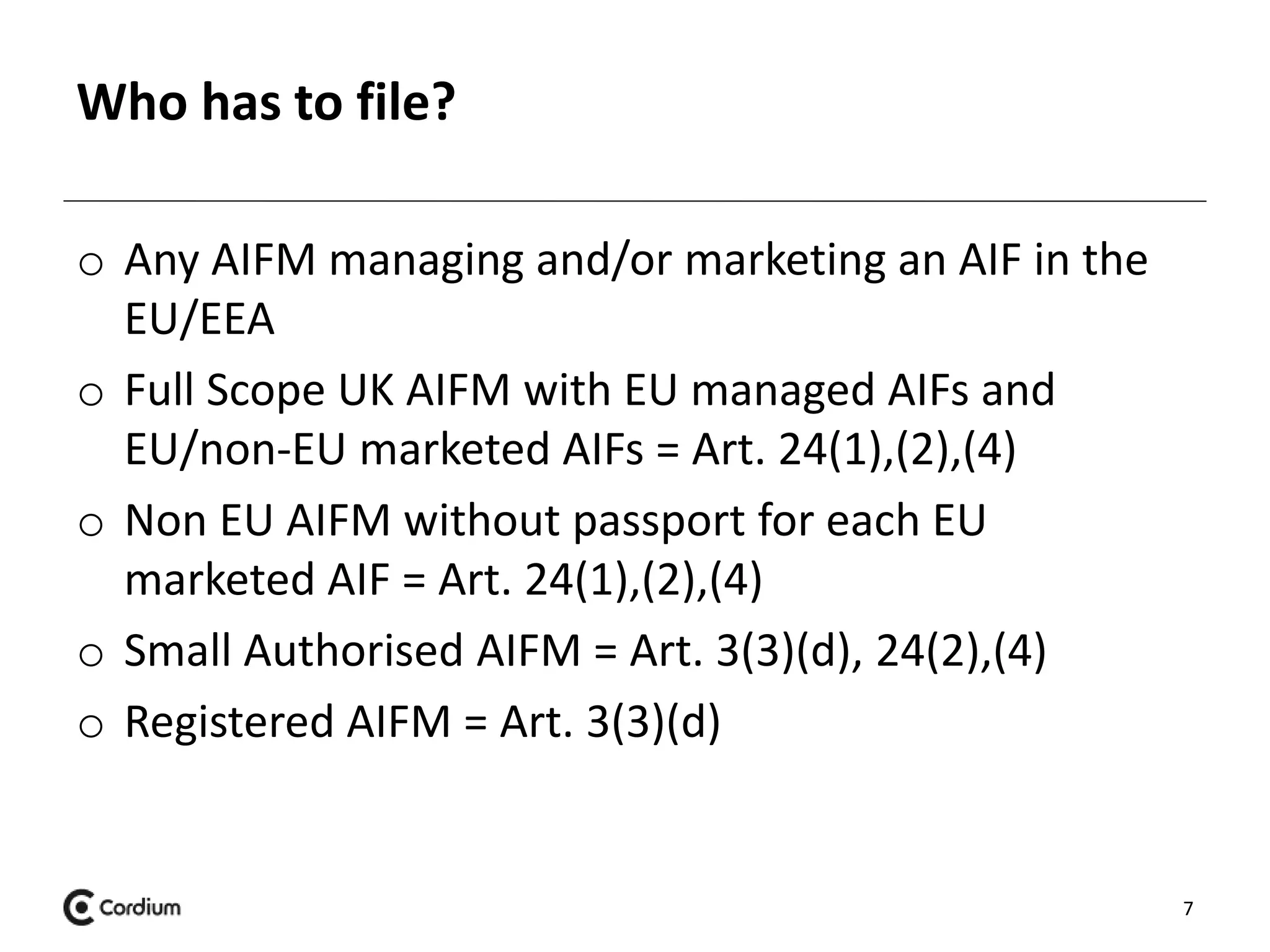
o Any AIFM managing and/or marketing an AIF in the 
EU/EEA 
o Full Scope UK AIFM with EU managed AIFs and 
EU/non-EU marketed AIFs = Art. 24(1),(2),(4) 
o Non EU AIFM without passport for each EU 
marketed AIF = Art. 24(1),(2),(4) 
o Small Authorised AIFM = Art. 3(3)(d), 24(2),(4) 
o Registered AIFM = Art. 3(3)(d) 
7
When and how often do I file? 
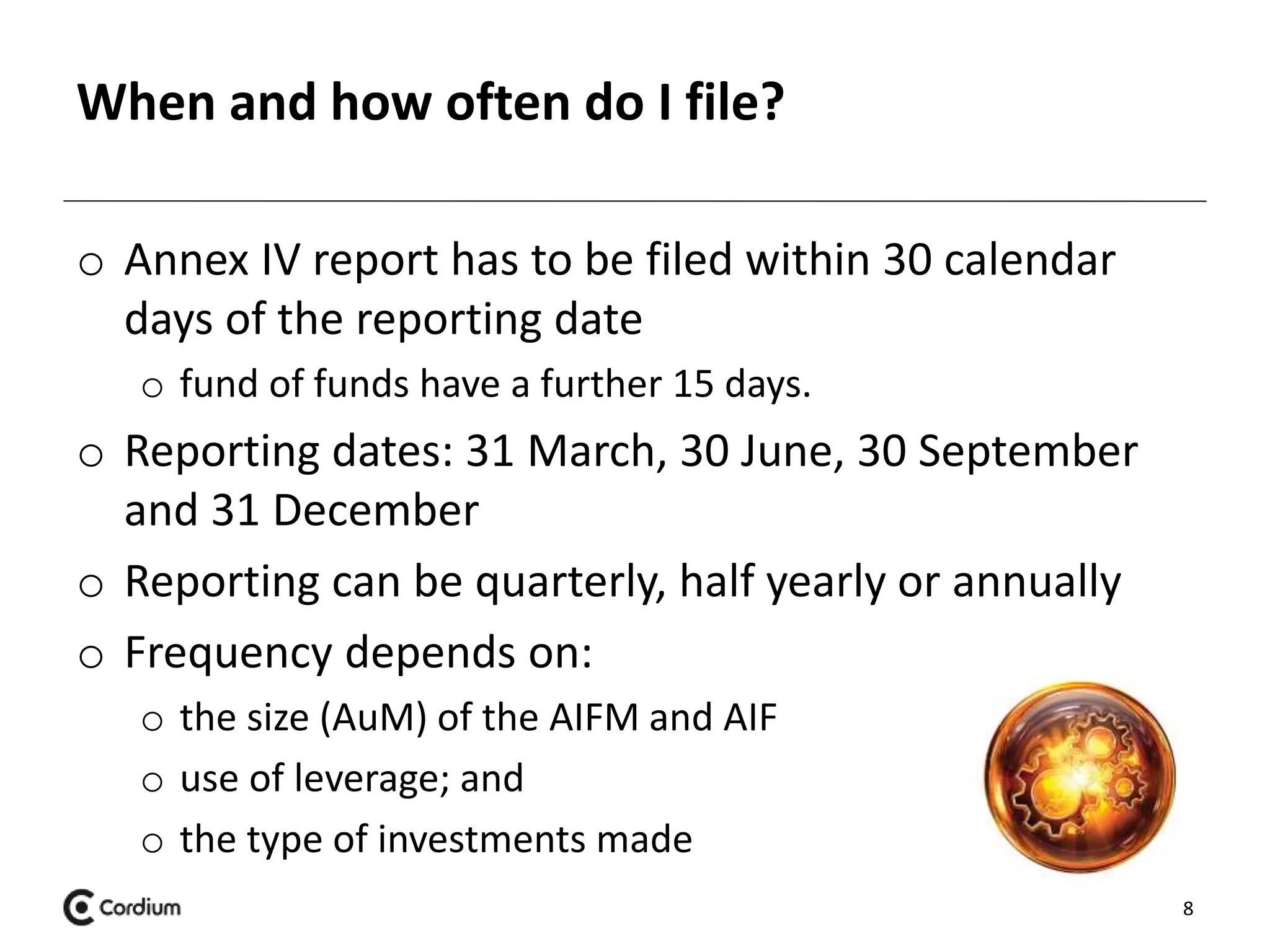
o Annex IV report has to be filed within 30 calendar 
days of the reporting date 
o fund of funds have a further 15 days. 
o Reporting dates: 31 March, 30 June, 30 September 
and 31 December 
o Reporting can be quarterly, half yearly or annually 
o Frequency depends on: 
o the size (AuM) of the AIFM and AIF 
o use of leverage; and 
o the type of investments made 
8
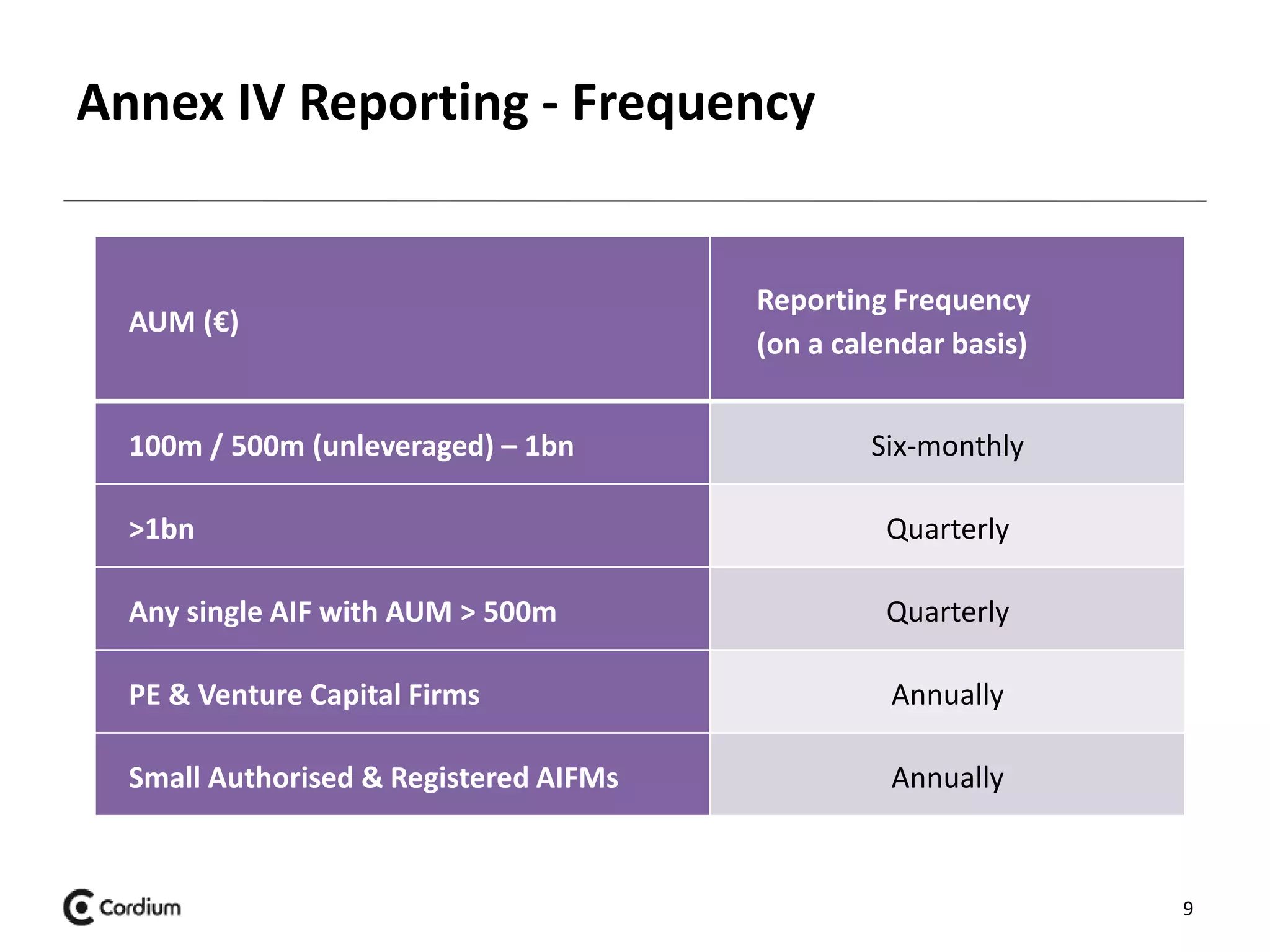
Annex IV Reporting - Frequency 
9 
AUM (€) 
Reporting Frequency 
(on a calendar basis) 
100m / 500m (unleveraged) – 1bn Six-monthly 
>1bn Quarterly 
Any single AIF with AUM > 500m Quarterly 
PE & Venture Capital Firms Annually 
Small Authorised & Registered AIFMs Annually
Who do I report to and how? 
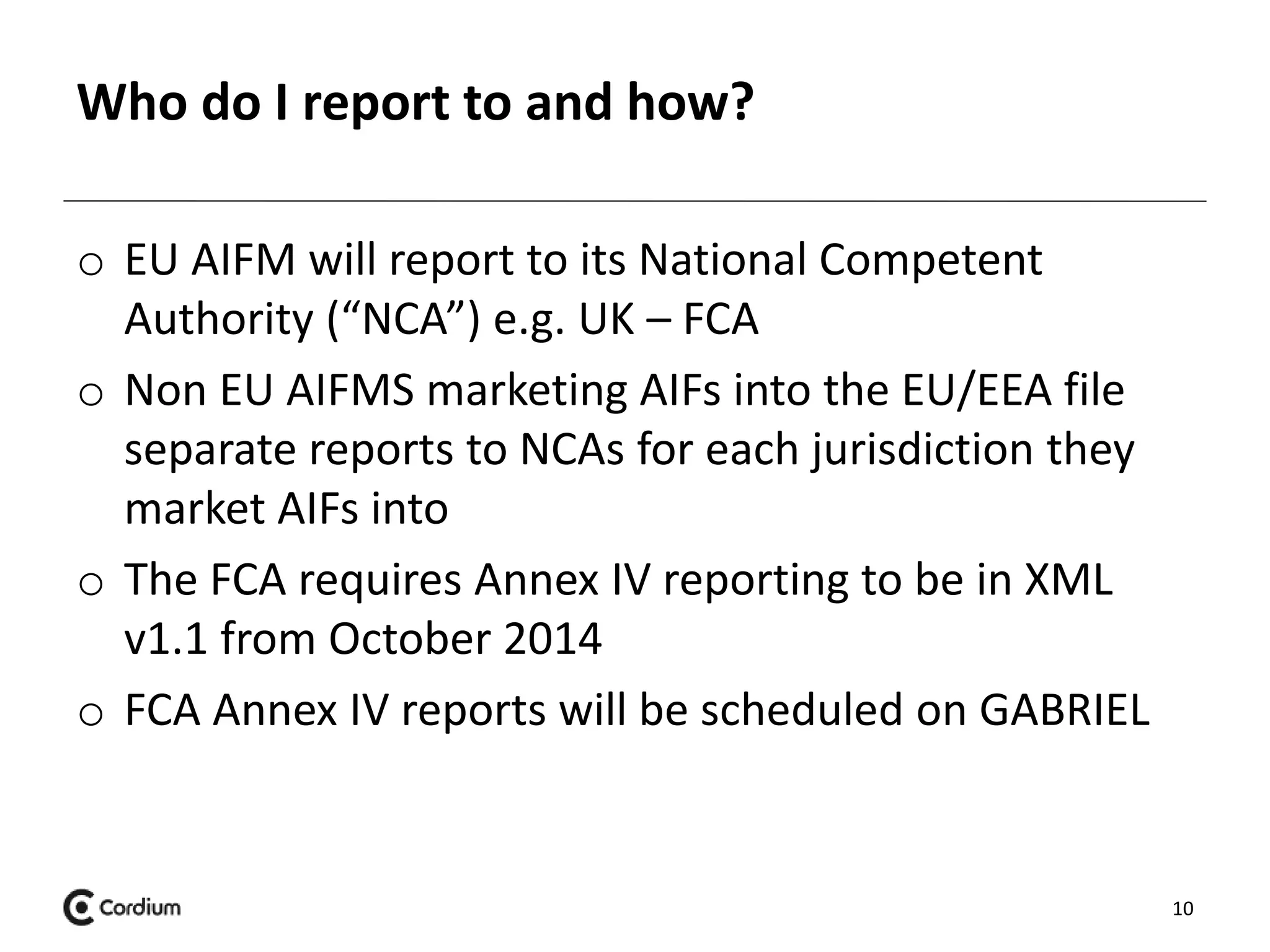
o EU AIFM will report to its National Competent 
Authority (“NCA”) e.g. UK – FCA 
o Non EU AIFMS marketing AIFs into the EU/EEA file 
separate reports to NCAs for each jurisdiction they 
market AIFs into 
o The FCA requires Annex IV reporting to be in XML 
v1.1 from October 2014 
o FCA Annex IV reports will be scheduled on GABRIEL 
10
What information is required? (1) 
ESMA template sheet 1 - Art 3(3)(d) / Art 24(1) 
o AIFM specific information 
o 38 questions 
o Static data in respect of the AIFM 
o 27 questions can be pre-populated 
o 11 further questions – cut off dependent 
o 5 principal markets and instruments they trade on behalf 
of the AIFs they manage 
o total assets under management 
11
What information is required? (2) 
ESMA template sheet 2 - Art 3(3)(d) / Art 24(1) 
o AIF specific information 
o 120 questions 
o 47 questions pre-populated 
o Approximately 60% cut off dependent 
o Questions that require attention 
o 5 main instruments AIF trades 
o 10 principal AIF exposures 
o 5 most important portfolio concentrations 
12
What information is required? (3) 
ESMA template sheet 3 - Art 24(2) 
o Additional AIF specific information 
o NOT required for small registered AIFMs or 
o Non-EEA AIFs not marketed in EEA by auth’d AIFM 
o Some fields can be pre-populated 
o Reporting requires significant amounts of data 
o 175 questions, some optional depending on AIF 
o exposures at reporting date 
o turnover of each asset class 
o risk reporting: market, counterparty, liquidity, financing 
o investor profile 
13
What information is required? (4) 
ESMA template sheet 4 - Art 24(4) 
o Leveraged AIFs additionally report per ESMA 
template sheet 4/Art 24(4) 
o overall leverage employed 
o breakdown of leverage arising from borrowing cash or securities 
or embedded in derivatives 
o extent to which the fund assets have been reused 
(collateralised) under leveraged arrangements 
o identity of the 5 largest sources of borrowed cash or 
securities for the fund and the leverage attached to them 
14
Guidance (1) 
Key sources: 
o ESMA – Guidelines (08.08.2014 / ESMA/2014/869EN) 
o ESMA AIFMD Q&A July 2014 (ESMA/2014/868) 
o FCA – AIFMD Reporting 
o Non EU AIFM – EU or Non-EU AIF – report to each NCA where AIF is marketed. 
o Reporting to NCA deemed to be ‘those of the member states where the AIFs are 
marketed’. 
o Multiple AIFs - Reporting under Art. 42, only the AIFs marketed in that Member State 
have to be reported to local NCA 
o Non-EU AIFMs - Master funds not marketed. Report on feeder funds only? 
o No. Report on Master also. Tab 24(2)&(4) 
o Whilst, only the Feeder is being marketed, information is also required to be provided as 
per the ESMA opinion and as adopted in FCA rules. 
o ESMA opinion/2013/1340/paras 11-12. FCA handbook: FUND 3.4.6AR(2) 
15
Guidance (2) 
o Procedures when the AIFM of an AIF changes or an AIF is liquidated 
o Change of AIFM – new AIFM should report at the next reporting period 
covering the whole period based on information provided by the former AIFM. 
o Liquidated or merged AIF - AIFMs should provide the last report of the AIF to 
their NCA immediately after the AIF has been liquidated or merged. 
o Nil return 
o E.g. New AIFs yet to raise capital should still submit nil return 
o New reporting obligation / shift in cycle: 
o Numerous scenarios detailed in Sec IX of the ESMA Guidelines. – Very much 
depends upon timing of change 
16
Guidance (3) 
o AUM methodology – Gross, as per Art.2.3 of the Regulation 
o Total value of all exposure lists in the Article 24(2) tab – gross values in lines 
122-124/ i.e. the total of the individual exposures = AUM 
o Does VAR need to be reported? 
o A. FUND 3.4.6AR(C) – reported only where VAR is already calculated. 
o -Originally suggested as a requirement in an FCA quarterly CP but new FUND 
3.4.6AR provision revised that 
Automated Validation checks from October 2014- ‘business validations’ yet to be 
published. 
17
What are the challenges? 
o Marshalling the data 
o identifying the sources of data 
o extracting the data required 
o collecting and normalising 
o validation and converting it into a reporting format 
o Represents a significant operational challenge 
o this has to become part of the AIFMs BAU 
o time constraints 
o Problems exacerbated if the AIFM has multiple service providers 
o Consistency across 
o period to period reports 
o all forms of regulatory reporting 
o Ability to demonstrate a clear audit trail and rationale 
18
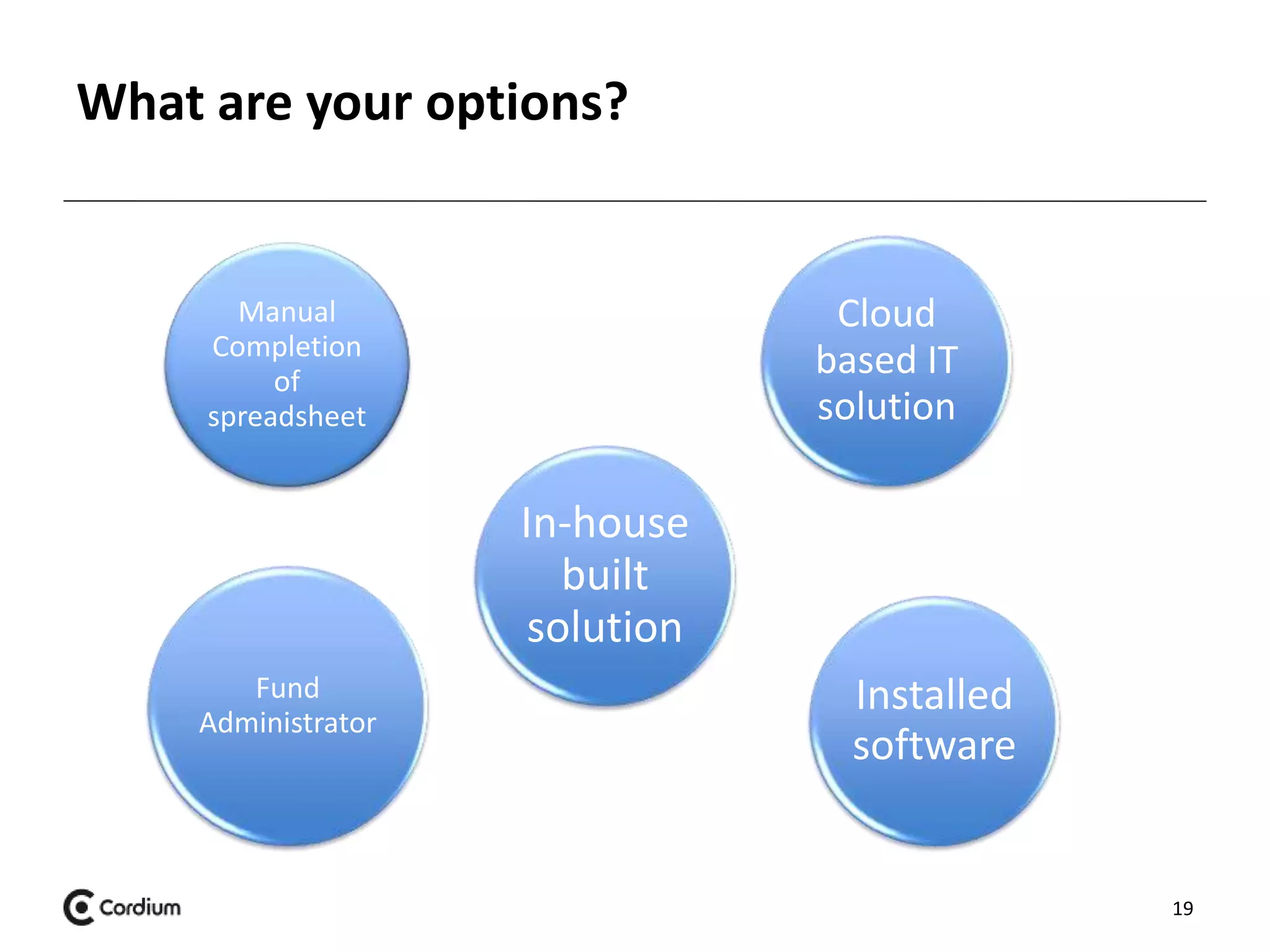
What are your options? 
19 
Manual 
Completion 
of 
spreadsheet 
Cloud 
based IT 
solution 
Installed 
software 
In-house 
built 
solution 
Fund 
Administrator
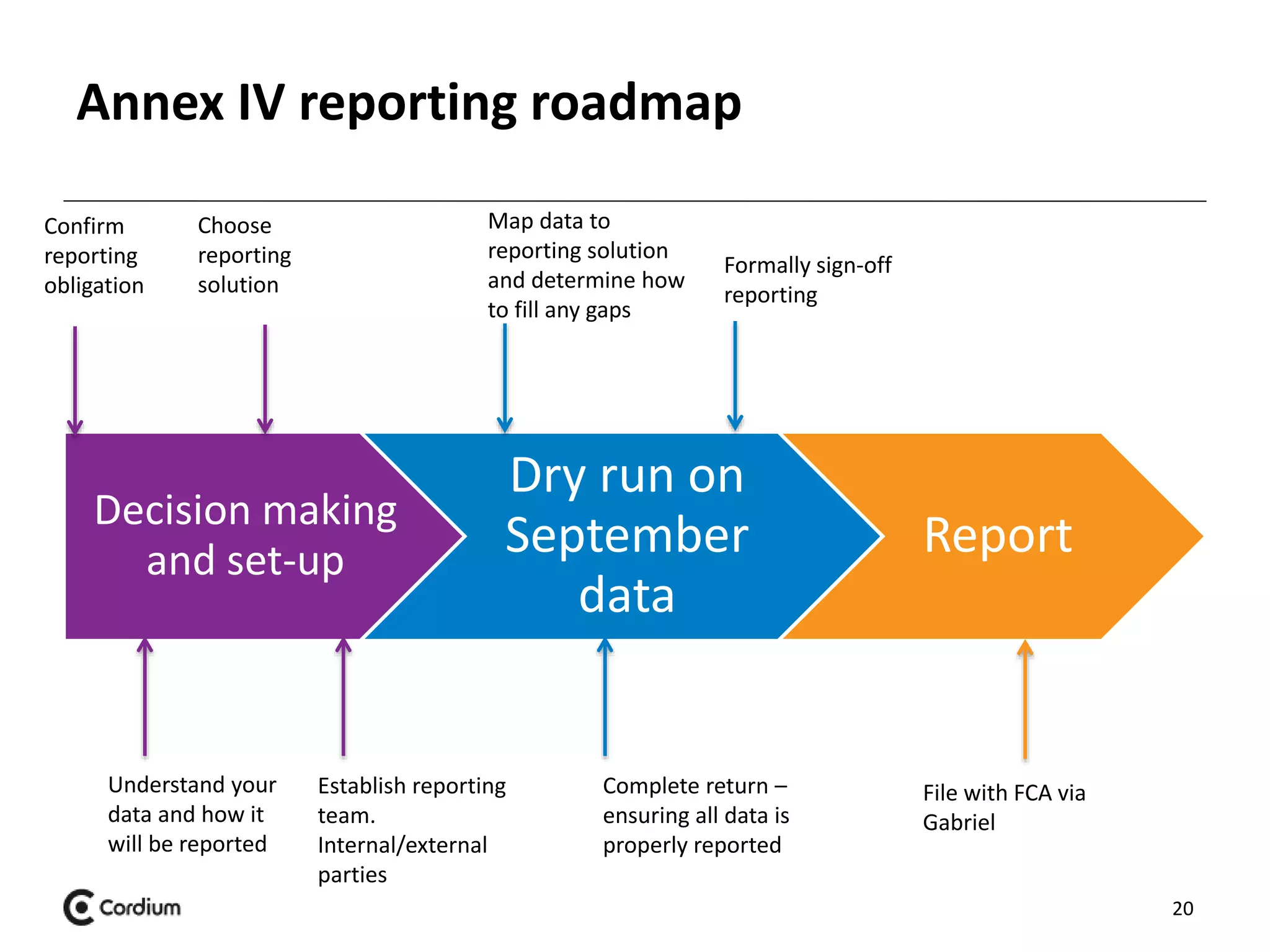
Annex IV reporting roadmap 
20 
Choose 
reporting 
solution 
Decision making 
and set-up 
Map data to 
reporting solution 
and determine how 
to fill any gaps 
Formally sign-off 
reporting 
Dry run on 
September 
data 
Report 
Confirm 
reporting 
obligation 
Understand your 
data and how it 
will be reported 
Establish reporting 
team. 
Internal/external 
parties 
Complete return – 
ensuring all data is 
properly reported 
File with FCA via 
Gabriel
IVP RAPTOR - Your platform for 
Global Regulatory Reporting
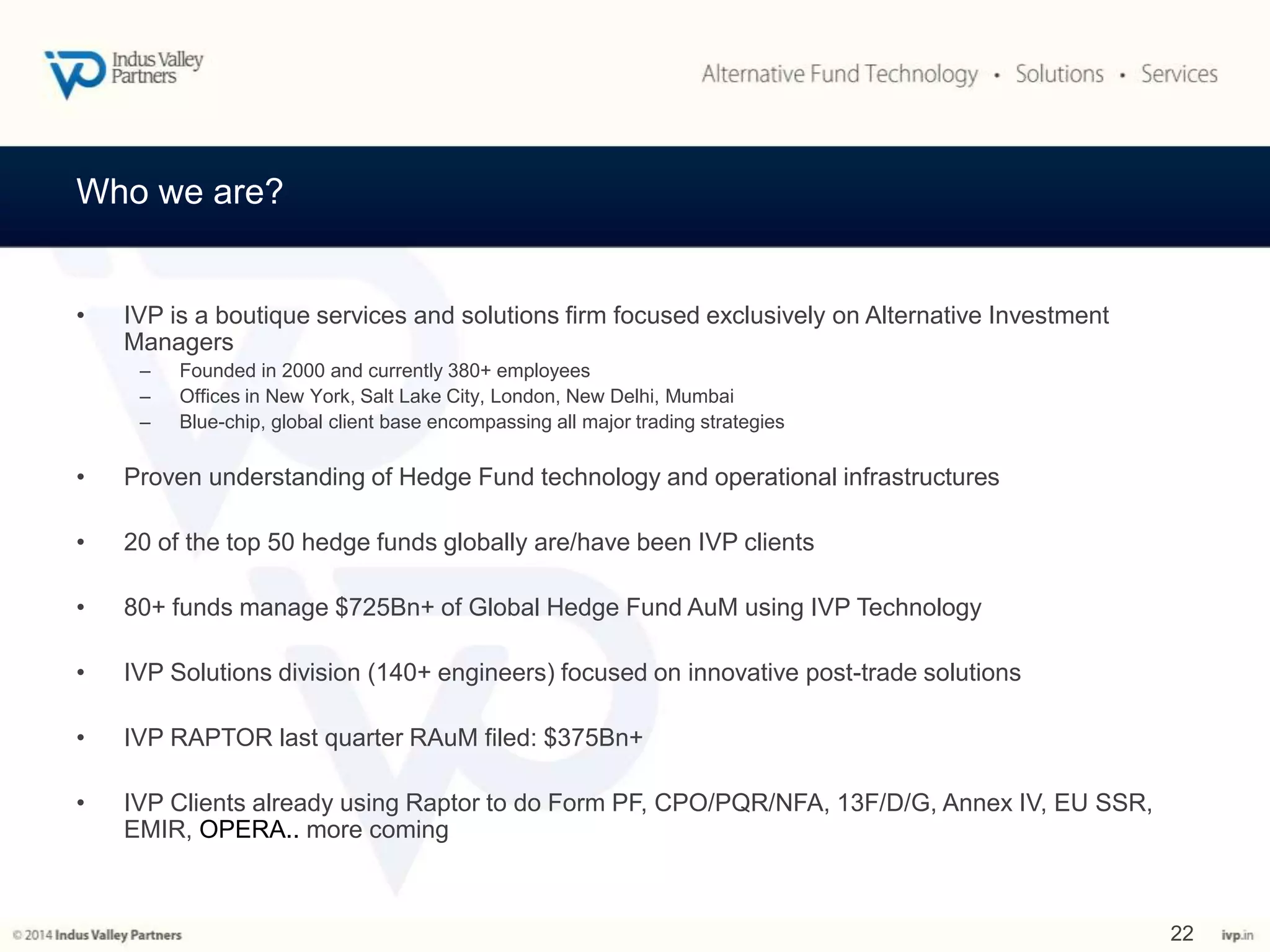
Who we are? 
• IVP is a boutique services and solutions firm focused exclusively on Alternative Investment 
Managers 
– Founded in 2000 and currently 380+ employees 
– Offices in New York, Salt Lake City, London, New Delhi, Mumbai 
– Blue-chip, global client base encompassing all major trading strategies 
• Proven understanding of Hedge Fund technology and operational infrastructures 
• 20 of the top 50 hedge funds globally are/have been IVP clients 
• 80+ funds manage $725Bn+ of Global Hedge Fund AuM using IVP Technology 
• IVP Solutions division (140+ engineers) focused on innovative post-trade solutions 
• IVP RAPTOR last quarter RAuM filed: $375Bn+ 
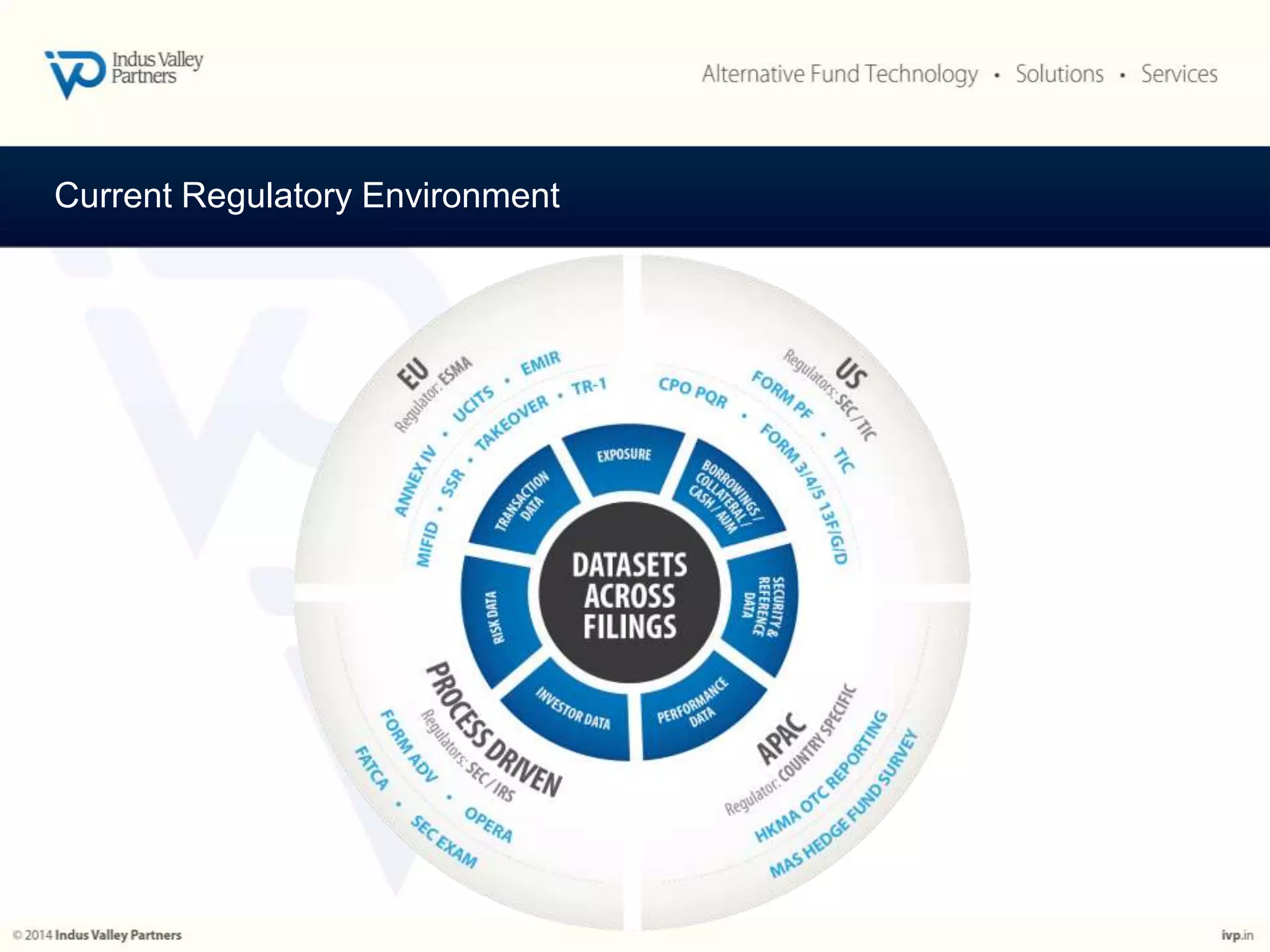
• IVP Clients already using Raptor to do Form PF, CPO/PQR/NFA, 13F/D/G, Annex IV, EU SSR, 
EMIR, OPERA.. more coming 
22
Current Regulatory Environment
Data challenges 
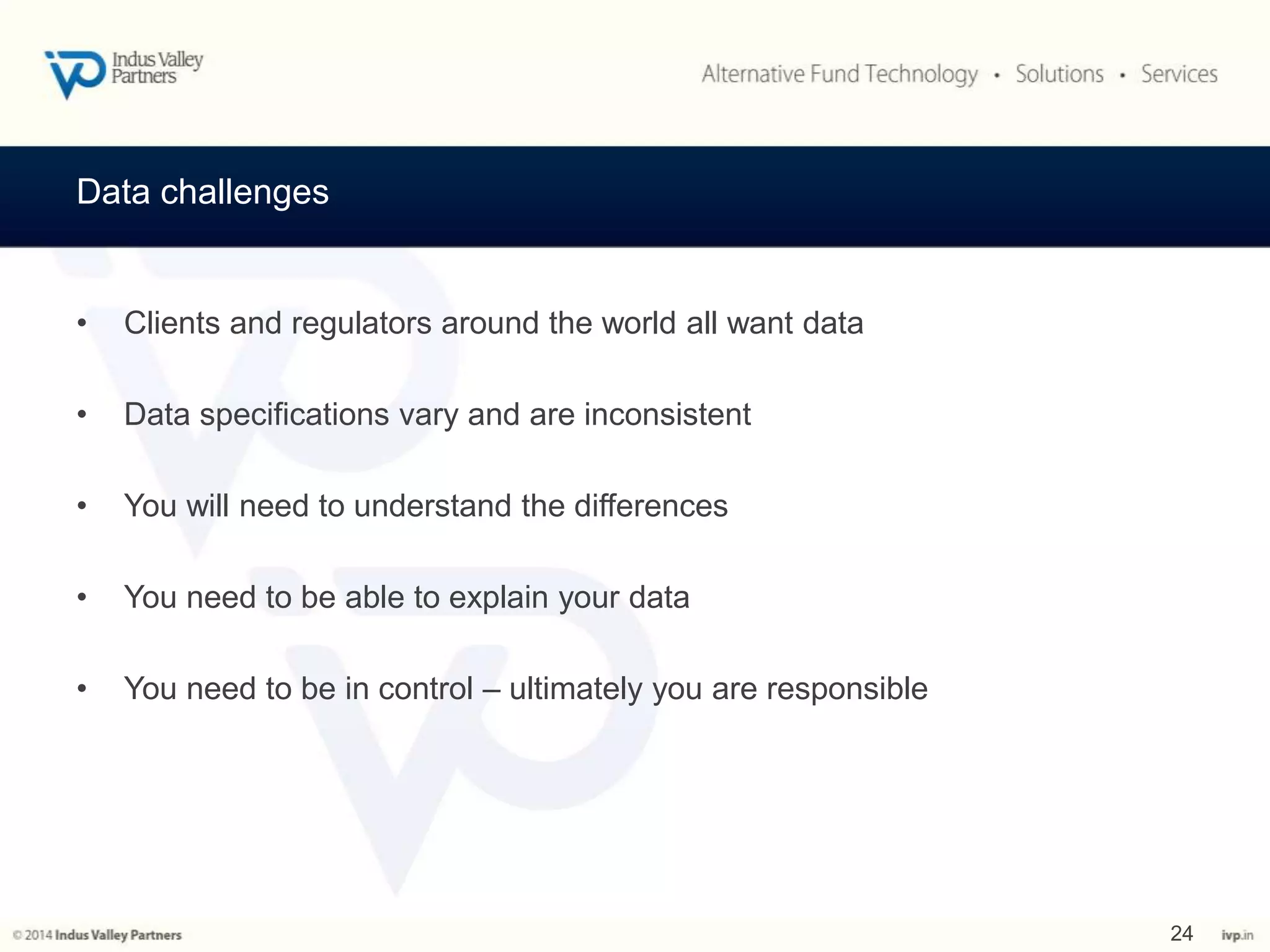
• Clients and regulators around the world all want data 
• Data specifications vary and are inconsistent 
• You will need to understand the differences 
• You need to be able to explain your data 
• You need to be in control – ultimately you are responsible 
24
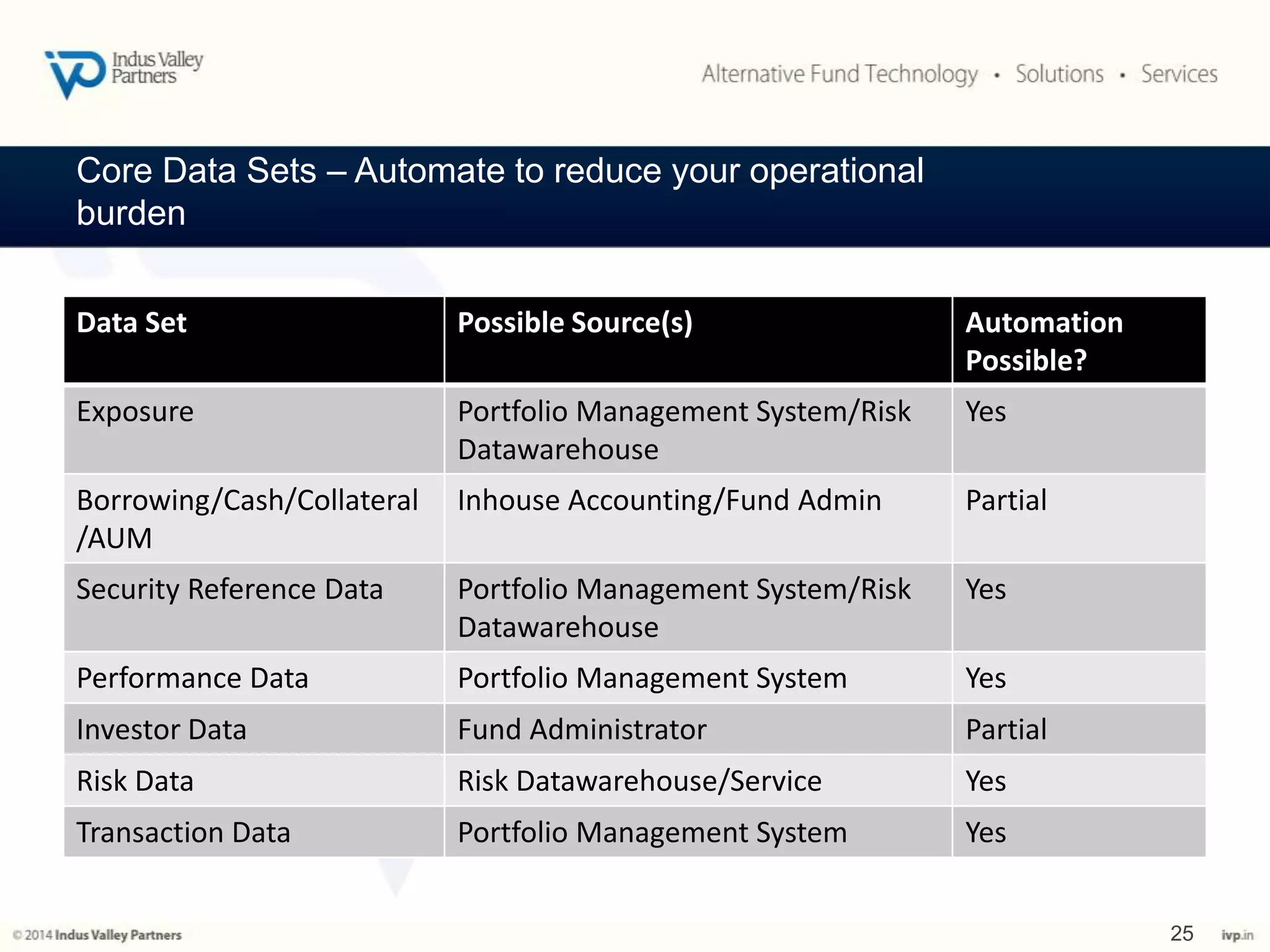
Core Data Sets – Automate to reduce your operational 
burden 
Data Set Possible Source(s) Automation 
Possible? 
Exposure Portfolio Management System/Risk 
Datawarehouse 
Yes 
Borrowing/Cash/Collateral 
/AUM 
Inhouse Accounting/Fund Admin Partial 
Security Reference Data Portfolio Management System/Risk 
Datawarehouse 
Yes 
Performance Data Portfolio Management System Yes 
Investor Data Fund Administrator Partial 
Risk Data Risk Datawarehouse/Service Yes 
Transaction Data Portfolio Management System Yes 
25
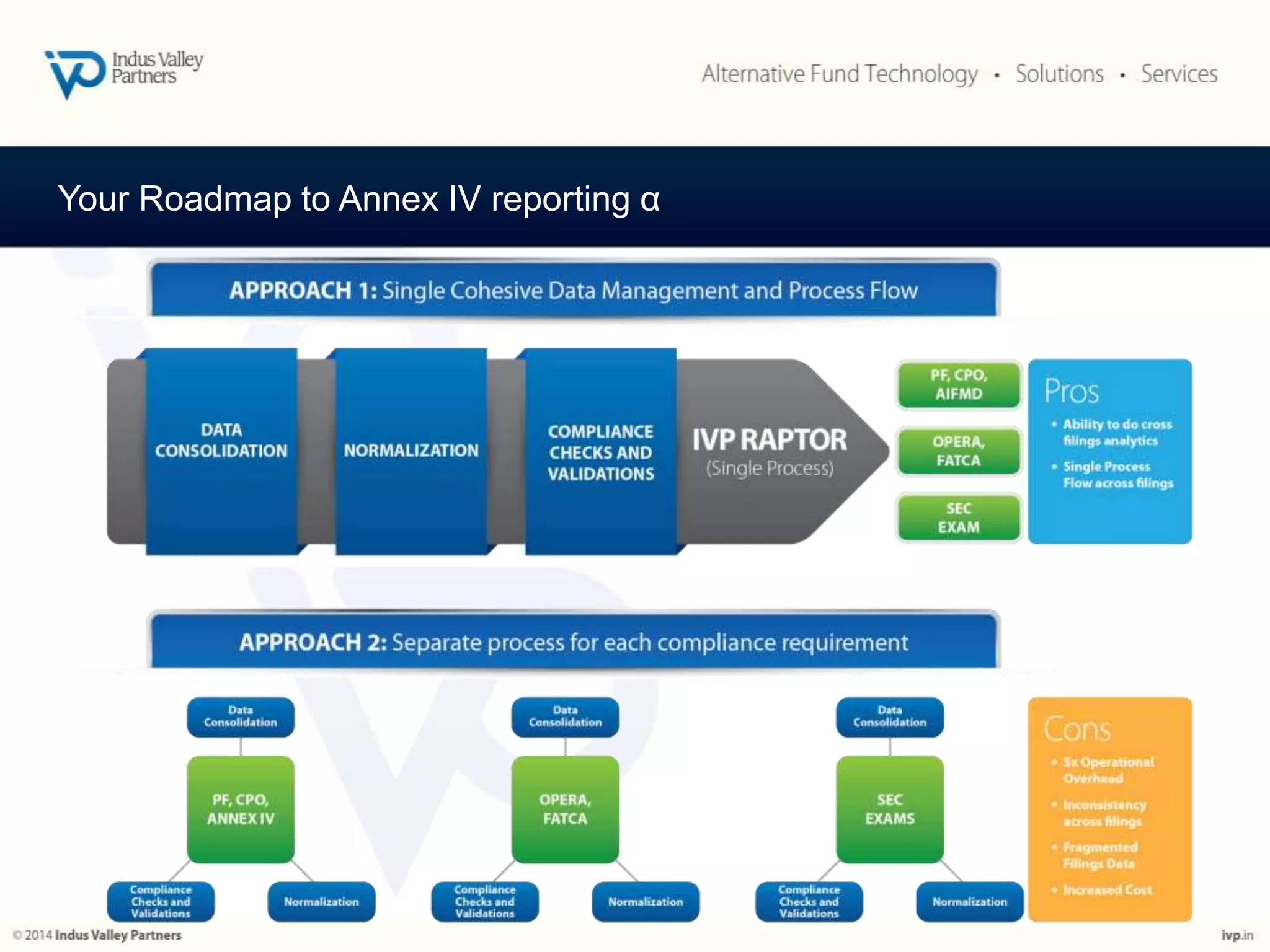
Your Roadmap to Annex IV reporting α
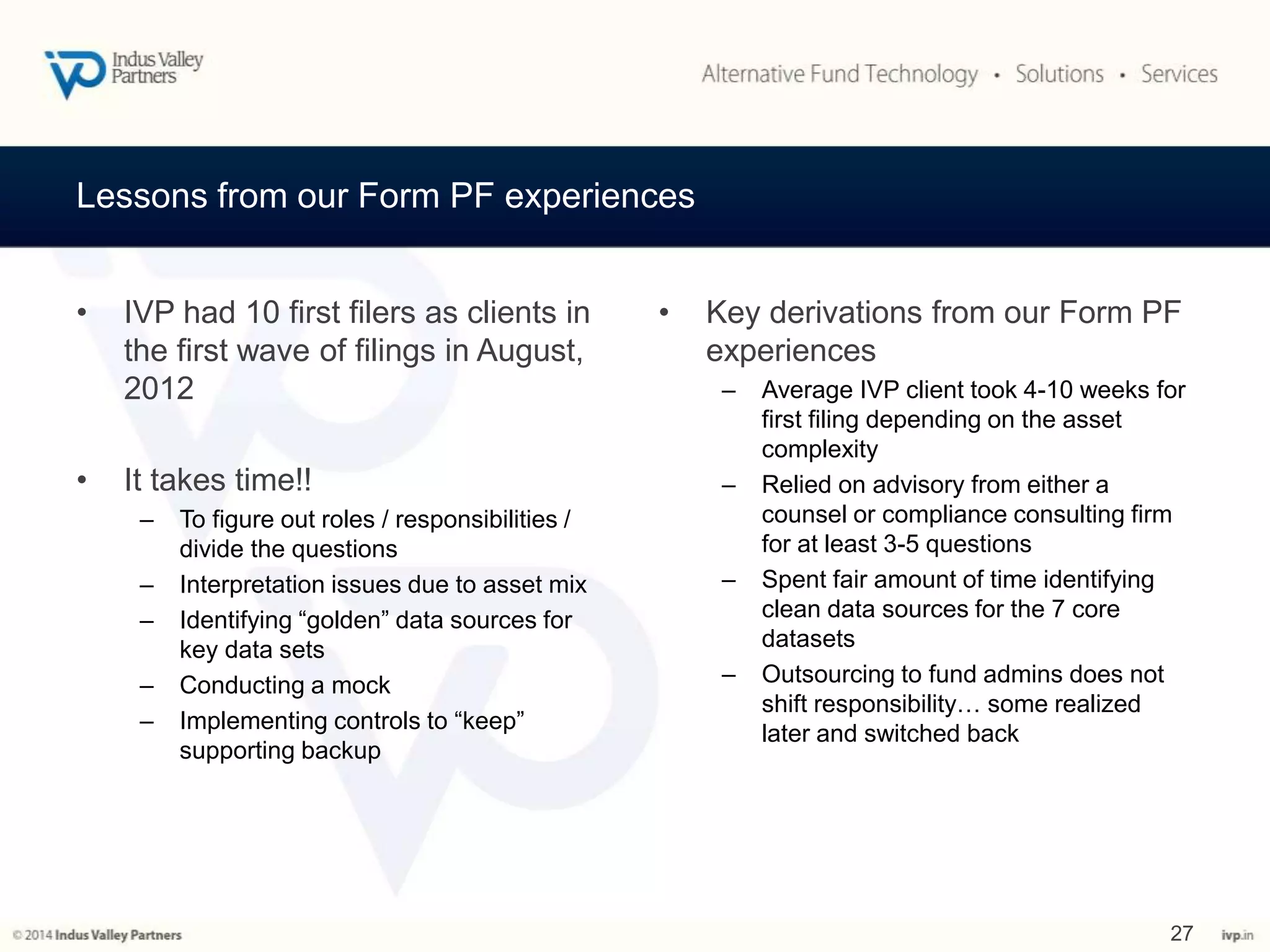
Lessons from our Form PF experiences 
• IVP had 10 first filers as clients in 
the first wave of filings in August, 
2012 
• It takes time!! 
– To figure out roles / responsibilities / 
divide the questions 
– Interpretation issues due to asset mix 
– Identifying “golden” data sources for 
key data sets 
– Conducting a mock 
– Implementing controls to “keep” 
supporting backup 
• Key derivations from our Form PF 
experiences 
– Average IVP client took 4-10 weeks for 
first filing depending on the asset 
complexity 
– Relied on advisory from either a 
counsel or compliance consulting firm 
for at least 3-5 questions 
– Spent fair amount of time identifying 
clean data sources for the 7 core 
datasets 
– Outsourcing to fund admins does not 
shift responsibility… some realized 
later and switched back 
27
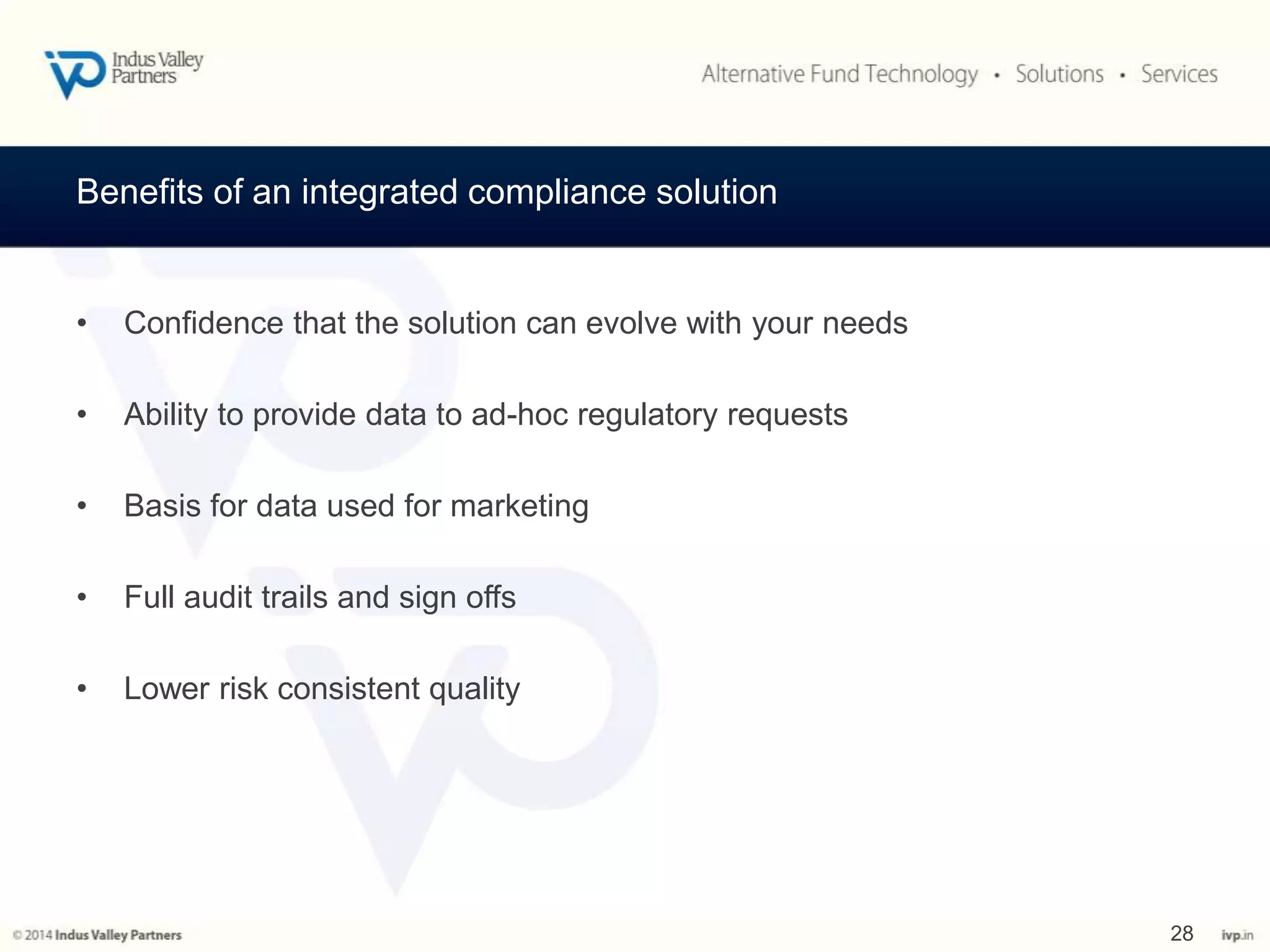
Benefits of an integrated compliance solution 
• Confidence that the solution can evolve with your needs 
• Ability to provide data to ad-hoc regulatory requests 
• Basis for data used for marketing 
• Full audit trails and sign offs 
• Lower risk consistent quality 
28
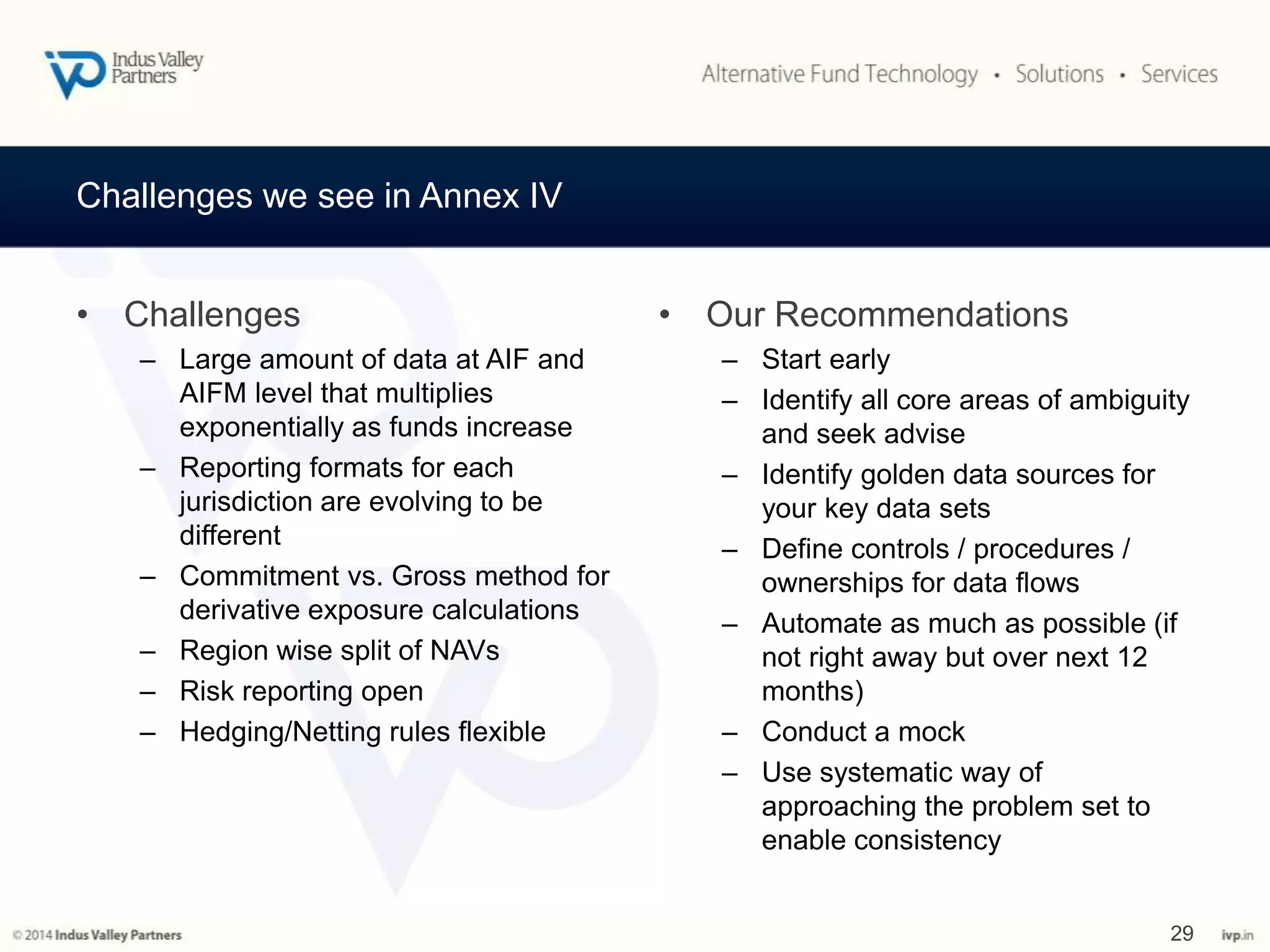
Challenges we see in Annex IV 
• Challenges 
– Large amount of data at AIF and 
AIFM level that multiplies 
exponentially as funds increase 
– Reporting formats for each 
jurisdiction are evolving to be 
different 
– Commitment vs. Gross method for 
derivative exposure calculations 
– Region wise split of NAVs 
– Risk reporting open 
– Hedging/Netting rules flexible 
• Our Recommendations 
– Start early 
– Identify all core areas of ambiguity 
and seek advise 
– Identify golden data sources for 
your key data sets 
– Define controls / procedures / 
ownerships for data flows 
– Automate as much as possible (if 
not right away but over next 12 
months) 
– Conduct a mock 
– Use systematic way of 
approaching the problem set to 
enable consistency 
29
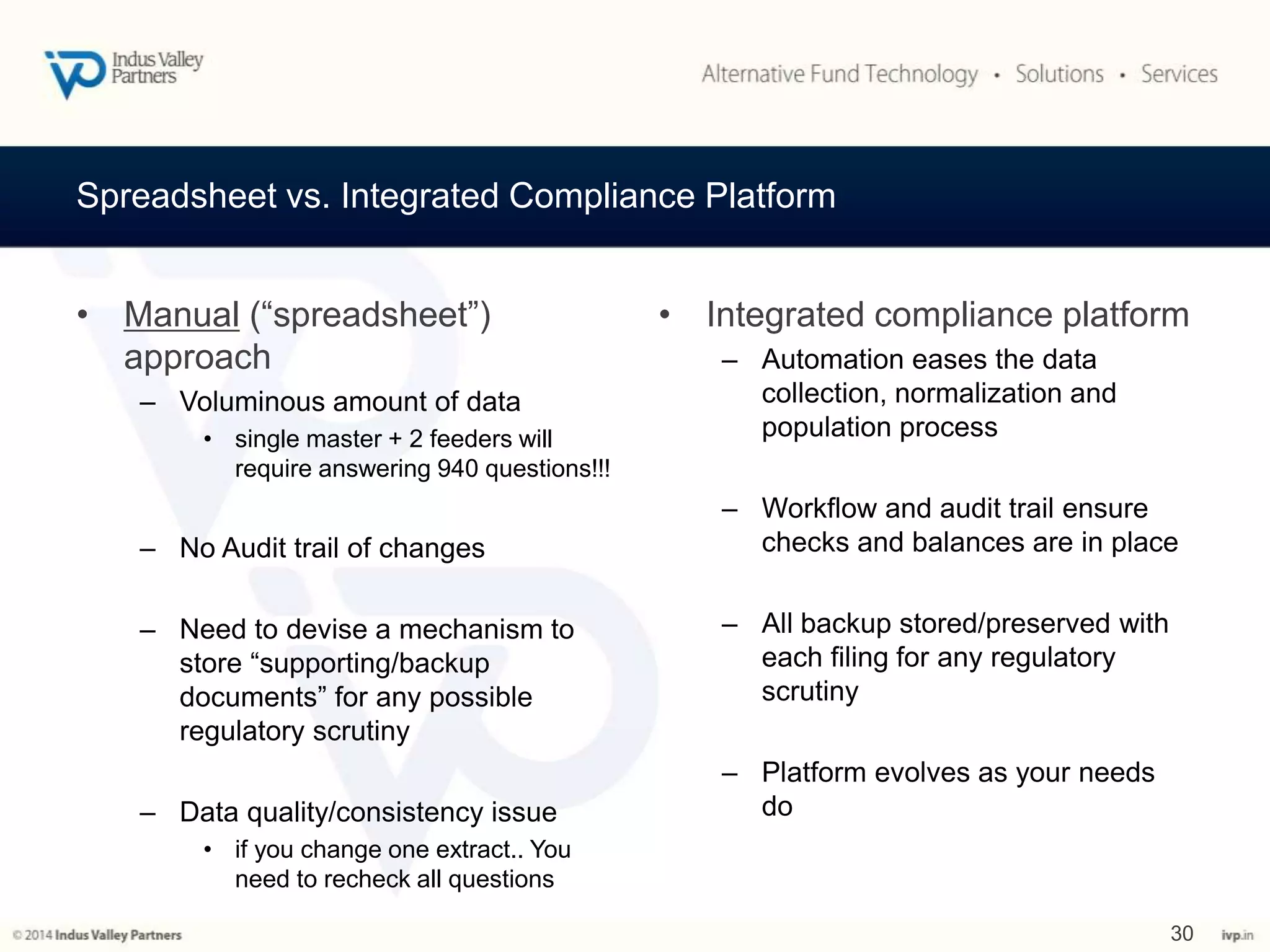
Spreadsheet vs. Integrated Compliance Platform 
• Manual (“spreadsheet”) 
approach 
– Voluminous amount of data 
• single master + 2 feeders will 
require answering 940 questions!!! 
– No Audit trail of changes 
– Need to devise a mechanism to 
store “supporting/backup 
documents” for any possible 
regulatory scrutiny 
– Data quality/consistency issue 
• if you change one extract.. You 
need to recheck all questions 
• Integrated compliance platform 
– Automation eases the data 
collection, normalization and 
population process 
– Workflow and audit trail ensure 
checks and balances are in place 
– All backup stored/preserved with 
each filing for any regulatory 
scrutiny 
– Platform evolves as your needs 
do 
30
Tips on AIFMD Annex IV reporting 
Fiona Bisset, Manager, Financial Conduct Authority 
31
Annex IV Reporting - Overview 
• Annex IV Reporting – scope 
• The role of the FCA 
• The role of the firm – understanding 
• What to report 
• When to report 
• How to report 
• Why they have to report 
32
GABRIEL Reporting 
• GABRIEL updated with new reporting functionality 
• Go live date and access for firms 
• Testing facilities 
• What firms need to do 
• XML V1.1 
• Data validation rules 
• Where to go for more information 
33
Reporting timelines 
• GABRIEL reporting window 
• Missed reporting deadlines 
• Transparency data - quality assurance 
• Disclosure to ESMA 
• Transparency data - analysis 
• Using data to inform supervision strategy and discharge 
responsibility as the UK competent authority 
34
Q & A 
35

Annex IV - The next chapter in AIFMD

  • 1.
    September 11, CORDIUMPOWERPOINT MASTER 1 2014
  • 2.
    ANNEX IV – THE NEXT CHAPTER IN AIFMD Thursday 11th September 2014 2
  • 3.
    Agenda o AnnexIV, an overview - Bobby Johal, Managing Consultant - Technical, Cordium o Cloud based reporting solution - Gurvinder Singh, Co-Founder and CEO, Indus Valley Partners o Helpful tips on Annex IV reporting - Fiona Bisset, Alternative Investment Team Manager, FCA o Q & A 3
  • 4.
    OVERVIEW OF OBLIGATIONSAND REQUIREMENTS 4 Bobby Johal Managing Consultant, Technical Cordium
  • 5.
    Annex IV –a recap o What is Annex IV reporting? o Who has to file? o When and how often do I file? o Who do I report to and how? o What information is required? o What are the challenges? o What are your options? 5
  • 6.
    What is AnnexIV? o Annex IV: periodic systemic risk reporting obligation under Art. 24 of the AIFMD o AIFMs required to file in respect of themselves and the AIFs they manage or market into the EU/EEA o Comprehensive report o 38 questions of the AIFM o over 300 questions for each AIF 6
  • 7.
    Who has tofile? o Any AIFM managing and/or marketing an AIF in the EU/EEA o Full Scope UK AIFM with EU managed AIFs and EU/non-EU marketed AIFs = Art. 24(1),(2),(4) o Non EU AIFM without passport for each EU marketed AIF = Art. 24(1),(2),(4) o Small Authorised AIFM = Art. 3(3)(d), 24(2),(4) o Registered AIFM = Art. 3(3)(d) 7
  • 8.
    When and howoften do I file? o Annex IV report has to be filed within 30 calendar days of the reporting date o fund of funds have a further 15 days. o Reporting dates: 31 March, 30 June, 30 September and 31 December o Reporting can be quarterly, half yearly or annually o Frequency depends on: o the size (AuM) of the AIFM and AIF o use of leverage; and o the type of investments made 8
  • 9.
    Annex IV Reporting- Frequency 9 AUM (€) Reporting Frequency (on a calendar basis) 100m / 500m (unleveraged) – 1bn Six-monthly >1bn Quarterly Any single AIF with AUM > 500m Quarterly PE & Venture Capital Firms Annually Small Authorised & Registered AIFMs Annually
  • 10.
    Who do Ireport to and how? o EU AIFM will report to its National Competent Authority (“NCA”) e.g. UK – FCA o Non EU AIFMS marketing AIFs into the EU/EEA file separate reports to NCAs for each jurisdiction they market AIFs into o The FCA requires Annex IV reporting to be in XML v1.1 from October 2014 o FCA Annex IV reports will be scheduled on GABRIEL 10
  • 11.
    What information isrequired? (1) ESMA template sheet 1 - Art 3(3)(d) / Art 24(1) o AIFM specific information o 38 questions o Static data in respect of the AIFM o 27 questions can be pre-populated o 11 further questions – cut off dependent o 5 principal markets and instruments they trade on behalf of the AIFs they manage o total assets under management 11
  • 12.
    What information isrequired? (2) ESMA template sheet 2 - Art 3(3)(d) / Art 24(1) o AIF specific information o 120 questions o 47 questions pre-populated o Approximately 60% cut off dependent o Questions that require attention o 5 main instruments AIF trades o 10 principal AIF exposures o 5 most important portfolio concentrations 12
  • 13.
    What information isrequired? (3) ESMA template sheet 3 - Art 24(2) o Additional AIF specific information o NOT required for small registered AIFMs or o Non-EEA AIFs not marketed in EEA by auth’d AIFM o Some fields can be pre-populated o Reporting requires significant amounts of data o 175 questions, some optional depending on AIF o exposures at reporting date o turnover of each asset class o risk reporting: market, counterparty, liquidity, financing o investor profile 13
  • 14.
    What information isrequired? (4) ESMA template sheet 4 - Art 24(4) o Leveraged AIFs additionally report per ESMA template sheet 4/Art 24(4) o overall leverage employed o breakdown of leverage arising from borrowing cash or securities or embedded in derivatives o extent to which the fund assets have been reused (collateralised) under leveraged arrangements o identity of the 5 largest sources of borrowed cash or securities for the fund and the leverage attached to them 14
  • 15.
    Guidance (1) Keysources: o ESMA – Guidelines (08.08.2014 / ESMA/2014/869EN) o ESMA AIFMD Q&A July 2014 (ESMA/2014/868) o FCA – AIFMD Reporting o Non EU AIFM – EU or Non-EU AIF – report to each NCA where AIF is marketed. o Reporting to NCA deemed to be ‘those of the member states where the AIFs are marketed’. o Multiple AIFs - Reporting under Art. 42, only the AIFs marketed in that Member State have to be reported to local NCA o Non-EU AIFMs - Master funds not marketed. Report on feeder funds only? o No. Report on Master also. Tab 24(2)&(4) o Whilst, only the Feeder is being marketed, information is also required to be provided as per the ESMA opinion and as adopted in FCA rules. o ESMA opinion/2013/1340/paras 11-12. FCA handbook: FUND 3.4.6AR(2) 15
  • 16.
    Guidance (2) oProcedures when the AIFM of an AIF changes or an AIF is liquidated o Change of AIFM – new AIFM should report at the next reporting period covering the whole period based on information provided by the former AIFM. o Liquidated or merged AIF - AIFMs should provide the last report of the AIF to their NCA immediately after the AIF has been liquidated or merged. o Nil return o E.g. New AIFs yet to raise capital should still submit nil return o New reporting obligation / shift in cycle: o Numerous scenarios detailed in Sec IX of the ESMA Guidelines. – Very much depends upon timing of change 16
  • 17.
    Guidance (3) oAUM methodology – Gross, as per Art.2.3 of the Regulation o Total value of all exposure lists in the Article 24(2) tab – gross values in lines 122-124/ i.e. the total of the individual exposures = AUM o Does VAR need to be reported? o A. FUND 3.4.6AR(C) – reported only where VAR is already calculated. o -Originally suggested as a requirement in an FCA quarterly CP but new FUND 3.4.6AR provision revised that Automated Validation checks from October 2014- ‘business validations’ yet to be published. 17
  • 18.
    What are thechallenges? o Marshalling the data o identifying the sources of data o extracting the data required o collecting and normalising o validation and converting it into a reporting format o Represents a significant operational challenge o this has to become part of the AIFMs BAU o time constraints o Problems exacerbated if the AIFM has multiple service providers o Consistency across o period to period reports o all forms of regulatory reporting o Ability to demonstrate a clear audit trail and rationale 18
  • 19.
    What are youroptions? 19 Manual Completion of spreadsheet Cloud based IT solution Installed software In-house built solution Fund Administrator
  • 20.
    Annex IV reportingroadmap 20 Choose reporting solution Decision making and set-up Map data to reporting solution and determine how to fill any gaps Formally sign-off reporting Dry run on September data Report Confirm reporting obligation Understand your data and how it will be reported Establish reporting team. Internal/external parties Complete return – ensuring all data is properly reported File with FCA via Gabriel
  • 21.
    IVP RAPTOR -Your platform for Global Regulatory Reporting
  • 22.
    Who we are? • IVP is a boutique services and solutions firm focused exclusively on Alternative Investment Managers – Founded in 2000 and currently 380+ employees – Offices in New York, Salt Lake City, London, New Delhi, Mumbai – Blue-chip, global client base encompassing all major trading strategies • Proven understanding of Hedge Fund technology and operational infrastructures • 20 of the top 50 hedge funds globally are/have been IVP clients • 80+ funds manage $725Bn+ of Global Hedge Fund AuM using IVP Technology • IVP Solutions division (140+ engineers) focused on innovative post-trade solutions • IVP RAPTOR last quarter RAuM filed: $375Bn+ • IVP Clients already using Raptor to do Form PF, CPO/PQR/NFA, 13F/D/G, Annex IV, EU SSR, EMIR, OPERA.. more coming 22
  • 23.
  • 24.
    Data challenges •Clients and regulators around the world all want data • Data specifications vary and are inconsistent • You will need to understand the differences • You need to be able to explain your data • You need to be in control – ultimately you are responsible 24
  • 25.
    Core Data Sets– Automate to reduce your operational burden Data Set Possible Source(s) Automation Possible? Exposure Portfolio Management System/Risk Datawarehouse Yes Borrowing/Cash/Collateral /AUM Inhouse Accounting/Fund Admin Partial Security Reference Data Portfolio Management System/Risk Datawarehouse Yes Performance Data Portfolio Management System Yes Investor Data Fund Administrator Partial Risk Data Risk Datawarehouse/Service Yes Transaction Data Portfolio Management System Yes 25
  • 26.
    Your Roadmap toAnnex IV reporting α
  • 27.
    Lessons from ourForm PF experiences • IVP had 10 first filers as clients in the first wave of filings in August, 2012 • It takes time!! – To figure out roles / responsibilities / divide the questions – Interpretation issues due to asset mix – Identifying “golden” data sources for key data sets – Conducting a mock – Implementing controls to “keep” supporting backup • Key derivations from our Form PF experiences – Average IVP client took 4-10 weeks for first filing depending on the asset complexity – Relied on advisory from either a counsel or compliance consulting firm for at least 3-5 questions – Spent fair amount of time identifying clean data sources for the 7 core datasets – Outsourcing to fund admins does not shift responsibility… some realized later and switched back 27
  • 28.
    Benefits of anintegrated compliance solution • Confidence that the solution can evolve with your needs • Ability to provide data to ad-hoc regulatory requests • Basis for data used for marketing • Full audit trails and sign offs • Lower risk consistent quality 28
  • 29.
    Challenges we seein Annex IV • Challenges – Large amount of data at AIF and AIFM level that multiplies exponentially as funds increase – Reporting formats for each jurisdiction are evolving to be different – Commitment vs. Gross method for derivative exposure calculations – Region wise split of NAVs – Risk reporting open – Hedging/Netting rules flexible • Our Recommendations – Start early – Identify all core areas of ambiguity and seek advise – Identify golden data sources for your key data sets – Define controls / procedures / ownerships for data flows – Automate as much as possible (if not right away but over next 12 months) – Conduct a mock – Use systematic way of approaching the problem set to enable consistency 29
  • 30.
    Spreadsheet vs. IntegratedCompliance Platform • Manual (“spreadsheet”) approach – Voluminous amount of data • single master + 2 feeders will require answering 940 questions!!! – No Audit trail of changes – Need to devise a mechanism to store “supporting/backup documents” for any possible regulatory scrutiny – Data quality/consistency issue • if you change one extract.. You need to recheck all questions • Integrated compliance platform – Automation eases the data collection, normalization and population process – Workflow and audit trail ensure checks and balances are in place – All backup stored/preserved with each filing for any regulatory scrutiny – Platform evolves as your needs do 30
  • 31.
    Tips on AIFMDAnnex IV reporting Fiona Bisset, Manager, Financial Conduct Authority 31
  • 32.
    Annex IV Reporting- Overview • Annex IV Reporting – scope • The role of the FCA • The role of the firm – understanding • What to report • When to report • How to report • Why they have to report 32
  • 33.
    GABRIEL Reporting •GABRIEL updated with new reporting functionality • Go live date and access for firms • Testing facilities • What firms need to do • XML V1.1 • Data validation rules • Where to go for more information 33
  • 34.
    Reporting timelines •GABRIEL reporting window • Missed reporting deadlines • Transparency data - quality assurance • Disclosure to ESMA • Transparency data - analysis • Using data to inform supervision strategy and discharge responsibility as the UK competent authority 34
  • 35.
    Q & A 35