Cash Transfer Programming:
Asia's Shared Concern
4th Asia NGO Innovation Summit
10 October 2013
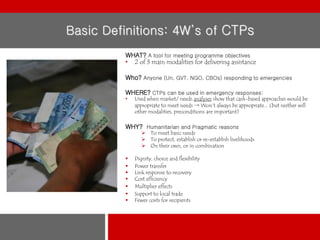
Basic Definitions: 4W’s of CTPs
WHAT? A tool for meeting programme objectives
• 2 of 3 main modalities for delivering assistance
Who? Anyone (Un, GVT, NGO, CBOs) responding to emergencies
WHERE? CTPs can be used in emergency responses:
•

Used when market/ needs analyses show that cash-based approaches would be
appropriate to meet needs → Won’t always be appropriate... (but neither will
other modalities, preconditions are important)

WHY? Humanitarian and Pragmatic reasons

 To meet basic needs
 To protect, establish or re-establish livelihoods
 On their own, or in combination









Dignity, choice and flexibility
Power transfer
Link response to recovery
Cost efficiency
Multiplier effects
Support to local trade
Fewer costs for recipients
trends to date, Where we Are now?
•
•
•
•

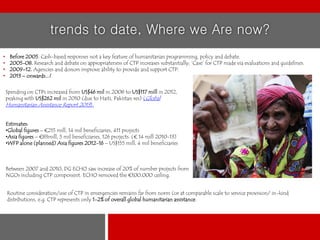
Before 2005. Cash-based responses not a key feature of humanitarian programming, policy and debate.
2005-08. Research and debate on appropriateness of CTP increases substantially; ‘Case’ for CTP made via evaluations and guidelines.
2009–12. Agencies and donors improve ability to provide and support CTP.
2013 – onwards...?
Spending on CTPs increased from US$46 mil in 2008 to US$117 mill in 2012,
peaking with US$262 mil in 2010 (due to Haiti, Pakistan res) (Global
Humanitarian Assistance Report 2013).
Estimates:
•Global figures – €215 mill, 14 mil beneficiaries, 411 projects
•Asia figures – €83mill, 5 mil beneficiaries, 126 projects. (€ 14 mill 2010-13)
•WFP alone (planned) Asia figures 2012-16 – US$155 mill, 4 mil beneficiaries

Between 2007 and 2010, DG ECHO saw increase of 20% of number projects from
NGOs including CTP component. ECHO removed the €100,000 ceiling.
Routine consideration/use of CTP in emergencies remains far from norm (or at comparable scale to service provision/ in-kind
distributions, e.g. CTP represents only 1-2% of overall global humanitarian assistance.
Who is CaLP ?
• Partnership between Oxfam GB, the
British Red Cross, Save the Children, the
Norwegian Refugee Council and Action
Against Hunger / ACF International.
• 5 steering committee organisations came
together to support capacity building,
research and information-sharing on cash
transfer programming as an effective tool
to help deliver aid in times of crisis.
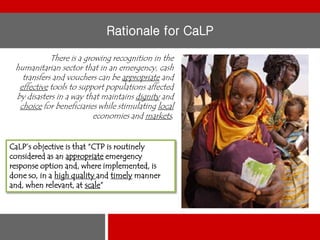
Rationale for CaLP
There is a growing recognition in the
humanitarian sector that in an emergency, cash
transfers and vouchers can be appropriate and
effective tools to support populations affected
by disasters in a way that maintains dignity and
choice for beneficiaries while stimulating local
economies and markets.
CaLP’s objective is that “CTP is routinely
considered as an appropriate emergency
response option and, where implemented, is
done so, in a high quality and timely manner
and, when relevant, at scale”
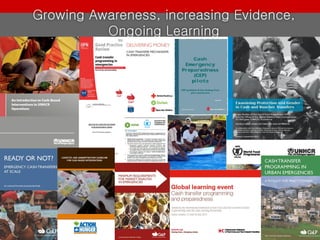
Growing Awareness, increasing Evidence,
Ongoing Learning
CaLP’s activities

Capacity building

In partnership with

+
Community of practice

Research

Advocacy, info sharing,
coordination
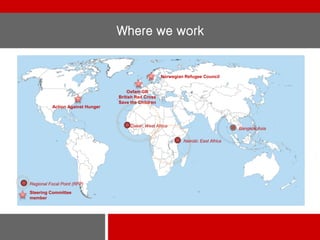
Where we work

Norwegian Refugee Council
Oxfam GB
British Red Cross
Save the Children
Action Against Hunger

Dakar: West Africa

Bangkok:Asia
Nairobi: East Africa

Regional Focal Point (RFP)
Steering Committee
member
“Social Innovation Meets Technology: Scale-up
Impacts, Enrich People’s Lives”
Q: How does technology contribute to scale up social innovation and solve complex
social challenges? How does technology connect people and bring impact to people lives?
A: Technology is a means to an end. During emergencies, technology has the power to
connect people to communicate where they are, if they are well/ in danger and transmit
messages as well as send cash and assistance.
Q: What are the best social innovation practices and its replication and sustainment strategies to
expand social innovation and technology in Asia?
A: NGO/ UN and private sector relationships (e.g. WFP and Globe Telecom, Oxfam/ CaLP and
Visa, Telecommunication Sans Frontiere, WFP and Mastercard, Telenor in Myanmar). Also
multi-sectorial responses! http://www.cashlearning.org/resources/video-library

Q: What are the key challenges and opportunities for technology in social innovation? How can
we create environment that fosters technology in social innovation? What are the enabling
factors and support requirements?
A: Challenges are network coverage/ systems failure during emergencies. TSF provide solutions
and support. Emergency preparedness, contingency plans and established positive
relationships with governments, regional bodies (ASEAN, SAARC etc) and private sector
are key.
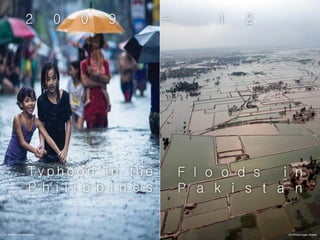
2

0

0

9

Typhoon in the
P h i l i p p i n e s

UN Photo/Evan Schneider

-

1

2

F l o o d s
i n
P a k i s t a n

UN Photo/Logan Abassi
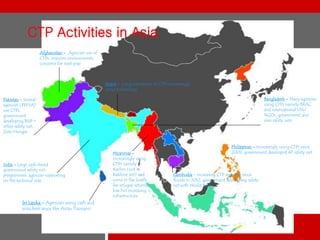
CTP Activities in Asia
Afghanistan – Agencies use of
CTPs, insecure environments,
concerns for next year

Nepal – Long experience of CTPs increasingly
using technology
Bangladesh – Many agencies
using CTPs namely BRAC
and international UN/
NGOs, government also
uses safety nets

Pakistan – Several
agencies (PEFSA)
use CTPs,
government
developing BISP +
other safety net,
Zero Hunger

India – Large cash-based
government safety net
programmes, agencies supporting
on the technical side

Sri Lanka – Agencies using cash and
vouchers since the Asian Tsunami

Myanmar –
Increasingly using
CTPs namely in
Kachin (not in
Rakhine yet) and
some in the South
for refugee returns,
low but increasing
infrastructure

Philippines – Increasingly using CTPs since
2009, government developed 4P safety net

Cambodia – Increasing CTP response since
floods in 2012, government developing safety
net with World Bank
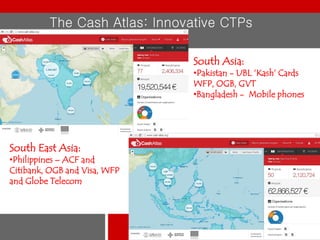
The Cash Atlas: Innovative CTPs
South Asia:

•Pakistan - UBL ‘Kash’ Cards
WFP, OGB, GVT
•Bangladesh - Mobile phones

South East Asia:

•Philippines – ACF and
Citibank, OGB and Visa, WFP
and Globe Telecom
CaLP in Asia
Other contexts (e.g. Bangladesh,
Indonesia, Sri Lanka, Cambodia and
learning from China and/ or India)

Myanmar

Afghanistan

Pakistan

Philippines

CaLP in Asia
– Regional
Hub in
Bangkok

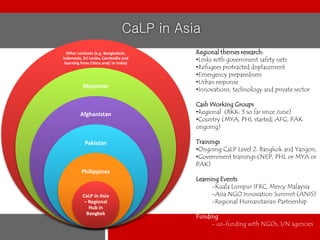
Regional themes research:
•Links with government safety nets
•Refugees protracted displacement
•Emergency preparedness
•Urban response
•Innovations, technology and private sector

Cash Working Groups
•Regional (BKK: 3 so far since June)
•Country (MYA, PHL started; AFG, PAK
ongoing)
Trainings
•Ongoing CaLP Level 2: Bangkok and Yangon,
•Government trainings:(NEP, PHL or MYA or
PAK)
Learning Events
-Kuala Lumpur IFRC, Mercy Malaysia
-Asia NGO Innovation Summit (ANIS)
-Regional Humanitarian Partnership
Funding
- co-funding with NGOs, UN agencies
Relevance of CTPs and New Technologies for
Social Innovation?
1.

‘CTPs is Fit for Purpose’ - CTP is indirectly ‘raising the bar’ in humanitarian assistance ensuring needs
are met in appropriate, effective, accountable ways.

2. ‘CTPs is Fit for the Region’ - CTP is cross-cutting and fit to issues of urban, emergency preparedness,
safety nets, innovations/ technology. Domestic governments increasingly take a stronger role in
response to crises, especially natural disasters, within their borders in this region. China and India
were home to a reported 78% of all people affected by disasters between 2002-11 and received little
international humanitarian assistance. CTP can enhance discussions w/ ASEAN, SAARC and SPC.
3. ‘CTPs is Fit for the Future’ – CTP promotes an increased discussion on coordination, engagement
with governments, multi-sectoral approaches, accountability to beneficiaries, cost-effectiveness of
humanitarian response and use of technology/ private sector/ innovative delivery mechanisms. The
UN’s Transformative Agenda was designed to improve leadership, coordination and accountability.
New technologies are being applied, not just talked about, in early warning, mapping and delivery.
Relevance of CTPs and New Technologies for
Social Innovation?
Relevance of CTPs and New Technologies for
Social Innovation?

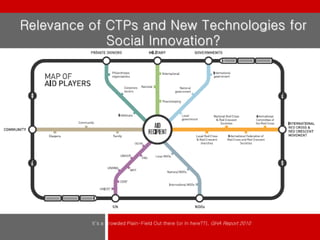
It’s a Crowded Plain-Field Out there (or In here??), GHA Report 2010

ANIS2013_Asia Seen through Technology Lens_Carla Lacerda

  • 1.
    Cash Transfer Programming: Asia'sShared Concern 4th Asia NGO Innovation Summit 10 October 2013
  • 2.
    Basic Definitions: 4W’sof CTPs WHAT? A tool for meeting programme objectives • 2 of 3 main modalities for delivering assistance Who? Anyone (Un, GVT, NGO, CBOs) responding to emergencies WHERE? CTPs can be used in emergency responses: • Used when market/ needs analyses show that cash-based approaches would be appropriate to meet needs → Won’t always be appropriate... (but neither will other modalities, preconditions are important) WHY? Humanitarian and Pragmatic reasons  To meet basic needs  To protect, establish or re-establish livelihoods  On their own, or in combination        Dignity, choice and flexibility Power transfer Link response to recovery Cost efficiency Multiplier effects Support to local trade Fewer costs for recipients
  • 3.
    trends to date,Where we Are now? • • • • Before 2005. Cash-based responses not a key feature of humanitarian programming, policy and debate. 2005-08. Research and debate on appropriateness of CTP increases substantially; ‘Case’ for CTP made via evaluations and guidelines. 2009–12. Agencies and donors improve ability to provide and support CTP. 2013 – onwards...? Spending on CTPs increased from US$46 mil in 2008 to US$117 mill in 2012, peaking with US$262 mil in 2010 (due to Haiti, Pakistan res) (Global Humanitarian Assistance Report 2013). Estimates: •Global figures – €215 mill, 14 mil beneficiaries, 411 projects •Asia figures – €83mill, 5 mil beneficiaries, 126 projects. (€ 14 mill 2010-13) •WFP alone (planned) Asia figures 2012-16 – US$155 mill, 4 mil beneficiaries Between 2007 and 2010, DG ECHO saw increase of 20% of number projects from NGOs including CTP component. ECHO removed the €100,000 ceiling. Routine consideration/use of CTP in emergencies remains far from norm (or at comparable scale to service provision/ in-kind distributions, e.g. CTP represents only 1-2% of overall global humanitarian assistance.
  • 4.
    Who is CaLP? • Partnership between Oxfam GB, the British Red Cross, Save the Children, the Norwegian Refugee Council and Action Against Hunger / ACF International. • 5 steering committee organisations came together to support capacity building, research and information-sharing on cash transfer programming as an effective tool to help deliver aid in times of crisis.
  • 5.
    Rationale for CaLP Thereis a growing recognition in the humanitarian sector that in an emergency, cash transfers and vouchers can be appropriate and effective tools to support populations affected by disasters in a way that maintains dignity and choice for beneficiaries while stimulating local economies and markets. CaLP’s objective is that “CTP is routinely considered as an appropriate emergency response option and, where implemented, is done so, in a high quality and timely manner and, when relevant, at scale”
  • 6.
    Growing Awareness, increasingEvidence, Ongoing Learning
  • 7.
    CaLP’s activities Capacity building Inpartnership with + Community of practice Research Advocacy, info sharing, coordination
  • 8.
    Where we work NorwegianRefugee Council Oxfam GB British Red Cross Save the Children Action Against Hunger Dakar: West Africa Bangkok:Asia Nairobi: East Africa Regional Focal Point (RFP) Steering Committee member
  • 9.
    “Social Innovation MeetsTechnology: Scale-up Impacts, Enrich People’s Lives” Q: How does technology contribute to scale up social innovation and solve complex social challenges? How does technology connect people and bring impact to people lives? A: Technology is a means to an end. During emergencies, technology has the power to connect people to communicate where they are, if they are well/ in danger and transmit messages as well as send cash and assistance. Q: What are the best social innovation practices and its replication and sustainment strategies to expand social innovation and technology in Asia? A: NGO/ UN and private sector relationships (e.g. WFP and Globe Telecom, Oxfam/ CaLP and Visa, Telecommunication Sans Frontiere, WFP and Mastercard, Telenor in Myanmar). Also multi-sectorial responses! http://www.cashlearning.org/resources/video-library Q: What are the key challenges and opportunities for technology in social innovation? How can we create environment that fosters technology in social innovation? What are the enabling factors and support requirements? A: Challenges are network coverage/ systems failure during emergencies. TSF provide solutions and support. Emergency preparedness, contingency plans and established positive relationships with governments, regional bodies (ASEAN, SAARC etc) and private sector are key.
  • 10.
    2 0 0 9 Typhoon in the Ph i l i p p i n e s UN Photo/Evan Schneider - 1 2 F l o o d s i n P a k i s t a n UN Photo/Logan Abassi
  • 11.
    CTP Activities inAsia Afghanistan – Agencies use of CTPs, insecure environments, concerns for next year Nepal – Long experience of CTPs increasingly using technology Bangladesh – Many agencies using CTPs namely BRAC and international UN/ NGOs, government also uses safety nets Pakistan – Several agencies (PEFSA) use CTPs, government developing BISP + other safety net, Zero Hunger India – Large cash-based government safety net programmes, agencies supporting on the technical side Sri Lanka – Agencies using cash and vouchers since the Asian Tsunami Myanmar – Increasingly using CTPs namely in Kachin (not in Rakhine yet) and some in the South for refugee returns, low but increasing infrastructure Philippines – Increasingly using CTPs since 2009, government developed 4P safety net Cambodia – Increasing CTP response since floods in 2012, government developing safety net with World Bank
  • 12.
    The Cash Atlas:Innovative CTPs South Asia: •Pakistan - UBL ‘Kash’ Cards WFP, OGB, GVT •Bangladesh - Mobile phones South East Asia: •Philippines – ACF and Citibank, OGB and Visa, WFP and Globe Telecom
  • 13.
    CaLP in Asia Othercontexts (e.g. Bangladesh, Indonesia, Sri Lanka, Cambodia and learning from China and/ or India) Myanmar Afghanistan Pakistan Philippines CaLP in Asia – Regional Hub in Bangkok Regional themes research: •Links with government safety nets •Refugees protracted displacement •Emergency preparedness •Urban response •Innovations, technology and private sector Cash Working Groups •Regional (BKK: 3 so far since June) •Country (MYA, PHL started; AFG, PAK ongoing) Trainings •Ongoing CaLP Level 2: Bangkok and Yangon, •Government trainings:(NEP, PHL or MYA or PAK) Learning Events -Kuala Lumpur IFRC, Mercy Malaysia -Asia NGO Innovation Summit (ANIS) -Regional Humanitarian Partnership Funding - co-funding with NGOs, UN agencies
  • 14.
    Relevance of CTPsand New Technologies for Social Innovation? 1. ‘CTPs is Fit for Purpose’ - CTP is indirectly ‘raising the bar’ in humanitarian assistance ensuring needs are met in appropriate, effective, accountable ways. 2. ‘CTPs is Fit for the Region’ - CTP is cross-cutting and fit to issues of urban, emergency preparedness, safety nets, innovations/ technology. Domestic governments increasingly take a stronger role in response to crises, especially natural disasters, within their borders in this region. China and India were home to a reported 78% of all people affected by disasters between 2002-11 and received little international humanitarian assistance. CTP can enhance discussions w/ ASEAN, SAARC and SPC. 3. ‘CTPs is Fit for the Future’ – CTP promotes an increased discussion on coordination, engagement with governments, multi-sectoral approaches, accountability to beneficiaries, cost-effectiveness of humanitarian response and use of technology/ private sector/ innovative delivery mechanisms. The UN’s Transformative Agenda was designed to improve leadership, coordination and accountability. New technologies are being applied, not just talked about, in early warning, mapping and delivery.
  • 15.
    Relevance of CTPsand New Technologies for Social Innovation?
  • 16.
    Relevance of CTPsand New Technologies for Social Innovation? It’s a Crowded Plain-Field Out there (or In here??), GHA Report 2010