Nathalie Lupercio
 March 14, 2013
   3. Living organisms depend on one another and on their
    environment for survival. As a basis for understanding this concept:
     • A. Students know ecosystems can be characterized by their living and
       nonliving components.
     • B.Students know that in any particular environment, some kinds of plants
       and animals survive well, some survive less well, and some cannot
       survive at all
     • C. Students know many plants depend on animals for pollination and
       seed dispersal, and animals depend on plants for food and shelter
     • D. Students know that most microorganisms do not cause disease and
       that many are beneficial.
 1. How to use a map
 and other geographic
 representations, tools
  and technologies to
 acquire, process and
   report information.
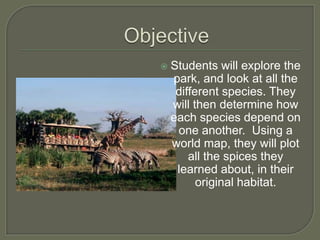
   Students will explore the
    park, and look at all the
     different species. They
    will then determine how
    each species depend on
     one another. Using a
    world map, they will plot
        all the spices they
     learned about, in their
          original habitat.
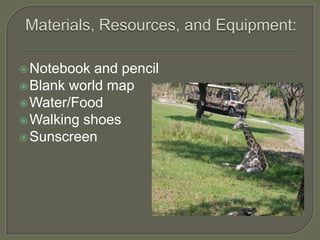
 Notebook  and pencil
 Blank world map
 Water/Food
 Walking shoes
 Sunscreen
 Explanation   of our
  Science Standard.
 Ask them different
  questions on animals
  and plants.
 Explain what a species
  is, and that plant,
  animals, and even
  humans depend on one
  another to survive.
 Split the class into small groups of 4-5 students.
 Students will go on attractions or exhibits that
  showcase animals, bugs, plants, or other types
  of species throughout the park.
 Students need to write down the species, where
  in the world it is found, and if it depends on
  another species to survive, or does another
  species depend on it.
 At the end, students will put all the species found
  on a blank world map in their natural habitat.
  They will color coordinate the species depending
  on who needs who to survive.
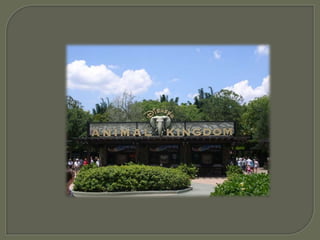
Animal kingdom

Animal kingdom

  • 1.
  • 2.
    3. Living organisms depend on one another and on their environment for survival. As a basis for understanding this concept: • A. Students know ecosystems can be characterized by their living and nonliving components. • B.Students know that in any particular environment, some kinds of plants and animals survive well, some survive less well, and some cannot survive at all • C. Students know many plants depend on animals for pollination and seed dispersal, and animals depend on plants for food and shelter • D. Students know that most microorganisms do not cause disease and that many are beneficial.
  • 3.
     1. Howto use a map and other geographic representations, tools and technologies to acquire, process and report information.
  • 4.
    Students will explore the park, and look at all the different species. They will then determine how each species depend on one another. Using a world map, they will plot all the spices they learned about, in their original habitat.
  • 5.
     Notebook and pencil  Blank world map  Water/Food  Walking shoes  Sunscreen
  • 6.
     Explanation of our Science Standard.  Ask them different questions on animals and plants.  Explain what a species is, and that plant, animals, and even humans depend on one another to survive.
  • 7.
     Split theclass into small groups of 4-5 students.  Students will go on attractions or exhibits that showcase animals, bugs, plants, or other types of species throughout the park.  Students need to write down the species, where in the world it is found, and if it depends on another species to survive, or does another species depend on it.  At the end, students will put all the species found on a blank world map in their natural habitat. They will color coordinate the species depending on who needs who to survive.