Haley Meadows4th hour white. Discovering Angels
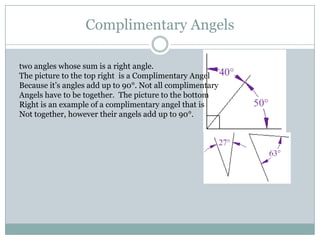
Complimentary Angelstwo angles whose sum is a right angle.The picture to the top right  is a Complimentary Angel Because it’s angles add up to 90°. Not all complimentaryAngels have to be together.  The picture to the bottom Right is an example of a complimentary angel that is Not together, however their angels add up to 90°.
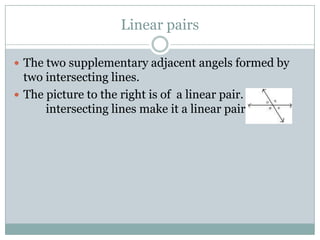
Linear pairsThe two supplementary adjacent angels formed by two intersecting lines.The picture to the right is of  a linear pair. The 	intersecting lines make it a linear pair.
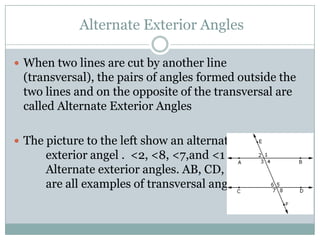
 Alternate Exterior AnglesWhen two lines are cut by another line (transversal), the pairs of angles formed outside the two lines and on the opposite of the transversal are called Alternate Exterior AnglesThe picture to the left show an alternate 		exterior angel .  <2, <8, <7,and <1 are all			Alternate exterior angles. AB, CD, and EF 		are all examples of transversal angels.
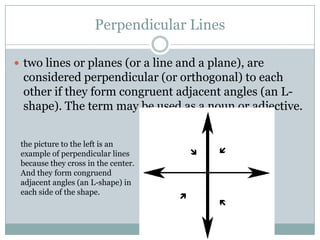
Perpendicular Linestwo lines or planes (or a line and a plane), are considered perpendicular (or orthogonal) to each other if they form congruent adjacent angles (an L-shape). The term may be used as a noun or adjective. the picture to the left is an example of perpendicular lines because they cross in the center. And they form congruend adjacent angles (an L-shape) in each side of the shape.
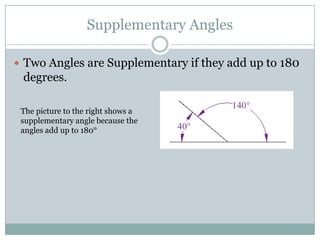
Supplementary AnglesTwo Angles are Supplementary if they add up to 180 degrees.The picture to the right shows a supplementary angle because the angles add up to 180°
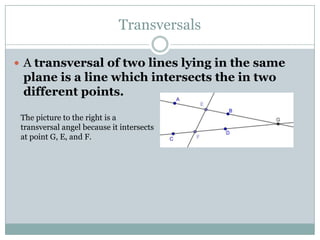
TransversalsA transversal of two lines lying in the same plane is a line which intersects the in two different points. The picture to the right is a transversal angel because it intersects at point G, E, and F.
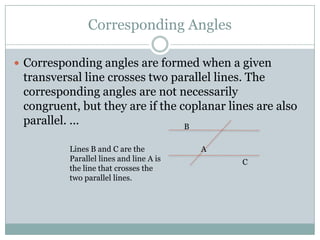
Corresponding AnglesCorresponding angles are formed when a given transversal line crosses two parallel lines. The corresponding angles are not necessarily congruent, but they are if the coplanar lines are also parallel. ...BLines B and C are the Parallel lines and line A is the line that crosses the two parallel lines.AC
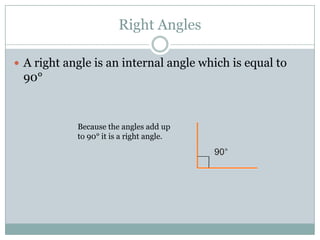
Right AnglesA right angle is an internal angle which is equal to 90°Because the angles add up to 90° it is a right angle.
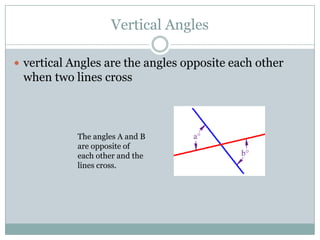
Vertical Anglesvertical Angles are the angles opposite each other when two lines crossThe angles A and B are opposite of each other and the lines cross.
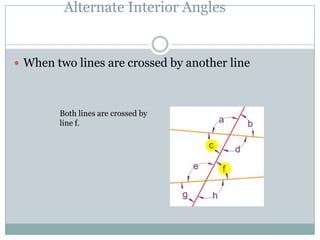
Alternate Interior Angles	When two lines are crossed by another line Both lines are crossed by line f.
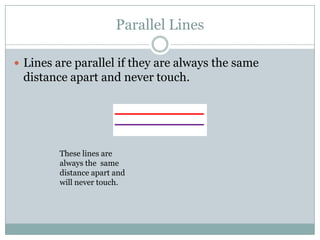
Parallel LinesLines are parallel if they are always the same distance apart and never touch.These lines are always the  same distance apart and will never touch.
Citation http://www.mathsisfun.com/geometry/complementary-angles.htmlhttp://www.allwords.com/word-linear+pair.htmlhttp://www.icoachmath.com/SiteMap/AlternateExteriorAngles.htmlhttp://www.proofwiki.org/wiki/Definition:Transversal_(Geometry)http://www.google.com/search?hl=en&safe=active&client=safari&rls=en&defl=en&q=define:Corresponding+angles&sa=X&ei=ZYNZTaiWIYGBlAfpnfShBw&ved=0CBMQkAEhttp://www.mathsisfun.com/rightangle.htmlhttp://www.mathsisfun.com/geometry/vertical-angles.htmlhttp://www.mathsisfun.com/geometry/alternate-interior-angles.htmlhttp://www.mathsisfun.com/geometry/parallel-lines.html

Angles