angles
What is an angle
 A shape, formed by two lines
or rays diverging from a
common point (the vertex).
Types of angles
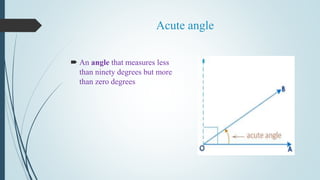
Acute angle
 An angle that measures less
than ninety degrees but more
than zero degrees
Right angle
 An angle of 90°, as in a corner
of a square, or formed by
dividing a circle into quarters.
Obtuse angle
 An angle that measures more
than 90 degrees but less than
180 degrees
Straight angle
 Two lines that form a right
angle are said to be normal,
orthogonal, or perpendicular.
Angles larger than a right
angle and smaller than a
straight angle (between 90°
and 180°) are called obtuse
angles ("obtuse" meaning
"blunt").
Reflex angle
 The reflex angle is the
larger angle. It is more than
180° but less than 360° If you
choose the smaller angle you
might have an Acute Angle, or
an Obtuse Angle instead: The
larger angle is a Reflex Angle,
but the smaller angle is an
Acute Angle.
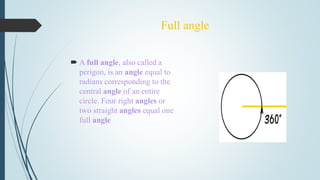
Full angle
 A full angle, also called a
perigon, is an angle equal to
radians corresponding to the
central angle of an entire
circle. Four right angles or
two straight angles equal one
full angle
Parts of an angle
Vertex
The column point where
two rays meet.
Arms
The rays that make angle.
Degrees
 The measure of the size of an
angles.
Naming angles
Naming angles
 One way is to use the < symbol followed by three letters.
Naming angles example
 = <ABC or <CBA
Quiz time
Which angle is equal to exactly 90 degrees
a) Right angle
b) Acute angle
c) Obtuse angle
d) Reflex angle
Answer: A
Which angle is less than 360 but greater than
180
a. Obtuse angle
b. Full rotation
c. Reflex angle
d. Straight angle
Answer: C
How many arms an angle has
a. One
b. Two
c. Three
d. Four
Answer: B
How many vertex do an angle has
a) One
b) Two
c) Three
d) four
Answer: A
Angles

Angles