Essentials of
Equipment in Anaesthesia,
Critical Care, and
Peri-Operative Medicine
FIFTH EDITION
This page intentionally left blank
FIFTH EDITION
Essentials of
Equipment in Anaesthesia,
Critical Care and
Peri-Operative Medicine
Baha Al-Shaikh FCARCSI FRCA
Consultant in Anaesthesia, Benenden Hospital, Kent;
Visiting Professor, Canterbury Christ Church University, UK
Simon G. Stacey FRCA FFICM
Consultant Anaesthetist & Intensivist, Bart’s Heart Centre,
Bart’s Health NHS Trust, London, UK
For additional online content visit ExpertConsult.com
© 2019, Elsevier Limited. All rights reserved.
First edition 1995
Second edition 2002
Third edition 2007
Fourth edition 2013
The right of Baha Al-Shaikh and Simon G. Stacey to be identified as authors of this work has been
asserted by them in accordance with the Copyright, Designs and Patents Act 1988.
No part of this publication may be reproduced or transmitted in any form or by any means, electronic
or mechanical, including photocopying, recording, or any information storage and retrieval system,
without permission in writing from the publisher. Details on how to seek permission, further
information about the Publisher’s permissions policies and our arrangements with organizations such
as the Copyright Clearance Center and the Copyright Licensing Agency, can be found at our website:
www.elsevier.com/permissions.
This book and the individual contributions contained in it are protected under copyright by the
Publisher (other than as may be noted herein).
ISBN: 978-0-7020-7195-9
Printed in China
Last digit is the print number: 9 8 7 6 5 4 3 2 1
Content Strategists: Jeremy Bowes, Laurence Hunter
Content Development Specialist: Fiona Conn
Project Manager: Joanna Souch
Design: Christian Bilbow
Cover image: MCC Design
Illustration Manager: Karen Giacomucci
Marketing Manager: Deborah Watkins
Notices
Practitioners and researchers must always rely on their own experience and knowledge in evaluating
and using any information, methods, compounds or experiments described herein. Because of rapid
advances in the medical sciences, in particular, independent verification of diagnoses and drug dosages
should be made. To the fullest extent of the law, no responsibility is assumed by Elsevier, authors, editors
or contributors for any injury and/or damage to persons or property as a matter of products liability,
negligence or otherwise, or from any use or operation of any methods, products, instructions, or ideas
contained in the material herein.
Preface ix
Acknowledgements xi
Chapter 1
MEDICAL GAS SUPPLY 1
Gas supply 2
Cylinders 2
Cylinder valves 4
Piped gas supply 7
Sources of gas supply 9
Oxygen concentrators 11
Entonox 12
Compressed air 13
Centralized vacuum or suction system 13
Chapter 2
THE ANAESTHETIC MACHINE 21
Pressure gauge 23
Pressure regulator (reducing valve) 23
Second-stage regulators and flow restrictors 24
One-way valve or backflow check valves 25
Flow control (needle) valves 25
Flowmeters 25
Vaporizers 27
Vaporizer filling devices 30
Non-return pressure relief safety valve 31
Emergency oxygen flush 31
Compressed oxygen outlet(s) 32
Oxygen supply failure alarm 32
Common gas outlet 33
Other modifications and designs 33
Anaesthesia in remote areas 35
Chapter 3
POLLUTION IN THEATRE AND SCAVENGING 43
Scavenging 45
Passive system 45
Active system 46
Charcoal canisters (Cardiff Aldasorber) 47
Chapter 4
BREATHING SYSTEMS 53
Properties of the ideal breathing system 54
Components of the breathing systems 54
Mapleson classification 56
Magill system (Mapleson A) 56
Lack system (Mapleson A) 57
Mapleson B and C systems 58
Bain system (Mapleson D) 58
T-piece system (Mapleson E and F) 60
The Humphrey ADE breathing system 61
The circle breathing system and soda lime 62
Use of vaporizers in the circle breathing system 64
Waters canister (‘to-and-fro’) bidirectional flow
breathing system 65
Chapter 5
TRACHEAL TUBES, TRACHEOSTOMY TUBES AND
AIRWAYS 73
Tracheal tubes 74
Specially designed tracheal tubes 77
Tracheostomy tracheal tubes 80
Minitracheostomy tube 83
Cricothyrotomy tube 84
Double lumen endobronchial tubes 84
Endobronchial blocker 86
Oropharyngeal airways 86
Nasopharyngeal airway 87
Supraglottic airway devices 88
Laryngeal mask airway 89
The intubating laryngeal mask airway (ILMA) 90
i-gel airway 91
AuraGain airway 92
COBRA perilaryngeal airway (PLA) 92
Chapter 6
MASKS AND OXYGEN DELIVERY DEVICES 99
Face masks and angle pieces 100
Nasal masks (inhalers) 100
Contents
vi Contents
Catheter mount 101
Oxygen delivery devices 101
Variable performance masks (medium
concentration; MC) 101
Nasal cannulae 103
Nasal catheters 104
Open oxygen delivery systems 104
Fixed performance devices 104
Humidified high-flow nasal oxygenation 106
Chapter 7
LARYNGOSCOPES AND TRACHEAL INTUBATION
EQUIPMENT 113
Laryngoscopes 114
Fibreoptic intubating laryngoscope 116
Videolaryngoscopes (rigid indirect laryngoscopes) 117
Magill forceps 117
Introducer, bougie, bite guard, local anaesthetic
spray, Endotrol tube and Nosworthy airway 118
Retrograde intubation set 119
Chapter 8
VENTILATORS 123
Classification of ventilators 124
Characteristics of the ideal ventilator 125
Manley MP3 ventilator 126
Penlon Anaesthesia Nuffield Ventilator Series 200 126
Bag in bottle ventilator 127
SERVO-U ventilator 128
High-frequency jet ventilator 130
VentiPAC 131
Pneupac VR1 Emergency Ventilator 132
Venturi injector device 132
Self-inflating bag and mask 133
PEEP valve 134
Chapter 9
HUMIDIFICATION AND FILTRATION 137
Heat and moisture exchanger (HME) humidifiers 138
Hot water bath humidifier 139
Nebulizers 140
Bacterial and viral filters 141
Chapter 10
NON-INVASIVE MONITORING 147
Integrated monitoring 148
Electrocardiogram (ECG) 149
Arterial blood pressure 151
Pulse oximetry 153
End-tidal carbon dioxide analysers (capnographs) 155
Oxygen concentration analysers 159
Nitrous oxide and inhalational agent concentration
analysers 161
Wright respirometer 163
Pneumotachograph 164
Combined pneumotachograph and Pitot tube 165
Ventilator alarms 166
Peripheral nerve stimulators and neuromuscular
blockade monitoring 167
Bispectral index (BIS) analysis 169
Entropy of the EEG 171
Chapter 11
INVASIVE MONITORING 179
Invasive arterial pressure monitoring 180
Central venous catheterization and pressure 183
Invasive electrocardiogram (ECG) 187
Cardiac output 188
Balloon-tipped flow-guided PA catheter 188
Oesophageal Doppler haemodynamic
measurement 191
LiDCOrapid 192
Masimo 193
Temperature probes 194
Chapter 12
PUMPS, PAIN MANAGEMENT AND REGIONAL
ANAESTHESIA 201
Patient-controlled analgesia (PCA) 202
Elastomeric pumps 204
Epidural needles 204
Epidural catheter, filter and loss of resistance
device 206
Spinal needles 207
Nerve block needles 209
Percutaneous localization of nerves 211
Nerve stimulator for nerve blocks 211
Ultrasound guidance in regional anaesthesia 212
Chapter 13
ADDITIONAL EQUIPMENT USED IN ANAESTHESIA
AND INTENSIVE CARE 217
Continuous positive airway pressure (CPAP) 218
Haemofiltration 218
Arterial blood gas analyser 220
Polarographic (Clark) oxygen electrode 221
pH electrode 222
Carbon dioxide electrode (Severinghaus electrode) 223
Intra-aortic balloon pump (IABP) 223
Intravenous giving sets 225
Intravenous cannulae 226
Blood warmers 227
vii
Contents
Forced-air warmers 227
Defibrillator 228
Chest drain 230
The ultrasound machine 231
Chapter 14
POINT-OF-CARE TESTING 237
Introduction 238
HemoCue 238
Hemochron Junior 238
Original TEG/ROTEM 239
Chapter 15
ELECTRICAL SAFETY 245
Principles of electricity 246
Identification of medical electrical equipment 247
Maintenance of equipment 250
Hazards of electrical shock 250
Diathermy 251
Static electricity 252
Lasers 252
Appendix A
SAFETY AND STANDARDS 257
Appendix B
GRAPHICAL SYMBOLS FOR USE IN LABELLING
MEDICAL DEVICES 259
Appendix C
DECONTAMINATION OF MEDICAL EQUIPMENT 261
CLEAN, DISINFECT OR STERILIZE INSTRUMENTS? 261
Appendix D
DIRECTORY OF MANUFACTURERS 265
GLOSSARY 269
INDEX 273
This page intentionally left blank
The new fifth edition hopefully makes a dry subject simple
enough to understand and is structured to aid revision for
the exam syllabus.
The text and illustrations have been updated and have
become ever more exam-focused: exam tips and new
questions are valuable additions. In this edition, we have
added a new chapter which starts to address the new and
ever-expanding field of ‘point-of-care testing’ in anaesthesia
and intensive care. The new edition also includes access to
the complete electronic text and over 100 interactive self-
assessment OSCE questions based on the book, available
via http://www.expertconsult.com.
We have tried not to increase the number of pages through
careful editing and the wider use of website addresses
where possible.
We hope this book will continue to be the equipment
book of choice for both the trainees sitting FRCA exams
and our Nursing and Operating Department Practitioner
colleagues.
Simplicity, Structure, Syllabus.
BA-S
SGS
Preface
This page intentionally left blank
We are extremely grateful to our anaesthetic trainees
Sindy Lee and Delme Luff for their help and contribution
in writing the Objective Structured Clinical Examination
(OSCE) questions and Andrew Feneley for his
contribution to the Multiple Choice Questions and the
Single Best Answer questions.
We are also very grateful to the many manufacturers
and others who have supplied the necessary
information and images for this edition. Without their
help, this fifth edition could not have gone ahead in its
current format.
Special mention goes to Jenny Reay of Teleflex Medical
UK for her determined support and James Craig of MCC
Design for his unflagging help with the cover of the book.
Below is a list of the people and their companies who
helped us by providing images during the preparation of
the book.
Muhammad Ashfaque (Consultant Anaesthetist)
Sean Duggan (Intersurgical)
Heidi Hughes (Philips Healthcare)
Alexandra Marheineke (Ambu UK)
Hannah Mulligan (BOC Healthcare)
Ross Munro (Pentland Medical)
Stewart Munro (Pentland Medical)
Alexander Perkins (Philips Healthcare)
Susanne Sigtryggsson (Philips Healthcare)
BA-S
SGS
Acknowledgements
This page intentionally left blank
Medical gas supply
Chapter 1
1
2 Medical gas supply
Gas supply
Medical gas supply takes the form of either cylinders or
a piped gas system, depending on the requirements of the
hospital.
Cylinders
Components
1. Cylinders are made of thin-walled seamless
molybdenum steel in which gases and vapours are
stored under pressure. They are designed to withstand
considerable internal pressure.
2. The top end of the cylinder is called the neck, and this
ends in a tapered screw thread into which the valve is
fitted. The thread is sealed with a material that melts if
the cylinder is exposed to intense heat. This allows the
gas to escape so reducing the risk of an explosion.
3. There is a plastic disc around the neck of the cylinder.
The year when the cylinder was last examined and
tested can be identified from the shape and colour of
the disc.
4. Cylinders are manufactured in different sizes (sizes A–J).
Sizes A and H are not used for medical gases. Cylinders
attached to the anaesthetic machine are usually size E
(Figs 1.1–1.4), while size J cylinders are commonly used
for cylinder manifolds. Size E oxygen cylinders contain
680L, whereas size E nitrous oxide cylinders can release
1800L. The smallest sized cylinder, size C, can hold
1.2L of water, and size E can hold 4.7L while the larger
size J can hold 47.2L of water.
5. Lightweight cylinders can be made from aluminium
alloy with a fibreglass covering in an epoxy resin
matrix. These can be used to provide oxygen at home,
during transport or in magnetic resonance scanners.
They have a flat base for easy storage and handling.
Fig. 1.1 Nitrous oxide cylinder (size E) with its wrapping and labels.
Fig. 1.2 Oxygen cylinder valve and pin index.
Fig. 1.3 Nitrous oxide cylinder valve and pin index.
• Gas exits in the gaseous state at room temperature. Its
liquefaction at room temperature is impossible, since the
room temperature is above its critical temperature.
• Vapour is the gaseous state of a substance below
its critical temperature. At room temperature and
atmospheric pressure, the substance is liquid.
• Critical temperature is the temperature above which
a substance cannot be liquefied no matter how much
pressure is applied. The critical temperatures for nitrous
oxide and oxygen are 36.5°C and −118°C, respectively.
3
Cylinders
At room temperature, oxygen is stored as a gas at a
pressure of 13700kPa (above its critical temperature)
whereas nitrous oxide is stored in a liquid phase with
its vapour at equilibrium at a pressure of 4400kPa (and
usually below its critical temperature). As the liquid is less
compressible than the gas, this means that the cylinder
should only be partially filled. The amount of filling
is called the filling ratio. Partially filling the cylinders
with liquid minimizes the risk of dangerous increases in
pressure due to increased vaporization of the liquid with
increases in the ambient temperature. This scenario could
lead to an explosion. In the UK, the filling ratio for nitrous
oxide and carbon dioxide is 0.75. In hotter climates, the
filling ratio is reduced to 0.67.
A full oxygen cylinder at atmospheric pressure can
deliver 130 times its capacity of oxygen. A typical size
E full oxygen cylinder delivering 4L/min will last for 2
hours and 50 minutes but will last only 45 minutes when
delivering 15L/min.
At constant temperature, a gas-containing cylinder,
e.g. oxygen, shows a linear and proportional reduction in
cylinder pressure as it empties, obeying Boyle’s law (first
gas law). For a cylinder that contains liquid and vapour,
e.g. nitrous oxide, initially the pressure remains constant
as more vapour is produced to replace that which was
used. Once all the liquid has been used, the pressure in
the cylinder starts to decreases. The temperature in such
a cylinder can decrease because of the loss of the latent
heat of vaporization leading to the formation of ice on the
outside of the cylinder.
Fig. 1.4 Carbon dioxide cylinder valve and pin index.
The filling ratio is the weight of the fluid in the cylinder
divided by the weight of water required to fill the cylinder.
However, it is important to remember that a filling ratio
of 0.75 in not exactly the same as the cylinder being
75% filled. This is due to the differences in the physical
properties of the contents, such as its density, and water
content.
Exam tip: In the exam, make sure you know the
difference between gas and vapour. This difference
causes the pressure changes in an oxygen cylinder
compared to a nitrous oxide cylinder when used.
Cylinders in use are checked and tested by manufacturers
at regular intervals, every 5–10 years. Test details are
recorded on the plastic disc between the valve and the neck
of the cylinder. They are also engraved on the cylinder:
1. An internal endoscopic examination is carried out.
2. Flattening, bend and impact tests are carried out on at
least one cylinder in every 100.
3. A pressure test is conducted, whereby the cylinder is
subjected to high pressures of about 22000 kPa, which
is more than 50% above their normal working pressure.
4. A tensile test is carried out on at least one cylinder in
every 100, whereby strips of the cylinder are cut out and
subjected to impact, stretching, flattening and other
tests of strength.
The marks engraved on the cylinders are:
1. Test pressure.
2. Dates of test performed.
3. Chemical formula of the cylinder’s content.
4. Tare weight (weight of nitrous oxide cylinder when
empty).
Labelling
The cylinder label includes the following details:
• Name, chemical symbol, pharmaceutical form,
specification of the product, its licence number and the
proportion of the constituent gases in a gas mixture.
• Substance identification number and batch number.
• Hazard warnings and safety instructions.
• Cylinder size code.
• Nominal cylinder volume (litres).
• Maximum cylinder pressure (bars).
• Filling date, shelf life and expiry date.
• Directions for use.
• Storage and handling precautions.
1
4 Medical gas supply
Problems in practice and safety features
1. The gases and vapours should be free of water vapour
when stored in cylinders. Water vapour freezes and
blocks the exit port when the temperature of the
cylinder decreases on opening.
2. The outlet valve uses the pin-index system to make it
almost impossible to connect a cylinder to the wrong
yoke (Fig. 1.5).
3. Cylinders are colour-coded to reduce accidental use of
the wrong gas or vapour. In the UK, the colour-coding
is a two-part colour, shoulder and body (Table 1.1).
The Medicine and Healthcare Products Regulatory
Agency (MHRA) in the UK has decided to bring the
UK in line with the European Standard EN 1089-3 to
aid cylinder identification and improve patient safety.
All cylinders will have a white body but each gas/
vapour will retain its current shoulder colour. It is
hoped that these changes will take full effect by 2025.
Already some oxygen and Entonox (BOC Healthcare,
Manchester, UK) cylinders in the UK have started
using the new scheme.
4. Cylinders should be checked regularly while in use to
ensure that they have sufficient content and that leaks
do not occur.
5. Cylinders should be stored in a purpose built, dry,
well-ventilated and fireproof room, preferably inside
and not subjected to extremes of heat. They should
not be stored near flammable materials such as oil or
grease or near any source of heat. They should not be
exposed to continuous dampness, corrosive chemicals
or fumes. This can lead to corrosion of cylinders and
their valves.
6. To avoid accidents, full cylinders should be stored
separately from empty ones. Size F, G and J cylinders
are stored upright to avoid damage to the valves. Size
C, D and E cylinders can be stored horizontally on
shelves made of a material that does not damage the
surface of the cylinders.
7. Overpressurized cylinders are hazardous and should be
reported to the manufacturer.
Cylinder valves
These valves seal the cylinder contents. The chemical formula
of the particular gas is engraved on the valve (Fig. 1.6). Other
types of valves, the bull nose, the hand wheel and the star, are
used under special circumstances (Fig. 1.7).
Components
1. The valve is mounted on the top of the cylinder,
screwed into the neck via a threaded connection. It is
made of brass and is sometimes chromium plated.
2. An on/off spindle is used to open and close the
valve by opposing a plastic facing against the valve
seating.
3. The exit port is for supplying gas to the apparatus (e.g.
anaesthetic machine).
4. A safety relief device allows the discharge of cylinder
contents to the atmosphere if the cylinder becomes
overpressurized.
5. The non-interchangeable safety system (pin-index
system) is used on cylinders of size E or smaller as
well as on size F and G Entonox cylinders. A specific
pin configuration exists for each medical gas on
the yoke of the anaesthetic machine. The matching
configuration of holes on the valve block allows
Fig. 1.5 Anaesthetic machine cylinder yokes. For the sake of
comparison, the Bodok seal is absent from the nitrous oxide yoke (left).
Cylinders
• Cylinders are made of thin-walled molybdenum steel to
withstand high pressures, e.g. 13700kPa and 4400kPa
for oxygen and nitrous oxide, respectively. Lightweight
aluminium is also available.
• They are made in different sizes: size E cylinders are used
on the anaesthetic machine; size J cylinders are used in
cylinder banks.
• Oxygen cylinders contain gas whereas nitrous oxide
cylinders contain a mixture of liquid and vapour. In the
UK, nitrous oxide cylinders are 75% filled with liquid
nitrous oxide (filling ratio); in hotter climates they are
67% filled.
• At a constant temperature, the pressure in a gas cylinder
decreases linearly and proportionally as it empties. This
is not true in cylinders containing liquid/vapour.
• They are colour-coded (shoulder and body). A new
colour system is being introduced with white bodies but
different coloured shoulders.
5
Cylinder valves
only the correct gas cylinder to be fitted in the yoke
(Figs 1.8 and 1.9). The gas exit port will not seal
against the washer of the yoke unless the pins and
holes are aligned.
6. A more recent modification is where the external
part of the valve is designed to allow manual turning
on and off of the cylinder without the need for a key
(Fig. 1.10).
Mechanism of action
1. The cylinder valve acts as a mechanism for opening
and closing the gas pathway.
Shoulder
colour
Body colour
(current/old
system)
Body
colour (new
system)
Pressure at room
temperature
(kPa)
Physical
state in
cylinder
Oxygen White Black (green in USA) White 13700 Gas
Nitrous oxide Blue Blue White 4400 Liquid/
vapour
Carbon
dioxide
Grey Grey White 5000 Liquid/
vapour
Air White/black
quarters
Grey (yellow in USA) White 13700 Gas
Entonox White/blue
quarters
Blue White 13700 Gas
Oxygen/
helium (Heliox)
White/brown
quarters
Black White 13700 Gas
Old System
OXYGEN
NITROUS OXIDE
ENTONOX
50% N2O / 50% O2
HELIUM/OXYGEN MIXTURE
79% He / 21% O2
AIR
CARBON DIOXIDE
New System
Oxygen
ENTONOX
Heliox
Medical
Air
Nitrous
Oxide
Carbon
Dioxide
Table 1.1 Colour-coding of medical gas cylinders (old and new system), their pressure when full and their
physical state in cylinder
1
6 Medical gas supply
2. A compressible yoke-sealing washer (Bodok seal) must
be placed between valve outlet and the apparatus to
make a gas-tight joint (Fig. 1.11). It is a gasket made
of non-combustible material with a metal rim.
Problems in practice and safety features
1. The plastic wrapping of the valve should be removed
just before use. The valve should be slightly opened
and closed (cracked) before connecting the cylinder
to the anaesthetic machine. This clears particles of
dust, oil and grease from the exit port, which would
otherwise enter the anaesthetic machine.
2. The valve should be opened slowly when attached to
the anaesthetic machine or regulator. This prevents
a rapid rise in pressure and an associated rise in
temperature of the gas in the machine’s pipelines. The
cylinder valve should be fully open when in use (the
valve must be turned two full revolutions).
3. During closure, overtightening of the valve should
be avoided. This might lead to damage to the seal
between the valve and the cylinder neck.
4. The Bodok seal should be inspected for damage
prior to use. Having a spare seal readily available is
advisable. This bonded non-combustible seal must be
kept clean and should never become contaminated
with oil or grease. If a gas-tight seal cannot be
achieved by moderate tightening of the screw clamp,
it is recommended that the seal be renewed. Excessive
force should never be used.
Fig. 1.6 Chemical formula (N2O) engraved on a nitrous oxide
cylinder valve.
Handwheel
side outlet
Handwheel
valve
Integral
(valve and
regulator)
Pin-index
side-spindle
valve
Pin-index
valve
Bullnose
valve
Fig. 1.7 Cylinder valves.
Oxygen Nitrous
oxide
Air Entonox
Fig. 1.8 Pin-index system. Note the different configuration for
each gas.
Fig. 1.9 A cylinder yoke and pin-index system. Note that a Bodok
seal is in position.
7
Piped gas supply
Piped gas supply
Piped medical gas and vacuum (PMGV) is a system where
gases are delivered from central supply points to different sites
in the hospital at a pressure of about 400 kPa. Special outlet
valves supply the various needs throughout the hospital.
Oxygen, nitrous oxide, Entonox, compressed air and
medical vacuum are commonly supplied through the
pipeline system.
Components
1. Central supply points such as cylinder banks or liquid
oxygen storage tank.
2. Pipework made of special high-quality copper alloy,
which both prevents degradation of the gases it
contains and has bacteriostatic properties. The fittings
used are made from brass and are brazed rather than
soldered.
3. The size of the pipes differs according to the demand
that they carry. Pipes with a 42-mm diameter are
usually used for leaving the manifold. Smaller
diameter tubes, such as 15mm, are used after repeated
branching.
4. Outlets are identified by gas colour coding, gas name
and by shape (Fig. 1.12). They accept matching quick
connect/disconnect Schrader probes and sockets
(Fig. 1.13), with an indexing collar specific for each
gas (or gas mixture).
5. Outlets can be installed as flush-fitting units, surface-
fitting units, on booms or pendants, or suspended on a
hose and gang mounted (Fig. 1.14).
6. Flexible colour-coded hoses connect the outlets to
the anaesthetic machine (Fig. 1.15). The anaesthetic
Fig. 1.10 Recently designed cylinder valve which allows manual
opening and closing.
Cylinder valves
• They are mounted on the neck of the cylinder.
• Act as an on/off device for the discharge of cylinder
contents.
• Pin-index system prevents cylinder identification errors.
• Bodok sealing washer must be placed between the valve
and the yoke of the anaesthetic machine.
• A newly designed valve allows keyless manual turning
on and off.
Fig. 1.11 A Bodok seal.
Fig. 1.12 Inserting a remote probe into its matching wall-mounted
outlet socket.
Fig. 1.13 Gas probes for oxygen (top), nitrous oxide (middle)
and air (bottom). Note the locking groove on the probe to ensure
connectivity.
1
8 Medical gas supply
machine end should be permanently fixed using a nut
and liner union where the thread is gas specific and
non-interchangeable (a non-interchangeable screw
thread [NIST] is the British Standard).
7. Isolating valves behind break-glass covers are positioned
at strategic points throughout the pipeline network.
They are also known as area valve service units (AVSUs)
(Fig. 1.16). They can be accessed to isolate the supply to
an area in cases of fire or other emergency.
Problems in practice and safety features
1. A reserve bank of cylinders is available should the
primary supply fail. Low-pressure alarms detect gas
supply failure (Fig. 1.17).
2. A single-hose test is performed to detect
cross-connection.
3. A tug test is performed to detect misconnection.
4. Regulations for PMGV installation, repair and
modification are enforced.
5. Anaesthetists are responsible for the gases supplied
from the terminal outlet through to the anaesthetic
machine. Pharmacy, supplies and engineering
departments share the responsibility for the gas
pipelines ‘behind the wall’.
6. There is a risk of fire from worn or damaged hoses
that are designed to carry gases under pressure from
Fig. 1.14 Outlet sockets mounted in a retractable ceiling unit.
(Courtesy Penlon Ltd, Abingdon, UK [http://www.penlon.com].)
Fig. 1.15 Colour-coded hoses with NIST fittings attached to an
anaesthetic machine.
Fig. 1.16 An area valve service unit (AVSU).
Fig. 1.17 Medical gas alarm panel. (Courtesy Penlon Ltd,
Abingdon, UK [http://www.penlon.com].)
9
Sources of gas supply
a primary source such as a cylinder or wall-mounted
terminal to medical devices such as ventilators and
anaesthetic machines. Because of heavy wear and tear,
the risk of rupture is greatest in oxygen hoses used with
transport devices. Regular inspection and replacement,
every 2–5 years, of all medical gas hoses is recommended.
Sources of gas supply
The source of supply can be cylinder manifold(s) and, in
the case of oxygen, a liquid oxygen storage tank or oxygen
concentrator (Fig. 1.18).
CYLINDER MANIFOLD
Manifolds are used to supply nitrous oxide, Entonox and
oxygen.
Components
1. Large cylinders (e.g. size J each with 6800L capacity)
are usually divided into two equal groups, primary and
secondary. The two groups alternate in supplying the
pipelines (Fig. 1.19). The number of cylinders depends
on the expected demand; usually to supply a typical
day’s demand so allowing one group of cylinders to
change each day.
2. All cylinders in each group are connected through
non-return valves to a common pipe. This in turn is
connected to the pipeline through pressure regulators.
3. Pressure regulators reduce gas/vapour pressure to 400
kPa, the standard pipeline pressure.
4. As nitrous oxide is only available in cylinders (in
contrast to liquid oxygen), its manifold is larger than
that of oxygen. The latter usually acts as a back up to
the liquid oxygen supply (see later).
Mechanism of action
1. In either group, all the cylinders’ valves are opened.
This allows them to empty simultaneously.
2. The supply is automatically changed to the secondary
group when the primary group is nearly empty. The
changeover is achieved through a pressure-sensitive
device that detects when the cylinders are nearly empty.
3. The changeover activates an electrical signalling system
to alert staff to the need to change the cylinders.
Problems in practice and safety features
1. The manifold should be housed in a well-ventilated
room built of fireproof material away from the main
buildings of the hospital.
Piped gas supply
• There is a network of copper alloy pipelines throughout
the hospital from central supply points.
• The outlets are colour- and shape-coded to accept
matching ‘Schrader’ probes.
• Flexible and colour-coded pipelines run from the
anaesthetic machine to the outlets.
• Single-hose and tug tests are performed to test for
cross-connection and misconnection, respectively.
• There is a risk of fire from worn and damaged hoses.
Liquid oxygen
Fig. 1.18 Sources of oxygen supply in a hospital. A vacuum-insulated evaporator (left) and a cylinder manifold (right).
Fig. 1.19 An oxygen cylinder manifold.
1
10 Medical gas supply
2. The manifold room should not be used as a general
cylinder store.
3. All empty cylinders should be removed immediately
from the manifold room.
LIQUID OXYGEN
A vacuum-insulated evaporator (VIE) (Fig. 1.20) is the
most economical way to store and supply oxygen.
Components
1. A thermally insulated double-walled steel tank with a
layer of perlite in a vacuum is used as the insulation
(Fig. 1.21). It can be described as a giant thermos
flask, employing the same principles.
2. A pressure regulator allows gas to enter the hospital
pipelines and maintains the pressure through the
pipelines at about 400 kPa.
3. A safety valve opens at 1700kPa allowing the gas to
escape when there is a build-up of pressure within the
vessel. This can be caused by underdemand for oxygen.
4. An electronically controlled valve opens when there is
an excessive demand on the system. This allows liquid
oxygen to evaporate by passing through superheaters
made of uninsulated coils of copper tubing. The
‘superheaters’ are not actively heated but rely on
ambient temperature and heat from the air to warm
the liquid oxygen.
Mechanism of action
1. Liquid oxygen is stored (up to 1500L) at a temperature
of −150°C to −170°C (lower than its critical
temperature of −119°C) and at a pressure of 1000kPa.
2. The VIE is not actively cooled. Instead, the
temperature of the vessel is maintained by the high-
vacuum shell insulation so minimizing conduction
and convection of heat into the vessel. In addition,
evaporation of the liquid oxygen requires heat (latent
heat of vaporization). This heat is taken from the
liquid oxygen, helping to maintain its low temperature.
3. The storage vessel rests on a weighing balance to
measure the mass of the liquid using a tripod weighing
scale. As the VIE’s weight when empty (tare) is known,
the weight of the liquid oxygen can be calculated.
More recently, a differential pressure gauge which
measures the pressure difference between the bottom
and top of the liquid oxygen can be used instead. This
allows the height of the oxygen fluid column to be
calculated. As the cross-sectional area of the VIE is
constant, by measuring the difference in pressure, the
volume of liquid oxygen can be calculated. As liquid
oxygen evaporates, its mass decreases, reducing the
pressure at the bottom. By measuring the difference
in pressure, the contents of the VIE can be calculated.
Fig. 1.20 A vacuum-insulated evaporator (VIE).
Pressure regulator
To pipeline
Pressure-raising vaporizer
Safety valve
Vacuum
400 kPa
Superheater
Control valve
Temperature
approx. −160ºC
700 kPa
Fig. 1.21 Schematic diagram of a liquid oxygen supply system.
11
Oxygen concentrators
The information obtained is sent to the hospital alarm
system. When required, fresh supplies of liquid oxygen
are pumped from a tanker into the vessel.
4. The cold oxygen gas is warmed once outside the vessel
in a coil of copper tubing. The increase in temperature
causes an increase in pressure.
5. At a temperature of 15°C and atmospheric pressure,
liquid oxygen can give 842 times its volume as gas.
Problems in practice and safety features
1. Reserve banks of cylinders are kept in case of supply
failure.
2. A liquid oxygen storage vessel should be housed away
from main buildings due to the fire hazard. The risk of
fire is increased in cases of liquid spillage.
3. Spillage of cryogenic liquid can cause cold burns,
frostbite and hypothermia.
Oxygen concentrators
Oxygen concentrators, also known as pressure swing
adsorption systems, extract oxygen from air by differential
adsorption. These devices may be small, designed to
supply oxygen to a single patient (Fig. 1.22), supply
oxygen to an anaesthetic machine (Fig. 1.23) or they
can be large enough to supply oxygen for a medical gas
pipeline system (Fig. 1.24).
Components
A zeolite molecular sieve is used. Zeolites are hydrated
aluminium silicates of the alkaline earth metals in a
powder or granular form in a lattice structure. Many
zeolite columns are used.
Mechanism of action (Fig. 1.25)
1. Ambient air is filtered and pressurized to about
137kPa by a compressor.
2. Air is exposed to a zeolite molecular sieve column,
forming a very large surface area, at a certain pressure.
3. The sieve selectively retains nitrogen, water vapour
and other unwanted components of air. These are
released into the atmosphere after heating the column
and applying a vacuum.
4. The sequential changeover between the columns is
made by a time switch, typically cycles of around 20
seconds, allowing for a continuous supply of oxygen.
5. The maximum oxygen concentration achieved is 95%
by volume. Argon is the main remaining constituent
with a concentration of approximately 5%. Argon is
concentrated from air in a similar fashion to oxygen.
6. The life of the zeolite crystal can be expected to be at
least 20000hours (which is about 10 years of use).
Routine maintenance consists of changing filters at
regular intervals.
Problems in practice and safety features
Although the oxygen concentration achieved is sufficient
for the vast majority of clinical applications, its use with
the circle system leads to argon accumulation. To avoid
this, higher fresh gas flows are required.
Exam tip: For the exam, make sure you understand
how the VIE works. It is very important to memorize
the relevant temperatures and pressures of liquid and
gaseous oxygen.
You also need to be able to explain what happens
when there is an overdemand or an underdemand for
the oxygen supply.
Fig. 1.22 The portable Eclipse 3 home oxygen concentrator. (Courtesy
Chart BioMedical Ltd, Wokingham, UK [www.sequal.com].)
Source of supply
• Cylinder manifold: banks of large cylinders, usually size
J, are used.
• Liquid oxygen: a thermally insulated vessel at a
temperature of −150°C to −170°C and at a pressure of
500–1000kPa is used.
• Oxygen concentrator: a zeolite molecular sieve is used.
1
12 Medical gas supply
Entonox
This is a compressed gas mixture containing 50% oxygen
and 50% nitrous oxide by volume. It is commonly
used in the A&E and labour ward and pre-hospital
care settings to provide analgesia. A two-stage pressure
demand regulator is attached to the Entonox cylinder
when in use (Fig. 1.26). As the patient inspires through
the mask or mouth piece, gas flow is allowed to occur.
Gas flow ceases at the end of an inspiratory effort.
Entonox is compressed into cylinders to a pressure of
13700 kPa. Entonox cylinders should be stored at 10°C
for 24 hours before use.
If the temperature of the Entonox cylinder is decreased
to below −5.5°C, liquefaction and separation of the two
components occur (Poynting effect). This results in:
• a liquid mixture containing mostly nitrous oxide with
about 20% oxygen dissolved in it
• above the liquid, a gas mixture of high oxygen
concentration.
This means that when used at a constant flow rate,
a gas with a high concentration of oxygen is supplied
first. This is followed by a gas of decreasing oxygen
concentration as the liquid evaporates. This may lead
to the supply of hypoxic mixtures, with less than 20%
oxygen, as the cylinder is nearly empty.
Rewarming and mixing of both the cylinder and its
contents reverses the separation and liquefaction.
Fig. 1.24 The RA40/D/M hospital oxygen concentrator. It produces
80L/min of oxygen. (Courtesy Rimer Alco Ltd, Thetford, UK
[www.i4innovation.co.uk].)
95% Oxygen
Tank
Zeolite towers
Nitrogen vent
Switch valve
Compressor
Room air
21% oxygen
To anaesthetic machine
and patient
Fig. 1.25 Mechanism of action of a concentrator.
Fig. 1.23 The universal anaesthetic machine (UAM) which has a
built-in oxygen concentrator (see Ch. 2 for more details). (Courtesy
Gradian Health Systems, New York, NY, USA [www.uamglobal.org].)
13
Problems in practice and safety features
Liquefaction and separation of the components can be
prevented by:
1. Cylinders being stored horizontally for about 24
hours at temperatures of or above 5°C before
use. The horizontal position increases the area for
diffusion. If the contents are well mixed by repeated
inversion, cylinders can be used earlier than 24 hours.
2. Large cylinders are equipped with a dip tube with
its tip ending in the liquid phase. This results in the
liquid being used first, preventing the delivery of an
oxygen concentration of less than 20%. Prolonged use
of Entonox should be avoided because of the effect
of nitrous oxide on the bone marrow especially in the
critically ill patient. Adequate facilities for scavenging
should be provided to protect hospital staff.
Compressed air
Medical air is supplied in a hospital for clinical uses or
to drive power tools. The former is supplied at a pressure
of 400kPa and the latter at 700 kPa. The anaesthetic
machines and most intensive care ventilator blenders
accept a 400kPa supply. The terminal outlets for the two
pressures are different, each with its own Schrader valve,
to prevent misconnection.
Air may be supplied from cylinder manifolds, or
more economically from a compressor plant with duty
and back-up compressors (Fig. 1.27). Each compressor
is capable to meeting the hospital’s expected demands.
The temperature of air increases as it is compressed
(Gay-Lussac’s law, also known as the third gas law). The
air is then cooled and the condensation is captured in
special traps. Oil-free medical air is cleaned by filters and
separators then dried and pressure regulated before use.
Compressor air intake should be carefully situated to
prevent contamination with regular inspection.
Centralized vacuum or suction
system (Fig. 1.28)
Suction devices play a crucial part in the care of patients
in the operating theatre, intensive care unit and other parts
of the hospital.
Components
1. A pump or a power source that is capable of
continuously generating a negative pressure of
−500mmHg.
Fig. 1.26 Entonox cylinder showing the integrated valve, Schroder
valve, hose and the patient’s demand valve. (Courtesy BOC
Healthcare, Manchester, UK [http://www.bochealthcare.co.uk].)
Entonox
• A compressed gas mixture with 50% oxygen and 50%
nitrous oxide by volume at a pressure of 13700kPa.
• A two-stage pressure demand regulator is usually used.
• Liquification and separation occurs at temperatures
below −5.5°C (Poynting effect). This can potentially
lead to hypoxic mixtures. Large cylinders are designed to
prevent this. Fig. 1.27 Compressed medical air plant. (Courtesy Penlon Ltd,
Abingdon, UK [http://www.penlon.com].)
Centralized vacuum or suction system
1
14 Medical gas supply
2. A suction controller with a filter.
3. A receiver or a collection vessel.
4. A suction tubing and suction nozzle (e.g. a Yankauer
sucker) or catheter.
Mechanism of action
1. This is a high-pressure, low-flow system (compared
with scavenging systems which are low-pressure, high-
flow; see Chapter 3).
2. Negative pressure is generated by an electric motor
and pneumatic-driven pumps using the Venturi
principle.
3. The amount of vacuum generated can be manually
adjusted by the suction controller. This device has
a variable orifice with a float assembly, a back-up
filter to prevent liquid entering the system and ports
to connect to a collection vessel or reservoir through
flexible tubing.
4. The reservoir must have sufficient capacity to receive
the aspirated material. Too large a capacity will make
the system cumbersome and will take a long time to
generate adequate negative pressure.
5. The suction tubing should be flexible and firm to
prevent collapse. Also it should be transparent so
that the contents aspirated can be visualized, and of
sufficient internal diameter and length for optimal
suction.
6. The negative pressure (or degree of suctioning) can
be adjusted to suit its use; e.g. a lesser degree of
suctioning is required to clear oral secretions in a child
than in an adult.
7. Bacterial filters are used to prevent spread of infectious
bacteria, with a removal of 99.999% of bacteria.
Filters are also used to prevent fluids, condensate and
smoke from contaminating the system.
8. It is recommended that there are at least two vacuum
outlets in each operating theatre, one per anaesthetic
room and one per recovery or intensive care unit bed.
Problems in practice and safety features
To prevent trauma to the tissues during suction, the
nozzles should taper, be smooth and have multiple
holes, so that if one is blocked the others will continue
suction.
SUGGESTED FURTHER READING
Crombie, N., 2009. Confusing and ambiguous labelling
of an oxygen cylinder. Anaesthesia 64 (1), 98.
Available from: http://onlinelibrary.wiley.com/
doi/10.1111/j.1365-2044.2008.05805.x/full.
Department of Health, 2006. Health Technical
Memorandum 02-01. Medical gas pipeline systems.
Part A: Design, Installation, Validation and
Verification. The Stationery Office, London.
Department of Health, 2006. Health Technical
Memorandum 02-01. Medical gas pipeline systems.
Part B: Operational Management. The Stationery
Office, London.
Department of Health, 2010. Unsecured medical gas
cylinders, including cylinders on trolleys. Available
from: https://www.gov.uk/government/publications/
unsecured-medical-gas-cylinders-including-cylinders-
on-trolleys.
Fig. 1.28 Medical vacuum plant. (Courtesy Penlon Ltd, Abingdon,
UK [http://www.penlon.com].)
To determine the efficiency of central-piped vacuum
systems
• A negative pressure of at least −53kPa (−400mmHg)
should be maintained at the outlet.
• Each central-piped vacuum outlet should be able to
withstand a flow of free air of at least 40L/min.
• A unit should take no longer than 10 seconds to
generate a vacuum (500mmHg) with a displacement of
air of 25L/min.
Centralized vacuum or suction system
• Consists of a power source, a suction controller, a
receiver, a suction tubing and suction nozzle.
• Efficiency of the system should be tested before use.
• The amount of negative pressure should be adjusted
according to its use.
• Trauma to tissues can be caused by the suction.
15
Centralized vacuum or suction system
Highly, D., 2009. Medical gases, their storage and delivery.
Anaesth. Intensive Care Med. 10 (11), 523–527.
Available from: http://www.anaesthesiajournal.co.uk/
article/S1472-0299(09)00220-3/abstract.
Medicines and Healthcare Products Regulatory Agency
(MHRA), 2011. Medical device alert: anaesthetic machine:
auxiliary common gas outlet (ACGO) manufactured
by GE Healthcare (MDA/2011/118).Available from:
http://www.mhra.gov.uk/Publications/Safetywarnings/
MedicalDeviceAlerts/CON137664.
National Health Service, 2009. Oxygen safety in hospitals.
Available from: http://www.nrls.npsa.nhs.uk/
alerts/?entryid45=62811.
Poolacherla, R., Nickells, J., 2006. Suction devices.
Anaesth. Intensive Care Med. 7 (10), 354–355.
Taylor, N.J., Davison, M., 2009. Inaccurate colour
coding of medical gas cylinders. Anaesthesia 64 (6),
690. Available from: http://onlinelibrary.wiley.com/
doi/10.1111/j.1365-2044.2009.05950.x/ful.
1
16 Medical gas supply
SELF-ASSESSMENT QUESTIONS
Please check your eBook for additional self-assessment
MCQs
In the following lists, which of the statements (a) to (e)
are true?
1. Concerning cylinders
a. Oxygen is stored in cylinders as a gas.
b. The pressure in a half-filled oxygen cylinder is
13700 kPa.
c. The pressure in a half-full nitrous oxide cylinder is
4400 kPa.
d. Nitrous oxide is stored in the cylinder in the gas
phase.
e. Pressure in a full Entonox cylinder is 13700 kPa.
2. Entonox
a. Entonox is a 50:50 mixture by weight of O2 and N2O.
b. Entonox has a critical temperature of 5.5°C.
c. Entonox cylinders should be stored upright.
d. At room temperature, Entonox cylinders contain
only gas.
e. Entonox cylinders have blue bodies and white and
blue quarters on the shoulders.
3. Medical gas cylinders
a. They are made of manganese steel.
b. They are engraved with the cylinder tare weight.
c. They are tested every 5 years.
d. Size E cylinders have an internal volume of 4.7L.
e. Grease should be applied to the valve to ensure a
good seal with the anaesthetic machine.
4. Oxygen
a. For medical use, oxygen is usually formed from
fractional distillation of air.
b. Long-term use can cause bone marrow depression.
c. In hyperbaric concentrations, oxygen may cause
convulsions.
d. At constant volume, the absolute pressure of oxygen
is directly proportional to its absolute temperature.
e. The critical temperature of oxygen is −118°C.
5. Oxygen concentrators
a. Oxygen concentrators concentrate O2 that
has been delivered from an oxygen cylinder
manifold.
b. Argon accumulation can occur when oxygen
concentrators are used with the circle system.
c. They are made of columns of a zeolite molecular
sieve.
d. They can achieve O2 concentrations of up to
100%.
e. They can only be used in home oxygen therapy.
6. Concerning the safety features of medical gas
cylinders
a. The valve is secured to the cylinder with a material
which is resistant to heat so that it does not come
loose in the event of a fire.
b. At least one cylinder in every 100 manufactured is
cut apart to test the strength of the cylinder.
c. Valves are colour-coded to aid identification.
d. A carbon dioxide cylinder can be fitted to the
nitrous oxide yoke on an anesthetic machine.
e. A removable plastic seal is applied to the cylinder
valve after filling to prevent ingress of dirt and to
show if the cylinder has been tampered with.
7. Oxygen
a. Oxygen is stored in cylinders at approximately
14 000kPa.
b. It has a critical temperature of 36.5°C.
c. It is a liquid in its cylinder.
d. It may form an inflammable mixture with oil.
e. It obeys Boyle’s law.
8. Concerning cylinders
a. The filling ratio is equal to the weight of liquid
in the cylinder divided by the weight of water
required to fill the cylinder.
b. The tare weight is the weight of the cylinder plus
its contents.
17
Single best answer (SBA)
c. Nitrous oxide cylinders have a blue body and a
blue and white top.
d. A full oxygen cylinder has a pressure of
approximately 137bar.
e. At 40°C, a nitrous oxide cylinder contains both
liquid and vapour.
9. Concerning piped gas supply in the operating
theatre
a. Compressed air is supplied only under one
pressure.
b. The NIST system is the British Standard.
c. Only oxygen and air are supplied.
d. Size E cylinders are normally used in cylinder
manifolds.
e. Liquid oxygen is stored at temperatures above
−100°C.
10. True or false
a. There is no need for cylinders to undergo regular
checks.
b. The only agent identification on the cylinder is its
colour.
c. When attached to the anaesthetic machine, the
cylinder valve should be opened slowly.
d. When warmed, liquid oxygen can give 842 times
its volume as gas.
e. Cylinders are made of thick-walled steel to
withstand the high internal pressure.
11. Regarding the pin-index system
a. Cylinders do not engage with the pin-index
system unless a Bodok seal is present.
b. Nitrous oxide yokes have a single, central pin.
c. The pin-index system is present on a size F
oxygen cylinder.
d. The system is used to identify the cylinder contents.
e. A Bodok seal is made of non-combustible
materials.
12. Regarding the piped medical vacuum system
a. A negative pressure of −53kPa is present at the
outlet.
b. The Venturi principle is used.
c. A pressure of −500kPa can be generated within
5 seconds.
d. The medical vacuum supply does not require an
area valve service unit (AVSU).
e. The piped medical vacuum system cannot cause
tissue damage at the pressures supplied.
Single best answer (SBA)
13. Which of the following statements about Entonox is
correct?
a. When using a demand valve, gas is supplied to the
patient at a fixed pressure.
b. Entonox has a single pin in the pin-index system.
c. Entonox is presented in a white cylinder with white
and blue quartered shoulders.
d. Entonox is stored as a liquid in cylinders.
e. Entonox cylinders should be stored vertically.
14. Concerning piped medical gas and vacuum (PMGV)
a. Outlets are only colour-coded.
b. Outlets are shape- and colour-coded.
c. All the supplies can be interrupted using a single
AVSU.
d. Copper sulphate pipes are used to carry oxygen
throughout the hospital.
e. Back-up cylinders for the oxygen supply are
undesirable.
15. Entonox may laminate at temperatures less than
a. 36.4°C.
b. 23.5°C.
c. 5°C.
d. −5.5°C.
e. −88°C.
1
18 Medical gas supply
Answers
1. Concerning cylinders
a. True. Oxygen is stored in the cylinder as a gas.
b. False. Oxygen is stored as a gas in the cylinder
where gas laws apply. The pressure gauge accurately
reflects the contents of the cylinder. A full oxygen
cylinder has a pressure of 13700 kPa. Pressure in a
half-full oxygen cylinder is therefore 6850 kPa.
c. True. Nitrous oxide is stored in the cylinder in
the liquid form. The pressure of a full nitrous
oxide cylinder is about 4400 kPa. As the cylinder
is used, the vapour above the liquid is used first.
This vapour is replaced by new vapour from the
liquid. Therefore the pressure is maintained. So the
cylinder is nearly empty before the pressure starts
to decrease. For this reason, the pressure gauge does
not accurately reflect the contents of the cylinder.
d. False. Nitrous oxide is stored in the cylinder as a
liquid. The vapour above the liquid is delivered to
the patient.
e. True. Entonox is a compressed gas mixture
containing 50% oxygen and 50% nitrous oxide by
volume.
2. Entonox
a. False. Entonox is a 50:50 mixture of O2 and N2O
by volume and not by weight.
b. False. The critical temperature of Entonox is −5.5°C.
At or below this temperature, liquefaction and
separation of the two components occurs. This results
in a liquid mixture of mainly nitrous oxide and about
20% oxygen. Above the liquid is a gaseous mixture
with a high concentration of oxygen.
c. False. This increases the risk of liquefaction and
separation of the components. To prevent this,
Entonox cylinders should be stored horizontally for
about 24 hours at temperatures at or above 5°C.
This position increases the area for diffusion. With
repeated inversion, Entonox cylinders can be used
earlier than 24 hours.
d. True. Liquefaction and separation of nitrous oxide
and oxygen occurs at or below −5.5°C.
e. True.
3. Medical gas cylinders
a. False. Standard medical gas cylinders are made of
molybdenum steel. Lightweight cylinders can be
made of an aluminium alloy or fiberglass.
b. True.
c. True.
d. True.
e. False. Grease should always be kept away from
medical gas cylinders as it may enter the anaesthetic
machine and contaminate the gas supply to the patient.
4. Oxygen
a. True. Except for oxygen concentrators which use
zeolites.
b. False. Long-term use of oxygen has no effect on
the bone marrow. Long-term use of N2O can
cause bone marrow depression especially with high
concentrations in critically ill patients.
c. True.
d. True. This is Gay-Lussac’s law where pressure=a
constant×temperature. Oxygen also obeys the other
gas laws (Dalton’s law of partial pressures, Boyle’s
and Charles’s laws).
e. True. At or below −118°C, oxygen changes to the
liquid phase. This is used in the design of the
vacuum-insulated evaporator where oxygen is stored in
the liquid phase at temperatures of −150°C to −170°C.
5. Concerning the safety features of medical gas cylinders
a. False. The valve is secured to the cylinder with a
material which melts when exposed to extreme heat
and releases the cylinder pressure in case of fire.
b. True.
c. False. Cylinders are colour-coded to indicate
contents.
d. False. This would be prevented by the pin-index
system.
e. True.
6. Oxygen concentrators
a. False. Oxygen concentrators extract oxygen from
air using a zeolite molecular sieve. Many columns
of zeolite are used. Zeolites are hydrated aluminium
silicates of the alkaline earth metals.
b. True. The maximum oxygen concentration achieved
by oxygen concentrators is 95%. The rest is mainly
argon. Using low flows with the circle breathing
system can lead to the accumulation of argon.
Higher fresh gas flows are required to avoid this.
c. True. The zeolite molecular sieve selectively retains
nitrogen and other unwanted gases in air. These
are released into the atmosphere. The changeover
between columns is made by a time switch.
d. False. Oxygen concentrators can deliver a maximum
oxygen concentration of 95%.
e. False. Oxygen concentrators can be small, delivering
oxygen to a single patient, or they can be large
enough to supply oxygen to hospitals.
19
Answers
7. Oxygen
a. True. Molybdenum steel or aluminium alloy
cylinders are used to store oxygen at pressures of
approximately 14000kPa (140bar).
b. False. The critical temperature of O2 is −118°C.
Above that temperature, oxygen cannot be
liquefied however much pressure is applied.
c. False. Oxygen is a gas in the cylinder as its critical
temperature is −118°C.
d. True. Oil is flammable while oxygen aids
combustion. Oxygen cylinders should be stored
away from oil.
e. True. At a constant temperature, the volume
of a given mass of oxygen varies inversely with
the absolute pressure (volume=a constant×1/
pressure). Oxygen obeys other gas laws.
8. Concerning cylinders
a. True. The filling ratio is used when filling
cylinders with liquid, e.g. nitrous oxide. As the
liquid is less compressible than the gas, the
cylinder should be only partially filled. Depending
on the ambient temperature, the filling ratio can
be from 0.67 to 0.75.
b. False. The tare weight is the weight of the empty
cylinder. This is used to estimate the amount of
the contents of the cylinder. It is one of the marks
engraved on the cylinders.
c. False. Nitrous oxide cylinders have a blue body
and top. Entonox cylinders have a blue body and a
blue and white top.
d. True.
e. False. At 40°C, nitrous oxide exists as a gas only.
This is above its critical temperature, 36.5°C, so it
cannot be liquefied above that.
9. Concerning piped gas supply in the operating theatre
a. False. Air is supplied at two different pressures; at
400kPa when it is delivered to the patient and at
700kPa when used to operate power tools in the
operating theatre.
b. True. This stands for non-interchangeable screw
thread. This is one of the safety features present in
the piped gas supply system. Flexible colour-coded
hoses connect the outlets to the anaesthetic machine.
The connections to the anaesthetic machine should be
permanently fixed using a nut and liner union where
the thread is gas-specific and non-interchangeable.
c. False. Oxygen, nitrous oxide, air and vacuum can
be supplied by the piped gas system.
d. False. Larger cylinders, e.g. size J, are normally
used in a cylinder manifold. Size E cylinders are
usually mounted on the anaesthetic machine.
e. False. Liquid oxygen has to be stored at
temperatures below its critical temperature, −118°C.
So oxygen stored at temperatures above −100°C
(above its critical temperature) exists as a gas.
10. True or false
a. False. Cylinders should be checked regularly by the
manufacturers. Internal endoscopic examination,
pressure testing, flattening, bending and impact
testing and tensile testing are done on a regular basis.
b. False. The name, chemical symbol, pharmaceutical
form and specification of the agent, in addition to the
colour of the cylinder are used to identify the agent.
c. True. When attached to an anaesthetic machine,
the cylinder valve should be opened slowly
to prevent a rapid rise in pressure within the
machine’s pipelines.
d. True. It is more economical to store oxygen as
a liquid before supplying it. At a temperature of
15°C and atmospheric pressure, liquid oxygen can
give 842 times its volume as gas.
e. False. For ease of transport, cylinders are made
of thin-walled seamless molybdenum steel. They
are designed to withstand considerable internal
pressures and are tested up to pressures of about
22000 kPa.
11. Regarding the pin-index system
a. False, though a Bodok seal should be present to
ensure that the cylinder has a good seal with the
yoke.
b. False. Entonox, not nitrous oxide, is marked by a
single central pin.
c. False. The pin-index system is used on size E
cylinders and below. Only Entonox cylinders have
the pin-index system on size E cylinders.
d. False. The pin-index system is a safety system to
ensure only the correct gas cylinder can be fitted to
the yoke.
e. True.
12. Regarding the piped medical vacuum system
a. True. At least −53kPa is maintained at the outlet.
b. True.
c. False. A vacuum of −500kPa (not mmHg) should
be generated within 10 seconds (not 5 seconds).
d. False. All of the piped medical gas supply and
vacuum have AVSUs to allow isolation in
emergencies and for maintenance.
e. False. Depending on the intended use, vacuum
pressure may need to be restricted to a lower
pressure.
13. b.
14. b.
16. d.
This page intentionally left blank
Chapter 2
The anaesthetic machine
2
22 The anaesthetic machine
Common
gas outlet
Back-bar
vaporizer
Needle
valves &
flowmeters
Gas supply
at standard
operating
pressure
Reserve
cylinders
Piped
gases
O2 supply
failure alarm
O2
N2O O2 flush
2
3
4
5
6
1
Cylinder pressure regulator
Non-return pressure relief valve
activated at about 35 kPa
Fig. 2.2 Diagrammatic representation of a continuous flow
anaesthetic machine. Pressures throughout the system: 1, O2:
13700 kPa, N2O: 4400 kPa; 2, pipeline: about 400 kPa; 3, O2 supply
failure alarm activated at <250 kPa; 4, regulated gas supply at
about 400 kPa; 5, O2 flush: 45L/min at a pressure of about 400 kPa;
6, back-bar pressure 1–10 kPa (depending on flow rate and type of
vaporizer).
The anaesthetic machine receives medical gases (oxygen,
nitrous oxide, air) under pressure and provides a
continuous and accurate flow of each gas individually.
A gas mixture of the desired composition at a defined
flow rate is created before a known concentration of
an inhalational agent vapour is added. Gas and vapour
mixtures are continuously delivered to the common gas
outlet of the machine, as fresh gas flow (FGF), and to
the breathing system and patient (Figs 2.1 and 2.2). The
anaesthetic machine consists of:
1. gas supplies (see Chapter 1)
2. pressure gauges
3. pressure regulators (reducing valves)
4. flowmeters
5. vaporizers
6. a common gas outlet
7. a variety of other features, e.g. high-flow oxygen flush,
pressure-relief valve and oxygen supply failure alarm
and suction apparatus
Most modern anaesthetic machines or stations
incorporate a circle breathing system (see Chapter 4) and
a bag-in-bottle type ventilator (see Chapter 8).
A
B
Fig. 2.1 The Philips IntelliSave AX700 anaesthetic machine with
its touch-sensitive control panel. (Courtesy Philips Healthcare,
Guildford, UK.)
To ensure the delivery of a safe gas mixture safety features
of a modern anaesthetic machine should include the
following:
• colour-coded pressure gauges
• colour-coded flowmeters
• an oxygen flowmeter controlled by a single touch-coded
knob
• oxygen is the last gas to be added to the mixture
• oxygen concentration monitor or analyser
• nitrous oxide is cut off when the oxygen pressure is low
• oxygen : nitrous oxide ratio monitor and controller
• pin-index safety system for cylinders and non-
interchangeable screw thread (NIST) for pipelines
• alarm for failure of oxygen supply
• ventilator disconnection alarm
• at least one reserve oxygen cylinder should be available
on machines that use pipeline supply
23
Pressure regulator (reducing valve)
Pressure gauge
This measures the pressure in the cylinder or pipeline. The
pressure gauges for oxygen, nitrous oxide and medical
air are mounted in a front-facing panel on the anaesthetic
machine (Fig. 2.3).
Some modern anaesthetic machine designs have a
digital display of the gas supply pressures (Fig. 2.4).
Components
1. A robust, flexible and coiled tube which is oval in cross-
section (Fig. 2.5). It should be able to withstand the
sudden high pressure when the cylinder is switched on.
2. The tube is sealed at its inner end and connected to a
needle pointer which moves over a dial.
3. The other end of the tube is exposed to the gas supply.
Mechanism of action
1. The high-pressure gas causes the tube to uncoil
(Bourdon gauge).
2. The movement of the tube causes the needle pointer
to move on the calibrated dial indicating the
pressure.
Problems in practice and safety features
1. Each pressure gauge is colour-coded and calibrated
for a particular gas or vapour. The pressure measured
indicates the contents available in an oxygen cylinder.
Oxygen is stored as a gas and obeys Boyle’s law
(pressure×volume=constant). This is not the case in a
nitrous oxide cylinder since it is stored as a liquid and
vapour.
2. A pressure gauge designed for pipelines should not be
used to measure cylinder pressure and vice versa. This
leads to inaccuracies and/or damage to the pressure
gauge.
3. Should the coiled tube rupture, the gas vents from
the back of the pressure gauge casing. The face of the
pressure gauge is made of heavy glass as an additional
safety feature.
Pressure regulator (reducing valve)
Pressure regulators are used because:
• Gas and vapour are stored under high pressure in
cylinders. A regulator reduces the variable cylinder
pressure to a constant safer operating pressure of about
400 kPa (just below the pipeline pressure) (Fig. 2.6).
• The temperature and pressure of the cylinder contents
decrease with use. In order to maintain flow, constant
adjustment is required in the absence of regulators.
• Regulators protect the components of the anaesthetic
machine against pressure surges.
• The use of pressure regulators allows low-pressure
piping and connectors to be used in the machine. This
makes the consequences of any gas leak much less
serious.
Fig. 2.3 Pipeline pressure gauges for oxygen, nitrous oxide and air.
Fig. 2.4 Digital display of pressure gauges for oxygen (cylinder and
pipeline), nitrous oxide (pipeline) and air (pipeline).
Pointer
Mechanism
Gas under
pressure
Coiled
tube
Calibrated
dial
0 200
100
Fig. 2.5 The Bourdon pressure gauge.
Pressure gauge
• Measures pressure in cylinder or pipeline.
• Pressure acts to straighten a coiled tube.
• Colour-coded and calibrated for a particular gas or
vapour.
2
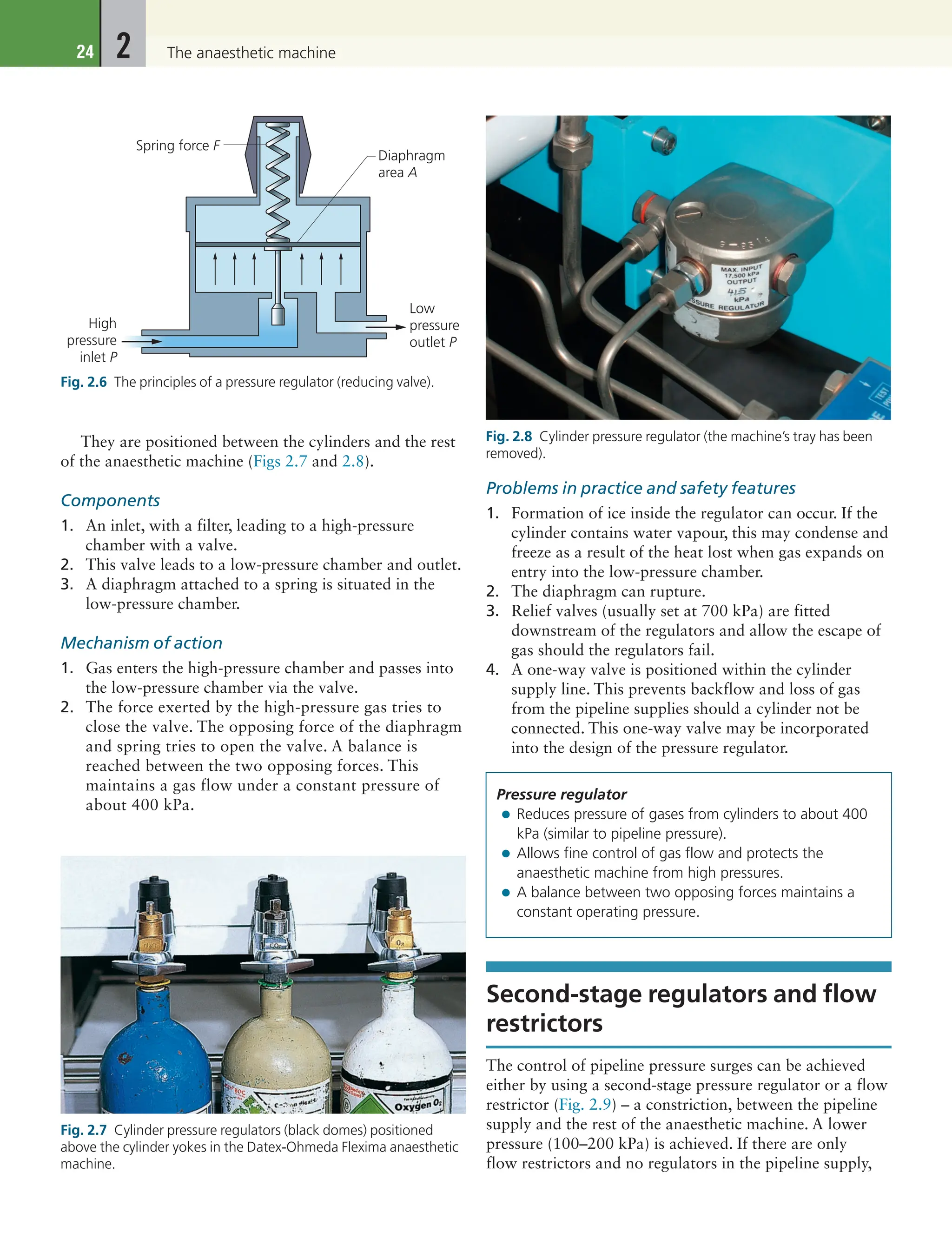
24 The anaesthetic machine
They are positioned between the cylinders and the rest
of the anaesthetic machine (Figs 2.7 and 2.8).
Components
1. An inlet, with a filter, leading to a high-pressure
chamber with a valve.
2. This valve leads to a low-pressure chamber and outlet.
3. A diaphragm attached to a spring is situated in the
low-pressure chamber.
Mechanism of action
1. Gas enters the high-pressure chamber and passes into
the low-pressure chamber via the valve.
2. The force exerted by the high-pressure gas tries to
close the valve. The opposing force of the diaphragm
and spring tries to open the valve. A balance is
reached between the two opposing forces. This
maintains a gas flow under a constant pressure of
about 400 kPa.
Problems in practice and safety features
1. Formation of ice inside the regulator can occur. If the
cylinder contains water vapour, this may condense and
freeze as a result of the heat lost when gas expands on
entry into the low-pressure chamber.
2. The diaphragm can rupture.
3. Relief valves (usually set at 700 kPa) are fitted
downstream of the regulators and allow the escape of
gas should the regulators fail.
4. A one-way valve is positioned within the cylinder
supply line. This prevents backflow and loss of gas
from the pipeline supplies should a cylinder not be
connected. This one-way valve may be incorporated
into the design of the pressure regulator.
Second-stage regulators and flow
restrictors
The control of pipeline pressure surges can be achieved
either by using a second-stage pressure regulator or a flow
restrictor (Fig. 2.9) – a constriction, between the pipeline
supply and the rest of the anaesthetic machine. A lower
pressure (100–200 kPa) is achieved. If there are only
flow restrictors and no regulators in the pipeline supply,
Spring force F
Low
pressure
outlet P
Diaphragm
area A
High
pressure
inlet P
Fig. 2.6 The principles of a pressure regulator (reducing valve).
Fig. 2.7 Cylinder pressure regulators (black domes) positioned
above the cylinder yokes in the Datex-Ohmeda Flexima anaesthetic
machine.
Fig. 2.8 Cylinder pressure regulator (the machine’s tray has been
removed).
Pressure regulator
• Reduces pressure of gases from cylinders to about 400
kPa (similar to pipeline pressure).
• Allows fine control of gas flow and protects the
anaesthetic machine from high pressures.
• A balance between two opposing forces maintains a
constant operating pressure.
25
Flowmeters
adjustment of the flowmeter controls is usually necessary
whenever there is change in pipeline pressure.
Flow restrictors may also be used downstream of
vaporizers to prevent back pressure effect (see later).
One-way valve or backflow check
valves
These valves are usually placed next to the inlet yoke.
Their function is to prevent loss or leakage of gas from
an empty yoke. They also prevent accidental cross-filling
between paired cylinders.
Flow control (needle) valves
These valves control the flow through the flowmeters
by manual adjustment. They are positioned at the base
of the associated flowmeter tube (Fig. 2.10). Increasing
the flow of a gas is achieved by turning the valve in an
anticlockwise direction.
Components
1. The body, made of brass, screws into the base of the
flowmeter.
2. The stem screws into the body and ends in a needle. It
has screw threads allowing fine adjustment.
3. The flow control knobs are labelled and colour-coded.
4. A flow control knob guard is fitted in some designs
to protect against accidental adjustment in the
flowmeters.
Flowmeters
Flowmeters measure the flow rate of a gas passing through
them. They are individually calibrated for each gas.
Calibration occurs at room temperature and atmospheric
pressure (sea level). They have an accuracy of about ±2.5%.
For flows above 1L/min, the units are L/min, and for flows
below that, the units are 100mL/min (Fig. 2.11).
Components
1. A flow control (needle) valve.
2. A tapered (wider at the top), transparent plastic or
glass tube.
3. A lightweight rotating bobbin or ball. Bobbin-stops at
either end of the tube ensure that it is always visible to
the operator at extremes of flow.
Fig. 2.9 A flow restrictor. The constriction causes a significant
pressure drop when there is a high gas flow rate.
Control
knob Gas in
Bobbin stop
Needle
Bobbin stop
Gas out to
back-bar
Bobbin
Tapered tube
Fig. 2.10 A flow control (needle) valve and flowmeter. Fig. 2.11 A flowmeter panel.
2
26 The anaesthetic machine
Mechanism of action
1. When the needle valve is opened, gas is free to enter
the tapered tube.
2. The bobbin is held floating within the tube by the gas
flow passing around it. The higher the flow rate, the
higher the bobbin rises within the tube.
3. The effect of gravity on the bobbin is counteracted
by the gas flow. The pressure difference across the
bobbin remains constant as it floats.
4. The clearance between the bobbin and the tube wall
widens as the gas flow increases (Fig. 2.12).
5. At low flow rates, the clearance is longer and
narrower, thus acting as a tube. Under these
circumstances, the flow is laminar and a function of
gas viscosity (Poiseuille’s law).
6. At high flow rates, the clearance is shorter and wider,
thus acting as an orifice. Here, the flow is turbulent
and a function of gas density.
7. The top of the bobbin has slits (flutes) cut into its
side. As gas flows past it, the slits cause the bobbin to
rotate. A dot on the bobbin indicates to the operator
that the bobbin is rotating and not stuck.
8. The reading of the flowmeter is taken from the
top of the bobbin (Fig. 2.13). When a ball is used,
the reading is generally taken from the midpoint
of the ball.
9. When very low flows are required, e.g. in the circle
breathing system, an arrangement of two flowmeters
in series is used. One flowmeter reads a maximum
of 1L/min allowing fine adjustment of the flow. One
flow control per gas is needed for both flowmeters
(Fig. 2.14).
10. There is a stop on the oxygen flow control valve to
ensure a minimum oxygen flow of 200–300mL/min
past the needle valve. This ensures that the oxygen
flow cannot be discontinued completely.
Problems in practice and safety features
1. The flow control knobs are colour-coded for their
respective gases. The oxygen control knob is situated
to the left (in the UK) and, in some designs, is larger
with larger ridges and has a longer stem than the
other control knobs so sticking out farthest, making it
easily recognizable (Fig. 2.15). In the United States and
Canada, the oxygen control knob is situated to the right.
Gas flow
y y
B
B
A
A
y
x
Fig. 2.12 Mechanism of action of the flowmeter. As the bobbin
rises from A to B, the clearance increases (from x to y).
Read here
1 2 3 4
Fig. 2.13 Reading a flowmeter (top). Different types of bobbin: 1,
ball; 2, non-rotating H float; 3, skirted; 4, non-skirted.
Fig. 2.14 Two flowmeters in series.
Exam tip: Make sure you understand how the
flowmeter works and the effects of viscosity and
density on the function of the flowmeter.
Fig. 2.15 Flow control knobs. Note the colour-coding and the
distinctive-shape oxygen control knob.
27
Vaporizers
2. The European Standard for anaesthetic machines
(EN 740) requires them to have the means to
prevent the delivery of a gas mixture with an oxygen
concentration below 25%. Current designs make it
impossible for nitrous oxide to be delivered without
the addition of a fixed percentage of oxygen. This
is achieved by using interactive oxygen and nitrous
oxide controls. This helps to prevent the possibility
of delivering a hypoxic mixture to the patient. In
the mechanical system, two gears are connected
together by a precision stainless steel link chain. One
gear with 14 teeth is fixed on the nitrous oxide flow
control valve spindle. The other gear has 29 teeth
and can rotate the oxygen flow control valve spindle,
rather like a nut rotating on a bolt. For every 2.07
revolutions of the nitrous oxide flow control knob,
the oxygen knob and spindle set to the lowest
oxygen flow will rotate once. Because the gear on
the oxygen flow control is mounted like a nut on a
bolt, oxygen flow can be adjusted independently of
nitrous oxide flow.
3. A crack in a flowmeter may result in a hypoxic mixture
(Fig. 2.16). To avoid this, oxygen is the last gas to be
added to the mixture delivered to the back bar.
4. Flow measurements can become inaccurate if the
bobbin sticks to the inside wall of the flowmeter. The
commonest causes are:
a. dirt: this is a problem at low flow rates when the
clearance is narrow. The source of the dirt is usually
a contaminated gas supply. Filters, acting before gas
enters the flowmeters, will remove the dirt
b. static electricity: the charge usually builds up over
a period of time, leading to inaccuracies of up
to 35%. Using antistatic materials in flowmeter
construction helps to eliminate any build-up of
charge. Application of antistatic spray removes any
charge present.
5. Flowmeters are designed to be read in a vertical
position, so any change in the position of the machine
can affect the accuracy.
6. Pressure rises at the common gas outlet are transmitted
back to the gas above the bobbin. This results in a
drop in the level of the bobbin with an inaccurate
reading. This can happen with minute volume divider
ventilators as back pressure is exerted as they cycle with
inaccuracies of up to 10%. A flow restrictor is fitted
downstream of the flowmeters to prevent this occurring.
7. Accidents have resulted from failure to see the bobbin
clearly at the extreme ends of the tube. This can be
prevented by illuminating the flowmeter bank and
installing a wire stop at the top to prevent the bobbin
reaching the top of the tube.
8. If facilities for the use of carbon dioxide are fitted
to the machine, the flowmeter is designed to allow
a maximum of 500mL/min to be added to the FGF.
This ensures that dangerous levels of hypercarbia are
avoided.
9. Highly accurate computer controlled gas mixers are
available.
Vaporizers
A vaporizer is designed to add a controlled amount of an
inhalational agent, after changing it from liquid to vapour,
to the FGF. This is normally expressed as a percentage of
saturated vapour added to the gas flow.
A
N2O
O2 AIR
To patient
B
N2O
O2 AIR
To patient
Fig. 2.16 (A) A broken air flowmeter allows oxygen to escape and
a hypoxic mixture to be delivered from the back bar. (B) A possible
design measure to prevent this.
Flowmeter
• Both laminar and turbulent flows are encountered,
making both the viscosity and density of the gas
relevant.
• The bobbin should not stick to the tapered tube.
• Oxygen is the last gas to be added to the mixture.
• It is very accurate with an error margin of ±2.5%.
Characteristics of the ideal vaporizer
1. Its performance is not affected by changes in FGF,
volume of the liquid agent, ambient temperature and
pressure, decrease in temperature due to vaporization
and pressure fluctuation due to the mode of respiration.
2. Low resistance to flow.
3. Light weight with small liquid requirement.
4. Economy and safety in use with minimal servicing
requirements.
5. Corrosion- and solvent-resistant construction.
2
28 The anaesthetic machine
Vaporizers can be classified according to location:
1. Inside the breathing system. Gases pass through a very
low resistance, draw-over vaporizer due to the patient’s
respiratory efforts (e.g. Goldman, Oxford Miniature
Vaporizer [OMV]). Such vaporizers are simple in
design, lightweight, agent non-specific, i.e. allowing the
use of any volatile agent, small and inexpensive. For
these reasons, they are used in the ‘field’ or in otherwise
difficult environments. However, they are not as
efficient as the plenum vaporizers as their performance
is affected as the temperature of the anaesthetic agent
decreases due to loss of latent heat during vaporization.
2. Outside the breathing system. Gases are driven
through a plenum (high resistance, unidirectional and
agent specific) vaporizer due to gas supply pressure.
These vaporizers are reliable and easy to use.
PLENUM VAPORIZER (FIG. 2.17)
Components
1. The case with the filling level indicator and a port for
the filling device.
2. Percentage control dial on top of the case.
3. The bypass channel and the vaporization chamber. The
latter has Teflon wicks or baffles, cowls or nebulizers
to increase the surface area available for vaporization
(Fig. 2.18).
4. The splitting ratio is controlled by a temperature-sensitive
valve utilizing a bimetallic strip (Fig. 2.19). The latter is
made of two strips of metal with different coefficients
of thermal expansion bonded together. It is positioned
inside the vaporization chamber in the Tec Mk 2 whereas
in Tec Mk 3, 4 and 5, it is outside the vaporization
chamber. An ether-filled bellows is the temperature
compensating device in the M&IE Vapamasta Vaporizer
5 and 6 (Key Health Solutions Ltd, Leicestershire, UK).
The bellows contracts as the temperature of the vaporizer
decreases.
5. The vaporizers are mounted on the back bar
(Fig. 2.20) using the interlocking Selectatec system
(Fig. 2.21). The percentage control dial cannot be
moved unless the locking lever of the system is
engaged (in Mk 4 and 5). The interlocking extension
rods prevent more than one vaporizer being used at
any one time, preventing contamination of the one
Fig. 2.17 A plenum vaporizer mounted on the back bar of an
anaesthetic machine. (Courtesy Philips Healthcare, Guildford, UK.)
Bypass
Bypass
Bypass
Fresh
gas in
Dial
Fresh
and
vapour
out
Vaporizing
chamber
Flow
split
Bimetallic
strip
Temperature
compensating
valve
Outlet
port
Percentage
control valve
Fig. 2.18 A schematic diagram of the Tec Mk 5, an example of a
plenum vaporizer.
Fig. 2.19 Mechanism of action of a bimetallic strip.
29
Vaporizers
downstream (in Mk 4 and 5). The FGF only enters the
vaporizer when it is switched on (Fig. 2.22).
Mechanism of action
1. The calibration of each vaporizer is agent-specific.
2. FGF is split into two streams on entering the vaporizer.
One stream flows through the bypass channel and the
other, smaller stream (typically less than 20% of total),
flows through the vaporizing chamber. The two gas
streams reunite as the gas leaves the vaporizer.
3. The vaporization chamber is designed so that the
gas leaving it is always fully saturated with vapour
before it rejoins the bypass gas stream. This should be
achieved despite changes in the FGF.
4. Full saturation with vapour is achieved by increasing
the surface area of contact between the carrier gas
and the anaesthetic agent. This is achieved by having
wicks saturated by the inhalational agent, a series of
baffles or by bubbling the gas through the liquid. The
presence of wicks and baffles increases significantly the
internal resistance of the vaporizer.
5. The desired concentration is obtained by adjusting the
percentage control dial. This alters the amount of gas
flowing through the bypass channel to that flowing
through the vaporization chamber.
6. In the modern designs, the vapour concentration
supplied by the vaporizer is virtually independent of
the FGFs between 0.25 and 15L/min.
7. During vaporization, cooling occurs due to the loss of
latent heat of vaporization. Lowering the temperature
of the agent decreases its SVP and makes it less
volatile. In order to stabilize the temperature and
compensate for temperature changes:
a. the vaporizer is made of a material with high
density and high specific heat capacity with a
very high thermal conductivity, e.g. copper. As a
temperature stabilizer, copper acts as a heat sink,
readily giving heat to the anaesthetic agent and
maintaining its temperature
b. a temperature sensitive valve (e.g. bimetallic strip
or bellows) within the body of the vaporizer
automatically adjusts the splitting ratio according
to the temperature. It allows more flow into the
vaporizing chamber as the temperature decreases.
8. The amount of vapour carried by the FGF is a function
of both the saturated vapour pressure (SVP) of the
agent and the atmospheric pressure. At high altitudes,
Fig. 2.20 An empty Selectatec back bar of an anaesthetic machine
showing the O-rings. (Courtesy Philips Healthcare, Guildford, UK.)
Percentage
control dial
Extension rod
Port valves
Vaporizing
locking lever
Port valve
actuating spindle
Control dial
release
Selectatec series
mounted manifold
Fig. 2.21 The Selectatec vaporizer interlock mechanism. See text
for details. (Courtesy GE Healthcare, Hatfield, UK.)
From
flowmeters
Manifold bypass
Vaporizer A
To common
gas outlet
Vaporizer B
(isolated)
Fig. 2.22 The Selectatec series mounted manifold bypass circuit. Only
when a vaporizer is locked in position and turned on can fresh gas
enter. Vaporizer B is turned off and is isolated from the fresh gas which
only enters vaporizer A which is turned on. If no vaporizer is fitted, the
port valves are closed. (Courtesy GE Healthcare, Hatfield, UK.)
2
30 The anaesthetic machine
the atmospheric pressure is reduced whereas the SVP
remains the same. This leads to an increased amount
of vapour whereas the saturation of the agent remains
the same. The opposite occurs in hyperbaric chambers.
This is of no clinical relevance as it is the partial
pressure of the agent in the alveoli that determines the
clinical effect of the agent.
Problems in practice and safety features
1. In modern vaporizers (Tec Mk 5), the liquid
anaesthetic agent does not enter the bypass channel
even if the vaporizer is tipped upside down due to
internal valves acting as an antispill mechanism. In
earlier designs, dangerously high concentrations of
anaesthetic agent could be delivered to the patient in
cases of agent spillage into the bypass channel. Despite
that, it is recommended that the vaporizer is purged
with a FGF of 5L/min for 30min with the percentage
control dial set at 5%.
2. The Selectatec system increases the potential for
leaks. This is due to the risk of accidental removal
of the O-rings with changes of vaporizers (see
Fig. 2.20).
3. Minute volume divider ventilators exert back pressure
as they cycle. This pressure forces some of the gas
exiting the outlet port back into the vaporizing
chamber, where more vapour is added. Retrograde
flow may also contaminate the bypass channel. These
effects cause an increase in the inspired concentration
of the agent which may be toxic. These pressure
fluctuations can be compensated for by:
a. long inlet port into the vaporizing chamber as in
Tec Mk 3. This ensures that the bypass channel
is not contaminated by retrograde flow from the
vaporizing chamber
b. downstream flow restrictors: used to maintain the
vaporizer at a pressure greater than any pressure
required to operate commonly used ventilators
c. both the bypass channel and the vaporizing
chamber are of equal volumes so gas expansion and
compression are equal.
4. Preservatives, such as thymol in halothane, accumulate
on the wicks of vaporizers with time. Large quantities
may interfere with the function of the vaporizer.
Thymol can also cause the bimetallic strip in the Tec
Mk 2 to stick. Enflurane and isoflurane do not contain
preservative.
5. A pressure relief valve downstream of the vaporizer
opens at about 35 kPa. This prevents damage to
flowmeters or vaporizers if the common gas outlet is
blocked.
6. The bimetallic strip has been situated in the bypass
channel since the Tec Mk 3. It is possible for the
chemically active strip to corrode in a mixture
of oxygen and the inhalational agent within the
vaporizing chamber (Tec Mk 2).
7. The vaporizer needs regular servicing to ensure
accurate calibration.
8. Despite its temperature-compensation properties,
the vaporizer can deliver unreliable inhalational
agent concentrations in extreme ambient
temperatures.
Vaporizer filling devices
These are agent-specific being geometrically coded (keyed)
to fit the safety filling port of the correct vaporizer and
anaesthetic agent supply bottle (Fig. 2.23). They prevent
the risk of adding the wrong agent to the wrong vaporizer
and decrease the extent of spillage. The safety filling
system, in addition, ensures that the vaporizer cannot
overflow. Fillers used for desflurane and sevoflurane have
valves that are only opened when fully inserted into their
ports. This prevents spillage.
Vaporizers
• The case is made of copper which is a good heat sink.
• Consists of a bypass channel and vaporization chamber.
The latter has wicks to increase the surface area
available for vaporization.
• A temperature-sensitive valve controls the splitting ratio.
It is positioned outside the vaporizing chamber in Tec
Mk 3, 4 and 5.
• The gas leaving the vaporizing chamber is fully
saturated.
• The effect of temperature changes and back pressure
are compensated for.
Fig. 2.23 Agent-specific, colour-coded filling devices; (left to right)
desflurane, sevoflurane, isoflurane and enflurane.
31
Emergency oxygen flush
A more recent design feature is the antipollution cap
allowing the filler to be left fitted to the bottle between
uses to prevent the agent from vaporizing. It also
eliminates air locks, speeding up vaporizer filling, and
ensures that the bottle is completely emptied, reducing
wastage.
Non-return pressure relief safety
valve
This is situated downstream of the vaporizers either
on the back bar itself or near the common gas outlet
(Fig. 2.24).
1. Its non-return design helps to prevent back pressure
effects commonly encountered using minute volume
divider ventilators.
2. It opens when the pressure in the back bar exceeds
about 35 kPa. Flowmeter and vaporizer components
can be damaged at higher pressures.
Emergency oxygen flush
This is usually activated by a non-locking button (Fig. 2.25).
When pressed, pure oxygen is supplied from the outlet of the
anaesthetic machine. The flow bypasses the flowmeters and
the vaporizers. A flow of about 35–75L/min at a pressure
of about 400 kPa is expected. The emergency oxygen flush
is usually activated by a non-locking button and using a
self-closing valve. It is designed to minimize unintended and
accidental operation by staff or other equipment. The button
is recessed in a housing to prevent accidental depression.
Problems in practice and safety features
1. The high operating pressure and flow of the oxygen
flush puts the patient at a higher risk of barotrauma.
The fillers are colour-coded:
red: halothane
orange: enflurane
purple: isoflurane
yellow: sevoflurane
blue: desflurane
Fig. 2.24 A non-return pressure relief valve situated at the end of
the back bar.
Self-closing valve
A
B
Oxygen
flow
Spring
Button
Fig. 2.25 The emergency oxygen flush button (A) and its mechanism
of action (B). (A, Courtesy Philips Healthcarep, Guildford, UK.)
2
32 The anaesthetic machine
2. When the emergency oxygen flush is used
inappropriately, it leads to dilution of the anaesthetic
gases and possible awareness.
3. It should not be activated while ventilating a patient
using a minute volume divider ventilator.
Compressed oxygen outlet(s)
One or more compressed oxygen outlets used to provide
oxygen at about 400 kPa (Fig. 2.26). It can be used to
drive ventilators or a manually controlled jet injector.
Oxygen supply failure alarm
Many designs are available (Fig. 2.27) but the
characteristics of the ideal warning device are as follows:
1. Activation depends on the pressure of oxygen itself.
2. It requires no batteries or mains power.
3. It gives an audible signal of a special character and of
sufficient duration and volume to attract attention.
4. It should give a warning of impending failure and a
further alarm that failure has occurred.
5. It should have pressure-linked controls which
interrupt the flow of all other gases when it comes into
operation. Atmospheric air is allowed to be delivered
to the patient, without carbon dioxide accumulation.
It should be impossible to resume anaesthesia until the
oxygen supply has been restored.
6. The alarm should be positioned on the reduced
pressure side of the oxygen supply line.
7. It should be tamper proof.
8. It is not affected by backpressure from the anaesthetic
ventilator.
In modern machines, if the oxygen supply pressure falls
below 200 kPa, the low-pressure supply alarm sounds.
With supply pressures below 137 kPa, the ‘fail safe’ valve
will interrupt the flow of other gases to their flowmeters
so that only oxygen can be delivered (Fig. 2.28). The
oxygen flow set on the oxygen flowmeter will not decrease
until the oxygen supply pressure falls below 100 kPa.
Fig. 2.26 Compressed oxygen outlet.
Fig. 2.27 The oxygen supply failure alarm in the Datex-Ohmeda
Flexima anaesthetic machine.
N2O
A B
Oxygen Oxygen
Fig. 2.28 Oxygen supply failure alarm mechanism of action. (A) O2
pressure is higher than 200 kPa so allowing N2O flow (blue). (B) O2
pressure is lower than 200 kPa so cutting off N2O flow.
Anti-hypoxic safety features
These features are designed to prevent the delivery of
gaseous mixtures with oxygen concentrations of less than
25%. This can be achieved by:
• Mechanical means: a chain links the oxygen and nitrous
oxide flow control valves. Increasing the flow rate of nitrous
oxide leads to a proportional increase in oxygen flow rate.
• Pneumatic means: a pressure-sensitive diaphragm measuring
the changes in oxygen and nitrous oxide concentrations.
• A paramagnetic oxygen analyser continuously
measuring the oxygen concentration. Nitrous oxide
flow is switched off automatically when oxygen
concentration falls under 25%.
33
Other modifications and designs
Common gas outlet (Fig. 2.29)
The common gas outlet is where the anaesthetic
machine ‘ends’. At the common gas outlet, the gas
mixture made at the flowmeters, plus any inhaled
anaesthetic agent added by the vaporizer, exits the
machine and enters the fresh gas tubing that conducts
it to the breathing system. The common gas outlet is
a conically tapered pipe with a 22 mm male/15 mm
female connector fitting. It can be fixed or on a
swivelling connector. The connector of the common gas
outlet should be strong enough to withstand a torque
of up to 10 Nm because of the heavy equipment that
may be attached.
Other modifications and designs
1. Desflurane Tec MK 6 vaporizer (Figs 2.30 and 2.31).
Desflurane is an inhalational agent with unique physical
properties making it extremely volatile. Its SVP is
664mmHg at 20°C and, with a boiling point of 23.5°C at
atmospheric pressure which is only slightly above normal
room temperature, precludes the use of a normal variable-
bypass type vaporizer. Due to its low boiling point,
Exam tip: Pay attention to the order in which you
check the anaesthetic machine. You need to follow
the gas flow.
Fig. 2.29 Common gas outlet. (Courtesy Philips Healthcare,
Guildford, UK.)
Fig. 2.30 Dräger D Vapor desflurane vaporizer. (Courtesy Dräger,
Hemel Hempstead, UK.)
PDes
PMain
Flow Main
Flow Des
Vaporizer
concentration dial
Shutoff
valve
Variable pressure
control valve
to make PDes =PMain
Control
electronics
Desflurane
liquid
heated
Desflurane
vapour
1550 mmHg
39°C
FGF from
flowmeter
Pressure
transducer
Fixed restrictor
Patient
Fig. 2.31 A schematic diagram of the desflurane Tec Mk 6 vaporizer.
2
34 The anaesthetic machine
changes in ambient temperature can lead to large and
unpredictable changes in vapour pressure and its delivered
concentration. In order to overcome these physical
properties, vaporizers with a completely different design
from the previous Tec series are used despite the similar
appearance. They are mounted on the Selectatec system.
a. An electrically heated desflurane vaporization
chamber (sump) with a capacity of 450mL. The
chamber requires a warm-up period of 5–10
minutes to reach its operating temperature of 39°C
(i.e. above its boiling point) and a SVP of more than
1550mmHg (about two atmospheric pressures). The
vaporizer will not function below this temperature
and pressure. Due to the above circumstances,
temperature compensation is not required.
b. A fixed restriction/orifice is positioned in the FGF
path. The FGF does not enter the vaporization
chamber. Instead, the FGF enters the path of the
regulated concentration of desflurane vapour before
the resulting gas mixture is delivered to the patient.
c. A differential pressure transducer adjusts a
pressure-regulating valve at the outlet of the
vaporization chamber. The transducer senses
pressure at the fixed restriction on one side and
the pressure of desflurane vapour upstream to the
pressure-regulating valve on the other side. This
transducer ensures that the pressure of desflurane
vapour upstream of the control valve equals the
pressure of FGF at the fixed restriction.
d. A percentage control dial with a rotary valve
adjusts a second resistor which controls the flow
of desflurane vapour into the FGF and thus the
output concentration. The dial calibration is from
0% to 18%.
e. The fixed restriction/orifice ensures that the
pressure of the carrier gas within the vaporizer is
proportional to gas flow. The transducer ensures
that the pressure of desflurane vapour upstream of
the resistor equals the pressure of FGF at the orifice.
This means that the flow of desflurane out of the
vaporizing chamber is proportional to the FGF,
so enabling the output concentration to be made
independent of FGF rate.
f. The vaporizer incorporates malfunction alarms
(auditory and visual). There is a back-up 9-V battery
should there be a main power system failure.
2. MRI compatible anaesthetic machines. Since most
of the anaesthetic machine is made from metal, it
should not be used close to magnetic resonance
imaging (MRI) scanner. Distorted readings and
physical damage to the scanner are possible because
of the attraction of the strong magnetic fields. Newly
designed anaesthetic machines made of totally non-
ferrous material solve this problem (Fig. 2.32).
3. Newly designed anaesthetic machines are more
sophisticated than that described previously. Many
important components have become electrically or
electronically controlled as an integrated system
(Fig. 2.33). Thermistors can be used to measure
the flow of gases. Gas flow causes changes in
Fig. 2.32 A non-ferrous MRI compatible anaesthetic machine.
(Courtesy Philips Healthcare, Guildford, UK.)
Fig. 2.33 Dräger Zeus IE anaesthetic workstation. (Courtesy Dräger,
Hemel Hempstead, UK.)
35
Anaesthesia in remote areas
temperature which are measured by the thermistors.
Changes in temperature are calibrated to measure
flows of gases. Other designs measure flows using
electronic flow sensors based on the principle of the
pneumotachograph. Pressure difference is measured
across a laminar flow resistor through which the gas
flows. Using a differential pressure transducer, flow
is measured and displayed on a screen in the form of
a virtual graduated flowmeter, together with a digital
display.
In the Dräger Zeus IE workstation (Dräger, Hemel
Hempstead, UK), the anaesthetist sets the FiO2 and
end-tidal anaesthetic agent concentration. The system
then works to achieve these targets in the quickest
and safest way. Direct injectors are used instead of the
traditional vaporizers. This allows direct injection of
the inhalational agent into the breathing system. This
in turn allows for rapid changes in the inhalational
agent concentration independent of the FGF. The
workstation also has a number of pumps allowing
intravenous infusion when required.
4. Quantiflex Anaesthetic Machine (Fig. 2.34). This
machine has the following features:
a. Two flowmeters, one for oxygen and one for
nitrous oxide, with one control knob for both
flowmeters.
b. The oxygen flowmeter is situated to the right,
whereas the nitrous oxide flowmeter is situated to
the left.
c. The relative concentrations of oxygen and nitrous
oxide are adjusted by a mixture control wheel.
The oxygen concentration can be adjusted in 10%
increments from 30% to 100%.
d. This design prevents the delivery of hypoxic
mixtures.
e. It is mainly used in dental anaesthesia.

Some newly designed anaesthetic machines have
an extra outlet with its own flowmeter to deliver
oxygen to conscious or lightly sedated patients via a
face mask. This can be used in patients undergoing
surgery under regional anaesthesia with sedation.
5. Universal Anaesthesia Machine (UAM) (Figs 1.23
and 2.35). This was developed to enable the provision
of anaesthesia in poorly resourced countries where
compressed gases and electricity supplies are
unreliable. The UAM differs from standard anaesthetic
machines by the use of an electrically powered oxygen
concentrator (producing 10L/min of 95% oxygen),
draw-over vaporizer, bellows and balloon valve.
The UAM can function in both continuous flow and
draw-over modes, entraining air as necessary (e.g.
if electricity supply to the concentrator fails), with
the vaporizer functioning as normal. Alternatively,
oxygen can be provided via cylinder, pipeline or the
side emergency inlet. The UAM has two flowmeters,
one for oxygen and the other for either nitrous oxide
or air. A 2-L reservoir bag is positioned distal to the
flowmeters on the back bar. A negative pressure valve
allows entrainment of air (if the FGF is less than the
patient’s minute ventilation) and a positive pressure
relief valve prevents overpressure of the bag.
A low-resistance vaporizer is fitted downstream
of the positive pressure valve. Vaporizers calibrated
for the use of isoflurane or halothane are available.
Distally, the set of silicone bellows (up to 1600mL)
allows manual ventilation through a standard dual
limb breathing system. The expiratory valve is sited
on the side of the machine, and comprises a long-life
silicone balloon housed in a clear plastic tube.
A fuel cell oxygen concentration monitor with a touch-
screen display, as well as a safety anti-hypoxic feature, are
included in the design.
Anaesthesia in remote areas
The apparatus used must be compact, portable and robust.
The Triservice apparatus is suitable for use in remote areas
where supply of compressed gases and vapours is difficult
(Figs 2.36 and 2.37). The Triservice anaesthetic apparatus
name derives from the three branches of military services:
Army, Navy and Air Force.
Components
1. A face mask with a non-rebreathing valve fitted.
2. A short length of tubing leading to a self-inflating bag.
Fig. 2.34 Matrx MDM Anaesthetic Machine. (Courtesy Porter
Instrument, Parker Hannifin Corporation, Hatfield, PA, USA.)
2
36 The anaesthetic machine
3. A second length of tubing leading from the self-
inflating bag to two OMVs.
4. An oxygen cylinder can be connected upstream of the
vaporizers. A third length of tubing acts as an oxygen
reservoir during expiration.
Mechanism of action
1. The Triservice apparatus can be used for both
spontaneous and controlled ventilation.
a. The patient can draw air through the vaporizers.
The exhaled gases are vented out via the non-
rebreathing valve.
b. The self-inflating bag can be used for controlled or
assisted ventilation.
2. The OMV is a variable bypass, low resistance draw-
over vaporizer with a capacity for 50mL of anaesthetic
agent. The wick is made of metal with no temperature
compensation features. However there is an ethylene
glycol jacket acting as a heat sink to help to stabilize
the vaporizer temperature. The calibration scale on the
Oxygen
concentrator
Oxygen analyser
and apnoea alarm
NPRV
air inlet
REGS
CYL/pipeline
pin-index yoke
+ N20 option
O2/N2O/air
flow control
O2 inlet
Emergency oxygen
inlet on the back
of the UAM
2 Litre reservoir
bag on back bar
Oxygen analyser
sampling port
Silicone
bellows
Bellows
block +
2 valves
FGF inlet
Y-piece outlet
Balloon
occluder
Balloon actuator
pipe
Scavenger
EXP
INSP
To patient
DOV for
HAL/ISO
PPRV
Fig. 2.35 Diagrammatic representation of UAM. (Courtesy Gradian Health Systems, New York, NY, USA [www.uamglobal.org].)
Fig. 2.36 The Triservice apparatus.
Inflating valve Inlet valve
0.1
Patient
Contents
gauge
Oxygen
Pressure
reducing
valve
Reservoir
Inflating bag
Vaporizers
1 L/min. 4 L/min.
Fig. 2.37 Mechanism of action of the Triservice apparatus.
37
Anaesthesia in remote areas
vaporizer can be detached allowing the use of different
inhalational agents. A different inhalational agent can
be used after blowing air for 10min and rinsing the
wicks with the new agent. The vaporizer casing has
extendable feet fitted.
3. The downstream vaporizer is traditionally filled with
trichloroethylene to compensate for the absence of the
analgesic effect of nitrous oxide.
Problems in practice and safety features
1. The vaporizers’ heat sink (ethylene glycol jacket) is
not suitable for prolonged use at high gas flows. The
vapour concentration decreases as the temperature
decreases.
2. During use, accidental tipping of the vaporizer can
spill liquid agent into the breathing system. The
vaporizer is spill proof when turned off.
SUGGESTED FURTHER READING
Boumphrey, S., Marshall, N., 2011. Understanding
vaporizers. Cont. Educ. Anaesth. Crit. Care Pain 11
(6), 199–203. Available from:
https://academic.oup.com/bjaed/
article/11/6/199/263839/Understanding-vaporizers.
National Institute for Health and Care Excellence (NICE),
2014. End-tidal Control software for use with Aisys
closed circuit anaesthesia systems for automated gas
control during general anaesthesia. Available from:
http://www.nice.org.uk/advice/mib10.
Medicines and Healthcare products Regulatory Agency
(MHRA), 2010. Anaesthetic vaporisers – failure to
attach vaporisers to the anaesthetic machine causes
gas leakage according to reports (MDA/2010/052).
Available from: https://www.gov.uk/drug-device-alerts/
medical-device-alert-anaesthetic-vaporisers-failure-to-
attach-vaporisers-to-the-anaesthetic-machine-causes-
gas-leakage-according-to-reports.
MHRA. The Anaesthetic Machine. Available at: http://www.
mddl.org.uk/mddl/emodules/AnaestheticMachines/
player.html.
MHRA, 2011. Auxiliary common gas outlet (ACGO)
for anaesthetic machine – no FGF to patient with
wrong setting. Available from: https://www.gov.uk/
drug-device-alerts/medical-device-alert-auxiliary-
common-gas-outlet-acgo-for-anaesthetic-machine-no-
fresh-gas-flow-to-patient-with-wrong-setting.
National Health Service (NHS), 2011. Airway suction
equipment. Available from: http://www.nrls.npsa.nhs.
uk/resources/?entryid45=94845.
Triservice apparatus
• Consists of two OMVs, self-inflating bag and non-
rebreathing valve.
• The apparatus is suitable for both spontaneous and
controlled breathing.
• The OMV is a draw-over vaporizer with no temperature
compensation. It has a heat sink. It can be used with
different inhalational agents.
2
38 The anaesthetic machine
SELF-ASSESSMENT QUESTIONS
Please check your eBook for additional self-assessment
MCQs
In the following lists, which of the following statements
(a) to (e) are true?
1. Flowmeters in an anaesthetic machine
a. N2O may be used in an O2 flowmeter without a
change in calibration.
b. Flowmeters use a tube and bobbin.
c. They are an example of a variable orifice device.
d. They have a linear scale.
e. Both laminar and turbulent flows are encountered.
2. Vaporizers
a. Manual ventilation using a vaporizer in
circle (VIC) causes a reduction in the inspired
concentration of the inhalational agent.
b. A Tec Mk 3 vaporizer can be used as a VIC.
c. Gas flow emerging from the vaporizing chamber
should be fully saturated with the inhalational agent.
d. The bimetallic strip valve in Tec Mk 5 is in the
vaporizing chamber.
e. The inhalational agent concentration delivered
to the patient gradually decreases the longer the
vaporizer is used due to cooling of the agent.
3. Pressure gauges on an anaesthetic machine
a. Use the Bourdon pressure gauge principle.
b. The pressure reflects accurately the cylinders’
contents for both oxygen and nitrous oxide.
c. Can be interchangeable between oxygen and
nitrous oxide.
d. The same pressure gauge can be used for both
cylinder and pipeline gas supply.
e. They are colour-coded for a particular gas or vapour.
4. Regarding safety features on modern anaesthetic
machines
a. The nitrous oxide flow control knob can be rotated
2.07 times for each revolution of the oxygen flow
control knob.
b. The nitrous oxide control knob has distinctive
knurling to reduce accidental activation.
c. The oxygen failure alarm activates when supply
pressure falls below 200 kPa.
d. European standard EN740 requires anaesthetic
machines to have a mechanism to prevent delivery
of gas mixtures of less than 25% oxygen.
e. A fail-safe valve prevents air supply to the
patient when oxygen supply pressure drops
below 137 kPa.
5. Laminar flow
a. It is directly proportional to the square root of
pressure.
b. Halving the radius results in a flow equivalent to a
16th of the original laminar flow.
c. It is related to the density of the fluid.
d. The flow is greatest in the centre.
e. Laminar flow changes to turbulent when Reynold’s
number exceeds 2000.
6. Flowmeters on an anaesthetic machine
a. They have an accuracy of ±2.5%.
b. They have a tapered tube with a narrow top.
c. Oxygen is the first gas to be added to the mixture
at the back bar.
d. At high flows, the density of the gas is important in
measuring the flow.
e. The reading of the flow is from the top of the
bobbin.
7. Concerning the Triservice apparatus
a. Two plenum vaporizers are used.
b. It can be used for both spontaneous and controlled
ventilation.
c. An inflating bag and a one-way valve are used.
d. The Oxford Miniature Vaporizer (OMV) has a
metal wick and a heat sink.
e. Supplementary oxygen can be added to the system.
39
Single best answer (SBA)
8. Pressure regulators
a. They are only used to reduce the pressure of gases.
b. They maintain a gas flow at a constant pressure of
about 400 kPa.
c. Their main purpose is to protect the patient.
d. Relief valves open at 700 kPa in case of failure.
e. Flow restrictors can additionally be used in
pipeline supply.
9. The safety features found in an anaesthetic machine
include
a. Oxygen supply failure alarm.
b. Colour-coded flowmeters.
c. Vaporizer level alarm.
d. Ventilator disconnection alarm.
e. Two vaporizers can be safely used at the same time.
10. The non-return valve on the back bar of an
anaesthetic machine between the vaporizer and
common gas outlet
a. Decreases the pumping effect.
b. Often is incorporated with a pressure relief valve
on modern machines.
c. Is designed to protect the patient.
d. Is designed to protect the machine.
e. Opens at a pressure of 70 kPa.
11. The oxygen emergency flush on an anaesthetic
machine
a. Operates at 20L/min.
b. Is always safe to use during anaesthesia.
c. Operates at 40L/min.
d. Increases risk of awareness during anaesthesia.
e. Can be safely used with a minute volume divider
ventilator.
12. Regarding the Universal Anaesthesia Machine
(UAM)
a. The UAM uses a plenum vaporizer.
b. Oxygen is supplied from cylinders.
c. Incorporates both a positive and negative
pressure relief valve.
d. Can be used to deliver sevoflurane.
e. Incorporates a paramagnetic oxygen analyser.
Single best answer (SBA)
13. Concerning a desflurane vaporizer
a. Is ready for use immediately.
b. Can be used with other inhalational agents.
c. Needs an electrical supply to function.
d. Fresh gas flow (FGF) enters the vaporization
chamber.
e. Is colour-coded red.
14. The pressure supplied by activating the emergency
oxygen flush button is
a. 13 700 kPa.
b. 4400 kPa.
c. 400 kPa.
d. 250 kPa.
e. 10 kPa.
15. Which of the following will not affect the reading on
a flowmeter
a. Temperature
b. Atmospheric pressure
c. Angle of flowmeter
d. Setting of a vaporizer
e. Use of a ventilator
16. Which of the following features of vaporizers are
designed to protect against the effects of back pressure
a. Having bypass and vaporizing chambers of the
same volume
b. Bi-metallic strips
c. Wicks
d. Selectatec system
e. Low resistance to flow
2
40 The anaesthetic machine
Answers
1. Flowmeters in an anaesthetic machine
a. False. The flowmeters in an anaesthetic machine
are calibrated for the particular gas(es) used taking
into consideration the viscosity and density of the
gas(es). N2O and O2 have different viscosities and
densities so unless the flowmeters are recalibrated,
false readings will result.
b. True. They are constant pressure, variable orifice
flowmeters. A tapered transparent tube with a
lightweight rotating bobbin. The bobbin is held
floating in the tube by the gas flow. The clearance
between the bobbin and the tube wall widens as
the flow increases. The pressure across the bobbin
remains constant as the effect of gravity on the
bobbin is countered by the gas flow.
c. True. See above.
d. False. The flowmeters do not have a linear scale.
There are different scales for low and high flow
rates.
e. True. At low flows, the flowmeter acts as a tube, as
the clearance between the bobbin and the wall of the
tube is longer and narrower. This leads to laminar
flow which is dependent on the viscosity (Poiseuille’s
law). At high flows, the flowmeter acts as an orifice.
The clearance is shorter and wider. This leads to
turbulent flow which is dependent on density.
2. Vaporizers
a. False. During manual (or controlled) ventilation
using a VIC vaporizer, the inspired concentration of
the inhalational agent is increased. It can increase to
dangerous concentrations. Unless the concentration
of the inhalational agent(s) is measured
continuously, this technique is not recommended.
b. False. As the patient is breathing through a
VIC vaporizer, it should have very low internal
resistance. The Tec Mk 3 has a high internal
resistance because of the wicks in the vaporizing
chamber.
c. True. This can be achieved by increasing the surface
area of contact between the carrier gas and the
anaesthetic agent. Full saturation should be achieved
despite changes in FGF. The final concentration is
delivered to the patient after mixing with the FGF
from the bypass channel.
d. False. The bimetallic strip valve in the Tec Mk 5 is
in the bypass chamber. The bimetallic strip has been
positioned in the bypass chamber since the Tec Mk
3. This was done to avoid corrosion of the strip in
a mixture of oxygen and inhalational agent when
positioned in the vaporizing chamber.
e. False. The concentration delivered to the patient
stays constant because of temperature compensating
mechanisms. This can be achieved by:
• using a material with high density and high
specific thermal conductivity (e.g. copper) which
acts as a heat sink readily giving heat to the agent
and maintaining its temperature
• a temperature-sensitive valve within the vaporizer
which automatically adjusts the splitting
ratio according to the temperature, so if the
temperature decreases due to loss of latent heat
of vaporization, it allows more flow into the
vaporizing chamber.
3. Pressure gauges on an anaesthetic machine
a. True. A pressure gauge consists of a coiled tube
that is subjected to pressure from the inside. The
high-pressure gas causes the tube to uncoil. The
movement of the tube causes a needle pointer to
move on a calibrated dial indicating the pressure.
b. False. Oxygen is stored as a gas in the cylinder
hence it obeys the gas laws. The pressure changes in
an oxygen cylinder accurately reflect the contents.
Nitrous oxide is stored as a liquid and vapour so
it does not obey Boyle’s law. This means that the
pressure changes in a nitrous oxide cylinder do not
accurately reflect the contents of the cylinder.
c. False. The pressure gauges are calibrated for a
particular gas or vapour. Oxygen and nitrous oxide
pressure gauges are not interchangeable.
d. False. Cylinders are kept under much higher
pressures (13700 kPa for oxygen and 5400 kPa for
nitrous oxide) than the pipeline gas supply (about
400 kPa). Using the same pressure gauges for
both cylinders and pipeline gas supply can lead to
inaccuracies and/or damage to pressure gauges.
e. True. Colour-coding is one of the safety features
used in the use and delivery of gases in medical
practice. In the UK, white is for oxygen, blue for
nitrous oxide and black for medical air.
4. Regarding safety features on modern anaesthetic
machines
a. True.
b. False. The oxygen flow control knob has distinctive
knurling to aid identification.
c. True.
41
Answers
d. True.
e. False. The fail-safe valve prevents nitrous oxide
supply when the oxygen supply pressure falls below
137 kPa.
5. Laminar flow
a. False. Laminar flow is directly proportional to
pressure. Hagen–Poiseuille equation: Flow ∝
pressure×radius4
/viscosity×length.
b. True. From the above equation, the flow ∝ radius4
.
c. False. Laminar flow is related to viscosity. Turbulent
flow is related to density.
d. True. Laminar flow is greatest in the centre at
about twice the mean flow rate. The flow is slower
nearer to the wall of the tube. At the wall the flow is
almost zero.
e. True. Reynold’s number is the index used to predict
the type of flow, laminar or turbulent. Reynold’s
number=velocity of fluid×density×radius of tube/
viscosity. In laminar flow, Reynold’s number is
2000. In turbulent flow, Reynold’s number is
2000.
6. Flowmeters on an anaesthetic machine
a. True. The flowmeters on the anaesthetic machine
are very accurate with an accuracy of ±2.5%.
b. False. The flowmeters on an anaesthetic machine are
tapered tubes. The top is wider than the bottom.
c. False. Oxygen is the last gas to be added to the
mixture at the back bar. This is a safety feature in
the design of the anaesthetic machine. If there is a
crack in a flowmeter, a hypoxic mixture may result
if oxygen is added first to the mixture.
d. True. At high flows, the flow is turbulent which
is dependent on density. At low flows, the flow is
laminar which is dependent on viscosity.
e. True. When a ball is used, the reading is taken from
the midpoint.
7. Concerning the Triservice apparatus
a. False. In the Triservice apparatus, two draw-over
OMVs are used. Plenum vaporizers are not used
due to their high internal resistance. The OMV is
lightweight and, by changing its calibration scale,
different inhalational agents can be used easily.
b. True. The system allows both spontaneous and
controlled ventilation. The resistance to breathing
is low allowing spontaneous ventilation. The
self-inflating bag provides the means to control
ventilation.
c. True. As above.
d. True. The OMV has a metal wick to increase area
of vaporization within the vaporization chamber.
The heat sink consists of an ethylene glycol jacket to
stabilize the vaporizer temperature.
e. True. Supplementary oxygen can be added
to the system from an oxygen cylinder. The
oxygen is added to the reservoir proximal to the
vaporizer(s).
8. Pressure regulators
a. False. Pressure regulators are used to reduce
pressure of gases and also to maintain a constant
flow. In the absence of pressure regulators, the
flowmeters need to be adjusted regularly to
maintain constant flows as the contents of the
cylinders are used up. The temperature and pressure
of the cylinder contents decrease with use.
b. True. Pressure regulators are designed to maintain
a gas flow at a constant pressure of about 400 kPa
irrespective of the pressure and temperature of the
contents of the cylinder.
c. False. Pressure regulators offer no protection to
the patient. Their main function is to protect the
anaesthetic machine from the high pressure of the
cylinder and to maintain a constant flow of gas.
d. True. In situations where the pressure regulator
fails, a relief valve that opens at 700 kPa prevents
the build-up of excessive pressure.
e. True. Flow restrictors can be used in a pipeline
supply. They are designed to protect the anaesthetic
machine from pressure surges in the system. They
consist of a constriction between the pipeline supply
and the anaesthetic machine.
9. The safety features found in an anaesthetic machine
include
a. True. This is an essential safety feature in the
anaesthetic machine. The ideal design should
operate under the pressure of oxygen itself, give a
characteristic audible signal, be capable of warning
of impending failure and give a further alarm when
failure has occurred, be capable of interrupting the
flow of other gases and not require batteries or
mains power to operate.
b. True. The flowmeters are colour-coded and also
the shape and size of the oxygen flowmeter knob is
different from the nitrous oxide knob. This allows
the identification of the oxygen knob even in a dark
environment.
c. False. The vaporizer level can be monitored by the
anaesthetist. This is part of the anaesthetic machine
checklist. There is no alarm system.
d. True. A ventilator disconnection alarm is essential
when a ventilator is used. They are also used to
monitor leaks, obstruction and malfunction. They
can be pressure and/or volume monitoring alarms.
In addition, clinical observation, end-tidal carbon
dioxide concentration and airway pressure are also
‘disconnection alarms’.
2
42 The anaesthetic machine
e. False. Only one vaporizer can be used at any one
time. This is due to the interlocking Selectatec
system where interlocking extension rods prevent
more than one vaporizer being used at any one
time. These rods prevent the percentage control
dial from moving, preventing contamination of the
downstream vaporizer.
10. The non-return valve on the back bar of an
anaesthetic machine between the vaporizer and
common gas outlet
a. True. Minute volume divider ventilators exert
back pressure as they cycle. This causes reversal
of the FGF through the vaporizer. This leads to an
uncontrolled increase in the concentration of the
inhalational agent. Also the back pressure causes
the fluctuation of the bobbins in the flowmeters as
the ventilator cycles. The non-return valve on the
back bar prevents these events from happening.
b. True. The non-return valve on the back bar opens
when the pressure in the back bar exceeds 35 kPa.
Flowmeters and vaporizer components can be
damaged at higher pressures.
c. True. By preventing the effects of back pressure
on the flowmeters and vaporizer as the minute
volume divider ventilator cycles, the non-return
valve on the back bar provides some protection to
the patient. The flows on the flowmeters and the
desired concentration of the inhalational agent can
be accurately delivered to the patient.
d. True. See b.
e. False. The non-return valve on the back bar of the
anaesthetic machine opens at a pressure of 35 kPa.
11. The oxygen emergency flush on an anaesthetic
machine:
a. False. 35–75L/min can be delivered by activating
the oxygen emergency flush on the anaesthetic
machine.
b. False. The inappropriate use of the oxygen flush
during anaesthesia increases risk of awareness (a
100% oxygen can be delivered) and barotrauma to
the patient (because of the high flows delivered).
c. True. See a.
d. True. This can happen by diluting the anaesthetic
mixture; see b).
e. False. Because of the high FGF (35–70L/min), the
minute volume divider ventilator does not function
appropriately.
12. Regarding the Universal Anaesthesia Machine (UAM)
a. False. A draw-over vaporizer is used.
b. True. Though the main oxygen supply is from a
built-in oxygen concentrator.
c. True.
d. False. Only isoflurane and halothane vaporizers
are available.
e. False. A fuel cell oxygen analyser is used.
13. c.
14. c.
15. d.
16. a.
Chapter 3
Pollution in theatre and
scavenging
3
44 Pollution in theatre and scavenging
Since the late 1960s there has been speculation
that trace anaesthetic gases/vapours may have a
harmful effect on operating theatre personnel. It
has been concluded from currently available studies
that there is no association between occupational
exposure to trace levels of waste anaesthetic vapours
in scavenged operating theatres and adverse health
effects. However, it is desirable to vent out the exhaled
anaesthetic vapours and maintain a vapour-free theatre
environment. A prudent plan for minimizing exposure
includes maintaining equipment, training personnel and
monitoring exposure routinely. Although not universally
agreed upon, the recommended maximum accepted
concentrations in the UK (issued in 1996), over an
(see Table 3.1 for main causes) 8-hour time-weighted
average, are as follows:
• 100 particles per million (ppm) for nitrous oxide
• 50ppm for enflurane
• 50ppm for isoflurane
• 10 ppm for halothane
• 20 ppm for sevoflurane (recommended by Abbot
Laboratories)
• no limit set for desflurane, although a 50ppm target is
advisable due to its similarity to enflurane.
These levels were chosen because they are well below
the levels at which any significant adverse effects occurred
in animals and represent levels at which there is no
evidence to suggest human health would be affected.
In the USA, the maximum accepted concentrations of
any halogenated agent should be less than 2ppm. When
such agents are used in combination with nitrous oxide,
levels of less than 0.5ppm should be achieved. Nitrous
oxide, when used as the sole anaesthetic agent, at 8-hour
time-weighted average concentrations should be less than
25ppm during the administration of an anaesthetic.
The Netherlands has a limit of 25ppm for nitrous
oxide, whereas Italy, Sweden, Norway and Denmark set
100ppm as their limit for exposure to nitrous oxide. The
differences illustrate the difficulty in setting standards
without adequate data.
Methods used to decrease theatre pollution are listed as
follows.
1. The facility should have adequate theatre ventilation
and air conditioning, with frequent and rapid changing
of the circulating air (15–20 times/h). This is one of
the most important factors in reducing pollution.
Unventilated theatres are four times as contaminated
with anaesthetic gases and vapours compared to those
with proper ventilation. A non-recirculating ventilation
system is usually used. A recirculating ventilation system
is not recommended. In labour wards, where anaesthetic
agents including Entonox are used, rooms should be
well ventilated with a minimum of 5 air changes/hr.
2. The circle breathing system recycles the exhaled
anaesthetic vapours, absorbing CO2. It requires a
very low fresh gas flow, so reducing the amount of
inhalational agents used. This decreases the level of
theatre environment contamination.
3. Another alternative is total intravenous anaesthesia.
4. Regional anaesthesia is another option.
5. Avoid spillage and use fume cupboards during vaporizer
filling. This used to be a significant contributor to the
hazard of pollution in the operating theatre. Modern
vaporizers use special agent-specific filling devices as a
safety feature and to reduce spillage and pollution.
6. Scavenging can also be used.
Sampling procedures for evaluating waste anaesthetic
vapour concentrations in air should be conducted for
nitrous oxide and halogenated agents on a yearly basis
in the UK and on a quarterly basis in the United States
in each location where anaesthesia is administered.
Monitoring should include:
a. leak testing of equipment
b. sampling air in the theatre personnel breathing zone.
Anaesthetic equipment, gas scavenging, gas supply,
flowmeters and ventilation systems must be subject to a
planned preventative maintenance (PPM) programme. At
least once annually, the general ventilation system and the
scavenging equipment should be examined and tested by a
responsible person.
Anaesthetic
techniques
Incomplete scavenging of the gases
from ventilator and/or APL valve
Poorly fitting face mask
Paediatric breathing systems, e.g.
T-piece
Failure to turn off fresh gas and/or
vaporizer at the end of an anaesthetic
Uncuffed tracheal tubes
Filling of the vaporizers
Exhalation of the gases/vapours
during recovery
Anaesthetic
machine
Leaks from the various connections
used; e.g. ‘O’ rings, soda lime canister
Others Cryosurgery units and
cardiopulmonary bypass circuit if a
vapour is used
Table 3.1 Causes of operating theatre pollution
45
Passive system
Scavenging
In any location where inhalation anaesthetics are
administered, an adequate and reliable system should be
used for scavenging waste anaesthetic gases. A scavenging
system is capable of collecting the waste anaesthetic gases
from the breathing system and discarding them safely.
Unscavenged operating theatres can show N2O levels of
400–3000ppm.
A well-designed scavenging system should consist of
a collecting device for gases from the breathing system/
ventilator at the site of overflow, a ventilation system to
carry waste anaesthetic gases from the operating theatre
and a method for limiting both positive and negative
pressure variations in the breathing system.
The performance of the scavenging system should be
part of the anaesthetic machine check.
Scavenging systems can be divided into passive and
active systems.
Passive system
The passive system is simple to construct with zero
running cost.
Components
1. The collecting and transfer system consists of a
shroud connected to the adjustable pressure limiting
(APL) valve (or expiratory valve of the ventilator). A
30-mm connector attached to transfer tubing leads to
a receiving system (Fig. 3.1). The 30-mm wide-bore
connector is designed as a safety measure in order to
prevent accidental misconnection to other ports of the
breathing system (Fig. 3.2).
2. A receiving system (reservoir bag) can be used.Two spring-
loaded valves guard against excessive positive (1000Pa) in
case of a distal obstruction or negative (–50Pa) pressures
in case of increased demand in the scavenging system.
Without these valves, excessive positive pressure increases
the risk of barotrauma should there be an obstruction
beyond the receiving system. Excessive negative pressure
could lead to the collapse of the reservoir bag of the
breathing system and the risk of rebreathing.
Pollution in the operating theatre
• In scavenged areas, there is no association between
occupational exposure to anaesthetic agents trace levels
and adverse health effects.
• There are no agreed international standards of the
maximum accepted concentrations of agents in the
theatre environment.
• Routine monitoring and testing (PPM) are mandatory.
Exam tip: It is important to know the causes of
pollution in the operating theatre, the methods used
to reduce the pollution and the acceptable maximum
concentrations (in ppm) of vapours in the operating
theatre.
The ideal scavenging system
• Should not affect the ventilation and oxygenation of the
patient.
• Should not affect the dynamics of the breathing system.
The safety block provides
positive and negative pressure relief.
If it is near to the collecting system,
additional positive relief at the
collecting system is not required.
Fixed copper pipe
Reservoir bag
(optional)
Ducted
expiratory
valve
Positive pressure
relief valve set to
1000 Pa
Negative pressure
relief valve set to
minus 50 Pa
30 mm conical
connectors
External terminal
Fig. 3.1 Diagram of a passive scavenging system. (With permission from Aitkenhead, R., Smith, G., 1996. Textbook of Anaesthesia, 3rd ed.
Churchill Livingstone.)
3
46 Pollution in theatre and scavenging
3. The disposal system is a wide-bore copper pipe
leading to the atmosphere directly or via the theatre
ventilation system.
Mechanism of action
1. The exhaled gases are driven by either the patient’s
respiratory efforts or the ventilator.
2. The receiving system should be mounted on the
anaesthetic machine to minimize the length of transfer
tubing, therefore minimizing resistance to flow.
Problems in practice and safety features
1. Connecting the scavenging system to the exit grille
of the theatre ventilation is possible. Recirculation or
reversing of the flow is a problem in this situation.
2. Excess positive or negative pressures caused by the
wind at the outlet might affect the performance and
even reverse the flow.
3. The outlet should be fitted with a wire mesh to protect
against insects.
4. Compressing or occluding the passive hose may lead to
the escape of gases/vapours into the operating theatre and
thereby polluting it. The disposal hose should be made of
non-compressible materials and not placed on the floor.
Active system
Components
1. The collecting and transfer system is similar to that of
the passive system (Fig. 3.3).
2. The receiving system (Fig. 3.4) is usually a valveless,
open-ended reservoir positioned between the
A
B
Waste
gas
Air
Suction
Valve
Fig. 3.4 Anaesthetic gases receiving system. Its mechanism of action (right).
Fig. 3.2 Attaching a 30-mm connecter to the APL valve of the breathing
system. The 30-mm wide bore is designed as a safety measure.
To
atmosphere
Ducted
expiratory
valve
Air vents
Flow
controller/
indicator
30 mm conical
connectors
Reservoir assembly
Vacuum pump
Flexible
connection
Copper pipe
Outlet plate
assembly
Fig. 3.3 Diagram of an active scavenging system. (With permission
from Aitkenhead, R., Smith, G., 1996. Textbook of Anaesthesia, 3rd
ed. Churchill Livingstone.)
47
Charcoal canisters (Cardiff Aldasorber)
receiving and disposal components. A bacterial filter
situated downstream and a visual flow indicator
positioned between the receiving and disposal
systems can be used. A reservoir bag with two
spring-loaded safety valves can also be used as a
receiving system.
3. The active disposal system consists of a fan or a pump
used to generate a vacuum (Fig. 3.5).
Mechanism of action
1. The vacuum drives the gases through the system.
Active scavenging systems are able to deal with a wide
range of expiratory flow rates (30–130L/min).
2. A motorized fan, a pump or a Venturi system is used
to generate the vacuum or negative pressure that is
transmitted through pipes.
3. The receiving system is capable of coping with changes
in gas flow rates. Increased demands (or excessive
negative pressure) allows ambient air to be entrained
thereby maintaining the pressure. The opposite occurs
during excessive positive pressure. As a result, a
uniform gas flow is passed to the disposal system.
Problems in practice and safety features
1. The reservoir is designed to prevent excessive negative
or positive pressures being applied to the patient.
Excessive negative pressure leads to the collapse of
the reservoir bag of the breathing system and the risk
of rebreathing. Excessive positive pressure increases
the risk of barotrauma should an obstruction occur
beyond the receiving system.
2. An independent vacuum pump should be used for
scavenging purposes.
3. More recently, the ISO standard 80601-2-13 Anaesthetic
Workstation, states ‘under single fault conditions, the
pressure at the inlet to the anaesthetic gas scavenging
system shall not exceed 20cm H2O with an exhaust flow
rate of 75L/min’. A safety valve (Fig. 3.6) prevents the
build-up of pressure in the breathing system in case the
transfer system/tubing is occluded causing back pressure
to the patient. Gases are released into the atmosphere.
Charcoal canisters (Cardiff
Aldasorber)
The canister is a compact passive scavenging system
(Fig. 3.7).
Danger
415 volts
Fig. 3.5 Anaesthetic gases scavenging system (AGSS) vacuum
pumps used in an active scavenging system. (Courtesy Penlon Ltd,
Abingdon, UK [http://www.penlon.com].)
Scavenging
• Active or passive systems are incorporated to collect gas
waste.
• This method consists of a collecting and transfer system,
a receiving system and a disposal system.
• Both excessive positive and negative pressure variations
in the system are limited.
• Other methods are used to reduce theatre pollution:
theatre ventilation, circle system, total intravenous and
regional anaesthesia.
Exam tip: All the safety features in both the passive
and active scavenging systems need to be understood.
How is the patient protected against excessive positive
or negative pressures within the breathing system?
Fig. 3.6 Anaesthesia gas scavenging pressure relief valve. (Courtesy
Intersurgical, Wokingham, UK.)
3
48 Pollution in theatre and scavenging
Components
1. A canister.
2. Charcoal particles.
3. Transfer tubing connecting the canister to the APL
valve of the breathing system or the expiratory valve
of the ventilator.
Mechanism of action
1. The charcoal particles absorb the halogenated
inhalational agents (halothane, enflurane and
isoflurane).
2. The increasing weight of the canister is the only
indication that it is exhausted.
3. It is usually replaced after every 12 hours of use.
Problems in practice and safety features
1. It cannot absorb nitrous oxide.
2. Heating the canister causes the release of the
inhalational agents.
SUGGESTED FURTHER READING
Barker, J.P., Abdelatti, M.O., 1997. Anaesthetic
pollution. Potential sources, their identification
and control. Anaesthesia 52, 1077–1083.
Available from: http://onlinelibrary.wiley.com/
doi/10.1111/j.1365-2044.1007.224-az0359.x/full.
Centers for Disease Control and Prevention, 2007. Waste
anesthetic gases. Occupational hazards in hospitals.
Available from: http://www.cdc.gov/niosh/docs/2007-
151/pdfs/2007-151.pdf.
Henderson, K.A., Raj, A., Hall, J.E., 2002. The use of
nitrous oxide in anaesthetic practice: a questionnaire
survey. Anaesthesia 57 (12), 1155–1158.
Medicines and Healthcare products Regulatory Agency
(MHRA), 2010. Anaesthetic gas scavenging systems
(AGSS) – all manufacturers (MDA/2010/021).
Available from: https://assets.publishing.service.gov.uk/
media/5485ac3c40f0b602440002a5/con076137.pdf.
Occupational Safety and Health Administration (OSHA),
2000. Anesthetic gases: guidelines for workplace
exposures. Available from: http://www.osha.gov/dts/
osta/anestheticgases/index.html.
Fig. 3.7 Charcoal canister connected to the APL valve of the
breathing system.
Charcoal canisters
• A canister with charcoal granules is used to absorb
halogenated agents.
• It does not absorb nitrous oxide.
• Its weight indicates the degree of exhaustion. Usually
replaced after every 12 hours of use.
• When heated, the agents escape back into the
atmosphere.
49
MCQs
SELF-ASSESSMENT QUESTIONS
Please check your eBook for additional self-assessment
MCQs
In the following lists, which of the statements (a) to (e) are
true?
1. Pollution in theatre
a. The Cardiff Aldasorber can absorb N2O and the
inhalational agents.
b. The circulating air in theatre should be changed
15–20 times/h.
c. In the scavenging system, excessive positive and
negative pressures should be prevented from being
applied to the patient.
d. In the active scavenging system, an ordinary
vacuum pump can be utilized.
e. The maximum accepted concentration of nitrous
oxide is 100ppm.
2. Important factors in reducing pollution in the
operating theatre
a. Scavenging.
b. Low-flow anaesthesia using the circle system.
c. Adequate theatre ventilation.
d. The use of fume cupboards when filling vaporizers.
e. Cardiff Aldasorber.
3. Passive scavenging system
a. Is easy to build and maintain.
b. Is efficient.
c. There is no need to have positive or negative relief
valves in the collecting system.
d. The exhaled gases are driven by the patient’s
respiratory effort or the ventilator.
e. Commonly uses 15mm connectors in the UK.
4. Concerning anaesthetic agents pollution
a. There is an international standard for the
concentrations of trace inhalational agents in the
operating theatre environment.
b. In the UK, monitoring of inhalational agents
concentration in the operating theatre is done
annually.
c. PPM stands for particles per million.
d. An unscavenged operating theatre would have less
than 100 particles per million of nitrous oxide.
e. A T-piece paediatric breathing system can cause
theatre pollution.
5. Regarding the maximum permitted concentrations of
anaesthetic gases in the UK theatre environment
a. The limits are based on international guidelines.
b. The limits are based on a 24-hour time-weighted
average.
c. The limit for halothane is 50ppm.
d. The limit for sevoflurane is specified in the Control
of Substances Hazardous to Health (COSHH)
regulations.
e. The limit for isoflurane is the same as the limit for
enflurane.
6. Which of the following limits for anaesthetic vapour
concentrations in the theatre environment are correct?
a. A limit of 20ppm of sevoflurane is recommended
by the manufacturer.
b. A limit of 10ppm is set for enflurane.
c. A limit of 50ppm is set for halothane.
d. A limit of 50ppm is set for isoflurane.
e. A limit of 200ppm is set for nitrous oxide.
3
50 Pollution in theatre and scavenging
Single best answer (SBA)
7. Operating theatre pollution
a. Does not exist.
b. Only occurs in anaesthetic rooms.
c. Can be detected by analysing a sample from
theatre’s atmosphere.
d. Can be eliminated by regular monitoring alone.
e. Can be eliminated by using the laryngeal mask
more often.
8. What is the limit for isoflurane vapour concentration
in the theatre environment?
a. 100 ppm.
b. 75 ppm.
c. 50 ppm.
d. 20 ppm.
e. 10 ppm.
9. Use of which of the following can reduce theatre
pollution?
a. The T-piece anaesthesia circuit for paediatric cases.
b. Cardiopulmonary bypass.
c. Uncuffed endotracheal tubes.
d. High (10l/min) fresh gas flows.
e. Agent-specific vaporizer-filling devices.
10. Which of the following statements regarding
scavenging devices is true?
a. The reservoir in an active scavenging system is
open to air.
b. An ideal scavenging system increases the circuit
dead space.
c. The Cardiff Aldasorber is an example of an active
scavenging system.
d. Scavenging can only be fitted to circle breathing
circuits.
e. Passive scavenging systems require a one-way valve
at the external terminal.
51
Answers
Answers
1. Pollution in theatre
a. False. Cardiff Aldasorber can only absorb the
inhalational agents but not nitrous oxide. This limits
its use in reducing pollution in the operating theatre.
b. True. Changing the circulating air in the operating
theatre 15–20 times/h is one of the most effective
methods of reducing pollution. An unventilated
theatre is about four times more polluted compared
to a properly ventilated one.
c. True. The patient should be protected against
excessive positive and negative pressures being applied
by the scavenging system. Excessive positive pressure
puts the patient under the risk of barotrauma.
Excessive negative pressure causes the reservoir in the
breathing system to collapse thus leading to incorrect
performance of the breathing system.
d. False. Because of the nature of the flow of the exhaled
gases, the scavenging system should be capable of
tolerating high and variable gas flows. The flow of
exhaled gases is very variable during both spontaneous
and controlled ventilation. An ordinary vacuum pump
might not be capable of coping with such variable
flows, from 30 to 120L/min. The active scavenging
system is a high flow, low pressure system. A pressure
of –0.5cm H2O to the patient breathing system is
needed. This cannot be achieved with an ordinary
vacuum pump (low-flow, high-pressure system).
e. True. In the UK, the maximum accepted
concentration of nitrous oxide is 100ppm over an
8-hour time-weighted average.
2. Important factors in reducing pollution in the
operating theatre
a. True. In any location in which inhalation
anaesthetics are administered, there should be an
adequate and reliable system for scavenging waste
anaesthetic gases. Unscavenged operating theatres
can show 400–3000ppm of N2O, which is much
higher than the maximum acceptable concentration.
b. True.
c. True. One of the most important factors in
reducing pollution is adequate theatre ventilation.
The circulating air is changed 15–20 times/h.
Unventilated theatres are four times more
contaminated than properly ventilated theatres.
d. False. Modern vaporizers use agent-specific filling
keys which limit spillage.
e. False. Cardiff Aldasorber absorbs the inhalational
agents but not nitrous oxide.
3. Passive scavenging system
a. True. A passive scavenging system is easy and cheap
to build and costs nothing to maintain. There is no
need for a purpose-built vacuum pump system with
the necessary maintenance required.
b. False. The passive system is not an efficient
system. Its efficiency depends on the direction
of the wind blowing at the outlet. Negative or
positive pressure might affect the performance and
even reverse the flow.
c. False. The positive pressure relief valve protects the
patient against excessive pressure build up in the
breathing system and barotrauma. The negative
pressure relief valve prevents the breathing system
reservoir from being exhausted, ensuring correct
performance of the breathing system.
d. True. The driving forces for gases in the passive system
are the patient’s respiratory effort or the ventilator. For
this reason the transfer tubing should be made as short
as possible to reduce resistance to flow.
e. False. 30-mm connectors are used in the UK as a
safety feature to prevent misconnection.
4. Concerning anaesthetic agents pollution
a. False. There is no international standard for
the concentrations of trace inhalational agents
in the operating theatre environment. This is
mainly because of the unavailability of adequate
data. Different countries set their own standards
but there is an agreement on the importance of
maintaining a vapour-free environment in the
operating theatre.
b. True. Monitoring of inhalational agents concentration
in the operating theatre is done annually in the UK
and on a quarterly basis in the USA in each location
where anaesthesia is administered.
c. False. PPM (capitals) stands for planned
preventative maintenance, whereas ppm (small
letters) stands for particles per million.
d. False. An unscavenged operating theatre would
have 400–3000ppm of nitrous oxide. In the UK,
the recommended maximum accepted concentration
over an 8-hour time-weighted average is 100ppm of
nitrous oxide.
e. True. A T-piece paediatric breathing system can
cause theatre pollution because of the open-ended
reservoir. A modified version has an APL valve
allowing scavenging of the anaesthetic vapours (see
Chapter 4).
3
52 Pollution in theatre and scavenging
5. Regarding the maximum permitted concentrations
of anaesthetic gases in the UK theatre
environment
a. False. There are no international regulations on
occupational exposure to anaesthetic gases and
countries differ in their legislation.
b. False. An 8-hour time-weighted average is used.
c. False. The halothane concentration must be kept
below 10ppm.
d. False. The limit of 20ppm for sevoflurane is a
manufacturer’s recommendation, the limits for the
other gases were set in 1996, before sevoflurane
was in common use.
e. True. It is 50ppm.
6. Which of the following limits for anaesthetic vapour
concentrations in the theatre environment are correct
a. True.
b. False. It is 50ppm.
c. False. It is 10ppm.
d. True.
e. False. It is 100ppm.
7. c.
8. c.
9. e.
10. a.
Chapter 4
Breathing systems
4
54 Breathing systems
Breathing systems must fulfil three objectives:
1. delivery of oxygen
2. removal of carbon dioxide from the patient
3. delivery of inhaled anaesthetic agents. These agents
are predominantly eliminated by the lungs also, so
the breathing system must be able to expel them as
necessary.
Several breathing systems are used in anaesthesia.
Mapleson classified them into A, B, C, D and E. After
further revision of the classification, a Mapleson F
breathing system was added (Fig. 4.1). Currently, only A,
D, E and F systems and their modifications are commonly
used during anaesthesia. Mapleson B and C systems are
used more frequently during the recovery period and in
emergency situations.
The fresh gas flow (FGF) rate required to prevent
rebreathing of alveolar gas is a measure of the efficiency of
a breathing system.
Properties of the ideal breathing
system
1. Simple and safe to use.
2. Delivers the intended inspired gas mixture.
3. Permits spontaneous, manual and controlled
ventilation in all age groups.
4. Efficient, requiring low FGF rates.
5. Protects the patient from barotrauma.
6. Sturdy, compact, portable and lightweight in design.
7. Permits the easy removal of waste exhaled gases.
8. Ability to conserve heat and moisture.
9. Easy to maintain with minimal running costs.
Components of the breathing
systems
ADJUSTABLE PRESSURE LIMITING (APL) VALVE
This is a valve which allows the exhaled gases and excess
FGF to leave the breathing system (Fig. 4.2). It does not
allow room air to enter the breathing system. It allows
control of the pressure within the breathing system
and the patient’s airway. The APL valve is an essential
component of most breathing systems, except Mapleson E
or F (see later). Synonymous terms for the APL valve are
expiratory valve, spill valve and relief valve.
A
B
C
D
E (no bag)
F
Fig. 4.1 Mapleson classification of anaesthetic breathing systems.
The arrow indicates entry of fresh gas to the system.
Closed
Open
Fig. 4.2 Diagram of an adjustable pressure limiting (APL) valve.
55
Components of the breathing systems
Components
1. The APL valve has three ports: the inlet, the patient
and the exhaust. The latter can be open to the
atmosphere or connected to the scavenging system
using a shroud.
2. A lightweight disc rests on a knife-edge seating. The
disc is held onto its seating by a spring. The tension in
the spring, and therefore the valve’s opening pressure,
are controlled by the valve dial.
Mechanism of action
1. This is a one-way, adjustable, spring-loaded valve. The
spring is used to adjust the pressure required to open
the valve. The disc rests on a knife-edge seating in
order to minimize its area of contact.
2. The valve allows gases to escape when the pressure
in the breathing system exceeds the valve’s opening
pressure.
3. During spontaneous ventilation, the patient generates
a positive pressure in the system during expiration,
causing the valve to open. A pressure of less than 1cm
H2O (0.1 kPa) is needed to actuate the valve when it is
in the open position.
4. During positive pressure ventilation, a controlled
leak is produced by adjusting the valve dial during
inspiration. This allows control of the patient’s airway
pressure.
Problems in practice and safety features
1. Malfunction of the scavenging system may cause
excessive negative pressure. This can lead to the
APL valve remaining open throughout respiration.
This leads to an unwanted enormous increase in the
breathing system’s dead space.
2. The patient may be exposed to excessive positive
pressure if the valve is closed during assisted
ventilation. A pressure relief safety mechanism
actuated at a pressure of about 60cm H2O is present
in modern designs (Fig. 4.3), even when the cap is
screwed down and the valve is fully closed.
3. Water vapour in exhaled gas may condense on the
valve. The surface tension of the condensed water may
cause the valve to stick. The disc is usually made of a
hydrophobic (water repelling) material, which prevents
water condensing on the disc.
4. The valve can add bulk to the breathing system.
RESERVOIR BAG
The reservoir bag is an important component of most
breathing systems, improving efficiency and allowing
manual ventilation.
Components
1. It is made of anti-static rubber or plastic. Latex-free
versions also exist. Designs tend to be ellipsoidal in shape.
2. The standard adult size is 2L (Fig. 4.4). The smallest
size for paediatric use is 0.5L. Volumes from 0.5 to
High pressure
spring
Green
valve
Gas flow
Light pressure
spring
Scavenged gas
Gas flow Gas flow
Scavenged gas
Fig. 4.3 Intersurgical APL valve. In the open position (left), the valve is actuated by pressures of less than 0.1 kPa (1cm H2O) with minimal
resistance to flow. A 3/4 clockwise turn of the dial takes the valve through a range of pressure limiting positions to the closed position
(centre). In the closed position, the breathing system pressure, and therefore the intrapulmonary pressure, is protected by a pressure relief
mechanism (right) actuated at 6 kPa (60cm H2O). This safety relief mechanism cannot be overridden.
Adjustable pressure limiting (APL) valve
• One-way spring-loaded valve with three ports.
• The spring adjusts the pressure required to open the valve.
• When fully open, a pressure of less than 1cm H2O is
needed to actuate it.
• A pressure relief safety mechanism is actuated at 60cm
H2O even when closed.
Fig. 4.4 Intersurgical standard 2L adult size reservoir bag.
4
56 Breathing systems
6L exist. Bigger size reservoir bags are useful during
inhalational induction, e.g. adult induction with
sevoflurane.
Mechanism of action
1. The reservoir bag accommodates the FGF during
expiration, acting as a reservoir available for the
following inspiration. Otherwise, the FGF must be
at least the patient’s peak inspiratory flow to prevent
rebreathing. As this peak inspiratory flow may exceed
30L/min in adults, breathing directly from the FGF
will be insufficient.
2. It acts as a monitor of the patient’s ventilatory pattern
during spontaneous breathing. It serves as a very
inaccurate guide to the patient’s tidal volume.
3. It can be used to assist or control ventilation.
4. When employed in conjunction with the T-piece
(Mapleson F system), a 0.5L double-ended bag is used.
The distal hole acts as an expiratory port (Fig. 4.5).
Problems in practice and safety features
1. Because of its compliance, the reservoir bag can
accommodate rises in pressure in the breathing system
better than other parts. When grossly overinflated,
the rubber reservoir bag can limit the pressure in the
breathing system to about 40cm H2O. This is due to
Laplace’s law dictating that the pressure (P) will fall
as the bag’s radius (r) increases: P=2(tension)/r.
2. The size of the bag depends on the breathing system
and the patient. A small bag may not be large enough
to provide a sufficient reservoir for a large tidal
volume.
3. Too large a reservoir bag makes it difficult for it to act
as a respiratory monitor.
TUBINGS
These connect one part of a breathing system to another.
They also act as a reservoir for gases in certain systems.
They tend to be made of plastic, but other materials such
as silicone rubber and silver-impregnated bactericidal
plastics are available.
The length of the breathing tubing is variable
depending on the configuration of the breathing system
used. They must promote laminar flow wherever possible
and this is achieved by their being of a uniform and large
diameter. The size for adults is 22-mm wide. However,
paediatric tubing is 15-mm wide, to reduce bulk. The
corrugations resist kinking and increase flexibility, but
they produce greater turbulence than smooth-bore tubes.
Specific configurations are described as follows.
Mapleson classification
In 1954, Mapleson classified the breathing systems into
five configurations (A to E) and a sixth (F) was added
later. The classification is according to the relative
positions of the APL valve, reservoir bag and FGF.
Mapleson systems need significantly higher FGF to
prevent rebreathing compared to the circle breathing
system and therefore the expensive use of volatile agents.
Their use in modern anaesthesia is very limited with the
wide spread of the circle breathing system.
Magill system (Mapleson A)
This breathing system was popular and widely used in
the UK.
Components
1. Corrugated rubber or plastic tubing (usually 110–
180cm in length) and an internal volume of at least
550mL.
2. A reservoir bag, mounted at the machine end.
3. APL valve situated at the patient end.
Mechanism of action
1. During the first inspiration, all the gases are fresh
and consist of oxygen and anaesthetic gases from the
anaesthetic machine.
2. As the patient exhales (Fig. 4.6C), the gases coming
from the anatomical dead space (i.e. they have not
undergone gas exchange so contain no CO2) are
exhaled first and enter the tubing and are channelled
back towards the reservoir bag which is being filled
continuously with FGF.
Fig. 4.5 Intersurgical 0.5-L double-ended reservoir.
Reservoir bag
• Made of rubber or plastic.
• 2-L size commonly used for adults. Bigger sizes can be
used for inhalational induction in adults.
• Accommodates FGF.
• Can assist or control ventilation.
• Limits pressure build-up in the breathing system.
57
Lack system (Mapleson A)
3. During the expiratory pause, pressure build-up within
the system allows the FGF to expel the alveolar gases
first out through the APL valve (Fig. 4.6D).
4. By that time the patient inspires again (Fig. 4.6B),
getting a mixture of FGF and the rebreathed
anatomical dead space gases.
5. It is a very efficient system for spontaneous
breathing. Because there is no gas exchange in
the anatomical dead space, the FGF requirements
to prevent rebreathing of alveolar gases are
theoretically equal to the patient’s alveolar minute
volume (about 70 mL/kg/min).
6. The Magill system is not an efficient system for
controlled ventilation. An FGF rate of three times
the alveolar minute volume is required to prevent
rebreathing.
Problems in practice and safety features
The Magill system is not suitable for use with children
of less than 25–30kg body weight. This is because of the
increased dead space caused by the system’s geometry at
the patient end. Dead space is further increased by the
angle piece and face mask.
One of its disadvantages is the heaviness of the APL
valve at the patient’s end, especially if connected to
a scavenging system. This places a lot of drag on the
connections at the patient end.
Lack system (Mapleson A)
This is a coaxial modification of the Magill Mapleson A
system.
Components
1. 1.8-m length coaxial tubing (tube inside a tube). The
FGF is through the outside tube, and the exhaled gases
flow through the inside tube (Fig. 4.7A).
2. The inside tube is wide in diameter (14mm) to reduce
resistance to expiration. The outer tube’s diameter is
30mm.
3. The reservoir bag is mounted at the machine end.
4. The APL valve is mounted at the machine end
eliminating the drag on the connections at the patient
end, which is a problem with the Magill system.
FGF
FGF
A
Alveolar gas containing CO2 Deadspace gas
FGF
B
FGF
C
D
Fig. 4.6 Mechanism of action of the Magill breathing system
during spontaneous ventilation; see text for details. FGF, Fresh
gas flow.
Magill (Mapleson A) breathing system
• Efficient for spontaneous ventilation. FGF
required is equal to alveolar minute volume
(about 70 mL/kg/min).
• Inefficient for controlled ventilation. FGF three times
alveolar minute volume.
• APL valve is at the patient’s end.
• Not suitable for paediatric practice.
FGF
APL
valve
APL
valve
A
FGF
B
Fresh gas flow (FGF)
Exhaled gas
Fig. 4.7 (A) The coaxial Lack breathing system. (B) The parallel Lack
breathing system. APL, Adjustable pressure limiting.
4
58 Breathing systems
Mechanism of action
1. It has a similar mechanism to the Magill system except
the Lack system is a coaxial version. The fresh gas
flows through the outside tube whereas the exhaled
gases flow through the inside tube.
2. A FGF rate of about 70mL/kg/min is required in
order to prevent rebreathing. This makes it an efficient
breathing system for spontaneous ventilation.
3. Since it is based on the Magill system, it is not suitable
for controlled ventilation.
Instead of the coaxial design, a parallel tubing
version of the system exists (Fig. 4.7B). This has separate
inspiratory and expiratory tubing, and retains the same
flow characteristics as the coaxial version.
Mapleson B and C systems
(Figs 4.1 and 4.8)
Components
1. A reservoir bag. In the B system, corrugated tubing is
attached to the bag and both act as a reservoir.
2. An APL valve at the patient’s end.
3. FGF is added just proximal to the APL.
Mechanism of action
Both systems are not efficient during spontaneous
ventilation. An FGF of more than 1.5–2 times the minute
volume is required to prevent rebreathing.
During controlled ventilation, the B system is more
efficient due to the corrugated tubing acting as a reservoir.
An FGF of more than 50% of the minute ventilation is
still required to prevent rebreathing.
Mapleson C (also known as the Waters circuit) is
lightweight and compact. It is used in resuscitation
situations as an alternative to self-inflating bag. By
adjusting the APL valve, it allows positive end-expiratory
pressure (PEEP) with a visual and tactile ventilation
monitor.
Bain system (Mapleson D)
The Bain system is a coaxial version of the Mapleson D
system (Fig. 4.9). It is lightweight and compact at the
patient end. It is useful where access to the patient is
limited, such as during head and neck surgery.
The Manley ventilator, which has been switched to a
spontaneous ventilation mode, is an example of a non-
coaxial Mapleson D system.
Components
1. A length of coaxial tubing (tube inside a tube). The
usual length is 180cm, but it can be supplied at 270cm
(for dental or ophthalmic surgery) and 540cm (for
magnetic resonance imaging [MRI] scans where the
anaesthetic machine needs to be kept outside the
scanner’s magnetic field). Increasing the length of the
tubing does not affect the physical properties of the
breathing system.
2. The fresh gas flows through the narrow inner tube
(6mm) while the exhaled gases flow through the
outside tube (22mm) (Fig. 4.10). The internal lumen
Lack breathing system
• Coaxial version of Mapleson A, making it efficient for
spontaneous ventilation. FGF rate of about 70mL/kg/
min is required.
• FGF is delivered along the outside tube and the exhaled
gases flow along the inner tube.
• APL valve is at the machine end.
• Not suitable for controlled ventilation.
Fig. 4.8 Intersurgical adult Mapleson C system.
Mapleson B and C breathing systems
• B system has a tubing and bag reservoir.
• Both B and C systems are not efficient for spontaneous
and controlled ventilation.
• B system is more efficient than the A system during
controlled ventilation.
• C system is lightweight and used in resuscitation
situation.
Fig. 4.9 The Bain breathing system.
59
Bain system (Mapleson D)
has a swivel mount at the patient end. This ensures
that the internal tube cannot kink, thereby ensuring
delivery of fresh gas to the patient.
3. The reservoir bag is mounted at the machine end.
4. The APL valve is mounted at the machine end.
Mechanism of action
1. During spontaneous ventilation, the patient’s exhaled
gases are channelled back to the reservoir bag and
become mixed with fresh gas (Fig. 4.11B). Pressure
build-up within the system will open the APL valve
allowing the venting of the mixture of the exhaled
gases and fresh gas (Fig. 4.11C).
2. The FGF required to prevent rebreathing (as seen in
Fig. 4.11D) during spontaneous ventilation is about
1.5–2 times the alveolar minute volume. A flow rate
of 150–200mL/kg/min is required. This makes it an
inefficient and uneconomical system for use during
spontaneous ventilation.
3. It is a more efficient system for controlled ventilation.
A flow of 70–100mL/kg/min will maintain
normocapnia. A flow of 100mL/kg/min will cause
moderate hypocapnia during controlled ventilation.
4. Connection to a ventilator is possible (Fig. 4.12). By
removing the reservoir bag, a ventilator such as the
Penlon Nuffield 200 can be connected to the bag
mount using a 1-m length of corrugated tubing (the
volume of tubing must exceed 500mL if the driving
gas from the ventilator is not to enter the breathing
system). The APL valve must be fully closed. In this
situation it acts a T-piece.
5. A parallel version of the D system is available.
Problems in practice and safety features
1. The internal tube can kink, preventing fresh gas being
delivered to the patient.
2. The internal tube can become disconnected at the
machine end, causing a large increase in the dead
space and resulting in hypoxaemia and hypercapnia.
Movement of the reservoir bag during spontaneous
ventilation is not therefore an indication that the fresh
gas is being delivered to the patient.
Fig. 4.10 The proximal (machine’s) end of coaxial Bain’s breathing
system. The FGF flows through the narrow inner tube.
A FGF
Expired gas
FGF
C FGF
B FGF D
Fig. 4.11 Mechanism of action of the Mapleson D breathing
system during spontaneous ventilation. FGF, Fresh gas flow.
Corrugated tube
Patient valve
From control
module of
ventilator
FGF
Exhaust
Fig. 4.12 The Bain breathing system connected to a ventilator (e.g.
Penlon Nuffield 200) via tubing connected to the bag mount. FGF,
Fresh gas flow.
Bain breathing system
• Coaxial version of Mapleson D. A parallel version exits.
• Fresh gas flows along the inner tube and the exhaled
gases flow along the outer tube.
• Not efficient for spontaneous ventilation. FGF rate
required is 150–200mL/kg/min.
• Efficient during controlled ventilation. FGF rate required
is 70–100mL/kg/min.
Exam tip: A common question is how to safety
test the Bain breathing system to ensure that there
is no kinking, obstruction or dislodgment of the
inner tube delivering the FGF.
4
60 Breathing systems
T-piece system (Mapleson E and F)
This is a valveless breathing system used in anaesthesia
for children up to 25–30kg body weight (Fig. 4.13). It is
suitable for both spontaneous and controlled ventilation.
Components
1. A T-shaped tubing with three open ports (Fig. 4.14).
2. Fresh gas from the anaesthetic machine is delivered via
a tube to one port.
3. The second port leads to the patient’s mask or tracheal
tube. The connection should be as short as possible to
reduce dead space.
4. The third port leads to reservoir tubing. Jackson-Rees
added a double-ended bag to the end of the reservoir
tubing (making it Mapleson F).
5. A modification exists where an APL valve is included
before a closed-ended 500mL reservoir bag. A pressure
relief safety mechanism in the APL valve is actuated
at a pressure of 30cm H2O (Fig. 4.15). This design
allows effective scavenging.
Mechanism of action
1. The system requires an FGF of 2.5–3 times the minute
volume to prevent rebreathing with a minimal flow of
4L/min.
2. The double-ended bag acts as a visual monitor during
spontaneous ventilation. In addition, the bag can be
used for assisted or controlled ventilation.
3. The bag can provide a degree of continuous positive
airway pressure (CPAP) during spontaneous
ventilation.
4. Controlled ventilation is performed either by manual
squeezing of the double-ended bag (intermittent
occlusion of the reservoir tubing in the Mapleson E)
or by removing the bag and connecting the reservoir
tubing to a ventilator such as the Penlon Nuffield 200.
5. The volume of the reservoir tubing determines the
degree of rebreathing (too large a tube) or entrainment
of ambient air (too small a tube). The volume of the
reservoir tubing should approximate to the patient’s
tidal volume.
Problems in practice and safety features
1. Since there is no APL valve used in this breathing
system, scavenging is a problem.
2. Patients under 6 years of age have a low functional
residual capacity (FRC). Mapleson E was designed
before the advantages of CPAP were recognized for
increasing the FRC. This problem can be partially
overcome in the Mapleson F with the addition of the
double-ended bag.
Fig. 4.13 Intersurgical paediatric T-piece breathing system.
Inspiration
Reservoir
tubing
Patient
FGF
Expiration
Reservoir
tubing
Patient
FGF
Expiratory pause
Reservoir
tubing
Patient
FGF
Fig. 4.14 Mechanism of action of the T-piece breathing system. FGF, Fresh gas flow.
T-piece E and F breathing systems
• Used in paediatric practice up to 25–30kg body weight.
• Requires a high FGF during spontaneous ventilation.
• Offers minimal resistance to expiration.
• Valveless breathing system.
• Scavenging is difficult.
• A modified design with an APL valve and a closed-
ended reservoir allows effective scavenging.
Exam tip: Make sure you can talk about and
reassemble the separate components of a
breathing system (tubing, reservoir, APL valve and
face mask).
Fig. 4.15 Intersurgical T-piece incorporating an APL valve and
closed reservoir bag to enable effective scavenging.
61
The Humphrey ADE breathing system
The Humphrey ADE breathing
system
This is a very versatile breathing system which
combines the advantages of the Mapleson A, D
and E systems. It can therefore be used efficiently
for spontaneous and controlled ventilation in both
adults and children. The mode of use is determined
by the position of one lever which is mounted on the
Humphrey block (Fig. 4.16). Both parallel and coaxial
versions exist with similar efficiency. The parallel
version will be considered here.
Components
1. Two lengths of 15-mm smooth-bore tubing
(corrugated tubing is not recommended). One delivers
the fresh gas and the other carries away the exhaled
gas. Distally they are connected to a Y-connection
leading to the patient. Proximally they are connected
to the Humphrey block.
2. The Humphrey block is at the machine end and
consists of
a. an APL valve featuring a visible indicator of valve
performance
b. a 2-L reservoir bag
c. a lever to select either spontaneous or controlled
ventilation
d. a port to which a ventilator can be connected, e.g.
Penlon Nuffield 200
e. a safety pressure relief valve which opens at
pressure in excess of 60cm H2O
f. a modified design incorporating a soda lime
canister.
Mechanism of action
1. With the lever up (Fig. 4.17A) in the spontaneous
mode, the reservoir bag and APL valve are
connected to the breathing system as in the Magill
system.
2. With the lever down (Fig. 4.17B) in the ventilator
mode, the reservoir bag and the APL valve are isolated
from the breathing system as in the Mapleson E
system. The expiratory tubing channels the exhaled
gas via the ventilator port. Scavenging occurs at the
ventilator’s expiratory valve.
3. The system is suitable for paediatric and adult use.
The tubing is rather narrow, with a low internal
volume. Because of its smooth bore, there is no
significant increase in resistance to flow compared
to the 22-mm corrugated tubing used in other
systems. Small tidal volumes are possible during
controlled ventilation and less energy is needed to
overcome the inertia of gases during spontaneous
ventilation.
4. The presence of an APL valve in the breathing system
offers a physiological advantage during paediatric
anaesthesia, since it is designed to offer a small amount
of PEEP (1cm H2O).
5. During spontaneous ventilation
a. an FGF of about 50–60mL/kg/min is needed in
adults
b. the recommended initial FGF for children weighing
less than 25kg body weight is 3L/min. This offers a
considerable margin for safety.
6. During controlled ventilation
a. an FGF of 70mL/kg is needed in adults
b. the recommended initial FGF for children
weighing less than 25kg body weight is 3L/min.
However, adjustment may be necessary to maintain
normocarbia.
Fig. 4.16 The parallel Humphrey ADE breathing system.
Humphrey ADE breathing system
• Can be used efficiently for spontaneous and controlled
ventilation.
• Can be used in both adult and paediatric anaesthetic
practice.
• Both parallel and coaxial versions exist.
• A ventilator can be connected.
4
62 Breathing systems
The circle breathing system and
soda lime
Over 80% of the anaesthetic gases/vapours are wasted
when FGF of 5.0L/min is used. Typically, the reduction
of FGF from 3.0L/min to 1.0L/min results in a saving
of about 50% of the total consumption of any volatile
anaesthetic agent.
In this breathing system, soda lime is used to absorb
the patient’s exhaled carbon dioxide (Fig. 4.18). FGF
requirements are low, making the circle system very
efficient and causing minimal pollution. As a result,
there has been an increasing interest in low-flow
anaesthesia due to the cost of expensive inhalational
agents, together with the increased awareness of the
pollution caused by the inhalational agents themselves
(see Table 3.1).
Depending on the FGF, the system can be one of the
following:
• Closed circle anaesthesia. The FGF is just sufficient
to replace the volume of gas and vapour taken up by
the patient. No gas leaves via the APL valve and the
exhaled gases are rebreathed after carbon dioxide is
absorbed. Leaks from the breathing system should be
eliminated. In practice, this is possible only if the gases
sampled by the gas analyser are returned back to the
system.
• Minimal-flow anaesthesia. The FGF is reduced to
0.5 L/min.
• Low-flow anaesthesia. The FGF used is less than
the patient’s alveolar ventilation (usually below
1.5 L/min). Excess gases leave the system via the
APL valve.
Expired
gases
FGF
Patient
end
A
FGF
Patient
end
Ventilator
B
Fig. 4.17 Mechanism of action of the parallel Humphrey ADE breathing system. With the lever up (A), the system functions in its Mapleson
A mode for spontaneous ventilation. For mechanical ventilation, the lever is down (B) and the system functions in its Mapleson E mode.
FGF, Fresh gas flow. (Courtesy Dr D. Humphrey.)
Fig. 4.18 The circle breathing system.
63
The circle breathing system and soda lime
Components
1. A vertically positioned canister contains soda lime. The
canister has two ports, one to deliver inspired gases to
the patient and the other to receive exhaled gases from
the patient.
2. Inspiratory and expiratory tubings are connected to
the canister. Each port incorporates a unidirectional
valve. Corrugated tubings are used to prevent
kinking.
3. FGF from the anaesthetic machine is positioned
distal to the soda lime canister, but proximal to the
inspiratory valve; i.e. on the inspiratory limb.
4. An APL valve is positioned between the expiratory
valve and canister; i.e. on the expiratory limb. It is
connected to a 2-L reservoir bag.
5. A vaporizer is mounted on the anaesthetic machine
back bar (vaporizer outside circle [VOC]) or a
vaporizer positioned on the expiratory limb within the
system (vaporizer inside circle [VIC]).
6. Soda lime consists of 94% calcium hydroxide and
5% sodium hydroxide with a small amount of
potassium hydroxide (less than 0.1%). It has a pH
of 13.5 and a moisture content of 14–19%. Some
modern types of soda lime have no potassium
hydroxide. Soda lime granules are prone to powder
formation, especially during transport. Disintegrated
granules increase resistance to breathing. Because of
this, silica (0.2%) is added to harden the absorbents
and reduce powder formation. A dye or colour
indicator is added to change the granules’ colour
when the soda lime is exhausted. Colour changes
can be from white to violet/purple (ethyl violet
dye), from pink to white (titan yellow dye) or from
green to violet. Colour changes occur when the pH
is less than 10. Newer types of soda lime have a
low concentration of a zeolite added. This helps to
maintain the pH at a high level for longer and retains
moisture so improving carbon dioxide absorption
and reducing the formation of carbon monoxide and
compound A.
7. The size of soda lime granules is 4–8 mesh.
Strainers with 4–8 mesh have four and eight
openings/in, respectively. Therefore, the higher
the mesh number, the smaller the particles are.
Recently produced soda lime made to a uniform
shape of 3–4-mm spheres allows a more even flow
of gases and a reduction in channelling. This results
in a longer life with lower dust content and lower
resistance to flow: 1 kg can absorb more than 120 L
of CO2.
8. Barylime, which consists of barium hydroxide (80%)
and calcium hydroxide (20%), is widely used in
the United States. Another absorber is Amsorb that
consists of CaCl2 and Ca(OH)2.
Mechanism of action
1. High FGF of several L/min is needed in the initial
period to denitrogenate the circle system and the
FRC. This is important to avoid the build-up of
unacceptable levels of nitrogen in the system. In closed
circle anaesthesia, a high FGF is needed for up to 15
minutes. In low-flow anaesthesia, a high FGF of up to
6 minutes is required. The FGF can be later reduced
to 0.5–1L/min. If no N2O is used during anaesthesia
(i.e. an oxygen/air mix is used), it is not necessary to
eliminate nitrogen because air contains nitrogen. A
short period of high flow is needed to prime the system
and the patient with the inhalational agent.
2. Exhaled gases are circled back to the canister, where
carbon dioxide absorption takes place and water and
heat (exothermic reaction) are produced. The warmed
and humidified gas joins the FGF to be delivered to the
patient (Fig. 4.19).
3. Chemical sequences for the absorption of carbon
dioxide by soda lime:
a. Note how both NaOH and KOH are regenerated at
the expense of Ca(OH)2. This explains soda lime’s
mix – only a little Na(OH) and K(OH) and a lot of
Ca(OH)2:
H O CO H CO
2 2 2 3
+ ®
then
H CO KOH K CO H O
2 3 2 3 2
2 2
+ ® +
then
K CO Ca OH CaCO KOH
2 3 2 3 2
+ ( ) ® +
or
CO NaOH Na CO H O heat
2 2 3 2
2
+ ® + +
then
Na CO Ca OH NaOH CaCO
2 3 2 3
2
+ ( ) ® +
Connection to bag
in bottle ventilator
Soda lime
canister
Unidirectional
valve
Unidirectional
valve
Sampled gas from monitor
returned to circle
APL
Reservoir bag
To patient
FGF
Vent/bag
switch
From patient
Fig. 4.19 Mechanism of action of the circle breathing system. APL,
Adjustable pressure limiting; FGF, fresh gas flow.
4
64 Breathing systems
b. As can be seen in the previous equations, this is
an exothermic reaction, which alters the pH of the
whole system. The reaction also produces water.
One mole of water is produced for each mole of
CO2 absorbed.
c. The direction of gas flow is controlled via
the unidirectional valves made of discs that
rest on a ‘knife-edge’ (Fig. 4.20). They allow
gas to flow in one direction only and prevent
the mixing of inspired and expired gases,
thus preventing rebreathing. These are
mounted in see-through plastic domes so
that they can be seen to be working
satisfactorily.
4. The canister is positioned vertically to prevent
exhaled gas channelling through unfilled portions.
Larger canisters are more efficient than smaller
ones because of the higher litres of CO2/kg weight
capacity. Double absorbers with two cartridges
used simultaneously are more efficient than single
absorbers.
5. The lower the FGF used, the more rapidly soda
lime granules are consumed. This is because most
of the exhaled gases pass through the absorber
with very little being discarded through the APL
valve. For a 70–80 kg patient with a tidal volume
of 500 mL, respiratory rate of 12 breaths/min and
CO2 production of 250 mL/min, using an FGF of
1 L/min, the soda lime will be exhausted after 5–7
hours of use. For the same patient but using an FGF
of 3 L/min, the soda lime will be exhausted after
6–8 hours of use.
6. The circle system can be used for both spontaneous
and controlled ventilation.
7. Disposable circle breathing systems exist. They feature
coaxial inspiratory tubing. The inner tubing delivers
the FGF from the anaesthetic machine and the outer
tubing delivers the recirculated gas flow. Both gas
flows mix distally. This allows a more rapid change in
the inhalational gas and vapour concentration at the
patient end.
Use of vaporizers in the circle
breathing system
VOC vaporizers (Fig. 4.21) are positioned on the back
bar of the anaesthetic machine. They are high-efficiency
vaporizers that can deliver high-output concentrations at
low flows. They have high internal resistance.
1. The vaporizer should be able to deliver accurate
concentrations of inhalational agent with both high
and low FGFs. This is easily achieved by most modern
vaporizers, e.g. the Tec series.
2. The volume of the circle system is large in relation to
the low FGF used. Rapid changes in the concentration
of the inspired vapour can be achieved by increasing
the FGF to the circle system. Delivering the FGF
distally, using a coaxial inspiratory tubing design,
allows faster changes in inspired vapour concentration
compared to conventional circle systems at low flows.
VIC vaporizers (see Fig. 4.19) are designed to offer
minimal resistance to gas flow and have no wicks on
which water vapour might condense (e.g. Goldman
vaporizer). The VIC is a low-efficiency vaporizer adding
only small amounts of vapour to the gas recirculating
through it. Such a configuration is rarely used in current
practice.
1. FGF will be vapour free and thus dilutes the inspired
vapour concentration.
2. During spontaneous ventilation, respiration is
depressed with deepening of anaesthesia. Uptake of
the anaesthetic agent is therefore reduced. This is an
example of a feedback safety mechanism. The safety
mechanism is lost during controlled ventilation.
Problems in practice and safety features
1. Adequate monitoring of inspired oxygen, end-tidal carbon
dioxide and inhalational agent concentrations is essential
Disc
Gas flow
Fig. 4.20 Circle system unidirectional valve.
One-way
value
Spill
valve
Spill
valve
APL
valve
FGF
FGF
Bag
A CO2
absorber
Vaporizer
APL
valve
Bag
CO2
absorber
Vaporizer
B
Unidirectional valve
Fig. 4.21 Diagrammatic representation of the circle system with (A)
vaporizer outside the circle (VOC) and (B) vaporizer inside the circle
(VIC). APL, Adjustable pressure limiting; FGF, fresh gas flow.
65
Waters canister (‘to-and-fro’) bidirectional flow breathing system
and mandatory. Expired gas has lower concentrations
of oxygen and inhalational agent than the inspired gas
due to the uptake by patient. At low FGF flows, due to
the progressive dilution by the recycled expired gases,
the inspired concentration drifts downwards. This can be
prevented by setting high concentrations of oxygen (at
flowmeter) and agent (at vaporizer).
2. The unidirectional valves may stick and fail to close
because of water vapour condensation. This leads to
an enormous increase in dead space.
3. The resistance to breathing is increased especially
during spontaneous ventilation. The main cause of
resistance to breathing is due to the unidirectional
valves. Dust formation can increase resistance to
breathing further. It can also lead to clogging and
channelling, so reducing efficiency. Newer soda lime
designs claim less dust formation.
4. Compound A (a pentafluoroisopropenyl fluoromethyl
ether, which is nephrotoxic in rats) is produced
when sevoflurane is used in conjunction with soda
lime. This is due to the degradation of sevoflurane
(dehydrohalogenation) as a result of the alkali metal
hydroxide present in soda lime.
Factors that increase the production of compound
A are
a. increasing temperature
b. high sevoflurane concentrations
c. use of barylime rather than soda lime
d. low FGF
e. newer designs of soda lime, being non-caustic (no
KOH and only very low levels of NaOH), claim less
or no production of compound A. For substance A
production, barylime is worse than soda lime and
Amsorb is the safest.
5. Carbon monoxide production can occur when volatile
agents containing the CHF2 moiety (enflurane,
isoflurane and desflurane) are used with very dry
granules when the water content is less than 1.5% in
soda lime or less than 5% in barylime. This can occur
when the system is left unused for a long period of
time, e.g. overnight or during weekends, or when a
small basal flow from the anaesthetic machine occurs.
Carbon monoxide accumulation and subsequent
carboxyhaemoglobin formation is said to occur at
less than 0.1% per hour, so may become significant in
smokers when ultra-low flows are used; oxygen flushes
of the system (e.g. once per hour) will prevent this.
More recent designs of soda lime claim less or
no production of carbon monoxide. The association
of strong alkalis such as KOH and NaOH to the
production of carbon monoxide has led to the
subsequent removal of KOH and reduction in amounts
of NaOH used. Some absorbers (e.g. Amsorb) do not
use strong alkalis at all.
6. Other substances can accumulate such as methane,
acetone, ethanol and hydrogen. However, they do not
generally become clinically significant.
7. Uneven filling of the canister with soda lime leads to
channelling of gases and decreased efficiency.
8. The circle system is bulkier, less portable and more
difficult to clean.
9. Soda lime is corrosive. Protective clothing, gloves and
eye/face protection can be used.
10. Because of the many connections, there is an
increased potential for leaks and disconnection.
Waters canister (‘to-and-fro’)
bidirectional flow breathing
system
Currently, this system is not widely used in anaesthetic
practice. It consists of a Mapleson C system with a soda
lime canister positioned between the APL valve and the
reservoir. A filter is positioned in the canister to prevent
the soda lime granules ‘entering’ the breathing system
and the risk of inhaling them. It is not an efficient system
as the granules nearest to the patient are exhausted first,
so increasing the dead space. It is also a cumbersome
system as the canister has to be positioned horizontally
and packed tightly with the soda lime granules to prevent
channelling of the gases (Fig. 4.22).
The circle breathing system
• Soda lime canister with two unidirectional valves
attached to inspiratory and expiratory tubings. An APL
valve and a reservoir bag are connected to the system.
• Soda lime consists of 94% calcium hydroxide, 5%
sodium hydroxide and a small amount of potassium
hydroxide.
• Soda lime absorbs the exhaled carbon dioxide and
produces water and heat (so humidifies and warms
inspired gases).
• Very efficient breathing system using low FGF and
reducing pollution.
• A high initial flow is required.
• Vaporizers can be VIC or VOC.
Fig. 4.22 The Waters canister breathing system.
4
66 Breathing systems
SUGGESTED FURTHER READING
Department of Health, 2004. Protecting the breathing
circuit in anaesthesia. DoH, London. Available from:
http://www.frca.co.uk/documents/Protecting%20
the%20PBC.pdf.
Gott, K., Dolling, S., 2016. Anaesthetic breathing systems.
Anaesth Intens Care Med 17 (3), 137–140.
Mapleson, W.W., 2004. Fifty years after – reflections on
‘The elimination of rebreathing in various semi-closed
anaesthetic systems’. Editorial. I Br. J. Anaesth. 93 (3),
319–321. Available from: http://bja.oxfordjournals.
org/content/93/3/319.
Tsim, P., Howatson, A., 2016. Breathing systems in
anaesthesia. Available from: http://anaesthesiology.
gr/media/File/pdf/WFSA%20tutorial%20333%20
Breathing%20Systems%20in%20Anaesthesia.pdf.
67
MCQs
SELF-ASSESSMENT QUESTIONS
Please check your eBook for additional self-assessment
MCQs
In the following lists, which of the statements (a) to (e) are
true?
1. APL valve in a breathing system
a. In the open position, a pressure of less than 1cm
H2O (0.1 kPa) is needed to actuate the valve.
b. A pressure relief mechanism is activated at a
pressure of 60cm H2O.
c. Is incorporated in the T-piece breathing system.
d. The dead space of the breathing system is reduced
during spontaneous ventilation when excessive
negative pressure from the scavenging system is
applied through the APL valve.
e. Should be closed during controlled ventilation
using a Bain breathing system and an intermittent
blower ventilator.
2. Breathing systems
a. The FGF rate required to prevent rebreathing of
alveolar gas in the breathing system is a measure of
the efficiency of a breathing system.
b. The reservoir bag limits the pressure build-up in a
breathing system to about 40cm H2O.
c. An FGF of 150mL/kg/min is needed in the Mapleson
A system during spontaneous ventilation.
d. The inner tube in the Bain system delivers the FGF.
e. The Humphrey ADE system can be used for
spontaneous ventilation only.
3. Dead space
a. The face mask in the Mapleson A breathing system
has no effect on the dead space.
b. Disconnection of the inner tube at the patient’s end in
the Bain system results in an increase in dead space.
c. Failure of the unidirectional valves to close in
the circle system has no effect on the system’s
dead space.
d. The anatomic dead space is about 150mL.
e. Bohr’s equation is used to measure the
physiological dead space.
4. Concerning soda lime
a. 20% volume for volume of soda lime is sodium
hydroxide.
b. 90% is calcium carbonate.
c. 1 kg of soda lime can absorb about 120mL
of CO2.
d. The reaction with carbon dioxide is exothermic.
e. Soda lime fills half of the canister.
5. The Bain breathing system
a. Is an example of a Mapleson A system.
b. Requires an FGF of 70mL/kg during spontaneous
ventilation.
c. Is made of standard corrugated tubing.
d. Can be used in a T-piece system.
e. Can be used for both spontaneous and controlled
ventilation.
6. T-piece breathing system
a. Can be used in paediatric practice only.
b. Mapleson F system is the E system plus an open-
ended reservoir bag.
c. Is an efficient system.
d. With a constant FGF, a too small reservoir has no
effect on the performance of the system.
e. The reservoir bag in Mapleson F provides a degree
of CPAP during spontaneous ventilation.
7. Which of the following are true and which
are false?
a. The Magill classification is used to describe
anaesthetic breathing systems.
b. Modern anaesthetic breathing systems are
constructed using anti-static materials.
c. Efficiency of a breathing system is determined by
the mode of ventilation of the patient.
d. As long as the valve is present in a breathing
system, its position is not important.
e. Circle systems must only be used with very
low FGFs.
4
68 Breathing systems
8. The circle breathing system
a. With low flow rates, substance A can be produced
when sevoflurane is used.
b. The Goldman vaporizer is an example of a VOC.
c. Failure of the unidirectional valves to close leads to
an enormous increase in the dead space.
d. Patients should not be allowed to breathe
spontaneously, because of the high resistance
caused by the soda lime.
e. Exhaustion of the soda lime can be detected by an
end-tidal CO2 rebreathing waveform.
9. Regarding the circle system
a. A high FGF is needed in the first 15 minutes to
wash out any CO2 remaining in the breathing
system.
b. The pH of soda lime is highly acidic.
c. The lower the FGF, the slower the exhaustion of
soda lime granules.
d. The Waters to-and-fro system is very efficient.
e. Partially harmful substances can be produced when
using soda lime.
Single best answer (SBA)
10. The APL valve
a. Is present in all breathing systems.
b. Is actuated at only very high pressures when in
the open position.
c. Can act as a scavenging system.
d. Scavenging systems can usually be attached to it.
e. Is coloured bright yellow for safety reasons.
11. Which breathing system would be most suitable
for performing a gas induction of a spontaneously
breathing, adult patient?
a. Circle.
b. Mapleson A.
c. Mapleson C.
d. Mapleson D.
e. Mapleson F.
12. If the inner tube of a Bain’s (co-axial Mapleson D)
breathing system became disconnected or perforated
at the machine end, what classification of breathing
system would it become?
a. Mapleson A.
b. Mapleson B.
c. Mapleson C.
d. Mapleson D.
e. Mapleson E.
13. Approximately how much fresh gas flow is required
to prevent rebreathing when using a Magill
(Mapleson A) system for a 70-kg, spontaneously
breathing patient?
a. 0.5L/min.
b. 4 L/min.
c. 5 L/min.
d. 10 L/min.
e. 15 L/min.
14. Which of the following statements regarding
compound A is correct?
a. Studies show that compound A causes adverse
effects in humans.
b. Compound A formation increases if soda lime is
allowed to become damp.
c. Compound A causes a dose-dependent liver
toxicity.
d. Barylime causes less formation of compound A.
e. Compound A is only formed if sevoflurane is
used.
69
Answers
Answers
1. APL valve in a breathing system
a. True. This is a safety feature in the design of the APL
valve. When the APL valve is closed, pressure within
the breathing system increases, putting the patient at
the risk of barotrauma. A pressure relief mechanism
is activated at a pressure of 60 cm H2O, allowing the
reduction of pressure within the system.
b. True. This is a safety feature in the design of the
APL valve. If the APL valve is closed, a build-up
of pressure within the breathing system puts the
patient at the risk of barotrauma. A pressure relief
mechanism is activated at a pressure of 60cm
H2O, allowing the reduction of pressure within the
system.
c. False. There are no valves in the standard T-piece
system. This is to keep resistance to a minimum. A
recent modification exists where an APL valve is
included before a closed-ended 500-mL reservoir
bag. A pressure relief safety mechanism in the APL
valve is actuated at a pressure of 30cm H2O. This
design allows for effective scavenging.
d. False. There is a huge increase in the dead space
resulting in rebreathing. This is because excessive
negative pressure can lead the APL valve to remain
open throughout breathing.
e. True. When ventilation is controlled using a Bain
breathing system and an intermittent blower
ventilator, the APL valve must be closed completely.
This is to prevent the escape of inhaled gases
through the APL valve leading to inadequate
ventilation.
2. Breathing systems
a. True. The FGF rate required to prevent rebreathing
is a measure of the efficiency of a breathing system;
e.g. in spontaneous breathing, the circle system is
the most efficient system whereas the Bain system is
the least efficient.
b. True. This is a safety feature to protect the patient
from overpressure. Because of its high compliance,
the reservoir bag can accommodate rises in pressure
within the system better than other parts. Due to
Laplace’s law (pressure=2(tension)/radius), when
the reservoir is overinflated, it can limit the pressure
in the breathing system to about 40cm H2O.
c. False. Mapleson A system is an efficient system
during spontaneous breathing needing an FGF of
about 70mL/kg/min. Mapleson D needs an FGF of
150–200mL/kg/min.
d. True. The inner tube delivers the FGF as close as
possible to the patient. The outer tube, which is
connected to the reservoir bag, takes the exhaled gases.
e. False. The Humphrey ADE system is a very versatile
system and can be used for both spontaneous
and controlled ventilation both for adults and in
paediatrics.
3. Dead space
a. False. The face mask increases the dead space in the
Mapleson A breathing system. The dead space can
increase up to 200mL in adults.
b. True. Disconnection of the inner tube, which
delivers the FGF at the patient’s end in the Bain
system, leads to an increase in dead space and
rebreathing.
c. False. The unidirectional valves are essential for
the performance of the circle system. Failure of the
valves to close would lead to a significant increase in
the dead space.
d. True. The anatomic dead space is that part of the
respiratory system which takes no part in the gas
exchange.
e. True. VD/VT =PACO2 −PECO2/PACO2 where VD is
dead space; VT is tidal volume; PACO2 is alveolar
CO2 tension; PECO2 is mixed expired CO2 tension.
Normally VD/VT =0.25–0.35.
4. Concerning soda lime
a. False. Sodium hydroxide constitutes about 5% of
the soda lime.
b. False. Calcium carbonate is a product of the
reaction between soda lime and carbon dioxide.
CO NaOH Na CO H O heat
2 2 3 2
2
+ ® + +
Na CO Ca OH NaOH CaCO
2 3 2 3
2
+ ( ) ® +
c. False. 1kg of soda lime can absorb 120L of CO2.
d. True. Heat is produced as a by-product of the
reaction between CO2 and sodium hydroxide.
e. False. In order to achieve adequate CO2 absorption,
the canister should be well packed to avoid
channelling and incomplete CO2 absorption.
5. The Bain breathing system
a. False. The Bain breathing system is an example of a
Mapleson D system.
b. False. A FGF of about 150–200mL/kg/min is
required to prevent rebreathing in the Bain system
4
70 Breathing systems
during spontaneous ventilation. This makes it an
inefficient breathing system.
c. False. The Bain system is usually made of a coaxial
tubing. A more recent design, a pair of parallel
corrugated tubings, is also available.
d. False. The Bain breathing system is a Mapleson D
whereas the T-piece system is an E system. The Bain
system has an APL valve whereas the T-piece is a
valveless system.
e. True. The Bain system can be used for spontaneous
ventilation requiring an FGF of 150–200mL/kg. It
can also be used for controlled ventilation requiring
an FGF of 70–100mL/kg. During controlled
ventilation, the APL valve is fully closed, the
reservoir bag is removed and a ventilator like the
Penlon Nuffield 200 with a 1-m length of tubing is
connected instead.
6. T-piece breathing system
a. False. Although the T-piece breathing system is
mainly used in paediatrics, it can be used in adults
with a suitable FGF and reservoir volume. An FGF
of 2.5–3 times the minute volume and a reservoir
approximating the tidal volume are needed. Such a
system is usually used in recovery and for intensive
care patients.
b. True. Jackson-Rees added a double-ended bag to the
reservoir tubing of the Mapleson E thus converting
it to a Mapleson F. The bag acts as a visual monitor
during spontaneous ventilation and can be used for
assisted or controlled ventilation.
c. False. The T-piece system is not an efficient system
as it requires an FGF of 2.5–3 times the minute
volume to prevent rebreathing.
d. False. If the reservoir is too small, entrainment of
ambient air will occur resulting in dilution of the
FGF.
e. True. Patients under the age of 6 years have a
small functional residual capacity (FRC). General
anaesthesia causes a further decrease in the FRC.
The reservoir bag in the Mapleson F provides a
degree of CPAP during spontaneous ventilation,
helping to improve the FRC.
7. Which of the following are true or false?
a. False. Mapleson classification is used. The Mapleson
A breathing system was described by Magill.
b. False. As modern anaesthetic agents are not
flammable, modern breathing systems are not
constructed using anti-static materials. They are
normally made of plastic.
c. True. Efficiency of a breathing system differs
during spontaneous and controlled ventilation; e.g.
the Mapleson A system is more efficient during
spontaneous than controlled ventilation whereas the
opposite is true of the D system.
d. False. The position of the valve in the breathing
system is crucial in the function and efficiency of a
breathing system.
e. False. The circle system can be used with low flows
(e.g. 2–3L/min) as well as very low flows (e.g.
0.5–1.5L/min). This can be achieved safely with
adequate monitoring of the inspired and exhaled
concentration of the gases and vapours used.
8. The circle breathing system
a. True. Substance A can be produced when
sevoflurane is used with soda lime under low flow
rates. Newer designs of soda lime claim lesser
production of substance A.
b. False. The Goldman vaporizer is a VIC. It is
positioned on the expiratory limb with minimal
resistance to flow and no wicks.
c. True. The function of the unidirectional valves in
the circle system is crucial for its function. Failure of
the valve to close causes rebreathing resulting from
the huge increase in the dead space of the system.
This usually happens because of water vapour
condensing on the valve.
d. False. The circle system can be used for both
spontaneous and controlled ventilation. Soda lime
increases the resistance to flow but is clinically
insignificant.
e. True. As the soda lime gets exhausted, a rebreathing
end-tidal CO2 waveform can be detected. A dye
is added that changes the granules’ colour as they
become exhausted.
9. Regarding circle system
a. False. High FGF (several L/min) is needed initially
to denitrogenate the system and the FRC to avoid
the build-up of unacceptable levels of nitrogen in
the system. In closed circle anaesthesia, a high FGF
for up to 15 minutes, and in low-flow anaesthesia,
a high FGF of up to 6 minutes are required and
these can later be reduced to 0.5–1L/min. If no
N2O is used during anaesthesia, it is not necessary
to eliminate nitrogen. A short period of high flow is
needed to prime the system and the patient with the
inhalational agent.
b. False. The pH of soda lime is highly alkaline, 13.5,
because of the presence of calcium hydroxide,
sodium hydroxide and small amounts, if any, of
potassium hydroxide. This makes the soda lime a
corrosive substance. Colour changes occur when the
pH is less than 10.
c. False. The lower the FGF, the more rapidly soda lime
granules are exhausted because most of the exhaled
71
Answers
gases pass through the absorber with very little being
discarded through the APL valve. For a 70- to 80-kg
patient with a tidal volume of 500mL, respiratory
rate of 12 breaths/min and CO2 production of
250mL/min, using an FGF of 1L/min, the soda lime
will be exhausted in 5–7 hours of use. For the same
patient but using an FGF of 3L/min, the soda lime
will be exhausted in 6–8 hours of use.
d. False. It is not an efficient system as the granules
nearest to the patient are exhausted first so
increasing the dead space.
e. True. Substance A, nephrotoxic in rats, can be
produced when sevoflurane is used with soda lime
although newer designs claim less or no substance A
production. Carbon monoxide can occur when dry
soda lime is used. Newer designs claim less or no
carbon monoxide production.
10. d.
11. b. This system would rapidly provide a high
concentration of anaesthetic vapour to the patient
with the minimum FGF required to prevent
rebreathing.
12. c. Mapleson C breathing system would be created but
with a very large increase in dead space.
13. c. Spontaneous ventilation using Mapleson A
breathing system requires FGF of 70–100mL/kg/min
to prevent rebreathing. For a 70-kg patient this
equates to between 4.9 and 7L/min.
14. e.
This page intentionally left blank
Chapter 5
Tracheal tubes, tracheostomy
tubes and airways
5
74 Tracheal tubes, tracheostomy tubes and airways
Tracheal tubes
Tracheal tubes provide a means of securing the patient’s
airway, allowing spontaneous and controlled ventilation.
These disposable plastic tubes are made of polyvinyl
chloride (PVC) which could be clear, ivory or siliconized.
As plastic is not radio-opaque, tracheal tubes have a
radio-opaque line running along their length, which
enables their position to be determined on chest X-rays.
The siliconized PVC aids the passage of suction catheters
through the tube. In the past, tracheal tubes used to be
made of rubber allowing them to be reused after cleaning
and autoclaving.
FEATURES OF TRACHEAL TUBES (FIG. 5.1)
Size
1. The ‘size’ of a tracheal tube refers to its internal
diameter (ID) which is marked on the outside of
the tube in millimetres. Narrower tubes increase the
resistance to gas flow, therefore the largest possible
ID should be used. This is especially important
during spontaneous ventilation where the patient’s
own respiratory effort must overcome the tube’s
resistance. A size 4-mm tracheal tube has 16 times
more resistance to gas flow than a size 8-mm tube.
Usually, a size 8.5–9-mm ID tube is selected for an
average size adult male, and a size 7.5–8-mm ID
tube for an average size adult female. Paediatric
sizes are determined on the basis of age and weight
(Table 5.1). Tracheal tubes have both ID and outside
diameter (OD) markings. There are various methods
or formulae used to determine the size of paediatric
tracheal tubes. A commonly used formula is:
Internaldiameterinmm
agein years
= +
4
4
2. The length (taken from the tip of the tube) is marked
in centimetres on the outside of the tube. The tube can
be cut down to size to suit the individual patient. If
the tube is cut too long, there is a significant risk of it
advancing into one of the main bronchi (usually the
right one, Fig. 5.2). Black intubation depth markers
located 3cm proximal to the cuff can be seen in
some designs (see Fig. 5.1). These assist the accurate
placement of the tracheal tube tip within the trachea.
The vocal cords should be at the black mark in tubes
with one mark, or should be between marks if there
are two such marks. However, these are only rough
estimates and correct tracheal tube position depth
should always be confirmed by auscultation.
15 mm connector
Self-sealing valve
Pilot balloon
Radio-opaque line
OD Outside diameter mm
ID internal diameter mm
Level of vocal cords
Cuff
Bevel
Fig. 5.1 Features of a cuffed tracheal tube. Some designs have
the markings of implantation tested (IT) and Z-79 stands (the Z-79
Committee of the American National Standards Institute). (Courtesy
Smiths Medical, Ashford, Kent, UK.)
Age Weight (kg) Size, ID (mm) Length (cm)
Neonate 2–4 2.5–3.5 10–12
1–6 months 4–6 4.0–4.5 12–14
6–12 months 6–10 4.5–5.0 14–16
1–3 years 10–15 5.0–5.5 16–18
4–6 years 15–20 5.5–6.5 18–20
7–10 years 25–35 6.5–7.0 20–22
10–14 years 40–50 7.0–7.5 22–24
Table 5.1 A guide to the size and length of oral tracheal tubes used in paediatric practice
Tracheal tubes 75
The bevel
1. The bevel is left-facing and oval in most tube designs.
A left-facing bevel improves the view of the vocal
cords during laryngoscopy and intubation as the tube
is inserted from the right-hand side.
2. Some designs incorporate a side hole just above and
opposite the bevel, called a Murphy eye. This enables
ventilation to occur should the bevel become occluded
by secretions, blood or the wall of the trachea (Fig. 5.3).
The cuff
Tracheal (oral or nasal) tubes can be either cuffed or
uncuffed. The cuff, when inflated, provides an air-tight
seal between the tube and the tracheal wall (Fig. 5.4). This
air-tight seal protects the patient’s airway from aspiration
and allows efficient ventilation during intermittent
positive pressure ventilation (IPPV).
1. The cuff is connected to its pilot balloon which has
a self-sealing valve for injecting air. The pilot balloon
also indicates whether the cuff is inflated or not. After
intubation, the cuff is inflated until no gas leak can be
heard during IPPV.
2. The narrowest point in the adult’s airway is the glottis
(which is hexagonal). In order to achieve an air-tight
seal, cuffed tubes are used in adults.
3. The narrowest point in a child’s airway is the cricoid
cartilage. Since this is essentially circular, a correctly
sized uncuffed tube will fit well. Because of the narrow
upper airway in children, post-extubation subglottic
oedema can be a problem. In order to minimize the
risk, the presence of a small leak around the tube at an
airway pressure of 15cm H2O is desirable.
4. Cuffs can either be:
a. high pressure/low volume
b. low pressure/high volume.
High-pressure/low-volume cuffs
1. These can prevent the passing of vomitus, secretions or
blood into the lungs.
2. At the same time, they exert a high pressure on the
tracheal wall. If left in position for long periods, they
may cause necrosis of the tracheal mucosa (Fig. 5.5).
Low-pressure/high-volume cuffs
1. These exert minimal pressure on the tracheal wall as
the pressure equilibrates over a wider area (Fig. 5.6).
This allows the cuff to remain inflated for longer
periods.
2. They are less capable of preventing the aspiration of
vomitus or secretions. This is due to the possibility of
wrinkles forming in the cuff.
The pressure in the cuff should be checked at frequent
and regular intervals (Figs 5.7 and 5.8) maintaining a
pressure of 15–20mmHg (20–30cm H2O). The pressure
may increase mainly because of diffusion of nitrous oxide
A B
Fig. 5.2 (A) Correctly positioned tracheal tube. (B) The tracheal
tube has been advanced too far, into the right main bronchus.
Murphy
eye
Fig. 5.3 Diagram showing a tracheal tube with an obstructed bevel
against the trachea wall but a patent Murphy’s eye thereby allowing
ventilation.
Fig. 5.4 Different types of tracheal tube cuffs. High volume (left),
intermediate volume (centre), low volume (right).
5
76 Tracheal tubes, tracheostomy tubes and airways
into the cuff. Expansion of the air inside the cuff due to the
increase in its temperature from room to body temperature
and the diffusion of oxygen from the anaesthetic mixture
(about 33%) into the air (21%) in the cuff can also lead to
increase in the intracuff pressure. An increase in pressure
of about 10–12mmHg is expected after 30 minutes of
anaesthesia with 66% nitrous oxide. A more recent design
cuff material (Soft Seal, Portex) allows minimum diffusion
of nitrous oxide into the cuff with a pressure increase of
1–2mmHg only. The pressure may decrease because of a
leak in the cuff or pilot balloon’s valve.
Route of insertion
1. Tubes can be inserted orally or nasally (Fig. 5.9).
2. The indications for nasal intubation include:
a. surgery where access via the mouth is necessary,
e.g. ear, nose and throat (ENT) or dental
operations
b. long-term ventilated patients on intensive care units.
Patients tolerate a nasal tube better, and cannot bite
on the tube. However, long-term nasal intubation
may cause sinus infection.
3. Nasal intubation is usually avoided, if possible, in
children up to the age of 8–11 years. Hypertrophy of
Tracheal wall
Small
contact area
Large
contact area
Low volume cuff
High volume cuff
Fig. 5.6 Diagram illustrating how a low-volume cuff (top) maintains
a seal against a relatively small area of tracheal wall compared to a
high-volume cuff (bottom).
Fig. 5.7 Cuff pressure gauge. (Courtesy Smiths Medical, Ashford,
Kent, UK.)
LVHP cuff
Cuff volume
Cuff
pressure
HVLP cuff
Fig. 5.8 Graph showing pressure changes in low-volume/high-
pressure (LVHP) cuff and high-volume/low-pressure (HVLP) cuff.
Note the steep rise in cuff pressure in the LVHP cuff when the
cuff volume reaches a critical volume. A more gradual increase in
pressure is seen in the HVLP cuff.
Fig. 5.5 A postmortem tracheal specimen. Note the black necrotic
area which was caused by long-term intubation with a high-
pressure cuffed tube.
Specially designed tracheal tubes 77
the adenoids in this age group increases the risk of
profuse bleeding if nasal intubation is performed.
4. Ivory PVC nasotracheal tubes cause less trauma to the
nasal mucosa.
Connectors
These connect the tracheal tubes to the breathing system (or
catheter mount). Various designs and modifications (Fig. 5.10)
are available. They are made of plastic or metal and should
have an adequate ID to reduce the resistance to gas flow.
On the breathing system end, the British Standard
connector has a 15-mm diameter at the proximal end.
An 8.5-mm diameter version exists for neonatal use. On
the tracheal tube end, the connector has a diameter that
depends on the size of the tracheal tube. Connectors
designed for use with nasal tracheal tubes have a more
acute angle than the oral ones (e.g. Magill’s connector).
Some designs have an extra port for suction.
Problems in practice and safety features
1. Obstruction of the tracheal tube by kinking, herniation
of the cuff, occlusion by secretions, foreign body or the
bevel lying against the wall of the trachea.
2. Oesophageal or bronchial intubation.
3. Trauma and injury to the various tissues and structures
during and after intubation.
Specially designed tracheal tubes
OXFORD TRACHEAL TUBE
This anatomically L-shaped tracheal tube is used in
anaesthesia for head and neck surgery because it is non-
kinking (Fig. 5.11). The tube can be made of rubber
or plastic and can be cuffed or uncuffed. The bevel is
oval and faces posteriorly, and an introducing stylet is
supplied to aid the insertion of the tube. Its thick wall
adds to the tube’s external diameter making it wider for
a given ID. This is undesirable especially in paediatric
anaesthesia.
The distance from the bevel to the curve of the tube
is fixed. If the tube is too long, the problem cannot be
corrected by withdrawing the tube and shortening it
because this means losing its anatomical fit.
Fig. 5.9 A non-cuffed oral/nasal tracheal tube. (Courtesy Smiths
Medical, Ashford, Kent, UK.)
Fig. 5.10 A range of tracheal tube connectors. Top row from left to
right: Magill oral, Magill nasal, Nosworthy, Cobb suction. (Note the
Magill nasal connector has been supplied with a piece of wire threaded
through it to demonstrate its patency.) Bottom row: Paediatric 8.5-mm
connectors (left), standard 15-mm connectors (right).
Tracheal tubes
• Usually made of plastic.
• Oral or nasal (avoid nasal intubation in children).
• Cuffed or uncuffed.
• The cuff can be low pressure/high volume, high
pressure/low volume.
Exam tip: It is important to understand the difference
between low-pressure/high-volume and high-pressure/
low-volume cuffs and their potential risks/benefits in
clinical practice.
Fig. 5.11 The Oxford tracheal tube, red rubber (left) and plastic
(right).
5
78 Tracheal tubes, tracheostomy tubes and airways
ARMOURED/REINFORCED TRACHEAL TUBE
Armoured tracheal tubes are made of plastic or silicone
rubber (Fig. 5.12). The walls of the armoured tube
are thicker than ordinary tracheal tubes because they
contain an embedded spiral of metal wire or tough
nylon. They are used in anaesthesia for head and neck
surgery. The spiral helps to prevent the kinking and
occlusion of the tracheal tube when the head and/
or neck is rotated or flexed so giving it strength and
flexibility at the same time. An introducer stylet is used
to aid intubation.
Because of the spiral, it is not possible to cut the tube
to the desired length. This increases the risk of bronchial
intubation. Two markers, situated just above the cuff,
are present on some designs. These indicate the correct
position for the vocal cords.
POLAR AND RING, ADAIR AND ELWYN (RAE)
TRACHEAL TUBES
The polar tube is a north- or south-facing preformed nasal
cuffed or uncuffed tracheal tube (Fig. 5.13). It is used
mainly during anaesthesia for maxillofacial surgery as
it does not impede surgical access. Because of its design
and shape, it lies over the nose and the forehead. It can
be converted to an ordinary tracheal tube by cutting it
at the scissors mark just proximal to the pilot tube and
reconnecting the 15-mm connector. An oral version of the
polar tube exists.
The RAE tube has a preformed shape to fit the mouth
or nose without kinking. It has a bend located just as the
tube emerges, so the connections to the breathing system
are at the level of the chin or forehead and not interfering
with the surgical access. RAE tubes can be either north- or
south-facing, cuffed or uncuffed.
Because of its preformed shape, there is a higher risk
of bronchial intubation than with ordinary tracheal
tubes. The cuffed RAE tracheal tube has one Murphy
eye whereas the uncuffed version has two eyes. Since the
uncuffed version is mainly used in paediatric practice, two
Murphy eyes ensure adequate ventilation should the tube
prove too long.
The tube can be temporarily straightened to insert a
suction catheter.
Fig. 5.12 Armoured cuffed tracheal tube. (Courtesy Smiths
Medical, Ashford, Kent, UK.)
A
B
C
D
Fig. 5.13 Polar and RAE tracheal tubes: (A) cuffed nasal north
facing; (B) non-cuffed nasal north facing; (C) cuffed oral south-
facing; and (D) non-cuffed oral north-facing. (Courtesy Smiths
Medical, Ashford, Kent, UK.)
Specially designed tracheal tubes 79
LASER-RESISTANT TRACHEAL TUBES
These tubes are used in anaesthesia for laser surgery on
the larynx or trachea (Fig. 5.14). They are designed to
withstand the effect of carbon dioxide and potassium-
titanyl-phosphate (KTP) laser beams, avoiding the risk
of fire or damage to the tracheal tube. One design has
a flexible stainless steel body. Reflected beams from
the tube are defocused to reduce the accidental laser
strikes to healthy tissues (Fig. 5.15). Other designs have
a laser-resistant metal foil wrapped around the tube
for protection. The cuff is filled with methylene blue-
coloured saline. If the laser manages to damage the cuff,
the colouring will help identify rupture and the saline will
help prevent an airway fire.
Some designs have two cuffs. This ensures a tracheal
seal should the upper cuff be damaged by laser. An air-
filled cuff, hit by the laser beam, may ignite and so it is
recommended that the cuffs are filled with saline instead
of air.
EVOKED POTENTIALS TRACHEAL TUBES
(FIG. 5.16)
These tubes are used in a number of surgical procedures
that have the risks of damage to nerves, e.g. thyroid
surgery. Bipolar stainless steel contact electrical electrodes
are embedded in the tracheal tubes above the cuff where
they are in contact with the vocal cords. These electrodes
are connected to a nerve stimulator. An additional earth
electrode is attached to the skin of the patient.
The use of such tubes allows continuous nerve
monitoring throughout surgery providing visual and
audible warnings.
MICROLARYNGEAL TUBE
This tube allows better exposure and surgical access
to the larynx. It has a small diameter (usually 5-mm
ID) with an adult sized cuff (Fig. 5.17). Its length is
Fig. 5.14 Laser resistant tracheal tubes. Note the stainless steel
tube (left) with two cuffs. The tube on the right is covered with laser
protective wrapping.
Laser beam
Fig. 5.15 The reflected laser beam is defocused.
Fig. 5.16 Evoked potential tracheal tube. Note the electrodes (just
above the cuff) with their cables. The other cable is earth.
Fig. 5.17 Microlaryngeal tracheal tube. (Courtesy Smiths Medical,
Ashford, Kent, UK.)
5
80 Tracheal tubes, tracheostomy tubes and airways
sufficient to allow nasal intubation if required. The tube
is made of ivory PVC to reduce trauma to the nasal
mucosa.
Tracheostomy tracheal tubes
These are curved plastic tubes usually inserted through
the second, third and fourth tracheal cartilage rings
(Fig. 5.18).
Components
1. An introducer is used for insertion.
2. Wings are attached to the proximal part of the tube
to fix it in place with a ribbon or suture. Some designs
have an adjustable flange to fit the variable thickness
of the subcutaneous tissues (Fig. 5.19).
3. They can be cuffed or uncuffed. The former have a
pilot balloon.
4. The proximal end can have a standard 15-mm
connector.
5. The tip is usually cut square, rather than bevelled. This
decreases the risk of obstruction by lying against the
tracheal wall.
6. A more recent design with an additional suctioning
lumen which opens just above the cuff exists. The cuff
shape is designed to allow the secretions above it to
be suctioned effectively through the suctioning lumen
(Fig. 5.20).
7. Some tubes have an inner cannula. Secretions can
collect and dry out on the inner lumen of the tube
leading to obstruction. The internal cannula can be
replaced instead of changing the complete tube in such
cases. The cannula leads to a slight reduction of the ID
of the tube.
8. Different sizes of tracheostomy tubes are available to
fit neonates to adults.
9. Older uncuffed metal tracheostomy tubes made of a
non-irritant and bactericidal silver are rarely used in
current practice. Some designs have a one-way flap
valve and a window at the angle of the tube to allow
the patient to speak.
Fig. 5.18 Cuffed tracheostomy tube. (Courtesy Smiths Medical,
Ashford, Kent, UK.)
Fig. 5.19 Adjustable flange tracheostomy tube. (Courtesy Smiths
Medical, Ashford, Kent, UK.)
Indications for tracheostomy
1. Long-term intermittent positive pressure ventilation.
2. Upper airway obstruction that cannot be bypassed with
an oral/nasal tracheal tube.
3. Maintenance of an airway and to protect the lungs in
patients with impaired pharyngeal or laryngeal reflexes and
after major head and neck surgery (e.g. laryngectomy).
4. Long-term control of excessive bronchial secretions
especially in patients with a reduced level of consciousness.
5. To facilitate weaning from a ventilator. This is due to
a reduction in the sedation required, as the patients
tolerate tracheostomy tubes better than tracheal tubes.
Also, there is a reduction in the anatomical dead space.
Benefits of tracheostomy
• Increased patient comfort.
• Less need for sedation.
• Improved access for oral hygiene.
• Possibility of oral nutrition.
• Bronchial suctioning aided.
• Reduced dead space.
• Reduced airway resistance.
• Reduced risk of glottic trauma.
Tracheostomy tracheal tubes 81
Problems in practice and safety features
Surgical tracheostomy has a mortality rate of 1%
but has a total complications rate as high as 40%. The
complications rate is higher in the intensive care unit and
emergency patients.
The complications can be divided into:
1. Immediate:
a. haemorrhage
b. tube misplacement (e.g. into a main bronchus)
c. occlusion of tube by cuff herniation
d. occlusion of the tube tip against carina or
tracheal wall
e. pneumothorax.
2. Delayed:
a. blockage of the tube by secretions which can be
sudden or gradual; this is rare with adequate
humidification and suction
b. infection of the stoma
c. overinflation of the cuff leads to ulceration and
distension of the trachea
d. mucosal ulceration because of excessive cuff
pressures, asymmetrical inflation of the cuff or tube
migration.
3. Late:
a. granulomata of the trachea may cause respiratory
difficulty after extubation
b. persistent sinus at the tracheostomy site
c. tracheal dilatation
d. tracheal stenosis at the cuff site
e. scar formation.
THE FENESTRATED TRACHEOSTOMY TUBE
(FIG. 5.21)
1. The fenestration (window) in the greater curvature
channels air to the vocal cords allowing the patient
to speak.
2. After deflation of the cuff, the patient can breathe
around the cuff and through the fenestration as well as
through the stoma. This reduces airway resistance and
assists in weaning from tracheostomy in spontaneously
breathing patients.
3. Some tubes have a fenestrated inner cannula.
LARYNGECTOMY (MONTANDON) TUBE
This J-shaped cuffed tube is inserted through a
tracheostomy stoma to facilitate intermittent positive
pressure ventilation during neck surgery (Fig. 5.22). It
has the advantage of offering better surgical access by
allowing the breathing system to be connected well away
from the surgical field. Usually, it is replaced with a
tracheostomy tube at the end of operation.
Fig. 5.20 Smith’s Portex tracheostomy tube with an above-cuff
suction facility.
Fig. 5.21 A Portex unfenestrated inner cannula (left), fenestrated
inner cannula (middle) and Blue Line Ultra fenestrated tracheostomy
tube with Soft-Seal cuff (right).
Fig. 5.22 Montandon laryngectomy tube. (Courtesy Smiths
Medical, Ashford, Kent, UK.)
5
82 Tracheal tubes, tracheostomy tubes and airways
TRACHEOSTOMY SPEAKING VALVE (FIG. 5.23)
This is a one-way speaking valve. It is fitted to the
uncuffed tracheostomy tube or to the cuffed tracheostomy
tube with its cuff deflated.
Tracheostomy button (Fig. 5.24)
Once a tracheostomy is removed after long-term use, this
device is inserted into the stoma to maintain patency of
the tract and also act as a route for tracheal suction.
PERCUTANEOUS TRACHEOSTOMY TUBES
These tubes are inserted between the first and second or
second and third tracheal rings, usually at the bedside in
the intensive care unit.
1. If the patient is intubated, the tracheal tube is
withdrawn until the tip is just below the vocal cords.
Then the cuff is inflated and rested on the vocal
cords. A laryngeal mask can be used instead.
2. Through an introducing needle, a Seldinger
guidewire is inserted into the trachea. A fibreoptic
bronchoscope should be used throughout the
procedure. It helps to ensure the initial puncture of
the trachea is in the midline and free of the tracheal
tube. It can also ensure that the posterior tracheal
wall is not damaged during the procedure. Finally,
it can assess the position of the tracheostomy tube
relative to the carina.
3. A pair of specially designed Griggs forceps are
inserted over the guidewire. These forceps are used to
dilate the trachea. A tracheostomy tube is threaded
over the guidewire and advanced into the trachea.
The guidewire is then removed (Fig. 5.25).
4. A series of curved dilators can be used instead of the
dilating forceps. The diameter of the stoma is serially
increased until the desired diameter is achieved. A
single curved dilator of a graduated diameter can be
used instead (Fig. 5.26). A tracheostomy tube can
then be inserted.
5. An adjustable flange percutaneous tracheostomy
is available. The flange can be adjusted to suit the
patient’s anatomy, e.g. in the obese patient. The
flange can be moved away from the stoma site to aid
in cleaning around the stoma.
6. The procedure can be performed in the intensive care
unit with a lower incidence of complications than
Tracheostomy tubes
• Can be plastic or metal, cuffed or uncuffed.
• The tip is cut horizontally.
• Used for long-term intubation.
• Percutaneous tracheostomy tubes are becoming more
popular and have fewer complications than the surgical
technique.
• Speaking versions exist.
Fig. 5.23 A tracheostomy speaking valve mounted on an uncuffed
tracheostomy tube.
Fig. 5.24 Tracheostomy button and its skin dressing. Fig. 5.25 Smith’s Portex Griggs percutaneous tracheostomy set.
Minitracheostomy tube 83
the conventional open surgical method (infection
rate, subglottic stenosis and bleeding problems). The
operative time is about half that of a formal surgical
procedure.
7. Percutaneous tracheostomy can be performed faster
using the dilating forceps technique compared to the
dilator technique.
8. There is an increased risk of surgical emphysema
due to air leaks from the trachea to the surrounding
tissues. Loss of the airway, bleeding and incorrect
placement of the needle are potential difficulties
during the procedure. The risk of aspiration
is increased when the tracheal tube has to be
withdrawn at the start of the procedure.
9. Relative contraindications include enlarged thyroid
gland, non-palpable cricoid cartilage, paediatric
application, previous neck surgery and positive end-
expiratory pressure (PEEP) of more than 15cm H2O.
The latter is because of the difficulty in applying a
high PEEP during the process of insertion.
10. Reinsertion of a percutaneously fashioned tube can
be more difficult than the surgical one as the stoma
may close immediately. A track is formed after long-
term intubation and the tracheostomy tube can be
removed. In order to protect the patency of the tract,
a tracheostomy button is inserted into the stoma. It
also acts as a route for tracheal suction. Tracheostomy
buttons are made of straight rigid plastic.
Minitracheostomy tube
This tube is inserted percutaneously into the trachea
through the avascular cricothyroid membrane (Fig. 5.27).
Components
1. A siliconized PVC tube 10cm in length with an ID of
4mm. Some designs have lengths ranging from 3.5 to
7.5cm with IDs from 2 to 6mm.
2. The proximal end of the tube has a standard 15-mm
connector that allows attachment to breathing systems.
The proximal end also has wings used to secure the
tube with the ribbon supplied.
3. A 2-cm, 16-G needle is used to puncture the
cricothyroid cartilage. A 50-cm guidewire is used to
help in the tracheal cannulation. A 10-mL syringe is
used to aspirate air to confirm the correct placement of
the needle.
4. A 7-cm curved dilator and a curved introducer are
used to facilitate the insertion of the cricothyrotomy
tube in some designs.
Mechanism of action
1. The Seldinger technique is used to insert
the tube.
2. It is an effective method to clear tracheobronchial
secretions in patients with an inefficient
cough.
3. In an emergency, it can be used in patients with upper
airway obstruction that cannot be bypassed with a
tracheal tube.
Problems in practice and safety features
Percutaneous insertion of minitracheostomy has the
risk of:
1. pneumothorax
2. perforation of the oesophagus
3. severe haemorrhage
4. ossification of the cricothyroid membrane
5. incorrect placement.
Fig. 5.26 Smith’s Portex Ultraperc single dilator percutaneous
tracheostomy set.
Fig. 5.27 The Portex minitracheostomy set inserted using the
Seldinger technique.
5
84 Tracheal tubes, tracheostomy tubes and airways
Cricothyrotomy tube (Fig. 5.28)
This tube is used to maintain the airway in emergency
situations such as on the battlefield. It is inserted into the
trachea through the cricothyroid cartilage.
Components
1. A scalpel and syringe.
2. A needle with a Veress design and a dilator. The needle
has a ‘red flag’ indicator. This helps in locating the
tissues.
3. 6-mm cuffed tube.
Mechanism of action
1. After a 2-cm horizontal skin incision has been made,
the needle is inserted perpendicular to the skin.
2. As the needle enters the trachea, the red indicator
disappears. The needle is advanced carefully until the
red reappears, indicating contact with the posterior
wall of the trachea.
3. As the cricothyrotomy tube is advanced into the
trachea, the needle and the dilator are removed.
Problems in practice and safety features
The cricothyrotomy tube has complications similar to the
minitracheostomy tube.
Double lumen endobronchial
tubes
During thoracic surgery, one lung needs to be deflated.
This offers the surgeon easier and better access within the
designated hemithorax. In order to achieve this, double
lumen tubes are used which allow the anaesthetist to
selectively deflate one lung while maintaining standard
ventilation of the other.
Components
1. The double lumen tube has two separate colour-coded
lumens, each with its own bevel (Fig. 5.29). One lumen
ends in the trachea and the other lumen ends in either
the left or right main bronchus.
2. Each lumen has its own cuff (tracheal and bronchial
cuffs) and colour-coded pilot balloons. Both lumens
and pilot balloons are labelled.
3. There are two curves to the tube: the standard anterior
curve to fit into the oropharyngeal laryngeal tracheal
airway and the second curve, either to the right or left,
to fit into the right or left bronchus respectively.
4. The proximal end of these tubes is connected to a
Y-shaped catheter mount attached to the breathing
system.
Mechanism of action
1. Because of the differing anatomy of the main bronchi
and their branches, both right and left versions of any
particular double lumen tube must exist.
2. Once the tubes are correctly positioned, the
anaesthetist can selectively ventilate one lung. So, for
operations requiring that the right lung is deflated,
Minitracheostomy
• Tube inserted into the trachea through the cricothyroid
membrane using the Seldinger technique.
• Used for clearing secretions and maintaining an airway
in an emergency.
Fig. 5.28 Smith’s Portex cricothyrotomy set.
Cricothyrotomy
• A cuffed 6-mm tube is inserted into the trachea through
the cricothyroid cartilage.
• A Veress needle is designed to locate the trachea.
• Used in emergencies to establish an airway.
Fig. 5.29 Double lumen endobronchial tube (left sided).
Double lumen endobronchial tubes 85
a left-sided double lumen tube would be used that
enabled selective ventilation of the left lung alone and
vice versa.
3. It is desirable, when possible, to insert a left double
lumen tube instead of a right one. This reduces the risk
of upper lobe bronchus obstruction by the bronchial
cuff in the right-sided version.
4. The right-sided version has an eye in the bronchial
cuff to facilitate ventilation of the right upper lobe.
The distance between the right upper lobe bronchus
and the carina in an adult is only 2.5cm, so there is a
real risk of occluding it with the bronchial cuff. There
is no eye in the left-sided version because the distance
between the carina and the left upper lobe bronchus is
about 5cm, which is adequate to place the cuff.
5. The tubes come in different sizes to fit adult patients,
but not in paediatric sizes.
Tube positioning
1. The position of the tube should be checked by
auscultation immediately after intubation and after
positioning the patient for the operation. It is also
recommended to use a fibreoptic bronchoscope to
confirm correct positioning of the double lumen tube.
2. The tracheal cuff is inflated first until no leak is heard.
At this point, both lungs can be ventilated. Next, the
tracheal limb of the Y-catheter mount is clamped and
disconnected from the tracheal lumen tube. Then, the
bronchial cuff is inflated with only a few millilitres of
air until no leak is heard from the tracheal tube. At
this stage, only the lung ventilated via the bronchial
lumen should be ventilated. The ability to selectively
ventilate the other lung should also be checked by
clamping the bronchial limb of the Y-catheter mount
and disconnecting it from the bronchial lumen having
already reconnected the tracheal lumen. At this stage,
only the lung ventilated via the tracheal lumen should
be ventilated.
The commonly used double lumen bronchial tubes are:
1. Robertshaw (rubber) tubes (Fig. 5.30).
2. Single-use plastic tubes. These tubes require an
introducer for insertion. A more recent version of
the single use has the facility of applying continuous
positive airway pressure (CPAP) to the deflated
lung to improve arterial oxygenation (Fig. 5.31).
The Ambu VivaSight-DL tube (Ambu, St Ives,
Cambridgeshire, UK) (Fig. 5.32) has a camera
positioned adjacent to the tracheal lumen.
This allows real time visualization of tube
positioning during placement and during the surgery,
when tube displacement can be a problem.
3. Carlens (left-sided version) and White (right-sided
version) tubes that use a carinal hook to aid final
positioning of the tube (see Fig. 5.30). The hook can
cause trauma to the larynx or carina. Because of the
relatively small lumens (6 and 8mm), the Carlens tube
causes an increase in airway resistance and difficulty in
suctioning thick secretions.
Exam tip: A common question in the exams is
how to check the position of a double lumen
endobronchial tube.
Double lumen endobronchial tubes
• These tubes have two separate lumens each with its
own cuff and pilot tube.
• There are two curves, anterior and lateral.
• The right-sided version has an eye in the bronchial cuff
to facilitate ventilation of the right upper lobe.
• Commonly used ones are Robertshaw, Bronchocath and
Carlens (and White). The latter has a carinal hook.
Fig. 5.30 White double lumen tube with carinal hook (left). Left
and right versions of the Robertshaw double lumen tube (centre
and right).
Fig. 5.31 Bronchocath double lumen tube with the bronchial
lumen connected to a CPAP valve assembly. The disconnected limb
of the Y-shaped catheter mount has been clamped.
5
86 Tracheal tubes, tracheostomy tubes and airways
Endobronchial blocker
The endobronchial blocker is an alternative means to the
double lumen tube for providing one-lung ventilation
(Fig. 5.33A).
Components
1. The blocker catheter. This is a 9-FG, 78-cm catheter
that has a distal cuff inflated via a pilot balloon. A
guide loop emerges from its tip (Fig. 5.33B).
2. Multiport adapter.
Mechanism of action
The patient is intubated with a standard endotracheal
tube. A specially designed multiport adapter is connected
to the tube’s standard 15-mm connector. The blocker can
be advanced over a paediatric fibreoptic bronchoscope
into the desired main bronchus while maintaining
ventilation.
When the blocker’s position is satisfactory, the balloon
can be inflated, sealing off the desired main bronchus.
Ventilation of the contralateral lung is maintained via the
tracheal tube.
Oropharyngeal airways
This anatomically shaped airway is inserted through the
mouth into the oropharynx above the tongue to maintain
the patency of the upper airway (Fig. 5.34) in cases of
upper airway obstruction caused by a decreased level of
consciousness. Decreased consciousness can lead to loss
of pharyngeal tone that can result in airway obstruction
by the tongue, epiglottis, soft palate or pharyngeal tissues.
There are various regularly used types of oropharyngeal
airway. The most common type is the Guedel airway,
named after its developer Arthur Guedel, an American
anaesthetist who served in France during World War I. It
is available in up to nine sizes, which have a standardized
number coding (the smallest ‘000’ to the largest ‘6’).
Components
1. The curved body of the oropharyngeal airway contains
the air channel. It is flattened anteroposteriorly and
curved laterally.
2. There is a flange at the oral end to prevent the
oropharyngeal airway from falling back into the
mouth so avoiding further posterior displacement into
the pharynx.
Fig. 5.32 The Ambu VivaSight-DL tube (Ambu, St Ives,
Cambridgeshire, UK).
A
B
Fig. 5.33 (A) The Arndt endobronchial blocker set. (B) Detail of the
blocker emerging from a standard endotracheal tube. The guide
loop is used to advance the blocker over a fibreoptic bronchoscope
into the desired main bronchus.
Fig. 5.34 An oropharyngeal (Guedel) airway. (Courtesy Smiths
Medical, Ashford, Kent, UK.)
Nasopharyngeal airway 87
3. The bite portion is straight and fits between the teeth.
It is made of hard plastic to prevent occlusion of the air
channel should the patient bite the oropharyngeal airway.
Mechanism of action
1. The patient’s airway is kept patent by preventing the
tongue and epiglottis from falling backwards.
2. Oropharyngeal airways are designed in different sizes
to fit the majority of patients from neonates to adults.
3. The air channel should be as large as possible in order
to pass suction catheters.
4. As a good indication, a suitable Guedel airway size
can be equivalent to either distance from the patient’s
incisors to the angle of the mandible, or corner of the
patient’s mouth to the tragus of the ear.
5. In adults, the Guedel airway is initially inserted upside
down, with the curvature facing caudad. Once partially
inserted, it is then rotated through 180 degrees and
advanced until the bite block rests between the incisors.
This method prevents the tongue being pushed back
into the pharynx, causing further obstruction.
6. In children, it is often recommended that the Guedel
airway is inserted the right way round, using a tongue
depressor or laryngoscope to depress the tongue.
This is done to minimize the risk of trauma to the
oropharyngeal mucosa. The same technique can also
be used in adults.
7. Berman airway is another type of oropharyngeal
airway, designed to assist with oral fibreoptic
intubation (Fig. 5.35). It acts to guide the fibrescope
around the back of the tongue to the larynx, with
the purpose of both maintaining the patient’s airway
and acting as a bite block, thus preventing damage
to the fibrescope. Unlike a Guedel airway, it has a
side opening which allows it to be removed from the
fibrescope, prior to the railroading of the tracheal tube
into the trachea.
Problems in practice and safety features
1. Trauma to the different tissues during insertion.
2. Trauma to the teeth, crowns/caps if the patient bites
on it.
3. If inserted in a patient whose pharyngeal reflexes are
not depressed enough, the gag reflex can be induced
that might lead to vomiting and laryngospasm.
4. They confer no protection against aspiration.
5. The degree to which airway patency has been
increased after insertion of a Guedel airway should
be assessed, not assumed. It should also always be
remembered that a badly inserted Guedel airway can
make airway patency worse rather than better.
Nasopharyngeal airway
This airway is inserted through the nose into the
nasopharynx, bypassing the mouth and the oropharynx.
The distal end is just above the epiglottis and below the
base of the tongue (Fig. 5.36).
Fig. 5.35 A range of Berman airways. (Courtesy Smiths Medical,
Ashford, Kent, UK.)
Oropharyngeal airway
• Anatomically shaped.
• Inserted through the mouth above the tongue into the
oropharynx.
• Maintains the patency of the upper airway.
• Can cause trauma and injury to different structures.
• Risk of gag reflex stimulation and vomiting.
• Berman airway is designed to assist with oral fibreoptic
intubation.
Fig. 5.36 Nasopharyngeal airway. The safety pin is to prevent the
airway from migrating into the nose. (Courtesy Smiths Medical,
Ashford, Kent, UK.)
5
88 Tracheal tubes, tracheostomy tubes and airways
Components
1. The rounded curved body of the nasopharyngeal
airway.
2. The bevel is left-facing.
3. The proximal end has a flange. A ‘safety pin’ is
provided to prevent the airway from migrating into
the nose.
Mechanism of action
1. It is an alternative to the oropharyngeal airway when
the mouth cannot be opened or an oral airway does
not relieve the obstruction.
2. Nasotracheal suction can be performed using a
catheter passed through the nasal airway.
3. It is better tolerated by semi-awake patients than the
oral airway.
4. A lubricant is used to help in its insertion.
5. The size inserted can be estimated as size 6 for an average
height female and size 7 for an average height male.
6. Once lubricated, it can be inserted through either
nares, although the left-facing bevel is designed to ease
insertion into the right nostril. On insertion, it should
be passed backwards through the nasopharynx, such
that its distal end lies beyond the pharyngeal border of
the soft palate but not beyond the epiglottis.
Problems in practice and safety features
1. Its use is not recommended when the patient has
a bleeding disorder, is on anticoagulants, has nasal
deformities or sepsis.
2. Excess force should not be used during insertion as a
false passage may be created. There is a potential risk of
intracranial placement in cases of basal skull fracture.
3. An airway that is too large can result in pressure
necrosis of the nasal mucosa, whereas an airway that
is too small may be ineffective at relieving airway
obstruction.
Supraglottic airway devices
The introduction of the laryngeal mask airway heralded
an era of hands-free airway maintenance without the need
for tracheal intubation. Many other airway devices (well
over 100 designs) that lie outside the trachea and attempt
to provide a leak-free seal for spontaneous ventilation,
while some provide an adequate seal for positive pressure
ventilation under normal conditions, have been used. These
devices are collectively known as supraglottic airways
devices (SADs). Worldwide, millions of such devices are
used each year. SADs can be divided into:
• First-generation SADs
These fit the description ‘simple airway devices’,
including the original LMA Classic with only one
ventilation channel. They may or may not protect
against aspiration in the event of regurgitation, but have
no specific design features that lessen this risk.
• Second-generation SADs

SADs that have design features to reduce the risk of
aspiration with a separation of ventilatory and gastric
access channels; e.g. LMA ProSeal (Teleflex, Dublin,
Ireland), LMA Supreme (Teleflex, Dublin, Ireland),
AuraGain (Ambu, St Ives, Cambridgeshire, UK) and i-gel
(Intersurgical, Wokingham, UK) (see later). Some designs
have a ‘bite block’ to prevent the patient biting the tube
and occluding it during emergence from anaesthesia.
SADs, in general, provide the following:
1. The ability to be placed without direct visualization
of the larynx.
2. Increased speed and ease of placement when
compared with tracheal intubation, both by
experienced and less experienced operators.
3. Increased cardiovascular stability on insertion and
emergence.
4. During emergence, improved oxygen saturation and
lower frequency of coughing.
5. Minimal rise in intraocular pressure on insertion.
6. When the device is properly placed, it can act as
a conduit for oral tracheal intubation due to the
anatomical alignment of its aperture with the glottic
opening.
7. In the ‘can’t intubate, can’t ventilate’ scenario, the
decision to use such devices should be made early
to gain time while attempts are made to secure a
definite airway.
8. First-generation SADs normally provide little or
no protection against aspiration of refluxed gastric
contents, and are therefore contraindicated in patients
with full stomachs or prone to reflux. However,
second-generation devices (e.g. LMA ProSeal, LMA
Supreme, AuraGain and i-gel [see later]) offer many
improvements such as high cuff seal, second seal,
gastric access and drain tube. These allow for rapid
drainage of gastric fluids or secretions and reduce
the risk of gastric gas insufflation during ventilation.
Future indications might even be in emergency
medicine, where gastric vacuity is unknown, and in
cases of increased risk of regurgitation.
Nasopharyngeal airway
• Inserted through the nose into the nasopharynx.
• A useful alternative to the oropharyngeal airway.
• Not recommended in coagulopathy, nasal sepsis and
deformities.
Laryngeal mask airway 89
9. SADs would normally elicit airway reflexes such as
the gag reflex, and therefore require depression of
pharyngeal reflexes by general or topical anaesthesia.
10. These devices are increasingly used in a variety of
settings, including routine anaesthesia, emergency
airway management and as an aid to intubation.
Laryngeal mask airway
This very useful device is frequently used as an alternative
to either the face mask or tracheal tube during anaesthesia
(Fig. 5.37).
Components
1. It has a transparent tube of wide ID. The proximal end
is a standard 15-mm connection.
2. An elliptical cuff is found at the distal end. The cuff
resembles a small face mask to form an air-tight seal
around the posterior perimeter of the larynx and is
inflated via a pilot balloon with a self-sealing valve.
A non-metallic self-sealing valve is available for use
during magnetic resonance imaging (MRI) scans.
3. The original design (LMA Classic, Teleflex, Dublin,
Ireland) had two slits or bars at the junction between
the tube and the cuff to prevent the epiglottis from
obstructing the lumen of the laryngeal mask. Other
designs, such as Intersurgical Solus (Intersurgical,
Wokingham, UK), omit the bars with no adverse
clinical effects.
4. A modified design (LMA ProSeal) has an additional
lumen (drain tube) lateral to the airway tube and
traverses the floor of the mask to open in the mask tip
opposite the upper oesophageal sphincter, allowing
blind passage of an orogastric tube and helping in
the drainage of gastric air or secretions. Both tubes
are contained within an integrated bite block. The
cuff inflates in a three-dimensional manner with the
elliptical cuff augmented by a second cuff behind the
bowl, known as the rear boot or dorsal cuff. This
design improves the seal pressure. A single-use version,
LMA Supreme, is available which combines the best
features of previous LMA versions, and contains
an elliptical and anatomically shaped curve, which
facilitates insertion success and provides a double seal.
A first seal is important for adequacy of gas exchange,
better known as the oropharyngeal seal (Fig. 5.38).
It also incorporates a second seal, designed to reduce
the risk of stomach insufflation during ventilation,
to provide a passive conduit for (unexpected)
regurgitation or active suctioning of gastric content
and enhances the effectiveness of the first seal.
5. Low-cost disposable laryngeal masks have been
introduced and are widely used (Fig. 5.39).
Mechanism of action
1. A variety of techniques have been described for the
insertion of the laryngeal mask. It should provide
an adequate seal for spontaneous and mechanical
ventilation with a minimal leak, at a pressure of
20–25cm H2O. A seal pressure of up to 35cm H2O
can be achieved with the LMA ProSeal.
2. The cuff is deflated and lubricated before use. It is
inserted through the mouth. The cuff lies over the larynx.
Exam tip: Classification of SADs is a common topic
and how first-generation SADs differ from second-
generation SADs.
Fig. 5.37 Teleflex Classic Laryngeal Mask Airway size 4. (© 2013
Teleflex Incorporated, Dublin, Ireland. All rights reserved.)
Fig. 5.38 LMA Supreme. Note the drainage lumen.
Fig. 5.39 Teleflex Single-Use LMA-Unique. (© 2013 Teleflex
Incorporated, Dublin, Ireland. All rights reserved.)
5
90 Tracheal tubes, tracheostomy tubes and airways
3. Once the cuff is in position, it is inflated (Table 5.2).
4. Partial inflation of the cuff before insertion is used by
some anaesthetists.
5. The laryngeal masks have wide IDs in order to reduce
the flow resistance to a minimum (e.g. the IDs of sizes
2, 3, 4 and 5 are 7, 10, 10 and 11.5mm respectively).
This makes them suitable for long procedures using a
spontaneous ventilation technique.
6. It also has a role as an aid in difficult intubation.
Once in position, it can be used to introduce a bougie
or a narrow lumen tracheal tube into the trachea.
Alternatively, the laryngeal mask may be used to guide
passage of a fibreoptic bronchoscope into the trachea,
thus allowing intubation of the trachea.
The reinforced version of the laryngeal mask is used for
head and neck surgery (Fig. 5.40).
1. The tubes, although flexible, are kink and crush
resistant, because of a stainless steel wire spiral in their
wall. The tube can be moved during surgery without loss
of the cuff’s seal against the larynx. The breathing system
can easily be connected at any angle from the mouth.
2. A throat pack can be used with the reinforced
version.
3. The reinforced laryngeal masks have smaller IDs and
longer lengths than the standard versions, causing an
increase in flow resistance.This makes their use with
spontaneous ventilation for prolonged periods less suitable.
Currently there is a trend to use disposable single-
use laryngeal masks. Some have similar designs to the
original LMA Classic such as Portex Silicone LM (Smiths
Medical, Ashford, Kent, UK), Intavent Unique (Teleflex,
Dublin, Ireland) and Intersurgical Solus laryngeal masks.
Some have different designs such as the Ambu laryngeal
mask and the COBRA-PLA (Engineered Medical Systems,
Indianapolis, IN, USA) airway device. Their clinical
performance is similar to the original Classic LMA
with some achieving even better results and with fewer
traumas. They are made of PVC apart from the Portex
Silicone LM, which is made of silicone rubber.
The recommended safety checks before the use of
laryngeal masks
• Inflate the cuff and look for signs of herniation.
• Check that the lumen of the tube is patent.
• The tube can be bent to 180 degrees without kinking or
occlusion.
• Inspect the device for signs of dehiscence of the tube
or mask aperture bars, and cuff separations. In the
reusable devices, look for signs of damage or weakness
where the teeth were in contact with the tube.
• The device should also be inspected after removal from
the patient for signs of bleeding.
The intubating laryngeal mask
airway (ILMA)
This is a modification of the laryngeal mask designed
to facilitate tracheal intubation with a tracheal tube
either blindly or with a fibrescope while minimizing
the requirements for head and neck manipulation.
The specially designed laryngeal mask is inserted first
Size of patient Cuff
inflation
volume
Size 1 Neonates, infants up
to 5kg
Up to 4mL
Size 1.5 Infants 5–10kg Up to 7mL
Size 2 Infants/children
10–20kg
Up to 10mL
Size 2.5 Children 20–30kg Up to 14mL
Size 3 Paediatric 30–50kg Up to 20mL
Size 4 Adult 50–70kg Up to 30mL
Size 5 Adult 70–100kg Up to 40mL
Size 6 Large adult over
100kg
Up to 60mL
Table 5.2 The recommended sizes and cuff
inflation volumes
Fig. 5.40 Reinforced laryngeal mask, single use (left) and reusable
(right).
i-gel airway 91
(Fig. 5.41). A specially designed tracheal tube is then
passed through the laryngeal mask through the vocal
cords into the trachea (Fig. 5.42). Single-use ILMA
(Teleflex, Dublin, Ireland) is available (Fig. 5.43).
Problems in practice and safety features
1. The laryngeal mask does not protect against the
aspiration of gastric contents.
2. Despite the presence of the slits or bars, about 10% of
patients develop airway obstruction because of down-
folding of the epiglottis. Although clinically often
insignificant, a higher proportion of obstructions by
the epiglottis can be observed endoscopically.
3. The manufacturers recommend using the laryngeal
masks for a maximum of 40 times. The cuff is
likely to perish after autoclaving. A record card that
accompanies the laryngeal mask registers the number
of autoclaving episodes.
4. Unlike the tracheal tube, rotation of the laryngeal
mask may result in complete airway obstruction. In
order to assess the orientation of the laryngeal mask
when inserted, a black line is present on the tube.
This should face the upper lip of the patient when the
laryngeal mask is in position.
5. Cricoid pressure may prevent correct placement of the
laryngeal mask.
6. A common cause of airway obstruction during
laryngeal mask anaesthesia is down-folding of the
epiglottis, which occurs in 20%–56% of patients.
i-gel airway
The i-gel airway (Intersurgical, Wokingham, UK) is a
single-use extraglottic airway that uses an anatomically
designed mask to fit the perilaryngeal and hypopharyngeal
structures without the use of an inflatable cuff (Fig. 5.44).
It also incorporates a second drain tube.
Components
1. The large lumen is for ventilation with a proximal
15-mm connector. Distally, it ends in a non-inflatable
gel-like cuff with a ridge at the superior anterior edge.
2. Two separate ventilation and gastric channels or
lumens. The distal end of the integrated gastric lumen
is positioned in the upper oesophagus.
3. The body is a wide oval in cross section.
Fig. 5.41 The intubating LMA.
Fig. 5.42 The intubating LMA.
Fig. 5.43 Single-use ILMA. (Courtesy Teleflex, Dublin, Ireland.)
Laryngeal masks
• Used instead of face masks or tracheal tubes during
spontaneous and controlled ventilation allowing hands-
free anaesthesia.
• Can be used as an aid in difficult intubation.
• The reinforced version can be used for head and neck
surgery.
• Some designs offer more protection against aspiration.
• The intubating laryngeal mask airway allows blind
tracheal intubation.
• Single-use devices are available.
Fig. 5.44 The Intersurgical i-gel airway. (Courtesy Intersurgical,
Wokingham, UK.)
5
92 Tracheal tubes, tracheostomy tubes and airways
Mechanism of action
1. The soft, gel-like plastic from which the i-gel is
manufactured is intended to mould into place without
the use of an inflatable cuff.
2. The gastric channel allows direct suctioning or passage
of a gastric tube.
3. The wide oval-in-cross-section body is designed to
prevent rotation and to act as an integral bite block.
4. The epiglottic blocking ridge is intended to reduce the
possibility of epiglottic down-folding.
5. It is available in adult, paediatric and neonatal sizes,
1 to 5.
6. It is intended for use with fasted patients, with both
spontaneous and controlled ventilation, and can be
used as a conduit for tracheal intubation.
Problems in practice and safety features
Despite its gastric channel, the i-gel does not offer absolute
protection from aspiration of gastric contents.
AuraGain airway
The AuraGain (Ambu) is an anatomically curved, single
use second-generation SAD (Fig. 5.45). It incorporates
a gastric channel to allow drainage of gastric contents
and the insertion of a wide-bore gastric tube, up to 16
FR. It is available in paediatric and adult sizes, 1 to 6;
the former for patients 5 kg and the latter for 100 kg
body weight.
Its wide ventilation channel allows tracheal intubation,
usually aided using a flexible fibreoptic scope. The ID
of the ventilation channel is between 6.6mm (size 1)
and 12.9mm (sizes 5 and 6). This allows the insertion of
tracheal tube sizes of 3.5mm (size 1) and 8mm (sizes 5
and 6). The proximal end of the ventilation channel has a
proximal 15-mm connecter.
Using the AuraGain, high seal pressures, up to 40cm
H2O, can be successfully achieved.
COBRA perilaryngeal airway (PLA)
The COBRA-PLA consists of a large ventilation tube with
a distal circumferential inflatable cuff, designed to reside
in the hypopharynx at the base of the tongue, sealing off
the upper oropharynx. It differs from other extraglottic
airway devices as the distal tip lies proximal to the
oesophageal inlet.
The distal end consists of softened plastic slotted
openings designed to hold the soft tissues and epiglottis
out of the way of the laryngeal inlet, while the slotted
openings direct inspiratory gas into the trachea. The
openings are flexible enough to allow the passage of a
tracheal tube.
The COBRA-PLA allows both spontaneous and
controlled ventilation but provides no effective protection
against aspiration. The tube has a wider diameter than
usual, making the device suitable to be used as a rescue
airway through which tracheal intubation can then be
attempted. An internal ramp in the COBRA head is
designed to help guide a tracheal tube into the larynx
when the device is used as an intubation conduit. The cuff
is inflated using an integrated pilot balloon.
It is available in eight sizes. Paediatric models have
a distal gas sampling port in the COBRA head, which
minimizes sampling dead space increasing the accuracy of
capnometry. COBRA Plus models include a temperature
probe on the lateral posterior part of the cuff for core
temperature monitoring (Fig. 5.46).
Fig. 5.45 The Ambu AuraGain airway. (Courtesy Ambu, St Ives,
Cambridgeshire, UK.)
Fig. 5.46 COBRA-PLA Plus device. Note the temperature probe
used for core temperature monitoring. (Engineered Medical
Systems, Indianapolis, IN, USA.)
COBRA perilaryngeal airway (PLA) 93
SUGGESTED FURTHER READING
Brimacombe, J., 2004. Laryngeal Mask Anesthesia:
Principles and Practice, second ed. WB Saunders,
Philadelphia.
Cook, T., Howes, B., 2011. Supraglottic airway devices:
recent advances. Cont. Educ. Anaesth. Crit Care 11 (2),
56–61. Available from: http://ceaccp.oxfordjournals.
org/content/11/2/56.full.
Gothard, J.W.W., 2005. Anaesthetic equipment for thoracic
surgery. Anaesth. Intens. Care. Med. 6 (12), 425–427.
Haas, C.F., et al., 2014. Endotracheal tubes: old and new.
Respir. Care 59 (6), 933–955. Available from: http://
rc.rcjournal.com/content/59/6/933.
Van Zundert, T.C.R.V., et al., 2012. Archie Brain:
celebrating 30 years of development in laryngeal mask
airways. Anaesthesia 67 (12), 1375–1385. Available
from: http://onlinelibrary.wiley.com/doi/10.1111/
anae.12003.x/full.
5
94 Tracheal tubes, tracheostomy tubes and airways
SELF-ASSESSMENT QUESTIONS
Please check your eBook for additional self-assessment
MCQs
In the following lists, which of the statements (a) to (e)
are true?
1. Concerning tracheal tubes
a. The RAE tracheal tube is ideal for microlaryngeal
surgery.
b. Preformed tracheal tubes have a higher risk of
bronchial intubation.
c. Laryngeal masks can be used in nasal surgery.
d. RAE tubes stand for reinforced anaesthetic
endotracheal tubes.
e. The Oxford tracheal tube has a left-facing
bevel.
2. Laryngeal masks
a. They can prevent aspiration of gastric
contents.
b. The bars at the junction of the cuff and the
tube prevent foreign bodies from entering the
trachea.
c. Because of its large ID, it can be used in spontaneously
breathing patients for long periods of time.
d. It can be autoclaved and used repeatedly for an
unlimited number of times.
e. The standard design can be used in MRI.
3. Double lumen endobronchial tubes
a. Robertshaw double lumen tubes have carinal
hooks.
b. The left-sided tubes have an eye in the bronchial
cuff to facilitate ventilation of the left upper
lobe.
c. Carlens double lumen tubes have relatively small
lumens.
d. CPAP can be applied to the deflated lung to
improve oxygenation.
e. Fibreoptic bronchoscopy can be used to ensure
correct positioning of the tube.
4. Concerning the tracheal tube cuff during anaesthesia
a. Low-pressure/high-volume cuffs prevent aspiration
of gastric contents.
b. The intracuff pressure can rise significantly because
of the diffusion of the anaesthetic inhalational
vapour.
c. High-pressure/low-volume cuffs may cause necrosis
of the tracheal mucosa if left in position for long
periods.
d. Low-volume cuffs have a smaller contact area with
the tracheal wall than high-volume cuffs.
e. The pressure in the cuff may decrease because of
the diffusion of nitrous oxide.
5. Concerning tracheal tubes
a. The ID diameter is measured in centimetres.
b. Red rubber tubes never have cuffs.
c. Armoured tubes need to be cut to length.
d. Tubes should have a Murphy eye to allow
suction.
e. The tip is cut square.
6. Concerning tracheal tubes
a. Standard tracheal tubes have a right-facing bevel to
improve view at laryngoscopy.
b. Reinforced tubes have many rings of wire to
prevent kinking.
c. Microlaryngoscopy tubes differ from standard
5-mm tubes by having a larger cuff.
d. Oxford tubes are kink-resistant.
e. A standard paediatric tube is fitted with an 8.5-mm
diameter connector.
7. Tracheostomy tubes
a. Have a forward-facing bevel.
b. Fenestrated tubes require an unfenestrated inner
tube.
c. Are available in uncuffed varieties.
Single best answer (SBA) 95
d. Insertion can cause surgical emphysema.
e. Enlarged thyroid glands present an absolute
contraindication to percutaneous tracheostomy
insertion.
8. Concerning airway adjuncts
a. Oropharyngeal airways are available in sizes 1 to 9.
b. Berman airways have an opening on the side.
c. Nasopharyngeal airways are placed so that the tip
is superior to the border of the soft palate.
d. Nasopharyngeal airways are easier to insert in the
right nostril than the left.
e. Nasopharyngeal airways should be taped in place.
Single best answer (SBA)
9. Bronchial blockers
a. Can be used only with a nasal tracheal tube.
b. Should be used without a fibreoptic scope for
guidance.
c. Can be used for blocking only the right main
bronchus.
d. Can be used to easily suck out blood and
secretions.
e. Can have a ‘hockey stick’ design to aid directing
placement.
10. A size 4 LMA Classic has an ID of
a. 7mm.
b. 9mm.
c. 10mm.
d. 11.5mm.
e. 12mm.
11. Which of the following statements regarding
supraglottic airways is correct?
a. Classic LMAs can be safely used in MRI scanners.
b. i-gels are available in 7 sizes.
c. LMAs cause airway obstruction by folding the
epiglottis in 20% of insertions.
d. For secondary intubation using an intubating
LMA, a standard 6.0-mm tracheal tube is used.
e. Cricoid pressure aids insertion of the intubating
LMA.
5
96 Tracheal tubes, tracheostomy tubes and airways
Answers
1. Concerning tracheal tubes
a. False. An RAE tube is a normal size preformed
tracheal tube. It does not allow good visibility
of the larynx because of its large diameter. A
microlaryngeal tracheal tube of 5–6mm ID is more
suitable for microlaryngeal surgery, allowing good
visibility and access to the larynx.
b. True. Because the shape of these tubes is fixed,
they might not fit all patients of different sizes and
shapes; e.g. a small, short-necked patient having an
RAE tube inserted is at risk of an endobronchial
tube position.
c. True. Some anaesthetists use the laryngeal mask in
nasal surgery with a throat pack. This technique has
a higher risk of aspiration.
d. False. RAE stands for the initials of the designers
(Ring, Adair and Elwyn).
e. False. The Oxford tube is one of the few tracheal
tubes with a front-facing bevel. This might make
intubation more difficult as it obscures the larynx.
2. Laryngeal masks
a. False. Laryngeal masks do not protect the airway
from the risks of aspiration.
b. False. The bars in the cuff are designed to prevent
the epiglottis from blocking the lumen of the tube.
c. True. The laryngeal mask has a large ID, in
comparison with a tracheal tube. This reduces
the resistance to breathing which is of more
importance during spontaneous breathing. This
makes the laryngeal mask more suitable for use in
spontaneously breathing patients for long periods of
time.
d. False. The laryngeal mask can be autoclaved up to
40 times. The cuff is likely to perish after repeated
autoclaving. A record should be kept of the number
of autoclaves.
e. False. The standard laryngeal mask has a metal
component in the one-way inflating valve. This
makes it unsuitable for use in MRI. A specially
designed laryngeal mask with no metal parts is
available for MRI use.
3. Double lumen endobronchial tubes
a. False. The Robertshaw double lumen tube does not
have a carinal hook. The Carlens double lumen tube
has a carinal hook.
b. False. Left-sided tubes do not have an eye in the
bronchial cuff to facilitate ventilation of the left
upper lobe. This is because the distance between the
carina and the upper lobe bronchus is about 5cm,
which is enough for the bronchial cuff. Right-sided
tubes have an eye to facilitate ventilation of the right
upper lobe because the distance between the carina
and the upper lobe bronchus is only 2.5cm.
c. True. Carlens double lumen tubes have relatively
small lumens in comparison to the Robertshaw
double lumen tube.
d. True. CPAP can be applied to the deflated lung to
improve oxygenation during one lung anaesthesia.
e. True. It is sometimes difficult to ensure correct
positioning of the double lumen endobronchial tube.
By using a fibreoptic bronchoscope, the position
of the tube can be adjusted to ensure correct
positioning.
4. Concerning the tracheal tube cuff during anaesthesia
a. False. The design of the low-pressure/high-volume
cuff allows wrinkles to be formed around the
tracheal wall. The presence of the wrinkles allows
aspiration of gastric contents to occur.
b. False. The rise in the intracuff pressure is mainly
due to the diffusion of N2O. Minimal changes are
due to diffusion of oxygen (from 21% to say 33%)
and because of increase in the temperature of the
air in the cuff (from 21°C to 37°C). The diffusion
of inhalational agents causes minimal changes in
pressure due to the low concentrations used (1–2%).
New design material cuffs prevent the diffusion of
gases thus preventing significant changes in pressure.
c. True. The high pressures achieved by the high-
pressure/low-volume cuffs, especially during nitrous
oxide anaesthesia, can cause necrosis to the mucosa
of the trachea if left in position for a long period.
d. True. Because of the design of the low-volume cuffs,
a seal can be maintained against a relatively small
area of the tracheal wall. In the case of the high-
volume/low-pressure cuffs, a large contact area on
the tracheal wall is achieved.
e. False. The pressure in the cuff may decrease because
of a leak in the cuff or pilot balloon’s valve.
5. Concerning tracheal tubes
a. False. The ID is measured in millimetres.
b. False.
c. False. An armoured tube should not be cut, as that
will cut the spiral present in its wall. This increases
the risk of tube kinking.
Answers 97
d. False. A Murphy eye allows pulmonary ventilation
in the situation where the bevel of the tube is
occluded.
e. False. The bevel of the tube is usually left-facing to
allow easier visualization of the vocal cords. The
tracheostomy tube has a square-cut tip.
6. Concerning tracheal tubes
a. False. A left-facing bevel improves view at
laryngoscopy.
b. False. Reinforced tubes have a spiral of wire
running through the wall to resist crushing and
kinking.
c. True.
d. True. They have a thicker than usual wall to
prevent kinking but this reduces ID.
e. True.
7. Tracheostomy tubes
a. False. Tracheostomy tubes are cut horizontally.
b. False. Fenestrated inner tubes can be used to allow
phonation.
c. True.
d. True.
e. False. This is a relative contraindication;
ultrasound or cross-sectional imaging should
be considered to identify if percutaneous
tracheostomy can be safely attempted.
8. Concerning airway adjuncts
a. False. 9 sizes are available, but they are numbered
000 to 6.
b. True.
c. False. The tip should be inferior to the soft palate.
d. True.
e. False. Nasopharyngeal airways do not require
tape. A flanged end or safety pin prevents
migration into the nose.
9. e.
10. c.
11. b.
This page intentionally left blank
Chapter 6
Masks and oxygen delivery
devices
6
100 Masks and oxygen delivery devices
Face masks and angle pieces
The face mask is designed to fit the face anatomically
and comes in different sizes to fit patients of different age
groups (from neonates to adults). It is connected to the
breathing system via the angle piece.
Components
1. The body of the mask which rests on an air-filled cuff
(Fig. 6.1). Some paediatric designs do not have a cuff,
e.g. Rendell–Baker (Fig. 6.2).
2. The proximal end of the mask has a 22-mm inlet
connection to the angle piece.
3. Some designs have clamps for a harness to be attached.
4. The angle piece has a 90-degree bend with a 22-mm
end to fit into a catheter mount or a breathing system.
Mechanism of action
1. They are made of transparent plastic. Previously,
masks made of silicon rubber were used. The
transparent plastic allows the detection of vomitus
or secretions. It is also more acceptable to the patient
during inhalational induction. Some masks are
‘flavoured’, e.g. strawberry flavour.
2. The cuff helps to ensure a snug fit over the face
covering the mouth and nose. It also helps to minimize
the mask’s pressure on the face. Cuffs can be either air-
filled or made from a soft material.
3. The design of the interior of the mask determines the
size of its contribution to apparatus dead space. The
dead space may increase by up to 200mL in adults.
Paediatric masks are designed to reduce the dead space
as much as possible.
Problems in practice and safety features
1. Excessive pressure by the mask may cause injury to the
branches of the trigeminal or facial nerves.
2. Sometimes it is difficult to achieve an air-tight seal
over the face. Edentulous patients and those with
nasogastric tubes pose particular problems.
3. Imprecise application of the mask on the face can
cause trauma to the eyes.
Nasal masks (inhalers)
1. These masks are used during dental chair
anaesthesia.
2. An example is the Goldman inhaler (Fig. 6.3) which
has an inflatable cuff to fit the face and an adjustable
Fig. 6.1 A range of sizes of transparent face masks with
air-filled cuffs (Smiths Medical, Ashford, Kent, UK).
Fig. 6.2 Paediatric face masks. Ambu design (left) and Rendell–
Baker design (right).
Face masks
• Made of silicone rubber or plastic.
• Their design ensures a snug fit over the face of the patient.
• Cause an increase in dead space (up to 200mL in adults).
• Can cause trauma to the eyes and facial nerves.
Fig. 6.3 The Goldman nasal inhaler.
101
Variable performance masks (medium concentration; MC)
pressure limiting (APL) valve at the proximal end. The
mask is connected to tubing which delivers the fresh
gas flow.
3. Other designs have an inlet for delivering the inspired
fresh gas flow and an outlet connected to tubing with
a unidirectional valve for expired gases.
Catheter mount
This is the flexible link between the breathing system
tubing and the tracheal tube, face mask, supraglottic
airway device or tracheostomy tube (Fig. 6.4). The length
of the catheter mount varies from 45 to 170mm.
Components
1. It has a corrugated disposable plastic tubing. Some
catheter mounts have a concertina design allowing
their length to be adjusted.
2. The distal end is connected to either a 15-mm standard
tracheal tube connector, usually in the shape of an
angle piece, or a 22-mm mask fitting.
3. The proximal end has a 22-mm connector for
attachment to the breathing system.
4. Some designs have a condenser humidifier built
into them.
5. A gas sampling port is found in some designs.
Mechanism of action
1. The mount minimizes the transmission of accidental
movements of the breathing system to the tracheal
tube. Repeated movements of the tracheal tube can
cause injury to the tracheal mucosa.
2. Some designs allow for suction or the introduction
of a fibreoptic bronchoscope. This is done via a
special port.
Problems in practice and safety features
1. The catheter mount contributes to the apparatus dead
space. This is of particular importance in paediatric
anaesthesia. The concertina design allows adjustment
of the dead space from 25 to 60mL.
2. Foreign bodies can lodge inside the catheter mount
causing an unnoticed blockage of the breathing system.
To minimize this risk, the catheter mount should
remain wrapped in its sterile packaging until needed.
Oxygen delivery devices
Currently, a variety of delivery devices are used. These
devices differ in their ability to deliver a set fractional
inspired oxygen concentration (FiO2). The delivery devices
can be divided into variable and fixed performance
devices. The former devices deliver a fluctuating FiO2
whereas the latter devices deliver a more constant and
predictable FiO2 (Table 6.1). The FiO2 delivered to the
patient is dependent on device- and patient-related factors.
The FiO2 delivered can be calculated by measuring the
end-tidal oxygen fraction in the nasopharynx using
oxygraphy.
Variable performance masks
(medium concentration; MC)
These masks are used to deliver oxygen-enriched air to the
patient (Fig. 6.5). They are also called low-flow delivery
devices. They are widely used in the hospital because of
Fig. 6.4 Catheter mount.
Catheter mount
• Acts as an adapter between the tracheal tube and
breathing system in addition to stabilizing the tracheal
tube.
• Can be made of rubber or plastic with different lengths.
• Some have a condenser humidifier built in.
• Its length contributes to the apparatus dead space.
• Can be blocked by a foreign body.
Variable performance
devices
Fixed performance
devices
Hudson face masks and
partial rebreathing masks
Nasal cannulae (prongs or
spectacles)
Nasal catheters
Venturi-operated
devices
Anaesthetic breathing
systems with a suitably
large reservoir
Table 6.1 Classification of the oxygen delivery
systems
6
102 Masks and oxygen delivery devices
greater patient comfort, low cost, simplicity and the ability
to manipulate the FiO2 without changing the appliance.
Their performance varies between patients and from
breath to breath within the same patient. These systems
have a limited reservoir capacity, so in order to function
appropriately, the patient must inhale some ambient air to
meet the inspiratory demands. The FiO2 is determined by
the oxygen flow rate, the size of the oxygen reservoir and
the respiratory pattern (Table 6.2).
Components
1. The plastic body of the mask has side holes on
both sides.
2. A port is connected to an oxygen supply.
3. Elastic band(s) fix the mask to the patient’s face.
Mechanism of action
1. Ambient air is entrained through the holes on both
sides of the mask. The holes also allow exhaled gases
to be vented out.
2. During the expiratory pause, the fresh oxygen supplied
helps in venting the exhaled gases through the side
holes. The body of the mask (acting as a reservoir) is
filled with a fresh oxygen supply and is available for
the start of the next inspiration.
3. The final concentration of inspired oxygen
depends on:
a. the oxygen supply flow rate
b. the pattern of ventilation: If there is a pause
between expiration and inspiration, the mask fills
with oxygen and a high concentration is available
at the start of inspiration
c. the patient’s inspiratory flow rate: During
inspiration, oxygen is diluted by the air drawn in
through the holes when the inspiratory flow rate
exceeds the flow of oxygen supply. During normal
tidal ventilation, the peak inspiratory flow rate
is 20–30L/min, which is higher than the oxygen
supplied to the patient and the oxygen that is
contained in the body of the mask, so some ambient
air is inhaled to meet the demands thus diluting the
fresh oxygen supply. The peak inspiratory flow rate
increases further during deep inspiration and during
hyperventilation
d. how tight the mask fits on the face.
4. If there is no expiratory pause, alveolar gases may be
rebreathed from the mask at the start of inspiration.
5. The rebreathing of CO2 from the body of the mask
(apparatus dead space of about 100mL) is usually
of little clinical significance in adults but may be
a problem in some patients who are not able to
compensate by increasing their alveolar ventilation.
CO2 elimination can be improved by increasing the
fresh oxygen flow and is inversely related to the
minute ventilation. The rebreathing is also increased
when the mask body is large and when the resistance
to flow from the side holes is high (when the mask
is a good fit). The patients may experience a sense
of warmth and humidity, indicating significant
rebreathing.
6. A typical example of 4L/min of oxygen flow delivers
an FiO2 of about 0.35–0.4 providing there is a normal
respiratory pattern.
A
B
Fig. 6.5 (A) Adult variable performance face mask. (B) Paediatric
variable performance face mask.
High FiO2 delivered Low FiO2 delivered
Low peak inspiratory
flow rate
High peak inspiratory
flow rate
Slow respiratory rate Fast respiratory rate
High fresh oxygen flow
rate
Low fresh oxygen flow
rate
Tightly fitting face mask Less tightly fitting face
mask
Table 6.2 Factors that affect the delivered FiO2 in
the variable performance masks
103
Nasal cannulae
7. Adding a 600–800 mL bag to the mask will act as
an extra reservoir (Fig. 6.6). Such masks are known
as ‘partial rebreathing masks’ or ‘non-rebreather
masks’. A one-way valve is fitted between mask and
reservoir to prevent rebreathing to ensure a 100%
O2 in the reservoir. The inspired oxygen is derived
from the continuous fresh oxygen supply, oxygen
present in the reservoir and the entrained ambient
air. Higher variable FiO2 (0.6–0.8) can be achieved
with such masks.
8. Some designs have an extra port attached to the
body of the mask allowing it to be connected to a
side-stream CO2 monitor (Fig. 6.7). This allows it to
sample the exhaled CO2 so monitoring the patient’s
respiration during sedation.
9. Similar masks can be used in patients with
tracheostomy (Fig. 6.8). As with the face mask,
similar factors will affect its performance. Care
must be taken to humidify the inspired dry oxygen
as the gases delivered bypass the nose and its
humidification.
Problems in practice and safety features
These devices are used only when delivering a fixed
oxygen concentration is not critical. Patients whose
ventilation is dependent on a hypoxic drive must not
receive oxygen from a variable performance mask.
Nasal cannulae
Nasal cannulae are ideal for patients on long-term oxygen
therapy (Fig. 6.9). A flow rate of 2–4L/min delivers an
FiO2 of 0.28–0.36 respectively. Higher flow rates are
uncomfortable.
Fig. 6.6 A variable performance mask with a reservoir bag.
Fig. 6.7 A variable performance mask with an end-tidal CO2
monitoring port.
Fig. 6.8 Variable performance tracheostomy mask.
Variable performance mask, MC mask
• Entrains ambient air.
• The inspired oxygen concentration depends on the
oxygen flow rate, pattern and rate of ventilation,
maximum inspiratory flow rate and how well the mask
fits the patient’s face.
• Adding a reservoir with a one-way valve can significantly
increase FiO2 delivered.
Fig. 6.9 Oxygen nasal cannula.
6
104 Masks and oxygen delivery devices
Components
1. It has two prongs which protrude about 1 cm into
the nose.
2. These are held in place by an adjustable head strap.
Mechanism of action
1. There is entrainment of ambient air through the
nostrils. The nasopharynx acts as a reservoir.
2. The FiO2 achieved is proportional to:
a. the flow rate of oxygen
b. the patient’s tidal volume, inspiratory flow and
respiratory rate
c. the volume of the nasopharynx.
3. Mouth breathing causes inspiratory air flow. This
produces a Venturi effect in the posterior pharynx
entraining oxygen from the nose.
4. There is increased patient compliance with nasal
cannulae compared to facial oxygen masks. The
patient is able to speak, eat and drink.
Problems in practice and safety features
The cannulae and the dry gas flow cause trauma and
irritation to the nasal mucosa. They are not appropriate in
patients with blocked nasal passages.
Nasal catheters
Nasal catheters comprise a single lumen catheter, which
is lodged into the anterior naris (nostril) by a foam collar
(Fig. 6.10). Oxygen flows of 2–3L/min can be used. The
catheter can be secured to the patient’s face by using
tape. It should not be used when a nasal mucosal tear is
suspected because of the risk of surgical emphysema.
Open oxygen delivery systems
These are designed to offer the maximum comfort to patients
while delivering variable FiO2 concentrations. They fit around
the patient’s head like head phones, so making minimal
physical contact (Fig. 6.11). Such systems are suitable for
both nasal and mouth breathing patients. They may be more
suitable for patients on long-term oxygen therapy.
A wide range of fresh oxygen flows can be used,
so delivering a variable performance. As with the
other devices of this kind, similar factors will affect its
performance.
Fixed performance devices
VENTURI MASK
These masks are fixed performance devices (sometimes
called high-air-flow oxygen enrichment, or HAFOE).
Components
1. The plastic body of the mask has holes on both sides.
2. The proximal end of the mask consists of a Venturi
device. The Venturi devices are colour-coded
(Table 6.3) and marked with the recommended oxygen
flow rate to provide the desired oxygen concentration
(Figs 6.12 and 6.13).
3. Alternatively, a calibrated variable Venturi device can
be used to deliver the desired FiO2.
Nasal cannulae
• Entrainment of ambient air through the nostrils and
during mouth breathing.
• The FiO2 depends on the oxygen flow rate, tidal volume,
inspiratory flow rate, respiratory rate and the volume of
the nasopharynx.
• Better patient compliance compared with facial masks.
Exam tip: It is important to understand how the
variable performance devices function. Why are they
termed ‘variable’?
Fig. 6.10 Oxygen nasal catheter. Fig. 6.11 Open oxygen supply system.
105
Fixed performance devices
Mechanism of action
1. The Venturi mask uses the Bernoulli principle, described
in 1778 (in order to maintain a constant flow, a
fluid must increase its velocity as it flows through a
constriction), in delivering a predetermined and fixed
concentration of oxygen to the patient. The size of
the constriction determines the final concentration of
oxygen for a given gas flow. This is achieved despite the
patient’s respiratory pattern by providing a higher gas
flow than the peak inspiratory flow rate.
2. The Bernoulli effect can be written as:
P + =
1
2
2
r k
v
where ρ is the density, v is the velocity, P is the
pressure and κ is a constant.
3. As the flow of oxygen passes through the
constriction, a negative pressure is created. This
causes the ambient air to be entrained and mixed
with the oxygen flow (Fig. 6.14). The FiO2 is
dependent on the degree of air entrainment. Less
entrainment ensures a higher FiO2 is delivered.
This can be achieved by using smaller entrainment
apertures or bigger ‘windows’ to entrain ambient
air. The smaller the orifice is, the greater the
negative pressure generated, so the more ambient
air entrained, the lower the FiO2. The oxygen
concentration can be 0.24, 0.28, 0.35, 0.4 or 0.6.
4. The total energy during a fluid (gas or liquid) flow
consists of the sum of kinetic and potential energy.
The kinetic energy is related to the velocity of the
flow whereas the potential energy is related to the
pressure. As the flow of fresh oxygen passes through
Colour FiO2 (%)
Blue 24
White 28
Yellow 35
Red 40
Green 60
Table 6.3 Colour coding for Venturi devices in
the UK
Fig. 6.12 Fixed performance mask with a range of Venturi devices.
Orifice
Fig. 6.13 Detail of the Venturi device. Design for administering
60% oxygen (left) and 24% (right). Note the difference in the
recommended oxygen flow rates and the size of orifice and air
entrainment apertures.
Air
Air
O2
Fig. 6.14 Mechanism of action of the fixed performance
Venturi mask.
6
106 Masks and oxygen delivery devices
the constricted orifice into the larger chamber, the
velocity of the gas increases distal to the orifice causing
the kinetic energy to increase. As the total energy is
constant, there is a decrease in the potential energy so a
negative pressure is created. This causes the ambient air
to be entrained and mixed with the oxygen flow. The
FiO2 is dependent on the degree of air entrainment.
Less entrainment ensures higher FiO2 is delivered
and smaller entrainment apertures are one method of
achieving this (see Fig. 6.8). The devices must be driven
by the correct oxygen flow rate, calibrated for the
aperture size if a predictable FiO2 is to be achieved.
5. Because of the high fresh gas flow rate, the exhaled
gases are rapidly flushed from the mask, via its holes.
Therefore there is no rebreathing and no increase in
dead space.
6. These masks are recommended when a fixed oxygen
concentration is desired in patients whose ventilation
is dependent on the hypoxic drive.
7. For example, a 24% oxygen Venturi mask has an
air : oxygen entrainment ratio of 25 : 1. This means
an oxygen flow of 2L/min delivers a total flow of
50L/min, well above the peak inspiratory flow rate.
8. The mask’s side holes are used to vent the exhaled
gases only (as above) in comparison to the side holes
in the variable performance mask where the side
holes are used to entrain inspired air in addition to
expel exhaled gases.
9. The Venturi face masks are designed for both adult
and paediatric use (Fig. 6.14).
10. The Venturi attachments, with a reservoir tubing, can
be attached to a tracheal tube or a supraglottic airway
device as part of a T-piece breathing system (Fig. 6.15).
This arrangement is usually used in recovery wards to
deliver oxygen-enriched air to patients.
Problems in practice and safety features
1. These masks are recommended when a fixed oxygen
concentration is desired in patients whose ventilation
is dependent on their hypoxic drive, such as those
with chronic obstructive pulmonary disease. However,
caution should be exercised as it has been shown that
the average FiO2 delivered in such masks is up to 5%
above the expected value.
2. The Venturi mask with its Venturi device and the
oxygen delivery tubing is often not well tolerated by
patients because it is noisy and bulky.
Anaesthetic breathing systems are other examples of
the fixed performance devices. The reservoir bag acts to
deliver a fresh gas flow that is greater than the patient’s
peak inspiratory flow rate.
Humidified high-flow nasal
oxygenation (Fig. 6.16)
This device delivers warm and humidified high inspiratory
flow of accurate oxygen concentrations. It acts as a
fixed performance device. Its use in intensive care, high
dependency units, theatres and AE has increased
recently in attempts to reduce incidence of tracheal
intubation and mechanical ventilation, and as part of a
controlled ventilation weaning strategy.
A
B
Fig. 6.15 (A) Adult and paediatric Venturi masks. (B) Venturi device
as part of a breathing system.
Venturi mask
• Fixed performance device (HAFOE).
• Uses the Venturi principle to entrain ambient air.
• No rebreathing or increase in dead space.
• Changes in kinetic and potential energy during gas flow
lead to negative pressure and air entrainment.
O2
%
Flow meter
Heated inspiratory hose
Oxygen-air blender
Active humidifier
Nasal cannula
Fig. 6.16 Humidified high flow nasal oxygenation.
107
Humidified high-flow nasal oxygenation
Components
1. Air/oxygen blender to adjust FiO2.
2. An active humidifier.
3. A single heated circuit of corrugated tubing.
4. A nasal cannula.
Mechanism of action
1. Flows of up to 70L/min of warm and humidified gas
of more reliable FiO2 are delivered to patient via a
nasal cannula.
2. It is thought that it produces a reduction of anatomical
dead space with a moderate positive airway pressure
(CPAP) effect of about 2.7–7.4cm H2O.
3. The above can lead to reduced work of breathing,
improved oxygenation and ventilatory efficiency.
4. Such systems enhance patient comfort and tolerance
compared with other oxygen delivery systems.
Problems in practice and safety features
1. Contraindicated in recent nasal surgery and severe
epistaxis.
2. Base of skull fracture and/or cerebrospinal fluid
(CSF) leak.
SUGGESTED FURTHER READING
Agusti, A.G., Carrera, M., Barbe, F., et al., 1999.
Oxygen therapy during exacerbations of chronic
obstructive pulmonary disease. Eur Respir. J. 14,
934–939. Available from: http://erj.ersjournals.com/
content/14/4/934.long.
British Thoracic Society, 2015. Guidelines for oxygen
use in adults in healthcare and emergency settings.
Available from: https://www.brit-thoracic.org.uk/
document-library/clinical-information/oxygen/emergency-
oxygen-guideline-2015/bts-full-guideline-for-oxygen-use-
in-adults-in-healthcare-and-emergency-settings-2015/.
Nishimura, M., 2015. High-flow nasal cannula oxygen
therapy in adults. J. Intens Care. 3 (1), 15. Available
from: http://www.ncbi.nlm.nih.gov/pmc/articles/
PMC4393594/.
Medicines and Healthcare Products Regulatory Agency
(MHRA), 2011. Medical device alert: oxygen masks
manufactured by Lifecare Hospital Supplies Ltd
(MDA/2011/015). Available from: http://webarchive.
nationalarchives.gov.uk/20141205150130/http://
www.mhra.gov.uk/Publications/Safetywarnings/
MedicalDeviceAlerts/CON108738.
Stausholm, K., Rosenberg-Adamsen, S., Skriver, M., et al.,
1995. Comparison of three devices for oxygen
administration in the late postoperative period. Br. J.
Anaesth. 74 (5), 607–609. Available from: http://
citeseerx.ist.psu.edu/viewdoc/download?doi=
10.1.1.609.1470rep=rep1type=pdf.
Waldau, T., Larsen, V.H., Bonde, J., 1998. Evaluation
of five oxygen delivery devices in spontaneously
breathing subjects by oxygraphy. Anaesthesia. 53,
256–263. Available from: http://onlinelibrary.wiley.
com/doi/10.1046/j.1365-2044.1998.00318.x/pdf.
Humidified high flow nasal oxygenation
• Humidified and warmed flows of up to 60L/min.
• Accurate FiO2 is delivered.
• Reduces work of breathing.
Exam tip: It is important to understand how the fixed
devices function. A full knowledge of how the Venturi
devices work is essential.
6
108 Masks and oxygen delivery devices
SELF-ASSESSMENT QUESTIONS
Please check your eBook for additional self-assessment
MCQs
In the following lists, which of the statements (a) to (e) are
true?
1. Concerning the Venturi mask
a. Gas flow produced should be more than 20L/min.
b. Reducing the flow of oxygen from 12 to 8L/min
results in a reduction in oxygen concentration.
c. With a constant oxygen supply flow, widening the
orifice in the Venturi device increases the oxygen
concentration delivered to the patient.
d. There is rebreathing in the mask.
e. The mask is a fixed performance device.
2. High-air-flow oxygen enrichment face masks
a. Use the Venturi principle to deliver a fixed O2
concentration to the patient.
b. The size of the constriction of the Venturi has no effect
on the final O2 concentration delivered to the patient.
c. The holes on the side of the mask are used to
entrain ambient air.
d. The gas flow delivered to the patient is more than
the peak inspiratory flow rate.
e. There is significant rebreathing.
3. Face masks used during anaesthesia
a. The rubber mask is covered by carbon particles
which act as an antistatic measure.
b. Masks have no effect on the apparatus dead space.
c. The mask’s cuff has to be checked and inflated
before use.
d. The dental nasal masks are also known as nasal
inhalers.
e. Masks have a 15-mm end to fit the catheter mount.
4. Concerning the oxygen nasal cannula
a. Is a fixed performance device.
b. Is a variable performance device.
c. There is a Venturi effect in the posterior pharynx.
d. An oxygen flow of 8L/min is usually used in
an adult.
e. Has increased patient compliance.
5. Variable performance masks
a. During slow and deep breathing, a higher FiO2 can
be achieved.
b. Ambient air is not entrained into the mask.
c. Alveolar gas rebreathing is not possible.
d. Normal inspiratory peak flow rate is 20–30L/min
for an adult.
e. Can be used safely on all patients.
6. Regarding variable performance devices
a. They can offer greater patient compliance.
b. They can deliver an FiO2 that can vary from breath
to breath in the same patient.
c. The size of the medium concentration oxygen
face mask has no effect on rebreathing and CO2
elimination.
d. Capnography can be used to measure the FiO2
delivered to the patient.
e. With a variable performance mask, the FiO2 is
higher when the face mask is a tight fit.
7. Concerning fixed performance devices
a. Anaesthetic breathing systems with reservoirs are
fixed performance devices.
b. Distal to the constriction of a Venturi device, there
is an increase in potential energy.
c. In a Venturi mask, the higher the entrainment ratio,
the higher the FiO2.
d. A nasal oxygen catheter is a fixed performance
device.
e. Venturi masks are very well tolerated by
patients.
109
Single best answer (SBA)
8. Catheter mounts
a. Should have a 22-mm connector at the distal
(patient) end.
b. Should have a 15-mm connector at the proximal
(machine) end.
c. Gas sampling ports should always be built into the
structure.
d. Should never incorporate an angle piece.
e. Should have a 15-mm connector at the distal
(patient) end.
9. Average delivered oxygen percentage from a Venturi
device can vary from the expected value by what
percentage?
a. 1%.
b. 2%.
c. 5%.
d. 7.5%.
e. 10%.
6
110 Masks and oxygen delivery devices
Answers
1. Concerning the Venturi mask
a. True. The Venturi mask is a fixed performance
device. In order to achieve this, the flow delivered
to the patient should be more than the peak
inspiratory flow rate. A flow of more than 20 L/
min is adequate.
b. True. It is the flow rate of oxygen through the
orifice that determines the final FiO2 the patient
receives. With a constant orifice, the amount of
air entrained remains constant. So by reducing the
oxygen flow rate from 12 to 8L/min, less oxygen
will be in the final mixture.
c. True. The wider the orifice, the less the drop
in pressure across the orifice and the less the
entrainment of the ambient air, hence the less the
dilution of the O2, resulting in an increase in oxygen
concentration delivered to the patient. The opposite
is also correct.
d. False. There is no rebreathing in the mask because
of the high fresh gas flow rates causing the exhaled
gases to be flushed from the mask through the side
holes.
e. True. The Venturi mask is a fixed performance
device that delivers a constant concentration of
oxygen in spite of the patient’s respiratory pattern,
by providing a higher gas flow than the peak
inspiratory flow rate.
2. High-air-flow oxygen enrichment face masks
a. True. Laminar flow through a constriction causes a
decrease in pressure at the constriction. This leads
to entrainment of ambient air leading to mixture of
fixed oxygen concentration.
b. False. It is the size of the orifice that determines the
degree of decrease in pressure at the constriction.
This determines the amount of ambient air being
entrained, hence the final concentration of oxygen.
c. False. In such a mask, the holes are used to expel
the exhaled gases. Ambient air is not entrained in
such a mask because of the high gas flows. The
holes in a variable performance mask are used to
entrain ambient air.
d. True. The gas flow generated is higher than the peak
inspiratory flow rate. This allows the delivery of a
fixed oxygen concentration to the patient regardless
of the inspiratory flow rate. It also prevents
rebreathing.
e. False. There is no rebreathing because of the high
flows delivered to the patient. The exhaled gases are
expelled through the holes in the mask.
3. Face masks used during anaesthesia
a. True. Carbon particles prevent the build-up of
static electricity. The rubber face masks and the
rubber tubings used in anaesthesia are covered with
carbon. With modern anaesthetic practice where no
flammable drugs are used, its significance has all but
disappeared.
b. False. Face masks can have a significant effect on
the apparatus dead space if the wrong size is chosen.
In an adult, the dead space can increase by about
200mL. It is of more importance in paediatric
practice.
c. True. The cuff of the face mask is designed to
ensure a snug fit over the patient’s face and also to
minimize the mask’s pressure on the face. Ensuring
that the cuff is inflated before use is therefore
important.
d. True. Nasal inhalers are nasal masks used during
dental anaesthesia allowing good surgical access
to the mouth. The Goldman nasal inhaler is an
example.
e. False. The face masks have a 22-mm end to fit the
angle piece or catheter mount.
4. Concerning the oxygen nasal cannula
a. False. It is not a fixed performance device. The
final FiO2 depends on the flow rate of oxygen, tidal
volume, inspiratory flow, respiratory rate and the
volume of the nasopharynx.
b. True. See above.
c. True. During mouth breathing, the inspiratory
air flow produces a Venturi effect in the posterior
pharynx entraining oxygen from the nose.
d. False. It is uncomfortable for the patient to have
higher flows than 1–4L/min.
e. True. Patients tolerate the nasal cannula for much
longer periods than a face mask. Patients are
capable of eating, drinking and speaking despite the
cannula.
5. Variable performance masks
a. True. This allows fresh gas flow (FGF) during
the expiratory pause to fill the mask ready for
the following inspiration. In tachypnoea (fast and
111
Answers
shallow breathing), the opposite occurs where there
is not enough time for the FGF to fill the mask.
b. False. The maximum inspiratory flow rate is much
higher than the FGF, so ambient air is entrained into
the mask through the side holes.
c. False. During tachypnoea, there is not enough time
for the FGF to fill the mask and expel the exhaled
gases. This leads to rebreathing of the exhaled gases.
d. True.
e. False. As their performance is variable, the FiO2
the patient is getting is uncertain. Patients who are
dependent on their hypoxic drive require a fixed
performance mask.
6. Regarding variable performance devices
a. True. These devices are better tolerated by patients
because they are more comfortable. They also offer
simplicity, low cost and the ability to manipulate the
FiO2 without changing the appliance.
b. True. The FiO2 delivered can vary from one breath
to another in the same patient. This is because of
changes in the inspiratory flow rate and respiratory
pattern. These lead to changes in the amount of air
entrained so altering the FiO2.
c. False. Rebreathing is increased when the mask body
is large. In addition, the high inspiratory resistance
of the side holes increases the rebreathing. CO2
elimination can be improved by increasing the fresh
oxygen flow and is inversely related to the minute
ventilation.
d. False. Oxygraphy can be used to measure the FiO2
by measuring the end-tidal oxygen fraction in the
nasopharynx.
e. True. The tighter the fit of the face mask, the higher
the FiO2. Low peak inspiratory flow rate, slow
respiratory rate and a higher oxygen flow rate can
also increase the FiO2.
7. Concerning fixed performance devices
a. True. Anaesthetic breathing systems are fixed
performance devices. The reservoir bag acts to
deliver an FGF that is greater than the patient’s
peak inspiratory flow rate.
b. False. The potential energy is related to the pressure,
whereas the kinetic energy is related to the velocity
of the flow. As the flow of fresh oxygen supply
passes through the constricted orifice into the larger
chamber, the velocity of the gas increases distal to
the orifice causing the kinetic energy to increase. As
the total energy is constant, there is a decrease in the
potential energy so a negative pressure is created.
This causes the ambient air to be entrained and
mixed with the oxygen flow.
c. False. The higher the entrainment ratio, the lower
the FiO2 delivered. This is because of the ‘dilution’
of the 100% oxygen fresh flow by ambient air.
d. False. Nasal catheters are variable performance
devices.
e. False. Venturi masks are not very well tolerated by
patients because of the noise and bulkiness of the
masks and the attachments.
8. e.
9. c.
This page intentionally left blank
Laryngoscopes and tracheal
intubation equipment
Chapter 7
7
114 Laryngoscopes and tracheal intubation equipment
Laryngoscopes
These devices are used to perform direct laryngoscopy and
to aid in tracheal intubation (Fig. 7.1). They can also be used
to visualize the larynx or pharynx for suctioning, removal of
foreign body, placing of nasogastric tube and throat packs.
Components
1. The handle houses the power source (batteries) and is
designed in different sizes.
2. The blade is fitted to the handle and can be either
curved or straight. There is a wide range of designs for
both curved and straight blades (Fig. 7.2).
Mechanism of action
1. Usually the straight blade is used for intubating
neonates and infants. The blade is advanced over
the posterior border of the relatively large, floppy
V-shaped epiglottis which is then lifted directly in
order to view the larynx (Fig. 7.3B). Larger size
straight blades can be used in adults.
2. The curved blade (Macintosh blade) is designed to fit
into the oral and oropharyngeal cavity. It is inserted
through the right angle of the mouth and advanced
gradually, pushing the tongue to the left and away from
the view until the tip of the blade reaches the vallecula.
The blade has a small bulbous tip to help lift the larynx
(Fig. 7.3A). The laryngoscope is lifted upwards elevating
the larynx and allowing the vocal cords to be seen.
The Macintosh blade is made in five sizes: neonate (0),
infant (1), child (2), adult (3) and large adult (4).
3. In the standard designs, (colour-coded black) the
light source is a bulb screwed on to the blade and an
electrical connection is made when the blade is opened
ready for use. In more recent designs, the bulb is
placed in the handle and the light is transmitted to the
tip of the blade by means of fibreoptics (colour-coded
green) (Fig. 7.4). Opening the blade turns the light
Fig. 7.1 Performing direct laryngoscopy. The vocal cords are
visualized by lifting the laryngoscope in an upwards and forwards
direction (see arrow).
A
B
C
D
E I
H
G
F
Fig. 7.2 A wide range of laryngoscope blades. (A) Miller blades
(large, adult, infant, premature); (B) Macintosh blades (large, adult,
child, baby); (C) Macintosh polio blade; (D) Soper blades (adult,
child, baby); (E) left-handed Macintosh blade; (F) Wisconsin blades
(large, adult, child, baby, neonate); (G) Robertshaw blades (infant,
neonatal); (H) Seward blades (child, baby); (I) Oxford infant blade.
Epiglottis Epiglottis
Trachea Trachea
A B
Fig. 7.3 Use of the laryngoscope.
Fig. 7.4 Standard disposable laryngoscope blade (top) with the
light bulb mounted on the blade; fibreoptic disposable laryngoscope
blade (bottom). (Courtesy Smiths Medical, Ashford, Kent, UK.)
115
Laryngoscopes
on by forcing the bulb down to contact the battery
terminal. Acrylic fibre is used in the disposable blades.
The two systems are not cross-compatible.
4. A left-sided Macintosh blade is available. It is used in
patients with right-sided facial deformities making the
use of the right-sided blade difficult.
5. The McCoy laryngoscope (Penlon Ltd,Abingdon, UK) is
based on the standard Macintosh blade. It has a hinged tip
which is operated by the lever mechanism present on the
back of the handle. It is suited for both routine use and in
cases of difficult intubation (Figs 7.5 and 7.6).A more recent
McCoy design has a straight blade with a hinged tip. Both
the curved and the straight McCoy laryngoscopes use either
a traditional bulb in the blade or a lamp mounted in the
handle which fibreoptically transmits the light to the blade.
6. A modified design called the Flexiblade exists, where
the whole distal half of the blade can be manoeuvred
rather than just the tip, as in the McCoy. This can be
achieved using a lever on the front of the handle.
7. A more recent design the LpEx Dual Purpose blade
(PROACT Medical Ltd, Corby, UK) (Fig. 7.7), allows
tracheal intubation as with a traditional blade in addition
to an excellent visualization of the hypopharynx.
This allows easier insertion of a nasogastric tube into
the oesophagus in the presence of a tracheal tube. By
positioning the in-situ tracheal tube in the groove of the
blade, a clear view of the hypopharynx is achieved.
8. The blades are designed to be interchangeable among
different manufacturers and laryngoscope handles.
Two international standards are used: ISO 7376/2009
(green system) and ISO 7376/1 (black system) with a
coloured marking placed on the blade and handle. The
two systems have different dimension hinges and with
different light source positions. The ‘green system’ is
the most commonly used fitting standard.
Problems in practice and safety features
1. The risk of trauma and bruising to the different
structures (e.g. epiglottis) is higher with the straight blade.
2. It is of vital importance to check the function of the
laryngoscope before anaesthesia has commenced.
Reduction in power or total failure due to the
corrosion at the electrical contact point is possible.
3. Patients with large amounts of breast tissue present
difficulty during intubation. Insertion of the blade into
the mouth is restricted by the breast tissue impinging
on the handle. To overcome this problem, specially
designed blades are used such as the polio blade. The
polio blade is at about 120 degrees to the handle
allowing laryngoscopy without restriction. The polio
blade was first designed to intubate patients ventilated
in the iron lung during the poliomyelitis epidemic in
the 1950s. A Macintosh laryngoscope blade attached
to a short handle can also be useful in this situation.
5. To prevent cross-infection among patients, a
disposable blade (see Fig. 7.4) is used.
6. Laryngoscope handles must be appropriately
decontaminated between patients to prevent
cross-infection.
Fig. 7.5 The McCoy laryngoscope (Penlon Ltd, Abingdon, UK),
based on a standard Macintosh blade.
Fig. 7.6 Demonstrating the McCoy laryngoscope’s hinged
blade tip.
Fig. 7.7 LpEx Dual Purpose blade. The inset image shows the
groove to position an in-situ tracheal tube allowing visualization of
the hypopharynx.
Laryngoscopes
• Consist of a handle and a blade. The latter can be
straight or curved.
• The bulb is either in the blade or in the handle.
• Different designs and shapes exist.
7
116 Laryngoscopes and tracheal intubation equipment
Fibreoptic intubating laryngoscope
These devices have revolutionized airway management in
anaesthesia and intensive care (Fig. 7.8). They are used to
perform oral or nasal tracheal intubation (Figs 7.9 and
7.10), to evaluate the airway in trauma, tumour, infection
and inhalational injury, to confirm tube placement
(tracheal, endobronchial, double lumen or tracheostomy
tubes) and to perform tracheobronchial toilet.
Components
1. Control unit which consists of the following:
a. tip deflection control knob (the bending angle range
is 60–180 degrees in the vertical plane)
b. eye piece
c. diopter adjustment ring (focusing)
d. suction channel which can also be used to insufflate
oxygen and administer local anaesthetic solutions.
2. The flexible insertion cord consists of bundles of glass
fibres. Each bundle consists of 10000–15000 fibres
nearly identical in diameter and optical characteristics.
3. Light-transmitting cable to transmit light from an
external source.
4. Other equipment may be needed, e.g. endoscopic face
mask, oral airway, bite block, defogging agent.
Mechanism of action
1. The fibreoptic laryngoscope uses light transmitted
through glass fibres. The fibres used have diameters of
5–20μm, making them capable of transmitting light
and being flexible at the same time.
2. The fibres are coated with a thin external layer
of glass (of lower refractive index) thus providing
optical insulation of each fibre in the bundle. A
typical fibreoptic bundle is composed of up to 10000
individual glass fibres.
3. Light enters the fibre at a specific angle of incidence.
It travels down the fibre, repeatedly striking and
being reflected from the external layer of glass at a
similar angle of incidence until it emerges from the
opposite end.
4. The fibres are ‘coherently’ arranged throughout the
bundle. As each fibre carries a very small part of the
overall picture, it is essential for the clear transmission
of an image that the arrangement of fibres is the same
at both ends of the fibreoptic cable.
5. The insertion cords vary in length and diameter. The
latter determines the size of the tracheal tube that can
Exam tip: It is important to have knowledge about
the different design laryngoscope blades, their
advantages and disadvantages. An understanding
of the difference between a fibreoptic laryngoscope
blade and a standard blade with a mounted light bulb
is important.
Fig. 7.8 Intubating fibreoptic scope. (Courtesy Olympus.)
Fig. 7.9 Performing fibreoptic nasal intubation.
Fig. 7.10 Views of the vocal cords as seen through a fibreoptic
laryngoscope.
117
Magill forceps
be used. Smaller scopes are available for intubating
children. The outer diameter ranges from 1.8 to
6.4mm allowing the use of tracheal tubes of 3.0- to
7.0-mm internal diameter.
Problems in practice and safety features
1. The intubating fibreoptic laryngoscope is a delicate
instrument that can easily be damaged by careless
handling. Damage to the fibre bundles results in loss of
the image and light in individual fibres which cannot
be repaired.
2. The laryngoscope should be cleaned and dried
thoroughly as soon as possible after use.
Videolaryngoscopes (rigid indirect
laryngoscopes)
Recent advances in miniaturized, high-resolution,
digital camera and fibreoptic technology have led
to a new generation of ‘crossover’ devices. These
videolaryngoscopes, offering indirect laryngoscopy,
combine features of both the flexible fibreoptic scopes and
the standard rigid laryngoscopes (Fig. 7.11). The images
are transmitted using fibreoptics or lenses and prisms with
the light pathways encased in a rigid device. The cameras
used offer wide views, allowing the user to see around
corners, similar to the fibreoptic scopes. Some devices have
a heater at the lens to limit fogging. Certain designs allow
visualization of the larynx with the anaesthetist steering
the tube into the trachea using a stylet; non-guided. Others
have a channel that guides the tracheal tube into the
trachea; guided.
Videolaryngoscopes improve the view of the
glottis, as the camera eye is only centimetres away
from the glottis. Some designs use direct viewing
through an eyepiece or an attached or remote screen.
Their use requires minimal neck movement and can
make laryngoscopy and hopefully successful tracheal
intubation easier. These devices can be used both in
difficult tracheal intubation (e.g. anterior larynx and
limited neck extension) and routine tracheal intubation.
Following local anaesthesia to the airway, they can also
be used in awake intubation. Such devices may well
supersede the classic laryngoscopes.
Magill forceps
These forceps are designed for ease of use within the
mouth and oropharynx. Their curved design allows
manipulation in the oropharynx without the operator’s
hand being in line of sight. Magill forceps come in small
or large sizes (Fig. 7.12). During tracheal intubation, they
can be used to direct the tracheal tube towards the larynx
and vocal cords.
Care should be taken to protect the tracheal tube cuff
from being damaged by the forceps.
Other uses include the insertion and removal of throat
packs and removal of foreign bodies in the oropharynx
and larynx.
Fibreoptic intubating laryngoscope
• The insertion cord consists of glass fibres arranged in
bundles.
• Light is transmitted through the glass fibres.
• Used for tracheal intubation, airway evaluation and
tracheobronchial toilet.
• Damage to the fibres causes loss of image.
A B
Fig. 7.11 The Glidescope videolaryngoscope. (Courtesy Verathon Medical UK Ltd.)
Exam tip: Familiarity with the fibreoptic intubating
laryngoscope components and its physical principles is
important.
7
118 Laryngoscopes and tracheal intubation equipment
Introducer, bougie, bite guard,
local anaesthetic spray, Endotrol
tube and Nosworthy airway
1. A local anaesthetic spray is used to coat the laryngeal
and tracheal mucosa, usually with lidocaine. This
decreases the stimulus of intubation.
2. A bite guard protects the front upper teeth during
direct laryngoscopy.
3. The Endotrol tube (Shiley, Minneapolis, MN, USA)
has a ring-pull on its inner curvature connected to the
distal end of the tube. During intubation, the ring-pull
can be used to adjust the curvature of the tube.
4. The Nosworthy airway (Smiths Medical, Ashford, Kent,
UK) is an example of the many modifications that exist
in oropharyngeal airway design. This airway allows the
connection of a catheter mount and a breathing system.
5. An introducer or stylet (Fig. 7.13) is used to adjust the
curvature of a tracheal tube to help direct it through
the vocal cords.
6. A gum elastic bougie is used when it is difficult to
visualize the vocal cords. First, the bougie is inserted
through the vocal cords, then the tracheal tube is
railroaded over it. As the bougie is inserted into the
trachea, the tracheal rings can be felt as ridges; in
contrast to the smooth oesophagus. Currently, single
use intubating bougies are widely used (Fig. 7.14).
7. The airway exchange catheter (AEC) (Cook Medical,
Limerick, Ireland) (Fig. 7.15) allows the exchange of
tracheal tubes. It is a long hollow tube that can be inserted
through a tracheal tube. This can then be withdrawn and
another tracheal tube is inserted over it. Specially designed
detachable 15-mm male taper fit and Luer-Lok connectors
can be used to provide temporary oxygenation.
8. The Aintree intubation catheter (Cook Medical,
Limerick, Ireland) (Fig. 7.16). This catheter is designed
to be used with a fibrescope being passed through a
laryngeal mask or other supraglottic airway device.
It allows any appropriate size of tracheal tube to
be inserted into the trachea which would otherwise
be limited by the size of tube that could be passed
through the supraglottic airway.
A
C
E
D
B
Fig. 7.12 Intubation aids. (A) Magill forceps; (B) local anaesthetic
spray; (C) bite guard; (D) Nosworthy airway; (E) Endotrol tube.
Fig. 7.13 Introducers or stylets. (Courtesy Smiths Medical, Ashford,
Kent, UK.)
Fig. 7.15 The airway exchange catheter.
Fig. 7.14 Intubating bougie. Above is a single use bougie. Below
is a reusable bougie with its curved tip. (Courtesy Smiths Medical,
Ashford, Kent, UK.)
119
Retrograde intubation set
(Fig. 7.17)
This set is used to assist in placement of a tracheal tube
when a difficult intubation is encountered.
Components
1. It has an introducer needle (18G and 5cm in length).
2. A guidewire that has a J-shaped end.
3. It has a 14G 70-cm hollow guiding catheter with distal
sideports. The proximal end has a 15-mm connector.
Mechanism of action
1. The introducer needle is inserted through the
cricothyroid membrane.
2. The guidewire is advanced in a retrograde (cephalic)
direction to exit orally or nasally.
3. The hollow guiding catheter is then introduced in an
antegrade direction into the trachea. The proximal end
of the catheter can be connected to an oxygen supply.
4. A tracheal tube (5mm or larger) can be introduced
over the guiding catheter into the trachea.
Problems in practice and safety features
1. Pneumothorax.
2. Haemorrhage.
3. Failure.
SUGGESTED FURTHER READING
Cooper, R.J., 2004. Laryngoscopy – its past and future.
Can J Anaesth 51, R1–R5. Available from: http://www.
springerlink.com/content/y8k03q8966rj8878.
Norris, A., Heidegger, T., 2016. Limitations of
videolaryngoscopy. Br J Anaesth 117 (2), 148–150.
Zaouter, C., Calderon, J., Hemmerling, T.M., 2015.
Videolaryngoscopy as a new standard of care. Br J
Anaesth 114 (2), 181–183. Available from: http://bja.
oxfordjournals.org/content/114/2/181.
Fig. 7.16 The Aintree intubation catheter.
Retrograde intubation kit
• The introducer needle is inserted through the
cricothyroid.
• The guidewire is advanced in a cephalic direction.
• Pneumothorax and haemorrhage are potential
complications.
Fig. 7.17 The Cook retrograde intubation set.
7
120 Laryngoscopes and tracheal intubation equipment
SELF-ASSESSMENT QUESTIONS
Please check your eBook for additional self-assessment
MCQs
In the following lists, which of the statements (a) to (e) are
true?
1. Laryngoscopes
a. Straight blade laryngoscopes are only used in
neonates and infants.
b. The left-sided Macintosh blade is designed for a
left-handed anaesthetist.
c. The Macintosh blade is designed to elevate the
larynx.
d. The Macintosh polio blade can be used in patients
with large breasts.
e. The McCoy laryngoscope can improve the view of
the larynx.
2. Light failure during laryngoscopy can be caused by
a. Battery failure.
b. A loose bulb.
c. The wrong-sized blade having been used.
d. A blown bulb.
e. Inadequate connection due to corrosion.
3. Concerning retrograde intubation
a. The introducer needle is inserted at the level of
second and third tracheal cartilages.
b. It is a very safe procedure with no complications.
c. A guidewire is inserted in a cephalic direction.
d. Supplemental oxygen can be administered.
e. A tracheal tube (5mm or larger) can be introduced
over the guiding catheter into the trachea.
Single best answer (SBA)
4. Videolaryngoscopes
a. Are designed for retrograde intubation.
b. Utilize a screen to display the larynx.
c. Ensure safe intubation.
d. Cannot be used in paediatric patients.
e. Need no power supply.
121
Answers
Answers
1. Laryngoscopes
a. False. Straight blade laryngoscopes can be used
for adults, neonates and infants. Because of the
shape and size of the larynx in small children, it
is usually easier to intubate with a straight blade
laryngoscope. The latter can be used in adults, but
the curved blade laryngoscope is usually used.
b. False. The left-sided Macintosh blade is designed to
be used in cases of difficult access to the right side
of the mouth or tongue, e.g. trauma or tumour.
c. True. The Macintosh curved blade is designed to
elevate the larynx thus allowing better visualization
of the vocal cords.
d. True. The polio blade was designed during the polio
epidemic in the 1950s to overcome the problem of
intubating patients who were in an ‘iron lung’. In
current practice, it can be used in patients with large
breasts where the breasts do not get in the way of
the handle.
e. True. By using the hinged blade tip, the larynx is
further elevated. This improves the view of the
larynx.
2. Light failure during laryngoscopy
a. True.
b. True.
c. False. This should not cause light failure. It may,
however, cause a worse view of the larynx.
d. True.
e. True. This usually happens in the traditional
laryngoscope design where the handle needs
good contact with the blade for the current to
flow from the batteries to the bulb in the blade.
Corrosion at that junction can cause light failure.
Laryngoscopes using fibreoptics do not suffer
from this problem as the bulb is situated in the
handle.
3. Concerning retrograde intubation
a. False. The needle is inserted through the
cricothyroid membrane.
b. False. Retrograde intubation can cause haemorrhage
or pneumothorax.
c. True. The guidewire is inserted in a retrograde
cephalic direction to exit through the mouth or
nose.
d. True. Oxygen can be given through the proximal
end of the guiding catheter.
e. True.
4. b.
This page intentionally left blank
Chapter 8
Ventilators
8
124 Ventilators
Ventilators are used to provide controlled ventilation to
maintain oxygenation and removal of carbon dioxide.
Many of them have the facilities to provide multiple
ventilatory modes that can lead to some confusion. They
can be used in the operating theatre, intensive care unit,
during transport of critically ill patients and also at
home (e.g. for patients requiring nocturnal respiratory
assistance).
Positive pressure ventilators are overwhelmingly used
in current clinical practice where a positive pressure
within the breathing system is created driving the gas into
the patient’s lungs. Negative pressure ventilators mimic the
normal physiology by generating a negative intrathoracic
pressure allowing gas flow into the lungs but their use in
current practice is limited.
In this chapter, we will describe the basic functions
of the ventilators, attempt to classify them and define
the characteristics of the ideal ventilator. A selection of
the commonly used ventilators in current practice are
described in more detail. Only positive pressure ventilators
are described.
The basic variables in any ventilator are:
• Tidal volume (mL/breath), which can be delivered
either as a fixed volume (e.g. 500mL) with variable
peak airway pressures or a fixed pressure (e.g. 12–
15cm H2O) with variable volumes.
• Respiratory rate (breaths/min) can be set either by
the ventilator (mandatory breaths) or by the patient
(triggered breaths). These options allow different
ventilatory modes:
◦ Control mode when the ventilator does all the work
of breathing, delivering the set and mandatory
breaths only.
◦ Spontaneous breathing mode when the patient does
all the work of breathing, triggering all the breaths.
The ventilator may provide supplementary oxygen
or continuous positive airway pressure (CPAP) (see
Chapter 13).
◦ Support mode when patient triggers the ventilator to
deliver a breath. Here, the patient does some of the
work of breathing but the ventilator offers support
and does most of it.
• Minute volume is the volume of gas inhaled or exhaled
from patient’s lungs per minute. It is the product of
tidal volume and respiratory rate. In some of the
advanced modes of ventilation on modern intensive
care ventilators, it is possible to set the minute volume
directly and the ventilator will deliver variable tidal
volumes and breathing rate depending on the lung
mechanics.
• I:E ratio is the ratio of inspiratory time to the
expiratory time. The operator in mandatory ventilation
can set this either directly or indirectly through
adjusting inspiratory time or respiratory rate. In
spontaneous mode, the patient determines the I:E
ratio. This can be very important to set appropriately
in patients with acute respiratory distress syndrome
(ARDS) or acute severe asthma.
The four common ventilatory modes used are described
in the box below.
Classification of ventilators
There are many ways of classifying ventilators (Table 8.1).
1. Power source: ventilators can be:
a. Electrically powered: use standard mains electrical
output.
b. Pneumatically powered: use high pressure gas input
to power the gas.
c. Pneumatically powered microprocessor-controlled:
both above power sources are required; electrical
power is required to power a microprocessor within
the ventilator that adds further control options to
the gas flow such as pressure waveform.
2. Pressure generation: as described above, a ventilator
can either be:
a. Positive pressure: gas is pushed into the lungs,
generating positive pressure within the lungs to
cause chest expansion. Airway pressure is higher
than atmospheric pressure so exhalation occurs due
Using the variables, tidal volume (fixed volume or fixed
pressure) and respiratory rate (patient or ventilator), four
ventilator modes can be derived:
• Volume Control (VC): the desired tidal volume is
delivered regardless of the measured peak airway
pressure. The latter is dependent on the lung
compliance.
• Pressure Control (PC): the desired positive pressure is
reached delivering a compliance-dependent variable
volume.
• Pressure Support (PS): the ventilator augments the
patient’s spontaneous breaths. The ventilator functions
as a demand flow system that support the patient’s
spontaneous breathing efforts with a set pressure
support. The pressure support setting defines the
applied pressure. The patient determines the breath
timing.
• All of the above can be incorporated into one mode in
modern ventilators.
125
Characteristics of the ideal ventilator
to this pressure gradient as well as the elastic recoil
of the lungs and chest wall.
b. Negative pressure:
i. Tank ventilator or ‘iron lung’: gas is pumped
out of the airtight tank to generate a vacuum
around the body, decreasing intrapulmonary
pressure and leading to chest expansion. As the
vacuum is released, elastic recoil of the chest
leads to expiration.
ii. Cuirass ventilator: an upper body shell or
cuirass generates negative pressure only around
the chest. This technique has been improved by
the ability to generate two pressures, biphasic
cuirass ventilation. This allows control of
expiration as well as inspiration, and therefore
the I:E ratio and respiratory rate.
3. Control system:
a. Closed and open loops systems: in closed loop
systems, microprocessors allow feedback loops
between the control variable (such as tidal volume)
as set by the operator and the measured control
variable (exhaled tidal volume). If the two differ,
for example due to a leak, the ventilator can adjust
to achieve the desired expired tidal volume by
increasing the volume delivered. Open loop systems
deliver ventilation as set by the operator but do not
measure or adjust.
b. Pneumatic circuit: the means of delivering gas flow
from a high-pressure gas source to the patient can
be either:
i. Internal
• Single: the gas from the high pressure source
flows directly to the patient (e.g. modern
intensive care unit [ICU] ventilators)
• Double: the power source causes gas flow to
compress a chamber such as bellows or ‘bag-
in-a-chamber’. The gas in the chamber is then
delivered to the patient.
ii. External: tubing goes from the ventilator to the
patient.
4. Suitability for use in theatre and/or intensive care.
5. Suitability for paediatric practice.
6. Drive mechanism: the internal hardware that converts
electrical power or gas pressure into a breath to the
patient.
a. Flow devices: compressors, driven by pistons, rotating
blades, diaphragms or bellows, move atmospheric
pressure gas into a higher pressure storage chamber
which is then delivered as a breath. Blowers generate
high flows of gas as the direct ventilator output.
b. Volume displacement devices: the volume of gas to
be delivered to the patient is displaced by a moving
part such as a piston or spring loaded bellows.
7. Output control mechanism: valves regulate gas flow to
and from the patient.
a. Proportional solenoid valve: opens in very small
increments dependent upon flow required.
b. Digital on/off valves: a collection of valves, whereby
each one is either fully open or closed. Each valve
produces a certain flow by controlling the opening/
closing of a specifically sized orifice.
Characteristics of the ideal
ventilator
1. The ventilator should be simple, portable, robust and
economical to purchase and use. If compressed gas is
used to drive the ventilator, a significant wastage of
the compressed gas is expected. Some ventilators use
a Venturi to drive the bellows, to reduce the use of
compressed oxygen.
2. It should be versatile and supply tidal volumes up
to 1500mL with a respiratory rate of up to 60
breaths/min and variable I:E ratio. It can be used
Power source Electrically powered
Pneumatically powered
microprocessor-controlled
Pressure generation Positive pressure
Negative pressure
Control system Open and closed loops
systems
Pneumatic circuit:
Internal: single or double
External
Suitability for use Operating theatre
Intensive care unit
Both
Paediatric practice Yes/no
Drive mechanisms Flow devices
Volume displacement devices
Output control
mechanism
Proportional solenoid valve
Digital on/off valves
Table 8.1 Summary of the methods used in
classifying ventilators
Exam tip: A basic understanding of the classification
of ventilators is important.
8
126 Ventilators
with different breathing systems. It can deliver any
gas or vapour mixture. The addition of positive end
expiratory pressure (PEEP) should be possible.
3. It should monitor the airway pressure, inspired and
exhaled minute and tidal volume, respiratory rate and
inspired oxygen concentration.
4. There should be facilities to provide humidification.
Drugs can be nebulized through it.
5. Disconnection, high airway pressure and power failure
alarms should be present.
6. There should be the facility to provide other
ventilatory modes, e.g. synchronized intermittent
mandatory ventilation (SIMV), continuous positive
airway pressure (CPAP) and pressure support.
7. It should be easy to clean and sterilize.
Some of the commonly used ventilators are described
as follows.
Manley MP3 ventilator
The Manley MP3 ventilator (Spacelabs Healthcare,
Hertford, UK) is a minute volume divider (time-cycled
pressure generator). All the fresh gas flow (FGF) (the
minute volume) is delivered to the patient divided into
readily set tidal volumes (Fig. 8.1). It is rarely used in
current practice.
Components
1. Rubber tubing delivers the FGF from the anaesthetic
machine to the ventilator.
2. The machine has two sets of bellows. A smaller time-
cycling bellows receives the FGF directly from the gas
source and then empties into the main bellows.
3. It has three unidirectional valves.
4. An adjustable pressure limiting (APL) valve with
tubing and a reservoir bag is used during spontaneous
or manually controlled ventilation.
5. The ventilator has a pressure gauge (up to 100cm
H2O), inspiratory time dial, tidal volume adjuster
(up to 1000mL), two knobs to change the mode of
ventilation from and to controlled and spontaneous
(or manually controlled) ventilation. The inflation
pressure is adjusted by sliding the weight to an
appropriate position along its rail. The expiratory
block is easily removed for autoclaving.
Mechanism of action
1. The FGF drives the ventilator.
2. During inspiration, the smaller bellows receives the
FGF, while the main bellows delivers its contents to the
patient. The inspiratory time dial controls the extent of
filling of the smaller bellows before it empties into the
main bellows.
3. During expiration, the smaller bellows delivers its
contents to the main bellows until the predetermined
tidal volume is reached to start inspiration again.
4. Using the ventilator in the spontaneous (manual)
ventilation mode changes it to a Mapleson D breathing
system.
Problems in practice and safety features
1. The ventilator ceases to cycle and function when the
FGF is disconnected. This allows rapid detection of gas
supply failure.
2. Ventilating patients with poor pulmonary compliance
is not easily achieved.
3. It generates back pressure in the back bar as it cycles.
4. The emergency oxygen flush in the anaesthetic
machine should not be activated while ventilating a
patient with the Manley.
Penlon Anaesthesia Nuffield
Ventilator Series 200
This is an intermittent blower ventilator. It is small,
compact, versatile and easy to use with patients of
different sizes, ages and lung compliances. It can be
Fig. 8.1 The Blease Manley MP3 with ventilator alarm (right).
Manley MP3 ventilator
• It is a minute volume divider.
• Consists of two sets of bellows, three unidirectional
valves, an APL valve and a reservoir bag.
• Acts as a Mapleson D breathing system during
spontaneous ventilation.
127
Bag in bottle ventilator
used with different breathing systems (Fig. 8.2). It is a
volume-preset, time-cycled, flow generator in adult use.
In paediatric use, it is a pressure-preset, time-cycled, flow
generator.
Components
1. The control module consists of an airway pressure
gauge (cm H2O), inspiratory and expiratory time dials
(seconds), inspiratory flow rate dial (L/s) and an on/
off switch. Underneath the control module there are
connections for the driving gas supply and the valve
block. Tubing connects the valve block to the airway
pressure gauge.
2. The valve block has three ports:
a. a port for tubing to connect to the breathing system
reservoir bag mount
b. an exhaust port which can be connected to the
scavenging system
c. a pressure relief valve which opens at 60cm H2O.
3. The valve block can be changed to a paediatric
(Newton) valve.
Mechanism of action
1. The ventilator is powered by a driving gas
independent from the FGF. The commonly used
driving gas is oxygen (at about 400 kPa) supplied
from the compressed oxygen outlets on the
anaesthetic machine. The driving gas should not reach
the patient as it dilutes the FGF, lightening the depth
of anaesthesia.
2. It can be used with different breathing systems such
as Bain, Humphrey ADE, T-piece and the circle. In the
Bain and circle systems, the reservoir bag is replaced
by the tubing delivering the driving gas from the
ventilator. The APL valve of the breathing system must
be fully closed during ventilation.
3. The inspiratory and expiratory times can be adjusted
to the desired I:E ratio. The tidal volume is determined
by adjusting the inspiratory time and inspiratory flow
rate controls. The inflation pressure is adjusted by the
inspiratory flow rate control.
4. With its standard valve, the ventilator acts as a
time-cycled flow generator to deliver a minimal tidal
volume of 50 mL. When the valve is changed to a
paediatric (Newton) valve, the ventilator changes
to a time-cycled pressure generator capable of
delivering tidal volumes between 10 and 300 mL.
This makes it capable of ventilating premature
babies and neonates. It is recommended that the
Newton valve is used for children of less than 20 kg
body weight.
5. A PEEP valve may be fitted to the exhaust port.
Problems in practice and safety features
1. The ventilator continues to cycle despite breathing
system disconnection without an alarm.
2. Requires high flows of driving gas.
Bag in bottle ventilator
Modern anaesthetic machines often incorporate a bag in
bottle ventilator.
Components
1. A driving unit consisting of:
a. a chamber (Fig. 8.3) with a tidal volume range of
0–1500mL (a paediatric version with a range of
0–400mL exists)
b. an ascending bellows accommodating the FGF.
2. A control unit with a variety of controls, displays
and alarms: the tidal volume, respiratory rate (6–40
breaths/min), I:E ratio, airway pressure and power
supply (Figs 8.3 and 8.4).
Mechanism of action
1. It is a time-cycled ventilator that is pneumatically
powered and electronically controlled.
2. The fresh gas is accommodated in the bellows.
Fig. 8.2 The Penlon Nuffield 200 ventilator. (Courtesy Penlon Ltd,
Abingdon, UK [http://www.penlon.com].)
Penlon Nuffield Anaesthesia Ventilator Series 200
• An intermittent blower with a pressure gauge,
inspiratory and expiratory time and flow controls.
• Powered by a driving gas.
• Can be used for both adults and paediatric patients.
• Can be used with different breathing systems.
8
128 Ventilators
3. Compressed air is used as the driving gas (Fig. 8.5).
On entering the chamber, the compressed air forces
the bellows down, delivering the fresh gas to the
patient.
4. The driving gas and the fresh gas remain separate.
5. The volume of the driving gas reaching the chamber is
equal to the tidal volume.
6. Some designs feature a descending bellows instead.
Problems in practice and safety features
1. Positive pressure in the standing bellows causes a PEEP
of 2–4cm H2O.
2. The ascending bellows collapses to an empty
position and remains stationary in cases of
disconnection or leak.
3. The descending bellows hangs down to a fully
expanded position in a case of disconnection and
may continue to move almost normally in a case of
leakage.
SERVO-U ventilator
The SERVO-U is a versatile intensive care ventilator,
capable of being used for paediatric and adult patients. It
is fully transportable, utilizing at least two 12V batteries
when mains electricity is not available. It is not intended
for use with inhalational anaesthetics; however, it can be
used with intravenous anaesthetics in the theatre setting
if required. It can also be used to ventilate patients with
a tight-fitting nasal mask or prong, face mask or hood,
instead of a standard endotracheal tube or tracheostomy.
This is termed non-invasive ventilation (NIV). Leaks are
compensated for during NIV.
The most modern versions have advanced tools to
safely perform lung recruitment utilizing software that
regulates PEEP and aims to maintain lung compliance.
Neurally adjusted ventilatory assist (NAVA) uses a
specially adapted nasogastric tube that detects the phrenic
Fig. 8.3 Bag in bottle AV800 ventilator. (Courtesy Penlon Ltd,
Abingdon, UK [http://www.penlon.com].)
Fig. 8.4 Control panel of the Datex-Ohmeda 7900 ventilator.
Driving
gas
Fresh gas
100
200
300
400
500
600
700
800
900
1000
1100
1200
1300
1400
1500
Fig. 8.5 Mechanism of action of the bag in bottle ventilator.
Bag in bottle ventilator
• It is a time-cycled ventilator.
• Consists of driving and control units.
• Fresh gas is within the bellows whereas the driving gas
is within the chamber.
Exam tip: The bag in bottle ventilator is the most
commonly used type of ventilator in the operating
theatre. It is important to have good understanding of
its components and functions.
129
nerve impulses to the diaphragm. This enhances the ability
of the ventilator to match the respiratory efforts of the
patient by timing its assisted breaths.
Components (Fig. 8.6)
1. It has a ‘patient unit’ where gases are mixed and
administered.
2. The ventilator has a ‘graphical user interface’ where
settings are made and ventilation monitored.
Mechanism of action
1. Gas flow from the oxygen and air inlets is regulated by
their respective gas modules.
2. Oxygen concentration is measured by an oxygen cell.
3. The pressure of the delivered gas mixture is measured
by the inspiratory pressure transducer.
4. The patient’s expiratory gas flow is measured by
ultrasonic transducers and the pressure measured by
the expiratory pressure transducer.
5. PEEP in the patient system is regulated by the
expiratory valve.
There are various modes of ventilation available:
1. Synchronized intermittent mandatory ventilation
(SIMV). The ventilator provides mandatory breaths,
which are synchronized with the patient’s respiratory
effort (if present). The type of mandatory breath
supplied depends on the setting selected. Usually one
of the following is selected:
a. pressure-regulated volume control (PRVC): a
preset tidal volume is delivered but limited to
5cm H2O below the set upper pressure limit.
This automatically limits barotrauma if the upper
pressure limit is appropriately set. The flow during
inspiration is decelerating. The patient can trigger
extra breaths.
b. volume control: a preset tidal volume and respiratory
rate are selected. The breath is delivered with constant
flow during a preset inspiratory time. The set tidal
volume will always be delivered despite high airway
pressures if the patient’s lungs are not compliant. To
prevent excessive pressures being generated in this
situation, the upper pressure limit must be set to a
suitable level to prevent barotrauma.
c. pressure control: a pressure control level above
PEEP is selected. The delivered tidal volume is
dependent upon the patient’s lung compliance and
airway resistance together with the tubing and
endotracheal tube’s resistance. Pressure control
ventilation is preferred when there is a leak in
the breathing system (e.g. uncuffed endotracheal
tube) or where barotrauma is to be avoided (e.g.
acute lung injury). If the resistance or compliance
improves quickly, there is a risk of excessive tidal
volumes being delivered (volutrauma) unless the
pressure control setting is reduced.
2. Supported ventilation modes: once the patient has
enough respiratory drive to trigger the ventilator,
usually one of the following modes is selected in
addition to the PEEP setting:
a. volume support: assures a set tidal volume by
supplying the required pressure support needed to
achieve that tidal volume. It allows patients to wean
from ventilatory support themselves as their lungs’
compliance and inspiratory muscle strength improves.
This is shown by a gradual reduction in the peak
airway pressure measured by the ventilator. Once the
support is minimal, extubation can be considered.
b. pressure support (PS): the patient’s breath is
supported with a set constant pressure above PEEP.
This will give a tidal volume that is dependent
on the lung compliance and patient’s inspiratory
muscle strength. The pressure support setting needs
reviewing regularly to allow the patient to wean
from respiratory support.
c. continuous positive airway pressure (CPAP): a
continuous positive pressure is maintained in the
airways similar to that developed with a conventional
CPAP flow generator (see Chapter 13). This differs
from the conventional CPAP flow generator by
allowing measurement of tidal volume, minute volume
and respiratory rate, and trends can be observed also.
Problems in practice and safety features
1. A comprehensive alarm system is featured.
2. A mainstream carbon dioxide analyser is available
which allows continuous inspiratory and expiratory
monitoring of CO2 to be displayed if required.
SERVO-U ventilator
Fig. 8.6 SERVO-U ventilator.
8
130 Ventilators
3. Multiple battery modules (from two to six) can be
loaded on the ventilator if a long transport journey is
anticipated, allowing extended use. It is recommended
at least two battery modules are loaded for even the
shortest transport.
4. The ventilator is heavier (23kg) than a dedicated
transport ventilator.
High-frequency jet ventilator
This ventilator reduces the extent of the side-effects of
conventional intermittent positive pressure ventilation
(IPPV). It generates low tidal volumes at a high frequency
leading to lower peak airway pressures with better
maintenance of the cardiac output and less anti-diuretic
hormone production and fluid retention. High-frequency
jet ventilation is better tolerated by alert patients than
conventional IPPV (Fig. 8.7). It is frequently used in
anaesthesia for ear, nose and throat (ENT) surgery.
Components
1. A Venturi injector is used: a cannula positioned in a
tracheal tube (Fig. 8.8B), a cannula positioned in the
trachea via the cricothyroid membrane or a modified
tracheal tube with two additional small lumens
opening distally (Figs 8.8A and 8.9).
2. Solenoid valves are used to deliver the jet gas.
3. Dials and display are used for driving pressure,
frequency and inspiratory time. These determine the
volume of gas delivered to patient.
4. It has a built-in peristaltic pump for nebulizing drugs
or distilled water for humidifying the jet gas.
5. High-flow air/oxygen or nitrous oxide/oxygen blender
determines the mix of the jet gas.
SERVO-U ventilator
• Versatile intensive care ventilator suitable for both
paediatric and adult use, including NIV.
• Wide range of controls, displays and alarms.
• Portable with battery power.
Fig. 8.7 High-frequency jet ventilator with a jet catheter attached.
Entrained
gas
Humidified jet
driving gas
A
B
Airway pressure
monitoring
Entrained
gas
Tracheostomy tube
14 gauge cannula
Fig. 8.8 (A) A jet tracheal tube with two additional lumens for the
jet driving gas and airway pressure monitoring. (B) A 14-gauge
cannula positioned within a tracheostomy tube, through which the
jet driving gas can be administered.
Fig. 8.9 The Mallinckrodt Hi-Lo Jet cuffed tracheal tube. An
uncuffed version also exists.
131
VentiPAC
Mechanism of action
1. Frequencies of 20–500 cycles/min can be selected, with
minute volumes ranging from 5 to 60L/min. A typical
starting frequency is 100 cycles/min.
2. It is a time-cycled ventilator delivering gas in small
jet pulsations. The inspiratory time is adjustable from
20% to 50% of the cycle.
3. The fresh gas leaving the narrow injector at a very
high velocity causes entrainment of gas. The amount
of entrained gas is uncertain making measurement of
tidal volume and FiO2 difficult.
4. The jet and entrained gases impact into the much
larger volume of relatively immobile gases in the
airway, causing them to move forward.
5. Expiration is passive. PEEP occurs automatically at a
respiratory rate of over 100 breaths/min. Additional
PEEP can be added by means of a PEEP valve.
Problems in practice and safety features
1. Barotrauma can still occur as expiration is dependent
on passive lung and chest wall recoil driving the gas
out through the tracheal tube.
2. High-pressure (35–40cm H2O) and system
malfunction alarms are featured.
VentiPAC
This is a portable ventilator used during the transport
of critically ill patients (Fig. 8.10). It is a flow generator,
which is time cycled, volume preset and pressure limited.
It also acts as a pressure generator at flows below
0.25L/s in an air mix setting. ParaPAC ventilator allows
synchronization of ventilation with external cardiac
massage during cardiopulmonary resuscitation. A
neonatal/paediatric version exists.
Components
1. It has a variety of controls including:
a. inspiratory flow (6–60L/min)
b. inspiratory time (0.5–3.0s)
c. expiratory time (0.5–6.0s)
d. adjustable inspiratory relief pressure with an
audible alarm (20–80cm H2O)
e. air mix/no air mix control
f. a ‘demand’ and ‘CMV/demand’ control
(CMV=controlled mandatory ventilation).
2. Inflation pressure monitor measures the airway pressure.
3. 120-cm polyester or silicone 15-mm tubing with a one-
way valve delivers gases to the patient.
4. Tubing delivers the oxygen to the ventilator.
Mechanism of action
1. The source of power is dry, oil-free pressurized gas
(270–600 kPa) at 60 L/min. Using air mix mode
reduces gas consumption by the ventilator by
almost 70%.
2. The frequency is set by adjusting the inspiratory and
expiratory times.
3. The tidal volume is set by the adjustment of the flow
and inspiratory time.
4. A choice of an FiO2 of 1.0 (no air mix) or 0.45 (air mix).
5. The demand mode provides 100% oxygen to a
spontaneously breathing patient. A visual indicator
flashes when a spontaneous breath is detected.
6. CMV/demand mode provides continuous mandatory
ventilation. If the patient makes a spontaneous breath,
this causes the ventilator to operate in a synchronized
minimum mandatory ventilation (SMMV) mode. Any
superimposed mandatory ventilatory attempts are
synchronized with the breathing pattern.
7. A PEEP valve can be added generating a PEEP of up to
20cm H2O.
Problems in practice and safety features
1. An adjustable inspiratory pressure relief mechanism
with a range of 20–80cm H2O reduces the risk of
overpressure and barotrauma.
2. There are audible and visual low-pressure
(disconnection) and high-pressure (obstruction) alarms.
3. It has a supply gas failure alarm.
4. The ventilator is magnetic resonance imaging (MRI)
compatible.
High-frequency jet ventilator
• Time-cycled ventilator.
• A Venturi injector is used.
• Built-in peristaltic pump for humidification.
• Frequencies of 20–500 cycles/min. Minute volumes of
5–60L/min.
Fig. 8.10 The VentiPAC ventilator.
8
132 Ventilators
Pneupac VR1 Emergency Ventilator
(Fig. 8.11)
This is a lightweight handheld, time-cycled, gas-powered
flow generator ventilator. It is designed for use in
emergency and during transport. It is MRI compatible up
to 3 Tesla.
Components
1. It has a tidal volume/frequency control.
2. Auto/manual control has a manual trigger and push
button.
3. Air mix switch allows the delivery of oxygen at 100%
or 50% concentrations.
4. Patient valve connects to catheter mount/filter or face
mask.
5. It has a gas supply input.
Mechanism of action
1. The source of power is pressurized oxygen (280–1034
kPa). Using air mix prolongs the duration of use from
an oxygen cylinder.
2. A constant I:E ratio of 1:2 with flow rates of
11–32L/min.
3. An optional patient demand facility is incorporated
allowing synchronization between patient and
ventilator.
4. The linked manual controls allow the manual
triggering of a single controlled ventilation. This
allows the ventilator to be used in a variety of chest
compression/ventilation options in cardiac life support.
5. Suitable for children (above 10kg body weight) and
adults.
Problems in practice and safety features
1. Pressure relief valve designed to operate at 40cm H2O.
2. The manual control triggers a single ventilation
equivalent to the volume of ventilation delivered in
automatic ventilation. It is not a purge action so it
cannot stack breaths and is therefore inherently much
safer for the patient.
Venturi injector device
A manually controlled Venturi ventilation device that
is used during rigid bronchoscopy (Fig. 8.12). The
anaesthetist and the surgeon share the airway. General
anaesthesia is maintained intravenously. It is also used for
emergency ventilation using narrow bore airway devices
as a rescue method in ‘can’t ventilate, can’t intubate’
scenario.
VentiPAC
• Portable ventilator powered by pressurized gas.
• Controls include flow rate, inspiratory time and
expiratory time.
• An FiO2 of 0.45 or 1.0 can be delivered.
• It has a demand valve.
• MRI compatible.
Fig. 8.11 Pneupac VR1 Emergency Ventilator.
Pneupac VR1 Emergency Ventilator
• Hand-held, time-cycled, gas-powered flow generator
ventilator.
• Used in emergency and transport.
• MRI compatible up to 3 Tesla.
• Various controls.
• Can be used in children and adults.
Fig. 8.12 The manually controlled injector. In practice this is
connected to a rigid bronchoscope.
133
Self-inflating bag and mask
Components
1. A high-pressure oxygen source functions at about
400kPa (from the anaesthetic machine or direct from
a pipeline).
2. It has an on/off trigger.
3. Connection tubing can withstand high pressures.
4. A needle is of suitable gauge, which allows good air
entrainment without creating excessive airway pressures.
Mechanism of action
1. The high-pressure oxygen is injected intermittently
through the needle placed at the proximal end of the
bronchoscope or a cricothyroid needle.
2. This creates a Venturi effect, entraining atmospheric
air and inflating the lungs with oxygen-enriched air.
3. Oxygenation and carbon dioxide elimination are
achieved with airway pressures of 25–30cm H2O.
Problems in practice and safety features
1. Barotrauma is possible. Airway pressure monitoring is
not available. As exhalation is passive, it is essential to
allow full exhalation before delivering the next breath
to avoid air stacking and barotrauma.
2. Gastric distension can occur should ventilation
commence before the distal end of the bronchoscope is
beyond the larynx.
Self-inflating bag and mask
This is a means of providing manual IPPV. It is portable
and is used during resuscitation, transport and short-term
ventilation (Fig. 8.13). It can be used with or without a
pressurized gas supply.
Components
1. Self-inflating bag with a connection for added oxygen.
The bag is usually made of clear silicone.
2. A one-way valve with three ports:
a. inspiratory inlet allowing the entry of fresh gas
during inspiration
b. expiratory outlet allowing the exit of exhaled gas
c. connection to the face mask or tracheal tube, and
marked ‘patient’.
3. A reservoir for oxygen to increase the FiO2 delivered
to the patient.
Mechanism of action
1. The non-rebreathing valve (Ambu valve; artificial
manual breathing unit) incorporates a silicone
rubber membrane (Fig. 8.14). It has a small dead
space and low resistance to flow. At a flow of 25 L/
min, an inspiratory resistance of 0.4 cm H2O and an
expiratory resistance of 0.6 cm H2O are achieved.
The valve can easily be dismantled for cleaning and
sterilization.
2. The valve acts as a spill-over valve allowing
excess inspiratory gas to be channelled
directly to the expiratory outlet, bypassing
the patient port.
3. The valve is suitable for both IPPV and spontaneous
ventilation.
Venturi injector device
• Manually controlled Venturi used during rigid
bronchoscopy and rescue ventilation.
• High-pressure oxygen injected through a needle
entraining air.
Fig. 8.13 A range of self-inflating resuscitation bags with oxygen
reservoirs.
Valve housing
Inspiratory
connector
Expiratory
connector Patient connector
Valve
membrane
Fig. 8.14 An Ambu valve disassembled. (Courtesy Ambu
International [UK] Ltd.)
8
134 Ventilators
4. The shape of the self-inflating bag is automatically
restored after compression. This allows fresh gas to be
drawn from the reservoir.
5. A paediatric version exists with a smaller inflating bag
and a pressure relief valve.
6. Disposable designs for both the adult and paediatric
versions exist.
PEEP valve
This valve is used during IPPV to increase the functional
residual capacity (FRC) to improve the patient’s
oxygenation.
It is a spring-loaded unidirectional valve positioned on
the expiratory side of the ventilator breathing system with
a standard 22-mm connector. By adjusting the valve knob,
a PEEP of between 0 and 20cm H2O can be achieved
(Fig. 8.15).
The valve provides almost constant expiratory
resistance over a very wide range of flow rates.
SUGGESTED FURTHER READING
Bersten, A.D., 2003. Mechanical ventilation. In: Bersten,
A., Soni, N., Oh, T.E. (Eds.), Oh’s Intensive Care
Manual, fifth ed. Butterworth-Heinemann, Edinburgh.
Chatburn, R.L., 2007. Classification of ventilator modes:
update and proposal for implementation. Respir. Care.
3, 301–323. Available from: http://www.rcjournal.com/
contents/03.07/03.07.0301.pdf.
Merck, 2007. Overview of mechanical ventilation.
Available from: http://www.merckmanuals.com/
professional/critical_care_medicine/respiratory_
failure_and_mechanical_ventilation/overview_of_
mechanical_ventilation.html.
Fig. 8.15 The Ambu PEEP valve.
Self-inflating bag
• Compact, portable, self-inflating bag with a one-way
valve.
• Oxygen reservoir can be added to increase FiO2.
• Paediatric version exists.
135
Single best answer (SBA)
SELF-ASSESSMENT QUESTIONS
Please check your eBook for additional self-assessment
MCQs
In the following lists, which of the following statements
(a) to (e) are true?
1. Bag in bottle ventilator
a. The fresh gas flow (FGF) is the driving gas at the
same time.
b. Is a minute volume divider.
c. The bellows can be either ascending or descending.
d. With a leak, the ascending bellows may continue to
move almost normally.
e. Can be used only for adult patients.
2. Manley ventilator
a. Is a minute volume divider.
b. Has one set of bellows.
c. During controlled ventilation, it is safe to
activate the emergency oxygen flush device of the
anaesthetic machine.
d. A pressure-monitoring ventilator alarm is attached
to the expiratory limb.
e. It acts as a Mapleson D system during spontaneous
ventilation mode.
3. Bag in bottle ventilator
a. It is a time-cycled ventilator.
b. There is some mixing of the fresh gas and
driving gas.
c. For safety reasons, the descending bellows design is
preferred.
d. A small positive end expiratory pressure (PEEP) is
expected.
e. The driving gas volume in the chamber equals the
tidal volume.
4. Regarding classification of ventilators
a. A pressure generator ventilator can compensate for
changes in lung compliance.
b. A flow generator ventilator cannot compensate for
leaks in the system.
c. A time-cycling ventilator is affected by the lung
compliance.
d. The duration of inspiration in a pressure-cycling
ventilator is not affected by the compliance of the
lungs.
e. A pressure generator ventilator can compensate, to
a degree, for leaks in the system.
5. High-frequency jet ventilation
a. The FiO2 can easily be measured.
b. Frequencies of up to 500Hz can be achieved.
c. The cardiac output is better maintained than
conventional IPPV.
d. Can be used both in anaesthesia and intensive care.
e. Because of the lower peak airway pressures, there
is no risk of barotrauma.
Single best answer (SBA)
6. Concerning pressure-control versus volume-control
ventilation
a. Volume control will provide a set tidal volume.
b. Pressure control will provide a set tidal volume.
c. Lung compliance is irrelevant with pressure
control.
d. Paediatric ventilation never uses pressure control
ventilation.
e. Barotrauma is prevented by volume control
ventilation.
8
136 Ventilators
Answers
1. Bag in bottle ventilator
a. False. The driving gas is separate from the FGF.
The driving gas is usually either oxygen or, more
economically, air. There is no mixing between the
driving gas and the FGF. The volume of the driving
gas reaching the chamber is equal to the tidal
volume.
b. False. The tidal volume and respiratory rate can be
adjusted separately in a bag in bottle ventilator.
c. True. Most of the bag in bottle ventilators use
ascending bellows. This adds to the safety of the
system as the bellows will collapse if there is
a leak.
d. False. See c.
e. False. The ventilator can be used for both adults and
children. A different size bellows can be used for
different age groups.
2. Manley ventilator
a. True. The tidal volume can be set in a Manley
ventilator. The whole FGF (minute volume) is
delivered to the patient according to the set tidal
volume, thus dividing the minute volume.
b. False. There are two sets of bellows in a Manley
ventilator, the time-cycling bellows and the main
bellows.
c. False. As it is a minute volume divider and the
FGF is the driving gas (see a above), activating the
emergency oxygen flush will lead to considerable
increase in the minute volume.
d. False. The pressure-monitoring alarm should
be attached to the inspiratory limb and not the
expiratory limb. A Wright spirometer can be
attached to the expiratory limb to measure the tidal
volume.
e. True. During the spontaneous (manual) breathing
mode, the Manley ventilator acts as a Mapleson D
system.
3. Bag in bottle ventilator
a. True. The inspiratory and expiratory periods can
be determined by adjusting the I:E ratio and the
respiratory rate. So, for example, with a rate of 10
breaths/min and an I:E ratio of 1:2, each breath
lasts for 6 seconds with an inspiration of 2 seconds
and expiration of 4 seconds.
b. False. There is no mixing between the fresh gas and
the driving gas as they are completely separate.
c. False. In case of a leak in the system, the descending
bellows will not collapse. The opposite occurs with
the ascending bellows.
d. True. A PEEP of 2–4cm H2O is expected due to the
compliance of the bellows.
e. True.
4. Regarding classification of ventilators
a. False. A pressure generator ventilator cannot
compensate for changes in lung compliance. It
cycles when the set pressure has been reached. This
can be a larger or smaller tidal volume depending
on the lung compliance.
b. True. It will deliver the set flow whether there is a
leak or not.
c. False. The ventilator will cycle with time regardless
of the compliance.
d. False. In a lung with low compliance, the inspiration
will be shorter because the pressure will be reached
more quickly leading the ventilator to cycle and vice
versa.
e. True. The ventilator will continue to deliver gases,
despite the leak, until a preset pressure has been
reached.
5. High-frequency jet ventilation
a. False. The ventilator uses the Venturi principle to
entrain ambient air. The amount of entrainment is
uncertain, making the measurement of the FiO2
difficult.
b. False. Frequencies of up to 500/min (not Hz; i.e. per
second) can be achieved with a high-frequency jet
ventilator.
c. True. Because of the lower intrathoracic pressures
generated during high-frequency jet ventilation,
causing a lesser effect on the venous return, the
cardiac output is better maintained.
d. True. It can be used both in anaesthesia and
intensive care, e.g. in the management of
bronchopleural fistula.
e. False. Although the risk is reduced, there is still a
risk of barotrauma.
6. a.
Chapter 9
Humidification and filtration
9
138 Humidification and filtration
Inhaling dry gases can cause damage to the cells lining the
respiratory tract, impairing ciliary function. Within a short
period of just 10 minutes of ventilation with dry gases,
cilia function will be disrupted. This increases the patient’s
susceptibility to respiratory tract infection. A decrease in body
temperature (due to the loss of the latent heat of vaporization)
occurs as the respiratory tract humidifies the dry gases.
Air fully saturated with water vapour has an absolute
humidity of about 44mg/L at 37°C. During nasal breathing
at rest, inspired gases become heated to 36°C with a relative
humidity of about 80–90% by the time they reach the carina,
largely because of heat transfer in the nose. Mouth breathing
reduces this to 60–70% relative humidity. The humidifying
property of soda lime can achieve an absolute humidity of
29mg/L when used with the circle breathing system.
The isothermic boundary point is where 37°C and
100% humidity have been achieved. Normally it is a few
centimetres distal to the carina. Insertion of a tracheal or
tracheostomy tube bypasses the upper airway and moves
the isothermic boundary distally.
Heat and moisture exchanger
(HME) humidifiers
These are compact, inexpensive, passive and effective
humidifiers for most clinical situations (Figs 9.1 and 9.2).
The British Standard describes them as ‘devices intended to
retain a portion of the patient’s expired moisture and heat,
and return it to the respiratory tract during inspiration’.
The efficiency of an HME is gauged by the proportion
of heat and moisture it returns to the patient. Adequate
humidification is achieved with a relative humidity of
60–70%. Inspired gases are warmed to temperatures of
between 29°C and 34°C. HMEs should be able to deliver
an absolute humidity of a minimum of 30g/m3
water
vapour at 30°C. HMEs are easy and convenient to use
with no need for an external power source.
Components
1. Two ports that are designed to accept 15- and 22-
mm size tubings and connections. Some designs have
provision for connection of a sampling tube for gas
and vapour concentration monitoring.
2. The head contains a medium (Fig. 9.3), which can be:
a. hydrophobic (water repelling), such as aluminium
to provide simple and cheap but less efficient HME
b. hygroscopic (water retaining), such as paper or
foam impregnated with calcium chloride or lithium
chloride to provide better efficiency
c. combined hygroscopic–hydrophobic to provide best
efficiency.
Mechanism of action
1. In the hydrophobic HME, warm humidified exhaled
gases pass through the humidifier, causing water
vapour to condense on the cooler HME medium. The
condensed water is evaporated and returned to the
Characteristics of the ideal humidifier
• Capable of providing adequate levels of humidification.
• Has low resistance to flow and low dead space.
• Provides microbiological protection to the patient.
• Maintenance of body temperature.
• Safe and convenient to use.
• Economical.
Fig. 9.1 The Thermovent heat and moisture exchanger with
hydrophobic filtration properties. (Courtesy Smiths Medical,
Ashford, Kent, UK.)
Fig. 9.2 The Thermovent T tracheostomy heat and moisture
exchanger. (Courtesy Smiths Medical, Ashford, Kent, UK.)
139
Hot water bath humidifier
patient with the next inspiration of dry and cold gases,
humidifying them. There is no addition of water over
and above that previously exhaled.
2. In the hygroscopic version, the low thermal medium
preserves the moisture by a chemical reaction with the
salts making it more efficient.
3. The greater the temperature difference between each
side of the HME, the greater the potential for heat
and moisture to be transferred during exhalation and
inspiration.
4. The HME humidifier requires about 5–20 minutes
before it reaches its optimal ability to humidify
dry gases.
5. Some designs with a pore size of about 0.2μm can
filter out bacteria, viruses and particles from the gas
flow in either direction, as discussed later. They are
called heat and moisture exchanging filters (HMEF).
6. Their volumes range from 7.8mL (paediatric practice)
to 100mL. This increases the apparatus dead space.
7. The performance of the HME is affected by:
a. water vapour content and temperature of the
inspired and exhaled gases
b. inspiratory and expiratory flow rates affecting the
time the gas is in contact with the HME medium,
hence the heat and moisture exchange
c. the volume and efficiency of the HME medium: the
larger the medium, the greater the performance.
Low thermal conductivity, i.e. poor heat
conduction, helps to maintain a greater temperature
difference across the HME increasing the potential
performance.
Problems in practice and safety features
1. The estimated increase in resistance to flow due to
these humidifiers ranges from 0.1 to 2.0cm H2O
depending on the flow rate and the device used.
Obstruction of the HME with mucus or because of
the expansion of saturated heat exchanging material
may occur and can result in dangerous increases in
resistance.
2. It is recommended that they are used for a maximum
of 24 hours and for single patient use only. There is
a risk of increased airway resistance because of the
accumulation of water in the filter housing if used for
longer periods.
3. The humidifying efficiency decreases when large tidal
volumes are used.
4. For the HME to function adequately, a two-way gas
flow is required.
5. For optimal function, HME must be placed in the
breathing system close to the patient.
Hot water bath humidifier
This humidifier is used to deliver relative humidities
higher than the heat moisture exchange humidifier. It is
usually used in intensive care units (Fig. 9.4).
Components
1. It contains a disposable reservoir of water with an
inlet and outlet for inspired gases. Heated sterile water
partly fills the container.
2. A thermostatically controlled heating element
with temperature sensors, both in the reservoir
and in the breathing system, is located close to the
patient.
3. Tubing is used to deliver the humidified and warm
gases to the patient. It should be as short as possible.
A water trap is positioned between the patient and
the humidifier along the tubing. The trap is positioned
lower than the level of the patient.
Patient
moist humid and
warm gas
dry and cold gas
Antimicrobial filter
Gas sampling
port
Cellulose membrane
(hydrophobic and hygroscopic)
Fig. 9.3 Heat and moisture exchanger.
Heat and moisture exchanger (HME) humidifiers
• Water vapour present in the exhaled gases is condensed
or preserved on the medium. It is evaporated and
returned to the patient with the following inspiration.
• A relative humidity of 60–70% can be achieved.
• Some designs incorporate a filter.
• Apparatus dead space and airway resistance is
increased.
• The water vapour content and temperature of gases,
flow rate of gases and the volume of the medium affect
performance of HME.
Exam tip: The HME is a very popular topic in the
exams. Know how they function and their advantages
and limitations.
9
140 Humidification and filtration
Mechanism of action
1. Powered by electricity, the water is heated to between
45°C and 60°C (Fig. 9.5).
2. Dry cold gas enters the container where some
passes close to the water surface, gaining maximum
saturation. Some gas passes far from the water surface,
gaining minimal saturation and heat.
3. The container has a large surface area for
vaporization. This is to ensure that the gas is fully
saturated at the temperature of the water bath. The
amount of gas effectively bypassing the water surface
should be minimal.
4. The tubing has poor thermal insulation properties
causing a decrease in the temperature of inspired gases.
This is partly compensated for by the release of the
heat of condensation.
5. By raising the temperature in the humidifier above
body temperature, it is possible to deliver gases at
37°C and fully saturated. The temperature of gases
at the patient’s end is measured by a thermistor. Via
a feedback mechanism, the thermistor controls the
temperature of water in the container.
6. The temperature of gases at the patient’s end depends
on the surface area available for vaporization, the
flow rate and the amount of cooling and condensation
taking place in the inspiratory tubing.
7. Some designs have heated elements placed in the
inspiratory and expiratory limb of the breathing
system to maintain the temperature and prevent rain
out (condensation) within the tube.
Problems in practice and safety features
1. The humidifier, which is electrically powered, should
be safe to use with no risk of scalding, overhydration
and electric shock. A second backup thermostat cuts in
should the first thermostat malfunction.
2. The humidifier and water trap(s) should be positioned
below the level of the tracheal tube to prevent flooding
of the airway by condensed water.
3. Colonization of the water by bacteria can be prevented
by increasing the temperature to 60°C. This poses
greater risk of scalding.
4. The humidifier is large, expensive and can be awkward
to use.
5. There are more connections in a ventilator set up and
so the risk of disconnections or leaks increases.
Nebulizers (Fig. 9.6)
These produce a mist of microdroplets of water
suspended in a gaseous medium. The quantity of water
droplets delivered is not limited by gas temperature (as
Fig. 9.4 The Aquinox hot water bath humidifier. (Courtesy
Smiths Medical, Ashford, Kent, UK.)
Humidified
gas out
Overflow
Water in
Heat
Heat
Dry gas in
Fig. 9.5 Mechanism of action of the hot water bath humidifier.
Hot water bath humidifier
• Consists of a container with a thermostatically
controlled heating element and tubing with water traps.
• The temperature of water in the container, via a
feedback mechanism, is controlled by a thermistor at
the patient’s end.
• Full saturation at 37°C can be achieved.
• Colonization by bacteria is a problem.
141
Bacterial and viral filters
is the case with vapour). The smaller the droplets, the
more stable they are. Droplets of 2–5μm deposit in the
tracheobronchial tree, whereas 0.5–1μm droplets deposit
in the alveoli. In addition to delivering water, nebulizers
are used to deliver medications to peripheral airways and
radioactive isotopes in diagnostic lung ventilation imaging.
There are three types of nebulizers: gas driven, spinning
disc and ultrasonic.
GAS-DRIVEN (JET) NEBULIZER
Components
1. A capillary tube has the bottom end immersed in a
water container.
2. The top end of the capillary tube is close to a Venturi
constriction (Fig. 9.7).
Mechanism of action
1. A high-pressure gas flows through the Venturi, creating
a negative pressure.
2. Water is drawn up through the capillary tube and
broken into a fine spray. Even smaller droplets can be
achieved as the spray hits an anvil or a baffle.
3. The majority of the droplets are in the range of
2–4 μm. These droplets tend to deposit on the
pharynx and upper airway with a small amount
reaching the bronchial level. This nebulizer is also
capable of producing larger droplets of up to 20 μm.
Droplets with diameters of 5 μm or more fall back
into the container leaving droplets of 4 μm or less to
float out with the fresh gas flow.
4. The device is compact, making it easy to place close to
the patient.
SPINNING DISC NEBULIZER
This is a motor-driven spinning disc throwing out
microdroplets of water by centrifugal force. The water
impinges onto the disc after being drawn from a reservoir
via a tube over which the disc is mounted.
ULTRASONIC NEBULIZER
A transducer head vibrates at an ultrasonic frequency (e.g.
3MHz). The transducer can be immersed into water or
water can be dropped onto it, producing droplets less than
1–2μm. Droplets of 1μm or less are deposited in alveoli
and lower airways. This is a highly efficient method of
humidifying and also delivering drugs to the airway. There
is a risk of overhydration especially in children.
Bacterial and viral filters
These minimize the risk of cross-transmission of bacteria
and/or viruses among patients using the same anaesthetic
breathing systems. The British Standard defines them as
Fig. 9.6 Smiths Medical gas-driven nebulizer.
Water column
Anvil
Driving gas
Fig. 9.7 Mechanism of action of a gas-driven nebulizer.
Nebulizers
• Produce microdroplets of water of different sizes,
1–20μm.
• The quantity of water droplets is not limited by the
temperature of the carrier gas.
• They can be gas driven, spinning disc or ultrasonic.
9
142 Humidification and filtration
‘devices intended to reduce transmission of particulates,
including micro-organisms, in breathing systems’. It is
thought that the incidence of bleeding after orotracheal
intubation is 86%. The filter should be positioned as close
to the patient as possible, e.g. on the disposable catheter
mount, to protect the rest of the breathing system, ventilator
and anaesthetic machine. It is recommended that a new filter
should be used for each patient. A humidification element
can be added producing an HMEF (see Fig. 9.1).
Components
1. Two ports are designed to accept 15- and 22-mm size
tubings and connections.
2. A sampling port measures the gases’/agents’
concentrations positioned on the anaesthetic breathing
system side.
3. The filtration element can either be a felt-like
electrostatic material or a pleated hydrophobic
material.
Mechanism of action
There are five main mechanisms by which filtration can be
achieved on a fibre:
1. Direct interception: large particles (=1μm), such as
dust and large bacteria, are physically prevented from
passing through the pores of the filter because of their
large size.
2. Inertial impaction: smaller particles (0.5–1μm) collide
with the filter medium because of their inertia. They
tend to continue in straight lines, carried along by their
own momentum rather than following the path of
least resistance taken by the gas. The particles are held
by Van der Waals electrostatic forces.
3. Diffusional interception: very small particles
(0.5μm), such as viruses, are captured because
they undergo considerable Brownian motion (i.e.
random movement) because of their very small mass.
This movement increases their apparent diameter so
that they are more likely to be captured by the filter
element.
4. Electrostatic attraction: this can be very important
but it is difficult to measure as it requires knowing
the charge on the particles and on the fibres.
Increasing the charge on either the particles or the
fibres increases the filtration efficiency. Charged
particles are attracted to oppositely charged fibres by
coulombic attraction.
5. Gravitational settling: this affects large particles
(5μm). The rate of settling depends on the
balance between the effect of gravity on the
particle and the buoyancy of the particle. In filters
used in anaesthesia, it has minimal effect as
most of the settling occurs before the particles
reach the filter.
ELECTROSTATIC FILTERS (FIG. 9.8)
1. The element used is subjected to an electric field
producing a felt-like material with high polarity.
One type of fibre becomes positively charged and the
other type negatively charged. Usually two polymer
fibres (modacrylic and polyprolyne) are used.
Characteristics of the ideal filter
1. Efficient: The filter should be effective against both
air- and liquid-borne micro-organisms. A filtration
action of 99.99–99.999% should be achieved. This
allows between 100 and 10 micro-organisms to pass
through the filter, respectively, after a 106
micro-
organism challenge. The filter should be effective
bidirectionally.
2. Minimal dead space, particularly for paediatric
practice.
3. Minimum resistance, especially when wet.
4. Not affected by anaesthetic agents and does not affect
the anaesthetic agents.
5. Effective when either wet or dry. It should completely
prevent the passage of contaminated body liquids
(blood, saliva and other liquids) which may be present
or generated in the breathing system.
6. User friendly, lightweight, not bulky and non-traumatic
to the patient.
7. Disposable.
8. Provides some humidification if no other methods
being used. Adequate humidification can usually be
achieved by the addition of a hygroscopic element to
the device.
9. Transparent.
10. Cost effective.
Size of micro-organisms
Micro-organism Size (μm)
Hepatitis virus 0.02
Adenovirus 0.07
HIV 0.08
Mycobacterium tuberculosis 0.3
Staphylococcus aureus 1.0
Cytomegalovirus 0.1
143
Bacterial and viral filters
2. A flat layer of filter material can be used as the
resistance to gas flow is lower per unit area.
3. These filters rely on the electrical charge to attract
oppositely charged particles from the gas flow. They
have a filtration efficiency of 99.99%.
4. The electrical charge increases the efficiency of the
filter when the element is dry but can deteriorate
rapidly when it is wet. The resistance to flow increases
when the element is wet.
5. The electrical charge on the filter fibres decays with
time so it has a limited life.
6. A hygroscopic layer can be added to the filter in
order to provide humidification. In such an HMEF,
the pressure drop across the element and thus the
resistance to breathing will also increase with gradual
absorption of water.
PLEATED HYDROPHOBIC FILTERS (FIG. 9.9)
1. The very small pore size filter membrane provides
adequate filtration over longer periods of time. These
filters rely on the naturally occurring electrostatic
interactions to remove the particles. A filtration
efficiency of 99.999% can be achieved.
2. To achieve minimal pressure drop across the device
with such a small pore size, thereby allowing high
gas flows while retaining low resistance, a large
surface area is required. Pleated paper filters made of
inorganic fibres are used to achieve this.
3. The forces between individual liquid water molecules
are stronger than those between the water molecules
and the hydrophobic membrane. This leads to the
collection of water on the surface of the membrane
with no absorption. Such a filter can successfully
prevent the passage of water under pressures as high as
60cm H2O.
4. Although hydrophobic filters provide some
humidification, a hygroscopic element can be added to
improve humidification.
5. Currently no evidence shows any type of filter is
clinically superior to another.
VAPOR-CLEAN FILTERS
These filters are made of activated charcoal filters to
remove traces of the volatile agents from an anaesthetic
machine. They are used in the preparation of a ‘vapour-
free’ anaesthetic machine when dealing with malignant
hyperthermia susceptible patients. Using such filters,
very low concentrations can be achieved within
less than 2 minutes compared to up to 100 minutes
when not used. The concentrations remained below
the 5 ppm threshold for more than 60 minutes. It is
recommended that filters are positioned on both the
inspiratory and expiratory limbs of the circle breathing
system (Fig. 9.10).
100 µm
Fig. 9.8 Microscopic view of an electrostatic filter.
100 µm
Fig. 9.9 Microscopic view of a hydrophobic filter.
Bacterial and viral filters
• Can achieve a filtration efficiency of 99.99–99.999%.
• Electrostatic filters rely on an electrical charge to
attract oppositely charged particles. Their efficiency
is reduced when wet and they have a limited
lifespan.
• Hydrophobic pleated filters can repel water even under
high pressures. They have a longer lifespan.
Exam tip: As breathing filters (plus HME) are
universally used in the operating theatre, a good
understanding of the different types used and how
they function is important.
9
144 Humidification and filtration
SUGGESTED FURTHER READING
Association of Anaesthetists of Great Britain and Ireland
(AAGBI), 2008. AAGBI Safety Guideline. Infection
control in anaesthesia. Anaesthesia 63, 1027–1036.
Available from: https://www.aagbi.org/sites/default/
files/infection_control_08.pdf.
Ball, D.R., 2015. Humidification devices. Anaesth.
Intens. Care Med. 16 (8), 378–380. Available
from: http://www.anaesthesiajournal.co.uk/article/
S1472-0299(15)00121-6/fulltext.
Medicines and Healthcare Products Regulatory Agency
(MHRA), 2016. Medical device alert. AIRVO™2 and
myAIRVO™2 humidifier – risk of undetected auditory
alarm (MDA/2016/017). Available from: https://www.
gov.uk/drug-device-alerts/airvo-2-and-myairvo-2-
humidifier-risk-of-undetected-auditory-alarm.
Wilkes, A.R., 2011a. Heat and moisture exchangers
and breathing system filters: their use in anaesthesia
and intensive care. Part 1. History, principles
and efficiency. Anaesthesia 66 (1), 31–39.
Available from: http://onlinelibrary.wiley.com/
doi/10.1111/j.1365-2044.2010.06563.x/abstract.
Wilkes, A.R., 2011b. Heat and moisture exchangers
and breathing system filters: their use in
anaesthesia and intensive care. Part 2. Practical
use, including problems, and their use with
paediatric patients. Anaesthesia 66 (1), 40–51.
Available from: http://onlinelibrary.wiley.com/
doi/10.1111/j.1365-2044.2010.06564.x/abstract.
Fig 9.10 Vapor-Clean activated charcoal filters in position in the
circle breathing system. (Courtesy Dynasthetics.)
145
MCQs
SELF-ASSESSMENT QUESTIONS
Please check your eBook for additional self-assessment
MCQs
In the following lists, which of the statements (a) to (e) are
true?
1. Nebulizers
a. The gas-driven nebulizer can deliver much smaller
droplets than the ultrasonic nebulizer.
b. There is a risk of drowning.
c. The temperature of the gas determines the amount
of water delivered.
d. The smaller the droplets are, the more stable
they are.
e. Droplets of 1μm or less are deposited in the alveoli
and lower airways.
2. Humidity
a. Humidity is measured using a hair hygrometer.
b. Air fully saturated with water vapour has a relative
humidity of about 44mg/L at 37°C.
c. Using the circle breathing system, some
humidification can be achieved despite using dry
fresh gas flow.
d. Relative humidity is the ratio of the mass of water
vapour in a given volume of air to the mass of
water vapour required to saturate the same volume
at the same temperature.
e. The ideal relative humidity in the operating theatre
is about 45–55%.
3. Bacterial and viral filters
a. Particles of less than 0.5μm can be captured by
direct interception.
b. They can achieve a filtration action of 99.999%.
c. They should be effective when either wet or dry.
d. The filtration element used can be either an
electrostatic or a pleated hydrophobic material.
e. The hydrophobic filter has a more limited lifespan
than the electrostatic filter.
4. Hot water bath humidifiers
a. Heating the water improves the performance.
b. Because of its efficiency, the surface area for
vaporization does not have to be large.
c. There is a risk of scalding to the patient.
d. Temperature in the humidifier is usually kept
below body temperature.
e. The temperature of water in the container is
controlled by a feedback mechanism using a
thermistor which measures the temperature of the
gases at the patient’s end.
5. Heat exchange humidifiers
a. Inspired gases are warmed from 29°C to 34°C.
b. Performance is improved by increasing the volume
of the medium.
c. An absolute humidity of 60–70% can be achieved.
d. At high flows, the performance is reduced.
e. Performance is affected by the temperature of the
inspired and exhaled gases.
6. Which of the following statements are true
a. Mucus can cause obstruction of the heat and
moisture exchanger (HME).
b. 2–5-μm-sized nebulized droplets are deposited in
the alveoli.
c. HMEs should deliver a minimum of 300g water
vapour at 30°C.
d. A relative humidity of 80% at the carina can be
achieved during normal breathing.
e. HME requires some time before it reaches its
optimal ability to humidify dry gases.
9
146 Humidification and filtration
Answers
1. Nebulizers
a. False. The ultrasonic nebulizer can deliver very
much smaller droplets. 2–4-μm droplets can be
delivered by the gas-driven nebulizer. Droplets of
less than 1–2μm in size can be delivered by the
ultrasonic nebulizer.
b. True. This is especially so in children using the
ultrasonic nebulizer.
c. False. The temperature of the gas has no effect
on the quantity of water droplets delivered. The
temperature of the gas is of more importance in the
humidifier.
d. True. Very small droplets generated by the ultrasonic
nebulizer are very stable and can be deposited in the
alveoli and lower airways.
e. True. See d.
2. Humidity
a. True. The hair hygrometer is used to measure
relative humidity between 15% and 85%. It is
commonly used in the operating theatre. The length
of the hair increases with the increase in ambient
humidity. This causes a pointer to move over a chart
measuring the relative humidity.
b. False. It should be absolute humidity and not
relative humidity. Relative humidity is measured as
a percentage.
c. True. Water is produced as a product of the reaction
between CO2 and NaOH. An absolute humidity of
29mg/L at 37°C can be achieved.
d. True.
e. True. A high relative humidity is uncomfortable for
the staff in the operating theatre. Too low a relative
humidity can lead to the build-up of static electricity
increasing the risk of ignition.
3. Bacterial and viral filters
a. False. Such small particles are captured by
diffusional interception. Direct interception
can capture particles with sizes equal to or more
than 1μm.
b. True. Hydrophobic filters can achieve a filtration
action of 99.999%. Electrostatic filters can achieve
99.99% which is thought to be adequate for routine
use during anaesthesia.
c. True. Hydrophobic filters are effective both when
dry and wet. Electrostatic filters become less
effective when wet.
d. True.
e. False. The electrostatic filter has a more limited
lifespan than the hydrophobic filter. The efficacy
of the electrostatic filter decreases as the electrical
charge on the filter fibres decays.
4. Hot water bath humidifiers
a. True. This is due to the loss of latent heat of
vaporization as more water changes into vapour.
The lower the water temperature, the less vapour is
produced.
b. False. A large surface area is needed to improve
efficiency.
c. True. A faulty thermostat can cause overheating of
the water. There is usually a second thermostat to
prevent this.
d. False. The temperature of the humidifier is usually
kept above body temperature. A large amount of
heat is lost as the vapour and gases pass through the
plastic tubings.
e. True.
5. Heat exchange humidifiers
a. True.
b. True. The larger the volume of the medium, the
better the performance of the HME. This is because
of the larger surface area of contact between the gas
and the medium.
c. False. A relative, not absolute, humidity of 60–70%
can be achieved.
d. True. At high flows, the time the gas is in contact
with the medium is reduced so decreasing the
performance of the HME. The opposite is also
correct.
e. True. The higher the temperature of the gases, the
better the performance of the HME.
6. Which of the following statements are true
a. True. Mucus can cause obstruction of the HME
resulting in dangerous increases in resistance.
b. False. 2–5-μm nebulized droplets are deposited
in the tracheobronchial tree. Smaller droplets of
0.5–1μm are deposited in the alveoli.
c. False. HME should deliver a minimum of 30g water
vapour at 30°C.
d. True.
e. True. HME requires 5–20 minutes before it reaches
its optimal ability to humidify dry gases.
Chapter 10
Non-invasive monitoring
10
148 Non-invasive monitoring
Clinical observation provides vital information
regarding the patient. Observations gained from the
use of the various monitors should augment that
information; skin perfusion, capillary refill, cyanosis,
pallor, skin temperature and turgor, chest movement
and heart auscultation are just a few examples. The
equipment used to monitor the patient is becoming more
sophisticated. It is vital that the clinician using these
monitors is aware of their limitations and the potential
causes of error. Errors can be due to patient, equipment
and/or sampling factors.
Monitoring equipment can be invasive or non-invasive.
The latter is discussed in this chapter, whereas the former
is discussed in Chapter 11.
Integrated monitoring
Until recently, it was common to see the anaesthetic
machine adorned with discrete, bulky monitoring devices.
Significant advances in information technology have
allowed an integrated monitoring approach to occur.
Plug-in monitoring modules feed a single visual display on
which selected values and waveforms can be arranged and
colour-coded (Figs 10.1–10.3).
Although some would argue that such monitoring
systems are complex and potentially confusing, their
benefits in terms of flexibility and ergonomics are
undisputed.
More recently, wireless monitoring systems are
becoming available. An example is wireless invasive
pressure monitoring systems (Fig. 10.4). This reduces the
clutter of cables surrounding the patients.
Fig. 10.1 Datex-Ohmeda plug-in monitoring modules mounted on
the S/5 Advance anaesthetic machine.
Fig. 10.2 Compact monitor. (Courtesy Philips Healthcare,
Guildford, UK.)
Fig. 10.3 Colour-coded values and waveforms displayed on the
Zeus Dräger monitor. (Courtesy Dräger, Hemel Hempstead, UK.)
Fig. 10.4 Smiths Medical wireless invasive pressure monitoring
system.
149
Electrocardiogram (ECG)
This monitors the electrical activity of the heart with
electrical potentials of 0.5–2mV at the skin surface. It
is useful in determining the heart rate, ischaemia, the
presence of arrhythmias and conduction defects. It should
be emphasized that it gives no assessment of cardiac
output.
The bipolar leads (I, II, III, AVR, AVL and AVF)
measure voltage difference between two electrodes.
The unipolar leads (V1–6) measure voltage at different
electrodes relative to a zero point.
Components
1. Skin electrodes detect the electrical activity of the
heart (Fig. 10.5). Silver and silver chloride form a
stable electrode combination. Both are held in a cup
and separated from the skin by a foam pad soaked in
conducting gel. Changes in potential difference at the
skin lead to polarization of the silver/silver chloride
electrode.
2. Colour-coded cables transmit the polarization signal
from electrodes to the monitor. Cables are available in
3- and 5-lead versions as snap or grabber design and
with a variety of lengths. All the cables of a particular
set should have the same length to minimize the effect
of electromagnetic interference.
3. The ECG signal is then boosted using an amplifier. The
amplifier covers a frequency range of 0.05–150Hz. It
also filters out some of the frequencies considered to
be noise. The amplifier has ECG filters that are used
to remove the noise/artefacts from ECG and produce a
‘clean’ signal.
4. An oscilloscope displays the amplified ECG signal. A
high-resolution monochrome or colour monitor is used.
Mechanism of action
1. Proper attachment of ECG electrodes involves cleaning
the skin, gently abrading the stratum corneum and
ensuring adequate contact using conductive gel. Skin
impedance varies at different sites and it is thought to be
higher in females. The electrodes are best positioned on
bony prominences to reduce artefacts from respiration.
2. Modern ECG monitors use multiple filters for signal
processing. The filters used should be capable of removing
the unwanted frequencies, leaving the signal intact
(Fig. 10.6). Two types of filters are used for this purpose:
a. high-pass filters attenuate the frequency
components of a signal below a certain frequency.
They help to remove lower frequency noise from
the signal. For example, the respiratory component
from ECG can be removed by turning on a 1-Hz
high-pass filter on the amplifier. The filter will
centre the signal around the zero isoline
b. low-pass filters attenuate the frequency components
of a signal above a certain frequency. They are
useful for removing noise from lower frequency
signals. So an amplifier with a 35-Hz low-pass filter
will remove/attenuate signals above 35Hz and help
to ‘clean’ the ECG signal.
3. The ECG monitor can have two modes:
a. the monitoring mode has a limited frequency
response of 0.5–40Hz. Filters are used to narrow the
bandwidth to reduce environmental artefacts. The
high-frequency filters reduce distortions from muscle
Conductive gel
Ag: AgCl electrode
Adhesive mount
Fig. 10.5 An ECG electrode.
1
0 0.2 0.4 0.6
t.s
A
0.8
0.5
–0.5
0
Amplitude
mV
1
0 0.2 0.4 0.6
t.s
B
0.8
0.5
–0.5
0
Amplitude
mV
Fig. 10.6 ECG filters. (A) Unfiltered signal with noise. (B) Filtered ‘clean’ signal.
10
150 Non-invasive monitoring
movement, and mains current and electromagnetic
interference from other equipment. The low-
frequency filters help provide a stable baseline by
reducing respiratory and body movement artefacts
b. the diagnostic mode has a wider frequency response
of 0.05–150Hz. The high-frequency limit allows
the assessment of the ST segment, QRS morphology
and tachyarrhythmias. The low-frequency limit
allows representation of P- and T-wave morphology
and ST-segment analysis.
4. There are many ECG electrode configurations. Usually
during anaesthesia, three skin electrodes are used
(right arm, left arm and indifferent leads). The three
limb leads used include two that are ‘active’ and one
that is ‘inactive’ (earth). Sometimes five electrodes are
used. Lead II is ideal for detecting arrhythmias. CM5
configuration is able to detect more than 80% of
ST-segment changes due to left ventricular ischaemia.
In CM5, the right arm electrode is positioned on the
manubrium (chest lead from manubrium), the left arm
electrode is on V5 position (fifth interspace in the left
anterior axillary line) and the indifferent lead is on the
left shoulder or any convenient position (Fig. 10.7).
5. The CB5 configuration is useful during thoracic
anaesthesia. The right arm electrode is positioned
over the centre of the right scapula and the left arm
electrode is over V5.
6. A display speed of 25mm/s and a sensitivity of
1mV/cm are standard in the UK.
Problems in practice and safety features
1. Incorrect placement of the ECG electrodes in relation to
the heart is a common error, leading to false information.
2. Electrical interference can be a 50-Hz (in the UK)
mains line interference because of capacitance or
inductive coupling effect. Any electrical device powered
by alternating current (AC) can act as one plate of
a capacitor and the patient acts as the other plate.
Interference can also be because of high-frequency
current interference from diathermy. Most modern
monitors have the facilities to avoid interference.
Shielding of cables and leads, differential amplifiers and
electronic filters all help to produce an interference-free
monitoring system. Differential amplifiers measure the
difference between the potential from two different
sources. If interference is common to the two input
terminals (e.g. mains frequency), it can be eliminated
as only the differences between the two terminals is
amplified. This is called common mode rejection ratio
(CMRR). Amplifiers used in ECG monitoring should
have a high CMRR of 100000:1 to 1000000:1, which
is a measurement of capability to reject the noise. They
should also have a high input impedance (about 10
MΩ) to minimize the current taken from the electrodes.
Table 10.1 shows the various types and sources of
interference and how to reduce the interference.
3. Muscular activity, such as shivering, can produce
artefacts. Positioning the electrodes over bony
prominences and the use of low-pass filters can reduce
these artefacts.
4. High and low ventricular rate alarms and an audible
indicator of ventricular rate are standard on most
designs. More advanced monitors have the facility
to monitor the ST segment (Fig. 10.8). Continuous
monitoring and measurement of the height of the ST
segment allows early diagnosis of ischaemic changes.
5. Absence of or improperly positioned patient
diathermy plate can cause burns at the site of ECG
skin electrodes. This is because of the passage of
the diathermy current via the electrodes causing a
relatively high current density.
Right arm lead
over manubrium
sterni
Indifferent lead
Left arm lead
V5 position over
left ventricle
Fig. 10.7 The CM5 ECG lead configuration.
ECG
• Silver and silver chloride skin electrodes detect the electrical
activity of the heart, 0.5–2mV at the skin surface.
• The signal is boosted by an amplifier and displayed by
an oscilloscope.
• The ECG monitor can have two modes, the monitoring
mode (frequency range 0.5–40Hz) and the diagnostic
mode (frequency range 0.05–150Hz).
• CM5 configuration is used to monitor left ventricular
ischaemia.
• Electrical interference can be due either to diathermy or
mains frequency.
• Differential amplifiers are used to reduce interference
(common mode rejection).
151
Arterial blood pressure
Oscillometry is the commonest method used to
measure arterial blood pressure non-invasively during
anaesthesia. The systolic, diastolic and mean arterial
pressures and pulse rate are measured, calculated and
displayed. These devices give reliable trend information
about the blood pressure. They are less reliable in
circumstances where a sudden change in blood pressure
is anticipated, or where a minimal change in blood
pressure is clinically relevant. The term ‘device for
indirect non-invasive automated mean arterial pressure’
(DINAMAP) is used for such devices.
Components
1. A cuff with a tube is used for inflation and deflation.
Some designs have an extra tube for transmitting
pressure fluctuations to the pressure transducer.
2. The case where the microprocessor, pressure
transducer and a solenoid valve which controls the
deflation of the arm cuff are housed. It contains the
display and a timing mechanism which adjusts the
frequency of measurements. Alarm limits can be set for
both high and low values.
Mechanism of action
1. The microprocessor is set to control the sequence of
inflation and deflation.
2. The cuff is inflated to a pressure above the previous
systolic pressure, then it is deflated incrementally. The
return of blood flow causes oscillation in cuff pressure
(Fig. 10.9).
Type of interference Sources of interference How to reduce interference
Electromagnetic induction Any electrical cable or light Use long ECG and twisted leads
(rejecting the induced signal as
common mode)
Use selective filters in amplifiers
Electrostatic induction and
capacitance coupling
Stray capacitances between table,
lights, monitors, patients and
electrical cables
ECG leads are surrounded by copper
screens
Radiofrequency interference
(150Hz)
Diathermy enters the system by:
mains supply
direct application by probe
 
radio transmission via probe and
wire
High-frequency filters clean up signal
before entering input
Filtering power supply of amplifiers
Double screen electronic components
of amplifiers and earth outer screen
Newer machines operate at higher
frequencies
Table 10.1 ECG signal interference
Fig. 10.8 ECG and ST-segment monitoring. (Courtesy Philips
Healthcare, Guildford, UK.)
Mean
Decreasing cuff pressure
Signal
from
cuff
Diastolic
Systolic
Fig. 10.9 Diagram showing how oscillations in cuff pressure
correspond to mean, systolic and diastolic pressures.
10
152 Non-invasive monitoring
3. The transducer senses the pressure changes which are
interpreted by the microprocessor. This transducer has
an accuracy of ±2%.
4. The output signal from the transducer passes through a
filter to an amplifier that amplifies the oscillations. The
output from the amplifier passes to the microprocessor
through the analogue digital converter (ADC). The
microprocessor controls the pneumatic pump for inflation
of the cuff and the solenoid valve for deflation of the cuff.
5. The systolic pressure corresponds to the onset of
rapidly increasing oscillations. The mean arterial blood
pressure corresponds to the maximum oscillation at
the lowest cuff pressure.
6. The diastolic pressure corresponds to the onset of
rapidly decreasing oscillations. In addition, it is
mathematically computed from the systolic and mean
pressure values (mean blood pressure=diastolic blood
pressure+1/3 pulse pressure).
7. The cuff must be of the correct size (Table 10.2). It
should cover at least two-thirds of the upper arm.
The width of the cuff’s bladder should be 40% of the
mid-circumference of the limb. The middle of the cuff’s
bladder should be positioned over the brachial artery.
8. Some designs have the ability to apply venous stasis to
facilitate intravenous cannulation.
Problems in practice and safety features
1. For the device to measure the arterial blood pressure
accurately, it should have a fast cuff inflation and a slow
cuff deflation (at a rate of 3mmHg/s or 2mmHg/beat).
The former is to avoid venous congestion and the latter
provides enough time to detect the arterial pulsation.
2. If the cuff is too small, the blood pressure is over-read,
whereas it is under-read if the cuff is too large. The
error is greater with too small than too large a cuff.
3. The systolic pressure is over-read at low pressures
(systolic pressure less than 60mmHg) and under-read
at high systolic pressures.
4. Atrial fibrillation and other arrhythmias affect
performance.
5. External pressure on the cuff or its tubing can cause
inaccuracies.
6. Frequently repeated cuff inflations can cause ulnar
nerve palsy and petechial haemorrhage of the skin
under the cuff.
The Finapres (finger arterial pressure) device uses
a combination of oscillometry and a servo control
unit. The volume of blood in the finger varies with the
cardiac cycle. A small cuff placed around the finger is
used to keep the blood volume of the finger constant.
An infrared photo-plethysmograph detects changes in
the volume of blood within the finger with each cardiac
cycle. A controller system alters the pressure in the cuff
accordingly, to keep the volume of blood in the finger
constant. The applied pressure waveform correlates with
the arterial blood volume and, therefore, with the arterial
blood pressure. This applied pressure is then displayed
continuously, in real time, as the arterial blood pressure
waveform.
THE VON RECKLINGHAUSEN
OSCILLOTONOMETER
During the premicroprocessor era, the Von Recklinghausen
oscillotonometer was widely used (Fig. 10.10).
Components
1. It has two cuffs: the upper, occluding cuff (5-cm
wide) overlaps a lower, sensing cuff (10-cm wide). An
inflation bulb is attached.
2. The case contains:
a. two bellows, one connected to the atmosphere, the
other connected to the lower sensing cuff
b. a mechanical amplification system
c. the oscillating needle and dial
d. the control lever
e. the release valve.
Width (cm) Patient
3 Nneonate
5 Infant
6 Child
9 Small adult
12 Standard adult
15 Large adult
Table 10.2 A guide to the correct blood pressure
cuff size
Fig. 10.10 The Von Recklinghausen oscillotonometer.
153
Pulse oximetry
Mechanism of action
1. With the control lever at rest, air is pumped into both
cuffs and the air-tight case of the instrument using
the inflation bulb to a pressure exceeding systolic
arterial pressure. By operating the control lever, the
lower sensing cuff is isolated and the pressure in the
upper cuff and instrument case is allowed to decrease
slowly through an adjustable leak controlled by the
release valve. As systolic pressure is reached, pulsation
of the artery under the lower cuff results in pressure
oscillations within the cuff and its bellows. The
pressure oscillations are transmitted via a mechanical
amplification system to the needle. As the pressure in
the upper cuff decreases below diastolic pressure, the
pulsation ceases.
2. The mean pressure is at the point of maximum
oscillation.
3. This method is reliable at low pressures. It is useful to
measure trends in blood pressure.
Problems in practice and safety features
1. In order for the device to operate accurately, the cuffs
must be correctly positioned and attached to their
respective tubes.
2. The diastolic pressure is not measured accurately with
this device.
Pulse oximetry
This is a non-invasive measurement of the arterial
blood oxygen saturation at the level of the arterioles. A
continuous display of the oxygenation (plethysmographic
oxygen saturation, SpO2) is achieved by a simple, accurate
and rapid method (Fig. 10.11).
Pulse oximetry has proved to be a powerful monitoring
tool in the operating theatre, recovery wards, intensive
care units, general wards and during the transport of
critically ill patients. It is considered to be the greatest
recent technical advance in monitoring. It enables the
detection of arterial hypoxaemia, allowing treatment
before tissue damage occurs.
Components
1. A probe is positioned on the finger, toe, ear lobe or
nose (Fig. 10.12). Two light-emitting diodes (LEDs)
produce beams at red and infrared frequencies (660nm
and 940nm, respectively) on one side and there is a
sensitive photodetector on the other side. The LEDs
operate in sequence at a rate of about 30 times/s
(Fig. 10.13).
2. The case houses the microprocessor. There is a
display of the oxygen saturation, pulse rate and a
plethysmographic waveform of the pulse. Alarm limits
can be set for a low saturation value and for both high
and low pulse rates.
Arterial blood pressure
• Oscillometry is the method used.
• Mean arterial pressure corresponds to maximum
oscillation.
• A cuff with a tube(s) is connected to a transducer and a
microprocessor.
• Accurate within the normal range of blood pressure.
• Arrhythmias and external pressure affect the
performance.
Fig. 10.11 Smiths Medical FingerPrint portable handheld oximeter.
Fig. 10.12 Pulse oximeter probes. Finger probe (top) and ear probe
(bottom).
10
154 Non-invasive monitoring
Mechanism of action
1. The oxygen saturation is estimated by measuring the
transmission of light, through a pulsatile vascular
tissue bed (e.g. finger). This is based on Beer’s law
(the relation between the light absorbed and the
concentration of solute in the solution) and Lambert’s
law (relation between absorption of light and the
thickness of the absorbing layer).
2. The amount of light transmitted depends on many
factors. The light absorbed by non-pulsatile tissues (e.g.
skin, soft tissues, bone and venous blood) is constant
(direct current [DC]). The non-constant absorption (AC)
is the result of arterial blood pulsations (Fig. 10.14). The
sensitive photodetector generates a voltage proportional
to the transmitted light. The AC component of the wave
is about 1–5% of the total signal.
3. The high frequency of the LEDs allows the absorption
to be sampled many times during each pulse beat. This
is used to enable running averages of saturation to be
calculated many times per second. This decreases the
‘noise’ (e.g. movement) effect on the signal.
4. The microprocessor is programmed to mathematically
analyse both the DC and AC components at 660 and
940nm calculating the ratio of absorption at these two
frequencies (R:IR ratio). The result is related to the
arterial saturation. The absorption of oxyhaemoglobin
and deoxyhaemoglobin at these two wavelengths is
very different. This allows these two wavelengths to
provide good sensitivity. 805nm is one of the isobestic
points of oxyhaemoglobin and deoxyhaemoglobin.
The OFF part allows a baseline measurement for any
changes in ambient light.
5. A more recent design uses multiple wavelengths to
eradicate false readings from carboxyhaemoglobin
and methaemoglobinaemia. Advanced oximeters use
more than seven light wavelengths. This has enabled
the measurement of haemoglobin value, oxygen
content, carboxyhaemoglobin and methaemoglobin
concentrations.
6. A variable pitch beep provides an audible signal of
changes in saturation.
Problems in practice and safety features
1. It is accurate (±2%) in the 70–100% range. Below
the saturation of 70%, readings are extrapolated.
2. The absolute measurement of oxygen saturation may
vary from one probe to another but with accurate
trends. This is due to the variability of the centre
wavelength of the LEDs.
3. Carbon monoxide poisoning (including smoking),
coloured nail varnish, intravenous injections of certain
dyes (e.g. methylene blue, indocyanine green) and drugs
responsible for the production of methaemoglobinaemia
are all sources of error (Table 10.3).
Display
Photodetector
LED sequence
Microprocessor
Sequence repeated many times per second
On Off
Off On
Off Off
940
nm
660
nm
Fig. 10.13 Working principles of the pulse oximeter. The LEDs
operate in sequence and when both are off the photodetector
measures the background level of ambient light.
Arterial
Venous
Skin
Tissue
Bone
Time
Absorbance
Fig. 10.14 Schematic representation of the contribution of various
body components to the absorbance of light.
HbF No significant clinical change
(absorption spectrum is similar
to the adult Hb over the range of
wavelengths used)
MetHb False low reading
CoHb False high reading
SulphHb Not a clinical problem
Bilirubin Not a clinical problem
Dark skin No effect
Methylene blue False low reading
Indocyanine
green
False low reading
Nail varnish May cause false low reading
Table 10.3 Sources of error in pulse oximetry
155
End-tidal carbon dioxide analysers (capnographs)
4. Hypoperfusion and severe peripheral
vasoconstriction affect the performance of the
pulse oximeter. This is because the AC signal sensed
is about 1–5% of the DC signal when the pulse
volume is normal. This makes it less accurate during
vasoconstriction when the AC component is reduced.
5. The device monitors the oxygen saturation with no
direct information regarding oxygen delivery to the
tissues.
6. Pulse oximeters average their readings every 10–20
seconds. They cannot detect acute desaturation.
The response time to desaturation is longer with the
finger probe (more than 60 seconds) whereas the ear
probe has a response time of 10–15 seconds.
7. Excessive movement or malposition of the probe
is a source of error. Newer designs such as the
Masimo oximeter claim more stability despite
motion. External fluorescent light can be a source of
interference.
8. Inaccurate measurement can be caused by venous
pulsation. This can be because of high airway
pressures, the Valsalva manoeuvre or other
consequences of impaired venous return. Pulse
oximeters assume that any pulsatile absorption is
caused by arterial blood pulsation only.
9. The site of the application should be checked at
regular intervals as the probe can cause pressure
sores with continuous use. Some manufacturers
recommend changing the site of application
every 2 hours especially in patients with impaired
microcirculation. Burns in infants have been
reported.
10. Pulse oximetry only gives information about
a patient’s oxygenation. It does not give any
indication of a patient’s ability to eliminate carbon
dioxide.
End-tidal carbon dioxide analysers
(capnographs)
Gases with molecules that contain at least two dissimilar
atoms absorb radiation in the infrared region of the
spectrum. Using this property, both inspired and exhaled
carbon dioxide concentration can be measured directly
and continuously throughout the respiratory cycle
(Fig. 10.15).
The end-tidal CO2 is less than alveolar CO2 because the
end-tidal CO2 is always diluted with alveolar dead space
gas from unperfused alveoli. These alveoli do not take part
in gas exchange and so contain no CO2. Alveolar CO2 is
less than arterial CO2 as the blood from unventilated alveoli
and lung parenchyma (both have higher CO2 contents)
mixes with the blood from ventilated alveoli. In healthy
adults with normal lungs, end-tidal CO2 is 0.3–0.6 kPa
Pulse oximetry
• Consists of a probe with two LEDs and a photodetector.
• A microprocessor analyses the signal.
• Accurate within the clinical range.
• Inaccurate readings in carbon monoxide poisoning, the
presence of dyes and methaemoglobinaemia.
• Hypoperfusion and severe vasoconstriction affect the
reading.
Exam tip: It is important to have a good
understanding of the physical principles used in pulse
oximetry. Also know its limitations and the factors
that can affect its accuracy.
Time (s)
AB
D D
C
E I E
CO
2
(kPa)
Fig. 10.15 Diagram of an end-tidal carbon dioxide waveform.
I=inspiration; E=expiration; A–B represents the emptying of the
upper dead space of the airways. As this has not undergone gas
exchange, the CO2 concentration is zero. B–C represents the gas
mixture from the upper airways and the CO2-rich alveolar gas. The
CO2 concentration rises continuously. C–D represents the alveolar
gas and is described as the ‘alveolar plateau’. The curve rises very
slowly. D is the end-tidal CO2 partial pressure where the highest
possible concentration of exhaled CO2 is achieved at the end of
expiration. It represents the final portion of gas which was involved
in the gas exchange in the alveoli. Under certain conditions (see
text) it represents a reliable index of the arterial CO2 partial pressure.
D–A represents inspiration where the fresh gas contains no CO2.
Technical terms used in measuring end-tidal CO2
1. Capnograph is the device that records and shows the
graphical display of waveform of CO2 (measured in kPa
or mmHg). It displays the value of CO2 at the end of
expiration, which is known as end-tidal CO2.
2. Capnogram is the graphical plot of CO2 partial pressure
(or percentage) versus time.
3. Capnometer is the device which only shows numerical
concentration of CO2 without a waveform.
10
156 Non-invasive monitoring
less than arterial CO2. This difference is reduced if
the lungs are ventilated with large tidal volumes. The
Greek root kapnos, meaning ‘smoke’, give us the term
capnography (CO2 can be thought as the ‘smoke’ of
cellular metabolism).
End tidalCO alveolarCO aCO
-  
2 2 2
P
In reality, the devices used cannot determine the
different phases of respiration but simply report the
minimum and maximum CO2 concentrations during each
respiratory cycle.
Components
1. The sampling chamber can either be positioned
within the patient’s gas stream (main-stream version,
Fig. 10.16) or connected to the distal end of the
breathing system via a sampling tube (side-stream
version, Fig. 10.17).
2. A photodetector measures light reaching it from a light
source at the correct infrared wavelength (using optical
filters) after passing through two chambers. One acts
as a reference whereas the other one is the sampling
chamber (Fig. 10.18).
Mechanism of action
1. Carbon dioxide absorbs the infrared radiation
particularly at a wavelength of 4.3μm.
2. The amount of infrared radiation absorbed is
proportional to the number of carbon dioxide
molecules (partial pressure of carbon dioxide) present
in the chamber.
3. The remaining infrared radiation falls on the
thermopile detector, which in turn produces heat.
The heat is measured by a temperature sensor and is
proportional to the partial pressure of carbon dioxide
gas present in the mixture in the sample chamber. This
produces an electrical output. This means that the
amount of gas present is inversely proportional to the
amount of infrared light present at the detector in the
sample chamber (Fig 10.19).
4. In the same way, a beam of light passes through the
reference chamber which contains room air. The
absorption detected from the sample chamber is
compared to that in the reference chamber. This allows
the calculation of carbon dioxide values.
5. The inspired and exhaled carbon dioxide forms a
square wave, with a zero baseline unless there is
rebreathing (Fig. 10.20A).
6. A microprocessor-controlled infrared lamp is
used. This produces a stable infrared source with
Fig. 10.16 A main-stream end-tidal carbon dioxide analyser.
Fig. 10.17 The Penlon PM9000 Express which measures end-tidal
CO2, oximetry and inhalational agent concentration using a side-
stream method. (Courtesy Penlon Ltd, Abingdon, UK [http://www.
penlon.com].)
Sample gas
Sample chamber Multigas filter
Light source
Detector
Fig. 10.18 Components of a gas analyser using an infrared light
source suitable for end-tidal carbon dioxide measurement. The
reference chamber has been omitted for the sake of clarity.
157
End-tidal carbon dioxide analysers (capnographs)
a constant output. The current is measured with a
current-sensing resistor, the voltage across which
is proportional to the current flowing through it.
The supply to the light source is controlled by the
feedback from the sensing resistor maintaining a
constant current of 150 mA.
7. Using the rise and fall of the carbon dioxide during the
respiratory cycle, monitors are designed to measure the
respiratory rate.
8. Alarm limits can be set for both high and low
values.
9. To avoid drift, the monitor should be calibrated
regularly with known concentrations of CO2 to ensure
accurate measurement.
Photo-acoustic spectroscopy: in these infrared
absorption devices, the sample gas is irradiated with
pulsatile infrared radiation of a suitable wavelength. The
periodic expansion and contraction produces a pressure
fluctuation of audible frequency that can be detected by a
microphone.
The advantages of photo-acoustic spectrometry over
conventional infrared absorption spectrometry are as
follows:
1. The photo-acoustic technique is extremely stable and
its calibration remains constant over much longer
periods of time.
2. The very fast rise and fall times give a much more
accurate representation of any change in CO2
concentration.
Carbon dioxide analysers can be either side-stream or
main-stream analysers.
SIDE-STREAM ANALYSERS
1. This consists of a 1.2-mm internal diameter tube
that samples the gases (both inspired and exhaled)
at a constant rate (e.g. 150–200mL/min). The
tube is connected to a lightweight adapter near
the patient’s end of the breathing system (with a
pneumotachograph for spirometry) with a small
increase in the dead space. It delivers the gases to the
sample chamber. The tube is made of Teflon so it is
impermeable to carbon dioxide and does not react
with anaesthetic agents.
2. As the gases are humid, there is a moisture trap with
an exhaust port, allowing gas to be vented to the
atmosphere or returned to the breathing system.
3. In order to accurately measure end-tidal carbon
dioxide, the sampling tube should be positioned as
close as possible to the patient’s trachea.
4. A variable time delay before the sample is presented to
the sample chamber is expected. The transit time delay
depends on the length (which should be as short as
possible, e.g. 2m) and diameter of the sampling tube
and the sampling rate. A delay of less than 3.8seconds
is acceptable. The rise time delay is the time for the
analyser to respond to the signal and depends upon the
size of the sample chamber and the gas flow.
5. Other gases and vapours can be analysed from the
same sample.
6. Portable handheld side-stream analysers are available
(Fig. 10.21). They can be used during patient transport
and out-of-hospital situations.
MAIN-STREAM ANALYSER
1. The sample chamber is positioned within the patient’s
gas stream, increasing the dead space. In order to
prevent water vapour condensation on its windows, it
is heated to about 41°C.
Infrared lamp
Sample chamber
Filter
Detector
Fig. 10.19 Principles of infrared detector: due to the large amount
of infrared absorption in the sample chamber by the carbon dioxide,
little infrared finally reaches the detector.
Time (s)
B
CO
2
(kPa)
Time (s)
A
CO
2
(kPa)
Fig. 10.20 (A) An end-tidal carbon dioxide waveform which
does not return to the baseline during inspiration indicating that
rebreathing is occurring. (B) An end-tidal carbon dioxide waveform
which illustrates the sloping plateau seen in patients with chronic
obstructive airways disease. The normal waveform is superimposed
(dotted line).
10
158 Non-invasive monitoring
2. Since there is no need for a sampling tube, there is
no transport time delay in gas delivery to the sample
chamber.
3. Other gases and vapours are not measured
simultaneously.
See Table 10.4 for a comparison of side-stream and
main-stream analysers.
Uses (Table 10.5)
In addition to its use as an indicator for the level of
ventilation (hypo-, normo- or hyperventilation), end-tidal
carbon dioxide measurement is useful:
1. To diagnose oesophageal intubation (no or very
little carbon dioxide is detected). Following manual
ventilation or the ingestion of carbonated drinks,
some carbon dioxide might be present in the stomach.
Characteristically, this may result in up to 5–6
waveforms with an abnormal shape and decreasing in
amplitude.
2. As a disconnection alarm for a ventilator or breathing
system. There is sudden absence of the end-tidal
carbon dioxide.
3. To diagnose lung embolism as a sudden decrease in
end-tidal carbon dioxide assuming that the arterial
blood pressure remains stable.
4. To diagnose malignant hyperpyrexia as a gradual
increase in end-tidal carbon dioxide.
Problems in practice and safety features
1. In patients with chronic obstructive airways disease,
the waveform shows a sloping trace and does not
accurately reflect the end-tidal carbon dioxide (see
Fig. 10.20B). An ascending plateau usually indicates
impairment of ventilation:perfusion ratio because of
uneven emptying of the alveoli.
2. During paediatric anaesthesia, it can be difficult
to produce and interpret end-tidal carbon dioxide
because of the high respiratory rates and small tidal
volumes. The patient’s tidal breath can be diluted with
fresh gas.
3. During a prolonged expiration or end-expiratory pause,
the gas flow exiting the trachea approaches zero. The
sampling line may aspirate gas from the trachea and the
inspiratory limb, causing ripples on the expired CO2
trace (cardiogenic oscillations). They appear during
the alveolar plateau in synchrony with the heartbeat.
It is thought to be due to mechanical agitation of deep
Fig. 10.21 Smiths Medical handheld side-stream end-tidal carbon
dioxide analyser.
Side stream Main stream
Disconnection
possible
Yes Yes
Sampling
catheter leak
common
Yes No
Calibration gas
required
Yes No
Sensor damage
common
No Some
Multiple gas
analysis possible
Yes No
Use on non-
intubated
patients
Yes No
Table 10.4 Comparison of various qualities
between side-stream and main-stream analysers
Increased end-tidal
CO2
Decreased end-tidal
CO2
Hypoventilation Hyperventilation
Rebreathing Pulmonary embolism
Sepsis Hypoperfusion
Malignant hyperpyrexia Hypometabolism
Hyperthermia Hypothermia
Skeletal muscle activity Hypovolaemia
Hypermetabolism Hypotension
Table 10.5 Summary of the uses of end-tidal CO2
159
Oxygen concentration analysers
lung regions that expel CO2-rich gas. Such fluctuations
can be smoothed over by increasing lung volume using
positive end expiratory pressure (PEEP).
4. Dilution of the end-tidal carbon dioxide can occur
whenever there are loose connections and system
leaks.
5. Nitrous oxide (may be present in the sample for
analysis) absorbs infrared light with an absorption
spectrum partly overlapping that of carbon dioxide
(Fig. 10.22). This causes inaccuracy of the detector,
with nitrous oxide being interpreted as carbon dioxide.
By careful choice of the wavelength using special
filters, this can be avoided. This is not a problem in
most modern analysers.
6. Collision broadening or pressure broadening is a
cause of error. The absorption of carbon dioxide is
increased because of the presence of nitrous oxide
or nitrogen. Calibration with a gas mixture that
contains the same background gases as the sample
solves this problem.
Oxygen concentration analysers
It is fundamental to monitor oxygen concentration in
the gas mixture delivered to the patient during general
anaesthesia. The inspired oxygen concentration (FiO2) is
measured using a galvanic, polarographic or paramagnetic
method (Fig. 10.23). The galvanic and polarographic
analysers have a slow response time (20–30 seconds)
because they are dependent on membrane diffusion. The
paramagnetic analyser has a rapid response time. The
paramagnetic analyser is currently more widely used.
Absorbance
Wavelength (µm)
Filter
Filter
CO2
N2O
4.5
4.0
0
Fig. 10.22 Carbon dioxide and nitrous oxide infrared absorption
spectrum.
End-tidal carbon dioxide measurement
• Uses the principle of infrared absorption by carbon
dioxide.
• The infrared radiation falls on a temperature sensor
producing an electrical output.
• Photo-acoustic spectroscopy with a microphone can also
be used.
• Sampling can be either side stream or main stream.
• It reflects accurately the arterial carbon dioxide partial
pressure in healthy individuals. End-tidal CO2 alveolar
CO2 arterial CO2.
• It is used to monitor the level of ventilation, affirm
tracheal intubation, as a disconnection alarm and
to diagnose lung embolization and malignant
hyperpyrexia.
• Nitrous oxide can distort the analysis in some designs.
Exam tip: A good understanding of the physical
principles of capnography is essential. What
information can be gained from monitoring the
end-tidal CO2? Knowledge of the more common
capnograph waveforms is required.
Amplifier
Ag-electrode
Polarographic Galvanic (fuel cell) Paramagnetic
Teflon membrane
Out
Out
Cathode
O2
Circular
contact plate
Anode
Sample in
Reference in
Mixture
out
Electromagnet
Switched
magnetic
field
Electrolyte
Pt-electrode
Electrolyte
Thin electrolyte layer
Sensing
membrane
Fig. 10.23 Different types of oxygen analysers.
10
160 Non-invasive monitoring
These analysers measure the oxygen partial pressure,
displayed as a percentage.
PARAMAGNETIC (PAULING) OXYGEN
ANALYSERS
Components
1. Two chambers are separated by a sensitive pressure
transducer. The gas sample containing oxygen is
delivered to the measuring chamber. The reference
(room air) is delivered to the other chamber. This is
accomplished via a sampling tube.
2. An electromagnet is rapidly switched on and off (a
frequency of about 100–110Hz) creating a changing
magnetic field to which the gases are subjected. The
electromagnet is designed to have its poles in close
proximity, forming a narrow gap.
Mechanism of action (Fig. 10.24)
1. Oxygen is attracted to the magnetic field
(paramagnetism) because of the fact that it has two
electrons in unpaired orbits. Most of the gases used
in anaesthesia are repelled by the magnetic field
(diamagnetism).
2. The magnetic field causes the oxygen molecules
to be attracted and agitated. This leads to changes
in pressure on both sides of the transducer. The
pressure difference (about 20–50 μbar) across
the transducer is proportional to the oxygen
partial pressure difference between the sample
and reference gases. The transducer converts this
pressure force to an electrical signal that is displayed
as oxygen partial pressure or converted to a reading
in volume percentage.
3. They are very accurate and highly sensitive. The
analyser should function continuously without any
service breaks.
4. The modern paramagnetic oxygen analysers have
a rapid response making it possible to analyse
the inspired and expired oxygen concentration
on a breath-to-breath basis. The older designs of
oxygen analysers had a slow response time (nearly 1
minute).
5. The audible alarms can be set for low and high
concentration limits.
The old version of the paramagnetic analyser
consists of a container with two spheres filled with
nitrogen (a weak diamagnetic gas). The spheres are
suspended by a wire allowing them to rotate in a non-
uniform magnetic field.
When the sample enters the container, it is
attracted by the magnetic field, causing the spheres
to rotate. The degree of rotation depends on the
number of oxygen molecules present in the sample.
The rotation of the spheres displaces a mirror
attached to the wire and a light deflected from the
mirror falls on a calibrated screen for measuring oxygen
concentration.
THE GALVANIC OXYGEN ANALYSER
(HERSCH FUEL CELL)
1. It generates a current proportional to the partial
pressure of oxygen (so acting as a battery requiring
oxygen for the current to flow). It does not require an
external power source.
2. It consists of a noble metal cathode and a lead anode
in a potassium chloride electrolyte solution. An
oxygen-permeable membrane separates the cell from
the gases in the breathing system.
3. The oxygen molecules diffuse through the membrane
and electrolyte solution to the gold cathode
(see Fig. 10.23), generating an electrical current
proportional to the partial pressure of oxygen:
4. At the cathode: O2 +4e→4(OH)–
At the anode: Pb+2(OH)→PbO+H2O+2e–
5. Calibration is achieved using 100% oxygen and room
air (21% oxygen).
6. It reads either the inspiratory or expiratory oxygen
concentration. It is usually positioned at the common
gas outlet of the anaesthetic machine.
7. Water vapour does not affect its performance.
8. It is depleted by continuous exposure to oxygen
because of exhaustion of the cell, so limiting its
lifespan to about 1 year.
9. The fuel cell has a slow response time of about 20
seconds with an accuracy of ±3%.
Reference gas
(room air)
Measurement gas
Differential pressure
(sensor microphone)
Switched magnetic field
21% O2
e.g. 100% O2
Fig. 10.24 Paramagnetic oxygen analyser.
161
Nitrous oxide and inhalational agent concentration analysers
POLAROGRAPHIC (CLARK ELECTRODE)
OXYGEN ANALYSERS
1. They have similar principles to the galvanic analysers (see
Fig. 10.23). A platinum cathode and a silver anode in an
electrolyte solution are used. The electrodes are polarized
by a 600–800mV power source. An oxygen-permeable
Teflon membrane separates the cell from the sample.
2. The number of oxygen molecules that traverse the
membrane is proportional to its partial pressure in
the sample. An electric current is produced when the
cathode donates electrons that are accepted by the
anode. For every molecule of oxygen, four electrons are
supplied making the current produced proportional to
the oxygen partial pressure in the sample.
3. They give only one reading, which is the average of
inspiratory and expiratory concentrations.
4. Their life expectancy is limited (about 3 years) because
of the deterioration of the membrane.
Problems in practice and safety features
1. Regular calibration of the analysers is vital.
2. Paramagnetic analysers are affected by water vapour
therefore a water trap is incorporated in their design.
3. The galvanic and the polarographic cells have limited
lifespans and need regular service.
4. The fuel cell and the polarographic electrode have
slow response times of about 20–30 seconds with an
accuracy of ±3%.
5. The positioning of the oxygen analyser is debatable. It
has been recommended that slow responding analysers
are positioned on the inspiratory limb of the breathing
system and fast responding analysers are positioned as
close as possible to the patient.
Nitrous oxide and inhalational
agent concentration analysers
Modern vaporizers are capable of delivering accurate
concentrations of the anaesthetic agent(s) with different
flows. It is important to monitor the inspired and
end-tidal concentrations of the agents. This is of vital
importance in the circle system as the exhaled inhalational
agent is recirculated and added to the fresh gas flow. In
addition, because of the low flow, the inhalational agent
concentration the patient is receiving is different from the
setting of the vaporizer.
Modern analysers can measure the concentration of
all the agents available, halothane, enflurane, isoflurane,
sevoflurane and desflurane, on a breath-by-breath basis
(Fig. 10.25) using infrared.
Components
1. A sampling tube from an adapter within the breathing
system delivers gas to the analyser.
2. A sample chamber to which gas for analysis is
delivered.
3. It has an infrared light source.
4. Optical filters are used.
5. It has a photodetector.
Mechanism of action
1. Infrared absorption analysers are used (Fig. 10.26).
The sampled gas enters a chamber where it is exposed
to infrared light. A photodetector measures the light
reaching it across the correct infrared wavelength
band. Absorption of the infrared light is proportional
to the vapour concentration. The electrical signal is
Oxygen analysers
• Paramagnetic, galvanic and polarographic cells are used.
The former is more widely used.
• The galvanic and polarographic analysers have a slow
response time because of membrane diffusion. The
paramagnetic analyser has a rapid response time.
• Oxygen is attracted by the magnetic field whereas the
gases or vapours are repelled.
• The paramagnetic cell measures the inspired and expired
oxygen concentration simultaneously on a breath-by-
breath basis.
Fig. 10.25 Inspired (Fi) and end-tidal (ET) values are displayed
for carbon dioxide, oxygen, nitrous oxide and isoflurane (ISO).
(Courtesy Philips Healthcare, Guildford, UK.)
Exam tip: There is a need to have a good
understanding of the various methods used to
measure oxygen concentration. Knowledge is also
needed of which method is usually used as an oxygen
concentration analyser in an anaesthetic machine.
10
162 Non-invasive monitoring
then analysed and processed to give a measurement of
the agent concentration.
2. Optical filters are used to select the desired
wavelengths. Different analyser designs use different
wavelengths for anaesthetic agent analysis. An
infrared light of a wavelength of 4.6μm is used for
N2O. For the inhalational agents, higher wavelengths
are used, between 8 and 9μm. This is to avoid
interference from methane and alcohol that happen at
the lower 3.3-μm band.
3. Modern sensors can automatically identify and
measure concentrations of up to three agents present
in a mixture and produce a warning message to the
user. Five sensors are used to produce a spectral shape
where the five outputs are compared and the shape
produced represents the spectral signal of the agent
present in the sample. This is compared with the
spectral shapes stored in the memory of the sensor and
used to identify the agent. Currently, it is possible to
detect and measure the concentrations of halothane,
enflurane, isoflurane, sevoflurane and desflurane
(Figs 10.27 and 10.28).
4. The amplitude of the spectral shape represents
the amount of vapour present in the mixture. The
amplitude is inversely proportional to the amount of
agent present. The output of the infrared lamp is kept
constant with a constant supply of current. Optical
filters are used to filter the desirable wavelengths.
Because of the autodetection, individual calibration for
each agent is not necessary.
5. A reference beam is incorporated. This allows the
detector software to calculate how much energy has
been absorbed by the sample at each wavelength and
therefore the concentration of agent in the sample.
6. The sample gas can be returned to the breathing
system, making the analysers suitable for use with the
circle breathing system.
7. No individual calibration for each agent is necessary.
8. Water vapour has no effect on the performance and
accuracy of the analyser.
PIEZOELECTRIC QUARTZ CRYSTAL
OSCILLATION
Piezoelectric quartz crystal oscillation can be used to
measure the concentration of inhalational agents. A
lipophilic-coated piezoelectric quartz crystal undergoes
changes in natural resonant frequency when exposed
Isoflurane
Gas sample Scanning
filter
IR-light
Enflurane
Halothane
3.2 3.4 λ (µm)
Multi-channel
analyser
Correlation
analysis
Fig. 10.26 Mechanism of action of an infrared anaesthetic agent monitor with automatic agent identification properties. Agents absorb
infrared light differently over a wavelength band of 3.2–3.4mm. The monitor can therefore identify the agent in use automatically by
analysing its unique absorbance pattern.
3.3 5.0 10.0
Wavelength (µm)
Desflurane
Desflurane (low end)
Enflurane Halothane
Absorbance
Fig. 10.27 Inhalational agents infrared absorption spectrum.
8.0 8.5 9.0 Wavelength (µm)
E
A B C D
TPX filters
Sevoflurane Desflurane Isoflurane Enflurane Halothane
Absorbance
0
Fig. 10.28 Agent identification and measurement: to measure and
identify the agents, all five sensors are used to produce a spectral
shape. When the detectors at all five outputs are compared, A, B,
C, D and E, a spectral shape is produced, representing the spectral
signal of the agent present in the sample.
163
Wright respirometer
to the lipid-soluble inhalational agents. This change in
frequency is directly proportional to the partial pressure
of agent. Such a technique lacks agent specificity and
sensitivity to water vapour.
Other methods less commonly used for measuring
inhalational agent concentration are:
1. Raman spectroscopy: the anaesthetic gas sample is
illuminated by an intense argon laser. Some light
energy is simply reflected but some energy stimulates
the sample molecules, causing them to scatter light
of a different wavelength from that of the incident
light energy (Raman scattering). This scattered light
is detected at right angles to the laser beam and the
difference in energy level between the incident and
reflected light is measured. All molecules in the gas/
volatile phase can be identified by their characteristic
spectrum of (Raman) scattering.
2. Ultraviolet absorption: in the case of halothane, with
similar principles to infrared absorption but using
ultraviolet absorption.
Problems in practice and safety features
1. Some designs of infrared light absorption analysers are
not agent specific. These must be programmed by the
user for the specific agent being administered. Incorrect
programming results in erroneous measurements.
2. Alarms can be set for inspired and exhaled
inhalational agent concentration.
Inhalational agent concentration analysers
• A sample of gas is used to measure the concentration of
inhalational agent using infrared light absorption.
• By selecting light of the correct wavelengths, the
inspired and expired concentrations of the agent(s) can
be measured.
• An infrared light of a wavelength of 4.6μm is used for
N2O. For other inhalational agents, higher wavelengths
are used, between 8 and 9μm.
• Ultraviolet absorption, mass spectrometry and quartz
crystal oscillation are other methods of measuring the
inhalational agents’ concentration.
MASS SPECTROMETER
This can be used to identify and measure, on a breath-to-
breath basis, the concentrations of the gases and vapours
used during anaesthesia. The principle of action is to
charge the particles of the sample (bombard them with an
electron beam) and then separate the components into a
spectrum according to their specific mass:charge ratios, so
each has its own ‘fingerprint’.
The creation and manipulation of the ions are done in a
high vacuum (10−5
mmHg) to avoid interference by outside
air and to minimize random collisions among the ions and
the residual gas. The relative abundance of ions at certain
specific mass:charge ratios is determined and is related to
the fractional composition of the original gas mixture.
A permanent magnet is used to separate the ion beam
into its component ion spectra. Because of the high
expense, multiplexed mass spectrometer systems are
used with several patient sampling locations on a time-
shared basis.
Table 10.6 summarizes the methods used in gas and
vapour analysis.
Wright respirometer
This compact and light (weighs less than 150g)
respirometer is used to measure the tidal volume and
minute volume (Fig. 10.29).
Technology O2 CO2 N2O Inhalational
agent
Infrared ✓ ✓ ✓
Paramagnetic ✓
Polarography ✓
Fuel cell ✓
Mass spectrometry ✓ ✓ ✓ ✓
Raman spectroscopy ✓ ✓ ✓ ✓
Piezoelectric resonance ✓
Table 10.6 The various methods used in gas and vapour analysis
10
164 Non-invasive monitoring
Components
1. The respirometer consists of an inlet and outlet.
2. A rotating vane surrounded by angled slits
(Fig. 10.30). The vane is attached to a pointer.
3. Buttons on the side of the respirometer to turn the device
on and off and reset the pointer to the zero position.
Mechanism of action
1. The Wright respirometer is a one-way system. It allows
the measurement of the tidal volume if the flow of the
gases is in one direction only. The correct direction for
gas flow is indicated by an arrow.
2. The slits surrounding the vane are to create a circular flow
in order to rotate the vane. The vane does 150 revolutions
for each litre of gas passing through. This causes the
pointer to rotate round the respirometer display.
3. The outer display is calibrated at 100mL per division.
The small inner display is calibrated at 1L per division.
4. It is usually positioned on the expiratory side of the
breathing system, which is at a lower pressure than the
inspiratory side. This minimizes the loss of gas volume
due to leaks and expansion of the tubing.
5. For clinical use, the respirometer reads accurately the
tidal volume and minute volume (±5–10%) within the
range of 4–24L/min. A minimum flow of 2L/min is
required for the respirometer to function accurately.
6. To improve accuracy, the respirometer should be
positioned as close to the patient’s trachea as possible.
7. The resistance to breathing is very low at about 2cm
H2O at 100L/min.
8. A paediatric version exists with a capability of accurate
tidal volume measurements between 15 and 200mL.
9. A more accurate version of the Wright respirometer
uses light reflection to measure the tidal volume. The
mechanical causes of inaccuracies (friction and inertia)
and the accumulation of water vapour are avoided. Other
designs use a semiconductive device that is sensitive to
changes in magnetic field. Tidal volume and minute
volume can be measured by converting these changes
electronically. An alarm system can also be added.
Problems in practice and safety features
1. The Wright respirometer tends to over-read at high
flow rates and under-read at low flows.
2. Water condensation from the expired gases causes the
pointer to stick, thus preventing it from rotating freely.
Pneumotachograph
Pneumotachograph measures gas flow. From this, gas
volume can be calculated. It is a constant orifice (or
resistance), variable pressure flowmeter.
Components
1. A tube with a fixed resistance. The resistance can be a
bundle of parallel tubes (Fig. 10.31).
2. Two sensitive pressure transducers on either side of the
resistance.
Mechanism of action
1. The principle of its function is sensing the change in
pressure across a fixed resistance through which gas
flow is laminar.
2. The pressure change is only a few millimetres of water
and is linearly proportional, over a certain range, to
the flow rate of gas passing through the resistance.
3. The tidal volumes can be summated over a period of a
minute to give the minute volume.
4. It can measure flows in both inspiration and
expiration (i.e. bidirectional).
Fig. 10.29 A Wright respirometer. An arrow on the side of the
casing indicates the direction of gas flow.
Gas flow
Mica vane
Fig. 10.30 Mechanism of action of the Wright respirometer.
Wright respirometer
• Rotating vane attached to a pointer.
• Fitted on the expiratory limb to measure the tidal and
minute volume with an accuracy of ±5–10%.
• The flow is unidirectional.
• It over-reads at high flows and under-reads at low flows.
165
Combined pneumotachograph and Pitot tube
Problems in practice and safety features
Water vapour condensation at the resistance will
encourage the formation of turbulent flow affecting the
accuracy of the measurement. This can be avoided by
heating the parallel tubes.
Combined pneumotachograph and
Pitot tube
This combination (Fig. 10.32) is designed to improve
accuracy and calculate and measure the compliance,
airway pressures, gas flow, volume/pressure (Fig. 10.33)
and flow/volume loops. Modern devices can be used
accurately even in neonates and infants.
THE PITOT TUBE
Components
1. It has two pressure ports, one facing the direction
of gas flow, the other facing perpendicular to the
gas flow. This is used to measure gas flow in one
direction only.
2. In order to measure bidirectional flows (inspiration
and expiration), two pressure ports face in opposite
directions within the gas flow (Fig. 10.34).
3. These pressure ports are connected to pressure
transducers.
Mechanism of action
The pressure difference between the ports is proportional
to the square of the flow rate.
Problems in practice and safety features
The effects of the density and viscosity of the gas(es)
can alter the accuracy. This can be compensated for by
continuous gas composition analysis via a sampling tube.
The effects of the density and viscosity of the gas(es)
can alter the accuracy. This can be compensated for by
continuous gas composition analysis via a sampling tube.
To differential pressure transducer
Heating coil
Gas flow
Laminar
resistor
Fig. 10.31 A pneumotachograph. See text for details.
Sample gas
flow
Gas flow
To pressure
transducers
Fig. 10.32 Combined pneumotachograph and Pitot tube.
(Courtesy GE Healthcare, Hatfield, UK.)
Paw (cm H20)
20
600 Vol (mL)
A B
0
Fig. 10.33 Volume pressure loops in a patient (A) before and
(B) during CO2 insufflation in a laparoscopic operation. Note the
decrease in compliance and increase in airway pressure (Paw).
Factors affecting the readings in pneumotachograph
1. Location: should be placed between the breathing
system Y-piece and the tracheal tube.
2. Gas composition: nominal values of gas composition
need to be known with sensors calibrated accordingly.
3. Gas temperature: a knowledge of gas temperatures is
required. Usually, the sensors’ software provides default
values for a typical patient.
4. Humidity: moisture can affect measurement and
generation of pressure drop. Have the pressure ports
directed upwards to prevent fluid from draining into them.
5. Apparatus dead space: sensors need to have a
minimum dead space; 10mL for the adult flow sensors
and 1mL for the neonatal sensors.
6. Operating range of flow sensor: sensors are designed
to function accurately with a very wide range of tidal
volumes, I:E ratios, frequencies and flow ranges.
7. Inter-sensor variability: individual sensors can have
different performances. There should be no need
for individual device calibration of the flow/pressure
characteristics.
10
166 Non-invasive monitoring
Ventilator alarms
It is mandatory to use a ventilator alarm during
intermittent positive pressure ventilation (IPPV) to
guard against patient disconnection, leaks, obstruction
or malfunction. These can be pressure and/or volume
monitoring alarms. Clinical observation, end-tidal carbon
dioxide concentration, airway pressure and pulse oximetry
are also ventilator monitors.
PRESSURE MONITORING ALARM
Components
1. The case where the pressure alarm limits are set, an
automatic on/off switch. A light flashes with each
ventilator cycle (Fig. 10.35).
2. The alarm is pressurized by a sensing tube connecting
it to the inspiratory limb of the ventilator system.
Mechanism of action
1. In this alarm, the peak inspiratory pressure is usually
measured and monitored during controlled ventilation.
2. A decrease in peak inspiratory pressure activates the
alarm. This indicates that the ventilator is unable to
achieve the preset threshold pressure in the breathing
system. Causes can be disconnection, gas leak or
inadequate fresh gas flow.
3. An increase in the peak inspiratory pressure usually
indicates an obstruction.
4. The low-pressure alarm can be set to 7cm H2O, 7cm
H2O plus time delay or 13cm H2O. The high-pressure
alarm is set at 60cm H2O.
Problems in practice and safety features
Disconnection of the breathing system with partial
obstruction of the alarm sensing tube may lead to a
condition where the alarm is not activated despite
inadequate ventilation.
VOLUME MONITORING ALARM
The expired gas volume can be measured and monitored.
Gas volume can be measured either directly using a
respirometer or indirectly by integration of the gas flow
(pneumotachograph).
These alarms are usually inserted in the expiratory limb
with a continuous display of tidal and minute volume. The
alarm limits are set for a minimum and maximum tidal
and/or minute volume.
To pressure transducer
Gas flow
Fig. 10.34 Cross-section of a Pitot tube flowmeter. The two ports
are facing in opposite directions within the gas flow.
Pneumotachograph
• A bidirectional device to measure the flow rate, tidal
and minute volume.
• A laminar flow across a fixed resistance causes changes
in pressure which are measured by transducers.
• Condensation at the resistance can cause turbulent flow
and inaccuracies.
• Improved accuracy is achieved by adding a Pitot tube(s)
and continuous gas composition analysis.
Fig. 10.35 The Penlon pressure monitoring ventilator alarm.
Ventilator alarms
• They can be pressure and/or volume monitoring
alarms.
• They detect disconnection (low pressure) or
obstruction (high pressure) in the ventilator breathing
system.
• The pressure alarms are fitted on the inspiratory limb
whereas the volume alarms are fitted on the expiratory
limb of the breathing system.
• Regular servicing is required.
167
Peripheral nerve stimulators and neuromuscular blockade monitoring
Peripheral nerve stimulators
and neuromuscular blockade
monitoring
These devices are used to monitor transmission across
the neuromuscular junction. The depth, adequate reversal
and type of neuromuscular blockade can be established
(Fig. 10.36).
Components
1. Two surface electrodes (small ECG electrodes) are
positioned over the nerve and connected via the leads
to the nerve stimulator.
2. Alternatively skin contact can be made via ball electrodes
which are mounted on the nerve stimulator casing.
3. The case consists of an on/off switch, facility to deliver
a twitch, train-of-four (at 2Hz) and tetanus (50Hz).
The stimulator is battery operated.
Mechanism of action
1. A supramaximal stimulus is used to stimulate a
peripheral nerve. This ensures that all the motor fibres
of the nerve are depolarized. The response of the
muscle(s) supplied by the nerve is observed. A current
of 15–40mA is used for the ulnar nerve (a current of
50–60mA may have to be used in obese patients).
2. This device should be battery powered and capable
of delivering a constant current. It is the current
magnitude that determines whether the nerve
depolarizes or not, so delivering a constant current is
more important than delivering a constant voltage as
the skin resistance is variable (Ohm’s law).
3. The muscle contraction can be observed visually, palpated,
measured using a force transducer, or the electrical activity
can be measured (electromyogram [EMG]).
4. The duration of the stimulus is less than 0.2–0.3ms.
The stimulus should have a monophasic square wave
shape to avoid repetitive nerve firing.
5. Superficial, accessible peripheral nerves are most
commonly used for monitoring purposes, e.g. ulnar
nerve at the wrist, common peroneal nerve at the neck
of the fibula, posterior tibial nerve at the ankle and the
facial nerve.
6. The negative electrode is positioned directly over
the most superficial part of the nerve. The positive
electrode is positioned along the proximal course of
the nerve to avoid direct muscle stimulation.
7. Consider the ulnar nerve at the wrist. Two electrodes
are positioned over the nerve, with the negative
electrode placed distally and the positive electrode
positioned about 2cm proximally. Successful ulnar
nerve stimulation causes the contraction of the
adductor pollicis brevis muscle.
More advanced devices offer continuous monitoring
of the transmission across the neuromuscular junction
(Fig. 10.37). A graphical and numerical display of the
train-of-four (Fig. 10.38) and the trend provide optimal
monitoring. Skin electrodes are used. A reference
Fig. 10.36 The RS7 peripheral nerve stimulator. (Courtesy Blue Box
Medical Ltd/G Rutter Ltd, Southampton, UK.) Fig. 10.37 Continuous neuromuscular transmission.
10
168 Non-invasive monitoring
measurement should be made where the device calculates
the supramaximal current needed before the muscle
relaxant is given. The device can be used to locate nerves
and plexuses with a much lower current (e.g. a maximum
of 5.0mA) during regional anaesthesia. In this mode,
a short stimulus can be used, e.g. 40ms, to reduce the
patient’s discomfort.
NEUROMUSCULAR TRANSMISSION
MONITORING
There are various methods for monitoring the
neuromuscular transmission using a nerve stimulator:
twitch, tetanic stimulation, train-of-four, post-tetanic
facilitation and double burst stimulation (Fig. 10.39).
1. Twitch: a short duration (0.1–0.2ms) square wave
stimulus of a frequency of 0.1–1Hz (one stimulus
every 10 seconds to one stimulus every 1 second) is
applied to a peripheral nerve. When used on its own,
it is of limited use. It is the least precise method of
assessing partial neuromuscular block.
2. Tetanic stimulation: a tetanus of 50–100Hz is used
to detect any residual neuromuscular block. Fade will
be apparent even with normal response to a twitch.
Tetanus is usually applied to anaesthetized patients
because of the discomfort caused.
3. Train-of-four (TOF): used to monitor the degree of the
neuromuscular block clinically. The ratio of the fourth
to the first twitch is called the TOF ratio:
a. four twitches of 2Hz each applied over 2 seconds.
A gap of 10 seconds between each TOF
b. as the muscle relaxant is administered, fade is noticed
first, followed by the disappearance of the fourth
twitch. This is followed by the disappearance of the
third then the second and last by the first twitch
c. on recovery, the first twitch appears first then the
second followed by the third and fourth; reversal
of the neuromuscular block is easier if the second
twitch is visible
d. for upper abdominal surgery, at least three twitches
must be absent to achieve adequate surgical conditions
e. the TOF ratio can be estimated using visible or
tactile means. Electrical recording of the response is
more accurate.
4. Post-tetanic facilitation or potentiation: this is used to
assess more profound degrees of neuromuscular block.
5. Double burst stimulation (Fig. 10.40): this allows a
more accurate visual assessment than TOF for residual
neuromuscular blockade. Two short bursts of 50Hz
tetanus are applied with a 750-ms interval. Each burst
comprises of two or three square wave impulses lasting
for 0.2ms.
Problems in practice and safety features
As the muscles of the hand are small in comparison with the
diaphragm (the main respiratory muscle), monitoring the
neuromuscular block peripherally does not reflect the true
picture of the depth of the diaphragmatic block. The smaller
the muscle is, the more sensitive it is to a muscle relaxant.
A B C D E
Fig. 10.38 Continuous monitoring and display of the neuromuscular transmission. (A) Reference measurement before administering the
muscle relaxant; (B) fade with a lower TOF% as the muscle relaxant started to function; (C) complete paralysis; (D) gradual recovery of
neuromuscular transmission; (E) near full recovery.
Twitch Twitch TOF
Tetanus
A Normal
B Total paralysis
C Depolarization block
D Non depolarizing block
Fig. 10.39 Effects of a single twitch, tetanus and train-of-four
(TOF) assessed by a force transducer recording contraction of the
adductor pollicis muscle.
169
Bispectral index (BIS) analysis
The BIS monitor is a device to monitor the electrical
activity and the level of sedation in the brain and to assess
the risk of awareness while under sedation/anaesthesia. In
addition, it allows titration of hypnotics based on individual
requirements to reduce underdosing and overdosing. BIS
has been shown to correlate with measures of sedation/
hypnosis, awareness and recall end points likely to be
reflected in the cortical electroencephalogram (EEG). It can
provide a continuous and consistent measure of sedation/
hypnosis induced by most of the widely used sedative-
hypnotic agents. Although BIS can measure the hypnotic
components, it is less sensitive to the analgesic/opiate
components of an anaesthetic.
Components
1. The display has the following features:
a. BIS (as a single value or trend) (Fig. 10.41)
b. facial EMG (in decibels)
c. EEG suppression measured
d. signal quality index (SQI) which indicates the
amount of interference from EMG.
2. A forehead sensor with four numbered electrodes
(elements) and a smart chip. The sensor uses small
tines, which part the outer layers of the skin, and a
hydrogel to make electrical contact. It is designed to
lower the impedance and to optimize the quality of the
signal (Figs 10.42 and 10.43).
3. A smaller paediatric sensor with three electrodes is
available. It has a flexible design to adjust to various
head sizes and contours (Fig. 10.44).
Peripheral nerve stimulators
• Used to ensure adequate reversal, and to monitor the
depth and the type of the block.
• Supramaximal stimulus is used to stimulate the nerve.
• The contraction of the muscle is observed visually,
palpated or measured by a pressure transducer.
• The ulnar, facial, posterior tibial and the common
peroneal nerves are often used.
20 ms
750 ms
Fig. 10.40 The pattern of double-burst stimulation. Three impulses
of 50Hz tetanus, at 20-ms intervals, every 750ms is shown.
Fig. 10.41 BIS value as part of patient monitoring. (Courtesy
Philips Healthcare, Guildford, UK.)
Fig. 10.43 Adult BIS electrode and monitor. (Courtesy Philips
Healthcare, Guildford, UK.)
Fig. 10.42 Adult BIS electrode. (Courtesy Philips Healthcare,
Guildford, UK.)
10
170 Non-invasive monitoring
Mechanism of action
1. Bispectral analysis is a statistical method that
quantifies the level of synchronization of the
underlying frequencies in the signal.
2. BIS is a value derived mathematically using
information from EEG power and frequency as
well as bispectral information. Along with the
traditional amplitude and frequency variables, it
provides a more complete description of complex
EEG patterns. BIS is widely used to monitor the
hypnotic component of anaesthesia, especially
when neuromuscular blockers and/or total
intravenous anaesthesia (TIVA) are used.
3. BIS is an empirical, statistically derived measurement.
It uses a linear, dimensionless scale from 0 to 100.
The lower the value, the greater the hypnotic effect.
A value of 100 represents an awake EEG whereas
zero represents complete electrical silence (cortical
suppression). BIS values of 65–85 are recommended for
sedation, whereas values of 40–60 are recommended
for general anaesthesia. At BIS values of less than 40,
cortical suppression becomes discernible in raw EEG as
a burst suppression pattern (Fig. 10.45).
4. BIS is also sensitive to changes in EMG activity.
When neuromuscular blockers are used, this can
decrease the value of BIS, due to the absence of EMG
activity. The lack of EMG activity does not equate to
sedation or anaesthesia.
5. BIS measures the state of the brain, not the
concentration of a particular drug. So a low value
for BIS indicates hypnosis irrespective of how it was
produced.
6. It has been shown that return of consciousness
occurs consistently when the BIS is above 60 and,
interestingly, at the same time, changes in blood
pressure and heart rate are poor predictors for
response.
7. The facial EMG (in decibels) is displayed to
inform the user of possible interference affecting
the BIS value.
8. The sensor is applied on the forehead at an angle. It
can be placed on either the right or left side of the
head. Element number 1 is placed at the centre of the
forehead, 5cm above the nose. Element number 4 is
positioned just above and adjacent to the eyebrow.
Element number 2 is positioned between number
1 and number 4. Element number 3 is positioned
on either temple between the corner of the eye and
the hairline. The sensor will not function beyond
the hairline. Each element should be pressed for 5
seconds with the fingertip.
9. Cerebral ischaemia from any cause can result in a
decrease in the BIS value if severe enough to cause a
global EEG slowing or outright suppression.
10. BIS is being ‘incorporated’ as an additional monitoring
module that can be added to the existing modular
patient monitors such as Datex-Ohmeda S/5, Philips
Viridia or GE Marquette Solar 8000M. In addition
to its use in the operating theatre, BIS has also been
used in the intensive care setting to assess the level of
sedation in mechanically ventilated patients.
Problems and safety features
1. Hypothermia of less than 33°C results in a decrease
in BIS levels as the brain processes slow. In such
situations, e.g. during cardiac bypass procedures, BIS
reflects the synergistic effects of hypothermia and
hypnotic drugs. A rapid rise in BIS usually occurs
during rewarming.
Fig. 10.44 Paediatric BIS electrode. (Courtesy Philips Healthcare,
Guildford, UK.)
Awake, memory intact
Sedation
General anaesthesia
`Deep´ hypnosis, memory function lost
Near suppression
Increasing burst suppression
Flat line EEG
0
20
40
60
80
100
BIS
Fig. 10.45 BIS values scale.
171
Entropy of the EEG
2. Interference from non-EEG electrical signals such as
EMG. High-frequency facial EMG activity may be
present in sedated, spontaneously breathing patients
and during awakening, causing BIS to increase in
conjunction with higher EMG. Significant EMG
interference can lead to a faulty high BIS despite
the patient being still unresponsive. EEG signals are
considered to exist in the 0.5–30-Hz band whereas
EMG signals exist in the 30–300-Hz band. Separation
is not absolute and low-frequency EMG signals can
occur in the conventional EEG band range. The more
recent BIS XP is less affected by EMG. However, care
must be taken in interpreting the BIS when muscle
relaxants are used, due to the complete absence of
EMG activity lowering the BIS score.
3. BIS cannot be used to monitor hypnosis during ketamine
anaesthesia. This is due to ketamine being a dissociative
anaesthetic with excitatory effects on the EEG.
4. Sedative concentrations of nitrous oxide (up to 70%)
do not appear to affect BIS.
5. There are conflicting data regarding opioid dose–response
and interaction of opioids with hypnotics on BIS.
6. Currently there are insufficient data to evaluate the use
of BIS in patients with neurological diseases.
7. When the SQI value goes below 50%, the BIS is not
stored in the trend memory. The BIS value on the
monitor appears in ‘reverse video’ to indicate this.
8. Interference from surgical diathermy. A recent version,
BIS XP, is better protected from the diathermy.
9. As with any other monitor, the use of BIS does not
obviate the need for critical clinical judgment.
Entropy of the EEG
This is a more recent technique used to measure the depth
of sedation/anaesthesia by measuring the ‘regularity’ or
the amount of disorder of the EEG signal. High levels of
entropy during anaesthesia show that the patient is awake,
and low levels correlate with deep unconsciousness.
The EEG signal is recorded using electrodes applied
to the forehead and side of the head, as with the BIS.
The device uses Fourier transformation to calculate the
frequencies of voltages for each given time sample (epoch).
This is then converted into a normalized frequency
spectrum (by squaring the transformed components) for
the selected frequency range.
State entropy (SE) index is calculated from a
low-frequency range (under 32Hz) corresponding
predominantly to EEG activity.
Response entropy (RE) index uses a higher frequency
range (up to 47Hz) and includes electromyographic
activity from frontalis muscle.
The concept of Shannon entropy is then applied to
normalize the entropy values to between zero (total
regularity) and 1 (total irregularity).
The commercially available M-entropy module
(GE Healthcare) converts the entropy scale of zero to
1 into a scale of zero to 100 (similar to the BIS scale).
The conversion is not exactly linear to give greater
resolution at the most important area to monitor ‘depth of
anaesthesia’ which is between 0.5 and 1.0.
Both RE and SE are displayed with the RE ranges
from 100 to zero and the SE ranges from a maximum
of 91 to zero (Fig. 10.46). In practice, zero corresponds
BIS
• Monitors the electrical activity in the brain.
• Uses a linear dimensionless scale from 0 to 100. The
lower the value, the greater the hypnotic effect. General
anaesthesia is at 40–60.
• Interference can be from diathermy or EMG.
• Changes in body temperature and cerebral ischaemia
can affect the value.
Entropy
RE 98
SE 91
100
0
A
Entropy
RE 26
SE 24
100
0
B
Entropy
RE 48
SE 41
100
0
C
Entropy
RE 99
SE 87
100
5 min
5 min
5 min
5 min
0
D
Fig. 10.46 Entropy of EEG. (A) Awake state. Note the difference
between the two entropies indicating muscle activity on the face.
(B) Immediately after induction of anaesthesia. (C) Maintenance of
anaesthesia. (D) Recovery from anaesthesia.
10
172 Non-invasive monitoring
to a very ‘deep’ level of anaesthesia and values close to
100 correspond to the awake patient. Like BIS, values
between 40 and 60 represent clinically desirable depths of
anaesthesia. At this level, the SE and RE indexes should be
similar if not identical.
As the patient awakens, an increase in the difference
between the SE and RE values is seen due to a diminishing
effect of drugs on the central nervous system (CNS) and
an increasing contribution from frontalis EMG.
SUGGESTED FURTHER READING
Kodali, B.S., 2013. Capnography outside the operating
rooms. Anesthesiology 118 (1), 192–201. Available
from: http://anesthesiology.pubs.asahq.org/article.
aspx?articleid=2034665resultClick=3.
McGrath, C.D., Hunter, J.M., 2006. Monitoring of
neuromuscular block. Contin Educ Anaesth Crit
Care Pain 6 (1), 7–12. Available from: http://ceaccp.
oxfordjournals.org/content/6/1/7.extract.
Medicines and Healthcare Products Regulatory Agency
(MHRA), 2012. Top tips for pulse oximetry. Available
from: http://webarchive.nationalarchives.gov.
uk/20141205150130/http://www.mhra.gov.uk/home/
groups/dts-iac/documents/publication/con103021.pdf.
National Institute of Health and Care Excellence, 2012.
Depth of anaesthesia monitors – Bispectral Index
(BIS), E-Entropy and Narcotrend-Compact M. NICE
diagnostics guidance [DG6]. Available from: http://
www.nice.org.uk/guidance/dg6.
Pandit, J.J., Cook, T.M. (Eds.), 2014. Accidental awareness
during general anaesthesia in the United Kingdom
and Ireland. National Audit Project 5. Available from:
http://www.nationalauditprojects.org.uk/NAP5report.
Patel, S., Souter, M., 2008. Equipment-related
electrocardiographic artifacts: causes, characteristics,
consequences, and correction. Anesthesiology 108,
138–148. Available from: http://anesthesiology.pubs.
asahq.org/article.aspx?articleid=1931969.
Entropy of EEG
1. The ‘regularity’ or the amount of disorder of the
EEG signal is used to measure the depth of sedation/
anaesthesia.
2. During anaesthesia, low levels correlate with deep
unconsciousness.
3. State entropy (SE) index corresponds predominantly to
EEG activity.
4. Response entropy (RE) index includes EMG activity from
frontalis muscle.
173
MCQs
SELF-ASSESSMENT QUESTIONS
Please check your eBook for additional self-assessment
MCQs
In the following lists, which of the statements (a) to (e) are
true?
1. Concerning capnography
a. Capnography is a more useful indicator of
ventilator disconnection and oesophageal
intubation than pulse oximetry.
b. Capnography typically works on the absorption of
CO2 in the ultraviolet region of the spectrum.
c. In side-stream analysers, a delay in measurement of
less than 38 seconds is acceptable.
d. The main-stream analyser type can measure other
gases simultaneously.
e. In patients with chronic obstructive airways
disease, the waveform can show a sloping trace
instead of the square shape wave.
2. Concerning oxygen concentration measurement
a. An infrared absorption technique is used.
b. Paramagnetic analysers are commonly used
because oxygen is repelled by the magnetic field.
c. The galvanic (fuel cell) analyser has a slow
response time of about 20 seconds and a lifespan
of about 1 year.
d. The fast responding analysers should be positioned
as near the patient as possible.
e. Paramagnetic analysers can provide breath-to-
breath measurement.
3. Pulse oximetry
a. The probe consists of two emitting diodes
producing beams at red and infrared frequencies.
b. Accurately reflects the ability of the patient to
eliminate CO2.
c. The measurements are accurate within the clinical
range of 70–100%.
d. Carbon monoxide in the blood causes a false
under-reading.
e. The site of the probe has to be checked frequently.
4. Arterial blood pressure
a. Mean blood pressure is the systolic pressure plus
one-third of the pulse pressure.
b. Too small a cuff causes a false high pressure.
c. Oscillotonometry is widely used to measure blood
pressure.
d. The Finapres technique uses ultraviolet light
absorption to measure the blood pressure.
e. A slow cuff inflation followed by a fast deflation
are needed to improve the accuracy of a non-
invasive blood pressure technique.
5. Pneumotachograph
a. It is a fixed orifice variable pressure
flowmeter.
b. It consists of two sensitive pressure transducers
positioned on either side of a resistance.
c. It is capable of flowing in one direction only.
d. A Pitot tube can be added to improve accuracy.
e. Humidity and water vapour condensation have no
effect on its accuracy.
6. Polarographic oxygen electrode
a. It can measure oxygen partial pressure in a blood
or gas sample.
b. The electrode acts as a battery requiring no power
source.
c. Oxygen molecules pass from the sample to
the potassium chloride solution across a
semipermeable membrane.
d. It uses a silver cathode and a platinum anode.
e. The amount of electrical current generated is
proportional to the oxygen partial pressure.
7. Wright respirometer
a. It is best positioned on the inspiratory limb of the
ventilator breathing system.
b. It is a bidirectional device.
c. It is accurate for clinical use.
10
174 Non-invasive monitoring
d. It over-reads at high flow rates and under-reads at
low flow rates.
e. It can measure both tidal volume and minute volume.
8. Paramagnetic gases include
a. Oxygen.
b. Sevoflurane.
c. Nitrous oxide.
d. Carbon dioxide.
e. Halothane.
9. Oxygen in a gas mixture can be measured by
a. Fuel cell.
b. Ultraviolet absorption.
c. Mass spectrometer.
d. Clark oxygen (polarographic) electrode.
e. Infrared absorption.
10. The concentrations of volatile agents can be
measured using
a. Fuel cell.
b. Piezoelectric crystal.
c. Ultraviolet spectroscopy.
d. Infrared spectroscopy.
e. Clark electrode.
11. A patient with healthy lungs and a PaCO2 of
40mmHg will have which of the following
percentages of CO2 in the end expiratory mixture?
a. 4%.
b. 5%.
c. 2%.
d. 1%.
e. 7%.
12. BIS monitor
a. It uses a linear dimensionless scale from 0 to
100Hz.
b. Hypothermia can increase the BIS value.
c. The BIS value is not accurate during ketamine
anaesthesia.
d. Interference can occur due to EMG or diathermy.
e. BIS can measure the drug concentration of a
particular drug.
13. Concerning ECG
a. The monitoring mode of ECG has a wider
frequency response range than the diagnostic
mode.
b. The electrical potentials have a range of 0.5–2V.
c. Interference due to electrostatic induction can be
reduced by surrounding ECG leads with copper
screens.
d. Silver and silver chloride electrodes are used.
e. It is standard in the UK to use a display speed of
25cm/s and a sensitivity of 1mV/cm.
14. Infrared spectrometry
a. CO2 absorbs infrared radiation mainly at a
wavelength of 4.3mm.
b. Photo-acoustic spectrometry is more stable than
the conventional infrared spectrometry.
c. Sampling catheter leak is a potential problem
with the side-stream analysers.
d. A wavelength of 4.6μm is used for nitrous oxide
measurement.
e. A wavelength of 3.3μm is used to measure the
concentration of inhalational agents.
Single best answer (SBA)
15. Regarding the minimum monitoring required for
anaesthesia
a. Renders bed-side clinical signs obsolete.
b. ECG monitoring is essential.
c. Modern ECG monitoring is immune from
artefacts.
d. Non-invasive blood pressure requires two cuffs
and a minimum cycle time of 1min.
e. National Institute for Health and Clinical
Excellence (NICE) guidelines forbid temperature
monitoring.
175
Answers
Answers
1. Concerning capnography
a. True. Capnography gives a fast warning in cases
of disconnection or oesophageal intubation. The
end-tidal CO2 will decrease sharply and suddenly.
The pulse oximeter will be very slow in detecting
disconnection or oesophageal intubation as the
arterial oxygen saturation will remain normal
for longer periods especially if the patient was
preoxygenated.
b. False. CO2 is absorbed in the infrared region.
c. False. In side-stream analysers, a delay of less
than 3.8seconds is acceptable. The length of the
sampling tubing should be as short as possible, e.g.
2m, with an internal diameter of 1.2mm and a
sampling rate of about 150mL/min.
d. False. Only CO2 can be measured by the main-stream
analyser. CO2, N2O and inhalational agents can be
measured simultaneously with a side-stream analyser.
e. True. In patients with chronic obstructive airways
disease, the alveoli empty at different rates
because of the differing time constants in different
regions of the lung with various degrees of altered
compliance and airway resistance.
2. Concerning oxygen concentration measurement
a. False. Oxygen does not absorb infrared radiation.
Only molecules with two differing atoms can
absorb infrared radiation.
b. False. Oxygen is attracted by the magnetic field
because it has two electrons in unpaired orbits.
c. True. The fuel cell is depleted by continuous
exposure to oxygen due to the exhaustion of the
cell giving it a lifespan of about 1 year.
d. True. Although the positioning of the
oxygen analyser is still debatable, it has been
recommended that the fast responding ones are
positioned as close to the patient as possible. The
slow responding analysers are positioned on the
inspiratory limb of the breathing system.
e. True. Modern paramagnetic analysers have a
rapid response allowing them to provide breath-
to-breath measurement. Older versions have a
1-min response time.
3. Pulse oximetry
a. True. The probe uses light-emitting diodes
(LEDs) that emit light at red (660nm) and
infrared (940nm) frequencies. The LEDs operate
in sequence with an ‘off’ period when the
photodetector measures the background level of
ambient light. This sequence happens at a rate of
about 30 times/s.
b. False. Pulse oximetry is a measurement of the
arterial oxygen saturation.
c. True. Readings below 70% are extrapolated by the
manufacturers.
d. False. Using a pulse oximeter, carbon monoxide
causes a false high reading of the arterial oxygen
saturation.
e. True. The probe can cause pressure sores with
continuous use so its site should be checked at
regular intervals. Some recommend changing the
site every 2 hours.
4. Arterial blood pressure
a. False. The mean blood pressure is the diastolic
pressure plus one-third of the pulse pressure
(systolic pressure−diastolic pressure).
b. True. The opposite is also correct.
c. True. Most of the non-invasive blood pressure
measuring devices use oscillometry as the basis
for measuring blood pressure. Return of the
blood flow during deflation causes pressure
changes in the cuff. The transducer senses the
pressure changes which are interpreted by the
microprocessor.
d. False. The Finapres uses oscillometry and a servo
control unit is used.
e. False. Slow cuff inflation leads to venous
congestion and inaccuracy. A fast cuff deflation
might miss the oscillations caused by the return of
blood flow (i.e. systolic pressure). A fast inflation
and slow deflation of the cuff is needed. A deflation
rate of 3mmHg/s or 2mmHg/beat is adequate.
5. Pneumotachograph
a. True. The pneumotachograph consists of a tube with
a fixed resistance, usually as a bundle of parallel
tubes, and is therefore a ‘fixed orifice’ device. As the
fluid (gas or liquid) passes across the resistance, the
pressure across the resistance changes, therefore it is
a ‘variable pressure’ flowmeter.
b. True. The two pressure transducers measure the
pressures on either side of the resistance. The
pressure changes are proportional to the flow rate
across the resistance.
c. False. It can measure flows in both directions; i.e.
it is bidirectional.
10
176 Non-invasive monitoring
d. True. The combined design improves accuracy and
allows the measurement and calculation of other
parameters: compliance, airway pressure, gas flow,
volume/pressure and flow/volume loops.
e. False. A laminar flow is required for the
pneumotachograph to measure accurately.
Water vapour condensation at the site of the
resistance leads to the formation of turbulent
flow thus reducing the accuracy of the
measurement.
6. Polarographic oxygen electrode
a. True. The polarographic (Clark) electrode
analysers can be used to measure oxygen partial
pressure in a gas sample (e.g. on an anaesthetic
machine giving an average inspiratory and
expiratory concentration) or in blood in a blood
gas analyser.
b. False. A power source of about 700mV is needed
in a polarographic analyser. The galvanic analyser
(fuel cell) acts as a battery requiring no power
source.
c. True. The oxygen molecules pass across a Teflon
semipermeable membrane at a rate proportional
to their partial pressure in the sample into the
sodium chloride solution. The performance of the
electrode is affected as the membrane deteriorates
or perforates.
d. False. The opposite is correct: the anode is made of
silver and the cathode is made of platinum.
e. True. When the oxygen molecules pass across
the membrane, very small electrical currents are
generated as electrons move from the cathode to
the anode.
7. Wright respirometer
a. False. The Wright respirometer is best positioned
on the expiratory limb of the ventilator breathing
system. This minimizes the loss of gas volume
due to leaks and expansion of the tubing on the
inspiratory limb.
b. False. It is a unidirectional device allowing the
measurement of the tidal volume if the flow of gases
is in one direction only. An arrow on the device
indicates the correct direction of the gas flow.
c. True. It is suitable for routine clinical use with an
accuracy of ±5–10% within a range of flows of
4–24L/min.
d. True. Over-reading at high flows and under-
reading at low flows is due to the effect of
inertia on the rotating vane. Using a Wright
respirometer based on light reflection or the use
of a semiconductive device, sensitive to changes
in magnetic field, instead of the mechanical
components, improves the accuracy.
e. True. The Wright respirometer can measure the
volume per breath, and if the measurement is
continued for 1 minute, the minute volume can be
measured as well.
8. Paramagnetic gases include
a. True. Oxygen is attracted by the magnetic field
because it has two electrons in unpaired orbits
causing it to possess paramagnetic properties.
b. False.
c. False.
d. False.
e. False.
9. Oxygen in a gas mixture can be measured by
a. True. The oxygen molecules diffuse through a
membrane and electrolyte solution to reach the
cathode. This generates a current proportional to
the partial pressure of oxygen in the mixture.
b. False. Oxygen does not absorb ultraviolet
radiation. Halothane absorbs ultraviolet
radiation.
c. True. Mass spectrometry can be used for the
measurement of any gas. It separates the gases
according to their molecular weight. The sample
is ionized and then the ions are separated. Mass
spectrometry allows rapid simultaneous breath-to-
breath measurement of oxygen concentration.
d. True. Although polarographic analysers are used
mainly to measure oxygen partial pressure in a
blood sample in blood gas analysers, they can also
be used to measure the partial pressure in a gas
sample. See Question 6 above.
e. False. Gases that absorb infrared radiation have
molecules with two different atoms (e.g. carbon
and oxygen in CO2). An oxygen molecule has two
similar atoms.
10. The concentrations of volatile agents can be
measured using
a. False. The fuel cell is used to measure the oxygen
concentration.
b. True. A piezoelectric quartz crystal with a
lipophilic coat undergoes changes in natural
frequency when exposed to a lipid-soluble
inhalational agent. It lacks agent specificity. It is
not widely used in current anaesthetic practice.
c. True. Halothane can absorb ultraviolet radiation.
It is not used in current anaesthetic practice.
d. True. Infrared radiation is absorbed by all the
gases with dissimilar atoms in the molecule.
Infrared analysers can be either side stream or
main stream.
e. False. The Clark polarographic electrode is used to
measure oxygen concentration.
177
Answers
11. A patient with healthy lungs and a PaCO2 of
40mmHg will have which of the following
percentages of CO2 in the end expiratory mixture?
a. False.
b. True. In a patient with healthy lungs, the end-
tidal CO2 concentration is a true reflection of the
arterial CO2. A PaCO2 of 40mmHg (5.3 kPa) is
therefore equivalent to an end-tidal CO2 of about
5 kPa. One atmospheric pressure is 760mmHg
or 101.33 kPa. That makes the end-tidal CO2
percentage about 5%.
c. False.
d. False.
e. False.
12. BIS monitor
a. False. BIS uses a linear dimensionless scale of
0–100 without any units. The lower the BIS value,
the greater the hypnotic effect. General anaesthesia
is between 40 and 60.
b. False. Hypothermia below 33°C decreases the
BIS value as the electrical activity in the brain is
decreased by the low temperature.
c. True. The BIS value is not accurate during
ketamine anaesthesia. Ketamine is a dissociative
anaesthetic with excitatory effects on the EEG.
d. True. Newer versions have better protection from
diathermy and EMG.
e. False. BIS monitors the electrical activity in the brain
and not the concentration of a particular drug.
13. Concerning ECG
a. False. The monitoring mode has a limited
frequency response of 0.5–40Hz whereas the
diagnostic mode has a much wider range of
0.05–100Hz.
b. False. The electrical activity of the heart has an
electrical potential range of 0.5–2mV.
c. True. Surrounding the ECG leads with copper
screens reduces interference due to electrostatic
induction and capacitance coupling.
d. True. Silver and silver chloride form a stable
electrode combination. They are held in a cup and
separated from the skin by a foam pad soaked in
conducting gel.
e. False. The standard in the UK is to use a
display speed of 25mm/s and a sensitivity
of 1mV/cm.
14. Infrared spectrometry
a. False. CO2 absorbs infrared radiation mainly at a
wavelength of 4.3μm.
b. True. Photo-acoustic spectrometry is more stable
than the conventional infrared spectrometry. Its
calibration remains constant over much longer
periods of time.
c. True. This is not the case with the main-stream
analysers.
d. True. Optical filters are used to select the desired
wavelengths to avoid interference from other
vapours or gases.
e. False. For the inhalational agents, higher
wavelengths are used, such as 8–9μm, to
avoid interference from methane and alcohol
(at 3.3μm).
15. b.
This page intentionally left blank
Invasive monitoring
Chapter 11
11
180 Invasive monitoring
Invasive arterial pressure
monitoring
Invasive arterial pressure monitoring provides beat-to-beat
real-time information with sustained accuracy.
Components
1. An indwelling Teflon arterial cannula (20G or 22G)
is used (Fig. 11.1). The cannula has parallel walls to
minimize the effect on blood flow to the distal parts
of the limb. Cannulation can be achieved by directly
threading the cannula (either by direct insertion
method or a transfixation technique) or by using a
modified Seldinger technique with a guidewire to assist
in the insertion as in some designs (Fig. 11.2).
2. A column of bubble-free heparinized or plain 0.9%
normal saline at a pressure of 300mmHg incorporates
a flushing device.
3. Via the fluid column, the cannula is connected to a
transducer (Figs 11.3–11.5). This in turn is connected
to an amplifier and oscilloscope. A strain gauge
variable resistor transducer is used.
4. The diaphragm (a very thin membrane) acts as
an interface between the transducer and the fluid
column.
5. The pressure transducer is a device that changes
either electrical resistance or capacitance in response
to changes in pressure on a solid-state device. The
moving part of the transducer is very small and has
little mass.
Fig. 11.1 BD Flowswitch arterial cannula. Note the on–off switch
valve. (Courtesy BD Medical.)
Fig. 11.2 Argon Careflow arterial cannula with its guidewire.
(Courtesy Argon Medical Devices.)
Flush pressurized
to 300 mmHg
Electrical signal
Dome and
diaphragm
Connected to
arterial cannula
Three-way tap
Flush
Transducer
Fig. 11.3 Components of a pressure measuring system.
Fig. 11.4 Smiths Medex single-use disposable integrated pressure
transducer.
Fig. 11.5 Smiths Medex reusable pressure transducer.
181
Invasive arterial pressure monitoring
Mechanism of action
1. The saline column moves back and forth with the
arterial pulsation causing the diaphragm to move.
This causes changes in the resistance and current flow
through the wires of the transducer.
2. The transducer is connected to a Wheatstone bridge
circuit (Fig. 11.6). This is an electrical circuit for the
precise comparison of resistors. It uses a null-deflection
system consisting of a very sensitive galvanometer and
four resistors in two parallel branches: two constant
resistors, a variable resistor and the unknown resistor.
Changes in resistance and current are measured,
electronically converted and displayed as systolic,
diastolic and mean arterial pressures. The Wheatstone
bridge circuit is ideal for measuring the small changes
in resistance found in strain gauges. Most pressure
transducers contain four strain gauges that form the
four resistors of the Wheatstone bridge.
3. The flushing device allows 3–4mL/h of saline (or
heparinized saline) to flush the cannula. This is to prevent
clotting and backflow through the catheter. Manual
flushing of the system is also possible when indicated.
4. The radial artery is the most commonly used artery
because the ulnar artery is the dominant artery in the
hand. The ulnar artery is connected to the radial artery
through the palmar arch in 95% of patients. The
brachial, femoral, ulnar or dorsalis pedis arteries are
used occasionally.
5. The information gained from invasive arterial pressure
monitoring includes heart rate, pulse pressure, the
presence of a respiratory swing, left ventricular (LV)
contractility, vascular tone (systematic vascular
resistance [SVR]) and stroke volume.
The arterial pressure waveform (Fig. 11.7)
1. This can be characterized as a complex sine wave
that is the summation of a series of simple sine waves
of different amplitudes and frequencies.
2. The fundamental frequency (or first harmonic) is equal
to the heart rate, so a heart rate of 60 beats/min=1
beat/s or 1 cycle/s or 1Hz. The first 10 harmonics of the
fundamental frequency contribute to the waveform.
3. The system used to measure arterial blood pressure
should be capable of responding to a frequency
range of 0.5–40Hz in order to display the arterial
waveform correctly.
4. The dicrotic notch in the arterial pressure waveform
represents changes in pressure because of vibrations
caused by the closure of the aortic valve.
5. The rate of rise of the upstroke part of the wave (dP/
dt) reflects the myocardial contractility. A slow rise
upstroke might indicate a need for inotropic support.
A positive response to the inotropic support will
show a steeper upstroke. The maximum upward
slope of the arterial waveform during systole is
related to the speed of ventricular ejection.
6. The position of the dicrotic notch on the downstroke
of the wave reflects the peripheral vascular resistance.
In vasodilated patients, e.g. following an epidural
block or in septic patients, the dicrotic notch is
positioned lower on the curve. The notch is higher in
vasoconstricted patients.
7. The downstroke slope indicates resistance to outflow.
A slow fall is seen in vasoconstriction.
8. The stroke volume can be estimated by measuring
the area from the beginning of the upstroke to the
dicrotic notch. Multiply that by the heart rate and
the cardiac output can be estimated.
9. Systolic time indicates the myocardial oxygen demand.
Diastolic time indicates myocardial oxygen supply.
10. Mean blood pressure is the average pressure
throughout the cardiac cycle. As systole is shorter
than diastole, the mean arterial pressure (MAP)
is slightly less than the value half way between
systolic and diastolic pressures. An estimate of
MAP can be obtained by adding a third of the pulse
pressure (systolic−diastolic pressure) to the diastolic
pressure. MAP can also be determined by integrating
a pressure signal over the duration of one cycle,
divided by time.
R4
Unknown
resistance
R3
Variable
resistance
R2
R1
Fig. 11.6 The Wheatstone bridge circuit where null deflection of
the galvanometer implies R1/R2=R3/R4.
120/70
(91)
ABP
0
150
ABP
5v
160
90
Fig. 11.7 Arterial pressure waveform showing systolic, diastolic and
mean pressures. (Courtesy Philips.)
11
182 Invasive monitoring
The natural frequency
This is the frequency at which the monitoring system
itself resonates and amplifies the signal by up to 20–40%.
This determines the frequency response of the monitoring
system. The natural frequency should be at least 10 times
the fundamental frequency. The natural frequency of
the measuring system is much higher than the primary
frequency of the arterial waveform which is 1–2Hz,
corresponding to a heart rate of 60–120 beats/min. Stiffer
(low compliance) tubing or a shorter length of tubing (less
mass) produce higher natural frequencies. This results
in the system requiring a much higher pulse rate before
amplification.
The natural frequency of the monitoring system is:
1. directly related to the catheter diameter
2. inversely related to the square root of the system
compliance
3. inversely related to the square root of the length of the
tubing
4. inversely related to the square root of the density of
the fluid in the system.
Problems in practice and safety features
1. The arterial pressure waveform should be displayed
(Fig. 11.8) in order to detect damping or resonance.
The monitoring system should be able to apply an
optimal damping value of 0.64.
a. Damping is caused by dissipation of stored
energy. Anything that takes energy out of the
system results in a progressive diminution of
amplitude of oscillations. Increased damping
lowers the systolic and elevates the diastolic
pressures with loss of detail in the waveform.
Damping can be caused by an air bubble (air
is more compressible in comparison to the
saline column), clot or a highly compliant, soft
transducer diaphragm and tube.
b. Resonance occurs when the frequency of the
driving force coincides with the resonant
frequency of the system. If the natural frequency
is less than 40Hz, it falls within the range of
the blood pressure and a sine wave will be
superimposed on the blood pressure wave.
Increased resonance elevates the systolic and
lowers the diastolic pressures. The mean pressure
should stay unchanged. Resonance can be due to
a stiff, non-compliant diaphragm and tube. It is
worse with tachycardia.
2. To determine the optimum damping of the system, a
square wave test (fast flush test) is used (Fig. 11.9).
The system is flushed by applying a pressure of
300mmHg (compress and release the flush button
or pull the lever located near the transducer).
This results in a square waveform, followed by
oscillations:
a. in an optimally damped system, there will be two
or three oscillations before settling to zero
b. an overdamped system settles to zero without any
oscillations
c. an underdamped system oscillates for more than
three to four cycles before settling to zero.
3. The transducer should be positioned at the level of
the right atrium as a reference point that is at the
level of the midaxillary line. Raising or lowering
the transducer above or below the level of the right
atrium gives error readings equivalent to 7.5mmHg
for each 10cm.
4. Ischaemia distal to the cannula is rare but should
be monitored for. Multiple attempts at insertion
and haematoma formation increase the risk of
ischaemia.
5. Arterial thrombosis occurs in 20–25% of cases with
very rare adverse effects such as ischaemia or necrosis
of the hand. Cannulae in place for less than 24 hours
very rarely cause thrombosis.
6. The arterial pressure wave narrows and increases
in amplitude in peripheral vessels. This makes the
systolic pressure higher in the dorsalis pedis than
in the radial artery. When compared to the aorta,
peripheral arteries contain less elastic fibres so
they are stiffer and less compliant. The arterial
distensibility determines the amplitude and contour
of the pressure waveform. In addition, the narrowing
A B C
(mmHg)
100
50
150
Fig. 11.8 Arterial pressure waveform. (A) Correct, optimally
damped waveform. (B) Underdamped waveform. (C) Overdamped
waveform.
A B C
300 mmHg
300
mmHg
1st
Oscillation
2nd
Oscillation
Fig. 11.9 The square wave test (fast flush test). (A) Optimally
damped system. (B) Overdamped system. (C) Underdamped
system.
183
Central venous catheterization and pressure
and bifurcation of arteries leads to impedance of
forward blood flow, which results in backward
reflection of the pressure wave.
7. There is risk of bleeding due to disconnection.
8. Inadvertent drug injection causes distal vascular
occlusion and gangrene. An arterial cannula should
be clearly labelled.
9. Local infection is thought to be less than 20%.
Systemic infection is thought to be less than 5%.
This is more common in patients with an arterial
cannula for more than 4 days with a traumatic
insertion.
10. Arterial cannulae should not be inserted in sites
with evidence of infection and trauma or through a
vascular prosthesis.
11. Periodic checks, calibrations and re-zeroing are
carried out to prevent baseline drift of the transducer
electrical circuits. Zero calibration eliminates the
effect of atmospheric pressure on the measured
pressure. This ensures that the monitor indicates
zero pressure in the absence of applied pressure, so
eliminating the offset drift (zero drift). To eliminate
the gradient drift, calibration at a higher pressure is
necessary. The transducer is connected to an aneroid
manometer using a sterile tubing, through a three-
way stopcock and the manometer pressure is raised
to 100 and 200mmHg. The monitor display should
read the same pressure as is applied to the transducer
(Fig. 11.10).
Central venous catheterization
and pressure
The central venous pressure (CVP) is the filling pressure
of the right atrium. It can be measured directly using a
central venous catheter. The catheter can also be used
to administer fluids, blood, drugs, parenteral nutrition
and sample blood. Specialized catheters can be used
for haemofiltration, haemodialysis (see Chapter 13,
Haemofiltration) and transvenous pacemaker placement.
The tip of the catheter is usually positioned in the
superior vena cava at the entrance to the right atrium.
The internal jugular, subclavian and basilic veins are
possible routes for central venous catheterization. The
subclavian route is associated with the highest rate of
complications but is convenient for the patient and for
the nursing care.
The Seldinger technique is the common and standard
method used for central venous catheterization
(Fig. 11.11) regardless of catheter type. The procedure
should be done under sterile conditions:
1. Introduce the cannula or needle into the vein using
the appropriate landmark technique or an ultrasound-
locating device.
2. A J-shaped soft tip guidewire is introduced through
the needle (and syringe in some designs) into the
vein. The needle can then be removed. The J-shaped
tip is designed to minimize trauma to the vessels’
endothelium.
3. After a small incision in the skin has been made, a
dilator is introduced over the guidewire to make a
track through the skin and subcutaneous tissues and is
then withdrawn.
4. The catheter is then railroaded over the guidewire into
its final position before the guidewire is withdrawn.
Gradient
drift
150
50
100
150
50 100
Offset
drift
Ideal
responce
True blood pressure (mmHg)
Displayed
blood
pressure
(mmHg)
Fig. 11.10 Calibration of invasive pressure monitor.
Invasive arterial blood pressure
• Consists of an arterial cannula, a heparinized saline
column, a flushing device, a transducer, an amplifier and
an oscilloscope.
• In addition to blood pressure, other parameters
can be measured and estimated such as myocardial
contractility, vascular tone and stroke volume.
• The waveform should be displayed to detect any
resonance or damping.
• The measuring system should be able to cover a
frequency range of 0.5–40Hz.
• The monitoring system should be able to apply an
optimal damping value of 0.64.
Exam tip: Invasive arterial pressure is a very
popular topic in exams. Know and understand
the components of an invasive pressure system,
how it works, factors that can affect its accuracy
and the different waveforms. To be able to draw
and explain a Wheatstone bridge circuit is also
important.
11
184 Invasive monitoring
5. Blood should be aspirated easily from all ports
which should then be flushed with saline or heparin
solution. All the port sites that are not intended for
immediate use are sealed. A port should never be left
open to air during insertion because of the risk of air
embolism.
6. The catheter is secured onto the skin and covered with
a sterile dressing.
7. A chest X-ray is performed to ensure correct
positioning of the catheter and to detect
pneumothorax and/or haemothorax.
8. The use of ultrasound guidance should be routinely
considered for the insertion of central venous catheters
(Fig. 11.12). Evidence shows that its use during
internal jugular venous catheterization reduces the
number of mechanical complications, the number of
catheter-placement failures and the time required for
insertion.
The CVP is read using either a pressure transducer or a
water manometer.
PRESSURE TRANSDUCER
1. A similar measuring system to that used for invasive
arterial pressure monitoring (catheter, heparinized
saline column, transducer, diaphragm, flushing device
and oscilloscope system). The transducer is positioned
at the level of the right atrium.
2. A measuring system of limited frequency range is
adequate because of the shape of the waveform and
the values of the CVP.
FLUID MANOMETER (FIG. 11.13)
1. A giving set with either normal saline or 5% dextrose is
connected to the vertical manometer via a three-way tap.
The latter is also connected to the central venous catheter.
2. The manometer has a spirit level side arm positioned
at the level of the right atrium (zero reference point).
The upper end of the column is open to air via a filter.
A
Needle
introduced
into vein
Vein
B
C D
E
J wire in –
needle out
Dilator in
 out
Catheter
advanced
over J wire
J wire out
Fig. 11.11 The Seldinger technique. See text for details.
Fig. 11.12 Ultrasound image showing a needle in the internal
jugular vein. The carotid artery is at the left lower corner.
Three-way tap
Giving set
500 ml
0.9% saline
Zero reference line
Central venous
pressure catheter
Filter
Manometer
Scale
Fig. 11.13 Measurement of central venous pressure (CVP) using a
manometer. The manometer’s fluid level falls until the height of the
fluid column above the zero reference point is equal to the CVP.
185
Central venous catheterization and pressure
This filter must stay dry to maintain direct connection
with the atmosphere.
3. The vertical manometer is filled to about the 20-cm
mark. By opening the three-way tap to the patient, a
swing of the column should be seen with respiration.
The CVP is read in cm H2O when the fluid level
stabilizes.
4. The manometer uses a balance of forces: downward
pressure of the fluid (determined by density and
height) against pressure of the central venous system
(caused by hydrostatic and recoil forces).
In both techniques, the monitoring system has to be
zeroed at the level of the right atrium (usually at the
midaxillary line). This eliminates the effect of hydrostatic
pressure on the CVP value.
CATHETERS
Different types of catheters are used for central venous
cannulation and CVP measurement. They differ in their
lumen size, length, number of lumens, the presence or
absence of a subcutaneous cuff and the material they are
made of. The vast majority of catheters are designed to be
inserted using the Seldinger technique although some are
designed as ‘long’ intravenous cannulae (cannula over a
needle) (Fig. 11.14).
Antimicrobial-coated catheters have been designed
to reduce the incidence of catheter-related bloodstream
infection. These can be either antiseptic coated (e.g.
chlorhexidine/silver sulfadiazine, benzalkonium chloride,
platinum/silver) or antibiotic coated (e.g. minocycline/
rifampin) on either the internal or external surface or
both. The antibiotic-coated central lines are thought to
be more effective in reducing the incidence of infection
(Fig. 11.15).
Multilumen catheter
1. The catheter has two or more lumens of different sizes,
e.g. 16G and 18G (Fig. 11.16). Paediatric sizes also
exist (Fig. 11.17).
2. The different lumens should be flushed with
heparinized saline before insertion.
3. Single and double lumen versions exist.
4. Simultaneous administration of drugs and CVP
monitoring is possible. It does not allow the insertion
of a pulmonary artery (PA) catheter.
5. These catheters are made of polyurethane. This
provides good tensile strength, allowing larger lumens
for smaller internal diameter.
Long central catheters/peripherally inserted
central catheters (PICC)
1. These catheters, 60cm in length, are designed to
be inserted through an introducing cannula via
an antecubital fossa vein, usually the basilic vein
(Fig. 11.18).
Fig. 11.14 Argon cannula over a needle central line. (Courtesy
Argon Medical Devices.)
Fig. 11.15 Smiths Medex silver impregnated triple lumen
central venous catheter. Both the inside and outside surfaces are
impregnated with silver.
Fig. 11.16 An adult triple lumen catheter. (Courtesy Vygon [UK]
Ltd. © Vygon [UK] Ltd.)
11
186 Invasive monitoring
2. They are used when a central catheter is required in
situations when it is undesirable to gain access via the
internal jugular or the subclavian veins, for example during
head and neck surgery or prolonged antibiotic therapy.
They are made of soft flexible polyurethane or silicone.
Hickman catheters
1. These central catheters are made of polyurethane
or silicone and are usually inserted into the internal
jugular or subclavian vein. The catheter can have one,
two or three lumens (Fig. 11.19).
2. The proximal end is tunnelled under the skin for a
distance of about 10cm.
3. A Dacron cuff is positioned 3–4cm from the site
of entry into the vein under the skin. It induces a
fibroblastic reaction to anchor the catheter in place
(Fig. 11.20). The cuff also reduces the risk of infection
as it stops the spread of infection from the site of
entry to the skin. Some catheters also have a silver
impregnated cuff that acts as an antimicrobial barrier.
4. They are used for long-term chemotherapy, parenteral
nutrition, blood sampling or as a readily available
venous access especially in children requiring frequent
anaesthetics during cancer treatment.
5. These lines are designed to remain in situ for several
months unless they become infected but require some
degree of daily maintenance.
Dialysis catheters
These are large-calibre catheters designed to allow high
flow rates of at least 300 mL/min. They are made of
silicone or polyurethane. Most of them are dual lumen
with staggered end and side holes to prevent admixture
Fig. 11.18 Double lumen PICC line. (Courtesy Teleflex Medical.)
Fig. 11.19 A double lumen long-term Hickman catheter. Note the
Dacron cuff. (Courtesy Vygon [UK] Ltd. © Vygon [UK] Ltd.)
Fig. 11.20 Final position of a tunnelled Hickman catheter.
(Reproduced with permission from Viggo-Spectramed, a division of
BOC Healthcare, Manchester, UK.)
Fig. 11.17 A paediatric triple lumen catheter. (Courtesy Vygon
[UK] Ltd. © Vygon [UK] Ltd.)
187
Invasive electrocardiogram (ECG)
of blood at the inflow and outflow portions reducing
recirculation.
Problems in practice and safety features
1. Inaccurate readings can be due to catheter blockage,
catheter inserted too far or using the wrong zero level.
2. Pneumohaemothorax (with an incidence of 2–10% with
subclavian vein catheterization and 1–2% with internal
jugular catheterization), trauma to the arteries (carotid,
subclavian and brachial), air embolism, haematoma and
tracheal puncture are complications of insertion.
3. Sepsis and infection are common complications with
an incidence of 2.8–20%. Staphylococcus aureus and
Enterococcus are the most common organisms.
4. A false passage may be created if the guidewire or
dilator is advanced against resistance. The insertion
should be smooth.
5. There may be cardiac complications such as self-
limiting arrhythmias due to the irritation caused by
the guidewire or catheter. Gradual withdrawal of the
device is usually adequate to restore normal rhythm.
More serious but unusual complications such as
venous or cardiac perforation can be lethal.
6. Catheter-related venous thrombosis is thought to be up
to 40% depending on the site, the duration of placement,
the technique and the condition of the patient.
7. Microshock may occur. A central venous catheter
presents a direct pathway to the heart muscle. Faulty
electrical equipment can produce minute electrical
currents (less than 1 ampere) which can travel via this
route to the myocardium. This can produce ventricular
fibrillation (VF) if the tip of the catheter is in direct
contact with the myocardium (see Chapter 14). This
very small current does not cause any adverse effects
if applied to the body surface, but if passed directly to
the heart, the current density will be high enough to
cause VF, hence the name microshock.
Invasive electrocardiogram (ECG)
In addition to using skin electrodes to record ECG, other
more invasive methods can be used (Fig. 11.21). The
following methods can be used:
1 Oesophageal ECG can be recorded by using
oesophageal electrodes that are incorporated into an
oesophageal stethoscope and temperature probe. It has
been found to be useful in detecting atrial arrhythmias.
As it is positioned near the posterior aspect of the left
ventricle, it can be helpful in detecting posterior wall
ischaemia.
2. Intracardiac ECG with electrodes are inserted using
a multipurpose pulmonary artery flotation catheter.
Guidelines for reduction in sepsis and infection rates with
the use of central venous catheters
• Education and training of staff who insert and maintain
the catheters.
• Use the maximum sterile barrier precautions during
central venous catheter insertion.
• Use of 0.5% chlorhexidine preparation with alcohol
preparations for skin antisepsis. If there is a contraindication
to chlorhexidine, tincture of iodine, an iodophor or 70%
alcohol can be used as alternative. Antiseptics should
be allowed to dry according to the manufacturer’s
recommendation prior to placing the catheter.
• Use a subclavian site, rather than a jugular or a femoral
site, in adult patients to minimize infection risk for non-
tunnelled central vascular catheter (CVC) placement.
• Use ultrasound guidance to place central venous
catheters (if this technology is available) to reduce
the number of cannulation attempts and mechanical
complications. Ultrasound guidance should only be used
by those fully trained in its technique.
• Use a CVC with the minimum number of ports or
lumens essential for the management of the patient.
• Promptly remove any intravascular catheter that is no
longer essential.
• When adherence to aseptic technique cannot be
ensured (i.e. catheters inserted during a medical
emergency), replace the catheter as soon as possible, i.e.
within 48 hours.
• Use either sterile gauze or sterile, transparent,
semipermeable dressing to cover the catheter site.
• Use a chlorhexidine/silver sulfadiazine or minocycline/
rifampin-impregnated CVC in patients whose catheter is
expected to remain in place 5days.
(Centers for Disease Control, 2011. Guidelines for the prevention of
intravascular catheter-related infections.)
Central venous catheterization and pressure
• There are different routes of insertion, e.g. the internal
jugular, subclavian and basilic veins.
• The Seldinger technique is the most commonly used.
• The catheters differ in size, length, number of lumens
and material.
• A pressure transducer or water manometer is used to
measure CVP.
• Sepsis and infection are common.
• Antibiotic- and/or antiseptic-coated catheters can reduce
the incidence of infections.
11
188 Invasive monitoring
There are three atrial and two ventricular electrodes.
In addition to ECG recording, these electrodes can be
used in atrial or atrioventricular (AV) pacing. Such
ECG recording has great diagnostic capabilities and
can be part of an implantable defibrillator. It is used for
loci that cannot be assessed by body surface electrodes,
such as the bundle of His or ventricular septal activity.
3. Tracheal ECG uses two electrodes embedded into
a tracheal tube. It is useful in diagnosing atrial
arrhythmias especially in children.
Cardiac output
Cardiac output monitoring (the measurement of flow,
rather than pressure) has been the subject of a lot of
technical development over the last decade. It is helpful to
consider the history of this development briefly.
The PA catheter was developed in the 1970s and was
the only bed-side piece of equipment available to measure
cardiac output. It gained widespread acceptance in the
intensive care and anaesthetic community. However, it
lost favour due to its technically demanding insertion.
Also some papers appeared in journals during the late
1980s and mid 1990s associating its use with an increased
mortality in patients. This finding has now been now
refuted; however, the PA catheter remains challenging to
insert in some circumstances.
As a result, there was a strong move to adopt less
invasive technologies and develop them to replace the PA
catheter.
The following techniques exist to provide measurement
of cardiac output. Some use a combination of these, for
example LiDCO, which uses lithium indicator dilution to
calibrate its arterial waveform analysis software. Detailed
discussion of each is beyond the scope of this book and
the reader is referred to the further reading section.
1. Arterial waveform analysis either via direct arterial
cannulation or ‘simulated’ via a plethysmographic
trace (such as that obtained with the pulse oximeter):
a. pulse contour analysis
b. conservation of mass
c. PRAM Vytech Mostcare (pressure recording
analytical method)
d. pleth variability index (Masimo PVI).
2. Aortic velocimetry using:
a. Doppler frequency shift (oesophageal and
suprasternal Doppler)
b. electrical velocimetry (Aesculon and Icon).
3. Formal echocardiography:
a. transoesophageal
b. transthoracic.
4. Transthoracic impedance.
5. Pulmonary gas clearance.
6. Indicator dilution:
a. thermal dilution
b. lithium dilution
c. dye dilution.
7. Electrical velocimetry (EV) is the technique which
non-invasively measures rate-of-change of electrical
conductivity of blood in the aorta using four standard
ECG surface electrodes.
Balloon-tipped flow-guided PA
catheter
PA catheters are usually inserted via the internal jugular or
subclavian veins via an introducer. They are floated through
the right atrium and ventricle into the pulmonary artery.
Components
PA catheters are available in sizes 5–8G and are usually
110cm in length (Fig. 11.22). They have up to five lumens
and are marked at 10-cm intervals:
1. The distal lumen ends in the pulmonary artery. It is
used to measure PA and pulmonary capillary wedge
(PCW) pressures and to sample mixed venous blood.
A
B
C
Fig. 11.21 Invasive ECG. (A) Skin electrodes. (B) Oesophageal. (C)
Intracardiac.
Indications for using a PA catheter
• Ischaemic heart disease, cardiogenic shock and right
ventricle failure.
• Sepsis and septic shock.
• Adult respiratory distress syndrome.
• Oliguria and unexplained hypotension.
• Perioperative monitoring, e.g. coronary artery bypass
graft (CABG), vascular surgery.
189
Balloon-tipped flow-guided PA catheter
2. The proximal lumen should ideally open in the right
atrium, being positioned about 30cm from the tip of
the catheter. It can be used to continuously monitor
the CVP, to administer the injectate, to measure the
cardiac output (by thermodilution) or to infuse fluids.
Depending on the design, a second proximal lumen
may be present which is usually dedicated to infusions
of drugs.
3. Another lumen contains two insulated wires leading
to a thermistor that is about 3.7 cm from the
catheter tip. Proximally it is connected to a cardiac
output computer.
4. The balloon inflation lumen is used to inflate the
balloon which is situated at the catheter tip.
Up to 1.5mL of air is needed. When the balloon is
inflated, the catheter floats with the blood flow into a
pulmonary artery branch (Fig. 11.23).
Mechanism of action
1. Before insertion, flush all the lines and test the balloon
with 1–1.5mL of air.
2. The distal lumen of the catheter is connected to a
transducer pressure measuring system for continuous
monitoring as the catheter is advanced. As the catheter
passes via the superior vena cava to the right atrium,
low pressure waves (mean of 3–8mmHg normally) are
displayed (Fig. 11.24). The distance from the internal
jugular or the subclavian vein to the right atrium is
about 15–20cm.
3. The balloon is partly inflated, enabling the blood
flow to carry the catheter tip through the tricuspid
valve into the right ventricle. Tall pressure waves
(15–25mmHg systolic and 0–10mmHg diastolic) are
displayed.
4. As the balloon tip floats through the pulmonary valve
into the PA, the pressure waveform changes with
higher diastolic pressure (10–20mmHg), but similar
systolic pressures. The dicrotic notch, caused by the
closure of the pulmonary valve, can be noted. The
distance from the right ventricle to the pulmonary
artery should be less than 10cm, unless there is
cardiomegaly.
5. The balloon is fully inflated enabling the blood flow
to carry the tip of the catheter into a pulmonary artery
branch, where it wedges. This is shown as a damped
pressure waveform (pulmonary capillary wedge
pressure [PCWP], mean pressure of 4–12mmHg).
This reflects the left atrial filling pressure. The balloon
should then be deflated so the catheter floats back
Fig. 11.22 Argon balloon-tipped flow-guided pulmonary artery
catheter with five lumens. (Courtesy Argon Medical Devices.)
Proximal
lumen
Fig. 11.23 Position of the pulmonary artery catheter tip in a
pulmonary artery branch. The desired position of the proximal
lumen in the right atrium is indicated by an arrow.
Normal
values
(mmHg)
Pulmonary
artery wedge
Pulmonary
artery
Right
ventricle
Right
atrium
4–12
25/10
25/0
3–8
25
20
15
10
5
0
Fig. 11.24 Diagrammatic representation of the pressure waveforms
seen as a pulmonary artery flotation catheter is advanced until it
wedges in a branch of the pulmonary artery.
11
190 Invasive monitoring
into the PA. The balloon should be kept deflated until
another PCWP reading is required.
6. The cardiac output can be measured using
thermodilution. Ten millilitres of cold injectate is
administered upstream via the proximal lumen. The
thermistor (in the pulmonary artery) measures the
change in temperature of the blood downstream.
A temperature–time curve is displayed from which
the computer can calculate the cardiac output
(Fig. 11.25). The volume of injectate should be
known accurately and the whole volume injected
quickly. Usually the mean of three readings is
taken. Because of the relatively high incidence
of complications, less invasive techniques are
being developed to measure the cardiac output.
Thermodilution remains the standard method for
measuring the cardiac output.
7. Some designs have the facility to continuously monitor
the mixed venous oxygen saturation using fibreoptic
technology (Figs 11.26 and 11.27). Cardiac pacing
capability is present in some designs.
Information gained from PA catheter
The responses to fluid challenges and therapeutic
regimens are monitored in preference to isolated
individual readings. The following can be measured:
CVP, right ventricular (RV) pressure, PA pressure,
PCWP, cardiac output, cardiac index, stroke volume,
stroke volume index, left and right ventricular stroke
work index, systemic vascular resistance, pulmonary
vascular resistance, mixed venous oximetry (SvO2), blood
temperature and degree of shunt.
Problems in practice and safety features
The overall patient morbidity of using such catheters
is 0.4%.
1. Complications due to central venous cannulation (as
stated previously).
2. Complications due to catheter passage and
advancement. These include arrhythmias
(ventricular ectopics, ventricular tachycardia and
others), heart block, knotting/kinking (common in
low-flow states and patients with large hearts; a
‘rule of thumb’ is that the catheter should not be
advanced more than 10–15 cm without a change
in the pressure waveform), valvular damage and
perforation of PA vessel.
3. Complications due to the presence in the PA. These
include thrombosis (can be reduced by the use of
heparin-bonded catheters), PA rupture (more common
in the elderly, may present as haemoptysis and is
often fatal), infection, balloon rupture, pulmonary
infarction, valve damage and arrhythmias.
4. In certain conditions, the PCWP does not accurately
reflect left ventricular filling pressure. Such conditions
include mitral stenosis and regurgitation, left atrial
myxoma, ball valve thrombus, pulmonary veno-
occlusive disease, total anomalous pulmonary
venous drainage, cardiac tamponade and acute right
ventricular dilatation resulting from right ventricular
Fig. 11.25 The Abbott cardiac output computer. Cardiac output
is measured using a thermodilution technique which produces a
temperature–time curve. Cardiac output is computed from this
information. When connected to the appropriate catheter, mixed
venous oxygen saturation (SvO2) can also be monitored.
Fibreoptic catheter
To oximeter
Distal (PA)
lumen
Open end hole lumen
for blood sampling,
blood pressure
monitoring
Thermistor solid
state temperature
measurement
CVP
injection
port
Transmitter
fibreoptic
lightguide
Receiving
fibreoptic
lightguide
Cardiac output
computer
connector
Proximal
(CVP)
lumen
Optical
module
Fig. 11.26 Mechanism of action of the Abbott Oximetrix
pulmonary artery catheter. This uses fibreoptic technology to
measure mixed venous oxygen saturation (SvO2).
Fig. 11.27 The Abbott Oximetrix pulmonary artery catheter tip.
191
Oesophageal Doppler haemodynamic measurement
infarction, massive pulmonary embolism and acute
severe tricuspid regurgitation.
5. Catheter whip can occur because of the coursing of the
pulmonary catheter through the right heart. Cardiac
contractions can produce ‘shock transients’ or ‘whip’
artefacts. Negative deflections due to a whip artefact
may lead to an underestimation of pulmonary artery
pressures.
Oesophageal Doppler
haemodynamic measurement
An estimate of cardiac output can be quickly obtained
using the minimally invasive oesophageal Doppler. Patient
response to therapeutic manoeuvres (e.g. fluid challenge)
can also be rapidly assessed. The technique has the
advantage of the smooth muscle tone of the oesophagus
acting as a natural means of maintaining the probe in
position for repeated measurements. In addition, the
oesophagus is in close anatomical proximity to the aorta
so that signal interference from bone, soft tissue and lung
is minimized. Over the past three decades, the oesophageal
Doppler has evolved from an experimental technique to a
relatively simple bed-side procedure with the latest models
incorporating both Doppler and echo-ultrasound in a
single probe.
The measurement of cardiac output using the
oesophageal Doppler method correlates well with that
obtained from a pulmonary artery catheter. Oesophageal
Doppler ultrasonography has been used for intravascular
volume optimization in both the perioperative period
and in the critical care setting. Its use in cardiac, general
and orthopaedic surgery has been associated with a
reduction in morbidity and hospital stay. Because of
the mild discomfort associated with placing the probe
and maintaining it in a fixed position, patients require
adequate sedation.
Components
1 A monitor housing that contains the following:
a. a screen for visual verification of correct signal
measurement (Fig. 11.28)
b. technology that enables beat-to-beat calculation of
the stroke volume and cardiac output.
2. An insulated, thin, latex-free silicone oesophageal
probe contains a Doppler transducer angled at 45
degrees (Fig. 11.28). The probe has a diameter of
6 mm with an internal spring coil to ensure flexibility
and rigidity. A paediatric probe is available for
children 3 kg.
Mechanism of action
1. The device relies on the Doppler principle. There is an
increase in observed frequency of a signal when the
signal source approaches the observer and a decrease
when the source moves away.
2. The changes in the frequency of the transmitted
ultrasound result from the encounter of the wavefront
with moving red blood cells. If the transmitted sound
waves encounter a group of red cells moving towards
the source, they are reflected back at a frequency
higher than that at which they were sent, producing a
positive Doppler shift. The opposite effect occurs when
a given frequency sent into tissues encounters red cells
moving away. The result is the return of a frequency
lower than that transmitted, resulting in a negative
Doppler shift. Analysis of the reflected frequencies
allows determination of velocity of flow.
3. The lubricated probe is inserted via the mouth with the
bevel of the tip facing up at the back of the patient’s
Balloon-tipped flow-guided pulmonary artery
catheter
• Inserted via a large central vein into the right atrium,
right ventricle, pulmonary artery and branch with
contiguous pressure monitoring.
• Used to measure left ventricular (LV) filling pressure in
addition to other parameters.
• Complications are due to central venous cannulation,
the passage of the catheter through different structures
and the presence of the catheter in the circulation.
• PCWP does not accurately reflect LV filling pressure in
certain conditions.
Exam tip: You need to be able to draw the pressure
waveforms during an insertion of a balloon-tipped
flow-guided PA catheter as it moves from one
chamber to another. In addition, the knowledge of
the physiological measurements (both direct and
derived) gained from such a catheter is important.
Fig. 11.28 The CardioQ oesophageal Doppler machine and
attached probe (foreground).
11
192 Invasive monitoring
throat into the distal oesophagus to a depth of about
35–40cm from the teeth.
4. The probe is rotated and slowly pulled back while
listening to the audible signal. The ideal probe
tip location is at the level between the fifth and
sixth thoracic vertebrae because, at that level,
the descending aorta is adjacent and parallel to
the distal oesophagus. This location is achieved
by superficially landmarking the distance to the
third sternocostal junction anteriorly. A correctly
positioned probe can measure the blood flow in this
major vessel using a high ultrasound frequency
of 4 MHz.
5. The Doppler signal waveform is analysed and the
stroke volume and total cardiac output are computed
using the Doppler equation and a normogram which
corrects for variations found with differing patient age,
sex and body surface area.
6. The parameters obtained from analysis of the Doppler
signal waveform allow the operator to gain an
assessment of cardiac output, stroke volume, volaemic
status, systemic vascular resistance and myocardial
function (Fig. 11.29).
Problems in practice and safety features
1. The probe is fully insulated and safe when diathermy
is being used.
2. The probe cannot easily be held in the correct position
for long periods. Frequent repositioning may be
necessary if continuous monitoring is required.
3. Oesophageal Doppler measurement can only be
used in an adequately sedated, intubated patient. Its
use in awake patients has been described using local
anaesthesia. A suprasternal probe is also available and
can be used in awake patients.
4. Insertion of the probe is not recommended in
patients with pharyngo-oesophageal pathology (e.g.
oesophageal varices).
5. The role of the oesophageal Doppler in children is still
being evaluated.
LiDCOrapid
LiDCOrapid (LiDCO, London, UK) is a cardiac output
monitor that uses arterial pressure waveform analysis
software to generate a ‘nominal’ cardiac output value.
Because it does not require calibration, it can be quickly set
up and the effects of fluids or inotropes assessed (Fig. 11.30).
Components
1. The monitor housing contains:
a. screen displaying real-time cardiac output
parameters
The Doppler equation
θ
d
T
=
2 cos
cf
v
f
where:
v is the flow velocity
c is the speed of sound in body tissue (1540m/s)
fd is the Doppler frequency shift
cos θ is the cosine of the angle between the sound
beam and the blood flow (45 degrees)
fT is the frequency of transmitted ultrasound (Hz).
Afterload increase
Afterload reduction
Myocardial depression
Positive inotropy
Preload increase
Time
Velocity
Preload reduction
Fig. 11.29 Changes in oesophageal Doppler waveform associated
with a variety of clinical situations. (Courtesy Dr M. Singer.)
Oesophageal Doppler
• Minimally invasive and rapid estimate of cardiac output
using the Doppler principle.
• Insulated Doppler probe lies in the distal oesophagus
emitting a high ultrasound frequency of 4MHz.
• Continuous monitoring is possible, although frequent
probe repositioning is a problem.
Fig. 11.30 The LiDCOrapid cardiac output monitor.
193
Masimo
b. software technology for computing the cardiac
output and other parameters
c. electrical connection feeding the arterial waveform
from the patient’s bed-side invasive pressure monitor.
Mechanism of action
1. The patient’s existing invasive blood pressure trace is
fed by a cable into the LiDCOrapid. From this, the
software algorithm generates a nominal stroke volume
and cardiac output.
2. The LiDCOrapid displays the following parameters:
heart rate, pressures (MAP, systolic and diastolic),
stroke volume and cardiac output.
3. Dynamic preload parameters can also be generated by
the software to assess the stroke volume response to a
fluid challenge.
Problems in practice and safety features
The performance of the software may be compromised in
the following patient groups:
1. Patients with aortic valve regurgitation.
2. Patients being treated with an intra-aortic balloon
pump or cardiac arrhythmias that will disrupt the
usual arterial waveform pattern.
3. Patients with highly damped peripheral arterial lines or
with pronounced peripheral arterial vasoconstriction.
4. The LiDCOplus (LiDCO, London, UK) can be calibrated
using a single-point lithium indicator dilution process.
This offers more accurate cardiac output measurement.
Masimo
Masimo is a company that offers a suite of innovative
monitoring options which have a strong patient safety
focus.
The pulse oximetry is based on signal extraction
technology (SET) that allows the saturation of the
venous blood to be ignored. Two wavelengths of light
are used (as per conventional pulse oximetry) but
through signal processing techniques (parallel engines
and adaptive filters), a more accurate assessment of
the true arterial oxygen saturation can be achieved.
This is also true for moving patients or patients with
poor peripheral circulation, where conventional pulse
oximetry often fails.
A more advanced version of the pulse oximeter uses
‘rainbow pulse co-oximetry’, whereby more than seven
wavelengths of light continuously and non-invasively
measure haemoglobin (SpHb), carboxyhaemoglobin
(SpCO), methaemoglobin (SpMet), oxygen saturation
(SpO2), pulse rate, perfusion index (PI) and pleth
variability index (PVI) (Fig. 11.31).
The Sed Line (Masimo, Basingstoke, UK) monitors
brain function and the effects of anaesthesia and
sedation. By monitoring four channels of bilateral EEG
waveforms via adhesive electrodes applied to the forehead,
a continuous display can be produced on a combined
monitor (Fig. 11.32).
Fig. 11.31 Masimo pulse oximetry with rainbow technology.
11
194 Invasive monitoring
The EEG information is displayed as:
1. ‘Patient State Index’ which is related to the depth of
anaesthesia.
2. ‘Density Spectral Array’ which represents activity in
both sides of the brain.
O3 (Masimo, Basingstoke, UK) regional oximetry is
also available and offers an alternative to conventional
pulse oximetry for monitoring cerebral oxygenation.
Temperature probes
Monitoring a patient’s temperature during surgery is
a common and routine procedure. Different types of
thermometers are available.
THERMISTOR
Components
1. It has a small bead of a temperature-dependent
semiconductor.
2. It has a Wheatstone bridge circuit.
Mechanism of action
1. The thermistor has electrical resistance which
changes non-linearly with temperature. The response
is made linear electronically. This property allows
them to accurately measure temperature to an order
of 0.1°C.
2. It can be made in very small sizes and is relatively
cheap to manufacture.
3. It is mounted in a plastic or stainless steel probe
making it mechanically robust, and it can be
chemically sterilized.
4. It is used in PA catheters to measure cardiac output.
5. In the negative thermal conductivity thermistors, such
as cobalt oxide, copper oxide and manganese oxide,
the electrical resistance decreases as the temperature
increases. In the positive thermal conductivity
thermistors, such as barium titanate, the electrical
resistance increases with the temperature.
Problems in practice and safety features
Thermistors need to be stabilized as they age.
INFRARED TYMPANIC THERMOMETER
Components
1. A small probe with a disposable and transparent cover
is inserted into the external auditory meatus.
2. The detector (which consists of a series of
thermocouples called a thermopile).
Mechanism of action
1. The detector receives infrared radiation from the
tympanic membrane.
2. The infrared signal detected is converted into an
electrical signal that is processed to measure accurately
the core temperature within 3 seconds.
3. The rate of radiation by an object is proportional to
temperature to the fourth power.
Problems in practice and safety features
1. Non-continuous intermittent readings.
2. The probe has to be accurately aimed at the tympanic
membrane. False low readings from the sides of the ear
canal can be a problem.
3. Wax in the ear can affect the accuracy.
THERMOCOUPLES
These are devices that make use of the principle that two
different metals in contact generate a voltage, which is
temperature dependent (Fig. 11.33).
Voltage measured
Hot junction
Cold junction
Metal A
Metal B
Fig. 11.33 Thermocouple.
Fig. 11.32 The Sed Line monitor and electrodes.
195
Temperature probes
Components
1. It uses two strips of dissimilar metals (0.4–2-mm
diameter) of different specific heats and in contact
from both ends. Usually copper-constantan (copper
with 40% nickel) junctions are used.
2. It has a galvanometer.
Mechanism of action
1. One junction is used as the measuring junction
whereas the other one is the reference. The latter is
kept at a constant temperature.
2. The metals expand and contract to different degrees with
change in temperature producing an electrical potential
that is compared to a reference junction. The current
produced is directly proportional to the temperature
difference between the two junctions, i.e. there is a linear
relationship between voltage and temperature.
3. The voltage produced is called the Seebeck effect or
thermoelectric effect.
4. The measuring junction produces a potential of
40μV/°C. This potential is measured by an amplifier.
5. They are stable and accurate to 0.1°C.
6. If multiple thermocouples are linked in series, they
constitute a thermopile. This is done to improve their
sensitivity
Body core temperature can be measured using
different sites:
1. Rectal temperature does not accurately reflect the
core temperature in anaesthetized patients. During an
operation, changes in temperature are relatively rapid
and the rectal temperature lags behind.
2. Oesophageal temperature accurately reflects the
core temperature with the probe positioned in the
lower oesophagus (at the level of the left atrium).
Here the probe is not affected by the cooler tracheal
temperature (Fig. 11.34).
3. Tympanic membrane temperature is closely associated
with brain temperature. It accurately reflects core
temperature, compared with lower oesophageal
temperature. Thermocouple and thermistor probes as
well as the infrared probe can be used (Figs 11.35 and
11.36).
4. Bladder temperature correlates well with the core
temperature when urine output is normal (Fig. 11.37).
5. Skin temperature, when measured with the core
temperature, can be useful in determining the volaemic
status of the patient (Fig. 11.38).
The axilla is the best location for monitoring muscle
temperature, making it most suitable for detecting
malignant hyperthermia.
Fig. 11.34 Oesophageal/rectal temperature probe.
Fig. 11.35 Tympanic membrane temperature probe. (Courtesy
Smiths Medical, Ashford, Kent, UK.)
Fig. 11.36 Tympanic membrane thermometer.
Temperature probes
• They can be thermistors, thermocouples or infrared
thermometers.
• Core and skin temperatures can be measured.
• Core temperature can be measured from the rectum,
oesophagus, tympanic membrane or the bladder.
Exam tip: It is important to know the various
methods and routes used to measure the temperature
in the operating theatre.
11
196 Invasive monitoring
SUGGESTED FURTHER READING
Centers for Disease Control and Prevention, 2011.
Guidelines for the Prevention of Intravascular
Catheter-related Infections. Available from:
http://www.cdc.gov/hicpac/pdf/guidelines/bsi-
guidelines-2011.pdf.
The Joint Commission, 2013. CVC Insertion Bundles.
Available from: https://www.jointcommission.
org/assets/1/6/CLABSI_Toolkit_Tool_3-18_CVC_
Insertion_Bundles.pdf.
National Institute for Health and Clinical Excellence,
2008/2016. Hypothermia: prevention and
management in adults having surgery. Available from:
https://www.nice.org.uk/guidance/cg65/evidence.
National Health Service (NHS), 2008. Infusions and
Sampling from Arterial Lines. Rapid Response
Report. Available from: http://www.nrls.npsa.nhs.uk/
resources/?entryid45=59891.
Fig. 11.37 Smiths Medical bladder catheter with a temperature probe.
Fig. 11.38 Skin temperature probe.
197
MCQs
SELF-ASSESSMENT QUESTIONS
Please check your eBook for additional self-assessment
MCQs
In the following lists, which of the statements (a) to (e) are
true?
1. Thermometers
a. The electrical resistance of a thermistor changes
non-linearly with temperature.
b. Thermocouples are used in measuring cardiac
output using the thermodilution method.
c. The Seebeck effect is used to measure the
temperature with thermocouples.
d. Thermometers can be used to measure core and
peripheral temperatures at the same time.
e. A galvanometer is used to measure the potential in
a thermocouple.
2. Concerning direct arterial blood pressure
measurement
a. A 16G radial artery cannula is suitable.
b. The position of the dicrotic notch in the waveform
can reflect the vascular tone.
c. The monitoring system should be capable of
responding to a frequency range of up to 40Hz.
d. Increased damping of the waveform causes an
increase in systolic pressure and a decrease in
diastolic pressure.
e. Air bubbles produce an overdamped waveform.
3. Balloon-tipped flow-guided pulmonary artery (PA)
catheter
a. They can have up to five separate lumens.
b. They measure the cardiac output using the Doppler
technique.
c. The balloon should be left wedged and inflated
in order to get a continuous reading of the left
ventricular filling pressure.
d. Mixed venous blood oxygen saturation can be
measured.
e. They use a thermocouple at the tip to measure the
temperature of the blood.
4. If the mean arterial blood pressure is 100mmHg,
pulmonary capillary wedge pressure is 10mmHg,
mean pulmonary artery pressure is 15mmHg, cardiac
output is 5L/min and CVP is 5mmHg, which of the
following statements are correct?
a. The unit for vascular resistance is dyne
s−1
cm5
.
b. The pulmonary vascular resistance is
about 800.
c. The peripheral vascular resistance is about 1500.
d. The patient has pulmonary hypertension.
e. The patient has normal peripheral vascular
resistance.
5. Concerning central venous pressure and cannulation
a. 10mmHg is equivalent to 7.5cm H2O.
b. During cannulation, the left internal jugular vein is
the approach of choice since the heart lies mainly
in the left side of the chest.
c. Subclavian vein cannulation has a higher
incidence of pneumothorax than the internal
jugular vein.
d. The J-shaped end of the guidewire is
inserted first.
e. The Dacron cuff used in a Hickman’s line is to
anchor the catheter only.
6. In an invasive pressure measurement system, which of
the following is/are correct
a. A clot causes high systolic and low diastolic
pressures.
b. A transducer diaphragm with very low
compliance causes low systolic and high diastolic
pressures.
c. A soft wide lumen catheter causes low systolic and
high diastolic pressures.
d. An air bubble causes low systolic and diastolic
pressures.
e. A short and narrow lumen catheter is ideal.
11
198 Invasive monitoring
7. Concerning the oesophageal Doppler
a. The ideal probe location is at the level between the
fifth and sixth thoracic vertebrae.
b. It emits a pulsed ultrasound wave of 4Hz.
c. Red cells moving towards the ultrasound source
reflect the sound back at a frequency lower than
that at which it was sent, producing a positive
Doppler shift.
d. The oesophageal probe tip is located at a depth of
about 40cm.
e. The angle between the ultrasound beam and blood
flow is 75 degrees.
Single best answer (SBA)
8. Direct arterial pressure monitoring
a. A minimum of a 16G cannula should be used.
b. Bubbles of air in the transducer aid accuracy.
c. The first 10 harmonics of the fundamental
frequency can be ignored.
d. The system needs to respond to a frequency range
of 0.5–40Hz.
e. Vasoconstriction lowers the position of the dicrotic
notch.
199
Answers
Answers
1. Thermometers
a. True. The response is non-linear but can be made
linear electronically.
b. False. Thermistors are used in measuring the
cardiac output by thermodilution. Thermocouples
are not used in measuring the cardiac output by
thermodilution.
c. True. The Seebeck effect is when the electrical
potential produced at the junction of two
dissimilar metals is dependent on the temperature
of the junction. This is the principle used in
thermocouples.
d. True. The gradient between the core and peripheral
temperatures is useful in assessing the degree
of skin perfusion and the circulatory volume.
For example, hypovolaemia causes a decrease
in skin perfusion which reduces the peripheral
temperature and thus increases the gradient. The
normal gradient is about 2–4°C.
e. True. The galvanometer is placed between the
junctions of the thermocouple, the reference and
the measuring junctions. This allows the current to
be measured. Changes in current are calibrated to
measure the temperature difference between the two
junctions.
2. Concerning direct arterial blood pressure measurement
a. False. A 16G cannula is far too big to be inserted
into an artery. 20G or 22G cannulae are usually
used allowing adequate blood flow to pass by the
cannula distally.
b. True. The position of the dicrotic notch (which
represents the closure of the aortic valve) is on the
downstroke curve. A high dicrotic notch can be seen
in vasoconstricted patients with high peripheral
vascular resistance. A low dicrotic notch can be seen
in vasodilated patients (e.g. patients with epidurals
or sepsis).
c. True. The addition of the shape of the dicrotic notch
to an already simple waveform makes a maximum
frequency of 40Hz adequate for such a monitoring
system. Because of the complicated waveform of the
ECG, the monitoring system requires a much wider
range of frequencies (maximum of 100Hz).
d. False. Increased damping leads to a decrease
in systolic pressure and an increase in diastolic
pressure. Decreased damping causes the opposite.
The mean pressure remains the same.
e. True. This is due to the difference in the
compressibility of the two media, air and saline. Air is
more compressible in contrast to the saline column.
3. Balloon-tipped flow-guided pulmonary artery catheter
a. True. The most distal lumen is in the pulmonary
artery. There are one or two proximal lumens in the
right atrium: one lumen carries the insulated wires
leading to the thermistor proximal to the tip of the
catheter and another lumen is used to inflate the
balloon at the tip of the catheter.
b. False. The cardiac output is measured by
thermodilution. A ‘cold’ injectate (e.g. saline) is
injected via the proximal lumen. The changes in
blood temperature are measured by the thermistor
in the pulmonary artery. A temperature–time curve
is displayed from which the cardiac output can be
calculated.
c. False. Leaving the balloon wedged and inflated is
dangerous and should not be done. This is due to
the risk of ischaemia to the distal parts of the lungs
supplied by the pulmonary artery or its branches.
d. True. Using fibreoptics, the mixed venous oxygen
saturation can be measured on some designs. This
allows the calculation of oxygen extraction by the
tissues.
e. False. A thermistor is used to measure the
temperature of the blood. Thermistors are made to
very small sizes.
4. If the mean arterial blood pressure is 100mmHg,
pulmonary capillary wedge pressure is 10mmHg,
mean pulmonary artery pressure is 15mmHg, cardiac
output is 5L/min and CVP is 5mmHg, which of the
following statements are correct?
a. False. The unit for vascular resistance is dyne s cm−5
.
b. False. The pulmonary vascular resistance=mean
pulmonary artery pressure−left atrial pressure×80/
cardiac output (15−10×80/5=80 dyne s cm−5
).
c. True. The peripheral vascular resistance=mean
arterial pressure−right atrial pressure×80/cardiac
output (100−5×80/5=1520 dyne s cm−5
.
d. False. The normal mean pulmonary artery pressure is
about 15mmHg (systolic pressure of about 25 and a
diastolic pressure of about 10mmHg) and pulmonary
vascular resistance is 80–120 dyne s cm−5
.
e. True. The normal peripheral vascular resistance is
1000–1500 dyne s cm−5
.
11
200 Invasive monitoring
5. Concerning central venous pressure and cannulation
a. False. 10cm H2O is equivalent to 7.5mmHg or
1 kPa.
b. False. The right internal jugular is usually preferred
first as the internal jugular, the brachiocephalic
veins and the superior vena cava are nearly in a
straight line.
c. True. The higher incidence of pneumothorax with
the subclavian approach makes the internal jugular
the preferred vein.
d. True. The J-shaped end of the guidewire is inserted
first because it is atraumatic and soft.
e. False. In addition to anchoring the catheter, the cuff
also reduces the risk of infection by stopping the
spread of infection from the site of skin entry. Some
catheters have a silver impregnated cuff that acts as
an anti-microbial barrier.
6. In an invasive pressure measurement system, which of
the following is/are correct
a. False. A clot will cause damping of the system as
pressure changes are not accurately transmitted.
The systolic pressure is decreased and the diastolic
pressure is increased.
b. False. A too rigid diaphragm will cause the system
to resonate. This leads to high systolic and low
diastolic pressures.
c. True. A soft wide lumen catheter will increase the
damping of the system (see a. above).
d. False. An air bubble will increase the damping of the
system (see a. above).
e. True. A catheter that is short and narrow allows
transmission of pressure changes accurately. For
clinical use, a maximum length of 2m is acceptable.
7. Concerning the oesophageal Doppler
a. True. The ideal probe tip location is at the level
between the fifth and sixth thoracic vertebrae. At
that level, the descending aorta is adjacent and
parallel to the distal oesophagus. This location is
achieved by superficially landmarking the distance
to the third sternocostal junction anteriorly.
b. False. The frequency used is 4MHz.
c. False. Red cells moving towards the ultrasound
source reflect the sound back at a frequency higher
than that at which they were sent, producing a
positive Doppler shift. The opposite produces a
negative Doppler shift.
d. True. The tip of the probe is positioned in the distal
oesophagus at about 40cm depth.
e. False. The angle between the ultrasound beam and
blood flow is 45 degrees.
8. d.
Pumps, pain management
and regional anaesthesia
Chapter 12
12
202 Pumps, pain management and regional anaesthesia
Patient-controlled analgesia (PCA)
PCA represents one of the most significant advances in
the treatment of postoperative pain. Improved technology
enables pumps to accurately deliver boluses of opioid
when a demand button is activated by the patient.
It is the patient who determines the plasma
concentration of the opioid, this being a balance between
the dose required to control the pain and that which
causes side-effects. The plasma concentration of the opioid
is maintained at a relatively constant level with the dose
requirements being generally smaller.
Components
1. It has a pump with an accuracy of at least ±5% of the
programmed dose (Fig. 12.1).
2. The remote demand button is connected to the pump
and activated by the patient.
3. It has an anti-siphon and backflow valve.
Mechanism of action
1. Different modes of analgesic administration can be
employed:
a. patient-controlled, on-demand bolus administration
b. continuous background infusion and patient
controlled bolus administration.
2. The initial programming of the pump must be for
the individual patient. The mode of administration,
the amount of analgesic administered per bolus, the
‘lock-out’ time (i.e. the time period during which the
patient is prevented from receiving another bolus
despite activating the demand button), the duration
of the administration of the bolus and the maximum
amount of analgesic permitted per unit time are all
variable settings on a PCA device.
3. Some designs have the capability to be used as a
PCA pump for a particular variable duration then
switching automatically to a continuous infusion as
programmed.
4. The history of the drug administration including the
total dose of the analgesic, the number of boluses and
the number of successful and failed attempts can be
displayed.
5. The devices have memory capabilities so they retain
their programming during syringe changing.
6. Tamper-resistant features are included.
7. Some designs have a safety measure where an
accidental triggering of the device is usually
prevented by the need for the patient to make two
successive presses on the hand control within 1
second.
8. PCA devices operate on main power sources or
battery.
9. Different routes of administration can be used for
PCA, e.g. intravenous, intramuscular, subcutaneous
or epidural routes.
10. Alarms are included for malfunction, occlusion and
disconnection.
11. Ambulatory PCA pumps are available allowing
patient’s mobilization during use (Fig. 12.2).
Problems in practice and safety features
1. The ability of the patient to cooperate and understand
is essential.
2. Availability of trained staff to programme the device
and monitor the patient is vital.
3. In the PCA mode, the patient may awaken in severe
pain because no boluses were administered during
sleep.
4. Some PCA devices require special giving sets and
syringes.
5. Technical errors can be fatal.
Fig. 12.1 The Graseby Omnifuse PCA pump. Fig. 12.2 The CADD Legacy portable PCA.
203
Patient-controlled analgesia (PCA)
SYRINGE PUMPS
These are programmable pumps that can be adjusted
to give variable rates of infusion and also bolus
administration (Fig. 12.3). They are used to maintain
continuous infusions of analgesics (or other drugs). The
type of flow is pulsatile continuous delivery and their
accuracy is within ±2–5%. Some designs can accept a
variety of different size syringes. The power source can be
battery and/or main power sources.
It is important to prevent free flow from the syringe
pump. Anti-siphon valves are usually used to achieve this.
Inadvertent free flow can occur if the syringe barrel or
plunger is not engaged firmly in the pump mechanism. The
syringe should be securely clamped to the pump. Syringe
drivers should not be positioned above the level of the
patient. If the pump is more than 100cm above the patient,
a gravitational pressure can be generated that overcomes
the friction between a non-secured plunger and barrel.
Siphoning can also occur if there is a crack in the syringe
allowing air to enter.
Some pumps have a ‘back-off’ function that prevents
the pump from administering a bolus following an
obstruction due to increased pressure in the system. An
anti-reflux valve should be inserted in any other line that
is connected to the infusion line. Anti-reflux valves prevent
backflow up the secondary and often lower pressure
line should a distal occlusion occur and they avoid a
subsequent inadvertent bolus.
VOLUMETRIC PUMPS
These are programmable pumps designed to be used
with specific giving set tubing (Fig. 12.4). They are
more suitable for infusions where accuracy of total
volume is more important than precise flow rate. Their
accuracy is generally within ±5–10%. Volumetric
pump accuracy is sensitive to the internal diameter of
the giving set tubing. Various mechanisms of action
exist. Peristaltic, cassette and reservoir systems are
commonly used.
The power source can be battery and/or main power
sources.
TARGET-CONTROLLED INFUSION PUMPS
These pumps have advanced software technology where
the age and the weight of the patient are entered in
addition to the drug’s desired plasma concentration.
They are mainly used with a propofol and remifentanil
infusion technique. The software is capable of
estimating the plasma and effect (brain) concentrations
allowing the anaesthetist to adjust the infusion rate
accordingly.
Patient-controlled analgesia (PCA)
• The patient has the ability to administer the opioid as
required.
• The device is programmed by the anaesthetist.
• Different modes of administration.
• Tamper-resistant designs are featured.
• Ambulatory designs are available.
• Technical errors can be fatal.
Fig. 12.3 The Graseby 2000 syringe pump. Fig. 12.4 The Graseby volumetric pump.
12
204 Pumps, pain management and regional anaesthesia
Elastomeric pumps
These recently designed light, portable and disposable pumps
allow continuous infusions of local anaesthetic solutions.
Continuous incisional infiltration or nerve blocks can be used
so allowing the delivery of continuous analgesia (Fig. 12.5).
Components
1. A small balloon-like pump is filled with local anaesthetic.
Variable volumes of 100–600mL are available.
2. Specially designed catheters have lengths of 7–30cm
and of different gauges.
3. It has a bacterial filter and a flow restrictor.
Mechanism of action
1. The balloon deflates slowly and spontaneously
delivering a set amount of local anaesthetic solution
per hour. Rates of 2–14mL/h can be programmed.
2. Catheters are designed with multiple orifices allowing
the infusion of local anaesthetic solution over a
large area.
3. An extra on-demand bolus facility is available in some
designs. This allows boluses of 5mL solution with a
lock-out time of 60 minutes.
4. Some designs allow the simultaneous infusion of two
surgical sites.
5. A silver-coated anti-microbial dressing is provided.
Problems in practice and safety features
1. Some of the local anaesthetic may get absorbed into
the balloon.
2. The infusion rate profile can vary throughout the infusion.
It is thought that the initial rate is higher than expected
initially especially if the pump is under filled. The infusion
rates tend to decrease over the infusion period.
3. It is important to follow the manufacturer’s
instructions regarding positioning of the device
in relation to the body and ambient temperature.
Changes in temperature can affect the flow rate. A
change of 10°C in the temperature of water-based
fluids results in altered viscosity, which causes a
20–30% change in flow rate.
Epidural needles
Epidural needles are used to identify and cannulate the
epidural space. The Tuohy needle is widely used in the UK
(Fig. 12.6).
Fig. 12.5 The On-Q elastomeric pump. Note the flow restricter,
bacterial filter, anti-syphon valve and the attached catheter.
(Courtesy Halyard.) Fig. 12.6 18-G Tuohy needle. Note the 1-cm markings along its shaft.
205
Epidural needles
Components
1. The needle is 10cm in length with a shaft of 8cm
(with 1-cm markings). A 15-cm version exists for
obese patients.
2. The needle wall is thin in order to allow a catheter to
be inserted through it.
3. The needle is provided with a stylet introducer to
prevent occlusion of the lumen by a core of tissue as
the needle is inserted.
4. The bevel (called a Huber point) is designed to be
slightly oblique at 20 degrees to the shaft, with a
rather blunt leading edge.
5. Some designs allow the wings at the hub to be added
or removed.
6. The commonly used gauges are either 16G or 18G.
Mechanism of action
1. The markings on the needle enable the anaesthetist
to determine the distance between the skin and the
epidural space. Hence the length of the catheter left
inside the epidural space can be estimated.
2. The shape and design of the bevel (Fig 12.7) enable
the anaesthetist to direct the catheter within the
epidural space (either in a cephalic or caudal
direction).
3. The bluntness of the bevel also minimizes the risk of
accidental dural puncture.
4. Some anaesthetists prefer winged epidural needles
for better control and handling of the needle during
insertion.
5. A paediatric 19-G, 5-cm long Tuohy needle (with 0.5-
cm markings), allowing the passage of a 21-G nylon
catheter, is available.
6. A combined spinal–epidural technique is possible
using a 26-G spinal needle of about 12-cm length
with a standard 16-G Tuohy needle. The Tuohy
needle is first positioned in the epidural space then
the spinal needle is introduced through it into the
subarachnoid space (see Fig. 12.7). A relatively high
pressure is required to inject through the spinal
needle because of its small bore. This might lead to
accidental displacement of the tip of the needle from
the subarachnoid space leading to a failed or partial
block. To prevent this happening, in some designs,
the spinal needle is ‘anchored’ to the epidural needle
to prevent displacement (Fig. 12.8).
Problems in practice and safety features
1. During insertion of the catheter through the needle,
if it is necessary to withdraw the catheter, the needle
must be withdrawn simultaneously. This is because of
the risk of the catheter being transected by the
oblique bevel.
2. In accidental dural puncture, there is a high incidence
of postdural headache due to the epidural needle’s
large bore (e.g. 16G or 18G).
3. Wrong route errors: in order to avoid administering
drugs that were intended for intravenous
administration, all epidural bolus doses are performed
using syringes, needles and other devices with safety
connectors that cannot connect with intravenous Luer
connectors.
Fig. 12.7 Detail of a spinal needle introduced through a Tuohy
needle (top); an epidural catheter passing through a Tuohy needle
(bottom).
Epidural needle
• The most popular needle is the 10-cm Tuohy needle
with the oblique bevel (Huber point). 5- and 15-cm-long
needles also exist.
• It has 1-cm markings to measure the depth of the
epidural space.
• A stylet introducer is provided with the needle.
• A combined spinal–epidural technique is becoming
more popular.
Fig. 12.8 The Portex CSEcure combined spinal–epidural device. The
spinal needle (top); the epidural needle (middle); the spinal needle
inserted and ‘anchored’ to the epidural needle (bottom).
12
206 Pumps, pain management and regional anaesthesia
Epidural catheter, filter and loss of
resistance device (Fig. 12.9)
THE CATHETER
Components
1. The catheter is a 90-cm transparent, malleable tube
made of either nylon or Teflon and is biologically inert.
The 16-G version has an external diameter of about
1mm and an internal diameter of 0.55mm.
2. The distal end has two or three side ports with a
closed and rounded tip in order to reduce the risk of
vascular or dural puncture (see Fig. 12.7). Paediatric
designs, 18G or 19G, have closer distal side ports.
3. Some designs have an open end.
4. The distal end of the catheter is marked clearly at 5-cm
intervals, with additional 1-cm markings between 5
and 15cm (Fig. 12.10).
5. The proximal end of the catheter is connected to a
Luer lock and a filter (see Fig. 12.10).
6. In order to prevent kinking, some designs incorporate
a coil-reinforced catheter.
7. Some designs are radio-opaque. These catheters tend
to be more rigid than the normal design. They can be
used in patients with chronic pain to ensure correct
placement of the catheter.
Mechanism of action
1. The catheters are designed to pass easily through their
matched gauge epidural needles.
2. The markings enable the anaesthetist to place the
desired length of catheter within the epidural space
(usually 3–5cm).
3. There are catheters with a single port at the distal
tip. These offer a rather sharp point and increase
the incidence of catheter-induced vascular or dural
puncture.
4. An epidural fixing device can be used to prevent the
catheter falling out. The device clips on the catheter.
It has an adhesive flange that secures it to the skin.
The device does not occlude the catheter and does not
increase the resistance to injection (Fig. 12.11).
Problems in practice and safety features
1. The patency of the catheter should be tested prior to
insertion.
2. The catheter can puncture an epidural vessel or the
dura at the time of insertion or even days later.
Fig. 12.9 The Portex epidural set containing Tuohy needle, loss
of resistance syringe and a range of other syringes and needles,
epidural catheter and filter, drape, swabs and epidural catheter
label.
Fig. 12.10 Portex epidural catheter and filter. Note the markings up
to 20cm.
207
Spinal needles
3. The catheter should not be withdrawn through the
Tuohy needle once it has been threaded beyond the
bevel as that can transect the catheter. Both needle and
catheter should be removed in unison.
4. It is almost impossible to predict in which direction the
epidural catheter is heading when it is advanced.
5. Once the catheter has been removed from the patient,
it should be inspected for any signs of breakage. The
side ports are points of catheter weakness where it is
possible for the catheter to break. Usually, if a portion of
the catheter were to remain in the patient after removal,
conservative management would be recommended.
6. Advancing the catheter too much can cause knotting
(Fig. 12.12).
THE FILTER (SEE FIG. 12.10)
The hydrophilic filter is a 0.22-μmmesh which acts as a
bacterial, viral and foreign body (e.g. glass) filter with a
priming volume of about 0.7mL. It is recommended that
the filter should be changed every 24 hours if the catheter
is going to stay in situ for long periods.
LOSS OF RESISTANCE DEVICE OR SYRINGE
The syringe has a special low-resistance plunger used to
identify the epidural space by loss of resistance to either
air or saline. Plastic and glass versions are available.
Spinal needles
These needles are used to inject local anaesthetic(s) and/or
opiates into the subarachnoid space. In addition, they are
used to sample cerebrospinal fluid (CSF) or for intrathecal
injections of antibiotics and cytotoxics (Fig. 12.13).
Components
1. The needle’s length varies from 5 to 15 cm; the
10-cm version is most commonly used. They have a
transparent hub in order to identify quickly the flow
of CSF.
Fig. 12.11 Smiths Portex LockIt Plus epidural catheter fixing device.
Fig. 12.12 An epidural catheter with a knot near its tip. (Courtesy
Dr M.S. Rao.)
Fig. 12.13 Different size spinal needles with their introducer. From
left: 27G (grey), 26G (brown), 25G (orange), 24G (purple) and
22G (black). (Courtesy Smiths Medical, Ashford, Kent, UK.)
Epidural catheter, filter and syringe
• Marked 90-cm catheter with distal side or end ports.
• It should not be advanced for more than 5cm inside the
epidural space.
• The proximal end is connected to a 0.22-μmmesh
bacterial, viral and foreign body filter.
• A low-resistance plunger syringe is used to identify the
epidural space.
12
208 Pumps, pain management and regional anaesthesia
2. A stylet is used to prevent a core of tissue occluding
the lumen of the needle during insertion. It also acts
to strengthen the shaft. The stylet is withdrawn once
the tip of the needle is (or is suspected to be) in the
subarachnoid space.
3. Spinal needles are made in different sizes, from 18G
to 29G in diameter. 32-G spinal needles have been
described but are not widely used.
4. The 25-G and smaller needles are used with an
introducer which is usually an 18-G or 19-G needle.
5. The bevel has two designs. The cutting, traumatic
bevel is seen in the Yale and Quincke needles. The non-
cutting, atraumatic pencil point, with a side hole just
proximal to the tip, is seen in the Whitacre and Sprotte
needles (Figs 12.14 and 12.15).
6. A 28-G nylon, open-ended microcatheter can be
inserted through a Crawford spinal needle (23G).
A stylet inside the catheter is removed during the
insertion. This allows top-ups to be administered.
The priming volume is 0.03mL with a length of
910mm. A 0.2-μm filter is attached to the catheter
(Fig. 12.16).
Mechanism of action
1. The large 22-G needle is more rigid and easier to
direct. It gives a better feedback feel as it passes
through the different tissue layers.
2. The CSF is slower to emerge from the smaller sized
needles. Aspirating gently with a syringe can speed up
the tracking back of CSF.
3. Continuous spinal anaesthesia can be achieved by
inserting 3–4cm of the 28-G spinal microcatheter into
the subarachnoid space.
Problems in practice and safety features
1. Wrong route errors: in order to avoid administering
drugs that were intended for intravenous
administration, all spinal (intrathecal) bolus doses and
lumbar puncture samples are performed using syringes,
needles and other devices with safer connectors that
cannot connect with intravenous Luer connectors
(Figs 12.17 and 12.18).
Dural headache
1. The incidence of dural headache is directly
proportional to the gauge of the needle and the
number of punctures made through the dura and
A B
C
D
E
F
Fig. 12.14 Bevel design of (A) 18-G Quincke; (B) 16-G Tuohy; (C)
22-G Yale; (D) 24-G Sprotte; (E) 25-G Whitacre; (F) 25-G Yale.
Fig. 12.15 Pencil-shaped Whitacre bevel (left) and cutting Quincke
bevel (right).
Fig. 12.16 The Portex spinal microcatheter set.
209
Nerve block needles
indirectly proportional to the age of the patient.
There is a 30% incidence of dural headache using a
20-G spinal needle, whereas the incidence is
reduced to about 1% when a 26-G needle is used.
For this reason, smaller gauge spinal needles are
preferred.
2. The Whitacre and Sprotte atraumatic needles separate
rather than cut the longitudinal fibres of the dura. The
defect in the dura has a higher chance of sealing after
the removal of the needles. This reduces the incidence
of dural headache.
3. Traumatic bevel needles cut the dural fibres,
producing a ragged tear which allows leakage of
CSF. Dural headache is thought to be caused by the
leakage of CSF.
4. The risk of dural headache is higher during pregnancy
and labour, day-surgery patients and those who have
experienced a dural headache in the past.
Spinal microcatheters
1. They are difficult to advance.
2. There is a risk of trauma to nerves.
3. Cauda equina syndrome is thought to be due to the
potential neurotoxicity from the anaesthetic solutions
rather than the microcatheter.
Nerve block needles
These needles are used in regional anaesthesia to identify a
nerve plexus or peripheral nerve (Fig. 12.19).
Components
1. They are made of steel with a Luer-lock attachment.
2. They have short, rather blunt bevels in order to cause
minimal trauma to the nervous tissue. The bluntness
makes skin insertion more difficult. This can be
overcome by a small incision.
3. The needles have transparent hubs which allow
earlier recognition of intravascular placement while
performing blocks.
4. A side port for injecting the local anaesthetic solution
is found in some designs.
5. The needles are connected to a nerve stimulator to
aid in localizing the nerve using an insulated cable to
prevent leakage of current (see Chapter 14).
A B
Fig. 12.17 The standard Luer connection spinal needle (left) and
the Portex Correct Inject spinal needle designed to avoid wrong
route error injections.
Fig. 12.18 Portex Correct Inject range of spinal needles and syringe
designed to avoid wrong route error injections.
Spinal needles
• They have a stylet and a transparent hub.
• Different gauges from 18G to 32G.
• The bevel can be cutting (Yale and Quincke) or pencil-
like (Whitacre and Sprotte).
• Can cause dural headache.
• Continuous spinal block using a 28-G microcatheter is
possible.
Exam tip: Know the different designs of spinal needle
tips and what influence this has on the incidence of
spinal headache.
Fig. 12.19 A range of Smiths Medical insulated peripheral nerve
block needles of different lengths.
12
210 Pumps, pain management and regional anaesthesia
6. 22-G size needles are optimal for the vast majority of
blocks. There are different lengths depending on the
depth of the nerve or plexus. Some suggested needle
lengths for common blocks are:
a. interscalene block: 25–50 mm
b. axillary block: 35–50 mm
c. psoas compartment block: 80–120 mm
d. femoral nerve block: 50 mm
e. sciatic nerve block (depending on the approach):
80–150mm.
7. A pencil-shaped needle tip with a distal side hole for
injecting local anaesthetic drugs is available.
Mechanism of action
1. The needle should first be introduced through the skin
and subcutaneous tissues and then attached to the lead
of the nerve stimulator.
2. An initial high output (e.g. 1–3mA) from the nerve
stimulator is selected. For superficial nerves, a starting
current of 1–2mA should be sufficient in most cases.
For deeper nerves, it may be necessary to increase
the initial current to 3mA or even more. The needle
is advanced slowly towards the nerve until nerve
stimulation is noticed. The output is then reduced
until a maximal stimulation is obtained with the
minimal output. This current should be 0.2–0.4mA.
Contractions with such a low current mean that the
tip of the needle is touching or very close to the nerve.
Higher currents suggest that the needle is unlikely
to be near the nerve. Contractions at a current less
than 0.2mA may indicate possible intraneural needle
placement.
3. The blunt nerve block needle pushes the nerve ahead
of itself as it is advanced, whereas a sharp needle is
more likely to pierce the nerve. Blunt needles give a
better feedback feel as resistance changes as they pass
through the different layers of tissues.
4. As the local anaesthetic solution is injected, the
stimulation is markedly reduced after only a small
volume (about 2mL) is injected. This is due to
displacement of the nerve by the needle tip. Failure of
the twitching to disappear (or pain experienced by the
awake patient) after injection may indicate intraneural
needle placement.
5. The immobile needle technique is used for major
nerve and plexus blocks when a large volume of
local anaesthetic solution is used. One operator
maintains the needle in position, while the second
operator, after aspiration, injects the local anaesthetic
solution through the side port. This technique reduces
the possibility of accidental misplacement and
intravascular injection.
6. Catheters can be inserted and left in situ after
localizing the nerve or plexus (Fig. 12.20). Repeat
bolus or continuous infusion of local anaesthetic
solution can then be administered. Catheter
techniques can be used to enhance the spread (such
as in the axillary block) or to prolong the duration
of the block.
7. Stimulating catheters can also be inserted to provide
a continuous block. The catheter body is made from
insulating plastic material and usually contains a
metallic wire inside, which conducts the current to
its exposed tip electrode. Usually, such stimulating
catheters are placed using a continuous nerve block
needle which is placed first using nerve stimulation.
It acts as an introducer needle for the catheter. Once
this needle is placed close to the nerve or plexus to
be blocked, the stimulating catheter is introduced
through it and the nerve stimulator is connected to
the catheter. Stimulation through the catheter should
reconfirm the catheter tip position in close proximity
to the target nerve(s). However, it must be noted that
the threshold currents with stimulating catheters may
be considerably higher. Injection of local anaesthetic
or saline (which is frequently used to widen the
space for threading the catheter more easily) should
be avoided, as this may increase the threshold
current considerably and may even prevent a motor
response.
Nerve block needles can either be insulated with an
exposed tip or non-insulated.
INSULATED NEEDLES
These needles are Teflon coated with exposed tips. The
current passes through the tip only (Fig. 12.21). The
insulated needles have a slightly greater diameter than
similar non-insulated needles, which may result in a higher
risk of nerve injury. The plexus or nerve can be identified
with a smaller current than that required using the non-
insulated needles.
Fig. 12.20 A catheter set for continuous plexus anaesthesia.
211
Nerve stimulator for nerve blocks
NON-INSULATED NEEDLES
These needles allow current to pass through the tip as
well as the shaft (see Fig. 12.21). They are effective in
regional anaesthesia because the maximum density of the
current is being localized to the tip because of its lower
resistance. However, a nerve may be stimulated via the
shaft. In this situation, the local anaesthetic solution
injected will be placed away from the nerve resulting in
an unsuccessful block.
Percutaneous localization of
nerves
This recent new technique allows rapid, relatively
painless and non-invasive localization of superficial
nerves using a pen-like device (Fig. 12.22). This
technique allows the identification of the optimal angle
and needle entry point before introducing the needle into
the patient. Such a device can be used to identify nerves
up to 3cm in depth.
Nerve stimulator for nerve blocks
This device is designed to produce visible muscular
contractions at a predetermined current and voltage once
a nerve plexus or peripheral nerve(s) has been located,
without actually touching it, thereby providing a greater
accuracy for local anaesthetic deposition (Fig. 12.23).
Components
1. The nerve stimulator case has an on/off switch and a
dial selecting the amplitude of the current.
2. Two leads complete the circuit. One is connected to
an ECG skin electrode and the other to the locating
Fig. 12.21 Current density and flow from an insulated needle (left)
and non-insulated needle (right). Note the current leakage from the
shaft in addition to the bevel of the latter.
Nerve block needles
• Made of steel with short blunt bevel to reduce trauma
to nerves and improve feedback feel.
• 22G is optimal with lengths of 50–150mm available.
• Can be insulated or non-insulated.
• Immobile needle technique is commonly used.
The ideal peripheral nerve stimulator
• Constant current output despite changes in resistance of
the external circuit (tissues, needles, connectors, etc.).
• Clear meter reading (digital) to 0.1mA.
• Variable output control.
• Linear output.
• Clearly marked polarity.
• Short pulse width.
• Pulse of 1–2Hz.
• Battery indicator.
• High-quality clips of low resistance.
Fig. 12.22 The Stimuplex pen used for the percutaneous
localization of nerves. (Courtesy B Braun Medical Ltd.)
Fig. 12.23 The Portex Tracer III peripheral nerve stimulator. Note
the pedal for remote control.
12
212 Pumps, pain management and regional anaesthesia
needle. The polarity of the leads should be clearly
indicated and colour-coded with the negative lead
being attached to the needle.
Mechanism of action
1. A small constant current (0.25–0.5mA) is used to
stimulate the nerve fibres causing the motor fibres
to contract. Less current is needed if the needle is
connected to the negative lead than to the positive
lead. When the negative (cathode) lead is used to locate
the nerve, the current causes changes in the resting
membrane potential of the cells, producing an area
of depolarization and so causing an action potential.
If the stimulating electrode is positive (anode), the
current causes an area of hyperpolarization near the
needle tip and a ring of depolarization distal to the tip.
This requires a much higher current.
2. The frequency is set at 1–2Hz. Tetanic stimuli are not
used because of the discomfort caused. Using 2-Hz
frequency allows more frequent feedback.
3. The duration of the stimulus should be short (50–
100ms) to generate painless motor contraction.
4. The nerve stimulator is battery operated to improve
patient safety.
5. Nerve location can be very accurately defined,
especially when low currents are used. The success rate
of technically difficult nerve blocks can be increased
by using a nerve stimulator. A sciatic nerve block
with a success rate of over 90% can be achieved in
experienced hands, compared to about 50% without
using a nerve stimulator.
6. Remote control of the nerve stimulator allows sterile
one-hand operation (Figs 12.23 and 12.24).
Problems in practice and safety features
1. Higher currents will stimulate nerve fibres even if
the tip of the needle is not adjacent to the nerve.
The muscle fibres themselves can also be directly
stimulated when a high current is used. In both
situations, the outcome will be an unsuccessful block
once the local anaesthetic solution has been injected.
2. The positive ground electrode should have good
contact with clear dry skin. As the current flows
between the two electrodes (needle and ground),
it is preferable not to position the ground over a
superficial nerve. The passage of the current through
the myocardium should also be avoided.
3. Most stimulators have a connection/disconnection
indicator to ensure that the operator is aware of the
delivery or not of stimulus current.
4. It is not recommended to use nerve stimulators
designed to monitor the extent of neuromuscular
blockade for regional nerve blocks. These are high-
output devices which can damage the nervous tissue.
5. It should be remembered that using the nerve
stimulator is no excuse for not having the sound
knowledge of surface and neuroanatomy required to
perform regional anaesthesia.
Ultrasound guidance in regional
anaesthesia
This more recent technique uses ultrasound control to
locate the nerves/plexuses. It is thought that a higher
success rate can be achieved when it is used, with lower
complication rates.
More specially designed needles for the use of
ultrasound are available allowing a better reflection of the
ultrasound waves (Fig. 12.25). The needles have echogenic
laser markings to facilitate better needle visualization with
minimal acoustic shadowing.
Most nerve blocks need ultrasound frequencies in
the range of 10–14MHz. Many broadband ultrasound
transducers with a bandwidth of 5–12MHz or 8–14MHz
can offer excellent resolution of superficial structures in
the upper frequency range and good penetration depth in
the lower frequency range.
Fig. 12.24 Stimuplex remote control. (Courtesy B Braun Medical Ltd.)
Peripheral nerve stimulator
• It has two leads, the positive one to the skin and the
negative to the needle.
• A small current of 0.5mA or less is used with a
frequency of 1–2Hz.
• The stimulus is of short duration (1–2ms).
Exam tip: A good understanding of how the nerve
stimulators and the insulated needles function is
important.
213
Ultrasound guidance in regional anaesthesia
The true echogenicity of a nerve is only captured
if the sound beam is oriented perpendicularly to the
nerve axis. This can be achieved best with linear
array transducers with parallel sound beam emission
rather than with sector transducers. The latter are
characterized by diverging sound waves, such that the
echotexture of the nerves will only be displayed in the
centre of the image.
The linear probes are most often used for the majority
of peripheral blocks. The curved arrays are used for deep
nerve structures (lower frequency is required). Smaller
footprint probes are useful for smaller infants and children
and for certain uses such as very superficial blocks (e.g.
ankle blocks).
Portable ultrasound units are available.
Ultrasound is described in more detail in Chapter 13.
SUGGESTED FURTHER READING
Dalrymple, P., Chelliah, S., 2006. Electrical nerve locators.
Cont. Educ. Anaesth. Crit. Care Pain 6 (1), 32–36.
Available from: http://ceaccp.oxfordjournals.org/
content/6/1/32.full.
Keay, S., Callander, C., 2004. The safe use of infusion
devices. Cont. Educ. Anaesth. Crit. Care Pain 4 (3),
81–85. Available from: https://ceaccp.oxfordjournals.
org/content/4/3/81.abstract.
Kinsella, S.M., et al., 2012. A clinical evaluation of
four non-Luer spinal needle and syringe systems.
Anaesthesia 67, 1217–1224. Available from: http://
www.aagbi.org/sites/default/files/Kinsella%20Nov%
202012.pdf.
Marhofer, P., Greher, M., Kapral, S., 2005. Ultrasound
guidance in regional anaesthesia. Br. J. Anaesth. 94 (1),
7–17. Available from: http://bja.oxfordjournals.org/
content/94/1/7.full.
Medicines and Healthcare products Regulatory Agency
(MHRA), 2016. Total Intravenous Anaesthesia Sets
(TIVA) – Risk of Leakage During Use. Available
from: https://www.gov.uk/drug-device-alerts/total-
intravenous-anaesthesia-sets-tiva-risk-of-leakage-
during-use.
MHRA, 2017. Alaris®
syringe pumps (GH, CC, TIVA 
PK models) – risk of uncontrolled bolus of medicine.
Available from: https://www.gov.uk/drug-device-alerts/
alaris-syringe-pumps-gh-cc-tiva-pk-models-risk-of-
uncontrolled-bolus-of-medicine.
The Royal College of Anaesthetists, 2010. Best Practice in
the Management of Epidural Analgesia in the Hospital
Setting. Available from: https://www.aagbi.org/sites/
default/files/epidural_analgesia_2011.pdf.
Fig. 12.25 B Braun Contiplex S Ultra designed for improved
echogenicity. (Courtesy B Braun Medical Ltd.)
12
214 Pumps, pain management and regional anaesthesia
SELF-ASSESSMENT QUESTIONS
Please check your eBook for additional self-assessment
MCQs
In the following lists, which of the statements (a) to (e) are
true?
1. Epidural catheters and filters
a. A minimum of 10cm of the catheter should be
inserted into the epidural space.
b. The catheter should not be withdrawn through the
Tuohy needle once it has been threaded beyond the
bevel.
c. Catheters with a single port at the distal tip reduce
the incidence of vascular or dural puncture.
d. The filter should be changed every 8 hours.
e. Catheters can be radio-opaque.
2. Regional anaesthesia using a nerve stimulator
a. The needles used have sharp tips to aid in
localizing the nerves/plexuses.
b. Alternating current (AC) current is used to locate
the nerve.
c. A current of 1 A is usually used to locate a nerve.
d. Paraesthesia is not required for successful blocks.
e. 50-Hz frequency stimuli are used.
3. Nerve stimulators in regional anaesthesia
a. They enable the block to be performed even
without full knowledge of the anatomy.
b. In the insulated nerve block needle, the current
passes through the tip only.
c. In the non-insulated nerve block needle, the current
passes through the tip and the shaft.
d. A catheter can be used for continuous nerve/plexus
blockade.
e. The immobile needle technique improves the
success rate of the block.
4. Incidence of spinal headache
a. Yale and Quincke needle design have lower
incidence of spinal headache.
b. It is inversely proportional to the size of the needle
used.
c. It is similar in young and elderly patients.
d. It is proportional to the number of dural punctures.
e. It is reduced using a pencil-shaped needle tip.
5. Which of the following is/are true?
a. Using ultrasound guidance in regional anaesthesia,
a frequency range of 10–14kHz is adequate.
b. It is important to prevent free flow from the
syringe pump.
c. There is no need to use anti-reflux valves in other
infusion lines.
d. Sector transducers can achieve better images when
in regional anaesthesia.
e. Syringe pumps should be positioned at the same
level as the patient.
Single best answer (SBA)
6. Spinal needles
a. Can be used to perform epidural block.
b. Have an opaque hub to allow identification of
cerebrospinal fluid (CSF).
c. Dural puncture headache is eliminated with the
cutting bevels.
d. New guidelines make it impossible to administer
drugs.
e. Can be used as part of a combined spinal–epidural
procedure.
215
Answers
Answers
1. Epidural catheters and filters
a. False. 3–5cm of the catheter is left in the epidural
space. This reduces the incidence of vascular or
dural puncture, segmental or unilateral block (as
the catheter can pass through an intervertebral
foramina) and knotting.
b. True. The withdrawal of the catheter through the
Tuohy needle after it has been threaded beyond the
bevel can lead to the transection of the catheter.
This usually happens when the catheter punctures
a vessel during insertion. The needle and the
catheter should be removed together and another
attempt should be made to reinsert the needle and
catheter.
c. False. Catheters with a single port at the distal tip
increase the incidence of vascular or dural puncture.
This is due to the ‘sharp’ point at the end of the
catheter. In contrast, catheters with side ports have a
closed and rounded end thus reducing the incidence
of vascular or dural puncture.
d. False. The filter can be used for up to 24 hours.
e. True. Some catheters are designed to be radio-
opaque. They are more rigid than the standard
design. They are mainly used in patients with
chronic pain to ensure the correct placement of the
catheter.
2. Regional anaesthesia using a nerve stimulator
a. False. There is a need for feedback from the needle
as it goes through the different layers of tissue. A
sharp needle will pass through the different layers of
tissues easily with minimal feedback. A blunt needle
will provide much better feedback.
b. False. Direct current (DC) current from a battery is
used to operate nerve stimulators. By avoiding AC
current, patient safety is improved.
c. False. This is a very high current. A current range
of up to 5mA is needed in locating the nerve. A
current of 0.25–0.5mA is used to stimulate the
nerve fibres. Using a very high current, the tip of
the needle might be far away from the nerve but
might still lead to stimulation of the nerve fibres or
the muscle fibres directly leading to the failure of
the block.
d. True. There is no need for paraesthesia in order to
achieve a successful block using a nerve stimulator.
Paraesthesia implies that the needle is touching the
nerve. With a nerve stimulator, the nerve can be
stimulated electrically without being touched.
e. False. Stimuli with a frequency of 1–2Hz are used.
Tetanic stimuli (e.g. 50-Hz frequency) are not used
because of the discomfort caused.
3. Nerve stimulators in regional anaesthesia
a. False. Full knowledge of the anatomical structure is
essential for a successful block.
b. True. As the tip is the only non-insulated part of the
needle, the current passes only through it. Using a
small current, the tip of the needle has to be very
close to the nerve before stimulation is visible.
c. True. In a non-insulated needle, the current passes
through both the tip and shaft. This might lead
to nerve stimulation by current from the shaft
even when the tip is far away from the nerve. This
obviously leads to a failed block.
d. True. After successful nerve stimulation, a catheter
can be inserted. This allows a prolonged and
continuous block using an infusion or boluses.
e. True. The immobile needle technique allows one
operator to maintain the needle in the correct
position while the second operator injects the local
anaesthetic. This also reduces the risk of accidental
intravascular injection.
4. Incidence of spinal headache
a. False. Yale and Quincke have a higher incidence of
spinal headache. This is due to the traumatic bevel
cutting the dural fibres producing a ragged tear
which allows CSF leakage.
b. False. The incidence is directly proportional to the
size of the needle used. Using a 20-G spinal needle
causes a 30% incidence of spinal headache whereas
a 26-G needle has a 1% incidence of headache.
c. False. The incidence of spinal headache is much
higher in the young than in elderly patients.
d. True. The incidence of spinal headache is increased
with multiple dural punctures.
e. True. The pencil-shaped needle tip separates rather
than cuts the longitudinal dural fibres. After removal
of the needle, the dura has a higher chance of
sealing, reducing the incidence of spinal headache.
5. Which of the following is/are true?
a. False. The frequencies needed for nerve blocks are in
the range of 10–14MHz. Most modern ultrasound
devices can generate these frequencies.
b. True. Anti-siphon valves are used to prevent free
flow from the syringe pump. In addition, the syringe
12
216 Pumps, pain management and regional anaesthesia
should be securely clamped to the pump. Siphoning
can also occur if there is a crack in the syringe
allowing air entry.
c. False. An anti-reflux valve should be inserted in
any other line that is connected to the infusion
line. Anti-reflux valves prevent backflow up the
secondary (usually with lower pressure) should
a distal occlusion occur and avoid a subsequent
inadvertent bolus.
d. False. Sector transducers emit diverging sound
waves, such that the echotexture of the nerves will
only be displayed in the centre of the image. The
true echogenicity of a nerve is only captured if the
sound beam is oriented perpendicularly to the nerve
axis. This can best be achieved with linear array
transducers with parallel sound beam emission.
e. True. Gravitational pressure can be generated
to overcome the friction between a non-secured
plunger and barrel especially if the pump is
positioned more than 100cm above the patient.
6. e.
Additional equipment used
in anaesthesia and intensive
care
Chapter 13
13
218 Additional equipment used in anaesthesia and intensive care
Continuous positive airway
pressure (CPAP)
CPAP is a spontaneous breathing mode used in the
intensive care unit, during anaesthesia and for patients
requiring respiratory support at home. It increases
the functional residual capacity (FRC) and improves
oxygenation. CPAP prevents alveolar collapse and possibly
recruits already collapsed alveoli.
Components
1. A flow generator producing high flows of gas
(Fig. 13.1), or a large reservoir bag may be needed.
2. It has a connecting tubing from the flow generator to
the inspiratory port of the mask. An oxygen analyser
is fitted along the tubing to determine the inspired
oxygen concentration.
3. A tight-fitting mask or a hood has both inspiratory
and expiratory ports. A CPAP valve is fitted to the
expiratory port.
4. If the patient is intubated and spontaneously
breathing, a T-piece with a CPAP valve fitted to the
expiratory limb can be used.
Mechanism of action
1. Positive pressure within the lungs (and breathing
system) is maintained throughout the whole of the
breathing cycle.
2. The patient’s peak inspiratory flow rate can be met.
3. The level of CPAP varies depending on the patient’s
requirements. It is usually 5–15cm H2O.
4. CPAP is useful in weaning patients off ventilators
especially when positive end expiratory pressure
(PEEP) is used. It is also useful in improving
oxygenation in type 1 respiratory failure, where CO2
elimination is not a problem.
5. Two levels of airway pressure support can be provided
using inspiratory positive airway pressure (IPAP) and
expiratory positive airway pressure (EPAP). IPAP is the
pressure set to support the patient during inspiration.
EPAP is the pressure set for the period of expiration.
This is commonly used in reference to bilevel positive
airway pressure (BiPAP). Using this mode, the airway
pressure during inspiration is independent from
expiratory airway pressure. This mode is useful in
managing patients with type 2 respiratory failure as
the work of breathing is reduced with improvements in
tidal volume and CO2 removal.
Problems in practice and safety features
1. CPAP has cardiovascular effects similar to PEEP but to
a lesser extent. Although the arterial oxygenation may
be improved, the cardiac output can be reduced. This
may reduce the oxygen delivery to the tissues.
2. Barotrauma can occur.
3. A loose-fitting mask allows leakage of gas and loss of
pressure.
4. A nasogastric tube is inserted in patients with
depressed consciousness level to prevent gastric
distension.
5. Skin erosion caused by the tight-fitting mask. This
is minimized by the use of soft silicone masks or
protective dressings or by using a CPAP hood.
Rhinorrhoea and nasal dryness can also occur.
6. Nasal masks are better tolerated but mouth breathing
reduces the effects of CPAP.
Haemofiltration
Haemofiltration is a process of acute renal support used
for critically ill patients. It is the ultrafiltration of blood.
Ultrafiltration is the passage of fluid under pressure
across a semipermeable membrane where low molecular
weight solutes (up to 20 000 Da) are carried along
with the fluid by solvent drag (convection) rather
than diffusion. This allows the larger molecules such
as plasma proteins, albumin (62 000 Da) and cellular
elements to be preserved.
Exhaled gas
CPAP
valve
Cushioned mask
and head harness Entrained air
Flow
generator
O2 supply outlet
FiO2 control
O2 analyser
Pressure
relief valve
Fig. 13.1 A CPAP breathing system set-up.
Continuous positive airway pressure (CPAP)
• A tight-fitting mask or hood, CPAP valve and flow
generator are used.
• CPAP can be used in type 1 respiratory failure.
• Two levels of airway pressure support (BiPAP) can also be
used in type 2 respiratory failure.
• Barotrauma, decrease in cardiac output and gastric
distension are some of the complications.
219
Haemofiltration
The widespread use of haemofiltration has
revolutionized the management of critically ill patients
with acute renal failure within the intensive therapy
environment (Fig. 13.2). Haemofiltration is popular
because of its relative ease of use and higher tolerability in
the cardiovascularly unstable patient.
In the critical care setting, haemofiltration can be
delivered by:
1. Continuous low flow therapy, which is typically run
24h/day for more than 1 day, but may be stopped for
procedures and filter or circuit changes. Continuous
treatments are said to offer better cardiovascular
stability and more efficient solute removal because of
the steady biochemical correction and gradual fluid
removal. Continuous therapy is also better suited
to the frequently changing fluid balance situation in
patients with multiorgan dysfunction in critical care.
2. Intermittent high flow systems, which is often a 4-hour
session with a new filter and circuit for each session.
Components
1. Intravascular access lines can either be arteriovenous
lines (such as femoral artery and vein or brachial
artery and femoral vein) or venovenous lines (such as
the femoral vein or the subclavian vein using a single
double-lumen catheter). The extracorporeal circuit is
connected to the intravascular lines. The lines should
be as short as possible to minimize resistance.
2. It has a filter or membrane (Fig. 13.3). Synthetic
membranes are ideal for this process. They are made
of polyacrylonitrile (PAN), polysulfone or polymethyl
methacrylate. They have a large pore size to allow
efficient diffusion (in contrast to the smaller size of
dialysis filters).
3. Two roller pumps are positioned on the unit,
one on each side of the circuit. Each pump
peristaltically propels about 10 mL of blood per
revolution and is positioned slightly below the level
of the patient’s heart.
4. The collection vessel for the ultrafiltrate is positioned
below the level of the pump.
Mechanism of action
1. At its most basic form, the haemofiltration system
consists of a circuit linking an artery to a vein with a
filter positioned between the two.
2. The patient’s blood pressure provides the hydrostatic
pressure necessary for ultrafiltration of the plasma.
This technique is suitable for fluid-overloaded patients
who have a stable, normal blood pressure.
3. Blood pressure of less than a mean of 60 or 70mmHg
reduces the flow and the volume of filtrate and leads
to clotting despite heparin.
Fig. 13.2 The Prismaflex 1 haemofiltration system. (Courtesy
Gambro Lundia AB.)
Fig. 13.3 The M100 Haemofilter set showing the filter, tubes and
collecting bag. (Courtesy Gambro Lundia AB.)
13
220 Additional equipment used in anaesthesia and intensive care
4. In the venovenous system, a pump is added making the
cannulation of a large artery unnecessary (Fig. 13.4).
The speed of the blood pump controls the maintenance
of the transmembrane pressure. The risk of clotting
is also reduced. This is the most common method
used. Blood flows of 30–750mL/min can be achieved,
although flow rates of 150–300mL/min are generally
used. This gives an ultrafiltration rate of 25–40mL/min.
5. The fluid balance is maintained by the simultaneous
reinfusion of a sterile crystalloid fluid. The fluid
contains most of the plasma electrolytes present in their
normal values (sodium, potassium, calcium, magnesium,
chloride, glucose and lactate or bicarbonate buffers)
with an osmolality of 285–335 mosmol/kg. Large
amounts of fluid are needed such as 2–3L/h.
6. Pressure transducers monitor the blood pressure in
access and return lines. Air bubble detection facilities
are also incorporated. Low inflow pressures can
happen during line occlusion. High and low post-
pump pressures can happen in line occlusion or
disconnection respectively.
7. Some designs have the facility to weigh the filtrate
and automatically supply the appropriate amount of
reinfusion fluid.
8. Unfractionated heparin is added as the anticoagulant with
a typical loading dose of 3000 IU followed by an infusion
of 10 IU/kg body weight. Heparin activity is monitored by
activated partial thromboplastin time or activated clotting
time. Citrate or Prostacyclin or low-molecular-weight
heparin can be used as alternatives to heparin.
9. The filters are supplied either in a cylinder or flat box
casing. The packing of the filter material ensures a
high surface-area-to-volume ratio. The filter is usually
manufactured as a parallel collection of hollow fibres
packed within a plastic canister. Blood is passed, or
pumped, from one end to the other through these
tubules. One or more ports provided in the outer casing
are used to collect the filtrate and/or pass dialysate
fluid across the effluent side of the membrane tubules.
a. They are highly biocompatible causing minimal
complement or leucocyte activation.
b. They are also highly wettable achieving high
ultrafiltration rates.
c. They have large pore size allowing efficient
diffusion.
d. The optimal surface area of the membrane is
0.3–1.9m2
.
e. Both small molecules (e.g. urea, creatinine and
potassium) and large molecules (e.g. myoglobin and
some antibiotics) are cleared efficiently. Proteins do
not pass through the membrane because of their
larger molecular size.
Problems in practice and safety features
1. The extracorporeal circuit must be primed with 2L
of normal saline prior to use. This removes all the
toxic ethylene oxide gas still present in the filter.
(Ethylene oxide is used to sterilize the equipment after
manufacture.)
2. Haemolysis of blood components by the roller pump.
3. The risk of cracks to the tubing after long-term use.
4. The risk of bleeding must be controlled by optimizing
the dose of anticoagulant.
Arterial blood gas analyser
(Fig. 13.5)
In order to measure arterial blood gases, a sample of
heparinized, anaerobic and fresh arterial blood is needed.
1. Heparin should be added to the sample to prevent
clotting during the analysis. The heparin should only
fill the dead space of the syringe and form a thin film
Replacement
fluid
Double lumen
venous line
Heparin
Filtrate
Filter
Filtration
Blood flow in
Blood flow out
Semipermeable
membrane
Roller
pump
Fig. 13.4 Diagrammatic representation of venovenous
haemofiltration.
Haemofiltration
• An effective method of renal support in critically ill
patients using ultrafiltration of the blood.
• Usually venovenous lines are connected to the
extracorporeal circuit (filter and a pump).
• Synthetic filters with a surface area of 0.5–1.5m2
are
used.
• Citrate can be used as an alternative to heparin for
anticoagulation during haemofiltration. It is usually
delivered as an infusion pre-filter.
221
Polarographic (Clark) oxygen electrode
on its interior. Excess heparin, which is acidic, lowers
the pH of the sample.
2. The presence of air bubbles in the sample increases the
oxygen partial pressure and decreases carbon dioxide
partial pressure.
3. An old blood sample has a lower pH and oxygen partial
pressure and a higher carbon dioxide partial pressure.
If there is a need to delay the analysis (e.g. machine self-
calibration), the sample should be kept on ice.
The measured parameters are:
1. arterial blood oxygen partial pressure
2. arterial carbon dioxide partial pressure
3. the pH of the arterial blood.
From these measurements, other parameters can be
calculated, e.g. actual bicarbonate, standard bicarbonate,
base excess and oxygen saturation.
Polarographic (Clark) oxygen
electrode
This measures the oxygen partial pressure in a blood (or
gas) sample (Fig. 13.6).
Components
1. A platinum cathode is sealed in a glass body.
2. A silver/silver chloride anode is present.
3. It has a sodium chloride electrolyte solution.
4. An oxygen-permeable Teflon membrane separates the
solution from the sample.
5. It has a power source of 700mV.
Mechanism of action
1. Oxygen molecules cross the membrane into the
electrolyte solution at a rate proportional to their
partial pressure in the sample.
2. A very small electric current flows when the
polarization potential is applied across the electrode
in the presence of oxygen molecules in the electrolyte
solution. Electrons are donated by the anode and
accepted by the cathode, producing an electric current
within the solution. The circuit is completed by the
input terminal of the amplifier.
Cathode reaction:
2 2
O 2H O 4e 4OH
+ + =
¯ ¯
Electrolyte reaction:
NaCI OH NaOH CI
+ = +
¯ ¯
Anode reaction:
Ag CI AgCI e
+ = +
¯ ¯
3. The oxygen partial pressure in the sample can be
measured since the amount of current is linearly
proportional to the oxygen partial pressure in the
sample.
4. The electrode is kept at a constant temperature
of 37°C.
Fig. 13.5 The ABL800FLEX blood gas analyser. (Courtesy
Radiometer Ltd.)
O2 O2
O2 O2
O2
PO2
O2
O2
- -
-
- -
Amplifier
Polarization potential (–0.7 V)
Blood sample (or calibration gas)
PO2 display
Oxygen permeable membrane
Cathode(s) (platinum)
Electrolyte (H2O + NaCl)
Anode (silver)
Special glass body
Fig. 13.6 Mechanism of action of the oxygen electrode.
(Courtesy AVL Medical Instruments UK Ltd, Burgess
Hill, UK.)
13
222 Additional equipment used in anaesthesia and intensive care
Problems in practice and safety features
1. The membrane can deteriorate and perforate, affecting
the performance of the electrode. Regular maintenance
is essential.
2. Protein particles can precipitate on the membrane
affecting the performance.
pH electrode
This measures the activity of the hydrogen ions in a
sample. Described mathematically, it is:
pH H
= 
 

+
-log
It is a versatile electrode which can measure samples of
blood, urine or cerebrospinal fluid (CSF) (Fig. 13.7).
Components
1. A glass electrode (silver/silver chloride) incorporates
a bulb made of pH-sensitive glass holding a buffer
solution.
2. A calomel reference electrode (mercury/mercury
chloride) is in contact with a potassium chloride
solution via a cotton plug. The arterial blood sample is
in contact with the potassium chloride solution via a
membrane.
3. A meter displays the potential difference across the
two electrodes.
Mechanism of action
1. The reference electrode maintains a constant potential.
2. The pH within the glass remains constant due to the
action of the buffer solution. However, a pH gradient
exists between the sample and the buffer solution. This
gradient results in an electrical potential.
3. Using the two electrodes to create an electrical circuit,
the potential can be measured. One electrode is in
contact with the buffer and the other is in contact with
the blood sample.
4. A linear electrical output of about 60mV per unit pH
is produced.
5. The two electrodes are kept at a constant temperature
of 37°C.
Polarographic oxygen electrode
• Consists of a platinum cathode, silver/silver chloride
anode, electrolyte solution, membrane and polarization
potential of 700mV.
• The flow of the electrical current is proportional to the
oxygen partial pressure in the sample.
• Requires regular maintenance.
H+
H+
H+
H+
Membrane
pH
Blood sample
(or calibration buffer solution)
Cotton
Saturated solution of
potassium chloride
Saturated solution of
mercurous chloride
Metallic mercury
Glass electrode
Calomel reference
electrode
Bulb of pH-sensitive special glass
Inner buffer solution
Amplifier pH display
Measuring electrode (silver/silver chloride)
Fig. 13.7 Mechanism of action of the pH electrode.
223
Intra-aortic balloon pump (IABP)
Problems in practice and safety features
1. It should be calibrated before use with two buffer
solutions.
2. The electrodes must be kept clean.
Carbon dioxide electrode
(Severinghaus electrode)
A modified pH electrode is used to measure carbon
dioxide partial pressure, as a result of change in the pH of
an electrolyte solution (Fig. 13.8).
Components
1. A pH-sensitive glass electrode with a silver/silver
chloride reference electrode forms its outer part.
2. The electrodes are surrounded by a thin film of an
electrolyte solution (sodium bicarbonate).
3. It has a carbon dioxide permeable rubber or Teflon
membrane.
Mechanism of action
1. Carbon dioxide (not hydrogen ions) diffuses in both
directions until equilibrium exists across the membrane
between the sample and the electrolyte solution.
2. Carbon dioxide reacts with the water present in the
electrolyte solution producing hydrogen ions resulting
in a change in pH:
CO H O H HCO
2 2 3
+ → +
+
¯
3. The change in pH is measured by the glass electrode.
4. The electrode should be maintained at a temperature
of 37°C. Regular calibration is required.
Problems in practice and safety features
1. The integrity of the membrane is vital for accuracy.
2. Slow response time because diffusion of carbon
dioxide takes 2 to 3 minutes.
Intra-aortic balloon pump (IABP)
This is a catheter incorporating a balloon which is inserted
into the aorta to support patients with severe cardiac
failure. Its core principle is synchronized counterpulsation.
It is usually inserted using a percutaneous femoral
approach, over a guidewire, under fluoroscopic or
transoesophageal echo guidance. The correct position of
the pump is in the descending aorta, just distal to the left
subclavian artery (Fig 13.9).
Components
1. The unit contains from a 7-FG up to 8-FG catheter
with a balloon.
2. The catheter has two lumens, an outer lumen for
helium gas exchange to and from the balloon and
a fluid-filled central lumen for continuous aortic
pressure monitoring via a transducer. The most
modern versions use fibreoptics instead to monitor
aortic pressure, which is faster and more sensitive,
generating faster response times.
pH electrode
• Two half cells linked via the sample.
• The electrical potential produced is proportional to the
pH of the sample.
CO2
CO2 CO2
PCO2
Amplifier
Blood sample (or calibration gas)
PCO2 display
CO2 permeable membrane
pH-sensitive glass electrode
Electrolyte H2O + KCl + NaHCO3
Reference electrode Ag/AgCI
Special glass body
Fig. 13.8 Mechanism of action of the carbon dioxide electrode.
Carbon dioxide electrode
• A modified pH electrode measures changes in pH due to
carbon dioxide diffusion across a membrane.
• Maintained at 37°C.
• Slow response time.
Exam tip: Know how the various electrodes in a
blood gas analyser work. Knowledge of the factors
that can affect the accuracy of the measurements is
important.
13
224 Additional equipment used in anaesthesia and intensive care
3. The usual volume of the balloon is 40mL. A 34-mL
balloon is available for small individuals. The size of
the balloon should be 80–90% of the diameter of the
aorta. The pump is attached to a console (Fig. 13.10)
which controls the flow of helium in and out of the
balloon and monitors the patient’s blood pressure
and electrocardiogram (ECG). The console allows
the adjustment of the various parameters in order to
optimize counterpulsation.
Mechanism of action
1. The balloon is inflated in early diastole, immediately
after the closure of the aortic valve. This leads to an
increase in peak diastolic blood pressure (diastolic
augmentation) and an increase in coronary artery
perfusion pressure. This increases myocardial oxygen
supply. Inflation should be at the dicrotic notch on the
arterial pressure waveform (Fig. 13.11).
2. The balloon is deflated at the end of diastole just before
the aortic valve opens and remains deflated during
systole. This leads to a decrease in aortic end-diastolic
pressure causing a decrease in left ventricular afterload
and decreased myocardial oxygen demand. This will
lead to an increase in left ventricular performance,
stroke work and ejection fraction. Deflation should be
at the lowest point of the arterial diastolic pressure.
3. During myocardial ischaemia, the main benefits of the
IABP are the reduction of myocardial oxygen demand
(by lowering of the left ventricular pressure) and the
increase in myocardial oxygen supply (by increasing
the coronary artery perfusion).
4. The effectiveness of the balloon depends on the ratio of the
balloon to aorta size, heart rate and rhythm, compliance of
the aorta and peripheral vessels and the precise timing of
the counterpulsation. Correctly timed IABP should be able
to increase the augmented diastolic pressure to higher then
the systolic pressure. IABP is expected to increase diastolic
pressure by 30%, decrease the systolic pressure by 20%
and improve cardiac output by 20%.
Fig. 13.9 The intra-aortic balloon pump in situ.
Fig. 13.10 Intra-aortic balloon pump console. (Courtesy
Maquet Ltd.)
Indications for use of IABP
• Refractory ventricular failure.
• Acute myocardial infarction complicated with
cardiogenic shock, mitral regurgitation, ventricular septal
defect.
• Impending myocardial infarction.
• Unstable angina refractory to medical treatment.
• High-risk angioplasty.
• Ischaemia-related ventricular arrhythmias.
• Pre- and post-coronary bypass surgery, including
weaning from cardiopulmonary bypass.
Contraindications for use of IABP
• Severe aortic regurgitation.
• Aortic dissection.
• Major coagulopathy.
• Severe bilateral peripheral arterial disease.
• Bilateral femoral–popliteal bypass graft.
• Sepsis.
225
Intravenous giving sets
Problems in practice and safety features
1. If the balloon is too large, it may damage the
aorta. If it is too small, counterpulsation will be
ineffective.
2. Limb ischaemia.
3. Thrombosis and embolism. Low-dose heparinization is
often used to counteract this.
4. Arterial dissection or perforation.
5. Bleeding.
6. Infection.
Intravenous giving sets
These are designed to administer intravenous fluids, blood
and blood products (Fig. 13.12).
Components
1. Adult giving set includes the following:
a. A clear plastic tube of about 175cm in length and
4mm in internal diameter. One end is designed for
insertion into the fluid bag, whereas the other end
is attached to an intravascular cannula with a Luer-
lock connection.
Unassisted aortic
end diastolic pressure
(mmHg)
140
120
100
80
60
Balloon
inflation
Unassisted
systole
Assisted
systole
Diastolic augmentation
↑ Coronary perfusion
Assisted aortic
end diastolic pressure
↓ MVO, Demand
Fig. 13.11 The changes that intra-aortic balloon pump therapy
causes to the arterial waveform and their consequences.
A B C D
Fig. 13.12 Intravenous giving sets: (A) Intrafix Safe Set adult fluid set; (B) SangofixB blood adult giving set with a 200-μm filter; (C)
Sangopur adult blood set with a 40-μm filter; (D) Dosifix paediatric fluid set with a burette. (Courtesy B Braun Medical Ltd.)
Intra-aortic balloon pump
• 7-FG to 8-FG catheter with a balloon positioned in the
descending aorta.
• Two lumens: a central one to monitor blood pressure
and an outer one for inflation and deflation of the
balloon with helium.
• Balloon inflation occurs at the dicrotic notch of the
arterial pressure waveform.
• Balloon deflation occurs at the lowest point of the
arterial diastolic pressure.
13
226 Additional equipment used in anaesthesia and intensive care
b. Blood giving sets have a filter with a mesh of about
150–200μm and a fluid chamber (Fig. 13.12B).
Giving sets with finer mesh filter of about 40μm are
available (Fig. 13.12C).
c. Some designs have a one-way valve and a three-
way tap attachment or a rubber injection site at the
patient’s end. The maximum size needle used for
injection should be 23G.
d. A flow controller determines the drip rate (20
drops of clear fluid is 1mL and 15 drops of blood
is 1mL).
2. Paediatric set (Fig. 13.12D) includes the following:
a. In order to attain accuracy, a burette (30–200mL)
in 1mL divisions is used to measure the volume of
fluid to be infused. The burette has a filter, air inlet
and an injection site on its top. At the bottom, a
flap/ball valve prevents air entry when the burette
is empty.
b. There are two flow controllers: one is between
the fluid bag and the burette and is used to fill the
burette; the second is between the burette and the
patient and controls the drip rate. An injection
site should be close to the patient to reduce the
dead space.
c. Drop size is 60 drops/mL of clear fluid. A burette
with a drop size similar to the adult’s version (15
drops/mL) is used for blood transfusion.
d. 0.2-μm filters can be added in line to filter out air
and foreign bodies, e.g. glass or plastic particles.
Infusion-related thrombophlebitis can be reduced
by the use of these filters.
Intravenous cannulae
Intravenous cannulae are made of plastic. They are made
by different manufacturers with different characteristics
(Fig. 13.13).
Intravenous cannulae can be either with or without
a port. Some designs offer protection against the risk of
needle stick injuries (Fig. 13.14), covering the sharp needle
tip with a blunt end.
More recent designs are the ‘closed and integrated’
cannulae (Fig. 13.15). A ‘closed’ system may offer better
protection against bacterial exposure than conventional
‘open’ ports. As the blood does not naturally escape from
the catheter hub, these devices further minimize the risk
of exposing the clinician to blood during the insertion
procedure.
Using distilled water at a temperature of 22°C and
under a pressure of 10 kPa, the flow through a 110-cm
tubing with an internal diameter of 4mm is as follows:
20G: 40–80mL/min.
18G: 75–120mL/min.
16G: 130–220mL/min.
14G: 250–360mL/min.
Fig. 13.13 A range of intravenous cannulae.
Fig. 13.14 Smiths Medical Protective Acuvance cannula designed
to reduce the risk of needle stick injury.
Fig. 13.15 The BD Nexiva IV closed and integrated cannula.
(Courtesy BD Medical.)
227
Forced-air warmers
Blood warmers
These are used to warm blood (and other fluids) before
administering them to the patient. The aim is to deliver
blood/fluids to the patient at 37°C. At this temperature,
there is no significant haemolysis or increase in osmotic
fragility of the red blood cells. Various designs with the
coaxial fluid/blood warmer devices are most popular
(Fig. 13.16). A coaxial tubing is used to heat and
deliver the fluids to the patient. The outside tubing
carries heated sterile water. The inside tubing carries the
intravenous fluid. The sterile water is heated to 40°C
and stored by the heating case. The water is circulated
through the outside tubing. The intravenous fluid does
not come in contact with the circulating water. The
coaxial tubing extends to the intravenous cannula
reducing the loss of heat as fluid is exposed to room
temperature.
For patients requiring large and rapid intravenous
therapy, special devices are used to deliver warm fluids
(Fig. 13.17). Fluids are pressurized to 300mmHg and
warmed with a countercurrent recirculation fluid at a
temperature of 42°C.
Forced-air warmers (Fig. 13.18)
These devices are used to maintain the temperature of
patients during surgery. They have been found to be
effective even when applied to a limited surface body
area. They consist of a case where warm ambient air is
pumped at variable temperatures between 32°C and 37°C.
Fig. 13.16 The Hotline 2 Fluid Warmer. (Courtesy Smiths Medical,
Ashford, Kent, UK.) Fig. 13.18 Level 1 forced-air warmer.
Fig. 13.17 Smiths Medical Level 1H 1200 fast fluid warmer with an
integrated air detector.
13
228 Additional equipment used in anaesthesia and intensive care
The warm air is delivered via a hose to a thin-walled
channelled bag positioned on the patient’s body. Different
bags are available depending on which part of the body
is covered (e.g. upper or lower body). A thermostat to
prevent overheating controls the temperature of the warm
air. Cooling versions also exist for surgery where body
temperature 37°C is desirable, e.g. neurosurgery.
Defibrillator
This is a device that delivers electrical energy to the heart
causing simultaneous depolarization of an adequate
number of myocardial cells to allow a stable rhythm
to be established. Defibrillators can be divided into the
automated external defibrillators (AEDs) (Fig. 13.19) and
manual defibrillators (Fig. 13.20). AEDs offer interaction
with the rescuer through voice and visual prompts.
Components
1. The device has an on/off switch, Joules setting control,
charge and discharge buttons.
2. Paddles can be either external (applied to the chest
wall) or internal (applied directly to the heart). The
external paddles/pads are usually 8–8.5cm in size.
Mechanism of action
1. DC energy rather than AC energy is used. DC energy
is more effective causing less myocardial damage and
being less arrhythmogenic than AC energy. The lower
the energy used, the less the damage to the heart.
2. Transformers are used to step up mains voltage from
240VAC to 5000–9000VAC. A rectifier converts it
to 5000VDC. A variable voltage step-up transformer
is used so that different amounts of charge may be
selected. Most defibrillators have internal rechargeable
batteries that supply DC in the absence of mains
supply. This is then converted to AC by means of an
inverter, and then amplified to 5000VDC by a step-up
transformer and rectifier (Fig. 13.21).
3. The DC shock is of brief duration and produced by
discharge from a capacitor. The capacitor stores energy
in the form of an electrical charge, and then releases
it over a short period of time. The current delivered is
maintained for several milliseconds in order to achieve
successful defibrillation. As the current and charge
delivered by a discharging capacitor decay rapidly
and exponentially, inductors are used to prolong the
duration of current flow.
4. The external paddles/pads are positioned on the
sternum and on the left midaxillary line (at the fifth–
sixth rib). An alternative placement is one paddle
positioned anteriorly over the left precordium and the
other positioned posteriorly behind the heart. Firm
pressure on the paddles is required in order to reduce
the transthoracic impedance and achieve a higher
peak current flow. Using conductive gel pads helps
in reducing the transthoracic impedance. Disposable
Fig. 13.19 The Zoll Pro AED. (Courtesy Zoll Medical.)
Fig. 13.20 The Zoll R manual defibrillator. (Courtesy Zoll
Medical.)
Rectifier
Step-up
transformer
Charging circuit
Switch
Capacitor
Paddles and
switches
Patient circuit
Inductor
Fig. 13.21 Defibrillator electric circuit.
229
Defibrillator
adhesive defibrillator electrode pads are currently used
instead of paddles, offering hands-free defibrillation.
5. Most of the current is dissipated through the resistance
of the skin and the rest of the tissues and only a small
part of the total current (about 35 A) flows through the
heart. The impedance to the flow of current is about
50–150 Ohms; however, repeated administration of
shocks in quick succession reduces impedance.
6. Waveform:
a. Monophasic defibrillators deliver current that
is unipolar (i.e. one direction of current flow)
(Fig. 13.22A). They are not used in modern practice
as they were likely to have waveform modification
depending on transthoracic impedance (e.g. larger
patients with high transthoracic impedance received
considerably less transmyocardial current than
smaller patients).
b. Biphasic defibrillators deliver a two-phased current
flow in which electrical current flows in one direction
for a specified duration, then reverses and flows in
the opposite direction for the remaining milliseconds
of the electrical discharge. Biphasic defibrillators
can either be biphasic truncated exponential
(BTE) (Fig. 13.22B) or rectilinear biphasic (RLB)
(Fig. 13.22C). Biphasic defibrillators compensate for
the wide variations in transthoracic impedance by
electronically adjusting the waveform magnitude and
duration to ensure optimal current delivery to the
myocardium, irrespective of the patient’s size.
c. Monophasic vs biphasic performance: as can be
seen in Fig. 13.23 the highest part of the current
waveform is known as the ‘peak current’ when the
most current is flowing. Note the difference in height
(amps) between the monophasic peak current and
the biphasic peak current. Too much peak current
during the shock can injure the heart. The peak
current, not energy, can injure the heart. The goal of
defibrillation is to deliver enough current to the heart
to stop the lethal rhythm but with a low peak current
to decrease risk of injury to the heart muscle.
7. For internal defibrillation, the shock delivered to the
heart depends on the size of the heart and the paddles.
8. Some designs have an ECG oscilloscope and
paper recording facilities. DC defibrillation can
be synchronized with the top of the R-wave in the
treatment of certain arrhythmias such as atrial
fibrillation.
Time (msec)
Current
(amps)
40
30
20
A
10
0
0 1 2 3 4 5 6 7 8 9 10 11 12
–10
–20
1
0 2 3 4 5 6 7 8 9 1011121314151617
Current
(amps)
30
25
15
5
–5
–15
–20
20
10
0
–10 Time (msec)
C
0
1
0 2 3 4 5 6 7 8 9 101112
Current
(amps)
30
40
–20
20
10
–10
Time (msec)
B
Fig. 13.22 Defibrillator waveforms. (A) Monophasic defibrillator
waveform. (B) Biphasic truncated exponential defibrillator
waveform. (C) Biphasic rectilinear defibrillator waveform.
0
0 5 10 15 20
Current
(amps)
30
40
–20
20
10
–10
Time (msec)
Biphasic waveform
Monophasic waveform
Biphasic peak currrent
Monophasic peak current
Fig. 13.23 Performance of monophasic versus biphasic defibrillator
current.
13
230 Additional equipment used in anaesthesia and intensive care
9. The implantable automatic internal defibrillator
(Fig. 13.24) is a self-contained diagnostic and
therapeutic device placed next to the heart. It consists
of a battery and electrical circuitry (pulse generator)
connected to one or more insulated wires. The pulse
generator and batteries are sealed together and
implanted under the skin, usually near the shoulder.
The wires are threaded through blood vessels from
the implantable cardiac defibrillator (ICD) to the
heart muscle. It continuously monitors the rhythm,
and when malignant tachyarrhythmias are detected, a
defibrillation shock is automatically delivered. ICDs
are subject to malfunction due to internal short circuit
when attempting to deliver an electrical shock to the
heart or due to a memory error. Newer devices also
provide overdrive pacing to electrically convert a
sustained ventricular tachycardia, and ‘back-up’ pacing
if bradycardia occurs. They also offer a host of other
sophisticated functions (such as storage of detected
arrhythmic events and the ability to do ‘non-invasive’
electrophysiologic testing).
Problems in practice and safety features
1. Skin burns.
2. Further arrhythmias.
Chest drain
Used for the drainage of air, blood and fluids from the
pleural space.
Components
1. A drainage tubing that has distal ports (Fig. 13.25).
2. An underwater seal and a collection chamber that
measures approximately 20cm in diameter.
Mechanism of action
1. An air-tight system is required to maintain a
subatmospheric intrapleural pressure. The underwater
seal acts as a one-way valve through which air is
expelled from the pleural space and prevented from
re-entering during the next inspiration. This allows re-
expansion of the lung after a pneumothorax and restores
haemodynamic stability by minimizing mediastinal shift.
2. Under asepsis, skin and subcutaneous tissues are
infiltrated with local anaesthetic at the level of the
fourth–fifth intercostal space in the midaxillary
line. The chest wall is incised and blunt dissection
using artery forceps through to the pleural cavity is
performed. Using the tip of the finger, adherent lung is
swept away from the insertion site.
3. The drain is inserted into the pleural cavity and slid
into position (usually towards the apex). The drain is
then connected to an underwater seal device.
4. Some designs have a flexible trocar to reduce the risk
of trauma.
Fig. 13.24 Implantable cardiac defibrillator. (Courtesy
Medtronic Ltd.)
Defibrillators
• AED and manual versions are available.
• A step-up transformer increases mains voltage then
a rectifier converts it to direct current. DC energy is
discharged from a capacitor.
• Modern defibrillators use a biphasic current flow.
• Implanted automatic internal defibrillators are becoming
more popular with pacemaker capabilities.
Exam tip: Knowing the physical principles of the
devices used in cardioversion is important.
Fig. 13.25 Seldinger chest drainage kit. (Courtesy Smiths Medical,
Ashford, Kent, UK.)
231
The ultrasound machine
5. The drainage tube is submerged to a depth of 1–2cm in
the collection chamber (Fig. 13.26).This ensures minimum
resistance to drainage of air and maintains the underwater
seal even in the face of a large inspiratory effort.
6. The collection chamber should be about 100cm below
the chest as subatmospheric pressures up to −80cm
H2O may be produced during obstructed inspiration.
7. A Heimlich flutter one-way valve can be used instead
of an underwater seal, allowing better patient mobility.
8. Drainage can be allowed to occur under gravity or
suction of about −15–20mmHg may be applied.
Problems in practice and safety features
1. Retrograde flow of fluid may occur if the collection
chamber is raised above the level of the patient. The
collection chamber should be kept below the level of
the patient at all times to prevent fluid being siphoned
into the pleural space.
2. Absence of oscillations may indicate obstruction of the
drainage system by clots or kinks, loss of subatmospheric
pressure or complete re-expansion of the lung.
3. Persistent bubbling indicates a continuing
bronchopleural air leak.
4. Clamping a pleural drain in the presence of a continuing
air leak may result in a tension pneumothorax.
The ultrasound machine
(Fig. 13.27)
Ultrasound (US) is a longitudinal high-frequency wave. It
travels through a medium by causing local displacement
of particles. This particle movement causes changes in
pressures with no overall movement of the medium. A US
machine consists of a probe connected to a control unit
that displays the US image.
Components
1. A beamformer applies high-amplitude voltage to
energize the crystals.
2. The transducer converts electrical energy to
mechanical (US) energy and vice versa.
3. The receiver detects and amplifies weak signals.
4. Memory stores video display.
Mechanism of action
1. The probe transmits and receives the ultrasound beam
once placed in contact with the skin via ‘acoustic
coupling’ jelly.
2. US is created by converting electrical energy into
mechanical vibration utilizing the piezoelectric (PE)
effect. The PE materials vibrate when a varying
voltage is applied. The frequency of the voltage
applied determines the frequency of the sound waves
produced. The thickness of the PE element determines
To patient To air or suction
Fig. 13.26 Chest drain underwater seal.
Chest drain
• An air-tight system to drain the pleural cavity usually
inserted at the fourth–fifth intercostal space in the
midaxillary line.
• The underwater seal chamber should be about 100cm
below the level of the patient.
• Absence of oscillation is seen with complete lung
expansion, obstruction of the system or loss of negative
pressure.
• Persistent bubbling is seen with a continuing
bronchopleural air leak. Fig. 13.27 The XD11XE Philips ultrasound machine. (Courtesy
Philips Healthcare, Guildford, UK.)
13
232 Additional equipment used in anaesthesia and intensive care
the frequency at which the element will vibrate most
efficiently, i.e. its resonant frequency (RF). RF occurs
when the thickness of element is half the wavelength of
the sound wave generated.
3. An image is generated when the pulse wave emitted
from the transducer is transmitted into the body,
reflected off the tissue interface and returned to the
transducer. Returning US waves cause PE crystals
(elements) within the transducer to vibrate. This
causes the generation of a voltage. Therefore, the
same crystals can be used to send and receive sound
waves.
4. Two-dimensional (2D) images of structures are
displayed. Procedures requiring precise needle
placement such as venous cannulation or nerve blocks
can be performed under direct US control. This helps
to minimize the possible risks of the procedure.
5. The image can be displayed in a number of modes:
a. A-mode (amplitude); not used any more
b. B-mode (brightness); most commonly used for
regional anaesthesia
c. M-mode (motion); most commonly for cardiac and
foetal imaging
d. 2D-real time.
6. Structures can then be identified via their US
characteristics and anatomical relationships.
7. Increasing the depth allows visualization of deeper
structures. The depth of the image should be optimized
so that the target is centred in the display image.
8. Transducer probes come in many shapes and sizes
(Fig. 13.28). The shape of the probe determines its
field of view, and the frequency of emitted sound
waves determines how deep the sound waves penetrate
and the resolution of the image.
Problems in practice and safety features
1. One of the commonest mistakes in US imaging is the
use of incorrect gain settings. Insufficient gain can
result in missed structures of low reflectivity, such as
thrombus. Excessive gain can result in artifacts.
2. The characteristics differentiating vein from artery are
listed in Table 14.1.
SUGGESTED FURTHER READING
Alaour, B., English, W., 2011. Intra-aortic balloon
pump counterpulsation. World Anaesthesia Society.
Available from: http://www.anaesthesiauk.com/
Documents/220%20Intra-aortic%20Balloon%20
Pump%20Counterpulsation.pdf.
Ihdayhid, A.R., Chopra, S., Rankin, J., 2014. Intra-aortic
balloon pump: indications, efficacy, guidelines and
future directions. Curr. Opin. Cardiol. 29 (4), 285–292.
Medicines and Healthcare Products Regulatory
Agency (MHRA), 2010. Medical device alert:
intravenous (IV) extension sets with multiple ports:
all brands (MDA/2010/073). Available from: http://
www.mhra.gov.uk/Publications/Safetywarnings/
MedicalDeviceAlerts/CON093966.
MHRA, 2016. Automatic external defibrillator (AED)
LIFEPAK CR Plus and LIFEPAK EXPRESS – risk
of failure to deliver a shock. Available from: https://
www.gov.uk/drug-device-alerts/automatic-external-
defibrillator-aed-lifepak-cr-plus-and-lifepak-express-
risk-of-failure-to-deliver-a-shock.
Oxford Medical Education. Intercostal drain (chest drain/
pleural drain) insertion. Available from: http://www.
oxfordmedicaleducation.com/clinical-skills/procedures/
intercostal-drain/.
Fig. 13.28 Different ultrasound probes. The probe on the left can
be used for superficial nerve blocks whereas the curved probe on
the right can be used for deeper nerve blocks. (Courtesy Philips
Healthcare, Guildford, UK.)
Vein Artery
Appearance Black Black
Movement None Pulsatile
Compressible Yes No
Colour flow Constant flow Pulsatile
Table 14.1 Differentiating veins from arteries
Ultrasound machine
• US is longitudinal high-frequency waves.
• Created by converting electrical energy into mechanical
vibration using piezoelectric effect.
• Same crystals can be used to send and receive sound wave.
• Shape of probe determines its field of view whereas
frequency of emitted sounds determines the depth of
penetration and resolution of image.
233
MCQs
SELF-ASSESSMENT QUESTIONS
Please check your eBook for additional self-assessment
MCQs
In the following lists, which of the statements (a) to (e)
are true?
1. Concerning defibrillators
a. Alternating current is commonly used instead of
direct current.
b. The electric current released is measured in watts.
c. Consists of an inductor which releases the electric
current.
d. Can cause skin burns.
e. The same amount of electrical energy is used for
external and internal defibrillation.
2. Concerning arterial blood gases analysis
a. Excess heparin in the sample increases the
hydrogen ion concentration.
b. Blood samples with air bubbles have a lower
oxygen partial pressure.
c. If there is a delay in the analysis, the blood sample
can be kept at room temperature.
d. Normal H+
ion concentration is 40mmol/L.
e. CO2 partial pressure can be measured by
measuring the pH.
3. Concerning the CO2 electrode
a. KCl and NaHCO3 are used as electrolyte solutions.
b. A carbon dioxide-sensitive glass electrode is used.
c. The electrical signal generated is directly
proportional to the log of CO2 tension in the sample.
d. It has a response time of 10 seconds.
e. It should be kept at room temperature.
4. CPAP
a. CPAP is a controlled ventilation mode.
b. It can improve oxygenation by increasing the FRC.
c. Pressures of up to 15 kPa are commonly used.
d. It has no effect on the cardiovascular system.
e. A nasogastric tube can be used during CPAP.
5. Haemofiltration
a. Solutes of molecular weight up to 20000Da can
pass through the filter.
b. It should not be used in the cardiovascularly
unstable patient.
c. Blood flows of 150–300mL/min are generally used.
d. Warfarin is routinely used to prevent the filter
clotting.
e. The optimal membrane surface area is
0.5–1.5cm2
.
6. Intra-aortic balloons
a. The usual volume of the balloon is 40mL.
b. The inflation of the balloon occurs at the upstroke
of the arterial waveform.
c. The deflation of the balloon occurs at the end of
diastole just before the aortic valve opens.
d. It is safe to use in aortic dissection.
e. Helium is used to inflate the balloon.
7. Chest drains
a. The underwater seal chamber can be positioned at
any level convenient to the patient.
b. Persistent air bubbling may be a sign of a
continuing bronchopleural air leak.
c. They function by expelling intrapleural fluids
during deep inspiration.
d. Negative pressure of about −15–20mmHg may be
applied to help in the drainage.
e. Clamping a pleural drain in the presence of
a continuing air leak may result in a tension
pneumothorax.
13
234 Additional equipment used in anaesthesia and intensive care
Single best answers (SBA)
8. CPAP respiratory support
a. Should be administered by a loose-fitting mask.
b. Can only be used in type 2 respiratory failure.
c. Can be used with high inspired oxygen
concentrations.
d. Typically uses an expiratory valve between
20–30cm H2O.
e. Has no effects on the cardiovascular system.
9. The blood gas analyser
a. Can use either heparinized or unheparinized
samples.
b. All the results are individually measured by the
machine.
c. The pH is related to the [H+
].
d. Its results are unaffected by temperature.
e. Only blood samples can be analysed.
235
Answers
Answers
1. Concerning defibrillators
a. False. DC current is used as the energy generated is
more effective and causes less myocardial damage.
Also DC energy is less arrhythmogenic than AC
energy.
b. False. Joules, not watts, are used to measure the
electric energy released.
c. False. The defibrillator consists of a capacitor
that stores then discharges the electric energy in a
controlled manner. Step-up transformers are used to
change mains voltage to a much higher AC voltage.
A rectifier converts that to a DC voltage. Inductors
are used to prolong the duration of current flow as
the current and charge delivered by a discharging
capacitor decay rapidly and exponentially.
d. True. Because of the high energy release, skin burns
can be caused by defibrillators especially if gel pads
are not used.
e. False. The amount of electrical energy used in
internal defibrillation is a very small fraction of
that used in external defibrillation. In internal
defibrillation, the energy is delivered directly to the
heart. In external defibrillation, a large proportion
of the energy is lost in the tissues before reaching
the heart.
2. Concerning arterial blood gases analysis
a. True. Heparin is added to the blood sample to
prevent clotting during the analysis. Heparin should
only fill the dead space of the syringe and form a
thin layer on its interior. Heparin is acidic and in
excess will increase the hydrogen ion concentration
(lowering the pH) of the sample.
b. False. As air consists of about 21% oxygen in
nitrogen, the addition of an air bubble(s) to the
blood sample will increase the oxygen partial
pressure in the sample.
c. False. At room temperature, the metabolism of the
cells in the blood sample will continue. This leads
to a low oxygen partial pressure and a high H+
concentration and CO2 partial pressure. If there is a
delay in the analysis, the sample should be kept on ice.
d. False. The normal H+
concentration is 40
nanomol/L, which is equivalent to a pH of 7.4.
e. True. CO2 partial pressure in a sample can be
measured by measuring the changes in pH of an
electrolyte solution using a modified pH electrode.
The CO2 diffuses across a membrane separating the
sample and the electrolyte solution. The CO2 reacts
with the water present producing H+
ions resulting
in changes in pH.
3. Concerning the carbon dioxide electrode
a. True. KCl, NaHCO3 and water are the electrolyte
solutions used. The CO2 reacts with the water
producing hydrogen ions.
b. False. A pH-sensitive glass electrode is used to
measure the changes in pH caused by the formation
of H+
ions resulting from the reaction between
water and CO2.
c. True. The electrical signal generated at the electrode
is directly proportional to the pH of the sample or
the−log of H+
concentration. The latter is related to
the CO2 tension in the sample.
d. False. The CO2 electrode has a slow response time
as the CO2 takes 2 to 3 minutes to diffuse across the
membrane.
e. False. The CO2 electrode, like the pH electrode,
should be kept at 37°C. Dissociation of acids or
bases changes when temperature changes.
4. CPAP
a. False. CPAP is continuous positive airway pressure
used in spontaneously breathing patients via a face
mask or a tracheal tube.
b. True. Oxygenation can be improved by CPAP
as the alveoli are held open throughout the
ventilatory cycle preventing airway closure thus
increasing the FRC.
c. False. Pressures of up to 15cm H2O are commonly
used during CPAP.
d. False. CPAP reduces the cardiac output (similar
to PEEP, although to a lesser extent). The arterial
oxygenation might improve with the application
of CPAP, but oxygen delivery might be reduced
because of the reduced cardiac output.
e. True. A nasogastric tube is inserted in patients with
depressed consciousness level to prevent gastric
distension.
5. Haemofiltration
a. True. Solutes of up to 20000Da molecular weight
are carried along the semipermeable membrane with
the fluid by solvent drag (convection).
b. False. One of the reasons for the popularity of
haemofiltration in the intensive care unit setup is
13
236 Additional equipment used in anaesthesia and intensive care
that it has a higher tolerability in cardiovascularly
unstable patients.
c. True. Although blood flows of 30–750mL/min can
be achieved during haemofiltration, blood flows of
150–300mL/min are commonly used. This gives a
filtration rate of 25–40mL/min.
d. False. Heparin is the anticoagulant of choice during
haemofiltration. If there is a contraindication for its
use, prostacyclin can be used instead.
e. False. The filters have a large surface area with large
pore size and are packed in such a way as to ensure
a high surface area to volume ratio. The optimal
surface area is 0.5–1.5m2
.
6. Intra-aortic balloons
a. True. The usual volume of the balloon is 40mL.
A smaller version, 34mL, can be used in small
patients. The size of the balloon should be 80–90%
of the diameter of the aorta.
b. False. The balloon should be inflated in early
diastole immediately after the closure of the aortic
valve at the dicrotic notch of the arterial waveform.
This leads to an increase in coronary artery
perfusion pressure.
c. True. This leads to a decrease in aortic end-diastolic
pressure so reducing the left ventricular afterload
and myocardial oxygen demand.
d. False. Aortic dissection is one of the absolute
contraindications to intra-aortic balloon pump.
e. True. Helium is used to inflate the balloon. Because
of its physical properties (low density) it allows
rapid and complete balloon inflation and deflation.
7. Chest drains
a. False. The collection chamber should be about
100cm below the chest as subatmospheric pressures
up to −80cm H2O may be produced during
obstructed inspiration. Retrograde flow of fluid may
occur if the collection chamber is raised above the
level of the patient.
b. True.
c. False. Deep inspiration helps in expanding the lung
whereas deep expiration helps in the drainage of
fluids from the pleural space.
d. True. Drainage can be allowed to occur under
gravity, or suction of about −15–20mmHg may be
applied.
e. True.
8. c.
9. c.
Point-of-care testing
Chapter 14
14
238 Point-of-care testing
Introduction
Point-of-care testing is a rapidly expanding area of
biomedical science and is now essential to efficient
patient care. As the name implies, the goal is to collect
the specimen to be tested and obtain the results in a short
period of time (Fig. 14.1). This ideally should be done at,
or at least near, the location of the patient.
Historically, blood gas analysis was the forerunner
of point-of-care testing, and blood glucose analysis
revolutionized diabetic care also.
Now tests as diverse as human immunodeficiency
virus (HIV), C-reactive protein (CRP), haemoglobin A1C
(HbA1C) and cardiac markers can be rapidly obtained at
the point of care. This chapter will consider only a few of the
available point-of-care tests and will go into detail on some
of the more common machines seen in healthcare theatres.
HemoCue
A reliable compact device that measures haemoglobin
concentration.
Components
1. A handheld and portable device houses a photometer.
2. It has a disposable microcuvette into which a drop of
capillary, venous or arterial blood is placed.
Mechanism of action
1. The microcuvette contains a dried reagent mixture.
Sodium deoxycholate haemolyses red blood cells,
releasing the haemoglobin. Sodium nitrite converts
haemoglobin to methaemoglobin which together with
sodium azide, gives azidemethaemoglobin.
2. A specific photometer is housed in the device and
measures the absorbance at 570nm and 880nm.
3. Results are displayed digitally almost immediately.
Problems in practice and safety features
1. Quality control is necessary, to ensure accuracy is
maintained.
2. The microcuvettes need to be stored in a dry environment.
Hemochron Junior
This is a compact, mains or battery powered device that
measures activated clotting time (ACT) (Fig. 14.2). The
ACT is used to monitor unfractionated heparin therapy.
Each different version of an ACT machine has its
own baseline reference value. The normal range for the
Hemochron Junior is usually between 90–140 seconds.
After a dose of unfractionated heparin, the measured
ACT value should rise. The two versions of cuvette
commonly used are low range and high range.
Components
1. A handheld device contains the test chamber.
2. A ‘Keypad’ and ‘Results’ display panel.
Sample Cassette with reagent Reader
Black
Box
Results display
Fig. 14.1 Point-of-care testing concepts.
Fig. 14.2 Hemochron Junior with cassette.
239
Original TEG/ROTEM
3. The test cuvette contains the following activation reagents:
a. low range: Celite, potato dextrin, stabilizers and
buffers
b. high range: Silica, kaolin, phospholipid, stabilizers
and buffers.
Mechanism of action
1. The cuvette is warmed to 37°C.
2. A single drop of blood is needed to be added to the
warmed cuvette.
3. The result is available in minutes.
Problems in practice and safety features
1. Memory function to store results.
2. Printer option available.
3. Quality control testing is necessary at regular intervals.
4. The ACT reading is prolonged by heparin, hypothermia,
haemodilution, low platetlet count, warfarin, clotting
factor deficiencies, hypofibrinogenaemia, qualitative
platelet abnormalities, aprotinin.
Original TEG/ROTEM
BACKGROUND
Speed to clot formation and the firmness (quality) of the
clot formed at the point of care can be assessed by two
similar technologies. They differ in essence via the simple
principles of testing the firmness of a clot as it forms. One
spins a cup around a fixed pin (thromboelastography
[TEG]). The other spins a pin in a fixed cup (rotational
thromboelastometry [ROTEM]).
Prothrombin time (PT), activated partial
thromboplastin time (APTT) and thrombin time (TT) are
traditional coagulation laboratory-based tests, with the
associated time delay to results being available.
Because of the speed of access to results with
TEG/ROTEM, these point-of-care machines are
rapidly becoming the gold standard for the treatment
of bleeding in major trauma, cardiac and liver
transplantation surgery and massive haemorrhage
resulting from other causes.
A small volume of whole blood is added to a cup
containing a clot activator assay. Other cups that contain
heparinase (an enzyme that neutralizes heparin) with the
clot activator, and other reagents are also available.
How it works
The cup is placed on the machine, and a sensor pin is
inserted into the blood. Rotational movement occurs
between the pin and the cup in one direction, followed by a
short pause. Rotation then occurs in the opposite direction.
This back and forth rotation continues throughout the
analysis, and is intended to represent sluggish venous
blood flow. The whole system is kept at 37°C. As the clot
begins to form, the blood becomes more viscous and exerts
more resistance to rotation. This resistance is detected and
plotted on a graph of clot strength against time.
TEG 6s
This is the most modern and truly portable point-of-
care device at the time of publication (Fig. 14.3). This
device uses a resonance method instead of a cup and pin
(as discussed previously) to produce the clot formation
measurements.
Components
1. A compact, portable unit that has an interactive screen
to display and control the functions of the TEG 6s.
2. The unit accepts a single microfluidic cartridge that
is primed with fresh whole blood from the patient.
Each cartridge can have an array of tests depending on
preference.
Fig. 14.3 TEG 6s with cartridge.
14
240 Point-of-care testing
Mechanism of action
1. To measure clot strength with the resonance method,
the sample is exposed to a fixed vibration frequency
range (20–500Hz). With light-emitting diode (LED)
illumination, a detector measures up/down motion of
the blood meniscus. A fast Fourier transform (FFT)
is used to identify frequency leading to resonance,
and this is converted to a TEG trace via a mapping
function (Fig. 14.4). Stiffer (stronger) clots have higher
resonant frequencies and higher TEG traces.
2. Up to four assays can be run simultaneously on the
TEG 6s.
From the global haemostasis cartridge, the
following parameters are rapidly available, giving a
complete picture and allowing therapy to be targeted
(Table 14.1).
Choices of cartridges include:
1. Global haemostasis cartridge (CM citrated):
The standard TEG assay uses kaolin for activation of
coagulation. This provides a measure of the time it
takes for the first measurable clot to be formed, the
kinetics of clot formation, the strength of the clot and
the breakdown of the clot, or fibrinolysis.
2. Kaolin TEG with heparinase (CKH):
The addition of heparinase (an enzyme that removes
the anticoagulant effects of heparin) eliminates the
effect of heparin in the test sample. In conjunction
with a kaolin TEG, this assesses the presence of
systemic heparin (e.g. during or after cardiac
surgery).
3. RapidTEG (CRT):
An accelerated assay with tissue factor and kaolin
for activation offering a more rapid assessment of
coagulation properties, enabling appropriate haemostatic
therapy to be administered with minimal time delay.
4. TEG functional fibrinogen (CFF):
Tissue factor is used for coagulation activation with
platelet function inhibited by a GPIIb/IIIa inhibitor. The
functional fibrinogen contribution to the clot strength is
examined. Also, by subtracting this functional fibrinogen
contribution from the overall clot strength, the specific
contribution of platelet function is extrapolated.
60 minutes
Fibrinolysis
α angle
20 mm
MA A60
2 mm
R time K time
Normal TEG trace
Fibrinolysis
Hypercoagulable
Coagulation
Time
Fig. 14.4 TEG patterns in some coagulation disorders (parameters
annotated for normal trace). (From Saville, M., Brown, V., 2007.
Clinical aspects of coagulation. Anaesth. Intens. Care Med. 8 (6),
234–238 with permission.)
Component Test Parameter Therapy
Fibrin clot strength CFF ↓ MA Fibrinogen
Fibrin and platelet clot
strength
CRT ↓ MA
*with normal CFFMA
Platelets
Clotting time CKH ↑R Clotting factors
Residual heparin CK and CKH CKRCKHR Protamine
Fibrinolysis CRT ↑ LY30 Anti-fibrinolytic
Table 14.1 TEG 6s available cartridge tests, results and therapeutic response guidelines
CFF, cartridge examining functional fibrinogen; CK, cartridge with kaolin; CKH, cartridge with kaolin and heparinase; CRT, cartridge with kaolin and
tissue factor; LY30, percentage decrease in amplitude 30 minutes post; MA, measures the degree of fibrinolysis; MA, maximum amplitude of the TEG
tracing providing information of clot strength; R, reaction time: the time to initial clot (fibrin) formation.
241
Original TEG/ROTEM
By using both the information from the
RapidTEG and TEG functional fibrinogen,
information is provided on a fibrinogen or platelet
deficiency.
Problems in practice and safety features
1. The machine needs regular quality control checks.
2. Results are not instantaneous and require
interpretation.
3. The sample blood needs to be citrated by adding it to a
citrated blood test bottle.
SUGGESTED FURTHER READING
St John, A., Price, CP., 2014. Existing and Emerging
Technologies for Point-of-Care Testing. Clin. Biochem.
Rev. 35 (3), 155–167.
https://www.haemonetics.com.
14
242 Point-of-care testing
SELF-ASSESSMENT QUESTIONS
Please check your eBook for additional self-assessment
MCQs
In the following lists, which of the following statements
(a) to (e) are true?
1. Concerning TEG
a. Heparin will always cause an abnormal reading.
b. An elevated LY 30 indicates good clot stability.
c. TEG has an important role in Cardiac Anaesthesia.
d. TEG  HemoCue are similar technologies.
e. TEG/ROTEM are laboratory based tests.
2. The ACT
a. Can be measured at any temperature.
b. Is prolonged by haemodilution.
c. Is not affected by unfractionated heparin.
d. Is commonly used in Cardiac Surgery.
e. Is useful to monitor the effect of protamine on
heparinised blood.
243
Answers
Answers
1. Concerning TEG
a. False. a heparinase cartridge can be used that
neutralises the effect of heparin.
b. False. LY 30 is a measure of clot lysis not stability.
c. True. Due to the TEG’s speed of delivery of results.
d. False. The TEG  HemoCue are very different
machines.
e. False. The TEG 6s is very portable.
2. Concerning TEG
a. False. The cuvette and the blood are warmed to 37
degrees C.
b. True. Coagulation is hindered by dilution as clotting
factor concentration decreases.
c. False. ACT is used as a measure of how well
a patient is heparinised after dosing with
unfractionated heparin.
d. True. Heparinisation is used in almost all cardiac
surgery.
e. True. Heparin is reversed by protamine. This can be
quantified by the change in the ACT value returning
to baseline after appropriate protamine dosing.
This page intentionally left blank
Electrical safety
Chapter 15
15
246 Electrical safety
The electrical equipment used in the operating theatre and
intensive care unit is designed to improve patient care and
safety. At the same time, however, there is the potential
of exposing both the patient and staff to an increased
risk of electric shock. It is essential for the anaesthetist to
have a thorough understanding of the basic principles of
electricity, even though these devices include specific safety
features.
In the UK, mains power source of electricity is supplied
as an alternating current with a frequency of 50Hz. The
current travels from the power station to the substation
where it is converted to main power voltage by a
transformer. From the substation, the current travels in
two conductors, the live and neutral wires. The live wire
is at a potential of 240V (or more accurately 240 RMS
[root mean square]). The neutral is connected to the earth
at the substation so keeping its potential approximately
the same as earth. The live wire carries the potential to the
equipment whereas the neutral wire returns the current
back to the source, so completing the circuit.
Principles of electricity (Fig. 15.1)
Electric current (I)
An electric current is the flow of electrons through a
conductor past a given point per unit of time, propelled
by the driving force, i.e. the voltage (potential difference).
The current is measured in amperes (A). One ampere
represents a flow of 6.24×10¹⁸
electrons (one coulomb of
charge) past a specific point in 1 second.
1. Direct current (DC): the current flows in one direction
(e.g. flow from a battery).
2. Alternating current (AC): the flow of electrons
reverses direction at regular intervals (e.g. main power
supply); in the UK, the frequency of AC is 50 cycles
per second (Hz).
Potential difference or voltage (V)
It is the electrical force that drives the electric current.
When a current of 1 A is carried along a conductor, such
that 1 watt (W) of power is dissipated between two points,
the potential difference between those points is 1 volt (V).
Electrical resistance (R)
Electrical resistance is the resistance along a conductor to
the flow of electrical current. It is not dependent on the
frequency of the current. Electrical resistance is measured
in ohms (Ω).
Impedance (Z)
Impedance is the sum of the forces that oppose the
movement of electrons in an AC circuit. The unit for
impedance is the ohm (Ω). The term impedance covers
resistors, capacitors and inductors and is dependent on the
frequency of the current. Substances with high impedance
are known as insulators. Substances with low impedance
are known as conductors. The impedance through
capacitors and inductors is related to the frequency (Hz)
at which AC reverses direction. Such an impedance, i.e.
frequency related, is known as reactance (X).
1. Capacitor: impedance ∝ 1/frequency.
2. Inductor: impedance ∝ frequency.
Ohm’s law
Electric potential (volts)=current (amperes)×resistance
(ohms) [E=I×R]
Cell
Switch
Lamp Voltmeter Ammeter
Motor
Battery
Resistor Variable resistor
Alternating current Direct current
Transformer
Capacitor
Inductor
Earth
Fig. 15.1 Symbols of the common electric components.
247
Identification of medical electrical equipment
Capacitance
Capacitance is a measure of the ability of a conductor or
system to store an electrical charge. A capacitor consists of
two parallel conducting plates separated by an insulator
(dielectric). The unit for capacitance is the farad.
With AC, the plates change polarity at the same current
frequency (e.g. 50/s). This will cause the electrons to move
back and forth between the plates so allowing the current
to flow.
The impedance of a capacitor=distance between the
plates/current frequency×plate area.
Inductance
Inductance occurs when electrons flow in a wire
resulting in a magnetic field being induced around the
wire. If the wire is coiled repeatedly around an iron
core, as in a transformer, the magnetic field can be very
powerful.
Identification of medical electrical
equipment
A single-fault condition is a condition when a single
means for protection against hazard in equipment is
defective or a single external abnormal condition is
present, e.g. short circuit between the live parts and the
applied part.
The following classes of equipment describe the method
used to protect against electrocution according to an
International Standard (IEC 60601).
Class I equipment This type of equipment offers basic protection whereby the live, neutral and
earth wires do not come into contact with each other.There is a secondary
protection whereby parts that can be touched by the user, such as the metal case,
are insulated from the live electricity and connected to an earth wire via the plug
to the main power supply. Fuses are positioned on the live and neutral supply in
the equipment. In addition, in the UK, a third fuse is positioned on the live wire
in the main power source plug.This fuse melts and disconnects the electrical
circuit in the event of a fault, protecting the user from electrical shock.The fault
can be due to deteriorating insulation or a short circuit, making the metal case
‘live’. Current will pass to earth causing the fuse to blow (this current is called
‘leakage current’). Some tiny non-fault leakage currents are always present as
insulation is never 100% perfect.A faultless earth connection is required for this
protection to function.
Class II equipment This type of equipment, also called double-insulated equipment, has double or
reinforced insulation protecting the accessible parts.There is no need to earth
this type of equipment.The power cable has only‘live’ and‘neutral’ conductors
with only one fuse.
Class III equipment This type of equipment does not need electrical supply exceeding 24VAC
or 50V DC. The voltage used is called safety extra low voltage (SELV).
Although this does not cause an electrical shock, there is still a risk of a
microshock. This equipment may contain an internal power source or be
connected to the main power supply by an adaptor or a SELV transformer.
The power input port is designed to prevent accidental connection with
another cable.
The following types of equipment define the degree of protection according to
the maximum permissible leakage current.
15
248 Electrical safety
Type B equipment This may be class I, II or III main source-powered equipment or equipment
with an internal power source.This equipment is designed to have low leakage
currents, even in fault conditions, such as 0.5mA for class I and 0.1mA for
class II. It may be connected to the patient externally or internally but is not
considered safe for direct connection to the heart.
The equipment may be provided with defibrillator protection.
Type BF equipment This is similar to type B equipment,but the part applied to the patient is isolated from
all other parts of the equipment using an isolated (or floating) circuit.This isolation
means that allowable leakage current under single fault conditions is not exceeded
even when 1.1 times the rated main power source voltage is applied between the
attachment to the patient and the earth.The maximumAC leakage current is 0.1mA
under normal conditions and under a single fault condition is 0.5mA.It is safer than
type B but still not safe enough for direct connection to the heart.
The equipment may be provided with defibrillator protection.
Type CF equipment This can be class I or II equipment powered by mains power source with an
internal electrical power source,but considered safe for direct connection to the
heart.Isolated circuits are used.There is no risk of electrocution by leakage currents
(allows 0.05mA per electrode for class I and 0.01mA per electrode for class II).
This provides a high degree of protection against electrical shock.This is used in
electrocardiogram (ECG) leads,pressure transducers and thermodilution computers.
The equipment may be provided with defibrillator protection.
Attention! The user must consult the accompanying documents for any equipment.A black
triangle on a yellow background with an exclamation mark means that there is
no standardized symbol for the hazard:
High voltage and risk of electrocution!
249
Identification of medical electrical equipment
Protective earth The equipment itself has its own earth connection via the green-and-yellow lead
in the conventional three-pin plug.The earth lead is connected to the external
case of the equipment so reducing it to zero potential.Although this provides
some protection, it does not guarantee it.
Functional earth This is part of the main circuit.The current is returned via the neutral wire
back to the substation and so to earth. In effect, all conventional electrical
circuits have functional earth. It is necessary for proper functioning of electrical
equipment and is not a safety feature. On older equipment, the same symbol may
have been used to denote protective earth.
Additional protective earth This equipment carries an additional protective earth.This protects against
electric shock in cases of a single fault condition.
Equipotentiality This is used to ensure that all metalwork is normally at or near zero voltage.
Therefore, under fault conditions, all the metalwork will increase to the same
potential. Simultaneous contact between two such metal appliances would not
cause a flow of current because they are both at the same potential, therefore no
shock results.This provides some protection against electric shock by joining
together all the metal appliances and connecting to earth.
Drip proof, splash proof,
water tight 
Depending on the nature and use of the equipment, some are drip proof, splash
proof or water proof.
Anaesthetic-proof equipment Anaesthetic-proof (AP) equipment standards are based on the ignition energy
required to ignite the most flammable mixture of ether and air.They can be used
within 5–25cm of gas escaping from a breathing system.The temperature should
not exceed 200°C. It is a less stringent requirement.
Anaesthetic-proof equipment
category G 
Anaesthetic-proof equipment category G (APG) standards are based on the
ignition energy required to ignite the most flammable mixture of ether and
oxygen. Can be used within 5cm of gas escaping from a breathing system.The
temperature should not exceed 90°C.This is a more stringent requirement as the
energy level should be less than 1mJ.
15
250 Electrical safety
Maintenance of equipment
Two factors should be checked during the maintenance
of equipment (details of the tests are beyond the scope of
this book):
1. Earth leakage: the maximum current allowed is less than
0.5mA. Devices that are connected directly to the patient’s
heart should have a leakage current of less than 10mA.
2. Earth continuity: the maximum resistance allowed is
less than 0.1 Ω.
Hazards of electrical shock
An electric shock can occur whenever an individual
becomes part of the electric circuit. The person has to be
in contact with the circuit at two points with a potential
difference between them for the electrons to flow. This
can happen either with a faulty high-leakage current or
by a direct connection to the main power source. Main
power source frequency is very dangerous as it can cause
muscle spasm or tetany. As the frequency increases, the
stimulation effect decreases but with an increase in heating
effect. With a frequency of over 100kHz, heating is the
only effect. Electric shock can happen with both AC and
DC. The DC required to cause ventricular fibrillation is
very much higher than the AC.
If a connection is made between the live wire and earth,
electricity will flow through that connection to earth. This
connection can be a patient or member of staff. Main
power source supplies are maintained at a constant voltage
(240V in the UK). According to Ohm’s law, current flow is
∝ 1/impedance. A high impedance will reduce the current
flow and vice versa. The main impedance is the skin
resistance which can vary from a few hundred thousand
ohms to one million ohms. Skin impedance can be reduced
in inflamed areas or when skin is covered with sweat.
Current density is the amount of current per unit area
of tissues. In the body, the current diffusion tends to be in
all directions. The larger the current or the smaller the area
over which it is applied, the higher the current density.
Regarding the heart, a current of 100mA (100000μA)
is required to cause ventricular fibrillation when the
current is applied to the surface of the body. However,
only 0.05–0.1mA (50–100μA) is required to cause
ventricular fibrillation when the current is applied directly
to the myocardium. This is known as microshock.
CE This is one of the most important symbols. It means conformity has been met
according to the Council of Europe Directive 93/42/EEC concerning medical
devices.
Isolated or floating circuit This is a safety feature whereby current is not allowed to flow between
the electrical source and earth.These circuits are used to isolate individual
equipment.An isolating transformer is used with two coils insulated from each
other.The main power source circuit is earthed whereas the patient’s circuit is
not earthed, so floating.As current flows through the main power source coil
(producing an electromagnetic field), a current is induced in the patient’s coil.To
complete the patient’s circuit, the wires A and B should be connected. Contact
with wire A or B alone will not complete a circuit, even if the subject is earthed.
Current-operated earth
leakage circuit breakers
(COELCB)

These safety features are also known as an earth trip or residual circuit breakers.
They consist of a transformer with a core that has an equal number of windings
of a live and neutral wire around it.These are connected via a third winding to
the coil of a relay that operates the circuit breaker. Under normal conditions, the
magnetic fluxes cancel themselves out, as the current in the live and neutral wires
is the same. In the case of a fault (e.g. excessive leakage current), the current in
the live and neutral wires will be different so resulting in a magnetic field.This
induces a current in the third winding causing the relay to break circuit.The
COELCB are designed to be very sensitive.A very small current is needed to trip
the COELCB (e.g. 30mA) for a very short period of time reducing the risk of
electrocution.
251
Diathermy
Electricity can cause electrocution, burns or ignition
of a flammable material so causing fire or explosion.
Burns can be caused as heat is generated due to the flow
of the current. This is typically seen in the skin. Fires and
explosions can occur through sparks caused by switches
or plugs being removed from wall sockets and igniting
inflammable vapours.
Damage caused by electrical shock can occur in two ways:
1. Disruption of the normal electrical function of cells.
This can cause contraction of muscles, alteration of
the cerebral function, paralysis of respiration and
disruption of normal cardiac function resulting in
ventricular fibrillation.
2. Dissipation of electrical energy throughout all the
tissues of the body. This leads to a rise in temperature
due to the flow of electrons and can result in burns.
The severity of the shock depends on:
1. The size of current (number of amperes) per
unit of area.
2. Current pathway (where it flows). A current passing
through the chest may cause ventricular fibrillation or
tetany of the respiratory muscles leading to asphyxia.
A current passing vertically through the body may
cause loss of consciousness and spinal cord damage.
3. The duration of contact. The shorter the contact, the
less damage caused.
4. The type of current (AC or DC) and its frequency. The
higher the frequency, the less risk to the patient. A
50-Hz current is almost the most lethal frequency. The
myocardium is most susceptible to the arrhythmogenic
effects of electric currents at this frequency and muscle
spasm prevents the victim letting go of the source. As
the frequencies increase to 1kHz, the risks decrease
dramatically.
THE EFFECTS OF ELECTROCUTION
As a general guide to the effects of electrocution, the
following might occur:
1. 1 mA: tingling pain.
2. 5 mA: pain.
3. 15 mA: tonic muscle contraction and pain.
4. 50 mA: tonic contraction of respiratory muscles and
respiratory arrest.
5. 75–100mA: ventricular fibrillation.
6. 1000 mA: extensive burns and charring.
The body can form part of an electrical circuit either by
acting as the plate of a capacitor (capacitance coupling)
without being in direct contact with a conductor or as an
electrical resistance (resistive coupling).
Resistive coupling
This can be caused by:
1. faulty equipment allowing a contact with a live wire if
it touches the casing of the equipment
2. leakage current. As there is no perfect insulation or
infinite resistance, some small currents will flow to earth
because the equipment is at a higher potential than earth.
Diathermy
Diathermy is frequently used to coagulate a bleeding
vessel or to cut tissues. Unipolar diathermy is commonly
used. As the current frequency increases above 100kHz
(i.e. radiofrequency), the entire effect is heat generating.
Components
1. Diathermy is achieved with an active or live electrode.
2. Patient’s neutral or passive plate is used.
3. Diathermy case where the frequency and voltage of the
current used can be adjusted. An isolating capacitor is
situated between the patient’s plate and earth.
Mechanism of action
1. Heat is generated when a current passes through a
resistor depending on the current density (current
per unit area). The amount of heat generated (H) is
proportional to the square of current (I2
) divided by
the area (A) (H=I2
/A). So the smaller the area, the
greater the heat generated. The current density around
the active electrode can be as much as 10 A/cm2
,
generating a heating power of about 200W.
2. A large amount of heat is produced at the tip of the
diathermy forceps because of its small size (high
current density). Whereas at the site of the patient’s
Methods to reduce the risk of electrocution
• General measures: adequate maintenance and testing
of electrical equipment at regular intervals, wearing
antistatic shoes and having antistatic flooring in
theatres.
• Ensuring that the patient is not in contact with earthed
objects.
• Equipment design: all medical equipment used in
theatres must comply with British Standard 5724 and
International Electro-technical Committee (IEC) 60601–1
describing the various methods used for protection and
the degree of protection (see above).
• Equipotentiality (see above).
• Isolated circuits (see above).
• Circuit breakers (COELCB) (see above).
15
252 Electrical safety
plate, because of its large surface area, no heat or
burning is produced (low current density).
3. A high-frequency current (in the radiofrequency range)
of 500000 to more than 1000000Hz is used. This
high-frequency current behaves differently from the
standard 50-Hz current. It passes directly across the
precordium without causing ventricular fibrillation.
This is because high-frequency currents have a low
tissue penetration without exciting the contractile cells.
4. The isolating capacitor has low impedance to a
high-frequency current, i.e. diathermy current. The
capacitor has a high impedance to 50-Hz current thus
protecting the patient against electrical shock.
5. Earth-free circuit diathermy can be used. The patient,
the tip of the diathermy forceps and the patient plate
are not connected to earth. This reduces the risk of
burns to the patient. This type of circuit is known as a
floating patient circuit.
6. Cutting diathermy uses a continuous sine waveform at
a voltage of 250–3000V. Coagulation diathermy uses a
modulated waveform. Coagulation can be achieved by
fulguration or desiccation. Blended modes (cutting and
coagulation) can be used with a variable mixture of
both cutting and coagulation.
7. Bipolar diathermy does not require a patient plate. The
current flows through one side of the forceps, through
the patient and then back through the other side of
the forceps. The current density and heating effect are
the same at both electrodes. Usually low power can
be achieved from a bipolar diathermy with a good
coagulation effect but less cutting ability. Bipolar
diathermy is frequently used during neurosurgery or
ophthalmic surgery.
Problems in practice and safety features
1. If the area of contact between the plate and patient
is reduced, the patient is at risk of being burned
at the site of the plate. If the plate is completely
detached, current might flow through any point
of contact between patient and earth, for example
earthed ECG electrodes or temperature probes.
Modern diathermy machines do not function with
any of the above.
2. Electrical interference with other electrical monitoring
devices. The use of electrical filters can solve this
problem.
3. Interference with the function of cardiac pacemakers.
Damage to the electrical circuits or changes in the
programming can occur. This is more of a hazard with
cutting diathermy than with coagulation diathermy.
Modern pacemakers are protected against diathermy.
4. Fires and explosions may be caused by sparks igniting
flammable material such as skin cleansing solutions or
bowel gas.
Static electricity
Measures to stop the build-up of static electricity in the
operating theatre are necessary to prevent the risk of
sparks, fire and explosions. The electrical impedance
of equipment should allow the leakage of charge to
earth, but should not be so low that there is a risk of
electrocution and electrical burns.
Some of the measures used to prevent the build-up of
static electricity are:
1. Tubings, reservoir bags and face masks are made of
carbon-containing rubber; they are black with yellow
labels.
2. Staff wear antistatic footwear.
3. Trolleys have conducting wheels.
4. The relative humidity in the operating theatre is kept
at more than 50% with a room temperature of more
than 20°C.
With modern anaesthesia, the significance of these
measures is questionable as the flammable inhalational
agents (e.g. ether and cyclopropane) are not used any more.
Lasers
Lasers are being used more frequently, both in and
outside the operating theatre. Lasers have the ability
to cut tissue with precision with almost perfect
haemostasis. They are used in thoracic surgery (excision
of central airway tumours such as bronchial carcinoma),
ENT (e.g. excision of vocal cord tumours), gynaecology
(excision of endometriosis), urology (benign prostatic
hyperplasia), skin lesion and myopia. Basic knowledge
of laser principles is essential for both patient and staff
safety.
Laser stands for light amplification by the stimulated
emission of radiation. Laser produces a non-divergent light
beam of a single colour or frequency (monochromatic)
with a high-energy intensity and has a very small cross-
sectional area. The energy of the beam depends on the
frequency.
Diathermy
• High-frequency current is used.
• An isolating capacitor is used to protect the patient
against mains power frequency current.
• Floating patient circuit (earth-free circuit) is used.
• There is a high current density at the tip of the
diathermy forceps generating heat.
253
Lasers
Problems in practice and safety features
Increasing the distance from the laser offers little increase
in safety as the laser is a high-energy non-divergent beam.
1. Permanent damage to the eye retina or the head of the
optic nerve can be caused by laser beams in the visible
portion. Infrared light can cause damage to cornea,
lens, and aqueous and vitreous humours. All staff
should wear eye protection appropriate for the type of
laser and within the laser-controlled area. This should
offer adequate protection against accidental exposure
to the main beam. Spectacles do not give reliable
peripheral visual field protection.
2. Burning can be caused if the laser hits the skin.
3. A non-water-based fire extinguisher should be used
immediately.
4. All doors should be locked and all windows covered in
order to protect those outside the operating theatre.
Table 15.1 shows the different classes of laser products.
AIRWAY LASER SURGERY
There is a high risk of fire due to the combination of an
oxygen-enriched environment and the very high thermal
energy generated by the laser. The risk can be reduced by
avoiding the use of nitrous oxide, the use of lower oxygen
concentrations (25% or less), the use of the laser-resistant
tracheal tubes, protecting other tissues with wet swabs and
using non-reflective matt-black surgical instruments so
reducing reflection of the main laser beam.
If fire occurs, the laser should be switched off and the
site of surgery flooded with saline. The breathing system
should be disconnected and the tracheal tube removed.
The patient can then be ventilated with air using a bag–
valve–mask system.
SUGGESTED FURTHER READING
Alkatout, I., et al., 2012. Principles and safety measures of
electrosurgery in laparoscopy. J. Laparoendosc. Surg.
16 (1), 130–139. Available from: https://www.ncbi.
nlm.nih.gov/pmc/articles/PMC3407433/.
Boumphrey, S., Langton, J.A., 2003. Electrical safety in
the operating theatre. BJA CPED Rev. 3 (1), 10–14.
Available from: http://ceaccp.oxfordjournals.org/
content/3/1/10.short.
ebme.co.uk, no date. Safety Testing of Medical and
Electrical Equipment. Available from: http://www.
ebme.co.uk/arts/safety/index.htm.
Kitching, A.J., Edge, C.J., 2003. Laser and surgery. BJA
CPED Rev. 8 (5), 143–146. Available from: http://
ceaccp.oxfordjournals.org/content/3/5/143.full.pdf.
Types of laser
• Solid-state laser such as the Nd–YAG laser that emits
light at 1064nm (infrared).
• Semiconductor laser such as the gallium arsenide (GaAs)
laser. The power output tends to be low.
• Liquid laser.
• Gas laser such as the helium–neon laser (emits red light),
carbon dioxide laser (emits infrared light) and argon
laser (emits green light).
Class 1 Power not to exceed maximum permissible exposure for the eye, or safe because of engineering design
Class 2 Visible laser beam only (400–700nm), powers up to 1mW, eye protected by blink-reflex time of
0.25seconds
Class 2m As class 2, but not safe when viewed with visual aids such as eye loupes
Class 3a Relaxation of class 2 to 5mW for radiation in the visible spectrum (400–700nm) provided the beam is
expanded so that the eye is still protected by the blink reflex
Maximum irradiance must not exceed 25W/m for intrabeam viewing
For other wavelengths, hazard is no greater than class 1
Class 3b Powers up to 0.5W
Direct viewing hazardous
Can be of any wavelength from 180nm to 1mm
Class 4 Powers over 0.5W
Any wavelength from 180nm to 1mm
Capable of igniting inflammable materials, extremely hazardous
Table 15.1 Classification of laser products
15
254 Electrical safety
SELF-ASSESSMENT QUESTIONS
Please check your eBook for additional self-assessment
MCQs
In the following lists, which of the statements (a) to (e)
are true?
1. Concerning electric current
a. Inductance is a measure of the ability to store a
charge.
b. Main power source current in the UK is at a
frequency of 50Hz.
c. The leakage current of a central venous pressure
monitoring device should be less than 10mA.
d. Current density is the current flow per unit of area.
e. In alternating current, the flow of electrons is in
one direction.
2. Electrical impedance
a. When current flow depends on the frequency,
impedance is used in preference to resistance.
b. The impedance of an inductor to low-frequency
current is high.
c. Isolating capacitors in surgical diathermy are used
because of their low impedance to high-frequency
current.
d. With ECG, skin electrodes need a good contact to
reduce impedance.
e. Ohms are the units used to measure impedance.
3. Which of the following statements are correct?
a. With equipotentiality, all metal work is normally at
or near zero voltage.
b. Functional earth found on medical devices acts as a
safety feature.
c. Ohm’s law states that electric
resistance=current×potential difference.
d. Type CF equipment can be safely used with direct
connection to the heart.
e. Defibrillators cannot be used with type B
equipment.
4. Electrical shock
a. It does not happen with direct current.
b. The main impedance is in the muscles.
c. A current of 50Hz is lethal.
d. A current of 100mA applied to the surface of the
body can cause ventricular fibrillation.
e. It can result in burns.
5. Diathermy
a. The current density at the patient’s plate should be
high to protect the patient.
b. An isolating capacitor is incorporated to protect
the patient against low-frequency electrical shock.
c. A floating patient circuit can be used.
d. Filters can reduce interference with ECG.
e. A current of 50Hz is used to cut tissues.
255
Answers
Answers
1. Concerning electric current
a. False. Inductance occurs when a magnetic field
is induced as electrons flow in a wire. The ability
to store a charge is known as capacitance. In
an inductor, the impedance is proportional to
the frequency of the current. In a capacitor,
impedance is inversely proportional to the current
frequency.
b. True. The frequency of the main power source
supply in the UK is 50Hz. At this relatively low
frequency, the danger of electric shock is high.
c. True. A central venous pressure monitoring device
can be in direct contact with the heart. Ventricular
fibrillation can occur with very small current,
between 50 and 100mA, as the current is applied
directly to the myocardium (microshock). Such
devices should have a leakage current of less than
10mA to prevent microshock.
d. True. The amount of current flow per unit of area
is known as the current density. This is important
in the function of diathermy. At the tip of the
diathermy forceps, the current density is high so
heat is generated. At the patient plate, the current
density is low and no heat is generated.
e. False. In alternating current, the flow of
electrons reverses direction at regular intervals.
In the UK, the AC is 50 cycles per second (Hz).
In direct current, the flow of electrons is in one
direction only.
2. Electrical impedance
a. True. Impedance is the sum of the forces that
oppose the movement of electrons in an AC circuit.
In capacitors, the impedance is low to high-
frequency current and vice versa. The opposite is
correct in inductors.
b. False. Inductors have low impedance to low-
frequency current and vice versa.
c. True. Capacitors have low impedance to high-
frequency current and high impedance to low-
frequency current. The latter is of most importance
in protecting the patient from low-frequency
current. High-frequency currents have low tissue
penetration without exciting the contractile cells,
allowing the current to pass directly across the heart
without causing ventricular fibrillation.
d. True. The skin forms the main impedance against
the conduction of the ECG signal. In order to
reduce the skin impedance, there should be good
contact between the skin and the electrodes.
e. True. Ohms are used to measure both impedance
and electrical resistance. Ohm=volt/ampere.
3. Which of the following statements are correct?
a. True. Equipotentiality is a safety feature when,
under fault conditions, all metalwork increases to
the same potential. Current will not flow during
simultaneous contact between two such metal
appliances as they are both at the same potential
and no shock results.
b. False. Functional earth is not a safety feature. It is
necessary for the proper functioning of the device. It
is part of the main circuit where the current, via the
neutral wire, is returned to the substation and so to
earth.
c. False. Ohm’s law states that the potential difference
(volts)=current (ampere)×resistance (ohms).
d. True. Type CF equipment can be used safely in
direct contact with the heart. The leakage current is
less than 50μA in class I and less than 10μA in class
II, providing a high degree of protection against
electrical shock.
e. False. Type B equipment can be provided with
defibrillator protection. The same applies to type BF
and type CF equipment.
4. Electrical shock
a. False. Electric shock can happen with direct current
although the amount of current required to cause
ventricular fibrillation is much higher than that of
alternating current.
b. False. The main impedance is in the skin and not
the muscles. Skin impedance is variable and can
be from 100 000 to 1 000 000 Ω depending on the
area of contact and whether or not the
skin is wet.
c. True. The severity of the electric shock depends
on the frequency of the current. The lower the
frequency, the higher the risk. A current of 50Hz is
almost the most lethal frequency.
d. True. A current of 100 mA, when applied to
the surface of the body, can cause ventricular
fibrillation. Most of the current is lost as the
current travels through the body and only
50–100 μA are required to cause ventricular
fibrillation.
15
256 Electrical safety
e. True. The electrical energy is dissipated throughout
the tissues of the body leading to a rise in
temperature and resulting in burns.
5. Diathermy
a. False. In order to protect the patient from burns, the
current density at the plate should be low. The same
current is passed through the tip of the diathermy
forceps where the current density is high, thus
producing heat. The current density at the plate is
low because of its large surface area.
b. True. The isolating capacitor protects the patient
from low-frequency current (50Hz) shock because
of its high impedance to low-frequency currents. It
has low impedance to high-frequency (diathermy)
currents.
c. True. A floating patient circuit can be used to reduce
the risk of burns. The diathermy circuit is earth free.
The patient, the tip of the diathermy forceps and the
patient’s plate are not connected to earth.
d. True. Diathermy can cause electrical interference
with ECG and other monitoring devices. The use of
electrical filters can solve this.
e. False. Very-high-frequency current (in the
radiofrequency range) of 500000 to 1000000Hz
is used. This high-frequency current behaves
differently from the standard 50-Hz current;
because of its low tissue penetration, it passes
directly through the heart without causing
ventricular fibrillation.
Appendices

258 Appendices
APPENDIX A
Safety and standards
CHECKING ANAESTHETIC EQUIPMENT
Association of Anaesthetists of Great Britain and Ireland
(AAGBI), 2012. Checking anaesthetic equipment 2012.
AAGBI Safety Guidelines. Available from: https://www.
aagbi.org/sites/default/files/checking_anaesthetic_
equipment_2012.pdf.
AAGBI, 2012. Checklist for anaesthetic equipment 2012
sheet. Available from:
https://www.aagbi.org/sites/default/files/checklist_for_
anaesthetic_equipment_2012.pdf.
RECOMMENDATIONS FOR STANDARDS OF
MONITORING DURING ANAESTHESIA AND
RECOVERY
AAGBI, 2015. Recommendations for standards of
monitoring during anaesthesia and recovery 2015.
Available from: http://www.aagbi.org/sites/default/files/
Standards_of_monitoring_2015_0.pdf.
259
Graphical symbols for use in labelling medical devices
APPENDIX B
Graphical symbols for use in
labelling medical devices
Batch code.
Can be autoclaved.
Cannot be autoclaved.
Catalogue number.
Certified to British Standards.
Date of manufacture.
Expiry date.
Serial number.
Do not reuse (single use only).
Sterile.
Method of sterilization using
ethylene oxide.
Method of sterilization using
irradiation.
Method of sterilization using
dry heat or steam.

260 Appendices
Do not use if package is opened
or damaged. Do not use if the
product sterilization barrier or its
packaging is compromised.
MR safe. This means the item poses
no known hazards in all magnetic
resonance imaging (MRI) environments.
MR conditional. This means an item has
been demonstrated to pose no known
hazards in a specified MRI environment
with specified conditions of use.
Contains phthalate – DEHP –
The potential effects of
phthalates on pregnant/nursing
women or children have not
been fully characterized and
there may be concern for
reproductive and developmental
effects.
MR
MR unsafe. This means an item is known
to pose hazards in all MRI environments.
Manufacturer. This symbol is
accompanied by the name and
address of the manufacturer.
Order Number = Reference
Number = Catalogue Number
Consult instructions for use.
261
Decontamination of medical equipment
APPENDIX C
Decontamination of medical
equipment
Healthcare-associated infections are the leading cause
of preventable disease. In the UK, they are responsible
for more than 5000 deaths per year and cost the
NHS over £1billion every year. Failure to adequately
decontaminate equipment carries not only the risk
associated with breach of the host barriers but the
additional risk of person-to-person transmission (e.g.
hepatitis B virus) and transmission of environmental
pathogens. Decontamination is a term encompassing all
the processes necessary to enable a reusable device to be
reused. This includes cleaning, disinfection, inspection,
packaging, sterilization, transport, storage and use (Table
AppC.1). The decontamination process is required to
make medical devices:
1. safe for users to handle
2. safe for use on the patient.
Clean, disinfect or sterilize
instruments?
As there is no need to sterilize all clinical items and some
items cannot be sterilized, healthcare policies must identify
whether cleaning, disinfection or sterilization is indicated
based primarily on the items’ intended use.
Earle H. Spaulding devised a classification system
where instruments and items used for patient care are
divided into three categories based on the degree of
risk of infection involved in the use of the items (Table
AppC.2).
Cleaning Disinfection Sterilization
Cleaning is the removal of visible soil (e.g.
organic and inorganic material) from
objects and surfaces
It is normally accomplished by manual
or mechanical means using water with
detergents or enzymatic products
Cleaning does much to reduce
risk of vCJD
Disinfection describes a process that
eliminates many or all pathogenic
micro-organisms on inanimate
objects with the exception of
bacterial spores
It is usually accomplished by the
use of liquid chemical and heat
(washer disinfector)
Sterilization is the complete
elimination or destruction of
all forms of microbial life
This is accomplished in
healthcare facilities by either
physical or chemical processes
Table AppC.1 Cleaning, disinfection and sterilization
vCJD, Variant Creutzfeldt-Jakob disease.
Critical Semi-critical Non-critical
Items which enter normally sterile
tissue or the vascular system or
through which blood flows
They have a high risk of infection
These items should be sterile
Examples: surgical instruments
and needles
Items that touch the mucous
membranes or skin that is not intact
They require a high-level
disinfection process; i.e.
mycobactericidal
As intact mucous membranes are
generally resistant to infection, such
items pose an intermediate risk
Such devices should ideally be
sterilized but chemical disinfection
is usually reserved for those that are
intolerant of heat sterilization
Example: laryngoscopes
Items that touch only intact skin
require low-level disinfection
As skin is an effective barrier to
micro-organisms, such items pose a
low risk of infection
Examples: bedpans and blood
pressure cuffs
Table AppC.2 Spaulding classification

262 Appendices
262
This classification has been successfully used by
infection control professionals and others when planning
methods for disinfection or sterilization.
The ease of inactivation differs according to the micro-
organisms involved (see Fig. AppC.1).
Cleaning
Cleaning involves the physical removal of the infectious
material or organic matter on which micro-organisms thrive.
The critical parameters for cleaning are the following:
1. Temperature: initial wash temperatures must be below
45°C to prevent coagulation of tissue/blood residues.
2. Chemicals: detergents used are a complex formulation
of chemicals designed to remove soil (proteins,
carbohydrates, lipids, etc.) from instruments. Detergents
have an optimal concentration and pH to work effectively.
3. Energy: cleaning may take the form of manual
washing, ultrasonic energy or water jets/sprays in
automated washer disinfectors.
4. Time: the cleaning cycle requires a suitable time period
to achieve its desired effect.
Cleaning can be achieved either by:
Manual cleaning
1. Immersion in a diluted detergent at 35°C.
Non-immersion techniques involve a cloth soaked in
cleaning solution and used to wipe the items. This can
be used for electrical equipment.
2. Mechanical cleaning: uses thermal disinfection,
chemical disinfection (see later) or ultrasonic cleaners.
Ultrasonic cleaning is used in areas that are difficult to
access. The ultrasonic waves create small bubbles on
the surfaces of the instruments. These bubbles expand
until they cavitate and collapse, producing areas of
vacuum that dislodge the contaminants.
Disinfection
Involves reduction of micro-organisms on devices.
1. Thermal washer disinfectors combine cleaning and
disinfection. Powerful water and detergent jets
heated to about 80°C are used. Most organisms are
inactivated except for bacterial spores, some heat-
resistant viruses and cryptosporidia.
2. Chemical disinfection is the destruction of micro-
organisms by chemical or physiochemical means.
This process is difficult to control and validate. It is
frequently used for devices that are heat sensitive in
the semicritical category such as endoscopes. Examples
are glutaraldehyde 2% for 20min, hydrogen peroxide
6–7.5% for 20–30min, peracetic acid 0.2–0.35% for
5min and orthophthalaldehyde (OPA) for 5–12min.
3. Pasteurization (heat disinfection): heating to 60–100°C
for approximately 30min to reduce the number of
pathogens by killing a significant number of them. The
higher the temperature, the shorter the time needed.
Sterilization
The complete destruction of all micro-organisms.
Sterility is the probability of complete sterilization. This
probability is known as the sterility assurance level (SAL).
A sterile device has a SAL of 10−6
, which means that the
probability of an organism surviving on that device is one
in a million using a validated process.
The methods used to achieve sterility include the
following:
1. Steam sterilization is currently the gold standard
method (Table AppC.3). It is reliable, easy to monitor,
non-toxic, inexpensive, sporicidal and has high
lethality, rapid heating and good penetration of fabrics.
The temperature and pressure reached determine the
time to sterilization. Usually a temperature of 134°C
maintained for a period of 3min under a pressure of
2.25bars is used.
2. Ionizing radiation using γ rays to produce sterility.
It is ideal for prepacked heat-labile single-use items
such as IV cannulae and syringes. This technique of
sterilization is widely used in industry.
3. Dry heat sterilization (hot air oven): a constant supply
of electricity is needed. Used for reusable glass, metal
instruments, oil, ointments and powders.
4. Ethylene oxide can effectively sterilize most equipment
that can withstand temperatures of 50–60°C. However, it
is used under carefully controlled conditions because it is
extremely toxic, carcinogenic, flammable and an explosion
risk.Although it is very versatile and can be used for
???? Prions ????
• Bacterial Spores
• Mycobacteria
• Non-lipid or Small Viruses
• Fungi
• Vegetative Bacteria
• Lipid or Medium-Size Viruses
Fig. AppC.1 Descending order of resistance of micro-organisms
against inactivation.
Advantages Disadvantages
Highly effective
Rapid heating and
penetration of instruments
Non-toxic
Inexpensive
Can be used to sterilize
liquids
Items must be heat and
moisture resistant
Does not sterilize
powders, ointments
or oils
Needs good
maintenance
Table AppC.3 Steam sterilization
263
Clean, disinfect or sterilize instruments? 263
heat-sensitive equipment, fluids and rubber, a long period
of aeration is necessary to remove all traces of gas before
the equipment can be distributed.The processing time
ranges from 2 to 24h and is a very costly process.
Sterilization monitoring
The sterilization process should demonstrate a spore kill
to achieve a SAL of 1×10⁻⁶
. To ensure that sterilization
has been successful, indicators are used (Table AppC.4).
For steam sterilization, for example, this requires the
direct contact of saturated steam with the device in
question in the absence of air at the required pressure/
temperature and time.
SINGLE-USE ITEMS
The use of single-use items should be encouraged
when possible. This practice ensures the sterility of the
equipment and prevents cross-infection. The quality of
such devices must be the same as the reusable ones. As
a large proportion of these devices are made from PVC
plastic materials, a balance should be struck between the
reduction in infection risk and effect on the environment.
Incinerating PVC has no or very small effect on the
levels of dioxin produced. The operating conditions of
an incineration plant are the key factor in determining
dioxin production and emissions, rather than the quantity
or source of the chlorine entering the incinerator. It must
be emphasized that any equipment that is designated
‘single-use’ must be used for one patient only and for a
single treatment episode, and not reused even for the same
patient during subsequent visits.
SUGGESTED FURTHER READING
Association of Anaesthetists in Great Britain and Ireland,
2008. Infection Control in Anaesthesia. AAGBI,
London. Available from: http://www.aagbi.org/sites/
default/files/infection_control_08.pdf.
Medicines and Healthcare products Regulatory Agency
(MHRA), 2010. Sterilization, Disinfection and
Cleaning of Medical Equipment: Guidance on
Decontamination From the Microbiology Advisory
Committee (the MAC manual). Available from: http://
www.mhra.gov.uk/Publications/Safetyguidance/
Otherdevicesafetyguidance/CON007438.
TSE Working Group, 2008. Transmissible Spongiform
Encephalopathy Agents: Safe Working and the
Prevention of Infection. Guidance from the Advisory
Committee on Dangerous Pathogens. Available
from: http://www.advisorybodies.doh.gov.uk/acdp/
tseguidance/Index.htm.
Fig. AppC.2 Heat- or chemical-sensitive inks that change colour.
Right: presterilization. Left: poststerilization with the sterilization
trace label. Note the date of sterilization that is valid for 1 year and
details to track any object.
Fig. AppC.3 Bowie Dick test. This is a daily test to ensure that the
steam sterilizer is functioning appropriately. Paper patches with
heat-sensitive inks are used. The blue patch (left) is a PASS, the
yellow patch (right) is FAILED.
Physical indicators Chemical indicators Biological indicators
These indicators are part
of the steam sterilizer itself
They record and allow
the observation of time,
temperature and pressure
readings during the
sterilization cycle
There are different chemical indicators
There are tapes with heat- or chemical-sensitive inks
that change colour when the intended temperature,
time and pressure are reached (Fig. AppC.2)
Such a tape does not assure sterility
It merely states that the pack has been through a
heating process
The Bowie Dick test uses heat-sensitive inks
to ensure that the steam sterilizer is functioning
appropriately (Fig. AppC.3)
These are rarely used in UK
hospitals
Bacillus spores that are heat
sensitive can directly measure
sterilization
They are inherently unreliable
but can be used as an additional
method of validation for some
forms of sterilization such as
ethylene oxide
Table AppC.4 Indicators used to monitor sterilization
This page intentionally left blank
265
Directory of manufacturers
APPENDIX D
Directory of manufacturers
AMBU
Ambu Ltd
Burrel Road
St. Ives
Cambridgeshire PE27 3LE
UK
Tel.: 01480 498 403
www.ambu.co.uk
ANAEQUIP UK
2 Millstream Bank
Worthen
Shrewsbury SY5 9EY
UK
Tel: 01743 891140
www.anaequip.com
B BRAUN MEDICAL LTD
Thorncliffe Park
Sheffield S35 2PW
UK
Tel: 0114 225 9000
www.bbraun.co.uk
BD
The Danby Building
Edmund Halley Road
Oxford Science Park
Oxford OX4 4DQ
UK
Tel: 01865 748844
www.bd.com
BLEASE MEDICAL EQUIPMENT LTD
Unit B, Foxholes Centre
John Tate Road
Hertford SG13 7DT
UK
Tel: 01992 507700
www.spacelabshealthcare.com
BLUE BOX MEDICAL LTD
Unit 29 New Forest Enterprise Centre
Chapel Lane
Totton
Southampton
Hants SO40 9LA
UK
Tel: 0238 066 9000
www.blueboxmedical.co.uk
BOC HEALTHCARE
Priestley Road
Worsley
Manchester M28 2UT
UK
Tel: 0800 111333
www.bochealthcare.co.uk/en/index.html
CHART BIOMEDICAL LTD
Unit 6, Ashville Way
Wokingham
Berks RG41 2PL
UK
Tel: 0118 936 7060
www.sequal.com
COOK MEDICAL
O’Halloran Road
National Technology Park
Limerick
Ireland
Tel: 00353 61 334440
www.cookmedical.com
COVIDIEN PLC
Medtronic Ltd
Building 9
Croxley Green Business Park
Hatters Lane
Watford, Hertfordshire WD18 8WW
UK
Tel: 01923 212213
www.covidien.com

266 Directory of manufacturers
266
DRÄGER MEDICAL UK LTD
The Willows
Mark Road
Hemel Hempstead
Hertfordshire HP2 7BW
UK
Tel: 01442 213542
www.draeger.com
DYNASTHETICS
Pentland Medical Ltd
48 Craighall Road,
Edinburgh EH6 4RU
UK
Tel: 0131 467 5764
www.pentlandmedical.co.uk
GAMBRO LUNDIA AB
Wallingford Road
Compton
Newbury
Berkshire RG20 7QW
UK
Tel: 01635 206000
www.baxterhealthcare.co.uk
GE HEALTHCARE
61 Great North Road,
Hatfield
Herts AL9 5EN
UK
Tel: 01707 263570
www.gehealthcare.com
GRADIAN HEALTH SYSTEMS
915 Broadway, Suite 1001
New York NY 10010
USA
www.uamglobal.org
HALYARD
Halyard UK
Abbey House
25 Clarendon Road
Redhill
Surrey RH1 1QZ
UK
Tel: 0203 684 2399
www.halyardhealth.com/solutions/pain-management/
acute-pain-solutions.aspx
INTERSURGICAL
Crane House
Molly Millars Lane
Wokingham
Berkshire RG41 2RZ
UK
Tel: 0118 965 6300
www.intersurgical.com
MANA-TECH LTD
Number 1, Eastgate Business Center,
Eastern Avenue Burton
Staffordshire DE13 0AT
UK
Tel: +44 1283 538538
Email: sales@mana-tech.com
www.mana-tech.com
MAQUET LTD
14–15 Burford Way
Boldon Business Park
Sunderland
Tyne  Wear NE35 9PZ
UK
Tel: 0191 519 6200
www.maquet.com
OLYMPUS KEYMED (MEDICAL  INDUSTRIAL
EQUIPMENT) LTD
Keymed House
Stock Road
Southend-on-Sea SS2 5QH
UK
Tel: 01702 616333
www.keymed.co.uk
PENLON LTD
Abingdon Science Park
Barton Lane
Abingdon
Oxon OX14 3PH
UK
Tel: 01235 547000
www.penlon.com
PHILIPS HEALTHCARE
Philips Centre
Guildford Business Park
Guildford
267
Directory of manufacturers 267
Surrey GU2 8XH
UK
Tel: 01483 792004
www.healthcare.philips.com
PROACT MEDICAL LTD
9–13 Oakley Hay Lodge
Great Folds Road,
Corby NN18 9AS
UK
Tel: 01536 461981
www.proactmedical.co.uk
RADIOMETER LTD
Manor Court
Manor Royal
Crawley
West Sussex RH10 9FY
UK
Tel: 01293 531597
www.radiometer.co.uk
RIMER ALCO LTD
4–8 Kelvin Place
Stephenson Way
Thetford
Norfolk IP24 3RR
UK
Tel: 01842 766557
www.i4innovation.co.uk
SIEMENS HEALTHCARE
Newton House
Sir William Siemens Square
Frimley
Camberley
Surrey GU16 8QD
UK
Tel: 01276 696000
www.medical.siemens.com
SMITHS MEDICAL
1500 Eureka Park
Lower Pemberton
Ashford
Kent TN25 4BF
UK
Tel: 01233 722351
www.smiths-medical.com
TELEFLEX
Teleflex Medical Europe Ltd
IDA Business and Technology Park
Dublin Road
Athlone
Co. Westmeath
Ireland
Tel: 00353 9 0646 0800
www.teleflex.com
VERATHON MEDICAL UNITED
KINGDOM LTD
Stokenchurch House
First Floor
Oxford Road
Stokenchurch
High Wycombe
Buckinghamshire HP14 3SX
UK
Tel: 01494 682650
www.verathon.com
VYGON (UK) LTD
The Pierre Simonet Building
V Park
Gateway North
Latham Road
Swindon
Wiltshire SN25 4DL
UK
Tel: 01793 748800
www.vygon.co.uk
ZOLL MEDICAL UK
16 Seymour Court
Tudor Road
Manor Park
Runcorn
Cheshire WA7 1SY
UK
Tel: 01928 595160
www.zollaed.co.uk
This page intentionally left blank
Chapter CN
Glossary

270 Glossary
Absolute pressure This is the total pressure exerted on a
system; i.e. the gauge pressure plus the atmospheric pressure.
Absolute pressure=gauge pressure+atmospheric
pressure
Absolute temperature This is the temperature measured
in relation to absolute zero using the Kelvin temperature
scale with absolute zero, or 0K, corresponding to
−273.15°C.
Absolute zero The temperature at which molecular
energy is at its minimum and below which temperatures
do not exist.
Cardiac index The cardiac output divided by the body
surface area. Normally, it is about 3.2L/min/m2
.
Dead space That volume of inspired air that does not
take part in gas exchange. It is divided into:
1. Anatomical dead space: that part of the patient’s
respiratory tract into which fresh gases enter
without undergoing gas exchange. Gases are
warmed and humidified in the anatomical dead
space.
2. Alveolar dead space: that part of the lungs where
perfusion is impaired, resulting in ventilation/perfusion
mismatch.
End-tidal gas concentration This is an estimation of the
alveolar gas composition. In cases of severe ventilation/
perfusion mismatch, it is an inaccurate estimation of the
alveolar gas composition.
FGF Fresh gas flow from the anaesthetic machine or other
source supplied to the patient.
Flow See laminar flow and turbulent flow.
FRC The functional residual capacity. It is the sum of the
expiratory reserve volume and the residual volume. In an
adult male, it is normally about 2.5–3L.
Gas laws
Dalton’s law of partial pressures In a mixture of gases,
each gas exerts the same pressure that it would if it alone
occupied the container.
Boyle’s law At a constant temperature, the volume of
a given mass of gas varies inversely with the absolute
pressure.
Volume=constant ×
1
pressure
Charles’ law At a constant pressure, the volume of
a given mass of gas varies directly with the absolute
temperature.
Volume=constant×temperature
Gay-Lussac’s law At a constant volume, the absolute
pressure of a given mass of gas varies directly with the
absolute temperature.
Pressure=constant×temperature
Humidity
1. Absolute humidity: the mass of water vapour present
in a given volume of air. The unit is mg/L.
2. Relative humidity: the ratio of the mass of water vapour
in a given volume of air to that required to saturate the
same volume at the same temperature. The unit is %.
I:E ratio The ratio of the length of inspiration to the
length of expiration, including the expiratory pause. The
commonly used ratio is 1:2.
Implantation testing (IT) In order to ensure that
tracheal tubes are safe for use in the human body, tube
material is cut into strips and inserted into muscle –
usually rabbit muscle. After a period of time, the effect of
the implant on the tissue is compared to controls.
IPPV Intermittent positive pressure ventilation includes
both controlled and assisted ventilation. The pressure
within the lung increases during inspiration (e.g. 15–20cm
H2O) and decreases during expiration to atmospheric
pressure. This reverses the pressures found during
spontaneous ventilation.
Laminar flow Flow is the amount of fluid (gas or liquid)
moving per unit of time. In laminar flow (through a
smooth tube with no sharp edges or bends) it is even with
no eddies. Laminar flow can be described by the Hagen–
Poiseuille equation.
Q
l
=
π
η
Pr4
8
where:
Q=flow
P=pressure across tube
r=radius of tube
η=viscosity
l=length of tube.
Latent heat of vaporization The energy needed to
change a substance from liquid to gas, without changing
its temperature.
271
Glossary
Minute volume The sum of the tidal volumes in 1min. It
is the tidal volume×respiratory rate.
Oscilloscope A device capable of displaying recorded
electrical signals. It is particularly useful in displaying
high-frequency signals and allowing analysis of their
shapes.
Partial pressure The pressure exerted by each gas in a
gas mixture.
PCWP Pulmonary capillary wedge pressure is a reflection
of the pressure in the left atrium. It is obtained by using a
balloon-tipped flow-guided pulmonary artery catheter.
PEEP Positive end expiratory pressure where the pressure
during expiration is prevented from reaching atmospheric
pressure (zero). It prevents the closure of airways during
expiration, thus improving oxygenation.
Plenum A chamber where the pressure inside is
greater than the pressure outside. Most modern
vaporizers are plenum vaporizers where compressed
gases are driven under pressure over or through a
liquid anaesthetic.
Pulmonary vascular resistance (PVR) The resistance
against which the right heart pumps. The unit is dyne/s/
cm−5
. Normally, PVR=80–120 dyne/s/cm−5
.
Pulse pressure The difference between the arterial
systolic and diastolic pressures.
SI units
Length Metre (m)
Mass Kilogram (kg)
Time Second (s)
Electric current Ampere (A)
Thermodynamic temperature Kelvin (K)
Luminous intensity Candela (cd)
Amount of substance Mole (mol)
Other units are derived, e.g.
pressure (force+area)
Pascal (Pa)
Force Newton (N)
Volume Cubic metre (m3
)
SIMV Synchronized intermittent mandatory ventilation
where the patient is allowed to breathe spontaneously
between the preset mechanical breaths delivered by
the ventilator. The ventilator synchronizes the patient’s
spontaneous breaths if they coincide.
Stroke volume The amount of blood expelled from a
ventricle at each beat. In an adult it is about 70–125mL.
Strokevolume
cardiacoutput
heart rate
=
Systemic vascular resistance (SVR) The resistance
against which the left heart pumps. The unit is dyne/s/cm−5
.
Normally, SVR=1000–1500 dyne/s/cm−5
.
Tidal volume This is the volume of a single breath. It is
about 10mL/kg body weight.
Transducer A device which changes one form of energy
to another. An example is the pressure transducer used
to measure pressures in the body. Mechanical energy is
converted to electrical energy.
Turbulent flow The amount of fluid (gas or liquid)
moving per unit of time.
In turbulent flow through a tube with a constriction
(an orifice) it is uneven and eddies occur.
In this situation, flow (Q) is:
proportional to the square of the radius of
the tube
∝r2
proportional to the square root of the
pressure gradient (P)
∝ Ρ
inversely proportional to the length of the
tube (l) ∝
1
l
inversely proportional to the density of the
fluid (ρ) ∝
1
ρ
Venturi principle A constriction in a tube causing an
area of low pressure, leading to the entrainment of a fluid
(gas or liquid) via a side arm.
PVR
mean pulmonaryarterypressure leftatrialpressure
cardiaco
=
−
u
utput
correctionfactor
× ( )
80
SVR
meanarterialpressure rightatrialpressure
cardiacoutput
=
−
×8
80 correctionfactor
( )
This page intentionally left blank
Index
Note: Page numbers followed by f
indicate figures, b indicate boxes
and t indicate tables.
A
Abbott cardiac output computer, 190f
Abbott Oximetrix pulmonary artery
catheter, 190f
ABL800FLEX blood gas analyser, 221f
Active scavenging system, 46–47, 46–47f
Adenovirus, 142b
Adjustable flange tracheostomy tube, 80f
Adjustable pressure limiting (APL) valve,
54–55, 54–55f, 55b, 61, 63
of inhaler, 100–101
of ventilator, 126
Aintree intubation catheter, 118, 119f
Air
compressed see Compressed air
cylinder valves, 6f
cylinders, 5t
Air conditioning, 44
Airway exchange catheter (AEC), 118,
118f
Airway laser surgery, 253
Airways
nasopharyngeal, 87–88, 87f, 88b
Nosworthy, 118
oropharyngeal, 86–87, 86–87f, 87b
Alarms
oxygen supply failure, 32–33, 32f
ventilator, 166–167, 166b
Alternating current, 246
AMBU, 265
Ambu laryngeal mask, 90
Ambu PEEP valve, 134, 134f
Ambu valve, 133, 133f
Anaequip UK, 265
Anaesthesia
additional equipment used in,
217–236
standards of monitoring during, 258
Anaesthetic agents, inhaled, scavenging
systems. See Scavenging
Anaesthetic equipment
checking of, 258
monitoring of, 258
safety and standards of, 258
Anaesthetic machine, 21–42, 22f
backflow check valves, 25
common gas outlet, 33, 33f
compressed oxygen outlet(s), 32, 32f
Anaesthetic machine (Continued)
emergency oxygen flush, 31–32, 31f
flow control (needle) valves, 25, 25f
flow restrictors, 24–25, 25f
flowmeters, 25–27, 25f
laminar flow, 34–35
modifications and designs of,
33–35
non-return pressure relief safety valve,
31, 31f
one-way valve, 25
oxygen supply failure alarm, 32–33, 32f
pressure gauges, 23, 23b, 23f
pressure regulator, 23–24, 24b, 24f
in remote areas, 35–37, 36f, 37b
safety of, 22b
second-stage regulators, 24–25
vaporizer filling devices, 30–31, 30f
vaporizers, 27–30
Anaesthetic-proof equipment, 249
category G, 249
Analgesia
elastomeric pumps, 204, 204f
patient-controlled, 202–203, 202f
Anode reaction, 221
Anti-hypoxic safety features, 32b
Antipollution cap, 31
Antistatic materials, 27
Aortic velocimetry, 188
APL (adjustable pressure limiting)
valve
of inhaler, 100–101
of ventilator, 126
Aquinox hot water bath humidifier, 140f
Area valve service units (AVSUs), 8, 8f
Argon accumulation, 11
Argon cannula, 185f
Argon Careflow arterial cannula, 180f
Armoured tracheal tube, 78, 78f
Arndt endobronchial blocker, 86f
Arterial blood gas analyser, 220–221,
221f
Arterial blood oxygen saturation
measurement, 153
Arterial blood pressure monitoring
invasive, 180–183, 180–181f, 183b
non-invasive, 151–153, 151f, 152t,
153b
Arterial pressure waveform, 181, 181f
Arterial waveform analysis, 188
Association of Anaesthetists of Great
Britain and Ireland
(AGGBI), checking
anaesthetic equipment
by, 258
AuraGain (Ambu) airway, 92, 92f
Autoclave, symbol for, 259f
Automated external defibrillators
(AEDs), 228, 228f
AVSUs (area valve service units), 8, 8f
Axilla, in monitoring muscle temperature,
195
Axillary block, 210
B
Backflow check valves, 25
Bacterial and viral filters, 141–142,
142–143b
Bag in bottle ventilator, 127–128, 128b,
128f
Bain breathing system, 54, 54f, 58–60,
58–59f, 59b
Balloon-tipped flow-guided PA catheter,
188–191, 188b, 189–190f,
191b
Barium hydroxide, 63
Barylime, 63
Batch code, symbol for, 259f
B Braun Contiplex S Ultra, 213f
B Braun Medical Ltd, 265
BD, 265
BD Flowswitch arterial cannula, 180f
BD Nexiva IV closed and integrated
cannula, 226f
Beer's law, 154
Berman airway, 87, 87f
Bernoulli principle, 105
Bilevel positive airway pressure (BiPAP),
218
Bimetallic strip, for plenum vaporizer,
28, 28f
Biphasic defibrillators, 229, 229f
Biphasic truncated exponential (BTE), 229
Bipolar diathermy, 252
Bispectral index (BIS) analysis, 169–171,
169–170f, 171b
Bite guard, 118
Bladder temperature, 195
Blease Manley MP3 ventilator,
126, 126f
Blease Medical Equipment Ltd, 265
Blood gas analyser, arterial, 220–221,
221f
Blood giving sets, 226
Blood pressure monitoring, arterial
invasive, 180–183, 180–181f, 183b
non-invasive, 151–153, 151f, 152t,
153b
Blood sampling, catheters for, 186
274 Index
Blood warmers, 227, 227f
Blue Box Medical Ltd, 265
BOC Healthcare, 265
Bodok seal, 6, 7f
Body core temperature, 195
Bougie bite guard, 118, 118f
Bourdon pressure gauge, 23f
Bowie Dick test, 263f
Boyle's law, 23
Breathing systems, 53–71, 106
adjustable pressure limiting valve of,
54–55, 54–55f, 55b
Bain system, 54, 54f, 58–60, 58–59f,
59b
circle breathing system and soda lime,
62–64, 62–64f, 65b
components of, 54–56
fresh gas flow (FGF) in, 54
Humphrey ADE breathing system,
61–62, 61b, 61–62f
ideal, properties of, 54
Lack system, 57–58, 57f, 58b
Magill system, 56–57, 57f, 57b
Mapleson A breathing system, 54, 54f
Mapleson B breathing system, 54, 54f,
58, 58b
Mapleson C breathing system, 54, 54f,
58, 58f, 58b
Mapleson classification of, 54, 54f
Mapleson D breathing system, 54,
54f, 58–60, 58–59f, 59b
Mapleson E breathing system, 54, 54f,
60–61, 60b, 60f
Mapleson F breathing system, 54, 54f,
60–61, 60b, 60f
objectives of, 54
reservoir bag in, 55–56, 55–56f, 56b
T-piece system, 54, 54f, 60–61, 60b,
60f
tubings in, 56
Waters canister bidirectional flow
breathing system, 65, 65f
British standards, certified to, symbol for,
259f
Bronchocath double lumen tube, 85f
Bronchoscopy, ventilation during, 132
C
CADD Legacy portable PCA, 202f
Calcium hydroxide, 63
Capacitance, 247
Capacitance coupling, 151t
Capacitors, 246
Capnogram, 155b
Capnographs, 155–159, 155f, 155b
Capnometer, 155b
Carbon dioxide (CO2)
absorption by soda lime, 63–64
analysers, end-tidal, 155–159, 155f, 155b
cylinder, 3f
infrared absorption spectrum, 159, 159f
monitoring of, variable performance
masks, 103, 103f
rebreathing in variable performance
masks, 102
Carbon dioxide electrode, 223, 223f, 223b
Carbon monoxide production, in circle
breathing systems, 65
Cardiac output, invasive monitoring of,
188
Cardiac pacemakers, diathermy and, 252
Cardiff Aldasorber, 47–48, 47–48f, 48b
CardioQ oesophageal Doppler machine,
191f
Carlens tubes, 85
Catalogue number, symbol for, 259f
Catheter mount, 101, 101f, 101b
Catheter whip, 191
Catheters
central venous catheterization and
pressure, 185–187, 185f,
187b
pulmonary artery see Pulmonary
artery (PA) catheters see also
specific types
Cathode reaction, 221
Cauda equina syndrome, 209
Centralized vacuum or suction system,
13–14, 14f, 14b
components of, 13–14, 14b
mechanism of action of, 14
problems in practice of, 14
safety features of, 14
Central venous catheterization and pressure,
183–187, 184f, 187b
catheters for, 185–187, 185f
fluid manometer for, 184–185, 184f
long central catheters/peripherally
inserted central catheters for,
185–186, 186f
multilumen catheter for, 185,
185–186f
pressure transducer for, 184
problems in practice and safety
features of, 187
for sepsis and infection reduction, 187b
Cerebral ischaemia, BIS and, 170
CE symbol, 250
Charcoal canisters, 47–48, 47–48f, 48b
Chart Biomedical Ltd, 265
Chemical disinfection, 262
Chemotherapy, catheters for, 186
Chest drain, 230–231, 230–231f, 231b
Children. See Paediatric practice
Circle breathing system, 44
see also Soda lime circle
breathing system
Clark electrode oxygen analysers, 161
Class I electrical equipment, 247–250
Class II electrical equipment, 247
Class III electrical equipment, 247
Classic LMA laryngeal mask, 90
Cleaning of equipment, 261t, 262–263
manual, 262
mechanical, 262
ultrasonic, 262
Closed circle anaesthesia, 62
Closed loop systems, 125
Coagulation diathermy, 252
Coaxial breathing systems, 57–58, 57f
Coaxial fluid/blood warmer devices, 227
Coaxial tubing, 227
Cobb suction tracheal tube connector, 77f
COBRA perilaryngeal airway (PLA), 92,
92f
Common gas outlet, 33, 33f
Common mode rejection ratio (CMRR),
150
Compact monitor, 148f
Compound A, 65
Compressed air, 13, 13f
Compressed oxygen outlet(s), 32, 32f
Consult instructions, symbol for, 260f
Continuous low flow therapy, in
haemofiltration, 219
Continuous neuromuscular transmission,
167f
Continuous positive airway pressure
(CPAP), 129, 218, 218f, 218b
Control mode, 124, 124b
Control system, in classifying ventilators,
125
Cook Medical, 265
Cook retrograde intubation set, 119f
Covidien PLC, 265
CPAP (continuous positive airway pressure),
129, 218, 218f, 218b
Crawford spinal needle, 208
Cricoid cartilage, 75
Cricothyrotomy tube, 84, 84f, 84b
Critical temperature, 2b
Cuff pressure gauge, 76f
Cuirass ventilator, 125
Current density, 211f, 250
Current-operated earth leakage circuit
breakers (COELCB), 250
Cutting diathermy, 252
Cylinder manifold, 9–10, 9f
Cylinders, 2–4, 2–3f, 4b
colour-coding of, 4, 5t
components of, 2–4
engraved marks on, 3b
filling ratio, 3b
labelling, 3b
lightweight, 2
outlets, 7, 7f
safety features of, 4, 4f
sizes of, 2
storage of, 4
testing, 3b
Cylinder valves, 4–7, 6f, 7b
Bodok seal, 6, 7f
components of, 4–7, 6–7f
mechanism of action of, 5–6, 7f
pin-index system, 4–5, 6f
problems in practice of, 6–7
safety features of, 6–7
types of, 6f
Cylinder yokes, 4f, 6f
Cytomegalovirus, 142b
D
Damping, in invasive arterial pressure
monitoring, 182
Datex-Ohmeda Flexima anaesthetic
machine, 24f
275
Index
Datex-Ohmeda plug-in monitoring, 148f
Datex-Ohmeda 7900 ventilator, 128f
Dead space, in breathing systems, 56–57
Decontamination, of equipment, 261,
261t, 263f
Defibrillators, 228–230, 228f, 230b
Dental anaesthesia, 35, 100
Desflurane
concentration analysis of, 161, 161f
infrared absorption spectrum of, 162f
pollution by, 44
vaporizer, 33–34, 33f
vaporizer filling device colour code of,
30f, 31b
Device for indirect non-invasive
automated mean arterial
pressure (DINAMAP), 151
Dialysis catheters, 186–187
Diathermy, 251–252, 252b
Dicrotic notch, in arterial pressure
waveform, 181
Diffusional interception, in filtration, 142
Digital on/off valves, 125
Direct current (DC), 246
Direct interception, in filtration, 142
Directory of manufacturers, 265–267
Disinfection, 261t, 262
Disposable circle breathing systems, 64
Disposable laryngeal masks, 89, 89f
Disposable tracheal tubes, 74
Doppler haemodynamic measurement,
oesophageal, 191–192,
191–192f, 192b
Double lumen endobronchial tubes,
84–86, 84–86f, 85b
Double-burst stimulation, in
neuromuscular transmission
monitoring, 168, 169f
Dräger D Vapor desflurane vaporizer, 33f
Dräger Medical UK Ltd, 266
Dräger Zeus IE workstation, 34f, 35
Draw-over vaporizer, 35
Drip proof, 249
Dry heat sterilization, 262
Dural headache, 208–209
Dynasthetics, 266
E
Earth continuity, 250
Earth leakage, 250
Earth trip, 250
Earth-free circuit diathermy, 252
EEG (electroencephalogram), entropy of,
171–172, 171f, 172b
Elastomeric pumps, 204, 204f
Electric circuit defibrillators, 228, 228f
Electric component symbols, 246f
Electric current, 246–247
Electric shock. See Electrocution
Electrical equipment
class I, 247–250
class II, 247
class III, 247
identification of, 247–250
maintenance of, 250
Electrical equipment (Continued)
type B, 248
type BF, 248
type CF, 248
Electrical resistance, 246
Electrical safety, 245–256
Electrical velocimetry (EV), 188
Electricity
principles of, 246–247, 246f
static, 252
Electrocardiogram (ECG), 149–151,
150b
components of, 149–151
electrical interference in, 150, 151t
electrodes in, 149, 149f
filters in, 149, 149f
invasive, 187–188, 188f
lead configuration in, 150, 150f
mechanism of action of, 149–150
modes of, 149–150
problems in practice and safety
features of, 150–151, 151f
Electrocution
effects of, 251
resistive coupling, 251
risk reduction of, 251b
Electroencephalogram (EEG), entropy of,
171f, 172b
Electromagnetic induction, 151t
Electrostatic attraction, in filtration, 142
Electrostatic filters, 142–143, 143f
Emergency oxygen flush, 31–32, 31f
Endobronchial blocker, 86, 86f
Endobronchial tubes, double lumen,
84–86, 84–86f, 85b
Endotrol tube, 118
End-tidal carbon dioxide analysers,
155–159, 155f, 155b
components of, 156–157, 156f
main-stream, 156–159, 156f, 158t
mechanism of action of, 156–157,
157f
problems in practice and safety
features of, 158–159, 159f
side-stream, 156–157, 156f, 158t,
158f
technical terms for, 155b
uses of, 158–159, 158t
Enflurane
concentration analysis of, 161, 161f
infrared absorption spectrum
of, 162f
pollution by, 44
vaporizer filling device colour code
of, 30f
Entonox, 12–13, 13f, 13b
cylinder, 5t
cylinder valves, 4–5, 6f
Poynting effect of, 12
problems in practice of, 13
safety features of, 13
Entropy of EEG, 171–172,
171f, 172b
Epidural catheter, 206–207, 206–207f
Epidural filter, 206–207, 206f
Epidural needles, 204–206, 204f, 205b
Epidural syringe, 207
Equipotentiality, 249
Ethylene oxide, 262–263
European Standard for anaesthetic
machines (EN 740), 27
Evoked potentials tracheal tubes, 79, 79f
Expiratory positive airway pressure
(EPAP), 218
Expiry date, symbol for, 259f
Extraglottic airway, 91
F
Face masks, 100, 100b, 100f
angle piece for, 100 see also specific
types
Fast flush test, 182, 182f
Femoral nerve block, 210
Fenestrated tracheostomy tube, 81, 81f
Fibreoptic bronchoscope, 82, 85
Fibreoptic intubating laryngoscope,
116–117, 116f, 117b
Filling ratio, 3b
Filters
bacterial and viral, 141–142,
142–143b
characteristics of, 142b
in electrocardiogram, 149, 149f
electrostatic, 142–143, 143f
heat and moisture exchanging, 139
pleated hydrophobic, 143, 143f
vapor-clean, 143, 144f
Filtration, 137–146
Finapres (finger arterial pressure) device,
152
FiO2 (fractional inspired oxygen
concentration), 101, 102t, 104
Fixed performance devices, 104–106
Flexiblade, 115
Floating circuit, 250
Flow control (needle) valves, 25, 25f
Flow devices, 125
Flow generator ventilator, 132
Flowmeters, 25–27, 25f, 27b
components of, 25–27
mechanism of action of, 26, 26f
problems in practice of, 26–27
safety features of, 26–27, 26–27f
in series, 26, 26f
Flow restrictors, 24–25, 25f
Fluid manometer, for central venous
catheterization and pressure,
184–185, 184f
Forced-air warmers, 227–228, 227f
Fractional inspired oxygen concentration
(FiO2), 101, 102t, 104
Fresh gas flow (FGF), 54
Fuel cell oxygen analyser, Hersch, 160
Fume cupboards, 44
Functional earth, 249
G
Galvanic oxygen analysers, 159f, 160
Gambro Lundia AB, 266
Gas, definition of, 2b
276 Index
Gas flow measurement, 164
Gas supply, 2
sources of, 9–11, 9f, 11b
Gas volume calculation, 164
Gas-driven nebulizer, 141, 141f
Gay-Lussac's law, 13
GE Healthcare, 266
Giving sets, intravenous, 225–226,
225f
Glidescope videolaryngoscope, 117f
Glottis, 75
Goldman inhaler, 100–101, 100f
Gradian Health Systems, 266
Graphical labelling symbols, 259–260
Graseby Omnifus PCA pump, 202f
Graseby 2000 syringe pump, 203f
Graseby volumetric pump, 203f
Gravitational settling, in filtration, 142
Griggs forceps, 82, 82f
Guedel airway, 86, 86f
H
HaemoCue, 238
Haemodynamic measurement,
oesophageal Doppler,
191–192, 191–192f, 192b
Haemofiltration, 218–220, 219–220f,
220b
HAFOE (high-air-flow oxygen
enrichment), 104
Halothane
concentration analysis of, 161, 161f
infrared absorption spectrum
of, 162f
pollution by, 44
vaporizer filling device colour code
of, 31b
Halyard, 266
Headache, dural, 208–209
Heat and moisture exchanger (HME)
humidifiers, 138–139, 138f
components of, 138–139, 139f
mechanism of action of, 138–139
problems in practice and safety
features of, 139
Heat and moisture exchanging filters
(HMEF), 139
Heat disinfection, 262
Helium/oxygen cylinders, 5t
Hemochron Junior, 238–239, 238f
Heparin, unfractionated, 220
Hepatitis virus, 142b
Hersch fuel cell oxygen analyser, 160
Hickman catheters, 186, 186f
High altitudes, vaporizers at, 29–30
High-air-flow oxygen enrichment
(HAFOE), 104
High-frequency jet ventilator, 130–131,
130f, 131b
High-pressure/low-volume cuffs, 75, 76f
HIV, 142b
HME (heat and moisture exchanger)
humidifiers, 138–139, 138f
HMEF (heat and moisture exchanging
filters), 139
Hot air oven, 262
Hot water bath humidifier, 139–140,
140f, 140b
components of, 139–140
mechanism of action of, 140, 140f
practice and safety features of,
problems in, 140
Hotline 2 Fluid Warmer, 227f
Huber point, 205
Human immunodeficiency virus (HIV),
142b
Humidification, 137–146
Humidified high-flow nasal oxygenation,
106–107, 106f, 107b
Humidifier
heat and moisture exchanger, 138–
139, 138–139f, 139b
hot water bath, 139–140, 140f, 140b
ideal, characteristics of, 138b
Humidity, 138
Humphrey ADE breathing system, 61–62,
61b, 61–62f
Hydrophobic filters, pleated, 143, 143f
Hyperbaric chambers, vaporizers in,
29–30
Hypercarbia, avoidance of, 27
Hypnosis, monitoring of, 169
Hypothermia, BIS levels in, 170
I
IABP. See Intra-aortic balloon pump
Ice formation, on cylinder, 3
i-gel airway, 91–92, 91f
ILMA (intubating laryngeal mask
airway), 90–91, 91b, 91f
Impedance (Z), 246
Implantable cardiac defibrillator (ICD),
230, 230f
Inductance, 247
Inductors, 246
Inertial impaction, in filtration, 142
Infection reduction, in central venous
catheterization and pressure,
187b
Infrared absorption analysers, 161–162,
162f
Infrared absorption spectrum, 162f
Infrared detector, 157f
Infrared tympanic thermometer, 194
Inhalational agent concentration
analysers, 161–163,
161–162f
infrared absorption spectrum, 162f
mass spectrometer, 163, 163t
piezoelectric quartz crystal oscillation,
162–163
Raman spectroscopy, 163
ultraviolet absorption, 163
Inhalers, 100–101, 100f
Inspiratory positive airway pressure
(IPAP), 218
Insulated nerve block needles,
210, 211f
Intavent Classic LMA laryngeal mask, 90
Integrated monitoring, 148, 148f
Intensive care, additional equipment for,
217–236
Intermittent blower ventilator, 126–127
Intermittent high flow systems, in
haemofiltration, 219
Intermittent positive pressure ventilation
(IPPV), 130
Interscalene block, 210
Intersurgical manufacturer, 266
Intersurgical Solus laryngeal masks,
89–90
Intra-aortic balloon pump (IABP),
223–225, 224f, 225b
arterial pressure waveform and, 224,
225f
console, 224, 224f
contraindications for, 224b
indications for, 224b
problems in practice and safety
features of, 225
Intracardiac ECG, 187–188
Intravenous cannulae, 226, 226f
Intravenous giving sets, 225–226, 225f
Introducer (intubation), 118, 118f
Intubating laryngeal mask airway
(ILMA), 90–91, 91b, 91f
Intubation aids, 117, 118f
Invasive monitoring, 179–200
of arterial pressure, 180–183, 183b
balloon-tipped flow-guided PA
catheter in, 188–191, 188b,
189–190f, 191b
of cardiac output, 188
central venous catheterization and
pressure in, 183–187, 184f
electrocardiogram in, 187–188, 188f
LiDCOrapid in, 192–193, 192f
oesophageal Doppler haemodynamic
measurement in, 191–192,
191–192f, 192b
Ionizing radiation, 262
Iron lung,, 125
Isoflurane
concentration analysis of, 161, 161f
pollution by, 44
vaporizer filling device colour code
of, 30f
Isolated circuit, 250
Isothermic boundary point, 138
J
Jet nebulizer, 141
Jet ventilator, high-frequency, 130–131,
130f, 131b
K
Ketamine anaesthesia, 171
L
Labelling symbols, 259–260
Labour wards, ventilation in, 44
Lack breathing system, 57–58, 57f, 58b
Lambert's law, 154
277
Index
Laminar flow, 34–35
Laplace's law, 56
Large-breasted patients, laryngoscopy
in, 115
Laryngeal mask airway (LMA), 89–90,
89–90f
AuraGain (Ambu), 92, 92f
classic LMA, 90
COBRA perilaryngeal airway,
92, 92f
components of, 89–90, 89f
cuff inflation volume of, 90t
disposable, 89, 89f
Intersurgical Solus, 89–90
intubating, 90–91, 91b, 91f
LMA ProSeal, 89
LMA Supreme, 89, 89f
mechanism of action of, 89–90
Portex Silicone LM, 90
Portex SoftSeal, 75–76
reinforced, 90, 90f
safety checks for, 90
Silicone LM, 90
size of, 90t
Laryngectomy (Montandon)
tube, 81–82, 81f
Laryngoscopes, 114–116, 114f, 115b
components of, 114–116, 114f
fibreoptic intubating, 116–117, 116f,
117b
mechanism of action of, 114–115,
114–115f
problems in practice and safety
features of, 114f,
115–116
videolaryngoscopes, 117, 117f
Laser-resistant tracheal tubes, 79, 79f
Lasers, 252–253
airway laser surgery, 253
classification of, 253t
problems in practice and safety
features of, 253
types of, 253b
LiDCOrapid, 192–193, 192f
Lightweight cylinders, 2
Liquid oxygen, 10–11, 10f
LMA ProSeal laryngeal mask, 89
LMA Supreme laryngeal mask, 89, 89f
Local anaesthetic
infusion pumps of, 204
spinal needles for, 207
spray, for intubation, 118
Long central catheters, 185–186, 186f
Loss of resistance device, epidurals, 207
Low-flow anaesthesia, 62
Low-flow delivery devices, 101–102
Low-pressure/high-volume cuffs, 75–76,
76f
Luer connection spinal needle, 209f
Lung embolism diagnosis, 158
M
Macintosh blade, 114, 114f
Magill breathing system, 56–57, 57f, 57b
Magill forceps, 117, 118f
Magill nasal/oral tracheal tube
connectors, 77f
Magnetic resonance imaging (MRI),
compatible to anaesthetic
machines, 34, 34f
Main-stream analysers, 156–159, 156f,
158t
Malignant hyperpyrexia, 158
Mallinckrodt Hi-Lo Jet cuffed tracheal
tube, 130f
Mana-Tech Ltd, 266
Manley MP3 ventilator, 126,
126f, 126b
Manley ventilator, 58
Manufacture date, symbol for, 259f
Manufacturer, symbol for, 260f
Mapleson A breathing system, 54, 54f
Lack system, 57–58, 57f, 58b
Magill system, 56–57, 57f, 57b
Mapleson B breathing system, 54, 54f,
58, 58b
Mapleson C breathing system, 54, 54f,
58, 58f, 58b
Mapleson D breathing system, 54, 54f,
58–60, 58–59f, 59b
Mapleson E breathing system, 54, 54f,
60–61, 60b, 60f
Mapleson F breathing system, 54, 54f,
60–61, 60b, 60f
Maquet Ltd, 266
Masimo oximeter, 193–194, 193–194f
Mass spectrometer, 163, 163t
Maxillofacial surgery, tracheal tubes for,
78
McCoy laryngoscope, 115, 115f
Mechanical cleaning, 262
Medical equipment, decontamination of,
261, 261t
Medical gas supply, 1–19
centralized vacuum or suction system,
13–14, 14f, 14b
compressed air, 13, 13f
cylinder valves, 4–7, 6f
cylinders, 2–4
Entonox, 12–13, 13f, 13b
piped medical gas and vacuum
(PMGV), 7
sources of, 9–11, 9f, 11b
Medium concentration (MC) masks,
101–103, 101–102t,
102–103f, 103b
M-entropy module, 171
Microlaryngeal tracheal tube,
79–80, 79f
Micro-organisms
descending order of resistance
of, 262f
size of, 142b
Microshock, 187, 250
MIE Vapamasta Vaporizer, 28
Miller blades, 114f
Minimal-flow anaesthesia, 62
Minitracheostomy tube, 83–84,
83f, 84b
Minute volume, 124
Minute volume divider, 30
M100 Haemofilter set, 219f
Monitoring
of anaesthetic equipment, 258
invasive see Invasive monitoring
non-invasive see Non-invasive
monitoring
standards of, 258
of sterilization, 263, 263t
Monophasic defibrillators, 229, 229f
Montandon tube, 81–82, 81f
MR safe, symbol for, 260f
MRI (magnetic resonance imaging),
compatible to anaesthetic
machines, 34, 34f
Multilumen catheter, 185, 185–186f
Murphy eye, in tracheal tubes, 75, 75f,
78
Mycobacterium tuberculosis, 142b
N
Nasal cannulae, 103–104, 103f, 104b
Nasal catheters, 104, 104f
Nasal masks, 100–101, 100f
Nasopharyngeal airway, 87–88, 87f,
88b
Natural frequency, of invasive arterial
pressure monitoring, 182
Nebulizers, 140–141, 141f, 141b
gas-driven, 141, 141f
spinning disc, 141
ultrasonic, 141
Needle valves, 25, 25f
Nerve block needles, 209–211, 209f,
211b
insulated, 210, 211f
non-insulated, 211
Nerve blocks, nerve stimulator for,
211–212, 211f, 211b
Nerve stimulator, for nerve blocks,
211–212, 211f, 211b
Nerves, percutaneous localization of,
211, 211f
Neurally adjusted ventilatory assist
(NAVA), 128–129
Neuromuscular transmission monitoring,
168–169, 168–169f
Newton valve, 127
NIST (non-interchangeable screw thread),
7–8, 8f
Nitrous oxide
concentration analysers, 161–163,
161–162f
cylinder, 2f, 3
cylinder valves, 6f
infrared absorption spectrum of, 159,
159f
pollution by, 44
Non-insulated nerve block needles, 211
Non-interchangeable screw thread
(NIST), 7–8, 8f
Non-invasive monitoring, 147–177
of arterial blood pressure, 151–153,
151f, 152t, 153b
bispectral index (BIS) analysis in,
169–171, 169–170f, 171b
278 Index
Non-invasive monitoring (Continued)
combined pneumotachograph and
Pitot tube in, 165–166,
165–166f
electrocardiogram in, 149–151,
149–151f, 150b, 151t
end-tidal carbon dioxide analysers in,
155–159, 155b, 155–157f,
159b
entropy of EEG in, 171–172, 171f, 172b
integrated, 148, 148f
nitrous oxide and inhalational agent
concentration analysers in,
161–163, 161–162f
oxygen concentration analysers in,
159–161, 159f, 161b
peripheral nerve stimulators in,
167–169, 167f, 169b
pneumotachograph in, 164–165, 165f,
165–166b
pulse oximetry in, 153–155, 153–
154f, 154t, 155b
ventilator alarms in, 166–167, 166b
Wright respirometer in, 163–164,
164f, 164b
Non-return pressure relief safety, 31, 31f
Nosworthy airway, 118
Nosworthy tracheal tube connector, 77f
O
Oesophageal Doppler haemodynamic
measurement, 191–192,
191–192f, 192b
Oesophageal ECG, 187
Oesophageal temperature, 195
Ohm’s law, 246, 250
Olympus Keymed (Medical  Industrial
Equipment) Ltd, 266
One-way valve, 25
On-Q elastomeric pump, 204f
Open oxygen delivery systems, 104
Ophthalmic surgery, breathing system
for, 58
Original TEG/ROTEM, 239–241
TEG6, 239–241, 239–240f, 240t
Oropharyngeal airways, 86–87, 86–87f,
87b
Oscillometry, 151
Oscillotonometer, von Recklinghausen,
152–153, 152f
Oxford infant blade, 114f
Oxford Miniature Vaporizer (OMV), 36–37
Oxford tracheal tube, 77, 77f
Oxygen
cylinder, 2f, 3
cylinder valves, 6f
emergency flush, 31–32, 31f
supply failure alarm, 32–33, 32f
Oxygen concentration analysers,
159–161, 159f
galvanic, 160
paramagnetic, 160, 160f
polarographic, 161
problems in practice and safety
features of, 161
Oxygen concentrators, 11–12, 11–12f
Oxygen delivery devices, 101
fixed performance, 101t, 104–106,
105f, 106b
nasal cannulae, 103–104, 103f, 104b
open, 104
variable performance, 101–103,
101–102t, 102–103f, 103b
Oxygen electrode, polarographic,
221–222, 221f, 222b
Oxygen/nitrous oxide. See Entonox
P
Package, symbol regarding, 260f
Paediatric practice
in classifying ventilators, 125
in COBRA-PLA, 92
in face masks, 100f
in intravenous giving sets, 226
in multilumen catheter, 185, 186f
in variable performance face mask, 102f
in Venturi masks, 106, 106f
Pain management, 201–216
PA (pulmonary artery) catheters. See
Pulmonary artery (PA)
catheters
Paramagnetic oxygen analysers,
159–160f, 160
ParaPAC ventilator, 131
Parenteral nutrition, catheters for, 186
Partial rebreathing masks, 103
Passive scavenging system, 45–46, 45–46f
Pasteurization, 262
Patient-controlled analgesia (PCA),
202–203, 202f, 203b
syringe pumps for, 203, 203f
target controlled infusion pumps for, 203
volumetric pumps for, 203, 203f
PCA. See Patient-controlled analgesia
Peak inspiratory flow, 56
PEEP valve, 134, 134f
Penlon Anaesthesia Nuffield Ventilator Series
200, 126–127, 127f, 127b
Penlon Ltd, 266
Penlon Nuffield 200 ventilator
with Bain breathing system, 59
with T-piece breathing system, 60
Penlon PM9000 Express, 156f
Penlon pressure monitoring ventilator
alarm, 166f
Percutaneous localization of nerves, 211,
211f
Percutaneous tracheostomy tubes, 82–83,
82–83f
Peripheral nerve stimulators, 167–169,
167–168f, 169b, 212b
neuromuscular transmission
monitoring in, 168–169,
168–169f
Peripheral vascular resistance, 181
Peripherally inserted central catheters
(PICC), 185–186, 186f
pH electrode, 222–223, 222f, 223b
Philips Healthcare, 266–267
Photo-acoustic spectroscopy, 157
Phthalates, symbol for, 260f
PICC (peripherally inserted central
catheters), 185–186, 186f
Piezoelectric quartz crystal oscillation,
162–163
Pin-index system, cylinder valves, 4–5, 6f
Piped gas supply (piped medical gas and
vacuum (PMGV)), 7–9, 9b
colour-coded hoses, 7–8, 8f
components of, 7–9, 7–8f
gas probes, 7f
isolating valves, 8, 8f
outlets of, 7, 7f
problems in practice of, 8–9
safety features of, 8–9, 8f
Pitot tube, pneumotachograph combined
with, 165–166, 166f
Pleated hydrophobic filters, 143, 143f
Plenum vaporizer, 28–30, 28f
components of, 28–30, 28–29f
mechanism of action of, 29–30
problems in practice of, 30
safety features of, 30
Plexus anaesthesia, catheter set for, 210f
PMGV. See Piped gas supply (piped
medical gas and vacuum
(PMGV))
Pneumotachograph, 164–165, 165f,
165–166b
combined with Pitot tube, 165–166, 165f
Pneupac VR1 emergency ventilator, 132,
132f, 132b
Point-of-care testing, 237–243, 238f
HaemoCue, 238
Hemochron Junior, 238–239, 238f
Original TEG/ROTEM, 239–241
Poiseuille's law, 26
Polar tracheal tubes, 78, 78f
Polarographic (Clark) oxygen electrode,
221–222, 221f, 222b
Polarographic oxygen analysers, 159f,
161
Polio blade, 115
Pollution in theatre, 43–52, 45b
causes of, 44t
Portex Correct Inject spinal needles, 209f
Portex cricothyrotomy set, 84f
Portex CSEcure combined spinal-epidural
device, 205f
Portex epidural catheter and filter, 206f
Portex epidural set, 206f
Portex Griggs percutaneous tracheostomy
set, 82f
Portex LockIt Plus epidural catheter
fixing device, 207f
Portex Silicone LM laryngeal mask, 90
Portex spinal microcatheter set, 208f
Portex Tracer III peripheral nerve
stimulator, 211f
Portex tracheostomy tube, 81f
Portex Ultraperc single dilator
percutaneous tracheostomy
set, 83f
Positive end expiratory pressure (PEEP),
218
Post-tetanic facilitation, 168
279
Index
Potassium hydroxide, 63
Potential difference, 246
Poynting effect, 12
Pressure control ventilation, 124b, 129
Pressure gauges, 23, 23b, 23f
components of, 23, 23f
mechanism of action of, 23
problems in practice of, 23
safety features of, 23
Pressure generation, in classifying
ventilators, 124–125
Pressure monitoring alarm, 166, 166f
Pressure regulator, 23–24, 24b, 24f
second-stage, 24–25
Pressure support ventilation (PS), 124b, 129
Pressure swing adsorption, 11
Pressure transducer, for central venous
catheterization and pressure,
184
Pressure-regulated volume control
(PRVC), 129
Prismaflex 1 haemofiltration system, 219f
PROACT Medical Ltd, 267
Protective earth, 249
additional, 249
Psoas compartment block, 210
Pulmonary artery (PA) catheters
balloon-tipped flow-guided, 188–191,
189–190f, 191b
indications for, 188b
information gained from, 190
Pulse oximetry, 153–155, 153–154f, 154t
Pumps, 201–216
Q
Quantiflex anaesthetic machine, 35, 35f
Quartz crystal oscillation, piezoelectric,
162–163
Quincke needles, 208, 208f
R
Radial artery, 181
Radiofrequency interference, 151t
Radiometer Ltd, 267
RAE tracheal tubes, 78, 78f
Raman spectroscopy, 163
Recovery from anesthesia, 258
Rectal temperature, 195, 195f
Reducing valve, 23–24, 24b, 24f
Regional anaesthesia, 201–216
ultrasound guidance in, 212–213,
213f
Relative humidity, 252
Remote areas, anaesthesia in, 35–37, 36f,
37b
Rendell-Baker face masks, 100, 100f
Reservoir bag, 55–56, 55–56f, 56b
Residual circuit breakers, 250
Resistive coupling, 251
Resistors, 246
Resonance, in invasive arterial pressure
monitoring, 182
Respirometer, Wright, 163–164, 164f,
164b
Response entropy (RE), 171
Retrograde intubation set, 119, 119f,
119b
Rimer Alco Ltd, 267
Ring, Adair and Elwyn (RAE) tracheal
tubes, 78, 78f
Robertshaw blades, 114f
Robertshaw double lumen tube, 85f
Robertshaw (rubber) tubes, 85
RS7 peripheral nerve stimulator, 167f
S
Safety
of adjustable pressure limiting valve, 55
of anaesthetic machine, 22b
anti-hypoxic safety features, 32b
of Bain breathing system, 59–60
bispectral index analysis, 170–171
of carbon dioxide electrode, 223
of catheter mount, 101
of central venous catheterization and
pressure, 187
of centralized vacuum or suction
system, 14
of chest drain, 231
of circle breathing system and soda
lime, 64–65
of continuous positive airway
pressure, 218
of cricothyrotomy tube, 84
of cylinder valves, 6–7
of cylinders, 4, 4f
of defibrillators, 230
of diathermy, 252
of elastomeric pumps, 204
electrical, 245–256
of emergency oxygen flush, 31–32
of end-tidal carbon dioxide analysers,
158–159
of Entonox, 13
of epidural catheter, 206–207
of epidural needles, 205–206
of face masks, 100
of fibreoptic intubating laryngoscope,
117
of flowmeters, 26–27, 26–27f
of haemofiltration, 220b
of humidifier, 139
of i-gel airway, 92
of inhalational agent concentration
analysers, 163
of intra-aortic balloon pump, 225
of intubating laryngeal mask airway, 91
of invasive arterial pressure
monitoring, 182–183,
182–183f
of laryngeal mask, 91b
of laryngoscopes, 115–116
of lasers, 252–253
of LiDCOrapid, 193
of Mapleson A breathing system, 57
of Mapleson D breathing system,
59–60
of Mapleson E breathing system,
60–61
Safety (Continued)
of Mapleson F breathing system,
60–61
of minitracheostomy tube, 83–84
of nasal cannulae, 104
of nasopharyngeal airway, 88
of nerve stimulators, 212
of oesophageal Doppler
haemodynamic
measurement, 192
of oropharyngeal airways, 87
of oscillometry, 152
of patient controlled analgesia,
202–203
of peripheral nerve stimulators,
168–169
of pH electrode, 223
of piped gas supply (piped medical
gas and vacuum (PMGV)),
8–9, 8f
of plenum vaporizers, 30
of pneumotachograph, 165–166
of polarographic (Clark) oxygen
electrode, 222
of pressure gauges, 23
of pressure regulators, 24
of pulmonary artery catheters, 190–191
of pulse oximetry, 154–155
of reservoir bag, 56
of retrograde intubation set, 119
of spinal needles, 208
of tracheal tubes, 77
of tracheostomy tracheal tubes, 81
of ultrasound machine, 232
of vaporizers, 37
of variable performance masks, 103b
of ventilator alarms, 166
of Venturi mask, 106
of Wright respirometer, 163–164,
164f, 164b
Saturated vapour pressure (SVP), 29–30
Scavenging, 45, 47b
active system, 46–47, 46–47f
ideal system, 45b
passive system, 45–46, 45–46f
Sciatic nerve block, 210
Sedation, monitoring of, 169
Seldinger chest drainage kit, 230f
Seldinger technique
for central venous catheterization and
pressure, 183, 184f
for tracheostomy tubes, 83
Selectatec vaporizer mount system,
28–29, 29f
Self-inflating bag and mask, 133–134,
133f, 134b
Sepsis reduction, central venous
catheterization and pressure
for, 187b
Serial number, symbol for, 259f
SERVO-U ventilator, 128–130, 130b
components of, 129–130, 129f
mechanism of action of, 129
problems in practice and safety
features of, 129–130
Severinghaus electrode, 223, 223f, 223b
280 Index
Sevoflurane
concentration analysis of, 161, 161f
pollution by, 44
vaporizer filling device colour code
of, 30f
Seward blades, 114f
Shannon entropy, 171
Side-stream analysers, 156–157, 156f,
158t, 158f
Siemens Healthcare, 267
Silicone LM laryngeal mask, 90
Single-fault condition, 247
Single-hose test, 8
Single-use items, 263
Single-use plastic tubes, 85, 85–86f
Skin impedance, 250
Skin temperature probe, 195, 196f
Smiths Medex reusable pressure
transducer, 180f
Smiths Medex silver impregnated triple
lumen central venous
catheter, 185f
Smiths Medex single-use disposable
integrated pressure
transducer, 180f
Smiths Medical, 267
Smiths Medical bladder catheter, 196f
Smiths Medical FingerPrint oximeter, 153f
Smiths Medical gas-driven nebulizer, 141f
Smiths Medical handheld side-stream
end-tidal carbon dioxide
analyser, 158f
Smiths Medical insulated peripheral
nerve block needles, 209f
Smiths Medical Level 1 H 1200 fast fluid
warmer, 227f
Smiths Medical Protective Acuvance
cannula, 226f
Smiths Medical wireless invasive pressure
monitoring system, 148f
Smith's Portex cricothyrotomy set, 84f
Smith's Portex Griggs percutaneous
tracheostomy set, 82f
Smiths Portex LockIt Plus epidural
catheter fixing device, 207f
Smith's Portex tracheostomy tube, 81f
Smith's Portex Ultraperc single dilator
percutaneous tracheostomy
set, 83f
Soda lime, 63
Soda lime circle breathing system, 62–64,
62–64f, 65b
components of, 63–64
mechanism of action of, 63–64, 63f
problems in practice and safety
features of, 64–65
used of vaporizers in, 64–65, 64f
Sodium hydroxide, 63
Soper blades, 114f
Spaulding classification, 261t
Spinal microcatheters, 209
Spinal needles, 207–209, 207f, 209b
Spinal-epidural technique, 205, 205f
Spinning disc nebulizer, 141
Splash proof, 249
Sprotte needles, 208
Square wave test, 182, 182f
Staphylococcus aureus, 142b
State entropy (SE), 171
Static electricity, 27, 252
Steam sterilization, 262, 262t
Sterility, symbol for, 259f
Sterilization method, symbol for, 259f
Sterilization of equipment, 261–263t,
262–263, 263f
Stimuplex remote control, 212f
Stroke volume, 181
Stylets, 118, 118f
Suction devices, 13
Supraglottic airway devices, 88–89
SVP (saturated vapour pressure), 29–30
Synchronized intermittent mandatory
ventilation (SIMV), 129
Syringe pumps, 203, 203f
T
Tare weight, of cylinders, 3b
Target controlled infusion pumps, 203
Tec Mk 5 vaporizer, 30
Tec Mk 6 vaporizer, 33–34
TEG6, 239–241, 239–240f, 240t
Teleflex Medical Europe Ltd, 267
Temperature probes, 194–196, 195f, 195b
Tetanic stimulation, neuromuscular
monitoring, 168
Thermistors, 34–35, 194
Thermocouples, 194–196, 194f
Thermodilution, 190
Thermometer, infrared tympanic, 194
Thymol, 30
Tidal volume measurement, 164
Time-cycled pressure generator, 126
'To-and-fro' breathing system, 65, 65f
T-piece breathing system, 60–61, 60b, 60f
Tracheal ECG, 188
Tracheal intubation equipment, 113–121
Tracheal tubes, 74–77, 74f, 77b
armoured/reinforced, 78, 78f
bevel in, 75, 75f
connectors of, 77, 77f
cuff in, 75–76, 75f
depth markers in, 74
evoked potentials, 79, 79f
internal diameter of, 74
laser-resistant, 79, 79f
Mallinckrodt Hi-Lo Jet cuffed, 130f
microlaryngeal, 79–80, 79f
outside diameter of, 74
Oxford, 77, 77f
polar and ring, Adair and Elwyn, 78,
78f
problems in practice and safety
features of, 77
route of insertion of, 76–77, 77f
size and length of, 74, 74t, 75f
specially designed, 77–80
tracheostomy see Tracheostomy
tracheal tubes
Tracheostomy, indications for, 80b
Tracheostomy tracheal tubes, 80–83, 80f,
82b
benefits of tracheostomy, 80b
components of, 80–81, 80–81f
Tracheostomy tracheal tubes (Continued)
fenestrated, 81, 81f
laryngectomy (Montandon) tube,
81–82, 81f
percutaneous, 82–83, 82–83f
problems in practice and safety
features of, 81
speaking valve of, 82, 82f
tracheostomy button of, 82, 82f
Tracheostomy variable performance
masks, 103, 103f
Train-of-four (TOF), neuromuscular
monitoring, 168
Triservice apparatus, 35, 36f, 37b
Tubings, in breathing systems, 56
Tug test, 8
Tuohy needle, 204, 204f
Twitch, neuromuscular monitoring, 168
Tympanic membrane thermometer, 195,
195f
Type B electrical equipment, 248
Type BF electrical equipment, 248
Type CF electrical equipment, 248
U
Ulnar artery, 181
Ultrafiltration, 218
Ultrasonic nebulizer, 141
Ultrasound guidance in regional
anaesthesia, 212–213, 213f
Ultrasound machine, 231–232, 231f,
232t, 232b
Ultraviolet absorption analyser, 163
Unipolar diathermy, 251
Universal Anaesthesia Machine (UAM),
35, 36f
V
Vacuum-insulated evaporator (VIE), 10,
10f
Valveless breathing system, 60–61
Vapor-clean filters, 143, 144f
Vaporizer filling devices, 30–31, 30f
Vaporizers, 27–30, 30b
characteristics of, 27b
in circle breathing system and soda
lime, 64–65, 64f
classification of, 28
desflurane, 30f, 31b,
33–34, 33f
draw-over, 35
plenum, 28–30, 28f
pollution by, 44
in soda lime circle breathing system,
64–65, 64f
VIC, 64
VOC, 64
Vapour, definition of, 2b
Variable performance masks, 101–103,
101–102t, 102–103f, 103b
Venous thrombosis, catheter-
related, 187
Ventilation of air in theatre, 44
Ventilators, 123–136
alarm, 166–167, 166b
281
Index
Ventilators (Continued)
bag in bottle, 127–128, 128b, 128f
classification of, 124–125, 125t
connection of Bain breathing system
to, 59
connection of T-piece breathing
system to, 60
flow generator, 132
high-frequency jet, 130–131, 130f,
131b
ideal, characteristics of, 125–126
Manley MP3, 126, 126f, 126b
minute volume divider, 30
Penlon Anaesthesia Nuffield
Ventilator Series 200,
126–127, 127f, 127b
Pneupac VR1 emergency, 132, 132f,
132b
pressure generation, 124–125
self-inflating bag and mask, 133–134,
133f, 134b
SERVO-U, 128–130, 129f, 130b
time-cycled pressure generator, 126
VentiPAC, 131–132, 131f, 132b
Venturi injector device for, 132–133,
132f, 133b
VentiPAC, 131–132, 131f, 132b
Venturi injector device, 132–133, 132f,
133b
Venturi mask, 104–106, 104–106f, 105t,
106b
Verathon Medical United Kingdom Ltd,
267
VIC vaporizers, 64
Videolaryngoscopes, 117, 117f
Viral filters, 141–142, 142–143b
VOC vaporizers, 64
Voltage (V), 246
Volume control ventilation (VC), 124b, 129
Volume monitoring alarms, 166
Volume support ventilation, 129
Volumetric pumps, 203, 203f
von Recklinghausen oscillotonometer,
152–153, 152f
Vygon (UK) Ltd, 267
W
Water tight, 249
Waters canister bidirectional flow
breathing system, 65, 65f
Wheatstone bridge circuit, 181, 181f
'Whip' artefacts, 191
Whitacre needles, 208, 208f
White tubes, 85
Wisconsin blades, 114f
Wright respirometer, 163–164, 164f,
164b
X
XD11XE Philips ultrasound machine,
231–232f
Y
Yale needles, 208
Z
Zeolites, 11
Zeus Dräger monitor, 148f
ZOLL Medical UK, 267
Zoll Pro AED, 228f
Zoll R manual defibrillator, 228f
This page intentionally left blank
Anesthesia_Books 2019 Essentials of E.pdf

Anesthesia_Books 2019 Essentials of E.pdf

  • 3.
    Essentials of Equipment inAnaesthesia, Critical Care, and Peri-Operative Medicine FIFTH EDITION
  • 4.
  • 5.
    FIFTH EDITION Essentials of Equipmentin Anaesthesia, Critical Care and Peri-Operative Medicine Baha Al-Shaikh FCARCSI FRCA Consultant in Anaesthesia, Benenden Hospital, Kent; Visiting Professor, Canterbury Christ Church University, UK Simon G. Stacey FRCA FFICM Consultant Anaesthetist & Intensivist, Bart’s Heart Centre, Bart’s Health NHS Trust, London, UK For additional online content visit ExpertConsult.com
  • 6.
    © 2019, ElsevierLimited. All rights reserved. First edition 1995 Second edition 2002 Third edition 2007 Fourth edition 2013 The right of Baha Al-Shaikh and Simon G. Stacey to be identified as authors of this work has been asserted by them in accordance with the Copyright, Designs and Patents Act 1988. No part of this publication may be reproduced or transmitted in any form or by any means, electronic or mechanical, including photocopying, recording, or any information storage and retrieval system, without permission in writing from the publisher. Details on how to seek permission, further information about the Publisher’s permissions policies and our arrangements with organizations such as the Copyright Clearance Center and the Copyright Licensing Agency, can be found at our website: www.elsevier.com/permissions. This book and the individual contributions contained in it are protected under copyright by the Publisher (other than as may be noted herein). ISBN: 978-0-7020-7195-9 Printed in China Last digit is the print number: 9 8 7 6 5 4 3 2 1 Content Strategists: Jeremy Bowes, Laurence Hunter Content Development Specialist: Fiona Conn Project Manager: Joanna Souch Design: Christian Bilbow Cover image: MCC Design Illustration Manager: Karen Giacomucci Marketing Manager: Deborah Watkins Notices Practitioners and researchers must always rely on their own experience and knowledge in evaluating and using any information, methods, compounds or experiments described herein. Because of rapid advances in the medical sciences, in particular, independent verification of diagnoses and drug dosages should be made. To the fullest extent of the law, no responsibility is assumed by Elsevier, authors, editors or contributors for any injury and/or damage to persons or property as a matter of products liability, negligence or otherwise, or from any use or operation of any methods, products, instructions, or ideas contained in the material herein.
  • 7.
    Preface ix Acknowledgements xi Chapter1 MEDICAL GAS SUPPLY 1 Gas supply 2 Cylinders 2 Cylinder valves 4 Piped gas supply 7 Sources of gas supply 9 Oxygen concentrators 11 Entonox 12 Compressed air 13 Centralized vacuum or suction system 13 Chapter 2 THE ANAESTHETIC MACHINE 21 Pressure gauge 23 Pressure regulator (reducing valve) 23 Second-stage regulators and flow restrictors 24 One-way valve or backflow check valves 25 Flow control (needle) valves 25 Flowmeters 25 Vaporizers 27 Vaporizer filling devices 30 Non-return pressure relief safety valve 31 Emergency oxygen flush 31 Compressed oxygen outlet(s) 32 Oxygen supply failure alarm 32 Common gas outlet 33 Other modifications and designs 33 Anaesthesia in remote areas 35 Chapter 3 POLLUTION IN THEATRE AND SCAVENGING 43 Scavenging 45 Passive system 45 Active system 46 Charcoal canisters (Cardiff Aldasorber) 47 Chapter 4 BREATHING SYSTEMS 53 Properties of the ideal breathing system 54 Components of the breathing systems 54 Mapleson classification 56 Magill system (Mapleson A) 56 Lack system (Mapleson A) 57 Mapleson B and C systems 58 Bain system (Mapleson D) 58 T-piece system (Mapleson E and F) 60 The Humphrey ADE breathing system 61 The circle breathing system and soda lime 62 Use of vaporizers in the circle breathing system 64 Waters canister (‘to-and-fro’) bidirectional flow breathing system 65 Chapter 5 TRACHEAL TUBES, TRACHEOSTOMY TUBES AND AIRWAYS 73 Tracheal tubes 74 Specially designed tracheal tubes 77 Tracheostomy tracheal tubes 80 Minitracheostomy tube 83 Cricothyrotomy tube 84 Double lumen endobronchial tubes 84 Endobronchial blocker 86 Oropharyngeal airways 86 Nasopharyngeal airway 87 Supraglottic airway devices 88 Laryngeal mask airway 89 The intubating laryngeal mask airway (ILMA) 90 i-gel airway 91 AuraGain airway 92 COBRA perilaryngeal airway (PLA) 92 Chapter 6 MASKS AND OXYGEN DELIVERY DEVICES 99 Face masks and angle pieces 100 Nasal masks (inhalers) 100 Contents
  • 8.
    vi Contents Catheter mount101 Oxygen delivery devices 101 Variable performance masks (medium concentration; MC) 101 Nasal cannulae 103 Nasal catheters 104 Open oxygen delivery systems 104 Fixed performance devices 104 Humidified high-flow nasal oxygenation 106 Chapter 7 LARYNGOSCOPES AND TRACHEAL INTUBATION EQUIPMENT 113 Laryngoscopes 114 Fibreoptic intubating laryngoscope 116 Videolaryngoscopes (rigid indirect laryngoscopes) 117 Magill forceps 117 Introducer, bougie, bite guard, local anaesthetic spray, Endotrol tube and Nosworthy airway 118 Retrograde intubation set 119 Chapter 8 VENTILATORS 123 Classification of ventilators 124 Characteristics of the ideal ventilator 125 Manley MP3 ventilator 126 Penlon Anaesthesia Nuffield Ventilator Series 200 126 Bag in bottle ventilator 127 SERVO-U ventilator 128 High-frequency jet ventilator 130 VentiPAC 131 Pneupac VR1 Emergency Ventilator 132 Venturi injector device 132 Self-inflating bag and mask 133 PEEP valve 134 Chapter 9 HUMIDIFICATION AND FILTRATION 137 Heat and moisture exchanger (HME) humidifiers 138 Hot water bath humidifier 139 Nebulizers 140 Bacterial and viral filters 141 Chapter 10 NON-INVASIVE MONITORING 147 Integrated monitoring 148 Electrocardiogram (ECG) 149 Arterial blood pressure 151 Pulse oximetry 153 End-tidal carbon dioxide analysers (capnographs) 155 Oxygen concentration analysers 159 Nitrous oxide and inhalational agent concentration analysers 161 Wright respirometer 163 Pneumotachograph 164 Combined pneumotachograph and Pitot tube 165 Ventilator alarms 166 Peripheral nerve stimulators and neuromuscular blockade monitoring 167 Bispectral index (BIS) analysis 169 Entropy of the EEG 171 Chapter 11 INVASIVE MONITORING 179 Invasive arterial pressure monitoring 180 Central venous catheterization and pressure 183 Invasive electrocardiogram (ECG) 187 Cardiac output 188 Balloon-tipped flow-guided PA catheter 188 Oesophageal Doppler haemodynamic measurement 191 LiDCOrapid 192 Masimo 193 Temperature probes 194 Chapter 12 PUMPS, PAIN MANAGEMENT AND REGIONAL ANAESTHESIA 201 Patient-controlled analgesia (PCA) 202 Elastomeric pumps 204 Epidural needles 204 Epidural catheter, filter and loss of resistance device 206 Spinal needles 207 Nerve block needles 209 Percutaneous localization of nerves 211 Nerve stimulator for nerve blocks 211 Ultrasound guidance in regional anaesthesia 212 Chapter 13 ADDITIONAL EQUIPMENT USED IN ANAESTHESIA AND INTENSIVE CARE 217 Continuous positive airway pressure (CPAP) 218 Haemofiltration 218 Arterial blood gas analyser 220 Polarographic (Clark) oxygen electrode 221 pH electrode 222 Carbon dioxide electrode (Severinghaus electrode) 223 Intra-aortic balloon pump (IABP) 223 Intravenous giving sets 225 Intravenous cannulae 226 Blood warmers 227
  • 9.
    vii Contents Forced-air warmers 227 Defibrillator228 Chest drain 230 The ultrasound machine 231 Chapter 14 POINT-OF-CARE TESTING 237 Introduction 238 HemoCue 238 Hemochron Junior 238 Original TEG/ROTEM 239 Chapter 15 ELECTRICAL SAFETY 245 Principles of electricity 246 Identification of medical electrical equipment 247 Maintenance of equipment 250 Hazards of electrical shock 250 Diathermy 251 Static electricity 252 Lasers 252 Appendix A SAFETY AND STANDARDS 257 Appendix B GRAPHICAL SYMBOLS FOR USE IN LABELLING MEDICAL DEVICES 259 Appendix C DECONTAMINATION OF MEDICAL EQUIPMENT 261 CLEAN, DISINFECT OR STERILIZE INSTRUMENTS? 261 Appendix D DIRECTORY OF MANUFACTURERS 265 GLOSSARY 269 INDEX 273
  • 10.
  • 11.
    The new fifthedition hopefully makes a dry subject simple enough to understand and is structured to aid revision for the exam syllabus. The text and illustrations have been updated and have become ever more exam-focused: exam tips and new questions are valuable additions. In this edition, we have added a new chapter which starts to address the new and ever-expanding field of ‘point-of-care testing’ in anaesthesia and intensive care. The new edition also includes access to the complete electronic text and over 100 interactive self- assessment OSCE questions based on the book, available via http://www.expertconsult.com. We have tried not to increase the number of pages through careful editing and the wider use of website addresses where possible. We hope this book will continue to be the equipment book of choice for both the trainees sitting FRCA exams and our Nursing and Operating Department Practitioner colleagues. Simplicity, Structure, Syllabus. BA-S SGS Preface
  • 12.
  • 13.
    We are extremelygrateful to our anaesthetic trainees Sindy Lee and Delme Luff for their help and contribution in writing the Objective Structured Clinical Examination (OSCE) questions and Andrew Feneley for his contribution to the Multiple Choice Questions and the Single Best Answer questions. We are also very grateful to the many manufacturers and others who have supplied the necessary information and images for this edition. Without their help, this fifth edition could not have gone ahead in its current format. Special mention goes to Jenny Reay of Teleflex Medical UK for her determined support and James Craig of MCC Design for his unflagging help with the cover of the book. Below is a list of the people and their companies who helped us by providing images during the preparation of the book. Muhammad Ashfaque (Consultant Anaesthetist) Sean Duggan (Intersurgical) Heidi Hughes (Philips Healthcare) Alexandra Marheineke (Ambu UK) Hannah Mulligan (BOC Healthcare) Ross Munro (Pentland Medical) Stewart Munro (Pentland Medical) Alexander Perkins (Philips Healthcare) Susanne Sigtryggsson (Philips Healthcare) BA-S SGS Acknowledgements
  • 14.
  • 15.
  • 16.
    1 2 Medical gassupply Gas supply Medical gas supply takes the form of either cylinders or a piped gas system, depending on the requirements of the hospital. Cylinders Components 1. Cylinders are made of thin-walled seamless molybdenum steel in which gases and vapours are stored under pressure. They are designed to withstand considerable internal pressure. 2. The top end of the cylinder is called the neck, and this ends in a tapered screw thread into which the valve is fitted. The thread is sealed with a material that melts if the cylinder is exposed to intense heat. This allows the gas to escape so reducing the risk of an explosion. 3. There is a plastic disc around the neck of the cylinder. The year when the cylinder was last examined and tested can be identified from the shape and colour of the disc. 4. Cylinders are manufactured in different sizes (sizes A–J). Sizes A and H are not used for medical gases. Cylinders attached to the anaesthetic machine are usually size E (Figs 1.1–1.4), while size J cylinders are commonly used for cylinder manifolds. Size E oxygen cylinders contain 680L, whereas size E nitrous oxide cylinders can release 1800L. The smallest sized cylinder, size C, can hold 1.2L of water, and size E can hold 4.7L while the larger size J can hold 47.2L of water. 5. Lightweight cylinders can be made from aluminium alloy with a fibreglass covering in an epoxy resin matrix. These can be used to provide oxygen at home, during transport or in magnetic resonance scanners. They have a flat base for easy storage and handling. Fig. 1.1 Nitrous oxide cylinder (size E) with its wrapping and labels. Fig. 1.2 Oxygen cylinder valve and pin index. Fig. 1.3 Nitrous oxide cylinder valve and pin index. • Gas exits in the gaseous state at room temperature. Its liquefaction at room temperature is impossible, since the room temperature is above its critical temperature. • Vapour is the gaseous state of a substance below its critical temperature. At room temperature and atmospheric pressure, the substance is liquid. • Critical temperature is the temperature above which a substance cannot be liquefied no matter how much pressure is applied. The critical temperatures for nitrous oxide and oxygen are 36.5°C and −118°C, respectively.
  • 17.
    3 Cylinders At room temperature,oxygen is stored as a gas at a pressure of 13700kPa (above its critical temperature) whereas nitrous oxide is stored in a liquid phase with its vapour at equilibrium at a pressure of 4400kPa (and usually below its critical temperature). As the liquid is less compressible than the gas, this means that the cylinder should only be partially filled. The amount of filling is called the filling ratio. Partially filling the cylinders with liquid minimizes the risk of dangerous increases in pressure due to increased vaporization of the liquid with increases in the ambient temperature. This scenario could lead to an explosion. In the UK, the filling ratio for nitrous oxide and carbon dioxide is 0.75. In hotter climates, the filling ratio is reduced to 0.67. A full oxygen cylinder at atmospheric pressure can deliver 130 times its capacity of oxygen. A typical size E full oxygen cylinder delivering 4L/min will last for 2 hours and 50 minutes but will last only 45 minutes when delivering 15L/min. At constant temperature, a gas-containing cylinder, e.g. oxygen, shows a linear and proportional reduction in cylinder pressure as it empties, obeying Boyle’s law (first gas law). For a cylinder that contains liquid and vapour, e.g. nitrous oxide, initially the pressure remains constant as more vapour is produced to replace that which was used. Once all the liquid has been used, the pressure in the cylinder starts to decreases. The temperature in such a cylinder can decrease because of the loss of the latent heat of vaporization leading to the formation of ice on the outside of the cylinder. Fig. 1.4 Carbon dioxide cylinder valve and pin index. The filling ratio is the weight of the fluid in the cylinder divided by the weight of water required to fill the cylinder. However, it is important to remember that a filling ratio of 0.75 in not exactly the same as the cylinder being 75% filled. This is due to the differences in the physical properties of the contents, such as its density, and water content. Exam tip: In the exam, make sure you know the difference between gas and vapour. This difference causes the pressure changes in an oxygen cylinder compared to a nitrous oxide cylinder when used. Cylinders in use are checked and tested by manufacturers at regular intervals, every 5–10 years. Test details are recorded on the plastic disc between the valve and the neck of the cylinder. They are also engraved on the cylinder: 1. An internal endoscopic examination is carried out. 2. Flattening, bend and impact tests are carried out on at least one cylinder in every 100. 3. A pressure test is conducted, whereby the cylinder is subjected to high pressures of about 22000 kPa, which is more than 50% above their normal working pressure. 4. A tensile test is carried out on at least one cylinder in every 100, whereby strips of the cylinder are cut out and subjected to impact, stretching, flattening and other tests of strength. The marks engraved on the cylinders are: 1. Test pressure. 2. Dates of test performed. 3. Chemical formula of the cylinder’s content. 4. Tare weight (weight of nitrous oxide cylinder when empty). Labelling The cylinder label includes the following details: • Name, chemical symbol, pharmaceutical form, specification of the product, its licence number and the proportion of the constituent gases in a gas mixture. • Substance identification number and batch number. • Hazard warnings and safety instructions. • Cylinder size code. • Nominal cylinder volume (litres). • Maximum cylinder pressure (bars). • Filling date, shelf life and expiry date. • Directions for use. • Storage and handling precautions.
  • 18.
    1 4 Medical gassupply Problems in practice and safety features 1. The gases and vapours should be free of water vapour when stored in cylinders. Water vapour freezes and blocks the exit port when the temperature of the cylinder decreases on opening. 2. The outlet valve uses the pin-index system to make it almost impossible to connect a cylinder to the wrong yoke (Fig. 1.5). 3. Cylinders are colour-coded to reduce accidental use of the wrong gas or vapour. In the UK, the colour-coding is a two-part colour, shoulder and body (Table 1.1). The Medicine and Healthcare Products Regulatory Agency (MHRA) in the UK has decided to bring the UK in line with the European Standard EN 1089-3 to aid cylinder identification and improve patient safety. All cylinders will have a white body but each gas/ vapour will retain its current shoulder colour. It is hoped that these changes will take full effect by 2025. Already some oxygen and Entonox (BOC Healthcare, Manchester, UK) cylinders in the UK have started using the new scheme. 4. Cylinders should be checked regularly while in use to ensure that they have sufficient content and that leaks do not occur. 5. Cylinders should be stored in a purpose built, dry, well-ventilated and fireproof room, preferably inside and not subjected to extremes of heat. They should not be stored near flammable materials such as oil or grease or near any source of heat. They should not be exposed to continuous dampness, corrosive chemicals or fumes. This can lead to corrosion of cylinders and their valves. 6. To avoid accidents, full cylinders should be stored separately from empty ones. Size F, G and J cylinders are stored upright to avoid damage to the valves. Size C, D and E cylinders can be stored horizontally on shelves made of a material that does not damage the surface of the cylinders. 7. Overpressurized cylinders are hazardous and should be reported to the manufacturer. Cylinder valves These valves seal the cylinder contents. The chemical formula of the particular gas is engraved on the valve (Fig. 1.6). Other types of valves, the bull nose, the hand wheel and the star, are used under special circumstances (Fig. 1.7). Components 1. The valve is mounted on the top of the cylinder, screwed into the neck via a threaded connection. It is made of brass and is sometimes chromium plated. 2. An on/off spindle is used to open and close the valve by opposing a plastic facing against the valve seating. 3. The exit port is for supplying gas to the apparatus (e.g. anaesthetic machine). 4. A safety relief device allows the discharge of cylinder contents to the atmosphere if the cylinder becomes overpressurized. 5. The non-interchangeable safety system (pin-index system) is used on cylinders of size E or smaller as well as on size F and G Entonox cylinders. A specific pin configuration exists for each medical gas on the yoke of the anaesthetic machine. The matching configuration of holes on the valve block allows Fig. 1.5 Anaesthetic machine cylinder yokes. For the sake of comparison, the Bodok seal is absent from the nitrous oxide yoke (left). Cylinders • Cylinders are made of thin-walled molybdenum steel to withstand high pressures, e.g. 13700kPa and 4400kPa for oxygen and nitrous oxide, respectively. Lightweight aluminium is also available. • They are made in different sizes: size E cylinders are used on the anaesthetic machine; size J cylinders are used in cylinder banks. • Oxygen cylinders contain gas whereas nitrous oxide cylinders contain a mixture of liquid and vapour. In the UK, nitrous oxide cylinders are 75% filled with liquid nitrous oxide (filling ratio); in hotter climates they are 67% filled. • At a constant temperature, the pressure in a gas cylinder decreases linearly and proportionally as it empties. This is not true in cylinders containing liquid/vapour. • They are colour-coded (shoulder and body). A new colour system is being introduced with white bodies but different coloured shoulders.
  • 19.
    5 Cylinder valves only thecorrect gas cylinder to be fitted in the yoke (Figs 1.8 and 1.9). The gas exit port will not seal against the washer of the yoke unless the pins and holes are aligned. 6. A more recent modification is where the external part of the valve is designed to allow manual turning on and off of the cylinder without the need for a key (Fig. 1.10). Mechanism of action 1. The cylinder valve acts as a mechanism for opening and closing the gas pathway. Shoulder colour Body colour (current/old system) Body colour (new system) Pressure at room temperature (kPa) Physical state in cylinder Oxygen White Black (green in USA) White 13700 Gas Nitrous oxide Blue Blue White 4400 Liquid/ vapour Carbon dioxide Grey Grey White 5000 Liquid/ vapour Air White/black quarters Grey (yellow in USA) White 13700 Gas Entonox White/blue quarters Blue White 13700 Gas Oxygen/ helium (Heliox) White/brown quarters Black White 13700 Gas Old System OXYGEN NITROUS OXIDE ENTONOX 50% N2O / 50% O2 HELIUM/OXYGEN MIXTURE 79% He / 21% O2 AIR CARBON DIOXIDE New System Oxygen ENTONOX Heliox Medical Air Nitrous Oxide Carbon Dioxide Table 1.1 Colour-coding of medical gas cylinders (old and new system), their pressure when full and their physical state in cylinder
  • 20.
    1 6 Medical gassupply 2. A compressible yoke-sealing washer (Bodok seal) must be placed between valve outlet and the apparatus to make a gas-tight joint (Fig. 1.11). It is a gasket made of non-combustible material with a metal rim. Problems in practice and safety features 1. The plastic wrapping of the valve should be removed just before use. The valve should be slightly opened and closed (cracked) before connecting the cylinder to the anaesthetic machine. This clears particles of dust, oil and grease from the exit port, which would otherwise enter the anaesthetic machine. 2. The valve should be opened slowly when attached to the anaesthetic machine or regulator. This prevents a rapid rise in pressure and an associated rise in temperature of the gas in the machine’s pipelines. The cylinder valve should be fully open when in use (the valve must be turned two full revolutions). 3. During closure, overtightening of the valve should be avoided. This might lead to damage to the seal between the valve and the cylinder neck. 4. The Bodok seal should be inspected for damage prior to use. Having a spare seal readily available is advisable. This bonded non-combustible seal must be kept clean and should never become contaminated with oil or grease. If a gas-tight seal cannot be achieved by moderate tightening of the screw clamp, it is recommended that the seal be renewed. Excessive force should never be used. Fig. 1.6 Chemical formula (N2O) engraved on a nitrous oxide cylinder valve. Handwheel side outlet Handwheel valve Integral (valve and regulator) Pin-index side-spindle valve Pin-index valve Bullnose valve Fig. 1.7 Cylinder valves. Oxygen Nitrous oxide Air Entonox Fig. 1.8 Pin-index system. Note the different configuration for each gas. Fig. 1.9 A cylinder yoke and pin-index system. Note that a Bodok seal is in position.
  • 21.
    7 Piped gas supply Pipedgas supply Piped medical gas and vacuum (PMGV) is a system where gases are delivered from central supply points to different sites in the hospital at a pressure of about 400 kPa. Special outlet valves supply the various needs throughout the hospital. Oxygen, nitrous oxide, Entonox, compressed air and medical vacuum are commonly supplied through the pipeline system. Components 1. Central supply points such as cylinder banks or liquid oxygen storage tank. 2. Pipework made of special high-quality copper alloy, which both prevents degradation of the gases it contains and has bacteriostatic properties. The fittings used are made from brass and are brazed rather than soldered. 3. The size of the pipes differs according to the demand that they carry. Pipes with a 42-mm diameter are usually used for leaving the manifold. Smaller diameter tubes, such as 15mm, are used after repeated branching. 4. Outlets are identified by gas colour coding, gas name and by shape (Fig. 1.12). They accept matching quick connect/disconnect Schrader probes and sockets (Fig. 1.13), with an indexing collar specific for each gas (or gas mixture). 5. Outlets can be installed as flush-fitting units, surface- fitting units, on booms or pendants, or suspended on a hose and gang mounted (Fig. 1.14). 6. Flexible colour-coded hoses connect the outlets to the anaesthetic machine (Fig. 1.15). The anaesthetic Fig. 1.10 Recently designed cylinder valve which allows manual opening and closing. Cylinder valves • They are mounted on the neck of the cylinder. • Act as an on/off device for the discharge of cylinder contents. • Pin-index system prevents cylinder identification errors. • Bodok sealing washer must be placed between the valve and the yoke of the anaesthetic machine. • A newly designed valve allows keyless manual turning on and off. Fig. 1.11 A Bodok seal. Fig. 1.12 Inserting a remote probe into its matching wall-mounted outlet socket. Fig. 1.13 Gas probes for oxygen (top), nitrous oxide (middle) and air (bottom). Note the locking groove on the probe to ensure connectivity.
  • 22.
    1 8 Medical gassupply machine end should be permanently fixed using a nut and liner union where the thread is gas specific and non-interchangeable (a non-interchangeable screw thread [NIST] is the British Standard). 7. Isolating valves behind break-glass covers are positioned at strategic points throughout the pipeline network. They are also known as area valve service units (AVSUs) (Fig. 1.16). They can be accessed to isolate the supply to an area in cases of fire or other emergency. Problems in practice and safety features 1. A reserve bank of cylinders is available should the primary supply fail. Low-pressure alarms detect gas supply failure (Fig. 1.17). 2. A single-hose test is performed to detect cross-connection. 3. A tug test is performed to detect misconnection. 4. Regulations for PMGV installation, repair and modification are enforced. 5. Anaesthetists are responsible for the gases supplied from the terminal outlet through to the anaesthetic machine. Pharmacy, supplies and engineering departments share the responsibility for the gas pipelines ‘behind the wall’. 6. There is a risk of fire from worn or damaged hoses that are designed to carry gases under pressure from Fig. 1.14 Outlet sockets mounted in a retractable ceiling unit. (Courtesy Penlon Ltd, Abingdon, UK [http://www.penlon.com].) Fig. 1.15 Colour-coded hoses with NIST fittings attached to an anaesthetic machine. Fig. 1.16 An area valve service unit (AVSU). Fig. 1.17 Medical gas alarm panel. (Courtesy Penlon Ltd, Abingdon, UK [http://www.penlon.com].)
  • 23.
    9 Sources of gassupply a primary source such as a cylinder or wall-mounted terminal to medical devices such as ventilators and anaesthetic machines. Because of heavy wear and tear, the risk of rupture is greatest in oxygen hoses used with transport devices. Regular inspection and replacement, every 2–5 years, of all medical gas hoses is recommended. Sources of gas supply The source of supply can be cylinder manifold(s) and, in the case of oxygen, a liquid oxygen storage tank or oxygen concentrator (Fig. 1.18). CYLINDER MANIFOLD Manifolds are used to supply nitrous oxide, Entonox and oxygen. Components 1. Large cylinders (e.g. size J each with 6800L capacity) are usually divided into two equal groups, primary and secondary. The two groups alternate in supplying the pipelines (Fig. 1.19). The number of cylinders depends on the expected demand; usually to supply a typical day’s demand so allowing one group of cylinders to change each day. 2. All cylinders in each group are connected through non-return valves to a common pipe. This in turn is connected to the pipeline through pressure regulators. 3. Pressure regulators reduce gas/vapour pressure to 400 kPa, the standard pipeline pressure. 4. As nitrous oxide is only available in cylinders (in contrast to liquid oxygen), its manifold is larger than that of oxygen. The latter usually acts as a back up to the liquid oxygen supply (see later). Mechanism of action 1. In either group, all the cylinders’ valves are opened. This allows them to empty simultaneously. 2. The supply is automatically changed to the secondary group when the primary group is nearly empty. The changeover is achieved through a pressure-sensitive device that detects when the cylinders are nearly empty. 3. The changeover activates an electrical signalling system to alert staff to the need to change the cylinders. Problems in practice and safety features 1. The manifold should be housed in a well-ventilated room built of fireproof material away from the main buildings of the hospital. Piped gas supply • There is a network of copper alloy pipelines throughout the hospital from central supply points. • The outlets are colour- and shape-coded to accept matching ‘Schrader’ probes. • Flexible and colour-coded pipelines run from the anaesthetic machine to the outlets. • Single-hose and tug tests are performed to test for cross-connection and misconnection, respectively. • There is a risk of fire from worn and damaged hoses. Liquid oxygen Fig. 1.18 Sources of oxygen supply in a hospital. A vacuum-insulated evaporator (left) and a cylinder manifold (right). Fig. 1.19 An oxygen cylinder manifold.
  • 24.
    1 10 Medical gassupply 2. The manifold room should not be used as a general cylinder store. 3. All empty cylinders should be removed immediately from the manifold room. LIQUID OXYGEN A vacuum-insulated evaporator (VIE) (Fig. 1.20) is the most economical way to store and supply oxygen. Components 1. A thermally insulated double-walled steel tank with a layer of perlite in a vacuum is used as the insulation (Fig. 1.21). It can be described as a giant thermos flask, employing the same principles. 2. A pressure regulator allows gas to enter the hospital pipelines and maintains the pressure through the pipelines at about 400 kPa. 3. A safety valve opens at 1700kPa allowing the gas to escape when there is a build-up of pressure within the vessel. This can be caused by underdemand for oxygen. 4. An electronically controlled valve opens when there is an excessive demand on the system. This allows liquid oxygen to evaporate by passing through superheaters made of uninsulated coils of copper tubing. The ‘superheaters’ are not actively heated but rely on ambient temperature and heat from the air to warm the liquid oxygen. Mechanism of action 1. Liquid oxygen is stored (up to 1500L) at a temperature of −150°C to −170°C (lower than its critical temperature of −119°C) and at a pressure of 1000kPa. 2. The VIE is not actively cooled. Instead, the temperature of the vessel is maintained by the high- vacuum shell insulation so minimizing conduction and convection of heat into the vessel. In addition, evaporation of the liquid oxygen requires heat (latent heat of vaporization). This heat is taken from the liquid oxygen, helping to maintain its low temperature. 3. The storage vessel rests on a weighing balance to measure the mass of the liquid using a tripod weighing scale. As the VIE’s weight when empty (tare) is known, the weight of the liquid oxygen can be calculated. More recently, a differential pressure gauge which measures the pressure difference between the bottom and top of the liquid oxygen can be used instead. This allows the height of the oxygen fluid column to be calculated. As the cross-sectional area of the VIE is constant, by measuring the difference in pressure, the volume of liquid oxygen can be calculated. As liquid oxygen evaporates, its mass decreases, reducing the pressure at the bottom. By measuring the difference in pressure, the contents of the VIE can be calculated. Fig. 1.20 A vacuum-insulated evaporator (VIE). Pressure regulator To pipeline Pressure-raising vaporizer Safety valve Vacuum 400 kPa Superheater Control valve Temperature approx. −160ºC 700 kPa Fig. 1.21 Schematic diagram of a liquid oxygen supply system.
  • 25.
    11 Oxygen concentrators The informationobtained is sent to the hospital alarm system. When required, fresh supplies of liquid oxygen are pumped from a tanker into the vessel. 4. The cold oxygen gas is warmed once outside the vessel in a coil of copper tubing. The increase in temperature causes an increase in pressure. 5. At a temperature of 15°C and atmospheric pressure, liquid oxygen can give 842 times its volume as gas. Problems in practice and safety features 1. Reserve banks of cylinders are kept in case of supply failure. 2. A liquid oxygen storage vessel should be housed away from main buildings due to the fire hazard. The risk of fire is increased in cases of liquid spillage. 3. Spillage of cryogenic liquid can cause cold burns, frostbite and hypothermia. Oxygen concentrators Oxygen concentrators, also known as pressure swing adsorption systems, extract oxygen from air by differential adsorption. These devices may be small, designed to supply oxygen to a single patient (Fig. 1.22), supply oxygen to an anaesthetic machine (Fig. 1.23) or they can be large enough to supply oxygen for a medical gas pipeline system (Fig. 1.24). Components A zeolite molecular sieve is used. Zeolites are hydrated aluminium silicates of the alkaline earth metals in a powder or granular form in a lattice structure. Many zeolite columns are used. Mechanism of action (Fig. 1.25) 1. Ambient air is filtered and pressurized to about 137kPa by a compressor. 2. Air is exposed to a zeolite molecular sieve column, forming a very large surface area, at a certain pressure. 3. The sieve selectively retains nitrogen, water vapour and other unwanted components of air. These are released into the atmosphere after heating the column and applying a vacuum. 4. The sequential changeover between the columns is made by a time switch, typically cycles of around 20 seconds, allowing for a continuous supply of oxygen. 5. The maximum oxygen concentration achieved is 95% by volume. Argon is the main remaining constituent with a concentration of approximately 5%. Argon is concentrated from air in a similar fashion to oxygen. 6. The life of the zeolite crystal can be expected to be at least 20000hours (which is about 10 years of use). Routine maintenance consists of changing filters at regular intervals. Problems in practice and safety features Although the oxygen concentration achieved is sufficient for the vast majority of clinical applications, its use with the circle system leads to argon accumulation. To avoid this, higher fresh gas flows are required. Exam tip: For the exam, make sure you understand how the VIE works. It is very important to memorize the relevant temperatures and pressures of liquid and gaseous oxygen. You also need to be able to explain what happens when there is an overdemand or an underdemand for the oxygen supply. Fig. 1.22 The portable Eclipse 3 home oxygen concentrator. (Courtesy Chart BioMedical Ltd, Wokingham, UK [www.sequal.com].) Source of supply • Cylinder manifold: banks of large cylinders, usually size J, are used. • Liquid oxygen: a thermally insulated vessel at a temperature of −150°C to −170°C and at a pressure of 500–1000kPa is used. • Oxygen concentrator: a zeolite molecular sieve is used.
  • 26.
    1 12 Medical gassupply Entonox This is a compressed gas mixture containing 50% oxygen and 50% nitrous oxide by volume. It is commonly used in the A&E and labour ward and pre-hospital care settings to provide analgesia. A two-stage pressure demand regulator is attached to the Entonox cylinder when in use (Fig. 1.26). As the patient inspires through the mask or mouth piece, gas flow is allowed to occur. Gas flow ceases at the end of an inspiratory effort. Entonox is compressed into cylinders to a pressure of 13700 kPa. Entonox cylinders should be stored at 10°C for 24 hours before use. If the temperature of the Entonox cylinder is decreased to below −5.5°C, liquefaction and separation of the two components occur (Poynting effect). This results in: • a liquid mixture containing mostly nitrous oxide with about 20% oxygen dissolved in it • above the liquid, a gas mixture of high oxygen concentration. This means that when used at a constant flow rate, a gas with a high concentration of oxygen is supplied first. This is followed by a gas of decreasing oxygen concentration as the liquid evaporates. This may lead to the supply of hypoxic mixtures, with less than 20% oxygen, as the cylinder is nearly empty. Rewarming and mixing of both the cylinder and its contents reverses the separation and liquefaction. Fig. 1.24 The RA40/D/M hospital oxygen concentrator. It produces 80L/min of oxygen. (Courtesy Rimer Alco Ltd, Thetford, UK [www.i4innovation.co.uk].) 95% Oxygen Tank Zeolite towers Nitrogen vent Switch valve Compressor Room air 21% oxygen To anaesthetic machine and patient Fig. 1.25 Mechanism of action of a concentrator. Fig. 1.23 The universal anaesthetic machine (UAM) which has a built-in oxygen concentrator (see Ch. 2 for more details). (Courtesy Gradian Health Systems, New York, NY, USA [www.uamglobal.org].)
  • 27.
    13 Problems in practiceand safety features Liquefaction and separation of the components can be prevented by: 1. Cylinders being stored horizontally for about 24 hours at temperatures of or above 5°C before use. The horizontal position increases the area for diffusion. If the contents are well mixed by repeated inversion, cylinders can be used earlier than 24 hours. 2. Large cylinders are equipped with a dip tube with its tip ending in the liquid phase. This results in the liquid being used first, preventing the delivery of an oxygen concentration of less than 20%. Prolonged use of Entonox should be avoided because of the effect of nitrous oxide on the bone marrow especially in the critically ill patient. Adequate facilities for scavenging should be provided to protect hospital staff. Compressed air Medical air is supplied in a hospital for clinical uses or to drive power tools. The former is supplied at a pressure of 400kPa and the latter at 700 kPa. The anaesthetic machines and most intensive care ventilator blenders accept a 400kPa supply. The terminal outlets for the two pressures are different, each with its own Schrader valve, to prevent misconnection. Air may be supplied from cylinder manifolds, or more economically from a compressor plant with duty and back-up compressors (Fig. 1.27). Each compressor is capable to meeting the hospital’s expected demands. The temperature of air increases as it is compressed (Gay-Lussac’s law, also known as the third gas law). The air is then cooled and the condensation is captured in special traps. Oil-free medical air is cleaned by filters and separators then dried and pressure regulated before use. Compressor air intake should be carefully situated to prevent contamination with regular inspection. Centralized vacuum or suction system (Fig. 1.28) Suction devices play a crucial part in the care of patients in the operating theatre, intensive care unit and other parts of the hospital. Components 1. A pump or a power source that is capable of continuously generating a negative pressure of −500mmHg. Fig. 1.26 Entonox cylinder showing the integrated valve, Schroder valve, hose and the patient’s demand valve. (Courtesy BOC Healthcare, Manchester, UK [http://www.bochealthcare.co.uk].) Entonox • A compressed gas mixture with 50% oxygen and 50% nitrous oxide by volume at a pressure of 13700kPa. • A two-stage pressure demand regulator is usually used. • Liquification and separation occurs at temperatures below −5.5°C (Poynting effect). This can potentially lead to hypoxic mixtures. Large cylinders are designed to prevent this. Fig. 1.27 Compressed medical air plant. (Courtesy Penlon Ltd, Abingdon, UK [http://www.penlon.com].) Centralized vacuum or suction system
  • 28.
    1 14 Medical gassupply 2. A suction controller with a filter. 3. A receiver or a collection vessel. 4. A suction tubing and suction nozzle (e.g. a Yankauer sucker) or catheter. Mechanism of action 1. This is a high-pressure, low-flow system (compared with scavenging systems which are low-pressure, high- flow; see Chapter 3). 2. Negative pressure is generated by an electric motor and pneumatic-driven pumps using the Venturi principle. 3. The amount of vacuum generated can be manually adjusted by the suction controller. This device has a variable orifice with a float assembly, a back-up filter to prevent liquid entering the system and ports to connect to a collection vessel or reservoir through flexible tubing. 4. The reservoir must have sufficient capacity to receive the aspirated material. Too large a capacity will make the system cumbersome and will take a long time to generate adequate negative pressure. 5. The suction tubing should be flexible and firm to prevent collapse. Also it should be transparent so that the contents aspirated can be visualized, and of sufficient internal diameter and length for optimal suction. 6. The negative pressure (or degree of suctioning) can be adjusted to suit its use; e.g. a lesser degree of suctioning is required to clear oral secretions in a child than in an adult. 7. Bacterial filters are used to prevent spread of infectious bacteria, with a removal of 99.999% of bacteria. Filters are also used to prevent fluids, condensate and smoke from contaminating the system. 8. It is recommended that there are at least two vacuum outlets in each operating theatre, one per anaesthetic room and one per recovery or intensive care unit bed. Problems in practice and safety features To prevent trauma to the tissues during suction, the nozzles should taper, be smooth and have multiple holes, so that if one is blocked the others will continue suction. SUGGESTED FURTHER READING Crombie, N., 2009. Confusing and ambiguous labelling of an oxygen cylinder. Anaesthesia 64 (1), 98. Available from: http://onlinelibrary.wiley.com/ doi/10.1111/j.1365-2044.2008.05805.x/full. Department of Health, 2006. Health Technical Memorandum 02-01. Medical gas pipeline systems. Part A: Design, Installation, Validation and Verification. The Stationery Office, London. Department of Health, 2006. Health Technical Memorandum 02-01. Medical gas pipeline systems. Part B: Operational Management. The Stationery Office, London. Department of Health, 2010. Unsecured medical gas cylinders, including cylinders on trolleys. Available from: https://www.gov.uk/government/publications/ unsecured-medical-gas-cylinders-including-cylinders- on-trolleys. Fig. 1.28 Medical vacuum plant. (Courtesy Penlon Ltd, Abingdon, UK [http://www.penlon.com].) To determine the efficiency of central-piped vacuum systems • A negative pressure of at least −53kPa (−400mmHg) should be maintained at the outlet. • Each central-piped vacuum outlet should be able to withstand a flow of free air of at least 40L/min. • A unit should take no longer than 10 seconds to generate a vacuum (500mmHg) with a displacement of air of 25L/min. Centralized vacuum or suction system • Consists of a power source, a suction controller, a receiver, a suction tubing and suction nozzle. • Efficiency of the system should be tested before use. • The amount of negative pressure should be adjusted according to its use. • Trauma to tissues can be caused by the suction.
  • 29.
    15 Centralized vacuum orsuction system Highly, D., 2009. Medical gases, their storage and delivery. Anaesth. Intensive Care Med. 10 (11), 523–527. Available from: http://www.anaesthesiajournal.co.uk/ article/S1472-0299(09)00220-3/abstract. Medicines and Healthcare Products Regulatory Agency (MHRA), 2011. Medical device alert: anaesthetic machine: auxiliary common gas outlet (ACGO) manufactured by GE Healthcare (MDA/2011/118).Available from: http://www.mhra.gov.uk/Publications/Safetywarnings/ MedicalDeviceAlerts/CON137664. National Health Service, 2009. Oxygen safety in hospitals. Available from: http://www.nrls.npsa.nhs.uk/ alerts/?entryid45=62811. Poolacherla, R., Nickells, J., 2006. Suction devices. Anaesth. Intensive Care Med. 7 (10), 354–355. Taylor, N.J., Davison, M., 2009. Inaccurate colour coding of medical gas cylinders. Anaesthesia 64 (6), 690. Available from: http://onlinelibrary.wiley.com/ doi/10.1111/j.1365-2044.2009.05950.x/ful.
  • 30.
    1 16 Medical gassupply SELF-ASSESSMENT QUESTIONS Please check your eBook for additional self-assessment MCQs In the following lists, which of the statements (a) to (e) are true? 1. Concerning cylinders a. Oxygen is stored in cylinders as a gas. b. The pressure in a half-filled oxygen cylinder is 13700 kPa. c. The pressure in a half-full nitrous oxide cylinder is 4400 kPa. d. Nitrous oxide is stored in the cylinder in the gas phase. e. Pressure in a full Entonox cylinder is 13700 kPa. 2. Entonox a. Entonox is a 50:50 mixture by weight of O2 and N2O. b. Entonox has a critical temperature of 5.5°C. c. Entonox cylinders should be stored upright. d. At room temperature, Entonox cylinders contain only gas. e. Entonox cylinders have blue bodies and white and blue quarters on the shoulders. 3. Medical gas cylinders a. They are made of manganese steel. b. They are engraved with the cylinder tare weight. c. They are tested every 5 years. d. Size E cylinders have an internal volume of 4.7L. e. Grease should be applied to the valve to ensure a good seal with the anaesthetic machine. 4. Oxygen a. For medical use, oxygen is usually formed from fractional distillation of air. b. Long-term use can cause bone marrow depression. c. In hyperbaric concentrations, oxygen may cause convulsions. d. At constant volume, the absolute pressure of oxygen is directly proportional to its absolute temperature. e. The critical temperature of oxygen is −118°C. 5. Oxygen concentrators a. Oxygen concentrators concentrate O2 that has been delivered from an oxygen cylinder manifold. b. Argon accumulation can occur when oxygen concentrators are used with the circle system. c. They are made of columns of a zeolite molecular sieve. d. They can achieve O2 concentrations of up to 100%. e. They can only be used in home oxygen therapy. 6. Concerning the safety features of medical gas cylinders a. The valve is secured to the cylinder with a material which is resistant to heat so that it does not come loose in the event of a fire. b. At least one cylinder in every 100 manufactured is cut apart to test the strength of the cylinder. c. Valves are colour-coded to aid identification. d. A carbon dioxide cylinder can be fitted to the nitrous oxide yoke on an anesthetic machine. e. A removable plastic seal is applied to the cylinder valve after filling to prevent ingress of dirt and to show if the cylinder has been tampered with. 7. Oxygen a. Oxygen is stored in cylinders at approximately 14 000kPa. b. It has a critical temperature of 36.5°C. c. It is a liquid in its cylinder. d. It may form an inflammable mixture with oil. e. It obeys Boyle’s law. 8. Concerning cylinders a. The filling ratio is equal to the weight of liquid in the cylinder divided by the weight of water required to fill the cylinder. b. The tare weight is the weight of the cylinder plus its contents.
  • 31.
    17 Single best answer(SBA) c. Nitrous oxide cylinders have a blue body and a blue and white top. d. A full oxygen cylinder has a pressure of approximately 137bar. e. At 40°C, a nitrous oxide cylinder contains both liquid and vapour. 9. Concerning piped gas supply in the operating theatre a. Compressed air is supplied only under one pressure. b. The NIST system is the British Standard. c. Only oxygen and air are supplied. d. Size E cylinders are normally used in cylinder manifolds. e. Liquid oxygen is stored at temperatures above −100°C. 10. True or false a. There is no need for cylinders to undergo regular checks. b. The only agent identification on the cylinder is its colour. c. When attached to the anaesthetic machine, the cylinder valve should be opened slowly. d. When warmed, liquid oxygen can give 842 times its volume as gas. e. Cylinders are made of thick-walled steel to withstand the high internal pressure. 11. Regarding the pin-index system a. Cylinders do not engage with the pin-index system unless a Bodok seal is present. b. Nitrous oxide yokes have a single, central pin. c. The pin-index system is present on a size F oxygen cylinder. d. The system is used to identify the cylinder contents. e. A Bodok seal is made of non-combustible materials. 12. Regarding the piped medical vacuum system a. A negative pressure of −53kPa is present at the outlet. b. The Venturi principle is used. c. A pressure of −500kPa can be generated within 5 seconds. d. The medical vacuum supply does not require an area valve service unit (AVSU). e. The piped medical vacuum system cannot cause tissue damage at the pressures supplied. Single best answer (SBA) 13. Which of the following statements about Entonox is correct? a. When using a demand valve, gas is supplied to the patient at a fixed pressure. b. Entonox has a single pin in the pin-index system. c. Entonox is presented in a white cylinder with white and blue quartered shoulders. d. Entonox is stored as a liquid in cylinders. e. Entonox cylinders should be stored vertically. 14. Concerning piped medical gas and vacuum (PMGV) a. Outlets are only colour-coded. b. Outlets are shape- and colour-coded. c. All the supplies can be interrupted using a single AVSU. d. Copper sulphate pipes are used to carry oxygen throughout the hospital. e. Back-up cylinders for the oxygen supply are undesirable. 15. Entonox may laminate at temperatures less than a. 36.4°C. b. 23.5°C. c. 5°C. d. −5.5°C. e. −88°C.
  • 32.
    1 18 Medical gassupply Answers 1. Concerning cylinders a. True. Oxygen is stored in the cylinder as a gas. b. False. Oxygen is stored as a gas in the cylinder where gas laws apply. The pressure gauge accurately reflects the contents of the cylinder. A full oxygen cylinder has a pressure of 13700 kPa. Pressure in a half-full oxygen cylinder is therefore 6850 kPa. c. True. Nitrous oxide is stored in the cylinder in the liquid form. The pressure of a full nitrous oxide cylinder is about 4400 kPa. As the cylinder is used, the vapour above the liquid is used first. This vapour is replaced by new vapour from the liquid. Therefore the pressure is maintained. So the cylinder is nearly empty before the pressure starts to decrease. For this reason, the pressure gauge does not accurately reflect the contents of the cylinder. d. False. Nitrous oxide is stored in the cylinder as a liquid. The vapour above the liquid is delivered to the patient. e. True. Entonox is a compressed gas mixture containing 50% oxygen and 50% nitrous oxide by volume. 2. Entonox a. False. Entonox is a 50:50 mixture of O2 and N2O by volume and not by weight. b. False. The critical temperature of Entonox is −5.5°C. At or below this temperature, liquefaction and separation of the two components occurs. This results in a liquid mixture of mainly nitrous oxide and about 20% oxygen. Above the liquid is a gaseous mixture with a high concentration of oxygen. c. False. This increases the risk of liquefaction and separation of the components. To prevent this, Entonox cylinders should be stored horizontally for about 24 hours at temperatures at or above 5°C. This position increases the area for diffusion. With repeated inversion, Entonox cylinders can be used earlier than 24 hours. d. True. Liquefaction and separation of nitrous oxide and oxygen occurs at or below −5.5°C. e. True. 3. Medical gas cylinders a. False. Standard medical gas cylinders are made of molybdenum steel. Lightweight cylinders can be made of an aluminium alloy or fiberglass. b. True. c. True. d. True. e. False. Grease should always be kept away from medical gas cylinders as it may enter the anaesthetic machine and contaminate the gas supply to the patient. 4. Oxygen a. True. Except for oxygen concentrators which use zeolites. b. False. Long-term use of oxygen has no effect on the bone marrow. Long-term use of N2O can cause bone marrow depression especially with high concentrations in critically ill patients. c. True. d. True. This is Gay-Lussac’s law where pressure=a constant×temperature. Oxygen also obeys the other gas laws (Dalton’s law of partial pressures, Boyle’s and Charles’s laws). e. True. At or below −118°C, oxygen changes to the liquid phase. This is used in the design of the vacuum-insulated evaporator where oxygen is stored in the liquid phase at temperatures of −150°C to −170°C. 5. Concerning the safety features of medical gas cylinders a. False. The valve is secured to the cylinder with a material which melts when exposed to extreme heat and releases the cylinder pressure in case of fire. b. True. c. False. Cylinders are colour-coded to indicate contents. d. False. This would be prevented by the pin-index system. e. True. 6. Oxygen concentrators a. False. Oxygen concentrators extract oxygen from air using a zeolite molecular sieve. Many columns of zeolite are used. Zeolites are hydrated aluminium silicates of the alkaline earth metals. b. True. The maximum oxygen concentration achieved by oxygen concentrators is 95%. The rest is mainly argon. Using low flows with the circle breathing system can lead to the accumulation of argon. Higher fresh gas flows are required to avoid this. c. True. The zeolite molecular sieve selectively retains nitrogen and other unwanted gases in air. These are released into the atmosphere. The changeover between columns is made by a time switch. d. False. Oxygen concentrators can deliver a maximum oxygen concentration of 95%. e. False. Oxygen concentrators can be small, delivering oxygen to a single patient, or they can be large enough to supply oxygen to hospitals.
  • 33.
    19 Answers 7. Oxygen a. True.Molybdenum steel or aluminium alloy cylinders are used to store oxygen at pressures of approximately 14000kPa (140bar). b. False. The critical temperature of O2 is −118°C. Above that temperature, oxygen cannot be liquefied however much pressure is applied. c. False. Oxygen is a gas in the cylinder as its critical temperature is −118°C. d. True. Oil is flammable while oxygen aids combustion. Oxygen cylinders should be stored away from oil. e. True. At a constant temperature, the volume of a given mass of oxygen varies inversely with the absolute pressure (volume=a constant×1/ pressure). Oxygen obeys other gas laws. 8. Concerning cylinders a. True. The filling ratio is used when filling cylinders with liquid, e.g. nitrous oxide. As the liquid is less compressible than the gas, the cylinder should be only partially filled. Depending on the ambient temperature, the filling ratio can be from 0.67 to 0.75. b. False. The tare weight is the weight of the empty cylinder. This is used to estimate the amount of the contents of the cylinder. It is one of the marks engraved on the cylinders. c. False. Nitrous oxide cylinders have a blue body and top. Entonox cylinders have a blue body and a blue and white top. d. True. e. False. At 40°C, nitrous oxide exists as a gas only. This is above its critical temperature, 36.5°C, so it cannot be liquefied above that. 9. Concerning piped gas supply in the operating theatre a. False. Air is supplied at two different pressures; at 400kPa when it is delivered to the patient and at 700kPa when used to operate power tools in the operating theatre. b. True. This stands for non-interchangeable screw thread. This is one of the safety features present in the piped gas supply system. Flexible colour-coded hoses connect the outlets to the anaesthetic machine. The connections to the anaesthetic machine should be permanently fixed using a nut and liner union where the thread is gas-specific and non-interchangeable. c. False. Oxygen, nitrous oxide, air and vacuum can be supplied by the piped gas system. d. False. Larger cylinders, e.g. size J, are normally used in a cylinder manifold. Size E cylinders are usually mounted on the anaesthetic machine. e. False. Liquid oxygen has to be stored at temperatures below its critical temperature, −118°C. So oxygen stored at temperatures above −100°C (above its critical temperature) exists as a gas. 10. True or false a. False. Cylinders should be checked regularly by the manufacturers. Internal endoscopic examination, pressure testing, flattening, bending and impact testing and tensile testing are done on a regular basis. b. False. The name, chemical symbol, pharmaceutical form and specification of the agent, in addition to the colour of the cylinder are used to identify the agent. c. True. When attached to an anaesthetic machine, the cylinder valve should be opened slowly to prevent a rapid rise in pressure within the machine’s pipelines. d. True. It is more economical to store oxygen as a liquid before supplying it. At a temperature of 15°C and atmospheric pressure, liquid oxygen can give 842 times its volume as gas. e. False. For ease of transport, cylinders are made of thin-walled seamless molybdenum steel. They are designed to withstand considerable internal pressures and are tested up to pressures of about 22000 kPa. 11. Regarding the pin-index system a. False, though a Bodok seal should be present to ensure that the cylinder has a good seal with the yoke. b. False. Entonox, not nitrous oxide, is marked by a single central pin. c. False. The pin-index system is used on size E cylinders and below. Only Entonox cylinders have the pin-index system on size E cylinders. d. False. The pin-index system is a safety system to ensure only the correct gas cylinder can be fitted to the yoke. e. True. 12. Regarding the piped medical vacuum system a. True. At least −53kPa is maintained at the outlet. b. True. c. False. A vacuum of −500kPa (not mmHg) should be generated within 10 seconds (not 5 seconds). d. False. All of the piped medical gas supply and vacuum have AVSUs to allow isolation in emergencies and for maintenance. e. False. Depending on the intended use, vacuum pressure may need to be restricted to a lower pressure. 13. b. 14. b. 16. d.
  • 34.
  • 35.
  • 36.
    2 22 The anaestheticmachine Common gas outlet Back-bar vaporizer Needle valves & flowmeters Gas supply at standard operating pressure Reserve cylinders Piped gases O2 supply failure alarm O2 N2O O2 flush 2 3 4 5 6 1 Cylinder pressure regulator Non-return pressure relief valve activated at about 35 kPa Fig. 2.2 Diagrammatic representation of a continuous flow anaesthetic machine. Pressures throughout the system: 1, O2: 13700 kPa, N2O: 4400 kPa; 2, pipeline: about 400 kPa; 3, O2 supply failure alarm activated at <250 kPa; 4, regulated gas supply at about 400 kPa; 5, O2 flush: 45L/min at a pressure of about 400 kPa; 6, back-bar pressure 1–10 kPa (depending on flow rate and type of vaporizer). The anaesthetic machine receives medical gases (oxygen, nitrous oxide, air) under pressure and provides a continuous and accurate flow of each gas individually. A gas mixture of the desired composition at a defined flow rate is created before a known concentration of an inhalational agent vapour is added. Gas and vapour mixtures are continuously delivered to the common gas outlet of the machine, as fresh gas flow (FGF), and to the breathing system and patient (Figs 2.1 and 2.2). The anaesthetic machine consists of: 1. gas supplies (see Chapter 1) 2. pressure gauges 3. pressure regulators (reducing valves) 4. flowmeters 5. vaporizers 6. a common gas outlet 7. a variety of other features, e.g. high-flow oxygen flush, pressure-relief valve and oxygen supply failure alarm and suction apparatus Most modern anaesthetic machines or stations incorporate a circle breathing system (see Chapter 4) and a bag-in-bottle type ventilator (see Chapter 8). A B Fig. 2.1 The Philips IntelliSave AX700 anaesthetic machine with its touch-sensitive control panel. (Courtesy Philips Healthcare, Guildford, UK.) To ensure the delivery of a safe gas mixture safety features of a modern anaesthetic machine should include the following: • colour-coded pressure gauges • colour-coded flowmeters • an oxygen flowmeter controlled by a single touch-coded knob • oxygen is the last gas to be added to the mixture • oxygen concentration monitor or analyser • nitrous oxide is cut off when the oxygen pressure is low • oxygen : nitrous oxide ratio monitor and controller • pin-index safety system for cylinders and non- interchangeable screw thread (NIST) for pipelines • alarm for failure of oxygen supply • ventilator disconnection alarm • at least one reserve oxygen cylinder should be available on machines that use pipeline supply
  • 37.
    23 Pressure regulator (reducingvalve) Pressure gauge This measures the pressure in the cylinder or pipeline. The pressure gauges for oxygen, nitrous oxide and medical air are mounted in a front-facing panel on the anaesthetic machine (Fig. 2.3). Some modern anaesthetic machine designs have a digital display of the gas supply pressures (Fig. 2.4). Components 1. A robust, flexible and coiled tube which is oval in cross- section (Fig. 2.5). It should be able to withstand the sudden high pressure when the cylinder is switched on. 2. The tube is sealed at its inner end and connected to a needle pointer which moves over a dial. 3. The other end of the tube is exposed to the gas supply. Mechanism of action 1. The high-pressure gas causes the tube to uncoil (Bourdon gauge). 2. The movement of the tube causes the needle pointer to move on the calibrated dial indicating the pressure. Problems in practice and safety features 1. Each pressure gauge is colour-coded and calibrated for a particular gas or vapour. The pressure measured indicates the contents available in an oxygen cylinder. Oxygen is stored as a gas and obeys Boyle’s law (pressure×volume=constant). This is not the case in a nitrous oxide cylinder since it is stored as a liquid and vapour. 2. A pressure gauge designed for pipelines should not be used to measure cylinder pressure and vice versa. This leads to inaccuracies and/or damage to the pressure gauge. 3. Should the coiled tube rupture, the gas vents from the back of the pressure gauge casing. The face of the pressure gauge is made of heavy glass as an additional safety feature. Pressure regulator (reducing valve) Pressure regulators are used because: • Gas and vapour are stored under high pressure in cylinders. A regulator reduces the variable cylinder pressure to a constant safer operating pressure of about 400 kPa (just below the pipeline pressure) (Fig. 2.6). • The temperature and pressure of the cylinder contents decrease with use. In order to maintain flow, constant adjustment is required in the absence of regulators. • Regulators protect the components of the anaesthetic machine against pressure surges. • The use of pressure regulators allows low-pressure piping and connectors to be used in the machine. This makes the consequences of any gas leak much less serious. Fig. 2.3 Pipeline pressure gauges for oxygen, nitrous oxide and air. Fig. 2.4 Digital display of pressure gauges for oxygen (cylinder and pipeline), nitrous oxide (pipeline) and air (pipeline). Pointer Mechanism Gas under pressure Coiled tube Calibrated dial 0 200 100 Fig. 2.5 The Bourdon pressure gauge. Pressure gauge • Measures pressure in cylinder or pipeline. • Pressure acts to straighten a coiled tube. • Colour-coded and calibrated for a particular gas or vapour.
  • 38.
    2 24 The anaestheticmachine They are positioned between the cylinders and the rest of the anaesthetic machine (Figs 2.7 and 2.8). Components 1. An inlet, with a filter, leading to a high-pressure chamber with a valve. 2. This valve leads to a low-pressure chamber and outlet. 3. A diaphragm attached to a spring is situated in the low-pressure chamber. Mechanism of action 1. Gas enters the high-pressure chamber and passes into the low-pressure chamber via the valve. 2. The force exerted by the high-pressure gas tries to close the valve. The opposing force of the diaphragm and spring tries to open the valve. A balance is reached between the two opposing forces. This maintains a gas flow under a constant pressure of about 400 kPa. Problems in practice and safety features 1. Formation of ice inside the regulator can occur. If the cylinder contains water vapour, this may condense and freeze as a result of the heat lost when gas expands on entry into the low-pressure chamber. 2. The diaphragm can rupture. 3. Relief valves (usually set at 700 kPa) are fitted downstream of the regulators and allow the escape of gas should the regulators fail. 4. A one-way valve is positioned within the cylinder supply line. This prevents backflow and loss of gas from the pipeline supplies should a cylinder not be connected. This one-way valve may be incorporated into the design of the pressure regulator. Second-stage regulators and flow restrictors The control of pipeline pressure surges can be achieved either by using a second-stage pressure regulator or a flow restrictor (Fig. 2.9) – a constriction, between the pipeline supply and the rest of the anaesthetic machine. A lower pressure (100–200 kPa) is achieved. If there are only flow restrictors and no regulators in the pipeline supply, Spring force F Low pressure outlet P Diaphragm area A High pressure inlet P Fig. 2.6 The principles of a pressure regulator (reducing valve). Fig. 2.7 Cylinder pressure regulators (black domes) positioned above the cylinder yokes in the Datex-Ohmeda Flexima anaesthetic machine. Fig. 2.8 Cylinder pressure regulator (the machine’s tray has been removed). Pressure regulator • Reduces pressure of gases from cylinders to about 400 kPa (similar to pipeline pressure). • Allows fine control of gas flow and protects the anaesthetic machine from high pressures. • A balance between two opposing forces maintains a constant operating pressure.
  • 39.
    25 Flowmeters adjustment of theflowmeter controls is usually necessary whenever there is change in pipeline pressure. Flow restrictors may also be used downstream of vaporizers to prevent back pressure effect (see later). One-way valve or backflow check valves These valves are usually placed next to the inlet yoke. Their function is to prevent loss or leakage of gas from an empty yoke. They also prevent accidental cross-filling between paired cylinders. Flow control (needle) valves These valves control the flow through the flowmeters by manual adjustment. They are positioned at the base of the associated flowmeter tube (Fig. 2.10). Increasing the flow of a gas is achieved by turning the valve in an anticlockwise direction. Components 1. The body, made of brass, screws into the base of the flowmeter. 2. The stem screws into the body and ends in a needle. It has screw threads allowing fine adjustment. 3. The flow control knobs are labelled and colour-coded. 4. A flow control knob guard is fitted in some designs to protect against accidental adjustment in the flowmeters. Flowmeters Flowmeters measure the flow rate of a gas passing through them. They are individually calibrated for each gas. Calibration occurs at room temperature and atmospheric pressure (sea level). They have an accuracy of about ±2.5%. For flows above 1L/min, the units are L/min, and for flows below that, the units are 100mL/min (Fig. 2.11). Components 1. A flow control (needle) valve. 2. A tapered (wider at the top), transparent plastic or glass tube. 3. A lightweight rotating bobbin or ball. Bobbin-stops at either end of the tube ensure that it is always visible to the operator at extremes of flow. Fig. 2.9 A flow restrictor. The constriction causes a significant pressure drop when there is a high gas flow rate. Control knob Gas in Bobbin stop Needle Bobbin stop Gas out to back-bar Bobbin Tapered tube Fig. 2.10 A flow control (needle) valve and flowmeter. Fig. 2.11 A flowmeter panel.
  • 40.
    2 26 The anaestheticmachine Mechanism of action 1. When the needle valve is opened, gas is free to enter the tapered tube. 2. The bobbin is held floating within the tube by the gas flow passing around it. The higher the flow rate, the higher the bobbin rises within the tube. 3. The effect of gravity on the bobbin is counteracted by the gas flow. The pressure difference across the bobbin remains constant as it floats. 4. The clearance between the bobbin and the tube wall widens as the gas flow increases (Fig. 2.12). 5. At low flow rates, the clearance is longer and narrower, thus acting as a tube. Under these circumstances, the flow is laminar and a function of gas viscosity (Poiseuille’s law). 6. At high flow rates, the clearance is shorter and wider, thus acting as an orifice. Here, the flow is turbulent and a function of gas density. 7. The top of the bobbin has slits (flutes) cut into its side. As gas flows past it, the slits cause the bobbin to rotate. A dot on the bobbin indicates to the operator that the bobbin is rotating and not stuck. 8. The reading of the flowmeter is taken from the top of the bobbin (Fig. 2.13). When a ball is used, the reading is generally taken from the midpoint of the ball. 9. When very low flows are required, e.g. in the circle breathing system, an arrangement of two flowmeters in series is used. One flowmeter reads a maximum of 1L/min allowing fine adjustment of the flow. One flow control per gas is needed for both flowmeters (Fig. 2.14). 10. There is a stop on the oxygen flow control valve to ensure a minimum oxygen flow of 200–300mL/min past the needle valve. This ensures that the oxygen flow cannot be discontinued completely. Problems in practice and safety features 1. The flow control knobs are colour-coded for their respective gases. The oxygen control knob is situated to the left (in the UK) and, in some designs, is larger with larger ridges and has a longer stem than the other control knobs so sticking out farthest, making it easily recognizable (Fig. 2.15). In the United States and Canada, the oxygen control knob is situated to the right. Gas flow y y B B A A y x Fig. 2.12 Mechanism of action of the flowmeter. As the bobbin rises from A to B, the clearance increases (from x to y). Read here 1 2 3 4 Fig. 2.13 Reading a flowmeter (top). Different types of bobbin: 1, ball; 2, non-rotating H float; 3, skirted; 4, non-skirted. Fig. 2.14 Two flowmeters in series. Exam tip: Make sure you understand how the flowmeter works and the effects of viscosity and density on the function of the flowmeter. Fig. 2.15 Flow control knobs. Note the colour-coding and the distinctive-shape oxygen control knob.
  • 41.
    27 Vaporizers 2. The EuropeanStandard for anaesthetic machines (EN 740) requires them to have the means to prevent the delivery of a gas mixture with an oxygen concentration below 25%. Current designs make it impossible for nitrous oxide to be delivered without the addition of a fixed percentage of oxygen. This is achieved by using interactive oxygen and nitrous oxide controls. This helps to prevent the possibility of delivering a hypoxic mixture to the patient. In the mechanical system, two gears are connected together by a precision stainless steel link chain. One gear with 14 teeth is fixed on the nitrous oxide flow control valve spindle. The other gear has 29 teeth and can rotate the oxygen flow control valve spindle, rather like a nut rotating on a bolt. For every 2.07 revolutions of the nitrous oxide flow control knob, the oxygen knob and spindle set to the lowest oxygen flow will rotate once. Because the gear on the oxygen flow control is mounted like a nut on a bolt, oxygen flow can be adjusted independently of nitrous oxide flow. 3. A crack in a flowmeter may result in a hypoxic mixture (Fig. 2.16). To avoid this, oxygen is the last gas to be added to the mixture delivered to the back bar. 4. Flow measurements can become inaccurate if the bobbin sticks to the inside wall of the flowmeter. The commonest causes are: a. dirt: this is a problem at low flow rates when the clearance is narrow. The source of the dirt is usually a contaminated gas supply. Filters, acting before gas enters the flowmeters, will remove the dirt b. static electricity: the charge usually builds up over a period of time, leading to inaccuracies of up to 35%. Using antistatic materials in flowmeter construction helps to eliminate any build-up of charge. Application of antistatic spray removes any charge present. 5. Flowmeters are designed to be read in a vertical position, so any change in the position of the machine can affect the accuracy. 6. Pressure rises at the common gas outlet are transmitted back to the gas above the bobbin. This results in a drop in the level of the bobbin with an inaccurate reading. This can happen with minute volume divider ventilators as back pressure is exerted as they cycle with inaccuracies of up to 10%. A flow restrictor is fitted downstream of the flowmeters to prevent this occurring. 7. Accidents have resulted from failure to see the bobbin clearly at the extreme ends of the tube. This can be prevented by illuminating the flowmeter bank and installing a wire stop at the top to prevent the bobbin reaching the top of the tube. 8. If facilities for the use of carbon dioxide are fitted to the machine, the flowmeter is designed to allow a maximum of 500mL/min to be added to the FGF. This ensures that dangerous levels of hypercarbia are avoided. 9. Highly accurate computer controlled gas mixers are available. Vaporizers A vaporizer is designed to add a controlled amount of an inhalational agent, after changing it from liquid to vapour, to the FGF. This is normally expressed as a percentage of saturated vapour added to the gas flow. A N2O O2 AIR To patient B N2O O2 AIR To patient Fig. 2.16 (A) A broken air flowmeter allows oxygen to escape and a hypoxic mixture to be delivered from the back bar. (B) A possible design measure to prevent this. Flowmeter • Both laminar and turbulent flows are encountered, making both the viscosity and density of the gas relevant. • The bobbin should not stick to the tapered tube. • Oxygen is the last gas to be added to the mixture. • It is very accurate with an error margin of ±2.5%. Characteristics of the ideal vaporizer 1. Its performance is not affected by changes in FGF, volume of the liquid agent, ambient temperature and pressure, decrease in temperature due to vaporization and pressure fluctuation due to the mode of respiration. 2. Low resistance to flow. 3. Light weight with small liquid requirement. 4. Economy and safety in use with minimal servicing requirements. 5. Corrosion- and solvent-resistant construction.
  • 42.
    2 28 The anaestheticmachine Vaporizers can be classified according to location: 1. Inside the breathing system. Gases pass through a very low resistance, draw-over vaporizer due to the patient’s respiratory efforts (e.g. Goldman, Oxford Miniature Vaporizer [OMV]). Such vaporizers are simple in design, lightweight, agent non-specific, i.e. allowing the use of any volatile agent, small and inexpensive. For these reasons, they are used in the ‘field’ or in otherwise difficult environments. However, they are not as efficient as the plenum vaporizers as their performance is affected as the temperature of the anaesthetic agent decreases due to loss of latent heat during vaporization. 2. Outside the breathing system. Gases are driven through a plenum (high resistance, unidirectional and agent specific) vaporizer due to gas supply pressure. These vaporizers are reliable and easy to use. PLENUM VAPORIZER (FIG. 2.17) Components 1. The case with the filling level indicator and a port for the filling device. 2. Percentage control dial on top of the case. 3. The bypass channel and the vaporization chamber. The latter has Teflon wicks or baffles, cowls or nebulizers to increase the surface area available for vaporization (Fig. 2.18). 4. The splitting ratio is controlled by a temperature-sensitive valve utilizing a bimetallic strip (Fig. 2.19). The latter is made of two strips of metal with different coefficients of thermal expansion bonded together. It is positioned inside the vaporization chamber in the Tec Mk 2 whereas in Tec Mk 3, 4 and 5, it is outside the vaporization chamber. An ether-filled bellows is the temperature compensating device in the M&IE Vapamasta Vaporizer 5 and 6 (Key Health Solutions Ltd, Leicestershire, UK). The bellows contracts as the temperature of the vaporizer decreases. 5. The vaporizers are mounted on the back bar (Fig. 2.20) using the interlocking Selectatec system (Fig. 2.21). The percentage control dial cannot be moved unless the locking lever of the system is engaged (in Mk 4 and 5). The interlocking extension rods prevent more than one vaporizer being used at any one time, preventing contamination of the one Fig. 2.17 A plenum vaporizer mounted on the back bar of an anaesthetic machine. (Courtesy Philips Healthcare, Guildford, UK.) Bypass Bypass Bypass Fresh gas in Dial Fresh and vapour out Vaporizing chamber Flow split Bimetallic strip Temperature compensating valve Outlet port Percentage control valve Fig. 2.18 A schematic diagram of the Tec Mk 5, an example of a plenum vaporizer. Fig. 2.19 Mechanism of action of a bimetallic strip.
  • 43.
    29 Vaporizers downstream (in Mk4 and 5). The FGF only enters the vaporizer when it is switched on (Fig. 2.22). Mechanism of action 1. The calibration of each vaporizer is agent-specific. 2. FGF is split into two streams on entering the vaporizer. One stream flows through the bypass channel and the other, smaller stream (typically less than 20% of total), flows through the vaporizing chamber. The two gas streams reunite as the gas leaves the vaporizer. 3. The vaporization chamber is designed so that the gas leaving it is always fully saturated with vapour before it rejoins the bypass gas stream. This should be achieved despite changes in the FGF. 4. Full saturation with vapour is achieved by increasing the surface area of contact between the carrier gas and the anaesthetic agent. This is achieved by having wicks saturated by the inhalational agent, a series of baffles or by bubbling the gas through the liquid. The presence of wicks and baffles increases significantly the internal resistance of the vaporizer. 5. The desired concentration is obtained by adjusting the percentage control dial. This alters the amount of gas flowing through the bypass channel to that flowing through the vaporization chamber. 6. In the modern designs, the vapour concentration supplied by the vaporizer is virtually independent of the FGFs between 0.25 and 15L/min. 7. During vaporization, cooling occurs due to the loss of latent heat of vaporization. Lowering the temperature of the agent decreases its SVP and makes it less volatile. In order to stabilize the temperature and compensate for temperature changes: a. the vaporizer is made of a material with high density and high specific heat capacity with a very high thermal conductivity, e.g. copper. As a temperature stabilizer, copper acts as a heat sink, readily giving heat to the anaesthetic agent and maintaining its temperature b. a temperature sensitive valve (e.g. bimetallic strip or bellows) within the body of the vaporizer automatically adjusts the splitting ratio according to the temperature. It allows more flow into the vaporizing chamber as the temperature decreases. 8. The amount of vapour carried by the FGF is a function of both the saturated vapour pressure (SVP) of the agent and the atmospheric pressure. At high altitudes, Fig. 2.20 An empty Selectatec back bar of an anaesthetic machine showing the O-rings. (Courtesy Philips Healthcare, Guildford, UK.) Percentage control dial Extension rod Port valves Vaporizing locking lever Port valve actuating spindle Control dial release Selectatec series mounted manifold Fig. 2.21 The Selectatec vaporizer interlock mechanism. See text for details. (Courtesy GE Healthcare, Hatfield, UK.) From flowmeters Manifold bypass Vaporizer A To common gas outlet Vaporizer B (isolated) Fig. 2.22 The Selectatec series mounted manifold bypass circuit. Only when a vaporizer is locked in position and turned on can fresh gas enter. Vaporizer B is turned off and is isolated from the fresh gas which only enters vaporizer A which is turned on. If no vaporizer is fitted, the port valves are closed. (Courtesy GE Healthcare, Hatfield, UK.)
  • 44.
    2 30 The anaestheticmachine the atmospheric pressure is reduced whereas the SVP remains the same. This leads to an increased amount of vapour whereas the saturation of the agent remains the same. The opposite occurs in hyperbaric chambers. This is of no clinical relevance as it is the partial pressure of the agent in the alveoli that determines the clinical effect of the agent. Problems in practice and safety features 1. In modern vaporizers (Tec Mk 5), the liquid anaesthetic agent does not enter the bypass channel even if the vaporizer is tipped upside down due to internal valves acting as an antispill mechanism. In earlier designs, dangerously high concentrations of anaesthetic agent could be delivered to the patient in cases of agent spillage into the bypass channel. Despite that, it is recommended that the vaporizer is purged with a FGF of 5L/min for 30min with the percentage control dial set at 5%. 2. The Selectatec system increases the potential for leaks. This is due to the risk of accidental removal of the O-rings with changes of vaporizers (see Fig. 2.20). 3. Minute volume divider ventilators exert back pressure as they cycle. This pressure forces some of the gas exiting the outlet port back into the vaporizing chamber, where more vapour is added. Retrograde flow may also contaminate the bypass channel. These effects cause an increase in the inspired concentration of the agent which may be toxic. These pressure fluctuations can be compensated for by: a. long inlet port into the vaporizing chamber as in Tec Mk 3. This ensures that the bypass channel is not contaminated by retrograde flow from the vaporizing chamber b. downstream flow restrictors: used to maintain the vaporizer at a pressure greater than any pressure required to operate commonly used ventilators c. both the bypass channel and the vaporizing chamber are of equal volumes so gas expansion and compression are equal. 4. Preservatives, such as thymol in halothane, accumulate on the wicks of vaporizers with time. Large quantities may interfere with the function of the vaporizer. Thymol can also cause the bimetallic strip in the Tec Mk 2 to stick. Enflurane and isoflurane do not contain preservative. 5. A pressure relief valve downstream of the vaporizer opens at about 35 kPa. This prevents damage to flowmeters or vaporizers if the common gas outlet is blocked. 6. The bimetallic strip has been situated in the bypass channel since the Tec Mk 3. It is possible for the chemically active strip to corrode in a mixture of oxygen and the inhalational agent within the vaporizing chamber (Tec Mk 2). 7. The vaporizer needs regular servicing to ensure accurate calibration. 8. Despite its temperature-compensation properties, the vaporizer can deliver unreliable inhalational agent concentrations in extreme ambient temperatures. Vaporizer filling devices These are agent-specific being geometrically coded (keyed) to fit the safety filling port of the correct vaporizer and anaesthetic agent supply bottle (Fig. 2.23). They prevent the risk of adding the wrong agent to the wrong vaporizer and decrease the extent of spillage. The safety filling system, in addition, ensures that the vaporizer cannot overflow. Fillers used for desflurane and sevoflurane have valves that are only opened when fully inserted into their ports. This prevents spillage. Vaporizers • The case is made of copper which is a good heat sink. • Consists of a bypass channel and vaporization chamber. The latter has wicks to increase the surface area available for vaporization. • A temperature-sensitive valve controls the splitting ratio. It is positioned outside the vaporizing chamber in Tec Mk 3, 4 and 5. • The gas leaving the vaporizing chamber is fully saturated. • The effect of temperature changes and back pressure are compensated for. Fig. 2.23 Agent-specific, colour-coded filling devices; (left to right) desflurane, sevoflurane, isoflurane and enflurane.
  • 45.
    31 Emergency oxygen flush Amore recent design feature is the antipollution cap allowing the filler to be left fitted to the bottle between uses to prevent the agent from vaporizing. It also eliminates air locks, speeding up vaporizer filling, and ensures that the bottle is completely emptied, reducing wastage. Non-return pressure relief safety valve This is situated downstream of the vaporizers either on the back bar itself or near the common gas outlet (Fig. 2.24). 1. Its non-return design helps to prevent back pressure effects commonly encountered using minute volume divider ventilators. 2. It opens when the pressure in the back bar exceeds about 35 kPa. Flowmeter and vaporizer components can be damaged at higher pressures. Emergency oxygen flush This is usually activated by a non-locking button (Fig. 2.25). When pressed, pure oxygen is supplied from the outlet of the anaesthetic machine. The flow bypasses the flowmeters and the vaporizers. A flow of about 35–75L/min at a pressure of about 400 kPa is expected. The emergency oxygen flush is usually activated by a non-locking button and using a self-closing valve. It is designed to minimize unintended and accidental operation by staff or other equipment. The button is recessed in a housing to prevent accidental depression. Problems in practice and safety features 1. The high operating pressure and flow of the oxygen flush puts the patient at a higher risk of barotrauma. The fillers are colour-coded: red: halothane orange: enflurane purple: isoflurane yellow: sevoflurane blue: desflurane Fig. 2.24 A non-return pressure relief valve situated at the end of the back bar. Self-closing valve A B Oxygen flow Spring Button Fig. 2.25 The emergency oxygen flush button (A) and its mechanism of action (B). (A, Courtesy Philips Healthcarep, Guildford, UK.)
  • 46.
    2 32 The anaestheticmachine 2. When the emergency oxygen flush is used inappropriately, it leads to dilution of the anaesthetic gases and possible awareness. 3. It should not be activated while ventilating a patient using a minute volume divider ventilator. Compressed oxygen outlet(s) One or more compressed oxygen outlets used to provide oxygen at about 400 kPa (Fig. 2.26). It can be used to drive ventilators or a manually controlled jet injector. Oxygen supply failure alarm Many designs are available (Fig. 2.27) but the characteristics of the ideal warning device are as follows: 1. Activation depends on the pressure of oxygen itself. 2. It requires no batteries or mains power. 3. It gives an audible signal of a special character and of sufficient duration and volume to attract attention. 4. It should give a warning of impending failure and a further alarm that failure has occurred. 5. It should have pressure-linked controls which interrupt the flow of all other gases when it comes into operation. Atmospheric air is allowed to be delivered to the patient, without carbon dioxide accumulation. It should be impossible to resume anaesthesia until the oxygen supply has been restored. 6. The alarm should be positioned on the reduced pressure side of the oxygen supply line. 7. It should be tamper proof. 8. It is not affected by backpressure from the anaesthetic ventilator. In modern machines, if the oxygen supply pressure falls below 200 kPa, the low-pressure supply alarm sounds. With supply pressures below 137 kPa, the ‘fail safe’ valve will interrupt the flow of other gases to their flowmeters so that only oxygen can be delivered (Fig. 2.28). The oxygen flow set on the oxygen flowmeter will not decrease until the oxygen supply pressure falls below 100 kPa. Fig. 2.26 Compressed oxygen outlet. Fig. 2.27 The oxygen supply failure alarm in the Datex-Ohmeda Flexima anaesthetic machine. N2O A B Oxygen Oxygen Fig. 2.28 Oxygen supply failure alarm mechanism of action. (A) O2 pressure is higher than 200 kPa so allowing N2O flow (blue). (B) O2 pressure is lower than 200 kPa so cutting off N2O flow. Anti-hypoxic safety features These features are designed to prevent the delivery of gaseous mixtures with oxygen concentrations of less than 25%. This can be achieved by: • Mechanical means: a chain links the oxygen and nitrous oxide flow control valves. Increasing the flow rate of nitrous oxide leads to a proportional increase in oxygen flow rate. • Pneumatic means: a pressure-sensitive diaphragm measuring the changes in oxygen and nitrous oxide concentrations. • A paramagnetic oxygen analyser continuously measuring the oxygen concentration. Nitrous oxide flow is switched off automatically when oxygen concentration falls under 25%.
  • 47.
    33 Other modifications anddesigns Common gas outlet (Fig. 2.29) The common gas outlet is where the anaesthetic machine ‘ends’. At the common gas outlet, the gas mixture made at the flowmeters, plus any inhaled anaesthetic agent added by the vaporizer, exits the machine and enters the fresh gas tubing that conducts it to the breathing system. The common gas outlet is a conically tapered pipe with a 22 mm male/15 mm female connector fitting. It can be fixed or on a swivelling connector. The connector of the common gas outlet should be strong enough to withstand a torque of up to 10 Nm because of the heavy equipment that may be attached. Other modifications and designs 1. Desflurane Tec MK 6 vaporizer (Figs 2.30 and 2.31). Desflurane is an inhalational agent with unique physical properties making it extremely volatile. Its SVP is 664mmHg at 20°C and, with a boiling point of 23.5°C at atmospheric pressure which is only slightly above normal room temperature, precludes the use of a normal variable- bypass type vaporizer. Due to its low boiling point, Exam tip: Pay attention to the order in which you check the anaesthetic machine. You need to follow the gas flow. Fig. 2.29 Common gas outlet. (Courtesy Philips Healthcare, Guildford, UK.) Fig. 2.30 Dräger D Vapor desflurane vaporizer. (Courtesy Dräger, Hemel Hempstead, UK.) PDes PMain Flow Main Flow Des Vaporizer concentration dial Shutoff valve Variable pressure control valve to make PDes =PMain Control electronics Desflurane liquid heated Desflurane vapour 1550 mmHg 39°C FGF from flowmeter Pressure transducer Fixed restrictor Patient Fig. 2.31 A schematic diagram of the desflurane Tec Mk 6 vaporizer.
  • 48.
    2 34 The anaestheticmachine changes in ambient temperature can lead to large and unpredictable changes in vapour pressure and its delivered concentration. In order to overcome these physical properties, vaporizers with a completely different design from the previous Tec series are used despite the similar appearance. They are mounted on the Selectatec system. a. An electrically heated desflurane vaporization chamber (sump) with a capacity of 450mL. The chamber requires a warm-up period of 5–10 minutes to reach its operating temperature of 39°C (i.e. above its boiling point) and a SVP of more than 1550mmHg (about two atmospheric pressures). The vaporizer will not function below this temperature and pressure. Due to the above circumstances, temperature compensation is not required. b. A fixed restriction/orifice is positioned in the FGF path. The FGF does not enter the vaporization chamber. Instead, the FGF enters the path of the regulated concentration of desflurane vapour before the resulting gas mixture is delivered to the patient. c. A differential pressure transducer adjusts a pressure-regulating valve at the outlet of the vaporization chamber. The transducer senses pressure at the fixed restriction on one side and the pressure of desflurane vapour upstream to the pressure-regulating valve on the other side. This transducer ensures that the pressure of desflurane vapour upstream of the control valve equals the pressure of FGF at the fixed restriction. d. A percentage control dial with a rotary valve adjusts a second resistor which controls the flow of desflurane vapour into the FGF and thus the output concentration. The dial calibration is from 0% to 18%. e. The fixed restriction/orifice ensures that the pressure of the carrier gas within the vaporizer is proportional to gas flow. The transducer ensures that the pressure of desflurane vapour upstream of the resistor equals the pressure of FGF at the orifice. This means that the flow of desflurane out of the vaporizing chamber is proportional to the FGF, so enabling the output concentration to be made independent of FGF rate. f. The vaporizer incorporates malfunction alarms (auditory and visual). There is a back-up 9-V battery should there be a main power system failure. 2. MRI compatible anaesthetic machines. Since most of the anaesthetic machine is made from metal, it should not be used close to magnetic resonance imaging (MRI) scanner. Distorted readings and physical damage to the scanner are possible because of the attraction of the strong magnetic fields. Newly designed anaesthetic machines made of totally non- ferrous material solve this problem (Fig. 2.32). 3. Newly designed anaesthetic machines are more sophisticated than that described previously. Many important components have become electrically or electronically controlled as an integrated system (Fig. 2.33). Thermistors can be used to measure the flow of gases. Gas flow causes changes in Fig. 2.32 A non-ferrous MRI compatible anaesthetic machine. (Courtesy Philips Healthcare, Guildford, UK.) Fig. 2.33 Dräger Zeus IE anaesthetic workstation. (Courtesy Dräger, Hemel Hempstead, UK.)
  • 49.
    35 Anaesthesia in remoteareas temperature which are measured by the thermistors. Changes in temperature are calibrated to measure flows of gases. Other designs measure flows using electronic flow sensors based on the principle of the pneumotachograph. Pressure difference is measured across a laminar flow resistor through which the gas flows. Using a differential pressure transducer, flow is measured and displayed on a screen in the form of a virtual graduated flowmeter, together with a digital display. In the Dräger Zeus IE workstation (Dräger, Hemel Hempstead, UK), the anaesthetist sets the FiO2 and end-tidal anaesthetic agent concentration. The system then works to achieve these targets in the quickest and safest way. Direct injectors are used instead of the traditional vaporizers. This allows direct injection of the inhalational agent into the breathing system. This in turn allows for rapid changes in the inhalational agent concentration independent of the FGF. The workstation also has a number of pumps allowing intravenous infusion when required. 4. Quantiflex Anaesthetic Machine (Fig. 2.34). This machine has the following features: a. Two flowmeters, one for oxygen and one for nitrous oxide, with one control knob for both flowmeters. b. The oxygen flowmeter is situated to the right, whereas the nitrous oxide flowmeter is situated to the left. c. The relative concentrations of oxygen and nitrous oxide are adjusted by a mixture control wheel. The oxygen concentration can be adjusted in 10% increments from 30% to 100%. d. This design prevents the delivery of hypoxic mixtures. e. It is mainly used in dental anaesthesia. Some newly designed anaesthetic machines have an extra outlet with its own flowmeter to deliver oxygen to conscious or lightly sedated patients via a face mask. This can be used in patients undergoing surgery under regional anaesthesia with sedation. 5. Universal Anaesthesia Machine (UAM) (Figs 1.23 and 2.35). This was developed to enable the provision of anaesthesia in poorly resourced countries where compressed gases and electricity supplies are unreliable. The UAM differs from standard anaesthetic machines by the use of an electrically powered oxygen concentrator (producing 10L/min of 95% oxygen), draw-over vaporizer, bellows and balloon valve. The UAM can function in both continuous flow and draw-over modes, entraining air as necessary (e.g. if electricity supply to the concentrator fails), with the vaporizer functioning as normal. Alternatively, oxygen can be provided via cylinder, pipeline or the side emergency inlet. The UAM has two flowmeters, one for oxygen and the other for either nitrous oxide or air. A 2-L reservoir bag is positioned distal to the flowmeters on the back bar. A negative pressure valve allows entrainment of air (if the FGF is less than the patient’s minute ventilation) and a positive pressure relief valve prevents overpressure of the bag. A low-resistance vaporizer is fitted downstream of the positive pressure valve. Vaporizers calibrated for the use of isoflurane or halothane are available. Distally, the set of silicone bellows (up to 1600mL) allows manual ventilation through a standard dual limb breathing system. The expiratory valve is sited on the side of the machine, and comprises a long-life silicone balloon housed in a clear plastic tube. A fuel cell oxygen concentration monitor with a touch- screen display, as well as a safety anti-hypoxic feature, are included in the design. Anaesthesia in remote areas The apparatus used must be compact, portable and robust. The Triservice apparatus is suitable for use in remote areas where supply of compressed gases and vapours is difficult (Figs 2.36 and 2.37). The Triservice anaesthetic apparatus name derives from the three branches of military services: Army, Navy and Air Force. Components 1. A face mask with a non-rebreathing valve fitted. 2. A short length of tubing leading to a self-inflating bag. Fig. 2.34 Matrx MDM Anaesthetic Machine. (Courtesy Porter Instrument, Parker Hannifin Corporation, Hatfield, PA, USA.)
  • 50.
    2 36 The anaestheticmachine 3. A second length of tubing leading from the self- inflating bag to two OMVs. 4. An oxygen cylinder can be connected upstream of the vaporizers. A third length of tubing acts as an oxygen reservoir during expiration. Mechanism of action 1. The Triservice apparatus can be used for both spontaneous and controlled ventilation. a. The patient can draw air through the vaporizers. The exhaled gases are vented out via the non- rebreathing valve. b. The self-inflating bag can be used for controlled or assisted ventilation. 2. The OMV is a variable bypass, low resistance draw- over vaporizer with a capacity for 50mL of anaesthetic agent. The wick is made of metal with no temperature compensation features. However there is an ethylene glycol jacket acting as a heat sink to help to stabilize the vaporizer temperature. The calibration scale on the Oxygen concentrator Oxygen analyser and apnoea alarm NPRV air inlet REGS CYL/pipeline pin-index yoke + N20 option O2/N2O/air flow control O2 inlet Emergency oxygen inlet on the back of the UAM 2 Litre reservoir bag on back bar Oxygen analyser sampling port Silicone bellows Bellows block + 2 valves FGF inlet Y-piece outlet Balloon occluder Balloon actuator pipe Scavenger EXP INSP To patient DOV for HAL/ISO PPRV Fig. 2.35 Diagrammatic representation of UAM. (Courtesy Gradian Health Systems, New York, NY, USA [www.uamglobal.org].) Fig. 2.36 The Triservice apparatus. Inflating valve Inlet valve 0.1 Patient Contents gauge Oxygen Pressure reducing valve Reservoir Inflating bag Vaporizers 1 L/min. 4 L/min. Fig. 2.37 Mechanism of action of the Triservice apparatus.
  • 51.
    37 Anaesthesia in remoteareas vaporizer can be detached allowing the use of different inhalational agents. A different inhalational agent can be used after blowing air for 10min and rinsing the wicks with the new agent. The vaporizer casing has extendable feet fitted. 3. The downstream vaporizer is traditionally filled with trichloroethylene to compensate for the absence of the analgesic effect of nitrous oxide. Problems in practice and safety features 1. The vaporizers’ heat sink (ethylene glycol jacket) is not suitable for prolonged use at high gas flows. The vapour concentration decreases as the temperature decreases. 2. During use, accidental tipping of the vaporizer can spill liquid agent into the breathing system. The vaporizer is spill proof when turned off. SUGGESTED FURTHER READING Boumphrey, S., Marshall, N., 2011. Understanding vaporizers. Cont. Educ. Anaesth. Crit. Care Pain 11 (6), 199–203. Available from: https://academic.oup.com/bjaed/ article/11/6/199/263839/Understanding-vaporizers. National Institute for Health and Care Excellence (NICE), 2014. End-tidal Control software for use with Aisys closed circuit anaesthesia systems for automated gas control during general anaesthesia. Available from: http://www.nice.org.uk/advice/mib10. Medicines and Healthcare products Regulatory Agency (MHRA), 2010. Anaesthetic vaporisers – failure to attach vaporisers to the anaesthetic machine causes gas leakage according to reports (MDA/2010/052). Available from: https://www.gov.uk/drug-device-alerts/ medical-device-alert-anaesthetic-vaporisers-failure-to- attach-vaporisers-to-the-anaesthetic-machine-causes- gas-leakage-according-to-reports. MHRA. The Anaesthetic Machine. Available at: http://www. mddl.org.uk/mddl/emodules/AnaestheticMachines/ player.html. MHRA, 2011. Auxiliary common gas outlet (ACGO) for anaesthetic machine – no FGF to patient with wrong setting. Available from: https://www.gov.uk/ drug-device-alerts/medical-device-alert-auxiliary- common-gas-outlet-acgo-for-anaesthetic-machine-no- fresh-gas-flow-to-patient-with-wrong-setting. National Health Service (NHS), 2011. Airway suction equipment. Available from: http://www.nrls.npsa.nhs. uk/resources/?entryid45=94845. Triservice apparatus • Consists of two OMVs, self-inflating bag and non- rebreathing valve. • The apparatus is suitable for both spontaneous and controlled breathing. • The OMV is a draw-over vaporizer with no temperature compensation. It has a heat sink. It can be used with different inhalational agents.
  • 52.
    2 38 The anaestheticmachine SELF-ASSESSMENT QUESTIONS Please check your eBook for additional self-assessment MCQs In the following lists, which of the following statements (a) to (e) are true? 1. Flowmeters in an anaesthetic machine a. N2O may be used in an O2 flowmeter without a change in calibration. b. Flowmeters use a tube and bobbin. c. They are an example of a variable orifice device. d. They have a linear scale. e. Both laminar and turbulent flows are encountered. 2. Vaporizers a. Manual ventilation using a vaporizer in circle (VIC) causes a reduction in the inspired concentration of the inhalational agent. b. A Tec Mk 3 vaporizer can be used as a VIC. c. Gas flow emerging from the vaporizing chamber should be fully saturated with the inhalational agent. d. The bimetallic strip valve in Tec Mk 5 is in the vaporizing chamber. e. The inhalational agent concentration delivered to the patient gradually decreases the longer the vaporizer is used due to cooling of the agent. 3. Pressure gauges on an anaesthetic machine a. Use the Bourdon pressure gauge principle. b. The pressure reflects accurately the cylinders’ contents for both oxygen and nitrous oxide. c. Can be interchangeable between oxygen and nitrous oxide. d. The same pressure gauge can be used for both cylinder and pipeline gas supply. e. They are colour-coded for a particular gas or vapour. 4. Regarding safety features on modern anaesthetic machines a. The nitrous oxide flow control knob can be rotated 2.07 times for each revolution of the oxygen flow control knob. b. The nitrous oxide control knob has distinctive knurling to reduce accidental activation. c. The oxygen failure alarm activates when supply pressure falls below 200 kPa. d. European standard EN740 requires anaesthetic machines to have a mechanism to prevent delivery of gas mixtures of less than 25% oxygen. e. A fail-safe valve prevents air supply to the patient when oxygen supply pressure drops below 137 kPa. 5. Laminar flow a. It is directly proportional to the square root of pressure. b. Halving the radius results in a flow equivalent to a 16th of the original laminar flow. c. It is related to the density of the fluid. d. The flow is greatest in the centre. e. Laminar flow changes to turbulent when Reynold’s number exceeds 2000. 6. Flowmeters on an anaesthetic machine a. They have an accuracy of ±2.5%. b. They have a tapered tube with a narrow top. c. Oxygen is the first gas to be added to the mixture at the back bar. d. At high flows, the density of the gas is important in measuring the flow. e. The reading of the flow is from the top of the bobbin. 7. Concerning the Triservice apparatus a. Two plenum vaporizers are used. b. It can be used for both spontaneous and controlled ventilation. c. An inflating bag and a one-way valve are used. d. The Oxford Miniature Vaporizer (OMV) has a metal wick and a heat sink. e. Supplementary oxygen can be added to the system.
  • 53.
    39 Single best answer(SBA) 8. Pressure regulators a. They are only used to reduce the pressure of gases. b. They maintain a gas flow at a constant pressure of about 400 kPa. c. Their main purpose is to protect the patient. d. Relief valves open at 700 kPa in case of failure. e. Flow restrictors can additionally be used in pipeline supply. 9. The safety features found in an anaesthetic machine include a. Oxygen supply failure alarm. b. Colour-coded flowmeters. c. Vaporizer level alarm. d. Ventilator disconnection alarm. e. Two vaporizers can be safely used at the same time. 10. The non-return valve on the back bar of an anaesthetic machine between the vaporizer and common gas outlet a. Decreases the pumping effect. b. Often is incorporated with a pressure relief valve on modern machines. c. Is designed to protect the patient. d. Is designed to protect the machine. e. Opens at a pressure of 70 kPa. 11. The oxygen emergency flush on an anaesthetic machine a. Operates at 20L/min. b. Is always safe to use during anaesthesia. c. Operates at 40L/min. d. Increases risk of awareness during anaesthesia. e. Can be safely used with a minute volume divider ventilator. 12. Regarding the Universal Anaesthesia Machine (UAM) a. The UAM uses a plenum vaporizer. b. Oxygen is supplied from cylinders. c. Incorporates both a positive and negative pressure relief valve. d. Can be used to deliver sevoflurane. e. Incorporates a paramagnetic oxygen analyser. Single best answer (SBA) 13. Concerning a desflurane vaporizer a. Is ready for use immediately. b. Can be used with other inhalational agents. c. Needs an electrical supply to function. d. Fresh gas flow (FGF) enters the vaporization chamber. e. Is colour-coded red. 14. The pressure supplied by activating the emergency oxygen flush button is a. 13 700 kPa. b. 4400 kPa. c. 400 kPa. d. 250 kPa. e. 10 kPa. 15. Which of the following will not affect the reading on a flowmeter a. Temperature b. Atmospheric pressure c. Angle of flowmeter d. Setting of a vaporizer e. Use of a ventilator 16. Which of the following features of vaporizers are designed to protect against the effects of back pressure a. Having bypass and vaporizing chambers of the same volume b. Bi-metallic strips c. Wicks d. Selectatec system e. Low resistance to flow
  • 54.
    2 40 The anaestheticmachine Answers 1. Flowmeters in an anaesthetic machine a. False. The flowmeters in an anaesthetic machine are calibrated for the particular gas(es) used taking into consideration the viscosity and density of the gas(es). N2O and O2 have different viscosities and densities so unless the flowmeters are recalibrated, false readings will result. b. True. They are constant pressure, variable orifice flowmeters. A tapered transparent tube with a lightweight rotating bobbin. The bobbin is held floating in the tube by the gas flow. The clearance between the bobbin and the tube wall widens as the flow increases. The pressure across the bobbin remains constant as the effect of gravity on the bobbin is countered by the gas flow. c. True. See above. d. False. The flowmeters do not have a linear scale. There are different scales for low and high flow rates. e. True. At low flows, the flowmeter acts as a tube, as the clearance between the bobbin and the wall of the tube is longer and narrower. This leads to laminar flow which is dependent on the viscosity (Poiseuille’s law). At high flows, the flowmeter acts as an orifice. The clearance is shorter and wider. This leads to turbulent flow which is dependent on density. 2. Vaporizers a. False. During manual (or controlled) ventilation using a VIC vaporizer, the inspired concentration of the inhalational agent is increased. It can increase to dangerous concentrations. Unless the concentration of the inhalational agent(s) is measured continuously, this technique is not recommended. b. False. As the patient is breathing through a VIC vaporizer, it should have very low internal resistance. The Tec Mk 3 has a high internal resistance because of the wicks in the vaporizing chamber. c. True. This can be achieved by increasing the surface area of contact between the carrier gas and the anaesthetic agent. Full saturation should be achieved despite changes in FGF. The final concentration is delivered to the patient after mixing with the FGF from the bypass channel. d. False. The bimetallic strip valve in the Tec Mk 5 is in the bypass chamber. The bimetallic strip has been positioned in the bypass chamber since the Tec Mk 3. This was done to avoid corrosion of the strip in a mixture of oxygen and inhalational agent when positioned in the vaporizing chamber. e. False. The concentration delivered to the patient stays constant because of temperature compensating mechanisms. This can be achieved by: • using a material with high density and high specific thermal conductivity (e.g. copper) which acts as a heat sink readily giving heat to the agent and maintaining its temperature • a temperature-sensitive valve within the vaporizer which automatically adjusts the splitting ratio according to the temperature, so if the temperature decreases due to loss of latent heat of vaporization, it allows more flow into the vaporizing chamber. 3. Pressure gauges on an anaesthetic machine a. True. A pressure gauge consists of a coiled tube that is subjected to pressure from the inside. The high-pressure gas causes the tube to uncoil. The movement of the tube causes a needle pointer to move on a calibrated dial indicating the pressure. b. False. Oxygen is stored as a gas in the cylinder hence it obeys the gas laws. The pressure changes in an oxygen cylinder accurately reflect the contents. Nitrous oxide is stored as a liquid and vapour so it does not obey Boyle’s law. This means that the pressure changes in a nitrous oxide cylinder do not accurately reflect the contents of the cylinder. c. False. The pressure gauges are calibrated for a particular gas or vapour. Oxygen and nitrous oxide pressure gauges are not interchangeable. d. False. Cylinders are kept under much higher pressures (13700 kPa for oxygen and 5400 kPa for nitrous oxide) than the pipeline gas supply (about 400 kPa). Using the same pressure gauges for both cylinders and pipeline gas supply can lead to inaccuracies and/or damage to pressure gauges. e. True. Colour-coding is one of the safety features used in the use and delivery of gases in medical practice. In the UK, white is for oxygen, blue for nitrous oxide and black for medical air. 4. Regarding safety features on modern anaesthetic machines a. True. b. False. The oxygen flow control knob has distinctive knurling to aid identification. c. True.
  • 55.
    41 Answers d. True. e. False.The fail-safe valve prevents nitrous oxide supply when the oxygen supply pressure falls below 137 kPa. 5. Laminar flow a. False. Laminar flow is directly proportional to pressure. Hagen–Poiseuille equation: Flow ∝ pressure×radius4 /viscosity×length. b. True. From the above equation, the flow ∝ radius4 . c. False. Laminar flow is related to viscosity. Turbulent flow is related to density. d. True. Laminar flow is greatest in the centre at about twice the mean flow rate. The flow is slower nearer to the wall of the tube. At the wall the flow is almost zero. e. True. Reynold’s number is the index used to predict the type of flow, laminar or turbulent. Reynold’s number=velocity of fluid×density×radius of tube/ viscosity. In laminar flow, Reynold’s number is 2000. In turbulent flow, Reynold’s number is 2000. 6. Flowmeters on an anaesthetic machine a. True. The flowmeters on the anaesthetic machine are very accurate with an accuracy of ±2.5%. b. False. The flowmeters on an anaesthetic machine are tapered tubes. The top is wider than the bottom. c. False. Oxygen is the last gas to be added to the mixture at the back bar. This is a safety feature in the design of the anaesthetic machine. If there is a crack in a flowmeter, a hypoxic mixture may result if oxygen is added first to the mixture. d. True. At high flows, the flow is turbulent which is dependent on density. At low flows, the flow is laminar which is dependent on viscosity. e. True. When a ball is used, the reading is taken from the midpoint. 7. Concerning the Triservice apparatus a. False. In the Triservice apparatus, two draw-over OMVs are used. Plenum vaporizers are not used due to their high internal resistance. The OMV is lightweight and, by changing its calibration scale, different inhalational agents can be used easily. b. True. The system allows both spontaneous and controlled ventilation. The resistance to breathing is low allowing spontaneous ventilation. The self-inflating bag provides the means to control ventilation. c. True. As above. d. True. The OMV has a metal wick to increase area of vaporization within the vaporization chamber. The heat sink consists of an ethylene glycol jacket to stabilize the vaporizer temperature. e. True. Supplementary oxygen can be added to the system from an oxygen cylinder. The oxygen is added to the reservoir proximal to the vaporizer(s). 8. Pressure regulators a. False. Pressure regulators are used to reduce pressure of gases and also to maintain a constant flow. In the absence of pressure regulators, the flowmeters need to be adjusted regularly to maintain constant flows as the contents of the cylinders are used up. The temperature and pressure of the cylinder contents decrease with use. b. True. Pressure regulators are designed to maintain a gas flow at a constant pressure of about 400 kPa irrespective of the pressure and temperature of the contents of the cylinder. c. False. Pressure regulators offer no protection to the patient. Their main function is to protect the anaesthetic machine from the high pressure of the cylinder and to maintain a constant flow of gas. d. True. In situations where the pressure regulator fails, a relief valve that opens at 700 kPa prevents the build-up of excessive pressure. e. True. Flow restrictors can be used in a pipeline supply. They are designed to protect the anaesthetic machine from pressure surges in the system. They consist of a constriction between the pipeline supply and the anaesthetic machine. 9. The safety features found in an anaesthetic machine include a. True. This is an essential safety feature in the anaesthetic machine. The ideal design should operate under the pressure of oxygen itself, give a characteristic audible signal, be capable of warning of impending failure and give a further alarm when failure has occurred, be capable of interrupting the flow of other gases and not require batteries or mains power to operate. b. True. The flowmeters are colour-coded and also the shape and size of the oxygen flowmeter knob is different from the nitrous oxide knob. This allows the identification of the oxygen knob even in a dark environment. c. False. The vaporizer level can be monitored by the anaesthetist. This is part of the anaesthetic machine checklist. There is no alarm system. d. True. A ventilator disconnection alarm is essential when a ventilator is used. They are also used to monitor leaks, obstruction and malfunction. They can be pressure and/or volume monitoring alarms. In addition, clinical observation, end-tidal carbon dioxide concentration and airway pressure are also ‘disconnection alarms’.
  • 56.
    2 42 The anaestheticmachine e. False. Only one vaporizer can be used at any one time. This is due to the interlocking Selectatec system where interlocking extension rods prevent more than one vaporizer being used at any one time. These rods prevent the percentage control dial from moving, preventing contamination of the downstream vaporizer. 10. The non-return valve on the back bar of an anaesthetic machine between the vaporizer and common gas outlet a. True. Minute volume divider ventilators exert back pressure as they cycle. This causes reversal of the FGF through the vaporizer. This leads to an uncontrolled increase in the concentration of the inhalational agent. Also the back pressure causes the fluctuation of the bobbins in the flowmeters as the ventilator cycles. The non-return valve on the back bar prevents these events from happening. b. True. The non-return valve on the back bar opens when the pressure in the back bar exceeds 35 kPa. Flowmeters and vaporizer components can be damaged at higher pressures. c. True. By preventing the effects of back pressure on the flowmeters and vaporizer as the minute volume divider ventilator cycles, the non-return valve on the back bar provides some protection to the patient. The flows on the flowmeters and the desired concentration of the inhalational agent can be accurately delivered to the patient. d. True. See b. e. False. The non-return valve on the back bar of the anaesthetic machine opens at a pressure of 35 kPa. 11. The oxygen emergency flush on an anaesthetic machine: a. False. 35–75L/min can be delivered by activating the oxygen emergency flush on the anaesthetic machine. b. False. The inappropriate use of the oxygen flush during anaesthesia increases risk of awareness (a 100% oxygen can be delivered) and barotrauma to the patient (because of the high flows delivered). c. True. See a. d. True. This can happen by diluting the anaesthetic mixture; see b). e. False. Because of the high FGF (35–70L/min), the minute volume divider ventilator does not function appropriately. 12. Regarding the Universal Anaesthesia Machine (UAM) a. False. A draw-over vaporizer is used. b. True. Though the main oxygen supply is from a built-in oxygen concentrator. c. True. d. False. Only isoflurane and halothane vaporizers are available. e. False. A fuel cell oxygen analyser is used. 13. c. 14. c. 15. d. 16. a.
  • 57.
    Chapter 3 Pollution intheatre and scavenging
  • 58.
    3 44 Pollution intheatre and scavenging Since the late 1960s there has been speculation that trace anaesthetic gases/vapours may have a harmful effect on operating theatre personnel. It has been concluded from currently available studies that there is no association between occupational exposure to trace levels of waste anaesthetic vapours in scavenged operating theatres and adverse health effects. However, it is desirable to vent out the exhaled anaesthetic vapours and maintain a vapour-free theatre environment. A prudent plan for minimizing exposure includes maintaining equipment, training personnel and monitoring exposure routinely. Although not universally agreed upon, the recommended maximum accepted concentrations in the UK (issued in 1996), over an (see Table 3.1 for main causes) 8-hour time-weighted average, are as follows: • 100 particles per million (ppm) for nitrous oxide • 50ppm for enflurane • 50ppm for isoflurane • 10 ppm for halothane • 20 ppm for sevoflurane (recommended by Abbot Laboratories) • no limit set for desflurane, although a 50ppm target is advisable due to its similarity to enflurane. These levels were chosen because they are well below the levels at which any significant adverse effects occurred in animals and represent levels at which there is no evidence to suggest human health would be affected. In the USA, the maximum accepted concentrations of any halogenated agent should be less than 2ppm. When such agents are used in combination with nitrous oxide, levels of less than 0.5ppm should be achieved. Nitrous oxide, when used as the sole anaesthetic agent, at 8-hour time-weighted average concentrations should be less than 25ppm during the administration of an anaesthetic. The Netherlands has a limit of 25ppm for nitrous oxide, whereas Italy, Sweden, Norway and Denmark set 100ppm as their limit for exposure to nitrous oxide. The differences illustrate the difficulty in setting standards without adequate data. Methods used to decrease theatre pollution are listed as follows. 1. The facility should have adequate theatre ventilation and air conditioning, with frequent and rapid changing of the circulating air (15–20 times/h). This is one of the most important factors in reducing pollution. Unventilated theatres are four times as contaminated with anaesthetic gases and vapours compared to those with proper ventilation. A non-recirculating ventilation system is usually used. A recirculating ventilation system is not recommended. In labour wards, where anaesthetic agents including Entonox are used, rooms should be well ventilated with a minimum of 5 air changes/hr. 2. The circle breathing system recycles the exhaled anaesthetic vapours, absorbing CO2. It requires a very low fresh gas flow, so reducing the amount of inhalational agents used. This decreases the level of theatre environment contamination. 3. Another alternative is total intravenous anaesthesia. 4. Regional anaesthesia is another option. 5. Avoid spillage and use fume cupboards during vaporizer filling. This used to be a significant contributor to the hazard of pollution in the operating theatre. Modern vaporizers use special agent-specific filling devices as a safety feature and to reduce spillage and pollution. 6. Scavenging can also be used. Sampling procedures for evaluating waste anaesthetic vapour concentrations in air should be conducted for nitrous oxide and halogenated agents on a yearly basis in the UK and on a quarterly basis in the United States in each location where anaesthesia is administered. Monitoring should include: a. leak testing of equipment b. sampling air in the theatre personnel breathing zone. Anaesthetic equipment, gas scavenging, gas supply, flowmeters and ventilation systems must be subject to a planned preventative maintenance (PPM) programme. At least once annually, the general ventilation system and the scavenging equipment should be examined and tested by a responsible person. Anaesthetic techniques Incomplete scavenging of the gases from ventilator and/or APL valve Poorly fitting face mask Paediatric breathing systems, e.g. T-piece Failure to turn off fresh gas and/or vaporizer at the end of an anaesthetic Uncuffed tracheal tubes Filling of the vaporizers Exhalation of the gases/vapours during recovery Anaesthetic machine Leaks from the various connections used; e.g. ‘O’ rings, soda lime canister Others Cryosurgery units and cardiopulmonary bypass circuit if a vapour is used Table 3.1 Causes of operating theatre pollution
  • 59.
    45 Passive system Scavenging In anylocation where inhalation anaesthetics are administered, an adequate and reliable system should be used for scavenging waste anaesthetic gases. A scavenging system is capable of collecting the waste anaesthetic gases from the breathing system and discarding them safely. Unscavenged operating theatres can show N2O levels of 400–3000ppm. A well-designed scavenging system should consist of a collecting device for gases from the breathing system/ ventilator at the site of overflow, a ventilation system to carry waste anaesthetic gases from the operating theatre and a method for limiting both positive and negative pressure variations in the breathing system. The performance of the scavenging system should be part of the anaesthetic machine check. Scavenging systems can be divided into passive and active systems. Passive system The passive system is simple to construct with zero running cost. Components 1. The collecting and transfer system consists of a shroud connected to the adjustable pressure limiting (APL) valve (or expiratory valve of the ventilator). A 30-mm connector attached to transfer tubing leads to a receiving system (Fig. 3.1). The 30-mm wide-bore connector is designed as a safety measure in order to prevent accidental misconnection to other ports of the breathing system (Fig. 3.2). 2. A receiving system (reservoir bag) can be used.Two spring- loaded valves guard against excessive positive (1000Pa) in case of a distal obstruction or negative (–50Pa) pressures in case of increased demand in the scavenging system. Without these valves, excessive positive pressure increases the risk of barotrauma should there be an obstruction beyond the receiving system. Excessive negative pressure could lead to the collapse of the reservoir bag of the breathing system and the risk of rebreathing. Pollution in the operating theatre • In scavenged areas, there is no association between occupational exposure to anaesthetic agents trace levels and adverse health effects. • There are no agreed international standards of the maximum accepted concentrations of agents in the theatre environment. • Routine monitoring and testing (PPM) are mandatory. Exam tip: It is important to know the causes of pollution in the operating theatre, the methods used to reduce the pollution and the acceptable maximum concentrations (in ppm) of vapours in the operating theatre. The ideal scavenging system • Should not affect the ventilation and oxygenation of the patient. • Should not affect the dynamics of the breathing system. The safety block provides positive and negative pressure relief. If it is near to the collecting system, additional positive relief at the collecting system is not required. Fixed copper pipe Reservoir bag (optional) Ducted expiratory valve Positive pressure relief valve set to 1000 Pa Negative pressure relief valve set to minus 50 Pa 30 mm conical connectors External terminal Fig. 3.1 Diagram of a passive scavenging system. (With permission from Aitkenhead, R., Smith, G., 1996. Textbook of Anaesthesia, 3rd ed. Churchill Livingstone.)
  • 60.
    3 46 Pollution intheatre and scavenging 3. The disposal system is a wide-bore copper pipe leading to the atmosphere directly or via the theatre ventilation system. Mechanism of action 1. The exhaled gases are driven by either the patient’s respiratory efforts or the ventilator. 2. The receiving system should be mounted on the anaesthetic machine to minimize the length of transfer tubing, therefore minimizing resistance to flow. Problems in practice and safety features 1. Connecting the scavenging system to the exit grille of the theatre ventilation is possible. Recirculation or reversing of the flow is a problem in this situation. 2. Excess positive or negative pressures caused by the wind at the outlet might affect the performance and even reverse the flow. 3. The outlet should be fitted with a wire mesh to protect against insects. 4. Compressing or occluding the passive hose may lead to the escape of gases/vapours into the operating theatre and thereby polluting it. The disposal hose should be made of non-compressible materials and not placed on the floor. Active system Components 1. The collecting and transfer system is similar to that of the passive system (Fig. 3.3). 2. The receiving system (Fig. 3.4) is usually a valveless, open-ended reservoir positioned between the A B Waste gas Air Suction Valve Fig. 3.4 Anaesthetic gases receiving system. Its mechanism of action (right). Fig. 3.2 Attaching a 30-mm connecter to the APL valve of the breathing system. The 30-mm wide bore is designed as a safety measure. To atmosphere Ducted expiratory valve Air vents Flow controller/ indicator 30 mm conical connectors Reservoir assembly Vacuum pump Flexible connection Copper pipe Outlet plate assembly Fig. 3.3 Diagram of an active scavenging system. (With permission from Aitkenhead, R., Smith, G., 1996. Textbook of Anaesthesia, 3rd ed. Churchill Livingstone.)
  • 61.
    47 Charcoal canisters (CardiffAldasorber) receiving and disposal components. A bacterial filter situated downstream and a visual flow indicator positioned between the receiving and disposal systems can be used. A reservoir bag with two spring-loaded safety valves can also be used as a receiving system. 3. The active disposal system consists of a fan or a pump used to generate a vacuum (Fig. 3.5). Mechanism of action 1. The vacuum drives the gases through the system. Active scavenging systems are able to deal with a wide range of expiratory flow rates (30–130L/min). 2. A motorized fan, a pump or a Venturi system is used to generate the vacuum or negative pressure that is transmitted through pipes. 3. The receiving system is capable of coping with changes in gas flow rates. Increased demands (or excessive negative pressure) allows ambient air to be entrained thereby maintaining the pressure. The opposite occurs during excessive positive pressure. As a result, a uniform gas flow is passed to the disposal system. Problems in practice and safety features 1. The reservoir is designed to prevent excessive negative or positive pressures being applied to the patient. Excessive negative pressure leads to the collapse of the reservoir bag of the breathing system and the risk of rebreathing. Excessive positive pressure increases the risk of barotrauma should an obstruction occur beyond the receiving system. 2. An independent vacuum pump should be used for scavenging purposes. 3. More recently, the ISO standard 80601-2-13 Anaesthetic Workstation, states ‘under single fault conditions, the pressure at the inlet to the anaesthetic gas scavenging system shall not exceed 20cm H2O with an exhaust flow rate of 75L/min’. A safety valve (Fig. 3.6) prevents the build-up of pressure in the breathing system in case the transfer system/tubing is occluded causing back pressure to the patient. Gases are released into the atmosphere. Charcoal canisters (Cardiff Aldasorber) The canister is a compact passive scavenging system (Fig. 3.7). Danger 415 volts Fig. 3.5 Anaesthetic gases scavenging system (AGSS) vacuum pumps used in an active scavenging system. (Courtesy Penlon Ltd, Abingdon, UK [http://www.penlon.com].) Scavenging • Active or passive systems are incorporated to collect gas waste. • This method consists of a collecting and transfer system, a receiving system and a disposal system. • Both excessive positive and negative pressure variations in the system are limited. • Other methods are used to reduce theatre pollution: theatre ventilation, circle system, total intravenous and regional anaesthesia. Exam tip: All the safety features in both the passive and active scavenging systems need to be understood. How is the patient protected against excessive positive or negative pressures within the breathing system? Fig. 3.6 Anaesthesia gas scavenging pressure relief valve. (Courtesy Intersurgical, Wokingham, UK.)
  • 62.
    3 48 Pollution intheatre and scavenging Components 1. A canister. 2. Charcoal particles. 3. Transfer tubing connecting the canister to the APL valve of the breathing system or the expiratory valve of the ventilator. Mechanism of action 1. The charcoal particles absorb the halogenated inhalational agents (halothane, enflurane and isoflurane). 2. The increasing weight of the canister is the only indication that it is exhausted. 3. It is usually replaced after every 12 hours of use. Problems in practice and safety features 1. It cannot absorb nitrous oxide. 2. Heating the canister causes the release of the inhalational agents. SUGGESTED FURTHER READING Barker, J.P., Abdelatti, M.O., 1997. Anaesthetic pollution. Potential sources, their identification and control. Anaesthesia 52, 1077–1083. Available from: http://onlinelibrary.wiley.com/ doi/10.1111/j.1365-2044.1007.224-az0359.x/full. Centers for Disease Control and Prevention, 2007. Waste anesthetic gases. Occupational hazards in hospitals. Available from: http://www.cdc.gov/niosh/docs/2007- 151/pdfs/2007-151.pdf. Henderson, K.A., Raj, A., Hall, J.E., 2002. The use of nitrous oxide in anaesthetic practice: a questionnaire survey. Anaesthesia 57 (12), 1155–1158. Medicines and Healthcare products Regulatory Agency (MHRA), 2010. Anaesthetic gas scavenging systems (AGSS) – all manufacturers (MDA/2010/021). Available from: https://assets.publishing.service.gov.uk/ media/5485ac3c40f0b602440002a5/con076137.pdf. Occupational Safety and Health Administration (OSHA), 2000. Anesthetic gases: guidelines for workplace exposures. Available from: http://www.osha.gov/dts/ osta/anestheticgases/index.html. Fig. 3.7 Charcoal canister connected to the APL valve of the breathing system. Charcoal canisters • A canister with charcoal granules is used to absorb halogenated agents. • It does not absorb nitrous oxide. • Its weight indicates the degree of exhaustion. Usually replaced after every 12 hours of use. • When heated, the agents escape back into the atmosphere.
  • 63.
    49 MCQs SELF-ASSESSMENT QUESTIONS Please checkyour eBook for additional self-assessment MCQs In the following lists, which of the statements (a) to (e) are true? 1. Pollution in theatre a. The Cardiff Aldasorber can absorb N2O and the inhalational agents. b. The circulating air in theatre should be changed 15–20 times/h. c. In the scavenging system, excessive positive and negative pressures should be prevented from being applied to the patient. d. In the active scavenging system, an ordinary vacuum pump can be utilized. e. The maximum accepted concentration of nitrous oxide is 100ppm. 2. Important factors in reducing pollution in the operating theatre a. Scavenging. b. Low-flow anaesthesia using the circle system. c. Adequate theatre ventilation. d. The use of fume cupboards when filling vaporizers. e. Cardiff Aldasorber. 3. Passive scavenging system a. Is easy to build and maintain. b. Is efficient. c. There is no need to have positive or negative relief valves in the collecting system. d. The exhaled gases are driven by the patient’s respiratory effort or the ventilator. e. Commonly uses 15mm connectors in the UK. 4. Concerning anaesthetic agents pollution a. There is an international standard for the concentrations of trace inhalational agents in the operating theatre environment. b. In the UK, monitoring of inhalational agents concentration in the operating theatre is done annually. c. PPM stands for particles per million. d. An unscavenged operating theatre would have less than 100 particles per million of nitrous oxide. e. A T-piece paediatric breathing system can cause theatre pollution. 5. Regarding the maximum permitted concentrations of anaesthetic gases in the UK theatre environment a. The limits are based on international guidelines. b. The limits are based on a 24-hour time-weighted average. c. The limit for halothane is 50ppm. d. The limit for sevoflurane is specified in the Control of Substances Hazardous to Health (COSHH) regulations. e. The limit for isoflurane is the same as the limit for enflurane. 6. Which of the following limits for anaesthetic vapour concentrations in the theatre environment are correct? a. A limit of 20ppm of sevoflurane is recommended by the manufacturer. b. A limit of 10ppm is set for enflurane. c. A limit of 50ppm is set for halothane. d. A limit of 50ppm is set for isoflurane. e. A limit of 200ppm is set for nitrous oxide.
  • 64.
    3 50 Pollution intheatre and scavenging Single best answer (SBA) 7. Operating theatre pollution a. Does not exist. b. Only occurs in anaesthetic rooms. c. Can be detected by analysing a sample from theatre’s atmosphere. d. Can be eliminated by regular monitoring alone. e. Can be eliminated by using the laryngeal mask more often. 8. What is the limit for isoflurane vapour concentration in the theatre environment? a. 100 ppm. b. 75 ppm. c. 50 ppm. d. 20 ppm. e. 10 ppm. 9. Use of which of the following can reduce theatre pollution? a. The T-piece anaesthesia circuit for paediatric cases. b. Cardiopulmonary bypass. c. Uncuffed endotracheal tubes. d. High (10l/min) fresh gas flows. e. Agent-specific vaporizer-filling devices. 10. Which of the following statements regarding scavenging devices is true? a. The reservoir in an active scavenging system is open to air. b. An ideal scavenging system increases the circuit dead space. c. The Cardiff Aldasorber is an example of an active scavenging system. d. Scavenging can only be fitted to circle breathing circuits. e. Passive scavenging systems require a one-way valve at the external terminal.
  • 65.
    51 Answers Answers 1. Pollution intheatre a. False. Cardiff Aldasorber can only absorb the inhalational agents but not nitrous oxide. This limits its use in reducing pollution in the operating theatre. b. True. Changing the circulating air in the operating theatre 15–20 times/h is one of the most effective methods of reducing pollution. An unventilated theatre is about four times more polluted compared to a properly ventilated one. c. True. The patient should be protected against excessive positive and negative pressures being applied by the scavenging system. Excessive positive pressure puts the patient under the risk of barotrauma. Excessive negative pressure causes the reservoir in the breathing system to collapse thus leading to incorrect performance of the breathing system. d. False. Because of the nature of the flow of the exhaled gases, the scavenging system should be capable of tolerating high and variable gas flows. The flow of exhaled gases is very variable during both spontaneous and controlled ventilation. An ordinary vacuum pump might not be capable of coping with such variable flows, from 30 to 120L/min. The active scavenging system is a high flow, low pressure system. A pressure of –0.5cm H2O to the patient breathing system is needed. This cannot be achieved with an ordinary vacuum pump (low-flow, high-pressure system). e. True. In the UK, the maximum accepted concentration of nitrous oxide is 100ppm over an 8-hour time-weighted average. 2. Important factors in reducing pollution in the operating theatre a. True. In any location in which inhalation anaesthetics are administered, there should be an adequate and reliable system for scavenging waste anaesthetic gases. Unscavenged operating theatres can show 400–3000ppm of N2O, which is much higher than the maximum acceptable concentration. b. True. c. True. One of the most important factors in reducing pollution is adequate theatre ventilation. The circulating air is changed 15–20 times/h. Unventilated theatres are four times more contaminated than properly ventilated theatres. d. False. Modern vaporizers use agent-specific filling keys which limit spillage. e. False. Cardiff Aldasorber absorbs the inhalational agents but not nitrous oxide. 3. Passive scavenging system a. True. A passive scavenging system is easy and cheap to build and costs nothing to maintain. There is no need for a purpose-built vacuum pump system with the necessary maintenance required. b. False. The passive system is not an efficient system. Its efficiency depends on the direction of the wind blowing at the outlet. Negative or positive pressure might affect the performance and even reverse the flow. c. False. The positive pressure relief valve protects the patient against excessive pressure build up in the breathing system and barotrauma. The negative pressure relief valve prevents the breathing system reservoir from being exhausted, ensuring correct performance of the breathing system. d. True. The driving forces for gases in the passive system are the patient’s respiratory effort or the ventilator. For this reason the transfer tubing should be made as short as possible to reduce resistance to flow. e. False. 30-mm connectors are used in the UK as a safety feature to prevent misconnection. 4. Concerning anaesthetic agents pollution a. False. There is no international standard for the concentrations of trace inhalational agents in the operating theatre environment. This is mainly because of the unavailability of adequate data. Different countries set their own standards but there is an agreement on the importance of maintaining a vapour-free environment in the operating theatre. b. True. Monitoring of inhalational agents concentration in the operating theatre is done annually in the UK and on a quarterly basis in the USA in each location where anaesthesia is administered. c. False. PPM (capitals) stands for planned preventative maintenance, whereas ppm (small letters) stands for particles per million. d. False. An unscavenged operating theatre would have 400–3000ppm of nitrous oxide. In the UK, the recommended maximum accepted concentration over an 8-hour time-weighted average is 100ppm of nitrous oxide. e. True. A T-piece paediatric breathing system can cause theatre pollution because of the open-ended reservoir. A modified version has an APL valve allowing scavenging of the anaesthetic vapours (see Chapter 4).
  • 66.
    3 52 Pollution intheatre and scavenging 5. Regarding the maximum permitted concentrations of anaesthetic gases in the UK theatre environment a. False. There are no international regulations on occupational exposure to anaesthetic gases and countries differ in their legislation. b. False. An 8-hour time-weighted average is used. c. False. The halothane concentration must be kept below 10ppm. d. False. The limit of 20ppm for sevoflurane is a manufacturer’s recommendation, the limits for the other gases were set in 1996, before sevoflurane was in common use. e. True. It is 50ppm. 6. Which of the following limits for anaesthetic vapour concentrations in the theatre environment are correct a. True. b. False. It is 50ppm. c. False. It is 10ppm. d. True. e. False. It is 100ppm. 7. c. 8. c. 9. e. 10. a.
  • 67.
  • 68.
    4 54 Breathing systems Breathingsystems must fulfil three objectives: 1. delivery of oxygen 2. removal of carbon dioxide from the patient 3. delivery of inhaled anaesthetic agents. These agents are predominantly eliminated by the lungs also, so the breathing system must be able to expel them as necessary. Several breathing systems are used in anaesthesia. Mapleson classified them into A, B, C, D and E. After further revision of the classification, a Mapleson F breathing system was added (Fig. 4.1). Currently, only A, D, E and F systems and their modifications are commonly used during anaesthesia. Mapleson B and C systems are used more frequently during the recovery period and in emergency situations. The fresh gas flow (FGF) rate required to prevent rebreathing of alveolar gas is a measure of the efficiency of a breathing system. Properties of the ideal breathing system 1. Simple and safe to use. 2. Delivers the intended inspired gas mixture. 3. Permits spontaneous, manual and controlled ventilation in all age groups. 4. Efficient, requiring low FGF rates. 5. Protects the patient from barotrauma. 6. Sturdy, compact, portable and lightweight in design. 7. Permits the easy removal of waste exhaled gases. 8. Ability to conserve heat and moisture. 9. Easy to maintain with minimal running costs. Components of the breathing systems ADJUSTABLE PRESSURE LIMITING (APL) VALVE This is a valve which allows the exhaled gases and excess FGF to leave the breathing system (Fig. 4.2). It does not allow room air to enter the breathing system. It allows control of the pressure within the breathing system and the patient’s airway. The APL valve is an essential component of most breathing systems, except Mapleson E or F (see later). Synonymous terms for the APL valve are expiratory valve, spill valve and relief valve. A B C D E (no bag) F Fig. 4.1 Mapleson classification of anaesthetic breathing systems. The arrow indicates entry of fresh gas to the system. Closed Open Fig. 4.2 Diagram of an adjustable pressure limiting (APL) valve.
  • 69.
    55 Components of thebreathing systems Components 1. The APL valve has three ports: the inlet, the patient and the exhaust. The latter can be open to the atmosphere or connected to the scavenging system using a shroud. 2. A lightweight disc rests on a knife-edge seating. The disc is held onto its seating by a spring. The tension in the spring, and therefore the valve’s opening pressure, are controlled by the valve dial. Mechanism of action 1. This is a one-way, adjustable, spring-loaded valve. The spring is used to adjust the pressure required to open the valve. The disc rests on a knife-edge seating in order to minimize its area of contact. 2. The valve allows gases to escape when the pressure in the breathing system exceeds the valve’s opening pressure. 3. During spontaneous ventilation, the patient generates a positive pressure in the system during expiration, causing the valve to open. A pressure of less than 1cm H2O (0.1 kPa) is needed to actuate the valve when it is in the open position. 4. During positive pressure ventilation, a controlled leak is produced by adjusting the valve dial during inspiration. This allows control of the patient’s airway pressure. Problems in practice and safety features 1. Malfunction of the scavenging system may cause excessive negative pressure. This can lead to the APL valve remaining open throughout respiration. This leads to an unwanted enormous increase in the breathing system’s dead space. 2. The patient may be exposed to excessive positive pressure if the valve is closed during assisted ventilation. A pressure relief safety mechanism actuated at a pressure of about 60cm H2O is present in modern designs (Fig. 4.3), even when the cap is screwed down and the valve is fully closed. 3. Water vapour in exhaled gas may condense on the valve. The surface tension of the condensed water may cause the valve to stick. The disc is usually made of a hydrophobic (water repelling) material, which prevents water condensing on the disc. 4. The valve can add bulk to the breathing system. RESERVOIR BAG The reservoir bag is an important component of most breathing systems, improving efficiency and allowing manual ventilation. Components 1. It is made of anti-static rubber or plastic. Latex-free versions also exist. Designs tend to be ellipsoidal in shape. 2. The standard adult size is 2L (Fig. 4.4). The smallest size for paediatric use is 0.5L. Volumes from 0.5 to High pressure spring Green valve Gas flow Light pressure spring Scavenged gas Gas flow Gas flow Scavenged gas Fig. 4.3 Intersurgical APL valve. In the open position (left), the valve is actuated by pressures of less than 0.1 kPa (1cm H2O) with minimal resistance to flow. A 3/4 clockwise turn of the dial takes the valve through a range of pressure limiting positions to the closed position (centre). In the closed position, the breathing system pressure, and therefore the intrapulmonary pressure, is protected by a pressure relief mechanism (right) actuated at 6 kPa (60cm H2O). This safety relief mechanism cannot be overridden. Adjustable pressure limiting (APL) valve • One-way spring-loaded valve with three ports. • The spring adjusts the pressure required to open the valve. • When fully open, a pressure of less than 1cm H2O is needed to actuate it. • A pressure relief safety mechanism is actuated at 60cm H2O even when closed. Fig. 4.4 Intersurgical standard 2L adult size reservoir bag.
  • 70.
    4 56 Breathing systems 6Lexist. Bigger size reservoir bags are useful during inhalational induction, e.g. adult induction with sevoflurane. Mechanism of action 1. The reservoir bag accommodates the FGF during expiration, acting as a reservoir available for the following inspiration. Otherwise, the FGF must be at least the patient’s peak inspiratory flow to prevent rebreathing. As this peak inspiratory flow may exceed 30L/min in adults, breathing directly from the FGF will be insufficient. 2. It acts as a monitor of the patient’s ventilatory pattern during spontaneous breathing. It serves as a very inaccurate guide to the patient’s tidal volume. 3. It can be used to assist or control ventilation. 4. When employed in conjunction with the T-piece (Mapleson F system), a 0.5L double-ended bag is used. The distal hole acts as an expiratory port (Fig. 4.5). Problems in practice and safety features 1. Because of its compliance, the reservoir bag can accommodate rises in pressure in the breathing system better than other parts. When grossly overinflated, the rubber reservoir bag can limit the pressure in the breathing system to about 40cm H2O. This is due to Laplace’s law dictating that the pressure (P) will fall as the bag’s radius (r) increases: P=2(tension)/r. 2. The size of the bag depends on the breathing system and the patient. A small bag may not be large enough to provide a sufficient reservoir for a large tidal volume. 3. Too large a reservoir bag makes it difficult for it to act as a respiratory monitor. TUBINGS These connect one part of a breathing system to another. They also act as a reservoir for gases in certain systems. They tend to be made of plastic, but other materials such as silicone rubber and silver-impregnated bactericidal plastics are available. The length of the breathing tubing is variable depending on the configuration of the breathing system used. They must promote laminar flow wherever possible and this is achieved by their being of a uniform and large diameter. The size for adults is 22-mm wide. However, paediatric tubing is 15-mm wide, to reduce bulk. The corrugations resist kinking and increase flexibility, but they produce greater turbulence than smooth-bore tubes. Specific configurations are described as follows. Mapleson classification In 1954, Mapleson classified the breathing systems into five configurations (A to E) and a sixth (F) was added later. The classification is according to the relative positions of the APL valve, reservoir bag and FGF. Mapleson systems need significantly higher FGF to prevent rebreathing compared to the circle breathing system and therefore the expensive use of volatile agents. Their use in modern anaesthesia is very limited with the wide spread of the circle breathing system. Magill system (Mapleson A) This breathing system was popular and widely used in the UK. Components 1. Corrugated rubber or plastic tubing (usually 110– 180cm in length) and an internal volume of at least 550mL. 2. A reservoir bag, mounted at the machine end. 3. APL valve situated at the patient end. Mechanism of action 1. During the first inspiration, all the gases are fresh and consist of oxygen and anaesthetic gases from the anaesthetic machine. 2. As the patient exhales (Fig. 4.6C), the gases coming from the anatomical dead space (i.e. they have not undergone gas exchange so contain no CO2) are exhaled first and enter the tubing and are channelled back towards the reservoir bag which is being filled continuously with FGF. Fig. 4.5 Intersurgical 0.5-L double-ended reservoir. Reservoir bag • Made of rubber or plastic. • 2-L size commonly used for adults. Bigger sizes can be used for inhalational induction in adults. • Accommodates FGF. • Can assist or control ventilation. • Limits pressure build-up in the breathing system.
  • 71.
    57 Lack system (MaplesonA) 3. During the expiratory pause, pressure build-up within the system allows the FGF to expel the alveolar gases first out through the APL valve (Fig. 4.6D). 4. By that time the patient inspires again (Fig. 4.6B), getting a mixture of FGF and the rebreathed anatomical dead space gases. 5. It is a very efficient system for spontaneous breathing. Because there is no gas exchange in the anatomical dead space, the FGF requirements to prevent rebreathing of alveolar gases are theoretically equal to the patient’s alveolar minute volume (about 70 mL/kg/min). 6. The Magill system is not an efficient system for controlled ventilation. An FGF rate of three times the alveolar minute volume is required to prevent rebreathing. Problems in practice and safety features The Magill system is not suitable for use with children of less than 25–30kg body weight. This is because of the increased dead space caused by the system’s geometry at the patient end. Dead space is further increased by the angle piece and face mask. One of its disadvantages is the heaviness of the APL valve at the patient’s end, especially if connected to a scavenging system. This places a lot of drag on the connections at the patient end. Lack system (Mapleson A) This is a coaxial modification of the Magill Mapleson A system. Components 1. 1.8-m length coaxial tubing (tube inside a tube). The FGF is through the outside tube, and the exhaled gases flow through the inside tube (Fig. 4.7A). 2. The inside tube is wide in diameter (14mm) to reduce resistance to expiration. The outer tube’s diameter is 30mm. 3. The reservoir bag is mounted at the machine end. 4. The APL valve is mounted at the machine end eliminating the drag on the connections at the patient end, which is a problem with the Magill system. FGF FGF A Alveolar gas containing CO2 Deadspace gas FGF B FGF C D Fig. 4.6 Mechanism of action of the Magill breathing system during spontaneous ventilation; see text for details. FGF, Fresh gas flow. Magill (Mapleson A) breathing system • Efficient for spontaneous ventilation. FGF required is equal to alveolar minute volume (about 70 mL/kg/min). • Inefficient for controlled ventilation. FGF three times alveolar minute volume. • APL valve is at the patient’s end. • Not suitable for paediatric practice. FGF APL valve APL valve A FGF B Fresh gas flow (FGF) Exhaled gas Fig. 4.7 (A) The coaxial Lack breathing system. (B) The parallel Lack breathing system. APL, Adjustable pressure limiting.
  • 72.
    4 58 Breathing systems Mechanismof action 1. It has a similar mechanism to the Magill system except the Lack system is a coaxial version. The fresh gas flows through the outside tube whereas the exhaled gases flow through the inside tube. 2. A FGF rate of about 70mL/kg/min is required in order to prevent rebreathing. This makes it an efficient breathing system for spontaneous ventilation. 3. Since it is based on the Magill system, it is not suitable for controlled ventilation. Instead of the coaxial design, a parallel tubing version of the system exists (Fig. 4.7B). This has separate inspiratory and expiratory tubing, and retains the same flow characteristics as the coaxial version. Mapleson B and C systems (Figs 4.1 and 4.8) Components 1. A reservoir bag. In the B system, corrugated tubing is attached to the bag and both act as a reservoir. 2. An APL valve at the patient’s end. 3. FGF is added just proximal to the APL. Mechanism of action Both systems are not efficient during spontaneous ventilation. An FGF of more than 1.5–2 times the minute volume is required to prevent rebreathing. During controlled ventilation, the B system is more efficient due to the corrugated tubing acting as a reservoir. An FGF of more than 50% of the minute ventilation is still required to prevent rebreathing. Mapleson C (also known as the Waters circuit) is lightweight and compact. It is used in resuscitation situations as an alternative to self-inflating bag. By adjusting the APL valve, it allows positive end-expiratory pressure (PEEP) with a visual and tactile ventilation monitor. Bain system (Mapleson D) The Bain system is a coaxial version of the Mapleson D system (Fig. 4.9). It is lightweight and compact at the patient end. It is useful where access to the patient is limited, such as during head and neck surgery. The Manley ventilator, which has been switched to a spontaneous ventilation mode, is an example of a non- coaxial Mapleson D system. Components 1. A length of coaxial tubing (tube inside a tube). The usual length is 180cm, but it can be supplied at 270cm (for dental or ophthalmic surgery) and 540cm (for magnetic resonance imaging [MRI] scans where the anaesthetic machine needs to be kept outside the scanner’s magnetic field). Increasing the length of the tubing does not affect the physical properties of the breathing system. 2. The fresh gas flows through the narrow inner tube (6mm) while the exhaled gases flow through the outside tube (22mm) (Fig. 4.10). The internal lumen Lack breathing system • Coaxial version of Mapleson A, making it efficient for spontaneous ventilation. FGF rate of about 70mL/kg/ min is required. • FGF is delivered along the outside tube and the exhaled gases flow along the inner tube. • APL valve is at the machine end. • Not suitable for controlled ventilation. Fig. 4.8 Intersurgical adult Mapleson C system. Mapleson B and C breathing systems • B system has a tubing and bag reservoir. • Both B and C systems are not efficient for spontaneous and controlled ventilation. • B system is more efficient than the A system during controlled ventilation. • C system is lightweight and used in resuscitation situation. Fig. 4.9 The Bain breathing system.
  • 73.
    59 Bain system (MaplesonD) has a swivel mount at the patient end. This ensures that the internal tube cannot kink, thereby ensuring delivery of fresh gas to the patient. 3. The reservoir bag is mounted at the machine end. 4. The APL valve is mounted at the machine end. Mechanism of action 1. During spontaneous ventilation, the patient’s exhaled gases are channelled back to the reservoir bag and become mixed with fresh gas (Fig. 4.11B). Pressure build-up within the system will open the APL valve allowing the venting of the mixture of the exhaled gases and fresh gas (Fig. 4.11C). 2. The FGF required to prevent rebreathing (as seen in Fig. 4.11D) during spontaneous ventilation is about 1.5–2 times the alveolar minute volume. A flow rate of 150–200mL/kg/min is required. This makes it an inefficient and uneconomical system for use during spontaneous ventilation. 3. It is a more efficient system for controlled ventilation. A flow of 70–100mL/kg/min will maintain normocapnia. A flow of 100mL/kg/min will cause moderate hypocapnia during controlled ventilation. 4. Connection to a ventilator is possible (Fig. 4.12). By removing the reservoir bag, a ventilator such as the Penlon Nuffield 200 can be connected to the bag mount using a 1-m length of corrugated tubing (the volume of tubing must exceed 500mL if the driving gas from the ventilator is not to enter the breathing system). The APL valve must be fully closed. In this situation it acts a T-piece. 5. A parallel version of the D system is available. Problems in practice and safety features 1. The internal tube can kink, preventing fresh gas being delivered to the patient. 2. The internal tube can become disconnected at the machine end, causing a large increase in the dead space and resulting in hypoxaemia and hypercapnia. Movement of the reservoir bag during spontaneous ventilation is not therefore an indication that the fresh gas is being delivered to the patient. Fig. 4.10 The proximal (machine’s) end of coaxial Bain’s breathing system. The FGF flows through the narrow inner tube. A FGF Expired gas FGF C FGF B FGF D Fig. 4.11 Mechanism of action of the Mapleson D breathing system during spontaneous ventilation. FGF, Fresh gas flow. Corrugated tube Patient valve From control module of ventilator FGF Exhaust Fig. 4.12 The Bain breathing system connected to a ventilator (e.g. Penlon Nuffield 200) via tubing connected to the bag mount. FGF, Fresh gas flow. Bain breathing system • Coaxial version of Mapleson D. A parallel version exits. • Fresh gas flows along the inner tube and the exhaled gases flow along the outer tube. • Not efficient for spontaneous ventilation. FGF rate required is 150–200mL/kg/min. • Efficient during controlled ventilation. FGF rate required is 70–100mL/kg/min. Exam tip: A common question is how to safety test the Bain breathing system to ensure that there is no kinking, obstruction or dislodgment of the inner tube delivering the FGF.
  • 74.
    4 60 Breathing systems T-piecesystem (Mapleson E and F) This is a valveless breathing system used in anaesthesia for children up to 25–30kg body weight (Fig. 4.13). It is suitable for both spontaneous and controlled ventilation. Components 1. A T-shaped tubing with three open ports (Fig. 4.14). 2. Fresh gas from the anaesthetic machine is delivered via a tube to one port. 3. The second port leads to the patient’s mask or tracheal tube. The connection should be as short as possible to reduce dead space. 4. The third port leads to reservoir tubing. Jackson-Rees added a double-ended bag to the end of the reservoir tubing (making it Mapleson F). 5. A modification exists where an APL valve is included before a closed-ended 500mL reservoir bag. A pressure relief safety mechanism in the APL valve is actuated at a pressure of 30cm H2O (Fig. 4.15). This design allows effective scavenging. Mechanism of action 1. The system requires an FGF of 2.5–3 times the minute volume to prevent rebreathing with a minimal flow of 4L/min. 2. The double-ended bag acts as a visual monitor during spontaneous ventilation. In addition, the bag can be used for assisted or controlled ventilation. 3. The bag can provide a degree of continuous positive airway pressure (CPAP) during spontaneous ventilation. 4. Controlled ventilation is performed either by manual squeezing of the double-ended bag (intermittent occlusion of the reservoir tubing in the Mapleson E) or by removing the bag and connecting the reservoir tubing to a ventilator such as the Penlon Nuffield 200. 5. The volume of the reservoir tubing determines the degree of rebreathing (too large a tube) or entrainment of ambient air (too small a tube). The volume of the reservoir tubing should approximate to the patient’s tidal volume. Problems in practice and safety features 1. Since there is no APL valve used in this breathing system, scavenging is a problem. 2. Patients under 6 years of age have a low functional residual capacity (FRC). Mapleson E was designed before the advantages of CPAP were recognized for increasing the FRC. This problem can be partially overcome in the Mapleson F with the addition of the double-ended bag. Fig. 4.13 Intersurgical paediatric T-piece breathing system. Inspiration Reservoir tubing Patient FGF Expiration Reservoir tubing Patient FGF Expiratory pause Reservoir tubing Patient FGF Fig. 4.14 Mechanism of action of the T-piece breathing system. FGF, Fresh gas flow. T-piece E and F breathing systems • Used in paediatric practice up to 25–30kg body weight. • Requires a high FGF during spontaneous ventilation. • Offers minimal resistance to expiration. • Valveless breathing system. • Scavenging is difficult. • A modified design with an APL valve and a closed- ended reservoir allows effective scavenging. Exam tip: Make sure you can talk about and reassemble the separate components of a breathing system (tubing, reservoir, APL valve and face mask). Fig. 4.15 Intersurgical T-piece incorporating an APL valve and closed reservoir bag to enable effective scavenging.
  • 75.
    61 The Humphrey ADEbreathing system The Humphrey ADE breathing system This is a very versatile breathing system which combines the advantages of the Mapleson A, D and E systems. It can therefore be used efficiently for spontaneous and controlled ventilation in both adults and children. The mode of use is determined by the position of one lever which is mounted on the Humphrey block (Fig. 4.16). Both parallel and coaxial versions exist with similar efficiency. The parallel version will be considered here. Components 1. Two lengths of 15-mm smooth-bore tubing (corrugated tubing is not recommended). One delivers the fresh gas and the other carries away the exhaled gas. Distally they are connected to a Y-connection leading to the patient. Proximally they are connected to the Humphrey block. 2. The Humphrey block is at the machine end and consists of a. an APL valve featuring a visible indicator of valve performance b. a 2-L reservoir bag c. a lever to select either spontaneous or controlled ventilation d. a port to which a ventilator can be connected, e.g. Penlon Nuffield 200 e. a safety pressure relief valve which opens at pressure in excess of 60cm H2O f. a modified design incorporating a soda lime canister. Mechanism of action 1. With the lever up (Fig. 4.17A) in the spontaneous mode, the reservoir bag and APL valve are connected to the breathing system as in the Magill system. 2. With the lever down (Fig. 4.17B) in the ventilator mode, the reservoir bag and the APL valve are isolated from the breathing system as in the Mapleson E system. The expiratory tubing channels the exhaled gas via the ventilator port. Scavenging occurs at the ventilator’s expiratory valve. 3. The system is suitable for paediatric and adult use. The tubing is rather narrow, with a low internal volume. Because of its smooth bore, there is no significant increase in resistance to flow compared to the 22-mm corrugated tubing used in other systems. Small tidal volumes are possible during controlled ventilation and less energy is needed to overcome the inertia of gases during spontaneous ventilation. 4. The presence of an APL valve in the breathing system offers a physiological advantage during paediatric anaesthesia, since it is designed to offer a small amount of PEEP (1cm H2O). 5. During spontaneous ventilation a. an FGF of about 50–60mL/kg/min is needed in adults b. the recommended initial FGF for children weighing less than 25kg body weight is 3L/min. This offers a considerable margin for safety. 6. During controlled ventilation a. an FGF of 70mL/kg is needed in adults b. the recommended initial FGF for children weighing less than 25kg body weight is 3L/min. However, adjustment may be necessary to maintain normocarbia. Fig. 4.16 The parallel Humphrey ADE breathing system. Humphrey ADE breathing system • Can be used efficiently for spontaneous and controlled ventilation. • Can be used in both adult and paediatric anaesthetic practice. • Both parallel and coaxial versions exist. • A ventilator can be connected.
  • 76.
    4 62 Breathing systems Thecircle breathing system and soda lime Over 80% of the anaesthetic gases/vapours are wasted when FGF of 5.0L/min is used. Typically, the reduction of FGF from 3.0L/min to 1.0L/min results in a saving of about 50% of the total consumption of any volatile anaesthetic agent. In this breathing system, soda lime is used to absorb the patient’s exhaled carbon dioxide (Fig. 4.18). FGF requirements are low, making the circle system very efficient and causing minimal pollution. As a result, there has been an increasing interest in low-flow anaesthesia due to the cost of expensive inhalational agents, together with the increased awareness of the pollution caused by the inhalational agents themselves (see Table 3.1). Depending on the FGF, the system can be one of the following: • Closed circle anaesthesia. The FGF is just sufficient to replace the volume of gas and vapour taken up by the patient. No gas leaves via the APL valve and the exhaled gases are rebreathed after carbon dioxide is absorbed. Leaks from the breathing system should be eliminated. In practice, this is possible only if the gases sampled by the gas analyser are returned back to the system. • Minimal-flow anaesthesia. The FGF is reduced to 0.5 L/min. • Low-flow anaesthesia. The FGF used is less than the patient’s alveolar ventilation (usually below 1.5 L/min). Excess gases leave the system via the APL valve. Expired gases FGF Patient end A FGF Patient end Ventilator B Fig. 4.17 Mechanism of action of the parallel Humphrey ADE breathing system. With the lever up (A), the system functions in its Mapleson A mode for spontaneous ventilation. For mechanical ventilation, the lever is down (B) and the system functions in its Mapleson E mode. FGF, Fresh gas flow. (Courtesy Dr D. Humphrey.) Fig. 4.18 The circle breathing system.
  • 77.
    63 The circle breathingsystem and soda lime Components 1. A vertically positioned canister contains soda lime. The canister has two ports, one to deliver inspired gases to the patient and the other to receive exhaled gases from the patient. 2. Inspiratory and expiratory tubings are connected to the canister. Each port incorporates a unidirectional valve. Corrugated tubings are used to prevent kinking. 3. FGF from the anaesthetic machine is positioned distal to the soda lime canister, but proximal to the inspiratory valve; i.e. on the inspiratory limb. 4. An APL valve is positioned between the expiratory valve and canister; i.e. on the expiratory limb. It is connected to a 2-L reservoir bag. 5. A vaporizer is mounted on the anaesthetic machine back bar (vaporizer outside circle [VOC]) or a vaporizer positioned on the expiratory limb within the system (vaporizer inside circle [VIC]). 6. Soda lime consists of 94% calcium hydroxide and 5% sodium hydroxide with a small amount of potassium hydroxide (less than 0.1%). It has a pH of 13.5 and a moisture content of 14–19%. Some modern types of soda lime have no potassium hydroxide. Soda lime granules are prone to powder formation, especially during transport. Disintegrated granules increase resistance to breathing. Because of this, silica (0.2%) is added to harden the absorbents and reduce powder formation. A dye or colour indicator is added to change the granules’ colour when the soda lime is exhausted. Colour changes can be from white to violet/purple (ethyl violet dye), from pink to white (titan yellow dye) or from green to violet. Colour changes occur when the pH is less than 10. Newer types of soda lime have a low concentration of a zeolite added. This helps to maintain the pH at a high level for longer and retains moisture so improving carbon dioxide absorption and reducing the formation of carbon monoxide and compound A. 7. The size of soda lime granules is 4–8 mesh. Strainers with 4–8 mesh have four and eight openings/in, respectively. Therefore, the higher the mesh number, the smaller the particles are. Recently produced soda lime made to a uniform shape of 3–4-mm spheres allows a more even flow of gases and a reduction in channelling. This results in a longer life with lower dust content and lower resistance to flow: 1 kg can absorb more than 120 L of CO2. 8. Barylime, which consists of barium hydroxide (80%) and calcium hydroxide (20%), is widely used in the United States. Another absorber is Amsorb that consists of CaCl2 and Ca(OH)2. Mechanism of action 1. High FGF of several L/min is needed in the initial period to denitrogenate the circle system and the FRC. This is important to avoid the build-up of unacceptable levels of nitrogen in the system. In closed circle anaesthesia, a high FGF is needed for up to 15 minutes. In low-flow anaesthesia, a high FGF of up to 6 minutes is required. The FGF can be later reduced to 0.5–1L/min. If no N2O is used during anaesthesia (i.e. an oxygen/air mix is used), it is not necessary to eliminate nitrogen because air contains nitrogen. A short period of high flow is needed to prime the system and the patient with the inhalational agent. 2. Exhaled gases are circled back to the canister, where carbon dioxide absorption takes place and water and heat (exothermic reaction) are produced. The warmed and humidified gas joins the FGF to be delivered to the patient (Fig. 4.19). 3. Chemical sequences for the absorption of carbon dioxide by soda lime: a. Note how both NaOH and KOH are regenerated at the expense of Ca(OH)2. This explains soda lime’s mix – only a little Na(OH) and K(OH) and a lot of Ca(OH)2: H O CO H CO 2 2 2 3 + ® then H CO KOH K CO H O 2 3 2 3 2 2 2 + ® + then K CO Ca OH CaCO KOH 2 3 2 3 2 + ( ) ® + or CO NaOH Na CO H O heat 2 2 3 2 2 + ® + + then Na CO Ca OH NaOH CaCO 2 3 2 3 2 + ( ) ® + Connection to bag in bottle ventilator Soda lime canister Unidirectional valve Unidirectional valve Sampled gas from monitor returned to circle APL Reservoir bag To patient FGF Vent/bag switch From patient Fig. 4.19 Mechanism of action of the circle breathing system. APL, Adjustable pressure limiting; FGF, fresh gas flow.
  • 78.
    4 64 Breathing systems b.As can be seen in the previous equations, this is an exothermic reaction, which alters the pH of the whole system. The reaction also produces water. One mole of water is produced for each mole of CO2 absorbed. c. The direction of gas flow is controlled via the unidirectional valves made of discs that rest on a ‘knife-edge’ (Fig. 4.20). They allow gas to flow in one direction only and prevent the mixing of inspired and expired gases, thus preventing rebreathing. These are mounted in see-through plastic domes so that they can be seen to be working satisfactorily. 4. The canister is positioned vertically to prevent exhaled gas channelling through unfilled portions. Larger canisters are more efficient than smaller ones because of the higher litres of CO2/kg weight capacity. Double absorbers with two cartridges used simultaneously are more efficient than single absorbers. 5. The lower the FGF used, the more rapidly soda lime granules are consumed. This is because most of the exhaled gases pass through the absorber with very little being discarded through the APL valve. For a 70–80 kg patient with a tidal volume of 500 mL, respiratory rate of 12 breaths/min and CO2 production of 250 mL/min, using an FGF of 1 L/min, the soda lime will be exhausted after 5–7 hours of use. For the same patient but using an FGF of 3 L/min, the soda lime will be exhausted after 6–8 hours of use. 6. The circle system can be used for both spontaneous and controlled ventilation. 7. Disposable circle breathing systems exist. They feature coaxial inspiratory tubing. The inner tubing delivers the FGF from the anaesthetic machine and the outer tubing delivers the recirculated gas flow. Both gas flows mix distally. This allows a more rapid change in the inhalational gas and vapour concentration at the patient end. Use of vaporizers in the circle breathing system VOC vaporizers (Fig. 4.21) are positioned on the back bar of the anaesthetic machine. They are high-efficiency vaporizers that can deliver high-output concentrations at low flows. They have high internal resistance. 1. The vaporizer should be able to deliver accurate concentrations of inhalational agent with both high and low FGFs. This is easily achieved by most modern vaporizers, e.g. the Tec series. 2. The volume of the circle system is large in relation to the low FGF used. Rapid changes in the concentration of the inspired vapour can be achieved by increasing the FGF to the circle system. Delivering the FGF distally, using a coaxial inspiratory tubing design, allows faster changes in inspired vapour concentration compared to conventional circle systems at low flows. VIC vaporizers (see Fig. 4.19) are designed to offer minimal resistance to gas flow and have no wicks on which water vapour might condense (e.g. Goldman vaporizer). The VIC is a low-efficiency vaporizer adding only small amounts of vapour to the gas recirculating through it. Such a configuration is rarely used in current practice. 1. FGF will be vapour free and thus dilutes the inspired vapour concentration. 2. During spontaneous ventilation, respiration is depressed with deepening of anaesthesia. Uptake of the anaesthetic agent is therefore reduced. This is an example of a feedback safety mechanism. The safety mechanism is lost during controlled ventilation. Problems in practice and safety features 1. Adequate monitoring of inspired oxygen, end-tidal carbon dioxide and inhalational agent concentrations is essential Disc Gas flow Fig. 4.20 Circle system unidirectional valve. One-way value Spill valve Spill valve APL valve FGF FGF Bag A CO2 absorber Vaporizer APL valve Bag CO2 absorber Vaporizer B Unidirectional valve Fig. 4.21 Diagrammatic representation of the circle system with (A) vaporizer outside the circle (VOC) and (B) vaporizer inside the circle (VIC). APL, Adjustable pressure limiting; FGF, fresh gas flow.
  • 79.
    65 Waters canister (‘to-and-fro’)bidirectional flow breathing system and mandatory. Expired gas has lower concentrations of oxygen and inhalational agent than the inspired gas due to the uptake by patient. At low FGF flows, due to the progressive dilution by the recycled expired gases, the inspired concentration drifts downwards. This can be prevented by setting high concentrations of oxygen (at flowmeter) and agent (at vaporizer). 2. The unidirectional valves may stick and fail to close because of water vapour condensation. This leads to an enormous increase in dead space. 3. The resistance to breathing is increased especially during spontaneous ventilation. The main cause of resistance to breathing is due to the unidirectional valves. Dust formation can increase resistance to breathing further. It can also lead to clogging and channelling, so reducing efficiency. Newer soda lime designs claim less dust formation. 4. Compound A (a pentafluoroisopropenyl fluoromethyl ether, which is nephrotoxic in rats) is produced when sevoflurane is used in conjunction with soda lime. This is due to the degradation of sevoflurane (dehydrohalogenation) as a result of the alkali metal hydroxide present in soda lime. Factors that increase the production of compound A are a. increasing temperature b. high sevoflurane concentrations c. use of barylime rather than soda lime d. low FGF e. newer designs of soda lime, being non-caustic (no KOH and only very low levels of NaOH), claim less or no production of compound A. For substance A production, barylime is worse than soda lime and Amsorb is the safest. 5. Carbon monoxide production can occur when volatile agents containing the CHF2 moiety (enflurane, isoflurane and desflurane) are used with very dry granules when the water content is less than 1.5% in soda lime or less than 5% in barylime. This can occur when the system is left unused for a long period of time, e.g. overnight or during weekends, or when a small basal flow from the anaesthetic machine occurs. Carbon monoxide accumulation and subsequent carboxyhaemoglobin formation is said to occur at less than 0.1% per hour, so may become significant in smokers when ultra-low flows are used; oxygen flushes of the system (e.g. once per hour) will prevent this. More recent designs of soda lime claim less or no production of carbon monoxide. The association of strong alkalis such as KOH and NaOH to the production of carbon monoxide has led to the subsequent removal of KOH and reduction in amounts of NaOH used. Some absorbers (e.g. Amsorb) do not use strong alkalis at all. 6. Other substances can accumulate such as methane, acetone, ethanol and hydrogen. However, they do not generally become clinically significant. 7. Uneven filling of the canister with soda lime leads to channelling of gases and decreased efficiency. 8. The circle system is bulkier, less portable and more difficult to clean. 9. Soda lime is corrosive. Protective clothing, gloves and eye/face protection can be used. 10. Because of the many connections, there is an increased potential for leaks and disconnection. Waters canister (‘to-and-fro’) bidirectional flow breathing system Currently, this system is not widely used in anaesthetic practice. It consists of a Mapleson C system with a soda lime canister positioned between the APL valve and the reservoir. A filter is positioned in the canister to prevent the soda lime granules ‘entering’ the breathing system and the risk of inhaling them. It is not an efficient system as the granules nearest to the patient are exhausted first, so increasing the dead space. It is also a cumbersome system as the canister has to be positioned horizontally and packed tightly with the soda lime granules to prevent channelling of the gases (Fig. 4.22). The circle breathing system • Soda lime canister with two unidirectional valves attached to inspiratory and expiratory tubings. An APL valve and a reservoir bag are connected to the system. • Soda lime consists of 94% calcium hydroxide, 5% sodium hydroxide and a small amount of potassium hydroxide. • Soda lime absorbs the exhaled carbon dioxide and produces water and heat (so humidifies and warms inspired gases). • Very efficient breathing system using low FGF and reducing pollution. • A high initial flow is required. • Vaporizers can be VIC or VOC. Fig. 4.22 The Waters canister breathing system.
  • 80.
    4 66 Breathing systems SUGGESTEDFURTHER READING Department of Health, 2004. Protecting the breathing circuit in anaesthesia. DoH, London. Available from: http://www.frca.co.uk/documents/Protecting%20 the%20PBC.pdf. Gott, K., Dolling, S., 2016. Anaesthetic breathing systems. Anaesth Intens Care Med 17 (3), 137–140. Mapleson, W.W., 2004. Fifty years after – reflections on ‘The elimination of rebreathing in various semi-closed anaesthetic systems’. Editorial. I Br. J. Anaesth. 93 (3), 319–321. Available from: http://bja.oxfordjournals. org/content/93/3/319. Tsim, P., Howatson, A., 2016. Breathing systems in anaesthesia. Available from: http://anaesthesiology. gr/media/File/pdf/WFSA%20tutorial%20333%20 Breathing%20Systems%20in%20Anaesthesia.pdf.
  • 81.
    67 MCQs SELF-ASSESSMENT QUESTIONS Please checkyour eBook for additional self-assessment MCQs In the following lists, which of the statements (a) to (e) are true? 1. APL valve in a breathing system a. In the open position, a pressure of less than 1cm H2O (0.1 kPa) is needed to actuate the valve. b. A pressure relief mechanism is activated at a pressure of 60cm H2O. c. Is incorporated in the T-piece breathing system. d. The dead space of the breathing system is reduced during spontaneous ventilation when excessive negative pressure from the scavenging system is applied through the APL valve. e. Should be closed during controlled ventilation using a Bain breathing system and an intermittent blower ventilator. 2. Breathing systems a. The FGF rate required to prevent rebreathing of alveolar gas in the breathing system is a measure of the efficiency of a breathing system. b. The reservoir bag limits the pressure build-up in a breathing system to about 40cm H2O. c. An FGF of 150mL/kg/min is needed in the Mapleson A system during spontaneous ventilation. d. The inner tube in the Bain system delivers the FGF. e. The Humphrey ADE system can be used for spontaneous ventilation only. 3. Dead space a. The face mask in the Mapleson A breathing system has no effect on the dead space. b. Disconnection of the inner tube at the patient’s end in the Bain system results in an increase in dead space. c. Failure of the unidirectional valves to close in the circle system has no effect on the system’s dead space. d. The anatomic dead space is about 150mL. e. Bohr’s equation is used to measure the physiological dead space. 4. Concerning soda lime a. 20% volume for volume of soda lime is sodium hydroxide. b. 90% is calcium carbonate. c. 1 kg of soda lime can absorb about 120mL of CO2. d. The reaction with carbon dioxide is exothermic. e. Soda lime fills half of the canister. 5. The Bain breathing system a. Is an example of a Mapleson A system. b. Requires an FGF of 70mL/kg during spontaneous ventilation. c. Is made of standard corrugated tubing. d. Can be used in a T-piece system. e. Can be used for both spontaneous and controlled ventilation. 6. T-piece breathing system a. Can be used in paediatric practice only. b. Mapleson F system is the E system plus an open- ended reservoir bag. c. Is an efficient system. d. With a constant FGF, a too small reservoir has no effect on the performance of the system. e. The reservoir bag in Mapleson F provides a degree of CPAP during spontaneous ventilation. 7. Which of the following are true and which are false? a. The Magill classification is used to describe anaesthetic breathing systems. b. Modern anaesthetic breathing systems are constructed using anti-static materials. c. Efficiency of a breathing system is determined by the mode of ventilation of the patient. d. As long as the valve is present in a breathing system, its position is not important. e. Circle systems must only be used with very low FGFs.
  • 82.
    4 68 Breathing systems 8.The circle breathing system a. With low flow rates, substance A can be produced when sevoflurane is used. b. The Goldman vaporizer is an example of a VOC. c. Failure of the unidirectional valves to close leads to an enormous increase in the dead space. d. Patients should not be allowed to breathe spontaneously, because of the high resistance caused by the soda lime. e. Exhaustion of the soda lime can be detected by an end-tidal CO2 rebreathing waveform. 9. Regarding the circle system a. A high FGF is needed in the first 15 minutes to wash out any CO2 remaining in the breathing system. b. The pH of soda lime is highly acidic. c. The lower the FGF, the slower the exhaustion of soda lime granules. d. The Waters to-and-fro system is very efficient. e. Partially harmful substances can be produced when using soda lime. Single best answer (SBA) 10. The APL valve a. Is present in all breathing systems. b. Is actuated at only very high pressures when in the open position. c. Can act as a scavenging system. d. Scavenging systems can usually be attached to it. e. Is coloured bright yellow for safety reasons. 11. Which breathing system would be most suitable for performing a gas induction of a spontaneously breathing, adult patient? a. Circle. b. Mapleson A. c. Mapleson C. d. Mapleson D. e. Mapleson F. 12. If the inner tube of a Bain’s (co-axial Mapleson D) breathing system became disconnected or perforated at the machine end, what classification of breathing system would it become? a. Mapleson A. b. Mapleson B. c. Mapleson C. d. Mapleson D. e. Mapleson E. 13. Approximately how much fresh gas flow is required to prevent rebreathing when using a Magill (Mapleson A) system for a 70-kg, spontaneously breathing patient? a. 0.5L/min. b. 4 L/min. c. 5 L/min. d. 10 L/min. e. 15 L/min. 14. Which of the following statements regarding compound A is correct? a. Studies show that compound A causes adverse effects in humans. b. Compound A formation increases if soda lime is allowed to become damp. c. Compound A causes a dose-dependent liver toxicity. d. Barylime causes less formation of compound A. e. Compound A is only formed if sevoflurane is used.
  • 83.
    69 Answers Answers 1. APL valvein a breathing system a. True. This is a safety feature in the design of the APL valve. When the APL valve is closed, pressure within the breathing system increases, putting the patient at the risk of barotrauma. A pressure relief mechanism is activated at a pressure of 60 cm H2O, allowing the reduction of pressure within the system. b. True. This is a safety feature in the design of the APL valve. If the APL valve is closed, a build-up of pressure within the breathing system puts the patient at the risk of barotrauma. A pressure relief mechanism is activated at a pressure of 60cm H2O, allowing the reduction of pressure within the system. c. False. There are no valves in the standard T-piece system. This is to keep resistance to a minimum. A recent modification exists where an APL valve is included before a closed-ended 500-mL reservoir bag. A pressure relief safety mechanism in the APL valve is actuated at a pressure of 30cm H2O. This design allows for effective scavenging. d. False. There is a huge increase in the dead space resulting in rebreathing. This is because excessive negative pressure can lead the APL valve to remain open throughout breathing. e. True. When ventilation is controlled using a Bain breathing system and an intermittent blower ventilator, the APL valve must be closed completely. This is to prevent the escape of inhaled gases through the APL valve leading to inadequate ventilation. 2. Breathing systems a. True. The FGF rate required to prevent rebreathing is a measure of the efficiency of a breathing system; e.g. in spontaneous breathing, the circle system is the most efficient system whereas the Bain system is the least efficient. b. True. This is a safety feature to protect the patient from overpressure. Because of its high compliance, the reservoir bag can accommodate rises in pressure within the system better than other parts. Due to Laplace’s law (pressure=2(tension)/radius), when the reservoir is overinflated, it can limit the pressure in the breathing system to about 40cm H2O. c. False. Mapleson A system is an efficient system during spontaneous breathing needing an FGF of about 70mL/kg/min. Mapleson D needs an FGF of 150–200mL/kg/min. d. True. The inner tube delivers the FGF as close as possible to the patient. The outer tube, which is connected to the reservoir bag, takes the exhaled gases. e. False. The Humphrey ADE system is a very versatile system and can be used for both spontaneous and controlled ventilation both for adults and in paediatrics. 3. Dead space a. False. The face mask increases the dead space in the Mapleson A breathing system. The dead space can increase up to 200mL in adults. b. True. Disconnection of the inner tube, which delivers the FGF at the patient’s end in the Bain system, leads to an increase in dead space and rebreathing. c. False. The unidirectional valves are essential for the performance of the circle system. Failure of the valves to close would lead to a significant increase in the dead space. d. True. The anatomic dead space is that part of the respiratory system which takes no part in the gas exchange. e. True. VD/VT =PACO2 −PECO2/PACO2 where VD is dead space; VT is tidal volume; PACO2 is alveolar CO2 tension; PECO2 is mixed expired CO2 tension. Normally VD/VT =0.25–0.35. 4. Concerning soda lime a. False. Sodium hydroxide constitutes about 5% of the soda lime. b. False. Calcium carbonate is a product of the reaction between soda lime and carbon dioxide. CO NaOH Na CO H O heat 2 2 3 2 2 + ® + + Na CO Ca OH NaOH CaCO 2 3 2 3 2 + ( ) ® + c. False. 1kg of soda lime can absorb 120L of CO2. d. True. Heat is produced as a by-product of the reaction between CO2 and sodium hydroxide. e. False. In order to achieve adequate CO2 absorption, the canister should be well packed to avoid channelling and incomplete CO2 absorption. 5. The Bain breathing system a. False. The Bain breathing system is an example of a Mapleson D system. b. False. A FGF of about 150–200mL/kg/min is required to prevent rebreathing in the Bain system
  • 84.
    4 70 Breathing systems duringspontaneous ventilation. This makes it an inefficient breathing system. c. False. The Bain system is usually made of a coaxial tubing. A more recent design, a pair of parallel corrugated tubings, is also available. d. False. The Bain breathing system is a Mapleson D whereas the T-piece system is an E system. The Bain system has an APL valve whereas the T-piece is a valveless system. e. True. The Bain system can be used for spontaneous ventilation requiring an FGF of 150–200mL/kg. It can also be used for controlled ventilation requiring an FGF of 70–100mL/kg. During controlled ventilation, the APL valve is fully closed, the reservoir bag is removed and a ventilator like the Penlon Nuffield 200 with a 1-m length of tubing is connected instead. 6. T-piece breathing system a. False. Although the T-piece breathing system is mainly used in paediatrics, it can be used in adults with a suitable FGF and reservoir volume. An FGF of 2.5–3 times the minute volume and a reservoir approximating the tidal volume are needed. Such a system is usually used in recovery and for intensive care patients. b. True. Jackson-Rees added a double-ended bag to the reservoir tubing of the Mapleson E thus converting it to a Mapleson F. The bag acts as a visual monitor during spontaneous ventilation and can be used for assisted or controlled ventilation. c. False. The T-piece system is not an efficient system as it requires an FGF of 2.5–3 times the minute volume to prevent rebreathing. d. False. If the reservoir is too small, entrainment of ambient air will occur resulting in dilution of the FGF. e. True. Patients under the age of 6 years have a small functional residual capacity (FRC). General anaesthesia causes a further decrease in the FRC. The reservoir bag in the Mapleson F provides a degree of CPAP during spontaneous ventilation, helping to improve the FRC. 7. Which of the following are true or false? a. False. Mapleson classification is used. The Mapleson A breathing system was described by Magill. b. False. As modern anaesthetic agents are not flammable, modern breathing systems are not constructed using anti-static materials. They are normally made of plastic. c. True. Efficiency of a breathing system differs during spontaneous and controlled ventilation; e.g. the Mapleson A system is more efficient during spontaneous than controlled ventilation whereas the opposite is true of the D system. d. False. The position of the valve in the breathing system is crucial in the function and efficiency of a breathing system. e. False. The circle system can be used with low flows (e.g. 2–3L/min) as well as very low flows (e.g. 0.5–1.5L/min). This can be achieved safely with adequate monitoring of the inspired and exhaled concentration of the gases and vapours used. 8. The circle breathing system a. True. Substance A can be produced when sevoflurane is used with soda lime under low flow rates. Newer designs of soda lime claim lesser production of substance A. b. False. The Goldman vaporizer is a VIC. It is positioned on the expiratory limb with minimal resistance to flow and no wicks. c. True. The function of the unidirectional valves in the circle system is crucial for its function. Failure of the valve to close causes rebreathing resulting from the huge increase in the dead space of the system. This usually happens because of water vapour condensing on the valve. d. False. The circle system can be used for both spontaneous and controlled ventilation. Soda lime increases the resistance to flow but is clinically insignificant. e. True. As the soda lime gets exhausted, a rebreathing end-tidal CO2 waveform can be detected. A dye is added that changes the granules’ colour as they become exhausted. 9. Regarding circle system a. False. High FGF (several L/min) is needed initially to denitrogenate the system and the FRC to avoid the build-up of unacceptable levels of nitrogen in the system. In closed circle anaesthesia, a high FGF for up to 15 minutes, and in low-flow anaesthesia, a high FGF of up to 6 minutes are required and these can later be reduced to 0.5–1L/min. If no N2O is used during anaesthesia, it is not necessary to eliminate nitrogen. A short period of high flow is needed to prime the system and the patient with the inhalational agent. b. False. The pH of soda lime is highly alkaline, 13.5, because of the presence of calcium hydroxide, sodium hydroxide and small amounts, if any, of potassium hydroxide. This makes the soda lime a corrosive substance. Colour changes occur when the pH is less than 10. c. False. The lower the FGF, the more rapidly soda lime granules are exhausted because most of the exhaled
  • 85.
    71 Answers gases pass throughthe absorber with very little being discarded through the APL valve. For a 70- to 80-kg patient with a tidal volume of 500mL, respiratory rate of 12 breaths/min and CO2 production of 250mL/min, using an FGF of 1L/min, the soda lime will be exhausted in 5–7 hours of use. For the same patient but using an FGF of 3L/min, the soda lime will be exhausted in 6–8 hours of use. d. False. It is not an efficient system as the granules nearest to the patient are exhausted first so increasing the dead space. e. True. Substance A, nephrotoxic in rats, can be produced when sevoflurane is used with soda lime although newer designs claim less or no substance A production. Carbon monoxide can occur when dry soda lime is used. Newer designs claim less or no carbon monoxide production. 10. d. 11. b. This system would rapidly provide a high concentration of anaesthetic vapour to the patient with the minimum FGF required to prevent rebreathing. 12. c. Mapleson C breathing system would be created but with a very large increase in dead space. 13. c. Spontaneous ventilation using Mapleson A breathing system requires FGF of 70–100mL/kg/min to prevent rebreathing. For a 70-kg patient this equates to between 4.9 and 7L/min. 14. e.
  • 86.
  • 87.
    Chapter 5 Tracheal tubes,tracheostomy tubes and airways
  • 88.
    5 74 Tracheal tubes,tracheostomy tubes and airways Tracheal tubes Tracheal tubes provide a means of securing the patient’s airway, allowing spontaneous and controlled ventilation. These disposable plastic tubes are made of polyvinyl chloride (PVC) which could be clear, ivory or siliconized. As plastic is not radio-opaque, tracheal tubes have a radio-opaque line running along their length, which enables their position to be determined on chest X-rays. The siliconized PVC aids the passage of suction catheters through the tube. In the past, tracheal tubes used to be made of rubber allowing them to be reused after cleaning and autoclaving. FEATURES OF TRACHEAL TUBES (FIG. 5.1) Size 1. The ‘size’ of a tracheal tube refers to its internal diameter (ID) which is marked on the outside of the tube in millimetres. Narrower tubes increase the resistance to gas flow, therefore the largest possible ID should be used. This is especially important during spontaneous ventilation where the patient’s own respiratory effort must overcome the tube’s resistance. A size 4-mm tracheal tube has 16 times more resistance to gas flow than a size 8-mm tube. Usually, a size 8.5–9-mm ID tube is selected for an average size adult male, and a size 7.5–8-mm ID tube for an average size adult female. Paediatric sizes are determined on the basis of age and weight (Table 5.1). Tracheal tubes have both ID and outside diameter (OD) markings. There are various methods or formulae used to determine the size of paediatric tracheal tubes. A commonly used formula is: Internaldiameterinmm agein years = + 4 4 2. The length (taken from the tip of the tube) is marked in centimetres on the outside of the tube. The tube can be cut down to size to suit the individual patient. If the tube is cut too long, there is a significant risk of it advancing into one of the main bronchi (usually the right one, Fig. 5.2). Black intubation depth markers located 3cm proximal to the cuff can be seen in some designs (see Fig. 5.1). These assist the accurate placement of the tracheal tube tip within the trachea. The vocal cords should be at the black mark in tubes with one mark, or should be between marks if there are two such marks. However, these are only rough estimates and correct tracheal tube position depth should always be confirmed by auscultation. 15 mm connector Self-sealing valve Pilot balloon Radio-opaque line OD Outside diameter mm ID internal diameter mm Level of vocal cords Cuff Bevel Fig. 5.1 Features of a cuffed tracheal tube. Some designs have the markings of implantation tested (IT) and Z-79 stands (the Z-79 Committee of the American National Standards Institute). (Courtesy Smiths Medical, Ashford, Kent, UK.) Age Weight (kg) Size, ID (mm) Length (cm) Neonate 2–4 2.5–3.5 10–12 1–6 months 4–6 4.0–4.5 12–14 6–12 months 6–10 4.5–5.0 14–16 1–3 years 10–15 5.0–5.5 16–18 4–6 years 15–20 5.5–6.5 18–20 7–10 years 25–35 6.5–7.0 20–22 10–14 years 40–50 7.0–7.5 22–24 Table 5.1 A guide to the size and length of oral tracheal tubes used in paediatric practice
  • 89.
    Tracheal tubes 75 Thebevel 1. The bevel is left-facing and oval in most tube designs. A left-facing bevel improves the view of the vocal cords during laryngoscopy and intubation as the tube is inserted from the right-hand side. 2. Some designs incorporate a side hole just above and opposite the bevel, called a Murphy eye. This enables ventilation to occur should the bevel become occluded by secretions, blood or the wall of the trachea (Fig. 5.3). The cuff Tracheal (oral or nasal) tubes can be either cuffed or uncuffed. The cuff, when inflated, provides an air-tight seal between the tube and the tracheal wall (Fig. 5.4). This air-tight seal protects the patient’s airway from aspiration and allows efficient ventilation during intermittent positive pressure ventilation (IPPV). 1. The cuff is connected to its pilot balloon which has a self-sealing valve for injecting air. The pilot balloon also indicates whether the cuff is inflated or not. After intubation, the cuff is inflated until no gas leak can be heard during IPPV. 2. The narrowest point in the adult’s airway is the glottis (which is hexagonal). In order to achieve an air-tight seal, cuffed tubes are used in adults. 3. The narrowest point in a child’s airway is the cricoid cartilage. Since this is essentially circular, a correctly sized uncuffed tube will fit well. Because of the narrow upper airway in children, post-extubation subglottic oedema can be a problem. In order to minimize the risk, the presence of a small leak around the tube at an airway pressure of 15cm H2O is desirable. 4. Cuffs can either be: a. high pressure/low volume b. low pressure/high volume. High-pressure/low-volume cuffs 1. These can prevent the passing of vomitus, secretions or blood into the lungs. 2. At the same time, they exert a high pressure on the tracheal wall. If left in position for long periods, they may cause necrosis of the tracheal mucosa (Fig. 5.5). Low-pressure/high-volume cuffs 1. These exert minimal pressure on the tracheal wall as the pressure equilibrates over a wider area (Fig. 5.6). This allows the cuff to remain inflated for longer periods. 2. They are less capable of preventing the aspiration of vomitus or secretions. This is due to the possibility of wrinkles forming in the cuff. The pressure in the cuff should be checked at frequent and regular intervals (Figs 5.7 and 5.8) maintaining a pressure of 15–20mmHg (20–30cm H2O). The pressure may increase mainly because of diffusion of nitrous oxide A B Fig. 5.2 (A) Correctly positioned tracheal tube. (B) The tracheal tube has been advanced too far, into the right main bronchus. Murphy eye Fig. 5.3 Diagram showing a tracheal tube with an obstructed bevel against the trachea wall but a patent Murphy’s eye thereby allowing ventilation. Fig. 5.4 Different types of tracheal tube cuffs. High volume (left), intermediate volume (centre), low volume (right).
  • 90.
    5 76 Tracheal tubes,tracheostomy tubes and airways into the cuff. Expansion of the air inside the cuff due to the increase in its temperature from room to body temperature and the diffusion of oxygen from the anaesthetic mixture (about 33%) into the air (21%) in the cuff can also lead to increase in the intracuff pressure. An increase in pressure of about 10–12mmHg is expected after 30 minutes of anaesthesia with 66% nitrous oxide. A more recent design cuff material (Soft Seal, Portex) allows minimum diffusion of nitrous oxide into the cuff with a pressure increase of 1–2mmHg only. The pressure may decrease because of a leak in the cuff or pilot balloon’s valve. Route of insertion 1. Tubes can be inserted orally or nasally (Fig. 5.9). 2. The indications for nasal intubation include: a. surgery where access via the mouth is necessary, e.g. ear, nose and throat (ENT) or dental operations b. long-term ventilated patients on intensive care units. Patients tolerate a nasal tube better, and cannot bite on the tube. However, long-term nasal intubation may cause sinus infection. 3. Nasal intubation is usually avoided, if possible, in children up to the age of 8–11 years. Hypertrophy of Tracheal wall Small contact area Large contact area Low volume cuff High volume cuff Fig. 5.6 Diagram illustrating how a low-volume cuff (top) maintains a seal against a relatively small area of tracheal wall compared to a high-volume cuff (bottom). Fig. 5.7 Cuff pressure gauge. (Courtesy Smiths Medical, Ashford, Kent, UK.) LVHP cuff Cuff volume Cuff pressure HVLP cuff Fig. 5.8 Graph showing pressure changes in low-volume/high- pressure (LVHP) cuff and high-volume/low-pressure (HVLP) cuff. Note the steep rise in cuff pressure in the LVHP cuff when the cuff volume reaches a critical volume. A more gradual increase in pressure is seen in the HVLP cuff. Fig. 5.5 A postmortem tracheal specimen. Note the black necrotic area which was caused by long-term intubation with a high- pressure cuffed tube.
  • 91.
    Specially designed trachealtubes 77 the adenoids in this age group increases the risk of profuse bleeding if nasal intubation is performed. 4. Ivory PVC nasotracheal tubes cause less trauma to the nasal mucosa. Connectors These connect the tracheal tubes to the breathing system (or catheter mount). Various designs and modifications (Fig. 5.10) are available. They are made of plastic or metal and should have an adequate ID to reduce the resistance to gas flow. On the breathing system end, the British Standard connector has a 15-mm diameter at the proximal end. An 8.5-mm diameter version exists for neonatal use. On the tracheal tube end, the connector has a diameter that depends on the size of the tracheal tube. Connectors designed for use with nasal tracheal tubes have a more acute angle than the oral ones (e.g. Magill’s connector). Some designs have an extra port for suction. Problems in practice and safety features 1. Obstruction of the tracheal tube by kinking, herniation of the cuff, occlusion by secretions, foreign body or the bevel lying against the wall of the trachea. 2. Oesophageal or bronchial intubation. 3. Trauma and injury to the various tissues and structures during and after intubation. Specially designed tracheal tubes OXFORD TRACHEAL TUBE This anatomically L-shaped tracheal tube is used in anaesthesia for head and neck surgery because it is non- kinking (Fig. 5.11). The tube can be made of rubber or plastic and can be cuffed or uncuffed. The bevel is oval and faces posteriorly, and an introducing stylet is supplied to aid the insertion of the tube. Its thick wall adds to the tube’s external diameter making it wider for a given ID. This is undesirable especially in paediatric anaesthesia. The distance from the bevel to the curve of the tube is fixed. If the tube is too long, the problem cannot be corrected by withdrawing the tube and shortening it because this means losing its anatomical fit. Fig. 5.9 A non-cuffed oral/nasal tracheal tube. (Courtesy Smiths Medical, Ashford, Kent, UK.) Fig. 5.10 A range of tracheal tube connectors. Top row from left to right: Magill oral, Magill nasal, Nosworthy, Cobb suction. (Note the Magill nasal connector has been supplied with a piece of wire threaded through it to demonstrate its patency.) Bottom row: Paediatric 8.5-mm connectors (left), standard 15-mm connectors (right). Tracheal tubes • Usually made of plastic. • Oral or nasal (avoid nasal intubation in children). • Cuffed or uncuffed. • The cuff can be low pressure/high volume, high pressure/low volume. Exam tip: It is important to understand the difference between low-pressure/high-volume and high-pressure/ low-volume cuffs and their potential risks/benefits in clinical practice. Fig. 5.11 The Oxford tracheal tube, red rubber (left) and plastic (right).
  • 92.
    5 78 Tracheal tubes,tracheostomy tubes and airways ARMOURED/REINFORCED TRACHEAL TUBE Armoured tracheal tubes are made of plastic or silicone rubber (Fig. 5.12). The walls of the armoured tube are thicker than ordinary tracheal tubes because they contain an embedded spiral of metal wire or tough nylon. They are used in anaesthesia for head and neck surgery. The spiral helps to prevent the kinking and occlusion of the tracheal tube when the head and/ or neck is rotated or flexed so giving it strength and flexibility at the same time. An introducer stylet is used to aid intubation. Because of the spiral, it is not possible to cut the tube to the desired length. This increases the risk of bronchial intubation. Two markers, situated just above the cuff, are present on some designs. These indicate the correct position for the vocal cords. POLAR AND RING, ADAIR AND ELWYN (RAE) TRACHEAL TUBES The polar tube is a north- or south-facing preformed nasal cuffed or uncuffed tracheal tube (Fig. 5.13). It is used mainly during anaesthesia for maxillofacial surgery as it does not impede surgical access. Because of its design and shape, it lies over the nose and the forehead. It can be converted to an ordinary tracheal tube by cutting it at the scissors mark just proximal to the pilot tube and reconnecting the 15-mm connector. An oral version of the polar tube exists. The RAE tube has a preformed shape to fit the mouth or nose without kinking. It has a bend located just as the tube emerges, so the connections to the breathing system are at the level of the chin or forehead and not interfering with the surgical access. RAE tubes can be either north- or south-facing, cuffed or uncuffed. Because of its preformed shape, there is a higher risk of bronchial intubation than with ordinary tracheal tubes. The cuffed RAE tracheal tube has one Murphy eye whereas the uncuffed version has two eyes. Since the uncuffed version is mainly used in paediatric practice, two Murphy eyes ensure adequate ventilation should the tube prove too long. The tube can be temporarily straightened to insert a suction catheter. Fig. 5.12 Armoured cuffed tracheal tube. (Courtesy Smiths Medical, Ashford, Kent, UK.) A B C D Fig. 5.13 Polar and RAE tracheal tubes: (A) cuffed nasal north facing; (B) non-cuffed nasal north facing; (C) cuffed oral south- facing; and (D) non-cuffed oral north-facing. (Courtesy Smiths Medical, Ashford, Kent, UK.)
  • 93.
    Specially designed trachealtubes 79 LASER-RESISTANT TRACHEAL TUBES These tubes are used in anaesthesia for laser surgery on the larynx or trachea (Fig. 5.14). They are designed to withstand the effect of carbon dioxide and potassium- titanyl-phosphate (KTP) laser beams, avoiding the risk of fire or damage to the tracheal tube. One design has a flexible stainless steel body. Reflected beams from the tube are defocused to reduce the accidental laser strikes to healthy tissues (Fig. 5.15). Other designs have a laser-resistant metal foil wrapped around the tube for protection. The cuff is filled with methylene blue- coloured saline. If the laser manages to damage the cuff, the colouring will help identify rupture and the saline will help prevent an airway fire. Some designs have two cuffs. This ensures a tracheal seal should the upper cuff be damaged by laser. An air- filled cuff, hit by the laser beam, may ignite and so it is recommended that the cuffs are filled with saline instead of air. EVOKED POTENTIALS TRACHEAL TUBES (FIG. 5.16) These tubes are used in a number of surgical procedures that have the risks of damage to nerves, e.g. thyroid surgery. Bipolar stainless steel contact electrical electrodes are embedded in the tracheal tubes above the cuff where they are in contact with the vocal cords. These electrodes are connected to a nerve stimulator. An additional earth electrode is attached to the skin of the patient. The use of such tubes allows continuous nerve monitoring throughout surgery providing visual and audible warnings. MICROLARYNGEAL TUBE This tube allows better exposure and surgical access to the larynx. It has a small diameter (usually 5-mm ID) with an adult sized cuff (Fig. 5.17). Its length is Fig. 5.14 Laser resistant tracheal tubes. Note the stainless steel tube (left) with two cuffs. The tube on the right is covered with laser protective wrapping. Laser beam Fig. 5.15 The reflected laser beam is defocused. Fig. 5.16 Evoked potential tracheal tube. Note the electrodes (just above the cuff) with their cables. The other cable is earth. Fig. 5.17 Microlaryngeal tracheal tube. (Courtesy Smiths Medical, Ashford, Kent, UK.)
  • 94.
    5 80 Tracheal tubes,tracheostomy tubes and airways sufficient to allow nasal intubation if required. The tube is made of ivory PVC to reduce trauma to the nasal mucosa. Tracheostomy tracheal tubes These are curved plastic tubes usually inserted through the second, third and fourth tracheal cartilage rings (Fig. 5.18). Components 1. An introducer is used for insertion. 2. Wings are attached to the proximal part of the tube to fix it in place with a ribbon or suture. Some designs have an adjustable flange to fit the variable thickness of the subcutaneous tissues (Fig. 5.19). 3. They can be cuffed or uncuffed. The former have a pilot balloon. 4. The proximal end can have a standard 15-mm connector. 5. The tip is usually cut square, rather than bevelled. This decreases the risk of obstruction by lying against the tracheal wall. 6. A more recent design with an additional suctioning lumen which opens just above the cuff exists. The cuff shape is designed to allow the secretions above it to be suctioned effectively through the suctioning lumen (Fig. 5.20). 7. Some tubes have an inner cannula. Secretions can collect and dry out on the inner lumen of the tube leading to obstruction. The internal cannula can be replaced instead of changing the complete tube in such cases. The cannula leads to a slight reduction of the ID of the tube. 8. Different sizes of tracheostomy tubes are available to fit neonates to adults. 9. Older uncuffed metal tracheostomy tubes made of a non-irritant and bactericidal silver are rarely used in current practice. Some designs have a one-way flap valve and a window at the angle of the tube to allow the patient to speak. Fig. 5.18 Cuffed tracheostomy tube. (Courtesy Smiths Medical, Ashford, Kent, UK.) Fig. 5.19 Adjustable flange tracheostomy tube. (Courtesy Smiths Medical, Ashford, Kent, UK.) Indications for tracheostomy 1. Long-term intermittent positive pressure ventilation. 2. Upper airway obstruction that cannot be bypassed with an oral/nasal tracheal tube. 3. Maintenance of an airway and to protect the lungs in patients with impaired pharyngeal or laryngeal reflexes and after major head and neck surgery (e.g. laryngectomy). 4. Long-term control of excessive bronchial secretions especially in patients with a reduced level of consciousness. 5. To facilitate weaning from a ventilator. This is due to a reduction in the sedation required, as the patients tolerate tracheostomy tubes better than tracheal tubes. Also, there is a reduction in the anatomical dead space. Benefits of tracheostomy • Increased patient comfort. • Less need for sedation. • Improved access for oral hygiene. • Possibility of oral nutrition. • Bronchial suctioning aided. • Reduced dead space. • Reduced airway resistance. • Reduced risk of glottic trauma.
  • 95.
    Tracheostomy tracheal tubes81 Problems in practice and safety features Surgical tracheostomy has a mortality rate of 1% but has a total complications rate as high as 40%. The complications rate is higher in the intensive care unit and emergency patients. The complications can be divided into: 1. Immediate: a. haemorrhage b. tube misplacement (e.g. into a main bronchus) c. occlusion of tube by cuff herniation d. occlusion of the tube tip against carina or tracheal wall e. pneumothorax. 2. Delayed: a. blockage of the tube by secretions which can be sudden or gradual; this is rare with adequate humidification and suction b. infection of the stoma c. overinflation of the cuff leads to ulceration and distension of the trachea d. mucosal ulceration because of excessive cuff pressures, asymmetrical inflation of the cuff or tube migration. 3. Late: a. granulomata of the trachea may cause respiratory difficulty after extubation b. persistent sinus at the tracheostomy site c. tracheal dilatation d. tracheal stenosis at the cuff site e. scar formation. THE FENESTRATED TRACHEOSTOMY TUBE (FIG. 5.21) 1. The fenestration (window) in the greater curvature channels air to the vocal cords allowing the patient to speak. 2. After deflation of the cuff, the patient can breathe around the cuff and through the fenestration as well as through the stoma. This reduces airway resistance and assists in weaning from tracheostomy in spontaneously breathing patients. 3. Some tubes have a fenestrated inner cannula. LARYNGECTOMY (MONTANDON) TUBE This J-shaped cuffed tube is inserted through a tracheostomy stoma to facilitate intermittent positive pressure ventilation during neck surgery (Fig. 5.22). It has the advantage of offering better surgical access by allowing the breathing system to be connected well away from the surgical field. Usually, it is replaced with a tracheostomy tube at the end of operation. Fig. 5.20 Smith’s Portex tracheostomy tube with an above-cuff suction facility. Fig. 5.21 A Portex unfenestrated inner cannula (left), fenestrated inner cannula (middle) and Blue Line Ultra fenestrated tracheostomy tube with Soft-Seal cuff (right). Fig. 5.22 Montandon laryngectomy tube. (Courtesy Smiths Medical, Ashford, Kent, UK.)
  • 96.
    5 82 Tracheal tubes,tracheostomy tubes and airways TRACHEOSTOMY SPEAKING VALVE (FIG. 5.23) This is a one-way speaking valve. It is fitted to the uncuffed tracheostomy tube or to the cuffed tracheostomy tube with its cuff deflated. Tracheostomy button (Fig. 5.24) Once a tracheostomy is removed after long-term use, this device is inserted into the stoma to maintain patency of the tract and also act as a route for tracheal suction. PERCUTANEOUS TRACHEOSTOMY TUBES These tubes are inserted between the first and second or second and third tracheal rings, usually at the bedside in the intensive care unit. 1. If the patient is intubated, the tracheal tube is withdrawn until the tip is just below the vocal cords. Then the cuff is inflated and rested on the vocal cords. A laryngeal mask can be used instead. 2. Through an introducing needle, a Seldinger guidewire is inserted into the trachea. A fibreoptic bronchoscope should be used throughout the procedure. It helps to ensure the initial puncture of the trachea is in the midline and free of the tracheal tube. It can also ensure that the posterior tracheal wall is not damaged during the procedure. Finally, it can assess the position of the tracheostomy tube relative to the carina. 3. A pair of specially designed Griggs forceps are inserted over the guidewire. These forceps are used to dilate the trachea. A tracheostomy tube is threaded over the guidewire and advanced into the trachea. The guidewire is then removed (Fig. 5.25). 4. A series of curved dilators can be used instead of the dilating forceps. The diameter of the stoma is serially increased until the desired diameter is achieved. A single curved dilator of a graduated diameter can be used instead (Fig. 5.26). A tracheostomy tube can then be inserted. 5. An adjustable flange percutaneous tracheostomy is available. The flange can be adjusted to suit the patient’s anatomy, e.g. in the obese patient. The flange can be moved away from the stoma site to aid in cleaning around the stoma. 6. The procedure can be performed in the intensive care unit with a lower incidence of complications than Tracheostomy tubes • Can be plastic or metal, cuffed or uncuffed. • The tip is cut horizontally. • Used for long-term intubation. • Percutaneous tracheostomy tubes are becoming more popular and have fewer complications than the surgical technique. • Speaking versions exist. Fig. 5.23 A tracheostomy speaking valve mounted on an uncuffed tracheostomy tube. Fig. 5.24 Tracheostomy button and its skin dressing. Fig. 5.25 Smith’s Portex Griggs percutaneous tracheostomy set.
  • 97.
    Minitracheostomy tube 83 theconventional open surgical method (infection rate, subglottic stenosis and bleeding problems). The operative time is about half that of a formal surgical procedure. 7. Percutaneous tracheostomy can be performed faster using the dilating forceps technique compared to the dilator technique. 8. There is an increased risk of surgical emphysema due to air leaks from the trachea to the surrounding tissues. Loss of the airway, bleeding and incorrect placement of the needle are potential difficulties during the procedure. The risk of aspiration is increased when the tracheal tube has to be withdrawn at the start of the procedure. 9. Relative contraindications include enlarged thyroid gland, non-palpable cricoid cartilage, paediatric application, previous neck surgery and positive end- expiratory pressure (PEEP) of more than 15cm H2O. The latter is because of the difficulty in applying a high PEEP during the process of insertion. 10. Reinsertion of a percutaneously fashioned tube can be more difficult than the surgical one as the stoma may close immediately. A track is formed after long- term intubation and the tracheostomy tube can be removed. In order to protect the patency of the tract, a tracheostomy button is inserted into the stoma. It also acts as a route for tracheal suction. Tracheostomy buttons are made of straight rigid plastic. Minitracheostomy tube This tube is inserted percutaneously into the trachea through the avascular cricothyroid membrane (Fig. 5.27). Components 1. A siliconized PVC tube 10cm in length with an ID of 4mm. Some designs have lengths ranging from 3.5 to 7.5cm with IDs from 2 to 6mm. 2. The proximal end of the tube has a standard 15-mm connector that allows attachment to breathing systems. The proximal end also has wings used to secure the tube with the ribbon supplied. 3. A 2-cm, 16-G needle is used to puncture the cricothyroid cartilage. A 50-cm guidewire is used to help in the tracheal cannulation. A 10-mL syringe is used to aspirate air to confirm the correct placement of the needle. 4. A 7-cm curved dilator and a curved introducer are used to facilitate the insertion of the cricothyrotomy tube in some designs. Mechanism of action 1. The Seldinger technique is used to insert the tube. 2. It is an effective method to clear tracheobronchial secretions in patients with an inefficient cough. 3. In an emergency, it can be used in patients with upper airway obstruction that cannot be bypassed with a tracheal tube. Problems in practice and safety features Percutaneous insertion of minitracheostomy has the risk of: 1. pneumothorax 2. perforation of the oesophagus 3. severe haemorrhage 4. ossification of the cricothyroid membrane 5. incorrect placement. Fig. 5.26 Smith’s Portex Ultraperc single dilator percutaneous tracheostomy set. Fig. 5.27 The Portex minitracheostomy set inserted using the Seldinger technique.
  • 98.
    5 84 Tracheal tubes,tracheostomy tubes and airways Cricothyrotomy tube (Fig. 5.28) This tube is used to maintain the airway in emergency situations such as on the battlefield. It is inserted into the trachea through the cricothyroid cartilage. Components 1. A scalpel and syringe. 2. A needle with a Veress design and a dilator. The needle has a ‘red flag’ indicator. This helps in locating the tissues. 3. 6-mm cuffed tube. Mechanism of action 1. After a 2-cm horizontal skin incision has been made, the needle is inserted perpendicular to the skin. 2. As the needle enters the trachea, the red indicator disappears. The needle is advanced carefully until the red reappears, indicating contact with the posterior wall of the trachea. 3. As the cricothyrotomy tube is advanced into the trachea, the needle and the dilator are removed. Problems in practice and safety features The cricothyrotomy tube has complications similar to the minitracheostomy tube. Double lumen endobronchial tubes During thoracic surgery, one lung needs to be deflated. This offers the surgeon easier and better access within the designated hemithorax. In order to achieve this, double lumen tubes are used which allow the anaesthetist to selectively deflate one lung while maintaining standard ventilation of the other. Components 1. The double lumen tube has two separate colour-coded lumens, each with its own bevel (Fig. 5.29). One lumen ends in the trachea and the other lumen ends in either the left or right main bronchus. 2. Each lumen has its own cuff (tracheal and bronchial cuffs) and colour-coded pilot balloons. Both lumens and pilot balloons are labelled. 3. There are two curves to the tube: the standard anterior curve to fit into the oropharyngeal laryngeal tracheal airway and the second curve, either to the right or left, to fit into the right or left bronchus respectively. 4. The proximal end of these tubes is connected to a Y-shaped catheter mount attached to the breathing system. Mechanism of action 1. Because of the differing anatomy of the main bronchi and their branches, both right and left versions of any particular double lumen tube must exist. 2. Once the tubes are correctly positioned, the anaesthetist can selectively ventilate one lung. So, for operations requiring that the right lung is deflated, Minitracheostomy • Tube inserted into the trachea through the cricothyroid membrane using the Seldinger technique. • Used for clearing secretions and maintaining an airway in an emergency. Fig. 5.28 Smith’s Portex cricothyrotomy set. Cricothyrotomy • A cuffed 6-mm tube is inserted into the trachea through the cricothyroid cartilage. • A Veress needle is designed to locate the trachea. • Used in emergencies to establish an airway. Fig. 5.29 Double lumen endobronchial tube (left sided).
  • 99.
    Double lumen endobronchialtubes 85 a left-sided double lumen tube would be used that enabled selective ventilation of the left lung alone and vice versa. 3. It is desirable, when possible, to insert a left double lumen tube instead of a right one. This reduces the risk of upper lobe bronchus obstruction by the bronchial cuff in the right-sided version. 4. The right-sided version has an eye in the bronchial cuff to facilitate ventilation of the right upper lobe. The distance between the right upper lobe bronchus and the carina in an adult is only 2.5cm, so there is a real risk of occluding it with the bronchial cuff. There is no eye in the left-sided version because the distance between the carina and the left upper lobe bronchus is about 5cm, which is adequate to place the cuff. 5. The tubes come in different sizes to fit adult patients, but not in paediatric sizes. Tube positioning 1. The position of the tube should be checked by auscultation immediately after intubation and after positioning the patient for the operation. It is also recommended to use a fibreoptic bronchoscope to confirm correct positioning of the double lumen tube. 2. The tracheal cuff is inflated first until no leak is heard. At this point, both lungs can be ventilated. Next, the tracheal limb of the Y-catheter mount is clamped and disconnected from the tracheal lumen tube. Then, the bronchial cuff is inflated with only a few millilitres of air until no leak is heard from the tracheal tube. At this stage, only the lung ventilated via the bronchial lumen should be ventilated. The ability to selectively ventilate the other lung should also be checked by clamping the bronchial limb of the Y-catheter mount and disconnecting it from the bronchial lumen having already reconnected the tracheal lumen. At this stage, only the lung ventilated via the tracheal lumen should be ventilated. The commonly used double lumen bronchial tubes are: 1. Robertshaw (rubber) tubes (Fig. 5.30). 2. Single-use plastic tubes. These tubes require an introducer for insertion. A more recent version of the single use has the facility of applying continuous positive airway pressure (CPAP) to the deflated lung to improve arterial oxygenation (Fig. 5.31). The Ambu VivaSight-DL tube (Ambu, St Ives, Cambridgeshire, UK) (Fig. 5.32) has a camera positioned adjacent to the tracheal lumen. This allows real time visualization of tube positioning during placement and during the surgery, when tube displacement can be a problem. 3. Carlens (left-sided version) and White (right-sided version) tubes that use a carinal hook to aid final positioning of the tube (see Fig. 5.30). The hook can cause trauma to the larynx or carina. Because of the relatively small lumens (6 and 8mm), the Carlens tube causes an increase in airway resistance and difficulty in suctioning thick secretions. Exam tip: A common question in the exams is how to check the position of a double lumen endobronchial tube. Double lumen endobronchial tubes • These tubes have two separate lumens each with its own cuff and pilot tube. • There are two curves, anterior and lateral. • The right-sided version has an eye in the bronchial cuff to facilitate ventilation of the right upper lobe. • Commonly used ones are Robertshaw, Bronchocath and Carlens (and White). The latter has a carinal hook. Fig. 5.30 White double lumen tube with carinal hook (left). Left and right versions of the Robertshaw double lumen tube (centre and right). Fig. 5.31 Bronchocath double lumen tube with the bronchial lumen connected to a CPAP valve assembly. The disconnected limb of the Y-shaped catheter mount has been clamped.
  • 100.
    5 86 Tracheal tubes,tracheostomy tubes and airways Endobronchial blocker The endobronchial blocker is an alternative means to the double lumen tube for providing one-lung ventilation (Fig. 5.33A). Components 1. The blocker catheter. This is a 9-FG, 78-cm catheter that has a distal cuff inflated via a pilot balloon. A guide loop emerges from its tip (Fig. 5.33B). 2. Multiport adapter. Mechanism of action The patient is intubated with a standard endotracheal tube. A specially designed multiport adapter is connected to the tube’s standard 15-mm connector. The blocker can be advanced over a paediatric fibreoptic bronchoscope into the desired main bronchus while maintaining ventilation. When the blocker’s position is satisfactory, the balloon can be inflated, sealing off the desired main bronchus. Ventilation of the contralateral lung is maintained via the tracheal tube. Oropharyngeal airways This anatomically shaped airway is inserted through the mouth into the oropharynx above the tongue to maintain the patency of the upper airway (Fig. 5.34) in cases of upper airway obstruction caused by a decreased level of consciousness. Decreased consciousness can lead to loss of pharyngeal tone that can result in airway obstruction by the tongue, epiglottis, soft palate or pharyngeal tissues. There are various regularly used types of oropharyngeal airway. The most common type is the Guedel airway, named after its developer Arthur Guedel, an American anaesthetist who served in France during World War I. It is available in up to nine sizes, which have a standardized number coding (the smallest ‘000’ to the largest ‘6’). Components 1. The curved body of the oropharyngeal airway contains the air channel. It is flattened anteroposteriorly and curved laterally. 2. There is a flange at the oral end to prevent the oropharyngeal airway from falling back into the mouth so avoiding further posterior displacement into the pharynx. Fig. 5.32 The Ambu VivaSight-DL tube (Ambu, St Ives, Cambridgeshire, UK). A B Fig. 5.33 (A) The Arndt endobronchial blocker set. (B) Detail of the blocker emerging from a standard endotracheal tube. The guide loop is used to advance the blocker over a fibreoptic bronchoscope into the desired main bronchus. Fig. 5.34 An oropharyngeal (Guedel) airway. (Courtesy Smiths Medical, Ashford, Kent, UK.)
  • 101.
    Nasopharyngeal airway 87 3.The bite portion is straight and fits between the teeth. It is made of hard plastic to prevent occlusion of the air channel should the patient bite the oropharyngeal airway. Mechanism of action 1. The patient’s airway is kept patent by preventing the tongue and epiglottis from falling backwards. 2. Oropharyngeal airways are designed in different sizes to fit the majority of patients from neonates to adults. 3. The air channel should be as large as possible in order to pass suction catheters. 4. As a good indication, a suitable Guedel airway size can be equivalent to either distance from the patient’s incisors to the angle of the mandible, or corner of the patient’s mouth to the tragus of the ear. 5. In adults, the Guedel airway is initially inserted upside down, with the curvature facing caudad. Once partially inserted, it is then rotated through 180 degrees and advanced until the bite block rests between the incisors. This method prevents the tongue being pushed back into the pharynx, causing further obstruction. 6. In children, it is often recommended that the Guedel airway is inserted the right way round, using a tongue depressor or laryngoscope to depress the tongue. This is done to minimize the risk of trauma to the oropharyngeal mucosa. The same technique can also be used in adults. 7. Berman airway is another type of oropharyngeal airway, designed to assist with oral fibreoptic intubation (Fig. 5.35). It acts to guide the fibrescope around the back of the tongue to the larynx, with the purpose of both maintaining the patient’s airway and acting as a bite block, thus preventing damage to the fibrescope. Unlike a Guedel airway, it has a side opening which allows it to be removed from the fibrescope, prior to the railroading of the tracheal tube into the trachea. Problems in practice and safety features 1. Trauma to the different tissues during insertion. 2. Trauma to the teeth, crowns/caps if the patient bites on it. 3. If inserted in a patient whose pharyngeal reflexes are not depressed enough, the gag reflex can be induced that might lead to vomiting and laryngospasm. 4. They confer no protection against aspiration. 5. The degree to which airway patency has been increased after insertion of a Guedel airway should be assessed, not assumed. It should also always be remembered that a badly inserted Guedel airway can make airway patency worse rather than better. Nasopharyngeal airway This airway is inserted through the nose into the nasopharynx, bypassing the mouth and the oropharynx. The distal end is just above the epiglottis and below the base of the tongue (Fig. 5.36). Fig. 5.35 A range of Berman airways. (Courtesy Smiths Medical, Ashford, Kent, UK.) Oropharyngeal airway • Anatomically shaped. • Inserted through the mouth above the tongue into the oropharynx. • Maintains the patency of the upper airway. • Can cause trauma and injury to different structures. • Risk of gag reflex stimulation and vomiting. • Berman airway is designed to assist with oral fibreoptic intubation. Fig. 5.36 Nasopharyngeal airway. The safety pin is to prevent the airway from migrating into the nose. (Courtesy Smiths Medical, Ashford, Kent, UK.)
  • 102.
    5 88 Tracheal tubes,tracheostomy tubes and airways Components 1. The rounded curved body of the nasopharyngeal airway. 2. The bevel is left-facing. 3. The proximal end has a flange. A ‘safety pin’ is provided to prevent the airway from migrating into the nose. Mechanism of action 1. It is an alternative to the oropharyngeal airway when the mouth cannot be opened or an oral airway does not relieve the obstruction. 2. Nasotracheal suction can be performed using a catheter passed through the nasal airway. 3. It is better tolerated by semi-awake patients than the oral airway. 4. A lubricant is used to help in its insertion. 5. The size inserted can be estimated as size 6 for an average height female and size 7 for an average height male. 6. Once lubricated, it can be inserted through either nares, although the left-facing bevel is designed to ease insertion into the right nostril. On insertion, it should be passed backwards through the nasopharynx, such that its distal end lies beyond the pharyngeal border of the soft palate but not beyond the epiglottis. Problems in practice and safety features 1. Its use is not recommended when the patient has a bleeding disorder, is on anticoagulants, has nasal deformities or sepsis. 2. Excess force should not be used during insertion as a false passage may be created. There is a potential risk of intracranial placement in cases of basal skull fracture. 3. An airway that is too large can result in pressure necrosis of the nasal mucosa, whereas an airway that is too small may be ineffective at relieving airway obstruction. Supraglottic airway devices The introduction of the laryngeal mask airway heralded an era of hands-free airway maintenance without the need for tracheal intubation. Many other airway devices (well over 100 designs) that lie outside the trachea and attempt to provide a leak-free seal for spontaneous ventilation, while some provide an adequate seal for positive pressure ventilation under normal conditions, have been used. These devices are collectively known as supraglottic airways devices (SADs). Worldwide, millions of such devices are used each year. SADs can be divided into: • First-generation SADs These fit the description ‘simple airway devices’, including the original LMA Classic with only one ventilation channel. They may or may not protect against aspiration in the event of regurgitation, but have no specific design features that lessen this risk. • Second-generation SADs SADs that have design features to reduce the risk of aspiration with a separation of ventilatory and gastric access channels; e.g. LMA ProSeal (Teleflex, Dublin, Ireland), LMA Supreme (Teleflex, Dublin, Ireland), AuraGain (Ambu, St Ives, Cambridgeshire, UK) and i-gel (Intersurgical, Wokingham, UK) (see later). Some designs have a ‘bite block’ to prevent the patient biting the tube and occluding it during emergence from anaesthesia. SADs, in general, provide the following: 1. The ability to be placed without direct visualization of the larynx. 2. Increased speed and ease of placement when compared with tracheal intubation, both by experienced and less experienced operators. 3. Increased cardiovascular stability on insertion and emergence. 4. During emergence, improved oxygen saturation and lower frequency of coughing. 5. Minimal rise in intraocular pressure on insertion. 6. When the device is properly placed, it can act as a conduit for oral tracheal intubation due to the anatomical alignment of its aperture with the glottic opening. 7. In the ‘can’t intubate, can’t ventilate’ scenario, the decision to use such devices should be made early to gain time while attempts are made to secure a definite airway. 8. First-generation SADs normally provide little or no protection against aspiration of refluxed gastric contents, and are therefore contraindicated in patients with full stomachs or prone to reflux. However, second-generation devices (e.g. LMA ProSeal, LMA Supreme, AuraGain and i-gel [see later]) offer many improvements such as high cuff seal, second seal, gastric access and drain tube. These allow for rapid drainage of gastric fluids or secretions and reduce the risk of gastric gas insufflation during ventilation. Future indications might even be in emergency medicine, where gastric vacuity is unknown, and in cases of increased risk of regurgitation. Nasopharyngeal airway • Inserted through the nose into the nasopharynx. • A useful alternative to the oropharyngeal airway. • Not recommended in coagulopathy, nasal sepsis and deformities.
  • 103.
    Laryngeal mask airway89 9. SADs would normally elicit airway reflexes such as the gag reflex, and therefore require depression of pharyngeal reflexes by general or topical anaesthesia. 10. These devices are increasingly used in a variety of settings, including routine anaesthesia, emergency airway management and as an aid to intubation. Laryngeal mask airway This very useful device is frequently used as an alternative to either the face mask or tracheal tube during anaesthesia (Fig. 5.37). Components 1. It has a transparent tube of wide ID. The proximal end is a standard 15-mm connection. 2. An elliptical cuff is found at the distal end. The cuff resembles a small face mask to form an air-tight seal around the posterior perimeter of the larynx and is inflated via a pilot balloon with a self-sealing valve. A non-metallic self-sealing valve is available for use during magnetic resonance imaging (MRI) scans. 3. The original design (LMA Classic, Teleflex, Dublin, Ireland) had two slits or bars at the junction between the tube and the cuff to prevent the epiglottis from obstructing the lumen of the laryngeal mask. Other designs, such as Intersurgical Solus (Intersurgical, Wokingham, UK), omit the bars with no adverse clinical effects. 4. A modified design (LMA ProSeal) has an additional lumen (drain tube) lateral to the airway tube and traverses the floor of the mask to open in the mask tip opposite the upper oesophageal sphincter, allowing blind passage of an orogastric tube and helping in the drainage of gastric air or secretions. Both tubes are contained within an integrated bite block. The cuff inflates in a three-dimensional manner with the elliptical cuff augmented by a second cuff behind the bowl, known as the rear boot or dorsal cuff. This design improves the seal pressure. A single-use version, LMA Supreme, is available which combines the best features of previous LMA versions, and contains an elliptical and anatomically shaped curve, which facilitates insertion success and provides a double seal. A first seal is important for adequacy of gas exchange, better known as the oropharyngeal seal (Fig. 5.38). It also incorporates a second seal, designed to reduce the risk of stomach insufflation during ventilation, to provide a passive conduit for (unexpected) regurgitation or active suctioning of gastric content and enhances the effectiveness of the first seal. 5. Low-cost disposable laryngeal masks have been introduced and are widely used (Fig. 5.39). Mechanism of action 1. A variety of techniques have been described for the insertion of the laryngeal mask. It should provide an adequate seal for spontaneous and mechanical ventilation with a minimal leak, at a pressure of 20–25cm H2O. A seal pressure of up to 35cm H2O can be achieved with the LMA ProSeal. 2. The cuff is deflated and lubricated before use. It is inserted through the mouth. The cuff lies over the larynx. Exam tip: Classification of SADs is a common topic and how first-generation SADs differ from second- generation SADs. Fig. 5.37 Teleflex Classic Laryngeal Mask Airway size 4. (© 2013 Teleflex Incorporated, Dublin, Ireland. All rights reserved.) Fig. 5.38 LMA Supreme. Note the drainage lumen. Fig. 5.39 Teleflex Single-Use LMA-Unique. (© 2013 Teleflex Incorporated, Dublin, Ireland. All rights reserved.)
  • 104.
    5 90 Tracheal tubes,tracheostomy tubes and airways 3. Once the cuff is in position, it is inflated (Table 5.2). 4. Partial inflation of the cuff before insertion is used by some anaesthetists. 5. The laryngeal masks have wide IDs in order to reduce the flow resistance to a minimum (e.g. the IDs of sizes 2, 3, 4 and 5 are 7, 10, 10 and 11.5mm respectively). This makes them suitable for long procedures using a spontaneous ventilation technique. 6. It also has a role as an aid in difficult intubation. Once in position, it can be used to introduce a bougie or a narrow lumen tracheal tube into the trachea. Alternatively, the laryngeal mask may be used to guide passage of a fibreoptic bronchoscope into the trachea, thus allowing intubation of the trachea. The reinforced version of the laryngeal mask is used for head and neck surgery (Fig. 5.40). 1. The tubes, although flexible, are kink and crush resistant, because of a stainless steel wire spiral in their wall. The tube can be moved during surgery without loss of the cuff’s seal against the larynx. The breathing system can easily be connected at any angle from the mouth. 2. A throat pack can be used with the reinforced version. 3. The reinforced laryngeal masks have smaller IDs and longer lengths than the standard versions, causing an increase in flow resistance.This makes their use with spontaneous ventilation for prolonged periods less suitable. Currently there is a trend to use disposable single- use laryngeal masks. Some have similar designs to the original LMA Classic such as Portex Silicone LM (Smiths Medical, Ashford, Kent, UK), Intavent Unique (Teleflex, Dublin, Ireland) and Intersurgical Solus laryngeal masks. Some have different designs such as the Ambu laryngeal mask and the COBRA-PLA (Engineered Medical Systems, Indianapolis, IN, USA) airway device. Their clinical performance is similar to the original Classic LMA with some achieving even better results and with fewer traumas. They are made of PVC apart from the Portex Silicone LM, which is made of silicone rubber. The recommended safety checks before the use of laryngeal masks • Inflate the cuff and look for signs of herniation. • Check that the lumen of the tube is patent. • The tube can be bent to 180 degrees without kinking or occlusion. • Inspect the device for signs of dehiscence of the tube or mask aperture bars, and cuff separations. In the reusable devices, look for signs of damage or weakness where the teeth were in contact with the tube. • The device should also be inspected after removal from the patient for signs of bleeding. The intubating laryngeal mask airway (ILMA) This is a modification of the laryngeal mask designed to facilitate tracheal intubation with a tracheal tube either blindly or with a fibrescope while minimizing the requirements for head and neck manipulation. The specially designed laryngeal mask is inserted first Size of patient Cuff inflation volume Size 1 Neonates, infants up to 5kg Up to 4mL Size 1.5 Infants 5–10kg Up to 7mL Size 2 Infants/children 10–20kg Up to 10mL Size 2.5 Children 20–30kg Up to 14mL Size 3 Paediatric 30–50kg Up to 20mL Size 4 Adult 50–70kg Up to 30mL Size 5 Adult 70–100kg Up to 40mL Size 6 Large adult over 100kg Up to 60mL Table 5.2 The recommended sizes and cuff inflation volumes Fig. 5.40 Reinforced laryngeal mask, single use (left) and reusable (right).
  • 105.
    i-gel airway 91 (Fig.5.41). A specially designed tracheal tube is then passed through the laryngeal mask through the vocal cords into the trachea (Fig. 5.42). Single-use ILMA (Teleflex, Dublin, Ireland) is available (Fig. 5.43). Problems in practice and safety features 1. The laryngeal mask does not protect against the aspiration of gastric contents. 2. Despite the presence of the slits or bars, about 10% of patients develop airway obstruction because of down- folding of the epiglottis. Although clinically often insignificant, a higher proportion of obstructions by the epiglottis can be observed endoscopically. 3. The manufacturers recommend using the laryngeal masks for a maximum of 40 times. The cuff is likely to perish after autoclaving. A record card that accompanies the laryngeal mask registers the number of autoclaving episodes. 4. Unlike the tracheal tube, rotation of the laryngeal mask may result in complete airway obstruction. In order to assess the orientation of the laryngeal mask when inserted, a black line is present on the tube. This should face the upper lip of the patient when the laryngeal mask is in position. 5. Cricoid pressure may prevent correct placement of the laryngeal mask. 6. A common cause of airway obstruction during laryngeal mask anaesthesia is down-folding of the epiglottis, which occurs in 20%–56% of patients. i-gel airway The i-gel airway (Intersurgical, Wokingham, UK) is a single-use extraglottic airway that uses an anatomically designed mask to fit the perilaryngeal and hypopharyngeal structures without the use of an inflatable cuff (Fig. 5.44). It also incorporates a second drain tube. Components 1. The large lumen is for ventilation with a proximal 15-mm connector. Distally, it ends in a non-inflatable gel-like cuff with a ridge at the superior anterior edge. 2. Two separate ventilation and gastric channels or lumens. The distal end of the integrated gastric lumen is positioned in the upper oesophagus. 3. The body is a wide oval in cross section. Fig. 5.41 The intubating LMA. Fig. 5.42 The intubating LMA. Fig. 5.43 Single-use ILMA. (Courtesy Teleflex, Dublin, Ireland.) Laryngeal masks • Used instead of face masks or tracheal tubes during spontaneous and controlled ventilation allowing hands- free anaesthesia. • Can be used as an aid in difficult intubation. • The reinforced version can be used for head and neck surgery. • Some designs offer more protection against aspiration. • The intubating laryngeal mask airway allows blind tracheal intubation. • Single-use devices are available. Fig. 5.44 The Intersurgical i-gel airway. (Courtesy Intersurgical, Wokingham, UK.)
  • 106.
    5 92 Tracheal tubes,tracheostomy tubes and airways Mechanism of action 1. The soft, gel-like plastic from which the i-gel is manufactured is intended to mould into place without the use of an inflatable cuff. 2. The gastric channel allows direct suctioning or passage of a gastric tube. 3. The wide oval-in-cross-section body is designed to prevent rotation and to act as an integral bite block. 4. The epiglottic blocking ridge is intended to reduce the possibility of epiglottic down-folding. 5. It is available in adult, paediatric and neonatal sizes, 1 to 5. 6. It is intended for use with fasted patients, with both spontaneous and controlled ventilation, and can be used as a conduit for tracheal intubation. Problems in practice and safety features Despite its gastric channel, the i-gel does not offer absolute protection from aspiration of gastric contents. AuraGain airway The AuraGain (Ambu) is an anatomically curved, single use second-generation SAD (Fig. 5.45). It incorporates a gastric channel to allow drainage of gastric contents and the insertion of a wide-bore gastric tube, up to 16 FR. It is available in paediatric and adult sizes, 1 to 6; the former for patients 5 kg and the latter for 100 kg body weight. Its wide ventilation channel allows tracheal intubation, usually aided using a flexible fibreoptic scope. The ID of the ventilation channel is between 6.6mm (size 1) and 12.9mm (sizes 5 and 6). This allows the insertion of tracheal tube sizes of 3.5mm (size 1) and 8mm (sizes 5 and 6). The proximal end of the ventilation channel has a proximal 15-mm connecter. Using the AuraGain, high seal pressures, up to 40cm H2O, can be successfully achieved. COBRA perilaryngeal airway (PLA) The COBRA-PLA consists of a large ventilation tube with a distal circumferential inflatable cuff, designed to reside in the hypopharynx at the base of the tongue, sealing off the upper oropharynx. It differs from other extraglottic airway devices as the distal tip lies proximal to the oesophageal inlet. The distal end consists of softened plastic slotted openings designed to hold the soft tissues and epiglottis out of the way of the laryngeal inlet, while the slotted openings direct inspiratory gas into the trachea. The openings are flexible enough to allow the passage of a tracheal tube. The COBRA-PLA allows both spontaneous and controlled ventilation but provides no effective protection against aspiration. The tube has a wider diameter than usual, making the device suitable to be used as a rescue airway through which tracheal intubation can then be attempted. An internal ramp in the COBRA head is designed to help guide a tracheal tube into the larynx when the device is used as an intubation conduit. The cuff is inflated using an integrated pilot balloon. It is available in eight sizes. Paediatric models have a distal gas sampling port in the COBRA head, which minimizes sampling dead space increasing the accuracy of capnometry. COBRA Plus models include a temperature probe on the lateral posterior part of the cuff for core temperature monitoring (Fig. 5.46). Fig. 5.45 The Ambu AuraGain airway. (Courtesy Ambu, St Ives, Cambridgeshire, UK.) Fig. 5.46 COBRA-PLA Plus device. Note the temperature probe used for core temperature monitoring. (Engineered Medical Systems, Indianapolis, IN, USA.)
  • 107.
    COBRA perilaryngeal airway(PLA) 93 SUGGESTED FURTHER READING Brimacombe, J., 2004. Laryngeal Mask Anesthesia: Principles and Practice, second ed. WB Saunders, Philadelphia. Cook, T., Howes, B., 2011. Supraglottic airway devices: recent advances. Cont. Educ. Anaesth. Crit Care 11 (2), 56–61. Available from: http://ceaccp.oxfordjournals. org/content/11/2/56.full. Gothard, J.W.W., 2005. Anaesthetic equipment for thoracic surgery. Anaesth. Intens. Care. Med. 6 (12), 425–427. Haas, C.F., et al., 2014. Endotracheal tubes: old and new. Respir. Care 59 (6), 933–955. Available from: http:// rc.rcjournal.com/content/59/6/933. Van Zundert, T.C.R.V., et al., 2012. Archie Brain: celebrating 30 years of development in laryngeal mask airways. Anaesthesia 67 (12), 1375–1385. Available from: http://onlinelibrary.wiley.com/doi/10.1111/ anae.12003.x/full.
  • 108.
    5 94 Tracheal tubes,tracheostomy tubes and airways SELF-ASSESSMENT QUESTIONS Please check your eBook for additional self-assessment MCQs In the following lists, which of the statements (a) to (e) are true? 1. Concerning tracheal tubes a. The RAE tracheal tube is ideal for microlaryngeal surgery. b. Preformed tracheal tubes have a higher risk of bronchial intubation. c. Laryngeal masks can be used in nasal surgery. d. RAE tubes stand for reinforced anaesthetic endotracheal tubes. e. The Oxford tracheal tube has a left-facing bevel. 2. Laryngeal masks a. They can prevent aspiration of gastric contents. b. The bars at the junction of the cuff and the tube prevent foreign bodies from entering the trachea. c. Because of its large ID, it can be used in spontaneously breathing patients for long periods of time. d. It can be autoclaved and used repeatedly for an unlimited number of times. e. The standard design can be used in MRI. 3. Double lumen endobronchial tubes a. Robertshaw double lumen tubes have carinal hooks. b. The left-sided tubes have an eye in the bronchial cuff to facilitate ventilation of the left upper lobe. c. Carlens double lumen tubes have relatively small lumens. d. CPAP can be applied to the deflated lung to improve oxygenation. e. Fibreoptic bronchoscopy can be used to ensure correct positioning of the tube. 4. Concerning the tracheal tube cuff during anaesthesia a. Low-pressure/high-volume cuffs prevent aspiration of gastric contents. b. The intracuff pressure can rise significantly because of the diffusion of the anaesthetic inhalational vapour. c. High-pressure/low-volume cuffs may cause necrosis of the tracheal mucosa if left in position for long periods. d. Low-volume cuffs have a smaller contact area with the tracheal wall than high-volume cuffs. e. The pressure in the cuff may decrease because of the diffusion of nitrous oxide. 5. Concerning tracheal tubes a. The ID diameter is measured in centimetres. b. Red rubber tubes never have cuffs. c. Armoured tubes need to be cut to length. d. Tubes should have a Murphy eye to allow suction. e. The tip is cut square. 6. Concerning tracheal tubes a. Standard tracheal tubes have a right-facing bevel to improve view at laryngoscopy. b. Reinforced tubes have many rings of wire to prevent kinking. c. Microlaryngoscopy tubes differ from standard 5-mm tubes by having a larger cuff. d. Oxford tubes are kink-resistant. e. A standard paediatric tube is fitted with an 8.5-mm diameter connector. 7. Tracheostomy tubes a. Have a forward-facing bevel. b. Fenestrated tubes require an unfenestrated inner tube. c. Are available in uncuffed varieties.
  • 109.
    Single best answer(SBA) 95 d. Insertion can cause surgical emphysema. e. Enlarged thyroid glands present an absolute contraindication to percutaneous tracheostomy insertion. 8. Concerning airway adjuncts a. Oropharyngeal airways are available in sizes 1 to 9. b. Berman airways have an opening on the side. c. Nasopharyngeal airways are placed so that the tip is superior to the border of the soft palate. d. Nasopharyngeal airways are easier to insert in the right nostril than the left. e. Nasopharyngeal airways should be taped in place. Single best answer (SBA) 9. Bronchial blockers a. Can be used only with a nasal tracheal tube. b. Should be used without a fibreoptic scope for guidance. c. Can be used for blocking only the right main bronchus. d. Can be used to easily suck out blood and secretions. e. Can have a ‘hockey stick’ design to aid directing placement. 10. A size 4 LMA Classic has an ID of a. 7mm. b. 9mm. c. 10mm. d. 11.5mm. e. 12mm. 11. Which of the following statements regarding supraglottic airways is correct? a. Classic LMAs can be safely used in MRI scanners. b. i-gels are available in 7 sizes. c. LMAs cause airway obstruction by folding the epiglottis in 20% of insertions. d. For secondary intubation using an intubating LMA, a standard 6.0-mm tracheal tube is used. e. Cricoid pressure aids insertion of the intubating LMA.
  • 110.
    5 96 Tracheal tubes,tracheostomy tubes and airways Answers 1. Concerning tracheal tubes a. False. An RAE tube is a normal size preformed tracheal tube. It does not allow good visibility of the larynx because of its large diameter. A microlaryngeal tracheal tube of 5–6mm ID is more suitable for microlaryngeal surgery, allowing good visibility and access to the larynx. b. True. Because the shape of these tubes is fixed, they might not fit all patients of different sizes and shapes; e.g. a small, short-necked patient having an RAE tube inserted is at risk of an endobronchial tube position. c. True. Some anaesthetists use the laryngeal mask in nasal surgery with a throat pack. This technique has a higher risk of aspiration. d. False. RAE stands for the initials of the designers (Ring, Adair and Elwyn). e. False. The Oxford tube is one of the few tracheal tubes with a front-facing bevel. This might make intubation more difficult as it obscures the larynx. 2. Laryngeal masks a. False. Laryngeal masks do not protect the airway from the risks of aspiration. b. False. The bars in the cuff are designed to prevent the epiglottis from blocking the lumen of the tube. c. True. The laryngeal mask has a large ID, in comparison with a tracheal tube. This reduces the resistance to breathing which is of more importance during spontaneous breathing. This makes the laryngeal mask more suitable for use in spontaneously breathing patients for long periods of time. d. False. The laryngeal mask can be autoclaved up to 40 times. The cuff is likely to perish after repeated autoclaving. A record should be kept of the number of autoclaves. e. False. The standard laryngeal mask has a metal component in the one-way inflating valve. This makes it unsuitable for use in MRI. A specially designed laryngeal mask with no metal parts is available for MRI use. 3. Double lumen endobronchial tubes a. False. The Robertshaw double lumen tube does not have a carinal hook. The Carlens double lumen tube has a carinal hook. b. False. Left-sided tubes do not have an eye in the bronchial cuff to facilitate ventilation of the left upper lobe. This is because the distance between the carina and the upper lobe bronchus is about 5cm, which is enough for the bronchial cuff. Right-sided tubes have an eye to facilitate ventilation of the right upper lobe because the distance between the carina and the upper lobe bronchus is only 2.5cm. c. True. Carlens double lumen tubes have relatively small lumens in comparison to the Robertshaw double lumen tube. d. True. CPAP can be applied to the deflated lung to improve oxygenation during one lung anaesthesia. e. True. It is sometimes difficult to ensure correct positioning of the double lumen endobronchial tube. By using a fibreoptic bronchoscope, the position of the tube can be adjusted to ensure correct positioning. 4. Concerning the tracheal tube cuff during anaesthesia a. False. The design of the low-pressure/high-volume cuff allows wrinkles to be formed around the tracheal wall. The presence of the wrinkles allows aspiration of gastric contents to occur. b. False. The rise in the intracuff pressure is mainly due to the diffusion of N2O. Minimal changes are due to diffusion of oxygen (from 21% to say 33%) and because of increase in the temperature of the air in the cuff (from 21°C to 37°C). The diffusion of inhalational agents causes minimal changes in pressure due to the low concentrations used (1–2%). New design material cuffs prevent the diffusion of gases thus preventing significant changes in pressure. c. True. The high pressures achieved by the high- pressure/low-volume cuffs, especially during nitrous oxide anaesthesia, can cause necrosis to the mucosa of the trachea if left in position for a long period. d. True. Because of the design of the low-volume cuffs, a seal can be maintained against a relatively small area of the tracheal wall. In the case of the high- volume/low-pressure cuffs, a large contact area on the tracheal wall is achieved. e. False. The pressure in the cuff may decrease because of a leak in the cuff or pilot balloon’s valve. 5. Concerning tracheal tubes a. False. The ID is measured in millimetres. b. False. c. False. An armoured tube should not be cut, as that will cut the spiral present in its wall. This increases the risk of tube kinking.
  • 111.
    Answers 97 d. False.A Murphy eye allows pulmonary ventilation in the situation where the bevel of the tube is occluded. e. False. The bevel of the tube is usually left-facing to allow easier visualization of the vocal cords. The tracheostomy tube has a square-cut tip. 6. Concerning tracheal tubes a. False. A left-facing bevel improves view at laryngoscopy. b. False. Reinforced tubes have a spiral of wire running through the wall to resist crushing and kinking. c. True. d. True. They have a thicker than usual wall to prevent kinking but this reduces ID. e. True. 7. Tracheostomy tubes a. False. Tracheostomy tubes are cut horizontally. b. False. Fenestrated inner tubes can be used to allow phonation. c. True. d. True. e. False. This is a relative contraindication; ultrasound or cross-sectional imaging should be considered to identify if percutaneous tracheostomy can be safely attempted. 8. Concerning airway adjuncts a. False. 9 sizes are available, but they are numbered 000 to 6. b. True. c. False. The tip should be inferior to the soft palate. d. True. e. False. Nasopharyngeal airways do not require tape. A flanged end or safety pin prevents migration into the nose. 9. e. 10. c. 11. b.
  • 112.
  • 113.
    Chapter 6 Masks andoxygen delivery devices
  • 114.
    6 100 Masks andoxygen delivery devices Face masks and angle pieces The face mask is designed to fit the face anatomically and comes in different sizes to fit patients of different age groups (from neonates to adults). It is connected to the breathing system via the angle piece. Components 1. The body of the mask which rests on an air-filled cuff (Fig. 6.1). Some paediatric designs do not have a cuff, e.g. Rendell–Baker (Fig. 6.2). 2. The proximal end of the mask has a 22-mm inlet connection to the angle piece. 3. Some designs have clamps for a harness to be attached. 4. The angle piece has a 90-degree bend with a 22-mm end to fit into a catheter mount or a breathing system. Mechanism of action 1. They are made of transparent plastic. Previously, masks made of silicon rubber were used. The transparent plastic allows the detection of vomitus or secretions. It is also more acceptable to the patient during inhalational induction. Some masks are ‘flavoured’, e.g. strawberry flavour. 2. The cuff helps to ensure a snug fit over the face covering the mouth and nose. It also helps to minimize the mask’s pressure on the face. Cuffs can be either air- filled or made from a soft material. 3. The design of the interior of the mask determines the size of its contribution to apparatus dead space. The dead space may increase by up to 200mL in adults. Paediatric masks are designed to reduce the dead space as much as possible. Problems in practice and safety features 1. Excessive pressure by the mask may cause injury to the branches of the trigeminal or facial nerves. 2. Sometimes it is difficult to achieve an air-tight seal over the face. Edentulous patients and those with nasogastric tubes pose particular problems. 3. Imprecise application of the mask on the face can cause trauma to the eyes. Nasal masks (inhalers) 1. These masks are used during dental chair anaesthesia. 2. An example is the Goldman inhaler (Fig. 6.3) which has an inflatable cuff to fit the face and an adjustable Fig. 6.1 A range of sizes of transparent face masks with air-filled cuffs (Smiths Medical, Ashford, Kent, UK). Fig. 6.2 Paediatric face masks. Ambu design (left) and Rendell– Baker design (right). Face masks • Made of silicone rubber or plastic. • Their design ensures a snug fit over the face of the patient. • Cause an increase in dead space (up to 200mL in adults). • Can cause trauma to the eyes and facial nerves. Fig. 6.3 The Goldman nasal inhaler.
  • 115.
    101 Variable performance masks(medium concentration; MC) pressure limiting (APL) valve at the proximal end. The mask is connected to tubing which delivers the fresh gas flow. 3. Other designs have an inlet for delivering the inspired fresh gas flow and an outlet connected to tubing with a unidirectional valve for expired gases. Catheter mount This is the flexible link between the breathing system tubing and the tracheal tube, face mask, supraglottic airway device or tracheostomy tube (Fig. 6.4). The length of the catheter mount varies from 45 to 170mm. Components 1. It has a corrugated disposable plastic tubing. Some catheter mounts have a concertina design allowing their length to be adjusted. 2. The distal end is connected to either a 15-mm standard tracheal tube connector, usually in the shape of an angle piece, or a 22-mm mask fitting. 3. The proximal end has a 22-mm connector for attachment to the breathing system. 4. Some designs have a condenser humidifier built into them. 5. A gas sampling port is found in some designs. Mechanism of action 1. The mount minimizes the transmission of accidental movements of the breathing system to the tracheal tube. Repeated movements of the tracheal tube can cause injury to the tracheal mucosa. 2. Some designs allow for suction or the introduction of a fibreoptic bronchoscope. This is done via a special port. Problems in practice and safety features 1. The catheter mount contributes to the apparatus dead space. This is of particular importance in paediatric anaesthesia. The concertina design allows adjustment of the dead space from 25 to 60mL. 2. Foreign bodies can lodge inside the catheter mount causing an unnoticed blockage of the breathing system. To minimize this risk, the catheter mount should remain wrapped in its sterile packaging until needed. Oxygen delivery devices Currently, a variety of delivery devices are used. These devices differ in their ability to deliver a set fractional inspired oxygen concentration (FiO2). The delivery devices can be divided into variable and fixed performance devices. The former devices deliver a fluctuating FiO2 whereas the latter devices deliver a more constant and predictable FiO2 (Table 6.1). The FiO2 delivered to the patient is dependent on device- and patient-related factors. The FiO2 delivered can be calculated by measuring the end-tidal oxygen fraction in the nasopharynx using oxygraphy. Variable performance masks (medium concentration; MC) These masks are used to deliver oxygen-enriched air to the patient (Fig. 6.5). They are also called low-flow delivery devices. They are widely used in the hospital because of Fig. 6.4 Catheter mount. Catheter mount • Acts as an adapter between the tracheal tube and breathing system in addition to stabilizing the tracheal tube. • Can be made of rubber or plastic with different lengths. • Some have a condenser humidifier built in. • Its length contributes to the apparatus dead space. • Can be blocked by a foreign body. Variable performance devices Fixed performance devices Hudson face masks and partial rebreathing masks Nasal cannulae (prongs or spectacles) Nasal catheters Venturi-operated devices Anaesthetic breathing systems with a suitably large reservoir Table 6.1 Classification of the oxygen delivery systems
  • 116.
    6 102 Masks andoxygen delivery devices greater patient comfort, low cost, simplicity and the ability to manipulate the FiO2 without changing the appliance. Their performance varies between patients and from breath to breath within the same patient. These systems have a limited reservoir capacity, so in order to function appropriately, the patient must inhale some ambient air to meet the inspiratory demands. The FiO2 is determined by the oxygen flow rate, the size of the oxygen reservoir and the respiratory pattern (Table 6.2). Components 1. The plastic body of the mask has side holes on both sides. 2. A port is connected to an oxygen supply. 3. Elastic band(s) fix the mask to the patient’s face. Mechanism of action 1. Ambient air is entrained through the holes on both sides of the mask. The holes also allow exhaled gases to be vented out. 2. During the expiratory pause, the fresh oxygen supplied helps in venting the exhaled gases through the side holes. The body of the mask (acting as a reservoir) is filled with a fresh oxygen supply and is available for the start of the next inspiration. 3. The final concentration of inspired oxygen depends on: a. the oxygen supply flow rate b. the pattern of ventilation: If there is a pause between expiration and inspiration, the mask fills with oxygen and a high concentration is available at the start of inspiration c. the patient’s inspiratory flow rate: During inspiration, oxygen is diluted by the air drawn in through the holes when the inspiratory flow rate exceeds the flow of oxygen supply. During normal tidal ventilation, the peak inspiratory flow rate is 20–30L/min, which is higher than the oxygen supplied to the patient and the oxygen that is contained in the body of the mask, so some ambient air is inhaled to meet the demands thus diluting the fresh oxygen supply. The peak inspiratory flow rate increases further during deep inspiration and during hyperventilation d. how tight the mask fits on the face. 4. If there is no expiratory pause, alveolar gases may be rebreathed from the mask at the start of inspiration. 5. The rebreathing of CO2 from the body of the mask (apparatus dead space of about 100mL) is usually of little clinical significance in adults but may be a problem in some patients who are not able to compensate by increasing their alveolar ventilation. CO2 elimination can be improved by increasing the fresh oxygen flow and is inversely related to the minute ventilation. The rebreathing is also increased when the mask body is large and when the resistance to flow from the side holes is high (when the mask is a good fit). The patients may experience a sense of warmth and humidity, indicating significant rebreathing. 6. A typical example of 4L/min of oxygen flow delivers an FiO2 of about 0.35–0.4 providing there is a normal respiratory pattern. A B Fig. 6.5 (A) Adult variable performance face mask. (B) Paediatric variable performance face mask. High FiO2 delivered Low FiO2 delivered Low peak inspiratory flow rate High peak inspiratory flow rate Slow respiratory rate Fast respiratory rate High fresh oxygen flow rate Low fresh oxygen flow rate Tightly fitting face mask Less tightly fitting face mask Table 6.2 Factors that affect the delivered FiO2 in the variable performance masks
  • 117.
    103 Nasal cannulae 7. Addinga 600–800 mL bag to the mask will act as an extra reservoir (Fig. 6.6). Such masks are known as ‘partial rebreathing masks’ or ‘non-rebreather masks’. A one-way valve is fitted between mask and reservoir to prevent rebreathing to ensure a 100% O2 in the reservoir. The inspired oxygen is derived from the continuous fresh oxygen supply, oxygen present in the reservoir and the entrained ambient air. Higher variable FiO2 (0.6–0.8) can be achieved with such masks. 8. Some designs have an extra port attached to the body of the mask allowing it to be connected to a side-stream CO2 monitor (Fig. 6.7). This allows it to sample the exhaled CO2 so monitoring the patient’s respiration during sedation. 9. Similar masks can be used in patients with tracheostomy (Fig. 6.8). As with the face mask, similar factors will affect its performance. Care must be taken to humidify the inspired dry oxygen as the gases delivered bypass the nose and its humidification. Problems in practice and safety features These devices are used only when delivering a fixed oxygen concentration is not critical. Patients whose ventilation is dependent on a hypoxic drive must not receive oxygen from a variable performance mask. Nasal cannulae Nasal cannulae are ideal for patients on long-term oxygen therapy (Fig. 6.9). A flow rate of 2–4L/min delivers an FiO2 of 0.28–0.36 respectively. Higher flow rates are uncomfortable. Fig. 6.6 A variable performance mask with a reservoir bag. Fig. 6.7 A variable performance mask with an end-tidal CO2 monitoring port. Fig. 6.8 Variable performance tracheostomy mask. Variable performance mask, MC mask • Entrains ambient air. • The inspired oxygen concentration depends on the oxygen flow rate, pattern and rate of ventilation, maximum inspiratory flow rate and how well the mask fits the patient’s face. • Adding a reservoir with a one-way valve can significantly increase FiO2 delivered. Fig. 6.9 Oxygen nasal cannula.
  • 118.
    6 104 Masks andoxygen delivery devices Components 1. It has two prongs which protrude about 1 cm into the nose. 2. These are held in place by an adjustable head strap. Mechanism of action 1. There is entrainment of ambient air through the nostrils. The nasopharynx acts as a reservoir. 2. The FiO2 achieved is proportional to: a. the flow rate of oxygen b. the patient’s tidal volume, inspiratory flow and respiratory rate c. the volume of the nasopharynx. 3. Mouth breathing causes inspiratory air flow. This produces a Venturi effect in the posterior pharynx entraining oxygen from the nose. 4. There is increased patient compliance with nasal cannulae compared to facial oxygen masks. The patient is able to speak, eat and drink. Problems in practice and safety features The cannulae and the dry gas flow cause trauma and irritation to the nasal mucosa. They are not appropriate in patients with blocked nasal passages. Nasal catheters Nasal catheters comprise a single lumen catheter, which is lodged into the anterior naris (nostril) by a foam collar (Fig. 6.10). Oxygen flows of 2–3L/min can be used. The catheter can be secured to the patient’s face by using tape. It should not be used when a nasal mucosal tear is suspected because of the risk of surgical emphysema. Open oxygen delivery systems These are designed to offer the maximum comfort to patients while delivering variable FiO2 concentrations. They fit around the patient’s head like head phones, so making minimal physical contact (Fig. 6.11). Such systems are suitable for both nasal and mouth breathing patients. They may be more suitable for patients on long-term oxygen therapy. A wide range of fresh oxygen flows can be used, so delivering a variable performance. As with the other devices of this kind, similar factors will affect its performance. Fixed performance devices VENTURI MASK These masks are fixed performance devices (sometimes called high-air-flow oxygen enrichment, or HAFOE). Components 1. The plastic body of the mask has holes on both sides. 2. The proximal end of the mask consists of a Venturi device. The Venturi devices are colour-coded (Table 6.3) and marked with the recommended oxygen flow rate to provide the desired oxygen concentration (Figs 6.12 and 6.13). 3. Alternatively, a calibrated variable Venturi device can be used to deliver the desired FiO2. Nasal cannulae • Entrainment of ambient air through the nostrils and during mouth breathing. • The FiO2 depends on the oxygen flow rate, tidal volume, inspiratory flow rate, respiratory rate and the volume of the nasopharynx. • Better patient compliance compared with facial masks. Exam tip: It is important to understand how the variable performance devices function. Why are they termed ‘variable’? Fig. 6.10 Oxygen nasal catheter. Fig. 6.11 Open oxygen supply system.
  • 119.
    105 Fixed performance devices Mechanismof action 1. The Venturi mask uses the Bernoulli principle, described in 1778 (in order to maintain a constant flow, a fluid must increase its velocity as it flows through a constriction), in delivering a predetermined and fixed concentration of oxygen to the patient. The size of the constriction determines the final concentration of oxygen for a given gas flow. This is achieved despite the patient’s respiratory pattern by providing a higher gas flow than the peak inspiratory flow rate. 2. The Bernoulli effect can be written as: P + = 1 2 2 r k v where ρ is the density, v is the velocity, P is the pressure and κ is a constant. 3. As the flow of oxygen passes through the constriction, a negative pressure is created. This causes the ambient air to be entrained and mixed with the oxygen flow (Fig. 6.14). The FiO2 is dependent on the degree of air entrainment. Less entrainment ensures a higher FiO2 is delivered. This can be achieved by using smaller entrainment apertures or bigger ‘windows’ to entrain ambient air. The smaller the orifice is, the greater the negative pressure generated, so the more ambient air entrained, the lower the FiO2. The oxygen concentration can be 0.24, 0.28, 0.35, 0.4 or 0.6. 4. The total energy during a fluid (gas or liquid) flow consists of the sum of kinetic and potential energy. The kinetic energy is related to the velocity of the flow whereas the potential energy is related to the pressure. As the flow of fresh oxygen passes through Colour FiO2 (%) Blue 24 White 28 Yellow 35 Red 40 Green 60 Table 6.3 Colour coding for Venturi devices in the UK Fig. 6.12 Fixed performance mask with a range of Venturi devices. Orifice Fig. 6.13 Detail of the Venturi device. Design for administering 60% oxygen (left) and 24% (right). Note the difference in the recommended oxygen flow rates and the size of orifice and air entrainment apertures. Air Air O2 Fig. 6.14 Mechanism of action of the fixed performance Venturi mask.
  • 120.
    6 106 Masks andoxygen delivery devices the constricted orifice into the larger chamber, the velocity of the gas increases distal to the orifice causing the kinetic energy to increase. As the total energy is constant, there is a decrease in the potential energy so a negative pressure is created. This causes the ambient air to be entrained and mixed with the oxygen flow. The FiO2 is dependent on the degree of air entrainment. Less entrainment ensures higher FiO2 is delivered and smaller entrainment apertures are one method of achieving this (see Fig. 6.8). The devices must be driven by the correct oxygen flow rate, calibrated for the aperture size if a predictable FiO2 is to be achieved. 5. Because of the high fresh gas flow rate, the exhaled gases are rapidly flushed from the mask, via its holes. Therefore there is no rebreathing and no increase in dead space. 6. These masks are recommended when a fixed oxygen concentration is desired in patients whose ventilation is dependent on the hypoxic drive. 7. For example, a 24% oxygen Venturi mask has an air : oxygen entrainment ratio of 25 : 1. This means an oxygen flow of 2L/min delivers a total flow of 50L/min, well above the peak inspiratory flow rate. 8. The mask’s side holes are used to vent the exhaled gases only (as above) in comparison to the side holes in the variable performance mask where the side holes are used to entrain inspired air in addition to expel exhaled gases. 9. The Venturi face masks are designed for both adult and paediatric use (Fig. 6.14). 10. The Venturi attachments, with a reservoir tubing, can be attached to a tracheal tube or a supraglottic airway device as part of a T-piece breathing system (Fig. 6.15). This arrangement is usually used in recovery wards to deliver oxygen-enriched air to patients. Problems in practice and safety features 1. These masks are recommended when a fixed oxygen concentration is desired in patients whose ventilation is dependent on their hypoxic drive, such as those with chronic obstructive pulmonary disease. However, caution should be exercised as it has been shown that the average FiO2 delivered in such masks is up to 5% above the expected value. 2. The Venturi mask with its Venturi device and the oxygen delivery tubing is often not well tolerated by patients because it is noisy and bulky. Anaesthetic breathing systems are other examples of the fixed performance devices. The reservoir bag acts to deliver a fresh gas flow that is greater than the patient’s peak inspiratory flow rate. Humidified high-flow nasal oxygenation (Fig. 6.16) This device delivers warm and humidified high inspiratory flow of accurate oxygen concentrations. It acts as a fixed performance device. Its use in intensive care, high dependency units, theatres and AE has increased recently in attempts to reduce incidence of tracheal intubation and mechanical ventilation, and as part of a controlled ventilation weaning strategy. A B Fig. 6.15 (A) Adult and paediatric Venturi masks. (B) Venturi device as part of a breathing system. Venturi mask • Fixed performance device (HAFOE). • Uses the Venturi principle to entrain ambient air. • No rebreathing or increase in dead space. • Changes in kinetic and potential energy during gas flow lead to negative pressure and air entrainment. O2 % Flow meter Heated inspiratory hose Oxygen-air blender Active humidifier Nasal cannula Fig. 6.16 Humidified high flow nasal oxygenation.
  • 121.
    107 Humidified high-flow nasaloxygenation Components 1. Air/oxygen blender to adjust FiO2. 2. An active humidifier. 3. A single heated circuit of corrugated tubing. 4. A nasal cannula. Mechanism of action 1. Flows of up to 70L/min of warm and humidified gas of more reliable FiO2 are delivered to patient via a nasal cannula. 2. It is thought that it produces a reduction of anatomical dead space with a moderate positive airway pressure (CPAP) effect of about 2.7–7.4cm H2O. 3. The above can lead to reduced work of breathing, improved oxygenation and ventilatory efficiency. 4. Such systems enhance patient comfort and tolerance compared with other oxygen delivery systems. Problems in practice and safety features 1. Contraindicated in recent nasal surgery and severe epistaxis. 2. Base of skull fracture and/or cerebrospinal fluid (CSF) leak. SUGGESTED FURTHER READING Agusti, A.G., Carrera, M., Barbe, F., et al., 1999. Oxygen therapy during exacerbations of chronic obstructive pulmonary disease. Eur Respir. J. 14, 934–939. Available from: http://erj.ersjournals.com/ content/14/4/934.long. British Thoracic Society, 2015. Guidelines for oxygen use in adults in healthcare and emergency settings. Available from: https://www.brit-thoracic.org.uk/ document-library/clinical-information/oxygen/emergency- oxygen-guideline-2015/bts-full-guideline-for-oxygen-use- in-adults-in-healthcare-and-emergency-settings-2015/. Nishimura, M., 2015. High-flow nasal cannula oxygen therapy in adults. J. Intens Care. 3 (1), 15. Available from: http://www.ncbi.nlm.nih.gov/pmc/articles/ PMC4393594/. Medicines and Healthcare Products Regulatory Agency (MHRA), 2011. Medical device alert: oxygen masks manufactured by Lifecare Hospital Supplies Ltd (MDA/2011/015). Available from: http://webarchive. nationalarchives.gov.uk/20141205150130/http:// www.mhra.gov.uk/Publications/Safetywarnings/ MedicalDeviceAlerts/CON108738. Stausholm, K., Rosenberg-Adamsen, S., Skriver, M., et al., 1995. Comparison of three devices for oxygen administration in the late postoperative period. Br. J. Anaesth. 74 (5), 607–609. Available from: http:// citeseerx.ist.psu.edu/viewdoc/download?doi= 10.1.1.609.1470rep=rep1type=pdf. Waldau, T., Larsen, V.H., Bonde, J., 1998. Evaluation of five oxygen delivery devices in spontaneously breathing subjects by oxygraphy. Anaesthesia. 53, 256–263. Available from: http://onlinelibrary.wiley. com/doi/10.1046/j.1365-2044.1998.00318.x/pdf. Humidified high flow nasal oxygenation • Humidified and warmed flows of up to 60L/min. • Accurate FiO2 is delivered. • Reduces work of breathing. Exam tip: It is important to understand how the fixed devices function. A full knowledge of how the Venturi devices work is essential.
  • 122.
    6 108 Masks andoxygen delivery devices SELF-ASSESSMENT QUESTIONS Please check your eBook for additional self-assessment MCQs In the following lists, which of the statements (a) to (e) are true? 1. Concerning the Venturi mask a. Gas flow produced should be more than 20L/min. b. Reducing the flow of oxygen from 12 to 8L/min results in a reduction in oxygen concentration. c. With a constant oxygen supply flow, widening the orifice in the Venturi device increases the oxygen concentration delivered to the patient. d. There is rebreathing in the mask. e. The mask is a fixed performance device. 2. High-air-flow oxygen enrichment face masks a. Use the Venturi principle to deliver a fixed O2 concentration to the patient. b. The size of the constriction of the Venturi has no effect on the final O2 concentration delivered to the patient. c. The holes on the side of the mask are used to entrain ambient air. d. The gas flow delivered to the patient is more than the peak inspiratory flow rate. e. There is significant rebreathing. 3. Face masks used during anaesthesia a. The rubber mask is covered by carbon particles which act as an antistatic measure. b. Masks have no effect on the apparatus dead space. c. The mask’s cuff has to be checked and inflated before use. d. The dental nasal masks are also known as nasal inhalers. e. Masks have a 15-mm end to fit the catheter mount. 4. Concerning the oxygen nasal cannula a. Is a fixed performance device. b. Is a variable performance device. c. There is a Venturi effect in the posterior pharynx. d. An oxygen flow of 8L/min is usually used in an adult. e. Has increased patient compliance. 5. Variable performance masks a. During slow and deep breathing, a higher FiO2 can be achieved. b. Ambient air is not entrained into the mask. c. Alveolar gas rebreathing is not possible. d. Normal inspiratory peak flow rate is 20–30L/min for an adult. e. Can be used safely on all patients. 6. Regarding variable performance devices a. They can offer greater patient compliance. b. They can deliver an FiO2 that can vary from breath to breath in the same patient. c. The size of the medium concentration oxygen face mask has no effect on rebreathing and CO2 elimination. d. Capnography can be used to measure the FiO2 delivered to the patient. e. With a variable performance mask, the FiO2 is higher when the face mask is a tight fit. 7. Concerning fixed performance devices a. Anaesthetic breathing systems with reservoirs are fixed performance devices. b. Distal to the constriction of a Venturi device, there is an increase in potential energy. c. In a Venturi mask, the higher the entrainment ratio, the higher the FiO2. d. A nasal oxygen catheter is a fixed performance device. e. Venturi masks are very well tolerated by patients.
  • 123.
    109 Single best answer(SBA) Single best answer (SBA) 8. Catheter mounts a. Should have a 22-mm connector at the distal (patient) end. b. Should have a 15-mm connector at the proximal (machine) end. c. Gas sampling ports should always be built into the structure. d. Should never incorporate an angle piece. e. Should have a 15-mm connector at the distal (patient) end. 9. Average delivered oxygen percentage from a Venturi device can vary from the expected value by what percentage? a. 1%. b. 2%. c. 5%. d. 7.5%. e. 10%.
  • 124.
    6 110 Masks andoxygen delivery devices Answers 1. Concerning the Venturi mask a. True. The Venturi mask is a fixed performance device. In order to achieve this, the flow delivered to the patient should be more than the peak inspiratory flow rate. A flow of more than 20 L/ min is adequate. b. True. It is the flow rate of oxygen through the orifice that determines the final FiO2 the patient receives. With a constant orifice, the amount of air entrained remains constant. So by reducing the oxygen flow rate from 12 to 8L/min, less oxygen will be in the final mixture. c. True. The wider the orifice, the less the drop in pressure across the orifice and the less the entrainment of the ambient air, hence the less the dilution of the O2, resulting in an increase in oxygen concentration delivered to the patient. The opposite is also correct. d. False. There is no rebreathing in the mask because of the high fresh gas flow rates causing the exhaled gases to be flushed from the mask through the side holes. e. True. The Venturi mask is a fixed performance device that delivers a constant concentration of oxygen in spite of the patient’s respiratory pattern, by providing a higher gas flow than the peak inspiratory flow rate. 2. High-air-flow oxygen enrichment face masks a. True. Laminar flow through a constriction causes a decrease in pressure at the constriction. This leads to entrainment of ambient air leading to mixture of fixed oxygen concentration. b. False. It is the size of the orifice that determines the degree of decrease in pressure at the constriction. This determines the amount of ambient air being entrained, hence the final concentration of oxygen. c. False. In such a mask, the holes are used to expel the exhaled gases. Ambient air is not entrained in such a mask because of the high gas flows. The holes in a variable performance mask are used to entrain ambient air. d. True. The gas flow generated is higher than the peak inspiratory flow rate. This allows the delivery of a fixed oxygen concentration to the patient regardless of the inspiratory flow rate. It also prevents rebreathing. e. False. There is no rebreathing because of the high flows delivered to the patient. The exhaled gases are expelled through the holes in the mask. 3. Face masks used during anaesthesia a. True. Carbon particles prevent the build-up of static electricity. The rubber face masks and the rubber tubings used in anaesthesia are covered with carbon. With modern anaesthetic practice where no flammable drugs are used, its significance has all but disappeared. b. False. Face masks can have a significant effect on the apparatus dead space if the wrong size is chosen. In an adult, the dead space can increase by about 200mL. It is of more importance in paediatric practice. c. True. The cuff of the face mask is designed to ensure a snug fit over the patient’s face and also to minimize the mask’s pressure on the face. Ensuring that the cuff is inflated before use is therefore important. d. True. Nasal inhalers are nasal masks used during dental anaesthesia allowing good surgical access to the mouth. The Goldman nasal inhaler is an example. e. False. The face masks have a 22-mm end to fit the angle piece or catheter mount. 4. Concerning the oxygen nasal cannula a. False. It is not a fixed performance device. The final FiO2 depends on the flow rate of oxygen, tidal volume, inspiratory flow, respiratory rate and the volume of the nasopharynx. b. True. See above. c. True. During mouth breathing, the inspiratory air flow produces a Venturi effect in the posterior pharynx entraining oxygen from the nose. d. False. It is uncomfortable for the patient to have higher flows than 1–4L/min. e. True. Patients tolerate the nasal cannula for much longer periods than a face mask. Patients are capable of eating, drinking and speaking despite the cannula. 5. Variable performance masks a. True. This allows fresh gas flow (FGF) during the expiratory pause to fill the mask ready for the following inspiration. In tachypnoea (fast and
  • 125.
    111 Answers shallow breathing), theopposite occurs where there is not enough time for the FGF to fill the mask. b. False. The maximum inspiratory flow rate is much higher than the FGF, so ambient air is entrained into the mask through the side holes. c. False. During tachypnoea, there is not enough time for the FGF to fill the mask and expel the exhaled gases. This leads to rebreathing of the exhaled gases. d. True. e. False. As their performance is variable, the FiO2 the patient is getting is uncertain. Patients who are dependent on their hypoxic drive require a fixed performance mask. 6. Regarding variable performance devices a. True. These devices are better tolerated by patients because they are more comfortable. They also offer simplicity, low cost and the ability to manipulate the FiO2 without changing the appliance. b. True. The FiO2 delivered can vary from one breath to another in the same patient. This is because of changes in the inspiratory flow rate and respiratory pattern. These lead to changes in the amount of air entrained so altering the FiO2. c. False. Rebreathing is increased when the mask body is large. In addition, the high inspiratory resistance of the side holes increases the rebreathing. CO2 elimination can be improved by increasing the fresh oxygen flow and is inversely related to the minute ventilation. d. False. Oxygraphy can be used to measure the FiO2 by measuring the end-tidal oxygen fraction in the nasopharynx. e. True. The tighter the fit of the face mask, the higher the FiO2. Low peak inspiratory flow rate, slow respiratory rate and a higher oxygen flow rate can also increase the FiO2. 7. Concerning fixed performance devices a. True. Anaesthetic breathing systems are fixed performance devices. The reservoir bag acts to deliver an FGF that is greater than the patient’s peak inspiratory flow rate. b. False. The potential energy is related to the pressure, whereas the kinetic energy is related to the velocity of the flow. As the flow of fresh oxygen supply passes through the constricted orifice into the larger chamber, the velocity of the gas increases distal to the orifice causing the kinetic energy to increase. As the total energy is constant, there is a decrease in the potential energy so a negative pressure is created. This causes the ambient air to be entrained and mixed with the oxygen flow. c. False. The higher the entrainment ratio, the lower the FiO2 delivered. This is because of the ‘dilution’ of the 100% oxygen fresh flow by ambient air. d. False. Nasal catheters are variable performance devices. e. False. Venturi masks are not very well tolerated by patients because of the noise and bulkiness of the masks and the attachments. 8. e. 9. c.
  • 126.
  • 127.
  • 128.
    7 114 Laryngoscopes andtracheal intubation equipment Laryngoscopes These devices are used to perform direct laryngoscopy and to aid in tracheal intubation (Fig. 7.1). They can also be used to visualize the larynx or pharynx for suctioning, removal of foreign body, placing of nasogastric tube and throat packs. Components 1. The handle houses the power source (batteries) and is designed in different sizes. 2. The blade is fitted to the handle and can be either curved or straight. There is a wide range of designs for both curved and straight blades (Fig. 7.2). Mechanism of action 1. Usually the straight blade is used for intubating neonates and infants. The blade is advanced over the posterior border of the relatively large, floppy V-shaped epiglottis which is then lifted directly in order to view the larynx (Fig. 7.3B). Larger size straight blades can be used in adults. 2. The curved blade (Macintosh blade) is designed to fit into the oral and oropharyngeal cavity. It is inserted through the right angle of the mouth and advanced gradually, pushing the tongue to the left and away from the view until the tip of the blade reaches the vallecula. The blade has a small bulbous tip to help lift the larynx (Fig. 7.3A). The laryngoscope is lifted upwards elevating the larynx and allowing the vocal cords to be seen. The Macintosh blade is made in five sizes: neonate (0), infant (1), child (2), adult (3) and large adult (4). 3. In the standard designs, (colour-coded black) the light source is a bulb screwed on to the blade and an electrical connection is made when the blade is opened ready for use. In more recent designs, the bulb is placed in the handle and the light is transmitted to the tip of the blade by means of fibreoptics (colour-coded green) (Fig. 7.4). Opening the blade turns the light Fig. 7.1 Performing direct laryngoscopy. The vocal cords are visualized by lifting the laryngoscope in an upwards and forwards direction (see arrow). A B C D E I H G F Fig. 7.2 A wide range of laryngoscope blades. (A) Miller blades (large, adult, infant, premature); (B) Macintosh blades (large, adult, child, baby); (C) Macintosh polio blade; (D) Soper blades (adult, child, baby); (E) left-handed Macintosh blade; (F) Wisconsin blades (large, adult, child, baby, neonate); (G) Robertshaw blades (infant, neonatal); (H) Seward blades (child, baby); (I) Oxford infant blade. Epiglottis Epiglottis Trachea Trachea A B Fig. 7.3 Use of the laryngoscope. Fig. 7.4 Standard disposable laryngoscope blade (top) with the light bulb mounted on the blade; fibreoptic disposable laryngoscope blade (bottom). (Courtesy Smiths Medical, Ashford, Kent, UK.)
  • 129.
    115 Laryngoscopes on by forcingthe bulb down to contact the battery terminal. Acrylic fibre is used in the disposable blades. The two systems are not cross-compatible. 4. A left-sided Macintosh blade is available. It is used in patients with right-sided facial deformities making the use of the right-sided blade difficult. 5. The McCoy laryngoscope (Penlon Ltd,Abingdon, UK) is based on the standard Macintosh blade. It has a hinged tip which is operated by the lever mechanism present on the back of the handle. It is suited for both routine use and in cases of difficult intubation (Figs 7.5 and 7.6).A more recent McCoy design has a straight blade with a hinged tip. Both the curved and the straight McCoy laryngoscopes use either a traditional bulb in the blade or a lamp mounted in the handle which fibreoptically transmits the light to the blade. 6. A modified design called the Flexiblade exists, where the whole distal half of the blade can be manoeuvred rather than just the tip, as in the McCoy. This can be achieved using a lever on the front of the handle. 7. A more recent design the LpEx Dual Purpose blade (PROACT Medical Ltd, Corby, UK) (Fig. 7.7), allows tracheal intubation as with a traditional blade in addition to an excellent visualization of the hypopharynx. This allows easier insertion of a nasogastric tube into the oesophagus in the presence of a tracheal tube. By positioning the in-situ tracheal tube in the groove of the blade, a clear view of the hypopharynx is achieved. 8. The blades are designed to be interchangeable among different manufacturers and laryngoscope handles. Two international standards are used: ISO 7376/2009 (green system) and ISO 7376/1 (black system) with a coloured marking placed on the blade and handle. The two systems have different dimension hinges and with different light source positions. The ‘green system’ is the most commonly used fitting standard. Problems in practice and safety features 1. The risk of trauma and bruising to the different structures (e.g. epiglottis) is higher with the straight blade. 2. It is of vital importance to check the function of the laryngoscope before anaesthesia has commenced. Reduction in power or total failure due to the corrosion at the electrical contact point is possible. 3. Patients with large amounts of breast tissue present difficulty during intubation. Insertion of the blade into the mouth is restricted by the breast tissue impinging on the handle. To overcome this problem, specially designed blades are used such as the polio blade. The polio blade is at about 120 degrees to the handle allowing laryngoscopy without restriction. The polio blade was first designed to intubate patients ventilated in the iron lung during the poliomyelitis epidemic in the 1950s. A Macintosh laryngoscope blade attached to a short handle can also be useful in this situation. 5. To prevent cross-infection among patients, a disposable blade (see Fig. 7.4) is used. 6. Laryngoscope handles must be appropriately decontaminated between patients to prevent cross-infection. Fig. 7.5 The McCoy laryngoscope (Penlon Ltd, Abingdon, UK), based on a standard Macintosh blade. Fig. 7.6 Demonstrating the McCoy laryngoscope’s hinged blade tip. Fig. 7.7 LpEx Dual Purpose blade. The inset image shows the groove to position an in-situ tracheal tube allowing visualization of the hypopharynx. Laryngoscopes • Consist of a handle and a blade. The latter can be straight or curved. • The bulb is either in the blade or in the handle. • Different designs and shapes exist.
  • 130.
    7 116 Laryngoscopes andtracheal intubation equipment Fibreoptic intubating laryngoscope These devices have revolutionized airway management in anaesthesia and intensive care (Fig. 7.8). They are used to perform oral or nasal tracheal intubation (Figs 7.9 and 7.10), to evaluate the airway in trauma, tumour, infection and inhalational injury, to confirm tube placement (tracheal, endobronchial, double lumen or tracheostomy tubes) and to perform tracheobronchial toilet. Components 1. Control unit which consists of the following: a. tip deflection control knob (the bending angle range is 60–180 degrees in the vertical plane) b. eye piece c. diopter adjustment ring (focusing) d. suction channel which can also be used to insufflate oxygen and administer local anaesthetic solutions. 2. The flexible insertion cord consists of bundles of glass fibres. Each bundle consists of 10000–15000 fibres nearly identical in diameter and optical characteristics. 3. Light-transmitting cable to transmit light from an external source. 4. Other equipment may be needed, e.g. endoscopic face mask, oral airway, bite block, defogging agent. Mechanism of action 1. The fibreoptic laryngoscope uses light transmitted through glass fibres. The fibres used have diameters of 5–20μm, making them capable of transmitting light and being flexible at the same time. 2. The fibres are coated with a thin external layer of glass (of lower refractive index) thus providing optical insulation of each fibre in the bundle. A typical fibreoptic bundle is composed of up to 10000 individual glass fibres. 3. Light enters the fibre at a specific angle of incidence. It travels down the fibre, repeatedly striking and being reflected from the external layer of glass at a similar angle of incidence until it emerges from the opposite end. 4. The fibres are ‘coherently’ arranged throughout the bundle. As each fibre carries a very small part of the overall picture, it is essential for the clear transmission of an image that the arrangement of fibres is the same at both ends of the fibreoptic cable. 5. The insertion cords vary in length and diameter. The latter determines the size of the tracheal tube that can Exam tip: It is important to have knowledge about the different design laryngoscope blades, their advantages and disadvantages. An understanding of the difference between a fibreoptic laryngoscope blade and a standard blade with a mounted light bulb is important. Fig. 7.8 Intubating fibreoptic scope. (Courtesy Olympus.) Fig. 7.9 Performing fibreoptic nasal intubation. Fig. 7.10 Views of the vocal cords as seen through a fibreoptic laryngoscope.
  • 131.
    117 Magill forceps be used.Smaller scopes are available for intubating children. The outer diameter ranges from 1.8 to 6.4mm allowing the use of tracheal tubes of 3.0- to 7.0-mm internal diameter. Problems in practice and safety features 1. The intubating fibreoptic laryngoscope is a delicate instrument that can easily be damaged by careless handling. Damage to the fibre bundles results in loss of the image and light in individual fibres which cannot be repaired. 2. The laryngoscope should be cleaned and dried thoroughly as soon as possible after use. Videolaryngoscopes (rigid indirect laryngoscopes) Recent advances in miniaturized, high-resolution, digital camera and fibreoptic technology have led to a new generation of ‘crossover’ devices. These videolaryngoscopes, offering indirect laryngoscopy, combine features of both the flexible fibreoptic scopes and the standard rigid laryngoscopes (Fig. 7.11). The images are transmitted using fibreoptics or lenses and prisms with the light pathways encased in a rigid device. The cameras used offer wide views, allowing the user to see around corners, similar to the fibreoptic scopes. Some devices have a heater at the lens to limit fogging. Certain designs allow visualization of the larynx with the anaesthetist steering the tube into the trachea using a stylet; non-guided. Others have a channel that guides the tracheal tube into the trachea; guided. Videolaryngoscopes improve the view of the glottis, as the camera eye is only centimetres away from the glottis. Some designs use direct viewing through an eyepiece or an attached or remote screen. Their use requires minimal neck movement and can make laryngoscopy and hopefully successful tracheal intubation easier. These devices can be used both in difficult tracheal intubation (e.g. anterior larynx and limited neck extension) and routine tracheal intubation. Following local anaesthesia to the airway, they can also be used in awake intubation. Such devices may well supersede the classic laryngoscopes. Magill forceps These forceps are designed for ease of use within the mouth and oropharynx. Their curved design allows manipulation in the oropharynx without the operator’s hand being in line of sight. Magill forceps come in small or large sizes (Fig. 7.12). During tracheal intubation, they can be used to direct the tracheal tube towards the larynx and vocal cords. Care should be taken to protect the tracheal tube cuff from being damaged by the forceps. Other uses include the insertion and removal of throat packs and removal of foreign bodies in the oropharynx and larynx. Fibreoptic intubating laryngoscope • The insertion cord consists of glass fibres arranged in bundles. • Light is transmitted through the glass fibres. • Used for tracheal intubation, airway evaluation and tracheobronchial toilet. • Damage to the fibres causes loss of image. A B Fig. 7.11 The Glidescope videolaryngoscope. (Courtesy Verathon Medical UK Ltd.) Exam tip: Familiarity with the fibreoptic intubating laryngoscope components and its physical principles is important.
  • 132.
    7 118 Laryngoscopes andtracheal intubation equipment Introducer, bougie, bite guard, local anaesthetic spray, Endotrol tube and Nosworthy airway 1. A local anaesthetic spray is used to coat the laryngeal and tracheal mucosa, usually with lidocaine. This decreases the stimulus of intubation. 2. A bite guard protects the front upper teeth during direct laryngoscopy. 3. The Endotrol tube (Shiley, Minneapolis, MN, USA) has a ring-pull on its inner curvature connected to the distal end of the tube. During intubation, the ring-pull can be used to adjust the curvature of the tube. 4. The Nosworthy airway (Smiths Medical, Ashford, Kent, UK) is an example of the many modifications that exist in oropharyngeal airway design. This airway allows the connection of a catheter mount and a breathing system. 5. An introducer or stylet (Fig. 7.13) is used to adjust the curvature of a tracheal tube to help direct it through the vocal cords. 6. A gum elastic bougie is used when it is difficult to visualize the vocal cords. First, the bougie is inserted through the vocal cords, then the tracheal tube is railroaded over it. As the bougie is inserted into the trachea, the tracheal rings can be felt as ridges; in contrast to the smooth oesophagus. Currently, single use intubating bougies are widely used (Fig. 7.14). 7. The airway exchange catheter (AEC) (Cook Medical, Limerick, Ireland) (Fig. 7.15) allows the exchange of tracheal tubes. It is a long hollow tube that can be inserted through a tracheal tube. This can then be withdrawn and another tracheal tube is inserted over it. Specially designed detachable 15-mm male taper fit and Luer-Lok connectors can be used to provide temporary oxygenation. 8. The Aintree intubation catheter (Cook Medical, Limerick, Ireland) (Fig. 7.16). This catheter is designed to be used with a fibrescope being passed through a laryngeal mask or other supraglottic airway device. It allows any appropriate size of tracheal tube to be inserted into the trachea which would otherwise be limited by the size of tube that could be passed through the supraglottic airway. A C E D B Fig. 7.12 Intubation aids. (A) Magill forceps; (B) local anaesthetic spray; (C) bite guard; (D) Nosworthy airway; (E) Endotrol tube. Fig. 7.13 Introducers or stylets. (Courtesy Smiths Medical, Ashford, Kent, UK.) Fig. 7.15 The airway exchange catheter. Fig. 7.14 Intubating bougie. Above is a single use bougie. Below is a reusable bougie with its curved tip. (Courtesy Smiths Medical, Ashford, Kent, UK.)
  • 133.
    119 Retrograde intubation set Retrogradeintubation set (Fig. 7.17) This set is used to assist in placement of a tracheal tube when a difficult intubation is encountered. Components 1. It has an introducer needle (18G and 5cm in length). 2. A guidewire that has a J-shaped end. 3. It has a 14G 70-cm hollow guiding catheter with distal sideports. The proximal end has a 15-mm connector. Mechanism of action 1. The introducer needle is inserted through the cricothyroid membrane. 2. The guidewire is advanced in a retrograde (cephalic) direction to exit orally or nasally. 3. The hollow guiding catheter is then introduced in an antegrade direction into the trachea. The proximal end of the catheter can be connected to an oxygen supply. 4. A tracheal tube (5mm or larger) can be introduced over the guiding catheter into the trachea. Problems in practice and safety features 1. Pneumothorax. 2. Haemorrhage. 3. Failure. SUGGESTED FURTHER READING Cooper, R.J., 2004. Laryngoscopy – its past and future. Can J Anaesth 51, R1–R5. Available from: http://www. springerlink.com/content/y8k03q8966rj8878. Norris, A., Heidegger, T., 2016. Limitations of videolaryngoscopy. Br J Anaesth 117 (2), 148–150. Zaouter, C., Calderon, J., Hemmerling, T.M., 2015. Videolaryngoscopy as a new standard of care. Br J Anaesth 114 (2), 181–183. Available from: http://bja. oxfordjournals.org/content/114/2/181. Fig. 7.16 The Aintree intubation catheter. Retrograde intubation kit • The introducer needle is inserted through the cricothyroid. • The guidewire is advanced in a cephalic direction. • Pneumothorax and haemorrhage are potential complications. Fig. 7.17 The Cook retrograde intubation set.
  • 134.
    7 120 Laryngoscopes andtracheal intubation equipment SELF-ASSESSMENT QUESTIONS Please check your eBook for additional self-assessment MCQs In the following lists, which of the statements (a) to (e) are true? 1. Laryngoscopes a. Straight blade laryngoscopes are only used in neonates and infants. b. The left-sided Macintosh blade is designed for a left-handed anaesthetist. c. The Macintosh blade is designed to elevate the larynx. d. The Macintosh polio blade can be used in patients with large breasts. e. The McCoy laryngoscope can improve the view of the larynx. 2. Light failure during laryngoscopy can be caused by a. Battery failure. b. A loose bulb. c. The wrong-sized blade having been used. d. A blown bulb. e. Inadequate connection due to corrosion. 3. Concerning retrograde intubation a. The introducer needle is inserted at the level of second and third tracheal cartilages. b. It is a very safe procedure with no complications. c. A guidewire is inserted in a cephalic direction. d. Supplemental oxygen can be administered. e. A tracheal tube (5mm or larger) can be introduced over the guiding catheter into the trachea. Single best answer (SBA) 4. Videolaryngoscopes a. Are designed for retrograde intubation. b. Utilize a screen to display the larynx. c. Ensure safe intubation. d. Cannot be used in paediatric patients. e. Need no power supply.
  • 135.
    121 Answers Answers 1. Laryngoscopes a. False.Straight blade laryngoscopes can be used for adults, neonates and infants. Because of the shape and size of the larynx in small children, it is usually easier to intubate with a straight blade laryngoscope. The latter can be used in adults, but the curved blade laryngoscope is usually used. b. False. The left-sided Macintosh blade is designed to be used in cases of difficult access to the right side of the mouth or tongue, e.g. trauma or tumour. c. True. The Macintosh curved blade is designed to elevate the larynx thus allowing better visualization of the vocal cords. d. True. The polio blade was designed during the polio epidemic in the 1950s to overcome the problem of intubating patients who were in an ‘iron lung’. In current practice, it can be used in patients with large breasts where the breasts do not get in the way of the handle. e. True. By using the hinged blade tip, the larynx is further elevated. This improves the view of the larynx. 2. Light failure during laryngoscopy a. True. b. True. c. False. This should not cause light failure. It may, however, cause a worse view of the larynx. d. True. e. True. This usually happens in the traditional laryngoscope design where the handle needs good contact with the blade for the current to flow from the batteries to the bulb in the blade. Corrosion at that junction can cause light failure. Laryngoscopes using fibreoptics do not suffer from this problem as the bulb is situated in the handle. 3. Concerning retrograde intubation a. False. The needle is inserted through the cricothyroid membrane. b. False. Retrograde intubation can cause haemorrhage or pneumothorax. c. True. The guidewire is inserted in a retrograde cephalic direction to exit through the mouth or nose. d. True. Oxygen can be given through the proximal end of the guiding catheter. e. True. 4. b.
  • 136.
  • 137.
  • 138.
    8 124 Ventilators Ventilators areused to provide controlled ventilation to maintain oxygenation and removal of carbon dioxide. Many of them have the facilities to provide multiple ventilatory modes that can lead to some confusion. They can be used in the operating theatre, intensive care unit, during transport of critically ill patients and also at home (e.g. for patients requiring nocturnal respiratory assistance). Positive pressure ventilators are overwhelmingly used in current clinical practice where a positive pressure within the breathing system is created driving the gas into the patient’s lungs. Negative pressure ventilators mimic the normal physiology by generating a negative intrathoracic pressure allowing gas flow into the lungs but their use in current practice is limited. In this chapter, we will describe the basic functions of the ventilators, attempt to classify them and define the characteristics of the ideal ventilator. A selection of the commonly used ventilators in current practice are described in more detail. Only positive pressure ventilators are described. The basic variables in any ventilator are: • Tidal volume (mL/breath), which can be delivered either as a fixed volume (e.g. 500mL) with variable peak airway pressures or a fixed pressure (e.g. 12– 15cm H2O) with variable volumes. • Respiratory rate (breaths/min) can be set either by the ventilator (mandatory breaths) or by the patient (triggered breaths). These options allow different ventilatory modes: ◦ Control mode when the ventilator does all the work of breathing, delivering the set and mandatory breaths only. ◦ Spontaneous breathing mode when the patient does all the work of breathing, triggering all the breaths. The ventilator may provide supplementary oxygen or continuous positive airway pressure (CPAP) (see Chapter 13). ◦ Support mode when patient triggers the ventilator to deliver a breath. Here, the patient does some of the work of breathing but the ventilator offers support and does most of it. • Minute volume is the volume of gas inhaled or exhaled from patient’s lungs per minute. It is the product of tidal volume and respiratory rate. In some of the advanced modes of ventilation on modern intensive care ventilators, it is possible to set the minute volume directly and the ventilator will deliver variable tidal volumes and breathing rate depending on the lung mechanics. • I:E ratio is the ratio of inspiratory time to the expiratory time. The operator in mandatory ventilation can set this either directly or indirectly through adjusting inspiratory time or respiratory rate. In spontaneous mode, the patient determines the I:E ratio. This can be very important to set appropriately in patients with acute respiratory distress syndrome (ARDS) or acute severe asthma. The four common ventilatory modes used are described in the box below. Classification of ventilators There are many ways of classifying ventilators (Table 8.1). 1. Power source: ventilators can be: a. Electrically powered: use standard mains electrical output. b. Pneumatically powered: use high pressure gas input to power the gas. c. Pneumatically powered microprocessor-controlled: both above power sources are required; electrical power is required to power a microprocessor within the ventilator that adds further control options to the gas flow such as pressure waveform. 2. Pressure generation: as described above, a ventilator can either be: a. Positive pressure: gas is pushed into the lungs, generating positive pressure within the lungs to cause chest expansion. Airway pressure is higher than atmospheric pressure so exhalation occurs due Using the variables, tidal volume (fixed volume or fixed pressure) and respiratory rate (patient or ventilator), four ventilator modes can be derived: • Volume Control (VC): the desired tidal volume is delivered regardless of the measured peak airway pressure. The latter is dependent on the lung compliance. • Pressure Control (PC): the desired positive pressure is reached delivering a compliance-dependent variable volume. • Pressure Support (PS): the ventilator augments the patient’s spontaneous breaths. The ventilator functions as a demand flow system that support the patient’s spontaneous breathing efforts with a set pressure support. The pressure support setting defines the applied pressure. The patient determines the breath timing. • All of the above can be incorporated into one mode in modern ventilators.
  • 139.
    125 Characteristics of theideal ventilator to this pressure gradient as well as the elastic recoil of the lungs and chest wall. b. Negative pressure: i. Tank ventilator or ‘iron lung’: gas is pumped out of the airtight tank to generate a vacuum around the body, decreasing intrapulmonary pressure and leading to chest expansion. As the vacuum is released, elastic recoil of the chest leads to expiration. ii. Cuirass ventilator: an upper body shell or cuirass generates negative pressure only around the chest. This technique has been improved by the ability to generate two pressures, biphasic cuirass ventilation. This allows control of expiration as well as inspiration, and therefore the I:E ratio and respiratory rate. 3. Control system: a. Closed and open loops systems: in closed loop systems, microprocessors allow feedback loops between the control variable (such as tidal volume) as set by the operator and the measured control variable (exhaled tidal volume). If the two differ, for example due to a leak, the ventilator can adjust to achieve the desired expired tidal volume by increasing the volume delivered. Open loop systems deliver ventilation as set by the operator but do not measure or adjust. b. Pneumatic circuit: the means of delivering gas flow from a high-pressure gas source to the patient can be either: i. Internal • Single: the gas from the high pressure source flows directly to the patient (e.g. modern intensive care unit [ICU] ventilators) • Double: the power source causes gas flow to compress a chamber such as bellows or ‘bag- in-a-chamber’. The gas in the chamber is then delivered to the patient. ii. External: tubing goes from the ventilator to the patient. 4. Suitability for use in theatre and/or intensive care. 5. Suitability for paediatric practice. 6. Drive mechanism: the internal hardware that converts electrical power or gas pressure into a breath to the patient. a. Flow devices: compressors, driven by pistons, rotating blades, diaphragms or bellows, move atmospheric pressure gas into a higher pressure storage chamber which is then delivered as a breath. Blowers generate high flows of gas as the direct ventilator output. b. Volume displacement devices: the volume of gas to be delivered to the patient is displaced by a moving part such as a piston or spring loaded bellows. 7. Output control mechanism: valves regulate gas flow to and from the patient. a. Proportional solenoid valve: opens in very small increments dependent upon flow required. b. Digital on/off valves: a collection of valves, whereby each one is either fully open or closed. Each valve produces a certain flow by controlling the opening/ closing of a specifically sized orifice. Characteristics of the ideal ventilator 1. The ventilator should be simple, portable, robust and economical to purchase and use. If compressed gas is used to drive the ventilator, a significant wastage of the compressed gas is expected. Some ventilators use a Venturi to drive the bellows, to reduce the use of compressed oxygen. 2. It should be versatile and supply tidal volumes up to 1500mL with a respiratory rate of up to 60 breaths/min and variable I:E ratio. It can be used Power source Electrically powered Pneumatically powered Pneumatically powered microprocessor-controlled Pressure generation Positive pressure Negative pressure Control system Open and closed loops systems Pneumatic circuit: Internal: single or double External Suitability for use Operating theatre Intensive care unit Both Paediatric practice Yes/no Drive mechanisms Flow devices Volume displacement devices Output control mechanism Proportional solenoid valve Digital on/off valves Table 8.1 Summary of the methods used in classifying ventilators Exam tip: A basic understanding of the classification of ventilators is important.
  • 140.
    8 126 Ventilators with differentbreathing systems. It can deliver any gas or vapour mixture. The addition of positive end expiratory pressure (PEEP) should be possible. 3. It should monitor the airway pressure, inspired and exhaled minute and tidal volume, respiratory rate and inspired oxygen concentration. 4. There should be facilities to provide humidification. Drugs can be nebulized through it. 5. Disconnection, high airway pressure and power failure alarms should be present. 6. There should be the facility to provide other ventilatory modes, e.g. synchronized intermittent mandatory ventilation (SIMV), continuous positive airway pressure (CPAP) and pressure support. 7. It should be easy to clean and sterilize. Some of the commonly used ventilators are described as follows. Manley MP3 ventilator The Manley MP3 ventilator (Spacelabs Healthcare, Hertford, UK) is a minute volume divider (time-cycled pressure generator). All the fresh gas flow (FGF) (the minute volume) is delivered to the patient divided into readily set tidal volumes (Fig. 8.1). It is rarely used in current practice. Components 1. Rubber tubing delivers the FGF from the anaesthetic machine to the ventilator. 2. The machine has two sets of bellows. A smaller time- cycling bellows receives the FGF directly from the gas source and then empties into the main bellows. 3. It has three unidirectional valves. 4. An adjustable pressure limiting (APL) valve with tubing and a reservoir bag is used during spontaneous or manually controlled ventilation. 5. The ventilator has a pressure gauge (up to 100cm H2O), inspiratory time dial, tidal volume adjuster (up to 1000mL), two knobs to change the mode of ventilation from and to controlled and spontaneous (or manually controlled) ventilation. The inflation pressure is adjusted by sliding the weight to an appropriate position along its rail. The expiratory block is easily removed for autoclaving. Mechanism of action 1. The FGF drives the ventilator. 2. During inspiration, the smaller bellows receives the FGF, while the main bellows delivers its contents to the patient. The inspiratory time dial controls the extent of filling of the smaller bellows before it empties into the main bellows. 3. During expiration, the smaller bellows delivers its contents to the main bellows until the predetermined tidal volume is reached to start inspiration again. 4. Using the ventilator in the spontaneous (manual) ventilation mode changes it to a Mapleson D breathing system. Problems in practice and safety features 1. The ventilator ceases to cycle and function when the FGF is disconnected. This allows rapid detection of gas supply failure. 2. Ventilating patients with poor pulmonary compliance is not easily achieved. 3. It generates back pressure in the back bar as it cycles. 4. The emergency oxygen flush in the anaesthetic machine should not be activated while ventilating a patient with the Manley. Penlon Anaesthesia Nuffield Ventilator Series 200 This is an intermittent blower ventilator. It is small, compact, versatile and easy to use with patients of different sizes, ages and lung compliances. It can be Fig. 8.1 The Blease Manley MP3 with ventilator alarm (right). Manley MP3 ventilator • It is a minute volume divider. • Consists of two sets of bellows, three unidirectional valves, an APL valve and a reservoir bag. • Acts as a Mapleson D breathing system during spontaneous ventilation.
  • 141.
    127 Bag in bottleventilator used with different breathing systems (Fig. 8.2). It is a volume-preset, time-cycled, flow generator in adult use. In paediatric use, it is a pressure-preset, time-cycled, flow generator. Components 1. The control module consists of an airway pressure gauge (cm H2O), inspiratory and expiratory time dials (seconds), inspiratory flow rate dial (L/s) and an on/ off switch. Underneath the control module there are connections for the driving gas supply and the valve block. Tubing connects the valve block to the airway pressure gauge. 2. The valve block has three ports: a. a port for tubing to connect to the breathing system reservoir bag mount b. an exhaust port which can be connected to the scavenging system c. a pressure relief valve which opens at 60cm H2O. 3. The valve block can be changed to a paediatric (Newton) valve. Mechanism of action 1. The ventilator is powered by a driving gas independent from the FGF. The commonly used driving gas is oxygen (at about 400 kPa) supplied from the compressed oxygen outlets on the anaesthetic machine. The driving gas should not reach the patient as it dilutes the FGF, lightening the depth of anaesthesia. 2. It can be used with different breathing systems such as Bain, Humphrey ADE, T-piece and the circle. In the Bain and circle systems, the reservoir bag is replaced by the tubing delivering the driving gas from the ventilator. The APL valve of the breathing system must be fully closed during ventilation. 3. The inspiratory and expiratory times can be adjusted to the desired I:E ratio. The tidal volume is determined by adjusting the inspiratory time and inspiratory flow rate controls. The inflation pressure is adjusted by the inspiratory flow rate control. 4. With its standard valve, the ventilator acts as a time-cycled flow generator to deliver a minimal tidal volume of 50 mL. When the valve is changed to a paediatric (Newton) valve, the ventilator changes to a time-cycled pressure generator capable of delivering tidal volumes between 10 and 300 mL. This makes it capable of ventilating premature babies and neonates. It is recommended that the Newton valve is used for children of less than 20 kg body weight. 5. A PEEP valve may be fitted to the exhaust port. Problems in practice and safety features 1. The ventilator continues to cycle despite breathing system disconnection without an alarm. 2. Requires high flows of driving gas. Bag in bottle ventilator Modern anaesthetic machines often incorporate a bag in bottle ventilator. Components 1. A driving unit consisting of: a. a chamber (Fig. 8.3) with a tidal volume range of 0–1500mL (a paediatric version with a range of 0–400mL exists) b. an ascending bellows accommodating the FGF. 2. A control unit with a variety of controls, displays and alarms: the tidal volume, respiratory rate (6–40 breaths/min), I:E ratio, airway pressure and power supply (Figs 8.3 and 8.4). Mechanism of action 1. It is a time-cycled ventilator that is pneumatically powered and electronically controlled. 2. The fresh gas is accommodated in the bellows. Fig. 8.2 The Penlon Nuffield 200 ventilator. (Courtesy Penlon Ltd, Abingdon, UK [http://www.penlon.com].) Penlon Nuffield Anaesthesia Ventilator Series 200 • An intermittent blower with a pressure gauge, inspiratory and expiratory time and flow controls. • Powered by a driving gas. • Can be used for both adults and paediatric patients. • Can be used with different breathing systems.
  • 142.
    8 128 Ventilators 3. Compressedair is used as the driving gas (Fig. 8.5). On entering the chamber, the compressed air forces the bellows down, delivering the fresh gas to the patient. 4. The driving gas and the fresh gas remain separate. 5. The volume of the driving gas reaching the chamber is equal to the tidal volume. 6. Some designs feature a descending bellows instead. Problems in practice and safety features 1. Positive pressure in the standing bellows causes a PEEP of 2–4cm H2O. 2. The ascending bellows collapses to an empty position and remains stationary in cases of disconnection or leak. 3. The descending bellows hangs down to a fully expanded position in a case of disconnection and may continue to move almost normally in a case of leakage. SERVO-U ventilator The SERVO-U is a versatile intensive care ventilator, capable of being used for paediatric and adult patients. It is fully transportable, utilizing at least two 12V batteries when mains electricity is not available. It is not intended for use with inhalational anaesthetics; however, it can be used with intravenous anaesthetics in the theatre setting if required. It can also be used to ventilate patients with a tight-fitting nasal mask or prong, face mask or hood, instead of a standard endotracheal tube or tracheostomy. This is termed non-invasive ventilation (NIV). Leaks are compensated for during NIV. The most modern versions have advanced tools to safely perform lung recruitment utilizing software that regulates PEEP and aims to maintain lung compliance. Neurally adjusted ventilatory assist (NAVA) uses a specially adapted nasogastric tube that detects the phrenic Fig. 8.3 Bag in bottle AV800 ventilator. (Courtesy Penlon Ltd, Abingdon, UK [http://www.penlon.com].) Fig. 8.4 Control panel of the Datex-Ohmeda 7900 ventilator. Driving gas Fresh gas 100 200 300 400 500 600 700 800 900 1000 1100 1200 1300 1400 1500 Fig. 8.5 Mechanism of action of the bag in bottle ventilator. Bag in bottle ventilator • It is a time-cycled ventilator. • Consists of driving and control units. • Fresh gas is within the bellows whereas the driving gas is within the chamber. Exam tip: The bag in bottle ventilator is the most commonly used type of ventilator in the operating theatre. It is important to have good understanding of its components and functions.
  • 143.
    129 nerve impulses tothe diaphragm. This enhances the ability of the ventilator to match the respiratory efforts of the patient by timing its assisted breaths. Components (Fig. 8.6) 1. It has a ‘patient unit’ where gases are mixed and administered. 2. The ventilator has a ‘graphical user interface’ where settings are made and ventilation monitored. Mechanism of action 1. Gas flow from the oxygen and air inlets is regulated by their respective gas modules. 2. Oxygen concentration is measured by an oxygen cell. 3. The pressure of the delivered gas mixture is measured by the inspiratory pressure transducer. 4. The patient’s expiratory gas flow is measured by ultrasonic transducers and the pressure measured by the expiratory pressure transducer. 5. PEEP in the patient system is regulated by the expiratory valve. There are various modes of ventilation available: 1. Synchronized intermittent mandatory ventilation (SIMV). The ventilator provides mandatory breaths, which are synchronized with the patient’s respiratory effort (if present). The type of mandatory breath supplied depends on the setting selected. Usually one of the following is selected: a. pressure-regulated volume control (PRVC): a preset tidal volume is delivered but limited to 5cm H2O below the set upper pressure limit. This automatically limits barotrauma if the upper pressure limit is appropriately set. The flow during inspiration is decelerating. The patient can trigger extra breaths. b. volume control: a preset tidal volume and respiratory rate are selected. The breath is delivered with constant flow during a preset inspiratory time. The set tidal volume will always be delivered despite high airway pressures if the patient’s lungs are not compliant. To prevent excessive pressures being generated in this situation, the upper pressure limit must be set to a suitable level to prevent barotrauma. c. pressure control: a pressure control level above PEEP is selected. The delivered tidal volume is dependent upon the patient’s lung compliance and airway resistance together with the tubing and endotracheal tube’s resistance. Pressure control ventilation is preferred when there is a leak in the breathing system (e.g. uncuffed endotracheal tube) or where barotrauma is to be avoided (e.g. acute lung injury). If the resistance or compliance improves quickly, there is a risk of excessive tidal volumes being delivered (volutrauma) unless the pressure control setting is reduced. 2. Supported ventilation modes: once the patient has enough respiratory drive to trigger the ventilator, usually one of the following modes is selected in addition to the PEEP setting: a. volume support: assures a set tidal volume by supplying the required pressure support needed to achieve that tidal volume. It allows patients to wean from ventilatory support themselves as their lungs’ compliance and inspiratory muscle strength improves. This is shown by a gradual reduction in the peak airway pressure measured by the ventilator. Once the support is minimal, extubation can be considered. b. pressure support (PS): the patient’s breath is supported with a set constant pressure above PEEP. This will give a tidal volume that is dependent on the lung compliance and patient’s inspiratory muscle strength. The pressure support setting needs reviewing regularly to allow the patient to wean from respiratory support. c. continuous positive airway pressure (CPAP): a continuous positive pressure is maintained in the airways similar to that developed with a conventional CPAP flow generator (see Chapter 13). This differs from the conventional CPAP flow generator by allowing measurement of tidal volume, minute volume and respiratory rate, and trends can be observed also. Problems in practice and safety features 1. A comprehensive alarm system is featured. 2. A mainstream carbon dioxide analyser is available which allows continuous inspiratory and expiratory monitoring of CO2 to be displayed if required. SERVO-U ventilator Fig. 8.6 SERVO-U ventilator.
  • 144.
    8 130 Ventilators 3. Multiplebattery modules (from two to six) can be loaded on the ventilator if a long transport journey is anticipated, allowing extended use. It is recommended at least two battery modules are loaded for even the shortest transport. 4. The ventilator is heavier (23kg) than a dedicated transport ventilator. High-frequency jet ventilator This ventilator reduces the extent of the side-effects of conventional intermittent positive pressure ventilation (IPPV). It generates low tidal volumes at a high frequency leading to lower peak airway pressures with better maintenance of the cardiac output and less anti-diuretic hormone production and fluid retention. High-frequency jet ventilation is better tolerated by alert patients than conventional IPPV (Fig. 8.7). It is frequently used in anaesthesia for ear, nose and throat (ENT) surgery. Components 1. A Venturi injector is used: a cannula positioned in a tracheal tube (Fig. 8.8B), a cannula positioned in the trachea via the cricothyroid membrane or a modified tracheal tube with two additional small lumens opening distally (Figs 8.8A and 8.9). 2. Solenoid valves are used to deliver the jet gas. 3. Dials and display are used for driving pressure, frequency and inspiratory time. These determine the volume of gas delivered to patient. 4. It has a built-in peristaltic pump for nebulizing drugs or distilled water for humidifying the jet gas. 5. High-flow air/oxygen or nitrous oxide/oxygen blender determines the mix of the jet gas. SERVO-U ventilator • Versatile intensive care ventilator suitable for both paediatric and adult use, including NIV. • Wide range of controls, displays and alarms. • Portable with battery power. Fig. 8.7 High-frequency jet ventilator with a jet catheter attached. Entrained gas Humidified jet driving gas A B Airway pressure monitoring Entrained gas Tracheostomy tube 14 gauge cannula Fig. 8.8 (A) A jet tracheal tube with two additional lumens for the jet driving gas and airway pressure monitoring. (B) A 14-gauge cannula positioned within a tracheostomy tube, through which the jet driving gas can be administered. Fig. 8.9 The Mallinckrodt Hi-Lo Jet cuffed tracheal tube. An uncuffed version also exists.
  • 145.
    131 VentiPAC Mechanism of action 1.Frequencies of 20–500 cycles/min can be selected, with minute volumes ranging from 5 to 60L/min. A typical starting frequency is 100 cycles/min. 2. It is a time-cycled ventilator delivering gas in small jet pulsations. The inspiratory time is adjustable from 20% to 50% of the cycle. 3. The fresh gas leaving the narrow injector at a very high velocity causes entrainment of gas. The amount of entrained gas is uncertain making measurement of tidal volume and FiO2 difficult. 4. The jet and entrained gases impact into the much larger volume of relatively immobile gases in the airway, causing them to move forward. 5. Expiration is passive. PEEP occurs automatically at a respiratory rate of over 100 breaths/min. Additional PEEP can be added by means of a PEEP valve. Problems in practice and safety features 1. Barotrauma can still occur as expiration is dependent on passive lung and chest wall recoil driving the gas out through the tracheal tube. 2. High-pressure (35–40cm H2O) and system malfunction alarms are featured. VentiPAC This is a portable ventilator used during the transport of critically ill patients (Fig. 8.10). It is a flow generator, which is time cycled, volume preset and pressure limited. It also acts as a pressure generator at flows below 0.25L/s in an air mix setting. ParaPAC ventilator allows synchronization of ventilation with external cardiac massage during cardiopulmonary resuscitation. A neonatal/paediatric version exists. Components 1. It has a variety of controls including: a. inspiratory flow (6–60L/min) b. inspiratory time (0.5–3.0s) c. expiratory time (0.5–6.0s) d. adjustable inspiratory relief pressure with an audible alarm (20–80cm H2O) e. air mix/no air mix control f. a ‘demand’ and ‘CMV/demand’ control (CMV=controlled mandatory ventilation). 2. Inflation pressure monitor measures the airway pressure. 3. 120-cm polyester or silicone 15-mm tubing with a one- way valve delivers gases to the patient. 4. Tubing delivers the oxygen to the ventilator. Mechanism of action 1. The source of power is dry, oil-free pressurized gas (270–600 kPa) at 60 L/min. Using air mix mode reduces gas consumption by the ventilator by almost 70%. 2. The frequency is set by adjusting the inspiratory and expiratory times. 3. The tidal volume is set by the adjustment of the flow and inspiratory time. 4. A choice of an FiO2 of 1.0 (no air mix) or 0.45 (air mix). 5. The demand mode provides 100% oxygen to a spontaneously breathing patient. A visual indicator flashes when a spontaneous breath is detected. 6. CMV/demand mode provides continuous mandatory ventilation. If the patient makes a spontaneous breath, this causes the ventilator to operate in a synchronized minimum mandatory ventilation (SMMV) mode. Any superimposed mandatory ventilatory attempts are synchronized with the breathing pattern. 7. A PEEP valve can be added generating a PEEP of up to 20cm H2O. Problems in practice and safety features 1. An adjustable inspiratory pressure relief mechanism with a range of 20–80cm H2O reduces the risk of overpressure and barotrauma. 2. There are audible and visual low-pressure (disconnection) and high-pressure (obstruction) alarms. 3. It has a supply gas failure alarm. 4. The ventilator is magnetic resonance imaging (MRI) compatible. High-frequency jet ventilator • Time-cycled ventilator. • A Venturi injector is used. • Built-in peristaltic pump for humidification. • Frequencies of 20–500 cycles/min. Minute volumes of 5–60L/min. Fig. 8.10 The VentiPAC ventilator.
  • 146.
    8 132 Ventilators Pneupac VR1Emergency Ventilator (Fig. 8.11) This is a lightweight handheld, time-cycled, gas-powered flow generator ventilator. It is designed for use in emergency and during transport. It is MRI compatible up to 3 Tesla. Components 1. It has a tidal volume/frequency control. 2. Auto/manual control has a manual trigger and push button. 3. Air mix switch allows the delivery of oxygen at 100% or 50% concentrations. 4. Patient valve connects to catheter mount/filter or face mask. 5. It has a gas supply input. Mechanism of action 1. The source of power is pressurized oxygen (280–1034 kPa). Using air mix prolongs the duration of use from an oxygen cylinder. 2. A constant I:E ratio of 1:2 with flow rates of 11–32L/min. 3. An optional patient demand facility is incorporated allowing synchronization between patient and ventilator. 4. The linked manual controls allow the manual triggering of a single controlled ventilation. This allows the ventilator to be used in a variety of chest compression/ventilation options in cardiac life support. 5. Suitable for children (above 10kg body weight) and adults. Problems in practice and safety features 1. Pressure relief valve designed to operate at 40cm H2O. 2. The manual control triggers a single ventilation equivalent to the volume of ventilation delivered in automatic ventilation. It is not a purge action so it cannot stack breaths and is therefore inherently much safer for the patient. Venturi injector device A manually controlled Venturi ventilation device that is used during rigid bronchoscopy (Fig. 8.12). The anaesthetist and the surgeon share the airway. General anaesthesia is maintained intravenously. It is also used for emergency ventilation using narrow bore airway devices as a rescue method in ‘can’t ventilate, can’t intubate’ scenario. VentiPAC • Portable ventilator powered by pressurized gas. • Controls include flow rate, inspiratory time and expiratory time. • An FiO2 of 0.45 or 1.0 can be delivered. • It has a demand valve. • MRI compatible. Fig. 8.11 Pneupac VR1 Emergency Ventilator. Pneupac VR1 Emergency Ventilator • Hand-held, time-cycled, gas-powered flow generator ventilator. • Used in emergency and transport. • MRI compatible up to 3 Tesla. • Various controls. • Can be used in children and adults. Fig. 8.12 The manually controlled injector. In practice this is connected to a rigid bronchoscope.
  • 147.
    133 Self-inflating bag andmask Components 1. A high-pressure oxygen source functions at about 400kPa (from the anaesthetic machine or direct from a pipeline). 2. It has an on/off trigger. 3. Connection tubing can withstand high pressures. 4. A needle is of suitable gauge, which allows good air entrainment without creating excessive airway pressures. Mechanism of action 1. The high-pressure oxygen is injected intermittently through the needle placed at the proximal end of the bronchoscope or a cricothyroid needle. 2. This creates a Venturi effect, entraining atmospheric air and inflating the lungs with oxygen-enriched air. 3. Oxygenation and carbon dioxide elimination are achieved with airway pressures of 25–30cm H2O. Problems in practice and safety features 1. Barotrauma is possible. Airway pressure monitoring is not available. As exhalation is passive, it is essential to allow full exhalation before delivering the next breath to avoid air stacking and barotrauma. 2. Gastric distension can occur should ventilation commence before the distal end of the bronchoscope is beyond the larynx. Self-inflating bag and mask This is a means of providing manual IPPV. It is portable and is used during resuscitation, transport and short-term ventilation (Fig. 8.13). It can be used with or without a pressurized gas supply. Components 1. Self-inflating bag with a connection for added oxygen. The bag is usually made of clear silicone. 2. A one-way valve with three ports: a. inspiratory inlet allowing the entry of fresh gas during inspiration b. expiratory outlet allowing the exit of exhaled gas c. connection to the face mask or tracheal tube, and marked ‘patient’. 3. A reservoir for oxygen to increase the FiO2 delivered to the patient. Mechanism of action 1. The non-rebreathing valve (Ambu valve; artificial manual breathing unit) incorporates a silicone rubber membrane (Fig. 8.14). It has a small dead space and low resistance to flow. At a flow of 25 L/ min, an inspiratory resistance of 0.4 cm H2O and an expiratory resistance of 0.6 cm H2O are achieved. The valve can easily be dismantled for cleaning and sterilization. 2. The valve acts as a spill-over valve allowing excess inspiratory gas to be channelled directly to the expiratory outlet, bypassing the patient port. 3. The valve is suitable for both IPPV and spontaneous ventilation. Venturi injector device • Manually controlled Venturi used during rigid bronchoscopy and rescue ventilation. • High-pressure oxygen injected through a needle entraining air. Fig. 8.13 A range of self-inflating resuscitation bags with oxygen reservoirs. Valve housing Inspiratory connector Expiratory connector Patient connector Valve membrane Fig. 8.14 An Ambu valve disassembled. (Courtesy Ambu International [UK] Ltd.)
  • 148.
    8 134 Ventilators 4. Theshape of the self-inflating bag is automatically restored after compression. This allows fresh gas to be drawn from the reservoir. 5. A paediatric version exists with a smaller inflating bag and a pressure relief valve. 6. Disposable designs for both the adult and paediatric versions exist. PEEP valve This valve is used during IPPV to increase the functional residual capacity (FRC) to improve the patient’s oxygenation. It is a spring-loaded unidirectional valve positioned on the expiratory side of the ventilator breathing system with a standard 22-mm connector. By adjusting the valve knob, a PEEP of between 0 and 20cm H2O can be achieved (Fig. 8.15). The valve provides almost constant expiratory resistance over a very wide range of flow rates. SUGGESTED FURTHER READING Bersten, A.D., 2003. Mechanical ventilation. In: Bersten, A., Soni, N., Oh, T.E. (Eds.), Oh’s Intensive Care Manual, fifth ed. Butterworth-Heinemann, Edinburgh. Chatburn, R.L., 2007. Classification of ventilator modes: update and proposal for implementation. Respir. Care. 3, 301–323. Available from: http://www.rcjournal.com/ contents/03.07/03.07.0301.pdf. Merck, 2007. Overview of mechanical ventilation. Available from: http://www.merckmanuals.com/ professional/critical_care_medicine/respiratory_ failure_and_mechanical_ventilation/overview_of_ mechanical_ventilation.html. Fig. 8.15 The Ambu PEEP valve. Self-inflating bag • Compact, portable, self-inflating bag with a one-way valve. • Oxygen reservoir can be added to increase FiO2. • Paediatric version exists.
  • 149.
    135 Single best answer(SBA) SELF-ASSESSMENT QUESTIONS Please check your eBook for additional self-assessment MCQs In the following lists, which of the following statements (a) to (e) are true? 1. Bag in bottle ventilator a. The fresh gas flow (FGF) is the driving gas at the same time. b. Is a minute volume divider. c. The bellows can be either ascending or descending. d. With a leak, the ascending bellows may continue to move almost normally. e. Can be used only for adult patients. 2. Manley ventilator a. Is a minute volume divider. b. Has one set of bellows. c. During controlled ventilation, it is safe to activate the emergency oxygen flush device of the anaesthetic machine. d. A pressure-monitoring ventilator alarm is attached to the expiratory limb. e. It acts as a Mapleson D system during spontaneous ventilation mode. 3. Bag in bottle ventilator a. It is a time-cycled ventilator. b. There is some mixing of the fresh gas and driving gas. c. For safety reasons, the descending bellows design is preferred. d. A small positive end expiratory pressure (PEEP) is expected. e. The driving gas volume in the chamber equals the tidal volume. 4. Regarding classification of ventilators a. A pressure generator ventilator can compensate for changes in lung compliance. b. A flow generator ventilator cannot compensate for leaks in the system. c. A time-cycling ventilator is affected by the lung compliance. d. The duration of inspiration in a pressure-cycling ventilator is not affected by the compliance of the lungs. e. A pressure generator ventilator can compensate, to a degree, for leaks in the system. 5. High-frequency jet ventilation a. The FiO2 can easily be measured. b. Frequencies of up to 500Hz can be achieved. c. The cardiac output is better maintained than conventional IPPV. d. Can be used both in anaesthesia and intensive care. e. Because of the lower peak airway pressures, there is no risk of barotrauma. Single best answer (SBA) 6. Concerning pressure-control versus volume-control ventilation a. Volume control will provide a set tidal volume. b. Pressure control will provide a set tidal volume. c. Lung compliance is irrelevant with pressure control. d. Paediatric ventilation never uses pressure control ventilation. e. Barotrauma is prevented by volume control ventilation.
  • 150.
    8 136 Ventilators Answers 1. Bagin bottle ventilator a. False. The driving gas is separate from the FGF. The driving gas is usually either oxygen or, more economically, air. There is no mixing between the driving gas and the FGF. The volume of the driving gas reaching the chamber is equal to the tidal volume. b. False. The tidal volume and respiratory rate can be adjusted separately in a bag in bottle ventilator. c. True. Most of the bag in bottle ventilators use ascending bellows. This adds to the safety of the system as the bellows will collapse if there is a leak. d. False. See c. e. False. The ventilator can be used for both adults and children. A different size bellows can be used for different age groups. 2. Manley ventilator a. True. The tidal volume can be set in a Manley ventilator. The whole FGF (minute volume) is delivered to the patient according to the set tidal volume, thus dividing the minute volume. b. False. There are two sets of bellows in a Manley ventilator, the time-cycling bellows and the main bellows. c. False. As it is a minute volume divider and the FGF is the driving gas (see a above), activating the emergency oxygen flush will lead to considerable increase in the minute volume. d. False. The pressure-monitoring alarm should be attached to the inspiratory limb and not the expiratory limb. A Wright spirometer can be attached to the expiratory limb to measure the tidal volume. e. True. During the spontaneous (manual) breathing mode, the Manley ventilator acts as a Mapleson D system. 3. Bag in bottle ventilator a. True. The inspiratory and expiratory periods can be determined by adjusting the I:E ratio and the respiratory rate. So, for example, with a rate of 10 breaths/min and an I:E ratio of 1:2, each breath lasts for 6 seconds with an inspiration of 2 seconds and expiration of 4 seconds. b. False. There is no mixing between the fresh gas and the driving gas as they are completely separate. c. False. In case of a leak in the system, the descending bellows will not collapse. The opposite occurs with the ascending bellows. d. True. A PEEP of 2–4cm H2O is expected due to the compliance of the bellows. e. True. 4. Regarding classification of ventilators a. False. A pressure generator ventilator cannot compensate for changes in lung compliance. It cycles when the set pressure has been reached. This can be a larger or smaller tidal volume depending on the lung compliance. b. True. It will deliver the set flow whether there is a leak or not. c. False. The ventilator will cycle with time regardless of the compliance. d. False. In a lung with low compliance, the inspiration will be shorter because the pressure will be reached more quickly leading the ventilator to cycle and vice versa. e. True. The ventilator will continue to deliver gases, despite the leak, until a preset pressure has been reached. 5. High-frequency jet ventilation a. False. The ventilator uses the Venturi principle to entrain ambient air. The amount of entrainment is uncertain, making the measurement of the FiO2 difficult. b. False. Frequencies of up to 500/min (not Hz; i.e. per second) can be achieved with a high-frequency jet ventilator. c. True. Because of the lower intrathoracic pressures generated during high-frequency jet ventilation, causing a lesser effect on the venous return, the cardiac output is better maintained. d. True. It can be used both in anaesthesia and intensive care, e.g. in the management of bronchopleural fistula. e. False. Although the risk is reduced, there is still a risk of barotrauma. 6. a.
  • 151.
  • 152.
    9 138 Humidification andfiltration Inhaling dry gases can cause damage to the cells lining the respiratory tract, impairing ciliary function. Within a short period of just 10 minutes of ventilation with dry gases, cilia function will be disrupted. This increases the patient’s susceptibility to respiratory tract infection. A decrease in body temperature (due to the loss of the latent heat of vaporization) occurs as the respiratory tract humidifies the dry gases. Air fully saturated with water vapour has an absolute humidity of about 44mg/L at 37°C. During nasal breathing at rest, inspired gases become heated to 36°C with a relative humidity of about 80–90% by the time they reach the carina, largely because of heat transfer in the nose. Mouth breathing reduces this to 60–70% relative humidity. The humidifying property of soda lime can achieve an absolute humidity of 29mg/L when used with the circle breathing system. The isothermic boundary point is where 37°C and 100% humidity have been achieved. Normally it is a few centimetres distal to the carina. Insertion of a tracheal or tracheostomy tube bypasses the upper airway and moves the isothermic boundary distally. Heat and moisture exchanger (HME) humidifiers These are compact, inexpensive, passive and effective humidifiers for most clinical situations (Figs 9.1 and 9.2). The British Standard describes them as ‘devices intended to retain a portion of the patient’s expired moisture and heat, and return it to the respiratory tract during inspiration’. The efficiency of an HME is gauged by the proportion of heat and moisture it returns to the patient. Adequate humidification is achieved with a relative humidity of 60–70%. Inspired gases are warmed to temperatures of between 29°C and 34°C. HMEs should be able to deliver an absolute humidity of a minimum of 30g/m3 water vapour at 30°C. HMEs are easy and convenient to use with no need for an external power source. Components 1. Two ports that are designed to accept 15- and 22- mm size tubings and connections. Some designs have provision for connection of a sampling tube for gas and vapour concentration monitoring. 2. The head contains a medium (Fig. 9.3), which can be: a. hydrophobic (water repelling), such as aluminium to provide simple and cheap but less efficient HME b. hygroscopic (water retaining), such as paper or foam impregnated with calcium chloride or lithium chloride to provide better efficiency c. combined hygroscopic–hydrophobic to provide best efficiency. Mechanism of action 1. In the hydrophobic HME, warm humidified exhaled gases pass through the humidifier, causing water vapour to condense on the cooler HME medium. The condensed water is evaporated and returned to the Characteristics of the ideal humidifier • Capable of providing adequate levels of humidification. • Has low resistance to flow and low dead space. • Provides microbiological protection to the patient. • Maintenance of body temperature. • Safe and convenient to use. • Economical. Fig. 9.1 The Thermovent heat and moisture exchanger with hydrophobic filtration properties. (Courtesy Smiths Medical, Ashford, Kent, UK.) Fig. 9.2 The Thermovent T tracheostomy heat and moisture exchanger. (Courtesy Smiths Medical, Ashford, Kent, UK.)
  • 153.
    139 Hot water bathhumidifier patient with the next inspiration of dry and cold gases, humidifying them. There is no addition of water over and above that previously exhaled. 2. In the hygroscopic version, the low thermal medium preserves the moisture by a chemical reaction with the salts making it more efficient. 3. The greater the temperature difference between each side of the HME, the greater the potential for heat and moisture to be transferred during exhalation and inspiration. 4. The HME humidifier requires about 5–20 minutes before it reaches its optimal ability to humidify dry gases. 5. Some designs with a pore size of about 0.2μm can filter out bacteria, viruses and particles from the gas flow in either direction, as discussed later. They are called heat and moisture exchanging filters (HMEF). 6. Their volumes range from 7.8mL (paediatric practice) to 100mL. This increases the apparatus dead space. 7. The performance of the HME is affected by: a. water vapour content and temperature of the inspired and exhaled gases b. inspiratory and expiratory flow rates affecting the time the gas is in contact with the HME medium, hence the heat and moisture exchange c. the volume and efficiency of the HME medium: the larger the medium, the greater the performance. Low thermal conductivity, i.e. poor heat conduction, helps to maintain a greater temperature difference across the HME increasing the potential performance. Problems in practice and safety features 1. The estimated increase in resistance to flow due to these humidifiers ranges from 0.1 to 2.0cm H2O depending on the flow rate and the device used. Obstruction of the HME with mucus or because of the expansion of saturated heat exchanging material may occur and can result in dangerous increases in resistance. 2. It is recommended that they are used for a maximum of 24 hours and for single patient use only. There is a risk of increased airway resistance because of the accumulation of water in the filter housing if used for longer periods. 3. The humidifying efficiency decreases when large tidal volumes are used. 4. For the HME to function adequately, a two-way gas flow is required. 5. For optimal function, HME must be placed in the breathing system close to the patient. Hot water bath humidifier This humidifier is used to deliver relative humidities higher than the heat moisture exchange humidifier. It is usually used in intensive care units (Fig. 9.4). Components 1. It contains a disposable reservoir of water with an inlet and outlet for inspired gases. Heated sterile water partly fills the container. 2. A thermostatically controlled heating element with temperature sensors, both in the reservoir and in the breathing system, is located close to the patient. 3. Tubing is used to deliver the humidified and warm gases to the patient. It should be as short as possible. A water trap is positioned between the patient and the humidifier along the tubing. The trap is positioned lower than the level of the patient. Patient moist humid and warm gas dry and cold gas Antimicrobial filter Gas sampling port Cellulose membrane (hydrophobic and hygroscopic) Fig. 9.3 Heat and moisture exchanger. Heat and moisture exchanger (HME) humidifiers • Water vapour present in the exhaled gases is condensed or preserved on the medium. It is evaporated and returned to the patient with the following inspiration. • A relative humidity of 60–70% can be achieved. • Some designs incorporate a filter. • Apparatus dead space and airway resistance is increased. • The water vapour content and temperature of gases, flow rate of gases and the volume of the medium affect performance of HME. Exam tip: The HME is a very popular topic in the exams. Know how they function and their advantages and limitations.
  • 154.
    9 140 Humidification andfiltration Mechanism of action 1. Powered by electricity, the water is heated to between 45°C and 60°C (Fig. 9.5). 2. Dry cold gas enters the container where some passes close to the water surface, gaining maximum saturation. Some gas passes far from the water surface, gaining minimal saturation and heat. 3. The container has a large surface area for vaporization. This is to ensure that the gas is fully saturated at the temperature of the water bath. The amount of gas effectively bypassing the water surface should be minimal. 4. The tubing has poor thermal insulation properties causing a decrease in the temperature of inspired gases. This is partly compensated for by the release of the heat of condensation. 5. By raising the temperature in the humidifier above body temperature, it is possible to deliver gases at 37°C and fully saturated. The temperature of gases at the patient’s end is measured by a thermistor. Via a feedback mechanism, the thermistor controls the temperature of water in the container. 6. The temperature of gases at the patient’s end depends on the surface area available for vaporization, the flow rate and the amount of cooling and condensation taking place in the inspiratory tubing. 7. Some designs have heated elements placed in the inspiratory and expiratory limb of the breathing system to maintain the temperature and prevent rain out (condensation) within the tube. Problems in practice and safety features 1. The humidifier, which is electrically powered, should be safe to use with no risk of scalding, overhydration and electric shock. A second backup thermostat cuts in should the first thermostat malfunction. 2. The humidifier and water trap(s) should be positioned below the level of the tracheal tube to prevent flooding of the airway by condensed water. 3. Colonization of the water by bacteria can be prevented by increasing the temperature to 60°C. This poses greater risk of scalding. 4. The humidifier is large, expensive and can be awkward to use. 5. There are more connections in a ventilator set up and so the risk of disconnections or leaks increases. Nebulizers (Fig. 9.6) These produce a mist of microdroplets of water suspended in a gaseous medium. The quantity of water droplets delivered is not limited by gas temperature (as Fig. 9.4 The Aquinox hot water bath humidifier. (Courtesy Smiths Medical, Ashford, Kent, UK.) Humidified gas out Overflow Water in Heat Heat Dry gas in Fig. 9.5 Mechanism of action of the hot water bath humidifier. Hot water bath humidifier • Consists of a container with a thermostatically controlled heating element and tubing with water traps. • The temperature of water in the container, via a feedback mechanism, is controlled by a thermistor at the patient’s end. • Full saturation at 37°C can be achieved. • Colonization by bacteria is a problem.
  • 155.
    141 Bacterial and viralfilters is the case with vapour). The smaller the droplets, the more stable they are. Droplets of 2–5μm deposit in the tracheobronchial tree, whereas 0.5–1μm droplets deposit in the alveoli. In addition to delivering water, nebulizers are used to deliver medications to peripheral airways and radioactive isotopes in diagnostic lung ventilation imaging. There are three types of nebulizers: gas driven, spinning disc and ultrasonic. GAS-DRIVEN (JET) NEBULIZER Components 1. A capillary tube has the bottom end immersed in a water container. 2. The top end of the capillary tube is close to a Venturi constriction (Fig. 9.7). Mechanism of action 1. A high-pressure gas flows through the Venturi, creating a negative pressure. 2. Water is drawn up through the capillary tube and broken into a fine spray. Even smaller droplets can be achieved as the spray hits an anvil or a baffle. 3. The majority of the droplets are in the range of 2–4 μm. These droplets tend to deposit on the pharynx and upper airway with a small amount reaching the bronchial level. This nebulizer is also capable of producing larger droplets of up to 20 μm. Droplets with diameters of 5 μm or more fall back into the container leaving droplets of 4 μm or less to float out with the fresh gas flow. 4. The device is compact, making it easy to place close to the patient. SPINNING DISC NEBULIZER This is a motor-driven spinning disc throwing out microdroplets of water by centrifugal force. The water impinges onto the disc after being drawn from a reservoir via a tube over which the disc is mounted. ULTRASONIC NEBULIZER A transducer head vibrates at an ultrasonic frequency (e.g. 3MHz). The transducer can be immersed into water or water can be dropped onto it, producing droplets less than 1–2μm. Droplets of 1μm or less are deposited in alveoli and lower airways. This is a highly efficient method of humidifying and also delivering drugs to the airway. There is a risk of overhydration especially in children. Bacterial and viral filters These minimize the risk of cross-transmission of bacteria and/or viruses among patients using the same anaesthetic breathing systems. The British Standard defines them as Fig. 9.6 Smiths Medical gas-driven nebulizer. Water column Anvil Driving gas Fig. 9.7 Mechanism of action of a gas-driven nebulizer. Nebulizers • Produce microdroplets of water of different sizes, 1–20μm. • The quantity of water droplets is not limited by the temperature of the carrier gas. • They can be gas driven, spinning disc or ultrasonic.
  • 156.
    9 142 Humidification andfiltration ‘devices intended to reduce transmission of particulates, including micro-organisms, in breathing systems’. It is thought that the incidence of bleeding after orotracheal intubation is 86%. The filter should be positioned as close to the patient as possible, e.g. on the disposable catheter mount, to protect the rest of the breathing system, ventilator and anaesthetic machine. It is recommended that a new filter should be used for each patient. A humidification element can be added producing an HMEF (see Fig. 9.1). Components 1. Two ports are designed to accept 15- and 22-mm size tubings and connections. 2. A sampling port measures the gases’/agents’ concentrations positioned on the anaesthetic breathing system side. 3. The filtration element can either be a felt-like electrostatic material or a pleated hydrophobic material. Mechanism of action There are five main mechanisms by which filtration can be achieved on a fibre: 1. Direct interception: large particles (=1μm), such as dust and large bacteria, are physically prevented from passing through the pores of the filter because of their large size. 2. Inertial impaction: smaller particles (0.5–1μm) collide with the filter medium because of their inertia. They tend to continue in straight lines, carried along by their own momentum rather than following the path of least resistance taken by the gas. The particles are held by Van der Waals electrostatic forces. 3. Diffusional interception: very small particles (0.5μm), such as viruses, are captured because they undergo considerable Brownian motion (i.e. random movement) because of their very small mass. This movement increases their apparent diameter so that they are more likely to be captured by the filter element. 4. Electrostatic attraction: this can be very important but it is difficult to measure as it requires knowing the charge on the particles and on the fibres. Increasing the charge on either the particles or the fibres increases the filtration efficiency. Charged particles are attracted to oppositely charged fibres by coulombic attraction. 5. Gravitational settling: this affects large particles (5μm). The rate of settling depends on the balance between the effect of gravity on the particle and the buoyancy of the particle. In filters used in anaesthesia, it has minimal effect as most of the settling occurs before the particles reach the filter. ELECTROSTATIC FILTERS (FIG. 9.8) 1. The element used is subjected to an electric field producing a felt-like material with high polarity. One type of fibre becomes positively charged and the other type negatively charged. Usually two polymer fibres (modacrylic and polyprolyne) are used. Characteristics of the ideal filter 1. Efficient: The filter should be effective against both air- and liquid-borne micro-organisms. A filtration action of 99.99–99.999% should be achieved. This allows between 100 and 10 micro-organisms to pass through the filter, respectively, after a 106 micro- organism challenge. The filter should be effective bidirectionally. 2. Minimal dead space, particularly for paediatric practice. 3. Minimum resistance, especially when wet. 4. Not affected by anaesthetic agents and does not affect the anaesthetic agents. 5. Effective when either wet or dry. It should completely prevent the passage of contaminated body liquids (blood, saliva and other liquids) which may be present or generated in the breathing system. 6. User friendly, lightweight, not bulky and non-traumatic to the patient. 7. Disposable. 8. Provides some humidification if no other methods being used. Adequate humidification can usually be achieved by the addition of a hygroscopic element to the device. 9. Transparent. 10. Cost effective. Size of micro-organisms Micro-organism Size (μm) Hepatitis virus 0.02 Adenovirus 0.07 HIV 0.08 Mycobacterium tuberculosis 0.3 Staphylococcus aureus 1.0 Cytomegalovirus 0.1
  • 157.
    143 Bacterial and viralfilters 2. A flat layer of filter material can be used as the resistance to gas flow is lower per unit area. 3. These filters rely on the electrical charge to attract oppositely charged particles from the gas flow. They have a filtration efficiency of 99.99%. 4. The electrical charge increases the efficiency of the filter when the element is dry but can deteriorate rapidly when it is wet. The resistance to flow increases when the element is wet. 5. The electrical charge on the filter fibres decays with time so it has a limited life. 6. A hygroscopic layer can be added to the filter in order to provide humidification. In such an HMEF, the pressure drop across the element and thus the resistance to breathing will also increase with gradual absorption of water. PLEATED HYDROPHOBIC FILTERS (FIG. 9.9) 1. The very small pore size filter membrane provides adequate filtration over longer periods of time. These filters rely on the naturally occurring electrostatic interactions to remove the particles. A filtration efficiency of 99.999% can be achieved. 2. To achieve minimal pressure drop across the device with such a small pore size, thereby allowing high gas flows while retaining low resistance, a large surface area is required. Pleated paper filters made of inorganic fibres are used to achieve this. 3. The forces between individual liquid water molecules are stronger than those between the water molecules and the hydrophobic membrane. This leads to the collection of water on the surface of the membrane with no absorption. Such a filter can successfully prevent the passage of water under pressures as high as 60cm H2O. 4. Although hydrophobic filters provide some humidification, a hygroscopic element can be added to improve humidification. 5. Currently no evidence shows any type of filter is clinically superior to another. VAPOR-CLEAN FILTERS These filters are made of activated charcoal filters to remove traces of the volatile agents from an anaesthetic machine. They are used in the preparation of a ‘vapour- free’ anaesthetic machine when dealing with malignant hyperthermia susceptible patients. Using such filters, very low concentrations can be achieved within less than 2 minutes compared to up to 100 minutes when not used. The concentrations remained below the 5 ppm threshold for more than 60 minutes. It is recommended that filters are positioned on both the inspiratory and expiratory limbs of the circle breathing system (Fig. 9.10). 100 µm Fig. 9.8 Microscopic view of an electrostatic filter. 100 µm Fig. 9.9 Microscopic view of a hydrophobic filter. Bacterial and viral filters • Can achieve a filtration efficiency of 99.99–99.999%. • Electrostatic filters rely on an electrical charge to attract oppositely charged particles. Their efficiency is reduced when wet and they have a limited lifespan. • Hydrophobic pleated filters can repel water even under high pressures. They have a longer lifespan. Exam tip: As breathing filters (plus HME) are universally used in the operating theatre, a good understanding of the different types used and how they function is important.
  • 158.
    9 144 Humidification andfiltration SUGGESTED FURTHER READING Association of Anaesthetists of Great Britain and Ireland (AAGBI), 2008. AAGBI Safety Guideline. Infection control in anaesthesia. Anaesthesia 63, 1027–1036. Available from: https://www.aagbi.org/sites/default/ files/infection_control_08.pdf. Ball, D.R., 2015. Humidification devices. Anaesth. Intens. Care Med. 16 (8), 378–380. Available from: http://www.anaesthesiajournal.co.uk/article/ S1472-0299(15)00121-6/fulltext. Medicines and Healthcare Products Regulatory Agency (MHRA), 2016. Medical device alert. AIRVO™2 and myAIRVO™2 humidifier – risk of undetected auditory alarm (MDA/2016/017). Available from: https://www. gov.uk/drug-device-alerts/airvo-2-and-myairvo-2- humidifier-risk-of-undetected-auditory-alarm. Wilkes, A.R., 2011a. Heat and moisture exchangers and breathing system filters: their use in anaesthesia and intensive care. Part 1. History, principles and efficiency. Anaesthesia 66 (1), 31–39. Available from: http://onlinelibrary.wiley.com/ doi/10.1111/j.1365-2044.2010.06563.x/abstract. Wilkes, A.R., 2011b. Heat and moisture exchangers and breathing system filters: their use in anaesthesia and intensive care. Part 2. Practical use, including problems, and their use with paediatric patients. Anaesthesia 66 (1), 40–51. Available from: http://onlinelibrary.wiley.com/ doi/10.1111/j.1365-2044.2010.06564.x/abstract. Fig 9.10 Vapor-Clean activated charcoal filters in position in the circle breathing system. (Courtesy Dynasthetics.)
  • 159.
    145 MCQs SELF-ASSESSMENT QUESTIONS Please checkyour eBook for additional self-assessment MCQs In the following lists, which of the statements (a) to (e) are true? 1. Nebulizers a. The gas-driven nebulizer can deliver much smaller droplets than the ultrasonic nebulizer. b. There is a risk of drowning. c. The temperature of the gas determines the amount of water delivered. d. The smaller the droplets are, the more stable they are. e. Droplets of 1μm or less are deposited in the alveoli and lower airways. 2. Humidity a. Humidity is measured using a hair hygrometer. b. Air fully saturated with water vapour has a relative humidity of about 44mg/L at 37°C. c. Using the circle breathing system, some humidification can be achieved despite using dry fresh gas flow. d. Relative humidity is the ratio of the mass of water vapour in a given volume of air to the mass of water vapour required to saturate the same volume at the same temperature. e. The ideal relative humidity in the operating theatre is about 45–55%. 3. Bacterial and viral filters a. Particles of less than 0.5μm can be captured by direct interception. b. They can achieve a filtration action of 99.999%. c. They should be effective when either wet or dry. d. The filtration element used can be either an electrostatic or a pleated hydrophobic material. e. The hydrophobic filter has a more limited lifespan than the electrostatic filter. 4. Hot water bath humidifiers a. Heating the water improves the performance. b. Because of its efficiency, the surface area for vaporization does not have to be large. c. There is a risk of scalding to the patient. d. Temperature in the humidifier is usually kept below body temperature. e. The temperature of water in the container is controlled by a feedback mechanism using a thermistor which measures the temperature of the gases at the patient’s end. 5. Heat exchange humidifiers a. Inspired gases are warmed from 29°C to 34°C. b. Performance is improved by increasing the volume of the medium. c. An absolute humidity of 60–70% can be achieved. d. At high flows, the performance is reduced. e. Performance is affected by the temperature of the inspired and exhaled gases. 6. Which of the following statements are true a. Mucus can cause obstruction of the heat and moisture exchanger (HME). b. 2–5-μm-sized nebulized droplets are deposited in the alveoli. c. HMEs should deliver a minimum of 300g water vapour at 30°C. d. A relative humidity of 80% at the carina can be achieved during normal breathing. e. HME requires some time before it reaches its optimal ability to humidify dry gases.
  • 160.
    9 146 Humidification andfiltration Answers 1. Nebulizers a. False. The ultrasonic nebulizer can deliver very much smaller droplets. 2–4-μm droplets can be delivered by the gas-driven nebulizer. Droplets of less than 1–2μm in size can be delivered by the ultrasonic nebulizer. b. True. This is especially so in children using the ultrasonic nebulizer. c. False. The temperature of the gas has no effect on the quantity of water droplets delivered. The temperature of the gas is of more importance in the humidifier. d. True. Very small droplets generated by the ultrasonic nebulizer are very stable and can be deposited in the alveoli and lower airways. e. True. See d. 2. Humidity a. True. The hair hygrometer is used to measure relative humidity between 15% and 85%. It is commonly used in the operating theatre. The length of the hair increases with the increase in ambient humidity. This causes a pointer to move over a chart measuring the relative humidity. b. False. It should be absolute humidity and not relative humidity. Relative humidity is measured as a percentage. c. True. Water is produced as a product of the reaction between CO2 and NaOH. An absolute humidity of 29mg/L at 37°C can be achieved. d. True. e. True. A high relative humidity is uncomfortable for the staff in the operating theatre. Too low a relative humidity can lead to the build-up of static electricity increasing the risk of ignition. 3. Bacterial and viral filters a. False. Such small particles are captured by diffusional interception. Direct interception can capture particles with sizes equal to or more than 1μm. b. True. Hydrophobic filters can achieve a filtration action of 99.999%. Electrostatic filters can achieve 99.99% which is thought to be adequate for routine use during anaesthesia. c. True. Hydrophobic filters are effective both when dry and wet. Electrostatic filters become less effective when wet. d. True. e. False. The electrostatic filter has a more limited lifespan than the hydrophobic filter. The efficacy of the electrostatic filter decreases as the electrical charge on the filter fibres decays. 4. Hot water bath humidifiers a. True. This is due to the loss of latent heat of vaporization as more water changes into vapour. The lower the water temperature, the less vapour is produced. b. False. A large surface area is needed to improve efficiency. c. True. A faulty thermostat can cause overheating of the water. There is usually a second thermostat to prevent this. d. False. The temperature of the humidifier is usually kept above body temperature. A large amount of heat is lost as the vapour and gases pass through the plastic tubings. e. True. 5. Heat exchange humidifiers a. True. b. True. The larger the volume of the medium, the better the performance of the HME. This is because of the larger surface area of contact between the gas and the medium. c. False. A relative, not absolute, humidity of 60–70% can be achieved. d. True. At high flows, the time the gas is in contact with the medium is reduced so decreasing the performance of the HME. The opposite is also correct. e. True. The higher the temperature of the gases, the better the performance of the HME. 6. Which of the following statements are true a. True. Mucus can cause obstruction of the HME resulting in dangerous increases in resistance. b. False. 2–5-μm nebulized droplets are deposited in the tracheobronchial tree. Smaller droplets of 0.5–1μm are deposited in the alveoli. c. False. HME should deliver a minimum of 30g water vapour at 30°C. d. True. e. True. HME requires 5–20 minutes before it reaches its optimal ability to humidify dry gases.
  • 161.
  • 162.
    10 148 Non-invasive monitoring Clinicalobservation provides vital information regarding the patient. Observations gained from the use of the various monitors should augment that information; skin perfusion, capillary refill, cyanosis, pallor, skin temperature and turgor, chest movement and heart auscultation are just a few examples. The equipment used to monitor the patient is becoming more sophisticated. It is vital that the clinician using these monitors is aware of their limitations and the potential causes of error. Errors can be due to patient, equipment and/or sampling factors. Monitoring equipment can be invasive or non-invasive. The latter is discussed in this chapter, whereas the former is discussed in Chapter 11. Integrated monitoring Until recently, it was common to see the anaesthetic machine adorned with discrete, bulky monitoring devices. Significant advances in information technology have allowed an integrated monitoring approach to occur. Plug-in monitoring modules feed a single visual display on which selected values and waveforms can be arranged and colour-coded (Figs 10.1–10.3). Although some would argue that such monitoring systems are complex and potentially confusing, their benefits in terms of flexibility and ergonomics are undisputed. More recently, wireless monitoring systems are becoming available. An example is wireless invasive pressure monitoring systems (Fig. 10.4). This reduces the clutter of cables surrounding the patients. Fig. 10.1 Datex-Ohmeda plug-in monitoring modules mounted on the S/5 Advance anaesthetic machine. Fig. 10.2 Compact monitor. (Courtesy Philips Healthcare, Guildford, UK.) Fig. 10.3 Colour-coded values and waveforms displayed on the Zeus Dräger monitor. (Courtesy Dräger, Hemel Hempstead, UK.) Fig. 10.4 Smiths Medical wireless invasive pressure monitoring system.
  • 163.
    149 Electrocardiogram (ECG) Electrocardiogram (ECG) Thismonitors the electrical activity of the heart with electrical potentials of 0.5–2mV at the skin surface. It is useful in determining the heart rate, ischaemia, the presence of arrhythmias and conduction defects. It should be emphasized that it gives no assessment of cardiac output. The bipolar leads (I, II, III, AVR, AVL and AVF) measure voltage difference between two electrodes. The unipolar leads (V1–6) measure voltage at different electrodes relative to a zero point. Components 1. Skin electrodes detect the electrical activity of the heart (Fig. 10.5). Silver and silver chloride form a stable electrode combination. Both are held in a cup and separated from the skin by a foam pad soaked in conducting gel. Changes in potential difference at the skin lead to polarization of the silver/silver chloride electrode. 2. Colour-coded cables transmit the polarization signal from electrodes to the monitor. Cables are available in 3- and 5-lead versions as snap or grabber design and with a variety of lengths. All the cables of a particular set should have the same length to minimize the effect of electromagnetic interference. 3. The ECG signal is then boosted using an amplifier. The amplifier covers a frequency range of 0.05–150Hz. It also filters out some of the frequencies considered to be noise. The amplifier has ECG filters that are used to remove the noise/artefacts from ECG and produce a ‘clean’ signal. 4. An oscilloscope displays the amplified ECG signal. A high-resolution monochrome or colour monitor is used. Mechanism of action 1. Proper attachment of ECG electrodes involves cleaning the skin, gently abrading the stratum corneum and ensuring adequate contact using conductive gel. Skin impedance varies at different sites and it is thought to be higher in females. The electrodes are best positioned on bony prominences to reduce artefacts from respiration. 2. Modern ECG monitors use multiple filters for signal processing. The filters used should be capable of removing the unwanted frequencies, leaving the signal intact (Fig. 10.6). Two types of filters are used for this purpose: a. high-pass filters attenuate the frequency components of a signal below a certain frequency. They help to remove lower frequency noise from the signal. For example, the respiratory component from ECG can be removed by turning on a 1-Hz high-pass filter on the amplifier. The filter will centre the signal around the zero isoline b. low-pass filters attenuate the frequency components of a signal above a certain frequency. They are useful for removing noise from lower frequency signals. So an amplifier with a 35-Hz low-pass filter will remove/attenuate signals above 35Hz and help to ‘clean’ the ECG signal. 3. The ECG monitor can have two modes: a. the monitoring mode has a limited frequency response of 0.5–40Hz. Filters are used to narrow the bandwidth to reduce environmental artefacts. The high-frequency filters reduce distortions from muscle Conductive gel Ag: AgCl electrode Adhesive mount Fig. 10.5 An ECG electrode. 1 0 0.2 0.4 0.6 t.s A 0.8 0.5 –0.5 0 Amplitude mV 1 0 0.2 0.4 0.6 t.s B 0.8 0.5 –0.5 0 Amplitude mV Fig. 10.6 ECG filters. (A) Unfiltered signal with noise. (B) Filtered ‘clean’ signal.
  • 164.
    10 150 Non-invasive monitoring movement,and mains current and electromagnetic interference from other equipment. The low- frequency filters help provide a stable baseline by reducing respiratory and body movement artefacts b. the diagnostic mode has a wider frequency response of 0.05–150Hz. The high-frequency limit allows the assessment of the ST segment, QRS morphology and tachyarrhythmias. The low-frequency limit allows representation of P- and T-wave morphology and ST-segment analysis. 4. There are many ECG electrode configurations. Usually during anaesthesia, three skin electrodes are used (right arm, left arm and indifferent leads). The three limb leads used include two that are ‘active’ and one that is ‘inactive’ (earth). Sometimes five electrodes are used. Lead II is ideal for detecting arrhythmias. CM5 configuration is able to detect more than 80% of ST-segment changes due to left ventricular ischaemia. In CM5, the right arm electrode is positioned on the manubrium (chest lead from manubrium), the left arm electrode is on V5 position (fifth interspace in the left anterior axillary line) and the indifferent lead is on the left shoulder or any convenient position (Fig. 10.7). 5. The CB5 configuration is useful during thoracic anaesthesia. The right arm electrode is positioned over the centre of the right scapula and the left arm electrode is over V5. 6. A display speed of 25mm/s and a sensitivity of 1mV/cm are standard in the UK. Problems in practice and safety features 1. Incorrect placement of the ECG electrodes in relation to the heart is a common error, leading to false information. 2. Electrical interference can be a 50-Hz (in the UK) mains line interference because of capacitance or inductive coupling effect. Any electrical device powered by alternating current (AC) can act as one plate of a capacitor and the patient acts as the other plate. Interference can also be because of high-frequency current interference from diathermy. Most modern monitors have the facilities to avoid interference. Shielding of cables and leads, differential amplifiers and electronic filters all help to produce an interference-free monitoring system. Differential amplifiers measure the difference between the potential from two different sources. If interference is common to the two input terminals (e.g. mains frequency), it can be eliminated as only the differences between the two terminals is amplified. This is called common mode rejection ratio (CMRR). Amplifiers used in ECG monitoring should have a high CMRR of 100000:1 to 1000000:1, which is a measurement of capability to reject the noise. They should also have a high input impedance (about 10 MΩ) to minimize the current taken from the electrodes. Table 10.1 shows the various types and sources of interference and how to reduce the interference. 3. Muscular activity, such as shivering, can produce artefacts. Positioning the electrodes over bony prominences and the use of low-pass filters can reduce these artefacts. 4. High and low ventricular rate alarms and an audible indicator of ventricular rate are standard on most designs. More advanced monitors have the facility to monitor the ST segment (Fig. 10.8). Continuous monitoring and measurement of the height of the ST segment allows early diagnosis of ischaemic changes. 5. Absence of or improperly positioned patient diathermy plate can cause burns at the site of ECG skin electrodes. This is because of the passage of the diathermy current via the electrodes causing a relatively high current density. Right arm lead over manubrium sterni Indifferent lead Left arm lead V5 position over left ventricle Fig. 10.7 The CM5 ECG lead configuration. ECG • Silver and silver chloride skin electrodes detect the electrical activity of the heart, 0.5–2mV at the skin surface. • The signal is boosted by an amplifier and displayed by an oscilloscope. • The ECG monitor can have two modes, the monitoring mode (frequency range 0.5–40Hz) and the diagnostic mode (frequency range 0.05–150Hz). • CM5 configuration is used to monitor left ventricular ischaemia. • Electrical interference can be due either to diathermy or mains frequency. • Differential amplifiers are used to reduce interference (common mode rejection).
  • 165.
    151 Arterial blood pressure Arterialblood pressure Oscillometry is the commonest method used to measure arterial blood pressure non-invasively during anaesthesia. The systolic, diastolic and mean arterial pressures and pulse rate are measured, calculated and displayed. These devices give reliable trend information about the blood pressure. They are less reliable in circumstances where a sudden change in blood pressure is anticipated, or where a minimal change in blood pressure is clinically relevant. The term ‘device for indirect non-invasive automated mean arterial pressure’ (DINAMAP) is used for such devices. Components 1. A cuff with a tube is used for inflation and deflation. Some designs have an extra tube for transmitting pressure fluctuations to the pressure transducer. 2. The case where the microprocessor, pressure transducer and a solenoid valve which controls the deflation of the arm cuff are housed. It contains the display and a timing mechanism which adjusts the frequency of measurements. Alarm limits can be set for both high and low values. Mechanism of action 1. The microprocessor is set to control the sequence of inflation and deflation. 2. The cuff is inflated to a pressure above the previous systolic pressure, then it is deflated incrementally. The return of blood flow causes oscillation in cuff pressure (Fig. 10.9). Type of interference Sources of interference How to reduce interference Electromagnetic induction Any electrical cable or light Use long ECG and twisted leads (rejecting the induced signal as common mode) Use selective filters in amplifiers Electrostatic induction and capacitance coupling Stray capacitances between table, lights, monitors, patients and electrical cables ECG leads are surrounded by copper screens Radiofrequency interference (150Hz) Diathermy enters the system by: mains supply direct application by probe   radio transmission via probe and wire High-frequency filters clean up signal before entering input Filtering power supply of amplifiers Double screen electronic components of amplifiers and earth outer screen Newer machines operate at higher frequencies Table 10.1 ECG signal interference Fig. 10.8 ECG and ST-segment monitoring. (Courtesy Philips Healthcare, Guildford, UK.) Mean Decreasing cuff pressure Signal from cuff Diastolic Systolic Fig. 10.9 Diagram showing how oscillations in cuff pressure correspond to mean, systolic and diastolic pressures.
  • 166.
    10 152 Non-invasive monitoring 3.The transducer senses the pressure changes which are interpreted by the microprocessor. This transducer has an accuracy of ±2%. 4. The output signal from the transducer passes through a filter to an amplifier that amplifies the oscillations. The output from the amplifier passes to the microprocessor through the analogue digital converter (ADC). The microprocessor controls the pneumatic pump for inflation of the cuff and the solenoid valve for deflation of the cuff. 5. The systolic pressure corresponds to the onset of rapidly increasing oscillations. The mean arterial blood pressure corresponds to the maximum oscillation at the lowest cuff pressure. 6. The diastolic pressure corresponds to the onset of rapidly decreasing oscillations. In addition, it is mathematically computed from the systolic and mean pressure values (mean blood pressure=diastolic blood pressure+1/3 pulse pressure). 7. The cuff must be of the correct size (Table 10.2). It should cover at least two-thirds of the upper arm. The width of the cuff’s bladder should be 40% of the mid-circumference of the limb. The middle of the cuff’s bladder should be positioned over the brachial artery. 8. Some designs have the ability to apply venous stasis to facilitate intravenous cannulation. Problems in practice and safety features 1. For the device to measure the arterial blood pressure accurately, it should have a fast cuff inflation and a slow cuff deflation (at a rate of 3mmHg/s or 2mmHg/beat). The former is to avoid venous congestion and the latter provides enough time to detect the arterial pulsation. 2. If the cuff is too small, the blood pressure is over-read, whereas it is under-read if the cuff is too large. The error is greater with too small than too large a cuff. 3. The systolic pressure is over-read at low pressures (systolic pressure less than 60mmHg) and under-read at high systolic pressures. 4. Atrial fibrillation and other arrhythmias affect performance. 5. External pressure on the cuff or its tubing can cause inaccuracies. 6. Frequently repeated cuff inflations can cause ulnar nerve palsy and petechial haemorrhage of the skin under the cuff. The Finapres (finger arterial pressure) device uses a combination of oscillometry and a servo control unit. The volume of blood in the finger varies with the cardiac cycle. A small cuff placed around the finger is used to keep the blood volume of the finger constant. An infrared photo-plethysmograph detects changes in the volume of blood within the finger with each cardiac cycle. A controller system alters the pressure in the cuff accordingly, to keep the volume of blood in the finger constant. The applied pressure waveform correlates with the arterial blood volume and, therefore, with the arterial blood pressure. This applied pressure is then displayed continuously, in real time, as the arterial blood pressure waveform. THE VON RECKLINGHAUSEN OSCILLOTONOMETER During the premicroprocessor era, the Von Recklinghausen oscillotonometer was widely used (Fig. 10.10). Components 1. It has two cuffs: the upper, occluding cuff (5-cm wide) overlaps a lower, sensing cuff (10-cm wide). An inflation bulb is attached. 2. The case contains: a. two bellows, one connected to the atmosphere, the other connected to the lower sensing cuff b. a mechanical amplification system c. the oscillating needle and dial d. the control lever e. the release valve. Width (cm) Patient 3 Nneonate 5 Infant 6 Child 9 Small adult 12 Standard adult 15 Large adult Table 10.2 A guide to the correct blood pressure cuff size Fig. 10.10 The Von Recklinghausen oscillotonometer.
  • 167.
    153 Pulse oximetry Mechanism ofaction 1. With the control lever at rest, air is pumped into both cuffs and the air-tight case of the instrument using the inflation bulb to a pressure exceeding systolic arterial pressure. By operating the control lever, the lower sensing cuff is isolated and the pressure in the upper cuff and instrument case is allowed to decrease slowly through an adjustable leak controlled by the release valve. As systolic pressure is reached, pulsation of the artery under the lower cuff results in pressure oscillations within the cuff and its bellows. The pressure oscillations are transmitted via a mechanical amplification system to the needle. As the pressure in the upper cuff decreases below diastolic pressure, the pulsation ceases. 2. The mean pressure is at the point of maximum oscillation. 3. This method is reliable at low pressures. It is useful to measure trends in blood pressure. Problems in practice and safety features 1. In order for the device to operate accurately, the cuffs must be correctly positioned and attached to their respective tubes. 2. The diastolic pressure is not measured accurately with this device. Pulse oximetry This is a non-invasive measurement of the arterial blood oxygen saturation at the level of the arterioles. A continuous display of the oxygenation (plethysmographic oxygen saturation, SpO2) is achieved by a simple, accurate and rapid method (Fig. 10.11). Pulse oximetry has proved to be a powerful monitoring tool in the operating theatre, recovery wards, intensive care units, general wards and during the transport of critically ill patients. It is considered to be the greatest recent technical advance in monitoring. It enables the detection of arterial hypoxaemia, allowing treatment before tissue damage occurs. Components 1. A probe is positioned on the finger, toe, ear lobe or nose (Fig. 10.12). Two light-emitting diodes (LEDs) produce beams at red and infrared frequencies (660nm and 940nm, respectively) on one side and there is a sensitive photodetector on the other side. The LEDs operate in sequence at a rate of about 30 times/s (Fig. 10.13). 2. The case houses the microprocessor. There is a display of the oxygen saturation, pulse rate and a plethysmographic waveform of the pulse. Alarm limits can be set for a low saturation value and for both high and low pulse rates. Arterial blood pressure • Oscillometry is the method used. • Mean arterial pressure corresponds to maximum oscillation. • A cuff with a tube(s) is connected to a transducer and a microprocessor. • Accurate within the normal range of blood pressure. • Arrhythmias and external pressure affect the performance. Fig. 10.11 Smiths Medical FingerPrint portable handheld oximeter. Fig. 10.12 Pulse oximeter probes. Finger probe (top) and ear probe (bottom).
  • 168.
    10 154 Non-invasive monitoring Mechanismof action 1. The oxygen saturation is estimated by measuring the transmission of light, through a pulsatile vascular tissue bed (e.g. finger). This is based on Beer’s law (the relation between the light absorbed and the concentration of solute in the solution) and Lambert’s law (relation between absorption of light and the thickness of the absorbing layer). 2. The amount of light transmitted depends on many factors. The light absorbed by non-pulsatile tissues (e.g. skin, soft tissues, bone and venous blood) is constant (direct current [DC]). The non-constant absorption (AC) is the result of arterial blood pulsations (Fig. 10.14). The sensitive photodetector generates a voltage proportional to the transmitted light. The AC component of the wave is about 1–5% of the total signal. 3. The high frequency of the LEDs allows the absorption to be sampled many times during each pulse beat. This is used to enable running averages of saturation to be calculated many times per second. This decreases the ‘noise’ (e.g. movement) effect on the signal. 4. The microprocessor is programmed to mathematically analyse both the DC and AC components at 660 and 940nm calculating the ratio of absorption at these two frequencies (R:IR ratio). The result is related to the arterial saturation. The absorption of oxyhaemoglobin and deoxyhaemoglobin at these two wavelengths is very different. This allows these two wavelengths to provide good sensitivity. 805nm is one of the isobestic points of oxyhaemoglobin and deoxyhaemoglobin. The OFF part allows a baseline measurement for any changes in ambient light. 5. A more recent design uses multiple wavelengths to eradicate false readings from carboxyhaemoglobin and methaemoglobinaemia. Advanced oximeters use more than seven light wavelengths. This has enabled the measurement of haemoglobin value, oxygen content, carboxyhaemoglobin and methaemoglobin concentrations. 6. A variable pitch beep provides an audible signal of changes in saturation. Problems in practice and safety features 1. It is accurate (±2%) in the 70–100% range. Below the saturation of 70%, readings are extrapolated. 2. The absolute measurement of oxygen saturation may vary from one probe to another but with accurate trends. This is due to the variability of the centre wavelength of the LEDs. 3. Carbon monoxide poisoning (including smoking), coloured nail varnish, intravenous injections of certain dyes (e.g. methylene blue, indocyanine green) and drugs responsible for the production of methaemoglobinaemia are all sources of error (Table 10.3). Display Photodetector LED sequence Microprocessor Sequence repeated many times per second On Off Off On Off Off 940 nm 660 nm Fig. 10.13 Working principles of the pulse oximeter. The LEDs operate in sequence and when both are off the photodetector measures the background level of ambient light. Arterial Venous Skin Tissue Bone Time Absorbance Fig. 10.14 Schematic representation of the contribution of various body components to the absorbance of light. HbF No significant clinical change (absorption spectrum is similar to the adult Hb over the range of wavelengths used) MetHb False low reading CoHb False high reading SulphHb Not a clinical problem Bilirubin Not a clinical problem Dark skin No effect Methylene blue False low reading Indocyanine green False low reading Nail varnish May cause false low reading Table 10.3 Sources of error in pulse oximetry
  • 169.
    155 End-tidal carbon dioxideanalysers (capnographs) 4. Hypoperfusion and severe peripheral vasoconstriction affect the performance of the pulse oximeter. This is because the AC signal sensed is about 1–5% of the DC signal when the pulse volume is normal. This makes it less accurate during vasoconstriction when the AC component is reduced. 5. The device monitors the oxygen saturation with no direct information regarding oxygen delivery to the tissues. 6. Pulse oximeters average their readings every 10–20 seconds. They cannot detect acute desaturation. The response time to desaturation is longer with the finger probe (more than 60 seconds) whereas the ear probe has a response time of 10–15 seconds. 7. Excessive movement or malposition of the probe is a source of error. Newer designs such as the Masimo oximeter claim more stability despite motion. External fluorescent light can be a source of interference. 8. Inaccurate measurement can be caused by venous pulsation. This can be because of high airway pressures, the Valsalva manoeuvre or other consequences of impaired venous return. Pulse oximeters assume that any pulsatile absorption is caused by arterial blood pulsation only. 9. The site of the application should be checked at regular intervals as the probe can cause pressure sores with continuous use. Some manufacturers recommend changing the site of application every 2 hours especially in patients with impaired microcirculation. Burns in infants have been reported. 10. Pulse oximetry only gives information about a patient’s oxygenation. It does not give any indication of a patient’s ability to eliminate carbon dioxide. End-tidal carbon dioxide analysers (capnographs) Gases with molecules that contain at least two dissimilar atoms absorb radiation in the infrared region of the spectrum. Using this property, both inspired and exhaled carbon dioxide concentration can be measured directly and continuously throughout the respiratory cycle (Fig. 10.15). The end-tidal CO2 is less than alveolar CO2 because the end-tidal CO2 is always diluted with alveolar dead space gas from unperfused alveoli. These alveoli do not take part in gas exchange and so contain no CO2. Alveolar CO2 is less than arterial CO2 as the blood from unventilated alveoli and lung parenchyma (both have higher CO2 contents) mixes with the blood from ventilated alveoli. In healthy adults with normal lungs, end-tidal CO2 is 0.3–0.6 kPa Pulse oximetry • Consists of a probe with two LEDs and a photodetector. • A microprocessor analyses the signal. • Accurate within the clinical range. • Inaccurate readings in carbon monoxide poisoning, the presence of dyes and methaemoglobinaemia. • Hypoperfusion and severe vasoconstriction affect the reading. Exam tip: It is important to have a good understanding of the physical principles used in pulse oximetry. Also know its limitations and the factors that can affect its accuracy. Time (s) AB D D C E I E CO 2 (kPa) Fig. 10.15 Diagram of an end-tidal carbon dioxide waveform. I=inspiration; E=expiration; A–B represents the emptying of the upper dead space of the airways. As this has not undergone gas exchange, the CO2 concentration is zero. B–C represents the gas mixture from the upper airways and the CO2-rich alveolar gas. The CO2 concentration rises continuously. C–D represents the alveolar gas and is described as the ‘alveolar plateau’. The curve rises very slowly. D is the end-tidal CO2 partial pressure where the highest possible concentration of exhaled CO2 is achieved at the end of expiration. It represents the final portion of gas which was involved in the gas exchange in the alveoli. Under certain conditions (see text) it represents a reliable index of the arterial CO2 partial pressure. D–A represents inspiration where the fresh gas contains no CO2. Technical terms used in measuring end-tidal CO2 1. Capnograph is the device that records and shows the graphical display of waveform of CO2 (measured in kPa or mmHg). It displays the value of CO2 at the end of expiration, which is known as end-tidal CO2. 2. Capnogram is the graphical plot of CO2 partial pressure (or percentage) versus time. 3. Capnometer is the device which only shows numerical concentration of CO2 without a waveform.
  • 170.
    10 156 Non-invasive monitoring lessthan arterial CO2. This difference is reduced if the lungs are ventilated with large tidal volumes. The Greek root kapnos, meaning ‘smoke’, give us the term capnography (CO2 can be thought as the ‘smoke’ of cellular metabolism). End tidalCO alveolarCO aCO - 2 2 2 P In reality, the devices used cannot determine the different phases of respiration but simply report the minimum and maximum CO2 concentrations during each respiratory cycle. Components 1. The sampling chamber can either be positioned within the patient’s gas stream (main-stream version, Fig. 10.16) or connected to the distal end of the breathing system via a sampling tube (side-stream version, Fig. 10.17). 2. A photodetector measures light reaching it from a light source at the correct infrared wavelength (using optical filters) after passing through two chambers. One acts as a reference whereas the other one is the sampling chamber (Fig. 10.18). Mechanism of action 1. Carbon dioxide absorbs the infrared radiation particularly at a wavelength of 4.3μm. 2. The amount of infrared radiation absorbed is proportional to the number of carbon dioxide molecules (partial pressure of carbon dioxide) present in the chamber. 3. The remaining infrared radiation falls on the thermopile detector, which in turn produces heat. The heat is measured by a temperature sensor and is proportional to the partial pressure of carbon dioxide gas present in the mixture in the sample chamber. This produces an electrical output. This means that the amount of gas present is inversely proportional to the amount of infrared light present at the detector in the sample chamber (Fig 10.19). 4. In the same way, a beam of light passes through the reference chamber which contains room air. The absorption detected from the sample chamber is compared to that in the reference chamber. This allows the calculation of carbon dioxide values. 5. The inspired and exhaled carbon dioxide forms a square wave, with a zero baseline unless there is rebreathing (Fig. 10.20A). 6. A microprocessor-controlled infrared lamp is used. This produces a stable infrared source with Fig. 10.16 A main-stream end-tidal carbon dioxide analyser. Fig. 10.17 The Penlon PM9000 Express which measures end-tidal CO2, oximetry and inhalational agent concentration using a side- stream method. (Courtesy Penlon Ltd, Abingdon, UK [http://www. penlon.com].) Sample gas Sample chamber Multigas filter Light source Detector Fig. 10.18 Components of a gas analyser using an infrared light source suitable for end-tidal carbon dioxide measurement. The reference chamber has been omitted for the sake of clarity.
  • 171.
    157 End-tidal carbon dioxideanalysers (capnographs) a constant output. The current is measured with a current-sensing resistor, the voltage across which is proportional to the current flowing through it. The supply to the light source is controlled by the feedback from the sensing resistor maintaining a constant current of 150 mA. 7. Using the rise and fall of the carbon dioxide during the respiratory cycle, monitors are designed to measure the respiratory rate. 8. Alarm limits can be set for both high and low values. 9. To avoid drift, the monitor should be calibrated regularly with known concentrations of CO2 to ensure accurate measurement. Photo-acoustic spectroscopy: in these infrared absorption devices, the sample gas is irradiated with pulsatile infrared radiation of a suitable wavelength. The periodic expansion and contraction produces a pressure fluctuation of audible frequency that can be detected by a microphone. The advantages of photo-acoustic spectrometry over conventional infrared absorption spectrometry are as follows: 1. The photo-acoustic technique is extremely stable and its calibration remains constant over much longer periods of time. 2. The very fast rise and fall times give a much more accurate representation of any change in CO2 concentration. Carbon dioxide analysers can be either side-stream or main-stream analysers. SIDE-STREAM ANALYSERS 1. This consists of a 1.2-mm internal diameter tube that samples the gases (both inspired and exhaled) at a constant rate (e.g. 150–200mL/min). The tube is connected to a lightweight adapter near the patient’s end of the breathing system (with a pneumotachograph for spirometry) with a small increase in the dead space. It delivers the gases to the sample chamber. The tube is made of Teflon so it is impermeable to carbon dioxide and does not react with anaesthetic agents. 2. As the gases are humid, there is a moisture trap with an exhaust port, allowing gas to be vented to the atmosphere or returned to the breathing system. 3. In order to accurately measure end-tidal carbon dioxide, the sampling tube should be positioned as close as possible to the patient’s trachea. 4. A variable time delay before the sample is presented to the sample chamber is expected. The transit time delay depends on the length (which should be as short as possible, e.g. 2m) and diameter of the sampling tube and the sampling rate. A delay of less than 3.8seconds is acceptable. The rise time delay is the time for the analyser to respond to the signal and depends upon the size of the sample chamber and the gas flow. 5. Other gases and vapours can be analysed from the same sample. 6. Portable handheld side-stream analysers are available (Fig. 10.21). They can be used during patient transport and out-of-hospital situations. MAIN-STREAM ANALYSER 1. The sample chamber is positioned within the patient’s gas stream, increasing the dead space. In order to prevent water vapour condensation on its windows, it is heated to about 41°C. Infrared lamp Sample chamber Filter Detector Fig. 10.19 Principles of infrared detector: due to the large amount of infrared absorption in the sample chamber by the carbon dioxide, little infrared finally reaches the detector. Time (s) B CO 2 (kPa) Time (s) A CO 2 (kPa) Fig. 10.20 (A) An end-tidal carbon dioxide waveform which does not return to the baseline during inspiration indicating that rebreathing is occurring. (B) An end-tidal carbon dioxide waveform which illustrates the sloping plateau seen in patients with chronic obstructive airways disease. The normal waveform is superimposed (dotted line).
  • 172.
    10 158 Non-invasive monitoring 2.Since there is no need for a sampling tube, there is no transport time delay in gas delivery to the sample chamber. 3. Other gases and vapours are not measured simultaneously. See Table 10.4 for a comparison of side-stream and main-stream analysers. Uses (Table 10.5) In addition to its use as an indicator for the level of ventilation (hypo-, normo- or hyperventilation), end-tidal carbon dioxide measurement is useful: 1. To diagnose oesophageal intubation (no or very little carbon dioxide is detected). Following manual ventilation or the ingestion of carbonated drinks, some carbon dioxide might be present in the stomach. Characteristically, this may result in up to 5–6 waveforms with an abnormal shape and decreasing in amplitude. 2. As a disconnection alarm for a ventilator or breathing system. There is sudden absence of the end-tidal carbon dioxide. 3. To diagnose lung embolism as a sudden decrease in end-tidal carbon dioxide assuming that the arterial blood pressure remains stable. 4. To diagnose malignant hyperpyrexia as a gradual increase in end-tidal carbon dioxide. Problems in practice and safety features 1. In patients with chronic obstructive airways disease, the waveform shows a sloping trace and does not accurately reflect the end-tidal carbon dioxide (see Fig. 10.20B). An ascending plateau usually indicates impairment of ventilation:perfusion ratio because of uneven emptying of the alveoli. 2. During paediatric anaesthesia, it can be difficult to produce and interpret end-tidal carbon dioxide because of the high respiratory rates and small tidal volumes. The patient’s tidal breath can be diluted with fresh gas. 3. During a prolonged expiration or end-expiratory pause, the gas flow exiting the trachea approaches zero. The sampling line may aspirate gas from the trachea and the inspiratory limb, causing ripples on the expired CO2 trace (cardiogenic oscillations). They appear during the alveolar plateau in synchrony with the heartbeat. It is thought to be due to mechanical agitation of deep Fig. 10.21 Smiths Medical handheld side-stream end-tidal carbon dioxide analyser. Side stream Main stream Disconnection possible Yes Yes Sampling catheter leak common Yes No Calibration gas required Yes No Sensor damage common No Some Multiple gas analysis possible Yes No Use on non- intubated patients Yes No Table 10.4 Comparison of various qualities between side-stream and main-stream analysers Increased end-tidal CO2 Decreased end-tidal CO2 Hypoventilation Hyperventilation Rebreathing Pulmonary embolism Sepsis Hypoperfusion Malignant hyperpyrexia Hypometabolism Hyperthermia Hypothermia Skeletal muscle activity Hypovolaemia Hypermetabolism Hypotension Table 10.5 Summary of the uses of end-tidal CO2
  • 173.
    159 Oxygen concentration analysers lungregions that expel CO2-rich gas. Such fluctuations can be smoothed over by increasing lung volume using positive end expiratory pressure (PEEP). 4. Dilution of the end-tidal carbon dioxide can occur whenever there are loose connections and system leaks. 5. Nitrous oxide (may be present in the sample for analysis) absorbs infrared light with an absorption spectrum partly overlapping that of carbon dioxide (Fig. 10.22). This causes inaccuracy of the detector, with nitrous oxide being interpreted as carbon dioxide. By careful choice of the wavelength using special filters, this can be avoided. This is not a problem in most modern analysers. 6. Collision broadening or pressure broadening is a cause of error. The absorption of carbon dioxide is increased because of the presence of nitrous oxide or nitrogen. Calibration with a gas mixture that contains the same background gases as the sample solves this problem. Oxygen concentration analysers It is fundamental to monitor oxygen concentration in the gas mixture delivered to the patient during general anaesthesia. The inspired oxygen concentration (FiO2) is measured using a galvanic, polarographic or paramagnetic method (Fig. 10.23). The galvanic and polarographic analysers have a slow response time (20–30 seconds) because they are dependent on membrane diffusion. The paramagnetic analyser has a rapid response time. The paramagnetic analyser is currently more widely used. Absorbance Wavelength (µm) Filter Filter CO2 N2O 4.5 4.0 0 Fig. 10.22 Carbon dioxide and nitrous oxide infrared absorption spectrum. End-tidal carbon dioxide measurement • Uses the principle of infrared absorption by carbon dioxide. • The infrared radiation falls on a temperature sensor producing an electrical output. • Photo-acoustic spectroscopy with a microphone can also be used. • Sampling can be either side stream or main stream. • It reflects accurately the arterial carbon dioxide partial pressure in healthy individuals. End-tidal CO2 alveolar CO2 arterial CO2. • It is used to monitor the level of ventilation, affirm tracheal intubation, as a disconnection alarm and to diagnose lung embolization and malignant hyperpyrexia. • Nitrous oxide can distort the analysis in some designs. Exam tip: A good understanding of the physical principles of capnography is essential. What information can be gained from monitoring the end-tidal CO2? Knowledge of the more common capnograph waveforms is required. Amplifier Ag-electrode Polarographic Galvanic (fuel cell) Paramagnetic Teflon membrane Out Out Cathode O2 Circular contact plate Anode Sample in Reference in Mixture out Electromagnet Switched magnetic field Electrolyte Pt-electrode Electrolyte Thin electrolyte layer Sensing membrane Fig. 10.23 Different types of oxygen analysers.
  • 174.
    10 160 Non-invasive monitoring Theseanalysers measure the oxygen partial pressure, displayed as a percentage. PARAMAGNETIC (PAULING) OXYGEN ANALYSERS Components 1. Two chambers are separated by a sensitive pressure transducer. The gas sample containing oxygen is delivered to the measuring chamber. The reference (room air) is delivered to the other chamber. This is accomplished via a sampling tube. 2. An electromagnet is rapidly switched on and off (a frequency of about 100–110Hz) creating a changing magnetic field to which the gases are subjected. The electromagnet is designed to have its poles in close proximity, forming a narrow gap. Mechanism of action (Fig. 10.24) 1. Oxygen is attracted to the magnetic field (paramagnetism) because of the fact that it has two electrons in unpaired orbits. Most of the gases used in anaesthesia are repelled by the magnetic field (diamagnetism). 2. The magnetic field causes the oxygen molecules to be attracted and agitated. This leads to changes in pressure on both sides of the transducer. The pressure difference (about 20–50 μbar) across the transducer is proportional to the oxygen partial pressure difference between the sample and reference gases. The transducer converts this pressure force to an electrical signal that is displayed as oxygen partial pressure or converted to a reading in volume percentage. 3. They are very accurate and highly sensitive. The analyser should function continuously without any service breaks. 4. The modern paramagnetic oxygen analysers have a rapid response making it possible to analyse the inspired and expired oxygen concentration on a breath-to-breath basis. The older designs of oxygen analysers had a slow response time (nearly 1 minute). 5. The audible alarms can be set for low and high concentration limits. The old version of the paramagnetic analyser consists of a container with two spheres filled with nitrogen (a weak diamagnetic gas). The spheres are suspended by a wire allowing them to rotate in a non- uniform magnetic field. When the sample enters the container, it is attracted by the magnetic field, causing the spheres to rotate. The degree of rotation depends on the number of oxygen molecules present in the sample. The rotation of the spheres displaces a mirror attached to the wire and a light deflected from the mirror falls on a calibrated screen for measuring oxygen concentration. THE GALVANIC OXYGEN ANALYSER (HERSCH FUEL CELL) 1. It generates a current proportional to the partial pressure of oxygen (so acting as a battery requiring oxygen for the current to flow). It does not require an external power source. 2. It consists of a noble metal cathode and a lead anode in a potassium chloride electrolyte solution. An oxygen-permeable membrane separates the cell from the gases in the breathing system. 3. The oxygen molecules diffuse through the membrane and electrolyte solution to the gold cathode (see Fig. 10.23), generating an electrical current proportional to the partial pressure of oxygen: 4. At the cathode: O2 +4e→4(OH)– At the anode: Pb+2(OH)→PbO+H2O+2e– 5. Calibration is achieved using 100% oxygen and room air (21% oxygen). 6. It reads either the inspiratory or expiratory oxygen concentration. It is usually positioned at the common gas outlet of the anaesthetic machine. 7. Water vapour does not affect its performance. 8. It is depleted by continuous exposure to oxygen because of exhaustion of the cell, so limiting its lifespan to about 1 year. 9. The fuel cell has a slow response time of about 20 seconds with an accuracy of ±3%. Reference gas (room air) Measurement gas Differential pressure (sensor microphone) Switched magnetic field 21% O2 e.g. 100% O2 Fig. 10.24 Paramagnetic oxygen analyser.
  • 175.
    161 Nitrous oxide andinhalational agent concentration analysers POLAROGRAPHIC (CLARK ELECTRODE) OXYGEN ANALYSERS 1. They have similar principles to the galvanic analysers (see Fig. 10.23). A platinum cathode and a silver anode in an electrolyte solution are used. The electrodes are polarized by a 600–800mV power source. An oxygen-permeable Teflon membrane separates the cell from the sample. 2. The number of oxygen molecules that traverse the membrane is proportional to its partial pressure in the sample. An electric current is produced when the cathode donates electrons that are accepted by the anode. For every molecule of oxygen, four electrons are supplied making the current produced proportional to the oxygen partial pressure in the sample. 3. They give only one reading, which is the average of inspiratory and expiratory concentrations. 4. Their life expectancy is limited (about 3 years) because of the deterioration of the membrane. Problems in practice and safety features 1. Regular calibration of the analysers is vital. 2. Paramagnetic analysers are affected by water vapour therefore a water trap is incorporated in their design. 3. The galvanic and the polarographic cells have limited lifespans and need regular service. 4. The fuel cell and the polarographic electrode have slow response times of about 20–30 seconds with an accuracy of ±3%. 5. The positioning of the oxygen analyser is debatable. It has been recommended that slow responding analysers are positioned on the inspiratory limb of the breathing system and fast responding analysers are positioned as close as possible to the patient. Nitrous oxide and inhalational agent concentration analysers Modern vaporizers are capable of delivering accurate concentrations of the anaesthetic agent(s) with different flows. It is important to monitor the inspired and end-tidal concentrations of the agents. This is of vital importance in the circle system as the exhaled inhalational agent is recirculated and added to the fresh gas flow. In addition, because of the low flow, the inhalational agent concentration the patient is receiving is different from the setting of the vaporizer. Modern analysers can measure the concentration of all the agents available, halothane, enflurane, isoflurane, sevoflurane and desflurane, on a breath-by-breath basis (Fig. 10.25) using infrared. Components 1. A sampling tube from an adapter within the breathing system delivers gas to the analyser. 2. A sample chamber to which gas for analysis is delivered. 3. It has an infrared light source. 4. Optical filters are used. 5. It has a photodetector. Mechanism of action 1. Infrared absorption analysers are used (Fig. 10.26). The sampled gas enters a chamber where it is exposed to infrared light. A photodetector measures the light reaching it across the correct infrared wavelength band. Absorption of the infrared light is proportional to the vapour concentration. The electrical signal is Oxygen analysers • Paramagnetic, galvanic and polarographic cells are used. The former is more widely used. • The galvanic and polarographic analysers have a slow response time because of membrane diffusion. The paramagnetic analyser has a rapid response time. • Oxygen is attracted by the magnetic field whereas the gases or vapours are repelled. • The paramagnetic cell measures the inspired and expired oxygen concentration simultaneously on a breath-by- breath basis. Fig. 10.25 Inspired (Fi) and end-tidal (ET) values are displayed for carbon dioxide, oxygen, nitrous oxide and isoflurane (ISO). (Courtesy Philips Healthcare, Guildford, UK.) Exam tip: There is a need to have a good understanding of the various methods used to measure oxygen concentration. Knowledge is also needed of which method is usually used as an oxygen concentration analyser in an anaesthetic machine.
  • 176.
    10 162 Non-invasive monitoring thenanalysed and processed to give a measurement of the agent concentration. 2. Optical filters are used to select the desired wavelengths. Different analyser designs use different wavelengths for anaesthetic agent analysis. An infrared light of a wavelength of 4.6μm is used for N2O. For the inhalational agents, higher wavelengths are used, between 8 and 9μm. This is to avoid interference from methane and alcohol that happen at the lower 3.3-μm band. 3. Modern sensors can automatically identify and measure concentrations of up to three agents present in a mixture and produce a warning message to the user. Five sensors are used to produce a spectral shape where the five outputs are compared and the shape produced represents the spectral signal of the agent present in the sample. This is compared with the spectral shapes stored in the memory of the sensor and used to identify the agent. Currently, it is possible to detect and measure the concentrations of halothane, enflurane, isoflurane, sevoflurane and desflurane (Figs 10.27 and 10.28). 4. The amplitude of the spectral shape represents the amount of vapour present in the mixture. The amplitude is inversely proportional to the amount of agent present. The output of the infrared lamp is kept constant with a constant supply of current. Optical filters are used to filter the desirable wavelengths. Because of the autodetection, individual calibration for each agent is not necessary. 5. A reference beam is incorporated. This allows the detector software to calculate how much energy has been absorbed by the sample at each wavelength and therefore the concentration of agent in the sample. 6. The sample gas can be returned to the breathing system, making the analysers suitable for use with the circle breathing system. 7. No individual calibration for each agent is necessary. 8. Water vapour has no effect on the performance and accuracy of the analyser. PIEZOELECTRIC QUARTZ CRYSTAL OSCILLATION Piezoelectric quartz crystal oscillation can be used to measure the concentration of inhalational agents. A lipophilic-coated piezoelectric quartz crystal undergoes changes in natural resonant frequency when exposed Isoflurane Gas sample Scanning filter IR-light Enflurane Halothane 3.2 3.4 λ (µm) Multi-channel analyser Correlation analysis Fig. 10.26 Mechanism of action of an infrared anaesthetic agent monitor with automatic agent identification properties. Agents absorb infrared light differently over a wavelength band of 3.2–3.4mm. The monitor can therefore identify the agent in use automatically by analysing its unique absorbance pattern. 3.3 5.0 10.0 Wavelength (µm) Desflurane Desflurane (low end) Enflurane Halothane Absorbance Fig. 10.27 Inhalational agents infrared absorption spectrum. 8.0 8.5 9.0 Wavelength (µm) E A B C D TPX filters Sevoflurane Desflurane Isoflurane Enflurane Halothane Absorbance 0 Fig. 10.28 Agent identification and measurement: to measure and identify the agents, all five sensors are used to produce a spectral shape. When the detectors at all five outputs are compared, A, B, C, D and E, a spectral shape is produced, representing the spectral signal of the agent present in the sample.
  • 177.
    163 Wright respirometer to thelipid-soluble inhalational agents. This change in frequency is directly proportional to the partial pressure of agent. Such a technique lacks agent specificity and sensitivity to water vapour. Other methods less commonly used for measuring inhalational agent concentration are: 1. Raman spectroscopy: the anaesthetic gas sample is illuminated by an intense argon laser. Some light energy is simply reflected but some energy stimulates the sample molecules, causing them to scatter light of a different wavelength from that of the incident light energy (Raman scattering). This scattered light is detected at right angles to the laser beam and the difference in energy level between the incident and reflected light is measured. All molecules in the gas/ volatile phase can be identified by their characteristic spectrum of (Raman) scattering. 2. Ultraviolet absorption: in the case of halothane, with similar principles to infrared absorption but using ultraviolet absorption. Problems in practice and safety features 1. Some designs of infrared light absorption analysers are not agent specific. These must be programmed by the user for the specific agent being administered. Incorrect programming results in erroneous measurements. 2. Alarms can be set for inspired and exhaled inhalational agent concentration. Inhalational agent concentration analysers • A sample of gas is used to measure the concentration of inhalational agent using infrared light absorption. • By selecting light of the correct wavelengths, the inspired and expired concentrations of the agent(s) can be measured. • An infrared light of a wavelength of 4.6μm is used for N2O. For other inhalational agents, higher wavelengths are used, between 8 and 9μm. • Ultraviolet absorption, mass spectrometry and quartz crystal oscillation are other methods of measuring the inhalational agents’ concentration. MASS SPECTROMETER This can be used to identify and measure, on a breath-to- breath basis, the concentrations of the gases and vapours used during anaesthesia. The principle of action is to charge the particles of the sample (bombard them with an electron beam) and then separate the components into a spectrum according to their specific mass:charge ratios, so each has its own ‘fingerprint’. The creation and manipulation of the ions are done in a high vacuum (10−5 mmHg) to avoid interference by outside air and to minimize random collisions among the ions and the residual gas. The relative abundance of ions at certain specific mass:charge ratios is determined and is related to the fractional composition of the original gas mixture. A permanent magnet is used to separate the ion beam into its component ion spectra. Because of the high expense, multiplexed mass spectrometer systems are used with several patient sampling locations on a time- shared basis. Table 10.6 summarizes the methods used in gas and vapour analysis. Wright respirometer This compact and light (weighs less than 150g) respirometer is used to measure the tidal volume and minute volume (Fig. 10.29). Technology O2 CO2 N2O Inhalational agent Infrared ✓ ✓ ✓ Paramagnetic ✓ Polarography ✓ Fuel cell ✓ Mass spectrometry ✓ ✓ ✓ ✓ Raman spectroscopy ✓ ✓ ✓ ✓ Piezoelectric resonance ✓ Table 10.6 The various methods used in gas and vapour analysis
  • 178.
    10 164 Non-invasive monitoring Components 1.The respirometer consists of an inlet and outlet. 2. A rotating vane surrounded by angled slits (Fig. 10.30). The vane is attached to a pointer. 3. Buttons on the side of the respirometer to turn the device on and off and reset the pointer to the zero position. Mechanism of action 1. The Wright respirometer is a one-way system. It allows the measurement of the tidal volume if the flow of the gases is in one direction only. The correct direction for gas flow is indicated by an arrow. 2. The slits surrounding the vane are to create a circular flow in order to rotate the vane. The vane does 150 revolutions for each litre of gas passing through. This causes the pointer to rotate round the respirometer display. 3. The outer display is calibrated at 100mL per division. The small inner display is calibrated at 1L per division. 4. It is usually positioned on the expiratory side of the breathing system, which is at a lower pressure than the inspiratory side. This minimizes the loss of gas volume due to leaks and expansion of the tubing. 5. For clinical use, the respirometer reads accurately the tidal volume and minute volume (±5–10%) within the range of 4–24L/min. A minimum flow of 2L/min is required for the respirometer to function accurately. 6. To improve accuracy, the respirometer should be positioned as close to the patient’s trachea as possible. 7. The resistance to breathing is very low at about 2cm H2O at 100L/min. 8. A paediatric version exists with a capability of accurate tidal volume measurements between 15 and 200mL. 9. A more accurate version of the Wright respirometer uses light reflection to measure the tidal volume. The mechanical causes of inaccuracies (friction and inertia) and the accumulation of water vapour are avoided. Other designs use a semiconductive device that is sensitive to changes in magnetic field. Tidal volume and minute volume can be measured by converting these changes electronically. An alarm system can also be added. Problems in practice and safety features 1. The Wright respirometer tends to over-read at high flow rates and under-read at low flows. 2. Water condensation from the expired gases causes the pointer to stick, thus preventing it from rotating freely. Pneumotachograph Pneumotachograph measures gas flow. From this, gas volume can be calculated. It is a constant orifice (or resistance), variable pressure flowmeter. Components 1. A tube with a fixed resistance. The resistance can be a bundle of parallel tubes (Fig. 10.31). 2. Two sensitive pressure transducers on either side of the resistance. Mechanism of action 1. The principle of its function is sensing the change in pressure across a fixed resistance through which gas flow is laminar. 2. The pressure change is only a few millimetres of water and is linearly proportional, over a certain range, to the flow rate of gas passing through the resistance. 3. The tidal volumes can be summated over a period of a minute to give the minute volume. 4. It can measure flows in both inspiration and expiration (i.e. bidirectional). Fig. 10.29 A Wright respirometer. An arrow on the side of the casing indicates the direction of gas flow. Gas flow Mica vane Fig. 10.30 Mechanism of action of the Wright respirometer. Wright respirometer • Rotating vane attached to a pointer. • Fitted on the expiratory limb to measure the tidal and minute volume with an accuracy of ±5–10%. • The flow is unidirectional. • It over-reads at high flows and under-reads at low flows.
  • 179.
    165 Combined pneumotachograph andPitot tube Problems in practice and safety features Water vapour condensation at the resistance will encourage the formation of turbulent flow affecting the accuracy of the measurement. This can be avoided by heating the parallel tubes. Combined pneumotachograph and Pitot tube This combination (Fig. 10.32) is designed to improve accuracy and calculate and measure the compliance, airway pressures, gas flow, volume/pressure (Fig. 10.33) and flow/volume loops. Modern devices can be used accurately even in neonates and infants. THE PITOT TUBE Components 1. It has two pressure ports, one facing the direction of gas flow, the other facing perpendicular to the gas flow. This is used to measure gas flow in one direction only. 2. In order to measure bidirectional flows (inspiration and expiration), two pressure ports face in opposite directions within the gas flow (Fig. 10.34). 3. These pressure ports are connected to pressure transducers. Mechanism of action The pressure difference between the ports is proportional to the square of the flow rate. Problems in practice and safety features The effects of the density and viscosity of the gas(es) can alter the accuracy. This can be compensated for by continuous gas composition analysis via a sampling tube. The effects of the density and viscosity of the gas(es) can alter the accuracy. This can be compensated for by continuous gas composition analysis via a sampling tube. To differential pressure transducer Heating coil Gas flow Laminar resistor Fig. 10.31 A pneumotachograph. See text for details. Sample gas flow Gas flow To pressure transducers Fig. 10.32 Combined pneumotachograph and Pitot tube. (Courtesy GE Healthcare, Hatfield, UK.) Paw (cm H20) 20 600 Vol (mL) A B 0 Fig. 10.33 Volume pressure loops in a patient (A) before and (B) during CO2 insufflation in a laparoscopic operation. Note the decrease in compliance and increase in airway pressure (Paw). Factors affecting the readings in pneumotachograph 1. Location: should be placed between the breathing system Y-piece and the tracheal tube. 2. Gas composition: nominal values of gas composition need to be known with sensors calibrated accordingly. 3. Gas temperature: a knowledge of gas temperatures is required. Usually, the sensors’ software provides default values for a typical patient. 4. Humidity: moisture can affect measurement and generation of pressure drop. Have the pressure ports directed upwards to prevent fluid from draining into them. 5. Apparatus dead space: sensors need to have a minimum dead space; 10mL for the adult flow sensors and 1mL for the neonatal sensors. 6. Operating range of flow sensor: sensors are designed to function accurately with a very wide range of tidal volumes, I:E ratios, frequencies and flow ranges. 7. Inter-sensor variability: individual sensors can have different performances. There should be no need for individual device calibration of the flow/pressure characteristics.
  • 180.
    10 166 Non-invasive monitoring Ventilatoralarms It is mandatory to use a ventilator alarm during intermittent positive pressure ventilation (IPPV) to guard against patient disconnection, leaks, obstruction or malfunction. These can be pressure and/or volume monitoring alarms. Clinical observation, end-tidal carbon dioxide concentration, airway pressure and pulse oximetry are also ventilator monitors. PRESSURE MONITORING ALARM Components 1. The case where the pressure alarm limits are set, an automatic on/off switch. A light flashes with each ventilator cycle (Fig. 10.35). 2. The alarm is pressurized by a sensing tube connecting it to the inspiratory limb of the ventilator system. Mechanism of action 1. In this alarm, the peak inspiratory pressure is usually measured and monitored during controlled ventilation. 2. A decrease in peak inspiratory pressure activates the alarm. This indicates that the ventilator is unable to achieve the preset threshold pressure in the breathing system. Causes can be disconnection, gas leak or inadequate fresh gas flow. 3. An increase in the peak inspiratory pressure usually indicates an obstruction. 4. The low-pressure alarm can be set to 7cm H2O, 7cm H2O plus time delay or 13cm H2O. The high-pressure alarm is set at 60cm H2O. Problems in practice and safety features Disconnection of the breathing system with partial obstruction of the alarm sensing tube may lead to a condition where the alarm is not activated despite inadequate ventilation. VOLUME MONITORING ALARM The expired gas volume can be measured and monitored. Gas volume can be measured either directly using a respirometer or indirectly by integration of the gas flow (pneumotachograph). These alarms are usually inserted in the expiratory limb with a continuous display of tidal and minute volume. The alarm limits are set for a minimum and maximum tidal and/or minute volume. To pressure transducer Gas flow Fig. 10.34 Cross-section of a Pitot tube flowmeter. The two ports are facing in opposite directions within the gas flow. Pneumotachograph • A bidirectional device to measure the flow rate, tidal and minute volume. • A laminar flow across a fixed resistance causes changes in pressure which are measured by transducers. • Condensation at the resistance can cause turbulent flow and inaccuracies. • Improved accuracy is achieved by adding a Pitot tube(s) and continuous gas composition analysis. Fig. 10.35 The Penlon pressure monitoring ventilator alarm. Ventilator alarms • They can be pressure and/or volume monitoring alarms. • They detect disconnection (low pressure) or obstruction (high pressure) in the ventilator breathing system. • The pressure alarms are fitted on the inspiratory limb whereas the volume alarms are fitted on the expiratory limb of the breathing system. • Regular servicing is required.
  • 181.
    167 Peripheral nerve stimulatorsand neuromuscular blockade monitoring Peripheral nerve stimulators and neuromuscular blockade monitoring These devices are used to monitor transmission across the neuromuscular junction. The depth, adequate reversal and type of neuromuscular blockade can be established (Fig. 10.36). Components 1. Two surface electrodes (small ECG electrodes) are positioned over the nerve and connected via the leads to the nerve stimulator. 2. Alternatively skin contact can be made via ball electrodes which are mounted on the nerve stimulator casing. 3. The case consists of an on/off switch, facility to deliver a twitch, train-of-four (at 2Hz) and tetanus (50Hz). The stimulator is battery operated. Mechanism of action 1. A supramaximal stimulus is used to stimulate a peripheral nerve. This ensures that all the motor fibres of the nerve are depolarized. The response of the muscle(s) supplied by the nerve is observed. A current of 15–40mA is used for the ulnar nerve (a current of 50–60mA may have to be used in obese patients). 2. This device should be battery powered and capable of delivering a constant current. It is the current magnitude that determines whether the nerve depolarizes or not, so delivering a constant current is more important than delivering a constant voltage as the skin resistance is variable (Ohm’s law). 3. The muscle contraction can be observed visually, palpated, measured using a force transducer, or the electrical activity can be measured (electromyogram [EMG]). 4. The duration of the stimulus is less than 0.2–0.3ms. The stimulus should have a monophasic square wave shape to avoid repetitive nerve firing. 5. Superficial, accessible peripheral nerves are most commonly used for monitoring purposes, e.g. ulnar nerve at the wrist, common peroneal nerve at the neck of the fibula, posterior tibial nerve at the ankle and the facial nerve. 6. The negative electrode is positioned directly over the most superficial part of the nerve. The positive electrode is positioned along the proximal course of the nerve to avoid direct muscle stimulation. 7. Consider the ulnar nerve at the wrist. Two electrodes are positioned over the nerve, with the negative electrode placed distally and the positive electrode positioned about 2cm proximally. Successful ulnar nerve stimulation causes the contraction of the adductor pollicis brevis muscle. More advanced devices offer continuous monitoring of the transmission across the neuromuscular junction (Fig. 10.37). A graphical and numerical display of the train-of-four (Fig. 10.38) and the trend provide optimal monitoring. Skin electrodes are used. A reference Fig. 10.36 The RS7 peripheral nerve stimulator. (Courtesy Blue Box Medical Ltd/G Rutter Ltd, Southampton, UK.) Fig. 10.37 Continuous neuromuscular transmission.
  • 182.
    10 168 Non-invasive monitoring measurementshould be made where the device calculates the supramaximal current needed before the muscle relaxant is given. The device can be used to locate nerves and plexuses with a much lower current (e.g. a maximum of 5.0mA) during regional anaesthesia. In this mode, a short stimulus can be used, e.g. 40ms, to reduce the patient’s discomfort. NEUROMUSCULAR TRANSMISSION MONITORING There are various methods for monitoring the neuromuscular transmission using a nerve stimulator: twitch, tetanic stimulation, train-of-four, post-tetanic facilitation and double burst stimulation (Fig. 10.39). 1. Twitch: a short duration (0.1–0.2ms) square wave stimulus of a frequency of 0.1–1Hz (one stimulus every 10 seconds to one stimulus every 1 second) is applied to a peripheral nerve. When used on its own, it is of limited use. It is the least precise method of assessing partial neuromuscular block. 2. Tetanic stimulation: a tetanus of 50–100Hz is used to detect any residual neuromuscular block. Fade will be apparent even with normal response to a twitch. Tetanus is usually applied to anaesthetized patients because of the discomfort caused. 3. Train-of-four (TOF): used to monitor the degree of the neuromuscular block clinically. The ratio of the fourth to the first twitch is called the TOF ratio: a. four twitches of 2Hz each applied over 2 seconds. A gap of 10 seconds between each TOF b. as the muscle relaxant is administered, fade is noticed first, followed by the disappearance of the fourth twitch. This is followed by the disappearance of the third then the second and last by the first twitch c. on recovery, the first twitch appears first then the second followed by the third and fourth; reversal of the neuromuscular block is easier if the second twitch is visible d. for upper abdominal surgery, at least three twitches must be absent to achieve adequate surgical conditions e. the TOF ratio can be estimated using visible or tactile means. Electrical recording of the response is more accurate. 4. Post-tetanic facilitation or potentiation: this is used to assess more profound degrees of neuromuscular block. 5. Double burst stimulation (Fig. 10.40): this allows a more accurate visual assessment than TOF for residual neuromuscular blockade. Two short bursts of 50Hz tetanus are applied with a 750-ms interval. Each burst comprises of two or three square wave impulses lasting for 0.2ms. Problems in practice and safety features As the muscles of the hand are small in comparison with the diaphragm (the main respiratory muscle), monitoring the neuromuscular block peripherally does not reflect the true picture of the depth of the diaphragmatic block. The smaller the muscle is, the more sensitive it is to a muscle relaxant. A B C D E Fig. 10.38 Continuous monitoring and display of the neuromuscular transmission. (A) Reference measurement before administering the muscle relaxant; (B) fade with a lower TOF% as the muscle relaxant started to function; (C) complete paralysis; (D) gradual recovery of neuromuscular transmission; (E) near full recovery. Twitch Twitch TOF Tetanus A Normal B Total paralysis C Depolarization block D Non depolarizing block Fig. 10.39 Effects of a single twitch, tetanus and train-of-four (TOF) assessed by a force transducer recording contraction of the adductor pollicis muscle.
  • 183.
    169 Bispectral index (BIS)analysis Bispectral index (BIS) analysis The BIS monitor is a device to monitor the electrical activity and the level of sedation in the brain and to assess the risk of awareness while under sedation/anaesthesia. In addition, it allows titration of hypnotics based on individual requirements to reduce underdosing and overdosing. BIS has been shown to correlate with measures of sedation/ hypnosis, awareness and recall end points likely to be reflected in the cortical electroencephalogram (EEG). It can provide a continuous and consistent measure of sedation/ hypnosis induced by most of the widely used sedative- hypnotic agents. Although BIS can measure the hypnotic components, it is less sensitive to the analgesic/opiate components of an anaesthetic. Components 1. The display has the following features: a. BIS (as a single value or trend) (Fig. 10.41) b. facial EMG (in decibels) c. EEG suppression measured d. signal quality index (SQI) which indicates the amount of interference from EMG. 2. A forehead sensor with four numbered electrodes (elements) and a smart chip. The sensor uses small tines, which part the outer layers of the skin, and a hydrogel to make electrical contact. It is designed to lower the impedance and to optimize the quality of the signal (Figs 10.42 and 10.43). 3. A smaller paediatric sensor with three electrodes is available. It has a flexible design to adjust to various head sizes and contours (Fig. 10.44). Peripheral nerve stimulators • Used to ensure adequate reversal, and to monitor the depth and the type of the block. • Supramaximal stimulus is used to stimulate the nerve. • The contraction of the muscle is observed visually, palpated or measured by a pressure transducer. • The ulnar, facial, posterior tibial and the common peroneal nerves are often used. 20 ms 750 ms Fig. 10.40 The pattern of double-burst stimulation. Three impulses of 50Hz tetanus, at 20-ms intervals, every 750ms is shown. Fig. 10.41 BIS value as part of patient monitoring. (Courtesy Philips Healthcare, Guildford, UK.) Fig. 10.43 Adult BIS electrode and monitor. (Courtesy Philips Healthcare, Guildford, UK.) Fig. 10.42 Adult BIS electrode. (Courtesy Philips Healthcare, Guildford, UK.)
  • 184.
    10 170 Non-invasive monitoring Mechanismof action 1. Bispectral analysis is a statistical method that quantifies the level of synchronization of the underlying frequencies in the signal. 2. BIS is a value derived mathematically using information from EEG power and frequency as well as bispectral information. Along with the traditional amplitude and frequency variables, it provides a more complete description of complex EEG patterns. BIS is widely used to monitor the hypnotic component of anaesthesia, especially when neuromuscular blockers and/or total intravenous anaesthesia (TIVA) are used. 3. BIS is an empirical, statistically derived measurement. It uses a linear, dimensionless scale from 0 to 100. The lower the value, the greater the hypnotic effect. A value of 100 represents an awake EEG whereas zero represents complete electrical silence (cortical suppression). BIS values of 65–85 are recommended for sedation, whereas values of 40–60 are recommended for general anaesthesia. At BIS values of less than 40, cortical suppression becomes discernible in raw EEG as a burst suppression pattern (Fig. 10.45). 4. BIS is also sensitive to changes in EMG activity. When neuromuscular blockers are used, this can decrease the value of BIS, due to the absence of EMG activity. The lack of EMG activity does not equate to sedation or anaesthesia. 5. BIS measures the state of the brain, not the concentration of a particular drug. So a low value for BIS indicates hypnosis irrespective of how it was produced. 6. It has been shown that return of consciousness occurs consistently when the BIS is above 60 and, interestingly, at the same time, changes in blood pressure and heart rate are poor predictors for response. 7. The facial EMG (in decibels) is displayed to inform the user of possible interference affecting the BIS value. 8. The sensor is applied on the forehead at an angle. It can be placed on either the right or left side of the head. Element number 1 is placed at the centre of the forehead, 5cm above the nose. Element number 4 is positioned just above and adjacent to the eyebrow. Element number 2 is positioned between number 1 and number 4. Element number 3 is positioned on either temple between the corner of the eye and the hairline. The sensor will not function beyond the hairline. Each element should be pressed for 5 seconds with the fingertip. 9. Cerebral ischaemia from any cause can result in a decrease in the BIS value if severe enough to cause a global EEG slowing or outright suppression. 10. BIS is being ‘incorporated’ as an additional monitoring module that can be added to the existing modular patient monitors such as Datex-Ohmeda S/5, Philips Viridia or GE Marquette Solar 8000M. In addition to its use in the operating theatre, BIS has also been used in the intensive care setting to assess the level of sedation in mechanically ventilated patients. Problems and safety features 1. Hypothermia of less than 33°C results in a decrease in BIS levels as the brain processes slow. In such situations, e.g. during cardiac bypass procedures, BIS reflects the synergistic effects of hypothermia and hypnotic drugs. A rapid rise in BIS usually occurs during rewarming. Fig. 10.44 Paediatric BIS electrode. (Courtesy Philips Healthcare, Guildford, UK.) Awake, memory intact Sedation General anaesthesia `Deep´ hypnosis, memory function lost Near suppression Increasing burst suppression Flat line EEG 0 20 40 60 80 100 BIS Fig. 10.45 BIS values scale.
  • 185.
    171 Entropy of theEEG 2. Interference from non-EEG electrical signals such as EMG. High-frequency facial EMG activity may be present in sedated, spontaneously breathing patients and during awakening, causing BIS to increase in conjunction with higher EMG. Significant EMG interference can lead to a faulty high BIS despite the patient being still unresponsive. EEG signals are considered to exist in the 0.5–30-Hz band whereas EMG signals exist in the 30–300-Hz band. Separation is not absolute and low-frequency EMG signals can occur in the conventional EEG band range. The more recent BIS XP is less affected by EMG. However, care must be taken in interpreting the BIS when muscle relaxants are used, due to the complete absence of EMG activity lowering the BIS score. 3. BIS cannot be used to monitor hypnosis during ketamine anaesthesia. This is due to ketamine being a dissociative anaesthetic with excitatory effects on the EEG. 4. Sedative concentrations of nitrous oxide (up to 70%) do not appear to affect BIS. 5. There are conflicting data regarding opioid dose–response and interaction of opioids with hypnotics on BIS. 6. Currently there are insufficient data to evaluate the use of BIS in patients with neurological diseases. 7. When the SQI value goes below 50%, the BIS is not stored in the trend memory. The BIS value on the monitor appears in ‘reverse video’ to indicate this. 8. Interference from surgical diathermy. A recent version, BIS XP, is better protected from the diathermy. 9. As with any other monitor, the use of BIS does not obviate the need for critical clinical judgment. Entropy of the EEG This is a more recent technique used to measure the depth of sedation/anaesthesia by measuring the ‘regularity’ or the amount of disorder of the EEG signal. High levels of entropy during anaesthesia show that the patient is awake, and low levels correlate with deep unconsciousness. The EEG signal is recorded using electrodes applied to the forehead and side of the head, as with the BIS. The device uses Fourier transformation to calculate the frequencies of voltages for each given time sample (epoch). This is then converted into a normalized frequency spectrum (by squaring the transformed components) for the selected frequency range. State entropy (SE) index is calculated from a low-frequency range (under 32Hz) corresponding predominantly to EEG activity. Response entropy (RE) index uses a higher frequency range (up to 47Hz) and includes electromyographic activity from frontalis muscle. The concept of Shannon entropy is then applied to normalize the entropy values to between zero (total regularity) and 1 (total irregularity). The commercially available M-entropy module (GE Healthcare) converts the entropy scale of zero to 1 into a scale of zero to 100 (similar to the BIS scale). The conversion is not exactly linear to give greater resolution at the most important area to monitor ‘depth of anaesthesia’ which is between 0.5 and 1.0. Both RE and SE are displayed with the RE ranges from 100 to zero and the SE ranges from a maximum of 91 to zero (Fig. 10.46). In practice, zero corresponds BIS • Monitors the electrical activity in the brain. • Uses a linear dimensionless scale from 0 to 100. The lower the value, the greater the hypnotic effect. General anaesthesia is at 40–60. • Interference can be from diathermy or EMG. • Changes in body temperature and cerebral ischaemia can affect the value. Entropy RE 98 SE 91 100 0 A Entropy RE 26 SE 24 100 0 B Entropy RE 48 SE 41 100 0 C Entropy RE 99 SE 87 100 5 min 5 min 5 min 5 min 0 D Fig. 10.46 Entropy of EEG. (A) Awake state. Note the difference between the two entropies indicating muscle activity on the face. (B) Immediately after induction of anaesthesia. (C) Maintenance of anaesthesia. (D) Recovery from anaesthesia.
  • 186.
    10 172 Non-invasive monitoring toa very ‘deep’ level of anaesthesia and values close to 100 correspond to the awake patient. Like BIS, values between 40 and 60 represent clinically desirable depths of anaesthesia. At this level, the SE and RE indexes should be similar if not identical. As the patient awakens, an increase in the difference between the SE and RE values is seen due to a diminishing effect of drugs on the central nervous system (CNS) and an increasing contribution from frontalis EMG. SUGGESTED FURTHER READING Kodali, B.S., 2013. Capnography outside the operating rooms. Anesthesiology 118 (1), 192–201. Available from: http://anesthesiology.pubs.asahq.org/article. aspx?articleid=2034665resultClick=3. McGrath, C.D., Hunter, J.M., 2006. Monitoring of neuromuscular block. Contin Educ Anaesth Crit Care Pain 6 (1), 7–12. Available from: http://ceaccp. oxfordjournals.org/content/6/1/7.extract. Medicines and Healthcare Products Regulatory Agency (MHRA), 2012. Top tips for pulse oximetry. Available from: http://webarchive.nationalarchives.gov. uk/20141205150130/http://www.mhra.gov.uk/home/ groups/dts-iac/documents/publication/con103021.pdf. National Institute of Health and Care Excellence, 2012. Depth of anaesthesia monitors – Bispectral Index (BIS), E-Entropy and Narcotrend-Compact M. NICE diagnostics guidance [DG6]. Available from: http:// www.nice.org.uk/guidance/dg6. Pandit, J.J., Cook, T.M. (Eds.), 2014. Accidental awareness during general anaesthesia in the United Kingdom and Ireland. National Audit Project 5. Available from: http://www.nationalauditprojects.org.uk/NAP5report. Patel, S., Souter, M., 2008. Equipment-related electrocardiographic artifacts: causes, characteristics, consequences, and correction. Anesthesiology 108, 138–148. Available from: http://anesthesiology.pubs. asahq.org/article.aspx?articleid=1931969. Entropy of EEG 1. The ‘regularity’ or the amount of disorder of the EEG signal is used to measure the depth of sedation/ anaesthesia. 2. During anaesthesia, low levels correlate with deep unconsciousness. 3. State entropy (SE) index corresponds predominantly to EEG activity. 4. Response entropy (RE) index includes EMG activity from frontalis muscle.
  • 187.
    173 MCQs SELF-ASSESSMENT QUESTIONS Please checkyour eBook for additional self-assessment MCQs In the following lists, which of the statements (a) to (e) are true? 1. Concerning capnography a. Capnography is a more useful indicator of ventilator disconnection and oesophageal intubation than pulse oximetry. b. Capnography typically works on the absorption of CO2 in the ultraviolet region of the spectrum. c. In side-stream analysers, a delay in measurement of less than 38 seconds is acceptable. d. The main-stream analyser type can measure other gases simultaneously. e. In patients with chronic obstructive airways disease, the waveform can show a sloping trace instead of the square shape wave. 2. Concerning oxygen concentration measurement a. An infrared absorption technique is used. b. Paramagnetic analysers are commonly used because oxygen is repelled by the magnetic field. c. The galvanic (fuel cell) analyser has a slow response time of about 20 seconds and a lifespan of about 1 year. d. The fast responding analysers should be positioned as near the patient as possible. e. Paramagnetic analysers can provide breath-to- breath measurement. 3. Pulse oximetry a. The probe consists of two emitting diodes producing beams at red and infrared frequencies. b. Accurately reflects the ability of the patient to eliminate CO2. c. The measurements are accurate within the clinical range of 70–100%. d. Carbon monoxide in the blood causes a false under-reading. e. The site of the probe has to be checked frequently. 4. Arterial blood pressure a. Mean blood pressure is the systolic pressure plus one-third of the pulse pressure. b. Too small a cuff causes a false high pressure. c. Oscillotonometry is widely used to measure blood pressure. d. The Finapres technique uses ultraviolet light absorption to measure the blood pressure. e. A slow cuff inflation followed by a fast deflation are needed to improve the accuracy of a non- invasive blood pressure technique. 5. Pneumotachograph a. It is a fixed orifice variable pressure flowmeter. b. It consists of two sensitive pressure transducers positioned on either side of a resistance. c. It is capable of flowing in one direction only. d. A Pitot tube can be added to improve accuracy. e. Humidity and water vapour condensation have no effect on its accuracy. 6. Polarographic oxygen electrode a. It can measure oxygen partial pressure in a blood or gas sample. b. The electrode acts as a battery requiring no power source. c. Oxygen molecules pass from the sample to the potassium chloride solution across a semipermeable membrane. d. It uses a silver cathode and a platinum anode. e. The amount of electrical current generated is proportional to the oxygen partial pressure. 7. Wright respirometer a. It is best positioned on the inspiratory limb of the ventilator breathing system. b. It is a bidirectional device. c. It is accurate for clinical use.
  • 188.
    10 174 Non-invasive monitoring d.It over-reads at high flow rates and under-reads at low flow rates. e. It can measure both tidal volume and minute volume. 8. Paramagnetic gases include a. Oxygen. b. Sevoflurane. c. Nitrous oxide. d. Carbon dioxide. e. Halothane. 9. Oxygen in a gas mixture can be measured by a. Fuel cell. b. Ultraviolet absorption. c. Mass spectrometer. d. Clark oxygen (polarographic) electrode. e. Infrared absorption. 10. The concentrations of volatile agents can be measured using a. Fuel cell. b. Piezoelectric crystal. c. Ultraviolet spectroscopy. d. Infrared spectroscopy. e. Clark electrode. 11. A patient with healthy lungs and a PaCO2 of 40mmHg will have which of the following percentages of CO2 in the end expiratory mixture? a. 4%. b. 5%. c. 2%. d. 1%. e. 7%. 12. BIS monitor a. It uses a linear dimensionless scale from 0 to 100Hz. b. Hypothermia can increase the BIS value. c. The BIS value is not accurate during ketamine anaesthesia. d. Interference can occur due to EMG or diathermy. e. BIS can measure the drug concentration of a particular drug. 13. Concerning ECG a. The monitoring mode of ECG has a wider frequency response range than the diagnostic mode. b. The electrical potentials have a range of 0.5–2V. c. Interference due to electrostatic induction can be reduced by surrounding ECG leads with copper screens. d. Silver and silver chloride electrodes are used. e. It is standard in the UK to use a display speed of 25cm/s and a sensitivity of 1mV/cm. 14. Infrared spectrometry a. CO2 absorbs infrared radiation mainly at a wavelength of 4.3mm. b. Photo-acoustic spectrometry is more stable than the conventional infrared spectrometry. c. Sampling catheter leak is a potential problem with the side-stream analysers. d. A wavelength of 4.6μm is used for nitrous oxide measurement. e. A wavelength of 3.3μm is used to measure the concentration of inhalational agents. Single best answer (SBA) 15. Regarding the minimum monitoring required for anaesthesia a. Renders bed-side clinical signs obsolete. b. ECG monitoring is essential. c. Modern ECG monitoring is immune from artefacts. d. Non-invasive blood pressure requires two cuffs and a minimum cycle time of 1min. e. National Institute for Health and Clinical Excellence (NICE) guidelines forbid temperature monitoring.
  • 189.
    175 Answers Answers 1. Concerning capnography a.True. Capnography gives a fast warning in cases of disconnection or oesophageal intubation. The end-tidal CO2 will decrease sharply and suddenly. The pulse oximeter will be very slow in detecting disconnection or oesophageal intubation as the arterial oxygen saturation will remain normal for longer periods especially if the patient was preoxygenated. b. False. CO2 is absorbed in the infrared region. c. False. In side-stream analysers, a delay of less than 3.8seconds is acceptable. The length of the sampling tubing should be as short as possible, e.g. 2m, with an internal diameter of 1.2mm and a sampling rate of about 150mL/min. d. False. Only CO2 can be measured by the main-stream analyser. CO2, N2O and inhalational agents can be measured simultaneously with a side-stream analyser. e. True. In patients with chronic obstructive airways disease, the alveoli empty at different rates because of the differing time constants in different regions of the lung with various degrees of altered compliance and airway resistance. 2. Concerning oxygen concentration measurement a. False. Oxygen does not absorb infrared radiation. Only molecules with two differing atoms can absorb infrared radiation. b. False. Oxygen is attracted by the magnetic field because it has two electrons in unpaired orbits. c. True. The fuel cell is depleted by continuous exposure to oxygen due to the exhaustion of the cell giving it a lifespan of about 1 year. d. True. Although the positioning of the oxygen analyser is still debatable, it has been recommended that the fast responding ones are positioned as close to the patient as possible. The slow responding analysers are positioned on the inspiratory limb of the breathing system. e. True. Modern paramagnetic analysers have a rapid response allowing them to provide breath- to-breath measurement. Older versions have a 1-min response time. 3. Pulse oximetry a. True. The probe uses light-emitting diodes (LEDs) that emit light at red (660nm) and infrared (940nm) frequencies. The LEDs operate in sequence with an ‘off’ period when the photodetector measures the background level of ambient light. This sequence happens at a rate of about 30 times/s. b. False. Pulse oximetry is a measurement of the arterial oxygen saturation. c. True. Readings below 70% are extrapolated by the manufacturers. d. False. Using a pulse oximeter, carbon monoxide causes a false high reading of the arterial oxygen saturation. e. True. The probe can cause pressure sores with continuous use so its site should be checked at regular intervals. Some recommend changing the site every 2 hours. 4. Arterial blood pressure a. False. The mean blood pressure is the diastolic pressure plus one-third of the pulse pressure (systolic pressure−diastolic pressure). b. True. The opposite is also correct. c. True. Most of the non-invasive blood pressure measuring devices use oscillometry as the basis for measuring blood pressure. Return of the blood flow during deflation causes pressure changes in the cuff. The transducer senses the pressure changes which are interpreted by the microprocessor. d. False. The Finapres uses oscillometry and a servo control unit is used. e. False. Slow cuff inflation leads to venous congestion and inaccuracy. A fast cuff deflation might miss the oscillations caused by the return of blood flow (i.e. systolic pressure). A fast inflation and slow deflation of the cuff is needed. A deflation rate of 3mmHg/s or 2mmHg/beat is adequate. 5. Pneumotachograph a. True. The pneumotachograph consists of a tube with a fixed resistance, usually as a bundle of parallel tubes, and is therefore a ‘fixed orifice’ device. As the fluid (gas or liquid) passes across the resistance, the pressure across the resistance changes, therefore it is a ‘variable pressure’ flowmeter. b. True. The two pressure transducers measure the pressures on either side of the resistance. The pressure changes are proportional to the flow rate across the resistance. c. False. It can measure flows in both directions; i.e. it is bidirectional.
  • 190.
    10 176 Non-invasive monitoring d.True. The combined design improves accuracy and allows the measurement and calculation of other parameters: compliance, airway pressure, gas flow, volume/pressure and flow/volume loops. e. False. A laminar flow is required for the pneumotachograph to measure accurately. Water vapour condensation at the site of the resistance leads to the formation of turbulent flow thus reducing the accuracy of the measurement. 6. Polarographic oxygen electrode a. True. The polarographic (Clark) electrode analysers can be used to measure oxygen partial pressure in a gas sample (e.g. on an anaesthetic machine giving an average inspiratory and expiratory concentration) or in blood in a blood gas analyser. b. False. A power source of about 700mV is needed in a polarographic analyser. The galvanic analyser (fuel cell) acts as a battery requiring no power source. c. True. The oxygen molecules pass across a Teflon semipermeable membrane at a rate proportional to their partial pressure in the sample into the sodium chloride solution. The performance of the electrode is affected as the membrane deteriorates or perforates. d. False. The opposite is correct: the anode is made of silver and the cathode is made of platinum. e. True. When the oxygen molecules pass across the membrane, very small electrical currents are generated as electrons move from the cathode to the anode. 7. Wright respirometer a. False. The Wright respirometer is best positioned on the expiratory limb of the ventilator breathing system. This minimizes the loss of gas volume due to leaks and expansion of the tubing on the inspiratory limb. b. False. It is a unidirectional device allowing the measurement of the tidal volume if the flow of gases is in one direction only. An arrow on the device indicates the correct direction of the gas flow. c. True. It is suitable for routine clinical use with an accuracy of ±5–10% within a range of flows of 4–24L/min. d. True. Over-reading at high flows and under- reading at low flows is due to the effect of inertia on the rotating vane. Using a Wright respirometer based on light reflection or the use of a semiconductive device, sensitive to changes in magnetic field, instead of the mechanical components, improves the accuracy. e. True. The Wright respirometer can measure the volume per breath, and if the measurement is continued for 1 minute, the minute volume can be measured as well. 8. Paramagnetic gases include a. True. Oxygen is attracted by the magnetic field because it has two electrons in unpaired orbits causing it to possess paramagnetic properties. b. False. c. False. d. False. e. False. 9. Oxygen in a gas mixture can be measured by a. True. The oxygen molecules diffuse through a membrane and electrolyte solution to reach the cathode. This generates a current proportional to the partial pressure of oxygen in the mixture. b. False. Oxygen does not absorb ultraviolet radiation. Halothane absorbs ultraviolet radiation. c. True. Mass spectrometry can be used for the measurement of any gas. It separates the gases according to their molecular weight. The sample is ionized and then the ions are separated. Mass spectrometry allows rapid simultaneous breath-to- breath measurement of oxygen concentration. d. True. Although polarographic analysers are used mainly to measure oxygen partial pressure in a blood sample in blood gas analysers, they can also be used to measure the partial pressure in a gas sample. See Question 6 above. e. False. Gases that absorb infrared radiation have molecules with two different atoms (e.g. carbon and oxygen in CO2). An oxygen molecule has two similar atoms. 10. The concentrations of volatile agents can be measured using a. False. The fuel cell is used to measure the oxygen concentration. b. True. A piezoelectric quartz crystal with a lipophilic coat undergoes changes in natural frequency when exposed to a lipid-soluble inhalational agent. It lacks agent specificity. It is not widely used in current anaesthetic practice. c. True. Halothane can absorb ultraviolet radiation. It is not used in current anaesthetic practice. d. True. Infrared radiation is absorbed by all the gases with dissimilar atoms in the molecule. Infrared analysers can be either side stream or main stream. e. False. The Clark polarographic electrode is used to measure oxygen concentration.
  • 191.
    177 Answers 11. A patientwith healthy lungs and a PaCO2 of 40mmHg will have which of the following percentages of CO2 in the end expiratory mixture? a. False. b. True. In a patient with healthy lungs, the end- tidal CO2 concentration is a true reflection of the arterial CO2. A PaCO2 of 40mmHg (5.3 kPa) is therefore equivalent to an end-tidal CO2 of about 5 kPa. One atmospheric pressure is 760mmHg or 101.33 kPa. That makes the end-tidal CO2 percentage about 5%. c. False. d. False. e. False. 12. BIS monitor a. False. BIS uses a linear dimensionless scale of 0–100 without any units. The lower the BIS value, the greater the hypnotic effect. General anaesthesia is between 40 and 60. b. False. Hypothermia below 33°C decreases the BIS value as the electrical activity in the brain is decreased by the low temperature. c. True. The BIS value is not accurate during ketamine anaesthesia. Ketamine is a dissociative anaesthetic with excitatory effects on the EEG. d. True. Newer versions have better protection from diathermy and EMG. e. False. BIS monitors the electrical activity in the brain and not the concentration of a particular drug. 13. Concerning ECG a. False. The monitoring mode has a limited frequency response of 0.5–40Hz whereas the diagnostic mode has a much wider range of 0.05–100Hz. b. False. The electrical activity of the heart has an electrical potential range of 0.5–2mV. c. True. Surrounding the ECG leads with copper screens reduces interference due to electrostatic induction and capacitance coupling. d. True. Silver and silver chloride form a stable electrode combination. They are held in a cup and separated from the skin by a foam pad soaked in conducting gel. e. False. The standard in the UK is to use a display speed of 25mm/s and a sensitivity of 1mV/cm. 14. Infrared spectrometry a. False. CO2 absorbs infrared radiation mainly at a wavelength of 4.3μm. b. True. Photo-acoustic spectrometry is more stable than the conventional infrared spectrometry. Its calibration remains constant over much longer periods of time. c. True. This is not the case with the main-stream analysers. d. True. Optical filters are used to select the desired wavelengths to avoid interference from other vapours or gases. e. False. For the inhalational agents, higher wavelengths are used, such as 8–9μm, to avoid interference from methane and alcohol (at 3.3μm). 15. b.
  • 192.
  • 193.
  • 194.
    11 180 Invasive monitoring Invasivearterial pressure monitoring Invasive arterial pressure monitoring provides beat-to-beat real-time information with sustained accuracy. Components 1. An indwelling Teflon arterial cannula (20G or 22G) is used (Fig. 11.1). The cannula has parallel walls to minimize the effect on blood flow to the distal parts of the limb. Cannulation can be achieved by directly threading the cannula (either by direct insertion method or a transfixation technique) or by using a modified Seldinger technique with a guidewire to assist in the insertion as in some designs (Fig. 11.2). 2. A column of bubble-free heparinized or plain 0.9% normal saline at a pressure of 300mmHg incorporates a flushing device. 3. Via the fluid column, the cannula is connected to a transducer (Figs 11.3–11.5). This in turn is connected to an amplifier and oscilloscope. A strain gauge variable resistor transducer is used. 4. The diaphragm (a very thin membrane) acts as an interface between the transducer and the fluid column. 5. The pressure transducer is a device that changes either electrical resistance or capacitance in response to changes in pressure on a solid-state device. The moving part of the transducer is very small and has little mass. Fig. 11.1 BD Flowswitch arterial cannula. Note the on–off switch valve. (Courtesy BD Medical.) Fig. 11.2 Argon Careflow arterial cannula with its guidewire. (Courtesy Argon Medical Devices.) Flush pressurized to 300 mmHg Electrical signal Dome and diaphragm Connected to arterial cannula Three-way tap Flush Transducer Fig. 11.3 Components of a pressure measuring system. Fig. 11.4 Smiths Medex single-use disposable integrated pressure transducer. Fig. 11.5 Smiths Medex reusable pressure transducer.
  • 195.
    181 Invasive arterial pressuremonitoring Mechanism of action 1. The saline column moves back and forth with the arterial pulsation causing the diaphragm to move. This causes changes in the resistance and current flow through the wires of the transducer. 2. The transducer is connected to a Wheatstone bridge circuit (Fig. 11.6). This is an electrical circuit for the precise comparison of resistors. It uses a null-deflection system consisting of a very sensitive galvanometer and four resistors in two parallel branches: two constant resistors, a variable resistor and the unknown resistor. Changes in resistance and current are measured, electronically converted and displayed as systolic, diastolic and mean arterial pressures. The Wheatstone bridge circuit is ideal for measuring the small changes in resistance found in strain gauges. Most pressure transducers contain four strain gauges that form the four resistors of the Wheatstone bridge. 3. The flushing device allows 3–4mL/h of saline (or heparinized saline) to flush the cannula. This is to prevent clotting and backflow through the catheter. Manual flushing of the system is also possible when indicated. 4. The radial artery is the most commonly used artery because the ulnar artery is the dominant artery in the hand. The ulnar artery is connected to the radial artery through the palmar arch in 95% of patients. The brachial, femoral, ulnar or dorsalis pedis arteries are used occasionally. 5. The information gained from invasive arterial pressure monitoring includes heart rate, pulse pressure, the presence of a respiratory swing, left ventricular (LV) contractility, vascular tone (systematic vascular resistance [SVR]) and stroke volume. The arterial pressure waveform (Fig. 11.7) 1. This can be characterized as a complex sine wave that is the summation of a series of simple sine waves of different amplitudes and frequencies. 2. The fundamental frequency (or first harmonic) is equal to the heart rate, so a heart rate of 60 beats/min=1 beat/s or 1 cycle/s or 1Hz. The first 10 harmonics of the fundamental frequency contribute to the waveform. 3. The system used to measure arterial blood pressure should be capable of responding to a frequency range of 0.5–40Hz in order to display the arterial waveform correctly. 4. The dicrotic notch in the arterial pressure waveform represents changes in pressure because of vibrations caused by the closure of the aortic valve. 5. The rate of rise of the upstroke part of the wave (dP/ dt) reflects the myocardial contractility. A slow rise upstroke might indicate a need for inotropic support. A positive response to the inotropic support will show a steeper upstroke. The maximum upward slope of the arterial waveform during systole is related to the speed of ventricular ejection. 6. The position of the dicrotic notch on the downstroke of the wave reflects the peripheral vascular resistance. In vasodilated patients, e.g. following an epidural block or in septic patients, the dicrotic notch is positioned lower on the curve. The notch is higher in vasoconstricted patients. 7. The downstroke slope indicates resistance to outflow. A slow fall is seen in vasoconstriction. 8. The stroke volume can be estimated by measuring the area from the beginning of the upstroke to the dicrotic notch. Multiply that by the heart rate and the cardiac output can be estimated. 9. Systolic time indicates the myocardial oxygen demand. Diastolic time indicates myocardial oxygen supply. 10. Mean blood pressure is the average pressure throughout the cardiac cycle. As systole is shorter than diastole, the mean arterial pressure (MAP) is slightly less than the value half way between systolic and diastolic pressures. An estimate of MAP can be obtained by adding a third of the pulse pressure (systolic−diastolic pressure) to the diastolic pressure. MAP can also be determined by integrating a pressure signal over the duration of one cycle, divided by time. R4 Unknown resistance R3 Variable resistance R2 R1 Fig. 11.6 The Wheatstone bridge circuit where null deflection of the galvanometer implies R1/R2=R3/R4. 120/70 (91) ABP 0 150 ABP 5v 160 90 Fig. 11.7 Arterial pressure waveform showing systolic, diastolic and mean pressures. (Courtesy Philips.)
  • 196.
    11 182 Invasive monitoring Thenatural frequency This is the frequency at which the monitoring system itself resonates and amplifies the signal by up to 20–40%. This determines the frequency response of the monitoring system. The natural frequency should be at least 10 times the fundamental frequency. The natural frequency of the measuring system is much higher than the primary frequency of the arterial waveform which is 1–2Hz, corresponding to a heart rate of 60–120 beats/min. Stiffer (low compliance) tubing or a shorter length of tubing (less mass) produce higher natural frequencies. This results in the system requiring a much higher pulse rate before amplification. The natural frequency of the monitoring system is: 1. directly related to the catheter diameter 2. inversely related to the square root of the system compliance 3. inversely related to the square root of the length of the tubing 4. inversely related to the square root of the density of the fluid in the system. Problems in practice and safety features 1. The arterial pressure waveform should be displayed (Fig. 11.8) in order to detect damping or resonance. The monitoring system should be able to apply an optimal damping value of 0.64. a. Damping is caused by dissipation of stored energy. Anything that takes energy out of the system results in a progressive diminution of amplitude of oscillations. Increased damping lowers the systolic and elevates the diastolic pressures with loss of detail in the waveform. Damping can be caused by an air bubble (air is more compressible in comparison to the saline column), clot or a highly compliant, soft transducer diaphragm and tube. b. Resonance occurs when the frequency of the driving force coincides with the resonant frequency of the system. If the natural frequency is less than 40Hz, it falls within the range of the blood pressure and a sine wave will be superimposed on the blood pressure wave. Increased resonance elevates the systolic and lowers the diastolic pressures. The mean pressure should stay unchanged. Resonance can be due to a stiff, non-compliant diaphragm and tube. It is worse with tachycardia. 2. To determine the optimum damping of the system, a square wave test (fast flush test) is used (Fig. 11.9). The system is flushed by applying a pressure of 300mmHg (compress and release the flush button or pull the lever located near the transducer). This results in a square waveform, followed by oscillations: a. in an optimally damped system, there will be two or three oscillations before settling to zero b. an overdamped system settles to zero without any oscillations c. an underdamped system oscillates for more than three to four cycles before settling to zero. 3. The transducer should be positioned at the level of the right atrium as a reference point that is at the level of the midaxillary line. Raising or lowering the transducer above or below the level of the right atrium gives error readings equivalent to 7.5mmHg for each 10cm. 4. Ischaemia distal to the cannula is rare but should be monitored for. Multiple attempts at insertion and haematoma formation increase the risk of ischaemia. 5. Arterial thrombosis occurs in 20–25% of cases with very rare adverse effects such as ischaemia or necrosis of the hand. Cannulae in place for less than 24 hours very rarely cause thrombosis. 6. The arterial pressure wave narrows and increases in amplitude in peripheral vessels. This makes the systolic pressure higher in the dorsalis pedis than in the radial artery. When compared to the aorta, peripheral arteries contain less elastic fibres so they are stiffer and less compliant. The arterial distensibility determines the amplitude and contour of the pressure waveform. In addition, the narrowing A B C (mmHg) 100 50 150 Fig. 11.8 Arterial pressure waveform. (A) Correct, optimally damped waveform. (B) Underdamped waveform. (C) Overdamped waveform. A B C 300 mmHg 300 mmHg 1st Oscillation 2nd Oscillation Fig. 11.9 The square wave test (fast flush test). (A) Optimally damped system. (B) Overdamped system. (C) Underdamped system.
  • 197.
    183 Central venous catheterizationand pressure and bifurcation of arteries leads to impedance of forward blood flow, which results in backward reflection of the pressure wave. 7. There is risk of bleeding due to disconnection. 8. Inadvertent drug injection causes distal vascular occlusion and gangrene. An arterial cannula should be clearly labelled. 9. Local infection is thought to be less than 20%. Systemic infection is thought to be less than 5%. This is more common in patients with an arterial cannula for more than 4 days with a traumatic insertion. 10. Arterial cannulae should not be inserted in sites with evidence of infection and trauma or through a vascular prosthesis. 11. Periodic checks, calibrations and re-zeroing are carried out to prevent baseline drift of the transducer electrical circuits. Zero calibration eliminates the effect of atmospheric pressure on the measured pressure. This ensures that the monitor indicates zero pressure in the absence of applied pressure, so eliminating the offset drift (zero drift). To eliminate the gradient drift, calibration at a higher pressure is necessary. The transducer is connected to an aneroid manometer using a sterile tubing, through a three- way stopcock and the manometer pressure is raised to 100 and 200mmHg. The monitor display should read the same pressure as is applied to the transducer (Fig. 11.10). Central venous catheterization and pressure The central venous pressure (CVP) is the filling pressure of the right atrium. It can be measured directly using a central venous catheter. The catheter can also be used to administer fluids, blood, drugs, parenteral nutrition and sample blood. Specialized catheters can be used for haemofiltration, haemodialysis (see Chapter 13, Haemofiltration) and transvenous pacemaker placement. The tip of the catheter is usually positioned in the superior vena cava at the entrance to the right atrium. The internal jugular, subclavian and basilic veins are possible routes for central venous catheterization. The subclavian route is associated with the highest rate of complications but is convenient for the patient and for the nursing care. The Seldinger technique is the common and standard method used for central venous catheterization (Fig. 11.11) regardless of catheter type. The procedure should be done under sterile conditions: 1. Introduce the cannula or needle into the vein using the appropriate landmark technique or an ultrasound- locating device. 2. A J-shaped soft tip guidewire is introduced through the needle (and syringe in some designs) into the vein. The needle can then be removed. The J-shaped tip is designed to minimize trauma to the vessels’ endothelium. 3. After a small incision in the skin has been made, a dilator is introduced over the guidewire to make a track through the skin and subcutaneous tissues and is then withdrawn. 4. The catheter is then railroaded over the guidewire into its final position before the guidewire is withdrawn. Gradient drift 150 50 100 150 50 100 Offset drift Ideal responce True blood pressure (mmHg) Displayed blood pressure (mmHg) Fig. 11.10 Calibration of invasive pressure monitor. Invasive arterial blood pressure • Consists of an arterial cannula, a heparinized saline column, a flushing device, a transducer, an amplifier and an oscilloscope. • In addition to blood pressure, other parameters can be measured and estimated such as myocardial contractility, vascular tone and stroke volume. • The waveform should be displayed to detect any resonance or damping. • The measuring system should be able to cover a frequency range of 0.5–40Hz. • The monitoring system should be able to apply an optimal damping value of 0.64. Exam tip: Invasive arterial pressure is a very popular topic in exams. Know and understand the components of an invasive pressure system, how it works, factors that can affect its accuracy and the different waveforms. To be able to draw and explain a Wheatstone bridge circuit is also important.
  • 198.
    11 184 Invasive monitoring 5.Blood should be aspirated easily from all ports which should then be flushed with saline or heparin solution. All the port sites that are not intended for immediate use are sealed. A port should never be left open to air during insertion because of the risk of air embolism. 6. The catheter is secured onto the skin and covered with a sterile dressing. 7. A chest X-ray is performed to ensure correct positioning of the catheter and to detect pneumothorax and/or haemothorax. 8. The use of ultrasound guidance should be routinely considered for the insertion of central venous catheters (Fig. 11.12). Evidence shows that its use during internal jugular venous catheterization reduces the number of mechanical complications, the number of catheter-placement failures and the time required for insertion. The CVP is read using either a pressure transducer or a water manometer. PRESSURE TRANSDUCER 1. A similar measuring system to that used for invasive arterial pressure monitoring (catheter, heparinized saline column, transducer, diaphragm, flushing device and oscilloscope system). The transducer is positioned at the level of the right atrium. 2. A measuring system of limited frequency range is adequate because of the shape of the waveform and the values of the CVP. FLUID MANOMETER (FIG. 11.13) 1. A giving set with either normal saline or 5% dextrose is connected to the vertical manometer via a three-way tap. The latter is also connected to the central venous catheter. 2. The manometer has a spirit level side arm positioned at the level of the right atrium (zero reference point). The upper end of the column is open to air via a filter. A Needle introduced into vein Vein B C D E J wire in – needle out Dilator in out Catheter advanced over J wire J wire out Fig. 11.11 The Seldinger technique. See text for details. Fig. 11.12 Ultrasound image showing a needle in the internal jugular vein. The carotid artery is at the left lower corner. Three-way tap Giving set 500 ml 0.9% saline Zero reference line Central venous pressure catheter Filter Manometer Scale Fig. 11.13 Measurement of central venous pressure (CVP) using a manometer. The manometer’s fluid level falls until the height of the fluid column above the zero reference point is equal to the CVP.
  • 199.
    185 Central venous catheterizationand pressure This filter must stay dry to maintain direct connection with the atmosphere. 3. The vertical manometer is filled to about the 20-cm mark. By opening the three-way tap to the patient, a swing of the column should be seen with respiration. The CVP is read in cm H2O when the fluid level stabilizes. 4. The manometer uses a balance of forces: downward pressure of the fluid (determined by density and height) against pressure of the central venous system (caused by hydrostatic and recoil forces). In both techniques, the monitoring system has to be zeroed at the level of the right atrium (usually at the midaxillary line). This eliminates the effect of hydrostatic pressure on the CVP value. CATHETERS Different types of catheters are used for central venous cannulation and CVP measurement. They differ in their lumen size, length, number of lumens, the presence or absence of a subcutaneous cuff and the material they are made of. The vast majority of catheters are designed to be inserted using the Seldinger technique although some are designed as ‘long’ intravenous cannulae (cannula over a needle) (Fig. 11.14). Antimicrobial-coated catheters have been designed to reduce the incidence of catheter-related bloodstream infection. These can be either antiseptic coated (e.g. chlorhexidine/silver sulfadiazine, benzalkonium chloride, platinum/silver) or antibiotic coated (e.g. minocycline/ rifampin) on either the internal or external surface or both. The antibiotic-coated central lines are thought to be more effective in reducing the incidence of infection (Fig. 11.15). Multilumen catheter 1. The catheter has two or more lumens of different sizes, e.g. 16G and 18G (Fig. 11.16). Paediatric sizes also exist (Fig. 11.17). 2. The different lumens should be flushed with heparinized saline before insertion. 3. Single and double lumen versions exist. 4. Simultaneous administration of drugs and CVP monitoring is possible. It does not allow the insertion of a pulmonary artery (PA) catheter. 5. These catheters are made of polyurethane. This provides good tensile strength, allowing larger lumens for smaller internal diameter. Long central catheters/peripherally inserted central catheters (PICC) 1. These catheters, 60cm in length, are designed to be inserted through an introducing cannula via an antecubital fossa vein, usually the basilic vein (Fig. 11.18). Fig. 11.14 Argon cannula over a needle central line. (Courtesy Argon Medical Devices.) Fig. 11.15 Smiths Medex silver impregnated triple lumen central venous catheter. Both the inside and outside surfaces are impregnated with silver. Fig. 11.16 An adult triple lumen catheter. (Courtesy Vygon [UK] Ltd. © Vygon [UK] Ltd.)
  • 200.
    11 186 Invasive monitoring 2.They are used when a central catheter is required in situations when it is undesirable to gain access via the internal jugular or the subclavian veins, for example during head and neck surgery or prolonged antibiotic therapy. They are made of soft flexible polyurethane or silicone. Hickman catheters 1. These central catheters are made of polyurethane or silicone and are usually inserted into the internal jugular or subclavian vein. The catheter can have one, two or three lumens (Fig. 11.19). 2. The proximal end is tunnelled under the skin for a distance of about 10cm. 3. A Dacron cuff is positioned 3–4cm from the site of entry into the vein under the skin. It induces a fibroblastic reaction to anchor the catheter in place (Fig. 11.20). The cuff also reduces the risk of infection as it stops the spread of infection from the site of entry to the skin. Some catheters also have a silver impregnated cuff that acts as an antimicrobial barrier. 4. They are used for long-term chemotherapy, parenteral nutrition, blood sampling or as a readily available venous access especially in children requiring frequent anaesthetics during cancer treatment. 5. These lines are designed to remain in situ for several months unless they become infected but require some degree of daily maintenance. Dialysis catheters These are large-calibre catheters designed to allow high flow rates of at least 300 mL/min. They are made of silicone or polyurethane. Most of them are dual lumen with staggered end and side holes to prevent admixture Fig. 11.18 Double lumen PICC line. (Courtesy Teleflex Medical.) Fig. 11.19 A double lumen long-term Hickman catheter. Note the Dacron cuff. (Courtesy Vygon [UK] Ltd. © Vygon [UK] Ltd.) Fig. 11.20 Final position of a tunnelled Hickman catheter. (Reproduced with permission from Viggo-Spectramed, a division of BOC Healthcare, Manchester, UK.) Fig. 11.17 A paediatric triple lumen catheter. (Courtesy Vygon [UK] Ltd. © Vygon [UK] Ltd.)
  • 201.
    187 Invasive electrocardiogram (ECG) ofblood at the inflow and outflow portions reducing recirculation. Problems in practice and safety features 1. Inaccurate readings can be due to catheter blockage, catheter inserted too far or using the wrong zero level. 2. Pneumohaemothorax (with an incidence of 2–10% with subclavian vein catheterization and 1–2% with internal jugular catheterization), trauma to the arteries (carotid, subclavian and brachial), air embolism, haematoma and tracheal puncture are complications of insertion. 3. Sepsis and infection are common complications with an incidence of 2.8–20%. Staphylococcus aureus and Enterococcus are the most common organisms. 4. A false passage may be created if the guidewire or dilator is advanced against resistance. The insertion should be smooth. 5. There may be cardiac complications such as self- limiting arrhythmias due to the irritation caused by the guidewire or catheter. Gradual withdrawal of the device is usually adequate to restore normal rhythm. More serious but unusual complications such as venous or cardiac perforation can be lethal. 6. Catheter-related venous thrombosis is thought to be up to 40% depending on the site, the duration of placement, the technique and the condition of the patient. 7. Microshock may occur. A central venous catheter presents a direct pathway to the heart muscle. Faulty electrical equipment can produce minute electrical currents (less than 1 ampere) which can travel via this route to the myocardium. This can produce ventricular fibrillation (VF) if the tip of the catheter is in direct contact with the myocardium (see Chapter 14). This very small current does not cause any adverse effects if applied to the body surface, but if passed directly to the heart, the current density will be high enough to cause VF, hence the name microshock. Invasive electrocardiogram (ECG) In addition to using skin electrodes to record ECG, other more invasive methods can be used (Fig. 11.21). The following methods can be used: 1 Oesophageal ECG can be recorded by using oesophageal electrodes that are incorporated into an oesophageal stethoscope and temperature probe. It has been found to be useful in detecting atrial arrhythmias. As it is positioned near the posterior aspect of the left ventricle, it can be helpful in detecting posterior wall ischaemia. 2. Intracardiac ECG with electrodes are inserted using a multipurpose pulmonary artery flotation catheter. Guidelines for reduction in sepsis and infection rates with the use of central venous catheters • Education and training of staff who insert and maintain the catheters. • Use the maximum sterile barrier precautions during central venous catheter insertion. • Use of 0.5% chlorhexidine preparation with alcohol preparations for skin antisepsis. If there is a contraindication to chlorhexidine, tincture of iodine, an iodophor or 70% alcohol can be used as alternative. Antiseptics should be allowed to dry according to the manufacturer’s recommendation prior to placing the catheter. • Use a subclavian site, rather than a jugular or a femoral site, in adult patients to minimize infection risk for non- tunnelled central vascular catheter (CVC) placement. • Use ultrasound guidance to place central venous catheters (if this technology is available) to reduce the number of cannulation attempts and mechanical complications. Ultrasound guidance should only be used by those fully trained in its technique. • Use a CVC with the minimum number of ports or lumens essential for the management of the patient. • Promptly remove any intravascular catheter that is no longer essential. • When adherence to aseptic technique cannot be ensured (i.e. catheters inserted during a medical emergency), replace the catheter as soon as possible, i.e. within 48 hours. • Use either sterile gauze or sterile, transparent, semipermeable dressing to cover the catheter site. • Use a chlorhexidine/silver sulfadiazine or minocycline/ rifampin-impregnated CVC in patients whose catheter is expected to remain in place 5days. (Centers for Disease Control, 2011. Guidelines for the prevention of intravascular catheter-related infections.) Central venous catheterization and pressure • There are different routes of insertion, e.g. the internal jugular, subclavian and basilic veins. • The Seldinger technique is the most commonly used. • The catheters differ in size, length, number of lumens and material. • A pressure transducer or water manometer is used to measure CVP. • Sepsis and infection are common. • Antibiotic- and/or antiseptic-coated catheters can reduce the incidence of infections.
  • 202.
    11 188 Invasive monitoring Thereare three atrial and two ventricular electrodes. In addition to ECG recording, these electrodes can be used in atrial or atrioventricular (AV) pacing. Such ECG recording has great diagnostic capabilities and can be part of an implantable defibrillator. It is used for loci that cannot be assessed by body surface electrodes, such as the bundle of His or ventricular septal activity. 3. Tracheal ECG uses two electrodes embedded into a tracheal tube. It is useful in diagnosing atrial arrhythmias especially in children. Cardiac output Cardiac output monitoring (the measurement of flow, rather than pressure) has been the subject of a lot of technical development over the last decade. It is helpful to consider the history of this development briefly. The PA catheter was developed in the 1970s and was the only bed-side piece of equipment available to measure cardiac output. It gained widespread acceptance in the intensive care and anaesthetic community. However, it lost favour due to its technically demanding insertion. Also some papers appeared in journals during the late 1980s and mid 1990s associating its use with an increased mortality in patients. This finding has now been now refuted; however, the PA catheter remains challenging to insert in some circumstances. As a result, there was a strong move to adopt less invasive technologies and develop them to replace the PA catheter. The following techniques exist to provide measurement of cardiac output. Some use a combination of these, for example LiDCO, which uses lithium indicator dilution to calibrate its arterial waveform analysis software. Detailed discussion of each is beyond the scope of this book and the reader is referred to the further reading section. 1. Arterial waveform analysis either via direct arterial cannulation or ‘simulated’ via a plethysmographic trace (such as that obtained with the pulse oximeter): a. pulse contour analysis b. conservation of mass c. PRAM Vytech Mostcare (pressure recording analytical method) d. pleth variability index (Masimo PVI). 2. Aortic velocimetry using: a. Doppler frequency shift (oesophageal and suprasternal Doppler) b. electrical velocimetry (Aesculon and Icon). 3. Formal echocardiography: a. transoesophageal b. transthoracic. 4. Transthoracic impedance. 5. Pulmonary gas clearance. 6. Indicator dilution: a. thermal dilution b. lithium dilution c. dye dilution. 7. Electrical velocimetry (EV) is the technique which non-invasively measures rate-of-change of electrical conductivity of blood in the aorta using four standard ECG surface electrodes. Balloon-tipped flow-guided PA catheter PA catheters are usually inserted via the internal jugular or subclavian veins via an introducer. They are floated through the right atrium and ventricle into the pulmonary artery. Components PA catheters are available in sizes 5–8G and are usually 110cm in length (Fig. 11.22). They have up to five lumens and are marked at 10-cm intervals: 1. The distal lumen ends in the pulmonary artery. It is used to measure PA and pulmonary capillary wedge (PCW) pressures and to sample mixed venous blood. A B C Fig. 11.21 Invasive ECG. (A) Skin electrodes. (B) Oesophageal. (C) Intracardiac. Indications for using a PA catheter • Ischaemic heart disease, cardiogenic shock and right ventricle failure. • Sepsis and septic shock. • Adult respiratory distress syndrome. • Oliguria and unexplained hypotension. • Perioperative monitoring, e.g. coronary artery bypass graft (CABG), vascular surgery.
  • 203.
    189 Balloon-tipped flow-guided PAcatheter 2. The proximal lumen should ideally open in the right atrium, being positioned about 30cm from the tip of the catheter. It can be used to continuously monitor the CVP, to administer the injectate, to measure the cardiac output (by thermodilution) or to infuse fluids. Depending on the design, a second proximal lumen may be present which is usually dedicated to infusions of drugs. 3. Another lumen contains two insulated wires leading to a thermistor that is about 3.7 cm from the catheter tip. Proximally it is connected to a cardiac output computer. 4. The balloon inflation lumen is used to inflate the balloon which is situated at the catheter tip. Up to 1.5mL of air is needed. When the balloon is inflated, the catheter floats with the blood flow into a pulmonary artery branch (Fig. 11.23). Mechanism of action 1. Before insertion, flush all the lines and test the balloon with 1–1.5mL of air. 2. The distal lumen of the catheter is connected to a transducer pressure measuring system for continuous monitoring as the catheter is advanced. As the catheter passes via the superior vena cava to the right atrium, low pressure waves (mean of 3–8mmHg normally) are displayed (Fig. 11.24). The distance from the internal jugular or the subclavian vein to the right atrium is about 15–20cm. 3. The balloon is partly inflated, enabling the blood flow to carry the catheter tip through the tricuspid valve into the right ventricle. Tall pressure waves (15–25mmHg systolic and 0–10mmHg diastolic) are displayed. 4. As the balloon tip floats through the pulmonary valve into the PA, the pressure waveform changes with higher diastolic pressure (10–20mmHg), but similar systolic pressures. The dicrotic notch, caused by the closure of the pulmonary valve, can be noted. The distance from the right ventricle to the pulmonary artery should be less than 10cm, unless there is cardiomegaly. 5. The balloon is fully inflated enabling the blood flow to carry the tip of the catheter into a pulmonary artery branch, where it wedges. This is shown as a damped pressure waveform (pulmonary capillary wedge pressure [PCWP], mean pressure of 4–12mmHg). This reflects the left atrial filling pressure. The balloon should then be deflated so the catheter floats back Fig. 11.22 Argon balloon-tipped flow-guided pulmonary artery catheter with five lumens. (Courtesy Argon Medical Devices.) Proximal lumen Fig. 11.23 Position of the pulmonary artery catheter tip in a pulmonary artery branch. The desired position of the proximal lumen in the right atrium is indicated by an arrow. Normal values (mmHg) Pulmonary artery wedge Pulmonary artery Right ventricle Right atrium 4–12 25/10 25/0 3–8 25 20 15 10 5 0 Fig. 11.24 Diagrammatic representation of the pressure waveforms seen as a pulmonary artery flotation catheter is advanced until it wedges in a branch of the pulmonary artery.
  • 204.
    11 190 Invasive monitoring intothe PA. The balloon should be kept deflated until another PCWP reading is required. 6. The cardiac output can be measured using thermodilution. Ten millilitres of cold injectate is administered upstream via the proximal lumen. The thermistor (in the pulmonary artery) measures the change in temperature of the blood downstream. A temperature–time curve is displayed from which the computer can calculate the cardiac output (Fig. 11.25). The volume of injectate should be known accurately and the whole volume injected quickly. Usually the mean of three readings is taken. Because of the relatively high incidence of complications, less invasive techniques are being developed to measure the cardiac output. Thermodilution remains the standard method for measuring the cardiac output. 7. Some designs have the facility to continuously monitor the mixed venous oxygen saturation using fibreoptic technology (Figs 11.26 and 11.27). Cardiac pacing capability is present in some designs. Information gained from PA catheter The responses to fluid challenges and therapeutic regimens are monitored in preference to isolated individual readings. The following can be measured: CVP, right ventricular (RV) pressure, PA pressure, PCWP, cardiac output, cardiac index, stroke volume, stroke volume index, left and right ventricular stroke work index, systemic vascular resistance, pulmonary vascular resistance, mixed venous oximetry (SvO2), blood temperature and degree of shunt. Problems in practice and safety features The overall patient morbidity of using such catheters is 0.4%. 1. Complications due to central venous cannulation (as stated previously). 2. Complications due to catheter passage and advancement. These include arrhythmias (ventricular ectopics, ventricular tachycardia and others), heart block, knotting/kinking (common in low-flow states and patients with large hearts; a ‘rule of thumb’ is that the catheter should not be advanced more than 10–15 cm without a change in the pressure waveform), valvular damage and perforation of PA vessel. 3. Complications due to the presence in the PA. These include thrombosis (can be reduced by the use of heparin-bonded catheters), PA rupture (more common in the elderly, may present as haemoptysis and is often fatal), infection, balloon rupture, pulmonary infarction, valve damage and arrhythmias. 4. In certain conditions, the PCWP does not accurately reflect left ventricular filling pressure. Such conditions include mitral stenosis and regurgitation, left atrial myxoma, ball valve thrombus, pulmonary veno- occlusive disease, total anomalous pulmonary venous drainage, cardiac tamponade and acute right ventricular dilatation resulting from right ventricular Fig. 11.25 The Abbott cardiac output computer. Cardiac output is measured using a thermodilution technique which produces a temperature–time curve. Cardiac output is computed from this information. When connected to the appropriate catheter, mixed venous oxygen saturation (SvO2) can also be monitored. Fibreoptic catheter To oximeter Distal (PA) lumen Open end hole lumen for blood sampling, blood pressure monitoring Thermistor solid state temperature measurement CVP injection port Transmitter fibreoptic lightguide Receiving fibreoptic lightguide Cardiac output computer connector Proximal (CVP) lumen Optical module Fig. 11.26 Mechanism of action of the Abbott Oximetrix pulmonary artery catheter. This uses fibreoptic technology to measure mixed venous oxygen saturation (SvO2). Fig. 11.27 The Abbott Oximetrix pulmonary artery catheter tip.
  • 205.
    191 Oesophageal Doppler haemodynamicmeasurement infarction, massive pulmonary embolism and acute severe tricuspid regurgitation. 5. Catheter whip can occur because of the coursing of the pulmonary catheter through the right heart. Cardiac contractions can produce ‘shock transients’ or ‘whip’ artefacts. Negative deflections due to a whip artefact may lead to an underestimation of pulmonary artery pressures. Oesophageal Doppler haemodynamic measurement An estimate of cardiac output can be quickly obtained using the minimally invasive oesophageal Doppler. Patient response to therapeutic manoeuvres (e.g. fluid challenge) can also be rapidly assessed. The technique has the advantage of the smooth muscle tone of the oesophagus acting as a natural means of maintaining the probe in position for repeated measurements. In addition, the oesophagus is in close anatomical proximity to the aorta so that signal interference from bone, soft tissue and lung is minimized. Over the past three decades, the oesophageal Doppler has evolved from an experimental technique to a relatively simple bed-side procedure with the latest models incorporating both Doppler and echo-ultrasound in a single probe. The measurement of cardiac output using the oesophageal Doppler method correlates well with that obtained from a pulmonary artery catheter. Oesophageal Doppler ultrasonography has been used for intravascular volume optimization in both the perioperative period and in the critical care setting. Its use in cardiac, general and orthopaedic surgery has been associated with a reduction in morbidity and hospital stay. Because of the mild discomfort associated with placing the probe and maintaining it in a fixed position, patients require adequate sedation. Components 1 A monitor housing that contains the following: a. a screen for visual verification of correct signal measurement (Fig. 11.28) b. technology that enables beat-to-beat calculation of the stroke volume and cardiac output. 2. An insulated, thin, latex-free silicone oesophageal probe contains a Doppler transducer angled at 45 degrees (Fig. 11.28). The probe has a diameter of 6 mm with an internal spring coil to ensure flexibility and rigidity. A paediatric probe is available for children 3 kg. Mechanism of action 1. The device relies on the Doppler principle. There is an increase in observed frequency of a signal when the signal source approaches the observer and a decrease when the source moves away. 2. The changes in the frequency of the transmitted ultrasound result from the encounter of the wavefront with moving red blood cells. If the transmitted sound waves encounter a group of red cells moving towards the source, they are reflected back at a frequency higher than that at which they were sent, producing a positive Doppler shift. The opposite effect occurs when a given frequency sent into tissues encounters red cells moving away. The result is the return of a frequency lower than that transmitted, resulting in a negative Doppler shift. Analysis of the reflected frequencies allows determination of velocity of flow. 3. The lubricated probe is inserted via the mouth with the bevel of the tip facing up at the back of the patient’s Balloon-tipped flow-guided pulmonary artery catheter • Inserted via a large central vein into the right atrium, right ventricle, pulmonary artery and branch with contiguous pressure monitoring. • Used to measure left ventricular (LV) filling pressure in addition to other parameters. • Complications are due to central venous cannulation, the passage of the catheter through different structures and the presence of the catheter in the circulation. • PCWP does not accurately reflect LV filling pressure in certain conditions. Exam tip: You need to be able to draw the pressure waveforms during an insertion of a balloon-tipped flow-guided PA catheter as it moves from one chamber to another. In addition, the knowledge of the physiological measurements (both direct and derived) gained from such a catheter is important. Fig. 11.28 The CardioQ oesophageal Doppler machine and attached probe (foreground).
  • 206.
    11 192 Invasive monitoring throatinto the distal oesophagus to a depth of about 35–40cm from the teeth. 4. The probe is rotated and slowly pulled back while listening to the audible signal. The ideal probe tip location is at the level between the fifth and sixth thoracic vertebrae because, at that level, the descending aorta is adjacent and parallel to the distal oesophagus. This location is achieved by superficially landmarking the distance to the third sternocostal junction anteriorly. A correctly positioned probe can measure the blood flow in this major vessel using a high ultrasound frequency of 4 MHz. 5. The Doppler signal waveform is analysed and the stroke volume and total cardiac output are computed using the Doppler equation and a normogram which corrects for variations found with differing patient age, sex and body surface area. 6. The parameters obtained from analysis of the Doppler signal waveform allow the operator to gain an assessment of cardiac output, stroke volume, volaemic status, systemic vascular resistance and myocardial function (Fig. 11.29). Problems in practice and safety features 1. The probe is fully insulated and safe when diathermy is being used. 2. The probe cannot easily be held in the correct position for long periods. Frequent repositioning may be necessary if continuous monitoring is required. 3. Oesophageal Doppler measurement can only be used in an adequately sedated, intubated patient. Its use in awake patients has been described using local anaesthesia. A suprasternal probe is also available and can be used in awake patients. 4. Insertion of the probe is not recommended in patients with pharyngo-oesophageal pathology (e.g. oesophageal varices). 5. The role of the oesophageal Doppler in children is still being evaluated. LiDCOrapid LiDCOrapid (LiDCO, London, UK) is a cardiac output monitor that uses arterial pressure waveform analysis software to generate a ‘nominal’ cardiac output value. Because it does not require calibration, it can be quickly set up and the effects of fluids or inotropes assessed (Fig. 11.30). Components 1. The monitor housing contains: a. screen displaying real-time cardiac output parameters The Doppler equation θ d T = 2 cos cf v f where: v is the flow velocity c is the speed of sound in body tissue (1540m/s) fd is the Doppler frequency shift cos θ is the cosine of the angle between the sound beam and the blood flow (45 degrees) fT is the frequency of transmitted ultrasound (Hz). Afterload increase Afterload reduction Myocardial depression Positive inotropy Preload increase Time Velocity Preload reduction Fig. 11.29 Changes in oesophageal Doppler waveform associated with a variety of clinical situations. (Courtesy Dr M. Singer.) Oesophageal Doppler • Minimally invasive and rapid estimate of cardiac output using the Doppler principle. • Insulated Doppler probe lies in the distal oesophagus emitting a high ultrasound frequency of 4MHz. • Continuous monitoring is possible, although frequent probe repositioning is a problem. Fig. 11.30 The LiDCOrapid cardiac output monitor.
  • 207.
    193 Masimo b. software technologyfor computing the cardiac output and other parameters c. electrical connection feeding the arterial waveform from the patient’s bed-side invasive pressure monitor. Mechanism of action 1. The patient’s existing invasive blood pressure trace is fed by a cable into the LiDCOrapid. From this, the software algorithm generates a nominal stroke volume and cardiac output. 2. The LiDCOrapid displays the following parameters: heart rate, pressures (MAP, systolic and diastolic), stroke volume and cardiac output. 3. Dynamic preload parameters can also be generated by the software to assess the stroke volume response to a fluid challenge. Problems in practice and safety features The performance of the software may be compromised in the following patient groups: 1. Patients with aortic valve regurgitation. 2. Patients being treated with an intra-aortic balloon pump or cardiac arrhythmias that will disrupt the usual arterial waveform pattern. 3. Patients with highly damped peripheral arterial lines or with pronounced peripheral arterial vasoconstriction. 4. The LiDCOplus (LiDCO, London, UK) can be calibrated using a single-point lithium indicator dilution process. This offers more accurate cardiac output measurement. Masimo Masimo is a company that offers a suite of innovative monitoring options which have a strong patient safety focus. The pulse oximetry is based on signal extraction technology (SET) that allows the saturation of the venous blood to be ignored. Two wavelengths of light are used (as per conventional pulse oximetry) but through signal processing techniques (parallel engines and adaptive filters), a more accurate assessment of the true arterial oxygen saturation can be achieved. This is also true for moving patients or patients with poor peripheral circulation, where conventional pulse oximetry often fails. A more advanced version of the pulse oximeter uses ‘rainbow pulse co-oximetry’, whereby more than seven wavelengths of light continuously and non-invasively measure haemoglobin (SpHb), carboxyhaemoglobin (SpCO), methaemoglobin (SpMet), oxygen saturation (SpO2), pulse rate, perfusion index (PI) and pleth variability index (PVI) (Fig. 11.31). The Sed Line (Masimo, Basingstoke, UK) monitors brain function and the effects of anaesthesia and sedation. By monitoring four channels of bilateral EEG waveforms via adhesive electrodes applied to the forehead, a continuous display can be produced on a combined monitor (Fig. 11.32). Fig. 11.31 Masimo pulse oximetry with rainbow technology.
  • 208.
    11 194 Invasive monitoring TheEEG information is displayed as: 1. ‘Patient State Index’ which is related to the depth of anaesthesia. 2. ‘Density Spectral Array’ which represents activity in both sides of the brain. O3 (Masimo, Basingstoke, UK) regional oximetry is also available and offers an alternative to conventional pulse oximetry for monitoring cerebral oxygenation. Temperature probes Monitoring a patient’s temperature during surgery is a common and routine procedure. Different types of thermometers are available. THERMISTOR Components 1. It has a small bead of a temperature-dependent semiconductor. 2. It has a Wheatstone bridge circuit. Mechanism of action 1. The thermistor has electrical resistance which changes non-linearly with temperature. The response is made linear electronically. This property allows them to accurately measure temperature to an order of 0.1°C. 2. It can be made in very small sizes and is relatively cheap to manufacture. 3. It is mounted in a plastic or stainless steel probe making it mechanically robust, and it can be chemically sterilized. 4. It is used in PA catheters to measure cardiac output. 5. In the negative thermal conductivity thermistors, such as cobalt oxide, copper oxide and manganese oxide, the electrical resistance decreases as the temperature increases. In the positive thermal conductivity thermistors, such as barium titanate, the electrical resistance increases with the temperature. Problems in practice and safety features Thermistors need to be stabilized as they age. INFRARED TYMPANIC THERMOMETER Components 1. A small probe with a disposable and transparent cover is inserted into the external auditory meatus. 2. The detector (which consists of a series of thermocouples called a thermopile). Mechanism of action 1. The detector receives infrared radiation from the tympanic membrane. 2. The infrared signal detected is converted into an electrical signal that is processed to measure accurately the core temperature within 3 seconds. 3. The rate of radiation by an object is proportional to temperature to the fourth power. Problems in practice and safety features 1. Non-continuous intermittent readings. 2. The probe has to be accurately aimed at the tympanic membrane. False low readings from the sides of the ear canal can be a problem. 3. Wax in the ear can affect the accuracy. THERMOCOUPLES These are devices that make use of the principle that two different metals in contact generate a voltage, which is temperature dependent (Fig. 11.33). Voltage measured Hot junction Cold junction Metal A Metal B Fig. 11.33 Thermocouple. Fig. 11.32 The Sed Line monitor and electrodes.
  • 209.
    195 Temperature probes Components 1. Ituses two strips of dissimilar metals (0.4–2-mm diameter) of different specific heats and in contact from both ends. Usually copper-constantan (copper with 40% nickel) junctions are used. 2. It has a galvanometer. Mechanism of action 1. One junction is used as the measuring junction whereas the other one is the reference. The latter is kept at a constant temperature. 2. The metals expand and contract to different degrees with change in temperature producing an electrical potential that is compared to a reference junction. The current produced is directly proportional to the temperature difference between the two junctions, i.e. there is a linear relationship between voltage and temperature. 3. The voltage produced is called the Seebeck effect or thermoelectric effect. 4. The measuring junction produces a potential of 40μV/°C. This potential is measured by an amplifier. 5. They are stable and accurate to 0.1°C. 6. If multiple thermocouples are linked in series, they constitute a thermopile. This is done to improve their sensitivity Body core temperature can be measured using different sites: 1. Rectal temperature does not accurately reflect the core temperature in anaesthetized patients. During an operation, changes in temperature are relatively rapid and the rectal temperature lags behind. 2. Oesophageal temperature accurately reflects the core temperature with the probe positioned in the lower oesophagus (at the level of the left atrium). Here the probe is not affected by the cooler tracheal temperature (Fig. 11.34). 3. Tympanic membrane temperature is closely associated with brain temperature. It accurately reflects core temperature, compared with lower oesophageal temperature. Thermocouple and thermistor probes as well as the infrared probe can be used (Figs 11.35 and 11.36). 4. Bladder temperature correlates well with the core temperature when urine output is normal (Fig. 11.37). 5. Skin temperature, when measured with the core temperature, can be useful in determining the volaemic status of the patient (Fig. 11.38). The axilla is the best location for monitoring muscle temperature, making it most suitable for detecting malignant hyperthermia. Fig. 11.34 Oesophageal/rectal temperature probe. Fig. 11.35 Tympanic membrane temperature probe. (Courtesy Smiths Medical, Ashford, Kent, UK.) Fig. 11.36 Tympanic membrane thermometer. Temperature probes • They can be thermistors, thermocouples or infrared thermometers. • Core and skin temperatures can be measured. • Core temperature can be measured from the rectum, oesophagus, tympanic membrane or the bladder. Exam tip: It is important to know the various methods and routes used to measure the temperature in the operating theatre.
  • 210.
    11 196 Invasive monitoring SUGGESTEDFURTHER READING Centers for Disease Control and Prevention, 2011. Guidelines for the Prevention of Intravascular Catheter-related Infections. Available from: http://www.cdc.gov/hicpac/pdf/guidelines/bsi- guidelines-2011.pdf. The Joint Commission, 2013. CVC Insertion Bundles. Available from: https://www.jointcommission. org/assets/1/6/CLABSI_Toolkit_Tool_3-18_CVC_ Insertion_Bundles.pdf. National Institute for Health and Clinical Excellence, 2008/2016. Hypothermia: prevention and management in adults having surgery. Available from: https://www.nice.org.uk/guidance/cg65/evidence. National Health Service (NHS), 2008. Infusions and Sampling from Arterial Lines. Rapid Response Report. Available from: http://www.nrls.npsa.nhs.uk/ resources/?entryid45=59891. Fig. 11.37 Smiths Medical bladder catheter with a temperature probe. Fig. 11.38 Skin temperature probe.
  • 211.
    197 MCQs SELF-ASSESSMENT QUESTIONS Please checkyour eBook for additional self-assessment MCQs In the following lists, which of the statements (a) to (e) are true? 1. Thermometers a. The electrical resistance of a thermistor changes non-linearly with temperature. b. Thermocouples are used in measuring cardiac output using the thermodilution method. c. The Seebeck effect is used to measure the temperature with thermocouples. d. Thermometers can be used to measure core and peripheral temperatures at the same time. e. A galvanometer is used to measure the potential in a thermocouple. 2. Concerning direct arterial blood pressure measurement a. A 16G radial artery cannula is suitable. b. The position of the dicrotic notch in the waveform can reflect the vascular tone. c. The monitoring system should be capable of responding to a frequency range of up to 40Hz. d. Increased damping of the waveform causes an increase in systolic pressure and a decrease in diastolic pressure. e. Air bubbles produce an overdamped waveform. 3. Balloon-tipped flow-guided pulmonary artery (PA) catheter a. They can have up to five separate lumens. b. They measure the cardiac output using the Doppler technique. c. The balloon should be left wedged and inflated in order to get a continuous reading of the left ventricular filling pressure. d. Mixed venous blood oxygen saturation can be measured. e. They use a thermocouple at the tip to measure the temperature of the blood. 4. If the mean arterial blood pressure is 100mmHg, pulmonary capillary wedge pressure is 10mmHg, mean pulmonary artery pressure is 15mmHg, cardiac output is 5L/min and CVP is 5mmHg, which of the following statements are correct? a. The unit for vascular resistance is dyne s−1 cm5 . b. The pulmonary vascular resistance is about 800. c. The peripheral vascular resistance is about 1500. d. The patient has pulmonary hypertension. e. The patient has normal peripheral vascular resistance. 5. Concerning central venous pressure and cannulation a. 10mmHg is equivalent to 7.5cm H2O. b. During cannulation, the left internal jugular vein is the approach of choice since the heart lies mainly in the left side of the chest. c. Subclavian vein cannulation has a higher incidence of pneumothorax than the internal jugular vein. d. The J-shaped end of the guidewire is inserted first. e. The Dacron cuff used in a Hickman’s line is to anchor the catheter only. 6. In an invasive pressure measurement system, which of the following is/are correct a. A clot causes high systolic and low diastolic pressures. b. A transducer diaphragm with very low compliance causes low systolic and high diastolic pressures. c. A soft wide lumen catheter causes low systolic and high diastolic pressures. d. An air bubble causes low systolic and diastolic pressures. e. A short and narrow lumen catheter is ideal.
  • 212.
    11 198 Invasive monitoring 7.Concerning the oesophageal Doppler a. The ideal probe location is at the level between the fifth and sixth thoracic vertebrae. b. It emits a pulsed ultrasound wave of 4Hz. c. Red cells moving towards the ultrasound source reflect the sound back at a frequency lower than that at which it was sent, producing a positive Doppler shift. d. The oesophageal probe tip is located at a depth of about 40cm. e. The angle between the ultrasound beam and blood flow is 75 degrees. Single best answer (SBA) 8. Direct arterial pressure monitoring a. A minimum of a 16G cannula should be used. b. Bubbles of air in the transducer aid accuracy. c. The first 10 harmonics of the fundamental frequency can be ignored. d. The system needs to respond to a frequency range of 0.5–40Hz. e. Vasoconstriction lowers the position of the dicrotic notch.
  • 213.
    199 Answers Answers 1. Thermometers a. True.The response is non-linear but can be made linear electronically. b. False. Thermistors are used in measuring the cardiac output by thermodilution. Thermocouples are not used in measuring the cardiac output by thermodilution. c. True. The Seebeck effect is when the electrical potential produced at the junction of two dissimilar metals is dependent on the temperature of the junction. This is the principle used in thermocouples. d. True. The gradient between the core and peripheral temperatures is useful in assessing the degree of skin perfusion and the circulatory volume. For example, hypovolaemia causes a decrease in skin perfusion which reduces the peripheral temperature and thus increases the gradient. The normal gradient is about 2–4°C. e. True. The galvanometer is placed between the junctions of the thermocouple, the reference and the measuring junctions. This allows the current to be measured. Changes in current are calibrated to measure the temperature difference between the two junctions. 2. Concerning direct arterial blood pressure measurement a. False. A 16G cannula is far too big to be inserted into an artery. 20G or 22G cannulae are usually used allowing adequate blood flow to pass by the cannula distally. b. True. The position of the dicrotic notch (which represents the closure of the aortic valve) is on the downstroke curve. A high dicrotic notch can be seen in vasoconstricted patients with high peripheral vascular resistance. A low dicrotic notch can be seen in vasodilated patients (e.g. patients with epidurals or sepsis). c. True. The addition of the shape of the dicrotic notch to an already simple waveform makes a maximum frequency of 40Hz adequate for such a monitoring system. Because of the complicated waveform of the ECG, the monitoring system requires a much wider range of frequencies (maximum of 100Hz). d. False. Increased damping leads to a decrease in systolic pressure and an increase in diastolic pressure. Decreased damping causes the opposite. The mean pressure remains the same. e. True. This is due to the difference in the compressibility of the two media, air and saline. Air is more compressible in contrast to the saline column. 3. Balloon-tipped flow-guided pulmonary artery catheter a. True. The most distal lumen is in the pulmonary artery. There are one or two proximal lumens in the right atrium: one lumen carries the insulated wires leading to the thermistor proximal to the tip of the catheter and another lumen is used to inflate the balloon at the tip of the catheter. b. False. The cardiac output is measured by thermodilution. A ‘cold’ injectate (e.g. saline) is injected via the proximal lumen. The changes in blood temperature are measured by the thermistor in the pulmonary artery. A temperature–time curve is displayed from which the cardiac output can be calculated. c. False. Leaving the balloon wedged and inflated is dangerous and should not be done. This is due to the risk of ischaemia to the distal parts of the lungs supplied by the pulmonary artery or its branches. d. True. Using fibreoptics, the mixed venous oxygen saturation can be measured on some designs. This allows the calculation of oxygen extraction by the tissues. e. False. A thermistor is used to measure the temperature of the blood. Thermistors are made to very small sizes. 4. If the mean arterial blood pressure is 100mmHg, pulmonary capillary wedge pressure is 10mmHg, mean pulmonary artery pressure is 15mmHg, cardiac output is 5L/min and CVP is 5mmHg, which of the following statements are correct? a. False. The unit for vascular resistance is dyne s cm−5 . b. False. The pulmonary vascular resistance=mean pulmonary artery pressure−left atrial pressure×80/ cardiac output (15−10×80/5=80 dyne s cm−5 ). c. True. The peripheral vascular resistance=mean arterial pressure−right atrial pressure×80/cardiac output (100−5×80/5=1520 dyne s cm−5 . d. False. The normal mean pulmonary artery pressure is about 15mmHg (systolic pressure of about 25 and a diastolic pressure of about 10mmHg) and pulmonary vascular resistance is 80–120 dyne s cm−5 . e. True. The normal peripheral vascular resistance is 1000–1500 dyne s cm−5 .
  • 214.
    11 200 Invasive monitoring 5.Concerning central venous pressure and cannulation a. False. 10cm H2O is equivalent to 7.5mmHg or 1 kPa. b. False. The right internal jugular is usually preferred first as the internal jugular, the brachiocephalic veins and the superior vena cava are nearly in a straight line. c. True. The higher incidence of pneumothorax with the subclavian approach makes the internal jugular the preferred vein. d. True. The J-shaped end of the guidewire is inserted first because it is atraumatic and soft. e. False. In addition to anchoring the catheter, the cuff also reduces the risk of infection by stopping the spread of infection from the site of skin entry. Some catheters have a silver impregnated cuff that acts as an anti-microbial barrier. 6. In an invasive pressure measurement system, which of the following is/are correct a. False. A clot will cause damping of the system as pressure changes are not accurately transmitted. The systolic pressure is decreased and the diastolic pressure is increased. b. False. A too rigid diaphragm will cause the system to resonate. This leads to high systolic and low diastolic pressures. c. True. A soft wide lumen catheter will increase the damping of the system (see a. above). d. False. An air bubble will increase the damping of the system (see a. above). e. True. A catheter that is short and narrow allows transmission of pressure changes accurately. For clinical use, a maximum length of 2m is acceptable. 7. Concerning the oesophageal Doppler a. True. The ideal probe tip location is at the level between the fifth and sixth thoracic vertebrae. At that level, the descending aorta is adjacent and parallel to the distal oesophagus. This location is achieved by superficially landmarking the distance to the third sternocostal junction anteriorly. b. False. The frequency used is 4MHz. c. False. Red cells moving towards the ultrasound source reflect the sound back at a frequency higher than that at which they were sent, producing a positive Doppler shift. The opposite produces a negative Doppler shift. d. True. The tip of the probe is positioned in the distal oesophagus at about 40cm depth. e. False. The angle between the ultrasound beam and blood flow is 45 degrees. 8. d.
  • 215.
    Pumps, pain management andregional anaesthesia Chapter 12
  • 216.
    12 202 Pumps, painmanagement and regional anaesthesia Patient-controlled analgesia (PCA) PCA represents one of the most significant advances in the treatment of postoperative pain. Improved technology enables pumps to accurately deliver boluses of opioid when a demand button is activated by the patient. It is the patient who determines the plasma concentration of the opioid, this being a balance between the dose required to control the pain and that which causes side-effects. The plasma concentration of the opioid is maintained at a relatively constant level with the dose requirements being generally smaller. Components 1. It has a pump with an accuracy of at least ±5% of the programmed dose (Fig. 12.1). 2. The remote demand button is connected to the pump and activated by the patient. 3. It has an anti-siphon and backflow valve. Mechanism of action 1. Different modes of analgesic administration can be employed: a. patient-controlled, on-demand bolus administration b. continuous background infusion and patient controlled bolus administration. 2. The initial programming of the pump must be for the individual patient. The mode of administration, the amount of analgesic administered per bolus, the ‘lock-out’ time (i.e. the time period during which the patient is prevented from receiving another bolus despite activating the demand button), the duration of the administration of the bolus and the maximum amount of analgesic permitted per unit time are all variable settings on a PCA device. 3. Some designs have the capability to be used as a PCA pump for a particular variable duration then switching automatically to a continuous infusion as programmed. 4. The history of the drug administration including the total dose of the analgesic, the number of boluses and the number of successful and failed attempts can be displayed. 5. The devices have memory capabilities so they retain their programming during syringe changing. 6. Tamper-resistant features are included. 7. Some designs have a safety measure where an accidental triggering of the device is usually prevented by the need for the patient to make two successive presses on the hand control within 1 second. 8. PCA devices operate on main power sources or battery. 9. Different routes of administration can be used for PCA, e.g. intravenous, intramuscular, subcutaneous or epidural routes. 10. Alarms are included for malfunction, occlusion and disconnection. 11. Ambulatory PCA pumps are available allowing patient’s mobilization during use (Fig. 12.2). Problems in practice and safety features 1. The ability of the patient to cooperate and understand is essential. 2. Availability of trained staff to programme the device and monitor the patient is vital. 3. In the PCA mode, the patient may awaken in severe pain because no boluses were administered during sleep. 4. Some PCA devices require special giving sets and syringes. 5. Technical errors can be fatal. Fig. 12.1 The Graseby Omnifuse PCA pump. Fig. 12.2 The CADD Legacy portable PCA.
  • 217.
    203 Patient-controlled analgesia (PCA) SYRINGEPUMPS These are programmable pumps that can be adjusted to give variable rates of infusion and also bolus administration (Fig. 12.3). They are used to maintain continuous infusions of analgesics (or other drugs). The type of flow is pulsatile continuous delivery and their accuracy is within ±2–5%. Some designs can accept a variety of different size syringes. The power source can be battery and/or main power sources. It is important to prevent free flow from the syringe pump. Anti-siphon valves are usually used to achieve this. Inadvertent free flow can occur if the syringe barrel or plunger is not engaged firmly in the pump mechanism. The syringe should be securely clamped to the pump. Syringe drivers should not be positioned above the level of the patient. If the pump is more than 100cm above the patient, a gravitational pressure can be generated that overcomes the friction between a non-secured plunger and barrel. Siphoning can also occur if there is a crack in the syringe allowing air to enter. Some pumps have a ‘back-off’ function that prevents the pump from administering a bolus following an obstruction due to increased pressure in the system. An anti-reflux valve should be inserted in any other line that is connected to the infusion line. Anti-reflux valves prevent backflow up the secondary and often lower pressure line should a distal occlusion occur and they avoid a subsequent inadvertent bolus. VOLUMETRIC PUMPS These are programmable pumps designed to be used with specific giving set tubing (Fig. 12.4). They are more suitable for infusions where accuracy of total volume is more important than precise flow rate. Their accuracy is generally within ±5–10%. Volumetric pump accuracy is sensitive to the internal diameter of the giving set tubing. Various mechanisms of action exist. Peristaltic, cassette and reservoir systems are commonly used. The power source can be battery and/or main power sources. TARGET-CONTROLLED INFUSION PUMPS These pumps have advanced software technology where the age and the weight of the patient are entered in addition to the drug’s desired plasma concentration. They are mainly used with a propofol and remifentanil infusion technique. The software is capable of estimating the plasma and effect (brain) concentrations allowing the anaesthetist to adjust the infusion rate accordingly. Patient-controlled analgesia (PCA) • The patient has the ability to administer the opioid as required. • The device is programmed by the anaesthetist. • Different modes of administration. • Tamper-resistant designs are featured. • Ambulatory designs are available. • Technical errors can be fatal. Fig. 12.3 The Graseby 2000 syringe pump. Fig. 12.4 The Graseby volumetric pump.
  • 218.
    12 204 Pumps, painmanagement and regional anaesthesia Elastomeric pumps These recently designed light, portable and disposable pumps allow continuous infusions of local anaesthetic solutions. Continuous incisional infiltration or nerve blocks can be used so allowing the delivery of continuous analgesia (Fig. 12.5). Components 1. A small balloon-like pump is filled with local anaesthetic. Variable volumes of 100–600mL are available. 2. Specially designed catheters have lengths of 7–30cm and of different gauges. 3. It has a bacterial filter and a flow restrictor. Mechanism of action 1. The balloon deflates slowly and spontaneously delivering a set amount of local anaesthetic solution per hour. Rates of 2–14mL/h can be programmed. 2. Catheters are designed with multiple orifices allowing the infusion of local anaesthetic solution over a large area. 3. An extra on-demand bolus facility is available in some designs. This allows boluses of 5mL solution with a lock-out time of 60 minutes. 4. Some designs allow the simultaneous infusion of two surgical sites. 5. A silver-coated anti-microbial dressing is provided. Problems in practice and safety features 1. Some of the local anaesthetic may get absorbed into the balloon. 2. The infusion rate profile can vary throughout the infusion. It is thought that the initial rate is higher than expected initially especially if the pump is under filled. The infusion rates tend to decrease over the infusion period. 3. It is important to follow the manufacturer’s instructions regarding positioning of the device in relation to the body and ambient temperature. Changes in temperature can affect the flow rate. A change of 10°C in the temperature of water-based fluids results in altered viscosity, which causes a 20–30% change in flow rate. Epidural needles Epidural needles are used to identify and cannulate the epidural space. The Tuohy needle is widely used in the UK (Fig. 12.6). Fig. 12.5 The On-Q elastomeric pump. Note the flow restricter, bacterial filter, anti-syphon valve and the attached catheter. (Courtesy Halyard.) Fig. 12.6 18-G Tuohy needle. Note the 1-cm markings along its shaft.
  • 219.
    205 Epidural needles Components 1. Theneedle is 10cm in length with a shaft of 8cm (with 1-cm markings). A 15-cm version exists for obese patients. 2. The needle wall is thin in order to allow a catheter to be inserted through it. 3. The needle is provided with a stylet introducer to prevent occlusion of the lumen by a core of tissue as the needle is inserted. 4. The bevel (called a Huber point) is designed to be slightly oblique at 20 degrees to the shaft, with a rather blunt leading edge. 5. Some designs allow the wings at the hub to be added or removed. 6. The commonly used gauges are either 16G or 18G. Mechanism of action 1. The markings on the needle enable the anaesthetist to determine the distance between the skin and the epidural space. Hence the length of the catheter left inside the epidural space can be estimated. 2. The shape and design of the bevel (Fig 12.7) enable the anaesthetist to direct the catheter within the epidural space (either in a cephalic or caudal direction). 3. The bluntness of the bevel also minimizes the risk of accidental dural puncture. 4. Some anaesthetists prefer winged epidural needles for better control and handling of the needle during insertion. 5. A paediatric 19-G, 5-cm long Tuohy needle (with 0.5- cm markings), allowing the passage of a 21-G nylon catheter, is available. 6. A combined spinal–epidural technique is possible using a 26-G spinal needle of about 12-cm length with a standard 16-G Tuohy needle. The Tuohy needle is first positioned in the epidural space then the spinal needle is introduced through it into the subarachnoid space (see Fig. 12.7). A relatively high pressure is required to inject through the spinal needle because of its small bore. This might lead to accidental displacement of the tip of the needle from the subarachnoid space leading to a failed or partial block. To prevent this happening, in some designs, the spinal needle is ‘anchored’ to the epidural needle to prevent displacement (Fig. 12.8). Problems in practice and safety features 1. During insertion of the catheter through the needle, if it is necessary to withdraw the catheter, the needle must be withdrawn simultaneously. This is because of the risk of the catheter being transected by the oblique bevel. 2. In accidental dural puncture, there is a high incidence of postdural headache due to the epidural needle’s large bore (e.g. 16G or 18G). 3. Wrong route errors: in order to avoid administering drugs that were intended for intravenous administration, all epidural bolus doses are performed using syringes, needles and other devices with safety connectors that cannot connect with intravenous Luer connectors. Fig. 12.7 Detail of a spinal needle introduced through a Tuohy needle (top); an epidural catheter passing through a Tuohy needle (bottom). Epidural needle • The most popular needle is the 10-cm Tuohy needle with the oblique bevel (Huber point). 5- and 15-cm-long needles also exist. • It has 1-cm markings to measure the depth of the epidural space. • A stylet introducer is provided with the needle. • A combined spinal–epidural technique is becoming more popular. Fig. 12.8 The Portex CSEcure combined spinal–epidural device. The spinal needle (top); the epidural needle (middle); the spinal needle inserted and ‘anchored’ to the epidural needle (bottom).
  • 220.
    12 206 Pumps, painmanagement and regional anaesthesia Epidural catheter, filter and loss of resistance device (Fig. 12.9) THE CATHETER Components 1. The catheter is a 90-cm transparent, malleable tube made of either nylon or Teflon and is biologically inert. The 16-G version has an external diameter of about 1mm and an internal diameter of 0.55mm. 2. The distal end has two or three side ports with a closed and rounded tip in order to reduce the risk of vascular or dural puncture (see Fig. 12.7). Paediatric designs, 18G or 19G, have closer distal side ports. 3. Some designs have an open end. 4. The distal end of the catheter is marked clearly at 5-cm intervals, with additional 1-cm markings between 5 and 15cm (Fig. 12.10). 5. The proximal end of the catheter is connected to a Luer lock and a filter (see Fig. 12.10). 6. In order to prevent kinking, some designs incorporate a coil-reinforced catheter. 7. Some designs are radio-opaque. These catheters tend to be more rigid than the normal design. They can be used in patients with chronic pain to ensure correct placement of the catheter. Mechanism of action 1. The catheters are designed to pass easily through their matched gauge epidural needles. 2. The markings enable the anaesthetist to place the desired length of catheter within the epidural space (usually 3–5cm). 3. There are catheters with a single port at the distal tip. These offer a rather sharp point and increase the incidence of catheter-induced vascular or dural puncture. 4. An epidural fixing device can be used to prevent the catheter falling out. The device clips on the catheter. It has an adhesive flange that secures it to the skin. The device does not occlude the catheter and does not increase the resistance to injection (Fig. 12.11). Problems in practice and safety features 1. The patency of the catheter should be tested prior to insertion. 2. The catheter can puncture an epidural vessel or the dura at the time of insertion or even days later. Fig. 12.9 The Portex epidural set containing Tuohy needle, loss of resistance syringe and a range of other syringes and needles, epidural catheter and filter, drape, swabs and epidural catheter label. Fig. 12.10 Portex epidural catheter and filter. Note the markings up to 20cm.
  • 221.
    207 Spinal needles 3. Thecatheter should not be withdrawn through the Tuohy needle once it has been threaded beyond the bevel as that can transect the catheter. Both needle and catheter should be removed in unison. 4. It is almost impossible to predict in which direction the epidural catheter is heading when it is advanced. 5. Once the catheter has been removed from the patient, it should be inspected for any signs of breakage. The side ports are points of catheter weakness where it is possible for the catheter to break. Usually, if a portion of the catheter were to remain in the patient after removal, conservative management would be recommended. 6. Advancing the catheter too much can cause knotting (Fig. 12.12). THE FILTER (SEE FIG. 12.10) The hydrophilic filter is a 0.22-μmmesh which acts as a bacterial, viral and foreign body (e.g. glass) filter with a priming volume of about 0.7mL. It is recommended that the filter should be changed every 24 hours if the catheter is going to stay in situ for long periods. LOSS OF RESISTANCE DEVICE OR SYRINGE The syringe has a special low-resistance plunger used to identify the epidural space by loss of resistance to either air or saline. Plastic and glass versions are available. Spinal needles These needles are used to inject local anaesthetic(s) and/or opiates into the subarachnoid space. In addition, they are used to sample cerebrospinal fluid (CSF) or for intrathecal injections of antibiotics and cytotoxics (Fig. 12.13). Components 1. The needle’s length varies from 5 to 15 cm; the 10-cm version is most commonly used. They have a transparent hub in order to identify quickly the flow of CSF. Fig. 12.11 Smiths Portex LockIt Plus epidural catheter fixing device. Fig. 12.12 An epidural catheter with a knot near its tip. (Courtesy Dr M.S. Rao.) Fig. 12.13 Different size spinal needles with their introducer. From left: 27G (grey), 26G (brown), 25G (orange), 24G (purple) and 22G (black). (Courtesy Smiths Medical, Ashford, Kent, UK.) Epidural catheter, filter and syringe • Marked 90-cm catheter with distal side or end ports. • It should not be advanced for more than 5cm inside the epidural space. • The proximal end is connected to a 0.22-μmmesh bacterial, viral and foreign body filter. • A low-resistance plunger syringe is used to identify the epidural space.
  • 222.
    12 208 Pumps, painmanagement and regional anaesthesia 2. A stylet is used to prevent a core of tissue occluding the lumen of the needle during insertion. It also acts to strengthen the shaft. The stylet is withdrawn once the tip of the needle is (or is suspected to be) in the subarachnoid space. 3. Spinal needles are made in different sizes, from 18G to 29G in diameter. 32-G spinal needles have been described but are not widely used. 4. The 25-G and smaller needles are used with an introducer which is usually an 18-G or 19-G needle. 5. The bevel has two designs. The cutting, traumatic bevel is seen in the Yale and Quincke needles. The non- cutting, atraumatic pencil point, with a side hole just proximal to the tip, is seen in the Whitacre and Sprotte needles (Figs 12.14 and 12.15). 6. A 28-G nylon, open-ended microcatheter can be inserted through a Crawford spinal needle (23G). A stylet inside the catheter is removed during the insertion. This allows top-ups to be administered. The priming volume is 0.03mL with a length of 910mm. A 0.2-μm filter is attached to the catheter (Fig. 12.16). Mechanism of action 1. The large 22-G needle is more rigid and easier to direct. It gives a better feedback feel as it passes through the different tissue layers. 2. The CSF is slower to emerge from the smaller sized needles. Aspirating gently with a syringe can speed up the tracking back of CSF. 3. Continuous spinal anaesthesia can be achieved by inserting 3–4cm of the 28-G spinal microcatheter into the subarachnoid space. Problems in practice and safety features 1. Wrong route errors: in order to avoid administering drugs that were intended for intravenous administration, all spinal (intrathecal) bolus doses and lumbar puncture samples are performed using syringes, needles and other devices with safer connectors that cannot connect with intravenous Luer connectors (Figs 12.17 and 12.18). Dural headache 1. The incidence of dural headache is directly proportional to the gauge of the needle and the number of punctures made through the dura and A B C D E F Fig. 12.14 Bevel design of (A) 18-G Quincke; (B) 16-G Tuohy; (C) 22-G Yale; (D) 24-G Sprotte; (E) 25-G Whitacre; (F) 25-G Yale. Fig. 12.15 Pencil-shaped Whitacre bevel (left) and cutting Quincke bevel (right). Fig. 12.16 The Portex spinal microcatheter set.
  • 223.
    209 Nerve block needles indirectlyproportional to the age of the patient. There is a 30% incidence of dural headache using a 20-G spinal needle, whereas the incidence is reduced to about 1% when a 26-G needle is used. For this reason, smaller gauge spinal needles are preferred. 2. The Whitacre and Sprotte atraumatic needles separate rather than cut the longitudinal fibres of the dura. The defect in the dura has a higher chance of sealing after the removal of the needles. This reduces the incidence of dural headache. 3. Traumatic bevel needles cut the dural fibres, producing a ragged tear which allows leakage of CSF. Dural headache is thought to be caused by the leakage of CSF. 4. The risk of dural headache is higher during pregnancy and labour, day-surgery patients and those who have experienced a dural headache in the past. Spinal microcatheters 1. They are difficult to advance. 2. There is a risk of trauma to nerves. 3. Cauda equina syndrome is thought to be due to the potential neurotoxicity from the anaesthetic solutions rather than the microcatheter. Nerve block needles These needles are used in regional anaesthesia to identify a nerve plexus or peripheral nerve (Fig. 12.19). Components 1. They are made of steel with a Luer-lock attachment. 2. They have short, rather blunt bevels in order to cause minimal trauma to the nervous tissue. The bluntness makes skin insertion more difficult. This can be overcome by a small incision. 3. The needles have transparent hubs which allow earlier recognition of intravascular placement while performing blocks. 4. A side port for injecting the local anaesthetic solution is found in some designs. 5. The needles are connected to a nerve stimulator to aid in localizing the nerve using an insulated cable to prevent leakage of current (see Chapter 14). A B Fig. 12.17 The standard Luer connection spinal needle (left) and the Portex Correct Inject spinal needle designed to avoid wrong route error injections. Fig. 12.18 Portex Correct Inject range of spinal needles and syringe designed to avoid wrong route error injections. Spinal needles • They have a stylet and a transparent hub. • Different gauges from 18G to 32G. • The bevel can be cutting (Yale and Quincke) or pencil- like (Whitacre and Sprotte). • Can cause dural headache. • Continuous spinal block using a 28-G microcatheter is possible. Exam tip: Know the different designs of spinal needle tips and what influence this has on the incidence of spinal headache. Fig. 12.19 A range of Smiths Medical insulated peripheral nerve block needles of different lengths.
  • 224.
    12 210 Pumps, painmanagement and regional anaesthesia 6. 22-G size needles are optimal for the vast majority of blocks. There are different lengths depending on the depth of the nerve or plexus. Some suggested needle lengths for common blocks are: a. interscalene block: 25–50 mm b. axillary block: 35–50 mm c. psoas compartment block: 80–120 mm d. femoral nerve block: 50 mm e. sciatic nerve block (depending on the approach): 80–150mm. 7. A pencil-shaped needle tip with a distal side hole for injecting local anaesthetic drugs is available. Mechanism of action 1. The needle should first be introduced through the skin and subcutaneous tissues and then attached to the lead of the nerve stimulator. 2. An initial high output (e.g. 1–3mA) from the nerve stimulator is selected. For superficial nerves, a starting current of 1–2mA should be sufficient in most cases. For deeper nerves, it may be necessary to increase the initial current to 3mA or even more. The needle is advanced slowly towards the nerve until nerve stimulation is noticed. The output is then reduced until a maximal stimulation is obtained with the minimal output. This current should be 0.2–0.4mA. Contractions with such a low current mean that the tip of the needle is touching or very close to the nerve. Higher currents suggest that the needle is unlikely to be near the nerve. Contractions at a current less than 0.2mA may indicate possible intraneural needle placement. 3. The blunt nerve block needle pushes the nerve ahead of itself as it is advanced, whereas a sharp needle is more likely to pierce the nerve. Blunt needles give a better feedback feel as resistance changes as they pass through the different layers of tissues. 4. As the local anaesthetic solution is injected, the stimulation is markedly reduced after only a small volume (about 2mL) is injected. This is due to displacement of the nerve by the needle tip. Failure of the twitching to disappear (or pain experienced by the awake patient) after injection may indicate intraneural needle placement. 5. The immobile needle technique is used for major nerve and plexus blocks when a large volume of local anaesthetic solution is used. One operator maintains the needle in position, while the second operator, after aspiration, injects the local anaesthetic solution through the side port. This technique reduces the possibility of accidental misplacement and intravascular injection. 6. Catheters can be inserted and left in situ after localizing the nerve or plexus (Fig. 12.20). Repeat bolus or continuous infusion of local anaesthetic solution can then be administered. Catheter techniques can be used to enhance the spread (such as in the axillary block) or to prolong the duration of the block. 7. Stimulating catheters can also be inserted to provide a continuous block. The catheter body is made from insulating plastic material and usually contains a metallic wire inside, which conducts the current to its exposed tip electrode. Usually, such stimulating catheters are placed using a continuous nerve block needle which is placed first using nerve stimulation. It acts as an introducer needle for the catheter. Once this needle is placed close to the nerve or plexus to be blocked, the stimulating catheter is introduced through it and the nerve stimulator is connected to the catheter. Stimulation through the catheter should reconfirm the catheter tip position in close proximity to the target nerve(s). However, it must be noted that the threshold currents with stimulating catheters may be considerably higher. Injection of local anaesthetic or saline (which is frequently used to widen the space for threading the catheter more easily) should be avoided, as this may increase the threshold current considerably and may even prevent a motor response. Nerve block needles can either be insulated with an exposed tip or non-insulated. INSULATED NEEDLES These needles are Teflon coated with exposed tips. The current passes through the tip only (Fig. 12.21). The insulated needles have a slightly greater diameter than similar non-insulated needles, which may result in a higher risk of nerve injury. The plexus or nerve can be identified with a smaller current than that required using the non- insulated needles. Fig. 12.20 A catheter set for continuous plexus anaesthesia.
  • 225.
    211 Nerve stimulator fornerve blocks NON-INSULATED NEEDLES These needles allow current to pass through the tip as well as the shaft (see Fig. 12.21). They are effective in regional anaesthesia because the maximum density of the current is being localized to the tip because of its lower resistance. However, a nerve may be stimulated via the shaft. In this situation, the local anaesthetic solution injected will be placed away from the nerve resulting in an unsuccessful block. Percutaneous localization of nerves This recent new technique allows rapid, relatively painless and non-invasive localization of superficial nerves using a pen-like device (Fig. 12.22). This technique allows the identification of the optimal angle and needle entry point before introducing the needle into the patient. Such a device can be used to identify nerves up to 3cm in depth. Nerve stimulator for nerve blocks This device is designed to produce visible muscular contractions at a predetermined current and voltage once a nerve plexus or peripheral nerve(s) has been located, without actually touching it, thereby providing a greater accuracy for local anaesthetic deposition (Fig. 12.23). Components 1. The nerve stimulator case has an on/off switch and a dial selecting the amplitude of the current. 2. Two leads complete the circuit. One is connected to an ECG skin electrode and the other to the locating Fig. 12.21 Current density and flow from an insulated needle (left) and non-insulated needle (right). Note the current leakage from the shaft in addition to the bevel of the latter. Nerve block needles • Made of steel with short blunt bevel to reduce trauma to nerves and improve feedback feel. • 22G is optimal with lengths of 50–150mm available. • Can be insulated or non-insulated. • Immobile needle technique is commonly used. The ideal peripheral nerve stimulator • Constant current output despite changes in resistance of the external circuit (tissues, needles, connectors, etc.). • Clear meter reading (digital) to 0.1mA. • Variable output control. • Linear output. • Clearly marked polarity. • Short pulse width. • Pulse of 1–2Hz. • Battery indicator. • High-quality clips of low resistance. Fig. 12.22 The Stimuplex pen used for the percutaneous localization of nerves. (Courtesy B Braun Medical Ltd.) Fig. 12.23 The Portex Tracer III peripheral nerve stimulator. Note the pedal for remote control.
  • 226.
    12 212 Pumps, painmanagement and regional anaesthesia needle. The polarity of the leads should be clearly indicated and colour-coded with the negative lead being attached to the needle. Mechanism of action 1. A small constant current (0.25–0.5mA) is used to stimulate the nerve fibres causing the motor fibres to contract. Less current is needed if the needle is connected to the negative lead than to the positive lead. When the negative (cathode) lead is used to locate the nerve, the current causes changes in the resting membrane potential of the cells, producing an area of depolarization and so causing an action potential. If the stimulating electrode is positive (anode), the current causes an area of hyperpolarization near the needle tip and a ring of depolarization distal to the tip. This requires a much higher current. 2. The frequency is set at 1–2Hz. Tetanic stimuli are not used because of the discomfort caused. Using 2-Hz frequency allows more frequent feedback. 3. The duration of the stimulus should be short (50– 100ms) to generate painless motor contraction. 4. The nerve stimulator is battery operated to improve patient safety. 5. Nerve location can be very accurately defined, especially when low currents are used. The success rate of technically difficult nerve blocks can be increased by using a nerve stimulator. A sciatic nerve block with a success rate of over 90% can be achieved in experienced hands, compared to about 50% without using a nerve stimulator. 6. Remote control of the nerve stimulator allows sterile one-hand operation (Figs 12.23 and 12.24). Problems in practice and safety features 1. Higher currents will stimulate nerve fibres even if the tip of the needle is not adjacent to the nerve. The muscle fibres themselves can also be directly stimulated when a high current is used. In both situations, the outcome will be an unsuccessful block once the local anaesthetic solution has been injected. 2. The positive ground electrode should have good contact with clear dry skin. As the current flows between the two electrodes (needle and ground), it is preferable not to position the ground over a superficial nerve. The passage of the current through the myocardium should also be avoided. 3. Most stimulators have a connection/disconnection indicator to ensure that the operator is aware of the delivery or not of stimulus current. 4. It is not recommended to use nerve stimulators designed to monitor the extent of neuromuscular blockade for regional nerve blocks. These are high- output devices which can damage the nervous tissue. 5. It should be remembered that using the nerve stimulator is no excuse for not having the sound knowledge of surface and neuroanatomy required to perform regional anaesthesia. Ultrasound guidance in regional anaesthesia This more recent technique uses ultrasound control to locate the nerves/plexuses. It is thought that a higher success rate can be achieved when it is used, with lower complication rates. More specially designed needles for the use of ultrasound are available allowing a better reflection of the ultrasound waves (Fig. 12.25). The needles have echogenic laser markings to facilitate better needle visualization with minimal acoustic shadowing. Most nerve blocks need ultrasound frequencies in the range of 10–14MHz. Many broadband ultrasound transducers with a bandwidth of 5–12MHz or 8–14MHz can offer excellent resolution of superficial structures in the upper frequency range and good penetration depth in the lower frequency range. Fig. 12.24 Stimuplex remote control. (Courtesy B Braun Medical Ltd.) Peripheral nerve stimulator • It has two leads, the positive one to the skin and the negative to the needle. • A small current of 0.5mA or less is used with a frequency of 1–2Hz. • The stimulus is of short duration (1–2ms). Exam tip: A good understanding of how the nerve stimulators and the insulated needles function is important.
  • 227.
    213 Ultrasound guidance inregional anaesthesia The true echogenicity of a nerve is only captured if the sound beam is oriented perpendicularly to the nerve axis. This can be achieved best with linear array transducers with parallel sound beam emission rather than with sector transducers. The latter are characterized by diverging sound waves, such that the echotexture of the nerves will only be displayed in the centre of the image. The linear probes are most often used for the majority of peripheral blocks. The curved arrays are used for deep nerve structures (lower frequency is required). Smaller footprint probes are useful for smaller infants and children and for certain uses such as very superficial blocks (e.g. ankle blocks). Portable ultrasound units are available. Ultrasound is described in more detail in Chapter 13. SUGGESTED FURTHER READING Dalrymple, P., Chelliah, S., 2006. Electrical nerve locators. Cont. Educ. Anaesth. Crit. Care Pain 6 (1), 32–36. Available from: http://ceaccp.oxfordjournals.org/ content/6/1/32.full. Keay, S., Callander, C., 2004. The safe use of infusion devices. Cont. Educ. Anaesth. Crit. Care Pain 4 (3), 81–85. Available from: https://ceaccp.oxfordjournals. org/content/4/3/81.abstract. Kinsella, S.M., et al., 2012. A clinical evaluation of four non-Luer spinal needle and syringe systems. Anaesthesia 67, 1217–1224. Available from: http:// www.aagbi.org/sites/default/files/Kinsella%20Nov% 202012.pdf. Marhofer, P., Greher, M., Kapral, S., 2005. Ultrasound guidance in regional anaesthesia. Br. J. Anaesth. 94 (1), 7–17. Available from: http://bja.oxfordjournals.org/ content/94/1/7.full. Medicines and Healthcare products Regulatory Agency (MHRA), 2016. Total Intravenous Anaesthesia Sets (TIVA) – Risk of Leakage During Use. Available from: https://www.gov.uk/drug-device-alerts/total- intravenous-anaesthesia-sets-tiva-risk-of-leakage- during-use. MHRA, 2017. Alaris® syringe pumps (GH, CC, TIVA PK models) – risk of uncontrolled bolus of medicine. Available from: https://www.gov.uk/drug-device-alerts/ alaris-syringe-pumps-gh-cc-tiva-pk-models-risk-of- uncontrolled-bolus-of-medicine. The Royal College of Anaesthetists, 2010. Best Practice in the Management of Epidural Analgesia in the Hospital Setting. Available from: https://www.aagbi.org/sites/ default/files/epidural_analgesia_2011.pdf. Fig. 12.25 B Braun Contiplex S Ultra designed for improved echogenicity. (Courtesy B Braun Medical Ltd.)
  • 228.
    12 214 Pumps, painmanagement and regional anaesthesia SELF-ASSESSMENT QUESTIONS Please check your eBook for additional self-assessment MCQs In the following lists, which of the statements (a) to (e) are true? 1. Epidural catheters and filters a. A minimum of 10cm of the catheter should be inserted into the epidural space. b. The catheter should not be withdrawn through the Tuohy needle once it has been threaded beyond the bevel. c. Catheters with a single port at the distal tip reduce the incidence of vascular or dural puncture. d. The filter should be changed every 8 hours. e. Catheters can be radio-opaque. 2. Regional anaesthesia using a nerve stimulator a. The needles used have sharp tips to aid in localizing the nerves/plexuses. b. Alternating current (AC) current is used to locate the nerve. c. A current of 1 A is usually used to locate a nerve. d. Paraesthesia is not required for successful blocks. e. 50-Hz frequency stimuli are used. 3. Nerve stimulators in regional anaesthesia a. They enable the block to be performed even without full knowledge of the anatomy. b. In the insulated nerve block needle, the current passes through the tip only. c. In the non-insulated nerve block needle, the current passes through the tip and the shaft. d. A catheter can be used for continuous nerve/plexus blockade. e. The immobile needle technique improves the success rate of the block. 4. Incidence of spinal headache a. Yale and Quincke needle design have lower incidence of spinal headache. b. It is inversely proportional to the size of the needle used. c. It is similar in young and elderly patients. d. It is proportional to the number of dural punctures. e. It is reduced using a pencil-shaped needle tip. 5. Which of the following is/are true? a. Using ultrasound guidance in regional anaesthesia, a frequency range of 10–14kHz is adequate. b. It is important to prevent free flow from the syringe pump. c. There is no need to use anti-reflux valves in other infusion lines. d. Sector transducers can achieve better images when in regional anaesthesia. e. Syringe pumps should be positioned at the same level as the patient. Single best answer (SBA) 6. Spinal needles a. Can be used to perform epidural block. b. Have an opaque hub to allow identification of cerebrospinal fluid (CSF). c. Dural puncture headache is eliminated with the cutting bevels. d. New guidelines make it impossible to administer drugs. e. Can be used as part of a combined spinal–epidural procedure.
  • 229.
    215 Answers Answers 1. Epidural cathetersand filters a. False. 3–5cm of the catheter is left in the epidural space. This reduces the incidence of vascular or dural puncture, segmental or unilateral block (as the catheter can pass through an intervertebral foramina) and knotting. b. True. The withdrawal of the catheter through the Tuohy needle after it has been threaded beyond the bevel can lead to the transection of the catheter. This usually happens when the catheter punctures a vessel during insertion. The needle and the catheter should be removed together and another attempt should be made to reinsert the needle and catheter. c. False. Catheters with a single port at the distal tip increase the incidence of vascular or dural puncture. This is due to the ‘sharp’ point at the end of the catheter. In contrast, catheters with side ports have a closed and rounded end thus reducing the incidence of vascular or dural puncture. d. False. The filter can be used for up to 24 hours. e. True. Some catheters are designed to be radio- opaque. They are more rigid than the standard design. They are mainly used in patients with chronic pain to ensure the correct placement of the catheter. 2. Regional anaesthesia using a nerve stimulator a. False. There is a need for feedback from the needle as it goes through the different layers of tissue. A sharp needle will pass through the different layers of tissues easily with minimal feedback. A blunt needle will provide much better feedback. b. False. Direct current (DC) current from a battery is used to operate nerve stimulators. By avoiding AC current, patient safety is improved. c. False. This is a very high current. A current range of up to 5mA is needed in locating the nerve. A current of 0.25–0.5mA is used to stimulate the nerve fibres. Using a very high current, the tip of the needle might be far away from the nerve but might still lead to stimulation of the nerve fibres or the muscle fibres directly leading to the failure of the block. d. True. There is no need for paraesthesia in order to achieve a successful block using a nerve stimulator. Paraesthesia implies that the needle is touching the nerve. With a nerve stimulator, the nerve can be stimulated electrically without being touched. e. False. Stimuli with a frequency of 1–2Hz are used. Tetanic stimuli (e.g. 50-Hz frequency) are not used because of the discomfort caused. 3. Nerve stimulators in regional anaesthesia a. False. Full knowledge of the anatomical structure is essential for a successful block. b. True. As the tip is the only non-insulated part of the needle, the current passes only through it. Using a small current, the tip of the needle has to be very close to the nerve before stimulation is visible. c. True. In a non-insulated needle, the current passes through both the tip and shaft. This might lead to nerve stimulation by current from the shaft even when the tip is far away from the nerve. This obviously leads to a failed block. d. True. After successful nerve stimulation, a catheter can be inserted. This allows a prolonged and continuous block using an infusion or boluses. e. True. The immobile needle technique allows one operator to maintain the needle in the correct position while the second operator injects the local anaesthetic. This also reduces the risk of accidental intravascular injection. 4. Incidence of spinal headache a. False. Yale and Quincke have a higher incidence of spinal headache. This is due to the traumatic bevel cutting the dural fibres producing a ragged tear which allows CSF leakage. b. False. The incidence is directly proportional to the size of the needle used. Using a 20-G spinal needle causes a 30% incidence of spinal headache whereas a 26-G needle has a 1% incidence of headache. c. False. The incidence of spinal headache is much higher in the young than in elderly patients. d. True. The incidence of spinal headache is increased with multiple dural punctures. e. True. The pencil-shaped needle tip separates rather than cuts the longitudinal dural fibres. After removal of the needle, the dura has a higher chance of sealing, reducing the incidence of spinal headache. 5. Which of the following is/are true? a. False. The frequencies needed for nerve blocks are in the range of 10–14MHz. Most modern ultrasound devices can generate these frequencies. b. True. Anti-siphon valves are used to prevent free flow from the syringe pump. In addition, the syringe
  • 230.
    12 216 Pumps, painmanagement and regional anaesthesia should be securely clamped to the pump. Siphoning can also occur if there is a crack in the syringe allowing air entry. c. False. An anti-reflux valve should be inserted in any other line that is connected to the infusion line. Anti-reflux valves prevent backflow up the secondary (usually with lower pressure) should a distal occlusion occur and avoid a subsequent inadvertent bolus. d. False. Sector transducers emit diverging sound waves, such that the echotexture of the nerves will only be displayed in the centre of the image. The true echogenicity of a nerve is only captured if the sound beam is oriented perpendicularly to the nerve axis. This can best be achieved with linear array transducers with parallel sound beam emission. e. True. Gravitational pressure can be generated to overcome the friction between a non-secured plunger and barrel especially if the pump is positioned more than 100cm above the patient. 6. e.
  • 231.
    Additional equipment used inanaesthesia and intensive care Chapter 13
  • 232.
    13 218 Additional equipmentused in anaesthesia and intensive care Continuous positive airway pressure (CPAP) CPAP is a spontaneous breathing mode used in the intensive care unit, during anaesthesia and for patients requiring respiratory support at home. It increases the functional residual capacity (FRC) and improves oxygenation. CPAP prevents alveolar collapse and possibly recruits already collapsed alveoli. Components 1. A flow generator producing high flows of gas (Fig. 13.1), or a large reservoir bag may be needed. 2. It has a connecting tubing from the flow generator to the inspiratory port of the mask. An oxygen analyser is fitted along the tubing to determine the inspired oxygen concentration. 3. A tight-fitting mask or a hood has both inspiratory and expiratory ports. A CPAP valve is fitted to the expiratory port. 4. If the patient is intubated and spontaneously breathing, a T-piece with a CPAP valve fitted to the expiratory limb can be used. Mechanism of action 1. Positive pressure within the lungs (and breathing system) is maintained throughout the whole of the breathing cycle. 2. The patient’s peak inspiratory flow rate can be met. 3. The level of CPAP varies depending on the patient’s requirements. It is usually 5–15cm H2O. 4. CPAP is useful in weaning patients off ventilators especially when positive end expiratory pressure (PEEP) is used. It is also useful in improving oxygenation in type 1 respiratory failure, where CO2 elimination is not a problem. 5. Two levels of airway pressure support can be provided using inspiratory positive airway pressure (IPAP) and expiratory positive airway pressure (EPAP). IPAP is the pressure set to support the patient during inspiration. EPAP is the pressure set for the period of expiration. This is commonly used in reference to bilevel positive airway pressure (BiPAP). Using this mode, the airway pressure during inspiration is independent from expiratory airway pressure. This mode is useful in managing patients with type 2 respiratory failure as the work of breathing is reduced with improvements in tidal volume and CO2 removal. Problems in practice and safety features 1. CPAP has cardiovascular effects similar to PEEP but to a lesser extent. Although the arterial oxygenation may be improved, the cardiac output can be reduced. This may reduce the oxygen delivery to the tissues. 2. Barotrauma can occur. 3. A loose-fitting mask allows leakage of gas and loss of pressure. 4. A nasogastric tube is inserted in patients with depressed consciousness level to prevent gastric distension. 5. Skin erosion caused by the tight-fitting mask. This is minimized by the use of soft silicone masks or protective dressings or by using a CPAP hood. Rhinorrhoea and nasal dryness can also occur. 6. Nasal masks are better tolerated but mouth breathing reduces the effects of CPAP. Haemofiltration Haemofiltration is a process of acute renal support used for critically ill patients. It is the ultrafiltration of blood. Ultrafiltration is the passage of fluid under pressure across a semipermeable membrane where low molecular weight solutes (up to 20 000 Da) are carried along with the fluid by solvent drag (convection) rather than diffusion. This allows the larger molecules such as plasma proteins, albumin (62 000 Da) and cellular elements to be preserved. Exhaled gas CPAP valve Cushioned mask and head harness Entrained air Flow generator O2 supply outlet FiO2 control O2 analyser Pressure relief valve Fig. 13.1 A CPAP breathing system set-up. Continuous positive airway pressure (CPAP) • A tight-fitting mask or hood, CPAP valve and flow generator are used. • CPAP can be used in type 1 respiratory failure. • Two levels of airway pressure support (BiPAP) can also be used in type 2 respiratory failure. • Barotrauma, decrease in cardiac output and gastric distension are some of the complications.
  • 233.
    219 Haemofiltration The widespread useof haemofiltration has revolutionized the management of critically ill patients with acute renal failure within the intensive therapy environment (Fig. 13.2). Haemofiltration is popular because of its relative ease of use and higher tolerability in the cardiovascularly unstable patient. In the critical care setting, haemofiltration can be delivered by: 1. Continuous low flow therapy, which is typically run 24h/day for more than 1 day, but may be stopped for procedures and filter or circuit changes. Continuous treatments are said to offer better cardiovascular stability and more efficient solute removal because of the steady biochemical correction and gradual fluid removal. Continuous therapy is also better suited to the frequently changing fluid balance situation in patients with multiorgan dysfunction in critical care. 2. Intermittent high flow systems, which is often a 4-hour session with a new filter and circuit for each session. Components 1. Intravascular access lines can either be arteriovenous lines (such as femoral artery and vein or brachial artery and femoral vein) or venovenous lines (such as the femoral vein or the subclavian vein using a single double-lumen catheter). The extracorporeal circuit is connected to the intravascular lines. The lines should be as short as possible to minimize resistance. 2. It has a filter or membrane (Fig. 13.3). Synthetic membranes are ideal for this process. They are made of polyacrylonitrile (PAN), polysulfone or polymethyl methacrylate. They have a large pore size to allow efficient diffusion (in contrast to the smaller size of dialysis filters). 3. Two roller pumps are positioned on the unit, one on each side of the circuit. Each pump peristaltically propels about 10 mL of blood per revolution and is positioned slightly below the level of the patient’s heart. 4. The collection vessel for the ultrafiltrate is positioned below the level of the pump. Mechanism of action 1. At its most basic form, the haemofiltration system consists of a circuit linking an artery to a vein with a filter positioned between the two. 2. The patient’s blood pressure provides the hydrostatic pressure necessary for ultrafiltration of the plasma. This technique is suitable for fluid-overloaded patients who have a stable, normal blood pressure. 3. Blood pressure of less than a mean of 60 or 70mmHg reduces the flow and the volume of filtrate and leads to clotting despite heparin. Fig. 13.2 The Prismaflex 1 haemofiltration system. (Courtesy Gambro Lundia AB.) Fig. 13.3 The M100 Haemofilter set showing the filter, tubes and collecting bag. (Courtesy Gambro Lundia AB.)
  • 234.
    13 220 Additional equipmentused in anaesthesia and intensive care 4. In the venovenous system, a pump is added making the cannulation of a large artery unnecessary (Fig. 13.4). The speed of the blood pump controls the maintenance of the transmembrane pressure. The risk of clotting is also reduced. This is the most common method used. Blood flows of 30–750mL/min can be achieved, although flow rates of 150–300mL/min are generally used. This gives an ultrafiltration rate of 25–40mL/min. 5. The fluid balance is maintained by the simultaneous reinfusion of a sterile crystalloid fluid. The fluid contains most of the plasma electrolytes present in their normal values (sodium, potassium, calcium, magnesium, chloride, glucose and lactate or bicarbonate buffers) with an osmolality of 285–335 mosmol/kg. Large amounts of fluid are needed such as 2–3L/h. 6. Pressure transducers monitor the blood pressure in access and return lines. Air bubble detection facilities are also incorporated. Low inflow pressures can happen during line occlusion. High and low post- pump pressures can happen in line occlusion or disconnection respectively. 7. Some designs have the facility to weigh the filtrate and automatically supply the appropriate amount of reinfusion fluid. 8. Unfractionated heparin is added as the anticoagulant with a typical loading dose of 3000 IU followed by an infusion of 10 IU/kg body weight. Heparin activity is monitored by activated partial thromboplastin time or activated clotting time. Citrate or Prostacyclin or low-molecular-weight heparin can be used as alternatives to heparin. 9. The filters are supplied either in a cylinder or flat box casing. The packing of the filter material ensures a high surface-area-to-volume ratio. The filter is usually manufactured as a parallel collection of hollow fibres packed within a plastic canister. Blood is passed, or pumped, from one end to the other through these tubules. One or more ports provided in the outer casing are used to collect the filtrate and/or pass dialysate fluid across the effluent side of the membrane tubules. a. They are highly biocompatible causing minimal complement or leucocyte activation. b. They are also highly wettable achieving high ultrafiltration rates. c. They have large pore size allowing efficient diffusion. d. The optimal surface area of the membrane is 0.3–1.9m2 . e. Both small molecules (e.g. urea, creatinine and potassium) and large molecules (e.g. myoglobin and some antibiotics) are cleared efficiently. Proteins do not pass through the membrane because of their larger molecular size. Problems in practice and safety features 1. The extracorporeal circuit must be primed with 2L of normal saline prior to use. This removes all the toxic ethylene oxide gas still present in the filter. (Ethylene oxide is used to sterilize the equipment after manufacture.) 2. Haemolysis of blood components by the roller pump. 3. The risk of cracks to the tubing after long-term use. 4. The risk of bleeding must be controlled by optimizing the dose of anticoagulant. Arterial blood gas analyser (Fig. 13.5) In order to measure arterial blood gases, a sample of heparinized, anaerobic and fresh arterial blood is needed. 1. Heparin should be added to the sample to prevent clotting during the analysis. The heparin should only fill the dead space of the syringe and form a thin film Replacement fluid Double lumen venous line Heparin Filtrate Filter Filtration Blood flow in Blood flow out Semipermeable membrane Roller pump Fig. 13.4 Diagrammatic representation of venovenous haemofiltration. Haemofiltration • An effective method of renal support in critically ill patients using ultrafiltration of the blood. • Usually venovenous lines are connected to the extracorporeal circuit (filter and a pump). • Synthetic filters with a surface area of 0.5–1.5m2 are used. • Citrate can be used as an alternative to heparin for anticoagulation during haemofiltration. It is usually delivered as an infusion pre-filter.
  • 235.
    221 Polarographic (Clark) oxygenelectrode on its interior. Excess heparin, which is acidic, lowers the pH of the sample. 2. The presence of air bubbles in the sample increases the oxygen partial pressure and decreases carbon dioxide partial pressure. 3. An old blood sample has a lower pH and oxygen partial pressure and a higher carbon dioxide partial pressure. If there is a need to delay the analysis (e.g. machine self- calibration), the sample should be kept on ice. The measured parameters are: 1. arterial blood oxygen partial pressure 2. arterial carbon dioxide partial pressure 3. the pH of the arterial blood. From these measurements, other parameters can be calculated, e.g. actual bicarbonate, standard bicarbonate, base excess and oxygen saturation. Polarographic (Clark) oxygen electrode This measures the oxygen partial pressure in a blood (or gas) sample (Fig. 13.6). Components 1. A platinum cathode is sealed in a glass body. 2. A silver/silver chloride anode is present. 3. It has a sodium chloride electrolyte solution. 4. An oxygen-permeable Teflon membrane separates the solution from the sample. 5. It has a power source of 700mV. Mechanism of action 1. Oxygen molecules cross the membrane into the electrolyte solution at a rate proportional to their partial pressure in the sample. 2. A very small electric current flows when the polarization potential is applied across the electrode in the presence of oxygen molecules in the electrolyte solution. Electrons are donated by the anode and accepted by the cathode, producing an electric current within the solution. The circuit is completed by the input terminal of the amplifier. Cathode reaction: 2 2 O 2H O 4e 4OH + + = ¯ ¯ Electrolyte reaction: NaCI OH NaOH CI + = + ¯ ¯ Anode reaction: Ag CI AgCI e + = + ¯ ¯ 3. The oxygen partial pressure in the sample can be measured since the amount of current is linearly proportional to the oxygen partial pressure in the sample. 4. The electrode is kept at a constant temperature of 37°C. Fig. 13.5 The ABL800FLEX blood gas analyser. (Courtesy Radiometer Ltd.) O2 O2 O2 O2 O2 PO2 O2 O2 - - - - - Amplifier Polarization potential (–0.7 V) Blood sample (or calibration gas) PO2 display Oxygen permeable membrane Cathode(s) (platinum) Electrolyte (H2O + NaCl) Anode (silver) Special glass body Fig. 13.6 Mechanism of action of the oxygen electrode. (Courtesy AVL Medical Instruments UK Ltd, Burgess Hill, UK.)
  • 236.
    13 222 Additional equipmentused in anaesthesia and intensive care Problems in practice and safety features 1. The membrane can deteriorate and perforate, affecting the performance of the electrode. Regular maintenance is essential. 2. Protein particles can precipitate on the membrane affecting the performance. pH electrode This measures the activity of the hydrogen ions in a sample. Described mathematically, it is: pH H =     + -log It is a versatile electrode which can measure samples of blood, urine or cerebrospinal fluid (CSF) (Fig. 13.7). Components 1. A glass electrode (silver/silver chloride) incorporates a bulb made of pH-sensitive glass holding a buffer solution. 2. A calomel reference electrode (mercury/mercury chloride) is in contact with a potassium chloride solution via a cotton plug. The arterial blood sample is in contact with the potassium chloride solution via a membrane. 3. A meter displays the potential difference across the two electrodes. Mechanism of action 1. The reference electrode maintains a constant potential. 2. The pH within the glass remains constant due to the action of the buffer solution. However, a pH gradient exists between the sample and the buffer solution. This gradient results in an electrical potential. 3. Using the two electrodes to create an electrical circuit, the potential can be measured. One electrode is in contact with the buffer and the other is in contact with the blood sample. 4. A linear electrical output of about 60mV per unit pH is produced. 5. The two electrodes are kept at a constant temperature of 37°C. Polarographic oxygen electrode • Consists of a platinum cathode, silver/silver chloride anode, electrolyte solution, membrane and polarization potential of 700mV. • The flow of the electrical current is proportional to the oxygen partial pressure in the sample. • Requires regular maintenance. H+ H+ H+ H+ Membrane pH Blood sample (or calibration buffer solution) Cotton Saturated solution of potassium chloride Saturated solution of mercurous chloride Metallic mercury Glass electrode Calomel reference electrode Bulb of pH-sensitive special glass Inner buffer solution Amplifier pH display Measuring electrode (silver/silver chloride) Fig. 13.7 Mechanism of action of the pH electrode.
  • 237.
    223 Intra-aortic balloon pump(IABP) Problems in practice and safety features 1. It should be calibrated before use with two buffer solutions. 2. The electrodes must be kept clean. Carbon dioxide electrode (Severinghaus electrode) A modified pH electrode is used to measure carbon dioxide partial pressure, as a result of change in the pH of an electrolyte solution (Fig. 13.8). Components 1. A pH-sensitive glass electrode with a silver/silver chloride reference electrode forms its outer part. 2. The electrodes are surrounded by a thin film of an electrolyte solution (sodium bicarbonate). 3. It has a carbon dioxide permeable rubber or Teflon membrane. Mechanism of action 1. Carbon dioxide (not hydrogen ions) diffuses in both directions until equilibrium exists across the membrane between the sample and the electrolyte solution. 2. Carbon dioxide reacts with the water present in the electrolyte solution producing hydrogen ions resulting in a change in pH: CO H O H HCO 2 2 3 + → + + ¯ 3. The change in pH is measured by the glass electrode. 4. The electrode should be maintained at a temperature of 37°C. Regular calibration is required. Problems in practice and safety features 1. The integrity of the membrane is vital for accuracy. 2. Slow response time because diffusion of carbon dioxide takes 2 to 3 minutes. Intra-aortic balloon pump (IABP) This is a catheter incorporating a balloon which is inserted into the aorta to support patients with severe cardiac failure. Its core principle is synchronized counterpulsation. It is usually inserted using a percutaneous femoral approach, over a guidewire, under fluoroscopic or transoesophageal echo guidance. The correct position of the pump is in the descending aorta, just distal to the left subclavian artery (Fig 13.9). Components 1. The unit contains from a 7-FG up to 8-FG catheter with a balloon. 2. The catheter has two lumens, an outer lumen for helium gas exchange to and from the balloon and a fluid-filled central lumen for continuous aortic pressure monitoring via a transducer. The most modern versions use fibreoptics instead to monitor aortic pressure, which is faster and more sensitive, generating faster response times. pH electrode • Two half cells linked via the sample. • The electrical potential produced is proportional to the pH of the sample. CO2 CO2 CO2 PCO2 Amplifier Blood sample (or calibration gas) PCO2 display CO2 permeable membrane pH-sensitive glass electrode Electrolyte H2O + KCl + NaHCO3 Reference electrode Ag/AgCI Special glass body Fig. 13.8 Mechanism of action of the carbon dioxide electrode. Carbon dioxide electrode • A modified pH electrode measures changes in pH due to carbon dioxide diffusion across a membrane. • Maintained at 37°C. • Slow response time. Exam tip: Know how the various electrodes in a blood gas analyser work. Knowledge of the factors that can affect the accuracy of the measurements is important.
  • 238.
    13 224 Additional equipmentused in anaesthesia and intensive care 3. The usual volume of the balloon is 40mL. A 34-mL balloon is available for small individuals. The size of the balloon should be 80–90% of the diameter of the aorta. The pump is attached to a console (Fig. 13.10) which controls the flow of helium in and out of the balloon and monitors the patient’s blood pressure and electrocardiogram (ECG). The console allows the adjustment of the various parameters in order to optimize counterpulsation. Mechanism of action 1. The balloon is inflated in early diastole, immediately after the closure of the aortic valve. This leads to an increase in peak diastolic blood pressure (diastolic augmentation) and an increase in coronary artery perfusion pressure. This increases myocardial oxygen supply. Inflation should be at the dicrotic notch on the arterial pressure waveform (Fig. 13.11). 2. The balloon is deflated at the end of diastole just before the aortic valve opens and remains deflated during systole. This leads to a decrease in aortic end-diastolic pressure causing a decrease in left ventricular afterload and decreased myocardial oxygen demand. This will lead to an increase in left ventricular performance, stroke work and ejection fraction. Deflation should be at the lowest point of the arterial diastolic pressure. 3. During myocardial ischaemia, the main benefits of the IABP are the reduction of myocardial oxygen demand (by lowering of the left ventricular pressure) and the increase in myocardial oxygen supply (by increasing the coronary artery perfusion). 4. The effectiveness of the balloon depends on the ratio of the balloon to aorta size, heart rate and rhythm, compliance of the aorta and peripheral vessels and the precise timing of the counterpulsation. Correctly timed IABP should be able to increase the augmented diastolic pressure to higher then the systolic pressure. IABP is expected to increase diastolic pressure by 30%, decrease the systolic pressure by 20% and improve cardiac output by 20%. Fig. 13.9 The intra-aortic balloon pump in situ. Fig. 13.10 Intra-aortic balloon pump console. (Courtesy Maquet Ltd.) Indications for use of IABP • Refractory ventricular failure. • Acute myocardial infarction complicated with cardiogenic shock, mitral regurgitation, ventricular septal defect. • Impending myocardial infarction. • Unstable angina refractory to medical treatment. • High-risk angioplasty. • Ischaemia-related ventricular arrhythmias. • Pre- and post-coronary bypass surgery, including weaning from cardiopulmonary bypass. Contraindications for use of IABP • Severe aortic regurgitation. • Aortic dissection. • Major coagulopathy. • Severe bilateral peripheral arterial disease. • Bilateral femoral–popliteal bypass graft. • Sepsis.
  • 239.
    225 Intravenous giving sets Problemsin practice and safety features 1. If the balloon is too large, it may damage the aorta. If it is too small, counterpulsation will be ineffective. 2. Limb ischaemia. 3. Thrombosis and embolism. Low-dose heparinization is often used to counteract this. 4. Arterial dissection or perforation. 5. Bleeding. 6. Infection. Intravenous giving sets These are designed to administer intravenous fluids, blood and blood products (Fig. 13.12). Components 1. Adult giving set includes the following: a. A clear plastic tube of about 175cm in length and 4mm in internal diameter. One end is designed for insertion into the fluid bag, whereas the other end is attached to an intravascular cannula with a Luer- lock connection. Unassisted aortic end diastolic pressure (mmHg) 140 120 100 80 60 Balloon inflation Unassisted systole Assisted systole Diastolic augmentation ↑ Coronary perfusion Assisted aortic end diastolic pressure ↓ MVO, Demand Fig. 13.11 The changes that intra-aortic balloon pump therapy causes to the arterial waveform and their consequences. A B C D Fig. 13.12 Intravenous giving sets: (A) Intrafix Safe Set adult fluid set; (B) SangofixB blood adult giving set with a 200-μm filter; (C) Sangopur adult blood set with a 40-μm filter; (D) Dosifix paediatric fluid set with a burette. (Courtesy B Braun Medical Ltd.) Intra-aortic balloon pump • 7-FG to 8-FG catheter with a balloon positioned in the descending aorta. • Two lumens: a central one to monitor blood pressure and an outer one for inflation and deflation of the balloon with helium. • Balloon inflation occurs at the dicrotic notch of the arterial pressure waveform. • Balloon deflation occurs at the lowest point of the arterial diastolic pressure.
  • 240.
    13 226 Additional equipmentused in anaesthesia and intensive care b. Blood giving sets have a filter with a mesh of about 150–200μm and a fluid chamber (Fig. 13.12B). Giving sets with finer mesh filter of about 40μm are available (Fig. 13.12C). c. Some designs have a one-way valve and a three- way tap attachment or a rubber injection site at the patient’s end. The maximum size needle used for injection should be 23G. d. A flow controller determines the drip rate (20 drops of clear fluid is 1mL and 15 drops of blood is 1mL). 2. Paediatric set (Fig. 13.12D) includes the following: a. In order to attain accuracy, a burette (30–200mL) in 1mL divisions is used to measure the volume of fluid to be infused. The burette has a filter, air inlet and an injection site on its top. At the bottom, a flap/ball valve prevents air entry when the burette is empty. b. There are two flow controllers: one is between the fluid bag and the burette and is used to fill the burette; the second is between the burette and the patient and controls the drip rate. An injection site should be close to the patient to reduce the dead space. c. Drop size is 60 drops/mL of clear fluid. A burette with a drop size similar to the adult’s version (15 drops/mL) is used for blood transfusion. d. 0.2-μm filters can be added in line to filter out air and foreign bodies, e.g. glass or plastic particles. Infusion-related thrombophlebitis can be reduced by the use of these filters. Intravenous cannulae Intravenous cannulae are made of plastic. They are made by different manufacturers with different characteristics (Fig. 13.13). Intravenous cannulae can be either with or without a port. Some designs offer protection against the risk of needle stick injuries (Fig. 13.14), covering the sharp needle tip with a blunt end. More recent designs are the ‘closed and integrated’ cannulae (Fig. 13.15). A ‘closed’ system may offer better protection against bacterial exposure than conventional ‘open’ ports. As the blood does not naturally escape from the catheter hub, these devices further minimize the risk of exposing the clinician to blood during the insertion procedure. Using distilled water at a temperature of 22°C and under a pressure of 10 kPa, the flow through a 110-cm tubing with an internal diameter of 4mm is as follows: 20G: 40–80mL/min. 18G: 75–120mL/min. 16G: 130–220mL/min. 14G: 250–360mL/min. Fig. 13.13 A range of intravenous cannulae. Fig. 13.14 Smiths Medical Protective Acuvance cannula designed to reduce the risk of needle stick injury. Fig. 13.15 The BD Nexiva IV closed and integrated cannula. (Courtesy BD Medical.)
  • 241.
    227 Forced-air warmers Blood warmers Theseare used to warm blood (and other fluids) before administering them to the patient. The aim is to deliver blood/fluids to the patient at 37°C. At this temperature, there is no significant haemolysis or increase in osmotic fragility of the red blood cells. Various designs with the coaxial fluid/blood warmer devices are most popular (Fig. 13.16). A coaxial tubing is used to heat and deliver the fluids to the patient. The outside tubing carries heated sterile water. The inside tubing carries the intravenous fluid. The sterile water is heated to 40°C and stored by the heating case. The water is circulated through the outside tubing. The intravenous fluid does not come in contact with the circulating water. The coaxial tubing extends to the intravenous cannula reducing the loss of heat as fluid is exposed to room temperature. For patients requiring large and rapid intravenous therapy, special devices are used to deliver warm fluids (Fig. 13.17). Fluids are pressurized to 300mmHg and warmed with a countercurrent recirculation fluid at a temperature of 42°C. Forced-air warmers (Fig. 13.18) These devices are used to maintain the temperature of patients during surgery. They have been found to be effective even when applied to a limited surface body area. They consist of a case where warm ambient air is pumped at variable temperatures between 32°C and 37°C. Fig. 13.16 The Hotline 2 Fluid Warmer. (Courtesy Smiths Medical, Ashford, Kent, UK.) Fig. 13.18 Level 1 forced-air warmer. Fig. 13.17 Smiths Medical Level 1H 1200 fast fluid warmer with an integrated air detector.
  • 242.
    13 228 Additional equipmentused in anaesthesia and intensive care The warm air is delivered via a hose to a thin-walled channelled bag positioned on the patient’s body. Different bags are available depending on which part of the body is covered (e.g. upper or lower body). A thermostat to prevent overheating controls the temperature of the warm air. Cooling versions also exist for surgery where body temperature 37°C is desirable, e.g. neurosurgery. Defibrillator This is a device that delivers electrical energy to the heart causing simultaneous depolarization of an adequate number of myocardial cells to allow a stable rhythm to be established. Defibrillators can be divided into the automated external defibrillators (AEDs) (Fig. 13.19) and manual defibrillators (Fig. 13.20). AEDs offer interaction with the rescuer through voice and visual prompts. Components 1. The device has an on/off switch, Joules setting control, charge and discharge buttons. 2. Paddles can be either external (applied to the chest wall) or internal (applied directly to the heart). The external paddles/pads are usually 8–8.5cm in size. Mechanism of action 1. DC energy rather than AC energy is used. DC energy is more effective causing less myocardial damage and being less arrhythmogenic than AC energy. The lower the energy used, the less the damage to the heart. 2. Transformers are used to step up mains voltage from 240VAC to 5000–9000VAC. A rectifier converts it to 5000VDC. A variable voltage step-up transformer is used so that different amounts of charge may be selected. Most defibrillators have internal rechargeable batteries that supply DC in the absence of mains supply. This is then converted to AC by means of an inverter, and then amplified to 5000VDC by a step-up transformer and rectifier (Fig. 13.21). 3. The DC shock is of brief duration and produced by discharge from a capacitor. The capacitor stores energy in the form of an electrical charge, and then releases it over a short period of time. The current delivered is maintained for several milliseconds in order to achieve successful defibrillation. As the current and charge delivered by a discharging capacitor decay rapidly and exponentially, inductors are used to prolong the duration of current flow. 4. The external paddles/pads are positioned on the sternum and on the left midaxillary line (at the fifth– sixth rib). An alternative placement is one paddle positioned anteriorly over the left precordium and the other positioned posteriorly behind the heart. Firm pressure on the paddles is required in order to reduce the transthoracic impedance and achieve a higher peak current flow. Using conductive gel pads helps in reducing the transthoracic impedance. Disposable Fig. 13.19 The Zoll Pro AED. (Courtesy Zoll Medical.) Fig. 13.20 The Zoll R manual defibrillator. (Courtesy Zoll Medical.) Rectifier Step-up transformer Charging circuit Switch Capacitor Paddles and switches Patient circuit Inductor Fig. 13.21 Defibrillator electric circuit.
  • 243.
    229 Defibrillator adhesive defibrillator electrodepads are currently used instead of paddles, offering hands-free defibrillation. 5. Most of the current is dissipated through the resistance of the skin and the rest of the tissues and only a small part of the total current (about 35 A) flows through the heart. The impedance to the flow of current is about 50–150 Ohms; however, repeated administration of shocks in quick succession reduces impedance. 6. Waveform: a. Monophasic defibrillators deliver current that is unipolar (i.e. one direction of current flow) (Fig. 13.22A). They are not used in modern practice as they were likely to have waveform modification depending on transthoracic impedance (e.g. larger patients with high transthoracic impedance received considerably less transmyocardial current than smaller patients). b. Biphasic defibrillators deliver a two-phased current flow in which electrical current flows in one direction for a specified duration, then reverses and flows in the opposite direction for the remaining milliseconds of the electrical discharge. Biphasic defibrillators can either be biphasic truncated exponential (BTE) (Fig. 13.22B) or rectilinear biphasic (RLB) (Fig. 13.22C). Biphasic defibrillators compensate for the wide variations in transthoracic impedance by electronically adjusting the waveform magnitude and duration to ensure optimal current delivery to the myocardium, irrespective of the patient’s size. c. Monophasic vs biphasic performance: as can be seen in Fig. 13.23 the highest part of the current waveform is known as the ‘peak current’ when the most current is flowing. Note the difference in height (amps) between the monophasic peak current and the biphasic peak current. Too much peak current during the shock can injure the heart. The peak current, not energy, can injure the heart. The goal of defibrillation is to deliver enough current to the heart to stop the lethal rhythm but with a low peak current to decrease risk of injury to the heart muscle. 7. For internal defibrillation, the shock delivered to the heart depends on the size of the heart and the paddles. 8. Some designs have an ECG oscilloscope and paper recording facilities. DC defibrillation can be synchronized with the top of the R-wave in the treatment of certain arrhythmias such as atrial fibrillation. Time (msec) Current (amps) 40 30 20 A 10 0 0 1 2 3 4 5 6 7 8 9 10 11 12 –10 –20 1 0 2 3 4 5 6 7 8 9 1011121314151617 Current (amps) 30 25 15 5 –5 –15 –20 20 10 0 –10 Time (msec) C 0 1 0 2 3 4 5 6 7 8 9 101112 Current (amps) 30 40 –20 20 10 –10 Time (msec) B Fig. 13.22 Defibrillator waveforms. (A) Monophasic defibrillator waveform. (B) Biphasic truncated exponential defibrillator waveform. (C) Biphasic rectilinear defibrillator waveform. 0 0 5 10 15 20 Current (amps) 30 40 –20 20 10 –10 Time (msec) Biphasic waveform Monophasic waveform Biphasic peak currrent Monophasic peak current Fig. 13.23 Performance of monophasic versus biphasic defibrillator current.
  • 244.
    13 230 Additional equipmentused in anaesthesia and intensive care 9. The implantable automatic internal defibrillator (Fig. 13.24) is a self-contained diagnostic and therapeutic device placed next to the heart. It consists of a battery and electrical circuitry (pulse generator) connected to one or more insulated wires. The pulse generator and batteries are sealed together and implanted under the skin, usually near the shoulder. The wires are threaded through blood vessels from the implantable cardiac defibrillator (ICD) to the heart muscle. It continuously monitors the rhythm, and when malignant tachyarrhythmias are detected, a defibrillation shock is automatically delivered. ICDs are subject to malfunction due to internal short circuit when attempting to deliver an electrical shock to the heart or due to a memory error. Newer devices also provide overdrive pacing to electrically convert a sustained ventricular tachycardia, and ‘back-up’ pacing if bradycardia occurs. They also offer a host of other sophisticated functions (such as storage of detected arrhythmic events and the ability to do ‘non-invasive’ electrophysiologic testing). Problems in practice and safety features 1. Skin burns. 2. Further arrhythmias. Chest drain Used for the drainage of air, blood and fluids from the pleural space. Components 1. A drainage tubing that has distal ports (Fig. 13.25). 2. An underwater seal and a collection chamber that measures approximately 20cm in diameter. Mechanism of action 1. An air-tight system is required to maintain a subatmospheric intrapleural pressure. The underwater seal acts as a one-way valve through which air is expelled from the pleural space and prevented from re-entering during the next inspiration. This allows re- expansion of the lung after a pneumothorax and restores haemodynamic stability by minimizing mediastinal shift. 2. Under asepsis, skin and subcutaneous tissues are infiltrated with local anaesthetic at the level of the fourth–fifth intercostal space in the midaxillary line. The chest wall is incised and blunt dissection using artery forceps through to the pleural cavity is performed. Using the tip of the finger, adherent lung is swept away from the insertion site. 3. The drain is inserted into the pleural cavity and slid into position (usually towards the apex). The drain is then connected to an underwater seal device. 4. Some designs have a flexible trocar to reduce the risk of trauma. Fig. 13.24 Implantable cardiac defibrillator. (Courtesy Medtronic Ltd.) Defibrillators • AED and manual versions are available. • A step-up transformer increases mains voltage then a rectifier converts it to direct current. DC energy is discharged from a capacitor. • Modern defibrillators use a biphasic current flow. • Implanted automatic internal defibrillators are becoming more popular with pacemaker capabilities. Exam tip: Knowing the physical principles of the devices used in cardioversion is important. Fig. 13.25 Seldinger chest drainage kit. (Courtesy Smiths Medical, Ashford, Kent, UK.)
  • 245.
    231 The ultrasound machine 5.The drainage tube is submerged to a depth of 1–2cm in the collection chamber (Fig. 13.26).This ensures minimum resistance to drainage of air and maintains the underwater seal even in the face of a large inspiratory effort. 6. The collection chamber should be about 100cm below the chest as subatmospheric pressures up to −80cm H2O may be produced during obstructed inspiration. 7. A Heimlich flutter one-way valve can be used instead of an underwater seal, allowing better patient mobility. 8. Drainage can be allowed to occur under gravity or suction of about −15–20mmHg may be applied. Problems in practice and safety features 1. Retrograde flow of fluid may occur if the collection chamber is raised above the level of the patient. The collection chamber should be kept below the level of the patient at all times to prevent fluid being siphoned into the pleural space. 2. Absence of oscillations may indicate obstruction of the drainage system by clots or kinks, loss of subatmospheric pressure or complete re-expansion of the lung. 3. Persistent bubbling indicates a continuing bronchopleural air leak. 4. Clamping a pleural drain in the presence of a continuing air leak may result in a tension pneumothorax. The ultrasound machine (Fig. 13.27) Ultrasound (US) is a longitudinal high-frequency wave. It travels through a medium by causing local displacement of particles. This particle movement causes changes in pressures with no overall movement of the medium. A US machine consists of a probe connected to a control unit that displays the US image. Components 1. A beamformer applies high-amplitude voltage to energize the crystals. 2. The transducer converts electrical energy to mechanical (US) energy and vice versa. 3. The receiver detects and amplifies weak signals. 4. Memory stores video display. Mechanism of action 1. The probe transmits and receives the ultrasound beam once placed in contact with the skin via ‘acoustic coupling’ jelly. 2. US is created by converting electrical energy into mechanical vibration utilizing the piezoelectric (PE) effect. The PE materials vibrate when a varying voltage is applied. The frequency of the voltage applied determines the frequency of the sound waves produced. The thickness of the PE element determines To patient To air or suction Fig. 13.26 Chest drain underwater seal. Chest drain • An air-tight system to drain the pleural cavity usually inserted at the fourth–fifth intercostal space in the midaxillary line. • The underwater seal chamber should be about 100cm below the level of the patient. • Absence of oscillation is seen with complete lung expansion, obstruction of the system or loss of negative pressure. • Persistent bubbling is seen with a continuing bronchopleural air leak. Fig. 13.27 The XD11XE Philips ultrasound machine. (Courtesy Philips Healthcare, Guildford, UK.)
  • 246.
    13 232 Additional equipmentused in anaesthesia and intensive care the frequency at which the element will vibrate most efficiently, i.e. its resonant frequency (RF). RF occurs when the thickness of element is half the wavelength of the sound wave generated. 3. An image is generated when the pulse wave emitted from the transducer is transmitted into the body, reflected off the tissue interface and returned to the transducer. Returning US waves cause PE crystals (elements) within the transducer to vibrate. This causes the generation of a voltage. Therefore, the same crystals can be used to send and receive sound waves. 4. Two-dimensional (2D) images of structures are displayed. Procedures requiring precise needle placement such as venous cannulation or nerve blocks can be performed under direct US control. This helps to minimize the possible risks of the procedure. 5. The image can be displayed in a number of modes: a. A-mode (amplitude); not used any more b. B-mode (brightness); most commonly used for regional anaesthesia c. M-mode (motion); most commonly for cardiac and foetal imaging d. 2D-real time. 6. Structures can then be identified via their US characteristics and anatomical relationships. 7. Increasing the depth allows visualization of deeper structures. The depth of the image should be optimized so that the target is centred in the display image. 8. Transducer probes come in many shapes and sizes (Fig. 13.28). The shape of the probe determines its field of view, and the frequency of emitted sound waves determines how deep the sound waves penetrate and the resolution of the image. Problems in practice and safety features 1. One of the commonest mistakes in US imaging is the use of incorrect gain settings. Insufficient gain can result in missed structures of low reflectivity, such as thrombus. Excessive gain can result in artifacts. 2. The characteristics differentiating vein from artery are listed in Table 14.1. SUGGESTED FURTHER READING Alaour, B., English, W., 2011. Intra-aortic balloon pump counterpulsation. World Anaesthesia Society. Available from: http://www.anaesthesiauk.com/ Documents/220%20Intra-aortic%20Balloon%20 Pump%20Counterpulsation.pdf. Ihdayhid, A.R., Chopra, S., Rankin, J., 2014. Intra-aortic balloon pump: indications, efficacy, guidelines and future directions. Curr. Opin. Cardiol. 29 (4), 285–292. Medicines and Healthcare Products Regulatory Agency (MHRA), 2010. Medical device alert: intravenous (IV) extension sets with multiple ports: all brands (MDA/2010/073). Available from: http:// www.mhra.gov.uk/Publications/Safetywarnings/ MedicalDeviceAlerts/CON093966. MHRA, 2016. Automatic external defibrillator (AED) LIFEPAK CR Plus and LIFEPAK EXPRESS – risk of failure to deliver a shock. Available from: https:// www.gov.uk/drug-device-alerts/automatic-external- defibrillator-aed-lifepak-cr-plus-and-lifepak-express- risk-of-failure-to-deliver-a-shock. Oxford Medical Education. Intercostal drain (chest drain/ pleural drain) insertion. Available from: http://www. oxfordmedicaleducation.com/clinical-skills/procedures/ intercostal-drain/. Fig. 13.28 Different ultrasound probes. The probe on the left can be used for superficial nerve blocks whereas the curved probe on the right can be used for deeper nerve blocks. (Courtesy Philips Healthcare, Guildford, UK.) Vein Artery Appearance Black Black Movement None Pulsatile Compressible Yes No Colour flow Constant flow Pulsatile Table 14.1 Differentiating veins from arteries Ultrasound machine • US is longitudinal high-frequency waves. • Created by converting electrical energy into mechanical vibration using piezoelectric effect. • Same crystals can be used to send and receive sound wave. • Shape of probe determines its field of view whereas frequency of emitted sounds determines the depth of penetration and resolution of image.
  • 247.
    233 MCQs SELF-ASSESSMENT QUESTIONS Please checkyour eBook for additional self-assessment MCQs In the following lists, which of the statements (a) to (e) are true? 1. Concerning defibrillators a. Alternating current is commonly used instead of direct current. b. The electric current released is measured in watts. c. Consists of an inductor which releases the electric current. d. Can cause skin burns. e. The same amount of electrical energy is used for external and internal defibrillation. 2. Concerning arterial blood gases analysis a. Excess heparin in the sample increases the hydrogen ion concentration. b. Blood samples with air bubbles have a lower oxygen partial pressure. c. If there is a delay in the analysis, the blood sample can be kept at room temperature. d. Normal H+ ion concentration is 40mmol/L. e. CO2 partial pressure can be measured by measuring the pH. 3. Concerning the CO2 electrode a. KCl and NaHCO3 are used as electrolyte solutions. b. A carbon dioxide-sensitive glass electrode is used. c. The electrical signal generated is directly proportional to the log of CO2 tension in the sample. d. It has a response time of 10 seconds. e. It should be kept at room temperature. 4. CPAP a. CPAP is a controlled ventilation mode. b. It can improve oxygenation by increasing the FRC. c. Pressures of up to 15 kPa are commonly used. d. It has no effect on the cardiovascular system. e. A nasogastric tube can be used during CPAP. 5. Haemofiltration a. Solutes of molecular weight up to 20000Da can pass through the filter. b. It should not be used in the cardiovascularly unstable patient. c. Blood flows of 150–300mL/min are generally used. d. Warfarin is routinely used to prevent the filter clotting. e. The optimal membrane surface area is 0.5–1.5cm2 . 6. Intra-aortic balloons a. The usual volume of the balloon is 40mL. b. The inflation of the balloon occurs at the upstroke of the arterial waveform. c. The deflation of the balloon occurs at the end of diastole just before the aortic valve opens. d. It is safe to use in aortic dissection. e. Helium is used to inflate the balloon. 7. Chest drains a. The underwater seal chamber can be positioned at any level convenient to the patient. b. Persistent air bubbling may be a sign of a continuing bronchopleural air leak. c. They function by expelling intrapleural fluids during deep inspiration. d. Negative pressure of about −15–20mmHg may be applied to help in the drainage. e. Clamping a pleural drain in the presence of a continuing air leak may result in a tension pneumothorax.
  • 248.
    13 234 Additional equipmentused in anaesthesia and intensive care Single best answers (SBA) 8. CPAP respiratory support a. Should be administered by a loose-fitting mask. b. Can only be used in type 2 respiratory failure. c. Can be used with high inspired oxygen concentrations. d. Typically uses an expiratory valve between 20–30cm H2O. e. Has no effects on the cardiovascular system. 9. The blood gas analyser a. Can use either heparinized or unheparinized samples. b. All the results are individually measured by the machine. c. The pH is related to the [H+ ]. d. Its results are unaffected by temperature. e. Only blood samples can be analysed.
  • 249.
    235 Answers Answers 1. Concerning defibrillators a.False. DC current is used as the energy generated is more effective and causes less myocardial damage. Also DC energy is less arrhythmogenic than AC energy. b. False. Joules, not watts, are used to measure the electric energy released. c. False. The defibrillator consists of a capacitor that stores then discharges the electric energy in a controlled manner. Step-up transformers are used to change mains voltage to a much higher AC voltage. A rectifier converts that to a DC voltage. Inductors are used to prolong the duration of current flow as the current and charge delivered by a discharging capacitor decay rapidly and exponentially. d. True. Because of the high energy release, skin burns can be caused by defibrillators especially if gel pads are not used. e. False. The amount of electrical energy used in internal defibrillation is a very small fraction of that used in external defibrillation. In internal defibrillation, the energy is delivered directly to the heart. In external defibrillation, a large proportion of the energy is lost in the tissues before reaching the heart. 2. Concerning arterial blood gases analysis a. True. Heparin is added to the blood sample to prevent clotting during the analysis. Heparin should only fill the dead space of the syringe and form a thin layer on its interior. Heparin is acidic and in excess will increase the hydrogen ion concentration (lowering the pH) of the sample. b. False. As air consists of about 21% oxygen in nitrogen, the addition of an air bubble(s) to the blood sample will increase the oxygen partial pressure in the sample. c. False. At room temperature, the metabolism of the cells in the blood sample will continue. This leads to a low oxygen partial pressure and a high H+ concentration and CO2 partial pressure. If there is a delay in the analysis, the sample should be kept on ice. d. False. The normal H+ concentration is 40 nanomol/L, which is equivalent to a pH of 7.4. e. True. CO2 partial pressure in a sample can be measured by measuring the changes in pH of an electrolyte solution using a modified pH electrode. The CO2 diffuses across a membrane separating the sample and the electrolyte solution. The CO2 reacts with the water present producing H+ ions resulting in changes in pH. 3. Concerning the carbon dioxide electrode a. True. KCl, NaHCO3 and water are the electrolyte solutions used. The CO2 reacts with the water producing hydrogen ions. b. False. A pH-sensitive glass electrode is used to measure the changes in pH caused by the formation of H+ ions resulting from the reaction between water and CO2. c. True. The electrical signal generated at the electrode is directly proportional to the pH of the sample or the−log of H+ concentration. The latter is related to the CO2 tension in the sample. d. False. The CO2 electrode has a slow response time as the CO2 takes 2 to 3 minutes to diffuse across the membrane. e. False. The CO2 electrode, like the pH electrode, should be kept at 37°C. Dissociation of acids or bases changes when temperature changes. 4. CPAP a. False. CPAP is continuous positive airway pressure used in spontaneously breathing patients via a face mask or a tracheal tube. b. True. Oxygenation can be improved by CPAP as the alveoli are held open throughout the ventilatory cycle preventing airway closure thus increasing the FRC. c. False. Pressures of up to 15cm H2O are commonly used during CPAP. d. False. CPAP reduces the cardiac output (similar to PEEP, although to a lesser extent). The arterial oxygenation might improve with the application of CPAP, but oxygen delivery might be reduced because of the reduced cardiac output. e. True. A nasogastric tube is inserted in patients with depressed consciousness level to prevent gastric distension. 5. Haemofiltration a. True. Solutes of up to 20000Da molecular weight are carried along the semipermeable membrane with the fluid by solvent drag (convection). b. False. One of the reasons for the popularity of haemofiltration in the intensive care unit setup is
  • 250.
    13 236 Additional equipmentused in anaesthesia and intensive care that it has a higher tolerability in cardiovascularly unstable patients. c. True. Although blood flows of 30–750mL/min can be achieved during haemofiltration, blood flows of 150–300mL/min are commonly used. This gives a filtration rate of 25–40mL/min. d. False. Heparin is the anticoagulant of choice during haemofiltration. If there is a contraindication for its use, prostacyclin can be used instead. e. False. The filters have a large surface area with large pore size and are packed in such a way as to ensure a high surface area to volume ratio. The optimal surface area is 0.5–1.5m2 . 6. Intra-aortic balloons a. True. The usual volume of the balloon is 40mL. A smaller version, 34mL, can be used in small patients. The size of the balloon should be 80–90% of the diameter of the aorta. b. False. The balloon should be inflated in early diastole immediately after the closure of the aortic valve at the dicrotic notch of the arterial waveform. This leads to an increase in coronary artery perfusion pressure. c. True. This leads to a decrease in aortic end-diastolic pressure so reducing the left ventricular afterload and myocardial oxygen demand. d. False. Aortic dissection is one of the absolute contraindications to intra-aortic balloon pump. e. True. Helium is used to inflate the balloon. Because of its physical properties (low density) it allows rapid and complete balloon inflation and deflation. 7. Chest drains a. False. The collection chamber should be about 100cm below the chest as subatmospheric pressures up to −80cm H2O may be produced during obstructed inspiration. Retrograde flow of fluid may occur if the collection chamber is raised above the level of the patient. b. True. c. False. Deep inspiration helps in expanding the lung whereas deep expiration helps in the drainage of fluids from the pleural space. d. True. Drainage can be allowed to occur under gravity, or suction of about −15–20mmHg may be applied. e. True. 8. c. 9. c.
  • 251.
  • 252.
    14 238 Point-of-care testing Introduction Point-of-caretesting is a rapidly expanding area of biomedical science and is now essential to efficient patient care. As the name implies, the goal is to collect the specimen to be tested and obtain the results in a short period of time (Fig. 14.1). This ideally should be done at, or at least near, the location of the patient. Historically, blood gas analysis was the forerunner of point-of-care testing, and blood glucose analysis revolutionized diabetic care also. Now tests as diverse as human immunodeficiency virus (HIV), C-reactive protein (CRP), haemoglobin A1C (HbA1C) and cardiac markers can be rapidly obtained at the point of care. This chapter will consider only a few of the available point-of-care tests and will go into detail on some of the more common machines seen in healthcare theatres. HemoCue A reliable compact device that measures haemoglobin concentration. Components 1. A handheld and portable device houses a photometer. 2. It has a disposable microcuvette into which a drop of capillary, venous or arterial blood is placed. Mechanism of action 1. The microcuvette contains a dried reagent mixture. Sodium deoxycholate haemolyses red blood cells, releasing the haemoglobin. Sodium nitrite converts haemoglobin to methaemoglobin which together with sodium azide, gives azidemethaemoglobin. 2. A specific photometer is housed in the device and measures the absorbance at 570nm and 880nm. 3. Results are displayed digitally almost immediately. Problems in practice and safety features 1. Quality control is necessary, to ensure accuracy is maintained. 2. The microcuvettes need to be stored in a dry environment. Hemochron Junior This is a compact, mains or battery powered device that measures activated clotting time (ACT) (Fig. 14.2). The ACT is used to monitor unfractionated heparin therapy. Each different version of an ACT machine has its own baseline reference value. The normal range for the Hemochron Junior is usually between 90–140 seconds. After a dose of unfractionated heparin, the measured ACT value should rise. The two versions of cuvette commonly used are low range and high range. Components 1. A handheld device contains the test chamber. 2. A ‘Keypad’ and ‘Results’ display panel. Sample Cassette with reagent Reader Black Box Results display Fig. 14.1 Point-of-care testing concepts. Fig. 14.2 Hemochron Junior with cassette.
  • 253.
    239 Original TEG/ROTEM 3. Thetest cuvette contains the following activation reagents: a. low range: Celite, potato dextrin, stabilizers and buffers b. high range: Silica, kaolin, phospholipid, stabilizers and buffers. Mechanism of action 1. The cuvette is warmed to 37°C. 2. A single drop of blood is needed to be added to the warmed cuvette. 3. The result is available in minutes. Problems in practice and safety features 1. Memory function to store results. 2. Printer option available. 3. Quality control testing is necessary at regular intervals. 4. The ACT reading is prolonged by heparin, hypothermia, haemodilution, low platetlet count, warfarin, clotting factor deficiencies, hypofibrinogenaemia, qualitative platelet abnormalities, aprotinin. Original TEG/ROTEM BACKGROUND Speed to clot formation and the firmness (quality) of the clot formed at the point of care can be assessed by two similar technologies. They differ in essence via the simple principles of testing the firmness of a clot as it forms. One spins a cup around a fixed pin (thromboelastography [TEG]). The other spins a pin in a fixed cup (rotational thromboelastometry [ROTEM]). Prothrombin time (PT), activated partial thromboplastin time (APTT) and thrombin time (TT) are traditional coagulation laboratory-based tests, with the associated time delay to results being available. Because of the speed of access to results with TEG/ROTEM, these point-of-care machines are rapidly becoming the gold standard for the treatment of bleeding in major trauma, cardiac and liver transplantation surgery and massive haemorrhage resulting from other causes. A small volume of whole blood is added to a cup containing a clot activator assay. Other cups that contain heparinase (an enzyme that neutralizes heparin) with the clot activator, and other reagents are also available. How it works The cup is placed on the machine, and a sensor pin is inserted into the blood. Rotational movement occurs between the pin and the cup in one direction, followed by a short pause. Rotation then occurs in the opposite direction. This back and forth rotation continues throughout the analysis, and is intended to represent sluggish venous blood flow. The whole system is kept at 37°C. As the clot begins to form, the blood becomes more viscous and exerts more resistance to rotation. This resistance is detected and plotted on a graph of clot strength against time. TEG 6s This is the most modern and truly portable point-of- care device at the time of publication (Fig. 14.3). This device uses a resonance method instead of a cup and pin (as discussed previously) to produce the clot formation measurements. Components 1. A compact, portable unit that has an interactive screen to display and control the functions of the TEG 6s. 2. The unit accepts a single microfluidic cartridge that is primed with fresh whole blood from the patient. Each cartridge can have an array of tests depending on preference. Fig. 14.3 TEG 6s with cartridge.
  • 254.
    14 240 Point-of-care testing Mechanismof action 1. To measure clot strength with the resonance method, the sample is exposed to a fixed vibration frequency range (20–500Hz). With light-emitting diode (LED) illumination, a detector measures up/down motion of the blood meniscus. A fast Fourier transform (FFT) is used to identify frequency leading to resonance, and this is converted to a TEG trace via a mapping function (Fig. 14.4). Stiffer (stronger) clots have higher resonant frequencies and higher TEG traces. 2. Up to four assays can be run simultaneously on the TEG 6s. From the global haemostasis cartridge, the following parameters are rapidly available, giving a complete picture and allowing therapy to be targeted (Table 14.1). Choices of cartridges include: 1. Global haemostasis cartridge (CM citrated): The standard TEG assay uses kaolin for activation of coagulation. This provides a measure of the time it takes for the first measurable clot to be formed, the kinetics of clot formation, the strength of the clot and the breakdown of the clot, or fibrinolysis. 2. Kaolin TEG with heparinase (CKH): The addition of heparinase (an enzyme that removes the anticoagulant effects of heparin) eliminates the effect of heparin in the test sample. In conjunction with a kaolin TEG, this assesses the presence of systemic heparin (e.g. during or after cardiac surgery). 3. RapidTEG (CRT): An accelerated assay with tissue factor and kaolin for activation offering a more rapid assessment of coagulation properties, enabling appropriate haemostatic therapy to be administered with minimal time delay. 4. TEG functional fibrinogen (CFF): Tissue factor is used for coagulation activation with platelet function inhibited by a GPIIb/IIIa inhibitor. The functional fibrinogen contribution to the clot strength is examined. Also, by subtracting this functional fibrinogen contribution from the overall clot strength, the specific contribution of platelet function is extrapolated. 60 minutes Fibrinolysis α angle 20 mm MA A60 2 mm R time K time Normal TEG trace Fibrinolysis Hypercoagulable Coagulation Time Fig. 14.4 TEG patterns in some coagulation disorders (parameters annotated for normal trace). (From Saville, M., Brown, V., 2007. Clinical aspects of coagulation. Anaesth. Intens. Care Med. 8 (6), 234–238 with permission.) Component Test Parameter Therapy Fibrin clot strength CFF ↓ MA Fibrinogen Fibrin and platelet clot strength CRT ↓ MA *with normal CFFMA Platelets Clotting time CKH ↑R Clotting factors Residual heparin CK and CKH CKRCKHR Protamine Fibrinolysis CRT ↑ LY30 Anti-fibrinolytic Table 14.1 TEG 6s available cartridge tests, results and therapeutic response guidelines CFF, cartridge examining functional fibrinogen; CK, cartridge with kaolin; CKH, cartridge with kaolin and heparinase; CRT, cartridge with kaolin and tissue factor; LY30, percentage decrease in amplitude 30 minutes post; MA, measures the degree of fibrinolysis; MA, maximum amplitude of the TEG tracing providing information of clot strength; R, reaction time: the time to initial clot (fibrin) formation.
  • 255.
    241 Original TEG/ROTEM By usingboth the information from the RapidTEG and TEG functional fibrinogen, information is provided on a fibrinogen or platelet deficiency. Problems in practice and safety features 1. The machine needs regular quality control checks. 2. Results are not instantaneous and require interpretation. 3. The sample blood needs to be citrated by adding it to a citrated blood test bottle. SUGGESTED FURTHER READING St John, A., Price, CP., 2014. Existing and Emerging Technologies for Point-of-Care Testing. Clin. Biochem. Rev. 35 (3), 155–167. https://www.haemonetics.com.
  • 256.
    14 242 Point-of-care testing SELF-ASSESSMENTQUESTIONS Please check your eBook for additional self-assessment MCQs In the following lists, which of the following statements (a) to (e) are true? 1. Concerning TEG a. Heparin will always cause an abnormal reading. b. An elevated LY 30 indicates good clot stability. c. TEG has an important role in Cardiac Anaesthesia. d. TEG HemoCue are similar technologies. e. TEG/ROTEM are laboratory based tests. 2. The ACT a. Can be measured at any temperature. b. Is prolonged by haemodilution. c. Is not affected by unfractionated heparin. d. Is commonly used in Cardiac Surgery. e. Is useful to monitor the effect of protamine on heparinised blood.
  • 257.
    243 Answers Answers 1. Concerning TEG a.False. a heparinase cartridge can be used that neutralises the effect of heparin. b. False. LY 30 is a measure of clot lysis not stability. c. True. Due to the TEG’s speed of delivery of results. d. False. The TEG HemoCue are very different machines. e. False. The TEG 6s is very portable. 2. Concerning TEG a. False. The cuvette and the blood are warmed to 37 degrees C. b. True. Coagulation is hindered by dilution as clotting factor concentration decreases. c. False. ACT is used as a measure of how well a patient is heparinised after dosing with unfractionated heparin. d. True. Heparinisation is used in almost all cardiac surgery. e. True. Heparin is reversed by protamine. This can be quantified by the change in the ACT value returning to baseline after appropriate protamine dosing.
  • 258.
  • 259.
  • 260.
    15 246 Electrical safety Theelectrical equipment used in the operating theatre and intensive care unit is designed to improve patient care and safety. At the same time, however, there is the potential of exposing both the patient and staff to an increased risk of electric shock. It is essential for the anaesthetist to have a thorough understanding of the basic principles of electricity, even though these devices include specific safety features. In the UK, mains power source of electricity is supplied as an alternating current with a frequency of 50Hz. The current travels from the power station to the substation where it is converted to main power voltage by a transformer. From the substation, the current travels in two conductors, the live and neutral wires. The live wire is at a potential of 240V (or more accurately 240 RMS [root mean square]). The neutral is connected to the earth at the substation so keeping its potential approximately the same as earth. The live wire carries the potential to the equipment whereas the neutral wire returns the current back to the source, so completing the circuit. Principles of electricity (Fig. 15.1) Electric current (I) An electric current is the flow of electrons through a conductor past a given point per unit of time, propelled by the driving force, i.e. the voltage (potential difference). The current is measured in amperes (A). One ampere represents a flow of 6.24×10¹⁸ electrons (one coulomb of charge) past a specific point in 1 second. 1. Direct current (DC): the current flows in one direction (e.g. flow from a battery). 2. Alternating current (AC): the flow of electrons reverses direction at regular intervals (e.g. main power supply); in the UK, the frequency of AC is 50 cycles per second (Hz). Potential difference or voltage (V) It is the electrical force that drives the electric current. When a current of 1 A is carried along a conductor, such that 1 watt (W) of power is dissipated between two points, the potential difference between those points is 1 volt (V). Electrical resistance (R) Electrical resistance is the resistance along a conductor to the flow of electrical current. It is not dependent on the frequency of the current. Electrical resistance is measured in ohms (Ω). Impedance (Z) Impedance is the sum of the forces that oppose the movement of electrons in an AC circuit. The unit for impedance is the ohm (Ω). The term impedance covers resistors, capacitors and inductors and is dependent on the frequency of the current. Substances with high impedance are known as insulators. Substances with low impedance are known as conductors. The impedance through capacitors and inductors is related to the frequency (Hz) at which AC reverses direction. Such an impedance, i.e. frequency related, is known as reactance (X). 1. Capacitor: impedance ∝ 1/frequency. 2. Inductor: impedance ∝ frequency. Ohm’s law Electric potential (volts)=current (amperes)×resistance (ohms) [E=I×R] Cell Switch Lamp Voltmeter Ammeter Motor Battery Resistor Variable resistor Alternating current Direct current Transformer Capacitor Inductor Earth Fig. 15.1 Symbols of the common electric components.
  • 261.
    247 Identification of medicalelectrical equipment Capacitance Capacitance is a measure of the ability of a conductor or system to store an electrical charge. A capacitor consists of two parallel conducting plates separated by an insulator (dielectric). The unit for capacitance is the farad. With AC, the plates change polarity at the same current frequency (e.g. 50/s). This will cause the electrons to move back and forth between the plates so allowing the current to flow. The impedance of a capacitor=distance between the plates/current frequency×plate area. Inductance Inductance occurs when electrons flow in a wire resulting in a magnetic field being induced around the wire. If the wire is coiled repeatedly around an iron core, as in a transformer, the magnetic field can be very powerful. Identification of medical electrical equipment A single-fault condition is a condition when a single means for protection against hazard in equipment is defective or a single external abnormal condition is present, e.g. short circuit between the live parts and the applied part. The following classes of equipment describe the method used to protect against electrocution according to an International Standard (IEC 60601). Class I equipment This type of equipment offers basic protection whereby the live, neutral and earth wires do not come into contact with each other.There is a secondary protection whereby parts that can be touched by the user, such as the metal case, are insulated from the live electricity and connected to an earth wire via the plug to the main power supply. Fuses are positioned on the live and neutral supply in the equipment. In addition, in the UK, a third fuse is positioned on the live wire in the main power source plug.This fuse melts and disconnects the electrical circuit in the event of a fault, protecting the user from electrical shock.The fault can be due to deteriorating insulation or a short circuit, making the metal case ‘live’. Current will pass to earth causing the fuse to blow (this current is called ‘leakage current’). Some tiny non-fault leakage currents are always present as insulation is never 100% perfect.A faultless earth connection is required for this protection to function. Class II equipment This type of equipment, also called double-insulated equipment, has double or reinforced insulation protecting the accessible parts.There is no need to earth this type of equipment.The power cable has only‘live’ and‘neutral’ conductors with only one fuse. Class III equipment This type of equipment does not need electrical supply exceeding 24VAC or 50V DC. The voltage used is called safety extra low voltage (SELV). Although this does not cause an electrical shock, there is still a risk of a microshock. This equipment may contain an internal power source or be connected to the main power supply by an adaptor or a SELV transformer. The power input port is designed to prevent accidental connection with another cable. The following types of equipment define the degree of protection according to the maximum permissible leakage current.
  • 262.
    15 248 Electrical safety TypeB equipment This may be class I, II or III main source-powered equipment or equipment with an internal power source.This equipment is designed to have low leakage currents, even in fault conditions, such as 0.5mA for class I and 0.1mA for class II. It may be connected to the patient externally or internally but is not considered safe for direct connection to the heart. The equipment may be provided with defibrillator protection. Type BF equipment This is similar to type B equipment,but the part applied to the patient is isolated from all other parts of the equipment using an isolated (or floating) circuit.This isolation means that allowable leakage current under single fault conditions is not exceeded even when 1.1 times the rated main power source voltage is applied between the attachment to the patient and the earth.The maximumAC leakage current is 0.1mA under normal conditions and under a single fault condition is 0.5mA.It is safer than type B but still not safe enough for direct connection to the heart. The equipment may be provided with defibrillator protection. Type CF equipment This can be class I or II equipment powered by mains power source with an internal electrical power source,but considered safe for direct connection to the heart.Isolated circuits are used.There is no risk of electrocution by leakage currents (allows 0.05mA per electrode for class I and 0.01mA per electrode for class II). This provides a high degree of protection against electrical shock.This is used in electrocardiogram (ECG) leads,pressure transducers and thermodilution computers. The equipment may be provided with defibrillator protection. Attention! The user must consult the accompanying documents for any equipment.A black triangle on a yellow background with an exclamation mark means that there is no standardized symbol for the hazard: High voltage and risk of electrocution!
  • 263.
    249 Identification of medicalelectrical equipment Protective earth The equipment itself has its own earth connection via the green-and-yellow lead in the conventional three-pin plug.The earth lead is connected to the external case of the equipment so reducing it to zero potential.Although this provides some protection, it does not guarantee it. Functional earth This is part of the main circuit.The current is returned via the neutral wire back to the substation and so to earth. In effect, all conventional electrical circuits have functional earth. It is necessary for proper functioning of electrical equipment and is not a safety feature. On older equipment, the same symbol may have been used to denote protective earth. Additional protective earth This equipment carries an additional protective earth.This protects against electric shock in cases of a single fault condition. Equipotentiality This is used to ensure that all metalwork is normally at or near zero voltage. Therefore, under fault conditions, all the metalwork will increase to the same potential. Simultaneous contact between two such metal appliances would not cause a flow of current because they are both at the same potential, therefore no shock results.This provides some protection against electric shock by joining together all the metal appliances and connecting to earth. Drip proof, splash proof, water tight Depending on the nature and use of the equipment, some are drip proof, splash proof or water proof. Anaesthetic-proof equipment Anaesthetic-proof (AP) equipment standards are based on the ignition energy required to ignite the most flammable mixture of ether and air.They can be used within 5–25cm of gas escaping from a breathing system.The temperature should not exceed 200°C. It is a less stringent requirement. Anaesthetic-proof equipment category G Anaesthetic-proof equipment category G (APG) standards are based on the ignition energy required to ignite the most flammable mixture of ether and oxygen. Can be used within 5cm of gas escaping from a breathing system.The temperature should not exceed 90°C.This is a more stringent requirement as the energy level should be less than 1mJ.
  • 264.
    15 250 Electrical safety Maintenanceof equipment Two factors should be checked during the maintenance of equipment (details of the tests are beyond the scope of this book): 1. Earth leakage: the maximum current allowed is less than 0.5mA. Devices that are connected directly to the patient’s heart should have a leakage current of less than 10mA. 2. Earth continuity: the maximum resistance allowed is less than 0.1 Ω. Hazards of electrical shock An electric shock can occur whenever an individual becomes part of the electric circuit. The person has to be in contact with the circuit at two points with a potential difference between them for the electrons to flow. This can happen either with a faulty high-leakage current or by a direct connection to the main power source. Main power source frequency is very dangerous as it can cause muscle spasm or tetany. As the frequency increases, the stimulation effect decreases but with an increase in heating effect. With a frequency of over 100kHz, heating is the only effect. Electric shock can happen with both AC and DC. The DC required to cause ventricular fibrillation is very much higher than the AC. If a connection is made between the live wire and earth, electricity will flow through that connection to earth. This connection can be a patient or member of staff. Main power source supplies are maintained at a constant voltage (240V in the UK). According to Ohm’s law, current flow is ∝ 1/impedance. A high impedance will reduce the current flow and vice versa. The main impedance is the skin resistance which can vary from a few hundred thousand ohms to one million ohms. Skin impedance can be reduced in inflamed areas or when skin is covered with sweat. Current density is the amount of current per unit area of tissues. In the body, the current diffusion tends to be in all directions. The larger the current or the smaller the area over which it is applied, the higher the current density. Regarding the heart, a current of 100mA (100000μA) is required to cause ventricular fibrillation when the current is applied to the surface of the body. However, only 0.05–0.1mA (50–100μA) is required to cause ventricular fibrillation when the current is applied directly to the myocardium. This is known as microshock. CE This is one of the most important symbols. It means conformity has been met according to the Council of Europe Directive 93/42/EEC concerning medical devices. Isolated or floating circuit This is a safety feature whereby current is not allowed to flow between the electrical source and earth.These circuits are used to isolate individual equipment.An isolating transformer is used with two coils insulated from each other.The main power source circuit is earthed whereas the patient’s circuit is not earthed, so floating.As current flows through the main power source coil (producing an electromagnetic field), a current is induced in the patient’s coil.To complete the patient’s circuit, the wires A and B should be connected. Contact with wire A or B alone will not complete a circuit, even if the subject is earthed. Current-operated earth leakage circuit breakers (COELCB) These safety features are also known as an earth trip or residual circuit breakers. They consist of a transformer with a core that has an equal number of windings of a live and neutral wire around it.These are connected via a third winding to the coil of a relay that operates the circuit breaker. Under normal conditions, the magnetic fluxes cancel themselves out, as the current in the live and neutral wires is the same. In the case of a fault (e.g. excessive leakage current), the current in the live and neutral wires will be different so resulting in a magnetic field.This induces a current in the third winding causing the relay to break circuit.The COELCB are designed to be very sensitive.A very small current is needed to trip the COELCB (e.g. 30mA) for a very short period of time reducing the risk of electrocution.
  • 265.
    251 Diathermy Electricity can causeelectrocution, burns or ignition of a flammable material so causing fire or explosion. Burns can be caused as heat is generated due to the flow of the current. This is typically seen in the skin. Fires and explosions can occur through sparks caused by switches or plugs being removed from wall sockets and igniting inflammable vapours. Damage caused by electrical shock can occur in two ways: 1. Disruption of the normal electrical function of cells. This can cause contraction of muscles, alteration of the cerebral function, paralysis of respiration and disruption of normal cardiac function resulting in ventricular fibrillation. 2. Dissipation of electrical energy throughout all the tissues of the body. This leads to a rise in temperature due to the flow of electrons and can result in burns. The severity of the shock depends on: 1. The size of current (number of amperes) per unit of area. 2. Current pathway (where it flows). A current passing through the chest may cause ventricular fibrillation or tetany of the respiratory muscles leading to asphyxia. A current passing vertically through the body may cause loss of consciousness and spinal cord damage. 3. The duration of contact. The shorter the contact, the less damage caused. 4. The type of current (AC or DC) and its frequency. The higher the frequency, the less risk to the patient. A 50-Hz current is almost the most lethal frequency. The myocardium is most susceptible to the arrhythmogenic effects of electric currents at this frequency and muscle spasm prevents the victim letting go of the source. As the frequencies increase to 1kHz, the risks decrease dramatically. THE EFFECTS OF ELECTROCUTION As a general guide to the effects of electrocution, the following might occur: 1. 1 mA: tingling pain. 2. 5 mA: pain. 3. 15 mA: tonic muscle contraction and pain. 4. 50 mA: tonic contraction of respiratory muscles and respiratory arrest. 5. 75–100mA: ventricular fibrillation. 6. 1000 mA: extensive burns and charring. The body can form part of an electrical circuit either by acting as the plate of a capacitor (capacitance coupling) without being in direct contact with a conductor or as an electrical resistance (resistive coupling). Resistive coupling This can be caused by: 1. faulty equipment allowing a contact with a live wire if it touches the casing of the equipment 2. leakage current. As there is no perfect insulation or infinite resistance, some small currents will flow to earth because the equipment is at a higher potential than earth. Diathermy Diathermy is frequently used to coagulate a bleeding vessel or to cut tissues. Unipolar diathermy is commonly used. As the current frequency increases above 100kHz (i.e. radiofrequency), the entire effect is heat generating. Components 1. Diathermy is achieved with an active or live electrode. 2. Patient’s neutral or passive plate is used. 3. Diathermy case where the frequency and voltage of the current used can be adjusted. An isolating capacitor is situated between the patient’s plate and earth. Mechanism of action 1. Heat is generated when a current passes through a resistor depending on the current density (current per unit area). The amount of heat generated (H) is proportional to the square of current (I2 ) divided by the area (A) (H=I2 /A). So the smaller the area, the greater the heat generated. The current density around the active electrode can be as much as 10 A/cm2 , generating a heating power of about 200W. 2. A large amount of heat is produced at the tip of the diathermy forceps because of its small size (high current density). Whereas at the site of the patient’s Methods to reduce the risk of electrocution • General measures: adequate maintenance and testing of electrical equipment at regular intervals, wearing antistatic shoes and having antistatic flooring in theatres. • Ensuring that the patient is not in contact with earthed objects. • Equipment design: all medical equipment used in theatres must comply with British Standard 5724 and International Electro-technical Committee (IEC) 60601–1 describing the various methods used for protection and the degree of protection (see above). • Equipotentiality (see above). • Isolated circuits (see above). • Circuit breakers (COELCB) (see above).
  • 266.
    15 252 Electrical safety plate,because of its large surface area, no heat or burning is produced (low current density). 3. A high-frequency current (in the radiofrequency range) of 500000 to more than 1000000Hz is used. This high-frequency current behaves differently from the standard 50-Hz current. It passes directly across the precordium without causing ventricular fibrillation. This is because high-frequency currents have a low tissue penetration without exciting the contractile cells. 4. The isolating capacitor has low impedance to a high-frequency current, i.e. diathermy current. The capacitor has a high impedance to 50-Hz current thus protecting the patient against electrical shock. 5. Earth-free circuit diathermy can be used. The patient, the tip of the diathermy forceps and the patient plate are not connected to earth. This reduces the risk of burns to the patient. This type of circuit is known as a floating patient circuit. 6. Cutting diathermy uses a continuous sine waveform at a voltage of 250–3000V. Coagulation diathermy uses a modulated waveform. Coagulation can be achieved by fulguration or desiccation. Blended modes (cutting and coagulation) can be used with a variable mixture of both cutting and coagulation. 7. Bipolar diathermy does not require a patient plate. The current flows through one side of the forceps, through the patient and then back through the other side of the forceps. The current density and heating effect are the same at both electrodes. Usually low power can be achieved from a bipolar diathermy with a good coagulation effect but less cutting ability. Bipolar diathermy is frequently used during neurosurgery or ophthalmic surgery. Problems in practice and safety features 1. If the area of contact between the plate and patient is reduced, the patient is at risk of being burned at the site of the plate. If the plate is completely detached, current might flow through any point of contact between patient and earth, for example earthed ECG electrodes or temperature probes. Modern diathermy machines do not function with any of the above. 2. Electrical interference with other electrical monitoring devices. The use of electrical filters can solve this problem. 3. Interference with the function of cardiac pacemakers. Damage to the electrical circuits or changes in the programming can occur. This is more of a hazard with cutting diathermy than with coagulation diathermy. Modern pacemakers are protected against diathermy. 4. Fires and explosions may be caused by sparks igniting flammable material such as skin cleansing solutions or bowel gas. Static electricity Measures to stop the build-up of static electricity in the operating theatre are necessary to prevent the risk of sparks, fire and explosions. The electrical impedance of equipment should allow the leakage of charge to earth, but should not be so low that there is a risk of electrocution and electrical burns. Some of the measures used to prevent the build-up of static electricity are: 1. Tubings, reservoir bags and face masks are made of carbon-containing rubber; they are black with yellow labels. 2. Staff wear antistatic footwear. 3. Trolleys have conducting wheels. 4. The relative humidity in the operating theatre is kept at more than 50% with a room temperature of more than 20°C. With modern anaesthesia, the significance of these measures is questionable as the flammable inhalational agents (e.g. ether and cyclopropane) are not used any more. Lasers Lasers are being used more frequently, both in and outside the operating theatre. Lasers have the ability to cut tissue with precision with almost perfect haemostasis. They are used in thoracic surgery (excision of central airway tumours such as bronchial carcinoma), ENT (e.g. excision of vocal cord tumours), gynaecology (excision of endometriosis), urology (benign prostatic hyperplasia), skin lesion and myopia. Basic knowledge of laser principles is essential for both patient and staff safety. Laser stands for light amplification by the stimulated emission of radiation. Laser produces a non-divergent light beam of a single colour or frequency (monochromatic) with a high-energy intensity and has a very small cross- sectional area. The energy of the beam depends on the frequency. Diathermy • High-frequency current is used. • An isolating capacitor is used to protect the patient against mains power frequency current. • Floating patient circuit (earth-free circuit) is used. • There is a high current density at the tip of the diathermy forceps generating heat.
  • 267.
    253 Lasers Problems in practiceand safety features Increasing the distance from the laser offers little increase in safety as the laser is a high-energy non-divergent beam. 1. Permanent damage to the eye retina or the head of the optic nerve can be caused by laser beams in the visible portion. Infrared light can cause damage to cornea, lens, and aqueous and vitreous humours. All staff should wear eye protection appropriate for the type of laser and within the laser-controlled area. This should offer adequate protection against accidental exposure to the main beam. Spectacles do not give reliable peripheral visual field protection. 2. Burning can be caused if the laser hits the skin. 3. A non-water-based fire extinguisher should be used immediately. 4. All doors should be locked and all windows covered in order to protect those outside the operating theatre. Table 15.1 shows the different classes of laser products. AIRWAY LASER SURGERY There is a high risk of fire due to the combination of an oxygen-enriched environment and the very high thermal energy generated by the laser. The risk can be reduced by avoiding the use of nitrous oxide, the use of lower oxygen concentrations (25% or less), the use of the laser-resistant tracheal tubes, protecting other tissues with wet swabs and using non-reflective matt-black surgical instruments so reducing reflection of the main laser beam. If fire occurs, the laser should be switched off and the site of surgery flooded with saline. The breathing system should be disconnected and the tracheal tube removed. The patient can then be ventilated with air using a bag– valve–mask system. SUGGESTED FURTHER READING Alkatout, I., et al., 2012. Principles and safety measures of electrosurgery in laparoscopy. J. Laparoendosc. Surg. 16 (1), 130–139. Available from: https://www.ncbi. nlm.nih.gov/pmc/articles/PMC3407433/. Boumphrey, S., Langton, J.A., 2003. Electrical safety in the operating theatre. BJA CPED Rev. 3 (1), 10–14. Available from: http://ceaccp.oxfordjournals.org/ content/3/1/10.short. ebme.co.uk, no date. Safety Testing of Medical and Electrical Equipment. Available from: http://www. ebme.co.uk/arts/safety/index.htm. Kitching, A.J., Edge, C.J., 2003. Laser and surgery. BJA CPED Rev. 8 (5), 143–146. Available from: http:// ceaccp.oxfordjournals.org/content/3/5/143.full.pdf. Types of laser • Solid-state laser such as the Nd–YAG laser that emits light at 1064nm (infrared). • Semiconductor laser such as the gallium arsenide (GaAs) laser. The power output tends to be low. • Liquid laser. • Gas laser such as the helium–neon laser (emits red light), carbon dioxide laser (emits infrared light) and argon laser (emits green light). Class 1 Power not to exceed maximum permissible exposure for the eye, or safe because of engineering design Class 2 Visible laser beam only (400–700nm), powers up to 1mW, eye protected by blink-reflex time of 0.25seconds Class 2m As class 2, but not safe when viewed with visual aids such as eye loupes Class 3a Relaxation of class 2 to 5mW for radiation in the visible spectrum (400–700nm) provided the beam is expanded so that the eye is still protected by the blink reflex Maximum irradiance must not exceed 25W/m for intrabeam viewing For other wavelengths, hazard is no greater than class 1 Class 3b Powers up to 0.5W Direct viewing hazardous Can be of any wavelength from 180nm to 1mm Class 4 Powers over 0.5W Any wavelength from 180nm to 1mm Capable of igniting inflammable materials, extremely hazardous Table 15.1 Classification of laser products
  • 268.
    15 254 Electrical safety SELF-ASSESSMENTQUESTIONS Please check your eBook for additional self-assessment MCQs In the following lists, which of the statements (a) to (e) are true? 1. Concerning electric current a. Inductance is a measure of the ability to store a charge. b. Main power source current in the UK is at a frequency of 50Hz. c. The leakage current of a central venous pressure monitoring device should be less than 10mA. d. Current density is the current flow per unit of area. e. In alternating current, the flow of electrons is in one direction. 2. Electrical impedance a. When current flow depends on the frequency, impedance is used in preference to resistance. b. The impedance of an inductor to low-frequency current is high. c. Isolating capacitors in surgical diathermy are used because of their low impedance to high-frequency current. d. With ECG, skin electrodes need a good contact to reduce impedance. e. Ohms are the units used to measure impedance. 3. Which of the following statements are correct? a. With equipotentiality, all metal work is normally at or near zero voltage. b. Functional earth found on medical devices acts as a safety feature. c. Ohm’s law states that electric resistance=current×potential difference. d. Type CF equipment can be safely used with direct connection to the heart. e. Defibrillators cannot be used with type B equipment. 4. Electrical shock a. It does not happen with direct current. b. The main impedance is in the muscles. c. A current of 50Hz is lethal. d. A current of 100mA applied to the surface of the body can cause ventricular fibrillation. e. It can result in burns. 5. Diathermy a. The current density at the patient’s plate should be high to protect the patient. b. An isolating capacitor is incorporated to protect the patient against low-frequency electrical shock. c. A floating patient circuit can be used. d. Filters can reduce interference with ECG. e. A current of 50Hz is used to cut tissues.
  • 269.
    255 Answers Answers 1. Concerning electriccurrent a. False. Inductance occurs when a magnetic field is induced as electrons flow in a wire. The ability to store a charge is known as capacitance. In an inductor, the impedance is proportional to the frequency of the current. In a capacitor, impedance is inversely proportional to the current frequency. b. True. The frequency of the main power source supply in the UK is 50Hz. At this relatively low frequency, the danger of electric shock is high. c. True. A central venous pressure monitoring device can be in direct contact with the heart. Ventricular fibrillation can occur with very small current, between 50 and 100mA, as the current is applied directly to the myocardium (microshock). Such devices should have a leakage current of less than 10mA to prevent microshock. d. True. The amount of current flow per unit of area is known as the current density. This is important in the function of diathermy. At the tip of the diathermy forceps, the current density is high so heat is generated. At the patient plate, the current density is low and no heat is generated. e. False. In alternating current, the flow of electrons reverses direction at regular intervals. In the UK, the AC is 50 cycles per second (Hz). In direct current, the flow of electrons is in one direction only. 2. Electrical impedance a. True. Impedance is the sum of the forces that oppose the movement of electrons in an AC circuit. In capacitors, the impedance is low to high- frequency current and vice versa. The opposite is correct in inductors. b. False. Inductors have low impedance to low- frequency current and vice versa. c. True. Capacitors have low impedance to high- frequency current and high impedance to low- frequency current. The latter is of most importance in protecting the patient from low-frequency current. High-frequency currents have low tissue penetration without exciting the contractile cells, allowing the current to pass directly across the heart without causing ventricular fibrillation. d. True. The skin forms the main impedance against the conduction of the ECG signal. In order to reduce the skin impedance, there should be good contact between the skin and the electrodes. e. True. Ohms are used to measure both impedance and electrical resistance. Ohm=volt/ampere. 3. Which of the following statements are correct? a. True. Equipotentiality is a safety feature when, under fault conditions, all metalwork increases to the same potential. Current will not flow during simultaneous contact between two such metal appliances as they are both at the same potential and no shock results. b. False. Functional earth is not a safety feature. It is necessary for the proper functioning of the device. It is part of the main circuit where the current, via the neutral wire, is returned to the substation and so to earth. c. False. Ohm’s law states that the potential difference (volts)=current (ampere)×resistance (ohms). d. True. Type CF equipment can be used safely in direct contact with the heart. The leakage current is less than 50μA in class I and less than 10μA in class II, providing a high degree of protection against electrical shock. e. False. Type B equipment can be provided with defibrillator protection. The same applies to type BF and type CF equipment. 4. Electrical shock a. False. Electric shock can happen with direct current although the amount of current required to cause ventricular fibrillation is much higher than that of alternating current. b. False. The main impedance is in the skin and not the muscles. Skin impedance is variable and can be from 100 000 to 1 000 000 Ω depending on the area of contact and whether or not the skin is wet. c. True. The severity of the electric shock depends on the frequency of the current. The lower the frequency, the higher the risk. A current of 50Hz is almost the most lethal frequency. d. True. A current of 100 mA, when applied to the surface of the body, can cause ventricular fibrillation. Most of the current is lost as the current travels through the body and only 50–100 μA are required to cause ventricular fibrillation.
  • 270.
    15 256 Electrical safety e.True. The electrical energy is dissipated throughout the tissues of the body leading to a rise in temperature and resulting in burns. 5. Diathermy a. False. In order to protect the patient from burns, the current density at the plate should be low. The same current is passed through the tip of the diathermy forceps where the current density is high, thus producing heat. The current density at the plate is low because of its large surface area. b. True. The isolating capacitor protects the patient from low-frequency current (50Hz) shock because of its high impedance to low-frequency currents. It has low impedance to high-frequency (diathermy) currents. c. True. A floating patient circuit can be used to reduce the risk of burns. The diathermy circuit is earth free. The patient, the tip of the diathermy forceps and the patient’s plate are not connected to earth. d. True. Diathermy can cause electrical interference with ECG and other monitoring devices. The use of electrical filters can solve this. e. False. Very-high-frequency current (in the radiofrequency range) of 500000 to 1000000Hz is used. This high-frequency current behaves differently from the standard 50-Hz current; because of its low tissue penetration, it passes directly through the heart without causing ventricular fibrillation.
  • 271.
  • 272.
     258 Appendices APPENDIX A Safetyand standards CHECKING ANAESTHETIC EQUIPMENT Association of Anaesthetists of Great Britain and Ireland (AAGBI), 2012. Checking anaesthetic equipment 2012. AAGBI Safety Guidelines. Available from: https://www. aagbi.org/sites/default/files/checking_anaesthetic_ equipment_2012.pdf. AAGBI, 2012. Checklist for anaesthetic equipment 2012 sheet. Available from: https://www.aagbi.org/sites/default/files/checklist_for_ anaesthetic_equipment_2012.pdf. RECOMMENDATIONS FOR STANDARDS OF MONITORING DURING ANAESTHESIA AND RECOVERY AAGBI, 2015. Recommendations for standards of monitoring during anaesthesia and recovery 2015. Available from: http://www.aagbi.org/sites/default/files/ Standards_of_monitoring_2015_0.pdf.
  • 273.
    259 Graphical symbols foruse in labelling medical devices APPENDIX B Graphical symbols for use in labelling medical devices Batch code. Can be autoclaved. Cannot be autoclaved. Catalogue number. Certified to British Standards. Date of manufacture. Expiry date. Serial number. Do not reuse (single use only). Sterile. Method of sterilization using ethylene oxide. Method of sterilization using irradiation. Method of sterilization using dry heat or steam.
  • 274.
     260 Appendices Do notuse if package is opened or damaged. Do not use if the product sterilization barrier or its packaging is compromised. MR safe. This means the item poses no known hazards in all magnetic resonance imaging (MRI) environments. MR conditional. This means an item has been demonstrated to pose no known hazards in a specified MRI environment with specified conditions of use. Contains phthalate – DEHP – The potential effects of phthalates on pregnant/nursing women or children have not been fully characterized and there may be concern for reproductive and developmental effects. MR MR unsafe. This means an item is known to pose hazards in all MRI environments. Manufacturer. This symbol is accompanied by the name and address of the manufacturer. Order Number = Reference Number = Catalogue Number Consult instructions for use.
  • 275.
    261 Decontamination of medicalequipment APPENDIX C Decontamination of medical equipment Healthcare-associated infections are the leading cause of preventable disease. In the UK, they are responsible for more than 5000 deaths per year and cost the NHS over £1billion every year. Failure to adequately decontaminate equipment carries not only the risk associated with breach of the host barriers but the additional risk of person-to-person transmission (e.g. hepatitis B virus) and transmission of environmental pathogens. Decontamination is a term encompassing all the processes necessary to enable a reusable device to be reused. This includes cleaning, disinfection, inspection, packaging, sterilization, transport, storage and use (Table AppC.1). The decontamination process is required to make medical devices: 1. safe for users to handle 2. safe for use on the patient. Clean, disinfect or sterilize instruments? As there is no need to sterilize all clinical items and some items cannot be sterilized, healthcare policies must identify whether cleaning, disinfection or sterilization is indicated based primarily on the items’ intended use. Earle H. Spaulding devised a classification system where instruments and items used for patient care are divided into three categories based on the degree of risk of infection involved in the use of the items (Table AppC.2). Cleaning Disinfection Sterilization Cleaning is the removal of visible soil (e.g. organic and inorganic material) from objects and surfaces It is normally accomplished by manual or mechanical means using water with detergents or enzymatic products Cleaning does much to reduce risk of vCJD Disinfection describes a process that eliminates many or all pathogenic micro-organisms on inanimate objects with the exception of bacterial spores It is usually accomplished by the use of liquid chemical and heat (washer disinfector) Sterilization is the complete elimination or destruction of all forms of microbial life This is accomplished in healthcare facilities by either physical or chemical processes Table AppC.1 Cleaning, disinfection and sterilization vCJD, Variant Creutzfeldt-Jakob disease. Critical Semi-critical Non-critical Items which enter normally sterile tissue or the vascular system or through which blood flows They have a high risk of infection These items should be sterile Examples: surgical instruments and needles Items that touch the mucous membranes or skin that is not intact They require a high-level disinfection process; i.e. mycobactericidal As intact mucous membranes are generally resistant to infection, such items pose an intermediate risk Such devices should ideally be sterilized but chemical disinfection is usually reserved for those that are intolerant of heat sterilization Example: laryngoscopes Items that touch only intact skin require low-level disinfection As skin is an effective barrier to micro-organisms, such items pose a low risk of infection Examples: bedpans and blood pressure cuffs Table AppC.2 Spaulding classification
  • 276.
     262 Appendices 262 This classificationhas been successfully used by infection control professionals and others when planning methods for disinfection or sterilization. The ease of inactivation differs according to the micro- organisms involved (see Fig. AppC.1). Cleaning Cleaning involves the physical removal of the infectious material or organic matter on which micro-organisms thrive. The critical parameters for cleaning are the following: 1. Temperature: initial wash temperatures must be below 45°C to prevent coagulation of tissue/blood residues. 2. Chemicals: detergents used are a complex formulation of chemicals designed to remove soil (proteins, carbohydrates, lipids, etc.) from instruments. Detergents have an optimal concentration and pH to work effectively. 3. Energy: cleaning may take the form of manual washing, ultrasonic energy or water jets/sprays in automated washer disinfectors. 4. Time: the cleaning cycle requires a suitable time period to achieve its desired effect. Cleaning can be achieved either by: Manual cleaning 1. Immersion in a diluted detergent at 35°C. Non-immersion techniques involve a cloth soaked in cleaning solution and used to wipe the items. This can be used for electrical equipment. 2. Mechanical cleaning: uses thermal disinfection, chemical disinfection (see later) or ultrasonic cleaners. Ultrasonic cleaning is used in areas that are difficult to access. The ultrasonic waves create small bubbles on the surfaces of the instruments. These bubbles expand until they cavitate and collapse, producing areas of vacuum that dislodge the contaminants. Disinfection Involves reduction of micro-organisms on devices. 1. Thermal washer disinfectors combine cleaning and disinfection. Powerful water and detergent jets heated to about 80°C are used. Most organisms are inactivated except for bacterial spores, some heat- resistant viruses and cryptosporidia. 2. Chemical disinfection is the destruction of micro- organisms by chemical or physiochemical means. This process is difficult to control and validate. It is frequently used for devices that are heat sensitive in the semicritical category such as endoscopes. Examples are glutaraldehyde 2% for 20min, hydrogen peroxide 6–7.5% for 20–30min, peracetic acid 0.2–0.35% for 5min and orthophthalaldehyde (OPA) for 5–12min. 3. Pasteurization (heat disinfection): heating to 60–100°C for approximately 30min to reduce the number of pathogens by killing a significant number of them. The higher the temperature, the shorter the time needed. Sterilization The complete destruction of all micro-organisms. Sterility is the probability of complete sterilization. This probability is known as the sterility assurance level (SAL). A sterile device has a SAL of 10−6 , which means that the probability of an organism surviving on that device is one in a million using a validated process. The methods used to achieve sterility include the following: 1. Steam sterilization is currently the gold standard method (Table AppC.3). It is reliable, easy to monitor, non-toxic, inexpensive, sporicidal and has high lethality, rapid heating and good penetration of fabrics. The temperature and pressure reached determine the time to sterilization. Usually a temperature of 134°C maintained for a period of 3min under a pressure of 2.25bars is used. 2. Ionizing radiation using γ rays to produce sterility. It is ideal for prepacked heat-labile single-use items such as IV cannulae and syringes. This technique of sterilization is widely used in industry. 3. Dry heat sterilization (hot air oven): a constant supply of electricity is needed. Used for reusable glass, metal instruments, oil, ointments and powders. 4. Ethylene oxide can effectively sterilize most equipment that can withstand temperatures of 50–60°C. However, it is used under carefully controlled conditions because it is extremely toxic, carcinogenic, flammable and an explosion risk.Although it is very versatile and can be used for ???? Prions ???? • Bacterial Spores • Mycobacteria • Non-lipid or Small Viruses • Fungi • Vegetative Bacteria • Lipid or Medium-Size Viruses Fig. AppC.1 Descending order of resistance of micro-organisms against inactivation. Advantages Disadvantages Highly effective Rapid heating and penetration of instruments Non-toxic Inexpensive Can be used to sterilize liquids Items must be heat and moisture resistant Does not sterilize powders, ointments or oils Needs good maintenance Table AppC.3 Steam sterilization
  • 277.
    263 Clean, disinfect orsterilize instruments? 263 heat-sensitive equipment, fluids and rubber, a long period of aeration is necessary to remove all traces of gas before the equipment can be distributed.The processing time ranges from 2 to 24h and is a very costly process. Sterilization monitoring The sterilization process should demonstrate a spore kill to achieve a SAL of 1×10⁻⁶ . To ensure that sterilization has been successful, indicators are used (Table AppC.4). For steam sterilization, for example, this requires the direct contact of saturated steam with the device in question in the absence of air at the required pressure/ temperature and time. SINGLE-USE ITEMS The use of single-use items should be encouraged when possible. This practice ensures the sterility of the equipment and prevents cross-infection. The quality of such devices must be the same as the reusable ones. As a large proportion of these devices are made from PVC plastic materials, a balance should be struck between the reduction in infection risk and effect on the environment. Incinerating PVC has no or very small effect on the levels of dioxin produced. The operating conditions of an incineration plant are the key factor in determining dioxin production and emissions, rather than the quantity or source of the chlorine entering the incinerator. It must be emphasized that any equipment that is designated ‘single-use’ must be used for one patient only and for a single treatment episode, and not reused even for the same patient during subsequent visits. SUGGESTED FURTHER READING Association of Anaesthetists in Great Britain and Ireland, 2008. Infection Control in Anaesthesia. AAGBI, London. Available from: http://www.aagbi.org/sites/ default/files/infection_control_08.pdf. Medicines and Healthcare products Regulatory Agency (MHRA), 2010. Sterilization, Disinfection and Cleaning of Medical Equipment: Guidance on Decontamination From the Microbiology Advisory Committee (the MAC manual). Available from: http:// www.mhra.gov.uk/Publications/Safetyguidance/ Otherdevicesafetyguidance/CON007438. TSE Working Group, 2008. Transmissible Spongiform Encephalopathy Agents: Safe Working and the Prevention of Infection. Guidance from the Advisory Committee on Dangerous Pathogens. Available from: http://www.advisorybodies.doh.gov.uk/acdp/ tseguidance/Index.htm. Fig. AppC.2 Heat- or chemical-sensitive inks that change colour. Right: presterilization. Left: poststerilization with the sterilization trace label. Note the date of sterilization that is valid for 1 year and details to track any object. Fig. AppC.3 Bowie Dick test. This is a daily test to ensure that the steam sterilizer is functioning appropriately. Paper patches with heat-sensitive inks are used. The blue patch (left) is a PASS, the yellow patch (right) is FAILED. Physical indicators Chemical indicators Biological indicators These indicators are part of the steam sterilizer itself They record and allow the observation of time, temperature and pressure readings during the sterilization cycle There are different chemical indicators There are tapes with heat- or chemical-sensitive inks that change colour when the intended temperature, time and pressure are reached (Fig. AppC.2) Such a tape does not assure sterility It merely states that the pack has been through a heating process The Bowie Dick test uses heat-sensitive inks to ensure that the steam sterilizer is functioning appropriately (Fig. AppC.3) These are rarely used in UK hospitals Bacillus spores that are heat sensitive can directly measure sterilization They are inherently unreliable but can be used as an additional method of validation for some forms of sterilization such as ethylene oxide Table AppC.4 Indicators used to monitor sterilization
  • 278.
  • 279.
    265 Directory of manufacturers APPENDIXD Directory of manufacturers AMBU Ambu Ltd Burrel Road St. Ives Cambridgeshire PE27 3LE UK Tel.: 01480 498 403 www.ambu.co.uk ANAEQUIP UK 2 Millstream Bank Worthen Shrewsbury SY5 9EY UK Tel: 01743 891140 www.anaequip.com B BRAUN MEDICAL LTD Thorncliffe Park Sheffield S35 2PW UK Tel: 0114 225 9000 www.bbraun.co.uk BD The Danby Building Edmund Halley Road Oxford Science Park Oxford OX4 4DQ UK Tel: 01865 748844 www.bd.com BLEASE MEDICAL EQUIPMENT LTD Unit B, Foxholes Centre John Tate Road Hertford SG13 7DT UK Tel: 01992 507700 www.spacelabshealthcare.com BLUE BOX MEDICAL LTD Unit 29 New Forest Enterprise Centre Chapel Lane Totton Southampton Hants SO40 9LA UK Tel: 0238 066 9000 www.blueboxmedical.co.uk BOC HEALTHCARE Priestley Road Worsley Manchester M28 2UT UK Tel: 0800 111333 www.bochealthcare.co.uk/en/index.html CHART BIOMEDICAL LTD Unit 6, Ashville Way Wokingham Berks RG41 2PL UK Tel: 0118 936 7060 www.sequal.com COOK MEDICAL O’Halloran Road National Technology Park Limerick Ireland Tel: 00353 61 334440 www.cookmedical.com COVIDIEN PLC Medtronic Ltd Building 9 Croxley Green Business Park Hatters Lane Watford, Hertfordshire WD18 8WW UK Tel: 01923 212213 www.covidien.com
  • 280.
     266 Directory ofmanufacturers 266 DRÄGER MEDICAL UK LTD The Willows Mark Road Hemel Hempstead Hertfordshire HP2 7BW UK Tel: 01442 213542 www.draeger.com DYNASTHETICS Pentland Medical Ltd 48 Craighall Road, Edinburgh EH6 4RU UK Tel: 0131 467 5764 www.pentlandmedical.co.uk GAMBRO LUNDIA AB Wallingford Road Compton Newbury Berkshire RG20 7QW UK Tel: 01635 206000 www.baxterhealthcare.co.uk GE HEALTHCARE 61 Great North Road, Hatfield Herts AL9 5EN UK Tel: 01707 263570 www.gehealthcare.com GRADIAN HEALTH SYSTEMS 915 Broadway, Suite 1001 New York NY 10010 USA www.uamglobal.org HALYARD Halyard UK Abbey House 25 Clarendon Road Redhill Surrey RH1 1QZ UK Tel: 0203 684 2399 www.halyardhealth.com/solutions/pain-management/ acute-pain-solutions.aspx INTERSURGICAL Crane House Molly Millars Lane Wokingham Berkshire RG41 2RZ UK Tel: 0118 965 6300 www.intersurgical.com MANA-TECH LTD Number 1, Eastgate Business Center, Eastern Avenue Burton Staffordshire DE13 0AT UK Tel: +44 1283 538538 Email: sales@mana-tech.com www.mana-tech.com MAQUET LTD 14–15 Burford Way Boldon Business Park Sunderland Tyne Wear NE35 9PZ UK Tel: 0191 519 6200 www.maquet.com OLYMPUS KEYMED (MEDICAL INDUSTRIAL EQUIPMENT) LTD Keymed House Stock Road Southend-on-Sea SS2 5QH UK Tel: 01702 616333 www.keymed.co.uk PENLON LTD Abingdon Science Park Barton Lane Abingdon Oxon OX14 3PH UK Tel: 01235 547000 www.penlon.com PHILIPS HEALTHCARE Philips Centre Guildford Business Park Guildford
  • 281.
    267 Directory of manufacturers267 Surrey GU2 8XH UK Tel: 01483 792004 www.healthcare.philips.com PROACT MEDICAL LTD 9–13 Oakley Hay Lodge Great Folds Road, Corby NN18 9AS UK Tel: 01536 461981 www.proactmedical.co.uk RADIOMETER LTD Manor Court Manor Royal Crawley West Sussex RH10 9FY UK Tel: 01293 531597 www.radiometer.co.uk RIMER ALCO LTD 4–8 Kelvin Place Stephenson Way Thetford Norfolk IP24 3RR UK Tel: 01842 766557 www.i4innovation.co.uk SIEMENS HEALTHCARE Newton House Sir William Siemens Square Frimley Camberley Surrey GU16 8QD UK Tel: 01276 696000 www.medical.siemens.com SMITHS MEDICAL 1500 Eureka Park Lower Pemberton Ashford Kent TN25 4BF UK Tel: 01233 722351 www.smiths-medical.com TELEFLEX Teleflex Medical Europe Ltd IDA Business and Technology Park Dublin Road Athlone Co. Westmeath Ireland Tel: 00353 9 0646 0800 www.teleflex.com VERATHON MEDICAL UNITED KINGDOM LTD Stokenchurch House First Floor Oxford Road Stokenchurch High Wycombe Buckinghamshire HP14 3SX UK Tel: 01494 682650 www.verathon.com VYGON (UK) LTD The Pierre Simonet Building V Park Gateway North Latham Road Swindon Wiltshire SN25 4DL UK Tel: 01793 748800 www.vygon.co.uk ZOLL MEDICAL UK 16 Seymour Court Tudor Road Manor Park Runcorn Cheshire WA7 1SY UK Tel: 01928 595160 www.zollaed.co.uk
  • 282.
  • 283.
  • 284.
     270 Glossary Absolute pressureThis is the total pressure exerted on a system; i.e. the gauge pressure plus the atmospheric pressure. Absolute pressure=gauge pressure+atmospheric pressure Absolute temperature This is the temperature measured in relation to absolute zero using the Kelvin temperature scale with absolute zero, or 0K, corresponding to −273.15°C. Absolute zero The temperature at which molecular energy is at its minimum and below which temperatures do not exist. Cardiac index The cardiac output divided by the body surface area. Normally, it is about 3.2L/min/m2 . Dead space That volume of inspired air that does not take part in gas exchange. It is divided into: 1. Anatomical dead space: that part of the patient’s respiratory tract into which fresh gases enter without undergoing gas exchange. Gases are warmed and humidified in the anatomical dead space. 2. Alveolar dead space: that part of the lungs where perfusion is impaired, resulting in ventilation/perfusion mismatch. End-tidal gas concentration This is an estimation of the alveolar gas composition. In cases of severe ventilation/ perfusion mismatch, it is an inaccurate estimation of the alveolar gas composition. FGF Fresh gas flow from the anaesthetic machine or other source supplied to the patient. Flow See laminar flow and turbulent flow. FRC The functional residual capacity. It is the sum of the expiratory reserve volume and the residual volume. In an adult male, it is normally about 2.5–3L. Gas laws Dalton’s law of partial pressures In a mixture of gases, each gas exerts the same pressure that it would if it alone occupied the container. Boyle’s law At a constant temperature, the volume of a given mass of gas varies inversely with the absolute pressure. Volume=constant × 1 pressure Charles’ law At a constant pressure, the volume of a given mass of gas varies directly with the absolute temperature. Volume=constant×temperature Gay-Lussac’s law At a constant volume, the absolute pressure of a given mass of gas varies directly with the absolute temperature. Pressure=constant×temperature Humidity 1. Absolute humidity: the mass of water vapour present in a given volume of air. The unit is mg/L. 2. Relative humidity: the ratio of the mass of water vapour in a given volume of air to that required to saturate the same volume at the same temperature. The unit is %. I:E ratio The ratio of the length of inspiration to the length of expiration, including the expiratory pause. The commonly used ratio is 1:2. Implantation testing (IT) In order to ensure that tracheal tubes are safe for use in the human body, tube material is cut into strips and inserted into muscle – usually rabbit muscle. After a period of time, the effect of the implant on the tissue is compared to controls. IPPV Intermittent positive pressure ventilation includes both controlled and assisted ventilation. The pressure within the lung increases during inspiration (e.g. 15–20cm H2O) and decreases during expiration to atmospheric pressure. This reverses the pressures found during spontaneous ventilation. Laminar flow Flow is the amount of fluid (gas or liquid) moving per unit of time. In laminar flow (through a smooth tube with no sharp edges or bends) it is even with no eddies. Laminar flow can be described by the Hagen– Poiseuille equation. Q l = π η Pr4 8 where: Q=flow P=pressure across tube r=radius of tube η=viscosity l=length of tube. Latent heat of vaporization The energy needed to change a substance from liquid to gas, without changing its temperature.
  • 285.
    271 Glossary Minute volume Thesum of the tidal volumes in 1min. It is the tidal volume×respiratory rate. Oscilloscope A device capable of displaying recorded electrical signals. It is particularly useful in displaying high-frequency signals and allowing analysis of their shapes. Partial pressure The pressure exerted by each gas in a gas mixture. PCWP Pulmonary capillary wedge pressure is a reflection of the pressure in the left atrium. It is obtained by using a balloon-tipped flow-guided pulmonary artery catheter. PEEP Positive end expiratory pressure where the pressure during expiration is prevented from reaching atmospheric pressure (zero). It prevents the closure of airways during expiration, thus improving oxygenation. Plenum A chamber where the pressure inside is greater than the pressure outside. Most modern vaporizers are plenum vaporizers where compressed gases are driven under pressure over or through a liquid anaesthetic. Pulmonary vascular resistance (PVR) The resistance against which the right heart pumps. The unit is dyne/s/ cm−5 . Normally, PVR=80–120 dyne/s/cm−5 . Pulse pressure The difference between the arterial systolic and diastolic pressures. SI units Length Metre (m) Mass Kilogram (kg) Time Second (s) Electric current Ampere (A) Thermodynamic temperature Kelvin (K) Luminous intensity Candela (cd) Amount of substance Mole (mol) Other units are derived, e.g. pressure (force+area) Pascal (Pa) Force Newton (N) Volume Cubic metre (m3 ) SIMV Synchronized intermittent mandatory ventilation where the patient is allowed to breathe spontaneously between the preset mechanical breaths delivered by the ventilator. The ventilator synchronizes the patient’s spontaneous breaths if they coincide. Stroke volume The amount of blood expelled from a ventricle at each beat. In an adult it is about 70–125mL. Strokevolume cardiacoutput heart rate = Systemic vascular resistance (SVR) The resistance against which the left heart pumps. The unit is dyne/s/cm−5 . Normally, SVR=1000–1500 dyne/s/cm−5 . Tidal volume This is the volume of a single breath. It is about 10mL/kg body weight. Transducer A device which changes one form of energy to another. An example is the pressure transducer used to measure pressures in the body. Mechanical energy is converted to electrical energy. Turbulent flow The amount of fluid (gas or liquid) moving per unit of time. In turbulent flow through a tube with a constriction (an orifice) it is uneven and eddies occur. In this situation, flow (Q) is: proportional to the square of the radius of the tube ∝r2 proportional to the square root of the pressure gradient (P) ∝ Ρ inversely proportional to the length of the tube (l) ∝ 1 l inversely proportional to the density of the fluid (ρ) ∝ 1 ρ Venturi principle A constriction in a tube causing an area of low pressure, leading to the entrainment of a fluid (gas or liquid) via a side arm. PVR mean pulmonaryarterypressure leftatrialpressure cardiaco = − u utput correctionfactor × ( ) 80 SVR meanarterialpressure rightatrialpressure cardiacoutput = − ×8 80 correctionfactor ( )
  • 286.
  • 287.
    Index Note: Page numbersfollowed by f indicate figures, b indicate boxes and t indicate tables. A Abbott cardiac output computer, 190f Abbott Oximetrix pulmonary artery catheter, 190f ABL800FLEX blood gas analyser, 221f Active scavenging system, 46–47, 46–47f Adenovirus, 142b Adjustable flange tracheostomy tube, 80f Adjustable pressure limiting (APL) valve, 54–55, 54–55f, 55b, 61, 63 of inhaler, 100–101 of ventilator, 126 Aintree intubation catheter, 118, 119f Air compressed see Compressed air cylinder valves, 6f cylinders, 5t Air conditioning, 44 Airway exchange catheter (AEC), 118, 118f Airway laser surgery, 253 Airways nasopharyngeal, 87–88, 87f, 88b Nosworthy, 118 oropharyngeal, 86–87, 86–87f, 87b Alarms oxygen supply failure, 32–33, 32f ventilator, 166–167, 166b Alternating current, 246 AMBU, 265 Ambu laryngeal mask, 90 Ambu PEEP valve, 134, 134f Ambu valve, 133, 133f Anaequip UK, 265 Anaesthesia additional equipment used in, 217–236 standards of monitoring during, 258 Anaesthetic agents, inhaled, scavenging systems. See Scavenging Anaesthetic equipment checking of, 258 monitoring of, 258 safety and standards of, 258 Anaesthetic machine, 21–42, 22f backflow check valves, 25 common gas outlet, 33, 33f compressed oxygen outlet(s), 32, 32f Anaesthetic machine (Continued) emergency oxygen flush, 31–32, 31f flow control (needle) valves, 25, 25f flow restrictors, 24–25, 25f flowmeters, 25–27, 25f laminar flow, 34–35 modifications and designs of, 33–35 non-return pressure relief safety valve, 31, 31f one-way valve, 25 oxygen supply failure alarm, 32–33, 32f pressure gauges, 23, 23b, 23f pressure regulator, 23–24, 24b, 24f in remote areas, 35–37, 36f, 37b safety of, 22b second-stage regulators, 24–25 vaporizer filling devices, 30–31, 30f vaporizers, 27–30 Anaesthetic-proof equipment, 249 category G, 249 Analgesia elastomeric pumps, 204, 204f patient-controlled, 202–203, 202f Anode reaction, 221 Anti-hypoxic safety features, 32b Antipollution cap, 31 Antistatic materials, 27 Aortic velocimetry, 188 APL (adjustable pressure limiting) valve of inhaler, 100–101 of ventilator, 126 Aquinox hot water bath humidifier, 140f Area valve service units (AVSUs), 8, 8f Argon accumulation, 11 Argon cannula, 185f Argon Careflow arterial cannula, 180f Armoured tracheal tube, 78, 78f Arndt endobronchial blocker, 86f Arterial blood gas analyser, 220–221, 221f Arterial blood oxygen saturation measurement, 153 Arterial blood pressure monitoring invasive, 180–183, 180–181f, 183b non-invasive, 151–153, 151f, 152t, 153b Arterial pressure waveform, 181, 181f Arterial waveform analysis, 188 Association of Anaesthetists of Great Britain and Ireland (AGGBI), checking anaesthetic equipment by, 258 AuraGain (Ambu) airway, 92, 92f Autoclave, symbol for, 259f Automated external defibrillators (AEDs), 228, 228f AVSUs (area valve service units), 8, 8f Axilla, in monitoring muscle temperature, 195 Axillary block, 210 B Backflow check valves, 25 Bacterial and viral filters, 141–142, 142–143b Bag in bottle ventilator, 127–128, 128b, 128f Bain breathing system, 54, 54f, 58–60, 58–59f, 59b Balloon-tipped flow-guided PA catheter, 188–191, 188b, 189–190f, 191b Barium hydroxide, 63 Barylime, 63 Batch code, symbol for, 259f B Braun Contiplex S Ultra, 213f B Braun Medical Ltd, 265 BD, 265 BD Flowswitch arterial cannula, 180f BD Nexiva IV closed and integrated cannula, 226f Beer's law, 154 Berman airway, 87, 87f Bernoulli principle, 105 Bilevel positive airway pressure (BiPAP), 218 Bimetallic strip, for plenum vaporizer, 28, 28f Biphasic defibrillators, 229, 229f Biphasic truncated exponential (BTE), 229 Bipolar diathermy, 252 Bispectral index (BIS) analysis, 169–171, 169–170f, 171b Bite guard, 118 Bladder temperature, 195 Blease Manley MP3 ventilator, 126, 126f Blease Medical Equipment Ltd, 265 Blood gas analyser, arterial, 220–221, 221f Blood giving sets, 226 Blood pressure monitoring, arterial invasive, 180–183, 180–181f, 183b non-invasive, 151–153, 151f, 152t, 153b Blood sampling, catheters for, 186
  • 288.
    274 Index Blood warmers,227, 227f Blue Box Medical Ltd, 265 BOC Healthcare, 265 Bodok seal, 6, 7f Body core temperature, 195 Bougie bite guard, 118, 118f Bourdon pressure gauge, 23f Bowie Dick test, 263f Boyle's law, 23 Breathing systems, 53–71, 106 adjustable pressure limiting valve of, 54–55, 54–55f, 55b Bain system, 54, 54f, 58–60, 58–59f, 59b circle breathing system and soda lime, 62–64, 62–64f, 65b components of, 54–56 fresh gas flow (FGF) in, 54 Humphrey ADE breathing system, 61–62, 61b, 61–62f ideal, properties of, 54 Lack system, 57–58, 57f, 58b Magill system, 56–57, 57f, 57b Mapleson A breathing system, 54, 54f Mapleson B breathing system, 54, 54f, 58, 58b Mapleson C breathing system, 54, 54f, 58, 58f, 58b Mapleson classification of, 54, 54f Mapleson D breathing system, 54, 54f, 58–60, 58–59f, 59b Mapleson E breathing system, 54, 54f, 60–61, 60b, 60f Mapleson F breathing system, 54, 54f, 60–61, 60b, 60f objectives of, 54 reservoir bag in, 55–56, 55–56f, 56b T-piece system, 54, 54f, 60–61, 60b, 60f tubings in, 56 Waters canister bidirectional flow breathing system, 65, 65f British standards, certified to, symbol for, 259f Bronchocath double lumen tube, 85f Bronchoscopy, ventilation during, 132 C CADD Legacy portable PCA, 202f Calcium hydroxide, 63 Capacitance, 247 Capacitance coupling, 151t Capacitors, 246 Capnogram, 155b Capnographs, 155–159, 155f, 155b Capnometer, 155b Carbon dioxide (CO2) absorption by soda lime, 63–64 analysers, end-tidal, 155–159, 155f, 155b cylinder, 3f infrared absorption spectrum, 159, 159f monitoring of, variable performance masks, 103, 103f rebreathing in variable performance masks, 102 Carbon dioxide electrode, 223, 223f, 223b Carbon monoxide production, in circle breathing systems, 65 Cardiac output, invasive monitoring of, 188 Cardiac pacemakers, diathermy and, 252 Cardiff Aldasorber, 47–48, 47–48f, 48b CardioQ oesophageal Doppler machine, 191f Carlens tubes, 85 Catalogue number, symbol for, 259f Catheter mount, 101, 101f, 101b Catheter whip, 191 Catheters central venous catheterization and pressure, 185–187, 185f, 187b pulmonary artery see Pulmonary artery (PA) catheters see also specific types Cathode reaction, 221 Cauda equina syndrome, 209 Centralized vacuum or suction system, 13–14, 14f, 14b components of, 13–14, 14b mechanism of action of, 14 problems in practice of, 14 safety features of, 14 Central venous catheterization and pressure, 183–187, 184f, 187b catheters for, 185–187, 185f fluid manometer for, 184–185, 184f long central catheters/peripherally inserted central catheters for, 185–186, 186f multilumen catheter for, 185, 185–186f pressure transducer for, 184 problems in practice and safety features of, 187 for sepsis and infection reduction, 187b Cerebral ischaemia, BIS and, 170 CE symbol, 250 Charcoal canisters, 47–48, 47–48f, 48b Chart Biomedical Ltd, 265 Chemical disinfection, 262 Chemotherapy, catheters for, 186 Chest drain, 230–231, 230–231f, 231b Children. See Paediatric practice Circle breathing system, 44 see also Soda lime circle breathing system Clark electrode oxygen analysers, 161 Class I electrical equipment, 247–250 Class II electrical equipment, 247 Class III electrical equipment, 247 Classic LMA laryngeal mask, 90 Cleaning of equipment, 261t, 262–263 manual, 262 mechanical, 262 ultrasonic, 262 Closed circle anaesthesia, 62 Closed loop systems, 125 Coagulation diathermy, 252 Coaxial breathing systems, 57–58, 57f Coaxial fluid/blood warmer devices, 227 Coaxial tubing, 227 Cobb suction tracheal tube connector, 77f COBRA perilaryngeal airway (PLA), 92, 92f Common gas outlet, 33, 33f Common mode rejection ratio (CMRR), 150 Compact monitor, 148f Compound A, 65 Compressed air, 13, 13f Compressed oxygen outlet(s), 32, 32f Consult instructions, symbol for, 260f Continuous low flow therapy, in haemofiltration, 219 Continuous neuromuscular transmission, 167f Continuous positive airway pressure (CPAP), 129, 218, 218f, 218b Control mode, 124, 124b Control system, in classifying ventilators, 125 Cook Medical, 265 Cook retrograde intubation set, 119f Covidien PLC, 265 CPAP (continuous positive airway pressure), 129, 218, 218f, 218b Crawford spinal needle, 208 Cricoid cartilage, 75 Cricothyrotomy tube, 84, 84f, 84b Critical temperature, 2b Cuff pressure gauge, 76f Cuirass ventilator, 125 Current density, 211f, 250 Current-operated earth leakage circuit breakers (COELCB), 250 Cutting diathermy, 252 Cylinder manifold, 9–10, 9f Cylinders, 2–4, 2–3f, 4b colour-coding of, 4, 5t components of, 2–4 engraved marks on, 3b filling ratio, 3b labelling, 3b lightweight, 2 outlets, 7, 7f safety features of, 4, 4f sizes of, 2 storage of, 4 testing, 3b Cylinder valves, 4–7, 6f, 7b Bodok seal, 6, 7f components of, 4–7, 6–7f mechanism of action of, 5–6, 7f pin-index system, 4–5, 6f problems in practice of, 6–7 safety features of, 6–7 types of, 6f Cylinder yokes, 4f, 6f Cytomegalovirus, 142b D Damping, in invasive arterial pressure monitoring, 182 Datex-Ohmeda Flexima anaesthetic machine, 24f
  • 289.
    275 Index Datex-Ohmeda plug-in monitoring,148f Datex-Ohmeda 7900 ventilator, 128f Dead space, in breathing systems, 56–57 Decontamination, of equipment, 261, 261t, 263f Defibrillators, 228–230, 228f, 230b Dental anaesthesia, 35, 100 Desflurane concentration analysis of, 161, 161f infrared absorption spectrum of, 162f pollution by, 44 vaporizer, 33–34, 33f vaporizer filling device colour code of, 30f, 31b Device for indirect non-invasive automated mean arterial pressure (DINAMAP), 151 Dialysis catheters, 186–187 Diathermy, 251–252, 252b Dicrotic notch, in arterial pressure waveform, 181 Diffusional interception, in filtration, 142 Digital on/off valves, 125 Direct current (DC), 246 Direct interception, in filtration, 142 Directory of manufacturers, 265–267 Disinfection, 261t, 262 Disposable circle breathing systems, 64 Disposable laryngeal masks, 89, 89f Disposable tracheal tubes, 74 Doppler haemodynamic measurement, oesophageal, 191–192, 191–192f, 192b Double lumen endobronchial tubes, 84–86, 84–86f, 85b Double-burst stimulation, in neuromuscular transmission monitoring, 168, 169f Dräger D Vapor desflurane vaporizer, 33f Dräger Medical UK Ltd, 266 Dräger Zeus IE workstation, 34f, 35 Draw-over vaporizer, 35 Drip proof, 249 Dry heat sterilization, 262 Dural headache, 208–209 Dynasthetics, 266 E Earth continuity, 250 Earth leakage, 250 Earth trip, 250 Earth-free circuit diathermy, 252 EEG (electroencephalogram), entropy of, 171–172, 171f, 172b Elastomeric pumps, 204, 204f Electric circuit defibrillators, 228, 228f Electric component symbols, 246f Electric current, 246–247 Electric shock. See Electrocution Electrical equipment class I, 247–250 class II, 247 class III, 247 identification of, 247–250 maintenance of, 250 Electrical equipment (Continued) type B, 248 type BF, 248 type CF, 248 Electrical resistance, 246 Electrical safety, 245–256 Electrical velocimetry (EV), 188 Electricity principles of, 246–247, 246f static, 252 Electrocardiogram (ECG), 149–151, 150b components of, 149–151 electrical interference in, 150, 151t electrodes in, 149, 149f filters in, 149, 149f invasive, 187–188, 188f lead configuration in, 150, 150f mechanism of action of, 149–150 modes of, 149–150 problems in practice and safety features of, 150–151, 151f Electrocution effects of, 251 resistive coupling, 251 risk reduction of, 251b Electroencephalogram (EEG), entropy of, 171f, 172b Electromagnetic induction, 151t Electrostatic attraction, in filtration, 142 Electrostatic filters, 142–143, 143f Emergency oxygen flush, 31–32, 31f Endobronchial blocker, 86, 86f Endobronchial tubes, double lumen, 84–86, 84–86f, 85b Endotrol tube, 118 End-tidal carbon dioxide analysers, 155–159, 155f, 155b components of, 156–157, 156f main-stream, 156–159, 156f, 158t mechanism of action of, 156–157, 157f problems in practice and safety features of, 158–159, 159f side-stream, 156–157, 156f, 158t, 158f technical terms for, 155b uses of, 158–159, 158t Enflurane concentration analysis of, 161, 161f infrared absorption spectrum of, 162f pollution by, 44 vaporizer filling device colour code of, 30f Entonox, 12–13, 13f, 13b cylinder, 5t cylinder valves, 4–5, 6f Poynting effect of, 12 problems in practice of, 13 safety features of, 13 Entropy of EEG, 171–172, 171f, 172b Epidural catheter, 206–207, 206–207f Epidural filter, 206–207, 206f Epidural needles, 204–206, 204f, 205b Epidural syringe, 207 Equipotentiality, 249 Ethylene oxide, 262–263 European Standard for anaesthetic machines (EN 740), 27 Evoked potentials tracheal tubes, 79, 79f Expiratory positive airway pressure (EPAP), 218 Expiry date, symbol for, 259f Extraglottic airway, 91 F Face masks, 100, 100b, 100f angle piece for, 100 see also specific types Fast flush test, 182, 182f Femoral nerve block, 210 Fenestrated tracheostomy tube, 81, 81f Fibreoptic bronchoscope, 82, 85 Fibreoptic intubating laryngoscope, 116–117, 116f, 117b Filling ratio, 3b Filters bacterial and viral, 141–142, 142–143b characteristics of, 142b in electrocardiogram, 149, 149f electrostatic, 142–143, 143f heat and moisture exchanging, 139 pleated hydrophobic, 143, 143f vapor-clean, 143, 144f Filtration, 137–146 Finapres (finger arterial pressure) device, 152 FiO2 (fractional inspired oxygen concentration), 101, 102t, 104 Fixed performance devices, 104–106 Flexiblade, 115 Floating circuit, 250 Flow control (needle) valves, 25, 25f Flow devices, 125 Flow generator ventilator, 132 Flowmeters, 25–27, 25f, 27b components of, 25–27 mechanism of action of, 26, 26f problems in practice of, 26–27 safety features of, 26–27, 26–27f in series, 26, 26f Flow restrictors, 24–25, 25f Fluid manometer, for central venous catheterization and pressure, 184–185, 184f Forced-air warmers, 227–228, 227f Fractional inspired oxygen concentration (FiO2), 101, 102t, 104 Fresh gas flow (FGF), 54 Fuel cell oxygen analyser, Hersch, 160 Fume cupboards, 44 Functional earth, 249 G Galvanic oxygen analysers, 159f, 160 Gambro Lundia AB, 266 Gas, definition of, 2b
  • 290.
    276 Index Gas flowmeasurement, 164 Gas supply, 2 sources of, 9–11, 9f, 11b Gas volume calculation, 164 Gas-driven nebulizer, 141, 141f Gay-Lussac's law, 13 GE Healthcare, 266 Giving sets, intravenous, 225–226, 225f Glidescope videolaryngoscope, 117f Glottis, 75 Goldman inhaler, 100–101, 100f Gradian Health Systems, 266 Graphical labelling symbols, 259–260 Graseby Omnifus PCA pump, 202f Graseby 2000 syringe pump, 203f Graseby volumetric pump, 203f Gravitational settling, in filtration, 142 Griggs forceps, 82, 82f Guedel airway, 86, 86f H HaemoCue, 238 Haemodynamic measurement, oesophageal Doppler, 191–192, 191–192f, 192b Haemofiltration, 218–220, 219–220f, 220b HAFOE (high-air-flow oxygen enrichment), 104 Halothane concentration analysis of, 161, 161f infrared absorption spectrum of, 162f pollution by, 44 vaporizer filling device colour code of, 31b Halyard, 266 Headache, dural, 208–209 Heat and moisture exchanger (HME) humidifiers, 138–139, 138f components of, 138–139, 139f mechanism of action of, 138–139 problems in practice and safety features of, 139 Heat and moisture exchanging filters (HMEF), 139 Heat disinfection, 262 Helium/oxygen cylinders, 5t Hemochron Junior, 238–239, 238f Heparin, unfractionated, 220 Hepatitis virus, 142b Hersch fuel cell oxygen analyser, 160 Hickman catheters, 186, 186f High altitudes, vaporizers at, 29–30 High-air-flow oxygen enrichment (HAFOE), 104 High-frequency jet ventilator, 130–131, 130f, 131b High-pressure/low-volume cuffs, 75, 76f HIV, 142b HME (heat and moisture exchanger) humidifiers, 138–139, 138f HMEF (heat and moisture exchanging filters), 139 Hot air oven, 262 Hot water bath humidifier, 139–140, 140f, 140b components of, 139–140 mechanism of action of, 140, 140f practice and safety features of, problems in, 140 Hotline 2 Fluid Warmer, 227f Huber point, 205 Human immunodeficiency virus (HIV), 142b Humidification, 137–146 Humidified high-flow nasal oxygenation, 106–107, 106f, 107b Humidifier heat and moisture exchanger, 138– 139, 138–139f, 139b hot water bath, 139–140, 140f, 140b ideal, characteristics of, 138b Humidity, 138 Humphrey ADE breathing system, 61–62, 61b, 61–62f Hydrophobic filters, pleated, 143, 143f Hyperbaric chambers, vaporizers in, 29–30 Hypercarbia, avoidance of, 27 Hypnosis, monitoring of, 169 Hypothermia, BIS levels in, 170 I IABP. See Intra-aortic balloon pump Ice formation, on cylinder, 3 i-gel airway, 91–92, 91f ILMA (intubating laryngeal mask airway), 90–91, 91b, 91f Impedance (Z), 246 Implantable cardiac defibrillator (ICD), 230, 230f Inductance, 247 Inductors, 246 Inertial impaction, in filtration, 142 Infection reduction, in central venous catheterization and pressure, 187b Infrared absorption analysers, 161–162, 162f Infrared absorption spectrum, 162f Infrared detector, 157f Infrared tympanic thermometer, 194 Inhalational agent concentration analysers, 161–163, 161–162f infrared absorption spectrum, 162f mass spectrometer, 163, 163t piezoelectric quartz crystal oscillation, 162–163 Raman spectroscopy, 163 ultraviolet absorption, 163 Inhalers, 100–101, 100f Inspiratory positive airway pressure (IPAP), 218 Insulated nerve block needles, 210, 211f Intavent Classic LMA laryngeal mask, 90 Integrated monitoring, 148, 148f Intensive care, additional equipment for, 217–236 Intermittent blower ventilator, 126–127 Intermittent high flow systems, in haemofiltration, 219 Intermittent positive pressure ventilation (IPPV), 130 Interscalene block, 210 Intersurgical manufacturer, 266 Intersurgical Solus laryngeal masks, 89–90 Intra-aortic balloon pump (IABP), 223–225, 224f, 225b arterial pressure waveform and, 224, 225f console, 224, 224f contraindications for, 224b indications for, 224b problems in practice and safety features of, 225 Intracardiac ECG, 187–188 Intravenous cannulae, 226, 226f Intravenous giving sets, 225–226, 225f Introducer (intubation), 118, 118f Intubating laryngeal mask airway (ILMA), 90–91, 91b, 91f Intubation aids, 117, 118f Invasive monitoring, 179–200 of arterial pressure, 180–183, 183b balloon-tipped flow-guided PA catheter in, 188–191, 188b, 189–190f, 191b of cardiac output, 188 central venous catheterization and pressure in, 183–187, 184f electrocardiogram in, 187–188, 188f LiDCOrapid in, 192–193, 192f oesophageal Doppler haemodynamic measurement in, 191–192, 191–192f, 192b Ionizing radiation, 262 Iron lung,, 125 Isoflurane concentration analysis of, 161, 161f pollution by, 44 vaporizer filling device colour code of, 30f Isolated circuit, 250 Isothermic boundary point, 138 J Jet nebulizer, 141 Jet ventilator, high-frequency, 130–131, 130f, 131b K Ketamine anaesthesia, 171 L Labelling symbols, 259–260 Labour wards, ventilation in, 44 Lack breathing system, 57–58, 57f, 58b Lambert's law, 154
  • 291.
    277 Index Laminar flow, 34–35 Laplace'slaw, 56 Large-breasted patients, laryngoscopy in, 115 Laryngeal mask airway (LMA), 89–90, 89–90f AuraGain (Ambu), 92, 92f classic LMA, 90 COBRA perilaryngeal airway, 92, 92f components of, 89–90, 89f cuff inflation volume of, 90t disposable, 89, 89f Intersurgical Solus, 89–90 intubating, 90–91, 91b, 91f LMA ProSeal, 89 LMA Supreme, 89, 89f mechanism of action of, 89–90 Portex Silicone LM, 90 Portex SoftSeal, 75–76 reinforced, 90, 90f safety checks for, 90 Silicone LM, 90 size of, 90t Laryngectomy (Montandon) tube, 81–82, 81f Laryngoscopes, 114–116, 114f, 115b components of, 114–116, 114f fibreoptic intubating, 116–117, 116f, 117b mechanism of action of, 114–115, 114–115f problems in practice and safety features of, 114f, 115–116 videolaryngoscopes, 117, 117f Laser-resistant tracheal tubes, 79, 79f Lasers, 252–253 airway laser surgery, 253 classification of, 253t problems in practice and safety features of, 253 types of, 253b LiDCOrapid, 192–193, 192f Lightweight cylinders, 2 Liquid oxygen, 10–11, 10f LMA ProSeal laryngeal mask, 89 LMA Supreme laryngeal mask, 89, 89f Local anaesthetic infusion pumps of, 204 spinal needles for, 207 spray, for intubation, 118 Long central catheters, 185–186, 186f Loss of resistance device, epidurals, 207 Low-flow anaesthesia, 62 Low-flow delivery devices, 101–102 Low-pressure/high-volume cuffs, 75–76, 76f Luer connection spinal needle, 209f Lung embolism diagnosis, 158 M Macintosh blade, 114, 114f Magill breathing system, 56–57, 57f, 57b Magill forceps, 117, 118f Magill nasal/oral tracheal tube connectors, 77f Magnetic resonance imaging (MRI), compatible to anaesthetic machines, 34, 34f Main-stream analysers, 156–159, 156f, 158t Malignant hyperpyrexia, 158 Mallinckrodt Hi-Lo Jet cuffed tracheal tube, 130f Mana-Tech Ltd, 266 Manley MP3 ventilator, 126, 126f, 126b Manley ventilator, 58 Manufacture date, symbol for, 259f Manufacturer, symbol for, 260f Mapleson A breathing system, 54, 54f Lack system, 57–58, 57f, 58b Magill system, 56–57, 57f, 57b Mapleson B breathing system, 54, 54f, 58, 58b Mapleson C breathing system, 54, 54f, 58, 58f, 58b Mapleson D breathing system, 54, 54f, 58–60, 58–59f, 59b Mapleson E breathing system, 54, 54f, 60–61, 60b, 60f Mapleson F breathing system, 54, 54f, 60–61, 60b, 60f Maquet Ltd, 266 Masimo oximeter, 193–194, 193–194f Mass spectrometer, 163, 163t Maxillofacial surgery, tracheal tubes for, 78 McCoy laryngoscope, 115, 115f Mechanical cleaning, 262 Medical equipment, decontamination of, 261, 261t Medical gas supply, 1–19 centralized vacuum or suction system, 13–14, 14f, 14b compressed air, 13, 13f cylinder valves, 4–7, 6f cylinders, 2–4 Entonox, 12–13, 13f, 13b piped medical gas and vacuum (PMGV), 7 sources of, 9–11, 9f, 11b Medium concentration (MC) masks, 101–103, 101–102t, 102–103f, 103b M-entropy module, 171 Microlaryngeal tracheal tube, 79–80, 79f Micro-organisms descending order of resistance of, 262f size of, 142b Microshock, 187, 250 MIE Vapamasta Vaporizer, 28 Miller blades, 114f Minimal-flow anaesthesia, 62 Minitracheostomy tube, 83–84, 83f, 84b Minute volume, 124 Minute volume divider, 30 M100 Haemofilter set, 219f Monitoring of anaesthetic equipment, 258 invasive see Invasive monitoring non-invasive see Non-invasive monitoring standards of, 258 of sterilization, 263, 263t Monophasic defibrillators, 229, 229f Montandon tube, 81–82, 81f MR safe, symbol for, 260f MRI (magnetic resonance imaging), compatible to anaesthetic machines, 34, 34f Multilumen catheter, 185, 185–186f Murphy eye, in tracheal tubes, 75, 75f, 78 Mycobacterium tuberculosis, 142b N Nasal cannulae, 103–104, 103f, 104b Nasal catheters, 104, 104f Nasal masks, 100–101, 100f Nasopharyngeal airway, 87–88, 87f, 88b Natural frequency, of invasive arterial pressure monitoring, 182 Nebulizers, 140–141, 141f, 141b gas-driven, 141, 141f spinning disc, 141 ultrasonic, 141 Needle valves, 25, 25f Nerve block needles, 209–211, 209f, 211b insulated, 210, 211f non-insulated, 211 Nerve blocks, nerve stimulator for, 211–212, 211f, 211b Nerve stimulator, for nerve blocks, 211–212, 211f, 211b Nerves, percutaneous localization of, 211, 211f Neurally adjusted ventilatory assist (NAVA), 128–129 Neuromuscular transmission monitoring, 168–169, 168–169f Newton valve, 127 NIST (non-interchangeable screw thread), 7–8, 8f Nitrous oxide concentration analysers, 161–163, 161–162f cylinder, 2f, 3 cylinder valves, 6f infrared absorption spectrum of, 159, 159f pollution by, 44 Non-insulated nerve block needles, 211 Non-interchangeable screw thread (NIST), 7–8, 8f Non-invasive monitoring, 147–177 of arterial blood pressure, 151–153, 151f, 152t, 153b bispectral index (BIS) analysis in, 169–171, 169–170f, 171b
  • 292.
    278 Index Non-invasive monitoring(Continued) combined pneumotachograph and Pitot tube in, 165–166, 165–166f electrocardiogram in, 149–151, 149–151f, 150b, 151t end-tidal carbon dioxide analysers in, 155–159, 155b, 155–157f, 159b entropy of EEG in, 171–172, 171f, 172b integrated, 148, 148f nitrous oxide and inhalational agent concentration analysers in, 161–163, 161–162f oxygen concentration analysers in, 159–161, 159f, 161b peripheral nerve stimulators in, 167–169, 167f, 169b pneumotachograph in, 164–165, 165f, 165–166b pulse oximetry in, 153–155, 153– 154f, 154t, 155b ventilator alarms in, 166–167, 166b Wright respirometer in, 163–164, 164f, 164b Non-return pressure relief safety, 31, 31f Nosworthy airway, 118 Nosworthy tracheal tube connector, 77f O Oesophageal Doppler haemodynamic measurement, 191–192, 191–192f, 192b Oesophageal ECG, 187 Oesophageal temperature, 195 Ohm’s law, 246, 250 Olympus Keymed (Medical Industrial Equipment) Ltd, 266 One-way valve, 25 On-Q elastomeric pump, 204f Open oxygen delivery systems, 104 Ophthalmic surgery, breathing system for, 58 Original TEG/ROTEM, 239–241 TEG6, 239–241, 239–240f, 240t Oropharyngeal airways, 86–87, 86–87f, 87b Oscillometry, 151 Oscillotonometer, von Recklinghausen, 152–153, 152f Oxford infant blade, 114f Oxford Miniature Vaporizer (OMV), 36–37 Oxford tracheal tube, 77, 77f Oxygen cylinder, 2f, 3 cylinder valves, 6f emergency flush, 31–32, 31f supply failure alarm, 32–33, 32f Oxygen concentration analysers, 159–161, 159f galvanic, 160 paramagnetic, 160, 160f polarographic, 161 problems in practice and safety features of, 161 Oxygen concentrators, 11–12, 11–12f Oxygen delivery devices, 101 fixed performance, 101t, 104–106, 105f, 106b nasal cannulae, 103–104, 103f, 104b open, 104 variable performance, 101–103, 101–102t, 102–103f, 103b Oxygen electrode, polarographic, 221–222, 221f, 222b Oxygen/nitrous oxide. See Entonox P Package, symbol regarding, 260f Paediatric practice in classifying ventilators, 125 in COBRA-PLA, 92 in face masks, 100f in intravenous giving sets, 226 in multilumen catheter, 185, 186f in variable performance face mask, 102f in Venturi masks, 106, 106f Pain management, 201–216 PA (pulmonary artery) catheters. See Pulmonary artery (PA) catheters Paramagnetic oxygen analysers, 159–160f, 160 ParaPAC ventilator, 131 Parenteral nutrition, catheters for, 186 Partial rebreathing masks, 103 Passive scavenging system, 45–46, 45–46f Pasteurization, 262 Patient-controlled analgesia (PCA), 202–203, 202f, 203b syringe pumps for, 203, 203f target controlled infusion pumps for, 203 volumetric pumps for, 203, 203f PCA. See Patient-controlled analgesia Peak inspiratory flow, 56 PEEP valve, 134, 134f Penlon Anaesthesia Nuffield Ventilator Series 200, 126–127, 127f, 127b Penlon Ltd, 266 Penlon Nuffield 200 ventilator with Bain breathing system, 59 with T-piece breathing system, 60 Penlon PM9000 Express, 156f Penlon pressure monitoring ventilator alarm, 166f Percutaneous localization of nerves, 211, 211f Percutaneous tracheostomy tubes, 82–83, 82–83f Peripheral nerve stimulators, 167–169, 167–168f, 169b, 212b neuromuscular transmission monitoring in, 168–169, 168–169f Peripheral vascular resistance, 181 Peripherally inserted central catheters (PICC), 185–186, 186f pH electrode, 222–223, 222f, 223b Philips Healthcare, 266–267 Photo-acoustic spectroscopy, 157 Phthalates, symbol for, 260f PICC (peripherally inserted central catheters), 185–186, 186f Piezoelectric quartz crystal oscillation, 162–163 Pin-index system, cylinder valves, 4–5, 6f Piped gas supply (piped medical gas and vacuum (PMGV)), 7–9, 9b colour-coded hoses, 7–8, 8f components of, 7–9, 7–8f gas probes, 7f isolating valves, 8, 8f outlets of, 7, 7f problems in practice of, 8–9 safety features of, 8–9, 8f Pitot tube, pneumotachograph combined with, 165–166, 166f Pleated hydrophobic filters, 143, 143f Plenum vaporizer, 28–30, 28f components of, 28–30, 28–29f mechanism of action of, 29–30 problems in practice of, 30 safety features of, 30 Plexus anaesthesia, catheter set for, 210f PMGV. See Piped gas supply (piped medical gas and vacuum (PMGV)) Pneumotachograph, 164–165, 165f, 165–166b combined with Pitot tube, 165–166, 165f Pneupac VR1 emergency ventilator, 132, 132f, 132b Point-of-care testing, 237–243, 238f HaemoCue, 238 Hemochron Junior, 238–239, 238f Original TEG/ROTEM, 239–241 Poiseuille's law, 26 Polar tracheal tubes, 78, 78f Polarographic (Clark) oxygen electrode, 221–222, 221f, 222b Polarographic oxygen analysers, 159f, 161 Polio blade, 115 Pollution in theatre, 43–52, 45b causes of, 44t Portex Correct Inject spinal needles, 209f Portex cricothyrotomy set, 84f Portex CSEcure combined spinal-epidural device, 205f Portex epidural catheter and filter, 206f Portex epidural set, 206f Portex Griggs percutaneous tracheostomy set, 82f Portex LockIt Plus epidural catheter fixing device, 207f Portex Silicone LM laryngeal mask, 90 Portex spinal microcatheter set, 208f Portex Tracer III peripheral nerve stimulator, 211f Portex tracheostomy tube, 81f Portex Ultraperc single dilator percutaneous tracheostomy set, 83f Positive end expiratory pressure (PEEP), 218 Post-tetanic facilitation, 168
  • 293.
    279 Index Potassium hydroxide, 63 Potentialdifference, 246 Poynting effect, 12 Pressure control ventilation, 124b, 129 Pressure gauges, 23, 23b, 23f components of, 23, 23f mechanism of action of, 23 problems in practice of, 23 safety features of, 23 Pressure generation, in classifying ventilators, 124–125 Pressure monitoring alarm, 166, 166f Pressure regulator, 23–24, 24b, 24f second-stage, 24–25 Pressure support ventilation (PS), 124b, 129 Pressure swing adsorption, 11 Pressure transducer, for central venous catheterization and pressure, 184 Pressure-regulated volume control (PRVC), 129 Prismaflex 1 haemofiltration system, 219f PROACT Medical Ltd, 267 Protective earth, 249 additional, 249 Psoas compartment block, 210 Pulmonary artery (PA) catheters balloon-tipped flow-guided, 188–191, 189–190f, 191b indications for, 188b information gained from, 190 Pulse oximetry, 153–155, 153–154f, 154t Pumps, 201–216 Q Quantiflex anaesthetic machine, 35, 35f Quartz crystal oscillation, piezoelectric, 162–163 Quincke needles, 208, 208f R Radial artery, 181 Radiofrequency interference, 151t Radiometer Ltd, 267 RAE tracheal tubes, 78, 78f Raman spectroscopy, 163 Recovery from anesthesia, 258 Rectal temperature, 195, 195f Reducing valve, 23–24, 24b, 24f Regional anaesthesia, 201–216 ultrasound guidance in, 212–213, 213f Relative humidity, 252 Remote areas, anaesthesia in, 35–37, 36f, 37b Rendell-Baker face masks, 100, 100f Reservoir bag, 55–56, 55–56f, 56b Residual circuit breakers, 250 Resistive coupling, 251 Resistors, 246 Resonance, in invasive arterial pressure monitoring, 182 Respirometer, Wright, 163–164, 164f, 164b Response entropy (RE), 171 Retrograde intubation set, 119, 119f, 119b Rimer Alco Ltd, 267 Ring, Adair and Elwyn (RAE) tracheal tubes, 78, 78f Robertshaw blades, 114f Robertshaw double lumen tube, 85f Robertshaw (rubber) tubes, 85 RS7 peripheral nerve stimulator, 167f S Safety of adjustable pressure limiting valve, 55 of anaesthetic machine, 22b anti-hypoxic safety features, 32b of Bain breathing system, 59–60 bispectral index analysis, 170–171 of carbon dioxide electrode, 223 of catheter mount, 101 of central venous catheterization and pressure, 187 of centralized vacuum or suction system, 14 of chest drain, 231 of circle breathing system and soda lime, 64–65 of continuous positive airway pressure, 218 of cricothyrotomy tube, 84 of cylinder valves, 6–7 of cylinders, 4, 4f of defibrillators, 230 of diathermy, 252 of elastomeric pumps, 204 electrical, 245–256 of emergency oxygen flush, 31–32 of end-tidal carbon dioxide analysers, 158–159 of Entonox, 13 of epidural catheter, 206–207 of epidural needles, 205–206 of face masks, 100 of fibreoptic intubating laryngoscope, 117 of flowmeters, 26–27, 26–27f of haemofiltration, 220b of humidifier, 139 of i-gel airway, 92 of inhalational agent concentration analysers, 163 of intra-aortic balloon pump, 225 of intubating laryngeal mask airway, 91 of invasive arterial pressure monitoring, 182–183, 182–183f of laryngeal mask, 91b of laryngoscopes, 115–116 of lasers, 252–253 of LiDCOrapid, 193 of Mapleson A breathing system, 57 of Mapleson D breathing system, 59–60 of Mapleson E breathing system, 60–61 Safety (Continued) of Mapleson F breathing system, 60–61 of minitracheostomy tube, 83–84 of nasal cannulae, 104 of nasopharyngeal airway, 88 of nerve stimulators, 212 of oesophageal Doppler haemodynamic measurement, 192 of oropharyngeal airways, 87 of oscillometry, 152 of patient controlled analgesia, 202–203 of peripheral nerve stimulators, 168–169 of pH electrode, 223 of piped gas supply (piped medical gas and vacuum (PMGV)), 8–9, 8f of plenum vaporizers, 30 of pneumotachograph, 165–166 of polarographic (Clark) oxygen electrode, 222 of pressure gauges, 23 of pressure regulators, 24 of pulmonary artery catheters, 190–191 of pulse oximetry, 154–155 of reservoir bag, 56 of retrograde intubation set, 119 of spinal needles, 208 of tracheal tubes, 77 of tracheostomy tracheal tubes, 81 of ultrasound machine, 232 of vaporizers, 37 of variable performance masks, 103b of ventilator alarms, 166 of Venturi mask, 106 of Wright respirometer, 163–164, 164f, 164b Saturated vapour pressure (SVP), 29–30 Scavenging, 45, 47b active system, 46–47, 46–47f ideal system, 45b passive system, 45–46, 45–46f Sciatic nerve block, 210 Sedation, monitoring of, 169 Seldinger chest drainage kit, 230f Seldinger technique for central venous catheterization and pressure, 183, 184f for tracheostomy tubes, 83 Selectatec vaporizer mount system, 28–29, 29f Self-inflating bag and mask, 133–134, 133f, 134b Sepsis reduction, central venous catheterization and pressure for, 187b Serial number, symbol for, 259f SERVO-U ventilator, 128–130, 130b components of, 129–130, 129f mechanism of action of, 129 problems in practice and safety features of, 129–130 Severinghaus electrode, 223, 223f, 223b
  • 294.
    280 Index Sevoflurane concentration analysisof, 161, 161f pollution by, 44 vaporizer filling device colour code of, 30f Seward blades, 114f Shannon entropy, 171 Side-stream analysers, 156–157, 156f, 158t, 158f Siemens Healthcare, 267 Silicone LM laryngeal mask, 90 Single-fault condition, 247 Single-hose test, 8 Single-use items, 263 Single-use plastic tubes, 85, 85–86f Skin impedance, 250 Skin temperature probe, 195, 196f Smiths Medex reusable pressure transducer, 180f Smiths Medex silver impregnated triple lumen central venous catheter, 185f Smiths Medex single-use disposable integrated pressure transducer, 180f Smiths Medical, 267 Smiths Medical bladder catheter, 196f Smiths Medical FingerPrint oximeter, 153f Smiths Medical gas-driven nebulizer, 141f Smiths Medical handheld side-stream end-tidal carbon dioxide analyser, 158f Smiths Medical insulated peripheral nerve block needles, 209f Smiths Medical Level 1 H 1200 fast fluid warmer, 227f Smiths Medical Protective Acuvance cannula, 226f Smiths Medical wireless invasive pressure monitoring system, 148f Smith's Portex cricothyrotomy set, 84f Smith's Portex Griggs percutaneous tracheostomy set, 82f Smiths Portex LockIt Plus epidural catheter fixing device, 207f Smith's Portex tracheostomy tube, 81f Smith's Portex Ultraperc single dilator percutaneous tracheostomy set, 83f Soda lime, 63 Soda lime circle breathing system, 62–64, 62–64f, 65b components of, 63–64 mechanism of action of, 63–64, 63f problems in practice and safety features of, 64–65 used of vaporizers in, 64–65, 64f Sodium hydroxide, 63 Soper blades, 114f Spaulding classification, 261t Spinal microcatheters, 209 Spinal needles, 207–209, 207f, 209b Spinal-epidural technique, 205, 205f Spinning disc nebulizer, 141 Splash proof, 249 Sprotte needles, 208 Square wave test, 182, 182f Staphylococcus aureus, 142b State entropy (SE), 171 Static electricity, 27, 252 Steam sterilization, 262, 262t Sterility, symbol for, 259f Sterilization method, symbol for, 259f Sterilization of equipment, 261–263t, 262–263, 263f Stimuplex remote control, 212f Stroke volume, 181 Stylets, 118, 118f Suction devices, 13 Supraglottic airway devices, 88–89 SVP (saturated vapour pressure), 29–30 Synchronized intermittent mandatory ventilation (SIMV), 129 Syringe pumps, 203, 203f T Tare weight, of cylinders, 3b Target controlled infusion pumps, 203 Tec Mk 5 vaporizer, 30 Tec Mk 6 vaporizer, 33–34 TEG6, 239–241, 239–240f, 240t Teleflex Medical Europe Ltd, 267 Temperature probes, 194–196, 195f, 195b Tetanic stimulation, neuromuscular monitoring, 168 Thermistors, 34–35, 194 Thermocouples, 194–196, 194f Thermodilution, 190 Thermometer, infrared tympanic, 194 Thymol, 30 Tidal volume measurement, 164 Time-cycled pressure generator, 126 'To-and-fro' breathing system, 65, 65f T-piece breathing system, 60–61, 60b, 60f Tracheal ECG, 188 Tracheal intubation equipment, 113–121 Tracheal tubes, 74–77, 74f, 77b armoured/reinforced, 78, 78f bevel in, 75, 75f connectors of, 77, 77f cuff in, 75–76, 75f depth markers in, 74 evoked potentials, 79, 79f internal diameter of, 74 laser-resistant, 79, 79f Mallinckrodt Hi-Lo Jet cuffed, 130f microlaryngeal, 79–80, 79f outside diameter of, 74 Oxford, 77, 77f polar and ring, Adair and Elwyn, 78, 78f problems in practice and safety features of, 77 route of insertion of, 76–77, 77f size and length of, 74, 74t, 75f specially designed, 77–80 tracheostomy see Tracheostomy tracheal tubes Tracheostomy, indications for, 80b Tracheostomy tracheal tubes, 80–83, 80f, 82b benefits of tracheostomy, 80b components of, 80–81, 80–81f Tracheostomy tracheal tubes (Continued) fenestrated, 81, 81f laryngectomy (Montandon) tube, 81–82, 81f percutaneous, 82–83, 82–83f problems in practice and safety features of, 81 speaking valve of, 82, 82f tracheostomy button of, 82, 82f Tracheostomy variable performance masks, 103, 103f Train-of-four (TOF), neuromuscular monitoring, 168 Triservice apparatus, 35, 36f, 37b Tubings, in breathing systems, 56 Tug test, 8 Tuohy needle, 204, 204f Twitch, neuromuscular monitoring, 168 Tympanic membrane thermometer, 195, 195f Type B electrical equipment, 248 Type BF electrical equipment, 248 Type CF electrical equipment, 248 U Ulnar artery, 181 Ultrafiltration, 218 Ultrasonic nebulizer, 141 Ultrasound guidance in regional anaesthesia, 212–213, 213f Ultrasound machine, 231–232, 231f, 232t, 232b Ultraviolet absorption analyser, 163 Unipolar diathermy, 251 Universal Anaesthesia Machine (UAM), 35, 36f V Vacuum-insulated evaporator (VIE), 10, 10f Valveless breathing system, 60–61 Vapor-clean filters, 143, 144f Vaporizer filling devices, 30–31, 30f Vaporizers, 27–30, 30b characteristics of, 27b in circle breathing system and soda lime, 64–65, 64f classification of, 28 desflurane, 30f, 31b, 33–34, 33f draw-over, 35 plenum, 28–30, 28f pollution by, 44 in soda lime circle breathing system, 64–65, 64f VIC, 64 VOC, 64 Vapour, definition of, 2b Variable performance masks, 101–103, 101–102t, 102–103f, 103b Venous thrombosis, catheter- related, 187 Ventilation of air in theatre, 44 Ventilators, 123–136 alarm, 166–167, 166b
  • 295.
    281 Index Ventilators (Continued) bag inbottle, 127–128, 128b, 128f classification of, 124–125, 125t connection of Bain breathing system to, 59 connection of T-piece breathing system to, 60 flow generator, 132 high-frequency jet, 130–131, 130f, 131b ideal, characteristics of, 125–126 Manley MP3, 126, 126f, 126b minute volume divider, 30 Penlon Anaesthesia Nuffield Ventilator Series 200, 126–127, 127f, 127b Pneupac VR1 emergency, 132, 132f, 132b pressure generation, 124–125 self-inflating bag and mask, 133–134, 133f, 134b SERVO-U, 128–130, 129f, 130b time-cycled pressure generator, 126 VentiPAC, 131–132, 131f, 132b Venturi injector device for, 132–133, 132f, 133b VentiPAC, 131–132, 131f, 132b Venturi injector device, 132–133, 132f, 133b Venturi mask, 104–106, 104–106f, 105t, 106b Verathon Medical United Kingdom Ltd, 267 VIC vaporizers, 64 Videolaryngoscopes, 117, 117f Viral filters, 141–142, 142–143b VOC vaporizers, 64 Voltage (V), 246 Volume control ventilation (VC), 124b, 129 Volume monitoring alarms, 166 Volume support ventilation, 129 Volumetric pumps, 203, 203f von Recklinghausen oscillotonometer, 152–153, 152f Vygon (UK) Ltd, 267 W Water tight, 249 Waters canister bidirectional flow breathing system, 65, 65f Wheatstone bridge circuit, 181, 181f 'Whip' artefacts, 191 Whitacre needles, 208, 208f White tubes, 85 Wisconsin blades, 114f Wright respirometer, 163–164, 164f, 164b X XD11XE Philips ultrasound machine, 231–232f Y Yale needles, 208 Z Zeolites, 11 Zeus Dräger monitor, 148f ZOLL Medical UK, 267 Zoll Pro AED, 228f Zoll R manual defibrillator, 228f
  • 296.