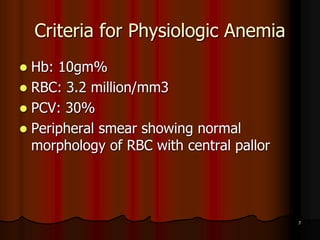
This document discusses anemia in pregnancy. It defines anemia as a hemoglobin level below 11g/dl. Anemia affects around 50% of pregnant women globally, and rates are higher in developing countries, up to 56%, often due to infections. Anemia can be physiologic, meaning it is a normal part of pregnancy, or it can be pathologic due to deficiencies in iron, folic acid, vitamin B12, hemorrhage, hereditary conditions, infections, or renal/bone marrow diseases. The most common cause of anemia in pregnancy is iron deficiency due to increased iron demands, poor diet, and infections. Treatment involves iron and folic acid supplementation. Megaloblastic anemia can also occur