A Brief Review of
Anemia in Children
Epidemiology, Etiology, Clinical Features, Classification
Prof. Imran Iqbal
Fellowship in Pediatric Neurology
(Australia) Prof of Paediatrics (2003-2018)
Prof of Pediatrics Emeritus,
CHICH Prof of Pediatrics, CIMS
Multan, Pakistan
Anatomy of Erythropoiesis
(RBC production)
• In fetal life, erythropoiesis occurs in liver and spleen
• After birth, RBCs are produced in Bone marrow
• Active Bone marrow in small children is present in all
skeleton
• Active Bone marrow in adults is present in axial
skeleton
Physiology of Erythropoiesis
(RBC production)
• Anemia and other disorders produce cellular hypoxia
• Hypoxia is a stimulus for production of erythropoietin
• Erythropoietin produced in kidney stimulates Erythropoiesis
• Thyroid hormones are needed for erythropoiesis
• Adrenal cortical steroids are needed for erythropoiesis
Anemia – Physiology
• Average lifespan of RBCs is 120 days
• About 1 % of the body's total red blood cells are produced
and replaced per day
• Anemia occurs when there is:
-- decreased production of RBCs
-- increased destruction / loss of RBCs
• In the normal functioning Bone marrow, Anemia results in
Erythroid Hyperplasia which can increase RBC production
many times
Anemia – Epidemiology
• Anemia is one of the commonest disorders in children
• Anemia is seen in 53.7 % of children in Pakistan (NNS 2018)
Anemia – Definition
• Anemia is decrease in the
-- Hemoglobin
-- Hematocrit
-- RBC mass
below the reference range for age and sex
Anemia
Clinical Presentation
Anemia – Abnormal Symptoms
• Pallor
• Fatigue
• Anorexia
• Breathlessness
• Palpitation
• Breath – holding spells
• Irritability
• Poor sleep
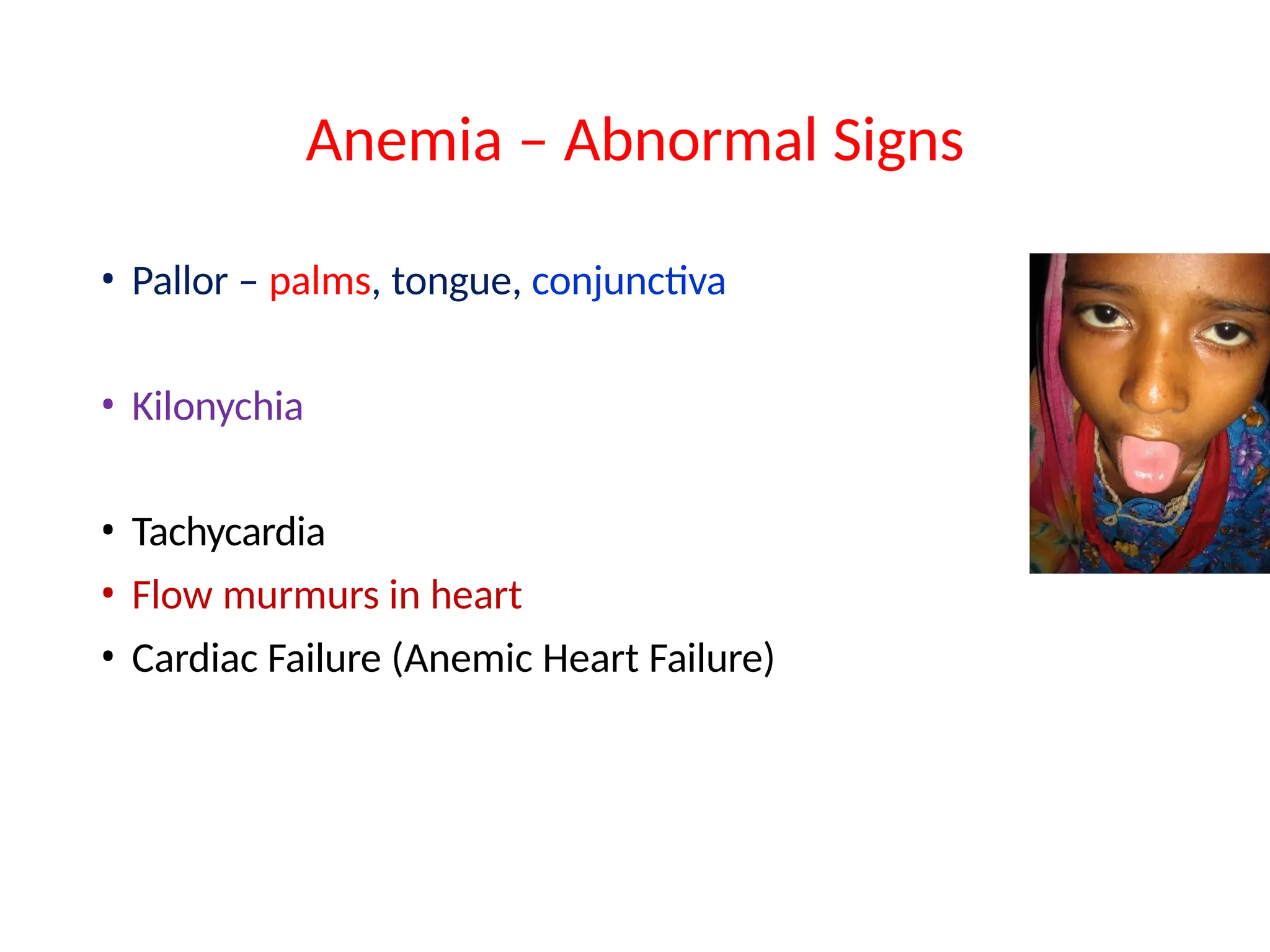
Anemia – Abnormal Signs
• Pallor – palms, tongue, conjunctiva
• Kilonychia
• Tachycardia
• Flow murmurs in heart
• Cardiac Failure (Anemic Heart Failure)
Anemia – Etiology
Anemia – Etiology
• Decreased production –
-- Nutritional substrate deficiency – Iron, Folic acid
-- Chronic diseases – CKD, JIA, Hypothyroid
• Chronic Blood Loss – Worms, Visible chronic bleeds
• Hypoplastic / Aplastic Anemia – Bone marrow Failure
• Bone Marrow Replacement – Leukemia, lymphoma
• Hemolytic Anemia – increased RBC breakdown
-- Genetic, congenital defects
-- Acquired disorders
Clinical Evaluation
of the Child with
Anemia
Case scenario
• An 8 year old girl presents with pallor for the last 3 years.
• She remains anorexic and is not active
• She has received 15 blood transfusions during this period
• On examination, pallor is visible on her skin and mucous
membranes
How will you evaluate this child to make a diagnosis and
decide about treatment ?
Anemia – History
• Age of onset
• Duration
• Birth Weight and Gestational age
• Milk intake
• Solid diet
• Feeding problems
• History of Blood loss or bruising
• Blood Transfusions – indicate severity or chronicity
• Any other symptoms – symptoms of chronic GI, liver or
kidney disease
Anemia – Examination
• Dysmorphic features – Congenital hypoplastic anemia,
-- Chronic hemolytic anemia
• Jaundice - Hemolysis
• Tongue (atrophy of papillae) – severe Iron deficiency
• Purpura or bleeding - Thrombocytopenia
• Kilonychia – severe Iron deficiency
• Cardiac examination – Heart Failure
• Lymphadenopathy – leukemia, lymphoma
• Splenomegaly – Hemolysis, leukemia, lymphoma
Anemia
Investigations
Anemia – Investigations
• CBC (Hb, Hematocrit, MCV,MCH,MCHC, TLC, DLC, Platelets)
• Peripheral Blood Film (microcytic, normocytic, macrocytic)
• Reticulocyte count – high (hemolysis), Low (hypoplastic)
• ESR, CRP (chronic disease, chronic inflammation)
• Serum Ferritin, Serum Iron (Iron deficiency, chronic
inflammation)
• Hemoglobin Electrophoresis (Hemoglobinopathies)
• Bone Marrow Examination (hypoplasia, leukemia)
Anemia
Morphological Classification
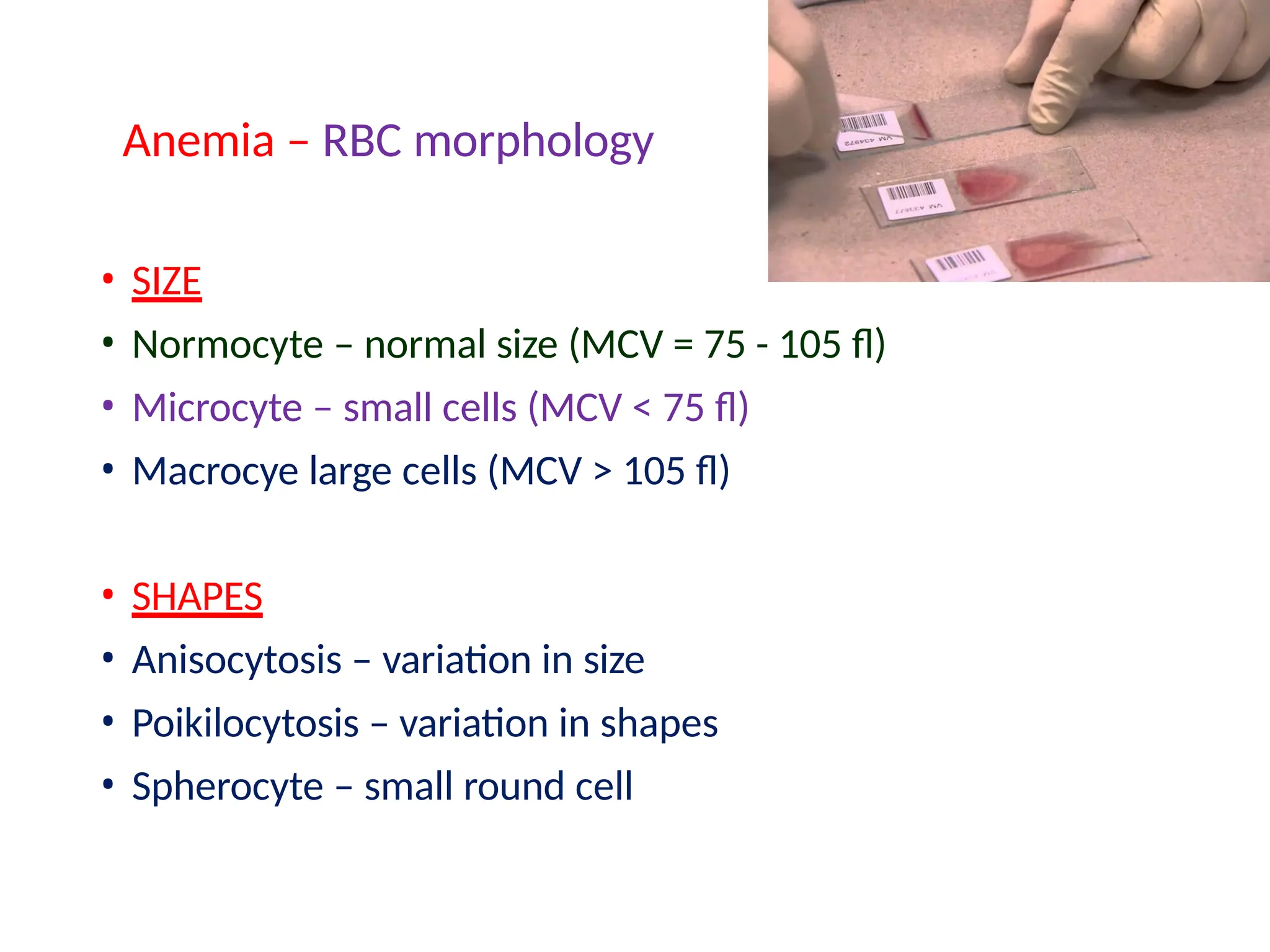
Anemia – RBC morphology
• SIZE
• Normocyte – normal size (MCV = 75 - 105 fl)
• Microcyte – small cells (MCV < 75 fl)
• Macrocye large cells (MCV > 105 fl)
• SHAPES
• Anisocytosis – variation in size
• Poikilocytosis – variation in shapes
• Spherocyte – small round cell
Anemia - Morphological Classification
• Normocytic Anemia (MCV = 75 - 105 fl)
• Microcytic Anemia (MCV < 75 fl)
• Macrocytic Anemia (MCV > 105 fl)
Normocytic Anemia (MCV = 75 - 105 fl)
• Acute blood loss
• Chronic diseases
• Hypo-plastic Anemia – Decreased RBC production
• Hemolytic Anemia – (G6-PD, AHA)
Microcytic Anemia (MCV < 75 fl)
• Iron deficiency anemia
• Hemolytic Anemia (Thalassemia, Hereditary Spherocytosis)
• Chronic diseases
Macrocytic Anemia (MCV > 75 fl)
• Hemolytic Anemia (chronic hemolysis)
• Folic Acid Deficiency
• Vitamin B12 deficiency
Anemia – Common Types
• Nutritional Anemia – Nutritional Iron deficiency
• Hypoplastic Anemia – Bone marrow Failure
• Hemolytic Anemia – increased RBC breakdown
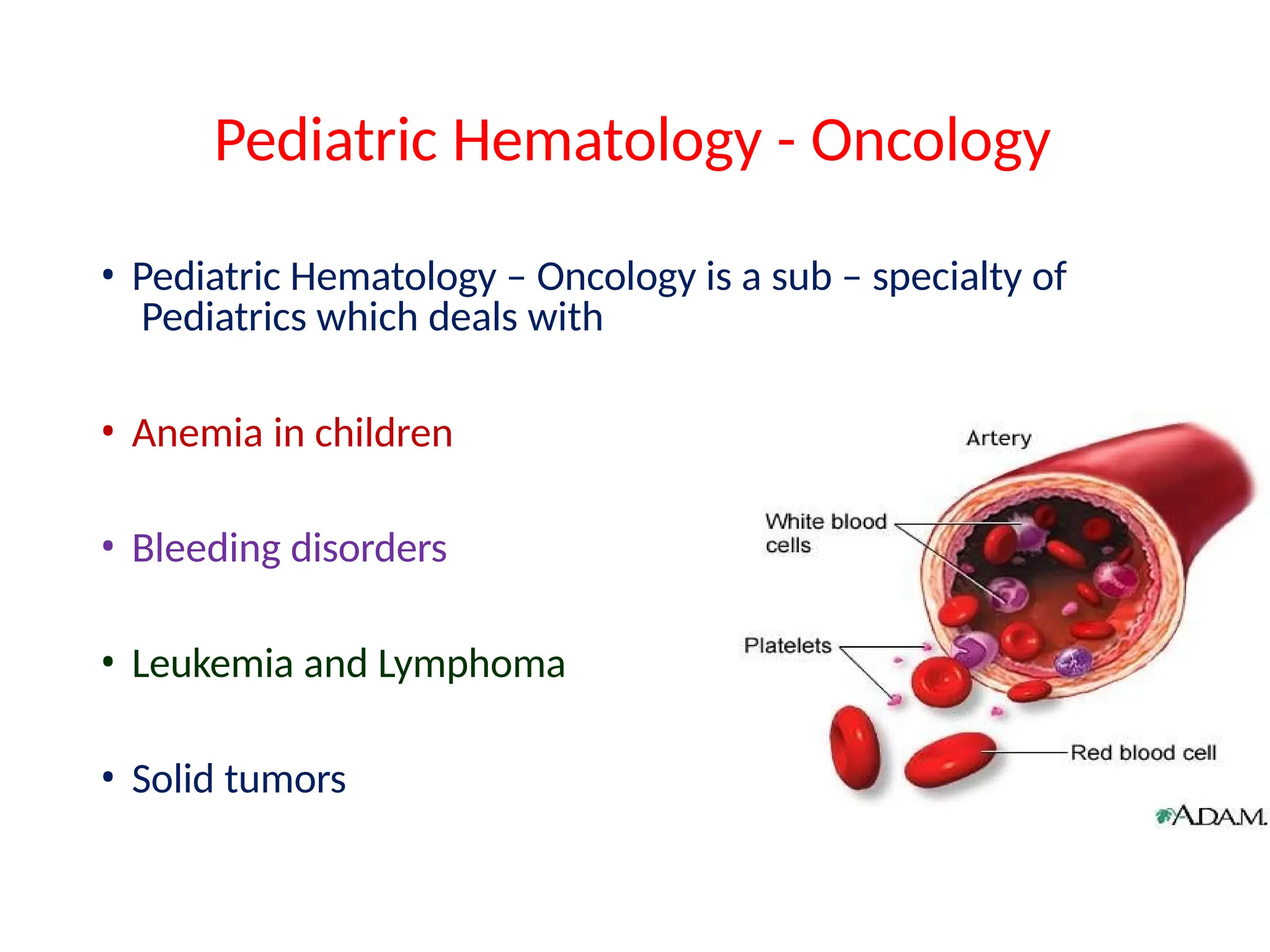
Pediatric Hematology - Oncology
• Pediatric Hematology – Oncology is a sub – specialty of
Pediatrics which deals with
• Anemia in children
• Bleeding disorders
• Leukemia and Lymphoma
• Solid tumors
In the name of Our Creator Allah,
the most Gracious, the most
Merciful
(God speaking to His Prophet Muhammad (PBUH)
And, indeed, You have a great moral character
Al Quran - surah Qalam 68:5

anemia in children ppt presentation paediatrics

  • 1.
    A Brief Reviewof Anemia in Children Epidemiology, Etiology, Clinical Features, Classification Prof. Imran Iqbal Fellowship in Pediatric Neurology (Australia) Prof of Paediatrics (2003-2018) Prof of Pediatrics Emeritus, CHICH Prof of Pediatrics, CIMS Multan, Pakistan
  • 2.
    Anatomy of Erythropoiesis (RBCproduction) • In fetal life, erythropoiesis occurs in liver and spleen • After birth, RBCs are produced in Bone marrow • Active Bone marrow in small children is present in all skeleton • Active Bone marrow in adults is present in axial skeleton
  • 3.
    Physiology of Erythropoiesis (RBCproduction) • Anemia and other disorders produce cellular hypoxia • Hypoxia is a stimulus for production of erythropoietin • Erythropoietin produced in kidney stimulates Erythropoiesis • Thyroid hormones are needed for erythropoiesis • Adrenal cortical steroids are needed for erythropoiesis
  • 4.
    Anemia – Physiology •Average lifespan of RBCs is 120 days • About 1 % of the body's total red blood cells are produced and replaced per day • Anemia occurs when there is: -- decreased production of RBCs -- increased destruction / loss of RBCs • In the normal functioning Bone marrow, Anemia results in Erythroid Hyperplasia which can increase RBC production many times
  • 5.
    Anemia – Epidemiology •Anemia is one of the commonest disorders in children • Anemia is seen in 53.7 % of children in Pakistan (NNS 2018)
  • 6.
    Anemia – Definition •Anemia is decrease in the -- Hemoglobin -- Hematocrit -- RBC mass below the reference range for age and sex
  • 7.
  • 8.
    Anemia – AbnormalSymptoms • Pallor • Fatigue • Anorexia • Breathlessness • Palpitation • Breath – holding spells • Irritability • Poor sleep
  • 9.
    Anemia – AbnormalSigns • Pallor – palms, tongue, conjunctiva • Kilonychia • Tachycardia • Flow murmurs in heart • Cardiac Failure (Anemic Heart Failure)
  • 10.
  • 11.
    Anemia – Etiology •Decreased production – -- Nutritional substrate deficiency – Iron, Folic acid -- Chronic diseases – CKD, JIA, Hypothyroid • Chronic Blood Loss – Worms, Visible chronic bleeds • Hypoplastic / Aplastic Anemia – Bone marrow Failure • Bone Marrow Replacement – Leukemia, lymphoma • Hemolytic Anemia – increased RBC breakdown -- Genetic, congenital defects -- Acquired disorders
  • 12.
    Clinical Evaluation of theChild with Anemia
  • 13.
    Case scenario • An8 year old girl presents with pallor for the last 3 years. • She remains anorexic and is not active • She has received 15 blood transfusions during this period • On examination, pallor is visible on her skin and mucous membranes How will you evaluate this child to make a diagnosis and decide about treatment ?
  • 14.
    Anemia – History •Age of onset • Duration • Birth Weight and Gestational age • Milk intake • Solid diet • Feeding problems • History of Blood loss or bruising • Blood Transfusions – indicate severity or chronicity • Any other symptoms – symptoms of chronic GI, liver or kidney disease
  • 15.
    Anemia – Examination •Dysmorphic features – Congenital hypoplastic anemia, -- Chronic hemolytic anemia • Jaundice - Hemolysis • Tongue (atrophy of papillae) – severe Iron deficiency • Purpura or bleeding - Thrombocytopenia • Kilonychia – severe Iron deficiency • Cardiac examination – Heart Failure • Lymphadenopathy – leukemia, lymphoma • Splenomegaly – Hemolysis, leukemia, lymphoma
  • 16.
  • 17.
    Anemia – Investigations •CBC (Hb, Hematocrit, MCV,MCH,MCHC, TLC, DLC, Platelets) • Peripheral Blood Film (microcytic, normocytic, macrocytic) • Reticulocyte count – high (hemolysis), Low (hypoplastic) • ESR, CRP (chronic disease, chronic inflammation) • Serum Ferritin, Serum Iron (Iron deficiency, chronic inflammation) • Hemoglobin Electrophoresis (Hemoglobinopathies) • Bone Marrow Examination (hypoplasia, leukemia)
  • 18.
  • 19.
    Anemia – RBCmorphology • SIZE • Normocyte – normal size (MCV = 75 - 105 fl) • Microcyte – small cells (MCV < 75 fl) • Macrocye large cells (MCV > 105 fl) • SHAPES • Anisocytosis – variation in size • Poikilocytosis – variation in shapes • Spherocyte – small round cell
  • 21.
    Anemia - MorphologicalClassification • Normocytic Anemia (MCV = 75 - 105 fl) • Microcytic Anemia (MCV < 75 fl) • Macrocytic Anemia (MCV > 105 fl)
  • 22.
    Normocytic Anemia (MCV= 75 - 105 fl) • Acute blood loss • Chronic diseases • Hypo-plastic Anemia – Decreased RBC production • Hemolytic Anemia – (G6-PD, AHA)
  • 23.
    Microcytic Anemia (MCV< 75 fl) • Iron deficiency anemia • Hemolytic Anemia (Thalassemia, Hereditary Spherocytosis) • Chronic diseases
  • 24.
    Macrocytic Anemia (MCV> 75 fl) • Hemolytic Anemia (chronic hemolysis) • Folic Acid Deficiency • Vitamin B12 deficiency
  • 25.
    Anemia – CommonTypes • Nutritional Anemia – Nutritional Iron deficiency • Hypoplastic Anemia – Bone marrow Failure • Hemolytic Anemia – increased RBC breakdown
  • 26.
    Pediatric Hematology -Oncology • Pediatric Hematology – Oncology is a sub – specialty of Pediatrics which deals with • Anemia in children • Bleeding disorders • Leukemia and Lymphoma • Solid tumors
  • 27.
    In the nameof Our Creator Allah, the most Gracious, the most Merciful (God speaking to His Prophet Muhammad (PBUH) And, indeed, You have a great moral character Al Quran - surah Qalam 68:5