Beyond the phone: Google
embraces IoT with Android Things
By giving away the hard stuff,
Google does to IoT what it did to mobile.
Carl Whalley
OTAMate
https://www.linkedin.com/in/carlwhalley
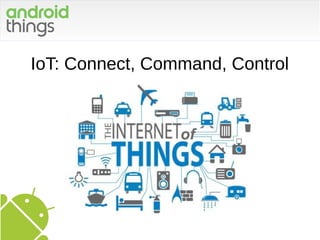
IoT: Connect, Command, Control
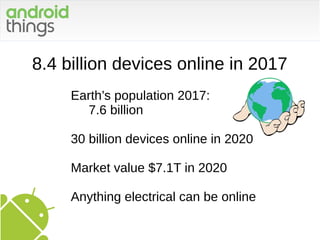
8.4 billion devices online in 2017
Earth’s population 2017:
7.6 billion
30 billion devices online in 2020
Market value $7.1T in 2020
Anything electrical can be online
IoT’s past is similar to mobile
No clear market leader OS
Nodes not powerful enough
Separate interfaces, protocols + UI’s
No enabler to standardise
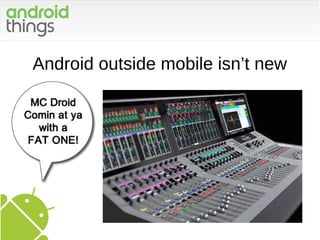
Android outside mobile isn’t new
The Hardware/Software tipping point
RAM, CPU power sky rocketed
Fewer wheels re-invented
Local networks became the Internet
Software evolved to make use of it
- Multitasking
- Better real world modelling
Google spots another perfect storm
IoT ready for prime time
The brand:
- 90% of smartphone users already know Android.
Established Cloud infrastructure
- Google Cloud IoT
- Managed services/Analytics/Security
Eliminated barriers to entry
Android Things is free
Ultra low cost hardware
Android support already available in
terms of docs, skills, apps, marketing
Guaranteed compatibility with Googles
Mobile & Cloud services
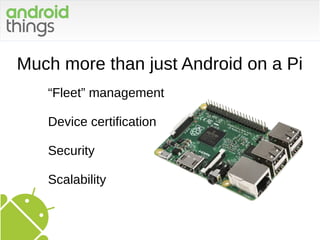
Much more than just Android on a Pi
“Fleet” management
Device certification
Security
Scalability
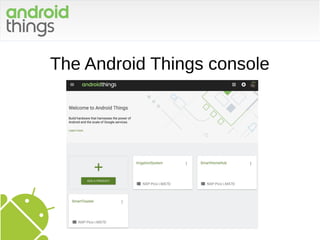
The Android Things console
What’s development like?
Platform is current Android
- Familar AndroidManifest.xml etc
- Keeps up with latest Kotlin (Yay!)
- No emulator (yet)
- The familiar Android env is all there:
- Activities
- Lifecycles
- Views etc
- Distinguishes between production
and development boards
- Heavy emphasis on drivers for I/O
And the code?
No default UI!
- No home screen/status bar/navigation
- Roll your own UI or use hardware
- Ooops: Google always said don’t code
a back button
Many API differences & restrictions
- Permissions can’t be asked for interactively
- Google services missing: Ads/Pay/Play Store
- Does support Firebase/Maps/Location
Sensors and comms
GPIO
- General Purpose IO
- “Pins” with easy on/off detection
- Industry standard I2C, serial Tx/Rx
- Networking
- WiFi
- Bluetooth
Native
- C++ via JNI for when you need to hit the metal
Local AI
Tensorflow Lite
- Image classifier via camera
- AI Training performed off device
- Machine Learning:
data deployed as one processed image
- Can act as Edge Computing device
- Tensorflow has full Android Studio support
- Local AI means offline continuity support
Call your Driver!
Drivers Managed by Developers
- Display: LCD screen, OLED
- Location: GPS, WiFi
- HID: Touch pads, keyboards etc
- Supports sensor fusion:
combines data from different physical
devices into a single virtual one
- LoWPAN:
Low-power Wireless Personal Area Networks
Real projects
Hackster
- Air Quality monitoring via Taxis
- Home brewery
- 3 Axis CNC
- Smart home security monitoring
- Drain clog detector
- Drone controllers
https://www.hackster.io/google/products/android-things

Android things-manchester-2018-jun

  • 1.
    Beyond the phone:Google embraces IoT with Android Things By giving away the hard stuff, Google does to IoT what it did to mobile. Carl Whalley OTAMate https://www.linkedin.com/in/carlwhalley
  • 2.
  • 3.
    8.4 billion devicesonline in 2017 Earth’s population 2017: 7.6 billion 30 billion devices online in 2020 Market value $7.1T in 2020 Anything electrical can be online
  • 4.
    IoT’s past issimilar to mobile No clear market leader OS Nodes not powerful enough Separate interfaces, protocols + UI’s No enabler to standardise
  • 5.
  • 6.
    The Hardware/Software tippingpoint RAM, CPU power sky rocketed Fewer wheels re-invented Local networks became the Internet Software evolved to make use of it - Multitasking - Better real world modelling
  • 7.
    Google spots anotherperfect storm IoT ready for prime time The brand: - 90% of smartphone users already know Android. Established Cloud infrastructure - Google Cloud IoT - Managed services/Analytics/Security
  • 8.
    Eliminated barriers toentry Android Things is free Ultra low cost hardware Android support already available in terms of docs, skills, apps, marketing Guaranteed compatibility with Googles Mobile & Cloud services
  • 9.
    Much more thanjust Android on a Pi “Fleet” management Device certification Security Scalability
  • 10.
  • 11.
    What’s development like? Platformis current Android - Familar AndroidManifest.xml etc - Keeps up with latest Kotlin (Yay!) - No emulator (yet) - The familiar Android env is all there: - Activities - Lifecycles - Views etc - Distinguishes between production and development boards - Heavy emphasis on drivers for I/O
  • 12.
    And the code? Nodefault UI! - No home screen/status bar/navigation - Roll your own UI or use hardware - Ooops: Google always said don’t code a back button Many API differences & restrictions - Permissions can’t be asked for interactively - Google services missing: Ads/Pay/Play Store - Does support Firebase/Maps/Location
  • 13.
    Sensors and comms GPIO -General Purpose IO - “Pins” with easy on/off detection - Industry standard I2C, serial Tx/Rx - Networking - WiFi - Bluetooth Native - C++ via JNI for when you need to hit the metal
  • 14.
    Local AI Tensorflow Lite -Image classifier via camera - AI Training performed off device - Machine Learning: data deployed as one processed image - Can act as Edge Computing device - Tensorflow has full Android Studio support - Local AI means offline continuity support
  • 15.
    Call your Driver! DriversManaged by Developers - Display: LCD screen, OLED - Location: GPS, WiFi - HID: Touch pads, keyboards etc - Supports sensor fusion: combines data from different physical devices into a single virtual one - LoWPAN: Low-power Wireless Personal Area Networks
  • 16.
    Real projects Hackster - AirQuality monitoring via Taxis - Home brewery - 3 Axis CNC - Smart home security monitoring - Drain clog detector - Drone controllers https://www.hackster.io/google/products/android-things