ANDROID Presented by: Jitendriya Pradhan
Guided by: Nibedita Shial
Regd No: 2001298092
GANDHI INSTITUTE FOR TECHNOLOGY
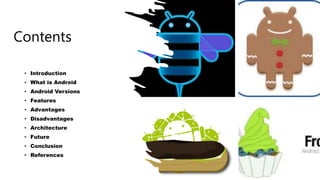
Contents
• Introduction
• What is Android
• Android Versions
• Features
• Advantages
• Disadvantages
• Architecture
• Future
• Conclusion
• References
Introduction
• Android is the first step in the vision of
creating a better mobile phone. It is a
complete open mobile platform
software stack recently release by
Google
• Android can be run on mobile devices
from companies that have come
together to form the Open Handset
Alliance. The Alliance currently consists
of 34 companies including Motorola, T-
Mobile and Sprint-Nextel. These
companies have agreed to open access
devices..
What Is Android
• Android is an operating system
for Mobile phones. I will explain
more about this in the later part
of this article. Lot of advances
can be seen these days in the
field of smart phones.
• As the number of users is
increasing day by day, facilities
are also increasing.
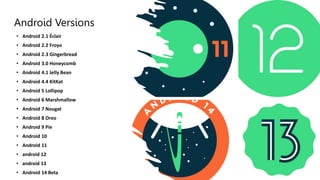
Android Versions
• Android 2.1 Éclair
• Android 2.2 Froyo
• Android 2.3 Gingerbread
• Android 3.0 Honeycomb
• Android 4.1 Jelly Bean
• Android 4.4 KitKat
• Android 5 Lollipop
• Android 6 Marshmallow
• Android 7 Nougat
• Android 8 Oreo
• Android 9 Pie
• Android 10
• Android 11
• android 12
• android 13
• Android 14 Beta
Features
• Translate languages in an instant.
• Use your camera to search the web.
• Automatically caption media playing on your phone.
• safe with built-in security.
• Full control of your data.
• Gesture Control
• Dark Mode
• Near Field Communication (NFC)
• Storage & Battery Swap
• Widgets
• Custom Home Screen
• Connectivity: GSM/EDGE, IDEN, CDMA, Bluetooth, WI-
FI, EDGE,3G,NFC, LTE,GPS.
• Multilanguage support
• Multi-touch etc.
Advantages
• Android can Run Multiple Apps at the Same Time.
• Android has a better application market compare
to Apple’s App because Android's App store has
over 2.9 million applications, w ethe Apple
Marketplace has only just broken the 1.76 million
mark.
• Android is Hardware independent.
• Android is an open-source platform allowing UI
customization.
• Supports cloud storage enabling sync of devices
with G-account.
• runs multiple apps simultaneously
• Expandable memory & runs on affordable large
devices
• Wide range of devices to choose from
Disadvantages
• Android Market is less control of the
manager, sometimes there are malware.
• Sometimes there are ads: because it is
easy and free, sometimes often a lot of
advertising. In appearance it does not
interfere with the performance of the
application itself, as it sometimes is in the
top or bottom of the application.
• No standardization of application quality
• some application contains a virus
• Google account mandatory to use Play
Store
Architecture
Conclusion
• With all upcoming applications and
mobile services Google Android is
stepping into the next level of Mobile
Internet. Android participates in many of
the successful open source projects.
That is, architect the solution for
participation and the developers will not
only come but will play well together.
• Android is a free open-source Unix-like
mobile operating system. It was
developed by a consortium of
developers known as the Open Handset
Alliance and commercially sponsored by
Google.
• There is a great future for android
application developers.
References
• www.studymafia.org
• www.Wikipedia.org
• www.javapoint.com
• www.geekforgeeks.com
Thank You

ANDROID (1).pptx

  • 2.
    ANDROID Presented by:Jitendriya Pradhan Guided by: Nibedita Shial Regd No: 2001298092 GANDHI INSTITUTE FOR TECHNOLOGY
  • 3.
    Contents • Introduction • Whatis Android • Android Versions • Features • Advantages • Disadvantages • Architecture • Future • Conclusion • References
  • 4.
    Introduction • Android isthe first step in the vision of creating a better mobile phone. It is a complete open mobile platform software stack recently release by Google • Android can be run on mobile devices from companies that have come together to form the Open Handset Alliance. The Alliance currently consists of 34 companies including Motorola, T- Mobile and Sprint-Nextel. These companies have agreed to open access devices..
  • 5.
    What Is Android •Android is an operating system for Mobile phones. I will explain more about this in the later part of this article. Lot of advances can be seen these days in the field of smart phones. • As the number of users is increasing day by day, facilities are also increasing.
  • 6.
    Android Versions • Android2.1 Éclair • Android 2.2 Froyo • Android 2.3 Gingerbread • Android 3.0 Honeycomb • Android 4.1 Jelly Bean • Android 4.4 KitKat • Android 5 Lollipop • Android 6 Marshmallow • Android 7 Nougat • Android 8 Oreo • Android 9 Pie • Android 10 • Android 11 • android 12 • android 13 • Android 14 Beta
  • 7.
    Features • Translate languagesin an instant. • Use your camera to search the web. • Automatically caption media playing on your phone. • safe with built-in security. • Full control of your data. • Gesture Control • Dark Mode • Near Field Communication (NFC) • Storage & Battery Swap • Widgets • Custom Home Screen • Connectivity: GSM/EDGE, IDEN, CDMA, Bluetooth, WI- FI, EDGE,3G,NFC, LTE,GPS. • Multilanguage support • Multi-touch etc.
  • 8.
    Advantages • Android canRun Multiple Apps at the Same Time. • Android has a better application market compare to Apple’s App because Android's App store has over 2.9 million applications, w ethe Apple Marketplace has only just broken the 1.76 million mark. • Android is Hardware independent. • Android is an open-source platform allowing UI customization. • Supports cloud storage enabling sync of devices with G-account. • runs multiple apps simultaneously • Expandable memory & runs on affordable large devices • Wide range of devices to choose from
  • 9.
    Disadvantages • Android Marketis less control of the manager, sometimes there are malware. • Sometimes there are ads: because it is easy and free, sometimes often a lot of advertising. In appearance it does not interfere with the performance of the application itself, as it sometimes is in the top or bottom of the application. • No standardization of application quality • some application contains a virus • Google account mandatory to use Play Store
  • 10.
  • 11.
    Conclusion • With allupcoming applications and mobile services Google Android is stepping into the next level of Mobile Internet. Android participates in many of the successful open source projects. That is, architect the solution for participation and the developers will not only come but will play well together. • Android is a free open-source Unix-like mobile operating system. It was developed by a consortium of developers known as the Open Handset Alliance and commercially sponsored by Google. • There is a great future for android application developers.
  • 12.
    References • www.studymafia.org • www.Wikipedia.org •www.javapoint.com • www.geekforgeeks.com
  • 13.