Andrew Goodwin identifies six key aspects of
music videos
1. A relationship between the lyrics and the visuals.
2. A relationship between the music and the visuals.
3. The video demonstrates genre characteristics.
4. There are close ups and motifs of the music artist.
5. There is reference to voyeurism.
6. There are intertextual references.
The relationship between the lyrics and the
visuals
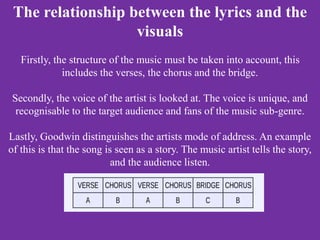
Firstly, the structure of the music must be taken into account, this
includes the verses, the chorus and the bridge.
Secondly, the voice of the artist is looked at. The voice is unique, and
recognisable to the target audience and fans of the music sub-genre.
Lastly, Goodwin distinguishes the artists mode of address. An example
of this is that the song is seen as a story. The music artist tells the story,
and the audience listen.
The relationship between the music and the
visuals.
There are three main aspects:
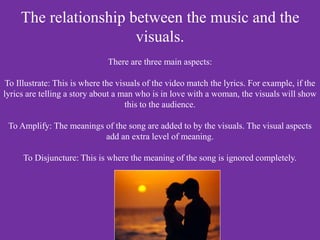
To Illustrate: This is where the visuals of the video match the lyrics. For example, if the
lyrics are telling a story about a man who is in love with a woman, the visuals will show
this to the audience.
To Amplify: The meanings of the song are added to by the visuals. The visual aspects
add an extra level of meaning.
To Disjuncture: This is where the meaning of the song is ignored completely.
Music videos demonstrate genre
characteristics.
Each genre of music has its own characteristics which define the
particular genre. For example, heavy rock bands may have an
intense performance, whereas girl pop groups may have a
choreographed dance routine.
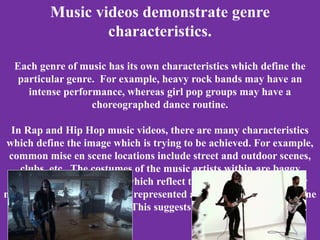
In Rap and Hip Hop music videos, there are many characteristics
which define the image which is trying to be achieved. For example,
common mise en scene locations include street and outdoor scenes,
clubs, etc. The costumes of the music artists within are baggy
clothes, chains, hats, etc, which reflect the rebellious tone of their
music. The music artists are represented as stereotypically masculine
with large egos. This suggests self promotion.
Close Ups and Motifs.
The demands of the record label will include the need for lots of
close ups of the artist and the artist may develop motifs which recur
throughout their work. A good example would be Amy Winehouse.
In her music videos there are lots of close ups which capture her
style. In terms of performance and body language, she has the same
iconic dance routine when she performs; the fixed position and
swaying motion.
Voyeurism
There is frequent reference to the notion of looking (screens within
screens, mirrors, stages, etc) and particularly voyeuristic treatment of the
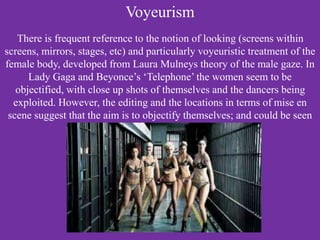
female body, developed from Laura Mulneys theory of the male gaze. In
Lady Gaga and Beyonce’s ‘Telephone’ the women seem to be
objectified, with close up shots of themselves and the dancers being
exploited. However, the editing and the locations in terms of mise en
scene suggest that the aim is to objectify themselves; and could be seen
as empowering.
Intertextual References
There are often intertextual reference to films, TV programmes,
products, etc within music videos. For example, Red Hot Chili Peppers
‘Californication’ references to video games, whereas Robbie Williams
‘You Know Me’ references to the Alice in Wonderland, through the
looking glass. Intertextual reference is useful as a wider audience would
have knowledge of the reference, therefore it could draw in more viewers
(cultural capital). Also, the commercial link in terms of synergy is
beneficial for both the record label, and the audience.
Andrew Goodwin’s Theoretical Framework
Applied To A Music Video Of My Choice
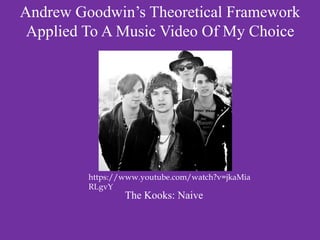
The Kooks: Naive
https://www.youtube.com/watch?v=jkaMia
RLgvY
The Relationship between the lyrics and the
visuals.
The Kooks ‘Naïve’ is a narrative/performance based music video, with the narrative being
presented through the lyrics. The lyrics describe a man who thinks that his other half is cheating
on him, however doesn’t want to confront her due to fear of ruining the relationship
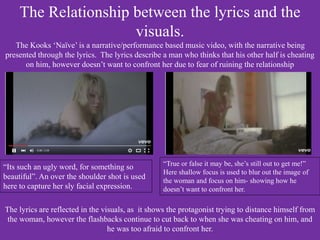
“Its such an ugly word, for something so
beautiful”. An over the shoulder shot is used
here to capture her sly facial expression.
“True or false it may be, she’s still out to get me!”
Here shallow focus is used to blur out the image of
the woman and focus on him- showing how he
doesn’t want to confront her.
The lyrics are reflected in the visuals, as it shows the protagonist trying to distance himself from
the woman, however the flashbacks continue to cut back to when she was cheating on him, and
he was too afraid to confront her.
The relationship between the music and the
visuals.
This video illustrates, however more important amplifies the song. Although the audience is
being shown the narrative of the man and woman, she is said to be acting ‘naïve’ however, it
is infact him who is acting naïve, therefore this adds an extra layer of meaning to the song.
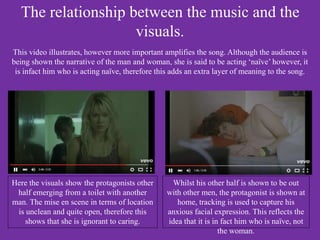
Here the visuals show the protagonists other
half emerging from a toilet with another
man. The mise en scene in terms of location
is unclean and quite open, therefore this
shows that she is ignorant to caring.
Whilst his other half is shown to be out
with other men, the protagonist is shown at
home, tracking is used to capture his
anxious facial expression. This reflects the
idea that it is in fact him who is naïve, not
the woman.
Genre Characteristics
Within a lot of Indie/ Rock music videos, the lead singer of the band is often placed into the
narrative as the main protagonist. This is shown in ‘Naïve’ where the lead singer is the
protagonist, however he is also lip syncing to emphasise the point of view whereby the song
comes from.
The costume featured within this video is
typical of common indie/ rock stereotypes.
This includes a leather jacket, jeans, and a
rough looking hairstyle. This conveys a sense
of rebellion, however also portrays the
personality of the character within the video,
making it more realistic for the target
audience.
The lighting within this video demonstrates
the genre characteristics of Indie/Rock music
as it is mostly low key, however with some
elements of high key to capture particular
feelings and emotions. The low key lighting
above with the red filter conveys a sense of
negativity, reflecting the emotions of the
lyrics.
Close Ups and Motifs
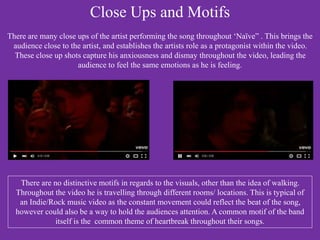
There are many close ups of the artist performing the song throughout ‘Naïve” . This brings the
audience close to the artist, and establishes the artists role as a protagonist within the video.
These close up shots capture his anxiousness and dismay throughout the video, leading the
audience to feel the same emotions as he is feeling.
There are no distinctive motifs in regards to the visuals, other than the idea of walking.
Throughout the video he is travelling through different rooms/ locations. This is typical of
an Indie/Rock music video as the constant movement could reflect the beat of the song,
however could also be a way to hold the audiences attention. A common motif of the band
itself is the common theme of heartbreak throughout their songs.
Voyeurism
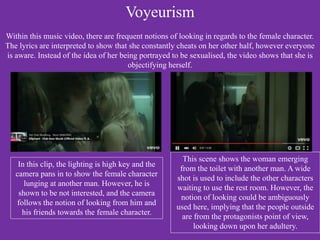
Within this music video, there are frequent notions of looking in regards to the female character.
The lyrics are interpreted to show that she constantly cheats on her other half, however everyone
is aware. Instead of the idea of her being portrayed to be sexualised, the video shows that she is
objectifying herself.
In this clip, the lighting is high key and the
camera pans in to show the female character
lunging at another man. However, he is
shown to be not interested, and the camera
follows the notion of looking from him and
his friends towards the female character.
This scene shows the woman emerging
from the toilet with another man. A wide
shot is used to include the other characters
waiting to use the rest room. However, the
notion of looking could be ambiguously
used here, implying that the people outside
are from the protagonists point of view,
looking down upon her adultery.

Andrew goodwin theory

  • 2.
    Andrew Goodwin identifiessix key aspects of music videos 1. A relationship between the lyrics and the visuals. 2. A relationship between the music and the visuals. 3. The video demonstrates genre characteristics. 4. There are close ups and motifs of the music artist. 5. There is reference to voyeurism. 6. There are intertextual references.
  • 3.
    The relationship betweenthe lyrics and the visuals Firstly, the structure of the music must be taken into account, this includes the verses, the chorus and the bridge. Secondly, the voice of the artist is looked at. The voice is unique, and recognisable to the target audience and fans of the music sub-genre. Lastly, Goodwin distinguishes the artists mode of address. An example of this is that the song is seen as a story. The music artist tells the story, and the audience listen.
  • 4.
    The relationship betweenthe music and the visuals. There are three main aspects: To Illustrate: This is where the visuals of the video match the lyrics. For example, if the lyrics are telling a story about a man who is in love with a woman, the visuals will show this to the audience. To Amplify: The meanings of the song are added to by the visuals. The visual aspects add an extra level of meaning. To Disjuncture: This is where the meaning of the song is ignored completely.
  • 5.
    Music videos demonstrategenre characteristics. Each genre of music has its own characteristics which define the particular genre. For example, heavy rock bands may have an intense performance, whereas girl pop groups may have a choreographed dance routine. In Rap and Hip Hop music videos, there are many characteristics which define the image which is trying to be achieved. For example, common mise en scene locations include street and outdoor scenes, clubs, etc. The costumes of the music artists within are baggy clothes, chains, hats, etc, which reflect the rebellious tone of their music. The music artists are represented as stereotypically masculine with large egos. This suggests self promotion.
  • 6.
    Close Ups andMotifs. The demands of the record label will include the need for lots of close ups of the artist and the artist may develop motifs which recur throughout their work. A good example would be Amy Winehouse. In her music videos there are lots of close ups which capture her style. In terms of performance and body language, she has the same iconic dance routine when she performs; the fixed position and swaying motion.
  • 7.
    Voyeurism There is frequentreference to the notion of looking (screens within screens, mirrors, stages, etc) and particularly voyeuristic treatment of the female body, developed from Laura Mulneys theory of the male gaze. In Lady Gaga and Beyonce’s ‘Telephone’ the women seem to be objectified, with close up shots of themselves and the dancers being exploited. However, the editing and the locations in terms of mise en scene suggest that the aim is to objectify themselves; and could be seen as empowering.
  • 8.
    Intertextual References There areoften intertextual reference to films, TV programmes, products, etc within music videos. For example, Red Hot Chili Peppers ‘Californication’ references to video games, whereas Robbie Williams ‘You Know Me’ references to the Alice in Wonderland, through the looking glass. Intertextual reference is useful as a wider audience would have knowledge of the reference, therefore it could draw in more viewers (cultural capital). Also, the commercial link in terms of synergy is beneficial for both the record label, and the audience.
  • 9.
    Andrew Goodwin’s TheoreticalFramework Applied To A Music Video Of My Choice The Kooks: Naive https://www.youtube.com/watch?v=jkaMia RLgvY
  • 10.
    The Relationship betweenthe lyrics and the visuals. The Kooks ‘Naïve’ is a narrative/performance based music video, with the narrative being presented through the lyrics. The lyrics describe a man who thinks that his other half is cheating on him, however doesn’t want to confront her due to fear of ruining the relationship “Its such an ugly word, for something so beautiful”. An over the shoulder shot is used here to capture her sly facial expression. “True or false it may be, she’s still out to get me!” Here shallow focus is used to blur out the image of the woman and focus on him- showing how he doesn’t want to confront her. The lyrics are reflected in the visuals, as it shows the protagonist trying to distance himself from the woman, however the flashbacks continue to cut back to when she was cheating on him, and he was too afraid to confront her.
  • 11.
    The relationship betweenthe music and the visuals. This video illustrates, however more important amplifies the song. Although the audience is being shown the narrative of the man and woman, she is said to be acting ‘naïve’ however, it is infact him who is acting naïve, therefore this adds an extra layer of meaning to the song. Here the visuals show the protagonists other half emerging from a toilet with another man. The mise en scene in terms of location is unclean and quite open, therefore this shows that she is ignorant to caring. Whilst his other half is shown to be out with other men, the protagonist is shown at home, tracking is used to capture his anxious facial expression. This reflects the idea that it is in fact him who is naïve, not the woman.
  • 12.
    Genre Characteristics Within alot of Indie/ Rock music videos, the lead singer of the band is often placed into the narrative as the main protagonist. This is shown in ‘Naïve’ where the lead singer is the protagonist, however he is also lip syncing to emphasise the point of view whereby the song comes from. The costume featured within this video is typical of common indie/ rock stereotypes. This includes a leather jacket, jeans, and a rough looking hairstyle. This conveys a sense of rebellion, however also portrays the personality of the character within the video, making it more realistic for the target audience. The lighting within this video demonstrates the genre characteristics of Indie/Rock music as it is mostly low key, however with some elements of high key to capture particular feelings and emotions. The low key lighting above with the red filter conveys a sense of negativity, reflecting the emotions of the lyrics.
  • 13.
    Close Ups andMotifs There are many close ups of the artist performing the song throughout ‘Naïve” . This brings the audience close to the artist, and establishes the artists role as a protagonist within the video. These close up shots capture his anxiousness and dismay throughout the video, leading the audience to feel the same emotions as he is feeling. There are no distinctive motifs in regards to the visuals, other than the idea of walking. Throughout the video he is travelling through different rooms/ locations. This is typical of an Indie/Rock music video as the constant movement could reflect the beat of the song, however could also be a way to hold the audiences attention. A common motif of the band itself is the common theme of heartbreak throughout their songs.
  • 14.
    Voyeurism Within this musicvideo, there are frequent notions of looking in regards to the female character. The lyrics are interpreted to show that she constantly cheats on her other half, however everyone is aware. Instead of the idea of her being portrayed to be sexualised, the video shows that she is objectifying herself. In this clip, the lighting is high key and the camera pans in to show the female character lunging at another man. However, he is shown to be not interested, and the camera follows the notion of looking from him and his friends towards the female character. This scene shows the woman emerging from the toilet with another man. A wide shot is used to include the other characters waiting to use the rest room. However, the notion of looking could be ambiguously used here, implying that the people outside are from the protagonists point of view, looking down upon her adultery.