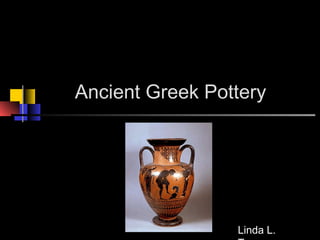
Ancient Greek Pottery
Linda L.
Ancient Greek Pottery
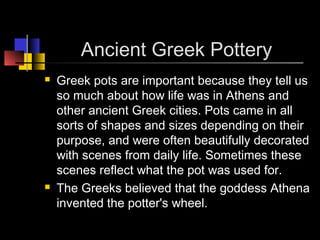
 Greek pots are important because they tell us
so much about how life was in Athens and
other ancient Greek cities. Pots came in all
sorts of shapes and sizes depending on their
purpose, and were often beautifully decorated
with scenes from daily life. Sometimes these
scenes reflect what the pot was used for.
 The Greeks believed that the goddess Athena
invented the potter's wheel.
Athena
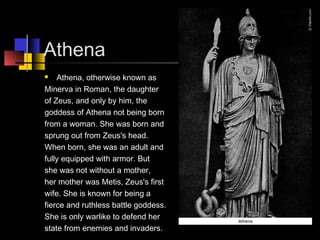
 Athena, otherwise known as
Minerva in Roman, the daughter
of Zeus, and only by him, the
goddess of Athena not being born
from a woman. She was born and
sprung out from Zeus's head.
When born, she was an adult and
fully equipped with armor. But
she was not without a mother,
her mother was Metis, Zeus's first
wife. She is known for being a
fierce and ruthless battle goddess.
She is only warlike to defend her
state from enemies and invaders.
The Importance of Pottery
 Storage containers,
cookware and
dishes were as
necessary for the
Ancient Greeks as
they are for us.
 Without much glass
and with metal
expensive, clay was
a very handy
material.
The death of Aktaeon
The painting on this pot shows
Artemis slaying Actaeon. It was made
circa 440 B.C.
Artemis was the daughter of Zeus and
Leto and the twin sister of Apollo. She
was usually depicted as the maiden
goddess of the hunt, bearing a bow
and arrows.
The story shown on this pottery is this:
When Actaeon made her angry by
bragging he was better at hunting,
Artemis hunted him with her hound
dogs and killed Actaeon.
Clay
 Clay is inexpensive and readily available.
 It is weathered rock that has crumbled to dust.
 Found in its original location, it is called
primary clay.
 In the Mediterranean region, most clay has
been deposited by glaciers and is known as
secondary clay.
 The impurities in clay give it varying colours.
 For instance, red clay contains iron.
Clay
 It is easily worked
and can be shaped
as desired.
 Once fired it is quite
strong and
waterproof.
 It makes an ideal
material for
containers of all
sorts.
Working With Clay
 The first step is to remove rocks, shells
and other materials.
 This is done by mixing the clay with water
in a process called levigation or
elutriation.
 This allows the impurities to sink to the
bottom of the mixing tub. The more often
this is done, the smoother the clay
becomes.
Throwing pots
 The clay is next kneaded and
placed on a wheel.
 As the wheel spins, the potter
shapes the clay and forms it into
the desired shapes.
 Large pots are made in sections.
Handles, feet and spouts were
also fabricated separately.
 Sections are glued together with
a layer of thin, watery, clay,
known as a slip.
Decoration
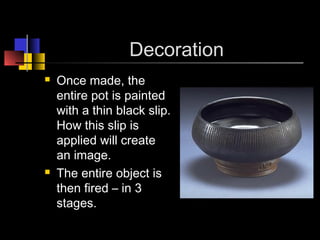
 Once made, the
entire pot is painted
with a thin black slip.
How this slip is
applied will create
an image.
 The entire object is
then fired – in 3
stages.
Pottery Art
 Only men were allowed to make pots in Ancient
Greece, though women were permitted to paint
them.
 Pottery was frequently made by slaves.
 What survives is often not high art. Really
valuable containers tended to be made of
bronze, silver or gold. However, little of this
survives because the metal was reused. Pottery
fragments, having no real value, survive.
Pottery Art
 Despite it being a
lesser form than
metal-craft, some
excellent creations
exist.
 Greek pottery and
painting evolved into
a significant art
form.
Form and Function
 Pots were shaped
according to their
function.
Form & Function
 Large storage
containers were
called amphora and
are made with two
carrying handles..
Form and Function
 Small storage boxes
were called pyxis.
Form and Function
 Small vases for
perfume or oil were
called Alabastron.
Form and Function
 Athletes kept their
oil supply in small
containers called
Aryballos
Form and Function
 Hydria were used to
carry water from
wells, springs or
rivers.
Form and Function
 Kraters were bowls
to mix water and
wine in.
Form and Function
 Wine was ladled
from kraters into
shallow wine cups
called kylix.
Form and Function
 It was also poured
directly out of wine
jugs called
oinochoe.
Form and Function
 Lekythos were used
to store oil
Periods and Styles
 Pottery is one of the oldest
surviving art forms from
Ancient Greece.
 Works and fragments
survive from the 2nd
millennium BC to the end of
the 1st
century BC.
 Greek pottery was traded
throughout the
Mediterranean world and
beyond.
Periods and Styles
Minoan & Mycenaean
 Minoan &
Mycenaean pottery
is the oldest that we
know of.
 It was exuberantly
decorated.
 It tends have as a
trait “horror vacui” or
fear of leaving open
space.
Periods and Styles
Geometric
 The next style to pervade
exhibits a different
sensibility.
 From the end of the 2nd
millennium the geometric
style dominates.
 Regular geometric
patterns and shapes, not
animal forms, are
pervasive.
Periods and Styles
Orientalizing
 Contact with Asia
brought new
innovation in design.
 The next stage is
therefore known as
the orientalizing
period.
 Plants and animals
reappear in the
bands of design.
Periods Periods and Styles
Orientalizing
 During the
orientalizing period
(roughly 725-650
BC) the black figure
technique is
employed in Corinth.
 In the 7th
century BC,
this spreads to
Athens.
Periods and Styles
Archaic
 The Archaic style
existed from around
700 to 480 BC.
 Mythology and life
became important
subjects.
 Some artists signed
their work.
Periods and Styles
Black-Figure
 The Black-figure style
really did not dominate
until the 6th
century BC.
 Artists painted black
images silhouetted against
the natural red clay
background.
 Details were inserted by
etching the black figures.
 White or purple paint could
then be added.
Periods and Styles
Red-Figure
 The red-figure style appeared
between 530-525 BC.
 It was achieved by simply
reversing the manner of black
figure painting.
 The red figures are reserved and
the background is painted.
 This is more difficult but it
allowed the design to be seen
better at a distance and it leaves
the contour of the pot more
visible.
 A. Herakles and
Athena join Greek
heroes. B. Apollo
and Artemis
avenge their
mother by
slaughtering the
children of Niobe
who boasted of
her superiority.
Achilles
In this image, Achiles
dice with a friend
ignoring the call to
battle.
Achilles had a
vulnerable heel on one
foot. When it was hit
by an arrow during a
battle, it killed
him.
Hydria
 http://www.ancien
tgreece.co.uk/dail
ylife/explore/hydri
a.html
Amphora
 http://www.ancien
tgreece.co.uk/dail
ylife/explore/amp
hora.html
Kylix
 http://www.ancien
tgreece.co.uk/dail
ylife/explore/kylix.
html
Periods and Styles
Classical
 Interestingly, the classical period saw
change, but not necessarily any improvement
in technique.
 Some observers actually feel that things
worsen as greater freedom brings less
balance.
 Some suggest that pottery artists were trying
to outdo the painters of the day. However,
this cannot be confirmed or denied, since no
paintings have survived.
Periods and Styles
Classical – White Ground
 One significant
innovation is the
painting of a large part
of the pot with a white
background.
 This creates almost a
canvas upon which the
artist can easily work.
The End
 By the end of the 5th
century BC, pottery
painting seems to lose its status as an art
form. Some suggest that metal bowls and
vases were now favoured by the rich.
 Outside Greece, local manufacturing
continued, particularly in what is now
Southern Italy.
 In the 3rd
century BC, the painting of pottery
before firing seems to end. Decoration was
now separate from potting entirely.
Bibliography
 http://www.beazley.ox.ac.uk/dictionary/
Dict/ASP/dictionarybody.asp?
name=Achilles
 http://hessemythology.wikispaces.com/
Artemis

Ancient greecepottery

  • 1.
  • 2.
    Ancient Greek Pottery Greek pots are important because they tell us so much about how life was in Athens and other ancient Greek cities. Pots came in all sorts of shapes and sizes depending on their purpose, and were often beautifully decorated with scenes from daily life. Sometimes these scenes reflect what the pot was used for.  The Greeks believed that the goddess Athena invented the potter's wheel.
  • 3.
    Athena  Athena, otherwiseknown as Minerva in Roman, the daughter of Zeus, and only by him, the goddess of Athena not being born from a woman. She was born and sprung out from Zeus's head. When born, she was an adult and fully equipped with armor. But she was not without a mother, her mother was Metis, Zeus's first wife. She is known for being a fierce and ruthless battle goddess. She is only warlike to defend her state from enemies and invaders.
  • 4.
    The Importance ofPottery  Storage containers, cookware and dishes were as necessary for the Ancient Greeks as they are for us.  Without much glass and with metal expensive, clay was a very handy material.
  • 5.
    The death ofAktaeon The painting on this pot shows Artemis slaying Actaeon. It was made circa 440 B.C. Artemis was the daughter of Zeus and Leto and the twin sister of Apollo. She was usually depicted as the maiden goddess of the hunt, bearing a bow and arrows. The story shown on this pottery is this: When Actaeon made her angry by bragging he was better at hunting, Artemis hunted him with her hound dogs and killed Actaeon.
  • 6.
    Clay  Clay isinexpensive and readily available.  It is weathered rock that has crumbled to dust.  Found in its original location, it is called primary clay.  In the Mediterranean region, most clay has been deposited by glaciers and is known as secondary clay.  The impurities in clay give it varying colours.  For instance, red clay contains iron.
  • 7.
    Clay  It iseasily worked and can be shaped as desired.  Once fired it is quite strong and waterproof.  It makes an ideal material for containers of all sorts.
  • 8.
    Working With Clay The first step is to remove rocks, shells and other materials.  This is done by mixing the clay with water in a process called levigation or elutriation.  This allows the impurities to sink to the bottom of the mixing tub. The more often this is done, the smoother the clay becomes.
  • 9.
    Throwing pots  Theclay is next kneaded and placed on a wheel.  As the wheel spins, the potter shapes the clay and forms it into the desired shapes.  Large pots are made in sections. Handles, feet and spouts were also fabricated separately.  Sections are glued together with a layer of thin, watery, clay, known as a slip.
  • 10.
    Decoration  Once made,the entire pot is painted with a thin black slip. How this slip is applied will create an image.  The entire object is then fired – in 3 stages.
  • 11.
    Pottery Art  Onlymen were allowed to make pots in Ancient Greece, though women were permitted to paint them.  Pottery was frequently made by slaves.  What survives is often not high art. Really valuable containers tended to be made of bronze, silver or gold. However, little of this survives because the metal was reused. Pottery fragments, having no real value, survive.
  • 12.
    Pottery Art  Despiteit being a lesser form than metal-craft, some excellent creations exist.  Greek pottery and painting evolved into a significant art form.
  • 13.
    Form and Function Pots were shaped according to their function.
  • 14.
    Form & Function Large storage containers were called amphora and are made with two carrying handles..
  • 15.
    Form and Function Small storage boxes were called pyxis.
  • 16.
    Form and Function Small vases for perfume or oil were called Alabastron.
  • 17.
    Form and Function Athletes kept their oil supply in small containers called Aryballos
  • 18.
    Form and Function Hydria were used to carry water from wells, springs or rivers.
  • 19.
    Form and Function Kraters were bowls to mix water and wine in.
  • 20.
    Form and Function Wine was ladled from kraters into shallow wine cups called kylix.
  • 21.
    Form and Function It was also poured directly out of wine jugs called oinochoe.
  • 22.
    Form and Function Lekythos were used to store oil
  • 23.
    Periods and Styles Pottery is one of the oldest surviving art forms from Ancient Greece.  Works and fragments survive from the 2nd millennium BC to the end of the 1st century BC.  Greek pottery was traded throughout the Mediterranean world and beyond.
  • 24.
    Periods and Styles Minoan& Mycenaean  Minoan & Mycenaean pottery is the oldest that we know of.  It was exuberantly decorated.  It tends have as a trait “horror vacui” or fear of leaving open space.
  • 25.
    Periods and Styles Geometric The next style to pervade exhibits a different sensibility.  From the end of the 2nd millennium the geometric style dominates.  Regular geometric patterns and shapes, not animal forms, are pervasive.
  • 26.
    Periods and Styles Orientalizing Contact with Asia brought new innovation in design.  The next stage is therefore known as the orientalizing period.  Plants and animals reappear in the bands of design.
  • 27.
    Periods Periods andStyles Orientalizing  During the orientalizing period (roughly 725-650 BC) the black figure technique is employed in Corinth.  In the 7th century BC, this spreads to Athens.
  • 28.
    Periods and Styles Archaic The Archaic style existed from around 700 to 480 BC.  Mythology and life became important subjects.  Some artists signed their work.
  • 29.
    Periods and Styles Black-Figure The Black-figure style really did not dominate until the 6th century BC.  Artists painted black images silhouetted against the natural red clay background.  Details were inserted by etching the black figures.  White or purple paint could then be added.
  • 30.
    Periods and Styles Red-Figure The red-figure style appeared between 530-525 BC.  It was achieved by simply reversing the manner of black figure painting.  The red figures are reserved and the background is painted.  This is more difficult but it allowed the design to be seen better at a distance and it leaves the contour of the pot more visible.
  • 31.
     A. Heraklesand Athena join Greek heroes. B. Apollo and Artemis avenge their mother by slaughtering the children of Niobe who boasted of her superiority.
  • 32.
    Achilles In this image,Achiles dice with a friend ignoring the call to battle. Achilles had a vulnerable heel on one foot. When it was hit by an arrow during a battle, it killed him.
  • 33.
  • 34.
  • 35.
  • 36.
    Periods and Styles Classical Interestingly, the classical period saw change, but not necessarily any improvement in technique.  Some observers actually feel that things worsen as greater freedom brings less balance.  Some suggest that pottery artists were trying to outdo the painters of the day. However, this cannot be confirmed or denied, since no paintings have survived.
  • 37.
    Periods and Styles Classical– White Ground  One significant innovation is the painting of a large part of the pot with a white background.  This creates almost a canvas upon which the artist can easily work.
  • 38.
    The End  Bythe end of the 5th century BC, pottery painting seems to lose its status as an art form. Some suggest that metal bowls and vases were now favoured by the rich.  Outside Greece, local manufacturing continued, particularly in what is now Southern Italy.  In the 3rd century BC, the painting of pottery before firing seems to end. Decoration was now separate from potting entirely.
  • 39.