WELCOME
DevelopmentofGeographicalThoughtsandExplanation:
(Greek Period)
Presentation on
OVERVIEW
• AIM AND OBJECTIVES
• INTRODUCTION
• THE CONCEPT OF DEVELOPMENT AND THOUGHT
• GREEK AGE
• THE GEOGRAPHICAL ACHIEVEMENTS OF GREEKS
• THE ANCIENT CLASSICAL GEOGRAPHY
• THE ROOTS OF GREEK SCHOLARSHIP
• GREEK GEOGRAPHY
• LOCATION OF GREECE
• GREEK SCHOLAR’S CONTRIBUTIONS IN GEOGRAPHY
• FINDINGS
• CONCLUSION
• REFERENCES
AIMS AND
OBJECTIVES
To know about the geographical
knowledge in different stages of Greek
period.
To know about their different
development branches.
To find out the similarities and
dissimilarities between Greek
Geography and Modern Geography
To present the achievements and lacking
of Greek Geography
Data Source
Data
Collection
Book
Atlas
Internet
Journals
Organization
Newspaper
Data Presentation
Picture
Figure
Map
INTRODUCTION
The Greeks were pioneers in many branches of knowledge.
Describing the change of geographical knowledge in different
stages may face some problem. To avoid the problems some
approaches have been risen to describe Geographical
knowledge. The basis of their knowledge was observation,
measurement, generalization process, philosophical and
comprehensiveness of mind were able to make tremendous
advancement in the knowledge of Geography. Their period is
known as the ‘Golden age of Greece’. Greek philosophers and
scientist were also interested in learning about spatial nature of
human and physical features found on the Earth.
THE CONCEPT
OF
DEVELOPMENT
AND
THOUGHT
•DEVELOPMENT IS THE PROCESS OF DEVELOPING OR BEING
DEVELOPED. DEVELPOMENT IS AN EVENT CONSTITUTING A NEW STAGE
IN A CHANGING SITUATION. BY HARD WORKING AND LONG TERM
EFFORTS GEOGRAPHY REACH THE PRESENT CONDITION.
•FACTORS OF DEVELOPMENT:
• OBSERVATION OF THE PEOPLE
• ENCOURAGEMENT (SOCIAL, POLITICAL, FINANCIAL)
• TRAVELLING
• TRADE AND COMMERCE
• EXPLORATION
•IN GEOGRAPHY, THOUGHTS ARE THE AGGLOMERATION OF PHYSICAL,
CULTURAL AND BIOLOGICAL ASPECTS OF THE EARTH AND VALUES AND
BELIEFS OF DIFFERENT OBJECTIVES. EXPLANATION IS THE
METHODOLOGICAL DESCRIPTION OF THESE THOUGHTS.
GREEK AGE
(800 BC – 150 BC)
.
Greek Age
Ancient Greek Age
(800 BC - 500 BC)
Late Greek Age
(500 Bc – 300 BC)
Greek-Roman Age
(300 BC – 150
AD)
THE GEOGRAPHICAL ACHIEVEMENTS OF GREEKS
• GREEKS DISCOVERED THAT, THE EARTH IS ROUND.
• GREEKS FIRST DREW THE MAP OF OCEAN.
• ERATOSTHENES FIRST MEASURE THE CIRCUMFERENCE OF THE EARTH.
• GREEKS INVENTED THE POLE STAR.
• GREEKS CREATED GEOGRAPHY AS SUBJECT.
• GREEKS INVENTED LATITUDE, LONGITUDE AND PROJECTION OF THE EARTH.
THE ANCIENT CLASSICAL GEOGRAPHY
• GEOGRAPHY AS A FIELD OF LEARNING IN THE WESTERN WORLD HAD IT’S BEGINNING OF
ANCIENT GREECE.
• IT IS CLEAR THAT MUCH ATTENTION WAS GIVEN TO GEOGRAPHICAL STUDY IN ANCIENT CHINA,
AND CHINESE EXPLORERS DID AS MUCH DO “DISCOVER” EUROPE AS THE EUROPEANS DID TO
REACH THE “FAR EAST". BUT CHINESE SCHOLARSHIP DID NOT FORM A MAJOR PART OF THE
STREAM OF WESTERN THOUGHT.
• THE GREEKS LIKE ALL INNOVATIVE PEOPLE WERE GREAT BORROWERS FROM THE MUCH OLDER
CIVILIZATIONS.
• MANY OF THE BASIC PROCEDURES OF SCHOLARSHIP STILL IN USE WERE FIRST DEVELOPED BY THE
GREEKS.
THE ROOTS OF GREEK SCHOLARSHIP
• THE GREEKS WERE INDEBTED TO THE WORLDS EARLIEST SCHOLARS IN MANY WAYS.EGYPT HAS BEEN
CALLED THE CRADLE OF SCIENCE BECAUSE OF THE VERY EARLY DEVELOPMENT OF THE METHODS OF
OBSERVATION, MEASUREMENT AND GENERALIZATION IN THAT COUNTRY. THEIR CONTRIBUTION:
• DEVELOPED WAYS TO MEASURE LAND AREAS.
• NORTH-SOUTH LINE
• THE ART OF WRITING
• (A + B)2 = (A2 + 2AB + B2)
• BOTH THE EGYPTIAN AND SUMERIANS BELIEVED THAT THERE WERE 360 DAYS IN A YEAR.
• THE SUMERIANS DIVIDED THE YEAR INTO TWELVE MONTH. THEY ALSO DIVIDED THE CIRCLE OF THE ZODIAC
INTO 360 PARTS.
• THE BABYLONIANS AND ASSYRIANS DEVELOPED THE IDEAS- A BODY OF CONCEPTS THAT WE CALL
ASTROLOGY.
• THE PHOENICIANS, TOO, DEVELOPED THE WORLD’S FIRST PHONETIC ALPHABET.
GREEK GEOGRAPHY
• THE GREEKS WERE PIONEERS IN MANY BRANCHES OF
KNOWLEDGE.THEIR PERIOD IS KNOWN AS THE “GOLDEN AGE
OF GREECE”.BETWEEN THE 5TH AND 3RD CENTURY B.C.,THE
GREEK COLONIES WERE ESTABLISHED IN DIFFERENT PARTS OF
THE MEDITERRANEAN SEA AND EUXINE.
• EUXINE BECAME THE MAIN CENTER OF GEOGRAPHICAL
ENQUIRY.
• THE EARLY EXPEDITION OF HANNO.
• THE ESTABLISHMENT OF FAMOUS LIBRARY MUSEUM AT
ALEXANDRIA.
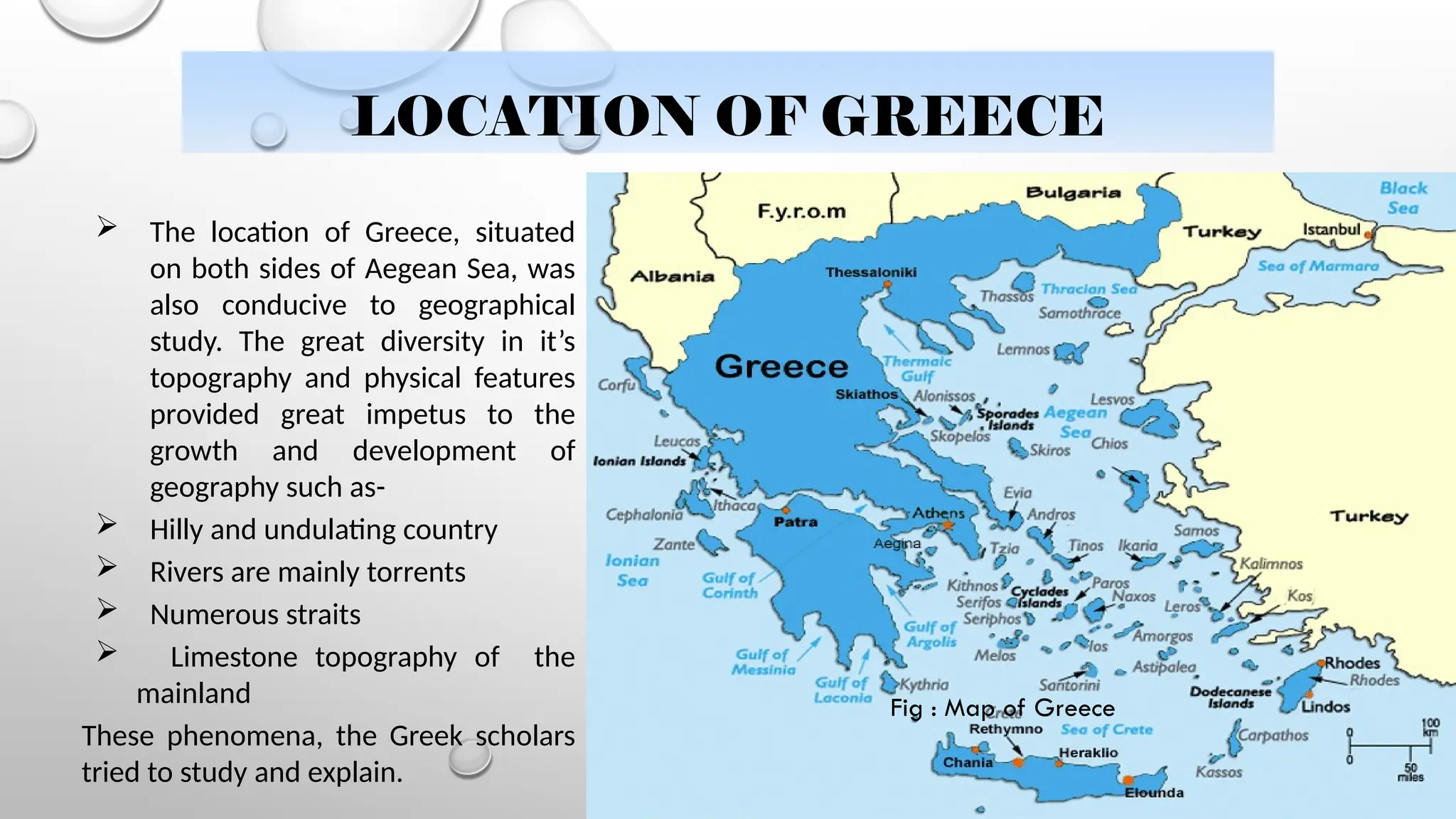
LOCATION OF GREECE
 The location of Greece, situated
on both sides of Aegean Sea, was
also conducive to geographical
study. The great diversity in it’s
topography and physical features
provided great impetus to the
growth and development of
geography such as-
 Hilly and undulating country
 Rivers are mainly torrents
 Numerous straits
 Limestone topography of the
mainland
These phenomena, the Greek scholars
tried to study and explain.
Fig : Map of Greece
GREEK SCHOLAR'S
CONTRIBUTIONS
IN GEOGRAPHY
HOMER
Idealized portrayal of Homer
dating to the Hellenistic period.
British Museum.
Born :
Melesigenes, as told in
Pseudo-Herodotus
c. 8th
century BC,
according to
Herodotus,
Smyrna
Died : Ios
Island
Residence : Smyrna, Cyme
(Aeolis),
Chios
Nationality : Greek
Notable work : Iliad, Odyssey,
Homeric
Hymns, Epic Cycle, other
HOMER
• THE EARTH TO BE A PLACE OF CIRCULAR FORM, SURROUNDED
ON ALL SIDES BY OCEAN RIVER. THE SKY (VAULT OF HEAVEN),
WHICH HE CONCEIVED AS A SOLID CONCAVE SURFACE,
RESTING ON TALL PILLARS.
• THE SUN ROSE OUT FROM OCEAN STREAM AND AGAIN SANK
INTO THE SAME WAY. STARS ARE ALSO BATHING EVERYDAY IN
THE OCEAN LIKE SUN.
• HE DESCRIBED THE NAME ‘EUROPE’ WAS APPLIED TO THE
SHORE OF THE AEGEAN SEA TOWARDS THE SETTING SUN
AND ‘ASIA’ WAS APPLIED TO THE SHORE TOWARDS THE
RISING SUN.
• WINDS ARE COMING FROM FOUR DIRECTIONS
• BORES: NORTH WIND, STRONG AND COOL WITH
CLEAR SKIES;
• EURAS: EAST WIND, WARM AND GENTLE;
• NOTUS: SOUTH WIND, ON THE FROM OF ADVANCED
STORM;
• ZEPHYRUS: WEST WIND, DREADED, BALMY WITH GALE
FORCE
Contribution In Geography
ANAXIMANDER
Relief representing Anaximander.
This is the only existing image of
Anaximander from the ancient
world.
Born : c. 610
BC
Died : c. 546
BC
Residence : Miletus, Lonia
(Turkey)
Nationality : Greek
Notable Ideas : The apeiron is the
arche
Evolutionary view of living
things Earth floats
unsupported Mechanical
model
of the sky Water of
rain from evaporation
Cosmology
 Anaximander explains how the four elements of ancient physics (air, earth, water and fire)
are formed, and how Earth and terrestrial beings are formed through their interactions.
 The Earth floats very still in the centre of the infinite, not supported by anything. Stars are
closer to Earth and then Moon and Then Sun. From this model he gave the explanation on
eclipse.
ANAXIMANDER
Contribution In Geography
Fig: Map of Anaximander's universe
Illustration of Anaximander's models of the universe. On the
left, daytime in summer; on the right, nighttime in winter.
Meteorology
 Anaximander attributed some meteorological
phenomena, such as thunder and lightning.
 Rain as a product of the humidity pumped up from
Earth by the sun.
Cartography
 Anaximander prepared a world map to scale. In this
map Greek has been shown in the center of the world
and surrounded by the Ocean river.
Geometry
 Gnomon is a pole set vertically above a flat surface
which the varying position of the sun could be
measured by the length and direction of the shadow
cast by the vertical pole. With the help of Gnomon,
noon could be established by noting when shadow
was the shortest; The noon shadow provided the
exact north-south line.
ANAXIMANDER
Contribution In Geography
Fig: Anaximander's world map
HIPPARCHUS
Fig:
Hipparchus
Born : c. 190
BC
Nicaea, Kingdom
of
Bithynia
Died : c. 120
BC
Rhodes, Roman
Republic
Occupation :
 He discovered the precession of the equinoxes.
 He made the star catalogue, listed 850 stars.
 Divided the circle into 360 degree based on Assyrian arithmetic.
 Equator as a great circle which divided the earth in to two equal parts.
 ‘Astrolabe’ The instrument helps to determine Latitude and Longitude.
 The conversion of three dimensional sphere to two dimensional plane.
 Orthographic and Stereographic, these projections are designed by him.
 Orbit and Motion of the sun and moon
 Distance of Sun and Moon from the Earth
HIPPARCHUS
Contribution In Geography
Fig: Geometric construction used by Hipparchus in his determination of the distances to the sun and moon.
HERODOTUS
Fig: A Roman copy of a Greek bust of
Herodotus
Born : c. 485 BC
Halicarnassus, Caria, Asia
Minor
Died : c. 425 BC
Thurii,
Calabria or Pella,
Macedon
Occupation : Historian
Ethnicity : Greek
Notable work : The Historian
HERODOTUS
Contribution In Geography
 He gave description of then existing
tribes and their life style.
 The meridian was drawn in the world
map.
 Divided the Land mass of the earth
into three continent : Asia, Europe and
Libya (Africa).
 Divided Libya (Africa) into three
latitudinal zones.
 Mediterranean coast from Atlas
mountain to delta of Nile.
 Area of Wild beast (South)
 True Sahara Desert Fig: ancient map based on Herodotus
ERATOSTHENES
Fig: Eratosthenes
Born : c. 276 BC
Cyrene
Died : c. 194 BC
Alexandria
Occupation : Scholar,
Librarian,
Poet,
Inventor
Ethnicity : Greek
 Described and Mapped the known world and dividing the Earth in to five climatic zone :
two freezing zone around the pole, two temperate zone and a equatorial zone.
 Placed grids of overlapping lines over the surface of the earth.
ERATOSTHENES
Contribution In Geography
Fig: The World according to Eratosthenes
 He wrote three books on Geography.
• The first book was something of an
introduction and gave a review of his
predecessors, recognizing their
contributions that he compiled in the
library.
• Second Book “A text on Mathematical
Geography”. Here he described
about the discover of the
circumference of the earth.
• Third book “the Geography” contains
political geography.
 calculated the Sun's diameter about 27
times that of the Earth
 Founder of ‘Leap Year’
 Measured the Circumference of the Earth.
ERATOSTHENES
Contribution In Geography
Plato is one of the greatest Greek philosophers. He was student of Socrates. His concept till now are taught in
universities worldwide.
Contribution:
 In Astronomical Geography:
 Explanation of solar system as system (circle shape).
 Explanation Size, shape of sun, moon, and earth (round, circular)
 Concept of revolution of sun, moon, and planets (in circular way)
 Concept about position of earth (at centre of solar system).
PLATO (C. 427 BC – 347 BC)
 In mathematical geography:
Analyzing physical science by mathematical way.
Concept of deduction (pollution).
Books:
Pheadu.
Philebus.
Timaeus.
Republica( Studied worldwide till now).
PLATO (C. 427 BC – 347 BC)
 In Mathematical Geography:
Concept of area measurement.
Existence of size of every matter (expressed by numerically).
 Concept about earth size.
 Concept of existence of planets.
where
a2
+ b2
= c2
Figure :Area measurement method of Pythagorus
Source: http:/ /en. Wikipedia.Pythagorus contribution in Greek
geography
Pythagoras was a Greek philosopher who made a great many contributions to the history of
mathematics, science, astronomy and music theory. He is perhaps best known for his contribution to
mathematics however the famed Pythagoras theorem.
Contribution:
PYTHAGORAS(C. 570 BC – 495 BC)
Activities :
• Established an organization (Pythagorean).
• Concept of anti-earth.
• Concept the source of energy.
In 529 BC, he migrated to Italy due to oppression in his own country. Later on, the
 Concepts about the movements of heavenly bodies (circular way).
 Concept of the position of earth (center of solar system).
 Concept of revolution of Sun and moon (round the earth).
Contribution:
PYTHAGORAS(C. 570 BC – 495 BC)
Contribution:
Explanation of solar system
by molecule theory.
Produce world map.
Ocean
Ocean
Ocean
Figure: World map produced by Democritus
Source: http:/ /en. Wikipedia.Democritus contribution in
Greek geography
Democritus was a scholar of the Greek Golden Age who was born in approximately 460 BC, twenty years
after the Battle of Salamis, in the city of Abdera. Democritus is considered by some to be the father of
science because he and his mentor Leucippus were both materialists.
DEMOCRITUS
 Concept of anti-earth.
 Identified the central fire.
 Systematized the number theory of
Pythagoras.
 Stressed the importance of numerical
groupings and the divine properties of
number.
 Conceived number ‘one’ as ‘the first
principle of all things’.
Figure: Earth moves round a central fire
Source: http://en.Wikipedia.cosmogenic concept by Philalaus
Contribution:
Philolaus was a Greek Pythagorean and Presocratic philosopher. He argued that at the foundation
of everything is the part played by the limiting and limitless, which combine together in a harmony.
He is also credited with originating the theory that the earth was not the center of the universe.
PHILOLAUS (500 BC – 440 BC)
 Rotation of earth on its own axis.
 Revolution of moon round the earth. (no doubt.
 Concept of solar system as pure.
 Irregular revolution of mercury and Venus.
 Revolution of Jupiter, Mars, Saturn around earth.
Figure: Rotation of earth on its own axis.
Source: http: //en.Wikipedia.rotation of earth
concept by Heraclaids
Contribution:
Heraclides Ponticus (Ancient Greek) also known as Herakleides and Heraklides of Pontus, was a Greek
philosopher and astronomer who lived and died at Heraclea Pontica, now Karadeniz Eregli, Turkey.He is best
remembered for proposing that the earth rotates on its axis, from west to east, once every 24 hours. He is also
frequently hailed as the originator of the heliocentric theory, although this is doubted.
HERACLIDES (388 BC – 315 BC)
Contribution:
 Attempted to measure distance to moon and sun.
 Used geometry to solve scientific problem.
 Discovered the sun clock and measuring
instrument.
 Rotation and revolution of Planets (round the sun).
 Proposed heliocentric model of solar
system.
Figure: Distance among sun,moon and earth.
Source: http: //en.Wikipedia. Distance measurement
among sun, moon and earth by Aristrarcus
Aristarchus of Samos was an ancient Greek astronomer and mathematician who presented the
first known model that placed the Sun at the center of the known universe with the Earth
revolving around it (see Solar system).
ARISTARCHUS (310 BC – 230BC)
Figure: Heliocentric model of solar system
Figure: measuring distance of sun, moon and earth by Aristrarcus
Figure: Heliocentric model of solar system
Source: http: //en.wikipedia. Astro-Geographic concept by Aristrarcus
ARISTARCHUS (310 BC – 230BC)
Thales of Miletus
Socrates
Anaximenes of Miletus
Posidonius
Partial scope of writings
 He attempted to create a unified system for understanding the human intellect and the universe
which would provide an explanation of and a guide for human behavior.
Philosophy
 His philosophical grand vision was that the universe itself was similarly interconnected, as if an
organism, through cosmic "sympathy", in all respects from the development of the physical
world to the history of humanity.
 Posidonius taught that the human soul had faculties that were spirited (anger, desires for
power, possessions, etc.) and desiderative (desires for sex and food). Ethics was the problem of
how to deal with these passions and restore reason as the dominant faculty.
Physics
 In physics, Posidonius advocated a theory of cosmic "sympathy", the organic interrelation of all
appearances in the world, from the sky to the earth, as part of a rational design uniting
humanity and all things in the universe.
Astronomy
 Posidonius advanced the theory that the Sun emanated a vital force which permeated the
world.
 He attempted to measure the distance and size of the Sun and reached a figure larger and more
accurate than those proposed by other Greek astronomers.
Posidonius
Theophrastus
Eudoxus (c. 400 B.C.) is the greatest of the ancient mathematicians,
surpassed only by Archimedes. Biographical highlights:
 Eudoxus was born in Cnidos, on the Black Sea.
 He studied mathematics with Archytus in Tarentum.
 He studied medicine with Philistium on Sicily.
 At 23 years he went to Plato's academy in Athens to study philosophy and rhetoric.
 Some time later he went to Egypt to learn astronomy at Helopolis.
 He established a school at Cyzicus on the sea of Marmora and had many pupils.
 In 365 B. C. he returned to Athens with his pupils. He became a colleague of Plato.
 At the age of 53 he died in Cnidos.
Eudoxus (c. 400 B.C.)
Eudoxus was the most renown astronomer and mathematician of his
day. In astronomy devised an ingenious planetary system based on
spheres.
 The spherical earth is at rest at the center.
 Around this center, 27 concentric spheres rotate.
 The exterior one caries the fixed stars
 The others account for the sun, moon, and five planets.
 Each planet requires four spheres, the sun and moon, three each.
Eudoxus 's contributions to mathematics include:
 A theory of proportion; this allowed the study of irrationals (incommensurables).
 The concept of magnitude, as not a number but stood for such as line segments, angles,
areas, etc., and which could vary continuously. Magnitudes were opposed to numbers,
which could change discontinuously. This avoided giving numerical values to lengths, areas,
etc. Consequently great advances in geometry were made.
 The method of exhaustion.
 Establishing rigorous methods for finding areas and volumes of curvilinear figures
(e.g. cones and spheres).
 A profound influence in the establishment of deductive organization of proof on the basis of
explicit axioms.
ARISTOTLE
Aristotle is a towering figure in ancient Greek philosophy, making contributions to logic,
metaphysics, mathematics, physics, biology, botany, ethics, politics, agriculture, medicine,
dance and theatre. He was a student of Plato who in turn studied under Socrates. He
was more empirically-minded than Plato or Socrates and is famous for rejecting Plato's
theory of forms.
Contribution on different field:
Works on natural history
History of Animals (physical/mental qualities, habits)
On the parts of Animals
On the Movement of Animals
On the Progression of Animals
On the Generation of Animals
Physical works
Physics (explains change, motion, void, time)
On the Heavens (structure of heaven, earth, elements)
On Generation (through combining material constituents)
Meteorologics (origin of comets, weather, disasters)
Philosophical works
Metaphysics (substance, cause, form, potentiality)
Nicomachean Ethics (soul, happiness, virtue, friendship)
Eudemain Ethics
Magna Moralia
Politics (best states, utopias, constitutions, revolutions)
Poetics (tragedy, epic poetry)
PHILOSOPHY OF NATURE
Motion is the passage of matter into form, and it is of four kinds:
(1) motion which affects the substance of a thing, particularly its beginning and
its ending;
(2) motion which brings about changes in quality;
(3) motion which brings about changes in quantity, by increasing it and
decreasing it; and
(4) motion which brings about locomotion, or change of place. Of these the last
is the most fundamental and important.
Aristotle rejects the definition of space as the void. Empty space is an impossibility.
Hence, too, he disagrees with the view of Plato and the Pythagoreans that the
elements are composed of geometrical figures. Space is defined as the limit of the
surrounding body towards what is surrounded. Time is defined as the measure of
motion in regard to what is earlier and later. It thus depends for its existence upon
motion. If there where no change in the universe, there would be no time. Since it is
the measuring or counting of motion, it also depends for its existence on a counting
mind. If there were no mind to count, there could be no time. As to the infinite
divisibility of space and time, and the paradoxes proposed by Zeno, Aristotle
argues that space and time are potentially divisible ad infinitum, but are not actually
so divided.
HECATAEUS OF MILETUS
•HECATAEUS OF MILETUS (C. 550 BC – C. 476 BC), SON OF HAGESANDRUS, WAS AN EARLY GREEK HISTORIAN OF A WEALTHY FAMILY. HE
FLOURISHED DURING THE TIME OF THE PERSIAN INVASION. HECATAEUS IS THE FIRST KNOWN GREEK HISTORIAN AND WAS ONE OF THE
FIRST CLASSICAL WRITERS TO MENTION THE CELTIC PEOPLE.
•WORKS
•SOME HAVE CREDITED HECATAEUS WITH A WORK ENTITLED PERIODOS GES, "TRAVELS ROUND THE EARTH" OR "WORLD SURVEY", WRITTEN
IN TWO BOOKS. ONE, ON EUROPE, IS ESSENTIALLY A PERIPLUS OF THE MEDITERRANEAN, DESCRIBING EACH REGION IN TURN, REACHING AS
FAR NORTH AS SCYTHIA. THE OTHER BOOK, ON ASIA, IS ARRANGED SIMILARLY TO THE PERIPLUS OF THE ERYTHRAEAN SEA OF WHICH A
VERSION OF THE 1ST CENTURY AD SURVIVES. HECATAEUS DESCRIBED THE COUNTRIES AND INHABITANTS OF THE KNOWN WORLD, THE
ACCOUNT OF EGYPT BEING PARTICULARLY COMPREHENSIVE; THE DESCRIPTIVE MATTER WAS ACCOMPANIED BY A MAP, BASED UPON
ANAXIMANDER’S MAP OF THE EARTH, WHICH HE CORRECTED AND ENLARGED.
•THE OTHER KNOWN WORK OF HECATAEUS WAS REGARDED AS THE (
ΓΕΝΕΑΛΟΓΊΑΙ GENEALOGIAI) OR THE (
ἹΣΤΟΡΊΑ HISTORIA), A
RATIONALLY SYSTEMATIZED ACCOUNT OF THE TRADITIONS AND THE MYTHS OF THE GREEKS, A BREAK WITH THE EPIC MYTH-MAKING
TRADITION, WHICH SURVIVES IN A FEW FRAGMENTS, JUST ENOUGH TO SHOW WHAT WE ARE MISSING.
HIPPOCRATES
Hippocrates of Kos (Greek: Hippokrát s
ē ; c. 460 – c. 370 BC) was a
Greek physician of the Age of Pericles (Classical Greece), and is
considered one of the most outstanding figures in the history of
medicine. He is referred to as the "Father of Western Medicine" in
recognition of his lasting contributions to the field as the founder of the
Hippocratic School of Medicine.
Work:
Hippocratic theory on disease: Hippocrates is credited with being the
first person to believe that diseases were caused naturally, not
because of superstition and gods. Ancient Greek schools of medicine
were split (into the Knidian and Koan) on how to deal with disease.
Direct contributions to medicine: Hippocrates and his followers were
first to describe many diseases and medical conditions. He is given
credit for the first description of clubbing of the fingers, an important
diagnostic sign in chronic lung disease, lung cancer and cyanotic heart
disease. For this reason, clubbed fingers are sometimes referred to as
"Hippocratic fingers“
He is certainly considered wise, of very great intellect and especially
as very practical. Francis Adams describes him as "strictly the physician
of experience and common sense."
ALEXANDER THE GREAT
Alexander III of Macedon commonly known as Alexander the Great was a King of the
Ancient Greek kingdom of Macedon and a member of the Argead dynasty, a
famous ancient Greek royal house. Born in Pella in 356 BC, Alexander succeeded his
father, Philip II, to the throne at the age of twenty. He was undefeated in battle and
is considered one of history's most successful military commanders. During his youth,
Alexander was tutored by the philosopher Aristotle until the age of 16. Alexander's
legacy includes the cultural diffusion his conquests engendered, such as Greco-
Buddhism. He founded some twenty cities that bore his name, most notably
Alexandria in Egypt. Alexander's settlement of Greek colonists and the resulting
spread of Greek culture in the east resulted in a new Hellenistic civilization, aspects
of which were still evident in the traditions of the Byzantine Empire in the mid-15th
century and the presence of Greek speakers in central and far eastern Anatolia
until the 1920s.
Contributions: The Macedonian king, when he conquered the known parts of the world had spread the Greek
civilization throughout the world. The Greek culture blended with the cultures of other nations which is known as
Hellenism. One common currency and Greek language untied the whole territories. Alexander was responsible for
the opening up of trade relations between the east and west. He had established many cities on the way to India
and these cities were established near the trade routes. The establishment of even the Roman Empire was based on
the conquests of Alexander. The conquest of Alexander had sparked an inspiration among the people to study
science. There were contributions in the field of mathematics, science, geography, philosophy, and astronomy.
Main towns founded by Alexander
• Alexandria, Egypt
• Alexandria Asiana, Iran
• Alexandria in Ariana, Afghanistan
• Alexandria of the Caucasus, Afghanistan
• Alexandria on the Oxus, Afghanistan
• Alexandria of the Arachosians, Afghanistan
• Alexandria on the Indus, or Alexandria Bucephalous, Pakistan
• Alexandria Eschate, "The furthest," Tajikistan
• Iskenderun (Alexandretta), Turkey
• Kandahar (Alexandropolis), Afghanistan
STRABO
Strabo (/ stre bo / Greek
ˈ ɪ ʊ Στράβων Strab n
ō ; 64/63 BC – c. AD
24), was a Greek geographer, philosopher, and historian. Strabo
was born to an affluent family from Amaseia in Pontus (modern
Amasya, Turkey), a city that he said was situated the approximate
equivalent of 75 km from the Black Sea.
Contribution:
Education: Strabo studied under several prominent teachers of
various specialties throughout his early life at different stops along
his Mediterranean travels. Strabo was an admirer of Homer's poetry,
perhaps a consequence of his time spent in Nysa with Aristodemus.
At around the age of 21 Strabo moved to Rome, where he studied
philosophy with the Peripatetic Xenarchus, a highly respected tutor in
Augustus's court. Despite Xenarchus's Aristotelian leanings, Strabo
later gives evidence to have formed his own Stoic inclinations.
Geographica: Strabo is most famous for his work Geographica ("Geography"), which presented
a descriptive history of people and places from different regions of the world known to his
era. Although the Geographica was rarely utilized in its contemporary antiquity, a multitude of
copies survived throughout the Byzantine Empire. It first appeared in Western Europe in Rome
as a Latin translation issued around 1469. Strabo is pro-Roman politically, but culturally he
reserves primacy to Greece "... pro-Roman throughout the Geography. But while he
acknowledges and even praises Roman ascendancy in the political and military sphere, he also
makes a significant effort to establish Greek primacy over Rome in other contexts.“
Geology: Strabo... enters largely, in the Second Book of his Geography, into the opinions of
Eratosthenes and other Greeks on one of the most difficult problems in geology, viz., by what
causes marine shells came to be plentifully buried in the earth at such great elevations and
distances from the sea.
Strabo rejects this theory as insufficient to account for
all the phenomena, and he proposes one of his own, the
profoundness of which modern geologists are only
beginning to appreciate. 'It is not,' he says, 'because the
lands covered by seas were originally at different
altitudes, that the waters have risen, or subsided, or
receded from some parts and inundated others.But the
reason is, that the same land is sometimes raised up
and sometimes depressed, and the sea also is
simultaneously raised and depressed, so that it either
overflows or returns into its own place again.
The very first written definition/discussion of volcanism (Effusive eruption) observed at
Katakekaumenē (modern Kula, Western Turkey) until Pliny the Younger witnessed to the eruption
of Vesuvius on 24 August 79 AD in Pompeii: Karadivlit Scoria Cone and AA type basaltic fissure lava
flow in Katakekaumenē (modern-day Kul, Turkey).
…There are no trees here, but only the vineyards where they produce the Katakekaumene wines
which are by no means inferior from any of the wines famous for their quality. The soil is covered
with ashes, and black in color as if the mountainous and rocky country was made up of fires. Some
assume that these ashes were the result of thunderbolts and sub terranean explosions, and do not
‐
doubt that the legendary story of Typhon takes place in this region. Ksanthos adds that the king of
this region was a man called Arimus. However, it is not reasonable to accept that the whole
country was burned down at a time as a result of such an event rather than as a result of a fire
bursting from underground whose source has now died out. Three pits are called “Physas” and
separated by forty stadia from each other. Above these pits, there are hills formed by the hot
masses burst out from the ground as estimated by a logical reasoning. Such type of soil is very
convenient for viniculture, just like the Katanasoil which is covered with ashes and where the best
wines are still produced abundantly. Some writers concluded by looking at these places that there
is a good reason for calling Dionysus by the name (“Phrygenes”)
MEGASTHENES
Megasthenes ( ca. 350 – 290 BC) was a Greek ethnographer and
explorer in the Hellenistic period, author of the work Indika.He was
born in Asi Minor (modern-day Turkey) and became an ambassador
of Seleucus I of the Seleucid dynasty possibly to Chandragupta
Maurya in Pataliputra India. However the exact date of his embassy is
uncertain. Scholars place it before 298 BC, the date of
Chandragupta's death.
Travel: Arrian explains that Megasthenes lived in Arachosia, with the
satrap Sibyrtius, from where he visited India:
"Megasthenes lived with Sibyrtius, satrap of Arachosia, and often
speaks of his visiting Sandracottus, the king of the Indians." Arrian,
Anabasis Alexandri
We have more definite information regarding the parts of India
Megasthenes visited. He entered the subcontinent through the district
of the Pentapotamia (modern day Punjab region, providing a full
account of the rivers found there (thought to be the five affluents of
the Indus that form the Punjab region), and proceeded from there by
the royal road to Pataliputra. There are accounts of Megasthenes
having visited Mathura (Muttra), in Bihar, but he appears not to have
visited any other parts of India.
Indica: His Indica served as an important source for many later writers
such as Strabo and Arrian. He describes such features as the
Himalayas and the island of Sri Lanka. He also describes a caste
system different from the one that exists today, which shows that the
caste system may to some extent be fluid and evolving.
 Idea about distance of area.
 Conception about solar system.
 Limitation of Technology.
 Lack of instruments.
 Limitation of communication and transportation system.
 Lack of Locational Knowledge .
 Lack of prominent structural education system.
Findings
The early Greeks were the first civilization to practice a form of
Geography that was more than mere map making or
Cartography. They borrowed many of the concepts of
Astronomy, Geometry and Mathematics from the Egyptians,
Chaldeans and Assyrians. The Greeks possessed philosophical
and scientific aptitude, versatility of intellect, inquisitive nature
and comprehensiveness of mind.
Conclusion

Ancient-Geography -Greece.aaaaaaaaaaaaaaaapptx

  • 1.
  • 2.
  • 3.
    OVERVIEW • AIM ANDOBJECTIVES • INTRODUCTION • THE CONCEPT OF DEVELOPMENT AND THOUGHT • GREEK AGE • THE GEOGRAPHICAL ACHIEVEMENTS OF GREEKS • THE ANCIENT CLASSICAL GEOGRAPHY • THE ROOTS OF GREEK SCHOLARSHIP • GREEK GEOGRAPHY • LOCATION OF GREECE • GREEK SCHOLAR’S CONTRIBUTIONS IN GEOGRAPHY • FINDINGS • CONCLUSION • REFERENCES
  • 4.
    AIMS AND OBJECTIVES To knowabout the geographical knowledge in different stages of Greek period. To know about their different development branches. To find out the similarities and dissimilarities between Greek Geography and Modern Geography To present the achievements and lacking of Greek Geography
  • 5.
  • 6.
    INTRODUCTION The Greeks werepioneers in many branches of knowledge. Describing the change of geographical knowledge in different stages may face some problem. To avoid the problems some approaches have been risen to describe Geographical knowledge. The basis of their knowledge was observation, measurement, generalization process, philosophical and comprehensiveness of mind were able to make tremendous advancement in the knowledge of Geography. Their period is known as the ‘Golden age of Greece’. Greek philosophers and scientist were also interested in learning about spatial nature of human and physical features found on the Earth.
  • 7.
    THE CONCEPT OF DEVELOPMENT AND THOUGHT •DEVELOPMENT ISTHE PROCESS OF DEVELOPING OR BEING DEVELOPED. DEVELPOMENT IS AN EVENT CONSTITUTING A NEW STAGE IN A CHANGING SITUATION. BY HARD WORKING AND LONG TERM EFFORTS GEOGRAPHY REACH THE PRESENT CONDITION. •FACTORS OF DEVELOPMENT: • OBSERVATION OF THE PEOPLE • ENCOURAGEMENT (SOCIAL, POLITICAL, FINANCIAL) • TRAVELLING • TRADE AND COMMERCE • EXPLORATION •IN GEOGRAPHY, THOUGHTS ARE THE AGGLOMERATION OF PHYSICAL, CULTURAL AND BIOLOGICAL ASPECTS OF THE EARTH AND VALUES AND BELIEFS OF DIFFERENT OBJECTIVES. EXPLANATION IS THE METHODOLOGICAL DESCRIPTION OF THESE THOUGHTS.
  • 8.
    GREEK AGE (800 BC– 150 BC) . Greek Age Ancient Greek Age (800 BC - 500 BC) Late Greek Age (500 Bc – 300 BC) Greek-Roman Age (300 BC – 150 AD)
  • 9.
    THE GEOGRAPHICAL ACHIEVEMENTSOF GREEKS • GREEKS DISCOVERED THAT, THE EARTH IS ROUND. • GREEKS FIRST DREW THE MAP OF OCEAN. • ERATOSTHENES FIRST MEASURE THE CIRCUMFERENCE OF THE EARTH. • GREEKS INVENTED THE POLE STAR. • GREEKS CREATED GEOGRAPHY AS SUBJECT. • GREEKS INVENTED LATITUDE, LONGITUDE AND PROJECTION OF THE EARTH.
  • 10.
    THE ANCIENT CLASSICALGEOGRAPHY • GEOGRAPHY AS A FIELD OF LEARNING IN THE WESTERN WORLD HAD IT’S BEGINNING OF ANCIENT GREECE. • IT IS CLEAR THAT MUCH ATTENTION WAS GIVEN TO GEOGRAPHICAL STUDY IN ANCIENT CHINA, AND CHINESE EXPLORERS DID AS MUCH DO “DISCOVER” EUROPE AS THE EUROPEANS DID TO REACH THE “FAR EAST". BUT CHINESE SCHOLARSHIP DID NOT FORM A MAJOR PART OF THE STREAM OF WESTERN THOUGHT. • THE GREEKS LIKE ALL INNOVATIVE PEOPLE WERE GREAT BORROWERS FROM THE MUCH OLDER CIVILIZATIONS. • MANY OF THE BASIC PROCEDURES OF SCHOLARSHIP STILL IN USE WERE FIRST DEVELOPED BY THE GREEKS.
  • 11.
    THE ROOTS OFGREEK SCHOLARSHIP • THE GREEKS WERE INDEBTED TO THE WORLDS EARLIEST SCHOLARS IN MANY WAYS.EGYPT HAS BEEN CALLED THE CRADLE OF SCIENCE BECAUSE OF THE VERY EARLY DEVELOPMENT OF THE METHODS OF OBSERVATION, MEASUREMENT AND GENERALIZATION IN THAT COUNTRY. THEIR CONTRIBUTION: • DEVELOPED WAYS TO MEASURE LAND AREAS. • NORTH-SOUTH LINE • THE ART OF WRITING • (A + B)2 = (A2 + 2AB + B2) • BOTH THE EGYPTIAN AND SUMERIANS BELIEVED THAT THERE WERE 360 DAYS IN A YEAR. • THE SUMERIANS DIVIDED THE YEAR INTO TWELVE MONTH. THEY ALSO DIVIDED THE CIRCLE OF THE ZODIAC INTO 360 PARTS. • THE BABYLONIANS AND ASSYRIANS DEVELOPED THE IDEAS- A BODY OF CONCEPTS THAT WE CALL ASTROLOGY. • THE PHOENICIANS, TOO, DEVELOPED THE WORLD’S FIRST PHONETIC ALPHABET.
  • 12.
    GREEK GEOGRAPHY • THEGREEKS WERE PIONEERS IN MANY BRANCHES OF KNOWLEDGE.THEIR PERIOD IS KNOWN AS THE “GOLDEN AGE OF GREECE”.BETWEEN THE 5TH AND 3RD CENTURY B.C.,THE GREEK COLONIES WERE ESTABLISHED IN DIFFERENT PARTS OF THE MEDITERRANEAN SEA AND EUXINE. • EUXINE BECAME THE MAIN CENTER OF GEOGRAPHICAL ENQUIRY. • THE EARLY EXPEDITION OF HANNO. • THE ESTABLISHMENT OF FAMOUS LIBRARY MUSEUM AT ALEXANDRIA.
  • 13.
    LOCATION OF GREECE The location of Greece, situated on both sides of Aegean Sea, was also conducive to geographical study. The great diversity in it’s topography and physical features provided great impetus to the growth and development of geography such as-  Hilly and undulating country  Rivers are mainly torrents  Numerous straits  Limestone topography of the mainland These phenomena, the Greek scholars tried to study and explain. Fig : Map of Greece
  • 14.
  • 15.
    HOMER Idealized portrayal ofHomer dating to the Hellenistic period. British Museum. Born : Melesigenes, as told in Pseudo-Herodotus c. 8th century BC, according to Herodotus, Smyrna Died : Ios Island Residence : Smyrna, Cyme (Aeolis), Chios Nationality : Greek Notable work : Iliad, Odyssey, Homeric Hymns, Epic Cycle, other
  • 16.
    HOMER • THE EARTHTO BE A PLACE OF CIRCULAR FORM, SURROUNDED ON ALL SIDES BY OCEAN RIVER. THE SKY (VAULT OF HEAVEN), WHICH HE CONCEIVED AS A SOLID CONCAVE SURFACE, RESTING ON TALL PILLARS. • THE SUN ROSE OUT FROM OCEAN STREAM AND AGAIN SANK INTO THE SAME WAY. STARS ARE ALSO BATHING EVERYDAY IN THE OCEAN LIKE SUN. • HE DESCRIBED THE NAME ‘EUROPE’ WAS APPLIED TO THE SHORE OF THE AEGEAN SEA TOWARDS THE SETTING SUN AND ‘ASIA’ WAS APPLIED TO THE SHORE TOWARDS THE RISING SUN. • WINDS ARE COMING FROM FOUR DIRECTIONS • BORES: NORTH WIND, STRONG AND COOL WITH CLEAR SKIES; • EURAS: EAST WIND, WARM AND GENTLE; • NOTUS: SOUTH WIND, ON THE FROM OF ADVANCED STORM; • ZEPHYRUS: WEST WIND, DREADED, BALMY WITH GALE FORCE Contribution In Geography
  • 17.
    ANAXIMANDER Relief representing Anaximander. Thisis the only existing image of Anaximander from the ancient world. Born : c. 610 BC Died : c. 546 BC Residence : Miletus, Lonia (Turkey) Nationality : Greek Notable Ideas : The apeiron is the arche Evolutionary view of living things Earth floats unsupported Mechanical model of the sky Water of rain from evaporation
  • 18.
    Cosmology  Anaximander explainshow the four elements of ancient physics (air, earth, water and fire) are formed, and how Earth and terrestrial beings are formed through their interactions.  The Earth floats very still in the centre of the infinite, not supported by anything. Stars are closer to Earth and then Moon and Then Sun. From this model he gave the explanation on eclipse. ANAXIMANDER Contribution In Geography Fig: Map of Anaximander's universe Illustration of Anaximander's models of the universe. On the left, daytime in summer; on the right, nighttime in winter.
  • 19.
    Meteorology  Anaximander attributedsome meteorological phenomena, such as thunder and lightning.  Rain as a product of the humidity pumped up from Earth by the sun. Cartography  Anaximander prepared a world map to scale. In this map Greek has been shown in the center of the world and surrounded by the Ocean river. Geometry  Gnomon is a pole set vertically above a flat surface which the varying position of the sun could be measured by the length and direction of the shadow cast by the vertical pole. With the help of Gnomon, noon could be established by noting when shadow was the shortest; The noon shadow provided the exact north-south line. ANAXIMANDER Contribution In Geography Fig: Anaximander's world map
  • 20.
    HIPPARCHUS Fig: Hipparchus Born : c.190 BC Nicaea, Kingdom of Bithynia Died : c. 120 BC Rhodes, Roman Republic Occupation :
  • 21.
     He discoveredthe precession of the equinoxes.  He made the star catalogue, listed 850 stars.  Divided the circle into 360 degree based on Assyrian arithmetic.  Equator as a great circle which divided the earth in to two equal parts.  ‘Astrolabe’ The instrument helps to determine Latitude and Longitude.  The conversion of three dimensional sphere to two dimensional plane.  Orthographic and Stereographic, these projections are designed by him.  Orbit and Motion of the sun and moon  Distance of Sun and Moon from the Earth HIPPARCHUS Contribution In Geography Fig: Geometric construction used by Hipparchus in his determination of the distances to the sun and moon.
  • 22.
    HERODOTUS Fig: A Romancopy of a Greek bust of Herodotus Born : c. 485 BC Halicarnassus, Caria, Asia Minor Died : c. 425 BC Thurii, Calabria or Pella, Macedon Occupation : Historian Ethnicity : Greek Notable work : The Historian
  • 23.
    HERODOTUS Contribution In Geography He gave description of then existing tribes and their life style.  The meridian was drawn in the world map.  Divided the Land mass of the earth into three continent : Asia, Europe and Libya (Africa).  Divided Libya (Africa) into three latitudinal zones.  Mediterranean coast from Atlas mountain to delta of Nile.  Area of Wild beast (South)  True Sahara Desert Fig: ancient map based on Herodotus
  • 24.
    ERATOSTHENES Fig: Eratosthenes Born :c. 276 BC Cyrene Died : c. 194 BC Alexandria Occupation : Scholar, Librarian, Poet, Inventor Ethnicity : Greek
  • 25.
     Described andMapped the known world and dividing the Earth in to five climatic zone : two freezing zone around the pole, two temperate zone and a equatorial zone.  Placed grids of overlapping lines over the surface of the earth. ERATOSTHENES Contribution In Geography Fig: The World according to Eratosthenes
  • 26.
     He wrotethree books on Geography. • The first book was something of an introduction and gave a review of his predecessors, recognizing their contributions that he compiled in the library. • Second Book “A text on Mathematical Geography”. Here he described about the discover of the circumference of the earth. • Third book “the Geography” contains political geography.  calculated the Sun's diameter about 27 times that of the Earth  Founder of ‘Leap Year’  Measured the Circumference of the Earth. ERATOSTHENES Contribution In Geography
  • 27.
    Plato is oneof the greatest Greek philosophers. He was student of Socrates. His concept till now are taught in universities worldwide. Contribution:  In Astronomical Geography:  Explanation of solar system as system (circle shape).  Explanation Size, shape of sun, moon, and earth (round, circular)  Concept of revolution of sun, moon, and planets (in circular way)  Concept about position of earth (at centre of solar system). PLATO (C. 427 BC – 347 BC)
  • 28.
     In mathematicalgeography: Analyzing physical science by mathematical way. Concept of deduction (pollution). Books: Pheadu. Philebus. Timaeus. Republica( Studied worldwide till now). PLATO (C. 427 BC – 347 BC)
  • 29.
     In MathematicalGeography: Concept of area measurement. Existence of size of every matter (expressed by numerically).  Concept about earth size.  Concept of existence of planets. where a2 + b2 = c2 Figure :Area measurement method of Pythagorus Source: http:/ /en. Wikipedia.Pythagorus contribution in Greek geography Pythagoras was a Greek philosopher who made a great many contributions to the history of mathematics, science, astronomy and music theory. He is perhaps best known for his contribution to mathematics however the famed Pythagoras theorem. Contribution: PYTHAGORAS(C. 570 BC – 495 BC)
  • 30.
    Activities : • Establishedan organization (Pythagorean). • Concept of anti-earth. • Concept the source of energy. In 529 BC, he migrated to Italy due to oppression in his own country. Later on, the  Concepts about the movements of heavenly bodies (circular way).  Concept of the position of earth (center of solar system).  Concept of revolution of Sun and moon (round the earth). Contribution: PYTHAGORAS(C. 570 BC – 495 BC)
  • 31.
    Contribution: Explanation of solarsystem by molecule theory. Produce world map. Ocean Ocean Ocean Figure: World map produced by Democritus Source: http:/ /en. Wikipedia.Democritus contribution in Greek geography Democritus was a scholar of the Greek Golden Age who was born in approximately 460 BC, twenty years after the Battle of Salamis, in the city of Abdera. Democritus is considered by some to be the father of science because he and his mentor Leucippus were both materialists. DEMOCRITUS
  • 32.
     Concept ofanti-earth.  Identified the central fire.  Systematized the number theory of Pythagoras.  Stressed the importance of numerical groupings and the divine properties of number.  Conceived number ‘one’ as ‘the first principle of all things’. Figure: Earth moves round a central fire Source: http://en.Wikipedia.cosmogenic concept by Philalaus Contribution: Philolaus was a Greek Pythagorean and Presocratic philosopher. He argued that at the foundation of everything is the part played by the limiting and limitless, which combine together in a harmony. He is also credited with originating the theory that the earth was not the center of the universe. PHILOLAUS (500 BC – 440 BC)
  • 33.
     Rotation ofearth on its own axis.  Revolution of moon round the earth. (no doubt.  Concept of solar system as pure.  Irregular revolution of mercury and Venus.  Revolution of Jupiter, Mars, Saturn around earth. Figure: Rotation of earth on its own axis. Source: http: //en.Wikipedia.rotation of earth concept by Heraclaids Contribution: Heraclides Ponticus (Ancient Greek) also known as Herakleides and Heraklides of Pontus, was a Greek philosopher and astronomer who lived and died at Heraclea Pontica, now Karadeniz Eregli, Turkey.He is best remembered for proposing that the earth rotates on its axis, from west to east, once every 24 hours. He is also frequently hailed as the originator of the heliocentric theory, although this is doubted. HERACLIDES (388 BC – 315 BC)
  • 34.
    Contribution:  Attempted tomeasure distance to moon and sun.  Used geometry to solve scientific problem.  Discovered the sun clock and measuring instrument.  Rotation and revolution of Planets (round the sun).  Proposed heliocentric model of solar system. Figure: Distance among sun,moon and earth. Source: http: //en.Wikipedia. Distance measurement among sun, moon and earth by Aristrarcus Aristarchus of Samos was an ancient Greek astronomer and mathematician who presented the first known model that placed the Sun at the center of the known universe with the Earth revolving around it (see Solar system). ARISTARCHUS (310 BC – 230BC)
  • 35.
    Figure: Heliocentric modelof solar system Figure: measuring distance of sun, moon and earth by Aristrarcus Figure: Heliocentric model of solar system Source: http: //en.wikipedia. Astro-Geographic concept by Aristrarcus ARISTARCHUS (310 BC – 230BC)
  • 36.
  • 37.
  • 38.
  • 39.
    Posidonius Partial scope ofwritings  He attempted to create a unified system for understanding the human intellect and the universe which would provide an explanation of and a guide for human behavior. Philosophy  His philosophical grand vision was that the universe itself was similarly interconnected, as if an organism, through cosmic "sympathy", in all respects from the development of the physical world to the history of humanity.  Posidonius taught that the human soul had faculties that were spirited (anger, desires for power, possessions, etc.) and desiderative (desires for sex and food). Ethics was the problem of how to deal with these passions and restore reason as the dominant faculty. Physics  In physics, Posidonius advocated a theory of cosmic "sympathy", the organic interrelation of all appearances in the world, from the sky to the earth, as part of a rational design uniting humanity and all things in the universe. Astronomy  Posidonius advanced the theory that the Sun emanated a vital force which permeated the world.  He attempted to measure the distance and size of the Sun and reached a figure larger and more accurate than those proposed by other Greek astronomers.
  • 40.
  • 41.
  • 42.
    Eudoxus (c. 400B.C.) is the greatest of the ancient mathematicians, surpassed only by Archimedes. Biographical highlights:  Eudoxus was born in Cnidos, on the Black Sea.  He studied mathematics with Archytus in Tarentum.  He studied medicine with Philistium on Sicily.  At 23 years he went to Plato's academy in Athens to study philosophy and rhetoric.  Some time later he went to Egypt to learn astronomy at Helopolis.  He established a school at Cyzicus on the sea of Marmora and had many pupils.  In 365 B. C. he returned to Athens with his pupils. He became a colleague of Plato.  At the age of 53 he died in Cnidos. Eudoxus (c. 400 B.C.)
  • 43.
    Eudoxus was themost renown astronomer and mathematician of his day. In astronomy devised an ingenious planetary system based on spheres.  The spherical earth is at rest at the center.  Around this center, 27 concentric spheres rotate.  The exterior one caries the fixed stars  The others account for the sun, moon, and five planets.  Each planet requires four spheres, the sun and moon, three each. Eudoxus 's contributions to mathematics include:  A theory of proportion; this allowed the study of irrationals (incommensurables).  The concept of magnitude, as not a number but stood for such as line segments, angles, areas, etc., and which could vary continuously. Magnitudes were opposed to numbers, which could change discontinuously. This avoided giving numerical values to lengths, areas, etc. Consequently great advances in geometry were made.  The method of exhaustion.  Establishing rigorous methods for finding areas and volumes of curvilinear figures (e.g. cones and spheres).  A profound influence in the establishment of deductive organization of proof on the basis of explicit axioms.
  • 44.
    ARISTOTLE Aristotle is atowering figure in ancient Greek philosophy, making contributions to logic, metaphysics, mathematics, physics, biology, botany, ethics, politics, agriculture, medicine, dance and theatre. He was a student of Plato who in turn studied under Socrates. He was more empirically-minded than Plato or Socrates and is famous for rejecting Plato's theory of forms. Contribution on different field: Works on natural history History of Animals (physical/mental qualities, habits) On the parts of Animals On the Movement of Animals On the Progression of Animals On the Generation of Animals Physical works Physics (explains change, motion, void, time) On the Heavens (structure of heaven, earth, elements) On Generation (through combining material constituents) Meteorologics (origin of comets, weather, disasters) Philosophical works Metaphysics (substance, cause, form, potentiality) Nicomachean Ethics (soul, happiness, virtue, friendship) Eudemain Ethics Magna Moralia Politics (best states, utopias, constitutions, revolutions) Poetics (tragedy, epic poetry)
  • 45.
    PHILOSOPHY OF NATURE Motionis the passage of matter into form, and it is of four kinds: (1) motion which affects the substance of a thing, particularly its beginning and its ending; (2) motion which brings about changes in quality; (3) motion which brings about changes in quantity, by increasing it and decreasing it; and (4) motion which brings about locomotion, or change of place. Of these the last is the most fundamental and important. Aristotle rejects the definition of space as the void. Empty space is an impossibility. Hence, too, he disagrees with the view of Plato and the Pythagoreans that the elements are composed of geometrical figures. Space is defined as the limit of the surrounding body towards what is surrounded. Time is defined as the measure of motion in regard to what is earlier and later. It thus depends for its existence upon motion. If there where no change in the universe, there would be no time. Since it is the measuring or counting of motion, it also depends for its existence on a counting mind. If there were no mind to count, there could be no time. As to the infinite divisibility of space and time, and the paradoxes proposed by Zeno, Aristotle argues that space and time are potentially divisible ad infinitum, but are not actually so divided.
  • 46.
    HECATAEUS OF MILETUS •HECATAEUSOF MILETUS (C. 550 BC – C. 476 BC), SON OF HAGESANDRUS, WAS AN EARLY GREEK HISTORIAN OF A WEALTHY FAMILY. HE FLOURISHED DURING THE TIME OF THE PERSIAN INVASION. HECATAEUS IS THE FIRST KNOWN GREEK HISTORIAN AND WAS ONE OF THE FIRST CLASSICAL WRITERS TO MENTION THE CELTIC PEOPLE. •WORKS •SOME HAVE CREDITED HECATAEUS WITH A WORK ENTITLED PERIODOS GES, "TRAVELS ROUND THE EARTH" OR "WORLD SURVEY", WRITTEN IN TWO BOOKS. ONE, ON EUROPE, IS ESSENTIALLY A PERIPLUS OF THE MEDITERRANEAN, DESCRIBING EACH REGION IN TURN, REACHING AS FAR NORTH AS SCYTHIA. THE OTHER BOOK, ON ASIA, IS ARRANGED SIMILARLY TO THE PERIPLUS OF THE ERYTHRAEAN SEA OF WHICH A VERSION OF THE 1ST CENTURY AD SURVIVES. HECATAEUS DESCRIBED THE COUNTRIES AND INHABITANTS OF THE KNOWN WORLD, THE ACCOUNT OF EGYPT BEING PARTICULARLY COMPREHENSIVE; THE DESCRIPTIVE MATTER WAS ACCOMPANIED BY A MAP, BASED UPON ANAXIMANDER’S MAP OF THE EARTH, WHICH HE CORRECTED AND ENLARGED. •THE OTHER KNOWN WORK OF HECATAEUS WAS REGARDED AS THE ( ΓΕΝΕΑΛΟΓΊΑΙ GENEALOGIAI) OR THE ( ἹΣΤΟΡΊΑ HISTORIA), A RATIONALLY SYSTEMATIZED ACCOUNT OF THE TRADITIONS AND THE MYTHS OF THE GREEKS, A BREAK WITH THE EPIC MYTH-MAKING TRADITION, WHICH SURVIVES IN A FEW FRAGMENTS, JUST ENOUGH TO SHOW WHAT WE ARE MISSING.
  • 47.
    HIPPOCRATES Hippocrates of Kos(Greek: Hippokrát s ē ; c. 460 – c. 370 BC) was a Greek physician of the Age of Pericles (Classical Greece), and is considered one of the most outstanding figures in the history of medicine. He is referred to as the "Father of Western Medicine" in recognition of his lasting contributions to the field as the founder of the Hippocratic School of Medicine. Work: Hippocratic theory on disease: Hippocrates is credited with being the first person to believe that diseases were caused naturally, not because of superstition and gods. Ancient Greek schools of medicine were split (into the Knidian and Koan) on how to deal with disease. Direct contributions to medicine: Hippocrates and his followers were first to describe many diseases and medical conditions. He is given credit for the first description of clubbing of the fingers, an important diagnostic sign in chronic lung disease, lung cancer and cyanotic heart disease. For this reason, clubbed fingers are sometimes referred to as "Hippocratic fingers“ He is certainly considered wise, of very great intellect and especially as very practical. Francis Adams describes him as "strictly the physician of experience and common sense."
  • 48.
    ALEXANDER THE GREAT AlexanderIII of Macedon commonly known as Alexander the Great was a King of the Ancient Greek kingdom of Macedon and a member of the Argead dynasty, a famous ancient Greek royal house. Born in Pella in 356 BC, Alexander succeeded his father, Philip II, to the throne at the age of twenty. He was undefeated in battle and is considered one of history's most successful military commanders. During his youth, Alexander was tutored by the philosopher Aristotle until the age of 16. Alexander's legacy includes the cultural diffusion his conquests engendered, such as Greco- Buddhism. He founded some twenty cities that bore his name, most notably Alexandria in Egypt. Alexander's settlement of Greek colonists and the resulting spread of Greek culture in the east resulted in a new Hellenistic civilization, aspects of which were still evident in the traditions of the Byzantine Empire in the mid-15th century and the presence of Greek speakers in central and far eastern Anatolia until the 1920s.
  • 49.
    Contributions: The Macedonianking, when he conquered the known parts of the world had spread the Greek civilization throughout the world. The Greek culture blended with the cultures of other nations which is known as Hellenism. One common currency and Greek language untied the whole territories. Alexander was responsible for the opening up of trade relations between the east and west. He had established many cities on the way to India and these cities were established near the trade routes. The establishment of even the Roman Empire was based on the conquests of Alexander. The conquest of Alexander had sparked an inspiration among the people to study science. There were contributions in the field of mathematics, science, geography, philosophy, and astronomy. Main towns founded by Alexander • Alexandria, Egypt • Alexandria Asiana, Iran • Alexandria in Ariana, Afghanistan • Alexandria of the Caucasus, Afghanistan • Alexandria on the Oxus, Afghanistan • Alexandria of the Arachosians, Afghanistan • Alexandria on the Indus, or Alexandria Bucephalous, Pakistan • Alexandria Eschate, "The furthest," Tajikistan • Iskenderun (Alexandretta), Turkey • Kandahar (Alexandropolis), Afghanistan
  • 50.
    STRABO Strabo (/ strebo / Greek ˈ ɪ ʊ Στράβων Strab n ō ; 64/63 BC – c. AD 24), was a Greek geographer, philosopher, and historian. Strabo was born to an affluent family from Amaseia in Pontus (modern Amasya, Turkey), a city that he said was situated the approximate equivalent of 75 km from the Black Sea. Contribution: Education: Strabo studied under several prominent teachers of various specialties throughout his early life at different stops along his Mediterranean travels. Strabo was an admirer of Homer's poetry, perhaps a consequence of his time spent in Nysa with Aristodemus. At around the age of 21 Strabo moved to Rome, where he studied philosophy with the Peripatetic Xenarchus, a highly respected tutor in Augustus's court. Despite Xenarchus's Aristotelian leanings, Strabo later gives evidence to have formed his own Stoic inclinations.
  • 51.
    Geographica: Strabo ismost famous for his work Geographica ("Geography"), which presented a descriptive history of people and places from different regions of the world known to his era. Although the Geographica was rarely utilized in its contemporary antiquity, a multitude of copies survived throughout the Byzantine Empire. It first appeared in Western Europe in Rome as a Latin translation issued around 1469. Strabo is pro-Roman politically, but culturally he reserves primacy to Greece "... pro-Roman throughout the Geography. But while he acknowledges and even praises Roman ascendancy in the political and military sphere, he also makes a significant effort to establish Greek primacy over Rome in other contexts.“ Geology: Strabo... enters largely, in the Second Book of his Geography, into the opinions of Eratosthenes and other Greeks on one of the most difficult problems in geology, viz., by what causes marine shells came to be plentifully buried in the earth at such great elevations and distances from the sea. Strabo rejects this theory as insufficient to account for all the phenomena, and he proposes one of his own, the profoundness of which modern geologists are only beginning to appreciate. 'It is not,' he says, 'because the lands covered by seas were originally at different altitudes, that the waters have risen, or subsided, or receded from some parts and inundated others.But the reason is, that the same land is sometimes raised up and sometimes depressed, and the sea also is simultaneously raised and depressed, so that it either overflows or returns into its own place again.
  • 52.
    The very firstwritten definition/discussion of volcanism (Effusive eruption) observed at Katakekaumenē (modern Kula, Western Turkey) until Pliny the Younger witnessed to the eruption of Vesuvius on 24 August 79 AD in Pompeii: Karadivlit Scoria Cone and AA type basaltic fissure lava flow in Katakekaumenē (modern-day Kul, Turkey). …There are no trees here, but only the vineyards where they produce the Katakekaumene wines which are by no means inferior from any of the wines famous for their quality. The soil is covered with ashes, and black in color as if the mountainous and rocky country was made up of fires. Some assume that these ashes were the result of thunderbolts and sub terranean explosions, and do not ‐ doubt that the legendary story of Typhon takes place in this region. Ksanthos adds that the king of this region was a man called Arimus. However, it is not reasonable to accept that the whole country was burned down at a time as a result of such an event rather than as a result of a fire bursting from underground whose source has now died out. Three pits are called “Physas” and separated by forty stadia from each other. Above these pits, there are hills formed by the hot masses burst out from the ground as estimated by a logical reasoning. Such type of soil is very convenient for viniculture, just like the Katanasoil which is covered with ashes and where the best wines are still produced abundantly. Some writers concluded by looking at these places that there is a good reason for calling Dionysus by the name (“Phrygenes”)
  • 53.
    MEGASTHENES Megasthenes ( ca.350 – 290 BC) was a Greek ethnographer and explorer in the Hellenistic period, author of the work Indika.He was born in Asi Minor (modern-day Turkey) and became an ambassador of Seleucus I of the Seleucid dynasty possibly to Chandragupta Maurya in Pataliputra India. However the exact date of his embassy is uncertain. Scholars place it before 298 BC, the date of Chandragupta's death. Travel: Arrian explains that Megasthenes lived in Arachosia, with the satrap Sibyrtius, from where he visited India: "Megasthenes lived with Sibyrtius, satrap of Arachosia, and often speaks of his visiting Sandracottus, the king of the Indians." Arrian, Anabasis Alexandri We have more definite information regarding the parts of India Megasthenes visited. He entered the subcontinent through the district of the Pentapotamia (modern day Punjab region, providing a full account of the rivers found there (thought to be the five affluents of the Indus that form the Punjab region), and proceeded from there by the royal road to Pataliputra. There are accounts of Megasthenes having visited Mathura (Muttra), in Bihar, but he appears not to have visited any other parts of India. Indica: His Indica served as an important source for many later writers such as Strabo and Arrian. He describes such features as the Himalayas and the island of Sri Lanka. He also describes a caste system different from the one that exists today, which shows that the caste system may to some extent be fluid and evolving.
  • 54.
     Idea aboutdistance of area.  Conception about solar system.  Limitation of Technology.  Lack of instruments.  Limitation of communication and transportation system.  Lack of Locational Knowledge .  Lack of prominent structural education system. Findings
  • 55.
    The early Greekswere the first civilization to practice a form of Geography that was more than mere map making or Cartography. They borrowed many of the concepts of Astronomy, Geometry and Mathematics from the Egyptians, Chaldeans and Assyrians. The Greeks possessed philosophical and scientific aptitude, versatility of intellect, inquisitive nature and comprehensiveness of mind. Conclusion