What is
the
skeletal
system?
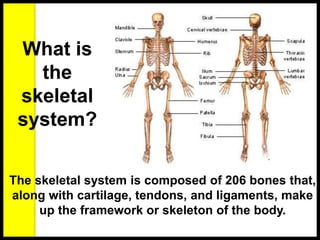
The skeletal system is composed of 206 bones that,
along with cartilage, tendons, and ligaments, make
up the framework or skeleton of the body.
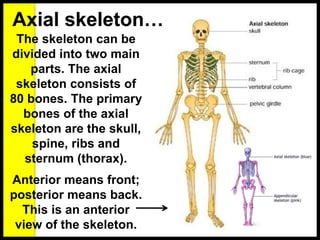
The skeleton can be
divided into two main
parts. The axial
skeleton consists of
80 bones. The primary
bones of the axial
skeleton are the skull,
spine, ribs and
sternum (thorax).
Anterior means front;
posterior means back.
This is an anterior
view of the skeleton.
Axial skeleton…
The appendicular
skeleton consists of
126 bones. The
primary bones of this
skeleton are the
shoulder or pectoral
girdle, arms, hands,
pelvic girdle, legs,
and feet.
Appendicular skeleton…
Functions of
bones…
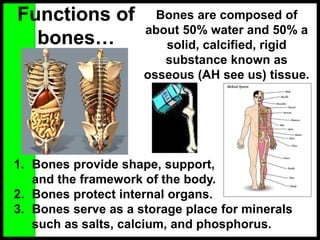
Bones are composed of
about 50% water and 50% a
solid, calcified, rigid
substance known as
osseous (AH see us) tissue.
1. Bones provide shape, support,
and the framework of the body.
2. Bones protect internal organs.
3. Bones serve as a storage place for minerals
such as salts, calcium, and phosphorus.
4. Bones play an important role in hematopoiesis
(hee MAT ah poh EE siss)… the formation of
blood cells that takes place in bone marrow.
5. Bones provide a place to attach muscles.
6. Bones make movement possible through
articulation (manner in which the parts come together at a joint) .
Functions of bones…
Classifications of
bones by shape…
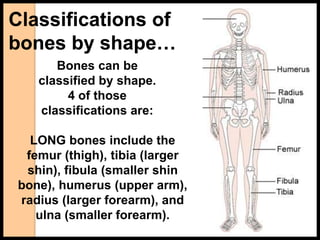
Bones can be
classified by shape.
4 of those
classifications are:
LONG bones include the
femur (thigh), tibia (larger
shin), fibula (smaller shin
bone), humerus (upper arm),
radius (larger forearm), and
ulna (smaller forearm).
Classifications of bones by
shape… Bones can be classified by shape.
4 of those classifications are:
SHORT bones include the carpals of the wrist
and tarsals of the ankle.
Classifications of bones by
shape… Bones can be classified by shape.
4 of those classifications are:
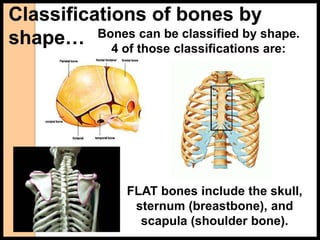
FLAT bones include the skull,
sternum (breastbone), and
scapula (shoulder bone).
Classifications of bones by
shape… Bones can be classified by shape.
4 of those classifications are:
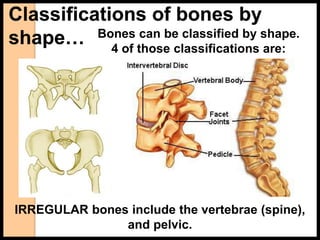
IRREGULAR bones include the vertebrae (spine),
and pelvic.
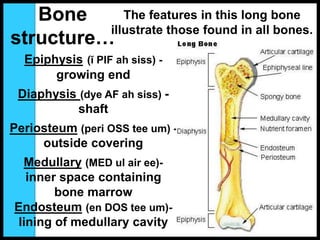
Epiphysis (ĭ PIF ah siss) -
growing end
Diaphysis (dye AF ah siss) -
shaft
Periosteum (peri OSS tee um) -
outside covering
Medullary (MED ul air ee)-
inner space containing
bone marrow
Endosteum (en DOS tee um)-
lining of medullary cavity
Bone
structure…
The features in this long bone
illustrate those found in all bones.
Joints… A joint is a place where two or more
bones connect. The manner in which
they connect determines the type of
movement allowed at that joint.
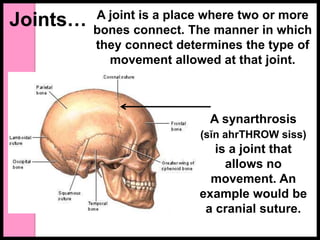
A synarthrosis
(sĭn ahrTHROW siss)
is a joint that
allows no
movement. An
example would be
a cranial suture.
Joints…
A amphiarthrosis
(am fee ahr THROW siss) is
a joint that allows slight
movement. An example
would be a vertebra.
A diarthrosis (dye ahr THROW siss) is a joint that
allows free movement in a variety of directions,
such as knee, hip, elbow, wrist, and foot.
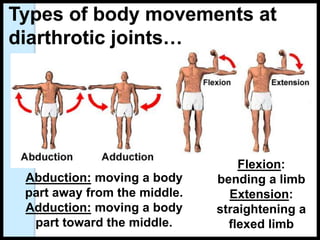
Types of body movements at
diarthrotic joints…
Flexion:
bending a limb
Extension:
straightening a
flexed limb
Abduction: moving a body
part away from the middle.
Adduction: moving a body
part toward the middle.
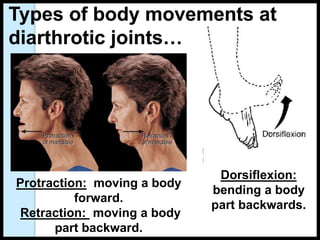
Dorsiflexion:
bending a body
part backwards.
Protraction: moving a body
forward.
Retraction: moving a body
part backward.
Types of body movements at
diarthrotic joints…
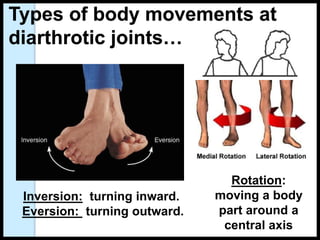
Rotation:
moving a body
part around a
central axis
Inversion: turning inward.
Eversion: turning outward.
Types of body movements at
diarthrotic joints…
The vertebral column…
The vertebral column is
composed of separate
bones called vertebrae,
connected to form four
spinal curves. A curve has
more strength than a
straight line, so can
support the weight of the
body and provide balance
needed to walk.
The vertebral column…
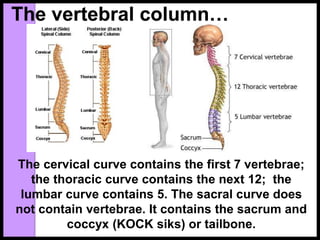
The cervical curve contains the first 7 vertebrae;
the thoracic curve contains the next 12; the
lumbar curve contains 5. The sacral curve does
not contain vertebrae. It contains the sacrum and
coccyx (KOCK siks) or tailbone.
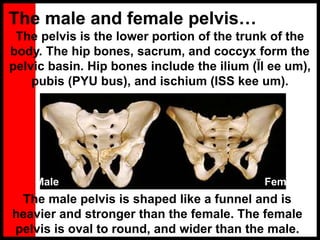
The male and female pelvis…
The pelvis is the lower portion of the trunk of the
body. The hip bones, sacrum, and coccyx form the
pelvic basin. Hip bones include the ilium (Ĭl ee um),
pubis (PYU bus), and ischium (ISS kee um).
The male pelvis is shaped like a funnel and is
heavier and stronger than the female. The female
pelvis is oval to round, and wider than the male.
Male Female
-Anatomy-bone and joint.ppt

-Anatomy-bone and joint.ppt

  • 1.
    What is the skeletal system? The skeletalsystem is composed of 206 bones that, along with cartilage, tendons, and ligaments, make up the framework or skeleton of the body.
  • 2.
    The skeleton canbe divided into two main parts. The axial skeleton consists of 80 bones. The primary bones of the axial skeleton are the skull, spine, ribs and sternum (thorax). Anterior means front; posterior means back. This is an anterior view of the skeleton. Axial skeleton…
  • 3.
    The appendicular skeleton consistsof 126 bones. The primary bones of this skeleton are the shoulder or pectoral girdle, arms, hands, pelvic girdle, legs, and feet. Appendicular skeleton…
  • 4.
    Functions of bones… Bones arecomposed of about 50% water and 50% a solid, calcified, rigid substance known as osseous (AH see us) tissue. 1. Bones provide shape, support, and the framework of the body. 2. Bones protect internal organs. 3. Bones serve as a storage place for minerals such as salts, calcium, and phosphorus.
  • 5.
    4. Bones playan important role in hematopoiesis (hee MAT ah poh EE siss)… the formation of blood cells that takes place in bone marrow. 5. Bones provide a place to attach muscles. 6. Bones make movement possible through articulation (manner in which the parts come together at a joint) . Functions of bones…
  • 6.
    Classifications of bones byshape… Bones can be classified by shape. 4 of those classifications are: LONG bones include the femur (thigh), tibia (larger shin), fibula (smaller shin bone), humerus (upper arm), radius (larger forearm), and ulna (smaller forearm).
  • 7.
    Classifications of bonesby shape… Bones can be classified by shape. 4 of those classifications are: SHORT bones include the carpals of the wrist and tarsals of the ankle.
  • 8.
    Classifications of bonesby shape… Bones can be classified by shape. 4 of those classifications are: FLAT bones include the skull, sternum (breastbone), and scapula (shoulder bone).
  • 9.
    Classifications of bonesby shape… Bones can be classified by shape. 4 of those classifications are: IRREGULAR bones include the vertebrae (spine), and pelvic.
  • 10.
    Epiphysis (ĭ PIFah siss) - growing end Diaphysis (dye AF ah siss) - shaft Periosteum (peri OSS tee um) - outside covering Medullary (MED ul air ee)- inner space containing bone marrow Endosteum (en DOS tee um)- lining of medullary cavity Bone structure… The features in this long bone illustrate those found in all bones.
  • 11.
    Joints… A jointis a place where two or more bones connect. The manner in which they connect determines the type of movement allowed at that joint. A synarthrosis (sĭn ahrTHROW siss) is a joint that allows no movement. An example would be a cranial suture.
  • 12.
    Joints… A amphiarthrosis (am feeahr THROW siss) is a joint that allows slight movement. An example would be a vertebra. A diarthrosis (dye ahr THROW siss) is a joint that allows free movement in a variety of directions, such as knee, hip, elbow, wrist, and foot.
  • 13.
    Types of bodymovements at diarthrotic joints… Flexion: bending a limb Extension: straightening a flexed limb Abduction: moving a body part away from the middle. Adduction: moving a body part toward the middle.
  • 14.
    Dorsiflexion: bending a body partbackwards. Protraction: moving a body forward. Retraction: moving a body part backward. Types of body movements at diarthrotic joints…
  • 15.
    Rotation: moving a body partaround a central axis Inversion: turning inward. Eversion: turning outward. Types of body movements at diarthrotic joints…
  • 16.
    The vertebral column… Thevertebral column is composed of separate bones called vertebrae, connected to form four spinal curves. A curve has more strength than a straight line, so can support the weight of the body and provide balance needed to walk.
  • 17.
    The vertebral column… Thecervical curve contains the first 7 vertebrae; the thoracic curve contains the next 12; the lumbar curve contains 5. The sacral curve does not contain vertebrae. It contains the sacrum and coccyx (KOCK siks) or tailbone.
  • 18.
    The male andfemale pelvis… The pelvis is the lower portion of the trunk of the body. The hip bones, sacrum, and coccyx form the pelvic basin. Hip bones include the ilium (Ĭl ee um), pubis (PYU bus), and ischium (ISS kee um). The male pelvis is shaped like a funnel and is heavier and stronger than the female. The female pelvis is oval to round, and wider than the male. Male Female