The Anatomy of the Interview Process Cynthia WrightRecruiter and Author of “366 Tips for a Successful  Job Search”AndPedro S. Silva IICandidate Relationship Manager for JCSI
PresentersPedro SilvaJCSI Candidate Relationship Manager/Communications StrategistCynthia WrightStaffing Expert and Author of “366 Tips for a Successful  Job Search”
Cynthia Wright
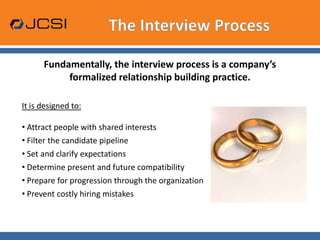
The Interview ProcessFundamentally, the interview process is a company’s formalized relationship building practice.It is designed to: Attract people with shared interests
 Filter the candidate pipeline
 Set and clarify expectations
 Determine present and future compatibility
 Prepare for progression through the organization
 Prevent costly hiring mistakesWhat’s The Recruiter’s Role?There are specialized recruiters for every level of engagement, but essentially all recruiters are part matchmaker part detective. Find and attract talent to an organization
Manage candidate pipeline and fill job openings
 Manage relationships between employers and prospects
 Investigate market trends to advise clients
 Track, analyze, and report candidate and job statusRecruiters see both sides of the job market and understand the nature of “the process”.
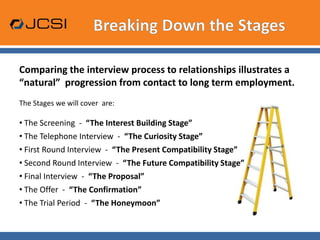
Breaking Down the StagesComparing the interview process to relationships illustrates a “natural”  progression from contact to long term employment.The Stages we will cover  are:The Screening  -  “The Interest Building Stage”
 The Telephone Interview  -  “The Curiosity Stage”
 First Round Interview  -  “The Present Compatibility Stage”
 Second Round Interview  -  “The Future Compatibility Stage”
 Final Interview  -  “The Proposal”
 The Offer  -  “The Confirmation”
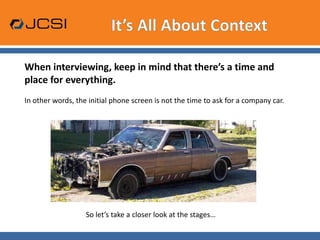
 The Trial Period  -  “The Honeymoon”It’s All About ContextWhen interviewing, keep in mind that there’s a time and  place for everything.  In other words, the initial phone screen is not the time to ask for a company car.So let’s take a closer look at the stages…
The Initial Phone ScreenReferred to here as the “Interest Building Stage”, this is where it is determined whether the basic requirements are met.Factors that may prevent future engagement include: Commute/Location
 Improper Skills Match
 Salary

Anatomy of the Job Interview

  • 1.
    The Anatomy ofthe Interview Process Cynthia WrightRecruiter and Author of “366 Tips for a Successful Job Search”AndPedro S. Silva IICandidate Relationship Manager for JCSI
  • 2.
    PresentersPedro SilvaJCSI CandidateRelationship Manager/Communications StrategistCynthia WrightStaffing Expert and Author of “366 Tips for a Successful Job Search”
  • 3.
  • 4.
    The Interview ProcessFundamentally,the interview process is a company’s formalized relationship building practice.It is designed to: Attract people with shared interests
  • 5.
    Filter thecandidate pipeline
  • 6.
    Set andclarify expectations
  • 7.
    Determine presentand future compatibility
  • 8.
    Prepare forprogression through the organization
  • 9.
    Prevent costlyhiring mistakesWhat’s The Recruiter’s Role?There are specialized recruiters for every level of engagement, but essentially all recruiters are part matchmaker part detective. Find and attract talent to an organization
  • 10.
    Manage candidate pipelineand fill job openings
  • 11.
    Manage relationshipsbetween employers and prospects
  • 12.
    Investigate markettrends to advise clients
  • 13.
    Track, analyze,and report candidate and job statusRecruiters see both sides of the job market and understand the nature of “the process”.
  • 14.
    Breaking Down theStagesComparing the interview process to relationships illustrates a “natural” progression from contact to long term employment.The Stages we will cover are:The Screening - “The Interest Building Stage”
  • 15.
    The TelephoneInterview - “The Curiosity Stage”
  • 16.
    First RoundInterview - “The Present Compatibility Stage”
  • 17.
    Second RoundInterview - “The Future Compatibility Stage”
  • 18.
    Final Interview - “The Proposal”
  • 19.
    The Offer - “The Confirmation”
  • 20.
    The TrialPeriod - “The Honeymoon”It’s All About ContextWhen interviewing, keep in mind that there’s a time and place for everything. In other words, the initial phone screen is not the time to ask for a company car.So let’s take a closer look at the stages…
  • 21.
    The Initial PhoneScreenReferred to here as the “Interest Building Stage”, this is where it is determined whether the basic requirements are met.Factors that may prevent future engagement include: Commute/Location
  • 22.
  • 23.