Analyzing the Marketing Environment
By Nicole Twedell
The Immediate Environment
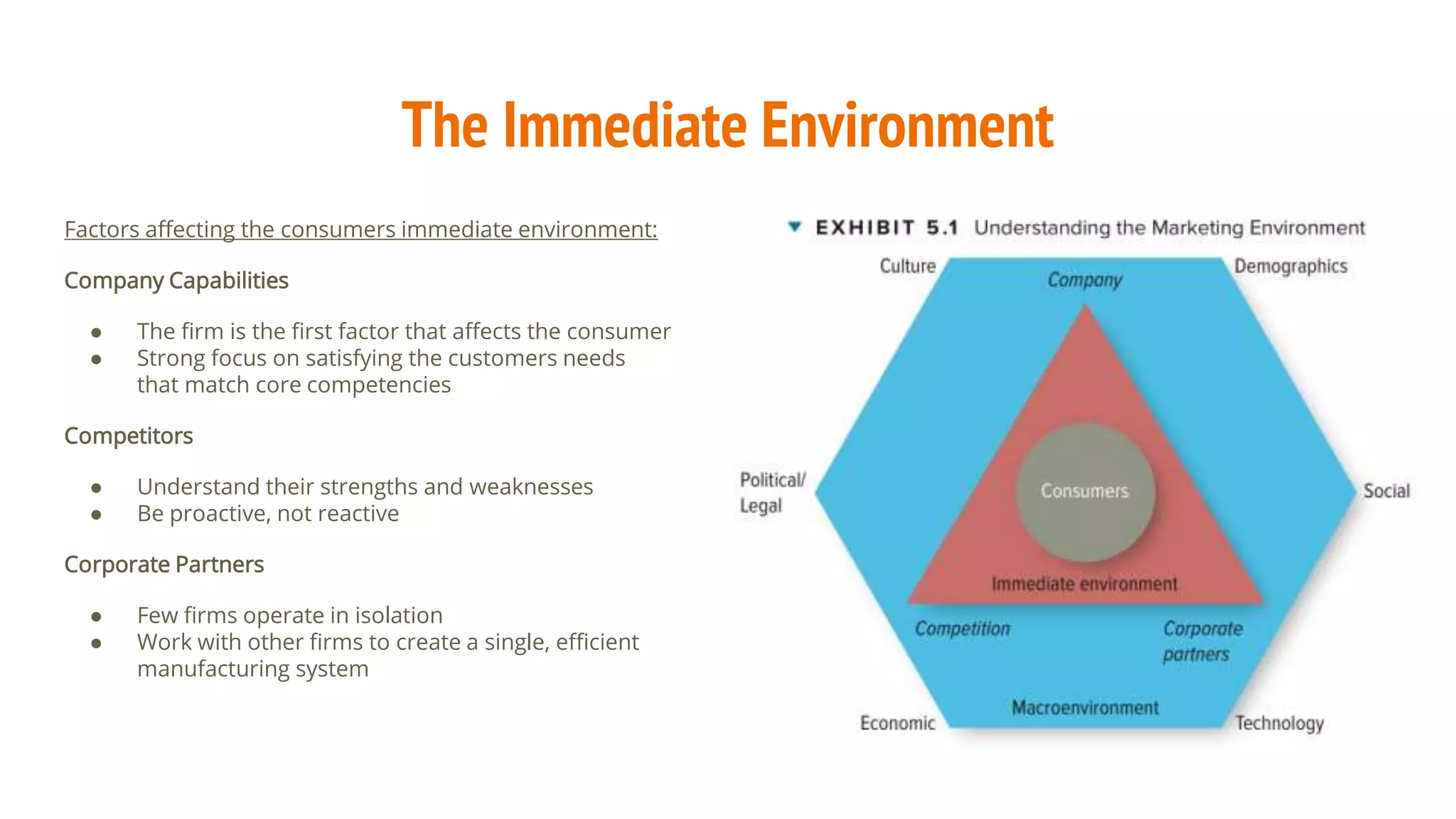
Factors affecting the consumers immediate environment:
Company Capabilities
● The firm is the first factor that affects the consumer
● Strong focus on satisfying the customers needs
that match core competencies
Competitors
● Understand their strengths and weaknesses
● Be proactive, not reactive
Corporate Partners
● Few firms operate in isolation
● Work with other firms to create a single, efficient
manufacturing system
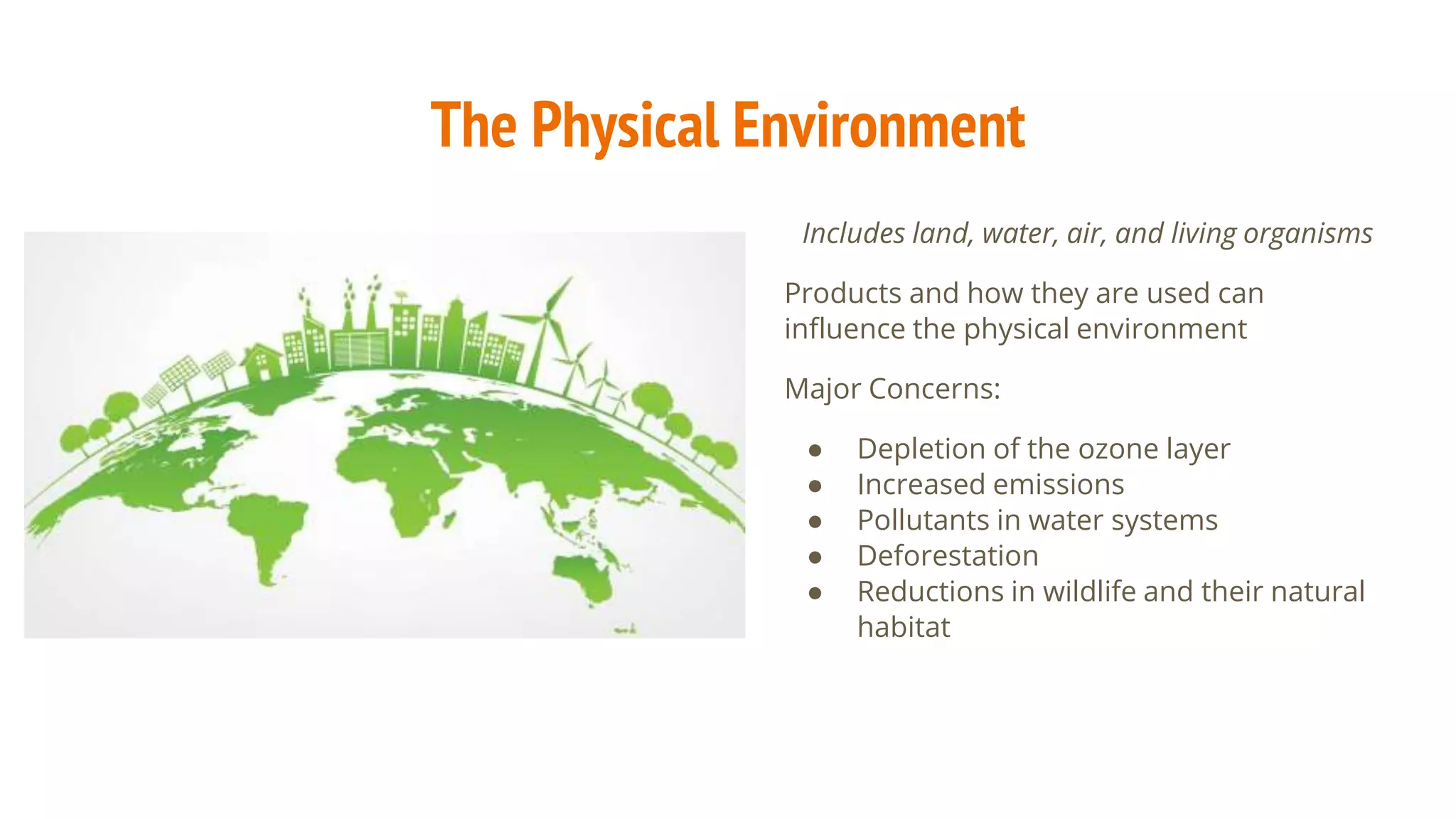
The Physical Environment
Includes land, water, air, and living organisms
Products and how they are used can
influence the physical environment
Major Concerns:
● Depletion of the ozone layer
● Increased emissions
● Pollutants in water systems
● Deforestation
● Reductions in wildlife and their natural
habitat
The Physical Environment (cont.)
Energy Trends
Firms are actively engaging in sustainable
practices
● How they manufacture products
● Provisioning services
● Types of products/services they offer
Example:
Electric Cars (Tesla)
Ride-shares (Uber)
Greener Practices + Consumers
Green Marketing is a strategic effort in which
firms work to supply customers with
environmentally friendly, sustainable
merchandise and services.
Goal: Appeal to customers and help ensure stable
supply chains and potentially reduce production
costs
Greenwashing is a type of exploitation
companies will use to convey a false image of
support for the environment.
Macroenvironment
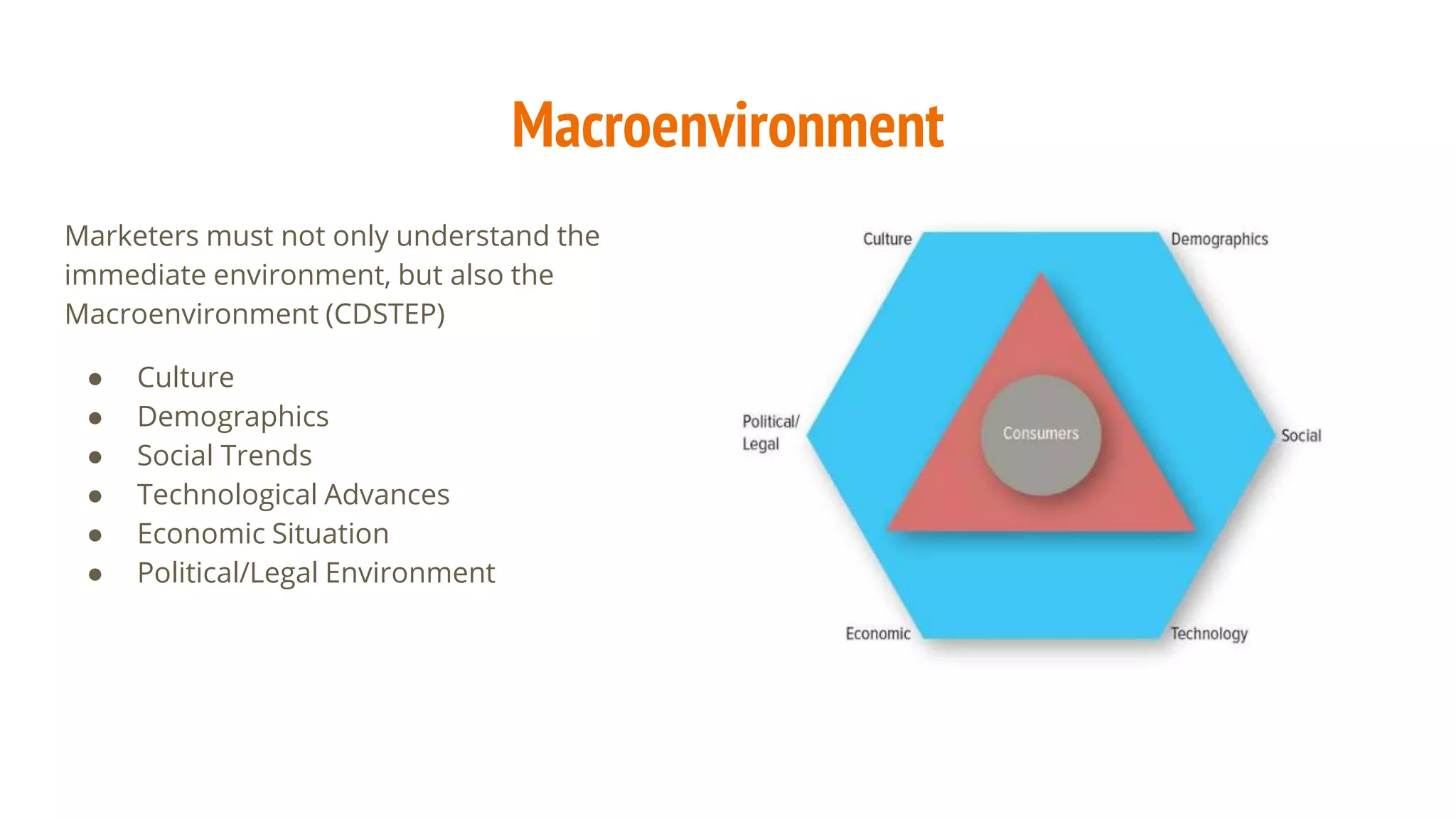
Marketers must not only understand the
immediate environment, but also the
Macroenvironment (CDSTEP)
● Culture
● Demographics
● Social Trends
● Technological Advances
● Economic Situation
● Political/Legal Environment
Culture
Culture is broadly defined as the shared
meanings, beliefs, morals, values, and
customs of a group of people.
● Culture is passed down through
generations and is learned over time
● Challenges marketers to have products
or services identifiable by and relevant
to a particular group of people
● Two dimensions of culture are the
culture of the country and that of the
region within a country
Country Culture
● Visible differences such as artifacts,
behavior, dress, symbols, physical
settings, ceremonies, language
differences, etc.
● Generally tricker to identify or navigate
Regional Culture
● Things that affect people’s lives such as
dietary tastes and preferences
● Offers marketers an opportunity to use
local variations to please customers
Demographics
Demographics indicate the characteristics of
human populations and segments
● Age and generational cohorts
● Gender
● Race
● Education
● Income
Demographics provide an easily understoon
snapshot of the typical consumer in a specific
target market
Generational Cohorts are groups of people from the same generation
● Gen Z (2001-2014)
● Gen Y (1977-2000)
● Gen X (1965-1976)
● Baby Boomers (1946-1964)
Income
● Purchasing power in high income groups grow, while declining in lower
and middle class.
Education
● Higher levels of education lead to better jobs and higher incomes
Gender
● Products are designed for both women and men as both genders
carry equal purchasing power
Race
● In the US, 80% of all population growth over the next 20 years is
expected to come from Hispanic, Asian, and African American
communities
Social Trends
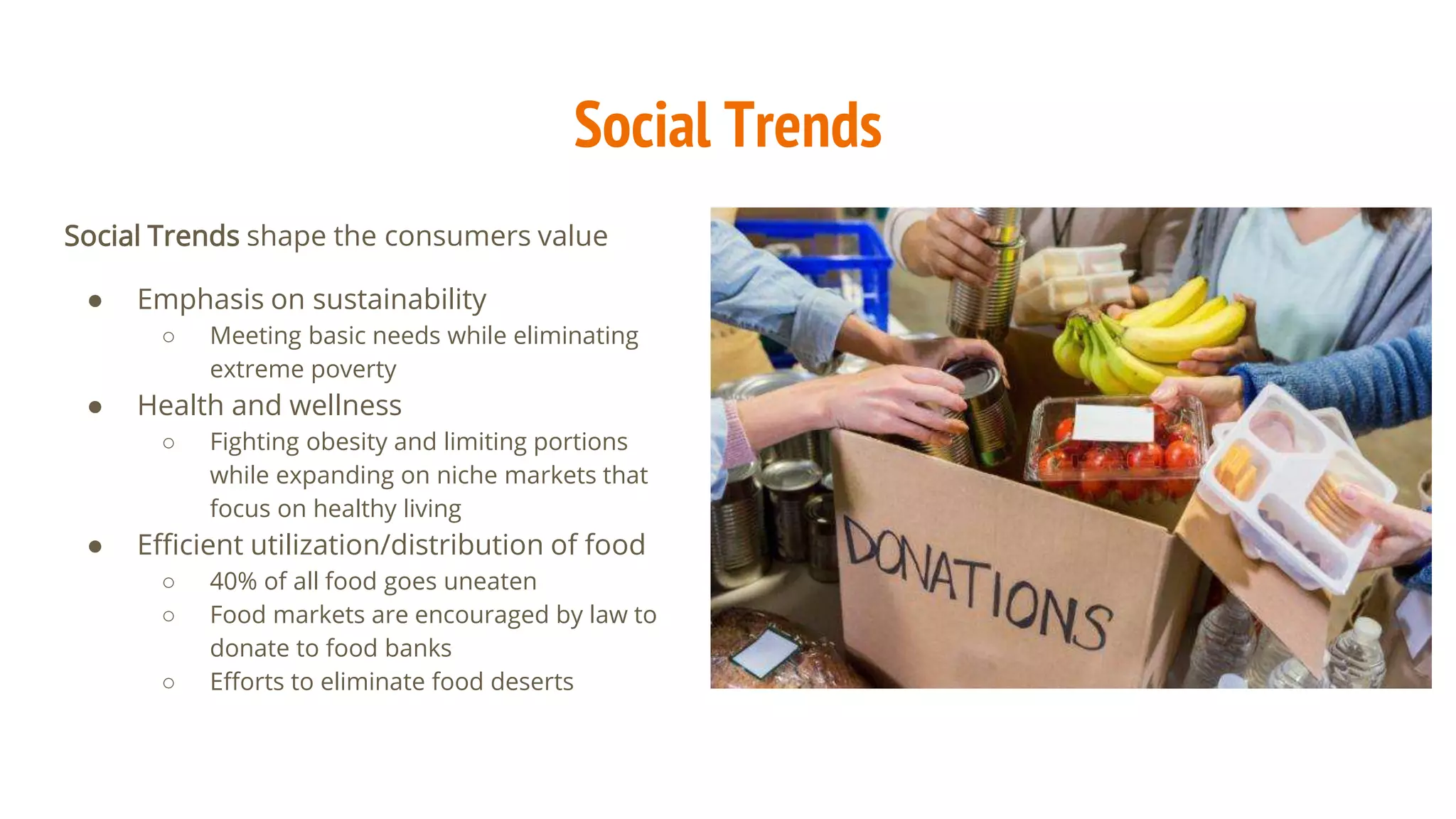
Social Trends shape the consumers value
● Emphasis on sustainability
○ Meeting basic needs while eliminating
extreme poverty
● Health and wellness
○ Fighting obesity and limiting portions
while expanding on niche markets that
focus on healthy living
● Efficient utilization/distribution of food
○ 40% of all food goes uneaten
○ Food markets are encouraged by law to
donate to food banks
○ Efforts to eliminate food deserts
Technological Advances
Technology has vastly improved the value of products and services
Constant access to the internet allows for
● Smartphones, tablets, and computers to be
used as reliable sources for purchasing goods
and services
● Easier interaction with those associated with
the business (owners, employees, other
customers)
Artificial Intelligence (AI) seeks to determine exactly
what the consumers seek by following their click path
Robotics are commonly used in distribution and
fulfillment centers, increasing efficiency
Technological Advances (cont.)
Internet of Things (IoT) emerges when multiple “smart
devices” with Internet-connected sensors, such as
refrigerators, dishwashers, and coffee machines, combine
data that they have collected to help both the consumers
and the companies consume more efficiently
● IoT delivers insightful data to retailers and
manufacturers that they can use to optimize their
inventories, predict the need for maintenance
services, and so forth
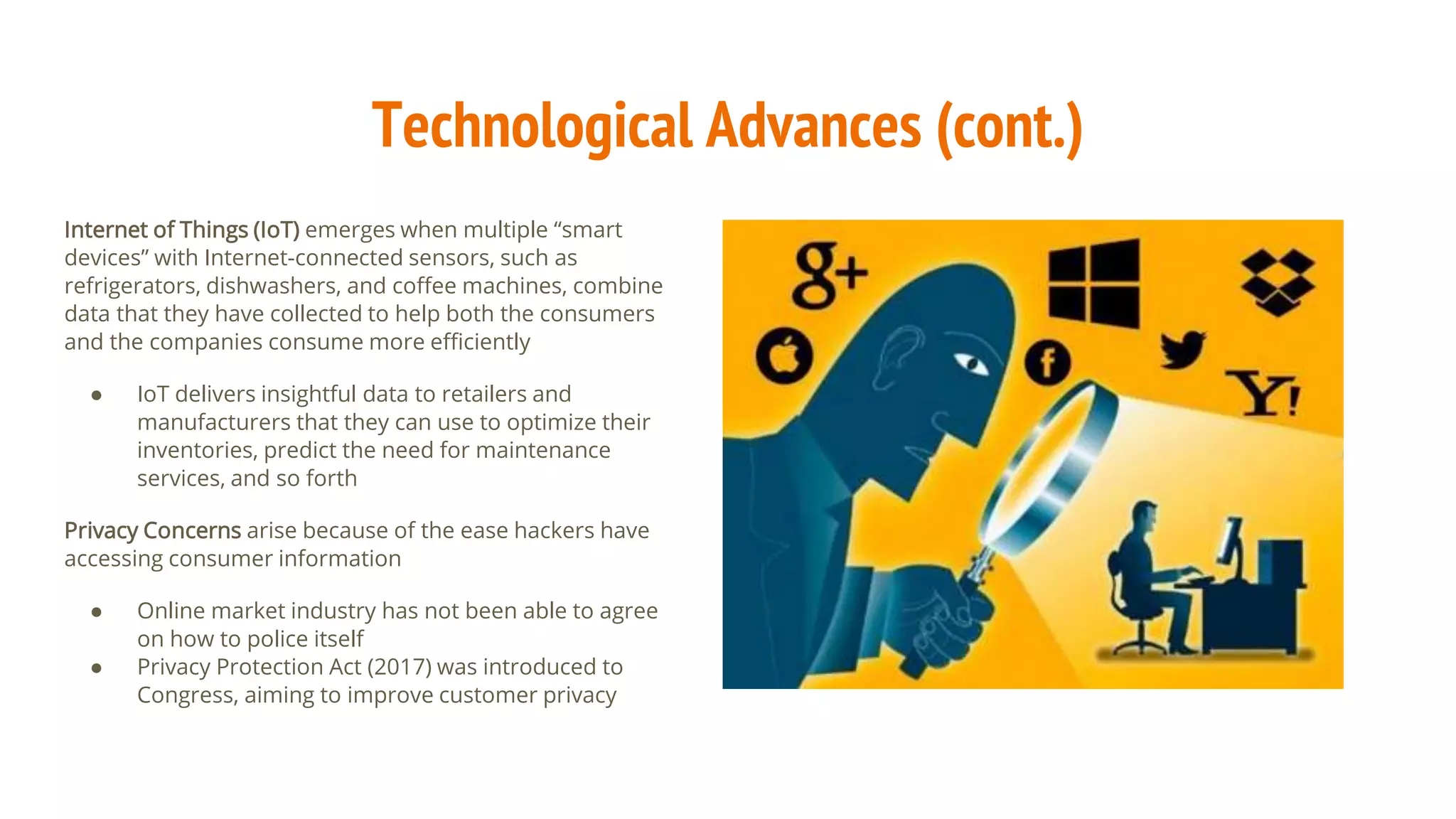
Privacy Concerns arise because of the ease hackers have
accessing consumer information
● Online market industry has not been able to agree
on how to police itself
● Privacy Protection Act (2017) was introduced to
Congress, aiming to improve customer privacy
Economic Situation Political/Legal
Environment
Economic Situation affects the way
consumers by merchandise and spend
money. Major factors include:
● Rate of Inflation, which refers to the
persistent increase in the prices of
goods and services
● Foreign Currency Fluctuation, making
one nation’s currency worth more than
another
● Interest Rate which represents the cost
of borrowing money
The Political/Legal Environment comprises political parties,
government organizations, and legislation and laws
● Organizations must comply with any legislation
regarding fair competition, consumer protection, or
industry-specific regulations.
● The government enacts laws focused on ensuring
that companies compete fairly with one another
Legislation has been enacted to protect consumers by:
● Requiring marketers to abstain from false or
misleading advertising
● Requiring manufacturers to abstain from using
harmful or hazardous materials
● Requiring organizations to adhere to fair and
reasonable business practices when
communicating with customers
Works Cited
Grewal, Dhruv, and Levy, Michael. “Chapter 5: Analyzing the Marketing
Environment” Marketing 7th Edition, McGraw-Hill Education, 2020, Pages 145-167

Analyzing the Marketing Environment

  • 1.
    Analyzing the MarketingEnvironment By Nicole Twedell
  • 2.
    The Immediate Environment Factorsaffecting the consumers immediate environment: Company Capabilities ● The firm is the first factor that affects the consumer ● Strong focus on satisfying the customers needs that match core competencies Competitors ● Understand their strengths and weaknesses ● Be proactive, not reactive Corporate Partners ● Few firms operate in isolation ● Work with other firms to create a single, efficient manufacturing system
  • 3.
    The Physical Environment Includesland, water, air, and living organisms Products and how they are used can influence the physical environment Major Concerns: ● Depletion of the ozone layer ● Increased emissions ● Pollutants in water systems ● Deforestation ● Reductions in wildlife and their natural habitat
  • 4.
    The Physical Environment(cont.) Energy Trends Firms are actively engaging in sustainable practices ● How they manufacture products ● Provisioning services ● Types of products/services they offer Example: Electric Cars (Tesla) Ride-shares (Uber) Greener Practices + Consumers Green Marketing is a strategic effort in which firms work to supply customers with environmentally friendly, sustainable merchandise and services. Goal: Appeal to customers and help ensure stable supply chains and potentially reduce production costs Greenwashing is a type of exploitation companies will use to convey a false image of support for the environment.
  • 5.
    Macroenvironment Marketers must notonly understand the immediate environment, but also the Macroenvironment (CDSTEP) ● Culture ● Demographics ● Social Trends ● Technological Advances ● Economic Situation ● Political/Legal Environment
  • 6.
    Culture Culture is broadlydefined as the shared meanings, beliefs, morals, values, and customs of a group of people. ● Culture is passed down through generations and is learned over time ● Challenges marketers to have products or services identifiable by and relevant to a particular group of people ● Two dimensions of culture are the culture of the country and that of the region within a country Country Culture ● Visible differences such as artifacts, behavior, dress, symbols, physical settings, ceremonies, language differences, etc. ● Generally tricker to identify or navigate Regional Culture ● Things that affect people’s lives such as dietary tastes and preferences ● Offers marketers an opportunity to use local variations to please customers
  • 7.
    Demographics Demographics indicate thecharacteristics of human populations and segments ● Age and generational cohorts ● Gender ● Race ● Education ● Income Demographics provide an easily understoon snapshot of the typical consumer in a specific target market Generational Cohorts are groups of people from the same generation ● Gen Z (2001-2014) ● Gen Y (1977-2000) ● Gen X (1965-1976) ● Baby Boomers (1946-1964) Income ● Purchasing power in high income groups grow, while declining in lower and middle class. Education ● Higher levels of education lead to better jobs and higher incomes Gender ● Products are designed for both women and men as both genders carry equal purchasing power Race ● In the US, 80% of all population growth over the next 20 years is expected to come from Hispanic, Asian, and African American communities
  • 8.
    Social Trends Social Trendsshape the consumers value ● Emphasis on sustainability ○ Meeting basic needs while eliminating extreme poverty ● Health and wellness ○ Fighting obesity and limiting portions while expanding on niche markets that focus on healthy living ● Efficient utilization/distribution of food ○ 40% of all food goes uneaten ○ Food markets are encouraged by law to donate to food banks ○ Efforts to eliminate food deserts
  • 9.
    Technological Advances Technology hasvastly improved the value of products and services Constant access to the internet allows for ● Smartphones, tablets, and computers to be used as reliable sources for purchasing goods and services ● Easier interaction with those associated with the business (owners, employees, other customers) Artificial Intelligence (AI) seeks to determine exactly what the consumers seek by following their click path Robotics are commonly used in distribution and fulfillment centers, increasing efficiency
  • 10.
    Technological Advances (cont.) Internetof Things (IoT) emerges when multiple “smart devices” with Internet-connected sensors, such as refrigerators, dishwashers, and coffee machines, combine data that they have collected to help both the consumers and the companies consume more efficiently ● IoT delivers insightful data to retailers and manufacturers that they can use to optimize their inventories, predict the need for maintenance services, and so forth Privacy Concerns arise because of the ease hackers have accessing consumer information ● Online market industry has not been able to agree on how to police itself ● Privacy Protection Act (2017) was introduced to Congress, aiming to improve customer privacy
  • 11.
    Economic Situation Political/Legal Environment EconomicSituation affects the way consumers by merchandise and spend money. Major factors include: ● Rate of Inflation, which refers to the persistent increase in the prices of goods and services ● Foreign Currency Fluctuation, making one nation’s currency worth more than another ● Interest Rate which represents the cost of borrowing money The Political/Legal Environment comprises political parties, government organizations, and legislation and laws ● Organizations must comply with any legislation regarding fair competition, consumer protection, or industry-specific regulations. ● The government enacts laws focused on ensuring that companies compete fairly with one another Legislation has been enacted to protect consumers by: ● Requiring marketers to abstain from false or misleading advertising ● Requiring manufacturers to abstain from using harmful or hazardous materials ● Requiring organizations to adhere to fair and reasonable business practices when communicating with customers
  • 12.
    Works Cited Grewal, Dhruv,and Levy, Michael. “Chapter 5: Analyzing the Marketing Environment” Marketing 7th Edition, McGraw-Hill Education, 2020, Pages 145-167