Advancing Cloud, Analytics, and
Data Science with Logical Data Fabric
The Agile Data Management and Analytics Conference
#DenodoDataFest
Data Virtualization as a Data Management
Strategy for Advanced Analytics
Sr. Research Director, TDWI
P hi l ip Rus s om , P hD.
Today’s
Discussion
Take-Aways
Data virtualization (DV) is a modern approach to data integration
DV usage is rising as the distribution of data gets more extreme
DV provides a development environment that models distributed
data as simpler, unified structures that are easier to use
DV also provides a deployment platform that serves as a data
access point for many users and apps
DV addresses new requirements for analytics, real-time, self-
service, architecture, governance, development methods, etc.
Summary
Please Tweet - @prussom #TDWI @Denodo #DataVirtualization
DEFINING
Data Virtualization (DV)
DV provides abstraction and service layers
Integrates heterogeneous and distributed data without replicating it
Creates “virtual” or “logical” layers that unify data to support many
users and apps
DV is a platform type for modern data integration
The usual transformation and quality functions: ETL, federation,
messaging…
But without the latency, redundancy, and rigidity of older approaches
A good DV platform supports query planning, in-memory functions,
business glossary, self-service, and strategies for optimizing cross-
platform performance
Most organizations surveyed recently
by TDWI are using Data Virtualization
With DM for AA in your organization, what data and analytics
tools, techniques, and platforms are supported today?
37% of respondents use Data Virtualization for Advanced Analytics
What data management capabilities do you need for successful
advanced analytics?
33% of respondents consider DV to be a success factor for AA
POINT – Data virtualization is real
Organizations use it, because it works and it has value
You should depend on DV, for analytics & other use cases
SOURCE: 2020 TDWI Best Practices Report on Data Management for Advanced Analytics
Depend on Data Virtualization
TO PROVIDE USEFUL FUNCTIONS IN MANY CONTEXTS
Logical/virtual layer is insulation for evolving data
architectures, especially as they go cloud/hybrid
Virtual views can be biz-friendly for self-service
or big picture of whole data environment
DV platform can be a central, shared “hub” for:
Views, metadata, catalog, interfaces, gov, security…
DV is great for rapid prototyping of datasets
DV services = batch to real time execution
DV as Data Integration
Infrastructure
Data virtualization is a form of data integration
Along with ETL/ELT, replication, synchronization,
quality, metadata, cataloging, event processing
DI infrastructure is not modern or complete
without full DV functionality
DV enhances DI infrastructure immensely
Virtual views, services, multi-latency, diverse data
semantics, data catalog
DV as enabler for Real-Time Analytics
Operational reporting
Performance management
Manager dashboards
Embedding analytics
in operational applications
Business activity monitoring and surveillance
DV can complement or replace middleware,
messaging, event processing
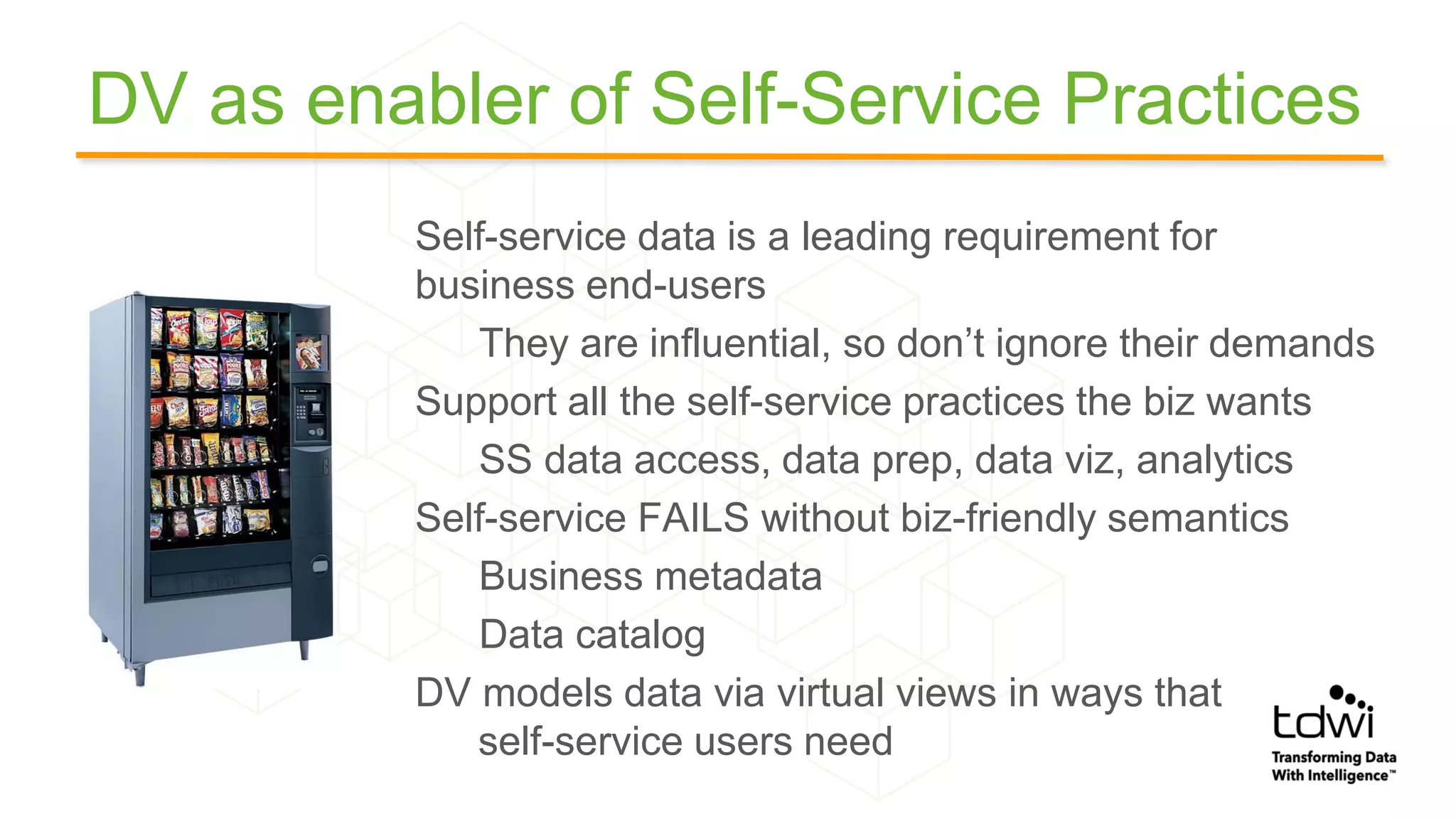
DV as enabler of Self-Service Practices
Self-service data is a leading requirement for
business end-users
They are influential, so don’t ignore their demands
Support all the self-service practices the biz wants
SS data access, data prep, data viz, analytics
Self-service FAILS without biz-friendly semantics
Business metadata
Data catalog
DV models data via virtual views in ways that
self-service users need
DV enables Modern Analytics Methods
AGILE – DV for rapid prototyping of analytics datasets
Virtual modeling in DV tool, with minimal data movement
Get a prototype in front of your business sponsor sooner
Iterative improvement of datasets is equally fast
LEAN – DV frees you from excess development steps
DV views are self documenting
Less testing and deployment steps before production
Most maintenance of datasets done from DV console
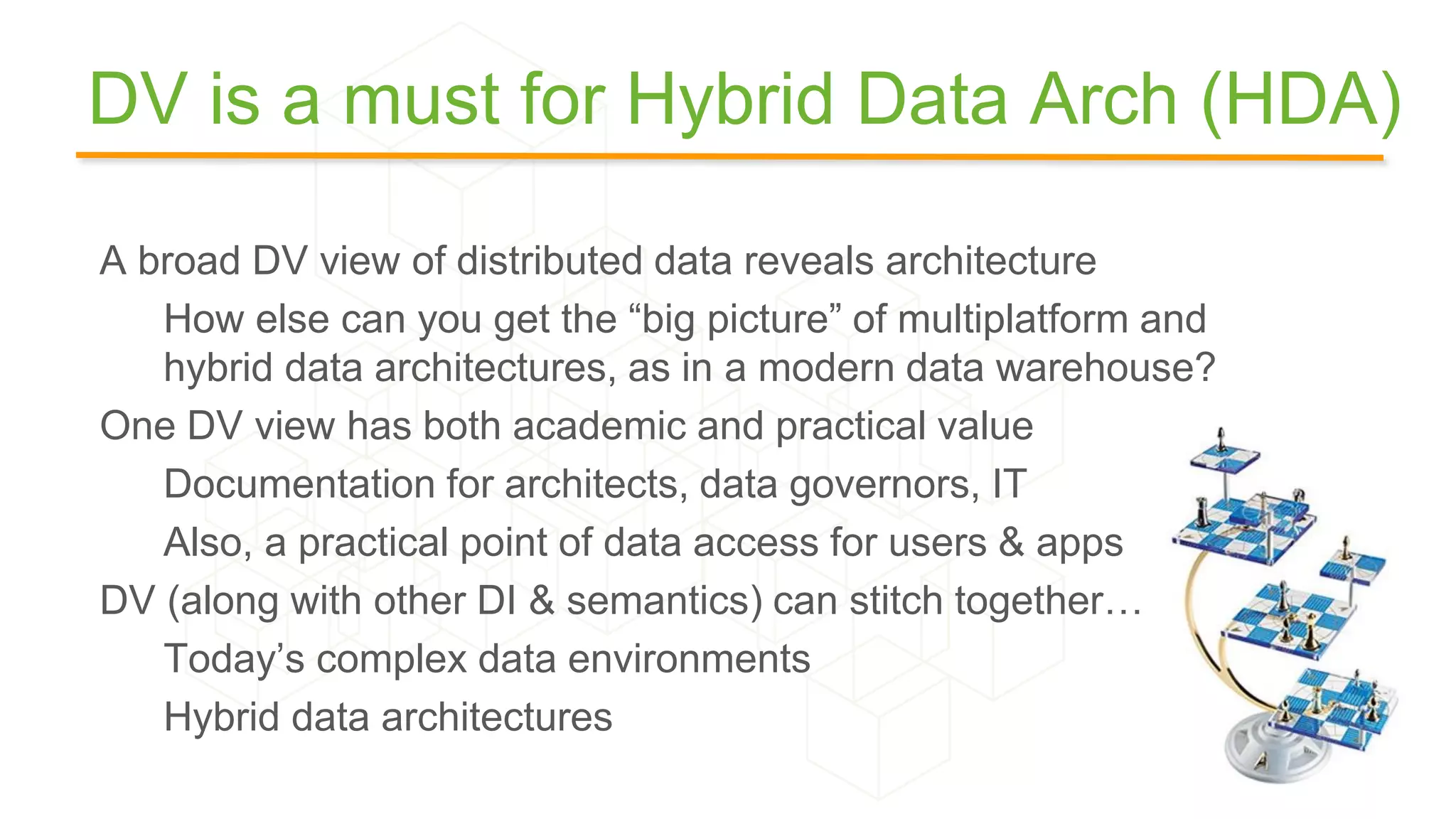
DV is a must for Hybrid Data Arch (HDA)
A broad DV view of distributed data reveals architecture
How else can you get the “big picture” of multiplatform and
hybrid data architectures, as in a modern data warehouse?
One DV view has both academic and practical value
Documentation for architects, data governors, IT
Also, a practical point of data access for users & apps
DV (along with other DI & semantics) can stitch together…
Today’s complex data environments
Hybrid data architectures
Summary
Data virtualization (DV) is a modern approach to data integration
DV usage is rising as the distribution of data gets more extreme
DV provides a development environment that models distributed
data as simpler, unified structures that are easier to use
DV also provides a deployment platform that serves as a data
access point for many users and apps
DV addresses new requirements for analytics, real-time, self-
service, architecture, governance, development methods, etc.
© Copyright Denodo Technologies.All rights reserved
Unless otherwise specified,no part of this PDF file may be reproduced or utilized in any for or by any means, electronic or mechanical,includingphotocopyingand microfilm, without prior the written authorizationfrom Denodo Technologies.

Analyst Keynote: TDWI: Data Virtualization as a Data Management Strategy for Advanced Analytics

  • 1.
    Advancing Cloud, Analytics,and Data Science with Logical Data Fabric The Agile Data Management and Analytics Conference
  • 2.
    #DenodoDataFest Data Virtualization asa Data Management Strategy for Advanced Analytics Sr. Research Director, TDWI P hi l ip Rus s om , P hD.
  • 3.
    Today’s Discussion Take-Aways Data virtualization (DV)is a modern approach to data integration DV usage is rising as the distribution of data gets more extreme DV provides a development environment that models distributed data as simpler, unified structures that are easier to use DV also provides a deployment platform that serves as a data access point for many users and apps DV addresses new requirements for analytics, real-time, self- service, architecture, governance, development methods, etc. Summary Please Tweet - @prussom #TDWI @Denodo #DataVirtualization
  • 4.
    DEFINING Data Virtualization (DV) DVprovides abstraction and service layers Integrates heterogeneous and distributed data without replicating it Creates “virtual” or “logical” layers that unify data to support many users and apps DV is a platform type for modern data integration The usual transformation and quality functions: ETL, federation, messaging… But without the latency, redundancy, and rigidity of older approaches A good DV platform supports query planning, in-memory functions, business glossary, self-service, and strategies for optimizing cross- platform performance
  • 5.
    Most organizations surveyedrecently by TDWI are using Data Virtualization With DM for AA in your organization, what data and analytics tools, techniques, and platforms are supported today? 37% of respondents use Data Virtualization for Advanced Analytics What data management capabilities do you need for successful advanced analytics? 33% of respondents consider DV to be a success factor for AA POINT – Data virtualization is real Organizations use it, because it works and it has value You should depend on DV, for analytics & other use cases SOURCE: 2020 TDWI Best Practices Report on Data Management for Advanced Analytics
  • 6.
    Depend on DataVirtualization TO PROVIDE USEFUL FUNCTIONS IN MANY CONTEXTS Logical/virtual layer is insulation for evolving data architectures, especially as they go cloud/hybrid Virtual views can be biz-friendly for self-service or big picture of whole data environment DV platform can be a central, shared “hub” for: Views, metadata, catalog, interfaces, gov, security… DV is great for rapid prototyping of datasets DV services = batch to real time execution
  • 7.
    DV as DataIntegration Infrastructure Data virtualization is a form of data integration Along with ETL/ELT, replication, synchronization, quality, metadata, cataloging, event processing DI infrastructure is not modern or complete without full DV functionality DV enhances DI infrastructure immensely Virtual views, services, multi-latency, diverse data semantics, data catalog
  • 8.
    DV as enablerfor Real-Time Analytics Operational reporting Performance management Manager dashboards Embedding analytics in operational applications Business activity monitoring and surveillance DV can complement or replace middleware, messaging, event processing
  • 9.
    DV as enablerof Self-Service Practices Self-service data is a leading requirement for business end-users They are influential, so don’t ignore their demands Support all the self-service practices the biz wants SS data access, data prep, data viz, analytics Self-service FAILS without biz-friendly semantics Business metadata Data catalog DV models data via virtual views in ways that self-service users need
  • 10.
    DV enables ModernAnalytics Methods AGILE – DV for rapid prototyping of analytics datasets Virtual modeling in DV tool, with minimal data movement Get a prototype in front of your business sponsor sooner Iterative improvement of datasets is equally fast LEAN – DV frees you from excess development steps DV views are self documenting Less testing and deployment steps before production Most maintenance of datasets done from DV console
  • 11.
    DV is amust for Hybrid Data Arch (HDA) A broad DV view of distributed data reveals architecture How else can you get the “big picture” of multiplatform and hybrid data architectures, as in a modern data warehouse? One DV view has both academic and practical value Documentation for architects, data governors, IT Also, a practical point of data access for users & apps DV (along with other DI & semantics) can stitch together… Today’s complex data environments Hybrid data architectures
  • 12.
    Summary Data virtualization (DV)is a modern approach to data integration DV usage is rising as the distribution of data gets more extreme DV provides a development environment that models distributed data as simpler, unified structures that are easier to use DV also provides a deployment platform that serves as a data access point for many users and apps DV addresses new requirements for analytics, real-time, self- service, architecture, governance, development methods, etc.
  • 13.
    © Copyright DenodoTechnologies.All rights reserved Unless otherwise specified,no part of this PDF file may be reproduced or utilized in any for or by any means, electronic or mechanical,includingphotocopyingand microfilm, without prior the written authorizationfrom Denodo Technologies.