Analysis of the interaction between
practices for introducing XP
effectively

                     Osamu Kobayashi
                      SRA(Software Research Associates)
                  Mitsuyoshi Kawabata
                   Agileware
                Makoto Sakai
                SRA Key Technology Laboratry
              Eddy Parkinson
               Department of Computer Science,
               Osaka University
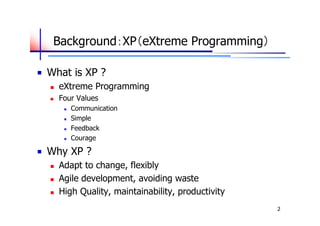
Background:XP(eXtreme Programming)

What is XP ?
   eXtreme Programming
   Four Values
        Communication
        Simple
        Feedback
        Courage

Why XP ?
   Adapt to change, flexibly
   Agile development, avoiding waste
   High Quality, maintainability, productivity
                                                  2
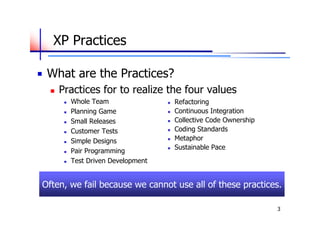
XP Practices

 What are the Practices?
     Practices for to realize the four values
          Whole Team                   Refactoring
          Planning Game                Continuous Integration
          Small Releases               Collective Code Ownership
          Customer Tests               Coding Standards
          Simple Designs               Metaphor
                                         Sustainable Pace
           Pair Programming
                                     
       

          Test Driven Development


Often, we fail because we cannot use all of these practices.

                                                                     3
Using a subset of practices

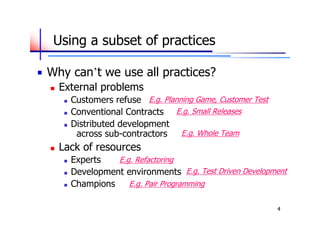
Why can’t we use all practices?
   External problems
        Customers refuse E.g. Planning Game, Customer Test
        Conventional Contracts E.g. Small Releases
        Distributed development
          across sub-contractors    E.g. Whole Team
   Lack of resources
        Experts   E.g. Refactoring
        Development environments E.g. Test Driven Development
        Champions    E.g. Pair Programming


                                                              4
Problems of using not all practices

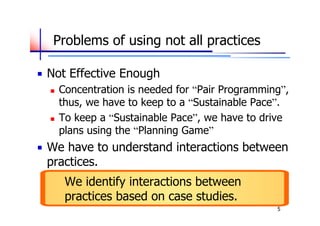
Not Effective Enough
   Concentration is needed for “Pair Programming”,
    thus, we have to keep to a “Sustainable Pace”.
   To keep a “Sustainable Pace”, we have to drive
    plans using the “Planning Game”
We have to understand interactions between
practices.
     We identify interactions between
     practices based on case studies.
                                                5
Agenda

Background
Analysis Methods
Case Studies
Results
Discussions
Summary


                   6
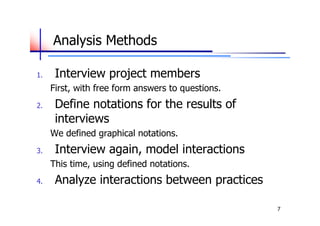
Analysis Methods

1.    Interview project members
     First, with free form answers to questions.
2.    Define notations for the results of
      interviews
     We defined graphical notations.
3.    Interview again, model interactions
     This time, using defined notations.
4.    Analyze interactions between practices

                                                   7
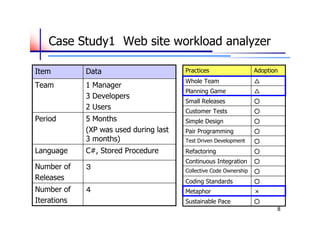
Case Study1 Web site workload analyzer

Item         Data                       Practices                   Adoption
                                        Whole Team                  △
Team         1 Manager
                                        Planning Game               △
             3 Developers
                                        Small Releases              ○
             2 Users                    Customer Tests              ○
Period       5 Months                   Simple Design               ○
             (XP was used during last   Pair Programming            ○
             3 months)                  Test Driven Development     ○
Language     C#, Stored Procedure       Refactoring                 ○
                                        Continuous Integration      ○
Number of    3                          Collective Code Ownership   ○
Releases                                Coding Standards            ○
Number of    4                          Metaphor                    ×
Iterations                              Sustainable Pace            ○
                                                                           8
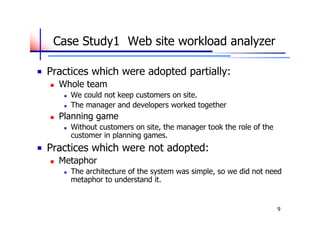
Case Study1 Web site workload analyzer

Practices which were adopted partially:
   Whole team
        We could not keep customers on site.
        The manager and developers worked together
   Planning game
        Without customers on site, the manager took the role of the
         customer in planning games.
Practices which were not adopted:
   Metaphor
        The architecture of the system was simple, so we did not need
         metaphor to understand it.


                                                                       9
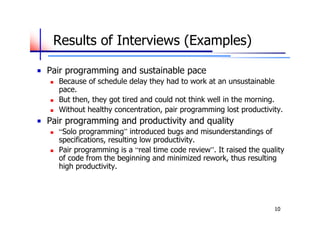
Results of Interviews (Examples)

Pair programming and sustainable pace
   Because of schedule delay they had to work at an unsustainable
    pace.
   But then, they got tired and could not think well in the morning.
   Without healthy concentration, pair programming lost productivity.
Pair programming and productivity and quality
   “Solo programming” introduced bugs and misunderstandings of
    specifications, resulting low productivity.
   Pair programming is a “real time code review”. It raised the quality
    of code from the beginning and minimized rework, thus resulting
    high productivity.


                                                                     10
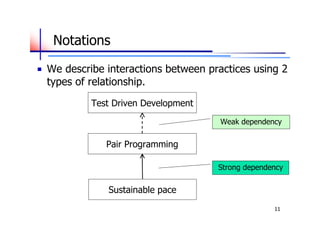
Notations

We describe interactions between practices using 2
types of relationship.
         Test Driven Development
                                    Weak dependency


            Pair Programming

                                   Strong dependency


            Sustainable pace
                                                 11
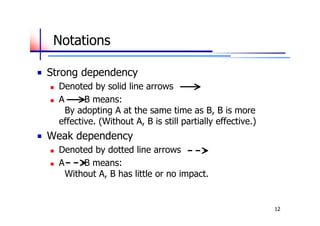
Notations

Strong dependency
   Denoted by solid line arrows
   A      B means:
      By adopting A at the same time as B, B is more
    effective. (Without A, B is still partially effective.)
Weak dependency
   Denoted by dotted line arrows
   A     B means:
      Without A, B has little or no impact.


                                                              12
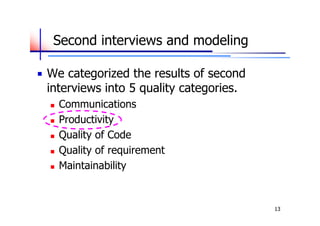
Second interviews and modeling

We categorized the results of second
interviews into 5 quality categories.
   Communications
   Productivity
   Quality of Code
   Quality of requirement
   Maintainability


                                        13
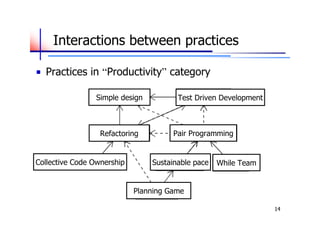
Interactions between practices

  Practices in “Productivity” category

                 Simple design          Test Driven Development


                  Refactoring         Pair Programming


Collective Code Ownership        Sustainable pace   While Team


                            Planning Game

                                                                  14
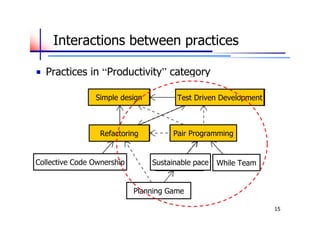
Interactions between practices

  Practices in “Productivity” category

                Simple design          Test Driven Development


                  Refactoring         Pair Programming


Collective Code Ownership       Sustainable pace   While Team


                            Planning Game

                                                                 15
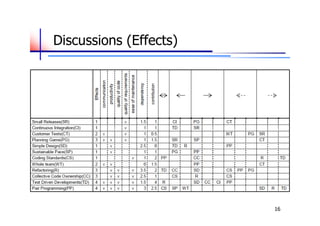
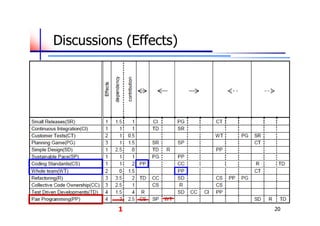
Discussions (Effects)


                        16
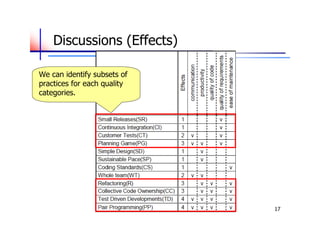
Discussions (Effects)

We can identify subsets of
practices for each quality
categories.


                             17
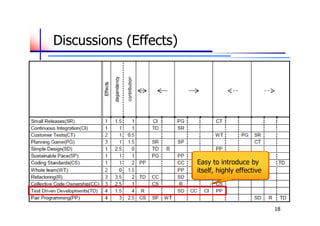
Discussions (Effects)


                        Easy to introduce by
                        itself, highly effective


                                                   18
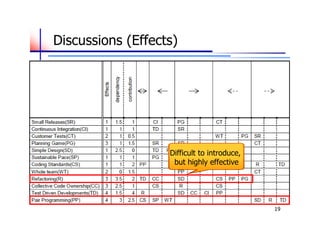
Discussions (Effects)


                   Difficult to introduce,
                    but highly effective


                                             19
Discussions (Effects)


          1             20
Summary

Model interactions between practices based on
case studies.
Using a table, categorized interactions into quality
categories.
Using the results, it looks possible to introduce XP
effectively, even when all practices cannot be
introduced at once.
Future directions
   More case studies.
   Recognize patterns of practice introduction.

                                                   21

Analysis of the interaction between practices for introducing XP effectively

  • 1.
    Analysis of theinteraction between practices for introducing XP effectively Osamu Kobayashi SRA(Software Research Associates) Mitsuyoshi Kawabata Agileware Makoto Sakai SRA Key Technology Laboratry Eddy Parkinson Department of Computer Science, Osaka University
  • 2.
    Background:XP(eXtreme Programming) What isXP ?  eXtreme Programming  Four Values  Communication  Simple  Feedback  Courage Why XP ?  Adapt to change, flexibly  Agile development, avoiding waste  High Quality, maintainability, productivity 2
  • 3.
    XP Practices Whatare the Practices?  Practices for to realize the four values  Whole Team  Refactoring  Planning Game  Continuous Integration  Small Releases  Collective Code Ownership  Customer Tests  Coding Standards  Simple Designs  Metaphor Sustainable Pace Pair Programming    Test Driven Development Often, we fail because we cannot use all of these practices. 3
  • 4.
    Using a subsetof practices Why can’t we use all practices?  External problems  Customers refuse E.g. Planning Game, Customer Test  Conventional Contracts E.g. Small Releases  Distributed development across sub-contractors E.g. Whole Team  Lack of resources  Experts E.g. Refactoring  Development environments E.g. Test Driven Development  Champions E.g. Pair Programming 4
  • 5.
    Problems of usingnot all practices Not Effective Enough  Concentration is needed for “Pair Programming”, thus, we have to keep to a “Sustainable Pace”.  To keep a “Sustainable Pace”, we have to drive plans using the “Planning Game” We have to understand interactions between practices. We identify interactions between practices based on case studies. 5
  • 6.
  • 7.
    Analysis Methods 1. Interview project members First, with free form answers to questions. 2. Define notations for the results of interviews We defined graphical notations. 3. Interview again, model interactions This time, using defined notations. 4. Analyze interactions between practices 7
  • 8.
    Case Study1 Web siteworkload analyzer Item Data Practices Adoption Whole Team △ Team 1 Manager Planning Game △ 3 Developers Small Releases ○ 2 Users Customer Tests ○ Period 5 Months Simple Design ○ (XP was used during last Pair Programming ○ 3 months) Test Driven Development ○ Language C#, Stored Procedure Refactoring ○ Continuous Integration ○ Number of 3 Collective Code Ownership ○ Releases Coding Standards ○ Number of 4 Metaphor × Iterations Sustainable Pace ○ 8
  • 9.
    Case Study1 Web siteworkload analyzer Practices which were adopted partially:  Whole team  We could not keep customers on site.  The manager and developers worked together  Planning game  Without customers on site, the manager took the role of the customer in planning games. Practices which were not adopted:  Metaphor  The architecture of the system was simple, so we did not need metaphor to understand it. 9
  • 10.
    Results of Interviews(Examples) Pair programming and sustainable pace  Because of schedule delay they had to work at an unsustainable pace.  But then, they got tired and could not think well in the morning.  Without healthy concentration, pair programming lost productivity. Pair programming and productivity and quality  “Solo programming” introduced bugs and misunderstandings of specifications, resulting low productivity.  Pair programming is a “real time code review”. It raised the quality of code from the beginning and minimized rework, thus resulting high productivity. 10
  • 11.
    Notations We describe interactionsbetween practices using 2 types of relationship. Test Driven Development Weak dependency Pair Programming Strong dependency Sustainable pace 11
  • 12.
    Notations Strong dependency  Denoted by solid line arrows  A B means: By adopting A at the same time as B, B is more effective. (Without A, B is still partially effective.) Weak dependency  Denoted by dotted line arrows  A B means: Without A, B has little or no impact. 12
  • 13.
    Second interviews andmodeling We categorized the results of second interviews into 5 quality categories.  Communications  Productivity  Quality of Code  Quality of requirement  Maintainability 13
  • 14.
    Interactions between practices Practices in “Productivity” category Simple design Test Driven Development Refactoring Pair Programming Collective Code Ownership Sustainable pace While Team Planning Game 14
  • 15.
    Interactions between practices Practices in “Productivity” category Simple design Test Driven Development Refactoring Pair Programming Collective Code Ownership Sustainable pace While Team Planning Game 15
  • 16.
  • 17.
    Discussions (Effects) We canidentify subsets of practices for each quality categories. 17
  • 18.
    Discussions (Effects) Easy to introduce by itself, highly effective 18
  • 19.
    Discussions (Effects) Difficult to introduce, but highly effective 19
  • 20.
  • 21.
    Summary Model interactions betweenpractices based on case studies. Using a table, categorized interactions into quality categories. Using the results, it looks possible to introduce XP effectively, even when all practices cannot be introduced at once. Future directions  More case studies.  Recognize patterns of practice introduction. 21