Test Driven Development


        Todays Forum Topic:


Test Driven Development
         (TDD)
Agenda              Test Driven Development


Agenda
         1. Learning the TDD Process

         2. Waterfall vs. TDD Process

         3. Short-term advantages

         4. Long-term advantages

         5. Common critics and answers
TDD Formula                 Test Driven Development


                                1. add a test


                                                             4. improve design
2. get it to fail      JUnit                       JUnit
                                                            through refactoring


                    3. write enough code to pass the test
Test Driven Development


User Story
            Role:    As a user
         Feature:    I want to be able to create my shopping cart with products
   Business Value:   So that I can estimate my costs and buy my products
Test Driven Development


1. add a test...
Test Driven Development


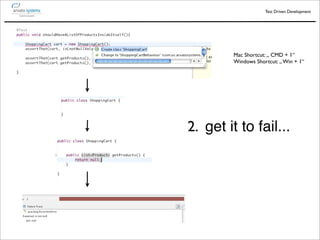
        Mac Shortcut: „ CMD + 1“
        Windows Shortcut: „ Win + 1“


2. get it to fail...
Test Driven Development


3. write code to pass the test...

                   ... in the simplest possible way


                           JUnit
Test Driven Development


4. improve design
         too simple in this case, later...
TDD Formula                 Test Driven Development


   Start the loop again....

                                1. add a test


                                                             4. improve design
2. get it to fail      JUnit                      JUnit
                                                            through refactoring


                    3. write enough code to pass the test
Test Driven Development


1. add a test...

     think about the new API before it will be created
2. get the test to fail...     Test Driven Development


Generate now the new missing classes and methods
Test Driven Development


3. write just enough code to pass the test...


                        JUnit
Test Driven Development


 JUnit                                     JUnit


by switching from a red bar to a green one, we
tested our test itself

we fulfilled the test through last implementation
Test Driven Development


4. improve design

                any change                            JUnit


                •   evolve your design
                •   create only needed abstractions
                •   be always sure the code is still working
Test Driven Development


   Start the loop again....

                                1. add a test


                                                             4. improve design
2. get it to fail      JUnit                      JUnit
                                                            through refactoring


                    3. write enough code to pass the test
Test Driven Development


1. add a test...


     motivate the next new feature by a test!
Test Driven Development


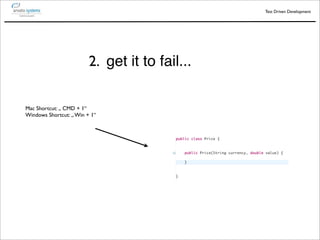
                         2. get it to fail...

Mac Shortcut: „ CMD + 1“
Windows Shortcut: „ Win + 1“
Test Driven Development


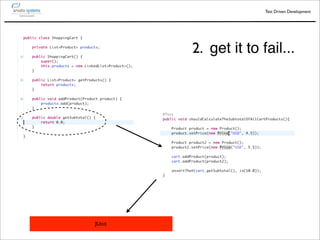
        2. get it to fail...


JUnit
Test Driven Development


3. write code to pass the test...


                 ... in the simplest possible way


                         JUnit
Test Driven Development


4. improve design
            always supporting your steps
               by the test, stay „green“


    JUnit
Classical waterfall process                    Test Driven Development


    Analysis
                                               A new feature
   Customer
Project Manager                               or a small library
 What?                 Design


                      Architect
                  Senior Developer

                     How?                          Implementation


                                                   Developer


                                                                              Test

                                                                         Developer
                                                                          Tester
The process resulting from TDD       Test Driven Development


                    Analysis            =            Test      What?
                                   1. add a test


2. get it to fail     JUnit                          JUnit     4. improve design

                                                                    Design


                                                                  How?
                       3. write code to pass the test

                                  Implementation
TDD vs Waterfall                         Test Driven Development


Waterfall:             Analysis                                   Design

                                                 GAP
                                         Formal language lack


  TDD:
         ShoppingCart ....
         ...shouldHaveAListOfProductsInsideItself
         ...shouldCalculateTheSubotalOfAllProductsInTheShoppingCart


         Behavior Driven Development (last evolvement TDD) is binding the
         user stories directly to the tests!
TDD vs Waterfall                           Test Driven Development


Waterfall:
                                                                             Design
 •   predict the right design (M.Fowler, Is design dead?)
 •   think about everything upfront?
 •   sit down and think where to start, make random drafts


TDD:
 •   dont think about the design in detail (at class level)
 •   adapt your design to your needs later, create the abstractions you will only need
 •   let your design evolve with time
 •   change the design fast alway assured by the tests
TDD vs Waterfall                      Test Driven Development


Waterfall:                                                            Implementation

  •   fullfill the planned design in anycase
  •   or develop without any plan
  •   danger to develop things you will not need at the end
  •   trying to get classes work somehow together at the end


TDD:
  •   develop only what needed
  •   dont really think about the design upfront
  •   get motivated and driven by the test
  •   try to close the loop to green as fast as possible
  •   make changes to former code without any concern that you break it
TDD vs Waterfall                          Test Driven Development


     Analysis           Design         Implementation


                                                                 Test
Waterfall testing:

•   hope to have no bugs, creating ad-hoc and random test cases
•   since the code is not test friendly => time consuming and of bad test quality (testing of
    huge private methods after they are written)
•   boring task, trying to finish it fast
•   already lost time with manual testing
•   will debug the code you wrote days or weeks ago or even not your code
•   might be removed with more project pressure


TDD:Your test is already done!
TDD vs Waterfall                     Test Driven Development


                Analysis          =           Test


                  Is a test still a test ?
           We should consider the test as
          specification of our requirements!


   ShoppingCart ....
   ...shouldHaveAListOfProductsInsideItself
   ...shouldCalculateTheSubotalOfAllProductsInTheShoppingCart


Behavior Driven Development (BDD) by Dan North

Large adoption in the rails community with RSpec
Short-term advantages                           Test Driven Development


Short-term advantages


•   by writing the test first we are able to think about the API and create it user friendly
•   we did not try to achieve the planned design, which is a hard task
•   we never thought about design, just started to develop
•   we immediately created an executable specification for our code
•   the code is born with two clients: the test using it and the client code => reusable code
•   avoid loosing the time by build process, build and deploy only if everything is tested
•   compiler is assuring the syntax, tests assuring semantics
•   write the test once and develop against it, never check things manually for their correctness
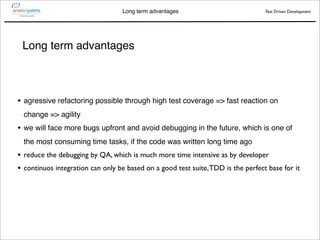
Long term advantages                            Test Driven Development


    Long term advantages


•   agressive refactoring possible through high test coverage => fast reaction on
    change => agility
•   we will face more bugs upfront and avoid debugging in the future, which is one of
    the most consuming time tasks, if the code was written long time ago
•   reduce the debugging by QA, which is much more time intensive as by developer
•   continuos integration can only be based on a good test suite, TDD is the perfect base for it
Test Driven Development


Long term advantages

    •   tests will enforce compositions oriented design
    •   this correlates very well with dependency injection of spring
    •   stubbing can be easily realized, making the test faster and independent


                                       Main Service


                   DAO               external Tax-Service   Validation Service


               <<implements>>          <<implements>>       <<implements>>


                                          Stub
                  DAOImpl                                   ValidationServiceImlpl
                                     Implementation
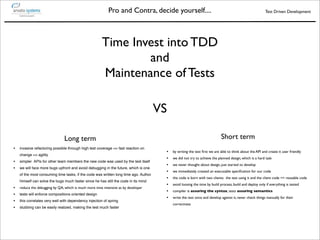
Pro and Contra, decide yourself....                                                            Test Driven Development


                                                       Time Invest into TDD
                                                               and
                                                       Maintenance of Tests

                                                                                      VS

                                Long term                                                                                  Short term
•   invasive refactoring possible through high test coverage => fast reaction on
                                                                                       •   by writing the test first we are able to think about the API and create it user friendly
    change => agility
                                                                                       •   we did not try to achieve the planned design, which is a hard task
•   simpler APIs for other team members the new code was used by the test itself
                                                                                       •   we never thought about design, just started to develop
•   we will face more bugs upfront and avoid debugging in the future, which is one
                                                                                       •   we immediately created an executable specification for our code
    of the most consuming time tasks, if the code was written long time ago. Author
                                                                                       •   the code is born with two clients: the test using it and the client code => reusable code
    himself can solve the bugs much faster since he has still the code in its mind
                                                                                       •   avoid loosing the time by build process, build and deploy only if everything is tested
•   reduce the debugging by QA, which is much more time intensive as by developer
                                                                                       •   compiler is assuring the syntax, tests assuring semantics
•   tests will enforce compositions oriented design
                                                                                       •   write the test once and develop against it, never check things manually for their
•   this correlates very well with dependency injection of spring
                                                                                           correctness
•   stubbing can be easily realized, making the test much faster
Test Driven Development


         „Testing upfront takes to much time“

 •   of not testable code? of course...
 •   at the end you have to test your code anyway
 •   have you counted your time spent on manual testing during development?


„Why to write tests for code I may be not use“

  •   this is only true for a prototype development or a not modularized code

Test Driven Development by Denis Lutz

  • 1.
    Test Driven Development Todays Forum Topic: Test Driven Development (TDD)
  • 2.
    Agenda Test Driven Development Agenda 1. Learning the TDD Process 2. Waterfall vs. TDD Process 3. Short-term advantages 4. Long-term advantages 5. Common critics and answers
  • 3.
    TDD Formula Test Driven Development 1. add a test 4. improve design 2. get it to fail JUnit JUnit through refactoring 3. write enough code to pass the test
  • 4.
    Test Driven Development UserStory Role: As a user Feature: I want to be able to create my shopping cart with products Business Value: So that I can estimate my costs and buy my products
  • 5.
  • 6.
    Test Driven Development Mac Shortcut: „ CMD + 1“ Windows Shortcut: „ Win + 1“ 2. get it to fail...
  • 7.
    Test Driven Development 3.write code to pass the test... ... in the simplest possible way JUnit
  • 8.
    Test Driven Development 4.improve design too simple in this case, later...
  • 9.
    TDD Formula Test Driven Development Start the loop again.... 1. add a test 4. improve design 2. get it to fail JUnit JUnit through refactoring 3. write enough code to pass the test
  • 10.
    Test Driven Development 1.add a test... think about the new API before it will be created
  • 11.
    2. get thetest to fail... Test Driven Development Generate now the new missing classes and methods
  • 12.
    Test Driven Development 3.write just enough code to pass the test... JUnit
  • 13.
    Test Driven Development JUnit JUnit by switching from a red bar to a green one, we tested our test itself we fulfilled the test through last implementation
  • 14.
    Test Driven Development 4.improve design any change JUnit • evolve your design • create only needed abstractions • be always sure the code is still working
  • 15.
    Test Driven Development Start the loop again.... 1. add a test 4. improve design 2. get it to fail JUnit JUnit through refactoring 3. write enough code to pass the test
  • 16.
    Test Driven Development 1.add a test... motivate the next new feature by a test!
  • 17.
    Test Driven Development 2. get it to fail... Mac Shortcut: „ CMD + 1“ Windows Shortcut: „ Win + 1“
  • 18.
    Test Driven Development 2. get it to fail... JUnit
  • 19.
    Test Driven Development 3.write code to pass the test... ... in the simplest possible way JUnit
  • 20.
    Test Driven Development 4.improve design always supporting your steps by the test, stay „green“ JUnit
  • 21.
    Classical waterfall process Test Driven Development Analysis A new feature Customer Project Manager or a small library What? Design Architect Senior Developer How? Implementation Developer Test Developer Tester
  • 22.
    The process resultingfrom TDD Test Driven Development Analysis = Test What? 1. add a test 2. get it to fail JUnit JUnit 4. improve design Design How? 3. write code to pass the test Implementation
  • 23.
    TDD vs Waterfall Test Driven Development Waterfall: Analysis Design GAP Formal language lack TDD: ShoppingCart .... ...shouldHaveAListOfProductsInsideItself ...shouldCalculateTheSubotalOfAllProductsInTheShoppingCart Behavior Driven Development (last evolvement TDD) is binding the user stories directly to the tests!
  • 24.
    TDD vs Waterfall Test Driven Development Waterfall: Design • predict the right design (M.Fowler, Is design dead?) • think about everything upfront? • sit down and think where to start, make random drafts TDD: • dont think about the design in detail (at class level) • adapt your design to your needs later, create the abstractions you will only need • let your design evolve with time • change the design fast alway assured by the tests
  • 25.
    TDD vs Waterfall Test Driven Development Waterfall: Implementation • fullfill the planned design in anycase • or develop without any plan • danger to develop things you will not need at the end • trying to get classes work somehow together at the end TDD: • develop only what needed • dont really think about the design upfront • get motivated and driven by the test • try to close the loop to green as fast as possible • make changes to former code without any concern that you break it
  • 26.
    TDD vs Waterfall Test Driven Development Analysis Design Implementation Test Waterfall testing: • hope to have no bugs, creating ad-hoc and random test cases • since the code is not test friendly => time consuming and of bad test quality (testing of huge private methods after they are written) • boring task, trying to finish it fast • already lost time with manual testing • will debug the code you wrote days or weeks ago or even not your code • might be removed with more project pressure TDD:Your test is already done!
  • 27.
    TDD vs Waterfall Test Driven Development Analysis = Test Is a test still a test ? We should consider the test as specification of our requirements! ShoppingCart .... ...shouldHaveAListOfProductsInsideItself ...shouldCalculateTheSubotalOfAllProductsInTheShoppingCart Behavior Driven Development (BDD) by Dan North Large adoption in the rails community with RSpec
  • 28.
    Short-term advantages Test Driven Development Short-term advantages • by writing the test first we are able to think about the API and create it user friendly • we did not try to achieve the planned design, which is a hard task • we never thought about design, just started to develop • we immediately created an executable specification for our code • the code is born with two clients: the test using it and the client code => reusable code • avoid loosing the time by build process, build and deploy only if everything is tested • compiler is assuring the syntax, tests assuring semantics • write the test once and develop against it, never check things manually for their correctness
  • 29.
    Long term advantages Test Driven Development Long term advantages • agressive refactoring possible through high test coverage => fast reaction on change => agility • we will face more bugs upfront and avoid debugging in the future, which is one of the most consuming time tasks, if the code was written long time ago • reduce the debugging by QA, which is much more time intensive as by developer • continuos integration can only be based on a good test suite, TDD is the perfect base for it
  • 30.
    Test Driven Development Longterm advantages • tests will enforce compositions oriented design • this correlates very well with dependency injection of spring • stubbing can be easily realized, making the test faster and independent Main Service DAO external Tax-Service Validation Service <<implements>> <<implements>> <<implements>> Stub DAOImpl ValidationServiceImlpl Implementation
  • 31.
    Pro and Contra,decide yourself.... Test Driven Development Time Invest into TDD and Maintenance of Tests VS Long term Short term • invasive refactoring possible through high test coverage => fast reaction on • by writing the test first we are able to think about the API and create it user friendly change => agility • we did not try to achieve the planned design, which is a hard task • simpler APIs for other team members the new code was used by the test itself • we never thought about design, just started to develop • we will face more bugs upfront and avoid debugging in the future, which is one • we immediately created an executable specification for our code of the most consuming time tasks, if the code was written long time ago. Author • the code is born with two clients: the test using it and the client code => reusable code himself can solve the bugs much faster since he has still the code in its mind • avoid loosing the time by build process, build and deploy only if everything is tested • reduce the debugging by QA, which is much more time intensive as by developer • compiler is assuring the syntax, tests assuring semantics • tests will enforce compositions oriented design • write the test once and develop against it, never check things manually for their • this correlates very well with dependency injection of spring correctness • stubbing can be easily realized, making the test much faster
  • 32.
    Test Driven Development „Testing upfront takes to much time“ • of not testable code? of course... • at the end you have to test your code anyway • have you counted your time spent on manual testing during development? „Why to write tests for code I may be not use“ • this is only true for a prototype development or a not modularized code