THE MOTOR VEHICLES ACT, 1988 
(Act No. 59 OF 1988)
LECTURE TO 
TATA MOTORS TRAINEES 
BY 
MAJ. GEN. NILENDRA KUMAR 
DIRECTOR 
AMITY LAW SCHOOL, NOIDA 
ON 
25TH JANUARY,2012
Session on law governing motor vehicles
LAW 
It is a command enforced by some 
sanction. It is a rule of action to which 
men are obliged to make their conduct 
conformable.
All laws in the country, whether of the 
Union or of the States, have to conform to 
the constitutional scheme.
CONSTITUTION 
is a basic law defining and delimiting the 
principle organs of Government and their 
jurisdiction as well as the basic rights of 
men and citizen.
The Constitution of India contains twelve 
schedules
Seventh schedule of the Constitution 
enumerates the subject matter of laws 
and thus demarcates the division of 
responsibility between the Union and the 
States.
Seventh schedule has three lists each of 
which 
has a number of entries.
Entry 23 of List A to the Seventh Schedule
The subject of motor vehicles is dealt by the 
Central Government.
The Government of India has a specific 
Ministry concerned with the Motor 
Vehicle Laws in India.
Ministry of Road Transport & Highways
The Ministry has two separate wings
1. Roads Wing 
2. Transport Wing
Roads Wing deals with development 
and maintenance of National Highway 
in the country.
Transport Wing deals with matters 
relating to road transport including 
motor vehicle legislation.
There are a number of legislations in India 
that deal with different aspects of motor 
vehicles.
These are a the statutes that deal with 
motor transport.
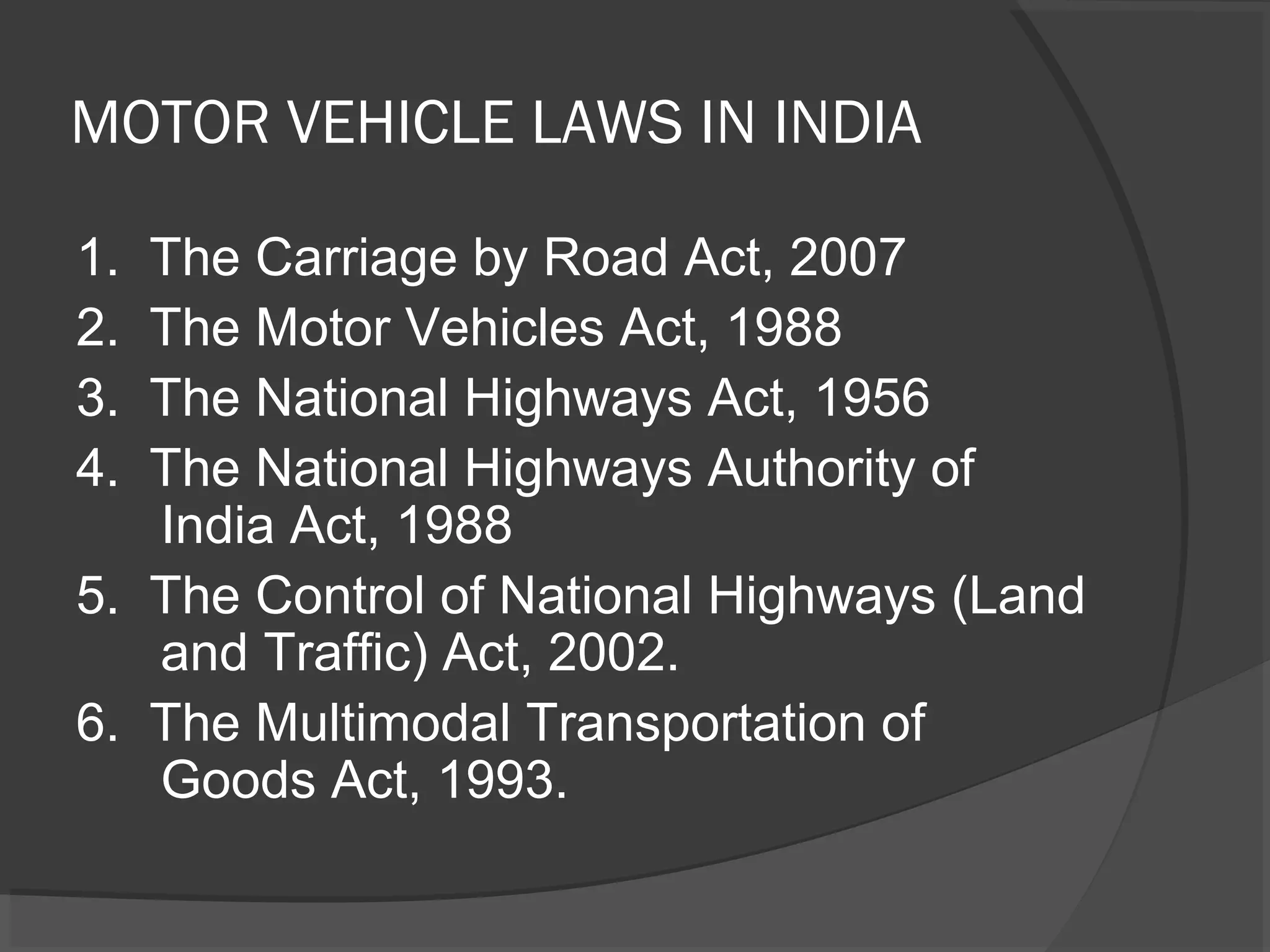
MOTOR VEHICLE LAWS IN INDIA 
1. The Carriage by Road Act, 2007 
2. The Motor Vehicles Act, 1988 
3. The National Highways Act, 1956 
4. The National Highways Authority of 
India Act, 1988 
5. The Control of National Highways (Land 
and Traffic) Act, 2002. 
6. The Multimodal Transportation of 
Goods Act, 1993.
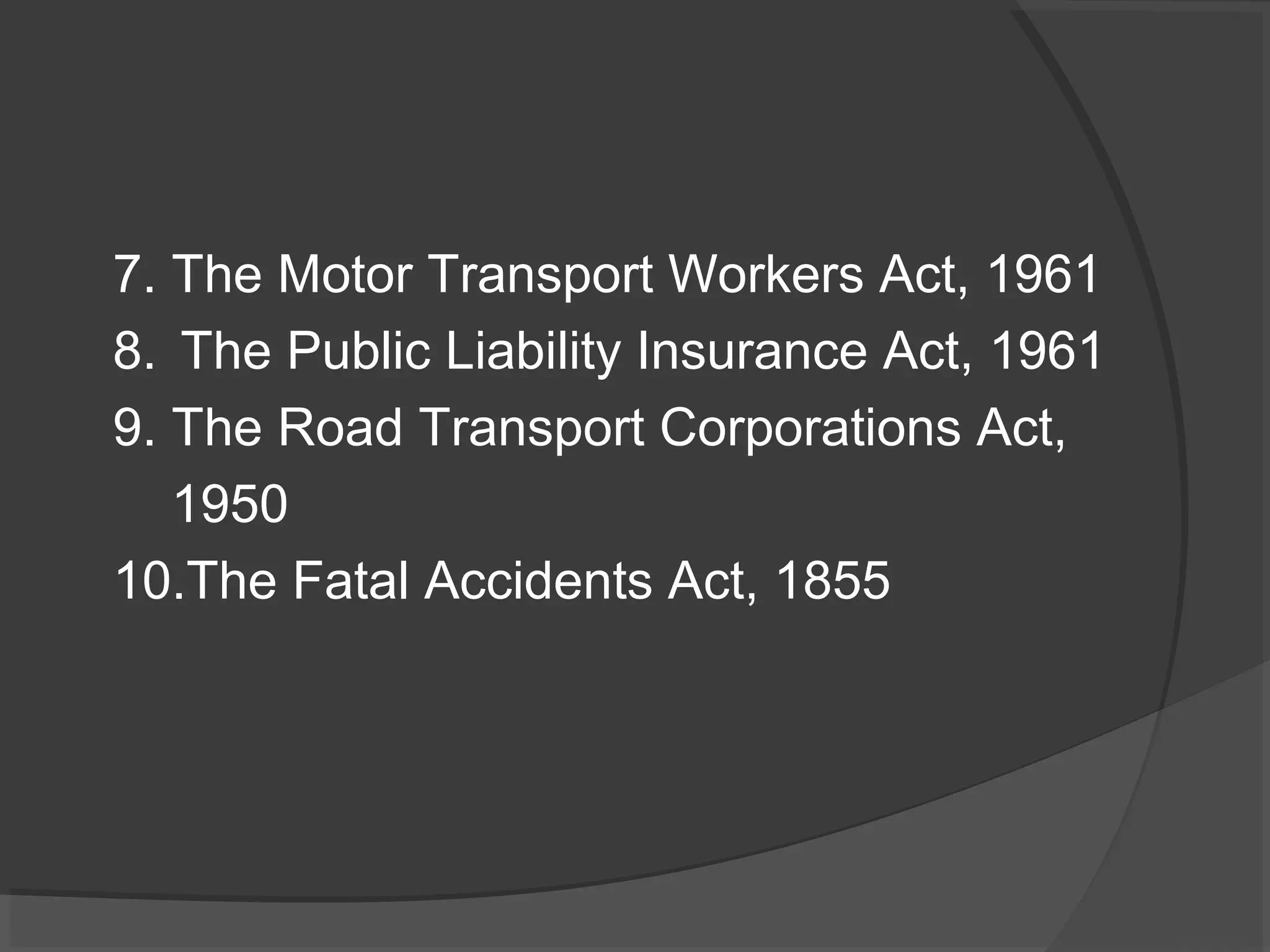
7. The Motor Transport Workers Act, 1961 
8. The Public Liability Insurance Act, 1961 
9. The Road Transport Corporations Act, 
1950 
10.The Fatal Accidents Act, 1855
The Motor Vehicles Act 1988 
Act No. 59 of 1988
SIGNIFICANCE 
The Act has taken into account changes 
in the road transport technology, pattern 
of passenger and freight movements, 
developments in the road network in the 
country and particularly techniques in the 
motor vehicles management.
RELEVANCE OF MV ACT TO THE 
TATA 
MOTORS TRAINEES
The Act deals with 
 Construction equipment and maintenance 
 Standards for components and parts 
 Anti-pollution control devices 
 Issue of testing fitness certificates 
 Registration marks
MV ACT 
1. Extends to whole of India 
2. Came into force on 1 July 1989 
3. No. of Chapters – 14 
4. No. of Sections – 217
CHAPTERISATION 
Number 
1. Preliminary 
2. Licensing of drives of motor vehicles 
3. Licensing of conductors of stage carriages 
4. Registration of motor vehicles 
5. Control of transport vehicles 
6. Special provisions relating to State Transport 
undertaking 
7. Construction, equipment and maintenance of 
vehicles
8. Control of traffic 
9. Motor vehicles temporarily leaving or 
visiting India 
10. Liability without fault in certain cases 
11. Insurance of motor vehicles against third 
party risks 
12. Claims Tribunals 
13. Offences, penalties and procedure 
14. Miscellaneous
Salient portions of the Act have been 
discussed in this presentation.
PREAMBLE 
An Act to consolidate and amend the 
law relating to motor vehicles.
The Act categorizes motor vehicles 
into different types.
Generally the categorization is based on 
size, type and utility of such vehicles.
CARRIAGE 
A carriage is a contrivance which is used 
for carrying or transporting, especially 
along or over a solid surface.
Carriage includes any carriage, wagon, 
cart truck, vehicle or other means of 
conveying goods, or passengers by 
land.
A crane is a motor vehicle
The term automobile includes all vehicles 
propelled by means other than muscular 
power, except rail road, railway cars and 
motor vehicles, running only on rails and 
tracks, and road rollers.
The Act defines and enumerates various 
kind of 
motor vehicles.
Section 2 of the Act contains the definition 
of 
various words and terms.
DEFINITIONS 
Section 2(8) 
Dealer includes a person who is engaged 
_____ 
b) in building bodies for attachment to chassis; 
or 
c) in the repair of motor vehicles; or 
d) in the business of hypothecation, leasing or 
hire purchase of motor vehicles
“Contract carriage” means a motor vehicle 
which carries a passenger or passengers for 
hire or reward and is engaged under a 
contract, whether expressed or implied, for 
the use of such vehicle as a whole for the 
carriage of passengers mentioned therein 
and entered into by a person with a holder of 
a permit in relation to such vehicle or any 
person authorized by him in this behalf on a 
fixed or an agreed rate or sum –
a) on a time basis, whether or not with 
reference to any route or distance; or 
b) from one point to another, 
and in either case, without stopping to pick 
up or set down passengers not included in 
the contract anywhere during the journey, 
and includes – 
i) a maxicab; and 
ii) a motor can notwithstanding that separate 
fares are charged for its passengers;
“Goods carriage” means any motor vehicle 
constructed or adapted for use solely for the 
carriage of goods, or any motor vehicle not 
so constructed or adapted when used for the 
carriage of goods.
“Heavy goods vehicle” means any goods 
carriage the gross vehicle weight of which, 
or a tractor or a road-roller the unladen 
weight of either of which, exceeds 12,000 
kilograms;
“Heavy passenger motor vehicle” means 
any public service vehicle or private service 
vehicle or educational institution bus or 
omnibus the gross vehicle weight of any of 
which, or a motor car the unladen weight of 
which, exceeds 12,000 kilograms;
“Invalid carriage” means a motor vehicle 
specially designed and constructed, and 
not 
merely, adapted, for the use of a person 
suffering from some physical defect or 
disability, and used solely by or for such a 
person;
“Light motor vehicle” means a transport 
vehicle or omnibus the gross vehicle 
weight 
of either of which or a motor car or tractor 
or 
road-roller the unladen weight of any of 
which, does not exceed 7,500 kilograms.
“Maxicab” means any motor vehicle 
constructed or adapted to carry more than 
six passengers , but not more than twelve 
passengers, excluding the driver, for hire 
or 
reward;
“Medium goods vehicle” means any goods 
carriage other than a light motor vehicle or a 
heavy goods vehicle;
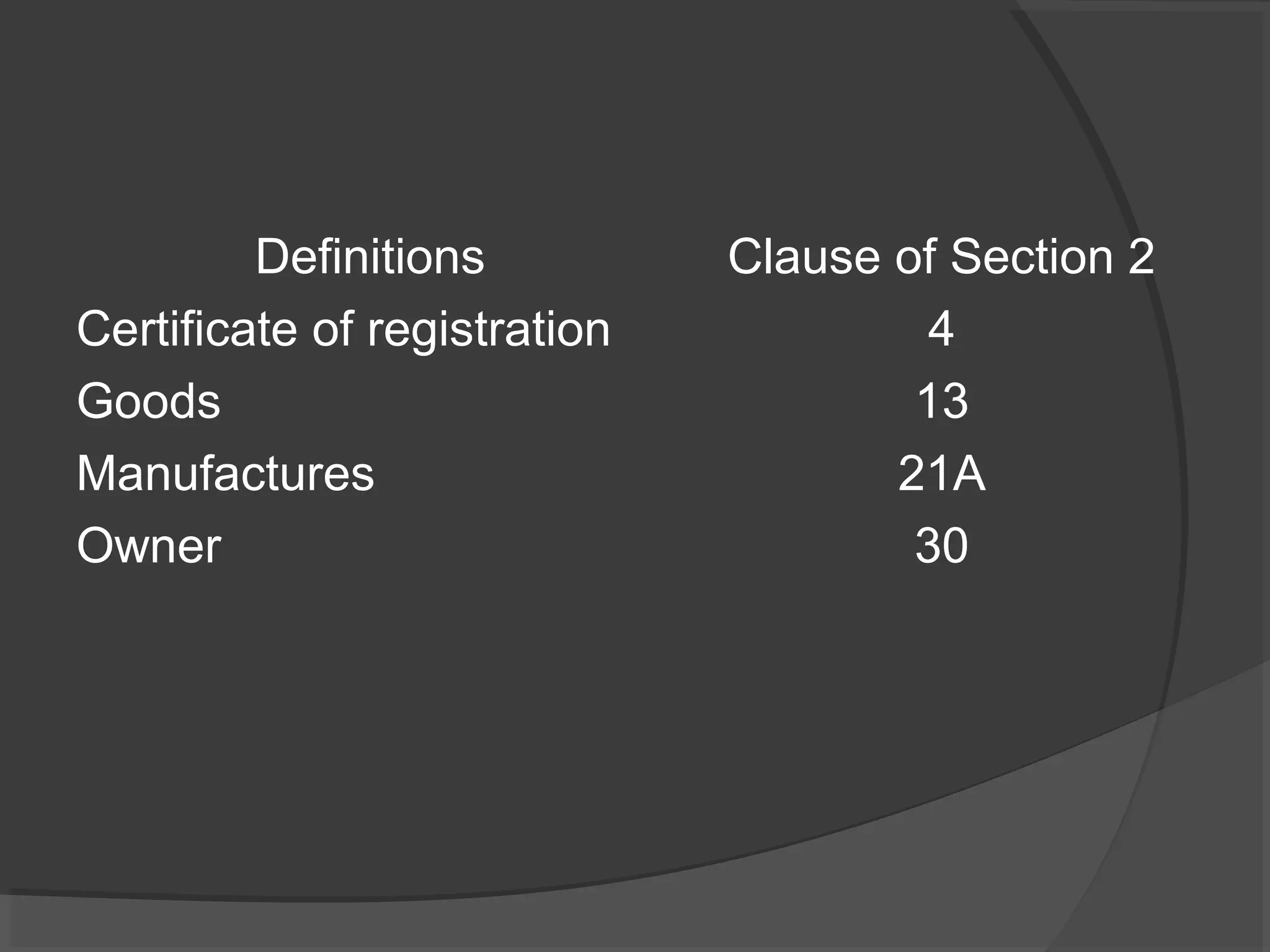
Definitions Clause of Section 2 
Certificate of registration 4 
Goods 13 
Manufactures 21A 
Owner 30
TYPES OF VEHICLES 
Words Defined Clause of 
Section 2 
Contract carriage 7 
Goods carriage 14 
Heavy goods vehicle 16 
Heavy passenger motor vehicle 17 
Invalid carriage 18 
Light motor vehicle 21 
Maxicab 22 
Medium goods vehicle 23 
Medium passenger motor vehicle 24
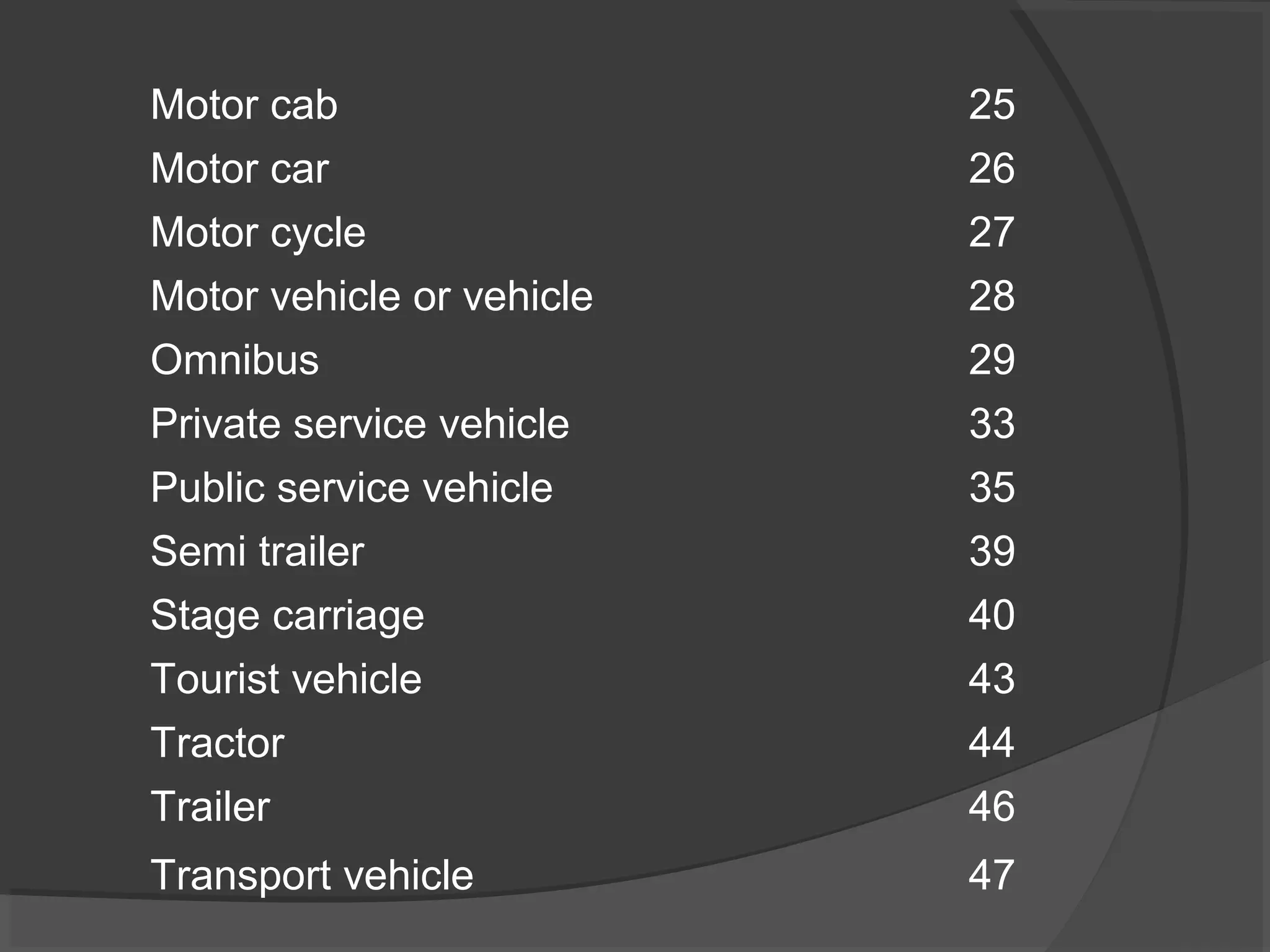
Motor cab 25 
Motor car 26 
Motor cycle 27 
Motor vehicle or vehicle 28 
Omnibus 29 
Private service vehicle 33 
Public service vehicle 35 
Semi trailer 39 
Stage carriage 40 
Tourist vehicle 43 
Tractor 44 
Trailer 46 
Transport vehicle 47
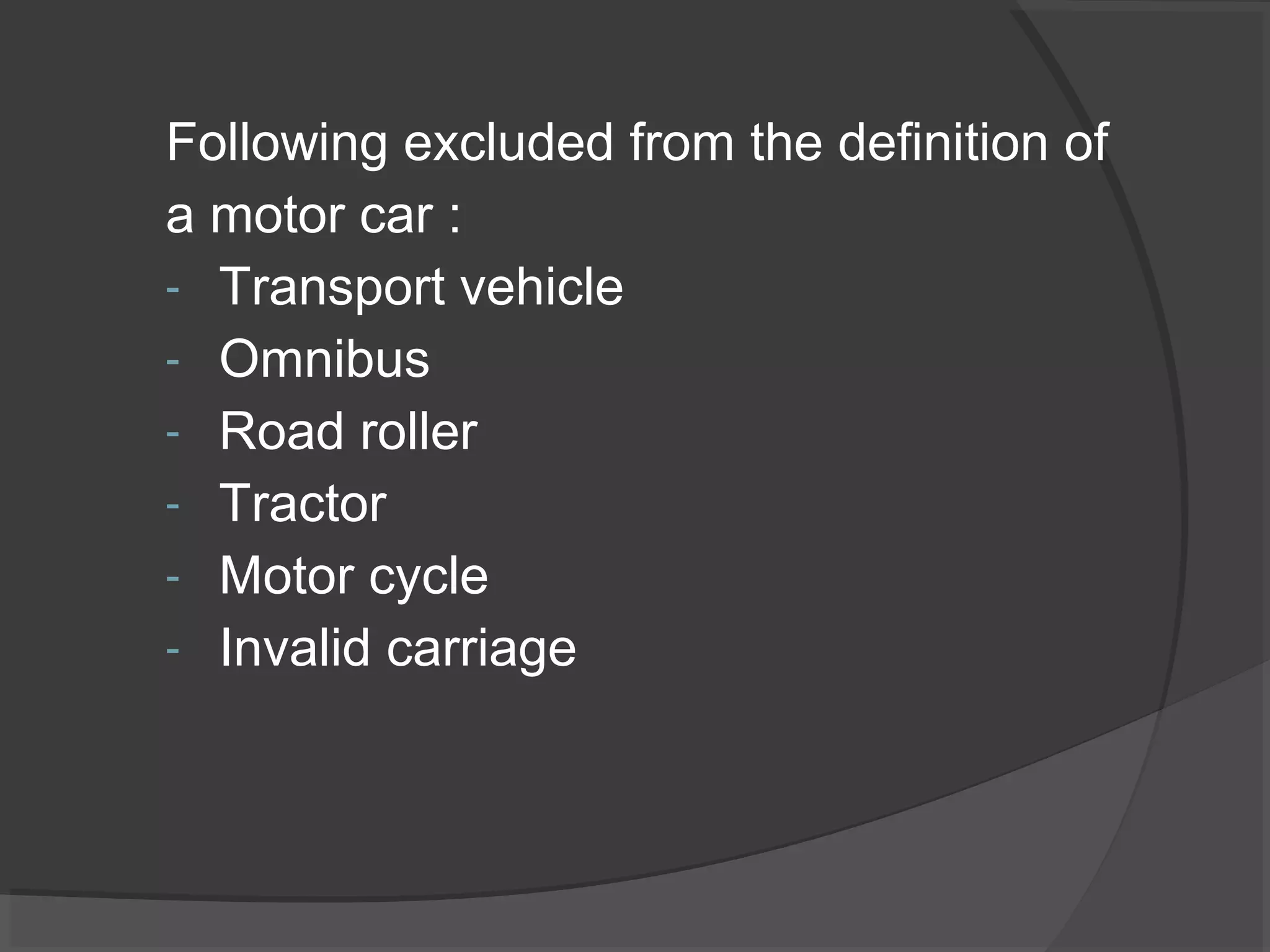
Following excluded from the definition of 
a motor car : 
- Transport vehicle 
- Omnibus 
- Road roller 
- Tractor 
- Motor cycle 
- Invalid carriage
To be noted 
1. Driving license does not mean a 
learner’s license 
2. A minor cannot be an owner (His 
guardian would be the owner)
Special provisions have been made 
regarding 
Motor Vehicle subject to hire purchase 
agreement etc. in Section 51
Alteration in Motor Vehicle is dealt under 
Section 52
Alteration means a change in the structure 
of a vehicle which results in a change in its 
basic features.
The Government has a duty to ensure that 
only 
roadworthy vehicles come on road. In 
other 
words, the vehicles that are fit to drive.
Certificate of fitness is covered under 
Section 56
This provision has been added with a view 
to prevent or reduce pollution and due to 
environmental concerns.
But there exists a need to ensure 
transparency 
and institute accountability.
In case of refusal, owner of the vehicle will 
be supplied with reasons in writing for such 
refusal.
Thus an appeal can be filed if refusal is felt 
to be arbitrary or malafide or on any other 
valid ground.
The Act has dealt with the matter of 
maximum 
time for which a motor vehicle may be 
used.
Power to fix the age limit of Motor Vehicle is 
under Section 59
Different ages may be specified for 
different classes or different types of 
motor vehicles.
CONSIDERATIONS 
Having regard to 
a) Public safety 
b) Convenience 
c) Objects of this Act
Thus fixation of age for different category 
of vehicles can be lawful only on these 
three grounds.
NOTE 
The provisions of registration also apply to 
trailer under Section 61(1)
Power to State Government to control road 
transport is enshrined under Section 67.
Role of Automobile manufacturers and 
servicing 
companies.
General provision regarding construction 
and maintenance of vehicles is in 
Section 109.
To operationalise the law, it may require 
framing 
of elaborate rules.
Power of Central Government to make Rules 
flows from Section 110
Power of State Government to make Rules 
is under Section 111
Limits of speed 
It prescribes the maximum speed at which 
each 
class or type of motor vehicle can be 
driven 
under Section 112.
Limits of weight and limitation on use is 
under Section 113
Vehicles with left hand control are covered 
under Section 121.
What happens if the laid down provisions are 
disregarded?
OFFENCES 
Different types of offences and penalties 
have been enumerated in following 
provisions of the MV Act. 
Sections 3,4,5,6,23,36,39,47,52,66, 
93,109,112,113,114,115,124,130,133,158, 
178,179,189,197 and 198 etc.
Section 129 is with regard to wearing of 
protective head gear.
Duty of the driver to take certain 
precautions 
at unguarded railway level crossings is in 
Section 131.
Section 134 is duty of driver in case of 
accident and injury to a person.
Section 185 is with regard to driving by a 
drunken person or by a person under the 
influence of drugs.
SUMMARY 
Due sensitization of the automobile 
engineers and those connected with sale, 
servicing and maintenance of vehicles to 
the provisions of the MV Act, 1988 is a 
functional necessity.
Thanks

An Introduction to Motor Vehicles Act, 1988

  • 1.
    THE MOTOR VEHICLESACT, 1988 (Act No. 59 OF 1988)
  • 2.
    LECTURE TO TATAMOTORS TRAINEES BY MAJ. GEN. NILENDRA KUMAR DIRECTOR AMITY LAW SCHOOL, NOIDA ON 25TH JANUARY,2012
  • 3.
    Session on lawgoverning motor vehicles
  • 4.
    LAW It isa command enforced by some sanction. It is a rule of action to which men are obliged to make their conduct conformable.
  • 5.
    All laws inthe country, whether of the Union or of the States, have to conform to the constitutional scheme.
  • 6.
    CONSTITUTION is abasic law defining and delimiting the principle organs of Government and their jurisdiction as well as the basic rights of men and citizen.
  • 7.
    The Constitution ofIndia contains twelve schedules
  • 8.
    Seventh schedule ofthe Constitution enumerates the subject matter of laws and thus demarcates the division of responsibility between the Union and the States.
  • 9.
    Seventh schedule hasthree lists each of which has a number of entries.
  • 10.
    Entry 23 ofList A to the Seventh Schedule
  • 11.
    The subject ofmotor vehicles is dealt by the Central Government.
  • 12.
    The Government ofIndia has a specific Ministry concerned with the Motor Vehicle Laws in India.
  • 13.
    Ministry of RoadTransport & Highways
  • 14.
    The Ministry hastwo separate wings
  • 15.
    1. Roads Wing 2. Transport Wing
  • 16.
    Roads Wing dealswith development and maintenance of National Highway in the country.
  • 17.
    Transport Wing dealswith matters relating to road transport including motor vehicle legislation.
  • 18.
    There are anumber of legislations in India that deal with different aspects of motor vehicles.
  • 19.
    These are athe statutes that deal with motor transport.
  • 20.
    MOTOR VEHICLE LAWSIN INDIA 1. The Carriage by Road Act, 2007 2. The Motor Vehicles Act, 1988 3. The National Highways Act, 1956 4. The National Highways Authority of India Act, 1988 5. The Control of National Highways (Land and Traffic) Act, 2002. 6. The Multimodal Transportation of Goods Act, 1993.
  • 21.
    7. The MotorTransport Workers Act, 1961 8. The Public Liability Insurance Act, 1961 9. The Road Transport Corporations Act, 1950 10.The Fatal Accidents Act, 1855
  • 22.
    The Motor VehiclesAct 1988 Act No. 59 of 1988
  • 23.
    SIGNIFICANCE The Acthas taken into account changes in the road transport technology, pattern of passenger and freight movements, developments in the road network in the country and particularly techniques in the motor vehicles management.
  • 24.
    RELEVANCE OF MVACT TO THE TATA MOTORS TRAINEES
  • 25.
    The Act dealswith  Construction equipment and maintenance  Standards for components and parts  Anti-pollution control devices  Issue of testing fitness certificates  Registration marks
  • 26.
    MV ACT 1.Extends to whole of India 2. Came into force on 1 July 1989 3. No. of Chapters – 14 4. No. of Sections – 217
  • 27.
    CHAPTERISATION Number 1.Preliminary 2. Licensing of drives of motor vehicles 3. Licensing of conductors of stage carriages 4. Registration of motor vehicles 5. Control of transport vehicles 6. Special provisions relating to State Transport undertaking 7. Construction, equipment and maintenance of vehicles
  • 28.
    8. Control oftraffic 9. Motor vehicles temporarily leaving or visiting India 10. Liability without fault in certain cases 11. Insurance of motor vehicles against third party risks 12. Claims Tribunals 13. Offences, penalties and procedure 14. Miscellaneous
  • 29.
    Salient portions ofthe Act have been discussed in this presentation.
  • 30.
    PREAMBLE An Actto consolidate and amend the law relating to motor vehicles.
  • 31.
    The Act categorizesmotor vehicles into different types.
  • 32.
    Generally the categorizationis based on size, type and utility of such vehicles.
  • 33.
    CARRIAGE A carriageis a contrivance which is used for carrying or transporting, especially along or over a solid surface.
  • 34.
    Carriage includes anycarriage, wagon, cart truck, vehicle or other means of conveying goods, or passengers by land.
  • 35.
    A crane isa motor vehicle
  • 36.
    The term automobileincludes all vehicles propelled by means other than muscular power, except rail road, railway cars and motor vehicles, running only on rails and tracks, and road rollers.
  • 37.
    The Act definesand enumerates various kind of motor vehicles.
  • 38.
    Section 2 ofthe Act contains the definition of various words and terms.
  • 39.
    DEFINITIONS Section 2(8) Dealer includes a person who is engaged _____ b) in building bodies for attachment to chassis; or c) in the repair of motor vehicles; or d) in the business of hypothecation, leasing or hire purchase of motor vehicles
  • 40.
    “Contract carriage” meansa motor vehicle which carries a passenger or passengers for hire or reward and is engaged under a contract, whether expressed or implied, for the use of such vehicle as a whole for the carriage of passengers mentioned therein and entered into by a person with a holder of a permit in relation to such vehicle or any person authorized by him in this behalf on a fixed or an agreed rate or sum –
  • 41.
    a) on atime basis, whether or not with reference to any route or distance; or b) from one point to another, and in either case, without stopping to pick up or set down passengers not included in the contract anywhere during the journey, and includes – i) a maxicab; and ii) a motor can notwithstanding that separate fares are charged for its passengers;
  • 42.
    “Goods carriage” meansany motor vehicle constructed or adapted for use solely for the carriage of goods, or any motor vehicle not so constructed or adapted when used for the carriage of goods.
  • 43.
    “Heavy goods vehicle”means any goods carriage the gross vehicle weight of which, or a tractor or a road-roller the unladen weight of either of which, exceeds 12,000 kilograms;
  • 44.
    “Heavy passenger motorvehicle” means any public service vehicle or private service vehicle or educational institution bus or omnibus the gross vehicle weight of any of which, or a motor car the unladen weight of which, exceeds 12,000 kilograms;
  • 45.
    “Invalid carriage” meansa motor vehicle specially designed and constructed, and not merely, adapted, for the use of a person suffering from some physical defect or disability, and used solely by or for such a person;
  • 46.
    “Light motor vehicle”means a transport vehicle or omnibus the gross vehicle weight of either of which or a motor car or tractor or road-roller the unladen weight of any of which, does not exceed 7,500 kilograms.
  • 47.
    “Maxicab” means anymotor vehicle constructed or adapted to carry more than six passengers , but not more than twelve passengers, excluding the driver, for hire or reward;
  • 48.
    “Medium goods vehicle”means any goods carriage other than a light motor vehicle or a heavy goods vehicle;
  • 49.
    Definitions Clause ofSection 2 Certificate of registration 4 Goods 13 Manufactures 21A Owner 30
  • 50.
    TYPES OF VEHICLES Words Defined Clause of Section 2 Contract carriage 7 Goods carriage 14 Heavy goods vehicle 16 Heavy passenger motor vehicle 17 Invalid carriage 18 Light motor vehicle 21 Maxicab 22 Medium goods vehicle 23 Medium passenger motor vehicle 24
  • 51.
    Motor cab 25 Motor car 26 Motor cycle 27 Motor vehicle or vehicle 28 Omnibus 29 Private service vehicle 33 Public service vehicle 35 Semi trailer 39 Stage carriage 40 Tourist vehicle 43 Tractor 44 Trailer 46 Transport vehicle 47
  • 52.
    Following excluded fromthe definition of a motor car : - Transport vehicle - Omnibus - Road roller - Tractor - Motor cycle - Invalid carriage
  • 53.
    To be noted 1. Driving license does not mean a learner’s license 2. A minor cannot be an owner (His guardian would be the owner)
  • 54.
    Special provisions havebeen made regarding Motor Vehicle subject to hire purchase agreement etc. in Section 51
  • 55.
    Alteration in MotorVehicle is dealt under Section 52
  • 56.
    Alteration means achange in the structure of a vehicle which results in a change in its basic features.
  • 57.
    The Government hasa duty to ensure that only roadworthy vehicles come on road. In other words, the vehicles that are fit to drive.
  • 58.
    Certificate of fitnessis covered under Section 56
  • 59.
    This provision hasbeen added with a view to prevent or reduce pollution and due to environmental concerns.
  • 60.
    But there existsa need to ensure transparency and institute accountability.
  • 61.
    In case ofrefusal, owner of the vehicle will be supplied with reasons in writing for such refusal.
  • 62.
    Thus an appealcan be filed if refusal is felt to be arbitrary or malafide or on any other valid ground.
  • 63.
    The Act hasdealt with the matter of maximum time for which a motor vehicle may be used.
  • 64.
    Power to fixthe age limit of Motor Vehicle is under Section 59
  • 65.
    Different ages maybe specified for different classes or different types of motor vehicles.
  • 66.
    CONSIDERATIONS Having regardto a) Public safety b) Convenience c) Objects of this Act
  • 67.
    Thus fixation ofage for different category of vehicles can be lawful only on these three grounds.
  • 68.
    NOTE The provisionsof registration also apply to trailer under Section 61(1)
  • 69.
    Power to StateGovernment to control road transport is enshrined under Section 67.
  • 70.
    Role of Automobilemanufacturers and servicing companies.
  • 71.
    General provision regardingconstruction and maintenance of vehicles is in Section 109.
  • 72.
    To operationalise thelaw, it may require framing of elaborate rules.
  • 73.
    Power of CentralGovernment to make Rules flows from Section 110
  • 74.
    Power of StateGovernment to make Rules is under Section 111
  • 75.
    Limits of speed It prescribes the maximum speed at which each class or type of motor vehicle can be driven under Section 112.
  • 76.
    Limits of weightand limitation on use is under Section 113
  • 77.
    Vehicles with lefthand control are covered under Section 121.
  • 78.
    What happens ifthe laid down provisions are disregarded?
  • 79.
    OFFENCES Different typesof offences and penalties have been enumerated in following provisions of the MV Act. Sections 3,4,5,6,23,36,39,47,52,66, 93,109,112,113,114,115,124,130,133,158, 178,179,189,197 and 198 etc.
  • 80.
    Section 129 iswith regard to wearing of protective head gear.
  • 81.
    Duty of thedriver to take certain precautions at unguarded railway level crossings is in Section 131.
  • 82.
    Section 134 isduty of driver in case of accident and injury to a person.
  • 83.
    Section 185 iswith regard to driving by a drunken person or by a person under the influence of drugs.
  • 84.
    SUMMARY Due sensitizationof the automobile engineers and those connected with sale, servicing and maintenance of vehicles to the provisions of the MV Act, 1988 is a functional necessity.
  • 85.