Journal of Soft Computing in Civil Engineering 4-2 (2018) 86-95
How to cite this article: Farahnaki R, Azimi A. An equation to determine the ultimate flexural load of RC beams strengthened with
CFRP laminates. J Soft Comput Civ Eng 2018;2(4):86–95. https://doi.org/10.22115/scce.2018.136500.1076.
2588-2872/ © 2018 The Authors. Published by Pouyan Press.
This is an open access article under the CC BY license (http://creativecommons.org/licenses/by/4.0/).
Contents lists available at SCCE
Journal of Soft Computing in Civil Engineering
Journal homepage: www.jsoftcivil.com
An Equation to Determine the Ultimate Flexural Load of RC
Beams Strengthened with CFRP Laminates
R. Farahnaki1*
, A. Azimi2
1. The University of Wollongong, Wollongong, Australia
2. Department of Civil Engineering, University of Birmingham, Birmingham, United Kingdom
Corresponding author: rf847@uowmail.edu.au
https://doi.org/10.22115/SCCE.2018.136500.1076
ARTICLE INFO ABSTRACT
Article history:
Received: 19 June 2018
Revised: 29 September 2018
Accepted: 31 October 2018
In this paper, a new relationship is presented for determining
the ultimate flexural load of reinforced concrete beams
strengthened with CFRP laminates. An artificial neural
network with a suitable performance was used to estimate
this equation. First, a collection of laboratory results
including 83 data was collected from valid references. This
database was then divided into three groups of 51, 16, and
16, which were used to train, validation, and test the
proposed equation, respectively. The final model had eleven
inputs including concrete compressive strength, width of
beam, effective depth, area of tension reinforcement, area of
compression reinforcement, yield strength of steel, modulus
of elasticity of steel, modulus of elasticity of CFRP sheet,
width of CFRP sheet, total thickness of CFRP sheets and,
length of CFRP sheet, which were applied to the network to
determine the ultimate flexural load as the output of the
model. The obtained results from the proposed relationship
showed that it was able to use as a predictive equation for the
considered target.
Keywords:
Concrete beam;
Flexural load;
FRP;
Strengthening.
1. Introduction
Today, FRP materials are widely used for retrofitting. FRP materials can use in three types
including layers, grainy material and also bars. The retrofitting effects of FRP plate instead of
bars was studied by researchers [1]. Some researchers developed the theoretical approaches to
study the flexural capacity of FRP concrete beams [2]. Previous studies have shown that the
R. Farahnaki, A. Azimi / Journal of Soft Computing in Civil Engineering 4-2 (2018) 86-95 87
performance of FRP materials is suitable for increasing the capacity of structural elements and
for this reason, their use in the building industry is expanding. Finite elements method, which is
considered as a suitable tool for analyzing the structures [3] and determining the forces of
elements, was investigated by Qu et al. [4] to estimate failure modes of FRP strengthened
concrete beams. In another study, Xu [5] simulated FRP concrete beams by finite elements
method and investigated the bearing capacity of RC beams. The moment capacity of RC beams
strengthened with FRP based artificial neural networks was predicted by Zatloukal and
Konvalinka [6].
Soft computing methods, which are very efficient models, are used for engineering problems.
Their application in various fields of civil engineering has also been evaluated by researchers [7–
20]. In this paper, neural networks as a soft computing method are considered to propose a new
capable equation to predict the ultimate flexural load in reinforced concrete beams strengthened
with CFRP laminates. A collection of experimental results is used to train and validate the
equation. Details of the method are described and illustrated in the next sections.
2. Definition of the database and selected parameters
One of the most important factors in the construction of a neural network is a valid database,
which is used to train the network and determine its unknown parameters. In this paper, the
authors used the experimental results of RC beams strengthened with FRP that carried out by
researchers [21–37]. This database includes 83 data that has been used in three groups of 51, 16
and 16 for training, evaluating and also testing of the proposed model.
In addition, eleven parameters were used as inputs in the presented neural network including
concrete compressive strength, width of beam, effective depth, area of tension reinforcement,
area of compression reinforcement, yield strength of steel, modulus of elasticity of steel,
modulus of elasticity of CFRP sheet, width of CFRP sheet, total thickness of CFRP sheets and
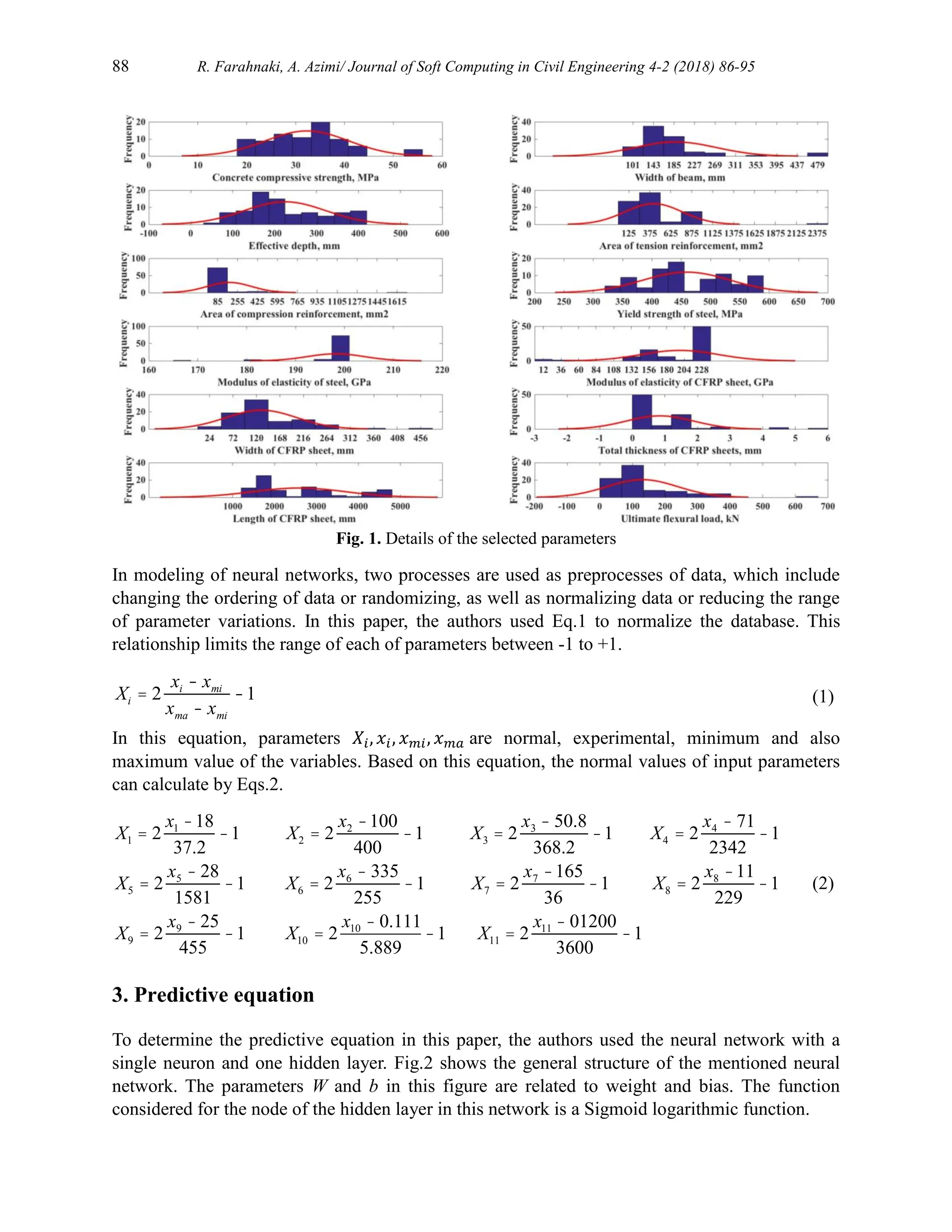
also length of CFRP sheet. Details of these parameters are shown in Table 1 and also Fig.1.
Based on the database collected for this article, the amounts of maximum and minimum of each
parameter were reported in the table.
Table 1
The considered parameters for the proposed model.
Variable Description Minimum Maximum
𝑥1 Concrete compressive strength, MPa 18 55.2
𝑥2 Width of beam, mm 100 500
𝑥3 Effective depth, mm 50.8 419
𝑥4 Area of tension reinforcement, mm2
71 2413
𝑥5 Area of compression reinforcement, mm2
28 1609
𝑥6 Yield strength of steel, MPa 335 590
𝑥7 Modulus of elasticity of steel, GPa 165 201
𝑥8 Modulus of elasticity of CFRP sheet, GPa 11 240
𝑥9 Width of CFRP sheet, mm 25 480
𝑥10 Total thickness of CFRP sheets, mm 0.111 6
𝑥11 Length of CFRP sheet, mm 1200 4800
𝑌 Ultimate flexural load, kN 16.1 669.3
88 R. Farahnaki, A. Azimi/ Journal of Soft Computing in Civil Engineering 4-2 (2018) 86-95
Fig. 1. Details of the selected parameters
In modeling of neural networks, two processes are used as preprocesses of data, which include
changing the ordering of data or randomizing, as well as normalizing data or reducing the range
of parameter variations. In this paper, the authors used Eq.1 to normalize the database. This
relationship limits the range of each of parameters between -1 to +1.
(1)
In this equation, parameters 𝑋𝑖, 𝑥𝑖, 𝑥𝑚𝑖, 𝑥𝑚𝑎 are normal, experimental, minimum and also
maximum value of the variables. Based on this equation, the normal values of input parameters
can calculate by Eqs.2.
(2)
3. Predictive equation
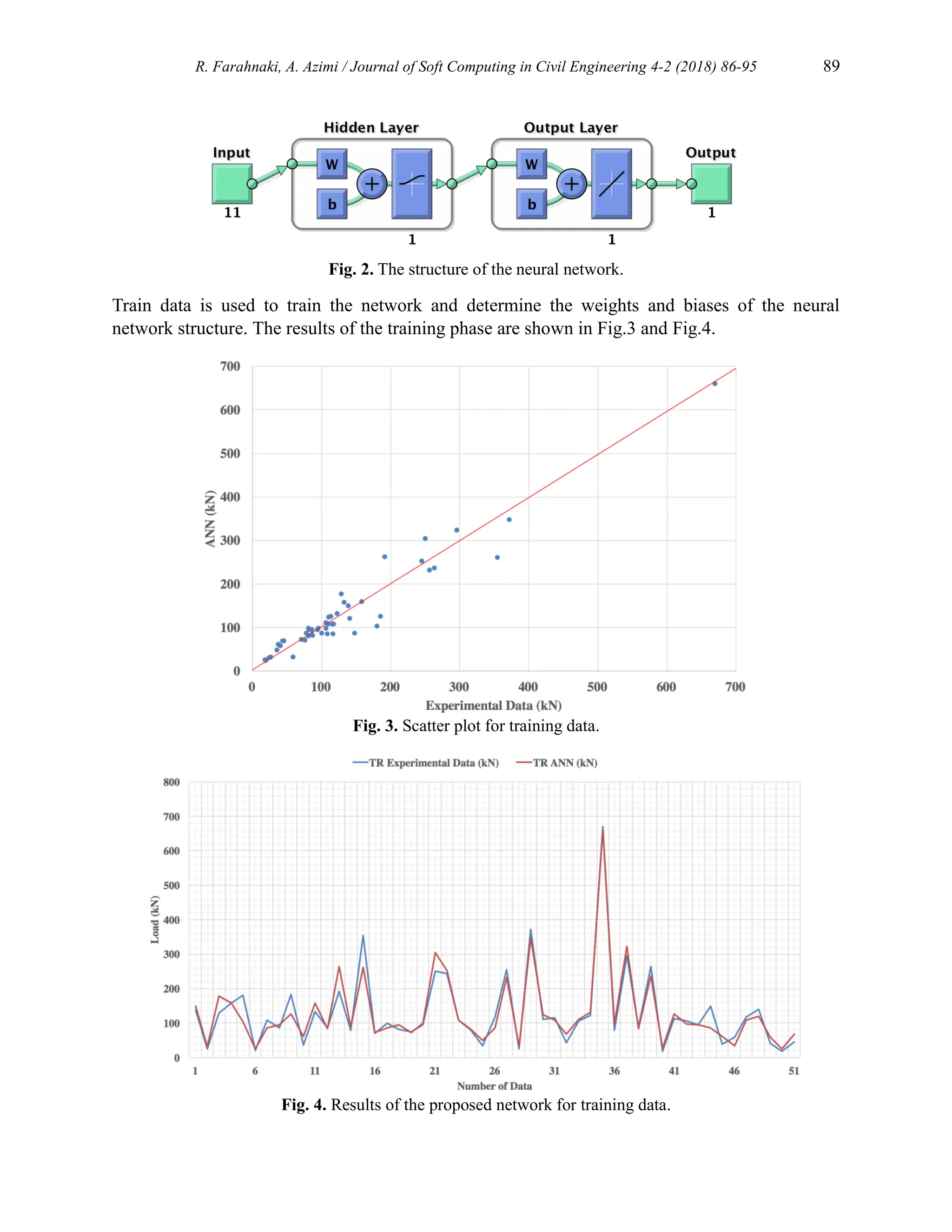
To determine the predictive equation in this paper, the authors used the neural network with a
single neuron and one hidden layer. Fig.2 shows the general structure of the mentioned neural
network. The parameters W and b in this figure are related to weight and bias. The function
considered for the node of the hidden layer in this network is a Sigmoid logarithmic function.
Xi = 2
xi - xmi
xma - xmi
-1
X1 = 2
x1 -18
37.2
-1 X2 = 2
x2 -100
400
-1 X3 = 2
x3 - 50.8
368.2
-1 X4 = 2
x4 - 71
2342
-1
X5 = 2
x5 - 28
1581
-1 X6 = 2
x6 - 335
255
-1 X7 = 2
x7 -165
36
-1 X8 = 2
x8 -11
229
-1
X9 = 2
x9 - 25
455
-1 X10 = 2
x10 - 0.111
5.889
-1 X11 = 2
x11 - 01200
3600
-1
R. Farahnaki, A. Azimi / Journal of Soft Computing in Civil Engineering 4-2 (2018) 86-95 89
Fig. 2. The structure of the neural network.
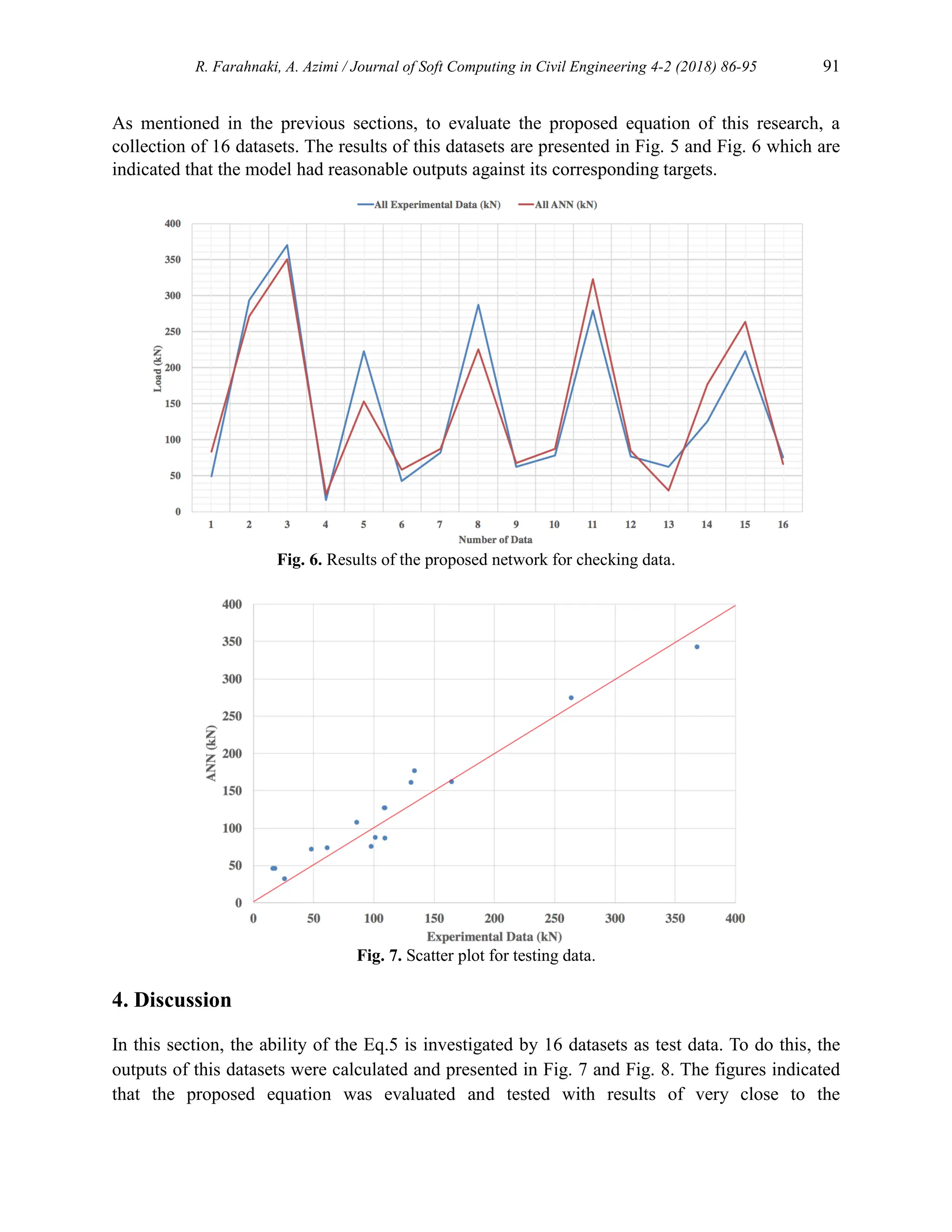
Train data is used to train the network and determine the weights and biases of the neural
network structure. The results of the training phase are shown in Fig.3 and Fig.4.
Fig. 3. Scatter plot for training data.
Fig. 4. Results of the proposed network for training data.
90 R. Farahnaki, A. Azimi/ Journal of Soft Computing in Civil Engineering 4-2 (2018) 86-95
After training the network with 51 data intended for training and 16 data for evaluating, the
unknown parameters of the network were determined as follows, in which, IW, LW, b1 and b2
were input weights, layer weight, the bias of the hidden layer and also the bias of the output
layer.
To determine the output of the hidden layer, the weight of each input should apply to its
corresponding input value. Then, the sum of the resulting values with adding the hidden layer
bias (Eq.3) is applied to Sigmoid logarithm function (Eq.4).
(3)
(4)
Based on the above equations and the obtained results of the coefficients, Eq.5 is proposed as the
predictive model for determining the ultimate flexural load of reinforced concrete beams
strengthened with CFRP laminates.
(5)
Fig. 5. Scatterplot for checking data.
IW
[ ]= -0.0831 0.0974 -0.4439 -0.9075 0.1203 -0.1085 -0.0071 0.0412 -0.3204 0.0809 0.1325
é
ë
ù
û
LW = -3.6649
b1 = 0.3598
b2 = 2.0099
X
[ ]= X1 X2 X3 X4 X5 X6 X7 X8 X9 X10 X11
é
ë
ù
û
Y1 = IW
[ ] X
[ ]T
+ b1
= -0.0831X1 + 0.0974 X2 - 0.4439 X3 - 0.9075 X4 + 0.1203X5 - 0.1085 X6 - 0.0071X7
+0.0412 X8 - 0.3204 X9 + 0.0809 X10 + 0.1325X11 + 0.3598
Y2 = -3.6649
1
1+ e-Y1
æ
è
ç
ö
ø
÷ + b2
Y (kN) = 326.6 Y2 +1
( )+16.1
R. Farahnaki, A. Azimi / Journal of Soft Computing in Civil Engineering 4-2 (2018) 86-95 91
As mentioned in the previous sections, to evaluate the proposed equation of this research, a
collection of 16 datasets. The results of this datasets are presented in Fig. 5 and Fig. 6 which are
indicated that the model had reasonable outputs against its corresponding targets.
Fig. 6. Results of the proposed network for checking data.
Fig. 7. Scatter plot for testing data.
4. Discussion
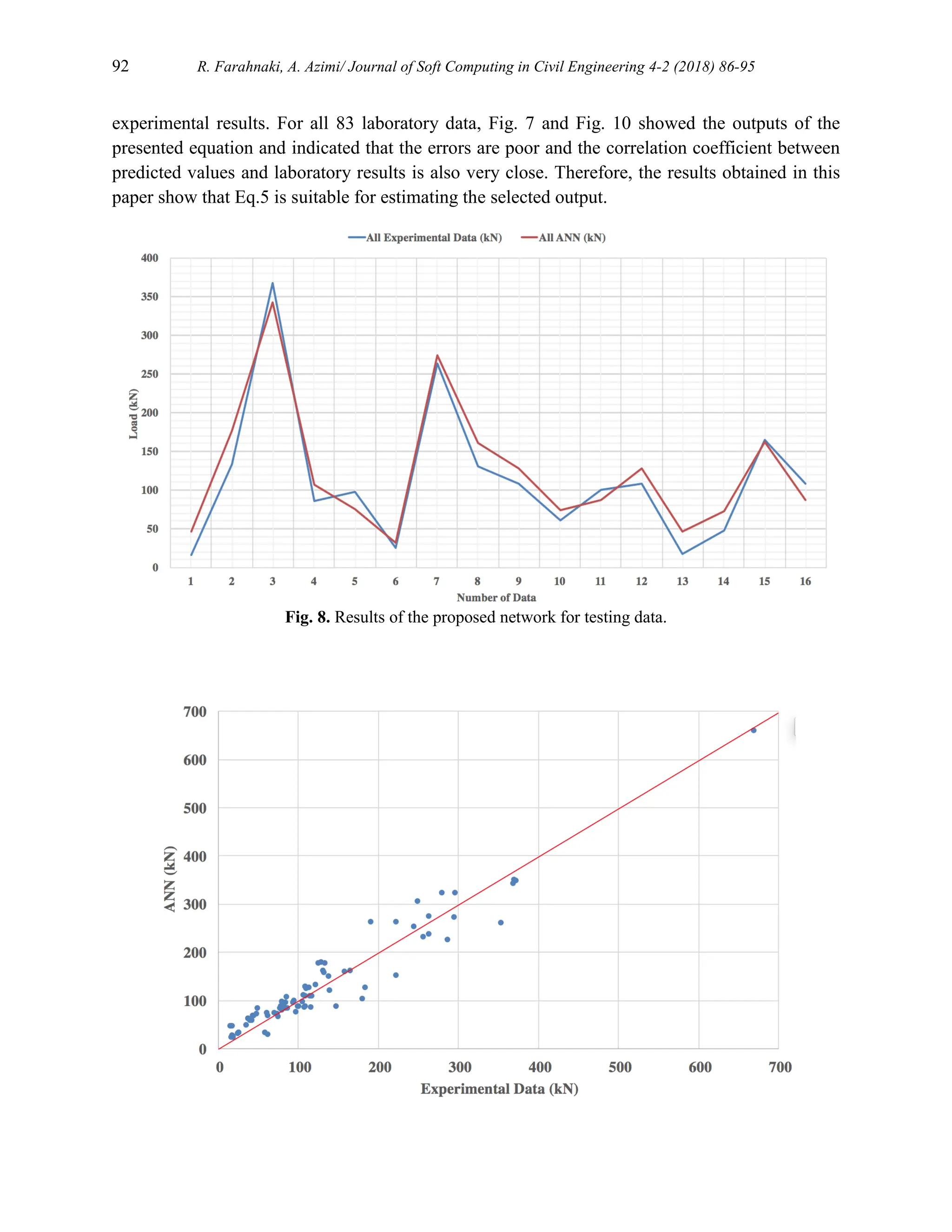
In this section, the ability of the Eq.5 is investigated by 16 datasets as test data. To do this, the
outputs of this datasets were calculated and presented in Fig. 7 and Fig. 8. The figures indicated
that the proposed equation was evaluated and tested with results of very close to the
92 R. Farahnaki, A. Azimi/ Journal of Soft Computing in Civil Engineering 4-2 (2018) 86-95
experimental results. For all 83 laboratory data, Fig. 7 and Fig. 10 showed the outputs of the
presented equation and indicated that the errors are poor and the correlation coefficient between
predicted values and laboratory results is also very close. Therefore, the results obtained in this
paper show that Eq.5 is suitable for estimating the selected output.
Fig. 8. Results of the proposed network for testing data.
R. Farahnaki, A. Azimi / Journal of Soft Computing in Civil Engineering 4-2 (2018) 86-95 93
Fig. 9. Scatter plot for all data.
Fig. 10. Results of the proposed network for all data.
5. Conclusion
In this paper, a relationship is proposed for estimating the ultimate flexural load in reinforced
concrete beams strengthened with CFRP laminates. The effective parameters on the target, which
are used as inputs of the proposed model, are the concrete compressive strength, width of beam,
effective depth, area of tension reinforcement, area of compression reinforcement, yield strength
of steel, modulus of elasticity of steel, modulus of elasticity of CFRP sheet, width of CFRP sheet,
total thickness of CFRP sheets and, length of CFRP sheet. The unknown coefficients of the
proposed equation are driven using a neural network model as well as the results of the
laboratory tests. Also, the proposed Equation has good accuracy, which indicates that this
relationship can predict the considered output parameter.
References
[1] Seo SY, Choi KB, Kwon YS. Retrofit Capacity of Near-Surface-Mounted RC Beam by using FRP
Plate. J Korea Inst Struct Maint Insp 2012;16:18–26. doi:10.11112/jksmi.2012.16.1.018.
[2] Dolan CW, Swanson D. Development of flexural capacity of a FRP prestressed beam with
vertically distributed tendons. Compos Part B Eng 2002;33:1–6. doi:10.1016/S1359-
8368(01)00053-1.
[3] Kheyroddin A, Mirrashid M, Arshadi H. An Investigation on the Behavior of Concrete Cores in
Suspended Tall Buildings. Iran J Sci Technol Trans Civ Eng 2017;41:383–8. doi:10.1007/s40996-
017-0075-y.
[4] Qu HC, Wu CQ, Chen LL. Numerical Analysis on the Load-Carrying Capacity for the FRP
Reinforced Four-Point Bending Concrete Beam. Adv Mater Res 2011;287–290:1130–4.
doi:10.4028/www.scientific.net/AMR.287-290.1130.
94 R. Farahnaki, A. Azimi/ Journal of Soft Computing in Civil Engineering 4-2 (2018) 86-95
[5] Xu X. Calculation Method and Analysis of Bearing Capacity of FRP Rebar Concrete Beam. ICTE
2011, Reston, VA: American Society of Civil Engineers; 2011, p. 1572–7.
doi:10.1061/41184(419)260.
[6] Zatloukal J, Konvalinka P. Moment Capacity of FRP Reinforced Concrete Beam Assessment
Based on Centerline Geometry. Appl Mech Mater 2013;486:211–6.
doi:10.4028/www.scientific.net/AMM.486.211.
[7] Jafari M, Mirrashid M, Vahidnia A. Prediction of chloride penetration in the concrete containing
magnetite aggregates by Adaptive Neural Fuzzy Inference System (ANFIS). 7th Internatinal Symp.
Adv. Sci. Technol. (5thsastech), Bandare Abbas, Iran, 2013.
[8] Mirrashid M. Earthquake magnitude prediction by adaptive neuro-fuzzy inference system (ANFIS)
based on fuzzy C-means algorithm. Nat Hazards 2014;74:1577–93. doi:10.1007/s11069-014-1264-
7.
[9] Naderpour H, Mirrashid M. Shear Strength Prediction of RC Beams Using Adaptive Neuro-Fuzzy
Inference System. Sci Iran 2018:0–0. doi:10.24200/sci.2018.50308.1624.
[10] Naderpour H, Mirrashid M. An innovative approach for compressive strength estimation of mortars
having calcium inosilicate minerals. J Build Eng 2018;19:205–15. doi:10.1016/j.jobe.2018.05.012.
[11] Naderpour H, Rafiean AH, Fakharian P. Compressive strength prediction of environmentally
friendly concrete using artificial neural networks. J Build Eng 2018;16:213–9.
doi:10.1016/j.jobe.2018.01.007.
[12] Naderpour H, Vahdani R, Mirrashid M. Soft Computing Research in Structural Control by Mass
Damper (A review paper). 4st Int. Conf. Struct. Eng. Tehran, Iran, 2018.
[13] Mirrashid M. Comparison Study of Soft Computing Approaches for Estimation of the Non-Ductile
RC Joint Shear Strength. Soft Comput Civ Eng 2017;1:12–28. doi:10.22115/scce.2017.46318.
[14] Mirrashid M, Bigdeli S. Genetic Algorithm for Prediction the Compressive Strength of Mortar
Containing Wollastonite. 1st Natl. Congr. Counstruction Eng. Proj. Assessment, Gorgan, Iran,
2014.
[15] Mirrashid M, Givehchi M, Miri M, Madandoust R. Performance investigation of neuro-fuzzy
system for earthquake prediction. Asian J Civ Eng 2016;17:213–23.
[16] Mirrashid M, Jafari M, Akhlaghi A, Vahidnia A. Prediction of compressive strength of concrete
containing magnetite aggregates using Adaptive Neural Fuzzy Inference System (ANFIS). 4th
Internatinal Conf. Concr. Dev., Tehran, Iran: 2013.
[17] Naderpour H, Mirrashid M. Application of Soft Computing to Reinforced Concrete Beams
Strengthened with Fibre Reinforced Polymers: A State-of-the-Art Review. Comput Tech Civ Struct
Eng 2015;38:305–23.
[18] Naderpour H, Mirrashid M. Compressive Strength of Mortars Admixed with Wollastonite and
Microsilica. Mater Sci Forum 2017;890:415–8. doi:10.4028/www.scientific.net/MSF.890.415.
[19] Naderpour H, Mirrashid M. Ultimate Capacity Prediction of Concrete Slabs Reinforced with FRP
Bars. 3rd Int. 7th Natl. Conf. Mod. Mater. Struct. Civ. Eng. Bu-Ali Sina Univ. Hamedan, IRAN,
2018.
[20] Naderpour H, Mirrashid M. Application of group method of data handling to Estimate the Shear
Strength of RC Beams Reinforced with FRP Bars. 3rd Int. 7th Natl. Conf. Mod. Mater. Struct. Civ.
Eng. Bu-Ali Sina Univ. Hamedan, IRAN, 2018.
[21] HAJELA P, BERKE L. Neurobiological Computational Models in Structural Analysis and Design.
31st Struct. Struct. Dyn. Mater. Conf., Reston, Virigina: American Institute of Aeronautics and
Astronautics; 1990. doi:10.2514/6.1990-1133.
R. Farahnaki, A. Azimi / Journal of Soft Computing in Civil Engineering 4-2 (2018) 86-95 95
[22] Saadatmanesh H, Ehsani MR. RC Beams Strengthened with GFRP Plates. I: Experimental Study. J
Struct Eng 1991;117:3417–33. doi:10.1061/(ASCE)0733-9445(1991)117:11(3417).
[23] Lundqvist J, Nordin H, Täljsten B, Olofsson T. Numerical analysis of concrete beams strengthened
with CFRP : a study of anchorage lengths. Int Symp Bond Behav FRP Struct 2005:239–46.
[24] Maalej M, Leong KS. Effect of beam size and FRP thickness on interfacial shear stress
concentration and failure mode of FRP-strengthened beams. Compos Sci Technol 2005;65:1148–
58. doi:10.1016/j.compscitech.2004.11.010.
[25] Coronado CA, Lopez MM. Sensitivity analysis of reinforced concrete beams strengthened with
FRP laminates. Cem Concr Compos 2006;28:102–14. doi:10.1016/j.cemconcomp.2005.07.005.
[26] Reeve BZ. Effect of adhesive stiffness and CFRP geometry on the behavior of externally bonded
CFRP retrofit measures subject to monotonic loads 2006.
[27] Abdalla JA, Elsanosi A, Abdelwahab A. Modeling and simulation of shear resistance of R/C beams
using artificial neural network. J Franklin Inst 2007;344:741–56.
doi:10.1016/j.jfranklin.2005.12.005.
[28] Esfahani MR, Kianoush MR, Tajari AR. Flexural behaviour of reinforced concrete beams
strengthened by CFRP sheets. Eng Struct 2007;29:2428–44. doi:10.1016/j.engstruct.2006.12.008.
[29] Neagoe CA. Concrete beams reinforced with CFRP laminates 2011.
[30] C. Allen Ross Joseph W. Tedesco, and Mary L. Hughes DMJ. Strengthening of Reinforced
Concrete Beams with Externally Bonded Composite Laminates. Struct J n.d.;96. doi:10.14359/612.
[31] Ni H-G, Wang J-Z. Prediction of compressive strength of concrete by neural networks. Cem Concr
Res 2000;30:1245–50. doi:10.1016/S0008-8846(00)00345-8.
[32] Du Béton FI. Externally bonded FRP reinforcement for RC structures. Bulletin 2001;14:138.
[33] Sanad A, Saka MP. Prediction of Ultimate Shear Strength of Reinforced-Concrete Deep Beams
Using Neural Networks. J Struct Eng 2001;127:818–28. doi:10.1061/(ASCE)0733-
9445(2001)127:7(818).
[34] Dong Y, Zhao M, Ansari F. Failure characteristics of reinforced concrete beams repaired with
CFRP composites. Strain 2002;304:12–7.
[35] Dai JG, Ueda T, Sato Y, Ito T. Flexural strengthening of RC beams using externally bonded FRP
sheets through flexible adhesive bonding. Int. Symp. Bond Behav. FRP Struct. Hong Kong, 2005,
p. 7–9.
[36] Ebead UA, Marzouk H. Tension-stiffening model for FRP-strenghened RC concrete two-way
slabs. Mater Struct 2005;38:193–200. doi:10.1007/BF02479344.
[37] Kotynia R. Debonding failures of RC beams strengthened with externally bonded strips. Proc. Int.
Symp. Bond Behav. FRP Struct., 2005.

An Equation to Determine the Ultimate Flexural Load of RC Beams Strengthened with CFRP Laminates

  • 1.
    Journal of SoftComputing in Civil Engineering 4-2 (2018) 86-95 How to cite this article: Farahnaki R, Azimi A. An equation to determine the ultimate flexural load of RC beams strengthened with CFRP laminates. J Soft Comput Civ Eng 2018;2(4):86–95. https://doi.org/10.22115/scce.2018.136500.1076. 2588-2872/ © 2018 The Authors. Published by Pouyan Press. This is an open access article under the CC BY license (http://creativecommons.org/licenses/by/4.0/). Contents lists available at SCCE Journal of Soft Computing in Civil Engineering Journal homepage: www.jsoftcivil.com An Equation to Determine the Ultimate Flexural Load of RC Beams Strengthened with CFRP Laminates R. Farahnaki1* , A. Azimi2 1. The University of Wollongong, Wollongong, Australia 2. Department of Civil Engineering, University of Birmingham, Birmingham, United Kingdom Corresponding author: rf847@uowmail.edu.au https://doi.org/10.22115/SCCE.2018.136500.1076 ARTICLE INFO ABSTRACT Article history: Received: 19 June 2018 Revised: 29 September 2018 Accepted: 31 October 2018 In this paper, a new relationship is presented for determining the ultimate flexural load of reinforced concrete beams strengthened with CFRP laminates. An artificial neural network with a suitable performance was used to estimate this equation. First, a collection of laboratory results including 83 data was collected from valid references. This database was then divided into three groups of 51, 16, and 16, which were used to train, validation, and test the proposed equation, respectively. The final model had eleven inputs including concrete compressive strength, width of beam, effective depth, area of tension reinforcement, area of compression reinforcement, yield strength of steel, modulus of elasticity of steel, modulus of elasticity of CFRP sheet, width of CFRP sheet, total thickness of CFRP sheets and, length of CFRP sheet, which were applied to the network to determine the ultimate flexural load as the output of the model. The obtained results from the proposed relationship showed that it was able to use as a predictive equation for the considered target. Keywords: Concrete beam; Flexural load; FRP; Strengthening. 1. Introduction Today, FRP materials are widely used for retrofitting. FRP materials can use in three types including layers, grainy material and also bars. The retrofitting effects of FRP plate instead of bars was studied by researchers [1]. Some researchers developed the theoretical approaches to study the flexural capacity of FRP concrete beams [2]. Previous studies have shown that the
  • 2.
    R. Farahnaki, A.Azimi / Journal of Soft Computing in Civil Engineering 4-2 (2018) 86-95 87 performance of FRP materials is suitable for increasing the capacity of structural elements and for this reason, their use in the building industry is expanding. Finite elements method, which is considered as a suitable tool for analyzing the structures [3] and determining the forces of elements, was investigated by Qu et al. [4] to estimate failure modes of FRP strengthened concrete beams. In another study, Xu [5] simulated FRP concrete beams by finite elements method and investigated the bearing capacity of RC beams. The moment capacity of RC beams strengthened with FRP based artificial neural networks was predicted by Zatloukal and Konvalinka [6]. Soft computing methods, which are very efficient models, are used for engineering problems. Their application in various fields of civil engineering has also been evaluated by researchers [7– 20]. In this paper, neural networks as a soft computing method are considered to propose a new capable equation to predict the ultimate flexural load in reinforced concrete beams strengthened with CFRP laminates. A collection of experimental results is used to train and validate the equation. Details of the method are described and illustrated in the next sections. 2. Definition of the database and selected parameters One of the most important factors in the construction of a neural network is a valid database, which is used to train the network and determine its unknown parameters. In this paper, the authors used the experimental results of RC beams strengthened with FRP that carried out by researchers [21–37]. This database includes 83 data that has been used in three groups of 51, 16 and 16 for training, evaluating and also testing of the proposed model. In addition, eleven parameters were used as inputs in the presented neural network including concrete compressive strength, width of beam, effective depth, area of tension reinforcement, area of compression reinforcement, yield strength of steel, modulus of elasticity of steel, modulus of elasticity of CFRP sheet, width of CFRP sheet, total thickness of CFRP sheets and also length of CFRP sheet. Details of these parameters are shown in Table 1 and also Fig.1. Based on the database collected for this article, the amounts of maximum and minimum of each parameter were reported in the table. Table 1 The considered parameters for the proposed model. Variable Description Minimum Maximum 𝑥1 Concrete compressive strength, MPa 18 55.2 𝑥2 Width of beam, mm 100 500 𝑥3 Effective depth, mm 50.8 419 𝑥4 Area of tension reinforcement, mm2 71 2413 𝑥5 Area of compression reinforcement, mm2 28 1609 𝑥6 Yield strength of steel, MPa 335 590 𝑥7 Modulus of elasticity of steel, GPa 165 201 𝑥8 Modulus of elasticity of CFRP sheet, GPa 11 240 𝑥9 Width of CFRP sheet, mm 25 480 𝑥10 Total thickness of CFRP sheets, mm 0.111 6 𝑥11 Length of CFRP sheet, mm 1200 4800 𝑌 Ultimate flexural load, kN 16.1 669.3
  • 3.
    88 R. Farahnaki,A. Azimi/ Journal of Soft Computing in Civil Engineering 4-2 (2018) 86-95 Fig. 1. Details of the selected parameters In modeling of neural networks, two processes are used as preprocesses of data, which include changing the ordering of data or randomizing, as well as normalizing data or reducing the range of parameter variations. In this paper, the authors used Eq.1 to normalize the database. This relationship limits the range of each of parameters between -1 to +1. (1) In this equation, parameters 𝑋𝑖, 𝑥𝑖, 𝑥𝑚𝑖, 𝑥𝑚𝑎 are normal, experimental, minimum and also maximum value of the variables. Based on this equation, the normal values of input parameters can calculate by Eqs.2. (2) 3. Predictive equation To determine the predictive equation in this paper, the authors used the neural network with a single neuron and one hidden layer. Fig.2 shows the general structure of the mentioned neural network. The parameters W and b in this figure are related to weight and bias. The function considered for the node of the hidden layer in this network is a Sigmoid logarithmic function. Xi = 2 xi - xmi xma - xmi -1 X1 = 2 x1 -18 37.2 -1 X2 = 2 x2 -100 400 -1 X3 = 2 x3 - 50.8 368.2 -1 X4 = 2 x4 - 71 2342 -1 X5 = 2 x5 - 28 1581 -1 X6 = 2 x6 - 335 255 -1 X7 = 2 x7 -165 36 -1 X8 = 2 x8 -11 229 -1 X9 = 2 x9 - 25 455 -1 X10 = 2 x10 - 0.111 5.889 -1 X11 = 2 x11 - 01200 3600 -1
  • 4.
    R. Farahnaki, A.Azimi / Journal of Soft Computing in Civil Engineering 4-2 (2018) 86-95 89 Fig. 2. The structure of the neural network. Train data is used to train the network and determine the weights and biases of the neural network structure. The results of the training phase are shown in Fig.3 and Fig.4. Fig. 3. Scatter plot for training data. Fig. 4. Results of the proposed network for training data.
  • 5.
    90 R. Farahnaki,A. Azimi/ Journal of Soft Computing in Civil Engineering 4-2 (2018) 86-95 After training the network with 51 data intended for training and 16 data for evaluating, the unknown parameters of the network were determined as follows, in which, IW, LW, b1 and b2 were input weights, layer weight, the bias of the hidden layer and also the bias of the output layer. To determine the output of the hidden layer, the weight of each input should apply to its corresponding input value. Then, the sum of the resulting values with adding the hidden layer bias (Eq.3) is applied to Sigmoid logarithm function (Eq.4). (3) (4) Based on the above equations and the obtained results of the coefficients, Eq.5 is proposed as the predictive model for determining the ultimate flexural load of reinforced concrete beams strengthened with CFRP laminates. (5) Fig. 5. Scatterplot for checking data. IW [ ]= -0.0831 0.0974 -0.4439 -0.9075 0.1203 -0.1085 -0.0071 0.0412 -0.3204 0.0809 0.1325 é ë ù û LW = -3.6649 b1 = 0.3598 b2 = 2.0099 X [ ]= X1 X2 X3 X4 X5 X6 X7 X8 X9 X10 X11 é ë ù û Y1 = IW [ ] X [ ]T + b1 = -0.0831X1 + 0.0974 X2 - 0.4439 X3 - 0.9075 X4 + 0.1203X5 - 0.1085 X6 - 0.0071X7 +0.0412 X8 - 0.3204 X9 + 0.0809 X10 + 0.1325X11 + 0.3598 Y2 = -3.6649 1 1+ e-Y1 æ è ç ö ø ÷ + b2 Y (kN) = 326.6 Y2 +1 ( )+16.1
  • 6.
    R. Farahnaki, A.Azimi / Journal of Soft Computing in Civil Engineering 4-2 (2018) 86-95 91 As mentioned in the previous sections, to evaluate the proposed equation of this research, a collection of 16 datasets. The results of this datasets are presented in Fig. 5 and Fig. 6 which are indicated that the model had reasonable outputs against its corresponding targets. Fig. 6. Results of the proposed network for checking data. Fig. 7. Scatter plot for testing data. 4. Discussion In this section, the ability of the Eq.5 is investigated by 16 datasets as test data. To do this, the outputs of this datasets were calculated and presented in Fig. 7 and Fig. 8. The figures indicated that the proposed equation was evaluated and tested with results of very close to the
  • 7.
    92 R. Farahnaki,A. Azimi/ Journal of Soft Computing in Civil Engineering 4-2 (2018) 86-95 experimental results. For all 83 laboratory data, Fig. 7 and Fig. 10 showed the outputs of the presented equation and indicated that the errors are poor and the correlation coefficient between predicted values and laboratory results is also very close. Therefore, the results obtained in this paper show that Eq.5 is suitable for estimating the selected output. Fig. 8. Results of the proposed network for testing data.
  • 8.
    R. Farahnaki, A.Azimi / Journal of Soft Computing in Civil Engineering 4-2 (2018) 86-95 93 Fig. 9. Scatter plot for all data. Fig. 10. Results of the proposed network for all data. 5. Conclusion In this paper, a relationship is proposed for estimating the ultimate flexural load in reinforced concrete beams strengthened with CFRP laminates. The effective parameters on the target, which are used as inputs of the proposed model, are the concrete compressive strength, width of beam, effective depth, area of tension reinforcement, area of compression reinforcement, yield strength of steel, modulus of elasticity of steel, modulus of elasticity of CFRP sheet, width of CFRP sheet, total thickness of CFRP sheets and, length of CFRP sheet. The unknown coefficients of the proposed equation are driven using a neural network model as well as the results of the laboratory tests. Also, the proposed Equation has good accuracy, which indicates that this relationship can predict the considered output parameter. References [1] Seo SY, Choi KB, Kwon YS. Retrofit Capacity of Near-Surface-Mounted RC Beam by using FRP Plate. J Korea Inst Struct Maint Insp 2012;16:18–26. doi:10.11112/jksmi.2012.16.1.018. [2] Dolan CW, Swanson D. Development of flexural capacity of a FRP prestressed beam with vertically distributed tendons. Compos Part B Eng 2002;33:1–6. doi:10.1016/S1359- 8368(01)00053-1. [3] Kheyroddin A, Mirrashid M, Arshadi H. An Investigation on the Behavior of Concrete Cores in Suspended Tall Buildings. Iran J Sci Technol Trans Civ Eng 2017;41:383–8. doi:10.1007/s40996- 017-0075-y. [4] Qu HC, Wu CQ, Chen LL. Numerical Analysis on the Load-Carrying Capacity for the FRP Reinforced Four-Point Bending Concrete Beam. Adv Mater Res 2011;287–290:1130–4. doi:10.4028/www.scientific.net/AMR.287-290.1130.
  • 9.
    94 R. Farahnaki,A. Azimi/ Journal of Soft Computing in Civil Engineering 4-2 (2018) 86-95 [5] Xu X. Calculation Method and Analysis of Bearing Capacity of FRP Rebar Concrete Beam. ICTE 2011, Reston, VA: American Society of Civil Engineers; 2011, p. 1572–7. doi:10.1061/41184(419)260. [6] Zatloukal J, Konvalinka P. Moment Capacity of FRP Reinforced Concrete Beam Assessment Based on Centerline Geometry. Appl Mech Mater 2013;486:211–6. doi:10.4028/www.scientific.net/AMM.486.211. [7] Jafari M, Mirrashid M, Vahidnia A. Prediction of chloride penetration in the concrete containing magnetite aggregates by Adaptive Neural Fuzzy Inference System (ANFIS). 7th Internatinal Symp. Adv. Sci. Technol. (5thsastech), Bandare Abbas, Iran, 2013. [8] Mirrashid M. Earthquake magnitude prediction by adaptive neuro-fuzzy inference system (ANFIS) based on fuzzy C-means algorithm. Nat Hazards 2014;74:1577–93. doi:10.1007/s11069-014-1264- 7. [9] Naderpour H, Mirrashid M. Shear Strength Prediction of RC Beams Using Adaptive Neuro-Fuzzy Inference System. Sci Iran 2018:0–0. doi:10.24200/sci.2018.50308.1624. [10] Naderpour H, Mirrashid M. An innovative approach for compressive strength estimation of mortars having calcium inosilicate minerals. J Build Eng 2018;19:205–15. doi:10.1016/j.jobe.2018.05.012. [11] Naderpour H, Rafiean AH, Fakharian P. Compressive strength prediction of environmentally friendly concrete using artificial neural networks. J Build Eng 2018;16:213–9. doi:10.1016/j.jobe.2018.01.007. [12] Naderpour H, Vahdani R, Mirrashid M. Soft Computing Research in Structural Control by Mass Damper (A review paper). 4st Int. Conf. Struct. Eng. Tehran, Iran, 2018. [13] Mirrashid M. Comparison Study of Soft Computing Approaches for Estimation of the Non-Ductile RC Joint Shear Strength. Soft Comput Civ Eng 2017;1:12–28. doi:10.22115/scce.2017.46318. [14] Mirrashid M, Bigdeli S. Genetic Algorithm for Prediction the Compressive Strength of Mortar Containing Wollastonite. 1st Natl. Congr. Counstruction Eng. Proj. Assessment, Gorgan, Iran, 2014. [15] Mirrashid M, Givehchi M, Miri M, Madandoust R. Performance investigation of neuro-fuzzy system for earthquake prediction. Asian J Civ Eng 2016;17:213–23. [16] Mirrashid M, Jafari M, Akhlaghi A, Vahidnia A. Prediction of compressive strength of concrete containing magnetite aggregates using Adaptive Neural Fuzzy Inference System (ANFIS). 4th Internatinal Conf. Concr. Dev., Tehran, Iran: 2013. [17] Naderpour H, Mirrashid M. Application of Soft Computing to Reinforced Concrete Beams Strengthened with Fibre Reinforced Polymers: A State-of-the-Art Review. Comput Tech Civ Struct Eng 2015;38:305–23. [18] Naderpour H, Mirrashid M. Compressive Strength of Mortars Admixed with Wollastonite and Microsilica. Mater Sci Forum 2017;890:415–8. doi:10.4028/www.scientific.net/MSF.890.415. [19] Naderpour H, Mirrashid M. Ultimate Capacity Prediction of Concrete Slabs Reinforced with FRP Bars. 3rd Int. 7th Natl. Conf. Mod. Mater. Struct. Civ. Eng. Bu-Ali Sina Univ. Hamedan, IRAN, 2018. [20] Naderpour H, Mirrashid M. Application of group method of data handling to Estimate the Shear Strength of RC Beams Reinforced with FRP Bars. 3rd Int. 7th Natl. Conf. Mod. Mater. Struct. Civ. Eng. Bu-Ali Sina Univ. Hamedan, IRAN, 2018. [21] HAJELA P, BERKE L. Neurobiological Computational Models in Structural Analysis and Design. 31st Struct. Struct. Dyn. Mater. Conf., Reston, Virigina: American Institute of Aeronautics and Astronautics; 1990. doi:10.2514/6.1990-1133.
  • 10.
    R. Farahnaki, A.Azimi / Journal of Soft Computing in Civil Engineering 4-2 (2018) 86-95 95 [22] Saadatmanesh H, Ehsani MR. RC Beams Strengthened with GFRP Plates. I: Experimental Study. J Struct Eng 1991;117:3417–33. doi:10.1061/(ASCE)0733-9445(1991)117:11(3417). [23] Lundqvist J, Nordin H, Täljsten B, Olofsson T. Numerical analysis of concrete beams strengthened with CFRP : a study of anchorage lengths. Int Symp Bond Behav FRP Struct 2005:239–46. [24] Maalej M, Leong KS. Effect of beam size and FRP thickness on interfacial shear stress concentration and failure mode of FRP-strengthened beams. Compos Sci Technol 2005;65:1148– 58. doi:10.1016/j.compscitech.2004.11.010. [25] Coronado CA, Lopez MM. Sensitivity analysis of reinforced concrete beams strengthened with FRP laminates. Cem Concr Compos 2006;28:102–14. doi:10.1016/j.cemconcomp.2005.07.005. [26] Reeve BZ. Effect of adhesive stiffness and CFRP geometry on the behavior of externally bonded CFRP retrofit measures subject to monotonic loads 2006. [27] Abdalla JA, Elsanosi A, Abdelwahab A. Modeling and simulation of shear resistance of R/C beams using artificial neural network. J Franklin Inst 2007;344:741–56. doi:10.1016/j.jfranklin.2005.12.005. [28] Esfahani MR, Kianoush MR, Tajari AR. Flexural behaviour of reinforced concrete beams strengthened by CFRP sheets. Eng Struct 2007;29:2428–44. doi:10.1016/j.engstruct.2006.12.008. [29] Neagoe CA. Concrete beams reinforced with CFRP laminates 2011. [30] C. Allen Ross Joseph W. Tedesco, and Mary L. Hughes DMJ. Strengthening of Reinforced Concrete Beams with Externally Bonded Composite Laminates. Struct J n.d.;96. doi:10.14359/612. [31] Ni H-G, Wang J-Z. Prediction of compressive strength of concrete by neural networks. Cem Concr Res 2000;30:1245–50. doi:10.1016/S0008-8846(00)00345-8. [32] Du Béton FI. Externally bonded FRP reinforcement for RC structures. Bulletin 2001;14:138. [33] Sanad A, Saka MP. Prediction of Ultimate Shear Strength of Reinforced-Concrete Deep Beams Using Neural Networks. J Struct Eng 2001;127:818–28. doi:10.1061/(ASCE)0733- 9445(2001)127:7(818). [34] Dong Y, Zhao M, Ansari F. Failure characteristics of reinforced concrete beams repaired with CFRP composites. Strain 2002;304:12–7. [35] Dai JG, Ueda T, Sato Y, Ito T. Flexural strengthening of RC beams using externally bonded FRP sheets through flexible adhesive bonding. Int. Symp. Bond Behav. FRP Struct. Hong Kong, 2005, p. 7–9. [36] Ebead UA, Marzouk H. Tension-stiffening model for FRP-strenghened RC concrete two-way slabs. Mater Struct 2005;38:193–200. doi:10.1007/BF02479344. [37] Kotynia R. Debonding failures of RC beams strengthened with externally bonded strips. Proc. Int. Symp. Bond Behav. FRP Struct., 2005.