AN EFFICIENT VOTE CASTING SYSTEM WITH AADHAR
VERIFICATION THROUGH BLOCKCHAIN
Abstract:
The traditional voting systems in India often face critical challenges such as bogus voting,
tampering of Electronic Voting Machines (EVMs), and unauthorized voter impersonation. To
address these issues, this project proposes an Efficient Vote Casting System integrated with
Aadhar-based biometric verification and Blockchain technology. The system ensures secure,
transparent, and tamper-proof voting by leveraging the decentralized and immutable nature of
blockchain.In this system, voters authenticate their identity through fingerprint verification,
which is matched with the Aadhar fingerprint database stored on a secure cloud server. Only
upon successful authentication is the voter allowed to cast their vote, ensuring that each eligible
voter votes only once. The voting process is managed through smart contracts developed using
Solidity and deployed on the Ethereum blockchain, which stores candidate and voter data
securely.The system also uses an IoT-enabled EVM to forward voting data to a centralized
cloud server in real-time, protecting it from network-level attacks. The blockchain ensures that
every vote cast is recorded as a transaction, making the process transparent and verifiable.
Additionally, a latency graph is generated to analyze blockchain transaction processing time,
ensuring performance efficiency.This blockchain-based voting system not only prevents
tampering and double voting but also enhances trust, transparency, and accountability in the
electoral process by eliminating the need for third-party verification.
Introduction:
In a democratic country like India, voting is the most fundamental right of every citizen. It is a
process that determines the governance and future direction of the nation. However, traditional
voting systems in India still rely heavily on manual procedures, which are not only time-
consuming but also prone to several challenges such as impersonation, fake voting, logistical
complications, and low turnout due to physical limitations. As technology continues to evolve,
there is an increasing need to modernize the electoral process in a way that ensures both
accessibility and security.
To address these challenges, integrating digital identity verification mechanisms into the voting
process offers a promising solution. Aadhar, India's unique biometric identification system,
provides a robust framework for verifying voter identity. By combining Aadhar verification with
OTP-based authentication, voters can be verified remotely in real time using a secure and
familiar method. OTP (One-Time Password) sent to the registered mobile number associated
with the Aadhar ID serves as an additional layer of security, preventing impersonation and
unauthorized access. This digital approach not only strengthens authentication but also
eliminates the need for physical presence at polling booths.
The proposed system leverages this approach to enable online vote casting, creating a secure,
accessible, and transparent voting environment. The platform ensures end-to-end encryption of
votes, secure user sessions, and audit trails for accountability. With increased digital penetration
and mobile connectivity, especially in rural and semi-urban areas, such a system can empower
more citizens to participate in elections. Ultimately, this technology-driven model aims to
increase voter turnout, eliminate fraudulent practices, and build trust in the integrity of
democratic processes.
Literature Survey:
1. Title: E-Voting System Using Aadhar Card and Biometric Verification
Author: Dr. S. Kumar, R. Patel
Description: This paper proposes an electronic voting system that incorporates biometric
verification linked to Aadhar to ensure voter authenticity. The system minimizes fraud
and illegal voting by validating the identity of users through fingerprint recognition
before vote casting. However, it relies on biometric devices, which may limit
accessibility in remote or under-equipped areas.
2. Title: Secure OTP Based Voting System
Author: A. Mishra, N. Jain
Description: The authors introduce a voting mechanism where a voter receives an OTP
on their registered mobile number after entering a voter ID. This OTP is used to confirm
the voter's identity. Though it improves security and avoids impersonation, the system
lacks a national ID linkage like Aadhar, which could further enhance trust and identity
assurance.
3. Title: Online Voting System Using Aadhar Authentication
Author: Priya Sharma, Ankit Raj
Description: The paper explores integrating the Aadhar database with an online voting
system to validate voter credentials. It describes how such a system can authenticate users
using demographic data and avoid multiple voting. The study highlights the benefits of
national identity linkage but does not implement OTP verification, leaving room for
improvement in access control.
4. Title: Blockchain-Based Voting System with Secure Voter Authentication
Author: M. Reddy, K. Thomas
Description: This work outlines a secure e-voting architecture using blockchain
technology to store votes and Aadhar-based login mechanisms for voter verification.
While highly secure and immutable, the blockchain infrastructure is complex and may
not be suitable for areas with limited digital infrastructure.
5. Title: Aadhar-Based Secure Authentication in Digital Platforms
Author: Neha Verma, Kunal Tiwari
Description: This paper investigates how Aadhar-based authentication using OTP and
biometrics can be applied in various digital services, including voting systems. The
authors conclude that OTP verification is a practical and scalable method for ensuring the
identity of users in a secure and user-friendly manner.
Existing System:
The current voting system in India largely relies on Electronic Voting Machines (EVMs) and
manual verification processes, which are vulnerable to several security threats. One major issue
is bogus or proxy voting, where individuals vote multiple times or impersonate others.
Although EVMs are designed to be secure, their internal data can potentially be tampered with
or manipulated, especially in the absence of transparent audit trails. The lack of robust voter
authentication, such as biometric verification, further increases the risk of fraudulent voting.
Moreover, since the EVM data is stored in centralized databases, any breach in the central
system can compromise the entire election process. These limitations call for a more secure,
transparent, and decentralized approach to ensure electoral integrity.
Disadvantages of Existing Systems:
1. Lack of Remote Accessibility
Traditional voting systems require physical presence at polling booths, which makes it difficult
for senior citizens, persons with disabilities, and people living far from their registered locations
to cast their votes.
2. Susceptibility to Fraud
Existing systems are vulnerable to impersonation, multiple voting, and proxy voting due to weak
or outdated voter verification methods, especially when voter ID cards are misused or duplicated.
3. Time-Consuming and Expensive
The manual setup of polling booths, staffing, transportation of Electronic Voting Machines
(EVMs), and post-election counting involve significant time, effort, and public expenditure.
4. Limited Use of Technology
Even in systems with EVMs, there is little integration with modern identity verification
technologies such as Aadhar-based OTP authentication, biometric scanning, or online platforms.
5. Voter Turnout Challenges
Because of physical, social, or logistical barriers, a large portion of the eligible population does
not participate in the voting process, resulting in low voter turnout and underrepresentation.
Proposed System:
To overcome the drawbacks of the existing system, the proposed solution introduces a
Blockchain-based voting system integrated with Aadhar biometric verification and IoT-
enabled Electronic Voting Machines (EVMs). In this system, each voter's fingerprint is
authenticated against the Aadhar fingerprint database stored on a secure cloud server. Upon
successful verification, the voter is allowed to cast their vote using the EVM. The vote is then
recorded as a tamper-proof transaction on the Ethereum blockchain through smart contracts
developed in Solidity. This decentralized ledger ensures data integrity, transparency, and
eliminates the possibility of altering or deleting vote records. The integration of IoT ensures that
vote count data is securely transmitted to a cloud server, minimizing the risk of network-level
attacks. Furthermore, the system generates a latency graph to analyze transaction performance
on the blockchain, making the system not only secure but also efficient. This innovative
approach ensures a transparent, secure, and trustworthy voting process without reliance on third-
party verification.
Advantages of the Proposed System:
1. Enhanced Security through Aadhar-OTP Verification
The use of Aadhar-linked OTP ensures that only legitimate voters can access the voting system.
This greatly reduces the chances of impersonation, fake voting, or any unauthorized access.
2. Remote and Convenient Voting
Voters can cast their votes from anywhere using their mobile or computer. This convenience is
especially helpful for people who are elderly, disabled, or living far from their polling locations.
3. Prevention of Duplicate Voting
The system is designed to allow only one vote per authenticated Aadhar number, eliminating the
possibility of multiple votes being cast by a single individual.
4. Cost and Time Efficient
By digitizing the entire voting process, the proposed system significantly reduces the expenses
associated with setting up polling booths, deploying staff, and printing ballots. It also speeds up
vote counting and result declaration.
5. Improved Voter Turnout
Easy access and simplified verification encourage more people to participate in elections,
potentially leading to higher voter turnout and a more representative democratic process.
6. Transparency and Auditability
All votes are digitally recorded and can be securely audited if needed. This ensures
accountability and builds public trust in the integrity of the election process.
System Analysis:
The proposed voting system is designed with a strong emphasis on user authentication and
identity validation. At the core of the system is Aadhar-based verification, which ensures that
every voter is uniquely identified using their government-issued Aadhar number. The system
sends an OTP to the registered mobile number associated with the voter’s Aadhar profile. This
form of two-factor authentication reduces the risk of fraudulent voting and provides a secure
method of voter validation without requiring biometric hardware or physical verification at
polling stations.
The system incorporates a robust user interface that caters to both tech-savvy users and those
with minimal digital literacy. The interface allows voters to log in, verify their identity via OTP,
view the list of candidates, and cast their vote with minimal effort. Clear instructions and
intuitive design elements guide the user through each step, ensuring a smooth voting experience.
Additionally, the platform is designed to be accessible on both mobile devices and desktop
systems, enabling a wide range of users to participate in the election process from any location.
In terms of data security and privacy, the system employs end-to-end encryption and secure
database management practices. Voter information and vote records are stored in a tamper-proof
digital ledger that maintains data integrity and confidentiality. The backend architecture includes
strict access control mechanisms and regular security audits to prevent unauthorized data access
or cyberattacks. Sensitive data such as Aadhar numbers and vote choices are encrypted and
anonymized to ensure that user privacy is never compromised.
The database system is another critical component of the analysis. It is responsible for storing
user credentials, OTP logs, voting records, and authentication attempts. The system uses a
relational database for managing user data and integrates a logging mechanism to track system
activity and detect any anomalies. Each vote is linked to a unique voter session but not to their
identity, ensuring that the election remains anonymous yet verifiable. The system supports real-
time monitoring and instant tallying of votes, greatly improving efficiency and reducing human
error.
Finally, the scalability and integration aspects of the system are analyzed to ensure adaptability
for future use. The system is built to scale and accommodate large numbers of concurrent users
without compromising performance. It can be integrated with government voter databases and
election commission platforms to enable seamless authentication and verification processes.
Furthermore, provisions are made for multi-language support and accessibility features to ensure
inclusiveness across different regions and demographics of the country.
SYSTEM REQUIREMENTS:
HARDWARE REQUIREMENTS:
• System : Pentium IV 2.4 GHz.
• Hard Disk : 40 GB.
• Ram : 512 Mb.
SOFTWARE REQUIREMENTS:
• Operating system : - Windows.
• Coding Language : python.
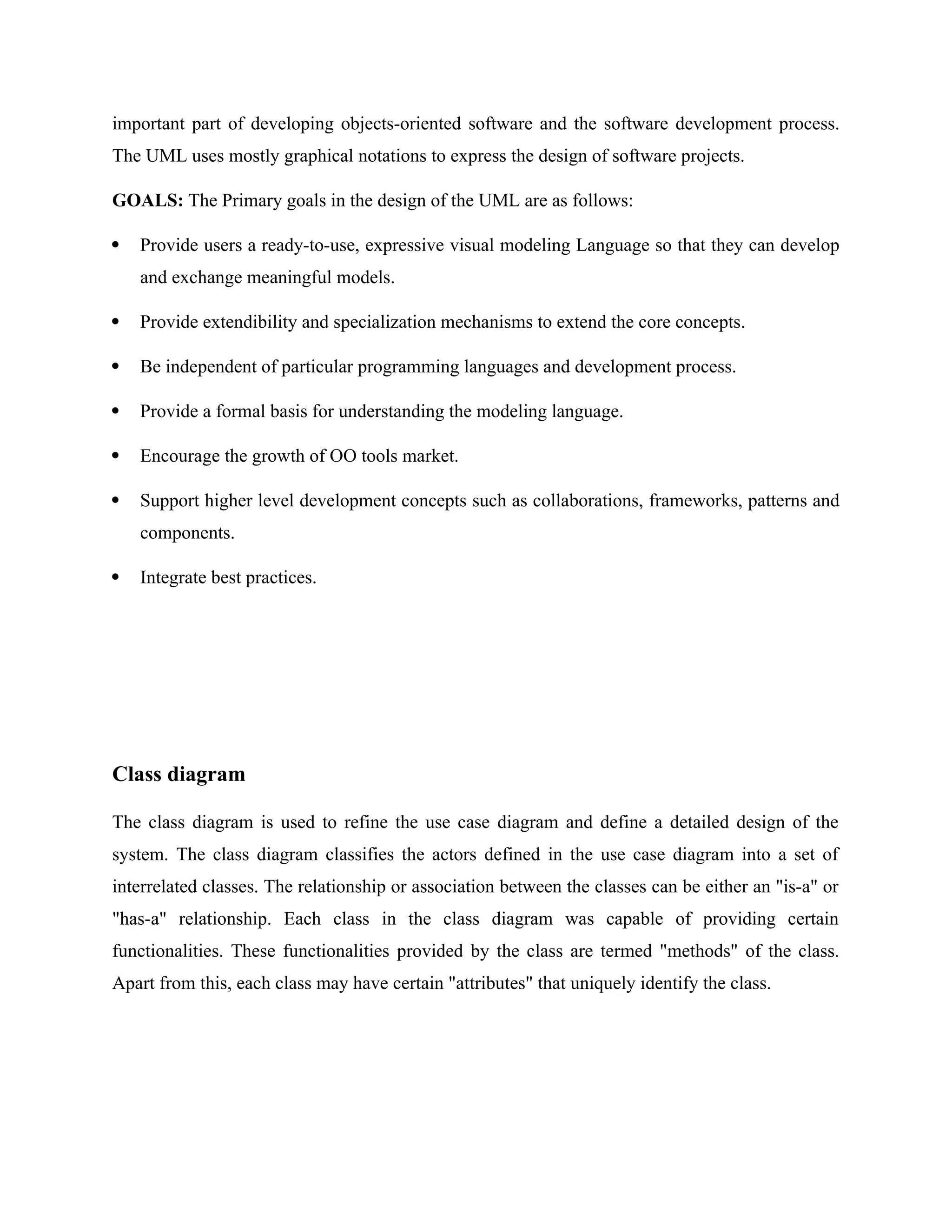
System Architecture
UML Diagrams:
UML DIAGRAMS
UML stands for Unified Modeling Language. UML is a standardized general-purpose modeling
language in the field of object-oriented software engineering. The standard is managed, and was
created by, the Object Management Group. The goal is for UML to become a common language
for creating models of object-oriented computer software. In its current form UML is comprised
of two major components: a Meta-model and a notation. In the future, some form of method or
process may also be added to; or associated with, UML.
The Unified Modeling Language is a standard language for specifying, Visualization,
Constructing and documenting the artifacts of software system, as well as for business modeling
and other non-software systems. The UML represents a collection of best engineering practices
that have proven successful in the modeling of large and complex systems. The UML is a very
important part of developing objects-oriented software and the software development process.
The UML uses mostly graphical notations to express the design of software projects.
GOALS: The Primary goals in the design of the UML are as follows:
 Provide users a ready-to-use, expressive visual modeling Language so that they can develop
and exchange meaningful models.
 Provide extendibility and specialization mechanisms to extend the core concepts.
 Be independent of particular programming languages and development process.
 Provide a formal basis for understanding the modeling language.
 Encourage the growth of OO tools market.
 Support higher level development concepts such as collaborations, frameworks, patterns and
components.
 Integrate best practices.
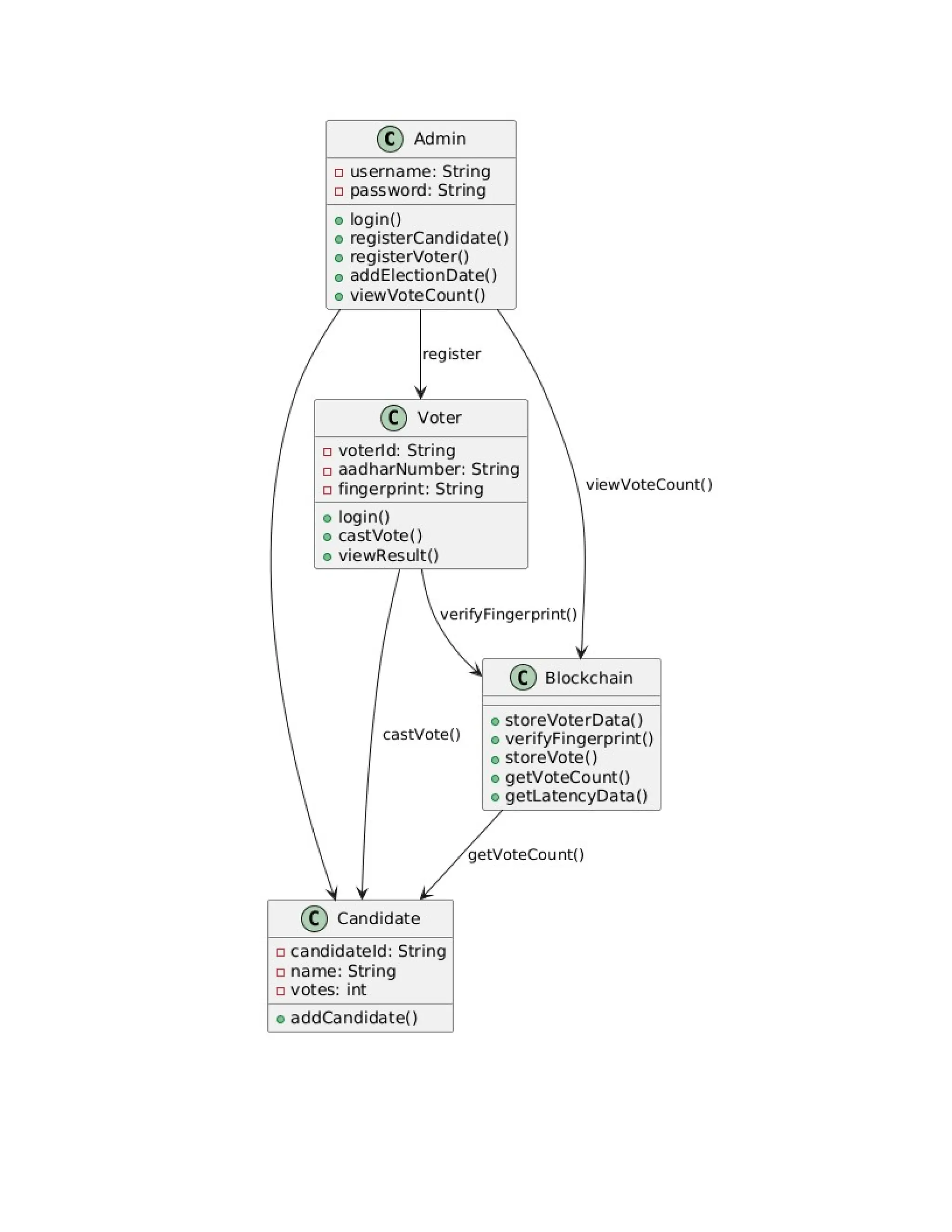
Class diagram
The class diagram is used to refine the use case diagram and define a detailed design of the
system. The class diagram classifies the actors defined in the use case diagram into a set of
interrelated classes. The relationship or association between the classes can be either an "is-a" or
"has-a" relationship. Each class in the class diagram was capable of providing certain
functionalities. These functionalities provided by the class are termed "methods" of the class.
Apart from this, each class may have certain "attributes" that uniquely identify the class.
Figure-5.1: Class Diagram
Sequence Diagram
A sequence diagram in Unified Modeling Language (UML) is a kind of interaction diagram that
shows how processes operate with one another and in what order. It is a construct of a Message
Sequence Chart. A sequence diagram shows, as parallel vertical lines (“lifelines”), different
processes or objects that live simultaneously, and as horizontal arrows, the messages exchanged
between them, in the order in which they occur. This allows the specification of simple runtime
scenarios in a graphical manner.
Figure-5.2: Sequence Diagram
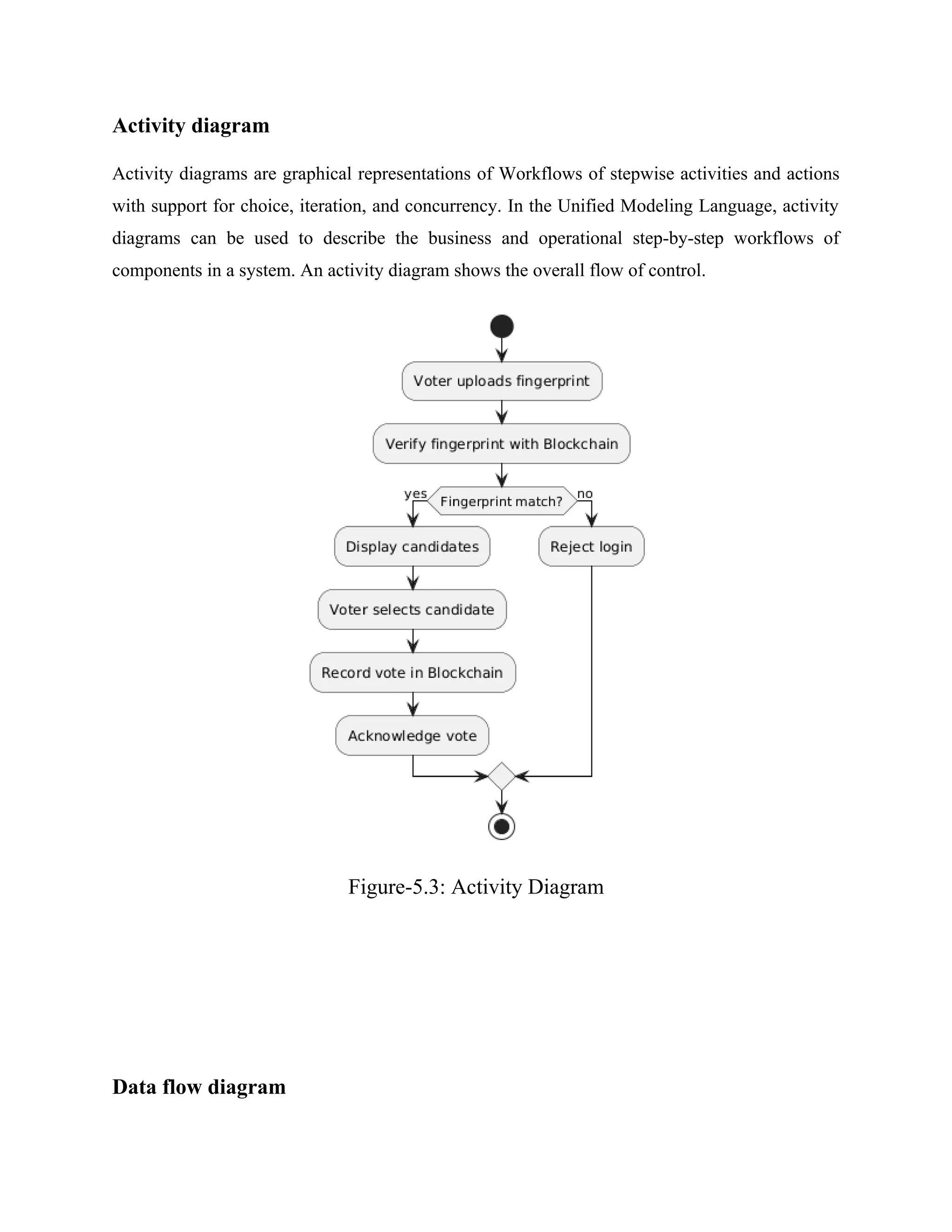
Activity diagram
Activity diagrams are graphical representations of Workflows of stepwise activities and actions
with support for choice, iteration, and concurrency. In the Unified Modeling Language, activity
diagrams can be used to describe the business and operational step-by-step workflows of
components in a system. An activity diagram shows the overall flow of control.
Figure-5.3: Activity Diagram
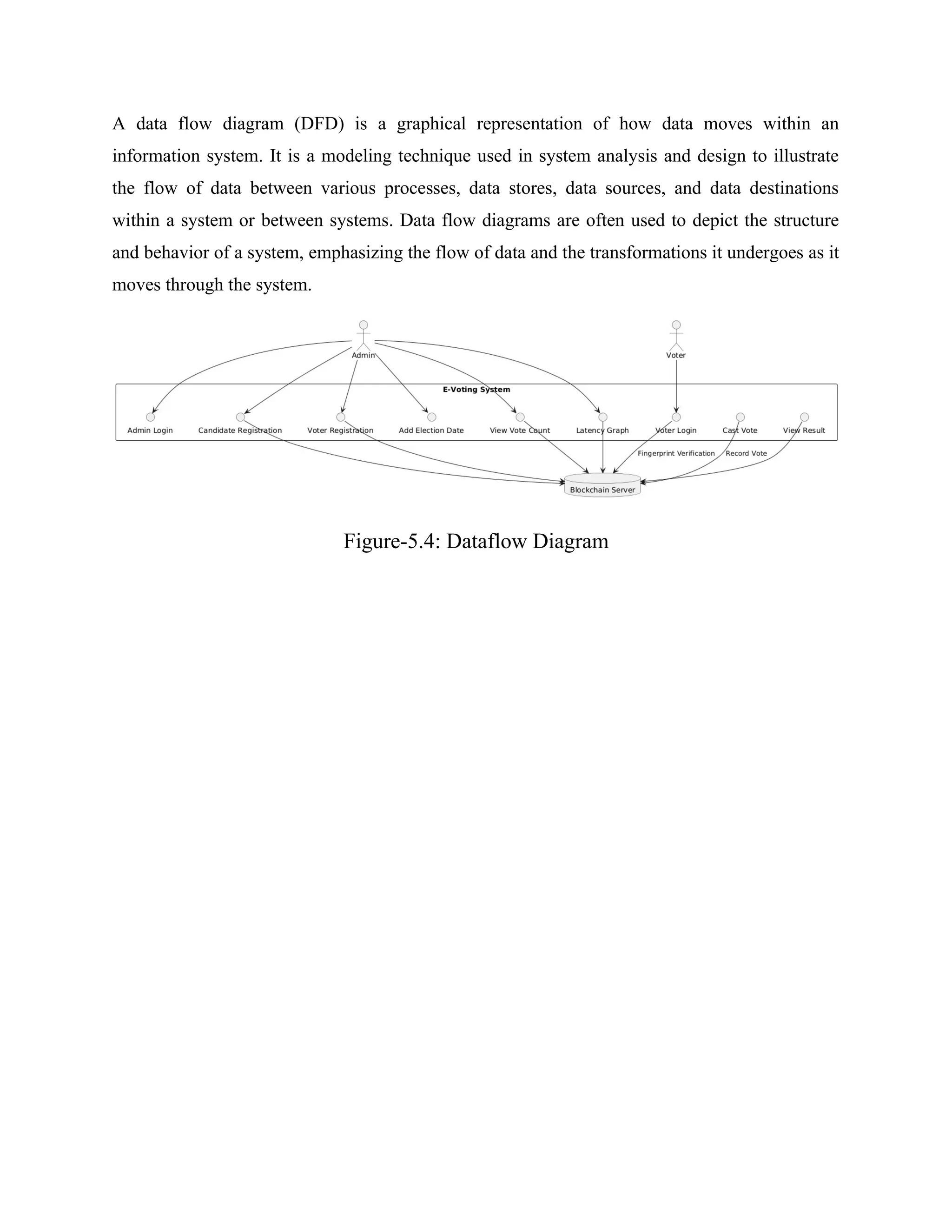
Data flow diagram
A data flow diagram (DFD) is a graphical representation of how data moves within an
information system. It is a modeling technique used in system analysis and design to illustrate
the flow of data between various processes, data stores, data sources, and data destinations
within a system or between systems. Data flow diagrams are often used to depict the structure
and behavior of a system, emphasizing the flow of data and the transformations it undergoes as it
moves through the system.
Figure-5.4: Dataflow Diagram
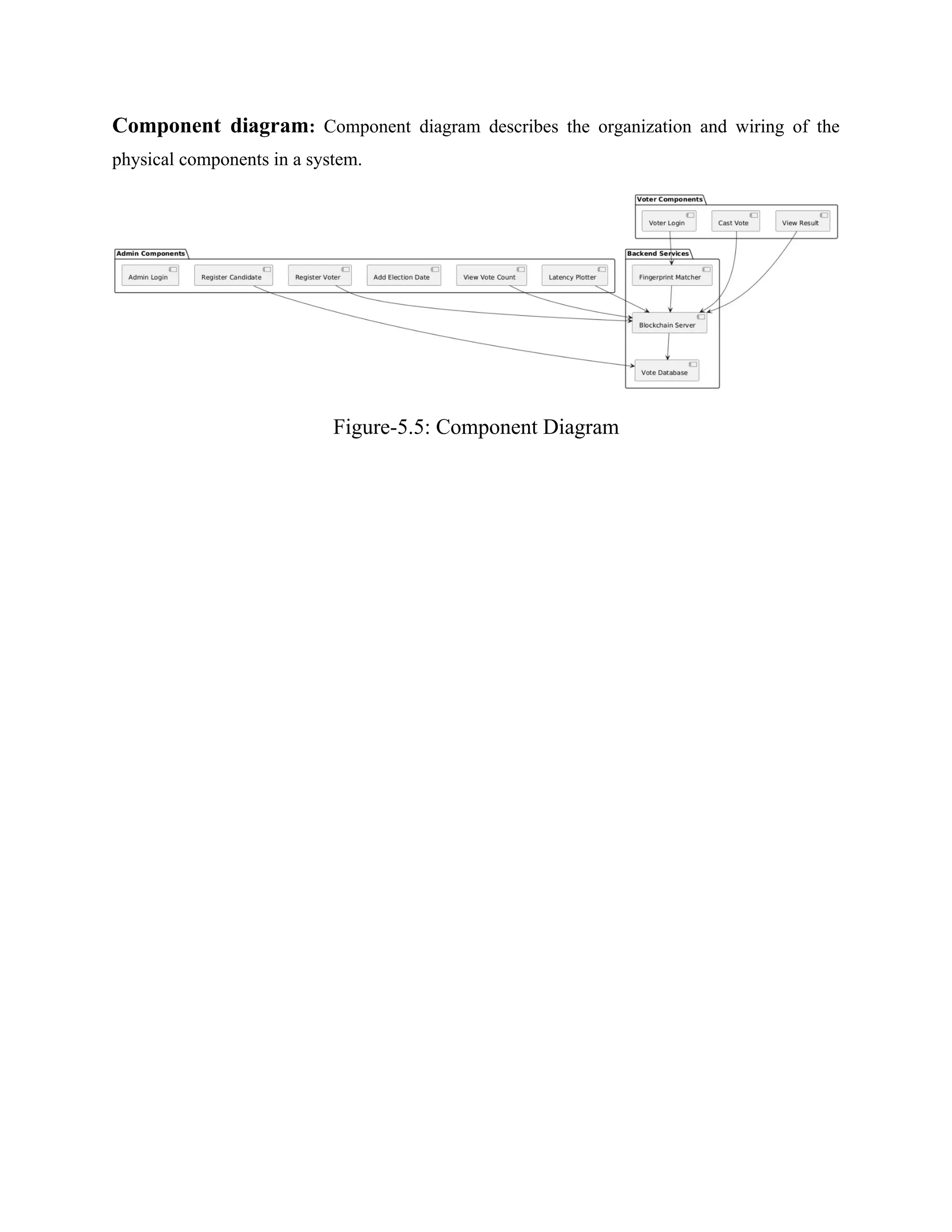
Component diagram: Component diagram describes the organization and wiring of the
physical components in a system.
Figure-5.5: Component Diagram
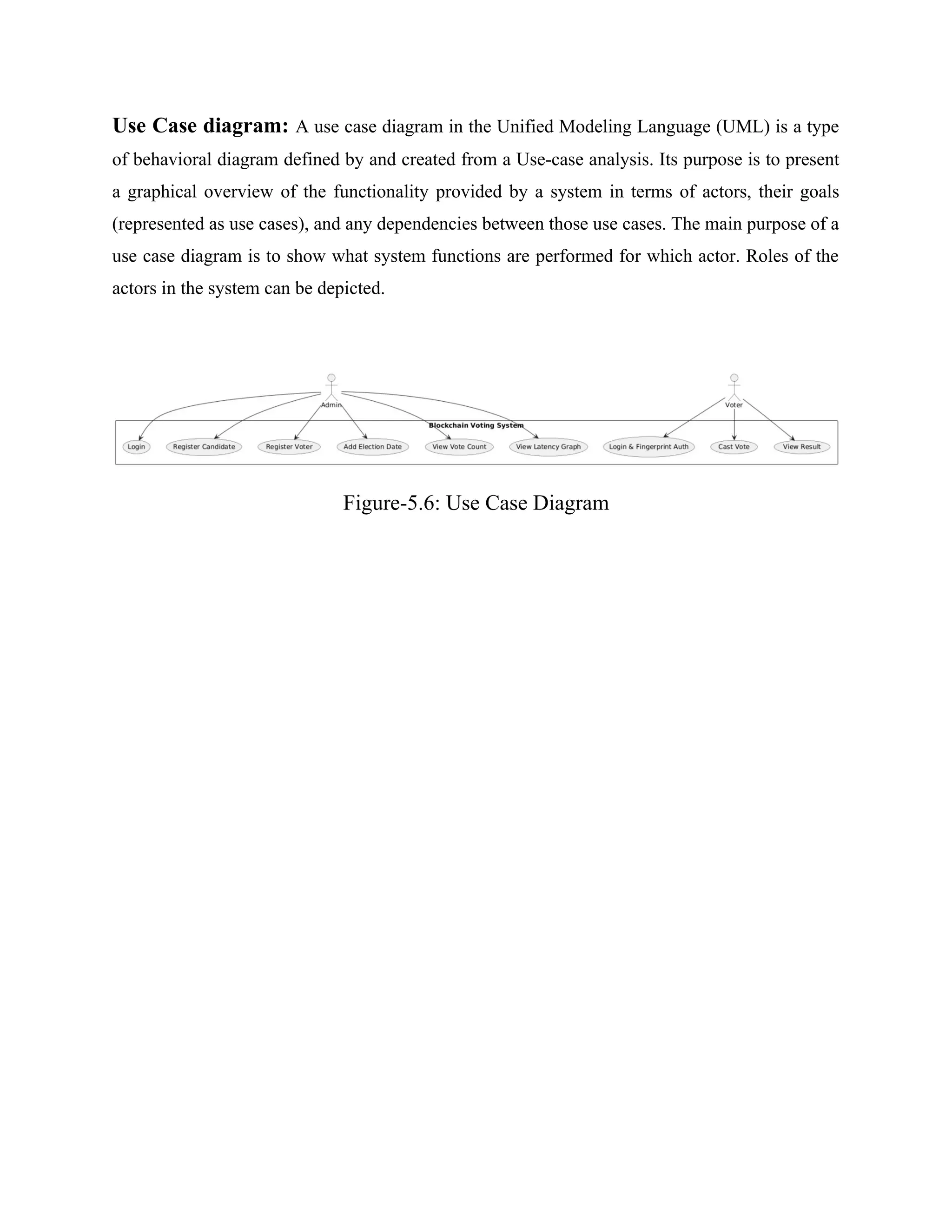
Use Case diagram: A use case diagram in the Unified Modeling Language (UML) is a type
of behavioral diagram defined by and created from a Use-case analysis. Its purpose is to present
a graphical overview of the functionality provided by a system in terms of actors, their goals
(represented as use cases), and any dependencies between those use cases. The main purpose of a
use case diagram is to show what system functions are performed for which actor. Roles of the
actors in the system can be depicted.
Figure-5.6: Use Case Diagram
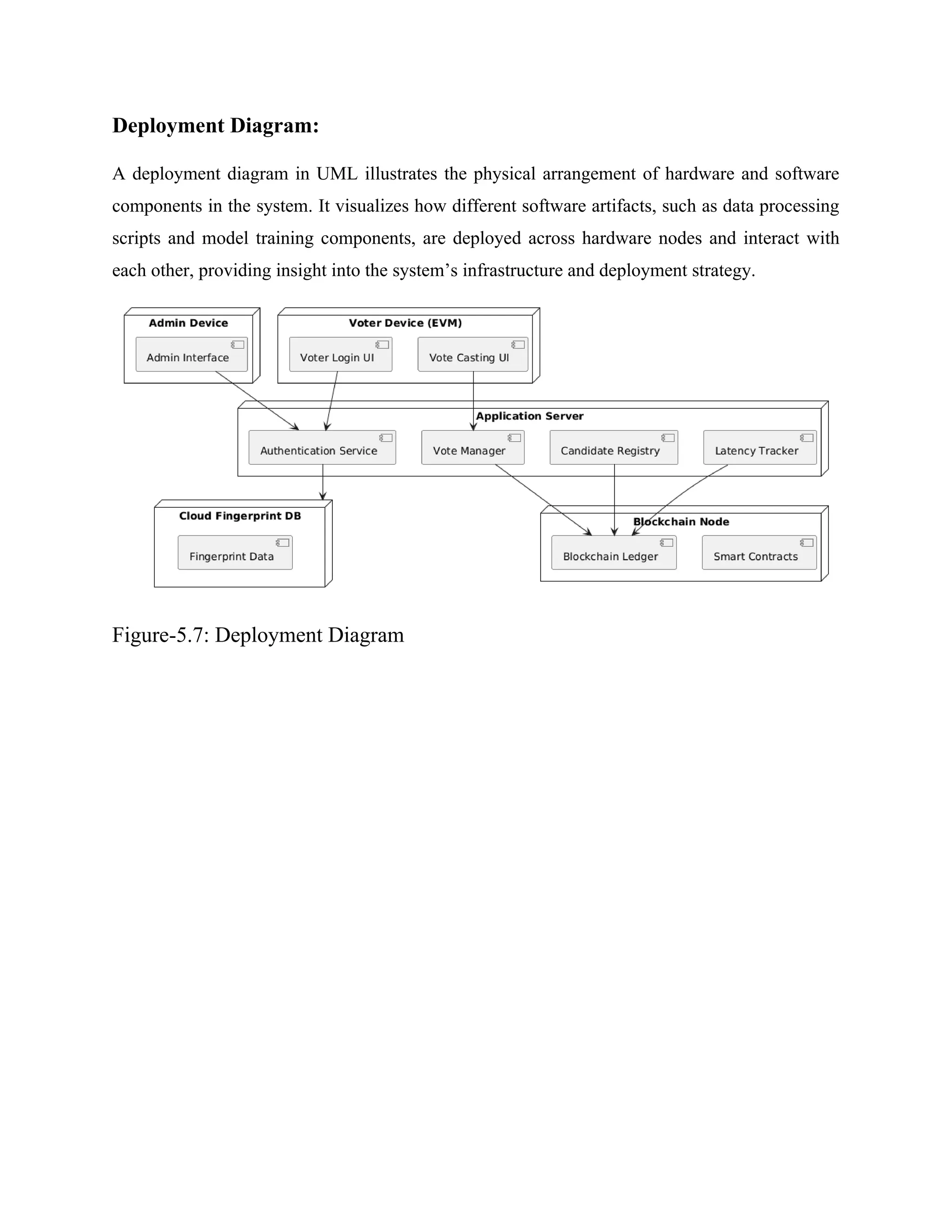
Deployment Diagram:
A deployment diagram in UML illustrates the physical arrangement of hardware and software
components in the system. It visualizes how different software artifacts, such as data processing
scripts and model training components, are deployed across hardware nodes and interact with
each other, providing insight into the system’s infrastructure and deployment strategy.
Figure-5.7: Deployment Diagram
System Implementations:
1. User Registration and Authentication Module
This module handles the secure registration of voters. Each user must enter their Aadhar number,
which is validated against government records. Upon successful matching, an OTP is generated
and sent to the registered mobile number. The voter must input this OTP to gain access to the
voting interface. This two-step authentication ensures that only eligible voters can access the
system.
2. Voting Interface Module
Once authenticated, users are redirected to a user-friendly voting interface. This module displays
the list of candidates and their respective parties in a clean, accessible layout. The system ensures
that each user can cast only one vote. Upon casting the vote, the data is recorded in a secure,
encrypted format to maintain confidentiality and integrity.
3. Admin and Monitoring Panel
The administrative module is restricted to authorized personnel only. It allows the election
officials to monitor voting activity, manage the database, and view system logs for transparency.
This module also includes features for scheduling voting times, publishing results, and auditing
any unusual activity.
4. Database and Backend Management
The backend is developed to handle secure storage and processing of sensitive information.
Voter data, OTP logs, and vote records are stored in an encrypted format in a relational database
(such as MySQL or PostgreSQL). Security measures such as hashing, SSL encryption, and
firewalls are employed to protect the data from breaches.
5. Security and Logging Mechanism
This module logs all activities such as login attempts, OTP requests, and vote submissions for
future auditing. It helps in identifying fraudulent behavior and ensures that the system is
transparent and trustworthy. Additionally, the logging system assists in generating reports for
post-election analysis.
System Environment:
What is Python :-
Below are some facts about Python.
Python is currently the most widely used multi-purpose, high-level
programming language.
Python allows programming in Object-Oriented and Procedural paradigms.
Python programs generally are smaller than other programming languages
like Java.
Programmers have to type relatively less and indentation requirement of
the language, makes them readable all the time.
Python language is being used by almost all tech-giant companies like –
Google, Amazon, Facebook, Instagram, Dropbox, Uber… etc.
The biggest strength of Python is huge collection of standard library which
can be used for the following .
 Machine Learning
 GUI Applications (like Kivy, Tkinter, PyQt etc. )
 Web frameworks like Django (used by YouTube, Instagram, Dropbox)
 Image processing (like Opencv, Pillow)
 Web scraping (like Scrapy, BeautifulSoup, Selenium)
 Test frameworks
 Multimedia
Advantages of Python :-
Let’s see how Python dominates over other languages.
1. Extensive Libraries
Python downloads with an extensive library and it contain code for various
purposes like regular expressions, documentation-generation, unit-testing, web
browsers, threading, databases, CGI, email, image manipulation, and
more. So, we don’t have to write the complete code for that manually.
2. Extensible
As we have seen earlier, Python can be extended to other languages. You can
write some of your code in languages like C++ or C. This comes in handy,
especially in projects.
3. Embeddable
Complimentary to extensibility, Python is embeddable as well. You can put
your Python code in your source code of a different language, like C++. This
lets us add scripting capabilities to our code in the other language.
4. Improved Productivity
The language’s simplicity and extensive libraries render programmers more
productive than languages like Java and C++ do. Also, the fact that you need
to write less and get more things done.
5. IOT Opportunities
Since Python forms the basis of new platforms like Raspberry Pi, it finds the
future bright for the Internet Of Things. This is a way to connect the language
with the real world.
6. Simple and Easy
When working with Java, you may have to create a class to print ‘Hello
World’. But in Python, just a print statement will do. It is also quite easy to
learn, understand, and code. This is why when people pick up Python, they
have a hard time adjusting to other more verbose languages like Java.
7. Readable
Because it is not such a verbose language, reading Python is much like reading
English. This is the reason why it is so easy to learn, understand, and code. It
also does not need curly braces to define blocks, and indentation is
mandatory. This further aids the readability of the code.
8. Object-Oriented
This language supports both the procedural and object-
oriented programming paradigms. While functions help us with code
reusability, classes and objects let us model the real world. A class allows
the encapsulation of data and functions into one.
9. Free and Open-Source
Like we said earlier, Python is freely available. But not only can
you download Python for free, but you can also download its source code,
make changes to it, and even distribute it. It downloads with an extensive
collection of libraries to help you with your tasks.
10. Portable
When you code your project in a language like C++, you may need to make
some changes to it if you want to run it on another platform. But it isn’t the
same with Python. Here, you need to code only once, and you can run it
anywhere. This is called Write Once Run Anywhere (WORA). However,
you need to be careful enough not to include any system-dependent features.
11. Interpreted
Lastly, we will say that it is an interpreted language. Since statements are
executed one by one, debugging is easier than in compiled languages.
Any doubts till now in the advantages of Python? Mention in the comment
section.
Advantages of Python Over Other Languages
1. Less Coding
Almost all of the tasks done in Python requires less coding when the same task
is done in other languages. Python also has an awesome standard library
support, so you don’t have to search for any third-party libraries to get your
job done. This is the reason that many people suggest learning Python to
beginners.
2. Affordable
Python is free therefore individuals, small companies or big organizations can
leverage the free available resources to build applications. Python is popular
and widely used so it gives you better community support.
The 2019 Github annual survey showed us that Python has overtaken
Java in the most popular programming language category.
3. Python is for Everyone
Python code can run on any machine whether it is Linux, Mac or Windows.
Programmers need to learn different languages for different jobs but with
Python, you can professionally build web apps, perform data analysis
and machine learning, automate things, do web scraping and also build games
and powerful visualizations. It is an all-rounder programming language.
Disadvantages of Python
So far, we’ve seen why Python is a great choice for your project. But if you
choose it, you should be aware of its consequences as well. Let’s now see the
downsides of choosing Python over another language.
1. Speed Limitations
We have seen that Python code is executed line by line. But since Python is
interpreted, it often results in slow execution. This, however, isn’t a problem
unless speed is a focal point for the project. In other words, unless high speed is
a requirement, the benefits offered by Python are enough to distract us from its
speed limitations.
2. Weak in Mobile Computing and Browsers
While it serves as an excellent server-side language, Python is much rarely seen
on the client-side. Besides that, it is rarely ever used to implement smartphone-
based applications. One such application is called Carbonnelle.
The reason it is not so famous despite the existence of Brython is that it isn’t
that secure.
3. Design Restrictions
As you know, Python is dynamically-typed. This means that you don’t need to
declare the type of variable while writing the code. It uses duck-typing. But
wait, what’s that? Well, it just means that if it looks like a duck, it must be a
duck. While this is easy on the programmers during coding, it can raise run-
time errors.
4. Underdeveloped Database Access Layers
Compared to more widely used technologies like JDBC (Java DataBase
Connectivity) and ODBC (Open DataBase Connectivity), Python’s database
access layers are a bit underdeveloped. Consequently, it is less often applied in
huge enterprises.
5. Simple
No, we’re not kidding. Python’s simplicity can indeed be a problem. Take my
example. I don’t do Java, I’m more of a Python person. To me, its syntax is so
simple that the verbosity of Java code seems unnecessary.
This was all about the Advantages and Disadvantages of Python Programming
Language.
History of Python : -
What do the alphabet and the programming language Python have in common?
Right, both start with ABC. If we are talking about ABC in the Python context,
it's clear that the programming language ABC is meant. ABC is a general-
purpose programming language and programming environment, which had
been developed in the Netherlands, Amsterdam, at the CWI (Centrum
Wiskunde &Informatica). The greatest achievement of ABC was to influence
the design of Python.Python was conceptualized in the late 1980s. Guido van
Rossum worked that time in a project at the CWI, called Amoeba, a distributed
operating system. In an interview with Bill Venners1
, Guido van Rossum said:
"In the early 1980s, I worked as an implementer on a team building a language
called ABC at Centrum voor Wiskunde en Informatica (CWI).
I don't know how well people know ABC's influence on Python. I try to
mention ABC's influence because I'm indebted to everything I learned during
that project and to the people who worked on it."Later on in the same
Interview, Guido van Rossum continued: "I remembered all my experience and
some of my frustration with ABC. I decided to try to design a simple scripting
language that possessed some of ABC's better properties, but without its
problems. So I started typing. I created a simple virtual machine, a simple
parser, and a simple runtime. I made my own version of the various ABC parts
that I liked. I created a basic syntax, used indentation for statement grouping
instead of curly braces or begin-end blocks, and developed a small number of
powerful data types: a hash table (or dictionary, as we call it), a list, strings, and
numbers."
What is Machine Learning : -
Before we take a look at the details of various machine learning methods, let's
start by looking at what machine learning is, and what it isn't. Machine learning
is often categorized as a subfield of artificial intelligence, but I find that
categorization can often be misleading at first brush. The study of machine
learning certainly arose from research in this context, but in the data science
application of machine learning methods, it's more helpful to think of machine
learning as a means of building models of data.
Fundamentally, machine learning involves building mathematical models to
help understand data. "Learning" enters the fray when we give these
models tunable parameters that can be adapted to observed data; in this way
the program can be considered to be "learning" from the data.
Once these models have been fit to previously seen data, they can be used to
predict and understand aspects of newly observed data. I'll leave to the reader
the more philosophical digression regarding the extent to which this type of
mathematical, model-based "learning" is similar to the "learning" exhibited by
the human brain.Understanding the problem setting in machine learning is
essential to using these tools effectively, and so we will start with some broad
categorizations of the types of approaches we'll discuss here.
Categories Of Machine Leaning :-
At the most fundamental level, machine learning can be categorized into two
main types: supervised learning and unsupervised learning.
Supervised learning involves somehow modeling the relationship between
measured features of data and some label associated with the data; once this
model is determined, it can be used to apply labels to new, unknown data. This
is further subdivided into classification tasks and regression tasks: in
classification, the labels are discrete categories, while in regression, the labels
are continuous quantities. We will see examples of both types of supervised
learning in the following section.
Unsupervised learning involves modeling the features of a dataset without
reference to any label, and is often described as "letting the dataset speak for
itself." These models include tasks such as clustering and dimensionality
reduction.
Clustering algorithms identify distinct groups of data, while dimensionality
reduction algorithms search for more succinct representations of the data. We
will see examples of both types of unsupervised learning in the following
section.
Need for Machine Learning
Human beings, at this moment, are the most intelligent and advanced species
on earth because they can think, evaluate and solve complex problems. On the
other side, AI is still in its initial stage and haven’t surpassed human
intelligence in many aspects. Then the question is that what is the need to make
machine learn? The most suitable reason for doing this is, “to make decisions,
based on data, with efficiency and scale”.
Lately, organizations are investing heavily in newer technologies like Artificial
Intelligence, Machine Learning and Deep Learning to get the key information
from data to perform several real-world tasks and solve problems. We can call
it data-driven decisions taken by machines, particularly to automate the
process. These data-driven decisions can be used, instead of using programing
logic, in the problems that cannot be programmed inherently. The fact is that
we can’t do without human intelligence, but other aspect is that we all need to
solve real-world problems with efficiency at a huge scale. That is why the need
for machine learning arises.
Challenges in Machines Learning :-
While Machine Learning is rapidly evolving, making significant strides with
cybersecurity and autonomous cars, this segment of AI as whole still has a long
way to go. The reason behind is that ML has not been able to overcome number
of challenges. The challenges that ML is facing currently are −
Quality of data − Having good-quality data for ML algorithms is one of the
biggest challenges. Use of low-quality data leads to the problems related to data
preprocessing and feature extraction.
Time-Consuming task − Another challenge faced by ML models is the
consumption of time especially for data acquisition, feature extraction and
retrieval.
Lack of specialist persons − As ML technology is still in its infancy stage,
availability of expert resources is a tough job.
No clear objective for formulating business problems − Having no clear
objective and well-defined goal for business problems is another key challenge
for ML because this technology is not that mature yet.
Issue of overfitting & underfitting − If the model is overfitting or
underfitting, it cannot be represented well for the problem.
Curse of dimensionality − Another challenge ML model faces is too many
features of data points. This can be a real hindrance.
Difficulty in deployment − Complexity of the ML model makes it quite
difficult to be deployed in real life.
Applications of Machines Learning :-
Machine Learning is the most rapidly growing technology and according to
researchers we are in the golden year of AI and ML. It is used to solve many
real-world complex problems which cannot be solved with traditional approach.
Following are some real-world applications of ML −
 Emotion analysis
 Sentiment analysis
 Error detection and prevention
 Weather forecasting and prediction
 Stock market analysis and forecasting
 Speech synthesis
 Speech recognition
 Customer segmentation
 Object recognition
 Fraud detection
 Fraud prevention
 Recommendation of products to customer in online shopping
How to Start Learning Machine Learning?
Arthur Samuel coined the term “Machine Learning” in 1959 and defined it as
a “Field of study that gives computers the capability to learn without being
explicitly programmed”.
And that was the beginning of Machine Learning! In modern times, Machine
Learning is one of the most popular (if not the most!) career choices. According
to Indeed, Machine Learning Engineer Is The Best Job of 2019 with
a 344% growth and an average base salary of $146,085 per year.
But there is still a lot of doubt about what exactly is Machine Learning and how
to start learning it? So this article deals with the Basics of Machine Learning and
also the path you can follow to eventually become a full-fledged Machine
Learning Engineer. Now let’s get started!!!
How to start learning ML?
This is a rough roadmap you can follow on your way to becoming an insanely
talented Machine Learning Engineer. Of course, you can always modify the
steps according to your needs to reach your desired end-goal!
Step 1 – Understand the Prerequisites
In case you are a genius, you could start ML directly but normally, there are
some prerequisites that you need to know which include Linear Algebra,
Multivariate Calculus, Statistics, and Python. And if you don’t know these,
never fear! You don’t need a Ph.D. degree in these topics to get started but you
do need a basic understanding.
(a) Learn Linear Algebra and Multivariate Calculus
Both Linear Algebra and Multivariate Calculus are important in Machine
Learning. However, the extent to which you need them depends on your role as
a data scientist. If you are more focused on application heavy machine learning,
then you will not be that heavily focused on maths as there are many common
libraries available. But if you want to focus on R&D in Machine Learning, then
mastery of Linear Algebra and Multivariate Calculus is very important as you
will have to implement many ML algorithms from scratch.
(b) Learn Statistics
Data plays a huge role in Machine Learning. In fact, around 80% of your time as
an ML expert will be spent collecting and cleaning data. And statistics is a field
that handles the collection, analysis, and presentation of data. So it is no surprise
that you need to learn it!!!
Some of the key concepts in statistics that are important are Statistical
Significance, Probability Distributions, Hypothesis Testing, Regression, etc.
Also, Bayesian Thinking is also a very important part of ML which deals with
various concepts like Conditional Probability, Priors, and Posteriors, Maximum
Likelihood, etc.
(c) Learn Python
Some people prefer to skip Linear Algebra, Multivariate Calculus and Statistics
and learn them as they go along with trial and error. But the one thing that you
absolutely cannot skip is Python! While there are other languages you can use
for Machine Learning like R, Scala, etc. Python is currently the most popular
language for ML. In fact, there are many Python libraries that are specifically
useful for Artificial Intelligence and Machine Learning such
as Keras, TensorFlow, Scikit-learn, etc.
So if you want to learn ML, it’s best if you learn Python! You can do that using
various online resources and courses such as Fork Python available Free on
GeeksforGeeks.
Step 2 – Learn Various ML Concepts
Now that you are done with the prerequisites, you can move on to actually
learning ML (Which is the fun part!!!) It’s best to start with the basics and then
move on to the more complicated stuff. Some of the basic concepts in ML are:
(a) Terminologies of Machine Learning
 Model – A model is a specific representation learned from data by applying
some machine learning algorithm. A model is also called a hypothesis.
 Feature – A feature is an individual measurable property of the data. A set of
numeric features can be conveniently described by a feature vector. Feature
vectors are fed as input to the model. For example, in order to predict a fruit,
there may be features like color, smell, taste, etc.
 Target (Label) – A target variable or label is the value to be predicted by our
model. For the fruit example discussed in the feature section, the label with each
set of input would be the name of the fruit like apple, orange, banana, etc.
 Training – The idea is to give a set of inputs(features) and it’s expected
outputs(labels), so after training, we will have a model (hypothesis) that will then
map new data to one of the categories trained on.
 Prediction – Once our model is ready, it can be fed a set of inputs to which it
will provide a predicted output(label).
(b) Types of Machine Learning
 Supervised Learning – This involves learning from a training dataset with
labeled data using classification and regression models. This learning process
continues until the required level of performance is achieved.
 Unsupervised Learning – This involves using unlabelled data and then finding
the underlying structure in the data in order to learn more and more about the
data itself using factor and cluster analysis models.
 Semi-supervised Learning – This involves using unlabelled data like
Unsupervised Learning with a small amount of labeled data. Using labeled data
vastly increases the learning accuracy and is also more cost-effective than
Supervised Learning.
 Reinforcement Learning – This involves learning optimal actions through trial
and error. So the next action is decided by learning behaviors that are based on
the current state and that will maximize the reward in the future.
Advantages of Machine learning :-
1. Easily identifies trends and patterns -
Machine Learning can review large volumes of data and discover specific trends
and patterns that would not be apparent to humans. For instance, for an e-
commerce website like Amazon, it serves to understand the browsing behaviors
and purchase histories of its users to help cater to the right products, deals, and
reminders relevant to them. It uses the results to reveal relevant advertisements to
them.
2. No human intervention needed (automation)
With ML, you don’t need to babysit your project every step of the way. Since it
means giving machines the ability to learn, it lets them make predictions and also
improve the algorithms on their own. A common example of this is anti-virus
softwares; they learn to filter new threats as they are recognized. ML is also good
at recognizing spam.
3. Continuous Improvement
As ML algorithms gain experience, they keep improving in accuracy and
efficiency. This lets them make better decisions. Say you need to make a weather
forecast model. As the amount of data you have keeps growing, your algorithms
learn to make more accurate predictions faster.
4. Handling multi-dimensional and multi-variety data
Machine Learning algorithms are good at handling data that are multi-
dimensional and multi-variety, and they can do this in dynamic or uncertain
environments.
5. Wide Applications
You could be an e-tailer or a healthcare provider and make ML work for you.
Where it does apply, it holds the capability to help deliver a much more personal
experience to customers while also targeting the right customers.
Disadvantages of Machine Learning :-
1. Data Acquisition
Machine Learning requires massive data sets to train on, and these should be
inclusive/unbiased, and of good quality. There can also be times where they must
wait for new data to be generated.
2. Time and Resources
ML needs enough time to let the algorithms learn and develop enough to fulfill
their purpose with a considerable amount of accuracy and relevancy. It also needs
massive resources to function. This can mean additional requirements of
computer power for you.
3. Interpretation of Results
Another major challenge is the ability to accurately interpret results generated by
the algorithms. You must also carefully choose the algorithms for your purpose.
4. High error-susceptibility
Machine Learning is autonomous but highly susceptible to errors. Suppose you
train an algorithm with data sets small enough to not be inclusive. You end up
with biased predictions coming from a biased training set. This leads to irrelevant
advertisements being displayed to customers. In the case of ML, such blunders
can set off a chain of errors that can go undetected for long periods of time. And
when they do get noticed, it takes quite some time to recognize the source of the
issue, and even longer to correct it.
Python Development Steps : -
Guido Van Rossum published the first version of Python code (version 0.9.0) at
alt.sources in February 1991. This release included already exception handling,
functions, and the core data types of list, dict, str and others. It was also object
oriented and had a module system.
Python version 1.0 was released in January 1994. The major new features
included in this release were the functional programming tools lambda, map,
filter and reduce, which Guido Van Rossum never liked.Six and a half years later
in October 2000, Python 2.0 was introduced. This release included list
comprehensions, a full garbage collector and it was supporting unicode.Python
flourished for another 8 years in the versions 2.x before the next major release as
Python 3.0 (also known as "Python 3000" and "Py3K") was released. Python 3 is
not backwards compatible with Python 2.x.
The emphasis in Python 3 had been on the removal of duplicate programming
constructs and modules, thus fulfilling or coming close to fulfilling the 13th law
of the Zen of Python: "There should be one -- and preferably only one -- obvious
way to do it."Some changes in Python 7.3:
 Print is now a function
 Views and iterators instead of lists
 The rules for ordering comparisons have been simplified. E.g. a heterogeneous
list cannot be sorted, because all the elements of a list must be comparable to
each other.
 There is only one integer type left, i.e. int. long is int as well.
 The division of two integers returns a float instead of an integer. "//" can be
used to have the "old" behaviour.
 Text Vs. Data Instead Of Unicode Vs. 8-bit
Purpose :-
We demonstrated that our approach enables successful segmentation of intra-
retinal layers—even with low-quality images containing speckle noise, low
contrast, and different intensity ranges throughout—with the assistance of the
ANIS feature.
Python
Python is an interpreted high-level programming language for general-purpose
programming. Created by Guido van Rossum and first released in 1991, Python
has a design philosophy that emphasizes code readability, notably using
significant whitespace.
Python features a dynamic type system and automatic memory management. It
supports multiple programming paradigms, including object-oriented,
imperative, functional and procedural, and has a large and comprehensive
standard library.
 Python is Interpreted − Python is processed at runtime by the interpreter. You do
not need to compile your program before executing it. This is similar to PERL
and PHP.
 Python is Interactive − you can actually sit at a Python prompt and interact with
the interpreter directly to write your programs.
Python also acknowledges that speed of development is important. Readable
and terse code is part of this, and so is access to powerful constructs that avoid
tedious repetition of code. Maintainability also ties into this may be an all but
useless metric, but it does say something about how much code you have to
scan, read and/or understand to troubleshoot problems or tweak behaviors. This
speed of development, the ease with which a programmer of other languages
can pick up basic Python skills and the huge standard library is key to another
area where Python excels. All its tools have been quick to implement, saved a
lot of time, and several of them have later been patched and updated by people
with no Python background - without breaking.
Modules Used in Project :-
Tensorflow
TensorFlow is a free and open-source software library for dataflow and
differentiable programming across a range of tasks. It is a symbolic math
library, and is also used for machine learning applications such as neural
networks. It is used for both research and production at Google.‍
TensorFlow was developed by the Google Brain team for internal Google use.
It was released under the Apache 2.0 open-source license on November 9,
2015.
Numpy
Numpy is a general-purpose array-processing package. It provides a high-
performance multidimensional array object, and tools for working with these
arrays.
It is the fundamental package for scientific computing with Python. It contains
various features including these important ones:
 A powerful N-dimensional array object
 Sophisticated (broadcasting) functions
 Tools for integrating C/C++ and Fortran code
 Useful linear algebra, Fourier transform, and random number capabilities
Besides its obvious scientific uses, Numpy can also be used as an efficient
multi-dimensional container of generic data. Arbitrary data-types can be
defined using Numpy which allows Numpy to seamlessly and speedily
integrate with a wide variety of databases.
Pandas
Pandas is an open-source Python Library providing high-performance data
manipulation and analysis tool using its powerful data structures. Python was
majorly used for data munging and preparation. It had very little contribution
towards data analysis. Pandas solved this problem. Using Pandas, we can
accomplish five typical steps in the processing and analysis of data, regardless
of the origin of data load, prepare, manipulate, model, and analyze. Python with
Pandas is used in a wide range of fields including academic and commercial
domains including finance, economics, Statistics, analytics, etc.
Matplotlib
Matplotlib is a Python 2D plotting library which produces publication quality
figures in a variety of hardcopy formats and interactive environments across
platforms. Matplotlib can be used in Python scripts, the Python
and IPython shells, the Jupyter Notebook, web application servers, and four
graphical user interface toolkits. Matplotlib tries to make easy things easy and
hard things possible. You can generate plots, histograms, power spectra, bar
charts, error charts, scatter plots, etc., with just a few lines of code. For
examples, see the sample plots and thumbnail gallery.
For simple plotting the pyplot module provides a MATLAB-like interface,
particularly when combined with IPython. For the power user, you have full
control of line styles, font properties, axes properties, etc, via an object oriented
interface or via a set of functions familiar to MATLAB users.
Scikit – learn
Scikit-learn provides a range of supervised and unsupervised learning
algorithms via a consistent interface in Python. It is licensed under a permissive
simplified BSD license and is distributed under many Linux distributions,
encouraging academic and commercial use. Python
Python is an interpreted high-level programming language for general-purpose
programming. Created by Guido van Rossum and first released in 1991, Python
has a design philosophy that emphasizes code readability, notably using
significant whitespace.
Python features a dynamic type system and automatic memory management. It
supports multiple programming paradigms, including object-oriented,
imperative, functional and procedural, and has a large and comprehensive
standard library.
 Python is Interpreted − Python is processed at runtime by the interpreter. You do
not need to compile your program before executing it. This is similar to PERL
and PHP.
 Python is Interactive − you can actually sit at a Python prompt and interact with
the interpreter directly to write your programs.
Python also acknowledges that speed of development is important. Readable
and terse code is part of this, and so is access to powerful constructs that avoid
tedious repetition of code. Maintainability also ties into this may be an all but
useless metric, but it does say something about how much code you have to
scan, read and/or understand to troubleshoot problems or tweak behaviors. This
speed of development, the ease with which a programmer of other languages
can pick up basic Python skills and the huge standard library is key to another
area where Python excels.
All its tools have been quick to implement, saved a lot of time, and several of
them have later been patched and updated by people with no Python
background - without breaking.
Install Python Step-by-Step in Windows and Mac :
Python a versatile programming language doesn’t come pre-installed on your
computer devices. Python was first released in the year 1991 and until today it is
a very popular high-level programming language. Its style philosophy emphasizes
code readability with its notable use of great whitespace.
The object-oriented approach and language construct provided by Python enables
programmers to write both clear and logical code for projects. This software does
not come pre-packaged with Windows.
How to Install Python on Windows and Mac :
There have been several updates in the Python version over the years. The
question is how to install Python? It might be confusing for the beginner who is
willing to start learning Python but this tutorial will solve your query. The latest
or the newest version of Python is version 3.7.4 or in other words, it is Python 3.
Note: The python version 3.7.4 cannot be used on Windows XP or earlier
devices.
Before you start with the installation process of Python. First, you need to know
about your System Requirements. Based on your system type i.e. operating
system and based processor, you must download the python version. My system
type is a Windows 64-bit operating system. So the steps below are to install
python version 3.7.4 on Windows 7 device or to install Python 3. Download the
Python Cheatsheet here.The steps on how to install Python on Windows 10, 8 and
7 are divided into 4 parts to help understand better.
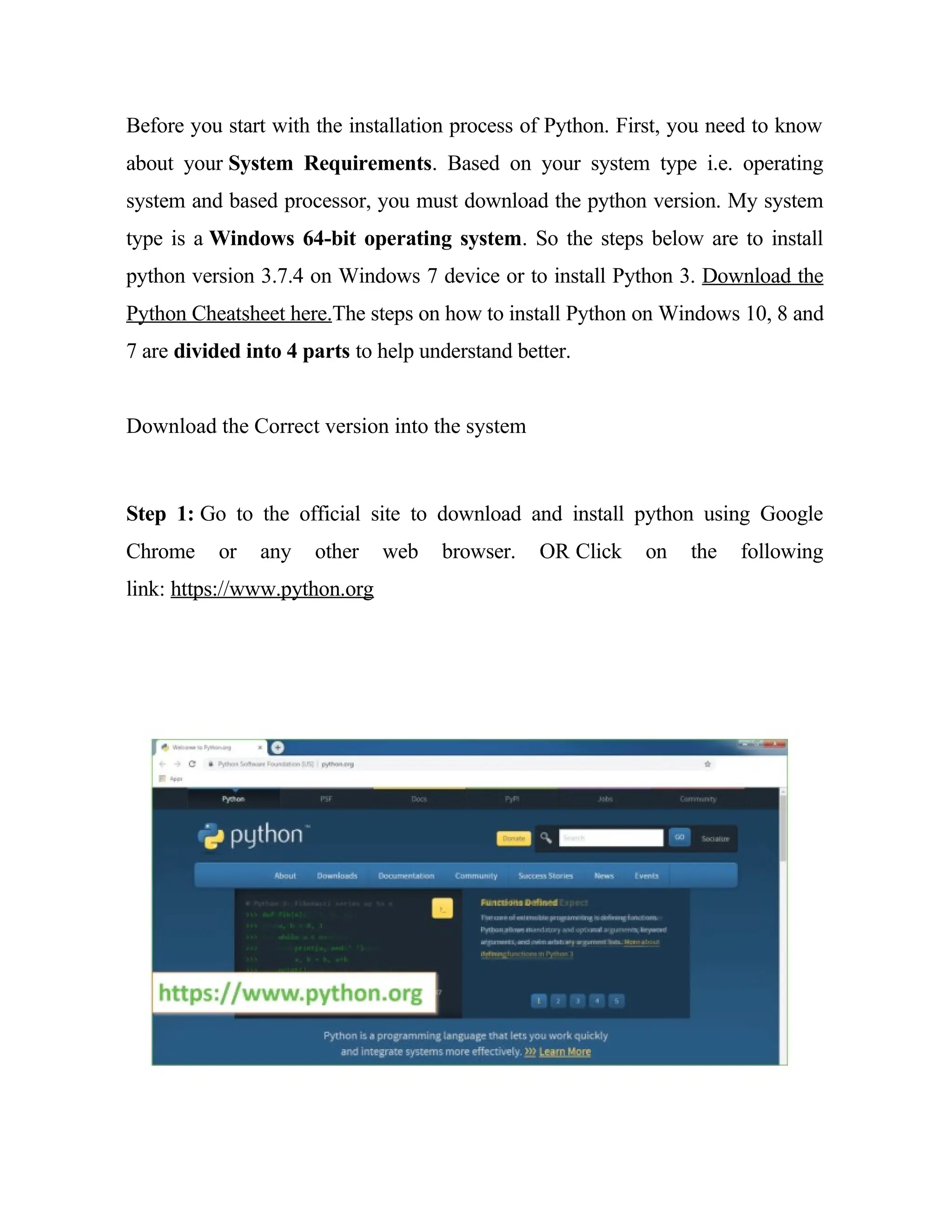
Download the Correct version into the system
Step 1: Go to the official site to download and install python using Google
Chrome or any other web browser. OR Click on the following
link: https://www.python.org
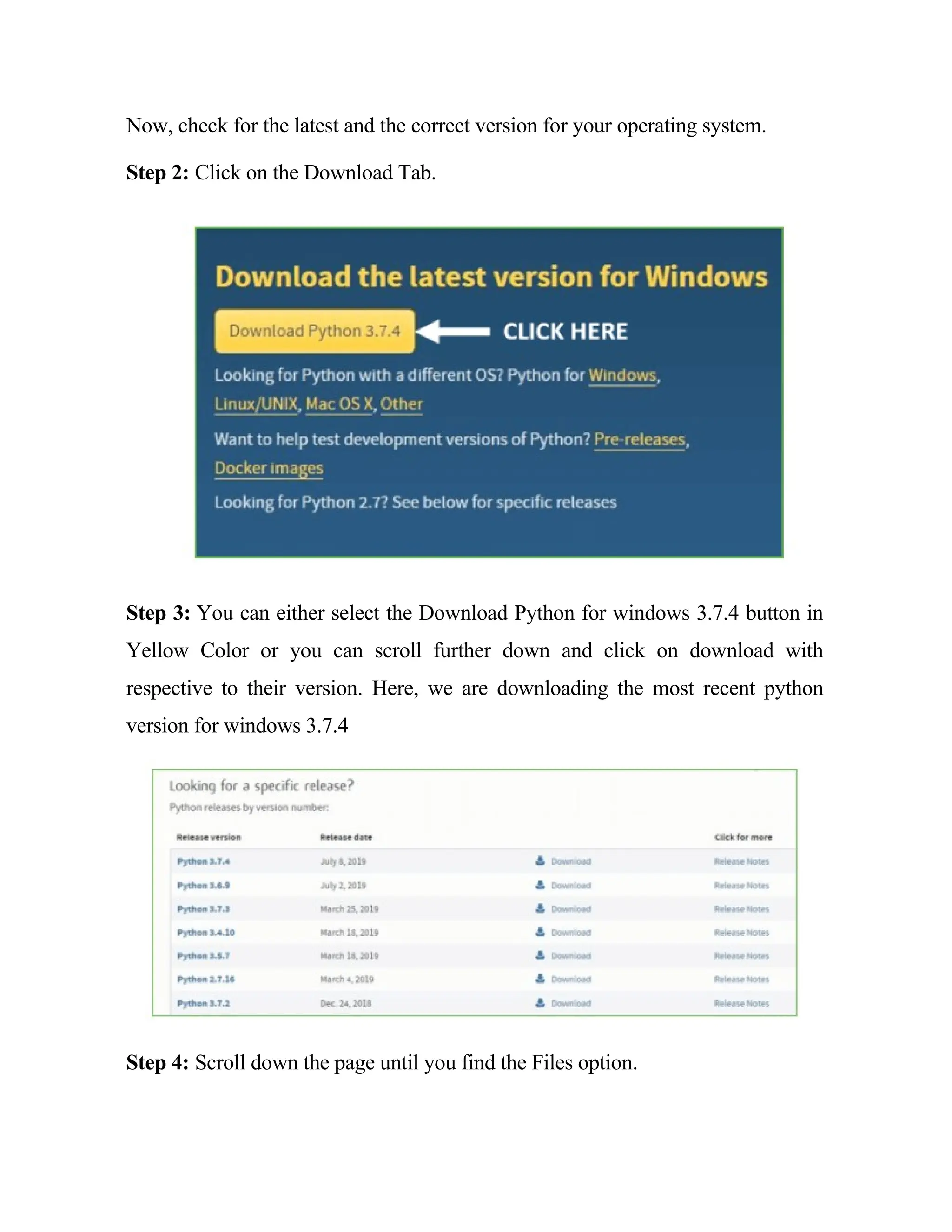
Now, check for the latest and the correct version for your operating system.
Step 2: Click on the Download Tab.
Step 3: You can either select the Download Python for windows 3.7.4 button in
Yellow Color or you can scroll further down and click on download with
respective to their version. Here, we are downloading the most recent python
version for windows 3.7.4
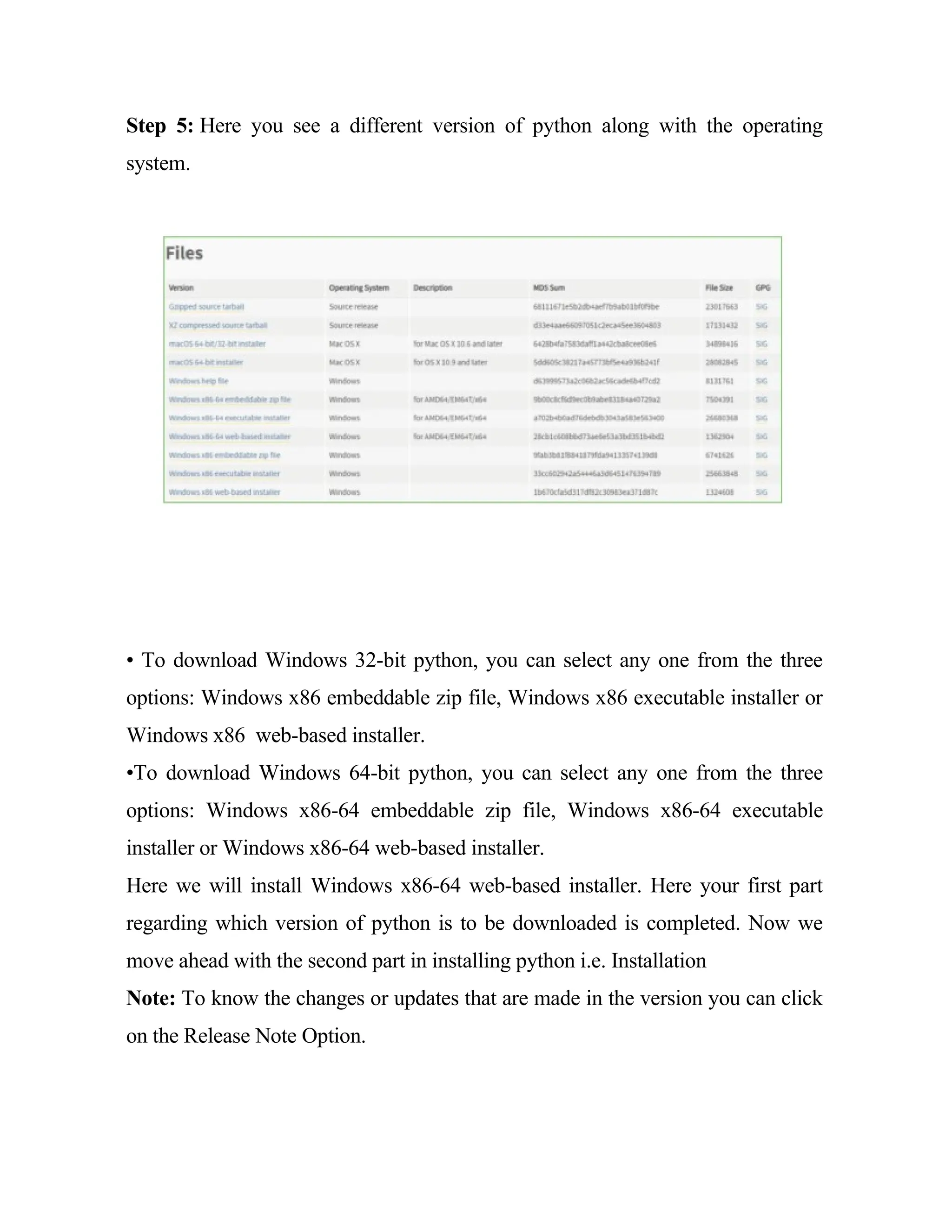
Step 4: Scroll down the page until you find the Files option.
Step 5: Here you see a different version of python along with the operating
system.
• To download Windows 32-bit python, you can select any one from the three
options: Windows x86 embeddable zip file, Windows x86 executable installer or
Windows x86 web-based installer.
•To download Windows 64-bit python, you can select any one from the three
options: Windows x86-64 embeddable zip file, Windows x86-64 executable
installer or Windows x86-64 web-based installer.
Here we will install Windows x86-64 web-based installer. Here your first part
regarding which version of python is to be downloaded is completed. Now we
move ahead with the second part in installing python i.e. Installation
Note: To know the changes or updates that are made in the version you can click
on the Release Note Option.
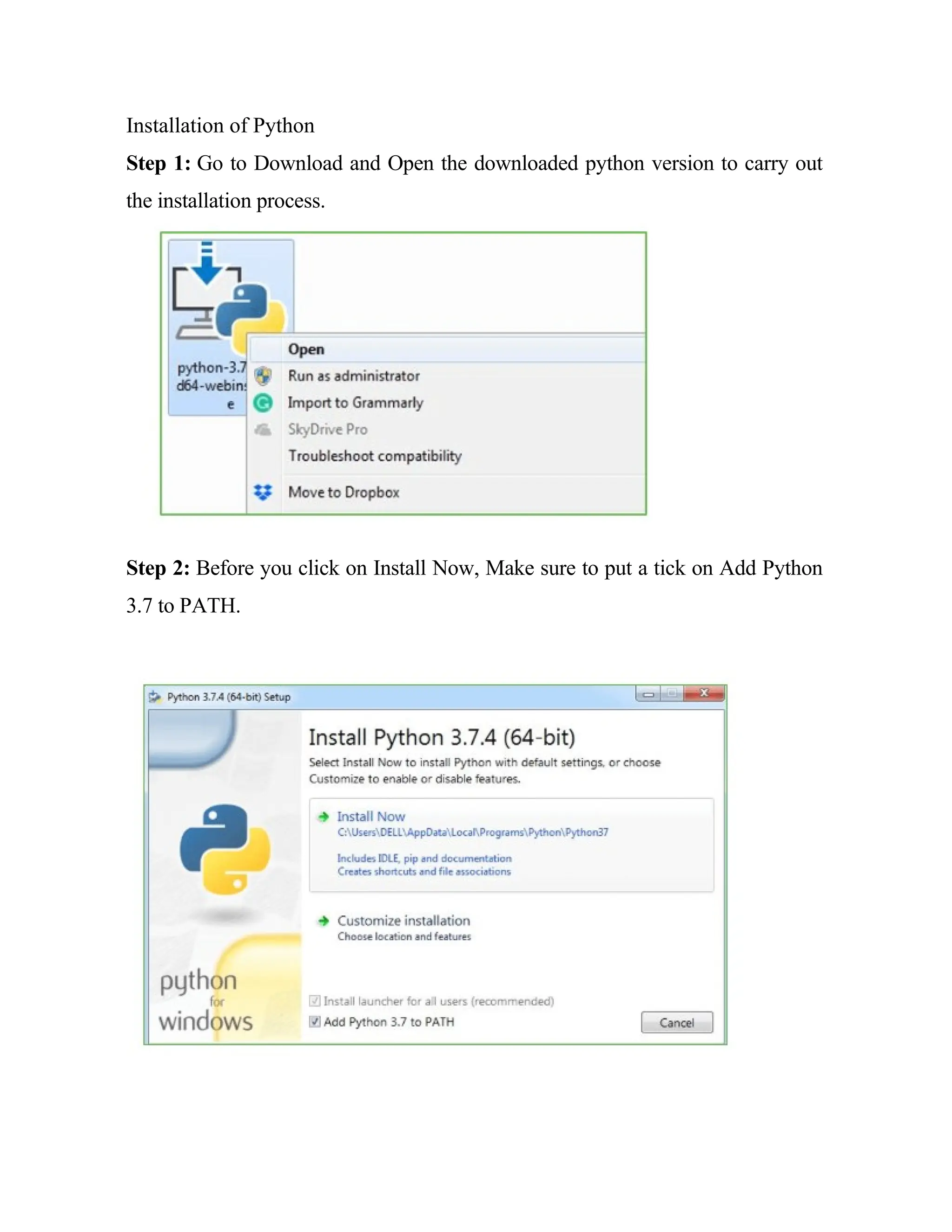
Installation of Python
Step 1: Go to Download and Open the downloaded python version to carry out
the installation process.
Step 2: Before you click on Install Now, Make sure to put a tick on Add Python
3.7 to PATH.
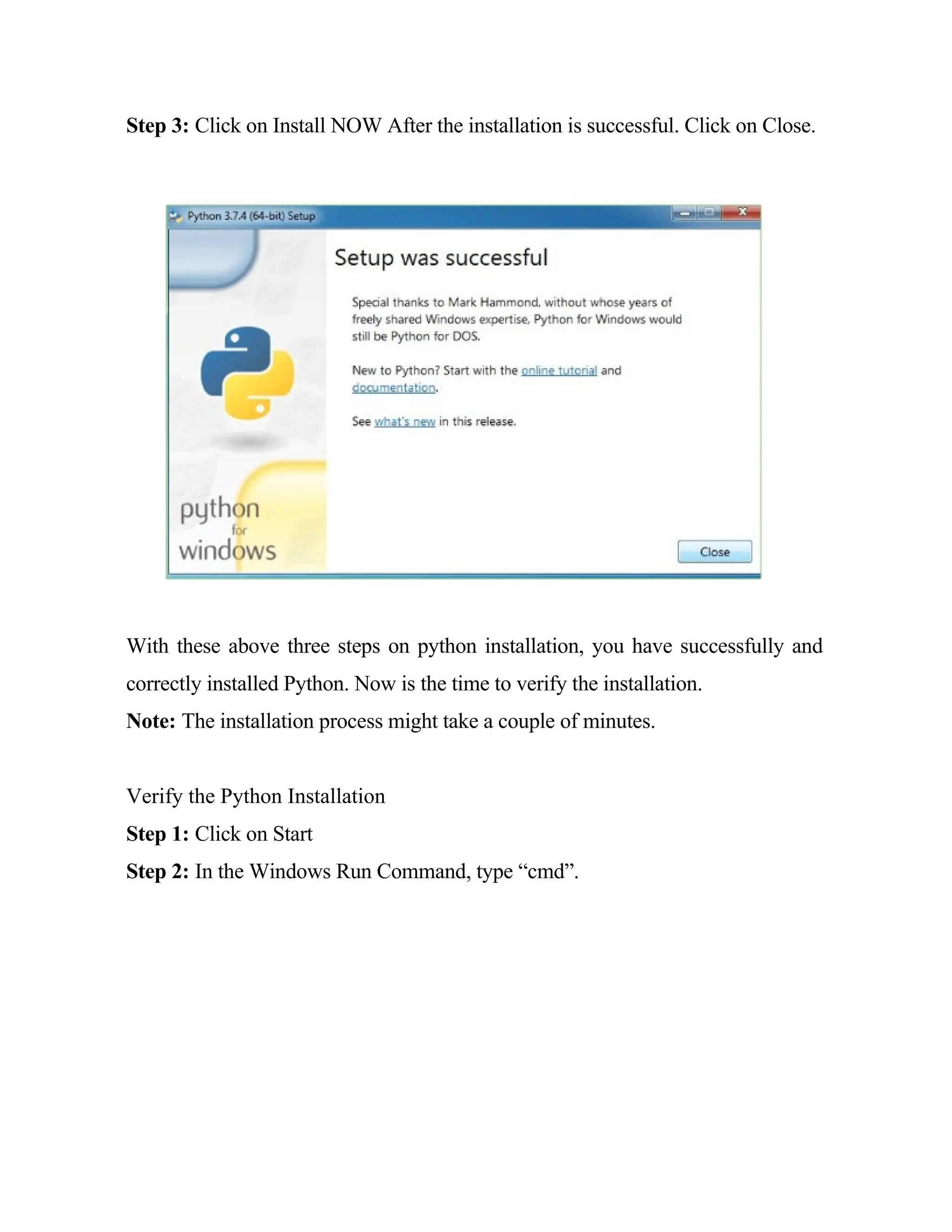
Step 3: Click on Install NOW After the installation is successful. Click on Close.
With these above three steps on python installation, you have successfully and
correctly installed Python. Now is the time to verify the installation.
Note: The installation process might take a couple of minutes.
Verify the Python Installation
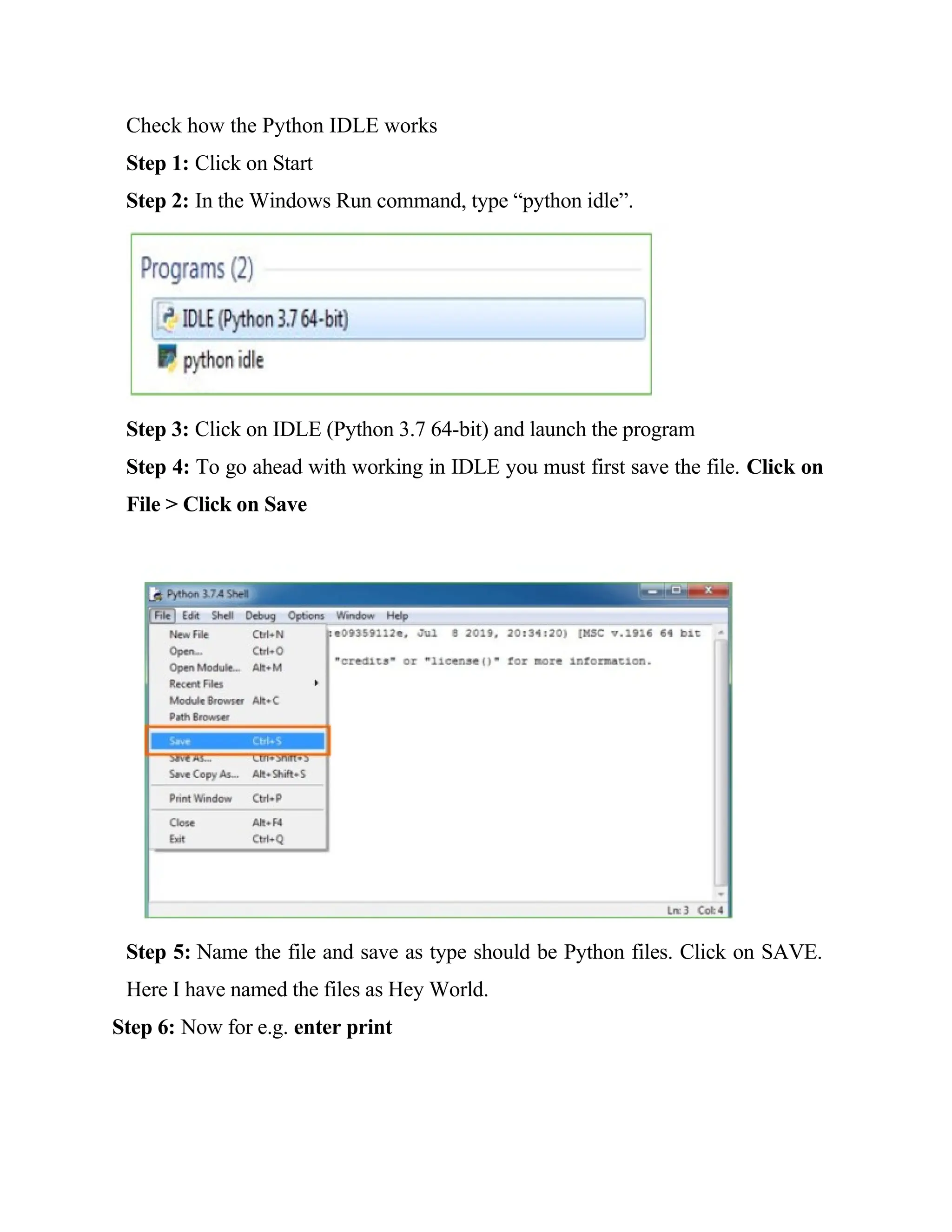
Step 1: Click on Start
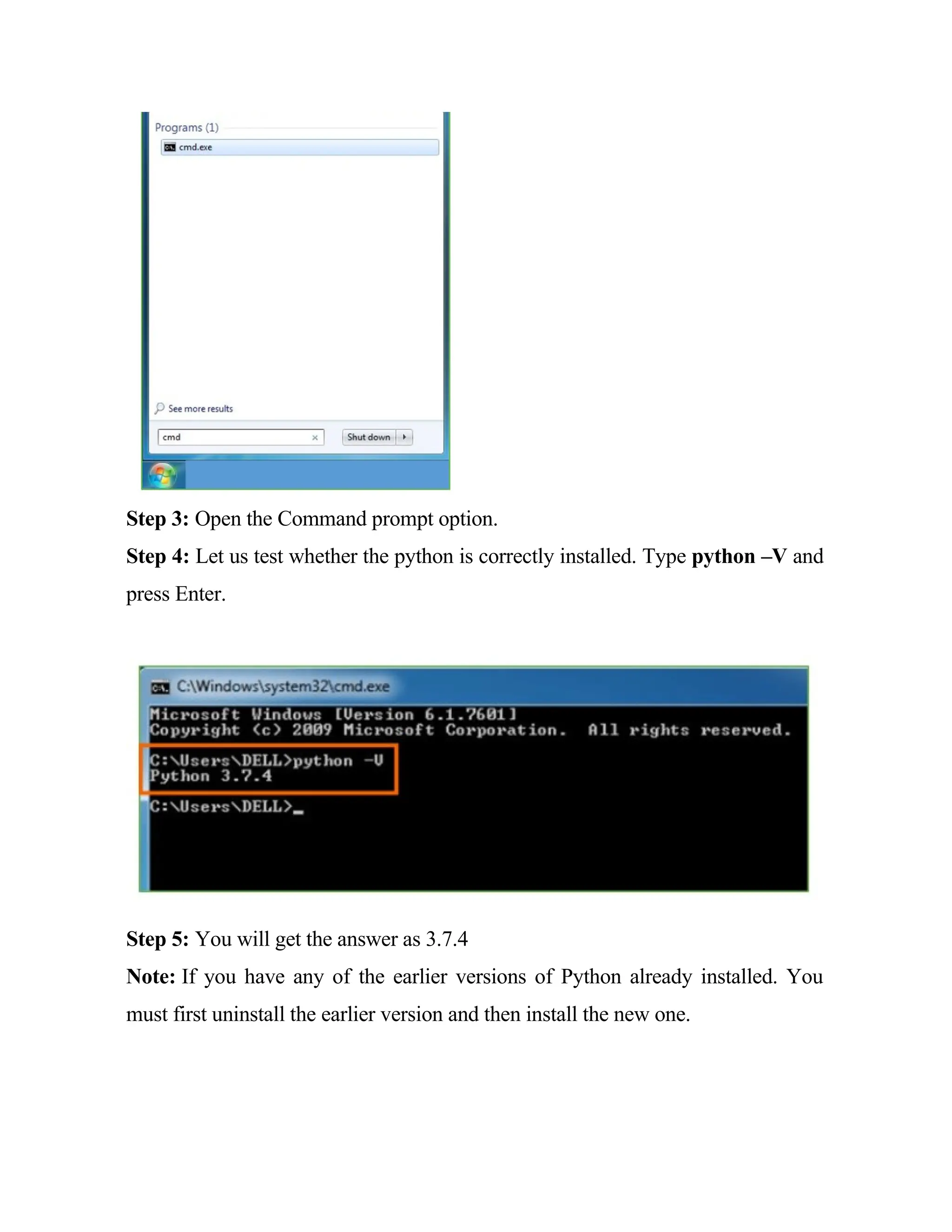
Step 2: In the Windows Run Command, type “cmd”.
Step 3: Open the Command prompt option.
Step 4: Let us test whether the python is correctly installed. Type python –V and
press Enter.
Step 5: You will get the answer as 3.7.4
Note: If you have any of the earlier versions of Python already installed. You
must first uninstall the earlier version and then install the new one.
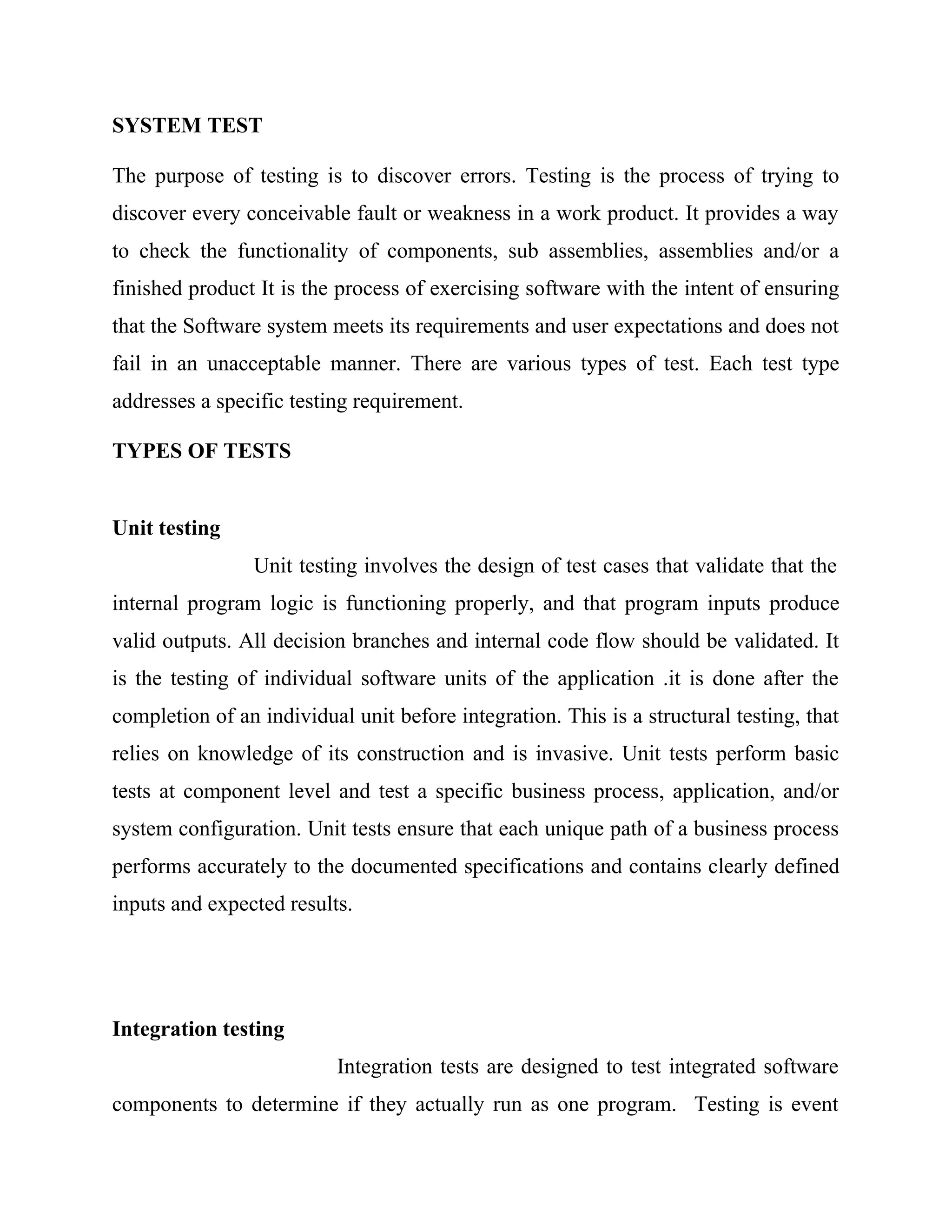
Check how the Python IDLE works
Step 1: Click on Start
Step 2: In the Windows Run command, type “python idle”.
Step 3: Click on IDLE (Python 3.7 64-bit) and launch the program
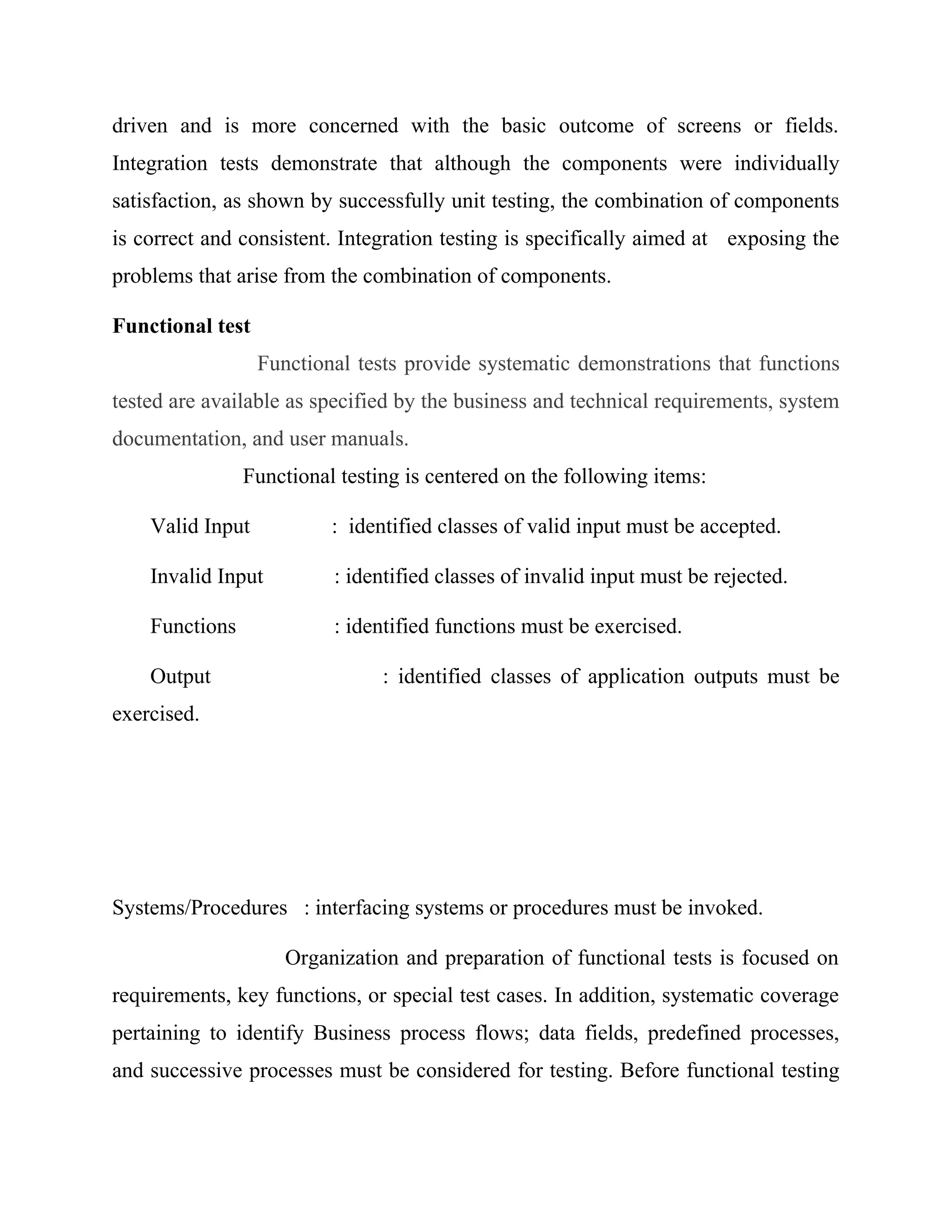
Step 4: To go ahead with working in IDLE you must first save the file. Click on
File > Click on Save
Step 5: Name the file and save as type should be Python files. Click on SAVE.
Here I have named the files as Hey World.
Step 6: Now for e.g. enter print
SYSTEM TEST
The purpose of testing is to discover errors. Testing is the process of trying to
discover every conceivable fault or weakness in a work product. It provides a way
to check the functionality of components, sub assemblies, assemblies and/or a
finished product It is the process of exercising software with the intent of ensuring
that the Software system meets its requirements and user expectations and does not
fail in an unacceptable manner. There are various types of test. Each test type
addresses a specific testing requirement.
TYPES OF TESTS
Unit testing
Unit testing involves the design of test cases that validate that the
internal program logic is functioning properly, and that program inputs produce
valid outputs. All decision branches and internal code flow should be validated. It
is the testing of individual software units of the application .it is done after the
completion of an individual unit before integration. This is a structural testing, that
relies on knowledge of its construction and is invasive. Unit tests perform basic
tests at component level and test a specific business process, application, and/or
system configuration. Unit tests ensure that each unique path of a business process
performs accurately to the documented specifications and contains clearly defined
inputs and expected results.
Integration testing
Integration tests are designed to test integrated software
components to determine if they actually run as one program. Testing is event
driven and is more concerned with the basic outcome of screens or fields.
Integration tests demonstrate that although the components were individually
satisfaction, as shown by successfully unit testing, the combination of components
is correct and consistent. Integration testing is specifically aimed at exposing the
problems that arise from the combination of components.
Functional test
Functional tests provide systematic demonstrations that functions
tested are available as specified by the business and technical requirements, system
documentation, and user manuals.
Functional testing is centered on the following items:
Valid Input : identified classes of valid input must be accepted.
Invalid Input : identified classes of invalid input must be rejected.
Functions : identified functions must be exercised.
Output : identified classes of application outputs must be
exercised.
Systems/Procedures : interfacing systems or procedures must be invoked.
Organization and preparation of functional tests is focused on
requirements, key functions, or special test cases. In addition, systematic coverage
pertaining to identify Business process flows; data fields, predefined processes,
and successive processes must be considered for testing. Before functional testing
is complete, additional tests are identified and the effective value of current tests is
determined.
System Test
System testing ensures that the entire integrated software system
meets requirements. It tests a configuration to ensure known and predictable
results. An example of system testing is the configuration oriented system
integration test. System testing is based on process descriptions and flows,
emphasizing pre-driven process links and integration points.
White Box Testing
White Box Testing is a testing in which in which the software tester
has knowledge of the inner workings, structure and language of the software, or at
least its purpose. It is purpose. It is used to test areas that cannot be reached from a
black box level.
Black Box Testing
Black Box Testing is testing the software without any knowledge
of the inner workings, structure or language of the module being tested. Black box
tests, as most other kinds of tests, must be written from a definitive source
document, such as specification or requirements document, such as specification or
requirements document. It is a testing in which the software under test is treated, as
a black box .you cannot “see” into it. The test provides inputs and responds to
outputs without considering how the software works.
Unit Testing
Unit testing is usually conducted as part of a combined code and
unit test phase of the software lifecycle, although it is not uncommon for coding
and unit testing to be conducted as two distinct phases.
Test strategy and approach
Field testing will be performed manually and functional tests will
be written in detail.
Test objectives
 All field entries must work properly.
 Pages must be activated from the identified link.
 The entry screen, messages and responses must not be delayed.
Features to be tested
 Verify that the entries are of the correct format
 No duplicate entries should be allowed
 All links should take the user to the correct page.
Integration Testing
Software integration testing is the incremental integration testing of
two or more integrated software components on a single platform to produce
failures caused by interface defects.
The task of the integration test is to check that components or software
applications, e.g. components in a software system or – one step up – software
applications at the company level – interact without error.
Test Results: All the test cases mentioned above passed successfully. No defects
encountered.
Acceptance Testing
User Acceptance Testing is a critical phase of any project and requires significant
participation by the end user. It also ensures that the system meets the functional
requirements.
Test Results: All the test cases mentioned above passed successfully. No defects
encountered.
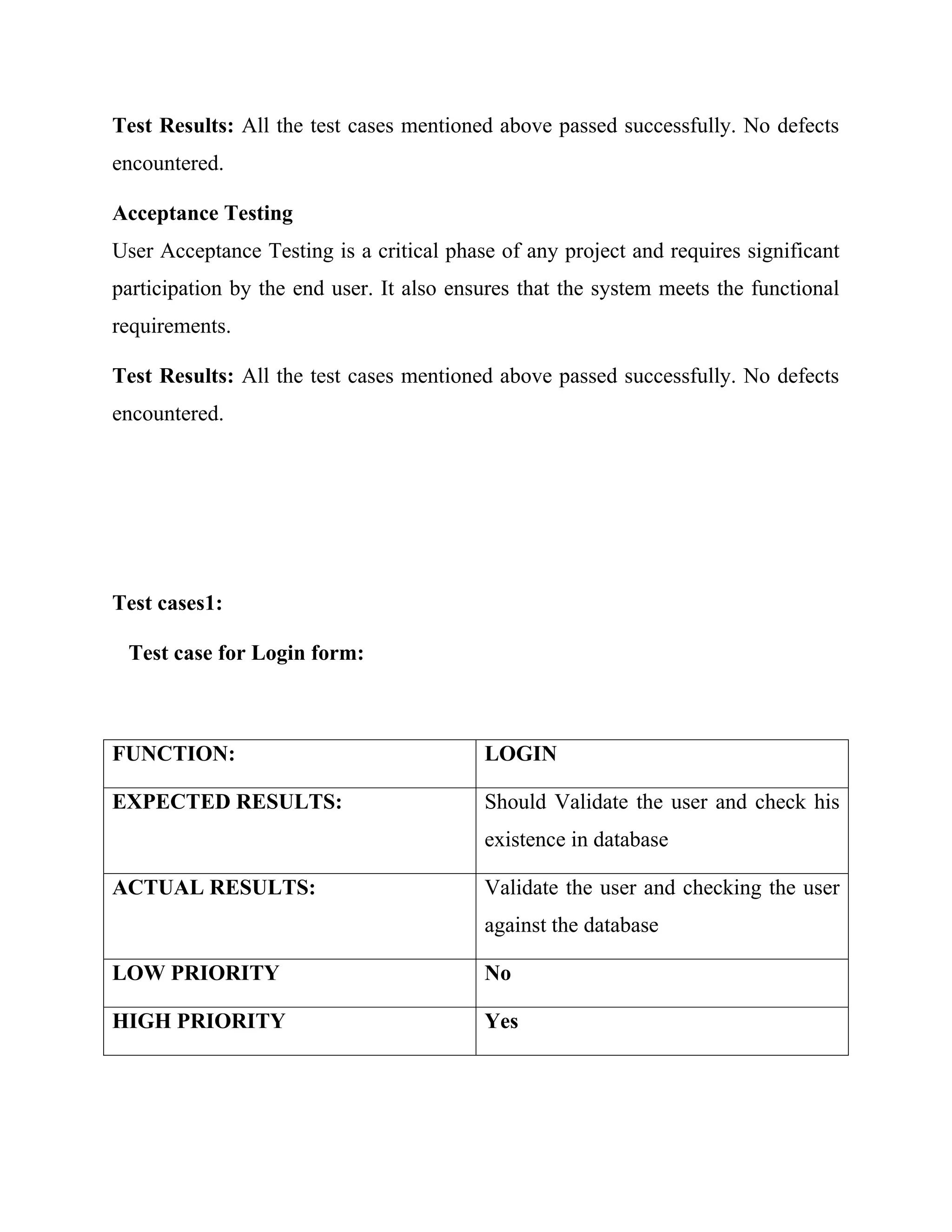
Test cases1:
Test case for Login form:
FUNCTION: LOGIN
EXPECTED RESULTS: Should Validate the user and check his
existence in database
ACTUAL RESULTS: Validate the user and checking the user
against the database
LOW PRIORITY No
HIGH PRIORITY Yes
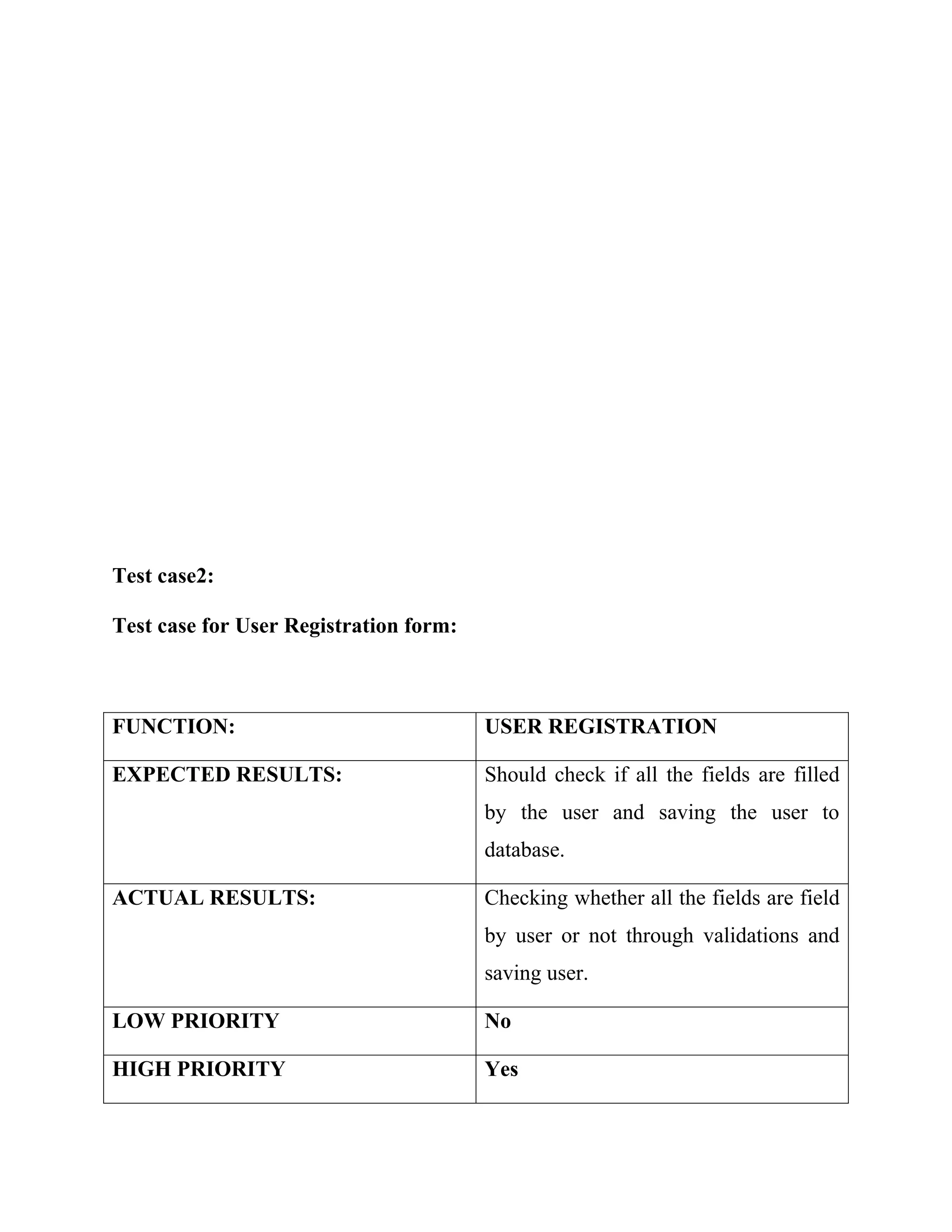
Test case2:
Test case for User Registration form:
FUNCTION: USER REGISTRATION
EXPECTED RESULTS: Should check if all the fields are filled
by the user and saving the user to
database.
ACTUAL RESULTS: Checking whether all the fields are field
by user or not through validations and
saving user.
LOW PRIORITY No
HIGH PRIORITY Yes
Test case3:
Test case for Change Password:
When the old password does not match with the new password ,then this
results in displaying an error message as “ OLD PASSWORD DOES NOT
MATCH WITH THE NEW PASSWORD”.
FUNCTION: Change Password
EXPECTED RESULTS: Should check if old password and new
password fields are filled by the user
and saving the user to database.
ACTUAL RESULTS: Checking whether all the fields are field
by user or not through validations and
saving user.
LOW PRIORITY No
HIGH PRIORITY Yes
SCREEN SHOTS
An Efficient Vote Casting System with Aadhar Verification through Blockchain
Traditional voting system in India often fall prey to bogus voting and to combat
against this bogus voting EVM has been deployed but EVM database can be easily
tamper. In propose paper author employing Blockchain along with IOT cloud
connection to avoid EVM tampering.
Blockchain has inbuilt support for secured (encrypted) and tamper proof data
storage which can be utilize to capture voter fingerprint and then matched with
Aadhar fingerprint cloud database, if user fingerprint authenticated then only EVM
will accept user vote. EVM will utilize IOT network to forward voting count
details to centralized cloud server. IOT network cannot be easily hack so fully
security will be provided to avoid any type of network attack.
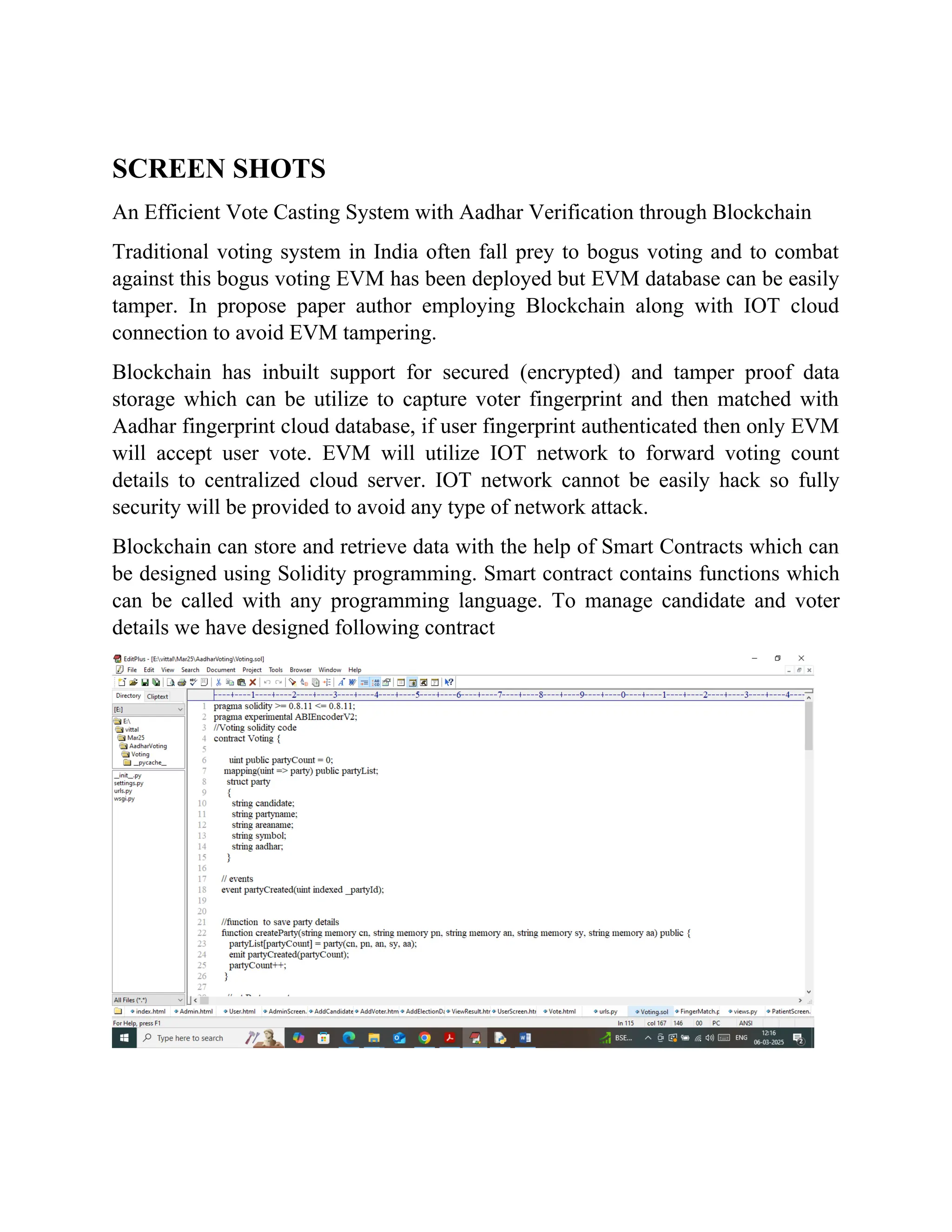
Blockchain can store and retrieve data with the help of Smart Contracts which can
be designed using Solidity programming. Smart contract contains functions which
can be called with any programming language. To manage candidate and voter
details we have designed following contract
In above smart contract code we have defined required functions to manage
candidate, voter and verification or tally functions. Now we need to deploy above
contract to Blockchain Ethereum using below steps
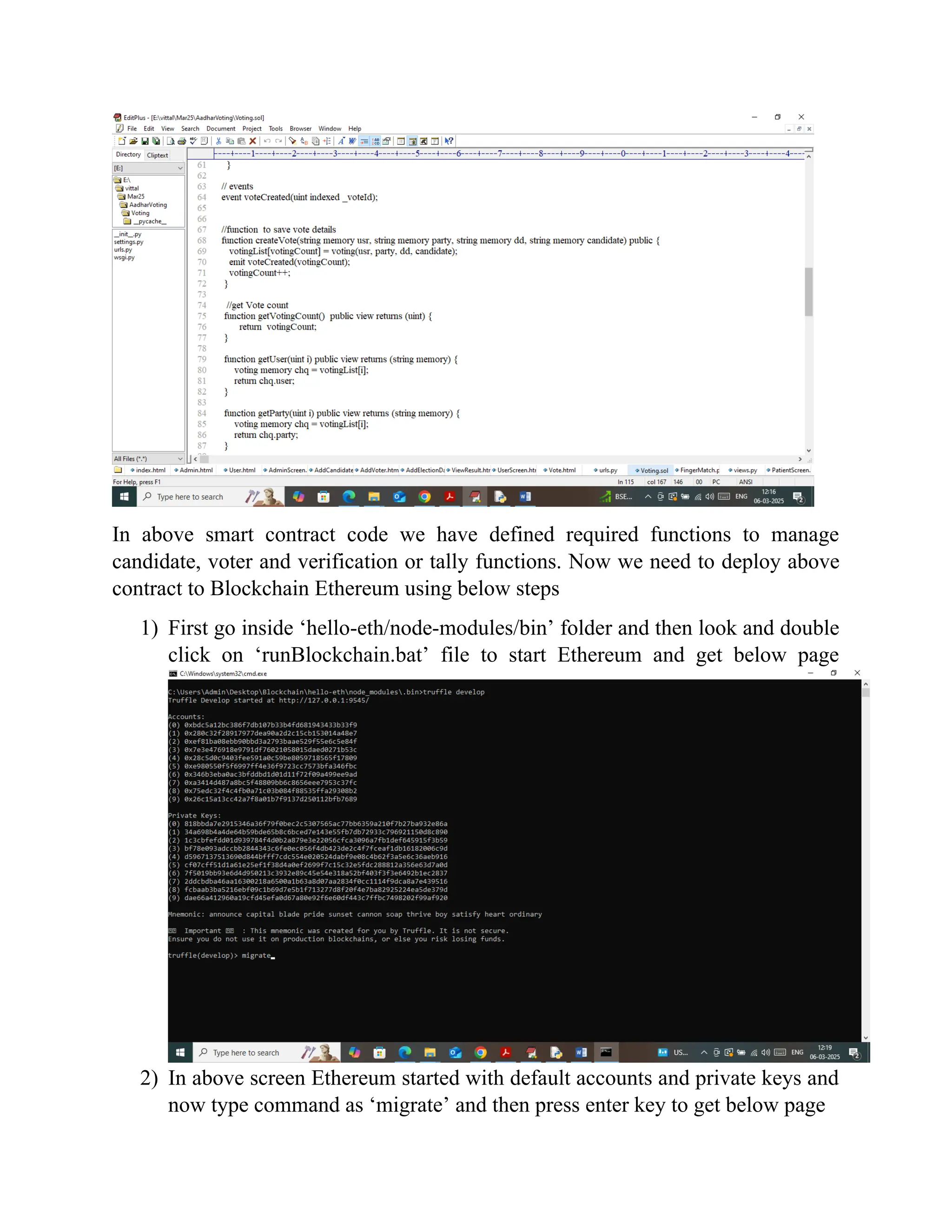
1) First go inside ‘hello-eth/node-modules/bin’ folder and then look and double
click on ‘runBlockchain.bat’ file to start Ethereum and get below page
2) In above screen Ethereum started with default accounts and private keys and
now type command as ‘migrate’ and then press enter key to get below page
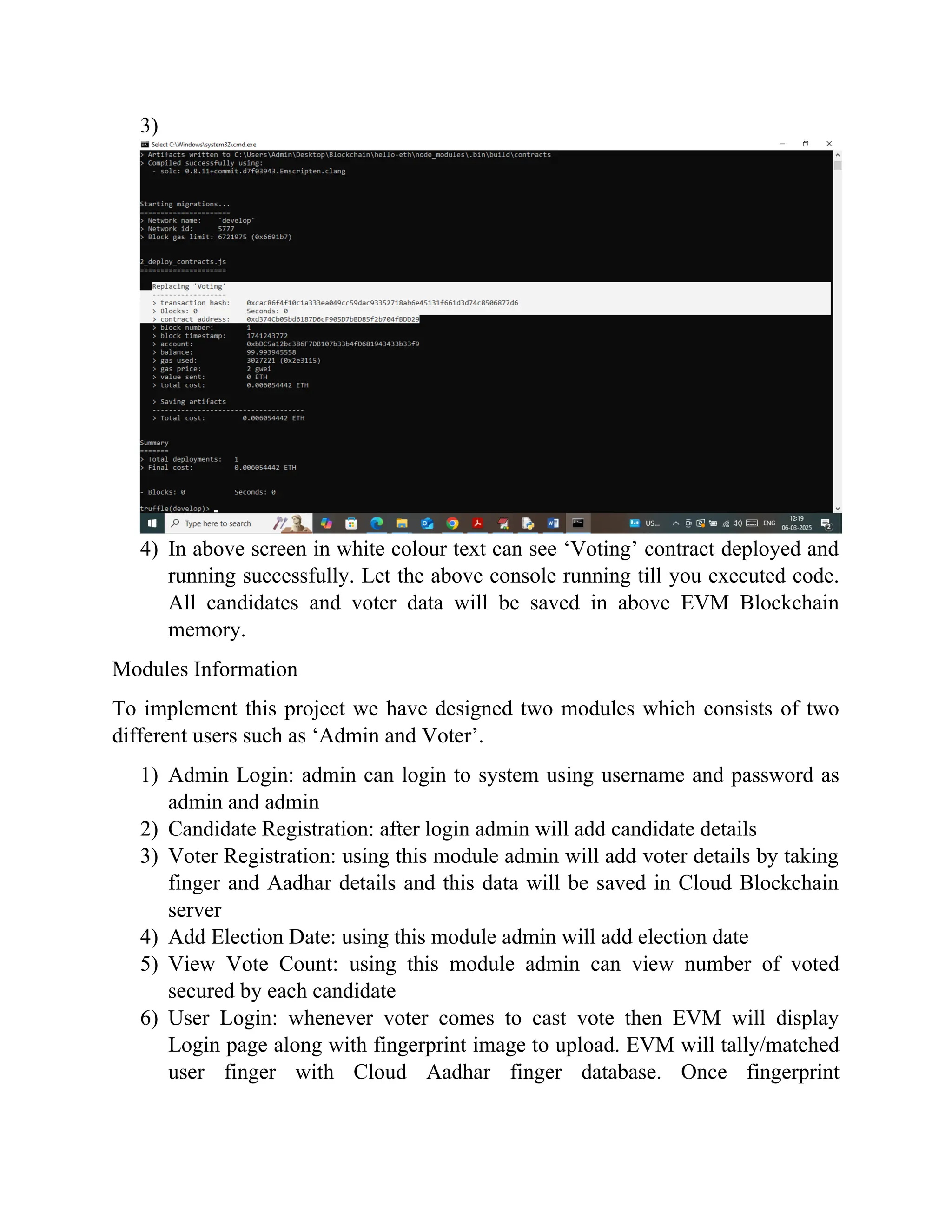
3)
4) In above screen in white colour text can see ‘Voting’ contract deployed and
running successfully. Let the above console running till you executed code.
All candidates and voter data will be saved in above EVM Blockchain
memory.
Modules Information
To implement this project we have designed two modules which consists of two
different users such as ‘Admin and Voter’.
1) Admin Login: admin can login to system using username and password as
admin and admin
2) Candidate Registration: after login admin will add candidate details
3) Voter Registration: using this module admin will add voter details by taking
finger and Aadhar details and this data will be saved in Cloud Blockchain
server
4) Add Election Date: using this module admin will add election date
5) View Vote Count: using this module admin can view number of voted
secured by each candidate
6) User Login: whenever voter comes to cast vote then EVM will display
Login page along with fingerprint image to upload. EVM will tally/matched
user finger with Cloud Aadhar finger database. Once fingerprint
authenticated EVM will forward user to cast vote. Each user allowed to cast
vote only one time
7) View Result: voter can view number of votes secured by each candidate
8) Latency Graph: using this module will plot Blockchain Latency graph which
take time to verify voters.
SCREEN SHOTS
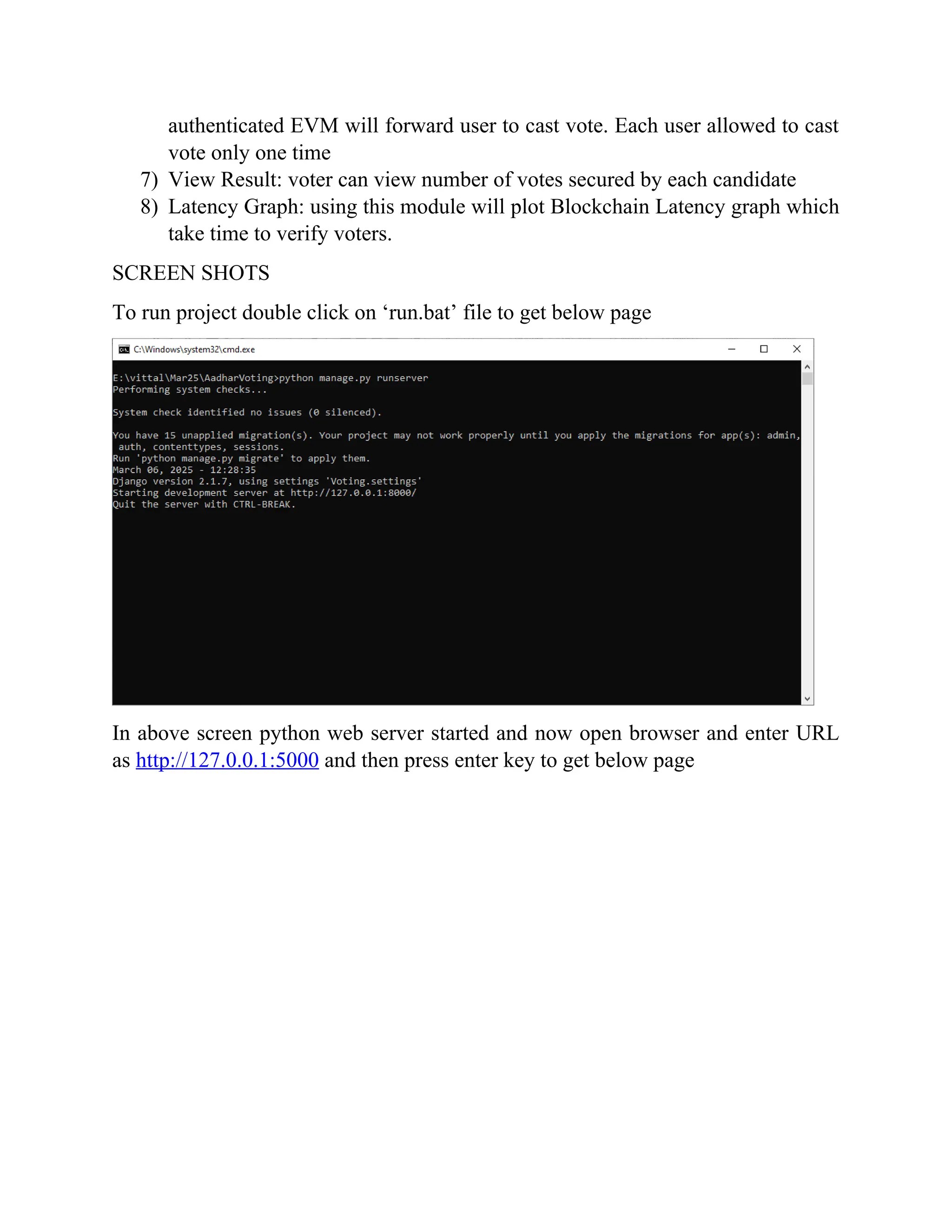
To run project double click on ‘run.bat’ file to get below page
In above screen python web server started and now open browser and enter URL
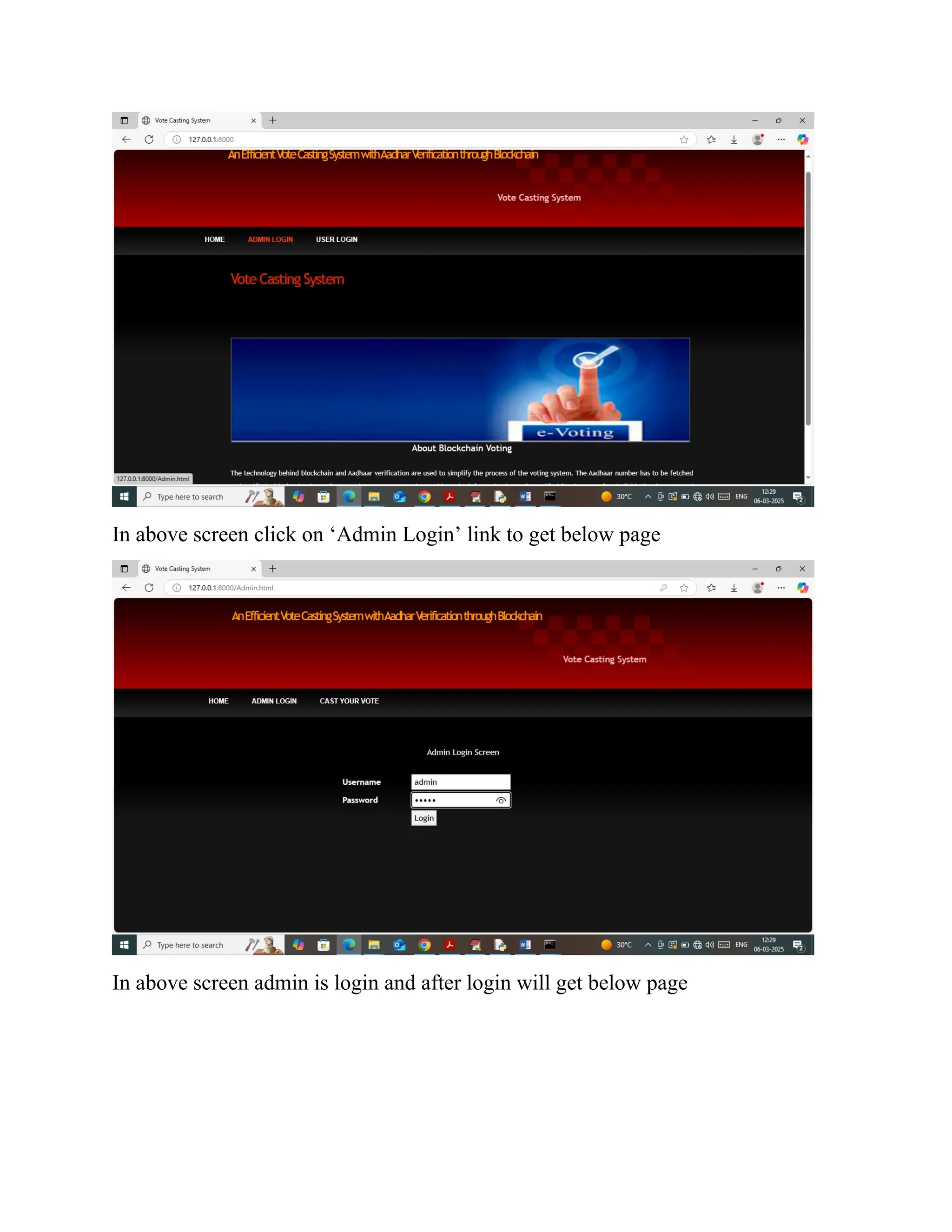
as http://127.0.0.1:5000 and then press enter key to get below page
In above screen click on ‘Admin Login’ link to get below page
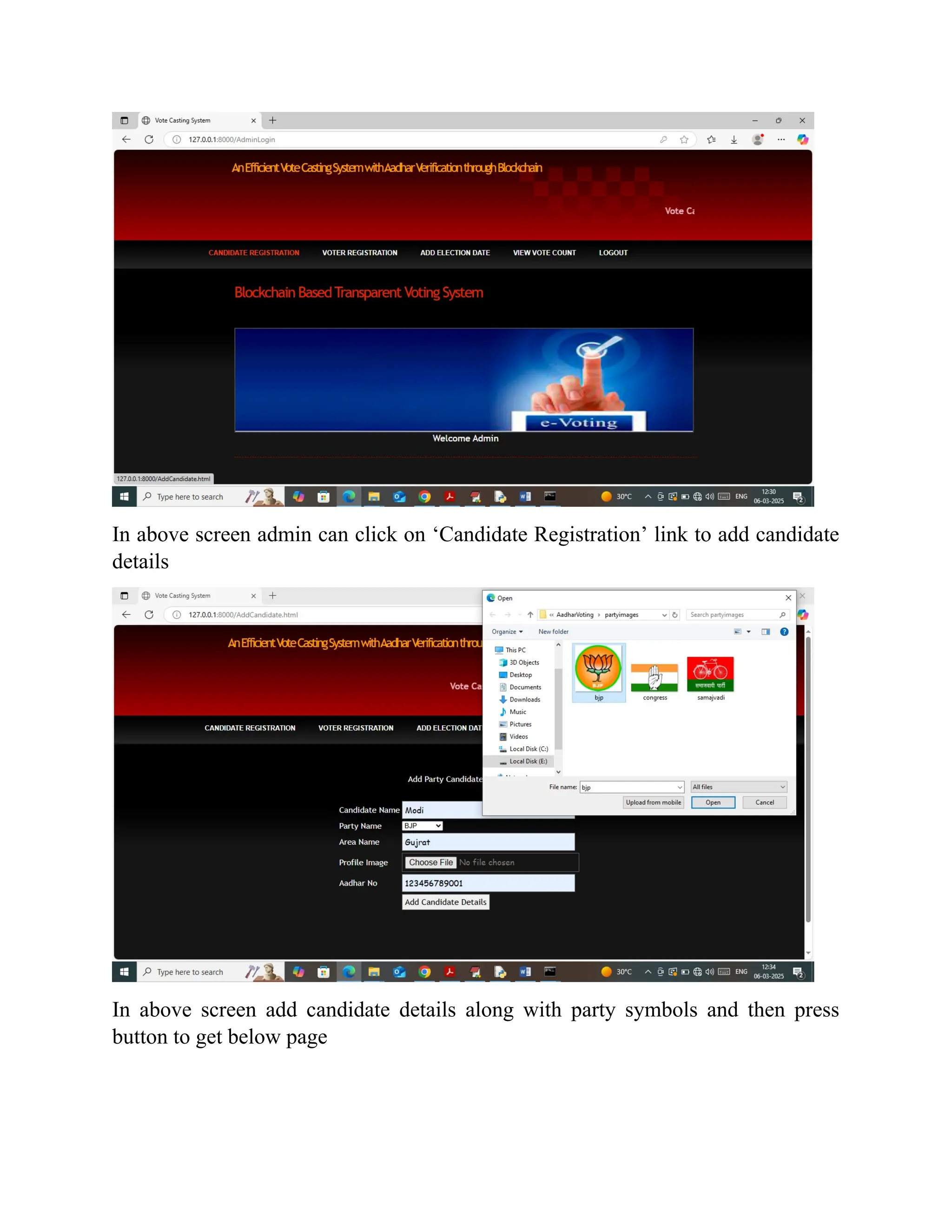
In above screen admin is login and after login will get below page
In above screen admin can click on ‘Candidate Registration’ link to add candidate
details
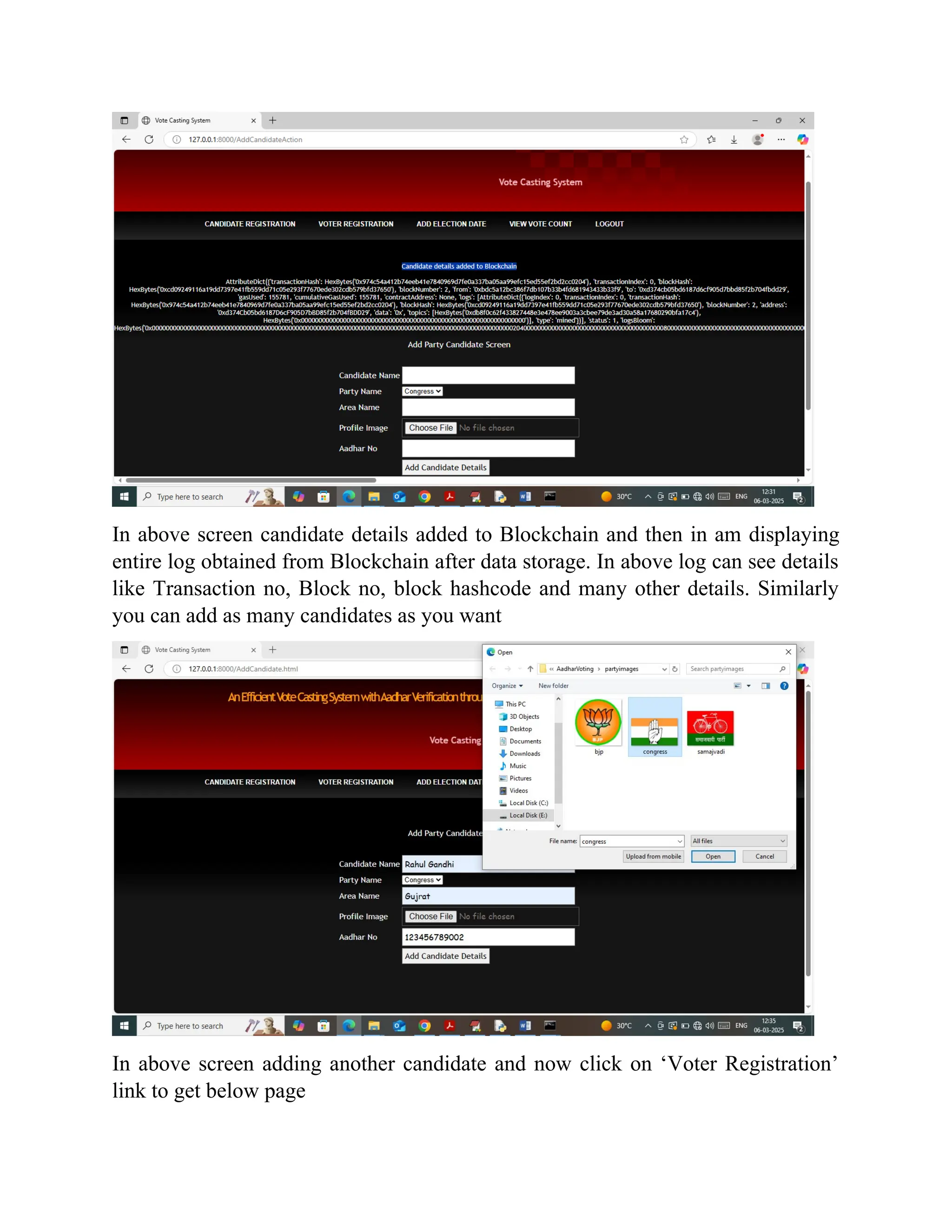
In above screen add candidate details along with party symbols and then press
button to get below page
In above screen candidate details added to Blockchain and then in am displaying
entire log obtained from Blockchain after data storage. In above log can see details
like Transaction no, Block no, block hashcode and many other details. Similarly
you can add as many candidates as you want
In above screen adding another candidate and now click on ‘Voter Registration’
link to get below page
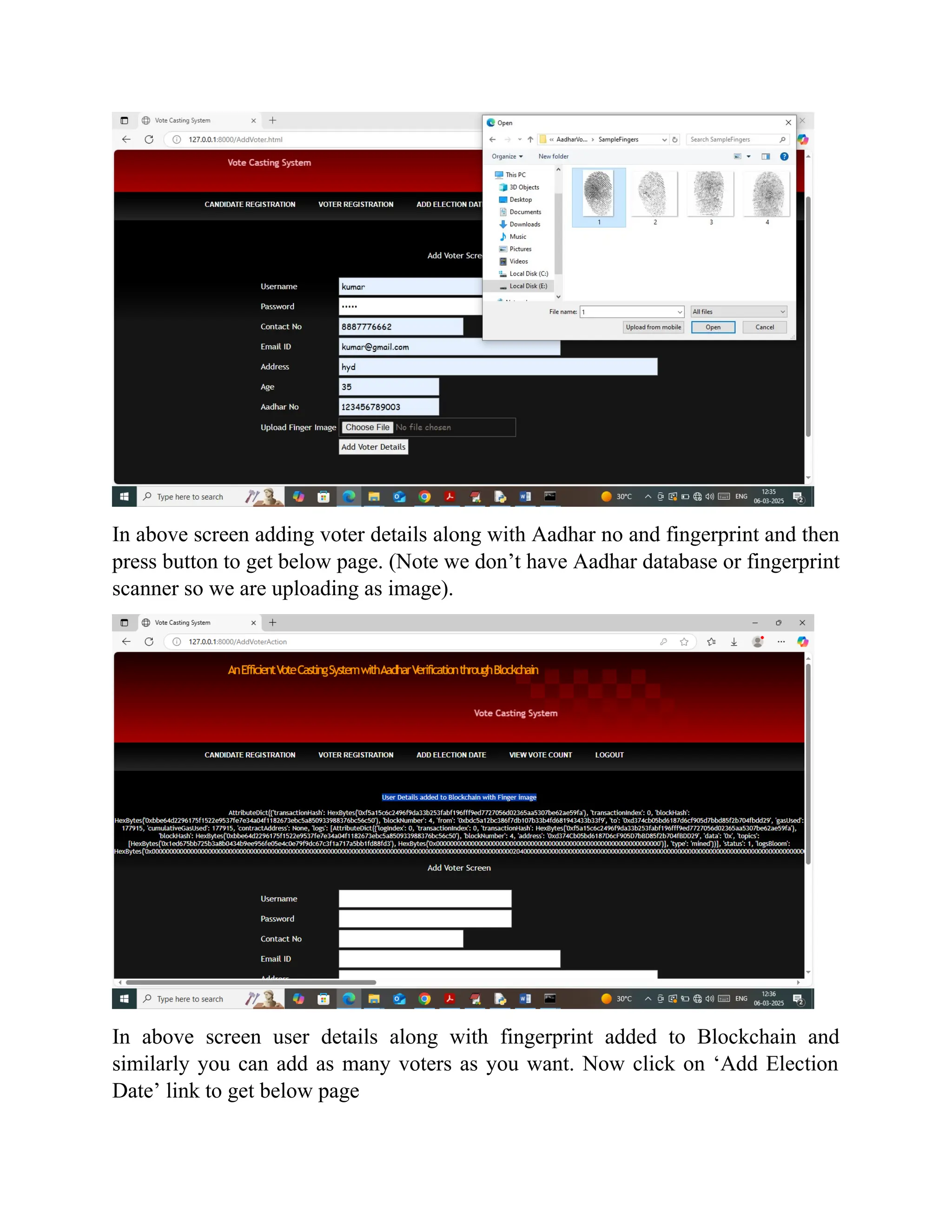
In above screen adding voter details along with Aadhar no and fingerprint and then
press button to get below page. (Note we don’t have Aadhar database or fingerprint
scanner so we are uploading as image).
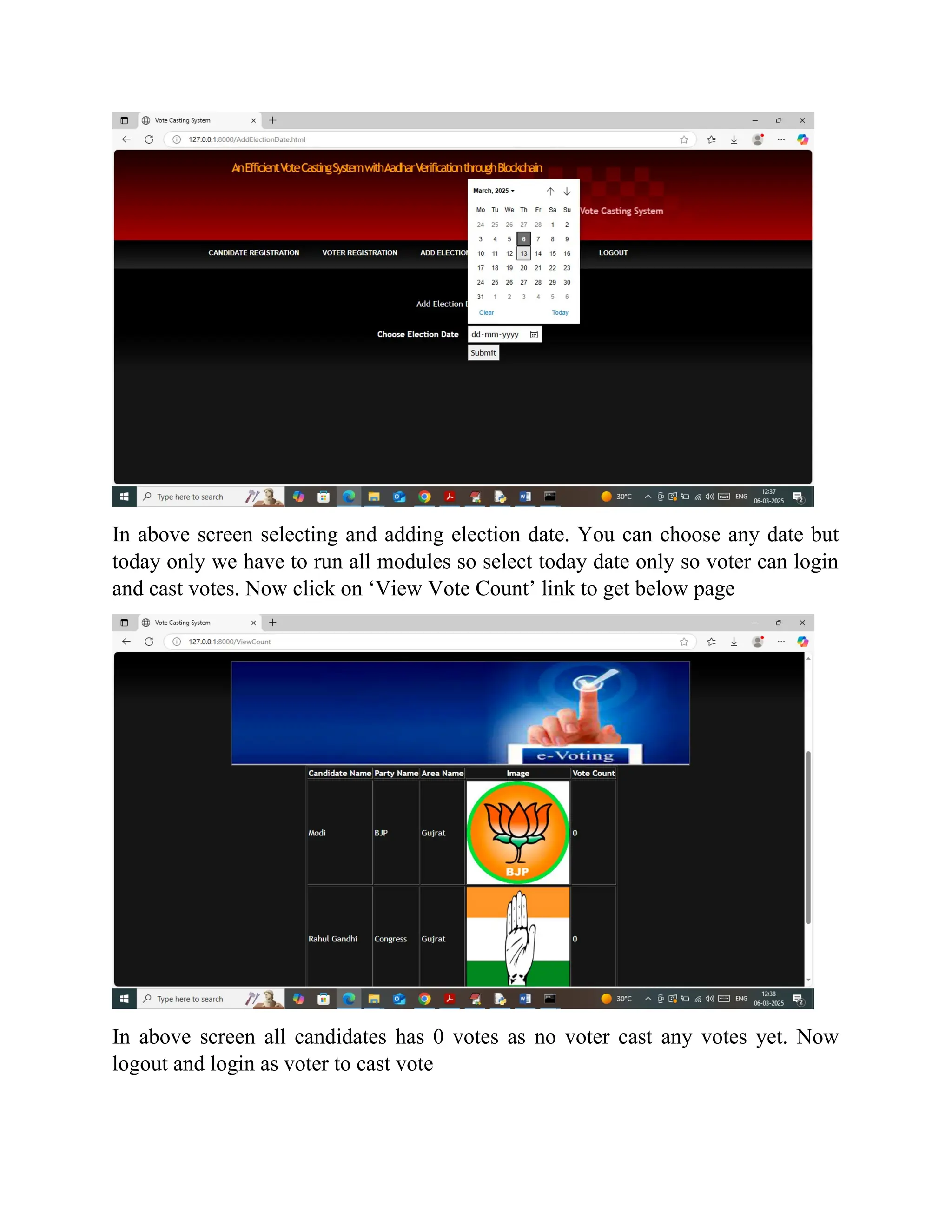
In above screen user details along with fingerprint added to Blockchain and
similarly you can add as many voters as you want. Now click on ‘Add Election
Date’ link to get below page
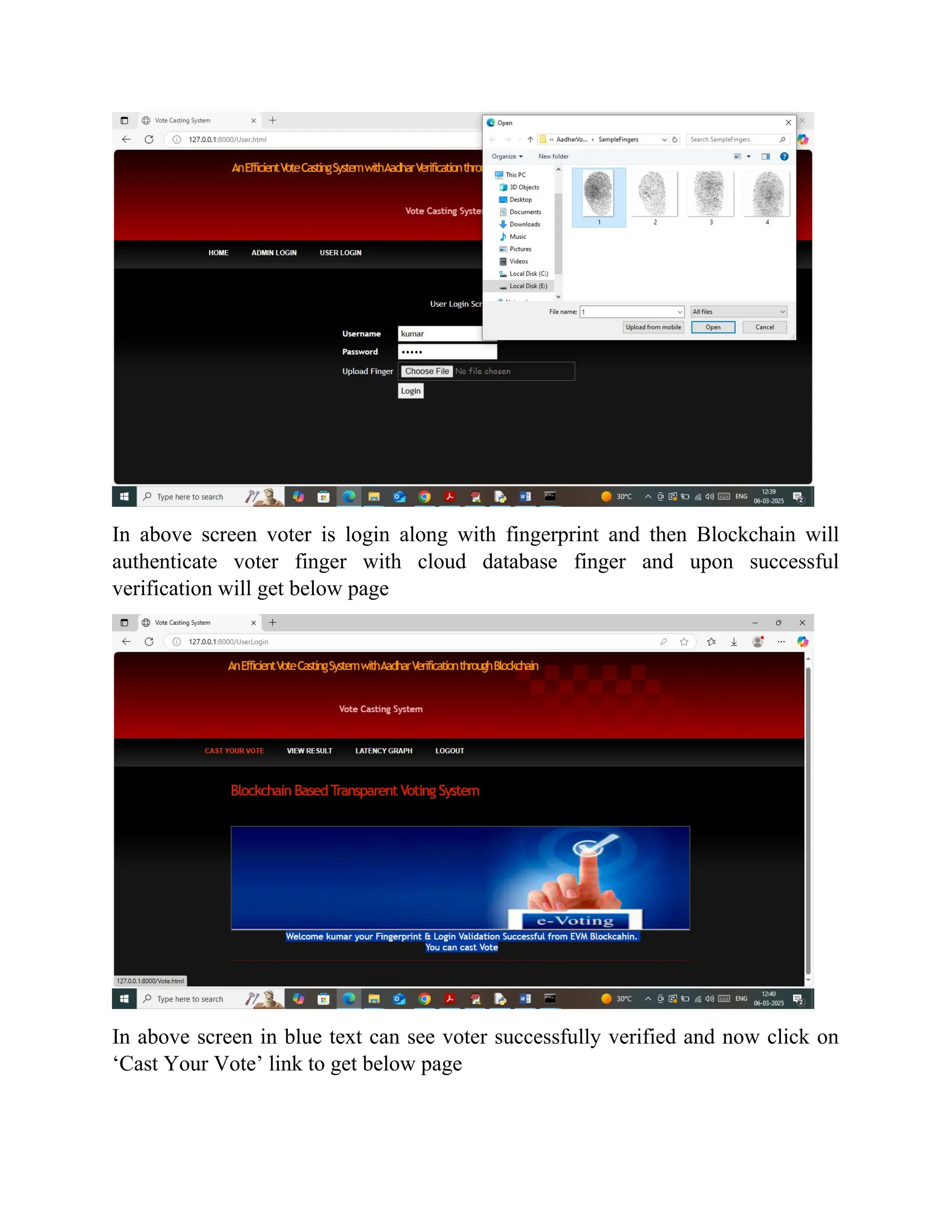
In above screen selecting and adding election date. You can choose any date but
today only we have to run all modules so select today date only so voter can login
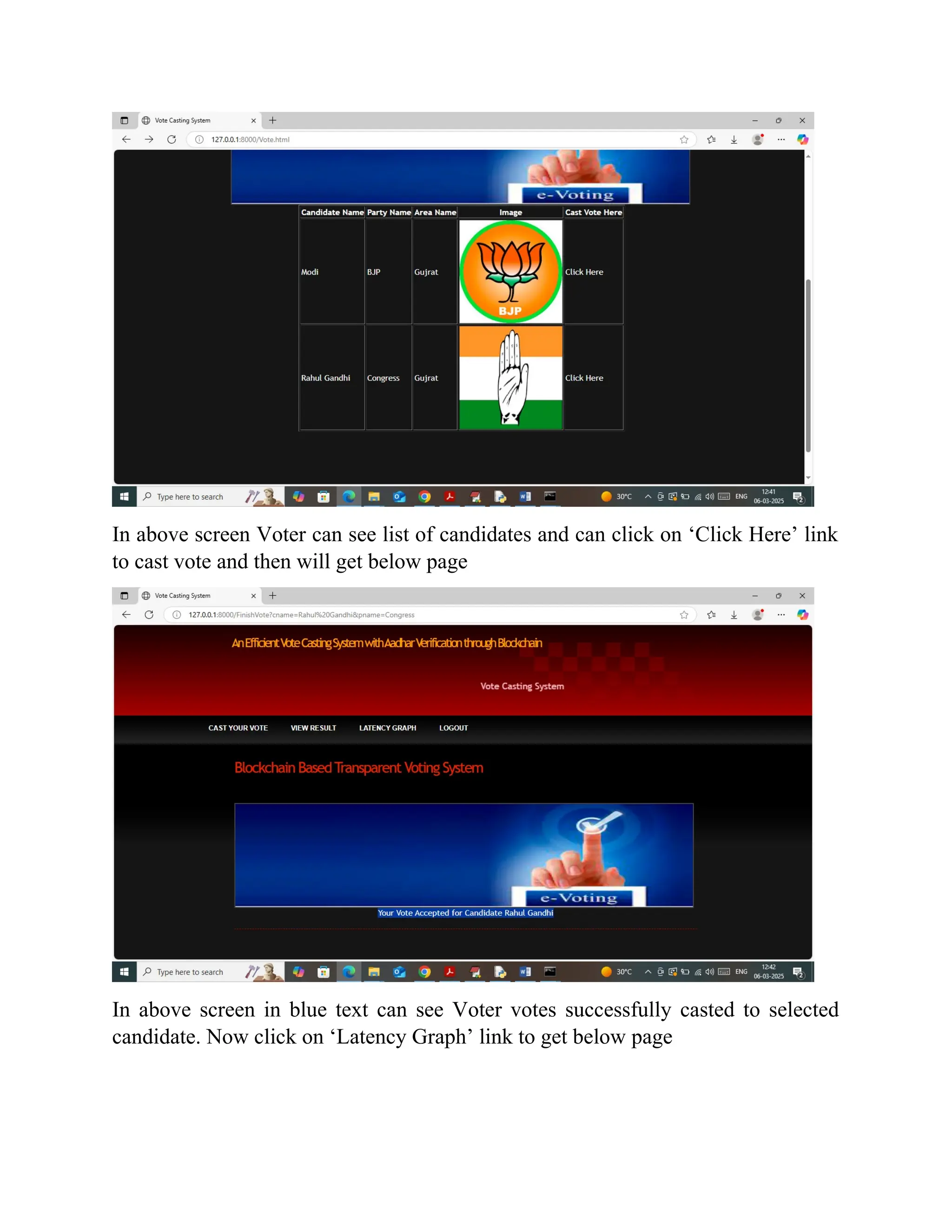
and cast votes. Now click on ‘View Vote Count’ link to get below page
In above screen all candidates has 0 votes as no voter cast any votes yet. Now
logout and login as voter to cast vote
In above screen voter is login along with fingerprint and then Blockchain will
authenticate voter finger with cloud database finger and upon successful
verification will get below page
In above screen in blue text can see voter successfully verified and now click on
‘Cast Your Vote’ link to get below page
In above screen Voter can see list of candidates and can click on ‘Click Here’ link
to cast vote and then will get below page
In above screen in blue text can see Voter votes successfully casted to selected
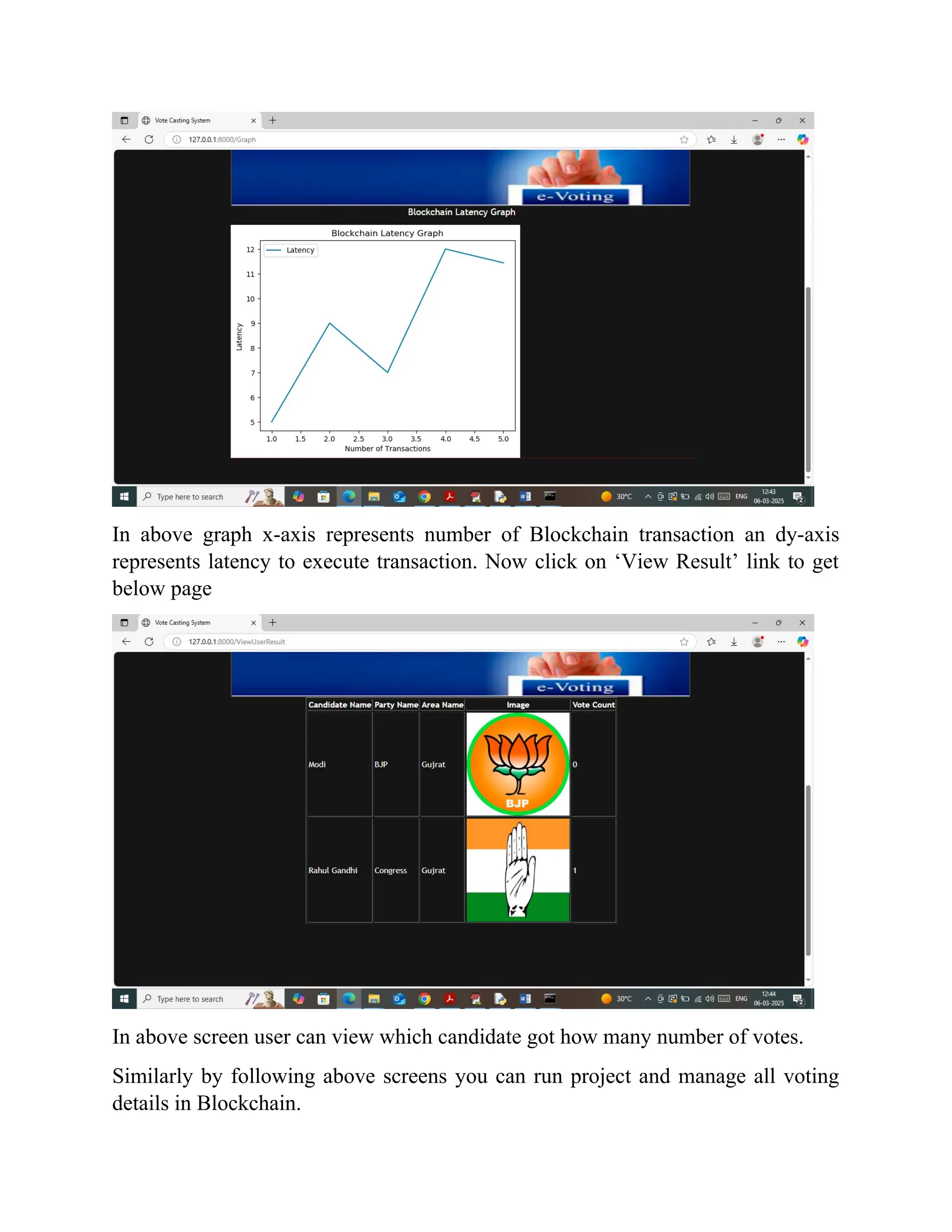
candidate. Now click on ‘Latency Graph’ link to get below page
In above graph x-axis represents number of Blockchain transaction an dy-axis
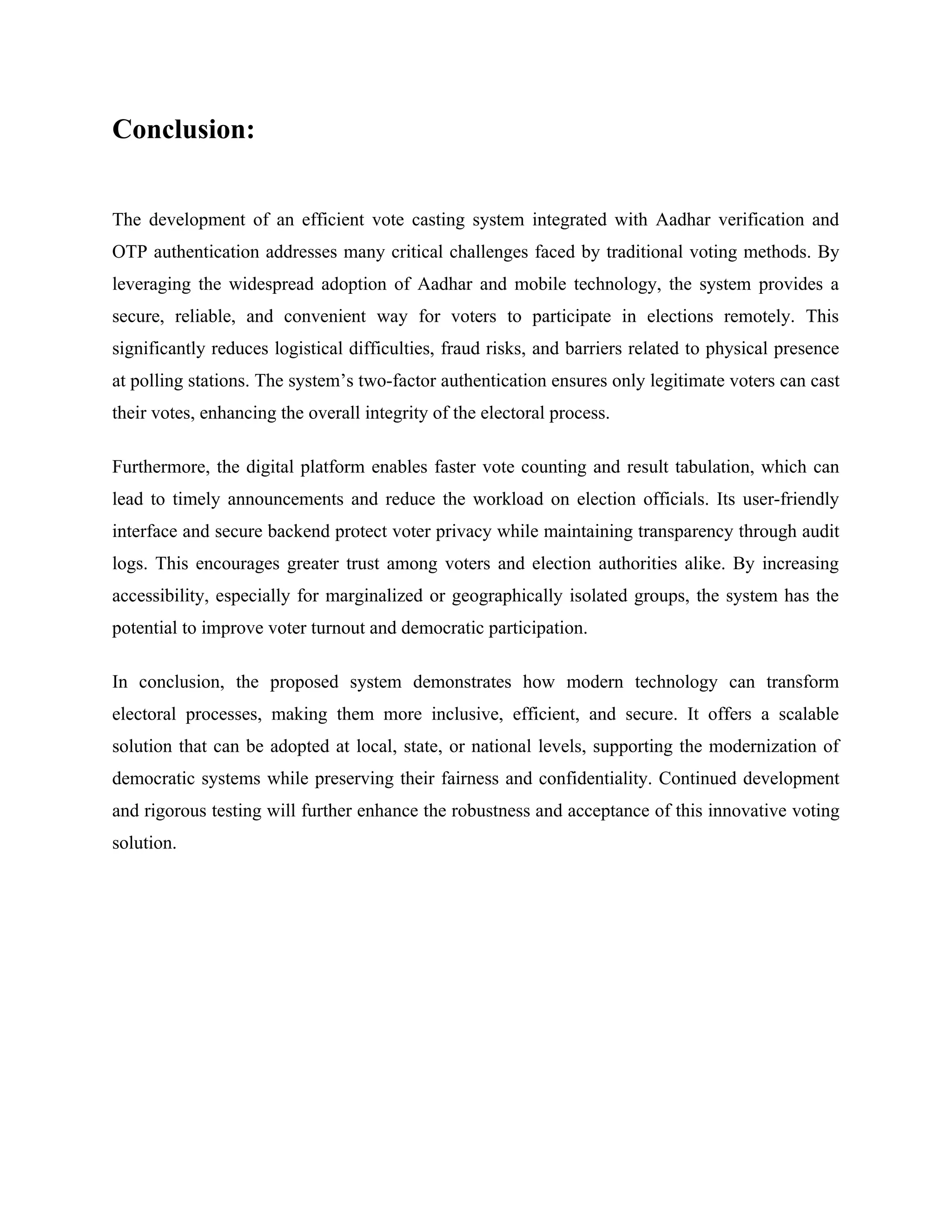
represents latency to execute transaction. Now click on ‘View Result’ link to get
below page
In above screen user can view which candidate got how many number of votes.
Similarly by following above screens you can run project and manage all voting
details in Blockchain.
Conclusion:
The development of an efficient vote casting system integrated with Aadhar verification and
OTP authentication addresses many critical challenges faced by traditional voting methods. By
leveraging the widespread adoption of Aadhar and mobile technology, the system provides a
secure, reliable, and convenient way for voters to participate in elections remotely. This
significantly reduces logistical difficulties, fraud risks, and barriers related to physical presence
at polling stations. The system’s two-factor authentication ensures only legitimate voters can cast
their votes, enhancing the overall integrity of the electoral process.
Furthermore, the digital platform enables faster vote counting and result tabulation, which can
lead to timely announcements and reduce the workload on election officials. Its user-friendly
interface and secure backend protect voter privacy while maintaining transparency through audit
logs. This encourages greater trust among voters and election authorities alike. By increasing
accessibility, especially for marginalized or geographically isolated groups, the system has the
potential to improve voter turnout and democratic participation.
In conclusion, the proposed system demonstrates how modern technology can transform
electoral processes, making them more inclusive, efficient, and secure. It offers a scalable
solution that can be adopted at local, state, or national levels, supporting the modernization of
democratic systems while preserving their fairness and confidentiality. Continued development
and rigorous testing will further enhance the robustness and acceptance of this innovative voting
solution.
Future Work:
The proposed voting system lays a solid foundation for secure and efficient digital elections, but
there are several avenues for future enhancements to make it even more robust and user-friendly.
One potential area of improvement is the integration of biometric verification methods such as
fingerprint or facial recognition alongside OTP authentication. This multi-factor authentication
can add an extra layer of security, further reducing the chances of identity theft or unauthorized
access.
Another important aspect for future work is the incorporation of blockchain technology to store
votes in a decentralized, immutable ledger. Blockchain can guarantee transparency and tamper-
proof record-keeping, which would greatly enhance trust in the election results. Additionally,
smart contracts could automate various election processes such as vote tallying and result
publishing, reducing human intervention and errors.
Expanding accessibility features is also vital for inclusive elections. The system can be enhanced
with multi-language support, voice-assisted navigation, and simplified interfaces for differently-
abled users. Mobile applications can be developed to facilitate easier access and engagement,
especially in rural and remote areas where internet connectivity and digital literacy might be
limited.
Moreover, continuous security audits and penetration testing will be necessary to keep the
system resilient against evolving cyber threats. Future iterations could also explore AI-based
fraud detection mechanisms to identify suspicious patterns in voting behavior. Finally, pilot
testing in smaller elections or community polls can provide valuable feedback and help fine-tune
the system before large-scale deployment.
References
1. Sharma, R., & Singh, P. (2021). Secure Online Voting System using OTP and Aadhaar
Verification. International Journal of Computer Applications, 175(9), 30-36.
2. Patel, K., & Joshi, A. (2020). Blockchain-Based Electronic Voting System: A Review.
Journal of Network and Computer Applications, 150, 102-115.
3. Gupta, S., & Verma, N. (2019). Authentication Techniques for E-Voting Systems.
Proceedings of the International Conference on Cyber Security, 45-50.
4. Kumar, V., & Sharma, M. (2018). An Efficient Aadhaar Based Voting System with OTP
Verification. International Journal of Advanced Research in Computer Science, 9(3),
120-126.
5. Election Commission of India. (2022). Guidelines on Electronic Voting Machines and
Security Measures. Retrieved from https://eci.gov.in
6. Singh, A., & Kaur, J. (2020). Design and Implementation of a Secure E-Voting System.
IEEE International Conference on Computing and Communication Technologies, 89-94.
7. Reddy, M., & Rao, P. (2017). Role of Aadhaar in Securing Electronic Voting Systems.
Journal of Information Security, 8(4), 175-182.
8. National Institute of Standards and Technology (NIST). (2021). Digital Identity
Guidelines. NIST Special Publication 800-63.
AN EFFICIENT VOTE CASTING SYSTEM WITH AADHAR VERIFICATION THROUGH.docx

  • 1.
    AN EFFICIENT VOTECASTING SYSTEM WITH AADHAR VERIFICATION THROUGH BLOCKCHAIN Abstract: The traditional voting systems in India often face critical challenges such as bogus voting, tampering of Electronic Voting Machines (EVMs), and unauthorized voter impersonation. To address these issues, this project proposes an Efficient Vote Casting System integrated with Aadhar-based biometric verification and Blockchain technology. The system ensures secure, transparent, and tamper-proof voting by leveraging the decentralized and immutable nature of blockchain.In this system, voters authenticate their identity through fingerprint verification, which is matched with the Aadhar fingerprint database stored on a secure cloud server. Only upon successful authentication is the voter allowed to cast their vote, ensuring that each eligible voter votes only once. The voting process is managed through smart contracts developed using Solidity and deployed on the Ethereum blockchain, which stores candidate and voter data securely.The system also uses an IoT-enabled EVM to forward voting data to a centralized cloud server in real-time, protecting it from network-level attacks. The blockchain ensures that every vote cast is recorded as a transaction, making the process transparent and verifiable. Additionally, a latency graph is generated to analyze blockchain transaction processing time, ensuring performance efficiency.This blockchain-based voting system not only prevents tampering and double voting but also enhances trust, transparency, and accountability in the electoral process by eliminating the need for third-party verification. Introduction: In a democratic country like India, voting is the most fundamental right of every citizen. It is a process that determines the governance and future direction of the nation. However, traditional voting systems in India still rely heavily on manual procedures, which are not only time-
  • 2.
    consuming but alsoprone to several challenges such as impersonation, fake voting, logistical complications, and low turnout due to physical limitations. As technology continues to evolve, there is an increasing need to modernize the electoral process in a way that ensures both accessibility and security. To address these challenges, integrating digital identity verification mechanisms into the voting process offers a promising solution. Aadhar, India's unique biometric identification system, provides a robust framework for verifying voter identity. By combining Aadhar verification with OTP-based authentication, voters can be verified remotely in real time using a secure and familiar method. OTP (One-Time Password) sent to the registered mobile number associated with the Aadhar ID serves as an additional layer of security, preventing impersonation and unauthorized access. This digital approach not only strengthens authentication but also eliminates the need for physical presence at polling booths. The proposed system leverages this approach to enable online vote casting, creating a secure, accessible, and transparent voting environment. The platform ensures end-to-end encryption of votes, secure user sessions, and audit trails for accountability. With increased digital penetration and mobile connectivity, especially in rural and semi-urban areas, such a system can empower more citizens to participate in elections. Ultimately, this technology-driven model aims to increase voter turnout, eliminate fraudulent practices, and build trust in the integrity of democratic processes. Literature Survey:
  • 3.
    1. Title: E-VotingSystem Using Aadhar Card and Biometric Verification Author: Dr. S. Kumar, R. Patel Description: This paper proposes an electronic voting system that incorporates biometric verification linked to Aadhar to ensure voter authenticity. The system minimizes fraud and illegal voting by validating the identity of users through fingerprint recognition before vote casting. However, it relies on biometric devices, which may limit accessibility in remote or under-equipped areas. 2. Title: Secure OTP Based Voting System Author: A. Mishra, N. Jain Description: The authors introduce a voting mechanism where a voter receives an OTP on their registered mobile number after entering a voter ID. This OTP is used to confirm the voter's identity. Though it improves security and avoids impersonation, the system lacks a national ID linkage like Aadhar, which could further enhance trust and identity assurance. 3. Title: Online Voting System Using Aadhar Authentication Author: Priya Sharma, Ankit Raj Description: The paper explores integrating the Aadhar database with an online voting system to validate voter credentials. It describes how such a system can authenticate users using demographic data and avoid multiple voting. The study highlights the benefits of national identity linkage but does not implement OTP verification, leaving room for improvement in access control. 4. Title: Blockchain-Based Voting System with Secure Voter Authentication Author: M. Reddy, K. Thomas Description: This work outlines a secure e-voting architecture using blockchain technology to store votes and Aadhar-based login mechanisms for voter verification. While highly secure and immutable, the blockchain infrastructure is complex and may not be suitable for areas with limited digital infrastructure. 5. Title: Aadhar-Based Secure Authentication in Digital Platforms Author: Neha Verma, Kunal Tiwari Description: This paper investigates how Aadhar-based authentication using OTP and biometrics can be applied in various digital services, including voting systems. The
  • 4.
    authors conclude thatOTP verification is a practical and scalable method for ensuring the identity of users in a secure and user-friendly manner. Existing System: The current voting system in India largely relies on Electronic Voting Machines (EVMs) and manual verification processes, which are vulnerable to several security threats. One major issue is bogus or proxy voting, where individuals vote multiple times or impersonate others. Although EVMs are designed to be secure, their internal data can potentially be tampered with or manipulated, especially in the absence of transparent audit trails. The lack of robust voter authentication, such as biometric verification, further increases the risk of fraudulent voting. Moreover, since the EVM data is stored in centralized databases, any breach in the central system can compromise the entire election process. These limitations call for a more secure, transparent, and decentralized approach to ensure electoral integrity. Disadvantages of Existing Systems: 1. Lack of Remote Accessibility Traditional voting systems require physical presence at polling booths, which makes it difficult for senior citizens, persons with disabilities, and people living far from their registered locations to cast their votes. 2. Susceptibility to Fraud Existing systems are vulnerable to impersonation, multiple voting, and proxy voting due to weak or outdated voter verification methods, especially when voter ID cards are misused or duplicated.
  • 5.
    3. Time-Consuming andExpensive The manual setup of polling booths, staffing, transportation of Electronic Voting Machines (EVMs), and post-election counting involve significant time, effort, and public expenditure. 4. Limited Use of Technology Even in systems with EVMs, there is little integration with modern identity verification technologies such as Aadhar-based OTP authentication, biometric scanning, or online platforms. 5. Voter Turnout Challenges Because of physical, social, or logistical barriers, a large portion of the eligible population does not participate in the voting process, resulting in low voter turnout and underrepresentation. Proposed System: To overcome the drawbacks of the existing system, the proposed solution introduces a Blockchain-based voting system integrated with Aadhar biometric verification and IoT- enabled Electronic Voting Machines (EVMs). In this system, each voter's fingerprint is authenticated against the Aadhar fingerprint database stored on a secure cloud server. Upon successful verification, the voter is allowed to cast their vote using the EVM. The vote is then recorded as a tamper-proof transaction on the Ethereum blockchain through smart contracts developed in Solidity. This decentralized ledger ensures data integrity, transparency, and eliminates the possibility of altering or deleting vote records. The integration of IoT ensures that vote count data is securely transmitted to a cloud server, minimizing the risk of network-level attacks. Furthermore, the system generates a latency graph to analyze transaction performance on the blockchain, making the system not only secure but also efficient. This innovative approach ensures a transparent, secure, and trustworthy voting process without reliance on third- party verification. Advantages of the Proposed System: 1. Enhanced Security through Aadhar-OTP Verification The use of Aadhar-linked OTP ensures that only legitimate voters can access the voting system. This greatly reduces the chances of impersonation, fake voting, or any unauthorized access.
  • 6.
    2. Remote andConvenient Voting Voters can cast their votes from anywhere using their mobile or computer. This convenience is especially helpful for people who are elderly, disabled, or living far from their polling locations. 3. Prevention of Duplicate Voting The system is designed to allow only one vote per authenticated Aadhar number, eliminating the possibility of multiple votes being cast by a single individual. 4. Cost and Time Efficient By digitizing the entire voting process, the proposed system significantly reduces the expenses associated with setting up polling booths, deploying staff, and printing ballots. It also speeds up vote counting and result declaration. 5. Improved Voter Turnout Easy access and simplified verification encourage more people to participate in elections, potentially leading to higher voter turnout and a more representative democratic process. 6. Transparency and Auditability All votes are digitally recorded and can be securely audited if needed. This ensures accountability and builds public trust in the integrity of the election process. System Analysis: The proposed voting system is designed with a strong emphasis on user authentication and identity validation. At the core of the system is Aadhar-based verification, which ensures that every voter is uniquely identified using their government-issued Aadhar number. The system sends an OTP to the registered mobile number associated with the voter’s Aadhar profile. This form of two-factor authentication reduces the risk of fraudulent voting and provides a secure
  • 7.
    method of votervalidation without requiring biometric hardware or physical verification at polling stations. The system incorporates a robust user interface that caters to both tech-savvy users and those with minimal digital literacy. The interface allows voters to log in, verify their identity via OTP, view the list of candidates, and cast their vote with minimal effort. Clear instructions and intuitive design elements guide the user through each step, ensuring a smooth voting experience. Additionally, the platform is designed to be accessible on both mobile devices and desktop systems, enabling a wide range of users to participate in the election process from any location. In terms of data security and privacy, the system employs end-to-end encryption and secure database management practices. Voter information and vote records are stored in a tamper-proof digital ledger that maintains data integrity and confidentiality. The backend architecture includes strict access control mechanisms and regular security audits to prevent unauthorized data access or cyberattacks. Sensitive data such as Aadhar numbers and vote choices are encrypted and anonymized to ensure that user privacy is never compromised. The database system is another critical component of the analysis. It is responsible for storing user credentials, OTP logs, voting records, and authentication attempts. The system uses a relational database for managing user data and integrates a logging mechanism to track system activity and detect any anomalies. Each vote is linked to a unique voter session but not to their identity, ensuring that the election remains anonymous yet verifiable. The system supports real- time monitoring and instant tallying of votes, greatly improving efficiency and reducing human error. Finally, the scalability and integration aspects of the system are analyzed to ensure adaptability for future use. The system is built to scale and accommodate large numbers of concurrent users without compromising performance. It can be integrated with government voter databases and election commission platforms to enable seamless authentication and verification processes. Furthermore, provisions are made for multi-language support and accessibility features to ensure inclusiveness across different regions and demographics of the country.
  • 8.
    SYSTEM REQUIREMENTS: HARDWARE REQUIREMENTS: •System : Pentium IV 2.4 GHz. • Hard Disk : 40 GB. • Ram : 512 Mb. SOFTWARE REQUIREMENTS: • Operating system : - Windows. • Coding Language : python. System Architecture
  • 9.
    UML Diagrams: UML DIAGRAMS UMLstands for Unified Modeling Language. UML is a standardized general-purpose modeling language in the field of object-oriented software engineering. The standard is managed, and was created by, the Object Management Group. The goal is for UML to become a common language for creating models of object-oriented computer software. In its current form UML is comprised of two major components: a Meta-model and a notation. In the future, some form of method or process may also be added to; or associated with, UML. The Unified Modeling Language is a standard language for specifying, Visualization, Constructing and documenting the artifacts of software system, as well as for business modeling and other non-software systems. The UML represents a collection of best engineering practices that have proven successful in the modeling of large and complex systems. The UML is a very
  • 10.
    important part ofdeveloping objects-oriented software and the software development process. The UML uses mostly graphical notations to express the design of software projects. GOALS: The Primary goals in the design of the UML are as follows:  Provide users a ready-to-use, expressive visual modeling Language so that they can develop and exchange meaningful models.  Provide extendibility and specialization mechanisms to extend the core concepts.  Be independent of particular programming languages and development process.  Provide a formal basis for understanding the modeling language.  Encourage the growth of OO tools market.  Support higher level development concepts such as collaborations, frameworks, patterns and components.  Integrate best practices. Class diagram The class diagram is used to refine the use case diagram and define a detailed design of the system. The class diagram classifies the actors defined in the use case diagram into a set of interrelated classes. The relationship or association between the classes can be either an "is-a" or "has-a" relationship. Each class in the class diagram was capable of providing certain functionalities. These functionalities provided by the class are termed "methods" of the class. Apart from this, each class may have certain "attributes" that uniquely identify the class.
  • 12.
    Figure-5.1: Class Diagram SequenceDiagram A sequence diagram in Unified Modeling Language (UML) is a kind of interaction diagram that shows how processes operate with one another and in what order. It is a construct of a Message Sequence Chart. A sequence diagram shows, as parallel vertical lines (“lifelines”), different processes or objects that live simultaneously, and as horizontal arrows, the messages exchanged between them, in the order in which they occur. This allows the specification of simple runtime scenarios in a graphical manner. Figure-5.2: Sequence Diagram
  • 13.
    Activity diagram Activity diagramsare graphical representations of Workflows of stepwise activities and actions with support for choice, iteration, and concurrency. In the Unified Modeling Language, activity diagrams can be used to describe the business and operational step-by-step workflows of components in a system. An activity diagram shows the overall flow of control. Figure-5.3: Activity Diagram Data flow diagram
  • 14.
    A data flowdiagram (DFD) is a graphical representation of how data moves within an information system. It is a modeling technique used in system analysis and design to illustrate the flow of data between various processes, data stores, data sources, and data destinations within a system or between systems. Data flow diagrams are often used to depict the structure and behavior of a system, emphasizing the flow of data and the transformations it undergoes as it moves through the system. Figure-5.4: Dataflow Diagram
  • 15.
    Component diagram: Componentdiagram describes the organization and wiring of the physical components in a system. Figure-5.5: Component Diagram
  • 16.
    Use Case diagram:A use case diagram in the Unified Modeling Language (UML) is a type of behavioral diagram defined by and created from a Use-case analysis. Its purpose is to present a graphical overview of the functionality provided by a system in terms of actors, their goals (represented as use cases), and any dependencies between those use cases. The main purpose of a use case diagram is to show what system functions are performed for which actor. Roles of the actors in the system can be depicted. Figure-5.6: Use Case Diagram
  • 17.
    Deployment Diagram: A deploymentdiagram in UML illustrates the physical arrangement of hardware and software components in the system. It visualizes how different software artifacts, such as data processing scripts and model training components, are deployed across hardware nodes and interact with each other, providing insight into the system’s infrastructure and deployment strategy. Figure-5.7: Deployment Diagram
  • 18.
    System Implementations: 1. UserRegistration and Authentication Module This module handles the secure registration of voters. Each user must enter their Aadhar number, which is validated against government records. Upon successful matching, an OTP is generated and sent to the registered mobile number. The voter must input this OTP to gain access to the voting interface. This two-step authentication ensures that only eligible voters can access the system. 2. Voting Interface Module Once authenticated, users are redirected to a user-friendly voting interface. This module displays the list of candidates and their respective parties in a clean, accessible layout. The system ensures that each user can cast only one vote. Upon casting the vote, the data is recorded in a secure, encrypted format to maintain confidentiality and integrity. 3. Admin and Monitoring Panel The administrative module is restricted to authorized personnel only. It allows the election officials to monitor voting activity, manage the database, and view system logs for transparency. This module also includes features for scheduling voting times, publishing results, and auditing any unusual activity. 4. Database and Backend Management The backend is developed to handle secure storage and processing of sensitive information. Voter data, OTP logs, and vote records are stored in an encrypted format in a relational database (such as MySQL or PostgreSQL). Security measures such as hashing, SSL encryption, and firewalls are employed to protect the data from breaches.
  • 19.
    5. Security andLogging Mechanism This module logs all activities such as login attempts, OTP requests, and vote submissions for future auditing. It helps in identifying fraudulent behavior and ensures that the system is transparent and trustworthy. Additionally, the logging system assists in generating reports for post-election analysis. System Environment: What is Python :- Below are some facts about Python. Python is currently the most widely used multi-purpose, high-level programming language. Python allows programming in Object-Oriented and Procedural paradigms. Python programs generally are smaller than other programming languages like Java. Programmers have to type relatively less and indentation requirement of the language, makes them readable all the time. Python language is being used by almost all tech-giant companies like – Google, Amazon, Facebook, Instagram, Dropbox, Uber… etc. The biggest strength of Python is huge collection of standard library which can be used for the following .
  • 20.
     Machine Learning GUI Applications (like Kivy, Tkinter, PyQt etc. )  Web frameworks like Django (used by YouTube, Instagram, Dropbox)  Image processing (like Opencv, Pillow)  Web scraping (like Scrapy, BeautifulSoup, Selenium)  Test frameworks  Multimedia Advantages of Python :- Let’s see how Python dominates over other languages. 1. Extensive Libraries Python downloads with an extensive library and it contain code for various purposes like regular expressions, documentation-generation, unit-testing, web browsers, threading, databases, CGI, email, image manipulation, and more. So, we don’t have to write the complete code for that manually. 2. Extensible As we have seen earlier, Python can be extended to other languages. You can write some of your code in languages like C++ or C. This comes in handy, especially in projects. 3. Embeddable Complimentary to extensibility, Python is embeddable as well. You can put your Python code in your source code of a different language, like C++. This lets us add scripting capabilities to our code in the other language.
  • 21.
    4. Improved Productivity Thelanguage’s simplicity and extensive libraries render programmers more productive than languages like Java and C++ do. Also, the fact that you need to write less and get more things done. 5. IOT Opportunities Since Python forms the basis of new platforms like Raspberry Pi, it finds the future bright for the Internet Of Things. This is a way to connect the language with the real world. 6. Simple and Easy When working with Java, you may have to create a class to print ‘Hello World’. But in Python, just a print statement will do. It is also quite easy to learn, understand, and code. This is why when people pick up Python, they have a hard time adjusting to other more verbose languages like Java. 7. Readable Because it is not such a verbose language, reading Python is much like reading English. This is the reason why it is so easy to learn, understand, and code. It also does not need curly braces to define blocks, and indentation is mandatory. This further aids the readability of the code. 8. Object-Oriented This language supports both the procedural and object- oriented programming paradigms. While functions help us with code reusability, classes and objects let us model the real world. A class allows the encapsulation of data and functions into one.
  • 22.
    9. Free andOpen-Source Like we said earlier, Python is freely available. But not only can you download Python for free, but you can also download its source code, make changes to it, and even distribute it. It downloads with an extensive collection of libraries to help you with your tasks. 10. Portable When you code your project in a language like C++, you may need to make some changes to it if you want to run it on another platform. But it isn’t the same with Python. Here, you need to code only once, and you can run it anywhere. This is called Write Once Run Anywhere (WORA). However, you need to be careful enough not to include any system-dependent features. 11. Interpreted Lastly, we will say that it is an interpreted language. Since statements are executed one by one, debugging is easier than in compiled languages. Any doubts till now in the advantages of Python? Mention in the comment section.
  • 23.
    Advantages of PythonOver Other Languages 1. Less Coding Almost all of the tasks done in Python requires less coding when the same task is done in other languages. Python also has an awesome standard library support, so you don’t have to search for any third-party libraries to get your job done. This is the reason that many people suggest learning Python to beginners. 2. Affordable Python is free therefore individuals, small companies or big organizations can leverage the free available resources to build applications. Python is popular and widely used so it gives you better community support. The 2019 Github annual survey showed us that Python has overtaken Java in the most popular programming language category. 3. Python is for Everyone Python code can run on any machine whether it is Linux, Mac or Windows. Programmers need to learn different languages for different jobs but with Python, you can professionally build web apps, perform data analysis and machine learning, automate things, do web scraping and also build games and powerful visualizations. It is an all-rounder programming language.
  • 24.
    Disadvantages of Python Sofar, we’ve seen why Python is a great choice for your project. But if you choose it, you should be aware of its consequences as well. Let’s now see the downsides of choosing Python over another language. 1. Speed Limitations We have seen that Python code is executed line by line. But since Python is interpreted, it often results in slow execution. This, however, isn’t a problem unless speed is a focal point for the project. In other words, unless high speed is a requirement, the benefits offered by Python are enough to distract us from its speed limitations. 2. Weak in Mobile Computing and Browsers While it serves as an excellent server-side language, Python is much rarely seen on the client-side. Besides that, it is rarely ever used to implement smartphone- based applications. One such application is called Carbonnelle. The reason it is not so famous despite the existence of Brython is that it isn’t that secure. 3. Design Restrictions As you know, Python is dynamically-typed. This means that you don’t need to declare the type of variable while writing the code. It uses duck-typing. But wait, what’s that? Well, it just means that if it looks like a duck, it must be a duck. While this is easy on the programmers during coding, it can raise run- time errors.
  • 25.
    4. Underdeveloped DatabaseAccess Layers Compared to more widely used technologies like JDBC (Java DataBase Connectivity) and ODBC (Open DataBase Connectivity), Python’s database access layers are a bit underdeveloped. Consequently, it is less often applied in huge enterprises. 5. Simple No, we’re not kidding. Python’s simplicity can indeed be a problem. Take my example. I don’t do Java, I’m more of a Python person. To me, its syntax is so simple that the verbosity of Java code seems unnecessary. This was all about the Advantages and Disadvantages of Python Programming Language. History of Python : - What do the alphabet and the programming language Python have in common? Right, both start with ABC. If we are talking about ABC in the Python context, it's clear that the programming language ABC is meant. ABC is a general- purpose programming language and programming environment, which had been developed in the Netherlands, Amsterdam, at the CWI (Centrum Wiskunde &Informatica). The greatest achievement of ABC was to influence the design of Python.Python was conceptualized in the late 1980s. Guido van Rossum worked that time in a project at the CWI, called Amoeba, a distributed operating system. In an interview with Bill Venners1 , Guido van Rossum said: "In the early 1980s, I worked as an implementer on a team building a language called ABC at Centrum voor Wiskunde en Informatica (CWI).
  • 26.
    I don't knowhow well people know ABC's influence on Python. I try to mention ABC's influence because I'm indebted to everything I learned during that project and to the people who worked on it."Later on in the same Interview, Guido van Rossum continued: "I remembered all my experience and some of my frustration with ABC. I decided to try to design a simple scripting language that possessed some of ABC's better properties, but without its problems. So I started typing. I created a simple virtual machine, a simple parser, and a simple runtime. I made my own version of the various ABC parts that I liked. I created a basic syntax, used indentation for statement grouping instead of curly braces or begin-end blocks, and developed a small number of powerful data types: a hash table (or dictionary, as we call it), a list, strings, and numbers." What is Machine Learning : - Before we take a look at the details of various machine learning methods, let's start by looking at what machine learning is, and what it isn't. Machine learning is often categorized as a subfield of artificial intelligence, but I find that categorization can often be misleading at first brush. The study of machine learning certainly arose from research in this context, but in the data science application of machine learning methods, it's more helpful to think of machine learning as a means of building models of data. Fundamentally, machine learning involves building mathematical models to help understand data. "Learning" enters the fray when we give these models tunable parameters that can be adapted to observed data; in this way the program can be considered to be "learning" from the data.
  • 27.
    Once these modelshave been fit to previously seen data, they can be used to predict and understand aspects of newly observed data. I'll leave to the reader the more philosophical digression regarding the extent to which this type of mathematical, model-based "learning" is similar to the "learning" exhibited by the human brain.Understanding the problem setting in machine learning is essential to using these tools effectively, and so we will start with some broad categorizations of the types of approaches we'll discuss here. Categories Of Machine Leaning :- At the most fundamental level, machine learning can be categorized into two main types: supervised learning and unsupervised learning. Supervised learning involves somehow modeling the relationship between measured features of data and some label associated with the data; once this model is determined, it can be used to apply labels to new, unknown data. This is further subdivided into classification tasks and regression tasks: in classification, the labels are discrete categories, while in regression, the labels are continuous quantities. We will see examples of both types of supervised learning in the following section. Unsupervised learning involves modeling the features of a dataset without reference to any label, and is often described as "letting the dataset speak for itself." These models include tasks such as clustering and dimensionality reduction.
  • 28.
    Clustering algorithms identifydistinct groups of data, while dimensionality reduction algorithms search for more succinct representations of the data. We will see examples of both types of unsupervised learning in the following section. Need for Machine Learning Human beings, at this moment, are the most intelligent and advanced species on earth because they can think, evaluate and solve complex problems. On the other side, AI is still in its initial stage and haven’t surpassed human intelligence in many aspects. Then the question is that what is the need to make machine learn? The most suitable reason for doing this is, “to make decisions, based on data, with efficiency and scale”. Lately, organizations are investing heavily in newer technologies like Artificial Intelligence, Machine Learning and Deep Learning to get the key information from data to perform several real-world tasks and solve problems. We can call it data-driven decisions taken by machines, particularly to automate the process. These data-driven decisions can be used, instead of using programing logic, in the problems that cannot be programmed inherently. The fact is that we can’t do without human intelligence, but other aspect is that we all need to solve real-world problems with efficiency at a huge scale. That is why the need for machine learning arises.
  • 29.
    Challenges in MachinesLearning :- While Machine Learning is rapidly evolving, making significant strides with cybersecurity and autonomous cars, this segment of AI as whole still has a long way to go. The reason behind is that ML has not been able to overcome number of challenges. The challenges that ML is facing currently are − Quality of data − Having good-quality data for ML algorithms is one of the biggest challenges. Use of low-quality data leads to the problems related to data preprocessing and feature extraction. Time-Consuming task − Another challenge faced by ML models is the consumption of time especially for data acquisition, feature extraction and retrieval. Lack of specialist persons − As ML technology is still in its infancy stage, availability of expert resources is a tough job. No clear objective for formulating business problems − Having no clear objective and well-defined goal for business problems is another key challenge for ML because this technology is not that mature yet. Issue of overfitting & underfitting − If the model is overfitting or underfitting, it cannot be represented well for the problem. Curse of dimensionality − Another challenge ML model faces is too many features of data points. This can be a real hindrance. Difficulty in deployment − Complexity of the ML model makes it quite difficult to be deployed in real life.
  • 30.
    Applications of MachinesLearning :- Machine Learning is the most rapidly growing technology and according to researchers we are in the golden year of AI and ML. It is used to solve many real-world complex problems which cannot be solved with traditional approach. Following are some real-world applications of ML −  Emotion analysis  Sentiment analysis  Error detection and prevention  Weather forecasting and prediction  Stock market analysis and forecasting  Speech synthesis  Speech recognition  Customer segmentation  Object recognition  Fraud detection  Fraud prevention  Recommendation of products to customer in online shopping
  • 31.
    How to StartLearning Machine Learning? Arthur Samuel coined the term “Machine Learning” in 1959 and defined it as a “Field of study that gives computers the capability to learn without being explicitly programmed”. And that was the beginning of Machine Learning! In modern times, Machine Learning is one of the most popular (if not the most!) career choices. According to Indeed, Machine Learning Engineer Is The Best Job of 2019 with a 344% growth and an average base salary of $146,085 per year. But there is still a lot of doubt about what exactly is Machine Learning and how to start learning it? So this article deals with the Basics of Machine Learning and also the path you can follow to eventually become a full-fledged Machine Learning Engineer. Now let’s get started!!! How to start learning ML? This is a rough roadmap you can follow on your way to becoming an insanely talented Machine Learning Engineer. Of course, you can always modify the steps according to your needs to reach your desired end-goal! Step 1 – Understand the Prerequisites In case you are a genius, you could start ML directly but normally, there are some prerequisites that you need to know which include Linear Algebra, Multivariate Calculus, Statistics, and Python. And if you don’t know these, never fear! You don’t need a Ph.D. degree in these topics to get started but you do need a basic understanding.
  • 32.
    (a) Learn LinearAlgebra and Multivariate Calculus Both Linear Algebra and Multivariate Calculus are important in Machine Learning. However, the extent to which you need them depends on your role as a data scientist. If you are more focused on application heavy machine learning, then you will not be that heavily focused on maths as there are many common libraries available. But if you want to focus on R&D in Machine Learning, then mastery of Linear Algebra and Multivariate Calculus is very important as you will have to implement many ML algorithms from scratch. (b) Learn Statistics Data plays a huge role in Machine Learning. In fact, around 80% of your time as an ML expert will be spent collecting and cleaning data. And statistics is a field that handles the collection, analysis, and presentation of data. So it is no surprise that you need to learn it!!! Some of the key concepts in statistics that are important are Statistical Significance, Probability Distributions, Hypothesis Testing, Regression, etc. Also, Bayesian Thinking is also a very important part of ML which deals with various concepts like Conditional Probability, Priors, and Posteriors, Maximum Likelihood, etc.
  • 33.
    (c) Learn Python Somepeople prefer to skip Linear Algebra, Multivariate Calculus and Statistics and learn them as they go along with trial and error. But the one thing that you absolutely cannot skip is Python! While there are other languages you can use for Machine Learning like R, Scala, etc. Python is currently the most popular language for ML. In fact, there are many Python libraries that are specifically useful for Artificial Intelligence and Machine Learning such as Keras, TensorFlow, Scikit-learn, etc. So if you want to learn ML, it’s best if you learn Python! You can do that using various online resources and courses such as Fork Python available Free on GeeksforGeeks. Step 2 – Learn Various ML Concepts Now that you are done with the prerequisites, you can move on to actually learning ML (Which is the fun part!!!) It’s best to start with the basics and then move on to the more complicated stuff. Some of the basic concepts in ML are: (a) Terminologies of Machine Learning  Model – A model is a specific representation learned from data by applying some machine learning algorithm. A model is also called a hypothesis.
  • 34.
     Feature –A feature is an individual measurable property of the data. A set of numeric features can be conveniently described by a feature vector. Feature vectors are fed as input to the model. For example, in order to predict a fruit, there may be features like color, smell, taste, etc.  Target (Label) – A target variable or label is the value to be predicted by our model. For the fruit example discussed in the feature section, the label with each set of input would be the name of the fruit like apple, orange, banana, etc.  Training – The idea is to give a set of inputs(features) and it’s expected outputs(labels), so after training, we will have a model (hypothesis) that will then map new data to one of the categories trained on.  Prediction – Once our model is ready, it can be fed a set of inputs to which it will provide a predicted output(label). (b) Types of Machine Learning  Supervised Learning – This involves learning from a training dataset with labeled data using classification and regression models. This learning process continues until the required level of performance is achieved.  Unsupervised Learning – This involves using unlabelled data and then finding the underlying structure in the data in order to learn more and more about the data itself using factor and cluster analysis models.  Semi-supervised Learning – This involves using unlabelled data like Unsupervised Learning with a small amount of labeled data. Using labeled data vastly increases the learning accuracy and is also more cost-effective than Supervised Learning.
  • 35.
     Reinforcement Learning– This involves learning optimal actions through trial and error. So the next action is decided by learning behaviors that are based on the current state and that will maximize the reward in the future. Advantages of Machine learning :- 1. Easily identifies trends and patterns - Machine Learning can review large volumes of data and discover specific trends and patterns that would not be apparent to humans. For instance, for an e- commerce website like Amazon, it serves to understand the browsing behaviors and purchase histories of its users to help cater to the right products, deals, and reminders relevant to them. It uses the results to reveal relevant advertisements to them. 2. No human intervention needed (automation) With ML, you don’t need to babysit your project every step of the way. Since it means giving machines the ability to learn, it lets them make predictions and also improve the algorithms on their own. A common example of this is anti-virus softwares; they learn to filter new threats as they are recognized. ML is also good at recognizing spam. 3. Continuous Improvement As ML algorithms gain experience, they keep improving in accuracy and efficiency. This lets them make better decisions. Say you need to make a weather forecast model. As the amount of data you have keeps growing, your algorithms learn to make more accurate predictions faster.
  • 36.
    4. Handling multi-dimensionaland multi-variety data Machine Learning algorithms are good at handling data that are multi- dimensional and multi-variety, and they can do this in dynamic or uncertain environments. 5. Wide Applications You could be an e-tailer or a healthcare provider and make ML work for you. Where it does apply, it holds the capability to help deliver a much more personal experience to customers while also targeting the right customers. Disadvantages of Machine Learning :- 1. Data Acquisition Machine Learning requires massive data sets to train on, and these should be inclusive/unbiased, and of good quality. There can also be times where they must wait for new data to be generated. 2. Time and Resources ML needs enough time to let the algorithms learn and develop enough to fulfill their purpose with a considerable amount of accuracy and relevancy. It also needs massive resources to function. This can mean additional requirements of computer power for you. 3. Interpretation of Results Another major challenge is the ability to accurately interpret results generated by the algorithms. You must also carefully choose the algorithms for your purpose.
  • 37.
    4. High error-susceptibility MachineLearning is autonomous but highly susceptible to errors. Suppose you train an algorithm with data sets small enough to not be inclusive. You end up with biased predictions coming from a biased training set. This leads to irrelevant advertisements being displayed to customers. In the case of ML, such blunders can set off a chain of errors that can go undetected for long periods of time. And when they do get noticed, it takes quite some time to recognize the source of the issue, and even longer to correct it. Python Development Steps : - Guido Van Rossum published the first version of Python code (version 0.9.0) at alt.sources in February 1991. This release included already exception handling, functions, and the core data types of list, dict, str and others. It was also object oriented and had a module system. Python version 1.0 was released in January 1994. The major new features included in this release were the functional programming tools lambda, map, filter and reduce, which Guido Van Rossum never liked.Six and a half years later in October 2000, Python 2.0 was introduced. This release included list comprehensions, a full garbage collector and it was supporting unicode.Python flourished for another 8 years in the versions 2.x before the next major release as Python 3.0 (also known as "Python 3000" and "Py3K") was released. Python 3 is not backwards compatible with Python 2.x. The emphasis in Python 3 had been on the removal of duplicate programming constructs and modules, thus fulfilling or coming close to fulfilling the 13th law
  • 38.
    of the Zenof Python: "There should be one -- and preferably only one -- obvious way to do it."Some changes in Python 7.3:  Print is now a function  Views and iterators instead of lists  The rules for ordering comparisons have been simplified. E.g. a heterogeneous list cannot be sorted, because all the elements of a list must be comparable to each other.  There is only one integer type left, i.e. int. long is int as well.  The division of two integers returns a float instead of an integer. "//" can be used to have the "old" behaviour.  Text Vs. Data Instead Of Unicode Vs. 8-bit Purpose :- We demonstrated that our approach enables successful segmentation of intra- retinal layers—even with low-quality images containing speckle noise, low contrast, and different intensity ranges throughout—with the assistance of the ANIS feature.
  • 39.
    Python Python is aninterpreted high-level programming language for general-purpose programming. Created by Guido van Rossum and first released in 1991, Python has a design philosophy that emphasizes code readability, notably using significant whitespace. Python features a dynamic type system and automatic memory management. It supports multiple programming paradigms, including object-oriented, imperative, functional and procedural, and has a large and comprehensive standard library.  Python is Interpreted − Python is processed at runtime by the interpreter. You do not need to compile your program before executing it. This is similar to PERL and PHP.  Python is Interactive − you can actually sit at a Python prompt and interact with the interpreter directly to write your programs. Python also acknowledges that speed of development is important. Readable and terse code is part of this, and so is access to powerful constructs that avoid tedious repetition of code. Maintainability also ties into this may be an all but useless metric, but it does say something about how much code you have to scan, read and/or understand to troubleshoot problems or tweak behaviors. This speed of development, the ease with which a programmer of other languages can pick up basic Python skills and the huge standard library is key to another area where Python excels. All its tools have been quick to implement, saved a lot of time, and several of them have later been patched and updated by people with no Python background - without breaking.
  • 40.
    Modules Used inProject :- Tensorflow TensorFlow is a free and open-source software library for dataflow and differentiable programming across a range of tasks. It is a symbolic math library, and is also used for machine learning applications such as neural networks. It is used for both research and production at Google.‍ TensorFlow was developed by the Google Brain team for internal Google use. It was released under the Apache 2.0 open-source license on November 9, 2015. Numpy Numpy is a general-purpose array-processing package. It provides a high- performance multidimensional array object, and tools for working with these arrays. It is the fundamental package for scientific computing with Python. It contains various features including these important ones:  A powerful N-dimensional array object  Sophisticated (broadcasting) functions  Tools for integrating C/C++ and Fortran code  Useful linear algebra, Fourier transform, and random number capabilities Besides its obvious scientific uses, Numpy can also be used as an efficient multi-dimensional container of generic data. Arbitrary data-types can be defined using Numpy which allows Numpy to seamlessly and speedily integrate with a wide variety of databases.
  • 41.
    Pandas Pandas is anopen-source Python Library providing high-performance data manipulation and analysis tool using its powerful data structures. Python was majorly used for data munging and preparation. It had very little contribution towards data analysis. Pandas solved this problem. Using Pandas, we can accomplish five typical steps in the processing and analysis of data, regardless of the origin of data load, prepare, manipulate, model, and analyze. Python with Pandas is used in a wide range of fields including academic and commercial domains including finance, economics, Statistics, analytics, etc. Matplotlib Matplotlib is a Python 2D plotting library which produces publication quality figures in a variety of hardcopy formats and interactive environments across platforms. Matplotlib can be used in Python scripts, the Python and IPython shells, the Jupyter Notebook, web application servers, and four graphical user interface toolkits. Matplotlib tries to make easy things easy and hard things possible. You can generate plots, histograms, power spectra, bar charts, error charts, scatter plots, etc., with just a few lines of code. For examples, see the sample plots and thumbnail gallery. For simple plotting the pyplot module provides a MATLAB-like interface, particularly when combined with IPython. For the power user, you have full control of line styles, font properties, axes properties, etc, via an object oriented interface or via a set of functions familiar to MATLAB users.
  • 42.
    Scikit – learn Scikit-learnprovides a range of supervised and unsupervised learning algorithms via a consistent interface in Python. It is licensed under a permissive simplified BSD license and is distributed under many Linux distributions, encouraging academic and commercial use. Python Python is an interpreted high-level programming language for general-purpose programming. Created by Guido van Rossum and first released in 1991, Python has a design philosophy that emphasizes code readability, notably using significant whitespace. Python features a dynamic type system and automatic memory management. It supports multiple programming paradigms, including object-oriented, imperative, functional and procedural, and has a large and comprehensive standard library.  Python is Interpreted − Python is processed at runtime by the interpreter. You do not need to compile your program before executing it. This is similar to PERL and PHP.  Python is Interactive − you can actually sit at a Python prompt and interact with the interpreter directly to write your programs. Python also acknowledges that speed of development is important. Readable and terse code is part of this, and so is access to powerful constructs that avoid tedious repetition of code. Maintainability also ties into this may be an all but useless metric, but it does say something about how much code you have to scan, read and/or understand to troubleshoot problems or tweak behaviors. This speed of development, the ease with which a programmer of other languages can pick up basic Python skills and the huge standard library is key to another area where Python excels.
  • 43.
    All its toolshave been quick to implement, saved a lot of time, and several of them have later been patched and updated by people with no Python background - without breaking. Install Python Step-by-Step in Windows and Mac : Python a versatile programming language doesn’t come pre-installed on your computer devices. Python was first released in the year 1991 and until today it is a very popular high-level programming language. Its style philosophy emphasizes code readability with its notable use of great whitespace. The object-oriented approach and language construct provided by Python enables programmers to write both clear and logical code for projects. This software does not come pre-packaged with Windows. How to Install Python on Windows and Mac : There have been several updates in the Python version over the years. The question is how to install Python? It might be confusing for the beginner who is willing to start learning Python but this tutorial will solve your query. The latest or the newest version of Python is version 3.7.4 or in other words, it is Python 3. Note: The python version 3.7.4 cannot be used on Windows XP or earlier devices.
  • 44.
    Before you startwith the installation process of Python. First, you need to know about your System Requirements. Based on your system type i.e. operating system and based processor, you must download the python version. My system type is a Windows 64-bit operating system. So the steps below are to install python version 3.7.4 on Windows 7 device or to install Python 3. Download the Python Cheatsheet here.The steps on how to install Python on Windows 10, 8 and 7 are divided into 4 parts to help understand better. Download the Correct version into the system Step 1: Go to the official site to download and install python using Google Chrome or any other web browser. OR Click on the following link: https://www.python.org
  • 45.
    Now, check forthe latest and the correct version for your operating system. Step 2: Click on the Download Tab. Step 3: You can either select the Download Python for windows 3.7.4 button in Yellow Color or you can scroll further down and click on download with respective to their version. Here, we are downloading the most recent python version for windows 3.7.4 Step 4: Scroll down the page until you find the Files option.
  • 46.
    Step 5: Hereyou see a different version of python along with the operating system. • To download Windows 32-bit python, you can select any one from the three options: Windows x86 embeddable zip file, Windows x86 executable installer or Windows x86 web-based installer. •To download Windows 64-bit python, you can select any one from the three options: Windows x86-64 embeddable zip file, Windows x86-64 executable installer or Windows x86-64 web-based installer. Here we will install Windows x86-64 web-based installer. Here your first part regarding which version of python is to be downloaded is completed. Now we move ahead with the second part in installing python i.e. Installation Note: To know the changes or updates that are made in the version you can click on the Release Note Option.
  • 47.
    Installation of Python Step1: Go to Download and Open the downloaded python version to carry out the installation process. Step 2: Before you click on Install Now, Make sure to put a tick on Add Python 3.7 to PATH.
  • 48.
    Step 3: Clickon Install NOW After the installation is successful. Click on Close. With these above three steps on python installation, you have successfully and correctly installed Python. Now is the time to verify the installation. Note: The installation process might take a couple of minutes. Verify the Python Installation Step 1: Click on Start Step 2: In the Windows Run Command, type “cmd”.
  • 49.
    Step 3: Openthe Command prompt option. Step 4: Let us test whether the python is correctly installed. Type python –V and press Enter. Step 5: You will get the answer as 3.7.4 Note: If you have any of the earlier versions of Python already installed. You must first uninstall the earlier version and then install the new one.
  • 50.
    Check how thePython IDLE works Step 1: Click on Start Step 2: In the Windows Run command, type “python idle”. Step 3: Click on IDLE (Python 3.7 64-bit) and launch the program Step 4: To go ahead with working in IDLE you must first save the file. Click on File > Click on Save Step 5: Name the file and save as type should be Python files. Click on SAVE. Here I have named the files as Hey World. Step 6: Now for e.g. enter print
  • 51.
    SYSTEM TEST The purposeof testing is to discover errors. Testing is the process of trying to discover every conceivable fault or weakness in a work product. It provides a way to check the functionality of components, sub assemblies, assemblies and/or a finished product It is the process of exercising software with the intent of ensuring that the Software system meets its requirements and user expectations and does not fail in an unacceptable manner. There are various types of test. Each test type addresses a specific testing requirement. TYPES OF TESTS Unit testing Unit testing involves the design of test cases that validate that the internal program logic is functioning properly, and that program inputs produce valid outputs. All decision branches and internal code flow should be validated. It is the testing of individual software units of the application .it is done after the completion of an individual unit before integration. This is a structural testing, that relies on knowledge of its construction and is invasive. Unit tests perform basic tests at component level and test a specific business process, application, and/or system configuration. Unit tests ensure that each unique path of a business process performs accurately to the documented specifications and contains clearly defined inputs and expected results. Integration testing Integration tests are designed to test integrated software components to determine if they actually run as one program. Testing is event
  • 52.
    driven and ismore concerned with the basic outcome of screens or fields. Integration tests demonstrate that although the components were individually satisfaction, as shown by successfully unit testing, the combination of components is correct and consistent. Integration testing is specifically aimed at exposing the problems that arise from the combination of components. Functional test Functional tests provide systematic demonstrations that functions tested are available as specified by the business and technical requirements, system documentation, and user manuals. Functional testing is centered on the following items: Valid Input : identified classes of valid input must be accepted. Invalid Input : identified classes of invalid input must be rejected. Functions : identified functions must be exercised. Output : identified classes of application outputs must be exercised. Systems/Procedures : interfacing systems or procedures must be invoked. Organization and preparation of functional tests is focused on requirements, key functions, or special test cases. In addition, systematic coverage pertaining to identify Business process flows; data fields, predefined processes, and successive processes must be considered for testing. Before functional testing
  • 53.
    is complete, additionaltests are identified and the effective value of current tests is determined. System Test System testing ensures that the entire integrated software system meets requirements. It tests a configuration to ensure known and predictable results. An example of system testing is the configuration oriented system integration test. System testing is based on process descriptions and flows, emphasizing pre-driven process links and integration points. White Box Testing White Box Testing is a testing in which in which the software tester has knowledge of the inner workings, structure and language of the software, or at least its purpose. It is purpose. It is used to test areas that cannot be reached from a black box level. Black Box Testing Black Box Testing is testing the software without any knowledge of the inner workings, structure or language of the module being tested. Black box tests, as most other kinds of tests, must be written from a definitive source document, such as specification or requirements document, such as specification or requirements document. It is a testing in which the software under test is treated, as a black box .you cannot “see” into it. The test provides inputs and responds to outputs without considering how the software works. Unit Testing Unit testing is usually conducted as part of a combined code and unit test phase of the software lifecycle, although it is not uncommon for coding and unit testing to be conducted as two distinct phases.
  • 54.
    Test strategy andapproach Field testing will be performed manually and functional tests will be written in detail. Test objectives  All field entries must work properly.  Pages must be activated from the identified link.  The entry screen, messages and responses must not be delayed. Features to be tested  Verify that the entries are of the correct format  No duplicate entries should be allowed  All links should take the user to the correct page. Integration Testing Software integration testing is the incremental integration testing of two or more integrated software components on a single platform to produce failures caused by interface defects. The task of the integration test is to check that components or software applications, e.g. components in a software system or – one step up – software applications at the company level – interact without error.
  • 55.
    Test Results: Allthe test cases mentioned above passed successfully. No defects encountered. Acceptance Testing User Acceptance Testing is a critical phase of any project and requires significant participation by the end user. It also ensures that the system meets the functional requirements. Test Results: All the test cases mentioned above passed successfully. No defects encountered. Test cases1: Test case for Login form: FUNCTION: LOGIN EXPECTED RESULTS: Should Validate the user and check his existence in database ACTUAL RESULTS: Validate the user and checking the user against the database LOW PRIORITY No HIGH PRIORITY Yes
  • 56.
    Test case2: Test casefor User Registration form: FUNCTION: USER REGISTRATION EXPECTED RESULTS: Should check if all the fields are filled by the user and saving the user to database. ACTUAL RESULTS: Checking whether all the fields are field by user or not through validations and saving user. LOW PRIORITY No HIGH PRIORITY Yes
  • 57.
    Test case3: Test casefor Change Password: When the old password does not match with the new password ,then this results in displaying an error message as “ OLD PASSWORD DOES NOT MATCH WITH THE NEW PASSWORD”. FUNCTION: Change Password EXPECTED RESULTS: Should check if old password and new password fields are filled by the user and saving the user to database. ACTUAL RESULTS: Checking whether all the fields are field by user or not through validations and saving user. LOW PRIORITY No HIGH PRIORITY Yes
  • 58.
    SCREEN SHOTS An EfficientVote Casting System with Aadhar Verification through Blockchain Traditional voting system in India often fall prey to bogus voting and to combat against this bogus voting EVM has been deployed but EVM database can be easily tamper. In propose paper author employing Blockchain along with IOT cloud connection to avoid EVM tampering. Blockchain has inbuilt support for secured (encrypted) and tamper proof data storage which can be utilize to capture voter fingerprint and then matched with Aadhar fingerprint cloud database, if user fingerprint authenticated then only EVM will accept user vote. EVM will utilize IOT network to forward voting count details to centralized cloud server. IOT network cannot be easily hack so fully security will be provided to avoid any type of network attack. Blockchain can store and retrieve data with the help of Smart Contracts which can be designed using Solidity programming. Smart contract contains functions which can be called with any programming language. To manage candidate and voter details we have designed following contract
  • 59.
    In above smartcontract code we have defined required functions to manage candidate, voter and verification or tally functions. Now we need to deploy above contract to Blockchain Ethereum using below steps 1) First go inside ‘hello-eth/node-modules/bin’ folder and then look and double click on ‘runBlockchain.bat’ file to start Ethereum and get below page 2) In above screen Ethereum started with default accounts and private keys and now type command as ‘migrate’ and then press enter key to get below page
  • 60.
    3) 4) In abovescreen in white colour text can see ‘Voting’ contract deployed and running successfully. Let the above console running till you executed code. All candidates and voter data will be saved in above EVM Blockchain memory. Modules Information To implement this project we have designed two modules which consists of two different users such as ‘Admin and Voter’. 1) Admin Login: admin can login to system using username and password as admin and admin 2) Candidate Registration: after login admin will add candidate details 3) Voter Registration: using this module admin will add voter details by taking finger and Aadhar details and this data will be saved in Cloud Blockchain server 4) Add Election Date: using this module admin will add election date 5) View Vote Count: using this module admin can view number of voted secured by each candidate 6) User Login: whenever voter comes to cast vote then EVM will display Login page along with fingerprint image to upload. EVM will tally/matched user finger with Cloud Aadhar finger database. Once fingerprint
  • 61.
    authenticated EVM willforward user to cast vote. Each user allowed to cast vote only one time 7) View Result: voter can view number of votes secured by each candidate 8) Latency Graph: using this module will plot Blockchain Latency graph which take time to verify voters. SCREEN SHOTS To run project double click on ‘run.bat’ file to get below page In above screen python web server started and now open browser and enter URL as http://127.0.0.1:5000 and then press enter key to get below page
  • 62.
    In above screenclick on ‘Admin Login’ link to get below page In above screen admin is login and after login will get below page
  • 63.
    In above screenadmin can click on ‘Candidate Registration’ link to add candidate details In above screen add candidate details along with party symbols and then press button to get below page
  • 64.
    In above screencandidate details added to Blockchain and then in am displaying entire log obtained from Blockchain after data storage. In above log can see details like Transaction no, Block no, block hashcode and many other details. Similarly you can add as many candidates as you want In above screen adding another candidate and now click on ‘Voter Registration’ link to get below page
  • 65.
    In above screenadding voter details along with Aadhar no and fingerprint and then press button to get below page. (Note we don’t have Aadhar database or fingerprint scanner so we are uploading as image). In above screen user details along with fingerprint added to Blockchain and similarly you can add as many voters as you want. Now click on ‘Add Election Date’ link to get below page
  • 66.
    In above screenselecting and adding election date. You can choose any date but today only we have to run all modules so select today date only so voter can login and cast votes. Now click on ‘View Vote Count’ link to get below page In above screen all candidates has 0 votes as no voter cast any votes yet. Now logout and login as voter to cast vote
  • 67.
    In above screenvoter is login along with fingerprint and then Blockchain will authenticate voter finger with cloud database finger and upon successful verification will get below page In above screen in blue text can see voter successfully verified and now click on ‘Cast Your Vote’ link to get below page
  • 68.
    In above screenVoter can see list of candidates and can click on ‘Click Here’ link to cast vote and then will get below page In above screen in blue text can see Voter votes successfully casted to selected candidate. Now click on ‘Latency Graph’ link to get below page
  • 69.
    In above graphx-axis represents number of Blockchain transaction an dy-axis represents latency to execute transaction. Now click on ‘View Result’ link to get below page In above screen user can view which candidate got how many number of votes. Similarly by following above screens you can run project and manage all voting details in Blockchain.
  • 70.
    Conclusion: The development ofan efficient vote casting system integrated with Aadhar verification and OTP authentication addresses many critical challenges faced by traditional voting methods. By leveraging the widespread adoption of Aadhar and mobile technology, the system provides a secure, reliable, and convenient way for voters to participate in elections remotely. This significantly reduces logistical difficulties, fraud risks, and barriers related to physical presence at polling stations. The system’s two-factor authentication ensures only legitimate voters can cast their votes, enhancing the overall integrity of the electoral process. Furthermore, the digital platform enables faster vote counting and result tabulation, which can lead to timely announcements and reduce the workload on election officials. Its user-friendly interface and secure backend protect voter privacy while maintaining transparency through audit logs. This encourages greater trust among voters and election authorities alike. By increasing accessibility, especially for marginalized or geographically isolated groups, the system has the potential to improve voter turnout and democratic participation. In conclusion, the proposed system demonstrates how modern technology can transform electoral processes, making them more inclusive, efficient, and secure. It offers a scalable solution that can be adopted at local, state, or national levels, supporting the modernization of democratic systems while preserving their fairness and confidentiality. Continued development and rigorous testing will further enhance the robustness and acceptance of this innovative voting solution.
  • 71.
    Future Work: The proposedvoting system lays a solid foundation for secure and efficient digital elections, but there are several avenues for future enhancements to make it even more robust and user-friendly. One potential area of improvement is the integration of biometric verification methods such as fingerprint or facial recognition alongside OTP authentication. This multi-factor authentication can add an extra layer of security, further reducing the chances of identity theft or unauthorized access. Another important aspect for future work is the incorporation of blockchain technology to store votes in a decentralized, immutable ledger. Blockchain can guarantee transparency and tamper- proof record-keeping, which would greatly enhance trust in the election results. Additionally, smart contracts could automate various election processes such as vote tallying and result publishing, reducing human intervention and errors. Expanding accessibility features is also vital for inclusive elections. The system can be enhanced with multi-language support, voice-assisted navigation, and simplified interfaces for differently- abled users. Mobile applications can be developed to facilitate easier access and engagement, especially in rural and remote areas where internet connectivity and digital literacy might be limited. Moreover, continuous security audits and penetration testing will be necessary to keep the system resilient against evolving cyber threats. Future iterations could also explore AI-based fraud detection mechanisms to identify suspicious patterns in voting behavior. Finally, pilot testing in smaller elections or community polls can provide valuable feedback and help fine-tune the system before large-scale deployment.
  • 72.
    References 1. Sharma, R.,& Singh, P. (2021). Secure Online Voting System using OTP and Aadhaar Verification. International Journal of Computer Applications, 175(9), 30-36. 2. Patel, K., & Joshi, A. (2020). Blockchain-Based Electronic Voting System: A Review. Journal of Network and Computer Applications, 150, 102-115. 3. Gupta, S., & Verma, N. (2019). Authentication Techniques for E-Voting Systems. Proceedings of the International Conference on Cyber Security, 45-50. 4. Kumar, V., & Sharma, M. (2018). An Efficient Aadhaar Based Voting System with OTP Verification. International Journal of Advanced Research in Computer Science, 9(3), 120-126. 5. Election Commission of India. (2022). Guidelines on Electronic Voting Machines and Security Measures. Retrieved from https://eci.gov.in 6. Singh, A., & Kaur, J. (2020). Design and Implementation of a Secure E-Voting System. IEEE International Conference on Computing and Communication Technologies, 89-94. 7. Reddy, M., & Rao, P. (2017). Role of Aadhaar in Securing Electronic Voting Systems. Journal of Information Security, 8(4), 175-182. 8. National Institute of Standards and Technology (NIST). (2021). Digital Identity Guidelines. NIST Special Publication 800-63.