© 2022, IRJET | Impact Factor value: 7.529 | ISO 9001:2008 Certified Journal | Page 3244
AN EFFECTIVE APPROACH TO PREDICT COVID-19 USING DEEP
LEARNING ALGORITHMS VIA X-RAY IMAGES
Sneha.C1, Likith.S M2, Munegowda.S N3, Spoorthi.R 4, Mr. Vijendra S N5, Dr. Dhananjaya . V6
1,2,3,4 B.E Student, Dept of Computer Science and Engineering, Impact College of Engineering and Applied Science,
Affiliated to Visvesvaraya Technological University, Bengaluru, Karnataka, India
5 Asst. Professor, Dept of Computer Science and Engineering, Impact College of Engineering and Applied Science,
Affiliated to Visvesvaraya Technological University, Bengaluru, Karnataka, India
6 HOD, Dept of Computer Science and Engineering, Impact College of Engineering and Applied Science, Affiliated to
Visvesvaraya Technological University, Bengaluru, Karnataka, India
--------------------------------------------------------------------***---------------------------------------------------------------------
Abstract - — ML models have long been employed in
numerous application areas that required the detection and
prioritization of risk variables. Several prediction
approaches are widely employed to deal with forecasting
challenges. Deep learning (DL) has shown beneficial in
medical imaging, and in the aftermath of the recent COVID-
19 epidemic, some research has begun to investigate DL-
based solutions for the aided detection of lung disorders.
This study highlights the use of DL approaches for the
interpretation of lung ultrasonography (LUS) pictures, as
well as the capacity of ML models to predict the number of
forthcoming patients affected by COVID-19, which is now
regarded as a possible threat to humanity. In this
experiment, two conventional deep learning models, RCNN
and CNN, were utilized to anticipate the threatening
elements of COVID-19. The project's results show that it is a
promising mechanism for using these technologies in the
current context of the COVID-19 pandemic. For prediction,
this study employs a new combination technique. For
training, many types of data sets are employed, which boosts
the accuracy of our project.
Keywords—: RCNN, CNN, Deep Learning, Machine
Learning, COVID-19.
1. INTRODUCTION
Due to the fast worldwide SARS-CoV-2 pandemic, medical
equipment was in short supply. Aside from a global lack of
mouth masks and mechanical ventilators, testing capacity
has been severely constrained. As a result, suspected
patients and healthcare employees received priority
testing. However, thorough testing and diagnosis are
critical for effectively containing the pandemic. Indeed,
nations that were able to do large-scale testing of
potentially affected persons, paired with extensive citizen
surveillance, were able to significantly control the
SARSCoV-2 virus. Because most nations lack testing
capability, the necessity for the search for alternate
approaches to diagnose COVID-19 has increased.
Furthermore, the latest lab test, reverse transcription
polymerase chain reaction (RT-PCR) arrays, remains
highly dependent on swab technique and location.
COVID-19 pneumonia can quickly develop into a life-
threatening disease. The radiological scans of over 1,000
COVID-19 patients revealed various ARDS-like symptoms,
such as bilateral and multi-lobar glass ground
opacifications (mostly posteriorly and/or peripherally
dispersed). As a result, chest computed tomography (CT)
has been proposed as a feasible option for COVID-19
diagnosis. While RTPCR can take up to 24 hours and
numerous tests to get clear findings, CT diagnosis can be
substantially faster. However, there are substantial
limitations to using chest CT: it is expensive, exposes
patients to radiation, necessitates lengthy cleaning after
images, and is dependent on radiologist interpretation.
Ultrasound imaging, a more generally available, cost-
effective, safe, and real-time imaging method, has recently
gained popularity. Lung ultrasonography (LUS) is
increasingly being employed in point-of-care settings for
the identification and treatment of acute respiratory
diseases. In certain situations, it was more sensitive than a
chest X-ray in identifying pneumonia. Clinicians have
recently detailed the use of LUS imaging in the emergency
room for COVID-19 diagnosis. The findings point to distinct
LUS features and imaging biomarkers for COVID-19
patients, which might be utilized to detect these individuals
as well as regulate the respiratory effectiveness of
mechanical ventilation. Because of its broad range of
applicability and inexpensive cost, ultrasonic imaging is a
highly beneficial tool when patient inflow surpasses the
usual hospital imaging infrastructure capacities. It is also
accessible to low- and middle-income nations because to its
low price. However, interpreting ultrasound pictures can be
difficult and error-prone due to a high learning curve.
1.1 EXISTING SYSTEM
The existing system suggests us the previous works done
in a specific domain, where we can refer to and get ideas
International Research Journal of Engineering and Technology (IRJET) e-ISSN: 2395-0056
Volume: 09 Issue: 04 | Jun 2022 www.irjet.net p-ISSN: 2395-0072
International Research Journal of Engineering and Technology (IRJET) e-ISSN: 2395-0056
Volume: 09 Issue: 04 | Jun 2022 www.irjet.net p-ISSN: 2395-0072
© 2022, IRJET | Impact Factor value: 7.529 | ISO 9001:2008 Certified Journal | Page 3245
from. Many farming or agriculture assistance systems have
been implemented or proposed focused in only a particular
aspect or crop.
In a research paper, the scholars proposed a system to
predict the amount of fertiliser needed for a specific crop
banana, as well as regression methods for future
plantations using Neural Networks. Nitrogen (N),
phosphorus (P), and potassium (K) are the three most
important soil nutrients for crop growth. The amount of
NPK in the soil varies depending on where you live. The
requirements for each crop differ as well. In this paper, a
model is built to recommend the amount of fertiliser
needed for the banana crop [1].
In a different paper proposed system's goal is to assist
farmers in cultivating crops for higher yield. The crops
chosen for this work are based on important crops from
the chosen location. Rice, Jowar, Wheat, Soyabean,
Sunflower, Cotton, Sugarcane, Tobacco, Onion, Dry Chili,
and other crops have been chosen. Crop yield data is
compiled from various sources over the last five years.
Scholars proposed the system in 3 steps: a. Soil
Classification b. Crop Yield Prediction and c. Fertilizer
Recommendation [2].
A paper published at IEEE predicts the yield of nearly all
types of crops grown in India. This script is novel because
it uses simple parameters such as state, district, season,
and area to predict crop yields in whatever year the user
desires. The paper predicts yield using advanced
regression techniques such as Kernel Ridge, Lasso, and
ENet algorithms, as well as the concept of Stacking
Regression to improve the algorithms [3].
Rainfall regimes, P application rates, soil P content, and
field management practices such as field bund and open
ditch construction can all influence phosphorus losses in
rice-wheat cropping systems. Heavy rainfalls shortly after
P applications, in particular, cause significant P loss, and P
loss increases with increasing P application rates and soil P
content. During the rice-growing season, P concentrations
in field ponding water regulate P concentrations in surface
runoff. The construction of open ditches can increase
phosphorus loss during the winter wheat growing season.
As a result, we propose that rice-wheat cropping systems
be managed to avoid heavy rain events while also
balancing crop P removal (20–30 kg P ha–1 in this study).
Furthermore, appropriate water management practices are
recommended, such as increasing the capacity of field
ponding water or using controlled irrigation in conjunction
with natural drying of the field rather than open ditches
during the wheat growing season [4].
1.2 PROBLEM STATEMENT
COVID-19 is now affecting numerous nations throughout
the world, including India. A few nations, like India, the
United States, Germany, Italy, and others, are dealing with
its spread in the community transfer phase, which means
that one infected individual can infect more than 100
persons with whom he comes into touch. So, the approach
is to identify sick people and place them in quarantine to
prevent further transmission. Existing diagnosis processes
for identifying the infected individual are time-consuming,
which slows diagnosis when dealing with a high number of
cases. As a result, to address this issue, we devised a
methodology that can efficiently categorize COVID-19
positive and negative situations ahead of time. The aim is
to use an automated machine learning-based model to
categorize persons as COVID-19 positive or COVID-19
negative. As an input parameter, the model uses X-ray
pictures that depict the disease's early symptoms.
2. PROPOSED SYSTEM
ML models have long been utilized in a variety of
applications requiring the identification and prioritization
of peril factors. To deal with forecasting issues, several
prognostication methodologies are extensively utilized.
Deep learning (DL) has shown utilizable in medical
imaging, and during the recent COVID-19 outbreak, some
research has commenced to investigate DL-predicated
solutions for the enhanced diagnosis of lung quandaries.
This work emphasizes the application of DL techniques for
the interpretation of lung ultrasonography (LUS) images,
as well as the faculty of ML models to estimate the number
of upcoming COVID-19 patients. which is now regarded as
a possible threat to humanity. In this experiment, two
conventional deep learning models, RCNN and CNN, were
utilized to anticipate the threatening elements of COVID-
19. The project's results show that it is a promising
mechanism for utilizing these technologies in the current
context of the COVID-19 pandemic. For prognostication,
this study employs an incipient amalgamation technique.
For training, many types of data sets are employed, which
boosts the precision of our project.
3. SYSTEM ARCHITECTURE
Algorithms Used:
 RCNN
 CNN
International Research Journal of Engineering and Technology (IRJET) e-ISSN: 2395-0056
Volume: 09 Issue: 04 | Jun 2022 www.irjet.net p-ISSN: 2395-0072
© 2022, IRJET | Impact Factor value: 7.529 | ISO 9001:2008 Certified Journal | Page 3246
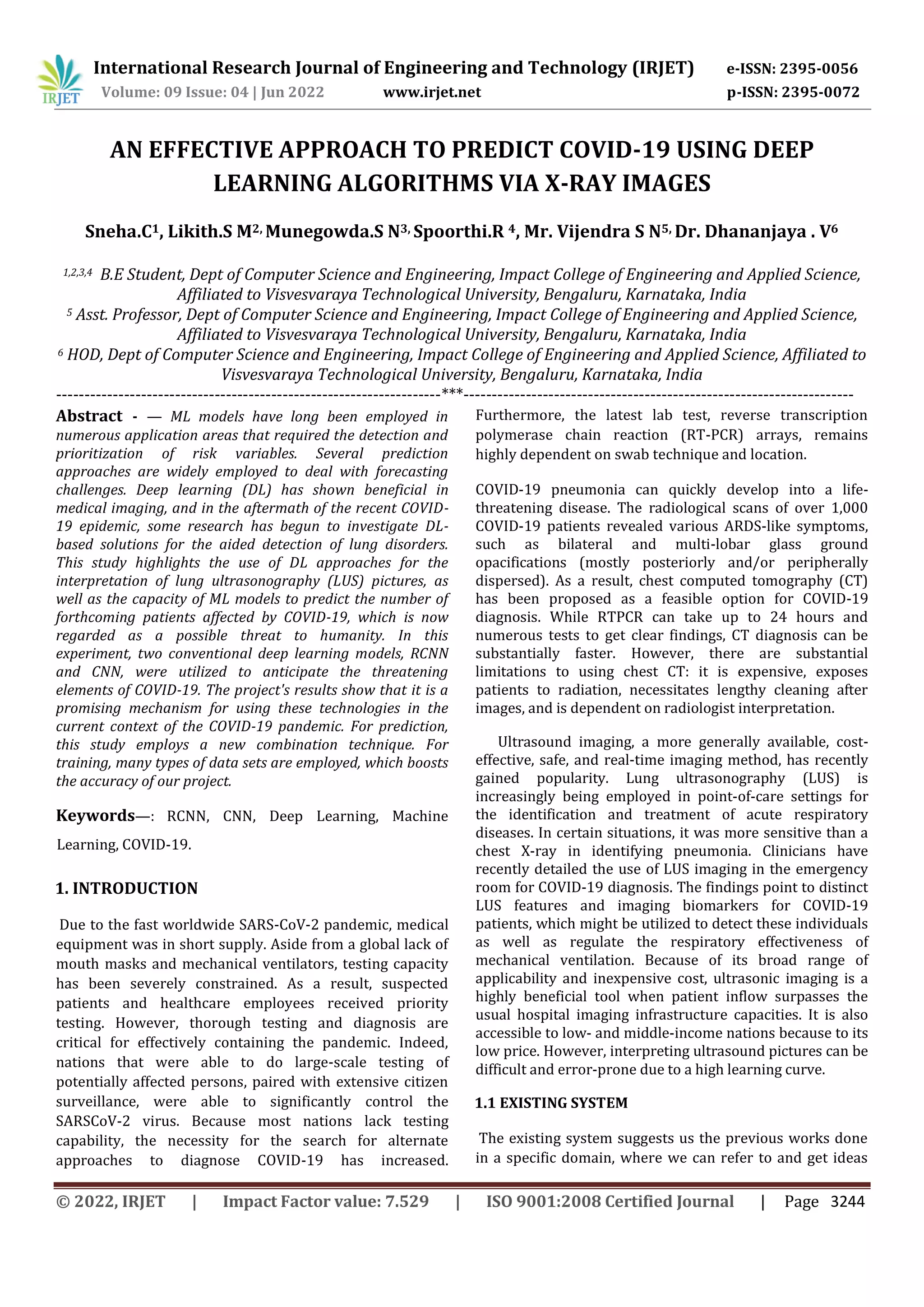
Fig- 1 : Block diagram of Proposed System
4. PROPOSED METHODOLOGY
This project may be divided into three major steps: data
processing, model training, and prediction. The primary
prediction technique based on input data is based on an
image dataset.
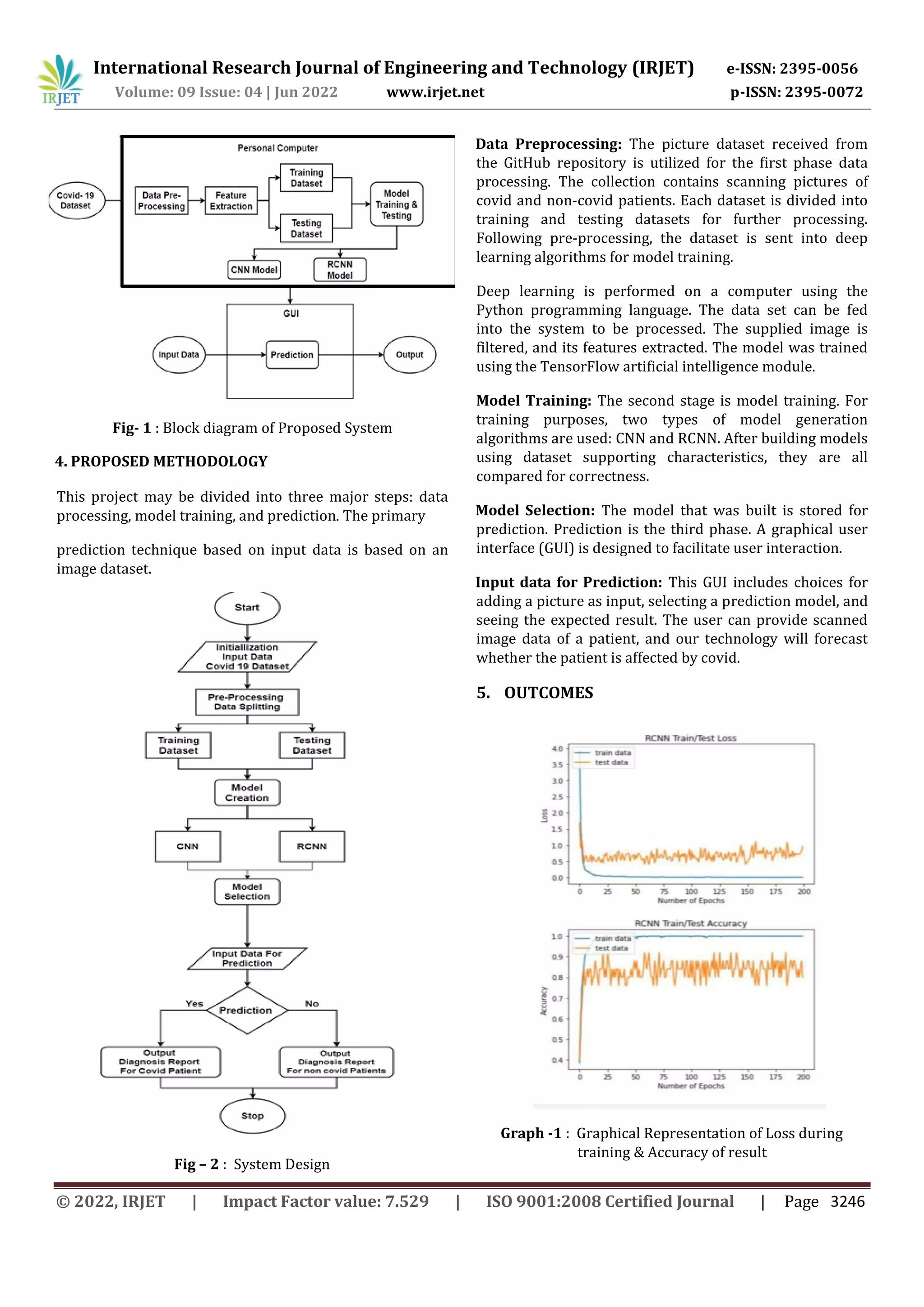
Fig – 2 : System Design
Data Preprocessing: The picture dataset received from
the GitHub repository is utilized for the first phase data
processing. The collection contains scanning pictures of
covid and non-covid patients. Each dataset is divided into
training and testing datasets for further processing.
Following pre-processing, the dataset is sent into deep
learning algorithms for model training.
Deep learning is performed on a computer using the
Python programming language. The data set can be fed
into the system to be processed. The supplied image is
filtered, and its features extracted. The model was trained
using the TensorFlow artificial intelligence module.
Model Training: The second stage is model training. For
training purposes, two types of model generation
algorithms are used: CNN and RCNN. After building models
using dataset supporting characteristics, they are all
compared for correctness.
Model Selection: The model that was built is stored for
prediction. Prediction is the third phase. A graphical user
interface (GUI) is designed to facilitate user interaction.
Input data for Prediction: This GUI includes choices for
adding a picture as input, selecting a prediction model, and
seeing the expected result. The user can provide scanned
image data of a patient, and our technology will forecast
whether the patient is affected by covid.
5. OUTCOMES
Graph -1 : Graphical Representation of Loss during
training & Accuracy of result
International Research Journal of Engineering and Technology (IRJET) e-ISSN: 2395-0056
Volume: 09 Issue: 04 | Jun 2022 www.irjet.net p-ISSN: 2395-0072
© 2022, IRJET | Impact Factor value: 7.529 | ISO 9001:2008 Certified Journal | Page 3247
Fig – 3 : Selected image & it’s prediction for Non Covid X-
ray
Fig – 4 : Selected Image & Prediction for Covid infected X-
ray
Fig – 5 : Selected Image and prediction for Viral
Pneumonia
6. CONCLUSION
In this paper, we present an ensemble based DeQueezeNet
model comprised of DenseNet121 and SqueezeNet1.0. The
model's performance is evaluated by applying it to X-ray
images to predict COVID-19 positive and negative
instances. The performance measures of accuracy,
precision, and recall are used to evaluate performance. The
confusion matrix demonstrates that the suggested
approach can accurately detect COVID-19 positive and
negative situations. The model's relevance is indicated by
its appropriate accuracy and high precision. A comparison
study is also conducted using current work on the
performance criteria. In which it is noted that the
performance of the suggested model is much superior,
indicating the model's relevance. Furthermore, it
demonstrates that the suggested model is best suited for
identifying COVID-19 positive and negative situations.
REFERENCES
[1] R. Niehus, P. M. D. Salazar, A. Taylor, and M. Lipsitch,
“Quantifying bias of COVID-19 prevalence and
severity estimates in Wuhan, China that depend on
reported cases in international travelers,” medRxiv,
p. 2020.02.13.20022707, feb 2020.
[2] Y. Yang et al., “Evaluating the accuracy of different
respiratory specimens in the laboratory diagnosis
and monitoring the viral shedding of 2019-nCoV
infections,” medRxiv, p. 2020.02.11.20021493, feb
2020.
[3] S. Salehi, A. Abedi, S. Balakrishnan, and A.
Gholamrezanezhad, “Coronavirus Disease 2019
(COVID-19): A Systematic Review of Imaging
Findings in 919 Patients,” Am J Roentgenol, pp. 1–7,
mar 2020.
[4] A. Bernheim et al., “Chest CT Findings in
Coronavirus Disease-19 (COVID-19): Relationship to
Duration of Infection,” Radiology, p. 200463, feb
2020. [Online]. Available:
http://pubs.rsna.org/doi/10.1148/radiol.20202004
63
[5] F. Mojoli, B. Bouhemad, S. Mongodi, and D.
Lichtenstein, “Lung ultrasound for critically ill
patients,” pp. 701–714, mar 2019.
[6] R. Raheja, M. Brahmavar, D. Joshi, and D. Raman,
“Application of Lung Ultrasound in Critical Care
Setting: A Review,” Cureus, vol. 11, no. 7, jul 2019.
International Research Journal of Engineering and Technology (IRJET) e-ISSN: 2395-0056
Volume: 09 Issue: 04 | Jun 2022 www.irjet.net p-ISSN: 2395-0072
© 2022, IRJET | Impact Factor value: 7.529 | ISO 9001:2008 Certified Journal | Page 3248
[7] Y. Amatya, J. Rupp, F. M. Russell, J. Saunders, B.
Bales, and D. R. House, “Diagnostic use of lung
ultrasound compared to chest radiograph for
suspected pneumonia in a resource-limited setting,”
International Journal of Emergency Medicine, vol.
11, no. 1, dec 2018.
[8]
E. Poggiali et al., “Can Lung US Help Critical Care
Clinicians in the Early Diagnosis of Novel
Coronavirus (COVID-19) Pneumonia?” Radiology, p.
200847, mar 2020.
[9] Q. Y. Peng et al., “Findings of lung ultrasonography of
novel corona virus pneumonia during the 2019 –
2020 epidemic,” Intensive Care Medicine, no. 87, pp.
6–7, mar 2020.
G. Soldati et al., “Is there a role for lung ultrasound
during the covid-19 pandemic?” J Ultrasound Med,
2020.
“Proposal for international standardization of the
use of lung ultrasound for COVID-19 patients; a
simple, quantitative, reproducible method,” J.
Ultrasound Med., 2020.
K. Stefanidis et al., “Lung sonography and
recruitment in patients with early acute respiratory
distress syndrome: A pilot study,” Critical Care, vol.
15, no. 4, p. R185, aug 2011.
K. A. Stewart et al., “Trends in Ultrasound Use in
Low- and Middle-Income Countries: A Systematic
Review.” International journal of MCH and AIDS, vol.
9, no. 1, pp. 103–120, 2020.
S. Makridakis, E. Spiliotis, and V. Assimakopoulos,
“Statistical and machine learning forecasting
methods: Concerns and ways forward,” PloS one,
vol. 13, no. 3, 2018.
G. Bontempi, S. B. Taieb, and Y.-A. Le Borgne,
“Machine learning strategies for time series
forecasting,” in European business intelligence
summer school. Springer, 2012, pp. 62–77.
[10]
[11]
[12]
[13]
[14]
[15]

AN EFFECTIVE APPROACH TO PREDICT COVID-19 USING DEEP LEARNING ALGORITHMS VIA X-RAY IMAGES

  • 1.
    © 2022, IRJET| Impact Factor value: 7.529 | ISO 9001:2008 Certified Journal | Page 3244 AN EFFECTIVE APPROACH TO PREDICT COVID-19 USING DEEP LEARNING ALGORITHMS VIA X-RAY IMAGES Sneha.C1, Likith.S M2, Munegowda.S N3, Spoorthi.R 4, Mr. Vijendra S N5, Dr. Dhananjaya . V6 1,2,3,4 B.E Student, Dept of Computer Science and Engineering, Impact College of Engineering and Applied Science, Affiliated to Visvesvaraya Technological University, Bengaluru, Karnataka, India 5 Asst. Professor, Dept of Computer Science and Engineering, Impact College of Engineering and Applied Science, Affiliated to Visvesvaraya Technological University, Bengaluru, Karnataka, India 6 HOD, Dept of Computer Science and Engineering, Impact College of Engineering and Applied Science, Affiliated to Visvesvaraya Technological University, Bengaluru, Karnataka, India --------------------------------------------------------------------***--------------------------------------------------------------------- Abstract - — ML models have long been employed in numerous application areas that required the detection and prioritization of risk variables. Several prediction approaches are widely employed to deal with forecasting challenges. Deep learning (DL) has shown beneficial in medical imaging, and in the aftermath of the recent COVID- 19 epidemic, some research has begun to investigate DL- based solutions for the aided detection of lung disorders. This study highlights the use of DL approaches for the interpretation of lung ultrasonography (LUS) pictures, as well as the capacity of ML models to predict the number of forthcoming patients affected by COVID-19, which is now regarded as a possible threat to humanity. In this experiment, two conventional deep learning models, RCNN and CNN, were utilized to anticipate the threatening elements of COVID-19. The project's results show that it is a promising mechanism for using these technologies in the current context of the COVID-19 pandemic. For prediction, this study employs a new combination technique. For training, many types of data sets are employed, which boosts the accuracy of our project. Keywords—: RCNN, CNN, Deep Learning, Machine Learning, COVID-19. 1. INTRODUCTION Due to the fast worldwide SARS-CoV-2 pandemic, medical equipment was in short supply. Aside from a global lack of mouth masks and mechanical ventilators, testing capacity has been severely constrained. As a result, suspected patients and healthcare employees received priority testing. However, thorough testing and diagnosis are critical for effectively containing the pandemic. Indeed, nations that were able to do large-scale testing of potentially affected persons, paired with extensive citizen surveillance, were able to significantly control the SARSCoV-2 virus. Because most nations lack testing capability, the necessity for the search for alternate approaches to diagnose COVID-19 has increased. Furthermore, the latest lab test, reverse transcription polymerase chain reaction (RT-PCR) arrays, remains highly dependent on swab technique and location. COVID-19 pneumonia can quickly develop into a life- threatening disease. The radiological scans of over 1,000 COVID-19 patients revealed various ARDS-like symptoms, such as bilateral and multi-lobar glass ground opacifications (mostly posteriorly and/or peripherally dispersed). As a result, chest computed tomography (CT) has been proposed as a feasible option for COVID-19 diagnosis. While RTPCR can take up to 24 hours and numerous tests to get clear findings, CT diagnosis can be substantially faster. However, there are substantial limitations to using chest CT: it is expensive, exposes patients to radiation, necessitates lengthy cleaning after images, and is dependent on radiologist interpretation. Ultrasound imaging, a more generally available, cost- effective, safe, and real-time imaging method, has recently gained popularity. Lung ultrasonography (LUS) is increasingly being employed in point-of-care settings for the identification and treatment of acute respiratory diseases. In certain situations, it was more sensitive than a chest X-ray in identifying pneumonia. Clinicians have recently detailed the use of LUS imaging in the emergency room for COVID-19 diagnosis. The findings point to distinct LUS features and imaging biomarkers for COVID-19 patients, which might be utilized to detect these individuals as well as regulate the respiratory effectiveness of mechanical ventilation. Because of its broad range of applicability and inexpensive cost, ultrasonic imaging is a highly beneficial tool when patient inflow surpasses the usual hospital imaging infrastructure capacities. It is also accessible to low- and middle-income nations because to its low price. However, interpreting ultrasound pictures can be difficult and error-prone due to a high learning curve. 1.1 EXISTING SYSTEM The existing system suggests us the previous works done in a specific domain, where we can refer to and get ideas International Research Journal of Engineering and Technology (IRJET) e-ISSN: 2395-0056 Volume: 09 Issue: 04 | Jun 2022 www.irjet.net p-ISSN: 2395-0072
  • 2.
    International Research Journalof Engineering and Technology (IRJET) e-ISSN: 2395-0056 Volume: 09 Issue: 04 | Jun 2022 www.irjet.net p-ISSN: 2395-0072 © 2022, IRJET | Impact Factor value: 7.529 | ISO 9001:2008 Certified Journal | Page 3245 from. Many farming or agriculture assistance systems have been implemented or proposed focused in only a particular aspect or crop. In a research paper, the scholars proposed a system to predict the amount of fertiliser needed for a specific crop banana, as well as regression methods for future plantations using Neural Networks. Nitrogen (N), phosphorus (P), and potassium (K) are the three most important soil nutrients for crop growth. The amount of NPK in the soil varies depending on where you live. The requirements for each crop differ as well. In this paper, a model is built to recommend the amount of fertiliser needed for the banana crop [1]. In a different paper proposed system's goal is to assist farmers in cultivating crops for higher yield. The crops chosen for this work are based on important crops from the chosen location. Rice, Jowar, Wheat, Soyabean, Sunflower, Cotton, Sugarcane, Tobacco, Onion, Dry Chili, and other crops have been chosen. Crop yield data is compiled from various sources over the last five years. Scholars proposed the system in 3 steps: a. Soil Classification b. Crop Yield Prediction and c. Fertilizer Recommendation [2]. A paper published at IEEE predicts the yield of nearly all types of crops grown in India. This script is novel because it uses simple parameters such as state, district, season, and area to predict crop yields in whatever year the user desires. The paper predicts yield using advanced regression techniques such as Kernel Ridge, Lasso, and ENet algorithms, as well as the concept of Stacking Regression to improve the algorithms [3]. Rainfall regimes, P application rates, soil P content, and field management practices such as field bund and open ditch construction can all influence phosphorus losses in rice-wheat cropping systems. Heavy rainfalls shortly after P applications, in particular, cause significant P loss, and P loss increases with increasing P application rates and soil P content. During the rice-growing season, P concentrations in field ponding water regulate P concentrations in surface runoff. The construction of open ditches can increase phosphorus loss during the winter wheat growing season. As a result, we propose that rice-wheat cropping systems be managed to avoid heavy rain events while also balancing crop P removal (20–30 kg P ha–1 in this study). Furthermore, appropriate water management practices are recommended, such as increasing the capacity of field ponding water or using controlled irrigation in conjunction with natural drying of the field rather than open ditches during the wheat growing season [4]. 1.2 PROBLEM STATEMENT COVID-19 is now affecting numerous nations throughout the world, including India. A few nations, like India, the United States, Germany, Italy, and others, are dealing with its spread in the community transfer phase, which means that one infected individual can infect more than 100 persons with whom he comes into touch. So, the approach is to identify sick people and place them in quarantine to prevent further transmission. Existing diagnosis processes for identifying the infected individual are time-consuming, which slows diagnosis when dealing with a high number of cases. As a result, to address this issue, we devised a methodology that can efficiently categorize COVID-19 positive and negative situations ahead of time. The aim is to use an automated machine learning-based model to categorize persons as COVID-19 positive or COVID-19 negative. As an input parameter, the model uses X-ray pictures that depict the disease's early symptoms. 2. PROPOSED SYSTEM ML models have long been utilized in a variety of applications requiring the identification and prioritization of peril factors. To deal with forecasting issues, several prognostication methodologies are extensively utilized. Deep learning (DL) has shown utilizable in medical imaging, and during the recent COVID-19 outbreak, some research has commenced to investigate DL-predicated solutions for the enhanced diagnosis of lung quandaries. This work emphasizes the application of DL techniques for the interpretation of lung ultrasonography (LUS) images, as well as the faculty of ML models to estimate the number of upcoming COVID-19 patients. which is now regarded as a possible threat to humanity. In this experiment, two conventional deep learning models, RCNN and CNN, were utilized to anticipate the threatening elements of COVID- 19. The project's results show that it is a promising mechanism for utilizing these technologies in the current context of the COVID-19 pandemic. For prognostication, this study employs an incipient amalgamation technique. For training, many types of data sets are employed, which boosts the precision of our project. 3. SYSTEM ARCHITECTURE Algorithms Used:  RCNN  CNN
  • 3.
    International Research Journalof Engineering and Technology (IRJET) e-ISSN: 2395-0056 Volume: 09 Issue: 04 | Jun 2022 www.irjet.net p-ISSN: 2395-0072 © 2022, IRJET | Impact Factor value: 7.529 | ISO 9001:2008 Certified Journal | Page 3246 Fig- 1 : Block diagram of Proposed System 4. PROPOSED METHODOLOGY This project may be divided into three major steps: data processing, model training, and prediction. The primary prediction technique based on input data is based on an image dataset. Fig – 2 : System Design Data Preprocessing: The picture dataset received from the GitHub repository is utilized for the first phase data processing. The collection contains scanning pictures of covid and non-covid patients. Each dataset is divided into training and testing datasets for further processing. Following pre-processing, the dataset is sent into deep learning algorithms for model training. Deep learning is performed on a computer using the Python programming language. The data set can be fed into the system to be processed. The supplied image is filtered, and its features extracted. The model was trained using the TensorFlow artificial intelligence module. Model Training: The second stage is model training. For training purposes, two types of model generation algorithms are used: CNN and RCNN. After building models using dataset supporting characteristics, they are all compared for correctness. Model Selection: The model that was built is stored for prediction. Prediction is the third phase. A graphical user interface (GUI) is designed to facilitate user interaction. Input data for Prediction: This GUI includes choices for adding a picture as input, selecting a prediction model, and seeing the expected result. The user can provide scanned image data of a patient, and our technology will forecast whether the patient is affected by covid. 5. OUTCOMES Graph -1 : Graphical Representation of Loss during training & Accuracy of result
  • 4.
    International Research Journalof Engineering and Technology (IRJET) e-ISSN: 2395-0056 Volume: 09 Issue: 04 | Jun 2022 www.irjet.net p-ISSN: 2395-0072 © 2022, IRJET | Impact Factor value: 7.529 | ISO 9001:2008 Certified Journal | Page 3247 Fig – 3 : Selected image & it’s prediction for Non Covid X- ray Fig – 4 : Selected Image & Prediction for Covid infected X- ray Fig – 5 : Selected Image and prediction for Viral Pneumonia 6. CONCLUSION In this paper, we present an ensemble based DeQueezeNet model comprised of DenseNet121 and SqueezeNet1.0. The model's performance is evaluated by applying it to X-ray images to predict COVID-19 positive and negative instances. The performance measures of accuracy, precision, and recall are used to evaluate performance. The confusion matrix demonstrates that the suggested approach can accurately detect COVID-19 positive and negative situations. The model's relevance is indicated by its appropriate accuracy and high precision. A comparison study is also conducted using current work on the performance criteria. In which it is noted that the performance of the suggested model is much superior, indicating the model's relevance. Furthermore, it demonstrates that the suggested model is best suited for identifying COVID-19 positive and negative situations. REFERENCES [1] R. Niehus, P. M. D. Salazar, A. Taylor, and M. Lipsitch, “Quantifying bias of COVID-19 prevalence and severity estimates in Wuhan, China that depend on reported cases in international travelers,” medRxiv, p. 2020.02.13.20022707, feb 2020. [2] Y. Yang et al., “Evaluating the accuracy of different respiratory specimens in the laboratory diagnosis and monitoring the viral shedding of 2019-nCoV infections,” medRxiv, p. 2020.02.11.20021493, feb 2020. [3] S. Salehi, A. Abedi, S. Balakrishnan, and A. Gholamrezanezhad, “Coronavirus Disease 2019 (COVID-19): A Systematic Review of Imaging Findings in 919 Patients,” Am J Roentgenol, pp. 1–7, mar 2020. [4] A. Bernheim et al., “Chest CT Findings in Coronavirus Disease-19 (COVID-19): Relationship to Duration of Infection,” Radiology, p. 200463, feb 2020. [Online]. Available: http://pubs.rsna.org/doi/10.1148/radiol.20202004 63 [5] F. Mojoli, B. Bouhemad, S. Mongodi, and D. Lichtenstein, “Lung ultrasound for critically ill patients,” pp. 701–714, mar 2019. [6] R. Raheja, M. Brahmavar, D. Joshi, and D. Raman, “Application of Lung Ultrasound in Critical Care Setting: A Review,” Cureus, vol. 11, no. 7, jul 2019.
  • 5.
    International Research Journalof Engineering and Technology (IRJET) e-ISSN: 2395-0056 Volume: 09 Issue: 04 | Jun 2022 www.irjet.net p-ISSN: 2395-0072 © 2022, IRJET | Impact Factor value: 7.529 | ISO 9001:2008 Certified Journal | Page 3248 [7] Y. Amatya, J. Rupp, F. M. Russell, J. Saunders, B. Bales, and D. R. House, “Diagnostic use of lung ultrasound compared to chest radiograph for suspected pneumonia in a resource-limited setting,” International Journal of Emergency Medicine, vol. 11, no. 1, dec 2018. [8] E. Poggiali et al., “Can Lung US Help Critical Care Clinicians in the Early Diagnosis of Novel Coronavirus (COVID-19) Pneumonia?” Radiology, p. 200847, mar 2020. [9] Q. Y. Peng et al., “Findings of lung ultrasonography of novel corona virus pneumonia during the 2019 – 2020 epidemic,” Intensive Care Medicine, no. 87, pp. 6–7, mar 2020. G. Soldati et al., “Is there a role for lung ultrasound during the covid-19 pandemic?” J Ultrasound Med, 2020. “Proposal for international standardization of the use of lung ultrasound for COVID-19 patients; a simple, quantitative, reproducible method,” J. Ultrasound Med., 2020. K. Stefanidis et al., “Lung sonography and recruitment in patients with early acute respiratory distress syndrome: A pilot study,” Critical Care, vol. 15, no. 4, p. R185, aug 2011. K. A. Stewart et al., “Trends in Ultrasound Use in Low- and Middle-Income Countries: A Systematic Review.” International journal of MCH and AIDS, vol. 9, no. 1, pp. 103–120, 2020. S. Makridakis, E. Spiliotis, and V. Assimakopoulos, “Statistical and machine learning forecasting methods: Concerns and ways forward,” PloS one, vol. 13, no. 3, 2018. G. Bontempi, S. B. Taieb, and Y.-A. Le Borgne, “Machine learning strategies for time series forecasting,” in European business intelligence summer school. Springer, 2012, pp. 62–77. [10] [11] [12] [13] [14] [15]