An agile approach to
       knowledge discovery
                   of web log data
Paul Lam, Thibaut Sacreste, Paul Ingles

OR54, Edinburgh, 4 September 2012
Why web log data
Visitor information

✤   web page requested

✤   client IP address

✤   request timestamp

✤   query string

✤   bytes served

✤   user agent

✤   referrer
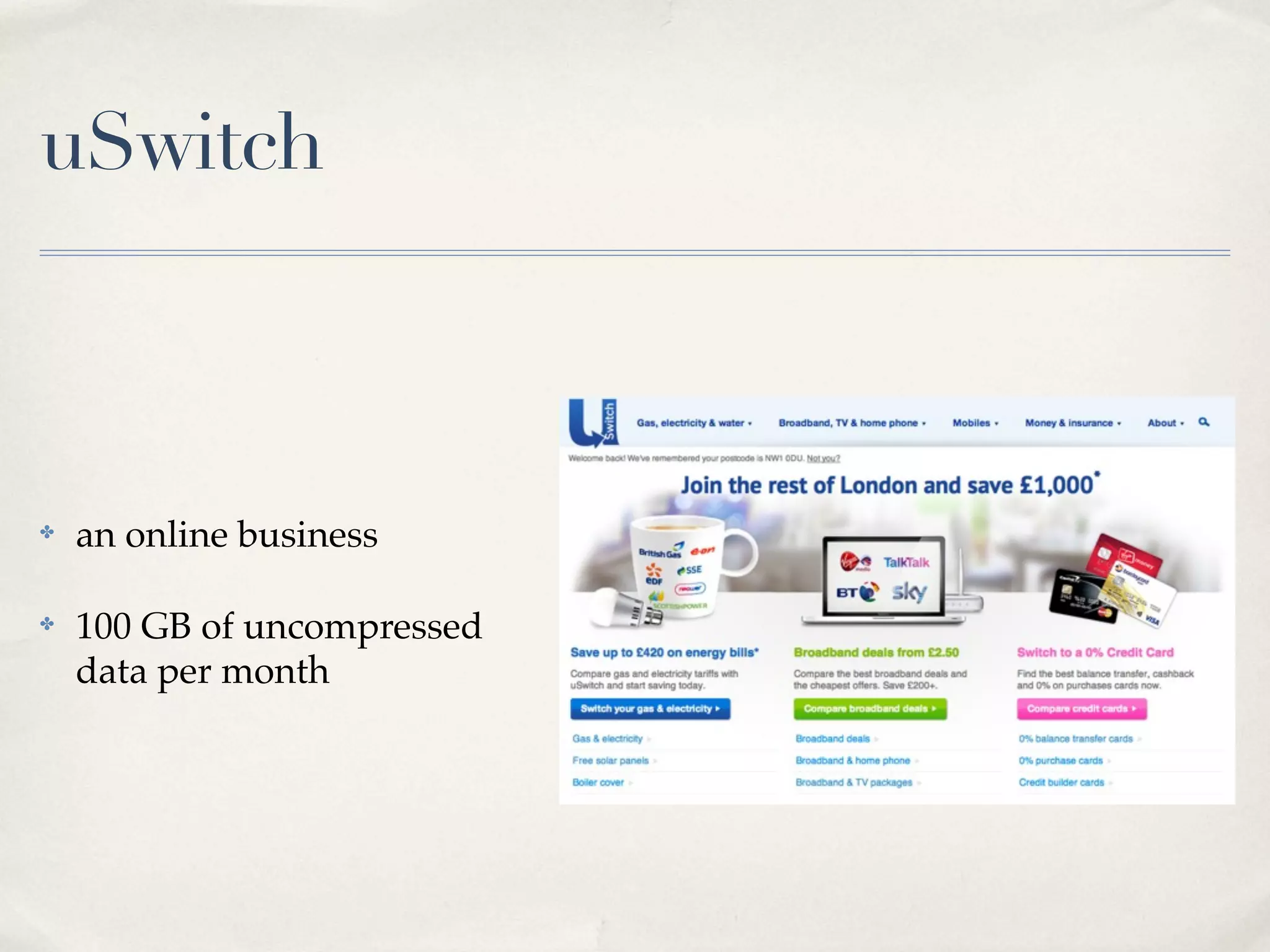
uSwitch


✤   an online business

✤   100 GB of uncompressed
    data per month
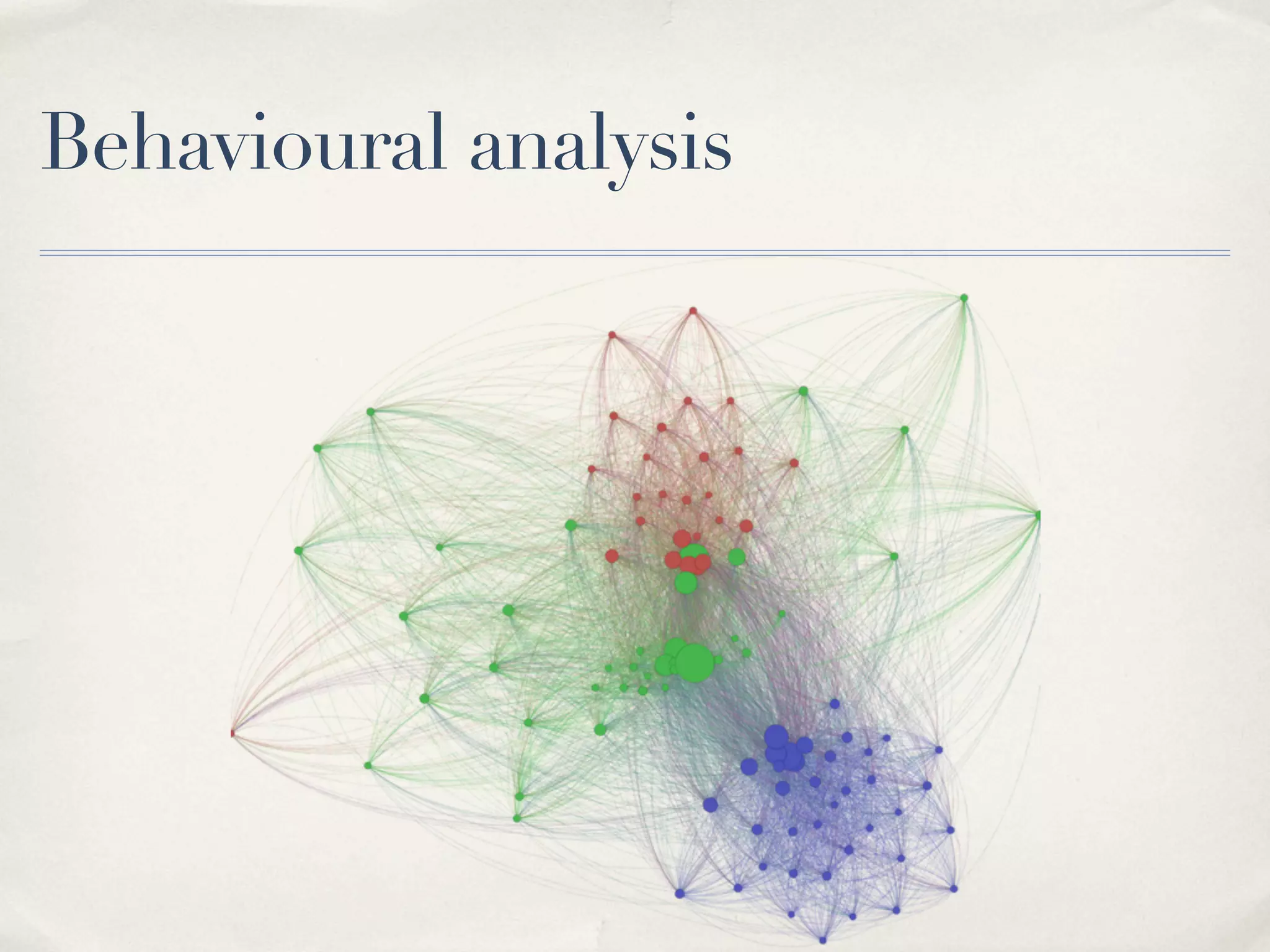
Behavioural analysis
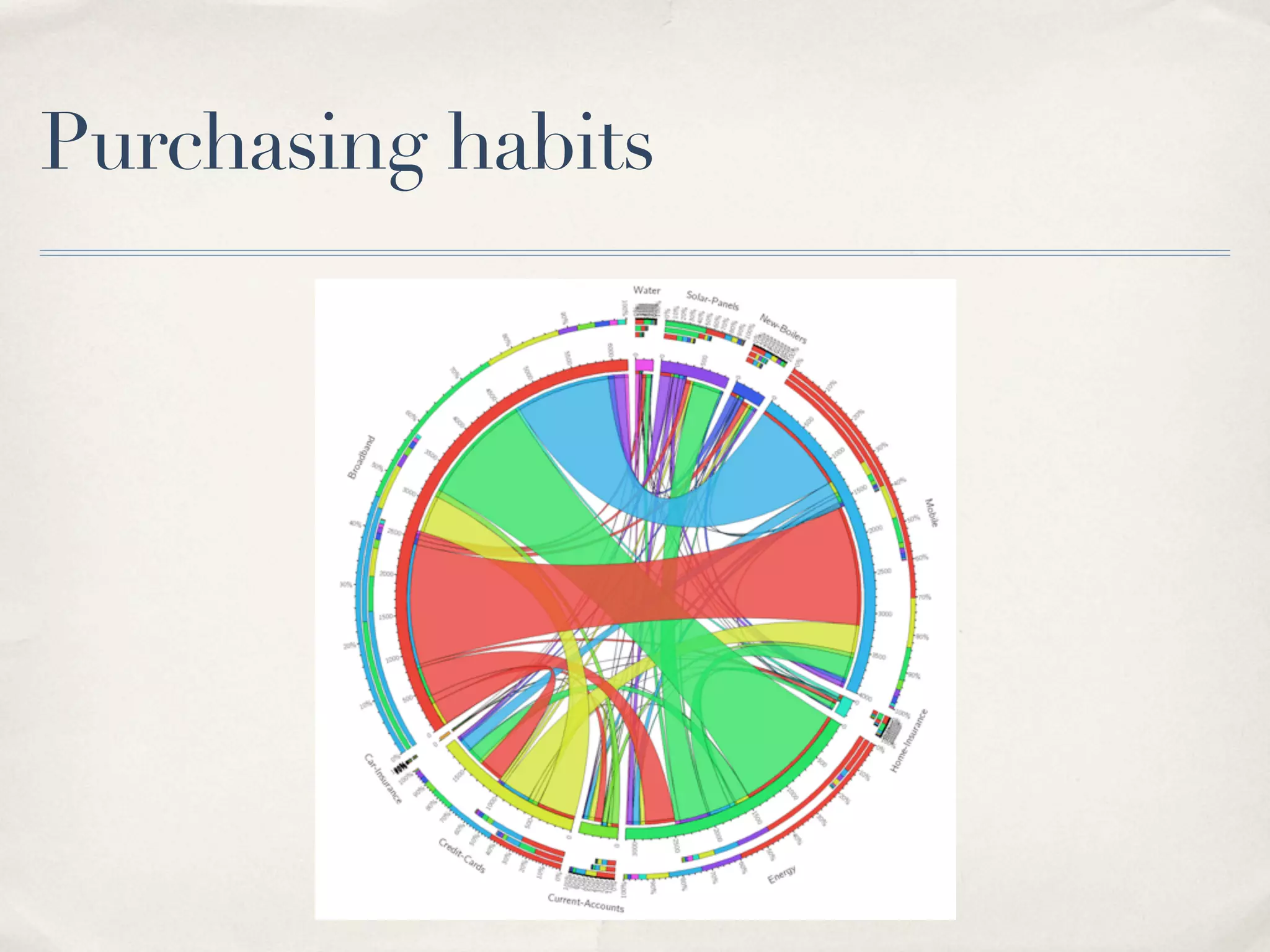
Purchasing habits
Product personalisation


✤   30% of Amazon
    sales comes from its
    recommendation
    engine [1]

✤   Examples on
    uSwitch homepage


                           [1] Schumpeter, “Building with big data”, Economist, 26 May 2011
Goals


✤   Exploration of data

✤   Exploitation of data
Data team at uSwitch

✤   a core team of 3 complementary skilled people:

    ✤   data scientist

    ✤   back-end developer

    ✤   software architect

✤   not a boundary of our roles

    ✤   guess who loves ggplot and who does the NLP work

✤   collaborate with domain experts (designers, marketers, product
    managers, developers, etc) across the company
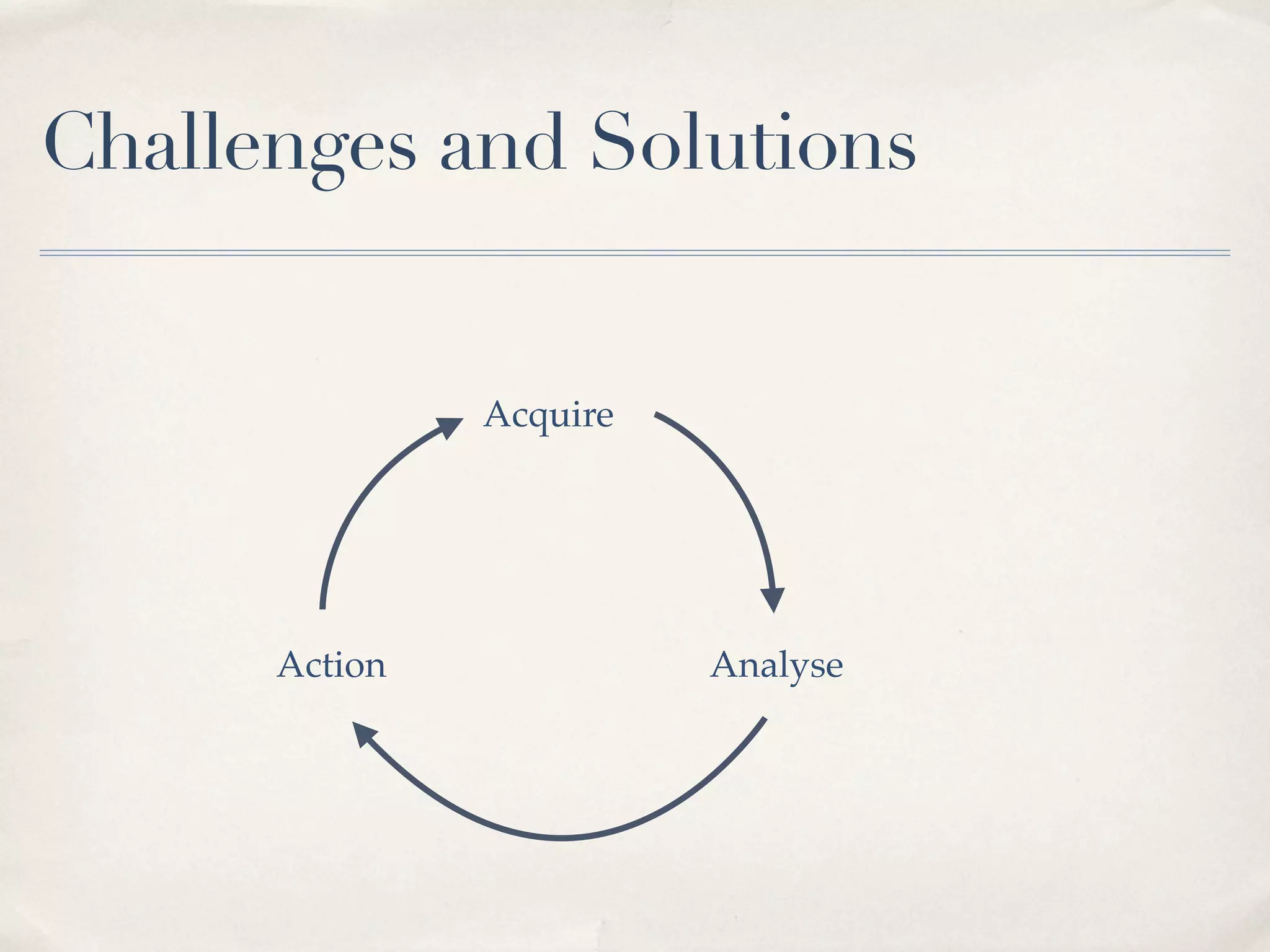
Challenges and Solutions


               Acquire


      Action             Analyse
Acquire
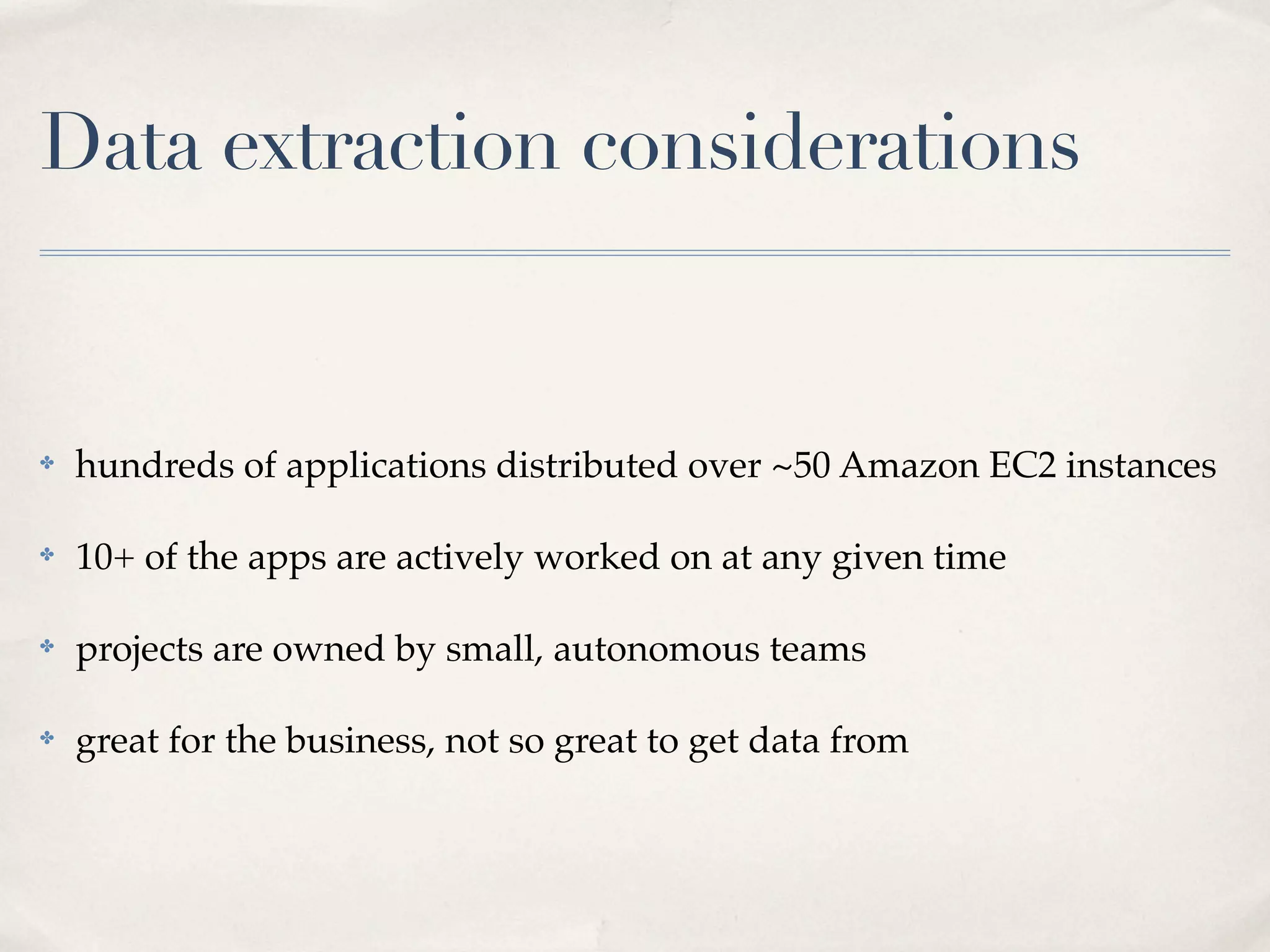
Data extraction considerations


✤   hundreds of applications distributed over ~50 Amazon EC2 instances

✤   10+ of the apps are actively worked on at any given time

✤   projects are owned by small, autonomous teams

✤   great for the business, not so great to get data from
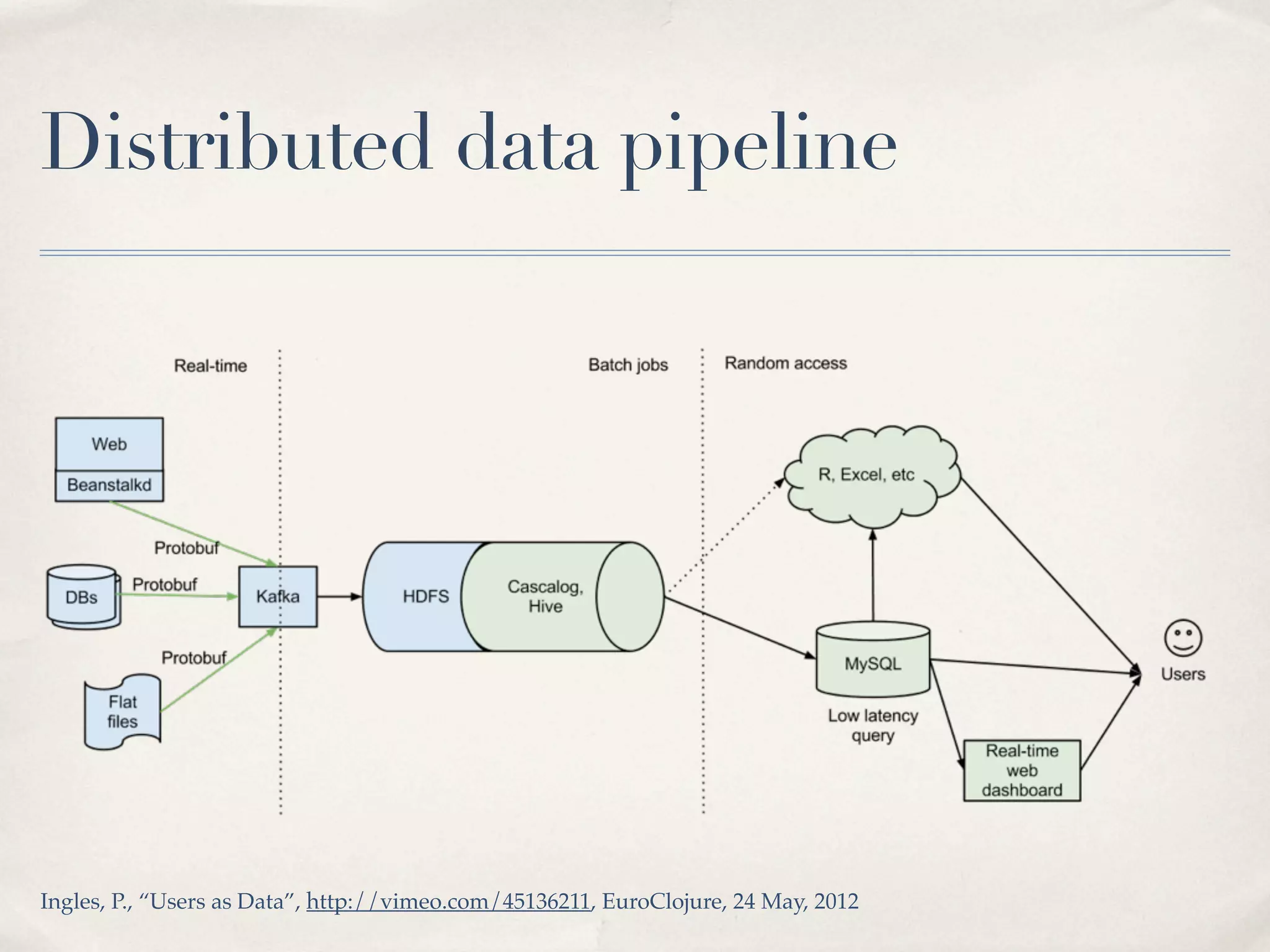
Distributed data pipeline


Ingles, P., “Users as Data”, http://vimeo.com/45136211, EuroClojure, 24 May, 2012
Analyse
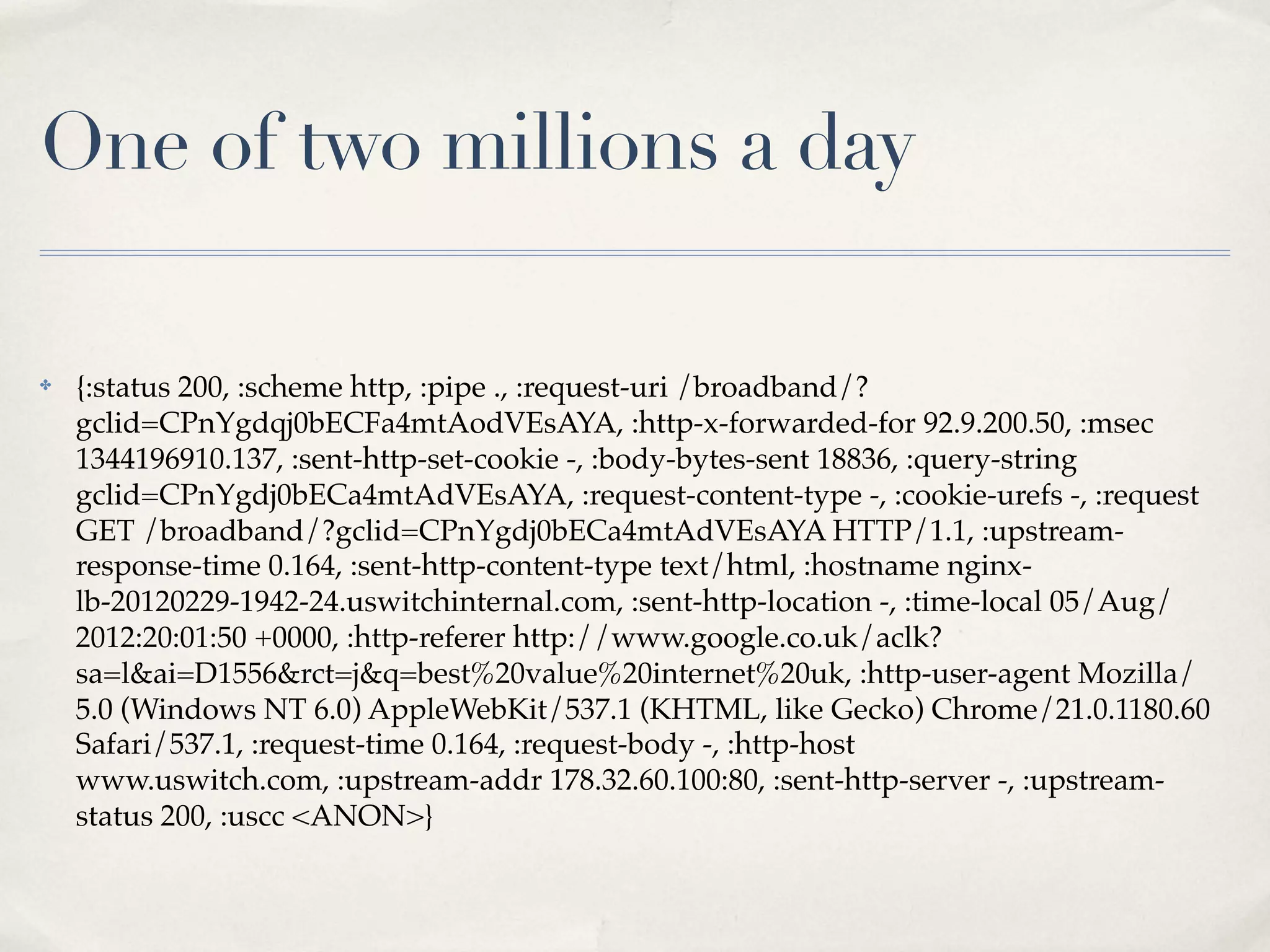
One of two millions a day

✤   {:status 200, :scheme http, :pipe ., :request-uri /broadband/?
    gclid=CPnYgdqj0bECFa4mtAodVEsAYA, :http-x-forwarded-for 92.9.200.50, :msec
    1344196910.137, :sent-http-set-cookie -, :body-bytes-sent 18836, :query-string
    gclid=CPnYgdj0bECa4mtAdVEsAYA, :request-content-type -, :cookie-urefs -, :request
    GET /broadband/?gclid=CPnYgdj0bECa4mtAdVEsAYA HTTP/1.1, :upstream-
    response-time 0.164, :sent-http-content-type text/html, :hostname nginx-
    lb-20120229-1942-24.uswitchinternal.com, :sent-http-location -, :time-local 05/Aug/
    2012:20:01:50 +0000, :http-referer http://www.google.co.uk/aclk?
    sa=l&ai=D1556&rct=j&q=best%20value%20internet%20uk, :http-user-agent Mozilla/
    5.0 (Windows NT 6.0) AppleWebKit/537.1 (KHTML, like Gecko) Chrome/21.0.1180.60
    Safari/537.1, :request-time 0.164, :request-body -, :http-host
    www.uswitch.com, :upstream-addr 178.32.60.100:80, :sent-http-server -, :upstream-
    status 200, :uscc <ANON>}
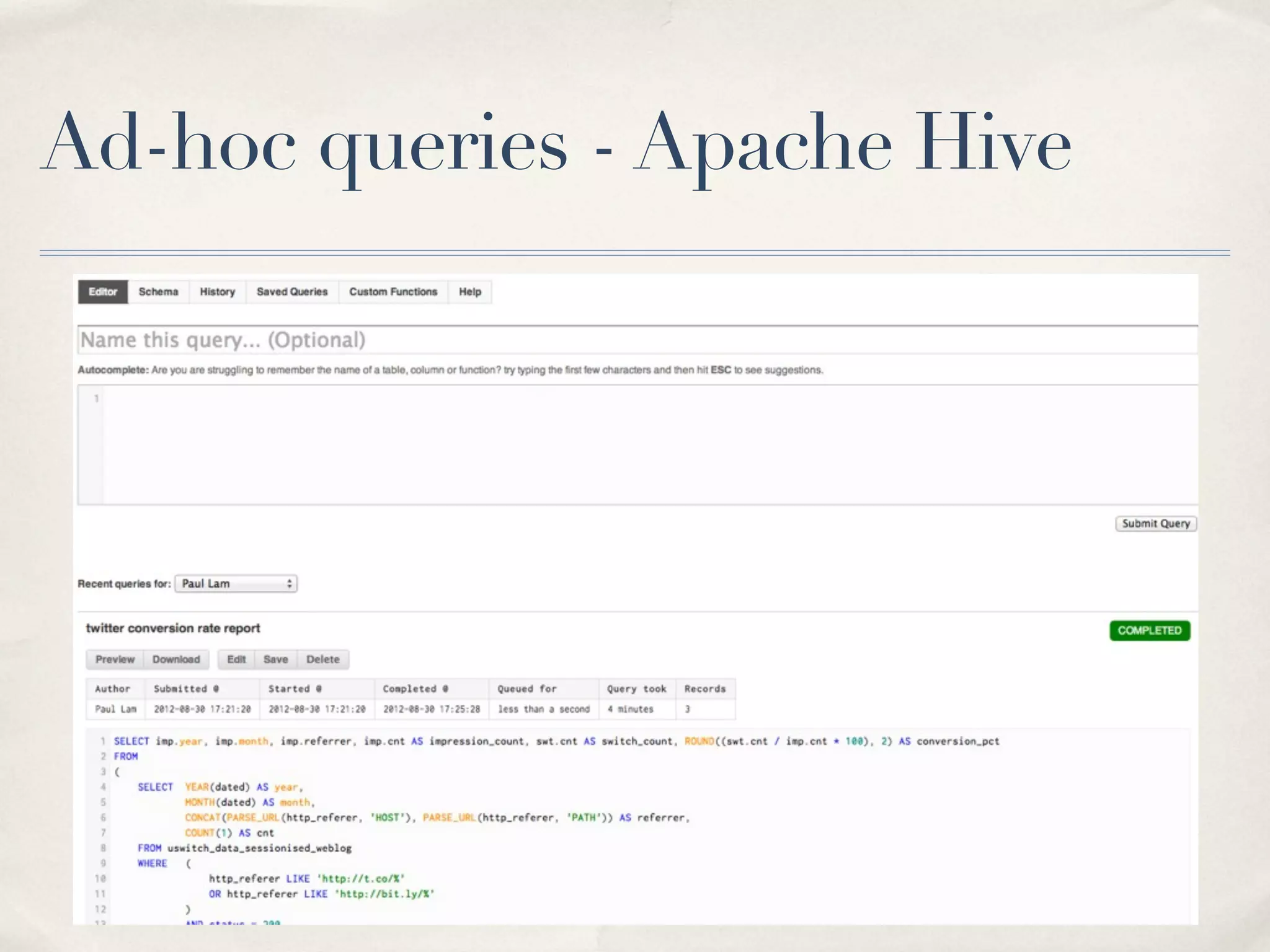
Ad-hoc queries - Apache Hive
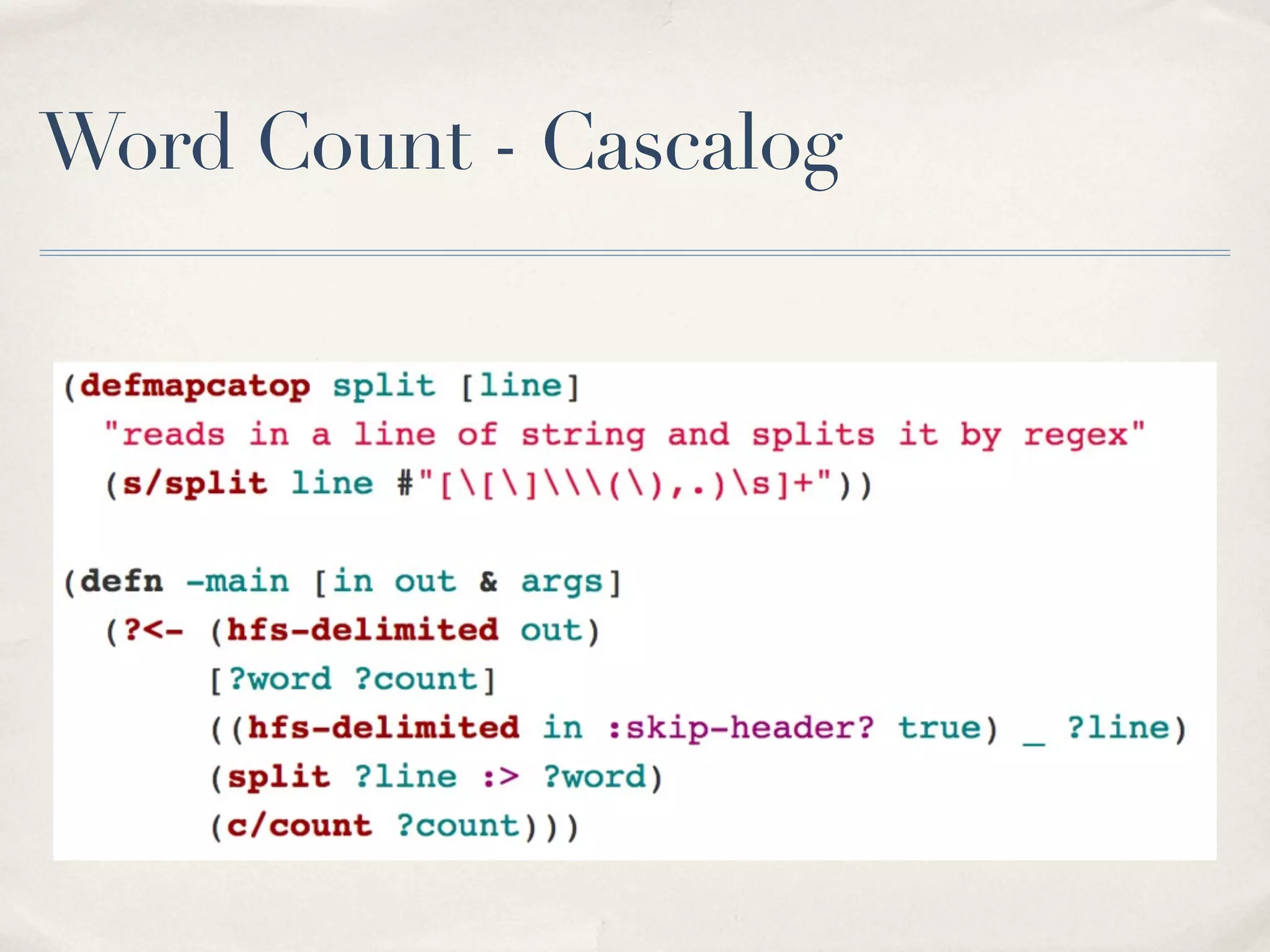
Word Count - Cascalog
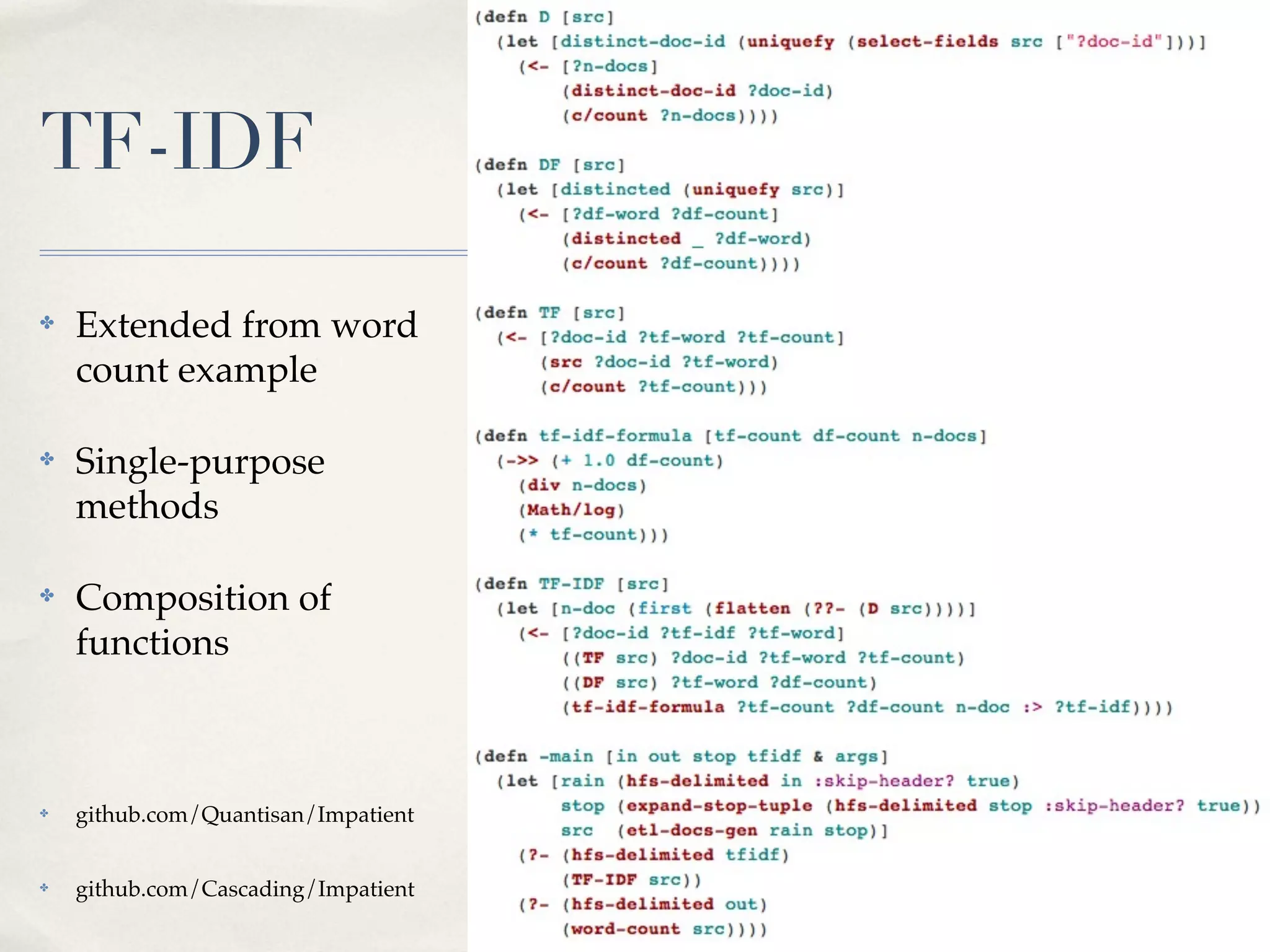
TF-IDF

✤   Extended from word
    count example

✤   Single-purpose
    methods

✤   Composition of
    functions


✤   github.com/Quantisan/Impatient


✤   github.com/Cascading/Impatient
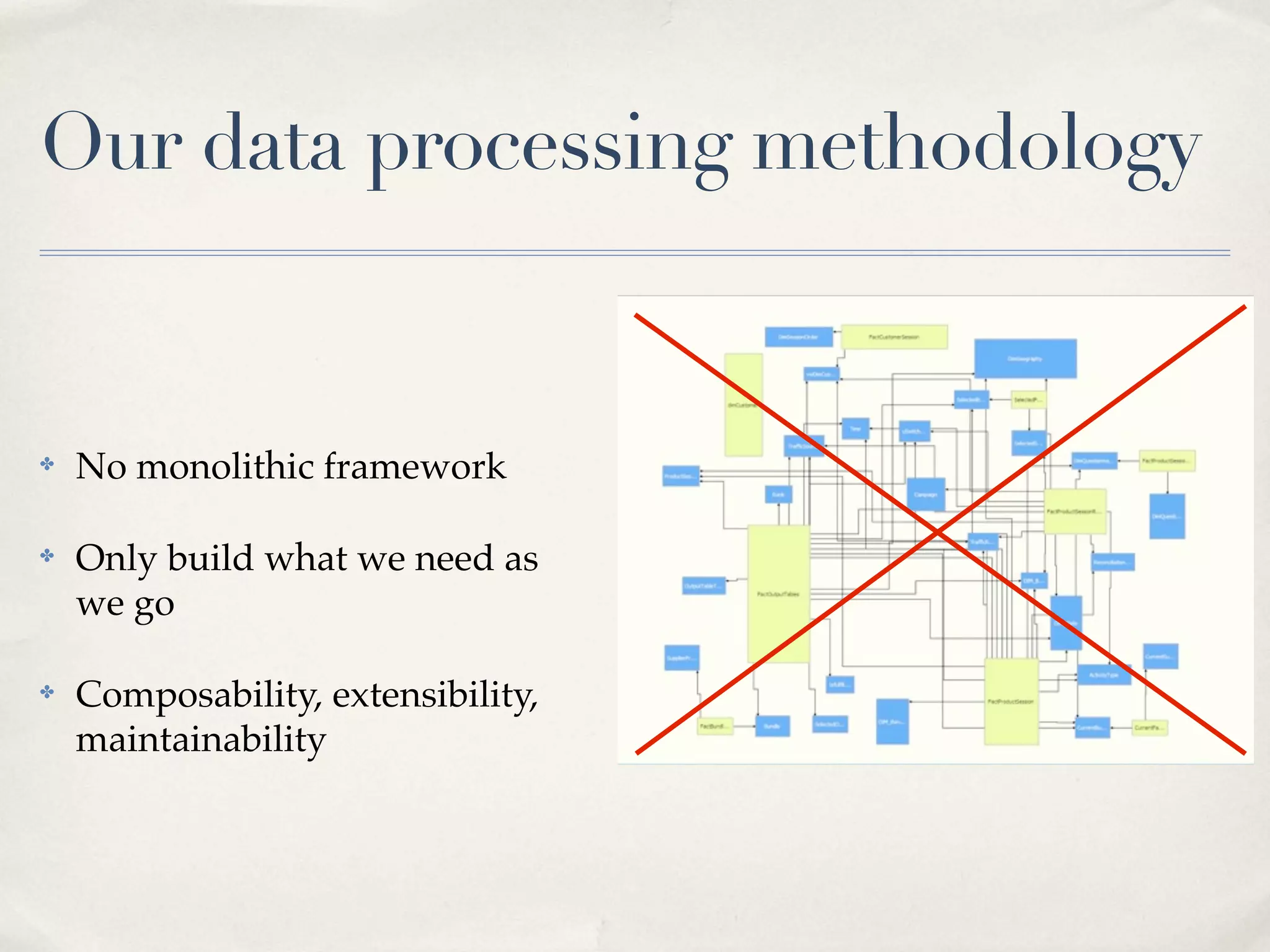
Our data processing methodology


✤   No monolithic framework

✤   Only build what we need as
    we go

✤   Composability, extensibility,
    maintainability
Action
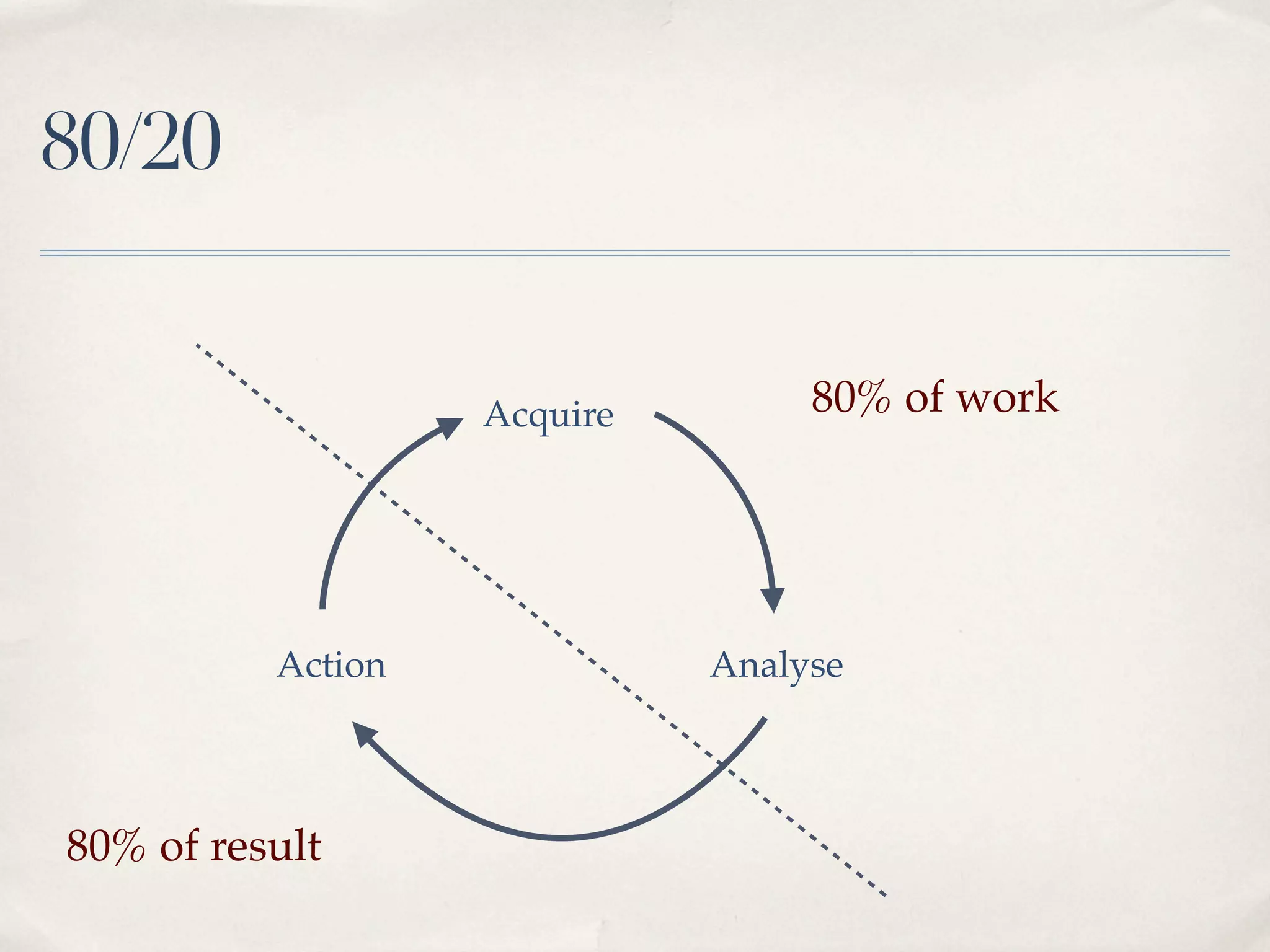
80/20


                   Acquire        80% of work


          Action             Analyse


80% of result
Three Es

✤   Enlighten

    ✤   R with rhdfs and ggplot, Sinatra + D3.js

✤   Expose

    ✤   Scheduled Hadoop jobs to load processed data into MySQL for
        everyone to use

✤   Exploit

    ✤   Real-time customer intelligence to personalise website for each
        visitor
Result


✤   Data from all levels are accessible

✤   Information is easy

    ✤   "Sweet! I don't have to do anything!” -- Hemal, uSwitch developer

✤   Opening dialogue about using data
Summary


✤   Develop incrementally and iterate

✤   Mitigate unnecessary complexity
Contact


✤   Paul Lam, data scientist at uSwitch

✤   @Quantisan

✤   paul.lam@forward.co.uk

An agile approach to knowledge discovery on web log data

  • 1.
    An agile approachto knowledge discovery of web log data Paul Lam, Thibaut Sacreste, Paul Ingles OR54, Edinburgh, 4 September 2012
  • 2.
  • 3.
    Visitor information ✤ web page requested ✤ client IP address ✤ request timestamp ✤ query string ✤ bytes served ✤ user agent ✤ referrer
  • 4.
    uSwitch ✤ an online business ✤ 100 GB of uncompressed data per month
  • 5.
  • 6.
  • 7.
    Product personalisation ✤ 30% of Amazon sales comes from its recommendation engine [1] ✤ Examples on uSwitch homepage [1] Schumpeter, “Building with big data”, Economist, 26 May 2011
  • 8.
    Goals ✤ Exploration of data ✤ Exploitation of data
  • 9.
    Data team atuSwitch ✤ a core team of 3 complementary skilled people: ✤ data scientist ✤ back-end developer ✤ software architect ✤ not a boundary of our roles ✤ guess who loves ggplot and who does the NLP work ✤ collaborate with domain experts (designers, marketers, product managers, developers, etc) across the company
  • 10.
    Challenges and Solutions Acquire Action Analyse
  • 11.
  • 12.
    Data extraction considerations ✤ hundreds of applications distributed over ~50 Amazon EC2 instances ✤ 10+ of the apps are actively worked on at any given time ✤ projects are owned by small, autonomous teams ✤ great for the business, not so great to get data from
  • 13.
    Distributed data pipeline Ingles,P., “Users as Data”, http://vimeo.com/45136211, EuroClojure, 24 May, 2012
  • 14.
  • 15.
    One of twomillions a day ✤ {:status 200, :scheme http, :pipe ., :request-uri /broadband/? gclid=CPnYgdqj0bECFa4mtAodVEsAYA, :http-x-forwarded-for 92.9.200.50, :msec 1344196910.137, :sent-http-set-cookie -, :body-bytes-sent 18836, :query-string gclid=CPnYgdj0bECa4mtAdVEsAYA, :request-content-type -, :cookie-urefs -, :request GET /broadband/?gclid=CPnYgdj0bECa4mtAdVEsAYA HTTP/1.1, :upstream- response-time 0.164, :sent-http-content-type text/html, :hostname nginx- lb-20120229-1942-24.uswitchinternal.com, :sent-http-location -, :time-local 05/Aug/ 2012:20:01:50 +0000, :http-referer http://www.google.co.uk/aclk? sa=l&ai=D1556&rct=j&q=best%20value%20internet%20uk, :http-user-agent Mozilla/ 5.0 (Windows NT 6.0) AppleWebKit/537.1 (KHTML, like Gecko) Chrome/21.0.1180.60 Safari/537.1, :request-time 0.164, :request-body -, :http-host www.uswitch.com, :upstream-addr 178.32.60.100:80, :sent-http-server -, :upstream- status 200, :uscc <ANON>}
  • 16.
    Ad-hoc queries -Apache Hive
  • 17.
    Word Count -Cascalog
  • 18.
    TF-IDF ✤ Extended from word count example ✤ Single-purpose methods ✤ Composition of functions ✤ github.com/Quantisan/Impatient ✤ github.com/Cascading/Impatient
  • 19.
    Our data processingmethodology ✤ No monolithic framework ✤ Only build what we need as we go ✤ Composability, extensibility, maintainability
  • 20.
  • 21.
    80/20 Acquire 80% of work Action Analyse 80% of result
  • 22.
    Three Es ✤ Enlighten ✤ R with rhdfs and ggplot, Sinatra + D3.js ✤ Expose ✤ Scheduled Hadoop jobs to load processed data into MySQL for everyone to use ✤ Exploit ✤ Real-time customer intelligence to personalise website for each visitor
  • 23.
    Result ✤ Data from all levels are accessible ✤ Information is easy ✤ "Sweet! I don't have to do anything!” -- Hemal, uSwitch developer ✤ Opening dialogue about using data
  • 24.
    Summary ✤ Develop incrementally and iterate ✤ Mitigate unnecessary complexity
  • 25.
    Contact ✤ Paul Lam, data scientist at uSwitch ✤ @Quantisan ✤ paul.lam@forward.co.uk

Editor's Notes

  • #2 \n
  • #3 So what&amp;#x2019;s so special about web log data?\n
  • #4 Web log contains visitor information such as: what page they&amp;#x2019;re looking at, what browser or device they&amp;#x2019;re using, and how they came about to our site.\n
  • #5 uswitch is the second largest price comparison website in the UK. In terms of data, we&amp;#x2019;re collecting about a 100 GB of data per month, most of which are web log data.\n
  • #6 It is literally trails of footprints of each and every one of our customer. By studying and analysing our web log data, we can better understand our customers.\n\nexplain graph\n\n3 clusters = 3 businesses\n
  • #7 \n
  • #8 in addition to providing information, we can also make use of the data within the website itself.\n
  • #9 \n
  • #10 \n
  • #11 \n
  • #12 There are 3 stages to our data process.\n
  • #13 \n
  • #14 \n
  • #15 distributed and asynchronous message queue\n\npush data\n
  • #16 \n
  • #17 semi-structured\n\npostcode field example\n
  • #18 \n
  • #19 \n
  • #20 \n
  • #21 \n
  • #22 \n
  • #23 \n
  • #24 \n
  • #25 \n
  • #26 \n
  • #27 \n
  • #28 \n
  • #29 \n
  • #30 \n