Ammonia Safety
Presented By:
John S. Hillard, CSP
Risk Control Consultant
jhillard@murrayins.com
717-606-5904
Agenda
Agenda
1.) Why are we here?
2.) Definitions
3.) Uses of Ammonia
4.) Areas of potential exposure
5.) Ammonia characteristics
6.) Emergency Response/Action Plan
Why are we Here?
Purpose:
1.Your own personal safety
• There is ammonia on our premises
• We want you to be aware of it
• We also want you to be prepared
2.Education
• You should know what ammonia is
• Emergency procedures should be well known by ALL employees
3.Preparation
• Be ready for the worst case
• If the worst case happens, preparation saves lives
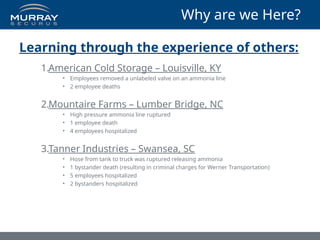
Why are we Here?
Learning through the experience of others:
1.American Cold Storage – Louisville, KY
• Employees removed a unlabeled valve on an ammonia line
• 2 employee deaths
2.Mountaire Farms – Lumber Bridge, NC
• High pressure ammonia line ruptured
• 1 employee death
• 4 employees hospitalized
3.Tanner Industries – Swansea, SC
• Hose from tank to truck was ruptured releasing ammonia
• 1 bystander death (resulting in criminal charges for Werner Transportation)
• 5 employees hospitalized
• 2 bystanders hospitalized
Why are we Here?
Learning the experience of others:
4. CF Industries – Rosemount, MN
• Connection between a truck and tank failed
• 2 employee deaths
5. Weng’s Cold Storage – Shanghai, China
• High pressure ammonia line ruptured
• 15 deaths
• 26 hospitalizations
Definitions
Definitions:
Anhydrous Ammonia
‘Pure’ ammonia. Ammonia that is without water added to it
Non-Responding Employee
Employees who work in a facility that uses or stores ammonia, but who has
no planned interactions with equipment or containers using or storing
ammonia
Responding Employee
Employees who are responsible and trained to complete work in a facility
that uses or stores ammonia
Definitions
Definitions (continued):
Emergency Action Plan
A plan put in place to outline expectation of all employees during an
emergency situation
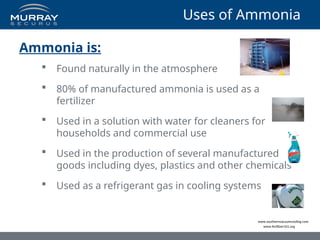
Ammonia is:
 Found naturally in the atmosphere
 80% of manufactured ammonia is used as a
fertilizer
 Used in a solution with water for cleaners for
households and commercial use
 Used in the production of several manufactured
goods including dyes, plastics and other chemicals
 Used as a refrigerant gas in cooling systems
www.fertilizer101.org
Uses of Ammonia
www.southernvacuumcooling.com
Ammonia in the packing areas:
 Used in the refrigeration process
 Found in the rear of the vacuum cooling unit
 Generally, the rear of the unit is isolated from
the general working population
 Can also be used as the refrigerant for the
cooling units in the warehouses and packing
areas
Uses of Ammonia
Characteristics of Ammonia
Properties:
 EASILY ABSORBED BY WATER
 Lighter than air (0.6 specific gravity)
 Gas at room temperature
 Akaline properties/corrosive
 Forms a liquid when compressed
 Rapidly expands from liquid to gas
 Pressure in a contained vessel increases as heated
Characteristics of Ammonia
Properties:
 EASILY ABSORBED BY WATER
This ONE item affects all other
characteristics of ammonia!
Characteristics of Ammonia
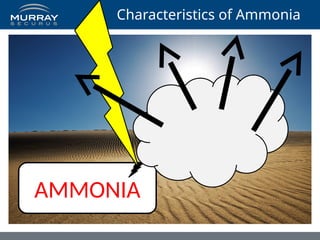
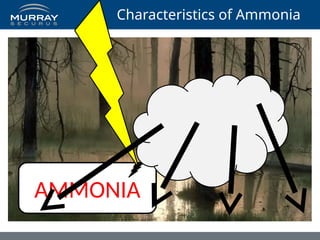
AMMONIA
Characteristics of Ammonia
AMMONIA
Characteristics of Ammonia
Properties:
 EASILY ABSORBED BY WATER
This ONE item affects all other characteristics of
ammonia!
Ammonia actively tries to find water in:
 The atmosphere
 Your eyes
 Your skin
 Your lungs;
 Etc.
Characteristics of Ammonia
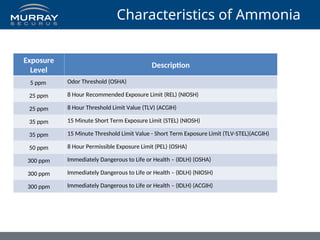
Exposure
Level
Description
5 ppm Odor Threshold (OSHA)
25 ppm 8 Hour Recommended Exposure Limit (REL) (NIOSH)
25 ppm 8 Hour Threshold Limit Value (TLV) (ACGIH)
35 ppm 15 Minute Short Term Exposure Limit (STEL) (NIOSH)
35 ppm 15 Minute Threshold Limit Value - Short Term Exposure Limit (TLV-STEL)(ACGIH)
50 ppm 8 Hour Permissible Exposure Limit (PEL) (OSHA)
300 ppm Immediately Dangerous to Life or Health – (IDLH) (OSHA)
300 ppm Immediately Dangerous to Life or Health – (IDLH) (NIOSH)
300 ppm Immediately Dangerous to Life or Health – (IDLH) (ACGIH)
Characteristics of Ammonia
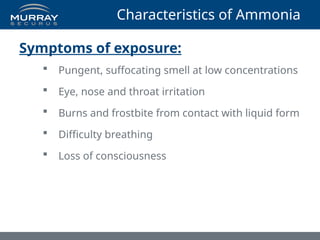
Symptoms of exposure:
 Pungent, suffocating smell at low concentrations
 Eye, nose and throat irritation
 Burns and frostbite from contact with liquid form
 Difficulty breathing
 Loss of consciousness
Emergency Action Plan
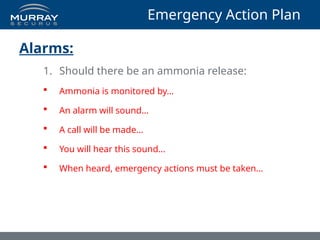
Alarms:
1. Should there be an ammonia release:
 Ammonia is monitored by…
 An alarm will sound…
 A call will be made…
 You will hear this sound…
 When heard, emergency actions must be taken…
Emergency Action Plan
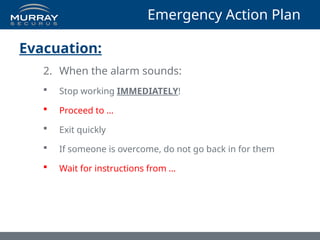
Evacuation:
2. When the alarm sounds:
 Stop working IMMEDIATELY!
 Proceed to …
 Exit quickly
 If someone is overcome, do not go back in for them
 Wait for instructions from …
Emergency Action Plan
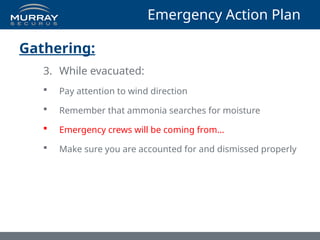
Gathering:
3. While evacuated:
 Pay attention to wind direction
 Remember that ammonia searches for moisture
 Emergency crews will be coming from…
 Make sure you are accounted for and dismissed properly
Emergency Action Plan
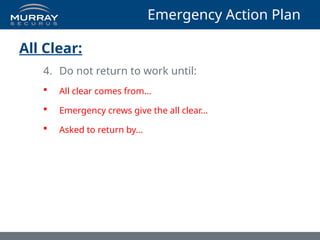
All Clear:
4. Do not return to work until:
 All clear comes from…
 Emergency crews give the all clear…
 Asked to return by…
Emergency Action Plan
Drills:
5. Procedures for emergency drills:
 Preparation is the key to avoiding catastrophe
 Failure to participate will result in disciplinary action
 Drill will be conducted (time frame)…
 Results of the drills will be recorded and reviewed by…
Conclusion
Conclusion:
1.) The potential for exposure to ammonia is
isolated
2.) Preparation is key in the case of an
accidental exposure
3.) Ammonia must be taken seriously and
considered dangerous
4.) Ammonia will seek out water in the
atmosphere
5.) Preparation is the difference between an
accident and a disaster
Questions and Discussion
Thank You!
John S. Hillard, CSP
Risk Control Consultant
jhillard@murrayins.com
717-606-5904

Ammonia Handling Safety Awareness Presentation

  • 1.
    Ammonia Safety Presented By: JohnS. Hillard, CSP Risk Control Consultant jhillard@murrayins.com 717-606-5904
  • 2.
    Agenda Agenda 1.) Why arewe here? 2.) Definitions 3.) Uses of Ammonia 4.) Areas of potential exposure 5.) Ammonia characteristics 6.) Emergency Response/Action Plan
  • 3.
    Why are weHere? Purpose: 1.Your own personal safety • There is ammonia on our premises • We want you to be aware of it • We also want you to be prepared 2.Education • You should know what ammonia is • Emergency procedures should be well known by ALL employees 3.Preparation • Be ready for the worst case • If the worst case happens, preparation saves lives
  • 4.
    Why are weHere? Learning through the experience of others: 1.American Cold Storage – Louisville, KY • Employees removed a unlabeled valve on an ammonia line • 2 employee deaths 2.Mountaire Farms – Lumber Bridge, NC • High pressure ammonia line ruptured • 1 employee death • 4 employees hospitalized 3.Tanner Industries – Swansea, SC • Hose from tank to truck was ruptured releasing ammonia • 1 bystander death (resulting in criminal charges for Werner Transportation) • 5 employees hospitalized • 2 bystanders hospitalized
  • 5.
    Why are weHere? Learning the experience of others: 4. CF Industries – Rosemount, MN • Connection between a truck and tank failed • 2 employee deaths 5. Weng’s Cold Storage – Shanghai, China • High pressure ammonia line ruptured • 15 deaths • 26 hospitalizations
  • 6.
    Definitions Definitions: Anhydrous Ammonia ‘Pure’ ammonia.Ammonia that is without water added to it Non-Responding Employee Employees who work in a facility that uses or stores ammonia, but who has no planned interactions with equipment or containers using or storing ammonia Responding Employee Employees who are responsible and trained to complete work in a facility that uses or stores ammonia
  • 7.
    Definitions Definitions (continued): Emergency ActionPlan A plan put in place to outline expectation of all employees during an emergency situation
  • 8.
    Ammonia is:  Foundnaturally in the atmosphere  80% of manufactured ammonia is used as a fertilizer  Used in a solution with water for cleaners for households and commercial use  Used in the production of several manufactured goods including dyes, plastics and other chemicals  Used as a refrigerant gas in cooling systems www.fertilizer101.org Uses of Ammonia www.southernvacuumcooling.com
  • 9.
    Ammonia in thepacking areas:  Used in the refrigeration process  Found in the rear of the vacuum cooling unit  Generally, the rear of the unit is isolated from the general working population  Can also be used as the refrigerant for the cooling units in the warehouses and packing areas Uses of Ammonia
  • 10.
    Characteristics of Ammonia Properties: EASILY ABSORBED BY WATER  Lighter than air (0.6 specific gravity)  Gas at room temperature  Akaline properties/corrosive  Forms a liquid when compressed  Rapidly expands from liquid to gas  Pressure in a contained vessel increases as heated
  • 11.
    Characteristics of Ammonia Properties: EASILY ABSORBED BY WATER This ONE item affects all other characteristics of ammonia!
  • 12.
  • 13.
  • 14.
    Characteristics of Ammonia Properties: EASILY ABSORBED BY WATER This ONE item affects all other characteristics of ammonia! Ammonia actively tries to find water in:  The atmosphere  Your eyes  Your skin  Your lungs;  Etc.
  • 15.
    Characteristics of Ammonia Exposure Level Description 5ppm Odor Threshold (OSHA) 25 ppm 8 Hour Recommended Exposure Limit (REL) (NIOSH) 25 ppm 8 Hour Threshold Limit Value (TLV) (ACGIH) 35 ppm 15 Minute Short Term Exposure Limit (STEL) (NIOSH) 35 ppm 15 Minute Threshold Limit Value - Short Term Exposure Limit (TLV-STEL)(ACGIH) 50 ppm 8 Hour Permissible Exposure Limit (PEL) (OSHA) 300 ppm Immediately Dangerous to Life or Health – (IDLH) (OSHA) 300 ppm Immediately Dangerous to Life or Health – (IDLH) (NIOSH) 300 ppm Immediately Dangerous to Life or Health – (IDLH) (ACGIH)
  • 16.
    Characteristics of Ammonia Symptomsof exposure:  Pungent, suffocating smell at low concentrations  Eye, nose and throat irritation  Burns and frostbite from contact with liquid form  Difficulty breathing  Loss of consciousness
  • 17.
    Emergency Action Plan Alarms: 1.Should there be an ammonia release:  Ammonia is monitored by…  An alarm will sound…  A call will be made…  You will hear this sound…  When heard, emergency actions must be taken…
  • 18.
    Emergency Action Plan Evacuation: 2.When the alarm sounds:  Stop working IMMEDIATELY!  Proceed to …  Exit quickly  If someone is overcome, do not go back in for them  Wait for instructions from …
  • 19.
    Emergency Action Plan Gathering: 3.While evacuated:  Pay attention to wind direction  Remember that ammonia searches for moisture  Emergency crews will be coming from…  Make sure you are accounted for and dismissed properly
  • 20.
    Emergency Action Plan AllClear: 4. Do not return to work until:  All clear comes from…  Emergency crews give the all clear…  Asked to return by…
  • 21.
    Emergency Action Plan Drills: 5.Procedures for emergency drills:  Preparation is the key to avoiding catastrophe  Failure to participate will result in disciplinary action  Drill will be conducted (time frame)…  Results of the drills will be recorded and reviewed by…
  • 22.
    Conclusion Conclusion: 1.) The potentialfor exposure to ammonia is isolated 2.) Preparation is key in the case of an accidental exposure 3.) Ammonia must be taken seriously and considered dangerous 4.) Ammonia will seek out water in the atmosphere 5.) Preparation is the difference between an accident and a disaster
  • 23.
  • 24.
    Thank You! John S.Hillard, CSP Risk Control Consultant jhillard@murrayins.com 717-606-5904