PHILIPPINE LITERATURE DURING
AMERICAN PERIOD
HISTORICAL BACKGROUND
•Philippine Independence (June 12, 1898)
•Nationalism
•Filipino writers went into all forms of
literature like news, reporting, poetry,
stories, plays, essays and novels.
Themes of Literature
•Desire for freedom
•Love of country
•Fight against colonialism and imperialism
NEWSPAPERS
•El Grito Del Pueblo
•Manila Daily Bulletin
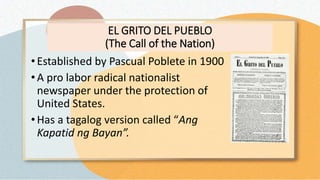
EL GRITO DEL PUEBLO
(The Call of the Nation)
•Established by Pascual Poblete in 1900
• A pro labor radical nationalist
newspaper under the protection of
United States.
• Has a tagalog version called “Ang
Kapatid ng Bayan”.
MANILA DAILY BULLETIN
•The Philippines’ largest
broadsheet newspaper bay
circulation.
•Now currently known as “The
Manila Bulletin”.
PLAYS
•Kahapon Ngayon at Bukas by Aurelio
Tolentino
•Tanikalang Ginto by Juan Abad
•Walang Sugat by Severino Reyes
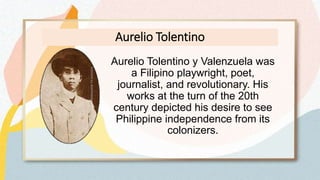
Aurelio Tolentino
Aurelio Tolentino y Valenzuela was
a Filipino playwright, poet,
journalist, and revolutionary. His
works at the turn of the 20th
century depicted his desire to see
Philippine independence from its
colonizers.
Kahapon, Ngayon at Bukas
by Aurelio Tolentino
It is an anti-imperialist play attacking the new
colonizers (at that time), the Americans, while
not forgiving the old ones – Mother Spain and
Old China, who want to feast on the Philippines’
wealth.
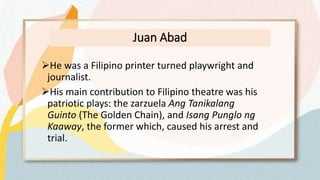
Juan Abad
He was a Filipino printer turned playwright and
journalist.
His main contribution to Filipino theatre was his
patriotic plays: the zarzuela Ang Tanikalang
Guinto (The Golden Chain), and Isang Punglo ng
Kaaway, the former which, caused his arrest and
trial.
Tanikalang Ginto
by Juan Abad
This is about the love story of Kaulayaw and
Liwanag. As of promise of love, Kaulayaw gave
a handkerchief to Liwanag . The other man
named Maimbot also admire Liwanag so he
gave her a Golden chain as a gift.
Severino Reyes
He was a Filipino writer, playwright, and
director of plays and he was nicknamed
“Don Binoy”.
➢ Reyes helped found the Liwayway
magazine in 1922, and is recognized for
pioneering the Tagalog literary renascence
during his lifetime. And his stories under
the name Lola Basyang were the magazine’s
most widely read.
Walang Sugat
Set in the Philippine Revolution of 1896, Walang
batas sa Sugat was first published in 1898, and first
performed in 1902 at the Teatro Libertad.
It portrays the dilemmas of domestic life through
dialogue, song, and dance. In addition, the zarzuela
is laden with romance, humor, and conflict.
SHORT STORIES
Dead Stars
by Paz Marquez-Benitez
How My Brother Leon Brought Home a Wife
by Manuel Arguilla
PAZ MARQUEZ-BENITEZ
Benitez was among the first generation of Filipinos
trained in the American education system which used
English as the medium of instruction. She was a
member of the first freshman class of the University
of the Philippines, graduating with a Bachelor of Arts
in 1912.
DEAD STARS
This story, first published in 1925 and regularly anthologized
since, is considered the first modern short story written in
English by a Filipino.
This holds a significant place in Philippine English Literature as
it gives birth to modern English writing in Philippine. At that
time, English was newly introduced and the writers were
struggling hard while using English as a medium of expression
DEAD STARS
The short story also illustrates the rising conjunction of
sociopolitical feminism. In this story, women are represented as
meek and dependent on men. Men are considered to be
superior to women. Women are faithful who easily falls in love
while the male is shown as uncertain, inconsistent and rational.
However, the story also ruined the concept of patriarchal
society as it sees the man rational and logical while woman as
emotional and kind.
MANUEL ARGUILLA
He was an Ilokano writer in English, patriot, and
martyr.
He is known for his widely anthologized short story
"How My Brother Leon Brought Home a Wife," which
won first prize in the Commonwealth Literary Contest
in 1940.
HOW MY BROTHER LEON BROUGHT
HOME A WIFE
The story begins with mixture of descriptions as the main
character, the brother, meets his brother and new wife. It is
about respect and acceptance of one's life. In order to have a
long-lasting relationship you must show respect to each other
and the family. And if you really love a person you should
accept who he/she is, and what he/she is and also don’t judge
other people first without even knowing him/her in person.
OTHER FILIPINO WRITERS
DURING AMERICAN PERIOD
LOPE K. SANTOS
Father of National Language
Also called “apo” of tagalog
writers.
He is best known for his
1906 socialist novel, Banaag at
Sikat.
JOSE CORAZON DE JESUS
•Known as “Huseng Batute”
•He was called the poet of love
during his time.
•AG ISANG PUNONGKAHOY- an elegy
believed to be his masterpiece.
AMADO V. HERNANDEZ
• Known as the “Poet of Laborers”
• In 1922, at the age of 19,
Hernandez became a member of
the literary society Aklatang Bayan
which included noted Tagalog
writers Lope K. Santos and Jose
Corazon de Jesu
• Ang Panday as his masterpiece.
PHILIPPINE LITERATURE IN ENGLISH
•The Period of Re-Orientation
(1898-1910)
•The Period of Imitation
(1910-1924)
•The Period of Self-Discovery and
Growth
(1925-1941)
The Period of Re-Orientation (1898-1910)
•English as a literary vehicle came with the
American occupation in August 13, 1898.
•By 1900, English came to be used as a medium of
instruction in the public schools.
•By 1908, the primary and intermediate grades
were using English.
The Period of Imitation (1910-1924)
•By 1919, the UP College Folio published the
literary compositions of the First Filipino writers
in English.
•They were then imitated American and British
models which resulted in stilted, artificial and
unnatural style, lacking versatility and
spontaneity.
The Period of Self-Discovery and Growth
(1925-1941)
•They were confidently and competently
wrote on a lot of subjects although the
old time favorites which is love and
youth persisted.

American-Period ppt.pptx

  • 1.
  • 2.
    HISTORICAL BACKGROUND •Philippine Independence(June 12, 1898) •Nationalism •Filipino writers went into all forms of literature like news, reporting, poetry, stories, plays, essays and novels.
  • 3.
    Themes of Literature •Desirefor freedom •Love of country •Fight against colonialism and imperialism
  • 4.
    NEWSPAPERS •El Grito DelPueblo •Manila Daily Bulletin
  • 5.
    EL GRITO DELPUEBLO (The Call of the Nation) •Established by Pascual Poblete in 1900 • A pro labor radical nationalist newspaper under the protection of United States. • Has a tagalog version called “Ang Kapatid ng Bayan”.
  • 6.
    MANILA DAILY BULLETIN •ThePhilippines’ largest broadsheet newspaper bay circulation. •Now currently known as “The Manila Bulletin”.
  • 7.
    PLAYS •Kahapon Ngayon atBukas by Aurelio Tolentino •Tanikalang Ginto by Juan Abad •Walang Sugat by Severino Reyes
  • 8.
    Aurelio Tolentino Aurelio Tolentinoy Valenzuela was a Filipino playwright, poet, journalist, and revolutionary. His works at the turn of the 20th century depicted his desire to see Philippine independence from its colonizers.
  • 9.
    Kahapon, Ngayon atBukas by Aurelio Tolentino It is an anti-imperialist play attacking the new colonizers (at that time), the Americans, while not forgiving the old ones – Mother Spain and Old China, who want to feast on the Philippines’ wealth.
  • 10.
    Juan Abad He wasa Filipino printer turned playwright and journalist. His main contribution to Filipino theatre was his patriotic plays: the zarzuela Ang Tanikalang Guinto (The Golden Chain), and Isang Punglo ng Kaaway, the former which, caused his arrest and trial.
  • 11.
    Tanikalang Ginto by JuanAbad This is about the love story of Kaulayaw and Liwanag. As of promise of love, Kaulayaw gave a handkerchief to Liwanag . The other man named Maimbot also admire Liwanag so he gave her a Golden chain as a gift.
  • 12.
    Severino Reyes He wasa Filipino writer, playwright, and director of plays and he was nicknamed “Don Binoy”. ➢ Reyes helped found the Liwayway magazine in 1922, and is recognized for pioneering the Tagalog literary renascence during his lifetime. And his stories under the name Lola Basyang were the magazine’s most widely read.
  • 13.
    Walang Sugat Set inthe Philippine Revolution of 1896, Walang batas sa Sugat was first published in 1898, and first performed in 1902 at the Teatro Libertad. It portrays the dilemmas of domestic life through dialogue, song, and dance. In addition, the zarzuela is laden with romance, humor, and conflict.
  • 14.
    SHORT STORIES Dead Stars byPaz Marquez-Benitez How My Brother Leon Brought Home a Wife by Manuel Arguilla
  • 15.
    PAZ MARQUEZ-BENITEZ Benitez wasamong the first generation of Filipinos trained in the American education system which used English as the medium of instruction. She was a member of the first freshman class of the University of the Philippines, graduating with a Bachelor of Arts in 1912.
  • 16.
    DEAD STARS This story,first published in 1925 and regularly anthologized since, is considered the first modern short story written in English by a Filipino. This holds a significant place in Philippine English Literature as it gives birth to modern English writing in Philippine. At that time, English was newly introduced and the writers were struggling hard while using English as a medium of expression
  • 17.
    DEAD STARS The shortstory also illustrates the rising conjunction of sociopolitical feminism. In this story, women are represented as meek and dependent on men. Men are considered to be superior to women. Women are faithful who easily falls in love while the male is shown as uncertain, inconsistent and rational. However, the story also ruined the concept of patriarchal society as it sees the man rational and logical while woman as emotional and kind.
  • 18.
    MANUEL ARGUILLA He wasan Ilokano writer in English, patriot, and martyr. He is known for his widely anthologized short story "How My Brother Leon Brought Home a Wife," which won first prize in the Commonwealth Literary Contest in 1940.
  • 19.
    HOW MY BROTHERLEON BROUGHT HOME A WIFE The story begins with mixture of descriptions as the main character, the brother, meets his brother and new wife. It is about respect and acceptance of one's life. In order to have a long-lasting relationship you must show respect to each other and the family. And if you really love a person you should accept who he/she is, and what he/she is and also don’t judge other people first without even knowing him/her in person.
  • 20.
  • 21.
    LOPE K. SANTOS Fatherof National Language Also called “apo” of tagalog writers. He is best known for his 1906 socialist novel, Banaag at Sikat.
  • 22.
    JOSE CORAZON DEJESUS •Known as “Huseng Batute” •He was called the poet of love during his time. •AG ISANG PUNONGKAHOY- an elegy believed to be his masterpiece.
  • 23.
    AMADO V. HERNANDEZ •Known as the “Poet of Laborers” • In 1922, at the age of 19, Hernandez became a member of the literary society Aklatang Bayan which included noted Tagalog writers Lope K. Santos and Jose Corazon de Jesu • Ang Panday as his masterpiece.
  • 24.
    PHILIPPINE LITERATURE INENGLISH •The Period of Re-Orientation (1898-1910) •The Period of Imitation (1910-1924) •The Period of Self-Discovery and Growth (1925-1941)
  • 25.
    The Period ofRe-Orientation (1898-1910) •English as a literary vehicle came with the American occupation in August 13, 1898. •By 1900, English came to be used as a medium of instruction in the public schools. •By 1908, the primary and intermediate grades were using English.
  • 26.
    The Period ofImitation (1910-1924) •By 1919, the UP College Folio published the literary compositions of the First Filipino writers in English. •They were then imitated American and British models which resulted in stilted, artificial and unnatural style, lacking versatility and spontaneity.
  • 27.
    The Period ofSelf-Discovery and Growth (1925-1941) •They were confidently and competently wrote on a lot of subjects although the old time favorites which is love and youth persisted.