AMEDS - PMHSInnovationforCure and Care
AMEDS - PMHSAMEDS  - PMHSPart two
AMEDS - PMHSIn the first part a largeupcomingproblem in todayshealthcare was outlined. It is very important to view the first part beforethissecond part.In thissecond part the innovationsorinventions AMEDS and PMHS willbepresented  as a technicalsolutionfor the problemdiscussed in the first part.
AMEDS - PMHSIn the first part of these presentationsitbecameclearthat, in order to beable to help frail, elderlypatients to taketheirmedication, a special technical system design is needed.As thissytem is not a realitynow we have to inventor design it.There is a differencebetweeninvention and innovation.
AMEDS - PMHSSystiMed defines four key concepts concerning innovation and invention: Inventional process: a systematic and logical thinking process to create an invention.Invention: a creative, new conceptual design with great beneficial potential. Innovative process: a process which leads to the usage of an invention.Innovation: a combination of an invention and an innovative process.
AMEDS - PMHSIn case you want to know more about the different stages of innovation and invention, pleasevisitSystiMed.com.The systemsAMEDS (AutomatedMedication Dispenser System) and PMHS (Personal Mobile Health management System) are invented and beingfurtherdevelopedby SystiMed. Patents for these systems are pending. Beforegiving a detailedtechnicaldescription of the systems we have to know more about the situation in which these systemscanbeapplied.
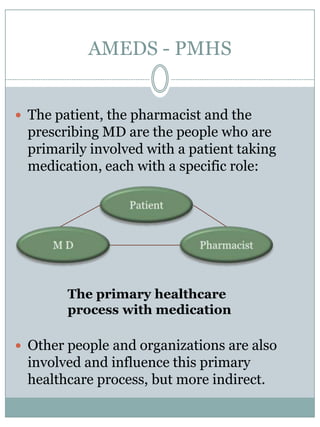
AMEDS - PMHSThe patient, the pharmacist and the prescribing MD are the peoplewho are primarilyinvolvedwith a patienttakingmedication, eachwith a specificrole:Otherpeople and organizations are alsoinvolved and influencethisprimaryhealthcareprocess, but more indirect. PatientM DPharmacistThe primaryhealthcareprocesswithmedication
AMEDS - PMHSIn the first part of thispresentation we have definedfourclearattributesfor the design foranappropriatetechnical system:Multi-userfriendlyOptimalergonomic designSafeReliableAll these attributes are important and it is important to notethat in case one of these attributes is not met, the design is of muchlessvalue, and can even considered to beuseless.
AMEDS - PMHSThe basicidea of AMEDS and PMHS is the following:The most tedious and difficult part in takingmedication is dispensing the medication. To achieve a suitable design foradherence support forelderlyfrail, polypharmic and multimorbidpatients, the dispensing of medication, is fullyautomatedand directlyavailableat the site of the patient. Untillnowdispensing of medication has been doneautomatedorby hand at the pharmacydepartment, orby hand at the location of the patient.
AMEDS - PMHSAs we willseethisnewbasicidea, fullyautomated of medicationdispensing  at the site of the patient, willmakeitpossible to design effectivesystemsforelderly, frailpatientswith polypharmacy and multimorbidity.To achieve the design forsuchsystems we have to applytechnologiesderrivedfromseveraltechnical disciplines in the systems:	Computer sciences, electronics, robotics, telecommunication, electromechanics, ergonomics and sensor technology.
AMEDS - PMHSAMEDS consists of hardware and software.The hardware consists of network servers and socalled ‘dispenser units’.Special medication cartridges canbeattached to the dispenser units.Bymeans of the software the dispenser units and servers canbecontroled.Digital data canbestoredon the server and in the memory of the dispenser unit. Communicationbetween dispenser units and servers canbewired and/orwireless.
AMEDS - PMHSThe AMEDS dispenser unit is a lightweighted, mobile device and consists of:A frame
A computer
An power supply unit
A lockablecompartment
Electromotors
A pillcollecting system
A lockablechallice
A weightingscalefor the chalice
SensorsAMEDS - PMHSThe computer is fullyfunctional and has all connections, like USB, monitor, mouse, keyboard, etc. The power supply unit canbeattached to the network and consists of a tranformator and an accumulator.Sensors are strategicallyplaced in the dispenser unit forcontrol and safety.In the lockablecompartmentmedication cartridges canbeattached to the dispenser unit. The medication cartridges containpills in special medication strips. The dispenser units are able to selectivelyexpell the pillsfrom the strips to the pillcollecting system.
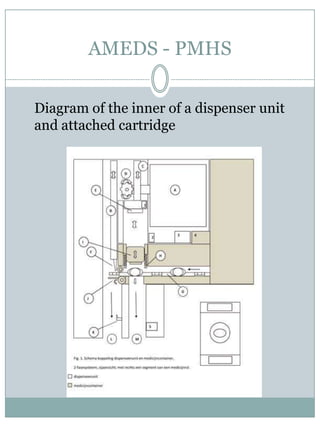
AMEDS - PMHSDiagram of the inner of a dispenser unit and attachedcartridge
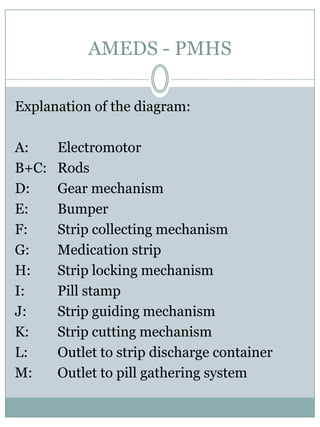
AMEDS - PMHSExplanation of the diagram:A:       	ElectromotorB+C: 	RodsD:      	GearmechanismE:       	BumperF:       	Strip collectingmechanismG:      	Medication stripH:      	Strip lockingmechanismI:        	Pill stampJ:       	Strip guidingmechanismK:      	Strip cuttingmechanismL:	Outlet to strip discharge container M:	Outlet to pillgathering system
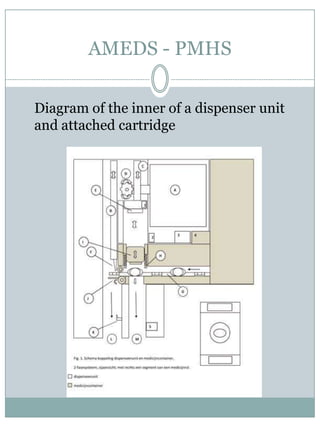
AMEDS - PMHSDiagram of the inner of a dispenser unit and attachedcartridge
AMEDS - PMHSFurtherexplanation of diagram:Sensors:1+2: 	Electronic slip contact sensor (expell)3+4: 	Cartridgeidentification sensor5:		Pillmovement sensorMedication strip segment (lower right):The pills are situated in the middle of the strip and canbeexpelledby the pill stamp.
With the holes at bothsends of the segments the strip segment canbecaughtby the catchingmechanism of the dispenser unit to renderforwardmovement of the strip.AMEDS - PMHSThe width of a medicationcartridge is appr. 2-2.5 cm.A maximum of 20 cartridges canbeattached to one dispenser unit, whichmakes the maximum totalwidth of a dispenser unit ca. 40-50 cm.Eachcartridge has a maximuncapacity of of 200 pills in onepill strip.All medicines on a localmarket are beinggiven a unique code representing the generic name and strength of the medicine.
AMEDS - PMHSBymeans of the uniquemedicine codes and adjustments to the cartridges all medicines on a localmarketcanbedispensedwith the AMEDS dispenser units.As soon a cartridge is attached to the dispenser unit a sensor identifies the cartridgewith the specificmedicine code.Thisway the informationabout the sort of medicine and strength of the medicine is automaticallybroughtinto the system.The sensor technique to identify the cartridges is RFID, or barcode based.
AMEDS - PMHSIn the diagramstwootheressential sensors are notdisplayed:Patient ID sensor	A chip based ID sensor is placedon the dispenser unit to makesure the correct patient is takingmedicinefrom the corresponding dispenser unit.Chaliceweightingscale	The chaliceweighingscaleweighs the chalicebefore and after the medicationexpell to makesure the right amount of pills are expelledfrom the cartridges.
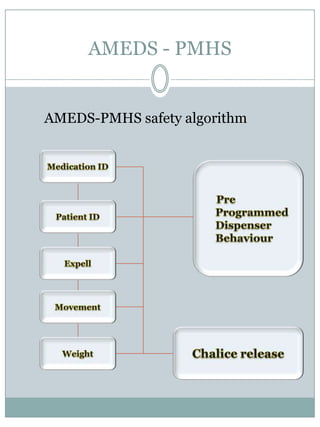
AMEDS - PMHSSafety is an important aspect of AMEDS. Everydispensingprocess at a givendosageormedication time is accompaniedby a sensor basedsafetyalgorithm.In case one step of the algorithm is notadequately met a preprogrammed dispenser behaviour is rendered.Thispreprogrammed dispenser behaviourcanbepredefinedflexibly in accordance to the situation of the patient and healthcareworkersinvolved and the specific step in the algorithm.Onlyif all steps of the algorithm are passed the chalice is made accesiblefor the patient.
AMEDS - PMHSAMEDS-PMHS safetyalgorithmMedication ID     Pre Programmed Dispenser BehaviourPatient IDExpellMovementChalice releaseWeight
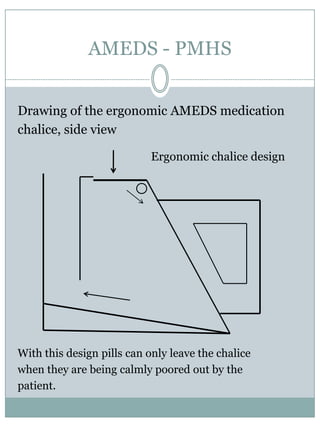
AMEDS - PMHSThe medicationchalice has a special ergonomic design. The basicidea of thisergonomic design is very important, becauseitwillmakehandling of the chaliceforpatientswithphysicalshortcomingspossible.Examples of these shortcomings are:Shaking of the hands (tremors) due to forexampleParkinson’sdiseaseor multiple sclerosis.Muscleweakness (paralysis) orclumsyness (apraxia) due to a stroke.VisionimpairmentReumatic disease
AMEDS - PMHSErgonomicattributes of a medicationchalicewhichmakehandling easy forpatientswithphysicalshortcomings:Lightweighted, transparentmaterial.Big handlewith easy grip.Easy accesible and even easy to findby touch forpeoplewithvisionimpairment.Closedfor the most part when taken in the hand of the patient, sothatwhen the chalicefalls, or is shaken, the pillsdon’t drop out of the chalice.Easy washable.Tiltedbottom.
AMEDS - PMHSDrawing of the ergonomic AMEDS medicationchalice, side viewWiththis design pillscanonlyleave the chalicewhenthey are beingcalmlypoored out by the patient. Ergonomicchalice design
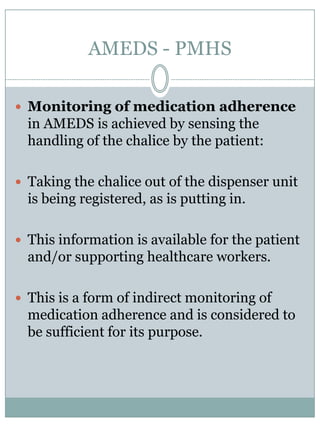
AMEDS - PMHSMonitoring of medicationadherencein AMEDS is achievedbysensing the handling of the chaliceby the patient:Taking the chalice out of the dispenser unit is beingregistered, as is putting in. Thisinformation is availablefor the patient and/orsupportinghealthcareworkers.This is a form of indirect monitoring of medicationadherence and is considered to besufficientforitspurpose.
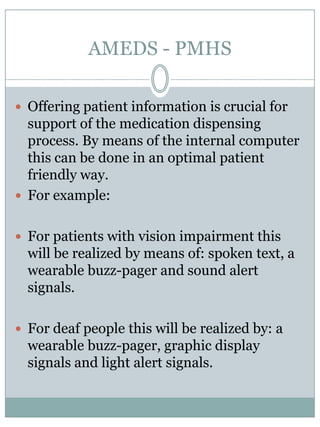
AMEDS - PMHSOfferingpatientinformation is crucialfor support of the medicationdispensingprocess. Bymeans of the internal computer thiscanbedone in anoptimalpatientfriendlyway.For example:  For patientswithvisionimpairmentthiswillberealizedbymeans of: spoken text, a wearablebuzz-pager and sound alert signals.For deafpeoplethiswillberealizedby: a wearablebuzz-pager, graphic display signals and light alert signals.

AMEDS - PMHS - part two

  • 1.
  • 2.
    AMEDS - PMHSAMEDS - PMHSPart two
  • 3.
    AMEDS - PMHSInthe first part a largeupcomingproblem in todayshealthcare was outlined. It is very important to view the first part beforethissecond part.In thissecond part the innovationsorinventions AMEDS and PMHS willbepresented as a technicalsolutionfor the problemdiscussed in the first part.
  • 4.
    AMEDS - PMHSInthe first part of these presentationsitbecameclearthat, in order to beable to help frail, elderlypatients to taketheirmedication, a special technical system design is needed.As thissytem is not a realitynow we have to inventor design it.There is a differencebetweeninvention and innovation.
  • 5.
    AMEDS - PMHSSystiMeddefines four key concepts concerning innovation and invention: Inventional process: a systematic and logical thinking process to create an invention.Invention: a creative, new conceptual design with great beneficial potential. Innovative process: a process which leads to the usage of an invention.Innovation: a combination of an invention and an innovative process.
  • 6.
    AMEDS - PMHSIncase you want to know more about the different stages of innovation and invention, pleasevisitSystiMed.com.The systemsAMEDS (AutomatedMedication Dispenser System) and PMHS (Personal Mobile Health management System) are invented and beingfurtherdevelopedby SystiMed. Patents for these systems are pending. Beforegiving a detailedtechnicaldescription of the systems we have to know more about the situation in which these systemscanbeapplied.
  • 7.
    AMEDS - PMHSThepatient, the pharmacist and the prescribing MD are the peoplewho are primarilyinvolvedwith a patienttakingmedication, eachwith a specificrole:Otherpeople and organizations are alsoinvolved and influencethisprimaryhealthcareprocess, but more indirect. PatientM DPharmacistThe primaryhealthcareprocesswithmedication
  • 8.
    AMEDS - PMHSInthe first part of thispresentation we have definedfourclearattributesfor the design foranappropriatetechnical system:Multi-userfriendlyOptimalergonomic designSafeReliableAll these attributes are important and it is important to notethat in case one of these attributes is not met, the design is of muchlessvalue, and can even considered to beuseless.
  • 9.
    AMEDS - PMHSThebasicidea of AMEDS and PMHS is the following:The most tedious and difficult part in takingmedication is dispensing the medication. To achieve a suitable design foradherence support forelderlyfrail, polypharmic and multimorbidpatients, the dispensing of medication, is fullyautomatedand directlyavailableat the site of the patient. Untillnowdispensing of medication has been doneautomatedorby hand at the pharmacydepartment, orby hand at the location of the patient.
  • 10.
    AMEDS - PMHSAswe willseethisnewbasicidea, fullyautomated of medicationdispensing at the site of the patient, willmakeitpossible to design effectivesystemsforelderly, frailpatientswith polypharmacy and multimorbidity.To achieve the design forsuchsystems we have to applytechnologiesderrivedfromseveraltechnical disciplines in the systems: Computer sciences, electronics, robotics, telecommunication, electromechanics, ergonomics and sensor technology.
  • 11.
    AMEDS - PMHSAMEDSconsists of hardware and software.The hardware consists of network servers and socalled ‘dispenser units’.Special medication cartridges canbeattached to the dispenser units.Bymeans of the software the dispenser units and servers canbecontroled.Digital data canbestoredon the server and in the memory of the dispenser unit. Communicationbetween dispenser units and servers canbewired and/orwireless.
  • 12.
    AMEDS - PMHSTheAMEDS dispenser unit is a lightweighted, mobile device and consists of:A frame
  • 13.
  • 14.
  • 15.
  • 16.
  • 17.
  • 18.
  • 19.
  • 20.
    SensorsAMEDS - PMHSThecomputer is fullyfunctional and has all connections, like USB, monitor, mouse, keyboard, etc. The power supply unit canbeattached to the network and consists of a tranformator and an accumulator.Sensors are strategicallyplaced in the dispenser unit forcontrol and safety.In the lockablecompartmentmedication cartridges canbeattached to the dispenser unit. The medication cartridges containpills in special medication strips. The dispenser units are able to selectivelyexpell the pillsfrom the strips to the pillcollecting system.
  • 21.
    AMEDS - PMHSDiagramof the inner of a dispenser unit and attachedcartridge
  • 22.
    AMEDS - PMHSExplanationof the diagram:A: ElectromotorB+C: RodsD: GearmechanismE: BumperF: Strip collectingmechanismG: Medication stripH: Strip lockingmechanismI: Pill stampJ: Strip guidingmechanismK: Strip cuttingmechanismL: Outlet to strip discharge container M: Outlet to pillgathering system
  • 23.
    AMEDS - PMHSDiagramof the inner of a dispenser unit and attachedcartridge
  • 24.
    AMEDS - PMHSFurtherexplanationof diagram:Sensors:1+2: Electronic slip contact sensor (expell)3+4: Cartridgeidentification sensor5: Pillmovement sensorMedication strip segment (lower right):The pills are situated in the middle of the strip and canbeexpelledby the pill stamp.
  • 25.
    With the holesat bothsends of the segments the strip segment canbecaughtby the catchingmechanism of the dispenser unit to renderforwardmovement of the strip.AMEDS - PMHSThe width of a medicationcartridge is appr. 2-2.5 cm.A maximum of 20 cartridges canbeattached to one dispenser unit, whichmakes the maximum totalwidth of a dispenser unit ca. 40-50 cm.Eachcartridge has a maximuncapacity of of 200 pills in onepill strip.All medicines on a localmarket are beinggiven a unique code representing the generic name and strength of the medicine.
  • 26.
    AMEDS - PMHSBymeansof the uniquemedicine codes and adjustments to the cartridges all medicines on a localmarketcanbedispensedwith the AMEDS dispenser units.As soon a cartridge is attached to the dispenser unit a sensor identifies the cartridgewith the specificmedicine code.Thisway the informationabout the sort of medicine and strength of the medicine is automaticallybroughtinto the system.The sensor technique to identify the cartridges is RFID, or barcode based.
  • 27.
    AMEDS - PMHSInthe diagramstwootheressential sensors are notdisplayed:Patient ID sensor A chip based ID sensor is placedon the dispenser unit to makesure the correct patient is takingmedicinefrom the corresponding dispenser unit.Chaliceweightingscale The chaliceweighingscaleweighs the chalicebefore and after the medicationexpell to makesure the right amount of pills are expelledfrom the cartridges.
  • 28.
    AMEDS - PMHSSafetyis an important aspect of AMEDS. Everydispensingprocess at a givendosageormedication time is accompaniedby a sensor basedsafetyalgorithm.In case one step of the algorithm is notadequately met a preprogrammed dispenser behaviour is rendered.Thispreprogrammed dispenser behaviourcanbepredefinedflexibly in accordance to the situation of the patient and healthcareworkersinvolved and the specific step in the algorithm.Onlyif all steps of the algorithm are passed the chalice is made accesiblefor the patient.
  • 29.
    AMEDS - PMHSAMEDS-PMHSsafetyalgorithmMedication ID Pre Programmed Dispenser BehaviourPatient IDExpellMovementChalice releaseWeight
  • 30.
    AMEDS - PMHSThemedicationchalice has a special ergonomic design. The basicidea of thisergonomic design is very important, becauseitwillmakehandling of the chaliceforpatientswithphysicalshortcomingspossible.Examples of these shortcomings are:Shaking of the hands (tremors) due to forexampleParkinson’sdiseaseor multiple sclerosis.Muscleweakness (paralysis) orclumsyness (apraxia) due to a stroke.VisionimpairmentReumatic disease
  • 31.
    AMEDS - PMHSErgonomicattributesof a medicationchalicewhichmakehandling easy forpatientswithphysicalshortcomings:Lightweighted, transparentmaterial.Big handlewith easy grip.Easy accesible and even easy to findby touch forpeoplewithvisionimpairment.Closedfor the most part when taken in the hand of the patient, sothatwhen the chalicefalls, or is shaken, the pillsdon’t drop out of the chalice.Easy washable.Tiltedbottom.
  • 32.
    AMEDS - PMHSDrawingof the ergonomic AMEDS medicationchalice, side viewWiththis design pillscanonlyleave the chalicewhenthey are beingcalmlypoored out by the patient. Ergonomicchalice design
  • 33.
    AMEDS - PMHSMonitoringof medicationadherencein AMEDS is achievedbysensing the handling of the chaliceby the patient:Taking the chalice out of the dispenser unit is beingregistered, as is putting in. Thisinformation is availablefor the patient and/orsupportinghealthcareworkers.This is a form of indirect monitoring of medicationadherence and is considered to besufficientforitspurpose.
  • 34.
    AMEDS - PMHSOfferingpatientinformationis crucialfor support of the medicationdispensingprocess. Bymeans of the internal computer thiscanbedone in anoptimalpatientfriendlyway.For example: For patientswithvisionimpairmentthiswillberealizedbymeans of: spoken text, a wearablebuzz-pager and sound alert signals.For deafpeoplethiswillberealizedby: a wearablebuzz-pager, graphic display signals and light alert signals.