CONDUCT
OF
LESSON OBJECTIVE
 At the end of the lesson, the student
should be able to correctly state the
organization and conduct of an ambush.
SCOPE
 Introduction
 Categories of Ambushes
 Principles
 Organization
 Layout of groups
 Planning & preparation
 Conduct
 Anti-armour ambushes
 Summary
What is an Ambush?
An ambush is a surprise attack, by
a force lying in wait, upon a moving
or temporarily halted enemy.
 “Ambush is killing and
killing is ambush”
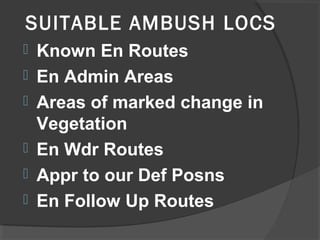
SUITABLE AMBUSH LOCS
 Known En Routes
 En Admin Areas
 Areas of marked change in
Vegetation
 En Wdr Routes
 Appr to our Def Posns
 En Follow Up Routes
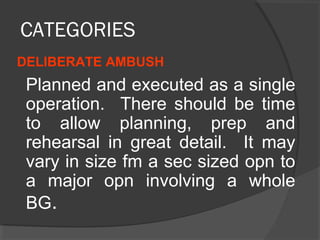
CATEGORIES
DELIBERATE AMBUSH
Planned and executed as a single
operation. There should be time
to allow planning, prep and
rehearsal in great detail. It may
vary in size fm a sec sized opn to
a major opn involving a whole
BG.
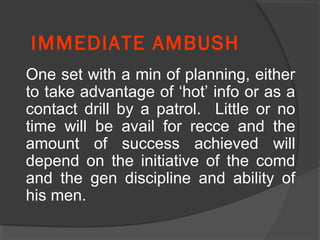
IMMEDIATE AMBUSH
One set with a min of planning, either
to take advantage of ‘hot’ info or as a
contact drill by a patrol. Little or no
time will be avail for recce and the
amount of success achieved will
depend on the initiative of the comd
and the gen discipline and ability of
his men.
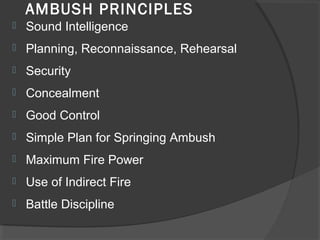
AMBUSH PRINCIPLES
 Sound Intelligence
 Planning, Reconnaissance, Rehearsal
 Security
 Concealment
 Good Control
 Simple Plan for Springing Ambush
 Maximum Fire Power
 Use of Indirect Fire
 Battle Discipline
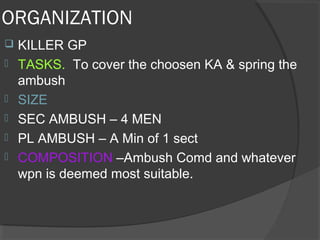
ORGANIZATION
 KILLER GP
 TASKS. To cover the choosen KA & spring the
ambush
 SIZE
 SEC AMBUSH – 4 MEN
 PL AMBUSH – A Min of 1 sect
 COMPOSITION –Ambush Comd and whatever
wpn is deemed most suitable.
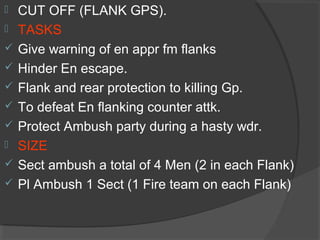
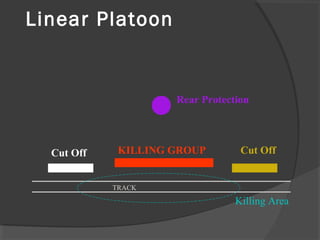
 CUT OFF (FLANK GPS).
 TASKS
 Give warning of en appr fm flanks
 Hinder En escape.
 Flank and rear protection to killing Gp.
 To defeat En flanking counter attk.
 Protect Ambush party during a hasty wdr.
 SIZE
 Sect ambush a total of 4 Men (2 in each Flank)
 Pl Ambush 1 Sect (1 Fire team on each Flank)
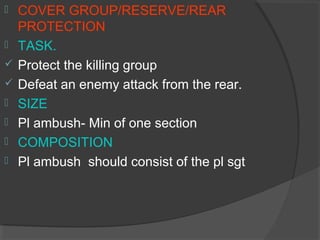
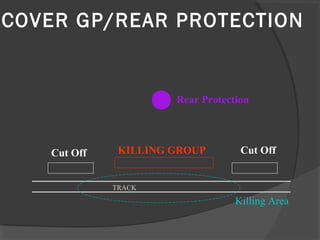
 COVER GROUP/RESERVE/REAR
PROTECTION
 TASK.
 Protect the killing group
 Defeat an enemy attack from the rear.
 SIZE
 Pl ambush- Min of one section
 COMPOSITION
 Pl ambush should consist of the pl sgt
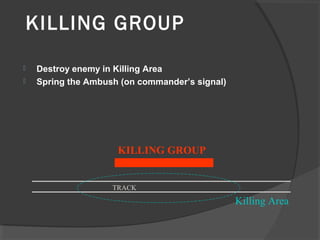
KILLING GROUP
 Destroy enemy in Killing Area
 Spring the Ambush (on commander’s signal)
TRACK
Killing Area
KILLING GROUP
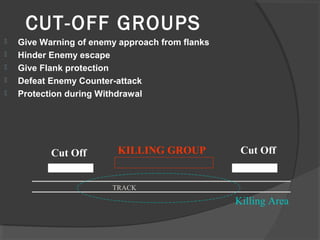
CUT-OFF GROUPS
 Give Warning of enemy approach from flanks
 Hinder Enemy escape
 Give Flank protection
 Defeat Enemy Counter-attack
 Protection during Withdrawal
TRACK
Killing Area
KILLING GROUP Cut OffCut Off
COVER GP/REAR PROTECTION
TRACK
Killing Area
KILLING GROUP Cut OffCut Off
Rear Protection
TYPES OF AMBUSH
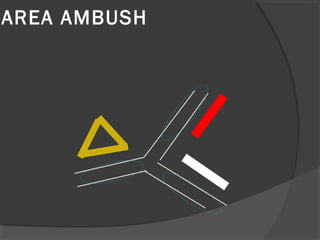
 AREA
 BASIC
Triangular
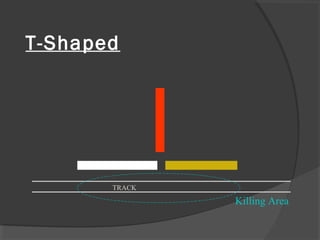
T-shaped
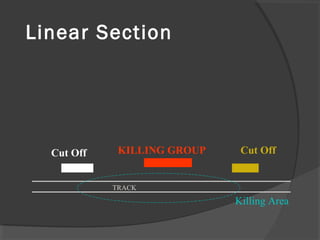
Linear
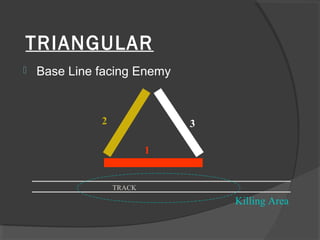
TRIANGULAR
 Base Line facing Enemy
TRACK
2 3
1
Killing Area
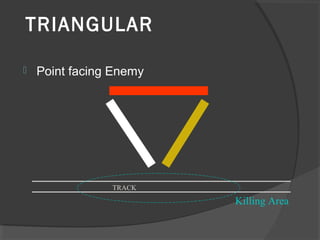
TRIANGULAR
 Point facing Enemy
TRACK
3
Killing Area
T-Shaped
TRACK
Killing Area
Linear Platoon
TRACK
Killing Area
KILLING GROUP Cut OffCut Off
Rear Protection
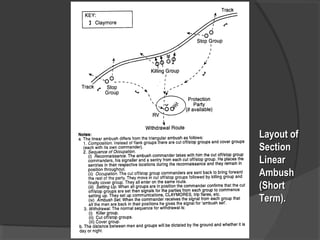
Linear Section
TRACK
Killing Area
KILLING GROUP Cut OffCut Off
AREA AMBUSH
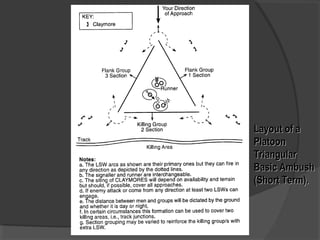
Layout of aLayout of a
PlatoonPlatoon
TriangularTriangular
Basic AmbushBasic Ambush
(Short Term).(Short Term).
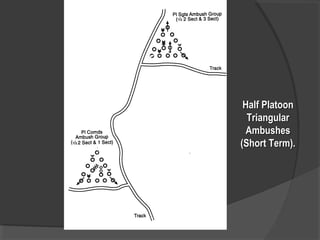
Half PlatoonHalf Platoon
TriangularTriangular
AmbushesAmbushes
(Short Term).(Short Term).
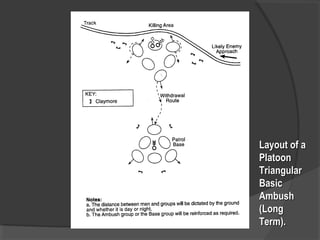
Layout of aLayout of a
PlatoonPlatoon
TriangularTriangular
BasicBasic
AmbushAmbush
(Long(Long
Term).Term).
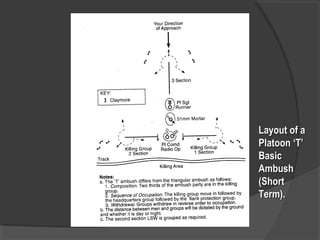
Layout of aLayout of a
Platoon ‘T’Platoon ‘T’
BasicBasic
AmbushAmbush
(Short(Short
Term).Term).
Layout ofLayout of
SectionSection
LinearLinear
AmbushAmbush
(Short(Short
Term).Term).
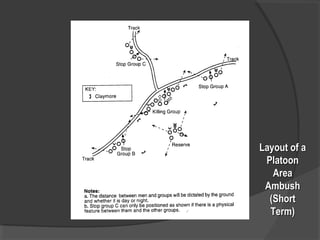
Layout of aLayout of a
PlatoonPlatoon
AreaArea
AmbushAmbush
(Short(Short
Term)Term)
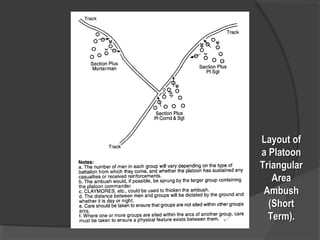
Layout ofLayout of
a Platoona Platoon
TriangularTriangular
AreaArea
AmbushAmbush
(Short(Short
Term).Term).
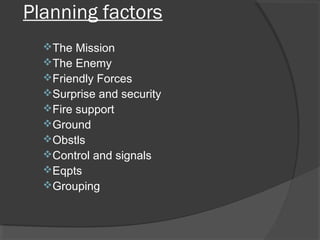
PLANNING AND PREPARATION
Planning factors
The Mission
The Enemy
Friendly Forces
Surprise and security
Fire support
Ground
Obstls
Control and signals
Eqpts
Grouping
Layout of an ambush
 There are three basic principles:
All approaches must be covered.
The ambush mush have depth.
The ambush must have all round defence.
Action after springing the ambush
Should be governed by:
The nature of the task.
The anticipated en str and his likely reaction.
The ground.
The WDR
Wdr plans should cover the fol
Searching the dead after the ambush.
When no en enters the ambush & the
ambush is not sprang.
When superior en force either approaches
the ambush site or is ambushed and counter
attks.
Wdr with a number of casualties hampering
the speed and silence of own movt.
Administration
 Take into consideration whether the
ambush is long or short term, thus the
admin implications.
 The estb of a patrol harbour & its
accompanying requirements.
 CASEVAC plans.
Alternative Plans
 The ambush Commander should try and
avoid, but contingency plans must be
made.
Timings of Ambushes
Day or Night ambushes, choices will
depend on:
The terrain, cover fm view & fields
of fire.
The pattern of the en.
Night Ambushes: Points to
consider
Concealment is easy but shooting is much
less accurate.
Auto wpns will produce better vol of fire but
single shot fire is more accurate.
Left & right arcs should be fixed for all wpns.
Restrict movt once ‘ambush set’ signal is
given.
Clear ‘O’s, fire control & signals essential.
Occupy , if possible.
Illumination needed.
Conduct
 Recce
 Issue of preliminary ‘O’s in a secure area.
 Prep & rehersals in a secure area.
 Movt to the ambush area.
 Final recce by ambush comd & group comds
and their guides.
 Confirmation by ambush comd.
 Occupation of position.
 Lying in ambush.
 Springing the ambush.
 Action after springing.
 Withdraw.
Claymores, surveillance devices &
illuminants.
 The Claymore.
 Wpn sights.
 Flares tripwire.
 Cluster of three flares.
 Flare ground indicating yellow.
 Flares hand thrown.
 Projected illuminants.
 NVGs.
ANTI-ARMOUR AMBUSH
 PRINCIPLES
Surprise.
Co-od fire plan.
Control.
Quick reaction.
Simplicity.
Factors
Suitability of ground.
Weather.
Darkness.
Available wpns and mines.
Obstls.
Composition
 Comdr
 Smk man
 Anti-tk team
 LMG group
Action at FRV
 The Comdr, LMG group comdr & Smk
man make a recce and confirm:
The exact killing area.
Siting of anti-tk mines & claymores.
Siting of the 84mm MAW teams.
LMG & GPMG posns.
Occupation
 GPMG grp positions first.
 Anti-tk teams placed in posn by the ambush comd.
 Anti-tk and claymore mines sited fol by wire &
lights.
 All prep shell scraps and clear fields of fire.
 Wdr plans rehearsed.
 Comd visits each grp before giving the signal
‘ambush set’, & to confirm all know their wdr
routes.
Springing the Ambush
 The lead veh will usually be used as the signal
to spring the ambush, but not always.
 The comdr initiates the primary anti-tk mine, this
signals the MAW teams to engage, WP thrown
to blind, MGs engage dismounting crew and
infantry.
 When the groups posn becomes untenable, a
controlled well rehersed wdr should occur.
Night Action
 The fol points should be
considered:
MAWs fitted with CWS.
Flares should be sited or fired to
silhouette the tgt.
Radio comms be used to co-ord firing
of flares and a/tk wpns.
ORDERS
PRELIMS
Security
Task Org
Sitting plan
Map folds
Weather
Forecast
Model description (Cpl)
Ground description (by the comd)
 Situation
 En forces
 FF
 Intent 2 levels up
 Intent 1 Level up
 Mission
 Execution
 Concept of ops
 Intent
 Scheme of manoeuvre
 ME
 SCHEME OF MANOEUVRE
 …..is to move fm present loc thru RV 1, RV2 and
FRV and subsequently clear the en in 5 phases.
 Ph 1. Rout out
 Ph 2. Action on FRV
 Ph 3. Action on obj
 Ph 4. Wdr
 Ph 5. Route in
Cord Instrs
CSS
Comd and signal
Questions
Summary
Synchronization of watches
Pass Word
CONCLUSION
 Definition
 Categories of Ambushes
 Principles
 Organization
 Layout of groups
 Planning & preparation
 Conduct
 Anti-armour ambushes
LESSON OBJECTIVE
 At the end of the lesson, the student
should be able to efficiently plan,
prepare and conduct an ambush.
Any
Questions ?
REFERENCES
 Commander’s Handbook
 Infantry Tactics Book
 Battle Group

Ambush revised

  • 1.
  • 2.
    LESSON OBJECTIVE  Atthe end of the lesson, the student should be able to correctly state the organization and conduct of an ambush.
  • 3.
    SCOPE  Introduction  Categoriesof Ambushes  Principles  Organization  Layout of groups  Planning & preparation  Conduct  Anti-armour ambushes  Summary
  • 4.
    What is anAmbush? An ambush is a surprise attack, by a force lying in wait, upon a moving or temporarily halted enemy.
  • 5.
     “Ambush iskilling and killing is ambush”
  • 6.
    SUITABLE AMBUSH LOCS Known En Routes  En Admin Areas  Areas of marked change in Vegetation  En Wdr Routes  Appr to our Def Posns  En Follow Up Routes
  • 7.
    CATEGORIES DELIBERATE AMBUSH Planned andexecuted as a single operation. There should be time to allow planning, prep and rehearsal in great detail. It may vary in size fm a sec sized opn to a major opn involving a whole BG.
  • 8.
    IMMEDIATE AMBUSH One setwith a min of planning, either to take advantage of ‘hot’ info or as a contact drill by a patrol. Little or no time will be avail for recce and the amount of success achieved will depend on the initiative of the comd and the gen discipline and ability of his men.
  • 9.
    AMBUSH PRINCIPLES  SoundIntelligence  Planning, Reconnaissance, Rehearsal  Security  Concealment  Good Control  Simple Plan for Springing Ambush  Maximum Fire Power  Use of Indirect Fire  Battle Discipline
  • 10.
    ORGANIZATION  KILLER GP TASKS. To cover the choosen KA & spring the ambush  SIZE  SEC AMBUSH – 4 MEN  PL AMBUSH – A Min of 1 sect  COMPOSITION –Ambush Comd and whatever wpn is deemed most suitable.
  • 11.
     CUT OFF(FLANK GPS).  TASKS  Give warning of en appr fm flanks  Hinder En escape.  Flank and rear protection to killing Gp.  To defeat En flanking counter attk.  Protect Ambush party during a hasty wdr.  SIZE  Sect ambush a total of 4 Men (2 in each Flank)  Pl Ambush 1 Sect (1 Fire team on each Flank)
  • 12.
     COVER GROUP/RESERVE/REAR PROTECTION TASK.  Protect the killing group  Defeat an enemy attack from the rear.  SIZE  Pl ambush- Min of one section  COMPOSITION  Pl ambush should consist of the pl sgt
  • 13.
    KILLING GROUP  Destroyenemy in Killing Area  Spring the Ambush (on commander’s signal) TRACK Killing Area KILLING GROUP
  • 14.
    CUT-OFF GROUPS  GiveWarning of enemy approach from flanks  Hinder Enemy escape  Give Flank protection  Defeat Enemy Counter-attack  Protection during Withdrawal TRACK Killing Area KILLING GROUP Cut OffCut Off
  • 15.
    COVER GP/REAR PROTECTION TRACK KillingArea KILLING GROUP Cut OffCut Off Rear Protection
  • 16.
    TYPES OF AMBUSH AREA  BASIC Triangular T-shaped Linear
  • 17.
    TRIANGULAR  Base Linefacing Enemy TRACK 2 3 1 Killing Area
  • 18.
    TRIANGULAR  Point facingEnemy TRACK 3 Killing Area
  • 19.
  • 20.
    Linear Platoon TRACK Killing Area KILLINGGROUP Cut OffCut Off Rear Protection
  • 21.
  • 22.
  • 23.
    Layout of aLayoutof a PlatoonPlatoon TriangularTriangular Basic AmbushBasic Ambush (Short Term).(Short Term).
  • 24.
  • 25.
    Layout of aLayoutof a PlatoonPlatoon TriangularTriangular BasicBasic AmbushAmbush (Long(Long Term).Term).
  • 26.
    Layout of aLayoutof a Platoon ‘T’Platoon ‘T’ BasicBasic AmbushAmbush (Short(Short Term).Term).
  • 27.
  • 28.
    Layout of aLayoutof a PlatoonPlatoon AreaArea AmbushAmbush (Short(Short Term)Term)
  • 29.
    Layout ofLayout of aPlatoona Platoon TriangularTriangular AreaArea AmbushAmbush (Short(Short Term).Term).
  • 30.
  • 31.
    Planning factors The Mission TheEnemy Friendly Forces Surprise and security Fire support Ground Obstls Control and signals Eqpts Grouping
  • 32.
    Layout of anambush  There are three basic principles: All approaches must be covered. The ambush mush have depth. The ambush must have all round defence.
  • 33.
    Action after springingthe ambush Should be governed by: The nature of the task. The anticipated en str and his likely reaction. The ground.
  • 34.
    The WDR Wdr plansshould cover the fol Searching the dead after the ambush. When no en enters the ambush & the ambush is not sprang. When superior en force either approaches the ambush site or is ambushed and counter attks. Wdr with a number of casualties hampering the speed and silence of own movt.
  • 35.
    Administration  Take intoconsideration whether the ambush is long or short term, thus the admin implications.  The estb of a patrol harbour & its accompanying requirements.  CASEVAC plans.
  • 36.
    Alternative Plans  Theambush Commander should try and avoid, but contingency plans must be made.
  • 37.
    Timings of Ambushes Dayor Night ambushes, choices will depend on: The terrain, cover fm view & fields of fire. The pattern of the en.
  • 38.
    Night Ambushes: Pointsto consider Concealment is easy but shooting is much less accurate. Auto wpns will produce better vol of fire but single shot fire is more accurate. Left & right arcs should be fixed for all wpns. Restrict movt once ‘ambush set’ signal is given. Clear ‘O’s, fire control & signals essential. Occupy , if possible. Illumination needed.
  • 39.
    Conduct  Recce  Issueof preliminary ‘O’s in a secure area.  Prep & rehersals in a secure area.  Movt to the ambush area.  Final recce by ambush comd & group comds and their guides.  Confirmation by ambush comd.  Occupation of position.  Lying in ambush.  Springing the ambush.  Action after springing.  Withdraw.
  • 40.
    Claymores, surveillance devices& illuminants.  The Claymore.  Wpn sights.  Flares tripwire.  Cluster of three flares.  Flare ground indicating yellow.  Flares hand thrown.  Projected illuminants.  NVGs.
  • 41.
    ANTI-ARMOUR AMBUSH  PRINCIPLES Surprise. Co-odfire plan. Control. Quick reaction. Simplicity.
  • 42.
  • 43.
    Composition  Comdr  Smkman  Anti-tk team  LMG group
  • 44.
    Action at FRV The Comdr, LMG group comdr & Smk man make a recce and confirm: The exact killing area. Siting of anti-tk mines & claymores. Siting of the 84mm MAW teams. LMG & GPMG posns.
  • 45.
    Occupation  GPMG grppositions first.  Anti-tk teams placed in posn by the ambush comd.  Anti-tk and claymore mines sited fol by wire & lights.  All prep shell scraps and clear fields of fire.  Wdr plans rehearsed.  Comd visits each grp before giving the signal ‘ambush set’, & to confirm all know their wdr routes.
  • 46.
    Springing the Ambush The lead veh will usually be used as the signal to spring the ambush, but not always.  The comdr initiates the primary anti-tk mine, this signals the MAW teams to engage, WP thrown to blind, MGs engage dismounting crew and infantry.  When the groups posn becomes untenable, a controlled well rehersed wdr should occur.
  • 47.
    Night Action  Thefol points should be considered: MAWs fitted with CWS. Flares should be sited or fired to silhouette the tgt. Radio comms be used to co-ord firing of flares and a/tk wpns.
  • 48.
    ORDERS PRELIMS Security Task Org Sitting plan Mapfolds Weather Forecast Model description (Cpl) Ground description (by the comd)
  • 49.
     Situation  Enforces  FF  Intent 2 levels up  Intent 1 Level up  Mission  Execution  Concept of ops  Intent  Scheme of manoeuvre  ME
  • 50.
     SCHEME OFMANOEUVRE  …..is to move fm present loc thru RV 1, RV2 and FRV and subsequently clear the en in 5 phases.  Ph 1. Rout out  Ph 2. Action on FRV  Ph 3. Action on obj  Ph 4. Wdr  Ph 5. Route in
  • 51.
    Cord Instrs CSS Comd andsignal Questions Summary Synchronization of watches Pass Word
  • 52.
    CONCLUSION  Definition  Categoriesof Ambushes  Principles  Organization  Layout of groups  Planning & preparation  Conduct  Anti-armour ambushes
  • 53.
    LESSON OBJECTIVE  Atthe end of the lesson, the student should be able to efficiently plan, prepare and conduct an ambush.
  • 54.
  • 55.
    REFERENCES  Commander’s Handbook Infantry Tactics Book  Battle Group