By: Utkarsh Kumar, Gaurab Dutta, Aman pratap Singh
Akash Vajpai, Virendra Singh Vora
 An e-commerce company headquartered in
Seattle.
 Provides a diversified range of products.
 Is a manufacturer of goods.
 Different websites for different countries.
 Software development centres across the
world.
 Customer service centres.
 Fulfillment structures.
 Warehousing.
 Amazon Prime
 Amazon Instant Video
 Private Labels
 Computing services
 Amazon local
 Amazon wireless
 AmazonFresh & Amazon Prime Pantry
 Amazon Dash
 Amazon Prime Air
 Prime now
 Amazon Supply
 Amapedia
 Amazon Vine
 Amazon Studios
 Credit Card
 Few number of internet users in developing
countries.
 Red tapism in developing countries
 Preferred payment mode is CoD
 Higher Acquisition costs
 Lack of skilled manpower
 Cyber security
 Low profitability
 Generation and sustenance of traffic
 Amazon forgoes profits
 Endures slim margins, and relentlessly
prioritizes customers
 Snuffs out competition with low prices
 Takes a hardline in negotiations companies
that want to sell products on Amazon.
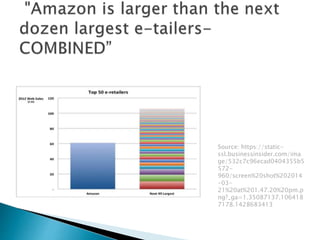
Source: https://static-
ssl.businessinsider.com/ima
ge/532c7c96ecad0404355b5
572-
960/screen%20shot%202014
-03-
21%20at%201.47.20%20pm.p
ng?_ga=1.35087137.106418
7178.1428683413
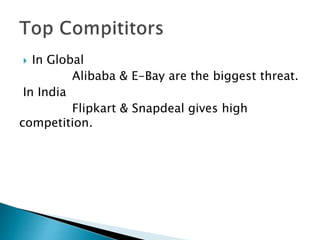
 In Global
Alibaba & E-Bay are the biggest threat.
In India
Flipkart & Snapdeal gives high
competition.
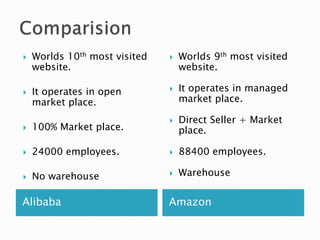
Alibaba
 Worlds 10th most visited
website.
 It operates in open
market place.
 100% Market place.
 24000 employees.
 No warehouse
Amazon
 Worlds 9th most visited
website.
 It operates in managed
market place.
 Direct Seller + Market
place.
 88400 employees.
 Warehouse

Amazon