Amazing
AUSTRALIA
By
Aabel Justin
Yatharth Shukla
Antara rai
MAJOR LANDFORMS OF
AUSTRALIA
Landforms are shapes of the land on the Earth’s surface.
•They are natural, not made by people.
•They are valleys, mountains, plateaus, plains, deserts, reefs etc.
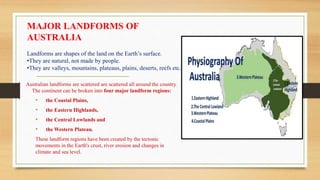
Australian landforms are scattered are scattered all around the country.
The continent can be broken into four major landform regions:
• the Coastal Plains,
• the Eastern Highlands,
• the Central Lowlands and
• the Western Plateau.
These landform regions have been created by the tectonic
movements in the Earth's crust, river erosion and changes in
climate and sea level.
THE COASTAL PLAINS OF AUSTRALIA
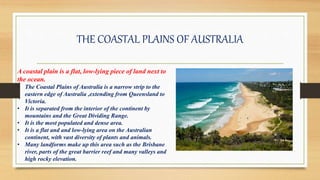
A coastal plain is a flat, low-lying piece of land next to
the ocean.
• The Coastal Plains of Australia is a narrow strip to the
eastern edge of Australia ,extending from Queensland to
Victoria.
• It is separated from the interior of the continent by
mountains and the Great Dividing Range.
• It is the most populated and dense area.
• It is a flat and and low-lying area on the Australian
continent, with vast diversity of plants and animals.
• Many landforms make up this area such as the Brisbane
river, parts of the great barrier reef and many valleys and
high rocky elevation.
THE EASTERN HIGHLANDS of australia
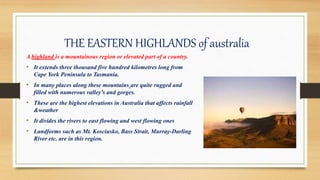
A highland is a mountainous region or elevated part of a country.
• It extends three thousand five hundred kilometres long from
Cape York Peninsula to Tasmania.
• In many places along these mountains are quite rugged and
filled with numerous valley's and gorges.
• These are the highest elevations in Australia that affects rainfall
&weather
• It divides the rivers to east flowing and west flowing ones
• Landforms such as Mt. Kosciusko, Bass Strait, Murray-Darling
River etc. are in this region.
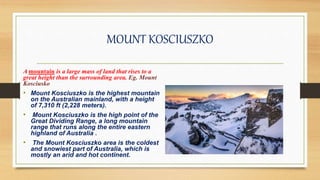
MOUNT KOSCIUSZKO
A mountain is a large mass of land that rises to a
great height than the surrounding area. Eg. Mount
Kosciusko
• Mount Kosciuszko is the highest mountain
on the Australian mainland, with a height
of 7,310 ft (2,228 meters).
• Mount Kosciuszko is the high point of the
Great Dividing Range, a long mountain
range that runs along the entire eastern
highland of Australia .
• The Mount Kosciuszko area is the coldest
and snowiest part of Australia, which is
mostly an arid and hot continent.
The cental lowland of australia
• The Central Lowlands occupy one-quarter of the
continental landmass ,stretching from the Gulf of
Carpentaria through the Great Artesian Basin to
the Murray-Darling Plains.
• It is low-lying, featureless and extremely flat .
• The Central Lowlands are made of old rocks and but
formed primarily by sediments.
• It is usually very hot and arid to semi-arid conditions
with deserts & salt pans .
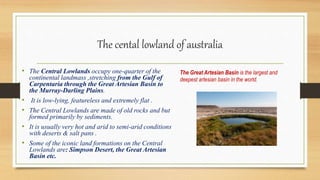
• Some of the iconic land formations on the Central
Lowlands are: Simpson Desert, the Great Artesian
Basin etc.
The Great Artesian Basin is the largest and
deepest artesian basin in the world.
The western plateau of australia
A plateau is a large mass of comparatively flat
land that rises abruptly from the surrounding area
• The Western Plateau incorporates one-third of the
Australian continent.
• It is made up of a huge, stable block of ancient igneous and
metaphoric rock, which is up to 3.6 billion years old.
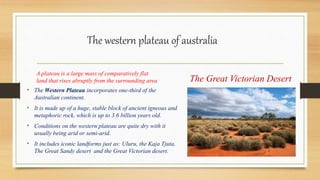
• Conditions on the western plateau are quite dry with it
usually being arid or semi-arid.
• It includes iconic landforms just as: Uluru, the Kaja Tjuta,
The Great Sandy desert and the Great Victorian desert.
The Great Victorian Desert
SPECIAL LANDFORMS IN AUSTRALIA:
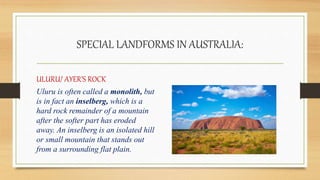
ULURU/ AYER’S ROCK
Uluru is often called a monolith, but
is in fact an inselberg, which is a
hard rock remainder of a mountain
after the softer part has eroded
away. An inselberg is an isolated hill
or small mountain that stands out
from a surrounding flat plain.
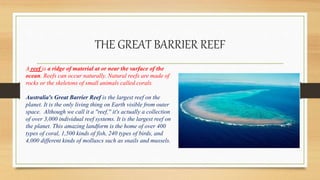
THE GREAT BARRIER REEF
A reef is a ridge of material at or near the surface of the
ocean. Reefs can occur naturally. Natural reefs are made of
rocks or the skeletons of small animals called corals.
Australia's Great Barrier Reef is the largest reef on the
planet. It is the only living thing on Earth visible from outer
space. Although we call it a ''reef,'' it's actually a collection
of over 3,000 individual reef systems. It is the largest reef on
the planet. This amazing landform is the home of over 400
types of coral, 1,500 kinds of fish, 240 types of birds, and
4,000 different kinds of molluscs such as snails and mussels.
VOTE OF THANKS
THIS ACTIVITY HELPED US TO GAIN KNOWLEDGE ON
AUSTRALIA AND ITS GEOGRAPHICAL FEATURES. THANK YOU
GEETHA MISS FOR GIVING US THIS WONDERFUL OPPORTUNITY.
WE HAD A GREAT TIME TOGETHER AS A TEAM. THANK ALL
TEAM MEMBERS FOR YOUR VALUABLE CONTRIBUTIONS.
THANK
YOU

Amazing Australia

  • 1.
  • 2.
    MAJOR LANDFORMS OF AUSTRALIA Landformsare shapes of the land on the Earth’s surface. •They are natural, not made by people. •They are valleys, mountains, plateaus, plains, deserts, reefs etc. Australian landforms are scattered are scattered all around the country. The continent can be broken into four major landform regions: • the Coastal Plains, • the Eastern Highlands, • the Central Lowlands and • the Western Plateau. These landform regions have been created by the tectonic movements in the Earth's crust, river erosion and changes in climate and sea level.
  • 3.
    THE COASTAL PLAINSOF AUSTRALIA A coastal plain is a flat, low-lying piece of land next to the ocean. • The Coastal Plains of Australia is a narrow strip to the eastern edge of Australia ,extending from Queensland to Victoria. • It is separated from the interior of the continent by mountains and the Great Dividing Range. • It is the most populated and dense area. • It is a flat and and low-lying area on the Australian continent, with vast diversity of plants and animals. • Many landforms make up this area such as the Brisbane river, parts of the great barrier reef and many valleys and high rocky elevation.
  • 4.
    THE EASTERN HIGHLANDSof australia A highland is a mountainous region or elevated part of a country. • It extends three thousand five hundred kilometres long from Cape York Peninsula to Tasmania. • In many places along these mountains are quite rugged and filled with numerous valley's and gorges. • These are the highest elevations in Australia that affects rainfall &weather • It divides the rivers to east flowing and west flowing ones • Landforms such as Mt. Kosciusko, Bass Strait, Murray-Darling River etc. are in this region.
  • 5.
    MOUNT KOSCIUSZKO A mountainis a large mass of land that rises to a great height than the surrounding area. Eg. Mount Kosciusko • Mount Kosciuszko is the highest mountain on the Australian mainland, with a height of 7,310 ft (2,228 meters). • Mount Kosciuszko is the high point of the Great Dividing Range, a long mountain range that runs along the entire eastern highland of Australia . • The Mount Kosciuszko area is the coldest and snowiest part of Australia, which is mostly an arid and hot continent.
  • 6.
    The cental lowlandof australia • The Central Lowlands occupy one-quarter of the continental landmass ,stretching from the Gulf of Carpentaria through the Great Artesian Basin to the Murray-Darling Plains. • It is low-lying, featureless and extremely flat . • The Central Lowlands are made of old rocks and but formed primarily by sediments. • It is usually very hot and arid to semi-arid conditions with deserts & salt pans . • Some of the iconic land formations on the Central Lowlands are: Simpson Desert, the Great Artesian Basin etc. The Great Artesian Basin is the largest and deepest artesian basin in the world.
  • 7.
    The western plateauof australia A plateau is a large mass of comparatively flat land that rises abruptly from the surrounding area • The Western Plateau incorporates one-third of the Australian continent. • It is made up of a huge, stable block of ancient igneous and metaphoric rock, which is up to 3.6 billion years old. • Conditions on the western plateau are quite dry with it usually being arid or semi-arid. • It includes iconic landforms just as: Uluru, the Kaja Tjuta, The Great Sandy desert and the Great Victorian desert. The Great Victorian Desert
  • 8.
    SPECIAL LANDFORMS INAUSTRALIA: ULURU/ AYER’S ROCK Uluru is often called a monolith, but is in fact an inselberg, which is a hard rock remainder of a mountain after the softer part has eroded away. An inselberg is an isolated hill or small mountain that stands out from a surrounding flat plain.
  • 9.
    THE GREAT BARRIERREEF A reef is a ridge of material at or near the surface of the ocean. Reefs can occur naturally. Natural reefs are made of rocks or the skeletons of small animals called corals. Australia's Great Barrier Reef is the largest reef on the planet. It is the only living thing on Earth visible from outer space. Although we call it a ''reef,'' it's actually a collection of over 3,000 individual reef systems. It is the largest reef on the planet. This amazing landform is the home of over 400 types of coral, 1,500 kinds of fish, 240 types of birds, and 4,000 different kinds of molluscs such as snails and mussels.
  • 10.
    VOTE OF THANKS THISACTIVITY HELPED US TO GAIN KNOWLEDGE ON AUSTRALIA AND ITS GEOGRAPHICAL FEATURES. THANK YOU GEETHA MISS FOR GIVING US THIS WONDERFUL OPPORTUNITY. WE HAD A GREAT TIME TOGETHER AS A TEAM. THANK ALL TEAM MEMBERS FOR YOUR VALUABLE CONTRIBUTIONS.
  • 11.