Corporate
Restructuring
Dr. Dharuv Pal Singh
Associate Professor
RESTRUCTURING BUSINESS
The term “business restructuring” is
composed of two different words. The
term business includes
trade ,commerce ,manufacture ,etc. The
word restructuring means rearranging the
affairs. In this way business restructuring
refers to the process by which the
business enterprise rearrange their affairs .
CORPORATE RESTRUCTURING -- NECESSITY
 Companies worldwide are refocusing, downsizing and merging
to become globally competitive.
 Developing core competence for global / domestic competition,
technological development through collaboration and joint
venture
 Divesting non profitable business
 To vertically integrate- backward and forward
 To achieve synergies through consolidation
 To grow in size
 To avail tax related benefits.
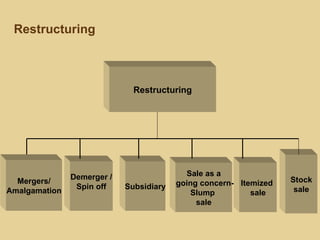
Restructuring
Demerger /
Spin off Subsidiary
Sale as a
going concern-
Slump
sale
Itemized
sale
Stock
sale
Restructuring
Mergers/
Amalgamation
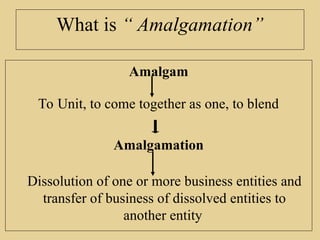
What is “ Amalgamation”
Amalgam
To Unit, to come together as one, to blend
Amalgamation
Dissolution of one or more business entities and
transfer of business of dissolved entities to
another entity
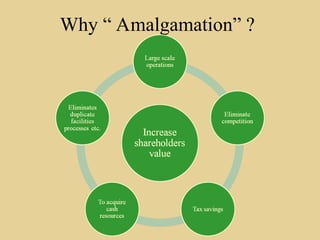
Why “ Amalgamation” ?
Meaning of “Amalgamation”
under the income tax Act [ sec 2(1B)]
• Amalgamation in relation to companies, means-
• (a) Merger of one or more companies with another company.
• (b) Merger of two or more companies to form one company.
( in India merger is called amalgamation )
• Merger of A Ltd with X Ltd.(A Ltd, goes out of existence).
• Merger of A Ltd and B Ltd with X Ltd ( A Ltd and B Ltd go out of existence )
• Merger of A Ltd, B Ltd and C Ltd into a newly incorporated company X Ltd
(A Ltd, B Ltd and C Ltd go out of existence )
In these cases A Ltd, B Ltd and C Ltd are amalgamating companies while X Ltd
is an amalgamated company.
Merging companies are called – Amalgamating companies
New Company is called – Amalgamated Company
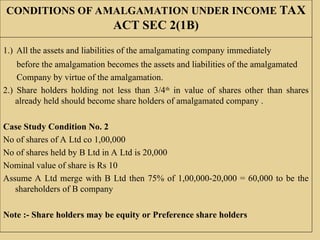
CONDITIONS OF AMALGAMATION UNDER INCOME TAX
ACT SEC 2(1B)
1.) All the assets and liabilities of the amalgamating company immediately
before the amalgamation becomes the assets and liabilities of the amalgamated
Company by virtue of the amalgamation.
2.) Share holders holding not less than 3/4th
in value of shares other than shares
already held should become share holders of amalgamated company .
Case Study Condition No. 2
No of shares of A Ltd co 1,00,000
No of shares held by B Ltd in A Ltd is 20,000
Nominal value of share is Rs 10
Assume A Ltd merge with B Ltd then 75% of 1,00,000-20,000 = 60,000 to be the
shareholders of B company
Note :- Share holders may be equity or Preference share holders
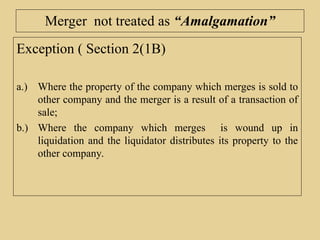
Merger not treated as “Amalgamation”
Exception ( Section 2(1B)
a.) Where the property of the company which merges is sold to
other company and the merger is a result of a transaction of
sale;
b.) Where the company which merges is wound up in
liquidation and the liquidator distributes its property to the
other company.
ASSETS IN AMALGAMATION NOT TREATED AS “ TRANSFER”
Sec 47(vi):-
Any transfer, in scheme of amalgamation of capital assets by the
amalgamating company to the amalgamated company is not taken
as “ transfer” if the following conditions are fulfilled:-
(a) The scheme satisfied that conditions of sec2(IB) ; and
(b) The Amalgamated company is Indian company.
Sec 47(via) :-
Conditions:-
(a) If shares of Indian Co. held by Foreign co before merger and such
Foreign Co taken over by another Foreign co.
(b) At least 25% of the Foreign Co. ( Before Merger) to be share
holders of the new Foreign Co.
Such transfer does not attract tax on capital Gains in the country
in which the amalgamating co is incorporated
Sec 47 (vii) and 49.2
( Allotment of shares in amalgamated Co to the shareholders of amalgamating)
Any transfer by a share holders in a scheme of amalgamation of shares held
by him in the amalgamating Co. shall not be regarded as transfer if :-
a) Transfer is made in consideration of allotment to him of shares in the
amalgamated Co; and
b) Amalgamated Co is an Indian Company.
According to Sec49(2) in the aforesaid the cost of shares of the
amalgamating Co shall be the cost of shares of the amalgamated company
Case study
X Ltd, an Indian company , take over the business of Y Ltd in a scheme of
amalgamation of the two companies. Z has purchased 100 shares in Y Ltd in
1994 for Rs 60 per share. As per the scheme of amalgamation, he gets 50
shares in X Ltd in lieu of 100 shares in Y Ltd Consequently the cost of
shares in X Ltd will be taken as Rs 120 per shares [ i.e. Rs 6000/- being cost
of 100 shares in Y Ltd ÷ 50 shares in X Ltd]
Carry forward and set off of loss and depreciation [ Sec 72A]
If the following conditions are satisfied then the accumulated loss and the unabsorbed
depreciation of the amalgamating company shall be deemed to be loss / depreciation of
the amalgamated company for the P.Y in which the amalgamation is effected :-
Sec 72A to be fulfilled – conditions:-
1.) There is an amalgamation of a company owning industrial undertaking, ship or a hotel
with another Co, or a banking company with a SBI or any subsidiary of SBI, Public sector
airlines with another public sector airlines
Industrial undertaking – manufacture or processing of good, computer software,
generation or distribution of electricity, mining construction of ships, aircraft or rail
system, telecommunication services, broadband network and internet services ) Except
hospital.
2.) Accumulated losses remain unabsorbed for 3 or more years .
3.) 75% of Book value to be held at least for 2 years before amalgamation
4.) The amalgamated Co continues to hold ¾ the of book value at least for 5 years
5.) New Co Should continue for another 5 years.
6.) New Co. Should achieve at least 50% of installed capacity before end of 4 years and
should continue for 5 years
7.) The new amalgamated Co should furnish to assessing officer a certificate in form No 62
about particulars of production
This scheme is also applicable to banking institutions
The conditions of
Sec 2(1B) is satisfied
Sec 72 A is satisfied
Situation A Yes Yes
Situation B Yes No
Situation C No No
[Analysis ]
A Ltd proposes to be merged with B Ltd. consider which is the following benefits
are available to B Ltd under the following situations :-
The Benefits are :-
Situation A Situation B Situation C
Expected Bad debits
B/F business loss
Unabsorbed depreciation
B/F speculation loss
B/F Capital loss
Deduction U/S 801A or 80 I
B of unexpired period
Yes
Yes
Yes
No
No
yes
Yes
No
No
No
No
yes
No
No
No
No
No
No
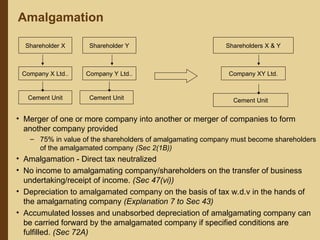
• Merger of one or more company into another or merger of companies to form
another company provided
– 75% in value of the shareholders of amalgamating company must become shareholders
of the amalgamated company (Sec 2(1B))
• Amalgamation - Direct tax neutralized
• No income to amalgamating company/shareholders on the transfer of business
undertaking/receipt of income. (Sec 47(vi))
• Depreciation to amalgamated company on the basis of tax w.d.v in the hands of
the amalgamating company (Explanation 7 to Sec 43)
• Accumulated losses and unabsorbed depreciation of amalgamating company can
be carried forward by the amalgamated company if specified conditions are
fulfilled. (Sec 72A)
Amalgamation
Shareholder X
Cement Unit
Company X Ltd..
Shareholder Y
Cement Unit
Company Y Ltd..
Shareholders X & Y
Cement Unit
Company XY Ltd.
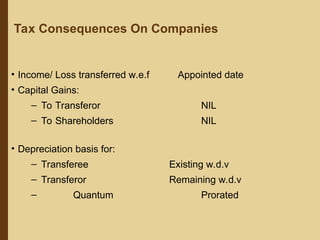
• Income/ Loss transferred w.e.f Appointed date
• Capital Gains:
– To Transferor NIL
– To Shareholders NIL
• Depreciation basis for:
– Transferee Existing w.d.v
– Transferor Remaining w.d.v
– Quantum Prorated
Tax Consequences On Companies
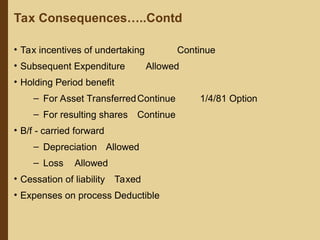
• Tax incentives of undertaking Continue
• Subsequent Expenditure Allowed
• Holding Period benefit
– For Asset TransferredContinue 1/4/81 Option
– For resulting shares Continue
• B/f - carried forward
– Depreciation Allowed
– Loss Allowed
• Cessation of liability Taxed
• Expenses on process Deductible
Tax Consequences…..Contd
OTHER TAX BENEFITS
OTHER TAX BENEFITS
1. Expenditure on amalgamation or de-merger – allowed under
sec 35DD both revenue and capital expenditure allowed
2. Expenditure on scientific research can be carried forward
3. Expenditure on acquisition of patent rights copyrights –
depreciation can be provided
4. Expenditure for obtaining license for tele-communication
service can be written off
5. Preliminary expenses
6. Capital expenditure on family planning
7. Bad debts are allowed
Tax Concession To Share Holders Of
Amalgamating Co.
Amalgamating Co.
• No capital gain tax provided, new co. is an
Indian co.& Shareholders are acquired
everything in shares
When a capital asset
(other a block assets is transferred )
Where an asset is transferred, in a scheme of amalgamation to an
Indian company, the actual cost of the transferred asset will be taken
to be same as it would have been if the amalgamating company had
continued to hold the capital asset for the purpose of its own
business
When a block of asset is transferred
Where in any previous year, any block of assets is transferred in a
scheme of amalgamation by the amalgamating company, then
actual cost of block of assets in the case of amalgamated company,
shall be the written down value of block of assets as the case of
amalgamating company for the immediately preceding previous
year as reduced by the amount of depreciation actually allowed in
relation to the said previous year. This rule is however, applicable
only if the amalgamated company is an Indian company
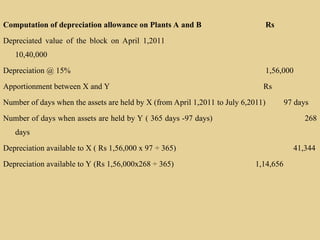
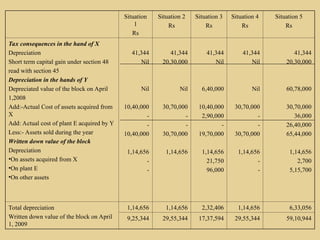
Case Study
X owns a block of assets ( consisting of plants A and B, depreciation rate 15
per cent. On April1,2011 depreciated value of the block is Rs 10,40,000. On
July 7,2011the block of assets is transferred by X to Y for Rs 30,70,000. Find
out the tax consequences under the following situations-
1. X is amalgamating company and Y, being an Indian company, is the
amalgamated company and the block of assets is transferred by X to Y in a
scheme of amalgamation. Y does not own any other assets.
2. Suppose in (1)(supra) Y is a foreign company.
3. Suppose in (1) Y owns a block of assets (consisting of plants C and D,
depreciation rate 15 per cent ) on April 1,2011.Depreicated value of the block
of assets being Rs 6,40,000. Y purchase plant E, an office appliance ( rate of
depreciation 15 per cent ) on March 10,2012 for Rs 2,90,000. It is put to use on
the same day.
4. X is a partnership firm, It is converted into Y company, The conversion
satisfies the condition of section 47(xiii). Y does not own any other assets.
5. X is a firm. The business of X is taken over by Y, a partner in the firm, On
April,2011, Y owns plants C and D (Depreciation rate 15 per cent .
Depreciated value of the block of Rs 60,78,000). Y purchase plant E, an office
appliance on December 5,2008 (depreciation rate 15 per cent, actual cost
Rs 36,000). It is put to use on the same day. On March 13,2012, Y sells plant C
for Rs 26,40,000.
Computation of depreciation allowance on Plants A and B Rs
Depreciated value of the block on April 1,2011
10,40,000
Depreciation @ 15% 1,56,000
Apportionment between X and Y Rs
Number of days when the assets are held by X (from April 1,2011 to July 6,2011) 97 days
Number of days when assets are held by Y ( 365 days -97 days) 268
days
Depreciation available to X ( Rs 1,56,000 x 97 ÷ 365) 41,344
Depreciation available to Y (Rs 1,56,000x268 ÷ 365) 1,14,656
Situation
1
Rs
Situation 2
Rs
Situation 3
Rs
Situation 4
Rs
Situation 5
Rs
Tax consequences in the hand of X
Depreciation
Short term capital gain under section 48
read with section 45
Depreciation in the hands of Y
Depreciated value of the block on April
1,2008
Add:-Actual Cost of assets acquired from
X
Add: Actual cost of plant E acquired by Y
Less:- Assets sold during the year
Written down value of the block
Depreciation
•On assets acquired from X
•On plant E
•On other assets
41,344
Nil
Nil
10,40,000
-
-
10,40,000
1,14,656
-
-
41,344
20,30,000
Nil
30,70,000
-
-
30,70,000
1,14,656
41,344
Nil
6,40,000
10,40,000
2,90,000
-
19,70,000
1,14,656
21,750
96,000
41,344
Nil
Nil
30,70,000
-
-
30,70,000
1,14,656
-
-
41,344
20,30,000
60,78,000
30,70,000
36,000
26,40,000
65,44,000
1,14,656
2,700
5,15,700
Total depreciation
Written down value of the block on April
1, 2009
1,14,656 1,14,656 2,32,406 1,14,656 6,33,056
9,25,344 29,55,344 17,37,594 29,55,344 59,10,944
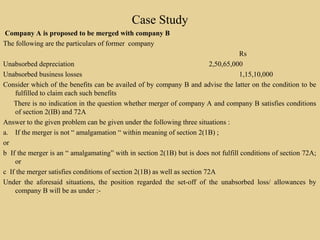
Case Study
Company A is proposed to be merged with company B
The following are the particulars of former company
Rs
Unabsorbed depreciation 2,50,65,000
Unabsorbed business losses 1,15,10,000
Consider which of the benefits can be availed of by company B and advise the latter on the condition to be
fulfilled to claim each such benefits
There is no indication in the question whether merger of company A and company B satisfies conditions
of section 2(IB) and 72A
Answer to the given problem can be given under the following three situations :
a. If the merger is not “ amalgamation “ within meaning of section 2(1B) ;
or
b If the merger is an “ amalgamating” with in section 2(1B) but is does not fulfill conditions of section 72A;
or
c If the merger satisfies conditions of section 2(1B) as well as section 72A
Under the aforesaid situations, the position regarded the set-off of the unabsorbed loss/ allowances by
company B will be as under :-
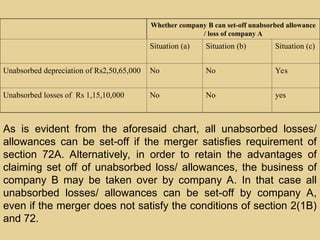
Whether company B can set-off unabsorbed allowance
/ loss of company A
Situation (a) Situation (b) Situation (c)
Unabsorbed depreciation of Rs2,50,65,000 No No Yes
Unabsorbed losses of Rs 1,15,10,000 No No yes
As is evident from the aforesaid chart, all unabsorbed losses/
allowances can be set-off if the merger satisfies requirement of
section 72A. Alternatively, in order to retain the advantages of
claiming set off of unabsorbed loss/ allowances, the business of
company B may be taken over by company A. In that case all
unabsorbed losses/ allowances can be set-off by company A,
even if the merger does not satisfy the conditions of section 2(1B)
and 72.
Case study
Company X which has an accumulated loss of Rs 5,00,000 and depreciation of
Rs . 3,00,000 wants to reorganize its business by amalgamating with a rival
company Y. which is engaged in the same time of production but with a smaller
capital, but has an efficient management set up and more modern machinery.
Company Y is agreeable to the amalgamation. What are the alternative course
available to the companies for effecting the merger and how would you advise
them as to the best course of action .
The alternatives for merger that are available to X and Y are :
(i) Merger of X into Y, whereby X goes out of existence.
(ii) Merger of Y into X, whereby Y goes out of existence and
(iii) Merger of X and Y into a new company, whereby a new company, say Z, is
formed and both X and Y go out of existence.
All the three mergers can take place under one of the following situations
a. If the merger is not an “ amalgamation” within the meaning of section 2(1B)
b. If the merger is an “ amalgamation” within the meaning of section 2(1B),
though it does not satisfy provision of section 72A
c. If the merger satisfies conditions of section 2(1B) and 72.
Under the aforesaid situations, the set-off of accumulated loss of Rs 5,00,000 and
unabsorbed depreciation of Rs, 3,00,000 is possible in the following cases:
Whether set-off of unabsorbed loss/
depreciation allowance is possible
Situation (a) Situation
(b)
Situation
(c)
Merger of X into Y ( X goes out of existence after merger ). No No Yes
Merger of Y into X ( Y goes out of existence Yes Yes Yes
Merger of X and Y into Z ( X and y go out of existence, Z
is formed as a new company.
No No Yes
To conclude, it can be said that if the condition of section 72A are satisfied, any of the three
alternatives for mergers can be adopted, as In all cases the loss can be set-off by the amalgamated
company. If, however, conditions of section 72A are not satisfied, alternative (ii) (i.e. merger of
company Y into X ) should be adopted as in this case, company X would be able to carry forward
and set-off of loss/ depreciation even if the merger does not fulfill the requirement of section 2(1B).
This kind of merger is also known as reverse merger.
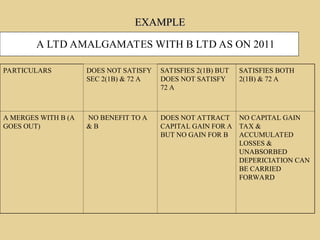
EXAMPLE
EXAMPLE
PARTICULARS DOES NOT SATISFY
SEC 2(1B) & 72 A
SATISFIES 2(1B) BUT
DOES NOT SATISFY
72 A
SATISFIES BOTH
2(1B) & 72 A
A MERGES WITH B (A
GOES OUT)
NO BENEFIT TO A
& B
DOES NOT ATTRACT
CAPITAL GAIN FOR A
BUT NO GAIN FOR B
NO CAPITAL GAIN
TAX &
ACCUMULATED
LOSSES &
UNABSORBED
DEPERICIATION CAN
BE CARRIED
FORWARD
A LTD AMALGAMATES WITH B LTD AS ON 2011
De merger
•De merger is relatively a new phenomenon in the
indian corporate sector.
•There is no specific provisions under co. act 1956
•Sections 391 to 394 of co. act governs same nature of
transactions i.e. scheme of compromise.
• The co whose undertaking is transferred pursuant to
demerger is known as “demerged” co.
•The co to which the undertaking is transferred is
known as “resulting” co
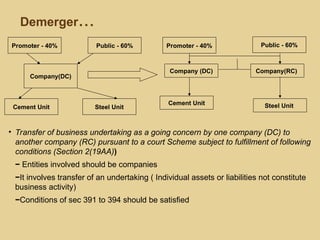
Demerger...
Promoter - 40% Public - 60%
Company(DC)
Promoter - 40% Public - 60%
Cement Unit Steel Unit
• Transfer of business undertaking as a going concern by one company (DC) to
another company (RC) pursuant to a court Scheme subject to fulfillment of following
conditions (Section 2(19AA))
− Entities involved should be companies
−It involves transfer of an undertaking ( Individual assets or liabilities not constitute
business activity)
−Conditions of sec 391 to 394 should be satisfied
Cement Unit Steel Unit
Company(RC)
Company (DC)
Conditions …….cont….
– All properties and liabilities of the business undertaking are transferred
to resulting co at book values appearing in the books of demerged co
before demerger;
– Shares of the RC are issued to the shareholders of the DC on a
proportionate basis;
– Shareholders holding not less than 75% in value of the shares of the DC
become shareholders of the RC;
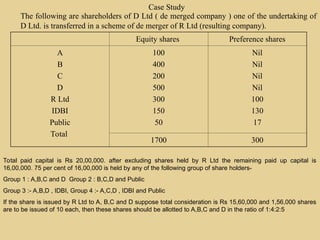
Case Study
The following are shareholders of D Ltd ( de merged company ) one of the undertaking of
D Ltd. is transferred in a scheme of de merger of R Ltd (resulting company).
Equity shares Preference shares
A
B
C
D
R Ltd
IDBI
Public
Total
100
400
200
500
300
150
50
Nil
Nil
Nil
Nil
100
130
17
1700 300
Total paid capital is Rs 20,00,000. after excluding shares held by R Ltd the remaining paid up capital is
16,00,000. 75 per cent of 16,00,000 is held by any of the following group of share holders-
Group 1 : A,B,C and D Group 2 : B,C,D and Public
Group 3 :- A,B,D , IDBI, Group 4 :- A,C,D , IDBI and Public
If the share is issued by R Ltd to A, B,C and D suppose total consideration is Rs 15,60,000 and 1,56,000 shares
are to be issued of 10 each, then these shares should be allotted to A,B,C and D in the ratio of 1:4:2:5
Demerger ...
Demerger - Direct tax neutral for company/shareholder.
• No income to DC on transfer of undertaking (Section 47(vib))
• No income to shareholder on receipt of shares in RC (Section 47(vid))
• Proportionate depreciation in the year of demerger. Depreciation to RC
on the basis of tax W.D.V. in the hands of DC.[explanation to Section
43(1)]
• Accumulated business losses and unabsorbed depreciation (Section
72A):-
– directly relatable to the demerged undertaking - allowed to be carried
forward by RC
– not directly relatable to the demerged undertaking - to be apportioned in
the ratio of assets transferred to RC and assets retained by DC
• Demerged business undertaking eligible for most tax exemption -
benefits available even as part of RC (deduction u/s 80IA, 80IB
available for unexpired period to resulting Co.)
Demerger.. .Issues
• ¾ shareholding criteria to be applied in respect of shares
held as on Appointed date or Effective date?
• Transactions between holding & subsidiary Company during
‘Appointed date’ & ‘Effective date’?
– Dividend declared - DDT
• 43B payment by resulting Company
• Whether succession to business
• What happens if conditions for demerger are not satisfied
Demerger.. .Tax consequences if conditions
of demerger not satisfied
• Capital gain to transferor / shareholder
• Deemed dividend to shareholder – dividend distribution tax
• Section 72A not applicable
• Depreciation to transferee on consideration paid
• Cost of shares issued to shareholders of demerging
company
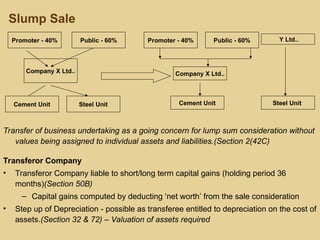
Transfer of business undertaking as a going concern for lump sum consideration without
values being assigned to individual assets and liabilities.(Section 2(42C)
Transferor Company
• Transferor Company liable to short/long term capital gains (holding period 36
months)(Section 50B)
– Capital gains computed by deducting ‘net worth’ from the sale consideration
• Step up of Depreciation - possible as transferee entitled to depreciation on the cost of
assets.(Section 32 & 72) – Valuation of assets required
Slump Sale
Promoter - 40% Public - 60%
Company X Ltd..
Promoter - 40% Public - 60%
Cement Unit Steel Unit
Company X Ltd..
Y Ltd..
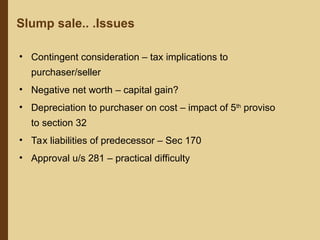
Slump sale.. .Issues
• Contingent consideration – tax implications to
purchaser/seller
• Negative net worth – capital gain?
• Depreciation to purchaser on cost – impact of 5th
proviso
to section 32
• Tax liabilities of predecessor – Sec 170
• Approval u/s 281 – practical difficulty
Slump sale.. .Issues
• Contingent consideration – tax implications to
purchaser/seller
• Negative net worth – capital gain?
• Depreciation to purchaser on cost – impact of 5th
proviso
to section 32
• Tax liabilities of predecessor – Sec 170
• Approval u/s 281 – practical difficulty
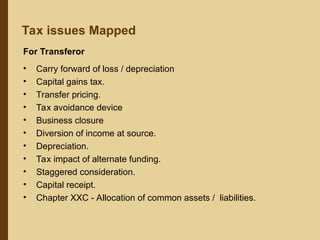
Tax issues Mapped
For Transferor
• Carry forward of loss / depreciation
• Capital gains tax.
• Transfer pricing.
• Tax avoidance device
• Business closure
• Diversion of income at source.
• Depreciation.
• Tax impact of alternate funding.
• Staggered consideration.
• Capital receipt.
• Chapter XXC - Allocation of common assets / liabilities.
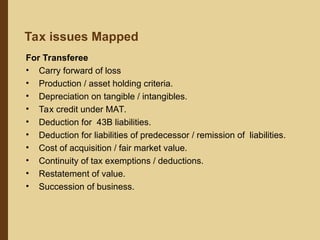
For Transferee
• Carry forward of loss
• Production / asset holding criteria.
• Depreciation on tangible / intangibles.
• Tax credit under MAT.
• Deduction for 43B liabilities.
• Deduction for liabilities of predecessor / remission of liabilities.
• Cost of acquisition / fair market value.
• Continuity of tax exemptions / deductions.
• Restatement of value.
• Succession of business.
Tax issues Mapped
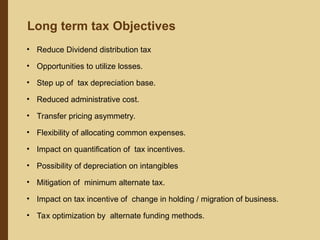
• Reduce Dividend distribution tax
• Opportunities to utilize losses.
• Step up of tax depreciation base.
• Reduced administrative cost.
• Transfer pricing asymmetry.
• Flexibility of allocating common expenses.
• Impact on quantification of tax incentives.
• Possibility of depreciation on intangibles
• Mitigation of minimum alternate tax.
• Impact on tax incentive of change in holding / migration of business.
• Tax optimization by alternate funding methods.
Long term tax Objectives
amalagamation, Absorption and reconstructionppt

amalagamation, Absorption and reconstructionppt

  • 1.
    Corporate Restructuring Dr. Dharuv PalSingh Associate Professor
  • 2.
    RESTRUCTURING BUSINESS The term“business restructuring” is composed of two different words. The term business includes trade ,commerce ,manufacture ,etc. The word restructuring means rearranging the affairs. In this way business restructuring refers to the process by which the business enterprise rearrange their affairs .
  • 3.
    CORPORATE RESTRUCTURING --NECESSITY  Companies worldwide are refocusing, downsizing and merging to become globally competitive.  Developing core competence for global / domestic competition, technological development through collaboration and joint venture  Divesting non profitable business  To vertically integrate- backward and forward  To achieve synergies through consolidation  To grow in size  To avail tax related benefits.
  • 4.
    Restructuring Demerger / Spin offSubsidiary Sale as a going concern- Slump sale Itemized sale Stock sale Restructuring Mergers/ Amalgamation
  • 5.
    What is “Amalgamation” Amalgam To Unit, to come together as one, to blend Amalgamation Dissolution of one or more business entities and transfer of business of dissolved entities to another entity
  • 6.
  • 7.
    Meaning of “Amalgamation” underthe income tax Act [ sec 2(1B)] • Amalgamation in relation to companies, means- • (a) Merger of one or more companies with another company. • (b) Merger of two or more companies to form one company. ( in India merger is called amalgamation ) • Merger of A Ltd with X Ltd.(A Ltd, goes out of existence). • Merger of A Ltd and B Ltd with X Ltd ( A Ltd and B Ltd go out of existence ) • Merger of A Ltd, B Ltd and C Ltd into a newly incorporated company X Ltd (A Ltd, B Ltd and C Ltd go out of existence ) In these cases A Ltd, B Ltd and C Ltd are amalgamating companies while X Ltd is an amalgamated company. Merging companies are called – Amalgamating companies New Company is called – Amalgamated Company
  • 8.
    CONDITIONS OF AMALGAMATIONUNDER INCOME TAX ACT SEC 2(1B) 1.) All the assets and liabilities of the amalgamating company immediately before the amalgamation becomes the assets and liabilities of the amalgamated Company by virtue of the amalgamation. 2.) Share holders holding not less than 3/4th in value of shares other than shares already held should become share holders of amalgamated company . Case Study Condition No. 2 No of shares of A Ltd co 1,00,000 No of shares held by B Ltd in A Ltd is 20,000 Nominal value of share is Rs 10 Assume A Ltd merge with B Ltd then 75% of 1,00,000-20,000 = 60,000 to be the shareholders of B company Note :- Share holders may be equity or Preference share holders
  • 9.
    Merger not treatedas “Amalgamation” Exception ( Section 2(1B) a.) Where the property of the company which merges is sold to other company and the merger is a result of a transaction of sale; b.) Where the company which merges is wound up in liquidation and the liquidator distributes its property to the other company.
  • 10.
    ASSETS IN AMALGAMATIONNOT TREATED AS “ TRANSFER” Sec 47(vi):- Any transfer, in scheme of amalgamation of capital assets by the amalgamating company to the amalgamated company is not taken as “ transfer” if the following conditions are fulfilled:- (a) The scheme satisfied that conditions of sec2(IB) ; and (b) The Amalgamated company is Indian company. Sec 47(via) :- Conditions:- (a) If shares of Indian Co. held by Foreign co before merger and such Foreign Co taken over by another Foreign co. (b) At least 25% of the Foreign Co. ( Before Merger) to be share holders of the new Foreign Co. Such transfer does not attract tax on capital Gains in the country in which the amalgamating co is incorporated
  • 11.
    Sec 47 (vii)and 49.2 ( Allotment of shares in amalgamated Co to the shareholders of amalgamating) Any transfer by a share holders in a scheme of amalgamation of shares held by him in the amalgamating Co. shall not be regarded as transfer if :- a) Transfer is made in consideration of allotment to him of shares in the amalgamated Co; and b) Amalgamated Co is an Indian Company. According to Sec49(2) in the aforesaid the cost of shares of the amalgamating Co shall be the cost of shares of the amalgamated company Case study X Ltd, an Indian company , take over the business of Y Ltd in a scheme of amalgamation of the two companies. Z has purchased 100 shares in Y Ltd in 1994 for Rs 60 per share. As per the scheme of amalgamation, he gets 50 shares in X Ltd in lieu of 100 shares in Y Ltd Consequently the cost of shares in X Ltd will be taken as Rs 120 per shares [ i.e. Rs 6000/- being cost of 100 shares in Y Ltd ÷ 50 shares in X Ltd]
  • 12.
    Carry forward andset off of loss and depreciation [ Sec 72A] If the following conditions are satisfied then the accumulated loss and the unabsorbed depreciation of the amalgamating company shall be deemed to be loss / depreciation of the amalgamated company for the P.Y in which the amalgamation is effected :- Sec 72A to be fulfilled – conditions:- 1.) There is an amalgamation of a company owning industrial undertaking, ship or a hotel with another Co, or a banking company with a SBI or any subsidiary of SBI, Public sector airlines with another public sector airlines Industrial undertaking – manufacture or processing of good, computer software, generation or distribution of electricity, mining construction of ships, aircraft or rail system, telecommunication services, broadband network and internet services ) Except hospital. 2.) Accumulated losses remain unabsorbed for 3 or more years . 3.) 75% of Book value to be held at least for 2 years before amalgamation 4.) The amalgamated Co continues to hold ¾ the of book value at least for 5 years 5.) New Co Should continue for another 5 years. 6.) New Co. Should achieve at least 50% of installed capacity before end of 4 years and should continue for 5 years 7.) The new amalgamated Co should furnish to assessing officer a certificate in form No 62 about particulars of production This scheme is also applicable to banking institutions
  • 13.
    The conditions of Sec2(1B) is satisfied Sec 72 A is satisfied Situation A Yes Yes Situation B Yes No Situation C No No [Analysis ] A Ltd proposes to be merged with B Ltd. consider which is the following benefits are available to B Ltd under the following situations :- The Benefits are :- Situation A Situation B Situation C Expected Bad debits B/F business loss Unabsorbed depreciation B/F speculation loss B/F Capital loss Deduction U/S 801A or 80 I B of unexpired period Yes Yes Yes No No yes Yes No No No No yes No No No No No No
  • 14.
    • Merger ofone or more company into another or merger of companies to form another company provided – 75% in value of the shareholders of amalgamating company must become shareholders of the amalgamated company (Sec 2(1B)) • Amalgamation - Direct tax neutralized • No income to amalgamating company/shareholders on the transfer of business undertaking/receipt of income. (Sec 47(vi)) • Depreciation to amalgamated company on the basis of tax w.d.v in the hands of the amalgamating company (Explanation 7 to Sec 43) • Accumulated losses and unabsorbed depreciation of amalgamating company can be carried forward by the amalgamated company if specified conditions are fulfilled. (Sec 72A) Amalgamation Shareholder X Cement Unit Company X Ltd.. Shareholder Y Cement Unit Company Y Ltd.. Shareholders X & Y Cement Unit Company XY Ltd.
  • 15.
    • Income/ Losstransferred w.e.f Appointed date • Capital Gains: – To Transferor NIL – To Shareholders NIL • Depreciation basis for: – Transferee Existing w.d.v – Transferor Remaining w.d.v – Quantum Prorated Tax Consequences On Companies
  • 16.
    • Tax incentivesof undertaking Continue • Subsequent Expenditure Allowed • Holding Period benefit – For Asset TransferredContinue 1/4/81 Option – For resulting shares Continue • B/f - carried forward – Depreciation Allowed – Loss Allowed • Cessation of liability Taxed • Expenses on process Deductible Tax Consequences…..Contd
  • 17.
    OTHER TAX BENEFITS OTHERTAX BENEFITS 1. Expenditure on amalgamation or de-merger – allowed under sec 35DD both revenue and capital expenditure allowed 2. Expenditure on scientific research can be carried forward 3. Expenditure on acquisition of patent rights copyrights – depreciation can be provided 4. Expenditure for obtaining license for tele-communication service can be written off 5. Preliminary expenses 6. Capital expenditure on family planning 7. Bad debts are allowed
  • 18.
    Tax Concession ToShare Holders Of Tax Concession To Share Holders Of Amalgamating Co. Amalgamating Co. • No capital gain tax provided, new co. is an Indian co.& Shareholders are acquired everything in shares
  • 19.
    When a capitalasset (other a block assets is transferred ) Where an asset is transferred, in a scheme of amalgamation to an Indian company, the actual cost of the transferred asset will be taken to be same as it would have been if the amalgamating company had continued to hold the capital asset for the purpose of its own business When a block of asset is transferred Where in any previous year, any block of assets is transferred in a scheme of amalgamation by the amalgamating company, then actual cost of block of assets in the case of amalgamated company, shall be the written down value of block of assets as the case of amalgamating company for the immediately preceding previous year as reduced by the amount of depreciation actually allowed in relation to the said previous year. This rule is however, applicable only if the amalgamated company is an Indian company
  • 20.
    Case Study X ownsa block of assets ( consisting of plants A and B, depreciation rate 15 per cent. On April1,2011 depreciated value of the block is Rs 10,40,000. On July 7,2011the block of assets is transferred by X to Y for Rs 30,70,000. Find out the tax consequences under the following situations- 1. X is amalgamating company and Y, being an Indian company, is the amalgamated company and the block of assets is transferred by X to Y in a scheme of amalgamation. Y does not own any other assets. 2. Suppose in (1)(supra) Y is a foreign company. 3. Suppose in (1) Y owns a block of assets (consisting of plants C and D, depreciation rate 15 per cent ) on April 1,2011.Depreicated value of the block of assets being Rs 6,40,000. Y purchase plant E, an office appliance ( rate of depreciation 15 per cent ) on March 10,2012 for Rs 2,90,000. It is put to use on the same day. 4. X is a partnership firm, It is converted into Y company, The conversion satisfies the condition of section 47(xiii). Y does not own any other assets. 5. X is a firm. The business of X is taken over by Y, a partner in the firm, On April,2011, Y owns plants C and D (Depreciation rate 15 per cent . Depreciated value of the block of Rs 60,78,000). Y purchase plant E, an office appliance on December 5,2008 (depreciation rate 15 per cent, actual cost Rs 36,000). It is put to use on the same day. On March 13,2012, Y sells plant C for Rs 26,40,000.
  • 21.
    Computation of depreciationallowance on Plants A and B Rs Depreciated value of the block on April 1,2011 10,40,000 Depreciation @ 15% 1,56,000 Apportionment between X and Y Rs Number of days when the assets are held by X (from April 1,2011 to July 6,2011) 97 days Number of days when assets are held by Y ( 365 days -97 days) 268 days Depreciation available to X ( Rs 1,56,000 x 97 ÷ 365) 41,344 Depreciation available to Y (Rs 1,56,000x268 ÷ 365) 1,14,656
  • 22.
    Situation 1 Rs Situation 2 Rs Situation 3 Rs Situation4 Rs Situation 5 Rs Tax consequences in the hand of X Depreciation Short term capital gain under section 48 read with section 45 Depreciation in the hands of Y Depreciated value of the block on April 1,2008 Add:-Actual Cost of assets acquired from X Add: Actual cost of plant E acquired by Y Less:- Assets sold during the year Written down value of the block Depreciation •On assets acquired from X •On plant E •On other assets 41,344 Nil Nil 10,40,000 - - 10,40,000 1,14,656 - - 41,344 20,30,000 Nil 30,70,000 - - 30,70,000 1,14,656 41,344 Nil 6,40,000 10,40,000 2,90,000 - 19,70,000 1,14,656 21,750 96,000 41,344 Nil Nil 30,70,000 - - 30,70,000 1,14,656 - - 41,344 20,30,000 60,78,000 30,70,000 36,000 26,40,000 65,44,000 1,14,656 2,700 5,15,700 Total depreciation Written down value of the block on April 1, 2009 1,14,656 1,14,656 2,32,406 1,14,656 6,33,056 9,25,344 29,55,344 17,37,594 29,55,344 59,10,944
  • 23.
    Case Study Company Ais proposed to be merged with company B The following are the particulars of former company Rs Unabsorbed depreciation 2,50,65,000 Unabsorbed business losses 1,15,10,000 Consider which of the benefits can be availed of by company B and advise the latter on the condition to be fulfilled to claim each such benefits There is no indication in the question whether merger of company A and company B satisfies conditions of section 2(IB) and 72A Answer to the given problem can be given under the following three situations : a. If the merger is not “ amalgamation “ within meaning of section 2(1B) ; or b If the merger is an “ amalgamating” with in section 2(1B) but is does not fulfill conditions of section 72A; or c If the merger satisfies conditions of section 2(1B) as well as section 72A Under the aforesaid situations, the position regarded the set-off of the unabsorbed loss/ allowances by company B will be as under :-
  • 24.
    Whether company Bcan set-off unabsorbed allowance / loss of company A Situation (a) Situation (b) Situation (c) Unabsorbed depreciation of Rs2,50,65,000 No No Yes Unabsorbed losses of Rs 1,15,10,000 No No yes As is evident from the aforesaid chart, all unabsorbed losses/ allowances can be set-off if the merger satisfies requirement of section 72A. Alternatively, in order to retain the advantages of claiming set off of unabsorbed loss/ allowances, the business of company B may be taken over by company A. In that case all unabsorbed losses/ allowances can be set-off by company A, even if the merger does not satisfy the conditions of section 2(1B) and 72.
  • 25.
    Case study Company Xwhich has an accumulated loss of Rs 5,00,000 and depreciation of Rs . 3,00,000 wants to reorganize its business by amalgamating with a rival company Y. which is engaged in the same time of production but with a smaller capital, but has an efficient management set up and more modern machinery. Company Y is agreeable to the amalgamation. What are the alternative course available to the companies for effecting the merger and how would you advise them as to the best course of action . The alternatives for merger that are available to X and Y are : (i) Merger of X into Y, whereby X goes out of existence. (ii) Merger of Y into X, whereby Y goes out of existence and (iii) Merger of X and Y into a new company, whereby a new company, say Z, is formed and both X and Y go out of existence. All the three mergers can take place under one of the following situations a. If the merger is not an “ amalgamation” within the meaning of section 2(1B) b. If the merger is an “ amalgamation” within the meaning of section 2(1B), though it does not satisfy provision of section 72A c. If the merger satisfies conditions of section 2(1B) and 72.
  • 26.
    Under the aforesaidsituations, the set-off of accumulated loss of Rs 5,00,000 and unabsorbed depreciation of Rs, 3,00,000 is possible in the following cases: Whether set-off of unabsorbed loss/ depreciation allowance is possible Situation (a) Situation (b) Situation (c) Merger of X into Y ( X goes out of existence after merger ). No No Yes Merger of Y into X ( Y goes out of existence Yes Yes Yes Merger of X and Y into Z ( X and y go out of existence, Z is formed as a new company. No No Yes To conclude, it can be said that if the condition of section 72A are satisfied, any of the three alternatives for mergers can be adopted, as In all cases the loss can be set-off by the amalgamated company. If, however, conditions of section 72A are not satisfied, alternative (ii) (i.e. merger of company Y into X ) should be adopted as in this case, company X would be able to carry forward and set-off of loss/ depreciation even if the merger does not fulfill the requirement of section 2(1B). This kind of merger is also known as reverse merger.
  • 27.
    EXAMPLE EXAMPLE PARTICULARS DOES NOTSATISFY SEC 2(1B) & 72 A SATISFIES 2(1B) BUT DOES NOT SATISFY 72 A SATISFIES BOTH 2(1B) & 72 A A MERGES WITH B (A GOES OUT) NO BENEFIT TO A & B DOES NOT ATTRACT CAPITAL GAIN FOR A BUT NO GAIN FOR B NO CAPITAL GAIN TAX & ACCUMULATED LOSSES & UNABSORBED DEPERICIATION CAN BE CARRIED FORWARD A LTD AMALGAMATES WITH B LTD AS ON 2011
  • 28.
    De merger •De mergeris relatively a new phenomenon in the indian corporate sector. •There is no specific provisions under co. act 1956 •Sections 391 to 394 of co. act governs same nature of transactions i.e. scheme of compromise. • The co whose undertaking is transferred pursuant to demerger is known as “demerged” co. •The co to which the undertaking is transferred is known as “resulting” co
  • 29.
    Demerger... Promoter - 40%Public - 60% Company(DC) Promoter - 40% Public - 60% Cement Unit Steel Unit • Transfer of business undertaking as a going concern by one company (DC) to another company (RC) pursuant to a court Scheme subject to fulfillment of following conditions (Section 2(19AA)) − Entities involved should be companies −It involves transfer of an undertaking ( Individual assets or liabilities not constitute business activity) −Conditions of sec 391 to 394 should be satisfied Cement Unit Steel Unit Company(RC) Company (DC)
  • 30.
    Conditions …….cont…. – Allproperties and liabilities of the business undertaking are transferred to resulting co at book values appearing in the books of demerged co before demerger; – Shares of the RC are issued to the shareholders of the DC on a proportionate basis; – Shareholders holding not less than 75% in value of the shares of the DC become shareholders of the RC;
  • 31.
    Case Study The followingare shareholders of D Ltd ( de merged company ) one of the undertaking of D Ltd. is transferred in a scheme of de merger of R Ltd (resulting company). Equity shares Preference shares A B C D R Ltd IDBI Public Total 100 400 200 500 300 150 50 Nil Nil Nil Nil 100 130 17 1700 300 Total paid capital is Rs 20,00,000. after excluding shares held by R Ltd the remaining paid up capital is 16,00,000. 75 per cent of 16,00,000 is held by any of the following group of share holders- Group 1 : A,B,C and D Group 2 : B,C,D and Public Group 3 :- A,B,D , IDBI, Group 4 :- A,C,D , IDBI and Public If the share is issued by R Ltd to A, B,C and D suppose total consideration is Rs 15,60,000 and 1,56,000 shares are to be issued of 10 each, then these shares should be allotted to A,B,C and D in the ratio of 1:4:2:5
  • 32.
    Demerger ... Demerger -Direct tax neutral for company/shareholder. • No income to DC on transfer of undertaking (Section 47(vib)) • No income to shareholder on receipt of shares in RC (Section 47(vid)) • Proportionate depreciation in the year of demerger. Depreciation to RC on the basis of tax W.D.V. in the hands of DC.[explanation to Section 43(1)] • Accumulated business losses and unabsorbed depreciation (Section 72A):- – directly relatable to the demerged undertaking - allowed to be carried forward by RC – not directly relatable to the demerged undertaking - to be apportioned in the ratio of assets transferred to RC and assets retained by DC • Demerged business undertaking eligible for most tax exemption - benefits available even as part of RC (deduction u/s 80IA, 80IB available for unexpired period to resulting Co.)
  • 33.
    Demerger.. .Issues • ¾shareholding criteria to be applied in respect of shares held as on Appointed date or Effective date? • Transactions between holding & subsidiary Company during ‘Appointed date’ & ‘Effective date’? – Dividend declared - DDT • 43B payment by resulting Company • Whether succession to business • What happens if conditions for demerger are not satisfied
  • 34.
    Demerger.. .Tax consequencesif conditions of demerger not satisfied • Capital gain to transferor / shareholder • Deemed dividend to shareholder – dividend distribution tax • Section 72A not applicable • Depreciation to transferee on consideration paid • Cost of shares issued to shareholders of demerging company
  • 35.
    Transfer of businessundertaking as a going concern for lump sum consideration without values being assigned to individual assets and liabilities.(Section 2(42C) Transferor Company • Transferor Company liable to short/long term capital gains (holding period 36 months)(Section 50B) – Capital gains computed by deducting ‘net worth’ from the sale consideration • Step up of Depreciation - possible as transferee entitled to depreciation on the cost of assets.(Section 32 & 72) – Valuation of assets required Slump Sale Promoter - 40% Public - 60% Company X Ltd.. Promoter - 40% Public - 60% Cement Unit Steel Unit Cement Unit Steel Unit Company X Ltd.. Y Ltd..
  • 36.
    Slump sale.. .Issues •Contingent consideration – tax implications to purchaser/seller • Negative net worth – capital gain? • Depreciation to purchaser on cost – impact of 5th proviso to section 32 • Tax liabilities of predecessor – Sec 170 • Approval u/s 281 – practical difficulty
  • 37.
    Slump sale.. .Issues •Contingent consideration – tax implications to purchaser/seller • Negative net worth – capital gain? • Depreciation to purchaser on cost – impact of 5th proviso to section 32 • Tax liabilities of predecessor – Sec 170 • Approval u/s 281 – practical difficulty
  • 38.
    Tax issues Mapped ForTransferor • Carry forward of loss / depreciation • Capital gains tax. • Transfer pricing. • Tax avoidance device • Business closure • Diversion of income at source. • Depreciation. • Tax impact of alternate funding. • Staggered consideration. • Capital receipt. • Chapter XXC - Allocation of common assets / liabilities.
  • 39.
    For Transferee • Carryforward of loss • Production / asset holding criteria. • Depreciation on tangible / intangibles. • Tax credit under MAT. • Deduction for 43B liabilities. • Deduction for liabilities of predecessor / remission of liabilities. • Cost of acquisition / fair market value. • Continuity of tax exemptions / deductions. • Restatement of value. • Succession of business. Tax issues Mapped
  • 40.
    • Reduce Dividenddistribution tax • Opportunities to utilize losses. • Step up of tax depreciation base. • Reduced administrative cost. • Transfer pricing asymmetry. • Flexibility of allocating common expenses. • Impact on quantification of tax incentives. • Possibility of depreciation on intangibles • Mitigation of minimum alternate tax. • Impact on tax incentive of change in holding / migration of business. • Tax optimization by alternate funding methods. Long term tax Objectives