Alternative Pathway Of Immune Response
SlideMake.com
Introduction to the Alternative Pathway of Immune
Response
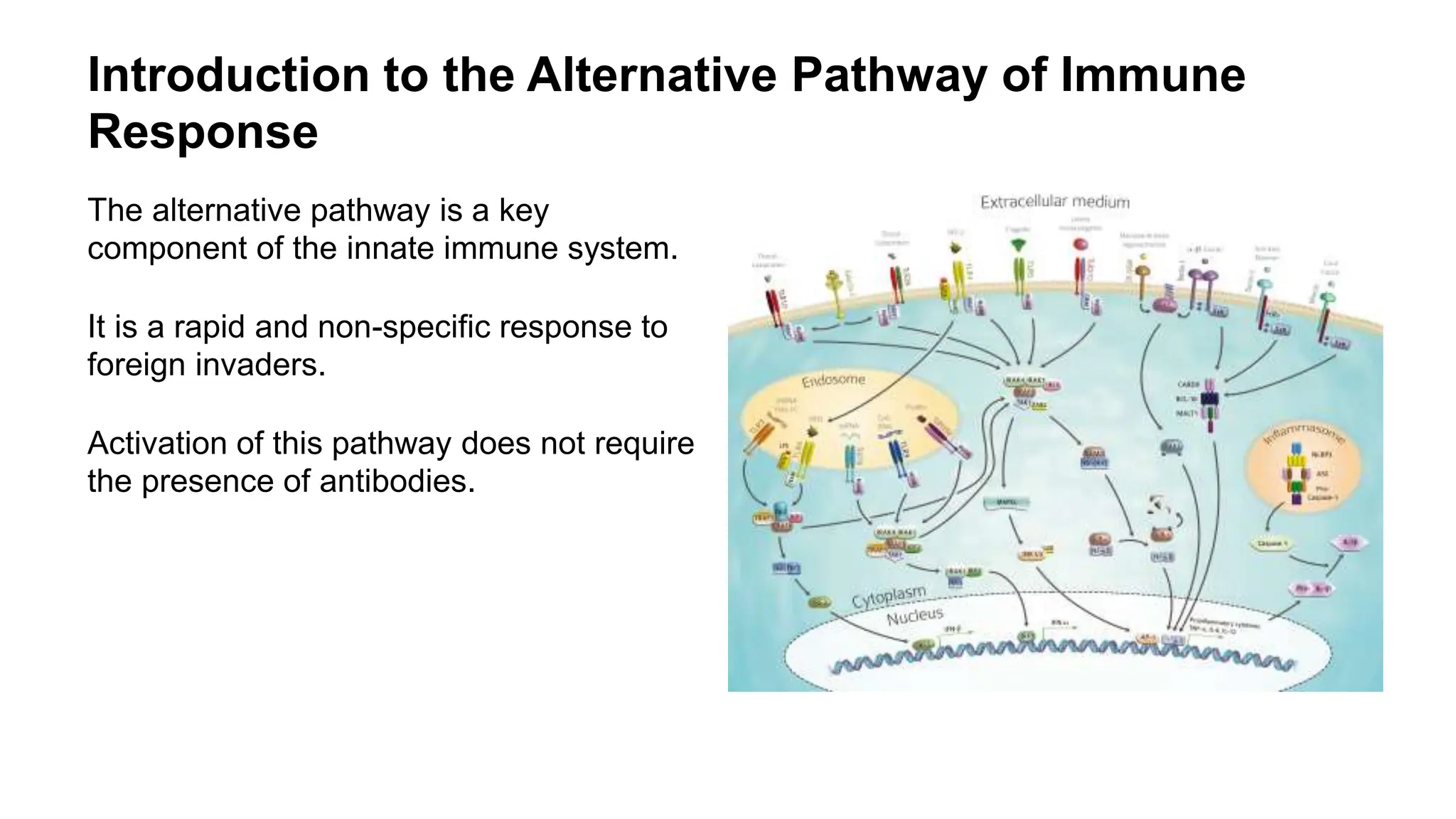
The alternative pathway is a key
component of the innate immune system.
It is a rapid and non-specific response to
foreign invaders.
Activation of this pathway does not require
the presence of antibodies.
Components of the Alternative Pathway
The alternative pathway includes proteins
such as Factor B, Factor D, and properdin.
These proteins interact to form a complex
that activates the complement cascade.
This cascade leads to the opsonization and
lysis of pathogens.
Initiation of the Alternative Pathway
The alternative pathway is initiated by the
spontaneous hydrolysis of C3 into
C3(H2O).
Factor B binds to C3(H2O) and is cleaved
by Factor D to form the C3 convertase.
The C3 convertase then cleaves more C3
molecules, amplifying the immune
response.
Role of Properdin in the Alternative Pathway
Properdin is a positive regulator of the
alternative pathway.
It stabilizes the C3 convertase complex and
enhances its activity.
Properdin also promotes the formation of
the membrane attack complex for pathogen
lysis.
Differences Between the Classical and Alternative
Pathways
The classical pathway is antibody-
dependent, while the alternative pathway is
antibody-independent.
The classical pathway is slower and more
specific, while the alternative pathway is
rapid and non-specific.
Both pathways ultimately converge to the
formation of the membrane attack complex.
Regulation of the Alternative Pathway
Several regulatory proteins, such as Factor
H and Factor I, help control the alternative
pathway.
These proteins prevent excessive
complement activation on host cells.
Dysregulation of the alternative pathway
can lead to autoimmune diseases.
Clinical Implications of the Alternative Pathway
Deficiencies in alternative pathway
components can lead to recurrent
infections.
Overactivation of the alternative pathway
has been implicated in inflammatory
conditions.
Therapeutic targeting of the alternative
pathway is being explored for various
diseases.
Evolutionary Significance of the Alternative Pathway
The alternative pathway is evolutionarily
conserved and found in both vertebrates
and invertebrates.
It provides a rapid defense mechanism
against pathogens before the adaptive
immune response kicks in.
The alternative pathway has likely played a
crucial role in the survival of species over
time.
Research Advances in the Alternative Pathway
Ongoing research is uncovering new
insights into the molecular mechanisms of
the alternative pathway.
Novel therapeutic strategies are being
developed to modulate the alternative
pathway in disease states.
Understanding the alternative pathway may
lead to the development of more targeted
immunotherapies.
Conclusion
The alternative pathway of immune
response is a vital component of the innate
immune system.
It provides a rapid and effective defense
against pathogens.
Continued research into the alternative
pathway may offer new avenues for the
treatment of immune-related disorders.

Alternative Pathway Of Immune Responsese

  • 1.
    Alternative Pathway OfImmune Response SlideMake.com
  • 2.
    Introduction to theAlternative Pathway of Immune Response The alternative pathway is a key component of the innate immune system. It is a rapid and non-specific response to foreign invaders. Activation of this pathway does not require the presence of antibodies.
  • 3.
    Components of theAlternative Pathway The alternative pathway includes proteins such as Factor B, Factor D, and properdin. These proteins interact to form a complex that activates the complement cascade. This cascade leads to the opsonization and lysis of pathogens.
  • 4.
    Initiation of theAlternative Pathway The alternative pathway is initiated by the spontaneous hydrolysis of C3 into C3(H2O). Factor B binds to C3(H2O) and is cleaved by Factor D to form the C3 convertase. The C3 convertase then cleaves more C3 molecules, amplifying the immune response.
  • 5.
    Role of Properdinin the Alternative Pathway Properdin is a positive regulator of the alternative pathway. It stabilizes the C3 convertase complex and enhances its activity. Properdin also promotes the formation of the membrane attack complex for pathogen lysis.
  • 6.
    Differences Between theClassical and Alternative Pathways The classical pathway is antibody- dependent, while the alternative pathway is antibody-independent. The classical pathway is slower and more specific, while the alternative pathway is rapid and non-specific. Both pathways ultimately converge to the formation of the membrane attack complex.
  • 7.
    Regulation of theAlternative Pathway Several regulatory proteins, such as Factor H and Factor I, help control the alternative pathway. These proteins prevent excessive complement activation on host cells. Dysregulation of the alternative pathway can lead to autoimmune diseases.
  • 8.
    Clinical Implications ofthe Alternative Pathway Deficiencies in alternative pathway components can lead to recurrent infections. Overactivation of the alternative pathway has been implicated in inflammatory conditions. Therapeutic targeting of the alternative pathway is being explored for various diseases.
  • 9.
    Evolutionary Significance ofthe Alternative Pathway The alternative pathway is evolutionarily conserved and found in both vertebrates and invertebrates. It provides a rapid defense mechanism against pathogens before the adaptive immune response kicks in. The alternative pathway has likely played a crucial role in the survival of species over time.
  • 10.
    Research Advances inthe Alternative Pathway Ongoing research is uncovering new insights into the molecular mechanisms of the alternative pathway. Novel therapeutic strategies are being developed to modulate the alternative pathway in disease states. Understanding the alternative pathway may lead to the development of more targeted immunotherapies.
  • 11.
    Conclusion The alternative pathwayof immune response is a vital component of the innate immune system. It provides a rapid and effective defense against pathogens. Continued research into the alternative pathway may offer new avenues for the treatment of immune-related disorders.

Editor's Notes

  • #3 Image source: https://www.covalab.com/science-innate-immunity-home
  • #4 Image source: https://ar.pinterest.com/pin/alternative-pathway-of-the-complement-system--414753446943971038/
  • #5 Image source: https://www.kidney-international.org/article/S0085-2538(15)00071-X/fulltext
  • #6 Image source: https://link.springer.com/article/10.1007/s00467-018-4042-z
  • #7 Image source: https://www.differencebetween.com/what-is-the-difference-between-classical-alternative-and-lectin-pathway/
  • #8 Image source: https://mavink.com/explore/Complement-System-Alternative-Pathway
  • #9 Image source: https://www.kidney-international.org/article/S0085-2538(15)00071-X/fulltext
  • #10 Image source: https://www.researchgate.net/figure/The-evolutionary-conservation-of-Drosophila-and-human-RAS-signaling-pathway-The-human_fig3_306421583
  • #11 Image source: https://www.scoop.it/topic/plant-hormones-by-julio-retamales/p/4129419081/2022/01/12/auxin-signaling-research-advances-over-the-past-30-years-review
  • #12 Image source: https://www.vrogue.co/post/innate-immune-system-diagram