www.alpais.com.tr
Protect your
business from
costly downtime!
The Alpais battery monitoring system guarantees
live and secure monitoring of your batteries
24/7 & 365 days a year.
Located at the center of the Alpais system, the control unit offers
a complete solution for monitoring an unlimited number of batteries
with its integrated hardware and software. Alpais offers maximum
usage of the available backup power infrastructure generated by the
batteries which ensures that businesses make the most of their
investment in the batteries.
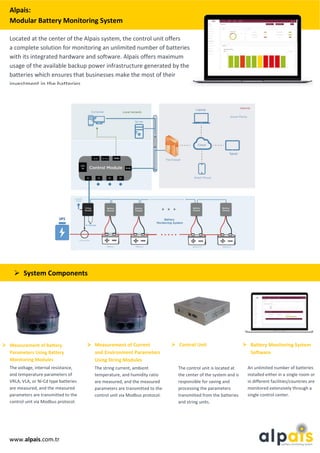
 System Components
www.alpais.com.tr
Alpais:
Modular Battery Monitoring System
 Measurement of Battery
Parameters Using Battery
Monitoring Modules
The voltage, internal resistance,
and temperature parameters of
VRLA, VLA, or Ni-Cd type batteries
are measured, and the measured
parameters are transmitted to the
control unit via Modbus protocol.
 Measurement of Current
and Environment Parameters
Using String Modules
The string current, ambient
temperature, and humidity ratio
are measured, and the measured
parameters are transmitted to the
control unit via Modbus protocol.
 Control Unit  Battery Monitoring System
Software
The control unit is located at
the center of the system and is
responsible for saving and
processing the parameters
transmitted from the batteries
and string units.
An unlimited number of batteries
installed either in a single room or
in different facilities/countries are
monitored extensively through a
single control center.
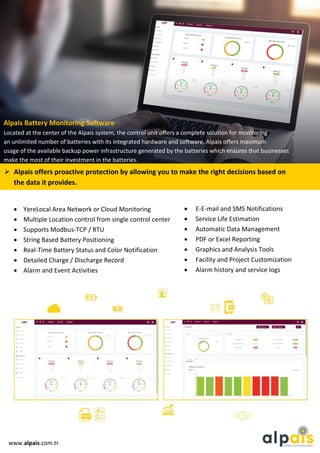
 Alpais offers proactive protection by allowing you to make the right decisions based on
the data it provides.
Alpais Battery Monitoring Software
Located at the center of the Alpais system, the control unit offers a complete solution for monitoring
an unlimited number of batteries with its integrated hardware and software. Alpais offers maximum
usage of the available backup power infrastructure generated by the batteries which ensures that businesses
make the most of their investment in the batteries.
 YereLocal Area Network or Cloud Monitoring
 Multiple Location control from single control center
 Supports Modbus-TCP / RTU
 String Based Battery Positioning
 Real-Time Battery Status and Color Notification
 Detailed Charge / Discharge Record
 Alarm and Event Activities
 E-E-mail and SMS Notifications
 Service Life Estimation
 Automatic Data Management
 PDF or Excel Reporting
 Graphics and Analysis Tools
 Facility and Project Customization
 Alarm history and service logs
Management and service based
www.alpais.com.tr
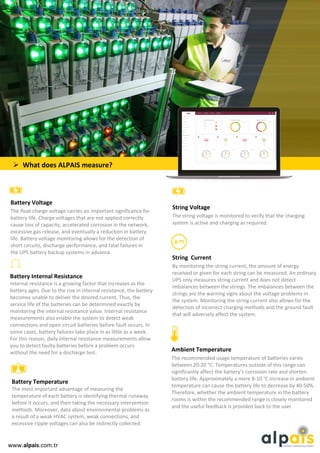
 What does ALPAIS measure?
www.alpais.com.tr
Battery Voltage
The float charge voltage carries an important significance for
battery life. Charge voltages that are not applied correctly
cause loss of capacity, accelerated corrosion in the network,
excessive gas release, and eventually a reduction in battery
life. Battery voltage monitoring allows for the detection of
short circuits, discharge performance, and fatal failures in
the UPS battery backup systems in advance.
Battery Internal Resistance
Internal resistance is a growing factor that increases as the
battery ages. Due to the rise in internal resistance, the battery
becomes unable to deliver the desired current. Thus, the
service life of the batteries can be determined exactly by
monitoring the internal resistance value. Internal resistance
measurements also enable the system to detect weak
connections and open circuit batteries before fault occurs. In
some cases, battery failures take place in as little as a week.
For this reason, daily internal resistance measurements allow
you to detect faulty batteries before a problem occurs
without the need for a discharge test.
Battery Temperature
The most important advantage of measuring the
temperature of each battery is identifying thermal runaway
before it occurs, and then taking the necessary intervention
methods. Moreover, data about environmental problems as
a result of a weak HVAC system, weak connections, and
excessive ripple voltages can also be indirectly collected.
String Voltage
The string voltage is monitored to verify that the charging
system is active and charging as required.
String Current
By monitoring the string current, the amount of energy
received or given for each string can be measured. An ordinary
UPS only measures string current and does not detect
imbalances between the strings. The imbalances between the
strings are the warning signs about the voltage problems in
the system. Monitoring the string current also allows for the
detection of incorrect charging methods and the ground fault
that will adversely affect the system.
Ambient Temperature
The recommended usage temperature of batteries varies
between 20-20 °C. Temperatures outside of this range can
significantly affect the battery’s corrosion rate and shorten
battery life. Approximately a mere 8-10 °C increase in ambient
temperature can cause the battery life to decrease by 40-50%.
Therefore, whether the ambient temperature in the battery
rooms is within the recommended range is closely monitored
and the useful feedback is provided back to the user.
End of
Costly Downtime
If we are talking about the backup battery infrastructure installed somewhere, it can be easily
predicted if and when a critical task has been carried out there. If the battery infrastructure is
required and this need cannot be met on demand, the increase in costs will be inevitable.
Power blackouts are a very common occurrence all around the world. If power blackouts are
taken into account, the investment made into UPSes and battery monitoring systems becomes
vital for your business.
You can be ready for any negative situation by monitoring the installed battery infrastructure in
place for providing backup power.
The Alpais battery monitoring system always refreshes your sense of trust by providing you with
daily feedback and information about the battery infrastructure.
 Alpais: Adds Value to Your Business & Protects Your Investment!
 Extends the lifetime of the batteries in the infrastructure.
 Reduces maintenance and replacement costs through effective protective and preventative maintenance.
 Provides maximum benefit with minimum workforce.
 Provides remote access, giving you the opportunity to manage your business anytime, anywhere.
 Provides planned battery procurement by avoiding emergency situations.
 Enables the identification and verification of the warranty status with recorded data and reporting.
 Provides improvements in business insurance premiums as risks are reduced to a minimum.
 Keeps your staff away from battery racks/chambers and vulnerable areas which further ensures that their
safety and activities continue without interruption. This allows you to focus on your core activities by
simplifying your work safety
and health planning.
 Order Information
SYSTEM STRUCTURE EXPLANATION PRODUCT CODE
CONTROL MODULE
Control Module
Control Module - with Hydrogen Sensor
CONMOD
CONMOD-H
STRING MODULE
String Module
String Module – with Temperature and Humidity Sensor
STRMOD
STRMOD-ENV
BATTERY MODULE
2V Battery Module ( Optional Transparent Case )
6V Battery Module ( Optional Transparent Case )
12V Battery Module ( Optional Transparent Case )
BATMOD02 (BATMOD02-T)
BATMOD06 (BATMOD06-T)
BATMOD12 (BATMOD12-T)
ACCESSORY
DATA CABLE
Cable Terminal : RJ11 Input, L:40 cm
Cable Terminal : RJ11 Input, L:70 cm
COMCAB-40
COMCAB-70
BATTERY
MEASUREMENT
CABLE
Cable Terminal: U Type, r:X mm L:30 cm
Cable Terminal: O Type, r:X mm L:30 cm
Cable Terminal: Faston Type, L:30 cm
MEACAB-U-X-30
MEACAB-O-X-30
MEACAB-F-30
CURRENT SENSOR
Rated Input : 50A ( Measure Range : ̴̴̴̴̴̴̴̴̴0 ± 100A )
Rated Input : 100A ( Measure Range : ̴̴̴̴̴̴̴̴̴0 ± 200A )
Rated Input : 200A ( Measure Range : ̴̴̴̴̴̴̴̴̴0 ± 400A )
Rated Input : 400A ( Measure Range : ̴̴̴̴̴̴̴̴̴0 ± 800A )
Rated Input : 500A ( Measure Range : 0 ± 1000A )
CS050
CS100
CS200
CS400
CS500
POWER SUPPLY 12V DC Power Supply PA-12-2
CONTROL MODULE CABINET SOLUTION
Dimensions : 300x600x165mm (for 1 Control Module)
Dimensions : 500x600x165mm (for 2 Control Module)
PTC-1
PTC-2
Note: Our solutions vary according to user demand. The standard dimensions and product dimensions can be changed according to the
requirements of the Project if technically appropriate.
www.alpais.com.tr
 Frequently Asked Questions
How the Battery Monitoring System works?
With the Alpais battery monitoring system, a battery module is installed in each battery. The battery module measures the
voltage, temperature, and internal resistance of each battery. Charge and discharge status, string current, and string
voltage are measured by each string module placed on each string. Ambient humidity and temperature are also measured
by the sensors in these string modules. The control unit collects and records the data received through the communication
links between them. Afterwards, the data is transmitted to the user through the Alpais software to show the battery status
as well as a time-axis and some column graphs. Notifications of critical and alert batteries are sent by e-mail and SMS and
are displayed via the interface. In this way, critical batteries are detected and necessary actions or planned battery changes
can be made according to the data received.
Your periodic maintenance cannot keep you as safe and secure as you think. Batteries and the management of batteries are
shown as the cause of nearly 85% of all interruptions connected to the uninterruptible power supply. Periodic maintenance
has become a traditional method as a result of time. However, there are still interruptions in critical area applications, and
these have considerable costs to business owners. Therefore, protecting your backup power system with only periodic
maintenance will not reduce the 85% failure rate caused by the battery and will not reduce your risks sufficiently. Batteries,
which are unpredictable by nature, can suddenly break down within 2 weeks and cause your system to crash.
I have a periodic maintenance agreement with my UPS or battery service provider.
Why should I need a battery monitoring system?
I already have a monitoring system in the UPS or rectifier. Is the battery monitoring system necessary
for my operation?
All monitoring systems are the same. Monitoring systems in UPSes or rectifiers monitor batteries as a group and provide
only string-based monitoring. It monitors the battery pack as whole, singular block. They usually monitor the group’s
voltage and charge/discharge states, which does not provide adequate protection. However, each battery in the battery
group has its own importance, so if even one of the batteries in the group fails or is unhealthy, this will affect the whole
group and the system may seize operating. In other words, since the monitoring systems in the UPS or Reducer are not able
to inspect each battery individually, your system is still at great risk, even though everything might seem ok. Whenever you
need to ensure that your system will work properly, it is essential to use a system that can monitor each battery separately,
examine parameters that may affect its health, and allow you to perform scheduled battery replacement as soon as
necessary.
Instead of installing a battery monitoring system, I can reserve some more resources by replacing all my
batteries. Should I still use a battery monitoring system?
The backup power system responsible makes this mistake. Installing a new battery system does not eliminate the risk of
battery failure. Risks cannot be reduced to zero in any unmonitorable component. The possibility of fabricated problems
and the effect of this situation on the total life of the system, along with the fact that some batteries can be completed by
the end of the warranty period (approximately 3%) are among the risk factors that cannot be ignored. Even if your batteries
are newly purchased, unexpected situations may occur and even your new system that is being relied on can interrupt your
business and cause significant financial losses. Thanks to the measurements and reports provided by the battery monitoring
system, it is possible to identify production-related problems and to submit reports for warranty evaluation.
Installing the Battery Monitoring System is a cost for my business. Will it benefit financially?
Contrary to popular belief, the battery monitoring system has many financial benefits. Installing this system reduces routine
visits and maintenance to battery rooms and reduces the amount of work to be done, which saves you money. It may also
lead to reducing the frequency of conducting discharge tests which wear batteries. This will result in saving you time, costs,
and prolonging the lives of the batteries. Because you can monitor the status of your batteries instantly and be aware of
the alarms and warning signs as soon as possible, you can prevent situations that reduce the life of each battery individually
by detecting and replacing an unhealthy battery which could otherwise have reduced the life of the entire system. Thus,
the life of your battery system is extended, its continuity is ensured, and replacement of the whole battery group is
postponed. Even in this situation, the battery monitoring system is a self-paying system.
www.alpais.com.tr
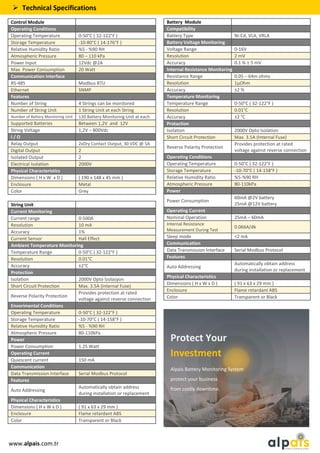
Control Module
Operating Conditions
Operating Temperature 0-50°C ( 32-122°F )
Storage Temperature -10-80°C ( 14-176°F )
Relative Humidity Ratio %5 - %90 RH
Atmospheric Pressure 80 – 110 kPa
Power Input 12Vdc @2A
Max. Power Consumption 20 Watt
Communication Interface
RS-485 Modbus RTU
Ethernet SNMP
Features
Number of String 4 Strings can be monitored
Number of String Unit 1 String Unit at each String
Number of Battery Monitoring Unit 120 Battery Monitoring Unit at each
Supported Batteries Between 1,2V and 12V
String Voltage 1,2V – 800Vdc
I / O
Relay Output 2xDry Contact Output, 30 VDC @ 5A
Digital Output 2
Isolated Output 2
Electrical Isolation 2000V
Physical Characteristics
Dimensions ( H x W x D ) ( 190 x 148 x 45 mm )
Enclosure Metal
Color Grey
 Technical Specifications
String Unit
Current Monitoring
Current range 0-500A
Resolution 10 mA
Accuracy 1%
Current Sensor Hall Effect
Ambient Temperature Monitoring
Temperature Range 0-50°C ( 32-122°F )
Resolution 0.01°C
Accuracy ±2°C
Protection
Isolation 2000V Opto İzolasyon
Short Circuit Protection Max. 3.5A (Internal Fuse)
Reverse Polarity Protection
Provides protection at rated
voltage against reverse connection
Envorimental Conditions
Operating Temperature 0-50°C ( 32-122°F )
Storage Temperature -10-70°C ( 14-158°F )
Relative Humidity Ratio %5 - %90 RH
Atmospheric Pressure 80-110kPa
Power
Power Consumption 1.25 Watt
Operating Current
Quiescent current 150 mA
Communication
Data Transmission Interface Serial Modbus Protocol
Features
Auto Addressing
Automatically obtain address
during installation or replacement
Physical Characteristics
Dimensions ( H x W x D ) ( 91 x 63 x 29 mm )
Enclosure Flame retardant ABS
Color Transparent or Black
Battery Module
Compatibility
Battery Type Ni-Cd, VLA, VRLA
Battery Voltage Monitoring
Voltage Range 0-16V
Resolution 2 mV
Accuracy 0.1 % ± 5 mV
Internal Resistance Monitoring
Resistance Range 0.05 – 64m ohms
Resolution 1µOhm
Accuracy ±2 %
Temperature Monitoring
Temperature Range 0-50°C ( 32-122°F )
Resolution 0.01°C
Accuracy ±2 °C
Protaction
Isolation 2000V Opto Isolation
Short Circuit Protection Max. 3.5A (Internal Fuse)
Reverse Polarity Protection
Provides protection at rated
voltage against reverse connection
Operating Conditions
Operating Temperature 0-50°C ( 32-122°F )
Storage Temperature -10-70°C ( 14-158°F )
Relative Humidity Ratio %5-%90 RH
Atmospheric Pressure 80-110kPa
Power
Power Consumption
60mA @2V battery
25mA @12V battery
Operating Current
Nominal Operation 25mA – 60mA
Internal Resistance
Measurement During Test
0.066A/dk
Sleep mode <2 mA
Communication
Data Transmission Interface Serial Modbus Protocol
Features
Auto Addressing
Automatically obtain address
during installation or replacement
Physical Characteristics
Dimensions ( H x W x D ) ( 91 x 63 x 29 mm )
Enclosure Flame retardant ABS
Color Transparent or Black
www.alpais.com.tr
Protect Your
Investment
Alpais Battery Monitoring System
protect your business
from costly downtime.
www.alpais.com.tr
About Us;
"15 years of field experience, knowledge and technical expertise."
We create global benefits by focusing on uninterrupted sufficiency and sustainability in our critical energy infrastructure
with our integrated production capacity, and our reliable and practical solutions. Our brand provides you and your
business with superior technology 24/7 through the distinguished efforts of our expert team.
We offer productivity, simplicity and sustainability with our industrial experience, expert and solution-oriented team,
high-quality products/services and our ability to carry out global-quality business.
We are making a difference with our ability to intervene immediately with the power to provide uninterrupted energy.
ALPAIS BATTERY MONITORING SYSTEM
Istanbul
Yalı Mh. Top Selvi Cd. Mai Residence No:100-B
Kat:15 Daire : 128 PK:34873 ISTANBUL / TÜRKİYE
Tel: +90 216 561 90 73-74 (pbx) 444 66 21
Fax: +90 216 561 51 32
Ankara
Ankara Teknopark TGB Yerleşkesi İvedik OSB Mah. 2224 Cd.
No:1/1 E Blok Zemin Kat (E-Z09) ANKARA / TÜRKİYE
Tel: +90 216 561 90 73-74 (pbx) 444 66 21
Fax: +90 216 561 51 32
info@alpais.com.tr

Alpais-Battery_Monitoring_System_Brochure.pdf

  • 1.
    www.alpais.com.tr Protect your business from costlydowntime! The Alpais battery monitoring system guarantees live and secure monitoring of your batteries 24/7 & 365 days a year.
  • 2.
    Located at thecenter of the Alpais system, the control unit offers a complete solution for monitoring an unlimited number of batteries with its integrated hardware and software. Alpais offers maximum usage of the available backup power infrastructure generated by the batteries which ensures that businesses make the most of their investment in the batteries.  System Components www.alpais.com.tr Alpais: Modular Battery Monitoring System  Measurement of Battery Parameters Using Battery Monitoring Modules The voltage, internal resistance, and temperature parameters of VRLA, VLA, or Ni-Cd type batteries are measured, and the measured parameters are transmitted to the control unit via Modbus protocol.  Measurement of Current and Environment Parameters Using String Modules The string current, ambient temperature, and humidity ratio are measured, and the measured parameters are transmitted to the control unit via Modbus protocol.  Control Unit  Battery Monitoring System Software The control unit is located at the center of the system and is responsible for saving and processing the parameters transmitted from the batteries and string units. An unlimited number of batteries installed either in a single room or in different facilities/countries are monitored extensively through a single control center.
  • 3.
     Alpais offersproactive protection by allowing you to make the right decisions based on the data it provides. Alpais Battery Monitoring Software Located at the center of the Alpais system, the control unit offers a complete solution for monitoring an unlimited number of batteries with its integrated hardware and software. Alpais offers maximum usage of the available backup power infrastructure generated by the batteries which ensures that businesses make the most of their investment in the batteries.  YereLocal Area Network or Cloud Monitoring  Multiple Location control from single control center  Supports Modbus-TCP / RTU  String Based Battery Positioning  Real-Time Battery Status and Color Notification  Detailed Charge / Discharge Record  Alarm and Event Activities  E-E-mail and SMS Notifications  Service Life Estimation  Automatic Data Management  PDF or Excel Reporting  Graphics and Analysis Tools  Facility and Project Customization  Alarm history and service logs Management and service based www.alpais.com.tr
  • 4.
     What doesALPAIS measure? www.alpais.com.tr Battery Voltage The float charge voltage carries an important significance for battery life. Charge voltages that are not applied correctly cause loss of capacity, accelerated corrosion in the network, excessive gas release, and eventually a reduction in battery life. Battery voltage monitoring allows for the detection of short circuits, discharge performance, and fatal failures in the UPS battery backup systems in advance. Battery Internal Resistance Internal resistance is a growing factor that increases as the battery ages. Due to the rise in internal resistance, the battery becomes unable to deliver the desired current. Thus, the service life of the batteries can be determined exactly by monitoring the internal resistance value. Internal resistance measurements also enable the system to detect weak connections and open circuit batteries before fault occurs. In some cases, battery failures take place in as little as a week. For this reason, daily internal resistance measurements allow you to detect faulty batteries before a problem occurs without the need for a discharge test. Battery Temperature The most important advantage of measuring the temperature of each battery is identifying thermal runaway before it occurs, and then taking the necessary intervention methods. Moreover, data about environmental problems as a result of a weak HVAC system, weak connections, and excessive ripple voltages can also be indirectly collected. String Voltage The string voltage is monitored to verify that the charging system is active and charging as required. String Current By monitoring the string current, the amount of energy received or given for each string can be measured. An ordinary UPS only measures string current and does not detect imbalances between the strings. The imbalances between the strings are the warning signs about the voltage problems in the system. Monitoring the string current also allows for the detection of incorrect charging methods and the ground fault that will adversely affect the system. Ambient Temperature The recommended usage temperature of batteries varies between 20-20 °C. Temperatures outside of this range can significantly affect the battery’s corrosion rate and shorten battery life. Approximately a mere 8-10 °C increase in ambient temperature can cause the battery life to decrease by 40-50%. Therefore, whether the ambient temperature in the battery rooms is within the recommended range is closely monitored and the useful feedback is provided back to the user.
  • 5.
    End of Costly Downtime Ifwe are talking about the backup battery infrastructure installed somewhere, it can be easily predicted if and when a critical task has been carried out there. If the battery infrastructure is required and this need cannot be met on demand, the increase in costs will be inevitable. Power blackouts are a very common occurrence all around the world. If power blackouts are taken into account, the investment made into UPSes and battery monitoring systems becomes vital for your business. You can be ready for any negative situation by monitoring the installed battery infrastructure in place for providing backup power. The Alpais battery monitoring system always refreshes your sense of trust by providing you with daily feedback and information about the battery infrastructure.  Alpais: Adds Value to Your Business & Protects Your Investment!  Extends the lifetime of the batteries in the infrastructure.  Reduces maintenance and replacement costs through effective protective and preventative maintenance.  Provides maximum benefit with minimum workforce.  Provides remote access, giving you the opportunity to manage your business anytime, anywhere.  Provides planned battery procurement by avoiding emergency situations.  Enables the identification and verification of the warranty status with recorded data and reporting.  Provides improvements in business insurance premiums as risks are reduced to a minimum.  Keeps your staff away from battery racks/chambers and vulnerable areas which further ensures that their safety and activities continue without interruption. This allows you to focus on your core activities by simplifying your work safety and health planning.  Order Information SYSTEM STRUCTURE EXPLANATION PRODUCT CODE CONTROL MODULE Control Module Control Module - with Hydrogen Sensor CONMOD CONMOD-H STRING MODULE String Module String Module – with Temperature and Humidity Sensor STRMOD STRMOD-ENV BATTERY MODULE 2V Battery Module ( Optional Transparent Case ) 6V Battery Module ( Optional Transparent Case ) 12V Battery Module ( Optional Transparent Case ) BATMOD02 (BATMOD02-T) BATMOD06 (BATMOD06-T) BATMOD12 (BATMOD12-T) ACCESSORY DATA CABLE Cable Terminal : RJ11 Input, L:40 cm Cable Terminal : RJ11 Input, L:70 cm COMCAB-40 COMCAB-70 BATTERY MEASUREMENT CABLE Cable Terminal: U Type, r:X mm L:30 cm Cable Terminal: O Type, r:X mm L:30 cm Cable Terminal: Faston Type, L:30 cm MEACAB-U-X-30 MEACAB-O-X-30 MEACAB-F-30 CURRENT SENSOR Rated Input : 50A ( Measure Range : ̴̴̴̴̴̴̴̴̴0 ± 100A ) Rated Input : 100A ( Measure Range : ̴̴̴̴̴̴̴̴̴0 ± 200A ) Rated Input : 200A ( Measure Range : ̴̴̴̴̴̴̴̴̴0 ± 400A ) Rated Input : 400A ( Measure Range : ̴̴̴̴̴̴̴̴̴0 ± 800A ) Rated Input : 500A ( Measure Range : 0 ± 1000A ) CS050 CS100 CS200 CS400 CS500 POWER SUPPLY 12V DC Power Supply PA-12-2 CONTROL MODULE CABINET SOLUTION Dimensions : 300x600x165mm (for 1 Control Module) Dimensions : 500x600x165mm (for 2 Control Module) PTC-1 PTC-2 Note: Our solutions vary according to user demand. The standard dimensions and product dimensions can be changed according to the requirements of the Project if technically appropriate. www.alpais.com.tr
  • 6.
     Frequently AskedQuestions How the Battery Monitoring System works? With the Alpais battery monitoring system, a battery module is installed in each battery. The battery module measures the voltage, temperature, and internal resistance of each battery. Charge and discharge status, string current, and string voltage are measured by each string module placed on each string. Ambient humidity and temperature are also measured by the sensors in these string modules. The control unit collects and records the data received through the communication links between them. Afterwards, the data is transmitted to the user through the Alpais software to show the battery status as well as a time-axis and some column graphs. Notifications of critical and alert batteries are sent by e-mail and SMS and are displayed via the interface. In this way, critical batteries are detected and necessary actions or planned battery changes can be made according to the data received. Your periodic maintenance cannot keep you as safe and secure as you think. Batteries and the management of batteries are shown as the cause of nearly 85% of all interruptions connected to the uninterruptible power supply. Periodic maintenance has become a traditional method as a result of time. However, there are still interruptions in critical area applications, and these have considerable costs to business owners. Therefore, protecting your backup power system with only periodic maintenance will not reduce the 85% failure rate caused by the battery and will not reduce your risks sufficiently. Batteries, which are unpredictable by nature, can suddenly break down within 2 weeks and cause your system to crash. I have a periodic maintenance agreement with my UPS or battery service provider. Why should I need a battery monitoring system? I already have a monitoring system in the UPS or rectifier. Is the battery monitoring system necessary for my operation? All monitoring systems are the same. Monitoring systems in UPSes or rectifiers monitor batteries as a group and provide only string-based monitoring. It monitors the battery pack as whole, singular block. They usually monitor the group’s voltage and charge/discharge states, which does not provide adequate protection. However, each battery in the battery group has its own importance, so if even one of the batteries in the group fails or is unhealthy, this will affect the whole group and the system may seize operating. In other words, since the monitoring systems in the UPS or Reducer are not able to inspect each battery individually, your system is still at great risk, even though everything might seem ok. Whenever you need to ensure that your system will work properly, it is essential to use a system that can monitor each battery separately, examine parameters that may affect its health, and allow you to perform scheduled battery replacement as soon as necessary. Instead of installing a battery monitoring system, I can reserve some more resources by replacing all my batteries. Should I still use a battery monitoring system? The backup power system responsible makes this mistake. Installing a new battery system does not eliminate the risk of battery failure. Risks cannot be reduced to zero in any unmonitorable component. The possibility of fabricated problems and the effect of this situation on the total life of the system, along with the fact that some batteries can be completed by the end of the warranty period (approximately 3%) are among the risk factors that cannot be ignored. Even if your batteries are newly purchased, unexpected situations may occur and even your new system that is being relied on can interrupt your business and cause significant financial losses. Thanks to the measurements and reports provided by the battery monitoring system, it is possible to identify production-related problems and to submit reports for warranty evaluation. Installing the Battery Monitoring System is a cost for my business. Will it benefit financially? Contrary to popular belief, the battery monitoring system has many financial benefits. Installing this system reduces routine visits and maintenance to battery rooms and reduces the amount of work to be done, which saves you money. It may also lead to reducing the frequency of conducting discharge tests which wear batteries. This will result in saving you time, costs, and prolonging the lives of the batteries. Because you can monitor the status of your batteries instantly and be aware of the alarms and warning signs as soon as possible, you can prevent situations that reduce the life of each battery individually by detecting and replacing an unhealthy battery which could otherwise have reduced the life of the entire system. Thus, the life of your battery system is extended, its continuity is ensured, and replacement of the whole battery group is postponed. Even in this situation, the battery monitoring system is a self-paying system. www.alpais.com.tr
  • 7.
    Control Module Operating Conditions OperatingTemperature 0-50°C ( 32-122°F ) Storage Temperature -10-80°C ( 14-176°F ) Relative Humidity Ratio %5 - %90 RH Atmospheric Pressure 80 – 110 kPa Power Input 12Vdc @2A Max. Power Consumption 20 Watt Communication Interface RS-485 Modbus RTU Ethernet SNMP Features Number of String 4 Strings can be monitored Number of String Unit 1 String Unit at each String Number of Battery Monitoring Unit 120 Battery Monitoring Unit at each Supported Batteries Between 1,2V and 12V String Voltage 1,2V – 800Vdc I / O Relay Output 2xDry Contact Output, 30 VDC @ 5A Digital Output 2 Isolated Output 2 Electrical Isolation 2000V Physical Characteristics Dimensions ( H x W x D ) ( 190 x 148 x 45 mm ) Enclosure Metal Color Grey  Technical Specifications String Unit Current Monitoring Current range 0-500A Resolution 10 mA Accuracy 1% Current Sensor Hall Effect Ambient Temperature Monitoring Temperature Range 0-50°C ( 32-122°F ) Resolution 0.01°C Accuracy ±2°C Protection Isolation 2000V Opto İzolasyon Short Circuit Protection Max. 3.5A (Internal Fuse) Reverse Polarity Protection Provides protection at rated voltage against reverse connection Envorimental Conditions Operating Temperature 0-50°C ( 32-122°F ) Storage Temperature -10-70°C ( 14-158°F ) Relative Humidity Ratio %5 - %90 RH Atmospheric Pressure 80-110kPa Power Power Consumption 1.25 Watt Operating Current Quiescent current 150 mA Communication Data Transmission Interface Serial Modbus Protocol Features Auto Addressing Automatically obtain address during installation or replacement Physical Characteristics Dimensions ( H x W x D ) ( 91 x 63 x 29 mm ) Enclosure Flame retardant ABS Color Transparent or Black Battery Module Compatibility Battery Type Ni-Cd, VLA, VRLA Battery Voltage Monitoring Voltage Range 0-16V Resolution 2 mV Accuracy 0.1 % ± 5 mV Internal Resistance Monitoring Resistance Range 0.05 – 64m ohms Resolution 1µOhm Accuracy ±2 % Temperature Monitoring Temperature Range 0-50°C ( 32-122°F ) Resolution 0.01°C Accuracy ±2 °C Protaction Isolation 2000V Opto Isolation Short Circuit Protection Max. 3.5A (Internal Fuse) Reverse Polarity Protection Provides protection at rated voltage against reverse connection Operating Conditions Operating Temperature 0-50°C ( 32-122°F ) Storage Temperature -10-70°C ( 14-158°F ) Relative Humidity Ratio %5-%90 RH Atmospheric Pressure 80-110kPa Power Power Consumption 60mA @2V battery 25mA @12V battery Operating Current Nominal Operation 25mA – 60mA Internal Resistance Measurement During Test 0.066A/dk Sleep mode <2 mA Communication Data Transmission Interface Serial Modbus Protocol Features Auto Addressing Automatically obtain address during installation or replacement Physical Characteristics Dimensions ( H x W x D ) ( 91 x 63 x 29 mm ) Enclosure Flame retardant ABS Color Transparent or Black www.alpais.com.tr Protect Your Investment Alpais Battery Monitoring System protect your business from costly downtime.
  • 8.
    www.alpais.com.tr About Us; "15 yearsof field experience, knowledge and technical expertise." We create global benefits by focusing on uninterrupted sufficiency and sustainability in our critical energy infrastructure with our integrated production capacity, and our reliable and practical solutions. Our brand provides you and your business with superior technology 24/7 through the distinguished efforts of our expert team. We offer productivity, simplicity and sustainability with our industrial experience, expert and solution-oriented team, high-quality products/services and our ability to carry out global-quality business. We are making a difference with our ability to intervene immediately with the power to provide uninterrupted energy. ALPAIS BATTERY MONITORING SYSTEM Istanbul Yalı Mh. Top Selvi Cd. Mai Residence No:100-B Kat:15 Daire : 128 PK:34873 ISTANBUL / TÜRKİYE Tel: +90 216 561 90 73-74 (pbx) 444 66 21 Fax: +90 216 561 51 32 Ankara Ankara Teknopark TGB Yerleşkesi İvedik OSB Mah. 2224 Cd. No:1/1 E Blok Zemin Kat (E-Z09) ANKARA / TÜRKİYE Tel: +90 216 561 90 73-74 (pbx) 444 66 21 Fax: +90 216 561 51 32 info@alpais.com.tr