All About Python for Grade 8
Cambridge
A Comprehensive Guide to Learning Python
Introduction to Python
• Python is a high-level, interpreted
programming language.
• Developed by Guido van Rossum and first
released in 1991.
• It's known for its readability and simplicity.
• Used in various domains such as web
development, automation, data science, and
more.
Key Features of Python
• Easy to read and write: Python's syntax is
simple and clean.
• Interpreted language: No need to compile
before running the code.
• Dynamically typed: No need to declare
variable types explicitly.
• Extensive library support: Python has
libraries for various tasks such as web
development, data analysis, and more.•
Open-source: Python is free to use and
distribute.
Why Learn Python?
• Python is versatile and can be used in
many fields.
• It is beginner-friendly and widely used in
educational settings.
• Python is in high demand in industries
such as AI, web development, and finance.
• Large community support makes it easy to
find help and resources.
Setting Up Python
1. Go to https://www.python.org/downloads/.
2. Download the latest version of Python for
your operating system.
3. Install Python and ensure to check 'Add
Python to PATH'.
4. Verify the installation by typing 'python --
version' in your terminal or command
prompt.
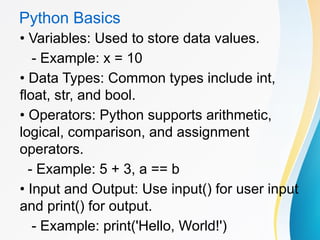
Python Basics
• Variables: Used to store data values.
- Example: x = 10
• Data Types: Common types include int,
float, str, and bool.
• Operators: Python supports arithmetic,
logical, comparison, and assignment
operators.
- Example: 5 + 3, a == b
• Input and Output: Use input() for user input
and print() for output.
- Example: print('Hello, World!')
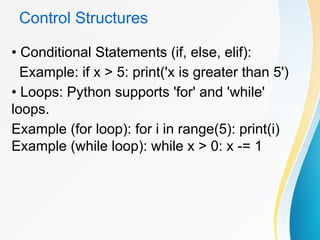
Control Structures
• Conditional Statements (if, else, elif):
Example: if x > 5: print('x is greater than 5')
• Loops: Python supports 'for' and 'while'
loops.
Example (for loop): for i in range(5): print(i)
Example (while loop): while x > 0: x -= 1
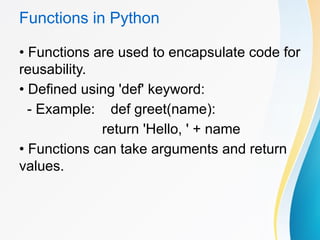
Functions in Python
• Functions are used to encapsulate code for
reusability.
• Defined using 'def' keyword:
- Example: def greet(name):
return 'Hello, ' + name
• Functions can take arguments and return
values.
Data Structures in Python
• Lists: Ordered and mutable collection of
elements.
Example: my_list = [1, 2, 3]
• Tuples: Ordered but immutable collection of
elements.
Example: my_tuple = (1, 2, 3)
• Dictionaries: Key-value pairs for storing
related data.
Example: my_dict = {'name': 'John', 'age':
25}
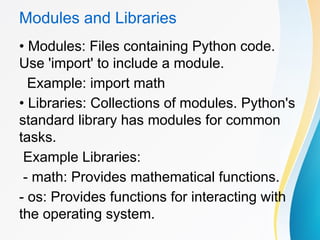
Modules and Libraries
• Modules: Files containing Python code.
Use 'import' to include a module.
Example: import math
• Libraries: Collections of modules. Python's
standard library has modules for common
tasks.
Example Libraries:
- math: Provides mathematical functions.
- os: Provides functions for interacting with
the operating system.
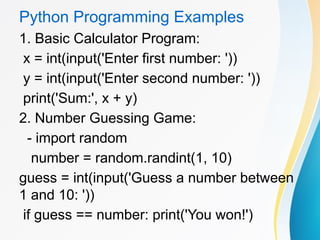
Python Programming Examples
1. Basic Calculator Program:
x = int(input('Enter first number: '))
y = int(input('Enter second number: '))
print('Sum:', x + y)
2. Number Guessing Game:
- import random
number = random.randint(1, 10)
guess = int(input('Guess a number between
1 and 10: '))
if guess == number: print('You won!')
Conclusion
• Python is a powerful, easy-to-learn
programming language.
• It is used in various industries and is an
essential tool for modern computing.
• Explore Python further by working on real-
world projects and experimenting with
libraries.

All_About_Python_and_more+Cambridge.pptx

  • 1.
    All About Pythonfor Grade 8 Cambridge A Comprehensive Guide to Learning Python
  • 2.
    Introduction to Python •Python is a high-level, interpreted programming language. • Developed by Guido van Rossum and first released in 1991. • It's known for its readability and simplicity. • Used in various domains such as web development, automation, data science, and more.
  • 3.
    Key Features ofPython • Easy to read and write: Python's syntax is simple and clean. • Interpreted language: No need to compile before running the code. • Dynamically typed: No need to declare variable types explicitly. • Extensive library support: Python has libraries for various tasks such as web development, data analysis, and more.• Open-source: Python is free to use and distribute.
  • 4.
    Why Learn Python? •Python is versatile and can be used in many fields. • It is beginner-friendly and widely used in educational settings. • Python is in high demand in industries such as AI, web development, and finance. • Large community support makes it easy to find help and resources.
  • 5.
    Setting Up Python 1.Go to https://www.python.org/downloads/. 2. Download the latest version of Python for your operating system. 3. Install Python and ensure to check 'Add Python to PATH'. 4. Verify the installation by typing 'python -- version' in your terminal or command prompt.
  • 6.
    Python Basics • Variables:Used to store data values. - Example: x = 10 • Data Types: Common types include int, float, str, and bool. • Operators: Python supports arithmetic, logical, comparison, and assignment operators. - Example: 5 + 3, a == b • Input and Output: Use input() for user input and print() for output. - Example: print('Hello, World!')
  • 7.
    Control Structures • ConditionalStatements (if, else, elif): Example: if x > 5: print('x is greater than 5') • Loops: Python supports 'for' and 'while' loops. Example (for loop): for i in range(5): print(i) Example (while loop): while x > 0: x -= 1
  • 8.
    Functions in Python •Functions are used to encapsulate code for reusability. • Defined using 'def' keyword: - Example: def greet(name): return 'Hello, ' + name • Functions can take arguments and return values.
  • 9.
    Data Structures inPython • Lists: Ordered and mutable collection of elements. Example: my_list = [1, 2, 3] • Tuples: Ordered but immutable collection of elements. Example: my_tuple = (1, 2, 3) • Dictionaries: Key-value pairs for storing related data. Example: my_dict = {'name': 'John', 'age': 25}
  • 10.
    Modules and Libraries •Modules: Files containing Python code. Use 'import' to include a module. Example: import math • Libraries: Collections of modules. Python's standard library has modules for common tasks. Example Libraries: - math: Provides mathematical functions. - os: Provides functions for interacting with the operating system.
  • 11.
    Python Programming Examples 1.Basic Calculator Program: x = int(input('Enter first number: ')) y = int(input('Enter second number: ')) print('Sum:', x + y) 2. Number Guessing Game: - import random number = random.randint(1, 10) guess = int(input('Guess a number between 1 and 10: ')) if guess == number: print('You won!')
  • 12.
    Conclusion • Python isa powerful, easy-to-learn programming language. • It is used in various industries and is an essential tool for modern computing. • Explore Python further by working on real- world projects and experimenting with libraries.