



ALL KINDS OF MINDS The Learning Theories of  Mel Levine, M.D.
MEL LEVINE Professor of Pediatrics, UNC Co-Founder, All Kinds of Minds  Institute Author:  All Kinds of Minds    A Mind at a Time    Ready or Not, Here Life Comes    The Myth of Laziness
A PEDIATRIC PERSPECTIVE “ IN” Learning Differences Profiling Systems Analysis Specificity Demystification “ What’s right?” “ OUT” Learning Styles Labeling (ADD, LD) Pathology Generalization Secrecy “ What’s wrong?”
“ Every one of our children ambles down the highly judgmental corridors of school each day dragging along his mind’s profile, a partly hidden spreadsheet of personal strengths and weaknesses.  And throughout every moment of the school day that profile gets put to the test.”  “ It’s taken for granted in adult society that  we  cannot all be ‘generalists’ skilled in every area of learning and mastery.  Nevertheless, we apply tremendous pressure to our children to be good at  everything.” A Mind at a Time , Levine
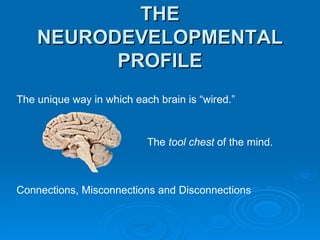
THE NEURODEVELOPMENTAL PROFILE The unique way in which each brain is “wired.” The  tool chest  of the mind. Connections, Misconnections and Disconnections
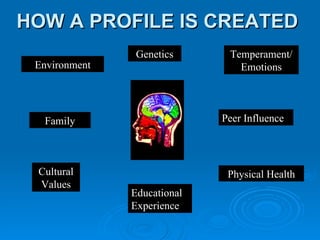
HOW A PROFILE IS CREATED Genetics Temperament/Emotions Environment Peer Influence Family Physical Health Educational Experience Cultural Values
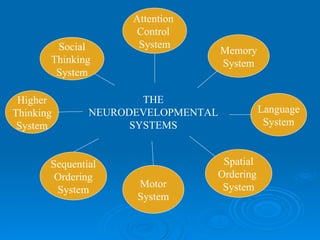
THE NEURODEVELOPMENTAL SYSTEMS Attention  Control  System Social Thinking  System Higher Thinking System Memory System Language System Sequential Ordering System Motor System Spatial Ordering  System
Analysis of the Eight Neurodevelopmental Systems
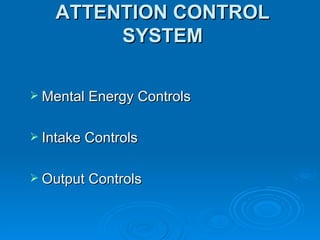
ATTENTION CONTROL SYSTEM Mental Energy Controls Intake Controls Output Controls
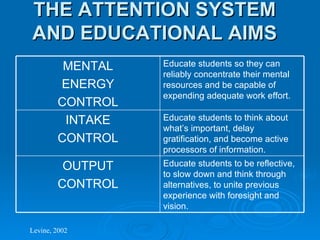
THE ATTENTION SYSTEM AND EDUCATIONAL AIMS Levine, 2002 Educate students to be reflective, to slow down and think through alternatives, to unite previous experience with foresight and vision. OUTPUT CONTROL Educate students to think about what’s important, delay gratification, and become active processors of information. INTAKE CONTROL Educate students so they can reliably concentrate their mental resources and be capable of expending adequate work effort. MENTAL ENERGY CONTROL
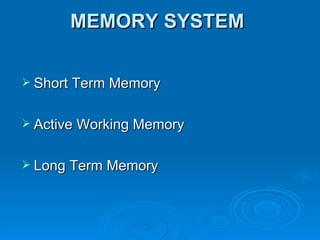
MEMORY SYSTEM Short Term Memory Active Working Memory Long Term Memory
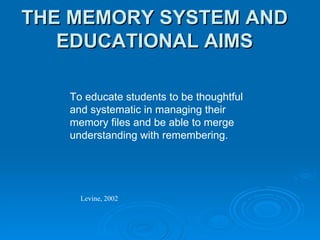
THE MEMORY SYSTEM AND EDUCATIONAL AIMS To educate students to be thoughtful and systematic in managing their memory files and be able to merge understanding with remembering. Levine, 2002
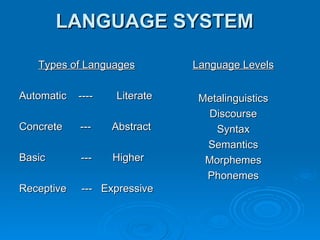
LANGUAGE SYSTEM Types of Languages Automatic  ----  Literate Concrete  ---  Abstract Basic  ---  Higher Receptive  ---  Expressive Language Levels Metalinguistics Discourse Syntax Semantics Morphemes Phonemes
THE LANGUAGE SYSTEM AND EDUCATIONAL AIMS To educate students to derive gratification and knowledge from language input and to become effective verbal communicators. Levine, 2002
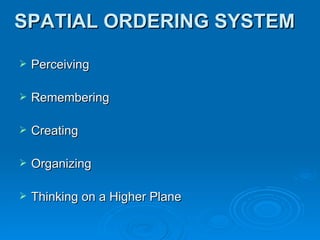
SPATIAL ORDERING SYSTEM Perceiving Remembering Creating Organizing Thinking on a Higher Plane
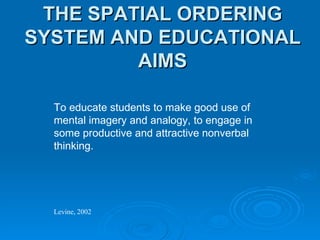
THE SPATIAL ORDERING SYSTEM AND EDUCATIONAL AIMS To educate students to make good use of mental imagery and analogy, to engage in some productive and attractive nonverbal thinking. Levine, 2002
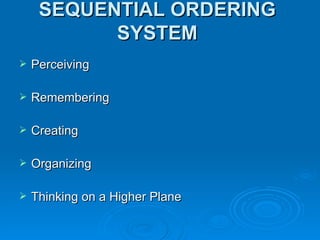
SEQUENTIAL ORDERING SYSTEM Perceiving Remembering Creating Organizing Thinking on a Higher Plane
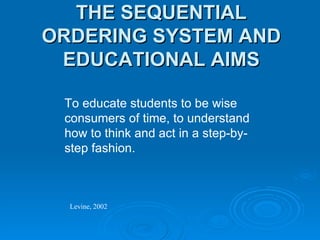
THE SEQUENTIAL ORDERING SYSTEM AND EDUCATIONAL AIMS To educate students to be wise consumers of time, to understand how to think and act in a step-by-step fashion. Levine, 2002
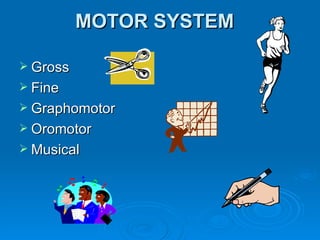
MOTOR SYSTEM Gross Fine Graphomotor Oromotor Musical
THE MOTOR SYSTEM AND EDUCATIONAL AIMS To educate students regarding the ways in which they can achieve a satisfying level of motor effectiveness. Levine, 2002
HIGHER THINKING SYSTEM Concepts Problem Solving Critical Thinking Rule-Guided Thinking Creativity
THE HIGHER THINKING SYSTEM AND EDUCATIONAL AIMS To educate students as thinkers, so they become adept conceptualizers, creators, problem solvers, and critical analysts. Levine, 2002
SOCIAL THINKING SYSTEM Friendship Popularity Politics
THE SOCIAL THINKING SYSTEM AND EDUCATIONAL AIMS To educate students to understand and practice effective interpersonal skills and to be tolerant of differences in social values and styles. Levine, 2002
CONSTRUCTING NEURODEVELOPMENTAL PROFILES Search for highly specific strengths and weaknesses through: Direct observation by multiple parties Testing for specific functions Discussions with the subject Analysis of work products
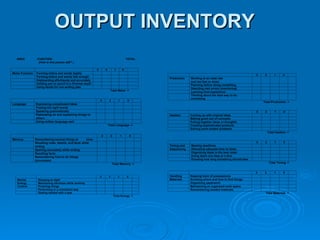
OUTPUT INVENTORY
CONSTRUCTING NEURODEVELOPMENTAL PROFILES Breakdown Points Trouble mastering skills Trouble acquiring facts or knowledge Trouble accomplishing output Trouble understanding Trouble approaching tasks systematically Trouble with the rate and amount of demands
MANAGEMENT BY PROFILE Demystification Accommodations Interventions at Breakdown Points Strengthening Strengths Protection from Humiliation Other Services Coaching and Mentoring
SCHOOLS ATTUNED Schools should tolerate, educate and celebrate all kinds of minds. Teachers Parents Students Setting Atmosphere

All Kinds Of Minds

  • 1.
    ALL KINDS OFMINDS The Learning Theories of Mel Levine, M.D.
  • 2.
    MEL LEVINE Professorof Pediatrics, UNC Co-Founder, All Kinds of Minds Institute Author: All Kinds of Minds A Mind at a Time Ready or Not, Here Life Comes The Myth of Laziness
  • 3.
    A PEDIATRIC PERSPECTIVE“ IN” Learning Differences Profiling Systems Analysis Specificity Demystification “ What’s right?” “ OUT” Learning Styles Labeling (ADD, LD) Pathology Generalization Secrecy “ What’s wrong?”
  • 4.
    “ Every oneof our children ambles down the highly judgmental corridors of school each day dragging along his mind’s profile, a partly hidden spreadsheet of personal strengths and weaknesses. And throughout every moment of the school day that profile gets put to the test.” “ It’s taken for granted in adult society that we cannot all be ‘generalists’ skilled in every area of learning and mastery. Nevertheless, we apply tremendous pressure to our children to be good at everything.” A Mind at a Time , Levine
  • 5.
    THE NEURODEVELOPMENTAL PROFILEThe unique way in which each brain is “wired.” The tool chest of the mind. Connections, Misconnections and Disconnections
  • 6.
    HOW A PROFILEIS CREATED Genetics Temperament/Emotions Environment Peer Influence Family Physical Health Educational Experience Cultural Values
  • 7.
    THE NEURODEVELOPMENTAL SYSTEMSAttention Control System Social Thinking System Higher Thinking System Memory System Language System Sequential Ordering System Motor System Spatial Ordering System
  • 8.
    Analysis of theEight Neurodevelopmental Systems
  • 9.
    ATTENTION CONTROL SYSTEMMental Energy Controls Intake Controls Output Controls
  • 10.
    THE ATTENTION SYSTEMAND EDUCATIONAL AIMS Levine, 2002 Educate students to be reflective, to slow down and think through alternatives, to unite previous experience with foresight and vision. OUTPUT CONTROL Educate students to think about what’s important, delay gratification, and become active processors of information. INTAKE CONTROL Educate students so they can reliably concentrate their mental resources and be capable of expending adequate work effort. MENTAL ENERGY CONTROL
  • 11.
    MEMORY SYSTEM ShortTerm Memory Active Working Memory Long Term Memory
  • 12.
    THE MEMORY SYSTEMAND EDUCATIONAL AIMS To educate students to be thoughtful and systematic in managing their memory files and be able to merge understanding with remembering. Levine, 2002
  • 13.
    LANGUAGE SYSTEM Typesof Languages Automatic ---- Literate Concrete --- Abstract Basic --- Higher Receptive --- Expressive Language Levels Metalinguistics Discourse Syntax Semantics Morphemes Phonemes
  • 14.
    THE LANGUAGE SYSTEMAND EDUCATIONAL AIMS To educate students to derive gratification and knowledge from language input and to become effective verbal communicators. Levine, 2002
  • 15.
    SPATIAL ORDERING SYSTEMPerceiving Remembering Creating Organizing Thinking on a Higher Plane
  • 16.
    THE SPATIAL ORDERINGSYSTEM AND EDUCATIONAL AIMS To educate students to make good use of mental imagery and analogy, to engage in some productive and attractive nonverbal thinking. Levine, 2002
  • 17.
    SEQUENTIAL ORDERING SYSTEMPerceiving Remembering Creating Organizing Thinking on a Higher Plane
  • 18.
    THE SEQUENTIAL ORDERINGSYSTEM AND EDUCATIONAL AIMS To educate students to be wise consumers of time, to understand how to think and act in a step-by-step fashion. Levine, 2002
  • 19.
    MOTOR SYSTEM GrossFine Graphomotor Oromotor Musical
  • 20.
    THE MOTOR SYSTEMAND EDUCATIONAL AIMS To educate students regarding the ways in which they can achieve a satisfying level of motor effectiveness. Levine, 2002
  • 21.
    HIGHER THINKING SYSTEMConcepts Problem Solving Critical Thinking Rule-Guided Thinking Creativity
  • 22.
    THE HIGHER THINKINGSYSTEM AND EDUCATIONAL AIMS To educate students as thinkers, so they become adept conceptualizers, creators, problem solvers, and critical analysts. Levine, 2002
  • 23.
    SOCIAL THINKING SYSTEMFriendship Popularity Politics
  • 24.
    THE SOCIAL THINKINGSYSTEM AND EDUCATIONAL AIMS To educate students to understand and practice effective interpersonal skills and to be tolerant of differences in social values and styles. Levine, 2002
  • 25.
    CONSTRUCTING NEURODEVELOPMENTAL PROFILESSearch for highly specific strengths and weaknesses through: Direct observation by multiple parties Testing for specific functions Discussions with the subject Analysis of work products
  • 26.
  • 27.
    CONSTRUCTING NEURODEVELOPMENTAL PROFILESBreakdown Points Trouble mastering skills Trouble acquiring facts or knowledge Trouble accomplishing output Trouble understanding Trouble approaching tasks systematically Trouble with the rate and amount of demands
  • 28.
    MANAGEMENT BY PROFILEDemystification Accommodations Interventions at Breakdown Points Strengthening Strengths Protection from Humiliation Other Services Coaching and Mentoring
  • 29.
    SCHOOLS ATTUNED Schoolsshould tolerate, educate and celebrate all kinds of minds. Teachers Parents Students Setting Atmosphere