Aligning Training For Results A Process And
Tools That Link Training To Business Ron Drew
Stone download
https://ebookbell.com/product/aligning-training-for-results-a-
process-and-tools-that-link-training-to-business-ron-drew-
stone-1669428
Explore and download more ebooks at ebookbell.com
Here are some recommended products that we believe you will be
interested in. You can click the link to download.
Aligning Human Resources And Business Strategy 3rd Edition Linda
Holbeche
https://ebookbell.com/product/aligning-human-resources-and-business-
strategy-3rd-edition-linda-holbeche-47203030
Aligning Security Operations With The Mitre Attck Framework Level Up
Your Security Operations Center For Better Security Rebecca Blair
https://ebookbell.com/product/aligning-security-operations-with-the-
mitre-attck-framework-level-up-your-security-operations-center-for-
better-security-rebecca-blair-50311562
Aligning Instructional Design With Business Goals Make The Case And
Deliver Results Kristopher Newbauer
https://ebookbell.com/product/aligning-instructional-design-with-
business-goals-make-the-case-and-deliver-results-kristopher-
newbauer-51718308
Aligning Perspectives In Gender Mainstreaming Gender Health Safety And
Wellbeing 1st Ed Juliet Hassard
https://ebookbell.com/product/aligning-perspectives-in-gender-
mainstreaming-gender-health-safety-and-wellbeing-1st-ed-juliet-
hassard-22501718
Aligning With Gods Appointed Times Discover The Prophetic And
Spiritual Meaning Of The Biblical Holidays Rabbi Jason Sobel
https://ebookbell.com/product/aligning-with-gods-appointed-times-
discover-the-prophetic-and-spiritual-meaning-of-the-biblical-holidays-
rabbi-jason-sobel-36144288
Aligning Climate Change And Sustainable Development Policies In Asia
1st Edition Hooman Farzaneh
https://ebookbell.com/product/aligning-climate-change-and-sustainable-
development-policies-in-asia-1st-edition-hooman-farzaneh-43015194
Aligning Information Technology Organization And Strategy Effects On
Firm Performance 1st Edition Ferdinand Mahr Auth
https://ebookbell.com/product/aligning-information-technology-
organization-and-strategy-effects-on-firm-performance-1st-edition-
ferdinand-mahr-auth-4625274
Aligning Organizations Through Measurement The Gqmstrategies Approach
1st Edition Victor Basili
https://ebookbell.com/product/aligning-organizations-through-
measurement-the-gqmstrategies-approach-1st-edition-victor-
basili-4696836
Aligning Enterprise System And Software Architectures Ivan Mistrik
https://ebookbell.com/product/aligning-enterprise-system-and-software-
architectures-ivan-mistrik-4723880
ALIGNING TRAINING
FOR RESULTS
A Process and Tools That Link
Training to Business
Ron Drew Stone
ffirs.indd v
ffirs.indd v 8/22/08 5:27:28 PM
8/22/08 5:27:28 PM
ffirs.indd v
ffirs.indd v 8/22/08 5:27:28 PM
8/22/08 5:27:28 PM
“If you follow the PAL process, you will get the desired training result! The process includes
clearly defined, well-structured tools that will definitely benefit both training professionals and
line managers to achieve training effectiveness.”
—Han Qing, director, Siemens Management Institute
“Ron’s book is a much-needed contribution to the training profession and provides a refreshing
view of how a results-centered training process should function. His process provides the guid-
ance to initiate and sustain alignment with the business, and his tools and templates provide
the how-to.”
—Stephen M. R. Covey, best-selling author of The Speed of Trust
“At last, a book I can use as a guide to ensure that our programs are designed for business needs
and stay aligned throughout the training process to achieve business results. A great contribu-
tion to our profession and a great resource for training fellows.”
—Sunny Niu Peie, regional director, Field Force Effectiveness,
Japan/Asia, Pfizer, Inc.
“Ron’s work is a key resource for all of us in the learning space. Two concepts in particular are
not to be missed: the Performance-Centered Framework is a great blueprint for building alignment
with business challenges and the Active Management Reinforcement connects the performer with the
manager and the work setting and the work, a perfect recipe for success.”
—Rebecca L. Ray, group head, Global Talent Management & Development,
MasterCard Worldwide
“This is a brilliant book that is packed with sage advice and instructive examples. It moves the
traditional trainer role into one of performance consultant. The author provides numerous
tools and strategies that will allow all professionals to be guided in assisting their stakeholders to
achieve transfer of skills into the workplace. A must-read for those who want to align their
learning initiatives to business outcomes.”
—Pam Poggi, vice president, Corporate Human Resources
Development, Safeway Inc.
“The demands of the 21st century Knowledge Worker era are radically different to the needs
of the Industrial Age. Yet a lot of what is being done and offered in the training industry has
just been refined and tweaked for the knowledge worker and we struggle therefore with per-
formance. Ron Stone has built the processes completely afresh from this new paradigm. What
is extremely refreshing are the practical applications and the perspective Ron brings from his
immense experience, which liven up what could otherwise become very dull and dreary.
The way the chapters have been organized are simply superb as they are complete in them-
selves, allowing the reader easy referability and implementation. All in all I would unhesitatingly
classify this book as a must-read not only for all in the training and learning and development
industry but for anyone who has a responsibility to drive organizational performance on a sus-
tained and consistent basis. It is outstanding in terms of its easy-to-understand language and
practicality, which from a global perspective is simply outstanding.
ffirs.indd i
ffirs.indd i 8/22/08 5:27:26 PM
8/22/08 5:27:26 PM
Ron seems to have done the impossible in this book, which is showing us how to turn people
potential into performance. Do yourself a big favor and get yourself a copy today.”
—Rajan Kaicker, executive chairman, FranklinCoveySouthAsia
“Aligning Training for Results is an invaluable resource for professionals around the world who are
responsible for results-oriented outcomes. The tools provided are powerful and easily applica-
ble to everyday work environments. The alignment of training to organizational performance
processes is the critical element to our organization’s success! This book is filled with insights
and strategies that will impact our work in a profound manner.”
—Judith Cardenas, president, Lansing Community College
“This book will be an invaluable resource for training professionals and will help them address
their most serious current challenge: how to align their programs to the business. The logi-
cal and systematic solutions proposed in the book are backed up with an impressive range of
tools and techniques designed to facilitate practical implementation. Ron Stone presents us with
an exciting array of new concepts and approaches. But he isn’t just theorizing—this new think-
ing is grounded in years of practice and the sort of credibility that can only come from doing.
This book breaks new ground and will in time become an important work of reference.”
—Gerry Doyle, director, Impact Measurement Centre, Ireland
“Aligning Training for Results is more than a contribution to the field of performance improve-
ment. It is the only work to date that offers the analyst an inclusive process to prepare for, con-
duct, and evaluate any performance improvement program, with the end in mind throughout.
Tools and techniques are built in to ensure that the analyst uncovers and stays securely tied to
the stakeholders’ expectations and needs.”
—Toni Hodges DeTuncq, principal, THD & Company,
author of Linking Learning and Performance
“Aligning Training for Results is an excellent resource for learning professionals who want to better
align training and performance solutions with business requirements. The book’s comprehen-
sive coverage provides practical ways you can use to meet the expectations of clients and ensure
success. A must-have for anyone interested in achieving business outcomes from training.”
—Don Kraft, director, Learning & Development, Genentech, Inc.
“The Performance Alignment and Linkage Process (PAL), a systematic process and tools, will
provide valuable information for any organization that is being faced with critical questions
from HRD programs.”
—Sunhee Yoo, general manager consulting team,
Samsung Human Resources Development Center
Seoul, South Korea
“Aligning Training for Results is a must-read book for anyone involved in training programs in govern-
ment or the corporate world. Its performance alignment and linkage process (PAL) is the answer
we’ve been looking for—how to demonstrate training’s contribution to achieving business results.”
—Coleen Hines, administrator, Performance Excellence Division,
Michigan Department of Transportation
ffirs.indd ii
ffirs.indd ii 8/22/08 5:27:26 PM
8/22/08 5:27:26 PM
About This Book
Why This Topic Is Important
Although we are doing many things right, our profession and our clients are also keenly aware
that too many training programs continue to underachieve and yield disappointing results.
Ultimately, this leads to the demise of many training functions and strikes a serious blow to
the credibility of our profession. Close examination reveals that our own training processes
lack proper quality controls; they are dated in some cases, sometimes disregarded or misused,
and unresponsive to the needs and demands of the twenty-first century. It is time to correct
this by reexamining and realigning our processes so that we influence and achieve the expect-
ed results for our clients and the organization. We must realign how we execute our training
processes, and refine how we engage our clients and how we target the results.
What the Reader Can Achieve with This Book
The purpose of this book is twofold. First, it offers useful processes and tools to analyze per-
formance as it relates to training and performance needs. Second, it offers a systematic meth-
odology and tools to align the training process with business requirements and consistently
achieve performance results. The methodology and tools cannot be found anywhere else. You
will learn how to use new tools and job-aids when engaging your clients and how to apply
the Performance Alignment and Linkage Process (PAL) to keep your targeted results on track.
The PAL process offers a new perspective and approach, with a strong focus on performance
readiness and achieving execution in the work setting. Quality control components are built
into the process. As you apply the process and tools, you will sharpen your consulting skills,
eliminate time wasters during needs assessment and design activities, clarify performance
execution and outcome requirements, and satisfy the needs of your client.
For updates on performance issues and additional tools and worksheets associated with
the processes in this book, visit my web site frequently at www.performanceandROI
.com. The site includes templates of the job aids presented in the book, as well as new
tools and templates, and a newsletter and is host to frequent free webinars. The site also
has a description of performance-related workshops and other services.
ffirs.indd iii
ffirs.indd iii 8/22/08 5:27:27 PM
8/22/08 5:27:27 PM
About Pfeiffer
Pfeiffer serves the professional development and hands-on resource needs of training and
human resource practitioners and gives them products to do their jobs better. We deliver
proven ideas and solutions from experts in HR development and HR management, and we
offer effective and customizable tools to improve workplace performance. From novice to
seasoned professional, Pfeiffer is the source you can trust to make yourself and your organi-
zation more successful.
Essential Knowledge Pfeiffer produces insightful, practical, and comprehensive
materials on topics that matter the most to training and HR professionals. Our Essential
Knowledge resources translate the expertise of seasoned professionals into practical,
how-to guidance on critical workplace issues and problems. These resources are supported by case
studies, worksheets, and job aids and are frequently supplemented with CD-ROMs, websites, and
other means of making the content easier to read, understand, and use.
Essential Tools Pfeiffer’s Essential Tools resources save time and expense by offer-
ing proven, ready-to-use materials—including exercises, activities, games, instruments,
and assessments—for use during a training or-team-learning event. These resources are
frequently offered in looseleaf or CD-ROM format to facilitate copying and customization of the
material.
Pfeiffer also recognizes the remarkable power of new technologies in expanding the reach
and effectiveness of training. While e-hype has often created whizbang solutions in search of
a problem, we are dedicated to bringing convenience and enhancements to proven training
solutions. All our e-tools comply with rigorous functionality standards. The most appropriate
technology wrapped around essential content yields the perfect solution for today’s on-the-
go trainers and human resource professionals.
Essential resources for training and HR professionals
w w w. p f e i f f e r. c o m
ffirs.indd iv
ffirs.indd iv 8/22/08 5:27:27 PM
8/22/08 5:27:27 PM
ALIGNING TRAINING
FOR RESULTS
A Process and Tools That Link
Training to Business
Ron Drew Stone
ffirs.indd v
ffirs.indd v 8/22/08 5:27:28 PM
8/22/08 5:27:28 PM
Copyright © 2009 by Ron Drew Stone. All Rights Reserved.
Published by Pfeiffer
An Imprint of Wiley
989 Market Street, San Francisco, CA 94103-1741
www.pfeiffer.com
No part of this publication may be reproduced, stored in a retrieval system, or transmitted in any form
or by any means, electronic, mechanical, photocopying, recording, scanning, or otherwise, except as
permitted under Section 107 or 108 of the 1976 United States Copyright Act, without either the prior
written permission of the Publisher, or authorization through payment of the appropriate per-copy fee
to the Copyright Clearance Center, Inc., 222 Rosewood Drive, Danvers, MA 01923, 978-750-8400, fax
978-646-8600, or on the web at www.copyright.com. Requests to the Publisher for permission should
be addressed to the Permissions Department, John Wiley & Sons, Inc., 111 River Street, Hoboken, NJ
07030, 201-748-6011, fax 201-748-6008, or online at http://www.wiley.com/go/permissions.
Limit of Liability/Disclaimer of Warranty: While the publisher and author have used their best
efforts in preparing this book, they make no representations or warranties with respect to the accuracy
or completeness of the contents of this book and specifically disclaim any implied warranties of
merchantability or fitness for a particular purpose. No warranty may be created or extended by sales
representatives or written sales materials. The advice and strategies contained herein may not be suitable
for your situation. You should consult with a professional where appropriate. Neither the publisher nor
author shall be liable for any loss of profit or any other commercial damages, including but not limited to
special, incidental, consequential, or other damages.
Readers should be aware that Internet web sites offered as citations and/or sources for further
information may have changed or disappeared between the time this was written and when it is read.
For additional copies/bulk purchases of this book in the U.S. please contact 800-274-4434.
Pfeiffer books and products are available through most bookstores. To contact Pfeiffer directly call our
Customer Care Department within the U.S. at 800-274-4434, outside the U.S. at 317-572-3985,
fax 317-572-4002, or visit www.pfeiffer.com.
Pfeiffer also publishes its books in a variety of electronic formats. Some content that appears in print
may not be available in electronic books.
Library of Congress Cataloging-in-Publication Data
Stone, Ron Drew, date-
Aligning training for results : a process and tools that link training to business / Ron Drew Stone.
p. cm.
Includes bibliographical references and index.
ISBN 978-0-470-18175-1 (cloth/website)
1. Employees—Training of. 2. Performance. 3. Needs assessment. I. Title.
HF5549.5.T7S718 2008
658.3'124—dc22
2008025948
Acquiring Editor: Matthew Davis
Production Editor: Michael Kay/Susan Geraghty
Editorial Assistant: Lindsay Morton
Manufacturing Supervisor: Becky Morgan
Printed in the United States of America
HB Printing 10 9 8 7 6 5 4 3 2 1
ffirs.indd vi
ffirs.indd vi 8/22/08 5:27:29 PM
8/22/08 5:27:29 PM
To my wife, Jo Ann, who reviewed much of my work
and always offers critical insight and editorial advice.
To my daughter, Ronda, who continuously provides me
with fresh insight into today’s world of work.
ffirs.indd vii
ffirs.indd vii 8/22/08 5:27:29 PM
8/22/08 5:27:29 PM
Select tables, exhibits, and figures from Aligning Training for Results: A Process and Tools
That Link Training to Business are available free online. If you would like to download
and print out a copy of these materials, please visit: http://Pfeiffer/go/TrainingforResults.
For additional tools, visit the author’s Web site, www.performanceandroi.com.
ffirs.indd viii
ffirs.indd viii 8/22/08 5:27:29 PM
8/22/08 5:27:29 PM
ix
CONTENTS
About This Book iii
Tables, Figures, and Exhibits xv
Web Site Tools xvii
Preface xxi
Introduction xxiii
Audience xxiv
How This Book Is Organized xxiv
Getting the Most from This Resource xxvi
Key Terms Used Throughout the Book xxvii
1 Thinking Performance in the Twenty-First Century 1
Performance Is Our Business 1
Performers Do Have a Choice 2
Viewing Training Through a Different Lens 3
Client-Friendly Performance Framework 4
ftoc.indd ix
ftoc.indd ix 8/22/08 5:25:58 PM
8/22/08 5:25:58 PM
x Contents
Business Outcome 6
Execution in the Work Setting 6
Performance Readiness 12
Preferences 14
The Training and Performance Process 14
Top Three Barriers to Performance 16
Summary 17
2 Five Key Factors of Alignment 19
It’s About Results 19
Performance Results Defined 20
Keys to Alignment and Linkage 20
Factor One: Business Outcome Need Is Identified Up Front 22
Factor Two: The Training and Performance Design Is Guided
by the Root Cause and Relevant Needs 26
Factor Three: Development and Delivery Are Focused and Linked to the
Training and Performance Design 27
Factor Four: Following Delivery, Performers Choose to Execute
in the Work Setting 29
Factor Five: Execution Is Linked to One or More Business
Outcome Measures 29
Summary 31
3 PAL: The Alignment of Our Processes 33
With a New View Come New Processes 33
Introduction to the PAL Process 34
Phase One: Situational Needs Assessment
and Performance Design 36
Step 1: Scope the Project and Utilize Six Signals to Determine
Assessment Strategy 36
Step 2: Conduct Detailed Assessment and Analysis and Identify
Alternative Solutions 37
Step 3: Administer Situational Risk Assessment and Analysis 37
ftoc.indd x
ftoc.indd x 8/22/08 5:25:59 PM
8/22/08 5:25:59 PM
Contents xi
Step 4: Propose the Solution and Negotiate Performance
Alignment Contract 38
Step 5: Go/No Go Solution Decision 38
Phase Two: Design and Development 39
Step 6: Finalize Delivery Design and Strategy for Performance Transfer 39
Step 7: Develop and/or Acquire Focused Performance Solution
Components 40
Phase Three: Delivery and Execution 41
Step 8: Implement Pre-Engagement Action 41
Step 9: Deliver Performance Solution and Assess Learning Readiness and
Initial Reaction 41
Step 10: Trigger Transfer Strategy and Work Setting Execution 42
Phase Four: Verification and Follow-Up 43
Step 11: Rapid Verification of Results and Follow-Up Action Steps 43
Guiding Principles 43
Summary 43
4 Situational Needs Assessment: Opening the Door 45
A Process with Many Names 45
Getting Started 46
Two Roles for Needs Assessment 46
Proactive Role 47
Client Request Role 48
Client Key Behavior and Suggested Solutions 49
Client Resistance to Our Processes 49
The Initial Meeting: Let the Client Talk 50
Step 1 of the PAL Process: Scope the Project 52
The Six Signals 52
Intake Scope and Alignment Document 64
Summary 73
ftoc.indd xi
ftoc.indd xi 8/22/08 5:25:59 PM
8/22/08 5:25:59 PM
xii Contents
5 Situational Needs Assessment: The Analysis 75
Step 2 of the PAL Process: Conduct Detailed Assessment
and Analysis 75
The Approach 76
The Strategy 76
Sampling 81
Data Collection Methods and Sources 83
Data Collection Methods 83
Data Collection Sources 85
Detailed Analysis 87
Execution Gap Analysis 88
Root Cause Analysis 89
The Acid Test 92
Step 3 of the PAL Process: Administer Situational Risk Assessment
and Analysis 92
The Guiding Objectives and Measures 97
Risk Analysis: Assessing the Need for a Transfer Action and Strategy 98
Summary 107
6 Aligning and Proposing the Solution 109
Believe in Your Solution 109
Influencing the Client 110
Step 4 of the PAL Process: Propose the Solution and Negotiate Performance
Alignment Contract 110
Educating the Client 113
Negotiating the Solution and the Performance Alignment Contract 119
Evaluation Inquiry 125
Step 5 of the PAL Process: Go/No Go Decision 126
Forecasting the Return on Investment 126
Summary 129
ftoc.indd xii
ftoc.indd xii 8/22/08 5:25:59 PM
8/22/08 5:25:59 PM
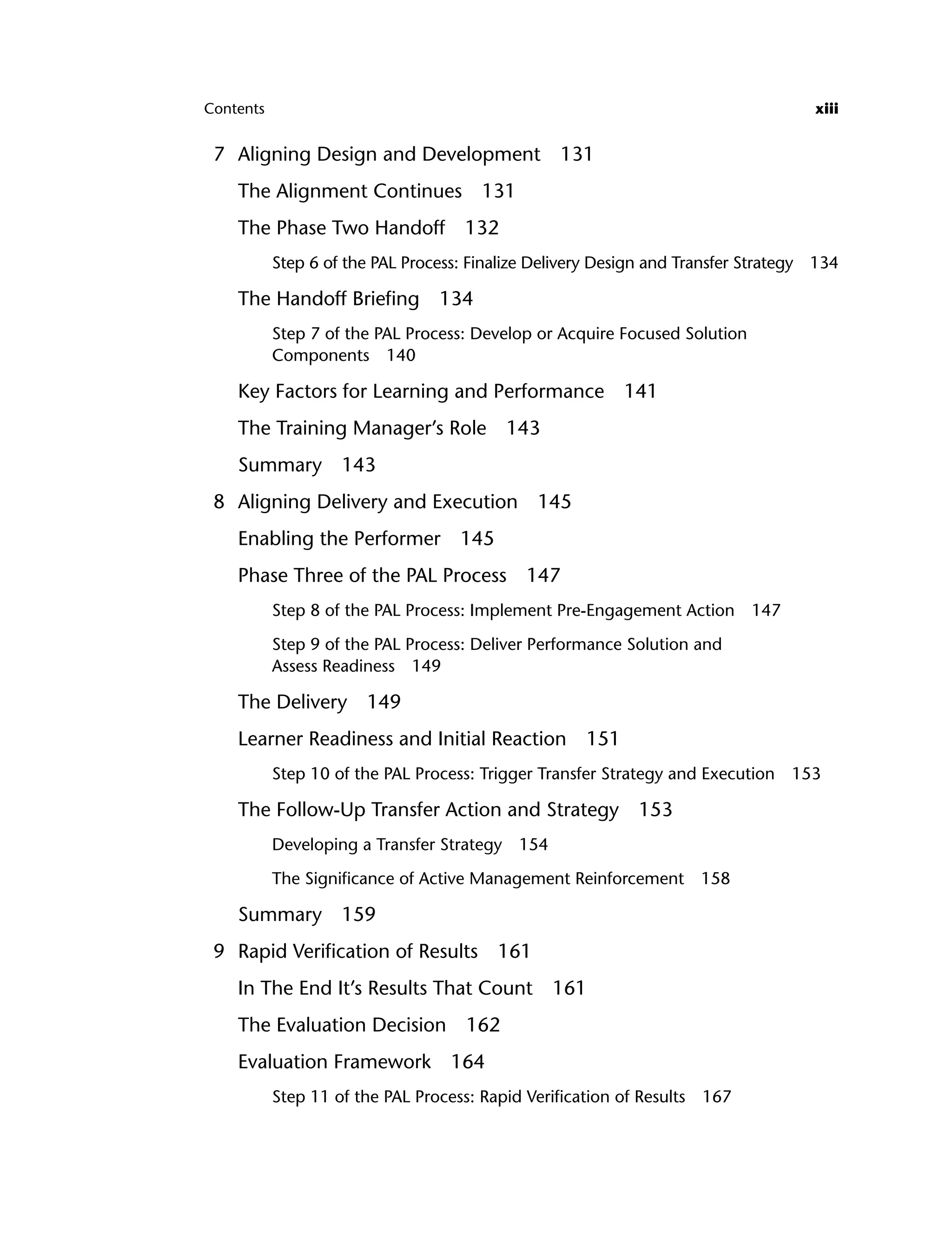
Contents xiii
7 Aligning Design and Development 131
The Alignment Continues 131
The Phase Two Handoff 132
Step 6 of the PAL Process: Finalize Delivery Design and Transfer Strategy 134
The Handoff Briefing 134
Step 7 of the PAL Process: Develop or Acquire Focused Solution
Components 140
Key Factors for Learning and Performance 141
The Training Manager’s Role 143
Summary 143
8 Aligning Delivery and Execution 145
Enabling the Performer 145
Phase Three of the PAL Process 147
Step 8 of the PAL Process: Implement Pre-Engagement Action 147
Step 9 of the PAL Process: Deliver Performance Solution and
Assess Readiness 149
The Delivery 149
Learner Readiness and Initial Reaction 151
Step 10 of the PAL Process: Trigger Transfer Strategy and Execution 153
The Follow-Up Transfer Action and Strategy 153
Developing a Transfer Strategy 154
The Significance of Active Management Reinforcement 158
Summary 159
9 Rapid Verification of Results 161
In The End It’s Results That Count 161
The Evaluation Decision 162
Evaluation Framework 164
Step 11 of the PAL Process: Rapid Verification of Results 167
ftoc.indd xiii
ftoc.indd xiii 8/22/08 5:25:59 PM
8/22/08 5:25:59 PM
xiv Contents
Step 1: Determine Purpose and Verify Sponsorship for Evaluation 167
Step 2: Develop Detailed Plans for Low-Intensity Rapid
Verification Strategy 170
Step 3: Collect and Analyze Readiness Data 179
Step 4: Collect and Analyze Follow-Up Performance Data 179
Step 5: Communicate Findings and Recommend Follow-Up Action 191
Summary 195
10 Cultivating and Sustaining Sponsorship 197
Contribution and Survival 197
Importance of Sponsorship 198
Influencing Sponsorship 199
Channel One: Direct Use Knowledge 200
Channel Two: Casual Indicators 200
Channel Three: Communication of Demonstrated Results 202
The Outside View 203
It’s Time to Stop Doing—and Start Doing 206
Working Our Processes 208
A Few Closing Thoughts 209
Summary 210
Bibliography 211
About the Author 213
Index 215
ftoc.indd xiv
ftoc.indd xiv 8/22/08 5:26:00 PM
8/22/08 5:26:00 PM
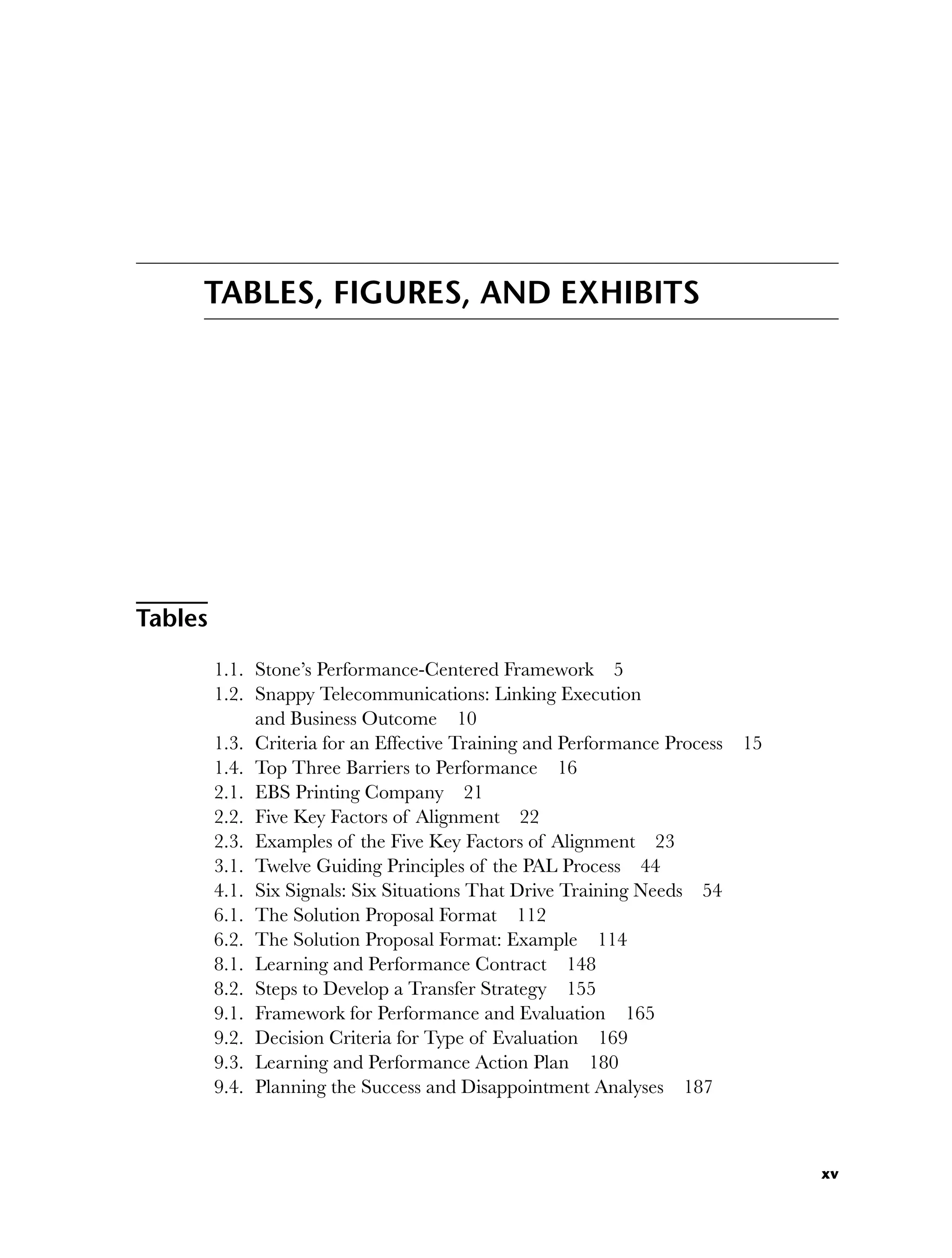
xv
TABLES, FIGURES, AND EXHIBITS
Tables
1.1. Stone’s Performance-Centered Framework 5
1.2. Snappy Telecommunications: Linking Execution
and Business Outcome 10
1.3. Criteria for an Effective Training and Performance Process 15
1.4. Top Three Barriers to Performance 16
2.1. EBS Printing Company 21
2.2. Five Key Factors of Alignment 22
2.3. Examples of the Five Key Factors of Alignment 23
3.1. Twelve Guiding Principles of the PAL Process 44
4.1. Six Signals: Six Situations That Drive Training Needs 54
6.1. The Solution Proposal Format 112
6.2. The Solution Proposal Format: Example 114
8.1. Learning and Performance Contract 148
8.2. Steps to Develop a Transfer Strategy 155
9.1. Framework for Performance and Evaluation 165
9.2. Decision Criteria for Type of Evaluation 169
9.3. Learning and Performance Action Plan 180
9.4. Planning the Success and Disappointment Analyses 187
ftoc.indd xv
ftoc.indd xv 8/22/08 5:26:00 PM
8/22/08 5:26:00 PM
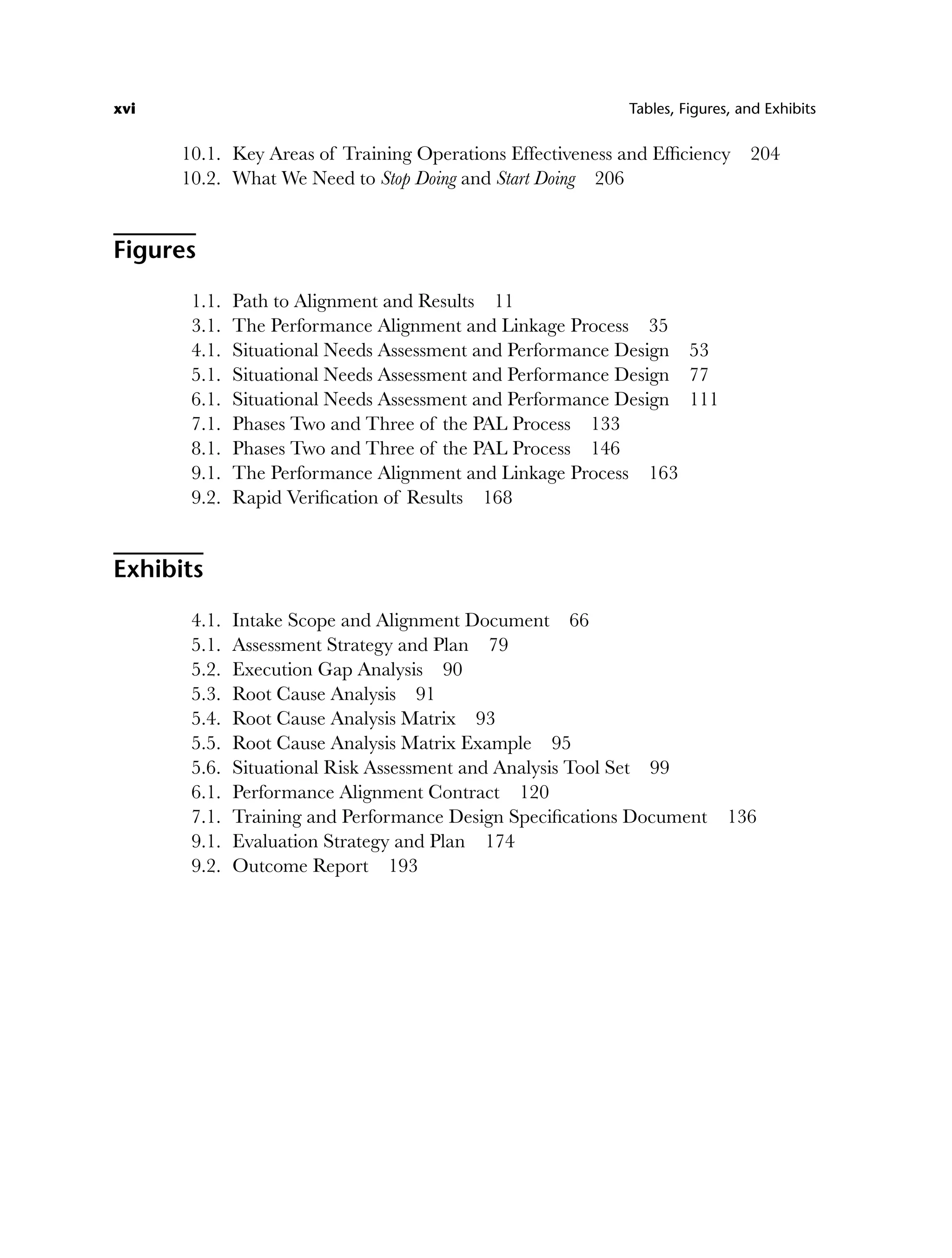
10.1. Key Areas of Training Operations Effectiveness and Efficiency 204
10.2. What We Need to Stop Doing and Start Doing 206
Figures
1.1. Path to Alignment and Results 11
3.1. The Performance Alignment and Linkage Process 35
4.1. Situational Needs Assessment and Performance Design 53
5.1. Situational Needs Assessment and Performance Design 77
6.1. Situational Needs Assessment and Performance Design 111
7.1. Phases Two and Three of the PAL Process 133
8.1. Phases Two and Three of the PAL Process 146
9.1. The Performance Alignment and Linkage Process 163
9.2. Rapid Verification of Results 168
Exhibits
4.1. Intake Scope and Alignment Document 66
5.1. Assessment Strategy and Plan 79
5.2. Execution Gap Analysis 90
5.3. Root Cause Analysis 91
5.4. Root Cause Analysis Matrix 93
5.5. Root Cause Analysis Matrix Example 95
5.6. Situational Risk Assessment and Analysis Tool Set 99
6.1. Performance Alignment Contract 120
7.1. Training and Performance Design Specifications Document 136
9.1. Evaluation Strategy and Plan 174
9.2. Outcome Report 193
xvi Tables, Figures, and Exhibits
ftoc.indd xvi
ftoc.indd xvi 8/22/08 5:26:00 PM
8/22/08 5:26:00 PM
xvii
WEB SITE TOOLS
Chapter One
Table 1.1. Stone’s Performance-Centered Framework 5
Table 1.3. Criteria for an Effective Training and Performance
Process 15
Chapter Two
Table 2.2. Five Key Factors of Alignment 22
Chapter Three
Figure 3.1. The Performance Alignment and Linkage Process 35
Table 3.1. Twelve Guiding Principles of the PAL Process 44
ftoc.indd xvii
ftoc.indd xvii 8/22/08 5:26:00 PM
8/22/08 5:26:00 PM
Chapter Four
Figure 4.1. Situational Needs Assessment and Performance Design 53
Table 4.1. Six Signals: Six Situations That Drive Training Needs 54
Exhibit 4.1.*
Intake Scope and Alignment Document 66
Chapter Five
Figure 5.1. Situational Needs Assessment and Performance Design 77
Exhibit 5.1.*
Assessment Strategy and Plan 79
Exhibit 5.2.*
Execution Gap Analysis 89
Exhibit 5.3. Root Cause Analysis 91
Exhibit 5.4.*
Root Cause Analysis Matrix 93
Exhibit 5.5. Root Cause Analysis Matrix Example 95
Exhibit 5.6.*
Situational Risk Assessment and Analysis Tool Set 99
Chapter Six
Figure 6.1. Situational Needs Assessment and Performance Design 111
Table 6.1.*
The Solution Proposal Format 112
Table 6.2. The Solution Proposal Format: Example 114
Exhibit 6.1.*
Performance Alignment Contract 120
Chapter Seven
Figure 7.1. Phases Two and Three of the PAL Process 133
Exhibit 7.1.*
Training and Performance Design Specifications
Document 136
Chapter Eight
Figure 8.1. Phases Two and Three of the PAL Process 146
Table 8.1. Learning and Performance Contract 148
Table 8.2.*
Steps to Develop a Transfer Strategy 155
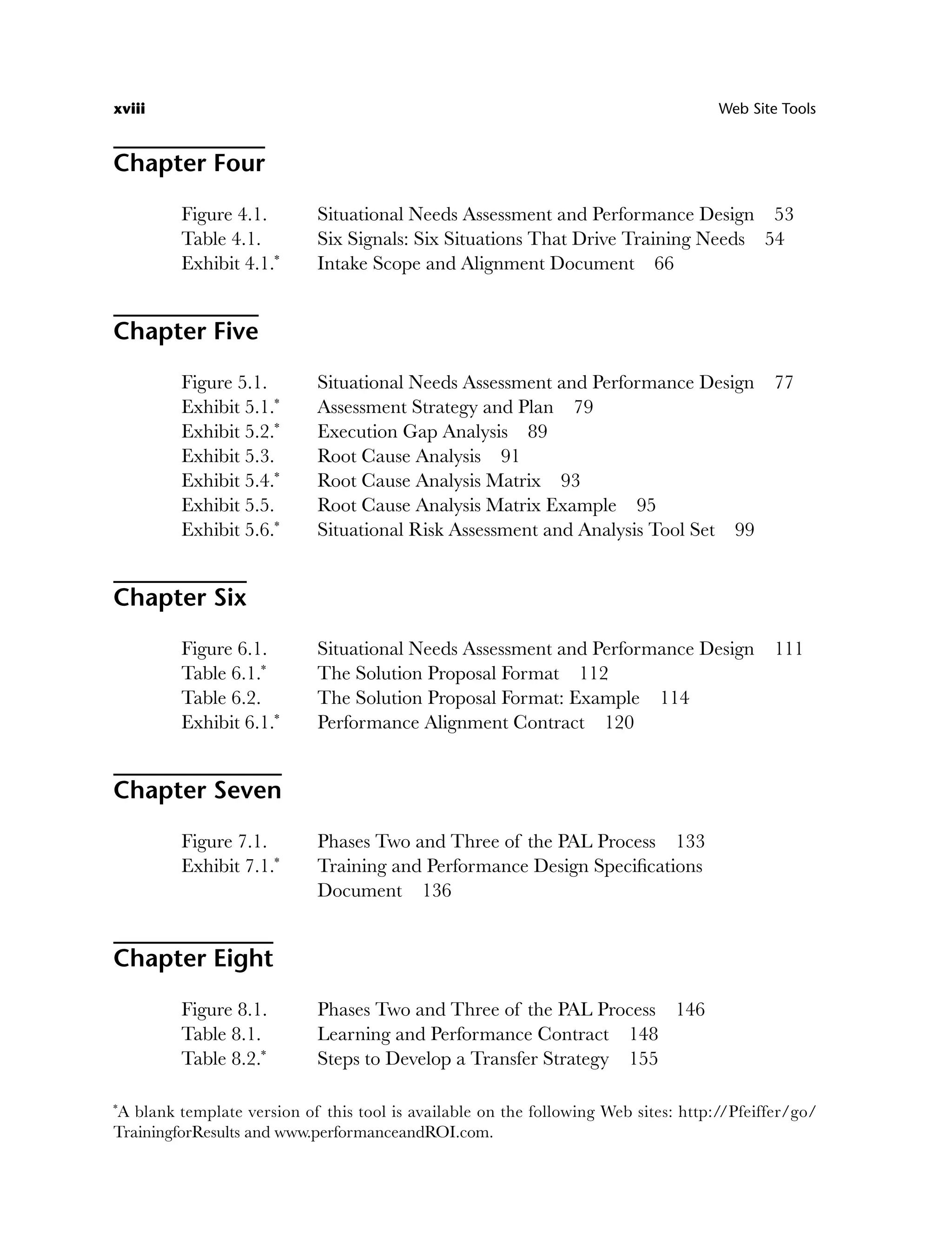
xviii Web Site Tools
*
A blank template version of this tool is available on the following Web sites: http://Pfeiffer/go/
TrainingforResults and www.performanceandROI.com.
ftoc.indd xviii
ftoc.indd xviii 8/22/08 5:26:01 PM
8/22/08 5:26:01 PM
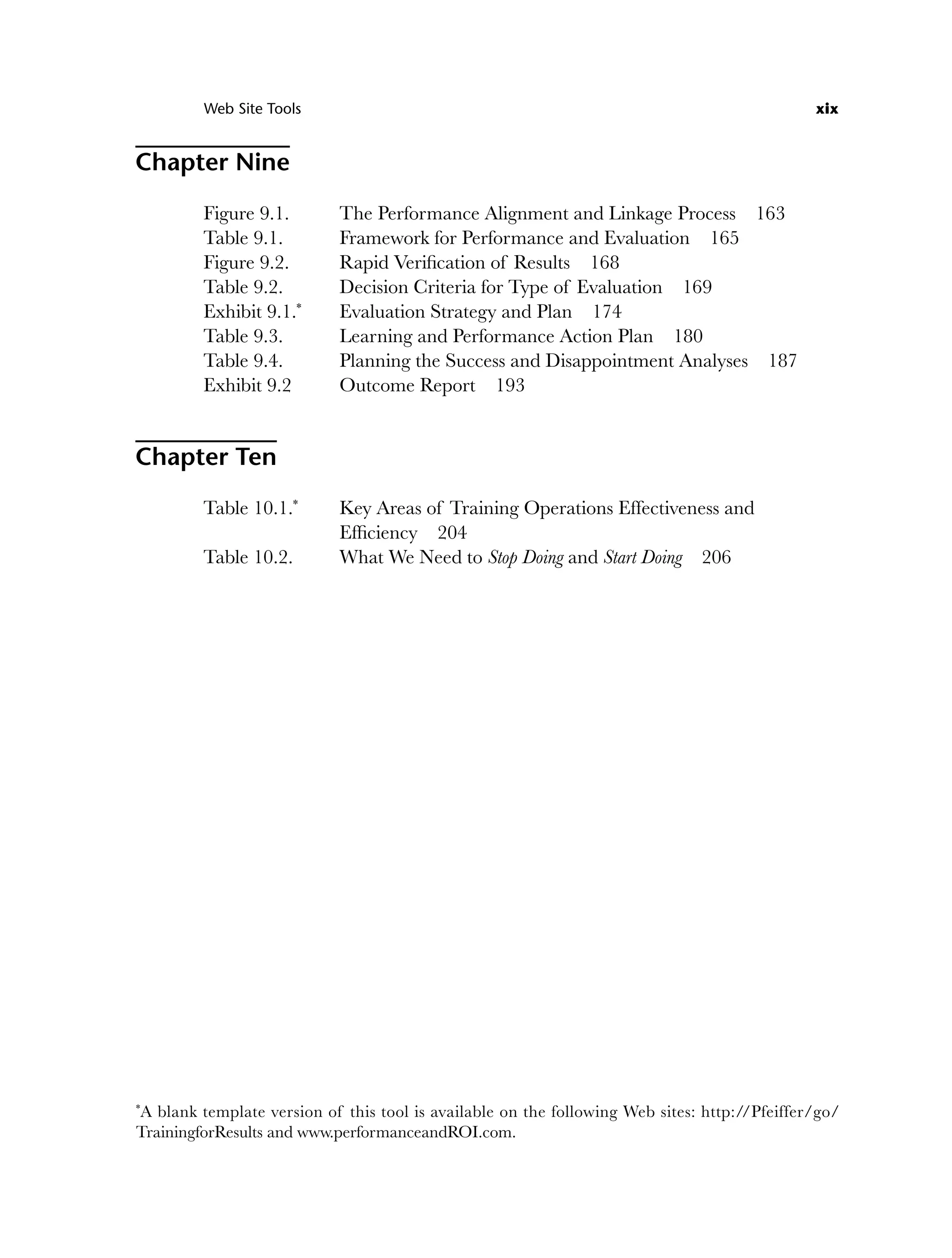
Chapter Nine
Figure 9.1. The Performance Alignment and Linkage Process 163
Table 9.1. Framework for Performance and Evaluation 165
Figure 9.2. Rapid Verification of Results 168
Table 9.2. Decision Criteria for Type of Evaluation 169
Exhibit 9.1.*
Evaluation Strategy and Plan 174
Table 9.3. Learning and Performance Action Plan 180
Table 9.4. Planning the Success and Disappointment Analyses 187
Exhibit 9.2 Outcome Report 193
Chapter Ten
Table 10.1.*
Key Areas of Training Operations Effectiveness and
Efficiency 204
Table 10.2. What We Need to Stop Doing and Start Doing 206
Web Site Tools xix
*
A blank template version of this tool is available on the following Web sites: http://Pfeiffer/go/
TrainingforResults and www.performanceandROI.com.
ftoc.indd xix
ftoc.indd xix 8/22/08 5:26:01 PM
8/22/08 5:26:01 PM
ftoc.indd xx
ftoc.indd xx 8/22/08 5:26:01 PM
8/22/08 5:26:01 PM
xxi
PREFACE
As I organized and documented what I have learned over the years, I discov-
ered that I was in danger of missing the picture altogether. I had to keep
an open mind in order to sort out the puzzle. I had to keep asking myself, what
are we doing well in our profession and how are our processes broken? I also
had to ask myself the obvious question, if our processes are broken, can they be
repaired? If so, what is the appropriate fix? Can we improve our processes enough
to achieve the expected results—and can we do it now?
My experience and my research have led me to the conclusion that I know
how we can align our processes for results. I have created the work in this book
with the goal of sharing this with you and providing the tools you need to be suc-
cessful. You can be a major player in continuously bringing results and credibility
to our training function. You can achieve this goal with minimal pain. But you
must be willing to change the way you think about and apply our training pro-
cesses. You must accept that there are some broken pieces and that not only is a
fix possible but it will also be very gratifying along the way. You must also commit
to being process driven, trust your processes, and then work your processes.
fpref.indd xxi
fpref.indd xxi 8/22/08 5:26:54 PM
8/22/08 5:26:54 PM
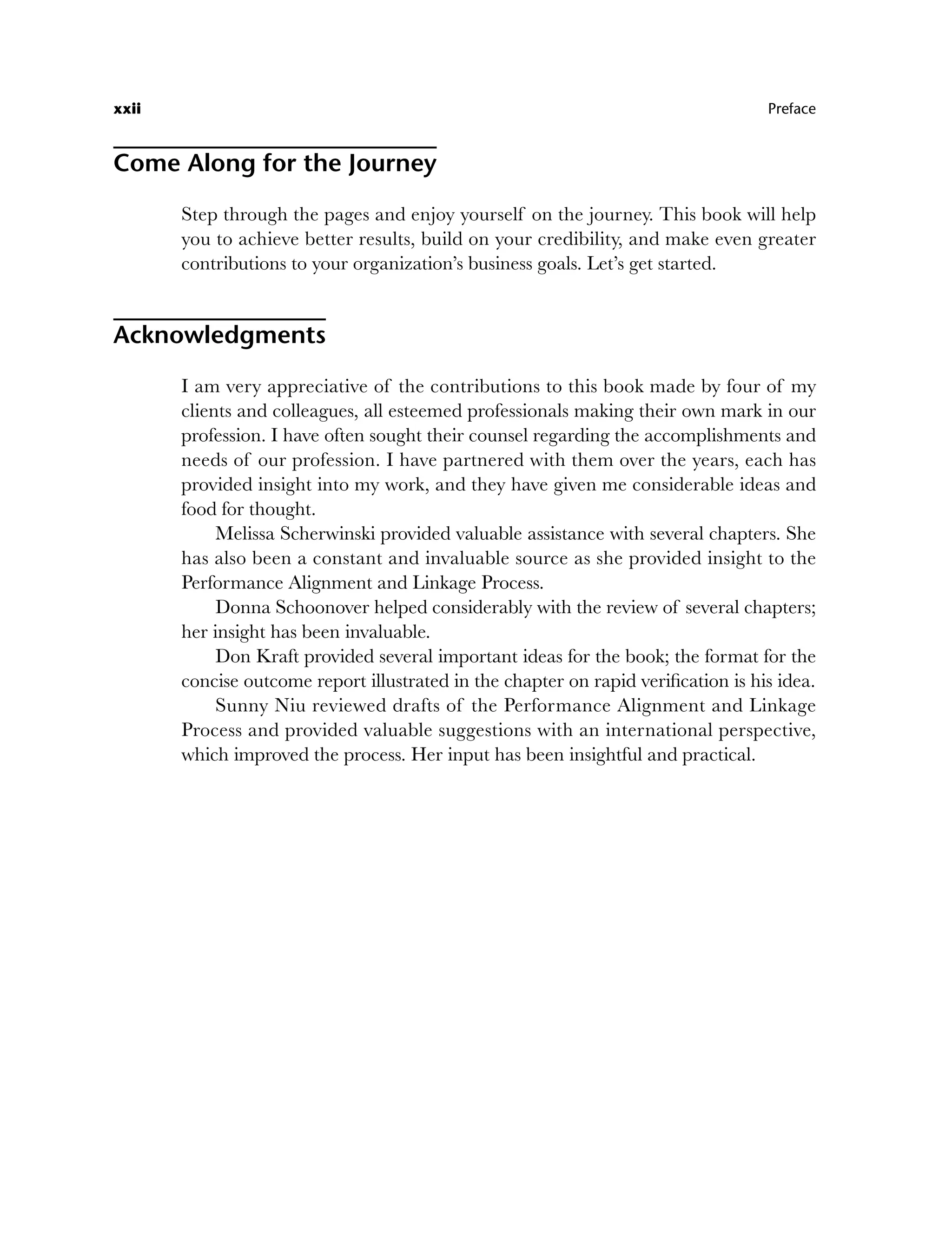
Come Along for the Journey
Step through the pages and enjoy yourself on the journey. This book will help
you to achieve better results, build on your credibility, and make even greater
contributions to your organization’s business goals. Let’s get started.
Acknowledgments
I am very appreciative of the contributions to this book made by four of my
clients and colleagues, all esteemed professionals making their own mark in our
profession. I have often sought their counsel regarding the accomplishments and
needs of our profession. I have partnered with them over the years, each has
provided insight into my work, and they have given me considerable ideas and
food for thought.
Melissa Scherwinski provided valuable assistance with several chapters. She
has also been a constant and invaluable source as she provided insight to the
Performance Alignment and Linkage Process.
Donna Schoonover helped considerably with the review of several chapters;
her insight has been invaluable.
Don Kraft provided several important ideas for the book; the format for the
concise outcome report illustrated in the chapter on rapid verification is his idea.
Sunny Niu reviewed drafts of the Performance Alignment and Linkage
Process and provided valuable suggestions with an international perspective,
which improved the process. Her input has been insightful and practical.
xxii Preface
fpref.indd xxii
fpref.indd xxii 8/22/08 5:26:54 PM
8/22/08 5:26:54 PM
xxiii
INTRODUCTION
This book provides a methodology—the Performance Alignment and Linkage
(PAL) process—to analyze performance needs and to align training processes
with business requirements so that solutions influence performance and achieve
business results. Throughout this book, you will learn how to apply numerous
tools to influence performance and get the results you and your clients desire. You
will learn how to view performance in the proper context and how to properly
execute the PAL methodology to build and deliver training results and, yes, to
influence return on investment (ROI) if that’s on your wish list. The end in mind
is to deliver the expected results for our clients and stake a claim as a key contribu-
tor to the organization’s success in the twenty-first century. This book is a neces-
sary resource for helping interested training managers and professionals to be the
best they can be and meet the expectations of clients and the organization.
The process begins with how we think about performance and our product
and continues with realigned needs assessment, design, delivery, and follow-up
approaches that we employ to ensure success and satisfy client needs. In addition
to building on the work of many pioneers in our profession, the approach pre-
sented in this book brings a new frame of reference and a more results-centered
blueprint to our profession. Our goal with these new processes and realignment is
to leave our deficiencies in the past and achieve results that build a reputation for
meeting or exceeding the expectations of clients and the organization.
flast.indd xxiii
flast.indd xxiii 8/22/08 5:26:32 PM
8/22/08 5:26:32 PM
xxiv Introduction
Audience
This book is for you if the current processes you are using are unwieldy or you are
not getting expected results from your programs. You will learn how to identify
performance gaps and root causes, determine related needs, and sustain align-
ment throughout the training and performance process.
Whether you are a training director, project manager, coordinator, designer,
research analyst, performance consultant, or client account manager, you will
benefit from this book. The concepts, principles, and processes presented here
can serve your needs if you are new to the training profession or if you are a sea-
soned professional. If you are new and have no background in existing training
processes, you will find many practical approaches and tools you can use imme-
diately. If you are experienced and currently using your own processes, or those
developed by others, you have two choices:
Adopt new concepts, ideas, and tools presented here and integrate them with
what you are doing now to improve your results.
Do a process dump and start anew with the processes presented here.
Whatever your role in the training function, you are always in a position to
influence the success of training processes and programs. This book will generate
ideas that you can put into action immediately to exercise your influence.
How This Book Is Organized
The book begins by addressing performance issues and identifies the top three
barriers to performance. It then suggests that we abandon the way we have his-
torically characterized the training process in favor of an approach more in line
with today’s needs. The PAL methodology embraces a framework and the tools
necessary for linkage and performance alignment. Here are summaries of the
ten chapters.
Chapter One: Thinking Performance in the Twenty-First Century. This is a “must read”
chapter. To gain the most from this book, you must be willing to change the
way you think about the training and performance process. A new performance
framework for training is presented, along with criteria for the training and per-
formance process. Because results are driven by the right processes applied in the
right way, this chapter addresses how you must trust your processes, commit to
being process driven, and then work your processes.
•
•
flast.indd xxiv
flast.indd xxiv 8/22/08 5:26:32 PM
8/22/08 5:26:32 PM
Introduction xxv
Chapter Two: Five Key Factors of Alignment. Many training programs have a
limited chance to succeed because training managers and training professionals
sometimes do not focus on the proper factors during needs assessment, program
design, and program delivery. Key factors are introduced that are necessary to
ensure alignment and a sustained focus on results throughout the training pro-
cess. The goal of these factors is to link needs identification with the design,
development, and delivery of a proper solution and to address learning transfer
to the work setting. These factors are inherently addressed throughout the PAL
methodology.
Chapter Three: PAL: The Alignment of Our Processes. An overview of the
Performance Alignment and Linkage (PAL) process is provided in this chapter.
Detailed components of the methodology are covered in subsequent chapters.
The PAL training and performance process is a front-to-back refinement of how
we should view and respond to training requests and fulfill client needs. The
methodology includes guiding principles and addresses results-centered design,
development, and delivery, transfer to the work setting, and rapid verification of
results. The PAL process includes tools and templates that serve as built-in qual-
ity control mechanisms, helping keep our eyes on our processes to ensure that we
sustain alignment and achieve business results.
Chapter Four: Situational Needs Assessment: Opening the Door. This chapter keys in
on how to establish initial alignment and how to rapidly adapt the needs assess-
ment process to a wide range of diverse client situations. It addresses how the
“situation” drives the way in which the needs assessment process should be used,
resulting in contextual application and greater efficiency. This aids greatly in gain-
ing cooperation from the client to conduct needs assessment activities necessary
to deliver an effective training and performance solution.
Chapter Five: Situational Needs Assessment: The Analysis. This chapter covers
the use of various analysis tools to address the following significant aspects of the
front-end analysis:
Clarification of the performance requirements
Identification of the performance gap, which identifies the deficiency
Identification of the cause of the deficiency
Identification of relevant needs along with alternative solutions
The tools are easy to use and allow for quick completion of the assessment
and analysis to identify the problem area and an appropriate solution.
Chapter Six: Aligning and Proposing the Solution. This chapter demonstrates how
to propose the recommended solution in a context that will educate the client
about alignment, communicate the support needed through Active Management
•
•
•
•
flast.indd xxv
flast.indd xxv 8/22/08 5:26:33 PM
8/22/08 5:26:33 PM
xxvi Introduction
Reinforcement, and gain approval to proceed with design and implementation of
a feasible solution. It also includes how to address a request to forecast a return
on investment when required. A key component of this chapter is communication
of the proposed solution in a way that gains client support for the most effective
performance design.
Chapter Seven: Aligning Design and Development. This chapter addresses how
to sustain alignment from needs assessment through design and development to
achieve the desired business outcome.
Chapter Eight: Aligning Delivery and Execution. This chapter addresses sustaining
the alignment through delivery and execution. It also addresses the significance of
the need for methods to trigger execution in the work setting. Alternative transfer
actions and key components of developing a transfer strategy are addressed so
that execution is appropriately influenced in the work setting.
Chapter Nine: Rapid Verification of Results. This chapter addresses how to execute
a form of follow-up evaluation that is less intensive, less expensive, and less time
consuming than traditional evaluation approaches. It satisfies the need for expedi-
tiously capturing indicators of success without draining resources.
Chapter Ten: Cultivating and Sustaining Sponsorship. This chapter addresses how
our clients and stakeholders routinely assess the value of the training function
during normal day-to-day operations both with and without our knowledge or
input. Important areas that frame stakeholder attitudes about the training func-
tion are identified, along with suggestions for routinely addressing them to gain
and sustain sponsorship.
Getting the Most from This Resource
All the tools you will need for this learning package are at your fingertips. In addition
to the text, a web site is provided that includes the key process tools addressed in the
text. Each tool that is located on the web site is identified by a distinctive icon, as
shown in the margin here. The tool might be a table, a job aid (called exhibit in this
book), a form with detailed instructions on how to use it, or an explanation of an
important concept that is central to a methodology. Many of the tools also include
a template on the web site. Use the tools and what you learn from this material to
achieve results with your own training programs to satisfy clients and other stakehold-
ers. Your existing know-how—along with a new frame of reference, new processes,
new learning, and new tools—will improve your possibility of achieving business
results and a return on investment (ROI) with your projects and programs.
There is one axiom I would like you to remember as you read this book and
as you apply the processes to your projects:
flast.indd xxvi
flast.indd xxvi 8/22/08 5:26:33 PM
8/22/08 5:26:33 PM
Introduction xxvii
If you have the right processes and you follow your processes, the desired result
should follow.
Chapters One through Six should be read in sequence, as they contain a
common thread that sets the stage for linkage and alignment to achieve results. If
you are experienced at conducting traditional needs assessments, you may want
to skip Chapter Five, with the exception of the Risk Assessment and Analysis sec-
tion in that chapter. The remaining chapters may be reviewed in any sequence
desired. Beginning in Chapter Four, a case scenario—Big Sky Medical Group—is
used throughout several of the chapters to demonstrate the use of processes and
tools. Other case scenarios are also used frequently. This influences active learning
for the reader and sustains interest in the book as well.
As you are reading this text, experiment with the ideas and tools on one of
your current programs. Ask a coworker or even a client with whom you have a
comfortable relationship to be a willing partner as you practice using the tools and
applying the processes to your programs. While your initial learning is still fresh in
your mind, consider making a personal commitment to apply the methodology and
tools with your next three projects or clients. This will help you see what works best
for you and will increase your confidence in using the methodology and tools.
The processes, concepts, and tools presented in this book are not a total rein-
vention or restructuring of our business processes, but rather a strict realignment
that you should be able to easily adapt to your situation.
For updates on performance issues and additional tools and worksheets asso-
ciated with the processes in this book, visit my web site frequently at www
.performanceandROI.com. The site includes templates of the job aids presented
in the book, as well as new tools and templates, and a newsletter and is host to
frequent free webinars. The site also has a description of performance-related
workshops and other services.
Key Terms Used Throughout the Book
Alignment or align: Refers to the need for interventions or training solutions to be
compatible with business needs and requirements. For example, the business need
(the end in mind) must be identified up front when there is a request for a training
flast.indd xxvii
flast.indd xxvii 8/22/08 5:26:34 PM
8/22/08 5:26:34 PM
xxviii Introduction
program. The training solution that is selected must address this identified need.
Alignment or align also refers to the need for the different phases of the training
process to be in alignment. For example, the training design must be compatible
with the needs that are identified during needs assessment, and the instructional
staff must follow the design when delivering the solution.
Active Management Reinforcement (AMR): AMR represents factors that are typi-
cally the responsibility of managers as they prepare and engage their team in the
work setting to achieve desired behavior, task assignments, and performance goals.
These actions include factors such as communicating expectations, negotiating
performance goals, providing coaching and positive reinforcement, and manag-
ing incentives and rewards. The concept of AMR emphasizes that performers
may perceive these factors to be inadequate unless the factors are actively being
addressed by managers during any given performance scenario. When these
AMR factors are absent or inadequate, the result is often less than desirable per-
formance by the workforce.
Client: Used in this work, the term client refers to the person who has requested
training services. Clients are usually members of management, but could be
someone in another role, such as a member of the community if the training is
providing services to the community. A client usually has the authority to approve
budgets and provide funding and support resources to assist in the project’s devel-
opment and implementation. The director of the training department may be a
client, in the absence of a direct client. For example, an open enrollment offering
in which participants from many different departments enroll in the same offering of
a course requires one central sponsor.
Committee: When a training committee exists, it usually serves some type of
governing role in the project. This term is used interchangeably with other related
terms, like steering committee, task force, action committee, training committee,
or project committee. Sometimes, for the duration of a training project the proj-
ect manager will interface with a committee instead of the sponsor or client. This
can be an effective method to get broad management support and resources for
a project, but it can also work against expediency. A committee often is involved
when the project is large, cuts across functional or departmental lines, or when
the project involves an outside compliance agency.
Delivery: This is the phase of the training and performance process when
the learners become engaged with the solution. Delivery is the execution of all of
the activity that surrounds the learning engagement to facilitate learning.
Effective or effectiveness: The outcome of working a process, providing services,
or performing a task or behavior that conforms to standards or criteria of quality.
Effectiveness is a measure of quality.
flast.indd xxviii
flast.indd xxviii 8/22/08 5:26:34 PM
8/22/08 5:26:34 PM
Introduction xxix
Efficient or efficiency: The outcome of working a process, providing services,
or performing a task or behavior that conforms to standards or criteria of time or
resource utilization. Efficiency is a measure of quantity.
Learning transfer: The context of learning transfer, training transfer, or performance
transfer, as used in this book, refers to the participants’ applying what they learn to
situations in the work setting. Transfer completes the training and performance
cycle and should serve to favorably influence business outcomes.
Linkage or linked relationships: See Performance-centered framework.
Open enrollment program: A training offering in which participants are enrolled
from multiple departments or from multiple companies.
Participant: Participants are the target for the training being delivered. In some
countries participants are called delegates. Even though participants are a type of
client, a different term is used to distinguish them from the client who is request-
ing or funding the project.
Performance driver: Any factor that tends to influence how people perform. For
example, coaching and positive reinforcement from a supervisor tend to influence
favorable employee performance.
Performance-centered framework: A way in which to view linked relationships that
affect performance. Linked relationships occur when one action or set of cir-
cumstances influences another action or set of circumstances. Here are several
examples:
Training results: A customer service training program provides skills that influ-
ence improved service to the customer, which in turn drives a business outcome
of improved customer satisfaction.
Performance needs: A work team is making errors in filling customer orders
because they lack the proper knowledge of how to use the order-filling process.
The missing link of “proper knowledge of the order filling process” results in
errors, which results in customer receiving the wrong orders, receiving orders
late, or receiving incomplete orders, and so on.
Performance needs: A work team is deficient in performing the task of providing
acceptable customer service because effective customer service guidelines are
not properly communicated and reinforced by their manager. The missing link
of “guidelines” results in inadequate customer service.
As the last two examples illustrate, the framework is the key to viewing perfor-
mance issues when conducting needs assessment activities and making decisions
about training and performance solutions. It helps to ensure that we view per-
formance from every possible angle and see the linkages. It aids us in ultimately
•
•
•
flast.indd xxix
flast.indd xxix 8/22/08 5:26:35 PM
8/22/08 5:26:35 PM
xxx Introduction
viewing performance, performance gaps, and performance requirements in the
proper context.
Pre-engagement action: Any action or activity to begin participant involvement
prior to the actual learning engagement. Examples are pretesting participants to
determine current knowledge and skills; initiating discussion between participants
and their supervisor to discuss how the training relates to job expectations and
to set relevant goals; and assigning specific reading materials, review of web site
content, or completion of job tasks to prepare for participation in the learning
engagement.
Program, project, or solution: This references the initiative that is being funded
for a population. The term program is used interchangeably with course, intervention,
solution, or project.
Project manager: This is the owner of the training project from beginning to
follow-through in the work setting. This person is in charge of managing the
project, reporting on the status, influencing the project’s success, and negotiating
decisions when there are disagreements along the way. In reality the title in many
organizations could be something different, such as coordinator, account man-
ager, training manager, or the like. This role could also be filled by the facilitator
or instructor, but it is best that it be someone else—someone who oversees the
entire process from request to follow-up. Who the project manager is may depend
on the size of the project or even the size of the organization, as in some training
organizations the same person may wear several hats.
Root cause: The initial contributing factor of a chain of events that leads to
a specific outcome. When the root cause is identified, an intervention may then
be identified and implemented to change performance and prevent an undesir-
able outcome. In a given performance situation, there could be one cause or
multiple causes that influence a specific outcome. Typically, the dominant factor
or factors are addressed with the intervention.
Sponsor: Sponsors may be high-level executives or have some type of func-
tional authority in regard to the project, or they may be in a department other
than the one that is targeted for the training. For example, the vice president of
quality in the corporate headquarters sponsors a QA training program to be
offered to employees who report to other vice presidents, such as the vice presi-
dent of operations and the vice president of product assembly. There is no direct
reporting relationship between the sponsor (VP of quality) and the employees
who are targeted for the training. A sponsor and a client can be the same person.
Like clients, sponsors usually can fund a project or otherwise provide resources
and support.
Sponsors of designated training programs should always take ownership of
the program. The terms initiating sponsor and sustaining sponsor are also used in
flast.indd xxx
flast.indd xxx 8/22/08 5:26:35 PM
8/22/08 5:26:35 PM
Introduction xxxi
this work. In the previous example, the vice president of quality is an initiating
sponsor of the QA training program that she originates or initiates. The vice
presidents of operations and product assembly and the managers that report to
them are expected to take on the role of sustaining sponsors to support imple-
mentation of the QA training program in their department. Without this formal
sustaining support, training programs that cross functional or department lines
can easily fail due to lack of ownership and support.
Stakeholder: This can be anyone who has an interest in a training project or the
training department. Clients, participants, sponsors, project managers, training
directors, employees, managers, senior managers, executives, CEOs—all can be
stakeholders.
Training or learning engagement: Refers to any type of training intervention (pro-
gram, course, lesson, session, solution, project) delivered through any means
(instructor-led, online, CD, teleconference, self-study, and so on), for the pur-
pose of enabling individuals and teams to address knowledge, skill, or behavior
requirements.
Training professional: A generic term used to refer to anyone serving in a train-
ing role who is responsible for any part of the training and performance pro-
cess. It represents more specific titles; for example, training analyst, performance
consultant, designer, account manager, training manager, training director, proj-
ect manager, facilitator, instructor, instructional technologist, measurement and
evaluation specialist, or client account manager.
Training and performance design: Replaces the term training design to clarify that
the design is about more than the training or the training content and delivery. It
is also about creating a design to include any necessary factors that will influence
transfer and performance in the work setting following the training delivery.
Training and performance process: Refers to the processes employed by training
professionals to research, promote, design, develop, deliver, follow up, and evalu-
ate training products and services, and to partner with clients, participants, man-
agers, suppliers and others. Historically, this has been referred to as the training
process in many organizations.
Including the word performance in the process reestablishes our focus and
brings results front and center. Other terms throughout this work serve a similar
purpose, such as performance-centered framework, training and performance solution, and
performance results.
flast.indd xxxi
flast.indd xxxi 8/22/08 5:26:35 PM
8/22/08 5:26:35 PM
flast.indd xxxii
flast.indd xxxii 8/22/08 5:26:36 PM
8/22/08 5:26:36 PM
1
CHAPTER ONE
THINKING PERFORMANCE IN THE
TWENTY-FIRST CENTURY
In this chapter you will learn about
A new performance-centered framework and how it can be used to address
performance deficiencies, needs, and solutions
How the criteria for an effective training and performance process can be used
to influence the client’s desired results
The three most frequent barriers to performance and why we must address them
Performance Is Our Business
During the last seventy-five years or so, many experts have contributed to the
task of linking the training profession to performance by developing concepts,
processes, methodologies, and tools to create and deliver our products and serve
our clients. We have made significant progress because of these pioneers. Some of
their processes and models have been updated several times and are still in use by
training professionals today. These processes and associated behavioral and learn-
ing theories and applications were influenced by people such as B. F. Skinner, Kurt
Lewin, Benjamin Bloom, Geary Rummler, Malcom Knowles, Thomas Gilbert,
Joe Harless, Jim and Dana Robinson, Robert F. Mager, Dave Meier, and Robert
Gagné. Evaluation models and methodology have been influenced by Donald L.
•
•
•
Y
c01.indd 1
c01.indd 1 8/22/08 5:02:42 PM
8/22/08 5:02:42 PM
2 Aligning Training for Results
Kirkpatrick and Jack J. Phillips. We owe much to these and other trailblazers for
originating or improving these concepts, applications, and processes.
As a result of my experience over twenty-five years, I have been in a unique
position to see our training processes from the inside out and from the out-
side in. I have seen the successes of the fruits of our labor as well as the hard
knocks and disappointments in the performance results. Our profession is not
entirely broken—it just needs a little help to catch up with and respond to today’s
demands. What is being presented in this book does not take away from the great
work of these pioneers, but adds to it.
It is vital that training professionals understand performance in order to
identify needs and design, develop, and deliver training solutions. Even more
important, we must be performance experts in order to influence clients and other
stakeholders as to why the preferred design of a training program should not be
compromised. In a consultative way, we must be able to demonstrate to others
what will and will not work when implementing projects and programs to influence
the desired performance in the work setting. If the training process does not play
a role in influencing people to apply what they have learned to the work setting,
then our function should not be funded.
This chapter focuses on viewing our training products and processes through
a different lens. A performance-centered framework is proposed that will lead to a
more results-centered design and delivery of the training product. This begins
a journey that continues throughout the book to address the most significant issue
we face as a profession: why do so many people complete training successfully and
fail to apply what they learn to the work setting? The natural follow-up question
is, what can we do about it? We will begin to address both of these questions now
and proceed throughout the chapters to show how we can succeed.
Performers Do Have a Choice
The first thing we must recognize about performance is that, more often than
not, people are in a position to choose whether they will perform specific tasks
or comply with specific job behavior requirements and how they will go about
doing so. I am not referring here to poor performers or to overall performance.
I am referring to the daily routine of executing the myriad of tasks and providing
services to get business results. Consider the following:
Managers do not watch over their team every moment of every day. Nor
should they.
Performance monitoring techniques, or controls, are not always in place to
detect whether and how people are doing what they should be doing.
•
•
c01.indd 2
c01.indd 2 8/22/08 5:02:43 PM
8/22/08 5:02:43 PM
Thinking Performance in the Twenty-First Century 3
Knowledge workers often work alone or unsupervised and have great latitude
in getting the work done.
Even when monitoring or controls are in place, it can be weeks or even months
before the specifics of an individual’s performance become known.
When the organization provides new or upgraded technology to people, they
sometimes (without being discovered) underuse the technology, continue to do
what they have always done regardless of the technology, or simply find ways
to shortcut the technology. Consequently, in either of these situations we often
do not realize the cost savings or other benefits that proper use of the technol-
ogy should deliver.
When training is provided, even when people have a need, dozens of factors
in the work setting can derail the appropriate or timely job execution of what
was learned, so that the intended result is never realized.
The point is that we can fund a training program, new technology, a new HR
procedure or program, or any other organization initiative to achieve some end in
mind. But unless we follow the right processes to design and deliver the solution,
people may choose to ignore what the program or intervention is designed to help
them achieve in the work setting. We should design our training solutions with the
end in mind and within the right parameters to achieve alignment and results. We
should have a strategy to help clients understand the meaning and value of this
alignment and how it is achieved. That strategy begins with our own rethinking
of our processes and how we apply them.
Viewing Training Through a Different Lens
As we go about conducting our business of identifying training needs and design-
ing, developing, and delivering training for our clients and our organization,
we focus on the learning requirements. After all, that is what we should do. We
are the experts in learning and training delivery for the organization. It is what
we are paid to do, and it is our mission and passion. But the underlying reason
clients come to us is not just to check off the training box so they can say it has
been done. Well, yes, maybe a few managers and even a few participants are just
checking the box. And some are checking the box with regard to compliance
training. But the underlying reason we are asked to deliver most training comes
back full circle to job performance. So we are not just in the training business; we
are also in the performance business. We are the ones responsible for how clients
and others perceive us and whether or not they view us as helping to check the
training box or helping them with performance issues.
•
•
•
•
c01.indd 3
c01.indd 3 8/22/08 5:02:44 PM
8/22/08 5:02:44 PM
4 Aligning Training for Results
How we frame something can serve as a key to our understanding, and
it guides our decisions, communication, and actions we take. It also limits our
view, our decisions, our communication, and our actions. I suggest that train-
ing professionals should adopt a different thought pattern and a different per-
formance framework that will allow us to see and communicate training and
performance in a more results-centered way. This will also give us a better avenue
to discuss performance with our clients and stakeholders and to clarify their role
in the process.
Client-Friendly Performance Framework
Many in our profession (perhaps most) have adopted Donald L. Kirkpatrick’s
four levels of evaluation as a standard for how to conduct evaluation activities
(Kirkpatrick, 1994). Kirkpatrick developed these levels in the late 1950s as an
approach to evaluation. By default or as a matter of choice, many training pro-
fessionals also use Kirkpatrick’s levels to express a framework for levels of perfor-
mance. The four levels of Kirkpatrick’s evaluation model are
Reaction (Level 1)
Learning (Level 2)
Behavior (Level 3)
Results (Level 4)
Jack J. Phillips has added a fifth level of evaluation to Kirkpatrick’s model,
which he calls Return on Investment (Level 5) (Phillips & Stone, 2002).
For those in our profession who have been using the four levels as a perfor-
mance framework, I offer a more useful alternative. The four levels limit our think-
ing about nontraining performance factors and transfer of learning issues. The four
levels simply do not present the proper framework to encourage outside-the-box
thinking regarding performance.
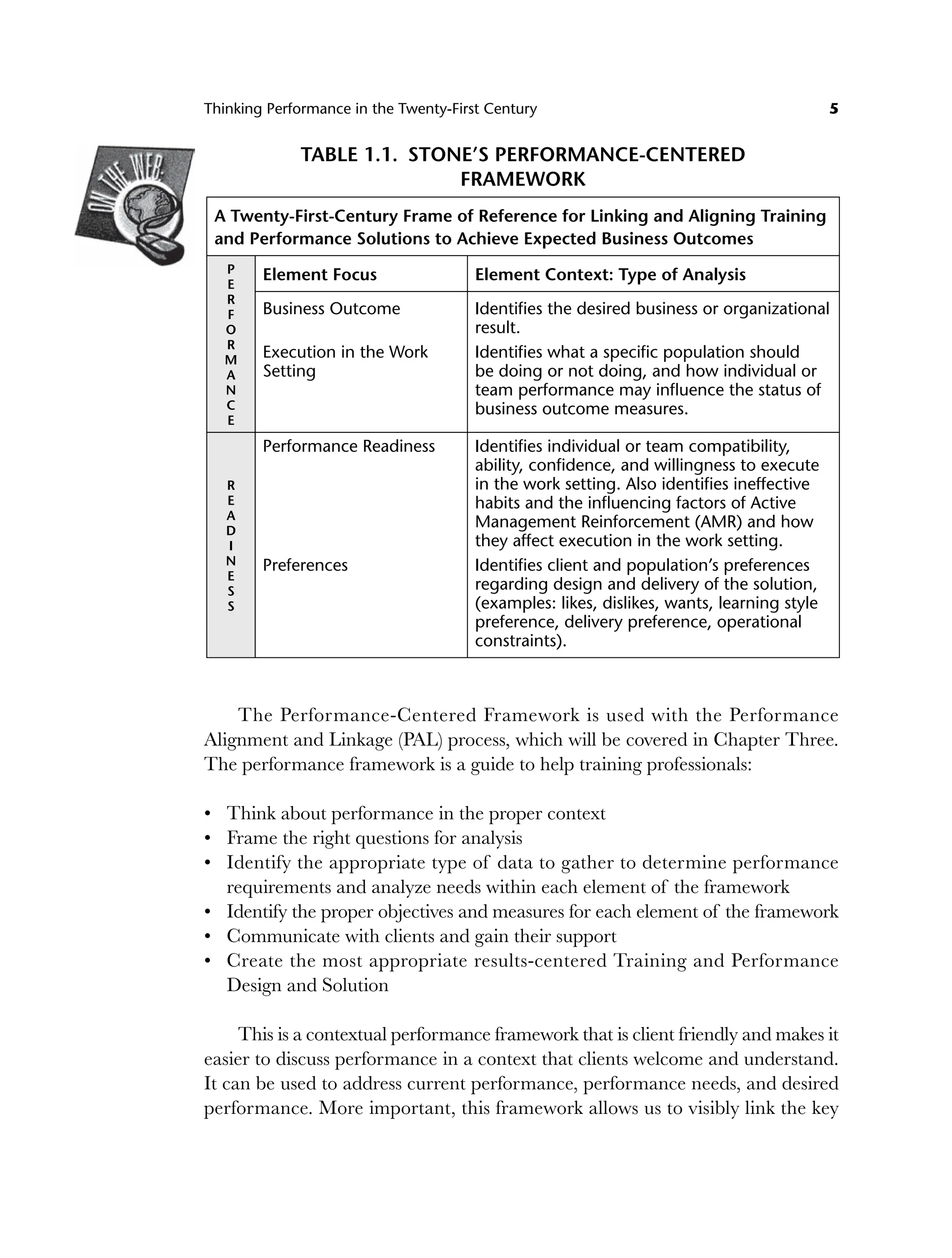
The elements of the Performance-Centered Framework described in
Table 1.1 are linked relationships that help to establish alignment in achieving
desired results from training programs and other performance interventions. They
are also the key to viewing performance issues when conducting needs assessment
activities and making decisions about training and performance solutions. Each
element is actually a type of analysis. They are presented here in the context of
needs assessment.
•
•
•
•
c01.indd 4
c01.indd 4 8/22/08 5:02:44 PM
8/22/08 5:02:44 PM
Thinking Performance in the Twenty-First Century 5
The Performance-Centered Framework is used with the Performance
Alignment and Linkage (PAL) process, which will be covered in Chapter Three.
The performance framework is a guide to help training professionals:
Think about performance in the proper context
Frame the right questions for analysis
Identify the appropriate type of data to gather to determine performance
requirements and analyze needs within each element of the framework
Identify the proper objectives and measures for each element of the framework
Communicate with clients and gain their support
Create the most appropriate results-centered Training and Performance
Design and Solution
This is a contextual performance framework that is client friendly and makes it
easier to discuss performance in a context that clients welcome and understand.
It can be used to address current performance, performance needs, and desired
performance. More important, this framework allows us to visibly link the key
•
•
•
•
•
•
TABLE 1.1. STONE’S PERFORMANCE-CENTERED
FRAMEWORK
A Twenty-First-Century Frame of Reference for Linking and Aligning Training
and Performance Solutions to Achieve Expected Business Outcomes
P
E
R
F
O
R
M
A
N
C
E
Element Focus Element Context: Type of Analysis
Business Outcome Identifies the desired business or organizational
result.
Execution in the Work
Setting
Identifies what a specific population should
be doing or not doing, and how individual or
team performance may influence the status of
business outcome measures.
R
E
A
D
I
N
E
S
S
Performance Readiness Identifies individual or team compatibility,
ability, confidence, and willingness to execute
in the work setting. Also identifies ineffective
habits and the influencing factors of Active
Management Reinforcement (AMR) and how
they affect execution in the work setting.
Preferences Identifies client and population’s preferences
regarding design and delivery of the solution,
(examples: likes, dislikes, wants, learning style
preference, delivery preference, operational
constraints).
c01.indd 5
c01.indd 5 8/22/08 5:02:45 PM
8/22/08 5:02:45 PM
6 Aligning Training for Results
elements of performance so that we can discuss performance with the end in
mind and address all of the influences to get the desired result. Let’s address the
performance-centered framework one element at a time, beginning with business
outcome.
Business Outcome
Every business, including non-profit organizations, has a list of desirable out-
comes that keep the business viable. When these outcomes do not measure up to
requirements, it compromises the ability to operate the business, sustain funding
and financial strength, remain competitive, serve customers, hire and retain com-
petent and committed employees, and accomplish the organization’s mission.
Outcome measures provide a target to define desired business results. They
are at the heart of the operation of the business enterprise, and they are influ-
enced by many factors. Typical categories of outcome measures include but are
not limited to the following:
The cost of doing business
The profitability of the business (quality of funding for nonprofits)
The quality (effectiveness) of research, acquisition, design, development, deliv-
ery, and management of the organization’s business products, processes, and
services
The output (quantity) of products and services
The time (efficiency) it takes to complete tasks (output) and business processes,
address and correct problem areas, and service the customer
There are additional categories of outcome measures and many measures
within each category depending on how they are uniquely defined by each orga-
nization. Business outcomes are generated from the completion of the business
cycle of acquiring, making, marketing, selling, fulfilling orders, delivering, servic-
ing, receiving payment, and accounting for the goods and services.
Let’s look at the next element of the Performance-Centered Framework so
that we can gain a better perspective of how the work itself influences the ulti-
mate business outcome and the outcome measures.
Execution in the Work Setting
Execution speaks to the activities that people routinely perform in the work setting
to accomplish the mission of the organization. Execution and performance are
synonymous. By definition, execution occurs in the work setting. It is what people
•
•
•
•
•
c01.indd 6
c01.indd 6 8/22/08 5:02:45 PM
8/22/08 5:02:45 PM
Thinking Performance in the Twenty-First Century 7
are expected to do. It is the performance of the work itself, the work processes, and
how people go about doing it. The business outcomes addressed in the preceding
section would not be possible without the performance of the human element.
Every manager knows that his or her team influences the business outcome in
their own work unit, which in turn contributes to the overall business outcome of
the company, agency, or institution.
When outcome measures are not being met or are perceived to be in immi-
nent danger of declining, attention immediately turns to the reason why. Work
activities are immediately suspect as a possible contributor to the undesirable
business outcome. So six types of questions are posed:
1. Are people doing what they should be doing?
2. If not, what is the deficiency?
3. Why are they not doing what they should be doing? (That is, what is contribut-
ing to the lack of this individual or team execution?)
4. How are the deficiencies in individual or team performance influencing busi-
ness outcomes?
5. What else (internal and external influences) may be influencing the
outcome?
6. What should be done to correct the situation and influence the outcome in a
positive way?
Perhaps further questions should be, both now and in the future, Who or
what is in a position to influence execution in the work setting? And how is this
influencing the ability to achieve the end in mind—the desired outcome? Then
we follow with the same questions just listed. It could be that faulty work processes
or something external to the business is influencing the desired business outcome.
Maybe individual or team performance is a secondary issue. If something else is
driving the outcome, our needs assessment should identify this and focus on any
recommendation in this regard.
If we are certain that individual or team performance is the problem, then
we should focus on the root cause of that problem. Remember, when we identify
what we believe to be a problem, it is often not the real problem. Often, the so-
called problem is only a surface indicator. It may be the first sign that a problem
of some type does exist. For example, poor work quality is a surface indicator. The
real problem is whatever is causing the poor work quality. Our front-end research
should identify the root cause of this deficiency in quality, and this should drive
the remaining decisions. For example, maybe the team does not know how to
execute the details of the work process, and this is causing deficiencies in quality.
The root cause is the specific knowledge that the team lacks in the work processes.
c01.indd 7
c01.indd 7 8/22/08 5:02:46 PM
8/22/08 5:02:46 PM
8 Aligning Training for Results
So, for the remainder of our discussion in this chapter, let’s assume that individual
or team execution is the issue driving a deficient business outcome.
When we are seeking a specific business outcome, everything depends on
execution. Execution can be something as simple as conducting a team meeting
and communicating work priorities or other information. Or it can be as complex
as a supervisor observing a team member’s performance and providing feedback
and coaching so that the team member can properly execute.
Execution is the most important aspect of getting business results.
Even when there are intervening external factors, we still have to execute in
order to respond to them, whether reactive or proactive. If we do not execute,
then the desired business outcome is left to chance. When we explore the reasons
for lack of execution and we limit our exploration to the workers themselves, we
may miss the true reason (or root cause) for the inappropriate execution or lack
thereof.
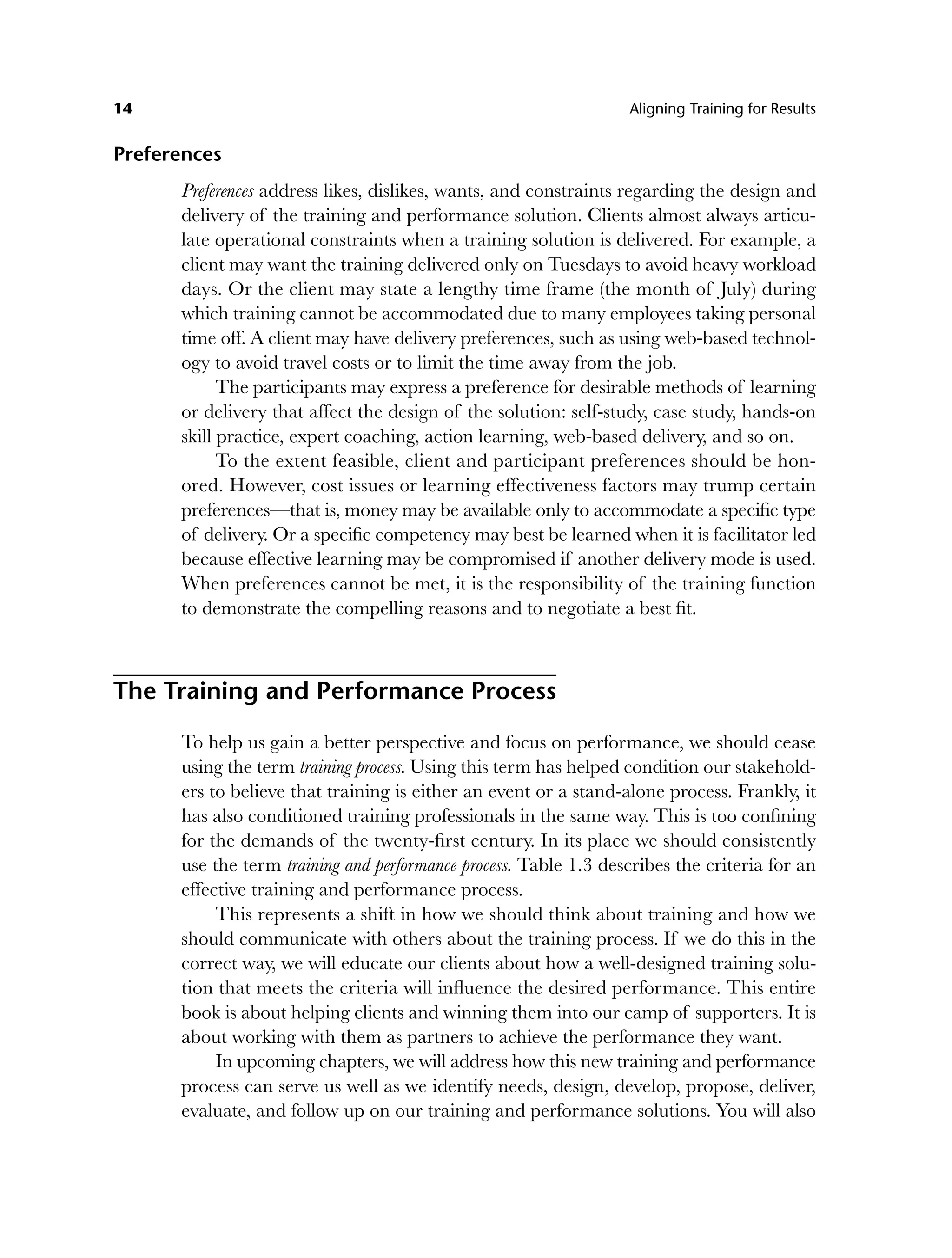
So it is fair to say that, if we are looking for the secret sauce—the one thing that
is fundamental to the business outcome results that we want—it is execution. It is
the performance of the team and the individuals that make up the team. Let’s
illustrate with a couple of examples so we can connect the dots, so to speak. We’ll
use one example in private industry and another in higher education.
Example One: Snappy Telecommunications International: We have telecommuni-
cations facilities, equipment, and technology; management and staff expertise;
internal operating work processes; business, community, and international part-
ners; and political affiliations in place. Our major challenge is this: how efficiently
and effectively can we execute the following:
Maintain our telecommunications network and keep it operating
Keep technology and relationships current
Differentiate our products and services
Maintain compliance in the eyes of regulatory agencies
Establish customer leads and contact prospective customers
Determine what customers need and sell them a profitable package to meet
their needs
Process and fulfill the orders through internal systems and processes
Connect the services and render a satisfied customer
Collect payments
Conduct legal and ethical business operations
•
•
•
•
•
•
•
•
•
•
c01.indd 8
c01.indd 8 8/22/08 5:02:46 PM
8/22/08 5:02:46 PM
Thinking Performance in the Twenty-First Century 9
There is more, but you get the idea. The extent to which we can execute all
of these items with efficiency and effectiveness will determine how well we can
gain repeat business and new customers; sustain our targeted market share; attract
and retain competent employees; sustain revenue, funding, and financial strength;
remain competitive; continue to serve customers; and accomplish the organiza-
tion’s mission. All of these are outcome measures. The final step in the system
is to track and account for the entire process so that we can replicate it and
keep everyone satisfied—customers, management, board members, employees,
stockholders, suppliers, business partners, and third-party interests. These are all
outcome measures as well.
Example Two: World Class University: We have educational facilities; technology;
administration leadership; faculty; administrative support; administrative and
educational processes; business, community, regional, and international partners;
and political affiliations in place. Our major challenge is this: how efficiently and
effectively can we execute the following:
Obtain funding from students, government earmarking and grants, donations,
and other sources
Maintain accreditation
Develop, sustain, and deliver current and competitive curricula and programs
of study in all colleges to differentiate ourselves and meet demand
Complete research and development activities that contribute to the univer-
sity’s mission
Attract, recruit, and enroll students
Provide student services and address ongoing student needs
Manage student satisfaction and attrition to acceptable standard
Manage the graduation rate to acceptable standard
Influence the employability and earning power of graduates
Sustain the university’s integrity, public standing, and image
There is more, but you get the idea. The extent to which we can do all of
this with efficiency and effectiveness will determine how well we can continue
to attract, enroll, educate, and graduate students; get adequate funding; maintain
a viable educational product; maintain accreditation; sustain student services;
attract and retain competent faculty and staff; and accomplish the university’s
mission. All of these are outcome measures. The final step in the system is to track
and account for the entire process so that we can replicate it and keep everyone
satisfied—students, the administration, the board, faculty and staff, funding agen-
cies, alumni, partners, third-party interests, and the community. These are also
outcome measures.
•
•
•
•
•
•
•
•
•
•
c01.indd 9
c01.indd 9 8/22/08 5:02:47 PM
8/22/08 5:02:47 PM
10 Aligning Training for Results
Without going into every detail, Table 1.2 uses the Snappy Telecommunications
example to distinguish between outcome and execution and show how the two
are linked.
The distinction is that execution is an activity and outcome is a result of the
activity, even if the activity is indirect. For example, generating sales leads is an
indirect activity to an actual sale; the direct activity is the sales call. In any case,
all activities represent work processes that must be executed to contribute to a
desired outcome. All of the support activities conducted by all departments that
acquire, market, produce, and account for the products and services are indirect
activities to the sale that must be executed properly. Without them, there may be
no product to sell and no customer service to provide. If we can influence people
to achieve the desired execution in all areas, all other things being equal, the busi-
ness outcome should take care of itself.
Without execution, nothing else happens except that which happens by chance
and luck.
TABLE 1.2. SNAPPY TELECOMMUNICATIONS: LINKING
EXECUTION AND BUSINESS OUTCOME
Business Outcome Measures Execution
Operational availability of the network
Cost of the availability
All upgrade and maintenance activities
associated with the telecommunications
network
Percent compliance with regulatory
agency requirements
Number of agency citations
All activities that management and
employees execute, allowing Snappy to
stay in compliance
Revenue from sales
Revenue from repeat sales
Revenue from cross selling
All activities that establish customer leads
All sales calls executed and deals closed
Processing and fulfillment of orders
Execution of service connections
Invoicing and collecting of payments
Profit from sales All activities by all departments and the
support infrastructure in the company
that contributes to the ability to sustain
sales and service and represents the cost
of staying in business and doing business
The quality of each sale and its
contribution to recovering costs
c01.indd 10
c01.indd 10 8/22/08 5:02:47 PM
8/22/08 5:02:47 PM
Thinking Performance in the Twenty-First Century 11
So execution should be the focus of our attention. When conducting needs
assessments, determining the root cause of performance issues, identifying learn-
ing needs, and designing and delivering training programs, we should focus on
what it takes to achieve execution. In looking at execution, we should address
training and nontraining factors with no bias about where the root cause may be.
We should also look at potential external factors.
If a client truly wants results, we should not hesitate to ask her, “What are you
willing to contribute to see this training succeed? How will the execution that you
desire be reinforced?” If we do our research properly, we should be able to deter-
mine the answers, and we can offer these to her as a recommendation along with
how and why it will influence the desired results. By focusing on execution, we
can gain a clear line of sight into the other two crucial paths to results: the path
leading up to performance and the path leading beyond performance. Figure 1.1
illustrates this performance alignment relationship.
We have discussed business outcome and execution. This leads us to the next
important element of the Performance-Centered Framework: performance readi-
ness. We must answer the question, what needs to happen to enable the perform-
ers to execute (perform) in the work setting?
• Readiness of people
to perform enables
execution in the work
setting. Knowledge
and skill are only one
component of
readiness.
• Execution
requirements must be
known before any
readiness needs are
determined.
• The intended business
outcome will not occur
unless there is execution.
• Execution is the one
ingredient that must exist
in order to achieve
business results.
• No execution equals
misalignment, no
business outcome, and
zero possibility of return
on investment.
• Proper execution
influences the desired
business outcome.
• When business
outcome measures
are deficient, we
must determine how
execution will
remedy the situation.
Business
Outcome
Performance
Readiness
Path In Path Out
Execution
in the Work
Setting
FIGURE 1.1. PATH TO ALIGNMENT AND RESULTS
c01.indd 11
c01.indd 11 8/22/08 5:02:47 PM
8/22/08 5:02:47 PM
12 Aligning Training for Results
Performance Readiness
Performance readiness represents the key components that exist in a given
situation that enable the desired execution in the work setting. If we are going to
design, develop, and deliver a training and performance solution (or any other
type of intervention), then we must address all key components of performance
readiness. The 80/20 rule applies here.
The 80/20 rule is derived from Pareto’s Principle. In 1906 an Italian econo-
mist, Vilfredo Pareto, created a mathematical formula to describe the unequal
distribution of wealth in his country. Through a mathematical formula, Pareto
concluded that 20 percent of the people owned 80 percent of the wealth. In
the 1940s, Dr. Joseph Duran applied the same concept to the quality movement
when he concluded that 20 percent of defects cause 80 percent of the problems.
This concept has been applied to almost every type of endeavor. Here we are
saying that we should work on the cause or causes that represent the 20 percent
responsible for 80 percent of the impact. It is a subjective approach, but it keeps
us from stalling when we cannot solve every conceivable problem, or when a
problem seems too large to tackle. Because of the dynamics of organizations, we
can probably never realistically address all the components, but certainly we can
address that 20 percent.
If someone is not performing, or if we want them to execute in a certain
way, we must determine the execution requirements (what they should be doing)
and how performance readiness is contributing to any deficiency. Certainly the
knowledge, skill, and attitude of the performers represent one component of
performance readiness, but this is not the only component.
There are five key components of performance readiness that we should
explore when looking for root cause, determining needs, and recommending a
solution to influence execution. One of them, compatibility, is a nontraining factor
for the targeted population. The second, ability, is very much training related.
Three more—confidence, willingness, and Active Management Reinforcement—could be
training or nontraining related. Our challenge is to determine, using the 80/20
rule, the extent to which each is contributing to a lack of execution, why, and
which components matter the most in a given situation. Execution is what we
are trying to influence. Proper execution will in turn influence the business
outcome.
Here are details on the five key components of performance readiness:
Compatibility: An individual’s compatibility to do the assigned work. This is not
a knowledge or skill issue. It is a mental or physical challenge—the right person
in the right job or assignment. It addresses an individual’s reasonable mental
and physical capability to perform a specific task or job.
•
c01.indd 12
c01.indd 12 8/22/08 5:02:48 PM
8/22/08 5:02:48 PM
Thinking Performance in the Twenty-First Century 13
Ability: An individual’s knowledge, skill, expertise or competence to do the
assigned work. This involves information, awareness, principles, concepts,
facts, processes, procedures, techniques, methods, and so on.
Confidence: A personal comfort level stemming from a level of mastery and
Active Management Reinforcement that will stimulate a performer to use new
knowledge, skills, or exhibit a specific behavior in the natural work setting.
Even when skill exists, or once existed, other factors can erode confidence and
deter execution. For example, a supervisor can be overly critical of a team
member and tear down the individual’s confidence.
Willingness: An individual’s attitude or personal frame of reference—I will or
won’t do it because . . . As training professionals, we are interested in the willing-
ness of an individual to
Learn and adopt targeted knowledge, skills, and behavior
Discontinue old ineffective habits
Execute in the work setting
Active Management Reinforcement: AMR addresses actions of the performer’s
immediate manager to reinforce performance, reflect sponsorship, and be sup-
portive of execution in the work setting. The components of AMR are
Advance communication of information and negotiation of expectations, such
as goals and requirements regarding work roles, work load distribution, and
responsibilities
Provision for and proper execution of performance incentives and conse-
quences
Provision for and proper execution of timely feedback, coaching, recognition, and
support
Provision for and maintenance of adequate tools, equipment, technology, and
resources
Provision for and maintenance of proper design of work space, job, tasks, policies,
procedures, and processes
The first four components of performance readiness address the individual
and the fifth, AMR, addresses the carrying out of management responsibilities and
support to influence performance. Historically to this point, training profession-
als conducting needs assessments have addressed the ability component (knowl-
edge and skill) but often ignored the other components. As you will discover in
Chapters Four and Five, tools are available with the Situational Needs Assessment
process to help determine which components of performance readiness are lack-
ing. Also, in the table on page 15 of this chapter, you will see how the training and
performance design criteria account for all components of performance readi-
ness, not just the learning component.
•
•
•
•
•
•
•
•
•
•
•
•
c01.indd 13
c01.indd 13 8/22/08 5:02:48 PM
8/22/08 5:02:48 PM
14 Aligning Training for Results
Preferences
Preferences address likes, dislikes, wants, and constraints regarding the design and
delivery of the training and performance solution. Clients almost always articu-
late operational constraints when a training solution is delivered. For example, a
client may want the training delivered only on Tuesdays to avoid heavy workload
days. Or the client may state a lengthy time frame (the month of July) during
which training cannot be accommodated due to many employees taking personal
time off. A client may have delivery preferences, such as using web-based technol-
ogy to avoid travel costs or to limit the time away from the job.
The participants may express a preference for desirable methods of learning
or delivery that affect the design of the solution: self-study, case study, hands-on
skill practice, expert coaching, action learning, web-based delivery, and so on.
To the extent feasible, client and participant preferences should be hon-
ored. However, cost issues or learning effectiveness factors may trump certain
preferences—that is, money may be available only to accommodate a specific type
of delivery. Or a specific competency may best be learned when it is facilitator led
because effective learning may be compromised if another delivery mode is used.
When preferences cannot be met, it is the responsibility of the training function
to demonstrate the compelling reasons and to negotiate a best fit.
The Training and Performance Process
To help us gain a better perspective and focus on performance, we should cease
using the term training process. Using this term has helped condition our stakehold-
ers to believe that training is either an event or a stand-alone process. Frankly, it
has also conditioned training professionals in the same way. This is too confining
for the demands of the twenty-first century. In its place we should consistently
use the term training and performance process. Table 1.3 describes the criteria for an
effective training and performance process.
This represents a shift in how we should think about training and how we
should communicate with others about the training process. If we do this in the
correct way, we will educate our clients about how a well-designed training solu-
tion that meets the criteria will influence the desired performance. This entire
book is about helping clients and winning them into our camp of supporters. It is
about working with them as partners to achieve the performance they want.
In upcoming chapters, we will address how this new training and performance
process can serve us well as we identify needs, design, develop, propose, deliver,
evaluate, and follow up on our training and performance solutions. You will also
c01.indd 14
c01.indd 14 8/22/08 5:02:48 PM
8/22/08 5:02:48 PM
Thinking Performance in the Twenty-First Century 15
TABLE 1.3. CRITERIA FOR AN EFFECTIVE TRAINING
AND PERFORMANCE PROCESS
A. Assessment, design, development, delivery, and evaluation of the training and
performance process are results centered.
B. Some form of assessment is completed to identify performance requirements
(what the population should be doing), performance gaps, and root cause.
C. Solution objectives and measures focus on root cause and are developed and
communicated for performance readiness, performance execution, and busi-
ness outcome.
D. The training and performance design addresses all components of performance
readiness, not just learning.
E. The training and performance design addresses pre-engagement action.
F. The need for follow-up transfer action and strategy is assessed and imple-
mented, or a compelling reason is provided for why it is not needed.
G. Participants identify and understand their responsibility to eliminate old inef-
fective habits and to execute and obtain results.
H. The execution role of Active Management Reinforcement (AMR) is addressed
and, if needed, becomes part of the solution design.
I. Partnerships are established with key managers and clients, and a Performance
Alignment Contract is negotiated.
see some of the other approaches and tools in action, such as AMR (item H of
Table 1.3) and the Performance Alignment Contract (referenced in item I).
The training and performance process spelled out in Table 1.3 is a guide for
training professionals. If we truly want clients and others to see training through
a different lens, then we must frame it differently for them and then help them
to understand and appreciate that framework. We must address our processes
openly, as the training and performance process is only the starting point in bring-
ing performance clearly to the forefront. It gives us the opportunity to address
training and performance in the same breath on a day-to-day basis.
Results are driven by the right processes applied by people in the right way.
You must commit to being process driven and then work your processes.
We must become experts at demonstrating to clients how a compromise in
the training and performance process will affect the end result that they want to
achieve. If we cannot do this, then perhaps we deserve whatever downfall comes
our way. The remaining chapters are focused on how to avoid this downfall.
c01.indd 15
c01.indd 15 8/22/08 5:02:49 PM
8/22/08 5:02:49 PM
16 Aligning Training for Results
Top Three Barriers to Performance
Over the past twenty-five years I have conducted or been involved in several
hundred needs assessments and follow-up business impact studies regarding the
effectiveness of training solutions. As a result of these studies conducted in North
America, Asia, and Europe, I can say with certainty that it is not unusual to see
that 40 to 50 percent of the employees participating in training solutions do not
execute as expected in the work setting. These data were collected from training
participants using interviews, questionnaires, and focus groups. Additional research
with training professionals collected responses in the same targeted areas.
Table 1.4 lists the three most common barriers ranked in the order selected
by people participating in these systematic studies. Respondents were provided a
list of six typical barriers to performance and a seventh choice labeled “other.”
Some people providing data reported achieving good results after training even
with the barriers, while some reported achieving partial results, and some reported
achieving no results at all because of the barriers.
As Table 1.4 illustrates, old habits, ranked number two, are definitely some-
thing we should be concerned about as we strive to influence results with our
training. The number one barrier selected, of course, is lack of reinforcement
and support from the immediate manager. This is why the concept of AMR is
included in the performance-centered framework in Table 1.1. Barriers should be
sought out and identified during needs assessment activities, and their treatment
should not be left to chance. We should purposefully discuss them in a positive
way and address them in our training and performance design.
Both of the top two barriers in Table 1.4 indicate a lack of readiness to perform.
The performer and other factors in the work setting are not in a state of readiness.
We should not deliver training that provides a new skill or requires new behavior
and ignore other factors that will influence the application of that skill or behavior.
TABLE 1.4. TOP THREE BARRIERS TO PERFORMANCE
Question: What are the significant barriers that limited your effective
application of the skills/behavior at your job?
This question followed other questions related to use of skills on the job. The questions
were asked several months after the program delivery, when enough time had passed to
allow for an opportunity to implement the learning in the job setting.
1 My immediate manager does not reinforce/support my use of the skills/behavior.
2 It is difficult to break away from the way I have done it before (old habits).
3 I do not have enough time to apply the skills/behavior.
c01.indd 16
c01.indd 16 8/22/08 5:02:49 PM
8/22/08 5:02:49 PM
Random documents with unrelated
content Scribd suggests to you:
4
LADY ISABEL AND THE ELF-KNIGHT
A. a. 'The Gowans sae gay,' Buchan's Ballads of the North
of Scotland, I, 22. b. 'Aye as the Gowans grow gay,'
Motherwell's MS., p. 563.
B. 'The Water o Wearie's Well.' a. Buchan's MSS, II, fol.
80. b. Buchan's B. N. S., II, 201. c. Motherwell's MS., p.
561. d. 'Wearie's Wells,' Harris MS., No 19.
C. a. 'May Colven,' Herd's MSS, I, 166. b. 'May Colvin,'
Herd's Scottish Songs, 1776, I, 93. c. 'May Colvin, or, False
Sir John,' Motherwell's Minstrelsy, p. 67.
D. a. 'May Collin,' Sharpe's Ballad Book, No 17, p. 45. b.
'Fause Sir John and May Colvin,' Buchan, B. N. S., II, 45.
c. 'May Collean,' Motherwell's Minstrelsy, Appendix, p. xxi.
E. 'The Outlandish Knight,' Dixon, Ancient Poems, Ballads,
etc., p. 74 == Bell, Ancient Poems, Ballads, etc., p. 61.
F. 'The False Knight Outwitted,' Roxburgh Ballads, British
Museum, III, 449.
Of all ballads this has perhaps obtained the widest circulation. It is
nearly as well known to the southern as to the northern nations of
Europe. It has an extraordinary currency in Poland. The Germans,
Low and High, and the Scandinavians, preserve it, in a full and
evidently ancient form, even in the tradition of this generation.
Among the Latin nations it has, indeed, shrunk to very meagre
proportions, and though the best English forms are not without
ancient and distinctive marks, most of these have been eliminated,
and the better ballads are very brief.
A has but thirteen two-line stanzas. An elf-knight, by blowing his
horn, inspires Lady Isabel with love-longing. He appears on her first
breathing a wish for him, and induces her to ride with him to the
greenwood.[24] Arrived at the wood, he bids her alight, for she is
come to the place where she is to die. He had slain seven kings'
daughters there, and she should be the eighth. She persuades him
to sit down, with his head on her knee, lulls him asleep with a
charm, binds him with his own sword-belt, and stabs him with his
own dagger, saying, If seven kings' daughters you have slain, lie
here a husband to them all.
B, in fourteen four-line stanzas, begins unintelligibly with a bird
coming out of a bush for water, and a king's daughter sighing, "Wae
's this heart o mine." A personage not characterized, but evidently of
the same nature as the elf-knight in A, lulls everybody but this king's
daughter asleep with his harp,[25] then mounts her behind him, and
rides to a piece of water called Wearie's Well. He makes her wade in
up to her chin; then tells her that he has drowned seven kings'
daughters here, and she is to be the eighth. She asks him for one
kiss before she dies, and, as he bends over to give it, pitches him
from his saddle into the water, with the words, Since ye have
drowned seven here, I'll make you bridegroom to them all.[26]
C was first published by David Herd, in the second edition of his
Scottish Songs, 1776, and afterwards by Motherwell, "collated" with
a copy obtained from recitation. D,[27] E, F are all broadside or stall
copies, and in broadside style. C, D, E, F have nearly the same
story. False Sir John, a knight from the south country [west country,
north lands], entices May Colven, C, D [a king's daughter, C 16, E
16; a knight's daughter, Polly, F 4, 9], to ride off with him,
employing, in D, a charm which he has stuck in her sleeve. At the
knight's suggestion, E, F, she takes a good sum of money with her,
D, E, F. They come to a lonely rocky place by the sea [river-side, F],
and the knight bids her alight: he has drowned seven ladies here
[eight D, six E, F], and she shall be the next. But first she is to strip
off her rich clothes, as being too good to rot in the sea. She begs
him to avert his eyes, for decency's sake, and, getting behind him,
throws him into the water. In F he is absurdly sent for a sickle, to
crop the nettles on the river brim, and is pushed in while thus
occupied. He cries for help, and makes fair promises, C, E, but the
maid rides away, with a bitter jest [on his steed, D, leading his
steed, E, F], and reaches her father's house before daybreak. The
groom inquires in D about the strange horse, and is told that it is a
found one. The parrot asks what she has been doing, and is silenced
with a bribe; and when the father demands why he was chatting so
early, says he was calling to his mistress to take away the cat. Here
C, E, F stop, but D goes on to relate that the maid at once tells her
parents what has happened, and that the father rides off at dawn,
under her conduct, to find Sir John. They carry off the corpse, which
lay on the sands below the rocks, and bury it, for fear of discovery.
There is in Hone's Table Book, III, 130, ed. 1841, a rifacimento by
Dixon of the common English broadside in what passes for old-ballad
style. This has been repeated in Richardson's Borderer's Table Book,
VI, 367; in Dixon's Scottish Traditional Versions of Ancient Ballads, p.
101; and, with alterations, additions, and omissions, in Sheldon's
Minstrelsy of the English Border, p. 194.
Jamieson (1814) had never met with this ballad in Scotland, at least
in anything like a perfect state; but he says that a tale to the same
effect, intermixed with scraps of verse, was familiar to him when a
boy, and that he afterwards found it, "in much the same state, in the
Highlands, in Lochaber and Ardnamurchan." According to the
tradition reported by Jamieson, the murderer had seduced the
younger sister of his wife, and was seeking to prevent discovery, a
difference in the story which might lead us to doubt the accuracy of
Jamieson's recollection. (Illustrations of Northern Antiquities, p.
348.)
Stories like that of this ballad will inevitably be attached, and
perhaps more or less adapted, to localities where they become
known. May Collean, says Chambers, Scottish Ballads, p. 232, note,
"finds locality in that wild portion of the coast of Carrick (Ayrshire)
which intervenes betwixt Girvan and Ballantrae. Carlton Castle,
about two miles to the south of Girvan (a tall old ruin, situated on
the brink of a bank which overhangs the sea, and which gives title to
Sir John Cathcart, Bart, of Carlton), is affirmed by the country
people, who still remember the story with great freshness, to have
been the residence of 'the fause Sir John;' while a tall rocky
eminence called Gamesloup, overhanging the sea about two miles
still further south, and over which the road passes in a style terrible
to all travellers, is pointed out as the place where he was in the
habit of drowning his wives, and where he was finally drowned
himself. The people, who look upon the ballad as a regular and
proper record of an unquestionable fact, farther affirm that May
Collean was a daughter of the family of Kennedy of Colzean," etc.
Binyan's (Bunion) Bay, in D, is, according to Buchan, the old name of
the mouth of the river Ugie.
Far better preserved than the English, and marked with very ancient
and impressive traits, is the Dutch ballad 'Halewijn,' which, not many
years ago, was extensively sung in Brabant and Flanders, and is still
popular as a broadside, both oral tradition and printed copies
exhibiting manifold variations. A version of this ballad (A) was
communicated by Willems to Mone's Anzeiger in 1836, col. 448 ff,
thirty-eight two-line stanzas, and afterwards appeared in Willems's
Oude vlaemsche Liederen (1848), No 49, p. 116, with some changes
in the text and some various readings. Uhland, I, 153, 74 D, gave
the Anzeiger text, with one correction. So Hoffmann,
Niederländische Volkslieder, 2d ed., No 9, p. 39, but substituting for
stanzas 19, 20 four stanzas from the margin of O.v.L., and making
other slighter changes. Baecker, Chants historiques de la Flandre, No
9, p. 61, repeats Willems's second text, with one careless omission
and one transposition. Coussemaker, Chants populaires des
Flamands de France, No 45, p. 142, professes to give the text of
Oude vlaemsche Liederen, and does so nearly. Snellaert, Oude en
nieuwe Liedjes, 3d ed., 1864, No 55, p. 58, inserts seven stanzas in
the place of 33, 34 of O.v.L., and two after 35, making forty-five
two- (or three-) line stanzas instead of thirty-eight. These additions
are also found in an excessively corrupt form of the ballad (B),
Hoffmann, No 10, p. 43, in which the stanzas have been uniformly
extended to three verses, to suit the air, which required the
repetition of the second line of the original stanza.
Heer Halewijn (A), like the English elf-knight, sang such a song that
those who heard it longed to be with him. A king's daughter asked
her father if she might go to Halewijn. No, he said; those who go
that way never come back [sixteen have lost their lives, B]. So said
mother and sister, but her brother's answer was, I care not where
you go, so long as you keep your honor. She dressed herself
splendidly, took the best horse from her father's stable, and rode to
the wood, where she found Halewijn waiting for her.[28] They then
rode on further, till they came to a gallows, on which many women
were hanging. Halewijn says, Since you are the fairest maid, choose
your death [B 20 offers the choice between hanging and the sword].
She calmly chooses the sword. "Only take off your coat first, for a
maid's blood spirts a great way, and it would be a pity to spatter
you." His head was off before his coat, but the tongue still spake.
This dialogue ensues:
'Go yonder into the corn,
And blow upon my horn,
That all my friends you may warn.'
'Into the corn I will not go,
And on your horn I will not blow:
A murderer's bidding I will not do.'
'Go yonder under the gallows-tree,
And fetch a pot of salve for me,
And rub my red neck lustily.'
'Under the gallows I will not go,
Nor will I rub your red neck, no,
A murderer's bidding I will not do.'
She takes the head by the hair and washes it in a spring, and rides
back through the wood. Half-way through she meets Halewijn's
mother, who asks after her son; and she tells her that he is gone
hunting, that he will never be seen again, that he is dead, and she
has his head in her lap. When she came to her father's gate, she
blew the horn like any man.
And when the father heard the strain,
He was glad she had come back again.
Thereupon they held a feast,
The head was on the table placed.
Snellaert's copy and the modern three-line ballad have a meeting
with father, brother, sister, and mother successively. The maid's
answer to each of the first three is that Halewijn is amusing himself
with sixteen maids, or to that effect, but to the mother that he is
dead, and she has his head in her lap. The mother angrily replies, in
B, that if she had given this information earlier she would not have
got so far on her way home. The maid retorts, Wicked woman, you
are lucky not to have been served as your son; then rides, "like
Judith wise," straight to her father's palace, where she blows the
horn blithely, and is received with honor and love by the whole
court.[29]
Another Flemish version (C) has been lately published under the
title, 'Roland,' by which only, we are informed, is this particular form
known in Bruges and many parts of Flanders:[30] Chants populaires
recueillis à Bruges par Adolphe Lootens et J. M. E. Feys, No 37, p.
60, 183 vv, in sixty-three stanzas, of two, three, four, or five lines.
This text dates from the last century, and is given with the most
exact fidelity to tradition. It agrees with A as to some main points,
but differs not a little as to others. The story sets out thus:
It was a bold Roland,
He loved a lass from England;
He wist not how to get her,
With reading or with writing,
With brawling or with fighting.
Roland has lost Halewyn's art of singing. Louise asks her father if
she may go to Roland, to the fair, as all her friends do. Her father
refuses: Roland is "een stoute kalant," a bad fellow that betrays
pretty maids; he stands with a drawn sword in his hand, and all his
soldiers in armor. The daughter says she has seen Roland more than
once, and that the tale about the drawn sword and soldiers is not
true. This scene is exactly repeated with mother and brother. Louise
then tries her shrift-father. He is easier, and does not care where she
goes, provided she keeps her honor and does not shame her
parents. She tells father, mother, and brother that she has leave
from her confessor, makes her toilet as in A, takes the finest horse in
the stable, and rides to the wood. There she successively meets
Roland's father, mother, and brother, each of whom asks her where
she is going, and whether she has any right to the crown she wears.
To all she replies, Whether I have or not, be off; I know you not.
She does not encounter Roland in the wood, they do not ride
together, and there is no gallows-field. She enters Roland's house,
where he is lying abed. He bids her gather three rose-wreaths "at his
hands" and three at his feet; but when she approaches the foot of
the bed he rises, and offers her the choice to lose her honor or kneel
before the sword. She chooses the sword, advises him to spare his
coat, and, while he is taking it off, strikes off his head, all as in A.
The head speaks: Go under the gallows (of which we have heard
nothing hitherto), fetch a pot of salve, rub it on my wounds, and
they shall straight be well. She declines to follow a murderer's rede,
or to learn magic. The head bids her go under the blue stone and
fetch a pot of maidens-grease, which also will heal the wounds. This
again she refuses to do, in the same terms; then seizes the head by
the hair, washes it in a spring, and rides off with it through the
wood, duly meeting Roland's father, mother, and brother once more,
all of whom challenge her, and to all of whom she answers,
Roland your son is long ago dead;
God has his soul and I his head;
For in my lap here I have his head,
And with the blood my apron is red.
When she came back to the city the drums and the trumpets struck
up.[31] She stuck the head out of the window, and cried, "Now I am
Roland's bride!" She drew it in, and cried, "Now I am a heroine!"
Danish. Eleven versions of this ballad are known in Danish, seven of
which are given in Danmarks gamle Folkeviser, No 183,
'Kvindemorderen,' A-G. Four more, H-L, are furnished by
Kristensen, Jydske Folkeviser, I, Nos 46, 47, 91; II, No 85. A, in
forty-one two-line stanzas (previously printed in Grundtvig's
Engelske og skotske Folkeviser, p. 233), is from a 16th century MS.;
B, thirty stanzas, C, twenty-four, D, thirty-seven, from MSS of the
17th century; E, fifty-seven, from a broadside of the end of the
18th; F, thirty, from one of the beginning of the 19th; and G-L,
thirty-five, twenty-three, thirty-one, twenty-six, thirty-eight stanzas,
from recent oral tradition.
The four older versions, and also E, open with some lines that occur
at the beginning of other ballads.[32] In A and E, and, we may add,
G, the maid is allured by the promise of being taken to a paradise
exempt from death and sorrow; C, D, F promise a train of
handmaids and splendid presents. All the versions agree very well as
to the kernel of the story. A false knight prevails upon a lady to elope
with him, and they ride to a wood [they simply meet in a wood, H,
K]. He sets to work digging a grave, which she says is too long for
his [her] dog and too narrow for his [her] horse [all but F, H]. She is
told that the grave is for her. He has taken away the life [and honor,
B, C, I] of eight maids, and she shall be the ninth. The eight maids
become nine kings' daughters in E, ten in F, nineteen in G, and in E
and F the hard choice is offered of death by sword, tree, or stream.
In A, E, I, L the knight bids the lady get her gold together before
she sets out with him, and in D, H, K, L he points out a little knoll
under which he keeps the gold of his previous victims. The maid
now induces the knight to lie down with his head in her lap,
professing a fond desire to render him the most homely of
services[33] [not in C, G, I, K]. He makes an express condition in E,
F, G, H, L that she shall not betray him in his sleep, and she calls
Heaven to witness that she will not. In G she sings him to sleep. He
slept a sleep that was not sweet. She binds him hand and foot, then
cries, Wake up! I will not betray you in sleep.[34] Eight you have
killed; yourself shall be the ninth. Entreaties and fair promises and
pretences that he had been in jest, and desire for shrift, are in vain.
Woman-fashion she drew his sword, but man-fashion she cut him
down. She went home a maid.
E, F, G, however, do not end so simply. On her way home through
the wood [E], she comes upon a maid who is working gold, and who
says, The last time I saw that horse my brother rode it. She
answers, Your brother is dead, and will do no more murdering for
gold; then turns her horse, and sets the sister's bower on fire. Next
she encounters seven robbers on the heath, who recognize the
horse as their master's, and are informed of his death and of the
end of his crimes. They ask about the fire. She says it is an old pig-
sty. She rides on, and they call to her that she is losing her horse's
gold shoe. But nothing can stop her; she bids them pick it up and
drink it in wine; and so comes home to her father's. F has nothing of
the sister; in place of seven robbers there are nine of the robber's
brothers, and the maid sets their house on fire. G indulges in absurd
extravagances: the heroine meets the robber's sister with twelve
fierce dogs, and then his twelve swains, and cuts down both dogs
and swains.
The names in the Danish ballads are, A, Ulver and Vænelil; B,
Olmor, or Oldemor, and Vindelraad; C, Hollemen and Vendelraad; D,
Romor, Reimord, or Reimvord, and the maid unnamed; F, Herr Peder
and Liden Kirsten; H-L, Ribold, Rigbold [I, Rimmelil] and Guldborg.
Four Swedish versions are known, all from tradition of this century.
A, 'Den Falske Riddaren,' twenty-three two-line stanzas, Arwidsson,
44 B, I, 301. B, 'Röfvaren Brun,' fifteen stanzas, Afzelius, 83, III, 97.
C, twenty-seven stanzas, Arwidsson, 44 A, I, 298. D, 'Röfvaren
Rymer,' sixteen stanzas, Afzelius, 82, III, 94. A, B, D have
resemblances, at the beginning, to the Ribold ballads, like the
Danish A, B, E, G, while the beginning of C is like the Danish C, D,
F. A has the grave-digging; there have been eight maids before; the
knight lays his head in the lady's lap for the same reason as in most
of the Danish ballads, and under the same assurance that he shall
not be betrayed in sleep; he is bound, and conscientiously waked
before his head is struck off; and the lady rides home to her father's.
There have been eight previous victims in C, and they king's
daughters; in B, eleven (maids); D says not how many, but,
according to an explanation of the woman that sang it, there were
seven princesses. C, D, like Danish E, F, G, make the maid
encounter some of the robber's family on the way home. By a
misconception, as we perceive by the Dutch ballad, she is
represented as blowing the robber's horn. Seven sisters come at the
familiar sound to bury the murdered girl and share the booty, but
find that they have their brother to bury.
The woman has no name in any of the Swedish ballads. A calls the
robber "an outlandish man" (en man ifrån fremmande land), B,
simple Brun, C, a knight, and D, Riddaren Rymer, or Herr Rymer.
Of Norwegian versions, but two have been printed: A, 'Svein
Norðmann,' twenty two-line stanzas, Landstad, 69, p. 567; B,
'Rullemann og Hildeborg,' thirty stanzas, Landstad, 70, p. 571, both
from recent recitation. Bugge has communicated eight others to
Grundtvig. Both A and B have the paradise at the beginning, which
is found in Danish A, E, G, and Swedish D. In both the lady gets her
gold together while the swain is saddling his horse. They come to a
grave already dug, which in B is said to be made so very wide
because Rulleman has already laid nine maidens in it. The stanza in
A which should give the number is lost, but the reciter or singer put
it at seven or nine. The maid gets the robber into her power by the
usual artifice, with a slight variation in B. According to A, she rides
straight home to her father. B, like Danish F, has an encounter with
her false lover's [five] brothers. They ask, Where is Rullemann, thy
truelove? She answers, He is lying down, in the green mead, and
bloody is his bridal bed.
Of the unprinted versions obtained by Professor Bugge, two indicate
that the murderer's sleep was induced by a spell, as in English A. F
9 has,
Long time stood Gullbjör; to herself she thought,
May none of my runes avail me ought?
And H 18, as also a variant to B 20, says it was a rune-slumber that
came over him. Only G, H, I, K give the number of the murdered
women: in G, H, eight, in I, nine, in K, five.
The names are, in A, Svein Norðmann and Guðbjörg; B, Rulleman
and Hildeborg [or Signe]; C, D, E, F, Svein Nórmann and Gullbjör
[Gunnbjör]; G, Rullemann and Kjersti; H, Rullball and Signelill; I,
Alemarken and Valerós; K, Rulemann and a fair maid.
Such information as has transpired concerning Icelandic versions of
this ballad is furnished by Grundtvig, IV, 4. The Icelandic form,
though curtailed and much injured, has shown tenacity enough to
preserve itself in a series of closely agreeing copies from the 17th
century down. The eldest, from a manuscript of 1665, runs thus:
1
Ása went along the street, she heard a sweet sound.
2
Ása went into the house, she saw the villain bound.
3
'Little Ása, loose me! I will not beguile thee.'
4
'I dare not loose thee, I know not whether thou'lt
beguile me.'
5
'God almighty take note who deceives the other!'
6
She loosed the bands from his hand, the fetter from
his foot.
7
'Nine lands have I visited, ten women I've beguiled;
8
'Thou art now the eleventh, I'll not let thee slip.'
A copy, from the beginning of the 18th century, has, in stanza 2,
"Ása went into the wood," a recent copy, "over the fields;" and
stanza 3, in the former, with but slight differences in all the modern
copies, reads,
Á
'Welcome art thou, Ása maid! thou wilt mean to loose
me.'
Some recent copies (there is one in Berggreen, Danske Folkesange,
2d ed., I, 162) allow the maid to escape, adding,
9
'Wait for me a little space, whilst I go into the green
wood.'
10
He waited for her a long time, but she never came
back to him.
11
Ása took her white steed, of all women she rode most.
12
Ása went into a holy cell, never did she harm to man.
This is certainly one of the most important of the German ballads,
and additions are constantly making to a large number of known
versions. Excepting two broadsides of about 1560, and two copies
from recitation printed in 1778, all these, twenty-six in number, have
been obtained from tradition since 1800.[35] They are as follows: A
a, 'Gert Olbert,' 'Die Mörners Sang,' in Low German, as written down
by William Grimm, in the early years of this century, 61 vv,
Reifferscheid, p. 161, II. A b, "from the Münster region,"
communicated to Uhland by the Baroness Annette von Droste-
Hüllshof, 46 vv, Uhland, I, 151, No 74 C; repeated in Mittler, No 79.
A c, a fragment from the same source as the preceding, and written
down at the beginning of this century, 35 vv, Reifferscheid, p. 161, I.
B, 'Es wollt sich ein Markgraf ausreiten,' from Bökendorf, Westphalia,
as taken down by W. Grimm, in 1813, 41 vv, Reifferscheid, p. 116. C
a, 'Die Gerettete,' "from the Lower Rhine," twenty-six two-line
stanzas, Zuccalmaglio, No 28, p. 66; Mittler, No 85. C b, eleven two-
line stanzas, Montanus (== Zuccalmaglio) Die deutschen Volksfeste,
p. 45. D, 'Von einem wackern Mägdlein, Odilia geheissen,' etc., from
the Rhine, 34 vv [Longard], No 24, p. 48. E, 'Schondilie,'
Menzenberg and Breitbach, 59 vv, Simrock, No 7, p. 19; Mittler, No
86. F, 'Jungfrau Linnich,' communicated by Zuccalmaglio as from the
Rhine region, Berg and Mark, fourteen two-line stanzas, Erlach, IV,
598, and Kretzschmer (nearly), No 92, p. 164; Mittler, No 87. G a,
'Ulinger,' 120 vv, Nuremberg broadside "of about 1555" (Böhme) in
Wunderhorn, ed. 1857, IV, 101, Böhme, No 13a
, p. 56. G b c, Basel
broadsides, "of about 1570" (Böhme), and of 1605, in Uhland, No 74
A, I, 141; Mittler, No 77. H, 'Adelger,' 120 vv, an Augsburg broadside,
"of about 1560" (Böhme), Uhland, No 74 B, I, 146; Böhme, No 13b
,
p. 58; Mittler, No 76. I, 'Der Brautmörder,' in the dialect of the
Kuhländchen (Northeast Moravia and Austrian Silesia), 87 vv,
Meinert, p. 61; Mittler, No 80. J, 'Annele,' Swabian, from Hirrlingen
and Obernau, 80 vv, Meier, Schwäbische V. L., No 168, p. 298. K,
another Swabian version, from Hirrlingen, Immenried, and many
other localities, 80 vv, Scherer, Jungbrunnen, No 5 B, p. 25. L a,
from the Swabian-Würtemberg border, 81 VV, Birlinger, Schwäbisch-
Augsburgisches Wörterbuch, p. 458. L b, [Birlinger], Schwäbische V.
L., p. 159, from Immenried, nearly word for word the same. M, 'Der
falsche Sänger,' 40 vv, Meier, No 167, p. 296. N, 'Es reitets ein Ritter
durch Haber und Klee,' 43 vv, a fifth Swabian version, from
Hirrlingen, Meier, p. 302. O, 'Alte Ballade die in Entlebuch noch
gesungen wird,' twenty-three double stanzas, in the local dialect,
Schweizerblätter von Henne und Reithard, 1833, IIr
Jahrgang, 210-
12. P, 'Das Guggibader-Lied,' twenty-one treble stanzas (23?), in the
Aargau dialect, Rochholz, Schweizersagen aus dem Aargau, I 24. Q,
'Es sitzt gut Ritter auf und ritt,' a copy taken down in 1815 by J.
Grimm, from the recitation of a lady who had heard it as a child in
German Bohemia, 74 vv, Reifferscheid, p. 162. R, 'Bie wrüe işt auv
der ritterşmàn, 'in the dialect of Gottschee, Carniola, 86 vv, Schröer,
Sitzungsberichte der Wiener Ak., phil-hist. Cl, LX, 462. S, 'Das Lied
von dem falschen Rittersmann,' 60 vv, from Styria, Rosegger and
Heuberger, Volkslieder aus Steiermark, No 19, p. 17. T, 'Ulrich und
Ännchen,'[36] 49 vv, Herder's Volkslieder, 1778, I, 79; Mittler, No 78.
U, 'Schön Ulrich und Roth-Aennchen,' 46 vv, in Taschenbuch für
Dichter und Dichterfreunde, Abth. viii, 126, 1778, from Upper
Lusatia (slightly altered by the contributor, Meissner); Mittler, No 84.
A copy from Kapsdorf, in Hoffmann and Richter's Schlesische V. L.,
No 13, p. 27, is the same, differing by only three words. V, 'Schön-
Aennelein,' 54 vv, from the eastern part of Brandenburg, Erk u.
Irmer, 6th Heft, p. 64, No 56 (stanzas 4-8 from the preceding). W,
'Schön Ullerich und Hanselein,' twenty-nine two-line stanzas, from
the neighborhood of Breslau, in Gräter's Idunna und Hermode, No
35, Aug. 29, 1812, following p. 140. The same in Schlesische V. L.,
No 12, p. 23, 'Schön Ulrich u. Rautendelein,' with a stanza (12)
inserted; and Mittler, No 81. X, 'Der Albrecht u. der Hanselein,' 42
vv, from Natangen, East Prussia, in Neue preussische Provinzial-
Blätter, 2d series, III, 158, No 8. Y, 'Ulrich u. Annle,' nineteen two-
line stanzas, a second Kuhländchen version, Meinert, p. 66; Mittler,
No 83. Z a, 'Von einem frechen Räuber, Herr Ulrich geheissen,'
nineteen two-line stanzas, from the Rhine [Longard], No 23, p. 46. Z
b, 'Ulrich,' as sung on the Lower Rhine, the same ballad, with
unimportant verbal differences, and the insertion of one stanza (7,
the editor's?), Zuccalmaglio, No 15, p. 39; Mittler, No 82.
The German ballads, as Grundtvig has pointed out, divide into three
well-marked classes. The first class, embracing the versions A-F (6),
and coming nearest to English and Dutch tradition, has been found
along the lower half of the Rhine and in Westphalia, or in Northwest
Germany; the second, including G-S (13), is met with in Swabia,
Switzerland, Bohemia, Moravia, Styria, Carniola, or in South
Germany; the third, T-Z (7), in East Prussia, the eastern part of
Brandenburg and of Saxony, Silesia, and, again, Moravia, or, roughly
speaking, in North and East Germany; but, besides the Moravian,
there is also of this third class one version, in two copies, from the
Rhine.
(I.) A runs thus. She that would ride out with Gert Olbert must dress
in silk and gold. When fair Helena had so attired herself, she called
from her window, Gert Olbert, come and fetch the bride. He took her
by her silken gown and swung her on behind him, and they rode
three days and nights. Helena then said, We must eat and drink; but
Gert Olbert said, We must go on further. They rode over the green
heath, and Helena once more tenderly asked for refreshment. Under
yon fir [linden], said Gert Olbert, and kept on till they came to a
green spot, where nine maids were hanging. Then it was, Wilt thou
choose the fir-tree, the running stream, or the naked sword? She
chose the sword, but begged him to take off his silken coat, "for a
maid's blood spirts far, and I should be sorry to spatter it." While he
was engaged in drawing off his coat, she cut off his head. But still
the false tongue spoke. It bade her blow in his horn; then she would
have company enough. She was not so simple as to do this. She
rode three days and nights, and blew the horn when she reached
her father's castle. Then all the murderers came running, like hounds
after a hare. Frau Clara [Jutte] called out, Where is my son? Under
the fir-tree, sporting with nine maids; he meant me to be the tenth,
said Helena.
B is the same story told of a margrave and Fair Annie, but some
important early stanzas are lost, and the final ones have suffered
injury; for the ballad ends with this conceit, "She put the horn to her
mouth, and blew the margrave quite out of her heart." Here, by a
transference exceedingly common in tradition, it is the man, and not
the maid, that "would ride in velvet and silk and red gold."
C a has the names Odilia and Hilsinger, a trooper (reiter). Odilia was
early left an orphan, and as she grew up "she grew into the
trooper's bosom." He offered her seven pounds of gold to be his,
and "she thought seven pounds of gold a good thing." We now fall
into the track of A. Odilia dresses herself like a bride, and calls to
the trooper to come and get her. They ride first to a high hill, where
she asks to eat and drink, and then go on to a linden-tree, on which
seven maids are hanging. The choice of three deaths is offered, the
sword chosen, he is entreated to spare his coat, she seizes his sword
and hews off his head. The false tongue suggests blowing the horn.
Odilia thinks "much biding or blowing is not good." She rides away,
and presently meets the trooper's "little foot-page" (bot), who
fancies she has Hilsinger's horse and sword. "He sleeps," she says,
"with seven maids, and thought I was to be the eighth." This copy
concludes with a manifestly spurious stanza. C b agrees with C a for
ten stanzas, as to the matter, and so far seems to be C a improved
by Zuccalmaglio, with such substitutions as a princely castle for
"seven pounds of gold." The last stanza (11),
Und als die Sternlein am Himmel klar,
Ottilia die achte der Todten war,
was, no doubt, suggested by the last of F, another of Zuccalmaglio's
versions, and, if genuine, would belong to a ballad of the third class.
D has the name Odilia for the maid, but the knight, or trooper, has
become expressly a robber (ritter, reiter, räuber). They ride to a
green heath, where there is a cool spring. Odilia asks for and gets a
draught of water, and is told that at the linden-tree there will be
eating and drinking for them. And when they come to the linden,
there hang six, seven maids! All proceeds as before. The talking
head is lost. Odilia meets the robber's mother, and makes the usual
reply.[37]
E resembles C closely. Odilia becomes Schondilg (Schön Odilie),
Räuber returns to Ritter, or Reiter, and the servant-maid bribe of
seven pounds of gold rises to ten tons.[38] Schondilg's toilet,
preparatory to going off (6-8), is described with a minuteness that
we find only in the Dutch ballad (12-16). After this, there is no
important variation. She meets the trooper's three brothers, and
makes the same replies to them as to the mother in D.
F. The personages here are Linnich (i.e., Nellie) and a knight from
England. The first twelve stanzas do not diverge from C, D, E. In
stanza 13 we find the knight directing the lady to strip off her silk
gown and gold necklace, as in the English C, D, E; but certainly this
inversion of the procedure which obtains in German C, D, E is an
accident arising from confused recollection. The 14th and last stanza
similarly misunderstands the maid's feigned anxiety about the
knight's fine coat, and brings the ballad to a false close, resembling
the termination of those of the third class, still more those of certain
mixed forms to be spoken of presently.
(II.) The second series, G-S, has three or four traits that are not
found in the foregoing ballads. G, which, as well as H, was in print
more than two hundred years before any other copy is known to
have been taken down, begins, like the Dutch Halewijn, with a
knight (Ulinger) singing so sweetly that a maid (Fridburg) is filled
with desire to go off with him. He promises to teach her his art. This
magical song is wanting only in R, of class II, and the promise to
teach it only in Q, R. She attires herself splendidly; he swings her on
to his horse behind him, and they ride to a wood. When they came
to the wood there was no one there but a white dove on a hazel-
bush, that sang, Listen, Fridburg: Ulinger has hanged eleven[39]
maids; the twelfth is in his clutches. Fridburg asked what the dove
was saying. Ulinger replied, It takes me for another; it lies in its red
bill; and rode on till it suited him to alight. He spread his cloak on
the grass, and asked her to sit down:
Er sprach sie solt ihm lausen,
Sein gelbes Haar zerzausen.[40]
Looking up into her eyes, he saw tears, and asked why she was
weeping. Was it for her sorry husband? Not for her sorry husband,
she said. But here some stanzas, which belong to another ballad,[41]
have crept in, and she is, with no reason, made to ride further on.
She comes to a lofty fir, and eleven maids hanging on it. She wrings
her hands and tears her hair, and implores Ulinger to let her be
hanged in her clothes as she is.
'Ask me not that, Fridburg,' he said;
'Ask me not that, thou good young maid;
Thy scarlet mantle and kirtle black
Will well become my young sister's back.'
Then she begs to be allowed three cries.
'So much I may allow thee well,
Thou art so deep within the dell;
So deep within the dell we lie,
No man can ever hear thy cry.'
She cries, "Help, Jesu!" "Help, Mary!" "Help, dear brother!"
'For if thou come not straight,
For my life 't will be too late!'
Her brother seems to hear his sister's voice "in every sense."
He let his falcon fly,
Rode off with hounds in full cry;
With all the haste he could
He sped to the dusky wood.
'What dost thou here, my Ulinger?
What dost thou here, my master dear?'
'Twisting a withe, and that is all,
To make a halter for my foal.'
'Twisting a withe, and that is all,
To make a halter for thy foal!
I swear by my troth thus shall it be,
Thyself shalt be the foal for me.'
'Then this I beg, my Fridburger,
Then this I beg, my master dear,
That thou wilt let me hang
In my clothes as now I stand.'
'Ask me not that, thou Ulinger,
Ask me not that, false perjurer;
Thy scarlet mantle and jerkin black
Will well become my scullion's back.'
His shield before his breast he slung,
Behind him his fair sister swung,
And so he hied away
Where his father's kingdom lay.
H, the nearly contemporaneous Augsburg broadside, differs from G
in only one important particular. The "reuter" is Adelger, the lady
unnamed. A stanza is lost between 6 and 7, which should contain
the warning of the dove, and so is Adelger's version of what the bird
had said. The important feature in H, not present in G, is that the
halt is made near a spring, about which blood is streaming, "der war
mit blut umbrunnenn." This adds a horror to this powerful scene
which well suits with it. When the maid begins to weep, Adelger asks
whether her tears are for her father's land, or because she dislikes
him so much. It is for neither reason, but because on yon fir she
sees eleven maids hanging. He confirms her fears:
'Ah, thou fair young lady fine,
O palsgravine, O empress mine,
Adelger 's killed his eleven before,
Thou 'lt be the twelfth, of that be sure.'[42]
The last two lines seem, by their form, to be the dove's warning that
has dropped out between stanzas 6 and 7. The maid's clothes in H
are destined to be the perquisite of Adelger's mother, and the
brother says that Adelger's are to go to his shield-bearer. The
unhappy maid cries but twice, to the Virgin and to her brother. When
surprised by the brother, Adelger feigns to be twisting a withe for his
falcon.
I begins, like G, H, with the knight's seductive song. Instead of the
dove directly warning the maid, it upbraids the man: "Whither now,
thou Ollegehr?[43] Eight hast thou murdered already; and now for
the ninth!" The maid asks what the dove means, and is told to ride
on, and not mind the dove, who takes him for another man. There
Welcome to our website – the perfect destination for book lovers and
knowledge seekers. We believe that every book holds a new world,
offering opportunities for learning, discovery, and personal growth.
That’s why we are dedicated to bringing you a diverse collection of
books, ranging from classic literature and specialized publications to
self-development guides and children's books.
More than just a book-buying platform, we strive to be a bridge
connecting you with timeless cultural and intellectual values. With an
elegant, user-friendly interface and a smart search system, you can
quickly find the books that best suit your interests. Additionally,
our special promotions and home delivery services help you save time
and fully enjoy the joy of reading.
Join us on a journey of knowledge exploration, passion nurturing, and
personal growth every day!
ebookbell.com

Aligning Training For Results A Process And Tools That Link Training To Business Ron Drew Stone

  • 1.
    Aligning Training ForResults A Process And Tools That Link Training To Business Ron Drew Stone download https://ebookbell.com/product/aligning-training-for-results-a- process-and-tools-that-link-training-to-business-ron-drew- stone-1669428 Explore and download more ebooks at ebookbell.com
  • 2.
    Here are somerecommended products that we believe you will be interested in. You can click the link to download. Aligning Human Resources And Business Strategy 3rd Edition Linda Holbeche https://ebookbell.com/product/aligning-human-resources-and-business- strategy-3rd-edition-linda-holbeche-47203030 Aligning Security Operations With The Mitre Attck Framework Level Up Your Security Operations Center For Better Security Rebecca Blair https://ebookbell.com/product/aligning-security-operations-with-the- mitre-attck-framework-level-up-your-security-operations-center-for- better-security-rebecca-blair-50311562 Aligning Instructional Design With Business Goals Make The Case And Deliver Results Kristopher Newbauer https://ebookbell.com/product/aligning-instructional-design-with- business-goals-make-the-case-and-deliver-results-kristopher- newbauer-51718308 Aligning Perspectives In Gender Mainstreaming Gender Health Safety And Wellbeing 1st Ed Juliet Hassard https://ebookbell.com/product/aligning-perspectives-in-gender- mainstreaming-gender-health-safety-and-wellbeing-1st-ed-juliet- hassard-22501718
  • 3.
    Aligning With GodsAppointed Times Discover The Prophetic And Spiritual Meaning Of The Biblical Holidays Rabbi Jason Sobel https://ebookbell.com/product/aligning-with-gods-appointed-times- discover-the-prophetic-and-spiritual-meaning-of-the-biblical-holidays- rabbi-jason-sobel-36144288 Aligning Climate Change And Sustainable Development Policies In Asia 1st Edition Hooman Farzaneh https://ebookbell.com/product/aligning-climate-change-and-sustainable- development-policies-in-asia-1st-edition-hooman-farzaneh-43015194 Aligning Information Technology Organization And Strategy Effects On Firm Performance 1st Edition Ferdinand Mahr Auth https://ebookbell.com/product/aligning-information-technology- organization-and-strategy-effects-on-firm-performance-1st-edition- ferdinand-mahr-auth-4625274 Aligning Organizations Through Measurement The Gqmstrategies Approach 1st Edition Victor Basili https://ebookbell.com/product/aligning-organizations-through- measurement-the-gqmstrategies-approach-1st-edition-victor- basili-4696836 Aligning Enterprise System And Software Architectures Ivan Mistrik https://ebookbell.com/product/aligning-enterprise-system-and-software- architectures-ivan-mistrik-4723880
  • 5.
    ALIGNING TRAINING FOR RESULTS AProcess and Tools That Link Training to Business Ron Drew Stone ffirs.indd v ffirs.indd v 8/22/08 5:27:28 PM 8/22/08 5:27:28 PM

  • 6.
    ffirs.indd v ffirs.indd v8/22/08 5:27:28 PM 8/22/08 5:27:28 PM
  • 7.
    “If you followthe PAL process, you will get the desired training result! The process includes clearly defined, well-structured tools that will definitely benefit both training professionals and line managers to achieve training effectiveness.” —Han Qing, director, Siemens Management Institute “Ron’s book is a much-needed contribution to the training profession and provides a refreshing view of how a results-centered training process should function. His process provides the guid- ance to initiate and sustain alignment with the business, and his tools and templates provide the how-to.” —Stephen M. R. Covey, best-selling author of The Speed of Trust “At last, a book I can use as a guide to ensure that our programs are designed for business needs and stay aligned throughout the training process to achieve business results. A great contribu- tion to our profession and a great resource for training fellows.” —Sunny Niu Peie, regional director, Field Force Effectiveness, Japan/Asia, Pfizer, Inc. “Ron’s work is a key resource for all of us in the learning space. Two concepts in particular are not to be missed: the Performance-Centered Framework is a great blueprint for building alignment with business challenges and the Active Management Reinforcement connects the performer with the manager and the work setting and the work, a perfect recipe for success.” —Rebecca L. Ray, group head, Global Talent Management & Development, MasterCard Worldwide “This is a brilliant book that is packed with sage advice and instructive examples. It moves the traditional trainer role into one of performance consultant. The author provides numerous tools and strategies that will allow all professionals to be guided in assisting their stakeholders to achieve transfer of skills into the workplace. A must-read for those who want to align their learning initiatives to business outcomes.” —Pam Poggi, vice president, Corporate Human Resources Development, Safeway Inc. “The demands of the 21st century Knowledge Worker era are radically different to the needs of the Industrial Age. Yet a lot of what is being done and offered in the training industry has just been refined and tweaked for the knowledge worker and we struggle therefore with per- formance. Ron Stone has built the processes completely afresh from this new paradigm. What is extremely refreshing are the practical applications and the perspective Ron brings from his immense experience, which liven up what could otherwise become very dull and dreary. The way the chapters have been organized are simply superb as they are complete in them- selves, allowing the reader easy referability and implementation. All in all I would unhesitatingly classify this book as a must-read not only for all in the training and learning and development industry but for anyone who has a responsibility to drive organizational performance on a sus- tained and consistent basis. It is outstanding in terms of its easy-to-understand language and practicality, which from a global perspective is simply outstanding. ffirs.indd i ffirs.indd i 8/22/08 5:27:26 PM 8/22/08 5:27:26 PM
  • 8.
    Ron seems tohave done the impossible in this book, which is showing us how to turn people potential into performance. Do yourself a big favor and get yourself a copy today.” —Rajan Kaicker, executive chairman, FranklinCoveySouthAsia “Aligning Training for Results is an invaluable resource for professionals around the world who are responsible for results-oriented outcomes. The tools provided are powerful and easily applica- ble to everyday work environments. The alignment of training to organizational performance processes is the critical element to our organization’s success! This book is filled with insights and strategies that will impact our work in a profound manner.” —Judith Cardenas, president, Lansing Community College “This book will be an invaluable resource for training professionals and will help them address their most serious current challenge: how to align their programs to the business. The logi- cal and systematic solutions proposed in the book are backed up with an impressive range of tools and techniques designed to facilitate practical implementation. Ron Stone presents us with an exciting array of new concepts and approaches. But he isn’t just theorizing—this new think- ing is grounded in years of practice and the sort of credibility that can only come from doing. This book breaks new ground and will in time become an important work of reference.” —Gerry Doyle, director, Impact Measurement Centre, Ireland “Aligning Training for Results is more than a contribution to the field of performance improve- ment. It is the only work to date that offers the analyst an inclusive process to prepare for, con- duct, and evaluate any performance improvement program, with the end in mind throughout. Tools and techniques are built in to ensure that the analyst uncovers and stays securely tied to the stakeholders’ expectations and needs.” —Toni Hodges DeTuncq, principal, THD & Company, author of Linking Learning and Performance “Aligning Training for Results is an excellent resource for learning professionals who want to better align training and performance solutions with business requirements. The book’s comprehen- sive coverage provides practical ways you can use to meet the expectations of clients and ensure success. A must-have for anyone interested in achieving business outcomes from training.” —Don Kraft, director, Learning & Development, Genentech, Inc. “The Performance Alignment and Linkage Process (PAL), a systematic process and tools, will provide valuable information for any organization that is being faced with critical questions from HRD programs.” —Sunhee Yoo, general manager consulting team, Samsung Human Resources Development Center Seoul, South Korea “Aligning Training for Results is a must-read book for anyone involved in training programs in govern- ment or the corporate world. Its performance alignment and linkage process (PAL) is the answer we’ve been looking for—how to demonstrate training’s contribution to achieving business results.” —Coleen Hines, administrator, Performance Excellence Division, Michigan Department of Transportation ffirs.indd ii ffirs.indd ii 8/22/08 5:27:26 PM 8/22/08 5:27:26 PM
  • 9.
    About This Book WhyThis Topic Is Important Although we are doing many things right, our profession and our clients are also keenly aware that too many training programs continue to underachieve and yield disappointing results. Ultimately, this leads to the demise of many training functions and strikes a serious blow to the credibility of our profession. Close examination reveals that our own training processes lack proper quality controls; they are dated in some cases, sometimes disregarded or misused, and unresponsive to the needs and demands of the twenty-first century. It is time to correct this by reexamining and realigning our processes so that we influence and achieve the expect- ed results for our clients and the organization. We must realign how we execute our training processes, and refine how we engage our clients and how we target the results. What the Reader Can Achieve with This Book The purpose of this book is twofold. First, it offers useful processes and tools to analyze per- formance as it relates to training and performance needs. Second, it offers a systematic meth- odology and tools to align the training process with business requirements and consistently achieve performance results. The methodology and tools cannot be found anywhere else. You will learn how to use new tools and job-aids when engaging your clients and how to apply the Performance Alignment and Linkage Process (PAL) to keep your targeted results on track. The PAL process offers a new perspective and approach, with a strong focus on performance readiness and achieving execution in the work setting. Quality control components are built into the process. As you apply the process and tools, you will sharpen your consulting skills, eliminate time wasters during needs assessment and design activities, clarify performance execution and outcome requirements, and satisfy the needs of your client. For updates on performance issues and additional tools and worksheets associated with the processes in this book, visit my web site frequently at www.performanceandROI .com. The site includes templates of the job aids presented in the book, as well as new tools and templates, and a newsletter and is host to frequent free webinars. The site also has a description of performance-related workshops and other services. ffirs.indd iii ffirs.indd iii 8/22/08 5:27:27 PM 8/22/08 5:27:27 PM
  • 10.
    About Pfeiffer Pfeiffer servesthe professional development and hands-on resource needs of training and human resource practitioners and gives them products to do their jobs better. We deliver proven ideas and solutions from experts in HR development and HR management, and we offer effective and customizable tools to improve workplace performance. From novice to seasoned professional, Pfeiffer is the source you can trust to make yourself and your organi- zation more successful. Essential Knowledge Pfeiffer produces insightful, practical, and comprehensive materials on topics that matter the most to training and HR professionals. Our Essential Knowledge resources translate the expertise of seasoned professionals into practical, how-to guidance on critical workplace issues and problems. These resources are supported by case studies, worksheets, and job aids and are frequently supplemented with CD-ROMs, websites, and other means of making the content easier to read, understand, and use. Essential Tools Pfeiffer’s Essential Tools resources save time and expense by offer- ing proven, ready-to-use materials—including exercises, activities, games, instruments, and assessments—for use during a training or-team-learning event. These resources are frequently offered in looseleaf or CD-ROM format to facilitate copying and customization of the material. Pfeiffer also recognizes the remarkable power of new technologies in expanding the reach and effectiveness of training. While e-hype has often created whizbang solutions in search of a problem, we are dedicated to bringing convenience and enhancements to proven training solutions. All our e-tools comply with rigorous functionality standards. The most appropriate technology wrapped around essential content yields the perfect solution for today’s on-the- go trainers and human resource professionals. Essential resources for training and HR professionals w w w. p f e i f f e r. c o m ffirs.indd iv ffirs.indd iv 8/22/08 5:27:27 PM 8/22/08 5:27:27 PM
  • 11.
    ALIGNING TRAINING FOR RESULTS AProcess and Tools That Link Training to Business Ron Drew Stone ffirs.indd v ffirs.indd v 8/22/08 5:27:28 PM 8/22/08 5:27:28 PM
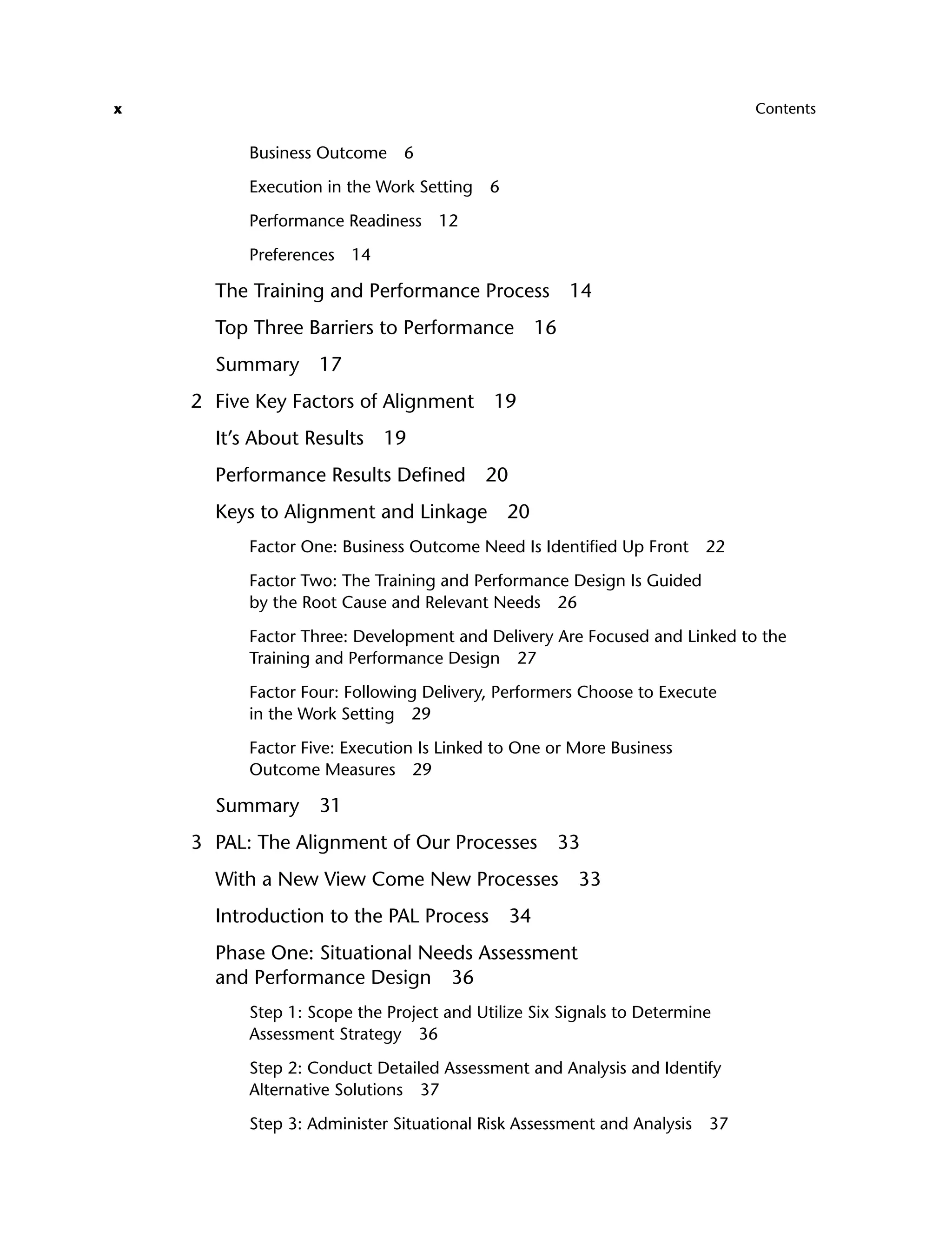
  • 12.
    Copyright © 2009by Ron Drew Stone. All Rights Reserved. Published by Pfeiffer An Imprint of Wiley 989 Market Street, San Francisco, CA 94103-1741 www.pfeiffer.com No part of this publication may be reproduced, stored in a retrieval system, or transmitted in any form or by any means, electronic, mechanical, photocopying, recording, scanning, or otherwise, except as permitted under Section 107 or 108 of the 1976 United States Copyright Act, without either the prior written permission of the Publisher, or authorization through payment of the appropriate per-copy fee to the Copyright Clearance Center, Inc., 222 Rosewood Drive, Danvers, MA 01923, 978-750-8400, fax 978-646-8600, or on the web at www.copyright.com. Requests to the Publisher for permission should be addressed to the Permissions Department, John Wiley & Sons, Inc., 111 River Street, Hoboken, NJ 07030, 201-748-6011, fax 201-748-6008, or online at http://www.wiley.com/go/permissions. Limit of Liability/Disclaimer of Warranty: While the publisher and author have used their best efforts in preparing this book, they make no representations or warranties with respect to the accuracy or completeness of the contents of this book and specifically disclaim any implied warranties of merchantability or fitness for a particular purpose. No warranty may be created or extended by sales representatives or written sales materials. The advice and strategies contained herein may not be suitable for your situation. You should consult with a professional where appropriate. Neither the publisher nor author shall be liable for any loss of profit or any other commercial damages, including but not limited to special, incidental, consequential, or other damages. Readers should be aware that Internet web sites offered as citations and/or sources for further information may have changed or disappeared between the time this was written and when it is read. For additional copies/bulk purchases of this book in the U.S. please contact 800-274-4434. Pfeiffer books and products are available through most bookstores. To contact Pfeiffer directly call our Customer Care Department within the U.S. at 800-274-4434, outside the U.S. at 317-572-3985, fax 317-572-4002, or visit www.pfeiffer.com. Pfeiffer also publishes its books in a variety of electronic formats. Some content that appears in print may not be available in electronic books. Library of Congress Cataloging-in-Publication Data Stone, Ron Drew, date- Aligning training for results : a process and tools that link training to business / Ron Drew Stone. p. cm. Includes bibliographical references and index. ISBN 978-0-470-18175-1 (cloth/website) 1. Employees—Training of. 2. Performance. 3. Needs assessment. I. Title. HF5549.5.T7S718 2008 658.3'124—dc22 2008025948 Acquiring Editor: Matthew Davis Production Editor: Michael Kay/Susan Geraghty Editorial Assistant: Lindsay Morton Manufacturing Supervisor: Becky Morgan Printed in the United States of America HB Printing 10 9 8 7 6 5 4 3 2 1 ffirs.indd vi ffirs.indd vi 8/22/08 5:27:29 PM 8/22/08 5:27:29 PM
  • 13.
    To my wife,Jo Ann, who reviewed much of my work and always offers critical insight and editorial advice. To my daughter, Ronda, who continuously provides me with fresh insight into today’s world of work. ffirs.indd vii ffirs.indd vii 8/22/08 5:27:29 PM 8/22/08 5:27:29 PM
  • 14.
    Select tables, exhibits,and figures from Aligning Training for Results: A Process and Tools That Link Training to Business are available free online. If you would like to download and print out a copy of these materials, please visit: http://Pfeiffer/go/TrainingforResults. For additional tools, visit the author’s Web site, www.performanceandroi.com. ffirs.indd viii ffirs.indd viii 8/22/08 5:27:29 PM 8/22/08 5:27:29 PM
  • 15.
    ix CONTENTS About This Bookiii Tables, Figures, and Exhibits xv Web Site Tools xvii Preface xxi Introduction xxiii Audience xxiv How This Book Is Organized xxiv Getting the Most from This Resource xxvi Key Terms Used Throughout the Book xxvii 1 Thinking Performance in the Twenty-First Century 1 Performance Is Our Business 1 Performers Do Have a Choice 2 Viewing Training Through a Different Lens 3 Client-Friendly Performance Framework 4 ftoc.indd ix ftoc.indd ix 8/22/08 5:25:58 PM 8/22/08 5:25:58 PM
  • 16.
    x Contents Business Outcome6 Execution in the Work Setting 6 Performance Readiness 12 Preferences 14 The Training and Performance Process 14 Top Three Barriers to Performance 16 Summary 17 2 Five Key Factors of Alignment 19 It’s About Results 19 Performance Results Defined 20 Keys to Alignment and Linkage 20 Factor One: Business Outcome Need Is Identified Up Front 22 Factor Two: The Training and Performance Design Is Guided by the Root Cause and Relevant Needs 26 Factor Three: Development and Delivery Are Focused and Linked to the Training and Performance Design 27 Factor Four: Following Delivery, Performers Choose to Execute in the Work Setting 29 Factor Five: Execution Is Linked to One or More Business Outcome Measures 29 Summary 31 3 PAL: The Alignment of Our Processes 33 With a New View Come New Processes 33 Introduction to the PAL Process 34 Phase One: Situational Needs Assessment and Performance Design 36 Step 1: Scope the Project and Utilize Six Signals to Determine Assessment Strategy 36 Step 2: Conduct Detailed Assessment and Analysis and Identify Alternative Solutions 37 Step 3: Administer Situational Risk Assessment and Analysis 37 ftoc.indd x ftoc.indd x 8/22/08 5:25:59 PM 8/22/08 5:25:59 PM
  • 17.
    Contents xi Step 4:Propose the Solution and Negotiate Performance Alignment Contract 38 Step 5: Go/No Go Solution Decision 38 Phase Two: Design and Development 39 Step 6: Finalize Delivery Design and Strategy for Performance Transfer 39 Step 7: Develop and/or Acquire Focused Performance Solution Components 40 Phase Three: Delivery and Execution 41 Step 8: Implement Pre-Engagement Action 41 Step 9: Deliver Performance Solution and Assess Learning Readiness and Initial Reaction 41 Step 10: Trigger Transfer Strategy and Work Setting Execution 42 Phase Four: Verification and Follow-Up 43 Step 11: Rapid Verification of Results and Follow-Up Action Steps 43 Guiding Principles 43 Summary 43 4 Situational Needs Assessment: Opening the Door 45 A Process with Many Names 45 Getting Started 46 Two Roles for Needs Assessment 46 Proactive Role 47 Client Request Role 48 Client Key Behavior and Suggested Solutions 49 Client Resistance to Our Processes 49 The Initial Meeting: Let the Client Talk 50 Step 1 of the PAL Process: Scope the Project 52 The Six Signals 52 Intake Scope and Alignment Document 64 Summary 73 ftoc.indd xi ftoc.indd xi 8/22/08 5:25:59 PM 8/22/08 5:25:59 PM
  • 18.
    xii Contents 5 SituationalNeeds Assessment: The Analysis 75 Step 2 of the PAL Process: Conduct Detailed Assessment and Analysis 75 The Approach 76 The Strategy 76 Sampling 81 Data Collection Methods and Sources 83 Data Collection Methods 83 Data Collection Sources 85 Detailed Analysis 87 Execution Gap Analysis 88 Root Cause Analysis 89 The Acid Test 92 Step 3 of the PAL Process: Administer Situational Risk Assessment and Analysis 92 The Guiding Objectives and Measures 97 Risk Analysis: Assessing the Need for a Transfer Action and Strategy 98 Summary 107 6 Aligning and Proposing the Solution 109 Believe in Your Solution 109 Influencing the Client 110 Step 4 of the PAL Process: Propose the Solution and Negotiate Performance Alignment Contract 110 Educating the Client 113 Negotiating the Solution and the Performance Alignment Contract 119 Evaluation Inquiry 125 Step 5 of the PAL Process: Go/No Go Decision 126 Forecasting the Return on Investment 126 Summary 129 ftoc.indd xii ftoc.indd xii 8/22/08 5:25:59 PM 8/22/08 5:25:59 PM
  • 19.
    Contents xiii 7 AligningDesign and Development 131 The Alignment Continues 131 The Phase Two Handoff 132 Step 6 of the PAL Process: Finalize Delivery Design and Transfer Strategy 134 The Handoff Briefing 134 Step 7 of the PAL Process: Develop or Acquire Focused Solution Components 140 Key Factors for Learning and Performance 141 The Training Manager’s Role 143 Summary 143 8 Aligning Delivery and Execution 145 Enabling the Performer 145 Phase Three of the PAL Process 147 Step 8 of the PAL Process: Implement Pre-Engagement Action 147 Step 9 of the PAL Process: Deliver Performance Solution and Assess Readiness 149 The Delivery 149 Learner Readiness and Initial Reaction 151 Step 10 of the PAL Process: Trigger Transfer Strategy and Execution 153 The Follow-Up Transfer Action and Strategy 153 Developing a Transfer Strategy 154 The Significance of Active Management Reinforcement 158 Summary 159 9 Rapid Verification of Results 161 In The End It’s Results That Count 161 The Evaluation Decision 162 Evaluation Framework 164 Step 11 of the PAL Process: Rapid Verification of Results 167 ftoc.indd xiii ftoc.indd xiii 8/22/08 5:25:59 PM 8/22/08 5:25:59 PM
  • 20.
    xiv Contents Step 1:Determine Purpose and Verify Sponsorship for Evaluation 167 Step 2: Develop Detailed Plans for Low-Intensity Rapid Verification Strategy 170 Step 3: Collect and Analyze Readiness Data 179 Step 4: Collect and Analyze Follow-Up Performance Data 179 Step 5: Communicate Findings and Recommend Follow-Up Action 191 Summary 195 10 Cultivating and Sustaining Sponsorship 197 Contribution and Survival 197 Importance of Sponsorship 198 Influencing Sponsorship 199 Channel One: Direct Use Knowledge 200 Channel Two: Casual Indicators 200 Channel Three: Communication of Demonstrated Results 202 The Outside View 203 It’s Time to Stop Doing—and Start Doing 206 Working Our Processes 208 A Few Closing Thoughts 209 Summary 210 Bibliography 211 About the Author 213 Index 215 ftoc.indd xiv ftoc.indd xiv 8/22/08 5:26:00 PM 8/22/08 5:26:00 PM
  • 21.
    xv TABLES, FIGURES, ANDEXHIBITS Tables 1.1. Stone’s Performance-Centered Framework 5 1.2. Snappy Telecommunications: Linking Execution and Business Outcome 10 1.3. Criteria for an Effective Training and Performance Process 15 1.4. Top Three Barriers to Performance 16 2.1. EBS Printing Company 21 2.2. Five Key Factors of Alignment 22 2.3. Examples of the Five Key Factors of Alignment 23 3.1. Twelve Guiding Principles of the PAL Process 44 4.1. Six Signals: Six Situations That Drive Training Needs 54 6.1. The Solution Proposal Format 112 6.2. The Solution Proposal Format: Example 114 8.1. Learning and Performance Contract 148 8.2. Steps to Develop a Transfer Strategy 155 9.1. Framework for Performance and Evaluation 165 9.2. Decision Criteria for Type of Evaluation 169 9.3. Learning and Performance Action Plan 180 9.4. Planning the Success and Disappointment Analyses 187 ftoc.indd xv ftoc.indd xv 8/22/08 5:26:00 PM 8/22/08 5:26:00 PM
  • 22.
    10.1. Key Areasof Training Operations Effectiveness and Efficiency 204 10.2. What We Need to Stop Doing and Start Doing 206 Figures 1.1. Path to Alignment and Results 11 3.1. The Performance Alignment and Linkage Process 35 4.1. Situational Needs Assessment and Performance Design 53 5.1. Situational Needs Assessment and Performance Design 77 6.1. Situational Needs Assessment and Performance Design 111 7.1. Phases Two and Three of the PAL Process 133 8.1. Phases Two and Three of the PAL Process 146 9.1. The Performance Alignment and Linkage Process 163 9.2. Rapid Verification of Results 168 Exhibits 4.1. Intake Scope and Alignment Document 66 5.1. Assessment Strategy and Plan 79 5.2. Execution Gap Analysis 90 5.3. Root Cause Analysis 91 5.4. Root Cause Analysis Matrix 93 5.5. Root Cause Analysis Matrix Example 95 5.6. Situational Risk Assessment and Analysis Tool Set 99 6.1. Performance Alignment Contract 120 7.1. Training and Performance Design Specifications Document 136 9.1. Evaluation Strategy and Plan 174 9.2. Outcome Report 193 xvi Tables, Figures, and Exhibits ftoc.indd xvi ftoc.indd xvi 8/22/08 5:26:00 PM 8/22/08 5:26:00 PM
  • 23.
    xvii WEB SITE TOOLS ChapterOne Table 1.1. Stone’s Performance-Centered Framework 5 Table 1.3. Criteria for an Effective Training and Performance Process 15 Chapter Two Table 2.2. Five Key Factors of Alignment 22 Chapter Three Figure 3.1. The Performance Alignment and Linkage Process 35 Table 3.1. Twelve Guiding Principles of the PAL Process 44 ftoc.indd xvii ftoc.indd xvii 8/22/08 5:26:00 PM 8/22/08 5:26:00 PM
  • 24.
    Chapter Four Figure 4.1.Situational Needs Assessment and Performance Design 53 Table 4.1. Six Signals: Six Situations That Drive Training Needs 54 Exhibit 4.1.* Intake Scope and Alignment Document 66 Chapter Five Figure 5.1. Situational Needs Assessment and Performance Design 77 Exhibit 5.1.* Assessment Strategy and Plan 79 Exhibit 5.2.* Execution Gap Analysis 89 Exhibit 5.3. Root Cause Analysis 91 Exhibit 5.4.* Root Cause Analysis Matrix 93 Exhibit 5.5. Root Cause Analysis Matrix Example 95 Exhibit 5.6.* Situational Risk Assessment and Analysis Tool Set 99 Chapter Six Figure 6.1. Situational Needs Assessment and Performance Design 111 Table 6.1.* The Solution Proposal Format 112 Table 6.2. The Solution Proposal Format: Example 114 Exhibit 6.1.* Performance Alignment Contract 120 Chapter Seven Figure 7.1. Phases Two and Three of the PAL Process 133 Exhibit 7.1.* Training and Performance Design Specifications Document 136 Chapter Eight Figure 8.1. Phases Two and Three of the PAL Process 146 Table 8.1. Learning and Performance Contract 148 Table 8.2.* Steps to Develop a Transfer Strategy 155 xviii Web Site Tools * A blank template version of this tool is available on the following Web sites: http://Pfeiffer/go/ TrainingforResults and www.performanceandROI.com. ftoc.indd xviii ftoc.indd xviii 8/22/08 5:26:01 PM 8/22/08 5:26:01 PM
  • 25.
    Chapter Nine Figure 9.1.The Performance Alignment and Linkage Process 163 Table 9.1. Framework for Performance and Evaluation 165 Figure 9.2. Rapid Verification of Results 168 Table 9.2. Decision Criteria for Type of Evaluation 169 Exhibit 9.1.* Evaluation Strategy and Plan 174 Table 9.3. Learning and Performance Action Plan 180 Table 9.4. Planning the Success and Disappointment Analyses 187 Exhibit 9.2 Outcome Report 193 Chapter Ten Table 10.1.* Key Areas of Training Operations Effectiveness and Efficiency 204 Table 10.2. What We Need to Stop Doing and Start Doing 206 Web Site Tools xix * A blank template version of this tool is available on the following Web sites: http://Pfeiffer/go/ TrainingforResults and www.performanceandROI.com. ftoc.indd xix ftoc.indd xix 8/22/08 5:26:01 PM 8/22/08 5:26:01 PM
  • 26.
    ftoc.indd xx ftoc.indd xx8/22/08 5:26:01 PM 8/22/08 5:26:01 PM
  • 27.
    xxi PREFACE As I organizedand documented what I have learned over the years, I discov- ered that I was in danger of missing the picture altogether. I had to keep an open mind in order to sort out the puzzle. I had to keep asking myself, what are we doing well in our profession and how are our processes broken? I also had to ask myself the obvious question, if our processes are broken, can they be repaired? If so, what is the appropriate fix? Can we improve our processes enough to achieve the expected results—and can we do it now? My experience and my research have led me to the conclusion that I know how we can align our processes for results. I have created the work in this book with the goal of sharing this with you and providing the tools you need to be suc- cessful. You can be a major player in continuously bringing results and credibility to our training function. You can achieve this goal with minimal pain. But you must be willing to change the way you think about and apply our training pro- cesses. You must accept that there are some broken pieces and that not only is a fix possible but it will also be very gratifying along the way. You must also commit to being process driven, trust your processes, and then work your processes. fpref.indd xxi fpref.indd xxi 8/22/08 5:26:54 PM 8/22/08 5:26:54 PM
  • 28.
    Come Along forthe Journey Step through the pages and enjoy yourself on the journey. This book will help you to achieve better results, build on your credibility, and make even greater contributions to your organization’s business goals. Let’s get started. Acknowledgments I am very appreciative of the contributions to this book made by four of my clients and colleagues, all esteemed professionals making their own mark in our profession. I have often sought their counsel regarding the accomplishments and needs of our profession. I have partnered with them over the years, each has provided insight into my work, and they have given me considerable ideas and food for thought. Melissa Scherwinski provided valuable assistance with several chapters. She has also been a constant and invaluable source as she provided insight to the Performance Alignment and Linkage Process. Donna Schoonover helped considerably with the review of several chapters; her insight has been invaluable. Don Kraft provided several important ideas for the book; the format for the concise outcome report illustrated in the chapter on rapid verification is his idea. Sunny Niu reviewed drafts of the Performance Alignment and Linkage Process and provided valuable suggestions with an international perspective, which improved the process. Her input has been insightful and practical. xxii Preface fpref.indd xxii fpref.indd xxii 8/22/08 5:26:54 PM 8/22/08 5:26:54 PM
  • 29.
    xxiii INTRODUCTION This book providesa methodology—the Performance Alignment and Linkage (PAL) process—to analyze performance needs and to align training processes with business requirements so that solutions influence performance and achieve business results. Throughout this book, you will learn how to apply numerous tools to influence performance and get the results you and your clients desire. You will learn how to view performance in the proper context and how to properly execute the PAL methodology to build and deliver training results and, yes, to influence return on investment (ROI) if that’s on your wish list. The end in mind is to deliver the expected results for our clients and stake a claim as a key contribu- tor to the organization’s success in the twenty-first century. This book is a neces- sary resource for helping interested training managers and professionals to be the best they can be and meet the expectations of clients and the organization. The process begins with how we think about performance and our product and continues with realigned needs assessment, design, delivery, and follow-up approaches that we employ to ensure success and satisfy client needs. In addition to building on the work of many pioneers in our profession, the approach pre- sented in this book brings a new frame of reference and a more results-centered blueprint to our profession. Our goal with these new processes and realignment is to leave our deficiencies in the past and achieve results that build a reputation for meeting or exceeding the expectations of clients and the organization. flast.indd xxiii flast.indd xxiii 8/22/08 5:26:32 PM 8/22/08 5:26:32 PM
  • 30.
    xxiv Introduction Audience This bookis for you if the current processes you are using are unwieldy or you are not getting expected results from your programs. You will learn how to identify performance gaps and root causes, determine related needs, and sustain align- ment throughout the training and performance process. Whether you are a training director, project manager, coordinator, designer, research analyst, performance consultant, or client account manager, you will benefit from this book. The concepts, principles, and processes presented here can serve your needs if you are new to the training profession or if you are a sea- soned professional. If you are new and have no background in existing training processes, you will find many practical approaches and tools you can use imme- diately. If you are experienced and currently using your own processes, or those developed by others, you have two choices: Adopt new concepts, ideas, and tools presented here and integrate them with what you are doing now to improve your results. Do a process dump and start anew with the processes presented here. Whatever your role in the training function, you are always in a position to influence the success of training processes and programs. This book will generate ideas that you can put into action immediately to exercise your influence. How This Book Is Organized The book begins by addressing performance issues and identifies the top three barriers to performance. It then suggests that we abandon the way we have his- torically characterized the training process in favor of an approach more in line with today’s needs. The PAL methodology embraces a framework and the tools necessary for linkage and performance alignment. Here are summaries of the ten chapters. Chapter One: Thinking Performance in the Twenty-First Century. This is a “must read” chapter. To gain the most from this book, you must be willing to change the way you think about the training and performance process. A new performance framework for training is presented, along with criteria for the training and per- formance process. Because results are driven by the right processes applied in the right way, this chapter addresses how you must trust your processes, commit to being process driven, and then work your processes. • • flast.indd xxiv flast.indd xxiv 8/22/08 5:26:32 PM 8/22/08 5:26:32 PM
  • 31.
    Introduction xxv Chapter Two:Five Key Factors of Alignment. Many training programs have a limited chance to succeed because training managers and training professionals sometimes do not focus on the proper factors during needs assessment, program design, and program delivery. Key factors are introduced that are necessary to ensure alignment and a sustained focus on results throughout the training pro- cess. The goal of these factors is to link needs identification with the design, development, and delivery of a proper solution and to address learning transfer to the work setting. These factors are inherently addressed throughout the PAL methodology. Chapter Three: PAL: The Alignment of Our Processes. An overview of the Performance Alignment and Linkage (PAL) process is provided in this chapter. Detailed components of the methodology are covered in subsequent chapters. The PAL training and performance process is a front-to-back refinement of how we should view and respond to training requests and fulfill client needs. The methodology includes guiding principles and addresses results-centered design, development, and delivery, transfer to the work setting, and rapid verification of results. The PAL process includes tools and templates that serve as built-in qual- ity control mechanisms, helping keep our eyes on our processes to ensure that we sustain alignment and achieve business results. Chapter Four: Situational Needs Assessment: Opening the Door. This chapter keys in on how to establish initial alignment and how to rapidly adapt the needs assess- ment process to a wide range of diverse client situations. It addresses how the “situation” drives the way in which the needs assessment process should be used, resulting in contextual application and greater efficiency. This aids greatly in gain- ing cooperation from the client to conduct needs assessment activities necessary to deliver an effective training and performance solution. Chapter Five: Situational Needs Assessment: The Analysis. This chapter covers the use of various analysis tools to address the following significant aspects of the front-end analysis: Clarification of the performance requirements Identification of the performance gap, which identifies the deficiency Identification of the cause of the deficiency Identification of relevant needs along with alternative solutions The tools are easy to use and allow for quick completion of the assessment and analysis to identify the problem area and an appropriate solution. Chapter Six: Aligning and Proposing the Solution. This chapter demonstrates how to propose the recommended solution in a context that will educate the client about alignment, communicate the support needed through Active Management • • • • flast.indd xxv flast.indd xxv 8/22/08 5:26:33 PM 8/22/08 5:26:33 PM
  • 32.
    xxvi Introduction Reinforcement, andgain approval to proceed with design and implementation of a feasible solution. It also includes how to address a request to forecast a return on investment when required. A key component of this chapter is communication of the proposed solution in a way that gains client support for the most effective performance design. Chapter Seven: Aligning Design and Development. This chapter addresses how to sustain alignment from needs assessment through design and development to achieve the desired business outcome. Chapter Eight: Aligning Delivery and Execution. This chapter addresses sustaining the alignment through delivery and execution. It also addresses the significance of the need for methods to trigger execution in the work setting. Alternative transfer actions and key components of developing a transfer strategy are addressed so that execution is appropriately influenced in the work setting. Chapter Nine: Rapid Verification of Results. This chapter addresses how to execute a form of follow-up evaluation that is less intensive, less expensive, and less time consuming than traditional evaluation approaches. It satisfies the need for expedi- tiously capturing indicators of success without draining resources. Chapter Ten: Cultivating and Sustaining Sponsorship. This chapter addresses how our clients and stakeholders routinely assess the value of the training function during normal day-to-day operations both with and without our knowledge or input. Important areas that frame stakeholder attitudes about the training func- tion are identified, along with suggestions for routinely addressing them to gain and sustain sponsorship. Getting the Most from This Resource All the tools you will need for this learning package are at your fingertips. In addition to the text, a web site is provided that includes the key process tools addressed in the text. Each tool that is located on the web site is identified by a distinctive icon, as shown in the margin here. The tool might be a table, a job aid (called exhibit in this book), a form with detailed instructions on how to use it, or an explanation of an important concept that is central to a methodology. Many of the tools also include a template on the web site. Use the tools and what you learn from this material to achieve results with your own training programs to satisfy clients and other stakehold- ers. Your existing know-how—along with a new frame of reference, new processes, new learning, and new tools—will improve your possibility of achieving business results and a return on investment (ROI) with your projects and programs. There is one axiom I would like you to remember as you read this book and as you apply the processes to your projects: flast.indd xxvi flast.indd xxvi 8/22/08 5:26:33 PM 8/22/08 5:26:33 PM
  • 33.
    Introduction xxvii If youhave the right processes and you follow your processes, the desired result should follow. Chapters One through Six should be read in sequence, as they contain a common thread that sets the stage for linkage and alignment to achieve results. If you are experienced at conducting traditional needs assessments, you may want to skip Chapter Five, with the exception of the Risk Assessment and Analysis sec- tion in that chapter. The remaining chapters may be reviewed in any sequence desired. Beginning in Chapter Four, a case scenario—Big Sky Medical Group—is used throughout several of the chapters to demonstrate the use of processes and tools. Other case scenarios are also used frequently. This influences active learning for the reader and sustains interest in the book as well. As you are reading this text, experiment with the ideas and tools on one of your current programs. Ask a coworker or even a client with whom you have a comfortable relationship to be a willing partner as you practice using the tools and applying the processes to your programs. While your initial learning is still fresh in your mind, consider making a personal commitment to apply the methodology and tools with your next three projects or clients. This will help you see what works best for you and will increase your confidence in using the methodology and tools. The processes, concepts, and tools presented in this book are not a total rein- vention or restructuring of our business processes, but rather a strict realignment that you should be able to easily adapt to your situation. For updates on performance issues and additional tools and worksheets asso- ciated with the processes in this book, visit my web site frequently at www .performanceandROI.com. The site includes templates of the job aids presented in the book, as well as new tools and templates, and a newsletter and is host to frequent free webinars. The site also has a description of performance-related workshops and other services. Key Terms Used Throughout the Book Alignment or align: Refers to the need for interventions or training solutions to be compatible with business needs and requirements. For example, the business need (the end in mind) must be identified up front when there is a request for a training flast.indd xxvii flast.indd xxvii 8/22/08 5:26:34 PM 8/22/08 5:26:34 PM
  • 34.
    xxviii Introduction program. Thetraining solution that is selected must address this identified need. Alignment or align also refers to the need for the different phases of the training process to be in alignment. For example, the training design must be compatible with the needs that are identified during needs assessment, and the instructional staff must follow the design when delivering the solution. Active Management Reinforcement (AMR): AMR represents factors that are typi- cally the responsibility of managers as they prepare and engage their team in the work setting to achieve desired behavior, task assignments, and performance goals. These actions include factors such as communicating expectations, negotiating performance goals, providing coaching and positive reinforcement, and manag- ing incentives and rewards. The concept of AMR emphasizes that performers may perceive these factors to be inadequate unless the factors are actively being addressed by managers during any given performance scenario. When these AMR factors are absent or inadequate, the result is often less than desirable per- formance by the workforce. Client: Used in this work, the term client refers to the person who has requested training services. Clients are usually members of management, but could be someone in another role, such as a member of the community if the training is providing services to the community. A client usually has the authority to approve budgets and provide funding and support resources to assist in the project’s devel- opment and implementation. The director of the training department may be a client, in the absence of a direct client. For example, an open enrollment offering in which participants from many different departments enroll in the same offering of a course requires one central sponsor. Committee: When a training committee exists, it usually serves some type of governing role in the project. This term is used interchangeably with other related terms, like steering committee, task force, action committee, training committee, or project committee. Sometimes, for the duration of a training project the proj- ect manager will interface with a committee instead of the sponsor or client. This can be an effective method to get broad management support and resources for a project, but it can also work against expediency. A committee often is involved when the project is large, cuts across functional or departmental lines, or when the project involves an outside compliance agency. Delivery: This is the phase of the training and performance process when the learners become engaged with the solution. Delivery is the execution of all of the activity that surrounds the learning engagement to facilitate learning. Effective or effectiveness: The outcome of working a process, providing services, or performing a task or behavior that conforms to standards or criteria of quality. Effectiveness is a measure of quality. flast.indd xxviii flast.indd xxviii 8/22/08 5:26:34 PM 8/22/08 5:26:34 PM
  • 35.
    Introduction xxix Efficient orefficiency: The outcome of working a process, providing services, or performing a task or behavior that conforms to standards or criteria of time or resource utilization. Efficiency is a measure of quantity. Learning transfer: The context of learning transfer, training transfer, or performance transfer, as used in this book, refers to the participants’ applying what they learn to situations in the work setting. Transfer completes the training and performance cycle and should serve to favorably influence business outcomes. Linkage or linked relationships: See Performance-centered framework. Open enrollment program: A training offering in which participants are enrolled from multiple departments or from multiple companies. Participant: Participants are the target for the training being delivered. In some countries participants are called delegates. Even though participants are a type of client, a different term is used to distinguish them from the client who is request- ing or funding the project. Performance driver: Any factor that tends to influence how people perform. For example, coaching and positive reinforcement from a supervisor tend to influence favorable employee performance. Performance-centered framework: A way in which to view linked relationships that affect performance. Linked relationships occur when one action or set of cir- cumstances influences another action or set of circumstances. Here are several examples: Training results: A customer service training program provides skills that influ- ence improved service to the customer, which in turn drives a business outcome of improved customer satisfaction. Performance needs: A work team is making errors in filling customer orders because they lack the proper knowledge of how to use the order-filling process. The missing link of “proper knowledge of the order filling process” results in errors, which results in customer receiving the wrong orders, receiving orders late, or receiving incomplete orders, and so on. Performance needs: A work team is deficient in performing the task of providing acceptable customer service because effective customer service guidelines are not properly communicated and reinforced by their manager. The missing link of “guidelines” results in inadequate customer service. As the last two examples illustrate, the framework is the key to viewing perfor- mance issues when conducting needs assessment activities and making decisions about training and performance solutions. It helps to ensure that we view per- formance from every possible angle and see the linkages. It aids us in ultimately • • • flast.indd xxix flast.indd xxix 8/22/08 5:26:35 PM 8/22/08 5:26:35 PM
  • 36.
    xxx Introduction viewing performance,performance gaps, and performance requirements in the proper context. Pre-engagement action: Any action or activity to begin participant involvement prior to the actual learning engagement. Examples are pretesting participants to determine current knowledge and skills; initiating discussion between participants and their supervisor to discuss how the training relates to job expectations and to set relevant goals; and assigning specific reading materials, review of web site content, or completion of job tasks to prepare for participation in the learning engagement. Program, project, or solution: This references the initiative that is being funded for a population. The term program is used interchangeably with course, intervention, solution, or project. Project manager: This is the owner of the training project from beginning to follow-through in the work setting. This person is in charge of managing the project, reporting on the status, influencing the project’s success, and negotiating decisions when there are disagreements along the way. In reality the title in many organizations could be something different, such as coordinator, account man- ager, training manager, or the like. This role could also be filled by the facilitator or instructor, but it is best that it be someone else—someone who oversees the entire process from request to follow-up. Who the project manager is may depend on the size of the project or even the size of the organization, as in some training organizations the same person may wear several hats. Root cause: The initial contributing factor of a chain of events that leads to a specific outcome. When the root cause is identified, an intervention may then be identified and implemented to change performance and prevent an undesir- able outcome. In a given performance situation, there could be one cause or multiple causes that influence a specific outcome. Typically, the dominant factor or factors are addressed with the intervention. Sponsor: Sponsors may be high-level executives or have some type of func- tional authority in regard to the project, or they may be in a department other than the one that is targeted for the training. For example, the vice president of quality in the corporate headquarters sponsors a QA training program to be offered to employees who report to other vice presidents, such as the vice presi- dent of operations and the vice president of product assembly. There is no direct reporting relationship between the sponsor (VP of quality) and the employees who are targeted for the training. A sponsor and a client can be the same person. Like clients, sponsors usually can fund a project or otherwise provide resources and support. Sponsors of designated training programs should always take ownership of the program. The terms initiating sponsor and sustaining sponsor are also used in flast.indd xxx flast.indd xxx 8/22/08 5:26:35 PM 8/22/08 5:26:35 PM
  • 37.
    Introduction xxxi this work.In the previous example, the vice president of quality is an initiating sponsor of the QA training program that she originates or initiates. The vice presidents of operations and product assembly and the managers that report to them are expected to take on the role of sustaining sponsors to support imple- mentation of the QA training program in their department. Without this formal sustaining support, training programs that cross functional or department lines can easily fail due to lack of ownership and support. Stakeholder: This can be anyone who has an interest in a training project or the training department. Clients, participants, sponsors, project managers, training directors, employees, managers, senior managers, executives, CEOs—all can be stakeholders. Training or learning engagement: Refers to any type of training intervention (pro- gram, course, lesson, session, solution, project) delivered through any means (instructor-led, online, CD, teleconference, self-study, and so on), for the pur- pose of enabling individuals and teams to address knowledge, skill, or behavior requirements. Training professional: A generic term used to refer to anyone serving in a train- ing role who is responsible for any part of the training and performance pro- cess. It represents more specific titles; for example, training analyst, performance consultant, designer, account manager, training manager, training director, proj- ect manager, facilitator, instructor, instructional technologist, measurement and evaluation specialist, or client account manager. Training and performance design: Replaces the term training design to clarify that the design is about more than the training or the training content and delivery. It is also about creating a design to include any necessary factors that will influence transfer and performance in the work setting following the training delivery. Training and performance process: Refers to the processes employed by training professionals to research, promote, design, develop, deliver, follow up, and evalu- ate training products and services, and to partner with clients, participants, man- agers, suppliers and others. Historically, this has been referred to as the training process in many organizations. Including the word performance in the process reestablishes our focus and brings results front and center. Other terms throughout this work serve a similar purpose, such as performance-centered framework, training and performance solution, and performance results. flast.indd xxxi flast.indd xxxi 8/22/08 5:26:35 PM 8/22/08 5:26:35 PM
  • 38.
    flast.indd xxxii flast.indd xxxii8/22/08 5:26:36 PM 8/22/08 5:26:36 PM
  • 39.
    1 CHAPTER ONE THINKING PERFORMANCEIN THE TWENTY-FIRST CENTURY In this chapter you will learn about A new performance-centered framework and how it can be used to address performance deficiencies, needs, and solutions How the criteria for an effective training and performance process can be used to influence the client’s desired results The three most frequent barriers to performance and why we must address them Performance Is Our Business During the last seventy-five years or so, many experts have contributed to the task of linking the training profession to performance by developing concepts, processes, methodologies, and tools to create and deliver our products and serve our clients. We have made significant progress because of these pioneers. Some of their processes and models have been updated several times and are still in use by training professionals today. These processes and associated behavioral and learn- ing theories and applications were influenced by people such as B. F. Skinner, Kurt Lewin, Benjamin Bloom, Geary Rummler, Malcom Knowles, Thomas Gilbert, Joe Harless, Jim and Dana Robinson, Robert F. Mager, Dave Meier, and Robert Gagné. Evaluation models and methodology have been influenced by Donald L. • • • Y c01.indd 1 c01.indd 1 8/22/08 5:02:42 PM 8/22/08 5:02:42 PM
  • 40.
    2 Aligning Trainingfor Results Kirkpatrick and Jack J. Phillips. We owe much to these and other trailblazers for originating or improving these concepts, applications, and processes. As a result of my experience over twenty-five years, I have been in a unique position to see our training processes from the inside out and from the out- side in. I have seen the successes of the fruits of our labor as well as the hard knocks and disappointments in the performance results. Our profession is not entirely broken—it just needs a little help to catch up with and respond to today’s demands. What is being presented in this book does not take away from the great work of these pioneers, but adds to it. It is vital that training professionals understand performance in order to identify needs and design, develop, and deliver training solutions. Even more important, we must be performance experts in order to influence clients and other stakeholders as to why the preferred design of a training program should not be compromised. In a consultative way, we must be able to demonstrate to others what will and will not work when implementing projects and programs to influence the desired performance in the work setting. If the training process does not play a role in influencing people to apply what they have learned to the work setting, then our function should not be funded. This chapter focuses on viewing our training products and processes through a different lens. A performance-centered framework is proposed that will lead to a more results-centered design and delivery of the training product. This begins a journey that continues throughout the book to address the most significant issue we face as a profession: why do so many people complete training successfully and fail to apply what they learn to the work setting? The natural follow-up question is, what can we do about it? We will begin to address both of these questions now and proceed throughout the chapters to show how we can succeed. Performers Do Have a Choice The first thing we must recognize about performance is that, more often than not, people are in a position to choose whether they will perform specific tasks or comply with specific job behavior requirements and how they will go about doing so. I am not referring here to poor performers or to overall performance. I am referring to the daily routine of executing the myriad of tasks and providing services to get business results. Consider the following: Managers do not watch over their team every moment of every day. Nor should they. Performance monitoring techniques, or controls, are not always in place to detect whether and how people are doing what they should be doing. • • c01.indd 2 c01.indd 2 8/22/08 5:02:43 PM 8/22/08 5:02:43 PM
  • 41.
    Thinking Performance inthe Twenty-First Century 3 Knowledge workers often work alone or unsupervised and have great latitude in getting the work done. Even when monitoring or controls are in place, it can be weeks or even months before the specifics of an individual’s performance become known. When the organization provides new or upgraded technology to people, they sometimes (without being discovered) underuse the technology, continue to do what they have always done regardless of the technology, or simply find ways to shortcut the technology. Consequently, in either of these situations we often do not realize the cost savings or other benefits that proper use of the technol- ogy should deliver. When training is provided, even when people have a need, dozens of factors in the work setting can derail the appropriate or timely job execution of what was learned, so that the intended result is never realized. The point is that we can fund a training program, new technology, a new HR procedure or program, or any other organization initiative to achieve some end in mind. But unless we follow the right processes to design and deliver the solution, people may choose to ignore what the program or intervention is designed to help them achieve in the work setting. We should design our training solutions with the end in mind and within the right parameters to achieve alignment and results. We should have a strategy to help clients understand the meaning and value of this alignment and how it is achieved. That strategy begins with our own rethinking of our processes and how we apply them. Viewing Training Through a Different Lens As we go about conducting our business of identifying training needs and design- ing, developing, and delivering training for our clients and our organization, we focus on the learning requirements. After all, that is what we should do. We are the experts in learning and training delivery for the organization. It is what we are paid to do, and it is our mission and passion. But the underlying reason clients come to us is not just to check off the training box so they can say it has been done. Well, yes, maybe a few managers and even a few participants are just checking the box. And some are checking the box with regard to compliance training. But the underlying reason we are asked to deliver most training comes back full circle to job performance. So we are not just in the training business; we are also in the performance business. We are the ones responsible for how clients and others perceive us and whether or not they view us as helping to check the training box or helping them with performance issues. • • • • c01.indd 3 c01.indd 3 8/22/08 5:02:44 PM 8/22/08 5:02:44 PM
  • 42.
    4 Aligning Trainingfor Results How we frame something can serve as a key to our understanding, and it guides our decisions, communication, and actions we take. It also limits our view, our decisions, our communication, and our actions. I suggest that train- ing professionals should adopt a different thought pattern and a different per- formance framework that will allow us to see and communicate training and performance in a more results-centered way. This will also give us a better avenue to discuss performance with our clients and stakeholders and to clarify their role in the process. Client-Friendly Performance Framework Many in our profession (perhaps most) have adopted Donald L. Kirkpatrick’s four levels of evaluation as a standard for how to conduct evaluation activities (Kirkpatrick, 1994). Kirkpatrick developed these levels in the late 1950s as an approach to evaluation. By default or as a matter of choice, many training pro- fessionals also use Kirkpatrick’s levels to express a framework for levels of perfor- mance. The four levels of Kirkpatrick’s evaluation model are Reaction (Level 1) Learning (Level 2) Behavior (Level 3) Results (Level 4) Jack J. Phillips has added a fifth level of evaluation to Kirkpatrick’s model, which he calls Return on Investment (Level 5) (Phillips & Stone, 2002). For those in our profession who have been using the four levels as a perfor- mance framework, I offer a more useful alternative. The four levels limit our think- ing about nontraining performance factors and transfer of learning issues. The four levels simply do not present the proper framework to encourage outside-the-box thinking regarding performance. The elements of the Performance-Centered Framework described in Table 1.1 are linked relationships that help to establish alignment in achieving desired results from training programs and other performance interventions. They are also the key to viewing performance issues when conducting needs assessment activities and making decisions about training and performance solutions. Each element is actually a type of analysis. They are presented here in the context of needs assessment. • • • • c01.indd 4 c01.indd 4 8/22/08 5:02:44 PM 8/22/08 5:02:44 PM
  • 43.
    Thinking Performance inthe Twenty-First Century 5 The Performance-Centered Framework is used with the Performance Alignment and Linkage (PAL) process, which will be covered in Chapter Three. The performance framework is a guide to help training professionals: Think about performance in the proper context Frame the right questions for analysis Identify the appropriate type of data to gather to determine performance requirements and analyze needs within each element of the framework Identify the proper objectives and measures for each element of the framework Communicate with clients and gain their support Create the most appropriate results-centered Training and Performance Design and Solution This is a contextual performance framework that is client friendly and makes it easier to discuss performance in a context that clients welcome and understand. It can be used to address current performance, performance needs, and desired performance. More important, this framework allows us to visibly link the key • • • • • • TABLE 1.1. STONE’S PERFORMANCE-CENTERED FRAMEWORK A Twenty-First-Century Frame of Reference for Linking and Aligning Training and Performance Solutions to Achieve Expected Business Outcomes P E R F O R M A N C E Element Focus Element Context: Type of Analysis Business Outcome Identifies the desired business or organizational result. Execution in the Work Setting Identifies what a specific population should be doing or not doing, and how individual or team performance may influence the status of business outcome measures. R E A D I N E S S Performance Readiness Identifies individual or team compatibility, ability, confidence, and willingness to execute in the work setting. Also identifies ineffective habits and the influencing factors of Active Management Reinforcement (AMR) and how they affect execution in the work setting. Preferences Identifies client and population’s preferences regarding design and delivery of the solution, (examples: likes, dislikes, wants, learning style preference, delivery preference, operational constraints). c01.indd 5 c01.indd 5 8/22/08 5:02:45 PM 8/22/08 5:02:45 PM
  • 44.
    6 Aligning Trainingfor Results elements of performance so that we can discuss performance with the end in mind and address all of the influences to get the desired result. Let’s address the performance-centered framework one element at a time, beginning with business outcome. Business Outcome Every business, including non-profit organizations, has a list of desirable out- comes that keep the business viable. When these outcomes do not measure up to requirements, it compromises the ability to operate the business, sustain funding and financial strength, remain competitive, serve customers, hire and retain com- petent and committed employees, and accomplish the organization’s mission. Outcome measures provide a target to define desired business results. They are at the heart of the operation of the business enterprise, and they are influ- enced by many factors. Typical categories of outcome measures include but are not limited to the following: The cost of doing business The profitability of the business (quality of funding for nonprofits) The quality (effectiveness) of research, acquisition, design, development, deliv- ery, and management of the organization’s business products, processes, and services The output (quantity) of products and services The time (efficiency) it takes to complete tasks (output) and business processes, address and correct problem areas, and service the customer There are additional categories of outcome measures and many measures within each category depending on how they are uniquely defined by each orga- nization. Business outcomes are generated from the completion of the business cycle of acquiring, making, marketing, selling, fulfilling orders, delivering, servic- ing, receiving payment, and accounting for the goods and services. Let’s look at the next element of the Performance-Centered Framework so that we can gain a better perspective of how the work itself influences the ulti- mate business outcome and the outcome measures. Execution in the Work Setting Execution speaks to the activities that people routinely perform in the work setting to accomplish the mission of the organization. Execution and performance are synonymous. By definition, execution occurs in the work setting. It is what people • • • • • c01.indd 6 c01.indd 6 8/22/08 5:02:45 PM 8/22/08 5:02:45 PM
  • 45.
    Thinking Performance inthe Twenty-First Century 7 are expected to do. It is the performance of the work itself, the work processes, and how people go about doing it. The business outcomes addressed in the preceding section would not be possible without the performance of the human element. Every manager knows that his or her team influences the business outcome in their own work unit, which in turn contributes to the overall business outcome of the company, agency, or institution. When outcome measures are not being met or are perceived to be in immi- nent danger of declining, attention immediately turns to the reason why. Work activities are immediately suspect as a possible contributor to the undesirable business outcome. So six types of questions are posed: 1. Are people doing what they should be doing? 2. If not, what is the deficiency? 3. Why are they not doing what they should be doing? (That is, what is contribut- ing to the lack of this individual or team execution?) 4. How are the deficiencies in individual or team performance influencing busi- ness outcomes? 5. What else (internal and external influences) may be influencing the outcome? 6. What should be done to correct the situation and influence the outcome in a positive way? Perhaps further questions should be, both now and in the future, Who or what is in a position to influence execution in the work setting? And how is this influencing the ability to achieve the end in mind—the desired outcome? Then we follow with the same questions just listed. It could be that faulty work processes or something external to the business is influencing the desired business outcome. Maybe individual or team performance is a secondary issue. If something else is driving the outcome, our needs assessment should identify this and focus on any recommendation in this regard. If we are certain that individual or team performance is the problem, then we should focus on the root cause of that problem. Remember, when we identify what we believe to be a problem, it is often not the real problem. Often, the so- called problem is only a surface indicator. It may be the first sign that a problem of some type does exist. For example, poor work quality is a surface indicator. The real problem is whatever is causing the poor work quality. Our front-end research should identify the root cause of this deficiency in quality, and this should drive the remaining decisions. For example, maybe the team does not know how to execute the details of the work process, and this is causing deficiencies in quality. The root cause is the specific knowledge that the team lacks in the work processes. c01.indd 7 c01.indd 7 8/22/08 5:02:46 PM 8/22/08 5:02:46 PM
  • 46.
    8 Aligning Trainingfor Results So, for the remainder of our discussion in this chapter, let’s assume that individual or team execution is the issue driving a deficient business outcome. When we are seeking a specific business outcome, everything depends on execution. Execution can be something as simple as conducting a team meeting and communicating work priorities or other information. Or it can be as complex as a supervisor observing a team member’s performance and providing feedback and coaching so that the team member can properly execute. Execution is the most important aspect of getting business results. Even when there are intervening external factors, we still have to execute in order to respond to them, whether reactive or proactive. If we do not execute, then the desired business outcome is left to chance. When we explore the reasons for lack of execution and we limit our exploration to the workers themselves, we may miss the true reason (or root cause) for the inappropriate execution or lack thereof. So it is fair to say that, if we are looking for the secret sauce—the one thing that is fundamental to the business outcome results that we want—it is execution. It is the performance of the team and the individuals that make up the team. Let’s illustrate with a couple of examples so we can connect the dots, so to speak. We’ll use one example in private industry and another in higher education. Example One: Snappy Telecommunications International: We have telecommuni- cations facilities, equipment, and technology; management and staff expertise; internal operating work processes; business, community, and international part- ners; and political affiliations in place. Our major challenge is this: how efficiently and effectively can we execute the following: Maintain our telecommunications network and keep it operating Keep technology and relationships current Differentiate our products and services Maintain compliance in the eyes of regulatory agencies Establish customer leads and contact prospective customers Determine what customers need and sell them a profitable package to meet their needs Process and fulfill the orders through internal systems and processes Connect the services and render a satisfied customer Collect payments Conduct legal and ethical business operations • • • • • • • • • • c01.indd 8 c01.indd 8 8/22/08 5:02:46 PM 8/22/08 5:02:46 PM
  • 47.
    Thinking Performance inthe Twenty-First Century 9 There is more, but you get the idea. The extent to which we can execute all of these items with efficiency and effectiveness will determine how well we can gain repeat business and new customers; sustain our targeted market share; attract and retain competent employees; sustain revenue, funding, and financial strength; remain competitive; continue to serve customers; and accomplish the organiza- tion’s mission. All of these are outcome measures. The final step in the system is to track and account for the entire process so that we can replicate it and keep everyone satisfied—customers, management, board members, employees, stockholders, suppliers, business partners, and third-party interests. These are all outcome measures as well. Example Two: World Class University: We have educational facilities; technology; administration leadership; faculty; administrative support; administrative and educational processes; business, community, regional, and international partners; and political affiliations in place. Our major challenge is this: how efficiently and effectively can we execute the following: Obtain funding from students, government earmarking and grants, donations, and other sources Maintain accreditation Develop, sustain, and deliver current and competitive curricula and programs of study in all colleges to differentiate ourselves and meet demand Complete research and development activities that contribute to the univer- sity’s mission Attract, recruit, and enroll students Provide student services and address ongoing student needs Manage student satisfaction and attrition to acceptable standard Manage the graduation rate to acceptable standard Influence the employability and earning power of graduates Sustain the university’s integrity, public standing, and image There is more, but you get the idea. The extent to which we can do all of this with efficiency and effectiveness will determine how well we can continue to attract, enroll, educate, and graduate students; get adequate funding; maintain a viable educational product; maintain accreditation; sustain student services; attract and retain competent faculty and staff; and accomplish the university’s mission. All of these are outcome measures. The final step in the system is to track and account for the entire process so that we can replicate it and keep everyone satisfied—students, the administration, the board, faculty and staff, funding agen- cies, alumni, partners, third-party interests, and the community. These are also outcome measures. • • • • • • • • • • c01.indd 9 c01.indd 9 8/22/08 5:02:47 PM 8/22/08 5:02:47 PM
  • 48.
    10 Aligning Trainingfor Results Without going into every detail, Table 1.2 uses the Snappy Telecommunications example to distinguish between outcome and execution and show how the two are linked. The distinction is that execution is an activity and outcome is a result of the activity, even if the activity is indirect. For example, generating sales leads is an indirect activity to an actual sale; the direct activity is the sales call. In any case, all activities represent work processes that must be executed to contribute to a desired outcome. All of the support activities conducted by all departments that acquire, market, produce, and account for the products and services are indirect activities to the sale that must be executed properly. Without them, there may be no product to sell and no customer service to provide. If we can influence people to achieve the desired execution in all areas, all other things being equal, the busi- ness outcome should take care of itself. Without execution, nothing else happens except that which happens by chance and luck. TABLE 1.2. SNAPPY TELECOMMUNICATIONS: LINKING EXECUTION AND BUSINESS OUTCOME Business Outcome Measures Execution Operational availability of the network Cost of the availability All upgrade and maintenance activities associated with the telecommunications network Percent compliance with regulatory agency requirements Number of agency citations All activities that management and employees execute, allowing Snappy to stay in compliance Revenue from sales Revenue from repeat sales Revenue from cross selling All activities that establish customer leads All sales calls executed and deals closed Processing and fulfillment of orders Execution of service connections Invoicing and collecting of payments Profit from sales All activities by all departments and the support infrastructure in the company that contributes to the ability to sustain sales and service and represents the cost of staying in business and doing business The quality of each sale and its contribution to recovering costs c01.indd 10 c01.indd 10 8/22/08 5:02:47 PM 8/22/08 5:02:47 PM
  • 49.
    Thinking Performance inthe Twenty-First Century 11 So execution should be the focus of our attention. When conducting needs assessments, determining the root cause of performance issues, identifying learn- ing needs, and designing and delivering training programs, we should focus on what it takes to achieve execution. In looking at execution, we should address training and nontraining factors with no bias about where the root cause may be. We should also look at potential external factors. If a client truly wants results, we should not hesitate to ask her, “What are you willing to contribute to see this training succeed? How will the execution that you desire be reinforced?” If we do our research properly, we should be able to deter- mine the answers, and we can offer these to her as a recommendation along with how and why it will influence the desired results. By focusing on execution, we can gain a clear line of sight into the other two crucial paths to results: the path leading up to performance and the path leading beyond performance. Figure 1.1 illustrates this performance alignment relationship. We have discussed business outcome and execution. This leads us to the next important element of the Performance-Centered Framework: performance readi- ness. We must answer the question, what needs to happen to enable the perform- ers to execute (perform) in the work setting? • Readiness of people to perform enables execution in the work setting. Knowledge and skill are only one component of readiness. • Execution requirements must be known before any readiness needs are determined. • The intended business outcome will not occur unless there is execution. • Execution is the one ingredient that must exist in order to achieve business results. • No execution equals misalignment, no business outcome, and zero possibility of return on investment. • Proper execution influences the desired business outcome. • When business outcome measures are deficient, we must determine how execution will remedy the situation. Business Outcome Performance Readiness Path In Path Out Execution in the Work Setting FIGURE 1.1. PATH TO ALIGNMENT AND RESULTS c01.indd 11 c01.indd 11 8/22/08 5:02:47 PM 8/22/08 5:02:47 PM
  • 50.
    12 Aligning Trainingfor Results Performance Readiness Performance readiness represents the key components that exist in a given situation that enable the desired execution in the work setting. If we are going to design, develop, and deliver a training and performance solution (or any other type of intervention), then we must address all key components of performance readiness. The 80/20 rule applies here. The 80/20 rule is derived from Pareto’s Principle. In 1906 an Italian econo- mist, Vilfredo Pareto, created a mathematical formula to describe the unequal distribution of wealth in his country. Through a mathematical formula, Pareto concluded that 20 percent of the people owned 80 percent of the wealth. In the 1940s, Dr. Joseph Duran applied the same concept to the quality movement when he concluded that 20 percent of defects cause 80 percent of the problems. This concept has been applied to almost every type of endeavor. Here we are saying that we should work on the cause or causes that represent the 20 percent responsible for 80 percent of the impact. It is a subjective approach, but it keeps us from stalling when we cannot solve every conceivable problem, or when a problem seems too large to tackle. Because of the dynamics of organizations, we can probably never realistically address all the components, but certainly we can address that 20 percent. If someone is not performing, or if we want them to execute in a certain way, we must determine the execution requirements (what they should be doing) and how performance readiness is contributing to any deficiency. Certainly the knowledge, skill, and attitude of the performers represent one component of performance readiness, but this is not the only component. There are five key components of performance readiness that we should explore when looking for root cause, determining needs, and recommending a solution to influence execution. One of them, compatibility, is a nontraining factor for the targeted population. The second, ability, is very much training related. Three more—confidence, willingness, and Active Management Reinforcement—could be training or nontraining related. Our challenge is to determine, using the 80/20 rule, the extent to which each is contributing to a lack of execution, why, and which components matter the most in a given situation. Execution is what we are trying to influence. Proper execution will in turn influence the business outcome. Here are details on the five key components of performance readiness: Compatibility: An individual’s compatibility to do the assigned work. This is not a knowledge or skill issue. It is a mental or physical challenge—the right person in the right job or assignment. It addresses an individual’s reasonable mental and physical capability to perform a specific task or job. • c01.indd 12 c01.indd 12 8/22/08 5:02:48 PM 8/22/08 5:02:48 PM
  • 51.
    Thinking Performance inthe Twenty-First Century 13 Ability: An individual’s knowledge, skill, expertise or competence to do the assigned work. This involves information, awareness, principles, concepts, facts, processes, procedures, techniques, methods, and so on. Confidence: A personal comfort level stemming from a level of mastery and Active Management Reinforcement that will stimulate a performer to use new knowledge, skills, or exhibit a specific behavior in the natural work setting. Even when skill exists, or once existed, other factors can erode confidence and deter execution. For example, a supervisor can be overly critical of a team member and tear down the individual’s confidence. Willingness: An individual’s attitude or personal frame of reference—I will or won’t do it because . . . As training professionals, we are interested in the willing- ness of an individual to Learn and adopt targeted knowledge, skills, and behavior Discontinue old ineffective habits Execute in the work setting Active Management Reinforcement: AMR addresses actions of the performer’s immediate manager to reinforce performance, reflect sponsorship, and be sup- portive of execution in the work setting. The components of AMR are Advance communication of information and negotiation of expectations, such as goals and requirements regarding work roles, work load distribution, and responsibilities Provision for and proper execution of performance incentives and conse- quences Provision for and proper execution of timely feedback, coaching, recognition, and support Provision for and maintenance of adequate tools, equipment, technology, and resources Provision for and maintenance of proper design of work space, job, tasks, policies, procedures, and processes The first four components of performance readiness address the individual and the fifth, AMR, addresses the carrying out of management responsibilities and support to influence performance. Historically to this point, training profession- als conducting needs assessments have addressed the ability component (knowl- edge and skill) but often ignored the other components. As you will discover in Chapters Four and Five, tools are available with the Situational Needs Assessment process to help determine which components of performance readiness are lack- ing. Also, in the table on page 15 of this chapter, you will see how the training and performance design criteria account for all components of performance readi- ness, not just the learning component. • • • • • • • • • • • • c01.indd 13 c01.indd 13 8/22/08 5:02:48 PM 8/22/08 5:02:48 PM
  • 52.
    14 Aligning Trainingfor Results Preferences Preferences address likes, dislikes, wants, and constraints regarding the design and delivery of the training and performance solution. Clients almost always articu- late operational constraints when a training solution is delivered. For example, a client may want the training delivered only on Tuesdays to avoid heavy workload days. Or the client may state a lengthy time frame (the month of July) during which training cannot be accommodated due to many employees taking personal time off. A client may have delivery preferences, such as using web-based technol- ogy to avoid travel costs or to limit the time away from the job. The participants may express a preference for desirable methods of learning or delivery that affect the design of the solution: self-study, case study, hands-on skill practice, expert coaching, action learning, web-based delivery, and so on. To the extent feasible, client and participant preferences should be hon- ored. However, cost issues or learning effectiveness factors may trump certain preferences—that is, money may be available only to accommodate a specific type of delivery. Or a specific competency may best be learned when it is facilitator led because effective learning may be compromised if another delivery mode is used. When preferences cannot be met, it is the responsibility of the training function to demonstrate the compelling reasons and to negotiate a best fit. The Training and Performance Process To help us gain a better perspective and focus on performance, we should cease using the term training process. Using this term has helped condition our stakehold- ers to believe that training is either an event or a stand-alone process. Frankly, it has also conditioned training professionals in the same way. This is too confining for the demands of the twenty-first century. In its place we should consistently use the term training and performance process. Table 1.3 describes the criteria for an effective training and performance process. This represents a shift in how we should think about training and how we should communicate with others about the training process. If we do this in the correct way, we will educate our clients about how a well-designed training solu- tion that meets the criteria will influence the desired performance. This entire book is about helping clients and winning them into our camp of supporters. It is about working with them as partners to achieve the performance they want. In upcoming chapters, we will address how this new training and performance process can serve us well as we identify needs, design, develop, propose, deliver, evaluate, and follow up on our training and performance solutions. You will also c01.indd 14 c01.indd 14 8/22/08 5:02:48 PM 8/22/08 5:02:48 PM
  • 53.
    Thinking Performance inthe Twenty-First Century 15 TABLE 1.3. CRITERIA FOR AN EFFECTIVE TRAINING AND PERFORMANCE PROCESS A. Assessment, design, development, delivery, and evaluation of the training and performance process are results centered. B. Some form of assessment is completed to identify performance requirements (what the population should be doing), performance gaps, and root cause. C. Solution objectives and measures focus on root cause and are developed and communicated for performance readiness, performance execution, and busi- ness outcome. D. The training and performance design addresses all components of performance readiness, not just learning. E. The training and performance design addresses pre-engagement action. F. The need for follow-up transfer action and strategy is assessed and imple- mented, or a compelling reason is provided for why it is not needed. G. Participants identify and understand their responsibility to eliminate old inef- fective habits and to execute and obtain results. H. The execution role of Active Management Reinforcement (AMR) is addressed and, if needed, becomes part of the solution design. I. Partnerships are established with key managers and clients, and a Performance Alignment Contract is negotiated. see some of the other approaches and tools in action, such as AMR (item H of Table 1.3) and the Performance Alignment Contract (referenced in item I). The training and performance process spelled out in Table 1.3 is a guide for training professionals. If we truly want clients and others to see training through a different lens, then we must frame it differently for them and then help them to understand and appreciate that framework. We must address our processes openly, as the training and performance process is only the starting point in bring- ing performance clearly to the forefront. It gives us the opportunity to address training and performance in the same breath on a day-to-day basis. Results are driven by the right processes applied by people in the right way. You must commit to being process driven and then work your processes. We must become experts at demonstrating to clients how a compromise in the training and performance process will affect the end result that they want to achieve. If we cannot do this, then perhaps we deserve whatever downfall comes our way. The remaining chapters are focused on how to avoid this downfall. c01.indd 15 c01.indd 15 8/22/08 5:02:49 PM 8/22/08 5:02:49 PM
  • 54.
    16 Aligning Trainingfor Results Top Three Barriers to Performance Over the past twenty-five years I have conducted or been involved in several hundred needs assessments and follow-up business impact studies regarding the effectiveness of training solutions. As a result of these studies conducted in North America, Asia, and Europe, I can say with certainty that it is not unusual to see that 40 to 50 percent of the employees participating in training solutions do not execute as expected in the work setting. These data were collected from training participants using interviews, questionnaires, and focus groups. Additional research with training professionals collected responses in the same targeted areas. Table 1.4 lists the three most common barriers ranked in the order selected by people participating in these systematic studies. Respondents were provided a list of six typical barriers to performance and a seventh choice labeled “other.” Some people providing data reported achieving good results after training even with the barriers, while some reported achieving partial results, and some reported achieving no results at all because of the barriers. As Table 1.4 illustrates, old habits, ranked number two, are definitely some- thing we should be concerned about as we strive to influence results with our training. The number one barrier selected, of course, is lack of reinforcement and support from the immediate manager. This is why the concept of AMR is included in the performance-centered framework in Table 1.1. Barriers should be sought out and identified during needs assessment activities, and their treatment should not be left to chance. We should purposefully discuss them in a positive way and address them in our training and performance design. Both of the top two barriers in Table 1.4 indicate a lack of readiness to perform. The performer and other factors in the work setting are not in a state of readiness. We should not deliver training that provides a new skill or requires new behavior and ignore other factors that will influence the application of that skill or behavior. TABLE 1.4. TOP THREE BARRIERS TO PERFORMANCE Question: What are the significant barriers that limited your effective application of the skills/behavior at your job? This question followed other questions related to use of skills on the job. The questions were asked several months after the program delivery, when enough time had passed to allow for an opportunity to implement the learning in the job setting. 1 My immediate manager does not reinforce/support my use of the skills/behavior. 2 It is difficult to break away from the way I have done it before (old habits). 3 I do not have enough time to apply the skills/behavior. c01.indd 16 c01.indd 16 8/22/08 5:02:49 PM 8/22/08 5:02:49 PM
  • 55.
    Random documents withunrelated content Scribd suggests to you:
  • 56.
    4 LADY ISABEL ANDTHE ELF-KNIGHT A. a. 'The Gowans sae gay,' Buchan's Ballads of the North of Scotland, I, 22. b. 'Aye as the Gowans grow gay,' Motherwell's MS., p. 563. B. 'The Water o Wearie's Well.' a. Buchan's MSS, II, fol. 80. b. Buchan's B. N. S., II, 201. c. Motherwell's MS., p. 561. d. 'Wearie's Wells,' Harris MS., No 19. C. a. 'May Colven,' Herd's MSS, I, 166. b. 'May Colvin,' Herd's Scottish Songs, 1776, I, 93. c. 'May Colvin, or, False Sir John,' Motherwell's Minstrelsy, p. 67. D. a. 'May Collin,' Sharpe's Ballad Book, No 17, p. 45. b. 'Fause Sir John and May Colvin,' Buchan, B. N. S., II, 45. c. 'May Collean,' Motherwell's Minstrelsy, Appendix, p. xxi. E. 'The Outlandish Knight,' Dixon, Ancient Poems, Ballads, etc., p. 74 == Bell, Ancient Poems, Ballads, etc., p. 61. F. 'The False Knight Outwitted,' Roxburgh Ballads, British Museum, III, 449. Of all ballads this has perhaps obtained the widest circulation. It is nearly as well known to the southern as to the northern nations of Europe. It has an extraordinary currency in Poland. The Germans, Low and High, and the Scandinavians, preserve it, in a full and evidently ancient form, even in the tradition of this generation. Among the Latin nations it has, indeed, shrunk to very meagre proportions, and though the best English forms are not without ancient and distinctive marks, most of these have been eliminated, and the better ballads are very brief.
  • 57.
    A has butthirteen two-line stanzas. An elf-knight, by blowing his horn, inspires Lady Isabel with love-longing. He appears on her first breathing a wish for him, and induces her to ride with him to the greenwood.[24] Arrived at the wood, he bids her alight, for she is come to the place where she is to die. He had slain seven kings' daughters there, and she should be the eighth. She persuades him to sit down, with his head on her knee, lulls him asleep with a charm, binds him with his own sword-belt, and stabs him with his own dagger, saying, If seven kings' daughters you have slain, lie here a husband to them all. B, in fourteen four-line stanzas, begins unintelligibly with a bird coming out of a bush for water, and a king's daughter sighing, "Wae 's this heart o mine." A personage not characterized, but evidently of the same nature as the elf-knight in A, lulls everybody but this king's daughter asleep with his harp,[25] then mounts her behind him, and rides to a piece of water called Wearie's Well. He makes her wade in up to her chin; then tells her that he has drowned seven kings' daughters here, and she is to be the eighth. She asks him for one kiss before she dies, and, as he bends over to give it, pitches him from his saddle into the water, with the words, Since ye have drowned seven here, I'll make you bridegroom to them all.[26] C was first published by David Herd, in the second edition of his Scottish Songs, 1776, and afterwards by Motherwell, "collated" with a copy obtained from recitation. D,[27] E, F are all broadside or stall copies, and in broadside style. C, D, E, F have nearly the same story. False Sir John, a knight from the south country [west country, north lands], entices May Colven, C, D [a king's daughter, C 16, E 16; a knight's daughter, Polly, F 4, 9], to ride off with him, employing, in D, a charm which he has stuck in her sleeve. At the knight's suggestion, E, F, she takes a good sum of money with her, D, E, F. They come to a lonely rocky place by the sea [river-side, F], and the knight bids her alight: he has drowned seven ladies here [eight D, six E, F], and she shall be the next. But first she is to strip off her rich clothes, as being too good to rot in the sea. She begs
  • 58.
    him to averthis eyes, for decency's sake, and, getting behind him, throws him into the water. In F he is absurdly sent for a sickle, to crop the nettles on the river brim, and is pushed in while thus occupied. He cries for help, and makes fair promises, C, E, but the maid rides away, with a bitter jest [on his steed, D, leading his steed, E, F], and reaches her father's house before daybreak. The groom inquires in D about the strange horse, and is told that it is a found one. The parrot asks what she has been doing, and is silenced with a bribe; and when the father demands why he was chatting so early, says he was calling to his mistress to take away the cat. Here C, E, F stop, but D goes on to relate that the maid at once tells her parents what has happened, and that the father rides off at dawn, under her conduct, to find Sir John. They carry off the corpse, which lay on the sands below the rocks, and bury it, for fear of discovery. There is in Hone's Table Book, III, 130, ed. 1841, a rifacimento by Dixon of the common English broadside in what passes for old-ballad style. This has been repeated in Richardson's Borderer's Table Book, VI, 367; in Dixon's Scottish Traditional Versions of Ancient Ballads, p. 101; and, with alterations, additions, and omissions, in Sheldon's Minstrelsy of the English Border, p. 194. Jamieson (1814) had never met with this ballad in Scotland, at least in anything like a perfect state; but he says that a tale to the same effect, intermixed with scraps of verse, was familiar to him when a boy, and that he afterwards found it, "in much the same state, in the Highlands, in Lochaber and Ardnamurchan." According to the tradition reported by Jamieson, the murderer had seduced the younger sister of his wife, and was seeking to prevent discovery, a difference in the story which might lead us to doubt the accuracy of Jamieson's recollection. (Illustrations of Northern Antiquities, p. 348.) Stories like that of this ballad will inevitably be attached, and perhaps more or less adapted, to localities where they become known. May Collean, says Chambers, Scottish Ballads, p. 232, note, "finds locality in that wild portion of the coast of Carrick (Ayrshire)
  • 59.
    which intervenes betwixtGirvan and Ballantrae. Carlton Castle, about two miles to the south of Girvan (a tall old ruin, situated on the brink of a bank which overhangs the sea, and which gives title to Sir John Cathcart, Bart, of Carlton), is affirmed by the country people, who still remember the story with great freshness, to have been the residence of 'the fause Sir John;' while a tall rocky eminence called Gamesloup, overhanging the sea about two miles still further south, and over which the road passes in a style terrible to all travellers, is pointed out as the place where he was in the habit of drowning his wives, and where he was finally drowned himself. The people, who look upon the ballad as a regular and proper record of an unquestionable fact, farther affirm that May Collean was a daughter of the family of Kennedy of Colzean," etc. Binyan's (Bunion) Bay, in D, is, according to Buchan, the old name of the mouth of the river Ugie. Far better preserved than the English, and marked with very ancient and impressive traits, is the Dutch ballad 'Halewijn,' which, not many years ago, was extensively sung in Brabant and Flanders, and is still popular as a broadside, both oral tradition and printed copies exhibiting manifold variations. A version of this ballad (A) was communicated by Willems to Mone's Anzeiger in 1836, col. 448 ff, thirty-eight two-line stanzas, and afterwards appeared in Willems's Oude vlaemsche Liederen (1848), No 49, p. 116, with some changes in the text and some various readings. Uhland, I, 153, 74 D, gave the Anzeiger text, with one correction. So Hoffmann, Niederländische Volkslieder, 2d ed., No 9, p. 39, but substituting for stanzas 19, 20 four stanzas from the margin of O.v.L., and making other slighter changes. Baecker, Chants historiques de la Flandre, No 9, p. 61, repeats Willems's second text, with one careless omission and one transposition. Coussemaker, Chants populaires des Flamands de France, No 45, p. 142, professes to give the text of Oude vlaemsche Liederen, and does so nearly. Snellaert, Oude en nieuwe Liedjes, 3d ed., 1864, No 55, p. 58, inserts seven stanzas in the place of 33, 34 of O.v.L., and two after 35, making forty-five two- (or three-) line stanzas instead of thirty-eight. These additions
  • 60.
    are also foundin an excessively corrupt form of the ballad (B), Hoffmann, No 10, p. 43, in which the stanzas have been uniformly extended to three verses, to suit the air, which required the repetition of the second line of the original stanza. Heer Halewijn (A), like the English elf-knight, sang such a song that those who heard it longed to be with him. A king's daughter asked her father if she might go to Halewijn. No, he said; those who go that way never come back [sixteen have lost their lives, B]. So said mother and sister, but her brother's answer was, I care not where you go, so long as you keep your honor. She dressed herself splendidly, took the best horse from her father's stable, and rode to the wood, where she found Halewijn waiting for her.[28] They then rode on further, till they came to a gallows, on which many women were hanging. Halewijn says, Since you are the fairest maid, choose your death [B 20 offers the choice between hanging and the sword]. She calmly chooses the sword. "Only take off your coat first, for a maid's blood spirts a great way, and it would be a pity to spatter you." His head was off before his coat, but the tongue still spake. This dialogue ensues:
  • 61.
    'Go yonder intothe corn, And blow upon my horn, That all my friends you may warn.' 'Into the corn I will not go, And on your horn I will not blow: A murderer's bidding I will not do.' 'Go yonder under the gallows-tree, And fetch a pot of salve for me, And rub my red neck lustily.' 'Under the gallows I will not go, Nor will I rub your red neck, no, A murderer's bidding I will not do.' She takes the head by the hair and washes it in a spring, and rides back through the wood. Half-way through she meets Halewijn's mother, who asks after her son; and she tells her that he is gone hunting, that he will never be seen again, that he is dead, and she has his head in her lap. When she came to her father's gate, she blew the horn like any man. And when the father heard the strain, He was glad she had come back again. Thereupon they held a feast, The head was on the table placed. Snellaert's copy and the modern three-line ballad have a meeting with father, brother, sister, and mother successively. The maid's answer to each of the first three is that Halewijn is amusing himself with sixteen maids, or to that effect, but to the mother that he is dead, and she has his head in her lap. The mother angrily replies, in B, that if she had given this information earlier she would not have got so far on her way home. The maid retorts, Wicked woman, you
  • 62.
    are lucky notto have been served as your son; then rides, "like Judith wise," straight to her father's palace, where she blows the horn blithely, and is received with honor and love by the whole court.[29] Another Flemish version (C) has been lately published under the title, 'Roland,' by which only, we are informed, is this particular form known in Bruges and many parts of Flanders:[30] Chants populaires recueillis à Bruges par Adolphe Lootens et J. M. E. Feys, No 37, p. 60, 183 vv, in sixty-three stanzas, of two, three, four, or five lines. This text dates from the last century, and is given with the most exact fidelity to tradition. It agrees with A as to some main points, but differs not a little as to others. The story sets out thus: It was a bold Roland, He loved a lass from England; He wist not how to get her, With reading or with writing, With brawling or with fighting. Roland has lost Halewyn's art of singing. Louise asks her father if she may go to Roland, to the fair, as all her friends do. Her father refuses: Roland is "een stoute kalant," a bad fellow that betrays pretty maids; he stands with a drawn sword in his hand, and all his soldiers in armor. The daughter says she has seen Roland more than once, and that the tale about the drawn sword and soldiers is not true. This scene is exactly repeated with mother and brother. Louise then tries her shrift-father. He is easier, and does not care where she goes, provided she keeps her honor and does not shame her parents. She tells father, mother, and brother that she has leave from her confessor, makes her toilet as in A, takes the finest horse in the stable, and rides to the wood. There she successively meets Roland's father, mother, and brother, each of whom asks her where she is going, and whether she has any right to the crown she wears. To all she replies, Whether I have or not, be off; I know you not. She does not encounter Roland in the wood, they do not ride
  • 63.
    together, and thereis no gallows-field. She enters Roland's house, where he is lying abed. He bids her gather three rose-wreaths "at his hands" and three at his feet; but when she approaches the foot of the bed he rises, and offers her the choice to lose her honor or kneel before the sword. She chooses the sword, advises him to spare his coat, and, while he is taking it off, strikes off his head, all as in A. The head speaks: Go under the gallows (of which we have heard nothing hitherto), fetch a pot of salve, rub it on my wounds, and they shall straight be well. She declines to follow a murderer's rede, or to learn magic. The head bids her go under the blue stone and fetch a pot of maidens-grease, which also will heal the wounds. This again she refuses to do, in the same terms; then seizes the head by the hair, washes it in a spring, and rides off with it through the wood, duly meeting Roland's father, mother, and brother once more, all of whom challenge her, and to all of whom she answers, Roland your son is long ago dead; God has his soul and I his head; For in my lap here I have his head, And with the blood my apron is red. When she came back to the city the drums and the trumpets struck up.[31] She stuck the head out of the window, and cried, "Now I am Roland's bride!" She drew it in, and cried, "Now I am a heroine!" Danish. Eleven versions of this ballad are known in Danish, seven of which are given in Danmarks gamle Folkeviser, No 183, 'Kvindemorderen,' A-G. Four more, H-L, are furnished by Kristensen, Jydske Folkeviser, I, Nos 46, 47, 91; II, No 85. A, in forty-one two-line stanzas (previously printed in Grundtvig's Engelske og skotske Folkeviser, p. 233), is from a 16th century MS.; B, thirty stanzas, C, twenty-four, D, thirty-seven, from MSS of the 17th century; E, fifty-seven, from a broadside of the end of the 18th; F, thirty, from one of the beginning of the 19th; and G-L, thirty-five, twenty-three, thirty-one, twenty-six, thirty-eight stanzas, from recent oral tradition.
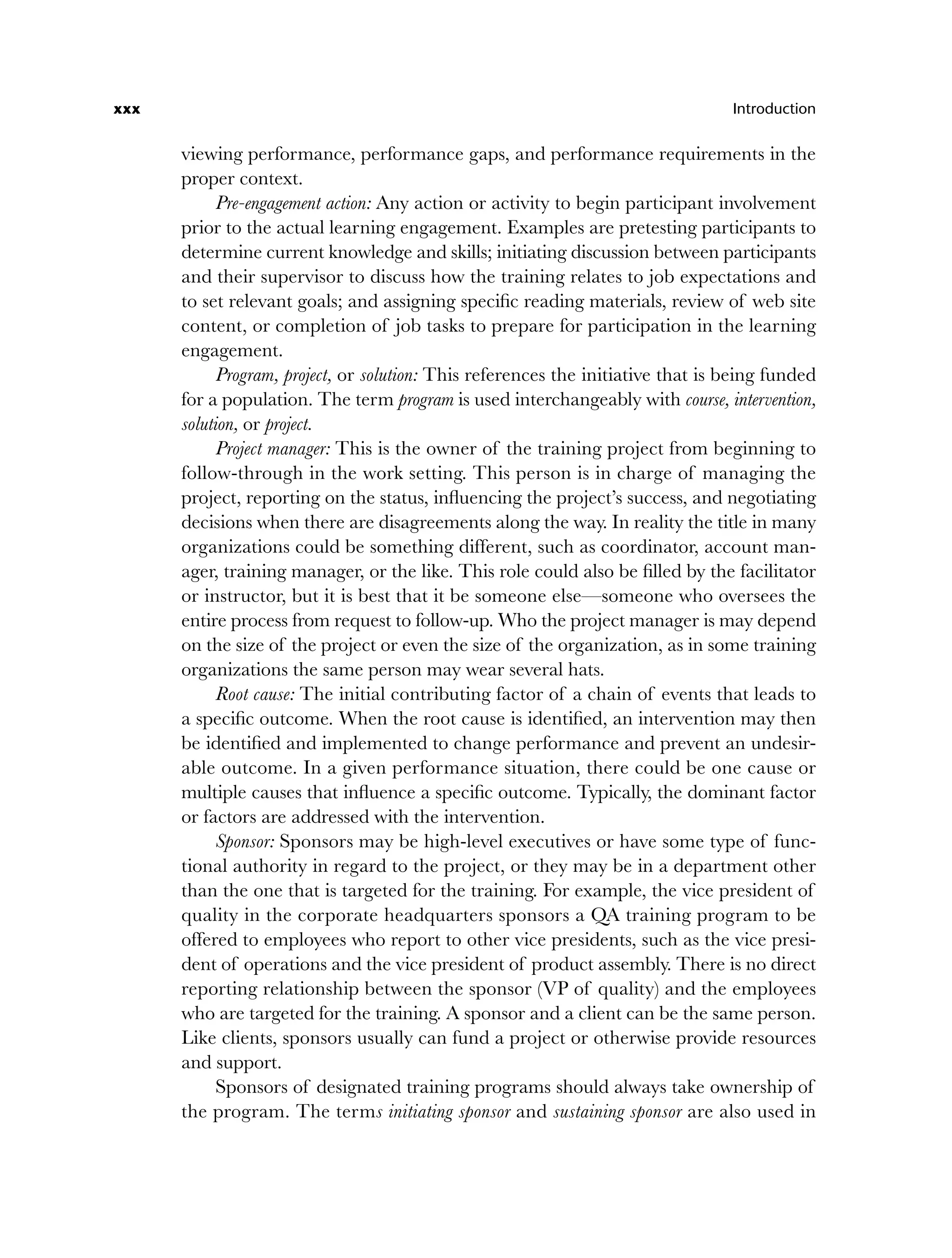

  • 64.
    The four olderversions, and also E, open with some lines that occur at the beginning of other ballads.[32] In A and E, and, we may add, G, the maid is allured by the promise of being taken to a paradise exempt from death and sorrow; C, D, F promise a train of handmaids and splendid presents. All the versions agree very well as to the kernel of the story. A false knight prevails upon a lady to elope with him, and they ride to a wood [they simply meet in a wood, H, K]. He sets to work digging a grave, which she says is too long for his [her] dog and too narrow for his [her] horse [all but F, H]. She is told that the grave is for her. He has taken away the life [and honor, B, C, I] of eight maids, and she shall be the ninth. The eight maids become nine kings' daughters in E, ten in F, nineteen in G, and in E and F the hard choice is offered of death by sword, tree, or stream. In A, E, I, L the knight bids the lady get her gold together before she sets out with him, and in D, H, K, L he points out a little knoll under which he keeps the gold of his previous victims. The maid now induces the knight to lie down with his head in her lap, professing a fond desire to render him the most homely of services[33] [not in C, G, I, K]. He makes an express condition in E, F, G, H, L that she shall not betray him in his sleep, and she calls Heaven to witness that she will not. In G she sings him to sleep. He slept a sleep that was not sweet. She binds him hand and foot, then cries, Wake up! I will not betray you in sleep.[34] Eight you have killed; yourself shall be the ninth. Entreaties and fair promises and pretences that he had been in jest, and desire for shrift, are in vain. Woman-fashion she drew his sword, but man-fashion she cut him down. She went home a maid. E, F, G, however, do not end so simply. On her way home through the wood [E], she comes upon a maid who is working gold, and who says, The last time I saw that horse my brother rode it. She answers, Your brother is dead, and will do no more murdering for gold; then turns her horse, and sets the sister's bower on fire. Next she encounters seven robbers on the heath, who recognize the horse as their master's, and are informed of his death and of the
  • 65.
    end of hiscrimes. They ask about the fire. She says it is an old pig- sty. She rides on, and they call to her that she is losing her horse's gold shoe. But nothing can stop her; she bids them pick it up and drink it in wine; and so comes home to her father's. F has nothing of the sister; in place of seven robbers there are nine of the robber's brothers, and the maid sets their house on fire. G indulges in absurd extravagances: the heroine meets the robber's sister with twelve fierce dogs, and then his twelve swains, and cuts down both dogs and swains. The names in the Danish ballads are, A, Ulver and Vænelil; B, Olmor, or Oldemor, and Vindelraad; C, Hollemen and Vendelraad; D, Romor, Reimord, or Reimvord, and the maid unnamed; F, Herr Peder and Liden Kirsten; H-L, Ribold, Rigbold [I, Rimmelil] and Guldborg. Four Swedish versions are known, all from tradition of this century. A, 'Den Falske Riddaren,' twenty-three two-line stanzas, Arwidsson, 44 B, I, 301. B, 'Röfvaren Brun,' fifteen stanzas, Afzelius, 83, III, 97. C, twenty-seven stanzas, Arwidsson, 44 A, I, 298. D, 'Röfvaren Rymer,' sixteen stanzas, Afzelius, 82, III, 94. A, B, D have resemblances, at the beginning, to the Ribold ballads, like the Danish A, B, E, G, while the beginning of C is like the Danish C, D, F. A has the grave-digging; there have been eight maids before; the knight lays his head in the lady's lap for the same reason as in most of the Danish ballads, and under the same assurance that he shall not be betrayed in sleep; he is bound, and conscientiously waked before his head is struck off; and the lady rides home to her father's. There have been eight previous victims in C, and they king's daughters; in B, eleven (maids); D says not how many, but, according to an explanation of the woman that sang it, there were seven princesses. C, D, like Danish E, F, G, make the maid encounter some of the robber's family on the way home. By a misconception, as we perceive by the Dutch ballad, she is represented as blowing the robber's horn. Seven sisters come at the familiar sound to bury the murdered girl and share the booty, but find that they have their brother to bury.
  • 66.
    The woman hasno name in any of the Swedish ballads. A calls the robber "an outlandish man" (en man ifrån fremmande land), B, simple Brun, C, a knight, and D, Riddaren Rymer, or Herr Rymer. Of Norwegian versions, but two have been printed: A, 'Svein Norðmann,' twenty two-line stanzas, Landstad, 69, p. 567; B, 'Rullemann og Hildeborg,' thirty stanzas, Landstad, 70, p. 571, both from recent recitation. Bugge has communicated eight others to Grundtvig. Both A and B have the paradise at the beginning, which is found in Danish A, E, G, and Swedish D. In both the lady gets her gold together while the swain is saddling his horse. They come to a grave already dug, which in B is said to be made so very wide because Rulleman has already laid nine maidens in it. The stanza in A which should give the number is lost, but the reciter or singer put it at seven or nine. The maid gets the robber into her power by the usual artifice, with a slight variation in B. According to A, she rides straight home to her father. B, like Danish F, has an encounter with her false lover's [five] brothers. They ask, Where is Rullemann, thy truelove? She answers, He is lying down, in the green mead, and bloody is his bridal bed. Of the unprinted versions obtained by Professor Bugge, two indicate that the murderer's sleep was induced by a spell, as in English A. F 9 has, Long time stood Gullbjör; to herself she thought, May none of my runes avail me ought? And H 18, as also a variant to B 20, says it was a rune-slumber that came over him. Only G, H, I, K give the number of the murdered women: in G, H, eight, in I, nine, in K, five. The names are, in A, Svein Norðmann and Guðbjörg; B, Rulleman and Hildeborg [or Signe]; C, D, E, F, Svein Nórmann and Gullbjör [Gunnbjör]; G, Rullemann and Kjersti; H, Rullball and Signelill; I, Alemarken and Valerós; K, Rulemann and a fair maid.
  • 67.
    Such information ashas transpired concerning Icelandic versions of this ballad is furnished by Grundtvig, IV, 4. The Icelandic form, though curtailed and much injured, has shown tenacity enough to preserve itself in a series of closely agreeing copies from the 17th century down. The eldest, from a manuscript of 1665, runs thus: 1 Ása went along the street, she heard a sweet sound. 2 Ása went into the house, she saw the villain bound. 3 'Little Ása, loose me! I will not beguile thee.' 4 'I dare not loose thee, I know not whether thou'lt beguile me.' 5 'God almighty take note who deceives the other!' 6 She loosed the bands from his hand, the fetter from his foot. 7 'Nine lands have I visited, ten women I've beguiled; 8 'Thou art now the eleventh, I'll not let thee slip.' A copy, from the beginning of the 18th century, has, in stanza 2, "Ása went into the wood," a recent copy, "over the fields;" and stanza 3, in the former, with but slight differences in all the modern copies, reads, Á
  • 68.
    'Welcome art thou,Ása maid! thou wilt mean to loose me.' Some recent copies (there is one in Berggreen, Danske Folkesange, 2d ed., I, 162) allow the maid to escape, adding, 9 'Wait for me a little space, whilst I go into the green wood.' 10 He waited for her a long time, but she never came back to him. 11 Ása took her white steed, of all women she rode most. 12 Ása went into a holy cell, never did she harm to man. This is certainly one of the most important of the German ballads, and additions are constantly making to a large number of known versions. Excepting two broadsides of about 1560, and two copies from recitation printed in 1778, all these, twenty-six in number, have been obtained from tradition since 1800.[35] They are as follows: A a, 'Gert Olbert,' 'Die Mörners Sang,' in Low German, as written down by William Grimm, in the early years of this century, 61 vv, Reifferscheid, p. 161, II. A b, "from the Münster region," communicated to Uhland by the Baroness Annette von Droste- Hüllshof, 46 vv, Uhland, I, 151, No 74 C; repeated in Mittler, No 79. A c, a fragment from the same source as the preceding, and written down at the beginning of this century, 35 vv, Reifferscheid, p. 161, I. B, 'Es wollt sich ein Markgraf ausreiten,' from Bökendorf, Westphalia, as taken down by W. Grimm, in 1813, 41 vv, Reifferscheid, p. 116. C a, 'Die Gerettete,' "from the Lower Rhine," twenty-six two-line stanzas, Zuccalmaglio, No 28, p. 66; Mittler, No 85. C b, eleven two-
  • 69.
    line stanzas, Montanus(== Zuccalmaglio) Die deutschen Volksfeste, p. 45. D, 'Von einem wackern Mägdlein, Odilia geheissen,' etc., from the Rhine, 34 vv [Longard], No 24, p. 48. E, 'Schondilie,' Menzenberg and Breitbach, 59 vv, Simrock, No 7, p. 19; Mittler, No 86. F, 'Jungfrau Linnich,' communicated by Zuccalmaglio as from the Rhine region, Berg and Mark, fourteen two-line stanzas, Erlach, IV, 598, and Kretzschmer (nearly), No 92, p. 164; Mittler, No 87. G a, 'Ulinger,' 120 vv, Nuremberg broadside "of about 1555" (Böhme) in Wunderhorn, ed. 1857, IV, 101, Böhme, No 13a , p. 56. G b c, Basel broadsides, "of about 1570" (Böhme), and of 1605, in Uhland, No 74 A, I, 141; Mittler, No 77. H, 'Adelger,' 120 vv, an Augsburg broadside, "of about 1560" (Böhme), Uhland, No 74 B, I, 146; Böhme, No 13b , p. 58; Mittler, No 76. I, 'Der Brautmörder,' in the dialect of the Kuhländchen (Northeast Moravia and Austrian Silesia), 87 vv, Meinert, p. 61; Mittler, No 80. J, 'Annele,' Swabian, from Hirrlingen and Obernau, 80 vv, Meier, Schwäbische V. L., No 168, p. 298. K, another Swabian version, from Hirrlingen, Immenried, and many other localities, 80 vv, Scherer, Jungbrunnen, No 5 B, p. 25. L a, from the Swabian-Würtemberg border, 81 VV, Birlinger, Schwäbisch- Augsburgisches Wörterbuch, p. 458. L b, [Birlinger], Schwäbische V. L., p. 159, from Immenried, nearly word for word the same. M, 'Der falsche Sänger,' 40 vv, Meier, No 167, p. 296. N, 'Es reitets ein Ritter durch Haber und Klee,' 43 vv, a fifth Swabian version, from Hirrlingen, Meier, p. 302. O, 'Alte Ballade die in Entlebuch noch gesungen wird,' twenty-three double stanzas, in the local dialect, Schweizerblätter von Henne und Reithard, 1833, IIr Jahrgang, 210- 12. P, 'Das Guggibader-Lied,' twenty-one treble stanzas (23?), in the Aargau dialect, Rochholz, Schweizersagen aus dem Aargau, I 24. Q, 'Es sitzt gut Ritter auf und ritt,' a copy taken down in 1815 by J. Grimm, from the recitation of a lady who had heard it as a child in German Bohemia, 74 vv, Reifferscheid, p. 162. R, 'Bie wrüe işt auv der ritterşmàn, 'in the dialect of Gottschee, Carniola, 86 vv, Schröer, Sitzungsberichte der Wiener Ak., phil-hist. Cl, LX, 462. S, 'Das Lied von dem falschen Rittersmann,' 60 vv, from Styria, Rosegger and Heuberger, Volkslieder aus Steiermark, No 19, p. 17. T, 'Ulrich und
  • 70.
    Ännchen,'[36] 49 vv,Herder's Volkslieder, 1778, I, 79; Mittler, No 78. U, 'Schön Ulrich und Roth-Aennchen,' 46 vv, in Taschenbuch für Dichter und Dichterfreunde, Abth. viii, 126, 1778, from Upper Lusatia (slightly altered by the contributor, Meissner); Mittler, No 84. A copy from Kapsdorf, in Hoffmann and Richter's Schlesische V. L., No 13, p. 27, is the same, differing by only three words. V, 'Schön- Aennelein,' 54 vv, from the eastern part of Brandenburg, Erk u. Irmer, 6th Heft, p. 64, No 56 (stanzas 4-8 from the preceding). W, 'Schön Ullerich und Hanselein,' twenty-nine two-line stanzas, from the neighborhood of Breslau, in Gräter's Idunna und Hermode, No 35, Aug. 29, 1812, following p. 140. The same in Schlesische V. L., No 12, p. 23, 'Schön Ulrich u. Rautendelein,' with a stanza (12) inserted; and Mittler, No 81. X, 'Der Albrecht u. der Hanselein,' 42 vv, from Natangen, East Prussia, in Neue preussische Provinzial- Blätter, 2d series, III, 158, No 8. Y, 'Ulrich u. Annle,' nineteen two- line stanzas, a second Kuhländchen version, Meinert, p. 66; Mittler, No 83. Z a, 'Von einem frechen Räuber, Herr Ulrich geheissen,' nineteen two-line stanzas, from the Rhine [Longard], No 23, p. 46. Z b, 'Ulrich,' as sung on the Lower Rhine, the same ballad, with unimportant verbal differences, and the insertion of one stanza (7, the editor's?), Zuccalmaglio, No 15, p. 39; Mittler, No 82. The German ballads, as Grundtvig has pointed out, divide into three well-marked classes. The first class, embracing the versions A-F (6), and coming nearest to English and Dutch tradition, has been found along the lower half of the Rhine and in Westphalia, or in Northwest Germany; the second, including G-S (13), is met with in Swabia, Switzerland, Bohemia, Moravia, Styria, Carniola, or in South Germany; the third, T-Z (7), in East Prussia, the eastern part of Brandenburg and of Saxony, Silesia, and, again, Moravia, or, roughly speaking, in North and East Germany; but, besides the Moravian, there is also of this third class one version, in two copies, from the Rhine. (I.) A runs thus. She that would ride out with Gert Olbert must dress in silk and gold. When fair Helena had so attired herself, she called
  • 71.
    from her window,Gert Olbert, come and fetch the bride. He took her by her silken gown and swung her on behind him, and they rode three days and nights. Helena then said, We must eat and drink; but Gert Olbert said, We must go on further. They rode over the green heath, and Helena once more tenderly asked for refreshment. Under yon fir [linden], said Gert Olbert, and kept on till they came to a green spot, where nine maids were hanging. Then it was, Wilt thou choose the fir-tree, the running stream, or the naked sword? She chose the sword, but begged him to take off his silken coat, "for a maid's blood spirts far, and I should be sorry to spatter it." While he was engaged in drawing off his coat, she cut off his head. But still the false tongue spoke. It bade her blow in his horn; then she would have company enough. She was not so simple as to do this. She rode three days and nights, and blew the horn when she reached her father's castle. Then all the murderers came running, like hounds after a hare. Frau Clara [Jutte] called out, Where is my son? Under the fir-tree, sporting with nine maids; he meant me to be the tenth, said Helena. B is the same story told of a margrave and Fair Annie, but some important early stanzas are lost, and the final ones have suffered injury; for the ballad ends with this conceit, "She put the horn to her mouth, and blew the margrave quite out of her heart." Here, by a transference exceedingly common in tradition, it is the man, and not the maid, that "would ride in velvet and silk and red gold." C a has the names Odilia and Hilsinger, a trooper (reiter). Odilia was early left an orphan, and as she grew up "she grew into the trooper's bosom." He offered her seven pounds of gold to be his, and "she thought seven pounds of gold a good thing." We now fall into the track of A. Odilia dresses herself like a bride, and calls to the trooper to come and get her. They ride first to a high hill, where she asks to eat and drink, and then go on to a linden-tree, on which seven maids are hanging. The choice of three deaths is offered, the sword chosen, he is entreated to spare his coat, she seizes his sword and hews off his head. The false tongue suggests blowing the horn. Odilia thinks "much biding or blowing is not good." She rides away,
  • 72.
    and presently meetsthe trooper's "little foot-page" (bot), who fancies she has Hilsinger's horse and sword. "He sleeps," she says, "with seven maids, and thought I was to be the eighth." This copy concludes with a manifestly spurious stanza. C b agrees with C a for ten stanzas, as to the matter, and so far seems to be C a improved by Zuccalmaglio, with such substitutions as a princely castle for "seven pounds of gold." The last stanza (11), Und als die Sternlein am Himmel klar, Ottilia die achte der Todten war, was, no doubt, suggested by the last of F, another of Zuccalmaglio's versions, and, if genuine, would belong to a ballad of the third class. D has the name Odilia for the maid, but the knight, or trooper, has become expressly a robber (ritter, reiter, räuber). They ride to a green heath, where there is a cool spring. Odilia asks for and gets a draught of water, and is told that at the linden-tree there will be eating and drinking for them. And when they come to the linden, there hang six, seven maids! All proceeds as before. The talking head is lost. Odilia meets the robber's mother, and makes the usual reply.[37] E resembles C closely. Odilia becomes Schondilg (Schön Odilie), Räuber returns to Ritter, or Reiter, and the servant-maid bribe of seven pounds of gold rises to ten tons.[38] Schondilg's toilet, preparatory to going off (6-8), is described with a minuteness that we find only in the Dutch ballad (12-16). After this, there is no important variation. She meets the trooper's three brothers, and makes the same replies to them as to the mother in D. F. The personages here are Linnich (i.e., Nellie) and a knight from England. The first twelve stanzas do not diverge from C, D, E. In stanza 13 we find the knight directing the lady to strip off her silk gown and gold necklace, as in the English C, D, E; but certainly this inversion of the procedure which obtains in German C, D, E is an accident arising from confused recollection. The 14th and last stanza
  • 73.
    similarly misunderstands themaid's feigned anxiety about the knight's fine coat, and brings the ballad to a false close, resembling the termination of those of the third class, still more those of certain mixed forms to be spoken of presently. (II.) The second series, G-S, has three or four traits that are not found in the foregoing ballads. G, which, as well as H, was in print more than two hundred years before any other copy is known to have been taken down, begins, like the Dutch Halewijn, with a knight (Ulinger) singing so sweetly that a maid (Fridburg) is filled with desire to go off with him. He promises to teach her his art. This magical song is wanting only in R, of class II, and the promise to teach it only in Q, R. She attires herself splendidly; he swings her on to his horse behind him, and they ride to a wood. When they came to the wood there was no one there but a white dove on a hazel- bush, that sang, Listen, Fridburg: Ulinger has hanged eleven[39] maids; the twelfth is in his clutches. Fridburg asked what the dove was saying. Ulinger replied, It takes me for another; it lies in its red bill; and rode on till it suited him to alight. He spread his cloak on the grass, and asked her to sit down: Er sprach sie solt ihm lausen, Sein gelbes Haar zerzausen.[40] Looking up into her eyes, he saw tears, and asked why she was weeping. Was it for her sorry husband? Not for her sorry husband, she said. But here some stanzas, which belong to another ballad,[41] have crept in, and she is, with no reason, made to ride further on. She comes to a lofty fir, and eleven maids hanging on it. She wrings her hands and tears her hair, and implores Ulinger to let her be hanged in her clothes as she is. 'Ask me not that, Fridburg,' he said; 'Ask me not that, thou good young maid; Thy scarlet mantle and kirtle black Will well become my young sister's back.'
  • 74.
    Then she begsto be allowed three cries. 'So much I may allow thee well, Thou art so deep within the dell; So deep within the dell we lie, No man can ever hear thy cry.' She cries, "Help, Jesu!" "Help, Mary!" "Help, dear brother!" 'For if thou come not straight, For my life 't will be too late!' Her brother seems to hear his sister's voice "in every sense." He let his falcon fly, Rode off with hounds in full cry; With all the haste he could He sped to the dusky wood. 'What dost thou here, my Ulinger? What dost thou here, my master dear?' 'Twisting a withe, and that is all, To make a halter for my foal.' 'Twisting a withe, and that is all, To make a halter for thy foal! I swear by my troth thus shall it be, Thyself shalt be the foal for me.' 'Then this I beg, my Fridburger, Then this I beg, my master dear, That thou wilt let me hang In my clothes as now I stand.' 'Ask me not that, thou Ulinger, Ask me not that, false perjurer; Thy scarlet mantle and jerkin black
  • 75.
    Will well becomemy scullion's back.' His shield before his breast he slung, Behind him his fair sister swung, And so he hied away Where his father's kingdom lay. H, the nearly contemporaneous Augsburg broadside, differs from G in only one important particular. The "reuter" is Adelger, the lady unnamed. A stanza is lost between 6 and 7, which should contain the warning of the dove, and so is Adelger's version of what the bird had said. The important feature in H, not present in G, is that the halt is made near a spring, about which blood is streaming, "der war mit blut umbrunnenn." This adds a horror to this powerful scene which well suits with it. When the maid begins to weep, Adelger asks whether her tears are for her father's land, or because she dislikes him so much. It is for neither reason, but because on yon fir she sees eleven maids hanging. He confirms her fears: 'Ah, thou fair young lady fine, O palsgravine, O empress mine, Adelger 's killed his eleven before, Thou 'lt be the twelfth, of that be sure.'[42] The last two lines seem, by their form, to be the dove's warning that has dropped out between stanzas 6 and 7. The maid's clothes in H are destined to be the perquisite of Adelger's mother, and the brother says that Adelger's are to go to his shield-bearer. The unhappy maid cries but twice, to the Virgin and to her brother. When surprised by the brother, Adelger feigns to be twisting a withe for his falcon. I begins, like G, H, with the knight's seductive song. Instead of the dove directly warning the maid, it upbraids the man: "Whither now, thou Ollegehr?[43] Eight hast thou murdered already; and now for the ninth!" The maid asks what the dove means, and is told to ride on, and not mind the dove, who takes him for another man. There
  • 76.
    Welcome to ourwebsite – the perfect destination for book lovers and knowledge seekers. We believe that every book holds a new world, offering opportunities for learning, discovery, and personal growth. That’s why we are dedicated to bringing you a diverse collection of books, ranging from classic literature and specialized publications to self-development guides and children's books. More than just a book-buying platform, we strive to be a bridge connecting you with timeless cultural and intellectual values. With an elegant, user-friendly interface and a smart search system, you can quickly find the books that best suit your interests. Additionally, our special promotions and home delivery services help you save time and fully enjoy the joy of reading. Join us on a journey of knowledge exploration, passion nurturing, and personal growth every day! ebookbell.com