Data Structures And Algorithm
Overview
Chapter 1
What is Data Structure?
•Definition: A data structure is a way to store and
organize data to facilitate access and
modifications. It represents the logical
relationship between individual data elements
related to solving a specific problem.
•Example: Arrays, Linked Lists, Stacks, Queues.
Why Learn Data Structures and Algorithms?
•Data Search: Efficient searching in large datasets.
•Processor Speed: Improves performance by
optimizing data handling.
•Multiple Requests: Helps manage concurrent
data requests efficiently.
Characteristics of Data Structure:
•Correctness: Implement the interface correctly.
•Time Complexity: Minimize the running time of
operations.
•Space Complexity: Minimize memory usage.
Execution Time Cases:
•Worst Case: Maximum time taken.
•Average Case: Average time taken.
•Best Case: Minimum time taken.
What is an Algorithm?
• Definition: A step-by-step procedure to perform operations on
data.
• Categories:
• Search: Find an item.
• Sort: Arrange items.
• Insert: Add an item.
• Update: Modify an item.
• Delete: Remove an item.
Characteristics of an Algorithm:
• Unambiguous: Clear and well-defined steps.
• Input/Output: Should have well-defined inputs and outputs.
• Finiteness: Should terminate after a finite number of steps.
• Feasibility: Must be possible with available resources.
• Independence: Should be independent of programming
languages.
Algorithm Complexity:
•Time Factor: Count key operations (e.g.,
comparisons in sorting).
•Space Factor: Measure maximum memory
required.
BASIC DATA STRUCTURES
1. Linear Data Structures
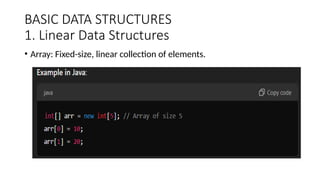
• Array: Fixed-size, linear collection of elements.
BASIC DATA STRUCTURES
1. Linear Data Structures
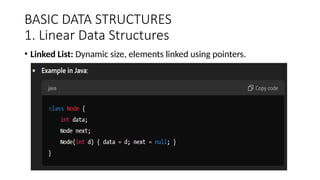
• Linked List: Dynamic size, elements linked using pointers.
BASIC DATA STRUCTURES
1. Linear Data Structures
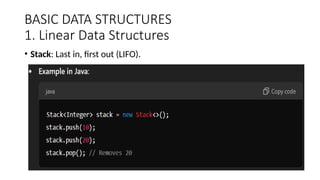
• Stack: Last in, first out (LIFO).
BASIC DATA STRUCTURES
1. Linear Data Structures
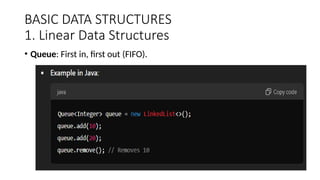
• Queue: First in, first out (FIFO).
BASIC DATA STRUCTURES
1. Non-Linear Data Structures
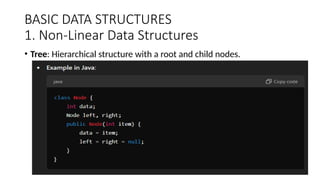
• Tree: Hierarchical structure with a root and child nodes.
BASIC DATA STRUCTURES
1. Non-Linear Data Structures
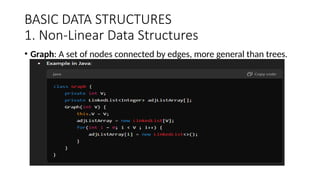
• Graph: A set of nodes connected by edges, more general than trees.
Queue vs. Stack: Understanding the
Differences
• Stack:
• Definition: A stack is a linear data structure that follows the Last In,
First Out (LIFO) principle.
• Operations:
• Push: Add an element to the top of the stack.
• Pop: Remove the element from the top of the stack.
• Peek: Retrieve the element at the top without removing it.
• Real-Life Analogy: Think of a stack of plates. You can only take the top
plate off the stack and add a new one on top.
Queue vs. Stack: Understanding the
Differences
• Queue:
• Definition: A queue is a linear data structure that follows the First In,
First Out (FIFO) principle.
• Operations:
• Enqueue: Add an element to the back of the queue.
• Dequeue: Remove the element from the front of the queue.
• Front: Retrieve the element at the front without removing it.
• Real-Life Analogy: Think of a line of people waiting for a bus. The first
person in line is the first to get on the bus.
Queue vs. Stack: Understanding the
Differences
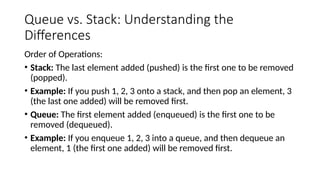
Order of Operations:
• Stack: The last element added (pushed) is the first one to be removed
(popped).
• Example: If you push 1, 2, 3 onto a stack, and then pop an element, 3
(the last one added) will be removed first.
• Queue: The first element added (enqueued) is the first one to be
removed (dequeued).
• Example: If you enqueue 1, 2, 3 into a queue, and then dequeue an
element, 1 (the first one added) will be removed first.
Queue vs. Stack: Understanding the Differences

algorithms and data structure for java person

  • 1.
    Data Structures AndAlgorithm Overview Chapter 1
  • 2.
    What is DataStructure? •Definition: A data structure is a way to store and organize data to facilitate access and modifications. It represents the logical relationship between individual data elements related to solving a specific problem. •Example: Arrays, Linked Lists, Stacks, Queues.
  • 3.
    Why Learn DataStructures and Algorithms? •Data Search: Efficient searching in large datasets. •Processor Speed: Improves performance by optimizing data handling. •Multiple Requests: Helps manage concurrent data requests efficiently.
  • 4.
    Characteristics of DataStructure: •Correctness: Implement the interface correctly. •Time Complexity: Minimize the running time of operations. •Space Complexity: Minimize memory usage.
  • 5.
    Execution Time Cases: •WorstCase: Maximum time taken. •Average Case: Average time taken. •Best Case: Minimum time taken.
  • 6.
    What is anAlgorithm? • Definition: A step-by-step procedure to perform operations on data. • Categories: • Search: Find an item. • Sort: Arrange items. • Insert: Add an item. • Update: Modify an item. • Delete: Remove an item.
  • 7.
    Characteristics of anAlgorithm: • Unambiguous: Clear and well-defined steps. • Input/Output: Should have well-defined inputs and outputs. • Finiteness: Should terminate after a finite number of steps. • Feasibility: Must be possible with available resources. • Independence: Should be independent of programming languages.
  • 8.
    Algorithm Complexity: •Time Factor:Count key operations (e.g., comparisons in sorting). •Space Factor: Measure maximum memory required.
  • 9.
    BASIC DATA STRUCTURES 1.Linear Data Structures • Array: Fixed-size, linear collection of elements.
  • 10.
    BASIC DATA STRUCTURES 1.Linear Data Structures • Linked List: Dynamic size, elements linked using pointers.
  • 11.
    BASIC DATA STRUCTURES 1.Linear Data Structures • Stack: Last in, first out (LIFO).
  • 12.
    BASIC DATA STRUCTURES 1.Linear Data Structures • Queue: First in, first out (FIFO).
  • 13.
    BASIC DATA STRUCTURES 1.Non-Linear Data Structures • Tree: Hierarchical structure with a root and child nodes.
  • 14.
    BASIC DATA STRUCTURES 1.Non-Linear Data Structures • Graph: A set of nodes connected by edges, more general than trees.
  • 15.
    Queue vs. Stack:Understanding the Differences • Stack: • Definition: A stack is a linear data structure that follows the Last In, First Out (LIFO) principle. • Operations: • Push: Add an element to the top of the stack. • Pop: Remove the element from the top of the stack. • Peek: Retrieve the element at the top without removing it. • Real-Life Analogy: Think of a stack of plates. You can only take the top plate off the stack and add a new one on top.
  • 16.
    Queue vs. Stack:Understanding the Differences • Queue: • Definition: A queue is a linear data structure that follows the First In, First Out (FIFO) principle. • Operations: • Enqueue: Add an element to the back of the queue. • Dequeue: Remove the element from the front of the queue. • Front: Retrieve the element at the front without removing it. • Real-Life Analogy: Think of a line of people waiting for a bus. The first person in line is the first to get on the bus.
  • 17.
    Queue vs. Stack:Understanding the Differences Order of Operations: • Stack: The last element added (pushed) is the first one to be removed (popped). • Example: If you push 1, 2, 3 onto a stack, and then pop an element, 3 (the last one added) will be removed first. • Queue: The first element added (enqueued) is the first one to be removed (dequeued). • Example: If you enqueue 1, 2, 3 into a queue, and then dequeue an element, 1 (the first one added) will be removed first.
  • 18.
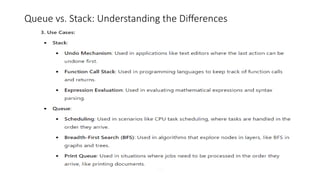
    Queue vs. Stack:Understanding the Differences
  • 19.
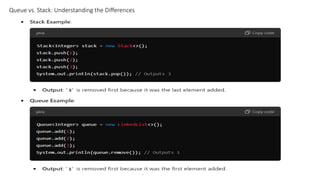
    Queue vs. Stack:Understanding the Differences