TIC424 – Complexity of
Algorithms
Prof. Magdy M. Aboul-Ela
Information Systems Department
Faculty of Management and Information Systems
French University in Egypt
Email: magdy.aboulela@ufe.edu.eg
maboulela@gmail.com
maboulela@link.net
The exercises are drawn from:
A. Levitin “Introduction to the Design & Analysis of
Algorithms,” 2nd ed., Copyright © 2007 Pearson
Addison-Wesley. All rights reserved.
Complexity of Algorithms
Exercises
.
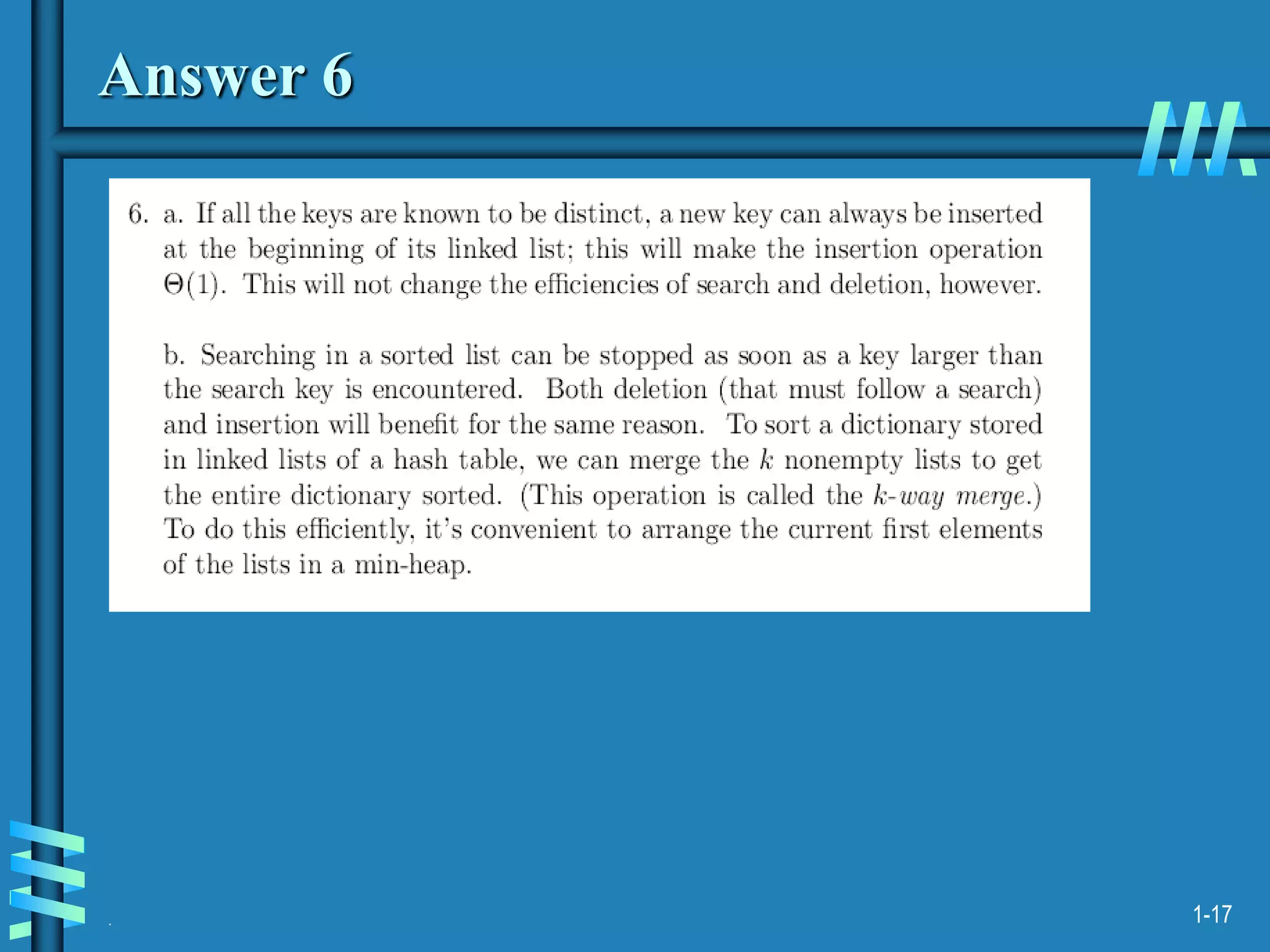
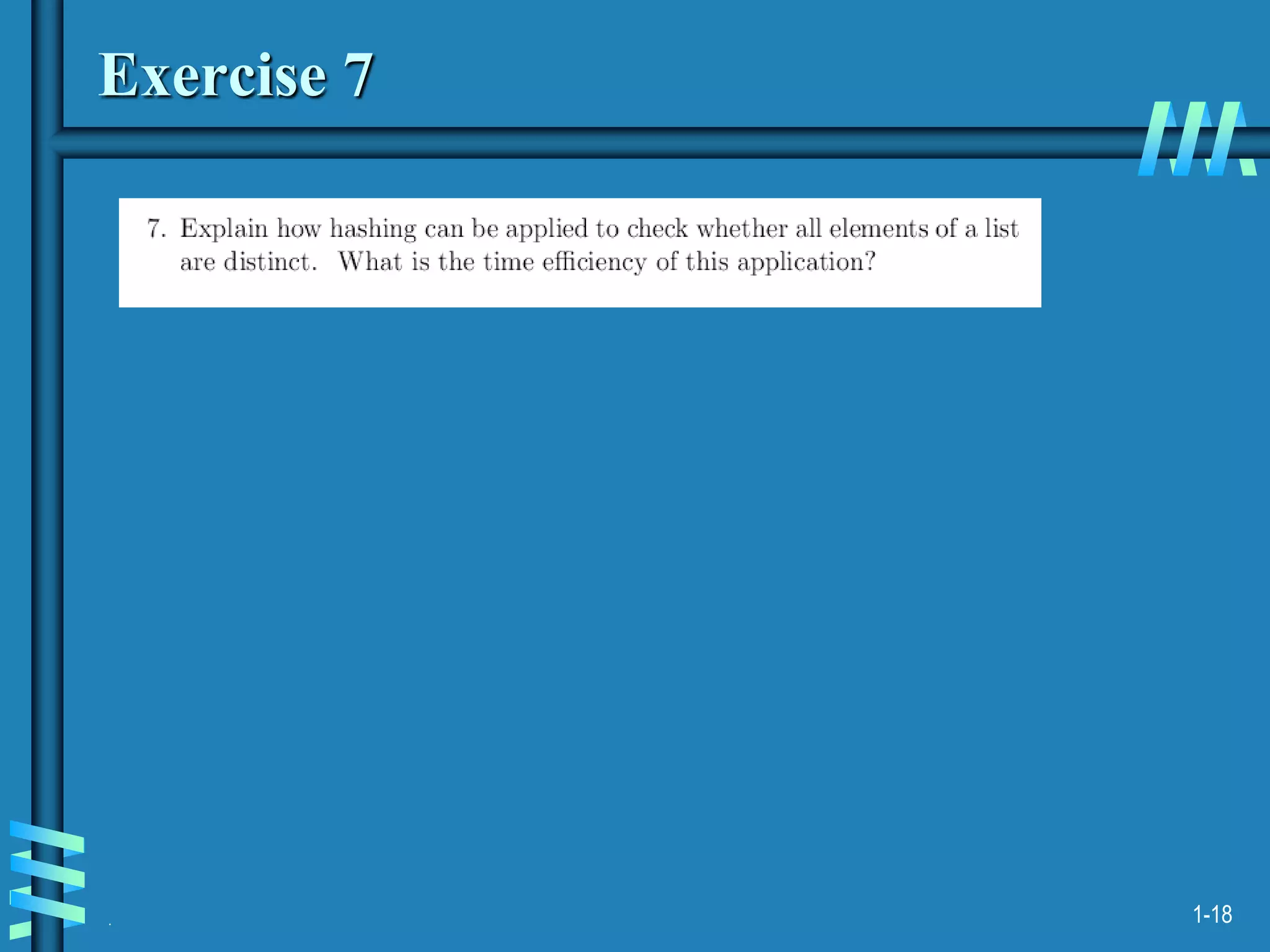
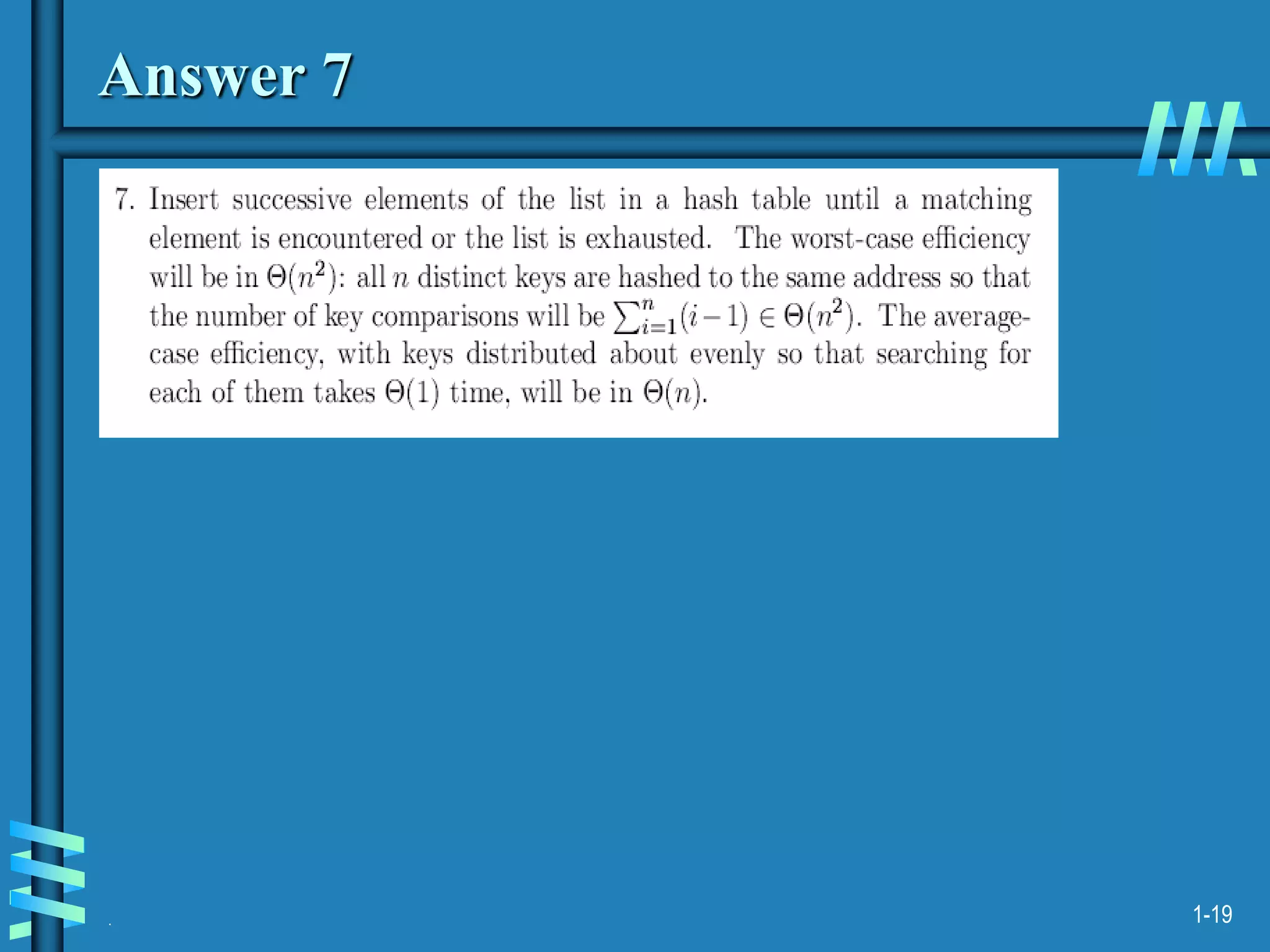
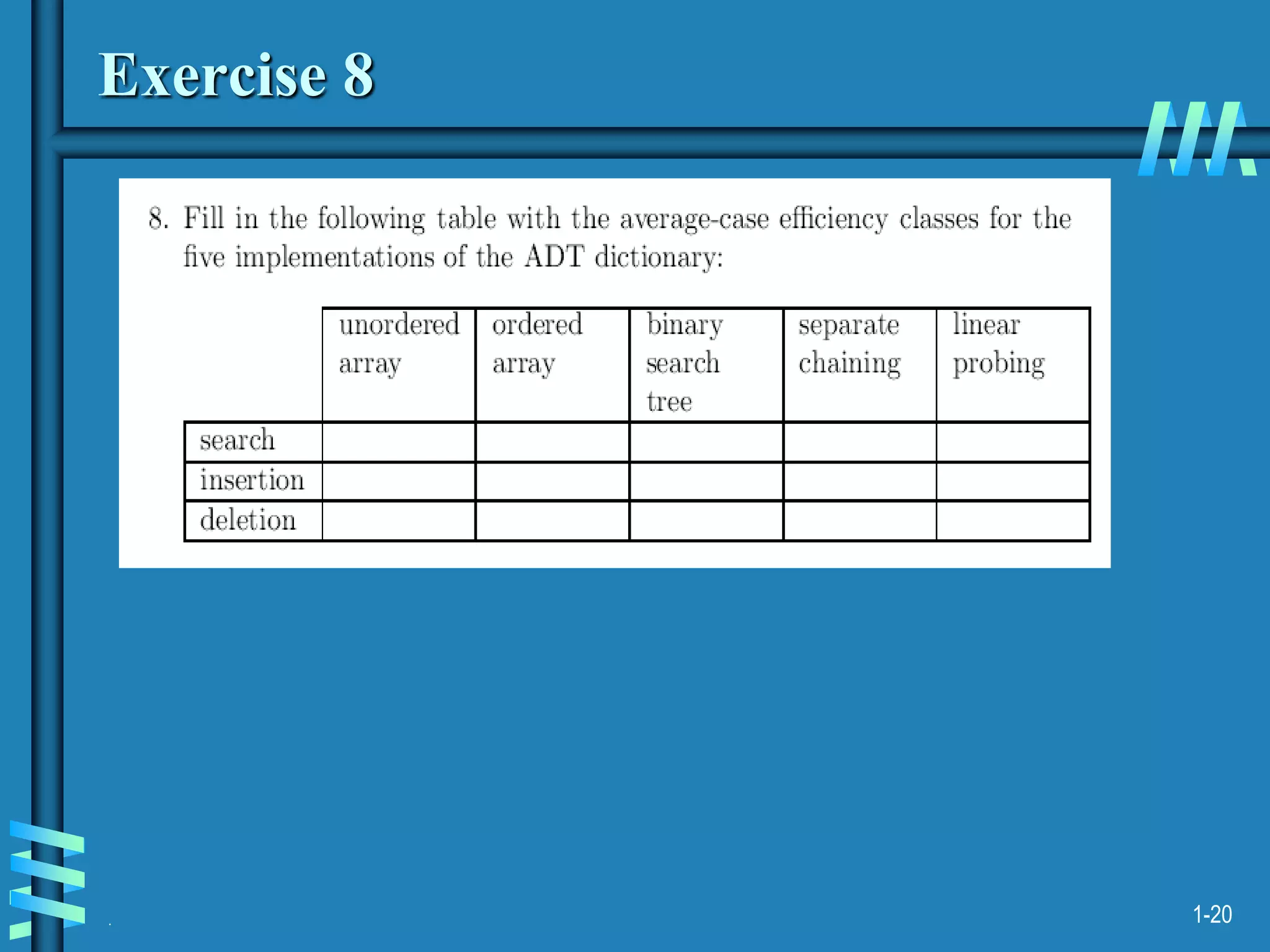
Hash tables and hash functions
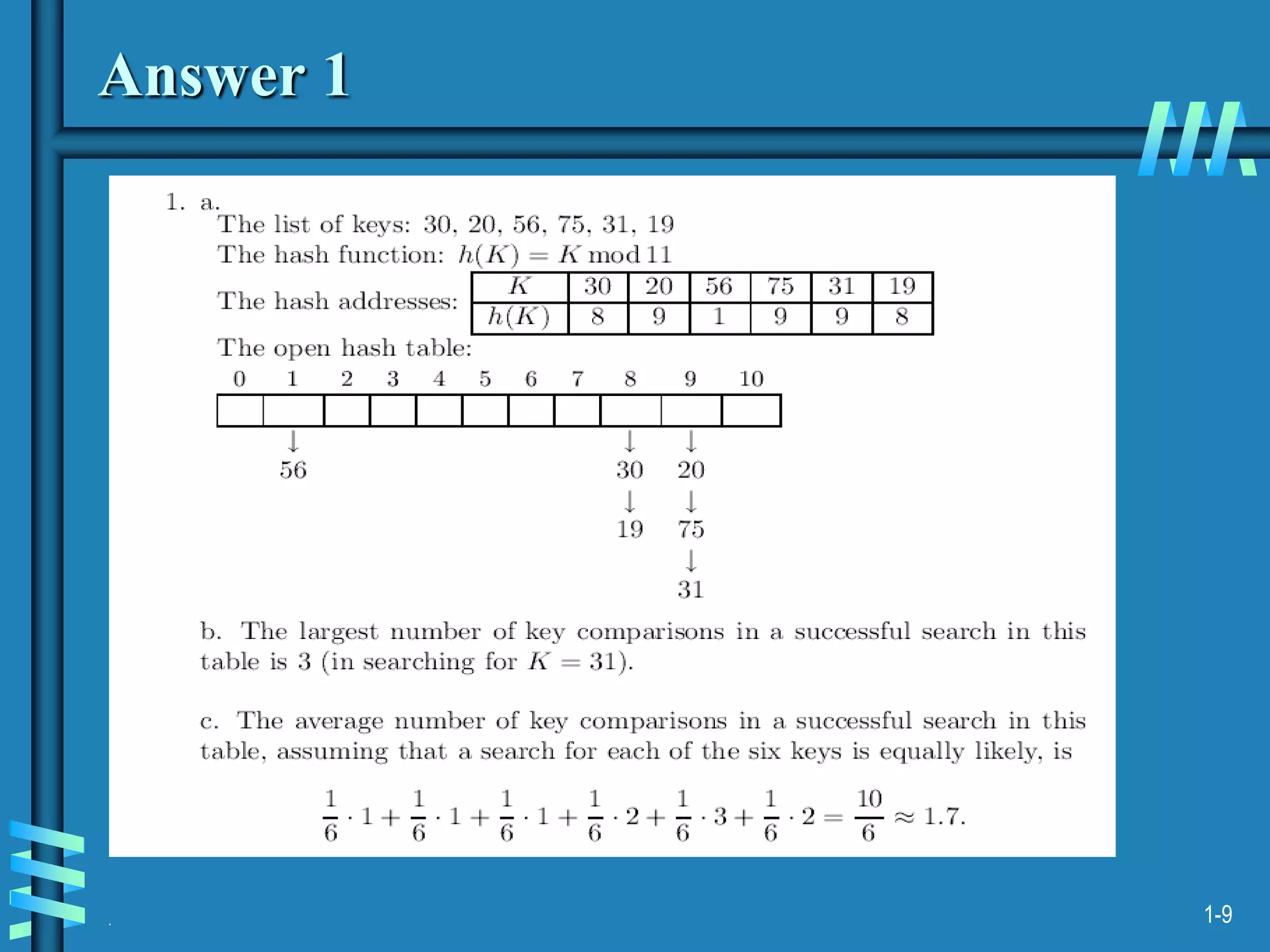
The idea of hashing is to map keys of a given file of size n into
a table of size m, called the hash table, by using a predefined
function, called the hash function,
h: K  location (cell) in the hash table
Example: student records, key = SSN. Hash function:
h(K) = K mod m where m is some integer (typically, prime)
If m = 1000, where is record with SSN= 314159265 stored?
Generally, a hash function should:
• be easy to compute
• distribute keys about evenly throughout the hash table
.
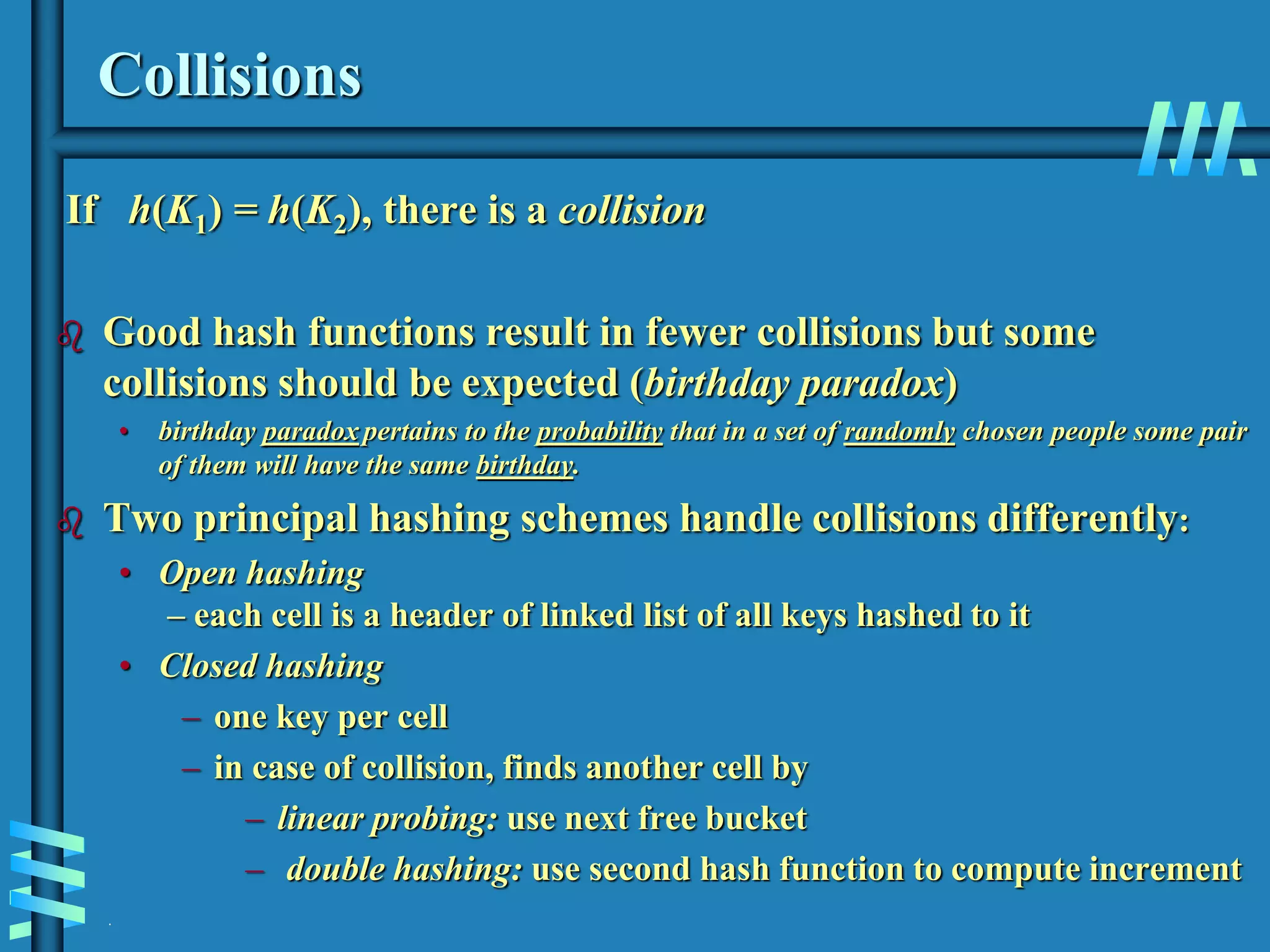
Collisions
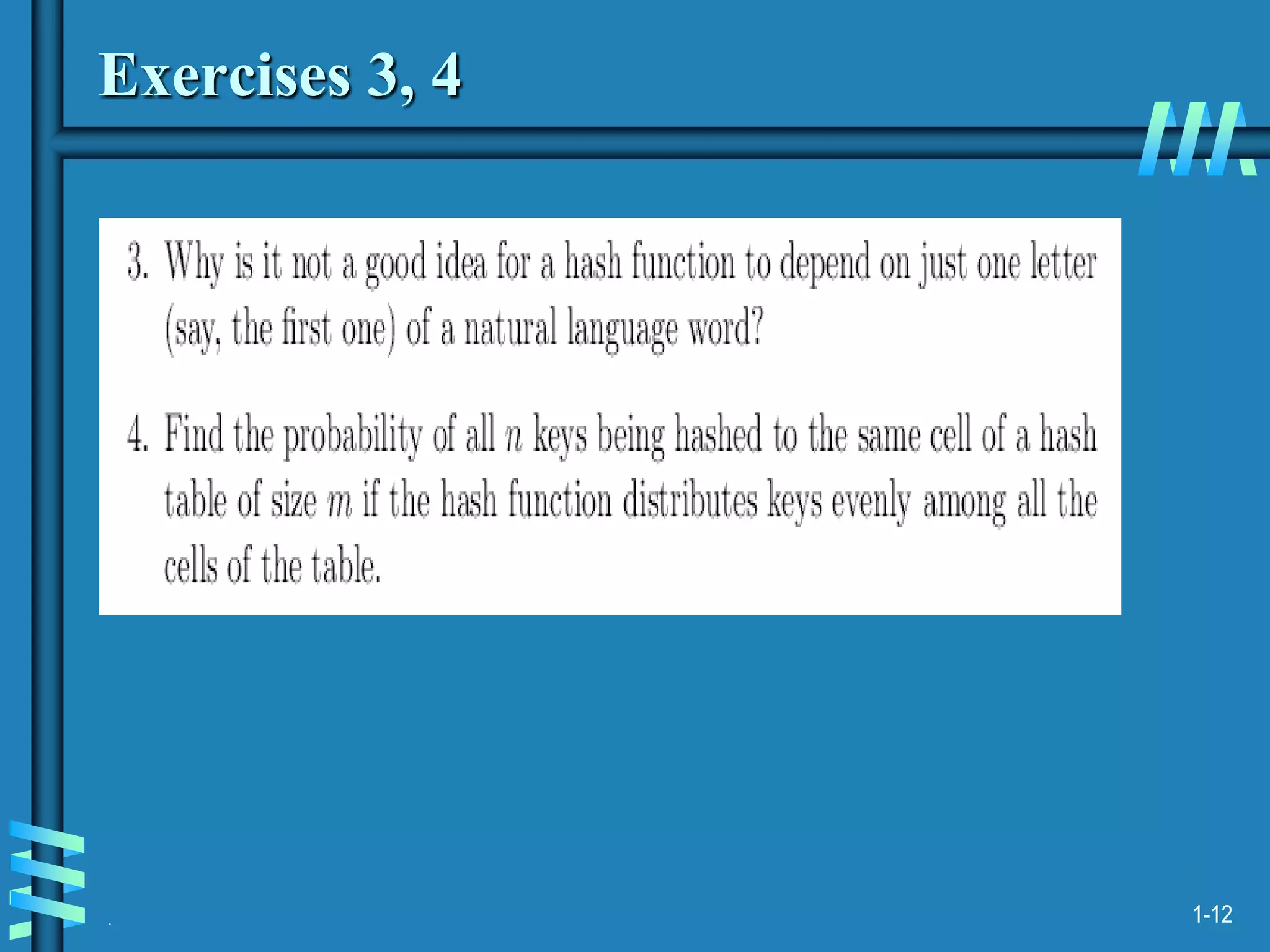
If h(K1) = h(K2), there is a collision
 Good hash functions result in fewer collisions but some
collisions should be expected (birthday paradox)
• birthday paradox pertains to the probability that in a set of randomly chosen people some pair
of them will have the same birthday.
 Two principal hashing schemes handle collisions differently:
• Open hashing
– each cell is a header of linked list of all keys hashed to it
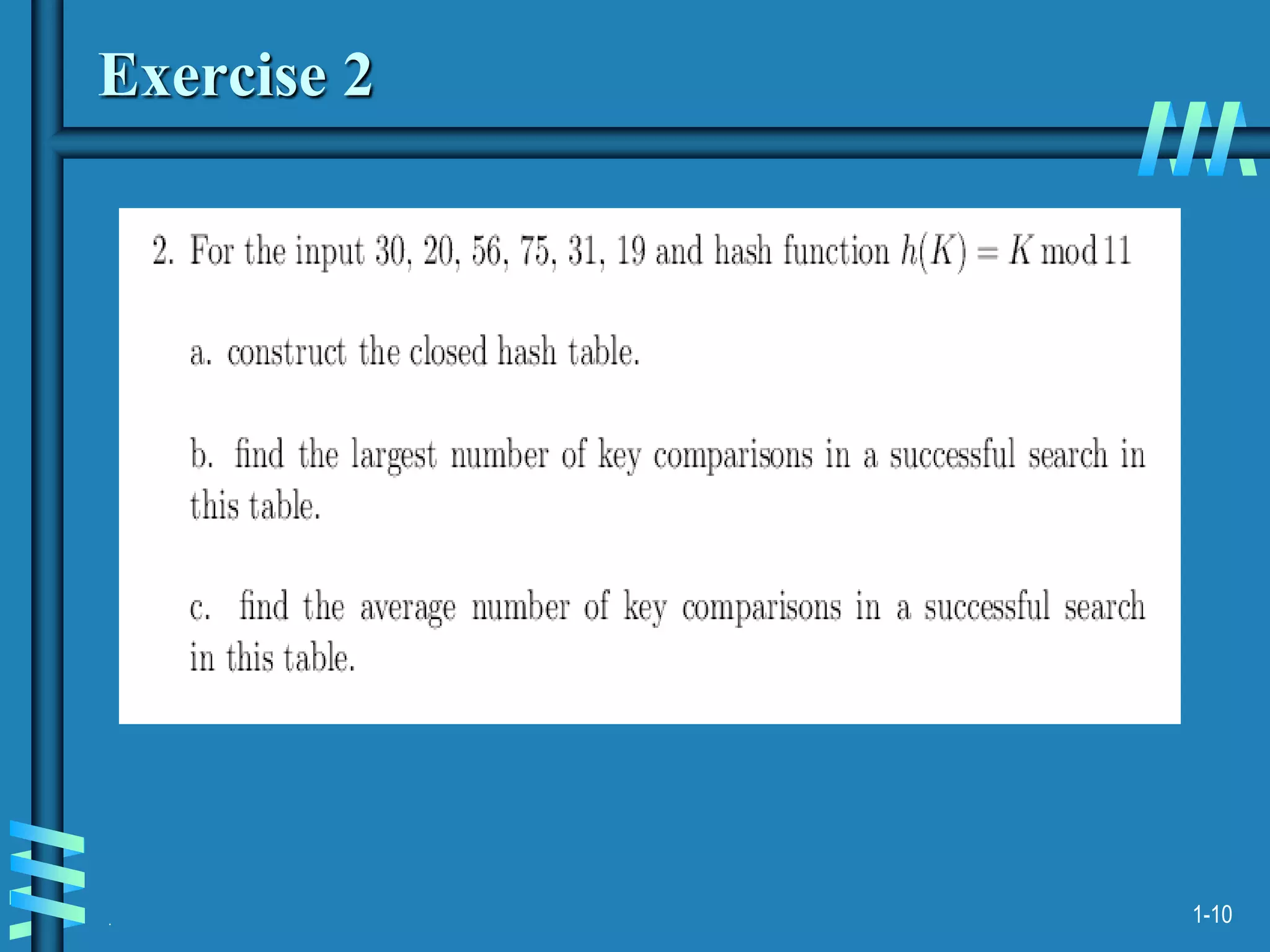
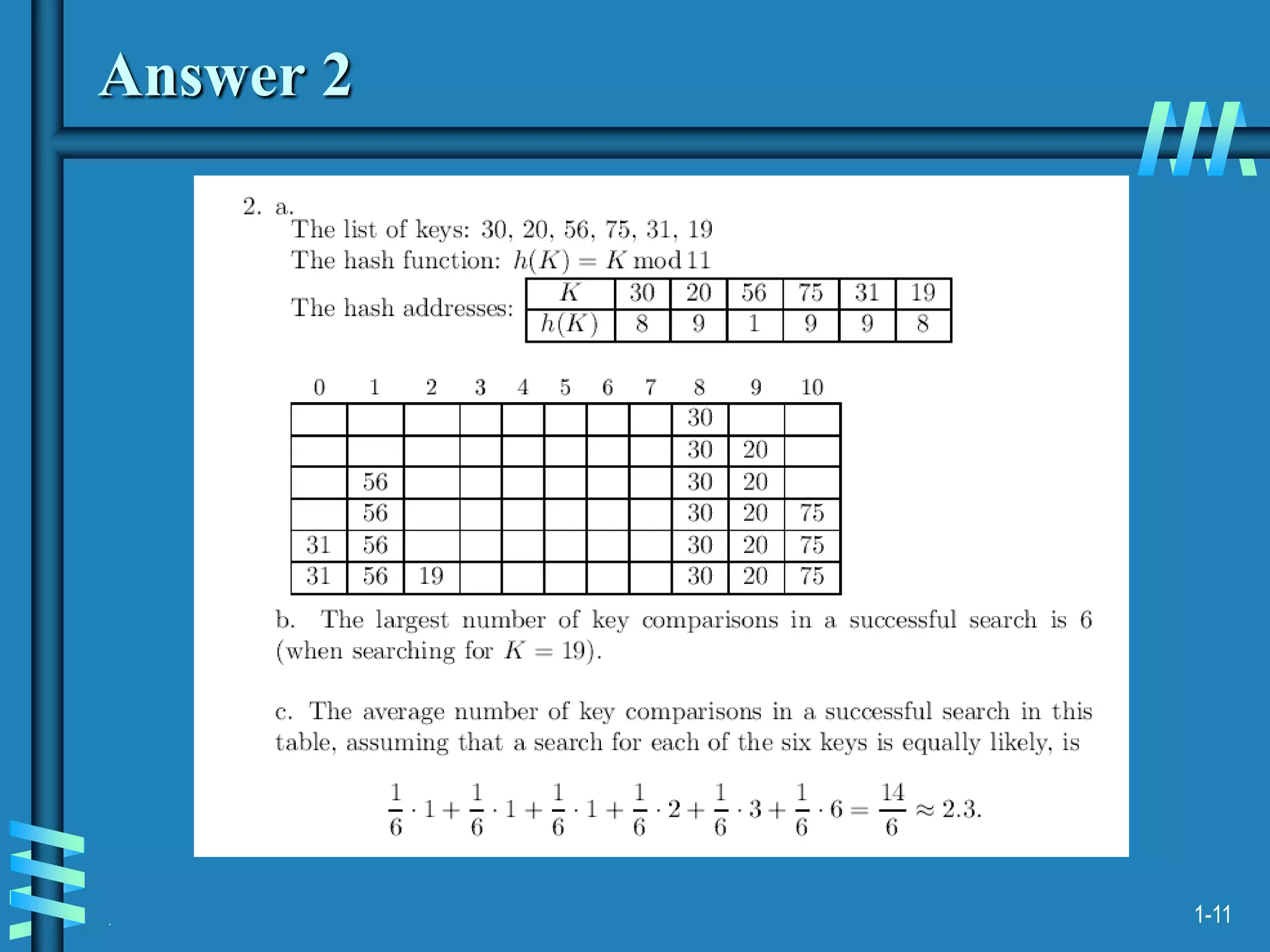
• Closed hashing
– one key per cell
– in case of collision, finds another cell by
– linear probing: use next free bucket
– double hashing: use second hash function to compute increment
.
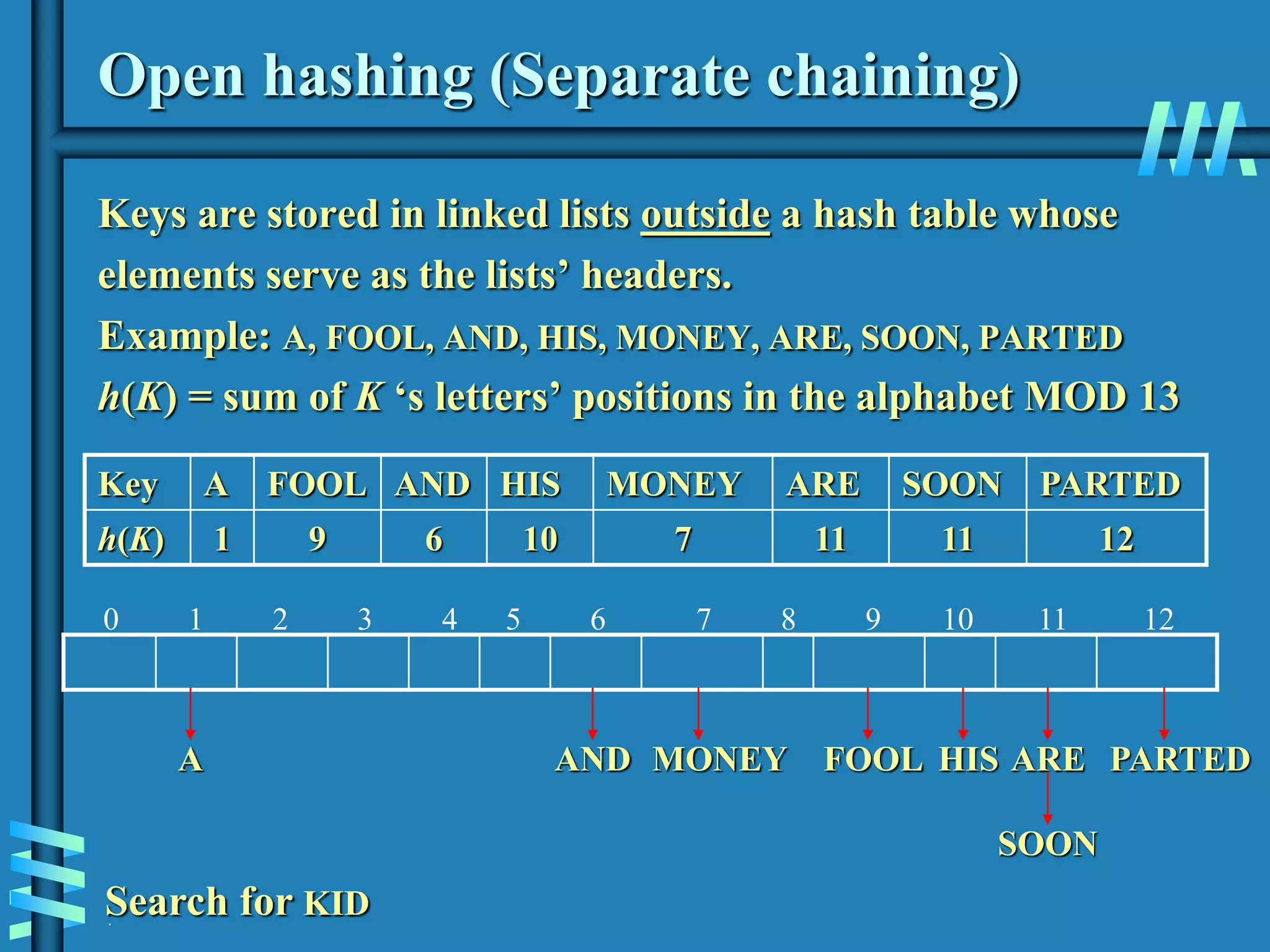
Open hashing (Separate chaining)
Keys are stored in linked lists outside a hash table whose
elements serve as the lists’ headers.
Example: A, FOOL, AND, HIS, MONEY, ARE, SOON, PARTED
h(K) = sum of K ‘s letters’ positions in the alphabet MOD 13
Key A FOOL AND HIS MONEY ARE SOON PARTED
h(K) 1 9 6 10 7 11 11 12
A FOOL
AND HIS
MONEY ARE PARTED
SOON
12
11
10
9
8
7
6
5
4
3
2
1
0
Search for KID
.
Open hashing (cont.)
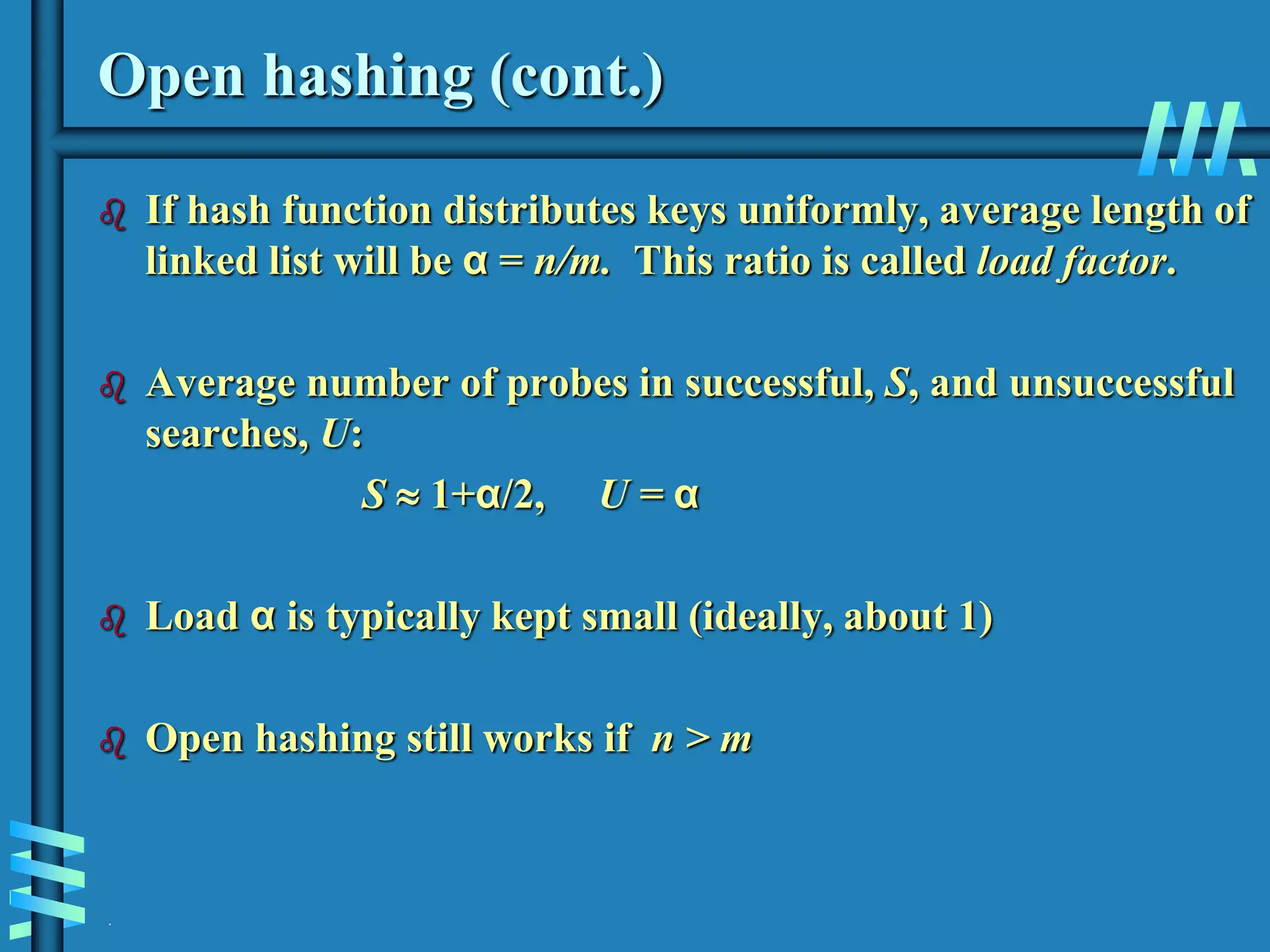
 If hash function distributes keys uniformly, average length of
linked list will be α = n/m. This ratio is called load factor.
 Average number of probes in successful, S, and unsuccessful
searches, U:
S  1+α/2, U = α
 Load α is typically kept small (ideally, about 1)
 Open hashing still works if n > m
.
Closed hashing (Open addressing)
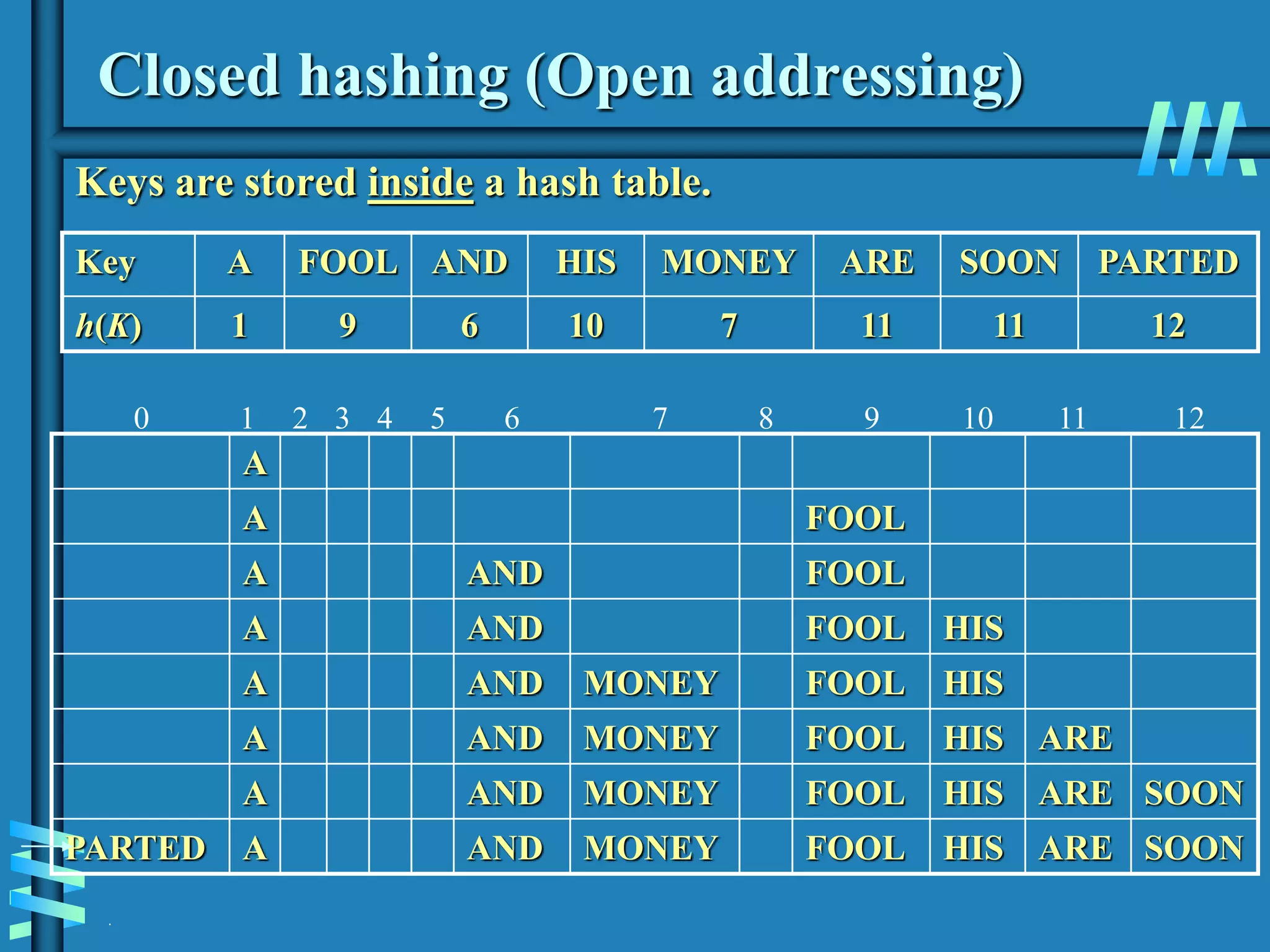
Keys are stored inside a hash table.
A
A FOOL
A AND FOOL
A AND FOOL HIS
A AND MONEY FOOL HIS
A AND MONEY FOOL HIS ARE
A AND MONEY FOOL HIS ARE SOON
PARTED A AND MONEY FOOL HIS ARE SOON
Key A FOOL AND HIS MONEY ARE SOON PARTED
h(K) 1 9 6 10 7 11 11 12
0 1 2 3 4 5 6 7 8 9 10 11 12
.
Closed hashing (cont.)
 Does not work if n > m
 Avoids pointers
 Deletions are not straightforward
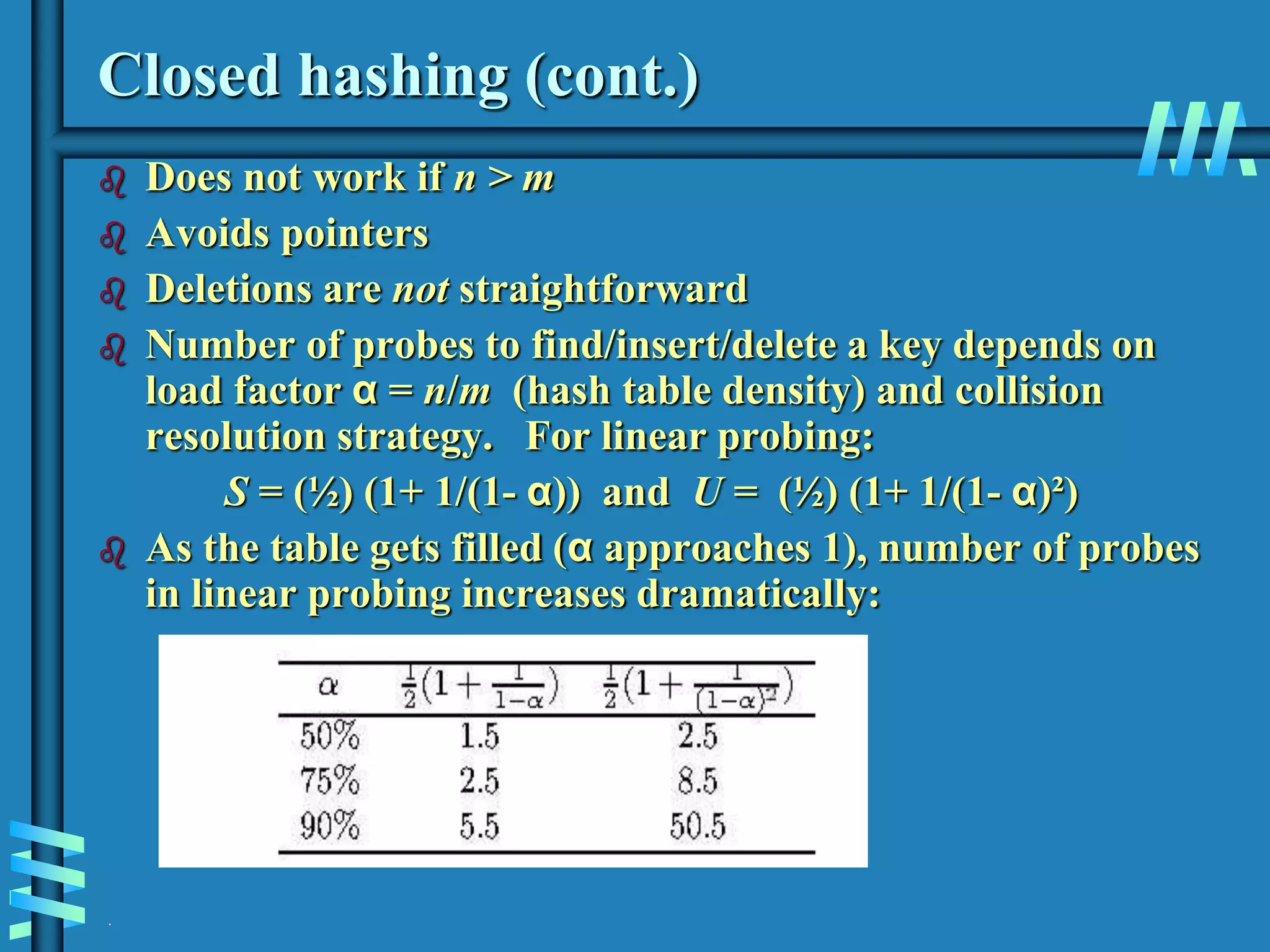
 Number of probes to find/insert/delete a key depends on
load factor α = n/m (hash table density) and collision
resolution strategy. For linear probing:
S = (½) (1+ 1/(1- α)) and U = (½) (1+ 1/(1- α)²)
 As the table gets filled (α approaches 1), number of probes
in linear probing increases dramatically:
.
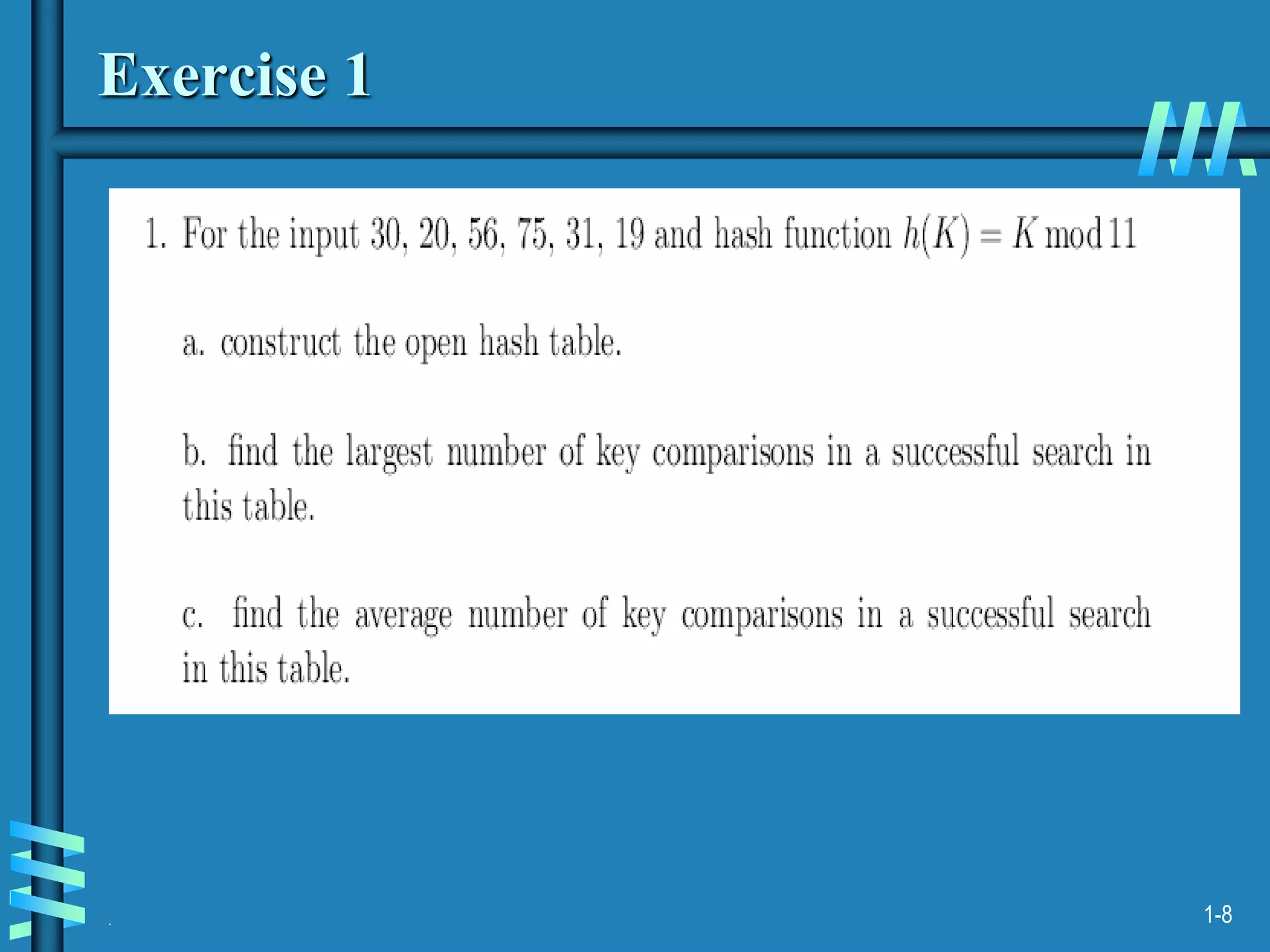
Exercise 1
1-8
.
Answer 1
1-9
.
Exercise 2
1-10
.
Answer 2
1-11
.
Exercises 3, 4
1-12
.
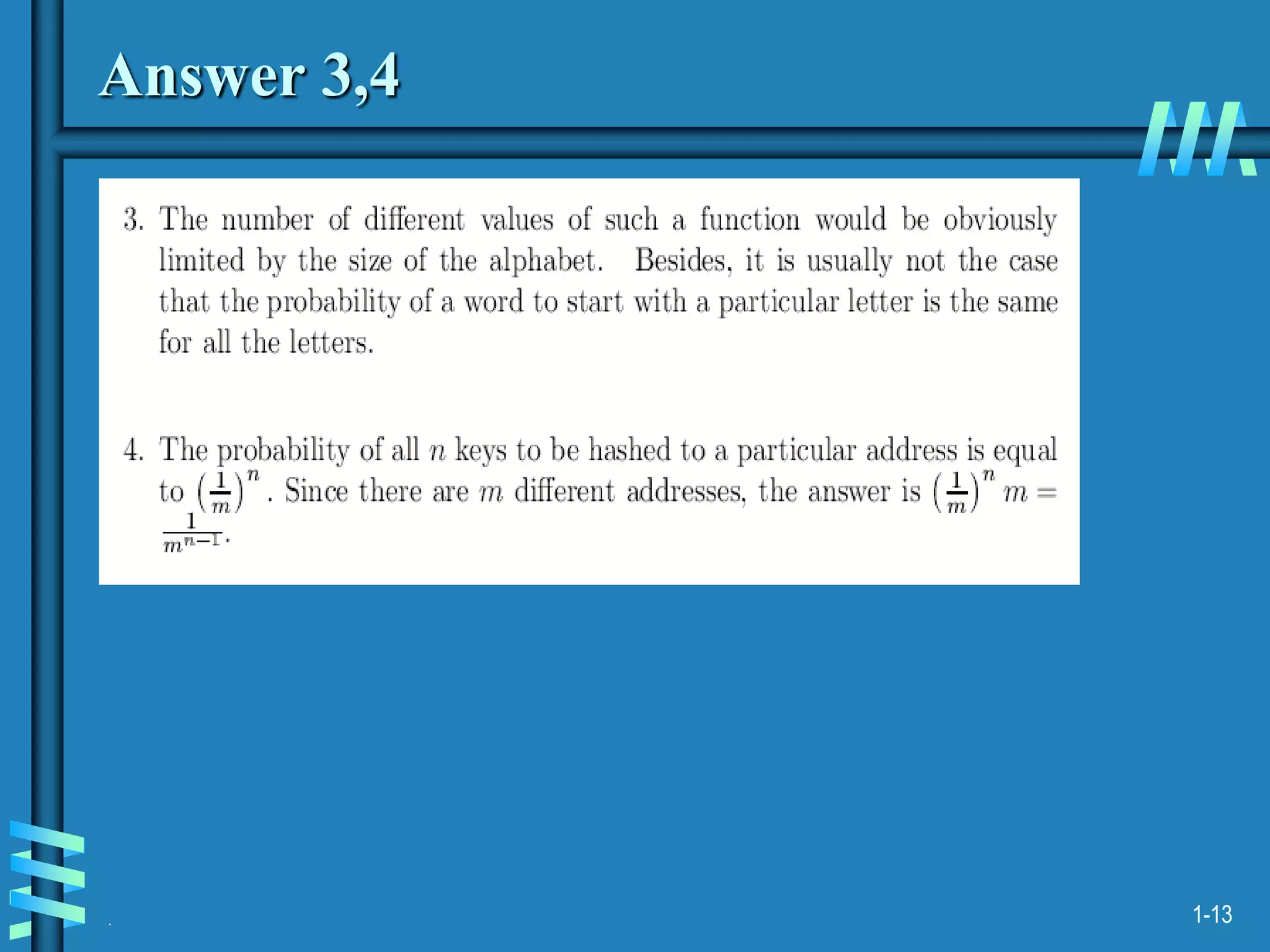
Answer 3,4
1-13
.
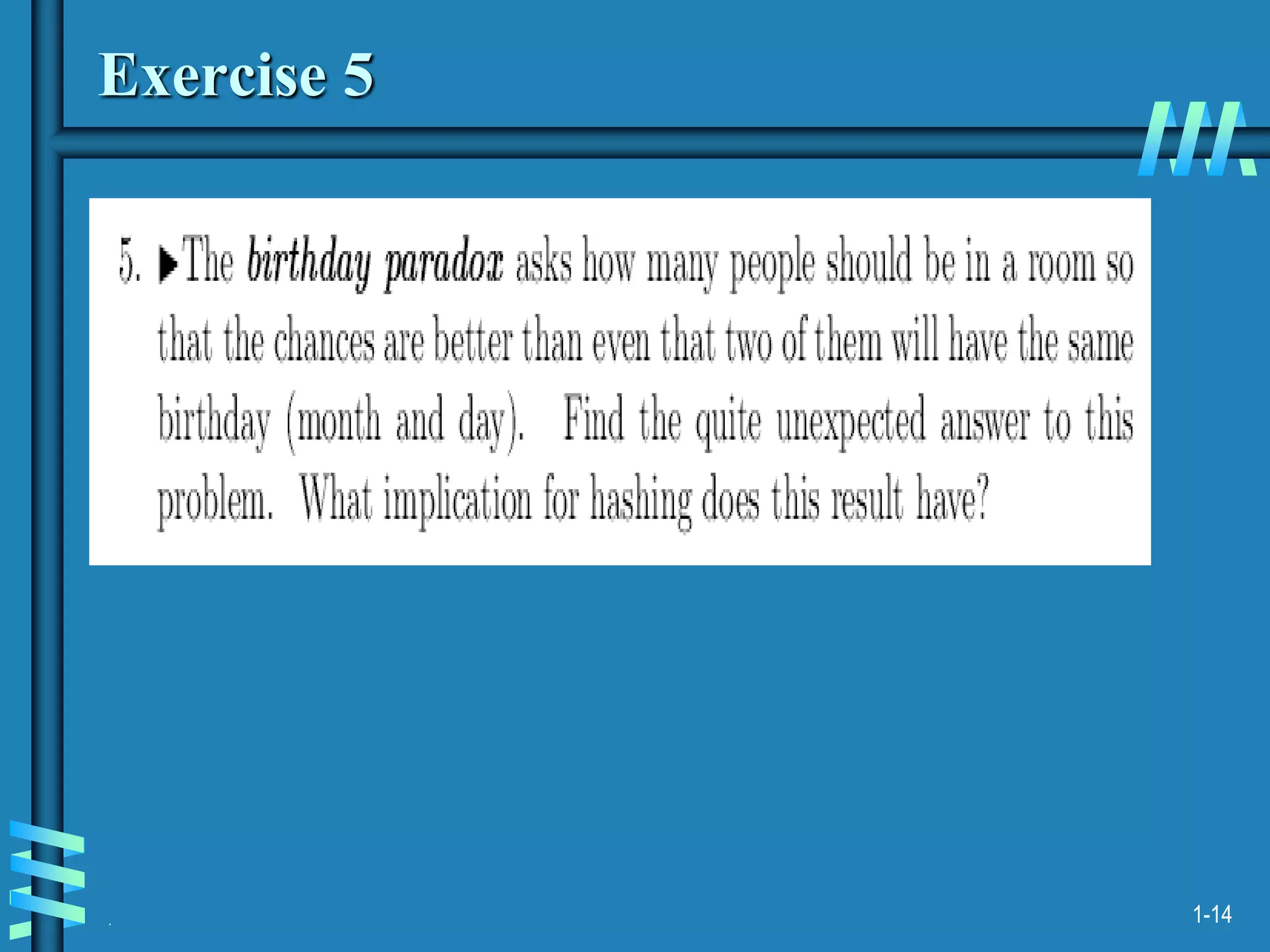
Exercise 5
1-14
.
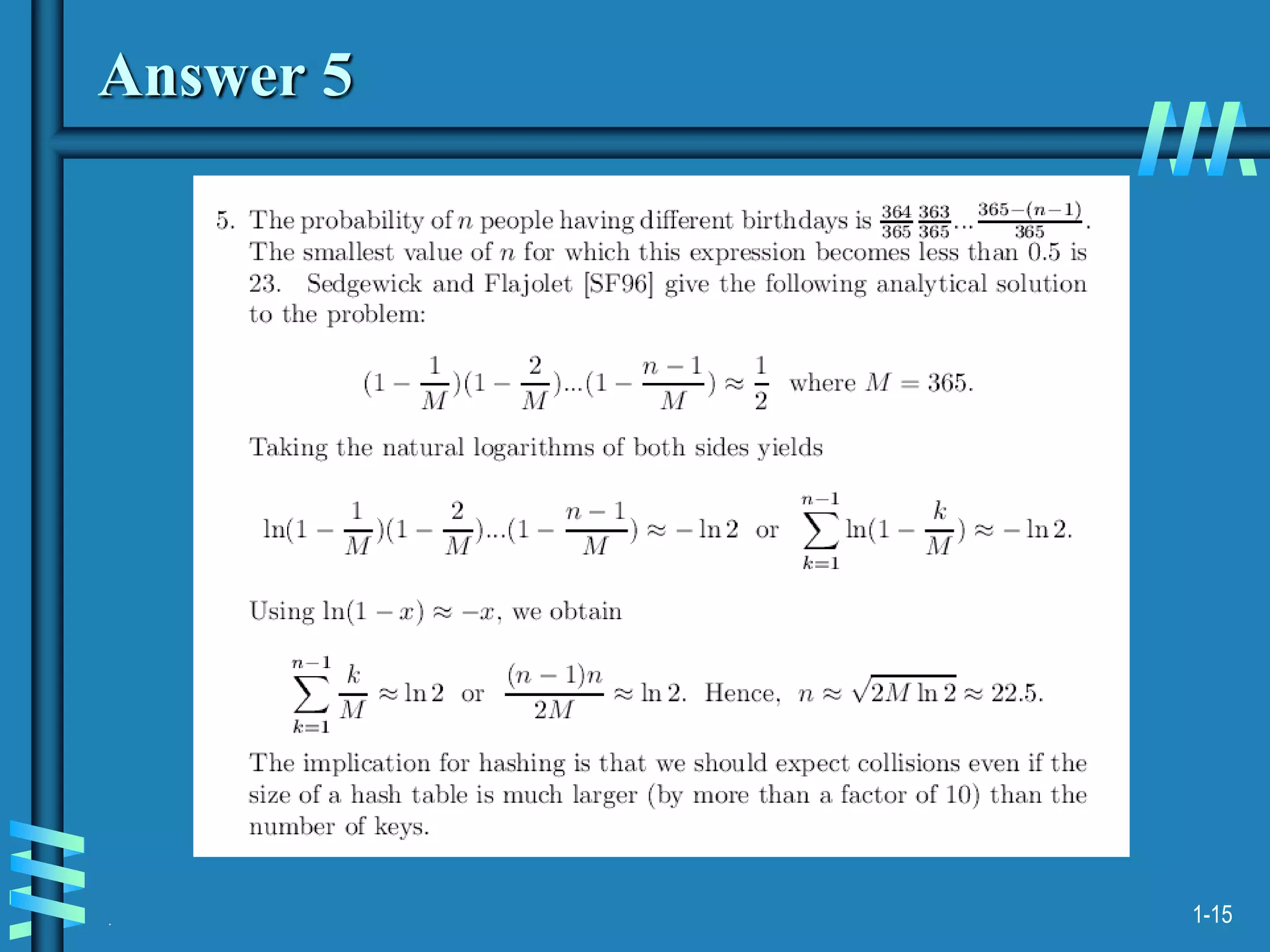
Answer 5
1-15
.
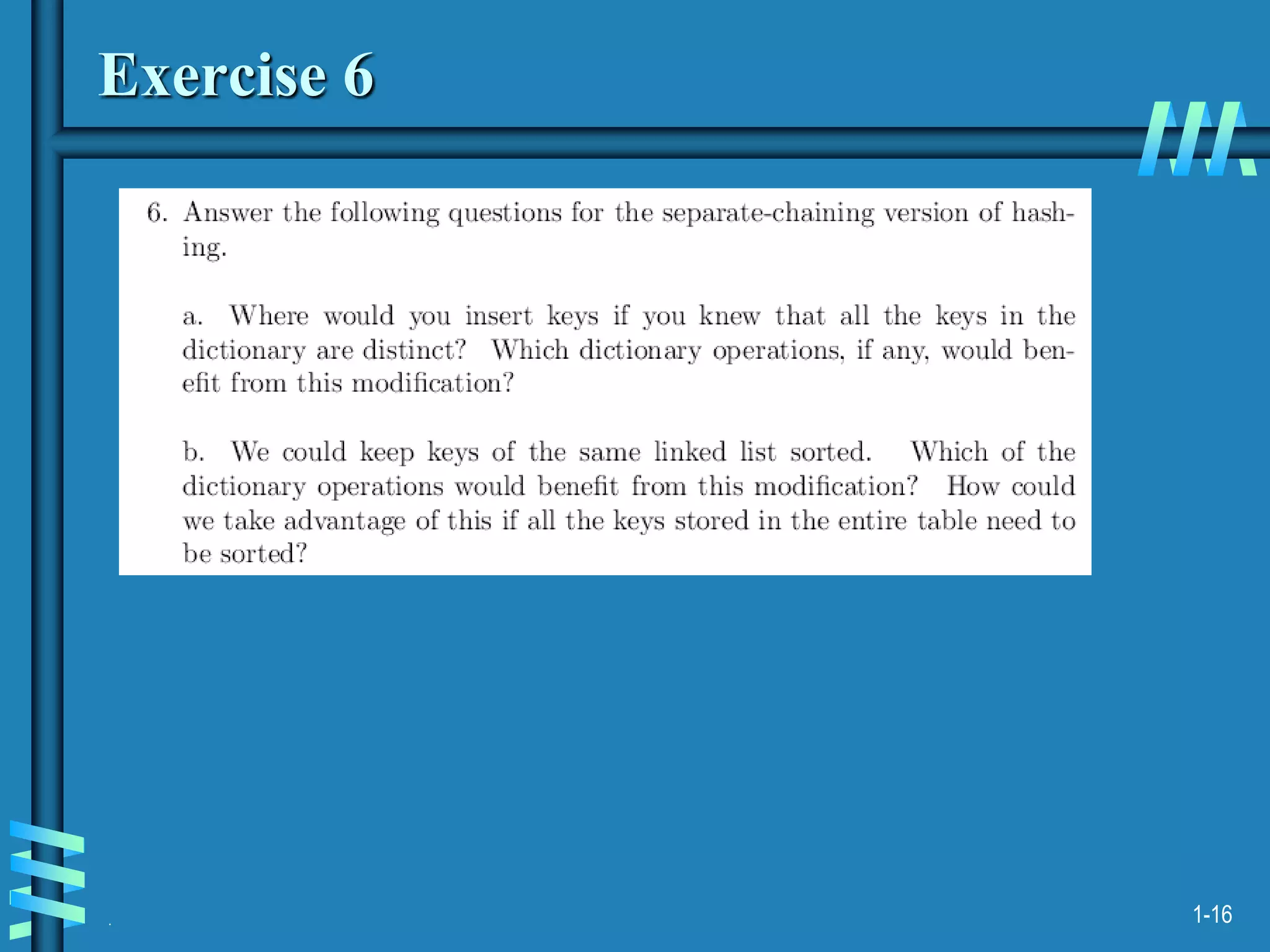
Exercise 6
1-16
.
Answer 6
1-17
.
Exercise 7
1-18
.
Answer 7
1-19
.
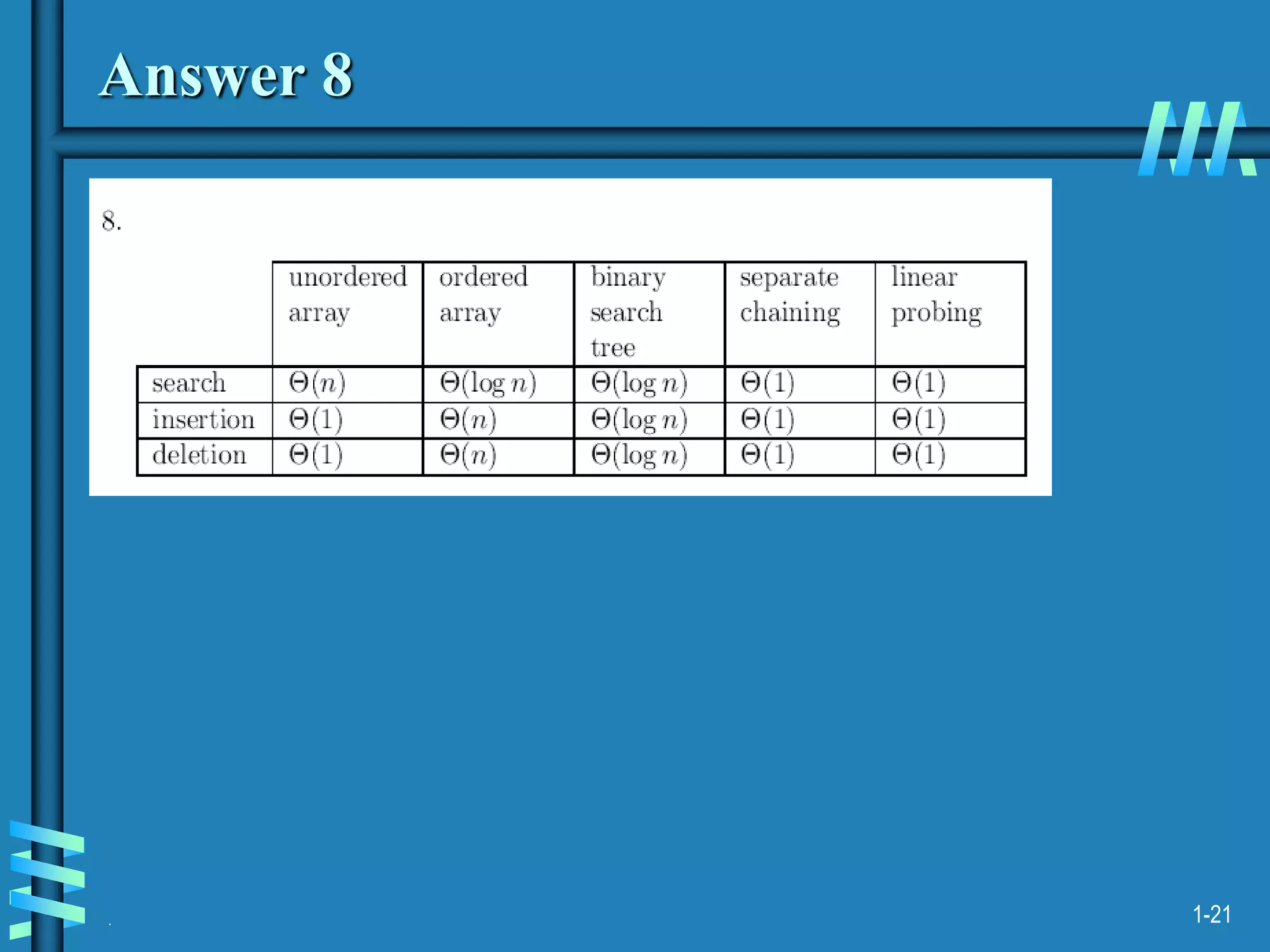
Exercise 8
1-20
.
Answer 8
1-21
.
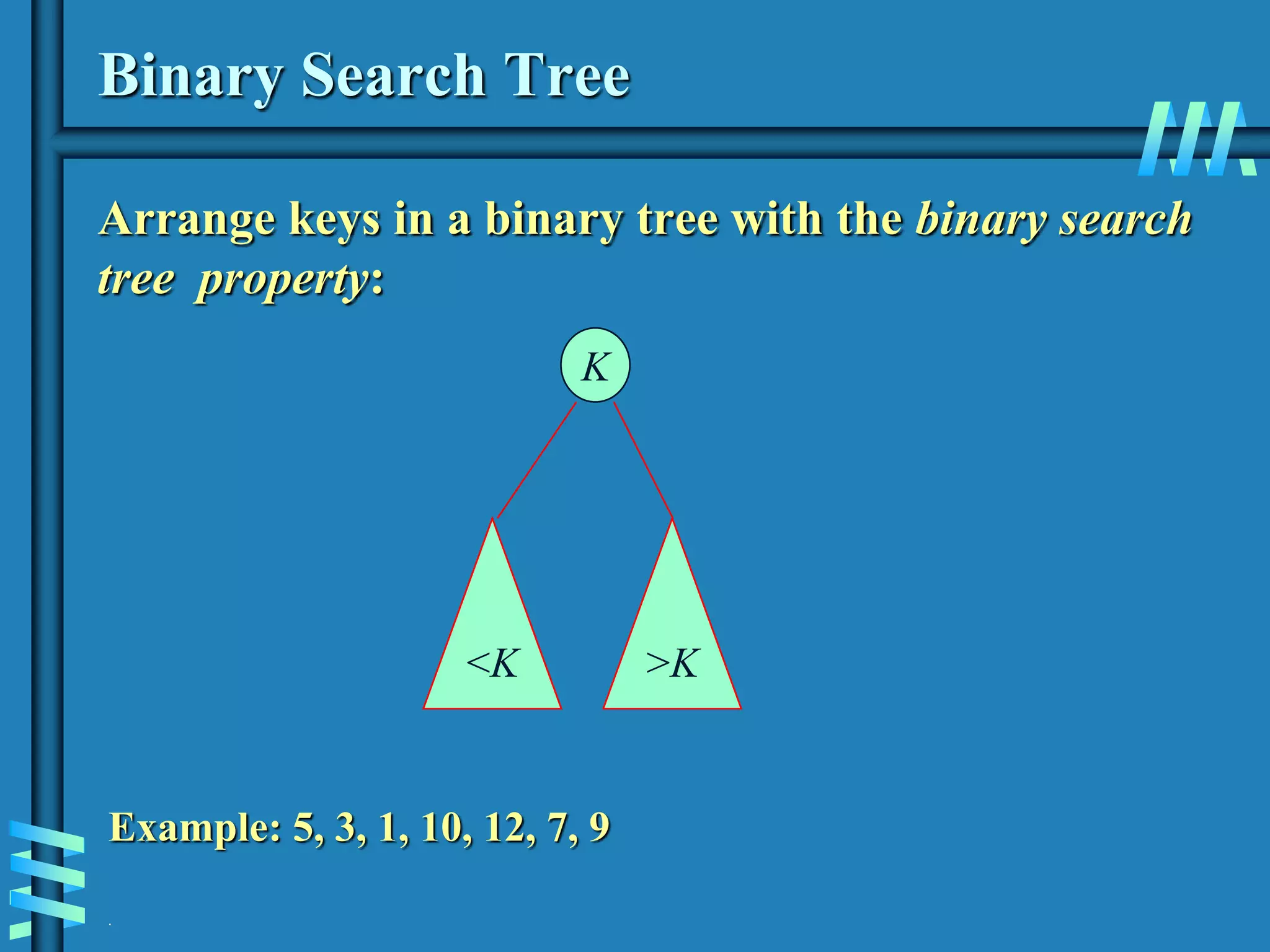
Binary Search Tree
Arrange keys in a binary tree with the binary search
tree property:
K
<K >K
Example: 5, 3, 1, 10, 12, 7, 9
.
Dictionary Operations on Binary Search Trees
Searching – straightforward
Insertion – search for key, insert at leaf where search terminated
Deletion – 3 cases:
deleting key at a leaf
deleting key at node with single child
deleting key at node with two children
Efficiency depends of the tree’s height: log2 n  h  n-1,
with height average (random files) be about 3log2 n
Thus all three operations have
• worst case efficiency: (n)
• average case efficiency: (log n)
inorder traversal produces sorted list
.
Balanced Search Trees
Attractiveness of binary search tree is marred by the bad (linear)
worst-case efficiency. Two ideas to overcome it are:
 to rebalance binary search tree when a new insertion
makes the tree “too unbalanced”
• AVL trees
• red-black trees
 to allow more than one key per node of a search tree
• 2-3 trees
• 2-3-4 trees
• B-trees
.
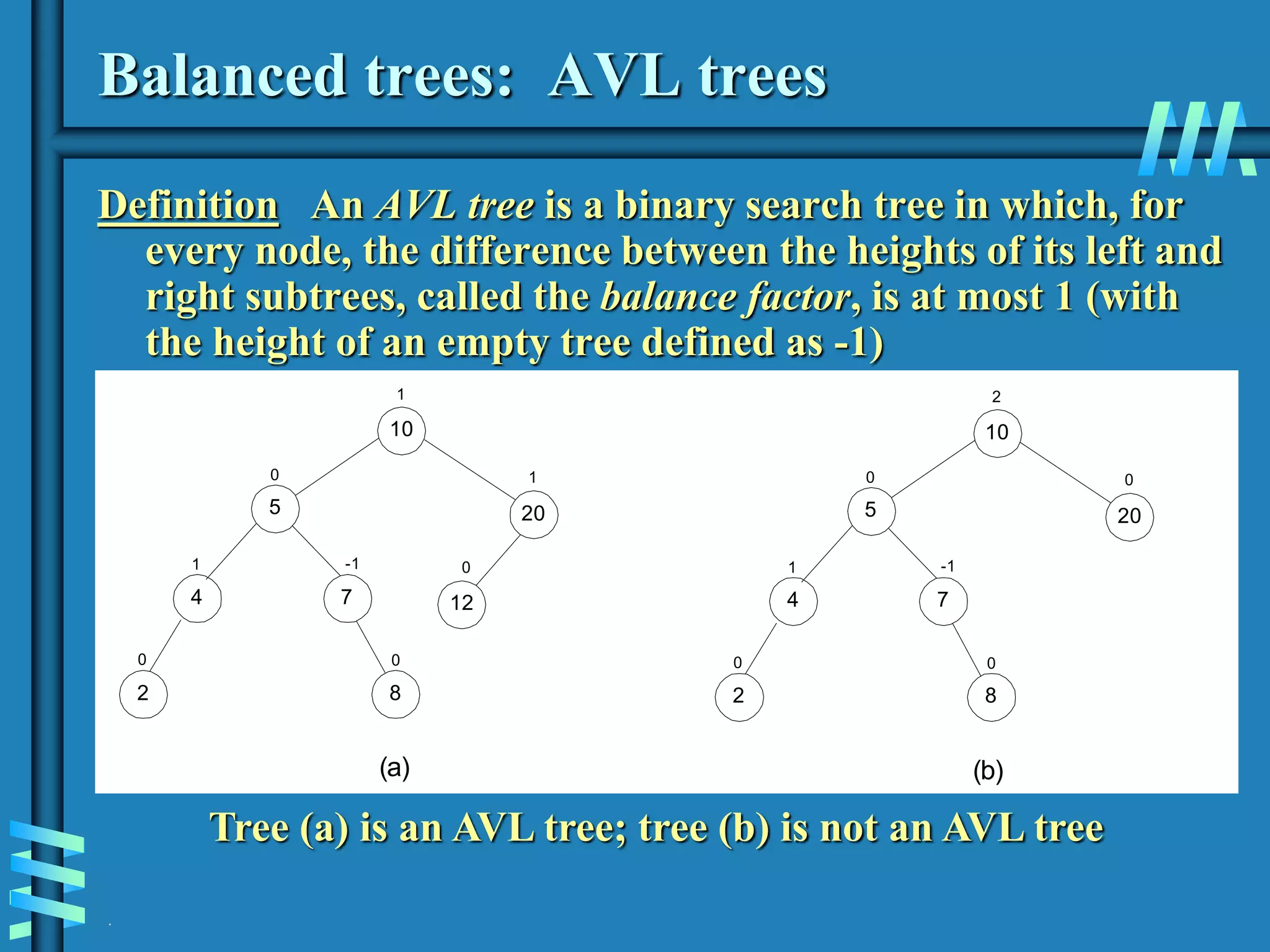
Balanced trees: AVL trees
Definition An AVL tree is a binary search tree in which, for
every node, the difference between the heights of its left and
right subtrees, called the balance factor, is at most 1 (with
the height of an empty tree defined as -1)
5 20
12
4 7
2
(a)
10
1
8
1
0
1
0
-1
0
0
5 20
4 7
2
(b)
10
2
8
0
0
1
0
-1
0
Tree (a) is an AVL tree; tree (b) is not an AVL tree
.
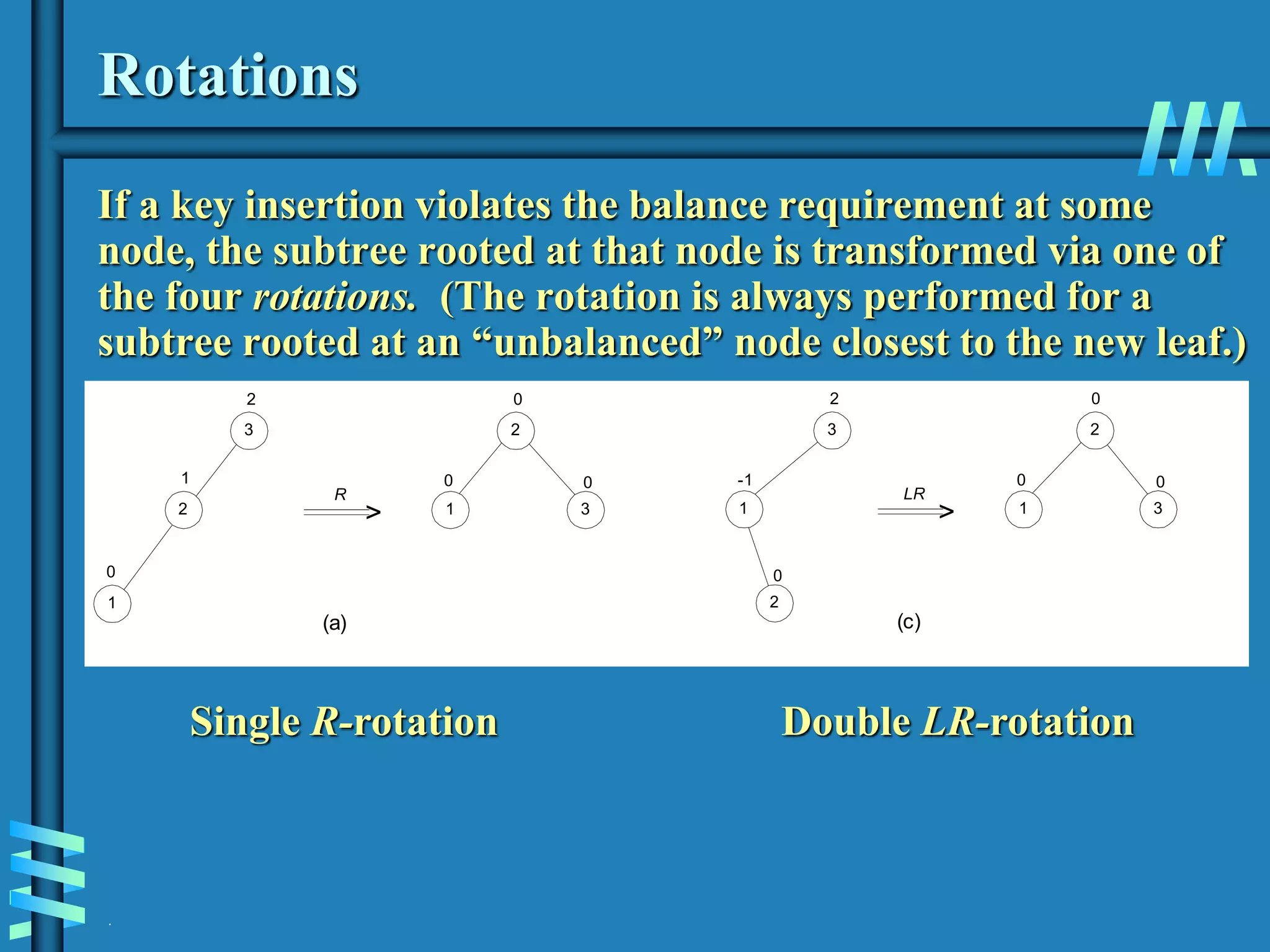
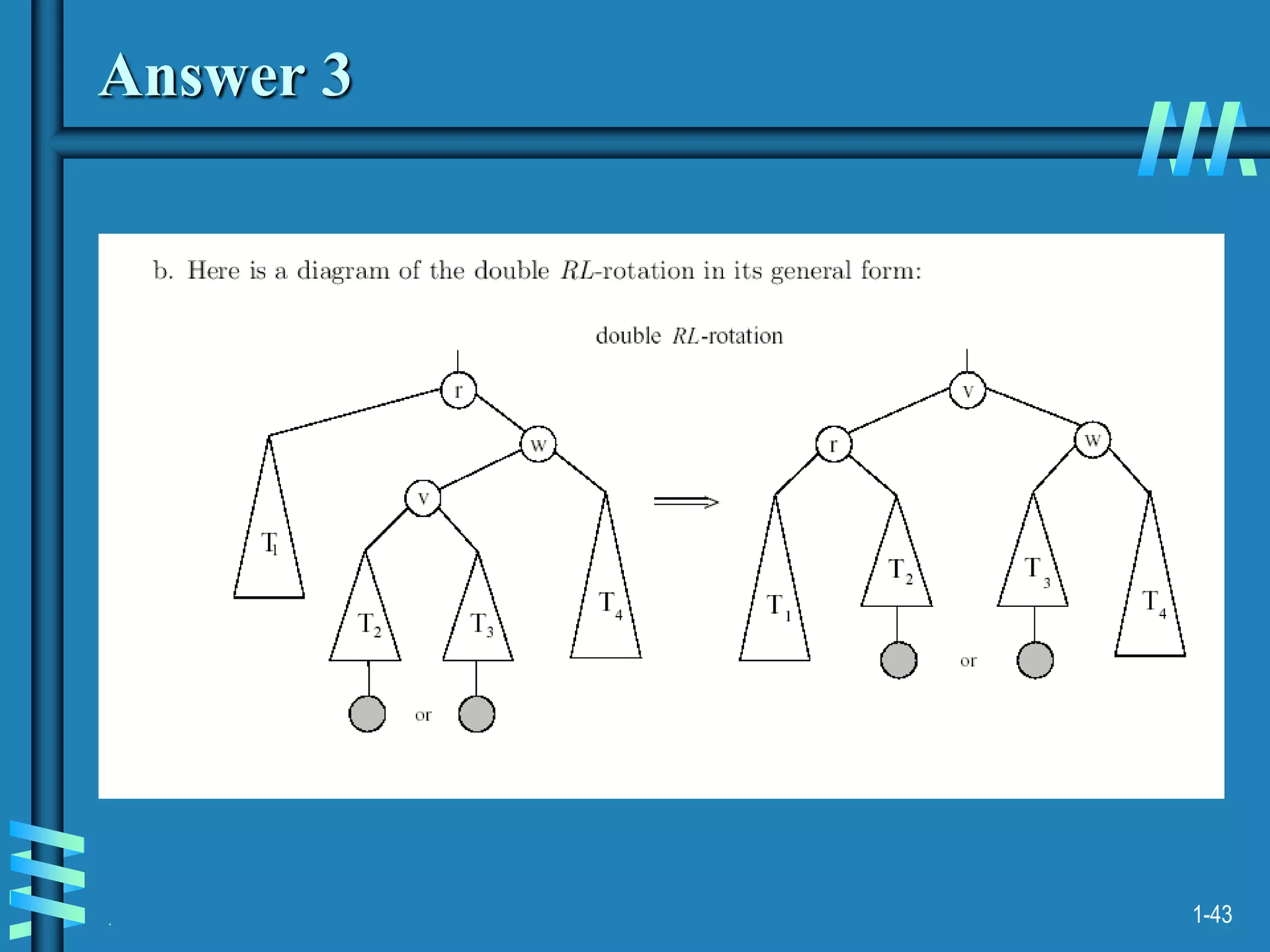
Rotations
If a key insertion violates the balance requirement at some
node, the subtree rooted at that node is transformed via one of
the four rotations. (The rotation is always performed for a
subtree rooted at an “unbalanced” node closest to the new leaf.)
3
2
2
1
1
0
2
0
1
0
3
0
>
R
(a)
3
2
1
-1
2
0
2
0
1
0
3
0
>
LR
(c)
Single R-rotation Double LR-rotation
.
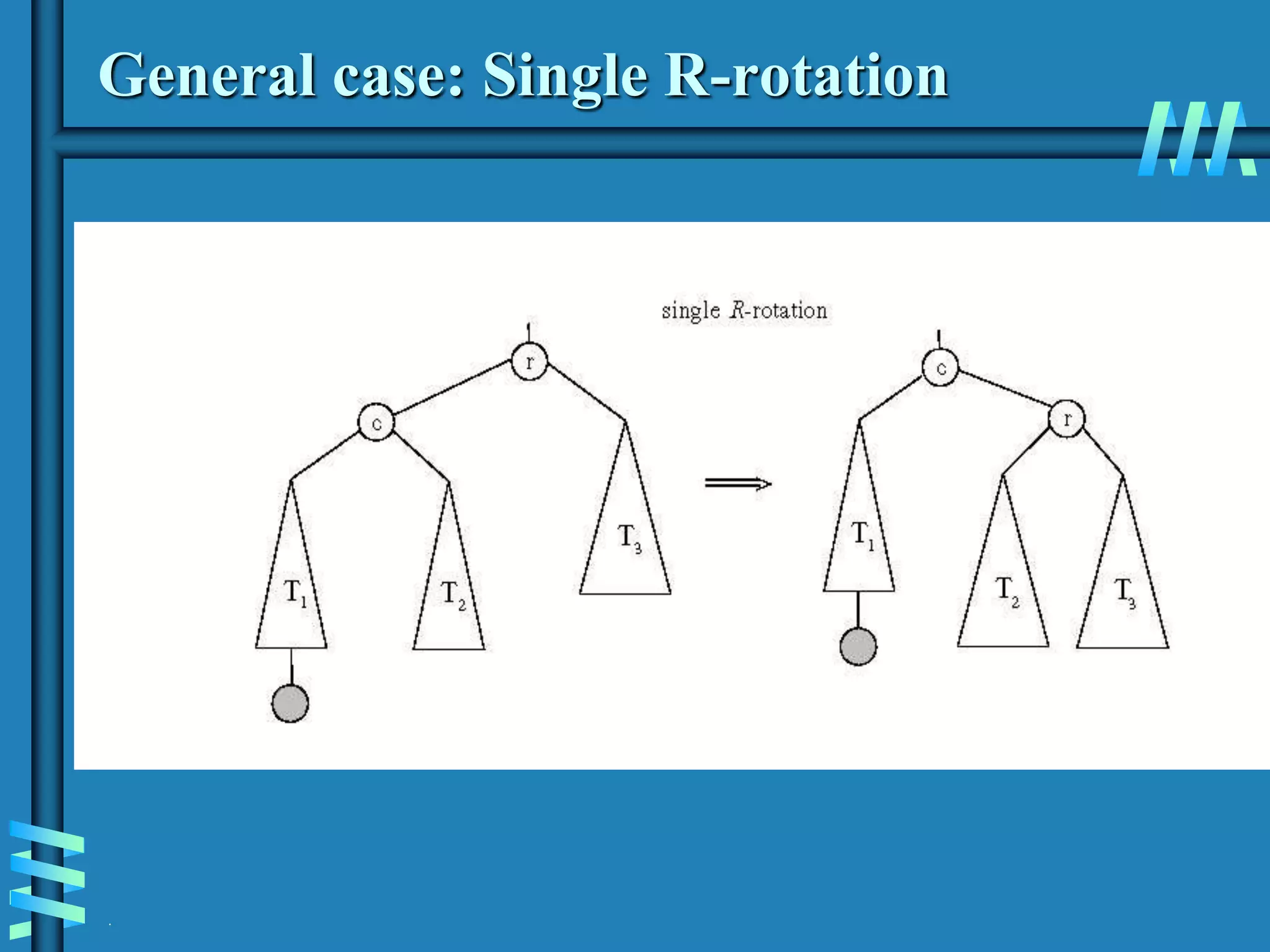
General case: Single R-rotation
.
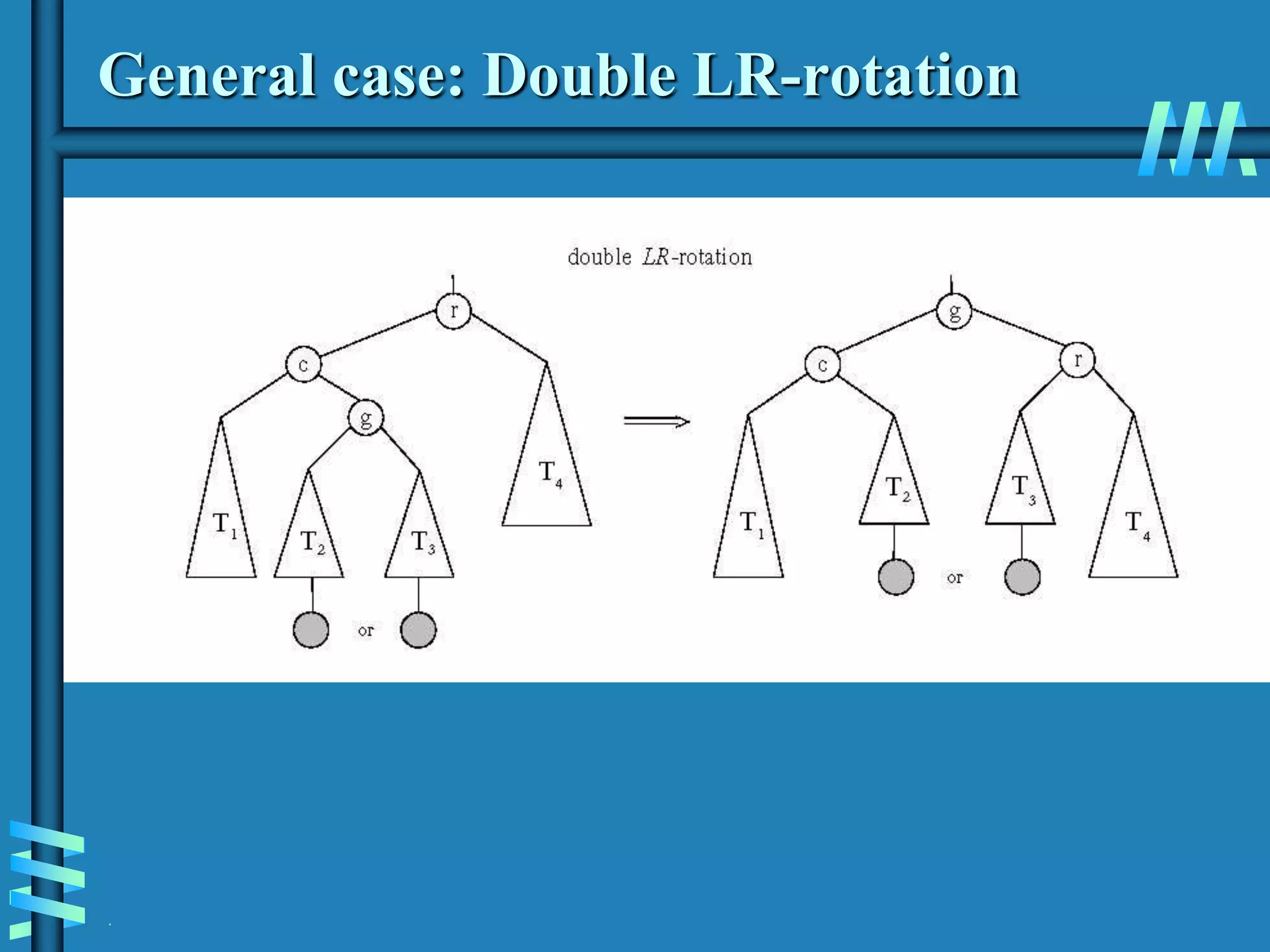
General case: Double LR-rotation
.
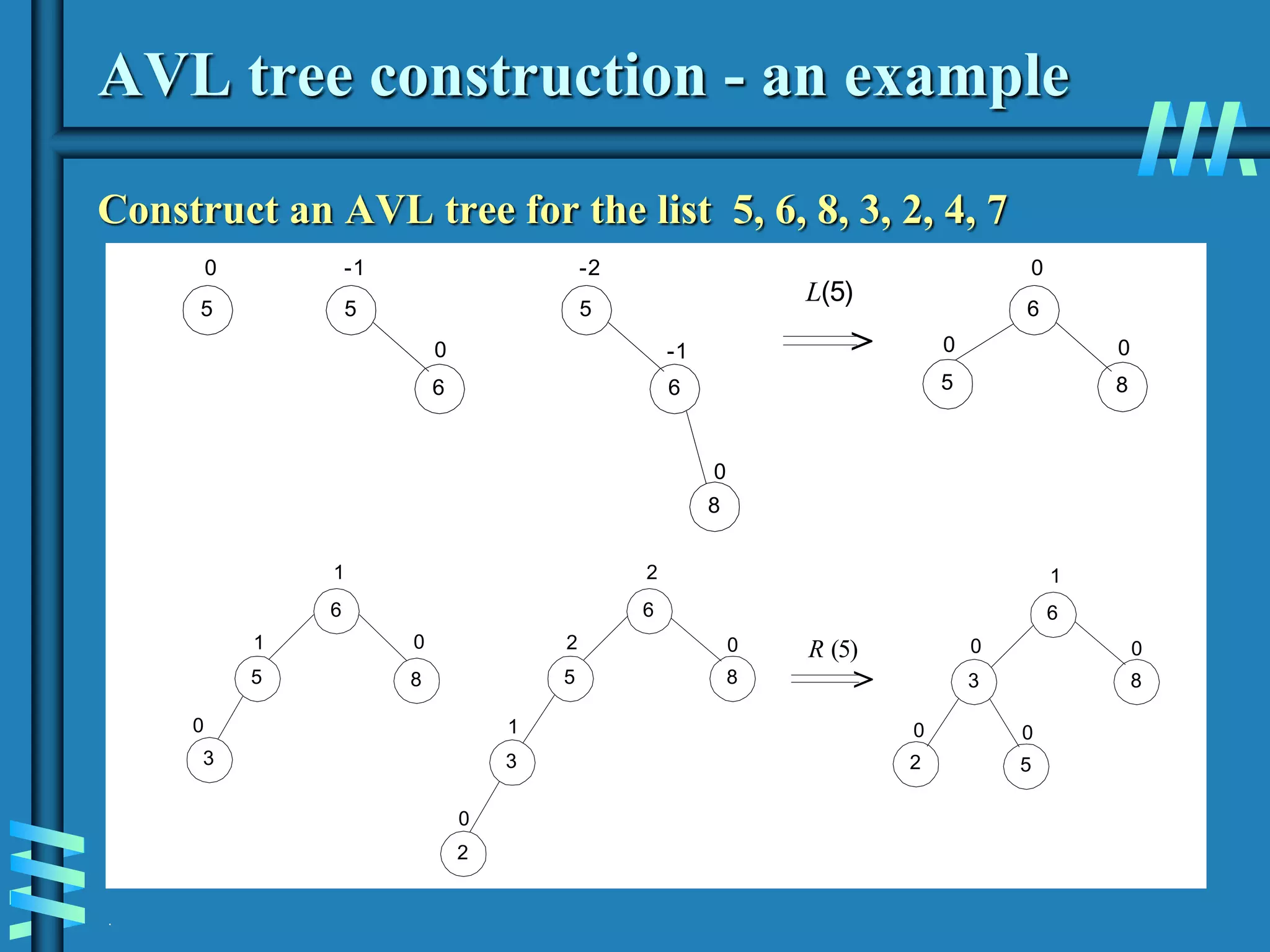
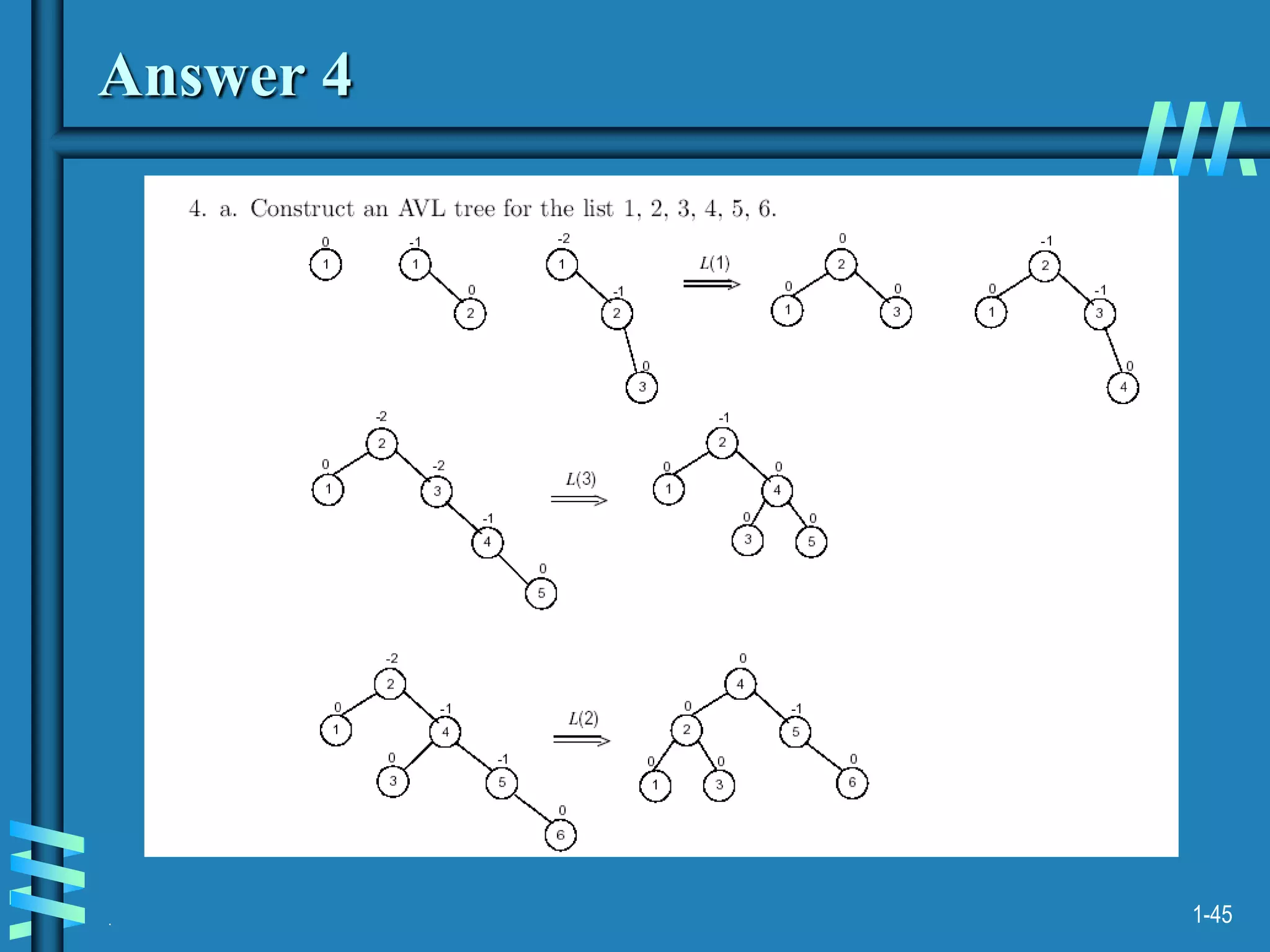
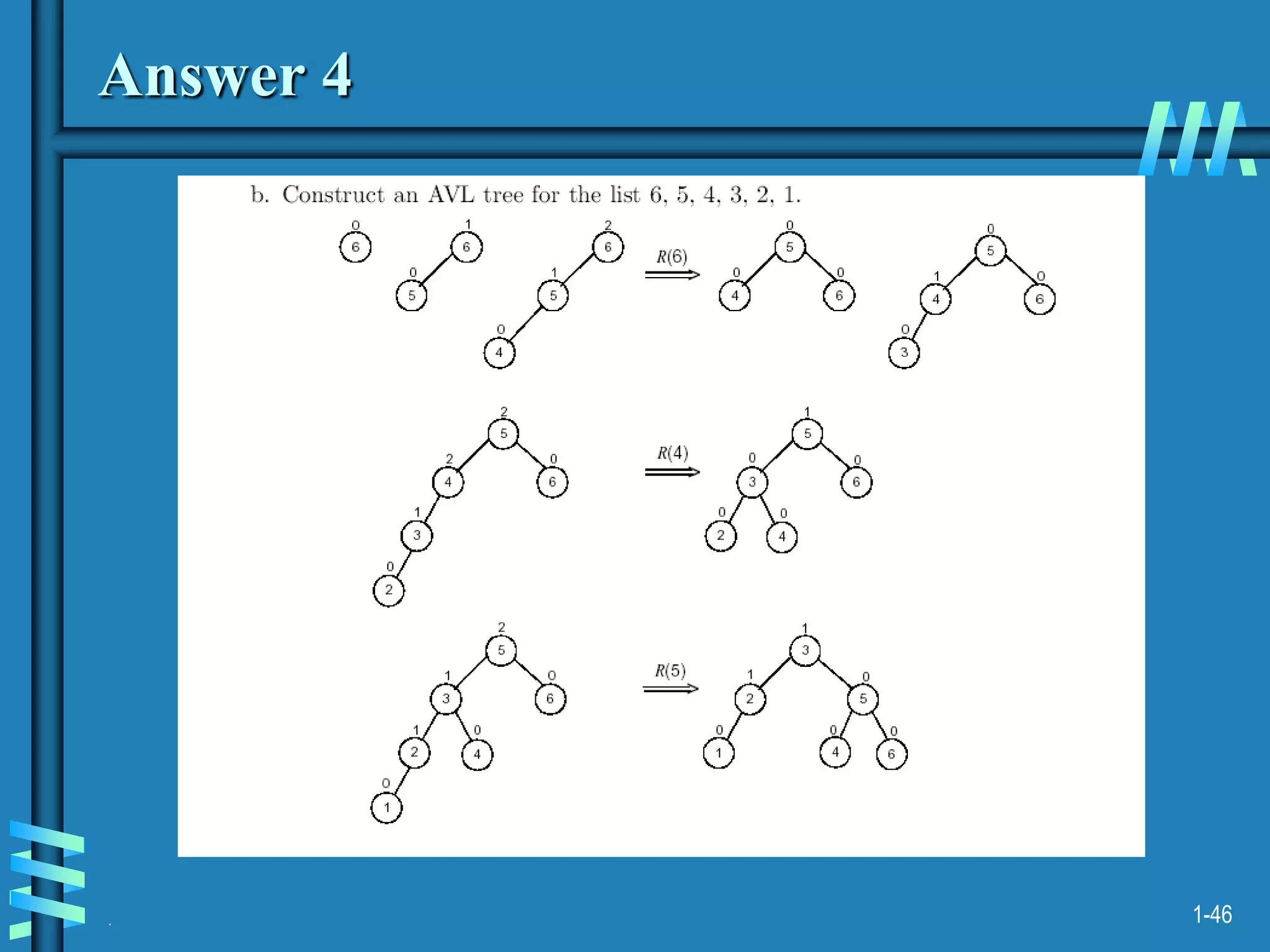
AVL tree construction - an example
Construct an AVL tree for the list 5, 6, 8, 3, 2, 4, 7
5
-1
6
0
5
0
5
-2
6
-1
8
0
>
6
0
8
0
5
0
L(5)
6
1
5
1
3
0
8
0
6
2
5
2
3
1
2
0
8
0
>
R (5)
6
1
3
0
2
0
8
0
5
0
.
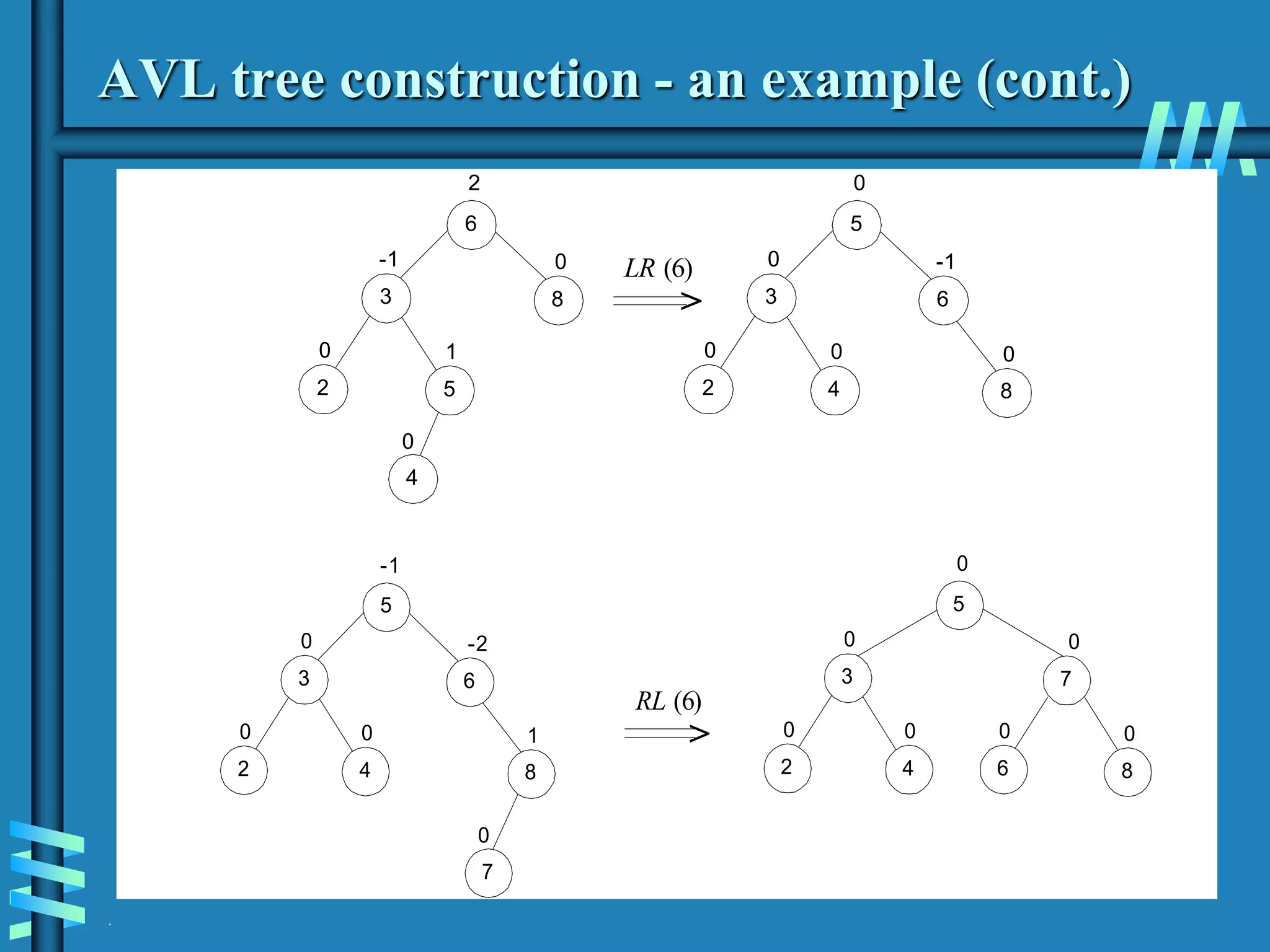
AVL tree construction - an example (cont.)
6
2
3
-1
2
0
5
1
4
0
8
0
>
LR (6)
5
0
3
0
2
0
4
0
6
-1
8
0
5
-1
3
0
2
0
4
0
6
-2
8
1
7
0
>
RL (6)
5
0
3
0
2
0
4
0
7
0
8
0
6
0
.
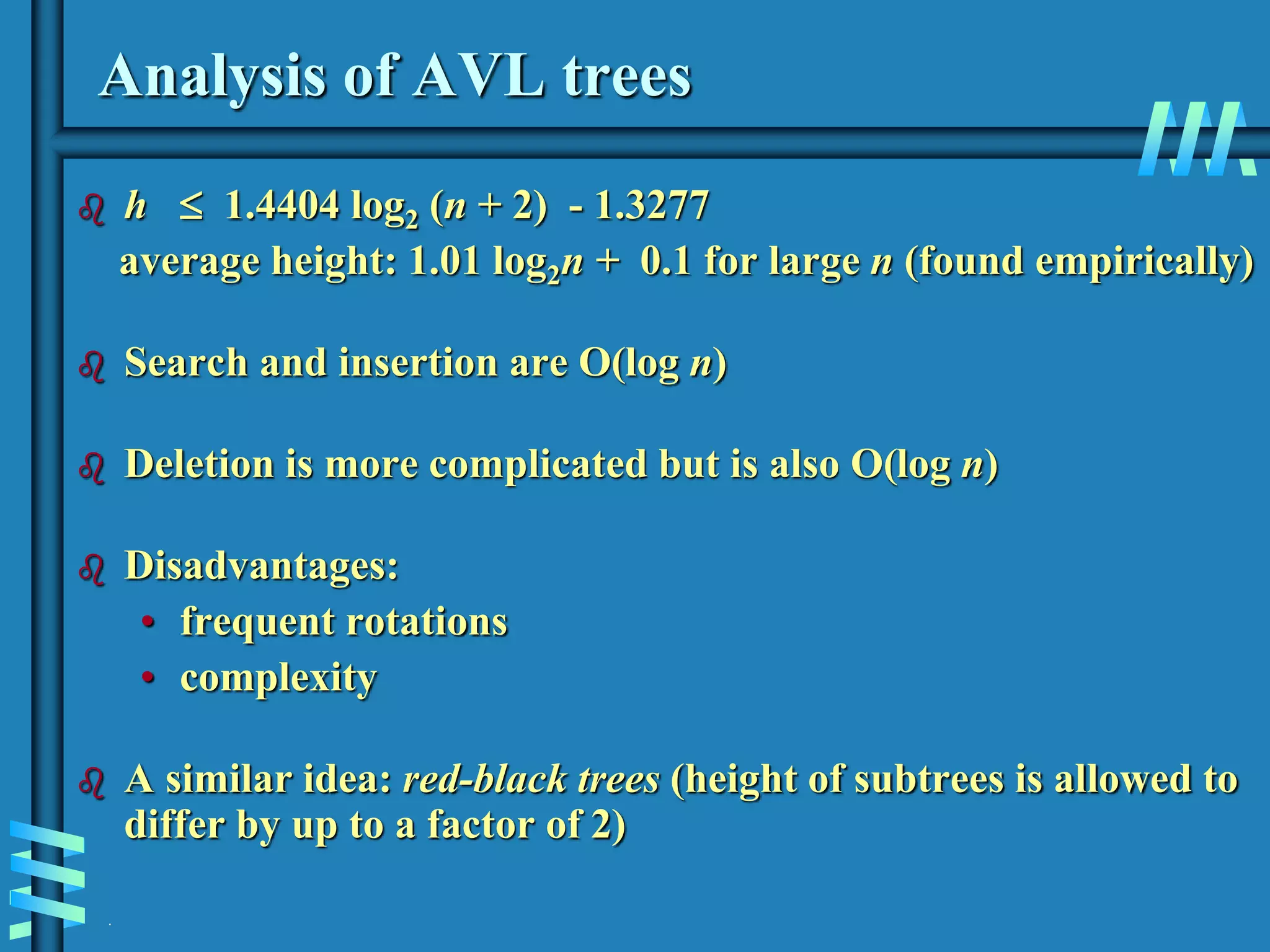
Analysis of AVL trees
 h  1.4404 log2 (n + 2) - 1.3277
average height: 1.01 log2n + 0.1 for large n (found empirically)
 Search and insertion are O(log n)
 Deletion is more complicated but is also O(log n)
 Disadvantages:
• frequent rotations
• complexity
 A similar idea: red-black trees (height of subtrees is allowed to
differ by up to a factor of 2)
.
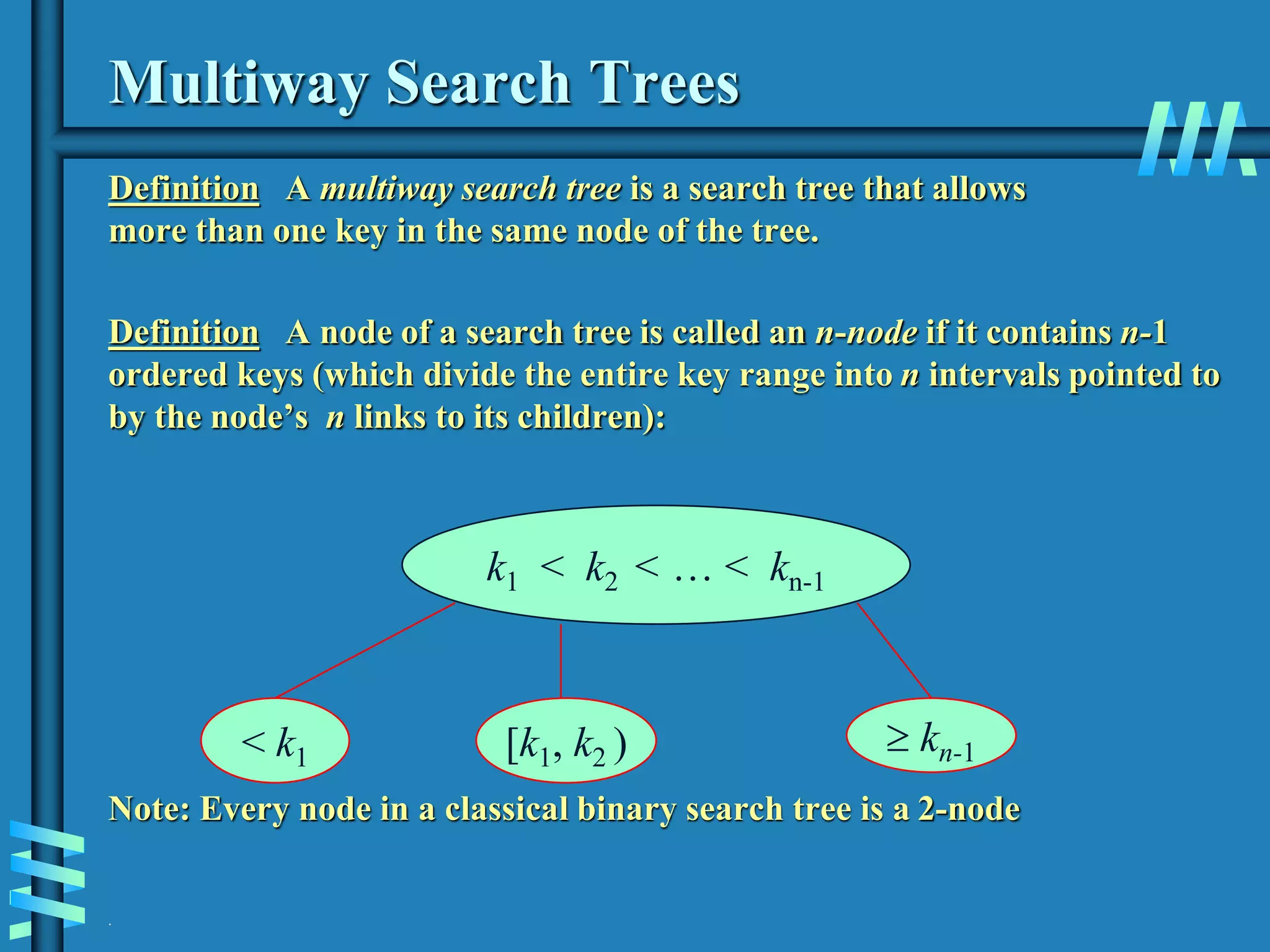
Multiway Search Trees
Definition A multiway search tree is a search tree that allows
more than one key in the same node of the tree.
Definition A node of a search tree is called an n-node if it contains n-1
ordered keys (which divide the entire key range into n intervals pointed to
by the node’s n links to its children):
Note: Every node in a classical binary search tree is a 2-node
k1 < k2 < … < kn-1
< k1 [k1, k2 )  kn-1
.
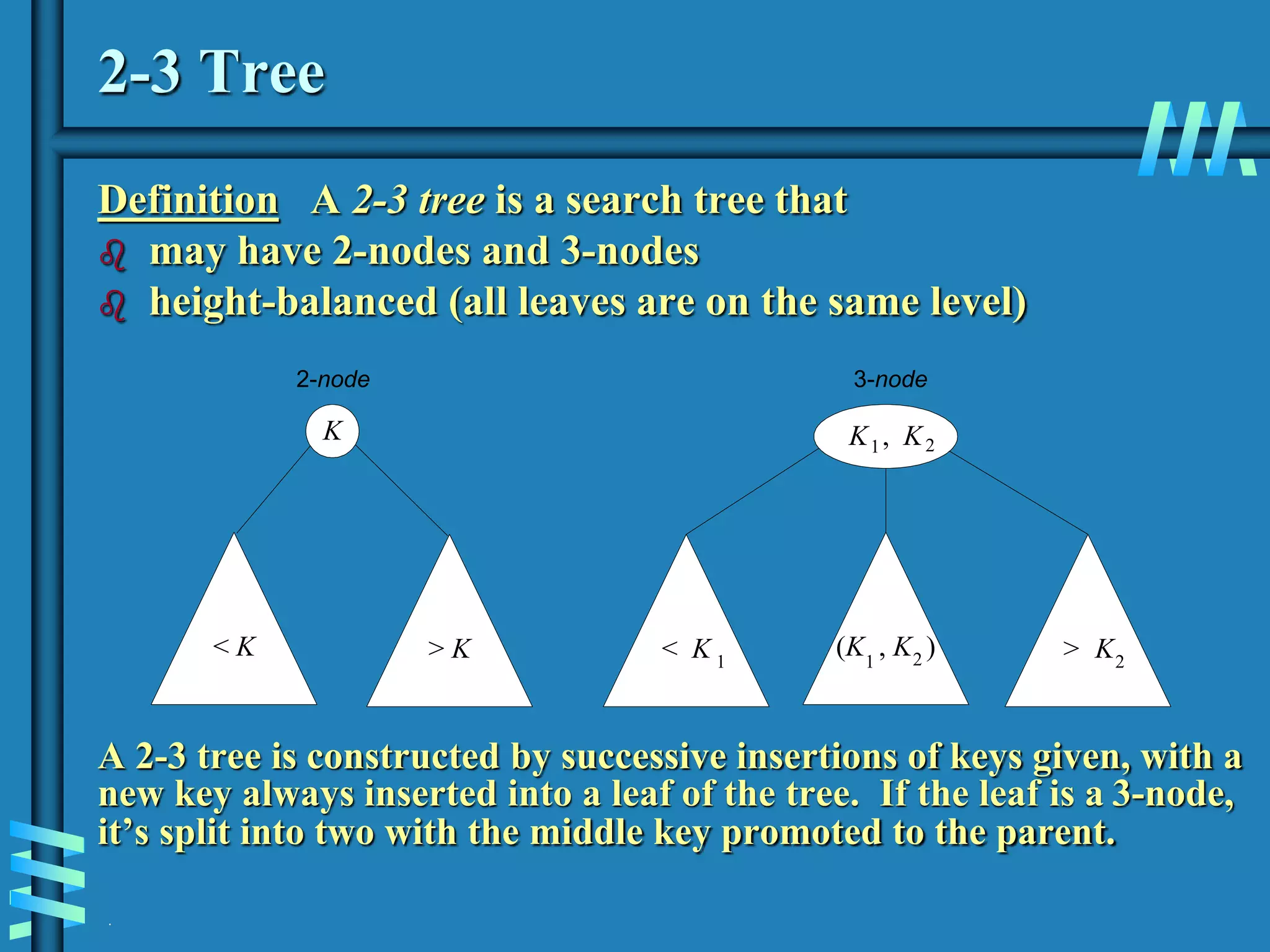
2-3 Tree
Definition A 2-3 tree is a search tree that
 may have 2-nodes and 3-nodes
 height-balanced (all leaves are on the same level)
A 2-3 tree is constructed by successive insertions of keys given, with a
new key always inserted into a leaf of the tree. If the leaf is a 3-node,
it’s split into two with the middle key promoted to the parent.
K K , K
1 2
(K , K )
1 2
2-node 3-node
< K > K
< K > K 1 2
.
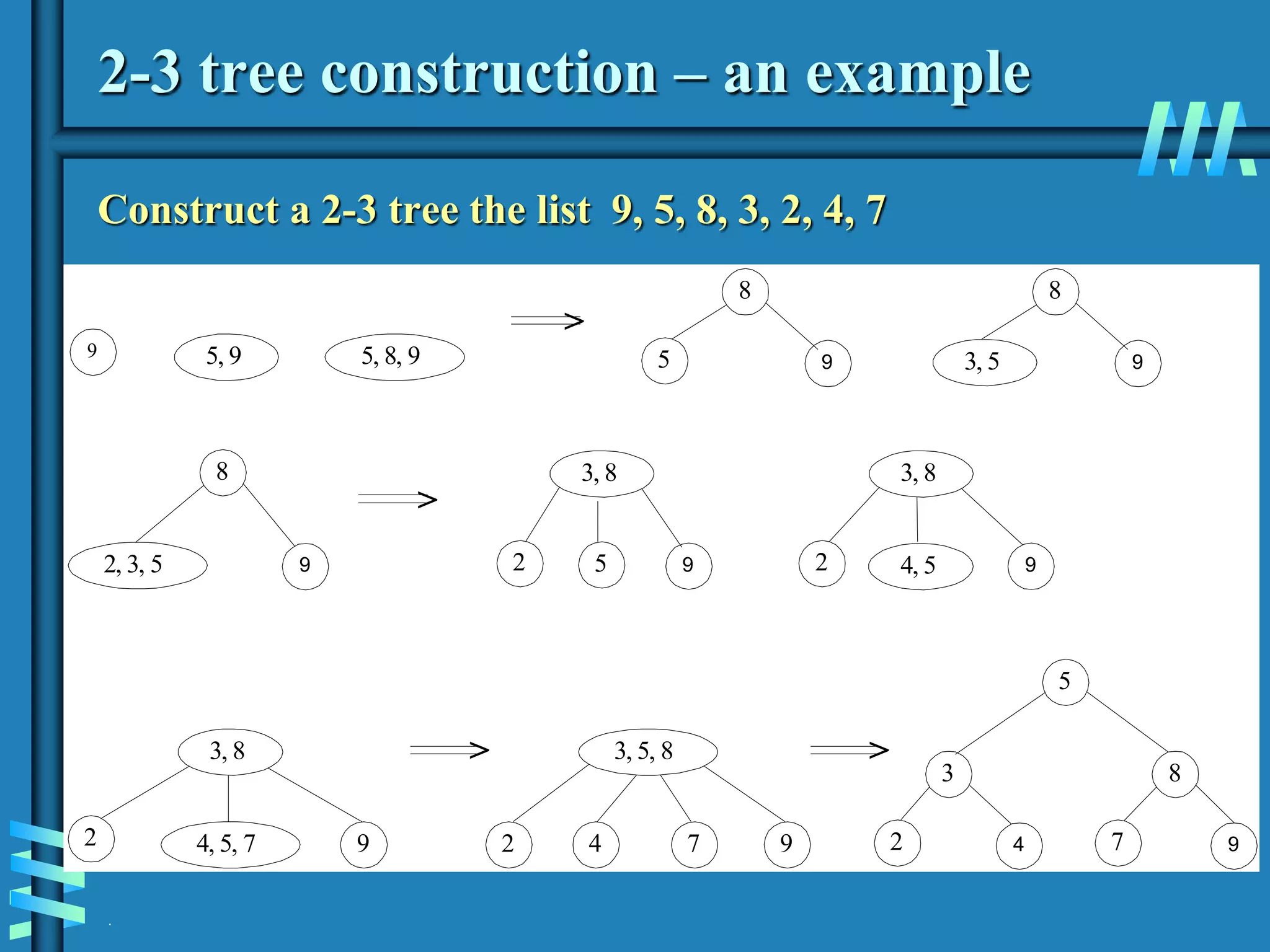
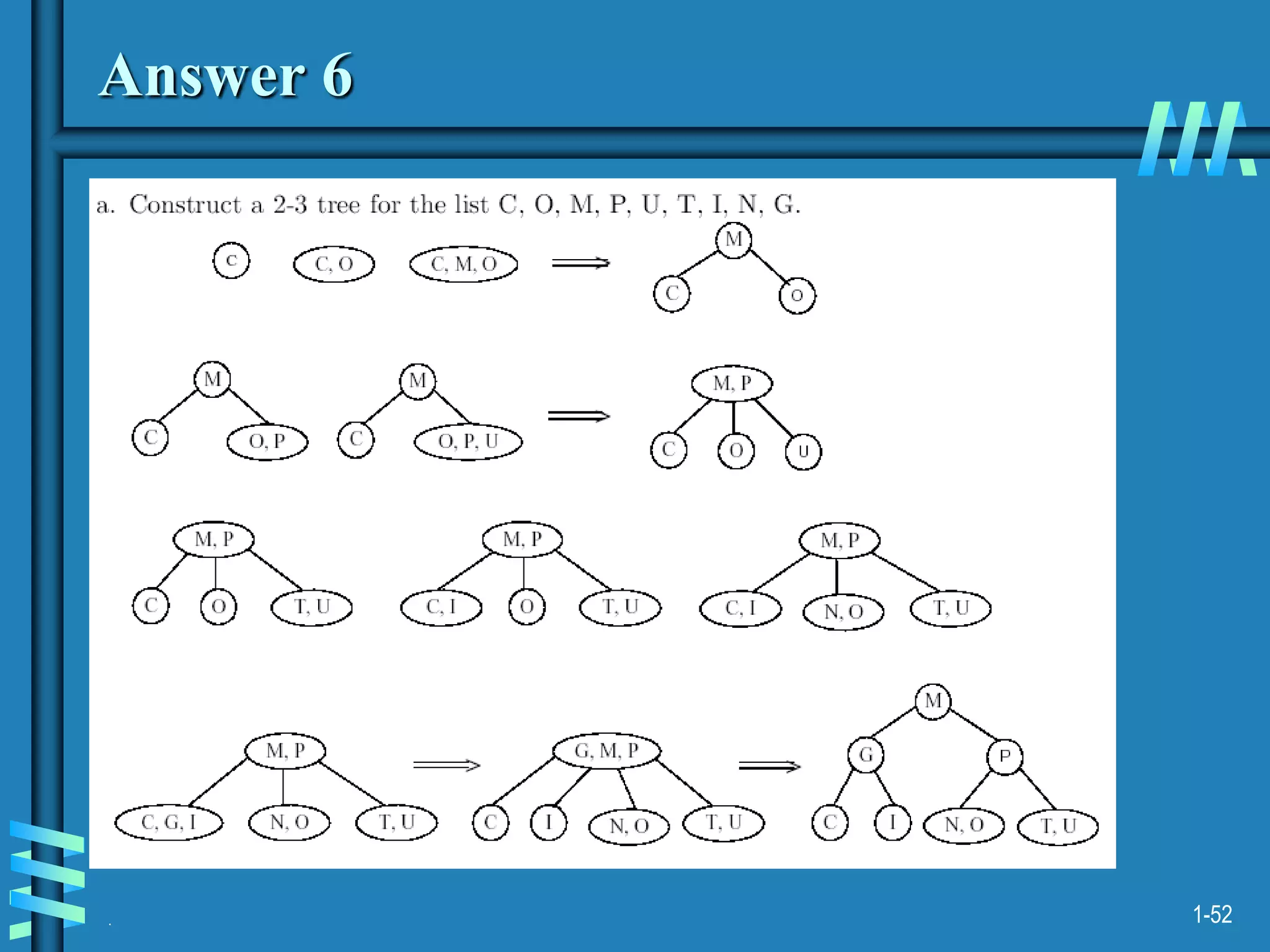
2-3 tree construction – an example
Construct a 2-3 tree the list 9, 5, 8, 3, 2, 4, 7
9
>
8
9
5
5, 9 5, 8, 9
8
9
3, 5
2, 3, 5
8
9
>
>
3, 8
9
2 5
3, 8
9
2 4, 5
3, 8
4, 5, 7
2 9
> 3, 5, 8
2 4 7 9
5
3
4
2
8
9
7
.
Analysis of 2-3 trees
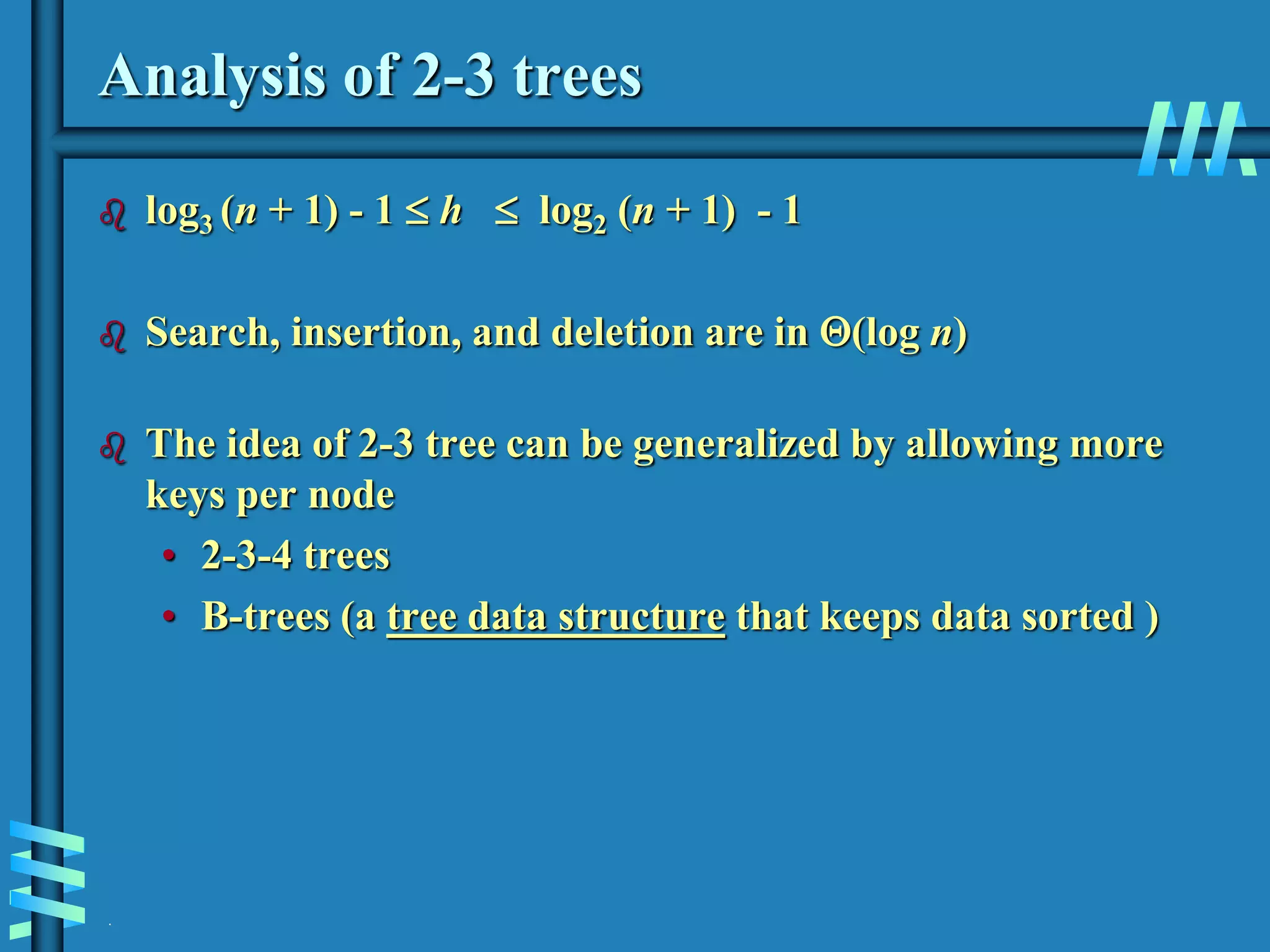
 log3 (n + 1) - 1  h  log2 (n + 1) - 1
 Search, insertion, and deletion are in (log n)
 The idea of 2-3 tree can be generalized by allowing more
keys per node
• 2-3-4 trees
• B-trees (a tree data structure that keeps data sorted )
.
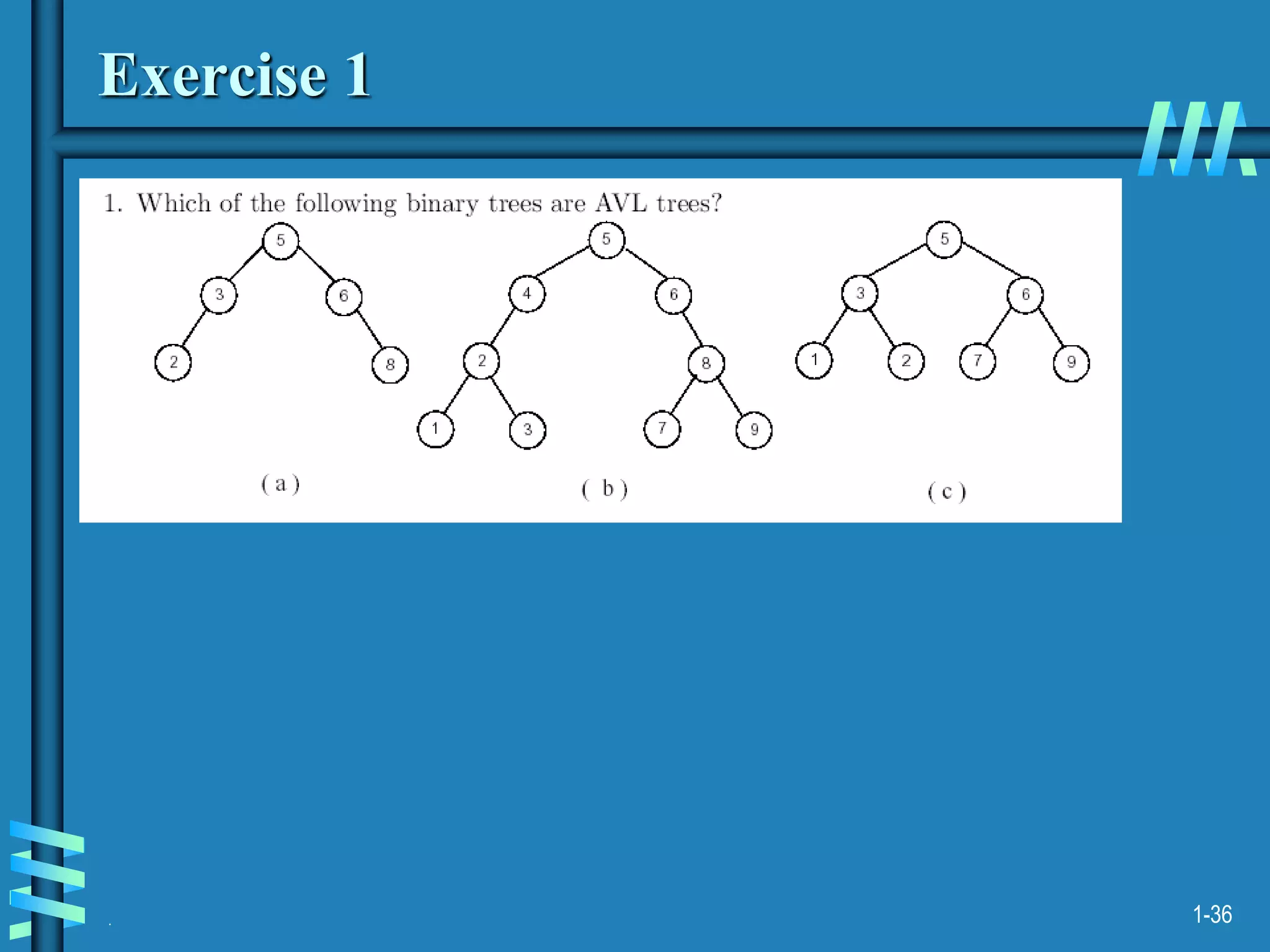
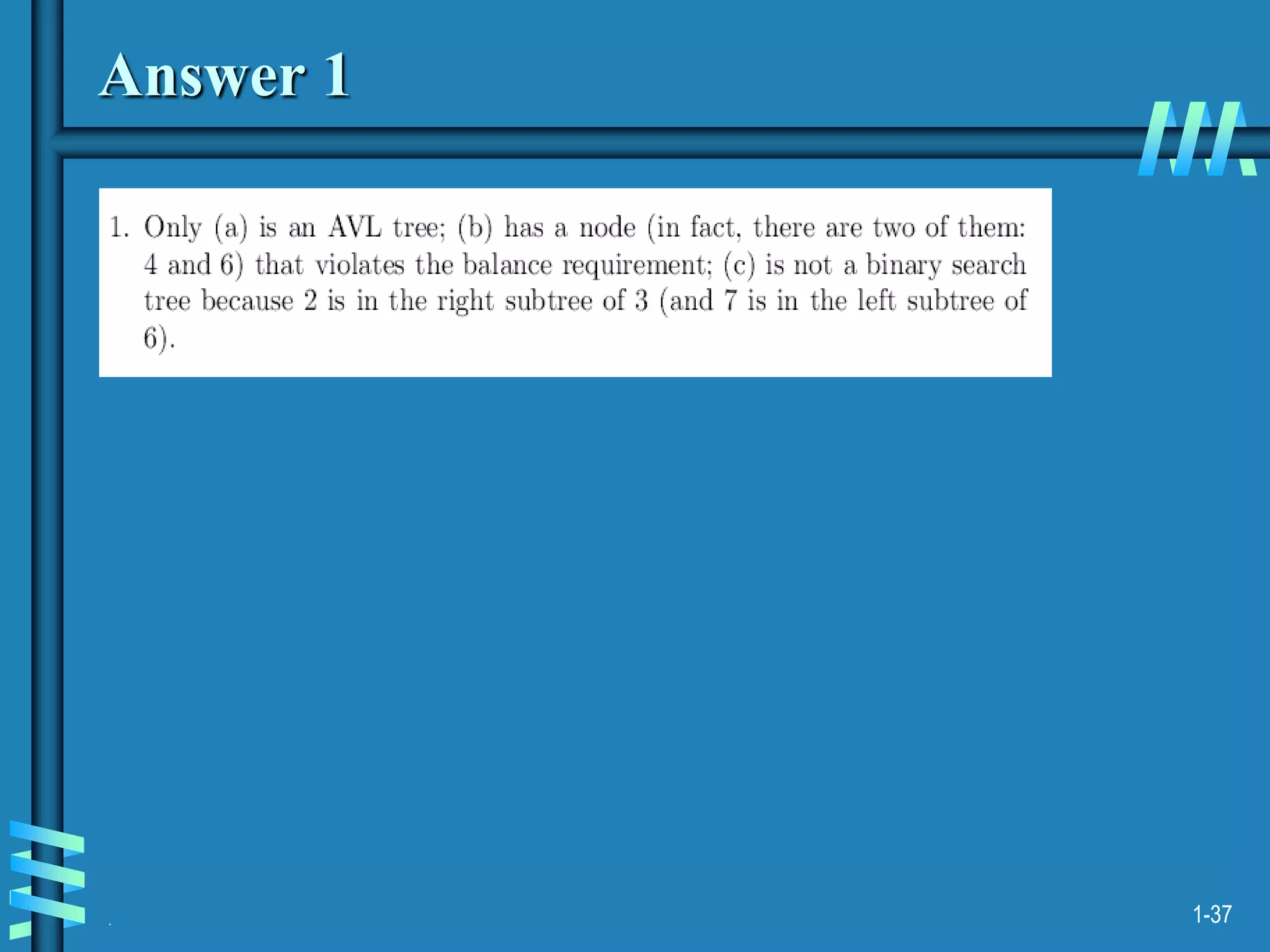
Exercise 1
1-36
.
Answer 1
1-37
.
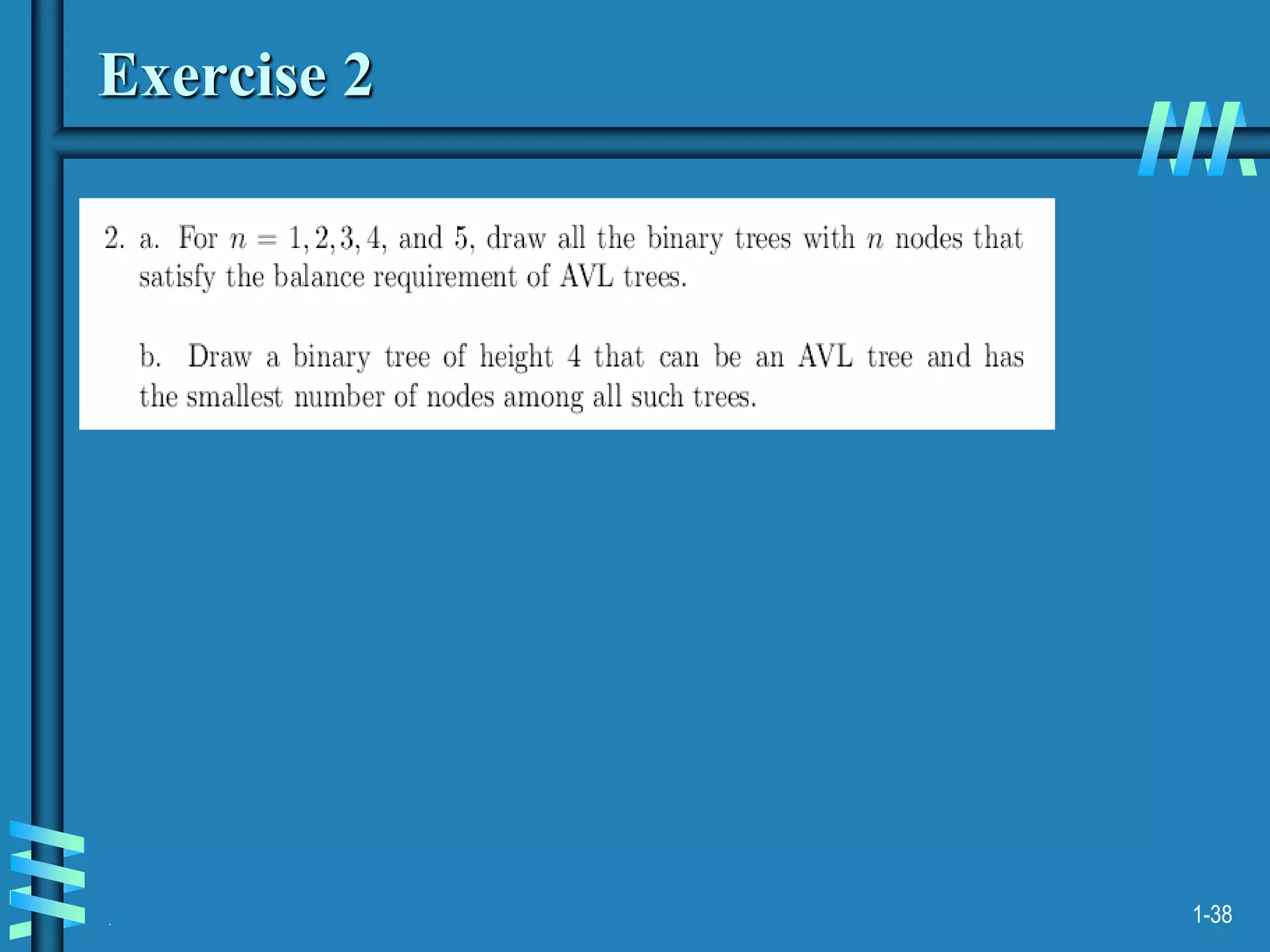
Exercise 2
1-38
.
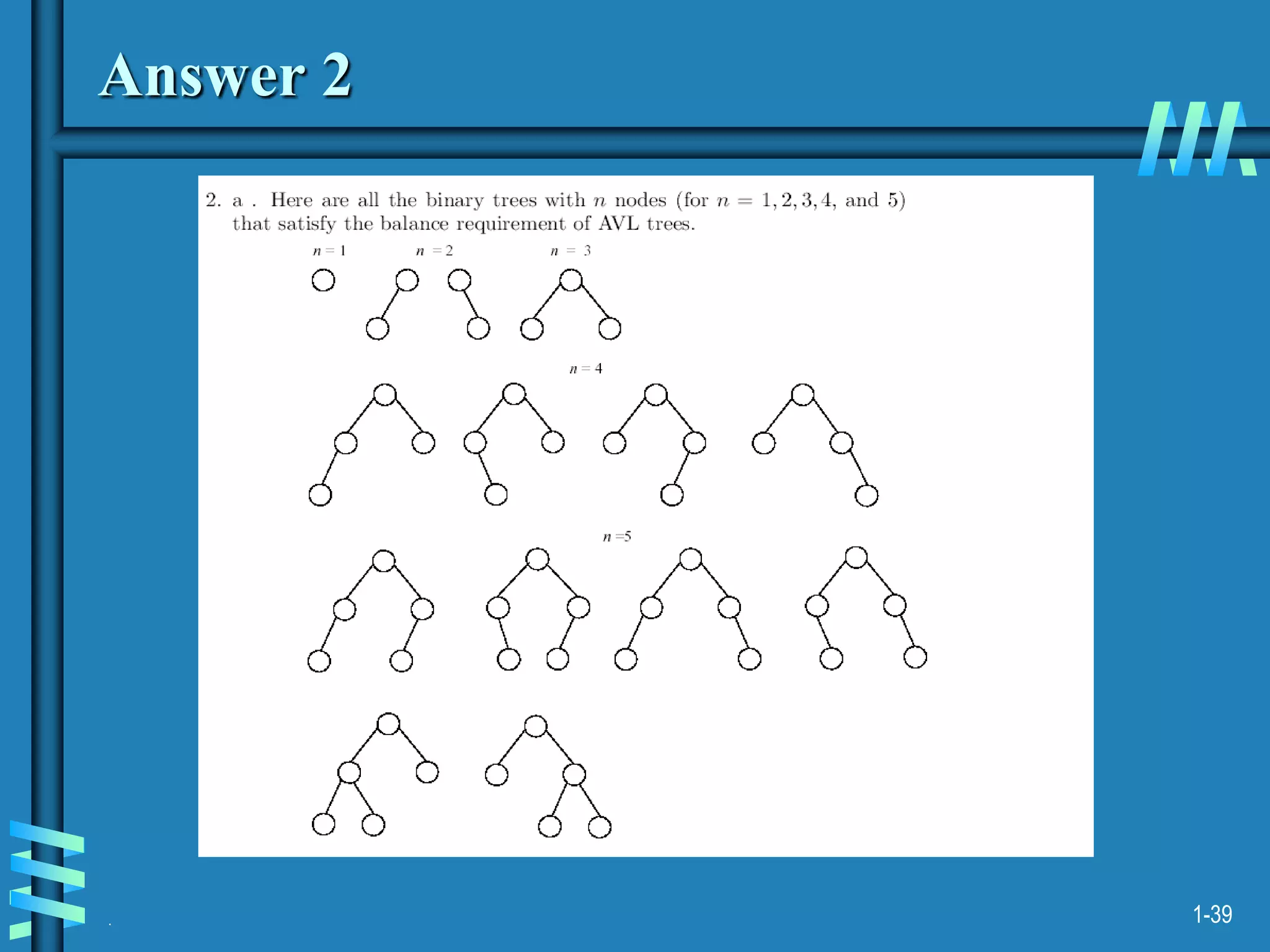
Answer 2
1-39
.
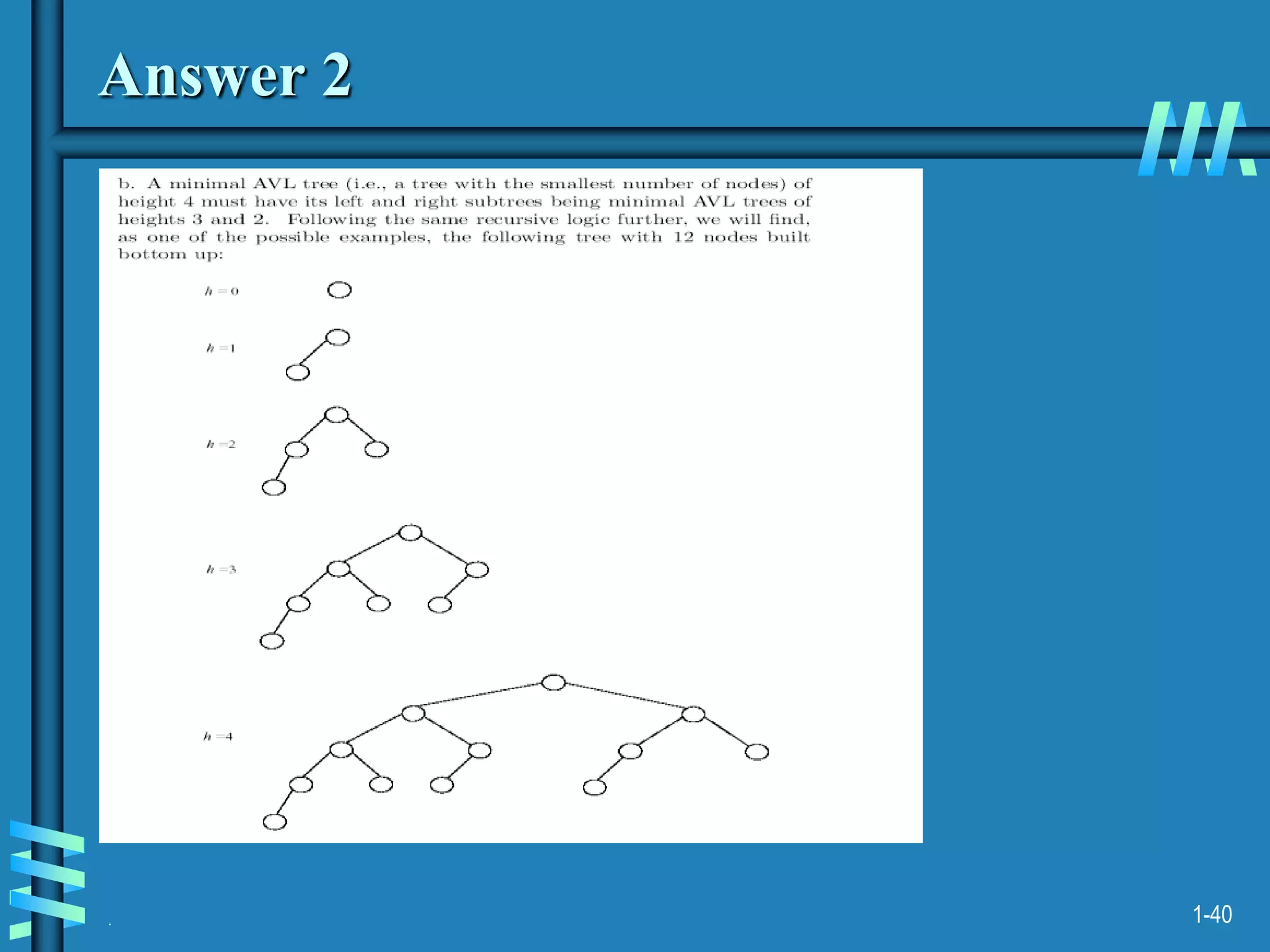
Answer 2
1-40
.
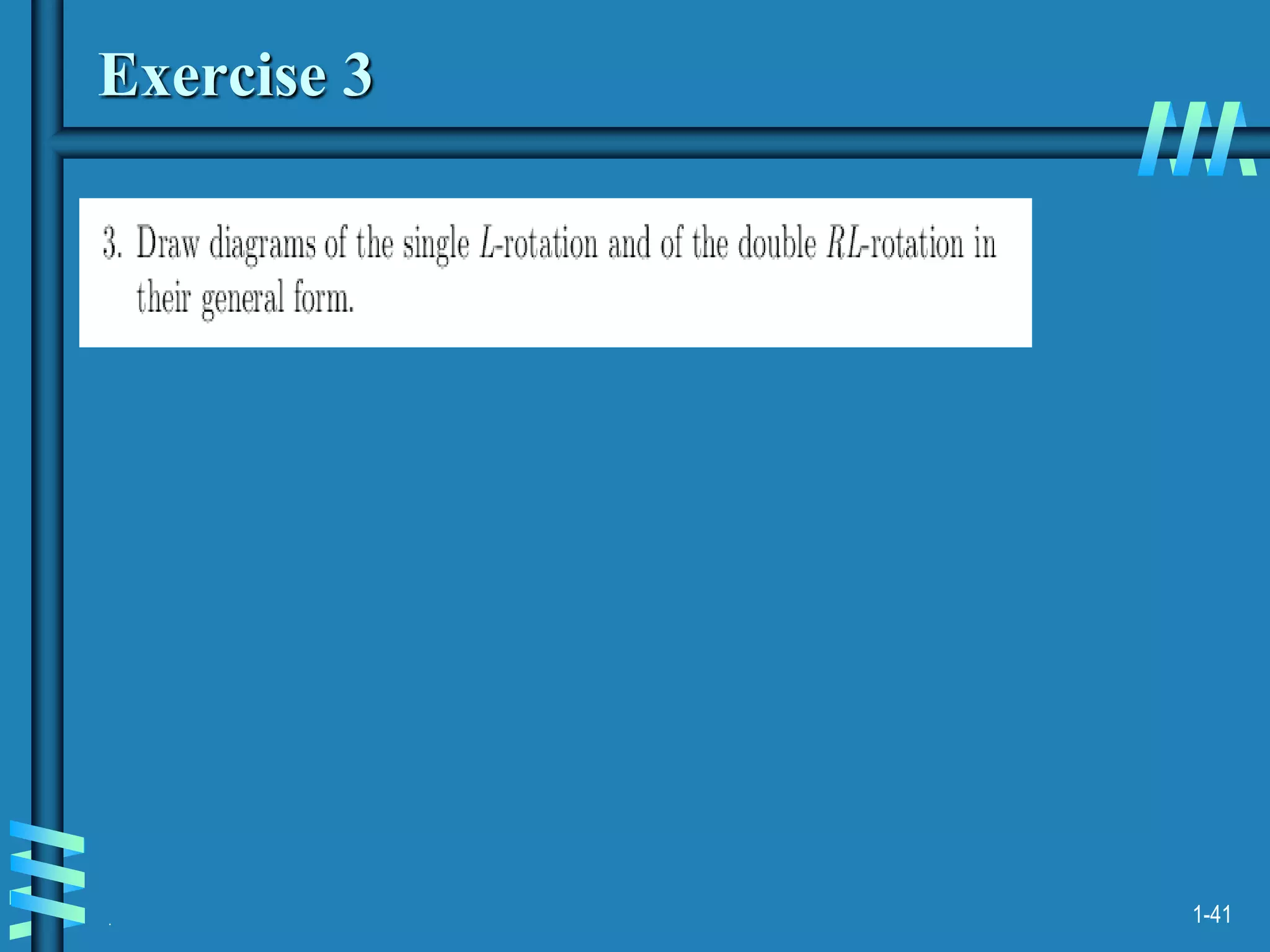
Exercise 3
1-41
.
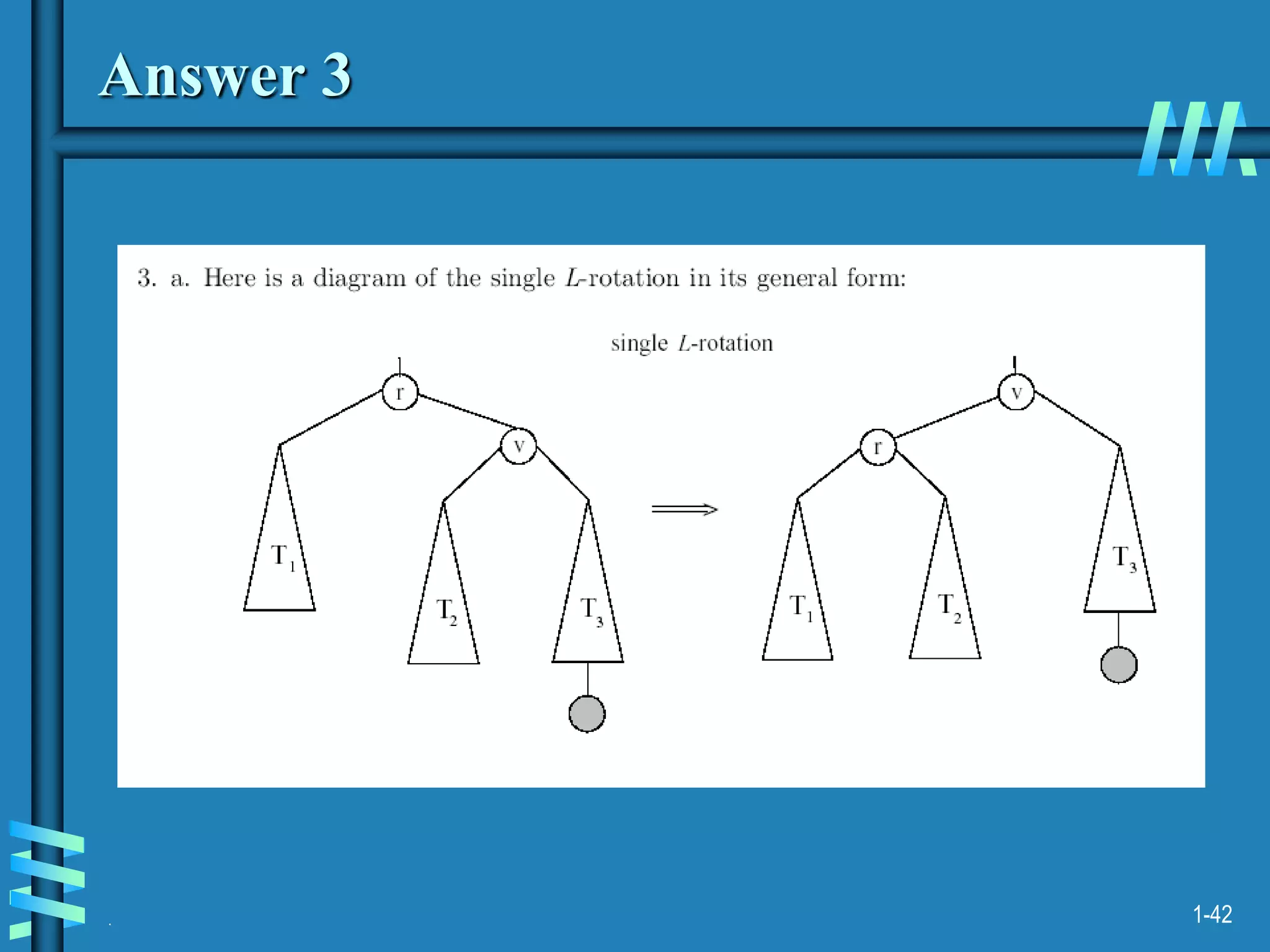
Answer 3
1-42
.
Answer 3
1-43
.
Exercise 4
1-44
.
Answer 4
1-45
.
Answer 4
1-46
.
Answer 4
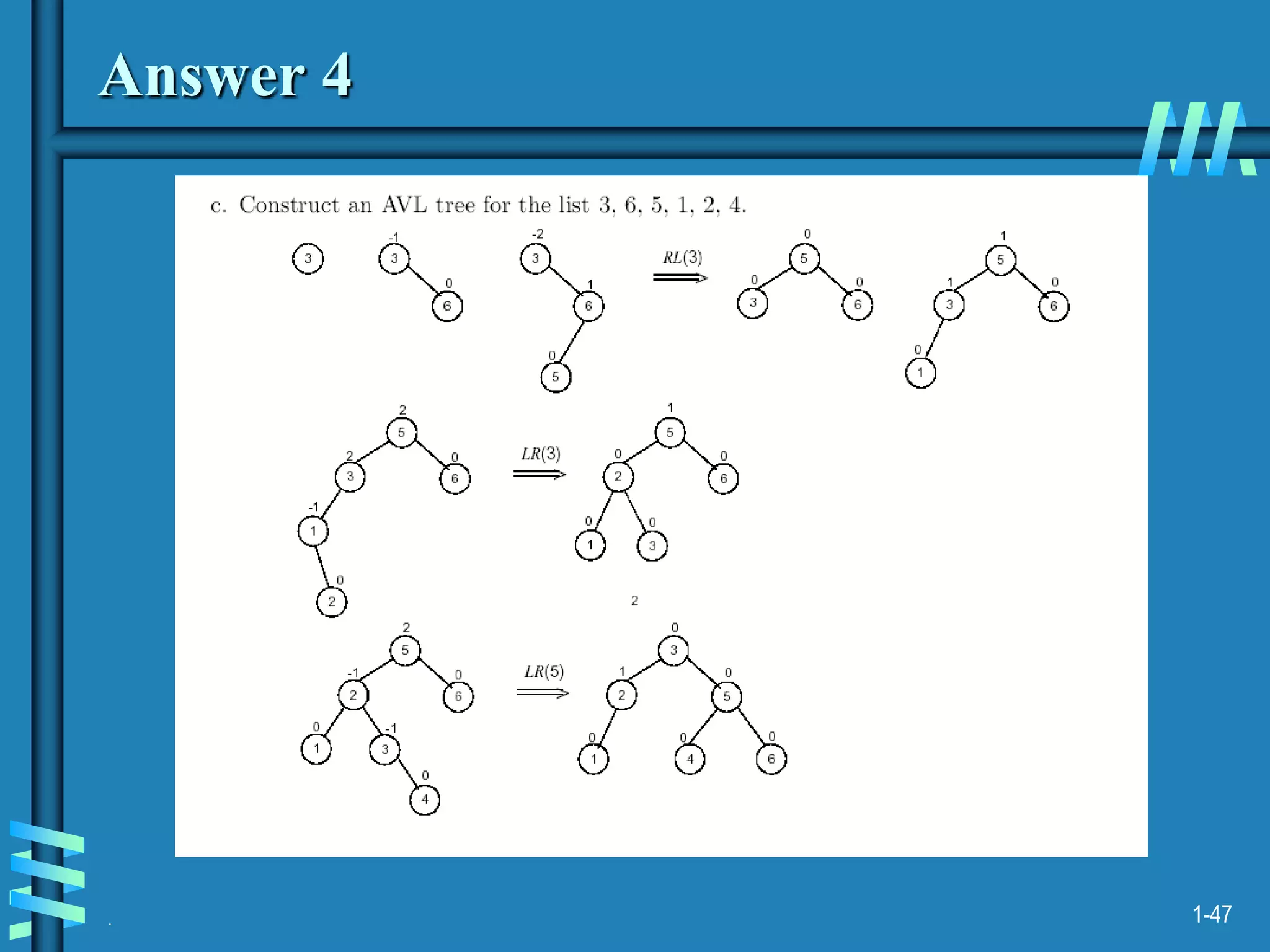
1-47
.
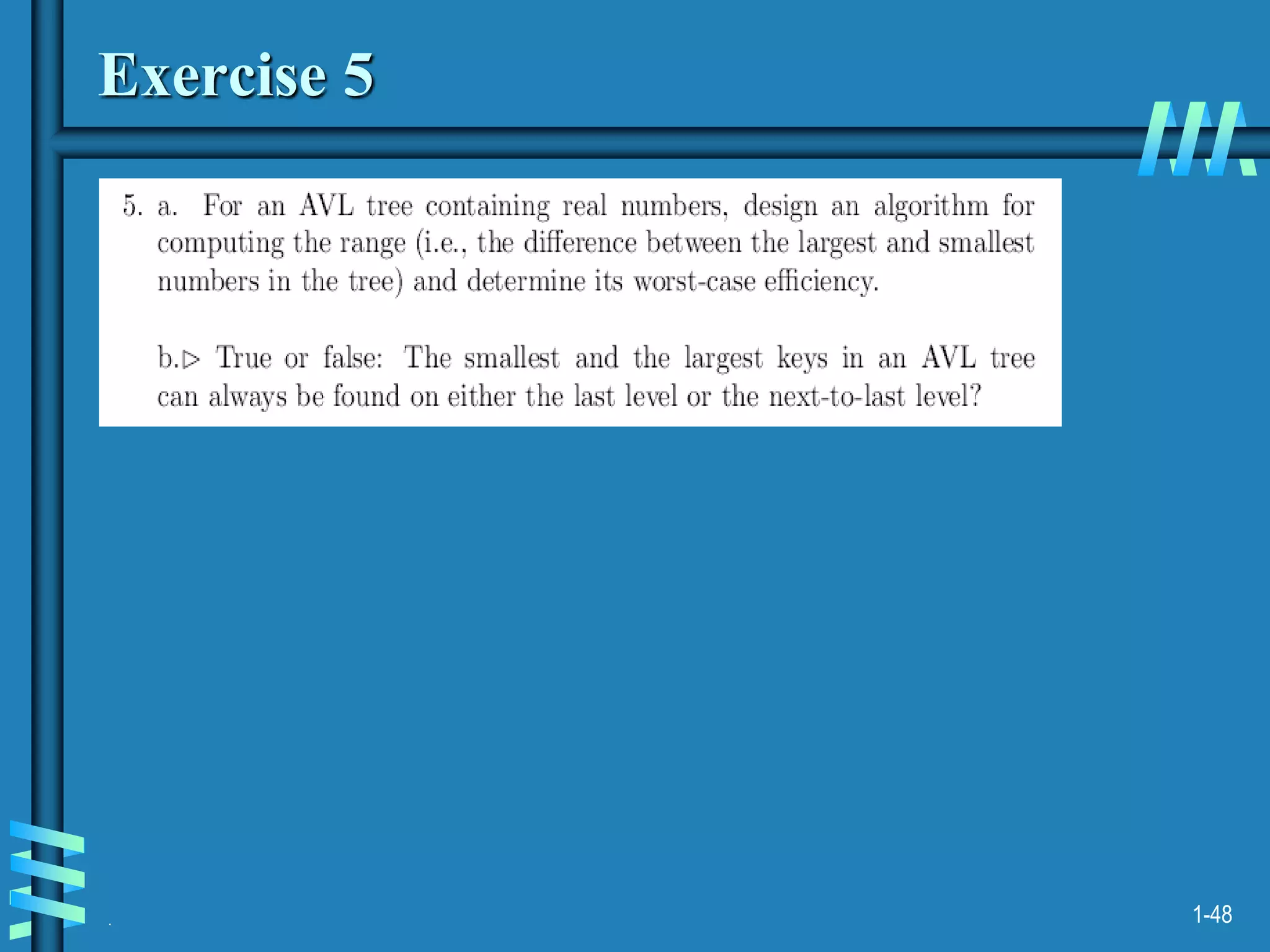
Exercise 5
1-48
.
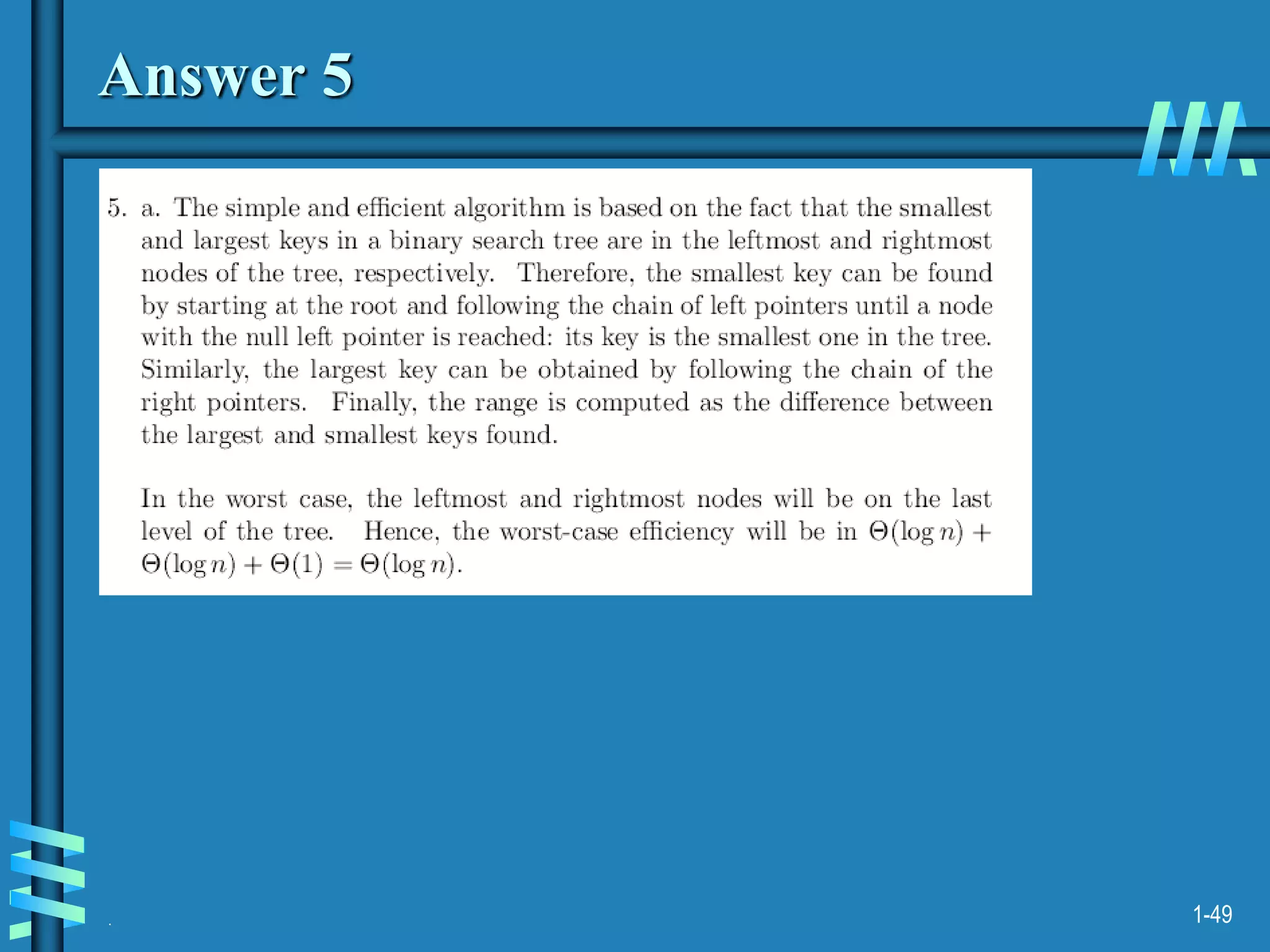
Answer 5
1-49
.
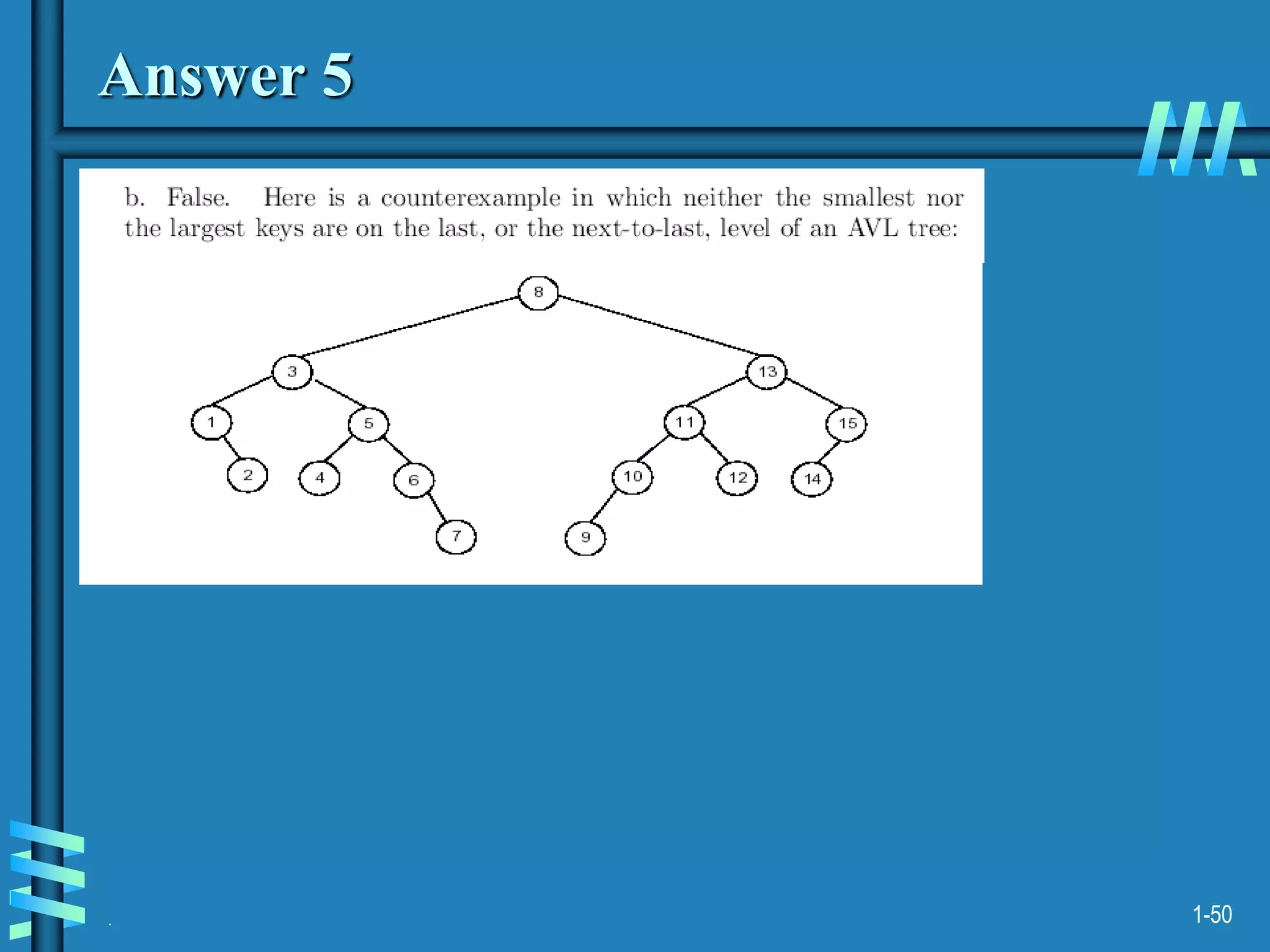
Answer 5
1-50
.
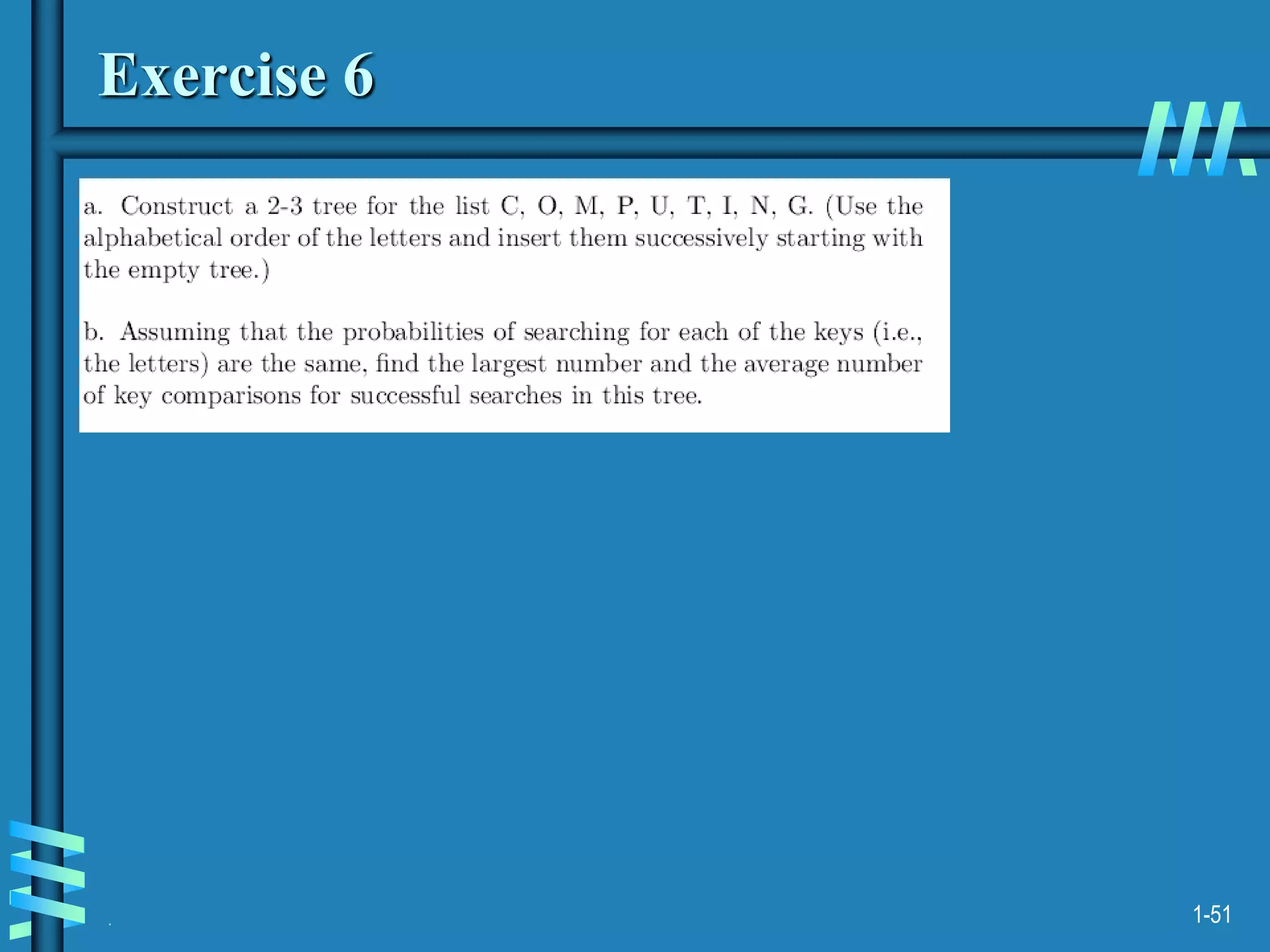
Exercise 6
1-51
.
Answer 6
1-52
.
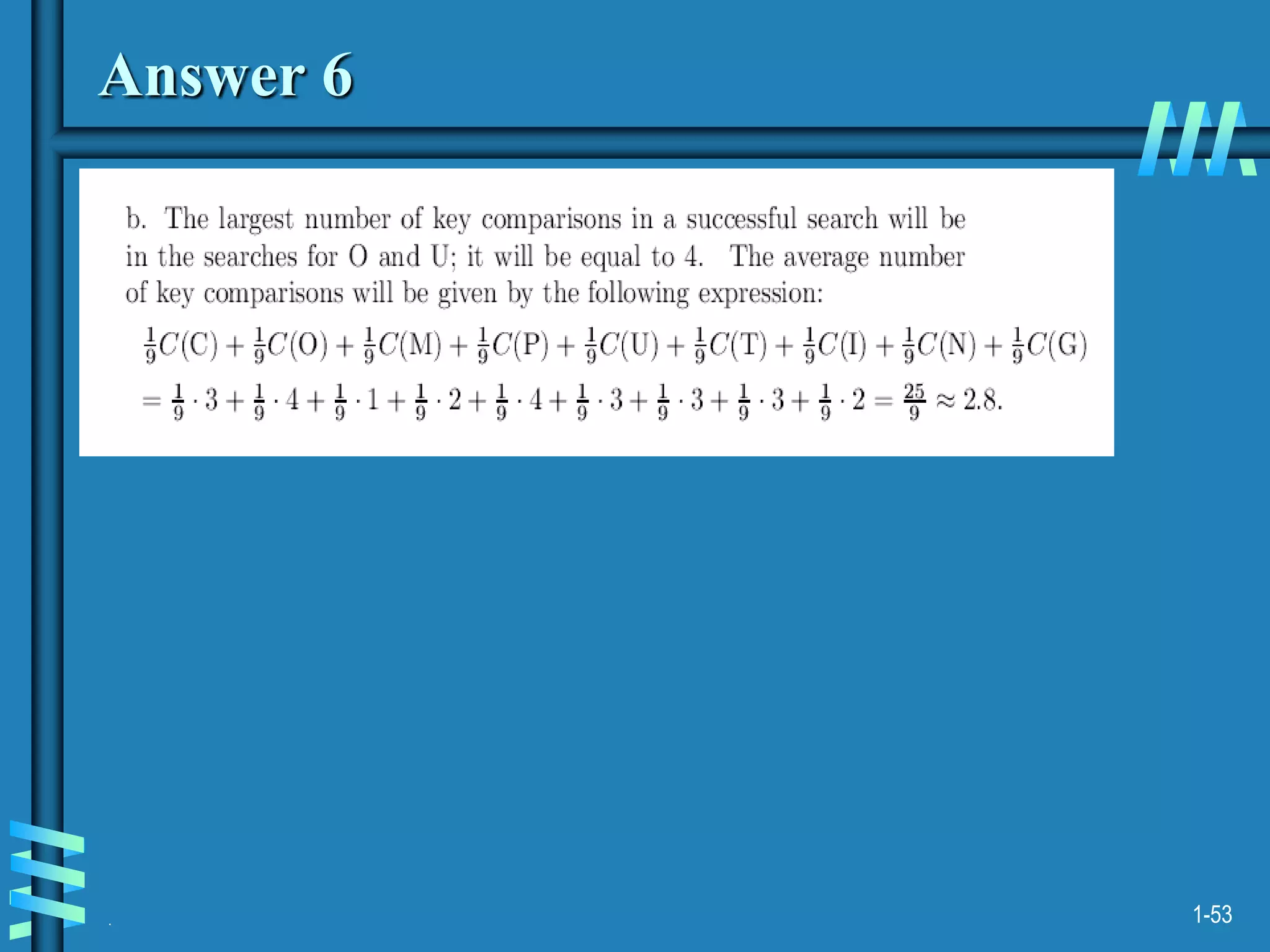
Answer 6
1-53
.
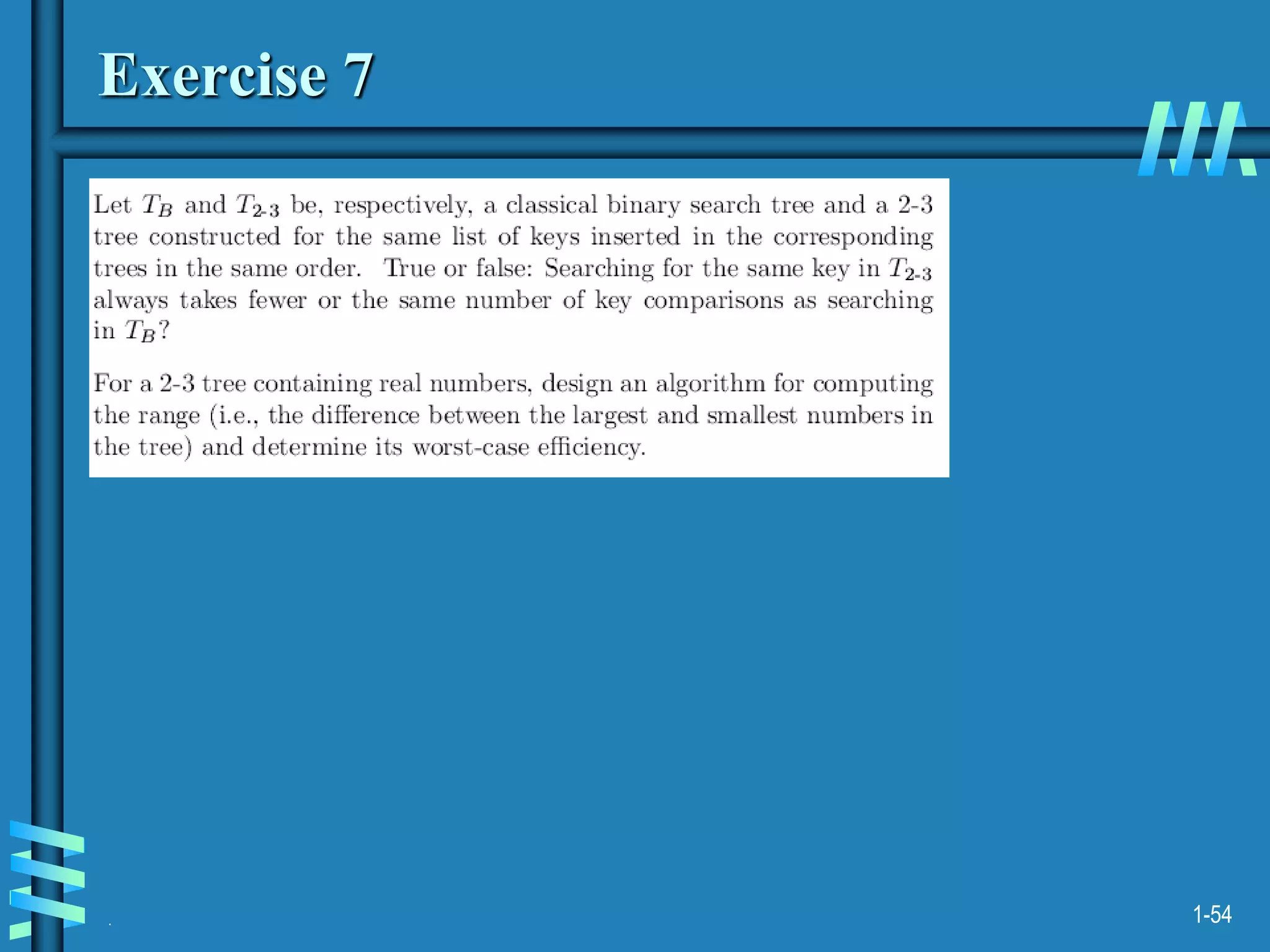
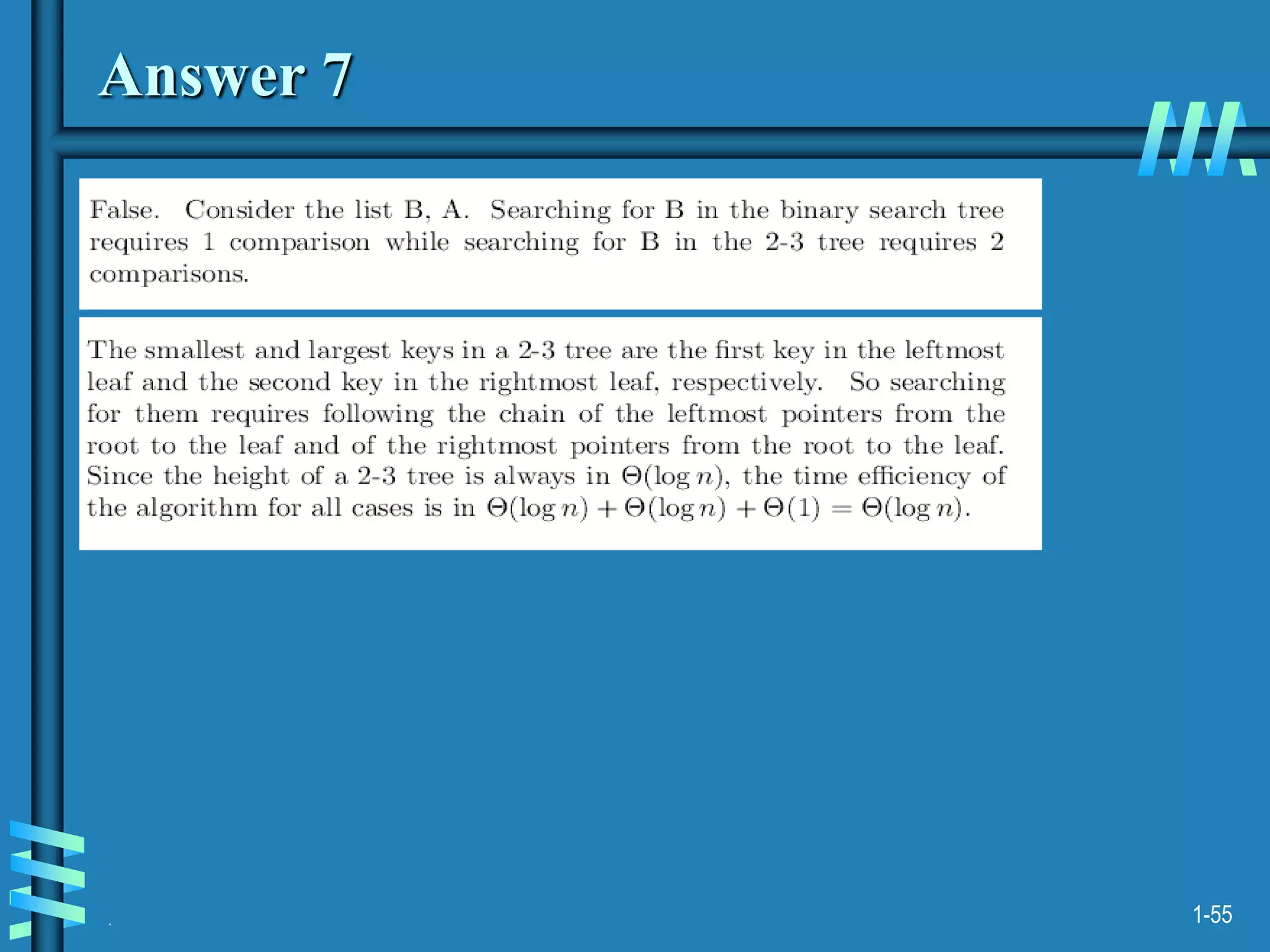
Exercise 7
1-54
.
Answer 7
1-55

Algo-Exercises-2-hash-AVL-Tree.ppt

  • 1.
    TIC424 – Complexityof Algorithms Prof. Magdy M. Aboul-Ela Information Systems Department Faculty of Management and Information Systems French University in Egypt Email: magdy.aboulela@ufe.edu.eg maboulela@gmail.com maboulela@link.net
  • 2.
    The exercises aredrawn from: A. Levitin “Introduction to the Design & Analysis of Algorithms,” 2nd ed., Copyright © 2007 Pearson Addison-Wesley. All rights reserved. Complexity of Algorithms Exercises
  • 3.
    . Hash tables andhash functions The idea of hashing is to map keys of a given file of size n into a table of size m, called the hash table, by using a predefined function, called the hash function, h: K  location (cell) in the hash table Example: student records, key = SSN. Hash function: h(K) = K mod m where m is some integer (typically, prime) If m = 1000, where is record with SSN= 314159265 stored? Generally, a hash function should: • be easy to compute • distribute keys about evenly throughout the hash table
  • 4.
    . Collisions If h(K1) =h(K2), there is a collision  Good hash functions result in fewer collisions but some collisions should be expected (birthday paradox) • birthday paradox pertains to the probability that in a set of randomly chosen people some pair of them will have the same birthday.  Two principal hashing schemes handle collisions differently: • Open hashing – each cell is a header of linked list of all keys hashed to it • Closed hashing – one key per cell – in case of collision, finds another cell by – linear probing: use next free bucket – double hashing: use second hash function to compute increment
  • 5.
    . Open hashing (Separatechaining) Keys are stored in linked lists outside a hash table whose elements serve as the lists’ headers. Example: A, FOOL, AND, HIS, MONEY, ARE, SOON, PARTED h(K) = sum of K ‘s letters’ positions in the alphabet MOD 13 Key A FOOL AND HIS MONEY ARE SOON PARTED h(K) 1 9 6 10 7 11 11 12 A FOOL AND HIS MONEY ARE PARTED SOON 12 11 10 9 8 7 6 5 4 3 2 1 0 Search for KID
  • 6.
    . Open hashing (cont.) If hash function distributes keys uniformly, average length of linked list will be α = n/m. This ratio is called load factor.  Average number of probes in successful, S, and unsuccessful searches, U: S  1+α/2, U = α  Load α is typically kept small (ideally, about 1)  Open hashing still works if n > m
  • 7.
    . Closed hashing (Openaddressing) Keys are stored inside a hash table. A A FOOL A AND FOOL A AND FOOL HIS A AND MONEY FOOL HIS A AND MONEY FOOL HIS ARE A AND MONEY FOOL HIS ARE SOON PARTED A AND MONEY FOOL HIS ARE SOON Key A FOOL AND HIS MONEY ARE SOON PARTED h(K) 1 9 6 10 7 11 11 12 0 1 2 3 4 5 6 7 8 9 10 11 12
  • 8.
    . Closed hashing (cont.) Does not work if n > m  Avoids pointers  Deletions are not straightforward  Number of probes to find/insert/delete a key depends on load factor α = n/m (hash table density) and collision resolution strategy. For linear probing: S = (½) (1+ 1/(1- α)) and U = (½) (1+ 1/(1- α)²)  As the table gets filled (α approaches 1), number of probes in linear probing increases dramatically:
  • 9.
  • 10.
  • 11.
  • 12.
  • 13.
  • 14.
  • 15.
  • 16.
  • 17.
  • 18.
  • 19.
  • 20.
  • 21.
  • 22.
  • 23.
    . Binary Search Tree Arrangekeys in a binary tree with the binary search tree property: K <K >K Example: 5, 3, 1, 10, 12, 7, 9
  • 24.
    . Dictionary Operations onBinary Search Trees Searching – straightforward Insertion – search for key, insert at leaf where search terminated Deletion – 3 cases: deleting key at a leaf deleting key at node with single child deleting key at node with two children Efficiency depends of the tree’s height: log2 n  h  n-1, with height average (random files) be about 3log2 n Thus all three operations have • worst case efficiency: (n) • average case efficiency: (log n) inorder traversal produces sorted list
  • 25.
    . Balanced Search Trees Attractivenessof binary search tree is marred by the bad (linear) worst-case efficiency. Two ideas to overcome it are:  to rebalance binary search tree when a new insertion makes the tree “too unbalanced” • AVL trees • red-black trees  to allow more than one key per node of a search tree • 2-3 trees • 2-3-4 trees • B-trees
  • 26.
    . Balanced trees: AVLtrees Definition An AVL tree is a binary search tree in which, for every node, the difference between the heights of its left and right subtrees, called the balance factor, is at most 1 (with the height of an empty tree defined as -1) 5 20 12 4 7 2 (a) 10 1 8 1 0 1 0 -1 0 0 5 20 4 7 2 (b) 10 2 8 0 0 1 0 -1 0 Tree (a) is an AVL tree; tree (b) is not an AVL tree
  • 27.
    . Rotations If a keyinsertion violates the balance requirement at some node, the subtree rooted at that node is transformed via one of the four rotations. (The rotation is always performed for a subtree rooted at an “unbalanced” node closest to the new leaf.) 3 2 2 1 1 0 2 0 1 0 3 0 > R (a) 3 2 1 -1 2 0 2 0 1 0 3 0 > LR (c) Single R-rotation Double LR-rotation
  • 28.
  • 29.
  • 30.
    . AVL tree construction- an example Construct an AVL tree for the list 5, 6, 8, 3, 2, 4, 7 5 -1 6 0 5 0 5 -2 6 -1 8 0 > 6 0 8 0 5 0 L(5) 6 1 5 1 3 0 8 0 6 2 5 2 3 1 2 0 8 0 > R (5) 6 1 3 0 2 0 8 0 5 0
  • 31.
    . AVL tree construction- an example (cont.) 6 2 3 -1 2 0 5 1 4 0 8 0 > LR (6) 5 0 3 0 2 0 4 0 6 -1 8 0 5 -1 3 0 2 0 4 0 6 -2 8 1 7 0 > RL (6) 5 0 3 0 2 0 4 0 7 0 8 0 6 0
  • 32.
    . Analysis of AVLtrees  h  1.4404 log2 (n + 2) - 1.3277 average height: 1.01 log2n + 0.1 for large n (found empirically)  Search and insertion are O(log n)  Deletion is more complicated but is also O(log n)  Disadvantages: • frequent rotations • complexity  A similar idea: red-black trees (height of subtrees is allowed to differ by up to a factor of 2)
  • 33.
    . Multiway Search Trees DefinitionA multiway search tree is a search tree that allows more than one key in the same node of the tree. Definition A node of a search tree is called an n-node if it contains n-1 ordered keys (which divide the entire key range into n intervals pointed to by the node’s n links to its children): Note: Every node in a classical binary search tree is a 2-node k1 < k2 < … < kn-1 < k1 [k1, k2 )  kn-1
  • 34.
    . 2-3 Tree Definition A2-3 tree is a search tree that  may have 2-nodes and 3-nodes  height-balanced (all leaves are on the same level) A 2-3 tree is constructed by successive insertions of keys given, with a new key always inserted into a leaf of the tree. If the leaf is a 3-node, it’s split into two with the middle key promoted to the parent. K K , K 1 2 (K , K ) 1 2 2-node 3-node < K > K < K > K 1 2
  • 35.
    . 2-3 tree construction– an example Construct a 2-3 tree the list 9, 5, 8, 3, 2, 4, 7 9 > 8 9 5 5, 9 5, 8, 9 8 9 3, 5 2, 3, 5 8 9 > > 3, 8 9 2 5 3, 8 9 2 4, 5 3, 8 4, 5, 7 2 9 > 3, 5, 8 2 4 7 9 5 3 4 2 8 9 7
  • 36.
    . Analysis of 2-3trees  log3 (n + 1) - 1  h  log2 (n + 1) - 1  Search, insertion, and deletion are in (log n)  The idea of 2-3 tree can be generalized by allowing more keys per node • 2-3-4 trees • B-trees (a tree data structure that keeps data sorted )
  • 37.
  • 38.
  • 39.
  • 40.
  • 41.
  • 42.
  • 43.
  • 44.
  • 45.
  • 46.
  • 47.
  • 48.
  • 49.
  • 50.
  • 51.
  • 52.
  • 53.
  • 54.
  • 55.
  • 56.