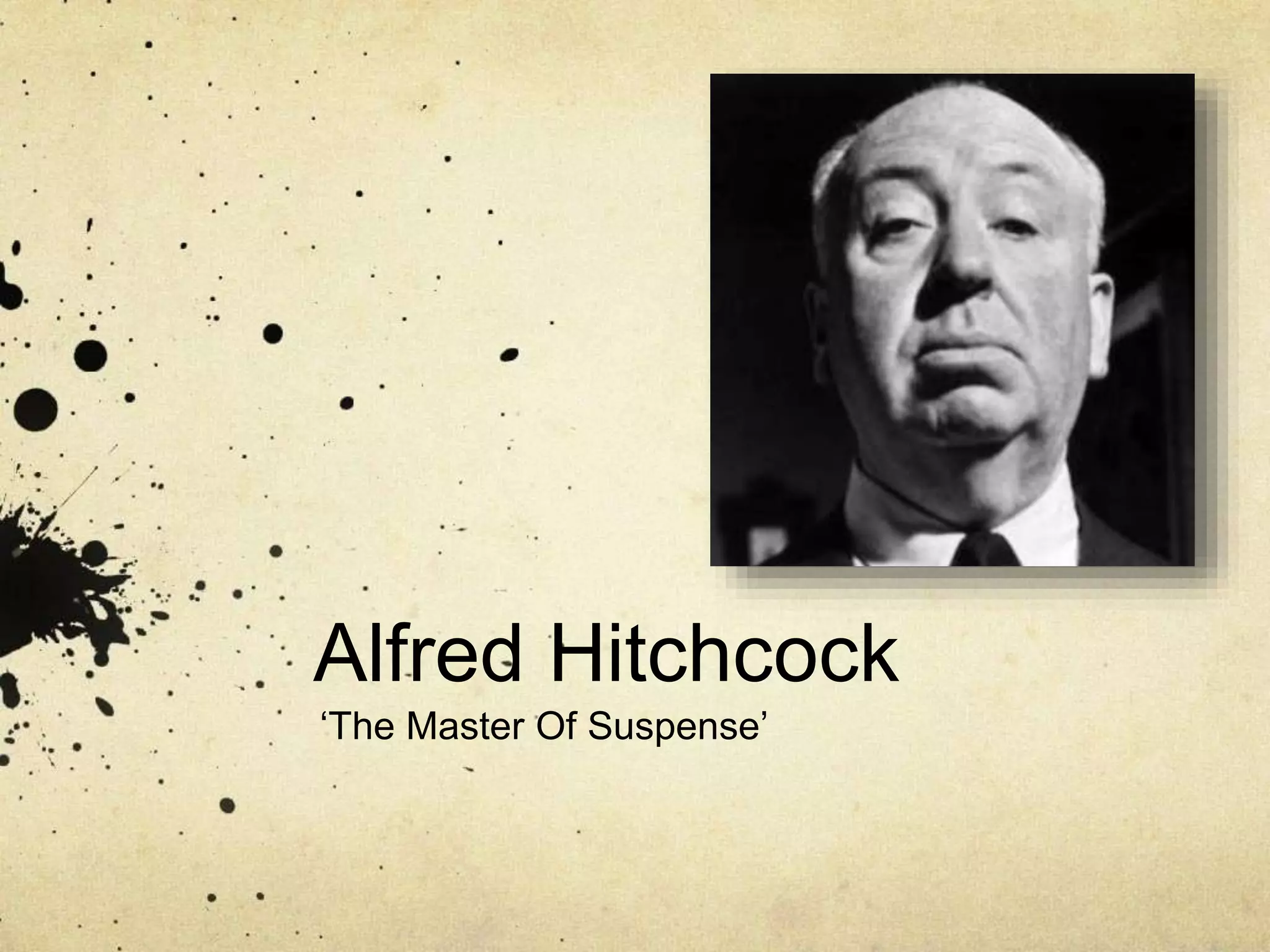
Alfred Hitchcock
‘The Master Of Suspense’
Alfred Hitchcock
Full Name: Alfred Joseph Hitchcock
D.O.B: August 13th 1899
Place of birth: London
Date of death: April 29th 1980
Career: Director, Producer, Television
Personality, Screenwriter
Filmmaker
Alfred studied at the University of London and then
moved to America and went into filmmaking and
screenwriting in California and Hollywood.
Hitchcock was nicknamed the "Master of Suspense" for
employing a kind of psychological suspense in his films,
producing a distinct viewer experience.
In 1925, Hitchcock directed his first film and began
making the thrillers for which he became known the
world over. His 1929 film Blackmail is said to be the first
British "talkie." In the 1930s, he directed such classic
suspense films as The Man Who Knew Too Much
(1934) and The 39 Steps (1935).
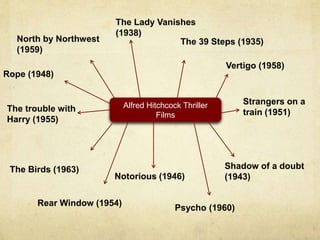
Alfred Hitchcock Thriller
Films
The 39 Steps (1935)North by Northwest
(1959)
Rope (1948)
Shadow of a doubt
(1943)
The trouble with
Harry (1955)
Vertigo (1958)
Rear Window (1954)
Psycho (1960)
The Lady Vanishes
(1938)
Notorious (1946)
Strangers on a
train (1951)
The Birds (1963)
Hitchcock’s Techniques –
Top 5
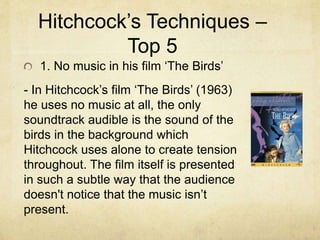
1. No music in his film ‘The Birds’
- In Hitchcock’s film ‘The Birds’ (1963)
he uses no music at all, the only
soundtrack audible is the sound of the
birds in the background which
Hitchcock uses alone to create tension
throughout. The film itself is presented
in such a subtle way that the audience
doesn't notice that the music isn’t
present.
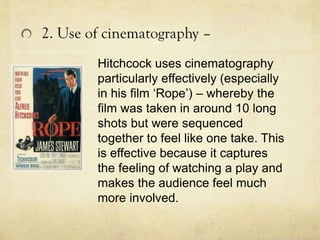
Hitchcock uses cinematography
particularly effectively (especially
in his film ‘Rope’) – whereby the
film was taken in around 10 long
shots but were sequenced
together to feel like one take. This
is effective because it captures
the feeling of watching a play and
makes the audience feel much
more involved.
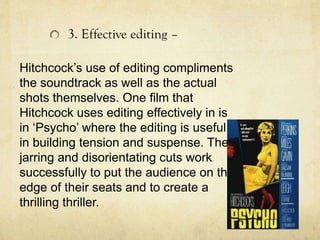
Hitchcock’s use of editing compliments
the soundtrack as well as the actual
shots themselves. One film that
Hitchcock uses editing effectively in is
in ‘Psycho’ where the editing is useful
in building tension and suspense. The
jarring and disorientating cuts work
successfully to put the audience on the
edge of their seats and to create a
thrilling thriller.
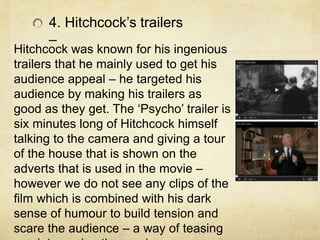
Hitchcock was known for his ingenious
trailers that he mainly used to get his
audience appeal – he targeted his
audience by making his trailers as
good as they get. The ‘Psycho’ trailer is
six minutes long of Hitchcock himself
talking to the camera and giving a tour
of the house that is shown on the
adverts that is used in the movie –
however we do not see any clips of the
film which is combined with his dark
sense of humour to build tension and
scare the audience – a way of teasing
4. Hitchcock’s trailers
–
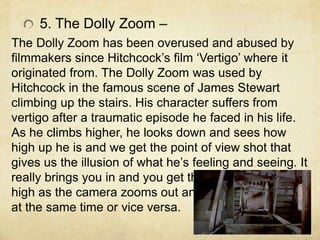
The Dolly Zoom has been overused and abused by
filmmakers since Hitchcock’s film ‘Vertigo’ where it
originated from. The Dolly Zoom was used by
Hitchcock in the famous scene of James Stewart
climbing up the stairs. His character suffers from
vertigo after a traumatic episode he faced in his life.
As he climbs higher, he looks down and sees how
high up he is and we get the point of view shot that
gives us the illusion of what he’s feeling and seeing. It
really brings you in and you get that feeling of too
high as the camera zooms out and dollies in
at the same time or vice versa.
5. The Dolly Zoom –

Alfred hitchcock1

  • 1.
  • 2.
    Alfred Hitchcock Full Name:Alfred Joseph Hitchcock D.O.B: August 13th 1899 Place of birth: London Date of death: April 29th 1980 Career: Director, Producer, Television Personality, Screenwriter
  • 3.
    Filmmaker Alfred studied atthe University of London and then moved to America and went into filmmaking and screenwriting in California and Hollywood. Hitchcock was nicknamed the "Master of Suspense" for employing a kind of psychological suspense in his films, producing a distinct viewer experience. In 1925, Hitchcock directed his first film and began making the thrillers for which he became known the world over. His 1929 film Blackmail is said to be the first British "talkie." In the 1930s, he directed such classic suspense films as The Man Who Knew Too Much (1934) and The 39 Steps (1935).
  • 4.
    Alfred Hitchcock Thriller Films The39 Steps (1935)North by Northwest (1959) Rope (1948) Shadow of a doubt (1943) The trouble with Harry (1955) Vertigo (1958) Rear Window (1954) Psycho (1960) The Lady Vanishes (1938) Notorious (1946) Strangers on a train (1951) The Birds (1963)
  • 5.
    Hitchcock’s Techniques – Top5 1. No music in his film ‘The Birds’ - In Hitchcock’s film ‘The Birds’ (1963) he uses no music at all, the only soundtrack audible is the sound of the birds in the background which Hitchcock uses alone to create tension throughout. The film itself is presented in such a subtle way that the audience doesn't notice that the music isn’t present.
  • 6.
    Hitchcock uses cinematography particularlyeffectively (especially in his film ‘Rope’) – whereby the film was taken in around 10 long shots but were sequenced together to feel like one take. This is effective because it captures the feeling of watching a play and makes the audience feel much more involved.
  • 7.
    Hitchcock’s use ofediting compliments the soundtrack as well as the actual shots themselves. One film that Hitchcock uses editing effectively in is in ‘Psycho’ where the editing is useful in building tension and suspense. The jarring and disorientating cuts work successfully to put the audience on the edge of their seats and to create a thrilling thriller.
  • 8.
    Hitchcock was knownfor his ingenious trailers that he mainly used to get his audience appeal – he targeted his audience by making his trailers as good as they get. The ‘Psycho’ trailer is six minutes long of Hitchcock himself talking to the camera and giving a tour of the house that is shown on the adverts that is used in the movie – however we do not see any clips of the film which is combined with his dark sense of humour to build tension and scare the audience – a way of teasing 4. Hitchcock’s trailers –
  • 9.
    The Dolly Zoomhas been overused and abused by filmmakers since Hitchcock’s film ‘Vertigo’ where it originated from. The Dolly Zoom was used by Hitchcock in the famous scene of James Stewart climbing up the stairs. His character suffers from vertigo after a traumatic episode he faced in his life. As he climbs higher, he looks down and sees how high up he is and we get the point of view shot that gives us the illusion of what he’s feeling and seeing. It really brings you in and you get that feeling of too high as the camera zooms out and dollies in at the same time or vice versa. 5. The Dolly Zoom –