Body Shape
- 3 volumes
- 4 doors
Alfa Romeo Giulia design analysis
Configurative components:
Platform
Dimensions
- Length, 4639 mm
- Large 1, 2024 mm (max dimensions, including external
mirrors)
- Large 2, 1873 mm (just body no external mirrors)
- Height, 1426 mm
- Wheel base, 2820 mm
- Front overhang, 795 mm
- Rear overhang, 1024 mm
Wheel drive
- Rear Wheel Drive
09/07/2017 Alex M. Marconi Analysis of Giulia Design – June 2017 1
Configurative components
Elements to be analysed
1. Headlights
2. Rear lamps
3. Rear lamps and tail
4. Wheels
5. Terminal exhausts
6. Front bonnet
7. Rear shape
8. Front overhang
9. The nose
10. The front grid
11. Registration plate positioning
12. doors
09/07/2017 Alex M. Marconi Analysis of Giulia Design – June 2017 2
09/07/2017 Alex M. Marconi Analysis of Giulia Design – June 2017 3
Configurative Analysis
The platform, a longitudinal engine rear wheel drive, gives immediately the
feeling this car wants to reveal: dynamic and sporty DNA. The Alfa DNA (by the
way, car setup is called as well DNA to provide the same feeling).
The wheel base dimension is typical of the RWD cars of this segment: quite short
to enable a better handle of the car on curves, but long enough to ensure stability
on large radius bends.
The body itself, generally speaking, provides the same feeling: a dynamic and
sporty car, mixed to an elegant shape too though. If compared with past stiles,
Giulia design is consistent and a sort of further development. Most details have
been developed to meet modern tastes: the grid, lamps, etc.. Most of the
technical choices have instead been changed, especially the RWD that Alfa funs
have been missing for more than 25 years, since the Alfa 75 was discontinued.
09/07/2017 Alex M. Marconi Analysis of Giulia Design – June 2017 4
Configurative Analysis
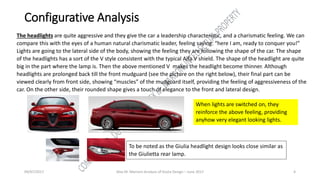
The headlights are quite aggressive and they give the car a leadership characteristic, and a charismatic feeling. We can
compare this with the eyes of a human natural charismatic leader, feeling saying: “here I am, ready to conquer you!”
Lights are going to the lateral side of the body, showing the feeling they are following the shape of the car. The shape
of the headlights has a sort of the V style consistent with the typical Alfa V shield. The shape of the headlight are quite
big in the part where the lamp is. Then the above mentioned V makes the headlight become thinner. Although
headlights are prolonged back till the front mudguard (see the picture on the right below), their final part can be
viewed clearly from front side, showing “muscles” of the mudguard itself, providing the feeling of aggressiveness of the
car. On the other side, their rounded shape gives a touch of elegance to the front and lateral design.
When lights are switched on, they
reinforce the above feeling, providing
anyhow very elegant looking lights.
To be noted as the Giulia headlight design looks close similar as
the Giulietta rear lamp.
09/07/2017 Alex M. Marconi Analysis of Giulia Design – June 2017 5
Configurative Analysis
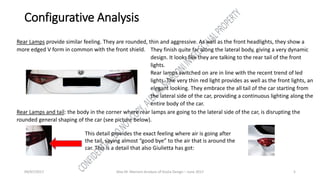
Rear Lamps provide similar feeling. They are rounded, thin and aggressive. As well as the front headlights, they show a
more edged V form in common with the front shield. They finish quite far along the lateral body, giving a very dynamic
design. It looks like they are talking to the rear tail of the front
lights.
Rear lamps switched on are in line with the recent trend of led
lights. The very thin red light provides as well as the front lights, an
elegant looking. They embrace the all tail of the car starting from
the lateral side of the car, providing a continuous lighting along the
entire body of the car.
Rear Lamps and tail: the body in the corner where rear lamps are going to the lateral side of the car, is disrupting the
rounded general shaping of the car (see picture below).
This detail provides the exact feeling where air is going after
the tail, saying almost “good bye” to the air that is around the
car. This is a detail that also Giulietta has got:
09/07/2017 Alex M. Marconi Analysis of Giulia Design – June 2017 6
Configurative Analysis
Wheels are consistent to the image of the car, big enough without catching people eyes. Depending on the model,
by looking at the Super version of the car, 17” standard wheels are optimum to give the car the feeling of dynamism
and elegance together. Spokes alloy wheels provide a classic touch that marry perfectly the body shape, and leave
the brake callipers be very well visible, reinforcing the power of the dynamic breaking system.
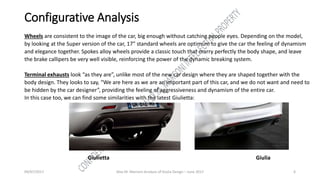
Terminal exhausts look “as they are”, unlike most of the new car design where they are shaped together with the
body design. They looks to say, “We are here as we are an important part of this car, and we do not want and need to
be hidden by the car designer”, providing the feeling of aggressiveness and dynamism of the entire car.
In this case too, we can find some similarities with the latest Giulietta:
Giulietta Giulia
09/07/2017 Alex M. Marconi Analysis of Giulia Design – June 2017 7
Configurative Analysis
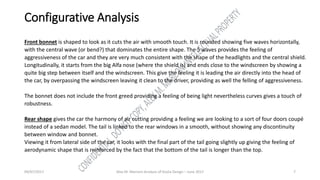
Front bonnet is shaped to look as it cuts the air with smooth touch. It is rounded showing five waves horizontally,
with the central wave (or bend?) that dominates the entire shape. The 5 waves provides the feeling of
aggressiveness of the car and they are very much consistent with the shape of the headlights and the central shield.
Longitudinally, it starts from the big Alfa nose (where the shield is) and ends close to the windscreen by showing a
quite big step between itself and the windscreen. This give the feeling it is leading the air directly into the head of
the car, by overpassing the windscreen leaving it clean to the driver, providing as well the felling of aggressiveness.
The bonnet does not include the front greed providing a feeling of being light nevertheless curves gives a touch of
robustness.
Rear shape gives the car the harmony of air cutting providing a feeling we are looking to a sort of four doors coupé
instead of a sedan model. The tail is linked to the rear windows in a smooth, without showing any discontinuity
between window and bonnet.
Viewing it from lateral side of the car, it looks with the final part of the tail going slightly up giving the feeling of
aerodynamic shape that is reinforced by the fact that the bottom of the tail is longer than the top.
09/07/2017 Alex M. Marconi Analysis of Giulia Design – June 2017 8
Configurative Analysis
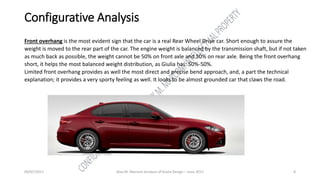
Front overhang is the most evident sign that the car is a real Rear Wheel Drive car. Short enough to assure the
weight is moved to the rear part of the car. The engine weight is balanced by the transmission shaft, but if not taken
as much back as possible, the weight cannot be 50% on front axle and 50% on rear axle. Being the front overhang
short, it helps the most balanced weight distribution, as Giulia has: 50%-50%.
Limited front overhang provides as well the most direct and precise bend approach, and, a part the technical
explanation; it provides a very sporty feeling as well. It looks to be almost grounded car that claws the road.
09/07/2017 Alex M. Marconi Analysis of Giulia Design – June 2017 9
Configurative Analysis
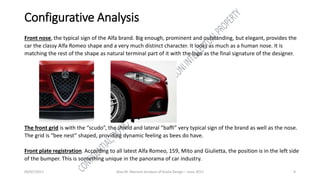
Front nose, the typical sign of the Alfa brand. Big enough, prominent and outstanding, but elegant, provides the
car the classy Alfa Romeo shape and a very much distinct character. It looks as much as a human nose. It is
matching the rest of the shape as natural terminal part of it with the logo as the final signature of the designer.
The front grid is with the “scudo”, the shield and lateral “baffi” very typical sign of the brand as well as the nose.
The grid is “bee nest” shaped, providing dynamic feeling as bees do have.
Front plate registration. According to all latest Alfa Romeo, 159, Mito and Giulietta, the position is in the left side
of the bumper. This is something unique in the panorama of car industry.
09/07/2017 Alex M. Marconi Analysis of Giulia Design – June 2017 10
Configurative Analysis
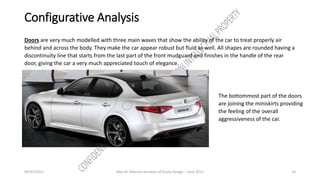
Doors are very much modelled with three main waves that show the ability of the car to treat properly air
behind and across the body. They make the car appear robust but fluid as well. All shapes are rounded having a
discontinuity line that starts from the last part of the front mudguard and finishes in the handle of the rear
door, giving the car a very much appreciated touch of elegance.
The bottommost part of the doors
are joining the miniskirts providing
the feeling of the overall
aggressiveness of the car.
09/07/2017 Alex M. Marconi Analysis of Giulia Design – June 2017 11
Taxonomy Analysis
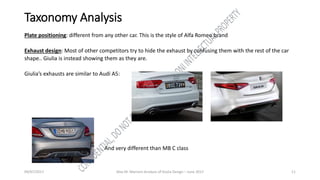
Plate positioning: different from any other car. This is the style of Alfa Romeo brand
Exhaust design: Most of other competitors try to hide the exhaust by confusing them with the rest of the car
shape.. Giulia is instead showing them as they are.
Giulia’s exhausts are similar to Audi A5:
And very different than MB C class
09/07/2017 Alex M. Marconi Analysis of Giulia Design – June 2017 12
Taxonomy Analysis
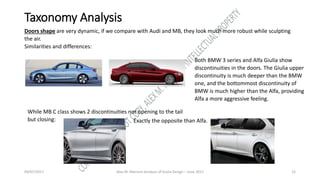
Doors shape are very dynamic, if we compare with Audi and MB, they look much more robust while sculpting
the air.
Similarities and differences:
Both BMW 3 series and Alfa Giulia show
discontinuities in the doors. The Giulia upper
discontinuity is much deeper than the BMW
one, and the bottommost discontinuity of
BMW is much higher than the Alfa, providing
Alfa a more aggressive feeling.
While MB C class shows 2 discontinuities not opening to the tail
but closing: Exactly the opposite than Alfa.
09/07/2017 Alex M. Marconi Analysis of Giulia Design – June 2017 13
Taxonomy Analysis
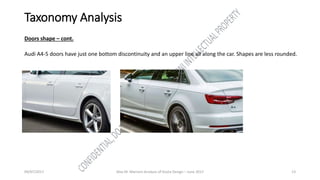
Doors shape – cont.
Audi A4-5 doors have just one bottom discontinuity and an upper line all along the car. Shapes are less rounded.
09/07/2017 Alex M. Marconi Analysis of Giulia Design – June 2017 14
Taxonomy Analysis
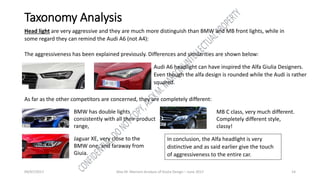
Head light are very aggressive and they are much more distinguish than BMW and MB front lights, while in
some regard they can remind the Audi A6 (not A4):
The aggressiveness has been explained previously. Differences and similarities are shown below:
Audi A6 headlight can have inspired the Alfa Giulia Designers.
Even though the alfa design is rounded while the Audi is rather
squared.
As far as the other competitors are concerned, they are completely different:
BMW has double lights
consistently with all their product
range,
MB C class, very much different.
Completely different style,
classy!
Jaguar XE, very close to the
BMW one, and faraway from
Giuia.
In conclusion, the Alfa headlight is very
distinctive and as said earlier give the touch
of aggressiveness to the entire car.
09/07/2017 Alex M. Marconi Analysis of Giulia Design – June 2017 15
Taxonomy Analysis
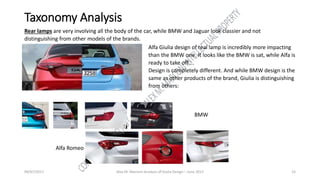
Rear lamps are very involving all the body of the car, while BMW and Jaguar look classier and not
distinguishing from other models of the brands.
Alfa Giulia design of real lamp is incredibly more impacting
than the BMW one. It looks like the BMW is sat, while Alfa is
ready to take off….
Design is completely different. And while BMW design is the
same as other products of the brand, Giulia is distinguishing
from others:
BMW
Alfa Romeo
09/07/2017 Alex M. Marconi Analysis of Giulia Design – June 2017 16
Taxonomy Analysis
Rear lamps – cont.
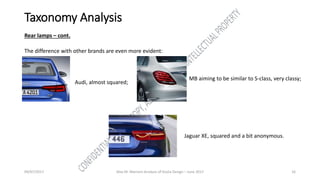
The difference with other brands are even more evident:
Audi, almost squared;
MB aiming to be similar to S-class, very classy;
Jaguar XE, squared and a bit anonymous.
09/07/2017 Alex M. Marconi Analysis of Giulia Design – June 2017 17
Taxonomy Analysis
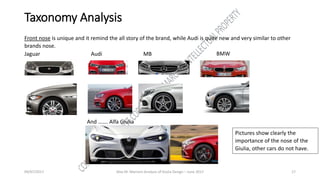
Front nose is unique and it remind the all story of the brand, while Audi is quite new and very similar to other
brands nose.
Jaguar Audi MB BMW
And ……. Alfa Giulia
Pictures show clearly the
importance of the nose of the
Giulia, other cars do not have.
09/07/2017 Alex M. Marconi Analysis of Giulia Design – June 2017 18
Functional Analysis
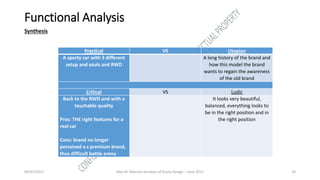
Synthesis
Practical VS Utopian
A sporty car with 3 different
setup and souls and RWD
A long history of the brand and
how this model the brand
wants to regain the awareness
of the old brand
Critical VS Ludic
Back to the RWD and with a
touchable quality
Pros: THE right features for a
real car
Cons: brand no longer
perceived a s premium brand,
thus difficult battle arena
It looks very beautiful,
balanced, everything looks to
be in the right position and in
the right position
09/07/2017 Alex M. Marconi Analysis of Giulia Design – June 2017 19
Functional Analysis
In terms of practical valorisation, Giulia adds many values to previous models:
First, it is the first car with RWD since 75 was dismissed. This represents an added value as most of the top-end cars
of the D segment, do have RWD, but Audi, who was able to conquer a place of leadership nevertheless the FWD.
Secondly, it is the first time Alfa is caring very much interiors and visible quality, therefore ready to compete with
Germans manufacturers.
To limit the weight, aluminium was used as first time in the brand, as well as part of the body parts.
Against competitors, Giulia offers same or even better pleasure of driving than BMW, providing a message of an old
brand back to the battle, ready to regain the awareness that was in mind of all drivers in the past.
The critical issue is that most of present drivers, due to the limited offer, or to the fact that electronics control of the
dynamic of the car, do not feel RWD as a big benefit unless the driver likes very much driving the car in a sporty way.
The offer of AWD version can countermeasure this issue.
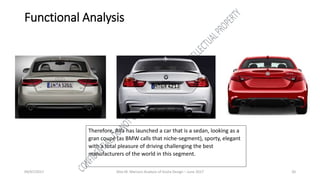
From a global design, the car looks very beautiful and well balanced. it looks more a coupe-sedan rather than a pure
sedan. In fact, from the back it looks more similar as BMW 4 series and Audi A5 with larger mudguards:
09/07/2017 Alex M. Marconi Analysis of Giulia Design – June 2017 20
Functional Analysis
Therefore, Alfa has launched a car that is a sedan, looking as a
gran coupé (as BMW calls that niche-segment), sporty, elegant
with a total pleasure of driving challenging the best
manufacturers of the world in this segment.

Alfa romeo giulia design analysis

  • 1.
    Body Shape - 3volumes - 4 doors Alfa Romeo Giulia design analysis Configurative components: Platform Dimensions - Length, 4639 mm - Large 1, 2024 mm (max dimensions, including external mirrors) - Large 2, 1873 mm (just body no external mirrors) - Height, 1426 mm - Wheel base, 2820 mm - Front overhang, 795 mm - Rear overhang, 1024 mm Wheel drive - Rear Wheel Drive 09/07/2017 Alex M. Marconi Analysis of Giulia Design – June 2017 1
  • 2.
    Configurative components Elements tobe analysed 1. Headlights 2. Rear lamps 3. Rear lamps and tail 4. Wheels 5. Terminal exhausts 6. Front bonnet 7. Rear shape 8. Front overhang 9. The nose 10. The front grid 11. Registration plate positioning 12. doors 09/07/2017 Alex M. Marconi Analysis of Giulia Design – June 2017 2
  • 3.
    09/07/2017 Alex M.Marconi Analysis of Giulia Design – June 2017 3 Configurative Analysis The platform, a longitudinal engine rear wheel drive, gives immediately the feeling this car wants to reveal: dynamic and sporty DNA. The Alfa DNA (by the way, car setup is called as well DNA to provide the same feeling). The wheel base dimension is typical of the RWD cars of this segment: quite short to enable a better handle of the car on curves, but long enough to ensure stability on large radius bends. The body itself, generally speaking, provides the same feeling: a dynamic and sporty car, mixed to an elegant shape too though. If compared with past stiles, Giulia design is consistent and a sort of further development. Most details have been developed to meet modern tastes: the grid, lamps, etc.. Most of the technical choices have instead been changed, especially the RWD that Alfa funs have been missing for more than 25 years, since the Alfa 75 was discontinued.
  • 4.
    09/07/2017 Alex M.Marconi Analysis of Giulia Design – June 2017 4 Configurative Analysis The headlights are quite aggressive and they give the car a leadership characteristic, and a charismatic feeling. We can compare this with the eyes of a human natural charismatic leader, feeling saying: “here I am, ready to conquer you!” Lights are going to the lateral side of the body, showing the feeling they are following the shape of the car. The shape of the headlights has a sort of the V style consistent with the typical Alfa V shield. The shape of the headlight are quite big in the part where the lamp is. Then the above mentioned V makes the headlight become thinner. Although headlights are prolonged back till the front mudguard (see the picture on the right below), their final part can be viewed clearly from front side, showing “muscles” of the mudguard itself, providing the feeling of aggressiveness of the car. On the other side, their rounded shape gives a touch of elegance to the front and lateral design. When lights are switched on, they reinforce the above feeling, providing anyhow very elegant looking lights. To be noted as the Giulia headlight design looks close similar as the Giulietta rear lamp.
  • 5.
    09/07/2017 Alex M.Marconi Analysis of Giulia Design – June 2017 5 Configurative Analysis Rear Lamps provide similar feeling. They are rounded, thin and aggressive. As well as the front headlights, they show a more edged V form in common with the front shield. They finish quite far along the lateral body, giving a very dynamic design. It looks like they are talking to the rear tail of the front lights. Rear lamps switched on are in line with the recent trend of led lights. The very thin red light provides as well as the front lights, an elegant looking. They embrace the all tail of the car starting from the lateral side of the car, providing a continuous lighting along the entire body of the car. Rear Lamps and tail: the body in the corner where rear lamps are going to the lateral side of the car, is disrupting the rounded general shaping of the car (see picture below). This detail provides the exact feeling where air is going after the tail, saying almost “good bye” to the air that is around the car. This is a detail that also Giulietta has got:
  • 6.
    09/07/2017 Alex M.Marconi Analysis of Giulia Design – June 2017 6 Configurative Analysis Wheels are consistent to the image of the car, big enough without catching people eyes. Depending on the model, by looking at the Super version of the car, 17” standard wheels are optimum to give the car the feeling of dynamism and elegance together. Spokes alloy wheels provide a classic touch that marry perfectly the body shape, and leave the brake callipers be very well visible, reinforcing the power of the dynamic breaking system. Terminal exhausts look “as they are”, unlike most of the new car design where they are shaped together with the body design. They looks to say, “We are here as we are an important part of this car, and we do not want and need to be hidden by the car designer”, providing the feeling of aggressiveness and dynamism of the entire car. In this case too, we can find some similarities with the latest Giulietta: Giulietta Giulia
  • 7.
    09/07/2017 Alex M.Marconi Analysis of Giulia Design – June 2017 7 Configurative Analysis Front bonnet is shaped to look as it cuts the air with smooth touch. It is rounded showing five waves horizontally, with the central wave (or bend?) that dominates the entire shape. The 5 waves provides the feeling of aggressiveness of the car and they are very much consistent with the shape of the headlights and the central shield. Longitudinally, it starts from the big Alfa nose (where the shield is) and ends close to the windscreen by showing a quite big step between itself and the windscreen. This give the feeling it is leading the air directly into the head of the car, by overpassing the windscreen leaving it clean to the driver, providing as well the felling of aggressiveness. The bonnet does not include the front greed providing a feeling of being light nevertheless curves gives a touch of robustness. Rear shape gives the car the harmony of air cutting providing a feeling we are looking to a sort of four doors coupé instead of a sedan model. The tail is linked to the rear windows in a smooth, without showing any discontinuity between window and bonnet. Viewing it from lateral side of the car, it looks with the final part of the tail going slightly up giving the feeling of aerodynamic shape that is reinforced by the fact that the bottom of the tail is longer than the top.
  • 8.
    09/07/2017 Alex M.Marconi Analysis of Giulia Design – June 2017 8 Configurative Analysis Front overhang is the most evident sign that the car is a real Rear Wheel Drive car. Short enough to assure the weight is moved to the rear part of the car. The engine weight is balanced by the transmission shaft, but if not taken as much back as possible, the weight cannot be 50% on front axle and 50% on rear axle. Being the front overhang short, it helps the most balanced weight distribution, as Giulia has: 50%-50%. Limited front overhang provides as well the most direct and precise bend approach, and, a part the technical explanation; it provides a very sporty feeling as well. It looks to be almost grounded car that claws the road.
  • 9.
    09/07/2017 Alex M.Marconi Analysis of Giulia Design – June 2017 9 Configurative Analysis Front nose, the typical sign of the Alfa brand. Big enough, prominent and outstanding, but elegant, provides the car the classy Alfa Romeo shape and a very much distinct character. It looks as much as a human nose. It is matching the rest of the shape as natural terminal part of it with the logo as the final signature of the designer. The front grid is with the “scudo”, the shield and lateral “baffi” very typical sign of the brand as well as the nose. The grid is “bee nest” shaped, providing dynamic feeling as bees do have. Front plate registration. According to all latest Alfa Romeo, 159, Mito and Giulietta, the position is in the left side of the bumper. This is something unique in the panorama of car industry.
  • 10.
    09/07/2017 Alex M.Marconi Analysis of Giulia Design – June 2017 10 Configurative Analysis Doors are very much modelled with three main waves that show the ability of the car to treat properly air behind and across the body. They make the car appear robust but fluid as well. All shapes are rounded having a discontinuity line that starts from the last part of the front mudguard and finishes in the handle of the rear door, giving the car a very much appreciated touch of elegance. The bottommost part of the doors are joining the miniskirts providing the feeling of the overall aggressiveness of the car.
  • 11.
    09/07/2017 Alex M.Marconi Analysis of Giulia Design – June 2017 11 Taxonomy Analysis Plate positioning: different from any other car. This is the style of Alfa Romeo brand Exhaust design: Most of other competitors try to hide the exhaust by confusing them with the rest of the car shape.. Giulia is instead showing them as they are. Giulia’s exhausts are similar to Audi A5: And very different than MB C class
  • 12.
    09/07/2017 Alex M.Marconi Analysis of Giulia Design – June 2017 12 Taxonomy Analysis Doors shape are very dynamic, if we compare with Audi and MB, they look much more robust while sculpting the air. Similarities and differences: Both BMW 3 series and Alfa Giulia show discontinuities in the doors. The Giulia upper discontinuity is much deeper than the BMW one, and the bottommost discontinuity of BMW is much higher than the Alfa, providing Alfa a more aggressive feeling. While MB C class shows 2 discontinuities not opening to the tail but closing: Exactly the opposite than Alfa.
  • 13.
    09/07/2017 Alex M.Marconi Analysis of Giulia Design – June 2017 13 Taxonomy Analysis Doors shape – cont. Audi A4-5 doors have just one bottom discontinuity and an upper line all along the car. Shapes are less rounded.
  • 14.
    09/07/2017 Alex M.Marconi Analysis of Giulia Design – June 2017 14 Taxonomy Analysis Head light are very aggressive and they are much more distinguish than BMW and MB front lights, while in some regard they can remind the Audi A6 (not A4): The aggressiveness has been explained previously. Differences and similarities are shown below: Audi A6 headlight can have inspired the Alfa Giulia Designers. Even though the alfa design is rounded while the Audi is rather squared. As far as the other competitors are concerned, they are completely different: BMW has double lights consistently with all their product range, MB C class, very much different. Completely different style, classy! Jaguar XE, very close to the BMW one, and faraway from Giuia. In conclusion, the Alfa headlight is very distinctive and as said earlier give the touch of aggressiveness to the entire car.
  • 15.
    09/07/2017 Alex M.Marconi Analysis of Giulia Design – June 2017 15 Taxonomy Analysis Rear lamps are very involving all the body of the car, while BMW and Jaguar look classier and not distinguishing from other models of the brands. Alfa Giulia design of real lamp is incredibly more impacting than the BMW one. It looks like the BMW is sat, while Alfa is ready to take off…. Design is completely different. And while BMW design is the same as other products of the brand, Giulia is distinguishing from others: BMW Alfa Romeo
  • 16.
    09/07/2017 Alex M.Marconi Analysis of Giulia Design – June 2017 16 Taxonomy Analysis Rear lamps – cont. The difference with other brands are even more evident: Audi, almost squared; MB aiming to be similar to S-class, very classy; Jaguar XE, squared and a bit anonymous.
  • 17.
    09/07/2017 Alex M.Marconi Analysis of Giulia Design – June 2017 17 Taxonomy Analysis Front nose is unique and it remind the all story of the brand, while Audi is quite new and very similar to other brands nose. Jaguar Audi MB BMW And ……. Alfa Giulia Pictures show clearly the importance of the nose of the Giulia, other cars do not have.
  • 18.
    09/07/2017 Alex M.Marconi Analysis of Giulia Design – June 2017 18 Functional Analysis Synthesis Practical VS Utopian A sporty car with 3 different setup and souls and RWD A long history of the brand and how this model the brand wants to regain the awareness of the old brand Critical VS Ludic Back to the RWD and with a touchable quality Pros: THE right features for a real car Cons: brand no longer perceived a s premium brand, thus difficult battle arena It looks very beautiful, balanced, everything looks to be in the right position and in the right position
  • 19.
    09/07/2017 Alex M.Marconi Analysis of Giulia Design – June 2017 19 Functional Analysis In terms of practical valorisation, Giulia adds many values to previous models: First, it is the first car with RWD since 75 was dismissed. This represents an added value as most of the top-end cars of the D segment, do have RWD, but Audi, who was able to conquer a place of leadership nevertheless the FWD. Secondly, it is the first time Alfa is caring very much interiors and visible quality, therefore ready to compete with Germans manufacturers. To limit the weight, aluminium was used as first time in the brand, as well as part of the body parts. Against competitors, Giulia offers same or even better pleasure of driving than BMW, providing a message of an old brand back to the battle, ready to regain the awareness that was in mind of all drivers in the past. The critical issue is that most of present drivers, due to the limited offer, or to the fact that electronics control of the dynamic of the car, do not feel RWD as a big benefit unless the driver likes very much driving the car in a sporty way. The offer of AWD version can countermeasure this issue. From a global design, the car looks very beautiful and well balanced. it looks more a coupe-sedan rather than a pure sedan. In fact, from the back it looks more similar as BMW 4 series and Audi A5 with larger mudguards:
  • 20.
    09/07/2017 Alex M.Marconi Analysis of Giulia Design – June 2017 20 Functional Analysis Therefore, Alfa has launched a car that is a sedan, looking as a gran coupé (as BMW calls that niche-segment), sporty, elegant with a total pleasure of driving challenging the best manufacturers of the world in this segment.