Physical Properties of
Alcohols in Association of
Functional Group
Abdulla Al Jubayed Rabby
NFE, DIU
Table of Contents
INTRODUCTION
01
SOLUBILITY
02
ALCOHOL ODOR
05
VISCOSITY
BOILING TEMPERATURE
03
04
Alcohols are organic compounds
containing one or more hydroxyl groups(-
OH).
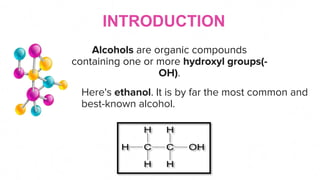
Here's ethanol. It is by far the most common and
best-known alcohol.
INTRODUCTION
PHYSICAL PROPERTIES OF ALCOHOL
➢ Solubility
➢ Boiling temperature
➢ Melting temperature
➢ Viscosity
➢ Odor
➢ Flammability
SOLUBILITY
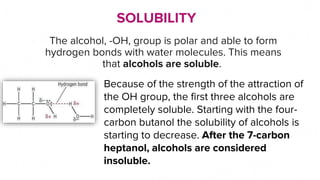
The alcohol, -OH, group is polar and able to form
hydrogen bonds with water molecules. This means
that alcohols are soluble.
Because of the strength of the attraction of
the OH group, the first three alcohols are
completely soluble. Starting with the four-
carbon butanol the solubility of alcohols is
starting to decrease. After the 7-carbon
heptanol, alcohols are considered
insoluble.
BOILING TEMPERATURE
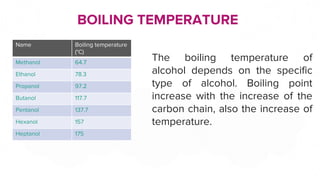
The boiling temperature of
alcohol depends on the specific
type of alcohol. Boiling point
increase with the increase of the
carbon chain, also the increase of
temperature.
Name Boiling temperature
(°C)
Methanol 64.7
Ethanol 78.3
Propanol 97.2
Butanol 117.7
Pentanol 137.7
Hexanol 157
Heptanol 175
MELTING TEMPERATURE
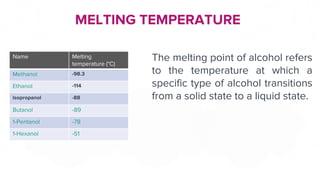
The melting point of alcohol refers
to the temperature at which a
specific type of alcohol transitions
from a solid state to a liquid state.
Name Melting
temperature (°C)
Methanol -98.3
Ethanol -114
Isopropanol -88
Butanol -89
1-Pentanol -78
1-Hexanol -51
VISCOSITY
.
Because of the hydrogen bond, which has a higher
intermolecular force of attraction, alcohol has a higher
viscosity.
As molecular size increase, the viscosity increase. Because of
intermolecular force of attraction increase. A shorter
hydrocarbon chain will be more 'runny' than a longer one.
Viscosity also decreases with the increase in temperature.
FLAMMABILITY
.
The flammability of alcohols depends on their
molecular structure and the specific type of alcohol.
Generally, alcohols are flammable because they
contain carbon and hydrogen atoms that can
undergo combustion reactions when exposed to a
flame or ignition source.
.
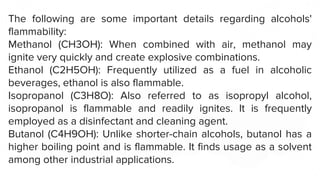
The following are some important details regarding alcohols'
flammability:
Methanol (CH3OH): When combined with air, methanol may
ignite very quickly and create explosive combinations.
Ethanol (C2H5OH): Frequently utilized as a fuel in alcoholic
beverages, ethanol is also flammable.
Isopropanol (C3H8O): Also referred to as isopropyl alcohol,
isopropanol is flammable and readily ignites. It is frequently
employed as a disinfectant and cleaning agent.
Butanol (C4H9OH): Unlike shorter-chain alcohols, butanol has a
higher boiling point and is flammable. It finds usage as a solvent
among other industrial applications.
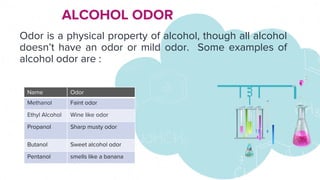
ALCOHOL ODOR
Odor is a physical property of alcohol, though all alcohol
doesn’t have an odor or mild odor. Some examples of
alcohol odor are :
Name Odor
Methanol Faint odor
Ethyl Alcohol Wine like odor
Propanol Sharp musty odor
Butanol Sweet alcohol odor
Pentanol smells like a banana
THANK YOU

Alcohol Properties .pptx

  • 1.
    Physical Properties of Alcoholsin Association of Functional Group Abdulla Al Jubayed Rabby NFE, DIU
  • 2.
    Table of Contents INTRODUCTION 01 SOLUBILITY 02 ALCOHOLODOR 05 VISCOSITY BOILING TEMPERATURE 03 04
  • 3.
    Alcohols are organiccompounds containing one or more hydroxyl groups(- OH). Here's ethanol. It is by far the most common and best-known alcohol. INTRODUCTION
  • 4.
    PHYSICAL PROPERTIES OFALCOHOL ➢ Solubility ➢ Boiling temperature ➢ Melting temperature ➢ Viscosity ➢ Odor ➢ Flammability
  • 5.
    SOLUBILITY The alcohol, -OH,group is polar and able to form hydrogen bonds with water molecules. This means that alcohols are soluble. Because of the strength of the attraction of the OH group, the first three alcohols are completely soluble. Starting with the four- carbon butanol the solubility of alcohols is starting to decrease. After the 7-carbon heptanol, alcohols are considered insoluble.
  • 6.
    BOILING TEMPERATURE The boilingtemperature of alcohol depends on the specific type of alcohol. Boiling point increase with the increase of the carbon chain, also the increase of temperature. Name Boiling temperature (°C) Methanol 64.7 Ethanol 78.3 Propanol 97.2 Butanol 117.7 Pentanol 137.7 Hexanol 157 Heptanol 175
  • 7.
    MELTING TEMPERATURE The meltingpoint of alcohol refers to the temperature at which a specific type of alcohol transitions from a solid state to a liquid state. Name Melting temperature (°C) Methanol -98.3 Ethanol -114 Isopropanol -88 Butanol -89 1-Pentanol -78 1-Hexanol -51
  • 8.
    VISCOSITY . Because of thehydrogen bond, which has a higher intermolecular force of attraction, alcohol has a higher viscosity. As molecular size increase, the viscosity increase. Because of intermolecular force of attraction increase. A shorter hydrocarbon chain will be more 'runny' than a longer one. Viscosity also decreases with the increase in temperature.
  • 9.
    FLAMMABILITY . The flammability ofalcohols depends on their molecular structure and the specific type of alcohol. Generally, alcohols are flammable because they contain carbon and hydrogen atoms that can undergo combustion reactions when exposed to a flame or ignition source.
  • 10.
    . The following aresome important details regarding alcohols' flammability: Methanol (CH3OH): When combined with air, methanol may ignite very quickly and create explosive combinations. Ethanol (C2H5OH): Frequently utilized as a fuel in alcoholic beverages, ethanol is also flammable. Isopropanol (C3H8O): Also referred to as isopropyl alcohol, isopropanol is flammable and readily ignites. It is frequently employed as a disinfectant and cleaning agent. Butanol (C4H9OH): Unlike shorter-chain alcohols, butanol has a higher boiling point and is flammable. It finds usage as a solvent among other industrial applications.
  • 11.
    ALCOHOL ODOR Odor isa physical property of alcohol, though all alcohol doesn’t have an odor or mild odor. Some examples of alcohol odor are : Name Odor Methanol Faint odor Ethyl Alcohol Wine like odor Propanol Sharp musty odor Butanol Sweet alcohol odor Pentanol smells like a banana
  • 12.