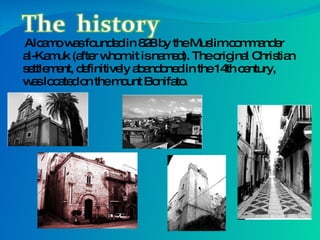
Alcamo was founded in 828 by the Muslim commander al-Kamuk (after whom it is named). The original Christian settlement, definitively abandoned in the 14th century,  was located on the mount Bonifato.
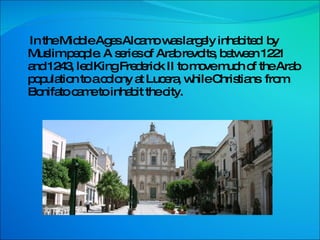
In the Middle Ages Alcamo was largely inhabited  by  Muslim people. A series of Arab revolts, between 1221 and 1243, led King Frederick II to move much of the Arab population to a colony at Lucera, while Christians  from Bonifato came to inhabit the city.
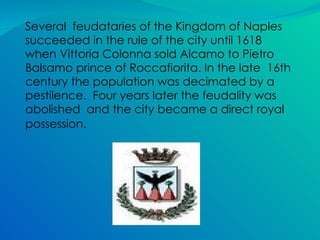
Several  feudataries of the Kingdom of Naples succeeded in the rule of the city until 1618 when Vittoria Colonna sold Alcamo to Pietro Balsamo prince of Roccafiorita. In the late  16th century the population was decimated by a pestilence.  Four years later the feudality was abolished  and the city became a direct royal possession .
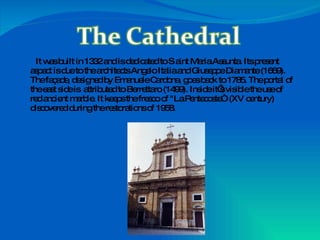
It was built in 1332 and is dedicated to S aint Maria Assunta. Its present aspect is due to the architects Angelo Italia and Giuseppe Diamante (1669). The façade, designed by Emanuele Cardona, goes back to 1785. The portal of the east side is  attributed to Berrettaro (1499). Inside it’s visible the use of red ancient marble. It keeps the fresco of "La Pentecoste“  (XV century) discovered during the restorations of 1958.
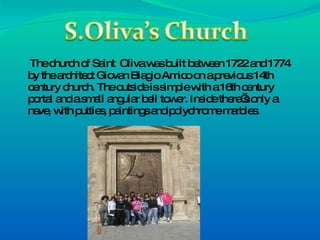
The church of Saint  Oliva was built between 1722 and 1774 by the architect Giovan Biagio Amico on a previous 14th century church. The outside is simple with a 16th century portal and a small angular bell tower. Inside there’s only a nave, with putties, paintings and polychrome marbles.
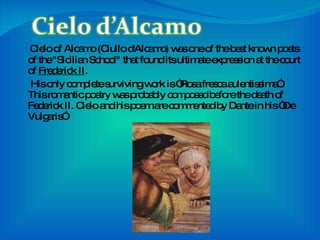
Cielo of Alcamo (Ciullo d'Alcamo) was one of the best known poets of the "Sicilian School" that found its ultimate expression at the court of  Frederick II . His only complete surviving work is “Rosa fresca aulentissima”. This romantic poetry was probably composed before the death of Federick II. Cielo and his poem are commented by Dante in his “De Vulgaris”.
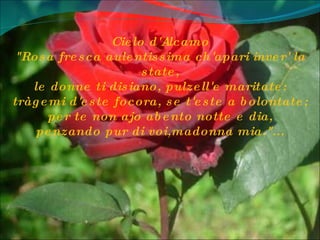
Cielo d'Alcamo "Rosa fresca aulentissima ch'apari inver' la state, le donne ti disiano, pulzell'e maritate: tràgemi d'este focora, se t'este a bolontate; per te non ajo abento notte e dia, penzando pur di voi,madonna mia."...
 
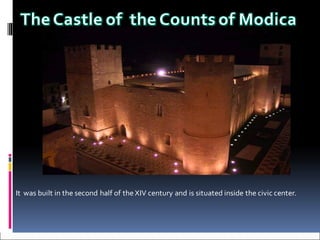
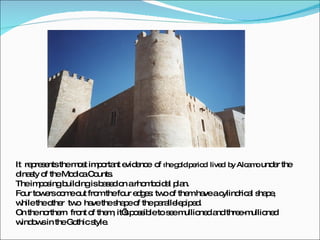
It  represents the most important evidence  of   t he gold period  lived  by Alcamo  under the dinasty of the Modica Counts. The imposing building is based on a rhomboidal plan. Four towers come out from the four edges: two of them have a cylindrical shape, while the other  two  have the shape of the parallelepiped.  On the northern  front of them, it’s possible to see mullioned and three-mullioned windows in the Gothic style.
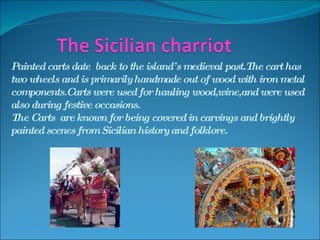
Painted carts date  back to the island’s medieval past.The cart has two wheels and is primarily handmade out of wood with iron metal components.Carts were used for hauling wood,wine,and were used also during festive occasions.  The Carts  are known for being covered in carvings and brightly painted scenes from Sicilian history and folklore.
 
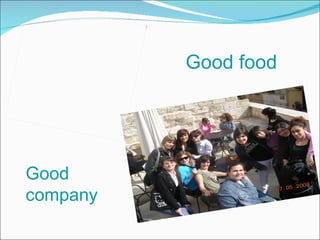
Good food Good company
 
 
Teacher: Mariella Sorrentino

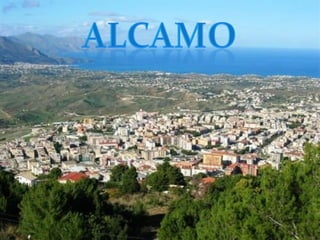
Alcamo

  • 1.
  • 2.
    Alcamo was foundedin 828 by the Muslim commander al-Kamuk (after whom it is named). The original Christian settlement, definitively abandoned in the 14th century, was located on the mount Bonifato.
  • 3.
    In the MiddleAges Alcamo was largely inhabited by Muslim people. A series of Arab revolts, between 1221 and 1243, led King Frederick II to move much of the Arab population to a colony at Lucera, while Christians from Bonifato came to inhabit the city.
  • 4.
    Several feudatariesof the Kingdom of Naples succeeded in the rule of the city until 1618 when Vittoria Colonna sold Alcamo to Pietro Balsamo prince of Roccafiorita. In the late 16th century the population was decimated by a pestilence. Four years later the feudality was abolished and the city became a direct royal possession .
  • 5.
    It was builtin 1332 and is dedicated to S aint Maria Assunta. Its present aspect is due to the architects Angelo Italia and Giuseppe Diamante (1669). The façade, designed by Emanuele Cardona, goes back to 1785. The portal of the east side is attributed to Berrettaro (1499). Inside it’s visible the use of red ancient marble. It keeps the fresco of "La Pentecoste“ (XV century) discovered during the restorations of 1958.
  • 6.
    The church ofSaint Oliva was built between 1722 and 1774 by the architect Giovan Biagio Amico on a previous 14th century church. The outside is simple with a 16th century portal and a small angular bell tower. Inside there’s only a nave, with putties, paintings and polychrome marbles.
  • 7.
    Cielo of Alcamo(Ciullo d'Alcamo) was one of the best known poets of the "Sicilian School" that found its ultimate expression at the court of Frederick II . His only complete surviving work is “Rosa fresca aulentissima”. This romantic poetry was probably composed before the death of Federick II. Cielo and his poem are commented by Dante in his “De Vulgaris”.
  • 8.
    Cielo d'Alcamo "Rosafresca aulentissima ch'apari inver' la state, le donne ti disiano, pulzell'e maritate: tràgemi d'este focora, se t'este a bolontate; per te non ajo abento notte e dia, penzando pur di voi,madonna mia."...
  • 9.
  • 10.
    It representsthe most important evidence of t he gold period lived by Alcamo under the dinasty of the Modica Counts. The imposing building is based on a rhomboidal plan. Four towers come out from the four edges: two of them have a cylindrical shape, while the other two have the shape of the parallelepiped. On the northern front of them, it’s possible to see mullioned and three-mullioned windows in the Gothic style.
  • 11.
    Painted carts date back to the island’s medieval past.The cart has two wheels and is primarily handmade out of wood with iron metal components.Carts were used for hauling wood,wine,and were used also during festive occasions. The Carts are known for being covered in carvings and brightly painted scenes from Sicilian history and folklore.
  • 12.
  • 13.
  • 14.
  • 15.
  • 16.