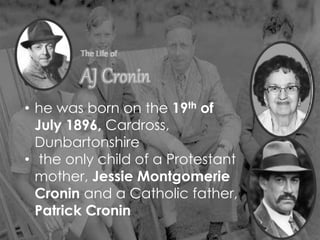
• he was born on the 19th of
July 1896, Cardross,
Dunbartonshire
• the only child of a Protestant
mother, Jessie Montgomerie
Cronin and a Catholic father,
Patrick Cronin
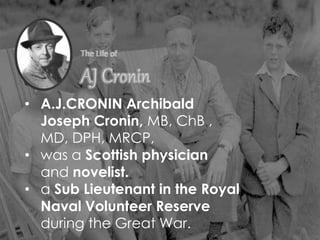
• A.J.CRONIN Archibald
Joseph Cronin, MB, ChB ,
MD, DPH, MRCP,
• was a Scottish physician
and novelist.
• a Sub Lieutenant in the Royal
Naval Volunteer Reserve
during the Great War.
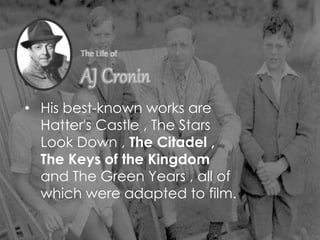
• His best-known works are
Hatter's Castle , The Stars
Look Down , The Citadel ,
The Keys of the Kingdom
and The Green Years , all of
which were adapted to film.
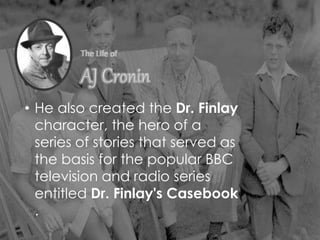
• He also created the Dr. Finlay
character, the hero of a
series of stories that served as
the basis for the popular BBC
television and radio series
entitled Dr. Finlay's Casebook
.
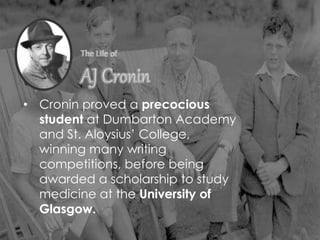
• Cronin proved a precocious
student at Dumbarton Academy
and St. Aloysius’ College,
winning many writing
competitions, before being
awarded a scholarship to study
medicine at the University of
Glasgow.
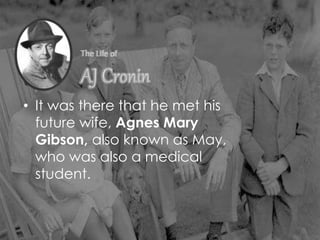
• It was there that he met his
future wife, Agnes Mary
Gibson, also known as May,
who was also a medical
student.
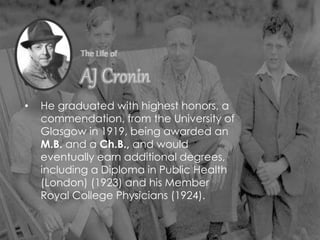
• He graduated with highest honors, a
commendation, from the University of
Glasgow in 1919, being awarded an
M.B. and a Ch.B., and would
eventually earn additional degrees,
including a Diploma in Public Health
(London) (1923) and his Member
Royal College Physicians (1924).
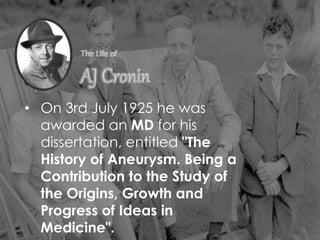
• On 3rd July 1925 he was
awarded an MD for his
dissertation, entitled "The
History of Aneurysm. Being a
Contribution to the Study of
the Origins, Growth and
Progress of Ideas in
Medicine".
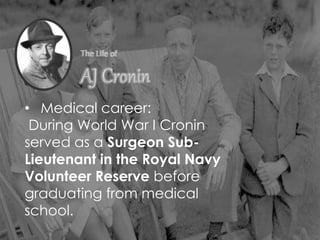
• Medical career:
During World War I Cronin
served as a Surgeon Sub-
Lieutenant in the Royal Navy
Volunteer Reserve before
graduating from medical
school.
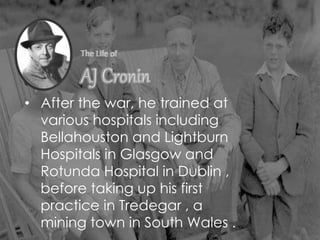
• After the war, he trained at
various hospitals including
Bellahouston and Lightburn
Hospitals in Glasgow and
Rotunda Hospital in Dublin ,
before taking up his first
practice in Tredegar , a
mining town in South Wales .
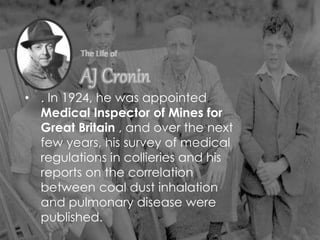
• . In 1924, he was appointed
Medical Inspector of Mines for
Great Britain , and over the next
few years, his survey of medical
regulations in collieries and his
reports on the correlation
between coal dust inhalation
and pulmonary disease were
published.
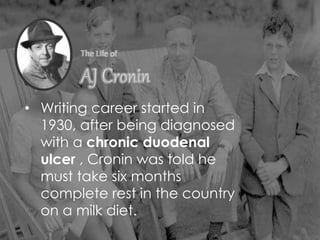
• Writing career started in
1930, after being diagnosed
with a chronic duodenal
ulcer , Cronin was told he
must take six months
complete rest in the country
on a milk diet.
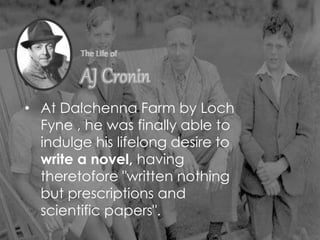
• At Dalchenna Farm by Loch
Fyne , he was finally able to
indulge his lifelong desire to
write a novel, having
theretofore "written nothing
but prescriptions and
scientific papers".
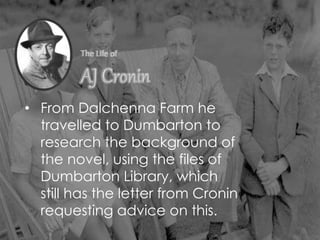
• From Dalchenna Farm he
travelled to Dumbarton to
research the background of
the novel, using the files of
Dumbarton Library, which
still has the letter from Cronin
requesting advice on this.
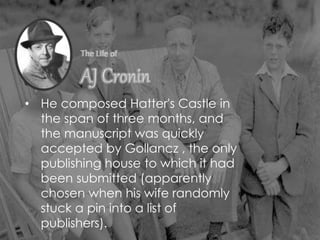
• He composed Hatter's Castle in
the span of three months, and
the manuscript was quickly
accepted by Gollancz , the only
publishing house to which it had
been submitted (apparently
chosen when his wife randomly
stuck a pin into a list of
publishers).
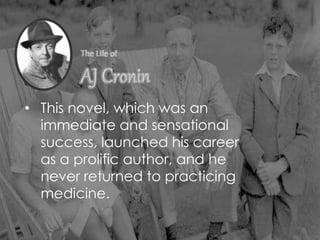
• This novel, which was an
immediate and sensational
success, launched his career
as a prolific author, and he
never returned to practicing
medicine.
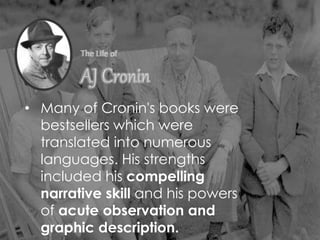
• Many of Cronin's books were
bestsellers which were
translated into numerous
languages. His strengths
included his compelling
narrative skill and his powers
of acute observation and
graphic description.
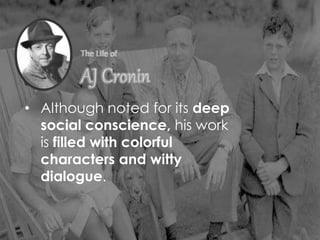
• Although noted for its deep
social conscience, his work
is filled with colorful
characters and witty
dialogue.
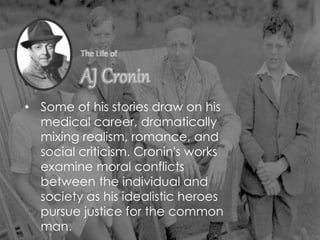
• Some of his stories draw on his
medical career, dramatically
mixing realism, romance, and
social criticism. Cronin's works
examine moral conflicts
between the individual and
society as his idealistic heroes
pursue justice for the common
man.
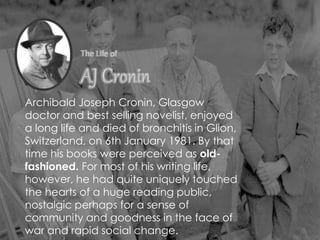
Archibald Joseph Cronin, Glasgow
doctor and best selling novelist, enjoyed
a long life and died of bronchitis in Glion,
Switzerland, on 6th January 1981. By that
time his books were perceived as old-
fashioned. For most of his writing life,
however, he had quite uniquely touched
the hearts of a huge reading public,
nostalgic perhaps for a sense of
community and goodness in the face of
war and rapid social change.
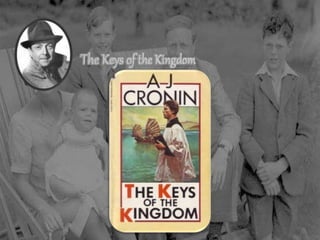
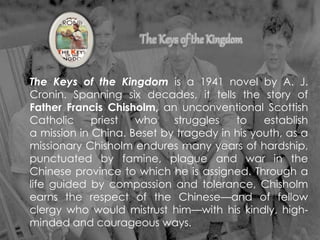
The Keys of the Kingdom is a 1941 novel by A. J.
Cronin. Spanning six decades, it tells the story of
Father Francis Chisholm, an unconventional Scottish
Catholic priest who struggles to establish
a mission in China. Beset by tragedy in his youth, as a
missionary Chisholm endures many years of hardship,
punctuated by famine, plague and war in the
Chinese province to which he is assigned. Through a
life guided by compassion and tolerance, Chisholm
earns the respect of the Chinese—and of fellow
clergy who would mistrust him—with his kindly, high-
minded and courageous ways.
The novel has six parts, the first (The
Beginning of the End) taking place
in Scotland in 1938. Father Francis
Chisholm is an old man, living with
a housekeeper and a young
orphan. Due to his unconventional
views, he is being investigated by
Monsignor Sleeth.
The second section (Strange Vocation), focuses on
Chisholm's youth. His father a Catholic and his mother
a non-denominational Protestant. After getting
beaten by an anti-Catholic mob, Chisholm's mother
tries to lead him home to safety, only for them both to
die in a bridge collapse, leaving young Francis an
orphan. Initially, his kindly Aunt Polly wishes to adopt
him, but his maternal grandmother, Mrs. Glennie,
intervenes and adopts him, thereby receiving any
money in the Chisholm's estate.
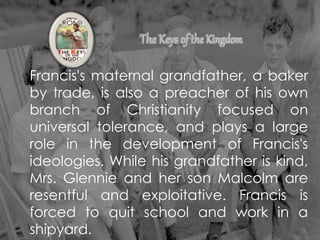
Francis's maternal grandfather, a baker
by trade, is also a preacher of his own
branch of Christianity focused on
universal tolerance, and plays a large
role in the development of Francis's
ideologies. While his grandfather is kind,
Mrs. Glennie and her son Malcolm are
resentful and exploitative. Francis is
forced to quit school and work in a
shipyard.
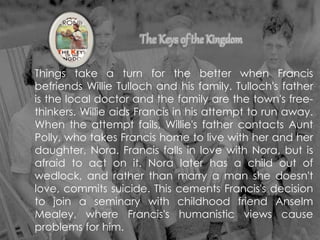
Things take a turn for the better when Francis
befriends Willie Tulloch and his family. Tulloch's father
is the local doctor and the family are the town's free-
thinkers. Willie aids Francis in his attempt to run away.
When the attempt fails, Willie's father contacts Aunt
Polly, who takes Francis home to live with her and her
daughter, Nora. Francis falls in love with Nora, but is
afraid to act on it. Nora later has a child out of
wedlock, and rather than marry a man she doesn't
love, commits suicide. This cements Francis's decision
to join a seminary with childhood friend Anselm
Mealey, where Francis's humanistic views cause
problems for him.
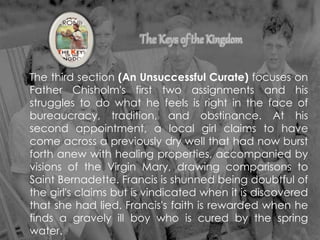
The third section (An Unsuccessful Curate) focuses on
Father Chisholm's first two assignments and his
struggles to do what he feels is right in the face of
bureaucracy, tradition, and obstinance. At his
second appointment, a local girl claims to have
come across a previously dry well that had now burst
forth anew with healing properties, accompanied by
visions of the Virgin Mary, drawing comparisons to
Saint Bernadette. Francis is shunned being doubtful of
the girl's claims but is vindicated when it is discovered
that she had lied. Francis's faith is rewarded when he
finds a gravely ill boy who is cured by the spring
water.
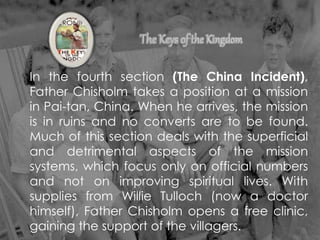
In the fourth section (The China Incident),
Father Chisholm takes a position at a mission
in Pai-tan, China. When he arrives, the mission
is in ruins and no converts are to be found.
Much of this section deals with the superficial
and detrimental aspects of the mission
systems, which focus only on official numbers
and not on improving spiritual lives. With
supplies from Willie Tulloch (now a doctor
himself), Father Chisholm opens a free clinic,
gaining the support of the villagers.
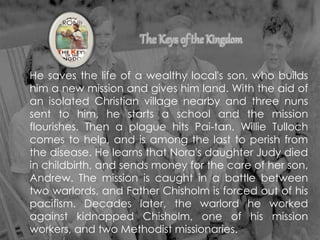
He saves the life of a wealthy local's son, who builds
him a new mission and gives him land. With the aid of
an isolated Christian village nearby and three nuns
sent to him, he starts a school and the mission
flourishes. Then a plague hits Pai-tan. Willie Tulloch
comes to help, and is among the last to perish from
the disease. He learns that Nora's daughter Judy died
in childbirth, and sends money for the care of her son,
Andrew. The mission is caught in a battle between
two warlords, and Father Chisholm is forced out of his
pacifism. Decades later, the warlord he worked
against kidnapped Chisholm, one of his mission
workers, and two Methodist missionaries.
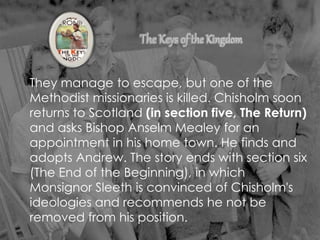
They manage to escape, but one of the
Methodist missionaries is killed. Chisholm soon
returns to Scotland (in section five, The Return)
and asks Bishop Anselm Mealey for an
appointment in his home town. He finds and
adopts Andrew. The story ends with section six
(The End of the Beginning), in which
Monsignor Sleeth is convinced of Chisholm's
ideologies and recommends he not be
removed from his position.
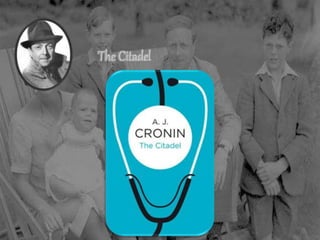
The Citadel is a novel by A. J. Cronin, first
published in 1937, which was groundbreaking
with its treatment of the contentious theme of
medical ethics. It has been credited with
laying the foundation in Great Britain for the
introduction of the NHS a decade later. In the
United States, it won the National Book
Award for 1937 novels, voted by members of
the American Booksellers Association.
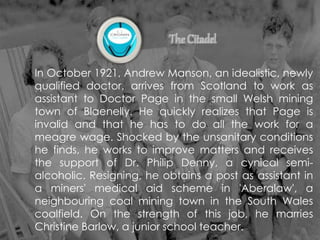
In October 1921, Andrew Manson, an idealistic, newly
qualified doctor, arrives from Scotland to work as
assistant to Doctor Page in the small Welsh mining
town of Blaenelly. He quickly realizes that Page is
invalid and that he has to do all the work for a
meagre wage. Shocked by the unsanitary conditions
he finds, he works to improve matters and receives
the support of Dr. Philip Denny, a cynical semi-
alcoholic. Resigning, he obtains a post as assistant in
a miners' medical aid scheme in 'Aberalaw', a
neighbouring coal mining town in the South Wales
coalfield. On the strength of this job, he marries
Christine Barlow, a junior school teacher.
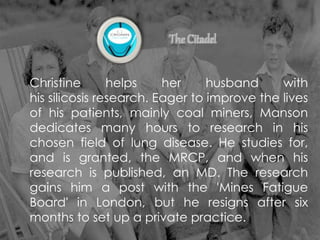
Christine helps her husband with
his silicosis research. Eager to improve the lives
of his patients, mainly coal miners, Manson
dedicates many hours to research in his
chosen field of lung disease. He studies for,
and is granted, the MRCP, and when his
research is published, an MD. The research
gains him a post with the 'Mines Fatigue
Board' in London, but he resigns after six
months to set up a private practice.
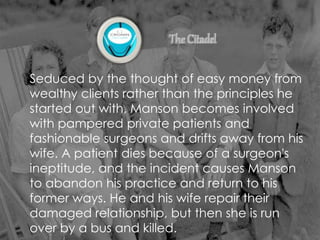
Seduced by the thought of easy money from
wealthy clients rather than the principles he
started out with, Manson becomes involved
with pampered private patients and
fashionable surgeons and drifts away from his
wife. A patient dies because of a surgeon's
ineptitude, and the incident causes Manson
to abandon his practice and return to his
former ways. He and his wife repair their
damaged relationship, but then she is run
over by a bus and killed.
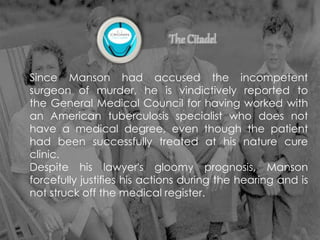
Since Manson had accused the incompetent
surgeon of murder, he is vindictively reported to
the General Medical Council for having worked with
an American tuberculosis specialist who does not
have a medical degree, even though the patient
had been successfully treated at his nature cure
clinic.
Despite his lawyer's gloomy prognosis, Manson
forcefully justifies his actions during the hearing and is
not struck off the medical register.
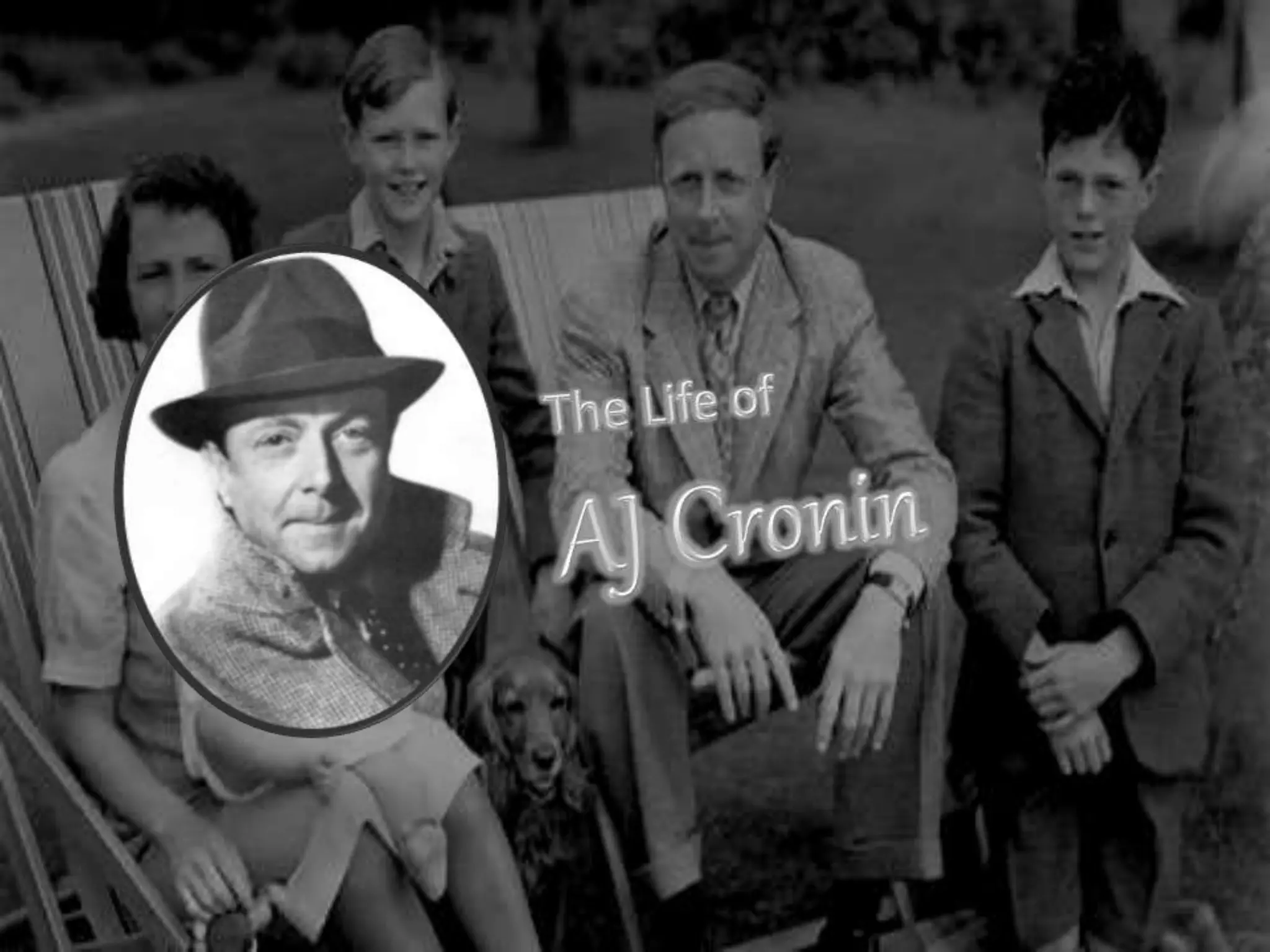
AJ Cronin

  • 2.
    • he wasborn on the 19th of July 1896, Cardross, Dunbartonshire • the only child of a Protestant mother, Jessie Montgomerie Cronin and a Catholic father, Patrick Cronin
  • 4.
    • A.J.CRONIN Archibald JosephCronin, MB, ChB , MD, DPH, MRCP, • was a Scottish physician and novelist. • a Sub Lieutenant in the Royal Naval Volunteer Reserve during the Great War.
  • 5.
    • His best-knownworks are Hatter's Castle , The Stars Look Down , The Citadel , The Keys of the Kingdom and The Green Years , all of which were adapted to film.
  • 6.
    • He alsocreated the Dr. Finlay character, the hero of a series of stories that served as the basis for the popular BBC television and radio series entitled Dr. Finlay's Casebook .
  • 7.
    • Cronin proveda precocious student at Dumbarton Academy and St. Aloysius’ College, winning many writing competitions, before being awarded a scholarship to study medicine at the University of Glasgow.
  • 8.
    • It wasthere that he met his future wife, Agnes Mary Gibson, also known as May, who was also a medical student.
  • 9.
    • He graduatedwith highest honors, a commendation, from the University of Glasgow in 1919, being awarded an M.B. and a Ch.B., and would eventually earn additional degrees, including a Diploma in Public Health (London) (1923) and his Member Royal College Physicians (1924).
  • 10.
    • On 3rdJuly 1925 he was awarded an MD for his dissertation, entitled "The History of Aneurysm. Being a Contribution to the Study of the Origins, Growth and Progress of Ideas in Medicine".
  • 11.
    • Medical career: DuringWorld War I Cronin served as a Surgeon Sub- Lieutenant in the Royal Navy Volunteer Reserve before graduating from medical school.
  • 12.
    • After thewar, he trained at various hospitals including Bellahouston and Lightburn Hospitals in Glasgow and Rotunda Hospital in Dublin , before taking up his first practice in Tredegar , a mining town in South Wales .
  • 13.
    • . In1924, he was appointed Medical Inspector of Mines for Great Britain , and over the next few years, his survey of medical regulations in collieries and his reports on the correlation between coal dust inhalation and pulmonary disease were published.
  • 14.
    • Writing careerstarted in 1930, after being diagnosed with a chronic duodenal ulcer , Cronin was told he must take six months complete rest in the country on a milk diet.
  • 15.
    • At DalchennaFarm by Loch Fyne , he was finally able to indulge his lifelong desire to write a novel, having theretofore "written nothing but prescriptions and scientific papers".
  • 16.
    • From DalchennaFarm he travelled to Dumbarton to research the background of the novel, using the files of Dumbarton Library, which still has the letter from Cronin requesting advice on this.
  • 17.
    • He composedHatter's Castle in the span of three months, and the manuscript was quickly accepted by Gollancz , the only publishing house to which it had been submitted (apparently chosen when his wife randomly stuck a pin into a list of publishers).
  • 18.
    • This novel,which was an immediate and sensational success, launched his career as a prolific author, and he never returned to practicing medicine.
  • 19.
    • Many ofCronin's books were bestsellers which were translated into numerous languages. His strengths included his compelling narrative skill and his powers of acute observation and graphic description.
  • 20.
    • Although notedfor its deep social conscience, his work is filled with colorful characters and witty dialogue.
  • 21.
    • Some ofhis stories draw on his medical career, dramatically mixing realism, romance, and social criticism. Cronin's works examine moral conflicts between the individual and society as his idealistic heroes pursue justice for the common man.
  • 22.
    Archibald Joseph Cronin,Glasgow doctor and best selling novelist, enjoyed a long life and died of bronchitis in Glion, Switzerland, on 6th January 1981. By that time his books were perceived as old- fashioned. For most of his writing life, however, he had quite uniquely touched the hearts of a huge reading public, nostalgic perhaps for a sense of community and goodness in the face of war and rapid social change.
  • 24.
    The Keys ofthe Kingdom is a 1941 novel by A. J. Cronin. Spanning six decades, it tells the story of Father Francis Chisholm, an unconventional Scottish Catholic priest who struggles to establish a mission in China. Beset by tragedy in his youth, as a missionary Chisholm endures many years of hardship, punctuated by famine, plague and war in the Chinese province to which he is assigned. Through a life guided by compassion and tolerance, Chisholm earns the respect of the Chinese—and of fellow clergy who would mistrust him—with his kindly, high- minded and courageous ways.
  • 25.
    The novel hassix parts, the first (The Beginning of the End) taking place in Scotland in 1938. Father Francis Chisholm is an old man, living with a housekeeper and a young orphan. Due to his unconventional views, he is being investigated by Monsignor Sleeth.
  • 26.
    The second section(Strange Vocation), focuses on Chisholm's youth. His father a Catholic and his mother a non-denominational Protestant. After getting beaten by an anti-Catholic mob, Chisholm's mother tries to lead him home to safety, only for them both to die in a bridge collapse, leaving young Francis an orphan. Initially, his kindly Aunt Polly wishes to adopt him, but his maternal grandmother, Mrs. Glennie, intervenes and adopts him, thereby receiving any money in the Chisholm's estate.
  • 27.
    Francis's maternal grandfather,a baker by trade, is also a preacher of his own branch of Christianity focused on universal tolerance, and plays a large role in the development of Francis's ideologies. While his grandfather is kind, Mrs. Glennie and her son Malcolm are resentful and exploitative. Francis is forced to quit school and work in a shipyard.
  • 28.
    Things take aturn for the better when Francis befriends Willie Tulloch and his family. Tulloch's father is the local doctor and the family are the town's free- thinkers. Willie aids Francis in his attempt to run away. When the attempt fails, Willie's father contacts Aunt Polly, who takes Francis home to live with her and her daughter, Nora. Francis falls in love with Nora, but is afraid to act on it. Nora later has a child out of wedlock, and rather than marry a man she doesn't love, commits suicide. This cements Francis's decision to join a seminary with childhood friend Anselm Mealey, where Francis's humanistic views cause problems for him.
  • 29.
    The third section(An Unsuccessful Curate) focuses on Father Chisholm's first two assignments and his struggles to do what he feels is right in the face of bureaucracy, tradition, and obstinance. At his second appointment, a local girl claims to have come across a previously dry well that had now burst forth anew with healing properties, accompanied by visions of the Virgin Mary, drawing comparisons to Saint Bernadette. Francis is shunned being doubtful of the girl's claims but is vindicated when it is discovered that she had lied. Francis's faith is rewarded when he finds a gravely ill boy who is cured by the spring water.
  • 30.
    In the fourthsection (The China Incident), Father Chisholm takes a position at a mission in Pai-tan, China. When he arrives, the mission is in ruins and no converts are to be found. Much of this section deals with the superficial and detrimental aspects of the mission systems, which focus only on official numbers and not on improving spiritual lives. With supplies from Willie Tulloch (now a doctor himself), Father Chisholm opens a free clinic, gaining the support of the villagers.
  • 31.
    He saves thelife of a wealthy local's son, who builds him a new mission and gives him land. With the aid of an isolated Christian village nearby and three nuns sent to him, he starts a school and the mission flourishes. Then a plague hits Pai-tan. Willie Tulloch comes to help, and is among the last to perish from the disease. He learns that Nora's daughter Judy died in childbirth, and sends money for the care of her son, Andrew. The mission is caught in a battle between two warlords, and Father Chisholm is forced out of his pacifism. Decades later, the warlord he worked against kidnapped Chisholm, one of his mission workers, and two Methodist missionaries.
  • 32.
    They manage toescape, but one of the Methodist missionaries is killed. Chisholm soon returns to Scotland (in section five, The Return) and asks Bishop Anselm Mealey for an appointment in his home town. He finds and adopts Andrew. The story ends with section six (The End of the Beginning), in which Monsignor Sleeth is convinced of Chisholm's ideologies and recommends he not be removed from his position.
  • 34.
    The Citadel isa novel by A. J. Cronin, first published in 1937, which was groundbreaking with its treatment of the contentious theme of medical ethics. It has been credited with laying the foundation in Great Britain for the introduction of the NHS a decade later. In the United States, it won the National Book Award for 1937 novels, voted by members of the American Booksellers Association.
  • 35.
    In October 1921,Andrew Manson, an idealistic, newly qualified doctor, arrives from Scotland to work as assistant to Doctor Page in the small Welsh mining town of Blaenelly. He quickly realizes that Page is invalid and that he has to do all the work for a meagre wage. Shocked by the unsanitary conditions he finds, he works to improve matters and receives the support of Dr. Philip Denny, a cynical semi- alcoholic. Resigning, he obtains a post as assistant in a miners' medical aid scheme in 'Aberalaw', a neighbouring coal mining town in the South Wales coalfield. On the strength of this job, he marries Christine Barlow, a junior school teacher.
  • 36.
    Christine helps herhusband with his silicosis research. Eager to improve the lives of his patients, mainly coal miners, Manson dedicates many hours to research in his chosen field of lung disease. He studies for, and is granted, the MRCP, and when his research is published, an MD. The research gains him a post with the 'Mines Fatigue Board' in London, but he resigns after six months to set up a private practice.
  • 37.
    Seduced by thethought of easy money from wealthy clients rather than the principles he started out with, Manson becomes involved with pampered private patients and fashionable surgeons and drifts away from his wife. A patient dies because of a surgeon's ineptitude, and the incident causes Manson to abandon his practice and return to his former ways. He and his wife repair their damaged relationship, but then she is run over by a bus and killed.
  • 38.
    Since Manson hadaccused the incompetent surgeon of murder, he is vindictively reported to the General Medical Council for having worked with an American tuberculosis specialist who does not have a medical degree, even though the patient had been successfully treated at his nature cure clinic. Despite his lawyer's gloomy prognosis, Manson forcefully justifies his actions during the hearing and is not struck off the medical register.