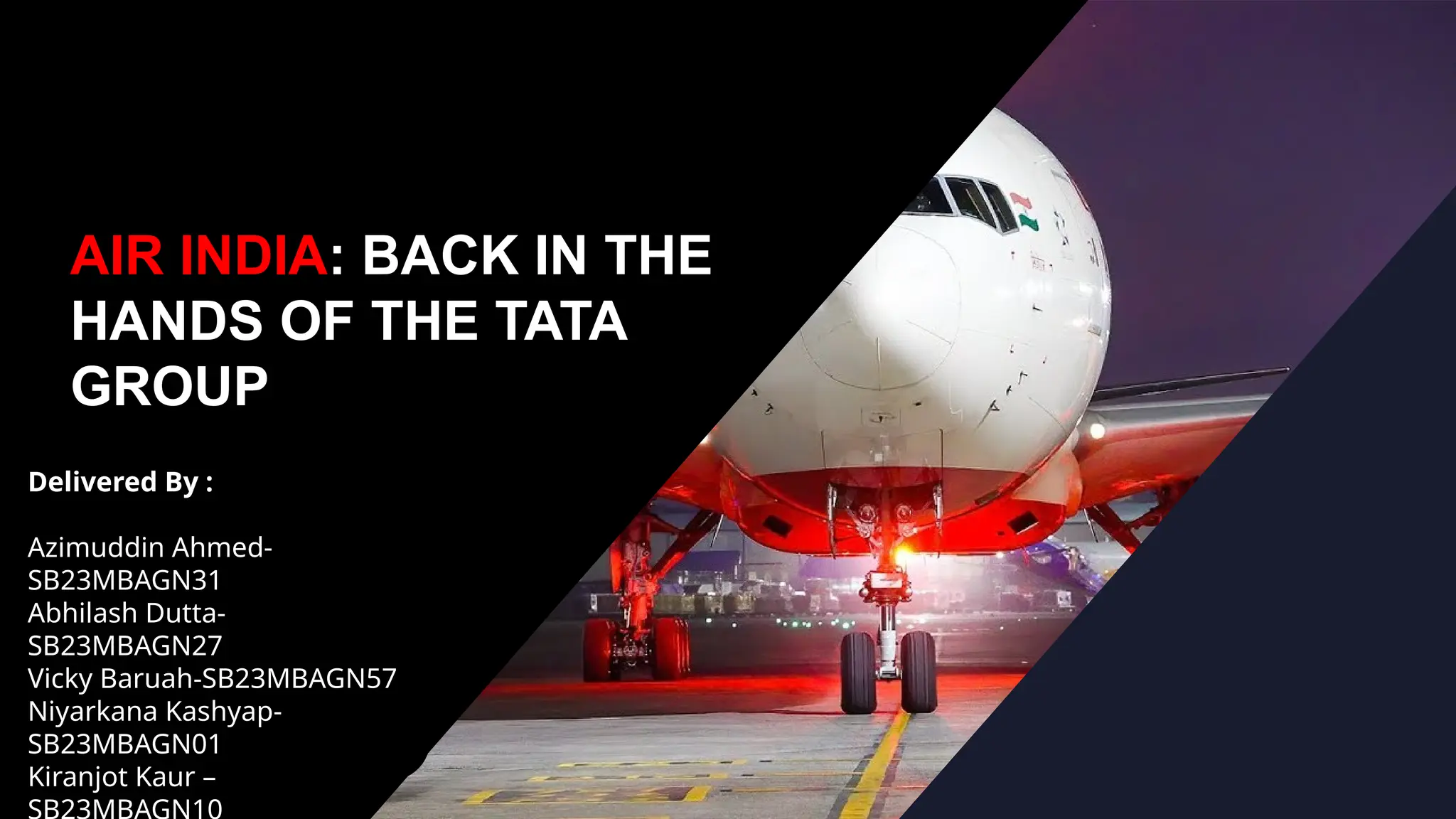
AIR INDIA: BACK IN THE
HANDS OF THE TATA
GROUP
Delivered By :
Azimuddin Ahmed-
SB23MBAGN31
Abhilash Dutta-
SB23MBAGN27
Vicky Baruah-SB23MBAGN57
Niyarkana Kashyap-
SB23MBAGN01
Kiranjot Kaur –
SB23MBAGN10
AIR INDIA - BACK IN THE HANDS
OF THE TATA GROUP
INTRODUCTION :-
Founded: 1932 by J.R.D. Tata as Tata Airlines.
Nationalization: In 1953, the Government of
India took control.
Re-privatization: Tata Sons reacquired Air India
in October 2021, nearly 70 years later.
Financial Troubles: Air India suffered from
decades of losses and a heavy debt burden
ASTHECASE
GOESON ..
 TATA’S REACQUISITION :-
 Tata's subsidiary Talace Private Limited won
the bid for $2.4 billion.
 This included retaining $2 billion in debt
and paying $400 million in cash.
 Air India’s assets include Air India Express
and a 50% stake in AISATS
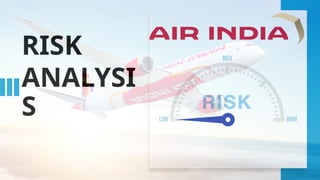
RISK
ANALYSI
S
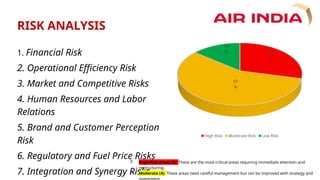
29
%
57
%
14
%
High Risk Moderate Risk Low Risk
1. Financial Risk
2. Operational Efficiency Risk
3. Market and Competitive Risks
4. Human Resources and Labor
Relations
5. Brand and Customer Perception
Risk
6. Regulatory and Fuel Price Risks
7. Integration and Synergy Risks
RISK ANALYSIS
 High-Risk Areas (5): These are the most critical areas requiring immediate attention and
restructuring.
 Moderate (4): These areas need careful management but can be improved with strategy and
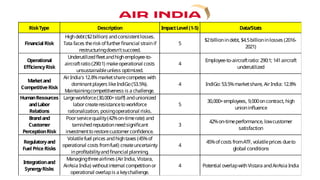
RiskType Description ImpactLevel (1-5) Data/Stats
Financial Risk
Highdebt($2billion) andconsistentlosses.
Tata faces theriskoffurtherfinancial strainif
restructuringdoesn'tsucceed.
5
$2billionindebt, $4.5billioninlosses (2016-
2021)
Operational
EfficiencyRisk
Underutilizedfleetandhighemployee-to-
aircraftratio(290:1) makeoperational costs
unsustainableunless optimized.
4
Employee-to-aircraftratio: 290:1; 141aircraft
underutilized
M
arketand
CompetitiveRisk
AirIndia's 12.8%marketsharecompetes with
dominantplayers likeIndiGo(53.5%).
Maintainingcompetitiveness is a challenge.
4 IndiGo: 53.5%marketshare, AirIndia: 12.8%
HumanResources
andLabor
Relations
Largeworkforce(30,000+staff) andunionized
laborcreateresistancetoworkforce
rationalization, posingoperational risks.
5
30,000+employees, 9,000oncontract, high
unioninfluence
Brandand
Customer
PerceptionRisk
Poorservicequality(42%on-timerate) and
tarnishedreputationneedsignificant
investmenttorestorecustomerconfidence.
3
42%on-timeperformance, lowcustomer
satisfaction
Regulatoryand
Fuel PriceRisks
Volatilefuel prices andhightaxes (45%of
operational costs fromfuel) createuncertainty
inprofitabilityandfinancial planning.
4
45%ofcosts fromATF, volatileprices dueto
global conditions
Integrationand
SynergyRisks
Managingthreeairlines (AirIndia, Vistara,
AirAsia India) withoutinternal competitionor
operational overlapis a keychallenge.
4 Potential overlapwithVistara andAirAsia India
DATA
ANALYSIS
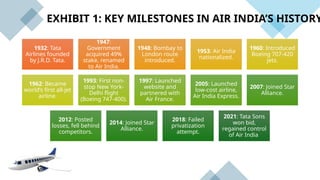
1932: Tata
Airlines founded
by J.R.D. Tata.
1947:
Government
acquired 49%
stake, renamed
to Air India.
1948: Bombay to
London route
introduced.
1953: Air India
nationalized.
1960: Introduced
Boeing 707-420
jets.
1962: Became
world’s first all-jet
airline.
1993: First non-
stop New York-
Delhi flight
(Boeing 747-400).
1997: Launched
website and
partnered with
Air France.
2005: Launched
low-cost airline,
Air India Express.
2007: Joined Star
Alliance.
2012: Posted
losses, fell behind
competitors.
2014: Joined Star
Alliance.
2018: Failed
privatization
attempt.
2021: Tata Sons
won bid,
regained control
of Air India
EXHIBIT 1: KEY MILESTONES IN AIR INDIA’S HISTORY
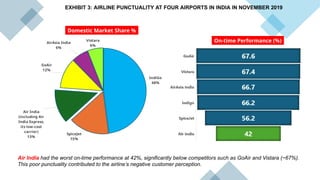
IndiGo
48%
SpiceJet
15%
Air India
(including Air
India Express,
its low-cost
carrier)
13%
GoAir
12%
AirAsia India
6%
Vistara
6%
Domestic Market Share %
On-time Performance (%)
Air India had the worst on-time performance at 42%, significantly below competitors such as GoAir and Vistara (~67%).
This poor punctuality contributed to the airline’s negative customer perception.
EXHIBIT 3: AIRLINE PUNCTUALITY AT FOUR AIRPORTS IN INDIA IN NOVEMBER 2019
0
50
100
150
200
250
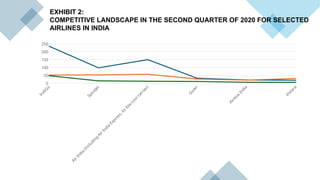
EXHIBIT 2:
COMPETITIVE LANDSCAPE IN THE SECOND QUARTER OF 2020 FOR SELECTED
AIRLINES IN INDIA
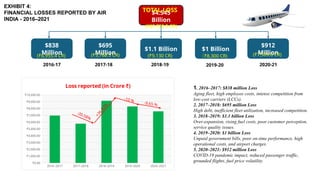
$4.545
Billion
(₹37,723.5 CR)
$838
Million
$695
Million
$1.1 Billion $1 Billion
$912
Million
(₹5,768.5 CR)
(₹6,955.4 CR) (₹8,300 CR)
(₹9,130 CR) (₹7,569.6 CR)
2016–2017 2017–2018 2018–2019 2019–2020 2020–2021
₹0.00
₹1,000.00
₹2,000.00
₹3,000.00
₹4,000.00
₹5,000.00
₹6,000.00
₹7,000.00
₹8,000.00
₹9,000.00
₹10,000.00
Loss reported (in Crore ₹)
-20.58%
+
3
6
.
8
2
%
-10 %
-9.65 %
1. 2016–2017: $838 million Loss
Aging fleet, high employee costs, intense competition from
low-cost carriers (LCCs).
2. 2017–2018: $695 million Loss
High debt, inefficient fleet utilization, increased competition.
3. 2018–2019: $1.1 billion Loss
Over-expansion, rising fuel costs, poor customer perception,
service quality issues.
4. 2019–2020: $1 billion Loss
Unpaid government bills, poor on-time performance, high
operational costs, and airport charges.
5. 2020–2021: $912 million Loss
COVID-19 pandemic impact, reduced passenger traffic,
grounded flights, fuel price volatility.
2016-17 2017-18 2018-19 2019-20 2020-21
TOTAL LOSS
EXHIBIT 4:
FINANCIAL LOSSES REPORTED BY AIR
INDIA - 2016–2021
CASE
SOLUTION
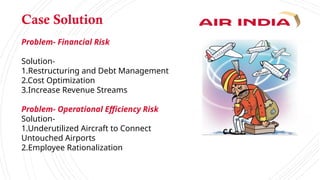
Case Solution
Problem- Financial Risk
Solution-
1.Restructuring and Debt Management
2.Cost Optimization
3.Increase Revenue Streams
Problem- Operational Efficiency Risk
Solution-
1.Underutilized Aircraft to Connect
Untouched Airports
2.Employee Rationalization
Case Solution
Problem- Market and Competitive Risk
Solution-
1. Match Fare Structures
2. Increase Customer Touchpoints
3. Focus on Customer Satisfaction
4. Partnerships and Alliances
Problem-Human Resources and Labor
Relations
Solution-
5. Negotiation with Unions
6. Human Resource Restructuring
Case Solution
Problem-Brand and Customer Perception
Risk
Solution-
1. Service Quality Improvement
2. Digital Transformation
Problem- Regulatory and Fuel Price Risks
Solution-
3. Fuel Price Hedging
4. Lobbying for Tax Cuts
Problem- Integration and Synergy Risks
Solution-
1. Synergy Optimization
2. Shared Services
RECOMMENDATION
1. Optimize Operations:
 Streamline Workforce: Reduce
excess staff through voluntary
retirements to improve cost
efficiency.
 Maximize Aircraft Usage: Better
plan schedules and routes to avoid
underutilization of planes.
RECOMMENDATIONS FOR AIR INDIA
2. Improve Customer Experience:
 Upgrade Service Quality: Use Tata’s
hospitality expertise (like Taj Hotels) to
enhance in-flight services and improve
customer satisfaction.
 Digitize Operations: Invest in technology
for smoother booking, better in-flight
connectivity, and enhanced customer
support.
3. Manage Financials:
 Reduce Debt: Focus on paying down
Air India’s massive debt by managing
costs and refinancing where possible.
 Lower Costs: Negotiate with airports
for lower fees and explore other cost-
cutting measures.
RECOMMENDATIONS FOR AIR INDIA
4. Boost Competitiveness:
 Leverage Synergies: Combine
operations with Tata’s other airlines
(Vistara, AirAsia India) to optimize routes
and services.
 Focus on International Routes:
Strengthen long-haul routes to attract
international travelers.
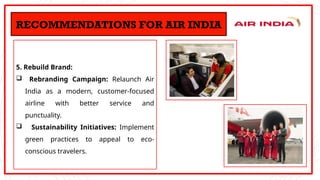
5. Rebuild Brand:
 Rebranding Campaign: Relaunch Air
India as a modern, customer-focused
airline with better service and
punctuality.
 Sustainability Initiatives: Implement
green practices to appeal to eco-
conscious travelers.
RECOMMENDATIONS FOR AIR INDIA
Tata Group’s acquisition of Air India presents both challenges and opportunities. To restore Air
India’s legacy, Tata must address operational inefficiencies, reduce debt, and improve customer
service. Leveraging its strengths in hospitality, technology, and synergies with Vistara and
AirAsia India, Tata can transform Air India into a competitive and profitable airline. Success will
hinge on effective execution in a highly competitive aviation market.
CONCLUSION
Air India Case Study.pptx which is presented in MBA class

Air India Case Study.pptx which is presented in MBA class

  • 1.
    AIR INDIA: BACKIN THE HANDS OF THE TATA GROUP Delivered By : Azimuddin Ahmed- SB23MBAGN31 Abhilash Dutta- SB23MBAGN27 Vicky Baruah-SB23MBAGN57 Niyarkana Kashyap- SB23MBAGN01 Kiranjot Kaur – SB23MBAGN10
  • 2.
    AIR INDIA -BACK IN THE HANDS OF THE TATA GROUP INTRODUCTION :- Founded: 1932 by J.R.D. Tata as Tata Airlines. Nationalization: In 1953, the Government of India took control. Re-privatization: Tata Sons reacquired Air India in October 2021, nearly 70 years later. Financial Troubles: Air India suffered from decades of losses and a heavy debt burden
  • 3.
    ASTHECASE GOESON ..  TATA’SREACQUISITION :-  Tata's subsidiary Talace Private Limited won the bid for $2.4 billion.  This included retaining $2 billion in debt and paying $400 million in cash.  Air India’s assets include Air India Express and a 50% stake in AISATS
  • 4.
  • 5.
    29 % 57 % 14 % High Risk ModerateRisk Low Risk 1. Financial Risk 2. Operational Efficiency Risk 3. Market and Competitive Risks 4. Human Resources and Labor Relations 5. Brand and Customer Perception Risk 6. Regulatory and Fuel Price Risks 7. Integration and Synergy Risks RISK ANALYSIS  High-Risk Areas (5): These are the most critical areas requiring immediate attention and restructuring.  Moderate (4): These areas need careful management but can be improved with strategy and
  • 6.
    RiskType Description ImpactLevel(1-5) Data/Stats Financial Risk Highdebt($2billion) andconsistentlosses. Tata faces theriskoffurtherfinancial strainif restructuringdoesn'tsucceed. 5 $2billionindebt, $4.5billioninlosses (2016- 2021) Operational EfficiencyRisk Underutilizedfleetandhighemployee-to- aircraftratio(290:1) makeoperational costs unsustainableunless optimized. 4 Employee-to-aircraftratio: 290:1; 141aircraft underutilized M arketand CompetitiveRisk AirIndia's 12.8%marketsharecompetes with dominantplayers likeIndiGo(53.5%). Maintainingcompetitiveness is a challenge. 4 IndiGo: 53.5%marketshare, AirIndia: 12.8% HumanResources andLabor Relations Largeworkforce(30,000+staff) andunionized laborcreateresistancetoworkforce rationalization, posingoperational risks. 5 30,000+employees, 9,000oncontract, high unioninfluence Brandand Customer PerceptionRisk Poorservicequality(42%on-timerate) and tarnishedreputationneedsignificant investmenttorestorecustomerconfidence. 3 42%on-timeperformance, lowcustomer satisfaction Regulatoryand Fuel PriceRisks Volatilefuel prices andhightaxes (45%of operational costs fromfuel) createuncertainty inprofitabilityandfinancial planning. 4 45%ofcosts fromATF, volatileprices dueto global conditions Integrationand SynergyRisks Managingthreeairlines (AirIndia, Vistara, AirAsia India) withoutinternal competitionor operational overlapis a keychallenge. 4 Potential overlapwithVistara andAirAsia India
  • 7.
  • 8.
    1932: Tata Airlines founded byJ.R.D. Tata. 1947: Government acquired 49% stake, renamed to Air India. 1948: Bombay to London route introduced. 1953: Air India nationalized. 1960: Introduced Boeing 707-420 jets. 1962: Became world’s first all-jet airline. 1993: First non- stop New York- Delhi flight (Boeing 747-400). 1997: Launched website and partnered with Air France. 2005: Launched low-cost airline, Air India Express. 2007: Joined Star Alliance. 2012: Posted losses, fell behind competitors. 2014: Joined Star Alliance. 2018: Failed privatization attempt. 2021: Tata Sons won bid, regained control of Air India EXHIBIT 1: KEY MILESTONES IN AIR INDIA’S HISTORY
  • 9.
    IndiGo 48% SpiceJet 15% Air India (including Air IndiaExpress, its low-cost carrier) 13% GoAir 12% AirAsia India 6% Vistara 6% Domestic Market Share % On-time Performance (%) Air India had the worst on-time performance at 42%, significantly below competitors such as GoAir and Vistara (~67%). This poor punctuality contributed to the airline’s negative customer perception. EXHIBIT 3: AIRLINE PUNCTUALITY AT FOUR AIRPORTS IN INDIA IN NOVEMBER 2019
  • 10.
    0 50 100 150 200 250 EXHIBIT 2: COMPETITIVE LANDSCAPEIN THE SECOND QUARTER OF 2020 FOR SELECTED AIRLINES IN INDIA
  • 11.
    $4.545 Billion (₹37,723.5 CR) $838 Million $695 Million $1.1 Billion$1 Billion $912 Million (₹5,768.5 CR) (₹6,955.4 CR) (₹8,300 CR) (₹9,130 CR) (₹7,569.6 CR) 2016–2017 2017–2018 2018–2019 2019–2020 2020–2021 ₹0.00 ₹1,000.00 ₹2,000.00 ₹3,000.00 ₹4,000.00 ₹5,000.00 ₹6,000.00 ₹7,000.00 ₹8,000.00 ₹9,000.00 ₹10,000.00 Loss reported (in Crore ₹) -20.58% + 3 6 . 8 2 % -10 % -9.65 % 1. 2016–2017: $838 million Loss Aging fleet, high employee costs, intense competition from low-cost carriers (LCCs). 2. 2017–2018: $695 million Loss High debt, inefficient fleet utilization, increased competition. 3. 2018–2019: $1.1 billion Loss Over-expansion, rising fuel costs, poor customer perception, service quality issues. 4. 2019–2020: $1 billion Loss Unpaid government bills, poor on-time performance, high operational costs, and airport charges. 5. 2020–2021: $912 million Loss COVID-19 pandemic impact, reduced passenger traffic, grounded flights, fuel price volatility. 2016-17 2017-18 2018-19 2019-20 2020-21 TOTAL LOSS EXHIBIT 4: FINANCIAL LOSSES REPORTED BY AIR INDIA - 2016–2021
  • 12.
  • 13.
    Case Solution Problem- FinancialRisk Solution- 1.Restructuring and Debt Management 2.Cost Optimization 3.Increase Revenue Streams Problem- Operational Efficiency Risk Solution- 1.Underutilized Aircraft to Connect Untouched Airports 2.Employee Rationalization
  • 14.
    Case Solution Problem- Marketand Competitive Risk Solution- 1. Match Fare Structures 2. Increase Customer Touchpoints 3. Focus on Customer Satisfaction 4. Partnerships and Alliances Problem-Human Resources and Labor Relations Solution- 5. Negotiation with Unions 6. Human Resource Restructuring
  • 15.
    Case Solution Problem-Brand andCustomer Perception Risk Solution- 1. Service Quality Improvement 2. Digital Transformation Problem- Regulatory and Fuel Price Risks Solution- 3. Fuel Price Hedging 4. Lobbying for Tax Cuts Problem- Integration and Synergy Risks Solution- 1. Synergy Optimization 2. Shared Services
  • 16.
  • 17.
    1. Optimize Operations: Streamline Workforce: Reduce excess staff through voluntary retirements to improve cost efficiency.  Maximize Aircraft Usage: Better plan schedules and routes to avoid underutilization of planes. RECOMMENDATIONS FOR AIR INDIA 2. Improve Customer Experience:  Upgrade Service Quality: Use Tata’s hospitality expertise (like Taj Hotels) to enhance in-flight services and improve customer satisfaction.  Digitize Operations: Invest in technology for smoother booking, better in-flight connectivity, and enhanced customer support.
  • 18.
    3. Manage Financials: Reduce Debt: Focus on paying down Air India’s massive debt by managing costs and refinancing where possible.  Lower Costs: Negotiate with airports for lower fees and explore other cost- cutting measures. RECOMMENDATIONS FOR AIR INDIA 4. Boost Competitiveness:  Leverage Synergies: Combine operations with Tata’s other airlines (Vistara, AirAsia India) to optimize routes and services.  Focus on International Routes: Strengthen long-haul routes to attract international travelers.
  • 19.
    5. Rebuild Brand: Rebranding Campaign: Relaunch Air India as a modern, customer-focused airline with better service and punctuality.  Sustainability Initiatives: Implement green practices to appeal to eco- conscious travelers. RECOMMENDATIONS FOR AIR INDIA
  • 20.
    Tata Group’s acquisitionof Air India presents both challenges and opportunities. To restore Air India’s legacy, Tata must address operational inefficiencies, reduce debt, and improve customer service. Leveraging its strengths in hospitality, technology, and synergies with Vistara and AirAsia India, Tata can transform Air India into a competitive and profitable airline. Success will hinge on effective execution in a highly competitive aviation market. CONCLUSION